Hydrologic Responses of Angat Dam Watershed, Philippines Using Different Reservoir Configurations in the Soil and Water Assessment Tool (SWAT)


 ,
,  and
and
Abstract
1. Introduction
2. Materials and Methods
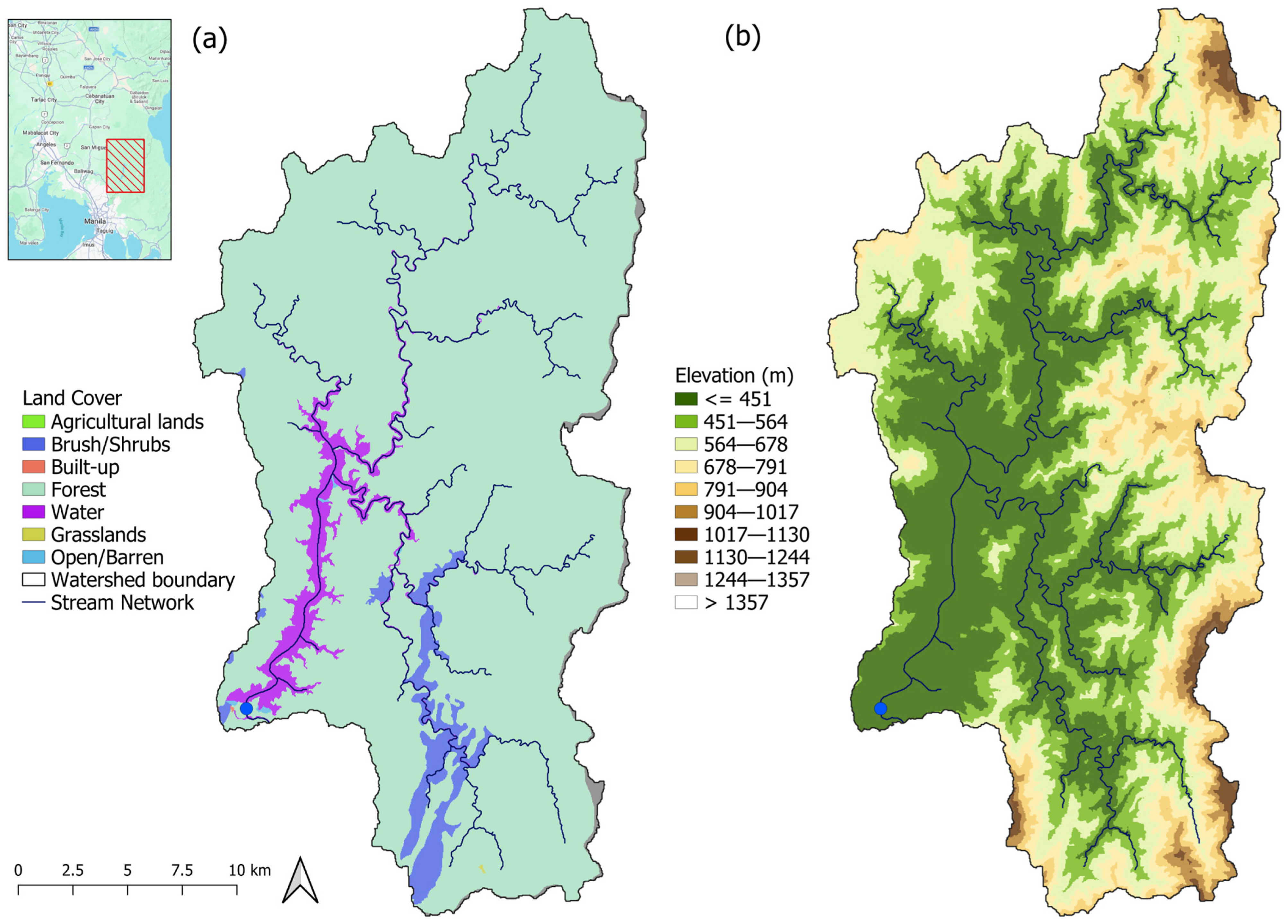
2.1. Study Area
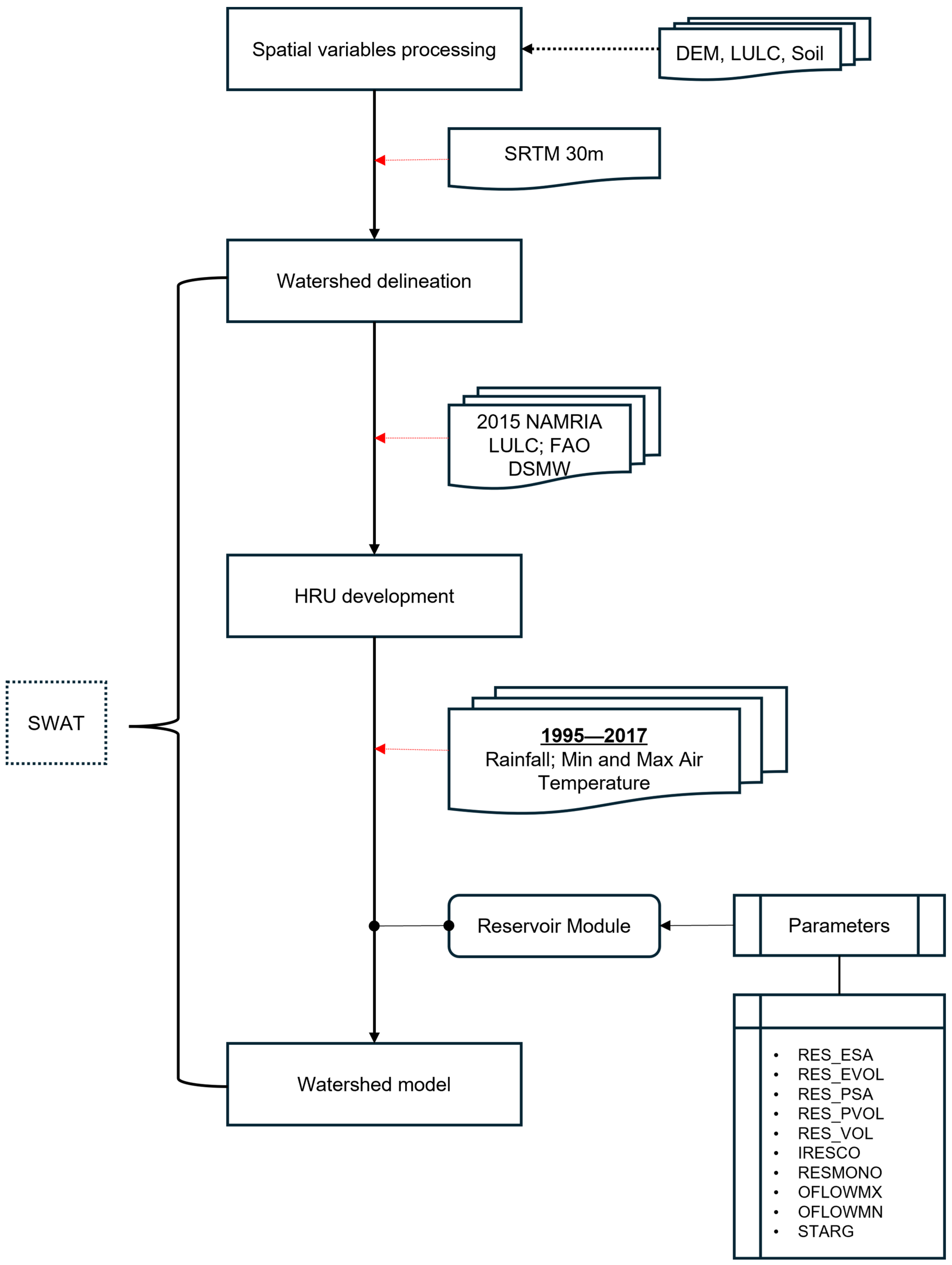
2.2. SWAT Model
2.3. Reservoir Module Parameters
2.4. Sensitivity Analysis and Model Calibration
3. Results and Discussion
3.1. Sensitivity Analysis
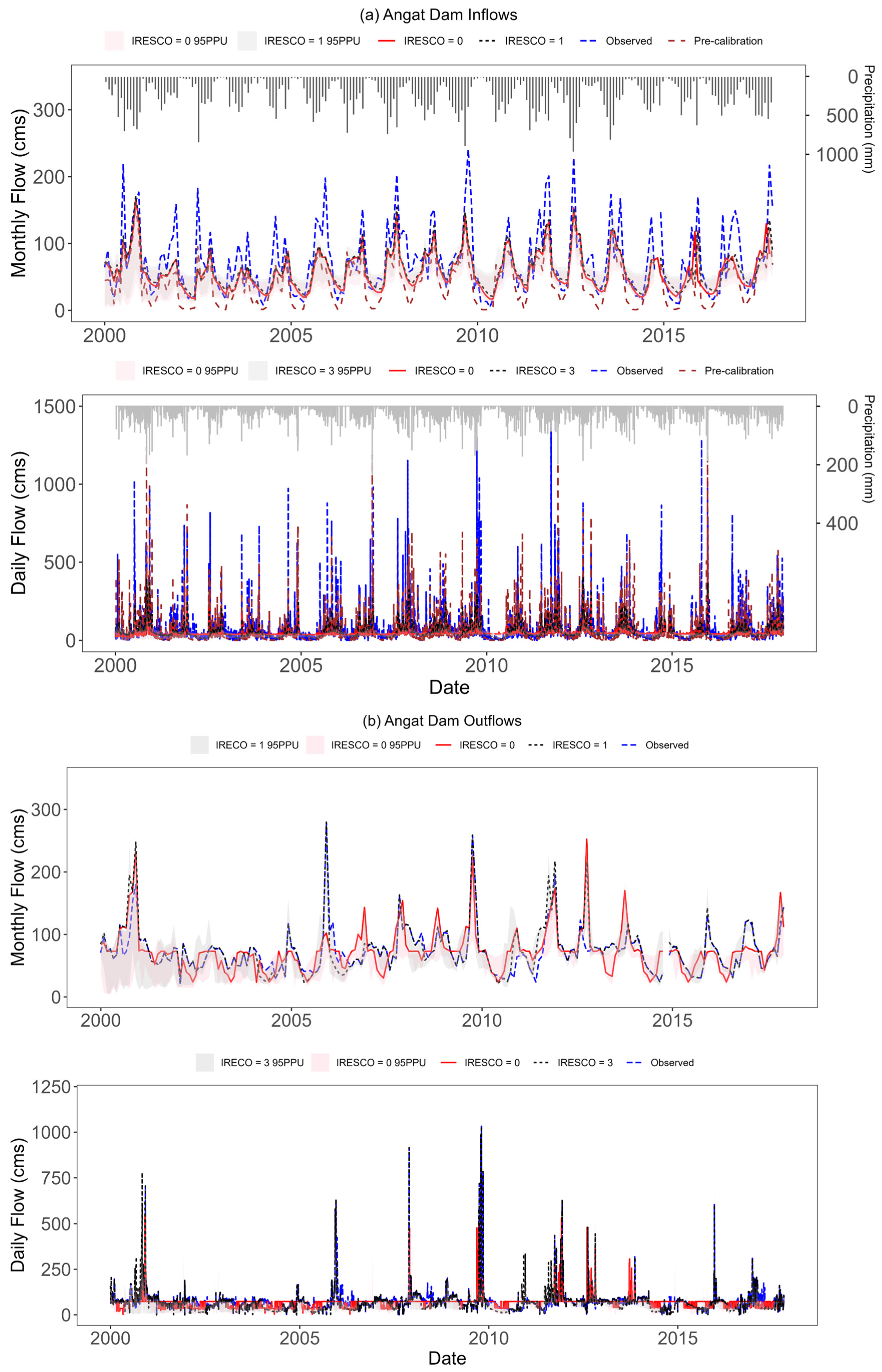
3.2. Uncertainty Analysis and Model Performance of Reservoir Estimations
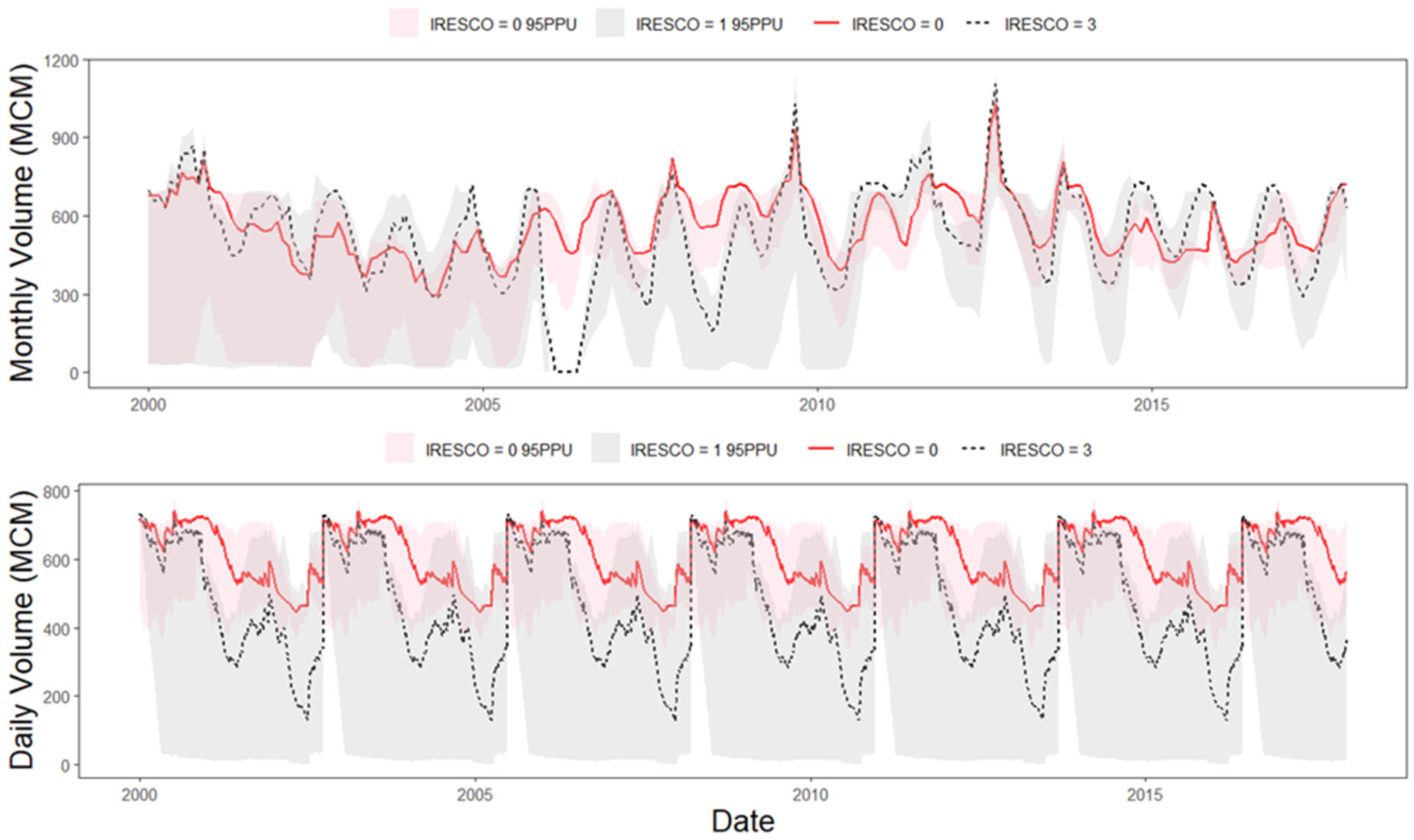
3.3. Estimation of the Reservoir Volume
4. Conclusions
Author Contributions
Funding
Data Availability Statement
Acknowledgments
Conflicts of Interest
References
- Jalali, J.; Ahmadi, A.; Abbaspour, K. Runoff responses to human activities and climate change in an arid watershed of central Iran. Hydrol. Sci. J. 2021, 66, 2280–2297. [Google Scholar] [CrossRef]
- Wei, D.; Liu, S.; Wu, Y.; Feng, S.; Gao, H.; Qin, C.; Ren, D.; Tang, W.; Zhang, Y. Impacts of human activities and climate change on water and sediment evolution in four large subtropical river basins in China. Ecol. Indic. 2023, 155, 110958. [Google Scholar] [CrossRef]
- Xue, B.; Helman, D.; Wang, G.; Xu, C.Y.; Xiao, J.; Liu, T.; Wang, L.; Li, X.; Duan, L.; Lei, H. The low hydrologic resilience of Asian Water Tower basins to adverse climatic changes. Adv. Water Resour. 2021, 155, 103996. [Google Scholar] [CrossRef]
- Rodriguez, B.C.; Palma-Torres, V.M.; Castañeda, T.J.; Codtiyeng, S.K.; Castillo, J.F.; Sasi, A.P.V.; Tercero, M.U.; Andrada, R.T. Drivers and impacts of land use and land cover changes on ecosystem services provided by the watersheds in the Philippines: A systematic literature review. Int. For. Rev. 2023, 25, 473–490. [Google Scholar] [CrossRef]
- Guiamel, I.A.; Lee, H.S. Watershed modelling of the Mindanao River Basin in the Philippines using the SWAT for water resource management. Civ. Eng. J. 2020, 6, 626–648. [Google Scholar] [CrossRef]
- Hoey, T.B.; Tolentino, P.L.M.; Guardian, E.; Perez, J.E.G.; Williams, R.D.; Boothroyd, R.; David, C.P.C.; Paringit, E.C. Integrating historical archives and geospatial data to revise flood estimation equations for Philippine rivers. Hydrol. Earth Syst. Sci. 2025, 29, 6181–6200. [Google Scholar] [CrossRef]
- Gacu, J.G.; Monjardin, C.E.F.; Mangulabnan, R.G.T.; Mendez, J.C.F. Application of Artificial Intelligence in Hydrological Modeling for Streamflow Prediction in Ungauged Watersheds: A Review. Water 2025, 17, 2722. [Google Scholar] [CrossRef]
- Edward, C.; Monjardin, F.; Aldrine, F.A.U.; Tan, F.J. Estimation of River Discharge at Ungauged Catchment using GIS Map Correlation Method as Applied in Sta. Lucia River in Mauban, Quezon, Philippines. IOP Conf. Ser. Mater. Sci. Eng. 2017, 216, 012045. [Google Scholar]
- Rice, J.S.; Emanuel, R.E.; Vose, J.M. The influence of watershed characteristics on spatial patterns of trends in annual scale streamflow variability in the continental US. J. Hydrol. 2016, 540, 850–860. [Google Scholar] [CrossRef]
- Neupane, R.P.; Kumar, S. Estimating the effects of potential climate and land use changes on hydrologic processes of a large agriculture dominated watershed. J. Hydrol. 2015, 529, 418–429. [Google Scholar] [CrossRef]
- Fan, M.; Shibata, H. Simulation of watershed hydrology and stream water quality under land use and climate change scenarios in Teshio River watershed, northern Japan. Ecol. Indic. 2015, 50, 79–89. [Google Scholar] [CrossRef]
- Lawal, I.M.; Bertram, D.; White, C.J.; Jagaba, A.H. Integrated framework for hydrologic modelling in data-sparse watersheds and climate change impact on projected green and blue water sustainability. Front. Environ. Sci. 2023, 11, 1233216. [Google Scholar] [CrossRef]
- Sahu, M.K.; Shwetha, H.R.; Dwarakish, G.S. State-of-the-art hydrological models and application of the HEC-HMS model: A review. Model. Earth Syst. Environ. 2023, 9, 3029–3051. [Google Scholar] [CrossRef]
- Siddique, R.; Sharma, S.; McCreight, J. Hydrological modeling, analyses, and predictions: Opportunities and challenges. Front. Water 2023, 4, 1121534. [Google Scholar] [CrossRef]
- Robles, K.P.V.; Monjardin, C.E.F. Forecasting Climate Change Impacts on Water Security Using HEC-HMS: A Case Study of Angat Dam in the Philippines. Water 2025, 17, 2085. [Google Scholar] [CrossRef]
- Tejada, A.T., Jr.; Sanchez, P.A.J.; Faderogao, F.J.F.; Gigantone, C.B.; Luyun, R.A., Jr. Spatiotemporal Analysis of Extreme Rainfall and Meteorological Drought Events over the Angat Watershed, Philippines. Atmosphere 2023, 14, 1790. [Google Scholar] [CrossRef]
- Tabios, G.Q., III. Water Resources Systems of the Philippines: Modeling Studies; Springer Nature: Cham, Switzerland, 2020; Volume 4. [Google Scholar]
- Mamidala, R.; Liu, L. Tile-drainage and Crop Rotation Enhanced Cropland Dataset to Improve Spatial Accuracy of Eco-hydrologic Models. Sci. Data 2026, 13, 321. [Google Scholar] [CrossRef]
- Wang, Z.; He, Y.; Li, W.; Chen, X.; Yang, P.; Bai, X. A generalized reservoir module for SWAT applications in watersheds regulated by reservoirs. J. Hydrol. 2023, 616, 128770. [Google Scholar] [CrossRef]
- Sánchez-Gómez, A.; Arnold, J.G.; Bieger, K.; Čerkasova, N.; Sammons, N.B.; Martínez-Pérez, S.; Molina-Navarro, E. Modelling water management using SWAT+: Application of reservoirs release tables and the new water allocation module in a highly managed river basin. Water Resour. Manag. 2025, 39, 2357–2399. [Google Scholar] [CrossRef]
- Liu, Y.; Liu, L.; Li, L.; Li, H.; Xu, H.; Yang, J.; Tao, S.; Zhu, B. Changes in Runoff in the Source Region of the Yellow River Basin Based on CMIP6 Data under the Goal of Carbon Neutrality. Water 2023, 15, 2457. [Google Scholar] [CrossRef]
- Rola, A.; Francisco, H.; Liguton, J. (Eds.) Winning the Water War: Watersheds, Water Policies and Water Institutions; Philippine Institute for Development Studies: Quezon City, Philippines, 2014.
- Ibañez, S.C.; Dajac, C.V.G.; Liponhay, M.P.; Legara, E.F.T.; Esteban, J.M.H.; Monterola, C.P. Forecasting Reservoir Water Levels Using Deep Neural Networks: A Case Study of Angat Dam in the Philippines. Water 2022, 14, 34. [Google Scholar] [CrossRef]
- Tabios, G.Q., III. Angat Multipurpose Reservoir with Increased Water Demand and Future Reservoir Sedimentation. DLSU Bus. Econ. Rev. 2018, 28, 32–39. [Google Scholar] [CrossRef]
- JICA. The Study on Integrated Water Resources Management for Poverty Alleviation and Economic Development in the Pampanga River Basin; Japan International Cooperation Agency: Tokyo, Japan, 2011.
- Kim, H.; Parajuli, P.B. Impacts of reservoir outflow estimation methods in SWAT model calibration. Trans. ASABE 2014, 57, 1029–1042. [Google Scholar] [CrossRef]
- Arnold, J.G.; Kiniry, J.R.; Srinivasan, R.; Williams, J.R.; Haney, E.B.; Neitsch, S.L. SWAT Input/Output Documentation v.2012; Texas Water Resources Institute: College Station, TX, USA, 2012.
- Funk, C.C.; Peterson, P.J.; Landsfeld, M.F.; Pedreros, D.H.; Verdin, J.P.; Rowland, J.D.; Romero, B.E.; Husak, G.J.; Michaelsen, J.C.; Verdin, A.P. A Quasi-Global Precipitation Time Series for Drought Monitoring (Nos 2327-638X; Issues 2327-638X); US Geological Survey: Reston, VA, USA, 2014.
- Verdin, A.; Funk, C.; Peterson, P.; Landsfeld, M.; Tuholske, C.; Grace, K. Development and validation of the CHIRTS-daily quasi-global high-resolution daily temperature data set. Sci. Data 2020, 7, 303. [Google Scholar] [CrossRef]
- Nguyen, T.V.; Dietrich, J.; Dang, T.D.; Tran, D.A.; Van Doan, B.; Sarrazin, F.J.; Abbaspour, K.; Srinivasan, R. An interactive graphical interface tool for parameter calibration, sensitivity analysis, uncertainty analysis, and visualization for the Soil and Water Assessment Tool. Environ. Model. Softw. 2022, 156, 105497. [Google Scholar] [CrossRef]
- Abbaspour, K.C.; Johnson, C.A.; van Genuchten, M.T. Estimating Uncertain Flow and Transport Parameters Using a Sequential Uncertainty Fitting Procedure. Vadose Zone J. 2004, 3, 1340–1352. [Google Scholar] [CrossRef]
- Abbaspour, K.C.; Yang, J.; Maximov, I.; Siber, R.; Bogner, K.; Mieleitner, J.; Zobrist, J.; Srinivasan, R. Modelling hydrology and water quality in the pre-alpine/alpine Thur watershed using SWAT. J. Hydrol. 2007, 333, 413–430. [Google Scholar] [CrossRef]
- Moriasi, D.; Arnold, J.; Van Liew, M.; Bingner, R.; Harmel, R.D.; Veith, T. Model Evaluation Guidelines for Systematic Quantification of Accuracy in Watershed Simulations. Trans. ASABE 2007, 50, 885–900. [Google Scholar] [CrossRef]
- Kalin, L.; Isik, S.; Schoonover, J.E.; Lockaby, B.G. Predicting water quality in unmonitored watersheds using artificial neural networks. J. Environ. Qual. 2010, 39, 1429–1440. [Google Scholar] [CrossRef]
- Arnold, J.G.; Moriasi, D.N.; Gassman, P.W.; Abbaspour, K.C.; White, M.J.; Srinivasan, R.; Santhi, C.; Harmel, R.; Van Griensven, A.; Van Liew, M.W.; et al. SWAT: Model use, calibration, and validation. Trans. ASABE 2012, 55, 1491–1508. [Google Scholar] [CrossRef]
- Liu, X.; Yang, M.; Meng, X.; Wen, F.; Sun, G. Assessing the Impact of Reservoir Parameters on Runoff in the Yalong River Basin using the SWAT Model. Water 2019, 11, 643. [Google Scholar] [CrossRef]
- Devkota, N.; Lamichhane, S.; Bhattarai, P.K. Multi-site calibration of the SWAT hydrological model and study of spatio-temporal variation of water balance components in the Narayani River Basin, central part of Nepal. H2Open J. 2024, 7, 114–129. [Google Scholar] [CrossRef]
- Duan, Y.; Meng, F.; Liu, T.; Huang, Y.; Luo, M.; Xing, W.; De Maeyer, P. Sub-Daily Simulation of Mountain Flood Processes Based on the Modified Soil Water Assessment Tool (SWAT) Model. Int. J. Environ. Res. Public Health 2019, 16, 3118. [Google Scholar] [CrossRef]
- Neitsch, S.L.; Arnold, J.G.; Kiniry, J.R.; Williams, J.R. Soil and Water Assessment Tool Theoretical Documentation Version 2009; Texas Water Resources Institute: College Station, TX, USA, 2011.
- Javed, A.; Neumann, A.; Cai, H.; Arnillas, C.A.; Arhonditsis, G.B. A reservoir-based approach of the SWAT hydrological model in the Napanee River and Wilton Creek agricultural watersheds, Bay of Quinte. J. Great Lakes Res. 2024, 50, 102404. [Google Scholar] [CrossRef]
- Jalowska, A.M.; Yuan, Y. Evaluation of SWAT impoundment modeling methods in water and sediment simulations. JAWRA J. Am. Water Resour. Assoc. 2019, 55, 209–227. [Google Scholar] [CrossRef]



| Reservoir Parameters | Definition (Arnold, Kiniry, et al., 2012 [27]) | Assigned Values (Units) | |
|---|---|---|---|
| IRESCO | Outflow simulation code 0—Average annual release rate 1—Measured monthly outflow 2—Controlled outflow—target release 3—measured daily outflow | 0 (Monthly and daily timestep) 1 (Monthly timestep) 3 (Daily timestep) | |
| RES_ESA | Reservoir surface area when the reservoir is filled to the emergency spillway | 21,000 ha | |
| RES_EVOL | Volume of water needed to fill the reservoir to the emergency spillway | 73,788 (104 m3) | |
| RES_PSA | Reservoir surface area when the reservoir is filled to the principal spillway | 19,500 ha | |
| RES_PVOL | Volume of water needed to fill the reservoir to the principal spillway | 46,981 (104 m3) | |
| RES_VOL | Initial reservoir volume | 46,981 (104 m3) | |
| RESMONO | Monthly reservoir outflow file | ||
| RESDAYO | Daily reservoir outflow file | ||
| RES_RR | Average release rate (m3/s) | 44.5148 (m3/s) | |
| OFLOWMX | Maximum outflow for the month (m3/s) | Monthly TS [1] 122.8 [2] 119.49 [3] 97.28 [4] 82.87 [5] 90.32 [6] 102.69 [7] 115.32 [8] 112.84 [9] 110.27 [10] 258.95 [11] 167.91 [12] 279.56 | Daily TS 206.44 196.35 140.71 174.15 174.19 155.61 170.03 480.1 584.14 1032.45 915.21 704.87 |
| OFLOWMN | Minimum outflow for the month (m3/s) | Monthly TS [1] 68.36 [2] 23.36 [3] 58.34 [4] 39.62 [5] 35.57 [6] 24.04 [7] 30.42 [8] 29.5 [9] 24.42 [10] 30.51 [11] 30.66 [12] 64.08 | Daily TS 37.71 10 0 35.06 3.28 6.98 3 0.58 0.96 1.42 15.25 0 |
| STARG | Target reservoir storage | Set to RES_PVOL | |
| Parameter Name | Definition | Method | Min | Max | Fitted Parameters | |
|---|---|---|---|---|---|---|
| Monthly TS | Daily TS | |||||
| ALPHA_BF.gw | Baseflow alpha factor | Replace | 0 | 0.2 | 0.0382 | 0.117 |
| GW_DELAY.gw | Groundwater delay time | Replace | 250 | 450 | 364.2 | 421 |
| GW_REVAP.gw | Groundwater “revap” coefficient | Replace | 0 | 0.3 | 0.2577 | 0.0885 |
| GWQMN.gw | Threshold depth of water in the shallow aquifer required for return flow to occur (mm H2O) | Replace | 5000 | 8000 | 7853 | 7937 |
| REVAPMN.gw | Threshold depth of water in the shallow aquifer for “revap” or percolation to the deep aquifer to occur (mm H2O) | Replace | 200 | 500 | 449.9 | 283.1 |
| RCHRG_DP.gw | Deep aquifer percolation fraction | Replace | 0.1 | 0.5 | 0.242 | 0.2492 |
| EPCO.hru | Plant uptake compensation factor | Replace | 0.1 | 0.4 | 0.2605 | 0.2995 |
| CN2.mgt | SCS runoff curve number | Relative | 0.2 | 0.8 | 0.2066 | 0.635 |
| CH_K2.rte | Effective hydraulic conductivity in main channel alluvium | Replace | 50 | 80 | 57.95 | 50.69 |
| CH_N2.rte | Manning’s “n” value for the main channel | Replace | 0.1 | 0.3 | 0.101 | 0.1938 |
| SOL_AWC.sol | Available water capacity of the soil | Relative | −0.039 | 0.524 | 0.302935 | 0.434663 |
| SOL_K.sol | Saturated hydraulic conductivity | Absolute | 101.976 | 524.444 | 460.6515 | 462.3414 |
| CH_N1.sub | Manning’s “n” value for the tributary channels | Replace | 0 | 21.742 | 15.24123 | 21.28553 |
| ESCO.hru | Soil evaporation compensation factor | Replace | 0.4 | 0.7 | 0.5539 | 0.5755 |
| SOL_BD.sol | Moist bulk density | Relative | −0.021 | −0.198 | −0.13436 | −0.10015 |
| ALPHA_BNK.rte | Baseflow alpha factor for bank storage | Replace | 0 | 0.05 | 0.03315 | 0.04945 |
| LAT_TTIME.hru | Lateral flow travel time | Replace | −0.223 | 0.291 | 0.128211 | 0.051153 |
| SURLAG.hru | Surface runoff lag time | Relative | −0.1 | 0.3 | 0.2324 | 0.214 |
| TLAPS.sub | Temperature lapse rate (°C/km) | Replace | −3 | −1 | −2.187 | −2.187 |
| PLAPS.sub | Precipitation lapse rate (mm H2O/km) | Replace | 0 | 5 | 0.0937 | 0.0937 |
| Performance Rating | RSR 1 | NSE 2 | PBIAS 3 (%) |
|---|---|---|---|
| Very good | PBIAS < ±10 | ||
| Monthly | 0.00 ≤ RSR ≤ 0.50 | 0.75 < NSE ≤ 1.00 | |
| Daily | 0.00 ≤ RSR ≤ 0.25 | NSE ≥ 0.70 | |
| Good | ±10 ≤ PBIAS < ±15 | ||
| Monthly | 0.50 < RSR ≤ 0.60 | 0.65 < NSE ≤ 0.75 | |
| Daily | 0.25 < RSR ≤ 0.50 | 0.50 ≤ NSE < 0.70 | |
| Satisfactory | ±15 ≤ PBIAS < ±25 | ||
| Monthly | 0.60 < RSR ≤ 0.70 | 0.50 < NSE ≤ 0.65 | |
| Daily | 0.50 < RSR ≤ 0.70 | 0.30 ≤ NSE < 0.50 | |
| Unsatisfactory | PBIAS ≥ ±25 | ||
| Monthly | RSR > 0.70 | NSE ≤ 0.50 | |
| Daily | RSR > 0.70 | 0.3 < NSE |
| Monthly Timestep Model | Daily Timestep Model | ||||
|---|---|---|---|---|---|
| Parameters | p-Value | Ranking | Parameters | p-Value | Ranking |
| PLAPS.sub | 3.64 × 10−52 | 1 | PLAPS.sub | 2.67 × 10−63 | 1 |
| ALPHA_BNK.rte | 1.15 × 10⁻¹² | 2 | ALPHA_BNK.rte | 1.21 × 10⁻¹⁷ | 2 |
| EPCO.hru | 2.19 × 10⁻¹ | 3 | CH_K2.rte | 2.52 × 10⁻² | 3 |
| GW_REVAP.gw | 2.25 × 10⁻¹ | 4 | TLAPS.sub | 3.17 × 10⁻² | 4 |
| CN2.mgt | 2.36 × 10⁻¹ | 5 | GW_REVAP.gw | 1.54 × 10⁻¹ | 5 |
| SURLAG.hru | 2.45 × 10⁻¹ | 6 | ESCO.hru | 2.17 × 10⁻¹ | 6 |
| TLAPS.sub | 2.66 × 10⁻¹ | 7 | EPCO.hru | 2.23 × 10⁻¹ | 7 |
| CH_N1.sub | 2.70 × 10⁻¹ | 8 | RCHRG_DP.gw | 2.49 × 10⁻¹ | 8 |
| RCHRG_DP.gw | 3.00 × 10⁻¹ | 9 | SOL_BD().sol | 3.07 × 10⁻¹ | 9 |
| GW_DELAY.gw | 4.00 × 10⁻¹ | 10 | SOL_AWC().sol | 4.57 × 10⁻¹ | 10 |
| CH_N2.rte | 4.30 × 10⁻¹ | 11 | LAT_TTIME.hru | 5.05 × 10⁻¹ | 11 |
| GWQMN.gw | 4.42 × 10⁻¹ | 12 | CH_N1.sub | 5.30 × 10⁻¹ | 12 |
| ESCO.hru | 4.55 × 10⁻¹ | 13 | GWQMN.gw | 5.42 × 10⁻¹ | 13 |
| SOL_BD().sol | 4.61 × 10⁻¹ | 14 | SURLAG.hru | 6.31 × 10⁻¹ | 14 |
| CH_K2.rte | 5.14 × 10⁻¹ | 15 | CN2.mgt | 6.46 × 10⁻¹ | 15 |
| ALPHA_BF.gw | 6.03 × 10⁻¹ | 16 | GW_DELAY.gw | 6.89 × 10⁻¹ | 16 |
| LAT_TTIME.hru | 7.21 × 10⁻¹ | 17 | ALPHA_BF.gw | 8.28 × 10⁻¹ | 17 |
| SOL_K().sol | 8.53 × 10⁻¹ | 18 | REVAPMN.gw | 8.81 × 10⁻¹ | 18 |
| REVAPMN.gw | 8.62 × 10⁻¹ | 19 | SOL_K().sol | 8.94 × 10⁻¹ | 19 |
| SOL_AWC().sol | 9.00 × 10⁻¹ | 20 | CH_N2.rte | 9.82 × 10⁻¹ | 20 |
Disclaimer/Publisher’s Note: The statements, opinions and data contained in all publications are solely those of the individual author(s) and contributor(s) and not of MDPI and/or the editor(s). MDPI and/or the editor(s) disclaim responsibility for any injury to people or property resulting from any ideas, methods, instructions or products referred to in the content. |
© 2026 by the authors. Licensee MDPI, Basel, Switzerland. This article is an open access article distributed under the terms and conditions of the Creative Commons Attribution (CC BY) license.
Share and Cite
Barrias, C.D.; Cabigao, K.M.F.; Apan, A.A.; Aragones, L.V.; Ligaray, M.V. Hydrologic Responses of Angat Dam Watershed, Philippines Using Different Reservoir Configurations in the Soil and Water Assessment Tool (SWAT). Water 2026, 18, 1417. https://doi.org/10.3390/w18121417
Barrias CD, Cabigao KMF, Apan AA, Aragones LV, Ligaray MV. Hydrologic Responses of Angat Dam Watershed, Philippines Using Different Reservoir Configurations in the Soil and Water Assessment Tool (SWAT). Water. 2026; 18(12):1417. https://doi.org/10.3390/w18121417
Chicago/Turabian StyleBarrias, Carolyn D., Kean Michael F. Cabigao, Armando A. Apan, Lemnuel V. Aragones, and Mayzonee V. Ligaray. 2026. "Hydrologic Responses of Angat Dam Watershed, Philippines Using Different Reservoir Configurations in the Soil and Water Assessment Tool (SWAT)" Water 18, no. 12: 1417. https://doi.org/10.3390/w18121417
APA StyleBarrias, C. D., Cabigao, K. M. F., Apan, A. A., Aragones, L. V., & Ligaray, M. V. (2026). Hydrologic Responses of Angat Dam Watershed, Philippines Using Different Reservoir Configurations in the Soil and Water Assessment Tool (SWAT). Water, 18(12), 1417. https://doi.org/10.3390/w18121417