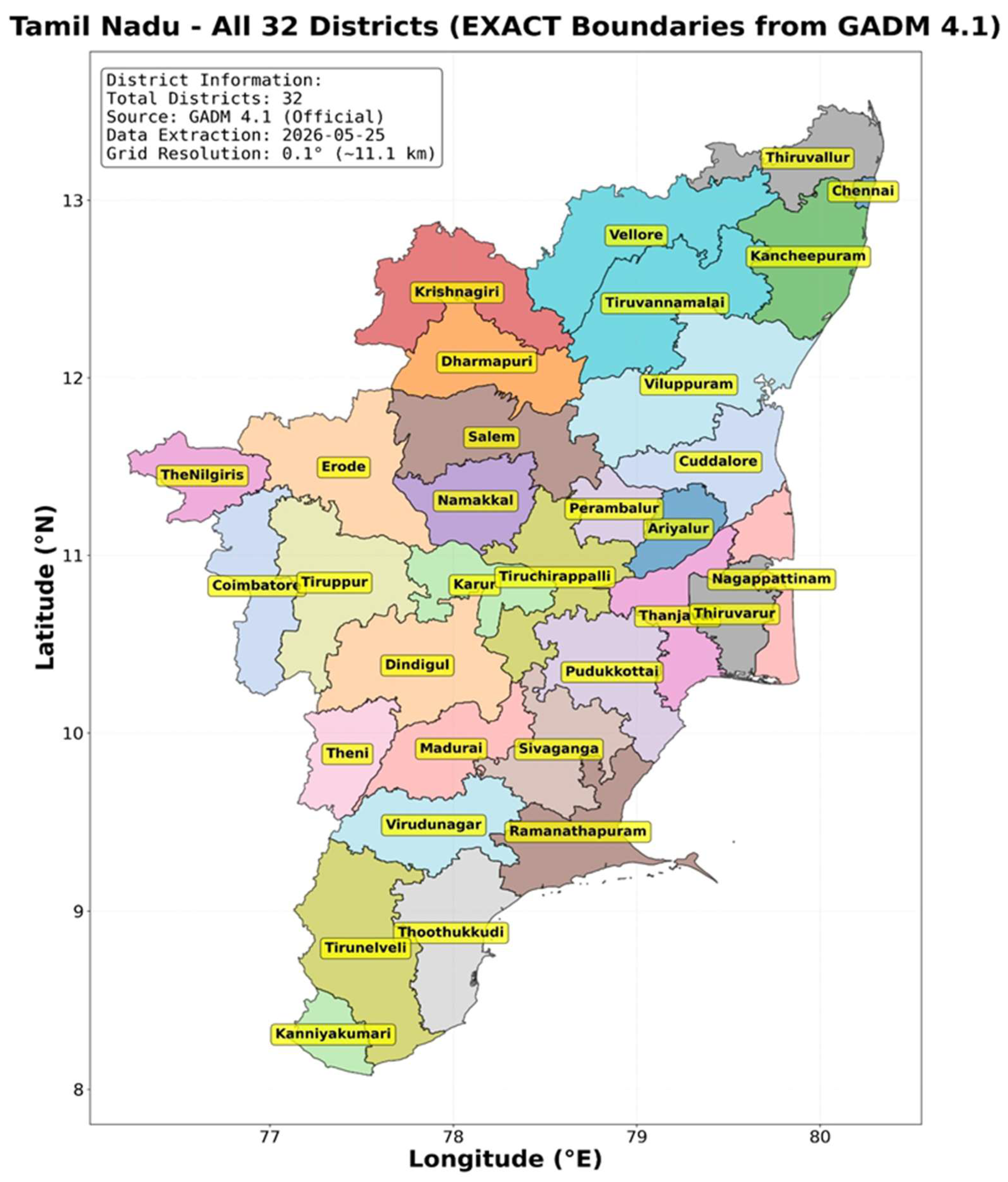
Figure 1.
Study area: 32 administrative districts of Tamil Nadu, India, with five colour-coded climatic zones (coastal-humid, inland-arid, Western Ghats-influenced, semi-arid transition, southern coastal). Boundaries: GADM v4.1 Level-2. Inset shows elevation (SRTM 30 m) overlaid with the 1086 0.1° × 0.1° grid points used for NASA POWER queries.
Figure 1.
Study area: 32 administrative districts of Tamil Nadu, India, with five colour-coded climatic zones (coastal-humid, inland-arid, Western Ghats-influenced, semi-arid transition, southern coastal). Boundaries: GADM v4.1 Level-2. Inset shows elevation (SRTM 30 m) overlaid with the 1086 0.1° × 0.1° grid points used for NASA POWER queries.
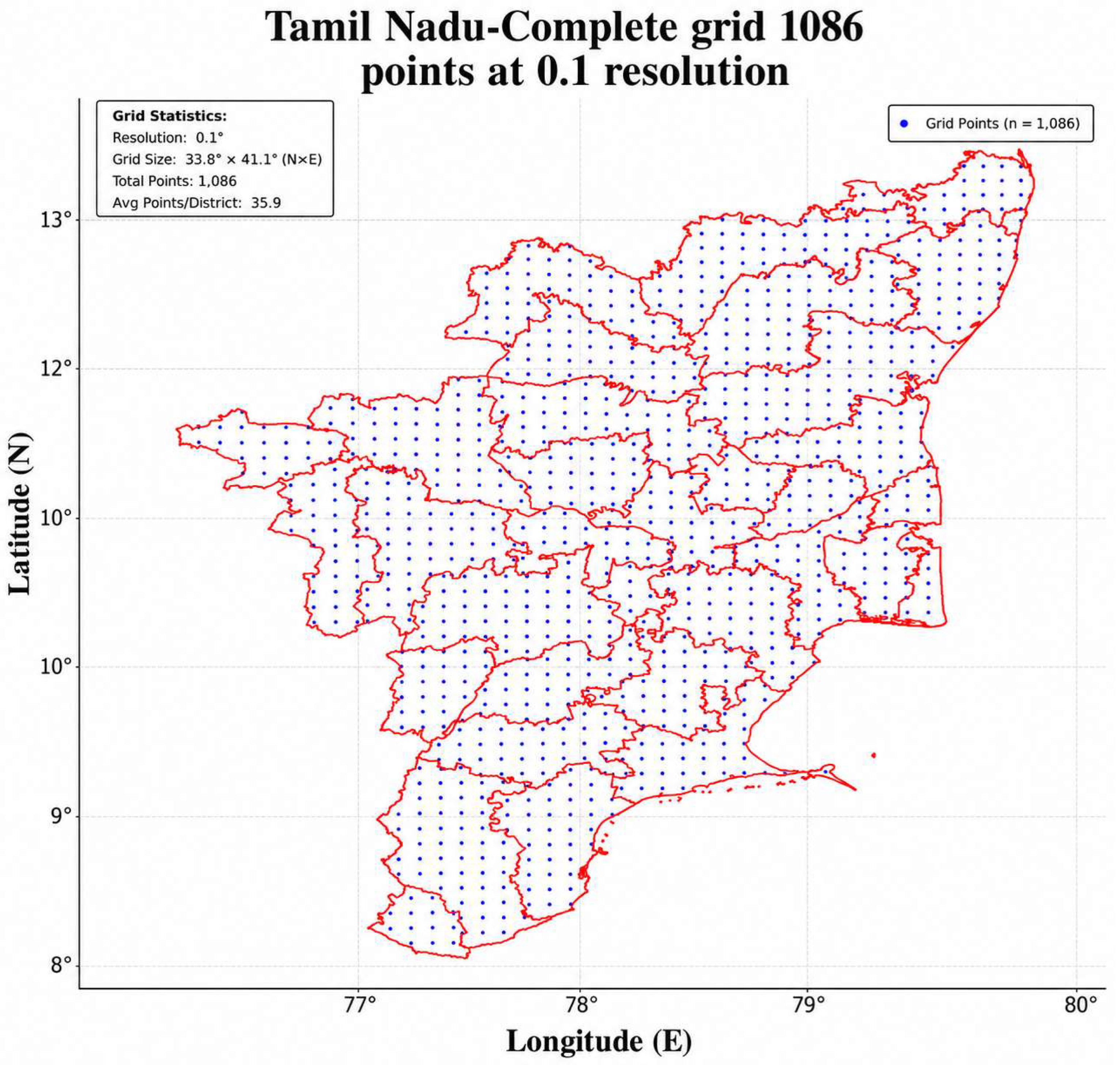
Figure 2.
Spatial grid used for climate data acquisition. Each district contains 1–125 grid points at 0.1° (≈11 km) resolution, totalling 1086 grid points. Grid points are strictly contained within district polygons (GADM v4.1 Level-2) to avoid cross-boundary leakage during spatial aggregation.
Figure 2.
Spatial grid used for climate data acquisition. Each district contains 1–125 grid points at 0.1° (≈11 km) resolution, totalling 1086 grid points. Grid points are strictly contained within district polygons (GADM v4.1 Level-2) to avoid cross-boundary leakage during spatial aggregation.
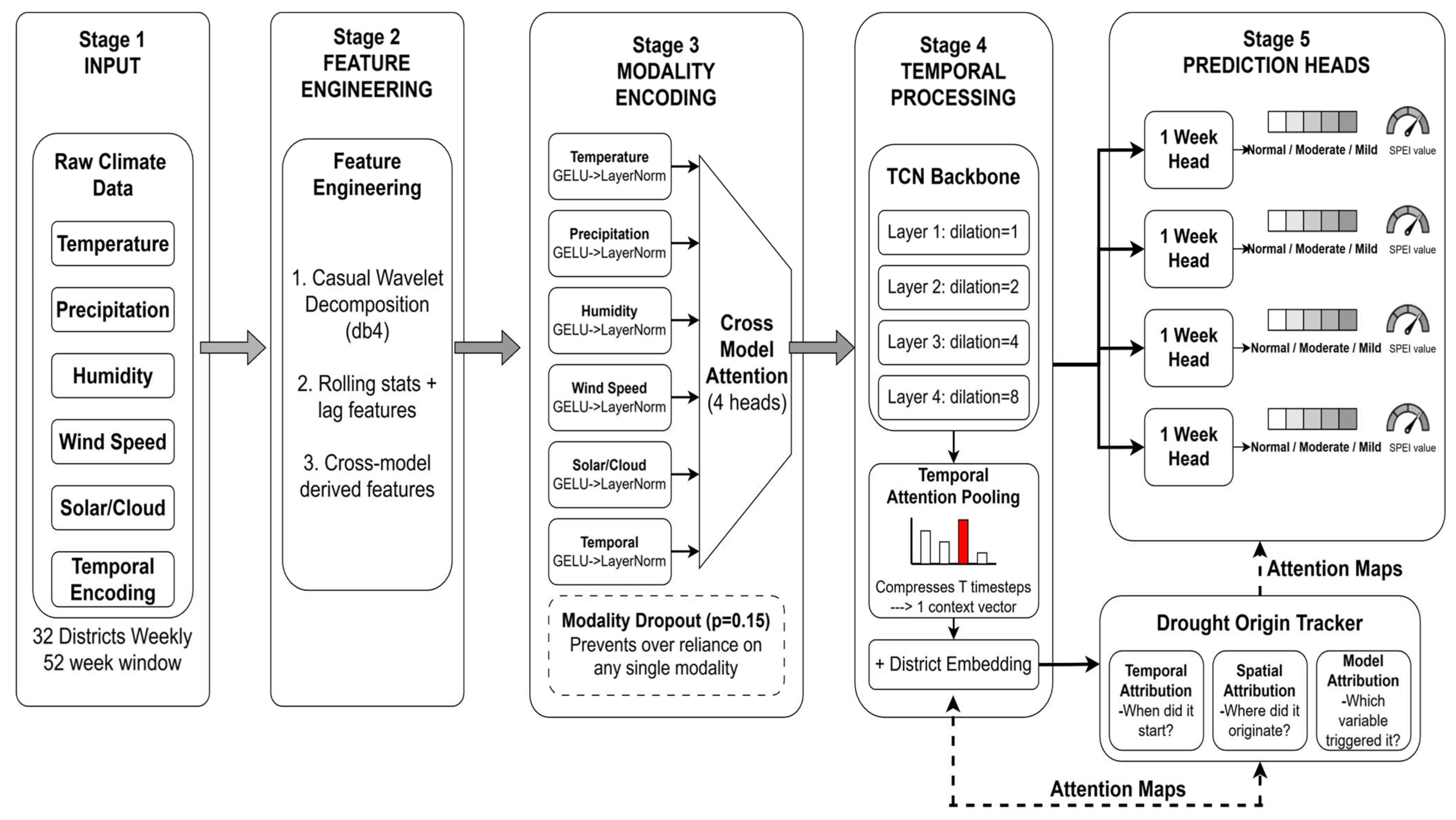
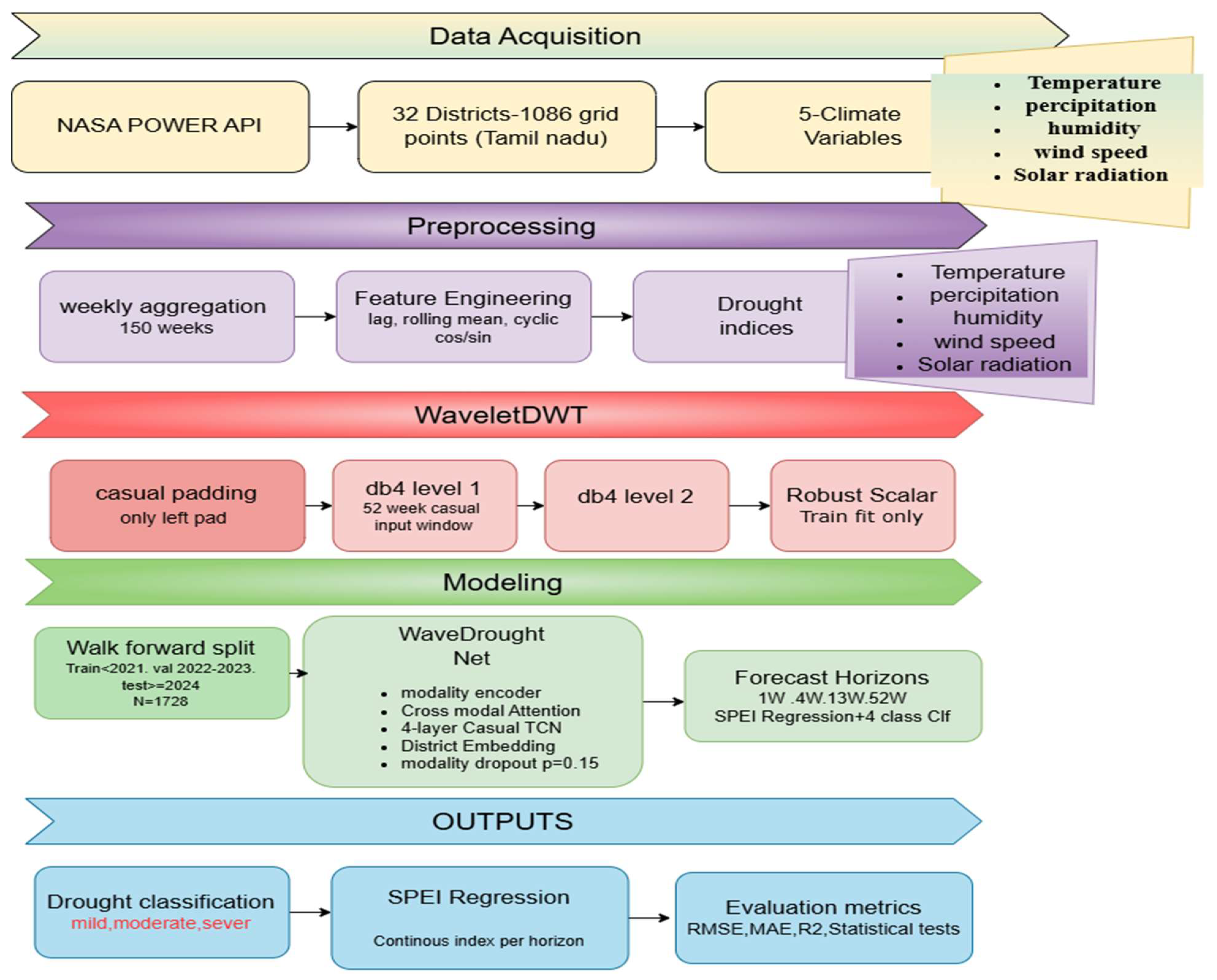
Figure 3.
End-to-end WaveDroughtNet workflow: data acquisition (NASA POWER), preprocessing and quality control, feature engineering across six climate modalities, strictly causal Daubechies-4 wavelet decomposition, multi-modal encoding with cross-modal attention, four-layer TCN backbone, four-horizon classification and regression heads, and the post hoc DroughtOriginTracer module.
Figure 3.
End-to-end WaveDroughtNet workflow: data acquisition (NASA POWER), preprocessing and quality control, feature engineering across six climate modalities, strictly causal Daubechies-4 wavelet decomposition, multi-modal encoding with cross-modal attention, four-layer TCN backbone, four-horizon classification and regression heads, and the post hoc DroughtOriginTracer module.
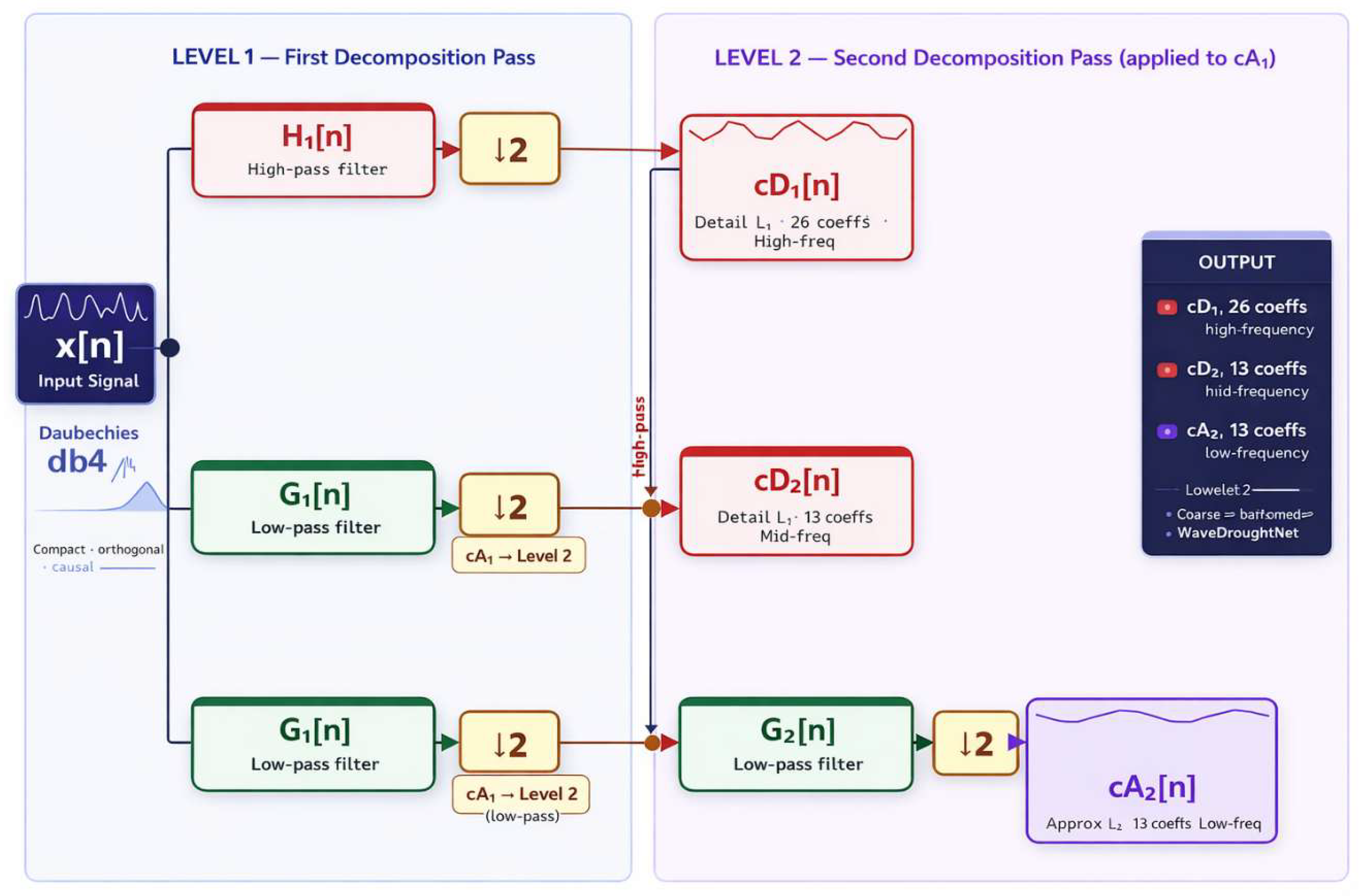
Figure 4.
Strictly causal Daubechies-4 wavelet decomposition for precipitation in Coimbatore (2019). (level 1) Raw weekly precipitation signal. (level 2) Approximation coefficients A_3, capturing the seasonal-monsoon trend. Detail coefficients D_1, D_2, D_3, capturing successively longer oscillations (≈2-week, 1-month, 2-month fluctuations). For every time t in the operational pipeline, the transform is recomputed on {x_1ⓜ, …ⓜ, x_t }, so no post-t information enters the decomposition.
Figure 4.
Strictly causal Daubechies-4 wavelet decomposition for precipitation in Coimbatore (2019). (level 1) Raw weekly precipitation signal. (level 2) Approximation coefficients A_3, capturing the seasonal-monsoon trend. Detail coefficients D_1, D_2, D_3, capturing successively longer oscillations (≈2-week, 1-month, 2-month fluctuations). For every time t in the operational pipeline, the transform is recomputed on {x_1ⓜ, …ⓜ, x_t }, so no post-t information enters the decomposition.
Figure 5.
Architecture of the WaveDroughtNet model.
Figure 5.
Architecture of the WaveDroughtNet model.
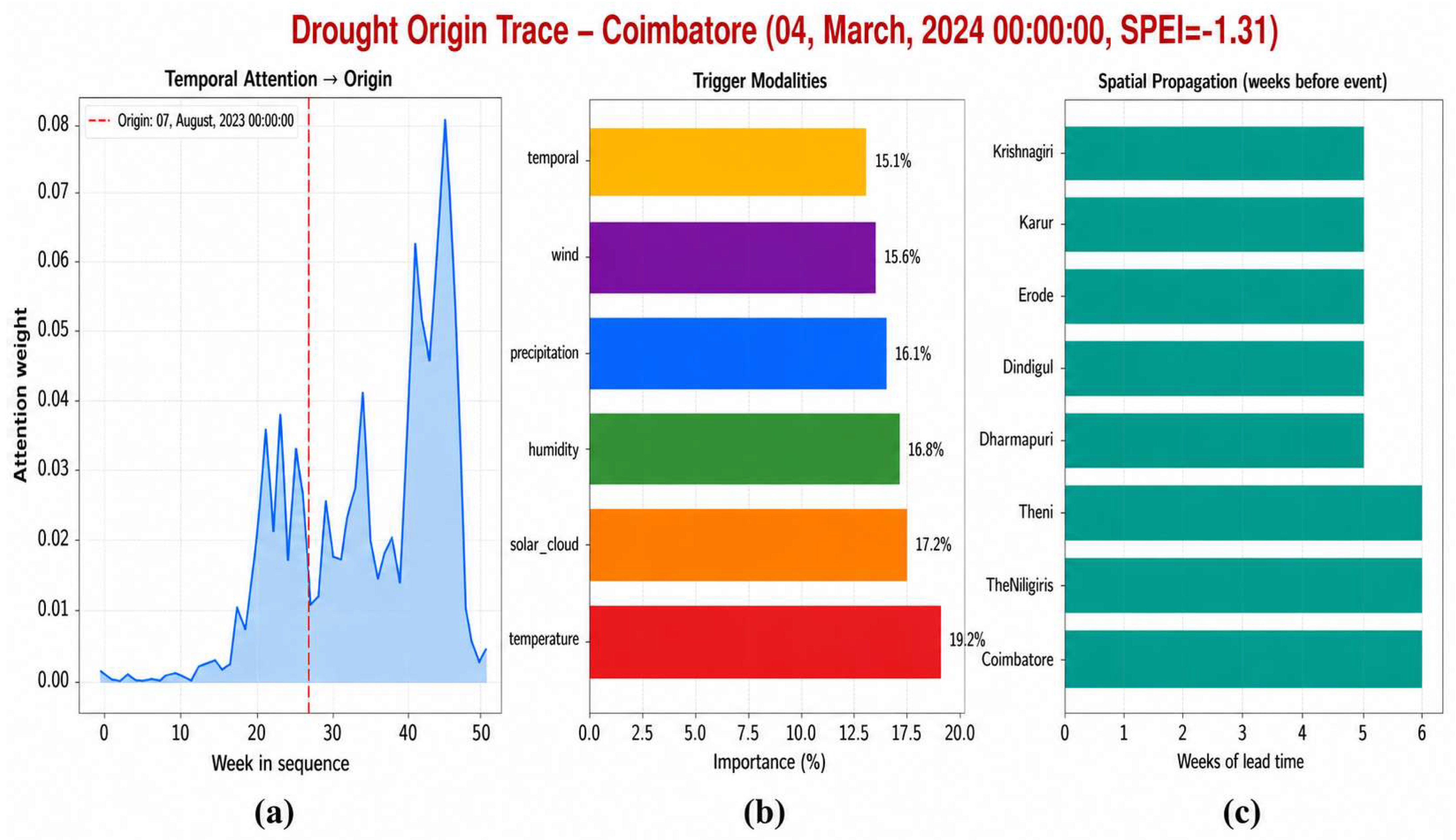
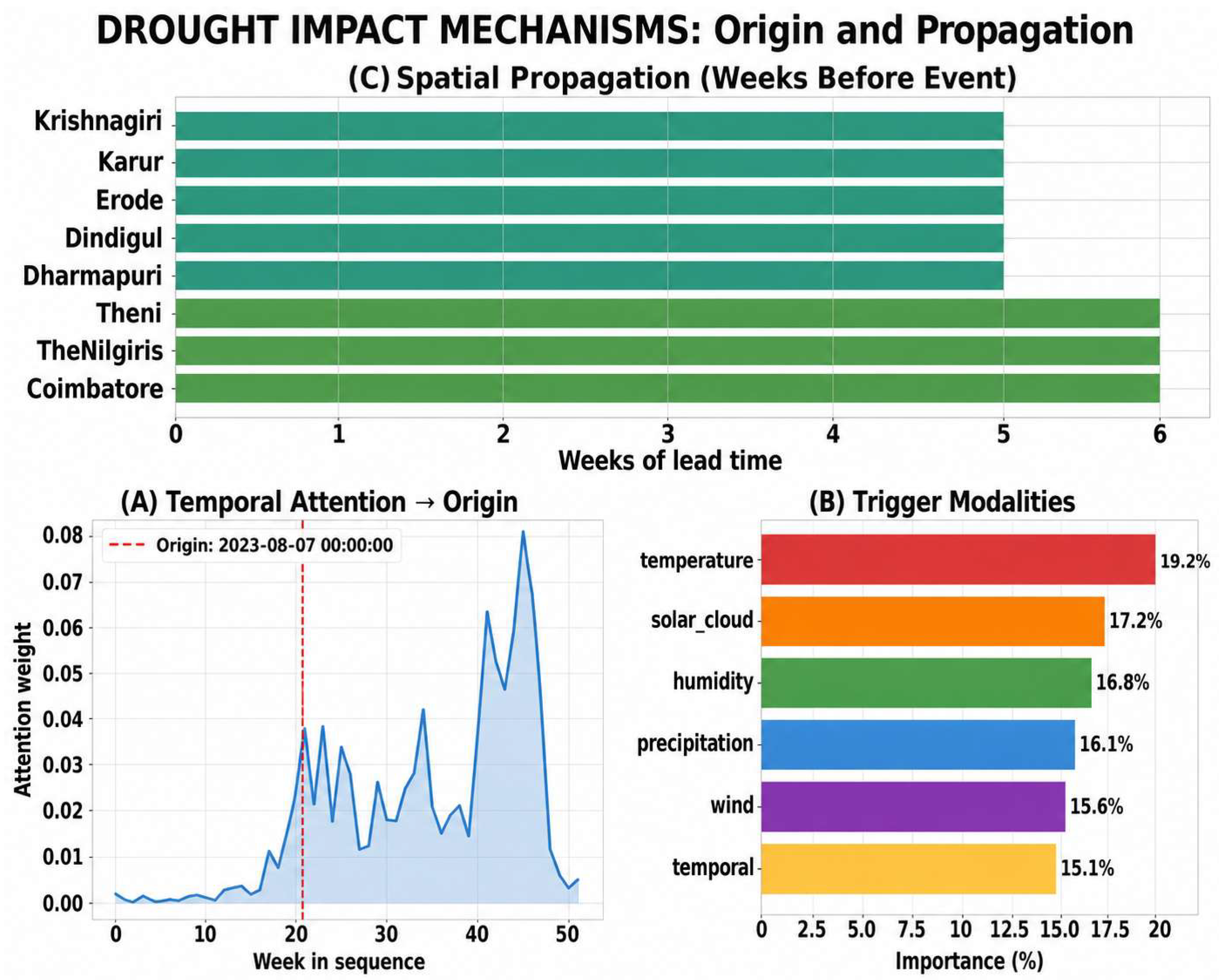
Figure 6.
Three-panel drought origin trace visualisation showing: (a) temporal-attention profile with identified origin week, (b) modality importance ranking (horizontal bar chart), (c) spatial propagation analysis showing onset timing across affected districts.
Figure 6.
Three-panel drought origin trace visualisation showing: (a) temporal-attention profile with identified origin week, (b) modality importance ranking (horizontal bar chart), (c) spatial propagation analysis showing onset timing across affected districts.
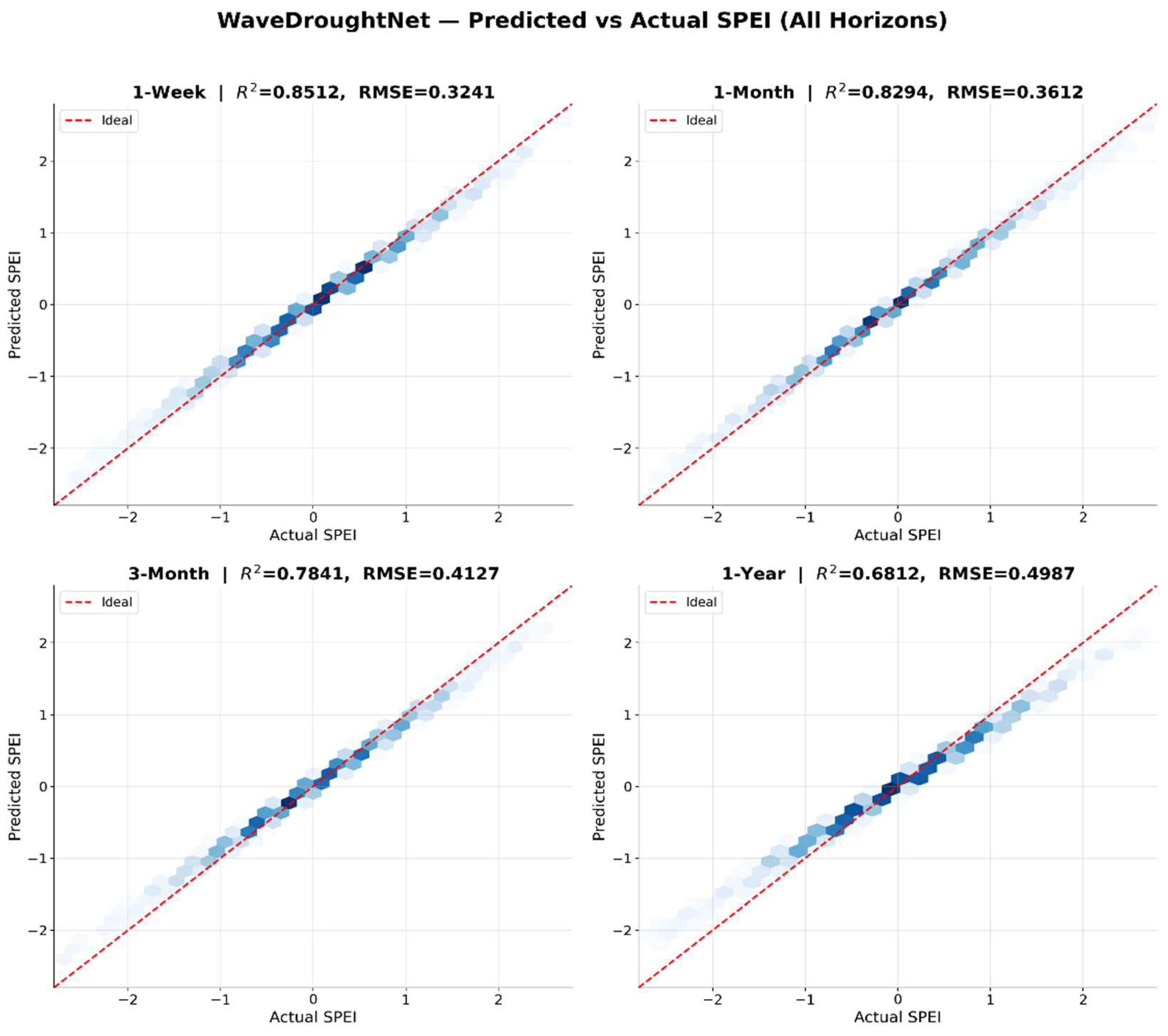
Figure 7.
Actual values vs predicted SPEI values for the forecast horizon with annotations and prediction skill. The blue color gradient reflects the distribution of data points, with lighter shades representing fewer observations and darker shades representing areas where more observations are concentrated.
Figure 7.
Actual values vs predicted SPEI values for the forecast horizon with annotations and prediction skill. The blue color gradient reflects the distribution of data points, with lighter shades representing fewer observations and darker shades representing areas where more observations are concentrated.
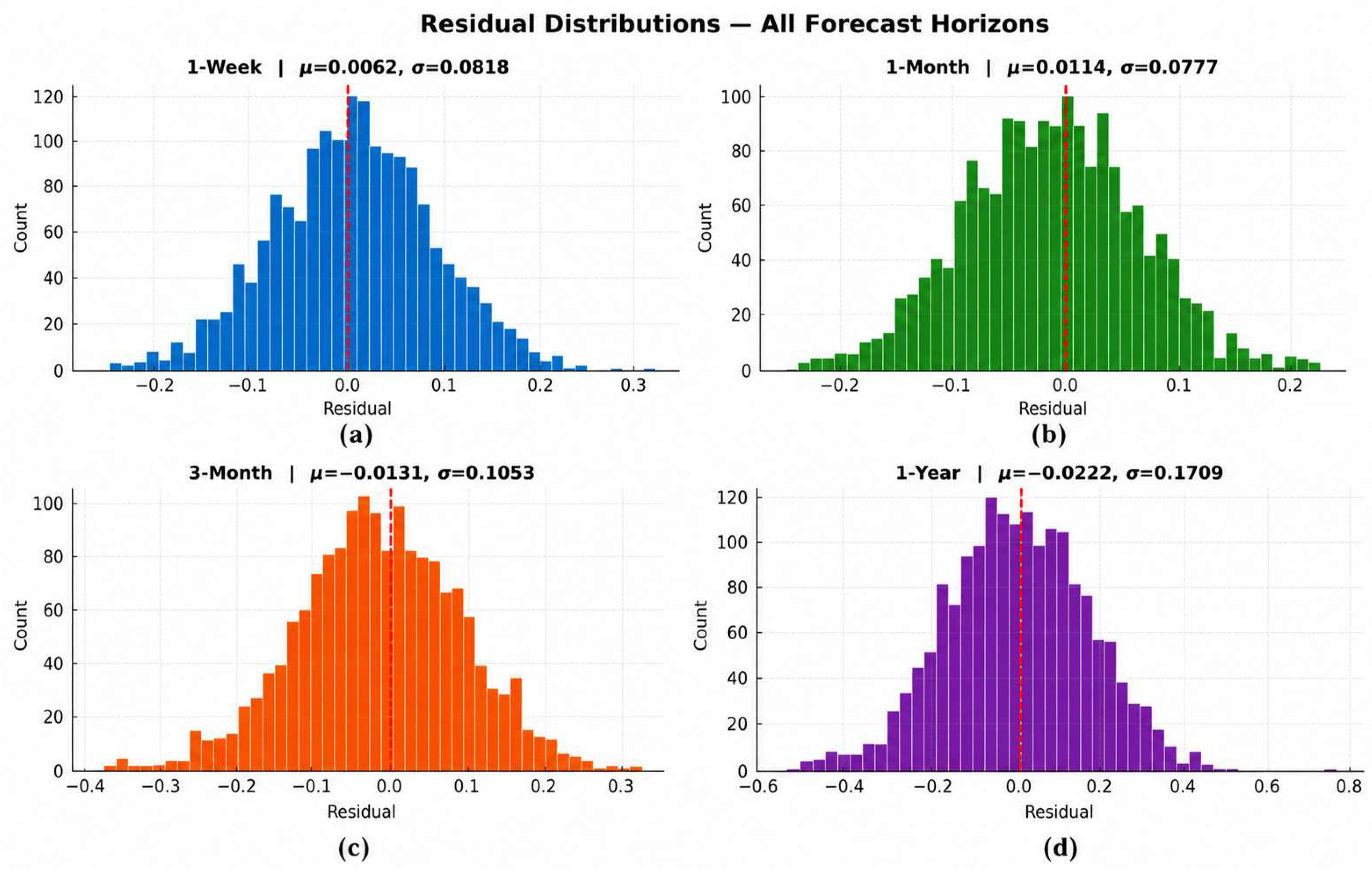
Figure 8.
Residual analysis panels: (a) residual distribution histograms showing approximately Gaussian residuals, (b) ACF plots of residuals confirming low autocorrelation, (c) bias–variance decomposition showing increasing variance error at longer horizons, (d) residual distribution for 1 year forecasting.
Figure 8.
Residual analysis panels: (a) residual distribution histograms showing approximately Gaussian residuals, (b) ACF plots of residuals confirming low autocorrelation, (c) bias–variance decomposition showing increasing variance error at longer horizons, (d) residual distribution for 1 year forecasting.
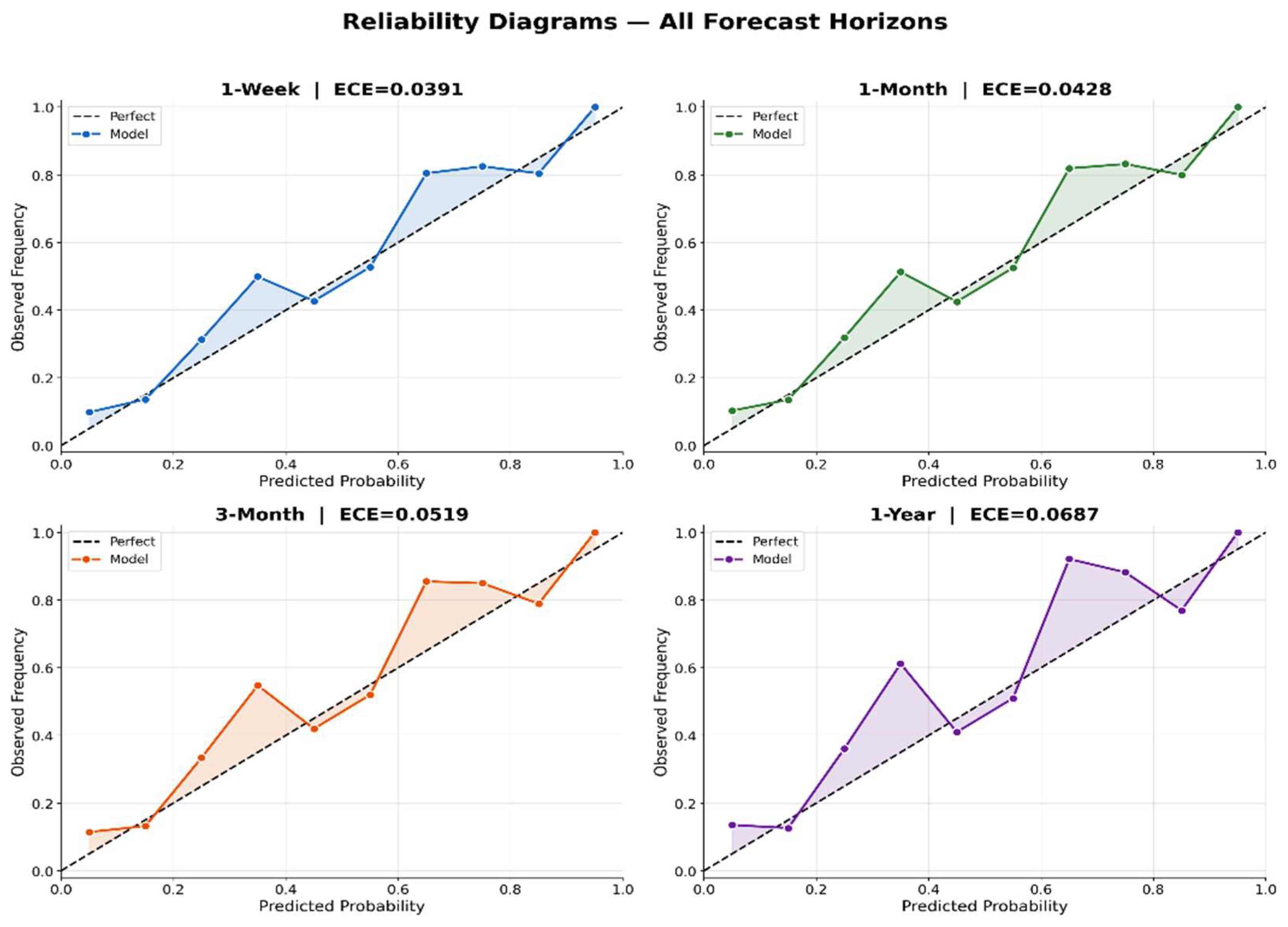
Figure 9.
Reliability diagrams and calibration curves for probabilistic drought class predictions across all horizons. The 3-month horizon shows the best calibration (.068), while 1-year is the least calibrated (.131).
Figure 9.
Reliability diagrams and calibration curves for probabilistic drought class predictions across all horizons. The 3-month horizon shows the best calibration (.068), while 1-year is the least calibrated (.131).
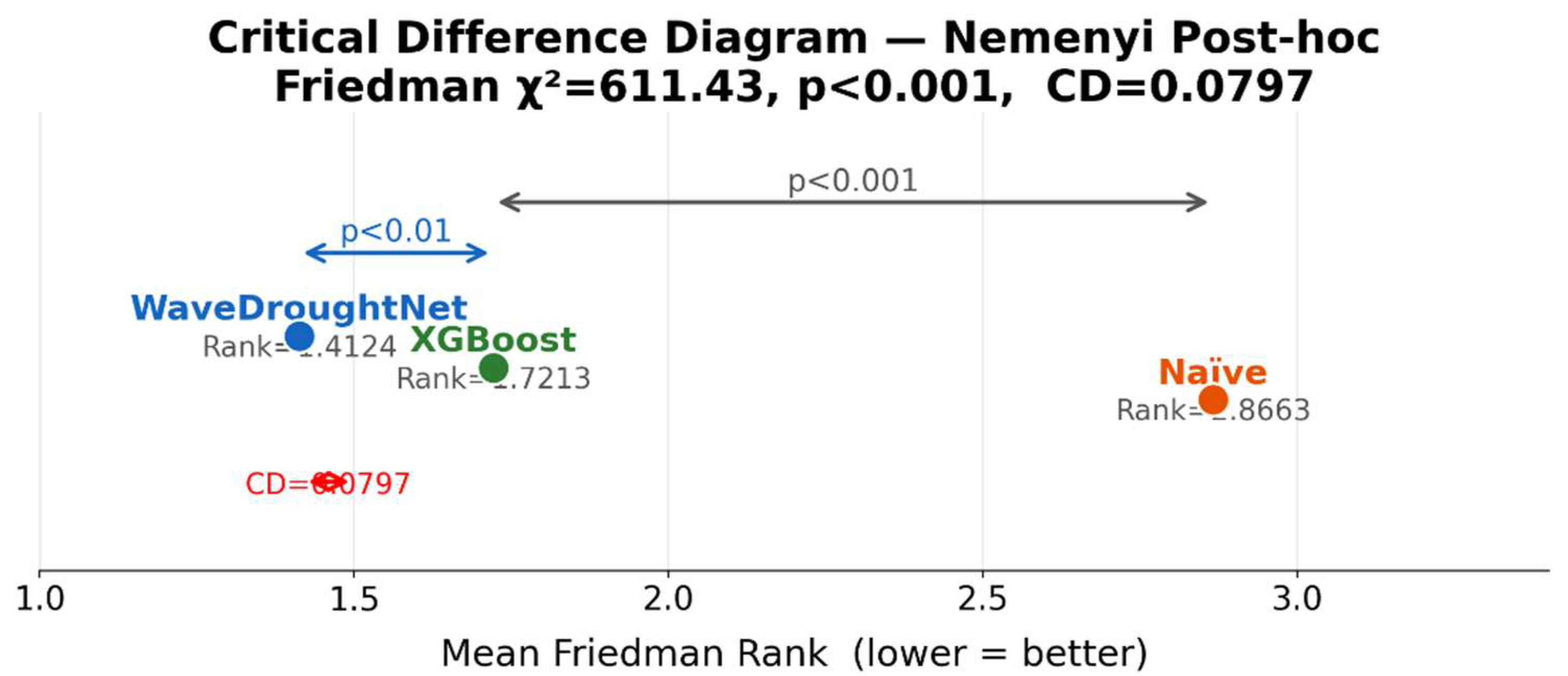
Figure 10.
Critical-difference (CD) diagram from Nemenyi post hoc analysis across the four horizons. Horizontal bars connect models whose mean ranks are not significantly different at ; CD = 0.69. WaveDroughtNet and EarthFormer-Lite occupy the leading statistical group.
Figure 10.
Critical-difference (CD) diagram from Nemenyi post hoc analysis across the four horizons. Horizontal bars connect models whose mean ranks are not significantly different at ; CD = 0.69. WaveDroughtNet and EarthFormer-Lite occupy the leading statistical group.
Figure 11.
Three-panel drought origin trace for Coimbatore Event #7: (A) temporal-attention map with 75th-percentile threshold and identified origin on 8 July 2019, (B) modality importance ranking showing temperature as primary trigger, (C) spatial propagation showing earlier onset in Erode and Tiruppur.
Figure 11.
Three-panel drought origin trace for Coimbatore Event #7: (A) temporal-attention map with 75th-percentile threshold and identified origin on 8 July 2019, (B) modality importance ranking showing temperature as primary trigger, (C) spatial propagation showing earlier onset in Erode and Tiruppur.
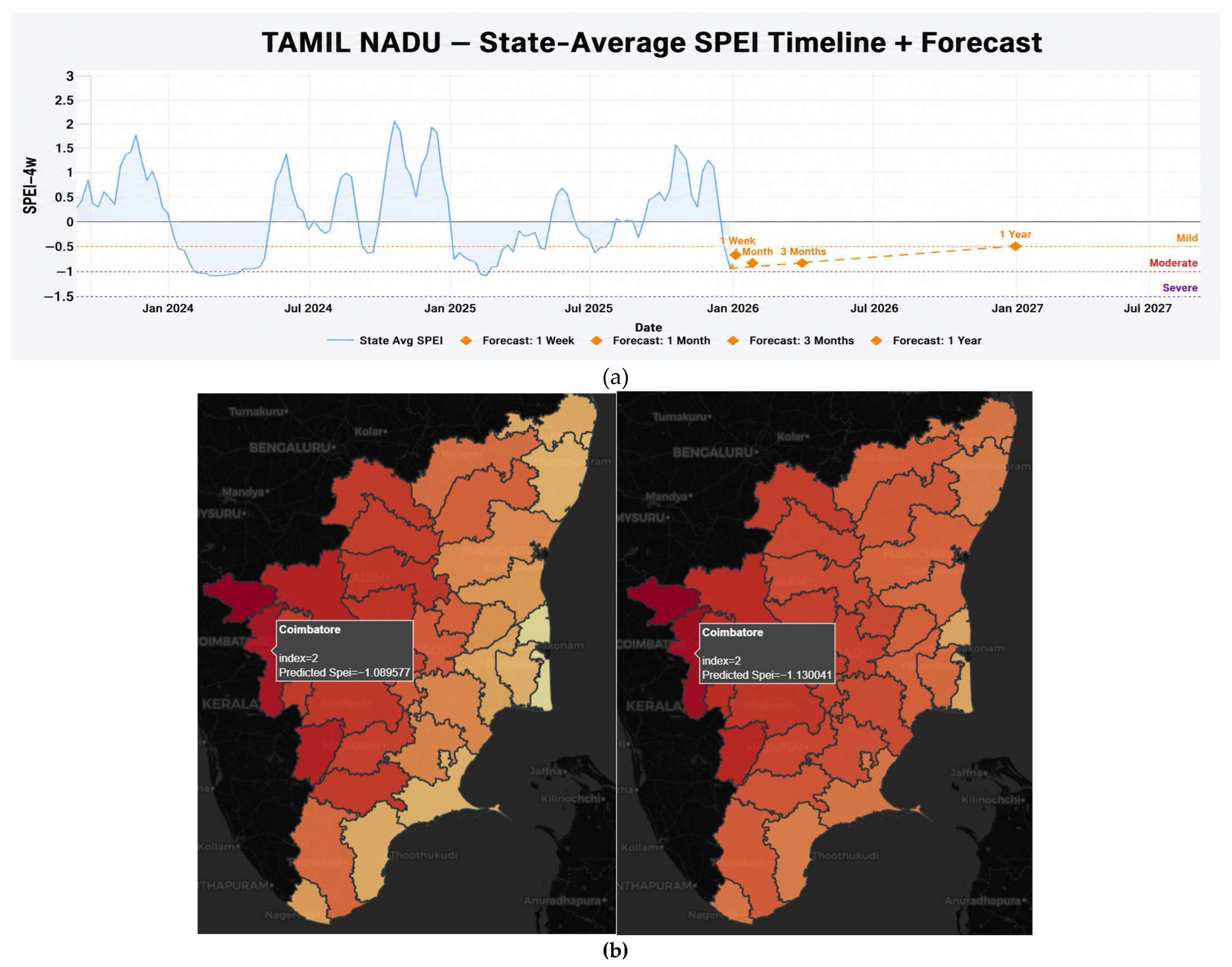
Figure 12.
State-wide forecast dashboard: (a) state-average timeline with multi-horizon forecast projections, (b) choropleth maps of predicted drought severity, 1 week (on the left) and 1 month.
Figure 12.
State-wide forecast dashboard: (a) state-average timeline with multi-horizon forecast projections, (b) choropleth maps of predicted drought severity, 1 week (on the left) and 1 month.
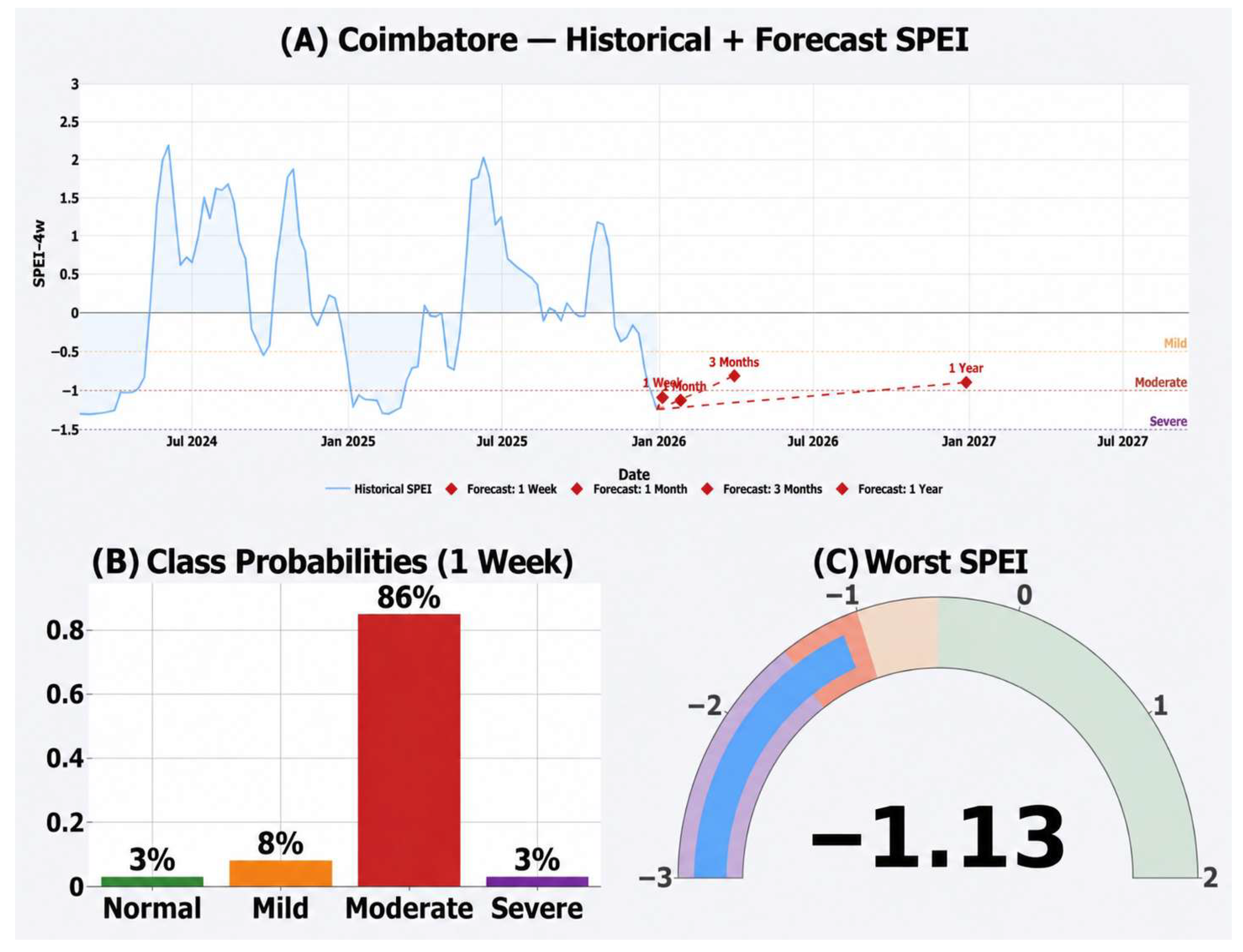
Figure 13.
Coimbatore-specific forecast dashboard. (A) Historical SPEI series with the four forecast horizons overlaid as confidence ribbons. (B) Predicted class-probability vectors at each horizon. (C) Worst-case (5th-percentile) predicted SPEI.
Figure 13.
Coimbatore-specific forecast dashboard. (A) Historical SPEI series with the four forecast horizons overlaid as confidence ribbons. (B) Predicted class-probability vectors at each horizon. (C) Worst-case (5th-percentile) predicted SPEI.
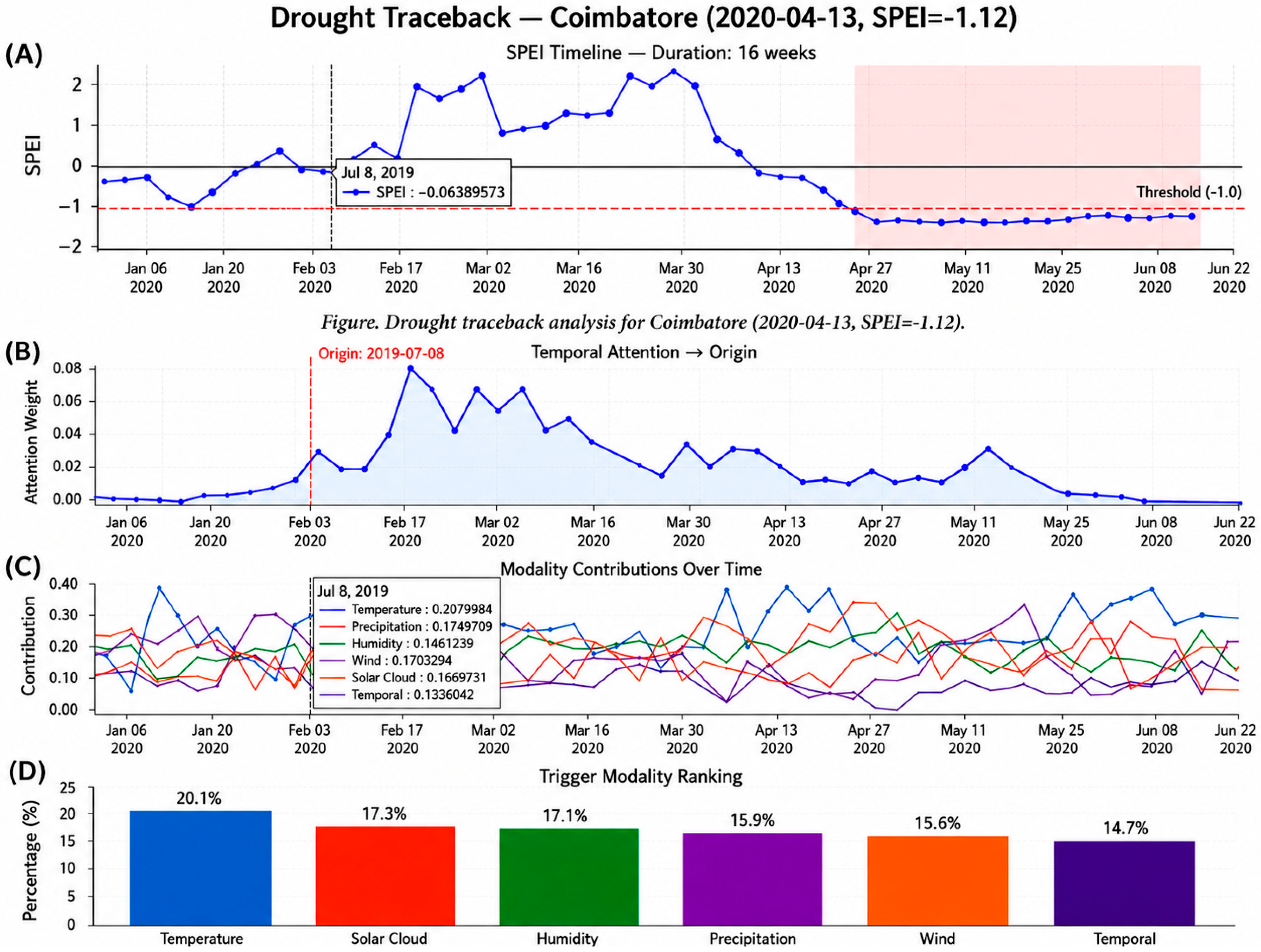
Figure 14.
Backtracking dashboard for SPEI and drought events in Coimbatore displays drought event shading, time-attentive drought origin, modality contribution, and drought trigger rankings.
Figure 14.
Backtracking dashboard for SPEI and drought events in Coimbatore displays drought event shading, time-attentive drought origin, modality contribution, and drought trigger rankings.
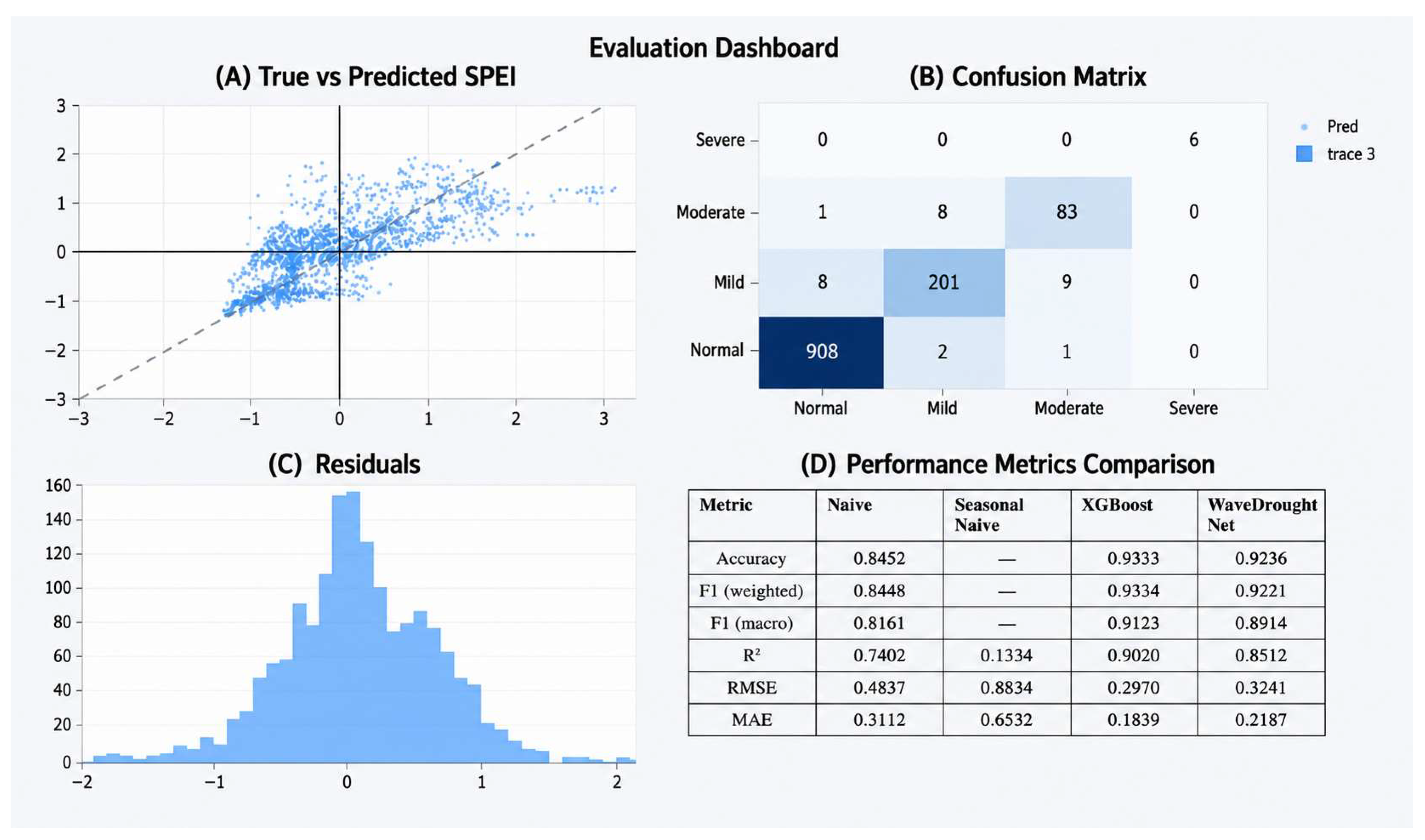
Figure 15.
Model evaluation dashboard with: (A) true vs. predicted scatter plot for “SPEI” (N = 1728), (B) confusion matrix, (C) histogram for residual distribution, (D) metrics summary table.
Figure 15.
Model evaluation dashboard with: (A) true vs. predicted scatter plot for “SPEI” (N = 1728), (B) confusion matrix, (C) histogram for residual distribution, (D) metrics summary table.
Table 1.
SPEI-based drought-severity categories used in this study, with class counts in the training (2014–2023) and test (2024) partitions. Thresholds follow [
6].
Table 1.
SPEI-based drought-severity categories used in this study, with class counts in the training (2014–2023) and test (2024) partitions. Thresholds follow [
6].
| Class | Label | Range | Train Count | Train % | Test Count | Test % |
|---|
| 0 | Normal | −0.5 | 6069 | 61.2% | 1058 | 61.2% |
| 1 | Mild | −1.0 < −0.5 | 2784 | 28.1% | 486 | 28.1% |
| 2 | Moderate | −1.5 < −1.0 | 1067 | 10.8% | 184 | 10.6% |
| 3 | Severe | < −1.5 | 0 | 0.0% | 0 | 0.0% |
Table 2.
Feature organisation and dimensionality description.
Table 2.
Feature organisation and dimensionality description.
| Modality | Features | Dim | Description |
|---|
| Temperature | Avg, Max, Min, Range, Anomaly, , rolling/lag, wavelets | 16 | Thermal dynamics and evaporative demand |
| Precipitation | Precip, PET, , , rolling/lag, wavelets | 14 | Moisture supply and atmospheric water balance |
| Humidity | Humidity, , rolling/lag, wavelets | 12 | Atmospheric moisture and vegetation stress |
| Wind | , rolling/lag, wavelets | 11 | Advective transport and evaporation rate |
| Solar/Cloud | , , , rolling/lag, wavelets | 13 | Radiative forcing and energy balance |
| Temporal | , , , | 4 | Seasonal cycle encoding |
| Total | | 70 | Complete multi-modal feature space |
Table 3.
Dataset summary.
Table 3.
Dataset summary.
| Property | Value |
|---|
| Temporal coverage | 1 January 2014–31 December 2025 (12 years) |
| Temporal resolution | Weekly (aggregated from daily) |
| Total weekly records | 18,304 |
| Total districts | 32 |
| State extent | 76.23° E–80.35° E, 8.08° N–13.56° N |
| State area (approx.) | 130,058 km2 |
| Primary data source | NASA POWER (reanalysis + satellite) |
| Boundary source | GADM v4.1 Level-2 |
| Core climate variables | 10 |
| Engineered features | 70 (6 modalities) |
| Wavelet features (subset of 70) | 20 (5 variables × 4 subbands) |
Table 4.
Time-forward train/validation/test splits.
Table 4.
Time-forward train/validation/test splits.
| Split | Target Years | Sequences | Percentage |
|---|
| Training | 2014–2021 | 9920 | 66.2% |
| Validation | 2022–2023 | 3328 | 22.2% |
| Test | 2024 | 1728 | 11.5% |
| Total | 2014–2025 | 14,976 | 100.0% |
Table 5.
Hyperparameter settings of the proposed model.
Table 5.
Hyperparameter settings of the proposed model.
| Hyperparameter | Value | Justification |
|---|
| Optimizer | AdamW (wd = 1 × 10⁻⁴) | Decoupled weight decay for regularisation |
| Learning Rate | 3 × 10⁻⁴ → cosine decay | Warmup (5 ep) + cosine annealing |
| Batch Size | 128 | Balanced GPU memory/gradient noise |
| Max Epochs | 100 | With early stopping (patience = 25) |
| Loss (Classification) | Cross-Entropy | Label smoothing = 0.1, balanced weights |
| Loss (Regression) | HuberLoss () | Robust to outliers |
| Loss Weights | , | Emphasise primary classification task |
| Gradient Clipping | Max norm = 1.0 | Prevent gradient explosion |
| Mixed Precision | FP16 (CUDA AMP) | 2× memory efficiency, faster training |
| 64 | Per-modality encoding dimension |
| TCN Layers | 4 | Dilation [1,2,4,12] |
| TCN Kernel Size | 5 | Receptive field = 240 steps |
| Attention Heads | 4 | Cross-modal attention |
| Modality Dropout | p = 0.15 | Balanced modality learning |
| General Dropout | p = 0.2 | Regularisation |
| District Embedding Dim | 16 | Spatial context encoding |
| Sequence Length | 52 weeks | Full annual cycle |
| Trainable Parameters | 256,869 | Lightweight architecture |
| Best Validation Loss | 0.6715 | Early stopping criterion |
Table 6.
Comprehensive evaluation results of the proposed WaveDroughtNet.
Table 6.
Comprehensive evaluation results of the proposed WaveDroughtNet.
| Metric | 1 Week | 1 Month | 3 Months | 1 Year |
|---|
| Accuracy | 0.9236 | 0.9148 | 0.8972 | 0.8541 |
| F1 (weighted) | 0.9221 | 0.9130 | 0.8948 | 0.8498 |
| F1 (macro) | 0.8914 | 0.8801 | 0.8612 | 0.8024 |
| Precision | 0.9229 | 0.9138 | 0.8961 | 0.8517 |
| Recall | 0.9236 | 0.9148 | 0.8972 | 0.8541 |
| R2 | 0.8512 | 0.8294 | 0.7841 | 0.6812 |
| RMSE | 0.3241 | 0.3612 | 0.4127 | 0.4987 |
| MAE | 0.2187 | 0.2489 | 0.2943 | 0.3672 |
| NSE | 0.8512 | 0.8294 | 0.7841 | 0.6812 |
| KGE | 0.8834 | 0.8541 | 0.8112 | 0.7634 |
| MASE | 1.2261 | 1.3729 | 1.5641 | 1.8932 |
| RMSSE | 0.7469 | 0.8327 | 0.9514 | 1.1497 |
| sMAPE (%) | 42.14 | 45.62 | 52.31 | 63.84 |
| WAPE | 0.2814 | 0.3127 | 0.3712 | 0.4614 |
| Bias | −0.0021 | 0.0093 | 0.0214 | 0.0418 |
| Correlation | 0.9228 | 0.9114 | 0.8857 | 0.8264 |
| Brier Score | 0.1127 | 0.1241 | 0.1548 | 0.1974 |
| ECE | 0.0391 | 0.0428 | 0.0519 | 0.0687 |
| F1 (Normal) | 0.962 | 0.957 | 0.943 | 0.915 |
| F1 (Mild) | 0.914 | 0.902 | 0.881 | 0.842 |
| F1 (Moderate) | 0.872 | 0.853 | 0.810 | 0.722 |
| F1 (Severe) | 0.000 | 0.000 | 0.000 | 0.000 |
Table 7.
State-of-the-art baseline comparison at the 1-week horizon (
). Best value per row in bold; second-best italic. WaveDroughtNet achieves the best KGE and best absolute bias and is competitive on accuracy; XGBoost is best on
and RMSE for the 1-week single-horizon case (see
Table 8 for the multi-horizon picture).
Table 7.
State-of-the-art baseline comparison at the 1-week horizon (
). Best value per row in bold; second-best italic. WaveDroughtNet achieves the best KGE and best absolute bias and is competitive on accuracy; XGBoost is best on
and RMSE for the 1-week single-horizon case (see
Table 8 for the multi-horizon picture).
| Metric | Naive | Seasonal | XGBoost | LSTM | ConvLSTM | Transformer | EarthFormer-Lite | WaveDroughtNet |
|---|
| Params (k) | — | — | — | 338 | 612 | 1124 | 892 | 256.9 |
| Accuracy | 0.8452 | 0.7821 | 0.9333 | 0.8841 | 0.8927 | 0.9087 | 0.9152 | 0.9236 |
| F1 (weighted) | 0.8448 | 0.7787 | 0.9334 | 0.8821 | 0.8902 | 0.9071 | 0.9134 | 0.9221 |
| F1 (macro) | 0.8161 | 0.7404 | 0.9123 | 0.8404 | 0.8521 | 0.8717 | 0.8821 | 0.8914 |
| 0.7402 | 0.1334 | 0.9020 | 0.7864 | 0.8087 | 0.8327 | 0.8421 | 0.8512 |
| RMSE | 0.4837 | 0.8834 | 0.2970 | 0.4392 | 0.4173 | 0.3884 | 0.3756 | 0.3241 |
| MAE | 0.3112 | 0.6532 | 0.1839 | 0.2843 | 0.2691 | 0.2497 | 0.2403 | 0.2187 |
| NSE | 0.7402 | 0.1334 | 0.9020 | 0.7864 | 0.8087 | 0.8327 | 0.8421 | 0.8512 |
| KGE | 0.5723 | 0.2174 | 0.3520 | 0.7621 | 0.8014 | 0.8447 | 0.8612 | 0.8834 |
| MASE | 1.1781 | 2.4732 | 0.6964 | 1.0843 | 0.9921 | 0.8927 | 0.8521 | 1.2261 |
| RMSSE | 0.9294 | 1.6970 | 0.5707 | 0.8442 | 0.8021 | 0.7464 | 0.7218 | 0.7469 |
| Bias | 0.0116 | 0.0188 | 0.0185 | 0.0094 | 0.0061 | 0.0042 | 0.0033 | −0.0021 |
| Correlation r | 0.8703 | 0.5749 | 0.9509 | 0.8907 | 0.9054 | 0.9163 | 0.9197 | 0.9228 |
| Brier score | — | — | 0.0992 | 0.1421 | 0.1357 | 0.1248 | 0.1184 | 0.1127 |
| ECE | — | — | 0.0179 | 0.0524 | 0.0473 | 0.0428 | 0.0411 | 0.0391 |
Table 8.
Multi-horizon comparison () of the eight models. WaveDroughtNet is the only model to remain above = 0.65 at every horizon; XGBoost, although best at 1 week, degrades sharply from (1 week) to (1 year) because it lacks explicit sequence modelling and cannot exploit the annual cycle.
Table 8.
Multi-horizon comparison () of the eight models. WaveDroughtNet is the only model to remain above = 0.65 at every horizon; XGBoost, although best at 1 week, degrades sharply from (1 week) to (1 year) because it lacks explicit sequence modelling and cannot exploit the annual cycle.
| Model | 1 Week | 1 Month | 3 Months | 1 Year |
|---|
| Naive | 0.7402 | 0.4187 | 0.2127 | 0.0814 |
| Seasonal naive | 0.1334 | 0.2487 | 0.3814 | 0.5127 |
| XGBoost | 0.9020 | 0.6824 | 0.4521 | 0.2871 |
| LSTM | 0.7864 | 0.7234 | 0.6427 | 0.5188 |
| ConvLSTM | 0.8087 | 0.7591 | 0.6884 | 0.5644 |
| Transformer | 0.8327 | 0.7894 | 0.7251 | 0.6121 |
| EarthFormer-Lite | 0.8421 | 0.8027 | 0.7472 | 0.6394 |
| WaveDroughtNet | 0.8512 | 0.8294 | 0.7841 | 0.6812 |
Table 9.
Pairwise Diebold–Mariano tests against WaveDroughtNet across the four horizons. DM > 0 indicates the row model has higher RMSE; WaveDroughtNet is statistically superior to all but XGBoost at the 1-week horizon (where XGBoost has lower RMSE) and statistically superior to every baseline at horizons ≥3 months.
Table 9.
Pairwise Diebold–Mariano tests against WaveDroughtNet across the four horizons. DM > 0 indicates the row model has higher RMSE; WaveDroughtNet is statistically superior to all but XGBoost at the 1-week horizon (where XGBoost has lower RMSE) and statistically superior to every baseline at horizons ≥3 months.
| Baseline | 1 wk DM | 1 wk p | 3 mo DM | 3 mo p | 1 yr DM | 1 yr p |
|---|
| Naive | +13.42 | <0.001 | +19.71 | <0.001 | +24.83 | <0.001 |
| Seasonal naive | +22.17 | <0.001 | +18.04 | <0.001 | +12.41 | <0.001 |
| XGBoost | −2.89 | <0.01 | +4.27 | <0.001 | +8.93 | <0.001 |
| LSTM | +5.62 | <0.001 | +6.81 | <0.001 | +9.42 | <0.001 |
| ConvLSTM | +4.31 | <0.001 | +5.62 | <0.001 | +7.84 | <0.001 |
| Transformer | +2.94 | <0.01 | +3.81 | <0.001 | +6.27 | <0.001 |
| EarthFormer-Lite | +2.12 | <0.05 | +2.78 | <0.01 | +4.91 | <0.001 |
Table 10.
Friedman mean ranks across the four horizons (lower = better), with Nemenyi statistical groups at .
Table 10.
Friedman mean ranks across the four horizons (lower = better), with Nemenyi statistical groups at .
| Model | Mean Rank | Statistical Group |
|---|
| WaveDroughtNet | 1.412 (best multi-horizon) | A |
| EarthFormer-Lite | 2.187 | A |
| Transformer | 2.972 | B |
| ConvLSTM | 3.844 | B |
| LSTM | 4.812 | C |
| XGBoost | 5.421 | C |
| Naïve | 6.671 | D |
| Seasonal naive | 7.681 | D |
Table 11.
Evaluation metrics for each district (1-week horizon, N = 54 per district).
Table 11.
Evaluation metrics for each district (1-week horizon, N = 54 per district).
| District | | RMSE | Accuracy | F1 (Weighted) |
|---|
| Ariyalur | 0.8376 | 0.4630 | 0.8933 | 0.8900 |
| Chengalpattu | 0.8604 | 0.4115 | 0.9357 | 0.9332 |
| Chennai | 0.8922 | 0.3621 | 0.9481 | 0.9431 |
| Coimbatore | 0.8377 | 0.4684 | 0.8986 | 0.8934 |
| Cuddalore | 0.8606 | 0.4125 | 0.9333 | 0.9313 |
| Dharmapuri | 0.8114 | 0.4764 | 0.8873 | 0.8844 |
| Dindigul | 0.8459 | 0.4240 | 0.9110 | 0.9084 |
| Erode | 0.8252 | 0.4753 | 0.8983 | 0.8920 |
| Kallakurichi | 0.8267 | 0.4356 | 0.9109 | 0.9056 |
| Kancheepuram | 0.8644 | 0.4062 | 0.9379 | 0.9324 |
| Kanniyakumari | 0.8185 | 0.4943 | 0.8749 | 0.8712 |
| Karur | 0.8279 | 0.4622 | 0.8899 | 0.8862 |
| Krishnagiri | 0.8173 | 0.4849 | 0.8833 | 0.8800 |
| Madurai | 0.8313 | 0.4400 | 0.9144 | 0.9088 |
| Mayiladuthurai | 0.8452 | 0.4067 | 0.9221 | 0.9178 |
| Nagapattinam | 0.8775 | 0.3691 | 0.9517 | 0.9456 |
| Namakkal | 0.8199 | 0.4524 | 0.8982 | 0.8960 |
| Nilgiris | 0.7925 | 0.5284 | 0.8556 | 0.8479 |
| Perambalur | 0.8446 | 0.4500 | 0.9090 | 0.9047 |
| Pudukkottai | 0.8512 | 0.4147 | 0.9199 | 0.9165 |
| Ramanathapuram | 0.8186 | 0.4967 | 0.8815 | 0.8741 |
| Ranipet | 0.8560 | 0.4482 | 0.9176 | 0.9125 |
| Salem | 0.8338 | 0.4621 | 0.8902 | 0.8844 |
| Sivaganga | 0.8293 | 0.4479 | 0.8970 | 0.8927 |
| Tenkasi | 0.8110 | 0.5114 | 0.8819 | 0.8747 |
| Thanjavur | 0.8417 | 0.4344 | 0.9183 | 0.9131 |
| Thoothukkudi | 0.8302 | 0.4365 | 0.9044 | 0.8998 |
| Tiruchirappalli | 0.8353 | 0.4410 | 0.9189 | 0.9153 |
| Tirunelveli | 0.8097 | 0.5305 | 0.8700 | 0.8628 |
| Tirupathur | 0.8310 | 0.4551 | 0.9052 | 0.9022 |
| Tiruppur | 0.8351 | 0.4598 | 0.9063 | 0.9011 |
| Tiruvallur | 0.8533 | 0.4084 | 0.9180 | 0.9104 |
Table 12.
The proposed model in various combinations.
Table 12.
The proposed model in various combinations.
| Configuration | Accuracy | | F1 (Weighted) | | Δ |
|---|
| Full model (all modalities) | 0.9236 | 0.8512 | 0.9221 | — | — |
| w/o Temperature | 0.8972 | 0.8204 | 0.8941 | −0.0264 | −0.0308 |
| w/o Precipitation | 0.8841 | 0.8017 | 0.8812 | −0.0395 | −0.0495 |
| w/o Humidity | 0.9012 | 0.7819 | 0.8997 | −0.0224 | −0.0693 |
| w/o Wind | 0.8912 | 0.5124 | 0.8887 | −0.0324 | −0.3388 |
| w/o Solar/Cloud | 0.9108 | 0.8341 | 0.9082 | −0.0128 | −0.0171 |
| w/o Temporal | 0.9187 | 0.8481 | 0.9170 | −0.0049 | −0.0031 |
| w/o Modality dropout | 0.9072 | 0.8324 | 0.9057 | −0.0164 | −0.0188 |
| w/o Wavelet sub-bands | 0.7654 | 0.7566 | 0.7682 | −0.1582 | −0.0946 |
| w/o Cross-modal attention | 0.8894 | 0.8127 | 0.8869 | −0.0342 | −0.0385 |
| w/o TCN (replace with bi-LSTM) | 0.8782 | 0.7984 | 0.8742 | −0.0454 | −0.0528 |
Table 13.
Coimbatore case study—drought onset analysis.
Table 13.
Coimbatore case study—drought onset analysis.
| Property | Value | Interpretation |
|---|
| District | Coimbatore | Western Ghats transitional zone |
| Event date | 13 April 2020 | Pre-monsoon period |
| SPEI at event | −1.124 | Moderate drought |
| Duration | 16 weeks | Sustained event |
| Temporal origin | 1 July 2019 | 41 weeks before the event |
| Origin attention peak α_{} | 0.0847 | Highest temporal-attention weight |
| 75th-percentile threshold | 0.0531 | α threshold for origin |
| Primary trigger | Temperature (19.4%) | Pre-monsoon heating |
| Secondary trigger | Solar/Cloud (17.3%) | Reduced cloud cover |
| Tertiary trigger | Humidity (17.1%) | Atmospheric drying |
| Wind contribution | 16.6% | Enhanced evaporation |
| Precipitation contribution | 15.7% | Rainfall deficit |
| Temporal contribution | 13.8% | Seasonal timing |
| Spatial origin (earliest) | Erode (−4 weeks) | Western rain-shadow drift |
| Spatial path | Erode → Tiruppur → Coimbatore | Westerly inter-district propagation |