High-Iodine Groundwater in the Lower Kuitun River in Xinjiang: Evidence from Stable-Carbon-Isotope Characteristics

Abstract
1. Introduction
2. Materials and Methods
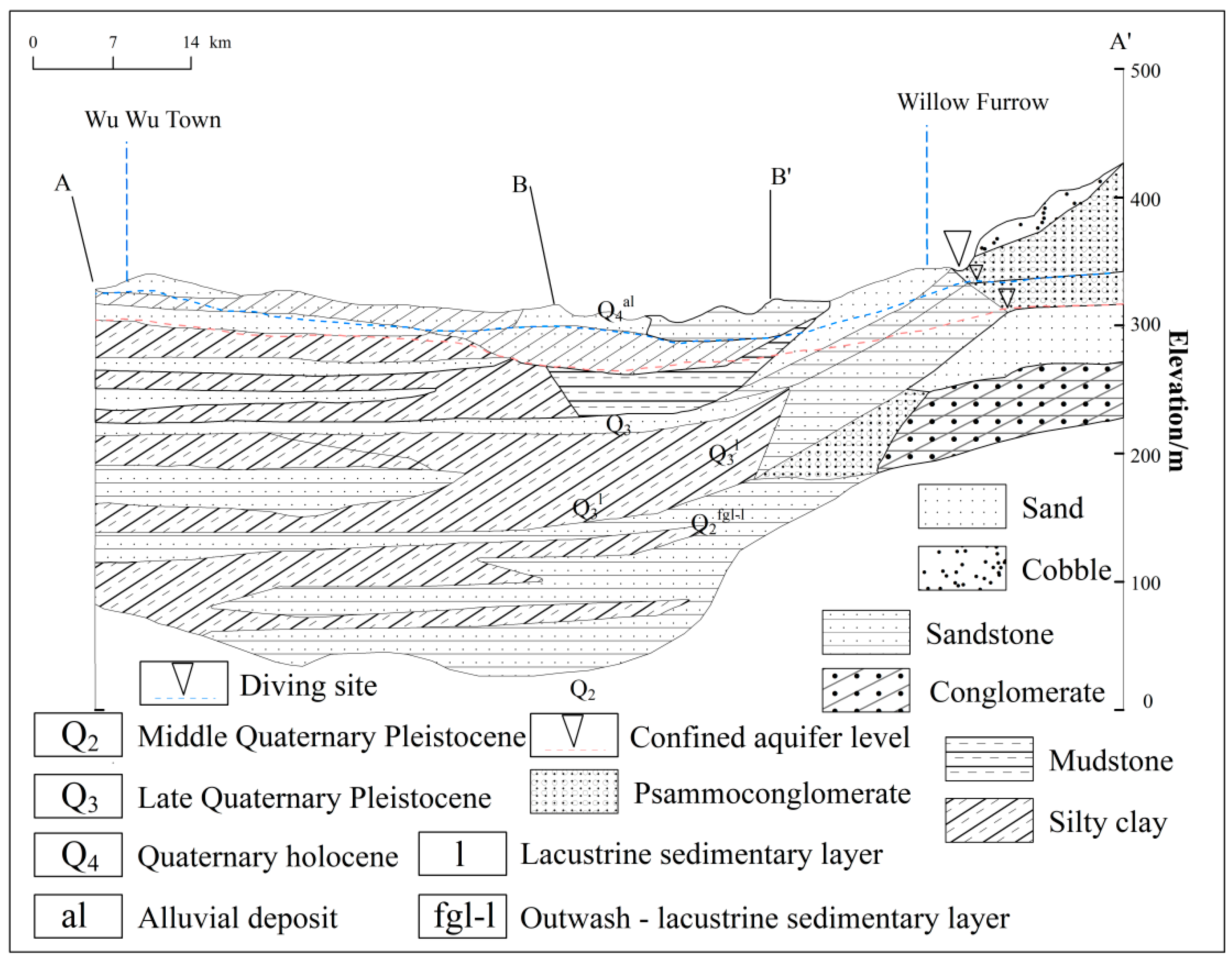
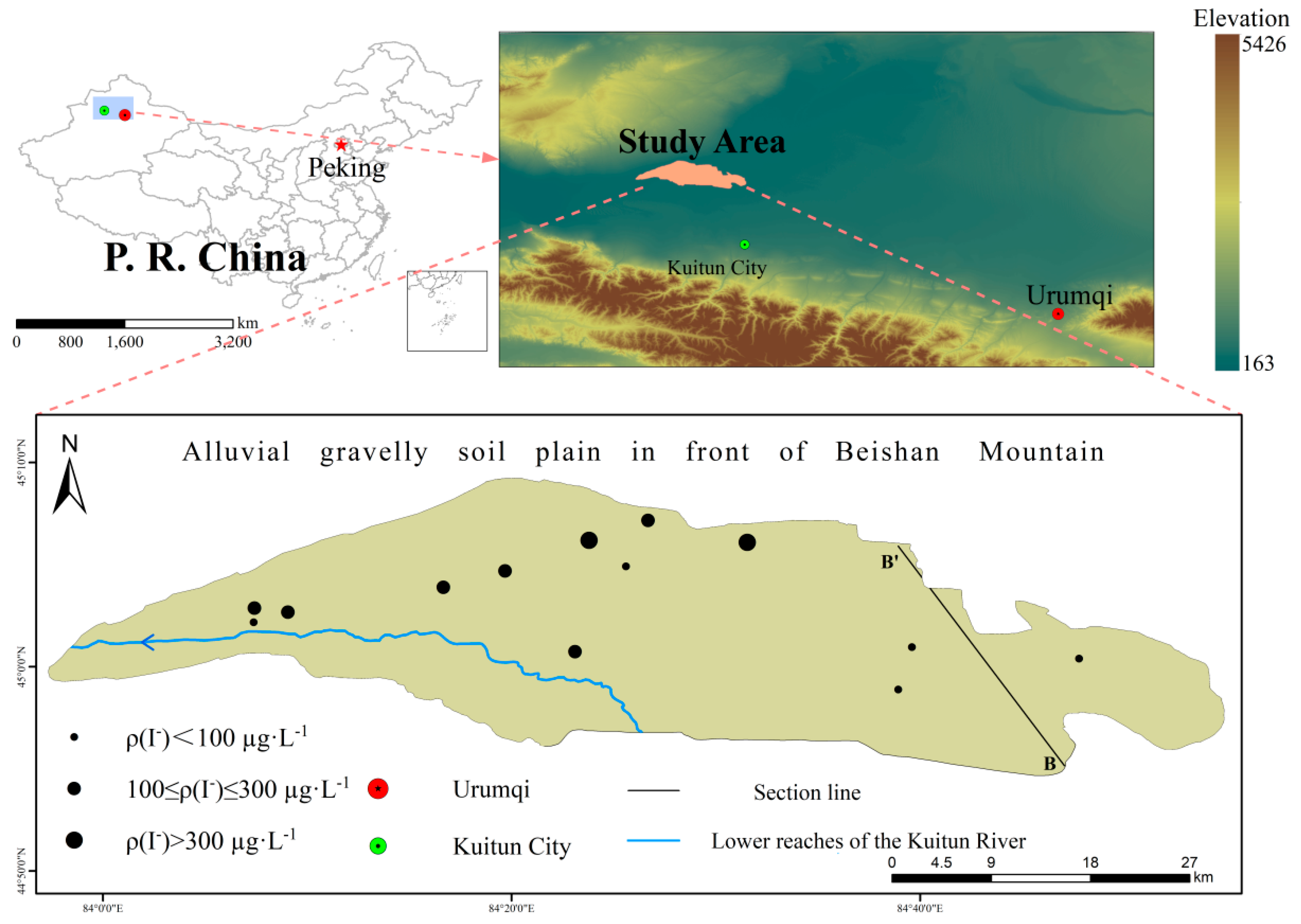
2.1. Study Area
2.2. Sample Collection and Pretreatment
2.3. Groundwater Chemical Analysis
2.3.1. Conventional Chemical Indicators of Water
2.3.2. Stable Carbon Isotopes
2.3.3. Quality Control
3. Results
3.1. Hydrochemical Characteristics of the Groundwater
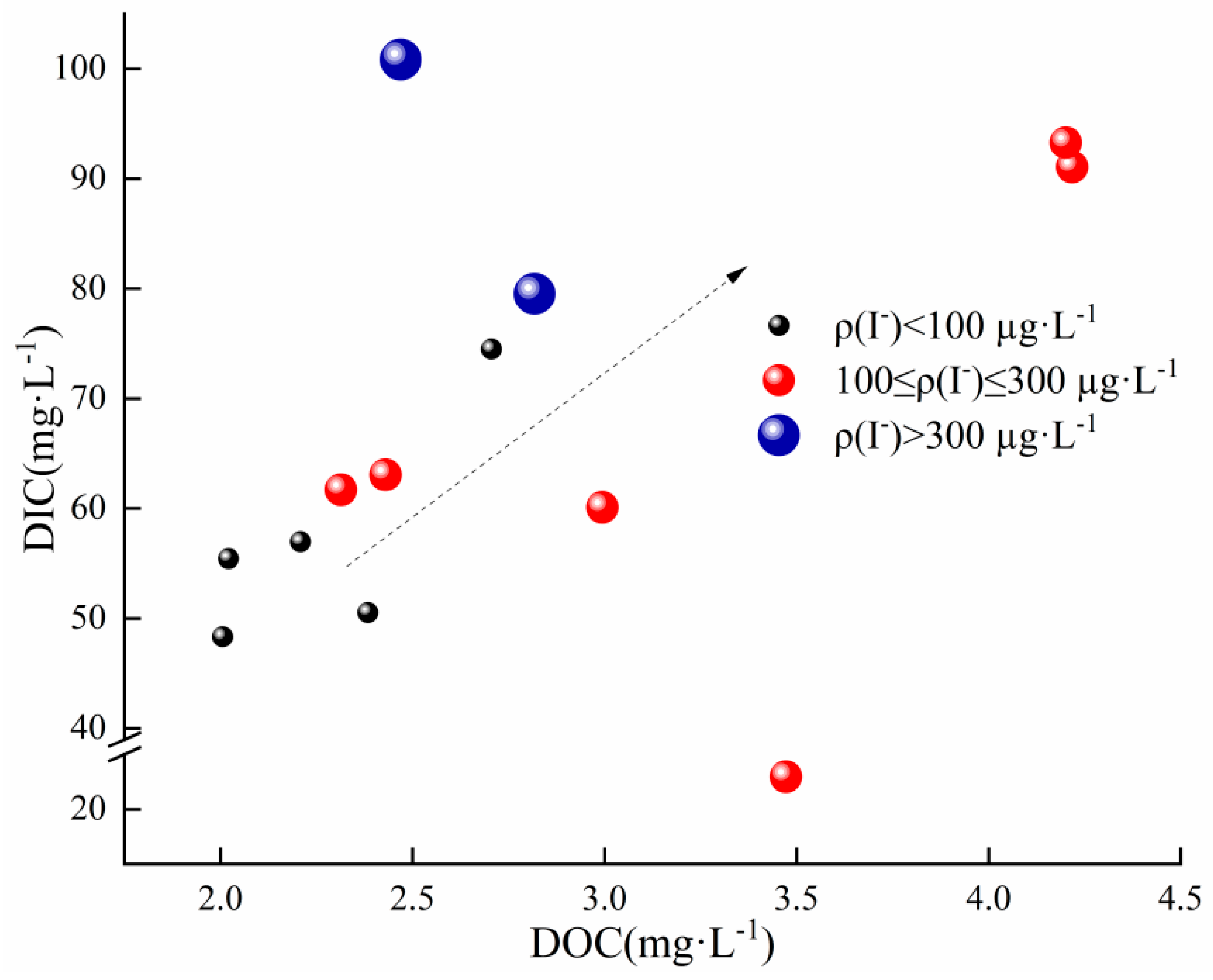
3.2. Characterisation of DIC and DOC in Groundwater Samples
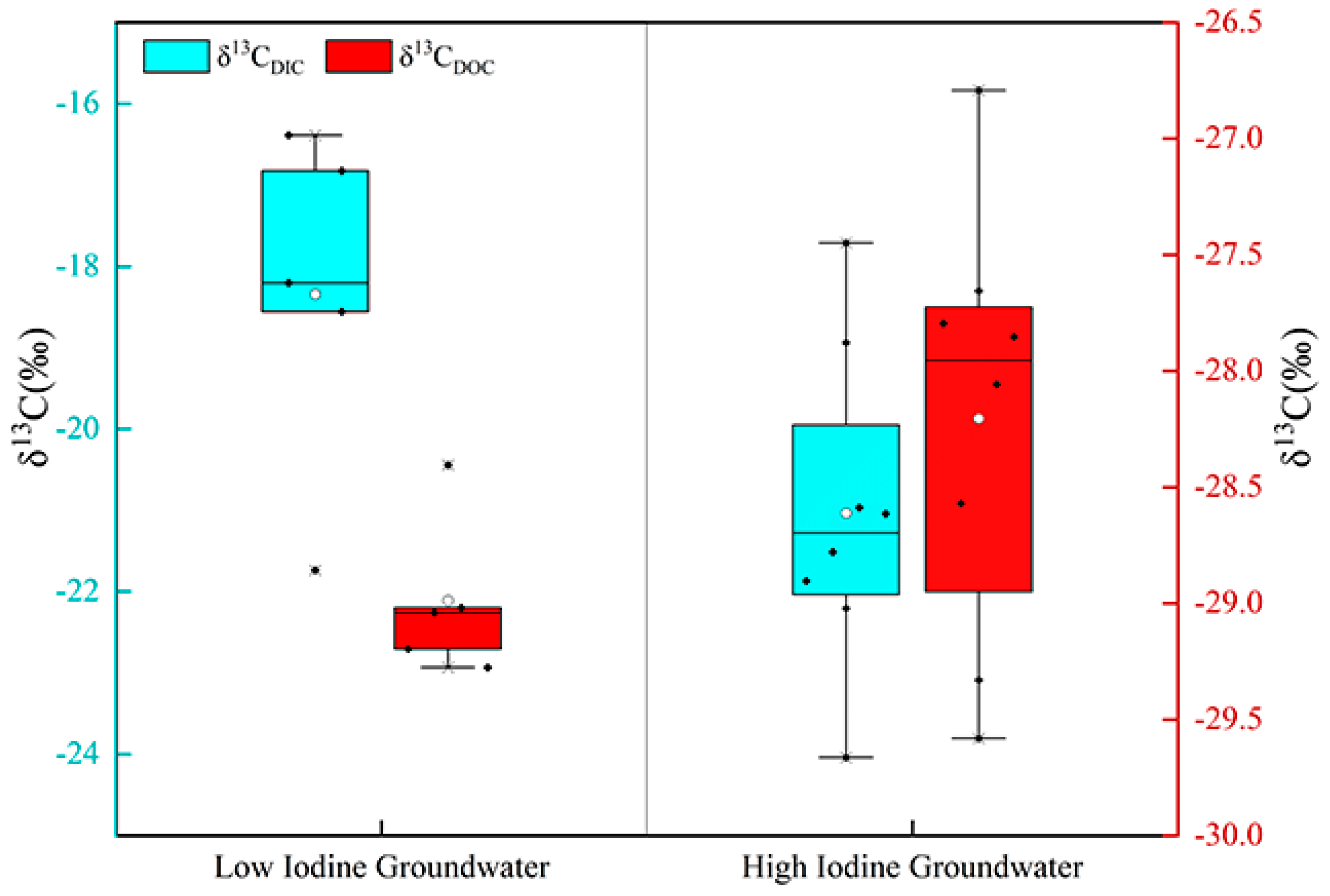
3.3. Characteristics of Stable C Isotopes in Groundwater
4. Discussion
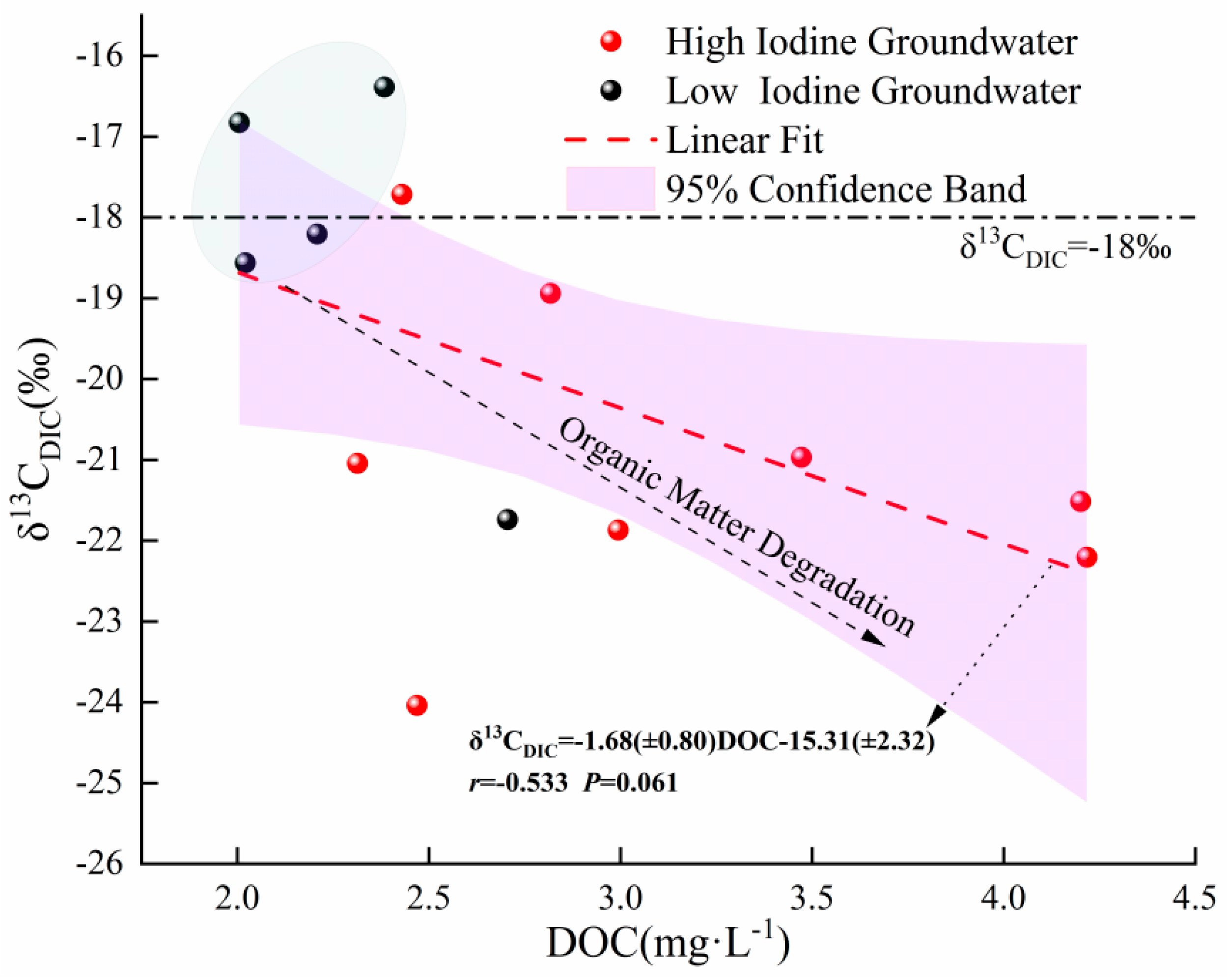
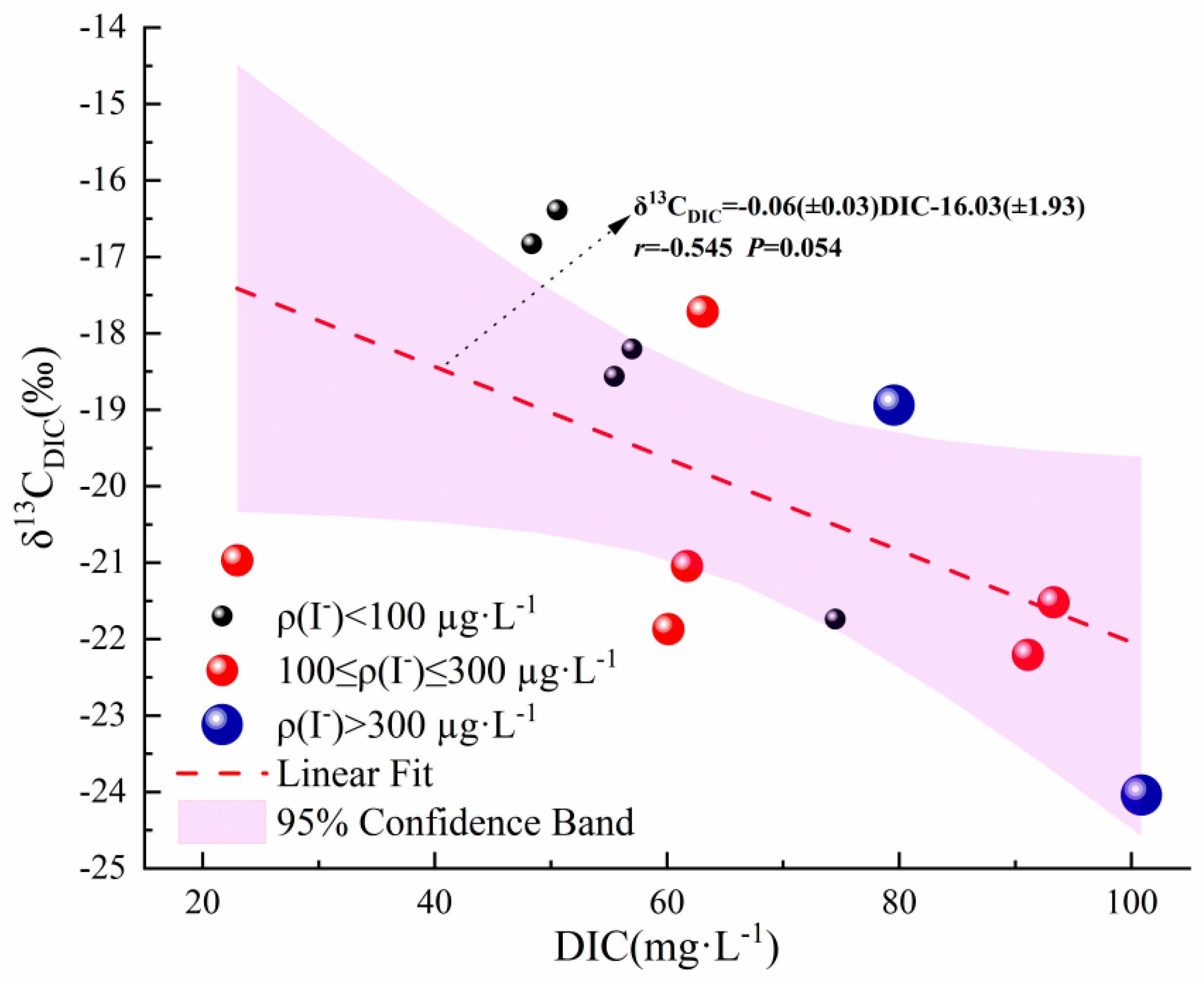
4.1. Source Analysis of DIC and DOC in Groundwater Samples
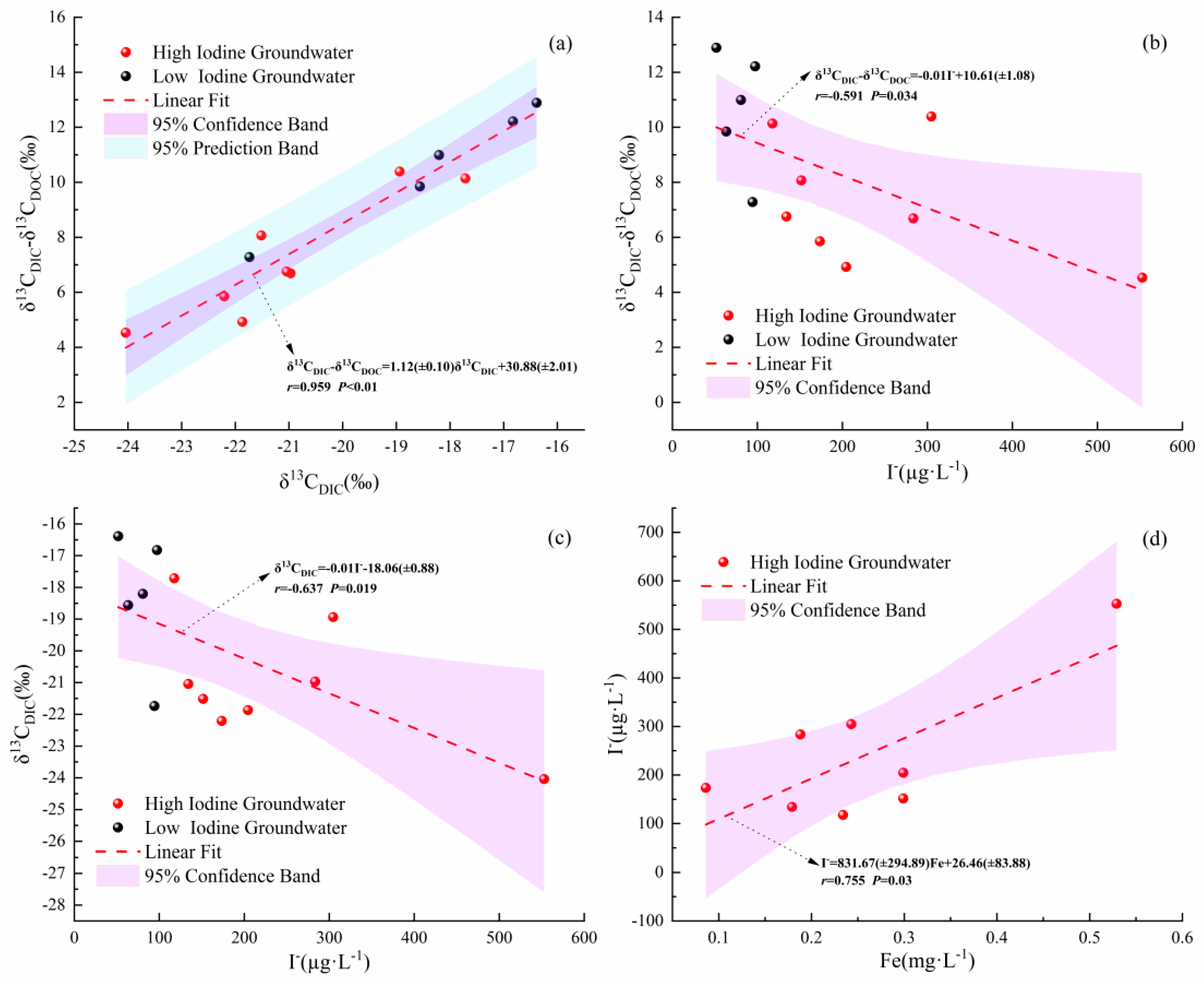
4.2. Stable Carbon Isotope Characteristics Favouring Iodine Enrichment
4.3. Formation Mechanism of Groundwater with High Iodine Content
4.4. Comparative Analysis of the Stable Carbon Isotope Signature and I− Concentration in Groundwater Samples from Different Regions
5. Conclusions
- The I− concentration in the groundwater of the study area ranged from 51.66 to 552.79 µg/L (average 177.68 µg/L) and the percentages of low-iodine water, high-iodine water and ultra-high-iodine water were 38.46%, 46.15% and 15.39%, respectively. The groundwater was reductive and weakly alkaline, and the dominant anion and cation were Cl− and Na+, respectively. The groundwater was dominated by brackish water (46.15%) and the main hydrochemical type was sulphate. According to the ‘Groundwater Quality Standards of China’, the groundwater was mainly classified as Class IV; Class I and Class II groundwater were absent.
- The groundwater DIC and DOC concentrations in the study area ranged from 22.97 to 100.85 mg/L and from 2.01 to 4.22 mg/L, respectively, the δ13CDIC values ranged from −24.04‰ to −16.39‰ and the δ13CDOC values ranged from −29.58‰ to −26.79‰. The ranges and means of the δ13CDIC values were significantly more depleted in high-iodine groundwater than in low-iodine groundwater. Groundwater DIC was primarily affected by microbial degradation of organic matter and by weathering and dissolution of silicate minerals, with HCO3− being the dominant anion. The DOC was mainly derived from C3 plants.
- In reducing aquifer environments with abundant organic matter, the primary hydrobiogeochemical processes leading to the release of solid-phase iodine in the aquifer and its migration into the groundwater were identified as microbial involvement in the decomposition of organic matter and the reductive dissolution of iron minerals. A burial–dissolution genesis model explains the high-iodine groundwater.
Author Contributions
Funding
Data Availability Statement
Acknowledgments
Conflicts of Interest
References
- Sun, D.; Codling, K.; Chang, S.; Zhang, S.; Shen, H.; Su, X.; Chen, Z.; Scherpbier, R.; Yan, J. Eliminating Iodine Deficiency in China: Achievements. Chall. Glob. Implic. Nutr. 2017, 9, 361. [Google Scholar] [CrossRef]
- Guo, H.; Zhang, Z.; Cheng, G.; Li, W.; Li, T.; Jiao, J.J. Groundwater-Derived Land Subsidence in the North China Plain. Environ. Earth Sci. 2015, 74, 1415–1427. [Google Scholar] [CrossRef]
- Kassim, I.A.; Moloney, G.; Busili, A.; Nur, A.Y.; Paron, P.; Jooste, P.; Gadain, H.; Seal, A.J. Iodine Intake in Somalia Is Excessive and Associated with the Source of Household Drinking Water. J. Nutr. 2014, 144, 375–381. [Google Scholar] [CrossRef] [PubMed]
- Voutchkova, D.D.; Ernstsen, V.; Hansen, B.; Sørensen, B.L.; Zhang, C.; Kristiansen, S.M. Assessment of Spatial Variation in Drinking Water Iodine and Its Implications for Dietary Intake: A New Conceptual Model for Denmark. Sci. Total Environ. 2014, 493, 432–444. [Google Scholar] [CrossRef]
- Álvarez, F.; Reich, M.; Snyder, G.; Pérez-Fodich, A.; Muramatsu, Y.; Daniele, L.; Fehn, U. Iodine Budget in Surface Waters from Atacama: Natural and Anthropogenic Iodine Sources Revealed by Halogen Geochemistry and Iodine-129 Isotopes. Appl. Geochem. 2016, 68, 53–63. [Google Scholar] [CrossRef]
- Li, J.; Wang, Y.; Guo, W.; Xie, X.; Zhang, L.; Liu, Y.; Kong, S. Iodine Mobilization in Groundwater System at Datong Basin, China: Evidence from Hydrochemistry and Fluorescence Characteristics. Sci. Total Environ. 2014, 468, 738–745. [Google Scholar] [CrossRef]
- Pearce, E.N.; Andersson, M.; Zimmermann, M.B. Global Iodine Nutrition: Where Do We Stand in 2013? Thyroid 2013, 23, 523–528. [Google Scholar] [CrossRef]
- Togo, Y.S.; Takahashi, Y.; Amano, Y.; Matsuzaki, H.; Suzuki, Y.; Terada, Y.; Muramatsu, Y.; Ito, K.; Iwatsuki, T. Age and Speciation of Iodine in Groundwater and Mudstones of the Horonobe Area, Hokkaido, Japan: Implications for the Origin and Migration of Iodine during Basin Evolution. Geochim. Cosmochim. Acta 2016, 191, 165–186. [Google Scholar] [CrossRef]
- Voutchkova, D.D.; Kristiansen, S.M.; Hansen, B.; Ernstsen, V.; Sørensen, B.L.; Esbensen, K.H. Iodine Concentrations in Danish Groundwater: Historical Data Assessment 1933–2011. Environ. Geochem. Health 2014, 36, 1151–1164. [Google Scholar] [CrossRef]
- Voutchkova, D.D.; Ernstsen, V.; Kristiansen, S.M.; Hansen, B. Iodine in Major Danish Aquifers. Environ. Earth Sci. 2017, 76, 447. [Google Scholar] [CrossRef]
- Ma, R.; Yan, M.; Han, P.; Wang, T.; Li, B.; Zhou, S.; Zheng, T.; Hu, T.; Borthwick, A.G.; Zheng, C.; et al. Deficiency and Excess of Groundwater Iodine and Their Health Associations. Nat. Commun. 2022, 13, 7354. [Google Scholar] [CrossRef]
- Wang, Y.; Li, J.; Xie, X. Genesis and Occurrence of High Iodine Groundwater. Earth Sci. Front. 2022, 29, 1–10. [Google Scholar] [CrossRef]
- Alvarez, F.; Reich, M.; Pérez-Fodich, A.; Snyder, G.; Muramatsu, Y.; Vargas, G.; Fehn, U. Sources, Sinks and Long-Term Cycling of Iodine in the Hyperarid Atacama Continental Margin. Geochim. Cosmochim. Acta 2015, 161, 50–70. [Google Scholar] [CrossRef]
- Li, Z.; Cao, W.; Ren, Y.; Pan, D.; Wang, S.; Zhi, C. Enrichment Mechanisms for the Co-Occurrence of Arsenic-Fluoride-Iodine in the Groundwater in Different Sedimentary Environments of the Hetao Basin, China. Sci. Total Environ. 2022, 839, 156184. [Google Scholar] [CrossRef]
- Sun, Y.; Zhou, J.; Liang, X.; Zhou, Y.; Zeng, Y.; Lin, L. Distribution and Genesis of Shallow High-Iodine Groundwater in Southern Margin of Tarim Basin: A Case Study of Plain Area in Minfeng County, Xinjiang. Earth Sci. 2021, 46, 2999–3011. [Google Scholar] [CrossRef]
- Tang, Q.; Xu, Q.; Zhang, F.; Huang, Y.; Liu, J.; Wang, X.; Yang, Y.; Liu, X. Geochemistry of Iodine-Rich Groundwater in the Taiyuan Basin of Central Shanxi Province, North China. J. Geochem. Explor. 2013, 135, 117–123. [Google Scholar] [CrossRef]
- Xue, J.; Deng, Y.; Luo, Y.; Du, Y.; Yang, Y.; Cheng, Y.; Xie, X.; Gan, Y.; Wang, Y. Unraveling the Impact of Iron Oxides-Organic Matter Complexes on Iodine Mobilization in Alluvial-Lacustrine Aquifers from Central Yangtze River Basin. Sci. Total Environ. 2022, 814, 151930. [Google Scholar] [CrossRef] [PubMed]
- Zhang, E.; Wang, Y.; Qian, Y.; Ma, T.; Zhang, D.; Zhan, H.; Zhang, Z.; Fei, Y.; Wang, S. Iodine in Groundwater of the North China Plain: Spatial Patterns and Hydrogeochemical Processes of Enrichment. J. Geochem. Explor. 2013, 135, 40–53. [Google Scholar] [CrossRef]
- Li, J.; Qian, K.; Yang, Y.; Xie, X. Iodine Speciation and Its Potential Influence on Iodine Enrichment in Groundwater from North China Plain. Procedia Earth Planet. Sci. 2017, 17, 312–315. [Google Scholar] [CrossRef]
- Li, J.; Wang, Y.; Xie, X.; DePaolo, D.J. Effects of Water-Sediment Interaction and Irrigation Practices on Iodine Enrichment in Shallow Groundwater. J. Hydrol. 2016, 543, 293–304. [Google Scholar] [CrossRef]
- Chao, B.; Luo, Y.; Dong, L.; Zheng, Y.; Song, Z.; Wang, M.; Liu, C. Characterizing the Spatial Distribution of Iodine and Analyzing Its Influential Factors in a Typical Groundwater Area with High Arsenic Content in Xinjiang. Acta Sci. Circumstantiae 2024, 44, 156–167. [Google Scholar] [CrossRef]
- Ye, M.; Zhang, W.; Zhao, S.; Zhang, J.; Li, Y.; Pan, H.; Jiang, Z.; Li, J.; Xie, X. Coupled Transformation Pathways of Iron Minerals and Natural Organic Matter Related to Iodine Mobilization in Alluvial-Lacustrine Aquifer. J. Hazard. Mater. 2024, 480, 135944. [Google Scholar] [CrossRef]
- Wang, Y.; Li, J.; Ma, T.; Xie, X.; Deng, Y.; Gan, Y. Genesis of Geogenic Contaminated Groundwater: As, F and I. Crit. Rev. Environ. Sci. Technol. 2021, 51, 2895–2933. [Google Scholar] [CrossRef]
- Yu, K.; Gan, Y.; Zhou, A.; Han, L.; Liu, Y. A Persulfate Oxidation Method for Stable Isotope Analysis of Dissolved Organic Carbon and the Influence of Inorganic Ions on the Results. Int. J. Mass Spectrom. 2015, 392, 63–68. [Google Scholar] [CrossRef]
- Yu, K.; Gan, Y.; Zhou, A.; Liu, C.; Duan, Y.; Han, L.; Zhang, Y. Organic Carbon Sources and Controlling Processes on Aquifer Arsenic Cycling in the Jianghan Plain, Central China. Chemosphere 2018, 208, 773–781. [Google Scholar] [CrossRef]
- Xie, X.; Wang, Y.; Ellis, A.; Li, J.; Su, C.; Duan, M. Multiple Isotope (O, S and C) Approach Elucidates the Enrichment of Arsenic in the Groundwater from the Datong Basin, Northern China. J. Hydrol. 2013, 498, 103–112. [Google Scholar] [CrossRef]
- Zhou, Y.; Guo, H.; Zhang, Z.; Lu, H.; Jia, Y.; Cao, Y. Characteristics and Implication of Stable Carbon Isotope in High Arsenic Groundwater Systems in the Northwest Hetao Basin, Inner Mongolia, China. J. Asian Earth Sci. 2018, 163, 70–79. [Google Scholar] [CrossRef]
- Zhang, Y.; Gan, Y.; Yu, K.; Han, L. Fractionation of Carbon Isotopes of Dissolved Organic Matter Adsorbed to Goethite in the Presence of Arsenic to Study the Origin of DOM in Groundwater. Environ. Geochem. Health 2021, 43, 1225–1238. [Google Scholar] [CrossRef]
- Xue, X.; Li, J.; Xie, X.; Wang, Y.; Tian, X.; Chi, X.; Wang, Y. Effects of Depositional Environment and Organic Matter Degradation on the Enrichment and Mobilization of Iodine in the Groundwater of the North China Plain. Sci. Total Environ. 2019, 686, 50–62. [Google Scholar] [CrossRef] [PubMed]
- Xu, Y.; Deng, Y.; Du, Y.; Xue, J.; Yuan, X.; Luo, Y.; Xie, X.; Wang, Y. Novel Insight into Iodine Enrichment in Alluvial-Lacustrine Aquifers: Evidence from Stable Carbon and Iron Isotopes. J. Hydrol. 2023, 617, 128940. [Google Scholar] [CrossRef]
- Li, J.; Zhou, H.; Wang, Y.; Xie, X.; Qian, K. Sorption and Speciation of Iodine in Groundwater System: The Roles of Organic Matter and Organic-Mineral Complexes. J. Contam. Hydrol. 2017, 201, 39–47. [Google Scholar] [CrossRef]
- Qiao, C.; Wang, Y.; Liu, Y.; Li, J.; Zhang, H.; Lu, J. Study of Water Resources Optimal Operation Model of Multireservoir: A Case Study of Kuitun River Basin in Northwestern China. Wirel. Commun. Mob. Comput. 2022, 2022, 17. [Google Scholar] [CrossRef]
- Wang, L.F.; Wang, H.M.; Lin, F.F.; Sun, X.Z.; Xu, X.F.; Su, M.Y.; Lin, J.; Feng, Z.Y.; Fan, X.Q. A Preliminary Investigation of Endemic Iodine Goiter on the Inclined Plain in Front of the Tian-Shan Mountains in Kuitun-Usum Area. Chin. Med. J. 1986, 99, 673–678. [Google Scholar]
- DZ/T 0064-2021; Methods for Analysis of Groundwater Quality. Standards Press of China: Beijing, China, 2021.
- Dai, S. Environmental Chemistry; Higher Education Press: Beijing, China, 2006. [Google Scholar]
- Atekwana, E.A.; Krishnamurthy, R.V. Seasonal Variations of Dissolved Inorganic Carbon and δ13C of Surface Waters: Application of a Modified Gas Evolution Technique. J. Hydrol. 1998, 205, 265–278. [Google Scholar] [CrossRef]
- Wassenaar, L.; Aravena, R.; Fritz, P. The Geochemistry and Evolution of Natural Organic Solutes in Groundwater. Radiocarbon 1989, 31, 865–876. [Google Scholar] [CrossRef][Green Version]
- Sharp, Z. Principles of Stable Isotope Geochemistry; Pearson Education: Upper Saddle River, NJ, USA, 2007. [Google Scholar]
- Kirkels, F.M.S.A.; Cerli, C.; Federherr, E.; Gao, J.; Kalbitz, K. A Novel High-Temperature Combustion Based System for Stable Isotope Analysis of Dissolved Organic Carbon in Aqueous Samples. II: Optimization and Assessment of Analytical Performance. Rapid Commun. Mass Spectrom. 2014, 28, 2574–2586. [Google Scholar] [CrossRef] [PubMed]
- Fuchu, Z.; Bin, W.; Fan, G.; Mingliang, D.; Liantong, X. Hydrochemical Characteristics of Groundwater and Evaluation of Water Quality in Arid Area of Northwest China: A Case Study in the Plain Area of Kuitun River Basin. Arab. J. Geosci. 2021, 14, 2079. [Google Scholar] [CrossRef]
- GB/T 14848-2017; Standard for Groundwater Quality. Standards Press of China: Beijing, China, 2017.
- Thurman, E.M. Organic Geochemistry of Natural Waters; Springer: Berlin/Heidelberg, Germany, 2012; Volume 2. [Google Scholar]
- Barth, J.A.; Cronin, A.A.; Dunlop, J.; Kalin, R.M. Influence of Carbonates on the Riverine Carbon Cycle in an Anthropogenically Dominated Catchment Basin: Evidence from Major Elements and Stable Carbon Isotopes in the Lagan River (N. Ireland). Chem. Geol. 2003, 200, 203–216. [Google Scholar] [CrossRef]
- Yang, C.; Telmer, K.; Veizer, J. Chemical Dynamics of the “St. Lawrence” Riverine System: δD(H2O), δ18O(H2O), δ13C(DIC), δ34S(sulfate), and Dissolved 87Sr/86Sr. Geochim. Cosmochim. Acta 1996, 60, 851–866. [Google Scholar] [CrossRef]
- Zhou, Y. Biogeochemical Processes in High Arsenic Groundwater in the Northwestern Hetao Basin, Inner Mongolia: Evidences from Hydrogeochemistry and Stable Isotopes. Ph.D. Thesis, China University of Geosciences, Beijing, China, 2018. [Google Scholar]
- Li, J.; Jiang, Z.; Xie, X.; Wang, Y. Mechanisms of Iodine Enrichment in the Pore-Water of Fluvial/Lacustrine Aquifer Systems: Insight from Stable Carbon Isotopes and Batch Experiments. J. Hydrol. 2022, 613, 128334. [Google Scholar] [CrossRef]
- Song, C.; Wang, G.; Mao, T.; Huang, K.; Sun, X.; Hu, Z.; Chang, R.; Chen, X.; Raymond, P.A. Spatiotemporal Variability and Sources of DIC in Permafrost Catchments of the Yangtze River Source Region: Insights from Stable Carbon Isotope and Water Chemistry. Water Resour. Res. 2020, 56, e2019WR025343. [Google Scholar] [CrossRef]
- Clark, I.D.; Fritz, P. Environmental Isotopes in Hydrogeology; CRC Press: Boca Raton, FL, USA, 2013. [Google Scholar]
- Jin, L.; Ogrinc, N.; Yesavage, T.; Hasenmueller, E.A.; Ma, L.; Sullivan, P.L.; Kaye, J.; Duffy, C.; Brantley, S.L. The CO2 Consumption Potential during Gray Shale Weathering: Insights from the Evolution of Carbon Isotopes in the Susquehanna Shale Hills Critical Zone Observatory. Geochim. Cosmochim. Acta 2014, 142, 260–280. [Google Scholar] [CrossRef]
- Porowska, D. Determination of the Origin of Dissolved Inorganic Carbon in Groundwater around a Reclaimed Landfill in Otwock Using Stable Carbon Isotopes. Waste Manag. 2015, 39, 216–225. [Google Scholar] [CrossRef]
- Zhang, D.; Liu, C.; Wang, F.; Zhao, Z. Inorganic Carbon Cycling in Subsurface Environment Influenced by Agricultural Activities. China Environ. Sci. 2015, 35, 3359–3370. [Google Scholar] [CrossRef]
- Chao, B.; Luo, Y.; Wang, X. Stable Carbon Isotope Signatures of High Arsenic Groundwater and Their Indicative Significance in Kuitun Area of Xinjiang. Environ. Chem. 2024, 43, 1–10. [Google Scholar] [CrossRef]
- Schulte, P.; van Geldern, R.; Freitag, H.; Karim, A.; Négrel, P.; Petelet-Giraud, E.; Probst, A.; Probst, J.; Telmer, K.; Veizer, J.; et al. Applications of Stable Water and Carbon Isotopes in Watershed Research: Weathering, Carbon Cycling, and Water Balances. Earth-Sci. Rev. 2011, 109, 20–31. [Google Scholar] [CrossRef]
- Truesdell, A.; Hulston, J. Chapter 5—Isotopic Evidence on Environments of Geothermal Systems. In Handbook of Environmental Isotope Geochemistry; Elsevier: Amsterdam, The Netherlands, 1980; Volume 3, pp. 179–226. [Google Scholar]
- Brookman, T.H.; Ambrose, S.H. Kangaroo Tooth Enamel Oxygen and Carbon Isotope Variation on a Latitudinal Transect in Southern Australia: Implications for Palaeoenvironmental Reconstruction. Oecologia 2013, 171, 403–416. [Google Scholar] [CrossRef] [PubMed]
- Hedges, J.I.; Keil, R.G.; Benner, R. What Happens to Terrestrial Organic Matter in the Ocean? Org. Geochem. 1997, 27, 195–212. [Google Scholar] [CrossRef]
- Hong, L. A Preliminary Study on the Disease and Formation Environment of High Fluorine and Arsenic Water in Chepaizi Area, North of Kuitun, Xinjiang. Xinjiang Environ. Prot. 1983, 5, 22–28. [Google Scholar]
- Luo, Y.; Li, J.; Jiang, P.; Xing, Y. Distribution, Classification and Cause Analysis of Geogenic High-Arsenic Groundwater in Kuitun, Xinjiang. Acta Sci. Circumstantiae 2017, 37, 2897–2903. [Google Scholar] [CrossRef]
- Dai, J.L.; Zhang, M.; Hu, Q.H.; Huang, Y.Z.; Wang, R.Q.; Zhu, Y.G. Adsorption and Desorption of Iodine by Various Chinese Soils: II. Iodide and Iodate. Geoderma 2009, 153, 130–135. [Google Scholar] [CrossRef]
- Hansen, V.; Roos, P.; Aldahan, A.; Hou, X.; Possnert, G. Partition of Iodine (129I and 127I) Isotopes in Soils and Marine Sediments. J. Environ. Radioact. 2011, 102, 1096–1104. [Google Scholar] [CrossRef]
- Tao, Y.; Du, Y.; Deng, Y.; Huang, Y.; Leng, Z.; Ma, T.; Wang, Y. Carbon and Iron Isotope Approach Elucidates the Enrichment of Geogenic Phosphorus in Alluvial-Lacustrine Sedimentary Aquifers. J. Hydrol. 2022, 607, 127517. [Google Scholar] [CrossRef]
- Wang, X.; Luo, Y.; Deng, W.; Zhipeng, D. Three-Dimensional Fluorescence Characteristics of Dissolved Organic Matter in High-Arsenic Groundwater in the Kuitun Area, Xinjiang. China Environ. Sci. 2020, 40, 4974–4981. [Google Scholar] [CrossRef]
- Li, J.; Zhao, S.; Jiang, Z.; Xie, X.; Deng, Y.; Shi, L.; Kappler, A.; Van Cappellen, P.; Wang, Y. Spatial Distribution and Formation Mechanisms of High-Iodine Groundwater throughout China. Earth-Sci. Rev. 2025, 265, 105134. [Google Scholar] [CrossRef]
- Li, J.; Fang, W.; Li, C.; Cui, M.; Qian, L.; Jiang, Z.; Jiang, Y.; Shi, L.; Xie, X.; Guo, H.; et al. Dissimilatory Iodate-Reducing Microorganisms Contribute to the Enrichment of Iodine in Groundwater. Environ. Sci. Technol. 2024, 58, 19255–19265. [Google Scholar] [CrossRef] [PubMed]
- Amachi, S. Microbial Contribution to Global Iodine Cycling: Volatilization, Accumulation, Reduction, Oxidation, and Sorption of Iodine. Microbes Environ. 2008, 23, 269–276. [Google Scholar] [CrossRef]
- Sracek, O.; Hirata, R. Geochemical and Stable Isotopic Evolution of the Guarani Aquifer System in the State of São Paulo, Brazil. Hydrogeol. J. 2002, 10, 643–655. [Google Scholar] [CrossRef]
- Rueedi, J.; Cronin, A.A.; Taylor, R.G.; Morris, B.L. Tracing Sources of Carbon in Urban Groundwater Using δ13C(TDIC) Ratios. Environ. Geol. 2007, 52, 541–557. [Google Scholar] [CrossRef]
- Moeller, P.; Weise, S.M.; Tesmer, M.; Dulski, P.; Pekdeger, A.; Bayer, U.; Magri, F. Salinization of Groundwater in the North German Basin: Results from Conjoint Investigation of Major, Trace Element and Multi-Isotope Distribution. Int. J. Earth Sci. 2008, 97, 1057–1073. [Google Scholar] [CrossRef]
- Zhu, C.; Li, J.; Xie, X. Carbon and Sulfur Isotopic Features and Their Implications for Iodine Mobilization in Groundwater System at Datong Basin, Northern China. Earth Sci. 2021, 46, 4480–4491. [Google Scholar] [CrossRef]
- Yuan, X.; Deng, Y.; Du, Y. Characteristics of Stable Carbon Isotopes and Its Implications on Arsenic Enrichment in Shallow Groundwater of the Jianghan Plain. Bull. Geol. Sci. Technol. 2020, 39, 156–163. [Google Scholar] [CrossRef]
- Fan, R.; Deng, Y.; Xue, J. Predicting the Spatial Distribution of Geogenic Iodine-Contaminated Groundwater of Jianghan Plain Based on Extreme Gradient Boost Model. Saf. Environ. Eng. 2022, 29, 70–77. [Google Scholar] [CrossRef]




| Index | Min | Max | Mean | Median | Coefficient of Variation |
|---|---|---|---|---|---|
| pH | 7.79 | 9.34 | 8.43 | 8.12 | 0.07 |
| Eh (mV) | −101.40 | −17.20 | −52.53 | −31.30 | −0.64 |
| K+ (mg/L) | 1.01 | 10.24 | 5.27 | 5.10 | 0.64 |
| Na+ (mg/L) | 78.06 | 1516.77 | 553.00 | 487.74 | 0.85 |
| Ca2+ (mg/L) | 28.71 | 537.63 | 205.17 | 187.31 | 0.83 |
| Mg2+ (mg/L) | 1.45 | 659.55 | 145.93 | 87.45 | 1.32 |
| Cl− (mg/L) | 38.20 | 3121.17 | 878.10 | 367.59 | 1.18 |
| SO42− (mg/L) | 179.67 | 1323.33 | 666.50 | 651.89 | 0.64 |
| HCO3− (mg/L) | 79.43 | 229.94 | 165.00 | 156.82 | 0.24 |
| CO32− (mg/L) | 3.62 | 18.50 | 10.23 | 9.13 | 0.39 |
| TDS (mg/L) | 475.75 | 6834.64 | 2629.21 | 2103.61 | 0.78 |
| Fe (mg/L) | 0.09 | 0.53 | 0.26 | 0.26 | 0.43 |
| I− (µg/L) | 51.66 | 552.79 | 177.68 | 134.24 | 0.77 |
| Country | Study Area | δ13CDIC (‰) | δ13CDOC (‰) | I− (μg/L) | Depth (m) | Aquifer Type |
|---|---|---|---|---|---|---|
| Brazil [66] | Guarani, São Paulo State | −19.00–−5.20 | - | - | - | Semi-confined to confined (unconfined in recharge area) |
| Britain [67] | British Midlands | −20.05–2.96 | - | - | 8.24–76.28 | Permo-Triassic sandstone aquifer (alternating confined/ unconfined conditions) |
| Germany [68] | North German Basin | −22.70–−3.70 | - | - | 86–1616 | Shallow unconfined (freshwater) to deep confined (saline) separated by clay aquitards |
| Poland [50] | Suburb of Otwock | −20.60–3.60 | - | - | - | Mainly unconfined, locally semi-confined |
| China [14,45,68,71] | Kuitun, Xinjiang | −24.04–−16.39 | −29.58–−26.79 | 51.66–552.79 | 90–200 | Deep confined |
| Datong Basin | −16.93–−7.36 | - | 14.40–1030.00 | 16–75 | Unconfined to confined | |
| Hetao Plain | −11.80–−5.34 | −22.90–−19.20 | 31.84–1289.57 | 15–80 | Mainly unconfined, locally semi-confined | |
| North China Plain | −11.42–−5.95 | - | 4–2175 | 10–860 | Shallow unconfined + deep confined | |
| Jianghan Plain | −18.50–−3.28 | −28.50–−19.60 | 2–1600 | 15–40 | Shallow unconfined + middle confined; deep confined |
Disclaimer/Publisher’s Note: The statements, opinions and data contained in all publications are solely those of the individual author(s) and contributor(s) and not of MDPI and/or the editor(s). MDPI and/or the editor(s) disclaim responsibility for any injury to people or property resulting from any ideas, methods, instructions or products referred to in the content. |
© 2026 by the authors. Licensee MDPI, Basel, Switzerland. This article is an open access article distributed under the terms and conditions of the Creative Commons Attribution (CC BY) license.
Share and Cite
Chao, B.; He, J.; Luo, Y.; Dong, L.; Zhang, Q.; Xie, X.; Liu, X.; Yu, E.; Sun, R.; Bian, J. High-Iodine Groundwater in the Lower Kuitun River in Xinjiang: Evidence from Stable-Carbon-Isotope Characteristics. Water 2026, 18, 1409. https://doi.org/10.3390/w18121409
Chao B, He J, Luo Y, Dong L, Zhang Q, Xie X, Liu X, Yu E, Sun R, Bian J. High-Iodine Groundwater in the Lower Kuitun River in Xinjiang: Evidence from Stable-Carbon-Isotope Characteristics. Water. 2026; 18(12):1409. https://doi.org/10.3390/w18121409
Chicago/Turabian StyleChao, Bo, Jiale He, Yanli Luo, Lele Dong, Qian Zhang, Xinzhe Xie, Xuan Liu, Enmeng Yu, Rui Sun, and Jiaqi Bian. 2026. "High-Iodine Groundwater in the Lower Kuitun River in Xinjiang: Evidence from Stable-Carbon-Isotope Characteristics" Water 18, no. 12: 1409. https://doi.org/10.3390/w18121409
APA StyleChao, B., He, J., Luo, Y., Dong, L., Zhang, Q., Xie, X., Liu, X., Yu, E., Sun, R., & Bian, J. (2026). High-Iodine Groundwater in the Lower Kuitun River in Xinjiang: Evidence from Stable-Carbon-Isotope Characteristics. Water, 18(12), 1409. https://doi.org/10.3390/w18121409