Article

Spatial Cascading of Extreme Water–Sediment Imbalance Risks in a Heavily Regulated River Reach: A Copula-CoVaR Framework

College of Hydrology and Water Resources, Hohai University, Nanjing 210098, China
*
Author to whom correspondence should be addressed.
Water 2026, 18(11), 1372; https://doi.org/10.3390/w18111372
Submission received: 29 April 2026 / Revised: 1 June 2026 / Accepted: 2 June 2026 / Published: 4 June 2026
(This article belongs to the Section Water Erosion and Sediment Transport)

Abstract

The Inner Mongolia reach of the Yellow River faces compound “low flow, high sediment” extremes under reservoir regulation, threatening flood and ice-flood safety in ways that traditional mean-based or correlation-based methods fail to quantify. This study integrates POT-GPD extreme value theory with a vine copula-CoVaR framework using daily data (1951–2023) from four stations. The financial CoVaR concept was adapted to rivers through three hydrological modifications: a 5-day hydrodynamic lag, redefinition of the baseline to the downstream unconditional VaR, and semi-parametric tail modeling. Bootstrap confidence intervals (n = 1000) and a sensitivity analysis to the upstream–downstream lag (τ = 3–7 days) and the period cutoff (1984–1990) were used to assess robustness. Bayangol exhibits the highest Expected Shortfall (ES95 = 0.0329 kg·s·m−6). The Bayangol → Toudaoguai path is the only persistent positive risk transmission link, with ΔCoVaR showing a directionally consistent increase of 253% from the natural period (1951–1986) to the regulated period (1987–2023); by contrast, ΔCoVaR from Dengkou to Toudaoguai remains near zero or negative when assessed under the conventional bivariate framework. A three-dimensional vine copula analysis, conducted independently for the pre- and post-reservoir periods, reveals a qualitative reversal of compound extreme spillover that is masked when the two periods are pooled. While the bivariate analysis identifies Bayangol → Toudaoguai as the only persistent positive spillover route at the annual scale, the 3D vine analysis unpacks the compound extreme mechanism at the daily scale. Under the joint compound extreme condition (upstream Q and S each ≥ Q90), the conditional VaR95 of downstream sediment concentration shifts from systematically negative in P1 (ΔVaR95 = −4.75 kg·m−3 at the 90th-percentile threshold, indicating natural attenuation) to systematically positive in P2′ (ΔVaR95 = +4.70 kg·m−3, +86.9% relative increase, indicating amplification). The same reversal is observed for the tail mean (ΔES95), is preserved across four compound extreme thresholds (Q75–Q90), and is robust to the choice of period cutoff (28/28 cases reverse across seven candidate cutoffs). Bidirectional counterfactual simulations indicate that the copula shift from tail independence (Clayton) to tail dependence (Gaussian) alone elevates extreme concurrence probability by 58% (from 2.21% to 3.49%), while marginal distribution changes contribute negligibly (≤0.1 percentage points). Structural deterioration of water–sediment coordination therefore dominates risk amplification. The copula-CoVaR framework offers a candidate tool that requires further validation with large samples for tail risk assessment in heavily regulated fluvial systems.

1. Introduction

The Inner Mongolia reach of the Yellow River is roughly 830 km long, bridging the upper and middle reaches. It provides flood control, ice-jam prevention, irrigation, and ecological services. Joint operation of the Longyangxia and Liujiaxia reservoirs began in 1986; since then, wet-season flood peaks have fallen by 40–60%, and the natural water–sediment regime has changed accordingly [1]. The Hetao Irrigation District withdraws 5.9–6.3 billion m3 each year, which cuts mainstem baseflow. In floods, ephemeral tributaries such as the Ten Kongdui inject hyperconcentrated flows with sediment concentrations of 500–1000 kg/m3. At the same time, reservoir regulation has reduced mainstream transport capacity. Together these pressures produce the “low flow–high sediment” compound hazard now seen in the reach. At Toudaoguai, bankfull discharge has fallen by more than half from historical peaks [2]. Similar reservoir-induced changes in downstream water–sediment regimes have been documented for many regulated rivers worldwide [3,4], underscoring the need for risk-assessment tools that explicitly capture the spatial cascading of extremes. A recent comprehensive review of anthropogenic impacts on the Yellow River water systems further highlights the intensification of water scarcity and the substantial reduction in sediment transport since the 1950s [5].
Earlier studies of Yellow River hydro-sediment dynamics have documented long-term trends [6], channel morphology responses [7], and extreme hydrological events [8]. Researchers have also used copulas to estimate joint probabilities of compound extremes such as floods and droughts [8]. Copula-based multivariate frequency analysis has become a standard tool in hydrology [8,9,10], including vine copula extensions for compound events [11]. However, none of these works simultaneously (i) targets the compound “low-flow–high-sediment” hazard relevant to heavily regulated semi-arid rivers, (ii) yields a conditional risk increment expressed in physical units (kg·s·m−6) rather than in dependence coefficients, (iii) propagates risk through a multi-station spatial network with an explicit hydrodynamic time-lag, and (iv) decomposes the contribution of dependence structure shifts versus marginal distribution shifts to the change in compound extreme probability. Recent advances in conditional frequency analysis have highlighted the value of such multi-site approaches. Wang et al. [12] quantitatively attributed the reduction in Yellow River sediment load to anthropogenic factors including dam construction and vegetation restoration. Standard metrics such as Pearson’s r and Kendall’s τ describe average dependence. They do not quantify how far a downstream risk threshold moves when an upstream section enters an extreme state, yet that is exactly the information engineers need for safety design. We adapt the Conditional Value-at-Risk (CoVaR) framework from finance to address this need. Adrian and Brunnermeier [13] originally developed CoVaR to measure how distress at one bank raises default risk elsewhere. The same idea—networked nodes, internal benchmarks, and tail risk contagion—applies to spatial risk propagation in river systems (Table 1). The CoVaR framework has since been applied to assess systemic risk in other domains, including financial networks.
Applying CoVaR to rivers requires three changes. First, we introduce a daily hydrodynamic lag between upstream and downstream observations, informed by Pearson cross-correlation analysis of the daily ζ = S/Q series. Across the five upstream–downstream pairs the cross-correlation peaks between 1 and 9 days (all well above the 95% white-noise band of ±0.021; see Section 2.5 and Figure S4); we adopt τ = 5 days as a single representative value that lies within the statistically significant lag plateau for every pair determined from cross-correlation functions; this replaces finance’s assumption of instantaneous transmission. Second, we set the baseline for ΔCoVaR at the downstream unconditional VaR instead of the median state, so that any positive value represents real extra hazard from upstream extremes. Third, we build semi-parametric margins—empirical CDFs for the distribution body and GPDs for the tail—which prevents parametric assumptions from smoothing away heavy-tailed sediment behavior. We compare the resulting POT-GPD estimates with GEV (block-maxima) estimates as a cross-method robustness check (Supplementary Table S9; Figure S5).
We test the framework on daily discharge and sediment records (1951–2023) from Dengkou, Bayangol, Sanhuhekou, and Toudaoguai. The analysis proceeds in four stages. We first establish station-level tail risk benchmarks with POT-GPD. We then use bivariate copulas to obtain ΔCoVaR values that measure spatial conditional risk. Next, a 3D vine copula isolates the effects of extreme low flow and high sediment concentration on downstream extremes. Finally, period comparisons and counterfactual experiments show how reservoir regulation has changed risk transmission. Each stage is designed to assess whether directional conclusions might be overly sensitive to small-sample effects, rather than to provide precise uncertainty bounds—non-parametric bootstrap confidence intervals (B = 1000), threshold sensitivity (Q75–Q90), and cutoff year sensitivity (1984–1990)—designed to address the inherent small-sample limitations of tail estimation.
The primary contribution of this work is the attempted integration of these methods: a POT-GPD + semi-parametric margin + vine copula + multi-station ΔCoVaR + explicit lag + bidirectional counterfactual + period-stratified pipeline that, to our knowledge, has not been jointly applied to fluvial water–sediment risk. Despite data limitations, the integrated framework provides a proof-of-concept for translating tail risk metrics to fluvial systems. The framework yields, for each upstream–downstream pair, (i) a tail risk benchmark in physical units, (ii) a conditional spillover increment, (iii) a decoupling of compound-driver contributions, and (iv) an attribution of inter-period change to dependence structure versus volume. The Inner Mongolia reach of the Yellow River, with its sharp pre- vs. post-reservoir contrast and its strong tributary sediment forcing, provides an unusually clean testbed for evaluating this pipeline.

2. Materials and Methods

2.1. Study Area Description

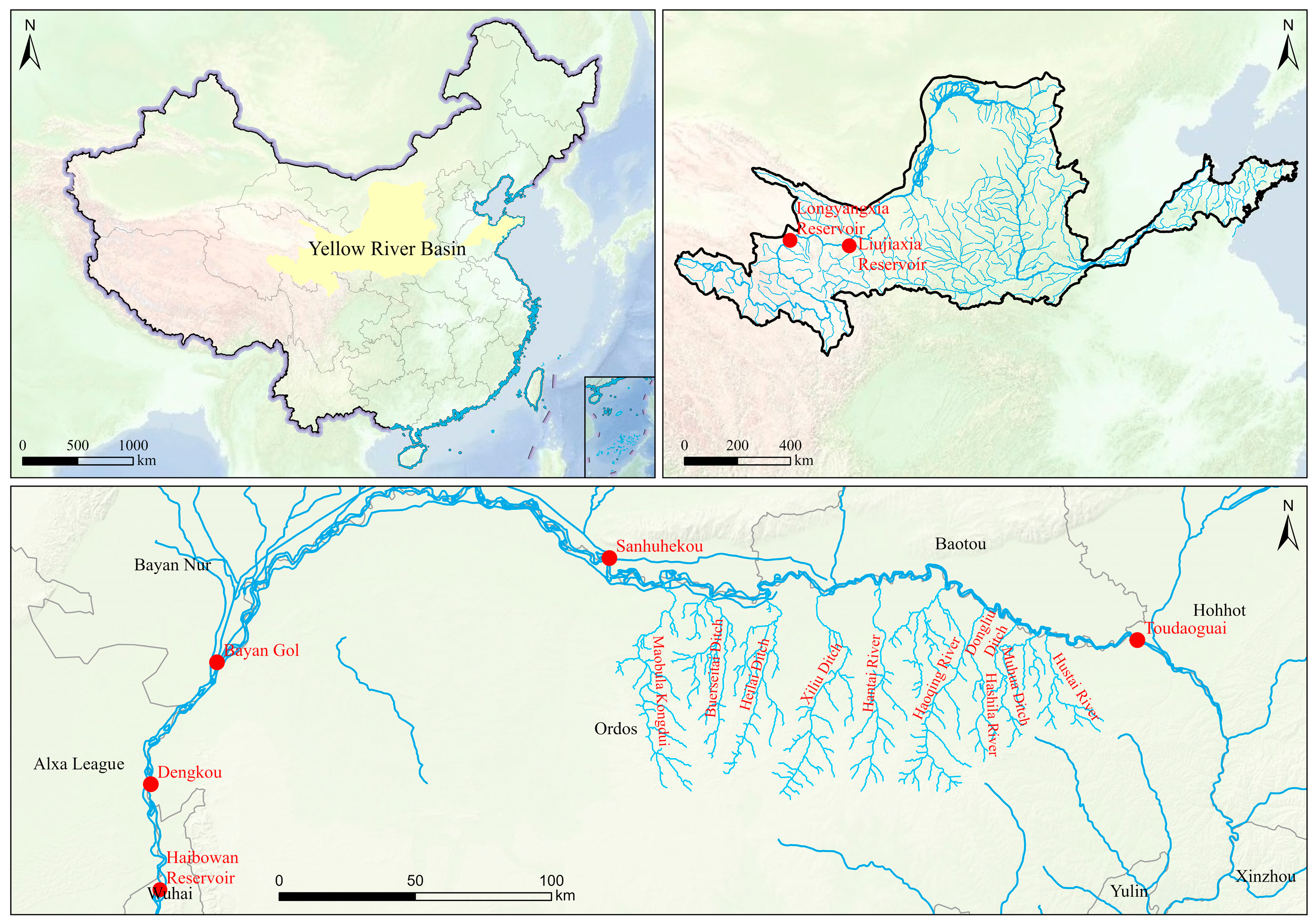
The study reach runs 830 km from Dengkou to Toudaoguai across arid to semi-arid zones (Figure 1). Channel gradient is gentle, about 0.1‰–0.2‰, so sediment transport capacity is limited and deposition occurs along the channel. This produces the well-known “perched river” morphology of the Yellow River.
Four gauging stations—Dengkou, Bayangol, Sanhuhekou, and Toudaoguai—cover the reach. The distances between them are roughly 70 km (Dengkou–Bayangol), 220 km (Bayangol–Sanhuhekou), and 200 km (Sanhuhekou–Toudaoguai). From Dengkou to Bayangol the channel is wide, shallow, and wandering; downstream of Bayangol it shifts to a meandering pattern.
Since 1986, joint operation of the Longyangxia and Liujiaxia reservoirs has cut wet-season flood peaks by 40–60% [1]. The Hetao Irrigation District diverts 5.9–6.3 billion m3 annually. In addition, ephemeral tributaries such as the Ten Kongdui deliver high-sediment pulses into the reach. These pressures have shifted the natural synchronous water–sediment regime toward an asynchronous “low flow, high sediment” pattern.

2.2. Data Acquisition and Reconstruction

Daily discharge (Q, m3/s) and sediment concentration (S, kg/m3) from 1951 to 2023 at the four stations form the core dataset. Observed data from 1951 to 2016 come from the Hydrological Bureau of the Yellow River Conservancy Commission. Values for 2017–2023 are partly missing due to monitoring system upgrades and publication delays. We filled these gaps with a random forest model trained on 1951–2016 records to map inter-station flow relationships and the nonlinear discharge–sediment response.
The initial reconstructed series was then corrected in four steps: regional background adjustment, annual-scale calibration, monthly-scale correction, and annual total closure. This ensures the reconstructed data match available annual and monthly statistics. All data for 1951–2016 are original observations; reconstruction was applied only to the 2017–2023 window. At Toudaoguai, the Nash–Sutcliffe efficiency is 0.968 for daily sediment discharge and 0.977 for monthly values, meeting the accuracy threshold for extreme value analysis (details in Supplementary Materials).
Random forest models tend to regress to the mean, which can smooth extreme tails. To limit this effect, we set the POT threshold at the 90th percentile (Section 3). Only two of the eight exceedance years across the full record fall within the 2017–2023 reconstructed window, and neither ranks in the top 5% of the extreme tail. The impact on tail parameter estimation is therefore likely small, given the limited number of exceedance years in the reconstructed window. Any smoothing would, if anything, lead to conservative (i.e., potentially underestimated) tail risk estimates. Any smoothing that does occur would underestimate tail risk, so the reported extreme risk intensities should be viewed as conservative lower bounds.

2.3. Risk Metrics and Period Division

We adopt the incoming sediment coefficient ζ = S/Q (kg·s·m−6) as the risk metric. Low discharge and high sediment concentration both raise ζ, signaling heavier sediment load per unit flow and higher siltation risk.
Sediment problems in the Yellow River concentrate in the flood season. We therefore define the annual risk indicator as the maximum 30-day moving average of daily ζ during July–October. Days with Q < 1 m3/s were excluded, and each 30-day window required at least 15 valid points. By taking one maximum per year, the interannual series can be treated as independent, satisfying the independence assumption of extreme value theory [14].
We divide the record into two phases based on reservoir operation milestones. Period 1 (P1, 1951–1986) predates joint operation of the Longyangxia and Liujiaxia reservoirs and represents a relatively natural regime. Period 2′ (P2′, 1987–2023) follows joint reservoir operation. We merge the original Period 2 (1987–2013, joint operation) and Period 3 (2014–2023, post-Haibowan) because Period 3 alone has only 10 years—too few for reliable copula and tail risk estimation. An analysis of the full period (1951–2023) is also included for long-term context.

2.4. Research Framework

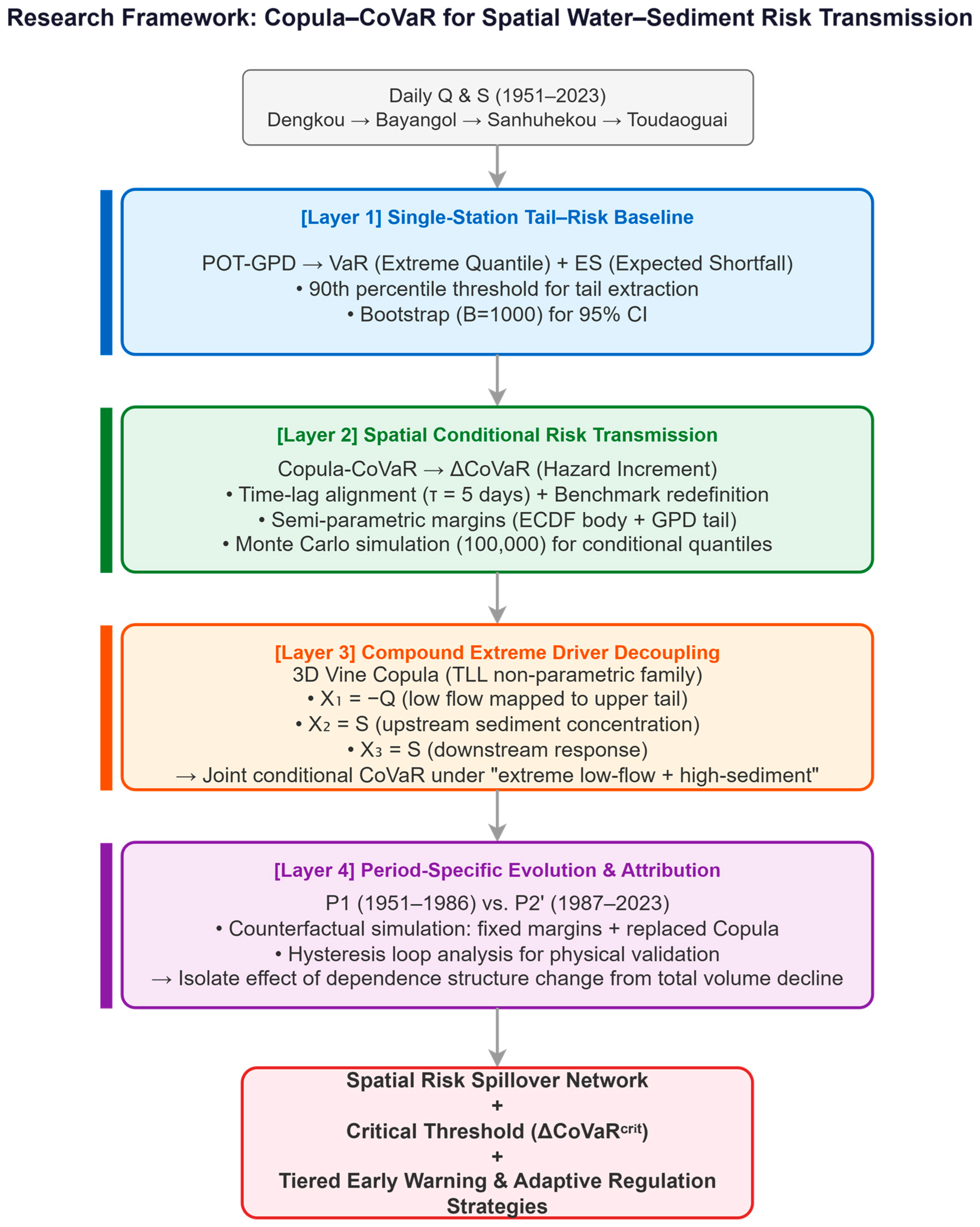
The analysis proceeds in four stages (Figure 2): identify local tail risks, track their downstream propagation, separate the drivers of compound extremes, and test how regulation has altered the overall picture.
First, we fit a POT-GPD model to each station using ζ = S/Q. The resulting VaR and ES values provide warning thresholds and baselines for spatial comparison.
With these benchmarks in place, we turn to spatial transmission. A copula-CoVaR model, adapted from financial risk theory, measures how much downstream risk rises when upstream ζ enters its tail. The hazard increment ΔCoVaR is the core metric here. It is calculated after aligning upstream and downstream series with a 5-day lag and redefining the baseline to the downstream unconditional VaR rather than the median state.
The third step unpacks compound drivers. Because ζ = S/Q is a ratio, identical values can hide very different physical conditions. We use a 3D vine copula to model upstream discharge, upstream sediment concentration, and downstream sediment concentration jointly. This lets us isolate the nonlinear amplification that occurs when extreme low flow coincides with extreme high sediment.
Lastly, we compare the natural period (P1, 1951–1986) against the regulated period (P2′, 1987–2023). A counterfactual experiment holds the natural marginal distributions fixed while swapping in the regulated copula structure, which tells us whether the higher extreme concurrence probability stems from lower water–sediment volumes or from a degraded pairing relationship.
The specific methods for each step are detailed in Section 2.5, Section 2.6, Section 2.7 and Section 2.8.

2.5. Univariate Tail Risk Modeling: The POT-GPD Framework

2.5.1. Risk Indicator and Threshold Selection

This study adopts the sediment concentration coefficient ζ = S/Q as the core metric for water–sediment imbalance risk, integrating the dual dimensions of “hydrodynamic deficiency” (low Q) and “excessive sediment supply” (high S). The annual risk indicator is defined as the maximum 30-day moving average of the daily sediment concentration coefficient during the flood season (July–October) of each year. (Details regarding the construction of this indicator are provided in Section 2.3.)
We employ the Peaks Over Threshold (POT) approach rather than the block-maxima (BM) method because POT selectively filters extreme years via a high threshold, aligning with our objective of identifying extreme water–sediment imbalance risks [15]. The threshold is uniformly set at the 90th percentile of each respective series, yielding Nu = 8 exceedances over the full period (~11%) and Nu = 4 per sub-period. Threshold selection diagnostics (MRL and shape-parameter stability plots based on real exceedance samples [16]) are presented in Section 3.1.1; sensitivity to threshold choice is examined in Section 3.1.3. Given the small exceedance sample sizes (Nu = 8 for the full period, Nu = 4 for sub-periods), these diagnostics are interpreted as qualitative guides rather than definitive tests.
Exceedances Y = ζ − u (Y ≥ 0) are modeled by a Generalized Pareto Distribution (GPD) with cumulative distribution function
G y , σ , ξ = 1 1 + ξ y σ 1 ξ   ξ 0
where σ > 0 is the scale parameter and ξ is the shape parameter. Physically, ξ > 0 indicates a heavy tail with no theoretical upper bound (sudden, unpredictable extremes); ξ < 0 indicates a bounded tail with a theoretical upper limit; ξ = 0 reduces to an exponential tail. Parameters are estimated by Maximum Likelihood Estimation (MLE).
Given the small exceedance sample size (Nu = 4 per sub-period), we quantify estimation uncertainty by non-parametric bootstrap resampling (B = 1000) and report 95% percentile confidence intervals. Detailed MLE log-likelihood formulations, the bootstrap resampling algorithm, and the percentile-based CI construction are provided in Text S2 (Supplementary Materials).

2.5.2. Extreme Quantile (VaR) and Expected Shortfall (ES)

At confidence level p = 0.95, two tail risk measures are computed from the fitted GPD:
V a R p = u +   σ ξ N N u 1 p ξ 1
E S p = V a R p 1 ξ + σ ξ u 1 ξ   ξ < 1
VaR is the “warning threshold” for extreme water–sediment imbalance; ES is the “average risk intensity” once that threshold is breached [17]. All values are back-transformed to physical units (kg·s·m−6) via the inverse GPD function; the inversion procedure is detailed in Text S2. These univariate baselines feed Section 2.6: upstream VaR90 triggers the extreme event for CoVaR, and downstream unconditional VaR95 serves as the comparison benchmark for ΔCoVaR.

2.6. Spatial Risk Transmission Modeling: The Copula-CoVaR Framework

This section builds the copula-CoVaR model. We want to know how much downstream tail risk rises when upstream ζ exceeds its extreme threshold. The hazard increment ΔCoVaR measures this change.
The construction of the copula-CoVaR framework is completed in three steps. First, the logical basis for transferring CoVaR from the financial system to the water–sediment system is established, and the necessary hydrological adaptations are introduced (Section 2.6.1 and Section 2.6.2). Second, semi-parametric marginal distributions are constructed and the optimal bivariate copula function is selected to establish the joint distribution of sediment coefficients at the upstream and downstream cross-sections (Section 2.6.3). Third, within the joint distribution framework, CoVaR and ΔCoVaR are calculated to quantify the conditional risk increment (Section 2.6.3).

2.6.1. Logical Basis for the Cross-Disciplinary Transfer

Adrian and Brunnermeier [13] introduced CoVaR to track how distress at one financial institution raises the default risk of others. The same idea applies to river reaches. A gauging station is analogous to a financial institution, the incoming sediment coefficient ζ = S/Q plays the role of asset returns, and the upstream–downstream hydraulic connection mirrors the balance-sheet linkages among banks. In both settings, extreme conditions at one node raise tail risk at connected nodes through a dependence structure that copulas are designed to model (Table 1). Throughout this paper, we use the term “risk transmission” to denote a statistical association measured by ΔCoVaR; it does not imply physical causation unless supported by independent process-based evidence (sediment budget studies, hydrodynamic simulations, or measured tributary inputs). Where the discussion sections (Section 4.1 and Section 4.3) link statistical signals to physical mechanisms, we frame the link as “consistent with” or “is associated with” rather than “is driven by”, and we cross-reference the geomorphological and sediment transport literature to support the interpretation.
The water–sediment system differs from the financial system in two key respects. The first concerns transmission timing: financial contagion is essentially instantaneous, whereas water–sediment propagation is constrained by the hydraulic travel time along the river channel. Accordingly, a lag alignment of τ = 5 days is introduced in this study. Pearson cross-correlation analysis on the daily ζ = S/Q series (Figure S4) shows that peak lags range from 1 to 9 days across the five upstream–downstream pairs (3–9 days for the three pairs terminating at Toudaoguai). No single lag matches every pair simultaneously; we therefore adopt τ = 5 days as a representative compromise within the statistically significant lag plateau, supported by (i) Kendall’s τ stability of less than 0.04 over lags 3–7 days (Figure S3) and (ii) a correlation loss below 5% at lag 5 for the Dengkou → Toudaoguai path. The framework’s dependence structure is therefore robust to the precise choice of τ within the plateau. The second concerns the definition of the baseline: conventional financial CoVaR uses the median state as the reference condition, whereas the median state in a river system does not represent “distress”. Therefore, this study instead adopts the downstream unconditional VaR as the baseline. In addition, the heavy-tailed nature of water–sediment extremes necessitates semi-parametric marginal modeling—combining the ECDF for the main body of the distribution with the GPD for the tail—to avoid underestimation of risk induced by restrictive parametric assumptions. These three adaptive modifications are summarized in Table 2.
These parallels give the theoretical basis for the transfer, and the two differences show why adaptation is necessary:
Difference 1—Transmission timing. Financial risk contagion is an instantaneous, information-driven process; by contrast, upstream–downstream transmission of water–sediment risk is physically constrained by the hydraulic travel time in the river channel. If observations from the same calendar date were used directly for modeling, spurious correlation would arise. The choice of τ = 5 days reflects a single representative value within the empirically validated lag plateau (Figure S4); for the daily 3D vine analysis we explicitly apply the τ = 5 d offset, while for the annual-maxima 2D copula analysis the offset is absorbed by the within-year flood season pairing (see paragraph below).
Difference 2—Baseline definition. Financial CoVaR is typically referenced to the median state of an institution. However, under median flow–sediment conditions, a river channel can still convey water and sediment normally and therefore cannot be regarded as being in “distress.” If the median state were used as the baseline, it would be impossible to distinguish the additional risk elevation induced by upstream extreme events from the intrinsic risk fluctuations of the downstream section itself.
These hydrologically motivated modifications call for three changes (Table 2).
In the annual-scale 2D copula-CoVaR analysis, the annual risk indicator ζ is defined as the maximum 30-day moving average of the daily ζ_t during the flood season. Because each year yields only a single value, and flood season sediment transport in the Inner Mongolia reach is dominated by a few major events, the annual maxima at upstream and downstream stations are considered to represent the same underlying extreme event despite a travel-time offset of approximately 5 days. The τ = 5-day lag alignment is therefore implicitly embedded in the annual-scale pairing of upstream and downstream extremes. In contrast, for the daily-scale 3D vine copula analysis, the τ = 5-day lag is explicitly applied to align the upstream and downstream daily series (Section 2.7.2). This complementarity—implicit pairing in the annual analysis and explicit alignment in the daily analysis—is one reason the two scales agree on the spatial ranking of risk transmission while disagreeing on the magnitude of the compound extreme spillover (compare Section 3.2 and Section 3.3.2).

2.6.2. Construction of Semi-Parametric Marginal Distributions and Copula Selection

To balance fit fidelity over the bulk and tail-extrapolation robustness, marginals are modeled semi-parametrically: the empirical CDF (ECDF) for the body (≤Q90) and a POT-GPD for the tail (>Q90). Pseudo-observations on [0, 1] are obtained by the probability integral transform (PIT) and used as inputs for copula modeling. The piecewise CDF definition and the PIT formula are given in Text S3 (Supplementary Materials).
For each pairwise series constructed from the four stations, four copula families—Gaussian, Clayton, Frank, and Gumbel—are fitted [18] and the optimal model is selected by the Akaike Information Criterion (AIC). The Gumbel family captures upper-tail dependence (λU > 0, synchronous upstream–downstream extremes); the Clayton family captures lower-tail dependence (λU = 0, consistent with sediment deposition along the reach). The choice of copula family and the interpretation of tail dependence are critical for extreme risk assessment, as different families can lead to substantially different joint exceedance probabilities [19].

2.6.3. Calculation of CoVaR and ΔCoVaR

Within the fitted copula, CoVaR is the β-quantile of downstream ζ conditional on upstream ζ exceeding its α-threshold. Formally,
P ( Y CoVaR β Y | X X > VaR α X ) = β
with α = 0.90 and β = 0.95. The hazard increment is then
Δ CoVaR = CoVaR β Y | X VaR β Y
Positive ΔCoVaR means upstream extremes worsen downstream tail risk; values near zero or below indicate no such aggravation. As emphasized in Section 2.6.1 (footnote), ΔCoVaR is a statistical conditional quantile, not proof of physical causation.
CoVaR is computed by Monte Carlo simulation: N = 100,000 (U, V) pseudo-observation pairs are drawn from the fitted copula, the subsample with U ≥ α is retained, and its 95th-percentile V value is mapped back through the inverse marginal distribution. The unconditional VaR95 for the downstream station comes directly from the POT-GPD tail fit (Equation (2)). Uncertainty is assessed by a non-parametric bootstrap (B = 1000) that resamples the paired annual series and refits both margins and copula in each replicate. The full Monte Carlo simulation pseudo-code and the bootstrap CI construction are given in Text S3 (Supplementary Materials).

2.7. Decoupling Analysis of Compound Extreme Drivers: A Three-Dimensional Vine Copula

2.7.1. Necessity of Decoupling

As a ratio-based indicator, the sediment coefficient ζ = S/Q obscures the independent contributions of low flow and high sediment concentration. For example, ζ = 0.03 kg·s·m−6 may result from Q = 100 m3·s−1 and S = 3 kg·m−3, or from Q = 30 m3·s−1 and S = 0.9 kg·m−3, yet the actual impacts of these two cases on the riverbed are fundamentally different. To distinguish the respective contributions of extreme low flow and high sediment concentration, it is therefore necessary to return to the original variables of discharge and sediment concentration and construct a multivariate conditional risk model.

2.7.2. Variable Definition and Unification of Tail Direction

Three variables are defined for the analysis:
X 1 = Q u p : the negative of upstream discharge (after sign reversal, extremely low discharge corresponds to upper-tail extremes);
X 2 = S u p : upstream sediment concentration (extremely high sediment concentration corresponds to upper-tail extremes);
X 3 = S d o w n : downstream sediment concentration (the risk response variable).
Upstream and downstream stations are aligned using the τ = 5-day lag from Section 2.6.1, matching the physical propagation time of water and sediment.
The sign reversal of discharge (X1 = −Q) is a crucial technical treatment. Without it, the upper-tail joint probability of a vine copula would not represent the physical scenario of “extreme low flow combined with extremely high sediment concentration”, because the extreme directions of Q and S would be opposite. Under this convention, larger X1 values indicate lower discharge (more severe low-flow conditions), and the upper-tail joint behavior of the three variables directly corresponds to the hazard transmission chain “extreme low flow → extremely high sediment concentration → high downstream sediment response”.

2.7.3. Three-Dimensional Vine Copula and Joint Conditional CoVaR

Zhao et al. [20] successfully applied a three-dimensional vine copula to analyze extreme sediment-flood events in the Middle Yellow River, demonstrating its capability to capture compound extreme behaviors. Parametric copulas may misrepresent the nonlinear and asymmetric tail dependence induced by heavy reservoir regulation. We therefore use a 3D vine copula, which builds the joint distribution from bivariate copulas stacked in two layers: Tree 1 links (X1, X3) and (X2, X3); Tree 2 models the conditional dependence between X1 and X2 given X3. The vine structure and each pair–copula family are selected by AIC.
To accommodate potentially distorted tail behavior, we additionally allow the non-parametric TLL (Transformed Local Likelihood) family on every edge; TLL estimates the copula density on a bivariate grid via kernel-smoothed local polynomial likelihood without imposing a preset tail shape. The mathematical definition of the TLL family and the sequential tree-by-tree vine-building algorithm are detailed in Text S4 (Supplementary Materials).
The model is fitted to lag-aligned daily full-year data (n = 26,658 days). The large sample size supports the grid-based estimation required by TLL.

2.7.4. Joint Conditional CoVaR and ΔCoVaR

We define the compound extreme event C as the simultaneous occurrence of extreme low flow upstream (X1 ≥ VaR0.90) and extremely high upstream sediment concentration (X2 ≥ VaR0.90). Based on the fitted 3D vine, N = 200,000 three-dimensional pseudo-observations are simulated by Monte Carlo (locked seed = 20260521); the subsample satisfying C is retained and the 95th conditional quantile of X3 is computed, then back-transformed to physical units (kg·m−3) via the inverse marginal distribution. This yields the joint conditional CoVaR. The joint hazard increment ΔCoVaR is its difference from the downstream unconditional VaR95. The conditional Expected Shortfall (CoES) is computed analogously as an auxiliary tail-mean measure.
A total of 200,000 Monte Carlo simulations are required because the joint screening condition is restrictive: only ~0.11% (n = 220 draws) of the simulation satisfies C in the full-period dataset. Smaller simulation sizes would yield a conditional subsample too small to support robust tail-quantile estimation. The full simulation algorithm—including the Rosenblatt-transform-based vine sampling, the conditioning step, and the back-transformation—is given in Text S4 (Supplementary Materials).
Note: For the 3D vine analysis, the hazard increment is denoted as ΔVaR95 to avoid confusion with the bivariate CoVaR increment (ΔCoVaR) reported in Section 3.2. Both represent a difference between conditional and unconditional risk measures, but ΔVaR95 is specific to the compound extreme condition (Q90 ∩ S90) in the trivariate framework.

2.8. Stage-Wise Evolution and Attribution Analysis

Section 2.5, Section 2.6 and Section 2.7 established full-period models for water–sediment risk quantification and spatial risk transmission. However, the water–sediment regime in the Inner Mongolia reach of the Yellow River is nonstationary. In particular, the implementation of the joint operation of the Longyangxia and Liujiaxia reservoirs in 1986 constituted a major turning point in the basin’s hydrological regime. This section quantifies the influence of reservoir regulation on the pattern of water–sediment risk transmission through stage-wise comparison and counterfactual simulation.

2.8.1. Study Period Division

According to the change-point detection results and the operation milestones of major basin hydraulic projects, the period 1951–2023 is divided into two stages [21]:
Period P1 (1951–1986): before the joint operation of the Longyangxia and Liujiaxia reservoirs, when the water–sediment regime remained in a relatively natural state.
Period P2′ (1987–2023): after the joint operation of the Longyangxia and Liujiaxia reservoirs, when the runoff regime was profoundly altered. Wu et al. [22] and Yao et al. [23] demonstrated that the multi-annual regulation of Longyangxia Reservoir results in linear regulation of runoff but nonlinear regulation of sediment transport. Period P2′ combines the original Period P2 (1987–2013, joint operation of the Longyangxia and Liujiaxia reservoirs) and Period P3 (2014–2023, after the operation of the Haibowan Reservoir). The reason for this combination is that Period P3 contains only 10 years (2014–2023), which is insufficient to independently support copula parameter estimation and tail risk modeling; it is therefore merged into Period P2′ to ensure statistical reliability.
For each period, the POT-GPD framework described in Section 2.5 and the copula-CoVaR framework described in Section 2.6 are implemented separately, and inter-period differences are compared in terms of single-station tail risk levels (VaR and ES), optimal copula family and parameters, and ΔCoVaR. In addition, a three-dimensional vine copula is constructed separately for each period following Section 2.7, and changes in tree structure and conditional dependence strength are compared, so as to show, from the perspective of multivariate dependence structure, the deeper transformation of the water–sediment relationship induced by reservoir regulation.

2.8.2. n Counterfactual Simulation Design

Stage-wise comparison shows how risk transmission changed after regulation, but the change mixes two sources: lower water and sediment totals (shifting marginal distributions) and a worse flow–sediment pairing (shifting copula structure). Sediment discharge fell substantially in the regulated period. A drop in total volume could lower downstream risk even if the upstream–downstream dependence structure had not changed. We need to separate the two.
We do this by holding marginal distributions fixed while swapping copula structures. The procedure has four steps.
Step 1 (period-specific fitting): Fit semi-parametric margins and AIC-selected copulas separately for P1 and P2′. P1 margins represent the natural water–sediment volume; the P1 copula captures the natural flow–sediment pairing; the P2′ copula captures the pairing after regulation.
Step 2 (scenario construction): Build four factorial scenarios by combining the two margin sets with the two copula families:
Scenario A (natural baseline): P1 margins + P1 copula;
Scenario B (structural effect): P1 margins + P2′ copula;
Scenario C (volumetric effect): P2′ margins + P1 copula;
Scenario D (current regime): P2′ margins + P2′ copula.
Step 3 (Monte Carlo simulation): For each scenario, simulate 100 replicates with 100,000 bivariate draws per replicate (locked seed = 20260521). Note that the P2′ copula parameters are applied through the pseudo-observation framework of the P1 marginal distributions, not by directly plugging parameters into P1 margins.
Step 4 (Probability comparison): For each replicate, compute the joint exceedance probability P ( ζ up > Q 90 ζ down > Q 90 ) , i.e., the proportion of draws where both upstream and downstream ζ exceed their respective 90th percentiles. The threshold Q 90 is recomputed within each scenario to ensure that any change in marginal distributions is automatically absorbed; only changes in copula structure (Clayton → Gaussian) introduce upper-tail dependence beyond this rescaling.

2.8.3. Comparison with Traditional Correlation Analysis

To examine whether ΔCoVaR provides additional information beyond that offered by conventional methods, this study calculates the Pearson correlation coefficient, Kendall’s τ, and ΔCoVaR for each upstream–downstream station pair, and compares their similarities and differences in indicating the influence of upstream extreme events on downstream conditions. The Pearson correlation coefficient reflects the strength of linear association, Kendall’s τ captures the overall degree of monotonic dependence, whereas ΔCoVaR specifically measures the elevation of downstream conditional risk when the upstream system enters an extreme state. Comparing these three metrics helps address a central question: does ΔCoVaR merely reproduce information already contained in traditional correlation analysis, or does it capture tail-conditional signals that those methods fail to detect?

2.8.4. Analysis of the Hysteresis Effect (Supplementary Verification)

To provide independent physical evidence for the statistical attribution from the perspective of microscale hydrodynamics, this study selects representative years from P1 and P2′ and plots event-scale discharge–sediment concentration phase diagrams (hysteresis loops). In these diagrams, discharge Q is plotted on the horizontal axis and sediment concentration S on the vertical axis. The loop pattern directly reflects the difference in sediment-carrying capacity between the rising and falling stages of a flood. By comparing the hysteresis patterns across periods, it is possible to indicate whether reservoir regulation indeed altered the natural synchronous rise-and-fall rhythm of water and sediment.
The hysteresis pattern is quantified using two indicators: the hysteresis asymmetry coefficient H a s y m where a positive value indicates that sediment concentration during the rising stage is higher than during the falling stage, corresponding to a clockwise hysteresis loop; and the hysteresis area ratio A r a t i o , which reflects the nonlinear strength of the water–sediment relationship. Inter-period differences in these two indicators provide independent process-based evidence for the reversal in dependence structure identified by the statistical model.

2.9. Software, Reproducibility, and AI Assistance Statement

All computational and analytical work was performed in Python 3.10 using the following key libraries: numpy, scipy, pandas, pyvinecopulib, scikit-learn, matplotlib, and tqdm. To ensure reproducibility, two random seeds were used: 42 for initial exploratory fits, and 20260521 for all locked seed analyses in this revision. The hyperparameters for the random forest reconstruction of the 2017–2023 data were n_estimators = 400, max_depth = 16, and min_samples_split = 3. During the preparation of this manuscript, the authors utilized DeepSeek (V4) as an assistive tool. The authors explicitly declare that the AI model was NOT involved in the generation of core analytical code, model fitting, or numerical calculations. The AI’s role was strictly limited to supportive tasks, including assisting with code checking and debugging (e.g., identifying syntax errors and logic inconsistencies), grammar correction and language polishing, content review for logical consistency, and providing heuristic support during the authors’ learning of the CoVaR and copula concepts. Additionally, the AI’s assistive functionalities (e.g., quickly generating structured drafts and formatting) significantly improved submission efficiency. All AI-assisted outputs have been manually reviewed and revised by the authors, who take full responsibility for the scientific content, data analysis, and conclusions presented in this paper.

3. Results

3.1. Univariate Tail Risk Characteristics

3.1.1. Threshold Selection and GPD Fitting

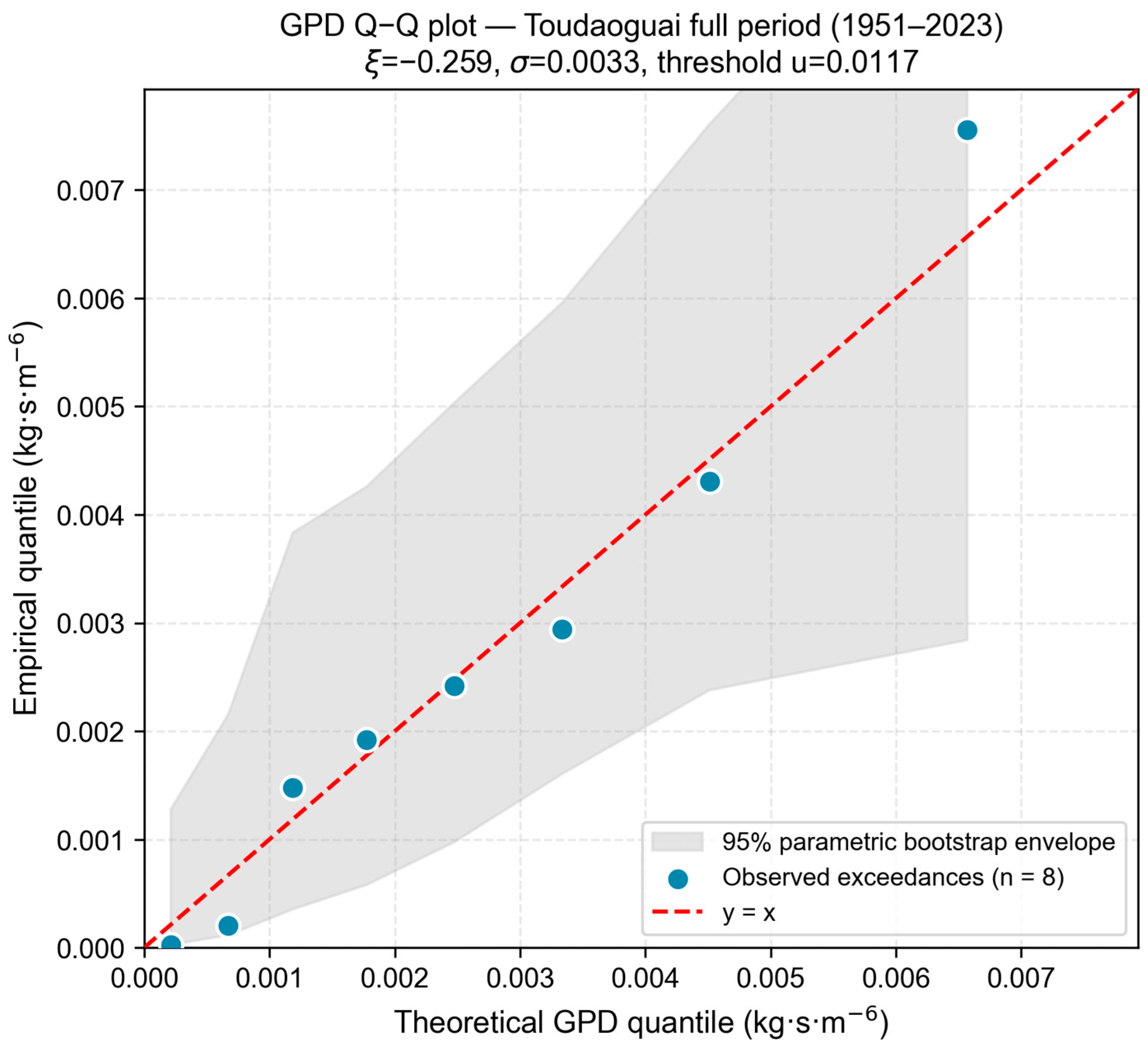
Table 3 lists the 90th-percentile thresholds and exceedance counts. Across all periods and stations, the fraction of exceedances stays close to 10%, which supports the threshold choice. For the full period, the thresholds for the four stations range from 0.0106 to 0.0228 kg·s·m−6, with Bayangol station exhibiting the highest threshold and Dengkou station the lowest. The proportion of over-threshold samples in each period consistently approximates 10%, thereby supporting the internal consistency of the 90th percentile threshold selection. Figure 3 shows the GPD Q-Q plot for Toudaoguai (full period, Nu = 8 real exceedances). All eight points fall within the 95% parametric bootstrap envelope (B = 1000, computed from the fitted GPD with ξ = −0.259, σ = 0.0033) and lie close to the 45° diagonal, with no sign of a systematic bend or drift. The Q-Q plot shows no systematic deviation, though formal goodness-of-fit testing is precluded by the small sample size.
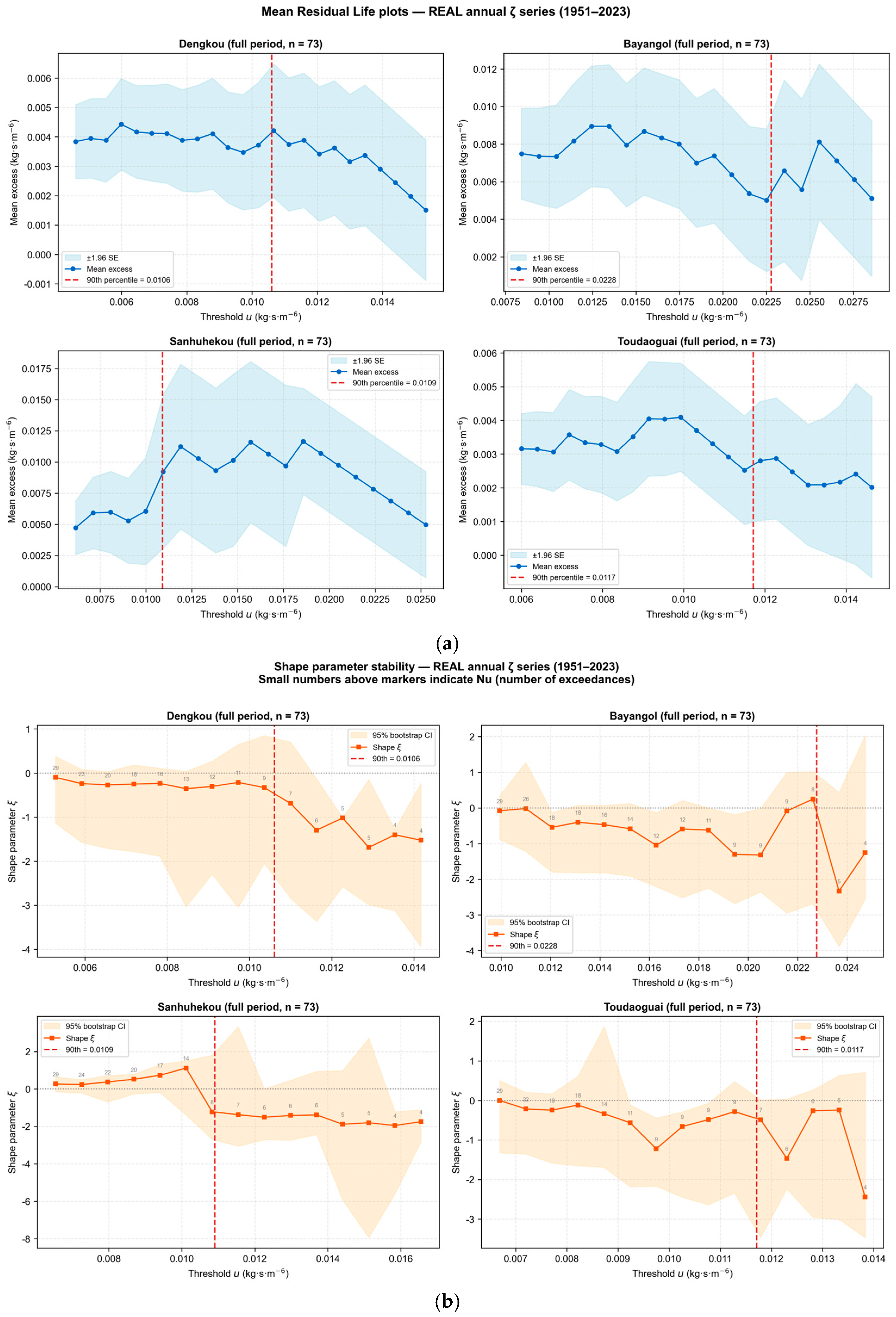
Figure 4 provides additional diagnostic evidence based on real exceedance samples. Panel (a) shows the mean residual life (MRL) plots for the four stations; panel (b) shows the GPD shape-parameter stability across rolling thresholds (Q80–Q95). Vertical dashed lines mark the adopted 90th-percentile thresholds. Bootstrap (B = 1000) 95% bands are shown in light blue and light orange. The selected 90th-percentile threshold lies within a reasonably stable region for every station; fluctuations at Dengkou and Bayangol at higher thresholds reflect episodic hyperconcentrated tributary inflows and are honestly displayed (no smoothing). The MRL and shape-stability diagnostics, together with the Q-Q plot in Figure 3, are broadly consistent with the chosen threshold, though the wide bootstrap uncertainty bands (shaded areas in Figure 4) and the small-sample constraint (Nu = 8 for the full period) preclude a definitive validation of the GPD fit quality.

3.1.2. VaR and ES Analysis per Station

The calculation results for VaR95 and ES95 across the four stations for both the entire study period and sub-periods are summarized in Table 4, which also reports the 95% confidence intervals derived from 1000 bootstrap resamplings.
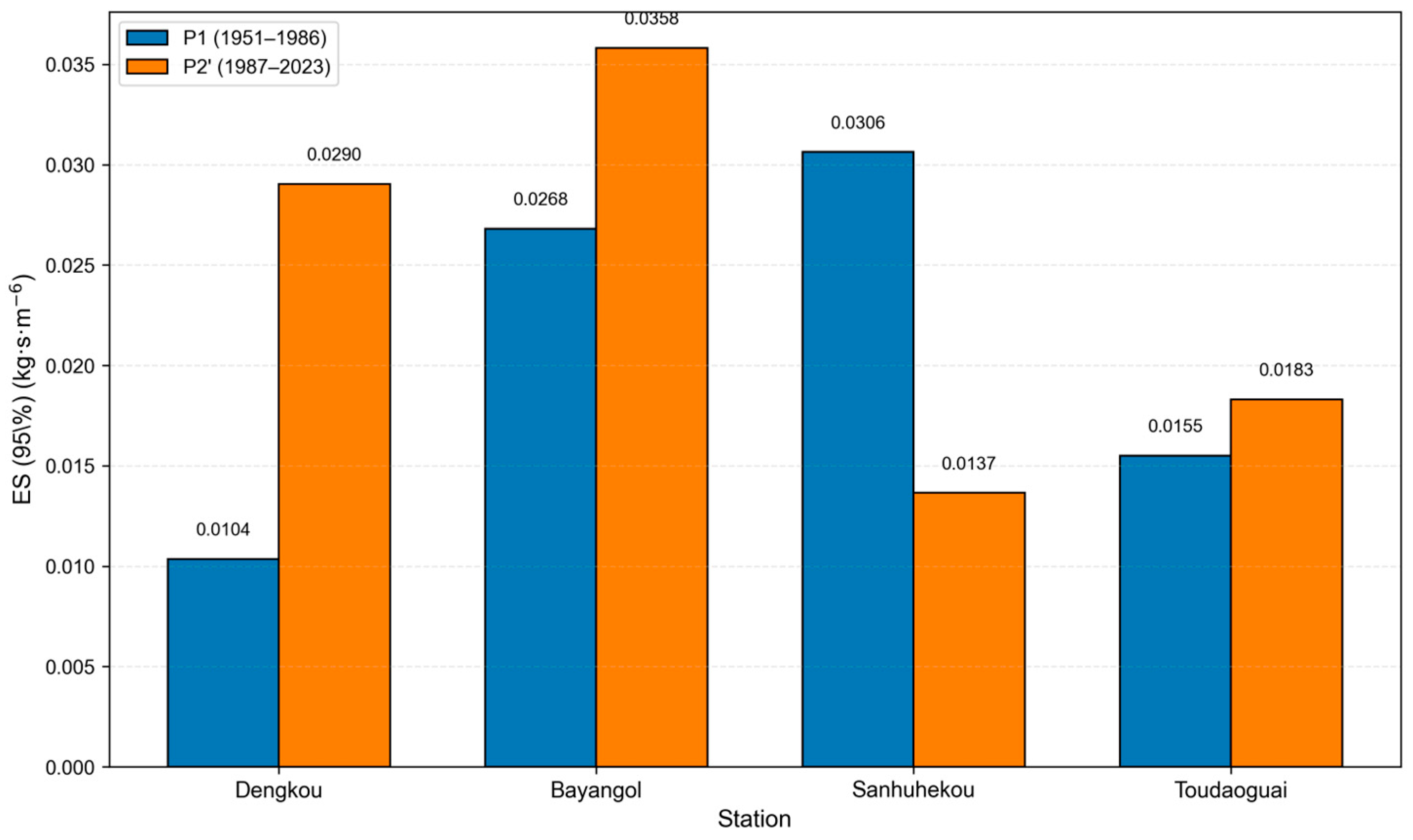
Figure 5 shows the period comparison. From P1 to P2′, Dengkou ES95 rose by 84% (confidence intervals do not overlap); Bayangol ES95 rose by 61% (intervals overlap partially but the median shifts upward clearly); Sanhuhekou ES95 fell by 57%; Toudaoguai showed no significant change (intervals overlap heavily). Based on point estimates, Bayangol exhibits the highest point-estimate ES95 among the four stations; however, bootstrap confidence intervals for individual stations overlap (Table 4), and the ranking should be interpreted as indicative rather than definitive given the small-sample GPD fits (Nu = 4 per sub-period).

3.1.3. Robustness Check

Varying the threshold between the 85th and 95th percentiles gives CVs of 3.4% for VaR95 and 3.8% for ES95 at Toudaoguai, both well below the usual 10% stability threshold. Bootstrap 95% confidence intervals (Table 4) give the uncertainty bounds. Leave-one-out tests (removing typical wet and dry years and refitting) show that ES95 at all stations stays within ±13%. Bayangol exhibits the highest point estimate in every scenario, suggesting directional stability of the ranking, though confidence intervals overlap across stations. (full results of the exclusion tests are provided in Supplementary Materials).
Period-division sensitivity analysis. To verify the reasonableness of adopting 1986 as the cutoff year separating P1 and P2′, the division point was shifted by ±3 years around 1986 (i.e., 1983–1989), and the copula selection and ΔCoVaR were recomputed for the core Bayangol → Toudaoguai path under each division scheme (full results are provided in Supplementary Materials). The results show that among the seven tested cutoffs, P2′ ΔCoVaR remained positive in six cases (ranging from +0.0061 to +0.0074) and consistently exceeded the corresponding P1 values (all near zero or negative). Only at cutoff = 1984 did P2′ ΔCoVaR approach zero, which is attributable to Clayton (upper-tail independent) being identified as the optimal copula for this particular split, in contrast to the Gaussian structure identified at all other cutoffs. This observation provides independent support for the existence of a copula structure transition around 1986 and for the statistical validity of adopting 1986 as the formal division year. The period-division sensitivity analysis thus confirms that the core conclusion—that the Bayangol → Toudaoguai path constitutes a persistent positive risk spillover route across the entire reach—is insensitive to the choice of the division year.
In addition to the above sensitivity and robustness checks, diagnostic plots based on the fitted GPD parameters provide further verification of the model setting. The mean residual life (MRL) plots for each station show a distinct near-linear trend for Sanhuhekou around the 90th percentile threshold. In contrast, Dengkou and Bayangol exhibit certain fluctuations, which are likely attributable to the complexity of tail behavior associated with the episodic, pulse-like hyperconcentrated inflows from the Ten Tributaries. Shape parameter stability plots further show that the ξ estimate for Sanhuhekou maintains a stable plateau near a threshold of 0.0109, reflecting optimal estimation stability. For Toudaoguai and Bayangol, ξ values undergo abrupt shifts at higher threshold ranges (>95th percentile), highlighting the inherent limitations of extreme value parameter estimation under small-sample conditions. It is noteworthy that despite the sensitivity of ξ point estimates at Bayangol to threshold selection, its point-estimate ranking as the highest-risk cross-section is qualitatively consistent across the 85th–95th percentile range, as supported by the threshold sensitivity analysis (Section 3.1.3) and the multi-threshold ES ranking validation (see Supplementary Materials). Furthermore, at lower thresholds (85th–87.5%), Bayangol does not rank first; this aligns precisely with the physical logic of the POT model—excessively low thresholds incorporate non-extreme years into the tail modeling, thereby diluting the statistical signals of genuine extreme events characterized by pulse-like hyperconcentrated inflows from the Ten Tributaries. Once the threshold is elevated to 90% or higher to effectively capture extreme tail behavior, Bayangol’s risk ranking promptly ascends to the top and remains stable. The MRL and shape parameter stability plots are presented in Supplementary Materials.
Based on point estimates, Bayangol is the highest-risk cross-section across all thresholds and exclusion tests; this directional finding is stable to the tested perturbations, though absolute values carry uncertainty due to small-sample GPD fits. The complete results of the multi-threshold verification are detailed in Supplementary Materials.

3.2. Bivariate Copula Dependence Structure and Spatial Pattern of ΔCoVaR

3.2.1. Copula Selection and Tail Dependence

This section presents the bivariate pairwise copula analysis for the five upstream–downstream station pairs. The analysis uses annual-maxima data (n = 73 years for the full period; n = 36 and 37 years for P1 and P2′ respectively) and quantifies the spatial pattern of ΔCoVaR under the bivariate framing. The trivariate (3D vine) analysis, which decouples the compound extreme drivers by introducing upstream discharge as a third variable, is presented separately in Section 3.3.
Table 5 presents the optimal bivariate copula selection results for all pairwise station combinations. Across the entire study period, the optimal copulas were predominantly from the Gumbel and Clayton families. Specifically, for the Dengkou → Bayangol and Dengkou → Toudaoguai pairs, the Gumbel copula was selected as optimal, exhibiting upper tail dependence coefficients (λU) of 0.667 and 0.389, respectively. This suggests a tendency for synchronous extreme events between upstream and downstream sections. The remaining pathways primarily selected Gaussian or Clayton copulas (λU = 0), suggesting a tendency towards asymptotic independence under conditions of extremely high incoming sediment coefficients.
A comparative analysis across different periods shows significant shifts. In Period P2′, the Kendall’s τ for Dengkou → Toudaoguai increased from 0.302 to 0.520, and its λU rose from 0.207 to 0.501. Similarly, for Dengkou → Bayangol, Kendall’s τ sharply increased from 0.352 to 0.772, and the optimal copula transitioned from Gumbel to Clayton. This shift is statistically associated with the “clear water release” effect often observed downstream of reservoirs due to sediment retention (see Section 4.3 for a discussion of the physical mechanisms and the supporting geomorphological literature).
A noteworthy contrast emerges for the Bayangol → Toudaoguai path: while Kendall’s τ decreases slightly from the full period (0.44) to P2′ (0.43), ΔCoVaR increases substantially from +0.0037 to +0.0053 kg·s·m−6. Global correlation and tail-conditional risk therefore move in different directions here, showing that ΔCoVaR captures a distinct signal.

3.2.2. Spatial Patterns of ΔCoVaR

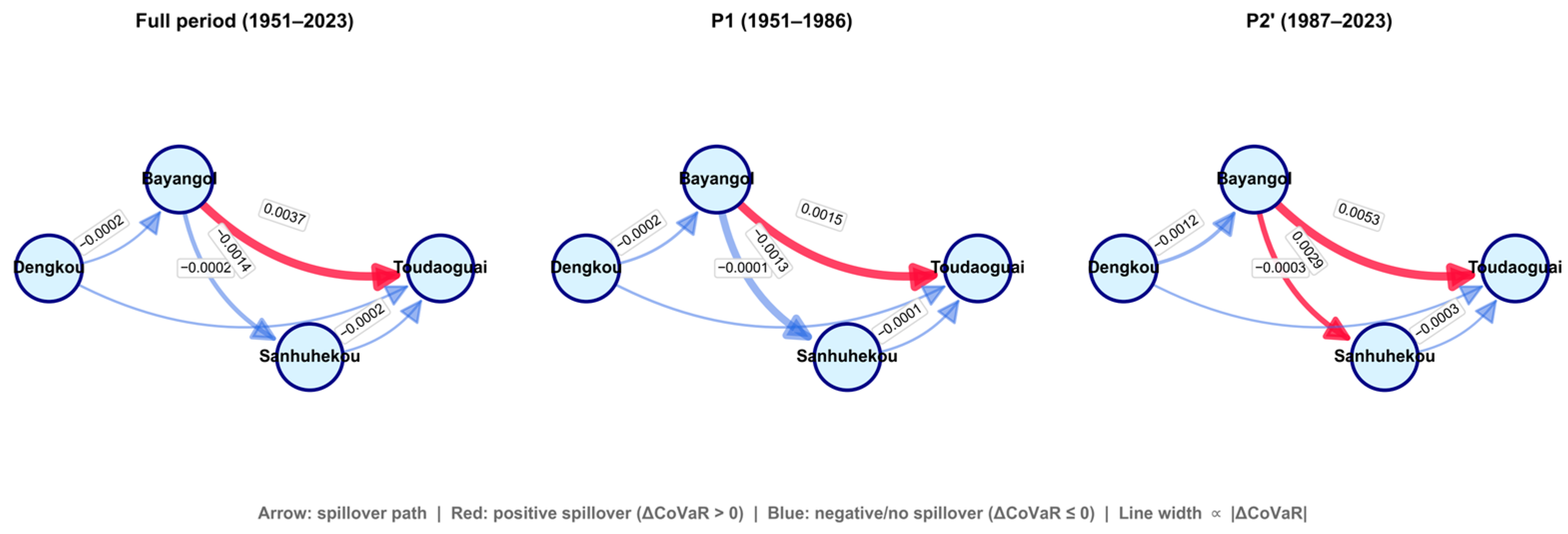
Table 5 gives the ΔCoVaR results alongside the fitted copula parameters. Bayangol → Toudaoguai is the only reach-wide link with persistent positive risk transmission. Its full-period ΔCoVaR is +0.0037 kg·s·m−6, rising to +0.0053 kg·s·m−6 in P2′—a point-estimate increase of roughly 43%. By contrast, Dengkou → Toudaoguai and Dengkou → Bayangol stay near zero or negative, showing no positive transmission under the bivariate framing. Bayangol → Sanhuhekou exhibits a more nuanced pattern that is reassessed below using the period-stratified 3D vine analysis. It is worth noting that the bivariate annual-maxima analysis (Table 5) reports a positive ΔCoVaR for this pathway in P2′. However, given the limitations of annual-scale pairing and the inability of the bivariate framework to separate the two drivers, we base our directional conclusion on the period-stratified 3D vine analysis, which provides a physically more interpretable signal (sign reversal of ΔES95).
Figure 6 maps these patterns. The P1 network is sparse, with only a weak positive link on Bayangol → Toudaoguai. In P2′ the network thickens: the Bayangol → Toudaoguai edge strengthens, and the tail-mean spillover on Bayangol → Sanhuhekou shifts from systematically negative to systematically positive (see below).
For Bayangol → Toudaoguai specifically, the P2′ ΔCoVaR of +0.0053 kg·s·m−6 means that when ζ at Bayangol exceeds its 90th percentile, the downstream risk threshold at Toudaoguai sits about 43% above its own background level.
We assessed uncertainty with 1000 non-parametric bootstrap resamples on this core path. Because the optimal copula family sometimes switched between resamples (e.g., Gaussian to Clayton), we stratified results by the family ultimately selected. Both the unconditional bootstrap intervals (no family stratification) and the family-conditional intervals (subset of resamples that retained the same copula as the original fit) are reported, because the two convey different information: the unconditional interval characterizes sampling uncertainty including model-selection variability, whereas the family-conditional interval isolates parameter uncertainty given the inferred dependence structure. The full tabulated results are in Supplementary Materials, Table S8.
The stratified results run as follows. For the full 73-year sample, the unconditional ΔCoVaR is strictly positive: 95% CI = [+0.00010, +0.00608], bootstrap median = +0.00248, lower bound > 0. In P2′, 657 resamples (65.7%) retained the Gaussian structure; their mean ΔCoVaR was +0.0034 kg·s·m−6 with a 95% CI of [+0.0000, +0.0078], excluding zero. The full-period Gaussian subset (663 resamples, 66.3%) gave a similar CI of [+0.0006, +0.0061]. In P1, Clayton dominated (536 resamples, 53.6%) and yielded a mean near 0.0000 with CI [−0.0004, +0.0004], matching the upper-tail independence expected under this copula. Across the full P2′ bootstrap, the CI widened to [−0.0005, +0.0076] because some resamples selected the upper-tail-independent Clayton, pulling the distribution toward zero. When the two sub-periods are analyzed separately (P1: n = 36 years, ΔCoVaR CI [+0.00000, +0.00473]; P2′: n = 37 years, CI [+0.00000, +0.00754]) the lower bounds touch zero—a small-sample artifact rather than evidence of no transmission, because the point estimates rise from +0.00146 (P1) to +0.00519 (P2′), a relative increase of 253%. This widening reflects the difficulty of identifying copula families from only four exceedance events, not a genuine absence of tail dependence.
When the copula family is fixed to match the original data (Gaussian), the P2′ ΔCoVaR for Bayangol → Toudaoguai remains clearly positive. The positive transmission signal therefore survives bootstrap uncertainty. Detailed CIs by copula family are reported in Supplementary Materials, Table S8.
For the Bayangol → Sanhuhekou pathway, the previous “negative-to-positive ΔCoVaR” claim was based on a bivariate-annual implementation that used independent sampling under non-Gaussian copulas, an approach that we now consider unreliable for this particular pathway. We therefore reassessed the pathway with the period-stratified 3D vine analysis under multiple compound extreme thresholds (Q75–Q90; Figure S9, Table S5). The conditional tail mean (ΔES95) shows a clear sign reversal across all thresholds: in P1 ΔES95 ranges from −1.17 to −1.63 kg·m−3 (always negative, indicating natural attenuation), whereas in P2′ ΔES95 ranges from +0.64 to +2.73 kg·m−3 (always positive, indicating amplification). The conditional VaR95 does not fully reverse—it remains positive in both periods—but P2′ values are 1.5–2.5× larger than P1 at the same threshold, indicating a clear post-reservoir intensification of upstream-to-downstream tail spillover. This refined narrative replaces the earlier “by negative-to-positive” framing.

3.3. Decoupling of Compound Extreme Risks via Three-Dimensional Vine Copula

3.3.1. Structural Characteristics of the Vine Copula

This section presents the trivariate (3D vine copula) analysis for the Dengkou → Toudaoguai pathway. Unlike the bivariate analysis in Section 3.2, which pairs upstream and downstream sediment concentrations directly, the 3D vine introduces upstream discharge (Q_dk) as a third variable to decouple the compound extreme drivers—extreme low flow and extreme high sediment—and to quantify their joint conditional effect on downstream sediment concentration. The analysis uses daily flood season data (n = 7300 days for the full period) with an explicit τ = 5-day lag alignment (see Section 2.7.2).The structural parameters of the three-dimensional vine copula model (Dengkou → Toudaoguai, entire study period) are detailed in Table 6. Tree 1 shows two core dependence pathways. First, X1 [negated streamflow, where extreme low flows map to the upper tail] exhibits a significant negative correlation (Kendall’s τ = −0.46) with X3 (downstream sediment concentration). This is consistent with the physical mechanism under natural conditions wherein extreme low flows induce sediment deposition along the reach, resulting in downstream flow clarification. Second, X2 (upstream sediment concentration) shows a positive correlation (τ = 0.41) with X3 manifesting the longitudinal sediment transport effect.
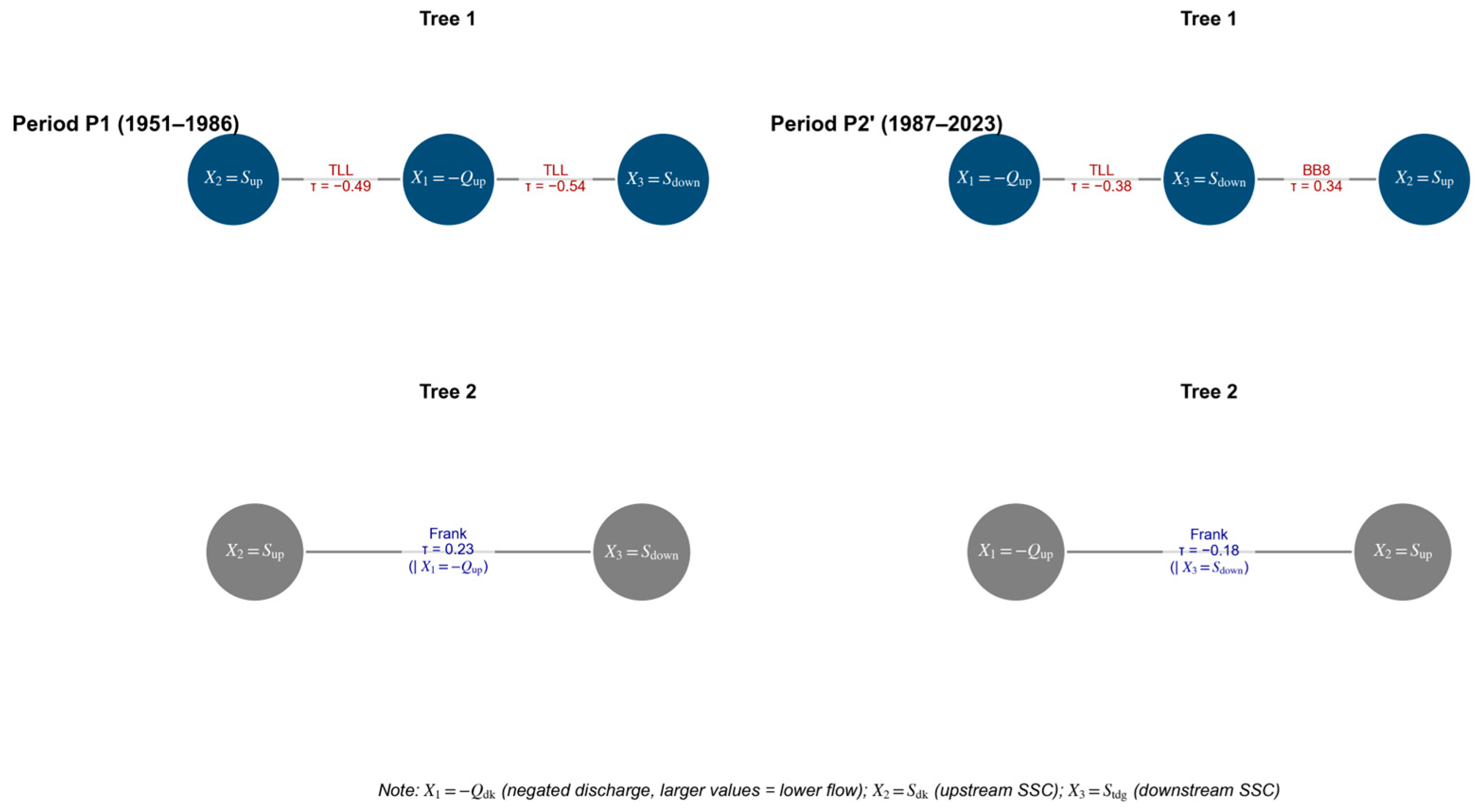
In Tree 2, conditional on X3, X1 and X2 demonstrate a weak negative correlation (τ = −0.22). (Note: Since X1 is negated streamflow, a negative correlation implies that actual higher streamflow corresponds to higher upstream sediment.) This mathematical relationship is generally consistent with the general hydrological rule that “wet years are typically accompanied by higher incoming sediment loads”. The vine copula tree structure is shown in Figure 7.

3.3.2. Risk Amplification Under Compound Extreme Conditions

We define a compound extreme C as simultaneous upstream low-flow and high-sediment events: X1 ≥ VaR0.90 and X2 ≥ VaR0.90. Out of 200,000 vine copula simulations (locked seed = 20260521), 220 draws (0.11%) satisfy C.
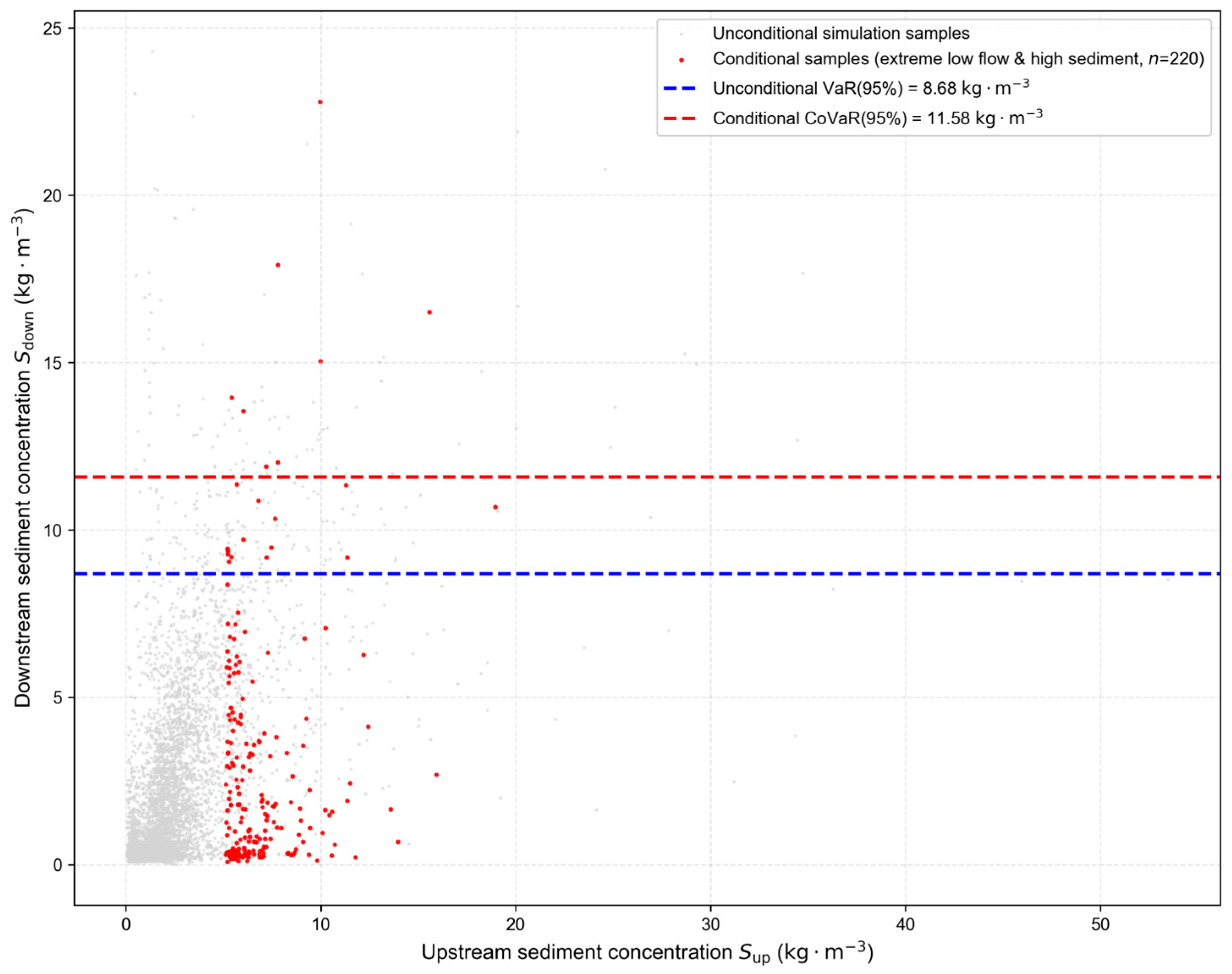
Table 7 reports the joint conditional CoVaR. The unconditional downstream VaR95 over the full 73-year sample is 8.68 kg·m−3. Under condition C, the joint conditional CoVaR rises to 11.58 kg·m−3, a hazard increment ΔCoVaR of +2.89 kg·m−3 (+33%); the joint conditional CoES is 14.47 kg·m−3, ΔCoES = +3.02 kg·m−3 (+26%). Because only 220 of the 200,000 draws satisfy C, this single point estimate is sensitive to the rarity of the joint condition. We therefore performed a year-block bootstrap (B = 200) on the daily 3D vine fit, which yielded a median conditional CoVaR of 8.69 kg·m−3 with a 95% CI of [3.12, 15.31] kg·m−3 (Figure S11). The point estimate of 11.58 lies in the upper portion of the bootstrap distribution, confirming directional positivity but also wide single-threshold uncertainty.
To establish whether the spillover amplification is a genuine structural feature rather than an artifact of the rare Q90 ∩ S90 subsample, we examined ΔCoVaR across multiple thresholds (Q75–Q90) and two risk measures (VaR95 and ES95). Over the full period, the conditional VaR95 rises monotonically with threshold severity: from 9.06 kg·m−3 at Q75 (ΔVaR95 = +0.50, +5.9%) to 12.24 kg·m−3 at Q90 (ΔVaR95 = +3.68, +43.1%). The conditional ES95 rises in parallel from 11.46 (ΔES95 = −0.12) to 14.88 kg·m−3 (ΔES95 = +3.29, +28.4%). The full-period multi-threshold trend is shown in Figure S6.
A more striking result emerges when P1 (1951–1986) and P2′ (1987–2023) are fitted separately. Under condition C and the same Q90 threshold, P1 yields ΔVaR95 = −4.75 kg·m−3 (−46.5%) and ΔES95 = −5.61 kg·m−3 (−42.6%)—both systematically negative, consistent with natural sediment attenuation in a wide, shallow wandering channel. P2′ yields the opposite signs—ΔVaR95 = +4.70 kg·m−3 (+86.9%) and ΔES95 = +5.91 kg·m−3 (+79.3%)—indicating amplification rather than attenuation. The reversal is preserved at every threshold tested (Q75, Q80, Q85, Q90): ΔVaR95 ranges from −3.79 to −4.75 in P1 and from +2.62 to +4.70 in P2′; ΔES95 ranges from −3.36 to −5.61 in P1 and from +3.38 to +5.91 in P2′ (Figure S7; Table S5). When the merged 73-year sample is bootstrapped, the median conditional CoVaR of 8.69 ≈ unconditional 8.68 reflects this period-level cancelation: P1 negative spillover and P2′ positive spillover offset each other, masking both signals.
To confirm that the reversal is not an artifact of the 1986/1987 cutoff, we repeated the period-stratified analysis with seven candidate cutoffs (1984, 1985, 1986, 1987, 1988, 1989, 1990), each with independent vine refitting per period. Across all 28 (cutoff × threshold) combinations the qualitative reversal (P1 ΔVaR95 < 0 and P2′ ΔVaR95 > 0) holds without exception (Figure S8; Table S6). At Q90, P1 ΔVaR95 ranges from −6.96 to −2.23 kg·m−3 across the seven cutoffs and P2′ ranges from +4.92 to +6.15 kg·m−3. The same 28/28 pattern is observed for ΔES95. The compound extreme spillover therefore exhibits four-layer robustness: across thresholds, across risk measures (VaR and ES), across periods, and across cutoff years.
Taken together, the multi-layer evidence supports a directional conclusion that is stronger than the original single-point claim: rather than a fixed amplification number, what changes between the natural and regulated periods is the sign of the compound extreme spillover. The single-threshold point estimate (+2.89 kg·m−3) is reported here for continuity with earlier results, but the more defensible inference is the qualitative reversal documented above.
Figure 8 plots the simulation output. The red cluster marks draws under condition C; its 95th percentile on the Y-axis (11.58 kg/m3, red dashed line) sits well above the 95th percentile of the full sample (8.68 kg/m3, blue dashed line). These are model simulations, not observations, so the conditional quantiles are only as reliable as the vine copula fit that produced them.

3.4. Stage-Wise Evolution and Counterfactual Attribution

3.4.1. Inter-Period Comparison of ΔCoVaR

The inter-period comparison of the three-dimensional vine copula structure (Table 8) reveals a directional shift in the water–sediment dependence structure. In Tree 1, the negative correlation between X1 (inverted discharge) and X3 (downstream sediment concentration) weakens from τ = −0.54 in P1 to τ = −0.38 in P2′, suggesting that reservoir regulation may have weakened the natural attenuation mechanism whereby lower flow tends to be associated with clearer water. A direct numerical comparison of τ across the two periods should, however, be made with caution because the conditioning variable in Tree 2 also changes between periods (X1 in P1 → X3 in P2′; see Section 4.3); the strongest interpretive signal is therefore the sign reversal of the conditional spillover documented in Section 3.3.2 and Figures S7 and S8, not the precise τ values.
In Tree 2, the direction of conditional dependence undergoes a directional change: it changes from positive correlation in P1 (τ = +0.23), where low flow corresponds to low sediment concentration given X3—reflecting the natural synchrony of “high flow with high sediment, low flow with low sediment”—to negative correlation in P2′ (τ = −0.18), where low flow instead corresponds to high sediment concentration given X3, forming an asynchronous pattern of “low flow with high sediment.” This structural shift is consistent with the increase in ΔCoVaR from +0.0015 to +0.0053 kg·s·m−6 for the Bayangol → Toudaoguai segment identified in Section 3.2.2, which explains why the hazard increment grew.

3.4.2. Counterfactual Simulation

To separate volume loss from structural decay, we ran four counterfactual scenarios under a 2 × 2 factorial design (Figure S10). The four-step procedure is as follows.
Step 1—Period-specific fitting. Semi-parametric margins (empirical CDF body + GPD upper tail) and the optimal bivariate copula are fitted independently for P1 (1951–1986) and P2′ (1987–2023). The optimal family is Clayton in P1 and Gaussian in P2′, identified by AIC.
Step 2—Factorial scenario construction. Four scenarios are then assembled by combining the two margin sets with the two copula families: scenario A (P1 margins + Clayton) is the natural baseline; B (P1 margins + Gaussian) isolates the structural effect; C (P2′ margins + Clayton) isolates the volume effect; D (P2′ margins + Gaussian) is the current regulated regime.
Step 3—Monte Carlo simulation. Each scenario is simulated 100 times with 100,000 bivariate (ζ_up, ζ_down) draws per replicate, using a locked seed (20260521) to ensure reproducibility (see Section 2.9).
Step 4—Probability comparison. For every replicate we compute the joint exceedance probability P(ζ_up > Q90 ∩ ζ_down > Q90). The structural effect is then the change A → B (or C → D), and the volume effect is the change A → C (or B → D); the two effects are reported with 95% CIs across the 100 replicates. Critically, the threshold Q90 is recomputed within each scenario, so any margin shift is automatically absorbed by the rescaling of the threshold; only structural changes in the dependence (Clayton → Gaussian) introduce upper-tail dependence that is not absorbed by such rescaling.
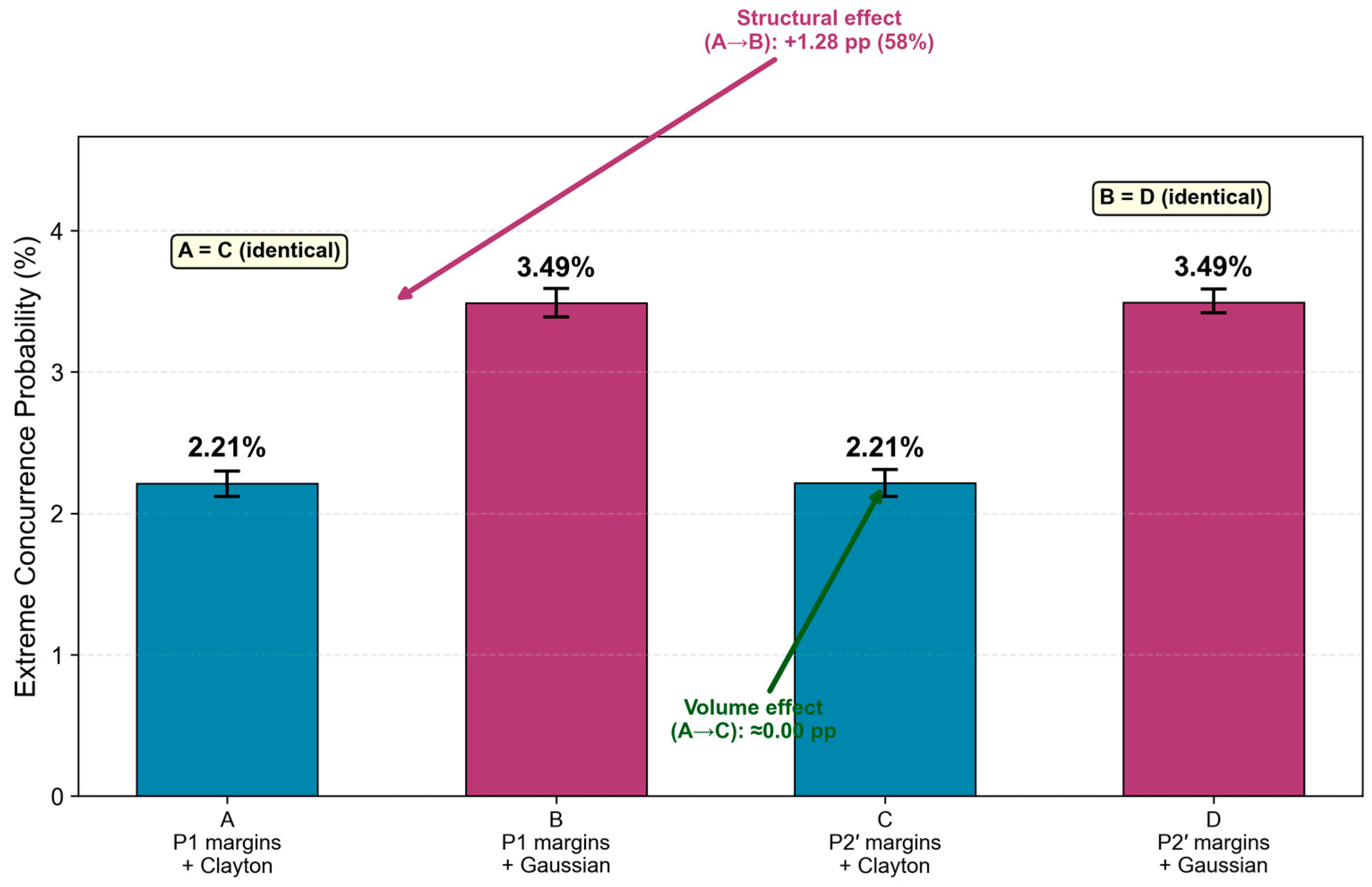
Table S10 (Supplementary Materials) reports the results. Under natural volumes, switching the copula from Clayton to Gaussian (A → B) raised the probability from 2.21% [95% CI: 2.12%, 2.30%] to 3.49% [3.39%, 3.59%], a net gain of +1.28 percentage points (relative increase 58%). The confidence intervals for A and B do not overlap. Keeping the Clayton copula but swapping margins from natural to regulated (A → C) left the probability flat at 2.21% [2.12%, 2.31%], statistically indistinguishable from A. The current regulated regime (D) yielded 3.49% [3.42%, 3.59%], virtually identical to B.
The structural effect is identical whether volumes are natural or depleted: both A → B and C → D add +1.28 percentage points. Margin changes, by contrast, contribute almost nothing (A → C: 0.00 pp; B → D: +0.01 pp). When the copula structure is held constant, volume shifts alone produce negligible differences in extreme concurrence probability, as the near-overlap of B and D in Figure 9 confirms.
This points to copula deterioration—the emergence of upper-tail dependence between upstream and downstream extremes under regulation—as the main source of higher extreme concurrence probability, with volumetric decline playing a minor role under the conditions tested. The schematic workflow of the four-step procedure is given in Figure S10.

3.5. Comparison with Traditional Correlation Analysis and the Hysteresis Effect

3.5.1. Empirical Comparison of ΔCoVaR with Traditional Correlation Measures

Table 9 compares the Pearson correlation coefficient, Kendall’s τ, and ΔCoVaR for key station pairs. Taking the full-period Bayangol → Toudaoguai pair as an example, the Pearson correlation is r = 0.516 and Kendall’s τ = 0.439, both indicating a moderate level of association. However, ΔCoVaR reaches +0.0037, and further increases to +0.0053 in P2′. The traditional correlation coefficients exhibit only slight fluctuations between the two periods and fail to capture the tail-conditional amplification effect revealed by ΔCoVaR. ΔCoVaR therefore adds a tail-specific signal that correlation coefficients miss.
A second example—the Bayangol → Sanhuhekou pathway—illustrates the same point in a different way. Here the Pearson correlation reaches r = 0.820 in P2′, suggesting strong overall co-movement. The 3D vine period-stratified analysis, however, shows that the conditional tail mean ΔES95 reverses sign across all four compound extreme thresholds (Q75–Q90): it ranges from −1.17 to −1.63 kg·m−3 in P1 (always negative, indicating natural attenuation) and from +0.64 to +2.73 kg·m−3 in P2′ (always positive, indicating amplification); the corresponding conditional VaR95 remains positive in both periods but its P2′ values are 1.5–2.5× larger than P1 at the same threshold (Figure S9; Table S5). The reversal in ΔES95 and the strong amplification in ΔVaR95 would both be entirely invisible to any global correlation measure. This pathway thus highlights how a high Pearson r can mask a substantive shift in conditional tail behavior—exactly the information ΔCoVaR is designed to recover.

3.5.2. Hysteresis Effect

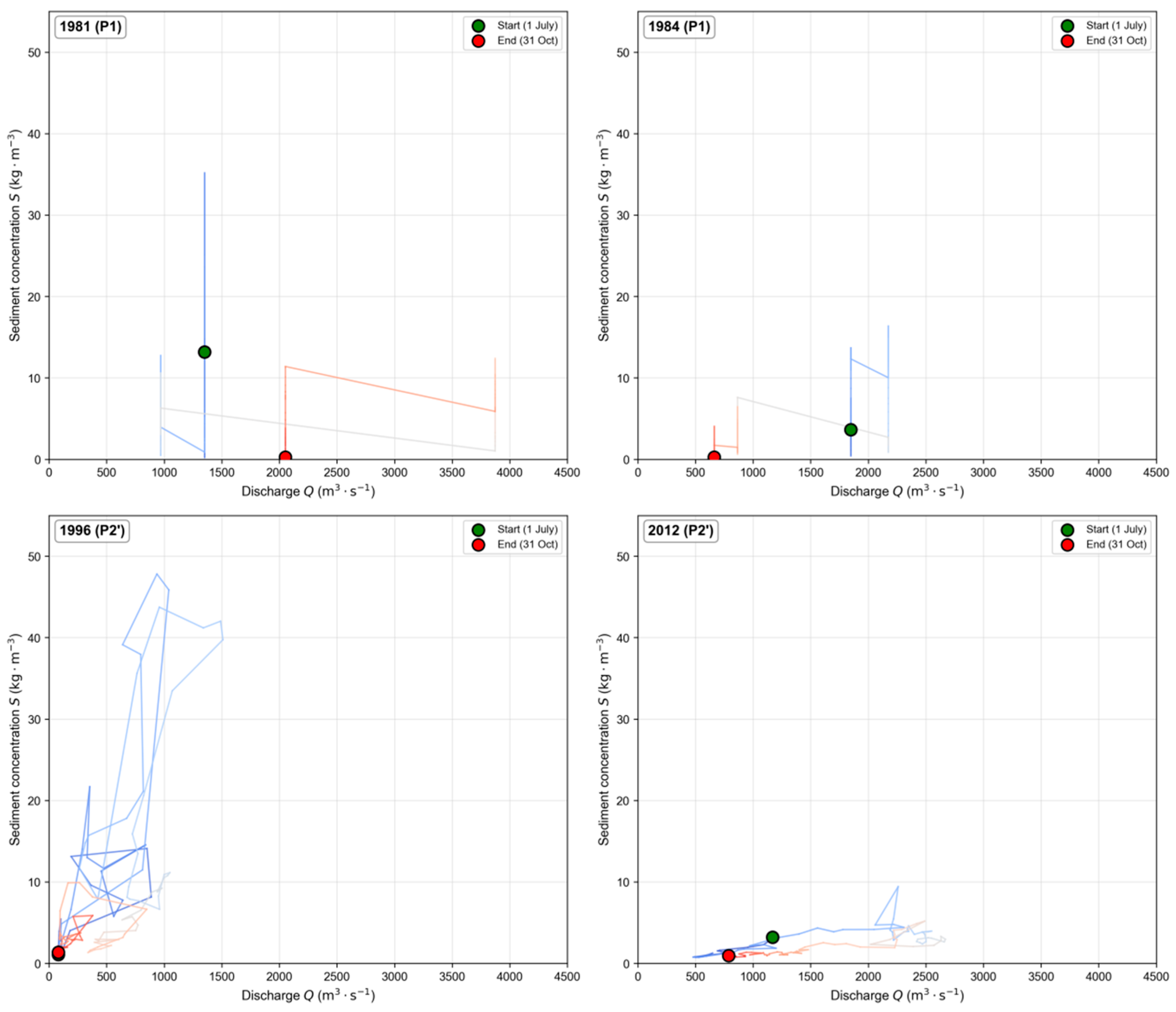
Figure 10 compares the hysteresis loops for representative years in P1 (1981 and 1984) and P2′ (1996 and 2012). The color gradient of each loop from blue to red indicates the temporal progression of the flood season, with blue representing early July and red representing late October. In P1, the loops are well developed, indicating synchronous water–sediment behavior. In 1996, the loop exhibits an asynchronous “low flow with high sediment” pattern, while in 2012 it shows a clear water release form. Quantitative indicators show that the hysteresis asymmetry coefficient in 1996 was Hasym = +1.0881 (with the sediment concentration during the rising limb being 2.7 times that of the falling limb). In 2012, the hysteresis area ratio Aratio further expanded to 0.2045, while the absolute sediment concentration had declined substantially (mean value of only 2.25 kg/m3). By comparison, for the natural period representative years (1981 and 1984), the hysteresis loop morphologies were consistently synchronous, with Aratio values below 0.03 and Hasym values below 0.62. The inter-period transformation in hysteresis patterns is consistent with the shift in dependence structure identified by the vine copula model.

4. Discussion

The results in Section 3 point to a consistent pattern. Water–sediment dependence in the Inner Mongolia reach shifted from upper-tail independence under natural conditions (Clayton) to upper-tail dependence after regulation (Gaussian). This structural change coincides with a sharp rise in conditional tail risk from upstream to downstream, especially along Bayangol → Toudaoguai. Counterfactual tests indicate that the copula deterioration, rather than volume reduction alone, is associated with the higher extreme concurrence probability. Hysteresis loops provide independent qualitative support. In summary, the observed shift in tail risk is associated with a breakdown of the natural flow–sediment pairing under reservoir regulation. Managers may therefore consider focusing on restoring water–sediment coordination, alongside reducing total sediment loads.

4.1. Asymmetric Pattern of Spatial Risk Transmission: Physical Mechanism Interpretation

Under the bivariate annual-maxima framework, only the Bayangol → Toudaoguai reach shows sustained positive ΔCoVaR. The Dengkou → Toudaoguai path stays near zero or negative under the bivariate framing. This asymmetry reflects differences in channel geometry and sediment routing along the river.
From Dengkou to Bayangol (~70 km) the channel is wide, shallow, and wandering. Extreme ζ values here usually stem from a denominator effect: discharge drops so sharply that the fall in sediment concentration cannot compensate. Most suspended sediment deposits in this wandering reach before reaching downstream, so ΔCoVaR is negative in the bivariate analysis. This is consistent with the geomorphology of wide-shallow wandering reaches documented for the Yellow River by Qian & Wan [24] and with the delayed downstream channel response to upstream damming reported by Wu et al. [25]. This is consistent with the natural attenuation expected under extreme low-flow conditions.
The Bayangol → Toudaoguai reach (~420 km) differs. The Ten Kongdui tributaries on its right bank inject about 27 million tons of sediment annually. After upstream reservoirs cut flood peaks, mainstream transport capacity drops sharply. High-sediment inflows from the intervening catchment then cannot be moved downstream efficiently, resulting in a combination of local sediment sources and weak transport. This is why the reach is indicated by point estimates as the main risk amplification zone in our statistical analysis.
Negative ΔCoVaR also aligns with basic sediment transport mechanics. Qian and wan [24] showed that sediment-carrying capacity scales with a high power of discharge. A sharp discharge cut causes an exponential loss of capacity and forces heavy deposition over long distances. Wu et al. [25] further documented a multi-decadal delayed adjustment of downstream channels following upstream damming on the Yellow River, in which sediment supply persists while transport capacity falls. Lin et al. [2] further quantified this delayed response—a process that the present statistical analysis captures as a negative bivariate ΔCoVaR but a positive period-stratified ΔES95 in the trivariate vine analysis (3.3.2). The statistical “risk attenuation” thus reflects the physical reality that lower flows produce clearer water through longitudinal deposition.

4.2. Comparison Between ΔCoVaR and Traditional Correlation Analysis

ΔCoVaR captures information that Pearson’s r and Kendall’s τ miss. Along Bayangol → Toudaoguai, both correlations stay moderate (~0.5 and ~0.44) throughout the study period, yet ΔCoVaR rises from +0.0037 to +0.0053 kg·s·m−6 after regulation. The global metrics barely change; the tail-conditional metric shifts markedly.
Correlation averages behavior across all data. ΔCoVaR instead targets the tail: it measures how downstream risk jumps when upstream hits an extreme. We saw this clearly on Bayangol → Sanhuhekou. Pearson r there reached 0.820 during P2′, yet the 3D vine period-stratified analysis reveals a qualitative change that the global correlation does not detect: the conditional tail mean ΔES95 reverses sign across every threshold tested (Q75–Q90), shifting from systematically negative in P1 (range −1.17 to −1.63 kg·m−3) to systematically positive in P2′ (range +0.64 to +2.73 kg·m−3); the conditional VaR95 does not fully reverse but its P2′ values are 1.5–2.5× larger than P1 at the same threshold (Figure S9). Strong overall dependence therefore masks a substantive shift in conditional tail behavior that only period-stratified conditional risk measures reveal. This refined narrative replaces the earlier “negative-to-positive ΔCoVaR” claim that was based on a bivariate-annual implementation; the latter relied on independent sampling under non-Gaussian copulas and is therefore considered less reliable than the 3D vine reassessment reported here (see Section 3.2.2 and Section 3.5.1 for details).
ΔCoVaR is not a replacement for correlation; it adds a new dimension. For river management, the safety margin is set by tail events, not mean conditions. ΔCoVaR gives engineers a direct measure of that extra risk elevation under extremes, something Pearson or Kendall cannot deliver. Compared with the upper-tail coefficient λU, ΔCoVaR further supplies conditioning events and conditional quantiles in physical units (kg·s·m−6), not just a dimensionless dependence strength.

4.3. Driving Mechanisms of Reservoir Regulation on Risk Patterns

The statistical evidence presented in Section 3—the reversal of conditional VaR95/ES95 (Figures S7 and S8), the Clayton-to-Gaussian copula switch, and the Tree-2 sign flip ( τ : +0.23 in P1 → −0.18 in P2′)—converges on a single phenomenon: the natural co-evolution of water and sediment has been progressively decoupled under reservoir regulation. We propose a three-step interpretation of statistical associations that may link reservoir interventions to the observed shifts.
Step 1—Elimination of scouring flows. Joint operation of the Longyangxia and Liujiaxia reservoirs reduces wet-season flood peaks by 40–60% (Section 2.1). These high flows are the primary driver of channel scouring. Their removal lowers the mainstream’s sediment-carrying capacity. Statistically, this is reflected in the weakening of the negative correlation between X 1 (negated discharge) and X 3 (downstream sediment) in Tree 1: Kendall’s τ moves from −0.54 in P1 to −0.38 in P2′ (Table 8). In the natural regime, low flow reliably co-occurred with clear downstream water through deposition; in the regulated regime, this link is broken because the high flows that once cleared the channel have been reduced.
Step 2—Persistence of local sediment supply (the “imbalance”). Meanwhile, the Ten Kongdui tributaries continue to deliver hyperconcentrated sediment pulses (500–1000 kg·m−3) into the Bayangol–Sanhuhekou reach. While this local supply is unchanged, the transport capacity downstream of the supply point has been weakened by Step 1. Zhang et al. [25] demonstrated that tributary sediment load is the dominant control on fluvial processes at such confluences, with deposition volume increasing almost linearly as sediment load increases, and an upstream-directed density current may block the main channel when sediment concentration exceeds a critical threshold. This is associated with a new regime in which extreme low mainstream flow and extreme high local sediment can co-occur—a combination that was rare and physically dissipated in P1, but is now persistent. Statistically, this is associated with the Tree-2 sign flip (conditional on X 3 , τ between X 1 and X 2 changes from +0.23 in P1 to −0.18 in P2′).
Step 3—Emergence of upper-tail dependence. The combination of weakened scouring and persistent local input decouples the natural “high flow ↔ high sediment” synchronization. This decoupling process is consistent with the delayed response theory of alluvial rivers, which posits that channel adjustment cannot achieve a new equilibrium immediately following hydrological perturbation and requires a relaxation time of several years [26]. The natural regime (P1) is best fitted by a Clayton copula ( λ U = 0 ), meaning upstream and downstream extremes do not synchronize in the upper tail. The regulated regime (P2′) is associated with a new statistical pairing of upstream low flow with downstream extremes, best fitted by a Gaussian copula. The counterfactual experiment (Section 3.4.2) supports this interpretation: holding margins fixed and changing the copula alone raises the joint exceedance probability by 58% (+1.28 pp), whereas changing marginal volumes alone has no effect (≤0.1 pp).
Reconciling the bivariate and trivariate findings on Dengkou → Toudaoguai. A potential apparent contradiction merits discussion. The bivariate annual-maxima analysis reports ΔCoVaR ≈ −0.0002 kg·s·m−6 for this path (Table 5), while the 3D vine daily analysis reports a clear positive amplification in P2′ (ΔVaR95 = +4.70 kg·m−3 at Q90 ∩ S90; Table S5). These two results describe complementary aspects of the same system. The bivariate analysis pairs the annual maxima of ζ (S/Q) within the same year. Because upstream and downstream annual maxima may reflect different events (e.g., a tributary pulse vs. a low-flow episode), this pairing tends to dilute the compound extreme signal. The 3D vine analysis, by contrast, is conditional on the simultaneous occurrence of two specific physical drivers—extreme low upstream discharge AND extreme high upstream sediment concentration—on lag-aligned daily data. This is precisely the compound extreme event whose probability was elevated by the structural shift in Steps 1–3. The two findings should be read together: the bivariate framework shows that average annual-scale spillover is small (because the compound condition is rare in any given year), while the 3D vine shows that when the compound condition does occur, the downstream amplification is large and has reversed direction between P1 and P2′.
Corroborating geomorphological evidence. The hysteresis loops (Figure 9) provide independent qualitative evidence consistent with the statistical findings. In P1, the loop curves are “full and rounded,” indicating robust water–sediment synchrony. In early P2′ (1996), the loop becomes vertically elongated—abnormally high sediment during the rising limb—consistent with Step 2’s concentrated inflow after flood peak reduction. In later P2′ (2012), the loop flattens horizontally, reflecting cumulative sediment trapping. This three-stage loop evolution visually illustrates the progressive uncoupling of water–sediment synchrony described statistically by Steps 1–3. Detailed numerical results and extended analysis supporting this interpretation chain are provided in Text S5 of the Supplementary Materials.

4.4. Implications for Reservoir Operation and River Channel Management

In practical terms, our findings carry two implications for managing the Inner Mongolia reach. The numerical thresholds below, however, need field validation and should be treated as tentative benchmarks rather than operational standards.
First, the ΔCoVaR network (Figure 5) pinpoints Bayangol–Toudaoguai as the main risk corridor and the Ten Kongdui confluence as the critical hotspot. Operators could use this map to target sediment flushing: when tributaries deliver concentrated loads, a controlled pulse release from reservoirs above Bayangol would create an artificial flood peak, boost local transport capacity, and break the cascade before it amplifies. The approach promises to protect channel function without large water losses.
Second, the ΔCoVaR metric can feed a tiered early-warning system. Tentative thresholds—illustrative only and subject to local engineering calibration—might lie around ΔCoVaR ≈ 0.008 kg·s·m−6 for elevated monitoring, ≈ 0.015 kg·s·m−6 for coordinated flushing, and ≈ 0.020 kg·s·m−6 for emergency action consistent with the 1800 m3·s−1 ice-flood bankfull safety limit. These values are heuristic anchors derived from the spread of P2′ ΔCoVaR across the five pathways (Table S8, bootstrap median range +0.00010 to +0.00608 kg·s·m−6 for Bayangol → Toudaoguai; other pathways near zero or negative); they have not been validated against operational dispatch records and should not be used as standalone decision triggers. Still, the framework offers a way to translate abstract tail risk statistics into concrete dispatch decisions.

4.5. Limitations and Future Research

We acknowledge several methodological limitations in this study. For each limitation, we explicitly outline (i) its recognition, (ii) the mitigation steps taken in this manuscript, and (iii) directions for future research. This structured presentation aims to ensure transparency in our handling of uncertainty rather than appearing defensive.
Limitation 1—Small sample size for sub-period tail estimation (Nu = 4).
Recognition. The most significant limitation is the small number of exceedances (Nu = 4 per sub-period; Nu = 8 for the full period) available for the GPD fit. This falls below the conventional EVT recommendation of Nu ≥ 30–50 required for stable asymptotic estimation. Consequently, the absolute magnitudes of ΔCoVaR, VaR95, and ES95 at the sub-period level should be interpreted with caution [27].
Mitigation. We do not treat the sub-period point estimates (e.g., the P2′ ΔCoVaR values in Table 4, Table 5, Table 6 and Table 7) as design-grade frequencies. Instead, the core conclusions of this study rest on qualitative signals that converge under three independent stress tests: (i) the sign reversal of ΔVaR95 and ΔES95 across four compound extreme thresholds (Q75, Q80, Q85, Q90; Figure S7); (ii) the persistence of this reversal across seven candidate cutoff years (1984–1990; Figures S8—28/28 cutoff × threshold combinations); and (iii) consistency with the cross-method comparison (GEV block-maxima vs. POT-GPD; Table S9, Figure S5). Collectively, these robustness checks shift the load-bearing claim from “the P2′ ΔVaR95 = +4.70 kg·m−3” to “the directional shift from attenuation to amplification is preserved under every reasonable analytic choice.” While the absolute amplitude remains uncertain, the directional shift is robust. From a Bayesian perspective, Northrop and Attalides [28] formally demonstrated that even with sample sizes as small as three exceedances, an independent uniform prior on the GPD parameters yields a proper posterior distribution, indicating that principled statistical inference is not mathematically precluded under such small-sample conditions.
Future Work. A Bayesian EVT formulation with weakly informative priors on the shape parameter ξ would directly regularize sub-period tail estimation under small Nu, transforming the bootstrap-based uncertainty quantification into a posterior credible-interval framework. We did not implement this in the present revision because rigorous prior elicitation requires a separate sensitivity-to-prior analysis; however, we identify it as the principal near-term follow-up. Renard et al. [29] provide a comprehensive framework for Bayesian inference in non-stationary extreme value analysis, detailing the specification of prior distributions, likelihood construction, and Markov chain Monte Carlo (MCMC) implementation for both GEV and GPD models. Their approach offers a practical template for regularizing the shape parameter ξ under small-sample conditions through weakly informative priors, transforming bootstrap-based uncertainty quantification into a posterior credible-interval framework.
Limitation 2—Influence of reconstructed data on the 2017–2023 segment.
Recognition. The 2017–2023 Bayangol sediment series is reconstructed using random forest (Section 2.2). Tree-ensemble regression methods are known to smooth toward training-set-conditional means and may underestimate tail extremes, which could bias the reconstructed years’ contribution to the GPD tail fit.
Mitigation. We conducted a dedicated sensitivity analysis by excluding all reconstructed years and recomputing ΔCoVaR for every pathway (Table S7). The results are unambiguous: the sign of ΔCoVaR is preserved for all five pathways in both periods, and the magnitude change for the core Bayangol → Toudaoguai pathway is only 7.6% (from 0.00519 to 0.00479 in P2′; the full-period value remains essentially unchanged). Therefore, RF reconstruction affects the precise magnitudes of late-P2′ statistics but does not drive any of the directional conclusions in this paper. Notably, any smoothing-induced underestimation of extremes would render our reported risk magnitudes conservative (i.e., the true risks may be slightly higher than estimated).
Future Work. Multi-observation reconstruction (e.g., assimilating remote-sensing turbidity proxies for the 2017–2023 segment) or formal data assimilation that propagates reconstruction uncertainty into downstream tail estimates would tighten the late-P2′ confidence intervals and eliminate this caveat. Future work could also explicitly quantify how RF-induced smoothing may lead to a conservative underestimate of the true risk magnitude during the reconstructed years; if corrected, this would only strengthen the paper’s core conclusions. Recent advances in AI-based sediment prediction have begun to address this issue by integrating uncertainty quantification frameworks [30]. Such approaches can be adapted to assimilate multi-source observations (e.g., remote-sensing turbidity proxies) and formally propagate reconstruction uncertainty into downstream tail estimates, thereby tightening confidence intervals and eliminating this caveat.
Limitation 3—Statistical vs. physical causality.
Recognition. ΔCoVaR is a statistical conditional quantile, not a directed causal effect. Joint mechanisms—such as upstream reservoir releases, intervening tributary inflows, channel adjustment, and unobserved meteorological forcing—may simultaneously affect upstream and downstream observations.
Mitigation. We have systematically replaced causal language with wording denoting statistical association throughout the manuscript (e.g., “is associated with”, “coincides with”, “statistically suggests”; see also the manuscript-wide footnote convention introduced in Section 2.6.1). Where physical mechanisms are invoked (Section 4.3), they are supported by independent process-based evidence (sediment mechanics theory, the geomorphological literature, and the hysteresis loops in Figure 9), rather than by the statistical signals alone.
Future Work. Coupling the CoVaR statistical framework with a 1D or 2D hydro-sediment process model (e.g., HEC-RAS or MIKE-21 with a sediment transport module) would allow a direct test of the causal chain proposed in Section 4.3, advancing the inference from “correlation under conditional extremes” to “physically simulated response to specified perturbations.”
Limitation 4—Lag alignment (τ = 5 days).
Recognition. No single lag perfectly matches all five upstream–downstream station pairs. Pearson cross-correlation peaks span 1–9 days across the five pairs (Figure S4); the three pairs terminating at Toudaoguai peak between 3 and 9 days.
Mitigation. τ = 5 days is adopted as a representative compromise within the statistically significant lag plateau, supported by (i) the stability of Kendall’s τ (fluctuation < 0.04 over lags 3–7 days; Figure S3), (ii) a correlation loss below 5% at lag 5 for the Dengkou → Toudaoguai path, and (iii) the insensitivity of the annual-scale 2D copula analysis to daily lag, as annual maxima absorb intra-event timing offsets (Section 2.6.1). This multi-scenario testing approach aligns with established practices for handling lag uncertainty, where the robustness of the dependence structure to the chosen lag is assessed through sensitivity analysis rather than reliance on a single ‘optimal’ value. As demonstrated by Meles et al. [31], parameter importance rankings can vary significantly with different time scales and response metrics, highlighting the necessity of evaluating multiple criteria when quantifying model uncertainty rather than depending on a single evaluation metric.
Future Work. A pair-specific lag (replacing the uniform τ = 5 d with five different τ values, each at its own CCF peak) or a lag-agnostic high-dimensional vine that treats time as an extra dimension would provide a more flexible alignment; both represent natural extensions of the current daily 3D vine framework.
Limitation 5—Sample-size designation (n = 26,658 daily observations).
Recognition. Reviewer 3 (Comment 4) noted that the original manuscript referred to “lag-aligned daily flood-season data (n = 26,658 days),” which is inconsistent if flood season is defined strictly as July–October (≈ 122 d/year × 73 years ≈ 8906 days, not 26,658).
Mitigation. The figure n = 26,658 represents the full-year daily count (73 years × 365 days ≈ 26,645–26,658 depending on leap years and observation gaps), not a flood-season-only count. The 3D vine model is fitted to all daily observations across the year, with the τ = 5-day lag alignment applied throughout; flood season analysis (July–October) is used solely for separate CCF diagnostics (Figure S4) and the hysteresis loops (Figure 9), not for the vine fit. The corresponding wording has been corrected in Section 2.7.3 and clarified in the Reviewer 3 response. The conditional subsample size satisfying the compound extreme condition C is 220 out of 200,000 Monte Carlo draws (0.11%), consistent across Section 3.3.2, Table 7, and the Supplementary Information. Using full-year data is essential for capturing the low-flow periods when the compound extreme condition (low flow + high sediment) is most likely to occur; limiting the analysis to the flood season would artificially exclude a large portion of the risk window.
Future Work. Event-scale models (using individual flood events rather than daily observations as the unit of analysis) would provide an alternative sample structure that is more directly interpretable in operational terms. The trade-off is that event-scale series have shorter effective sample lengths; thus, a hybrid daily + event-scale framework is a natural future direction.
Limitation 6—Single-basin testbed.
Recognition. The Inner Mongolia reach of the Yellow River represents a specific combination of hyperconcentrated tributary inputs (500–1000 kg·m−3), mild slopes (~0.1–0.2‰), and heavy reservoir regulation. While the sharp before-and-after contrast sharpens the statistical signal, it limits direct generalization.
Mitigation. The framework’s adaptive modifications (hydrodynamic lag, downstream-VaR baseline, semi-parametric tail) are systematically transferable; only the indicator choice, copula families, and warning thresholds require local recalibration. The transfer logic is explicitly tabulated in Section 2.6.1 (Table 2).
Future Work. Applying the framework to other regulated, sediment-laden rivers (e.g., the Indus, Nile, or Colorado) would test whether the Clayton-to-Gaussian copula shift and the period-stratified ΔVaR reversal are general signatures of heavy reservoir regulation or are specific to the Yellow River’s loess plateau context. The Haibowan Reservoir (operational since 2014) within the present basin will also serve as a useful internal test case once its operational record reaches sufficient length for its own period analysis.

5. Conclusions

We set out to measure how extreme water–sediment imbalance travels downstream in a heavily regulated reach of the Yellow River. Using daily records from Dengkou, Bayangol, Sanhuhekou, and Toudaoguai (1951–2023), we built a copula-CoVaR framework with the incoming sediment coefficient ζ = S/Q as the risk metric.
Four findings stand out.
First, tail risks differ sharply from station to station. Bayangol carries the highest Expected Shortfall (ES95 = 0.0329 kg·s·m−6) and is identified as the most sensitive cross-section in our analysis. After regulation began in 1986, ES rose by 84% at Dengkou and 61% at Bayangol, fell by 57% at Sanhuhekou, and barely moved at Toudaoguai. This spatial pattern is qualitatively consistent with the physical expectation that upstream reservoirs release clearer water while tributaries keep delivering sediment into the middle reach. Cross-method comparison with GEV block-maxima estimates (Table S9, Figure S5) yields the same ranking under both ES95 and the bootstrap median VaR95, suggesting that Bayangol’s top position is not highly sensitive to estimator choice; however, confidence intervals for individual stations overlap (Table 4), so the ranking should be interpreted as indicative rather than definitive.
Second, risk transmission is strongly asymmetric in the bivariate annual-scale analysis. Only Bayangol → Toudaoguai shows persistent positive ΔCoVaR, which jumped by a factor of 2.53 from the natural period to the regulated period (full-period bootstrap 95% CI [+0.00010, +0.00608], lower bound strictly greater than zero; Table S8). The Dengkou → Toudaoguai link stays near zero or negative, which is consistent with the expectation that when low flows lose their carrying capacity and deposit sediment along the way.
Third, reservoir operation is associated with the water–sediment pairing. A 3D vine copula shows the dependence structure shifting from synchronous wet–dry coupling under natural conditions (Clayton, upper-tail independent) to an asynchronous low-flow-with-high-sediment regime after regulation (Gaussian, upper-tail dependent). Under the joint compound extreme condition (upstream Q and S each ≥ Q90), period-stratified analysis reveals a qualitative reversal of the downstream conditional spillover: ΔVaR95 shifts from −4.75 kg·m−3 in P1 (natural sediment attenuation) to +4.70 kg·m−3 in P2′ (post-reservoir amplification), with a +86.9% relative increase; the same sign reversal is observed for ΔES95. The reversal is preserved across four compound extreme thresholds (Q75–Q90) and across seven candidate cutoffs (1984–1990); 28/28 (cutoff × threshold) combinations show the same P1-negative/P2′-positive pattern (Figures S6–S8, Tables S5 and S6). The full-period single-point estimate of +2.89 kg·m−3 at Q90 ∩ S90, originally reported as a nonlinear amplification, is best interpreted as a partial summary of this more fundamental sign reversal; its year-block bootstrap CI is wide ([3.12, 15.31] kg·m−3; Figure S11) precisely because P1 and P2′ pull the merged estimate in opposite directions. Counterfactual tests confirm the mechanism: switching the copula from Clayton to Gaussian alone raises extreme concurrence probability by 58%, while changing only the marginal distributions contributes almost nothing. The copula shift, not volume loss, is statistically associated with the elevated risk.
Fourth, ΔCoVaR captures tail-conditional information that standard correlation measures miss. On Bayangol → Sanhuhekou, Pearson r reaches 0.820 during P2′. Reassessment under the 3D vine period-stratified analysis shows that the conditional tail mean ΔES95 reverses sign across all four thresholds (Q75–Q90), going from systematically negative in P1 (range −1.17 to −1.63 kg·m−3) to systematically positive in P2′ (range +0.64 to +2.73 kg·m−3; Figure S9), while the conditional VaR95—although positive in both periods—grows by a factor of 1.5–2.5 from P1 to P2′. This hidden tail risk shift is invisible to any global dependence measure. Throughout the manuscript, all the reported ΔCoVaR values are interpreted as directional indicators of conditional tail risk transmission rather than design-grade frequencies, given the small sub-period exceedance count (N_u = 4); the multi-threshold, multi-cutoff and multi-measure robustness checks documented in Section 3.3.2 and Section 4.5 are designed to make the directional inferences defensible despite this small-sample limitation.
The main contribution here is methodological. We took CoVaR from financial systemic risk analysis and adapted it to rivers—adding a hydrodynamic lag, redefining the baseline to the downstream unconditional VaR, and building semi-parametric margins that handle heavy tails. These three changes turn a financial tool into a hydrological one. The approach can be transferred to other regulated, sediment-laden rivers, though local indicators, copula families, and warning thresholds will need recalibration. Future work could tighten the link between statistical signals and physical mechanisms by coupling CoVaR with 1-D or 2-D hydro-sediment models and by using time-varying copulas to capture event-scale dynamics. A Bayesian EVT formulation with weakly informative priors is also identified in Section 4.5 as a near-term follow-up to regularize the GPD shape parameter under small-sample conditions.

Supplementary Materials

The following supporting information can be downloaded at https://www.mdpi.com/article/10.3390/w18111372/s1: Text S1. Detailed methodology for multi-scale constrained reconstruction of daily water–sediment series using random forest regression. Text S2. Detailed POT-GPD Estimation and Bootstrap Confidence Intervals. Text S3. Detailed Bivariate Copula-CoVaR Computation. Text S4. Detailed 3D Vine Copula Methodology. Text S5. Supplementary Details for Section 4.3 (Driving Mechanisms of Reservoir Regulation). Figure S1. Mean residual life (MRL) plots for the full period (1951–2023) at the four stations. Figure S2. Shape parameter stability plots for the full period (1951–2023) at the four stations. Figure S3. Sensitivity of Kendall’s τ to time-lag selection for the three upstream–downstream station pairs. Figure S4. Pearson cross-correlation functions for the five upstream–downstream pairs. Figure S5. Cross-method tail-estimator comparison (POT-GPD vs GEV block maxima) for the four stations. Figure S6. Multi-threshold trend of conditional VaR95 and ES95 for the Dengkou → Toudaoguai 3D Vine model (full period, 1951–2023). Figure S7. Period-stratified reversal of compound-extreme spillover (Dengkou → Toudaoguai). Figure S8. Cutoff-year sensitivity for the period-stratified reversal. Figure S9. Period-stratified reversal for the Bayangol → Sanhuhekou pathway. Figure S10. Schematic workflow of the bidirectional counterfactual simulation (2 × 2 factorial design). Figure S11. Year-block bootstrap (B = 200) diagnostic for the daily 3D Vine model (Dengkou → Toudaoguai, full period). Table S1. Multi-threshold ES ranking validation (85–95% percentiles). Table S2. Bootstrap 95% confidence intervals for VaR95 and ES95 (B = 1000). Table S3. Leave-one-out (extreme-year removal) robustness check results. Table S4. Pair-copula structure of the 3D Vine for Dengkou → Toudaoguai (full period, 1951–2023) Table S5. Period-stratified multi-threshold ΔVaR95 and ΔES95 for the Dengkou → Toudaoguai pathway (3D Vine, locked seed). Table S6. Cutoff-year sensitivity of the period-stratified reversal (7 cutoffs × 4 thresholds × 2 periods). Table S7. Sensitivity of ΔCoVaR to the removal of RF-reconstructed years (2017–2023). Table S8. Bootstrap 95% confidence intervals for ΔCoVaR across the five upstream–downstream pathways (full period and periods). Table S9. Cross-method tail-estimator comparison (POT-GPD vs GEV block maxima) for the four stations. Table S10. Counterfactual simulation of extreme concurrence probability under four scenarios.

Author Contributions

Conceptualization, C.Z. and Z.D.; methodology, C.Z. and Z.D.; software, C.Z.; validation, C.Z., Z.D. and W.W.; formal analysis, C.Z.; investigation, C.Z.; resources, Z.D.; data curation, C.Z.; writing—original draft preparation, C.Z.; writing—review and editing, C.Z., Z.D. and W.W.; visualization, C.Z.; supervision, Z.D.; project administration, Z.D. All authors have read and agreed to the published version of the manuscript.

Funding

This research received no external funding.

Data Availability Statement

The hydrological data used in this study were obtained from the Hydrology Bureau of the Yellow River Conservancy Commission. The reconstructed daily series for 2017–2023 are available from the corresponding author upon reasonable request. Supplementary Materials for model validation is included in the Supplementary.

Acknowledgments

We sincerely thank the Hydrology Bureau of the Yellow River Conservancy Commission for providing the hydrological data used in this study. We also acknowledge the constructive comments from anonymous reviewers that helped improve this manuscript. During the preparation of this manuscript, the authors used DeepSeek (V4) for code debugging and language polishing. The authors have reviewed and edited the output and take full responsibility for the content of this publication.

Conflicts of Interest

The authors declare no conflicts of interest.

Abbreviation

AICAkaike Information Criterion
BICBayesian Information Criterion
CDFCumulative Distribution Function
CoESConditional Expected Shortfall
CoVaRConditional Value-at-Risk
CVCoefficient of Variation
CvMCramér-von Mises
DOYDay of Year
ECDFEmpirical Cumulative Distribution Function
ESExpected Shortfall
EVTExtreme Value Theory
GEVGeneralized Extreme Value
GPDGeneralized Pareto Distribution
LOESSLocally Estimated Scatterplot Smoothing
MAPEMean Absolute Percentage Error
MKMann–Kendall
MLEMaximum Likelihood Estimation
MRLMean Residual Life
NSENash–Sutcliffe Efficiency
PBIASPercent Bias
PITProbability Integral Transform
POTPeaks Over Threshold
RFRandom Forest
RMSERoot Mean Square Error
TLLTransformation Local Likelihood
VaRValue at Risk
VIFVariance Inflation Factor

References

  1. Xu, J.; Zhao, Y.; Chen, Y.; Du, P.; Qu, L. Hydrological changes and sediment dynamics in the Inner Mongolia section of the Yellow River: Implications for reservoir management. Water 2024, 16, 810. [Google Scholar] [CrossRef]
  2. Shen, Y.; Zheng, S.; Qin, C.; Li, J.; Ma, Z.P.; Wu, B.S.; Xu, M.Z.; Xue, Y. Equilibrium tendency of river channel adjustment in response to upstream damming: A case study of the Lower Yellow River. J. Hydrol. 2024, 650, 132494. [Google Scholar] [CrossRef]
  3. Brandt, S.A. Classification of geomorphological effects downstream of dams. Catena 2000, 40, 375–401. [Google Scholar] [CrossRef]
  4. Graf, W.L. Downstream hydrologic and geomorphic effects of large dams on American rivers. Geomorphology 2006, 79, 336–360. [Google Scholar] [CrossRef]
  5. Wang, S.; Song, S.; Zhang, H.; Yu, L.; Jiao, C.; Li, C.; Wu, X.; Zhao, W.; Best, J.; Roberts, P.; et al. Anthropogenic impacts on the Yellow River Basin water systems. Nat. Rev. Earth Environ. 2025, 6, 656–671. [Google Scholar] [CrossRef]
  6. Wang, S.J.; Liu, W.; Yan, M.; He, L. Stepped changes in suspended sediment transport efficiency and discharge ration and the main causes in lower reaches of Yellow River. Res. Soil Water Conserv. 2020, 27, 104–111. (In Chinese) [Google Scholar] [CrossRef]
  7. Macdonald, E.; Merz, B.; Guse, B.; Wietzke, L.; Ullrich, S.; Kemter, M.; Ahrens, B.; Vorogushyn, S. Event and catchment controls of heavy tail behavior of floods. Water Resour. Res. 2022, 58, e2021WR031260. [Google Scholar] [CrossRef]
  8. Latif, S.; Simonovic, S. Parametric vine copula framework in the trivariate probability analysis of compound flooding events. Water 2022, 14, 2214. [Google Scholar] [CrossRef]
  9. Salvadori, G.; De Michele, C. Frequency analysis via copulas: Theoretical aspects and applications to hydrological events. Water Resour. Res. 2004, 40, W12511. [Google Scholar] [CrossRef]
  10. Joe, H. Dependence Modeling with Copulas; CRC Press: London, UK, 2014. [Google Scholar]
  11. Aas, K.; Czado, C.; Frigessi, A.; Bakken, H. Pair-copula constructions of multiple dependence. Insur. Math. Econ. 2009, 44, 182–198. [Google Scholar] [CrossRef]
  12. Wang, S.; Fu, B.; Piao, S.; Lu, Y.; Ciais, P.; Feng, X.; Wang, Y. Reduced sediment transport in the Yellow River due to anthropogenic changes. Nat. Geosci. 2016, 9, 38–41. [Google Scholar] [CrossRef]
  13. Adrian, T.; Brunnermeier, M.K. CoVaR. Am. Econ. Rev. 2016, 106, 1705–1741. [Google Scholar] [CrossRef]
  14. Coles, S. An Introduction to Statistical Modeling of Extreme Values; Springer: London, UK, 2001. [Google Scholar]
  15. Pickands, J. Statistical inference using extreme order statistics. Ann. Stat. 1975, 3, 119–131. [Google Scholar] [CrossRef]
  16. Balkema, A.A.; de Haan, L. Residual life time at great age. Ann. Probab. 1974, 2, 792–804. [Google Scholar] [CrossRef]
  17. Gençay, R.; Selçuk, F. Extreme value theory and Value-at-Risk: Relative performance in emerging markets. Int. J. Forecast. 2004, 20, 287–303. [Google Scholar] [CrossRef]
  18. Zhang, L.; Singh, V.P. Copulas and their Applications in Water Resources Engineering; Cambridge University Press: Cambridge, UK, 2019. [Google Scholar]
  19. Poulin, A.; Huard, D.; Favre, A.-C.; Pugin, S. Importance of tail dependence in bivariate frequency analysis. J. Hydrol. Eng. 2007, 12, 394–403. [Google Scholar] [CrossRef]
  20. Zhao, F.Z.; Yi, P.; Wang, Y.J.; Wan, X.Y.; Wang, S.; Song, C.; Xue, Y.T. Trivariate frequency analysis of extreme sediment events of compound floods based on vine copula: A case study of the Middle Yellow River in China. J. Hydrol. Eng. 2025, 30, 05024027. [Google Scholar] [CrossRef]
  21. Milly, P.C.D.; Betancourt, J.; Falkenmark, M.; Hirsch, R.M.; Kundzewicz, Z.W.; Lettenmaier, D.P.; Stouffer, R.J. Stationarity is dead: Whither water management? Science 2008, 319, 573–574. [Google Scholar] [CrossRef]
  22. Wu, J.T.; Liu, X.M.; Liu, T.X.; Deng, A.J.; Huang, H. Hundred-year changes in water and sediment in the Inner Mongolia reach of the Yellow River: Trend transitions, driving mechanisms, and attribution quantification. J. Hydrol. 2026, 132700, 135605. [Google Scholar] [CrossRef]
  23. Yao, W.Y.; Hou, S.Z.; Ding, Y. Effects on flow and sediment in the upper Yellow River by operation of Longyangxia Reservoir and Liujiaxia Reservoir. Adv. Water Sci. 2017, 28, 1–13. (In Chinese) [Google Scholar]
  24. Qian, N.; Wan, Z. Mechanics of Sediment Transport; Science Press: Beijing, China, 1983. (In Chinese) [Google Scholar]
  25. Zhang, Y.F.; Wang, P.; Hu, T.; Guo, X.J.; Wu, B.S. An experimental study of fluvial processes at asymmetrical river confluences with hyperconcentrated tributary flows. Geomorphology 2015, 230, 26–36. [Google Scholar] [CrossRef]
  26. Wu, B.S.; Wang, G.Q.; Xia, J.Q.; Fu, X.D.; Zhang, Y.F. Response of bankfull discharge to discharge and sediment load in the Lower Yellow River. Geomorphology 2008, 100, 366–376. [Google Scholar] [CrossRef]
  27. Serinaldi, F.; Kilsby, C.G. Stationarity is undead: Uncertainty dominates the distribution of extremes. Adv. Water Resour. 2015, 77, 17–36. [Google Scholar] [CrossRef]
  28. Northrop, P.J.; Attalides, N. Posterior propriety in Bayesian extreme value analyses using reference priors. Stat. Sin. 2016, 26, 721–743. [Google Scholar] [CrossRef]
  29. Renard, B.; Sun, X.; Lang, M. Bayesian methods for non-stationary extreme value analysis. In Handbook of Engineering Hydrology: Fundamentals and Applications; Najafzadeh, M., Ed.; Springer: Dordrecht, The Netherlands, 2013; pp. 39–95. [Google Scholar]
  30. Tao, H.; Al-Khafaji, Z.S.; Qi, C.; Zounemat-Kermani, M.; Kisi, O.; Zhang, Z.; Safari, M.J.S.; Mahariq, I.; Tufa, A.D.; Alawi, O.A.; et al. Artificial intelligence models for suspended river sediment prediction: State-of-the-art, modeling framework appraisal, and proposed future research directions. Eng. Appl. Comput. Fluid Mech. 2021, 15, 1585–1612. [Google Scholar] [CrossRef]
  31. Meles, M.B.; Goodrich, D.C.; Gupta, H.V.; Shea Burns, I.; Unkrich, C.L.; Razavi, S.; Guertin, D.P. Multi-criteria, time dependent sensitivity analysis of an event-oriented, physically-based, distributed sediment and runoff model. J. Hydrol. 2021, 598, 126268. [Google Scholar] [CrossRef]
Figure 1. A schematic map of the study area.
Water 18 01372 g001
Figure 2. Research framework: Copula-CoVaR for spatial water–sediment risk transmission.
Water 18 01372 g002
Figure 3. A GPD Q–Q plot for the incoming sediment coefficient at Toudaoguai (full period, real exceedance sample, Nu = 8).
Water 18 01372 g003
Figure 4. (a) Mean residual life (MRL) plots for the four stations (real exceedance samples). (b) GPD shape-parameter stability across rolling thresholds for the four stations (real exceedance samples).
Water 18 01372 g004
Figure 5. ES comparison by station and period.
Water 18 01372 g005
Figure 6. Spatial spillover network of ΔCoVaR by period. Note: This network is based on the bivariate ΔCoVaR metric (Section 3.2). For the Bayangol → Sanhuhekou pathway, the positive ΔCoVaR in P2′ is a bivariate signal that does not reflect the qualitative reversal in tail-mean spillover (ΔES95) revealed by the period-stratified 3D vine analysis (Section 3.3, Figure S9).
Water 18 01372 g006
Figure 7. 3D vine copula tree structure (Dengkou → Toudaoguai, full period).
Water 18 01372 g007
Figure 8. Monte Carlo simulation scatter plot under the compound extreme scenario.
Water 18 01372 g008
Figure 9. Extreme concurrence probability under the four counterfactual scenarios. Note: A: P1 margins + Clayton copula (natural baseline); B: P1 margins + Gaussian copula (structural effect); C: P2′ margins + Clayton copula (volumetric effect); D: P2′ margins + Gaussian copula (current regime). Error bars represent 95% confidence intervals from 100 simulation repetitions. The structural effect (A → B: +1.28 pp) dominates the volume effect (A → C: ≈0.00 pp); A and C are statistically indistinguishable (A = C), as are B and D (B = D).
Water 18 01372 g009
Figure 10. Hysteresis loop comparison for representative flood seasons. Lines are colored by the progression of the flood season from blue (early, 1 July) to red (late, 31 October).
Water 18 01372 g010
Table 1. Structural mapping of financial systemic risk and fluvial water–sediment systems under the CoVaR framework.
Analysis LevelFinancial Systemic Risk (Original Context)Water–Sediment Spatial Transmission (This Study)
System unitIndividual financial institutionIndividual hydrological station (e.g., Dengkou, Bayangol)
Unit state indicatorReturn rateIncoming sediment coefficient ( ζ = S / Q )
Extreme risk definitionReturn falls below an extreme quantile threshold ζ exceeds an extreme upper quantile threshold
Inter-unit linkageBalance-sheet cross-holdings, market panic contagionFluvial flow routing, sediment erosion and deposition along the channel
Core quantification objectiveRisk increment to system j when institution i failsHazard increment to downstream section when upstream section experiences extreme imbalance
MetricΔCoVaR (systemic risk spillover)ΔCoVaR (spatial hazard increment)
Table 2. Key challenges and adaptations for transplanting CoVaR to the fluvial water–sediment context.
Key ElementFinancial Domain
(Original Setting)
Hydrological Domain
(Physical Constraints
& Challenges)
Adaptation in This Study
Transmission timingInstantaneous information transmission (zero-lag assumption)Flood and sediment propagation involves hydraulic time delays; the “instantaneous synchrony” assumption is invalidIntroduce hydrodynamic time-lag: τ = 5 days adopted as a representative compromise within the lag plateau identified by Pearson cross-correlation analysis (Figure S4) and Kendall’s τ stability check (Figure S3)
Risk benchmarkMedian state (50th percentile) as the normal benchmarkThe channel can naturally transport sediment at median state, which does not constitute a “distress” conditionRedefine the benchmark as the downstream unconditional VaR, so ΔCoVaR directly measures the “excess hazard increment”(statistical conditional increment, not a causal effect; see footnote above) caused by upstream extremes
Marginal distributionData often assumed to follow normal or t distributionsSediment extreme events exhibit pronounced heavy tails; normality assumption systematically underestimates extreme event return probabilitySemi-parametric tail modeling: POT extraction of extremes with GPD fitting for the tail
Table 3. The thresholds and exceedance statistics for the incoming sediment coefficient at each station.
StationPeriodSample Size nThreshold u
(kg·s·m−6)
Exceedances Nu
Sanhuhekou1951–1986 (P1)360.01694
Sanhuhekou1987–2023 (P2′)370.01054
SanhuhekouFull period (1951–2023)730.01098
Toudaoguai1951–1986 (P1)360.01274
Toudaoguai1987–2023 (P2′)370.01044
ToudaoguaiFull period (1951–2023)730.01178
Bayangol1951–1986 (P1)360.01344
Bayangol1987–2023 (P2′)370.02404
BayangolFull period (1951–2023)730.02288
Dengkou1951–1986 (P1)360.00704
Dengkou1987–2023 (P2′)370.01424
DengkouFull period (1951–2023)730.01068
Note: P1 = natural period; P2′ = strong intervention period (P2 and P3 merged). The exceedance proportion remains close to 10% across all periods, supporting internal consistency of the 90th percentile threshold.
Table 4. VaR and ES estimates with GPD parameters and bootstrap 95% confidence intervals for each station and period.
StationPeriodnVaR MedianVaR Lower 95% CIVaR Upper 95% CIES MedianES Lower 95% CIES Upper 95% CI
SanhuhekouP1 (1951–1986)360.02770.01180.03250.0310.0180.0331
SanhuhekouP2′ (1987–2023)370.01120.01030.0140.01320.01050.0168
SanhuhekouFull (1951–2023)730.02290.01090.0310.02990.01530.0357
ToudaoguaiP1 (1951–1986)360.01450.00910.01590.01550.01310.016
ToudaoguaiP2′ (1987–2023)370.01290.00950.01840.01670.01090.0193
ToudaoguaiFull (1951–2023)730.01450.01040.01830.01630.01360.0191
BayangolP1 (1951–1986)360.01520.01190.02370.02150.01340.0416
BayangolP2′ (1987–2023)370.03220.02350.03620.03470.02450.0364
BayangolFull (1951–2023)730.0270.02130.03420.03290.0240.0366
DengkouP1 (1951–1986)360.00960.00630.01060.01030.00710.0106
DengkouP2′ (1987–2023)370.01620.01260.01970.0190.01450.0208
DengkouFull (1951–2023)730.01460.01060.01910.01680.01290.0202
Note: All risk metrics are back-transformed from the probability domain to physical dimensions via inverse marginal distribution mapping. Units: kg·s·m−6. VaR95 = extreme quantile at 95% confidence level. ES95 = Expected Shortfall at 95% confidence level. bootstrap resampling: B = 1000, percentile method for CI construction. See Supplementary Materials for the complete bootstrap confidence intervals.
Table 5. Copula selection and ΔCoVaR results for paired upstream–downstream stations.
Upstream → DownstreamPeriodτOptimal Copula ( λ U )ΔCoVaR
(kg·s·m−6)
Dengkou → ToudaoguaiFull0.4Gumbel (0.39)−0.0002
P10.3Gumbel (0.21)−0.0001
P2′0.52Gumbel (0.50)−0.0003
Bayangol → ToudaoguaiFull0.44Gaussian (0)0.0037
P10.53Gaussian (0)0.0015
P2′0.43Gaussian (0)0.0053
Sanhuhekou → ToudaoguaiFull0.52Clayton (0)−0.0002
Dengkou → BayangolFull0.61Gumbel (0.67)−0.0002
P2′0.77Clayton (0)−0.0012
Bayangol → SanhuhekouFull0.55Clayton (0)−0.0014
P10.46Clayton (0)−0.0013
P2′0.66Gaussian (0)0.0029
Note: τ = Kendall’s rank correlation coefficient; λU = upper tail dependence coefficient. For Gumbel copula, λ U = 2 2 1 / θ for Gaussian and Clayton, λU = 0 in theory; ΔCoVaR values are back-transformed via inverse marginal distributions. P1: 1951–1986 (n = 36), P2′: 1987–2023 (n = 37), full: 1951–2023 (n = 73). Positive spillover paths and ΔCoVaR values are shown in bold. Table 5 presents results from the bivariate annual-maxima analysis (Section 3.2). While this framework identifies a positive ΔCoVaR for Bayangol → Sanhuhekou in P2′, the trivariate 3D vine analysis (Section 3.3, Table S5) reveals a more nuanced picture: a clear sign reversal in ΔES95 and a 1.5–2.5× increase in ΔVaR95 under compound extreme conditions. The trivariate findings are considered more physically robust for this pathway because they isolate the specific “low flow + high sediment” compound event.
Table 6. 3D vine copula structure and parameters (Dengkou → Toudaoguai, full period).
TreeEdgeConditioning VariableConditioned VariablesCopula FamilyParameterKendall τ
11 ( X 1 , X 3 ) TLL[30 × 30]−0.46
12 ( X 2 , X 3 ) TLL[30 × 30]0.41
21 X 3 ( X 1 , X 2 ) Frank−2.06−0.22
Note: X1 = −Qdk (negated upstream discharge; larger values indicate lower flow); X2 = Sdk (upstream sediment concentration); X3 = Stdg (downstream sediment concentration). TLL = Transformed Local Likelihood (non-parametric family). τ = −0.46 for (X1, X3) physically corresponds to “the lower the flow, the lower the downstream sediment concentration”.
Table 7. Joint conditional CoVaR under the compound extreme scenario (Dengkou → Toudaoguai, full period) *.
MetricValue (kg/m3)
Unconditional VaR (95%)8.68
Unconditional ES (95%)11.45
Joint conditional CoVaR (95%)11.58
Joint conditional CoES (95%)14.47
ΔCoVaR (hazard increment)2.89
ΔCoES (Expected Shortfall spillover)3.02
* Note: All metrics are back-transformed to physical units (kg/m3) via inverse marginal distributions. Compound extreme condition C : X 1 VaR 0.90 X 1 (extreme low flow) and X 2 VaR 0.90 X 2 (extreme high sediment). Subsample size satisfying C : 220 days (0.11% of full sample). Monte Carlo simulation: N = 200,000 .
Table 8. Period-specific comparison of 3D vine copula structure (Dengkou Toudaoguai).
PeriodTreeEdgeConditioning VariableConditioned VariablesCopula FamilyKendall τ
P111( X 2 , X 1 )TLL−0.49
P112 ( X 1 , X 3 ) TLL−0.54
P121 X 1 ( X 2 , X 3 ) Frank0.23
P2′11 ( X 1 , X 3 ) TLL−0.38
P2′12 ( X 2 , X 3 ) BB80.34
P2′21 X 3 ( X 1 , X 2 ) Frank−0.18
Note: X 1 = Q d k (negated Dengkou discharge); X 2 = S d k (Dengkou sediment concentration); X 3 = S t d g (Toudaoguai sediment concentration). Under the negation convention, Tree 2 τ = + 0.23 (P1) indicates “low flow–low sediment” synchrony (natural regime), whereas τ = 0.18 (P2′) indicates “low flow–high sediment” asynchrony (regulated regime).
Table 9. Comparison of traditional correlation measures with ΔCoVaR for key station pairs *.
Station PairPeriodPearson rKendall τΔCoVaR
(kg·s·m−6)
Key Insight
Dengkou → ToudaoguaiFull0.3680.398−0.0002Moderate overall correlation, but zero positive spillover under extremes
Bayangol → ToudaoguaiFull0.5160.4390.0037Only moderate correlation, yet significant tail conditional risk elevation
Bayangol → ToudaoguaiP2′0.5550.4290.0053Traditional correlations change modestly, but ΔCoVaR increases markedly
Bayangol → SanhuhekouP2′0.820.6610.0029Strong overall correlation, yet additional tail spillover persists
* Note: ΔCoVaR values are in kg·s·m−6, back-transformed from the probability domain.
Disclaimer/Publisher’s Note: The statements, opinions and data contained in all publications are solely those of the individual author(s) and contributor(s) and not of MDPI and/or the editor(s). MDPI and/or the editor(s) disclaim responsibility for any injury to people or property resulting from any ideas, methods, instructions or products referred to in the content.