Article

Methodological Framework for Tidal Energy Assessment in Low-Energy Tropical Estuaries: An ADCP-Calibrated Hydrodynamic and Techno-Economic Approach


by
Walter Luna Rivera
1,
Vladimir Sousa Santos
2,*,
Milen Balbis Morejón
2 and
Enrique C. Quispe
3
1
Faculty of Engineering, Escuela Naval de Suboficiales, Armada de la República de Colombia, Barranquilla 080001, Colombia
2
Department of Energy, Universidad de la Costa, Barranquilla 080002, Colombia
3
Grupo de Investigación en Energías (GIEN), Universidad Autónoma de Occidente, Cali 760030, Colombia
*
Author to whom correspondence should be addressed.
Water 2026, 18(11), 1370; https://doi.org/10.3390/w18111370
Submission received: 24 April 2026 / Revised: 23 May 2026 / Accepted: 28 May 2026 / Published: 4 June 2026

Abstract

Tidal energy assessment in tropical estuaries is constrained by low current velocities and high spatial variability, which limit conventional evaluation approaches. This study proposes a methodological framework adapted to velocity-constrained environments. The framework integrates ADCP-calibrated hydrodynamic modeling, velocity-exceedance-based site selection, low cut-in tidal turbine compatibility analysis, and a localized Levelized Cost of Energy evaluation within a unified decision-support structure. The methodology is applied to Buenaventura Bay, Colombia, where numerical simulations reproduce the mixed tidal regime with errors of approximately 0.30 m in water levels and 0.022 m/s in current velocities, enabling consistent characterization under low-flow conditions. Results at three locations indicate average available power densities of 64 W/m2 at La Bocana, 19 W/m2 at Buoy 29, and negligible values at Aguadulce, supporting the identification of marginal and non-viable sites based on velocity distributions. Under a low-velocity turbine configuration (10 m rotor diameter, 0.4 m/s cut-in speed), annual energy production is about 18 MWh per unit, while a 300-turbine array would generate approximately 5.4 GWh per year. The results indicate that annual energy production and capital expenditure are the main drivers of techno-economic feasibility in low-energy estuarine systems.

1. Introduction

Limiting global warming to 1.5 °C requires the accelerated deployment of renewable energy technologies worldwide. According to the International Energy Agency, global renewable capacity must triple to approximately 11,000 GW by 2030 [1]. Latin America already has a comparatively clean electricity mix, with more than 60% of generation coming from renewable sources, mainly hydropower. However, further diversification toward non-conventional renewable technologies remains necessary to enhance system resilience, reduce hydrological vulnerability, and support long-term decarbonization pathways [2]. Solar photovoltaic and wind power have experienced rapid expansion, reaching installed capacities of 1412 GW and 1017 GW, respectively, by 2023, driven by sustained technological improvements and cost reductions between 2010 and 2023 [3,4]. Despite these advances, deployment challenges persist, including land-use constraints, intermittency, and reliance on storage technologies such as batteries, which still involve efficiency losses and significant capital costs [5].
Within this diversification process, marine renewable energy has attracted increasing attention due to the predictability of tidal regimes and the potential for decentralized coastal energy supply. Tidal energy systems present advantages such as low visual impact and high resource predictability compared with wind and solar technologies [6,7,8]. However, the development of tidal-stream energy has historically focused on high-energy environments where current velocities frequently exceed 1.0–1.5 m/s and available power densities exceed 0.4–1 kW/m2 [9,10,11]. These conditions have supported pilot projects and early commercial deployments in regions such as Europe, Oceania, and parts of Asia.
In contrast, many coastal and estuarine environments worldwide exhibit significantly lower flow velocities. In these low-energy systems, tidal currents often remain below the operational thresholds of conventional tidal turbines, which complicates resource assessment and technology selection. Because tidal power scales with the cube of current velocity, small reductions in flow speed produce disproportionate reductions in extractable energy. Sensitivity analyses indicate that a 10% decrease in current velocity can reduce energy production by approximately 15% [12], while operational factors such as rotor misalignment can further decrease annual generation by more than 10% [13]. These constraints highlight the importance of site-specific evaluation methodologies that capture the detailed velocity distribution, rather than relying solely on mean current values.
Current methodological guidelines for tidal resource assessment, including those proposed by the European Marine Energy Center (EMEC) [14] and IEC TS 62600-201 [15], recommend using Acoustic Doppler Current Profiler (ADCP) measurements for at least 90 days to characterize current regimes and support hydrodynamic modeling. Although these standards provide a robust foundation for resource characterization, their application in data-scarce or low-energy environments remains challenging. Moreover, many feasibility studies continue to rely on simplified screening criteria based on mean or peak velocity, which may misclassify sites with marginal but persistent tidal currents.
These methodological limitations are particularly relevant in tropical estuaries, where hydrodynamic regimes are strongly influenced by tidal–river interactions, shallow bathymetry, and complex geomorphology. In such systems, the persistence of velocities near turbine cut-in thresholds may become a more relevant indicator of feasibility than conventional metrics derived from high-energy tidal channels. However, existing assessment approaches rarely integrate hydrodynamic modeling, velocity-exceedance analysis, turbine compatibility evaluation, and techno-economic analysis within a single coherent framework.
Colombia provides a representative case for examining these challenges. The country has committed to reducing greenhouse gas emissions by 51% by 2030 and achieving carbon neutrality by 2050 [16]. Electricity demand is projected to grow by 1.44–2.77% annually through 2038, reaching approximately 205–237 GWh per day [17]. Achieving this growth sustainably requires diversifying the national energy matrix and exploring new renewable resources aligned with regional development strategies [18,19].
The Colombian Pacific coast exhibits favorable tidal amplitudes of approximately 5 m, while average current velocities are typically around 0.49 m/s [20,21]. Buenaventura Bay, the country’s main Pacific port and an important logistics hub, is projected to reach a population of approximately 332,054 inhabitants by 2025 [22]. Despite its strategic importance, the region continues to face infrastructure gaps in electricity, water supply, and sanitation services [23]. Renewable alternatives such as solar and wind energy are constrained by high precipitation, moderate solar radiation, and wind speeds typically ranging between 4 m/s and 7 m/s [24]. These conditions suggest that tidal energy could represent a complementary local resource, although its low-velocity regime poses methodological and technological challenges for feasibility assessment.
Previous studies in the region reported mean tidal current velocities of approximately 0.49 m/s and estimated a potential monthly energy production of approximately 17 MWh for Buenaventura Bay [20]. Numerical modeling studies have also reproduced tidal–river interactions within the estuary [25,26]. However, these studies did not incorporate calibrated low-velocity hydrodynamic modeling, velocity-exceedance-based resource characterization, or integrated techno-economic analysis. As a result, the methodological basis for evaluating the feasibility of tidal energy in low-energy tropical estuaries remains limited.
This study addresses this gap by proposing a structured methodological framework specifically designed for tidal energy assessment in velocity-constrained estuarine environments. The framework integrates ADCP-calibrated hydrodynamic modeling, velocity-exceedance-based site characterization, compatibility analysis for low-cut-in tidal turbine technologies, and a localized techno-economic evaluation based on the Levelized Cost of Energy. The methodology is applied to Buenaventura Bay, Colombia, as a representative tropical estuary, providing a validation platform for a transferable evaluation approach applicable to similar low-energy coastal environments worldwide.

2. Materials and Methods

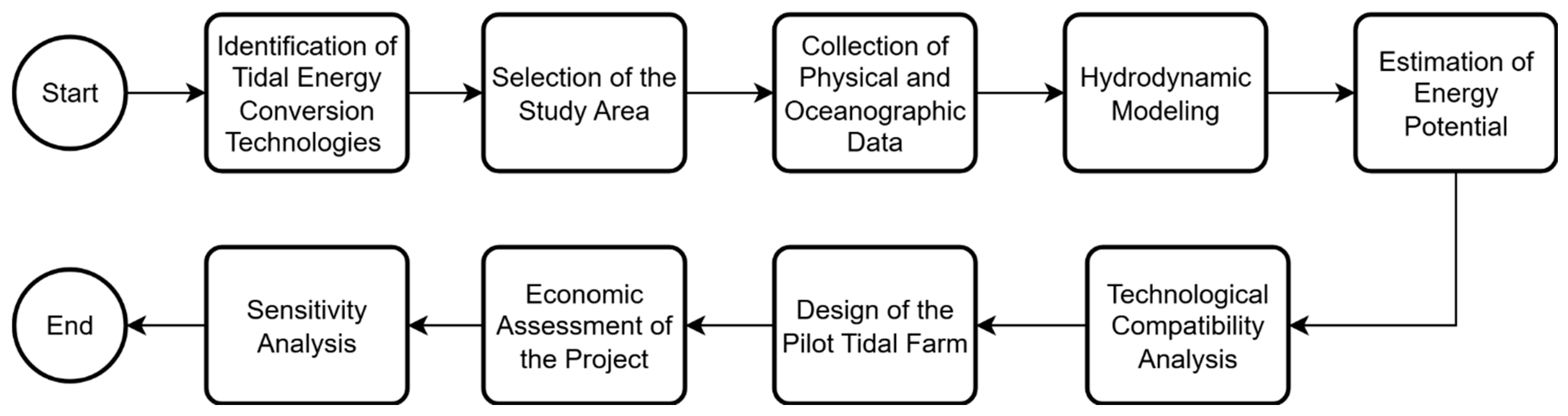
The methodological approach was structured in sequential stages to assess the technical and economic feasibility of tidal energy conversion in Buenaventura Bay. Figure 1 shows the methodology flowchart.
As shown in Figure 1, the process began with identifying suitable tidal energy conversion technologies, followed by selecting representative study sites based on hydrodynamic and logistical criteria. Physical and oceanographic data were collected and integrated into a hydrodynamic model to simulate tidal currents and validate site conditions. Subsequently, the available energy potential was estimated, and a technological compatibility analysis was performed to match local conditions with turbine specifications. Based on these results, a pilot tidal farm was designed, and the project’s economic viability was assessed using financial indicators. Finally, a sensitivity analysis was conducted to evaluate the impact of key variables on project feasibility. Each step is described below.

2.1. Identification of Tidal Energy Conversion Technologies

This step aimed to identify and pre-select tidal energy conversion technologies that are technically compatible with the hydrodynamic, bathymetric, and environmental conditions of Buenaventura Bay. The goal was to define a realistic technological boundary for hydrodynamic modeling, energy-yield estimation, and techno-economic assessment, avoiding the transfer of assumptions derived from high-energy marine environments.
A systematic literature review was conducted to identify tidal-stream energy conversion technologies suitable for estuarine and low-energy environments. The review included peer-reviewed journal articles, international technical reports, and manufacturer documentation, ensuring coverage of both scientific advances and practical deployment constraints. Bibliographic searches were conducted on Scopus, Web of Science, and IEEE Xplore, which provide comprehensive coverage of marine and renewable energy research.
The review methodology followed internationally recognized technical guidance, including recommendations from the EMEC [14] and the technical specification IEC TS 62600-201 [15], to ensure consistency in resource characterization, data representativeness, and alignment between hydrodynamic and energy assessments.
Based on the reviewed sources, tidal-stream technologies were classified into the main families reported for low-energy and/or estuarine contexts: horizontal-axis hydrokinetic turbines (HAHTs), vertical-axis hydrokinetic turbines (VAHTs), cross-flow hydrokinetic turbines (CFHTs), duct-augmented turbines, oscillating-foil energy converters, and tidal kites. For each family, the analysis considered operating principles, typical design velocities, deployment depth requirements, technological maturity, and reported performance in constrained estuarine environments. This classification defines the technological envelope used in subsequent stages of the study.
For each technology family, the following attributes were compiled: rotor configuration, cut-in velocity, rated velocity, operational velocity range, deployment depth, structural configuration, environmental tolerance, and installation/maintenance requirements. A screening framework was then defined to reflect documented constraints of low-energy tropical estuaries and the operational context of Buenaventura Bay. Criteria were grouped into technical–operational, deployment and maintenance, and environmental and spatial dimensions, as presented in Table 1 [27,28].
Each technology was evaluated using the following qualitative classification matrix [29]:
  • Compatible technologies: Devices satisfying all essential criteria for low-velocity, shallow estuarine environments.
  • Conditionally compatible technologies: Devices potentially deployable with design or operational adaptations (e.g., ducting, reduced rotor diameter, floating support).
  • Excluded technologies: Devices whose operational envelopes (minimum velocity, depth, or spatial requirements) exceeded the conditions of Buenaventura Bay.
Only compatible and conditionally compatible technologies were retained for subsequent analyses to preserve internal consistency between modeled hydrodynamics, performance curves, and cost structures representative of low-energy estuarine deployment.

2.2. Selection of the Study Area

The modeling domain encompassed both the external and internal sectors of Buenaventura Bay, including the main tidal channels and adjacent estuarine zones. Spatial boundaries were established using official nautical charts and bathymetric datasets provided by the Colombian Maritime Authority (DIMAR), complemented by geospatial layers from environmental and maritime agencies.
To ensure adequate representation of dominant tidal forcing while excluding zones with negligible tidal influence, spatial delimitation was based on the criteria in Table 2 [30,31].
Within the delimited domain, the hydrodynamic and bathymetric selection criteria shown in Table 3 were applied to identify candidate sectors that meet the low-energy estuarine restrictions and the floating or shallow-water technology requirements [32].
Finally, logistical and environmental constraints were incorporated to ensure operational viability and regulatory compliance, as shown in Table 4, including those related to port operations, protected areas, and community-use zones [33,34].

2.3. Collection of Physical and Oceanographic Data

This step acquired, processed, and integrated the datasets required for hydrodynamic characterization, numerical model calibration and validation, and tidal resource assessment. The approach combined in situ measurements, historical observations, and geospatial datasets to represent estuarine dynamics under low-energy tropical conditions.
Sea-level elevation data were obtained from permanent DIMAR tide stations [35]. Continuous records spanning several spring–neap cycles were processed to characterize the local tidal regime and to define the open-boundary forcing for the hydrodynamic model. The tidal regime of the study area, including its dominant semidiurnal and diurnal constituents, was established based on previously published literature and official technical reports [36]. The corresponding harmonic constituents were adopted from these sources to reconstruct a representative astronomical forcing consistent with standard tidal-analysis practice [37].
Sea-level validation was performed using observations from the Buenaventura Permanent Station (BUVE2; station code 15AA92C8), located inside Buenaventura Bay at 3.8906° N and −77.0808° W. This station is positioned within the inner model domain and away from the offshore open-boundary forcing location. Therefore, the comparison evaluates the model’s ability to reproduce water-level propagation inside the bay rather than testing the imposed boundary condition itself. The BUVE2 station operates as a permanent monitoring site with redundant instrumentation, including a radar sensor and a bubbler-type pressure sensor, which increases the reliability of the observed sea-level record used for validation.
Tidal current velocities were obtained from ADCP-AWAC records [38] provided by DIMAR/CECOLDO at Boya 29 [35], located in the access channel of Buenaventura Bay. This location was used as the control point for direct current-velocity validation because it provided in situ measurements for the period under analysis. The dataset corresponds to current-speed and current-direction measurements collected between 19 April 2021 and 1 May 2021. The ADCP-AWAC instrument was installed on the seabed, with sensors oriented upward toward the water surface and aligned to the north. The original dataset was recorded at 5 min intervals and includes measurements from 1.5 m to 20.5 m, with current velocity reported in m/s and current direction in degrees. The deployment and processing configuration used for hydrodynamic validation is summarized in Table 5.
The ADCP measurements included vertically resolved velocity profiles, bidirectional ebb–flood behavior, and short-term variability associated with meteorological and fluvial influences. The processed velocity series was used to compare the measured current velocity at the control location with the depth-averaged current velocity obtained from the hydrodynamic model.
Measurements included vertically resolved velocity profiles, bidirectional ebb–flood behavior, and short-term variability associated with meteorological and fluvial influences. Field procedures included pre-deployment calibration, stabilized mooring configuration, post-deployment diagnostics, and integrity checks.
Bathymetric data were compiled from DIMAR nautical charts and sonar-derived depth grids and were integrated into a digital elevation model (DEM). Processing included merging heterogeneous soundings, identifying main channels and shallow banks, and unifying vertical datums to ensure geometric consistency across sources.
Freshwater inflows were explicitly considered as a secondary control on estuarine circulation, particularly through their modulation of ebb-dominant phases and their contribution to short-term flow asymmetries. Upstream boundary conditions were therefore defined by incorporating the discharges of the main rivers and estuaries entering the system. These discharges were obtained from regional hydrological records reported by Colombian authorities [35] and were prescribed as steady or time-varying inflow conditions, depending on data availability and seasonal variability.
All datasets underwent quality-control procedures, including outlier detection, temporal synchronization to a unified reference, spectral verification of dominant tidal frequencies, and noise-reduction filtering of ADCP signals. Depth-averaged velocities were derived from ADCP profiles to ensure consistency with the depth-integrated numerical model. Model calibration and validation were subsequently assessed using standard performance indicators (RMSE, MAE, NSE, and correlation coefficient) for sea level at the BUVE2 interior station and for current velocity at the control site. The resulting datasets were then used to define boundary conditions, support the parameterization of bottom friction and roughness, and ensure suitability for energy estimation and subsequent techno-economic analyses [39].
Direct current-velocity validation was performed only at Boya 29, because this was the only site with available in situ ADCP measurements during the analyzed period. Therefore, the validation statistics reported for current velocity correspond specifically to Boya 29. At La Bocana and Aguadulce, current velocities were obtained from the calibrated Delft3D Flexible Mesh Suite (Delft3D-FM, version 2025.1) model outputs. Consequently, the hydrodynamic interpretation at these sites should be understood as model-based extrapolation supported by the calibration and validation performed at the control location.

2.4. Hydrodynamic Modeling

Hydrodynamic simulations were conducted using the Delft3D Flexible Mesh Suite (Delft3D-FM, version 2025.1) software [40] to reproduce water levels and depth-averaged tidal currents across Buenaventura Bay. The model was configured to generate spatially and temporally resolved flow fields suitable for characterizing hydrodynamic gradients, current persistence, and directional behavior under low-energy estuarine conditions. Mesh generation and bathymetry integration were performed using the Delft3D-FM Mesh Editor (Delft3D-FM, version 2025.1).
The hydrodynamic model solved the depth-integrated shallow-water equations (2D SWE), which describe the conservation of momentum and mass in free-surface flows subject to tidal forcing, bottom friction, and nonlinear advection [41].
U t + U U x + V U y = g η x + τ s x ρ H τ b x ρ H
V t + U V x + V V y = g η y + τ s y ρ H τ b y ρ H
H = h + η
Bottom shear stress was parameterized using a quadratic friction law:
τ b x = ρ C f U 2 + V 2
τ b y = ρ C f U 2 + V 2
with C f derived from the Chézy or Manning coefficients [42].
Continuity Equation:
η t + ( U H ) x + ( V H ) y = 0
The computational domain encompassed both external and internal sectors of Buenaventura Bay, extending offshore to represent tidal propagation and inland to include the main estuarine channels. An unstructured mesh comprising 1226 polygonal cells was generated, with a mean spatial resolution of approximately 270 m and local refinement to 150 m in tidal channels and zones of hydrodynamic interest, thereby ensuring adequate resolution of bathymetric controls and velocity gradients. Mesh quality was verified using an orthogonality criterion (cos(angle) < 0.001) [43]. Bathymetric data derived from DIMAR nautical charts and sonar surveys were interpolated onto the grid using a unified digital elevation model (DEM).
The mesh resolution was selected according to the feasibility-level scope of the study. IEC TS 62600-201 [15] distinguishes between feasibility assessments and layout-design studies for tidal-current resource characterization. Feasibility assessments are generally applied to the full estuary or channel and are intended to provide a medium-uncertainty estimate of the available resource, whereas layout-design studies focus on selected deployment areas and require finer spatial discretization to resolve turbine-scale effects. For feasibility-level studies, grid resolutions below 500 m are considered suitable, while layout-design studies require local grid resolutions below 50 m. Therefore, the adopted unstructured mesh, with a mean spatial resolution of approximately 270 m and local refinement to 150 m in tidal channels and hydrodynamically relevant areas, is consistent with the feasibility-stage objective of this work.
Because the present study was not intended as a final turbine-layout design, the adopted grid resolution was used to support bay-scale site comparison, velocity-exceedance analysis, APD estimation, and early-stage techno-economic screening. Turbine-scale wake interaction, blockage effects, array feedback, and detailed channel-scale velocity gradients should be evaluated in a subsequent layout-design stage using locally refined meshes below 50 m, higher-resolution bathymetry, and a dedicated mesh and time-step sensitivity analysis at La Bocana.
At the open boundary, tidal forcing was imposed using harmonic constituents (i.e., M2 (principal lunar semidiurnal), S2 (principal solar semidiurnal), N2 (lunar elliptic semidiurnal), K1 (lunisolar diurnal), O1 (principal lunar diurnal)) obtained from regional tide stations [36]. The boundary water-level signal was defined as [44]
η ( t ) = i = 1 N c A i c o s ( ω i t + ϕ i )
This formulation imposes a time-varying water-level condition at the offshore open boundary. The astronomical tide is represented as the linear superposition of harmonic constituents, which drive tidal-wave propagation into the estuarine domain and control the temporal evolution of water levels and depth-averaged currents within Buenaventura Bay.
Upstream boundaries were defined using steady or time-varying discharges derived from hydrological records, thereby representing freshwater inflows and their interaction with tidal oscillations. These upstream boundaries were imposed as discharge conditions at the river and estero limits of the model domain, allowing the model to represent the modulation of ebb and flood currents by freshwater contributions. Wind-stress effects were included when required by computing surface shear stresses from wind velocity using standard parameterizations.
Model calibration focuses on reproducing depth-averaged current magnitudes, temporal variability, and directional behavior representative of low-energy estuarine conditions. Calibration was performed by adjusting the bottom friction and horizontal eddy viscosity parameters using in situ current measurements at the control location. Horizontal turbulence was parameterized using either a Smagorinsky formulation [45] or constant eddy-viscosity coefficients, and wetting–drying processes were activated to represent intertidal zones.
Model performance was evaluated using standard statistical indicators, including Root Mean Square Error (RMSE), Mean Absolute Error (MAE), Nash–Sutcliffe Efficiency (NSE) [46], and correlation coefficient (R), complemented by time-series comparisons between modeled and measured variables. The validated hydrodynamic outputs were used to derive current-velocity time series, exceedance statistics, and directional metrics for energy assessment, site comparison, and techno-economic analyses.
Final model outputs, including velocity fields, flow directions, tidal elevations, and velocity probability distributions, were exported in Network Common Data Form (NetCDF) format for downstream processing and analysis.

2.5. Estimation of Energy Potential

Energy potential was quantified using validated hydrodynamic outputs, specifically depth-averaged current-velocity time series and spatial flow fields. The estimation procedure integrates theoretical resource characterization, statistical modeling of velocity occurrence, turbine power-conversion constraints, and temporal integration to derive both site-level indicators and annual energy production. Table 6 describes the formulation used to assess tidal-stream energy potential [11,12,13,14,15,16,17,18,19,20,21,22,23,24,25,26,27,28,29,30,31,32,33,34,35,36,37,38,39,40,41,42,43,44,45,46,47,48].
The resulting AEP values were subsequently adjusted to account for turbine availability, accessibility constraints, and environmentally driven downtime, ensuring consistency with the techno-economic evaluation presented in the subsequent sections.

2.6. Technological Compatibility Analysis

The compatibility analysis evaluated whether candidate technologies can operate under site-specific hydrodynamic, bathymetric, and environmental conditions. The comparison relied on key performance parameters, including cut-in velocity, rated velocity, operational range, turbine power coefficient curves, rotor diameter and swept area, draft and depth requirements, bidirectional operation capability, and tolerance to turbidity, sediments, and debris. These parameters were compiled from documented low-velocity turbine designs and performance studies, including laboratory-scale experiments and prototype evaluations for horizontal-axis and duct-augmented tidal turbines, as well as from standardized technology assessment frameworks and international technical guidelines [49,50].
Model outputs (velocity time series, PDFs, and power density maps) were used to apply compatibility conditions:
V ( t ) V cut - in
V ( t ) V rated
h ( x , y ) h m i n
Expected power for each velocity bin was estimated through [47]:
P b = 1 2 ρ A C p V b 3
Bathymetric maps were used to verify clearance, submergence ratios, and navigation constraints. Qualitative risk factors (sediment abrasion, debris impact, fauna interaction, and maintenance accessibility) were incorporated [51]. A multi-criteria compatibility matrix with normalized scoring (0–1) integrated hydrodynamic suitability, bathymetric feasibility, structural compatibility, environmental robustness, expected yield, and operational practicality to support selection for pilot design [52].
The 0–1 scores used in the compatibility matrix were obtained through a semi-quantitative multi-criteria normalization procedure. Each technology family was evaluated against the site-specific envelope derived from the hydrodynamic model, the velocity-exceedance analysis, the bathymetric characterization, and the operational constraints reported for tidal-stream technologies. This procedure was included to ensure that the compatibility matrix was traceable, reproducible, and consistent with the low-energy estuarine conditions of Buenaventura Bay.
The normalized scores were assigned using the interpretation scale presented in Table 7. A score close to 1.00 indicates strong agreement between the technology envelope and the local site conditions, whereas a score close to 0.00 indicates a clear mismatch between the technology requirements and the hydrodynamic, bathymetric, environmental, or operational constraints of the study area.
Hydrodynamic suitability was assessed by comparing the modeled velocity distribution with the turbine cut-in and rated velocity ranges. Bathymetric feasibility was evaluated based on the agreement among rotor diameter, deployment depth, clearance, submergence requirements, and navigation constraints. Structural compatibility is considered the consistency between the device size, support configuration, mooring or anchoring requirements, and the available depth envelope. Environmental robustness was assessed based on the reported tolerance of each technology family to turbidity, sediment abrasion, debris impact, fauna interactions, and estuarine exposure. Operational practicality considered technological maturity, installation feasibility, maintenance access, retrieval requirements, and suitability for regional port logistics. Expected yield consistency was derived from the overlap between the turbine power curve and the probability-weighted velocity bins used for APD and AEP estimation.
The source of information used to score each criterion is summarized in Table 8. This table clarifies that the matrix was based on model outputs, bathymetric constraints, the literature-reported turbine envelopes, manufacturer information when available, and site-specific operational conditions, rather than on arbitrary assignment.
The final compatibility classification was assigned from the combined interpretation of the normalized scores. Technologies with consistent performance across hydrodynamic, bathymetric, environmental, structural, and operational criteria were classified as compatible or partially compatible, whereas technologies with a clear mismatch in velocity requirements, depth constraints, spatial requirements, or operational feasibility were classified as not compatible. Therefore, the compatibility matrix should be interpreted as a normalized engineering screening tool for early-stage technology selection. It does not represent a direct manufacturer-certified performance ranking, but rather a structured comparison between technology envelopes and the site-specific constraints quantified for Buenaventura Bay. This approach allowed the selection process to remain consistent with the low-velocity, shallow-depth, sediment-influenced, and operationally constrained conditions of the study area.

2.7. Design of the Pilot Tidal Farm

Pilot-farm design integrated hydrodynamic indicators (velocity exceedance, directionality), energy potential results, and compatibility outcomes to define a pilot-scale configuration suitable for performance verification and techno-economic evaluation. The design and energy aggregation of the pilot tidal farm were developed using the System Advisor Model (SAM) developed by the National Renewable Energy Laboratory (NREL) (SAM–NREL) [58], ensuring internal consistency among device performance, array layout, and annual energy production estimates.
Candidate devices prioritized low cut-in velocities (0.3–0.5 m/s), bidirectional operation without active yaw, tolerance to sediment and turbidity, and feasibility under moderate port logistics. Horizontal-axis turbines with low-solidity rotors and/or duct augmentation were considered most consistent with the estuarine constraints. Hydrodynamic outputs were used to identify corridors with adequate depth, stable bidirectional flow, minimal navigation conflict, and limited morphological variability.
Array spacing followed standard wake-mitigation guidance adapted to channel constraints [59]:
L x = k x D , L y = k y D
k x and k y typically range from 8 to 10 and 3–4, respectively, depending on wake dissipation characteristics [60].
A staggered-row layout was adopted to improve wake recovery and maintain alignment with the dominant ebb–flood axis, with row spacing and turbines per row adjusted to the channel width and bathymetric stability.
Floating platforms with passive mooring were selected due to shallow depths and sedimentary conditions, which support retrievability and minimize seabed disturbance. Mooring and anchoring sizing was guided by hydrodynamic shear stresses inferred from the numerical model, ensuring structural stability under representative tidal loading conditions. The electrical configuration considered a low-voltage submerged interconnection between turbines, a junction node for power aggregation, power-conditioning units to ensure grid-compatible output, and an onshore interface located near existing distribution infrastructure. Electrical losses were estimated using standard steady-state electrical models consistent with international marine energy assessment practice, including Joule losses in subsea and onshore cables based on their equivalent series resistance, transformer copper and core losses represented through equivalent-circuit formulations, and power-conversion losses characterized by efficiency curves of the power-conditioning stage [61]. These losses were incorporated into the annual energy production and the subsequent techno-economic assessment, in accordance with the methodological guidance for tidal energy systems and system-level integration tools.
Farm power aggregation accounted for individual turbine power, wake interaction, and availability:
P F ( t ) = j = 1 N T P T , j ( t ) α j
Annual farm energy production A E P F was obtained by integrating P F ( t ) over a representative year.

2.8. Economic Assessment of the Project

The economic assessment evaluated the financial viability of the pilot tidal farm by integrating CAPEX, OPEX, and annual energy production over a 20-year project life cycle. Standard discounted cash flow indicators were applied to quantify lifecycle costs and economic performance under low-energy estuarine conditions in Buenaventura Bay. Table 9 presents the equations used in this assessment [62].
The interpretation of LCoE, NPV, and IRR results accounted for the local energy context of Colombia’s Pacific coast, including diesel-based generation costs in non-interconnected or partially reliable zones, the resilience requirements of coastal infrastructure, regional decarbonization targets, and potential hybridization with other renewable energy sources.
The economic indicators are structured into two primary components: capital investment and operational expenditures. Within the capital investment category, the Device includes structural mounting, the power take-off system, and the mooring, foundation, and substructure systems. The Balance of Systems (BOS) comprises project development, engineering and management, electrical infrastructure, plant commissioning, site access and port logistics, site preparation, and assembly and installation activities. Financial costs account for the project contingency budget, construction insurance, and reserve accounts. The aggregation of these elements defines the total CAPEX.
Regarding operational expenditures, the operations component encompasses health, safety, and environmental monitoring; annual leases, fees, and cost-of-doing-business charges; insurance; and operations, management, and general administration. The maintenance component includes long-term service agreements, scheduled maintenance, and unscheduled maintenance. The sum of these categories determines the annual OPEX.
Given the high turbidity and sediment-transport conditions identified at La Bocana, sediment-related operational burdens were incorporated within the maintenance component of the annual OPEX. A maintenance cost allowance of 3% was considered to account for additional inspection, cleaning, retrieval, scheduled maintenance, unscheduled maintenance, and corrective interventions associated with sediment abrasion, suspended solids, debris accumulation, and potential local scouring around support or mooring elements. This value was estimated from the literature on marine and tidal energy projects, where sediment exposure, biofouling, debris interaction, and restricted accessibility are commonly recognized as factors that increase operation and maintenance requirements [63]. Therefore, sedimentation and scouring effects were not treated as an independent cost item, but were incorporated within the maintenance component of the annual OPEX.
For the base-case financial assessment, the electricity selling price, P sell , was set at 0.15 USD/kWh, equivalent to 150 USD/MWh. This value was adopted as a local baseline reference corresponding to the average producer electricity price in Colombia during the 2012–2025 period [64]. The parameter was used to estimate annual revenues through Equation (25), and therefore influenced the NPV, revenue over the project lifetime, and payback assessment.

2.9. Sensitivity Analysis

Sensitivity analysis evaluated how uncertainty and improvement pathways propagate into AEP and LCoE in a low-energy estuarine context, where small velocity changes can produce large energy impacts due to cubic scaling [47]. Parameters considered included hydrodynamic uncertainty (mean velocity and exceedance near cut-in), technological uncertainty (power coefficient, cut-in/rated speeds, rotor diameter, availability, wake coefficients), and economic uncertainty (CAPEX, OPEX, discount rate, P sell , replacement intervals). AEP sensitivity to velocity perturbations was evaluated as [65]
AEP ( V + Δ V ) = k = 1 N t P T ( t k ; V t k + Δ V ) Δ t
LCoE sensitivity under varying CAPEX, OPEX, discount rate, and AEP conditions were evaluated with [66]
LCoE = CAPEX + t = 1 n OPEX ann 1 r ) t t = 1 n AEP F 1 r ) t
using the correction factors and variation ranges defined in the sensitivity analysis methodology. The variation ranges used (e.g., AEP (0–90%), CAPEX, and OPEX (0–90%) [67] and discount rate 3–12% [68]) followed common ranges for early-stage marine energy projects.
Sensitivity outcomes supported risk characterization into high-influence risks (hydrodynamic uncertainty near cut-in, CAPEX variability, seasonal sediment/debris exposure) [69], moderate-influence risks (discount rate changes and availability reductions) [70] and low-influence risks (minor OPEX changes and electrical losses), informing decisions on turbine selection, layout refinement, and monitoring priorities.

3. Results

3.1. Identification of Tidal Energy Conversion Technologies

Table 10 presents the operating principles of the analyzed tidal power generation technology and the limitations for low-energy tropical estuaries [54,71].
Table 10 indicates that only a subset of concepts can be aligned with low-energy estuarine regimes. In particular, the resource–technology mismatch is expected to be most critical for commercial HAHT concepts optimized for higher velocities. In contrast, ducted and low-speed-adapted concepts may provide a pathway to increase operational hours near cut-in speeds. This is consistent with the sensitivity of tidal-stream output to near-threshold velocities due to the cubic power–velocity dependence [57].
To quantify the contrast between typical tidal-stream project conditions and the local constraints of Buenaventura Bay, Table 11 compiles representative ranges from surveyed deployments and interprets their implications for the case study.
As shown in Table 11, the main structural limitation is velocity. While many commercial solutions are optimized for velocities above approximately 0.8 m/s, the average tidal current in Buenaventura Bay is approximately 0.49 m/s [20]. Therefore, compatibility must be determined not only by maturity level but also by jointly considering velocity distributions relative to inlet and nominal thresholds, depth restrictions, and environmental stressors (turbidity, sediment, debris).

3.2. Selection of the Study Area

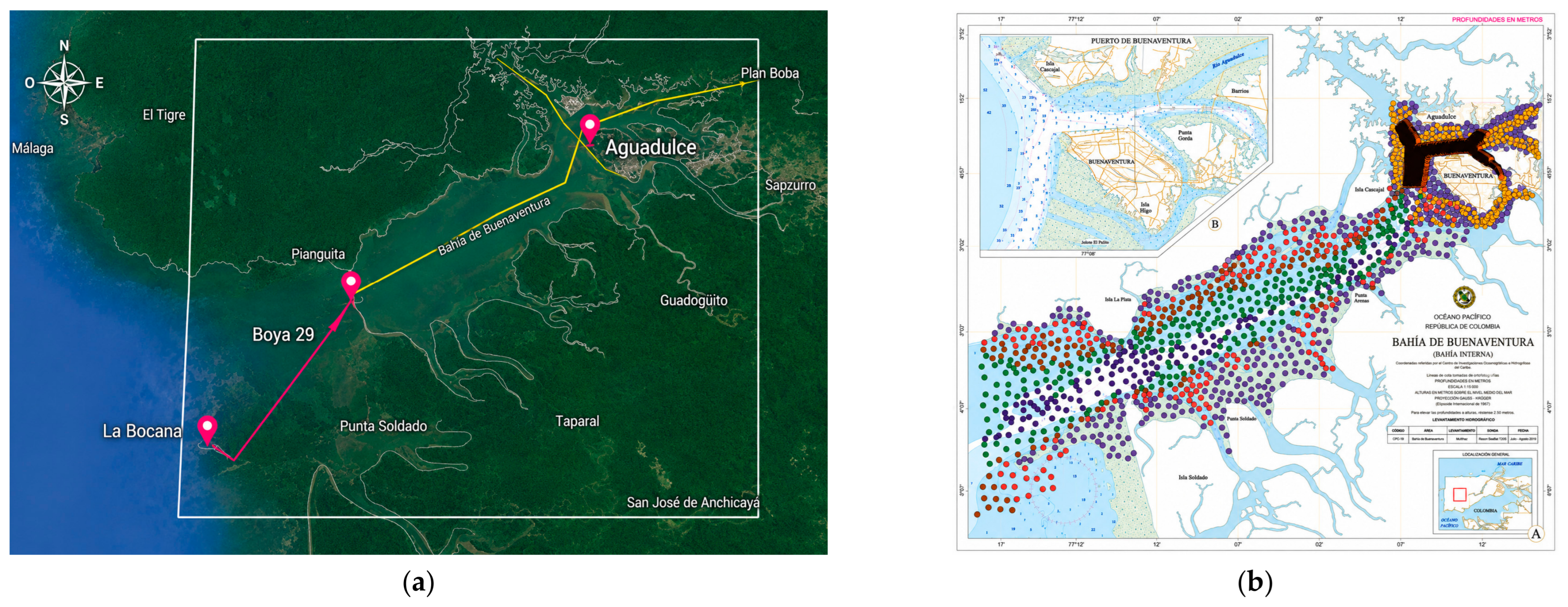
The bay-scale geometry and inlet control at La Bocana govern tidal propagation and the internal attenuation of current magnitudes. Figure 2 provides geographic context and locates the three reference sites (La Bocana, Boya 29, Aguadulce) used to structure the results.
In Figure 2a, Buenaventura Bay, Colombia, including La Bocana, Boya 29, Aguadulce, Piangüita, Punta Soldado, and other coastal or estuarine reference locations, is presented using the official geographic names in Spanish to maintain consistency with official nautical charts, regional cartography, and local navigational references employed in the hydrodynamic and bathymetric analyses.
In Figure 2b, the different colors represent groups of bathymetric depth points obtained from DIMAR nautical charts and GIS-based processing. Each color corresponds to a specific depth interval used during the interpolation and construction of the digital bathymetric model. The spatial distribution of these colored points highlights variations in channel depth throughout Buenaventura Bay: denser, darker point distributions are associated with deeper navigation channels, whereas lighter, more dispersed point distributions correspond to shallower estuarine and coastal sectors. These bathymetric datasets were subsequently used to generate the interpolated depth surface employed in the hydrodynamic simulations.
Figure 2 shows that the tidal force enters through a single inlet and dissipates progressively towards the land, implying a significant spatial gradient in current velocity and power density.
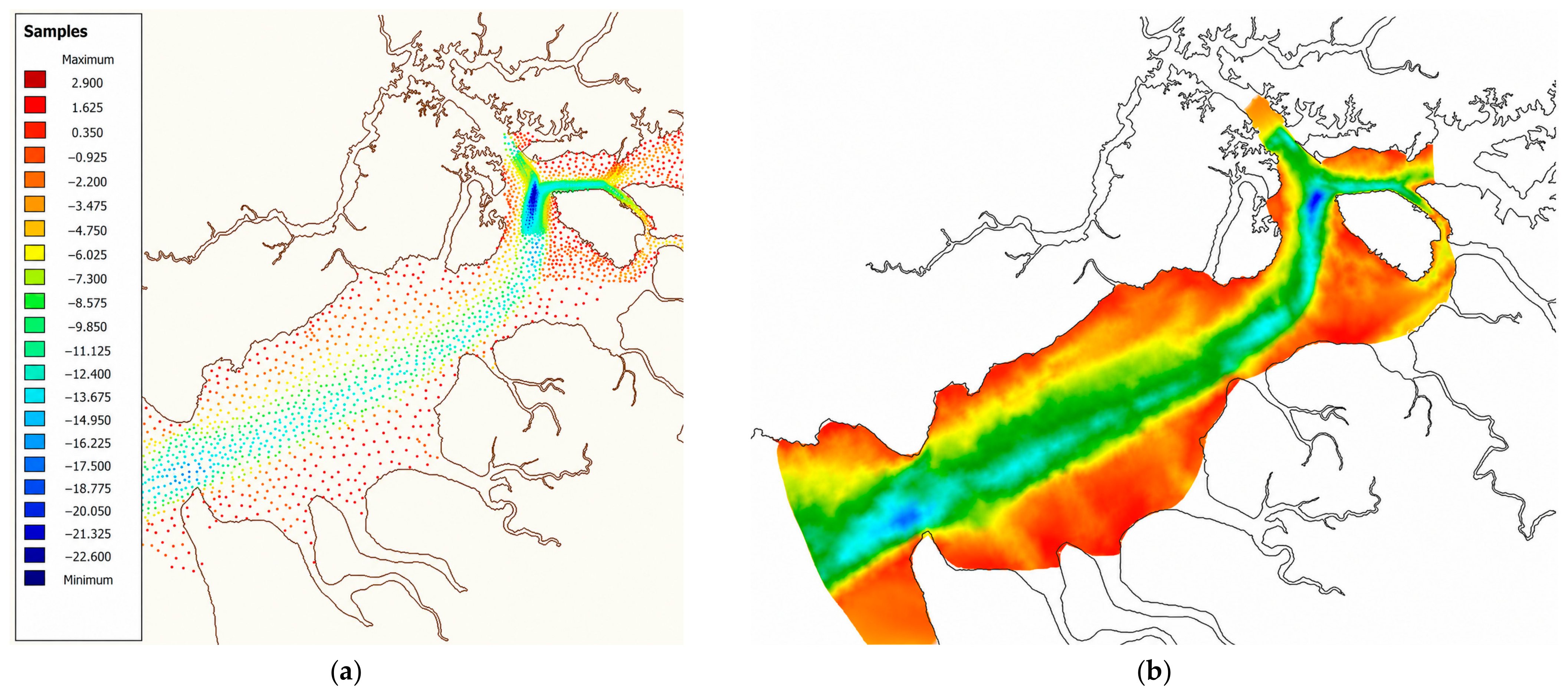
Because bathymetry is the dominant geometric control on flow acceleration and energy distribution, Figure 3 presents the bathymetric dataset used to support the numerical simulations and subsequent energy mapping.
Figure 3 indicates depth gradients and channelization consistent with localized acceleration near the inlet and reduced energetic potential in inner sectors. Table 12 compares the three selected sites with respect to hydrodynamic relevance, bathymetric feasibility, logistical access, and environmental compatibility.
Table 12 shows that La Bocana provides the strongest forcing signal, Boya 29 captures transitional dynamics and supports calibration, and Aguadulce represents constrained inner-estuarine conditions.

3.3. Collection of Physical and Oceanographic Data

Table 13 presents the harmonic constituents, including the amplitudes and phases of the dominant semidiurnal and diurnal components, used to define the tidal water-level boundary condition at the hydrodynamic model’s open boundary.
Table 13 shows that semidiurnal constituents (M2, S2, and N2) dominate the tidal signal, confirming the prevalence of semidiurnal forcing in the study area. The presence of the overtide M4 reflects nonlinear tidal distortion associated with shallow depths, bottom friction, and channel convergence.
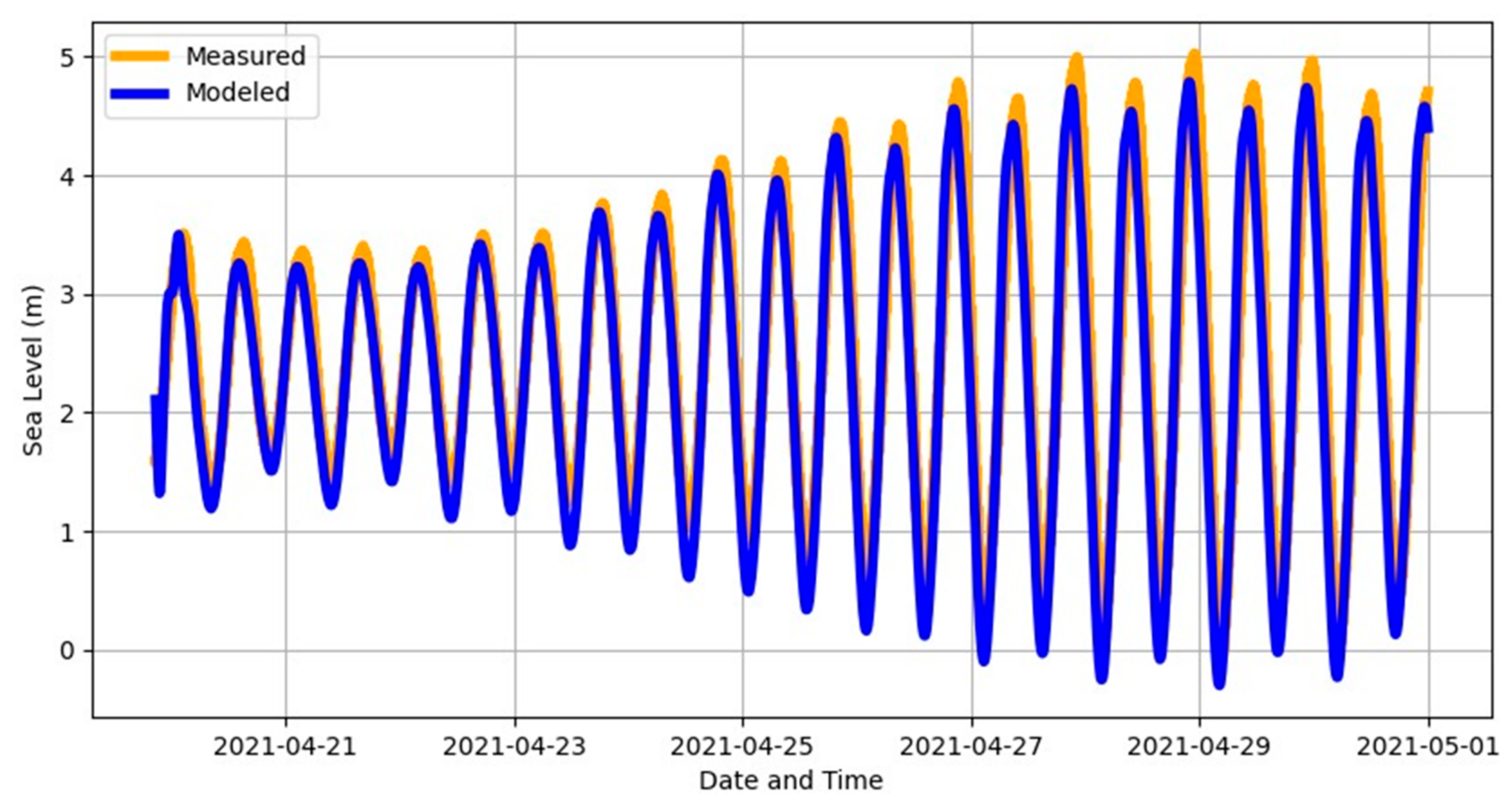
Figure 4 compares measured and modeled sea-level data for the analysis period. The figure also presents the processed sea-level time series employed to define the tidal forcing conditions.
Figure 4 indicates that spring–neap modulation and the full tidal range, including extreme low-water conditions, are well represented in the processed series. This is important because accurate representation of tidal phase and amplitude directly controls the timing and magnitude of modeled current velocities used in energy computations. The discharge values used for upstream characterization were calculated based on the data in Table 14.
Table 14 shows heterogeneous tributary contributions, with tidal oscillations remaining dominant but secondarily modulated by freshwater inflows. This combined forcing provides context for minor discrepancies between point ADCP measurements and depth-averaged modeled velocities during the peak-flow phase.
Table 15 presents the consolidated environmental configuration used to interpret model behavior and to identify sources of uncertainty.
Table 15 shows the internal consistency of the physical configuration adopted in the hydrodynamic model. Air and water temperatures and salinity are representative of tropical estuarine conditions influenced by freshwater inputs. The selected Manning roughness coefficient and turbulent viscosity are consistent with shallow, low-energy channels, explaining the enhanced friction and velocity attenuation observed in the modeled flow.
Table 16 and Table 17 present statistics and error metrics for sea-level and ADCP-derived current velocities, respectively.
Table 16 indicates low absolute errors and acceptable bias for the sea-level series used for comparison, supporting the reliability of the tidal forcing representation, in accordance with recommended validation practices for tidal resource assessment [15].
Table 17 shows close agreement between observed and model-ready velocity statistics, with low RMSE and negligible bias. This level of consistency is important because energy estimates in low-energy regimes are highly sensitive to velocity uncertainty.
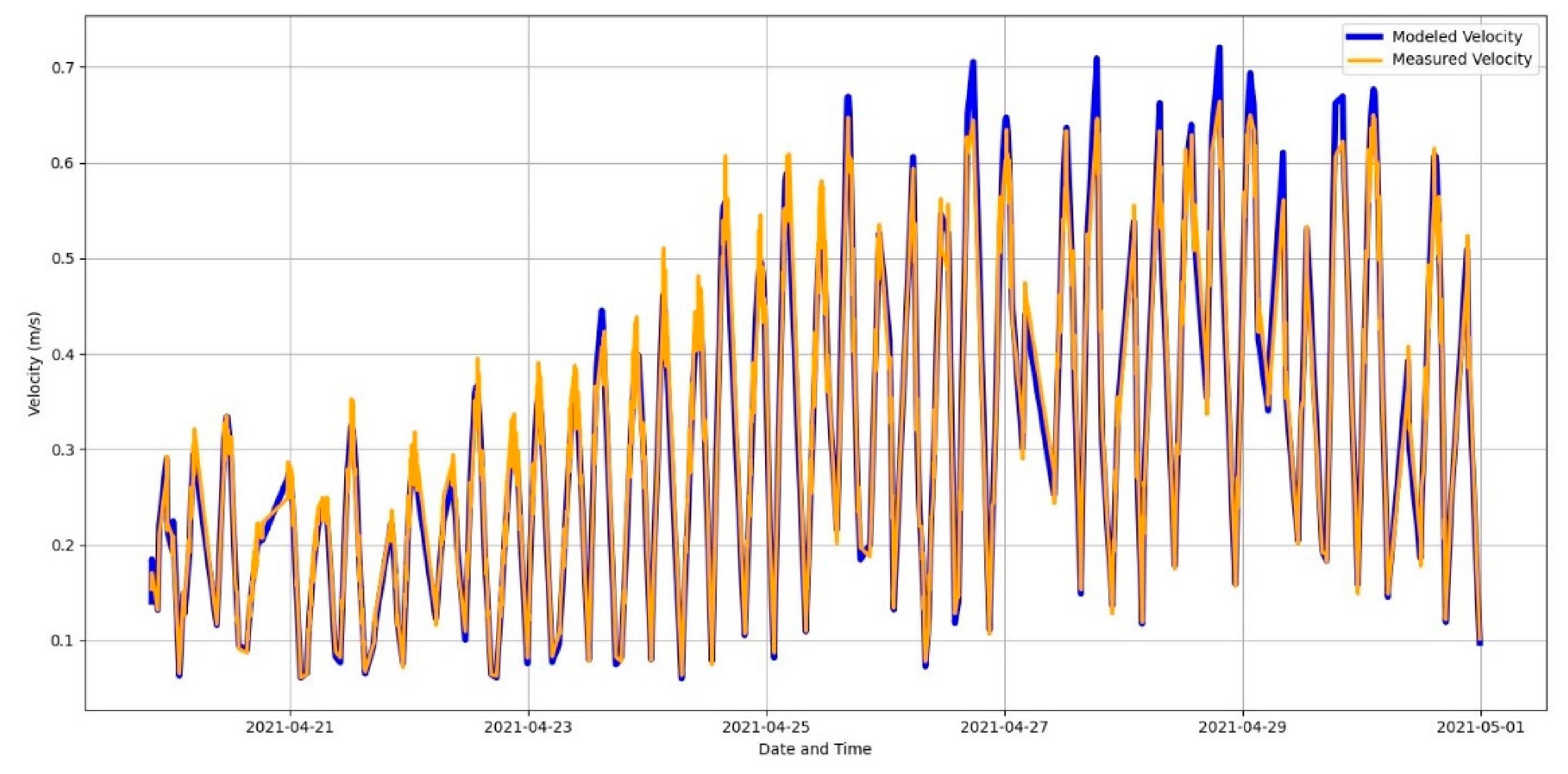
Figure 5 compares modeled and measured current-velocity time series at Boya 29. This comparison highlights phase alignment, peak magnitudes, and the stability of ebb–flood oscillations across the tidal cycle.
Figure 5 shows that the simulation reproduces the dominant tidal periodicity, ebb–flood symmetry, and phase timing observed in the measurements. Minor discrepancies near maxima are consistent with differences between point ADCP observations and a depth-averaged numerical representation, as well as with secondary modulation associated with freshwater inflows and local turbulence/strain fields, which can affect peak values more strongly than mid-range velocities [72].
Model performance was evaluated using calibration and validation statistics for the two key state variables used in downstream analyses (i.e., sea level at the open boundary and current velocity at the control site). Table 18 summarizes the resulting error metrics and goodness-of-fit indicators.
According to Table 18, the sea-level validation at the BUVE2 interior station yielded an RMSE of approximately 0.30 m and an MAE of approximately 0.23 m, with goodness-of-fit indicators above 0.90. These results indicate that the model adequately reproduces tidal propagation and water-level variability inside Buenaventura Bay, rather than merely reproducing the prescribed offshore boundary forcing. In addition, the velocity RMSE of 0.022 m/s at Boya 29 is small relative to the cut-in range of low-speed tidal-energy concepts, which is critical in low-energy environments where modest velocity deviations can disproportionately affect energy estimates due to the cubic dependence of power on flow velocity. Therefore, the combined sea-level and current-velocity validation results indicate that the model adequately resolves both the tidal elevation dynamics inside the bay and the magnitude and timing of current velocities required for tidal-energy assessment.

3.4. Hydrodynamic Modeling

Because direct ADCP validation was available only at Boya 29, the model uncertainty at La Bocana was interpreted using the velocity validation error obtained at the control site. The RMSE of 0.022 m/s at Boya 29 was considered as the reference uncertainty scale for the modeled velocity field. At La Bocana, where the mean current velocity is approximately 0.4–0.5 m/s, this error represents about 4–6% of the characteristic velocity range. Given the cubic dependence of tidal-stream power on velocity, this velocity uncertainty may propagate into a larger uncertainty in instantaneous power-density estimates. Therefore, La Bocana APD and AEP values should be interpreted as calibrated model-based estimates, suitable for early-stage screening and pilot design, but requiring site-specific ADCP validation before detailed engineering or investment decisions.
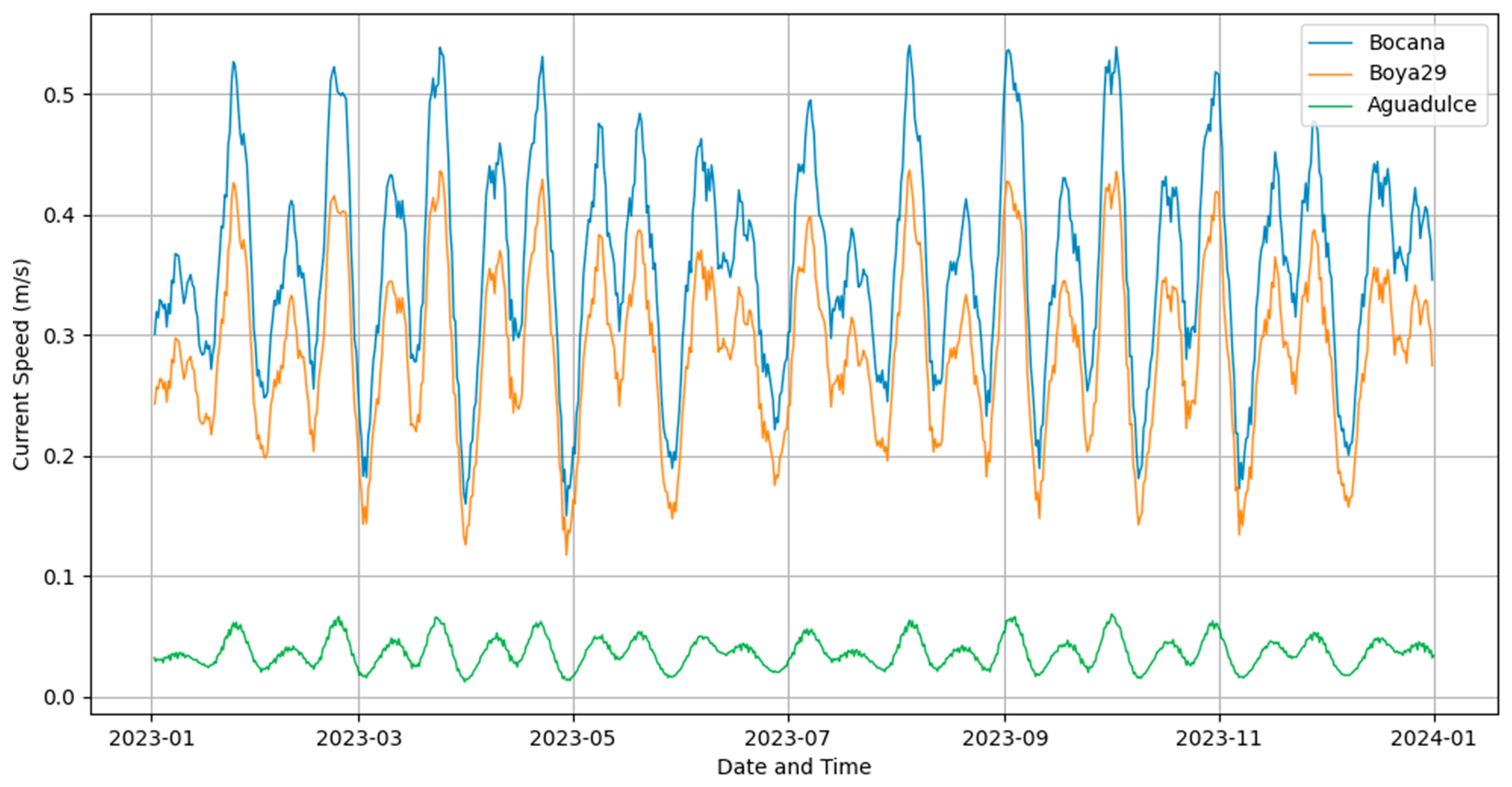
Figure 6 presents the results of hydrodynamic modeling over a full year, showing the temporal variation in current velocity at the three sites.
Figure 6 shows a consistent spatial gradient in modeled currents across Buenaventura Bay. La Bocana (blue) presents the highest velocities over the year, Boya 29 (orange) exhibits intermediate conditions, and Aguadulce (green) remains characterized by low velocities representative of inner-estuarine, weakly energetic sectors. This pattern is consistent with progressive attenuation of tidal currents from the inlet toward the inner bay and provides the basis for subsequent site ranking.
Because feasibility in low-energy estuaries is governed not only by peak velocities but also by the persistence of currents above practical cut-in thresholds [73] and by directional stability for turbine alignment [74]. Table 19 compiles indicators derived from the validated model outputs to characterize operational windows and array-design constraints.
Table 19 shows that the operational window for low-cut-in concepts is primarily concentrated above 0.3 m/s, with a notable contribution from the 0.5 m/s and higher-velocity bins at La Bocana. This behavior indicates that low-speed tidal technologies could operate during a meaningful fraction of the tidal cycle, although sustained operation at higher power levels remains constrained by the low-energy estuarine regime. The reported directional deviation (±15° during 80% of the tidal cycle) defines a stable dominant flow axis, which allows the use of fixed-axis configurations without active yaw control under the modeled conditions.

3.5. Estimation of Energy Potential

Table 20 presents the APD estimation for La Bocana and Boya 29, calculated from probability-weighted velocity bins obtained from the hydrodynamic simulations. The modeled current-velocity time series was discretized into uniform velocity bins with a constant class width of ΔU = 0.10 m/s, following the binning approach recommended in IEC TS 62600-201 [15], Section 8.3, for tidal-current resource assessment and device power-characteristic evaluation. Each velocity value reported in Table 20 represents the center of the corresponding velocity class. For example, Ui = 0.40 m/s denotes the class centered at 0.40 m/s, covering the interval from 0.35 m/s to 0.45 m/s. For each class, the theoretical power density was calculated using the bin-center velocity, and the corresponding APD contribution was obtained by multiplying this value by the probability of occurrence of the bin. This bin-center convention was applied consistently in the calculation of velocity frequency, probability of occurrence, APD contribution, and turbine cut-in interpretation. The results for Aguadulce are not reported in the table because its modeled hydrodynamic regime yields an available power density of about 10−6 kW/m2, which is negligible relative to the other sites.
According to Table 20, at La Bocana, the average power density (APD) is 3.4 times that at Boya 29, primarily due to the persistence of moderate current velocities rather than isolated high-velocity events. This behavior is directly linked to the high frequency of occurrence reported in the frequency column for the 0.4–0.6 m/s bins, which together account for more than 22,000 records and approximately 0.43 p.u. of the total probability. Because these velocities recur over many tidal cycles, their probability-weighted contributions dominate the APD, even though their instantaneous power levels are lower than those associated with higher-velocity bins. In low-energy estuarine regimes, this frequency–persistence effect is critical, as energy availability is governed by the frequency of usable velocities rather than by sporadic peaks. Consequently, although velocities above 0.8 m/s yield higher power densities, their low frequencies limit their influence on the APD. The dominant contribution of the 0.4–0.6 m/s range therefore supports a feasibility interpretation favoring tidal-stream technologies with low cut-in thresholds and reliable performance under moderate, frequently occurring flow conditions.
In contrast, Boya 29 exhibits a substantially lower APD, with its velocity distribution concentrated predominantly below 0.4 m/s. This pattern is reflected in the frequency column of Table 17, where velocities up to 0.3 m/s account for more than 28,000 records and nearly 0.72 p.u. of total probability. Although these low velocities occur frequently, their associated power densities are small, and the infrequent occurrence of moderate velocities between 0.4 and 0.6 m/s limits their cumulative contribution to the APD. As a result, the APD at Boya 29 is reduced to 19.1 W/m2 despite the large number of observations. This frequency structure shortens the duration during which velocities exceed cut-in thresholds. It increases sensitivity to operational and spatial constraints, thereby narrowing the feasibility margin for tidal-stream energy deployment, even under modest constraints on navigation, minimum clearance, or device operation.
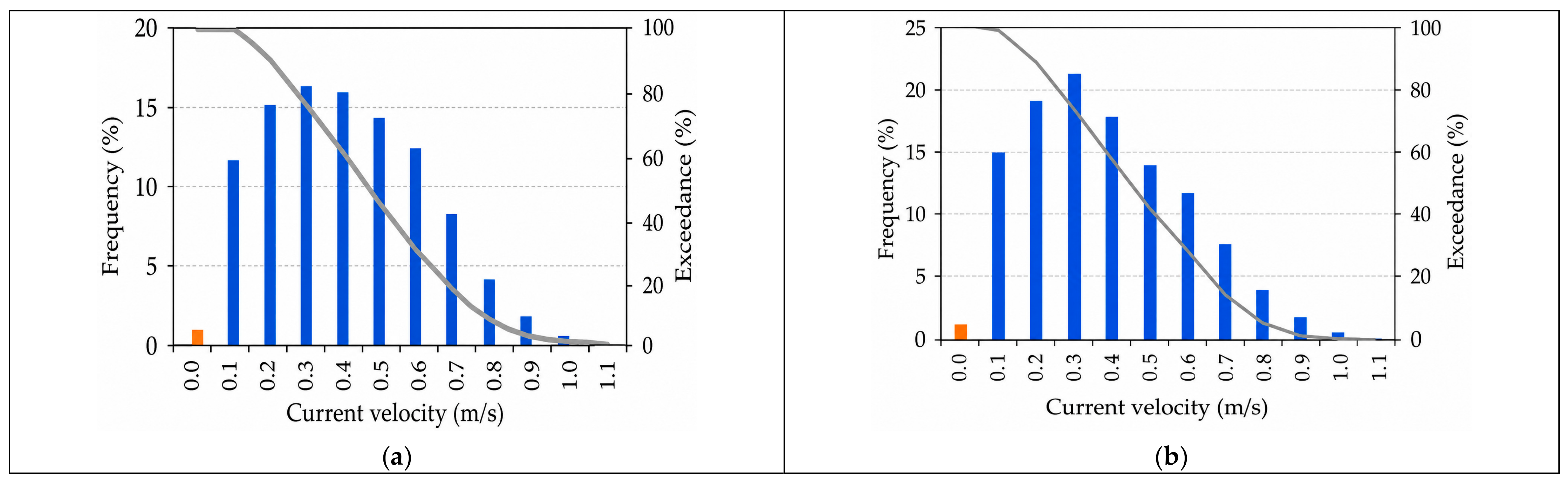
The differences between the two sites are illustrated in Figure 7, which presents their frequency distributions and exceedance curves for La Bocana (Figure 7a) and Boya 29 (Figure 7b).
In Figure 7, the blue bars represent the frequency distribution of current velocities for each velocity interval, expressed as a percentage of occurrence. The gray line represents the exceedance curve, indicating the percentage of time during which the current velocity exceeds a given threshold. The orange bar at 0.0 m/s represents periods with negligible or near-zero current velocities.
According to Figure 7, in La Bocana, the exceedance curve shows that velocities of approximately 0.35 m/s are exceeded for about 50% of the time, confirming a relatively favorable regime for low-cut-in tidal-stream concepts. Conversely, at Boya 29, events exceeding approximately 0.7 m/s are infrequent, and velocities around 0.3 m/s are exceeded roughly half of the time. This exceedance behavior confirms a lower practical resource classification under realistic turbine-activation thresholds and reinforces the conclusions drawn from the APD analysis.

3.6. Technological Compatibility Analysis

Compatibility results were derived by confronting site envelopes with turbine operational thresholds and structural feasibility constraints. Table 21 contrasts depth and current-speed ranges with generalized, commercially available envelopes and the implied requirements for low-speed adaptation.
Table 21 indicates that Boya 29 is constrained by both resource intensity and practical deployment factors, reinforcing La Bocana as the only site where a pilot configuration remains technically discussable under low-speed assumptions.
Table 22 presents the normalized compatibility matrix, which formalizes the comparative assessment across technology families.
Table 22 indicates that adapted HAHT low-speed concepts provide the most coherent pathway for a La Bocana pilot. In contrast, conventional commercial envelopes remain structurally inconsistent with the quantified low-speed regime.

3.7. Design of the Pilot Tidal Farm

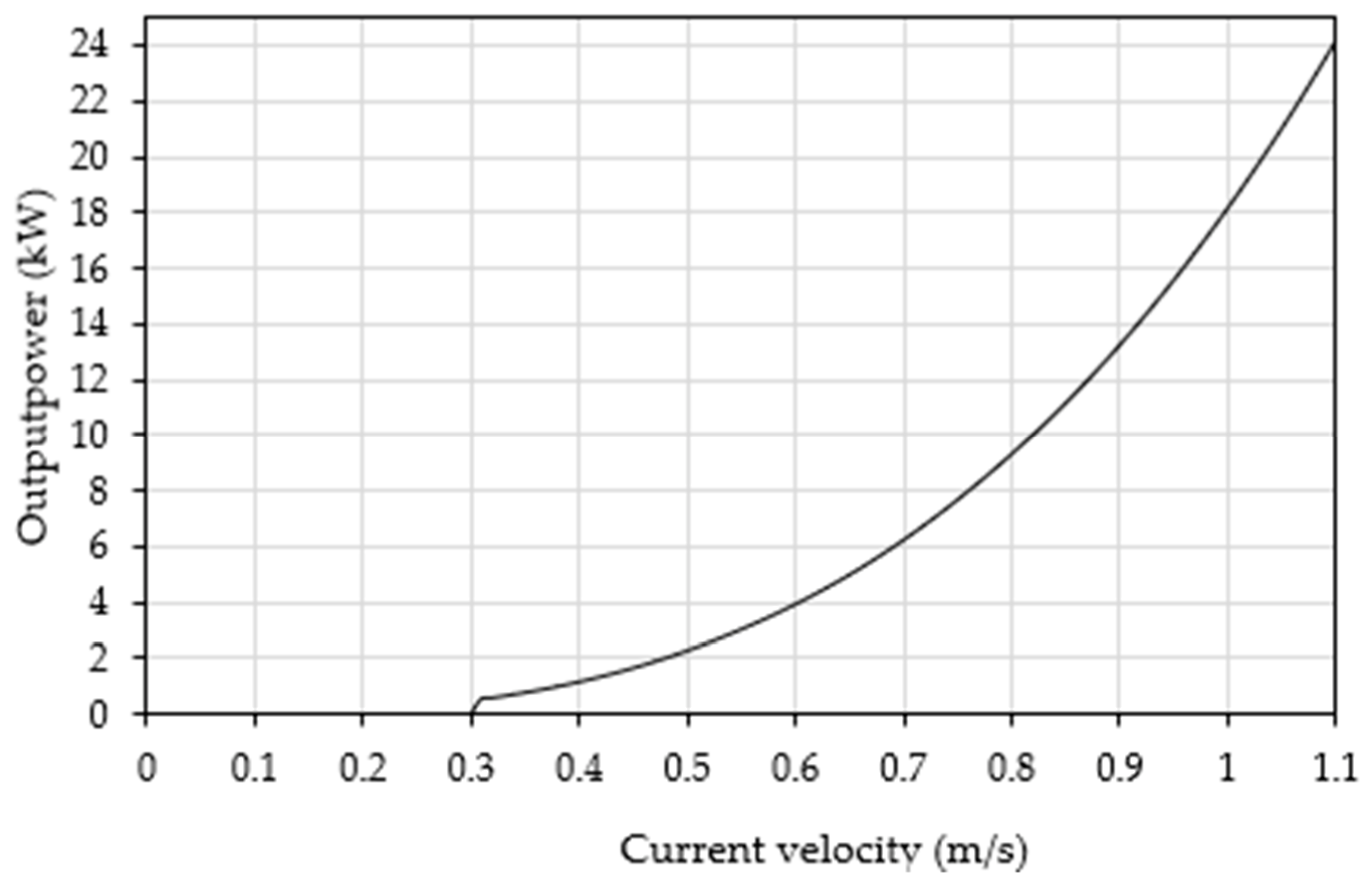
To enable internally consistent AEP estimation under low-speed conditions, a generic low-speed horizontal-axis tidal turbine was parameterized in SAM–NREL [58]. Table 23 presents the turbine parameters adopted for compatibility and AEP integration, and Figure 8 presents the variable–power curve used for the feasibility-stage energy estimation.
Figure 8 indicates that feasibility is governed by sustained operation near the cut-in threshold and by the probability-weighted contribution of moderate current velocities. In this curve, turbine power is set to zero below 0.40 m/s. Above this threshold, output power follows the kinetic-power formulation based on the bin-center velocity, rotor swept area, seawater density, and C p = 0.45 , without applying a rated-power plateau, pitch-control limitation, or electrical capping rule during the annual integration.
The annual energy production was calculated by discrete integration over the probability-weighted velocity bins reported in Table 17. For each bin, turbine power was calculated using Equation (10), where A = 78.54   m 2 , ρ = 1025   k g / m 3 , and C p = 0.45 . The resulting power values were weighted by their probability of occurrence. Therefore, the resulting average gross turbine power does not correspond to a single current velocity, but to the combined contribution of all operational velocity bins. The dominant contribution is associated with the moderate-velocity range between approximately 0.40 m/s and 0.70 m/s, where the balance between power output and probability of occurrence is most relevant. This procedure produced an average gross turbine power of approximately 2.168 kW, which is equivalent to a steady-flow velocity of approximately 0.49 m/s under the same rotor area, seawater density, and C p assumptions. After applying a 95% operational availability factor, the net annual energy production was 18,029.5 kWh/year, equivalent to approximately 18.03 MWh/year per turbine.
The hydrodynamic regime, depth envelope, and compatibility results define the boundary conditions for the preliminary pilot-farm configuration. Table 24 consolidates the boundary conditions adopted at La Bocana for array-level decisions.
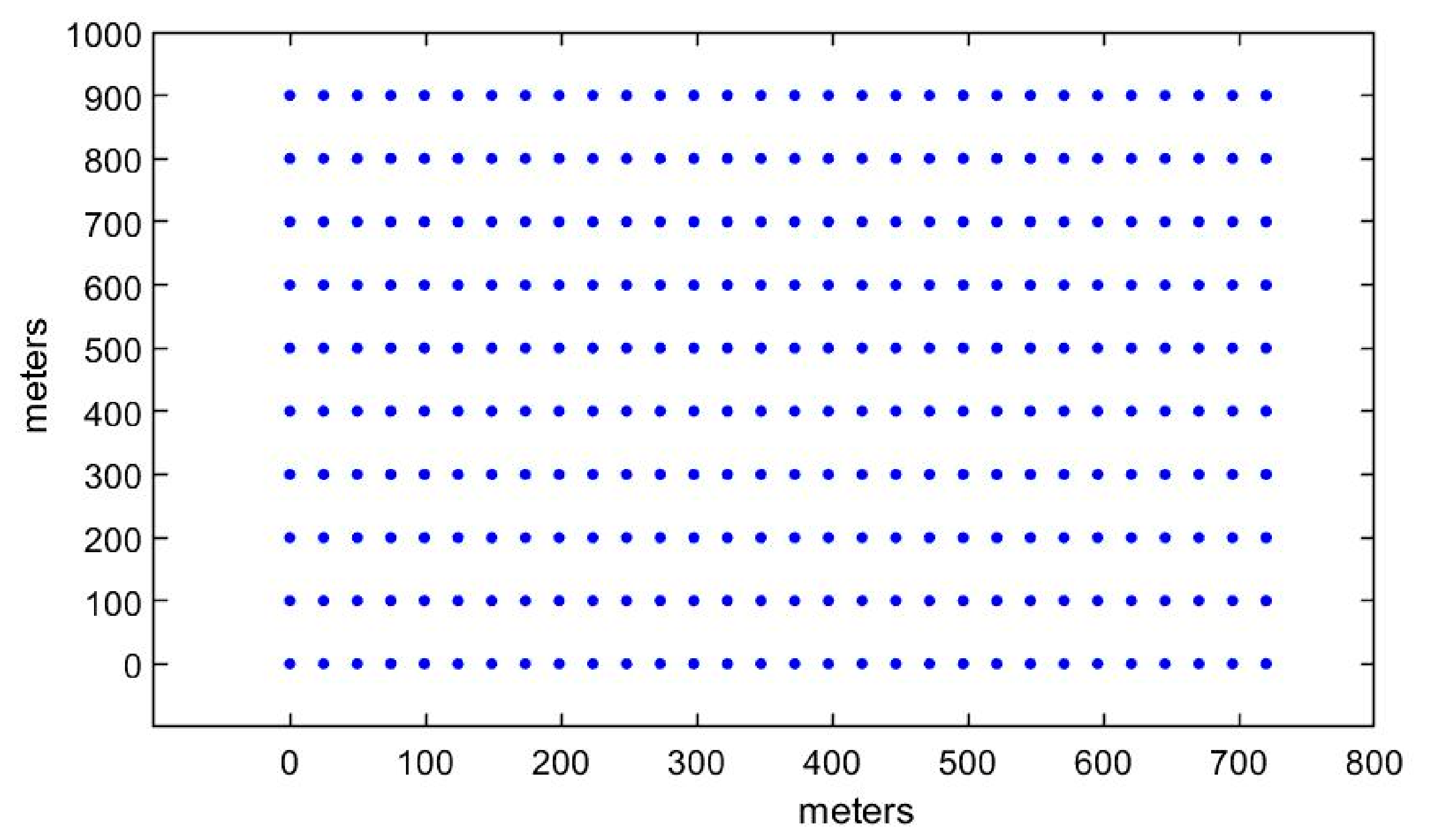
With the reference turbine defined and spacing constraints applied, Figure 9 presents the farm organization derived in SAM–NREL.
Figure 9 shows the array footprint and row-based organization within the channel corridor, providing the spatial basis for interpreting the farm-scale energy estimate. The technical data for the pilot tidal farm are shown in Table 25.
The 300-turbine configuration should be interpreted as a feasibility-stage reference scenario rather than as a final layout-design solution. In accordance with IEC TS 62600-201 [15], the present study focuses on macro-scale resource assessment, site screening, and preliminary techno-economic evaluation. Detailed layout-design studies require additional site-specific analysis, including high-resolution bathymetric mapping, navigation-corridor verification, turbine micro-siting, clearance assessment, wake-loss modeling, blockage effects, and array-feedback simulations. Therefore, the annual farm energy production of 5.42 GWh/year is used here as a preliminary estimate for feasibility and sensitivity analysis under low-energy tropical estuarine conditions. Before detailed engineering or investment decisions, a dedicated layout-design stage should be conducted at La Bocana using refined bathymetry, direct ADCP validation, navigation constraints, and hydrodynamic interaction modeling.

3.8. Economic Assessment of the Project

The economic results are first presented through the cost structure, as the CAPEX and OPEX composition explains the base-case LCoE and NPV outcomes. Table 26 presents the cost structure and the CAPEX/OPEX breakdown for the 1.1 MW pilot farm.
Table 26 shows BOS dominance (approximately 60% of CAPEX), consistent with pilot-scale marine deployments, in which logistics, installation, and project management account for the majority of costs. The OPEX magnitude (approximately 9% of CAPEX per year) is high relative to mature renewables, reflecting estuarine operational burdens (inspection, retrieval, monitoring). The maintenance component corresponds to 3% of the cost structure, equivalent to USD 444,946 per year. This component includes scheduled and unscheduled maintenance, as well as an allowance for additional maintenance activities associated with the high-turbidity and sediment-transport conditions identified at La Bocana. These activities include inspection, cleaning, retrieval, corrective maintenance, and potential interventions related to sediment abrasion, debris accumulation, and local scouring around support or mooring elements. Therefore, sedimentation and scouring effects were incorporated within the maintenance component of annual OPEX rather than treated as an independent cost item.
Table 27 presents base-case economic indicators in a single consolidated view, including LCoE, NPV, and IRR.
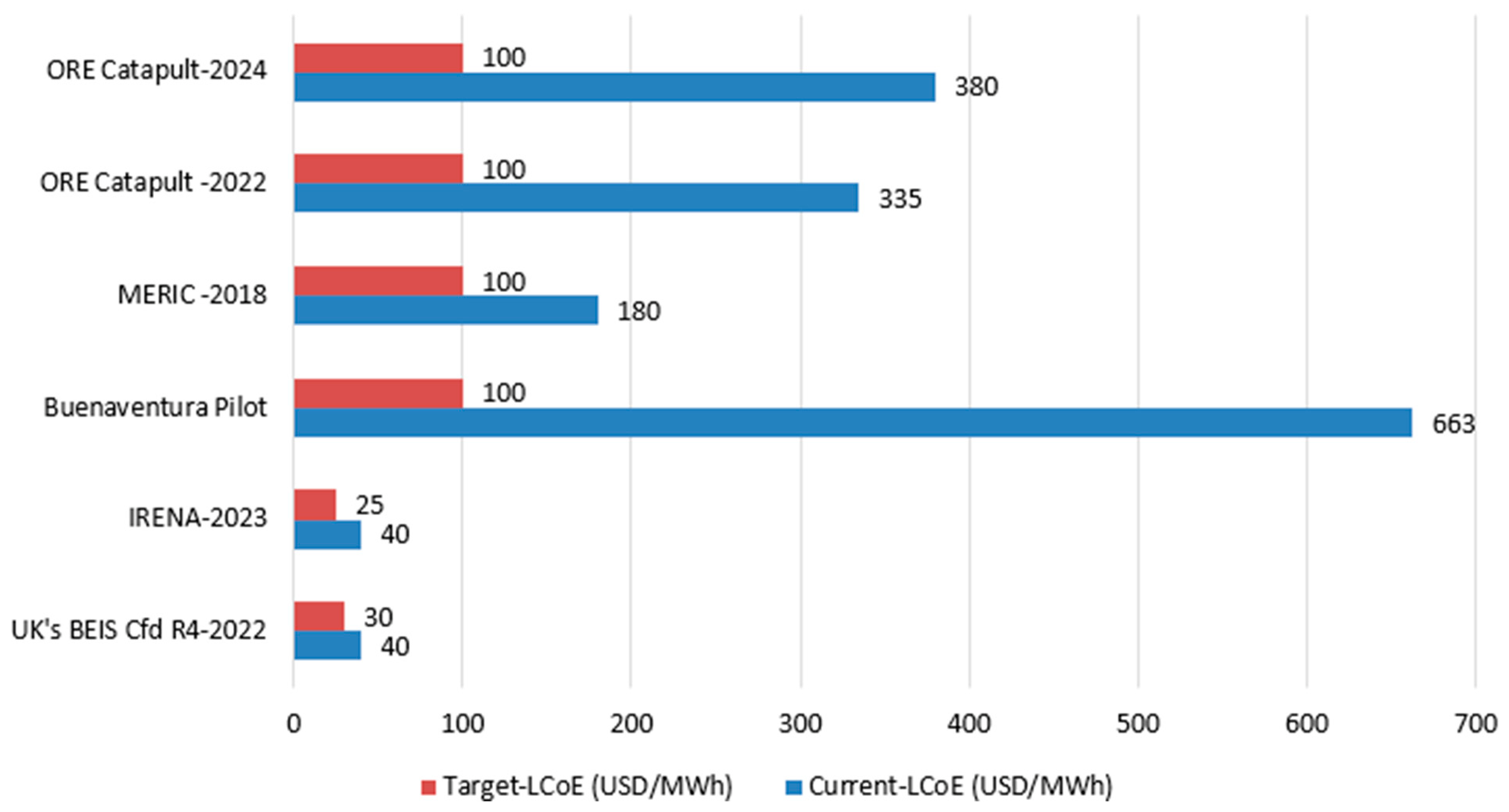
Table 27 indicates that the base case is not financially viable under conventional investment criteria. The elevated LCoE is explained by the combined effect of high CAPEX and constrained AEP, consistent with the low-energy hydrodynamic regime. Figure 10 compares the case-study LCoE with international references for tidal-stream and mature renewable technologies.
According to Figure 10, the estimated reference LCoE for the Buenaventura pilot configuration is approximately USD 663/MWh, considerably higher than that of other tidal power and mature renewable technologies. For comparison, MERIC-2018 [75] reports around USD 180/MWh, while ORE Catapult-2022 [56] indicates approximately USD 335/MWh, and ORE Catapult-2024 [76] costs USD 380/MWh. In contrast, offshore wind energy, within the framework of the UK’s BEIS Cfd R4-2022 [56], reports around USD 40/MWh, with targets close to USD 30/MWh, and solar photovoltaic energy IRENA-2023 [77] reports around USD 40/MWh, with targets close to USD 25/MWh.
The difference between Buenaventura and other tidal energy projects reflects the combined effect of lower resource intensity and a pilot-scale deployment (1.1 MW of installed capacity and approximately 5.4 GWh/year), while the gap with offshore wind and solar PV (USD 25–40/MWh) highlights the influence of economies of scale and technological maturity. Furthermore, the benchmark target of approximately USD 100/MWh for tidal energy projects implies that reductions of 80–85% relative to the Buenaventura baseline would be required to meet long-term competitiveness indicators, reinforcing the structural need to improve annual energy production (AEP) and capital expenditure (CAPEX) under low-energy estuarine conditions.

3.9. Sensitivity Analysis

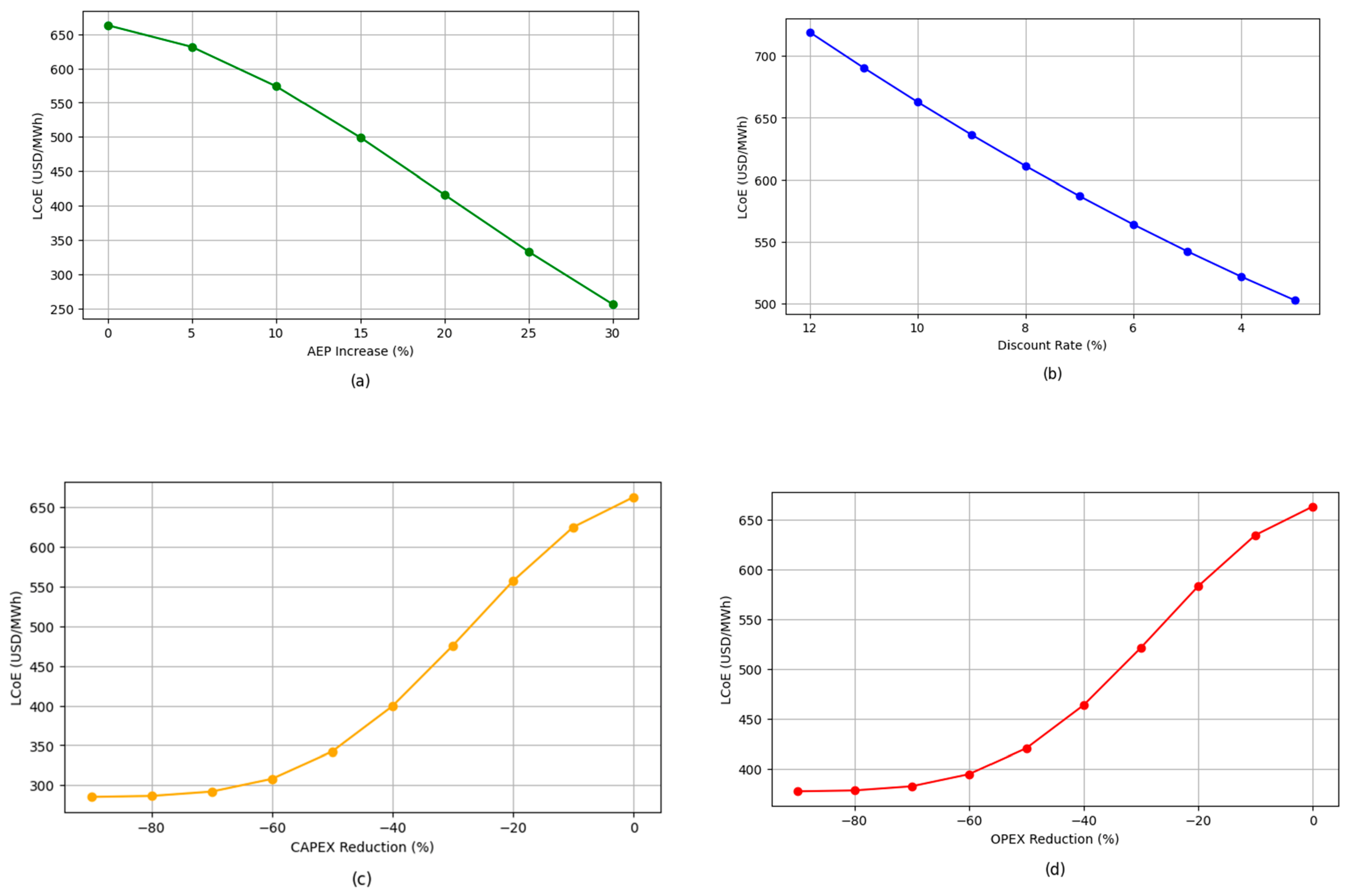
Figure 11 presents the univariable sensitivity responses of LCoE to AEP, discount rate, CAPEX, and OPEX.
Figure 11 shows that AEP has the strongest influence, followed by CAPEX, then the discount rate, and finally OPEX. AEP dominates because even small increases in operational hours above cut-in thresholds produce disproportionately large economic effects when baseline energy production is constrained. CAPEX reductions exhibit the second-strongest impact, consistent with the dominance of balance-of-systems reported in Table 27. In contrast, the discount rate primarily functions as an enabling condition rather than as an independent variable. Reductions in OPEX remain beneficial but play a secondary role within the range evaluated.
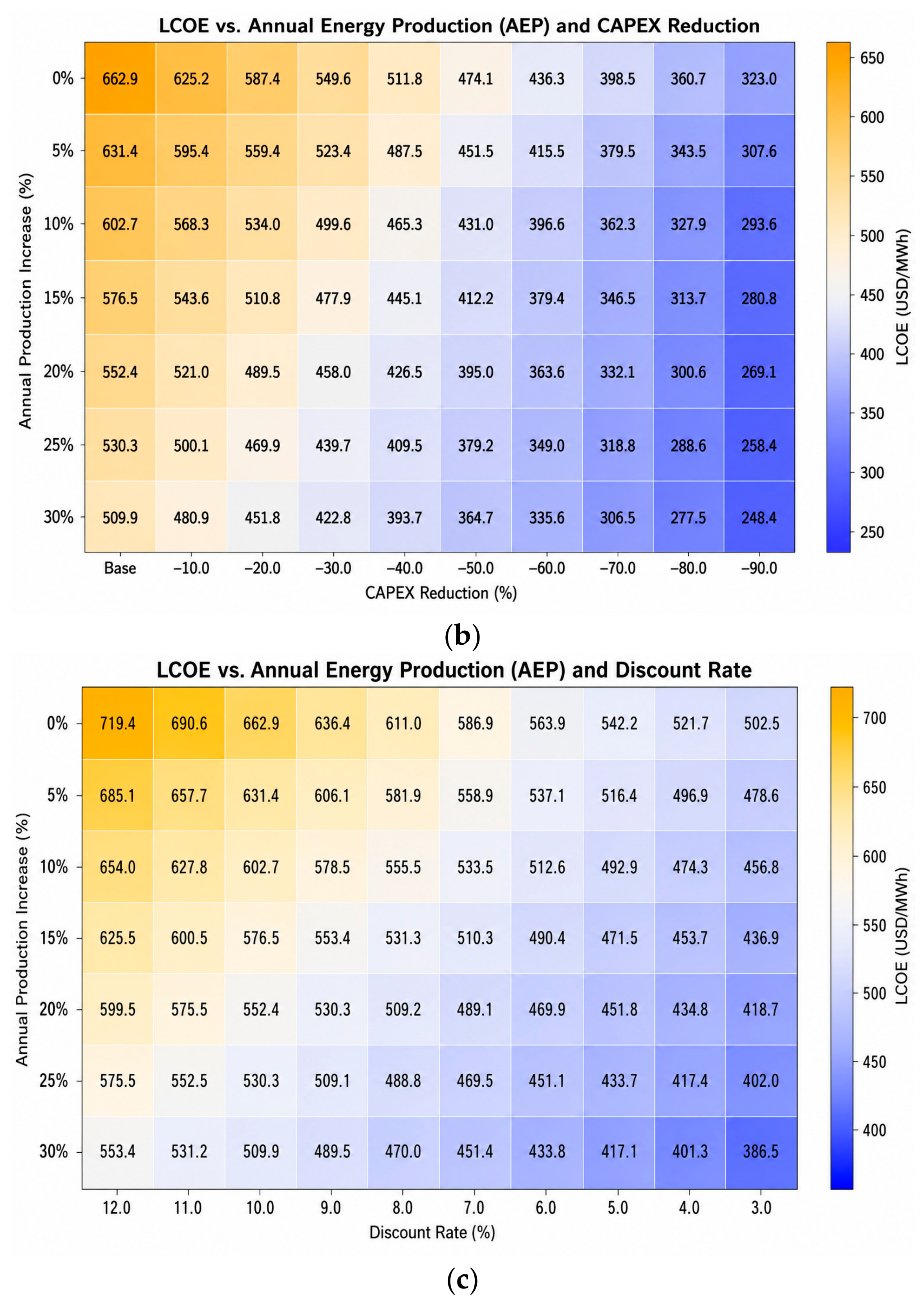
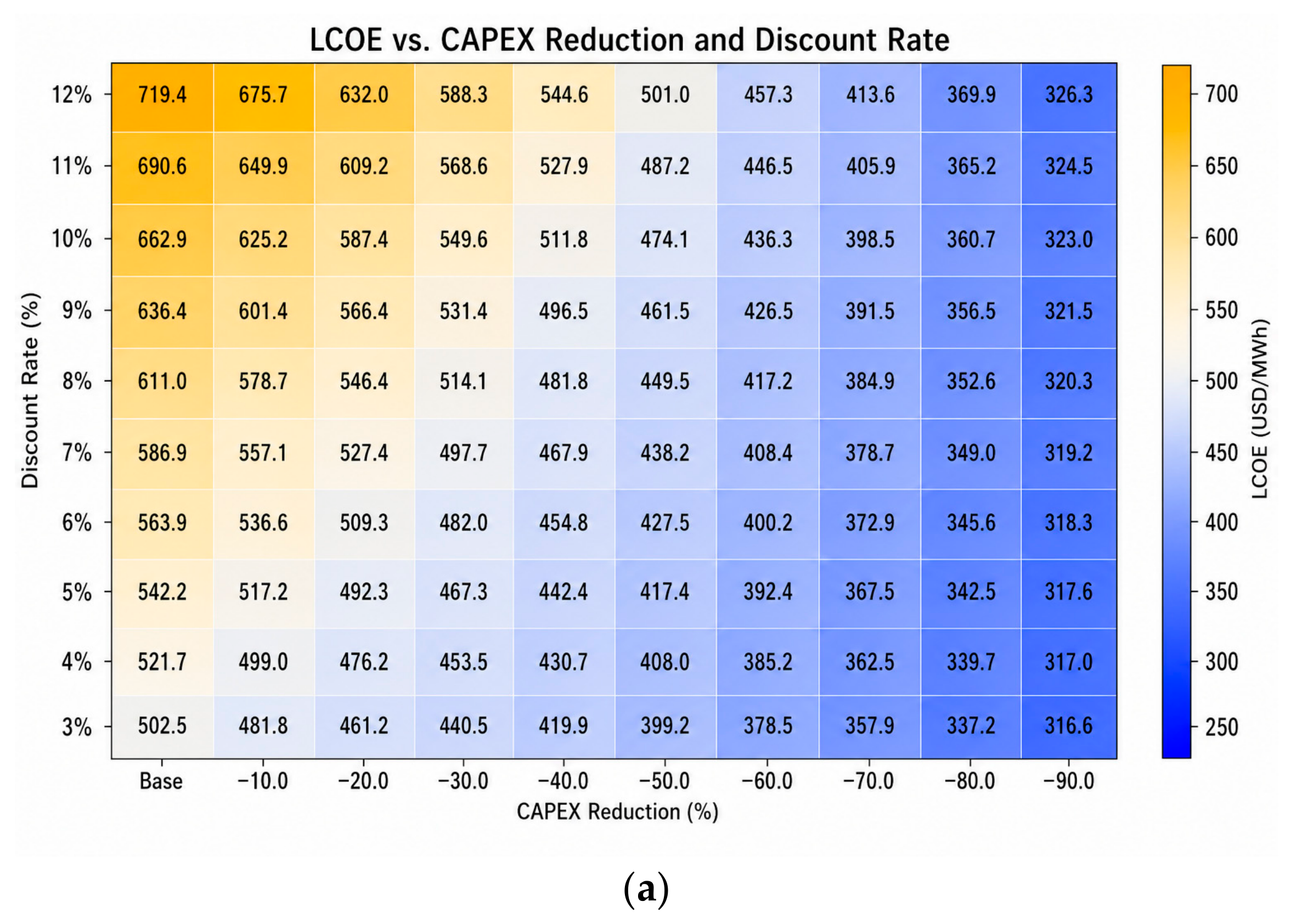
To better represent realistic improvement pathways, Figure 12 presents multivariable sensitivity surfaces showing (Figure 12a) LCoE as a function of CAPEX reduction and discount rate, (Figure 12b) LCoE as a function of CAPEX reduction and AEP increase, and (Figure 12c) LCoE as a function of AEP increase and discount rate.
Figure 12a shows that achieving LCoE values below approximately 400 USD/MWh requires substantial CAPEX reductions, combined with discount rates of approximately 5–8%, indicating that concessional financing is most effective when aligned with structural CAPEX learning effects. Figure 12b demonstrates that CAPEX reductions alone are insufficient when AEP remains low; however, moderate CAPEX reductions combined with AEP increases yield more pronounced LCoE improvements, underscoring AEP enhancement as a necessary condition for competitiveness. Figure 12c confirms a monotonic decrease in LCoE with increasing AEP and decreasing discount rate, identifying feasible clusters at AEP increases of approximately 25–30% and discount rates of 5% or lower.

4. Discussion

The results demonstrate that feasibility assessment in low-energy tropical estuaries requires an evaluation architecture that differs from approaches commonly applied in high-energy tidal channels. The state of the art in tidal-stream research has largely evolved around sites where velocities frequently exceed 1.0–1.5 m/s and mean available power densities range between 0.4 and 1 kW/m2, enabling operation near rated conditions and supporting pilot-to-commercial scaling pathways [9,10,78]. In contrast, the most energetic location evaluated here yields a mean available power density of about 64.58 W/m2, consistent with low-intensity characterizations previously reported for the Colombian Pacific [20]. This contrast is not only empirical but methodological: screening criteria derived from high-energy contexts may misclassify low-energy estuaries when based primarily on mean or peak velocity metrics.
Previous work on the Colombian Pacific coast reported mean tidal current velocities close to 0.49 m/s and estimated monthly energy production of approximately 17 MWh for Buenaventura Bay [20]. In the present study, La Bocana exhibited a mean available power density of approximately 64.58 W/m2 and an annual energy production of about 18 MWh per turbine under a low-cut-in configuration. These values are consistent with a marginal but technically discussable low-energy resource, especially when assessed through velocity-exceedance metrics rather than mean velocity alone.
Similar constraints have been reported in other low-velocity environments. In the Indian Sundarbans, in [49], tidal-energy potential under low-velocity tidal flows is assessed using a validated hydrodynamic model and turbine technology adapted to low-speed conditions. Their study considered turbine operation in velocity-constrained channels and reported annual energy production values that remained modest compared with high-energy tidal sites, confirming that low-energy estuarine systems require adapted turbine concepts and site-specific performance evaluation. Likewise, ref. [9] evaluated hydrokinetic resources in a combined estuarine and river region, where moderate current velocities and spatial hydrodynamic variability required detailed resource characterization. These comparisons indicate that the Buenaventura results are not anomalous; rather, they are representative of a class of low-energy estuarine environments in which feasibility depends on persistence above the cut-in speed, bathymetric feasibility, and technology adaptation.
The comparison with tropical tidal-energy studies further reinforces this interpretation. In [12] tidal-stream power in the Pakiputan Strait, Davao Gulf, Philippines is assessed, reporting current velocities substantially higher than those obtained in Buenaventura Bay and demonstrating the strong dependence of annual energy production on velocity variations. In that study, a 10% change in characteristic current velocity led to a marked change in estimated energy output, supporting the sensitivity observed here under low-energy conditions. Similarly, refs. [27] and [50] emphasize that tropical and lower-energy sites require turbine designs adapted to lower flow velocities, including low-cut-in operation and blade configurations suitable for reduced torque and near-threshold performance. Therefore, the Buenaventura case contributes to the literature by extending these low-speed design considerations into an integrated framework for hydrodynamic, technological, and economic assessment.
Within this framework, velocity-exceedance structure emerges as the defining descriptor of feasibility. The validated hydrodynamic model indicates that velocities above 0.3 m/s occur approximately 45–55 percent of the time, while exceedance above 0.5 m/s remains below 10 percent, constraining sustained operation at higher power levels. The probability-weighted APD confirms that the 0.4–0.6 m/s range provides the dominant energetic contribution due to recurrence rather than magnitude. This behavior reinforces findings in the recent literature showing that annual energy production is highly sensitive to near-cut-in persistence because of the cubic velocity–power relationship and operational threshold effects [12,13]. The methodological implication is that exceedance-based characterization is a necessary condition for robust assessment in velocity-constrained systems, consistent with international recommendations emphasizing persistence metrics and calibrated monitoring practices [53].
The coupling of resource envelopes with technology compatibility screening constitutes a second methodological advance. While several turbine concepts report high efficiencies at velocities above approximately 0.8 m/s, including low-solidity horizontal-axis and duct-augmented design mechanisms [50,79,80], their performance envelopes remain structurally misaligned with the quantified hydrodynamic regime. The compatibility matrix shows that conventional commercial horizontal-axis turbines are inconsistent with the prevailing velocity distribution. In contrast, low-speed-adapted and duct-assisted concepts provide comparatively coherent pathways for near-threshold operation. This confirms that technology selection in low-energy estuaries must be resource-driven and explicitly conditioned by operational thresholds and depth constraints.
From an energy-production perspective, the internally consistent workflow linking calibrated hydrodynamics, exceedance analysis, compatibility screening, and array design yields approximately 18 MWh per turbine annually and about 5420 MWh per year for a 300-turbine pilot array, corresponding to roughly 1.09 MW of installed capacity. Although modest relative to high-energy tidal arrays, these values are coherent with the identified operational window and align with international experience in demonstration-scale deployments, where validation and learning preceded cost competitiveness. In constrained environments, credible production estimates depend on internal methodological consistency rather than extrapolation from high-energy benchmarks.
Economically, the baseline Levelized Cost of Energy of about 663 USD per MWh reflects both limited resource intensity and pilot-scale cost structure. The dominance of balance-of-system costs, representing approximately 59 percent of total capital expenditure, is consistent with early-stage marine deployments, where installation, logistics, and monitoring burdens remain substantial. Sensitivity analysis identifies annual energy production as the primary feasibility driver, followed by capital expenditure, in agreement with recent techno-economic studies that highlight yield improvement and capital learning curves as principal cost-reduction levers [81,82]. The comparatively small influence of the discount rate and operational expenditure within the evaluated ranges indicates that structural hydrodynamic constraints and capital structure dominate feasibility in low-energy regimes. Multivariable scenarios suggest that moderate annual energy production gains of approximately 25 to 30 percent, combined with capital expenditure reductions and financing rates near 5 percent, can substantially shift cost trajectories.
From an engineering perspective, these findings indicate that future development in Buenaventura Bay should not prioritize direct replication of conventional high-energy tidal turbine concepts. Instead, efforts should focus on low cut-in devices optimized for the 0.4–0.6 m/s operational window, where the probability-weighted energetic contribution is concentrated. Specific engineering actions include rotor and blade-profile optimization for low-speed operation, evaluation of duct-augmented or low-solidity horizontal-axis turbines, improvement in array spacing to reduce wake losses, and adoption of floating or retrievable support systems to reduce installation and maintenance constraints under sediment-influenced estuarine conditions. In addition, long-term ADCP monitoring should be implemented before any pilot deployment to reduce uncertainty in velocity-exceedance statistics and improve AEP estimation.
From a policy and project-development perspective, the sensitivity results suggest that low-energy tidal projects require support mechanisms distinct from those used for mature renewable technologies. Since CAPEX and financing conditions strongly affect cost trajectories, demonstration-stage projects should be supported by concessional financing, public–private pilot programs, innovation grants, and local supply chain development for marine components, mooring systems, electrical infrastructure, and maintenance logistics. These measures would reduce capital costs, improve learning rates, and allow pilot projects to serve as validation platforms rather than immediate commercial assets.
Overall, the case study functions as a validation platform for a transferable methodological framework. In tropical estuaries with mean velocities below 0.5 m/s, feasibility assessment should prioritize the exceedance structure, adaptation of low-speed technology, and an integrated techno-economic evaluation within a unified workflow. By explicitly linking hydrodynamic persistence, operational thresholds, array design, and cost sensitivity, the framework extends best-practice marine energy assessment to velocity-constrained and data-scarce environments, providing reproducible guidance for screening and staged development in low-energy tropical estuaries worldwide.
Future research should include a detailed comparison of tidal turbine models and deployment strategies for La Bocana. This includes the evaluation of low cut-in horizontal-axis turbines, duct-augmented turbines, floating or retrievable support systems, mooring and anchoring alternatives, installation procedures, and maintenance strategies under high-turbidity and sediment-transport conditions. In addition, a dedicated ADCP deployment at La Bocana should be conducted to provide direct site-specific validation of modeled current velocities, velocity-exceedance structure, and directional stability. Longer monitoring campaigns, three-dimensional hydrodynamic simulations, sediment-transport and local-scour modeling, and prototype-scale validation should also be considered to reduce uncertainty in APD and AEP estimates and to strengthen the basis for detailed array design, turbine selection, and investment-grade feasibility assessment.

5. Conclusions

This study establishes a structured, internally consistent methodological framework for assessing tidal energy in low-energy tropical estuaries, addressing a limitation of conventional feasibility approaches that are primarily derived from high-energy marine environments. The validation conducted in Buenaventura Bay, Colombia, demonstrates that rigorous assessment is achievable when mean current velocities remain below 0.5 m/s, provided that velocity-exceedance structure, turbine operational thresholds, and techno-economic constraints are evaluated in an integrated manner.
Hydrodynamic validation, with a sea-level RMSE of about 0.30 m and a velocity RMSE of about 0.022 m/s, together with goodness-of-fit indicators exceeding 0.90, confirms that model accuracy is sufficient for energy estimation in velocity-sensitive regimes. The results show that feasibility in low-energy estuaries is governed predominantly by the persistence of velocities above cut-in thresholds rather than by peak or mean values. Although maximum velocities surpass 0.8 m/s, operationally relevant persistence is concentrated between 0.4 and 0.6 m/s, yielding mean available power densities of about 64.6 W/m2 and 19.1 W/m2 at representative sites.
The analysis reveals a structural resource–technology mismatch in conventional commercial turbines optimized for velocities above approximately 0.8 m/s, whereas low-speed-adapted concepts offer comparatively coherent deployment pathways. Under the evaluated configuration, defined by a 10 m rotor diameter and a cut-in speed of 0.4 m/s, annual production per turbine is about 18 MWh, and for a 300-unit pilot array, it is approximately 5420 MWh per year, corresponding to roughly 1.09 MW of installed capacity.
Economically, baseline conditions remain non-viable, with a Levelized Cost of Energy of about 663 USD per MWh and a Net Present Value of approximately minus 28.4 million USD. Annual energy production and capital expenditure emerge as the dominant drivers of feasibility. Sensitivity results indicate that moderate annual energy production improvements of 25 to 30 percent, combined with capital expenditure reductions and lower financing costs, can substantially alter cost indicators, defining quantified improvement pathways rather than categorical exclusion.
The sensitivity analysis also provides actionable recommendations for future development. Engineering efforts should prioritize AEP improvement through low-speed turbine adaptation, rotor and duct optimization, refined array layout, and long-term monitoring of velocity exceedance under seasonal conditions. CAPEX reduction should be achieved through modular pilot designs, retrievable support structures, simplified installation procedures, and progressive localization of the marine energy supply chain. From a policy perspective, the results support the need for concessional financing, targeted research and development incentives, public–private demonstration programs, and regulatory frameworks that recognize tidal energy as an emerging technology requiring staged validation before commercial deployment.
The proposed framework contributes a transferable assessment structure for low-energy estuarine systems worldwide. By prioritizing velocity-exceedance behavior, technology adaptation, and integrated cost drivers, it provides a methodological basis for early-stage screening, comparative evaluation, and staged development of tidal energy in resource-constrained coastal environments.

Author Contributions

Conceptualization, M.B.M.; Methodology, W.L.R., V.S.S. and M.B.M.; Software, W.L.R.; Formal analysis, W.L.R., M.B.M. and E.C.Q.; Investigation, W.L.R., V.S.S. and E.C.Q.; Resources, E.C.Q.; Data curation, W.L.R.; Writing—original draft, V.S.S.; Supervision, V.S.S. and M.B.M.; Project administration, V.S.S. All authors have read and agreed to the published version of the manuscript.

Funding

This research received no external funding.

Data Availability Statement

The original contributions presented in this study are included in the article. Further inquiries can be directed to the corresponding author.

Acknowledgments

The authors thank the Master’s Program in Energy Efficiency and Renewable Energies and the “Center for Research in Energy Engineering (CIIE)” of the University of the Coast for the academic support of the research project INV.1102-05-001-19, entitled “Technical and economic feasibility study of the potential generation of tidal energy in the bay of Buenaventura”.

Conflicts of Interest

The authors declare no conflicts of interest.

Abbreviations

The following abbreviations are used in this manuscript:
ATurbine rotor swept (capture) area (m2)
AEPAnnual energy production of a turbine or array (Wh, MWh)
AEPFAnnual energy production of the tidal farm (Wh, MWh)
AiAmplitude of the i-th tidal constituent (m)
ωiAngular frequency of tidal constituent i (rad/s)
ϕiPhase of tidal constituent i (rad)
NcNumber of tidal constituents (p.u.)
AvailabilityFraction of time the system is operational (p.u.)
CfBottom friction coefficient (p.u.)
CpTurbine power coefficient (p.u.)
CmaintRoutine and corrective maintenance cost (USD/year)
CoperOperational, inspection, and retrieval cost (USD/year)
CenvEnvironmental monitoring and regulatory compliance cost (USD/year)
CturbTurbine or device acquisition cost (USD)
CstructSupport-structure cost (USD)
CmoorMooring, foundation, and substructure cost (USD)
CelecElectrical infrastructure and interconnection cost (USD)
CinstInstallation and commissioning cost (USD)
CAPEXCapital expenditure (USD)
DTurbine rotor diameter (m)
ΔtTemporal resolution of model output (s)
ΔVVelocity perturbation applied to V for sensitivity analysis (m/s)
ETTechnical energy produced over horizon T (J, Wh)
TTime horizon for energy integration (s)
gGravitational acceleration (m/s2)
hStill-water (bathymetric) depth (m)
h(x,y)Local water depth (m)
hminMinimum depth required for installation and operation (m)
HTotal water depth, defined as H = h + η (m)
ηFree surface elevation (m)
ρSeawater density (kg/m3)
kxStreamwise turbine spacing coefficient (p.u.)
kyLateral turbine spacing coefficient (p.u.)
Lx, LyStreamwise and lateral turbine spacing distances (m)
LCoELevelized Cost of Energy (USD/MWh)
ΔLCoEVariation in LCoE relative to baseline (USD/MWh)
NPVNet Present Value (USD)
NtTotal number of time steps (p.u.)
tTime (s)
tkDiscrete hydrodynamic time step k (s)
OPEXannAnnual operational expenditure (USD/year)
Pd(t)Instantaneous theoretical power density (W/m2)
P ¯ d Mean theoretical power density (W/m2)
PT(t)Instantaneous turbine power output (W)
PT(tk; V+ΔV)Turbine power at time step tk with perturbed velocity (W)
P(T,j)(t)Instantaneous power output of turbine j at time t (W)
PF(t)Instantaneous farm power output (W)
rDiscount rate (p.u.)
nProject lifetime (years)
IRRInternal Rate of Return (p.u.)
RtAnnual revenue in year t (USD)
PsellElectricity selling price or avoided cost (USD/MWh)
U, VDepth-averaged velocity components (m/s)
V(t)Depth-averaged current velocity magnitude (m/s)
V ¯ Mean depth-averaged current velocity (m/s)
VbRepresentative velocity of bin b (m/s)
nbNumber of samples in velocity bin b (p.u.)
f(Vb)Relative frequency of velocity bin b (p.u.)
PbExpected power associated with velocity bin b (W)
Vcut-inTurbine cut-in velocity (m/s)
VratedTurbine rated velocity (m/s)
XParameter under evaluation in sensitivity analysis
ΔXVariation in parameter X relative to baseline
Elasticity(ΔLCoE/LCoE)/(ΔX/X) (p.u.)
αjWake-interaction coefficient applied to turbine j (p.u.)
NTNumber of turbines (p.u.)

References

  1. International Energy Agency (IEA). Latin America Energy Outlook 2023; International Energy Agency (IEA): Paris, France, 2023; Available online: https://www.iea.org/reports/latin-america-energy-outlook-2023 (accessed on 18 November 2024).
  2. IEA Net Zero Roadmap: A Global Pathway to Keep the 1.5 °C Goal in Reach. 2023. Available online: https://www.ecohz.com/net-zero-roadmap (accessed on 18 December 2025).
  3. International Renewable Energy Agency. Renewable Energy Statistics 2024; International Renewable Energy Agency: Abu Dhabi, United Arab Emirates, 2024. [Google Scholar]
  4. International Renewable Energy Agency. Renewable Power Generation Costs in 2023; International Renewable Energy Agency: Abu Dhabi, United Arab Emirates, 2024; ISBN 978-92-9260-621-3. [Google Scholar]
  5. Huang, M.; He, W.; Incecik, A.; Cichon, A.; Królczyk, G.; Li, Z. Renewable Energy Storage and Sustainable Design of Hybrid Energy Powered Ships: A Case Study. J. Energy Storage 2021, 43, 103266. [Google Scholar] [CrossRef]
  6. Nurjah Bazilah, H.J.; Roslynna, R. Design Selection of a Tidal Turbine for Low Velocity Application. In Sustainable Processes and Clean Energy Transition; Materials Research Forum LLC: Millersville, PA, USA, 2023; Volume 29, pp. 479–486. [Google Scholar]
  7. Rourke, F.O.; Boyle, F.; Reynolds, A. Tidal Energy Update 2009. Appl. Energy 2010, 87, 398–409. [Google Scholar] [CrossRef]
  8. Kangaji, L.M.; Raji, A.; Orumwense, E. Optimizing Sustainability Offshore Hybrid Tidal-Wind Energy Storage Systems for an Off-Grid Coastal City in South Africa. Sustainability 2024, 16, 9139. [Google Scholar] [CrossRef]
  9. Giannini, G.; Ramos, V.; Rosa-Santos, P.; Calheiros-Cabral, T.; Taveira-Pinto, F. Hydrokinetic Power Resource Assessment in a Combined Estuarine and River Region. Sustainability 2022, 14, 2606. [Google Scholar] [CrossRef]
  10. Cosme, D.L.S.; Veras, R.B.; Camacho, R.G.R.; Saavedra, O.R.; Torres, A.; Andrade, M.M. Modeling and Assessing the Potential of the Boqueirão Channel for Tidal Exploration. Renew. Energy 2023, 219, 119468. [Google Scholar] [CrossRef]
  11. Suarez, L.; Guerra, M.; Williams, M.E.; Escauriaza, C. Tidal Energy Resource Assessment in the Strait of Magellan in the Chilean Patagonia. Renew. Energy 2025, 252, 123430. [Google Scholar] [CrossRef]
  12. Palconit, E.V.; Villanueva, J.R.; Enano, N.; Buhali, M.; Mascariñas, A.C.; Galope, G.E.; Tabanguil, J.M. Resource Assessment of Tidal Stream Power in Pakiputan Strait, Davao Gulf, Philippines. Eng. Technol. Appl. Sci. Res. 2021, 11, 7233–7239. [Google Scholar] [CrossRef]
  13. Evans, L.; Ashton, I.; Sellar, B.G. Impact on Energy Yield of Varying Turbine Designs under Conditions of Misalignment to the Current Flow. Energies 2023, 16, 3923. [Google Scholar] [CrossRef]
  14. European Marine Energy Centre (EMEC). EMEC: European Marine Energy Centre. Available online: https://www.emec.org.uk/ (accessed on 1 October 2024).
  15. International Electrotechnical Commission. IEC TS 62600-201:2025 Energy-Wave, Tidal and Other Water Current Converters—Part 201: Tidal Energy Resource Assessment and Characterization; International Electrotechnical Commission: Geneva, Switzerland, 2025. [Google Scholar]
  16. Ministerio de Ambiente y Desarrollo Sostenible Todo Lo Que Debe Saber de La COP27. Available online: https://www.minambiente.gov.co/cop27/ (accessed on 10 October 2023).
  17. Unidad de Planeación Minero-Energética. Proyección de La Demanda de Energía Eléctrica y Potencia Máxima 2024–2038; Unidad de Planeación Minero-Energética: Bogotá, Colombia, 2025. [Google Scholar]
  18. Gobierno de Colombia. Misión de Sabios Colombia-2019; Gobierno de Colombia: Bogotá, Colombia, 2019. Available online: https://www.minciencias.gov.co/sites/default/files/libro_mision_de_sabios_digital_1_2_0.pdf (accessed on 4 February 2024).
  19. Cardona, D.; Tamayo, J.A.; Eslava-Garzón, J.S. Hacia Una Matriz Energética Sostenible En Colombia. Una Revisión Sistemática de La Literatura. Inf. Tecnol. 2024, 35, 1–16. [Google Scholar] [CrossRef]
  20. Quintero Aguilar, G.E.; Rueda Bayona, J.G. Tidal Energy Potential in the Center Zone of the Colombian Pacific Coast. Inge CuC 2021, 17, 65–75. [Google Scholar] [CrossRef]
  21. Instituto de Hidrología, Meteorología y Estudios Ambientales; Dirección General Marítima. Cartilla Mareográfica de Colombia, Región Pacífica 2023; Ed. Ideam—Dimar: Bogotá D.C., Colombia, 2023. [Google Scholar]
  22. Departamento Administrativo Nacional de Estadística (DANE); Dirección de Censos y Demografía. Proyecciones de Población. Actualización 2025; Departamento Administrativo Nacional de Estadística (DANE): Bogotá D.C., Colombia, 2025. Available online: https://www.dane.gov.co/index.php/estadisticas-por-tema/demografia-y-poblacion/proyecciones-de-poblacion (accessed on 28 January 2025).
  23. Departamento Administrativo Nacional de Estadística. La Información del DANE en la toma de Decisiones de los Municipios del país; Departamento Administrativo Nacional de Estadística: Bogotá D.C., Colombia, 2020. [Google Scholar]
  24. Dirección General Marítima. Compilación Oceanográfica de la Cuenca Pacifica Colombiana II; Editorial Dimar, ed.; Dirección General Marítima: Bogotá, Colombia, 2020; Volume 9, ISBN 978-958-5412-66-8. [Google Scholar]
  25. Giraldo Idárraga, C.P. Estudio de las Corrientes Residuales en la bahía de Buenaventura Colombia; Universidad del Valle: Santiago de Cali, Colombia, 2017. [Google Scholar]
  26. Barbosa, J.P.; Giraldo, C.P.; Leiton, P.; Ramírez, C.; García, J.; Cruz, C. Modelación de la dinámica de los sólidos suspendidos totales (SST) en la bahía interna de Buenaventura. In Proceedings of the En XXIII Seminario Nacional de Hidráulica e Hidrología; Sociedad Colombiana de Ingenieros: Bogotá, Colombia, 2018. [Google Scholar]
  27. Rotor, M.A.; Hefazi, H.; Enano, N. Review on Tidal Stream Energy and Blade Designs for Tropical Site Conditions and a Look at Philippines’ Future Prospects. Ocean Syst. Eng. 2023, 13, 247–268. [Google Scholar] [CrossRef]
  28. Kaddoura, M.; Tivander, J.; Molander, S. Life Cycle Assessment of Electricity Generation from an Array of Subsea Tidal Kite Prototypes. Energies 2020, 13, 456. [Google Scholar] [CrossRef]
  29. Rueda-Bayona, J.G.; García Vélez, J.L.; Parrado-Vallejo, D.M. Effect of Sea Level Rise and Access Channel Deepening on Future Tidal Power Plants in Buenaventura Colombia. Infrastructures 2023, 8, 51. [Google Scholar] [CrossRef]
  30. Khojasteh, D.; Glamore, W.; Heimhuber, V.; Hottinger, S.; Felder, S. Implications of Tidal Resonance and Water Depth on Predicting Sea Level Rise in Estuaries. In Proceedings of the Australasian Coasts and Ports 2019 Conference, Hobart, TAS, Australia, 10–13 September 2019; Engineers Australia: Barton, ACT, Australia, 2019; pp. 707–713. Available online: https://search.informit.org/doi/abs/10.3316/INFORMIT.799788729666644 (accessed on 18 December 2025).
  31. Lewis, M.; Khojasteh, D.; Iglesias, G.; Evans, P.; Neill, S. Mapping the Unresolved Tidal Resource in Estuaries. In Proceedings of the Proceedings of the European Wave and Tidal Energy Conference (EWTEC 2023), Bilbao, Spain, 3–7 September 2023; European Wave and Tidal Energy Conference (EWTEC): Bilbao, Spain, 2023; Available online: https://submissions.evolvingcities.org/proc-ewtec/article/view/178 (accessed on 18 December 2025).
  32. Evans, P.; Mason-Jones, A.; Wilson, C.; Wooldridge, C.; O’Doherty, T.; O’Doherty, D. Constraints on Extractable Power from Energetic Tidal Straits. Renew. Energy 2015, 81, 707–722. [Google Scholar] [CrossRef]
  33. Loughney, S.; Wang, J.; Bashir, M.; Armin, M.; Yang, Y. Application of a Multiple-Attribute Decision-Analysis Methodology for Site Selection of Floating Offshore Wind Farms off the West Coast of Ireland. In Developments in Renewable Energies Offshore; Soares, C.G., Ed.; Taylor & Francis Group: Boca Raton, FL, USA, 2021; pp. 389–398. Available online: https://www.taylorfrancis.com/chapters/edit/10.1201/9781003134572-45/application-multiple-attribute-decision-analysis-methodology-site-selection-floating-offshore-wind-farms-west-coast-ireland-loughney-wang-bashir-armin-yang (accessed on 18 December 2025).
  34. Shao, M.; Zhao, Y.; Sun, J.; Han, Z.; Shao, Z. A Decision Framework for Tidal Current Power Plant Site Selection Based on GIS-MCDM: A Case Study in China. Energy 2023, 262, 125476. [Google Scholar] [CrossRef]
  35. Dirección General Marítima-DIMAR Pronóstico de Mareas (Tide Forecast). Available online: https://cccp.dimar.mil.co/Mareas (accessed on 2 February 2026).
  36. Pan, H.; Xu, T.; Wei, Z. A Modified Tidal Harmonic Analysis Model for Short-Term Water Level Observations. Ocean Model. 2023, 186, 102251. [Google Scholar] [CrossRef]
  37. Li, Y.; Xie, S.; Wang, B.; He, S.; Huang, D.; He, H.; Qi, H. Unmixing: A New Direction from Classical Tidal Harmonic Analysis? In Proceedings of the Oceans 2015 Mts IEEE Washington, Washington, DC, USA, 19–22 October 2015; IEEE: Piscataway, NJ, USA, 2016; Available online: https://ieeexplore.ieee.org/document/7404611 (accessed on 18 December 2025).
  38. Fleit, G.; Muste, M.; Baranya, S.; Kim, D.; Whaling, A.; McAlpin, T.O.; You, H. The Acoustic-Doppler Current Profiler (ADCP): A Comprehensive Tool for River Hydromorphodynamics Monitoring. Adv. Water Resour. 2025, 206, 105180. [Google Scholar] [CrossRef]
  39. Han, G.; Li, W.; He, Z.; Liu, K.; Ma, J. Assimilated Tidal Results of Tide Gauge and TOPEX/POSEIDON Data over the China Seas Using a Variational Adjoint Approach with a Nonlinear Numerical Model. Adv. Atmos. Sci. 2006, 23, 449–460. [Google Scholar] [CrossRef]
  40. D-FLow Flexible Mesh_User Manual; Deltares: Delft, The Netherlands, 2002.
  41. Haces-Garcia, F.; Ross, N.; Glennie, C.L.; Rifai, H.S.; Hoskere, V.; Ekhtari, N. Rapid 2D Hydrodynamic Flood Modeling Using Deep Learning Surrogates. J. Hydrol. 2025, 651, 132561. [Google Scholar] [CrossRef]
  42. Loukam, I.; Achour, B. Chezy’s Resistance Coefficient in Vaulted Rectangular Conduit. Water Pract. Technol. 2024, 19, 2571–2583. [Google Scholar] [CrossRef]
  43. Skaperdas, V.; Ashton, N. Development of High-Quality Hybrid Unstructured Meshes for the GMGW-1 Workshop Using ANSA. In Proceedings of the AIAA Aerospace Sciences Meeting, Kissimmee, FL, USA, 8–12 January 2018. [Google Scholar]
  44. Kim, T.T.; Hong, N.T.T.; Long, N.K.T.; Phung, N.K.; Bay, N.T. Mapping Tidal Harmonic Constant Map from Vung Tau–Bac Lieu, Viet Nam by Using a Numerical Model in Curvilinear Coordinate. In Proceedings of the Second International Conference on Sustainable Civil Engineering and Architecture (ICSCEA 2021), Ho Chi Minh City, Vietnam, 30 October 2021; Springer Nature: Singapore, 2023; Volume 268, ISBN 9789811933028. Available online: https://link.springer.com/chapter/10.1007/978-981-19-3303-5_63 (accessed on 18 December 2025).
  45. Tejada-Martínez, A.E.; Grosch, C.E.; Gargett, A.E.; Polton, J.A.; Smith, J.A.; MacKinnon, J.A. A Hybrid Spectral/Finite-Difference Large-Eddy Simulator of Turbulent Processes in the Upper Ocean. Ocean Model. 2009, 30, 115–142. [Google Scholar] [CrossRef]
  46. Melsen, L.A.; Puy, A.; Torfs, P.J.J.F.; Saltelli, A. The Rise of the Nash-Sutcliffe Efficiency in Hydrology. Hydrol. Sci. J. 2025, 70, 1248–1259. [Google Scholar] [CrossRef]
  47. Hainan, X.; Xiangnan, W.; Yi, G.; Ning, J.; Qiang, C. Research on the Output Power Prediction Method of Tidal Energy Converters Based on Uncertainty Analysis. Yi Qi Yi Biao Xue Bao Chin. J. Sci. Instrum. 2025, 46, 108–116. [Google Scholar] [CrossRef]
  48. Zhang, J.-S.; Wang, J.; Tao, A.-F.; Zheng, J.-H.; Li, H. New Concept for Assessment of Tidal Current Energy in Jiangsu Coast, China. Adv. Mech. Eng. 2013, 2013, 340501. [Google Scholar] [CrossRef]
  49. Bhui, K.; Hazra, S.; Bhadra, T. Assessment of Tidal Energy Potential from Low-Velocity Tidal Flows in the Indian Sundarbans Utilizing Validated Hydrodynamic Model and Tidal Turbine Technology. Renew. Energy 2025, 242, 122410. [Google Scholar] [CrossRef]
  50. Encarnacion, J.I.; Johnstone, C.; Ordonez-Sanchez, S. Design of a Horizontal Axis Tidal Turbine for Less Energetic Current Velocity Profiles. J. Mar. Sci. Eng. 2019, 7, 197. [Google Scholar] [CrossRef]
  51. Hutchison, Z.L.; Lieber, L.; Miller, R.G.; Williamson, B.J. Environmental Impacts of Tidal and Wave Energy Converters. In Comprehensive Renewable Energy, 2nd ed.; Letcher, T.M., Ed.; Elsevier: Oxford, UK, 2022; Volume 8, pp. 1–8. ISBN 9780128197271. Available online: https://pure.uhi.ac.uk/fr/publications/environmental-impacts-of-tidal-and-wave-energy-converters/ (accessed on 18 December 2025).
  52. Mallela, M.; Nilanjan Saha, M.; Alluri, S.K.R.; Ramana Murthy, M.V. Offshore Wind Turbine Support Structures along Indian Coast Multi Criteria Analysis. In Proceedings of the ASME 2022 41st International Conference on Ocean, Offshore and Arctic Engineering (OMAE 2022), Hamburg, Germany, 5–10 June 2022; American Society of Mechanical Engineers (ASME): New York, NY, USA, 2022; Volume 8, Available online: https://asmedigitalcollection.asme.org/OMAE/proceedings-abstract/OMAE2022/85932/1148077 (accessed on 18 December 2025).
  53. Xu, T.; Haas, K.A.; Gunawan, B. Estimating Annual Energy Production from Short Tidal Current Records. Renew. Energy 2023, 207, 105–115. [Google Scholar] [CrossRef]
  54. Nachtane, M.; Tarfaoui, M.; Saifaoui, D.; El Moumen, A.; Hassoon, O.H.; Benyahia, H. Evaluation of Durability of Composite Materials Applied to Renewable Marine Energy: Case of Ducted Tidal Turbine. Energy Rep. 2018, 4, 31–40. [Google Scholar] [CrossRef]
  55. O’Connell, R.; Kamidelivand, M.; Polydoros, I.; Wright, C.; Bonar, P.; Williams, A.J.; Murphy, J. The Integration of Tools for the Techno-Economic Evaluation of Fixed and Floating Tidal Energy Deployment in the Irish Sea. Energies 2023, 16, 7526. [Google Scholar] [CrossRef]
  56. Frost, C. Cost Reduction Pathway of Tidal Stream Energy in the UK and France: TIGER 2019–2023; Offshore Renewable Energy Catapult (ORE Catapult): Glasgow, UK, 2022; Available online: https://cms.ore.catapult.org.uk/wp-content/uploads/2022/10/Tidal-stream-cost-reduction-report-T3.4.1-v1.0-for-ICOE.pdf (accessed on 18 December 2025).
  57. Lewis, M.; Murray, R.O.H.; Fredriksson, S.; Maskell, J.; De Fockert, A.; Neill, S.; Robins, P. A Resource-Led Globally Optimized Tidal Turbine Power Curve. In Proceedings of the European Wave and Tidal Energy Conference, Plymouth, UK, 5–9 September 2021. [Google Scholar]
  58. National Renewable Energy Laboratory. System Advisor Model (SAM); National Renewable Energy Laboratory: Golden, CO, USA, 2025. [Google Scholar]
  59. Laín, S.; Viveros, M.; Benavides-Morán, A.; Ouro, P. Numerical Study of the Flow Around Twin Straight-Bladed Darrieus Hydrokinetic Turbines. J. Mar. Sci. Eng. 2025, 13, 1947. [Google Scholar] [CrossRef]
  60. Haider, B.A.; Sohn, C.H. Effect of Spacing on a Pair of Naturally Oscillating Circular Cylinders in Tandem Arrangements Employing IB-LB Methods: Crossflow-Induced Vibrations. Int. J. Mech. Sci. 2018, 142–143, 74–85. [Google Scholar] [CrossRef]
  61. Doerry, N.; Amy, J.V. Design Considerations for a Reference MVDC Power System. Trans.-Soc. Nav. Archit. Mar. Eng. 2016, 124, 1–20. [Google Scholar]
  62. Kalogirou, E.N. Waste-to-Energy Investment Evaluation (WTE Tool). In Waste-to-Energy Technologies and Global Applications; CRC Press: Boca Raton, FL, USA, 2017; ISBN 9781138035201. Available online: https://www.taylorfrancis.com/chapters/edit/10.1201/9781003567547-9/waste-energy-investment-evaluation-wte-tool-efstratios-kalogirou (accessed on 18 December 2025).
  63. O’Connor, M.; Lewis, T.; Dalton, G. Operational Expenditure Costs for Wave Energy Projects and Impacts on Financial Returns. Renew. Energy 2013, 50, 1119–1131. [Google Scholar] [CrossRef]
  64. XM Sinergox. Available online: https://sinergox.xm.com.co/Paginas/Home.aspx (accessed on 21 January 2024).
  65. Vazquez, A.; Iglesias, G. Grid Parity in Tidal Stream Energy Projects: An Assessment of Financial, Technological and Economic LCOE Input Parameters. Technol. Forecast. Soc. Change 2016, 104, 89–101. [Google Scholar] [CrossRef]
  66. Shah, S.; Buckland, H.; Thies, P.R.; Cohen, C.; Bruce, T. De-Risking Marine Energy Project Development through Improved Financial Uncertainty Analysis. In Proceedings of the International Conference on Offshore Mechanics and Arctic Engineering (OMAE 2017), Trondheim, Norway, 25–30 June 2017; American Society of Mechanical Engineers (ASME): New York, NY, USA, 2017; Volume 10. [Google Scholar] [CrossRef]
  67. Higgins, C.E.; Baker, N.; Bathurst, G. Advantages of Numerical Modelling for Development of Marine Renewables. In Proceedings of the Marine Renewable Energy Conference, London, UK, 19–20 November 2008; The Royal Institution of Naval Architects (RINA): London, UK, 2008; ISBN 9781905040490. [Google Scholar]
  68. Bucher, R.; Couch, S.J. Adjusting the Financial Risk of Tidal Current Projects by Optimising the ’Installed Capacity/Capacity Factor’-Ratio Already during the Feasibility Stage. Int. J. Mar. Energy 2013, 2, 28–42. [Google Scholar] [CrossRef]
  69. Jordan, C.; Coles, D.S.; Johnson, F.; Angeloudis, A. On Tidal Array Layout Sensitivity to Regional Hydrodynamics Representation. Int. Mar. Energy J. 2025, 8, 227–236. [Google Scholar] [CrossRef]
  70. Yeter, B.; Garbatov, Y.; Guedes Soares, C. Risk-Based Life-Cycle Assessment of Offshore Wind Turbine Support Structures Accounting for Economic Constraints. Struct. Saf. 2019, 81, 101867. [Google Scholar] [CrossRef]
  71. Coiro, D.; Maisto, U.; Scherillo, F. Horizontal Axis Tidal Current Turbine: Numerical and Experimental Investigations. In Proceedings of the Offshore Wind and Other Marine Renewable Energies in Mediterranean and European Seas, European Seminar, Civitavecchia, Italy, 20–22 April 2006. [Google Scholar]
  72. Mackie, L.; Evans, P.S.; Harrold, M.J.; O’Doherty, T.; Piggott, M.D.; Angeloudis, A. Modelling an Energetic Tidal Strait: Investigating Implications of Common Numerical Configuration Choices. Appl. Ocean Res. 2021, 108, 102494. [Google Scholar] [CrossRef]
  73. Bermúdez-Romero, A.; Magar, V.; López-Mariscal, M.; De Basabe, J.D. Evaluation of Tidal Asymmetry and Its Effect on Tidal Energy Resources in the Great Island Region of the Gulf of California. J. Mar. Sci. Eng. 2024, 12, 1740. [Google Scholar] [CrossRef]
  74. Li, D.; Huang, S.; Lin, L.; Zhao, S.; Zhang, C. Motion Reduction Performance of a Novel Dual-Mode TLCD for Floating Offshore Wind Turbine. Ocean Eng. 2025, 342, 123064. [Google Scholar] [CrossRef]
  75. Marine Energy Research & Innovation Center. Energías Marinas, Estudio de Costo Nivelado de Energía En Chile Análisis de La Cadena de Suministro; Marine Energy Research & Innovation Center: Santiago, Chile, 2018. [Google Scholar]
  76. Offshore Renewable Energy Catapult. Tidal Stream Technology Roadmap; Offshore Renewable Energy Catapult: Glasgow, UK, 2024; Available online: https://ore.catapult.org.uk/resource-hub/analysis-reports/tidal-stream-technology-roadmap (accessed on 23 January 2026).
  77. IRENA. Scaling Up Investments in Ocean Energy Technologies; International Renewable Energy Agency (IRENA): Abu Dhabi, United Arab Emirates, 2023; Available online: https://www.oceanenergy-europe.eu/wp-content/uploads/2023/03/IRENA_OEE_Scaling_up_investment_ocean_energy_2023.pdf (accessed on 22 September 2025).
  78. Suarez Atias, L.; Escauriaza, C.; Williams, M.; Guerra, M. Assessment of Tidal Energy Resources in the Strait of Magellan in Southern Chile. Proc. Eur. Wave Tidal Energy Conf. 2023, 15. [Google Scholar] [CrossRef]
  79. Iliev, R.S.; Todorov, G.; Kamberov, K.; Zlatev, B. Review on the Axial Hydrokinetic Turbines. Field of Application and Efficiency Enhancement Methods. Preprints 2024, 2024050520. [Google Scholar] [CrossRef]
  80. Rumaherang, W.M.; Elim, H.I.; Latununuwe, A.; Huliselan, E.K.; Lekalette, J.D. Performance Energy Production with Advanced Design and Prototype Floating Ducted Tidal Turbine for Small Islands. Renew. Sustain. Energy Rev. 2025, 216, 115664. [Google Scholar] [CrossRef]
  81. Deb, M.; Yang, Z.; Wang, T.; Kilcher, L. Turbulence Modeling to Aid Tidal Energy Resource Characterization in the Western Passage, Maine, USA. Renew. Energy 2023, 219, 118694. [Google Scholar] [CrossRef]
  82. Mwero, N.; Fu, S.; Inamitsu, T.; Ordonez-Sanchez, S.; Mwangi, B.; Garcia-Novo, P.; Johnstone, C.; Sakaguchi, D. Effects of Irregular Bathymetry on the Performance and Wake Characteristics of Tidal Stream Turbines: A Case Study of a Tidal Power Site. J. Ocean Eng. Technol. 2025, 39, 82–91. [Google Scholar] [CrossRef]
Figure 1. Flowchart of the methodology for the assessment of tidal energy in low-energy tropical estuaries.
Water 18 01370 g001
Figure 2. Spatial data for Buenaventura Bay: (a) location map (La Bocana, Boya 29, Aguadulce); (b) bathymetric map derived from DIMAR nautical charts and processed in a GIS environment (QGIS).
Water 18 01370 g002
Figure 3. Bathymetric data for Buenaventura Bay: (a) loaded bathymetry from georeferenced depth points; (b) interpolated bathymetry highlighting the main channel geometry and potential deployment corridors.
Water 18 01370 g003
Figure 4. Measured and modeled sea level.
Water 18 01370 g004
Figure 5. Comparison of the current velocity at Boya 29.
Water 18 01370 g005
Figure 6. Comparison of velocity at the three sites.
Water 18 01370 g006
Figure 7. Frequency distribution and exceedance curve at (a) La Bocana and (b) Boya 29.
Water 18 01370 g007
Figure 8. Generic variable–power curve of the 10 m low-speed tidal turbine used for feasibility-stage AEP estimation.
Water 18 01370 g008
Figure 9. Organization of the pilot tidal turbine farm at La Bocana.
Water 18 01370 g009
Figure 10. International references for LCoE.
Water 18 01370 g010
Figure 11. Univariable sensitivity analysis of LCoE: (a) AEP, (b) discount rate, (c) CAPEX, and (d) OPEX.
Water 18 01370 g011
Figure 12. Multivariable sensitivity analysis of LCoE as a function of (a) CAPEX reduction and discount rate, (b) CAPEX reduction and increase in AEP, and (c) increase in AEP and discount rate.
Water 18 01370 g012aWater 18 01370 g012b
Table 1. Screening criteria for tidal energy conversion technologies in low-energy tropical estuaries.
Criteria CategoryCriterionOperational Rationale in
Buenaventura Bay
Technical–operational
Cut-in velocity ≤ 0.5 m/s
Ensures energy production under mean estuarine current velocities
Bidirectional operation capability
Required for ebb–flood tidal regimes without complex yaw systems
Documented performance below 1 m/s
Aligns turbine efficiency with low-energy flow conditions
Compatibility with shallow deployment
Addresses limited water depth and reduced clearance
Resistance to high turbidity and suspended sediments
Mitigates abrasion and performance degradation in estuarine waters
Deployment and maintenance
Installation using moderate port infrastructure
Reflects logistical constraints of regional port facilities
Suitability for floating, pile-mounted, or seabed-anchored systems
Enables adaptation to variable bathymetry and sediment conditions
Accessibility for inspection and maintenance
Ensures operational feasibility in constrained navigation channels
Environmental and spatial
Limited interference with navigation routes
Reduces conflicts with port operations and maritime traffic
Adaptability to mangrove-lined and morphodynamically active channels
Ensures compatibility with estuarine geomorphology
Minimization of estuarine ecosystem disturbance
Supports environmental sustainability and regulatory acceptance
Table 2. Spatial delimitation criteria for the study area.
CriterionPurpose
Direct exposure to tidal forcing
Capture dominant marine-driven hydrodynamics
Sufficient water depth
Enable hydrodynamic characterization and device deployment
Presence of main tidal channels
Represent potential energy extraction corridors
Exclusion of morphologically obstructed zones
Avoid areas with negligible tidal influence
Table 3. Hydrodynamic and bathymetric screening criteria.
CategoryCriterionRationale
Hydrodynamic
Measurable bidirectional tidal currents
Required for ebb–flood energy extraction
Stable velocity patterns
Reduce uncertainty in energy estimation
Bathymetric
Adequate depth for shallow or floating devices
Ensure structural feasibility
Spatial
Sufficient channel width
Avoid interference with navigation
Morphological
Low sediment accumulation and variability
Reduce operational and structural risk
Table 4. Logistical and environmental selection criteria.
CategoryCriterionPurpose
Logistical
Proximity to port infrastructure
Facilitate transport, installation, and maintenance
Accessibility for monitoring and retrieval
Support long-term operation
Environmental
Avoidance of protected areas
Reduce regulatory and ecological conflicts
Compatibility with community-use zones
Minimize socio-environmental impacts
Table 5. ADCP deployment and processing configuration used for current-velocity validation.
ParameterDescription
Data sourceDIMAR/CECOLDO current dataset
Measurement locationBoya 29, access channel of Buenaventura Bay
Coordinates3.837° N, −77.146° W
Deployment period19 April 2021–1 May 2021
InstrumentADCP-AWAC
Instrument setupBottom-mounted sensors oriented upward toward the water surface and aligned to the north
Measured variablesCurrent velocity and current direction
Sampling interval5 min
Vertical measurement levels1.5–20.5 m
Vertical resolution1 m between reported measurement levels
First valid measurement level
/blanking distance
1.5 m
Maximum reported depthApproximately 20 m
Quality-control standardDIMAR/CECOLDO metadata structure and IODE quality-flag scheme
Quality flags considered2: unknown quality; 9: missing data
Data-rejection criteriaMissing records, incomplete records, physically inconsistent values, isolated spikes, and records not suitable for model comparison
Processed outputCurrent-velocity series used for hydrodynamic model validation at Boya 29
Table 6. Formulation for tidal-stream energy potential estimation.
ParameterObjectiveEquation
Instantaneous power density fields (W/m2) Quantify the instantaneous kinetic power flux per unit area associated with tidal currents. P d t = 1 2 ρ V t 3 (8)
Velocity probability distribution (p.u.)Characterize velocity occurrence patterns and operational windows using binned statistics. f V b = n b N t (9)
Instantaneous turbine power time series (W)Estimate extractable power based on turbine capture area and hydrodynamic performance. P T t = 1 2 ρ A C p V t 3 (10)
Power time series with cut-in limitationEnforce the minimum operating speed below which energy production is null. V ( t ) < V cut - in P T ( t ) = 0 (11)
Technical   energy   over   period   T Integrate turbine power over the simulated period. E T = 0 T P T ( t ) d t (12)
Mean depth-averaged velocity (m/s)Compute representative site-level current velocity. V ¯ = 1 N t i = 1 N t V t k (13)
Mean power density (W/m2)Derive a site-ranking indicator based on average resource intensity. P ¯ d = 1 N t i = 1 N t P d t k (14)
Annual Energy Production (MWh/year)Estimate annual energy output by discrete temporal integration. A E P = k = 1 N t P T ( t k ) Δ t (15)
Table 7. Interpretation scale for normalized compatibility scores.
Normalized ScoreInterpretationMeaning for Compatibility Assessment
1.00High compatibilityThe technology envelope matches local conditions without any relevant adaptation.
0.75Moderate-to-high compatibilityThe technology is suitable for minor design or operational adaptation.
0.50Conditional compatibilityDeployment is possible but requires relevant adaptation or operational restrictions.
0.25Low compatibilityA major mismatch exists between the technology envelope and site conditions.
0.00Not compatibleThe technology cannot operate under the evaluated site conditions.
Table 8. Source of information used for each compatibility criterion.
CriterionMain Source of ScoreVariables Considered
Hydrodynamic suitabilityDelft3D-FM (Delft3D-FM, version 2025.1) outputs and velocity exceedance analysis [9,53]Velocity bins, exceedance above cut-in, APD, flow directionality
Bathymetric feasibilityBathymetric maps and site envelopes [29,32] Depth, clearance, rotor diameter, submergence, navigation constraints
Structural compatibilityTechnology dimensions, support configuration, and site depth envelope [50,54] Rotor diameter, support structure, mooring or anchoring requirements, minimum installation depth
Environmental robustnessLiterature and site conditions [51,54] Turbidity, sediment transport, debris, and fauna interaction
Operational practicalityLiterature, manufacturer data, and engineering judgment [55,56]Installation, access, maintenance, retrieval, and technological maturity
Expected yield consistencyPower curve and probability-weighted velocity bins [12,57]Cut-in speed, rated speed, C p , APD, AEP contribution
Table 9. Equations used for the economic assessment of the pilot tidal farm.
IndicatorMathematical FormulationDescription
Capital expenditure C A P E X = C turb + C struct + C moor + C elec + C inst (22)Total upfront investment cost
Annual OPEX O P E X ann = C maint + C oper + C env (23)Recurring annual operational cost
Levelized Cost of Energy L C o E = C A P E X + t = 1 n O P E X ann 1 r ) t t = 1 n A E P F 1 r ) t (24)Discounted cost per unit of energy produced
Net Present Value N P V = t = 1 n R t O P E X ann 1 r ) t C A P E X (25)Net discounted economic balance
Annual revenue R t = A E P F P sell (26)Yearly income from electricity production
Internal Rate of Return N P V ( r = I R R ) = 0 (27)Discount rate at economic breakeven
Table 10. Tidal energy conversion technologies and implications for low-energy estuaries.
TEC TypeMain Operating PrincipleImplications for Low-Energy Estuaries
Horizontal-axis hydro-turbines (HAHTs) Axial-flow rotor aligned with the currentHigh technological maturity; typically optimized for higher velocities and deeper sites.
Vertical-axis hydro-turbines (VAHTs)Rotor axis perpendicular to flowIntrinsic bidirectional operation; limited large-scale deployment.
Cross-flow hydro-turbines (CFHTs)Transverse-flow interactionCompact configurations; moderate adaptation to bidirectional flows.
Oscillating-foil converters Lift-based oscillatory motionConceptual or pilot scale; complex estuarine deployment.
Tidal kites Tethered moving turbine systemRequires a large maneuvering space; unsuitable for narrow channels.
Ducted turbines Rotor within a flow-accelerating ductPotential performance enhancement at low velocities; increased structural complexity.
Table 11. Typical tidal-stream project characteristics and implications for Buenaventura Bay.
ParameterTypical Values in Surveyed ProjectsImplications for Buenaventura Bay
Installed power per turbine0.1–1.5 MWLarge unit sizes are unsuitable for pilot-scale estuarine deployment
Rotor diameter3–20 mLarger diameters require greater depth and clearance
Deployment depth>15 m, up to >50 mExceeds most estuarine bathymetry
Operational velocity>0.8 m/sHigher than average currents in the bay
Table 12. Compliance with screening criteria for selected sites.
SiteHydrodynamic RelevanceBathymetric FeasibilityLogistical AccessEnvironmental Compatibility
La BocanaHighModerateHighModerate
Boya 29MediumHighHighHigh
AguadulceLow–mediumModerateHighModerate
Table 13. Harmonic constituents used to define tidal forcing at the open boundary.
ConstituentAmplitude (m)Phase (°)
M21.5185−114.9520
S20.4023−60.4288
N20.3367−148.2100
K20.1142−66.9127
K10.098155.3441
O10.023960.6242
P10.0322148.7770
Q10.007155.5307
M40.06300.0000
Table 14. River and estero discharges used for upstream inflow characterization.
TributaryDischarge (m3/s)Share (%)
Río Anchicayá17047.6
Río Dagua6718.8
Estero Gamboa308.4
Estero Aguacate102.8
Estero Aguadulce8022.4
Total357100
Table 15. Physical and parameter settings consistent with estuarine conditions.
VariableValue
Air temperature (°C)26
Water temperature (°C)28
Salinity (PSU)28
Manning coefficient (s/m1/3)0.028
Turbulent viscosity (m2/s)1
Table 16. Sea-level dataset consistency (measured vs. modeled-ready series): descriptive and error statistics.
MetricMeasuredModel-Ready/Compared Series
Number of samples16,03816,038
Mean (m)2.4602.331
Standard deviation (m)1.2281.295
Minimum (m)−0.150−0.303
Maximum (m)5.0304.790
Median (m)2.4302.371
MAE (m)0.228
RMSE (m)0.299
MBE (m)−0.129
Table 17. ADCP-derived current velocity at Boya 29 (measured vs. model-ready comparison): descriptive and error statistics.
MetricMeasuredModel-Ready/Compared Series
Number of samples16,06216,062
Mean (m/s)0.3130.314
Standard deviation (m/s)0.1480.156
Minimum (m/s)0.0610.060
Median (m/s)0.2880.284
Maximum (m/s)0.6640.721
MAE (m/s)0.0181
RMSE (m/s)0.0223
MBE (m/s)0.0011
Table 18. Hydrodynamic model performance metrics.
VariableLocationRMSEMAENSER
Sea levelBUVE2 interior station0.30 m0.23 m>0.95>0.97
VelocityBoya 290.022 m/s0.018 m/s>0.90>0.94
Table 19. Modeled hydrodynamic indicators for operational window definition at La Bocana.
IndicatorValue/Range
Percentage of time from the 0.30 m/s bin upward45–55%
Cumulative probability from the 0.50 m/s bin upward40.98%
Maximum modeled velocity0.8–0.9 m/s
Velocity amplification in narrow channel sectors20–35%
Directional deviation from the main axis±15° during 80% of the tidal cycle
Table 20. APD Estimation at La Bocana and Boya 29 from the Modeled Velocity Distribution.
Velocity
(m/s)
V3
(m/s)3
Power
(W/m2)
FrequencyProbability (p.u.)Contribution (W/m2)
BocanaBoya 29BocanaBoya 29BocanaBoya 29
0.00.000.00079740.00000000.15170900
0.10.000.516073101520.11554190.1931470.05920.099
0.20.014.107956110360.15136700.2099650.62060.861
0.30.0313.84857993150.16321990.1772222.25862.452
0.40.0632.80841675080.16011870.1428435.25194.685
0.50.1364.06756341310.14389000.0785949.2185.035
0.60.22110.70648018940.12328530.03603413.64773.989
0.70.34175.7942014780.07992620.00909414.051.599
0.80.51262.402170730.04128540.00138810.83330.364
0.90.73373.6188000.01674250.0000006.25520
1.01.00512.50239-0.0045471-2.3304-
1.11.33682.144-0.0000761-0.0519-
APD (W/m2)64.5819.09
Table 21. Site envelopes versus turbine availability requirements.
SiteDepth Range (m)Current Speed Range (m/s)Market-Available Turbine Option Key Limitation/
Requirement Inferred
La Bocana18–200.2–0.5HAHT is installable at approximately 1.5 m
Requires HAHT adapted to low speeds; rotor diameter up to approximately 15 m
Boya 299–140.1–0.4
Requires a small HAHT (6 m rotor) under shallow clearance
Table 22. Normalized technology–compatibility matrix for Buenaventura Bay (0–1 scale).
CriteriaHAHT
(Low-Speed)
HAHT
(Conventional)
VAHTCross-FlowDucted
Turbines
Oscillating-Foil
/Tidal Kites
Hydrodynamic
suitability
0.750.200.450.500.650.30
Bathymetric
feasibility
0.800.800.700.700.650.30
Environmental
robustness
0.600.600.550.500.550.40
Operational
practicality
0.650.650.550.550.500.20
Expected yield
consistency
0.700.250.400.450.600.25
Overall
compatibility
Partially
compatible
Not
compatible
Partially
compatible
Partially
compatible
Partially
compatible
Not
compatible
Table 23. Generic turbine configuration used for compatibility and AEP estimation (SAM–NREL).
ParameterValue
Turbine typeHorizontal-axis tidal turbine (low-speed adapted)
Rotor diameter (m)10
Swept area (m2)78.54
Cut-in speed (m/s)0.4
Power coefficient, C p 0.45
Seawater density (kg/m3)1025
Availability factor (%)95
Annual energy production per turbine (MWh)18.03
Table 24. Boundary conditions adopted for pilot tidal farm design at La Bocana.
ParameterValue/RangeDesign Implication
Mean current velocity0.4–0.5 m/sOperation governed by persistence near cut-in
Velocity exceedance >0.4 m/s>50% of the tidal cycleEnables sustained low-speed operation
Maximum modeled velocity0.8–0.9 m/s, spring tidesWithin the variable–power assessment range
Water depth18–20 mCompatible with 10 m rotor deployment
Flow directionalityBidirectional, stable axisFixed-axis turbines without active yaw
Environmental contextHigh turbidity, sediment transportPreference for retrievable/floating systems
Table 25. Pilot tidal farm technical performance.
ParameterValue
Number of turbines300
Reference annual energy production per turbine18.03 MWh/year
Array configuration10 rows × 30 turbines
Longitudinal spacing10D
Lateral spacing2.5D
Approximate farm area900 m × 725 m
Annual energy production5420 MWh
Table 26. Cost structure of the 1.1 MW pilot tidal farm (CAPEX and OPEX).
Cost CategoryShare (%)Farm Cost (USD)
Device31%4,759,509
Balance of System (BOS)59%9,120,661
Financial costs11%1,694,875
Total CAPEX100%15,575,045
Operations6%913,321
Maintenance3%444,946
Annual OPEX9%1,358,267
Table 27. Base-case scenario for the economic evaluation of the pilot tidal farm.
ParameterValue
Local baseline electricity price, P sell (USD/MWh)150
LCoE (USD/MWh)663
Net Present Value—NPV (USD)−28,437,604
Revenue in 20 years (USD)16,262,958
Total OPEX in 20 years (USD)−33,002,305
Internal Rate of Return—IRRNot defined
Payback periodNot achieved
Disclaimer/Publisher’s Note: The statements, opinions and data contained in all publications are solely those of the individual author(s) and contributor(s) and not of MDPI and/or the editor(s). MDPI and/or the editor(s) disclaim responsibility for any injury to people or property resulting from any ideas, methods, instructions or products referred to in the content.