Long-Term (2007–2024) Thermal and Water Quality Dynamics in Lake Tisza (Kisköre Reservoir), Hungary: A Shallow Freshwater Ecosystem Under Climate Pressure

 ,
,  ,
,  , , ,
, , ,
Abstract
1. Introduction
2. Materials and Methods
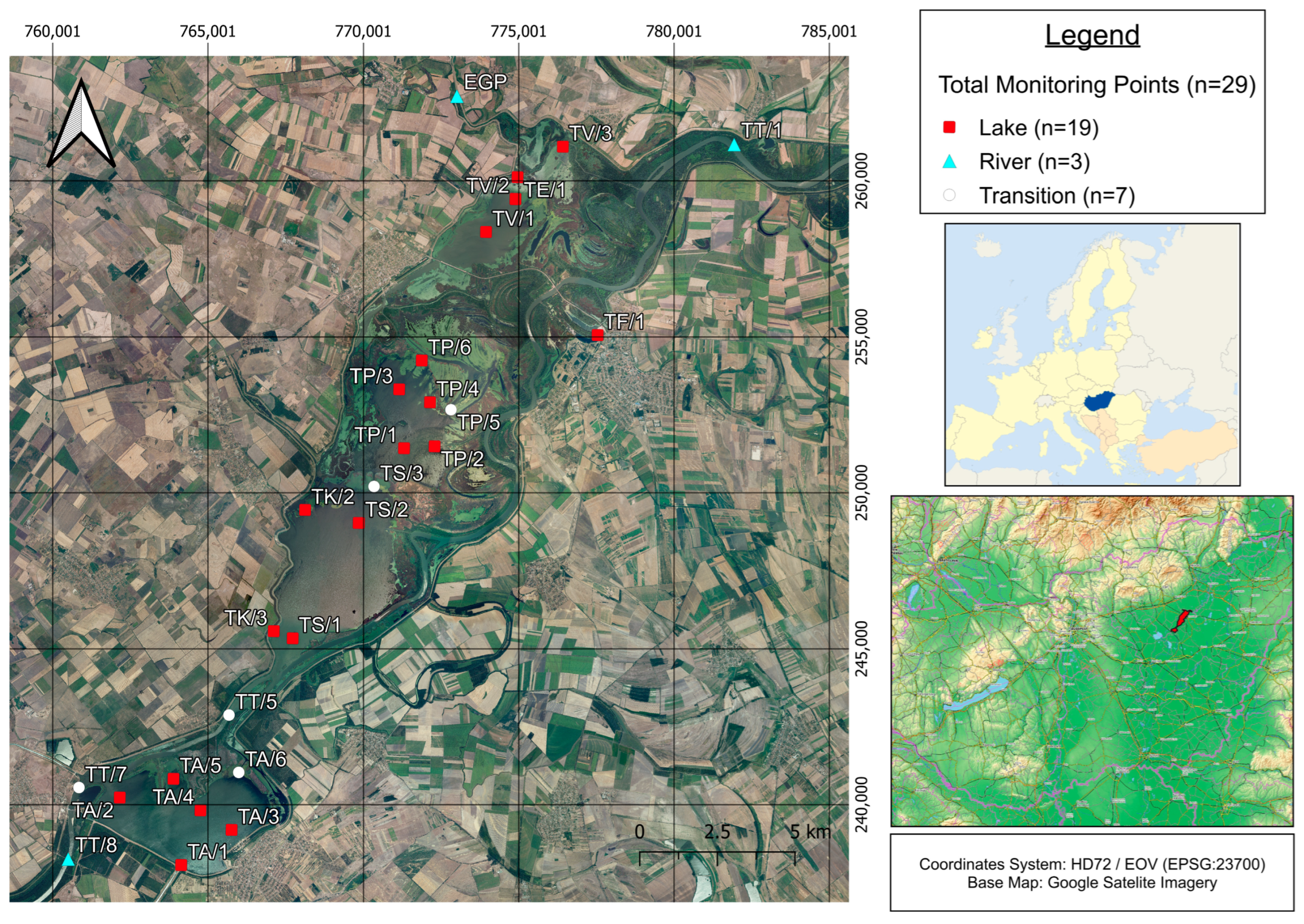
2.1. Description of the Study Area
2.2. Water Sampling
2.3. Evaluation Criteria for Each Hydrological Regime
2.4. Statistical Analysis and Spatial Analysis
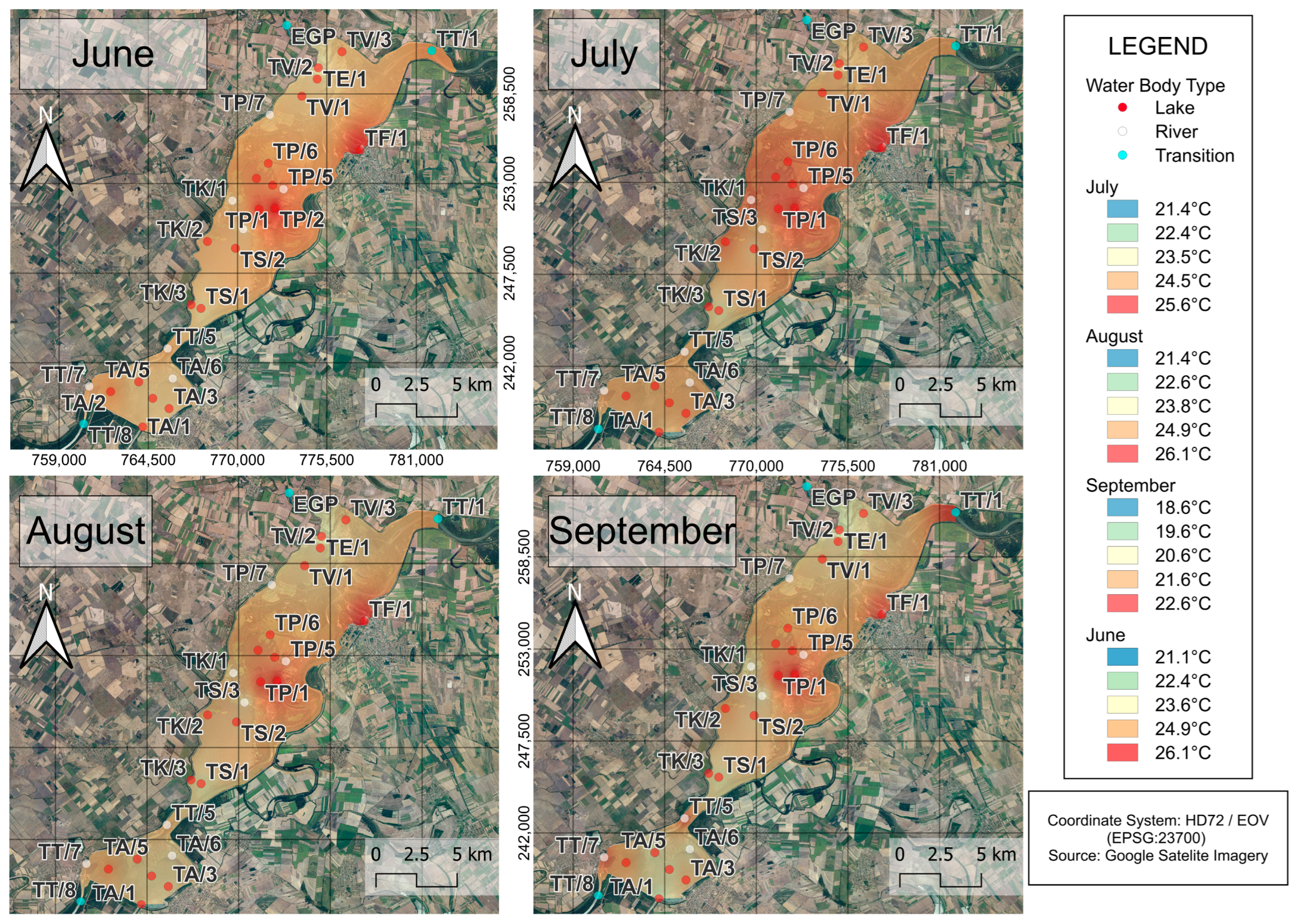
2.5. Spatial Analysis in QGIS 3.34
3. Results
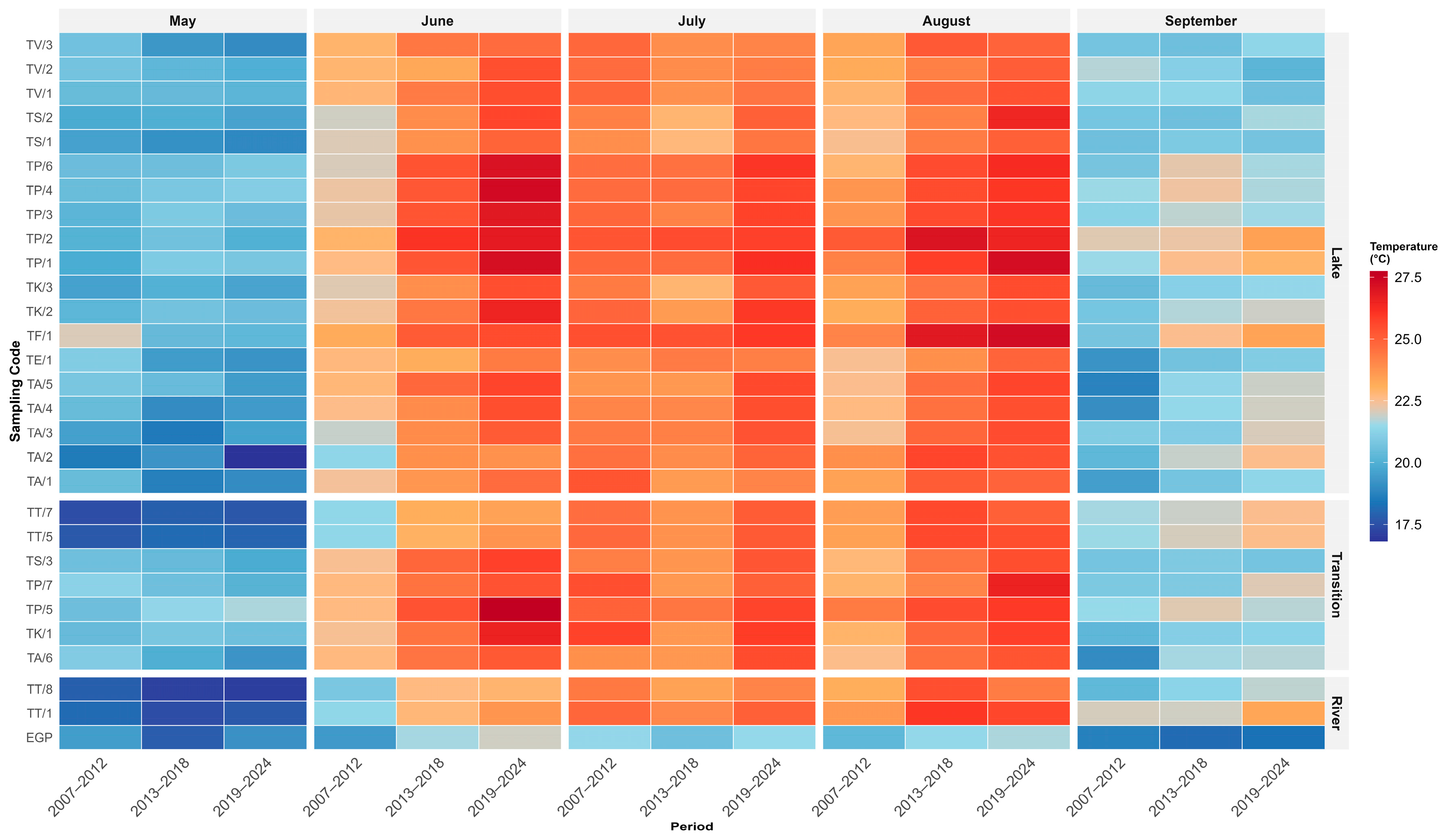
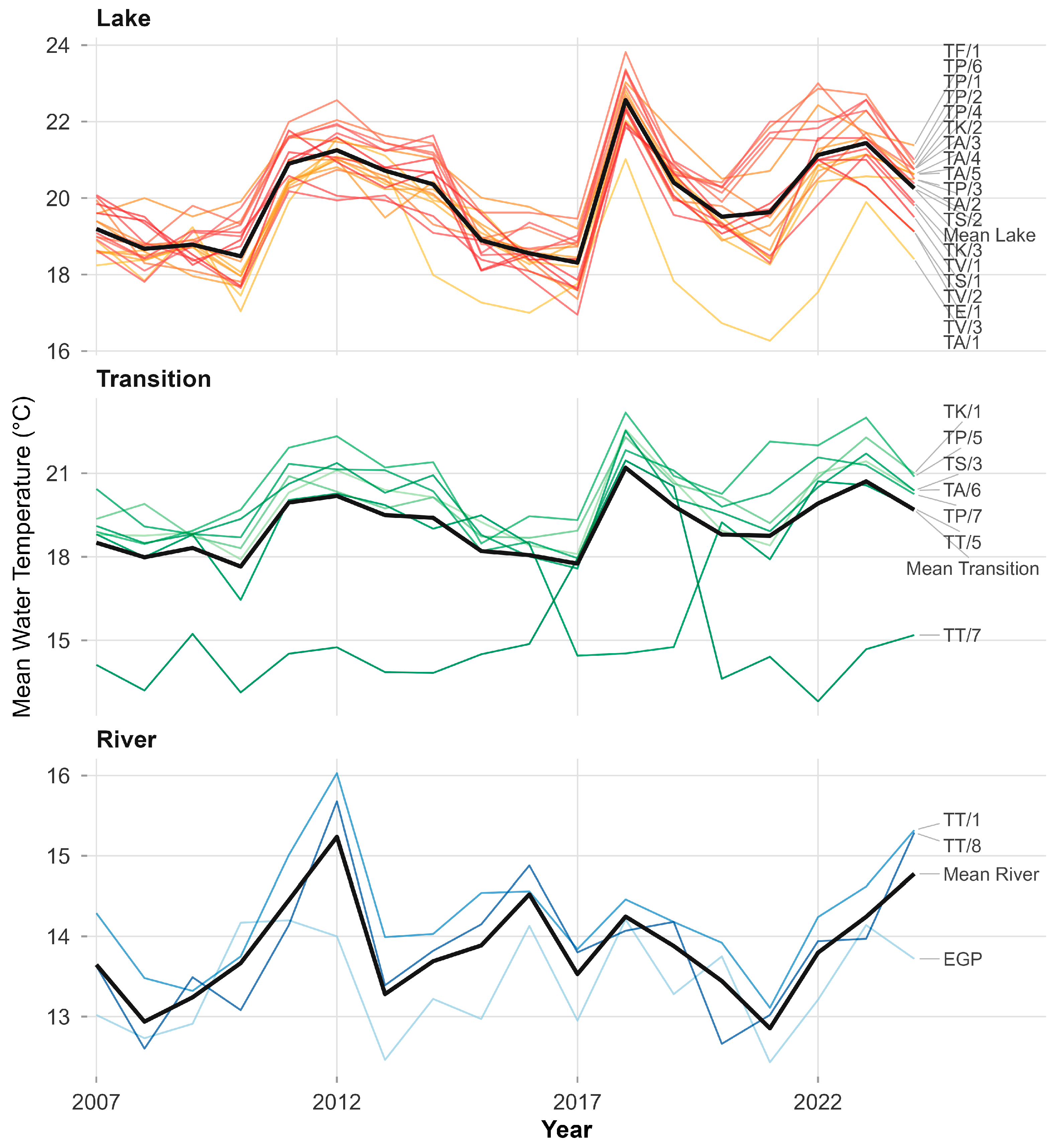
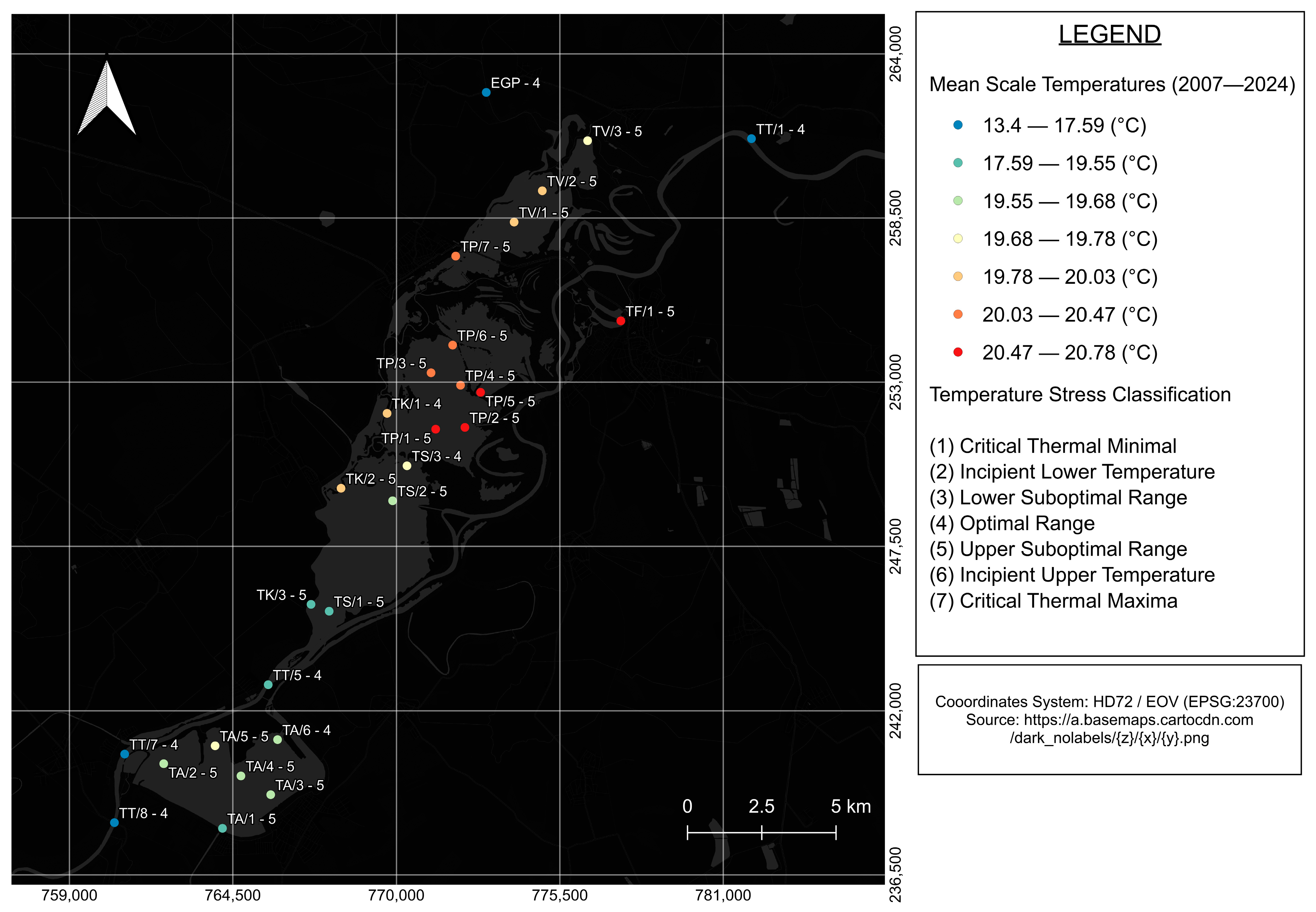
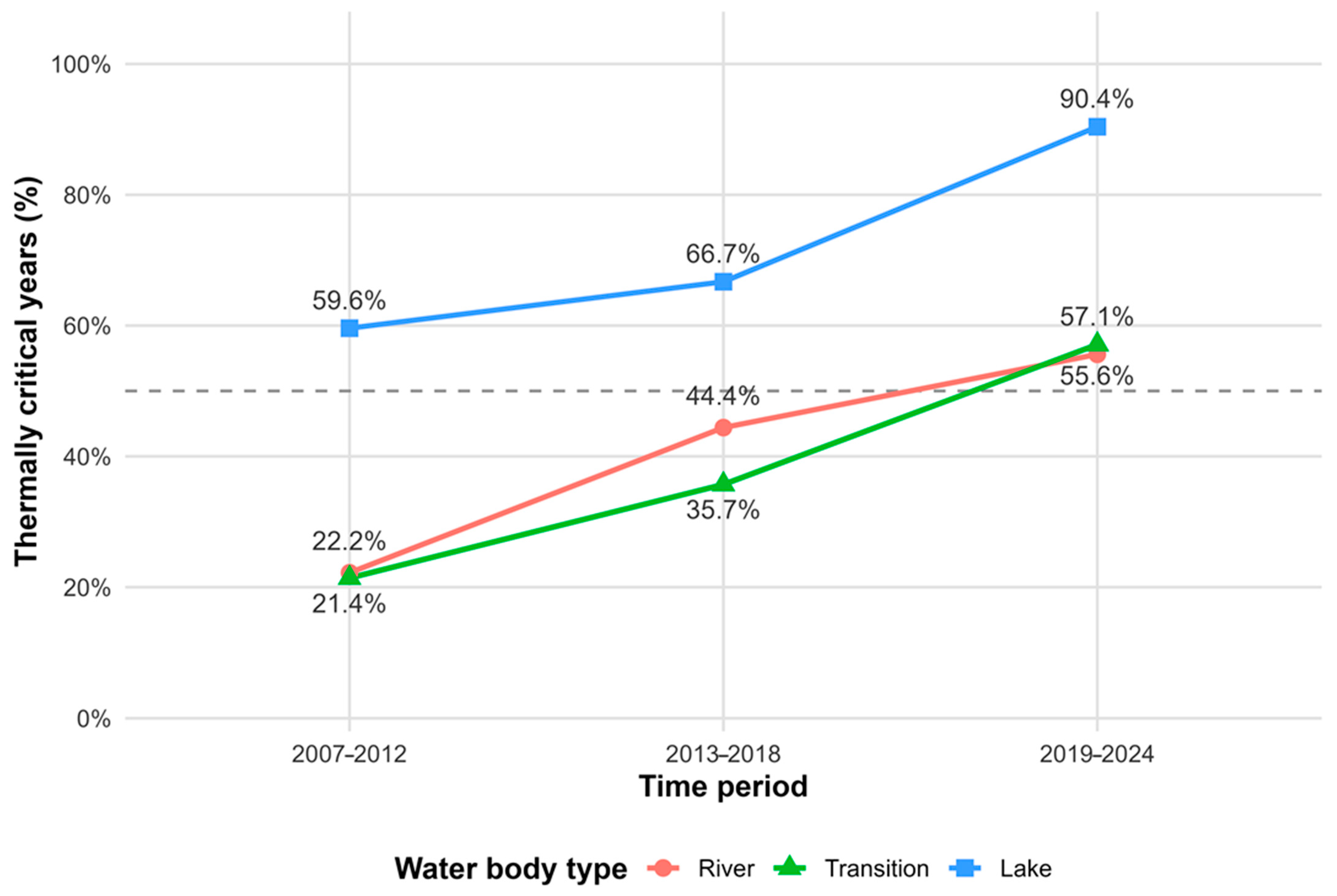
3.1. Spatiotemporal Temperature Variability in the Water Regime
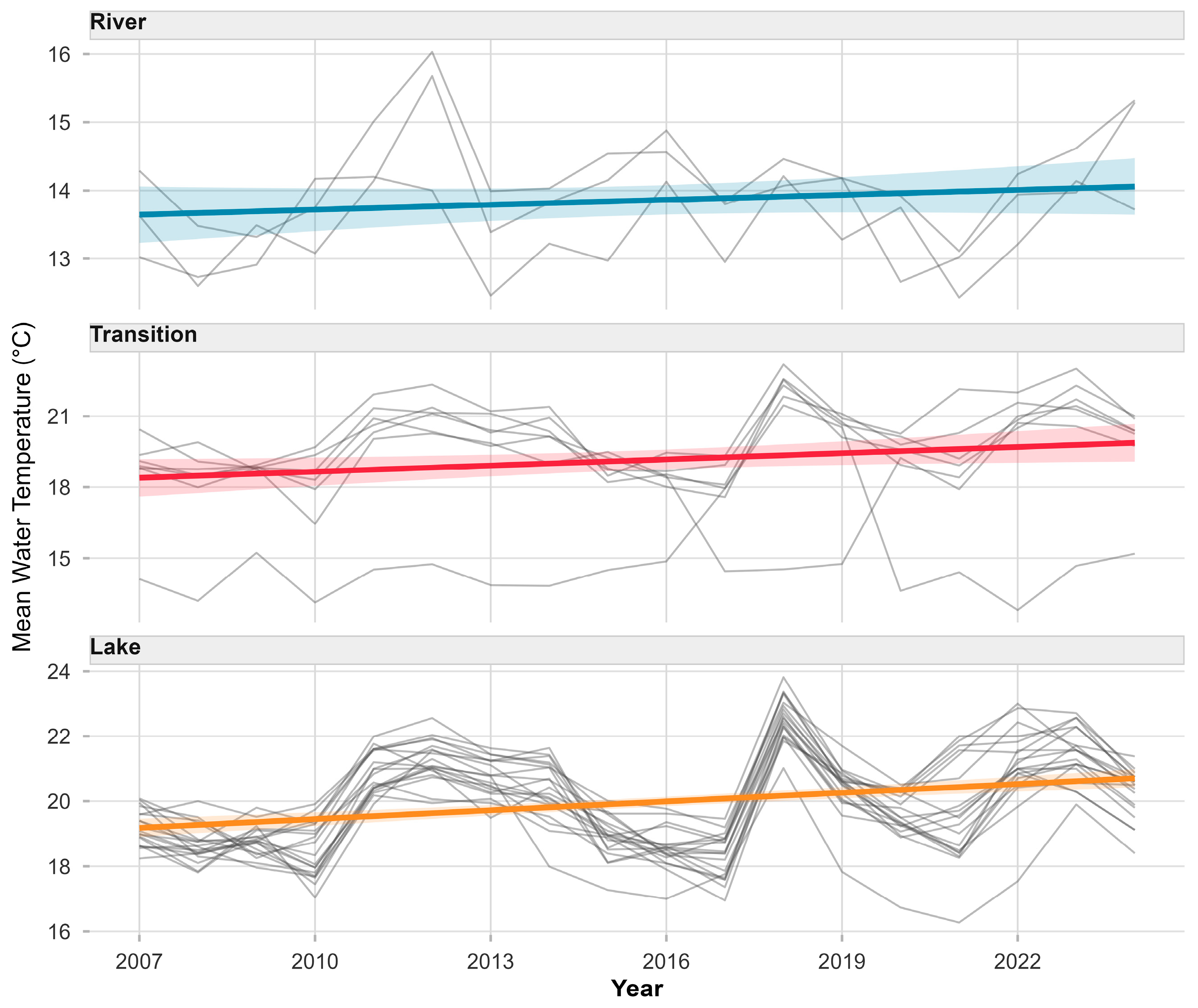
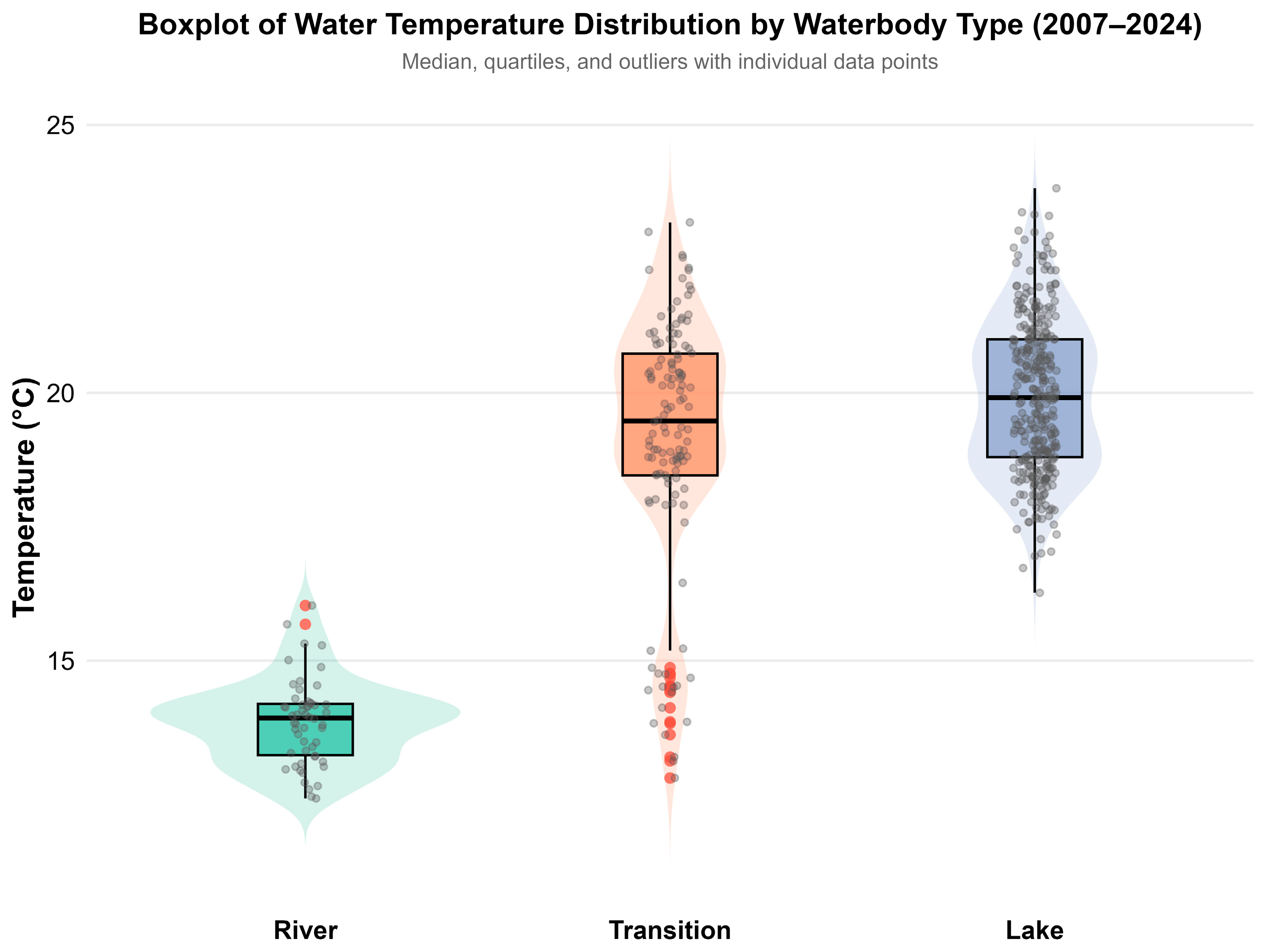
3.2. Statistical Evaluation of Thermal Trends (2007–2024)
3.3. Lake Tisza Dissolved Oxygen Summary (2007–2024)
3.4. Water Quality Index (WQI) Distribution by Ecosystem Type
3.5. Multivariate Spatial Organization Analysis of Water Quality Gradients
3.5.1. Principal Component Analysis (PCA) in Transition–River–Lake Systems
3.5.2. Hierarchical Clustering Dendrograms (Ward’s Method and Euclidean Distance)
4. Discussion
5. Conclusions
Supplementary Materials
Author Contributions
Funding
Data Availability Statement
Acknowledgments
Conflicts of Interest
Abbreviations
| PCA | Principal Component Analysis |
| WQI | Water Quality Index |
| IPCC | Intergovernmental Panel on Climate Change |
| IQR | Interquartile Range |
References
- Caretta, M.A.; Mukherji, A.; Arfanuzzaman, M.; Betts, R.A.; Gelfan, A.; Hirabayashi, Y.; Lissner, T.K.; Liu, J.; Lopez Gunn, E.; Morgan, R.; et al. Water. In Climate Change 2022—Impacts, Adaptation and Vulnerability; Cambridge University Press: Cambridge, UK, 2023; pp. 551–712. [Google Scholar]
- Vári, Á.; Podschun, S.A.; Erős, T.; Hein, T.; Pataki, B.; Iojă, I.-C.; Adamescu, C.M.; Gerhardt, A.; Gruber, T.; Dedić, A.; et al. Freshwater Systems and Ecosystem Services: Challenges and Chances for Cross-Fertilization of Disciplines. Ambio 2022, 51, 135–151. [Google Scholar] [CrossRef] [PubMed]
- Mester, T.; Benkhard, B.; Vasvári, M.; Csorba, P.; Kiss, E.; Balla, D.; Fazekas, I.; Csépes, E.; Barkat, A.; Szabó, G. Hydrochemical Assessment of the Kisköre Reservoir (Lake Tisza) and the Impacts of Water Quality on Tourism Development. Water 2023, 15, 1514. [Google Scholar] [CrossRef]
- Paerl, H.; Otten, T. Harmful Cyanobacterial Blooms: Causes, Consequences, and Controls. Microb. Ecol. 2013, 65, 995–1010. [Google Scholar] [CrossRef]
- Amorim, C.A.; do Nascimento Moura, A. Ecological Impacts of Freshwater Algal Blooms on Water Quality, Plankton Biodiversity, Structure, and Ecosystem Functioning. Sci. Total Environ. 2021, 758, 143605. [Google Scholar] [CrossRef]
- Parmesan, C.; Morecroft, M.; Trisurat, Y. Terrestrial and Freshwater Ecosystems and Their Services. In Climate Change 2022—Impacts, Adaptation and Vulnerability; Cambridge University Press: Cambridge, UK, 2023; pp. 197–378. [Google Scholar]
- O’Reilly, C.M.; Sharma, S.; Gray, D.K.; Hampton, S.E.; Read, J.S.; Rowley, R.J.; Schneider, P.; Lenters, J.D.; McIntyre, P.B.; Kraemer, B.M.; et al. Rapid and Highly Variable Warming of Lake Surface Waters around the Globe. Geophys. Res. Lett. 2015, 42, 10773–10781. [Google Scholar] [CrossRef]
- Woolway, R.I.; Merchant, C.J. Worldwide Alteration of Lake Mixing Regimes in Response to Climate Change. Nat. Geosci. 2019, 12, 271–276. [Google Scholar] [CrossRef]
- Jane, S.; Hansen, G.; Kraemer, B.; Leavitt, P.; Mincer, J.; North, R.; Pilla, R.; Stetler, J.; Williamson, C.; Woolway, R.; et al. Widespread Deoxygenation of Temperate Lakes. Nature 2021, 594, 66–70. [Google Scholar] [CrossRef]
- Paerl, H.W.; Huisman, J. Climate Change: A Catalyst for Global Expansion of Harmful Cyanobacterial Blooms. Environ. Microbiol. Rep. 2009, 1, 27–37. [Google Scholar] [CrossRef] [PubMed]
- Rodgers, E.M. Adding Climate Change to the Mix: Responses of Aquatic Ectotherms to the Combined Effects of Eutrophication and Warming. Biol. Lett. 2021, 17, 20210442. [Google Scholar] [CrossRef] [PubMed]
- Meyer-Jacob, C.; Michelutti, N.; Paterson, A.M.; Cumming, B.F.; Keller, W.; Smol, J.P. The Browning and Re-Browning of Lakes: Divergent Lake-Water Organic Carbon Trends Linked to Acid Deposition and Climate Change. Sci. Rep. 2019, 9, 16676. [Google Scholar] [CrossRef] [PubMed]
- Herreid, A.M.; Fazekas, H.M.; Nelson, S.J.; Wymore, A.S.; Murray, D.; Varner, R.K.; McDowell, W.H. Climate Displaces Deposition as Dominant Driver of Dissolved Organic Carbon Concentrations in Historically Acidified Lakes. Biogeochemistry 2024, 168, 5. [Google Scholar] [CrossRef] [PubMed]
- Poff, N.L.; Zimmerman, J.K.H. Ecological Responses to Altered Flow Regimes: A Literature Review to Inform the Science and Management of Environmental Flows. Freshw. Biol. 2010, 55, 194–205. [Google Scholar] [CrossRef]
- ICPDR. Updated Integrated Tisza River Basin Management Plan; ICPDR: Vienna, Austria, 2019. [Google Scholar]
- The European Parliament and the Council of the European Union. Diario Oficial de Las Comunidades Europeas ES; The European Parliament and the Council of the European Union: Strasbourg, France, 2000. [Google Scholar]
- Znachor, P.; Kosour, D.; Rederer, L.; Koza, V.; Kolář, V.; Nedoma, J. Tracking Reservoir Warming in a Changing Climate: A 31-Year Study from Czechia. Environ. Sci. Ecotechnol. 2025, 28, 100631. [Google Scholar] [CrossRef]
- Maberly, S.C.; O’Donnell, R.A.; Woolway, R.I.; Cutler, M.E.J.; Gong, M.; Jones, I.D.; Merchant, C.J.; Miller, C.A.; Politi, E.; Scott, E.M.; et al. Global Lake Thermal Regions Shift under Climate Change. Nat. Commun. 2020, 11, 1232. [Google Scholar] [CrossRef]
- Piccolroaz, S.; Zhu, S.; Ladwig, R.; Carrea, L.; Oliver, S.; Piotrowski, A.P.; Ptak, M.; Shinohara, R.; Sojka, M.; Woolway, R.I.; et al. Lake Water Temperature Modeling in an Era of Climate Change: Data Sources, Models, and Future Prospects. Rev. Geophys. 2024, 62, e2023RG000816. [Google Scholar] [CrossRef]
- Lovász, G. Water Temperatures of the Danube and Tisza Rivers in Hungary. Hung. Geogr. Bull. 2012, 61, 317–325. [Google Scholar]
- Benkhard, B.; Csorba, P.; Mester, T.; Balla, D.; Kiss, E.; Szabó, G.; Fazekas, I.; Vass, R.; Rooien, A.; Vasvári, M. Effects of Mosaic Natural Conditions on the Tourism Management of a Lowland Water Reservoir, Lake Tisza, Hungary. Land 2023, 12, 2092. [Google Scholar] [CrossRef]
- U.S. Geological Survey. Lakes and Reservoirs: Guidelines for Study Design and Sampling. In Book 9, Handbooks for Water-Resources Investigations; U.S. Geological Survey: Reston, VA, USA, 2018. [Google Scholar]
- Brungs, W.; Jones, B. Temperature Criteria for Freshwater Fish: Protocol and Procedures; U.S. Environmental Protection Agency: Washington, DC, USA, 1977.
- Vidékfejlesztési Minister. VM Rendelet a Felszíni Víz Vízszennyezettségi Határértékeiről És Azok Alkalmazásának Szabályairól; Vidékfejlesztési Minister: Budapest, Hungary, 2010.
- U.S. Environmental Protection Agency. Hypoxia 101. Available online: https://www.epa.gov/ms-htf/hypoxia-101 (accessed on 17 May 2026).
- Helsel, D.R.; Hirsch, R.M.; Ryberg, K.R.; Archfield, S.A.; Gilroy, E.J. Tm4a3.Pdf—Statistical Methods in Water Resources; U.S. Geological Survey: Reston, VA, USA, 2020.
- Chidiac, S.; Najjar, P.; Ouaini, N.; Rayess, Y.; Azzi, D. A Comprehensive Review of Water Quality Indices (WQIs): History, Models, Attempts and Perspectives. Rev. Environ. Sci. Biotechnol. 2023, 22, 349–395. [Google Scholar] [CrossRef]
- Sutadian, A.D.; Muttil, N.; Yilmaz, A.G.; Perera, B.J.C. Development of River Water Quality Indices—A Review. Environ. Monit. Assess. 2016, 188, 1–29. [Google Scholar] [CrossRef]
- Tyagi, S.; Sharma, B.; Singh, P.; Dobhal, R. Water Quality Assessment in Terms of Water Quality Index. Am. J. Water Resour. 2020, 1, 34–38. [Google Scholar] [CrossRef]
- Dong, Y.; Peng, C.-Y.J. Principled Missing Data Methods for Researchers. SpringerPlus 2013, 2, 222. [Google Scholar] [CrossRef] [PubMed]
- Li, H.; Sun, J.; Zhou, Q.; Sojka, M.; Ptak, M.; Luo, Y.; Wu, S.; Zhu, S.; Tóth, V.R. 150-Year Daily Data (1870–2021) in Lakes and Rivers Reveals Intensifying Surface Water Warming and Heatwaves in the Pannonian Ecoregion (Hungary). J. Hydrol. Reg. Stud. 2024, 56, 101985. [Google Scholar] [CrossRef]
- Takács-György, K.; Nagy-Kovács, Z. Evaluating Climate Change Impacts on Water Safety: A Case Study of the Danube in Budapest. Ecocycles 2024, 10, 14–25. [Google Scholar] [CrossRef]
- Climate-ADAPT. Temporary Flood Water Storage in Agricultural Areas in the Middle Tisza River Basin—Hungary; Climate-ADAPT: Copenhagen, Denmark, 2022. [Google Scholar]
- Kajner, P.T.; Gruber; Cselószki, T. Developing Sustainable Water Management and Landscapes in the Tisza Plain. Roadmap to 2050; European Union’s Horizon: Brussels, Belgium, 2024; p. 35. [Google Scholar]
- UNDP/GEF. UNDP/GEF Integrated River Basin Management in the Tisza INCEPTION REPORT Integrating Multiple Benefits of Wetlands and Floodplains into Improved Transboundary Management for the Tisza River Basin; UNDP/GEF: Washington, DC, USA, 2008. [Google Scholar]
- LIFE SUMAR. Theme: The Overall Context of Agriculture and Nature Conservation; LIFE SUMAR: Szolnok, Hungary, 2007. [Google Scholar]
- Radosavljevic, J.; Shahvaran, A.; Van Cappellen, P. Beyond Climate Warming: How Salinization Accelerates Deoxygenation in Lakes; Federated Research Data Repository: Waterloo, ON, Canada, 2025. [Google Scholar]






| Parameter | Type | Unit | Optimal | Sub-Optimal | Critical |
|---|---|---|---|---|---|
| Conductivity | River | µS/cm | <900 | 900–1200 | >1200 |
| Transition | µS/cm | <900 | 900–1200 | >1200 | |
| Lake | µS/cm | <900 | 900–1200 | >1200 | |
| BOD [5] | River | mg/L | <3 | 3–6 | >6 |
| Transition | mg/L | <3 | 3–6 | >6 | |
| Lake | mg/L | <3 | 3–6 | >6 | |
| Total N | River | mg/L | <1.0 | 1.0–3.0 | >3.0 |
| Transition | mg/L | <0.6 | 0.6–2.0 | >2.0 | |
| Lake | mg/L | <0.4 | 0.4–1.5 | >1.5 | |
| Total P | River | mg/L | <0.05 | 0.05–0.20 | >0.20 |
| Transition | mg/L | <0.05 | 0.05–0.15 | >0.15 | |
| Lake | mg/L | <0.03 | 0.03–0.05 | >0.05 | |
| Total Coliforms | River | UFC/100 mL | <500 | 500–10,000 | >10,000 |
| Transition | UFC/100 mL | <500 | 500–10,000 | >10,000 | |
| Lake | UFC/100 mL | <500 | 500–10,000 | >10,000 | |
| pH | River | - | 6.5–8.5 | 6.0–6.5//8.5–9.0 | <6.0//>9.0 |
| Transition | - | 6.5–8.5 | 6.0–6.5//8.5–9.0 | <6.0//>9.0 | |
| Lake | - | 6.5–8.5 | 6.0–6.5//8.5–9.0 | <6.0//>9.0 |
| Parameter | Category | Unit | Water Body | ||
|---|---|---|---|---|---|
| River | Transition | Lake (Epilimnion) | |||
| Dissolved Oxygen | 1. Critical | mg/L | <3.0 | <3.0 | <3.0 |
| 2. Lower Suboptimal | mg/L | 3.0–5.0 | 3.0–5.0 | 3.0–5.0 | |
| 3. Optimal/acceptable oxygenation | mg/L | 5.0–9.0 | 5.0–9.0 | 5.0–9.0 | |
| %Sat | 61–110 | 61–110 | 61–110 | ||
| 4. Upper Suboptimal | %Sat | >110–150 | >110–150 | >110–150 | |
| 5. Upper Critical | %Sat | >150 | >150 | >150 | |
| Temperature | 1. Critical Thermal Minimum | °C | 0–2 | 0- 3 | 0–2 |
| 2. Low Incipient Temperature | °C | 2–5 | 3–7 | 2–5 | |
| 3. Lower Suboptimal Range | °C | 5–10 | 7–12 | 5–8 | |
| 4. Optimal Range | °C | 10–18 | 12–20 | 8–18 | |
| 5. Upper Suboptimal Range | °C | 18–22 | 20–24 | 18–22 | |
| 6. High Incipient Temperature | °C | 22–25 | 24–27 | 22–25 | |
| 7. Critical Thermal Maximum | °C | >25 | >27 | >25 | |
| Canadian Council of Ministers of the Environment Water Quality Index | |
|---|---|
| 80–100 | Excellent Water Quality |
| 60–80 | Good Water Quality |
| 40–60 | Fair Water Quality |
| 20–40 | Marginal Water Quality |
| 0–20 | Poor Water Quality |
| Water Type | Trend, °C/Decade–°C/Year |
|---|---|
| River | 0.2429 °C/decade–0.0243 °C/year |
| Transition | 0.8718 °C/decade–0.0872 °C/year |
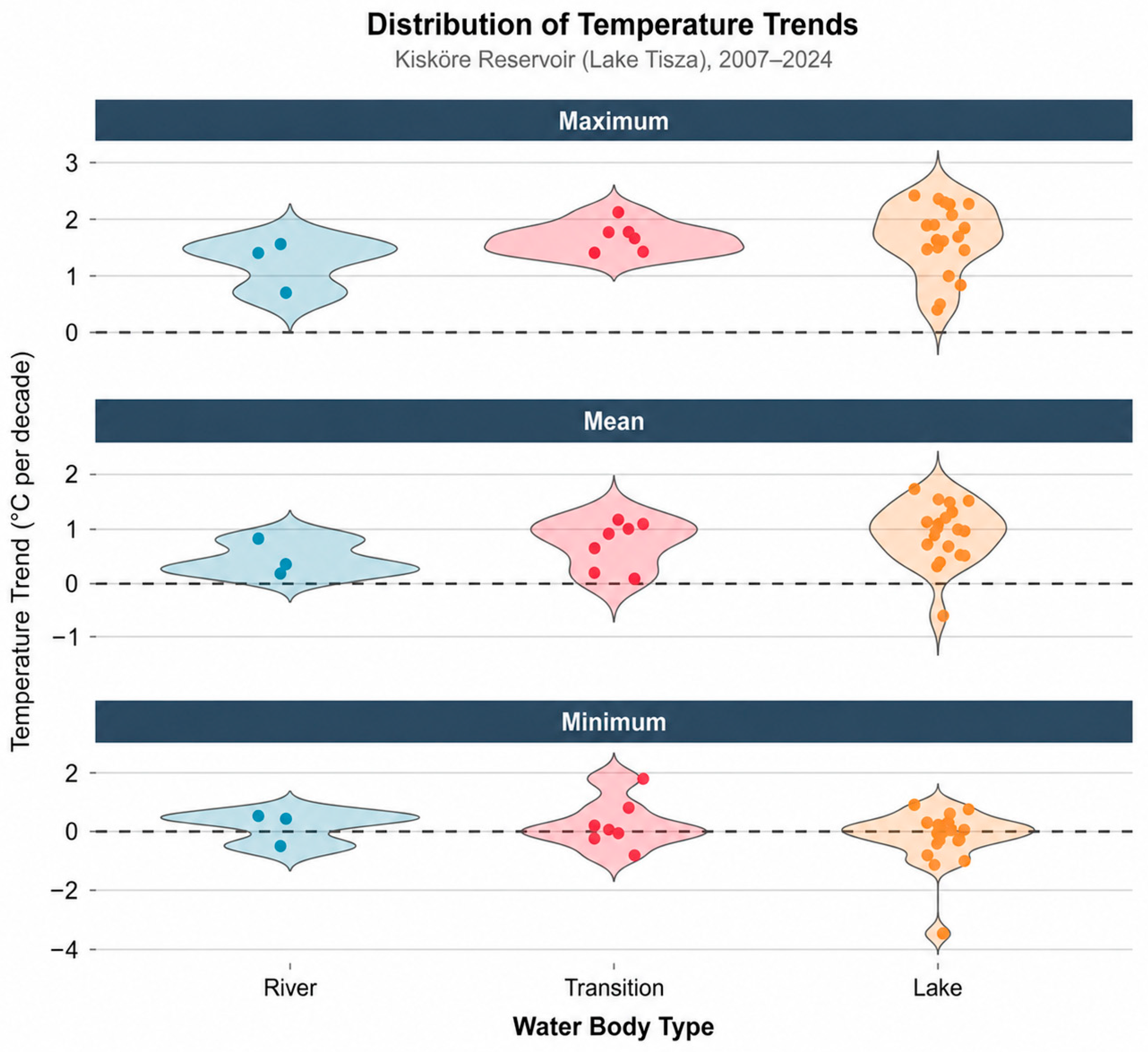
| Lake | 0.897 °C/decade–0.0898 °C/year |
| Periods | Principal Clusters | |
|---|---|---|
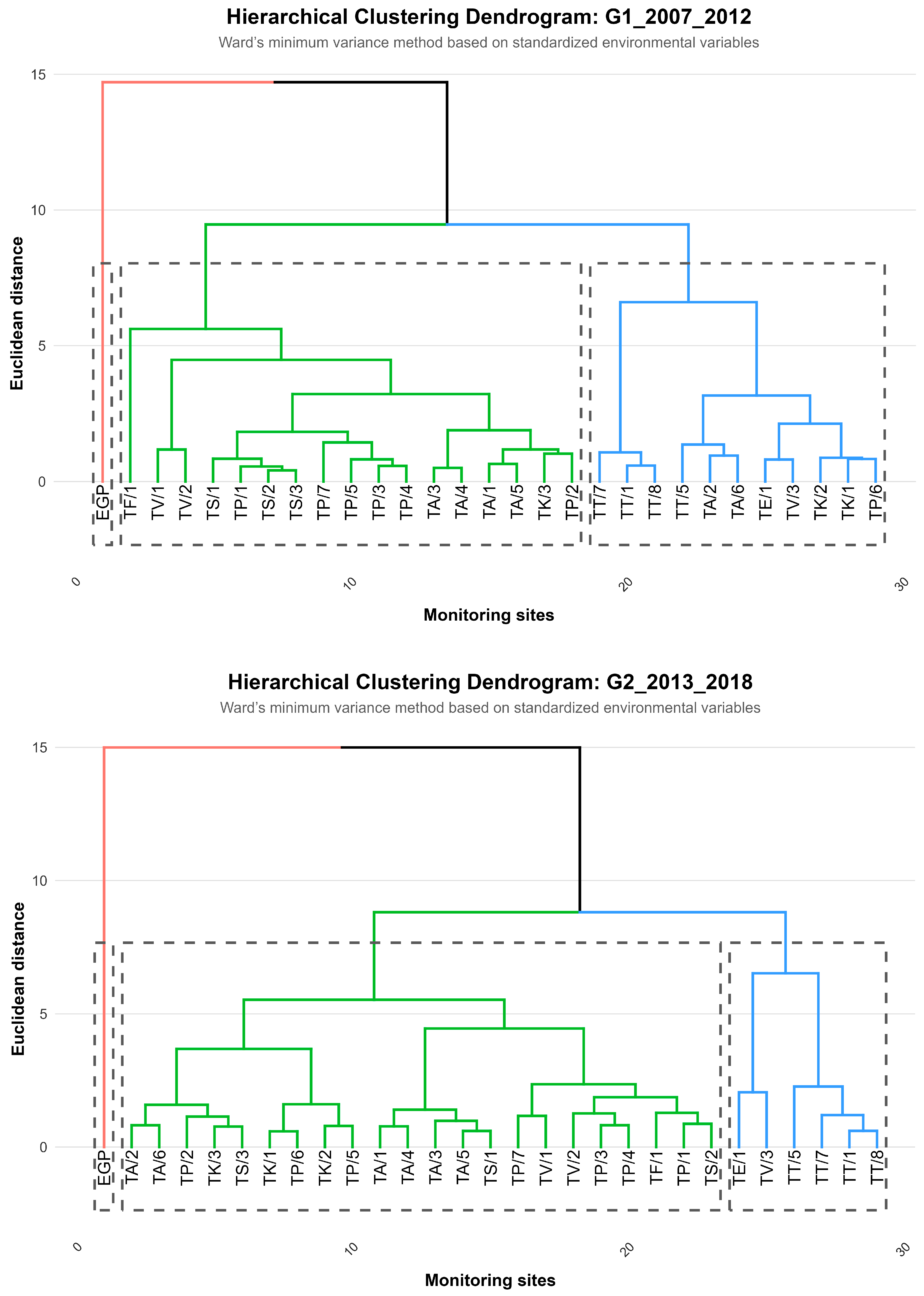
| 2007–2012 | River Cluster | Groups sites such as transition and river, denoting better oxygenated conditions and lower organic load (Figure 14) |
| Transition Cluster | Integrates transition zones and lake with moderate eutrophication and increasing internal similarity | |
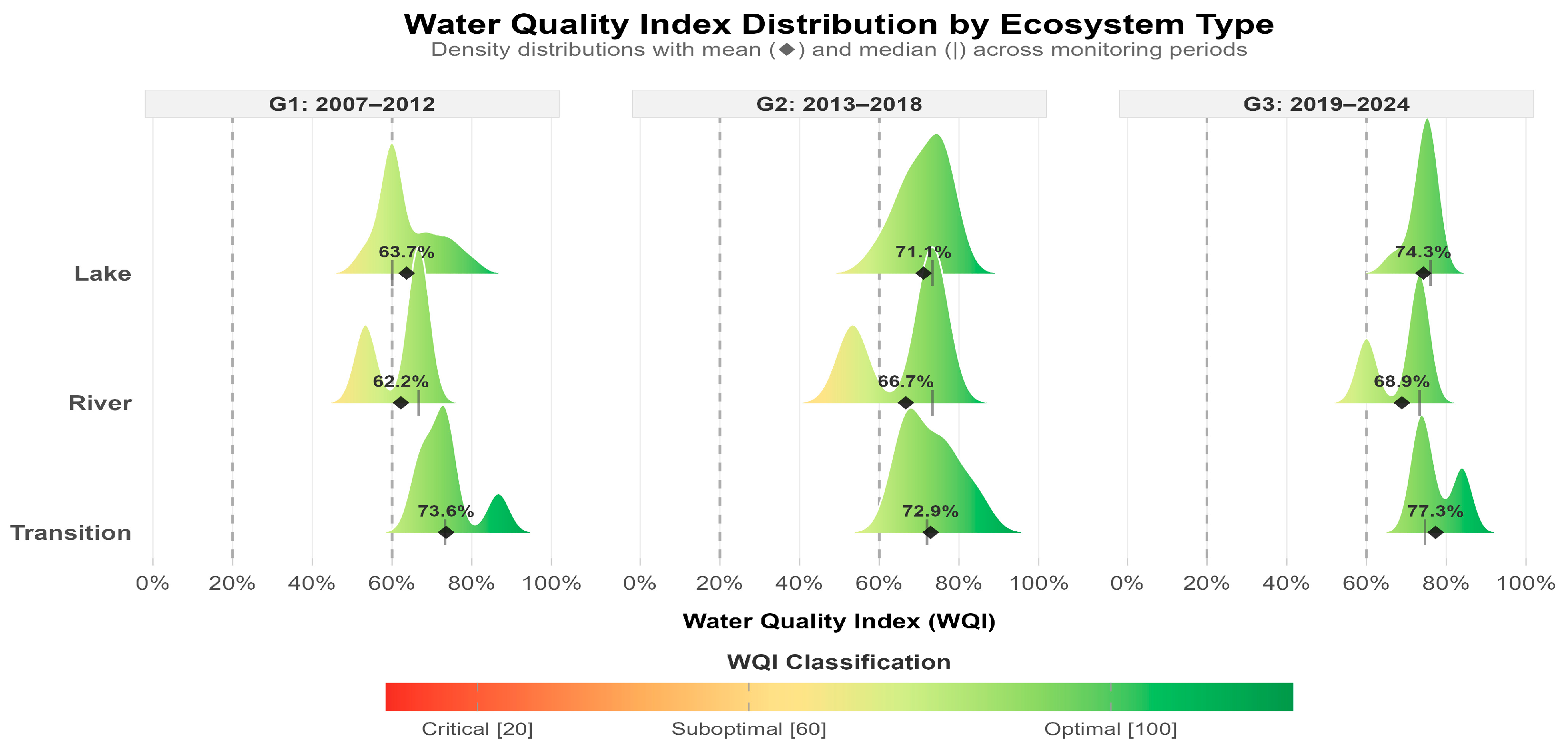
| Lacustrine Cluster | More dispersed, it integrates sites with impact, high BOD, nutrients, and coliforms, evidencing eutrophication and a low Water Quality Index (63–74), denoting marginal conditions in lake ecosystems | |
| 2013–2018 | River Cluster | It shows greater compaction/homogeneity with some signs of improved quality (Figure 14) |
| Transition Cluster | It suggests a relative improvement in transition zones and lakes, reciprocal with the increase in WQI in ecotones of 77.3 | |
| Lacustrine Cluster | It has a broader and more subdivided structure due to coliforms as a differentiating variable, the lake remaining the most impacted site | |
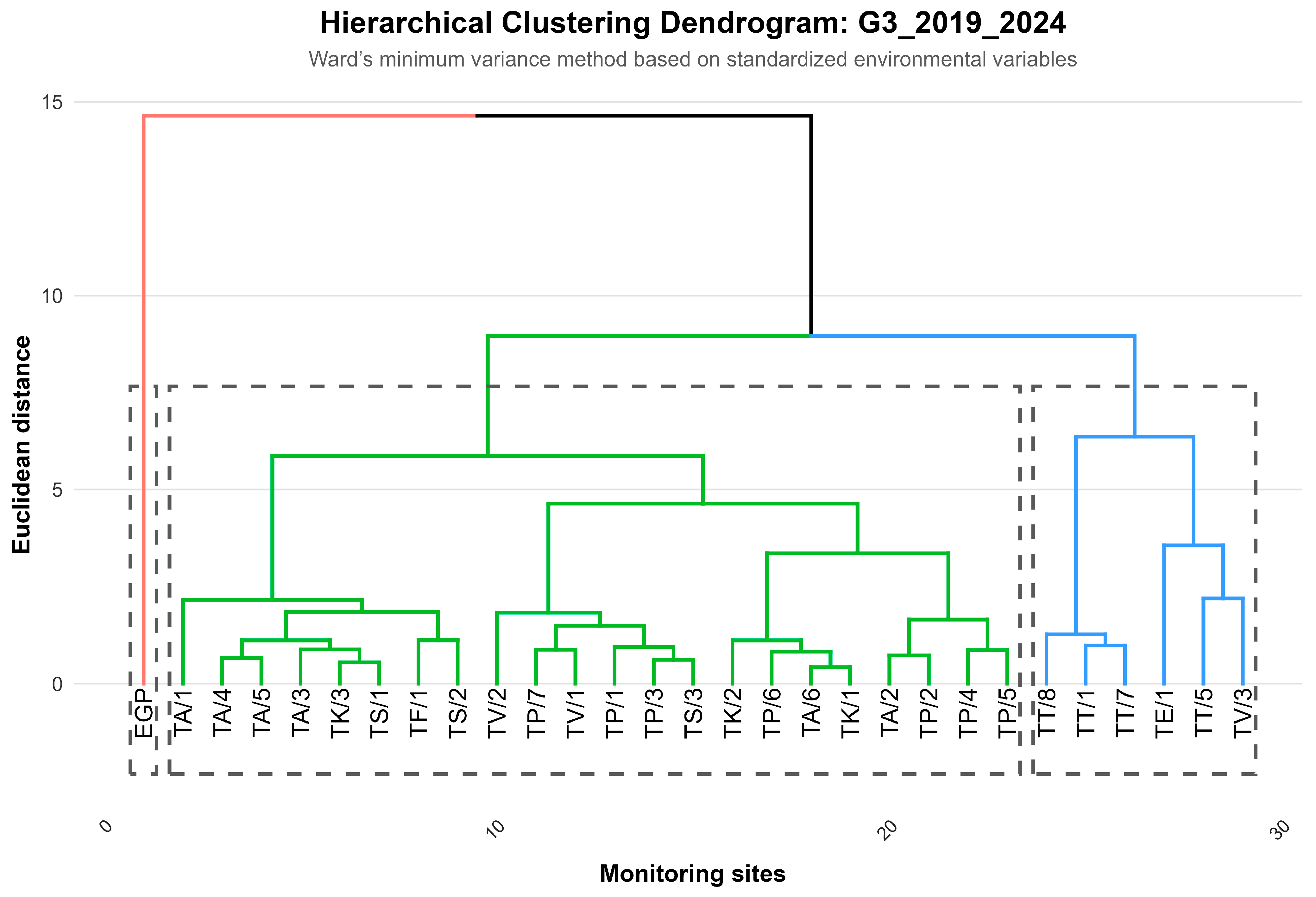
| 2019–2024 | River Cluster | It is the most homogeneous and separate group, with high oxygenation and low coliform load (Figure 14) |
| Transition Cluster | It reflects a reduction in BOD and nutrients, linking transitions to moderate lakes | |
| Lacustrine Cluster | It persists with impacted sites, has defined subgroups and less heterogeneity, confirming an improvement associated with coliforms and nutrients | |
Disclaimer/Publisher’s Note: The statements, opinions and data contained in all publications are solely those of the individual author(s) and contributor(s) and not of MDPI and/or the editor(s). MDPI and/or the editor(s) disclaim responsibility for any injury to people or property resulting from any ideas, methods, instructions or products referred to in the content. |
© 2026 by the authors. Licensee MDPI, Basel, Switzerland. This article is an open access article distributed under the terms and conditions of the Creative Commons Attribution (CC BY) license.
Share and Cite
Matamoros, D.; Szabó, G.; Csépes, E.; Benkhard, B.; Kiss, E.; Vasvári, M.; Csorba, P.; Mester, T. Long-Term (2007–2024) Thermal and Water Quality Dynamics in Lake Tisza (Kisköre Reservoir), Hungary: A Shallow Freshwater Ecosystem Under Climate Pressure. Water 2026, 18, 1365. https://doi.org/10.3390/w18111365
Matamoros D, Szabó G, Csépes E, Benkhard B, Kiss E, Vasvári M, Csorba P, Mester T. Long-Term (2007–2024) Thermal and Water Quality Dynamics in Lake Tisza (Kisköre Reservoir), Hungary: A Shallow Freshwater Ecosystem Under Climate Pressure. Water. 2026; 18(11):1365. https://doi.org/10.3390/w18111365
Chicago/Turabian StyleMatamoros, David, György Szabó, Eduárd Csépes, Borbála Benkhard, Emőke Kiss, Mária Vasvári, Péter Csorba, and Tamás Mester. 2026. "Long-Term (2007–2024) Thermal and Water Quality Dynamics in Lake Tisza (Kisköre Reservoir), Hungary: A Shallow Freshwater Ecosystem Under Climate Pressure" Water 18, no. 11: 1365. https://doi.org/10.3390/w18111365
APA StyleMatamoros, D., Szabó, G., Csépes, E., Benkhard, B., Kiss, E., Vasvári, M., Csorba, P., & Mester, T. (2026). Long-Term (2007–2024) Thermal and Water Quality Dynamics in Lake Tisza (Kisköre Reservoir), Hungary: A Shallow Freshwater Ecosystem Under Climate Pressure. Water, 18(11), 1365. https://doi.org/10.3390/w18111365