Article

Flood Inundation Area Prediction Under Climate Change Scenarios by Integrating Hydrological and Hydraulic Models with a Hybrid Deep Learning Framework


by
Tongchana Nawasanchai
,
Piyapong Tongdeenok
* and
Naruemol Kaewjampa
Watershed Management Program, Department of Conservation, Faculty of Forestry, Kasetsart University, Bangkok 10900, Thailand
*
Author to whom correspondence should be addressed.
Water 2026, 18(11), 1360; https://doi.org/10.3390/w18111360
Submission received: 24 March 2026 / Revised: 1 May 2026 / Accepted: 1 June 2026 / Published: 3 June 2026
(This article belongs to the Section Hydrology)

Abstract

Flood inundation modeling in low-gradient monsoon floodplains requires a physically consistent representation of rainfall–runoff–inundation processes. This study develops a hybrid modeling framework that integrates a coupled hydrological–hydraulic model (HEC-HMS–HEC-RAS) with a deep learning-based LSTM–U-Net surrogate to represent temporal hydrological memory and spatial inundation patterns. The framework is applied to the Upper Songkhram River Basin in northeastern Thailand, a storage-dominated floodplain strongly influenced by monsoon hydrology. The hydrological model demonstrated strong validation performance (NSE = 0.896, KGE = 0.827, R2 = 0.909), while hydraulic simulations showed high spatial agreement with satellite-derived inundation maps (F1 = 0.876, Kappa = 0.873). Trained on hydraulically simulated discharge–inundation pairs, the LSTM–U-Net model successfully reproduced two-dimensional flood patterns across independent flood events (mean F1 = 0.838, IoU = 0.721), with prediction errors mainly occurring along shallow floodplain margins. Future projections under CMIP6 SSP2-4.5 and SSP5-8.5 indicate clear changes in flood-season discharge, with stronger increases under SSP5-8.5, whereas maximum inundation extent shows more moderate changes (≤21%), reflecting nonlinear floodplain response in low-gradient systems. The proposed framework preserves hydrological–hydraulic consistency while supporting future flood inundation projection, climate-informed flood risk assessment, and adaptation planning.

1. Introduction

Flooding is a major natural hazard in monsoon-dominated regions, where prolonged rainfall often causes extensive inundation across low-gradient floodplains. Increasing flood frequency and severity have been linked to climate change-driven intensification of the hydrological cycle and shifts in precipitation extremes [1]. In storage-dominated basins, even moderate changes in seasonal discharge can substantially affect floodplain activation. This reflects the important role of floodplain storage and channel–floodplain interactions, which can limit the proportional expansion of inundation extent [2,3].
Physically based hydrological–hydraulic models provide a process-based representation of flood generation, from rainfall and runoff to floodplain inundation [4]. Hydrological models simulate rainfall–runoff processes and river discharge, but they generally cannot resolve the spatial dynamics of floodplain inundation. In contrast, hydraulic models explicitly represent water surface elevation, river routing, and two-dimensional floodplain flow processes, but they require discharge hydrographs as upstream boundary conditions. Therefore, integrating models such as HEC-HMS and HEC-RAS enables physically consistent simulation of flood processes through a one-way coupling framework that transfers hydrological forcing to floodplain inundation [5]. However, representing floodplain response under multiple future scenarios remains challenging, especially in low-gradient systems where inundation depends on hydrological forcing and spatial floodplain processes [6].
Deep learning has increasingly been used as a surrogate for hydraulic simulations because it can capture complex nonlinear relationships and spatiotemporal flood behavior [7,8]. However, many existing approaches rely on static or event-based predictors and do not explicitly account for hydrological memory, which is especially important in storage-influenced floodplains. Antecedent hydrological conditions can strongly affect flood magnitude and duration, highlighting the need to include temporal state dynamics in flood modeling [9]. As a result, generalization across different flood magnitudes under changing climate conditions remains difficult. A methodological gap therefore remains in developing surrogate models that can represent the temporal hydrological memory and spatial inundation response while preserving physical causality [10].
To address this gap, this study develops a physics-constrained hybrid framework that integrates a Long Short-Term Memory (LSTM)-based temporal encoder with a spatial decoding network, forming a hybrid deep learning surrogate of the hydraulic model. Trained strictly on hydraulically simulated inundation states, the model explicitly captures antecedent discharge dynamics while remaining embedded within a consistent climate–hydrology–hydraulics sequence. The framework is applied to the Upper Songkhram River Basin in northeastern Thailand to evaluate performance across contrasting flood magnitudes and to assess projected inundation changes under SSP2-4.5 and SSP5-8.5 scenarios.

2. Materials and Methods

2.1. Study Area

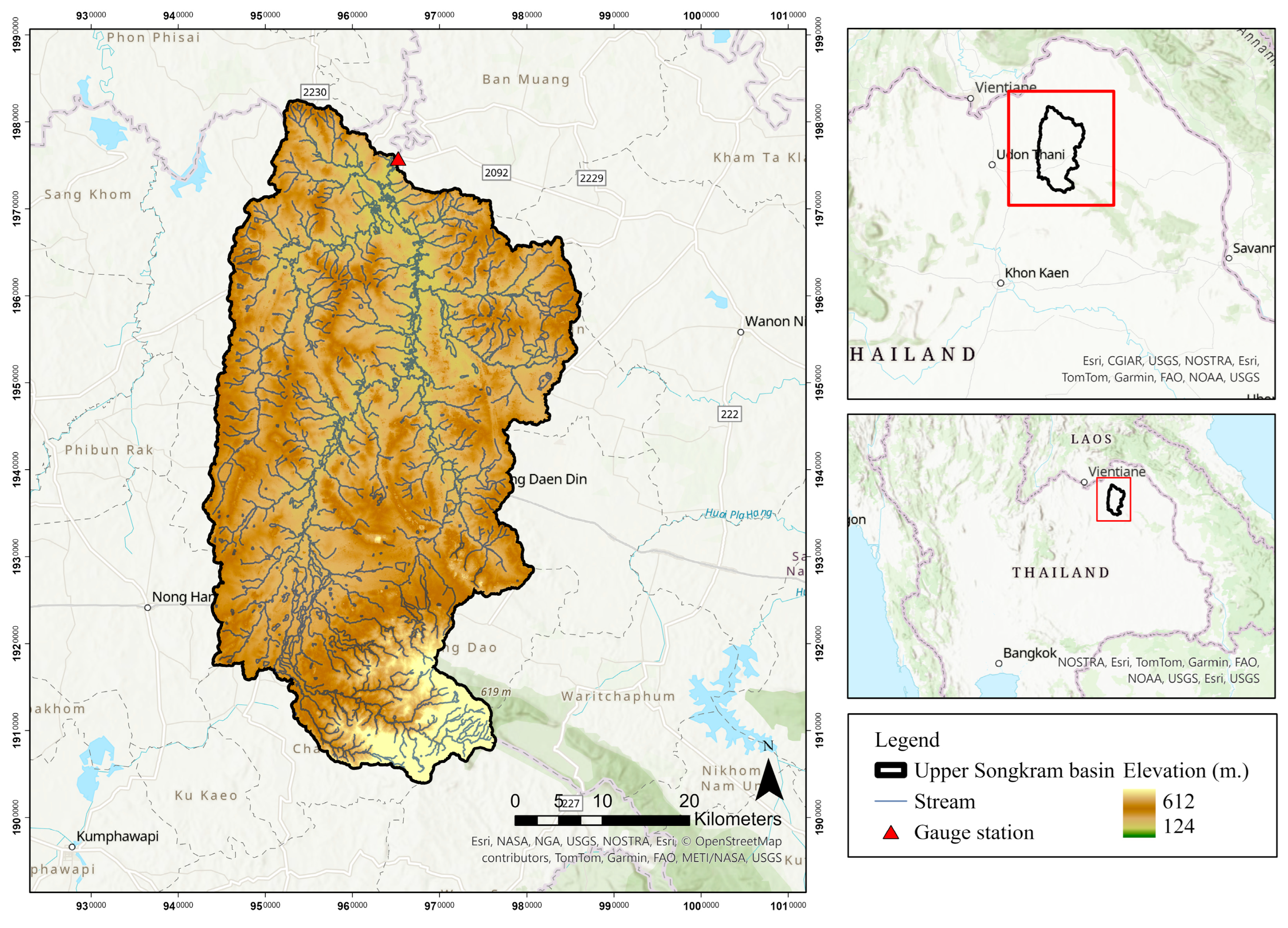
The study was conducted in the Upper Songkhram River Basin, located in Ban Muang District, Sakon Nakhon Province, northeastern Thailand (Figure 1). The basin forms part of the Songkhram River system, a major tributary of the Mekong River [11], and represents a flood-prone lowland catchment that is highly sensitive to monsoon-driven hydrological variability.
Topographically, the basin shows a clear upstream-downstream gradient, with headwaters originating from the Phu Phan Mountain range and downstream areas forming a wide, low-lying floodplain. The elevation and slope maps derived from the 12.5 m ALOS PALSAR DEM [12] indicate predominantly gentle terrain (~1–3%), which limits drainage efficiency and promotes widespread floodplain inundation during high-flow conditions.
The floodplain adjacent to the main river channel extends about 1–3 km on both sides and functions as a natural floodwater storage zone [13]. Combined with the basin’s low relief and gentle slope, this setting promotes widespread lateral inundation during high-flow conditions. Key physical and geomorphological characteristics of the basin are summarized in Table 1.
Hydrologically, the Upper Songkhram River Basin is dominated by the Southwest Monsoon, with most annual rainfall occurring between July and October, frequently producing seasonal riverine flooding over the low-lying floodplain [14]. The basin has experienced several severe flood events in recent decades, including a major flood in 2017 that caused widespread inundation [15], indicating high sensitivity to extreme hydrological conditions. Owing to its low-gradient floodplain morphology and seasonally persistent discharge regime, the basin provides a suitable case for flood inundation modeling under historical and future climate conditions.

2.2. Overview of the Hybrid Modeling Framework

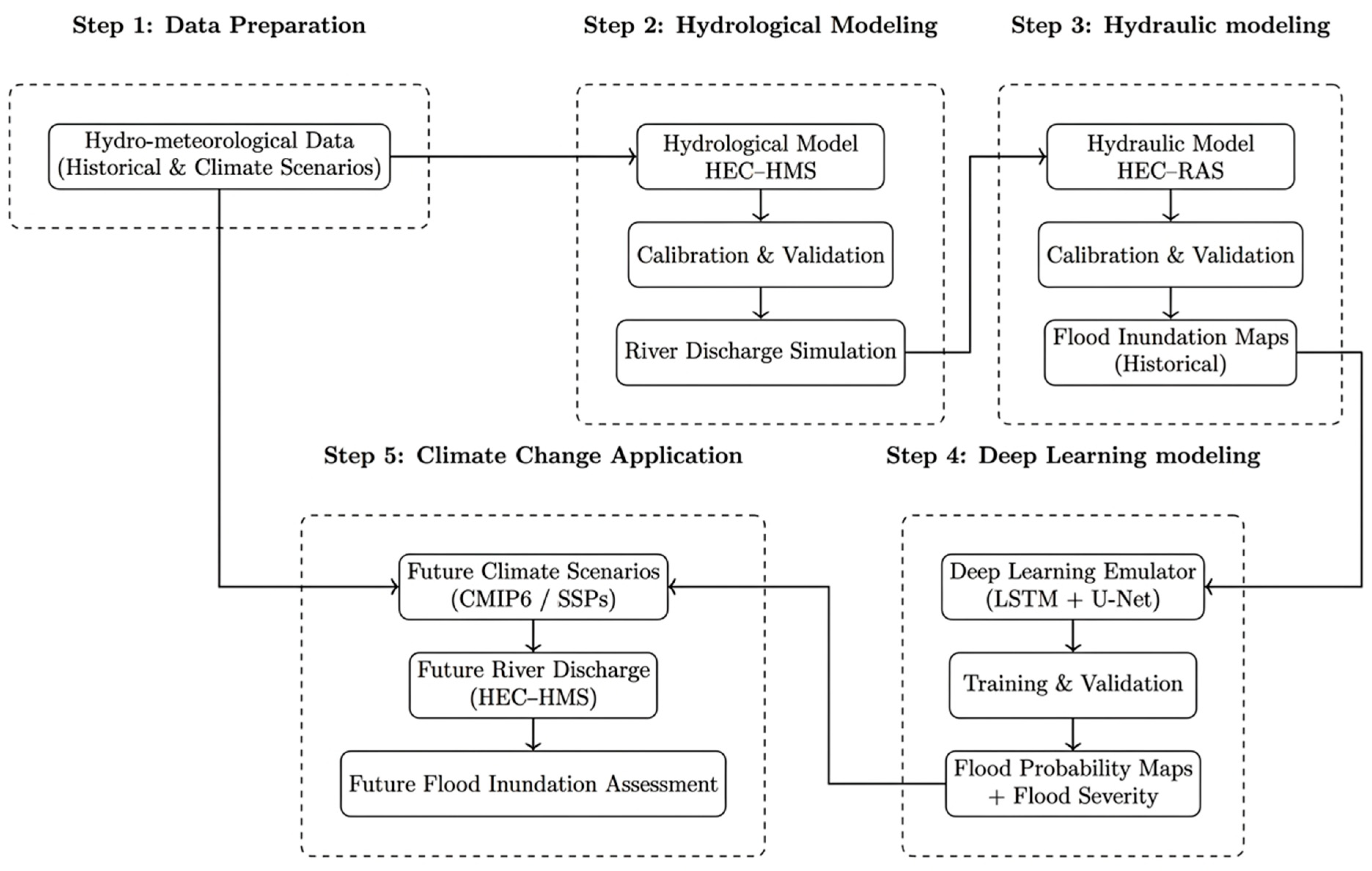
This study proposes a hybrid flood inundation modeling framework (Figure 2) that couples a physically based hydrological–hydraulic modeling system with a deep learning–based LSTM–U-Net flood inundation model. Hydrological simulations using HEC-HMS generate river discharge, which is applied as upstream forcing to a two-dimensional HEC-RAS model to produce spatial flood inundation maps. The resulting discharge–inundation datasets under historical conditions are used to train and validate a deep learning model that emulates hydraulic flood patterns from antecedent discharge conditions. Climate change scenarios are introduced only during the prediction stage, ensuring that the deep learning model functions strictly as a surrogate of the hydraulic model rather than as part of the climate forcing chain.

2.3. Hydrological Modeling Using HEC-HMS

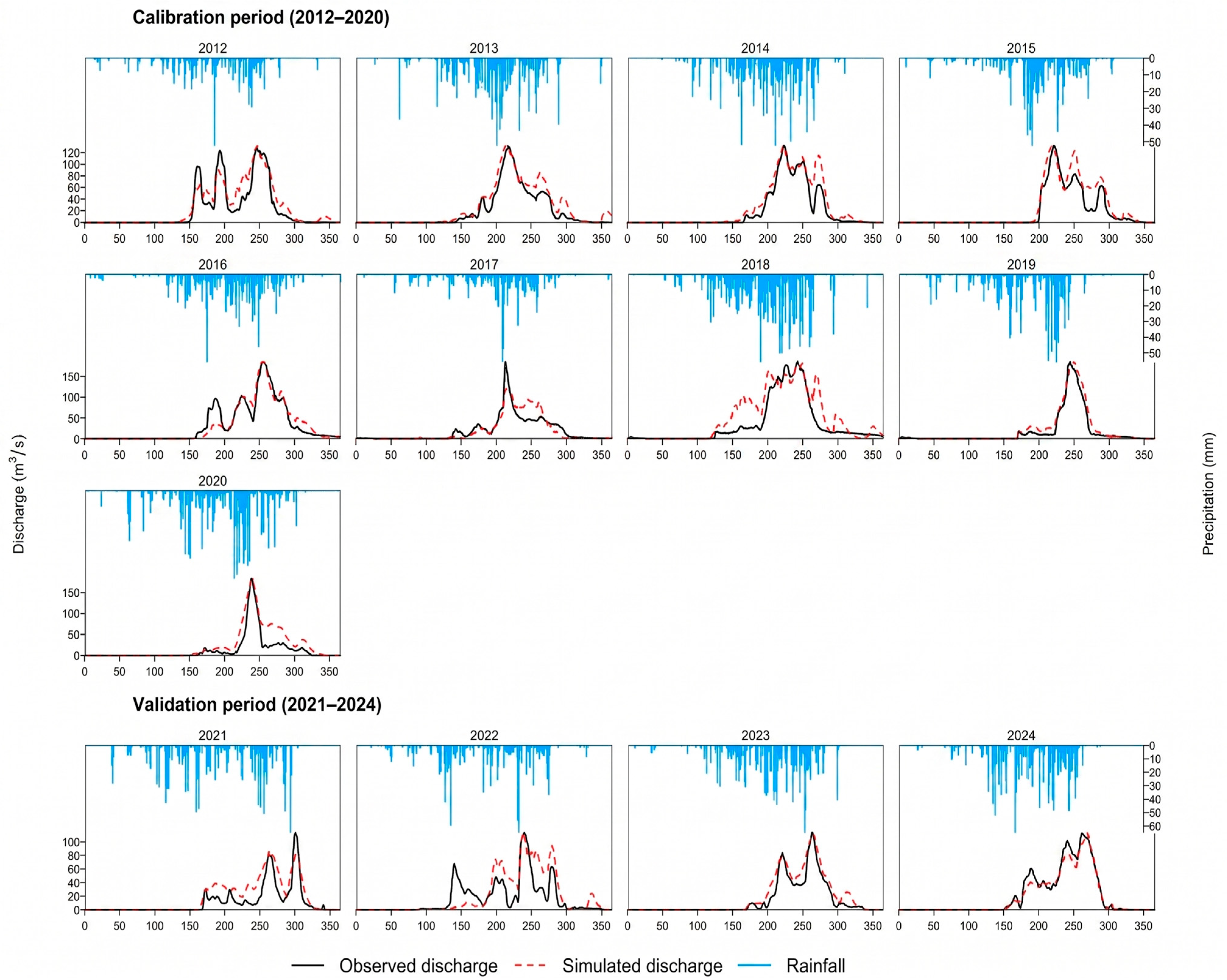
Hydrological processes in the study basin were simulated using HEC-HMS (Version 4.7, U.S. Army Corps of Engineers, Hydrologic Engineering Center, Davis, CA, USA) to generate daily discharge time series at the basin outlet (KH.74 gauging station), which were used as upstream boundary conditions for the hydraulic model. The model was run at a daily time step and calibrated using observed streamflow data for 2012–2020, with validation for 2021–2024. Standard runoff generation, baseflow, and routing components available in HEC-HMS were applied following common flood-oriented hydrological modeling practice [16,17].
Runoff generation was simulated using the Soil Conservation Service Curve Number (SCS-CN) method, which estimates direct runoff as a nonlinear function of rainfall, land use, soil properties, and antecedent moisture conditions [18,19]. Based on the watershed storage concept, surface runoff is assumed to occur only after initial abstraction is satisfied, with the curve number (CN) parameter representing the combined effects of soil and land cover. Direct runoff Q is computed from rainfall P as
  Q = 0 ,   P I a ; P     I a 2 P     I a + S ,   P   >   I a
where I a represents initial abstraction, and S is the potential maximum retention.
Excess rainfall was transformed into direct runoff hydrographs using the Snyder unit hydrograph method, which relates hydrograph shape and timing to basin geometry and drainage characteristics [20,21]. Baseflow contribution was represented using the recession method, assuming exponential decay of groundwater discharge following storm events [17]. Channel routing was performed using the Muskingum method, which represents channel storage as a weighted function of inflow and outflow for flood wave propagation in river channels [22].

2.4. Hydraulic Modeling Using HEC-RAS

Floodplain hydraulics were simulated using the two-dimensional (2D) HEC-RAS module (Version 6.6, U.S. Army Corps of Engineers, Hydrologic Engineering Center, Davis, CA, USA), which solves the depth-averaged shallow water (Saint-Venant) equations for unsteady flow over complex terrain [23]. The governing equations comprise the continuity and momentum equations in the x- and y-directions. The continuity equation is
h t + h u x + h v y = 0
and the momentum equations in the x and y directions are
h u t + h u 2 x + h u v y = g   h z x   g   h   S f x
h v t + h u v x + h v 2 y = g   h z y   g   h   S f y
where h is water depth, u and v are depth-averaged velocity components, z is bed elevation, and S f is the friction slope computed using Manning’s equation [24].
The two-dimensional HEC-RAS model computes spatially distributed water depth and velocity fields, from which inundation extent is delineated based on positive water depth. Flood maps were exported as raster datasets representing channel–floodplain interactions and were used as reference data for training and evaluating the LSTM–U-Net model. HEC-RAS has been widely applied for high-resolution flood hazard assessment [25,26].
The model was implemented using a computational mesh derived from the ALOS PALSAR DEM (12.5 m resolution) with a grid size of 50 m. Manning’s roughness coefficients were assigned based on land use characteristics. The upstream discharge simulated by HEC-HMS was applied as boundary forcing, while downstream conditions were specified using normal depth. Simulations were performed under unsteady flow conditions with a 12 h time step to ensure numerical stability while remaining consistent with the daily resolution of the input data.

2.5. Deep Learning-Based Flood Inundation

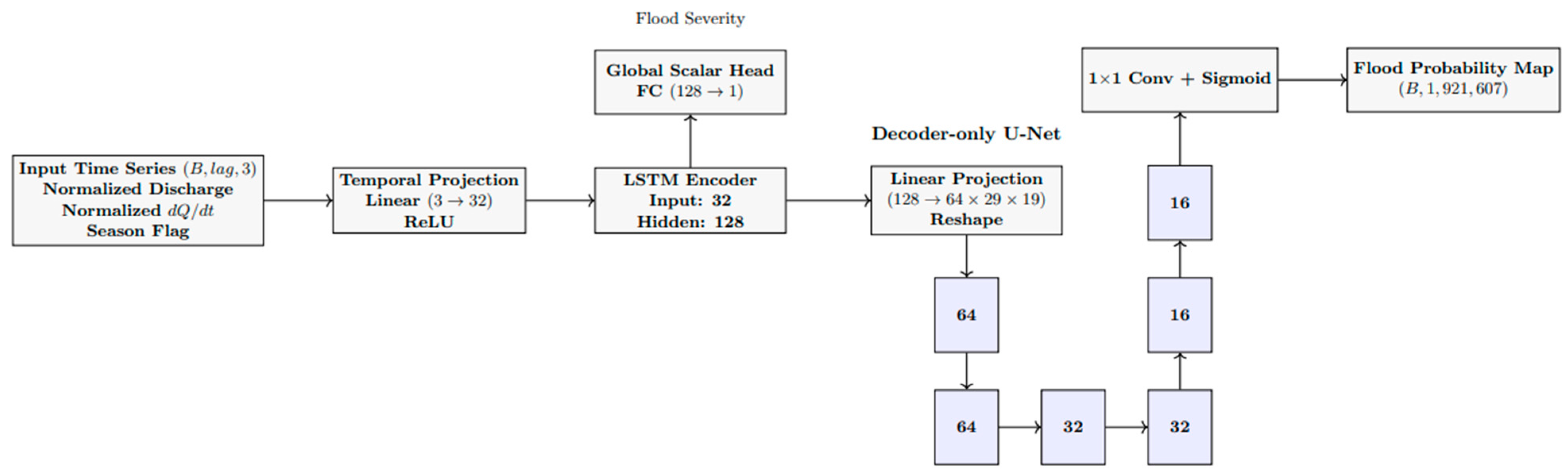
The deep learning model was designed as a computational surrogate of the physically based hydraulic model (Figure 3), rather than an independent flood prediction system. Consistent with previous studies on machine-learning surrogate models trained from physics-based flood simulations [27], it learned the nonlinear relationship between antecedent river discharge and spatial inundation patterns simulated by the two-dimensional HEC-RAS model and produced pixel-wise flood probability maps using a sigmoid activation function. Because the model was trained exclusively on hydraulically simulated flood maps, it preserved consistency with the hydrological–hydraulic modeling framework. Model training used hydraulically simulated discharge–inundation pairs from four representative flood years (2013, 2017, 2018, and 2023), while two independent flood years (2019 and 2024) were reserved for validation to assess event-level generalization.
The LSTM–U-Net model combined a temporal encoder and a spatial decoder to reproduce flood inundation patterns from antecedent discharge conditions. The LSTM component extracted temporal information from discharge sequences, while the U-Net-inspired decoder reconstructed two-dimensional inundation patterns, consistent with previous hybrid spatiotemporal flood-modeling studies [28,29]. Each timestep was represented by three input features: normalized discharge, its temporal derivative (dQ/dt), and a binary seasonal indicator. These inputs were arranged as a 10-timestep sequence, projected into a 32-dimensional space, and processed by a single-layer LSTM with 128 hidden units. The final hidden state was converted into a 64 × 29 × 19 spatial latent representation and decoded using five U-Net-inspired upsampling blocks. A final 1 × 1 convolution with sigmoid activation produced the pixel-wise flood probability map, while an auxiliary output estimated flood severity as the fraction of inundated area. The deep learning model was implemented and trained using Python (Version 3.11.9) with PyTorch (Version 2.4.1).
Model optimization was performed using the Adam optimizer proposed by Kingma and Ba (2015), because it adaptively adjusts learning rates during optimization [30]. Training was conducted with a learning rate of 1 × 10⁻⁴, a batch size of 16, and a maximum of 200 epochs, and early stopping based on validation loss was applied to reduce overfitting. The model was trained in a multi-task setting to predict both flood extent and flood severity. The flood extent loss combined binary cross-entropy with Dice loss, following the overlap-based segmentation loss introduced by Milletari et al. (2016), to improve pixel-wise flood classification and spatial overlap under class imbalance [31]. The flood severity loss used mean squared error because this output was treated as a continuous variable. Model performance was evaluated using Kappa and F1-score.

2.6. Climate Data and Future Precipitation Projections

Future precipitation data were obtained from 12 CMIP6 Global Climate Models (GCMs) using daily precipitation outputs. SSP2-4.5 and SSP5-8.5 were selected as intermediate- and high-emission pathways based on the CMIP6 scenario framework [32]. The selected GCMs and their horizontal resolutions are summarized in Table 2. Quantile Mapping (QM), a distribution-based bias-correction method [33], was used in this study to reduce systematic biases in GCM-simulated precipitation. QM was calibrated by matching the cumulative distribution of simulated daily precipitation to the observed distribution during the historical reference period of 1994–2014. The derived correction functions were then applied to future daily precipitation under SSP2-4.5 and SSP5-8.5.
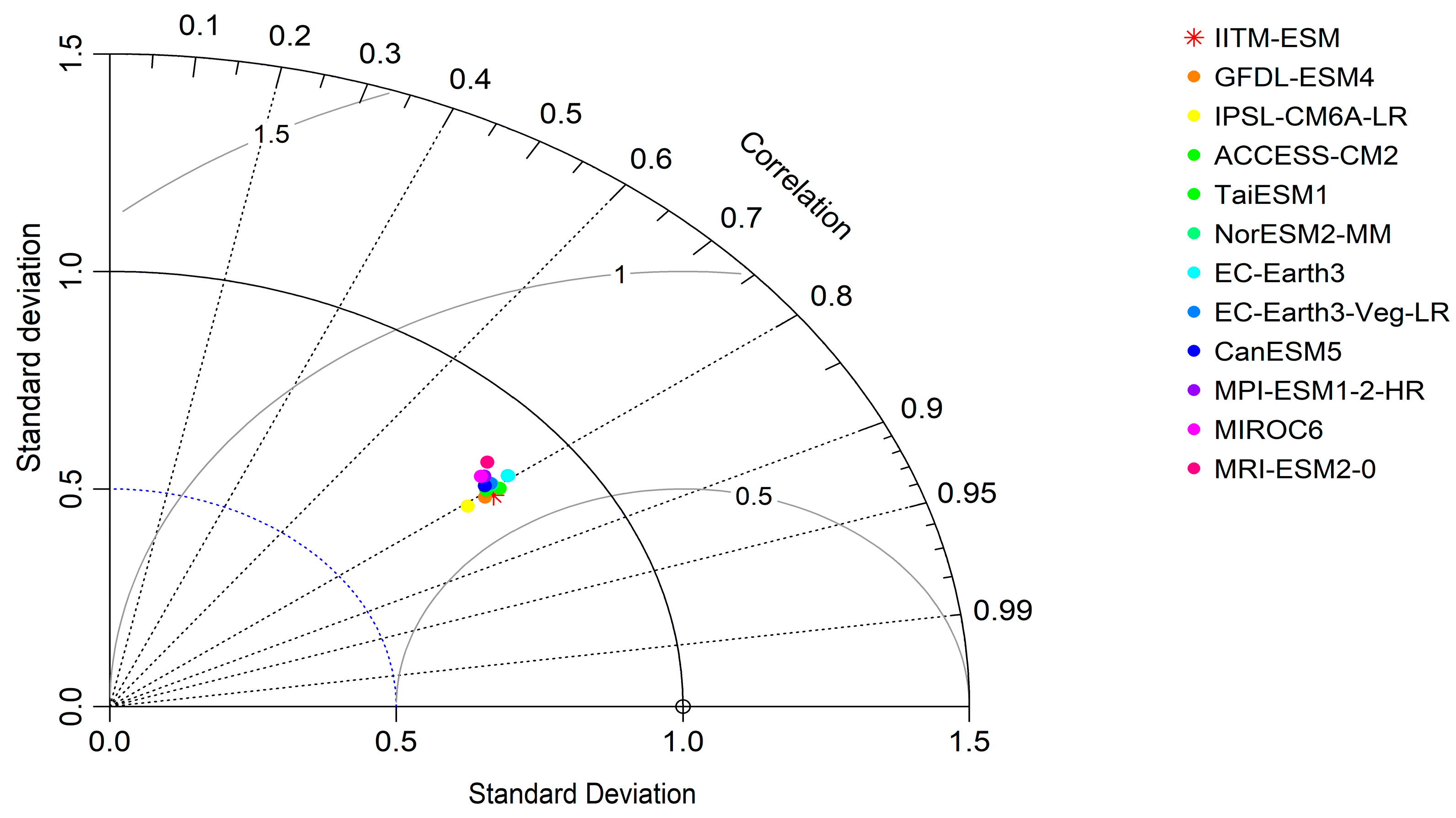
The corrected precipitation data were then downscaled to a spatial resolution of about 2.5 km and prepared for use in the hydrological modeling framework. Taylor diagrams, which evaluate model performance using correlation, RMSE, and standard deviation as described by Taylor (2001) [34], were applied to compare the historical simulations of the selected GCMs with observed precipitation (Figure 4). Among the evaluated models, IITM-ESM showed the best overall agreement with the observations and was therefore selected for future projections. Future climate projections were then analyzed for three target years: 2029, 2034, and 2044.

2.7. Evaluation Metrics

Model performance was evaluated using hydrological and spatial metrics. Hydrological performance was assessed by comparing observed and simulated daily discharge using the Nash–Sutcliffe efficiency (NSE), Kling–Gupta efficiency (KGE), coefficient of determination (R2), and root mean square error (RMSE) [35,36,37]. NSE and KGE evaluate agreement in magnitude, variability, and temporal dynamics, while R2 and RMSE quantify correlation and error magnitude. The Nash–Sutcliffe efficiency (NSE) is defined as
NSE = 1   t = 1 T Q t obs Q t sim 2 t = 1 T Q t obs Q obs ¯ 2
where Q t obs and Q t sim denote the observed and simulated discharge at time step t, respectively, Q obs ¯ is the mean observed discharge, and T is the total number of time steps. NSE values closer to unity indicate better model performance.
Spatial performance was evaluated through pixel-wise comparison between the reference and predicted flood maps. The maps were converted into binary classes, and classification metrics—including precision, recall, F1-score, intersection over union (IoU), and Kappa—were computed [38,39,40]. The F1-score was used as the primary metric, as it balances omission and commission errors. The F1-score is defined as
F 1 = 2 TP 2 TP + FP + FN
where TP , FP , and FN denote the number of true positives, false positives, and false negatives, respectively.

2.8. Use of Artificial Intelligence Tools

ChatGPT (GPT-5.4, OpenAI) and Perplexity AI (web version) were used only as supporting tools for organizing background information and listing potentially relevant literature. All scientific content and references were independently verified by the authors.

3. Results

3.1. Performance of the Coupled Hydrological–Hydraulic Model

The hydrological component was calibrated for the period 2012–2020 and validated for 2021–2024 at the KH.74 streamflow gauging station in the Upper Songkhram River Basin. Figure 5 shows good agreement between observed and simulated daily discharge, with the HEC-HMS model accurately capturing seasonal dynamics and major flood peaks. Quantitative evaluation yielded an NSE of 0.896, KGE of 0.827, R2 of 0.909, and RMSE of 18.13 m3/s, indicating high predictive skill in reproducing daily discharge variability and peak flows.
The hydraulic model was evaluated by comparing simulated flood extents with satellite-derived inundation maps from GISTDA for three major flood years (2017, 2023, and 2024). Annual maximum flood extents were extracted and aggregated for assessment. The results indicate strong spatial agreement, with an overall F1-score of 0.876 and a Kappa of 0.873, while precision and recall (Table 3) confirm accurate delineation of flooded areas. The simulated mean annual maximum inundation area (74.93 km2) closely matches the observed extent (77.02 km2), corresponding to a relative difference of 2.7%.

3.2. Performance Evaluation of the LSTM–U-Net Model

3.2.1. Model Configuration Evaluation

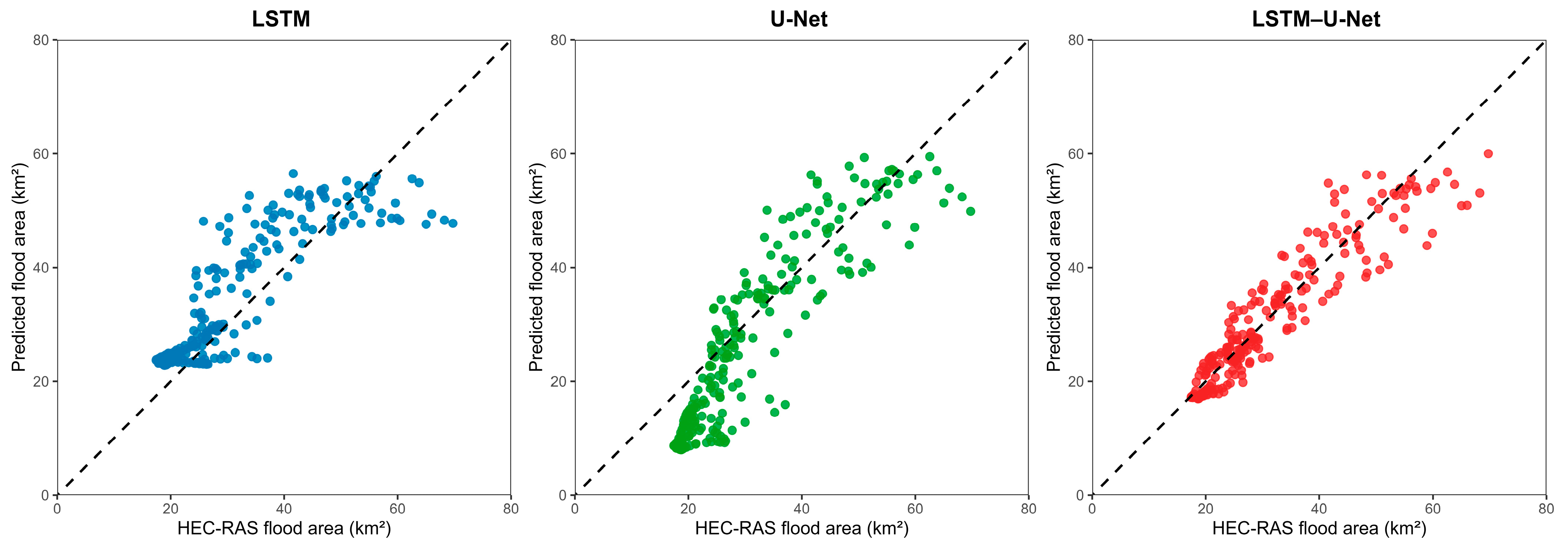
The LSTM–U-Net model was compared with two baseline models, a standalone LSTM and a U-Net, using the same validation dataset and HEC-RAS simulations as the reference. All models were trained under consistent settings to ensure a fair comparison. The quantitative results are summarized in Table 4. Overall, the LSTM–U-Net model achieved the best performance, followed by the U-Net, while the standalone LSTM showed the weakest performance.
These differences were also evident in the scatter plots (Figure 6). The LSTM model captured some of the variations in the flooded area, and its predictions generally increased with increasing HEC-RAS values. However, the points remained clustered, especially in lower flood areas, and the model tended to underestimate some large flood events. The U-Net model covered a wider range of flood areas, but clear deviations from the 1:1 line were still present. In contrast, the LSTM–U-Net model showed the best agreement with the reference, with most points lying close to the 1:1 line across a wider range of flooded areas.
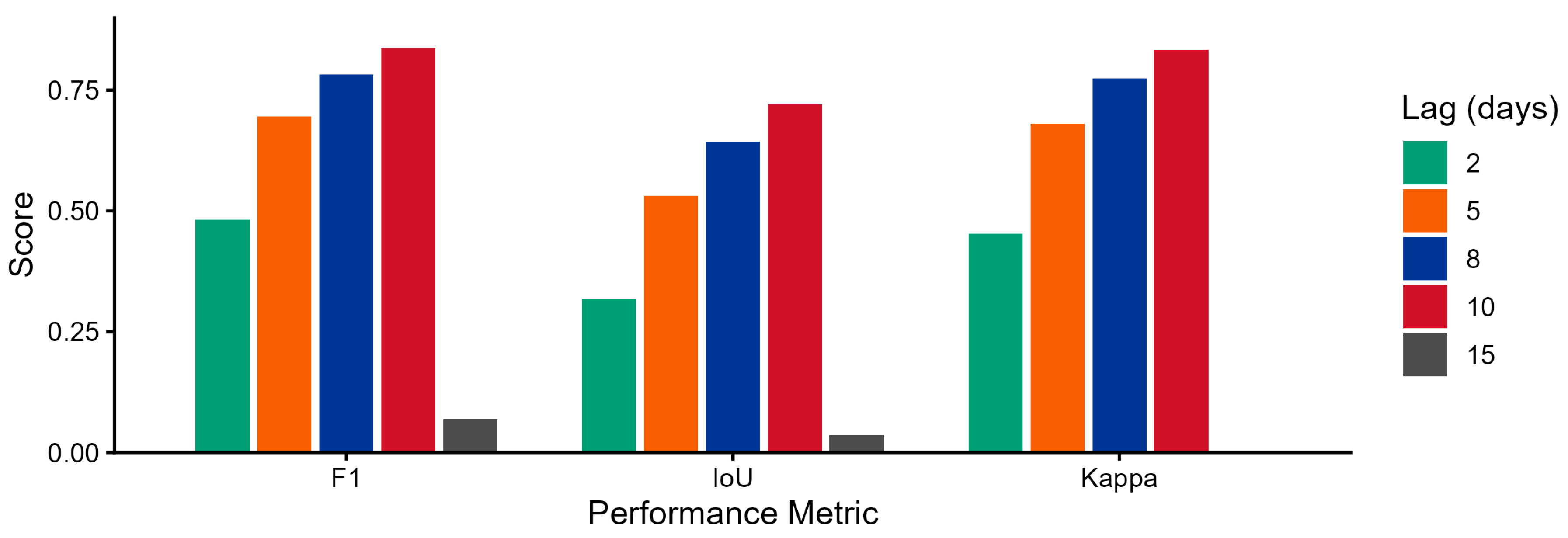
In addition to the model-structure assessment, the temporal input configuration was evaluated by testing different lag lengths for the LSTM encoder. Different lag lengths (T = 2, 5, 8, 10, and 15 days) were tested, and model performance was assessed using F1-score, IoU, and Kappa (Figure 7). Model performance improved as the lag length increased from 2 to 10 days, and the best performance was obtained at T = 10, which produced the highest F1, IoU, and Kappa values among the tested configurations.
Short lag lengths (T = 2–5) resulted in lower accuracy, while an excessively long lag (T = 15) caused a substantial decrease in performance. Based on these results, a lag length of 10 days was selected for all subsequent experiments.
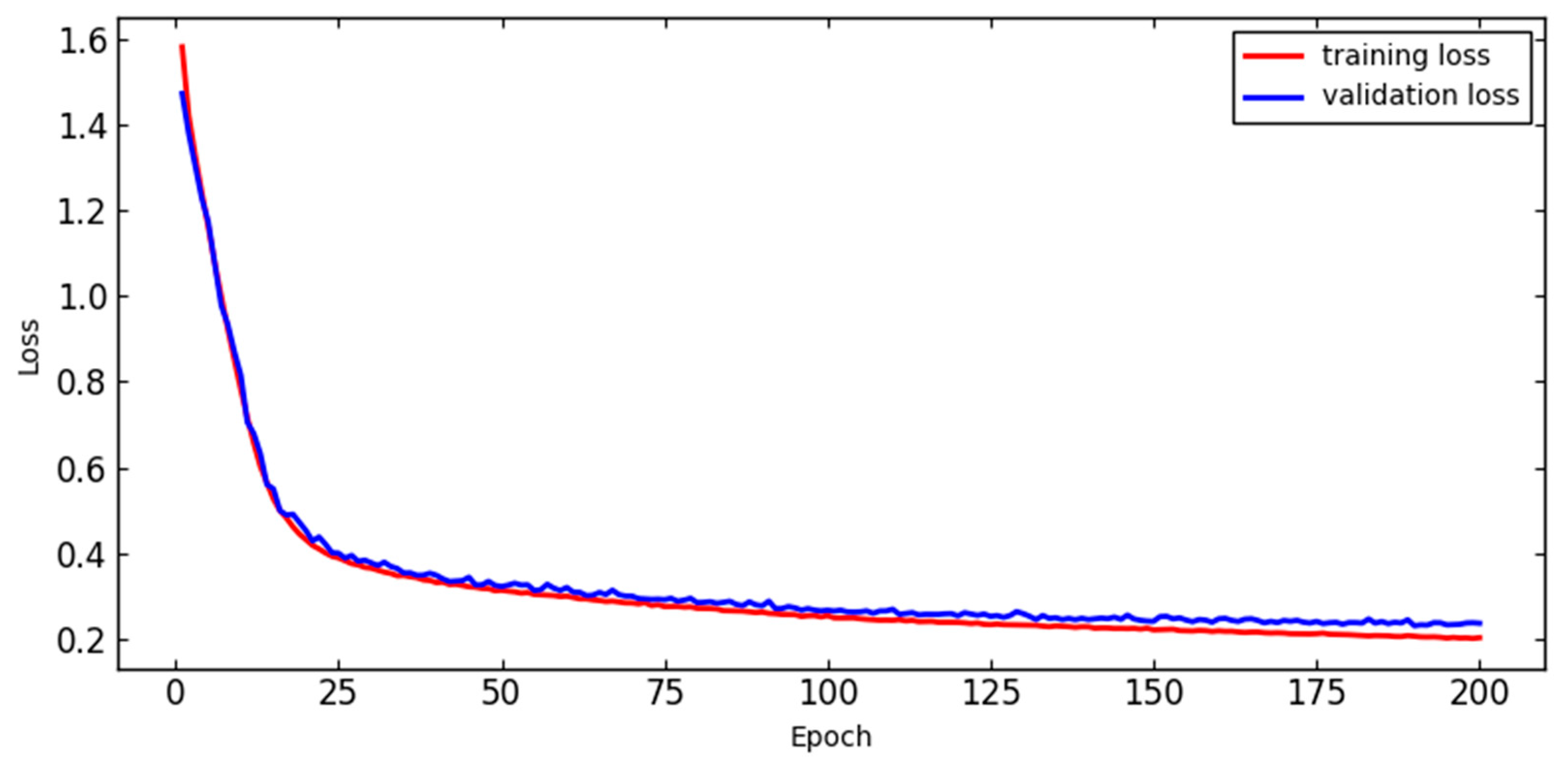
To further examine the learning process of the LSTM–U-Net model, the training and validation loss curves were analyzed (Figure 8). The loss curves decreased rapidly during the early epochs and then gradually stabilized toward the end of training. The validation loss closely followed the training loss with only minor fluctuations and did not show a sustained increase, indicating stable model convergence without severe overfitting.

3.2.2. Event-Based Model Validation

The LSTM–U-Net model showed strong spatial agreement with flood maps simulated by HEC-RAS, with an average F1-score of 0.838, IoU of 0.721, and Kappa of 0.833 (Table 5). These results indicate that the model can accurately reproduce the overall flood extent.
To examine the model behavior in more detail, two flood events (2019 and 2024) were selected as validation cases. Both events showed similar overall flood patterns. In addition, the 2024 event included satellite-based flood extent data from GISTDA, which provides additional reference for spatial comparison.
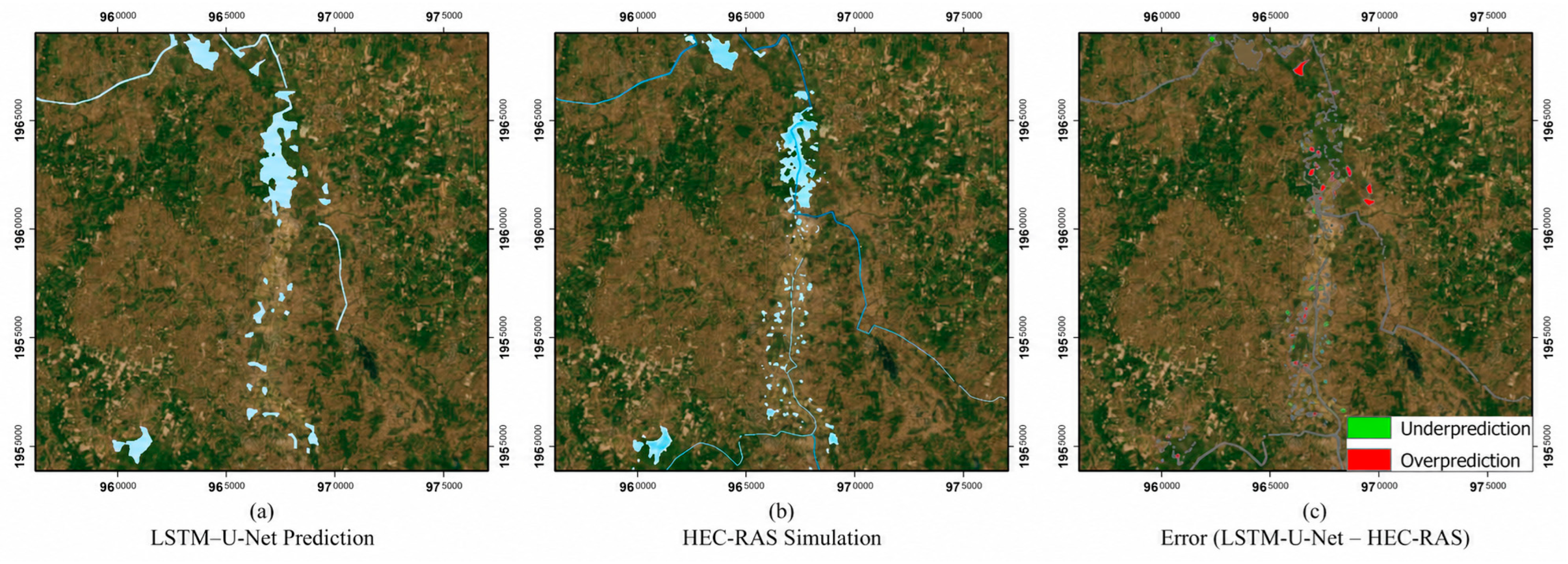
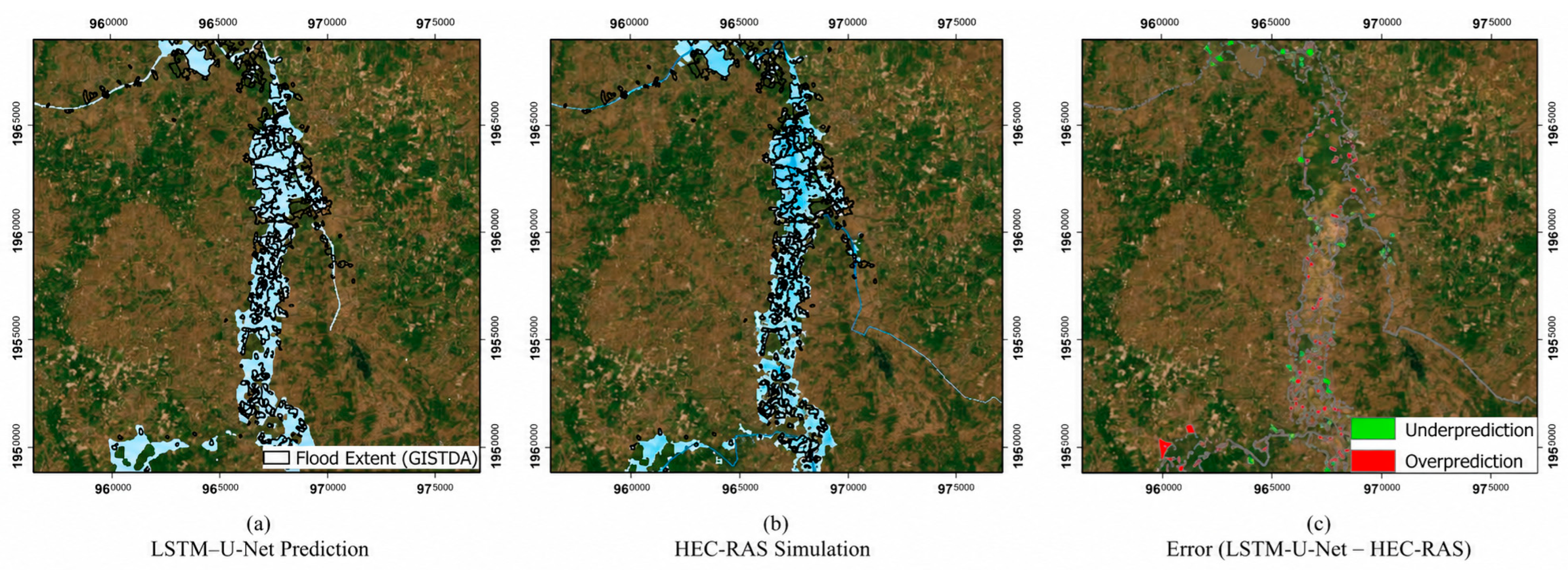
For the 2024 event, a representative high-magnitude timestep was selected for detailed spatial comparison (Figure 9). The predicted flood extent showed good agreement with the HEC-RAS simulation and satellite observations, with metrics computed against the HEC-RAS simulation (F1 = 0.855; IoU = 0.747). Flooded areas were continuous along the river and adjacent low-lying areas, and the model captured this structure clearly. Most errors were located near the boundaries of the flooded areas.
For the 2019 event, a representative low-inundation timestep was selected for spatial analysis (Figure 10). The flooded areas were smaller and more fragmented than in the selected 2024 high-inundation case, with metrics computed against the HEC-RAS simulation (F1 = 0.711; IoU = 0.551). The error map showed that the model tended to overpredict inundation under this weak-inundation condition, particularly along flood boundaries and disconnected areas. However, these overpredicted areas were localized and did not form extensive false inundation across the study area.

3.3. Climate Change Impact and Future Flood Inundation Projection

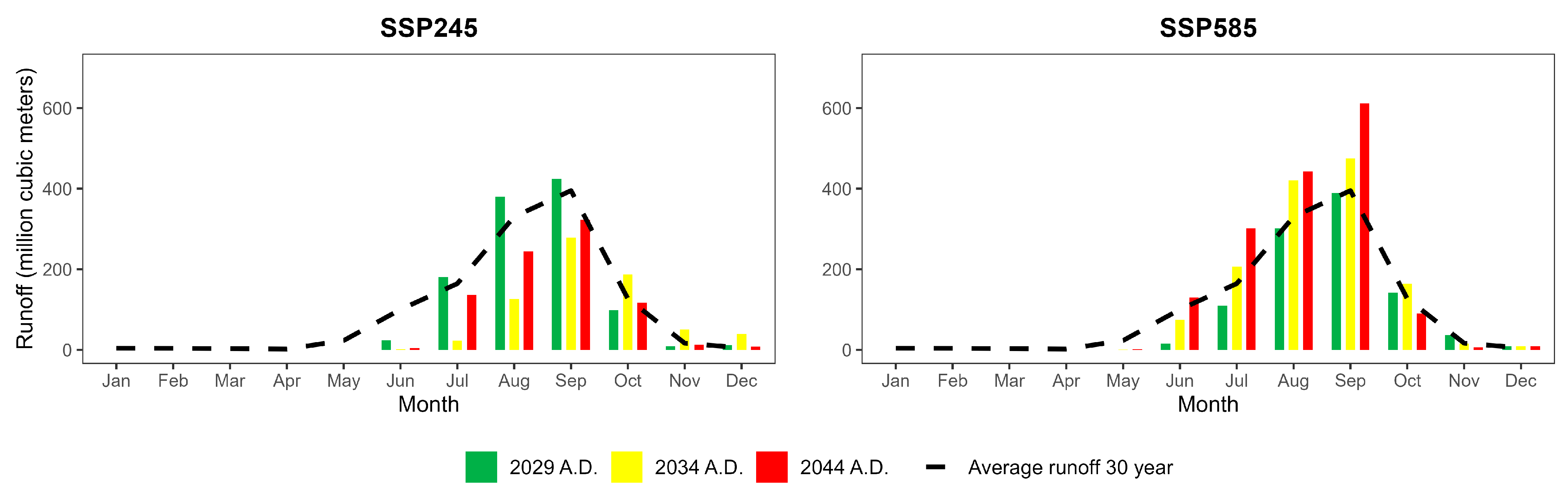
Projected monthly runoff under SSP2-4.5 and SSP5-8.5 showed a clear seasonal pattern, with most runoff occurring during July–October (Figure 11). During the peak months of August–September, runoff under both scenarios was projected to be higher than the historical 30-year average, indicating stronger runoff during the flood season.
Under SSP2-4.5, which represents moderate climate change conditions, runoff varied over time. Peak runoff during August–September was highest in 2029 (about 380–425 mcm), decreased in 2034 (125–280 mcm), and increased again in 2044 (240–320 mcm). In contrast, runoff under SSP5-8.5 increased steadily, with peak values rising from about 300–390 mcm in 2029 to 420–475 mcm in 2034 and reaching 440–612 mcm in 2044, indicating stronger runoff under higher emission conditions.
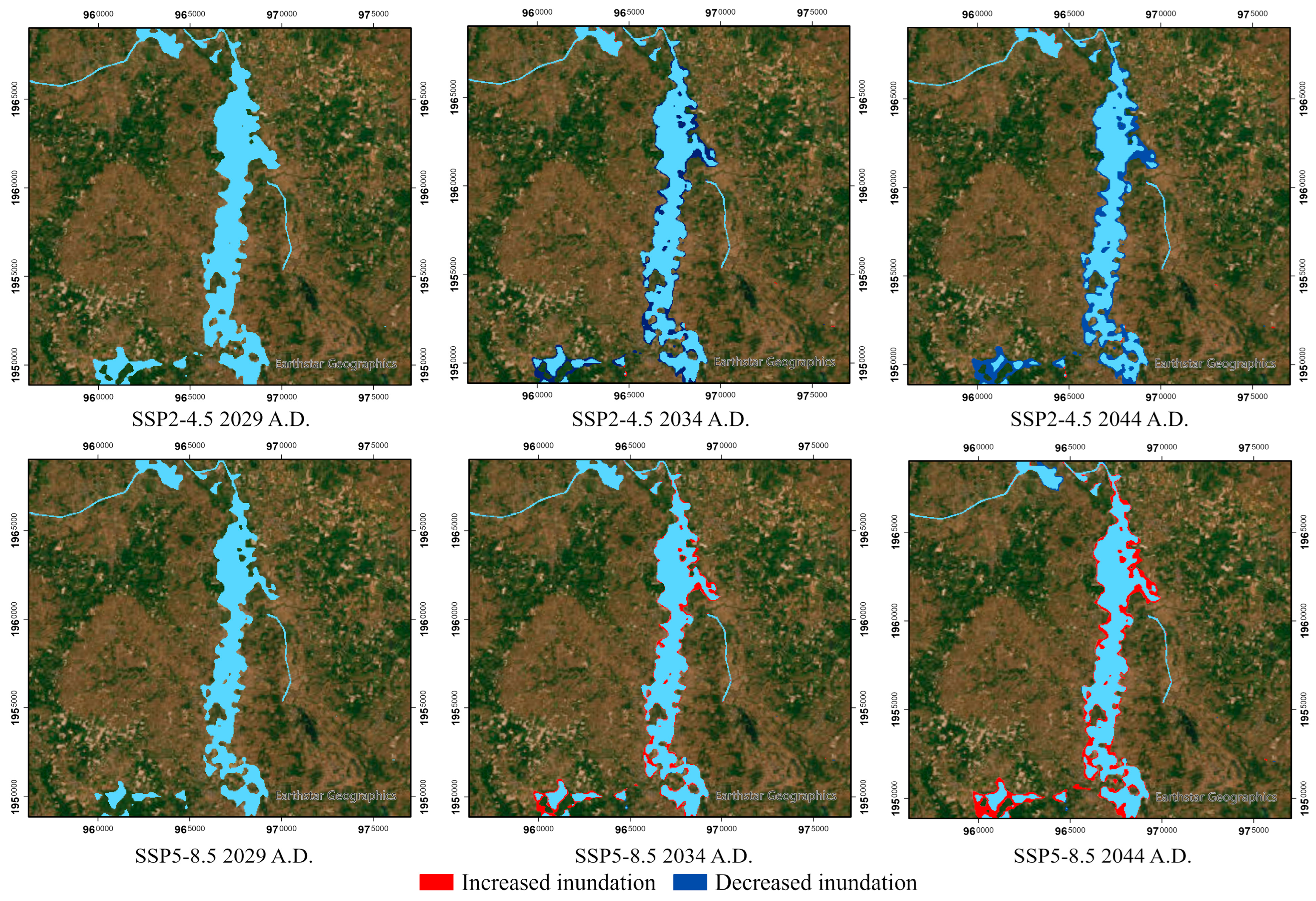
The projected runoff series were then used as input to the LSTM–U-Net model to estimate annual maximum flood inundation patterns. Event-based analysis of annual maximum flood extent showed different trends under the two emission scenarios (Figure 12). Under SSP2-4.5, flood extent decreased over time, with the largest inundation area occurring in 2029 (64.06 km2), followed by smaller extents in 2034 (50.85 km2) and 2044 (47.31 km2). This reduction was most clearly seen along the edges of the floodplain, where inundated areas became smaller in the later projection years. In contrast, under SSP5-8.5, flood extent increased steadily from 57.77 km2 in 2029 to 62.60 km2 in 2034 and 69.91 km2 in 2044. This increase was more visible in areas close to the main floodplain, showing that the spatial extent of flooding tended to expand under the higher-emission scenario.

4. Discussion

4.1. Representation of Flood Processes Using a Coupled Model

The strong hydrological (NSE = 0.896; KGE = 0.827) and hydraulic (F1 = 0.876; Kappa = 0.873) performance indicates that the coupled HEC-HMS–HEC-RAS framework provides a reliable and physically consistent basis for flood simulation in the Upper Songkhram Basin. The framework captures the runoff generation and downstream floodplain response within the same modeling chain. This is consistent with previous applications in low-gradient, monsoon-influenced floodplains [41,42]. It is also supported by Peker et al. (2024), who showed that coupling hydrological and hydraulic models improves the representation of the discharge and inundation dynamics [5]. In the Upper Songkhram Basin, flooding is controlled not only by runoff magnitude but also by channel–floodplain interactions and basin-scale storage processes, indicating a storage-influenced flood regime. This behavior is further shaped by the basin’s geomorphological characteristics, including low relief, gentle slope, elongated basin form, and strong lateral connectivity (Table 1), which promote overbank flow, temporary storage, and attenuation of flood wave propagation [3].
Under these conditions, a single-model approach would represent only part of the flood system and could misrepresent the relationship between discharge and inundation extent. In low-gradient floodplains, part of the incoming discharge is temporarily stored and later released, while flow is redistributed across the floodplain. Wohl (2021) emphasized that floodplains function as dynamic storage systems, where temporary storage and delayed release can weaken the direct relationship between discharge magnitude and inundation extent [43]. As a result, similar discharge magnitudes may produce different inundation extents depending on antecedent storage conditions. Therefore, a coupled modeling approach is needed to represent the basin-scale hydrological processes and downstream floodplain dynamics.

4.2. Efficient Surrogate Modeling Using Hybrid Deep Learning

The superior performance of the LSTM–U-Net model indicates that representing flood inundation in this study required the temporal and spatial learning components. This interpretation is partly consistent with Besseling et al. (2024), as their study showed that LSTM can accurately capture temporal changes in floodwater depth from hydrographs [44]. In this case, however, temporal information alone was insufficient to reproduce the spatial variability of flood extent, which helps explain the weaker performance of the standalone LSTM. Conversely, the U-Net better represented spatial inundation patterns, highlighting the importance of spatial feature extraction for flood mapping. This agrees with Bian et al. (2025), as their study reported strong U-Net performance in spatial and temporal inundation prediction [29]. However, without an explicit temporal learning component, the U-Net was less effective in capturing event-to-event hydrological variation. Taken together, these results suggest that the hybrid architecture was better suited to the prediction task because it combines temporal sequence learning with spatial pattern extraction, consistent with previous hybrid flood-modeling studies [45].
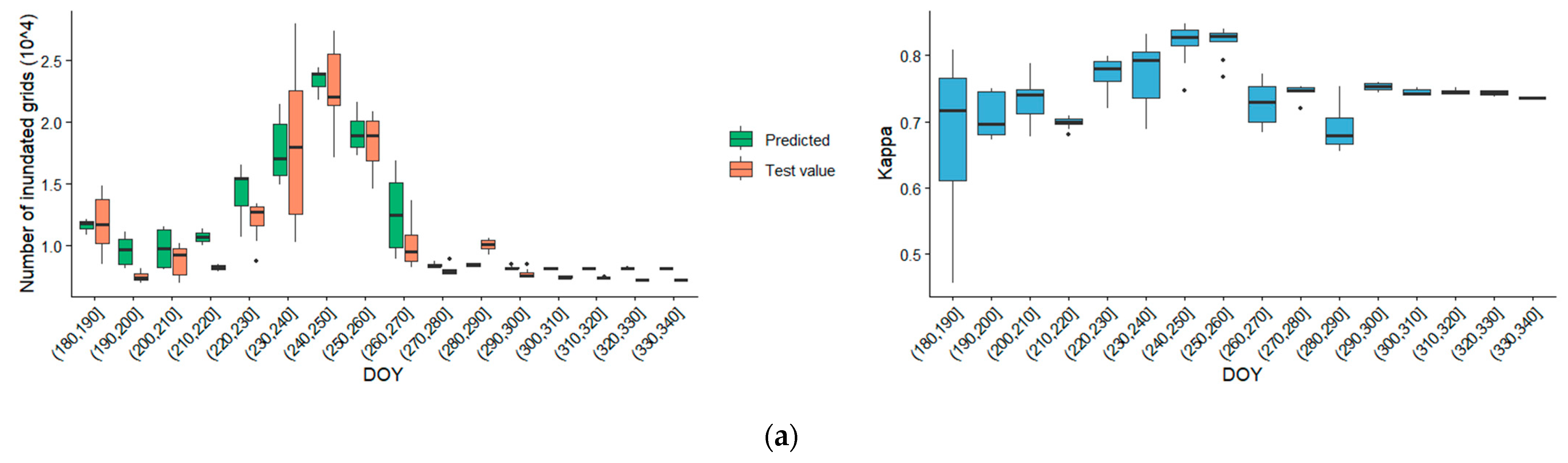
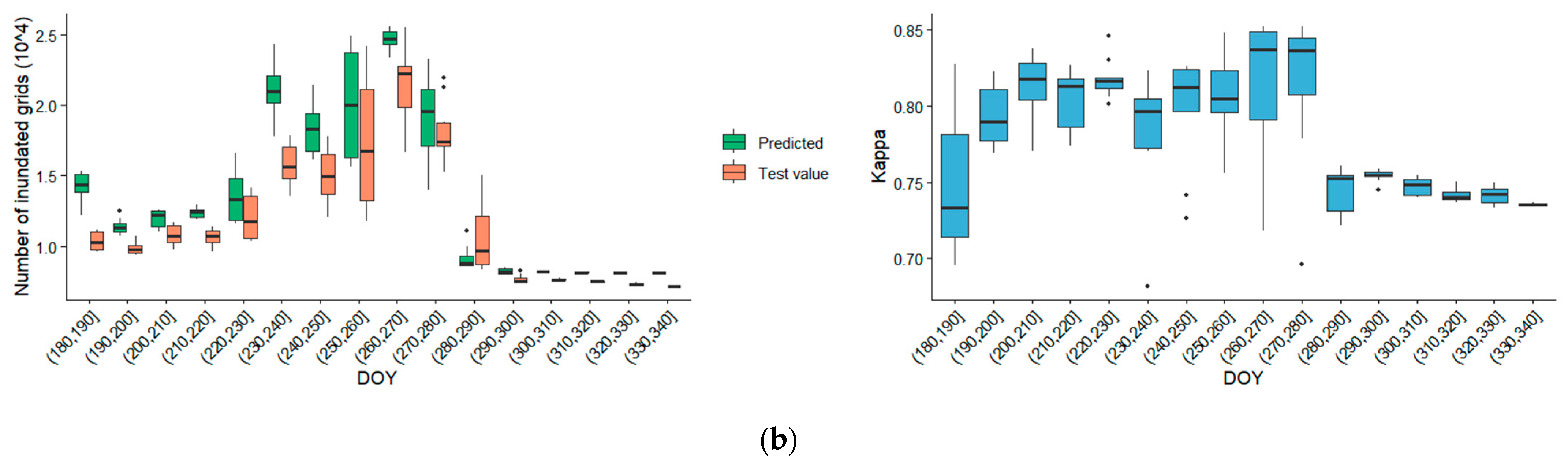
The comparison between the two-dimensional HEC-RAS simulations and the LSTM–U-Net model highlights the complementary roles of physics-based hydraulics and deep learning surrogates. HEC-RAS simulates floodplain hydraulics in low-gradient basins, whereas LSTM–U-Net reproduces the dominant inundation pattern, particularly the spatial organization of the core flooded areas. This indicates that the surrogate model preserves the main hydraulic response of the system rather than merely estimating flood extent. The stable agreement across different flood periods (Figure 13), together with the validation results in Section 3.2.2, further suggests that the hybrid framework can reproduce the main inundation dynamics of the study floodplain while retaining its dominant spatial structure. In addition, the lag-length sensitivity reported in Section 3.2.1 indicates that inundation in the Upper Songkhram Basin is influenced not only by topography and floodplain storage but also by antecedent hydrological conditions. This is consistent with the behavior of low-gradient, storage-dominated floodplains, where inundation is governed more by cumulative filling and antecedent system state than by discharge at a single time step [6,9].
While the LSTM–U-Net model captures the main inundation pattern, especially in the floodplain core, the spatial distribution of the error helps explain model behavior. As shown in Section 3.2.2, most discrepancies occur along shallow inundation boundaries, whereas the floodplain core remains consistent with HEC-RAS. This pattern is consistent with Li et al. (2026), who reported boundary delineation errors in complex floodplains [46], and Noori et al. (2025), who found classification uncertainty in transition zones and shallow flooded areas [47]. These discrepancies likely reflect the sensitivity of shallow floodplain edges to threshold-based flood classification, where small changes in water level can shift pixels between flooded and non-flooded states [39]. Such uncertainty is common in transition zones and may be increased by heterogeneous land cover and human alterations [48,49]. Despite these uncertainties, the model captures large-scale inundation patterns well, showing the value of deep learning as a surrogate for hydraulic simulations.
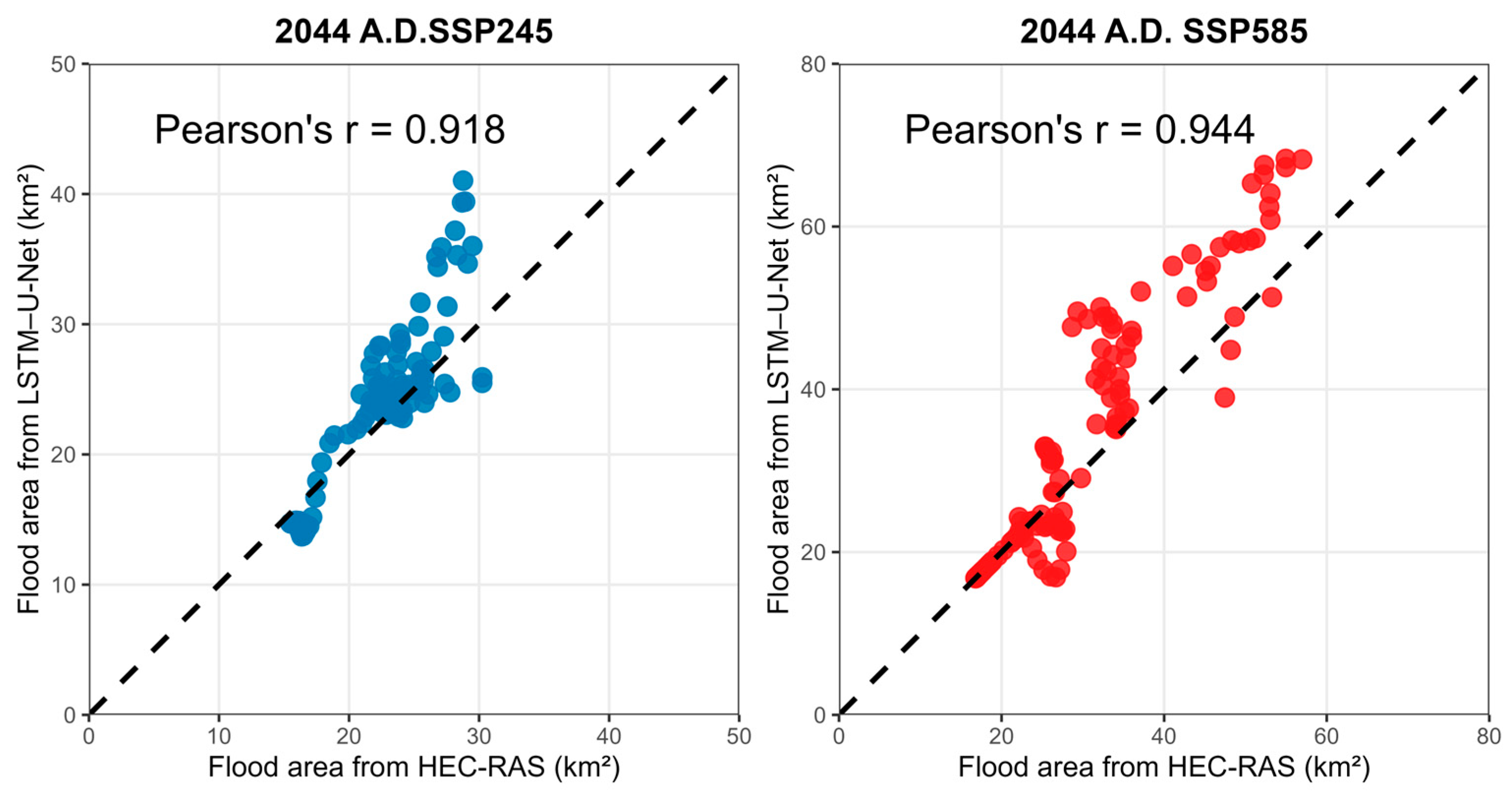
Despite the boundary-related errors discussed above, the deep learning model preserved a strong overall relationship with HEC-RAS under both SSP2-4.5 and SSP5-8.5, as indicated by the high correlations shown in Figure 14. This suggests that the model remains reliable when applied to conditions beyond the original validation cases, with the future scenarios providing additional evidence that it can reproduce the overall inundation response in a manner broadly comparable to HEC-RAS. Although the model tended to overpredict inundation extent in some cases, it still offers a practical advantage because it can use discharge time series as input without requiring repeated hydraulic simulations. This reduces computational demand and makes the framework more suitable for repeated scenario analysis and near-real-time flood prediction.

4.3. Future Runoff and Flooding Under Climate Change Scenarios

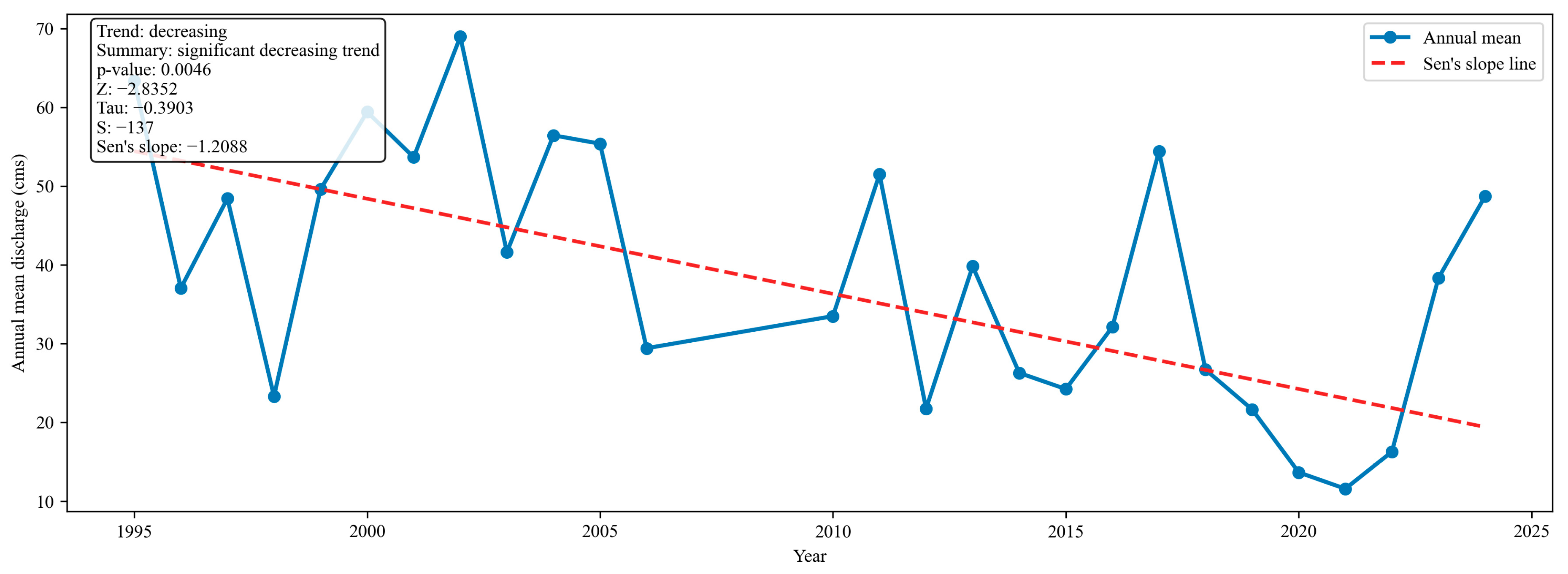
The contrasting runoff responses under SSP2-4.5 and SSP5-8.5 suggest that future hydrological change in the Upper Songkhram Basin is strongly controlled by emission-dependent differences in rainfall intensity and seasonal variability. The stronger and more sustained increase under SSP5-8.5 is consistent with the findings of Hormwichian et al. (2023), who reported a clearer rise in future runoff under the higher-emission scenario in northeastern Thailand [50]. This interpretation is further supported by Try and Qin (2024), who suggested that Southeast Asia is likely to experience stronger precipitation extremes under high-emission conditions [51]. In contrast, the more variable runoff response under SSP2-4.5 reflects weaker warming, a smaller increase in atmospheric moisture-holding capacity, and therefore a less pronounced intensification of heavy rainfall than under SSP5-8.5. A similar pattern was reported by Shrestha and Roachanakanan (2021) in the Lower Songkhram River Basin, where some wet-season rainfall extremes were expected to be stronger in the near future than in the far future [52]. This helps explain why runoff in 2029 is higher than in some later periods under SSP2-4.5. In addition, the significantly negative long-term runoff trend in the present study (Z = −2.83; negative Sen’s slope) (Figure 15) provides further historical context, suggesting that the basin does not show a clear long-term tendency toward continuously increasing runoff.
The non-proportional response between projected runoff and flood extent indicates that floodplain inundation in the Upper Songkhram Basin is constrained not only by hydrological forcing but also by basin geomorphology and internal floodplain storage. In particular, the low mean basin slope (2.21%) and the relatively wide floodplain (1–3 km) shown in Table 1 promote temporary water storage and lateral spreading across the floodplain. As a result, part of the additional flow may be stored or redistributed within the floodplain rather than being translated directly into a larger mapped inundation extent [3]. Under these conditions, increases in runoff may be expressed more through enhanced floodplain storage, greater flood depth, or longer water retention than through a proportional expansion of inundated areas.

5. Conclusions

This study developed a hybrid modeling framework that integrates a coupled hydrological–hydraulic model with a deep learning–based flood inundation model to simulate flood dynamics in the Upper Songkhram River Basin. By combining the physically based HEC-HMS and HEC-RAS models with a data-driven LSTM–U-Net architecture, the framework preserves the linkage between runoff generation and floodplain response while supporting scenario-based simulations. The strong performance of the hydrological component (NSE = 0.896; KGE = 0.827; R2 = 0.909) and hydraulic component (F1 = 0.876; Kappa = 0.873) indicates that the coupled system provides a physically consistent basis for generating reliable training data for the surrogate model.
The LSTM–U-Net model reproduced the main inundation patterns across independent flood events, achieving a mean F1-score of 0.838 and IoU of 0.721 relative to HEC-RAS simulations. Model performance remained stable across different flood stages, with most discrepancies occurring along shallow floodplain margins. This indicates that the surrogate captures the core inundation structure well, although some uncertainty remains along threshold-sensitive boundaries. These results suggest that physics-constrained surrogates can provide an effective alternative to fully hydraulic simulations while preserving the main spatial characteristics of flood behavior.
Application of the hybrid framework to CMIP6 climate scenarios indicates that future runoff and flood inundation in the Upper Songkhram Basin respond differently under SSP2-4.5 and SSP5-8.5. While SSP2-4.5 shows weaker and more variable changes, SSP5-8.5 indicates a clearer increase in the runoff and flood extent toward 2044. More importantly, the results indicate that changes in inundation extent are not directly proportional to changes in discharge, reflecting the storage-dominated behavior of the floodplain system.

Author Contributions

Conceptualization, methodology, analysis, investigation, visualization, and writing—original draft, T.N.; supervision, review, and editing, P.T. and N.K. All authors have read and agreed to the published version of the manuscript.

Funding

This research received no external funding.

Data Availability Statement

The datasets, including technical and observational data, generated and/or analyzed during this study, are available from the corresponding author upon reasonable request.

Conflicts of Interest

The authors declare no conflicts of interest.

References

  1. Intergovernmental Panel on Climate Change. Climate Change 2021: The Physical Science Basis. Contribution of Working Group I to the Sixth Assessment Report of the Intergovernmental Panel on Climate Change; Cambridge University Press: Cambridge, UK, 2021. [Google Scholar] [CrossRef]
  2. Nardi, F.; Vivoni, E.R.; Grimaldi, S. Investigating a floodplain scaling relation using a hydrogeomorphic delineation method. Water Resour. Res. 2006, 42, W09409. [Google Scholar] [CrossRef]
  3. Farrag, M.; Brill, F.; Dung, N.V.; Sairam, N.; Schröter, K.; Kreibich, H.; Merz, B.; de Bruijn, K.M.; Vorogushyn, S. On the role of floodplain storage and hydrodynamic interactions in flood risk estimation. Hydrol. Sci. J. 2022, 67, 508–534. [Google Scholar] [CrossRef]
  4. Teng, J.; Jakeman, A.J.; Vaze, J.; Croke, B.F.W.; Dutta, D.; Kim, S. Flood inundation modelling: A review of methods, recent advances and uncertainty analysis. Environ. Model. Softw. 2017, 90, 201–216. [Google Scholar] [CrossRef]
  5. Peker, İ.B.; Gülbaz, S.; Demir, V.; Orhan, O.; Beden, N. Integration of HEC-RAS and HEC-HMS with GIS in flood modeling and flood hazard mapping. Sustainability 2024, 16, 1226. [Google Scholar] [CrossRef]
  6. Cienciala, P.; Pasternack, G.B. Floodplain inundation response to climate, valley form, and flow regulation on a gravel-bed river in a Mediterranean-climate region. Geomorphology 2017, 282, 1–17. [Google Scholar] [CrossRef]
  7. Haces-García, F.; Ross, N.; Glennie, C.L.; Rifai, H.S.; Hoskere, V.; Ekhtari, N. Rapid 2D hydrodynamic flood modeling using deep learning surrogates. J. Hydrol. 2025, 651, 132561. [Google Scholar] [CrossRef]
  8. Zhou, Y.; Wu, W.; Nathan, R.; Wang, Q.J. Deep Learning-Based Rapid Flood Inundation Modeling for Flat Floodplains with Complex Flow Paths. Water Resour. Res. 2022, 58, e2022WR033214. [Google Scholar] [CrossRef]
  9. Staudinger, M.; Kauzlaric, M.; Mas, A.; Evin, G.; Hingray, B.; Viviroli, D. The role of antecedent conditions in translating precipitation events into extreme floods at the catchment scale and in a large-basin context. Nat. Hazards Earth Syst. Sci. 2025, 25, 247–265. [Google Scholar] [CrossRef]
  10. Mosimann, M.; Kauzlaric, M.; Schick, S.; Martius, O.; Zischg, A.P. Evaluation of surrogate flood models for the use in impact-based flood warning systems at national scale. Environ. Model. Softw. 2024, 173, 105936. [Google Scholar] [CrossRef]
  11. Hydro and Agro Informatics Institute (HAII). Data Collection and Analysis for the Development of a Data Warehouse System for 25 River Basins and Flood–Drought Simulation Models: Mekong River Basin; HAII: Bangkok, Thailand, 2012; (In Thai). Available online: https://tiwrm.hii.or.th/web/attachments/25basins/02-khong.pdf (accessed on 3 March 2026).
  12. ASF DAAC. ALOS PALSAR High Resolution Radiometric Terrain Corrected Product [Data set]; NASA Alaska Satellite Facility Distributed Active Archive Center: Fairbanks, AK, USA, 2014. [Google Scholar] [CrossRef]
  13. Sakon Nakhon Provincial Integrated Administration Committee. Sakon Nakhon Provincial Development Plan (5-Year Plan: 2023–2027); Fiscal Year 2023 Edition; Sakon Nakhon Province: Sakon Nakhon, Thailand, 2024; (In Thai). Available online: https://skko.moph.go.th/dward/document_file/d_sawangdaendin/tender_file_name/20240308094733_106948905.pdf (accessed on 3 March 2026).
  14. Walalite, T.; Dekker, S.C.; Keizer, F.M.; Kardel, I.; Schot, P.P.; de Jong, S.M.; Wassen, M.J. Flood water hydrochemistry patterns suggest floodplain sink function for dissolved solids from the Songkhram monsoon river (Thailand). Wetlands 2016, 36, 995–1008. [Google Scholar] [CrossRef]
  15. Bangkok Post. Sonca Storm Wrath Sinks Sakon Nakhon. 29 July 2017. Available online: https://www.bangkokpost.com/thailand/general/1295847/sonca-storm-wrath-sinks-sakon-nakhon (accessed on 3 March 2026).
  16. Feldman, A.D. (Ed.) Hydrologic Modeling System HEC-HMS: Technical Reference Manual; U.S. Army Corps of Engineers, Hydrologic Engineering Center: Davis, CA, USA, 2000. [Google Scholar]
  17. U.S. Army Corps of Engineers; Hydrologic Engineering Center. HEC-HMS Hydrologic Modeling System User’s Manual; Version 4.3; U.S. Army Corps of Engineers: Davis, CA, USA, 2018; Available online: https://www.hec.usace.army.mil/software/hec-hms/documentation/HEC-HMS_Users_Manual_4.3.pdf (accessed on 3 March 2026).
  18. U.S. Department of Agriculture, Soil Conservation Service. National Engineering Handbook, Section 4: Hydrology; Chapter 21: Design Hydrographs; U.S. Department of Agriculture: Washington, DC, USA, 1972; Available online: https://irrigationtoolbox.com/NEH/Part%20630%20Hydrology/neh630-ch21.pdf (accessed on 3 March 2026).
  19. Mishra, S.K.; Singh, V.P. Soil Conservation Service Curve Number (SCS-CN) Methodology; Springer: Dordrecht, The Netherlands, 2003. [Google Scholar] [CrossRef]
  20. Snyder, F.F. Synthetic unit-graphs. Eos Trans. Am. Geophys. Union 1938, 19, 447–454. [Google Scholar] [CrossRef]
  21. Chow, V.T.; Maidment, D.R.; Mays, L.W. Applied Hydrology; McGraw-Hill: New York, NY, USA, 1988. [Google Scholar]
  22. McCarthy, G.T. The unit hydrograph and flood routing. In Proceedings of the Conference of North Atlantic Division, U.S. Army Corps of Engineers, New London, CT, USA, 24 June 1938; pp. 608–609. [Google Scholar]
  23. U.S. Army Corps of Engineers. HEC-RAS River Analysis System: User’s Manual; Version 5.0; Hydrologic Engineering Center: Davis, CA, USA, 2016. [Google Scholar]
  24. Chow, V.T. Open-Channel Hydraulics; McGraw-Hill: New York, NY, USA, 1959. [Google Scholar]
  25. Vashist, K.V.; Singh, K.K. HEC-RAS 2D modeling for flood inundation mapping: A case study of the Krishna River Basin. Water Pract. Technol. 2023, 18, 831–844. [Google Scholar] [CrossRef]
  26. El-Haddad, B.A.; Youssef, A.M.; Karimi, Z.; Pourghasemi, H.R. Flood Inundation Mapping Using HEC-RAS 2D Modeling and Examining the Impact of Changes in the Model-Meshing Pixel Scale on the Final Output. Water Resour. Manag. 2025, 39, 5807–5826. [Google Scholar] [CrossRef]
  27. Zahura, F.T.; Goodall, J.L.; Sadler, J.M.; Shen, Y.; Morsy, M.M.; Behl, M.; Bowes, B.D. Training Machine Learning Surrogate Models From a High-Fidelity Physics-Based Model: Application for Real-Time Street-Scale Flood Prediction in an Urban Coastal Community. Water Resour. Res. 2020, 56, e2019WR027038. [Google Scholar] [CrossRef]
  28. Li, A.; Zhang, W.; Zhang, X.; Chen, G.; Liu, X.; Jiang, A.; Zhou, F.; Peng, H. A Deep U-Net-ConvLSTM Framework with Hydrodynamic Model for Basin-Scale Hydrodynamic Prediction. Water 2024, 16, 625. [Google Scholar] [CrossRef]
  29. Bian, W.; Fang, J.; Wang, P.; Sun, Q.; Fang, J.; Kong, F.; Hu, T. Deep learning surrogate models for spatiotemporal prediction of coastal flooding inundations in Tianjin, China. J. Hydrol. Reg. Stud. 2025, 60, 102593. [Google Scholar] [CrossRef]
  30. Kingma, D.P.; Ba, J. Adam: A Method for Stochastic Optimization. In Proceedings of the 3rd International Conference on Learning Representations (ICLR), San Diego, CA, USA, 7–9 May 2015. [Google Scholar]
  31. Milletari, F.; Navab, N.; Ahmadi, S.-A. V-Net: Fully Convolutional Neural Networks for Volumetric Medical Image Segmentation. In Proceedings of the 2016 Fourth International Conference on 3D Vision (3DV), Stanford, CA, USA, 25–28 October 2016; pp. 565–571. [Google Scholar] [CrossRef]
  32. O’Neill, B.C.; Tebaldi, C.; van Vuuren, D.P.; Eyring, V.; Friedlingstein, P.; Hurtt, G.; Knutti, R.; Kriegler, E.; Lamarque, J.-F.; Lowe, J.; et al. The Scenario Model Intercomparison Project (ScenarioMIP) for CMIP6. Geosci. Model Dev. 2016, 9, 3461–3482. [Google Scholar] [CrossRef]
  33. Themeßl, M.J.; Gobiet, A.; Leuprecht, A. Empirical-statistical downscaling and error correction of daily precipitation from regional climate models. Int. J. Climatol. 2011, 31, 1530–1544. [Google Scholar] [CrossRef]
  34. Taylor, K.E. Summarizing multiple aspects of model performance in a single diagram. J. Geophys. Res. Atmos. 2001, 106, 7183–7192. [Google Scholar] [CrossRef]
  35. Nash, J.E.; Sutcliffe, J.V. River flow forecasting through conceptual models part I—A discussion of principles. J. Hydrol. 1970, 10, 282–290. [Google Scholar] [CrossRef]
  36. Gupta, H.V.; Kling, H.; Yilmaz, K.K.; Martinez, G.F. Decomposition of the mean squared error and NSE performance criteria: Implications for improving hydrological modelling. J. Hydrol. 2009, 377, 80–91. [Google Scholar] [CrossRef]
  37. Moriasi, D.N.; Arnold, J.G.; Van Liew, M.W.; Bingner, R.L.; Harmel, R.D.; Veith, T.L. Model evaluation guidelines for systematic quantification of accuracy in watershed simulations. Trans. ASABE 2007, 50, 885–900. [Google Scholar] [CrossRef]
  38. Powers, D.M.W. Evaluation: From precision, recall and F-measure to ROC, informedness, markedness and correlation. J. Mach. Learn. Technol. 2011, 2, 37–63. [Google Scholar]
  39. Stephens, E.M.; Schumann, G.J.-P.; Bates, P.D. Problems with binary pattern measures for flood model evaluation. Hydrol. Process. 2014, 28, 4928–4937. [Google Scholar] [CrossRef]
  40. Wing, O.E.J.; Bates, P.D.; Sampson, C.C.; Smith, A.M.; Johnson, K.A.; Erickson, T.A. Validation of a 30 m Resolution Flood Hazard Model of the Conterminous United States. Water Resour. Res. 2017, 53, 7968–7986. [Google Scholar] [CrossRef]
  41. Hdeib, R.; Abdallah, C.; Colin, F.; Brocca, L.; Moussa, R. Constraining coupled hydrological-hydraulic flood model by past storm events and post-event measurements in data-sparse regions. J. Hydrol. 2018, 565, 160–175. [Google Scholar] [CrossRef]
  42. Thakur, B.; Parajuli, R.; Kalra, A.; Ahmad, S.; Gupta, R. Coupling HEC-RAS and HEC-HMS in Precipitation Runoff Modelling and Evaluating Flood Plain Inundation Map. In Proceedings of the World Environmental and Water Resources Congress 2017, Sacramento, CA, USA, 21–25 May 2017; pp. 240–251. [Google Scholar] [CrossRef]
  43. Wohl, E. An integrative conceptualization of floodplain storage. Rev. Geophys. 2021, 59, e2020RG000724. [Google Scholar] [CrossRef]
  44. Besseling, L.S.; Bomers, A.; Hulscher, S.J.M.H. Predicting Flood Inundation after a Dike Breach Using a Long Short-Term Memory (LSTM) Neural Network. Hydrology 2024, 11, 152. [Google Scholar] [CrossRef]
  45. Xu, L.; Gao, L. A hybrid surrogate model for real-time coastal urban flood prediction: An application to Macao. J. Hydrol. 2024, 642, 131863. [Google Scholar] [CrossRef]
  46. Li, L.; Zhao, Y.; Qin, S.; Pan, D.; Zhang, J.; Li, A.; Hu, Q. PhysWRNet: A physics-guided deep learning framework for flood inundation mapping with SAR and hydrodynamic simulations. J. Hydrol. 2026, 665, 134662. [Google Scholar] [CrossRef]
  47. Noori, A.M.; Ziboon, A.R.T.; Al-Hameedawi, A.N. Deep-learning integration of CNN-Transformer and U-Net for bi-temporal SAR flash-flood detection. Appl. Sci. 2025, 15, 7770. [Google Scholar] [CrossRef]
  48. Aristizabal, F.; Judge, J.; Monsivais-Huertero, A. High-resolution inundation mapping for heterogeneous land covers with synthetic aperture radar and terrain data. Remote Sens. 2020, 12, 900. [Google Scholar] [CrossRef]
  49. Rajib, A.; Zheng, Q.; Lane, C.R.; Golden, H.E.; Christensen, J.R. Human alterations of the global floodplains 1992–2019. Sci. Data 2023, 10, 499. [Google Scholar] [CrossRef] [PubMed]
  50. Hormwichian, R.; Kaewplang, S.; Kangrang, A.; Supakosol, J.; Boonrawd, K.; Sriworamat, K.; Muangthong, S.; Songsaengrit, S.; Prasanchum, H. Understanding the interactions of climate and land use changes with runoff components in spatial-temporal dimensions in the Upper Chi Basin, Thailand. Water 2023, 15, 3345. [Google Scholar] [CrossRef]
  51. Try, S.; Qin, X. Evaluation of future changes in climate extremes over Southeast Asia using downscaled CMIP6 GCM projections. Water 2024, 16, 2207. [Google Scholar] [CrossRef]
  52. Shrestha, S.; Roachanakanan, R. Extreme climate projections under representative concentration pathways in the Lower Songkhram River Basin, Thailand. Heliyon 2021, 7, e06146. [Google Scholar] [CrossRef]
Figure 1. Location of the Upper Songkhram River Basin and the study area.
Water 18 01360 g001
Figure 2. Conceptual framework of the coupled hydrological–hydraulic and deep learning modeling system.
Water 18 01360 g002
Figure 3. Structure of the hybrid deep learning flood inundation model.
Water 18 01360 g003
Figure 4. Taylor diagram of CMIP6 GCM performance used for model selection based on historical precipitation (1994–2014).
Water 18 01360 g004
Figure 5. Performance of the HEC-HMS model in simulating daily streamflow during the calibration (2012–2020) and validation (2021–2024) periods.
Water 18 01360 g005
Figure 6. Comparison of baseline models and LSTM–U-Net.
Water 18 01360 g006
Figure 7. Sensitivity of model performance to lag length for the LSTM–U-Net.
Water 18 01360 g007
Figure 8. Training and validation loss curves of the LSTM–U-Net model.
Water 18 01360 g008
Figure 9. High-magnitude flood inundation and model error distribution (2024).
Water 18 01360 g009
Figure 10. Low-magnitude flood inundation and model error distribution (2019).
Water 18 01360 g010
Figure 11. Monthly mean discharge projections under SSP2-4.5 and SSP5-8.5 for selected future years, compared with the historical 30-year average.
Water 18 01360 g011
Figure 12. Future flood inundation under SSP2-4.5 and SSP5-8.5 scenarios for 2029, 2034, and 2044 using the LSTM–U-Net model.
Water 18 01360 g012
Figure 13. Temporal validation of the LSTM–U-Net model for the flood events: (a) 2019 and (b) 2024.
Water 18 01360 g013aWater 18 01360 g013b
Figure 14. Scatter plots comparing flood extent from HEC-RAS and LSTM–U-Net under future climate scenarios.
Water 18 01360 g014
Figure 15. Long-term trend in annual mean discharge in the Upper Songkhram Basin.
Water 18 01360 g015
Table 1. Physical and geomorphological characteristics of the Upper Songkhram River Basin.
CategoryValueUnit
Basin area2174.65km2
Basin perimeter415.40km
Maximum elevation619m a.s.l.
Minimum elevation124m a.s.l.
Mean elevation183.32m a.s.l.
Mean basin slope2.21%
Floodplain width1–3km
Main channel length116.67km
Basin shapeElongated (rectangular)
Drainage patternDendritic
Table 2. Details of the 12 CMIP6 models used in this study.
No.GCMInstitution/CountryHorizontal Resolution (Lat × Lon)
1ACCESS-CM2CSIRO-ARCCSS/Australia144 × 192
2CanESM5CCCma/Canada64 × 128
3EC-Earth3EC-Earth-Consortium/Europe160 × 320
4EC-Earth3-Veg-LREC-Earth-Consortium/Europe256 × 512
5GFDL-ESM4NOAA-GFDL/USA180 × 288
6IITM-ESMCCCR-IITM/India94 × 192
7IPSL-CM6A-LRIPSL/France143 × 144
8MIROC6MIROC/Japan128 × 256
9MPI-ESM1-2-HRMPI-M/Germany192 × 384
10MRI-ESM2-0MRI/Japan160 × 320
11NorESM2-MMNCC/Norway192 × 288
12TaiESM1AS-RCEC/China192 × 288
Table 3. Spatial performance of HEC-RAS flood inundation maps compared with observed flood extent.
YearPrecisionRecallF1-ScoreKappa
20170.8750.9030.8890.885
20230.8850.8580.8710.869
20240.9100.8170.8610.858
Table 4. Performance comparison of baseline models and LSTM–U-Net.
ModelF1-ScoreIoUKappa
LSTM0.6410.4710.628
U-Net0.7170.5590.707
LSTM–U-Net0.8460.7320.841
Table 5. Spatial performance of the LSTM–U-Net model.
EventIoUF1-ScoreKappa
20190.7030.8260.819
20240.7290.8430.838
Mean0.7210.8380.833
Disclaimer/Publisher’s Note: The statements, opinions and data contained in all publications are solely those of the individual author(s) and contributor(s) and not of MDPI and/or the editor(s). MDPI and/or the editor(s) disclaim responsibility for any injury to people or property resulting from any ideas, methods, instructions or products referred to in the content.