Article

Assessment of Predicted Hydro-Morphodynamic Responses of a Selected Compound Meandering–Anabranching Reach of the Tigris River to Proposed River Training Works


by
Suray Abdel Hameed Rasheed
1,*,
Ammar Salman Dawood
1 and
Thamer Ahmed Mohammed
2
1
Department of Civil Engineering, Faculty of Engineering, University of Basrah, Basrah 61004, Iraq
2
Department of Water Resources Engineering, Faculty of Engineering, University of Baghdad, Jaderyah, Baghdad 10071, Iraq
*
Author to whom correspondence should be addressed.
Water 2026, 18(11), 1352; https://doi.org/10.3390/w18111352
Submission received: 28 March 2026 / Revised: 9 May 2026 / Accepted: 15 May 2026 / Published: 2 June 2026
(This article belongs to the Topic Hydraulic Engineering and Modelling)

Abstract

Anabranching, sedimentation, island growth, and bank scouring are key morphological processes occurring in the Tigris River. These processes can disrupt navigation, affect water intake, and compromise the safety of infrastructure near the riverbanks. This study aims to simulate and assess the responses of a 4.75 km meandering–anabranching reach of the Tigris River in Baghdad city center to various alternative groyne dimensions designed to control natural morphological processes, using a depth-averaged hydro-morphodynamic model (Delft3D-FM). Bathymetric and field measurements, including sediment load, velocity, water level, and discharge, were conducted and used for model calibration and validation. The model demonstrated good agreement with observed water levels (Root Mean Square Error (RMSE) = 0.02 m) and depth-averaged velocities (RMSE = 0.068–0.142 m/s), and it reproduced morphological changes with a maximum bed-level error of approximately 13% at control sections. More than 20 groyne configurations, varying in orientation, length (L), and spacing (S), were simulated and assessed. In this study, the selection of the best groyne design for controlling morphological processes in the target reach was carried out using a proposed composite Groyne Performance Index (GPI). The index is based on weighted contributions from flow partitioning, thalweg stability, cross-channel infilling, island-margin response, and corridor deposition. While the straight–groyne configuration with L = 0.25 W (river width) and S = 2 L achieved the highest GPI, the L = 0.25 W and S = 3 L configuration is selected as the preferred design as it provided a more balanced response in terms of flow redirection, thalweg stability, reduced anabranching and deposition, and lower scour risk. The adopted selection methodology demonstrates a valuable indicator-based framework for selecting river-training layouts in low-slope, sand-bed, meandering–anabranching reaches of alluvial rivers.

1. Introduction

Braided and anabranching patterns occur as a result of hydro-morphodynamic processes in natural alluvial rivers; however, the situation becomes more complex when anabranching develops within a meandering river reach. Hydro-morphodynamic processes include the adjustment of alluvial channels and the formation of anabranches in response to changes in flow hydraulics and sediment transport [1,2]. In anabranching rivers, the flow divides around islands and smaller islands, which complicates flow hydraulics. The division of flow among multiple channels reduces sediment transport capacity and increases the likelihood of shoal formation and bar development [1,2,3]. The interaction between bank strength, channel gradient, and sediment load determines the morphological response of anabranching rivers, including river planforms and cross-sections, their planforms and cross-sectional characteristics [2]. Human activities such as damming, gravel mining, dredging, and floodplain encroachment significantly influence the discharge regime and sediment load in anabranching rivers [4]. The resulting changes in cross-sectional morphology, including erosion and sedimentation, affect navigation, water intake, flow distribution, and the safety of developments located near the banks [5]. River training structures are frequently used to stabilize alluvial river channels, facilitate navigation, and control patterns of scour and deposition [6]. Groynes, which protrude from the bank into the flow, redirect the current, reduce near-bank shear stress, and promote sediment deposition downstream. Consequently, they mitigate bank erosion and confine low-discharge flow to a narrower, deeper channel [7,8].
The selection of an appropriate groyne configuration is critically dependent on the design parameters such as groyne length, spacing, orientation, and submergence. In most applications, short-length groynes (0.15–0.25 of channel width) positioned at around 3 to 5 times groyne length will offer adequate training without causing severe localized scour [8,9,10,11]. Upstream orientations of 30° to 45° may constitute an appropriate balance between flow deflection and wake stability [12,13]. Studies indicate that groyne fields, which consist of multiple groynes positioned along a bank, offer enhanced hydraulic efficiency, bank protection, and ecological connectivity compared to isolated groynes [14,15]. Groynes that are strategically positioned can effectively direct the majority of the flow toward the main channel, reduce the quantity and activity of the anabranch pathways, and enhance long-term morphological stability by facilitating preferential sedimentation in designated anabranches [7,9,16]. Numerical models have enhanced understanding of groyne-induced flow structures, scour, and bed evolution, while elucidating the effects of groyne submergence and permeability on turbulence intensity and localized erosion [17,18,19,20,21].
Most previous laboratory, numerical, and field investigations have focused on understanding the local hydraulic and morphodynamic impacts of the geometry and configuration of hydraulic structures in straight or single-channel rivers, particularly their effects on localized scour and bank protection. However, very few studies have addressed the morphology of compound meandering–anabranching reaches in low-slope, highly regulated alluvial rivers with limited data, such as the Tigris River in Iraq, including the design and implementation of groyne systems to control severe morphological changes along the river.
Over the past few decades, the construction of dams on the Tigris River, along with transboundary flow regulation, urbanization, and climate change, has led to significant reductions in discharge and sediment load, as well as increased operational challenges for navigation and water abstraction [4,22]. Due to low flow velocities, significant sedimentation has occurred in the meandering reaches of the Tigris River in Baghdad, resulting in the formation of anabranches and the growth of islands [23,24,25]. To control these morphological processes and their impact on navigation, further numerical and field studies are required.
The proposed training methods for managing hydro-morphodynamic processes in meandering–branching river reaches should be evaluated using various quantitative indicators, including the Anabranching Index (AnI), Thalweg Stability Index (TSI), Cross-Channel Infilling Volume (CIV), Island Toe Erosion Index (ITEI), and Corridor Deposition Volume (CDV). These indicators are based on widely accepted and physically meaningful concepts reported in the fluvial morphodynamic literature [26,27,28,29,30,31,32,33,34,35,36,37]. Most studies on alluvial rivers have used only one or a few indices to assess morphodynamic responses to training works. However, a more reliable evaluation requires the integrated consideration of these indicators rather than assessing them individually. In this study, a Groyne Performance Index (GPI) is introduced as a composite metric that incorporates the normalized responses of the selected morphodynamic indicators into a single performance measure.
In this study, the hydro-morphodynamic responses of a selected 4.75 km meandering–anabranching reach of the Tigris River to alternative groyne dimensions, designed to control morphological processes, will be simulated using the Delft3D-FM-V3 model. The study identifies two key gaps: the inadequate assessment of effective river training methods at the reach scale in regulated, low-slope, meandering–anabranching alluvial rivers and the absence of a comprehensive evaluation framework capable of simultaneously analyzing flow partitioning, channel stability, island margin response, and sedimentation patterns. In addition, a framework that integrates field-based calibration with a multi-indicator evaluation is presented to identify a groyne configuration that minimizes anabranching intensity, enhances thalweg stability, and regulates sedimentation in the studied reach of the Tigris River.
The alternative groyne design parameters, such as groyne dimensions, including length, spacing, orientation, shape, and configuration, will be selected based on the recommended values shown in Table 1.

2. Methodology

A calibrated Delft3D-FM-V3 hydro-morphodynamic model, incorporating an extensive range of detailed field data, was employed to simulate the hydro-morphodynamic responses of a selected 4.75 km meandering–anabranching reach of the Tigris River to alternative recommended groyne dimensions. These dimensions were proposed either for the complete removal of the semi-permanent island formed within the selected reach and/or for controlling the morphological processes (scouring and sedimentation) that are causing operational problems in the selected river reach. The hydro-morphodynamic responses were assessed using a set of adapted quantitative indicators, including groyne performance, multi-thread channel behavior, and river-training interventions. In this study, the recommended groyne dimensions shown in Table 1 were adopted.
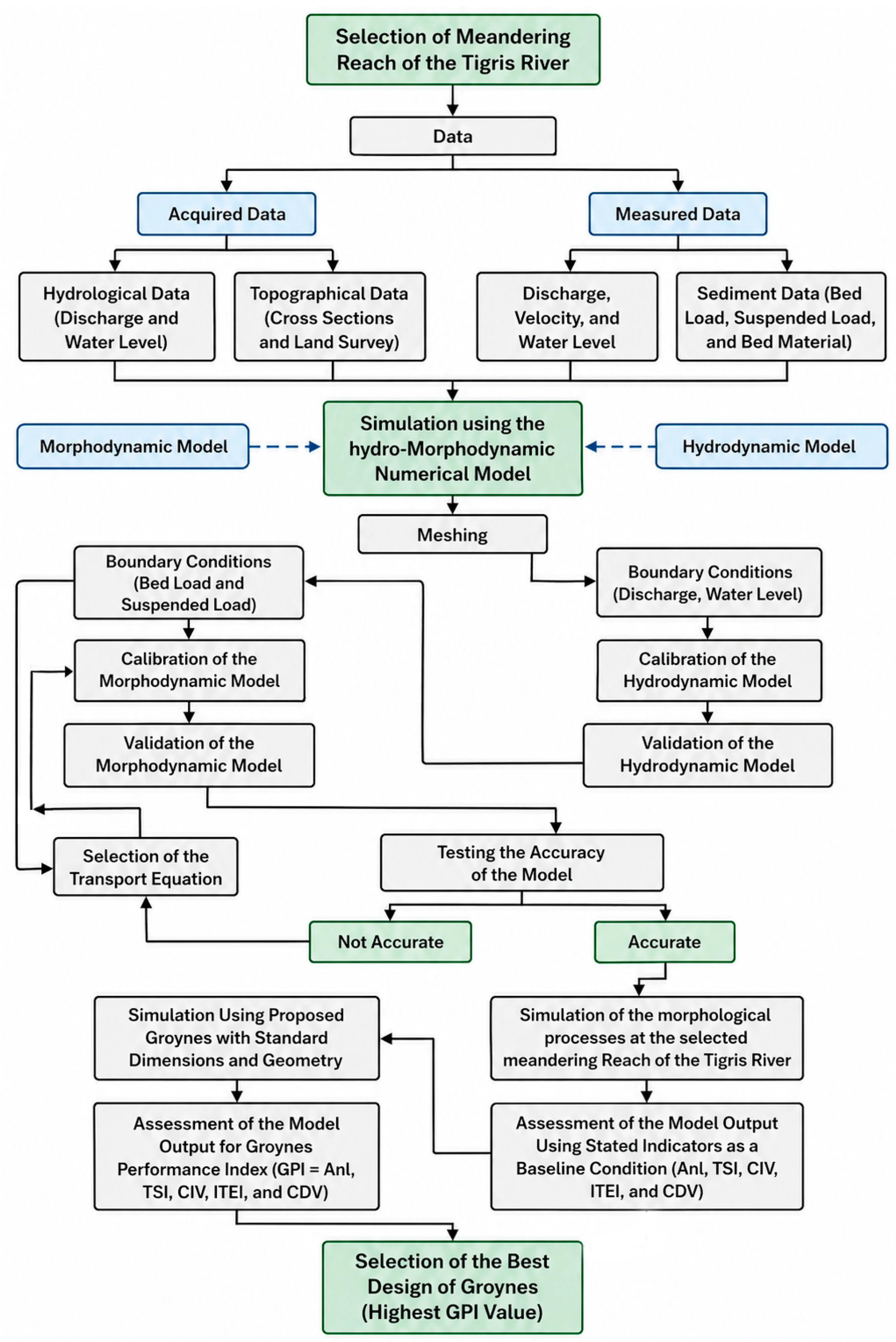
For the dominant discharge, the morphological and hydraulic characteristics of the selected meandering–anabranching reach of the Tigris River were evaluated for two cases. The first case, referred to as the baseline, represents the response of the reach to the no-groyne condition (without any training activities) and was assessed based on hydro-morphological characteristics obtained from the modeling process, while the second case evaluates the response of the reach to the proposed groyne fields, based on results obtained from the simulation process. For both cases, the responses were assessed based on calculated indices. Notably, the model was calibrated and validated before its application in the assessment. The simulation accounted for the actual distribution of flow between the two anabranches formed when the main channel of the Tigris River was split by a semi-permanent alluvial island within the selected reach. In addition, the mobile bed conditions of the anabranches, including contraction and backwater effects, as well as sediment deposition near a water station intake located on the left bank, were considered in the simulation. Figure 1 shows a flowchart for the methodology followed in this study.

2.1. Description of the Selected Meandering–Anabranching Reach, Data Acquisition, and Field Measurements

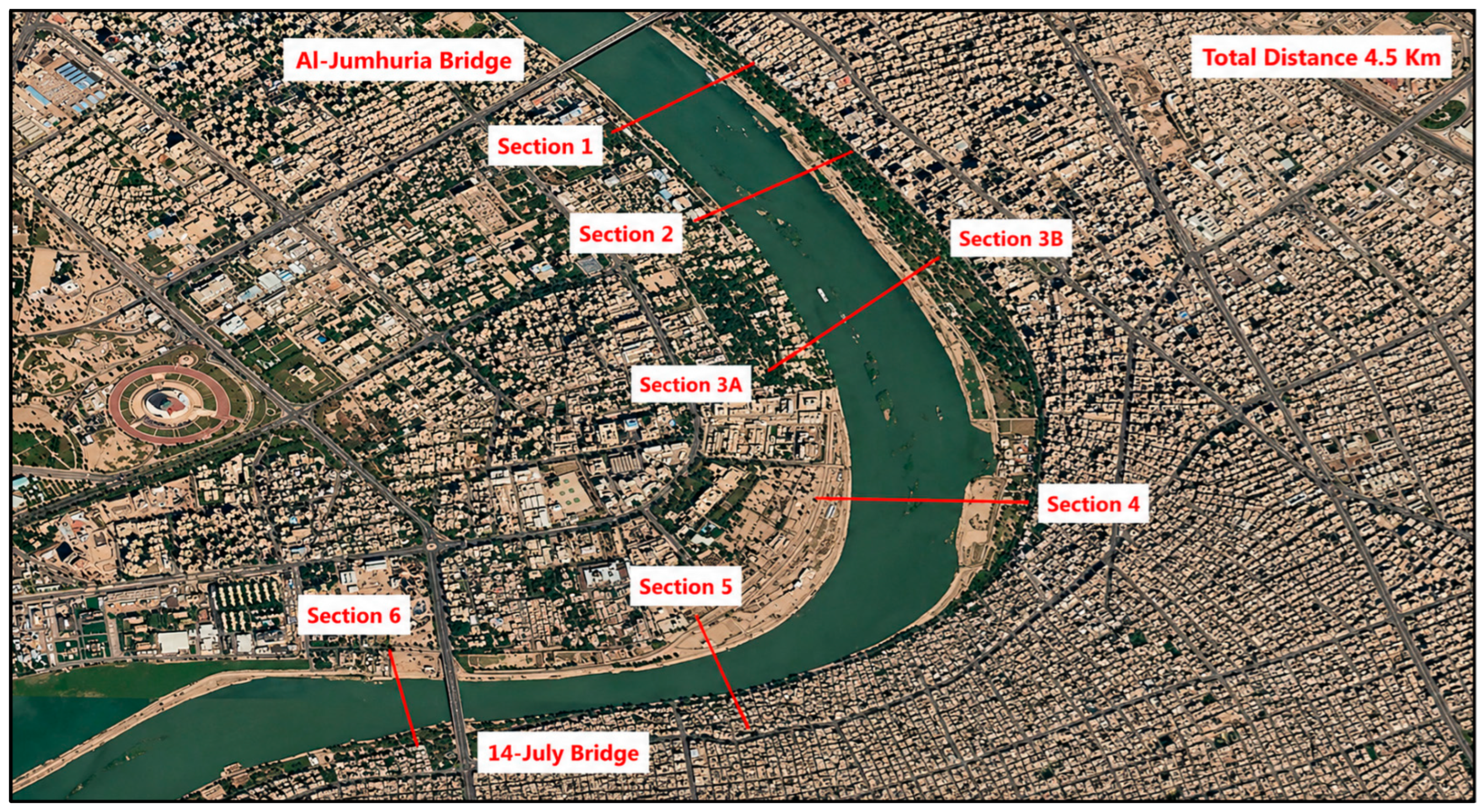
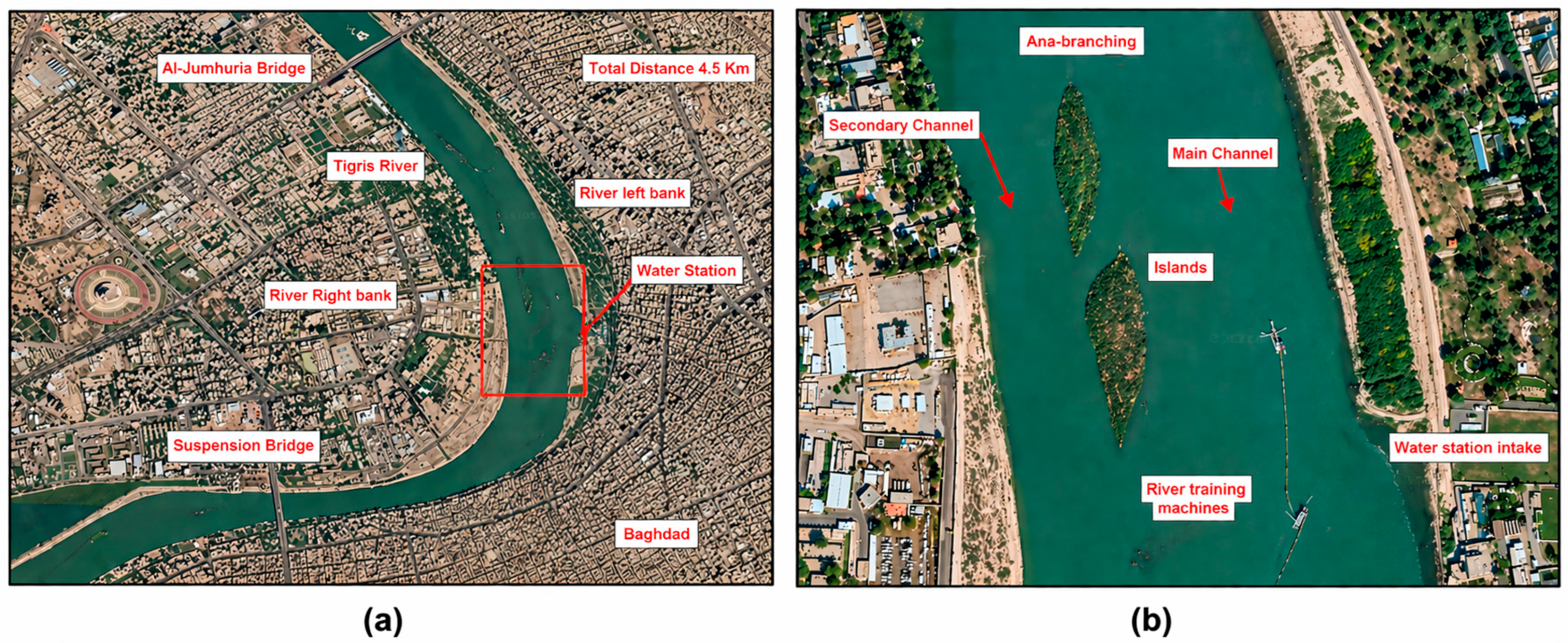
A 4.75 km meandering–anabranching reach of the Tigris River in central Baghdad, Iraq, was selected as a case study. As shown in Figure 2, the selected river reach extends from Al-Jumhuria Bridge (33°20′ N, 44°23′ E) to the Suspension Bridge (33°29′ N, 44°40′ E), within a heavily constrained urban setting. This reach includes the Abu Nawas raw water station intake, which is located on the left bank approximately at the center of the selected reach. Continuous sedimentation has led to the development of anabranching channels with semi-permanent alluvial islands within the meander. These islands have divided the flow into two main channels. Frequent dredging around the intake indicates an intense sedimentation process (Figure 2).
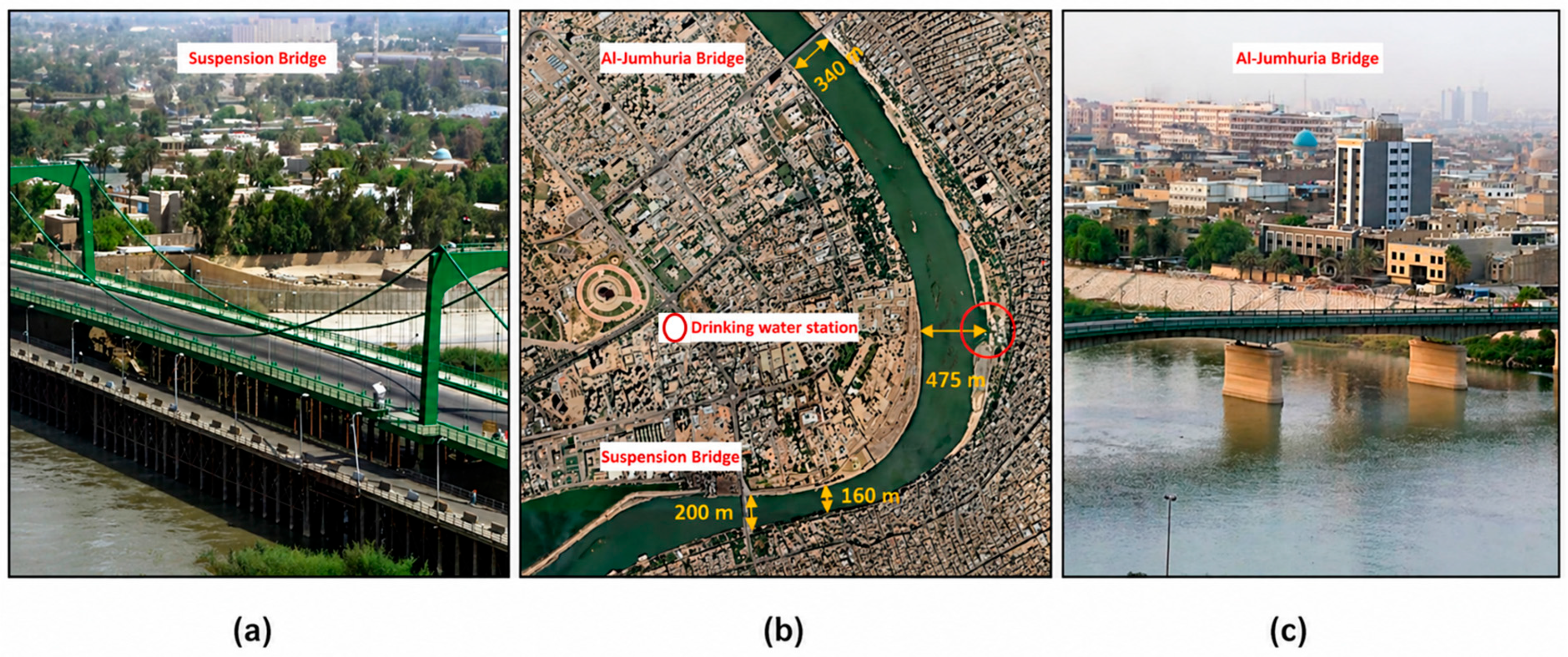
The planform characteristics of the meandering–anabranching reach of the River Tigris are defined by the extreme variability in the channel width, which changes from 475 m to less than 160 m. At the downstream end of the selected reach, the bridge piers constrict the river flow, causing local scour and upstream backwater effects. This backwater can be considered a primary factor in the formation of the semi-permanent alluvial islands in the river reach (Figure 3).
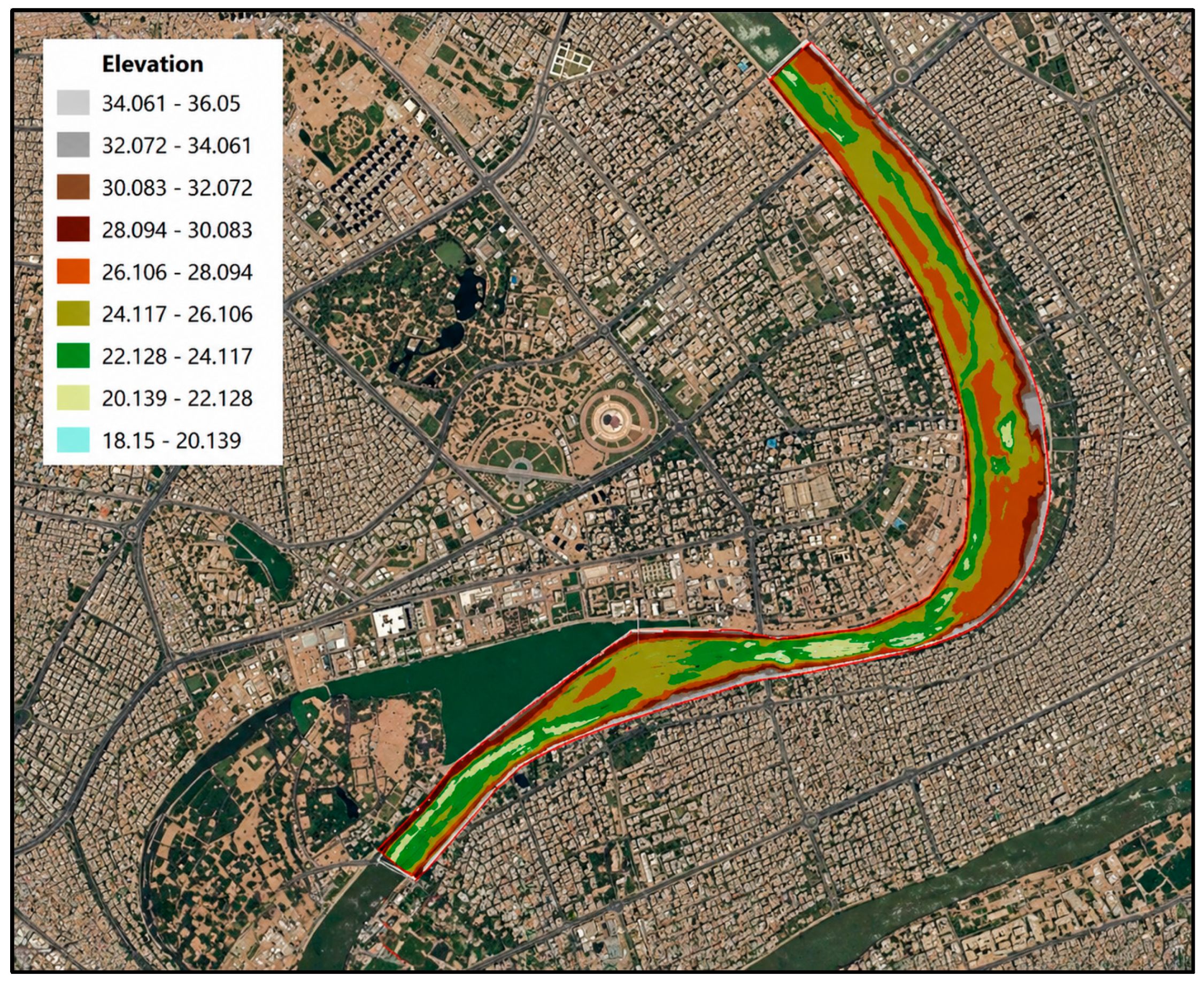
Geometric and topographic data defining the selected meandering–anabranching reach of the Tigris River were obtained from the State Commission of Surveying, Ministry of Water Resources, Iraq. Riverbed and bank elevations were measured using a CHCNAV IMU i83 RTK GNSS receiver, CHC Navigation (CHCNAV), Shanghai, China. This data was then used to develop a digital elevation model (DEM) of the flow channel and the adjacent floodplains of the selected reach (Figure 4).
The surveyed cross-sections along the meandering–anabranching river reach are shown in Figure 5. The discharge, flow area, top water width, and average velocity at various sections of the Tigris River are presented in Table 2. In addition, Acoustic Doppler Current Profiler (ADCP) datasets were collected in August 2023 at three sections within the same reach and were subsequently used to validate the hydrodynamic model.
A GNSS receiver water-level survey revealed an average water surface slope of 6.2 cm/km at a discharge of approximately 480 m3/s; this confirms a very low gradient and the alluvial nature of the studied river reach.
For the selected meandering–anabranching reach, samples of bed material, suspended load, and bed load were collected. At selected sections, a total of 20 bed-material samples were obtained using a 3.14 L Van Veen grab sampler. In addition, 82 bed-load samples were collected using a Helley–Smith sampler. Furthermore, a total of 64 suspended-load samples (500 mL each) were collected using a USP-61 sampler, following point-integrating sampling at multiple relative depths (0.2 h–1.0 h, depending on the total depth), where h is the water depth at the sampling point.
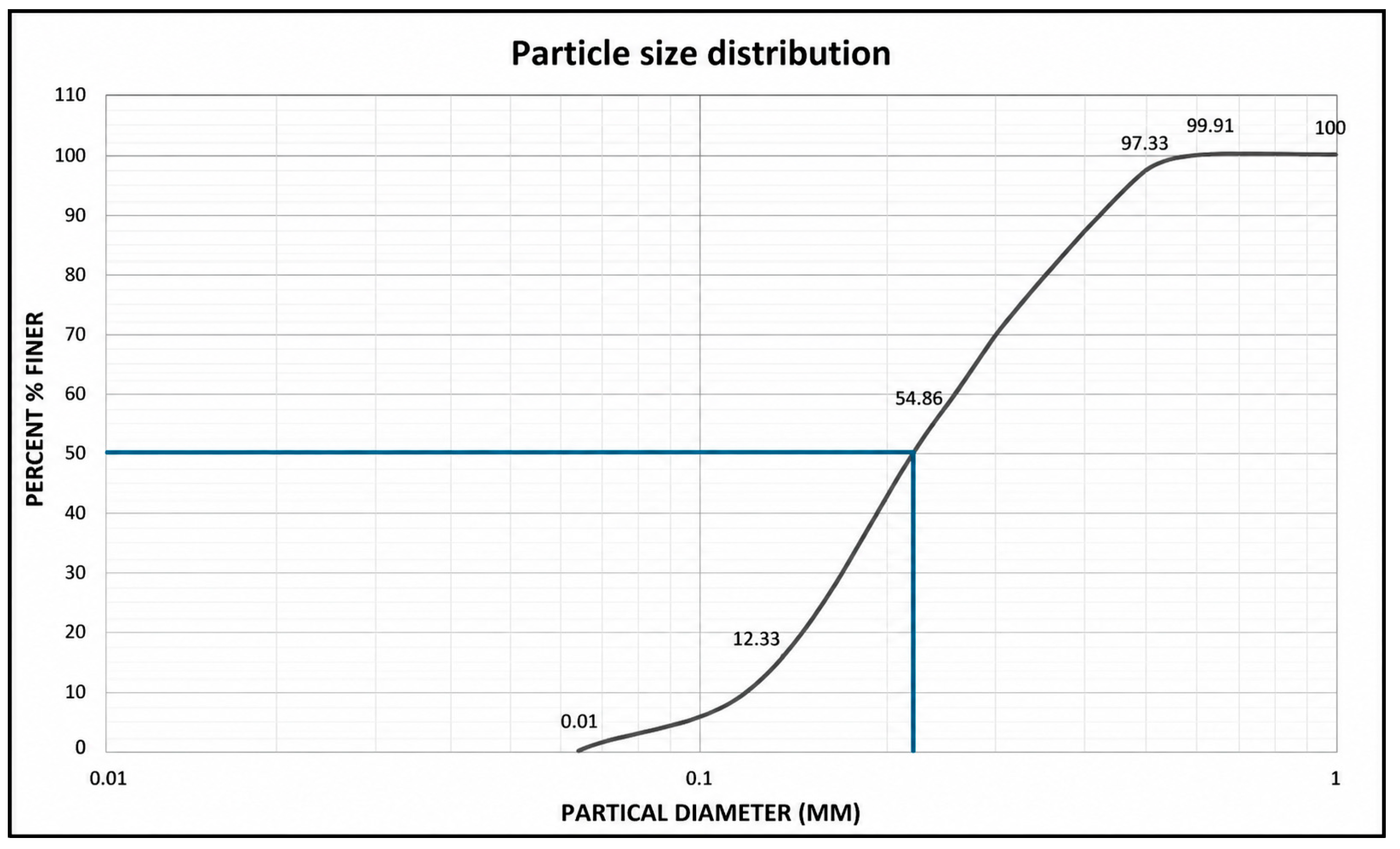
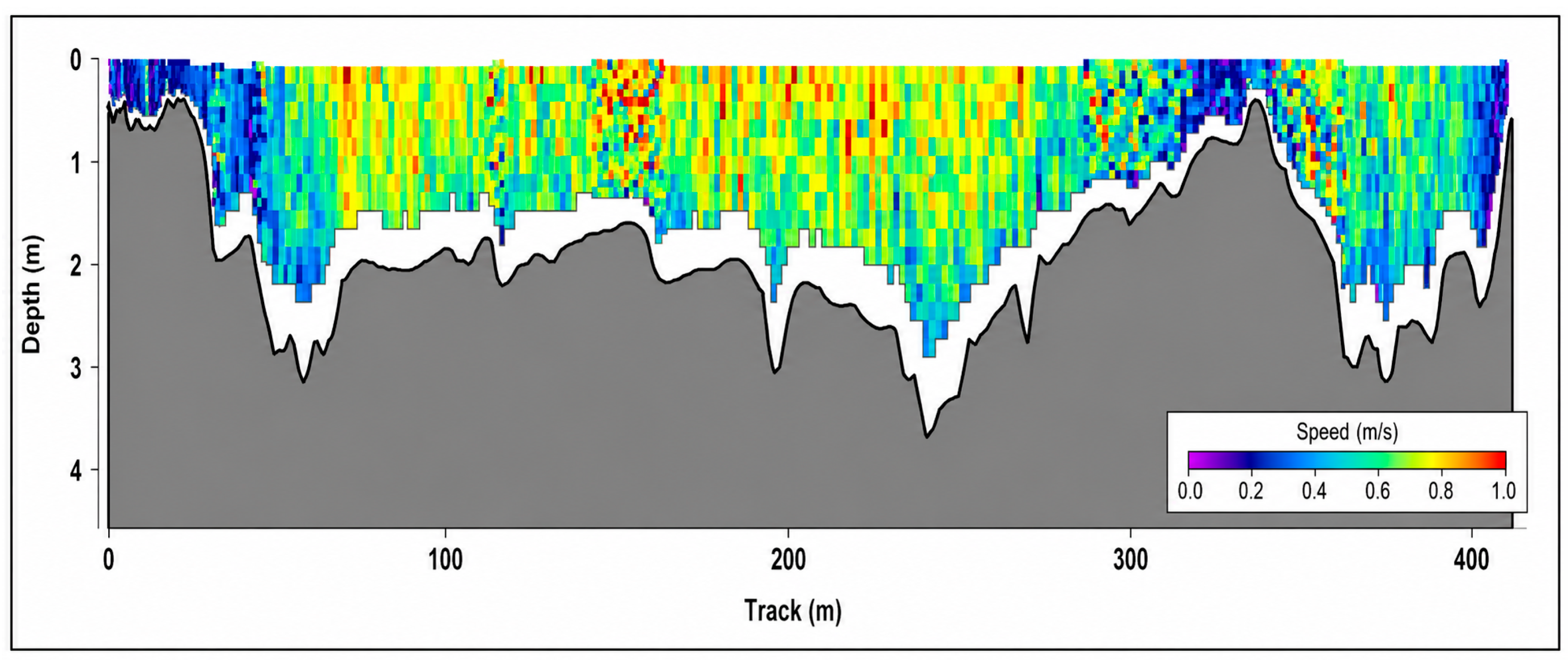
The bed-material samples were analyzed using sieve testing, and representative grain-size distributions are shown in Figure 6. The bed material of the studied river reach consists of more than 99% well-graded fine sand, with median diameters (D50) of 0.220 mm. The average sediment particle density ( ρ s ) was calculated and found to be 2.72 kg/L. The suspended-load and bed-load samples were analyzed in the laboratory, and their concentrations were determined at each section (Table 3). The combined geometric, hydrodynamic, and sediment datasets were used as boundary conditions and for calibration of the hydro-morphodynamic model. The sediment characteristics have significant implications for the selection of an appropriate sediment transport formula from those embedded in the Delft3D-FM morphodynamic model. Field measurements of velocity across a selected section (Section 6 in Figure 5) are presented in Figure 7.

2.2. The Framework of Hydro-Morphodynamic Modeling

Delft3D-FM is a hydro-morphodynamic finite-volume model that combines morphodynamic and two-dimensional flow models. The model is flexible, where a structured and an unstructured mesh can be constructed in the model building. The model includes depth-averaged shallow water equations, sediment transport equations, and bed evolution sub-models to forecast river morphological changes with complex geometries [19,41]. This combination allows flow, sediment transport, and bathymetry to interact across appropriate timescales that accurately reflect river adjustment to specific training works [19]. The Delft3D-FM model is found suitable to simulate the response of the selected meandering reach of the Tigris River to alternative groyne dimensions.

2.2.1. The Governing Equations

The hydrodynamic module of Delft3D-FM resolves the depth-averaged shallow-water (Saint–Venant) equations in a conservative format [19,41]. In Cartesian coordinates, a continuity equation (Equation (1)) for water depth ( h ) and a momentum equation (Equation (2)) for depth-averaged velocities ( u and v ) are shown below:
h t + · ( h U ) = q l a t
( h u ) t + · h u U = g h η x τ b x ρ + · h v t u
where h is the water depth; u and v are the depth-averaged velocity components in the x- and y-directions, respectively; U = ( u , v ) is the depth-averaged velocity vector; η is the free-surface elevation; q l a t is a source/sink term (lateral inflows); τ b x is the bed shear stress in the x-direction; g is the gravitational acceleration; ρ is the water density; and ν t is the depth-averaged horizontal eddy-viscosity coefficient representing turbulent momentum exchange [19,41]. Bed friction was characterized by using the Manning formulation.

2.2.2. Bed Evolution and Sediment Transport Formulation

The evolution of a riverbed in the simulation model is calculated by the D-Morphology module of Delft3D-FM. We utilize a depth-integrated sediment mass-balance equation of the Exner type, which correlates temporal variations in bed level to the divergence of the sediment transport field [19,41,42,43]:
1 p z b t +   · q s e d = 0
where Z b is the bed elevation, p is bed porosity, and q s e d is the depth-integrated sediment-transport vector.
A morphological factor (MORFAC) was employed to speed up the bed evolution, whereby the computed bed changes per hydrodynamic time step were increased by a constant factor representing a larger morphological time scale [19,41,43].

2.3. Numerical Set-Up and Mesh Sensitivity

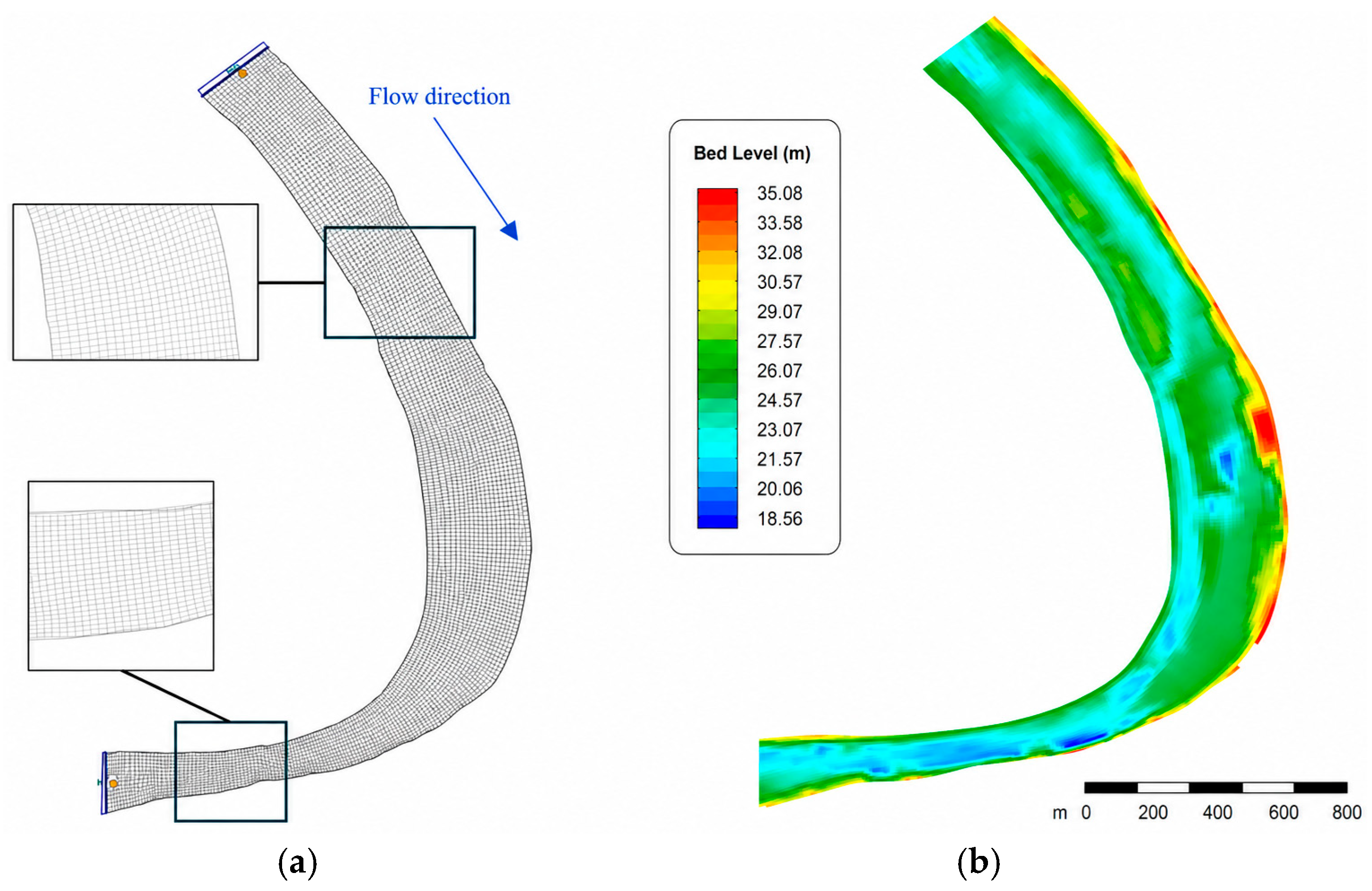
An unstructured mesh was created for the selected meandering–anabranching reach domain using bathymetric and topographic data, with localized refinement in high-curvature areas, including zones around the island, between the primary flow and the secondary anabranch, and along the banks where groynes have been placed. Mesh cell size is 5–10 m near the groyne fields and tight cross channels, while it is 20–30 m elsewhere on the Tigris River channel, particularly at locations with uniform hydraulic conditions. For detailed hydrodynamic and sediment-transport simulations, the model domain comprises 7825 computational nodes (Figure 8a).
To investigate the effect of mesh resolution on hydraulic performance, a sensitivity analysis was conducted during model development using a discharge of 480 m3/s. Several unstructured meshes, ranging from 2535 to 9800 computational nodes, were evaluated. The influence of mesh size on simulated water levels and depth-averaged velocities at several cross-sections of the meandering–anabranching reach of the Tigris River was examined. Comparison of several simulation trials showed that the mesh size has a minimal effect on the hydraulic parameters at the selected sections. For example, the maximum difference in water level between the selected meshes and finer meshes was approximately 15 mm, while the difference in depth-averaged velocity was about 1%. Therefore, the use of finer meshes only increased computational time without a significant improvement in accuracy. These results indicate that the selected mesh provides reasonable accuracy, and it is consistent with standard mesh sensitivity assessment practices [44].
The bed levels of the meandering–anabranching river reach shown in Figure 8b were generated from bathymetric survey and topographic elevation data. These data were subsequently interpolated to create a digital elevation model (DEM) and assigned to the unstructured Delft3D-FM grid as the primary bathymetry.

2.4. Boundary Conditions, Model Parameters, and Calibration Procedure

A steady discharge specified 100 m upstream of Al-Jumhuria Bridge was used as the upstream boundary condition and applied in calibration, validation, and scenario simulations. A constant water level specified approximately 200 m downstream of the Suspension Bridge was used as the downstream boundary condition. The lateral boundaries of the numerical domain were defined by the surveyed banks of the Tigris River and were treated as impermeable, closed boundaries, with no normal flow or sediment inflow across them. The model boundaries were kept fixed, while near-bank and island-edge bed adjustments were represented using the Delft3D-FM dry-cell erosion parameter (ThetSD), with a calibrated value of 0.7. This value lies within the recommended range [41].
In the simulations, the intake for the drinking water project was represented as a localized lateral abstraction. However, because the abstraction rate is much lower than the river discharge, it was considered to have a negligible effect on both flow and morphodynamics within the study reach. Model calibration and validation were performed sequentially.
For steady discharges, hydrodynamic calibration was first conducted by adjusting bed roughness coefficients until simulated water levels and depth-averaged velocities matched the measured values obtained from ADCP measurements. A steady discharge of 480 m3/s was used for calibration, while discharges of 500 m3/s and 510 m3/s were used for validation; each discharge corresponds to a different set of field measurements. In addition, morphodynamic calibration was performed using measured suspended load, bed load, and surveyed bed profiles. Appropriate sediment transport formulations were identified by adjusting key morphology-related parameters. Model validation was then carried out using independent field measurements of water level, velocity, sediment load, and cross-sectional bed changes.
A summary of the principal Delft3D-FM input parameters and numerical settings used in the present study is provided in Table 4.

2.5. Representations of Groynes in Delft3D-FM Model

In this study, groynes are used to control scouring and sedimentation in the selected meandering reach of the Tigris River. The groynes were designed based on experimental and field criteria, hydrology, and site-specific bathymetry of the Tigris River. In the Delft3D-FM meshing, groynes were simulated as riverbank protrusions spreading inward toward the center line of the Tigris River channel. Each groyne was described by its length (L), orientation (θ) to the local flow direction, groyne crest height (to maintain above-water level), and groyne spacing (S). To determine the most effective groyne dimensions and orientation, the simulation includes using groynes with different lengths (0.15 W, 0.20 W, and 0.25 W), spacing (2 L, 3 L, and 4 L), and orientation angles (θ = 90°, 45°, and 60°) along the critical location of the studied meandering stretch, where (W) is the local bank-to-band width, (L) is the recommended groyne length, and θ is the groyne orientation angle from the flow direction [7,39]. It is reported that the recommended groyne dimensions and orientation should deflect the flow and prevent adjacent crossflow between groynes [7].

2.6. Model Performance Metrics and Indicators of Groyne Effectiveness

The morphodynamic assessment for the groyne design scenarios has been guided by two principal engineering objectives: to concentrate discharge in the main corridor and to develop a stable, hydraulically efficient thalweg aligned with the preferred left-bank intake path. The assessment of model performance and groyne efficacy in controlling the morphological processes in the selected meandering–anabranching reach of the Tigris River was conducted by using two types of indices. For the hydrodynamic and morphodynamic calibration/validation, statistical indices were used, while morphodynamic indicators were used to measure alterations in channel configuration, thalweg stability, cross-channel activity, island erosion, and sediment deposition in the main flow channel.

2.6.1. Statistical Indices and Model Performance

Hydrodynamic model efficacy has been assessed by using statistical indices such as Root Mean Square Error (RMSE), ratio of RMSE to the standard deviation of observations (RSR), bias, and Scatter Index (SI) [45,46]. The indices have been used to evaluate model outputs for water level and depth-averaged velocity for each calibrated and validated discharge. The RMSE measures the average difference between modeled and observed data, while RSR was used as a normalized indicator of model performance. A lower RMSE and RSR value indicates a better evaluation outcome. Researchers have defined RSR as a dimensionless number used for evaluating model performance, stating that values less than 0.50 indicate “very good” model output [45]. For the average velocity, because no single universal acceptance threshold was adopted here for velocity RMSE, bias, or SI, these statistics were interpreted jointly, with lower RMSE and SI and bias values closer to zero, indicating better model performance. Similar statistical analyses have been performed to assess model accuracy for suspended-sediment concentration and bed elevation changes at control sections.

2.6.2. Morphodynamic Indicators

Several morphodynamic indicators were utilized to evaluate the baseline case (without groynes) and the river training (with groynes), allowing objective comparison of groyne configurations. These indicators were developed from physically meaningful model outputs, including water-discharge partitioning, bed-level changes, and planform attributes, and were formulated to represent the main hydro-morphodynamic responses relevant to the study objectives (a dominant, stable, hydraulically efficient main channel and minimized morphological processes (sedimentation and scouring)) [27,47,48,49]. As such, these indicators capture the fundamental characteristics of river training effectiveness, which include the tendency to develop a dominant, stable, and hydraulically efficient main channel while controlling undesirable morphological processes, primarily sedimentation and scouring. (i) Performance metric (1 − AnI) for the Anabranching Index (AnI), which quantifies discharge partitioning to evaluate secondary channel activity relative to the main channel [26,50]. Higher AnI values indicate stronger multi-thread or secondary-channel activity, whereas lower AnI values indicate greater concentration of flow within the main channel. At a control transect where the flow bifurcates into a main anabranch, secondary anabranch, or cross channels:
A n I ( s ) = Q o u t s + k = 1 N Q c c , k ( s ) Q t o t ( s )
where Q o u t s   is the discharge in the secondary channel; Q c c , k ( s ) is the discharge through cross-channel k ; N is the number of active cross-channels; and Q t o t s   is the total cross-sectional discharge.
For scoring, the benefit-oriented metric (1 − AnI) is utilized, where a higher (1 − AnI) signifies a more pronounced dominance of a singular major channel [47]. (ii) The Thalweg Stability Index (TSI) measures hydraulic performance and stability of the thalweg channel by measuring (a) bed change magnitude, (b) width–depth tendency toward a trained corridor, (c) thalweg continuity among control sections, and (d) planform alignment within the training corridor [27,28,37]. A higher TSI indicates a hydraulically efficient and stable thalweg. Because TSI is normalized between 0 and 1, values closer to 1 indicate a more stable, continuous, hydraulically efficient, and properly aligned thalweg, whereas lower values indicate greater thalweg instability, discontinuity, or deviation from the target training corridor. These metrics are normalized to [0, 1] and combined to generate the TSI value:
T S I =   w z S z + w w d S w d + w c S c + w l a t S l a t
where TSI is the Thalweg Stability Index; w z , w w d , w c , and w l a t are the weights assigned to the four sub-metrics; S z is the bed stability sub-metric index; S w d   is the width–depth sub-metric index; S c is the continuity sub-metric index; and S l a t is the lateral alignment index.
A multi-criteria decision analysis (MCDA) approach was selected to evaluate the hydro-morphodynamic responses of the trained meandering–anabranching reach of the Tigris River as a single metric [48,51]. The analytic hierarchy process (AHP) was employed to derive the relative weights of the TSI sub-metrics based on pairwise comparisons directly referenced to the river-training objective [49]. In AHP, the relative importance of each sub-metric is determined by using a reciprocal comparison matrix, from which the priority vector of relative weights is calculated and assessed for internal consistency using the consistency ratio (CR) [49]. Typically, a CR value below 0.1 indicates acceptable internal consistency [49].
Using this objective-linked weighting process, the adopted TSI sub-metric weights for w z , w w d , w c , and w l a t were taken as 0.20, 0.20, 0.25, and 0.35, respectively. The pairwise judgments were based on the extent to which each sub-metric contributes directly to the training objectives. For the studied case, lateral alignment was assigned the highest relative importance, as the primary function of the proposed groyne field is to redirect the principal flow axis into a predetermined corridor [27,28]. In addition, continuity received the second-highest weight, as the trained corridor should remain open for flow and free from obstruction [29]. However, bed stability and the width–depth ratio were assigned equal secondary weights, as neither directly controls the training objectives [29,37]. The evaluation indicated no inconsistency, as the calculated consistency ratio (CR) was found to be 0.022 [49].
The methodology for developing each of the selected indicators was formulated mathematically in an integrated manner using hydraulic geometry, dimensionless normalization, and threshold/run analysis, combined with composite-indicator weighting to establish a hydro-morphodynamic assessment framework [28,29,37,47,48,49]. The individual components of the indicators were derived from well-established mathematical and physical principles and integrated into a comprehensive assessment framework.
Overall, the mathematical development of the indicators followed four key steps: (i) conversion of measurable physical properties into dimensionless ratios or reference-based measures; (ii) representation of performance as a deviation from a specified target, threshold, or baseline condition; (iii) transformation of the measured response into a normalized score on a defined scale (0 to 1); and (iv) aggregation of the resulting scores using a weighted additive approach to evaluate overall impacts across multiple scenarios [28,47,48,49]. This study utilizes the following sub-metric forms:
S z = 1 z t h a l z r e f
S w d = c l i p   ( W / D t g t W / D s ,   0 , 1 )
S c = 1 L g a p s L t h a l
S l a t = c l i p 1 y n s y * s τ ,   0 ,   1
where Δ z t h a l is the thalweg bed change relative to the initial bed, Δ z r e f is a reference magnitude, W / D is the reach-averaged width–depth ratio of the main channel, W / D t g t is the target width–depth ratio for the trained main corridor, L t h a l is the total evaluated thalweg length within the study reach, and L g a p s is the length where the thalweg deviates beyond continuity criteria (e.g., discontinuities, abrupt jumps between branches). y n is the thalweg lateral position, y * is the corridor centerline, and τ is the corridor tolerance.
This formulation follows the established practice of constructing stability/efficiency indicators from normalized hydraulic and morphodynamic sub-metrics for trained rivers [27,28,29,37,52]. (iii) Cross-Channel Infilling Volume (CIV) measures the net positive bed-level change (deposition) in the grid polygons that construct cross-channel connecting the secondary to the main channel [30,31,32]. For K -cross-channel polygons:
C I V =   k = 1 N Ω k ( max z b x , y , t 1   z b x , y , t o , 0 d A
In Equations (10)–(12), K   is the number of cross-channel polygons; Ω k is the k -th cross-channel polygon; Ω c o r r is the main-channel corridor polygon; z b x , y , t 0 and z b x , y , t 1 are the initial and final bed elevations, respectively; t 0 and t 1 denote the initial and final simulation times; and d A is the elemental area.
Normalizing CIV to a no-groyne baseline makes it dimensionless and comparable across scenarios. Baseline referenced (or benchmarked) normalization is robust because it provides an easily understandable “change relative to baseline” measure, eliminates extreme values in the tested scenarios (min-max scaling), and follows composite indicator approaches where there is a suitable reference point or condition [47]. (iv) The Island Toe Integrity/Toe-Erosion Performance Score (ITEI) measures local scouring at island margins. The ITEI can be derived from bed-level change within a buffer around island margins [32,33,34]. Local toe erosion is computed as:
E x , y = max ( z b t 1   z b t o , 0 )
E x , y   is the local toe-erosion depth; this indicator measures scour along island perimeters, which initiates lateral trimming and changes island morphologies [33,34,53]. (v) Corridor Deposition Volume (CDV) and its performance version (1 − CDV) refer to net positive deposition within a grid polygon, Ω c o r r , around the main thalweg corridor [32,35,36]:
C D V =   Ω c o r r max z b x , y , t 1   z b x , y , t o , 0   d A
CDV is a cost-type indication because deposition fills the trained main channel and reduces capacity. Thus, to compare CDV across all scenarios, the raw volumes of deposition in the channels are normalized to the baseline instance (no groynes) and given as a ratio. Benefit-type performance measures are created by subtracting the raw ratio from 1. High scores for CDV indicate more channel sediment than baseline. This technique maintains the physical interpretation of progress, less sand in the channel, and penalizes poorly planned scenarios when more sediment is deposited than the baseline. Composite indicators and MCDA approaches involve reference point (ratio) normalization and transformation of cost metrics into benefit-type performance measures [47].

2.6.3. Groyne Performance Index (GPI), Normalization, and Decision Criteria

The alternative groyne designs were evaluated and ranked using a common analytical basis for the individual metrics. All indicators entered into the GPI formulation were obtained from morphodynamic results of the calibrated Delft3D-FM model, using the same hydraulic and topographical data (e.g., dominant discharge, predefined control sections, and spatial analysis domains). Differences in GPI values reflect the impact of varying groyne designs on the hydro-morphodynamics of the studied meandering–anabranching river reach, while the influence of extraction methods and spatial scales was eliminated. A common reference point was required to enable meaningful comparisons. Each selected indicator represents a distinct characteristic of river-training performance and therefore requires a unified basis for comparison prior to aggregation [47,48,51]. The aggregation followed a hierarchical structure: the four TSI sub-indicators were first combined into a single thalweg stability indicator; subsequently, the TSI was integrated with the remaining normalized indicators to obtain the final GPI value. The Groyne Performance Index (GPI) is calculated as a weighted linear aggregation according to the same methodology used in calculating TSI:
G P I =   i = 1 5 w i I i   with   w i = 1
where w i   is the weight assigned to criterion i , and I i s   is the normalized benefit-oriented score of criterion i for the scenario s .
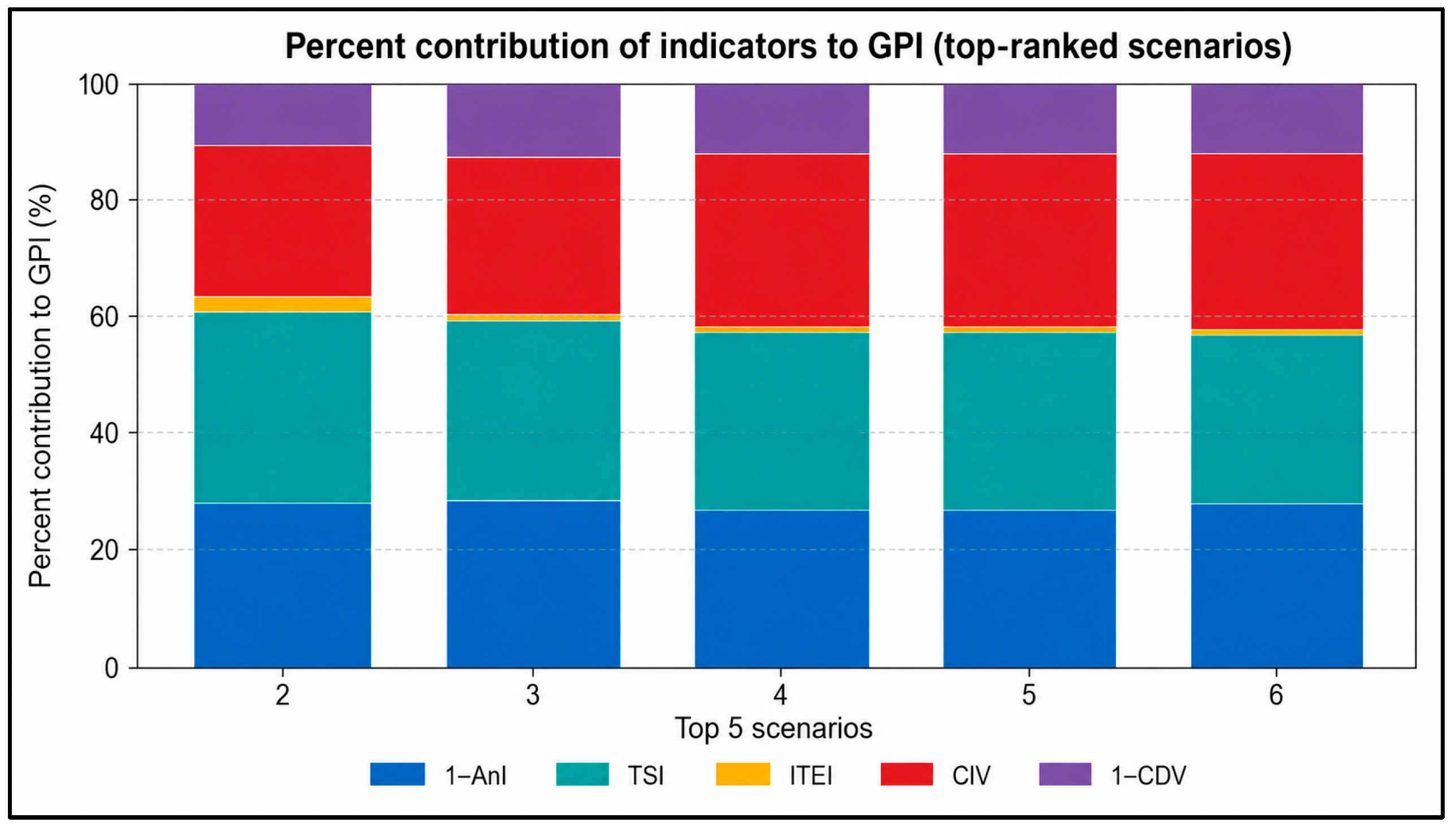
Individual scores, I i   , represent normalized, benefit-oriented indicator values for (1 − AnI), TSI, ITEI, CIV, and (1 − CDV). Accordingly, all indicators were evaluated on a common basis such that higher scores correspond to better performance of the river-training system. The GPI was calculated using a standard MCDA linear additive aggregation method across the various scenarios [47,48,49,51]. Using a weighted-sum formulation, “percent-share” interpretations of each indicator’s contribution to the overall score were obtained by comparing its weighted term to the total score; this approach helps identify the dominant drivers of design performance [47,48].
The top-level weights of the GPI were determined using the Analytic Hierarchy Process (AHP) through pairwise comparisons among the five criteria. The AHP was implemented with direct reference to the training objectives, including the development of a dominant, stable, and hydraulically efficient channel while controlling unfavorable morphodynamic activity [49]. Accordingly, TSI was assigned the highest weight, as the development of a stable, continuous, and well-aligned main channel represents the most direct measure of reach-scale success for the proposed river-training works. The performance metric (1 − AnI) was assigned the second-highest weight, as it reflects the reduction of excessive secondary flows and the concentration of flow within the main channel, which constitutes the next most direct measure of reach-scale success [26,27,28,50].
CIV, ITEI, and (1 − CDV) were used as secondary diagnostic indicators describing the mechanisms and conditions associated with achieving the primary objectives, including suppression of cross-channel activity, adjustment of island margins, and maintenance of conveyance capacity in trained channels [30,31,33,35,36]. As these indicators were considered to represent equally important aspects of the project objectives at this level of aggregation, they were assigned equal weights in the GPI formulation. The adopted weights for w ( 1 A n I ) , w T S I , w I T E I , w C I V , and w ( 1 C D V ) were 0.25, 0.30, 0.15, 0.15, and 0.15, respectively (Table 5).
The corresponding judgment matrix exhibited acceptable internal consistency, with a consistency ratio (CR) of 0.013, which is less than the recommended threshold of 0.10 [49]. Accordingly, for each scenario, TSI(s) was first calculated using Equation (5), after which GPI(s) was obtained from Equation (9).
The contribution of each indicator can be explicitly conveyed as a result of the additive character of GPI. In each case, the percentage contribution of indicator i to the GPI is as follows:
%   C o n t r i b i s = 100 %   w i I i ( s ) G P I
where % C o n t r i b i s   is the percentage contribution of the indicator i   to the GPI of the scenario s ,   a n d   w i I i   i s   t h e   w e i g h t e d   s c o r e   o f   i n d i c a t o r   i . This analysis elucidates the reasons behind the superior performance of one groyne configuration over another, as detailed in the top-ranked scenarios in the results [47,48,51].

2.6.4. The Design Rules

The scenario selection is based on a two-step approach. The first step involves selecting options according to the highest GPI. The second step is applied when the highest-ranking scenarios have GPI values within a narrow performance range. In such cases, further differentiation is required, and final selection is made using a benefit–risk decision-making framework. This framework identifies the alternative that provides comparable reach-scale benefits while minimizing the likelihood of adverse near-field effects. The screening tool evaluates whether there are significant concerns regarding an increased risk of adverse local responses, based on the design parameters and the spatial spacing between structures as reported in the literature. It also assesses whether the proposed design can be implemented under the prevailing river conditions.
During the preparation and revision of this manuscript, the authors used ChatGPT, GPT-5.5, OpenAI. by OpenAI for limited editorial support and enhancement of the visual clarity of selected figures.

3. Results and Discussion

3.1. Calibration and Validation of the Hydrodynamic Model

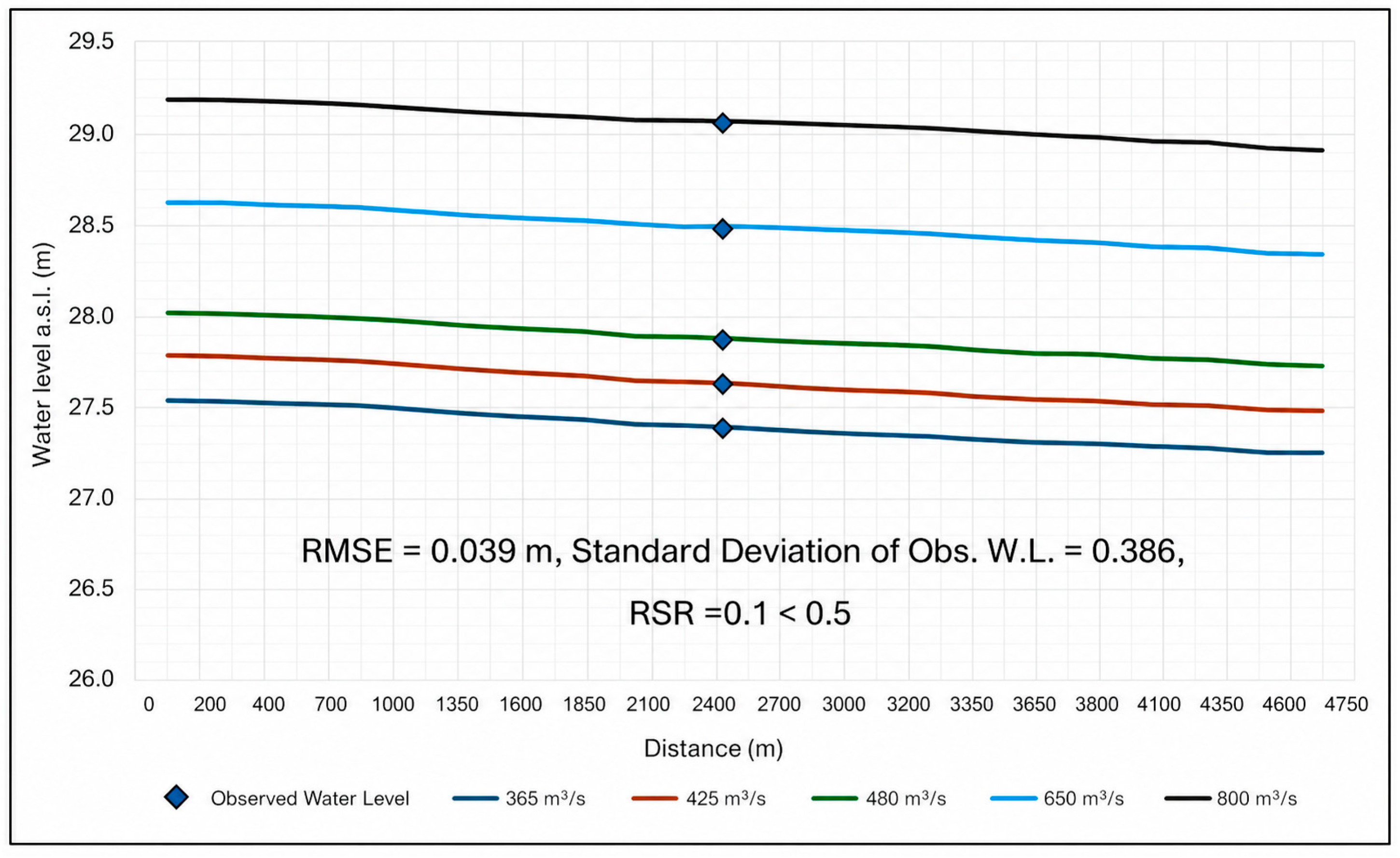
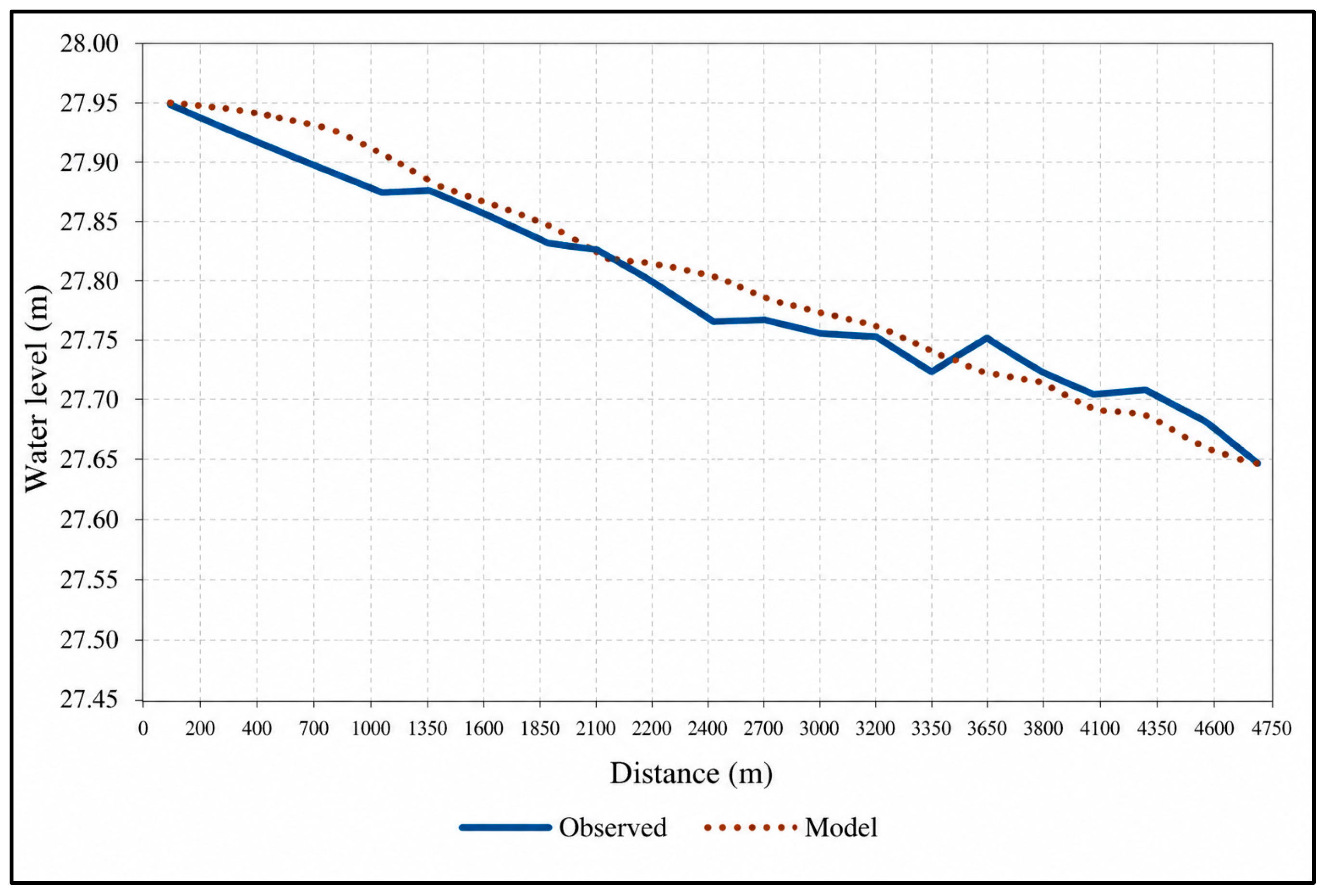
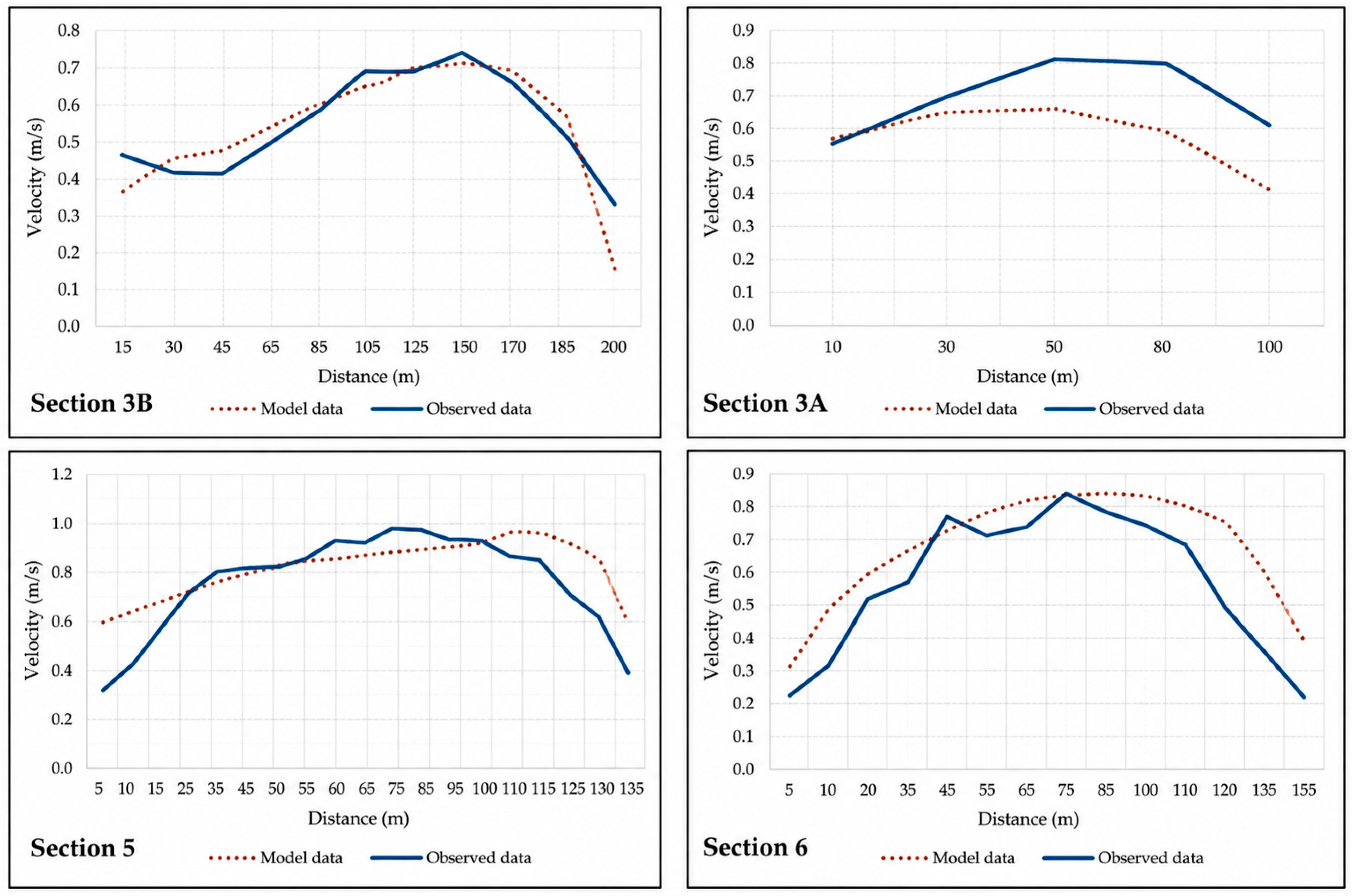
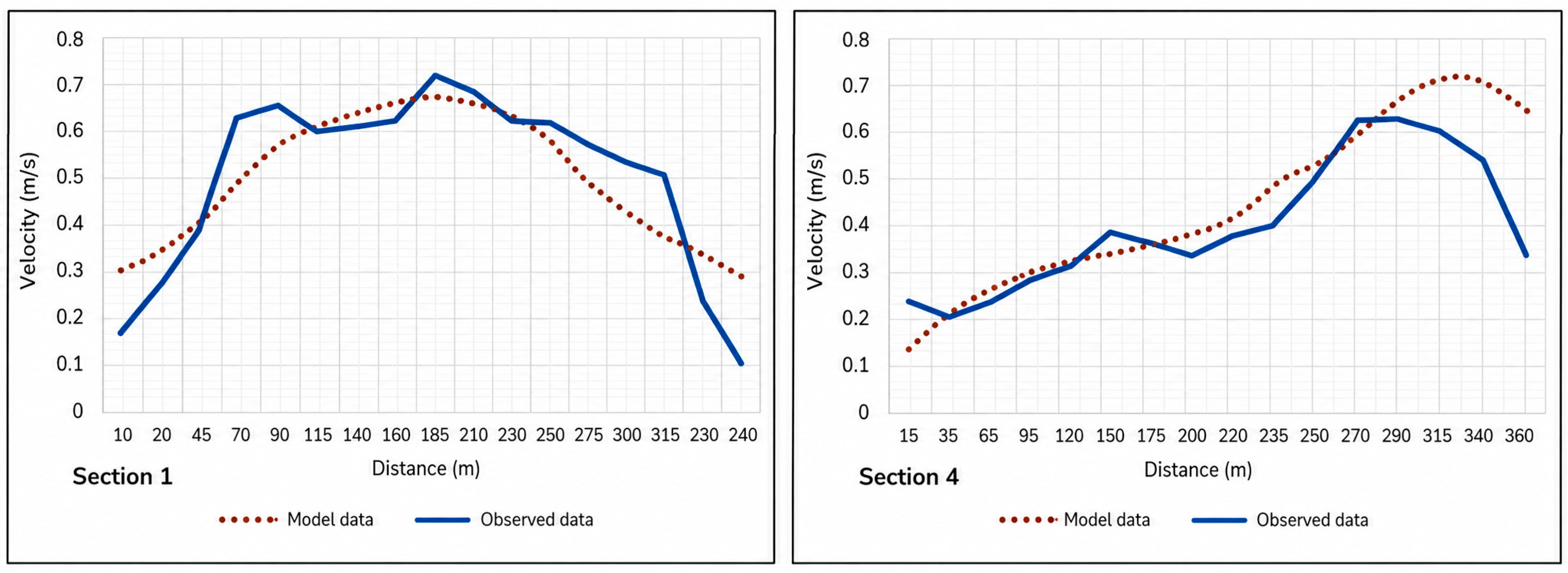
Model calibration was done using data on observed water surface elevation and flow velocity. In order to match simulated and actual water levels, coefficients of roughness (Manning’s n) were assigned to the main channel and floodplain. Values of Manning’s “n” were changed several times to match field data over the selected meandering–anabranching reach. Root Mean Square Error (RMSE) was used to assess model accuracy. The calibration process revealed that the values of Manning’s “n” for the main channel and flood plain of the studied reach were found to be 0.028 and 0.040, respectively. For a discharge (Q) of 480 m3/s, the value of RMSE between predicted and measured water surface elevations was found to be 0.02 m. Figure 9 shows the water surface elevations along the studied river reach. The value of RSR was found to be 0.232, “very good”. Comparison between observed and simulated two-dimensional depth-averaged velocities across selected sections showed a high degree of agreement (Figure 10) [4,6,28,47]. The observed and simulated velocities showed that the values of RMSE, Bias, and Scatter Index (SI) were 0.121 m/s, 0.038 m/s, and 0.187, respectively. These statistics indicate low overall error, slight positive Bias, and low normalized scatter [54]. For a discharge of 510 m3/s, the model was validated by comparing the recorded and predicted velocities in the Tigris River at Sections 1, 2, and 4 (Figure 11). The RMSE, Bias, and SI values were 0.095 m/s, 0.014 m/s, and 0.197, respectively, confirming the model’s accuracy [54].
Water level data from a gauging station located within the selected river reach at the apex of the meander part were used to validate the model output. Figure 12 shows good agreement between the simulated and observed water levels (RMSE = 0.039 m and RSR = 0.10).

3.2. Calibration and Validation of the Morphodynamic Model

Calibration of the morphodynamic model was done by matching the predicted depth-averaged suspended sediment concentrations (SSC) with the sediment data taken at selected sampling points within the Tigris River cross sections. The modeled SSC represents an average value across a water column. Many researchers confirmed that the depth-averaging values of SSC can be used for model calibration and validation. If sampling times are synced and units are consistent, it can be compared with the predicted values of SSC at the location [41,55].
Model performance was assessed using RMSE and normalized SI relative to the measured SSC. The upstream value of SSC was used as a boundary condition, and it was set at 0.06 g/L (based on the measured values at Al-Jumhuria Bridge). To calibrate morphology parameters, values of three key parameters (sediment layer thickness, adjustment factor for erosion of dry adjacent cells, and effects of secondary flow on bed load direction) were estimated as shown in Table 4. The fluctuations between the values of simulated and observed SSC can be attributed to sampling error and to the empirical parameters in the sediment transport formula [55]. The present model reproduced the primary sediment-transport behavior and yielded a scatter index (SI) of 19.5% relative to the mean measured SSC, indicating acceptable agreement between observed and simulated SSC values [56].
For the tested sediment transport formulae, it was found that the Engelund–Hansen formula gave the most accurate results for the sediment transport in the selected meandering–anabranching reach of the Tigris River. Compared with other evaluated formulae, such as the Van Rijn formulations (1984 and 1993), the Engelund–Hansen formula was found to provide the best correlation with the measured suspended sediment concentrations (SSC). This justifies why the Engelund–Hansen formula was chosen for morphodynamic simulations as input for the Delft3D-FM model of the Tigris River reach in this study. Observed and simulated values of SSC at left/right/center sampling locations across Sections 1 to 6 were found in agreement (Table 6). The discrepancies can be attributed to spatial flow characteristics and/or sample collection uncertainties in complex flow areas. In addition, it is recommended to apply the Engelund–Hansen total load formula for large, low-slope, sand-bed rivers [42,57,58].
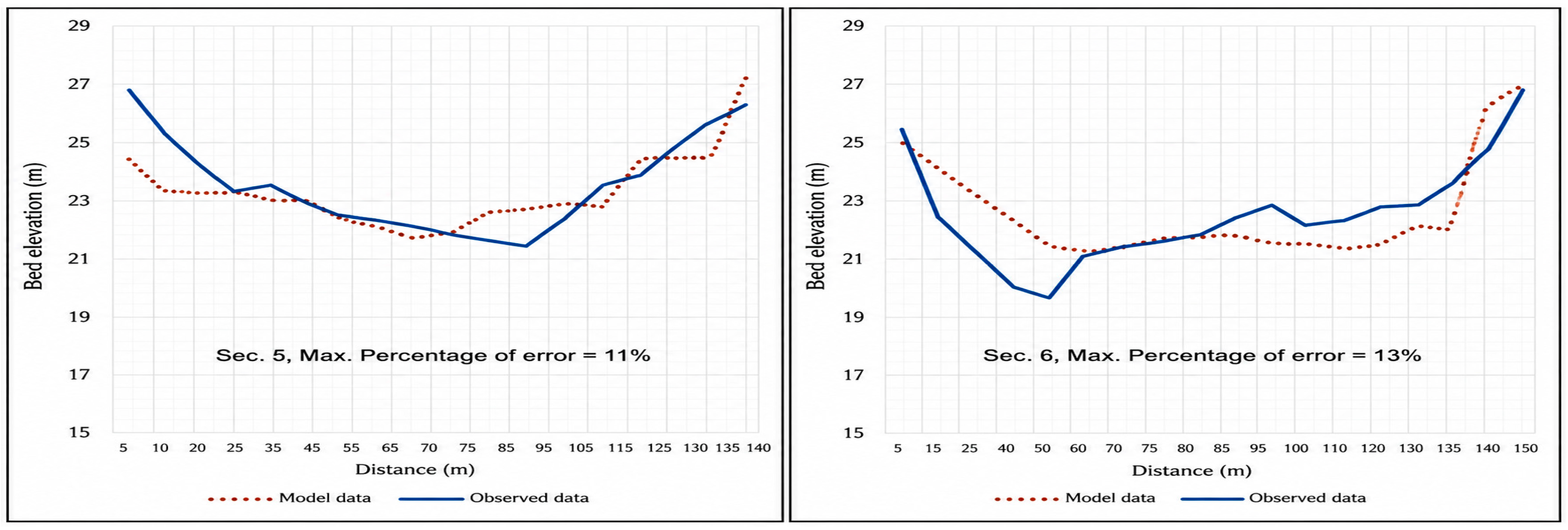
The morphological modeling results were validated by comparing the predicted and surveyed cross-sections, particularly at Sections 5 and 6, as these sections are located away from the continuous river-training works. The bed levels of the selected cross-sections were surveyed in 2025. The comparison showed a maximum error of 13%, indicating good agreement between the predicted and surveyed cross-sections (Figure 13). Additionally, Table 7 presents the measured and predicted values of total sediment load for the selected cross-sections. The RMSE was calculated as 3.51 kg/s, representing approximately 17.3% of the mean observed total sediment load. This level of deviation indicates acceptable agreement between the modeled and observed sediment loads [56]. These results support the adequacy of the calibrated hydrodynamic and morphodynamic models for the present application.

3.3. Simulation Using the Dominant (Bankfull) Discharge

A representative discharge was chosen to simulate the morphodynamic process since scouring and sedimentation are mostly affected by the flow regime and sediment load. The dominant or channel-forming (effective) discharge concept has been used to identify the most formative discharge contributing to geomorphic work over the long term, as defined by transport capacity and occurrence using magnitude-frequency analysis [59,60].
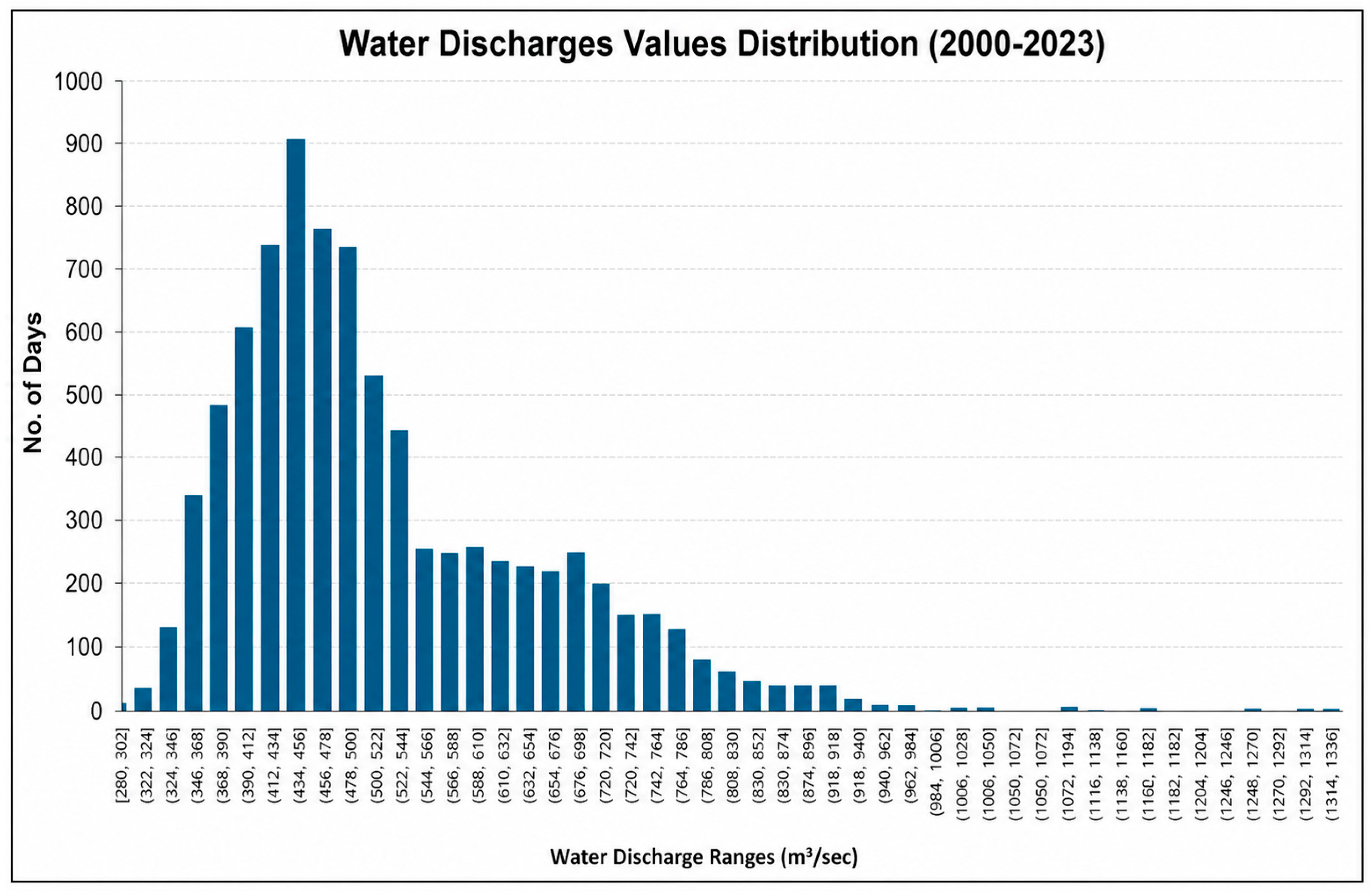
An upstream control structure (called the Samarra Barrage) regulates the downstream flows in the Tigris River and provides prolonged quasi-steady releases, including those in sections of the selected meandering reach. The post-year-2000 daily discharge data is shown in Figure 14, and approximately 46% of discharges were found between 400 and 500 m3/s, with the most frequent discharge being 485 m3/s. Therefore, the dominant discharge (Qd) for a moderate year at the selected river reach was determined to be 485 m3/s, as it occurred on 125 days. Moreover, this dominant discharge was used in the present study to assess the performance of the proposed groyne design.

3.4. The Configuration of the Selected Meandering–Anabranching Reach

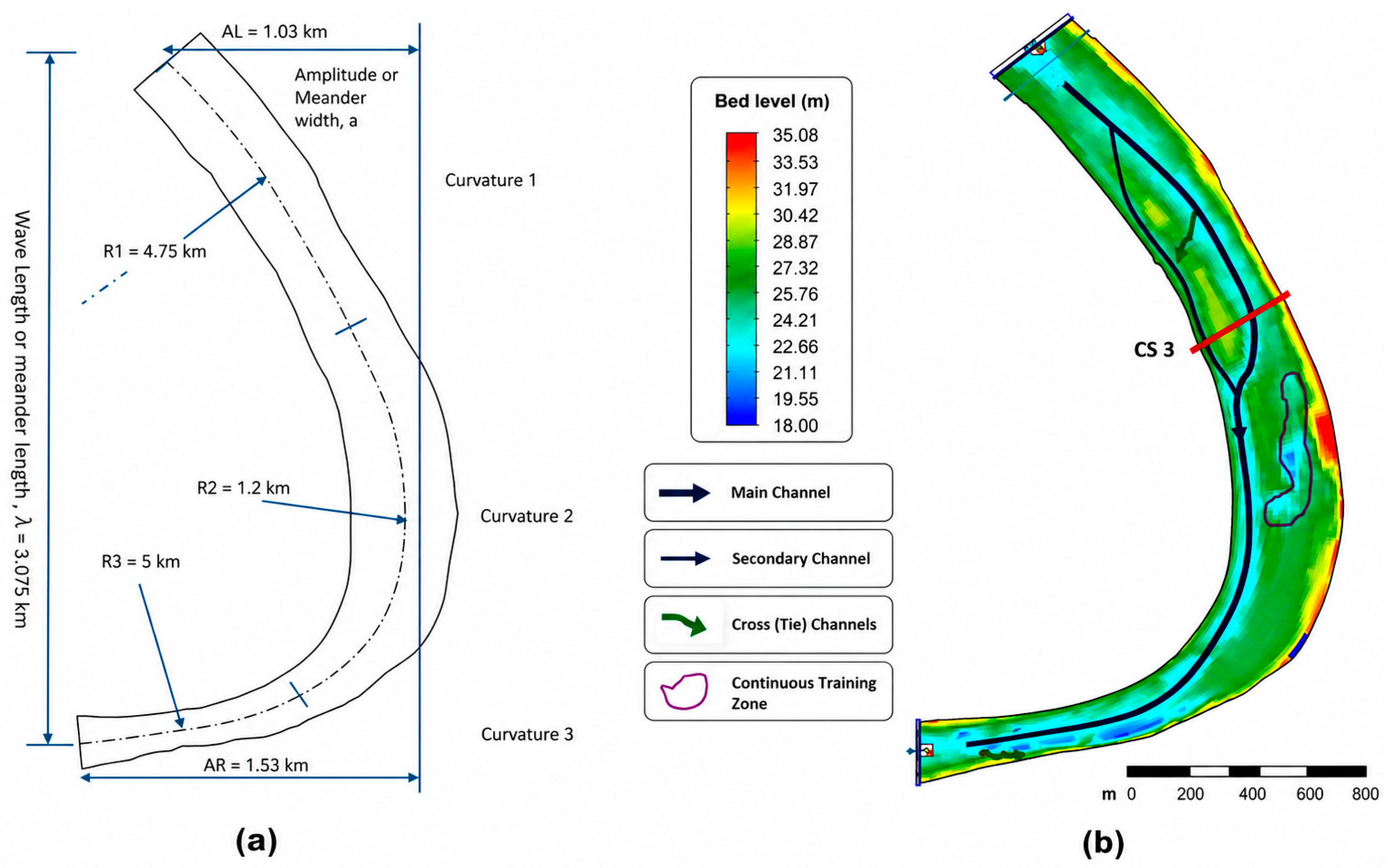
The selected river reach exhibits a consistently irregular meandering configuration. The channel top width varies from 160 m to 475 m, with an average of approximately 318 m. The measured meander wavelength (λ) is 3.075 km, while the mean radius of curvature (Rc) is 1.2 km. The ratios of λ/W and Rc/W for the studied reach were calculated as 9.6 and 3.75, respectively. Analysis of planform symmetry yields an asymmetry index of 0.195, indicating that the meander pattern is asymmetric [37]. These metrics suggest that the reach represents an irregular, compound meander system. Variations in curvature and bend morphology along the reach indicate the influence of local hydraulic conditions, sediment redistribution, and variability in bank processes (Figure 15a).
In the selected meandering–anabranching reach, the vegetated islands formed in the river split the discharge into main and secondary channels interconnected by small cross channels. The convergence of the main channel and the secondary channel forms a deep, narrow channel along the inner bank along the middle part of the selected meandering reach, while the outer bank area exhibits significant sediment accumulation across an extensive length, resulting in a shallow water depth in this region. The sediment deposit has expanded and significantly affected the existing water station intake. Therefore, river training works have become necessary to control the morphological processes within the selected meandering–anabranching reach. Following the post-meander apex, the flow traverses a designated restriction in the river section before expanding once more. An earthen extension from the left side of the river (about 33% of the river’s width) beneath the Suspension Bridge imposes additional geometric limitations (Figure 15b). The average widths for each river section are depicted in Figure 3. The bed and bank materials of the selected reach predominantly consist of fine sand (D50 = 0.22 mm), signifying considerable sediment mobility under sand-bed river discharge conditions. To prevent steep-sided undercutting of the outer bank from threatening nearby developed areas along the Tigris River, the bank has been protected with cemented rock lining.
For the discharge of 480 m3/s, field investigations of Section 3 (Figure 15b) reveal significant flow separation between the two anabranches (main and secondary), with 58% of the discharge flowing in the main channel, and 42% of the discharge flowing in the secondary channel; then, the major flow is diverted toward the inner bank away from the meander apex. In the main channel, depth-averaged velocity was 0.760 m/s, while it was 0.485 m/s in the secondary channel.
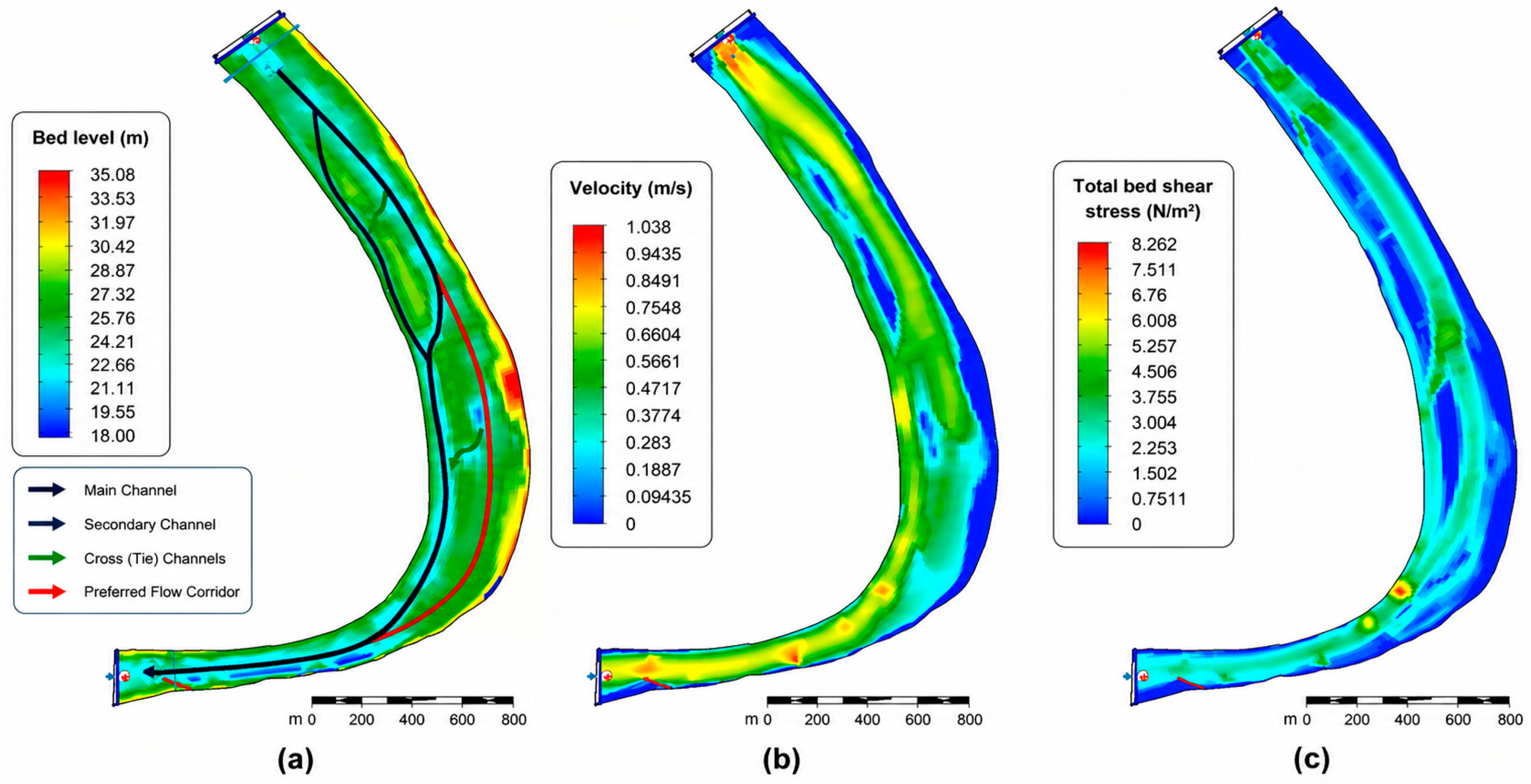
The overall modeling procedure consisted of two cases. The first case involved running the model without any groynes to establish a baseline for reproducing the current flow distribution, thalweg location, and typical morphodynamic trends under the dominant discharge. The results from this case enabled the establishment of a quantitative baseline using objective evaluation criteria. The second case involved implementing the designed groynes and evaluating their morphological performance using the same criteria applied in the first case. The main objectives of the training works are to minimize the effects of morphological processes within the selected meandering–anabranching reach by (i) redirecting the majority of the flow toward the main channel while reducing the flow in the secondary channel and (ii) stabilizing the thalweg of the main channel and adjusting the channel trajectory to run parallel to the left bank of the river, rather than diverting toward the inner bank, as illustrated in Figure 16a (the preferred channel path). Collectively, these measures were aimed at establishing a dominant, deep, hydraulically efficient main corridor with a stable thalweg parallel to the river left bank while developing and sustaining a controlled secondary channel along the river right bank and limiting the interchange of cross flows. This, in turn, would minimize recurrent sedimentation, maintenance, and dredging costs while improving navigation and enhancing the reliability of water supply to the intake structures of the drinking water treatment station located on the left bank at the meander apex.
However, under the prevailing sand-bed, width-variable, and locally constrained conditions, including contractions/backwater effects and ongoing deposition near the river left-bank of the selected meander apex, complete removal of the islands and the formation of a single wide channel remain difficult to achieve. In such settings, flow redistribution and rapid re-deposition typically restore multi-thread conveyance. The indices for the first case will be integrated into a single index value for comparison with the GPI values derived from the second-case indices for each scenario.
The groynes were positioned along the left bank of the selected reach at locations where the formation of anabranches and alluvial islands is prevalent. Each groyne configuration was simulated under the predominant flow conditions to evaluate the river’s morphological response. The analysis of velocity, flow depth, and bed pattern evolution was primarily based on the calculated morphodynamic indicators.

3.5. Baseline Modeling Results for Morphodynamic Processes (No-Groyne Scenario)

3.5.1. Modeling Flow Partitioning and Location of Thalweg

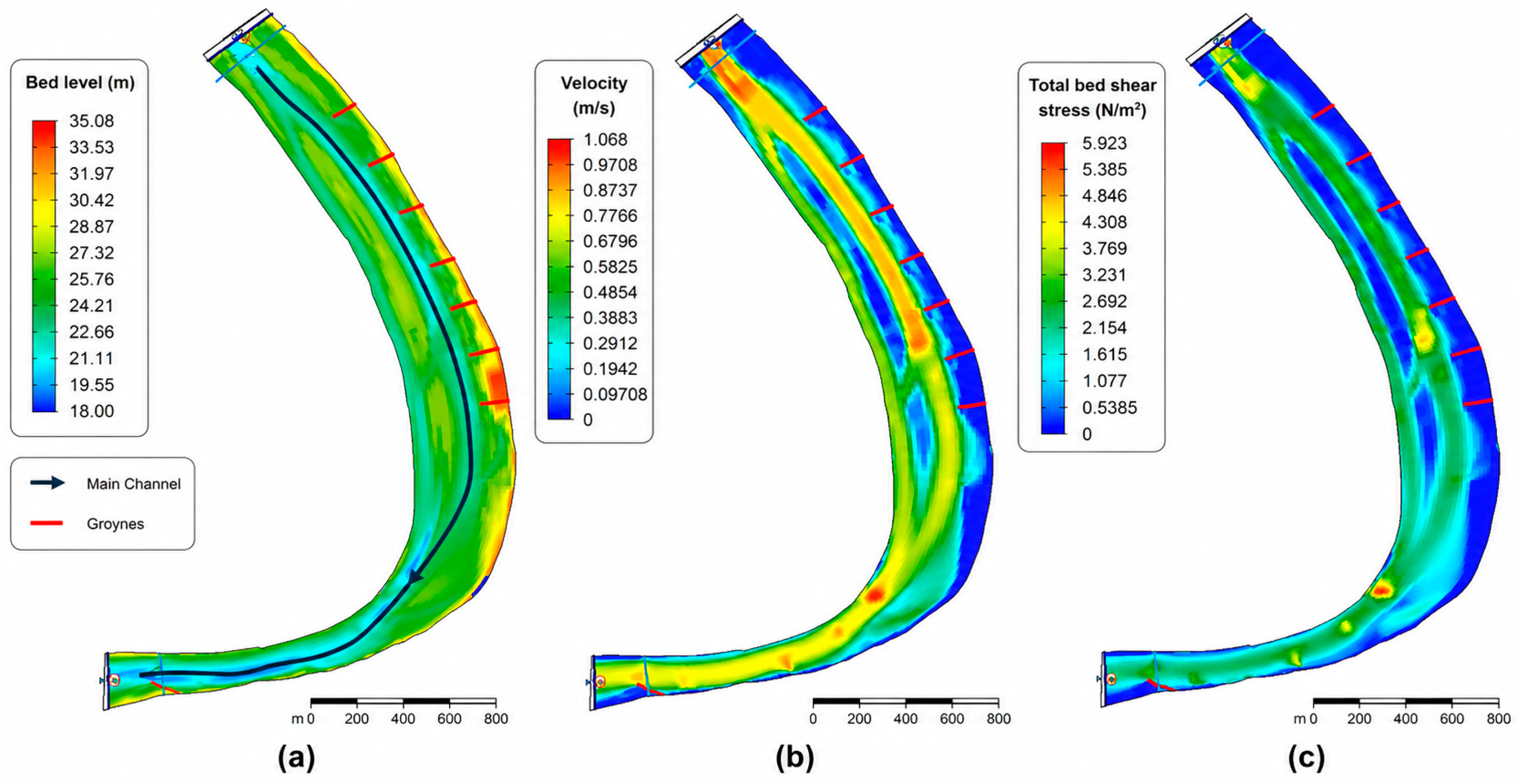
Utilizing the determined dominant discharge, the results of the no-groyne case modeling indicate that the studied reach exhibits flow through two anabranches with a distinct hydraulic disparity. Approximately 62% of the total discharge is conveyed through the main anabranch (proto-thalweg corridor), whereas about 38% is directed through the secondary anabranch at Section 3 (Figure 15b and Figure 17a).
The planform behavior also shows that the interconnecting channels become less hydraulically effective over time. Some of these channels appear to be gradually infilled with sediment and eventually disappear, causing the alluvial islands to merge into a continuous, broad, semi-permanent feature approximately located 500 m downstream of Al-Jumhuria Bridge.
In addition, the discharge becomes increasingly concentrated, and velocity increases within the main anabranch. However, at the same time, the last functional cross-channel diverts water toward the inner bank of the meander, where it joins the secondary anabranches and the discharge is concentrated in an inner-bank adjacent stream, where the velocity increases and a sedimentation zone adjacent to the outer bank, and then rejoin at the meander is formed (Figure 17a).
This indicates that the system naturally adjusts its flow paths rather than collapsing into a single, thalweg-stable, wide channel with sufficient hydraulic efficiency for navigation under varying water levels, regardless of existing training works and the need to secure water supply for intake stations.
Overall, the baseline morphological analysis confirms that the studied reach does not behave as a single continuous channel but rather as a hydrologically segregated system composed of a main channel, secondary anabranches with cross-channel flows, and deposition zones. This separation helps explain why the proposed training operations must be evaluated not only in terms of their effects on local velocities and bed elevations but also in terms of their ability to redirect a larger proportion of the dominant flow into the main channel. This, in turn, supports the development of a preferred thalweg corridor and reduces sediment deposition near the water intake of the drinking water project. Thus, the success of the groyne system depends on its ability to regulate the dominant discharge along the red-line path, rather than allowing it to follow the alternative route shown in Figure 16a (toward the inner bank).
The velocity and total bed shear stress distributions shown in Figure 17 are primarily concentrated in the main channel (the deeper, active channel) of the studied meandering–anabranching reach. These distributions are generally consistent with the characteristics of the local morphological processes occurring within the main channel. As a result, both the maximum velocity and shear stress are concentrated within the thalweg corridor. The main channel can be described as hydraulically efficient, as it conveys a large proportion of the discharge of the Tigris River within the selected reach. In contrast, the secondary channels, where deposition occurs, are shallower and convey a smaller proportion of the river discharge; consequently, velocities in these channels are low. Overall, this pattern illustrates the effects of flow segregation, depth variation, and localized channel constriction under the dominant discharge condition.

3.5.2. Benchmark Indicators (Baseline Problem Statement—Quantitative)

The benchmark indicators quantify the morphodynamic problem for which the groyne system has been designed. These indicators also provide a basis for evaluating the morphodynamic performance of the proposed groynes. The baseline condition indicates significant anabranch conveyance (AnI = 0.61) and moderate thalweg instability/inefficiency (TSI = 0.44). In addition, the development of interconnecting channels and the infilling of water corridors are also important processes. This is supported by the sediment volumes of =+26.3 × 10⁴ m3 in the cross channels and +30.7 × 10⁴ m3 in the corridor, which indicate net positive sediment deposition within the defined cross channels and the corridor polygons. These values will be set as reference state deposition conditions for CIV and CDV indicators calculations. Furthermore, the ITEI value (ITEI = 0.016) reflects localized scouring at island margins along the main channel side of the island (The side opposite the outer bank).

3.6. Evaluation of Groyne Performance Based on Effective Dimensions

3.6.1. Overall Ranking for Alternative Groyne Configurations for River Training Works

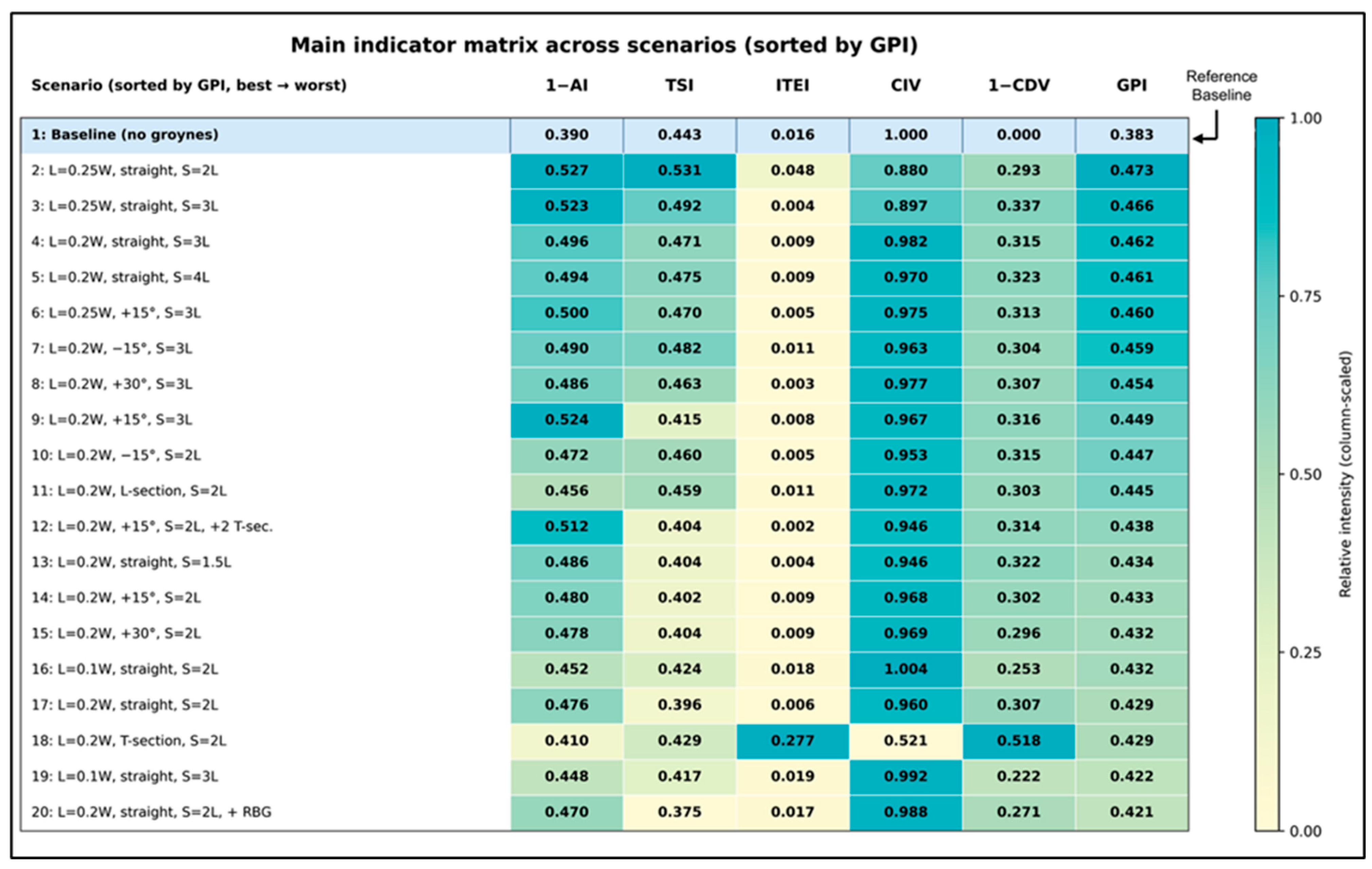
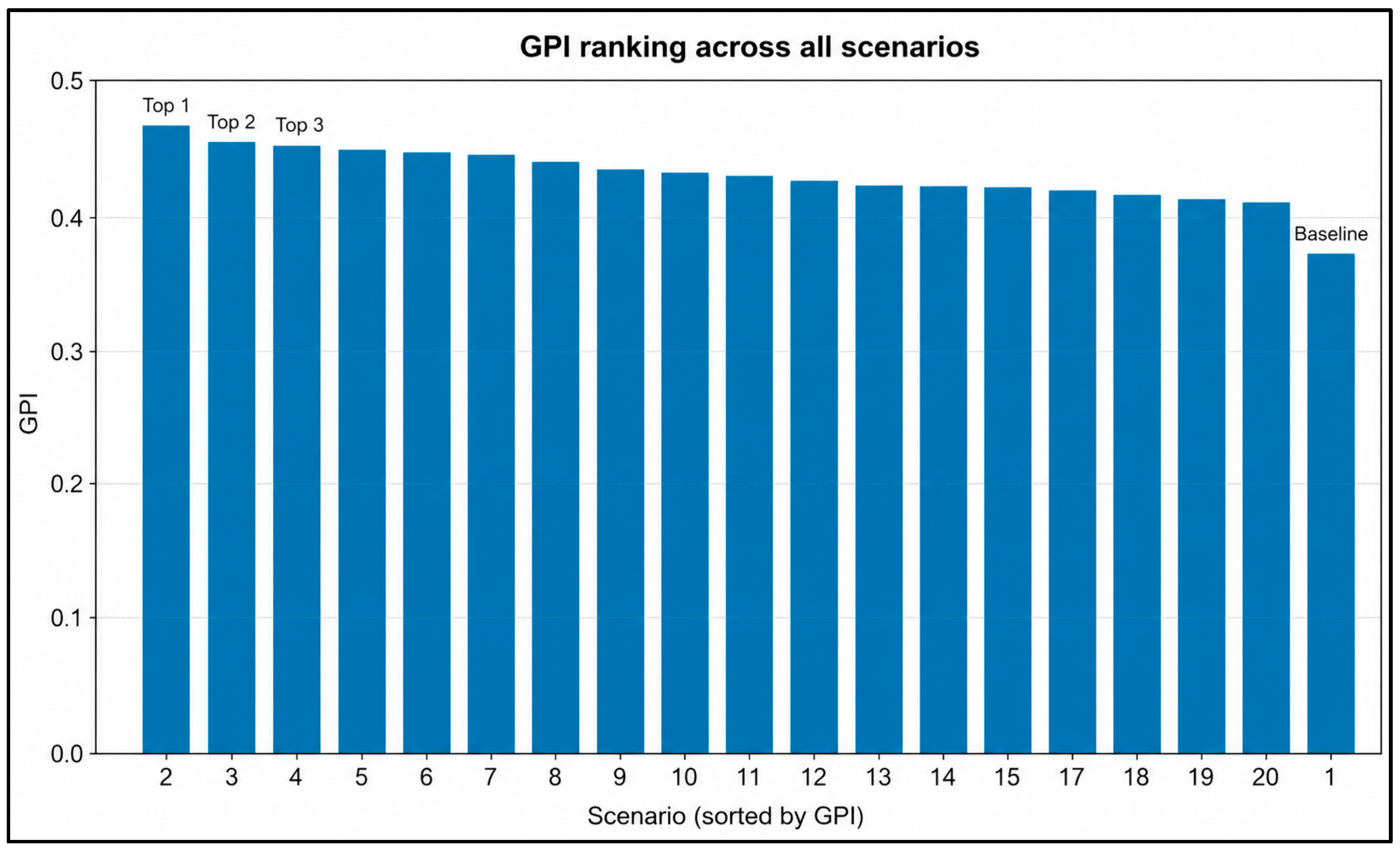
Twenty groyne configurations have been analyzed and ranked utilizing the GPI. In addition, a baseline condition (scenario without using a groyne) was used for comparison. A summary of normalized indicator values and the GPI values for each scenario is presented in Figure 18, while Figure 19 illustrates the configurations ranking based on GPI values. The outer bank (left bank) of the selected meandering–anabranching reach was designated as a groyne field. To prevent excessive scouring and minimize hydrodynamic disturbances caused by flow interaction near Al-Jumhuria Bridge, the groynes were positioned 500 m downstream of the bridge and extended toward the upstream of the water intake, at the location of maximum channel curvature. The proposed groyne placement is consistent with recommendations from previous studies [61,62].
The evaluated layouts show a consistent preference for straight groynes with a length of 0.25 W. The highest GPI value (GPI = 0.473) was obtained for groynes with L = 0.25 W and S = 2 L. A slightly lower GPI value (0.466) was achieved for groynes with L = 0.25 W and S = 3 L. In addition, groynes with a length of 0.20 W and spacings of 3 L–4 L yielded GPI values lower than those of the two configurations above, but they remained superior to most other alternatives. Inclined groynes, head-modified forms, and opposite-bank layouts were found to be less effective (Figure 18 and Figure 19). These results suggest that the response of the studied reach is primarily controlled by groyne length, straight orientation, and spacing, while head modification and bank-side reversal provide limited additional benefits. Although groynes with L = 0.25 W and S = 2 L achieved the highest GPI value, the final preferred configuration was further evaluated using the benefit–risk selection rule.
The above outcome shows morphodynamic consistency with the function of a straight groyne, which directs the high momentum flow towards an intended main channel, creates areas of protected recirculation, and reduces undesirable flow diversion into secondary or cross-channel paths [61,62]. Figure 20 illustrates the indicators’ contributions in the additive formulation of the GPI as values, not as the influence level toward the study objectives’ achievements, which is determined by the weight of each indicator.

3.6.2. Final Configuration (Selection Rule + Engineering Tie-Break)

A two-stage design assessment process was employed to select the optimal configuration by maximizing the GPI. When multiple designs fell within a narrow performance range, the final selection was determined using a benefit–risk screening approach that examined hydraulic performance, morphological risk, construction feasibility, and potential local impacts.
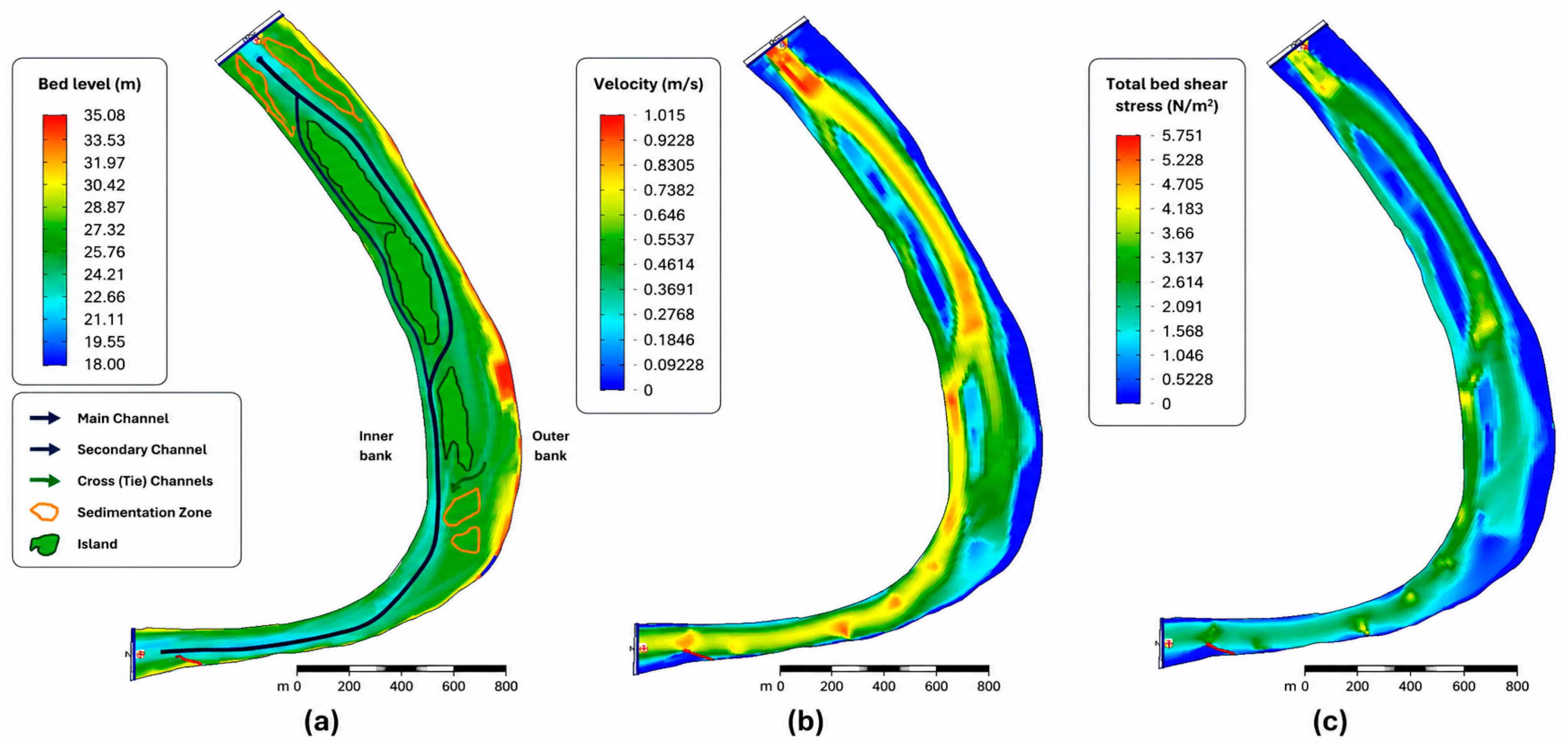
Based on this procedure, the preferred configuration has been identified and selected, which consists of straight groynes, with a length (L) of 0.25 W, oriented perpendicular to the flow direction and spaced at S = 3 L along the left bank of the upstream section of the designated meandering reach. Although groynes with L = 0.25 W, S = 2 L and straight configuration yielded the highest value of composite score (GPI), groynes with L = 0.25 W, S = 3 L and straight configuration have been selected as they provided a comparable composite performance with lower expected engineering and morphological risk. A closer spacing of 2 L may induce stronger flow contraction, higher near-tip shear stress, and greater local scour potential, as reported in previous studies on spur dikes and groynes [61,62]. In contrast, the spacing of S = 3 L maintains most of the reach-scale training benefit while reducing the number of structures, construction cost, hydraulic disturbance, and potential localized morphological impacts. Furthermore, it still maintains satisfactory performance with respect to the primary design objectives (Figure 21). Therefore, Scenario 3 represents the more balanced solution when composite performance and practical implementation risks are considered together.
For the dominant discharge, Qd = 485 m3/s, Figure 21b reveals significant flow separation between the two anabranches (main and secondary), with 71% of the discharge flowing in the main channel, and 29% of the discharge flowing in the secondary channel, then the major flow concentrated within the main corridor along the target path instead of diverting toward the inner bank away from the meander apex. The corresponding high-velocity and shear-stress zones also become more aligned with this intended corridor, indicating that the selected groyne field redirects the dominant flow path toward the preferred training alignment.
Accordingly, the selected configuration is in line with the main study objectives, including reduction of ana-branching activity, providing greater thalweg stability, and controlling the deposition along the proposed training alignment.

4. Discussion

Compared with the baseline case (without groynes), Scenario 3 shows clear improvements by increasing main-channel dominance, reducing sedimentation, and slightly enhancing thalweg stability. This interpretation is supported by the spatial results presented in Figure 17 and Figure 21, as well as the normalized indicator values shown in Figure 19. The physical interpretation of the results can be explained through an assessment of the morphological processes resulting from the use of river training structures. The assessment is mainly based on the values of the calculated quantitative metrics. The increase in discharge conveyed by the main channel was evaluated using the percentage of total discharge conveyed by the main channel. The results showed that this percentage increased from 62% before training to 71% after training. The quantitative benefit-oriented indicator (1 − AnI) increased from 0.39 to 0.523, indicating improved main channel conveyance and reduced sedimentation near the water intake, as shown in Figure 17a and Figure 21a.
The improvement in the morphological processes associated with the thalweg before and after training was assessed using the Thalweg Stability Indicator (TSI). The calculations showed that the TSI increased from 0.44 to 0.492, suggesting a slightly more stable and better-aligned thalweg compared with the pre-training condition.
A comparison of the studied reach in terms of sedimentation within the main channel before and after training was carried out using the benefit-oriented quantitative Corridor Deposition Volume metric (1 − CDV). The results showed that the value increased from 0.00 before training to 0.337 after training, indicating a reduction in sediment deposition within the main channel of the studied river reach.
The condition of the studied reach in terms of closure of the cross-connected channels before and after training was evaluated using the Cross Infilling Volume (CIV). The CIV value decreased slightly from 1.00 before training to 0.897 after training. This indicates that cross-channel infilling processes continue to occur; however, they are less active than the pre-training morphological condition. In contrast, the value of ITEI decreased from 0.016 to 0.0004, indicating that an adjustment of the toe of the island does occur under Scenario 3 but at a lower rate because flows are primarily directed into the trained channel.
Compared with smaller groyne spacing, the findings of the present study show that selecting a moderate spacing, particularly groynes with spacing (S) equal to 3 L and aligned perpendicular to the Tigris Riverbank, provides a good balance between hydraulic performance and river training, while accounting for site-specific morphological characteristics. This configuration helps minimize shear stresses, reduce local scour risk at the groynes, and limit contraction losses [10,11,61,62]. Although groynes with spacing S = 2 L result in a slightly higher GPI value (GPI = 0.473), the spacing S = 3 L, which gave a slightly lower GPI value (GPI = 0.466), offers a better overall balance between local morphological risk and flow distribution, directing a greater proportion of discharge toward the main channel. In addition, the redistribution of flow among the main channel, secondary channels, and cross-channels promotes sedimentation in low-slope secondary channels, contributing to their gradual closure, which finally increases the hydraulic efficiency.
It should be noted that CIV and CDV have been normalized to their respective no-groynes baselines in this paper. Therefore, the CIV baseline value of 1.00 is a reference normalized value and not necessarily a representation that the baseline is “optimal” based upon that criterion. Similarly, the baseline, (−1 − CDV) = 0.00, simply denotes that the no-groynes case has been set as a reference state for corridor deposition. Based on the adopted GPI weightings, the net GPI gained in Scenario 3 comes from improvements to (1 − AnI), (−1 − CDV), and TSI. Although there are small losses to CIV and ITEI, these losses do not detract from the overall net gain.
Several limitations need to be taken into consideration when assessing the outcomes from this study. The simulations used a depth-averaged Delft3D-FM model, which does not fully resolve three-dimensional turbulent flows, horseshoe vortices, or detailed local scouring around the head of each groyne. Additionally, the assessment was primarily based on the dominant discharge condition. Scenarios involving seasonal floods, low flows, and unsteady flow, which may lead to different local morphological responses in the studied meandering–anabranching reach of the Tigris River, were not considered. Therefore, it is recommended that future studies include these conditions and validate the findings experimentally.

5. Conclusions

In this study, hydro-morphodynamic modeling and an indicator-based decision-making approach were employed to assess the impacts of groyne interventions on the flow regime and morphological processes of a 4.75 km meandering–anabranching reach of the Tigris River in Baghdad city center. The current river-reach condition shows that the flow is distributed through multiple interconnected secondary channels, accompanied by sediment deposition and moderate thalweg instability. These conditions justify the need for river-training works using groynes.
A composite, benefit-oriented Groyne Performance Index (GPI) is proposed to evaluate the performance of alternative groyne designs. The GPI is based on several criteria, including main-channel flow dominance, thalweg stability, island-margin response, and sedimentation patterns. Design scenarios screening based on the benefit-oriented Groyne Performance Index (GPI), along with the benefit–risk decision-making framework, indicated that the best-performing design consists of straight groynes with lengths of 0.25 W and spacing of 3 L, which offer a better overall balance between local morphological risk and flow distribution, directing a greater proportion of discharge toward the main channel. From a river-engineering perspective, the selected groyne design also contributes to enhancing thalweg stability, reducing sedimentation, and lowering the risk of scouring around the groynes.
The proposed framework is most appropriate for meandering–anabranching reaches in low-slope, sand-bed alluvial rivers. In addition, the findings of the present study are limited by the use of depth-averaged modeling under dominant-discharge conditions and the adopted weighting scheme used in the calculation of the GPI. Future research could focus on unsteady flow scenarios, three-dimensional modeling at or near the groyne head, and post-construction field monitoring.
Overall, the baseline morphological analysis confirms that the studied reach does not behave as a single continuous channel but rather as a hydrologically segregated system composed of a main channel, secondary anabranches with cross-channel flows, and deposition zones. This separation helps explain why the proposed training operations must be evaluated not only in terms of their effects on local velocities and bed elevations, but also in terms of their ability to redirect a larger proportion of the dominant flow into the main channel. This, in turn, supports the development of a preferred thalweg corridor and reduces sediment deposition, improving navigation and enhancing the reliability of water supply to the intake structures of the drinking water treatment station located on the left bank at the meander apex.

Author Contributions

Conceptualization, S.A.H.R., T.A.M. and A.S.D., methodology, S.A.H.R. and A.S.D.; software, S.A.H.R.; validation, S.A.H.R.; formal analysis, S.A.H.R., A.S.D. and T.A.M.; investigation, S.A.H.R.; resources, S.A.H.R.; data curation, S.A.H.R.; writing—original draft preparation, S.A.H.R.; writing—review and editing, T.A.M.; visualization, S.A.H.R.; supervision, A.S.D.; project administration, S.A.H.R. All authors have read and agreed to the published version of the manuscript.

Funding

This research received no external funding.

Data Availability Statement

The original contributions presented in this study are included in the article. Further inquiries can be directed to the corresponding author.

Acknowledgments

The authors gratefully acknowledge the National Center for Water Resources Management (NCWRM), Ministry of Water Resources, Iraq, for their technical support; for granting permission to use the licensed Delft3D-FM software employed in this study; and for allowing them to use the measuring equipment, laboratories, and furnishing them with the historical records. In addition, the administrative support by the Department of Civil Engineering, College of Engineering, University of Basrah, is highly acknowledged. The authors also thank Hyder Lafta Ali for his valuable support and guidance throughout the research. During the preparation of this manuscript, the authors used ChatGPT, GPT-5.5, OpenAI. by OpenAI for limited editorial support and enhancement of the visual clarity of selected figures. The authors have reviewed and edited the output and take full responsibility for the content of this publication.

Conflicts of Interest

The authors declare no conflicts of interest from publishing this manuscript.

Abbreviations

The following abbreviations are used in this manuscript:
GPIGroyne Performance Index
AnIAnabranching Index
TSIThalweg Stability Index
CIVCross-Channel Infilling Volume
ITEIIsland Toe Integrity/Toe-Erosion
CDVCorridor Deposition Volume

References

  1. Makaske, B. Anastomosing rivers: A review of their classification, origin and sedimentary products. Earth-Sci. Rev. 2001, 53, 149–196. [Google Scholar] [CrossRef]
  2. Bridge, J.S. Rivers and Floodplains: Forms, Processes, and Sedimentary Record; Blackwell Publishing: Oxford, UK, 2003; p. 491. ISBN 0-632-06489-7/978-0-632-06489-2. Available online: https://www.wiley.com/en-be/Rivers%2Band%2BFloodplains%3A%2BForms%2C%2BProcesses%2C%2Band%2BSedimentary%2BRecord-p-9780632064892 (accessed on 28 February 2026).
  3. Rodrigues, S.; Gautier, J.-N.; Peters, J.J. Sediment dynamics in anabranched channels of the Loire River: The study case of Ingrandes (France). In River Flow 2006; Ferreira, R.M.L., Alves, E.C.T.L., Leal, J.G.A.B., Cardoso, A.H., Eds.; Taylor & Francis: London, UK, 2006; Volume 2, pp. 1293–1300. [Google Scholar] [CrossRef]
  4. Maaß, A.-L.; Schüttrumpf, H.; Lehmkuhl, F. Human impact on fluvial systems in Europe with special regard to today’s river restorations. Environ. Sci. Eur. 2021, 33, 119. [Google Scholar] [CrossRef]
  5. Alhasan, A.A.; Alyounis, M.; Al-Tofan, M.H. Impact of Contraction Scour in Tigris River on Al-Nuhairat Bridge in Basrah Governorate. Basrah J. Eng. Sci. 2025, 25, 75–82. [Google Scholar] [CrossRef]
  6. Malik, A.; Pal, D. Impact of groyne on channel morphology and sedimentology in an ephemeral alluvial river of Bengal Basin. Environ. Earth Sci. 2019, 78, 631. [Google Scholar] [CrossRef]
  7. Yossef, M.F.M.; de Vriend, H.J. Flow details near river groynes: Experimental investigation in a straight flume. J. Hydraul. Eng. 2011, 137, 1551–1565. [Google Scholar] [CrossRef]
  8. Ahmed, H.; Rajaratnam, N.; Zhu, D.Z. Analysis of flow around impermeable groynes on one side of symmetrical compound channel: An experimental study. Water Sci. Eng. 2010, 3, 56–66. [Google Scholar] [CrossRef]
  9. Akbari, M.; Vaghefi, M.; Chiew, Y.-M. Effect of T-shaped spur dike length on mean flow characteristics along a 180-degree sharp bend. J. Hydrol. Hydromech. 2021, 69, 98–107. [Google Scholar] [CrossRef]
  10. Vaghefi, M.; Safarpoor, Y.; Hashemi, S.S. Effects of relative curvature on the scour pattern in a 90° bend with a T-shaped spur dike using a numerical method. Int. J. River Basin Manag. 2015, 13, 501–514. [Google Scholar] [CrossRef]
  11. Mohammad, V.; Safarpoor, Y.; Hashemi, S.S. Effects of distance between two T-shaped spur dikes on flow pattern in a 90 degree bend using numerical model. Malays. J. Civ. Eng. 2015, 27, 437–449. [Google Scholar] [CrossRef]
  12. Akbar, Z.; Pasha, G.A.; Tanaka, N.; Ghani, U.; Hamidifar, H. Reducing bed scour in meandering channel bends using spur dikes. Int. J. Sediment Res. 2024, 39, 243–256. [Google Scholar] [CrossRef]
  13. Indulekha, S.C.; Jayasree, K.; Sachin, P. Simulation of flow pattern around series of groynes with different orientations in meandering channels. IOP Conf. Ser. Mater. Sci. Eng. 2021, 1114, 012024. [Google Scholar] [CrossRef]
  14. Chung, S.; Choi, D.; Hwang, G.; Chung, J. Effect of design factors for groynes on diversification of topography and restoration of ecosystems in straight and meandering streams. Ecol. Eng. 2020, 149, 105764. [Google Scholar] [CrossRef]
  15. Shokrian Hajibehzad, M.; Shafai Bejestan, M.; Ferro, V. Investigating the performance of enhanced permeable groynes in series. Water 2020, 12, 3531. [Google Scholar] [CrossRef]
  16. Shamloo, H.; Pirzadeh, B. Numerical simulation of the angle of groyne installation on the separation zone length behind it. J. River Eng. 2014, 2, 37–40. [Google Scholar]
  17. Pourshahbaz, H.; Abbasi, S.; Taghvaei, P. Numerical scour modeling around parallel spur dikes in FLOW-3D. Drink. Water Eng. Sci. Discuss. 2017. [Google Scholar] [CrossRef]
  18. Radan, P.; Vaghefi, M. Flow and scour pattern around submerged and non-submerged T-shaped spur dikes in a 90° bend using the SSIIM model. Int. J. River Basin Manag. 2016, 14, 219–232. [Google Scholar] [CrossRef]
  19. Lesser, G.R.; Roelvink, J.A.; van Kester, J.A.T.M.; Stelling, G.S. Development and validation of a three-dimensional morphological model. Coast. Eng. 2004, 51, 883–915. [Google Scholar] [CrossRef]
  20. Ezzeldin, R.M. Numerical and experimental investigation for the effect of permeability of spur dikes on local scour. J. Hydroinforma. 2019, 21, 335–342. [Google Scholar] [CrossRef]
  21. Rashak, B.M.; Khassaf, S.I. Study the local scour around different shapes of single submerged groyne. J. Water Land Dev. 2020, 47, 1–9. [Google Scholar] [CrossRef]
  22. Al-Ansari, N.A.; Ali, A.; Al-Suhail, Q.; Knutsson, S. Flow of River Tigris and its effect on the bed sediment within Baghdad, Iraq. Open Eng. 2015, 5, 465–477. [Google Scholar] [CrossRef]
  23. Nama, A.H. Distribution of shear stress in the meanders of Tigris River within Baghdad City. Nahrain Univ. Coll. Eng. J. 2015, 18, 26–40. [Google Scholar]
  24. Abduljaleel, H.; Al-Khafaji, M.S.; Al-Saedi, A.H.N. Sediment transport capacity of Tigris River within Baghdad City. Int. J. Environ. Water 2016, 5, 97–107. [Google Scholar]
  25. Kayyun, T.S.; Dagher, D.H. Potential sediment within a reach in Tigris River. Int. J. Hydraul. Eng. 2018, 7, 22–32. [Google Scholar] [CrossRef]
  26. Redolfi, M.; Zolezzi, G.; Tubino, M. Free instability of channel bifurcations and morphodynamic influence. J. Fluid Mech. 2016, 799, 476–504. [Google Scholar] [CrossRef]
  27. Liu, Y.; Wang, Y.; Jiang, E. Stability index for the planview morphology of alluvial rivers and a case study of the Lower Yellow River. Geomorphology 2021, 389, 107853. [Google Scholar] [CrossRef]
  28. Rinaldi, M.; Gurnell, A.M.; Belletti, B.; Cano, M.I.B.; Bizzi, S.; Bussettini, M.; del Tánago, M.G.; Grabowski, R.C.; Habersack, H.; Klösch, M.; et al. REFORM Deliverable 6.2, Part 1: Final Report on Methods, Models and Tools to Assess the Hydromorphology of Rivers, 2015. Available online: https://www.researchgate.net/publication/283538764_Final_report_on_methods_models_tools_to_assess_the_hydromorphology_of_rivers_Deliverable_62_Part_1_of_REFORM_REstoring_rivers_FOR_effective_catchment_Management_a_Collaborative_project_large-scale_int (accessed on 28 February 2026).
  29. Rinaldi, M.; Braca, G.; Bussettini, M.; Gurnell, A.M.; de Jalón, D.G.; del Tánago, M.G.; Lastoria, B.; Martínez-Fernández, V.; Mosselman, E.; Percopo, C. REFORM Deliverable 6.2, Part 2: Thematic Annexes on Monitoring, Indicators and Models. 2015. Available online: https://www.reformrivers.eu/methods-models-tools-assess-hydromorphology-rivers-part-2-thematic-annexes.html?utm_source=chatgpt.com (accessed on 28 February 2026).
  30. Fuller, I.C.; Large, A.R.G.; Milan, D.J. Quantifying channel development and sediment transfer following chute cutoff in a wandering gravel-bed river. Geomorphology 2003, 54, 307–323. [Google Scholar] [CrossRef]
  31. Piégay, H.; Hupp, C.R.; Citterio, A.; Dufour, S.; Moulin, B.; Walling, D.E. Spatial and temporal variability in sedimentation rates associated with cutoff channel infill deposits: Ain River, France. Water Resour. Res. 2008, 44, W05420. [Google Scholar] [CrossRef]
  32. Wheaton, J.M.; Brasington, J.; Darby, S.E.; Sear, D.A. Accounting for uncertainty in DEMs from repeat topographic surveys: Improved sediment budgets. Earth Surf. Process. Landf. 2010, 35, 136–156. [Google Scholar] [CrossRef]
  33. Moretto, J.; Rigon, E.; Mao, L.; Picco, L.; Delai, F.; Lenzi, M.A. Channel adjustments and island dynamics in the Brenta River (Italy) over the last 30 years. River Res. Appl. 2014, 30, 719–732. [Google Scholar] [CrossRef]
  34. Nicholas, A.P.; Ashworth, P.J.; Sambrook Smith, G.H.; Sandbach, S.D. Numerical simulation of bar and island morphodynamics in anabranching megarivers. J. Geophys. Res. Earth Surf. 2013, 118, 2019–2044. [Google Scholar] [CrossRef]
  35. Fredsøe, J. Sedimentation of river navigation channels. J. Hydraul. Div. 1978, 104, 223–236. [Google Scholar] [CrossRef]
  36. Mahmood, A.; Han, J.-C.; Ijaz, M.W.; Siyal, A.A.; Ahmad, M.; Yousaf, M. Impact of sediment deposition on flood carrying capacity of an alluvial channel: A case study of the Lower Indus Basin. Water 2022, 14, 3321. [Google Scholar] [CrossRef]
  37. Leopold, L.B.; Maddock, T., Jr. The hydraulic geometry of stream channels and some physiographic implications. In U.S. Geological Survey Professional Paper; US Government Printing Office: Washington, DC, USA, 1953; p. 252. Available online: https://pubs.usgs.gov/pp/0252/report.pdf (accessed on 28 February 2026).
  38. Alauddin, M.; Tsujimoto, T. Optimum design of groynes for stabilization of lowland rivers. J. Jpn. Soc. Civ. Eng. Ser. B1 (Hydraul. Eng.) 2011, 67, I_145–I_150. [Google Scholar] [CrossRef]
  39. Patel, H.K.; Kumar, B. Optimal spur dike orientation for scour mitigation under downward seepage conditions. J. Hydrol. Hydromech. 2024, 72, 135–148. [Google Scholar] [CrossRef]
  40. Mohammed, A.; Pervin, R.; Hasan, M.Z. Effect of Various Groynes in a Series on Channel Bed Morphology: An Experimental Investigation. Civ. Eng. J. 2022, 8, 211–221. [Google Scholar] [CrossRef]
  41. Deltares. Delft3D Flexible Mesh Suite (Delft3D FM): D-Flow Flexible Mesh and D-Morphology User Manual; Deltares: Delft, The Netherlands, 2021; Available online: https://content.oss.deltares.nl/delft3d/D-Flow_FM_User_Manual.pdf?utm_source=chatgpt.com (accessed on 28 February 2026).
  42. Engelund, F.; Hansen, E. A Monograph on Sediment Transport in Alluvial Streams; Technisk Forlag: Copenhagen, Denmark, 1967; Available online: https://repository.tudelft.nl/record/uuid:81101b08-04b5-4082-9121-861949c336c9 (accessed on 28 February 2026).
  43. Schuurman, F.; Marra, W.A.; Kleinhans, M.G. Physics-based modeling of large braided sand-bed rivers: Bar pattern formation, dynamics, and sediment sorting. J. Geophys. Res. Earth Surf. 2013, 118, 2509–2527. [Google Scholar] [CrossRef]
  44. Celik, I.B.; Ghia, U.; Roache, P.J.; Freitas, C.J.; Coleman, H.; Raad, P.E. Procedure for estimation and reporting of uncertainty due to discretization in CFD applications. J. Fluids Eng. 2008, 130, 078001. [Google Scholar] [CrossRef]
  45. Moriasi, D.N.; Arnold, J.G.; Van Liew, M.W.; Bingner, R.L.; Harmel, R.D.; Veith, T.L. Model evaluation guidelines for systematic quantification of accuracy in watershed simulations. Trans. ASABE 2007, 50, 885–900. [Google Scholar] [CrossRef]
  46. Moriasi, D.N.; Gitau, M.W.; Pai, N.; Daggupati, P. Hydrologic and water quality models: Performance measures and evaluation criteria. Trans. ASABE 2015, 58, 1763–1785. [Google Scholar] [CrossRef]
  47. Nardo, M.; Saisana, M.; Saltelli, A.; Tarantola, S.; Hoffmann, A.; Giovannini, E. Handbook on Constructing Composite Indicators: Methodology and User Guide; OECD Statistics Working Papers No. 2005/03; OECD Publishing: Paris, France, 2005. [CrossRef]
  48. Linkov, I.; Satterstrom, F.K.; Kiker, G.; Seager, T.P.; Bridges, T.; Gardner, K.H.; Rogers, S.H.; Belluck, D.A.; Meyer, A. Multicriteria decision analysis: A comprehensive decision approach for management of contaminated sediments. Risk Anal. 2006, 26, 61–78. [Google Scholar] [CrossRef]
  49. Saaty, T.L. Decision making with the analytic hierarchy process. Int. J. Serv. Sci. 2008, 1, 83–98. [Google Scholar] [CrossRef]
  50. Frias, C.E.; Abad, J.D.; Mendoza, A.; Paredes, J.; Ortals, C.; Montoro, H. Planform evolution of two anabranching structures in the Upper Peruvian Amazon River. Water Resour. Res. 2015, 51, 2742–2759. [Google Scholar] [CrossRef]
  51. Hajkowicz, S.; Collins, K. A review of multiple criteria analysis for water resource planning and management. Water Resour. Manag. 2007, 21, 1553–1566. [Google Scholar] [CrossRef]
  52. Mosselman, E. Bank protection and river training along the braided Brahmaputra-Jamuna River, Bangladesh. In Braided Rivers: Process, Deposits, Ecology and Management; Sambrook Smith, G.H., Best, J., Bristow, C.S., Petts, G.E., Eds.; Blackwell: Oxford, UK, 2006; pp. 277–287. [Google Scholar] [CrossRef]
  53. Edmonds, D.A.; Slingerland, R.L. Mechanics of river mouth bar formation: Implications for the morphodynamics of delta distributary networks. J. Geophys. Res. Earth Surf. 2007, 112, F02034. [Google Scholar] [CrossRef]
  54. Rivera-Trejo, F.; Soto-Cortes, G.; Konsoer, K.M.; Langendoen, E.J.; Priego-Hernandez, G. Beyond water surface profiles: A new iterative methodology for 2D model calibration in rivers using velocity data from multiple cross-sections. Water 2025, 17, 377. [Google Scholar] [CrossRef]
  55. Van Rijn, L.C. Unified view of sediment transport by currents and waves. II: Suspended load transport. J. Hydraul. Eng. 2007, 133, 668–689. [Google Scholar] [CrossRef]
  56. Williams, J.J.; Esteves, L.S. Guidance on Setup, Calibration, and Validation of Hydrodynamic, Wave, and Sediment Models for Shelf Seas and Estuaries. Adv. Civ. Eng. 2017, 2017, 5251902. [Google Scholar] [CrossRef]
  57. Van Rijn, L.C. Sediment transport, part I: Bed load transport. J. Hydraul. Eng. 1984, 110, 1431–1456. [Google Scholar] [CrossRef]
  58. Van Rijn, L.C. Principles of Sediment Transport in Rivers, Estuaries and Coastal Seas; Aqua Publications: Amsterdam, The Netherlands, 1993; p. 654. Available online: https://www.scribd.com/doc/91672985/Van–Rijn-1993-Principles-of-Sediment-Transport-in-Rivers-Estuaries-and-Coastal-Seas (accessed on 28 February 2026).
  59. Wolman, M.G.; Miller, J.P. Magnitude and frequency of forces in geomorphic processes. J. Geol. 1960, 68, 54–74. [Google Scholar] [CrossRef]
  60. Andrews, E.D. Effective and bankfull discharges of streams in the Yampa River basin, Colorado and Wyoming. J. Hydrol. 1980, 46, 311–330. [Google Scholar] [CrossRef]
  61. Koken, M.; Constantinescu, G. An investigation of the flow and scour mechanisms around isolated spur dikes in a shallow open channel: 1. Conditions corresponding to the initiation of the erosion and deposition process. Water Resour. Res. 2008, 44, W08406. [Google Scholar] [CrossRef]
  62. Duan, J.G.; He, L.; Fu, X.; Wang, Q. Mean flow and turbulence around experimental spur dike. Adv. Water Resour. 2009, 32, 1717–1725. [Google Scholar] [CrossRef]
Figure 1. Flowchart summarizing the methodology.
Water 18 01352 g001
Figure 2. (a) Selected meandering reach of the Tigris River in Baghdad; (b) anabranching features and intake area.
Water 18 01352 g002
Figure 3. (a) Suspension Bridge; (b) study reach showing variable river widths; (c) Al-Jumhuria Bridge.
Water 18 01352 g003
Figure 4. Bathymetric surveys for the studied reach of the Tigris River.
Water 18 01352 g004
Figure 5. Flow measurement and sediment sampling locations along the selected Tigris River study reach.
Water 18 01352 g005
Figure 6. Particle size distribution of the Tigris reach in Baghdad (D50 = 0.220 mm).
Water 18 01352 g006
Figure 7. Velocity distribution measured by ADCP at Section 6 of the river reach.
Water 18 01352 g007
Figure 8. (a) Unstructured computational grid of the studied Tigris River reach; (b) model bathymetry of the study area.
Water 18 01352 g008
Figure 9. Agreement between measured and calibrated water-surface profiles along the study reach (Q = 480 m3/s).
Water 18 01352 g009
Figure 10. Comparison between measured and calibrated depth-averaged velocity profiles at selected sections of the studied reach (Q = 480 m3/s).
Water 18 01352 g010
Figure 11. Comparison between measured and predicted depth-averaged velocity profiles at selected sections of the studied reach (Q = 510 m3/s).
Water 18 01352 g011
Figure 12. Comparison between measured and simulated water surface profiles along the studied reach for different discharges.
Water 18 01352 g012
Figure 13. Validation of modeled bed morphology by comparing simulated and observed cross-sectional bed elevations.
Water 18 01352 g013
Figure 14. Distribution of water discharge values for the period 2000–2023.
Water 18 01352 g014
Figure 15. (a) Meander characteristics; (b) riverbed elevation showing flow separation at Section 3 at (Q = 480 m3/s).
Water 18 01352 g015
Figure 16. (a) Riverbed-level configuration, (b) velocity, and (c) total bed shear stress distribution in the observed river reach condition (Q = 480 m3/s; observed/calibration discharge).
Water 18 01352 g016
Figure 17. (a) Riverbed-level configuration, (b) velocity, and (c) total bed shear stress distribution in the baseline river reach condition (Qd = 485 m3/s; dominant discharge used for scenario assessment).
Water 18 01352 g017
Figure 18. GPI ranking across all tested scenarios where: (L) groyne length, (W) river section width, (S) distance between groynes, (+) against the flow direction, (−) with flow direction, (straight) perpendicular to the flow direction, (+2-T sec.) two T sections situated on the meander part, (+RBG) one groyne on the right bank of the river (opposite side).
Water 18 01352 g018
Figure 19. Normalized indicators and GPI for all scenarios in Figure 18.
Water 18 01352 g019
Figure 20. Percent contribution of indicators to GPI for the top-ranked scenarios.
Water 18 01352 g020
Figure 21. (a) Riverbed-level configuration, (b) velocity, and (c) total bed shear stress distribution in the selected river reach condition (Qd = 485 m3/s; dominant discharge used for scenario assessment).
Water 18 01352 g021
Table 1. Recommended groyne design parameters for meandering alluvial rivers.
Design ParameterRecommended Values/FindingsBest Practices/InsightsReferences
LengthWidth of the river (W): 0.15 W–0.25 W, or <0.5 Wf (width of the floodplain)Extended groynes will enhance flow deflection but may also increase the maximum scouring depth. In proximity to floodplains, shorter groynes in proximity to a floodplain are more stable.[8,9]
Spacing (S)3–5 L (groyne length); maximum spacing: 6 LThe ratio of groyne length to spacing (R = L/S) is approximately 0.7 when optimal recirculation occurs. Spacing values greater than 6 L cause isolated eddies to form.[10,11]
Orientation (θ)Flow direction: 45–80°The optimal angle for minimizing downstream velocities and erosion in a meandering channel is 45°. >90° increases turbulence.[13,38]
ShapeT-head, hockey, rectangular, triangular shapeT-head and V-shaped groynes have been shown to minimize scour, elliptical groynes reduce turbulence, and triangular groynes can be used in bend applications.[12,39]
ConfigurationSingle, series, combination (permeable and impermeable)Combinations of different configurations support channel-bed stability and reduced local scour.[40]
Table 2. Hydraulic data from ADCP measurements.
DateSeptember 2024
Cross Section No.Flow Area in
(m2)
Top Width in
(m)
Discharge (Q) in (m3/s)Average Velocity (V) in (m/s)
Section-1923.3381.3509.10.551
Section-2935.0399.6496.60.531
Section-3A367.9114.8279.50.760
Section-3B417.6208.4202.40.485
Section-41057.2401.3503.40.476
Section-5586.1134.5483.50.825
Section-6836.6161.1483.80.578
Table 3. Measured bed load and suspended load rates and calculated total load rates.
Cross SectionBed Load (qb) in
(kg/s)
Suspended Load (qs) in (kg/s)Total Load (qt) in (kg/s)
Section-11.19225.61926.812
Section-21.08423.47524.559
Section-3A0.7729.79110.562
Section-3B0.6358.0128.647
Section-40.88322.56123.444
Section-50.08916.89616.986
Section-61.89829.23431.133
Table 4. Main Delft3D-FM input parameters and numerical settings employed in the current study.
ItemAdopted Value/Description
Model typeDelft3D-FM, 2D depth-averaged hydro-morphodynamic model
Computational gridUnstructured mesh with local refinement
Grid resolution5–10 m near groynes and cross-channels; 20–30 m elsewhere
Number of computational nodes7825
Scenario (dominant) discharge485 m3/s
Upstream boundary conditionDischarge, 480, 500, and 510 m3/s, suspended sediment concentration (SSC) = 0.06 g/L
Downstream boundary conditionWater-level boundary, 27.6, 27.8, and 27.85 m above sea level
Bed resistanceManning formulation; n = 0.028 for the main channel and n = 0.040 for the floodplain
Sediment characteristicsFine sand-bed (>99%); D50 = 0.22 mm; sediment density = 2.72 kg/L
Sediment transport formulationEngelund–Hansen total load
Time step15 s
Morphological settingMORFAC = 12 applied in morphodynamic simulations
Equivalent simulation period1.5 months
Groyne scenariosLengths 0.15 W, 0.20 W, and 0.25 W; spacing 2 L, 3 L, and 4 L; orientations 90°, 45°, and 60°
Sediment layer thickness1 m
Factor for erosion of adjacent dry cells0.7
Effect of secondary flow on bed load direction1
Table 5. Summary of scoring rules, benefit-oriented transformations, and adopted weights used in the indicator framework.
ComponentScoring Rule/TransformationWeight
(1 − AnI)Benefit-oriented transformation of AnI; higher value indicates stronger main-channel dominance0.25
TSI(TSI = 0.20 S z + 0.20 S w d + 0.25 S c + 0.35 S l a t ); a higher value indicates a more stable, continuous, hydraulically efficient, and properly aligned main-channel thalweg.0.30
ITEIToe-Integrity/Toe-Erosion Performance Score; a higher value indicates a more favorable island-toe response for the proposed river-training works.0.15
CIVBaseline-normalized cross-channel infilling score; a higher value indicates greater beneficial cross-channel suppression0.15
(1 − CDV)Benefit-oriented transformation of baseline-normalized corridor deposition; a higher value indicates less deposition in the trained corridor0.15
Table 6. Observed and simulated suspended sediment concentration (SSC) in (g/L) at sampling points using the Engelund–Hansen formula.
Cross SectionType of the Sediment LoadSediment Load at Right Point of the Section (g/L)Sediment Load at Center Point of the Section (g/L)Sediment Load at Left Point of the Section (g/L)
Section 1Observed0.0510.0380.018
Simulated0.0540.0360.021
Section 2Observed0.0520.0620.06
Simulated0.0520.0550.063
Section 3AObserved0.0390.050.046
Simulated0.0650.050.034
Section 3BObserved0.0220.050.052
Simulated0.0250.0530.042
Section 4Observed0.0440.0240.02
Simulated0.0460.0280.012
Section 5Observed0.0420.0380.034
Simulated0.0480.0560.032
Section 6Observed0.0580.0710.038
Simulated0.0540.0680.040
Table 7. Observed and simulated total sediment loads at various sections of the Tigris River.
Cross SectionObserved Total Sediment Load kg/sSimulated Total Sediment Load kg/s
Section 126.821.1
Section 224.624.5
Section 3A10.567.73
Section 3B8.659.83
Section 423.624.66
Section 51717.33
Section 631.124.53
Disclaimer/Publisher’s Note: The statements, opinions and data contained in all publications are solely those of the individual author(s) and contributor(s) and not of MDPI and/or the editor(s). MDPI and/or the editor(s) disclaim responsibility for any injury to people or property resulting from any ideas, methods, instructions or products referred to in the content.