1. Introduction
Under global climate change, extreme rainfall events are becoming more frequent, more intense, and less predictable. These changes pose serious challenges to hydrological processes and flood control safety at the river basin scale [
1,
2,
3,
4]. Levees are a key part of flood control systems. They play an important role in protecting people’s lives and property. In China, the total length of levees along small and medium-sized rivers, as well as along larger rivers, exceeds 318,000 km. These levees form a vital safety barrier, safeguarding more than 660 million people and 43.21 million hectares of farmland [
5]. China is one of the countries most severely affected by flood disasters. However, its river flood control system still has structural shortcomings [
6]. Approximately 90% of China’s levees were built more than 40 years ago. Most of them are earth-rock structures made from locally available materials. Among these, over 70% of branch levees (i.e., levees along tributaries), polder levees (i.e., levees enclosing low-lying reclaimed areas), and levees along small and medium-sized rivers still meet only a 10–20-year flood protection standard [
7]. Under extreme flood conditions, these levees face a significant risk of breaching, thereby endangering local residents and impeding regional social and economic stability. This vulnerability has become increasingly evident under recent extreme flood events. Specifically in 2024, 36,986 levee sections, totaling 8093.77 km, sustained varying degrees of damage within China [
8]. This evidence underscores a critical characteristic of levee failure: the catastrophic and rapid escalation of losses following a breach. Consequently, scientific risk assessment and the identification of vulnerabilities in flood control systems are of paramount importance for optimizing reinforcement strategies and flood mitigation infrastructure.
Traditional levee safety assessment has primarily focused on structural analysis and mechanical stability, emphasizing the safety and failure probability of the engineering structure itself. Existing studies have extensively investigated seepage instability, piping erosion, and reliability-based levee failure mechanisms through hydraulic–mechanical coupling analysis and probabilistic approaches. For example, Wang et al. [
9] developed a probabilistic evaluation framework combining hydraulic–mechanical coupling with random finite-element analysis for piping erosion assessment, while Polanco et al. [
10] evaluated the influence of subsurface geometry on seepage-related erosion susceptibility in levee systems. Bonaccorsi et al. [
11] further analyzed levee vulnerability curves and linked failure probability to residual flood risk under different geotechnical conditions. These studies have significantly improved the understanding of levee structural safety and failure mechanisms. However, existing research still pays insufficient attention to the dynamic flood evolution and disaster consequences following levee breaches, including inundation propagation, exposed-element impacts, and nonlinear escalation of losses under exceedance flood conditions. As a result, the coupling between levee failure processes and post-breach flood disaster systems remains insufficiently represented in current levee risk assessment research.
Flood risk assessment has evolved from simple statistical analysis to modern multi-indicator quantitative assessments based on a range of well-established analytical methods [
12,
13]. Current research typically uses four main categories of methods: indicator-based models [
14,
15], scenario simulations [
16,
17], historical event analysis [
18,
19], and integrated remote sensing and GIS techniques [
20,
21]. Among these, indicator-based methods have become one of the most widely used approaches because they can systematically characterize disaster systems from the perspectives of hazard, exposure, vulnerability, and resilience [
22]. Existing studies have successfully applied multi-indicator frameworks to watershed floods, urban inundation, and compound coastal flooding. For example, Azizi et al. [
23] integrated hazard, exposure, and vulnerability indicators to assess watershed flood risk in Ardabil, while Gao et al. [
24] combined hazard, exposure, vulnerability, and resilience indicators with AutoML to evaluate flood risk in the Yangtze River Delta. Similarly, Zhang et al. [
25] quantified compound coastal flood risk by integrating riverine and oceanic flood hazards with population exposure and empirical vulnerability relationships. These studies demonstrate the effectiveness of indicator-based approaches for regional flood risk assessment. However, most existing indicator systems primarily emphasize static hazard, exposure, and vulnerability characteristics, while insufficiently considering the dynamic flood processes and post-breach consequences associated with levee failures.
Assigning appropriate weights to indicators is a critical step in indicator-based flood risk assessment. Subjective methods rely on expert judgment, whereas objective methods determine weights according to the statistical characteristics of the data. To overcome the limitations of relying solely on a single weighting strategy, combined weighting methods integrating subjective and objective approaches have been increasingly adopted in recent studies. For example, Huang and Feng [
26] integrated AHP, EWM, and a cloud model to evaluate urban flood resilience, while Jing et al. [
27] combined AHP and EWM to optimize flood risk assessment in Wuhan, China. By incorporating both expert knowledge and data-driven information, these combined weighting methods can provide more balanced and reliable weight distributions for complex flood disaster systems.
Scenario simulation methods can effectively visualize flood inundation processes and spatial risk distributions under different flood conditions. To balance simulation accuracy and computational efficiency, 1D–2D coupled hydrodynamic models have become an important tool for simulating levee breaches and floodplain inundation processes [
28,
29,
30]. Representative 1D–2D coupled hydrodynamic models widely used in flood research include MIKE FLOOD [
31,
32], InfoWorks ICM [
33,
34], and HEC-RAS [
35,
36]. These models can represent river–floodplain interactions and dynamic flood propagation with relatively high accuracy. Compared with conventional urban flood simulations, levee breach processes involve rapidly changing hydraulic connectivity, dynamic breach development, and complex floodplain inundation behavior. Therefore, stable and flexible hydrodynamic models are particularly important for levee breach risk assessment. In this context, the Integrated Flood Modeling System (IFMS) [
37], developed in China for complex river basin environments, provides advantages in simulating large river networks, hydraulic structures, and dynamic levee breach processes.
Recently, with the rapid development of computing power and data acquisition technologies, increasing attention has been paid to integrating hydrodynamic scenario simulation with indicator-based flood risk assessment methods. Compared with traditional static assessment approaches, this coupled strategy can more effectively represent dynamic inundation evolution, spatial flood propagation, and disaster consequence distribution under different flood scenarios. Existing studies have demonstrated the applicability of combining hydrodynamic simulation results with multi-indicator assessment frameworks in urban flood research. For example, Yan et al. [
38] coupled SWMM and TELEMAC-2D to simulate urban inundation processes and incorporated the simulation results into a multi-indicator flood risk assessment framework. Similarly, Wei et al. [
39] integrated a 1D/2D urban flood model with an indicator-based assessment system under multiple rainfall scenarios to evaluate urban flood risk in Zhengzhou, China. These studies demonstrate that coupling hydrodynamic simulation with indicator-based assessment can effectively improve the representation of flood hazard processes and spatial risk heterogeneity. However, existing applications still mainly focus on regional or urban flooding, while insufficient attention has been paid to the nonlinear escalation behavior and exceedance sensitivity associated with levee breach disasters under extreme flood conditions.
Based on the disaster system theory, this study integrates scenario simulation with an indicator-based method to propose a comprehensive levee breach risk assessment framework. Unlike conventional flood risk assessments that primarily focus on static hazard, exposure, or vulnerability characteristics, the proposed framework explicitly incorporates dynamic flood evolution, post-breach inundation consequences, and nonlinear exceedance behavior into levee breach risk assessment. A 1D–2D coupled hydrodynamic model (IFMS) is employed to represent dynamic flood evolution following levee breaches, while the inundation results are integrated with the spatial distribution of exposed elements to support multi-dimensional risk evaluation. Based on the flood simulation, we further establish a multi-dimensional indicator system that incorporates levee attributes, flood hazards, typical exposed elements, and a new dimension termed the amplification effect, designed to characterize the nonlinear escalation of disaster consequences and the exceedance sensitivity of the flood disaster system under extreme levee breach conditions. This dimension further reflects the reduced resilience of flood-prone regions when the flood magnitude exceeds the protection capacity of the levee system, resulting in disproportionately amplified disaster losses. The novelty of this study lies in three aspects: (1) coupling a 1D–2D hydrodynamic model with a multi-dimensional indicator-based framework specifically for levee breach risk assessment; (2) integrating dynamic inundation evolution and post-breach disaster consequences into the risk evaluation process; and (3) introducing the amplification effect dimension to characterize the nonlinear escalation behavior and exceedance sensitivity of flood disaster systems under extreme flood conditions. The proposed framework can support levee reinforcement prioritization, emergency evacuation planning, and adaptive flood-control management under increasing extreme flood risks, while also providing a methodological reference for levee breach risk assessment in other flood-prone river basins.
3. Materials and Methods
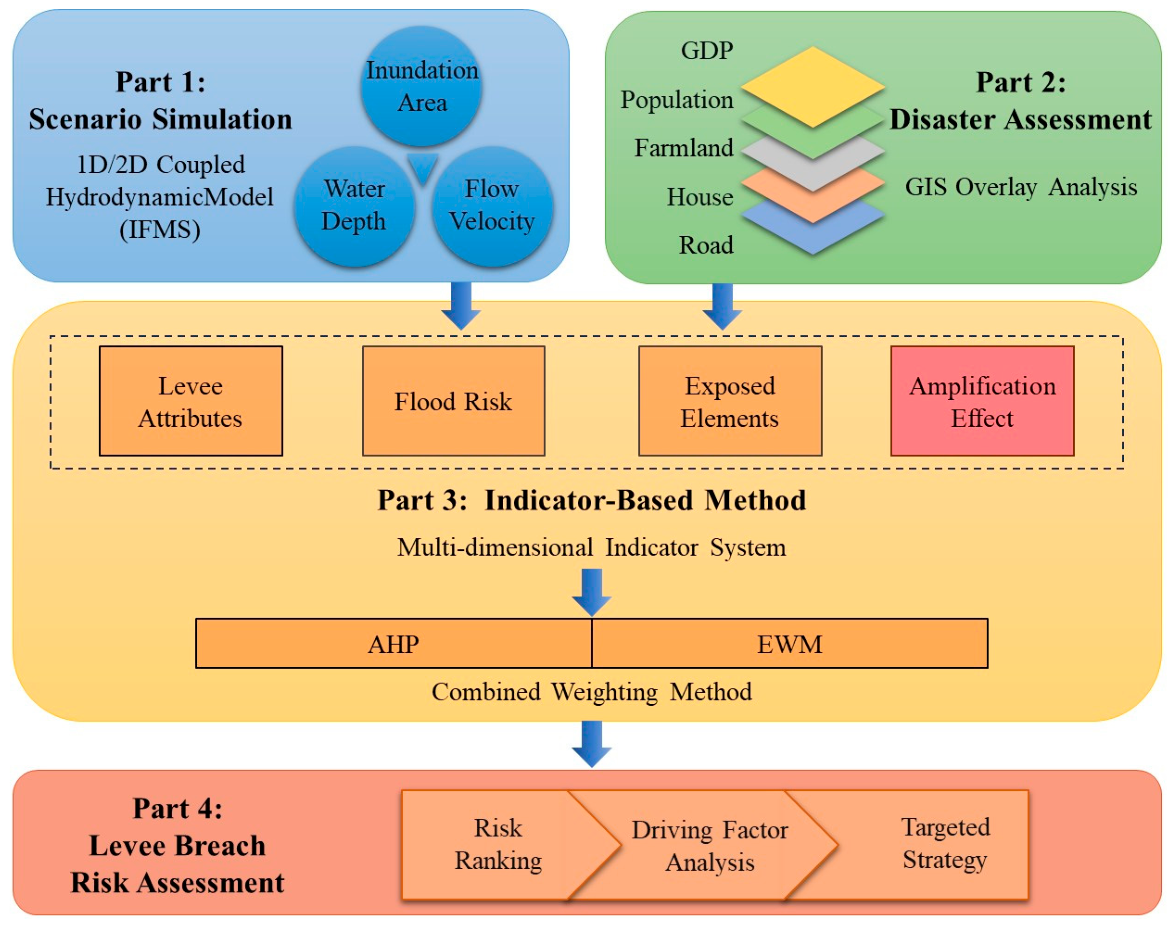
This study combines the scenario simulation method and the indicator-based method to propose a levee breach risk assessment method.
Figure 2 shows the technical diagram of the proposed method. First, we develop a 1D–2D coupled hydrodynamic model using IFMS software to simulate flood propagation following a levee breach. From the simulation, we extract flood inundation parameters such as inundation area and water depth. We then perform overlay analysis with the spatial distribution data of typical exposed elements. This allows us to quantify the disaster losses caused by the breach flood. Second, based on the disaster system theory framework, we introduce the amplification effect of disaster loss as a new dimension. We then build a multi-dimensional comprehensive risk assessment indicator system. This system includes levee engineering attributes, flood hazard, exposure of exposed elements, and the amplification effect. Finally, we use a combined subjective and objective weighting method to determine the indicator weights. We apply this method to identify weak levee sections and conduct a comprehensive risk assessment for rural levees in the middle and lower reaches of the Daling River.
3.1. Scenario Simulation Method
3.1.1. IFMS Model
The Integrated Flood Modeling System (IFMS) is a flood analysis software platform developed in China. It integrates multiple modules for unified simulation, including one-dimensional (1D) river networks, two-dimensional (2D) surfaces, and urban pipe networks [
42].
The one-dimensional river flow is solved using the Saint-Venant equations:
where
—flow discharge (m3/s);
—lateral inflow per unit length (m3/s);
—river water surface width (m);
—water level (m);
—cross-sectional flow area (m2);
—gravitational acceleration (m/s2).
The above one-dimensional Saint-Venant equations are discretized using the Godunov scheme based on the finite volume method.
For the two-dimensional model, the unstructured-grid finite volume method is adopted to solve the governing equations for unsteady shallow water flow, with water level and flow discharge as the primary variables. The governing equations are as follows.
Momentum equations:
where
—water depth (m);
—flow velocity components in the and directions (m/s);
—source terms.
The two-dimensional shallow water equations are discretized using the Godunov-type finite volume method. The Riemann problem is solved with the Roe approximate Riemann solver. The bed slope term is discretized by eigenvalue decomposition to preserve conservation, while the friction term is treated implicitly to enhance numerical stability. To achieve second-order accuracy in both space and time, the MUSCL (Monotonic Upstream-centered Scheme for Conservation Laws) spatial reconstruction and the two-stage Runge–Kutta method are employed. This enables the model to handle large discontinuities in water surfaces and adapt to complex topography, including shock capturing.
Water exchange between the one-dimensional river and the two-dimensional overland flow is realized by adding or subtracting the corresponding exchange discharge in the source terms. The lateral exchange flow
is approximated by the weir formula:
where
and
are given by:
In the above equations:
and —water levels upstream and downstream of the weir (m), taken as the water levels in the river and the adjacent 2D grid cell, respectively;
—weir crest elevation (m), taken as the levee crest elevation;
—weir width (m), taken as the side length of the cell adjacent to the river.
Moreover, IFMS supports the simulation of complex river network topologies and the operation of hydraulic structures such as sluices, pumps, and weirs. It also allows coupled simulation with zero-dimensional storage units, including reservoirs and lakes. The model has built-in levee breach features. Users can flexibly set breach conditions (e.g., water level threshold, time) and breach modes (instantaneous or gradual). This allows the model to simulate levee failure processes under different extreme flood scenarios. It can output key flood variables such as water depth, flow velocity, and inundation area. Researchers have widely used this model to simulate flood evolution and levee breaching processes [
43,
44]. Therefore, IFMS provides a reliable hydrodynamic modeling platform for the risk assessment method proposed in this study. It is highly suitable for simulating the entire process of flood overflow and floodplain inundation following a levee breach.
3.1.2. Model Construction
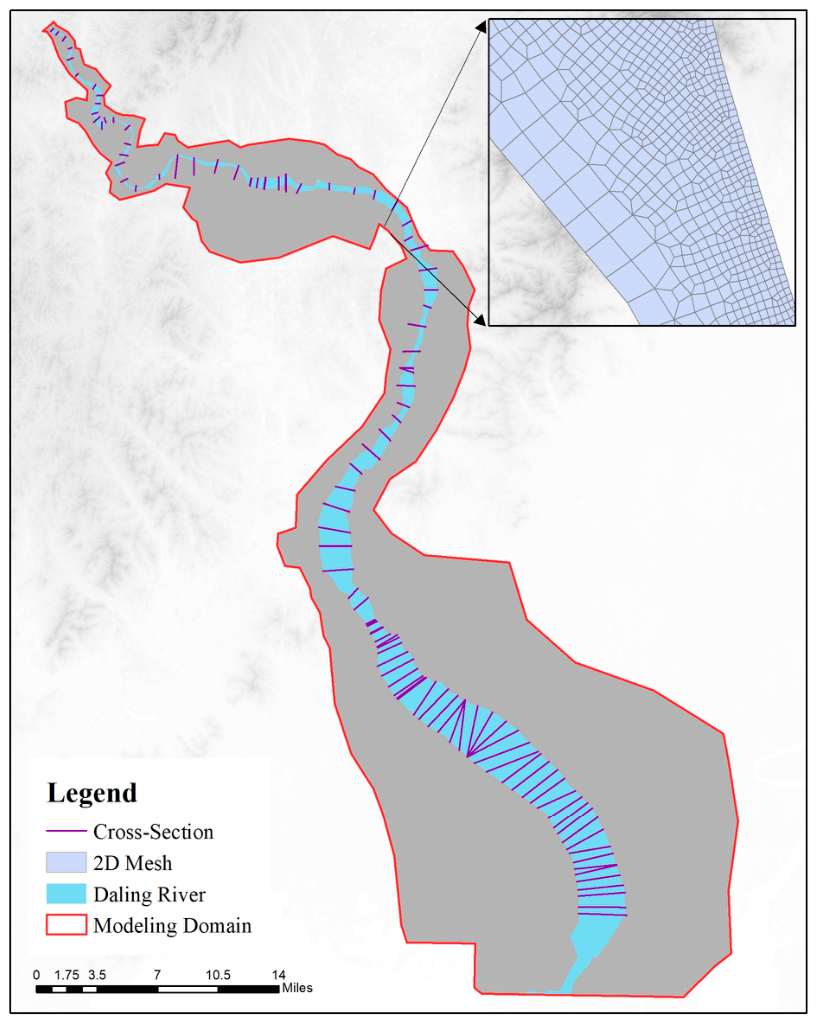
This study uses IFMS to build a 1D and 2D coupled hydrodynamic model for the middle and lower reaches of the Daling River. The 1D river network model covers the area from the lower end of the Baishi Reservoir to the river’s estuary. It uses 122 measured cross sections (
Figure 3). The total river length in this section is 158.8 km. The average spacing between cross sections is 1.3 km. The minimum spacing is 142.3 m, and the maximum spacing is 3.5 km.
After excluding the main river channel, we defined the 2D model domain based on the natural geography, drainage projects, and historical flood patterns of the Daling River. The domain reflects the maximum potential extent affected by river flooding. To represent this area, we divided the domain into unstructured quadrilateral grids, generating a total of 523,000 elements. Along both sides of the river, the grid resolution was refined with a side length of approximately 30 m to ensure accuracy near the levees. In other areas, the maximum side length was set to 100 m. The average grid area is 2590 m
2, while the maximum area reaches 19,763 m
2. We applied a gradual transition in grid size to maintain computational stability and connectivity between different regions, as shown in
Figure 3.
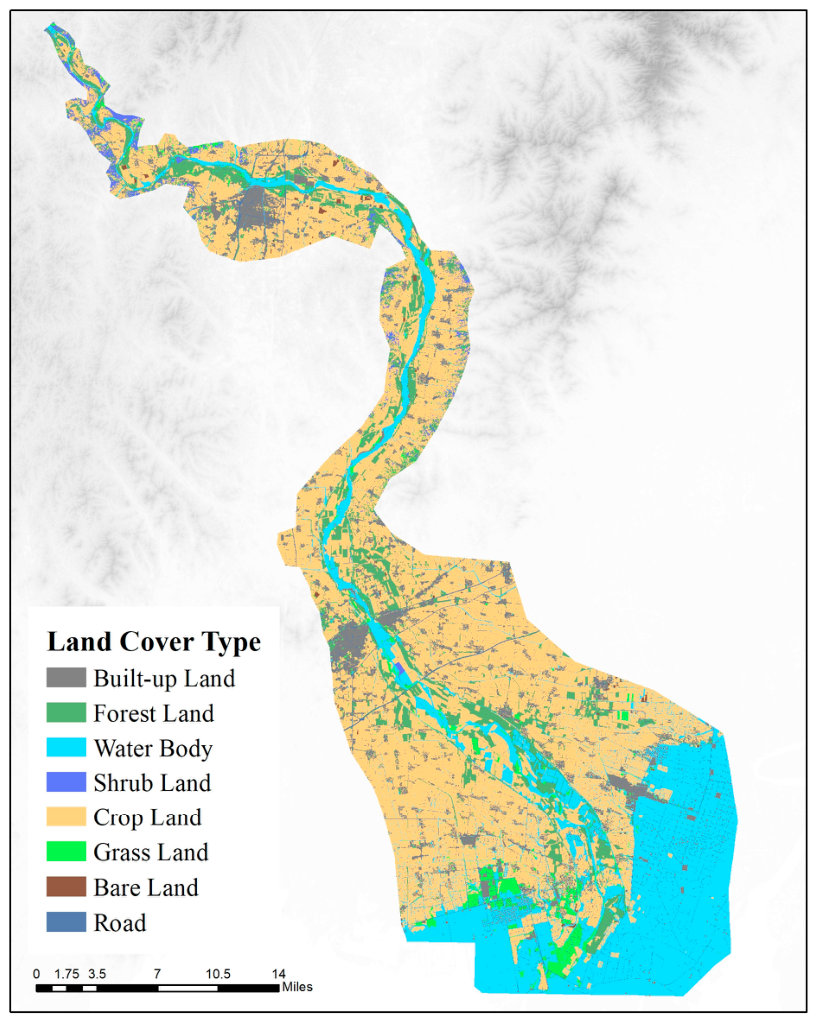
We first assigned elevation values to the 2D grid elements by interpolating a 5 m resolution Digital Elevation Model (DEM). To ensure a high-precision representation of the topography, the elevation at each grid centroid was calculated as the average of all DEM cells within that element. Subsequently, using remote sensing images, we extracted land cover information for the watershed and assigned roughness coefficients to the 2D grid cells based on different land cover types (see
Figure 4).
Furthermore, we coupled the 1D river network model with the 2D grid model to simulate water exchange between the river and the surrounding floodplain. This coupling was established through lateral connections along both riverbanks. This approach allows for the accurate modeling of both overflow and the subsequent inundation processes.
3.1.3. Model Calibration and Validation
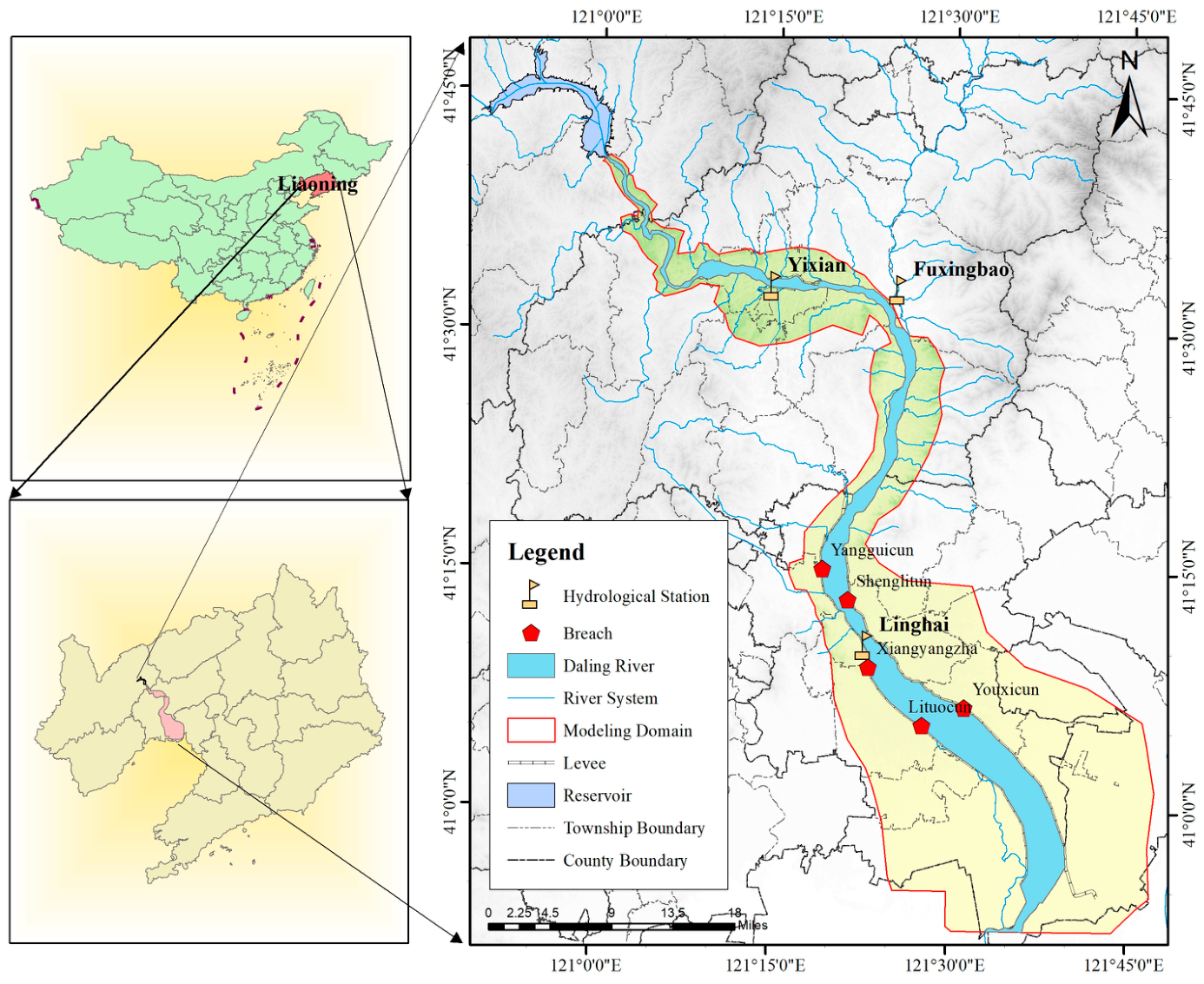
This study used measured flood data from the 1962 flood event at three hydrological stations along the lower Daling River, including Yixian, Fuxingbao, and Linghai stations (
Figure 1). Since 1930, eight major flood events have occurred in the Daling River basin [
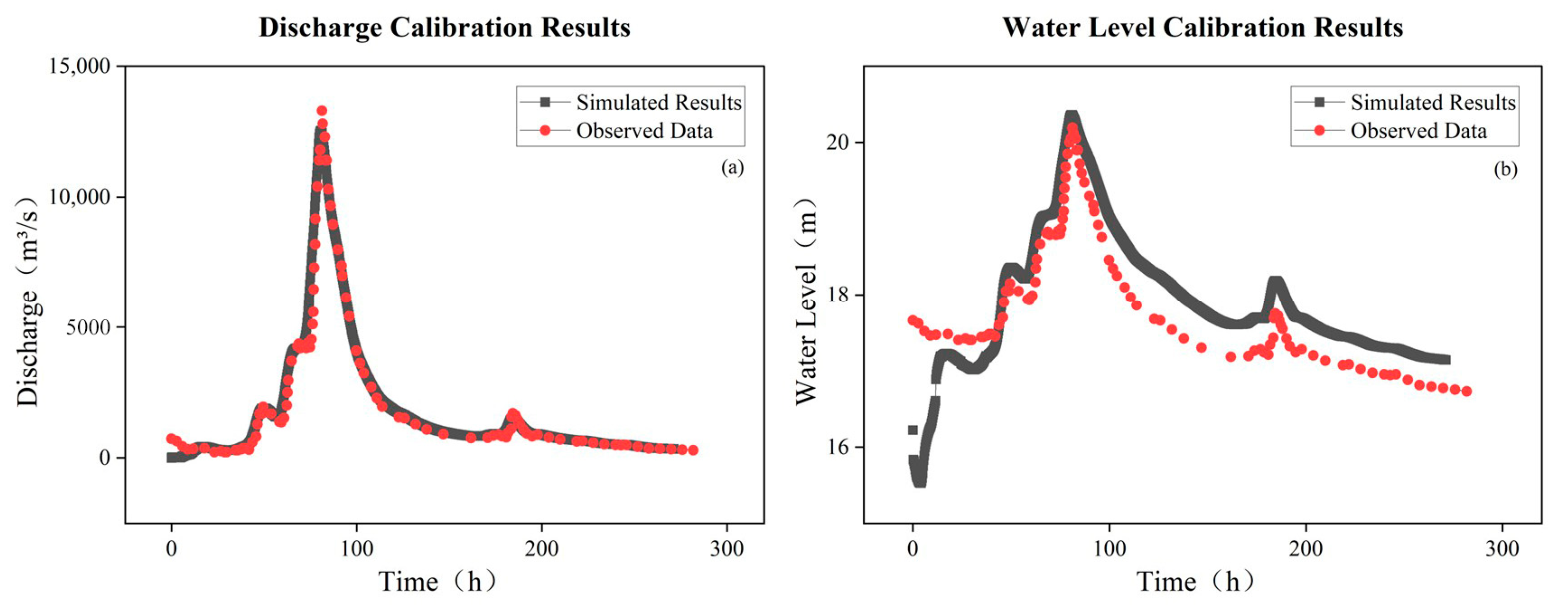
45], among which the 1962 flood was one of the most destructive events and had the most complete hydrological records at the relevant stations. Therefore, this event was selected for model calibration and validation. The measured discharge hydrograph at Yixian Station was used as the upstream inflow boundary condition of the main stream, while the measured discharge hydrograph at Fuxingbao Station was used as the tributary inflow boundary from the Xihe River. A water-level boundary condition was applied at the estuary cross section of the lower Daling River to represent the backwater effect of the sea. For model validation, the measured flood data at Linghai Station were used as reference data. By adjusting Manning’s roughness coefficient of the 1D river channel, the simulated discharge and water-level hydrographs at the cross section near Linghai Station were made consistent with the measured data.
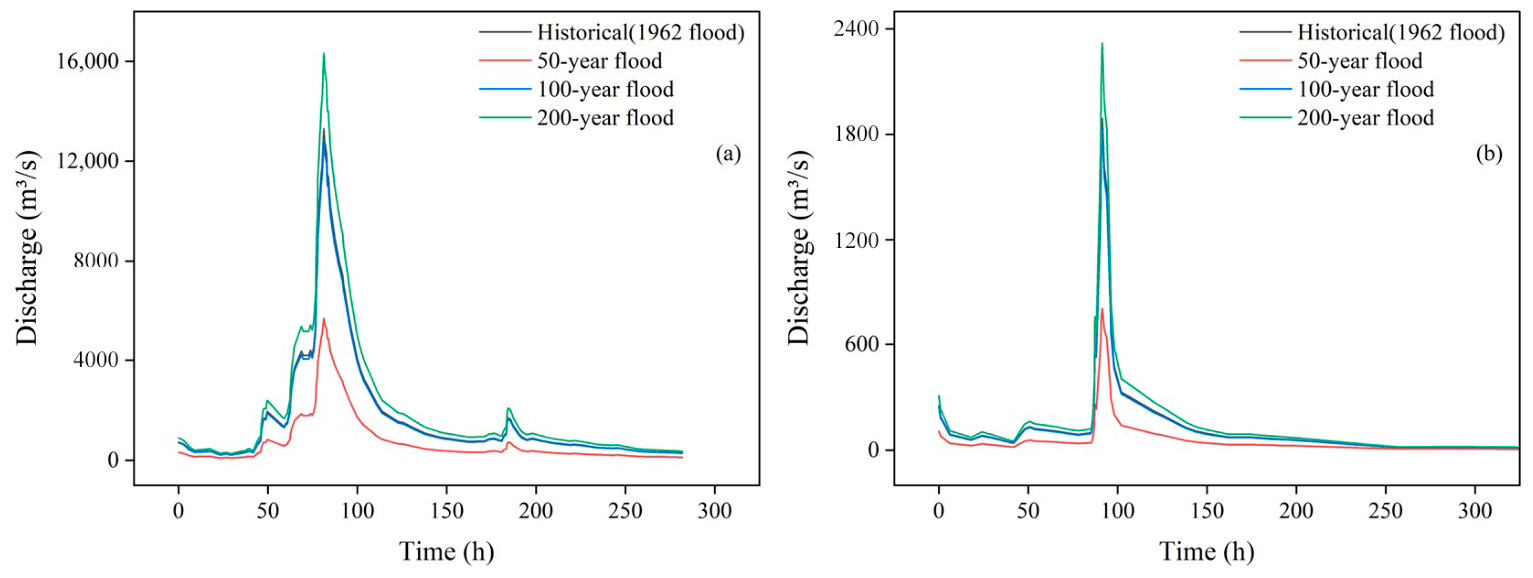
For scenario simulation, design flood hydrographs corresponding to the 50-, 100-, and 200-year return periods were used as model inflow conditions. The upstream design flood hydrographs at Yixian Station and the tributary inflow hydrographs at Fuxingbao Station are shown together with the observed 1962 flood hydrographs in
Figure 5. This comparison illustrates the boundary inflow conditions used for both model calibration and different return-period breach simulations.
3.2. Disaster Loss Assessment Method
Based on the flood inundation analysis, we further conducted a disaster loss assessment. This assessment systematically analyzed flood inundation characteristics and the potential economic losses they may cause. We carried out the loss assessment in four steps:
First, we performed topological checks and corrections on spatial data, including administrative divisions, land use, and the distribution of disaster-prone areas. Using GIS spatial analysis techniques, we spatially discretized socioeconomic statistical data and linked them to geographic objects.
Second, using the inundation area and water depth distribution from flood simulations, we performed spatial overlay analysis. This allowed us to accurately identify affected areas for different disaster-prone entities, such as residential areas, farmland, industrial and commercial zones, and transportation facilities. We then quantified the number of affected properties under different inundation depth levels.
Third, flood damage assessment requires not only quantifying the number of affected assets but also estimating their value. Common methods for property valuation [
46] include the current market value method, the income capitalization method, the replacement cost method, and the liquidation value method. Among these, the income capitalization method is suitable for assets that can generate independent income. The liquidation value method is commonly used for asset valuation during business shutdowns or bankruptcies.
Building upon these valuation principles, the comprehensive flood damage assessment is predicated upon the systematic identification and inventory of submerged elements at risk, including residential buildings, household property, farmland, industrial and commercial assets, and transportation infrastructure. Accordingly, the computational framework for evaluating total direct economic losses can be formulated as follows:
where
represents the value of the
-th category of property within the assessment unit under the
-th water depth interval, and
denotes the loss rate of the
-th property category under the
-th water depth condition.
This study used different methods for different asset types. For residential property, we used the replacement cost method, which values property based on local new construction costs minus depreciation. Household property was valued using the current market value method. The value of industrial and commercial assets was taken directly from relevant administrative district statistical yearbooks. Road damage was estimated based on repair costs.
3.3. Indicator-Based Method
3.3.1. Indicator System Construction
To systematically assess the risk of levee breaches along the Daling River, this study first conducted flood simulation and loss assessment. It then drew on the theoretical framework of comprehensive natural disaster risk assessment and integrated the mechanisms underlying levee risk. Therefore, we developed a multidimensional risk assessment indicator system. This system includes four primary dimensions: levee attributes, flood risk, typical exposed elements, and amplification effects. Each dimension contains second-level indicators.
Table 2 lists their specific definitions.
- (a)
Levee attributes
Levee attribute indicators reflect the structural properties and spatial location of a levee. They determine the levee’s ability to resist scouring, seepage, and maintain overall stability under flood conditions. Lower flood protection standards, insufficient freeboard, and closer distance to the main channel all increase breach risk.
- (b)
Flood risk
Flood risk indicators are derived from hydrodynamic simulation results. They represent the spatial extent and intensity of flood hazards. Larger inundation area, greater water depth, and higher flow velocity lead to higher risk.
- (c)
Typical exposed elements
Typical exposed elements reflect the scale of affected entities during flooding. They show the spatial distribution of population, economic activity, and land resources that are sensitive to flood events. The indicators include affected population, GDP impact, flooded housing area, flooded road length, and flooded farmland area.
- (d)
Amplification effect
The amplification effect characterizes the nonlinear escalation behavior of flood consequences once flood intensity exceeds the protection threshold of the levee system. Once flood magnitude exceeds the design protection capacity of the levee system, hydraulic connectivity between the main channel and floodplain rapidly increases, resulting in accelerated inundation propagation and nonlinear escalation of disaster losses. Compared with conventional exposure or vulnerability indicators, the amplification effect reflects the sensitivity of the disaster system to exceedance floods and captures the accelerated expansion of inundation consequences under extreme breach scenarios. In general, systems exhibiting higher amplification effects are also characterized by lower flood resilience, as they become increasingly unable to absorb, adapt to, or withstand exceedance flood disturbances, thereby resulting in disproportionately amplified disaster consequences.
The amplification effect is quantified using the relative escalation of losses under exceedance flood conditions:
Here, is the loss growth rate for a T-year flood. is the direct economic loss under a 50-year flood. is the direct economic loss under a T-year flood, where T is 100 or 200 years. Higher loss growth rates indicate stronger amplification under moderate (100-year) or extreme (200-year) exceedance conditions, implying greater exceedance sensitivity and lower resilience of the flood disaster system to high-magnitude levee breach events.
Among the 13 evaluation indicators, three are negative indicators: levee flood protection standard, levee freeboard, and distance from the main channel. Higher values of these indicators mean greater structural safety and thus lower breach risk. The remaining indicators are positive indicators. For these, higher values correspond to higher potential risk.
3.3.2. Indicator Weight Calculation
After establishing the risk assessment system, scientifically determining the weights for each indicator is a critical step. Weighting methods are generally categorized into subjective and objective approaches [
47]. Given the relatively small sample size in this study, purely objective weights would be susceptible to instability from individual sample fluctuations, whereas purely subjective weights would fail to reflect the natural variability within the data. To address these limitations and incorporate both expert knowledge and objective data characteristics, this study employs a combined the analytic hierarchy process (AHP) and entropy weight method (EWM) to determine the final indicator weights.
The AHP weights
and the entropy weighting method weights
were linearly combined to obtain the composite weights
. The mathematical expressions are as follows:
where
and
are non-negative coefficients satisfying
Through this linear combination method, the composite weights achieve a balance between expert knowledge and sample data features. This approach reflects a domain-specific understanding of the research subject while accounting for the objective variability of the indicator data. Consequently, we obtained more robust and reasonable composite weights, providing reliable support for the subsequent risk assessment.
4. Results and Discussion
4.1. Calibration and Validation Results
The model calibration and validation results show good performance, indicating that the model can accurately simulate flood processes. For calibration and validation, we used the maximum flood recorded at the Linghai Hydrological Station on 26 July 1962. The peak discharge was 14,600 m
3/s. The phase difference in flood peak time was within 1 h. The difference in flood discharge was within 10%. The difference in flood water level was within 0.2 m (
Table 3). The flood water levels and discharge hydrographs at the New G102 Bridge cross section near Linghai Station showed good agreement with the 1962 observed data (
Figure 6). This further confirms the model’s high accuracy.
4.2. Flood Simulation
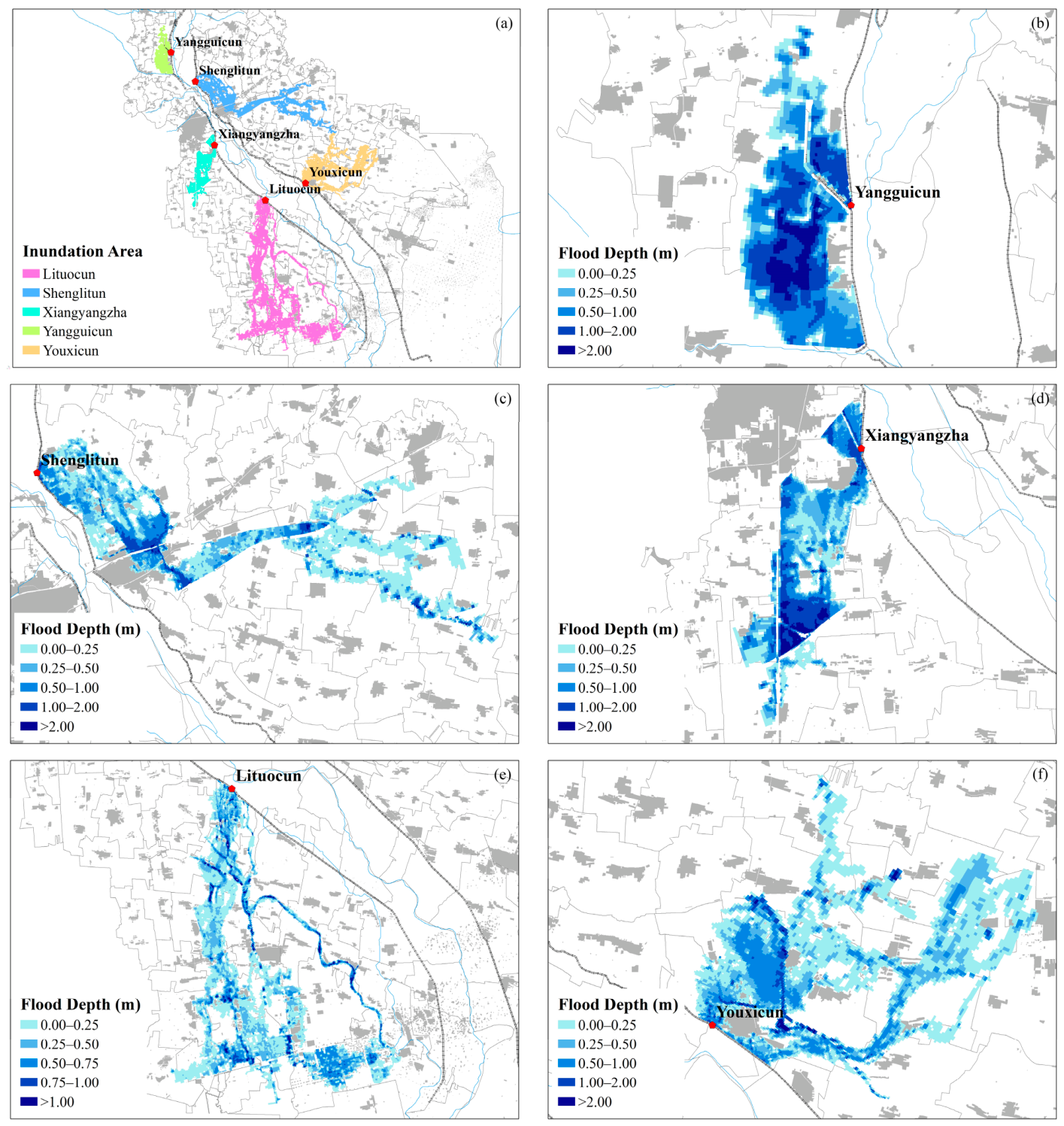
The simulated inundation patterns differ markedly among the five breach sites, reflecting the combined influence of breach location, floodplain topography, river–floodplain connectivity, and local terrain constraints. Although some levee sections no longer fully meet the original 50-year design standard due to long-term deterioration, the 50-year return period was retained as the reference scenario for comparing the post-breach inundation responses.
Under the 50-year scenario, the five breach sites show three typical inundation patterns: wide but shallow inundation, localized deep-water inundation, and limited inundation extent. The Lituocun breach had the largest inundation area. However, the flooding was mostly shallow, with a maximum water depth of only 2.60 m. This indicates that the terrain in this area is flat. As a result, floodwater spreads widely but remains shallow. In contrast, the maximum inundation depth at the Youxicun breach reached 5.07 m. The area of deep-water inundation (>3 m) accounted for 0.09% of the total area. This indicates a higher local hazard. The breach at Yangguicun had the smallest inundation area. The water depth distribution was relatively even across all depth categories. The Shenglitun breach was dominated by shallow water. The shallow water zone (0.05–0.5 m) covered 19.22 km
2, which accounted for 72.5% of the total area. The inundation at the Xiangyangzha breach showed a pattern of shallow water dominance with localized deep water. The 0.05–0.5 m shallow zone accounted for 47.8% of the area. The 0.5–1 m zone accounted for 27.6%. The maximum inundation depth was 4.95 m, which is relatively high. The water depth distributions for each breach site are shown in
Figure 7.
When a flood exceeds the design standard, the inundation area and water depth caused by levee breaches increase significantly. However, the extent of this increase varies among different breach locations (
Table 4).
Under flood conditions from a 50-year to a 100-year return period, the Shenglitun breach exhibited the highest rate of increase in inundation area (113.6%). The Lituocun breach ranked second (58.8%). The Xiangyangzha breach had the lowest rate (27.9%). Under the extreme scenario of a 200-year return period, the inundation area at the Yangguicun breach increased by 117.1% compared to the 50-year return period. This indicates a relatively strong inundation-area response to increasing flood magnitude at this site.
At the same time, as the flood return period increases, the proportion of deep-water inundation area at each breach rises significantly. At the Yangguicun breach, the deep-water area (depth > 3 m) increased from 0.152 km2 under a 50-year return period to 0.984 km2 under a 200-year return period. This is an increase of 547.4%. At the Youxicun breach, the corresponding deep-water area increased from 0.023 km2 to 0.332 km2, an increase of 1343.5%. This disproportionate increase in deep-water inundation areas indicates that higher return-period floods not only expand inundation extent but also alter the internal hazard structure of the inundated area.
4.3. Disaster Loss Assessment
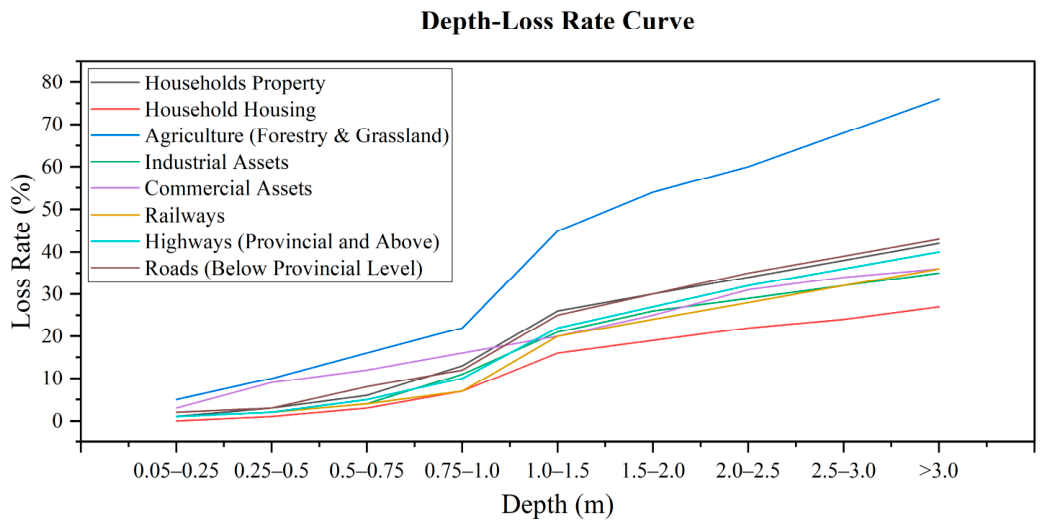
Determining the flood loss rate is essential for estimating direct economic losses. The loss rate is influenced by multiple factors, including inundation depth, property type, disaster season, inundation duration, response capacity, and mitigation measures. In this study, the relationship between water depth and loss rate was determined based on regional historical disaster records, loss-rate results from similar regions, and relevant literature [
48], while also considering the characteristics of the inundated areas in the Daling River basin. Loss-rate curves were established for different categories of exposed elements, including residential property, housing, agriculture, industrial and commercial assets, railways, highways, and local roads. The water depth–loss rate curves are shown in
Figure 8, and the detailed loss-rate values are listed in
Table 5.
Based on the water depth–loss rate relationships described above, the inundated exposed elements and direct economic losses were calculated for each breach site under the 50-year, 100-year, and 200-year flood scenarios. The results are presented in
Table 6.
Under the 50-year flood scenario, the baseline disaster-loss pattern differs markedly among the five breach sites. Lituocun has the largest flooded housing area, flooded road length, and flooded farmland area, indicating that its baseline loss is mainly driven by the wide spatial exposure of residential, transportation, and agricultural elements. Shenglitun has the largest affected population, reaching 10,300 people under the 50-year scenario, suggesting that its baseline risk is strongly associated with concentrated settlement exposure and potential evacuation pressure. Xiangyangzha shows the highest direct economic loss under the 50-year scenario despite relatively low values for several exposure indicators, which may be related to the presence of high-value assets or more depth-sensitive economic elements in the inundated area. In contrast, Yangguicun and Youxicun show relatively lower baseline losses, mainly due to their smaller exposed residential and socioeconomic elements under the 50-year scenario.
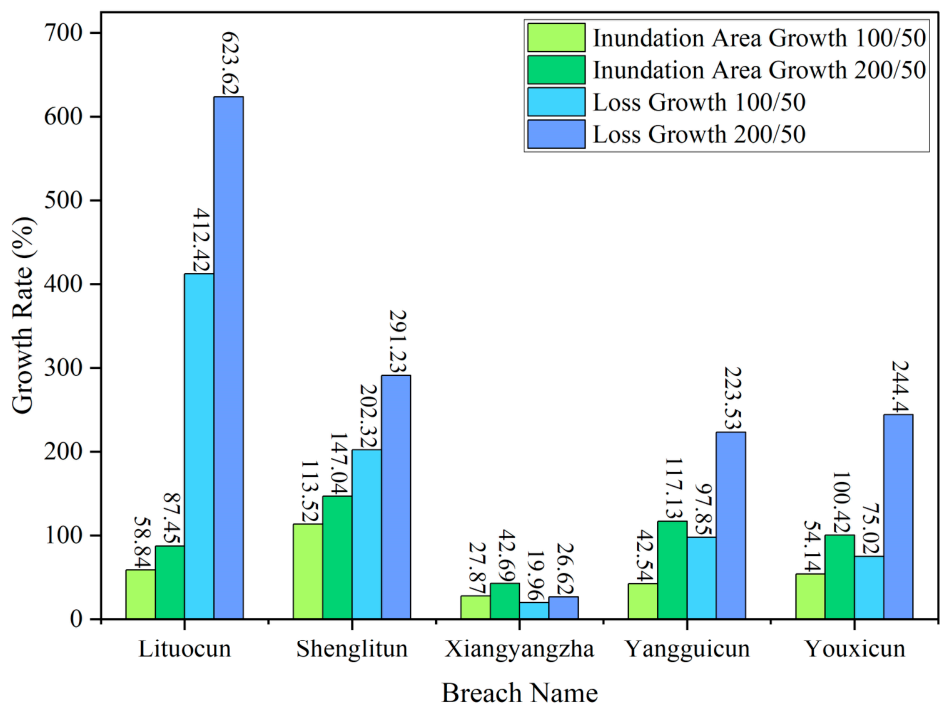
To further compare the nonlinear response of inundation extent and economic losses under exceedance flood scenarios, the growth rates of total inundation area and direct economic loss were calculated using the 50-year flood scenario as the baseline (
Figure 9).
When flood magnitude exceeds the design standard, the amplification effect of disaster losses becomes increasingly evident. The results show that direct economic losses generally increased faster than inundation area as the flood return period increased, indicating a nonlinear amplification of disaster consequences under exceedance flood conditions. This pattern is particularly evident at Lituocun. From the 50-year to the 200-year scenario, the total inundation area at Lituocun increased by 87.45%, whereas direct economic loss increased by 623.62%. This indicates that the increase in flood magnitude not only expands the inundated area but also shifts flood impacts toward deeper inundation zones and higher-value exposed elements. Shenglitun also shows a clear amplification response, with inundation area increasing by 147.04% and direct economic loss increasing by 291.23% under the 200-year scenario. For Yangguicun and Youxicun, the loss growth rates under the 200-year scenario also substantially exceed the corresponding inundation-area growth rates, suggesting that these sites are sensitive to extreme exceedance flood conditions despite their relatively low or moderate baseline risk levels. In contrast, Xiangyangzha shows relatively weak amplification. Its inundation area increased by 42.69% from the 50-year to the 200-year scenario, while direct economic loss increased by only 26.62%. This suggests that local exposure structure and geographic buffering conditions may limit the escalation of economic losses.
Overall, the comparison between inundation-area growth and loss growth provides quantitative evidence that levee breach consequences do not increase linearly with inundation extent. Instead, economic losses may escalate disproportionately once flood magnitude exceeds the levee protection threshold, supporting the necessity of including the amplification-effect dimension in the risk assessment framework.
4.4. Levee Breach Risk Assessment
This study used the combined AHP-EWM to assign weights to the levee breach risk assessment indicator system constructed earlier. The comprehensive weighting results are shown in
Table 7.
Among the AHP weighting results, the top-ranked indicators were affected population, flooded housing area, and GDP loss. This indicates that the AHP method places greater emphasis on experts’ professional judgments about exposure. It focuses more on the potential losses to exposed elements.
In contrast, the indicators with the highest weights from the entropy weighting method were Inundation Area, average Water Depth, and affected population. These indicators showed high sample dispersion. This means the entropy weighting method effectively uses the objective variation in the sample data. It highlights the impact of disaster conditions caused by hydrodynamic changes and spatial exposure differences.
However, due to the small sample size in this study, relying solely on the entropy weighting method is easily influenced by data scale and volatility. As a result, some indicators have relatively high weights but lower stability.
After determining the composite weights for each indicator (
), the raw indicator data were standardized to eliminate the influence of different units of measurement:
where
and
represent the maximum and minimum values, respectively, of the
indicator across all samples, and
denotes the normalized indicator value, ranging from
.
By performing a weighted sum of the normalized values of each indicator and their corresponding composite weights, we obtain the composite risk value
for the
sample:
where
is the total number of indicators, and
is the composite weight of the
indicator. A larger composite risk value
indicates a higher risk level for that sample.
The comprehensive risk values for each breach were calculated using Equation (11). As shown in
Table 8, Lituocun showed the highest comprehensive risk, followed by Shenglitun, Youxicun, Yangguicun, and Xiangyangzha. This ranking reflects the combined effects of levee attributes, flood hazard intensity, exposed elements, and amplification effects. To further examine whether this ranking is sensitive to the limited sample size and weighting uncertainty, a robustness analysis was conducted in the following section.
4.5. Risk Driver Analysis
Based on the flood simulation, disaster loss assessment, and comprehensive risk ranking results, we further analyzed the main factors driving the risk differences among the five breach sites. The results show that the risk ranking is not determined by inundation area alone, but by the combined effects of levee conditions, floodplain characteristics, exposed elements, and loss amplification under extreme flood scenarios.
As shown in
Table 9, the five breach sites exhibit different risk-driving mechanisms. Lituocun is the highest-risk site because of the combined effects of weak levee conditions, open floodplain topography, extensive inundation, high asset exposure, and strong nonlinear amplification under extreme flood conditions. The direct economic loss at Lituocun increased by 623.62% from the 50-year to the 200-year scenario, far exceeding the inundation-area growth rate of 87.45%, indicating relatively low flood resilience under exceedance flood conditions. Shenglitun is mainly characterized by high population exposure and relatively strong flood hazard intensity. Its large affected population indicates high evacuation and emergency-response pressure. Youxicun has a moderate comprehensive risk level, but its risk is strongly associated with transportation infrastructure exposure, as flooded roads may disrupt evacuation, rescue access, and regional transport connectivity. Yangguicun has a relatively low baseline risk because of its limited inundation extent and exposed elements, but it still shows a clear amplification response under extreme flood conditions. Xiangyangzha has the lowest comprehensive risk, mainly due to its relatively favorable engineering conditions, greater distance from the main channel, and geographic buffering effects.
Overall, the risk ranking is not controlled by inundation area alone. Instead, it reflects the combined influence of engineering weakness, floodplain setting, hydrodynamic hazard, exposure concentration, and nonlinear loss amplification. These differentiated risk drivers suggest that levee reinforcement and emergency management should be site-specific rather than based only on the magnitude of inundation extent.
5. Conclusions
This study developed and applied a levee breach risk assessment framework for the middle and lower reaches of the Daling River by coupling 1D–2D hydrodynamic simulation with a multi-dimensional indicator system. The framework unifies post-breach flood evolution, exposed-element losses, levee attributes, and amplification effects into a single assessment process. Using five representative levee sections as test cases, we show that the framework effectively evaluates and compares risk levels under different breach scenarios while also revealing the main drivers of risk differences across sections. A key takeaway is that we need to look beyond structural safety and consider the full chain of post-breach inundation, exposure, losses, and nonlinear disaster escalation.
The results show clear spatial differences in inundation patterns, disaster losses, and comprehensive risk levels among the five breach sites. Lituocun has the highest comprehensive risk, followed by Shenglitun, Youxicun, Yangguicun, and Xiangyangzha. The comparison between inundation-area growth and direct economic-loss growth further demonstrates that disaster losses do not increase linearly with flooded area. Under exceedance flood scenarios, economic losses may rise much faster than inundation extent, especially at Lituocun, where direct economic loss increased by 623.62% from the 50-year to the 200-year scenario while inundation area increased by only 87.45%. This confirms the necessity of introducing the amplification effect to characterize the exceedance sensitivity and nonlinear loss escalation of levee breach disaster systems. These findings provide practical support for differentiated levee reinforcement, evacuation planning, road-access protection, and flood-control management.
Overall, the proposed framework provides a practical and process-based method for levee breach risk assessment and can support more targeted levee reinforcement, evacuation planning, road-access protection, and flood-control management in flood-prone river basins. However, several limitations remain. First, the hydrodynamic model was calibrated and validated using a single historical flood event, which may limit the robustness of model validation. Although the terrain data, river cross-sections, land-cover information, levee data, and floodplain data used in the scenario simulations were updated datasets, future studies should incorporate additional observed flood events when sufficient data become available to further improve the reliability of model calibration and validation. Second, this study selected five representative breach sites for comparative assessment. Although these sites reflect typical levee and floodplain conditions along the middle and lower reaches of the Daling River, the limited number of samples may affect the robustness of indicator weights and risk ranking results. Therefore, the current ranking should be interpreted as a comparative assessment among selected typical sections rather than a continuous risk classification of the entire levee system. Future research could increase the number of breach scenarios by selecting more potential breach locations or setting breach points at equal intervals along the levee line, so as to evaluate the spatial variation in risk across the whole levee system and improve the stability of the indicator-based assessment. Third, sediment processes were not considered in the current hydrodynamic simulation. The middle and lower reaches of the Daling River have relatively high sediment concentrations, and erosion and deposition during flood events may alter river cross-section morphology and flood conveyance capacity [
49], thereby affecting the inundation extent and flood propagation path after levee breaching. In this study, the riverbed topography was assumed to remain unchanged during the flood process. Future studies could incorporate coupled hydrodynamic–sediment transport models to simulate riverbed erosion and deposition during floods and further examine the influence of sediment transport on levee breach flood evolution. With improvements in validation data, breach scenario design, sample size, and sediment-process simulation, the proposed framework can be further extended to broader river basins and provide stronger technical support for levee reinforcement planning and flood risk management.




 ,
,