Article

Evaluating SUDS Efficiency in Urban Environments: A Dual-Scale Methodology Applied to the City of Madrid


by
Anna Pia Monachese
1,*,
Álvaro Casitas
1,2,
María Teresa Gómez-Villarino
1 and
Sergio Zubelzu
1,2
1
School of Agricultural, Food and Biosystems Engineering, Universidad Politécnica de Madrid, 28040 Madrid, Spain
2
Centro de Estudios e Investigación para la Gestión de Riesgos Agrarios y Medioambientales, CEIGRAM, Universidad Politécnica de Madrid, Senda del Rey, 13, 28040 Madrid, Spain
*
Author to whom correspondence should be addressed.
Water 2026, 18(11), 1268; https://doi.org/10.3390/w18111268 (registering DOI)
Submission received: 12 February 2026 / Revised: 12 May 2026 / Accepted: 18 May 2026 / Published: 23 May 2026
(This article belongs to the Special Issue Advances in Research on Hydrology and Water Resources)

Abstract

Although Sustainable Urban Drainage Systems (SUDS) are widely recognised as essential components of resilient urban water management, the large-scale planning and evaluation of such systems remain challenging. This study assesses the hydrological and economic performance of SUDS in Madrid (Spain) under the SSP1-2.6 and SSP5-8.5 climate scenarios, applying a dual-scale methodology based on the Curve Number (CN) model. At the catchment scale, SUDS show substantial potential for irrigation reuse, with runoff-rich catchments reaching hydrological saturation earlier (plateau at r ≈ 0.4) and runoff-limited catchments stabilising at higher implementation levels (plateau at r ≈ 0.6). At the parcel scale, partial-coverage configurations (50% irrigation coverage) outperform full-coverage solutions (100% irrigation coverage), achieving maximum retention levels of 70% in SSP1-2.6 and 50% in SSP5-8.5 while requiring less surface area (10–15%). From an economic perspective, positive net present values (NPVs), acceptable internal rates of return (IRRs), and feasible payback periods occur only at very low retention levels (r < 0.05), with financial performance declining rapidly as storage capacity increases.

1. Introduction

Urban water management is increasingly challenged by the impacts of climate change, which are expected to intensify the frequency and severity of extreme weather events. In particular, both prolonged droughts and intense rainfall events are projected to increase in the coming decades [1,2], leading to accelerated runoff processes and increasing pluvial flood risk. As a consequence, flood risk has become a critical issue for urban water resource management [3]. Future projections suggest that, if no action is taken, flood-related damages in European cities could increase up to fivefold by 2050. These critical issues are not exclusively linked to the intensification of extreme weather events, but also to the growing vulnerability of contemporary urban systems and the limited capacity of conventional drainage infrastructures to manage high-intensity events. Recent events have revealed significant vulnerabilities in modern urban environments despite sustainable drainage strategies. The 2023 flooding in south-eastern China highlighted these fragilities [4].
In recent years, SUDS have become increasingly popular around the world as a means of supporting traditional sewerage systems. The literature has confirmed that not only do SUDS minimise the impact of urban rainfall by enhancing the resilience of hydrological urban systems [5], but they also provide multiple environmental and social benefits: they mitigate the impacts of climate change, improve biodiversity and urban amenities, and enhance the quality and quantity of water runoff [6,7,8,9,10,11,12,13,14,15]. In addition, SUDS can replicate the natural hydrological behaviour of a site before urban development as closely as possible [16].
From this perspective, SUDS are increasingly aligned with the objectives of the United Nations’ 2030 Agenda for Sustainable Development, particularly with regard to water management (SDG 6), sustainable cities (SDG 11), climate action (SDG 13) and partnerships (SDG 17). The growing pressure generated by urbanisation, soil sealing and climate change has expanded the role of SUDS in recent years. They are no longer exclusively interpreted as technical systems for urban drainage; rather, they are seen as integral to broader climate resilience and sustainable urban water management strategies.
Recent studies highlight how modern stormwater management approaches are evolving towards more holistic and multifunctional models, in which runoff regulation, climate adaptation, water quality improvement, ecosystem support, and urban resilience are closely interconnected [17]. Within this context, SUDS are increasingly associated with Nature-based Solutions (NbS) paradigms, since many of their configurations rely on vegetation, natural infiltration processes, evapotranspiration, and hydrological regulation mechanisms [18].
Consequently, several SUDS typologies, such as green roofs, bioswales, bioretention areas, infiltration systems, and constructed wetlands, can also be interpreted as urban green infrastructures implemented at local and municipal scales to support sustainable stormwater management and improve urban hydrological performance.
However, the existing literature remains fragmented in terms of spatial scale. While numerous studies focus on small-scale applications, such as individual sites or neighbourhoods [19,20,21,22], only a limited number of contributions address SUDS performance at larger, catchment-scale levels [23,24,25,26]. This lack of integration across scales highlights the need for modelling approaches that are both flexible and applicable in different spatial contexts.
In this perspective, the Curve Number (CN) method represents a suitable modelling framework. It is one of the most widely used tools in hydrological engineering for estimating direct runoff from rainfall, due to its simplicity, empirical basis, and adaptability to both rural and urban environments [27]. Developed by the USDA Soil Conservation Service (SCS) in 1954 and described in the Hydrology of the National Engineering Handbook (NEH-4) [28], the CN method provides a consistent basis for runoff estimation that can be effectively extended across multiple spatial scales.
However, a key limitation emerges from the way SUDS are currently analysed across different spatial scales. Many studies focus on local-scale applications, such as individual buildings or neighbourhoods, providing detailed insights into design, performance and site-specific feasibility. Conversely, other studies adopt a broader perspective, analysing SUDS at the catchment scale to evaluate overall hydrological behaviour and support strategic planning. Although both approaches offer valuable insights, they are often developed independently, resulting in an incomplete understanding of SUDS performance. Local-scale analyses provide a high level of detail, but they cannot capture system-wide dynamics. Catchment-scale assessments, on the other hand, rely on aggregated data, which tends to mask spatial variability and overlook local implementation and design constraints.
For this reason, an integrated, multi-scale approach is required. Linking parcel- or neighbourhood-scale analyses with catchment-scale evaluations enables detailed and systemic perspectives to be considered simultaneously. This integration is essential to conceptualise SUDS as interconnected elements within a distributed urban drainage network, rather than as isolated implementations.
Thus, Monachese et al. [27] and Rodríguez-Rojas et al. [23] advocate integrating large- and small-scale SUDS watershed balance analysis. This approach considers water needs, uses and available resources, as well as desired targets, in order to achieve a more holistic vision.
Khalili et al. [28] further support this perspective, highlighting that SUDS performance is highly site-specific and influenced by local climatic and morphological factors. More recent studies have progressively expanded the role of SUDS, exploring their contribution to runoff retention and reuse as a strategy to reduce external irrigation demand in urban green areas by supporting self-irrigation through locally retained stormwater [29,30]. From this perspective, the proposed framework focuses on green infrastructure-based SUDS configurations designed to evaluate the extent to which locally generated runoff can be intercepted, retained, and reused to directly satisfy the irrigation demand of the same urban green areas. The methodology integrates two levels of spatial analysis within a single CN-GIS hydrological framework, assessing both catchment and plot scales. The study, which was conducted in Madrid, Spain, aimed to evaluate the hydrological and economic feasibility of different SUDS configurations and implementation levels under future climate scenarios derived from Shared Socioeconomic Pathways (SSPs).
Firstly, it aimed to demonstrate the applicability of the proposed methodology, which integrates analyses at both catchment and parcel scales (1). Building on this framework, the study sought to enhance stormwater storage and reduce the demand for external irrigation in urban green spaces (2), while evaluating the feasibility of this approach using conventional economic indicators such as net present value (NPV), internal rate of return (IRR) and payback period (3). Furthermore, the framework can be transferred to other European and Mediterranean contexts experiencing water stress, as it can be adapted to different urban configurations and applied across multiple spatial scales. This integrated structure was developed to support urban planners and decision-makers by connecting strategic, urban-scale evaluations with site-specific implementation assessments within a consistent methodological framework.

2. Materials and Methods

The following method aids in the decision-making process for the optimal allocation of SUDS, and evaluates their efficiency and their hydrological and economic performances (Figure 1). The modelling framework was implemented in Python (version 3.7), integrating a soil water balance model coupled with the SCS–Curve Number method with GIS-based spatial processing (QGIS, version 3.10). The workflow includes data collection (precipitation and land use), model parameterisation (CN assignment), and simulation of runoff, storage, and irrigation demand under different SUDS configurations and climate scenarios. The method is based on a two-step spatial analysis:
The method is based on a two-step spatial analysis with two different and complementary scopes and ambitions:
At the city scale, the main objectives are to identify urban catchments, to evaluate the available resources and to evaluate the capacity to collect water of existing areas, to detain and store urban runoff, and to investigate the potential need for external irrigation. In particular,
  • Collecting spatial information on city land use and urban catchments or processing existing spatial information to identify urban catchments based on sewage networks, topography, rivers, and wastewater treatment plants.
  • Processing the spatial information to calibrate the selected hydrological models.
  • Defining the buffer area in which urban runoff can be collected, stored, and used locally to reduce the need for external irrigation. The buffers were identified individually for each green area and then studied at the level of aggregated urban catchments.
  • Defining the maximum SUDS storage capacity and evaluating the runoff retention rate.
At the parcel scale, the main objectives are to identify the specific reuse potential and to determine the hydrological and economic values of the volume and actual water needs for irrigation. In particular,
  • Selecting individual plots and defining the contributing area;
  • Defining the SUDS type and geometry;
  • Defining SUDS costs;
  • Running hydrological models;
  • Running financial analyses.
The following sections present the hydrological and economic tools employed for the required calculations.

2.1. Hydrological Model

Our ambition with the hydrological modelling is to estimate the volumes of the variables involved in the soil water balance presented in Equations (1) and (2).
θt = θt−1 + Inft + It + c·Rtkt· ET0t
Pt = Inft + Rt
where
  • θt is the soil moisture content at time t (mm)
  • Inft is infiltration (mm)
  • It is the volume of irrigation required from external sources (mm)
  • Rt is runoff (mm)
  • c is the fraction of runoff water stored in SUDS available for irrigation (–)
  • kt the crop coefficient (–)
  • ET0t the potential evapotranspiration (mm)
  • Pt the total rainfall (mm)
For the determination of the potential runoff generation, daily precipitation data and the SCS curve number model, whose expressions are presented in Equations (3)–(5), are used.
E = (PIa)2/(PIa + S)
S = 25.4 · (1000/CN − 10)
Ia = 0.2 · S
where
  • E is the volume of runoff generated by a storm with cumulative volume P (mm)
  • Ia is the initial abstraction (mm)
  • S is the maximum retention capacity of the substrate after the runoff initiation (mm)
  • CN is the curve number, specific for each type of land use (-)
We assume each daily precipitation represents a simple rainstorm event of aggregated precipitation P.
Based on the previous calculations, it is possible to estimate the volume of water stored in SUDS, the portion infiltrated into the soil, and the resulting need for external irrigation.

2.2. Dual-Scale Framework and Data Sources

The methodological framework adopts a dual-scale approach based on two spatial levels: urban catchment scale and parcel scale.
  • At the catchment scale, the model describes aggregated hydrological behaviour, including runoff generation, storage/reuse, and water availability within the urban system.
  • At the parcel scale, the same modelling structure is applied at a higher spatial resolution to capture local variability, implementation constraints, and operational feasibility.
Runoff is estimated from daily precipitation using the SCS–Curve Number method, adapted to a daily time step. Soil moisture dynamics are represented through a water balance Equation (1) accounting for infiltration, irrigation inputs, runoff storage, and evapotranspiration.
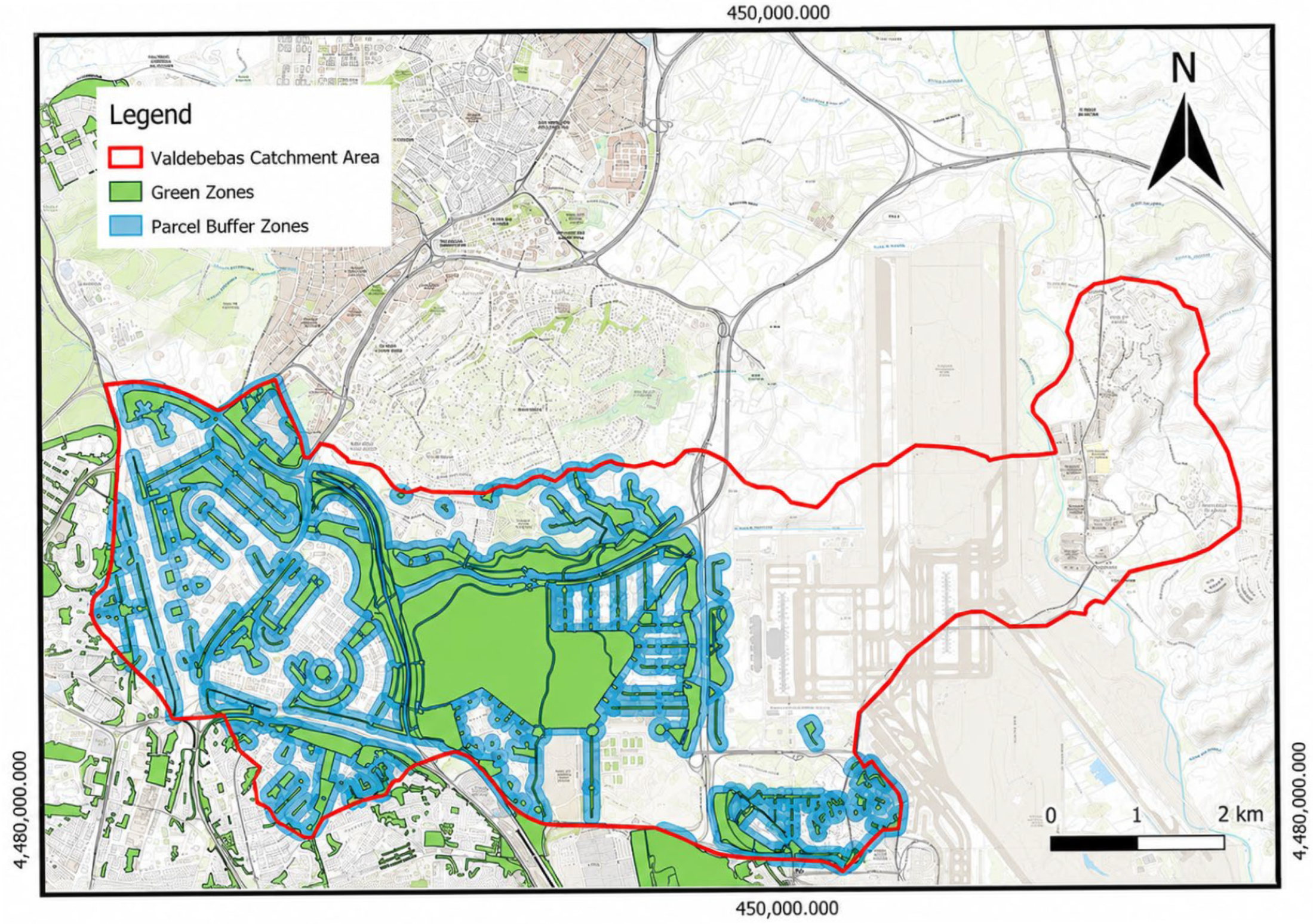
At the parcel scale, the same modelling structure is applied at a higher spatial resolution to capture local variability, implementation constraints, and operational feasibility. Spatial units were identified within the Valdebebas district through QGIS-based analysis and represented by plot centroids associated with surrounding buffer areas. These units were used to evaluate the spatial feasibility of runoff reuse for irrigation purposes.
Green areas derived from land-use data represented the receiving surfaces where irrigation demand was assessed. Potential runoff-contributing areas were approximated through 100 m and 1 km buffer zones surrounding the analysed plots. These buffers were introduced as simplified spatial proxies to represent nearby surfaces from which runoff could realistically be intercepted and redistributed. They do not represent the physical dimensions of SUDS installations or the actual extent of irrigated areas, but rather the potential spatial connectivity between runoff sources and irrigation demand.
Within this framework, SUDS are conceptualised as decentralised, green-based systems that intercept a fraction of the generated runoff, temporarily retain it, and redistribute it for irrigation reuse instead of allowing its direct discharge from the catchment. Hydrologically, SUDS are represented through the parameter c, which defines the proportion of runoff retained within the system and made available for reuse under different implementation conditions.
A generic swale-based SUDS configuration (4 m2 surface area and 0.5 m depth) was included solely as an interpretative reference and does not directly determine the hydrological calculations, where SUDS are represented through runoff-based parameterisation.

2.3. Economic Evaluation

For the economic evaluation of the possible implementation of SUDS, NPV (Equation (6)), IRR (derived from Equation (7)), and payback period (Equation (8)) have been used as indicators.
NPV = −I0 + ΣFt · (1 + r)i
0 = −I0 + ΣFt · (1 + k)i
0 = −I0 + ΣFt · (1 + r)t
where I0 represents the initial investment, Ft the cash flow at year t, r the discount rate, k is the internal rate of return (IRR), obtained by solving Equation (Equation (7)), and the payback period (Equation (8)).

2.4. Case Study

To evaluate the impact of SUDS on urban drainage, the proposed methodology was applied to a highly urbanised catchment area, namely the city of Madrid, the capital of Spain. Situated in central Spain on the Iberian Peninsula, between the Atlantic Ocean and the Mediterranean Sea, Madrid lies on a plateau at an average elevation of approximately 600 m above sea level [31]. The region is characterised by a Mediterranean climate with continental influence, with hot and dry summers and relatively cold winters.
Average daily temperatures range from approximately 10–11 °C in winter to 33 °C in summer, while minimum temperatures vary between about 2 °C and 18 °C throughout the year. Annual precipitation is relatively low, averaging around 400–450 mm, with rainfall mainly concentrated in spring and autumn, whereas summer periods are typically dry and associated with short but intense convective rainfall events [32].
Recent studies indicate that the area is experiencing increasing temperatures and a reduction in the number of rainy days, alongside a tendency towards more irregular and torrential precipitation patterns. This combination contributes to increasing evapotranspiration rates and water stress, particularly in central regions of the Iberian Peninsula.
From a geomorphological perspective, the study area is influenced by the presence of the Sierra de Guadarrama Mountain range to the northwest and by a system of minor valleys crossed by the Manzanares and Jarama rivers, which affect local drainage patterns and flow directions. The municipality of Madrid has a population exceeding 3.3 million inhabitants, with a high population density, making it a representative case study for analysing SUDS performance in highly urbanised environments.
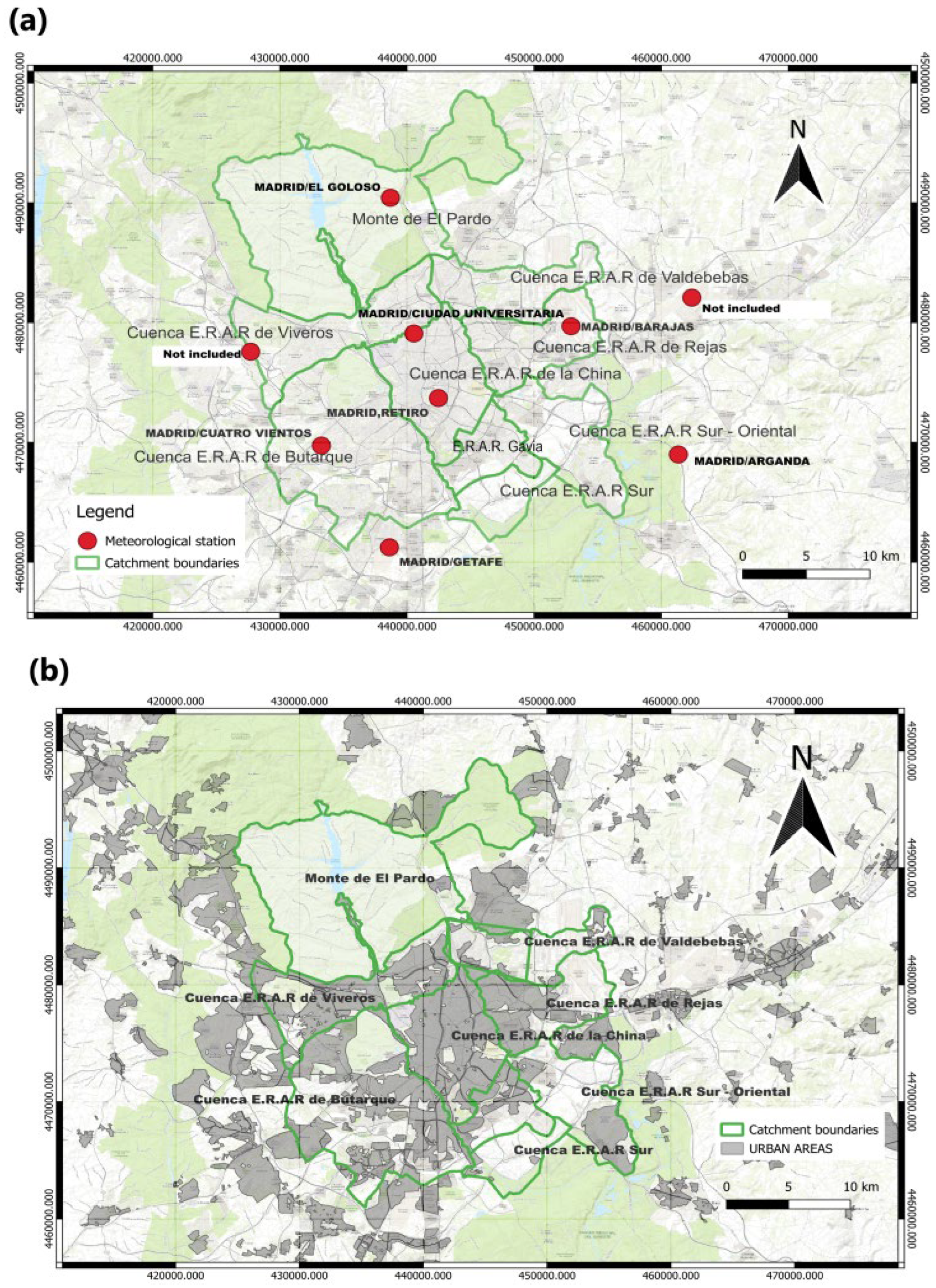
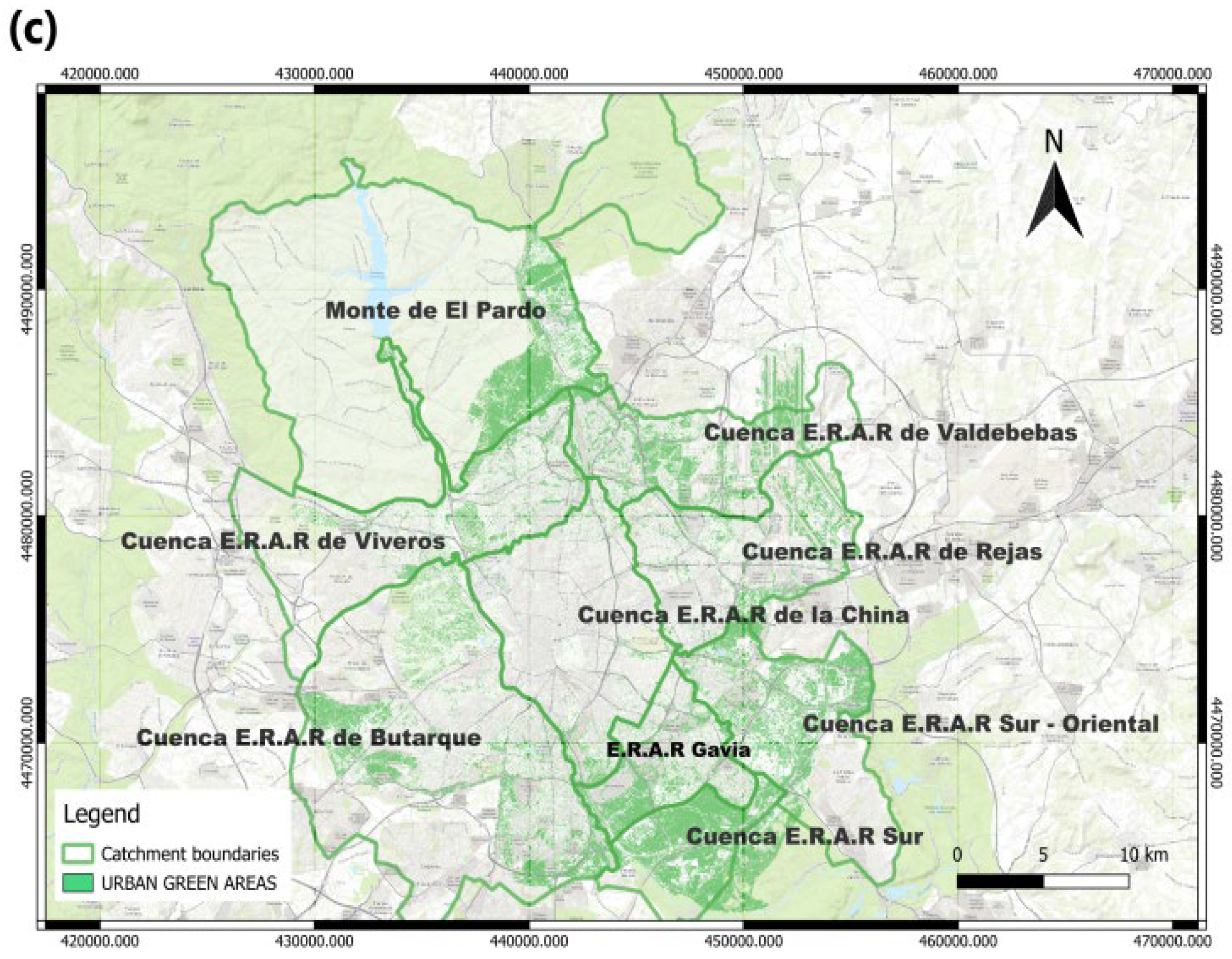
Figure 2 illustrates the existing drainage catchments within the municipality of Madrid (Figure 2a), defined based on the wastewater treatment systems to which different areas discharge. Land-use data (Figure 2b) were obtained from the municipal spatial information repository and were used to characterise surface properties, while green areas were identified to assess their potential contribution to SUDS implementation (Figure 2c).
For the application of the Curve Number (CN) method, CN values were assigned based on land-use classification derived from GIS datasets. Given the highly urbanised context and the limited availability of detailed soil data, CN values were primarily defined according to surface characteristics, distinguishing between impervious, partially permeable, and vegetated areas. Subcatchments were identified as spatial units corresponding to existing drainage areas, and a representative CN value was calculated for each unit using an area-weighted approach. Specifically, CN values associated with each land-use class were aggregated proportionally to their spatial extent within each sub-catchment.
Climate data were obtained from meteorological stations that were included in the official simulations developed by AEMET (Agencia Estatal de Meteorología). Climate projections used in this study are based on data from the Coupled Model Intercomparison Project Phase 6 (CMIP6), developed under the World Climate Research Programme (WCRP) and widely adopted in IPCC Assessment Reports. CMIP6 includes outputs from a large ensemble of global climate models (GCMs), providing a robust basis for future climate analysis. New global climate model (GCM) simulations have recently been released under the Shared Socioeconomic Pathways (SSPs). The Coupled Model Intercomparison Project (CMIP) was established in 1995 under the coordination of the World Climate Research Programme (WCRP) to systematically compare global coupled climate models. Over time, CMIP has evolved through several phases, aligning with the assessment cycles of the Intergovernmental Panel on Climate Change (IPCC). These phases began with CMIP1 and CMIP2 in 2001 and ended with CMIP6 in 2020 [33]. In this study, precipitation projections were used for the period 2025–2100.
Two contrasting climate scenarios were considered: a low-emission scenario (SSP1-2.6) and a high-emission scenario (SSP5-8.5). The SSP1-2.6 scenario represents a sustainability-oriented pathway characterised by strong climate mitigation efforts, resulting in relatively moderate changes in precipitation patterns. In contrast, SSP5-8.5 reflects a high-emission, fossil-fuel-driven pathway associated with more severe climate impacts, including increased variability in precipitation and higher irrigation demand.
These differences directly influence runoff generation and water availability, which are key drivers of SUDS performance in this study.
The climate projections were processed as continuous daily precipitation time series, which constitute the main input to the hydrological model. Runoff was estimated at each time step using the Curve Number (CN) method, which provides a simplified representation of rainfall–runoff response associated with individual precipitation events.
In this framework, each precipitation event contributes to runoff generation according to its magnitude, and these event-based contributions are subsequently aggregated over time.
For each catchment (ERAR, Estación Regeneradora de Aguas Residuales) shown in Figure 2a, the closest available meteorological station from the AEMET dataset was selected to provide localised climate inputs (see Table 1). The numerical codes associated with each meteorological station correspond to the official identifiers used in the AEMET database.

3. Results

This section presents the key findings from applying the suggested dual-scale methodology to Madrid.
These outcomes are organised into two levels of analysis: the catchment level, which provides an overview of hydrological performance and water reuse potential across nine urban catchments; and the parcel level, which focuses on the detailed evaluation of individual plots within the Valdebebas catchment.
Together, these results demonstrate how integrating hydrological modelling and economic assessment can inform decisions regarding the optimal design and allocation of SUDS in urban environments.

3.1. Catchment Scale Analysis

Based on the information gathered (layers with urban catchments, land uses, and green areas defined in the urban planning master plan), the hydrological models described in Section 2.1 were run. A Python (version 3.7) routine was integrated into QGIS (version 3.10) to estimate each catchment’s representative CN value and to parameterise the model at the catchment scale (see Table 2 for the average curve number values).
At the urban catchment scale, it is assumed that all the water generated within a 1 km strip around each green space can be collected and transported for use on those plots. For this reason, 1 km buffers are defined around each green space. Then, they are grouped together to generate an area of potential water runoff use in each catchment. Figure 3 shows the transition from greenfield plots to areas of potential water runoff and water use within each catchment, adjusting the surfaces of these areas with the catchment boundaries.
Once the catchment had been characterised through geographical information processing, the maximum storage capacity of the SUDS at the catchment scale was defined in order to run the hydrological models. It was assumed that the maximum storage capacity of SUDS corresponds to a fraction (r) of the average estimated runoff value for each catchment or parcel over the analysed period, based on the climatic projection.
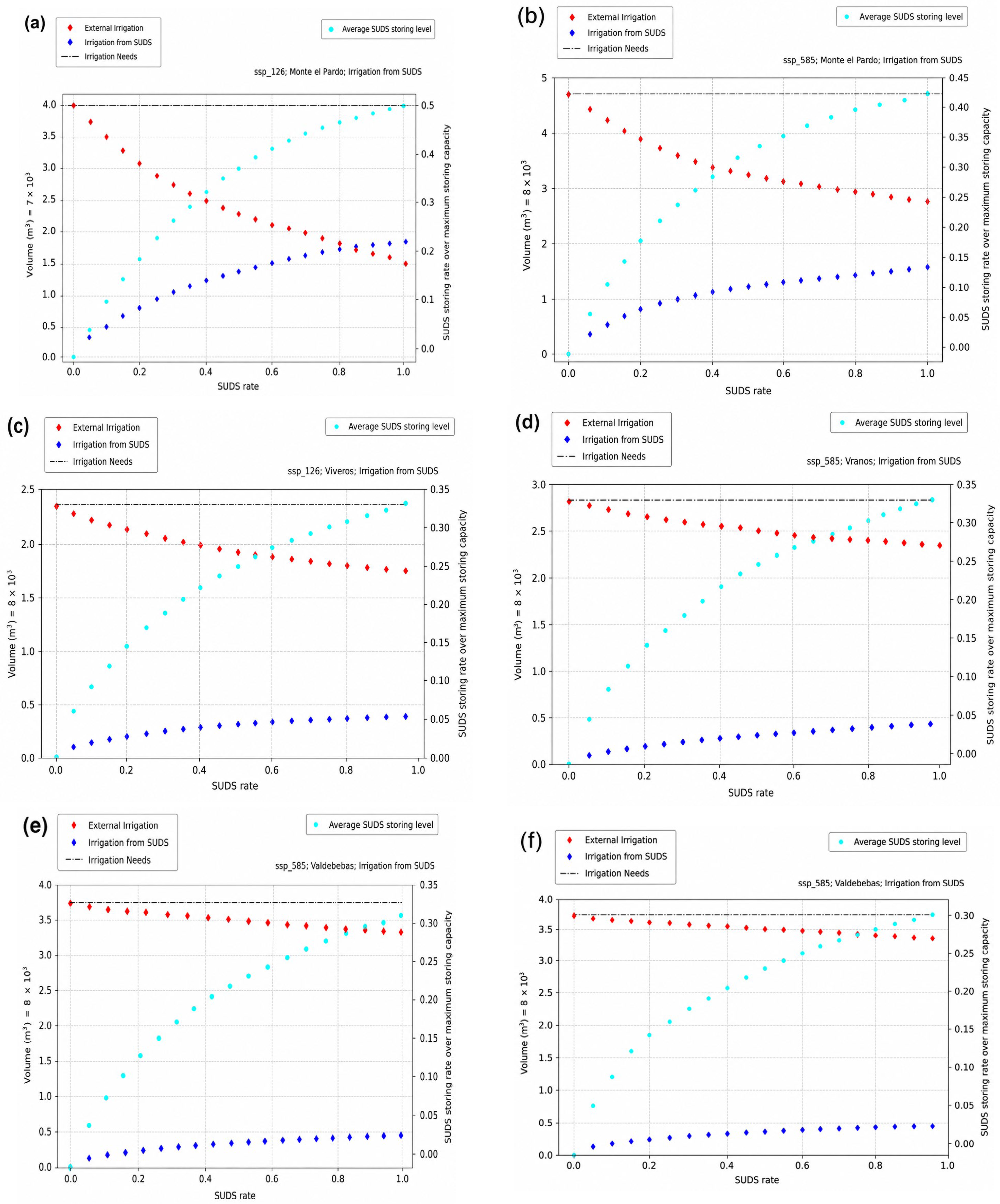
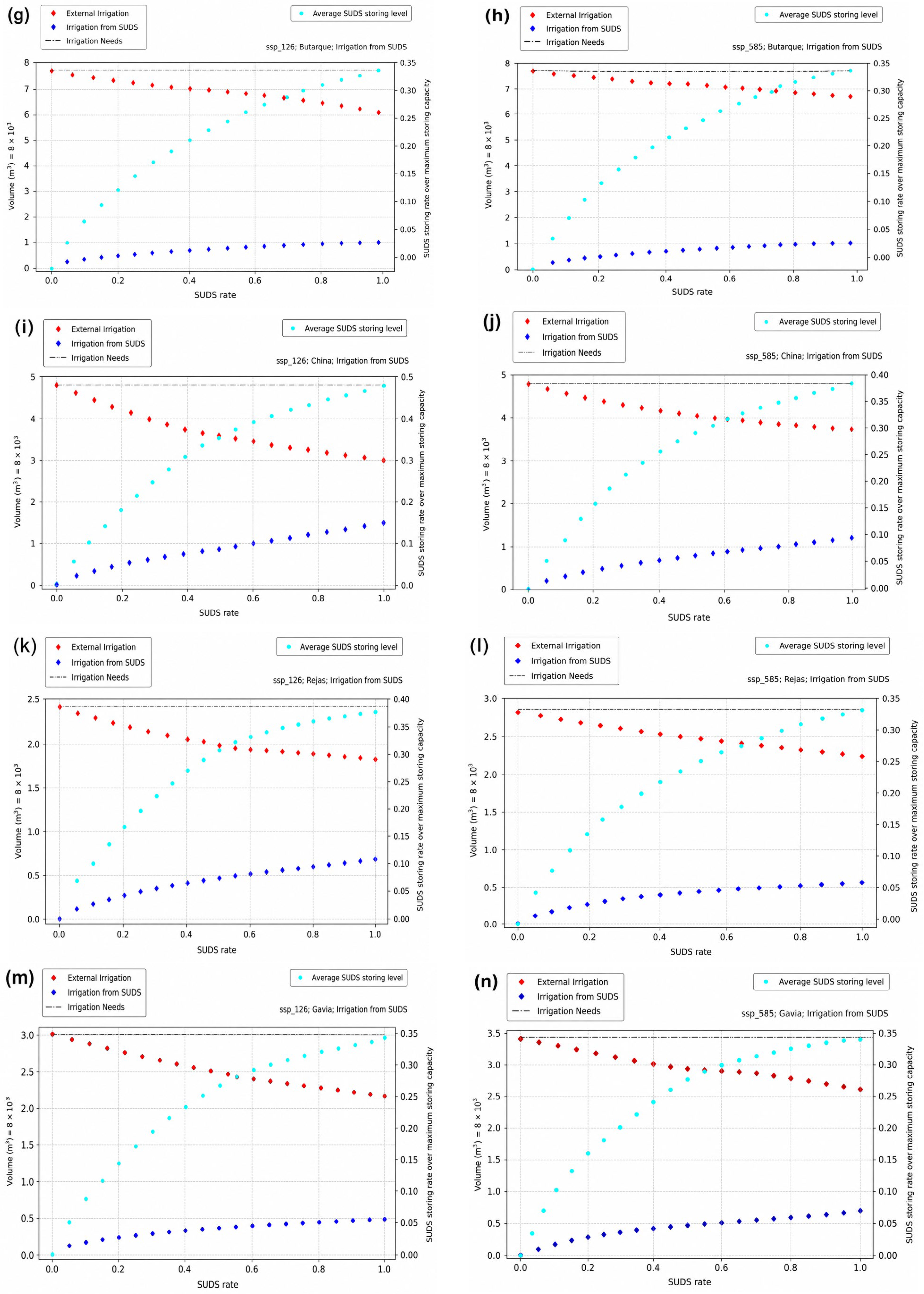
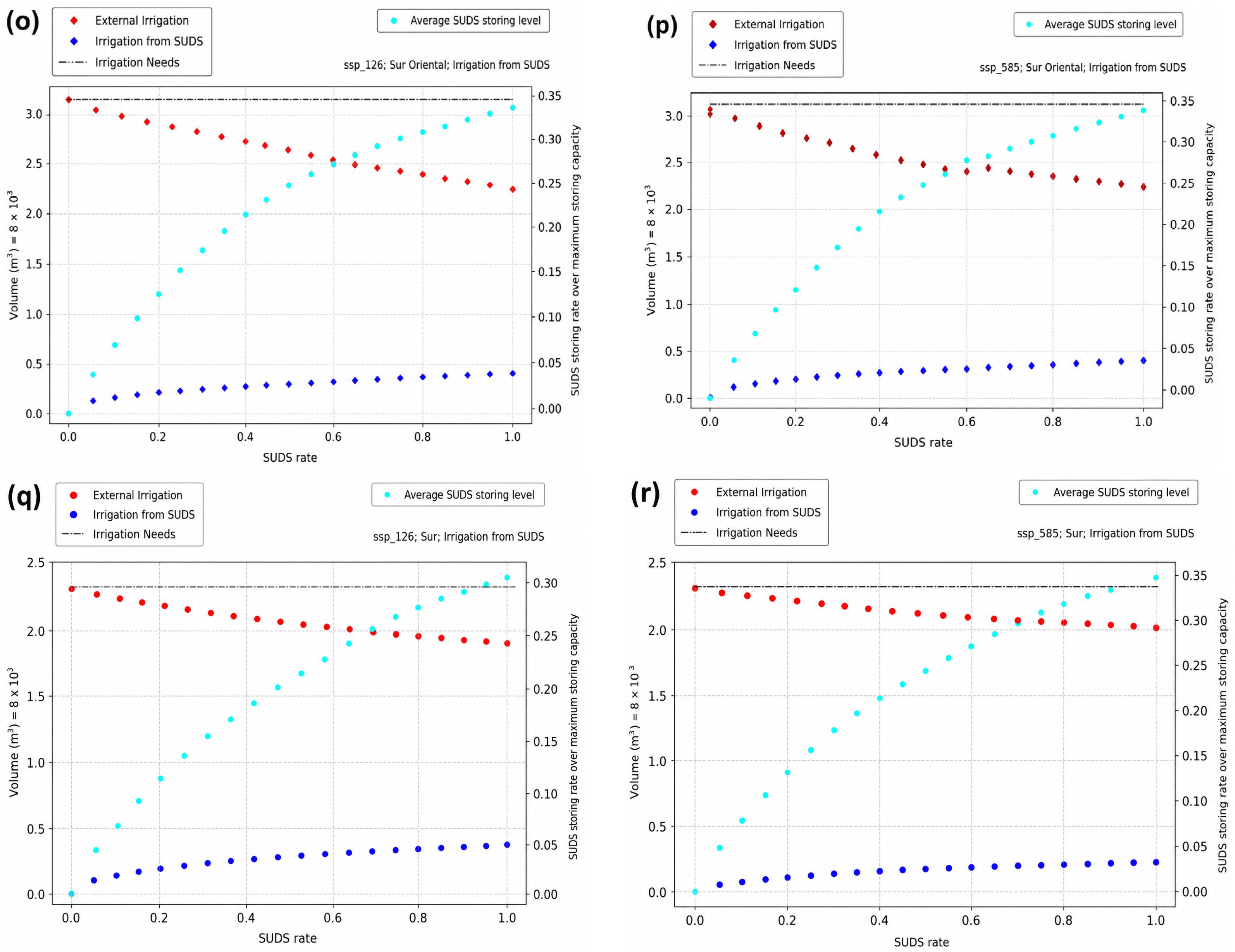
To estimate the average potential runoff generation throughout the analysed period, the water balance described in Section 2.1 was applied, setting c = 0. After estimating the average values, simulations were performed assuming that the available SUDS volume would represent a fraction (0 ≤ r ≤ 0.95) of the estimated average runoff. Figure 4 illustrates the response of irrigation demand and SUDS performance to increasing SUDS implementation rates (0 ≤ r ≤ 0.95) across the nine catchments and under both climate scenarios (SSP1-2.6 and SSP5-8.5).
Figure 4 shows that SUDS consistently reduce external irrigation demand across all catchments as their implementation rate increases. The average storage level relative to maximum capacity remains generally low (typically between 0.05 and 0.30), indicating that systems operate far from saturation and that performance is primarily limited by runoff availability rather than storage capacity.
Catchments with higher runoff availability, such as Monte El Pardo (Figure 4a,b) and China (Figure 4i,j), reach storage saturation earlier and stabilise around r ≈ 0.4. In contrast, catchments characterised by more limited runoff require higher SUDS implementation rates and tend to stabilise around r ≈ 0.6. This suggests an inverse relationship between the SUDS implementation rate and the plateau in hydrological benefits and runoff availability.
Under the SSP5-8.5 scenario, storage levels increase slightly; however, the relative contribution of SUDS decreases due to higher irrigation demand.

3.2. Parcel Scale Analysis

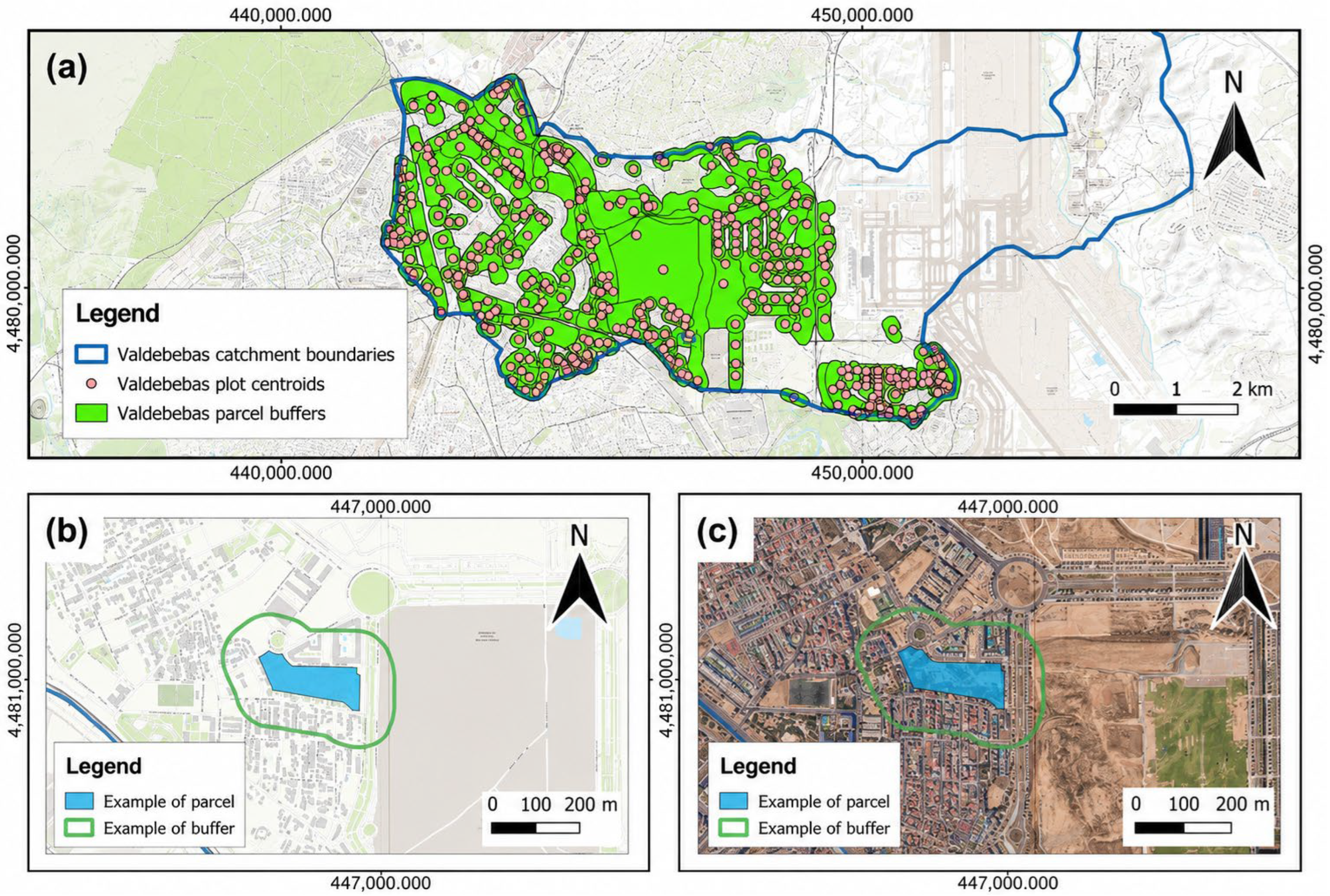
The next step was to downscale the analysis to the plot level and examine the potential implementation and efficiency of SUDS within each plot of the respective catchment areas. To demonstrate the method’s applicability, the Valdebebas catchment area was selected as a case study.
The plots were identified, and a buffer was generated. Given the smaller scale of analysis, a general rule of a 1 km and 100 m buffer was adopted; however, at this resolution, it could easily be refined using detailed topographical information. The plots were subsequently clipped according to land use. A green infrastructure-based type of SUDS was considered, with a surface area of 4 m2 and a depth of 0.5 m.
Figure 5 illustrates an example of a plot and its buffer, as well as the complete set of plots within the Valdebebas catchment area.
First, the hydrological model described in Section 2.1 (soil water balance coupled with the SCS–Curve Number method) was applied to assess the capacity to capture runoff and its potential to reduce irrigation demand.
At this scale, it was possible to evaluate the efficiency of SUDS in reducing the need for external irrigation under different spatial conditions. Different hydrological responses were obtained for each analysed plot depending on the local runoff–reuse relationship, with runoff retention rates (r) ranging from 0 to 0.95.
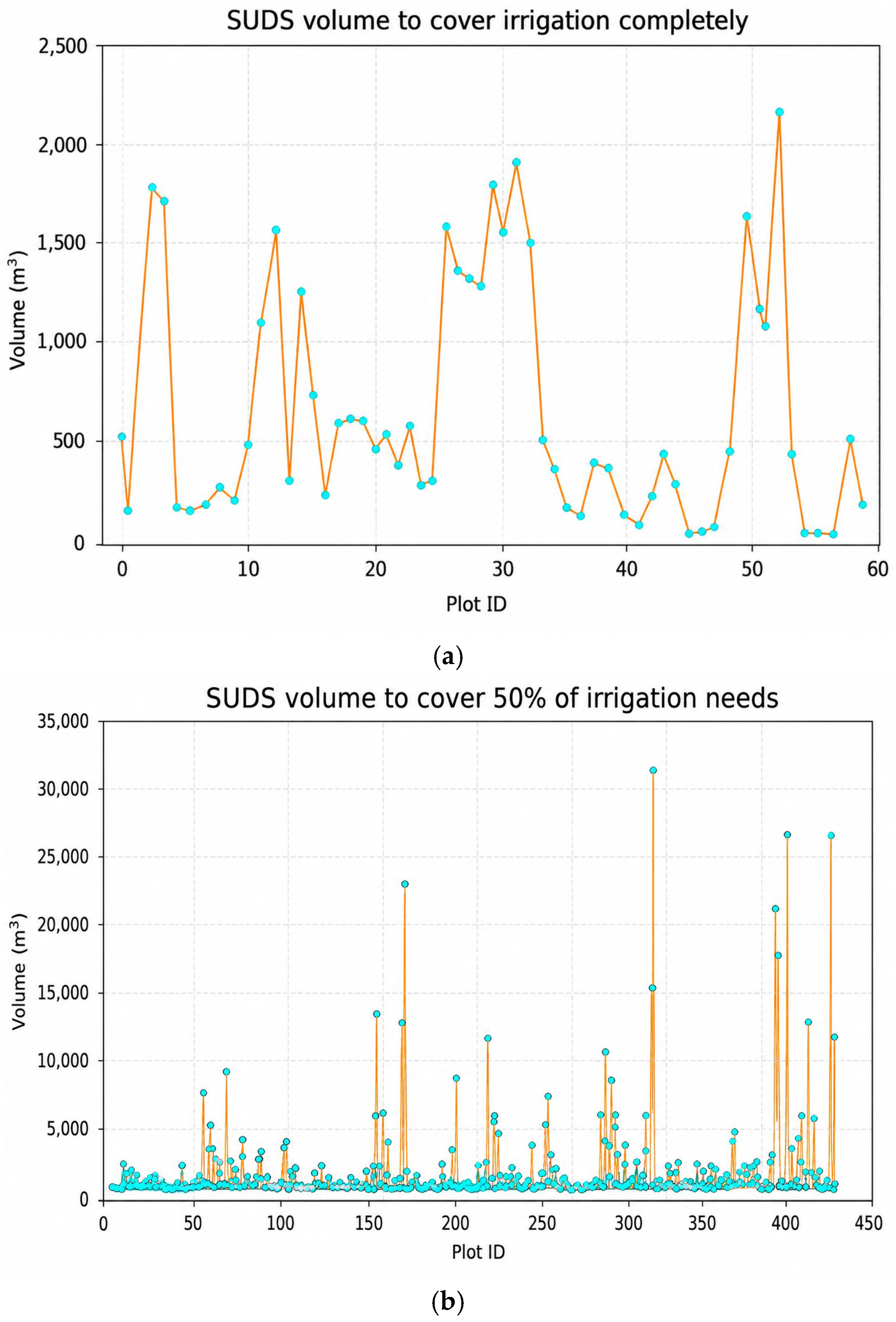
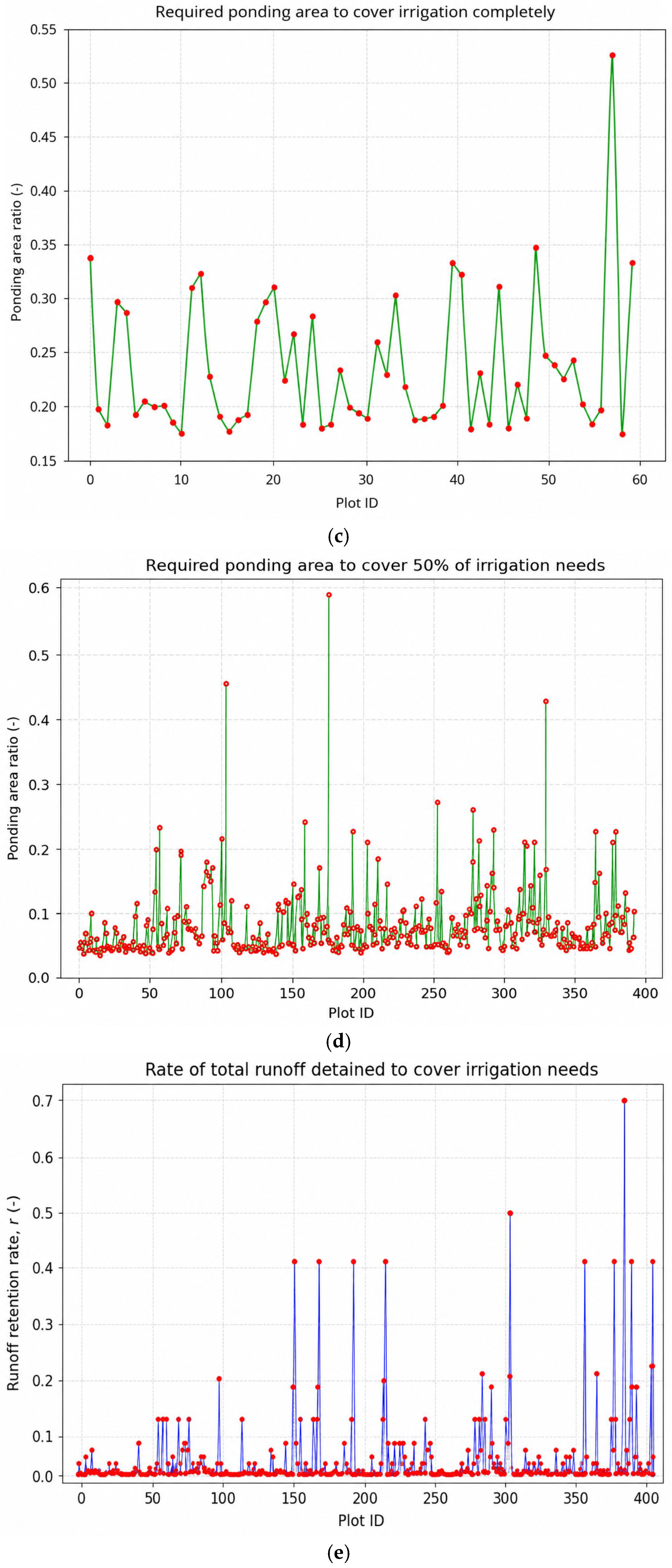
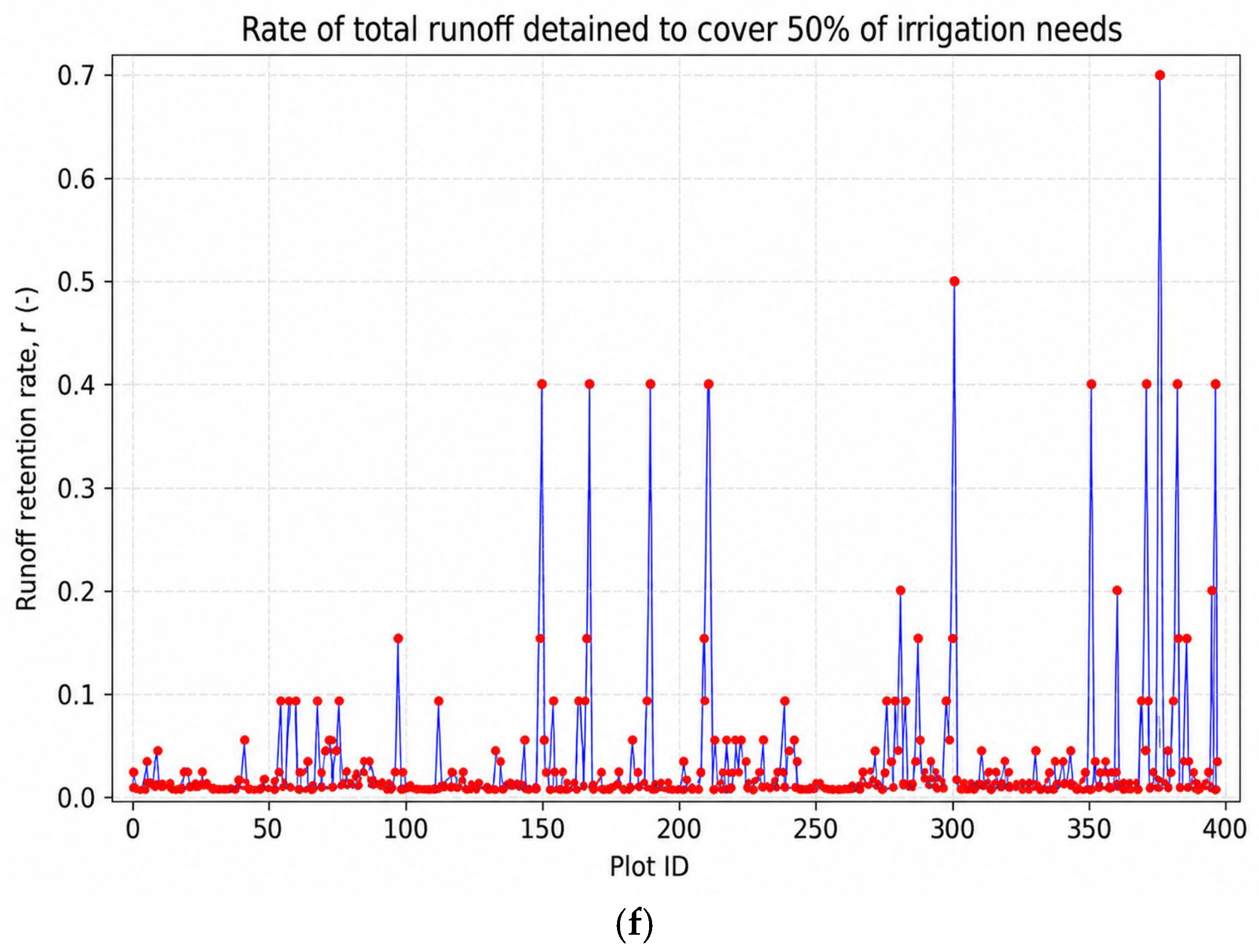
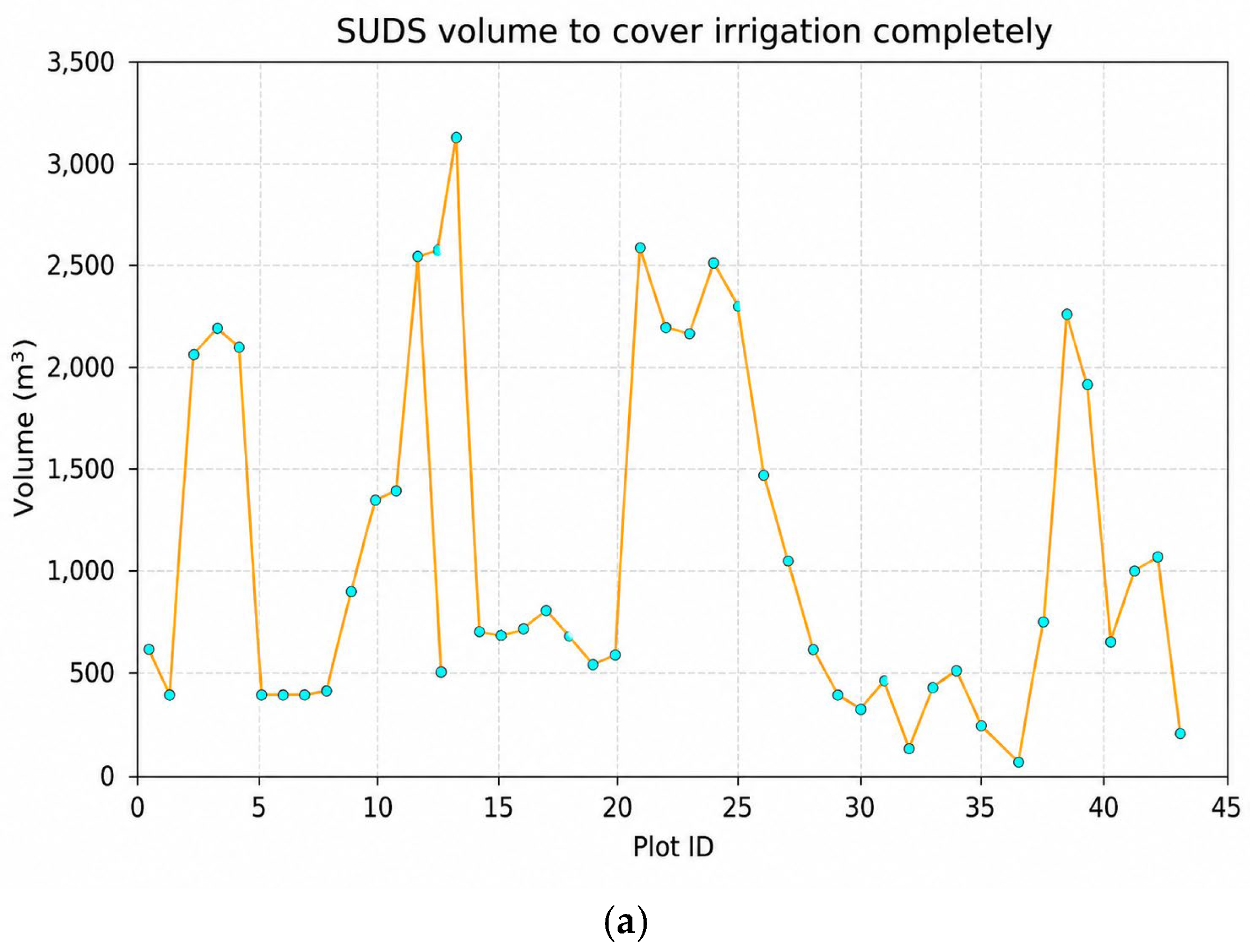
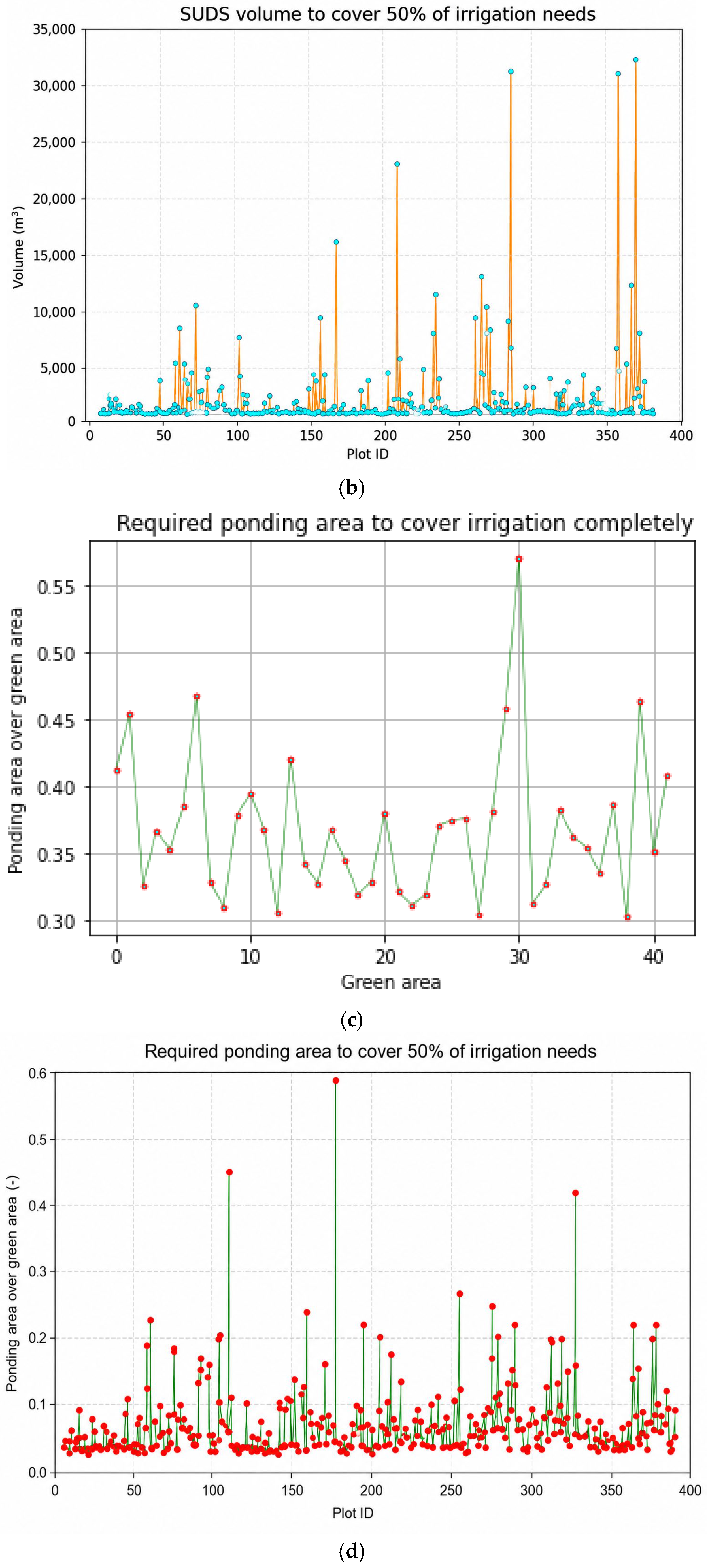
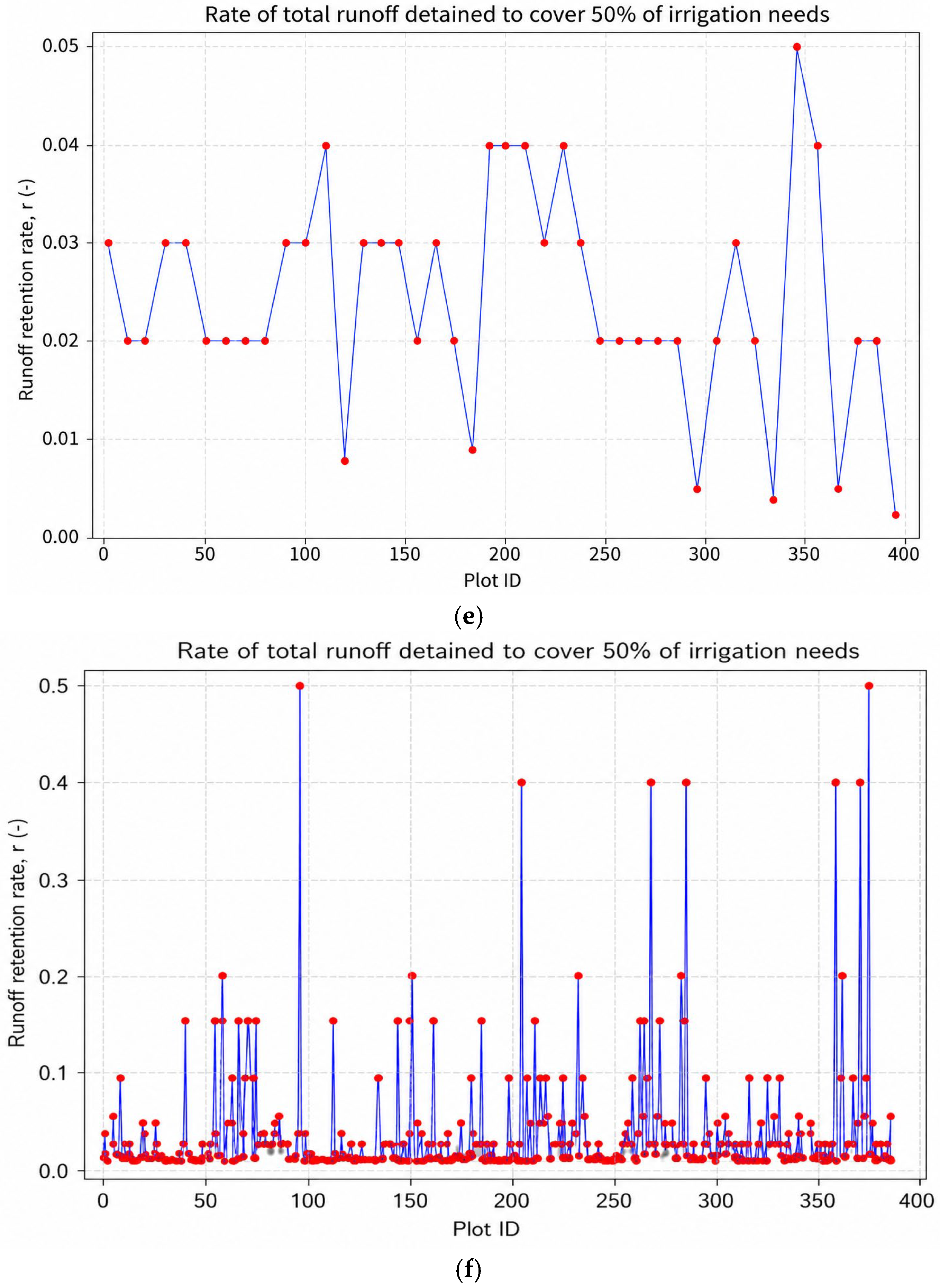
Figure 6 and Figure 7 present the required SUDS volumes, the ponding area ratio, and the runoff retention rates associated with the analysed plots in the Valdebebas area under the considered climate scenarios. Here, Plot ID refers to the identifier assigned to each analysed green area evaluated under the previously described swale-based SUDS configuration.
Under the SSP1-2.6 scenario, runoff reuse through SUDS could completely satisfy irrigation demand in 59 plots, while 405 plots were able to cover 50% of irrigation demand. Under the SSP5-8.5 scenario, complete irrigation coverage was achieved in 42 plots, whereas 385 plots were able to satisfy 50% of irrigation demand through runoff reuse.
In the SSP1-2.6 scenario, covering 100% of the irrigation, SUDS require relatively modest volumes (hundreds up to ~2000 m3) and occupy 15–35% of the green area. Instead, covering of 50% of the irrigation requires much more variable volumes (can even exceed 20,000–30,000 m3) and the required area occupied by SUDS drops to below 10–15%. The peak of the rate of total runoff detained to cover 100% of irrigation needs is 3%, while the peak of the rate of total runoff detained to cover 50% of irrigation needs is 70%.
In the more critical SSP5-8.5 scenario, the requirements increase, with many cases exceeding 3000 m3 for full coverage (100% irrigation coverage) and requiring 30–45% of the green area. Here, too, partial coverage (50% irrigation coverage) requires less space (10–15%), though there is high variability. The amount of runoff retained for irrigation is fixed at 5% under 100% irrigation coverage and at 50% under 50% irrigation coverage. This shows that the system could be resilient in partial configurations and in critical scenarios.

3.3. Economic Analysis

The economic analysis has calculated the financial implications of each of the proposed interventions. The costs relate to installation works (€44.65/m3, including excavation and gravel filling), while the revenues are derived from the reduction in irrigation water consumption made possible by the planned storage (assuming the cost of irrigation water from external sources is €1.709/m3). Additional costs are related to the need for external water to cover irrigation demands that exceed the SUDS contribution (an annual maintenance cost of €150).
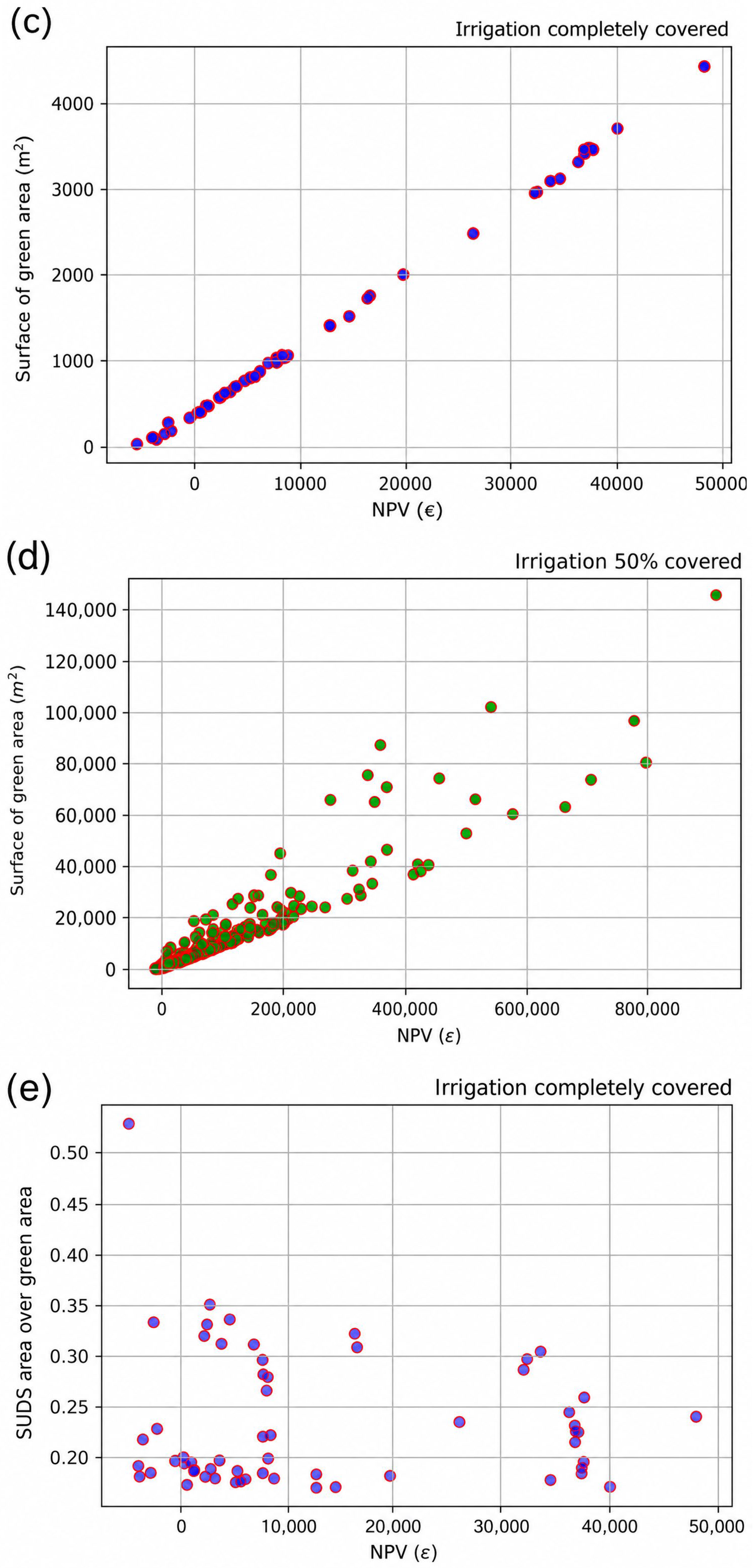
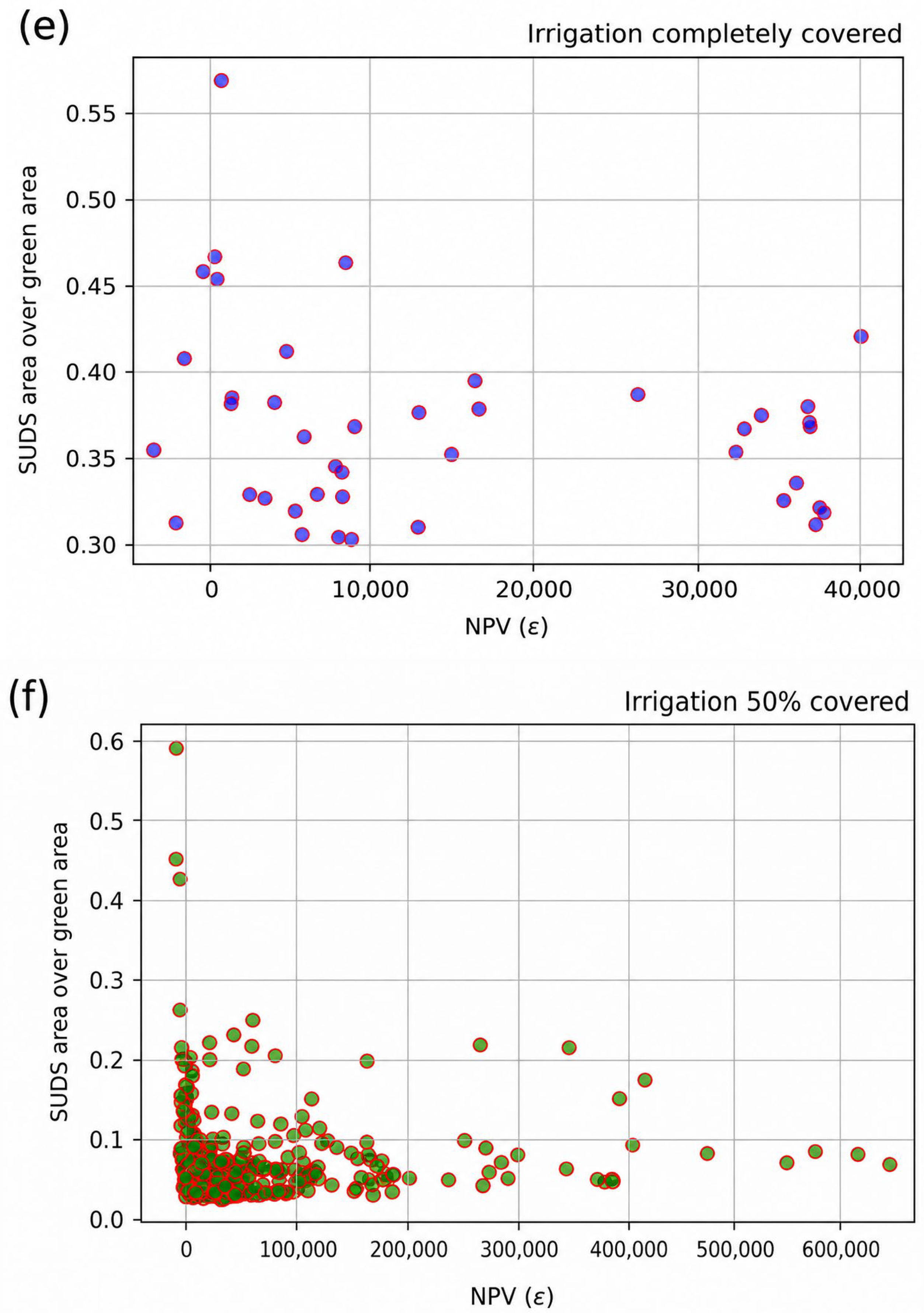
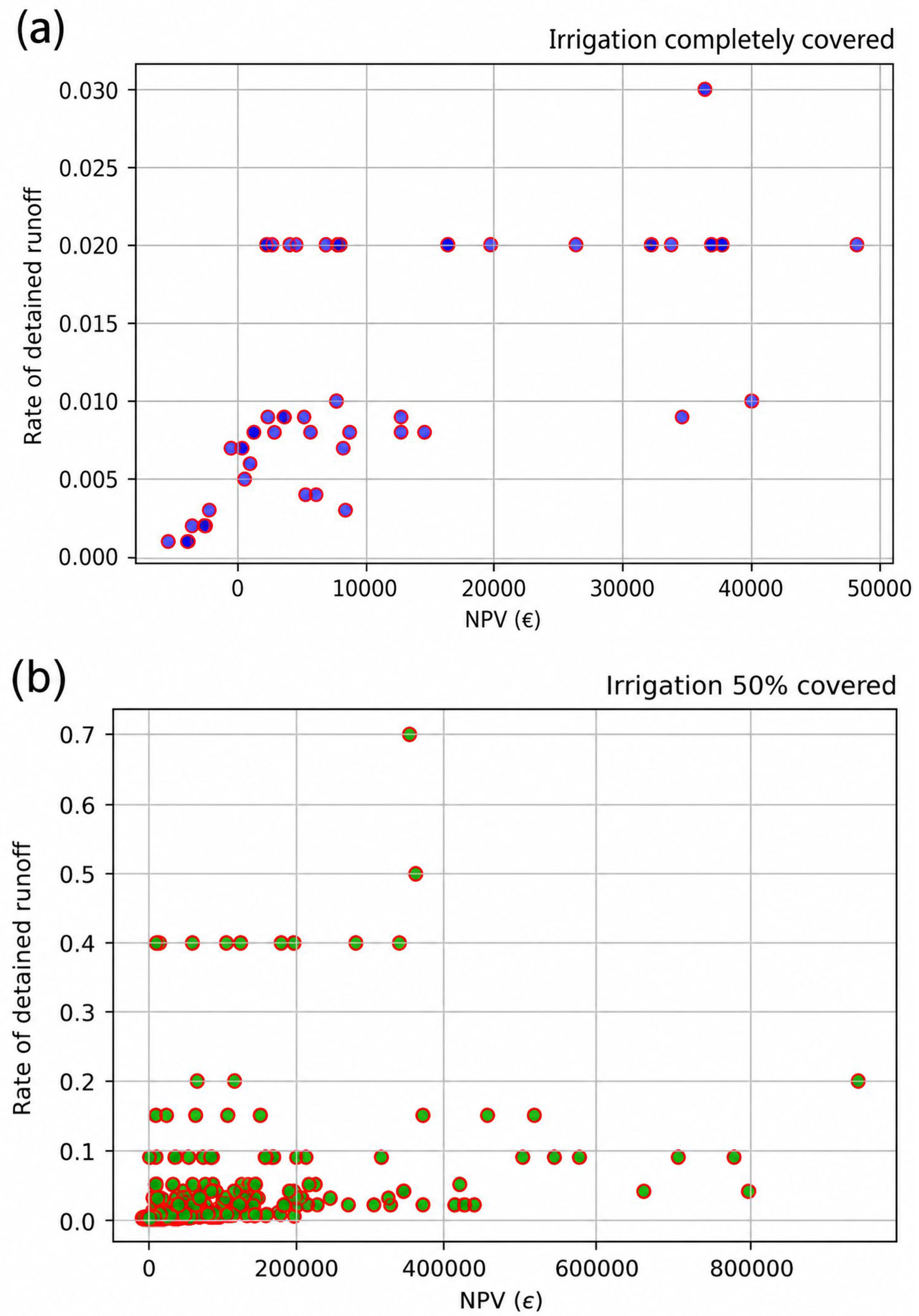
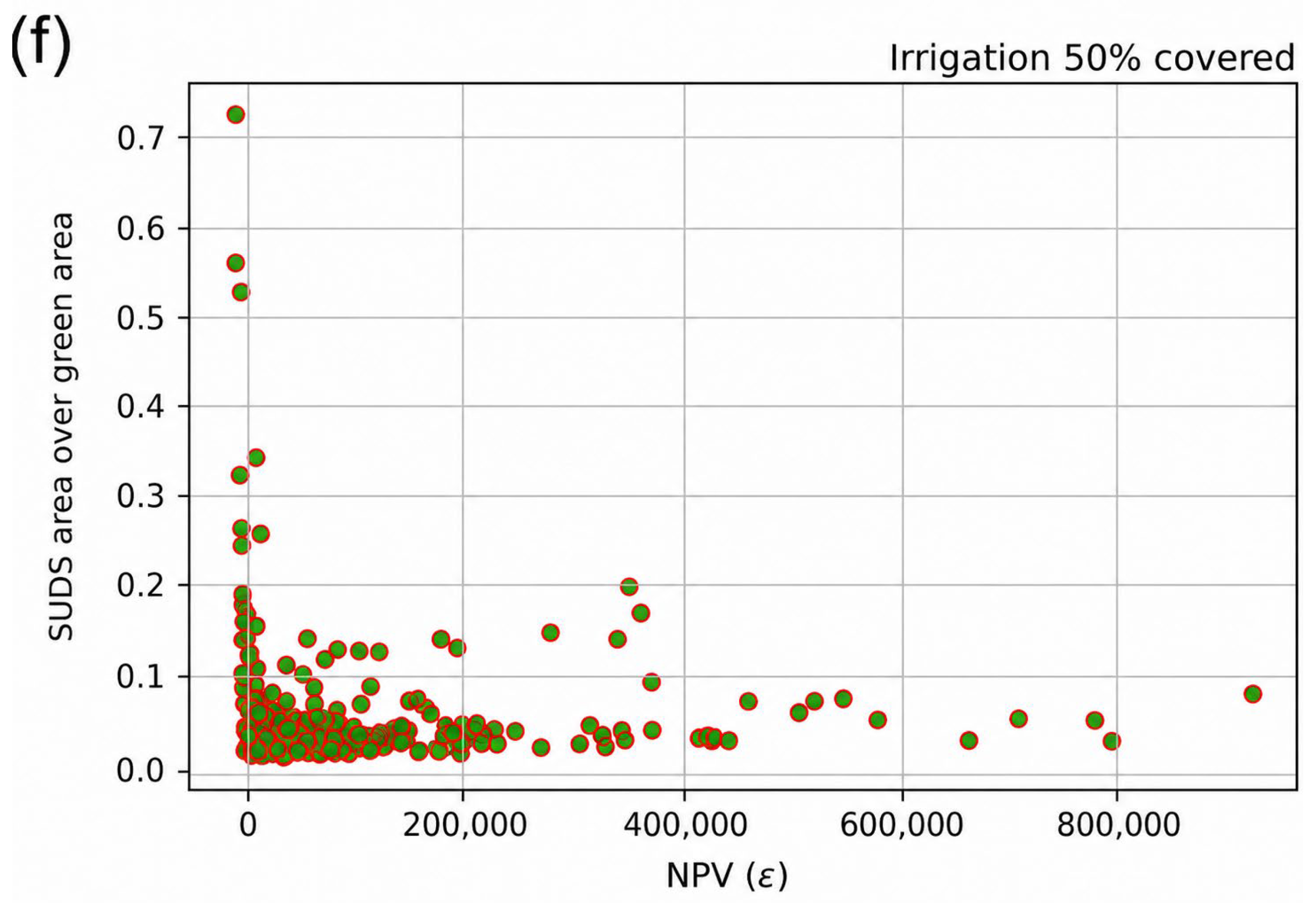
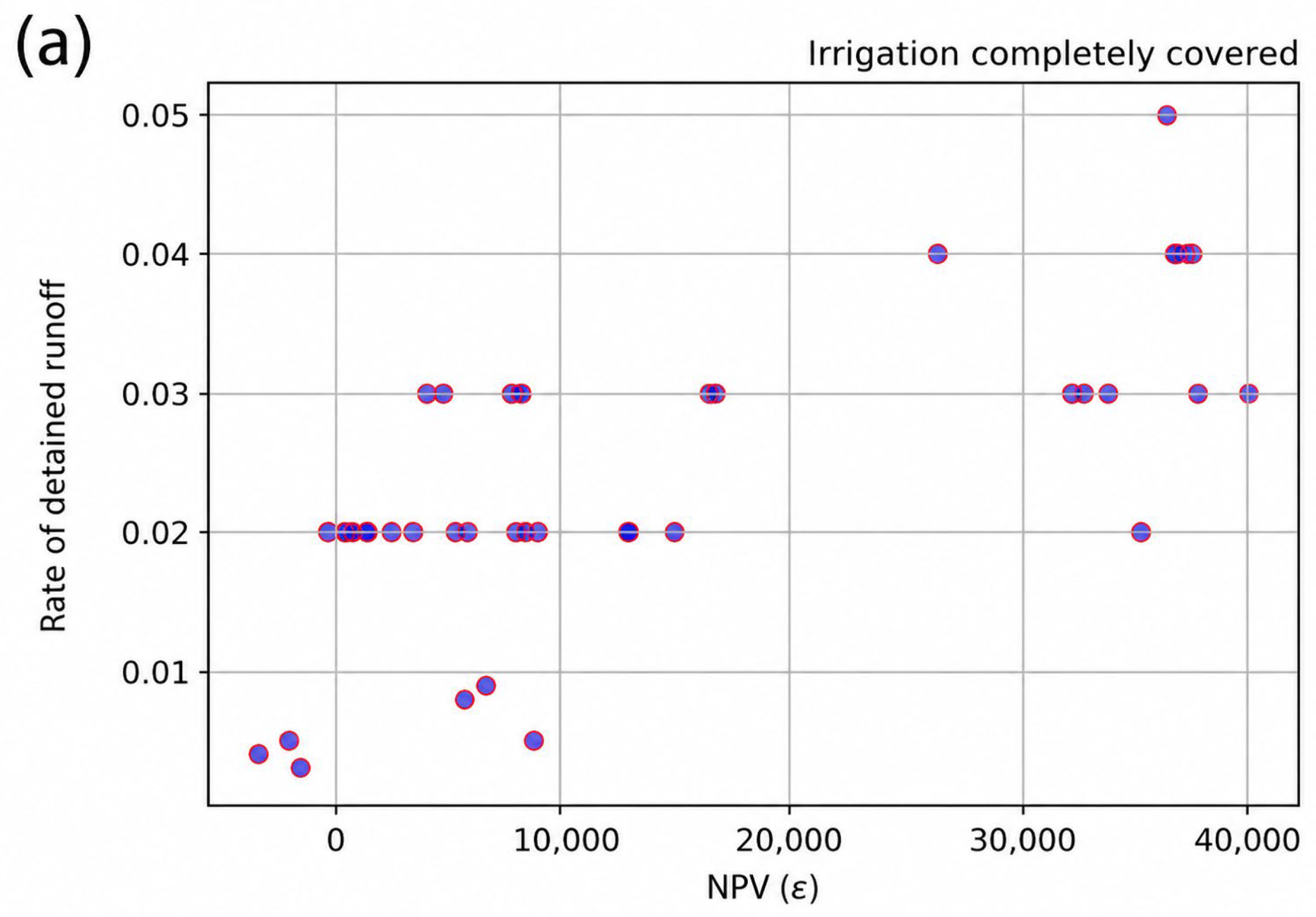
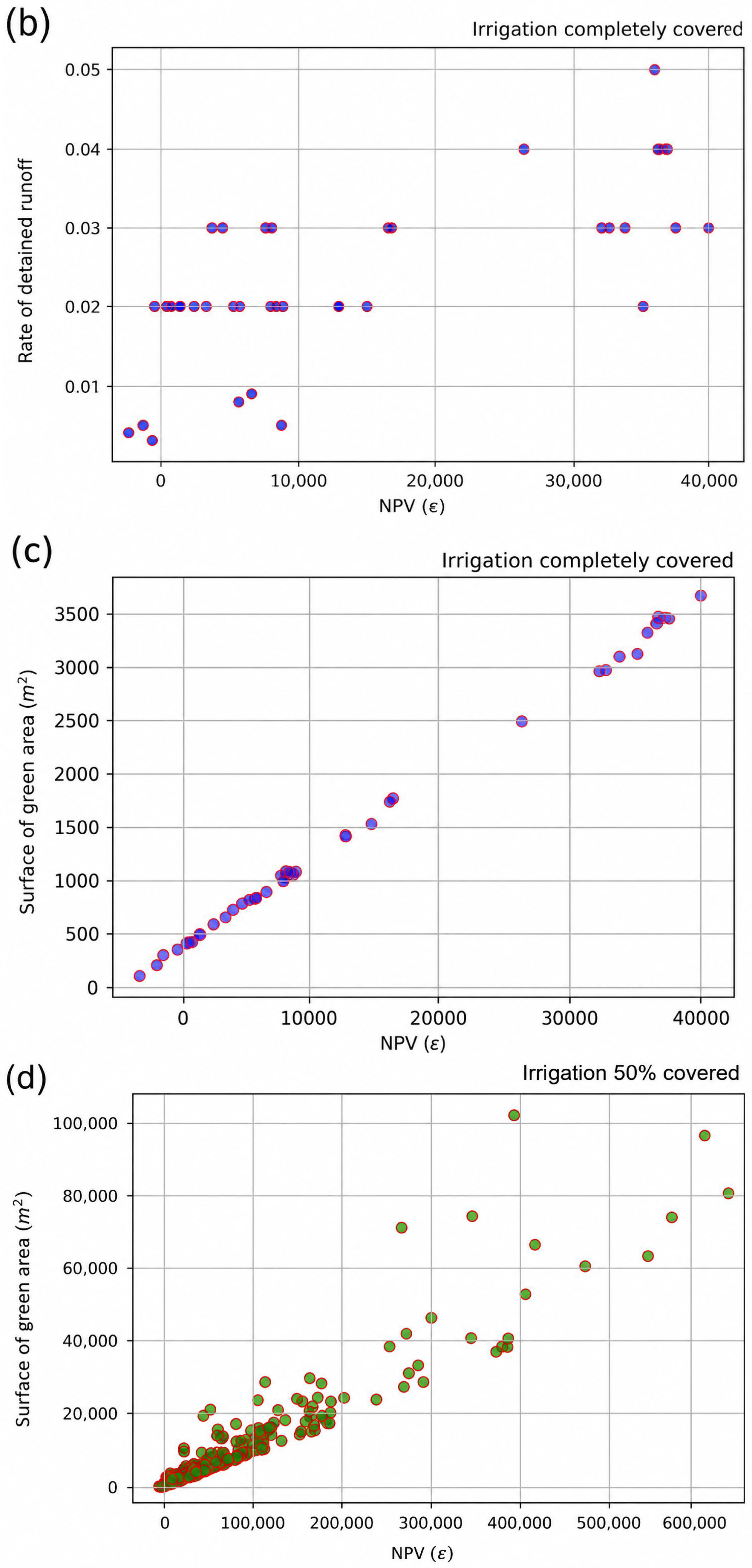
Figure 8 and Figure 9, based on Valdebebas data, show the relationship between NPVs and three key variables: (a) the rate of detained runoff, (b) the extent of green areas and (c) the proportion of the surface occupied by SUDS. This is shown for the two climate scenarios SSP1-2.6 and SSP5-8.5. For each variable, the figures distinguish between two irrigation performance conditions: full (100%) and partial (50%) coverage.
Under the SSP1-2.6 scenario with a 100% coverage target, feasible solutions fall within a runoff detention rate (0 < r < 0.10) and a green surface area of less than 4000 m2. They also require a percentage of the green area to be designated as SUDS (0.10–0.35). NPVs remain modest, generally not exceeding €50,000, with slightly higher values observed in plots with larger green areas (up to approximately 4500 m2). These configurations are technically homogeneous and provide stable, albeit limited, economic returns.
However, with a 50% coverage target, the range of feasible solutions is much broader. Most runoff detention rates are concentrated within the range of 0.10 to 0.20, green areas range from small plots to 100,000 m2, and the proportion of green space occupied by SUDS varies mostly from 0 to 0.4. This broader feasibility results in an extremely dispersed NPV distribution with peaks of €800,000.
In the SSP5-8.5 scenario, the increased demand for irrigation amplifies these dynamics. For the 100% irrigation target, the NPVs exhibit wide variability across the detained runoff rates and the proportion of green space occupied by SUDS. Under the 50% target, results appear more linear, with most NPVs falling within the €0–€400,000 range. These values correspond to comparatively high SUDS area proportions, typically between 0.30 and 0.55 of the green area.
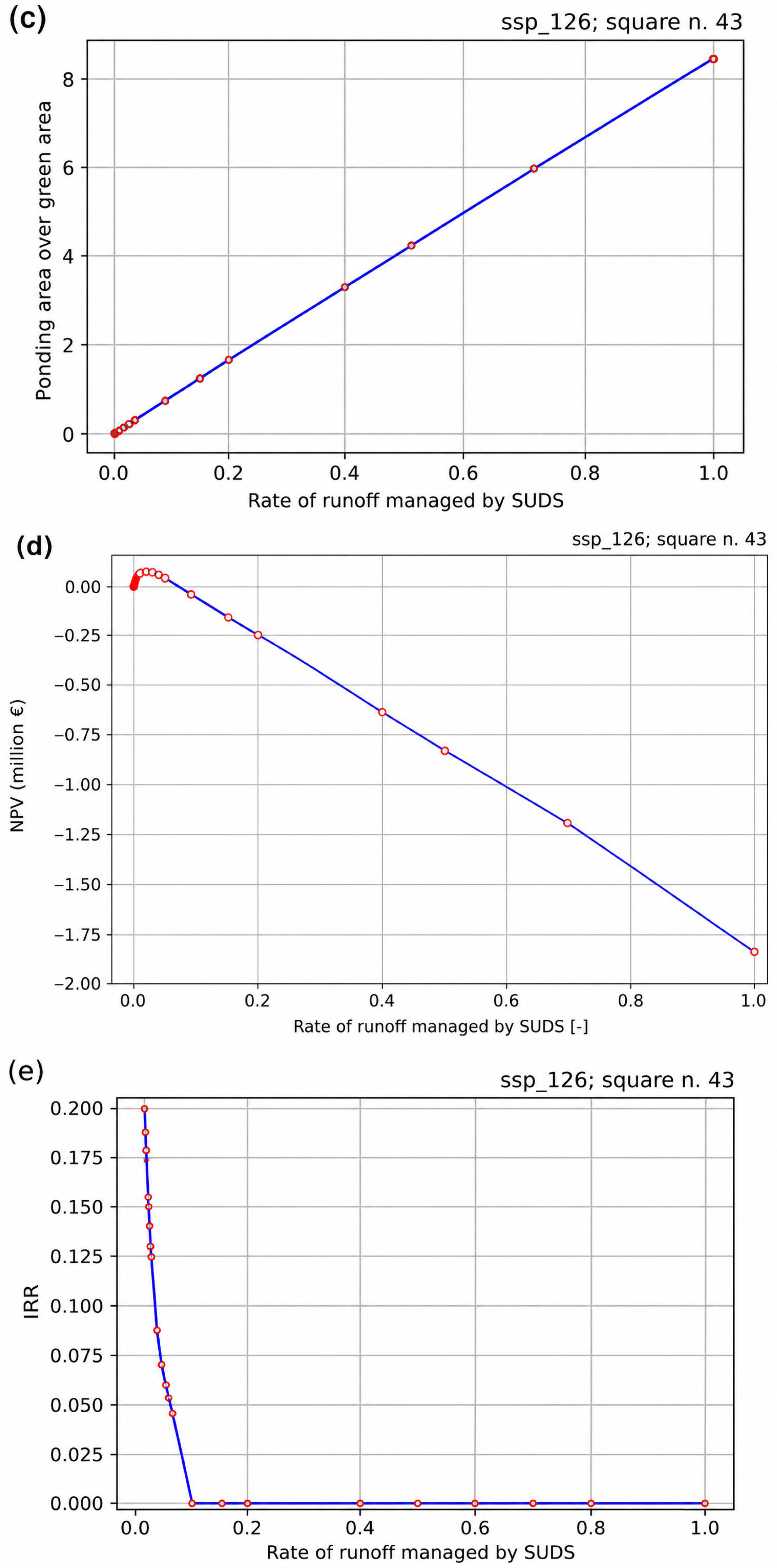
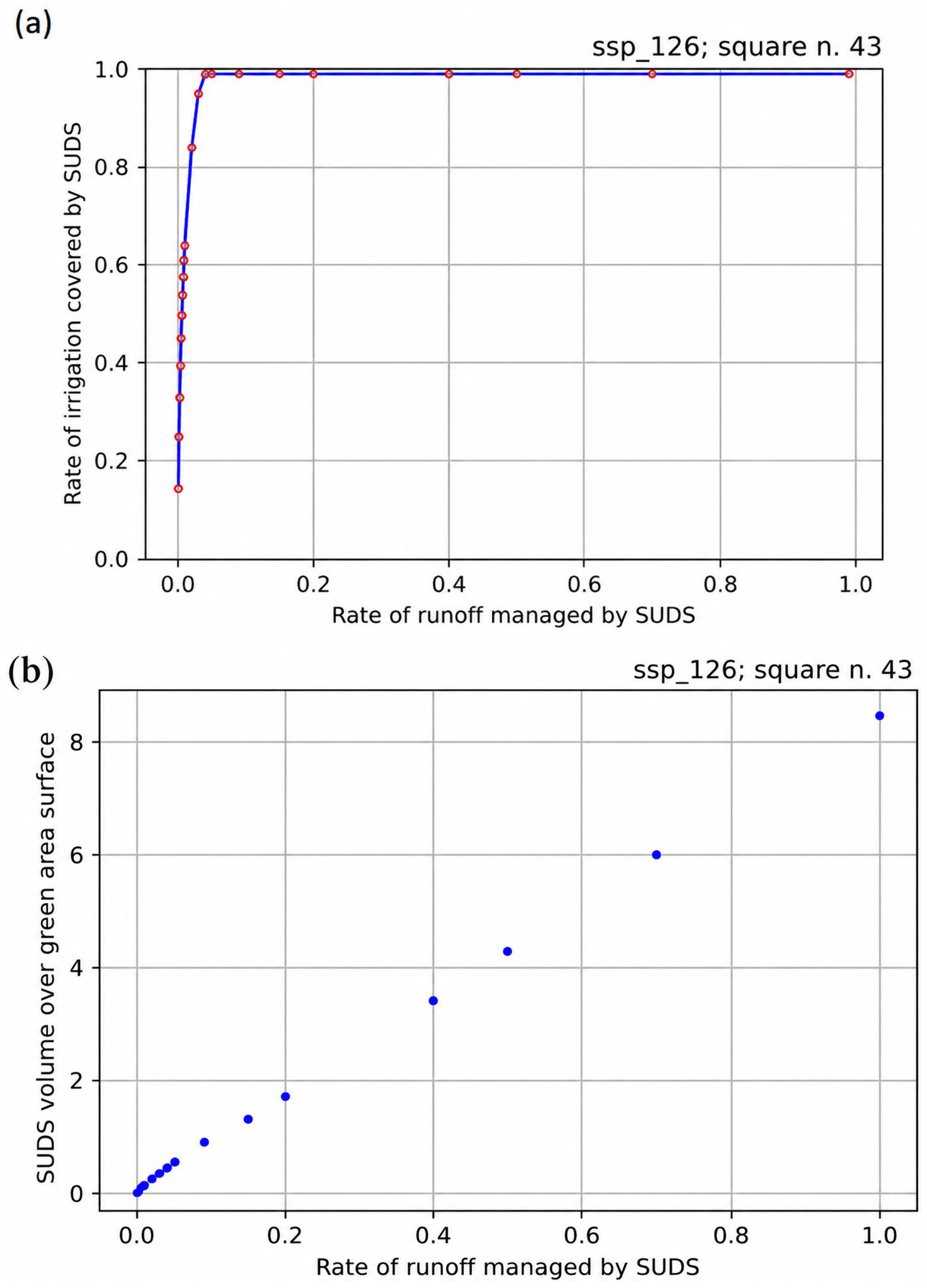
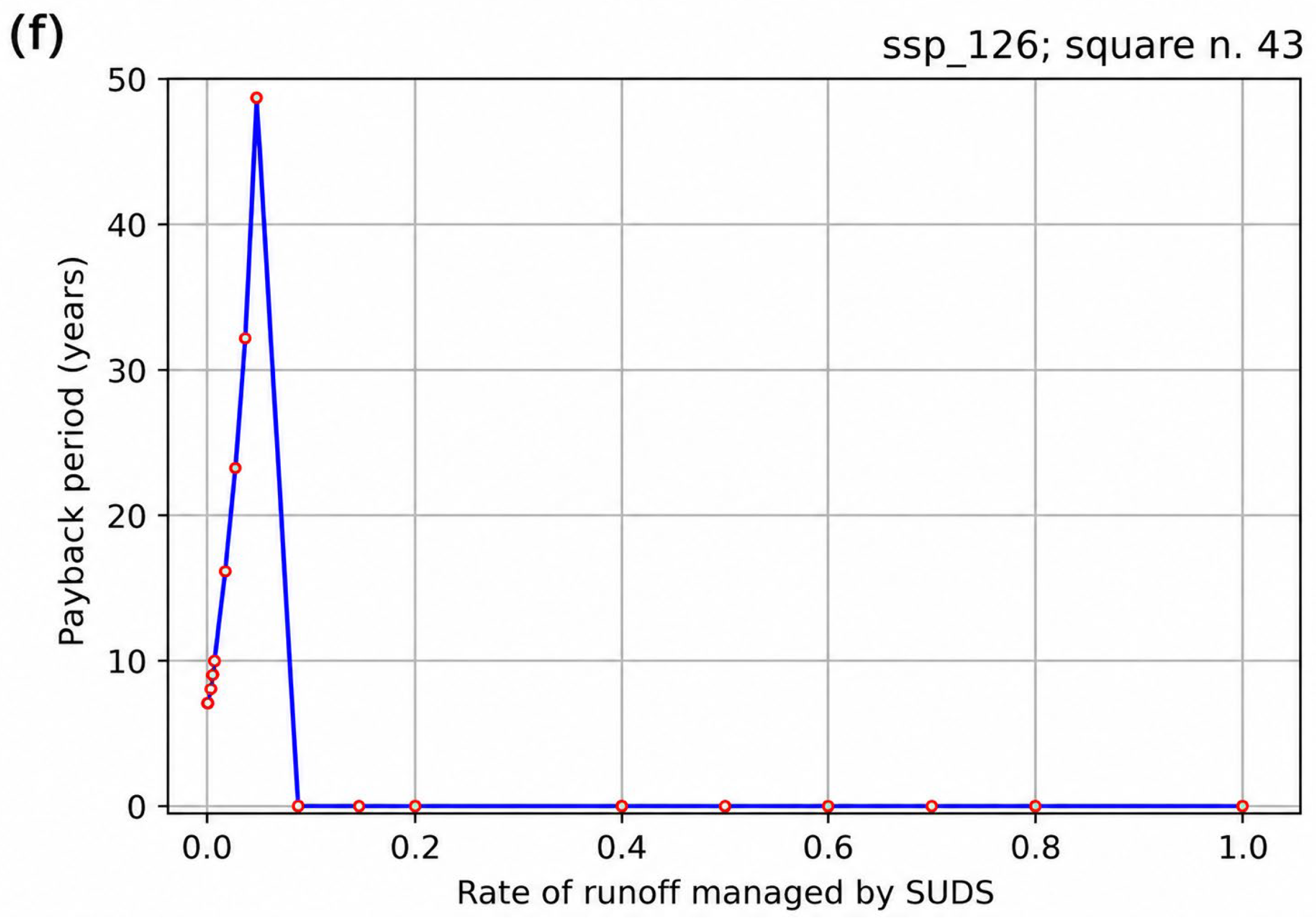
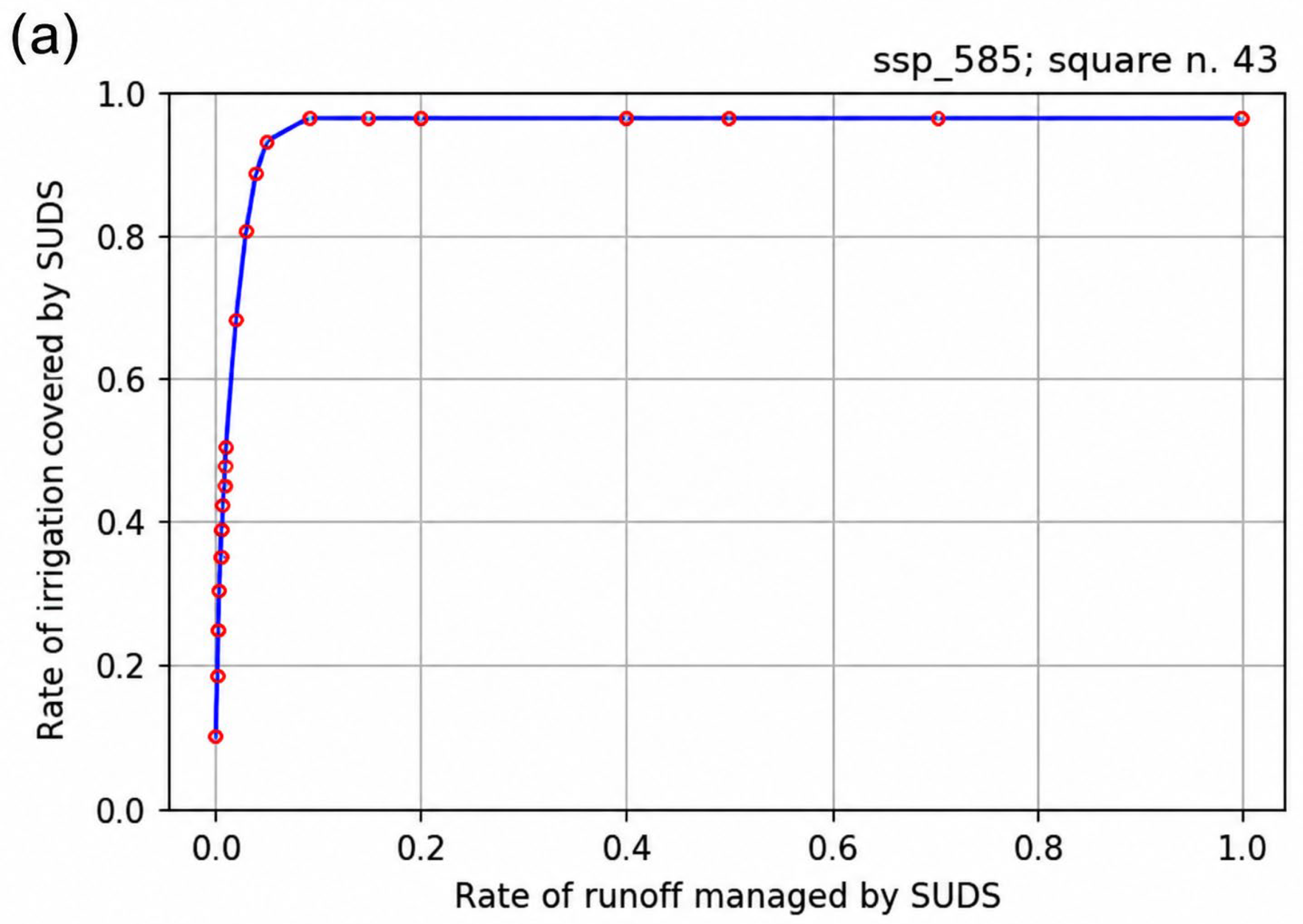
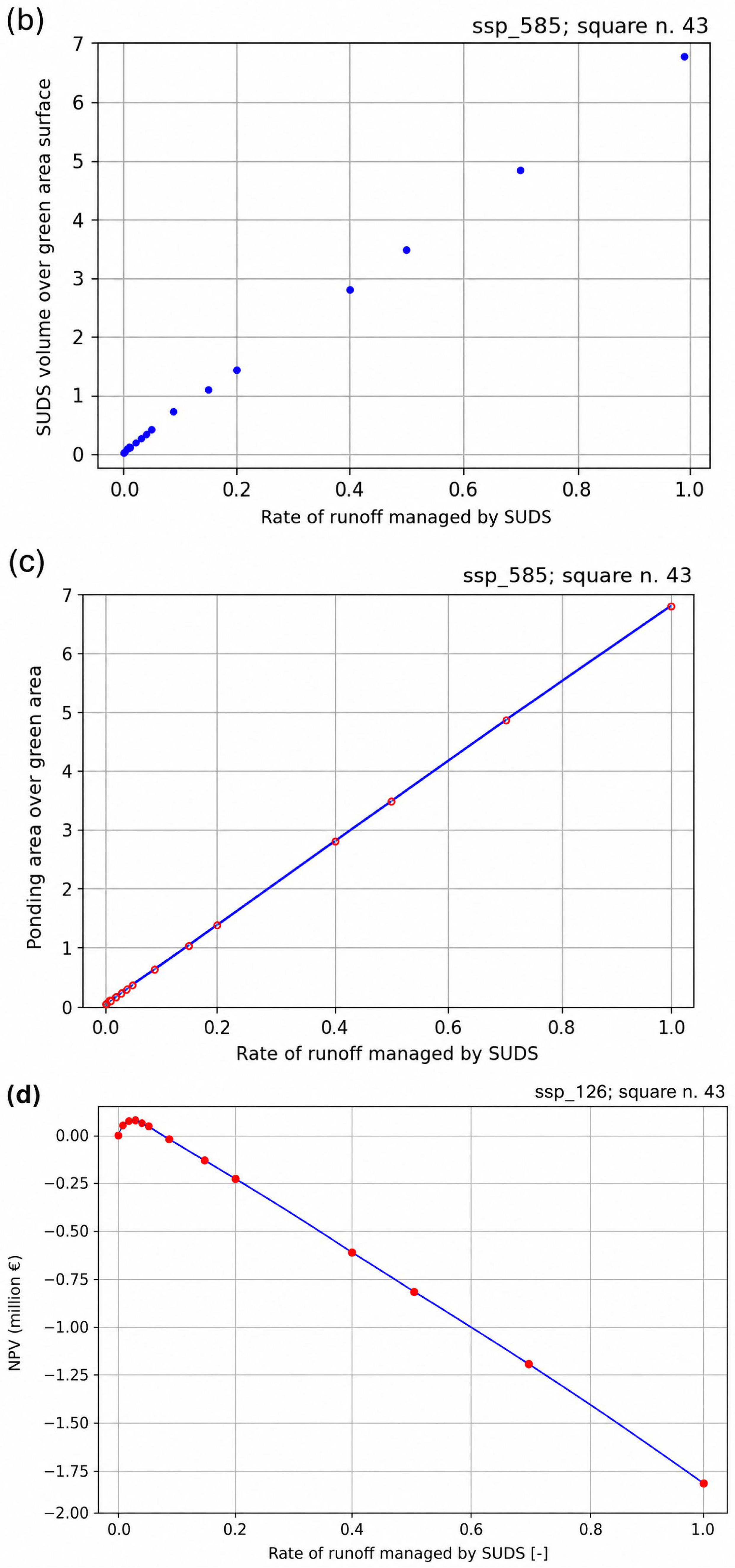
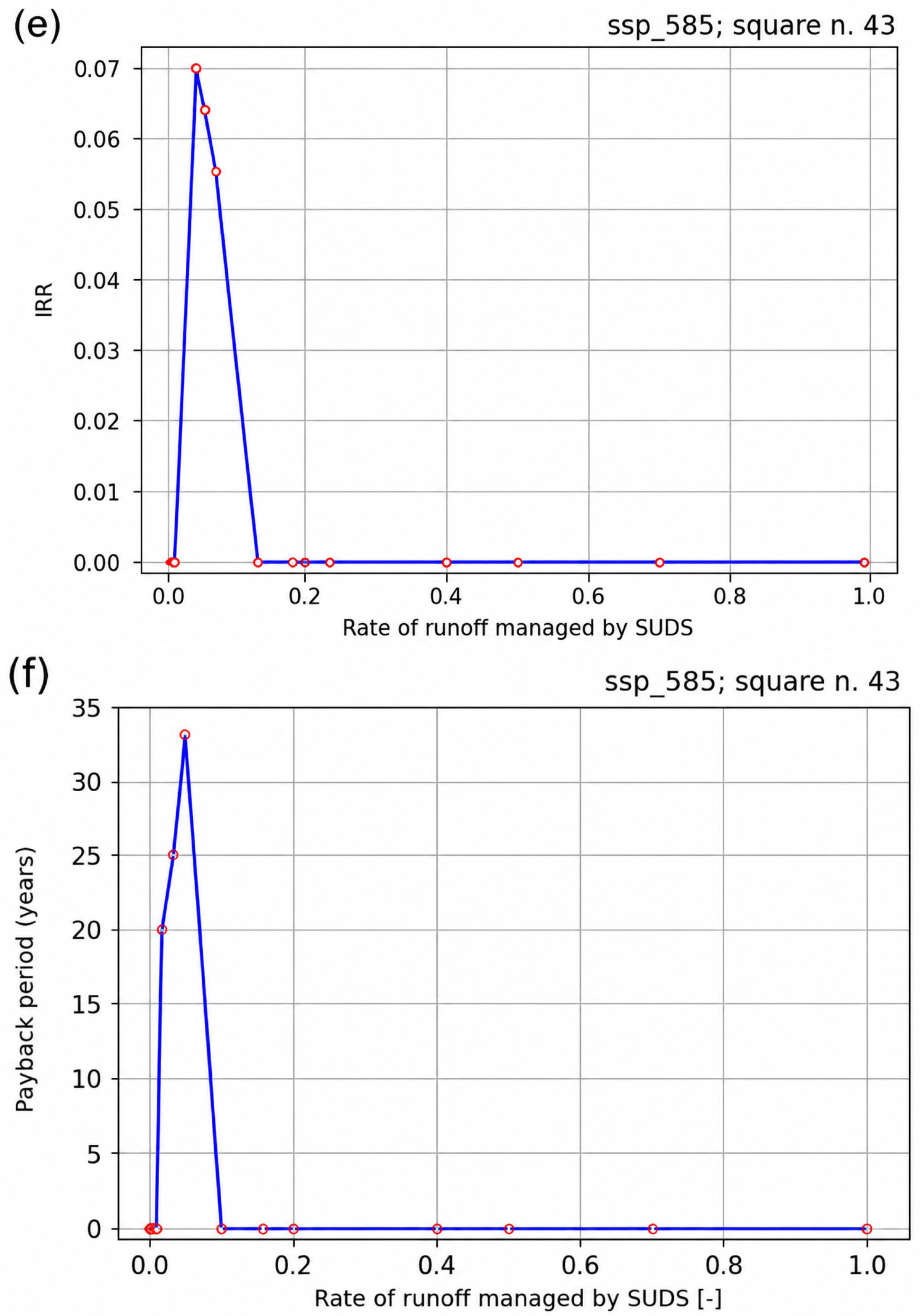
Figure 10 and Figure 11 present, for square 43, the evolution of the rate of irrigation covered by SUDS, the corresponding storage volumes and surface requirements, and the associated economic indicators (NPV, IRR and payback) under the SSP1-2.6 and SSP5-8.5 scenarios.
Figure 10 and Figure 11 demonstrate that irrigation coverage in square 43 reaches saturation extremely quickly. At low runoff values (0–0.2), the area is already capable of reusing water at correspondingly low retention levels (0.1–0.2). Most of the runoff is managed with relatively modest and favourable requirements in terms of SUDS volume per green area and ponding area per green area, generally within the 0–0.2 range.
These technical conditions have a direct impact on economic performance. The NPV remains positive only at very low retention levels. Beyond the saturation threshold (r > 0.05), the NPV declines rapidly into negative values. The IRR shows positive values only when the runoff managed by SUDS is below 0.05, before dropping to zero once that threshold is exceeded. Similarly, the payback period increases sharply, rising from fewer than 12 years to more than 30 years, often becoming unattainable. The retention rate of 0.05 thus represents a critical limit where all three economic indicators converge.
Compared to the SSP5-8.5 scenario, the behaviour is more uncertain, as the runoff managed by SUDS is lower than in the previous scenario, resulting in reduced hydrological and economic efficiency.

4. Discussion

4.1. Methodological Framework and Model Adaptation

The hydrological framework adopted in this study is based on the Curve Number (CN) method, a widely used approach for estimating direct runoff due to its simplicity, empirical basis, and adaptability across different environments [34,35]. It is particularly useful in contexts of scarce or incomplete hydrological data. The method considers four essential watershed properties: soil type, land use and treatment, surface condition, and antecedent moisture.
Conceptual models such as CN offer an effective yet simplified representation of runoff generation processes. This allows them to be applied consistently across different spatial scales while maintaining computational efficiency [36,37,38]. Although more physically based and data-driven models may offer higher predictive accuracy, their application is often constrained by data requirements and model complexity, making conceptual approaches still relevant for decision-support applications [39].
From a broader hydrological modelling perspective, representing hydrological properties and processes within physically based models poses significant challenges due to the spatial structure of catchments. These challenges include intensive data requirements, high computational cost, and equifinality problems arising from the large number of interacting parameters required to represent heterogeneous systems [40,41]. The challenge of homogenising and scaling hydrological information has been recognised since the early development of computational hydrology itself [42,43,44] and remains a central issue not only in hydrological modelling but across spatially distributed environmental modelling frameworks more broadly [45,46,47].
Numerical experiments have consistently highlighted the influence of spatial heterogeneity on runoff generation and storage dynamics [48,49,50]. Catchments characterised by homogeneous landscape properties have been shown to generate discharge peaks differently from real heterogeneous catchments, particularly under dry antecedent conditions [51]. Similarly, several studies have shown that spatial heterogeneity at finer scales can strongly influence hydrological behaviour and the representation of the water balance [52,53,54,55].
Importantly, several studies have demonstrated that simplified but spatially structured approaches may still provide meaningful representations of hydrological behaviour at broader spatial scales. In some cases, representing dominant spatial patterns of soil properties without highly detailed local-scale parameterisation has proven sufficient to reproduce runoff and soil moisture dynamics with satisfactory performance [54]; however, other studies emphasise the importance of finer-scale representations for reproducing detailed discharge dynamics [56].
From this perspective, integrating the CN method with GIS-based spatial analysis, as adopted in the present study, balances methodological simplicity, computational applicability and spatial representativeness. This allows consistent evaluation of hydrological behaviour across multiple urban scales, while remaining applicable to planning and decision support. Furthermore, recent studies have extended CN-based methodologies to future climate and scenario-driven assessments, demonstrating the continued applicability of the framework within contemporary hydrological research. For example, Jia et al. [57] used a CN-based approach under SSP scenarios to evaluate future flood risk. This highlights the relevance of the method for analysing hydrological responses in the context of changing climatic conditions and increasing climatic uncertainty.
A key contribution of the proposed methodology is the implementation of a dual-scale analytical framework. At the macro scale, the model evaluates the spatial distribution of hydrological resources and their potential contribution to urban water balance. At the micro scale, the analysis focuses on site-specific feasibility, including storage requirements, spatial constraints, and economic performance. Working across different spatial scales implies increasing the level of detail of the information used in the analysis. At the urban catchment scale, runoff generation is evaluated using aggregated hydrological and land-use information representative of the entire catchment. At the plot scale, the analysis is refined further to include individual plots within the selected catchment. This enables a more detailed representation of local land use, storage requirements, and the potential for runoff reuse. Therefore, plot-scale analyses do not represent independent hydrological units, but rather finer spatial subdivisions embedded within the broader catchment framework. In the Valdebebas case study, plots were delineated within the catchment boundaries and analysed individually using buffer distances of 1 km and 100 m. Given the finer resolution of the analysis, the methodology could be further refined by integrating high-resolution topographic and hydrological information. This is because working across different spatial scales means you have to adapt the level of detail of the information to the specific objectives of the analysis.
This approach directly addresses the fragmentation typically observed in conventional SUDS design studies, where strategic planning and local implementation are often treated separately. Similar multi-scale perspectives have been encouraged in recent studies [58,59], highlighting the need for integrated frameworks that can link system-level objectives with site-specific constraints.
Furthermore, the proposed methodology helps close the gap between strategic and operational planning by incorporating hydrological and economic factors within a single framework. While some studies have explored extensions of the CN method in urban contexts [60,61], the integration of runoff estimation with water reuse potential and economic feasibility at multiple scales remains only partially addressed in the literature.
Overall, the proposed dual-scale framework highlights the flexibility of the CN method as a decision-support tool, enabling its application across different spatial contexts while maintaining a balance between methodological simplicity and analytical robustness, and supporting the alignment of strategic planning objectives with practical SUDS implementation [62].

4.2. Hydrological Behaviour and Reuse Performance

Hydrological simulations confirm that SUDS effectively reduce irrigation demand across Madrid’s urban catchments. As shown in Figure 4, at the catchment scale, the average filling ratio of SUDS remains generally low (typically between 0.05 and 0.30 of the maximum storage capacity), indicating that system performance is primarily constrained by runoff availability rather than storage capacity.
Catchments with higher runoff availability, such as China (Figure 4i,j) and Monte El Pardo (Figure 4a,b), reach hydrological saturation earlier, stabilising around r ≈ 0.4. In contrast, catchments characterised by more limited runoff require higher SUDS implementation rates and tend to stabilise around r ≈ 0.6. This behaviour is consistent with previous research indicating that SUDS and green–grey drainage systems exhibit diminishing hydrological returns as storage capacity increases and that their performance is strongly influenced by the volume of runoff that can be captured and reused [51,52]. Building on these findings, the present study shows that the rate at which hydrological benefits plateau varies systematically with local runoff generation and is not constant across the city. This runoff-limited behaviour becomes even more evident at the parcel scale within the Valdebebas catchment (as delineated in Figure 5). Figure 6 and Figure 7 illustrate, respectively, for the SSP1-2.6 and SSP5-8.5 scenarios, the required storage volumes, the proportion of green area occupied by SUDS, and the runoff retention rates, all evaluated at the parcel scale.
Under the SSP1-2.6 scenario (Figure 6), full irrigation coverage is achieved in a limited number of plots with moderate storage requirements (generally below 3000 m3), while most parcels operate under partial supply conditions. The distribution of storage volumes required to meet 50% of irrigation demand is highly skewed, with most parcels requiring relatively low volumes and a small number of outliers exhibiting significantly higher values. This reflects local mismatches between runoff availability and irrigation demand. Similarly, the proportion of green space occupied by SUDS remains relatively stable under full coverage, but becomes more dispersed under partial coverage, indicating increasing spatial heterogeneity.
Under the SSP5-8.5 scenario (Figure 7), these dynamics become more pronounced. The number of plots capable of fully meeting irrigation demand decreases, while variability in required storage volumes increases, with more frequent extreme values. Runoff retention rates also show greater dispersion and fewer high-performance cases, suggesting a reduced reliability of SUDS as a water supply source under more extreme climate conditions. This indicates that climate change amplifies the mismatch between runoff availability and irrigation demand, further constraining system performance.
At the parcel scale, the amount of runoff retained for irrigation purposes exhibits the same runoff-limited behaviour observed at the catchment scale. The partial-coverage configuration (50% irrigation coverage) achieves the best performance, with maximum retention levels of 70% in SSP1-2.6 and 50% in SSP5-8.5, while requiring considerably less surface area than full-coverage solutions (100% irrigation coverage). By contrast, configurations designed to meet 100% of the irrigation demand only achieve 3–5% total runoff retention. This indicates that, although hydrologically functional, such systems are structurally oversized, as additional storage capacity remains largely unused due to insufficient runoff. The runoff-limited saturation observed at the parcel scale is consistent with the diminishing returns behaviour documented in SUDS optimisation studies [63]. This pattern is further supported by recent evidence showing that oversized drainage infrastructures yield limited additional benefits in terms of both hydrological performance and water demand reduction [64]. Seyedashraf et al. [65] similarly observed that beyond certain retention thresholds, hydrological efficiency stabilises while economic and environmental costs increase disproportionately. Comparable findings were reported by Mugume and Nakyanzi [66], who demonstrated that blue–green infrastructures maintain effective performance only within optimal dimensional ranges, beyond which additional capacity does not result in proportional improvements in flood mitigation.
Overall, these results reinforce the idea that “more is not necessarily better” in SUDS design. From a planning perspective, this suggests that distributed, medium-capacity systems (50% irrigation coverage) are preferable to a few large, centralised installations (100% irrigation coverage). This is consistent with substantial evidence indicating that decentralised or spatially distributed SUDS provide superior hydrological performance, greater resilience and adaptability, and more effective runoff control than centralised systems with equivalent total capacity [67,68].

4.3. Economic Efficiency and Co-Benefits

The behaviour of the economic indicators—NPV, IRR and payback period—highlights a clear advantage for moderate SUDS configurations. When runoff retention is very low (r < 0.05), systems operate at their maximum economic efficiency. NPVs are positive, IRRs remain within acceptable investment thresholds, and payback periods are short. This indicates that small, distributed SUDS, which require limited storage volumes and reduced surface occupation, offer a favourable balance between costs and the benefits associated with reduced irrigation demand.
These relationships are further illustrated in Figure 8 and Figure 9, which show the interaction between economic performance (NPV) and key hydrological and spatial variables under both SSP1-2.6 and SSP5-8.5 scenarios. In the case of partial irrigation coverage (50%), most configurations cluster at low runoff retention levels while achieving relatively high NPVs, confirming that economic performance is maximised under moderate retention conditions. However, increasing retention does not systematically translate into higher economic returns, as shown by the wide dispersion of NPVs associated with higher retention levels. In contrast, full-coverage configurations (100%) exhibit a strong dependence between NPV and system size. Larger SUDS implementations require significantly greater storage volumes and surface areas, yet provide only limited improvements in hydrological performance. This results in modest or negative NPVs, rapidly declining IRRs, and payback periods that can exceed 30 years. These patterns indicate that investment costs increase disproportionately relative to the additional hydrological benefits gained, reflecting the diminishing returns already observed in the hydrological analysis.
The effect of climate conditions further reinforces these dynamics. According to the SSP5-8.5 scenario (Figure 9), economic performance becomes more variable and unpredictable, with greater dispersion of NPVs and weaker correlations between runoff retention and financial returns. This reflects the increasing mismatch between runoff availability and irrigation demand under more extreme climatic conditions, which directly affects the economic viability of SUDS. These mechanisms are further clarified by the detailed analysis of a representative parcel (Square 43), presented in Figure 10 and Figure 11. In both scenarios, the demand for irrigation is met quickly at low levels of runoff management, suggesting that relatively small sustainable urban drainage systems (SUDS) are sufficient for high functional performance. However, increasing the rate of runoff managed leads to a disproportionate increase in storage volumes and surface requirements, while economic indicators deteriorate sharply. In particular, the net present value (NPV) decreases almost linearly, the internal rate of return (IRR) rapidly approaches zero, and the payback period becomes unfeasible beyond low retention thresholds. Comparing SSP1-2.6 and SSP5-8.5 highlights a clear climate effect: under more extreme conditions, economic performance is systematically worse, with more negative NPVs and reduced investment efficiency. This confirms the existence of a threshold behaviour in SUDS design: once irrigation demand is satisfied, further increases in system capacity do not provide additional functional benefits but result in significant economic inefficiencies. Overall, the results indicate that the economic sustainability of SUDS depends strongly on maintaining moderate retention thresholds. Distributed, medium-capacity systems maximise both financial viability and functional performance, whereas large, centralised or high-retention configurations become progressively less cost-effective, particularly under scenarios involving higher irrigation demand. These findings are consistent with those of Ossa-Moreno et al. [69] and Johnson & Geisendorf [70], who demonstrated that distributed, small-scale SUDS provide better value for money thanks to lower initial investment costs and reduced maintenance requirements. Similarly, Krivtsov et al. [71] found that blue–green infrastructure networks provide economic resilience when integrated with decentralised stormwater management systems.
Beyond direct financial metrics, SUDS generate indirect and non-market benefits that are often omitted from conventional cost–benefit analyses. These include reductions in flood damage costs, improvements in microclimatic conditions, increases in property value, and enhanced social well-being through access to green spaces [72,73]. If these co-benefits were monetised, the NPV of moderate SUDS configurations would likely be considerably higher. Furthermore, introducing economic incentives, such as tax credits, water tariffs linked to reuse, or planning bonuses for sustainable infrastructure, could enhance the financial feasibility of these systems and promote their wider adoption.

4.4. Limitations and Directions for Future Research

The Curve Number (CN) method is widely used in urban hydrology. However, it relies on simplified representations of key processes and is essentially empirical in nature [74]. Recent studies have revealed that the model does not explicitly simulate evapotranspiration, infiltration dynamics or soil moisture conditions, instead relying on categorical adjustments that can compromise its accuracy [75]. Such simplifications may result in under- or overestimation of runoff, particularly in the presence of variable climatic conditions or heterogeneous urban surfaces where imperviousness significantly alters infiltration patterns [76]. The 1 km and 100 m buffer assumptions adopted in this study also introduce spatial uncertainty. While these values are reasonable for exploratory analysis, their suitability should be confirmed through finer-scale topographical and hydraulic modelling. The economic parameters used in this study (€44.65/m3 for installation and €1.709/m3 for irrigation water) are based on generalised cost references and may vary depending on local conditions. Future developments could incorporate a reference SUDS prototype within the framework and evaluate alternative vegetation covers, substrate characteristics, storage capacities, and infiltration properties under different climatic and urban conditions. This would enable the framework to evolve from a simplified runoff-based parameterisation towards a more physically and design-oriented assessment of SUDS performance, thereby improving its applicability for site-specific planning, implementation, and long-term urban water management.

5. Conclusions

This study confirms the effectiveness of a dual-scale framework that coherently integrates hydrological and economic assessments at the catchment and parcel scales. In Madrid, runoff-rich catchments reach hydrological saturation earlier, stabilising at around r = 0.4, whereas catchments with limited runoff tend to plateau at higher implementation rates (r = 0.6).
At the parcel scale, the results show that configurations designed to meet 50% of irrigation demand provide the most balanced and efficient solutions, as confirmed by the economic analysis. The progressive analysis conducted from the nine catchments to the parcel-scale assessment further demonstrates the internal consistency of the proposed framework across spatial scales. In this context, Plot 43 was used as an illustrative and explicative case to demonstrate the local hydrological and economic behaviour captured by the proposed framework and to assess the methodological feasibility of the parcel-scale approach. The results show that irrigation coverage rapidly reaches saturation; even under low runoff conditions (0–0.2), irrigation demand can be satisfied at comparatively low retention levels (0.1–0.2). Positive net present values (NPVs) are only achieved when retention remains below r < 0.05, while higher retention thresholds rapidly reduce financial feasibility.
Overall, the convergence of hydrological and economic outcomes indicates that the most efficient, sustainable, and holistic strategy for urban water management is characterised by moderate, spatially distributed SUDS configurations with partial (50%) irrigation coverage and numerous small, well-dispersed units.
The analysis also indicates that maximising irrigation self-sufficiency is not necessarily the most spatially or economically feasible solution in dense urban environments. Under future climate conditions, a more realistic balance between hydrological performance, economic viability, and urban integration constraints appears to be provided by moderate runoff retention targets combined with distributed SUDS implementation.
Finally, the modular structure of the proposed framework allows key hydrological parameters (e.g., CN values, storage capacity, and water reuse) and socio-economic variables to be easily adapted to local conditions. This flexibility ensures that the strategy can be replicated in European and Mediterranean cities facing water scarcity and climate stress, providing robust and practical support for urban planning and decision-making.

Author Contributions

Conceptualization, S.Z., A.P.M., Á.C. and M.T.G.-V.; Methodology, S.Z., A.P.M., Á.C. and M.T.G.-V.; Software, S.Z. and A.P.M.; Validation, S.Z., A.P.M., Á.C. and M.T.G.-V.; Formal analysis, S.Z., A.P.M., Á.C. and M.T.G.-V.; Investigation, S.Z., A.P.M., Á.C. and M.T.G.-V.; Resources, S.Z., A.P.M., Á.C. and M.T.G.-V.; Data curation, S.Z., A.P.M., Á.C. and M.T.G.-V.; Writing—original draft preparation, S.Z., A.P.M. and M.T.G.-V.; Writing—review and editing, S.Z., A.P.M. and M.T.G.-V.; Visualization, S.Z., A.P.M. and M.T.G.-V.; Supervision, S.Z. and M.T.G.-V.; Project Administration: S.Z., A.P.M. and M.T.G.-V. All authors have read and agreed to the published version of the manuscript.

Funding

This research received no external funding.

Data Availability Statement

The original contributions presented in this study are included in the article. Further inquiries can be directed to the corresponding author.

Conflicts of Interest

The authors declare no conflicts of interest.

References

  1. Bąk, J.; Barjenbruch, M. Benefits, inconveniences, and facilities of the application of rain gardens in urban spaces from the perspective of climate change—A review. Water 2022, 14, 1153. [Google Scholar] [CrossRef]
  2. Golden, H.E.; Hoghooghi, N. Green infrastructure and its catchment-scale effects: An emerging science. Wiley Interdiscip. Rev. Water 2018, 5, e1254. [Google Scholar] [CrossRef]
  3. Rosenzweig, C.; Solecki, W.D.; Romero-Lankao, P.; Mehrotra, S.; Dhakal, S.; Ibrahim, S.A. (Eds.) Climate Change and Cities: Second Assessment Report of the Urban Climate Change Research Network; Cambridge University Press: Cambridge, UK, 2018. [Google Scholar]
  4. Xu, W.; Han, P.; Proverbs, D.G.; Guo, X. A study of the temporal and spatial evolution trends of urban flood resilience in the Pearl River Delta, China. Int. J. Build. Pathol. Adapt. 2025, 44, 720–739. [Google Scholar] [CrossRef]
  5. Ferrans, P.; Torres, M.N.; Temprano, J.; Sánchez, J.P.R. Sustainable Urban Drainage System (SUDS) modeling supporting decision-making: A systematic quantitative review. Sci. Total Environ. 2022, 806, 150447. [Google Scholar] [CrossRef] [PubMed]
  6. Charlesworth, S.M. A review of the adaptation and mitigation of global climate change using sustainable drainage in cities. J. Water Clim. Change 2010, 1, 165–180. [Google Scholar] [CrossRef]
  7. Warwick, F.; Charlesworth, S. Sustainable drainage devices for carbon mitigation. Manag. Environ. Qual. Int. J. 2012, 24, 123–136. [Google Scholar] [CrossRef]
  8. Arahuetes, A.; Olcina Cantos, J. The potential of sustainable urban drainage systems (SuDS) as an adaptive strategy to climate change in the Spanish Mediterranean. Int. J. Environ. Stud. 2019, 76, 764–779. [Google Scholar] [CrossRef]
  9. D’Ambrosio, R.; Balbo, A.; Longobardi, A.; Rizzo, A. Re-think urban drainage following a SuDS retrofitting approach against urban flooding: A modelling investigation for an Italian case study. Urban For. Urban Green. 2022, 70, 127518. [Google Scholar] [CrossRef]
  10. O’Brien, C.D. Sustainable drainage system (SuDS) ponds in Inverness, UK and the favourable conservation status of amphibians. Urban Ecosyst. 2015, 18, 321–331. [Google Scholar] [CrossRef]
  11. Aerts, R.; Honnay, O.; Van Nieuwenhuyse, A. Biodiversity and human health: Mechanisms and evidence of the positive health effects of diversity in nature and green spaces. Br. Med. Bull. 2018, 127, 5–22. [Google Scholar] [CrossRef]
  12. Andersson, E.; Langemeyer, J.; Borgström, S.; McPhearson, T.; Haase, D.; Kronenberg, J.; Barton, D.N.; Davis, M.; Naumann, S.; Röschel, L.; et al. Enabling green and blue infrastructure to improve contributions to human well-being and equity in urban systems. BioScience 2019, 69, 566–574. [Google Scholar] [CrossRef]
  13. Krivtsov, V.; Birkinshaw, S.; Olive, V.; Lomax, J.; Christie, D.; Arthur, S. Multiple benefits of blue-green infrastructure and the reduction of environmental risks: Case study of ecosystem services provided by a SuDS pond. In Civil Engineering for Disaster Risk Reduction; Springer: Singapore, 2022; pp. 247–262. [Google Scholar]
  14. Wang, W.; Emamjomehzadeh, O.; Leitão, J.P.; Juma, B.; Wang, Z.; Guan, M.; Saksena, S.; Zarei, S.; Wani, O. Next-Generation Stormwater Infrastructures: A Typology of Paradigms for Design and Operation. Wiley Interdiscip. Rev. Water 2026, 13, e70058. [Google Scholar] [CrossRef]
  15. Tang, S.; Jiang, J.; Zheng, Y.; Hong, Y.; Chung, E.S.; Shamseldin, A.Y.; Wei, Y.; Wang, X. Robustness analysis of storm water quality modelling with LID infrastructures from natural event-based field monitoring. Sci. Total Environ. 2021, 753, 142007. [Google Scholar] [CrossRef]
  16. Moazzem, S.; Bhuiyan, M.; Muthukumaran, S.; Fagan, J.; Jegatheesan, V. A critical review of nature-based systems (NbS) to treat stormwater in response to climate change and urbanization. Curr. Pollut. Rep. 2024, 10, 286–311. [Google Scholar] [CrossRef]
  17. Charlesworth, S.; Warwick, F.; Lashford, C. Decision-making and sustainable drainage: Design and scale. Sustainability 2016, 8, 782. [Google Scholar] [CrossRef]
  18. Zubelzu, S.; Rodríguez-Sinobas, L.; Andrés-Domenech, I.; Castillo-Rodríguez, J.T.; Perales-Momparler, S. Design of water reuse storage facilities in Sustainable Urban Drainage Systems from a volumetric water balance perspective. Sci. Total Environ. 2019, 663, 133–143. [Google Scholar] [CrossRef] [PubMed]
  19. Lawson, E.; Thorne, C.; Wright, N.; Fenner, R.; Arthur, S.; Lamond, J.; Kilsby, C.; Mant, J.; Smith, L.; Ahilan, S.; et al. Evaluating the multiple benefits of a Blue-Green Vision for urban surface water management. In Proceedings of the UDG Autumn Conference and Exhibition 2015, Leeds, UK, 4–6 November 2015. [Google Scholar]
  20. Alsubih, M.; Arthur, S.; Wright, G.; Allen, D. Experimental study on the hydrological performance of a permeable pavement. Urban Water J. 2017, 14, 427–434. [Google Scholar] [CrossRef]
  21. Rodríguez-Rojas, M.I.; Garrido-Jiménez, F.J.; Abarca-Álvarez, F.J.; Vallecillos-Siles, M.R. Advances in the integration of sustainable drainage systems into urban planning: A case study. Sustainability 2024, 16, 2658. [Google Scholar] [CrossRef]
  22. Huang, Y.; Tian, Z.; Ke, Q.; Liu, J.; Irannezhad, M.; Fan, D.; Hou, M.; Sun, L. Nature-based solutions for urban pluvial flood risk management. Wiley Interdiscip. Rev. Water 2020, 7, e1421. [Google Scholar] [CrossRef]
  23. Cipolla, S.S.; Maglionico, M.; Stojkov, I. A long-term hydrological modelling of an extensive green roof by means of SWMM. Ecol. Eng. 2016, 95, 876–887. [Google Scholar] [CrossRef]
  24. Andrés-Doménech, I.; Hernández-Crespo, C.; Martín, M.; Andrés-Valeri, V.C. Characterization of wash-off from urban impervious surfaces and SuDS design criteria for source control under semi-arid conditions. Sci. Total Environ. 2018, 612, 1320–1328. [Google Scholar] [CrossRef]
  25. Jiménez Ariza, S.L.; Martínez, J.A.; Muñoz, A.F.; Quijano, J.P.; Rodríguez, J.P.; Camacho, L.A.; Díaz-Granados, M. A multicriteria planning framework to locate and select sustainable urban drainage systems (SUDS) in consolidated urban areas. Sustainability 2019, 11, 2312. [Google Scholar] [CrossRef]
  26. USDA. National Engineering Handbook; Hydrology; Section 4; USDA: Washington, DC, USA, 1972; pp. 4–10.
  27. Monachese, A.P.; Gómez-Villarino, M.T.; López-Santiago, J.; Sanz, E.; Almeida-Ñauñay, A.F.; Zubelzu, S. Challenges and Innovations in Urban Drainage Systems: Sustainable Drainage Systems Focus. Water 2024, 17, 76. [Google Scholar] [CrossRef]
  28. Khalili, S.; Kumar, P.; Jones, L. Evaluating the benefits of urban green infrastructure: Methods, indicators, and gaps. Heliyon 2024, 10, e38446. [Google Scholar] [CrossRef] [PubMed]
  29. Pachouri, V.; Kothari, P.; Kathuria, S.; Gehlot, A.; Singh, R.; Thakur, A.K.; Gupta, L.R.; Dogra, S.; Priyadarshi, N.; Mohamed, H.G. Revolutionizing urban water resilience: Innovative strategies and advancements in sustainable urban drainage systems (SuDS). Desalination Water Treat. 2025, 323, 101407. [Google Scholar] [CrossRef]
  30. Monteiro, C.M.; Mendes, A.M.; Santos, C. Green roofs as an urban NbS strategy for rainwater retention: Influencing factors—A review. Water 2023, 15, 2787. [Google Scholar] [CrossRef]
  31. Sanchez, M.L.; De Torre, B.; Garcia, M.A.; Pérez, I. Ground-level ozone and ozone vertical profile measurements close to the foothills of the Guadarrama mountain range (Spain). Atmos. Environ. 2007, 41, 1302–1314. [Google Scholar] [CrossRef]
  32. Espín-Sánchez, D.; Allende-Álvarez, F.; López-Estébanez, N.; Olcina-Cantos, J. Variability and Trends in Spring Precipitation in the Central Sector of the Iberian Peninsula (1941–2020): The Central System and Southern Iberian System. Climate 2025, 13, 122. [Google Scholar] [CrossRef]
  33. Gütschow, J.; Jeffery, M.L.; Günther, A.; Meinshausen, M. Country-resolved combined emission and socio-economic pathways based on the Representative Concentration Pathway (RCP) and Shared Socio-Economic Pathway (SSP) scenarios. Earth Syst. Sci. Data 2021, 13, 1005–1040. [Google Scholar] [CrossRef]
  34. Xie, J.; Qiang, W.; Lin, Y.; Huang, Y.; Xu, K.Q.; Zheng, D.; Chen, S.; Pei, Y.; Fan, G. Enhancing urban drainage resilience through holistic stormwater regulation: A review. Water 2025, 17, 1536. [Google Scholar] [CrossRef]
  35. Cherchi, A.; Fogli, P.G.; Lovato, T.; Peano, D.; Iovino, D.; Gualdi, S.; Masina, S.; Scoccimarro, E.; Materia, S.; Bellucci, A.; et al. Global mean climate and main patterns of variability in the CMCC-CM2 coupled model. J. Adv. Model. Earth Syst. 2019, 11, 185–209. [Google Scholar] [CrossRef]
  36. Mishra, S.K.; Pandey, A.; Singh, V.P. Special issue on soil conservation service curve number (SCS-CN) methodology. J. Hydrol. Eng. 2012, 17, 1157. [Google Scholar] [CrossRef]
  37. Thyer, M.; Gupta, H.; Westra, S.; McInerney, D.; Maier, H.R.; Kavetski, D.; Jakeman, A.; Croke, B.; Simmons, C.; Partington, D.; et al. Virtual Hydrological Laboratories: Developing the next generation of conceptual models to support decision making under change. Water Resour. Res. 2024, 60, e2022WR034234. [Google Scholar] [CrossRef]
  38. Sadeq, H.; Meadows, M.E.; Miller, J.J.; Avila, J.J.; Tollner, E.W. NRCS curve number method: A comparison of methods for estimating the curve number from rainfall-runoff data. J. Hydrol. Eng. 2022, 27, 04022023. [Google Scholar] [CrossRef]
  39. Melo, P.A.; Alvarenga, L.A.; Tomasella, J.; Santos, A.C.N.; Mello, C.R.; Colombo, A. On the performance of conceptual and physically based modelling approach to simulate a headwater catchment in Brazil. J. S. Am. Earth Sci. 2022, 114, 103683. [Google Scholar] [CrossRef]
  40. Beven, K.; Freer, J. Equifinality, data assimilation, and uncertainty estimation in mechanistic modelling of complex environmental systems using the GLUE methodology. J. Hydrol. 2001, 249, 11–29. [Google Scholar] [CrossRef]
  41. Fatichi, S.; Vivoni, E.R.; Ogden, F.L.; Ivanov, V.Y.; Mirus, B.; Gochis, D.; Downer, C.W.; Camporese, M.; Davison, J.H.; Ebel, B.; et al. An overview of current applications, challenges, and future trends in distributed process-based models in hydrology. J. Hydrol. 2016, 537, 45–60. [Google Scholar] [CrossRef]
  42. Klemeš, V. Conceptualization and scale in hydrology. J. Hydrol. 1983, 65, 1–23. [Google Scholar] [CrossRef]
  43. Wood, E.F.; Sivapalan, M.; Beven, K.; Band, L. Effects of spatial variability and scale with implications to hydrologic modeling. J. Hydrol. 1988, 102, 29–47. [Google Scholar] [CrossRef]
  44. Blöschl, G.; Sivapalan, M. Scale issues in hydrological modelling: A review. Hydrol. Process. 1995, 9, 251–290. [Google Scholar] [CrossRef]
  45. Harvey, L.D. Upscaling in global change research. Clim. Change 2000, 44, 225–263. [Google Scholar] [CrossRef]
  46. Li, L.; Peters, C.A.; Celia, M.A. Upscaling geochemical reaction rates using pore-scale network modeling. Adv. Water Resour. 2006, 29, 1351–1370. [Google Scholar] [CrossRef]
  47. Li, L.; Maher, K.; Navarre-Sitchler, A.; Druhan, J.; Meile, C.; Lawrence, C.; Moore, J.; Perdrial, J.; Sullivan, P.; Thompson, A.; et al. Expanding the role of reactive transport models in critical zone processes. Earth-Sci. Rev. 2017, 165, 280–301. [Google Scholar] [CrossRef]
  48. Zhang, W.; Montgomery, D.R. Digital elevation model grid size, landscape representation, and hydrologic simulations. Water Resour. Res. 1994, 30, 1019–1028. [Google Scholar] [CrossRef]
  49. Vivoni, E.R.; Ivanov, V.Y.; Bras, R.L.; Entekhabi, D. On the effects of triangulated terrain resolution on distributed hydrologic model response. Hydrol. Process. Int. J. 2005, 19, 2101–2122. [Google Scholar] [CrossRef]
  50. Dixon, B.; Earls, J. Resample or not?! Effects of resolution of DEMs in watershed modeling. Hydrol. Process. Int. J. 2009, 23, 1714–1724. [Google Scholar] [CrossRef]
  51. Sulis, M.; Paniconi, C.; Camporese, M. Impact of grid resolution on the integrated and distributed response of a coupled surface–subsurface hydrological model for the des Anglais catchment, Quebec. Hydrol. Process. 2011, 25, 1853–1865. [Google Scholar] [CrossRef]
  52. Li, H.; Sivapalan, M. Effect of spatial heterogeneity of runoff generation mechanisms on the scaling behavior of event runoff responses in a natural river basin. Water Resour. Res. 2011, 47, W00H08. [Google Scholar] [CrossRef]
  53. Ajami, H.; Sharma, A. Disaggregating soil moisture to finer spatial resolutions: A comparison of alternatives. Water Resour. Res. 2018, 54, 9456–9483. [Google Scholar] [CrossRef]
  54. Foster, L.M.; Maxwell, R.M. Sensitivity analysis of hydraulic conductivity and Manning’s n parameters lead to new method to scale effective hydraulic conductivity across model resolutions. Hydrol. Process. 2019, 33, 332–349. [Google Scholar] [CrossRef]
  55. Garavaglia, F.; Le Lay, M.; Gottardi, F.; Garçon, R.; Gailhard, J.; Paquet, E.; Mathevet, T. Impact of model structure on flow simulation and hydrological realism: From a lumped to a semi-distributed approach. Hydrol. Earth Syst. Sci. 2017, 21, 3937–3952. [Google Scholar] [CrossRef]
  56. Zhao, Y.; Beighley, E. Upscaling Surface Runoff Routing Processes in Large-Scale Hydrologic Models: Application to the Ohio River Basin. J. Hydrol. Eng. 2017, 22, 04016068. [Google Scholar] [CrossRef]
  57. Jia, M.; Lin, J.; Dai, J.; Zhang, J. Assessing future flood risks in megacity suburbs under shared socioeconomic pathways (SSPs) scenarios: A case study of Beijing. Urban Clim. 2024, 58, 102208. [Google Scholar] [CrossRef]
  58. Shrestha, S.; Cui, S.; Xu, L.; Wang, L.; Manandhar, B.; Ding, S. Impact of land use change due to urbanisation on surface runoff using GIS-based SCS–CN method: A case study of Xiamen city, China. Land 2021, 10, 839. [Google Scholar] [CrossRef]
  59. Fang, Z.; Song, S.; He, C.; Liu, Z.; Qi, T.; Zhang, J.; Li, J. Evaluating the impacts of future urban expansion on surface runoff in an alpine basin by coupling the LUSD-urban and SCS-CN models. Water 2020, 12, 3405. [Google Scholar] [CrossRef]
  60. Lee, K.K.F.; Ling, L.; Yusop, Z. The revised curve number rainfall–runoff methodology for an improved runoff prediction. Water 2023, 15, 491. [Google Scholar] [CrossRef]
  61. Xu, C.; Tang, T.; Jia, H.; Xu, M.; Xu, T.; Liu, Z.; Long, Y.; Zhang, R. Benefits of coupled green and grey infrastructure systems: Evidence based on analytic hierarchy process and life cycle costing. Resour. Conserv. Recycl. 2019, 151, 104478. [Google Scholar] [CrossRef]
  62. García-Colin, J.C.; Díaz-Delgado, C.; Salinas Tapia, H.; Fonseca Ortiz, C.R.; Esteller Alberich, M.V.; Bâ, K.M.; García Pulido, D. Design of a Bioretention System with Water Reuse for Urban Agriculture through a Daily Water Balance. Water 2023, 15, 3477. [Google Scholar] [CrossRef]
  63. Jato-Espino, D.; Toro-Huertas, E.I.; Güereca, L.P. Lifecycle sustainability assessment for the comparison of traditional and sustainable drainage systems. Sci. Total Environ. 2022, 817, 152959. [Google Scholar] [CrossRef] [PubMed]
  64. Andrusenko, E.; van der Werf, J.A.; van der Hoek, J.P.; Langeveld, J.G. Estimating the impact of blue-green infrastructure on household water demand. Water Sci. Technol. 2025, 92, 96–111. [Google Scholar] [CrossRef]
  65. Seyedashraf, O. Simulation-Based Optimisation of Sustainable Urban Drainage Systems. Ph.D. Thesis, The University of Manchester, Manchester, UK, 2021. [Google Scholar]
  66. Mugume, S.N.; Nakyanzi, L.P. Evaluation of effectiveness of Blue-Green Infrastructure for reduction of pluvial flooding under climate change and internal system failure conditions. Blue-Green Syst. 2024, 6, 264–292. [Google Scholar] [CrossRef]
  67. Fletcher, T.D.; Shuster, W.; Hunt, W.F.; Ashley, R.; Butler, D.; Arthur, S.; Trowsdale, S.; Barraud, S.; Semadeni-Davies, A.; Bertrand-Krajewski, J.L.; et al. SUDS, LID, BMPs, WSUD and more–The evolution and application of terminology surrounding urban drainage. Urban Water J. 2015, 12, 525–542. [Google Scholar] [CrossRef]
  68. Burns, M.J.; Fletcher, T.D.; Walsh, C.J.; Ladson, A.R.; Hatt, B.E. Hydrologic shortcomings of conventional urban stormwater management and opportunities for reform. Landsc. Urban Plan. 2012, 105, 230–240. [Google Scholar] [CrossRef]
  69. Ossa-Moreno, J.; Smith, K.M.; Mijic, A. Economic analysis of wider benefits to facilitate SuDS uptake in London, UK. Sustain. Cities Soc. 2017, 28, 411–419. [Google Scholar] [CrossRef]
  70. Johnson, D.; Geisendorf, S. Are neighborhood-level SUDS worth it? An assessment of the economic value of sustainable urban drainage system scenarios using cost-benefit analyses. Ecol. Econ. 2019, 158, 194–205. [Google Scholar] [CrossRef]
  71. Krivtsov, V.; Birkinshaw, S.; Arthur, S.; Knott, D.; Monfries, R.; Wilson, K.; Christie, D.; Chamberlain, D.; Brownless, P.; Kelly, D.; et al. Flood resilience, amenity and biodiversity benefits of an historic urban pond. Philos. Trans. R. Soc. A 2020, 378, 20190389. [Google Scholar] [CrossRef]
  72. Jarvie, J.; Arthur, S.; Beevers, L. Valuing multiple benefits, and the public perception of SUDS ponds. Water 2017, 9, 128. [Google Scholar] [CrossRef]
  73. Vincent, S.U.; Radhakrishnan, M.; Hayde, L.; Pathirana, A. Enhancing the economic value of large investments in sustainable drainage systems (SuDS) through inclusion of ecosystems services benefits. Water 2017, 9, 841. [Google Scholar] [CrossRef]
  74. Jain, M.; Tripathi, L.K.; Bhambota, P.K.; Dangi, A. Comparative Review of Hydrological Models for Runoff Estimation: A Focus on SCS-CN, TOPMODEL, and VIC Approaches—A Review. Int. J. Res. Rev. Appl. Sci. Humanit. Technol. 2025, 2, 121–135. [Google Scholar]
  75. Khattab, M.I.; Fadl, M.E.; Megahed, H.A.; Saleem, A.M.; El-Saadawy, O.; Drosos, M.; Scopa, A.; Selim, M.K. Evaluation of the Soil Conservation Service Curve Number (SCS-CN) Method for Flash Flood Runoff Estimation in Arid Regions: A Case Study of Central Eastern Desert, Egypt. Hydrology 2025, 12, 54. [Google Scholar] [CrossRef]
  76. Soulis, K.X.; Valiantzas, J.D. SCS-CN parameter determination using rainfall-runoff data in heterogeneous watersheds–the two-CN system approach. Hydrol. Earth Syst. Sci. 2012, 16, 1001–1015. [Google Scholar] [CrossRef]
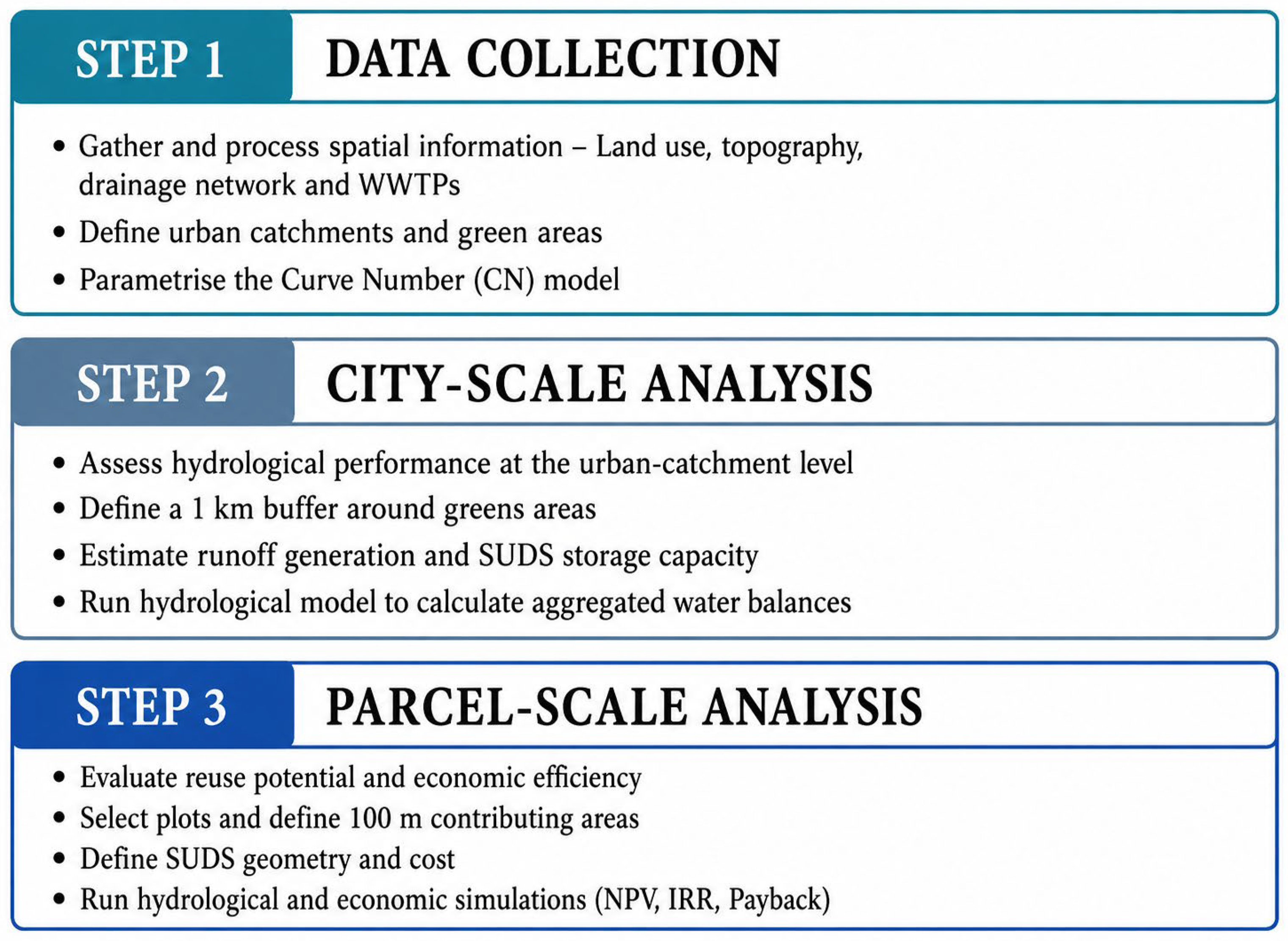
Figure 1. Flowchart of the proposed methodology.
Water 18 01268 g001
Figure 2. Spatial representation of the study area in the municipality of Madrid: (a) catchment areas and meteorological stations included in the study, (b) urban impervious surface, and (c) green areas. A legend, scale bar, and north arrow are included to improve cartographic clarity.
Water 18 01268 g002aWater 18 01268 g002b
Figure 3. Representative workflow illustrating the identification of runoff-contributing surfaces and green area plots in the ERAR Valdebebas catchment: identification of green areas and contributing surfaces, generation and grouping of buffer zones, and final clipped contributing area.
Water 18 01268 g003
Figure 4. Evolution of the average SUDS storing level and the contribution of irrigation water supplied by SUDS under different implementation rates and climate scenarios for the analysed urban catchments: (a) SSP1-2.6, Monte el Pardo; (b) SSP5-8.5, Monte el Pardo; (c) SSP1-2.6, Viveros; (d) SSP5-8.5, Viveros; (e) SSP1-2.6, Valdebebas; (f) SSP5-8.5, Valdebebas; (g) SSP1-2.6, Butarque; (h) SSP5-8.5, Butarque; (i) SSP1-2.6, China; (j) SSP5-8.5, China; (k) SSP1-2.6, Rejas; (l) SSP5-8.5, Rejas; (m) SSP1-2.6, Gavia; (n) SSP5-8.5, Gavia; (o) SSP1-2.6, Sur Oriental; (p) SSP5-8.5, Sur Oriental; (q) SSP1-2.6, Sur; (r) SSP5-8.5, Sur.
Water 18 01268 g004aWater 18 01268 g004bWater 18 01268 g004c
Figure 5. Plots and buffer zones identified in the ERAR Valdebebas catchment: (a) location of the selected area within the catchment, (b) detailed map view of the delimited plots and buffers, and (c) satellite view of the same area. The dashed boundary indicates the selected plots, while the blue shaded area represents the identified runoff storage potential.
Water 18 01268 g005
Figure 6. Scenario SSP1-2.6: (a) SUDS volume required to cover irrigation needs completely; (b) SUDS volume required to cover 50% of irrigation needs; (c) Required ponding area to cover irrigation needs completely; (d) Required ponding area to cover 50% of irrigation needs; (e) Runoff retention rate required to cover 50% of irrigation needs for selected plots; (f) Runoff retention rate required to cover 50% of irrigation needs across all analysed plots. Each point in the graphs corresponds to an individual plot, identified by its Plot ID along the X-axis.
Water 18 01268 g006aWater 18 01268 g006bWater 18 01268 g006c
Figure 7. Scenario SSP5-8.5: (a) SUDS volume required to cover irrigation needs completely; (b) SUDS volume required to cover 50% of irrigation needs; (c) Required ponding area to cover irrigation needs completely; (d) Required ponding area to cover 50% of irrigation needs; (e) Runoff retention rate required to cover 50% of irrigation needs for selected plots; (f) Runoff retention rate required to cover 50% of irrigation needs across all analysed plots. Each point in the graphs corresponds to an individual plot, identified by its Plot ID along the X-axis.
Water 18 01268 g007aWater 18 01268 g007bWater 18 01268 g007c
Figure 8. Scenario SSP1-2.6: (a) Relationship between runoff retention rate and NPV for configurations achieving complete irrigation coverage; (b) Relationship between runoff retention rate and NPV for configurations achieving 50% irrigation coverage; (c) Relationship between green area surface and NPV for configurations achieving complete irrigation coverage; (d) Relationship between green area surface and NPV for configurations achieving 50% irrigation coverage; (e) Relationship between SUDS area over green area and NPV for configurations achieving complete irrigation coverage; (f) Relationship between SUDS area over green area and NPV for configurations achieving 50% irrigation coverage. Each point in the graphs corresponds to an individual analysed plot.
Water 18 01268 g008aWater 18 01268 g008bWater 18 01268 g008c
Figure 9. Scenario SSP5-8.5: (a) Relationship between runoff retention rate and NPV for configurations achieving complete irrigation coverage; (b) Relationship between runoff retention rate and NPV for configurations achieving 50% irrigation coverage; (c) Relationship between green area surface and NPV for configurations achieving complete irrigation coverage; (d) Relationship between green area surface and NPV for configurations achieving 50% irrigation coverage; (e) Relationship between SUDS area over green area and NPV for configurations achieving complete irrigation coverage; (f) Relationship between SUDS area over green area and NPV for configurations achieving 50% irrigation coverage. Each point in the graphs corresponds to an individual analysed plot.
Water 18 01268 g009aWater 18 01268 g009bWater 18 01268 g009c
Figure 10. Scenario SSP1-2.6 for square n. 43: (a) Relationship between the runoff fraction managed by SUDS and the fraction of irrigation demand covered by SUDS; (b) Relationship between the runoff fraction managed by SUDS and the required SUDS volume over green area; (c) Relationship between the runoff fraction managed by SUDS and the required ponding area over green area; (d) Relationship between the runoff fraction managed by SUDS and NPV; (e) Relationship between the runoff fraction managed by SUDS and IRR; (f) Relationship between the runoff fraction managed by SUDS and payback period. Red points represent the discrete model outputs.
Water 18 01268 g010aWater 18 01268 g010bWater 18 01268 g010c
Figure 11. Scenario SSP5-8.5 for square n. 43: (a) Relationship between the runoff fraction managed by SUDS and the fraction of irrigation demand covered by SUDS; (b) Relationship between the runoff fraction managed by SUDS and the required SUDS volume over green area; (c) Relationship between the runoff fraction managed by SUDS and the required ponding area over green area; (d) Relationship between the runoff fraction managed by SUDS and NPV; (e) Relationship between the runoff fraction managed by SUDS and IRR; (f) Relationship between the runoff fraction managed by SUDS and payback period. Red points represent the discrete model outputs.
Water 18 01268 g011aWater 18 01268 g011bWater 18 01268 g011c
Table 1. Meteorological stations for every 9 catchments.
Catchments’ NameMeteorological Station
ERAR Monte El PardoEl Goloso (3126Y)
ERAR ViverosCiudad Universitaria (3194U)
ERAR ValdebebasBarajas (3129)
ERAR ButarqueCuatro Vientos (3196)
ERAR ChinaRetiro (3195)
ERAR RejasRetiro (3195)
ERAR GaviaRetiro (3195)
ERAR Sur OrientalArganda (3182Y)
ERAR SurGetafe (3200)
Table 2. Average curve numbers obtained for each catchment.
Catchments’ NameAverage Curve Number
ERAR Monte El Pardo87.00
ERAR Viveros88.47
ERAR Valdebebas89.01
ERAR Butarque88.68
ERAR China92.93
ERAR Rejas90.26
ERAR Gavia90.79
ERAR Sur Oriental91.32
ERAR Sur89.64
Disclaimer/Publisher’s Note: The statements, opinions and data contained in all publications are solely those of the individual author(s) and contributor(s) and not of MDPI and/or the editor(s). MDPI and/or the editor(s) disclaim responsibility for any injury to people or property resulting from any ideas, methods, instructions or products referred to in the content.