1. Introduction
Land surface temperature (LST), as an integrated indicator of surface energy balance, has been widely used to evaluate urban thermal environments and to quantify surface urban heat island (SUHI) effects [
1,
2]. Satellite-based studies at multiple scales have shown that urban expansion and land-cover change substantially alter radiative fluxes, heat storage, and surface energy partitioning, thereby reshaping thermal patterns across cities worldwide [
3,
4,
5]. Recent research has further emphasized that SUHI intensity is controlled not only by two-dimensional land-cover composition, but also by three-dimensional urban form [
6,
7]. These findings highlight the need to better understand how blue–green elements and surrounding built-up conditions jointly shape surface thermal patterns in high-density cities.
Among the various mitigation strategies, nature-based solutions, especially urban blue–green infrastructure, have received increasing attention for their cooling potential. Water bodies can function as thermal regulators through high heat capacity, latent heat exchange, and convective processes, thereby producing measurable water-cooling or urban heat-sink effects [
8,
9]. Vegetated areas reduce surface and near-surface temperatures through shading, evapotranspiration, and albedo-related effects [
10,
11]. Recent studies further suggest that the cooling roles of water and vegetation should not always be viewed separately, because spatially coordinated blue–green systems may generate stronger or more persistent cooling effects than isolated water or green patches alone [
12,
13,
14]. This indicates that the thermal role of urban blue–green spaces depends not only on the presence of individual elements, but also on their spatial arrangement and surrounding urban context.
Within this context, urban shorelines deserve particular attention because they represent transition zones where aquatic and terrestrial thermal regimes meet. From a landscape ecological perspective, such boundaries can be understood as spatial interfaces in which thermal processes are shaped by adjacency relationships and local configuration [
15]. Existing studies have shown that shoreline cooling is not determined by distance alone, but may also be affected by surrounding vegetation, impervious surfaces, and urban morphological conditions [
16,
17]. However, research on water-related cooling has often relied on spatially aggregated methods, such as fixed-distance buffers or mean temperature differences between whole water bodies and surrounding urban areas [
18,
19]. Although these approaches provide first-order estimates of cooling magnitude and distance, they tend to assume radial symmetry and spatial uniformity, and may therefore obscure local heterogeneity along individual shoreline segments.
These assumptions are increasingly questioned by empirical evidence. River-section analyses and high-resolution lake studies have shown that cooling intensity can vary substantially along different shoreline segments because of local differences in land-cover composition, built density, and urban morphology [
17,
20,
21]. Cross-city comparisons further suggest that reported cooling distances are often concentrated around 200–300 m, but still vary considerably with spatial configuration and climatic background [
22,
23]. Therefore, this distance range should not be generalized as a universal cooling boundary; rather, it points to the need to examine how shoreline cooling decays across space under different local conditions. At the same time, many empirical studies focus mainly on summer conditions, while the seasonal variation of shoreline cooling structure remains less well understood. Because evapotranspiration, solar radiation, and surface heat storage differ strongly across seasons, both cooling intensity and spatial decay are likely to be energy-dependent processes that require systematic seasonal assessment [
7,
11].
To address these gaps, this study investigates shoreline-mediated cooling around seven major urban water bodies within the heritage buffer zone of the Beijing Central Axis, a high-density and heritage-constrained urban environment. By combining 120 m shoreline segmentation with 0–600 m distance-buffer analysis, this study aims to: (1) characterize the distance-dependent spatial decay structure of shoreline cooling; (2) quantify seasonal differences in cooling intensity (CI) and cooling distance (CD); and (3) examine how vegetation greenness, shoreline distance, and built-up intensity are associated with LST while accounting for differences among individual water bodies. Rather than treating shoreline cooling as a single fixed-distance effect, this study interprets it as a layered and spatially heterogeneous decay process.
2. Materials and Methods
2.1. Study Area
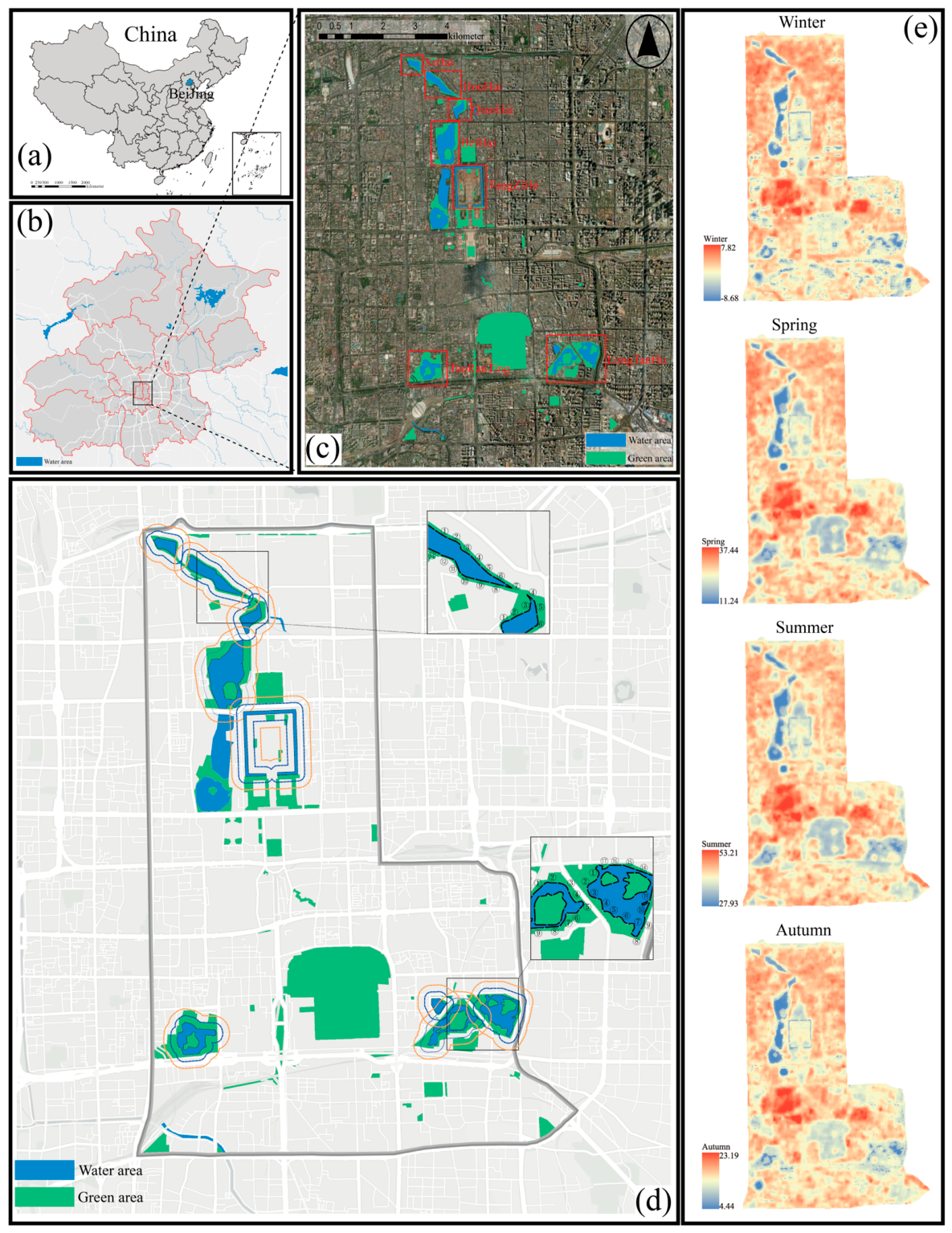
This study focuses on the historic urban area of Beijing, with the study area located within the heritage buffer zone of the Beijing Central Axis (
Figure 1). As a priority area for heritage conservation, this zone is subject to strict planning controls, and large-scale structural transformation has been relatively limited. As a result, the overall pattern of its high-density urban landscape has been largely preserved. At the same time, the study area still contains a relatively rich variety of blue–green spaces embedded within the continuous urban fabric, thereby providing a representative setting for examining shoreline-related thermal patterns under heritage conservation constraints. On this basis, seven major urban water bodies were selected as the main objects of analysis: Xihai, Houhai, Qianhai, Beihai, Taoranting, Longtanhu, and Tongzihe.
Beijing has a temperate monsoon climate, characterized by hot, humid summers and cold, dry winters, with pronounced seasonal contrasts [
24]. These climatic conditions provide a suitable basis for comparing seasonal variations in the cooling effects of blue–green spaces.
2.2. Data Sources and Preprocessing
Seasonal LST and same-date Landsat NDVI for robustness testing were derived from Landsat 8/9 Collection 2 Level-2 products (
Table 1) acquired from the United States Geological Survey (USGS) Earth Explorer platform (
https://earthexplorer.usgs.gov/ accessed on 8 June 2025) [
25]. Four low-cloud scenes with scene-level cloud cover below 5% were selected to represent winter, spring, summer, and autumn conditions. The ST_B10 band was used for LST conversion, while the surface reflectance red and near-infrared bands from the same Landsat scenes were used to calculate same-date Landsat NDVI. Pixel-level cloud, cloud-shadow, and invalid observations were further removed using the QA_PIXEL band, as described in
Section 2.3.
The ST_B10 digital numbers were converted to LST in degrees Celsius using Equation (1) [
26]:
where DNST_B10 is the digital number of the Landsat Collection 2 Level-2 Surface Temperature band [
27]. Because the Landsat Level-2 Surface Temperature product is generated within the USGS processing system, atmospheric correction and auxiliary atmospheric parameters were not manually estimated in this study.
Vegetation conditions were characterized using Sentinel-2 Level-2A multispectral imagery (
Table 2). The Normalized Difference Vegetation Index (NDVI) was calculated from the red and near-infrared bands as Equation (2) [
6,
28]:
NDVI has been widely applied as an indicator of vegetation greenness and surface biophysical activity in urban thermal studies. In addition to NDVI, the Normalized Difference Built-up Index (NDBI) was calculated to characterize built-up intensity within the shoreline buffer zones. For Sentinel-2 imagery, NDBI was derived from the shortwave-infrared and near-infrared bands as Equation (3) [
29]:
where Red, NIR, and SWIR represent the red, near-infrared, and shortwave-infrared bands, respectively. In this study, NDBI was used as a two-dimensional proxy for built-up intensity in the regression models, rather than as a direct measure of three-dimensional urban morphology such as building height, sky-view factor, or street-canyon geometry. For NDBI calculation, the 10 m Sentinel-2 NIR band was aligned to the 20 m SWIR band grid using bilinear resampling before index calculation, whereas the categorical SCL layer was aligned using nearest-neighbor resampling for quality masking. Because the main statistical analyses were conducted at the segment-ring level rather than through direct pixel-to-pixel matching, NDVI, NDBI, and LST were summarized as mean values within the same shoreline segment-ring polygons.
Spatial preprocessing, remote sensing image processing, zonal statistics, and statistical analyses were conducted using ArcGIS Pro 3.4.0 (Esri, Redlands, CA, USA), ENVI 5.6.2 (NV5 Geospatial Software, Broomfield, CO, USA), SNAP 13.0 (European Space Agency, Paris, France), and Python 3.11 (Python Software Foundation, Wilmington, DE, USA).
2.3. Data Quality Control and Uncertainty Treatment
To improve data reliability and reduce the influence of invalid observations, pixel-level quality control was applied to both Landsat and Sentinel-2 images. For Landsat scenes, invalid pixels affected by fill values, clouds, cirrus, cloud shadows, snow, and water were excluded using the QA_PIXEL band [
30]. For Sentinel-2 Level-2A imagery, the Scene Classification Layer (SCL) was used to remove no-data pixels, saturated or defective pixels, cloud shadows, medium- and high-probability clouds, thin cirrus, snow/ice, and water pixels before zonal statistics [
31,
32].
After QA/SCL-based quality control, valid-pixel ratios were calculated for each seasonal scene. Most spring, summer, and autumn scenes retained more than 96% valid pixels, whereas the winter scene retained approximately 75% valid pixels after the stricter exclusion of water, shadow-affected, and invalid pixels. The valid-pixel ratios after QA/SCL-based quality control are reported in
Table S1.
To evaluate the potential influence of the temporal mismatch between Landsat LST and Sentinel-2 NDVI, a same-date Landsat-derived NDVI was additionally calculated from the Landsat red and near-infrared surface reflectance bands after QA_PIXEL masking. The segment-ring-level NDVI values derived from Landsat and Sentinel-2 were then compared, and the NDVI–LST correlations were recalculated using both NDVI datasets. The agreement between Sentinel-2 NDVI and same-date Landsat NDVI is reported in
Table S2, and the corresponding NDVI–LST correlation robustness results are reported in
Table S3.
All raster and vector datasets were aligned to WGS 84/UTM Zone 50N (EPSG:32650) and clipped or analyzed within the same study boundary. To reduce the scale mismatch between Sentinel-2 NDVI and Landsat LST, the analysis was conducted at the segment-ring level rather than through direct pixel-to-pixel matching. The detailed construction of the shoreline segment-ring units is described in
Section 2.4.
Because the analysis was based on satellite-derived land surface temperature rather than in situ air temperature, the results should be interpreted as surface thermal responses rather than direct pedestrian-level thermal comfort effects.
2.4. Shoreline Segmentation and Distance-Buffer Framework
To identify fine-scale heterogeneity in the thermal effects along urban waterbody shorelines, waterbody polygons were extracted from vector datasets and integrated into a unified layer, from which shoreline boundaries were delineated and subsequently divided into segments of approximately 120 m along their perimeter. This segment length, corresponding to roughly four Landsat pixels (30 m) measured along the shoreline, was selected to balance spatial detail and segment-level statistical stability. Previous studies have demonstrated that buffer-based gradient analysis has been widely applied to quantify the cooling intensity and cooling distance of parks and water bodies [
19,
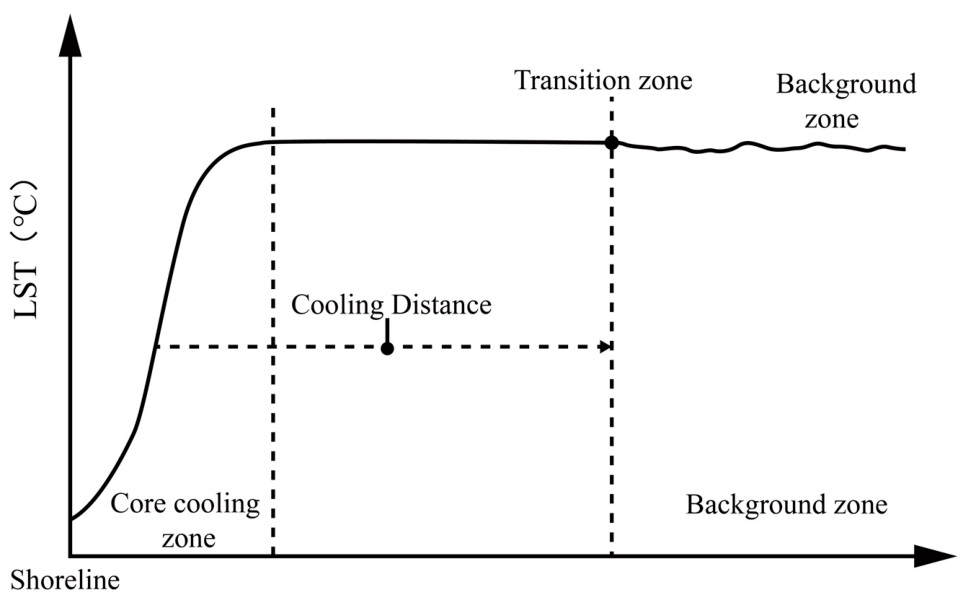
22]. On this basis, concentric buffer rings were generated for each shoreline segment at 30 m intervals and extended outward to 600 m to characterize segment-specific distance-temperature gradient patterns. According to the observed spatial decay pattern, the buffer rings were further classified into three zones—namely the near zone (0–150 m), middle zone (150–300 m), and far zone (300–600 m)—to support cross-seasonal comparison and interpretation of the spatial gradient of shoreline cooling effects (
Figure 2). The 0–200 m interval was used to characterize the core nearshore rapid-gradient zone where the observed LST profiles changed most sharply. This distance should not be interpreted as a statistically estimated breakpoint or a universal cooling boundary. Cooling distance (CD) was defined separately to represent the outward detectable reach of shoreline cooling before LST approached the segment-level background thermal condition.
2.5. Quantification of Cooling Metrics
Two complementary indicators were used to quantify shoreline cooling performance: cooling intensity (CI) and cooling distance (CD). CI and CD were designed to represent two different aspects of shoreline cooling. CI describes the local thermal contrast between the nearshore zone and the outer background zone, whereas CD describes the outward detectable reach of cooling along the distance gradient. Therefore, CI and CD should not be treated as competing estimates of the same cooling process.
2.5.1. Cooling Intensity (CI)
Cooling intensity (CI) was defined as Equation (4) [
33]:
where
and
represent the mean LST in the 0–150 m nearshore zone and the 300–600 m background zone, respectively.
2.5.2. Cooling Distance (CD)
Cooling distance (CD) was used to characterize the outer extent of detectable shoreline cooling along each shoreline segment and has been widely adopted in studies of waterbody and greenspace cooling effects [
11,
23]. In this study, the background thermal level for each shoreline segment was first defined as the mean LST of the 300–600 m zone. CD was then identified as the first buffer-ring midpoint distance at which LST reached or exceeded this background level and remained at or above it for at least two consecutive 30 m rings. If no such condition was met within 600 m, CD was assigned a value of 600 m. This rule-based approach reduces the influence of local fluctuations and provides a more robust estimate of the spatial reach of shoreline cooling. Accordingly, CD should be interpreted as the outer detectable reach of shoreline cooling rather than as the distance of the steepest nearshore thermal change.
2.6. Vegetation Characterization
Using zonal statistics, mean NDVI values were first calculated for each shoreline segment within individual buffer rings [
34]. The buffer rings were then grouped into three distance-based zones, namely the near zone (0–150 m), middle zone (150–300 m), and far zone (300–600 m), and segment-level vegetation metrics were subsequently computed for each zone to assess the potential role of vegetation in modulating shoreline cooling patterns across space.
2.7. Statistical Analysis
2.7.1. Seasonal Difference Tests for CI and CD
Seasonal differences in CI and CD were evaluated at the shoreline-segment level rather than at the buffer-ring level to avoid pseudo-replication. Because the same shoreline segments were observed across four seasonal scenes, Friedman tests were used to examine overall seasonal differences in CI and CD. When the Friedman test was significant, paired Wilcoxon signed-rank tests with Holm correction were applied for post hoc pairwise comparisons among seasons. Kendall’s W was reported as the effect size for the Friedman test.
2.7.2. Correlation Analysis
Spearman rank correlation was employed to assess monotonic relationships between LST and NDVI within each distance zone. This non-parametric method was selected because LST values in heterogeneous urban environments may deviate from normality and exhibit monotonic but non-linear responses. Spearman correlation has been widely applied in satellite-based urban thermal studies to examine vegetation–temperature coupling under non-parametric conditions [
11].
2.7.3. Regression Modeling with Built-Up Intensity Control
To examine the direction and relative strength of the associations between LST, vegetation greenness, shoreline distance, and built-up intensity, standardized multiple linear regression models were used for inferential rather than predictive purposes. All continuous variables were standardized before modeling using Equation (5) [
35,
36]:
where X is the original value of the variable, μ is the mean, and σ is the standard deviation. NDBI was used as a proxy for built-up intensity. Waterbody fixed effects were included to account for baseline differences among the seven water bodies.
The additive controlled model was specified as Equation (6) [
37,
38]:
The interaction model was specified as Equation (7) [
37,
38]:
where β
1, β
2, and β
3 represent the standardized associations of NDVI, shoreline distance, and NDBI with LST, respectively. β
4 represents the NDVI × Distance interaction term,
denotes the set of waterbody fixed effects, and ε is the residual error term. The interaction term was used to test whether the NDVI–LST association changed with increasing shoreline distance. Multicollinearity among core predictors was assessed using the variance inflation factor (VIF). Because multiple buffer rings were nested within the same shoreline segment, observations from adjacent rings could not be assumed to be fully independent. Therefore, cluster-robust standard errors were calculated at the shoreline-segment level to reduce the influence of within-segment dependence on regression inference. The regression results were interpreted as spatial associations rather than causal estimates.
3. Results
3.1. Spatial and Seasonal Patterns of LST Variation with Shoreline Distance
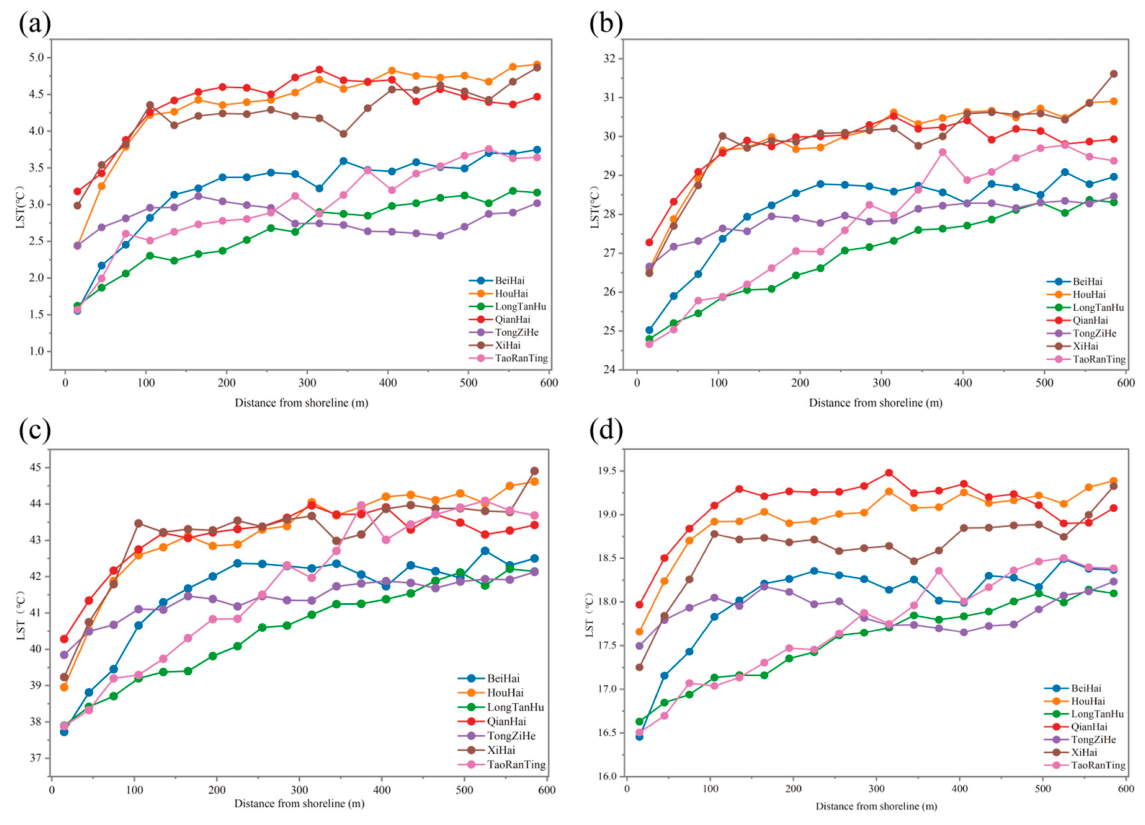
LST generally increased with increasing distance from the shoreline across all seven water bodies and in all seasons, although the magnitude of this increase varied by season (
Figure 3). In most cases, the increase was concentrated within the first 200 m from the shoreline, where the curves rose rapidly before becoming flatter at greater distances. This pattern was observed consistently in all four seasonal panels, indicating that the main shoreline-related thermal gradient was concentrated in the core nearshore gradient zone.
To describe this decay pattern without estimating a formal breakpoint, separate linear regressions were fitted for two predefined distance ranges, 0–200 m and 200–600 m, in each season (
Table 3). Within the first 200 m, LST increased significantly with distance in all seasons, with slopes of 0.0077, 0.0140, 0.0166, and 0.0061 °C m
−1 in winter, spring, summer, and autumn, respectively. The corresponding relationships were all significant (
p ≤ 0.001), with R
2 values ranging from 0.206 to 0.349. Among the four seasons, the nearshore gradient was strongest in summer, followed by spring, and weaker in winter and autumn.
The main distance-dependent thermal change therefore occurred within the first 200 m from the shoreline, whereas the outer 200–600 m zone showed a weaker and more gradual thermal response. Accordingly, the first 200 m was interpreted as a nearshore rapid-gradient zone rather than as a statistically estimated threshold.
3.2. Cooling Intensity (CI) and Cooling Distance (CD) Across Water Bodies and Seasons
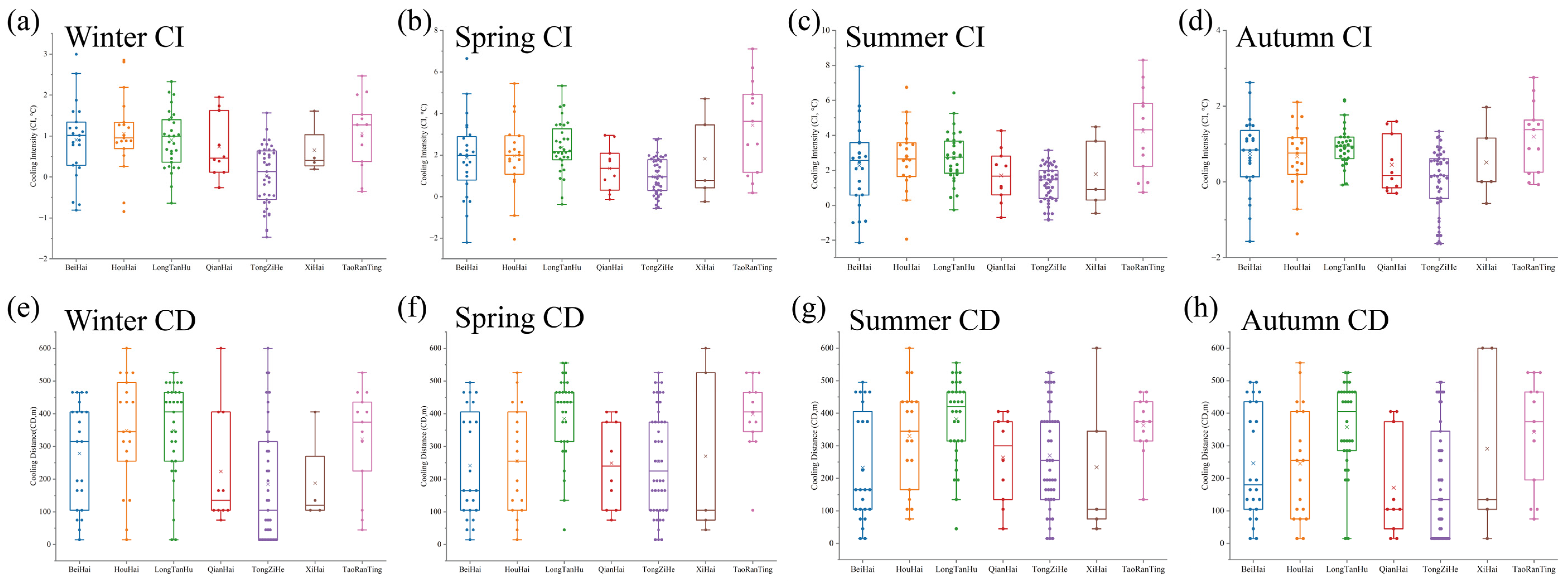
CI varied clearly by season across the shoreline segments, with higher values in spring and summer than in winter and autumn (
Figure 4;
Table 4). Median CI was highest in summer (2.10 °C; IQR: 0.96–3.22 °C), followed by spring (1.78 °C; IQR: 0.71–2.62 °C), and was much lower in winter (0.67 °C; IQR: 0.19–1.20 °C) and autumn (0.62 °C; IQR: 0.05–1.14 °C). The Friedman test confirmed a significant seasonal difference in CI (χ
2 = 214.81,
p < 0.001, Kendall’s W = 0.508). Post hoc paired Wilcoxon tests with Holm correction showed that summer had significantly higher CI than all other seasons, spring was significantly higher than winter and autumn, whereas winter and autumn did not differ significantly. Maximum CI exceeded 8 °C in summer and 7 °C in spring, indicating the occurrence of strong local cooling hotspots during the warm seasons. These results show that seasonal energy conditions exerted a stronger influence on cooling intensity, with summer maintaining the highest local thermal contrast between shoreline buffers and the outer urban background.
CD also varied by season, although the seasonal contrast was weaker than that of CI (
Figure 4;
Table 4). Median CD was 345 m in summer, 315 m in winter and spring, and 255 m in autumn. The interquartile range of CD was 105–435 m in winter, 135–435 m in spring, 165–435 m in summer, and 105–435 m in autumn. Although the Friedman test indicated a significant overall seasonal difference in CD (χ
2 = 28.23,
p < 0.001), the effect size was small (Kendall’s W = 0.067). Pairwise comparisons showed that spring and summer had significantly longer CD than autumn, whereas the other seasonal pairs were not significant after Holm correction. CD was therefore less seasonally sensitive than CI. Stronger cooling intensity did not necessarily correspond to a proportionally longer cooling reach.
Unlike the LST–distance analysis in
Section 3.1, which identifies the core nearshore zone of most rapid thermal change, CD measures the outer detectable reach of shoreline cooling before LST approaches the surrounding background level. Therefore, the first approximately 200 m and CD describe two different aspects of shoreline thermal structure rather than two competing estimates of a single cooling boundary. In this study, the most rapid increase in LST occurred within approximately the first 200 m from the shoreline, whereas cooling influence often remained detectable beyond this range.
3.3. Waterbody-Level Heterogeneity in Shoreline Cooling
The waterbody-level summary showed clear differences in shoreline cooling performance among the seven water bodies (
Table 5). In summer, median CI ranged from 0.91 °C in Xihai to 4.31 °C in Taoranting, while median CD ranged from 105 m in Xihai to 420 m in Longtanhu. Taoranting showed the highest summer CI, indicating a strong local thermal contrast, whereas Longtanhu showed the longest summer CD, suggesting a more persistent outward cooling reach. Tongzihe had the longest shoreline length and the largest number of shoreline segments, but its median summer CI and CD were relatively moderate, indicating that shoreline length alone did not determine cooling performance. Higher warm-season CI values in Taoranting and Longtanhu were accompanied by higher nearshore NDVI, suggesting a spatial correspondence between stronger cooling performance and more favorable nearshore vegetation conditions. These results support the use of shoreline segmentation, as whole-waterbody averages would obscure differences among individual water bodies and local shoreline contexts.
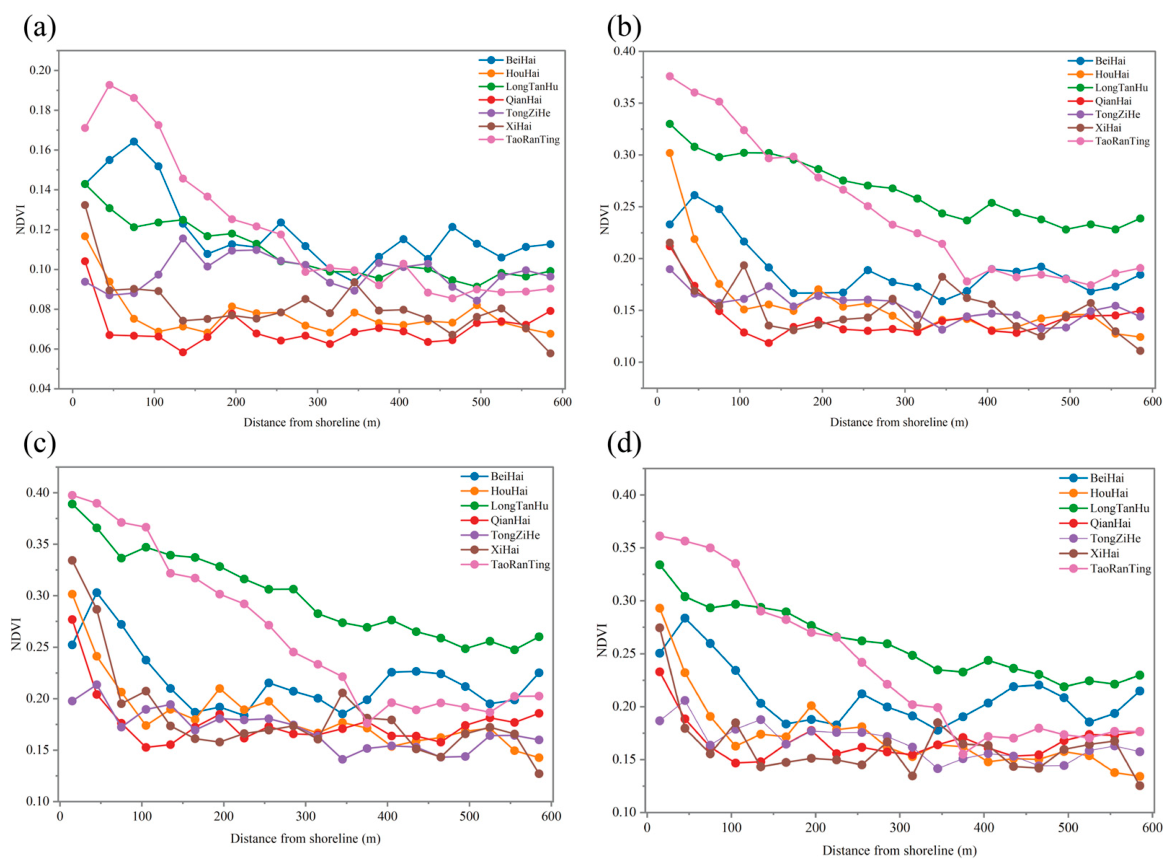
3.4. Vegetation Gradients Along Shoreline Buffers
NDVI showed clear distance-dependent variation across seasons and water bodies, although gradient forms differed among shorelines (
Figure 5). In most cases, NDVI changed most rapidly within the first 100–200 m from the shoreline and became more stable or fluctuated at greater distances. Seasonal contrasts were evident, with NDVI highest in summer, intermediate in spring and autumn, and lowest in winter, and with larger differences in the near and middle zones than in the far zone. Gradient shapes also varied among water bodies, including relatively smooth trends, intermediate peaks, and irregular fluctuations, indicating spatial heterogeneity in shoreline vegetation configuration. These differences in NDVI gradients corresponded to variation in cooling intensity and spatial decay patterns, indicating a spatial association between vegetation distribution and shoreline thermal responses.
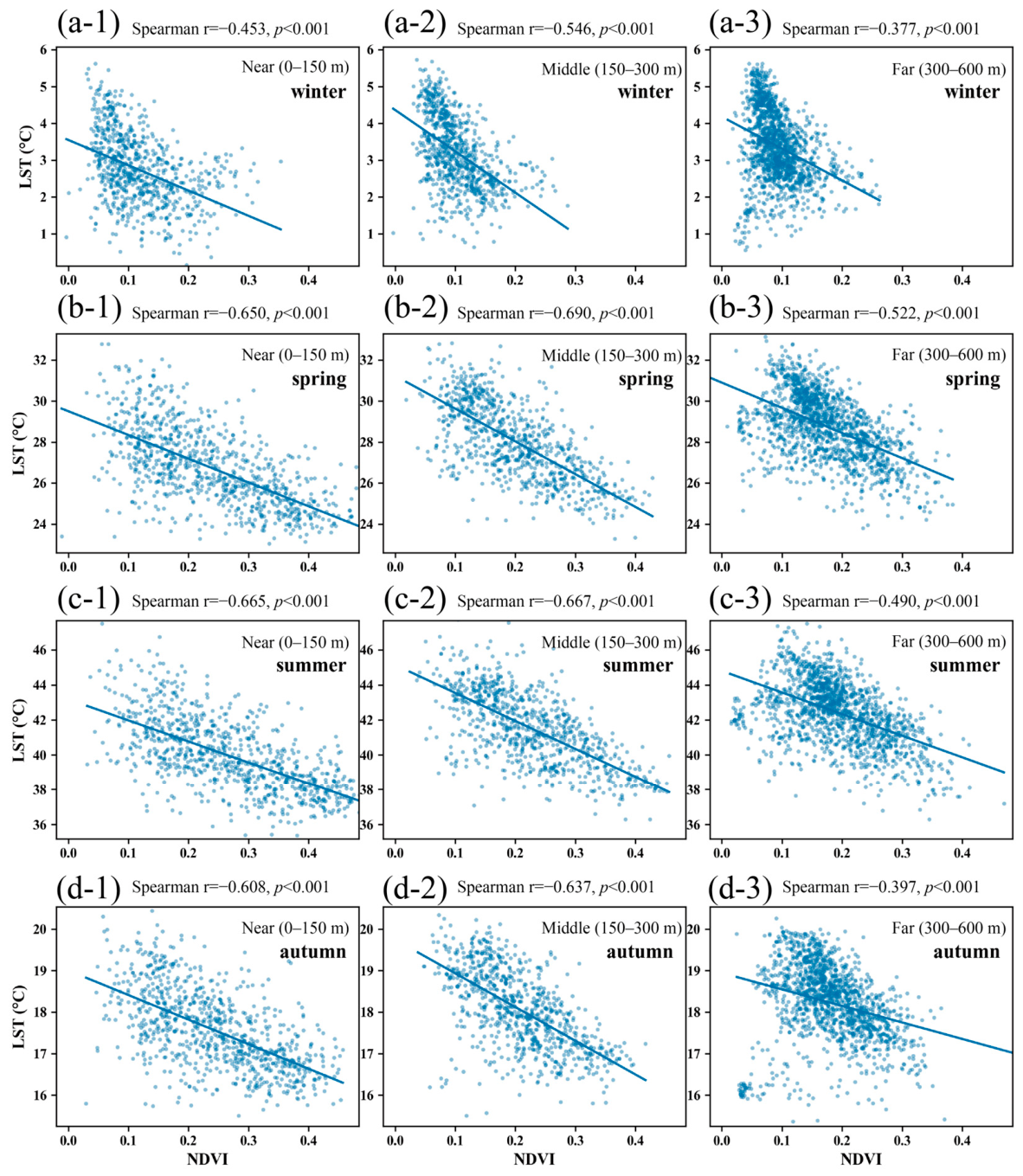
3.5. Vegetation–Temperature Correlations Across Spatial Zones
NDVI and LST were negatively correlated across all seasons and distance zones (
Figure 6). In winter, the correlations were moderate, with Spearman coefficients of −0.453, −0.546, and −0.377 in the near, middle, and far zones, respectively. Stronger negative correlations were observed during the vegetatively active seasons. In spring, the coefficients reached −0.650 in the near zone, −0.690 in the middle zone, and −0.522 in the far zone. In summer, the corresponding coefficients were −0.665, −0.667, and −0.490, while in autumn they were −0.608, −0.637, and −0.397.
Across all seasons, the NDVI–LST relationship was generally stronger in the near and middle zones than in the far zone, indicating that vegetation–temperature coupling was more pronounced within the inner shoreline buffers. A robustness test using same-date Landsat-derived NDVI produced consistent negative NDVI–LST correlations across seasons and distance zones. Sentinel-2 NDVI and same-date Landsat NDVI were strongly correlated at the segment-ring scale, with Spearman coefficients of 0.861, 0.947, 0.950, and 0.745 in winter, spring, summer, and autumn, respectively. This indicates that the main vegetation–temperature relationship was not driven solely by the temporal mismatch between Sentinel-2 NDVI and Landsat LST.
3.6. Regression Effects of Vegetation, Distance, and Built-Up Intensity
After controlling for built-up intensity and waterbody fixed effects, the regression models showed a clear distance-dependent thermal pattern across seasons (
Table 6). Shoreline distance remained a consistently positive predictor of LST in both the additive and interaction models. This indicates that LST generally increased with increasing distance from the shoreline, even after accounting for vegetation greenness, built-up intensity, and baseline differences among water bodies. NDVI was negatively associated with LST in winter, spring, and summer, with the strongest effect observed in spring. The autumn NDVI coefficient was not statistically significant after NDBI and waterbody fixed effects were included, suggesting that the independent thermal effect of vegetation was weaker under autumn conditions.
NDBI showed positive associations with LST in winter, summer, and autumn, especially in summer and autumn, indicating that built-up intensity contributed to higher surface temperatures within the shoreline buffer zones. The explanatory power of the models also improved substantially after NDBI and waterbody fixed effects were included, with R2 values ranging from 0.471 to 0.615 in the additive model and from 0.473 to 0.616 in the interaction model. However, the NDVI × distance interaction terms were small and not statistically significant in all seasons, and the increase in R2 after adding the interaction term was negligible, ranging from 0.0000 to 0.0029. Therefore, evidence for a strong non-additive distance-sensitive vegetation effect was limited. The results suggest that shoreline distance, vegetation greenness, and built-up intensity mainly operated as additive spatial predictors of LST rather than as a dominant interaction mechanism. VIF values indicated low multicollinearity in winter but moderate to high collinearity in spring, summer, and autumn, mainly reflecting the relationship between NDVI and NDBI. Therefore, coefficient magnitudes were interpreted cautiously, with emphasis placed on coefficient directions and model-level robustness.
5. Conclusions
This study examined shoreline cooling in a high-density, heritage-constrained urban environment using 120 m shoreline segmentation and 0–600 m buffer analysis across four seasonal observations. The results show that shoreline cooling was characterized by a layered spatial decay structure rather than a single fixed-distance effect. The first approximately 200 m from the shoreline formed a nearshore rapid-gradient zone, whereas CD represented a broader outward reach over which cooling remained detectable relative to the background thermal condition. Seasonal differences were more pronounced for CI than for CD, with CI strongest in summer and CD showing weaker seasonal differentiation. Waterbody-level results further revealed substantial heterogeneity among individual water bodies, indicating that shoreline length or water surface area alone cannot explain cooling performance. Vegetation greenness was generally negatively associated with LST, while built-up intensity showed positive associations with LST in most seasons. After controlling for NDBI and waterbody fixed effects, the NDVI × Distance interaction provided little additional explanatory power, suggesting that vegetation, shoreline distance, and built-up intensity mainly operated as additive spatial predictors rather than as a strong non-additive interaction mechanism. Overall, this study shifts the interpretation of urban waterbody cooling from whole-waterbody averages toward a shoreline-interface perspective, providing a basis for configuration-aware blue–green climate adaptation in high-density heritage cities.