Article

Seasonal Prediction of the Bohai Sea Ice Grade: A Multi-Model Intercomparison

North China Sea Marine Forecasting and Hazard Mitigation Center, Ministry of Natural Resources, Qingdao 266061, China
*
Author to whom correspondence should be addressed.
Water 2026, 18(10), 1242; https://doi.org/10.3390/w18101242
Submission received: 14 April 2026 / Revised: 10 May 2026 / Accepted: 14 May 2026 / Published: 21 May 2026

Abstract

Even under a warming climate, winter sea ice in the Bohai Sea continues to threaten ships and offshore/coastal infrastructure. Reliable pre-season prediction of the overall wintertime sea ice condition in the Bohai Sea, as represented by the Bohai Sea Ice Grade (BSIG), is therefore important for disaster preparedness and mitigation. Based on the 1979–2024 BSIG record, this study compares seven statistical and AI-based seasonal prediction methods: analog year analysis, multiple linear regression, stepwise regression, Principal Component Regression, a cross-correlation-based regression model, support vector regression, and the Bayesian Ensemble Bohai Ice Grade Net (BE-BIGNet). As potential precursors, we considered sea ice extent in 14 Arctic regions together with 114 large-scale atmospheric and oceanic circulation indices. The results suggest substantial differences in predictive skill among the methods. Among the tested approaches, BE-BIGNet, which combines Bayesian regularization with bootstrap median ensembling, achieves strong full-period performance and stable skill during the independent test period, suggesting that it may provide a useful framework for operational BSIG forecasting in the Bohai Sea.

1. Introduction

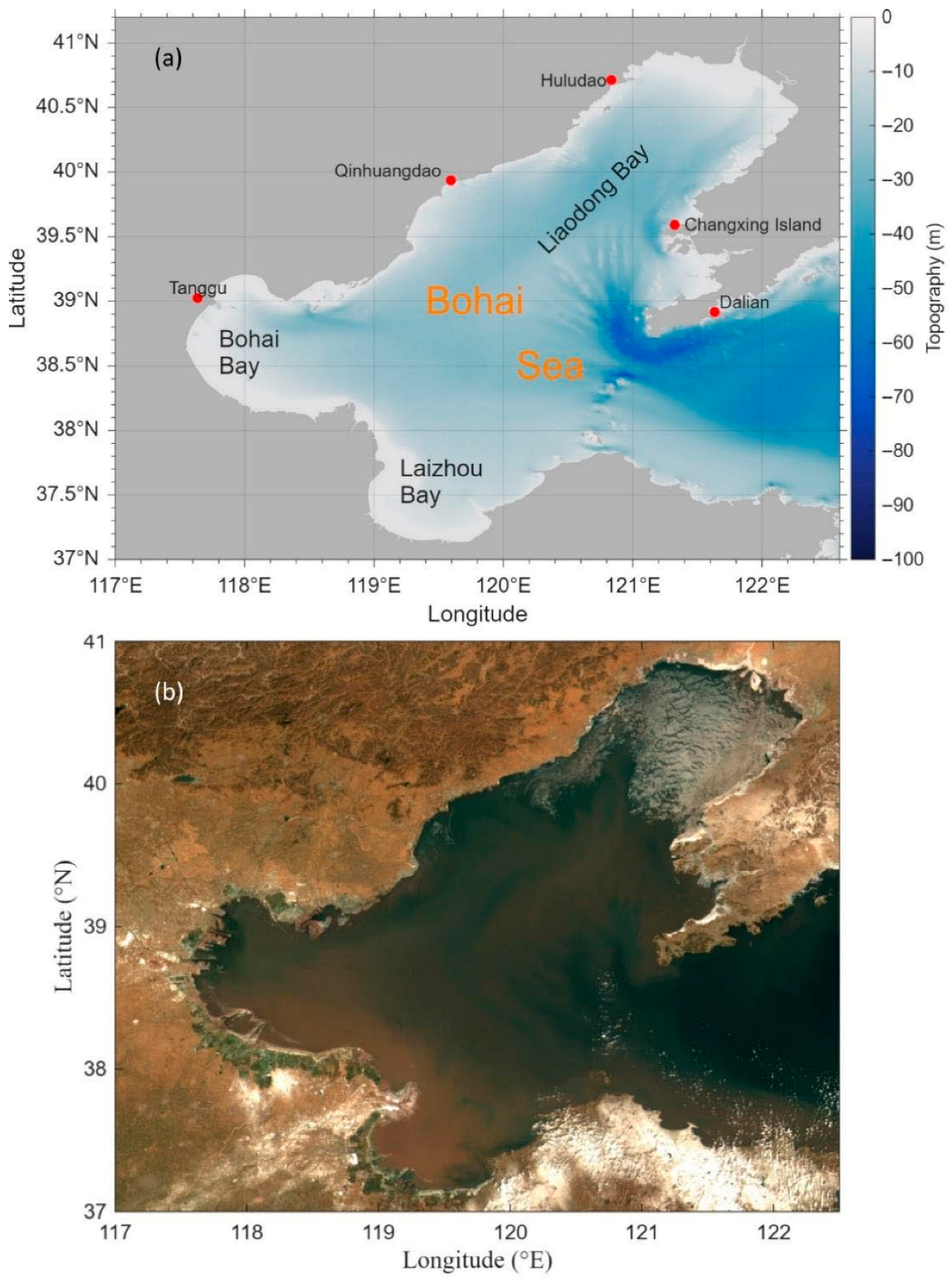
The Bohai Sea (37° N–41° N, 117° E–122° E), a shallow semi-enclosed marginal sea located in northeastern China along the northwestern Pacific coast (Figure 1a), represents the southernmost seasonally frozen coastal sea in the Northern Hemisphere. With an average depth of approximately 18 m, its unique geographical configuration—characterized by restricted water exchange with the open ocean and significant freshwater discharge from surrounding rivers—results in a relatively low heat capacity that makes it highly susceptible to rapid winter cooling. Sea ice in this region typically begins to form in late November and persists through March, characterized by a distinct spatial asymmetry where the northern part, particularly Liaodong Bay, acts as the primary and most ice-prone formation center. Climatologically, the maximum sea ice extent in the Bohai Sea averages approximately 20,000–30,000 km2, typically covering 30–40% of the total sea area during normal winters. The thickness of level ice generally ranges from 10 to 30 cm, while in severe cases, the thickness of deformed ice in nearshore regions of Liaodong Bay can exceed 50 cm. As a critical hub for maritime transport and a strategic base for China’s offshore oil and gas industry, severe ice conditions can result in shipping blockages and structural damage to vessels, while also triggering intense ice-induced vibrations on offshore platforms such as jacket structures, thereby threatening structural integrity and operational safety [1]. The overall sea ice condition of the Bohai Sea in each winter is operationally assessed by national ocean forecasting institutes in China using a sea ice grade index, which ranges from 1 to 5 at 0.5 intervals and is calculated based on floating ice extent [2]. Forecasts of the sea ice grade are routinely released about one month before the ice season, serving as a key reference for sea ice disaster preparedness and mitigation. Thus, the establishment of a robust prediction system for winter ice grades is of great importance for both disaster mitigation and maritime logistical scheduling.
Multi-decadal analyses indicate that, although the Bohai Sea ice area has generally declined since the late 20th century, its long-term evolution is dominated by strong interannual and decadal variability rather than a simple monotonic decrease. Much of this interannual variability can be attributed to large-scale climate modes, particularly the Arctic Oscillation (AO) and the North Atlantic Oscillation (NAO), which regulate regional atmospheric circulation patterns, near-surface air temperature, and wintertime surface heat loss over the Bohai Sea [3]. At the planetary scale, ongoing global warming has led to a significant contraction of Arctic sea ice extent and substantial adjustments in atmospheric circulation, contributing to more frequent extreme mid-latitude weather events [4]. Consequently, damaging sea ice events can still affect the region during periods of extreme cold anomalies, despite the overall warming trend. The complex interactions between large-scale climate variability and regional atmospheric forcing introduce considerable uncertainty into Bohai Sea ice evolution, rendering accurate sea ice prediction a formidable challenge.
Early statistical predictions of sea ice conditions predominantly relied on linear regression frameworks that related ice condition to antecedent meteorological forcing, such as air temperature and surface pressure fields [5,6,7]. While these methods established the baseline for regional forecasting, they often suffer from multicollinearity among atmospheric predictors, which can obscure physical mechanisms and degrade forecast stability. To address this, more sophisticated statistical methods were introduced. Stepwise regression has been adopted to optimize predictor selection and reduce overfitting [8,9], while Principal Component Regression (PCR)—a standard tool in broader climate prediction—offers a robust way to extract dominant modes of variability while avoiding collinearity issues [10]. Parallel to these regression efforts, the analog year analysis leverages historical similarity in circulation fields to infer future states, providing an intuitive physical basis for prediction [11].
Despite their wide usage, these statistical methods rely on linear assumptions or historical stationarity, which may limit their ability to represent the nonlinear processes of a changing climate system. Recently, machine learning approaches have been increasingly applied to sea ice prediction. For example, support vector regression (SVR) and neural networks can capture nonlinear relationships between environmental drivers and sea ice variability. They have been applied to seasonal and interannual forecasting, frequently yielding good predictive skill compared to conventional baselines [12,13]. However, the application of complex machine learning methods in Bohai Sea Ice Grade (BSIG) prediction is constrained by the “small sample” problem—reliable satellite and observational records span only a few decades (since 1979). Standard machine learning models often lack the probabilistic reasoning required to quantify uncertainty in such data-limited contexts.
Although both statistical and AI-based approaches have been successfully applied in sea ice prediction, their relative performance has not been systematically assessed in the Bohai Sea. To address this gap, we compare seven prediction methods representing analog, statistical, and machine learning frameworks:
(1)
Physical Analog Approaches, specifically the analog year analysis, which represents a physically motivated similarity approach.
(2)
Linear statistical approaches, including multiple linear regression, stepwise regression, as well as Principal Component Regression (PCR). This category also includes a linear fitting model based on key physical precursors identified through cross-correlation analysis of Arctic sea ice, atmospheric circulation, and oceanic drivers.
(3)
AI models, specifically support vector regression (SVR) for kernel-based learning and a novel Bayesian ensemble net (BE-BIGNet). The latter combines a neural network with Bayesian regularization to improve generalization under the limited sample size.
By evaluating these methods in both historical hindcasts and an independent test period, this study assesses their relative performance for BSIG prediction. The results may contribute to improving the accuracy of sea ice forecasts and supporting disaster mitigation.

2. Data and Methods

2.1. Data

The 1979–2024 Bohai Sea Ice Grade (BSIG) data adopted in this study were obtained from the historical records of the North China Sea Marine Forecasting and Hazard Mitigation Center of Ministry of Natural Resources. The BSIG is a comprehensive metric used to quantify the severity of ice conditions, classified into five levels: Grade 1 (Light), Grade 2 (Normal–Light), Grade 3 (Normal), Grade 4 (Normal–Heavy), and Grade 5 (Heavy). To ensure greater precision in operational forecasts and hindcasts, 0.5-grade intervals are adopted in practice. This classification standard is based on key parameters including the maximum sea ice extent and ice thickness, as described by Sui et al. (2022) [2].
The Arctic Sea Ice Concentration (SIC) dataset, published by the National Snow and Ice Data Center (NSIDC), is derived from remote sensing brightness temperature. The dataset was processed using the NASA Team (NT) algorithm developed by the NASA Goddard Space Flight Center’s Cryospheric Sciences Laboratory. The dataset is available online: https://nsidc.org/data/nsidc-0051/versions/2 (accessed on 5 December 2025). This dataset spans from 26 October 1978 to the present and includes daily and monthly averaged SIC values with a spatial resolution of 25 km × 25 km. The monthly averaged sea ice extent data used in this study was computed from the monthly SIC fields.
A total of 114 large-scale atmospheric and oceanic indices are adopted in this study. Monthly means time series were provided by the Beijing Climate Center (BCC). The dataset is available at https://cmdp.ncc-cma.net/Monitoring/cn_index_130.php (accessed on 12 November 2025). and a full list of indices used here is attached in Appendix A.

2.2. Prediction Models

(1) Analog Year Analysis
The analog year analysis is widely used for monitoring and predicting climate indices such as the MJO and BSISO [14]. It quantifies the similarity between historical circulation fields and a target-year pattern in the spatial domain, providing an objective basis for analog year selection. Let X ( r , t ) denote the anomaly field after removing the climatology and trend. The standardized field is
Z ( r , t ) = X ( r , t ) σ X ( r ) .
The projection index is calculated as
I ( t ) = r Z ( r , t )   M ( r )
where σ X ( r ) represents the temporal standard deviation of the anomaly field at spatial location r , and M ( r ) is the target projection pattern. The magnitude of I ( t ) represents the degree of spatial similarity between the historical field and the target pattern. Years satisfying I ( t )   θ are selected as analog years for subsequent ice severity prediction.
(2) Linear and Stepwise Regression
Multiple linear regression (MLR) is employed to quantify the linear relationship between the target variable and multiple predictor variables. This method assumes that the combined effect of the predictors on the target variable can be expressed as a linear superposition. To obtain a parsimonious and robust model, stepwise regression is also adopted to identify statistically significant predictors, eliminate redundant variables, and optimize the model structure. The MLR model is expressed as:
Y = β 0 + i = 1 p β i X i + ε
where Y indicates the target variable, X i ( i = 1 , , p ) are the predictors, β 0 is the intercept, β i ( i 1 ) are the regression coefficients associated with each predictor, p is the number of selected predictors, and ε represents the residual error.
(3) Principal Component Regression (PCR)
Principal Component Regression (PCR) first uses Principal Component Analysis (PCA) to transform the original variables into a set of orthogonal principal components. Then, the principal components with higher contribution rates are selected for regression modeling to enhance the robustness of the model [10]. The PCR model can be written as
P = X W ,
Y = β 0 + i = 1 m β i P i + ε ,
where X is the N × K data matrix of original predictor variables ( N observations as rows and K predictors as columns), W is the K × m PCA loading matrix, P is the resulting N × m matrix of the retained principal components, m is the number of selected components, β i are the regression coefficients, and ε is the residual error.
(4) Cross-Correlation-Based Linear Regression
To account for climate signals with longer seasonal memory, cross-correlation analysis is applied to identify potential precursors of BSIG. This method quantifies the linear relationship between the time series of the BSIG (Y) and potential factors (X) with a time lag τ [15]. The correlation coefficient R is calculated as:
R ( τ ) = i = 1 N ( X i , t τ X ¯ ) ( Y i , t Y ¯ ) i = 1 N ( X i , t τ X ¯ ) 2 i = 1 N ( Y i , t Y ¯ ) 2
where N is the sample size and τ denotes the time lag in months. Climatic factors that exhibit statistically significant correlations with the ice grade at lead times of 1–5 seasons (significance with p < 0.05 ) are selected as candidate precursors for subsequent linear regression.
(5) Support Vector Regression (SVR)
SVR is a machine learning algorithm based on the principle of minimizing structural risk. It projects low-dimensional input data into a higher-dimensional feature space using nonlinear mapping. The algorithm then finds the best regression function within a set error tolerance, making it effective for small sample sizes and complex nonlinear relationships [16]:
f x = ω T ϕ x + b
where ϕ ( x ) is the nonlinear mapping function that projects the input vector x into a high-dimensional feature space, ω is the weight vector, and b is the bias term.
(6) Bayesian Regularized Neural Network
Although large neural models handle complex problems, only 46 records of Bohai ice grade are available from 1979 to 2024. For this situation, simpler models often perform better; thus, this study uses a single hidden-layer fully connected model with 7 neurons. Furthermore, the bootstrap aggregating (bagging) method is adopted to create training datasets by sampling with replacement from the original dataset. Each bootstrap dataset is used to train an individual model, and the ensemble prediction is obtained by aggregating the outputs of all models, e.g., by averaging or taking the median of individual predictions. This approach reduces model variance and improves prediction stability, particularly in the presence of noise or small sample sizes [17]. The median-based ensemble prediction is defined as
y ^ = m e d i a n { f 1 ( x ) , f 2 ( x ) , , f B ( x ) }
where f b x is the model trained on the b -th bootstrap dataset, and B is the total number of bootstrap models.

2.3. Standardization of the Predictions

To ensure a strictly fair and mathematically rigorous intercomparison among the diverse models evaluated in this study, it is essential to align their output resolutions. Because the observed Bohai Sea Ice Grade (BSIG) is inherently recorded at 0.5-pitch intervals (as introduced in Section 2.1), evaluating continuous floating-point predictions directly against these discrete observations introduces artificial error penalties for traditional regression models. Therefore, prior to plotting the comparative time series and calculating the final evaluation metrics (e.g., root mean square error, RMSE), the continuous forecast outputs from all statistical models were standardized to 0.5 intervals (i.e., rounded to the nearest whole or half point). This standardization ensures that the calculated RMSE values accurately reflect a leveled operational baseline, emphasizing the intrinsic predictive skill of each architecture under real-world forecasting conditions.

3. Results

The prediction of the upcoming winter’s BSIG in the Bohai Sea is usually made and released in October, making summer predictors a standard and operationally practical choice. In this study, analog year analysis, multiple linear regression (MLR), stepwise regression, and PCR serve as baseline statistical models, all utilizing the same summer predictor window. This ensures methodological consistency and allows for a fair comparison that highlights differences in model structure rather than discrepancies arising from predictor selection.

3.1. Analog Year Analysis

The analog year analysis, originally proposed by Wheeler and Hendon (2004) [14], has been widely adopted by operational centers (e.g., NOAA and the China National Climate Center) to monitor and predict climate phenomena such as the Madden–Julian Oscillation (MJO) and the Boreal Summer Intraseasonal Oscillation (BSISO). The method first removes the climatological seasonal cycle and long-term trend from multi-year datasets of the target field; the resulting anomaly fields are then standardized and projected onto a predefined spatial pattern associated with the phenomenon of interest. This projection yields a projection index (PI) that quantifies the spatial similarity between each historical field and the target pattern, thereby providing an objective basis for analog year selection.
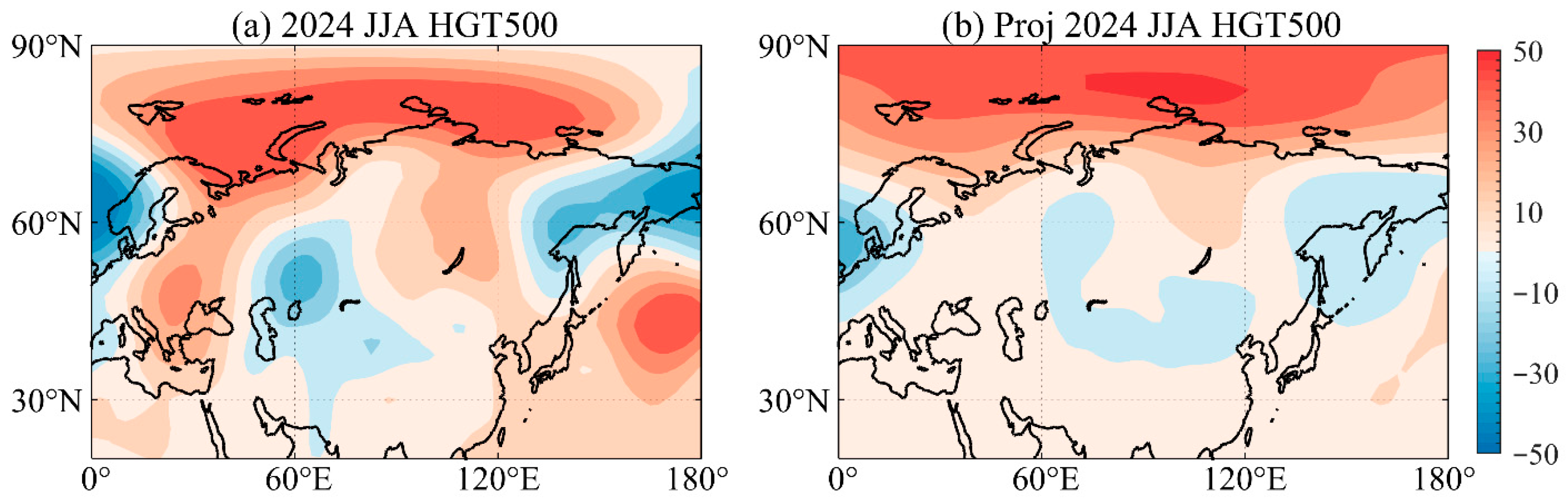
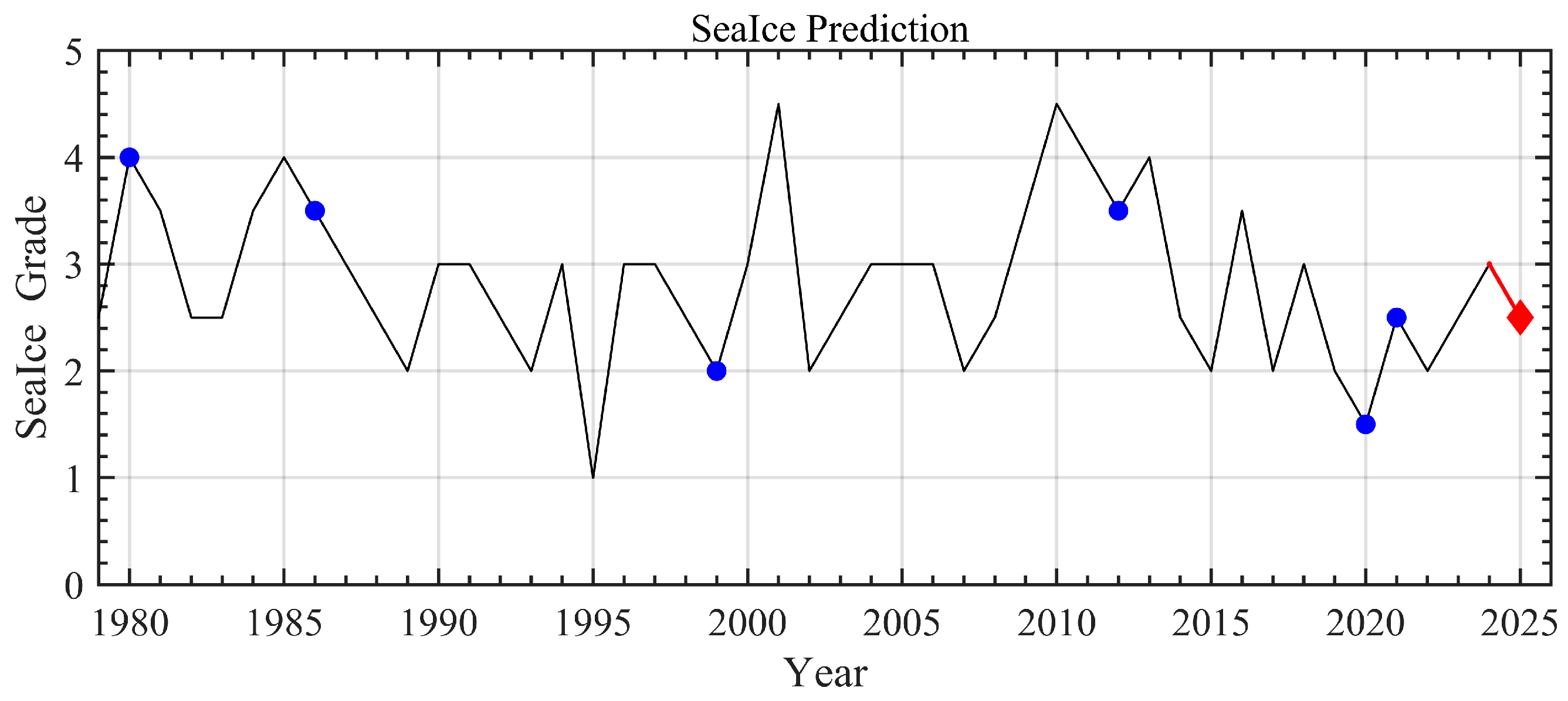
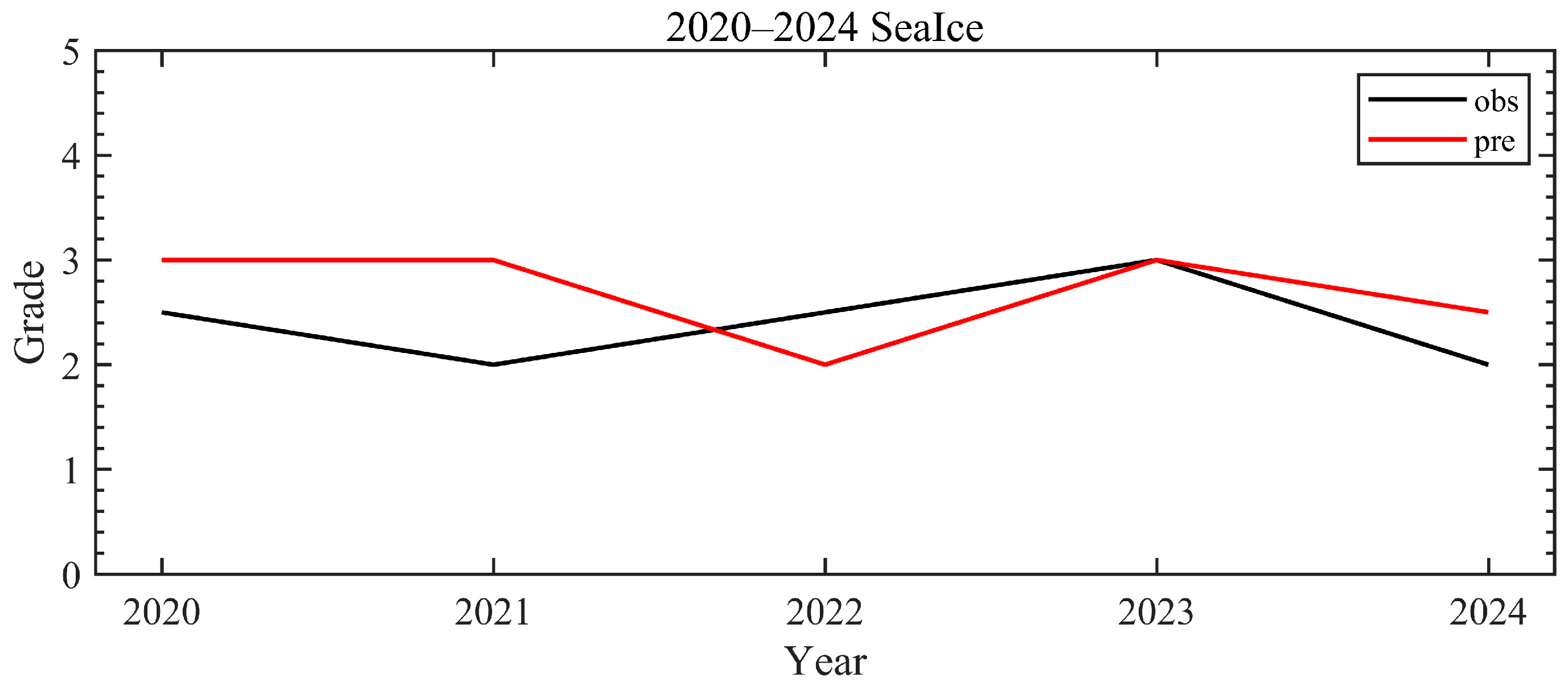
First, the summer (June–August) 500 hPa geopotential height anomaly for 2024 is used as the target projection pattern (Figure 2a) to illustrate the analog year analysis workflow and to derive a forecast for the Bohai Sea Ice Grade (BSIG) in the winter of 2024. Specifically, multi-year atmospheric circulation fields are projected onto the 2024 target pattern to generate a time series of PI values. Years with |PI| ≥ 0.5 standard deviations are identified as analog years (blue dots in Figure 3 with similar circulation patterns), and their composite 500 hPa geopotential height anomaly field is shown in Figure 2b. The composite mean sea ice grade derived from the selected analog years serves as the prediction for the Bohai Sea winter sea ice grade in 2024 (red diamonds in Figure 3). To evaluate predictive performance, we predicted the BSIG over the recent five-year period 2020–2024 and the results are compared with the observed records. This comparison yields a root mean square error (RMSE) of 0.59 (Figure 4), indicating that this method captures the recent interannual variability in sea ice conditions with relatively small overall error.

3.2. Multiple Linear Regression

To quantify the linear modulation of atmospheric circulation and oceanic forcing on the BSIG, we constructed a multiple linear regression (MLR) model. The model utilizes indices from the preceding summer (June–August) to predict the ice grade of the following winter. The dataset is partitioned into a training period (1979–2019) and an independent validation period (2020–2024). From the 114 indices listed in Appendix A, the ten predictors exhibiting the highest correlation coefficients with the BSIG were selected for the regression analysis. These key predictors include: the Cold-Tongue ENSO index ( X C T E N S O ), NINO 4 and NINO-W sea surface temperature (SST) anomalies ( X N I N O 4   &   X N I N O W ), the Tibet Plateau Region 1 and 2 indices ( X T P 1 & X T P 2 ), the Eastern Pacific Subtropical High Ridge Position index ( X E P S H ), North American Subtropical High Area and Intensity indices ( X N A S H A & X N A S H I ), the ENSO Modoki Index ( X E M I ), and the Eurasian Meridional Circulation (EMC). Prior to calculation, all indices were standardized. The resulting regression equation is expressed as:
Y = 2.81 1.06 · X C T E N S O + 0.47 · X N I N O 4 + 0.30 · X N I N O W + 0.06 · X T P 1                 0.09 · X T P 2 + 0.21 · X E P S H + 0.07 · X N A S H A         0.21 · X N A S H I + 0.23 · X E M I 0.27 · X E M C
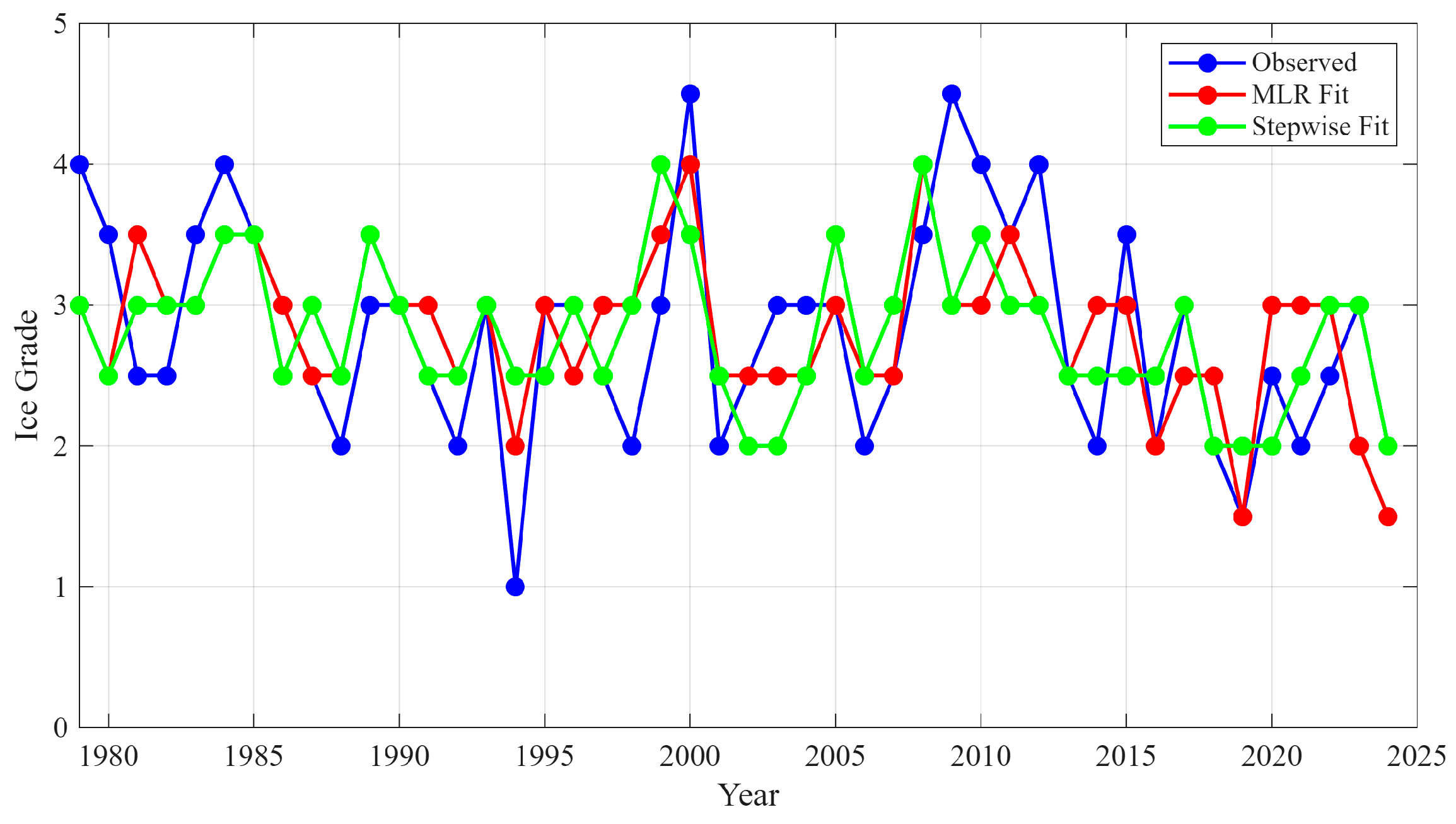
where Y represents the predicted ice grade. The predicted BSIG is shown by the red line in Figure 5. The root mean square error (RMSE) during the training period is 0.61, while for the validation period it is 0.74. The results suggest that interannual variability in the Bohai Sea may primarily be related to ENSO and its spatial SST anomalies. These anomalies modulate the intensity of the East Asian Winter Monsoon and local air–sea heat fluxes via teleconnections involving the Subtropical High, the Walker–Hadley circulation, and the Eurasian wave train. However, the significant increase in RMSE from the training to the validation period indicates that this standard MLR model is subject to potential overfitting.

3.3. Stepwise Regression

To address the potential overfitting and multicollinearity issues observed in the above MLR model, we employed stepwise regression using the Akaike Information Criterion (AIC) to optimize predictor selection. Using the standardized summer (June–August) indices from the training period (1979–2019) as the candidate pool, the algorithm automatically screened the variables to retain only those significantly correlated to BSIG, thereby refining the input set to six key precursors. The optimized prediction equation for the BSIG is expressed as:
Y = 2.81 1.25 · X C T E N S O + 0.88 · X N I N O 4 + 0.18 · X E P S H + 0.44 · X E M I 0.29 · X E M C + 0.41 · X W P T W
where Y represents the predicted ice grade and X W P T W indicates the West Pacific 850 hPa Trade Wind index. The predicted results are shown against the observations in Figure 5.
Both regression approaches confirm that ENSO (specifically its spatial morphology), the Subtropical High, and the Eurasian Meridional Circulation are the dominant controls on Bohai Sea ice evolution. While the MLR provides a broad linear projection including secondary factors, the stepwise approach effectively isolates the core drivers.
Over the full study period (1979–2024), the stepwise regression yielded a slightly higher RMSE (0.64) compared to the standard MLR (0.62). However, the stepwise model reached an RMSE of 0.39 during the independent validation period (2020–2024), significantly outperforming the MLR (RMSE = 0.74). This sharp contrast between the training and testing performances suggests that by reducing model complexity, stepwise regression mitigates the overfitting inherent in the standard MLR. Consequently, it minimizes noise amplification and offers better extrapolation stability under the rapidly shifting background state of the recent climate.

3.4. Principal Component Regression

To further mitigate multicollinearity among the numerous atmospheric and oceanic indices, we employed Principal Component Regression (PCR), a hybrid approach that integrates the dimensionality reduction advantages of Principal Component Analysis (PCA) with the adaptive variable selection of stepwise regression.
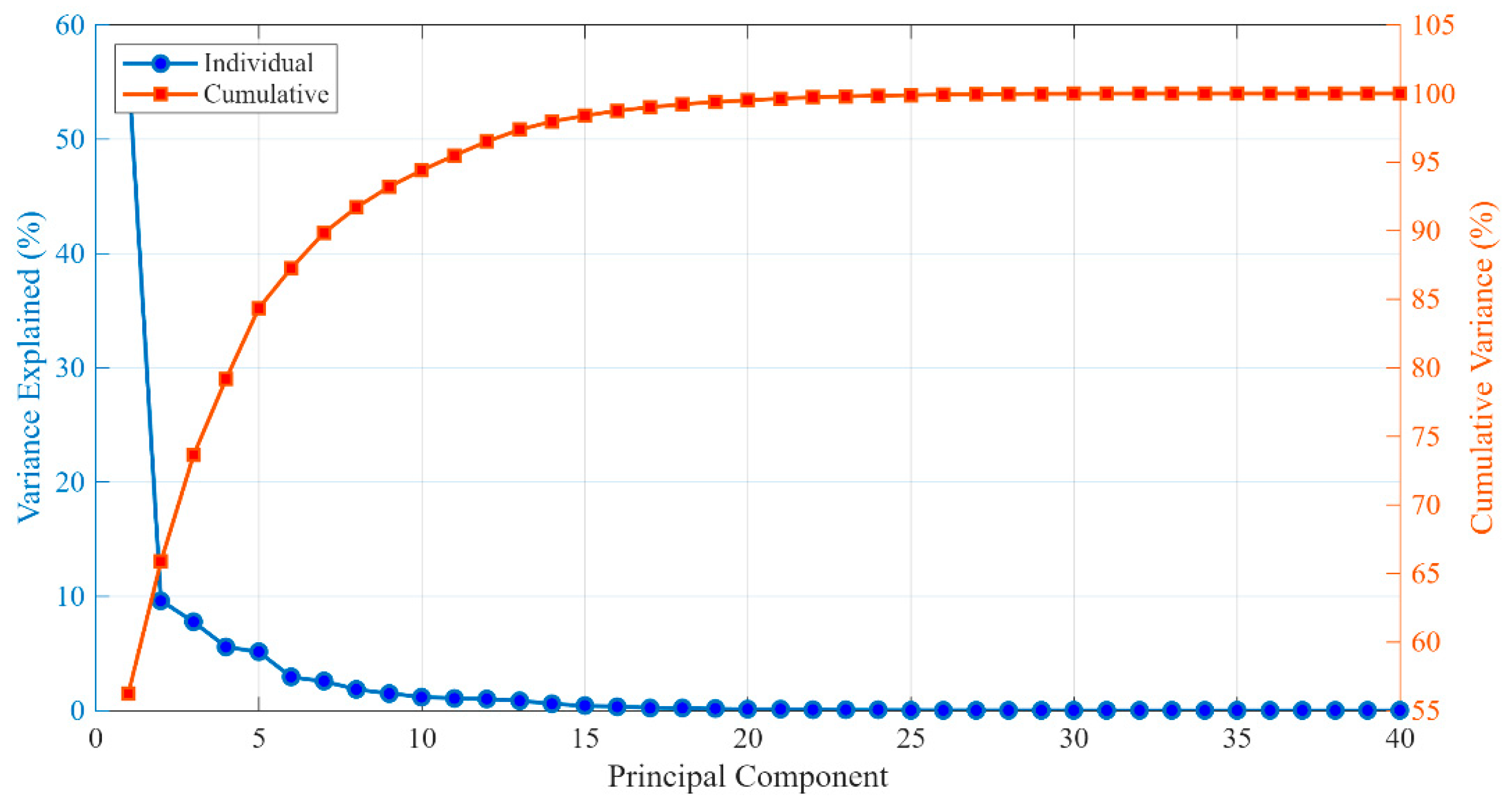
The model was constructed using standardized summer (June–August) indices in Appendix A. First, we screened the dataset to retain the 40 predictors exhibiting the highest correlation with the BSIG (listed in Appendix B). PCA was then performed on these key factors to extract orthogonal modes of variability. The variance explained by each PC is shown in Figure 6. The leading principal components (PCs) that accounted for 90% of the cumulative variance were retained as candidate variables. A stepwise regression algorithm was then applied—starting from an intercept-only baseline—to iteratively select the optimal subset of PCs that minimized the Akaike Information Criterion (AIC). The optimized prediction equation, trained on the 1979–2019 period, is expressed as:
Y = 2.82 0.05 · P C 1 0.07 · P C 2 + 0.14 · P C 3 + 0.11 · P C 4 0.10 · P C 5 0.18 · P C 7
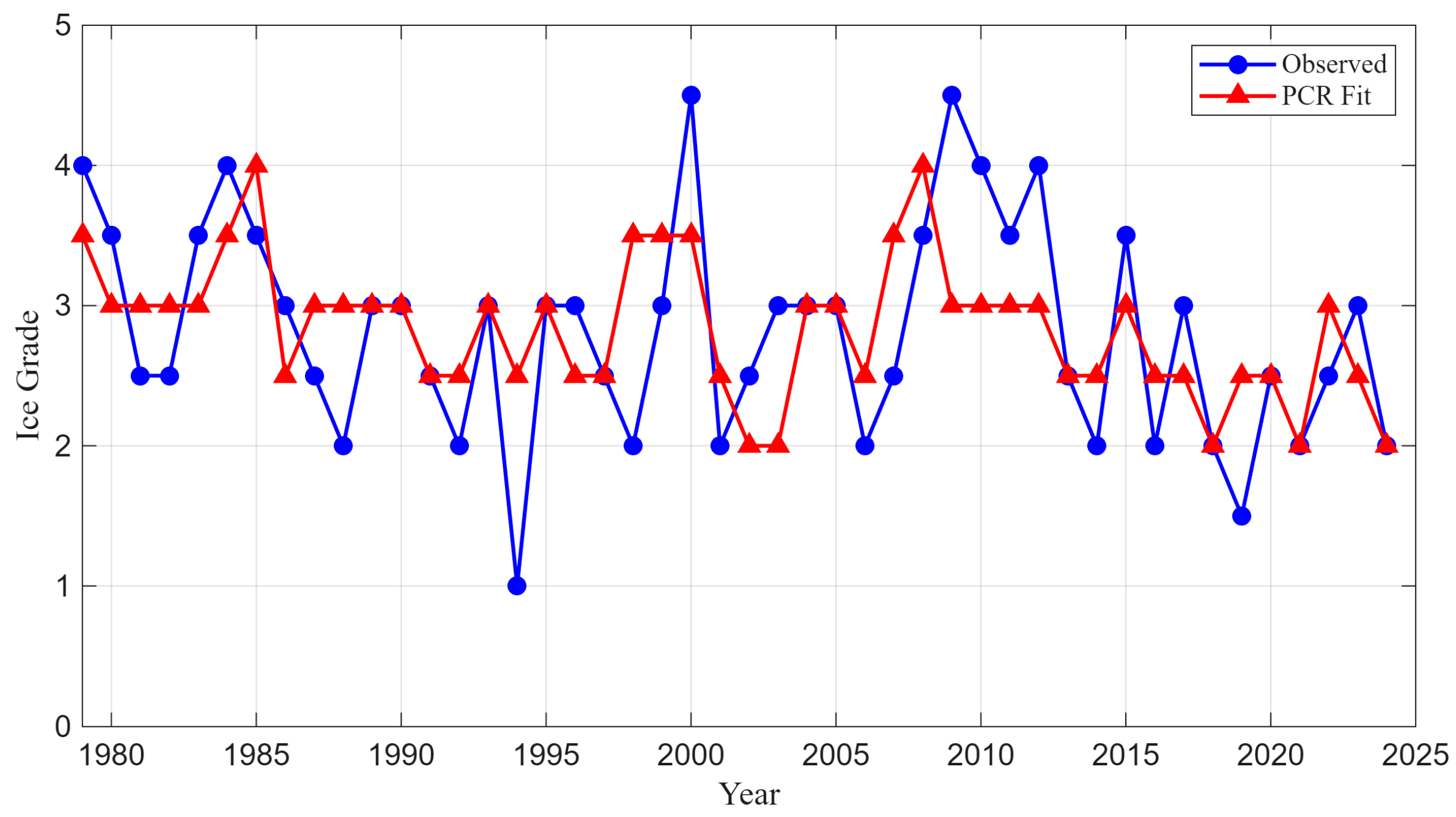
and the predicted BSIG is compared with the observations in Figure 7.
The PCR model demonstrated robust performance, achieving an RMSE of 0.65 for the full historical period (1979–2024) and a notably low RMSE of 0.32 during the independent validation period (2020–2024). By extracting orthogonal modes, PCR effectively filters noise and redundancy, allowing for a stable estimation of general climate forcing. However, while the model captures the mean state and baseline trends effectively, it exhibits reduced skill in reproducing extreme anomalies (e.g., severe heavy or light ice years). This limitation is characteristic of linear variance maximization techniques, which tend to prioritize dominant statistical signals at the expense of rare, high-amplitude events.

3.5. Cross-Correlation-Based Regression Model

Since summer-only predictors may not fully capture the longer memory of the climate system, we extended the analysis to earlier seasons. Specifically, we examined lead–lag relationships between BSIG and large-scale circulation indices as well as Arctic sea ice extent, with the aim of identifying precursor signals that persist across seasons and high-latitude drivers that may precondition winter ice severity in the Bohai Sea.

3.5.1. Circulation and Oceanic Factors

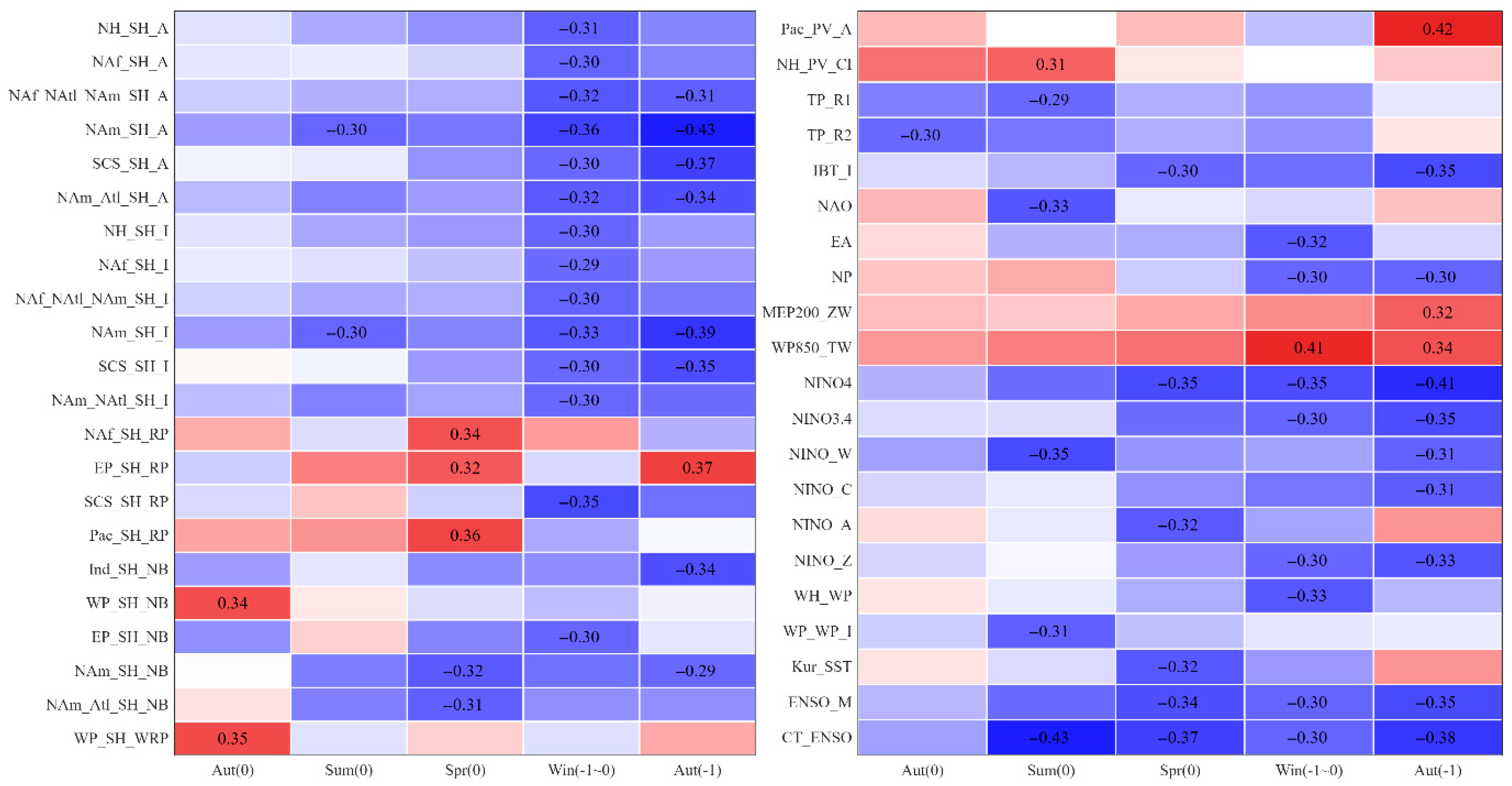
To investigate the physical mechanisms driving interannual variability, we analyzed cross-correlations between the detrended BSIG and 114 large-scale climate indices over the five preceding seasons. For robustness, we retained indices that were significant at the 95% confidence level in at least one lag season. The results (Figure 8) suggest that Bohai ice variability is associated with both tropical oceanic memory and atmospheric teleconnections.
One potential source of the predictability of BSIG arises from the persistence of tropical Pacific oceanic anomalies. The slow upper-ocean heat-content evolution and equatorial wave adjustment associated with ENSO provide an interseasonal memory that can precondition subsequent SST anomalies several seasons in advance [18,19,20]. The west Pacific trade winds during the previous winter may also contribute to the predictability of BSIG. Trade-wind and wind-stress-curl anomalies over the western/subtropical Pacific can induce Rossby wave propagation and subtropical cell adjustment, altering subsurface heat content in the western-to-central Pacific and favoring the persistence or later re-emergence of central-equatorial SST anomalies [21,22]. These anomalies may then influence East Asia through the Pacific–East Asian teleconnection, by modulating the western North Pacific anticyclonic/cyclonic circulation and thereby weakening or strengthening the East Asian Winter Monsoon [23,24,25]. For the Bohai Sea, such remote atmospheric forcing is likely converted into sea ice variability through changes in cold air outbreak frequency, surface heat loss, and wind-driven ice transport [26,27].

3.5.2. Arctic Sea Ice

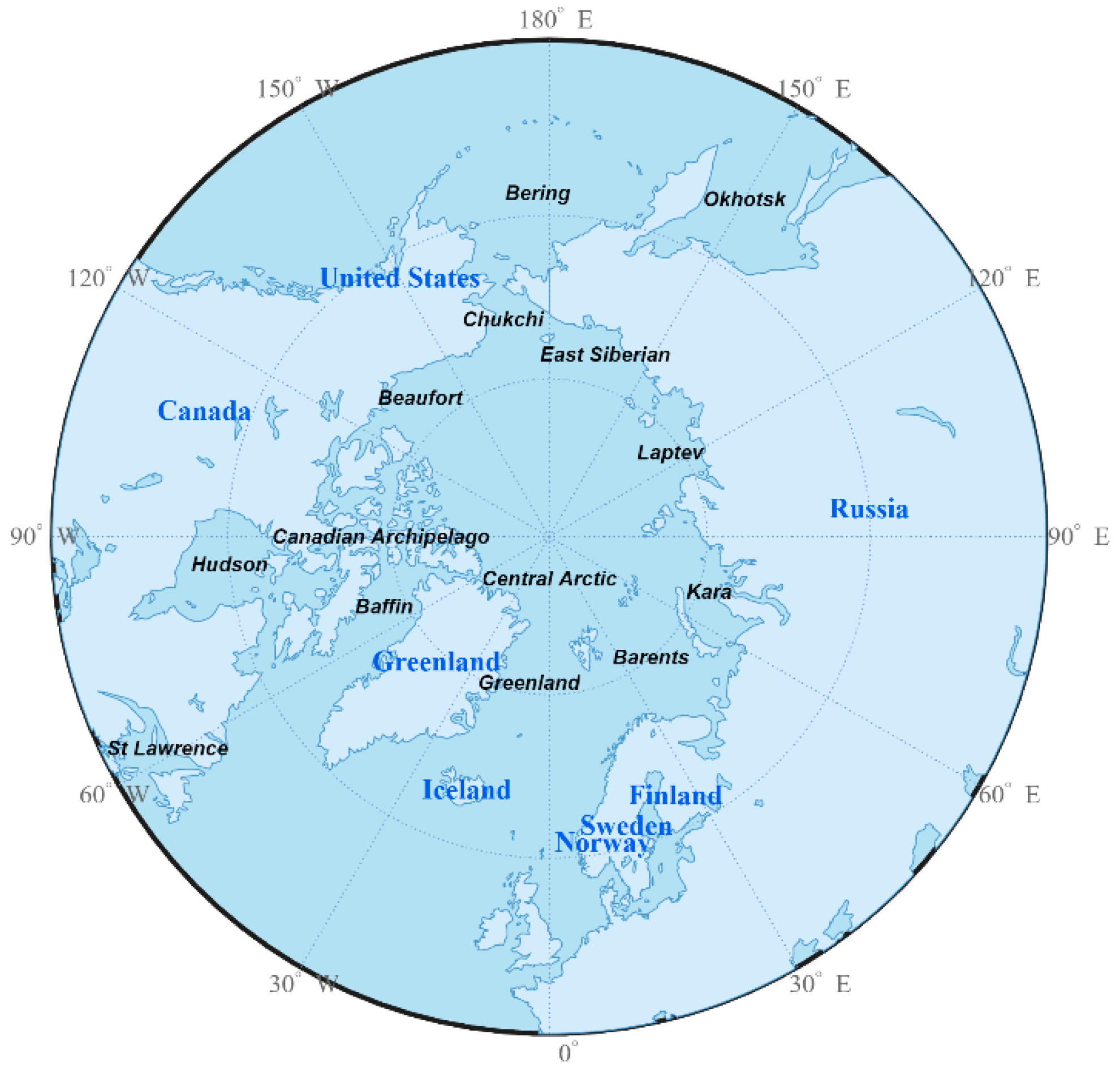
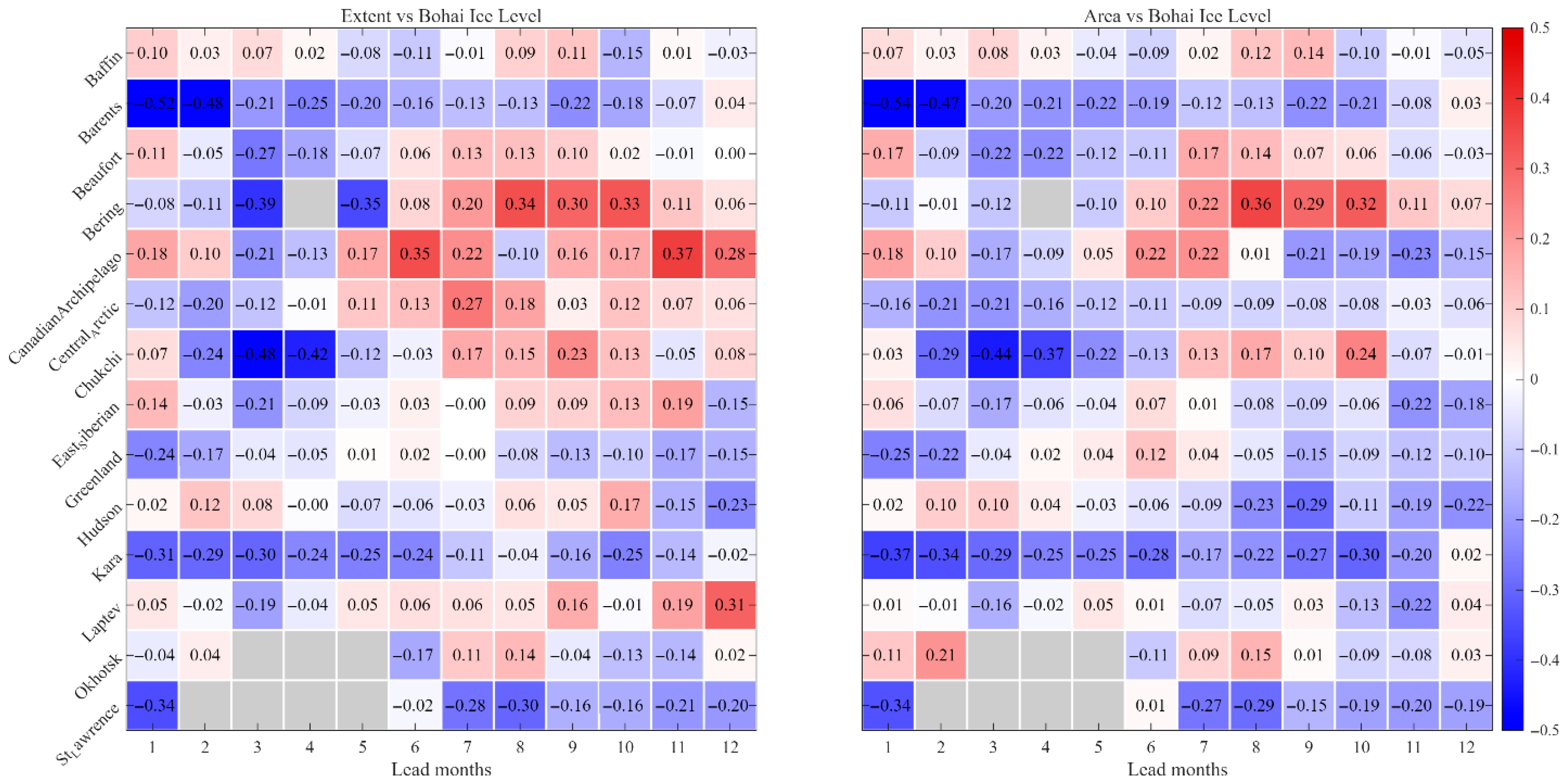
We further investigated the teleconnection between Arctic sea ice extent and Bohai ice grades. Correlations were calculated for sea ice extent/area across 14 key Arctic sectors (Figure 9) with lead times of 1–12 months (previous December to current November), with all time series detrended to remove long-term trends. The highest correlation coefficients were identified in the following two regions: the Barents Sea ice extent (in the Atlantic Sector) exhibits a strong negative correlation (−0.52) at a 1-month lead time (November); the Chukchi and Bering Seas (in the Pacific Sector) show significant negative correlations (−0.48 and −0.39, respectively) at a 3-month lead time (September).
These correlations (Figure 10) are consistent with a possible thermodynamic forcing pathway: a reduction in sea ice in these marginal seas during the current autumn (September to November) releases anomalous heat fluxes to the atmosphere via air–sea interaction. This surface heating excites stationary Rossby wave trains [28,29], which enhance mid-to-high-latitude blocking patterns over Eurasia—specifically the Ural Blocking High—and consolidate the Siberian High [30,31]. The resulting circulation anomalies intensify the East Asian Winter Monsoon, increase the frequency of cold air intrusions affecting the Bohai Sea, and intensify Bohai ice conditions. The observed 1–3-month lag is consistent with the timescale required for the establishment and propagation of this Atmospheric Bridge mechanism [4].

3.5.3. Predictor Selection and Sensitivity Experiments

To determine the optimal predictor set, we first established a baseline forcing field comprising the autumn Western Pacific Subtropical High Ridge Point and the Current Summer Cold-Tongue ENSO index. Building on this core configuration, we conducted 18 sensitivity experiments (Table 1) combining atmospheric/oceanic indices with sea ice metrics from different Arctic marginal seas. The regression coefficients were calculated on the training period (1979–2019), and performance was evaluated using RMSE for both the full historical period (1979–2024) and the 5-year independent validation period (2020–2024).
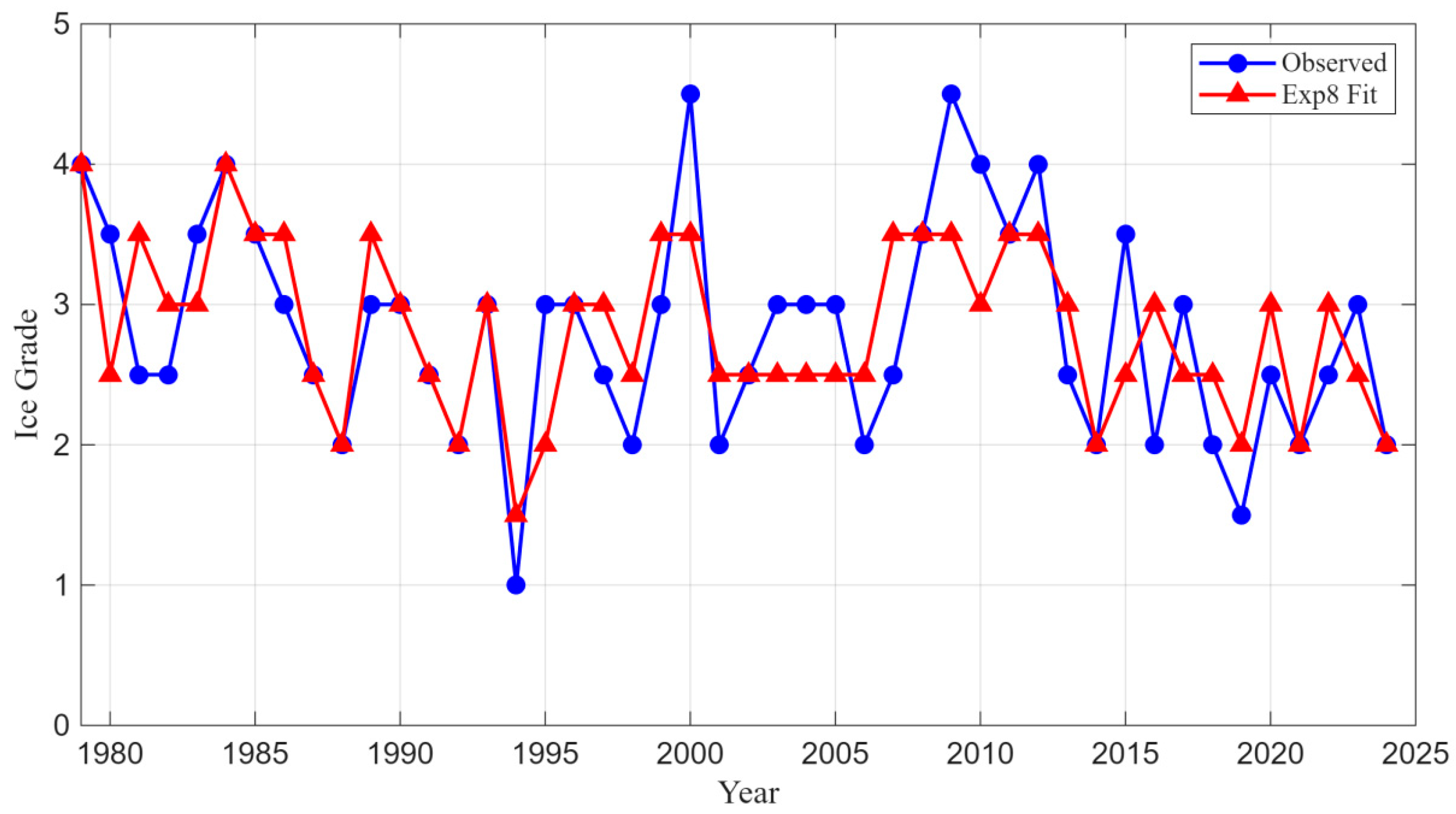
Similar RMSE values are found in Exp-8 and Exp-14, both of which achieve the lowest RMSEs during the training and validation periods. However, Exp-8 was selected as the optimal model because it employs fewer predictors than Exp-14, indicating that the additional variable (WP850_TW) included in Exp-14 does not provide meaningful improvement in predictive skill. Exp-8 achieves an independent validation RMSE of 0.354 by integrating high-latitude Arctic sea ice signals (Barents and Chukchi Seas) with mid-to-low-latitude atmospheric–oceanic predictors (WP_SH_WRP, CT_ENSO, and NINO4).
A comparative analysis with experiments incorporating Bering Sea ice (Exp-1, Exp-7, and Exp-13) reveals a clear overfitting problem. Although these experiments show training-period RMSEs comparable to that of Exp-8, their RMSEs are substantially higher than Exp-8 during the independent 5-year validation period. This result suggests that the inclusion of Bering Sea ice information weakens the model’s generalization capability.
Notably, experiments excluding key predictors, such as Barents Sea ice or the equatorial Pacific index (CT_ENSO), exhibited marked degradation in predictive performance. This finding demonstrates that a spatially comprehensive predictor set, spanning both high-latitude Arctic and tropical climate signals, is essential for maintaining the predictive stability of the Bohai Sea Ice Grade (BSIG). Therefore, to ensure robustness across the full 46-year record while effectively minimizing overfitting risk, Exp-8 was selected as the final baseline predictor configuration. A comparison between the predictions from Exp-8 and the observed BSIG is shown in Figure 11. This optimal predictor combination provides a balanced representation of both long-term climatological variability (RMSE = 0.557) and recent independent prediction skill (RMSE = 0.354), thereby establishing a rigorous and reliable benchmark for seasonal BSIG prediction.

3.6. Support Vector Regression

While Principal Component Regression (PCR) effectively mitigates multicollinearity through dimensionality reduction, it remains fundamentally constrained by linear assumptions, limiting its ability to resolve the nonlinear feedback mechanisms characteristic of the climate system. To address these issues and manage the “small sample” constraint, we employed support vector regression (SVR)—a kernel-based machine learning algorithm designed to capture nonlinear relationships while prioritizing robust generalization over fitting to noise.
Based on the preceding correlation analysis and physical mechanisms, we constructed a feature vector comprising five key atmospheric and oceanic precursors, plus a sea ice persistence term. The selected predictors include: (1) tropical forcing via the Current Summer Cold-Tongue ENSO index and the Previous Autumn NINO4 index; (2) atmospheric coupling via the Current Autumn Western Pacific Subtropical High Western Ridge Point; and (3) Arctic forcing via the sea ice extent of the Barents Sea in November and Chukchi Sea in September. Together, these predictors represent tropical forcing, intermediate atmospheric circulation, and autumn Arctic sea ice anomalies. Additionally, to capture the interannual persistence of the cryosphere, the BSIG from the previous winter was included as an autoregressive feature. Prior to training, all input features were standardized to eliminate dimensional discrepancies [32]. Model performance was assessed using a rolling-origin evaluation (time series cross-validation) scheme: for each iteration, the model was trained on all historical data prior to the target year to predict the subsequent winter. This approach strictly prevents data leakage and provides a robust evaluation of the model’s generalization ability through the cumulative assessment of multiple prediction errors [33].
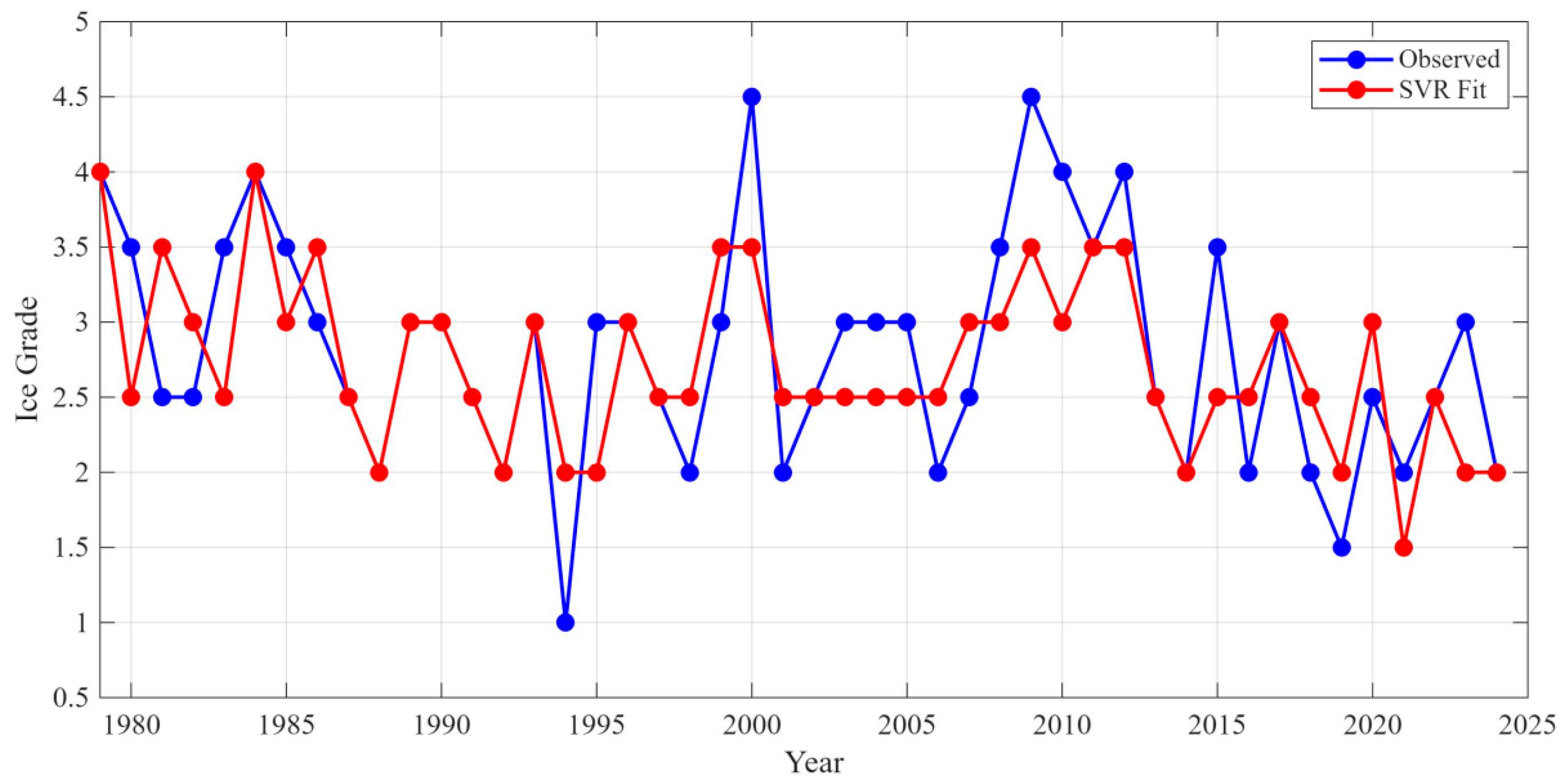
The prediction results of the SVR model are illustrated in Figure 12. During the training phase (1979–2019), the model achieved an RMSE of 0.55. In the independent validation phase (2020–2024), the SVR demonstrated comparable predictive accuracy, yielding an RMSE of 0.53. The absence of significant error amplification during the testing period indicates that the model effectively avoids the overfitting and numerical divergence issues commonly associated with small-sample nonlinear regression, thereby demonstrating satisfactory robustness.
Despite SVR showing acceptable performance in overall error control and predictive stability, deviations persist in forecasting extreme anomalies—specifically the heavy ice years of 2000 and 2009, and the light ice year of 1994—where predictions tend to gravitate toward the multi-year climatological mean. This behavior is intrinsically linked to the SVR’s use of an ϵ -insensitive loss function and smooth kernel settings, which are designed to suppress the impact of observational noise and random perturbations. In the climate system, extreme events are typically triggered by the superposition of multi-scale anomalous processes, featuring mechanisms and statistical properties that differ markedly from conventional interannual variability. Consequently, while SVR is effective at characterizing the predictable interannual background evolution of Bohai ice conditions, its capacity to reconstruct extreme intensities remains constrained. This limitation reflects a universal challenge for statistical methods in a non-stationary climate but does not undermine the model’s overall validity for operational forecasting.

3.7. Bayesian Ensemble Neural Network

In the prediction of variables driven by multiple factors using limited sample sizes, forecast stability and generalization performance are often highly sensitive to feature selection and model structure. To address these issues and leverage the complementary advantages of differing methodologies, this study proposes a hybrid prediction framework: the Bayesian Ensemble Bohai Ice Grade Net (BE-BIGNet). This framework combines nonlinear neural network fitting, Bayesian regularization, and ensemble averaging to improve prediction stability under a limited sample size.
Although the BSIG is operationally classified into discrete levels (1–5 at 0.5 intervals), sea ice growth and decay are physically continuous dynamic processes driven by the heat budget and factors such as cumulative Freezing Degree Days (FDDs) and ocean heat content [34]. Traditional classification algorithms, however, treat these grades as independent categories, failing to capture the continuous variation between adjacent levels. In the context of interannual prediction for the Bohai Sea, this structural discrepancy between the continuous physical process and the discrete classification system—compounded by the characteristics of a small sample size with high noise—creates significant uncertainty for direct classification modeling.
To resolve this, we employed a Bayesian Regularized Back-Propagation (BP) Neural Network and introduced a “continuous fitting–discrete quantization” modeling strategy. By establishing continuous nonlinear mapping between climate factors, Arctic sea ice, and ice grades, the model characterizes the physical continuity of the ice evolution process. For the historical training samples (1979–2019), the model incorporates a Bayesian probabilistic framework that adaptively adjusts weight penalty terms in the loss function via Maximum A Posteriori (MAP) estimation. This approach achieves more stable parameter estimation and prevents overfitting [35]. Combined with linear detrending preprocessing, this architecture constrains model complexity while focusing on capturing interannual physical fluctuations (after removing the background warming trend), effectively mitigating the risk of overfitting inherent in small-sample training.
To further mitigate prediction uncertainty arising from random weight initialization and data sampling variability, this study employs a bootstrap median ensemble strategy. Specifically, we utilized bootstrap aggregation (Bagging) to generate 100 training subsets via random resampling with replacement, with each subset training an independent Bayesian regularized sub-model [36]. For the final output, the median of the predictions from all 100 sub-models was adopted as the ensemble forecast, rather than the arithmetic mean. Statistical studies indicate that, compared to mean aggregation, a median ensemble possesses a higher breakdown point and handles non-normal prediction errors more robustly [37]. This strategy effectively serves as a nonlinear filter, removing outlier predictions caused by individual sub-models falling into local minima or overfitting to noise, thereby ensuring the physical consistency and reliability of the system output.
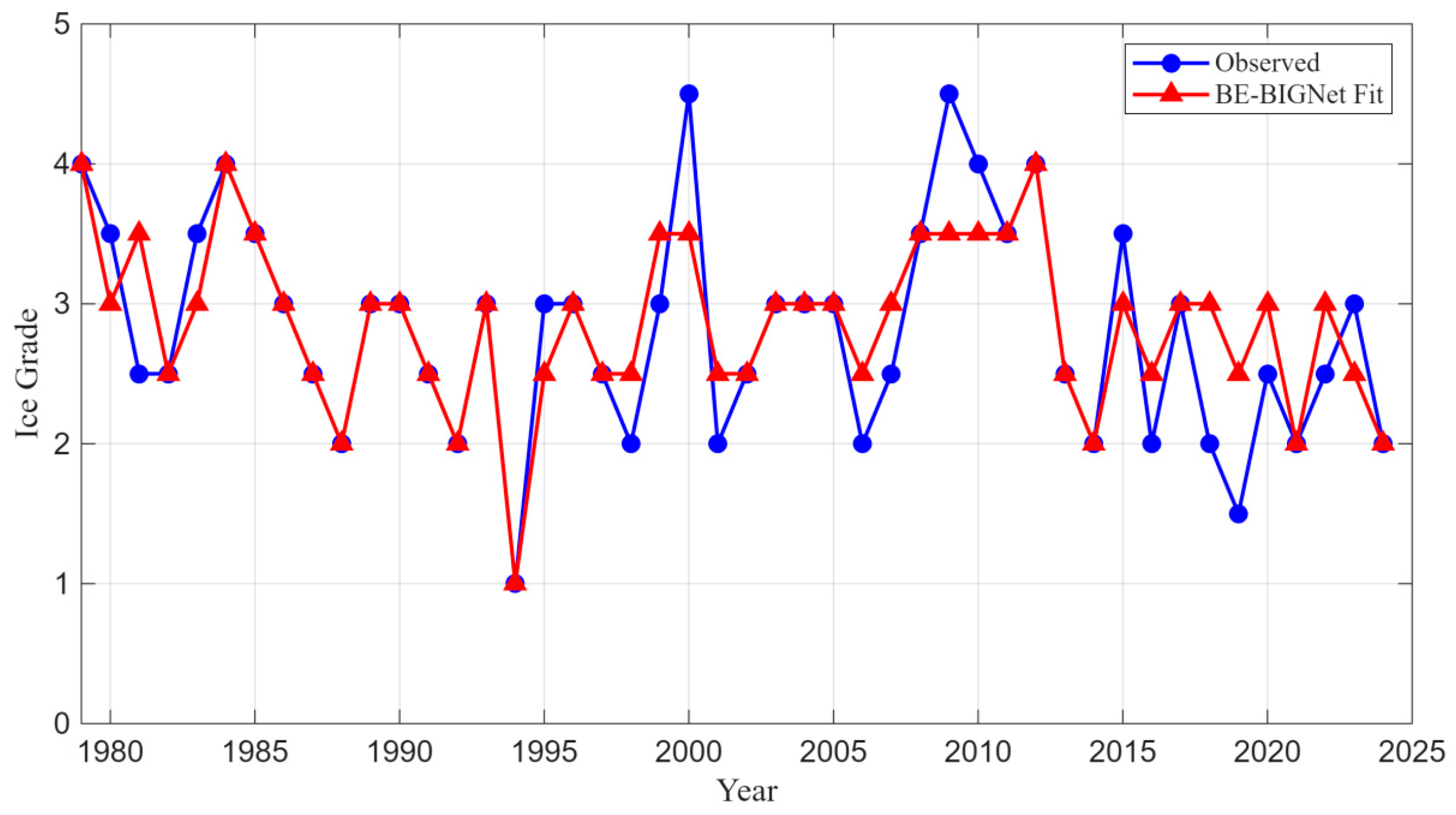
The BE-BIGNet model shows stable performance and relatively low prediction error (Figure 13). Adopting a three-layer feedforward neural network architecture (Input–Hidden–Output) with an optimal four neurons in the hidden layer, the model yielded a training RMSE of 0.44 over the historical period (1979–2019) and a testing RMSE of 0.38 for the independent period (2020–2024), indicating a strong fit to observations. Notably, the model successfully reproduced the heavy ice years of 1979 and 1984 and exhibited enhanced sensitivity to extreme anomalies compared to SVR, although larger deviations persisted for the extreme events of 2000 and 2009. Overall, this framework performs well for the Bohai Sea case and may be useful for operational BSIG prediction.

4. Discussions and Conclusions

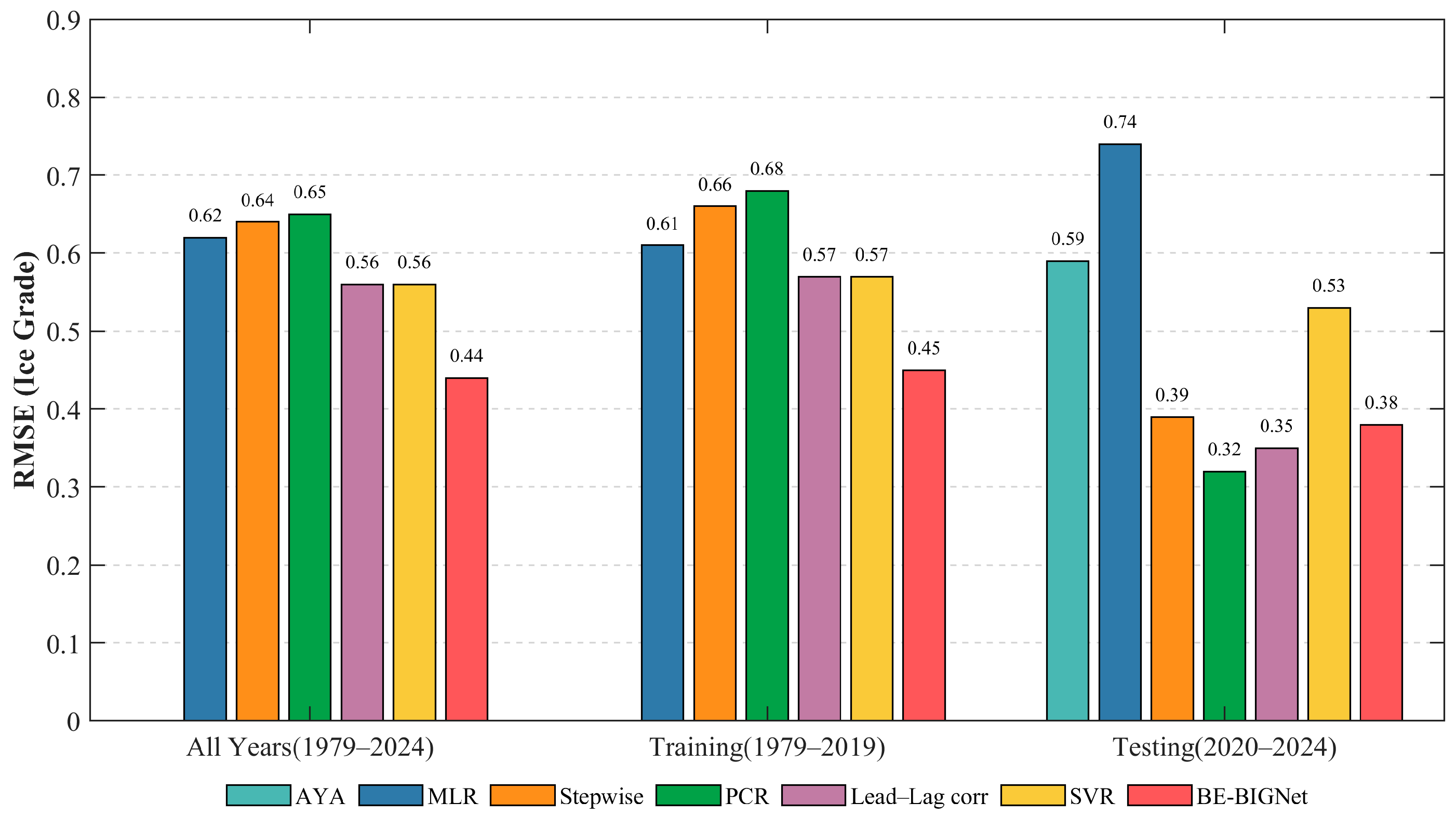
This study conducted an intercomparison of seven prediction methodologies for BSIG, ranging from static analogs to dynamic machine learning approaches. By systematically evaluating the analog year analysis (AYA), multiple linear regression (MLR), stepwise regression, Principal Component Regression (PCR), cross-correlation-based regression model, support vector regression (SVR), and the novel Bayesian Ensemble Bohai Ice Grade Net (BE-BIGNet), we established a hierarchy of model capability where each successive methodological advancement addresses the specific limitations of preceding approaches. The RMSEs of those prediction methods are compared in Figure 14. The advantages and limitations of those methods are summarized in Table 2.
The substantial increase in cross-model RMSE differences between training and testing periods suggests that traditional statistical methods are limited by overfitting and may lack predictive skill for BSIG within a nonstationary climate system. The analog year analysis serves as a useful reference but relies on “stationarity” assumptions that are becoming invalid in the context of global warming. Similarly, while regression analyses establish quantitative baselines, they often struggle with multicollinearity among atmospheric predictors. Although PCR resolves the multicollinearity issue through orthogonal decomposition, it remains bound by linear assumptions, restricting its ability to resolve the complex nonlinear interactions characteristic of air–sea coupling.
These limitations were reflected by the performance evaluation. During the independent testing period (2020–2024), the RMSE of the analog year analysis was 0.59, and the standard multiple linear regression (MLR) model degraded to 0.74, reflecting a significant inability to adapt to the non-stationary shifts in the recent climate background. While optimized linear models such as stepwise regression and PCR achieved superficially low RMSEs (0.39 and 0.32, respectively) in the testing period, their historical training performances were notably poorer (RMSEs of 0.66 and 0.68); this lack of consistency across different periods renders their long-term skill unstable and less reliable for operational baselines. Furthermore, while the machine learning approach SVR avoided severe overfitting and maintained relative stability (testing RMSE of 0.46), it failed to outperform the optimized linear models during this specific period, largely because its loss function structure tends to be overly conservative regarding extreme anomalies. Among the evaluated methods, BE-BIGNet demonstrated good stability and accuracy across both the training and independent testing periods. Over the full 1979–2024 period, it achieved an RMSE of 0.44, outperforming all other baseline models evaluated in this study. By integrating the nonlinear fitting capabilities of a neural network with Bayesian regularization and ensemble averaging, this architecture is particularly well-suited to the small-sample constraints inherent in BSIG prediction. Ultimately, these results indicate that BE-BIGNet provides a highly reliable framework for operational BSIG forecasting and regional disaster mitigation.
While the BE-BIGNet framework exhibits robust predictive skill for the overall winter BSIG, it is important to acknowledge that sea ice severity exhibits significant spatial variability across different regions of the Bohai Sea. This study focuses exclusively on a macroscopic, basin-wide index because our primary objective is to support strategic, large-scale disaster preparedness. Fundamentally, the BSIG is dictated by the most severe ice event recorded anywhere within the basin. Consequently, predicting this single comprehensive grade aligns directly with the operational mandate of preparing for worst-case scenarios.

Author Contributions

Conceptualization, D.G. and X.Z.; methodology, Y.Z.; software, X.C.; validation, S.G., G.L. and Q.H.; formal analysis, D.G.; investigation, X.Z.; resources, Y.Z.; data curation, X.C.; writing—original draft preparation, D.G.; writing—review and editing, Y.Z.; visualization, S.G.; supervision, G.L.; project administration, Q.H.; funding acquisition, D.G. All authors have read and agreed to the published version of the manuscript.

Funding

This research was funded by National Natural Science Foundation of China grant number 42206222.

Data Availability Statement

The Bohai Sea Ice Grade data are derived from the China Marine Disaster Bulletin and are publicly available at https://www.mnr.gov.cn/sj/sjfw/hy/gbgg/zghyzhgb/ (accessed on 30 October 2025). The Arctic sea ice data are obtained from the National Snow and Ice Data Center (NSIDC) and are available at https://noaadata.apps.nsidc.org/NOAA/G02135/north/monthly/data/ (accessed on 5 December 2025). The 114 atmospheric and oceanic circulation indices are provided by the National Climate Center of China and can be accessed at https://cmdp.ncc-cma.net/Monitoring/cn_index_130.php (accessed on 12 November 2025).

Acknowledgments

The authors have reviewed and edited the output and take full responsibility for the content of this publication.

Conflicts of Interest

The authors declare that the research was conducted in the absence of any commercial or financial relationships that could be construed as a potential conflict of interest.

Appendix A

Table A1. List of atmospheric circulation and oceanic indices used in this study.
Full NameShort Name
1Northern Hemisphere Subtropical High AreaNH_SH_A
2North African Subtropical High AreaNAf_SH_A
3North African–North Atlantic–North American Subtropical High AreaNAf_NAtl_NAm_SH_A
4Indian Subtropical High AreaInd_SH_A
5Western Pacific Subtropical High AreaWP_SH_A
6Eastern Pacific Subtropical High AreaEP_SH_A
7North American Subtropical High AreaNAm_SH_A
8Atlantic Subtropical High AreaAtl_SH_A
9South China Sea Subtropical High AreaSCS_SH_A
10North American–Atlantic Subtropical High AreaNAm_Atl_SH_A
11Pacific Subtropical High AreaPac_SH_A
12Northern Hemisphere Subtropical High IntensityNH_SH_I
13North African Subtropical High IntensityNAf_SH_I
14North African–North Atlantic–North American Subtropical High IntensityNAf_NAtl_NAm_SH_I
15Indian Subtropical High IntensityInd_SH_I
16Western Pacific Subtropical High IntensityWP_SH_I
17Eastern Pacific Subtropical High IntensityEP_SH_I
18North American Subtropical High IntensityNAm_SH_I
19North Atlantic Subtropical High IntensityNAtl_SH_I
20South China Sea Subtropical High IntensitySCS_SH_I
21North American–North Atlantic Subtropical High IntensityNAm_NAtl_SH_I
22Pacific Subtropical High IntensityPac_SH_I
23Northern Hemisphere Subtropical High Ridge PositionNH_SH_RP
24North African Subtropical High Ridge PositionNAf_SH_RP
25North African–North Atlantic–North American Subtropical High Ridge PositionNAf_NAtl_NAm_SH_RP
26Indian Subtropical High Ridge PositionInd_SH_RP
27Western Pacific Subtropical High Ridge PositionWP_SH_RP
28Eastern Pacific Subtropical High Ridge PositionEP_SH_RP
29North American Subtropical High Ridge PositionNAm_SH_RP
30Atlantic Subtropical High Ridge PositionAtl_SH_RP
31South China Sea Subtropical High Ridge PositionSCS_SH_RP
32North American–North Atlantic Subtropical High Ridge PositionNAm_NAtl_SH_RP
33Pacific Subtropical High Ridge PositionPac_SH_RP
34Northern Hemisphere Subtropical High Northern Boundary PositionNH_SH_NB
35North African Subtropical High Northern Boundary PositionNAf_SH_NB
36North African–North Atlantic–North American Subtropical High Northern Boundary PositionNAf_NAtl_NAm_SH_NB
37Indian Subtropical High Northern Boundary PositionInd_SH_NB
38Western Pacific Subtropical High Northern Boundary PositionWP_SH_NB
39Eastern Pacific Subtropical High Northern Boundary PositionEP_SH_NB
40North American Subtropical High Northern Boundary PositionNAm_SH_NB
41Atlantic Subtropical High Northern Boundary PositionAtl_SH_NB
42South China Sea Subtropical High Northern Boundary PositionSCS_SH_NB
43North American–Atlantic Subtropical High Northern Boundary PositionNAm_Atl_SH_NB
44Pacific Subtropical High Northern Boundary PositionPac_SH_NB
45Western Pacific Subtropical High Western Ridge PointWP_SH_WRP
46Asia Polar Vortex AreaAsia_PV_A
47Pacific Polar Vortex AreaPac_PV_A
48North American Polar Vortex AreaNAm_PV_A
49Atlantic–European Polar Vortex AreaAtlEu_PV_A
50Northern Hemisphere Polar Vortex AreaNH_PV_A
51Asia Polar Vortex IntensityAsia_PV_I
52Pacific Polar Vortex IntensityPac_PV_I
53North American Polar Vortex IntensityNAm_PV_I
54Atlantic–European Polar Vortex IntensityAtlEu_PV_I
55Northern Hemisphere Polar Vortex IntensityNH_PV_I
56Northern Hemisphere Polar Vortex Central LongitudeNH_PV_Lon
57Northern Hemisphere Polar Vortex Central LatitudeNH_PV_Lat
58Northern Hemisphere Polar Vortex Central IntensityNH_PV_CI
59Eurasian Zonal CirculationEur_ZC
60Eurasian Meridional CirculationEur_MC
61Asian Zonal CirculationAsia_ZC
62Asian Meridional CirculationAsia_MC
63East Asian Trough PositionEAT_RP
64East Asian Trough IntensityEAT_I
65Tibet Plateau Region 1TP_R1
66Tibet Plateau Region 2TP_R2
67India–Burma Trough IntensityIBT_I
68Arctic OscillationAO
69Antarctic OscillationAAO
70North Atlantic OscillationNAO
71Pacific/North American PatternPNA
72East Atlantic PatternEA
73West Pacific PatternWestern Pacific
74North Pacific PatternNP
75East Atlantic–West Russia PatternEA_WR
76Tropical–Northern Hemisphere PatternTNH
77Polar–Eurasia PatternPOL
78Scandinavia PatternSCA
79Pacific Transition PatternPT
8030 hPa Zonal WindZW30
8150 hPa Zonal WindZW50
82Mid-Eastern Pacific 200 mb Zonal WindMEP200_ZW
83West Pacific 850 mb Trade WindWP850_TW
84Central Pacific 850 mb Trade WindCP850_TW
85East Pacific 850 mb Trade WindEP850_TW
86Atlantic–European Circulation W PatternAtlEu_W
87Atlantic–European Circulation C PatternAtlEu_C
88Atlantic–European Circulation E PatternAtlEu_E
89NINO 1 + 2 SSTANINO1 + 2
90NINO 3 SSTANINO3
91NINO 4 SSTANINO4
92NINO 3.4 SSTANINO3.4
93NINO W SSTANINO_W
94NINO C SSTANINO_C
95NINO A SSTANINO_A
96NINO B SSTANINO_B
97NINO Z SSTANINO_Z
98Tropical Northern Atlantic SSTTNA_SST
99Tropical Southern Atlantic SSTTSA_SST
100Western Hemisphere Warm PoolWH_WP
101Indian Ocean Warm Pool AreaIO_WP_A
102Indian Ocean Warm Pool StrengthIO_WP_I
103Western Pacific Warm Pool AreaWP_WP_A
104Western Pacific Warm Pool StrengthWP_WP_I
105Atlantic Multi-Decadal OscillationAMO
106Oyashio Current SSTOya_SST
107West Wind Drift Current SSTWWD_SST
108Kuroshio Current SSTKur_SST
109ENSO ModokiENSO_M
110Warm-Pool ENSOWP_ENSO
111Cold-Tongue ENSOCT_ENSO
112Indian Ocean Basin-WideIOBW
113Tropic Indian Ocean DipoleTIOD
114South Indian Ocean DipoleSIOD

Appendix B

Table A2. Circulation and oceanic factors utilized in Principal Component Analysis (PCA). These factors were selected from 40 candidates that were retained based on their correlation with sea ice grade.
RankName
1Cold-Tongue ENSO Index
2NINO W SSTA Index
3North American Subtropical High Area Index
4Tibet Plateau Region 1 Index
5North American Subtropical High Intensity Index
6Western Pacific Warm Pool Strength Index
7Tibet Plateau Region 2 Index
8NINO 4 SSTA Index
9North American Subtropical High Northern Boundary Position Index
10North American–Atlantic Subtropical High Northern Boundary Position Index
11North American-Atlantic Subtropical High Area Index
12East Atlantic–West Russia Pattern
13North American–North Atlantic Subtropical High Intensity Index
14South Indian Ocean Dipole Index
15Eurasian Meridional Circulation Index
16ENSO Modoki Index
17Eastern Pacific Subtropical High Intensity Index
18North African–North Atlantic–North American Subtropical High Northern Boundary Position Index
19Eurasian Zonal Circulation Index
20Eastern Pacific Subtropical High Area Index
21North American Polar Vortex Area Index
22Northern Hemisphere Subtropical High Intensity Index
23Northern Hemisphere Subtropical High Area Index
24North African–North Atlantic–North American Subtropical High Intensity Index
25Atlantic Subtropical High Northern Boundary Position Index
26Atlantic–European Polar Vortex Area Index
27Pacific Subtropical High Area Index
28North Atlantic Subtropical High Intensity Index
29Pacific Subtropical High Intensity Index
30East Atlantic Pattern
31North African–North Atlantic–North American Subtropical High Area Index
32West Pacific Pattern
33North Pacific Pattern
34Polar–Eurasia Pattern
35Northern Hemisphere Polar Vortex Area Index
36Atlantic Subtropical High Area Index
37Northern Hemisphere Polar Vortex Central Intensity Index
38Indian Ocean Warm Pool Strength Index
39India-Burma Trough Intensity Index
40Asian Zonal Circulation Index

Appendix C

Table A3. The sea ice extent for the Barents Sea (November) and the Chukchi and Bering Seas (September).
BarentsChukchiBering
YearMonthExtent (km2)MonthExtent (km2)MonthExtent (km2)
197911377,561.729308,077.9794215.978
198011623,931.259506,905.5793898.599
198111354,210.269489,316.6294060.381
198211613,847.39421,360.2593373.778
198311477,744.329600,991.0693216.116
198411263,543.789404,113.3391567.284
198511402,748.39490,673.7192130.472
198611391,234.619361,453.7792210.436
198711484,374.959468,233.0492291.433
198811673,910.619585,884.5592372.224
198911457,087.199375,303.8192712.125
199011429,451.599319,286.2991948.287
199111486,556.489437,913.9292733.598
199211487,757.159501,605.5792532.877
199311500,023.379230,513.892853.114
199411562,963.189527,528.2293699.229
199511506,111.649410,419.1393477.757
199611300,882.289369,134.892813.529
199711481,642.229279,711.1391710.225
199811626,914.329177,868.991288.197
199911330,594.249218,604.691447.892
200011184,354.359342,758.1291005.904
200111354,509.169403,426.1291086.855
200211482,335.69174,862.1591005.474
200311426,018.269171,492.469584.201
200411353,862.659140,685.659403.342
200511301,938.039235,048.2991949.663
200611180,516.819302,418.4691488.86
200711121,206.67910,905.09591709.774
200811308,402.01913,886.3079644.788
200911932,22.729968,777.3739563.888
201011238,730.39930,460.5499563.278
201111147,293.64943,348.59391026.039
20121156,450.4693463.5699602.667
201311844,22.2649211,466.619382.756
201411403,570.119137,598.019845.387
20151164,105.819115,851.519442.74
20161143,942.011986,152.3039845.371
201711113,114.08944,679.0919482.039
20181189,673.005952,616.72891045.789
201911242,829.93936,843.31591707.377
20201137,772.68197025.3529944.181
202111227,374.139280,898.79442.539
20221198,802.296941,333.83991206.623
202311202,680.71931,880.3089703.175
20241152,933.7249186,051.289865.742

Appendix D

Table A4. Statistical relations between predicting variables and BSIG.
VariableCorrelation CoefficientRegression
Coefficient
Standard Deviationp-Value
Arctic Region Sea Ice ExtentBarents−0.5428−3.52 × 10−61.23 × 1050.0002
Chukchi−0.4672−3.86 × 10−69.67 × 1040.0021
Bering−0.3928−4.62 × 10−4679.19260.0111
Key IndexWP_SH_WRP (Aut0)0.34810.019714.07800.0257
CT_ENSO (Sum0)−0.4701−1.13420.33100.0019
WP850_TW (Win-1)0.43340.17741.95110.0046
NINO4 (Aut-1)−0.4291−0.50750.67540.0051

References

  1. Xu, N.; Liu, X.; Yuan, S.; Zhang, D.; Wang, Y.; Yue, Q.; Shi, W.; Chen, W. Sea Ice Risk Monitoring System on Offshore Structure Based on Emergent Marine Ecological Disaster Risk Prevention: A Case Study of Oil Platform in the Bohai Sea. Ocean Dev. Manag. 2018, 35, 89–92, (In Chinese with English abstract). [Google Scholar]
  2. GB/T 42254—2022; Sea Ice Grade of Bohai Sea and Northern Yellow Sea. Standardization Administration of the People’s Republic of China: Beijing, China, 2022; (In Chinese with English abstract).
  3. Yan, Y.; Uotila, P.; Huang, K.; Gu, W. Variability of Sea Ice Area in the Bohai Sea from 1958 to 2015. Sci. Total Environ. 2020, 709, 136164. [Google Scholar] [CrossRef]
  4. Cohen, J.; Screen, J.A.; Furtado, J.C.; Barlow, M.; Whittleston, D.; Coumou, D.; Francis, J.; Dethloff, K.; Entekhabi, D.; Overland, J.; et al. Recent Arctic Amplification and Extreme Mid-Latitude Weather. Nat. Geosci. 2014, 7, 627–637. [Google Scholar] [CrossRef]
  5. Zhang, N.; Wu, Y.; Zhang, Q. Forecasting the Evolution of the Sea Ice in the Liaodong Bay Using Meteorological Data. Cold Reg. Sci. Technol. 2016, 125, 21–30. [Google Scholar] [CrossRef]
  6. Yao, L.; Su, J. Relationships Between Bohai Sea Ice and Siberian High and Possible Connections Between Bohai Sea Ice and North Atlantic Oscillation. Period. Ocean Univ. China 2018, 48, 1–12, (In Chinese with English abstract). [Google Scholar]
  7. Li, C.; Liu, Q.; Huang, H. Statistic Relation between Sea Ice in the Bohai Sea and North Yellow Sea of China and the Subtropical High in the Pacific Ocean. Mar. Sci. Bull. 2009, 28, 43–47, (In Chinese with English abstract). [Google Scholar]
  8. Tian, B.; Fan, K. A Novel Stepwise Regression Method for Predicting September Pan-Arctic Sea-Ice Extent: Comparison with Long Short-Term Memory Neural Networks. Atmos. Ocean. Sci. Lett. 2025, 100727. [Google Scholar] [CrossRef]
  9. Zheng, D.; Zhang, S.; Zhou, Z.; Jia, N.; Wang, Z.; Chen, H. Application of stepwise regression analysis in Bohai sea ice grade forecasting. Mar. Forecast. 2015, 32, 57–61, (In Chinese with English abstract). [Google Scholar]
  10. Jolliffe, I.T. Principal Component Analysis; Springer Science & Business Media: New York, NY, USA, 2002. [Google Scholar]
  11. van den Dool, H. Empirical Methods in Short-Term Climate Prediction; Oxford University Press: Oxford, UK, 2007. [Google Scholar]
  12. Asadi, N.; Lamontagne, P.; King, M.; Richard, M.; Scott, K.A. Probabilistic Spatiotemporal Seasonal Sea Ice Presence Forecasting Using Sequence-to-Sequence Learning and ERA5 Data in the Hudson Bay Region. Cryosphere 2022, 16, 3753–3773. [Google Scholar] [CrossRef]
  13. Yang, Z.; Liu, J.; Song, M.; Hu, Y.; Yang, Q.; Fan, K.; Graversen, R.G.; Zhou, L. Extended Seasonal Prediction of Antarctic Sea Ice Concentration Using ANTSIC-UNet. Cryosphere 2025, 19, 6381–6402. [Google Scholar] [CrossRef]
  14. Wheeler, M.C.; Hendon, H.H. An All-Season Real-Time Multivariate MJO Index: Development of an Index for Monitoring and Prediction. Mon. Weather. Rev. 2004, 132, 1917–1932. [Google Scholar] [CrossRef]
  15. Wilks, D.S. Statistical Methods in the Atmospheric Sciences. In International Geophysics, 3rd ed.; Elsevier: Amsterdam, The Netherlands, 2011. [Google Scholar]
  16. Smola, A.J.; Schölkopf, B. A Tutorial on Support Vector Regression. Stat. Comput. 2004, 14, 199–222. [Google Scholar] [CrossRef]
  17. Breiman, L. Bagging Predictors. Mach. Learn. 1996, 24, 123–140. [Google Scholar] [CrossRef]
  18. Ashok, K.; Behera, S.K.; Rao, S.A.; Weng, H.; Yamagata, T. El Niño Modoki and Its Possible Teleconnection. J. Geophys. Res. Ocean. 2007, 112, C11007. [Google Scholar] [CrossRef]
  19. Yu, J.-Y.; Kao, H.-Y.; Lee, T. Subtropics-Related Interannual Sea Surface Temperature Variability in the Central Equatorial Pacific. J. Clim. 2010, 23, 2869–2884. [Google Scholar] [CrossRef]
  20. Kug, J.-S.; Jin, F.-F.; An, S.-I. Two Types of El Niño Events: Cold Tongue El Niño and Warm Pool El Niño. J. Clim. 2009, 22, 1499–1515. [Google Scholar] [CrossRef]
  21. Anderson, B.T.; Perez, R.C.; Karspeck, A. Triggering of El Niño Onset through Trade Wind–Induced Charging of the Equatorial Pacific. Geophys. Res. Lett. 2013, 40, 1212–1216. [Google Scholar] [CrossRef]
  22. Xu, K.; Tam, C.-Y.; Liu, B.; Chen, S.; Yang, X.; He, Z.; Xie, Q.; Wang, W. Attenuation of Central Pacific El Niño Amplitude by North Pacific Sea Surface Temperature Anomalies. J. Clim. 2020, 33, 6673–6688. [Google Scholar] [CrossRef]
  23. Kim, J.-W.; An, S.-I.; Jun, S.-Y.; Park, H.-J.; Yeh, S.-W. ENSO and East Asian Winter Monsoon Relationship Modulation Associated with the Anomalous Northwest Pacific Anticyclone. Clim. Dyn. 2017, 49, 1157–1179. [Google Scholar] [CrossRef]
  24. Wang, B.; Wu, R.; Fu, X. Pacific–East Asian Teleconnection: How Does ENSO Affect East Asian Climate? J. Clim. 2000, 13, 1517–1536. [Google Scholar] [CrossRef]
  25. Kim, J.-W.; Chang, T.-H.; Lee, C.-T.; Yu, J.-Y. On the Varying Responses of East Asian Winter Monsoon to Three Types of El Niño: Observations and Model Hindcasts. J. Clim. 2021, 34, 4089–4101. [Google Scholar] [CrossRef]
  26. Yan, Y.; Shao, D.; Gu, W.; Liu, C.; Li, Q.; Chao, J.; Tao, J.; Xu, Y. Multidecadal Anomalies of Bohai Sea Ice Cover and Potential Climate Driving Factors during 1988–2015. Environ. Res. Lett. 2017, 12, 094014. [Google Scholar] [CrossRef]
  27. Gui, S.; Cheng, J.; Yang, R.; He, Q.; Dong, Z.; Ma, J.; Chu, Q.; Hou, M. Interannual Variation of the Westward Ridge Point of the Western Pacific Subtropical High in Boreal Winter. Glob. Planet. Change 2024, 240, 104528. [Google Scholar] [CrossRef]
  28. Honda, M.; Inoue, J.; Yamane, S. Influence of Low Arctic Sea-Ice Minima on Anomalously Cold Eurasian Winters. Geophys. Res. Lett. 2009, 36, L08707. [Google Scholar] [CrossRef]
  29. Liu, J.; Curry, J.A.; Wang, H.; Song, M.; Horton, R.M. Impact of Declining Arctic Sea Ice on Winter Snowfall. Proc. Natl. Acad. Sci. USA 2012, 109, 4074–4079. [Google Scholar] [CrossRef]
  30. Wu, B.; Su, J.; Zhang, R. Effects of Autumn-Winter Arctic Sea Ice on Winter Siberian High. Chin. Sci. Bull. 2011, 56, 3220–3228. [Google Scholar] [CrossRef]
  31. Inoue, J.; Hori, M.E.; Takaya, K. The Role of Barents Sea Ice in the Wintertime Cyclone Track and Emergence of a Warm-Arctic Cold-Siberian Anomaly. J. Clim. 2012, 25, 2561–2568. [Google Scholar] [CrossRef]
  32. Bansal, N.; Defo, M.; Lacasse, M.A. Application of Support Vector Regression to the Prediction of the Long-Term Impacts of Climate Change on the Moisture Performance of Wood Frame and Massive Timber Walls. Buildings 2021, 11, 188. [Google Scholar] [CrossRef]
  33. Tashman, L.J. Out-of-Sample Tests of Forecasting Accuracy: An Analysis and Review. Int. J. Forecast. 2000, 16, 437–450. [Google Scholar] [CrossRef]
  34. Su, H.; Wang, Y. Using MODIS Data to Estimate Sea Ice Thickness in the Bohai Sea (China) in the 2009–2010 Winter. J. Geophys. Res. 2012, 117, C10018. [Google Scholar] [CrossRef]
  35. Burden, F.; Winkler, D. Bayesian Regularization of Neural Networks. In Artificial Neural Networks: Methods and Applications; Livingstone, D.J., Ed.; Methods in Molecular Biology; Humana Press: Totowa, NJ, USA, 2008; Volume 458, pp. 23–42. [Google Scholar]
  36. Choi, M.; De Silva, L.W.A.; Yamaguchi, H. Artificial Neural Network for the Short-Term Prediction of Arctic Sea Ice Concentration. Remote Sens. 2019, 11, 1071. [Google Scholar] [CrossRef]
  37. Kourentzes, N.; Barrow, D.K.; Crone, S.F. Neural Network Ensemble Operators for Time Series Forecasting. Expert Syst. Appl. 2014, 41, 4235–4244. [Google Scholar] [CrossRef]
Figure 1. (a) Topography of the Bohai Sea with key coastal cities marked by red dots; (b) spatial distribution of sea ice in the Bohai Sea observed by the Geostationary Ocean Color Imager (GOCI) on 24 January 2024.
Water 18 01242 g001
Figure 2. (a) Summer (June–August) 500 hPa geopotential height anomaly field for 2024 used as the target projection pattern; (b) composite 500 hPa geopotential height anomaly field constructed from historical analog years identified using the projection index method (|PI| ≥ 0.5 standard deviations).
Water 18 01242 g002
Figure 3. Composite winter Bohai Sea Ice Grade (BSIG) corresponding to historical analog years selected based on similarity of summer 500 hPa geopotential height anomaly patterns. Blue dots indicate analog years identified by the projection index, and red diamond denotes the observed BSIG in the subsequent winters.
Water 18 01242 g003
Figure 4. Comparison between projected (red) and observed (black) Bohai Sea Ice Grade (BSIG) during the independent evaluation period (2020–2024).
Water 18 01242 g004
Figure 5. Comparison between observed sea ice grade and fitted results obtained by the Top 10 correlation regression and Stepwise Seasonal Regression during the period 1979–2024.
Water 18 01242 g005
Figure 6. (Blue) individual and (orange) cumulative variance explained by the principal components.
Water 18 01242 g006
Figure 7. Comparison between observed sea ice grade and fitted results obtained by the PCR during the period 1979–2024.
Water 18 01242 g007
Figure 8. Correlation coefficients between detrended BSIG and atmospheric/oceanic indices (1979–2024). The red and blue shading indicate positive and negative correlations, respectively. Out of 114 calculated indices, only those showing statistical significance (p < 0.05) in at least one lag season are displayed.
Water 18 01242 g008
Figure 9. Locations of the Arctic sea regions utilized in the analysis.
Water 18 01242 g009
Figure 10. Correlation heatmaps between the detrended Bohai Sea Ice Grade (BSIG) and Arctic Sea Ice Extent (1979–2024). The left and right panels display the correlation coefficients for sea ice extent and sea ice area, respectively, across 14 key Arctic regions. The horizontal axis indicates lead times ranging from 1 to 12 months (from the previous December to the current November).
Water 18 01242 g010
Figure 11. Comparison of observed and Exp-8 fitted ice grades.
Water 18 01242 g011
Figure 12. Comparison of observed and SVR model fitted ice grades.
Water 18 01242 g012
Figure 13. Comparison of observed and BE-BIGNet predicted ice grades.
Water 18 01242 g013
Figure 14. Comparison of prediction performance (RMSE) among six models across different periods.
Water 18 01242 g014
Table 1. Configuration of predictors and prediction skill (RMSE) across different experimental schemes (Exp1–Exp18). The checkmarks (●) denote the variables included in each experiment. The regression coefficients, standard errors, and p-values for each parameter against the BSIG are also detailed in Appendix D for readers’ convenience.
Arctic Region Sea Ice ExtentKey Index
Barents
(Lag 1 mon)
Chukchi
(Lag 3 mon)
Bering
(Lag 3 mon)
WP_SH_WRP
(Aut0)
CT_ENSO
(Sum0)
WP850_TW
(Win-1)
NINO4
(Aut-1)
RMSERMSE
(5 Yr)
Exp-1 0.5570.559
Exp-2 0.5710.354
Exp-3 0.5990.612
Exp-4 0.5760.500
Exp-5 0.5990.433
Exp-6 0.6510.612
Exp-7 0.5570.559
Exp-8 0.5570.354
Exp-9 0.5710.612
Exp-10 0.5940.433
Exp-11 0.6120.433
Exp-12 0.6260.612
Exp-130.5570.559
Exp-14 0.5570.354
Exp-15 0.6030.612
Exp-16 0.6120.612
Exp-17 0.5800.433
Exp-18 0.6120.612
Table 2. Summary of advantages and limitations of seven BSIG prediction methods.
MethodTypeAdvantagesLimitations
Analog Year Analysis (AYA)Empirical/analog-basedPhysically intuitive; effective for small samples; operationally establishedAssumes stationarity; limited robustness under climate change; cannot represent nonlinear dynamics
Multiple Linear Regression (MLR)Linear statisticalSimple and interpretable; computationally efficientSensitive to multicollinearity; restricted to linearity; prone to overfitting under nonstationarity
Stepwise RegressionLinear statistical (feature selection)Reduces predictor redundancy; improves parsimonySelection instability; sampling dependence; weak physical interpretability
Principal Component Regression (PCR)Linear statistical (dimension reduction)Mitigates multicollinearity; improves numerical stabilityLoss of physical meaning; linear constraint; limited extreme-event representation
Cross-Correlation-Based RegressionPhysically constrained statisticalIncorporates lagged climate signals; partially physically interpretableStill linear; unstable lag relationships under changing climate conditions
Support Vector Regression (SVR)Machine learningCaptures nonlinear relationships; robust for small samples; good generalizationSensitive to hyperparameters; limited interpretability; underestimates extremes
BE-BIGNetBayesian ensemble learningStrong nonlinear representation; reduces overfitting; robust for small datasetsHigh computational cost; structural complexity; limited interpretability
Disclaimer/Publisher’s Note: The statements, opinions and data contained in all publications are solely those of the individual author(s) and contributor(s) and not of MDPI and/or the editor(s). MDPI and/or the editor(s) disclaim responsibility for any injury to people or property resulting from any ideas, methods, instructions or products referred to in the content.