Article

Deep Learning-Based Downstream Water Level Prediction Enhanced by Upstream Predict Information

1
Department of Smart City Engineering, Inha University, Incheon 22201, Republic of Korea
2
Department of Hydro Science and Engineering Research, Korea Institute of Civil Engineering and Building Technology (KICT), Goyang 10223, Republic of Korea
3
Department of Civil Engineering, Inha University, Incheon 22201, Republic of Korea
*
Author to whom correspondence should be addressed.
Water 2026, 18(10), 1231; https://doi.org/10.3390/w18101231
Submission received: 7 April 2026 / Revised: 4 May 2026 / Accepted: 16 May 2026 / Published: 19 May 2026
(This article belongs to the Section Hydrology)

Abstract

Climate change and urbanization have increased the precipitation variability and extreme hydrological events, highlighting the need for accurate river water level prediction. This study proposes a two-step sequential prediction framework based on a Long Short-Term Memory (LSTM) model and evaluates the impact of hydrological connectivity among observation stations on predictive performance. In Step 1, water levels at upstream and downstream stations are predicted. In Step 2, these predictions are incorporated as additional inputs for forecasting water levels at a target station. Input variables are selected using information gain (IG), and multicollinearity is assessed with the variance inflation factor (VIF). Results show that at Pojin Bridge, where short-term fluctuations are significant, incorporating predicted upstream and downstream water levels improves the coefficient of determination (R2) by approximately 3.9% to 9.24% as lead time increases. In contrast, at Andong Bridge, where hydrological responses are relatively stable, the additional inputs reduce model performance. These findings indicate that the effectiveness of incorporating hydrological connectivity depends on station-specific characteristics. The study provides practical guidance for designing data-driven river forecasting models under varying hydrological conditions.

1. Introduction

Climate change-induced alterations in atmospheric and hydrological circulation have increasingly complicated precipitation patterns on a global scale [1,2]. Coupled with intensified urbanization, these changes have been recognized as major factors increasing the risks of natural disasters, such as floods and droughts [3,4]. Extreme rainfall and prolonged droughts have long been recognized as critical risk factors in water resource management [5]. However, recent observational data indicates that intensity–duration–frequency (IDF) curves developed under the conventional assumption of stationarity show limitations in adequately capturing altered precipitation characteristics and the increasing trends of extreme rainfall events [3,6,7]. These nonstationary characteristics of the climate system directly affect river water levels, which serve as fundamental data for various applications, including the design of water resource infrastructure, flood risk assessment, and water supply planning. Consequently, research aimed at accurately simulating or predicting river water levels has emerged as an important research topic in the fields of water resource management and disaster response [8,9,10].
Previous studies aimed at the prediction and management of water-related disasters can be broadly categorized into numerical model-based approaches [11,12,13], machine learning techniques [14,15,16], probabilistic models [17], and hybrid models that combine two or more methodologies [18,19,20]. These approaches have been applied according to various prediction objectives and application environments [21]. Among these approaches, physics-based numerical models have the advantage of systematically simulating hydrological processes. However, they often rely on conceptual or empirical assumptions in the model development process, which can lead to considerable uncertainty in parameter estimation and limit general applicability across different basins or climatic conditions [22,23]. As an alternative to overcoming these limitations, recent studies have employed machine learning techniques for hydrological and meteorological prediction. These approaches have demonstrated the capability to effectively learn complex nonlinear relationships and partially overcome the limitations of conventional physics-based models [24,25,26]. In addition, with the advancement of observation network infrastructure and remote sensing technologies, both the quantity and quality of hydrological and meteorological data have improved, leading to growing attention toward data-based machine learning modeling [21,27,28].
In data-based modeling studies, such as machine learning and deep learning, securing high-quality training data and systematically preprocessing them are critical processes that determine model performance and typically require the greatest amount of time and effort throughout the research workflow [29]. As a strategy to alleviate this challenge, several studies have attempted to analyze hydrological cycle characteristics in data-scarce regions by integrating complementary datasets, such as ground-based observation data and satellite-based data [30,31]. In addition, studies have been conducted to address missing data issues by employing data-based models for missing value imputation [32,33]. In the field of language models, where data-driven models have rapidly advanced, recent studies suggest that model training based on human-generated data is approaching its limits and that model-generated data are increasingly being used for training [34,35]. This indicates that structural limitations have been reached in continuously securing high-quality data required to further improve the performance of data-driven models.
Recent studies have explored machine learning–based approaches for river water-level prediction, using observational data such as upstream water levels and rainfall as key input variables [36,37]. These studies have been conducted in regions with diverse climatic conditions, including Malaysia, Hungary, Indonesia, and China, where algorithms such as Multi-Layer Perceptron (MLP) and Long Short-Term Memory (LSTM) have been widely applied for water-level prediction [38,39,40,41]. However, cases demonstrating robust predictive performance under high-water-level conditions, such as floods, remain relatively limited [20,27]. This suggests that the availability of sufficient high-quality training data capable of adequately representing extreme conditions has become constrained. Accordingly, several studies have proposed new training strategies using generated or synthetic data to improve model performance [42,43,44]. Previous studies have improved downstream water-level prediction by incorporating hydrological observations from upstream stations [45]. Regression-based models using observed upstream water levels provide simple and practical solutions for data-scarce basins, whereas multivariate machine-learning and deep-learning models using upstream water level, discharge, rainfall, temperature, reservoir release, or radar information can better capture nonlinear and spatially connected hydrological processes [46]. Nevertheless, these studies mostly depend on observed upstream variables or extensive auxiliary datasets, and relatively few have examined cascaded forecasting frameworks in which predicted upstream water levels are used as inputs for downstream water-level prediction [47]. However, studies that utilize predicted upstream water levels as input variables to enhance downstream water-level prediction remain relatively limited.
This study aims to improve river water-level prediction by examining the use of predicted water-level data from both upstream and downstream stations as key input variables. Previous studies suggest that data-driven approaches can partly overcome the limitations of physical and statistical hydrological models by learning nonlinear hydrological relationships [48,49]. Building on this research direction, this study integrates deep learning-based predicted water-level data with meteorological and observed water-level data. The predictive performance is evaluated under various input combinations to identify an effective framework for real-time river water-level prediction. The proposed approach is expected to support the development of early warning systems for flood response and hydrological management under increasing climate-related hydrological uncertainty.

2. Methodology

2.1. Study Area

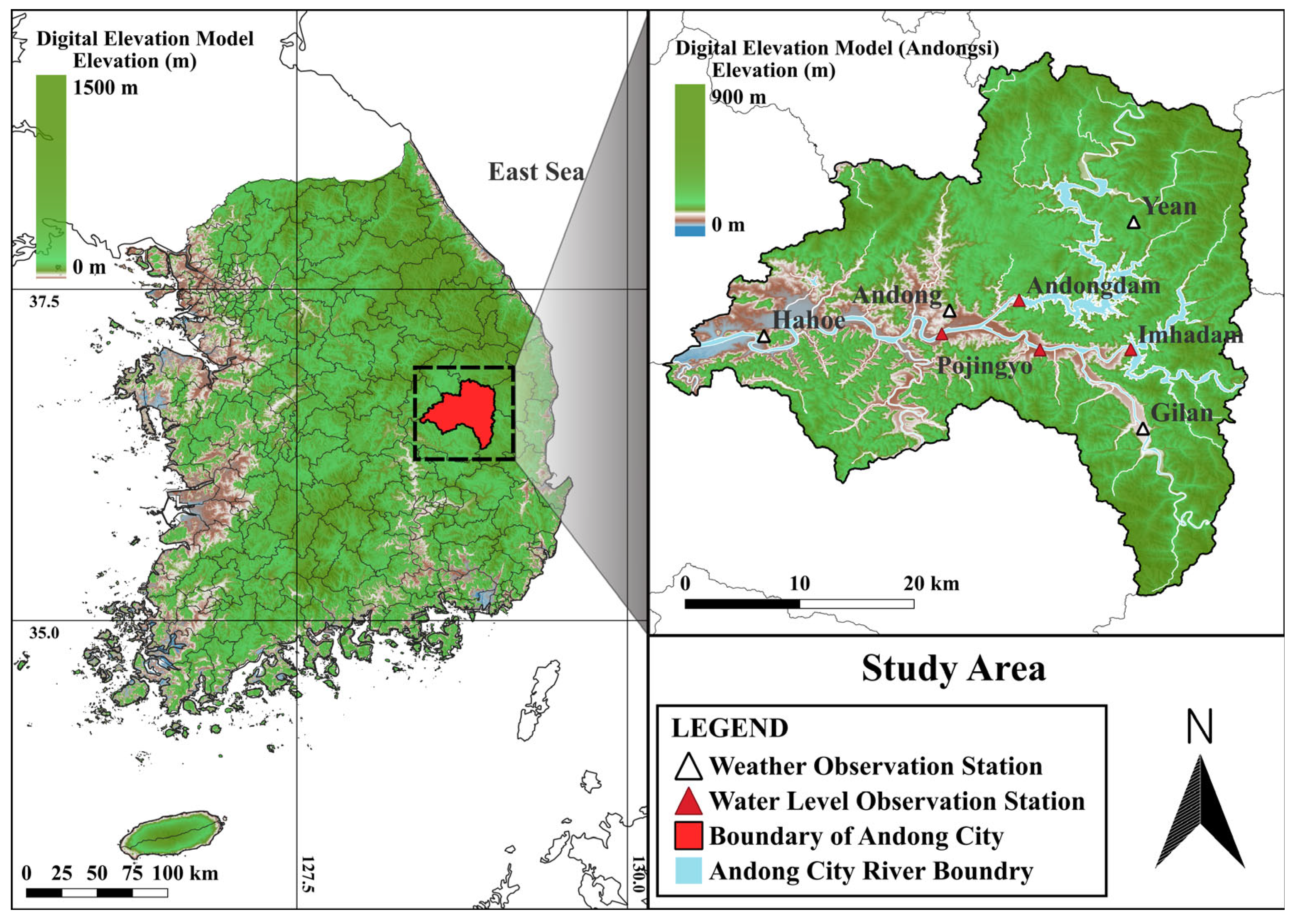
The study area is Andong City, located in Gyeongsangbuk-do, Republic of Korea (Figure 1). Andong City is characterized by mountainous terrain with limited plains. The region has an average annual temperature of approximately 12.2 °C and an average annual precipitation of about 1045 mm. More than 50% of the annual precipitation is concentrated during the summer season, reflecting the typical characteristics of the East Asian monsoon climate [50,51]. Two multi-purpose dams are currently in operation in Andong City, located in the upper Nakdong River basin, and are installed along the upper reaches of the Banbyeon Stream and the main stem of the Nakdong River, respectively. These two dams perform flood control and water resource management functions for the Nakdong River basin and directly influence the downstream hydrological and hydraulic environment. Within the study area, two national rivers and nine water-level observation stations are distributed. Major observation sites include the Pojin Bridge (Pyojingyo) water-level gauging station, located near the confluence of the Banbyeon Stream and the Nakdong River, and the Andong Bridge (Andongdaegyo) water-level gauging station, located along the Nakdong River section that passes through the urban area. In addition, water-level data for the spillways and regulating dams associated with each multi-purpose dam are also continuously monitored and provided.
Andong City was selected as the study area mainly because it provides sufficient and continuous hydrological observation data from multiple upstream and downstream water-level stations, including dam-related monitoring points. This data availability is essential for evaluating the proposed framework, which uses predicted water-level data from connected stations as input variables. In addition, the city is located in the upper Nakdong River basin and includes two multi-purpose dams and major river confluence sections, making it suitable for examining upstream–downstream water-level interactions in a regulated river system.

2.2. Datasets

2.2.1. Meteorological Data

The meteorological data used in this study were collected from the Automated Synoptic Observing System (ASOS) operated by the Korea Meteorological Administration (KMA) and the Automatic Weather System (AWS) stations installed for disaster prevention purposes. ASOS provides various fundamental meteorological variables, including air temperature, precipitation, dew point temperature, sunshine duration, and ground temperature. Due to its high data quality and the availability of variables not provided by AWS, ASOS stations were used as the primary meteorological observation sources in this study. In contrast, AWS provides a more limited set of variables, mainly air temperature and precipitation. However, its dense station network complements the broader spatial coverage represented by ASOS. Accordingly, air temperature and precipitation data from AWS were used as supplementary sources in this study. Meteorological data covering the period from 1 January 2000 to 31 December 2024 were obtained and used for analysis. The study area includes one ASOS station and three AWS stations. The Andong central meteorological station corresponds to the ASOS station, and the Yean, Gilan, and Hahoe disaster-prevention meteorological stations correspond to the AWS stations. Among these stations, the Andong central, Yean, and Gilan stations were used as final meteorological input sources because they showed better relevance to the water-level gauging stations in terms of distance, spatial representativeness, data continuity, and contribution to prediction performance. The remaining AWS station is shown in the study-area map because it is located within the study area, but it was excluded from the final input configuration because its inclusion did not produce a meaningful improvement in model performance.

2.2.2. Water-Level Data

The water-level data used in this study were obtained from two gauging stations and two multi-purpose dams located in Andong City, and are collected and quality-controlled by the Nakdong River Flood Control Office of the Republic of Korea. Water-level observations at each station cover the period from 1 January 2000 to 31 December 2024, and missing values in the Andongdaegyo and Pojingyo records were supplemented using linear interpolation. Missing values accounted for less than 1% of the total, with the longest gap being approximately 12 h. The dataset was split into training, validation, and test sets at a ratio of 70%, 15%, and 15%, respectively. For the Andong Dam (Andongdam) and Imha Dam (Imhadam), missing data occurred between 2015 and 2019. Accordingly, training, validation, and test sets were constructed based on this period and used for subsequent analysis.

2.3. Overview of Methodology

2.3.1. Long Short-Term Memory

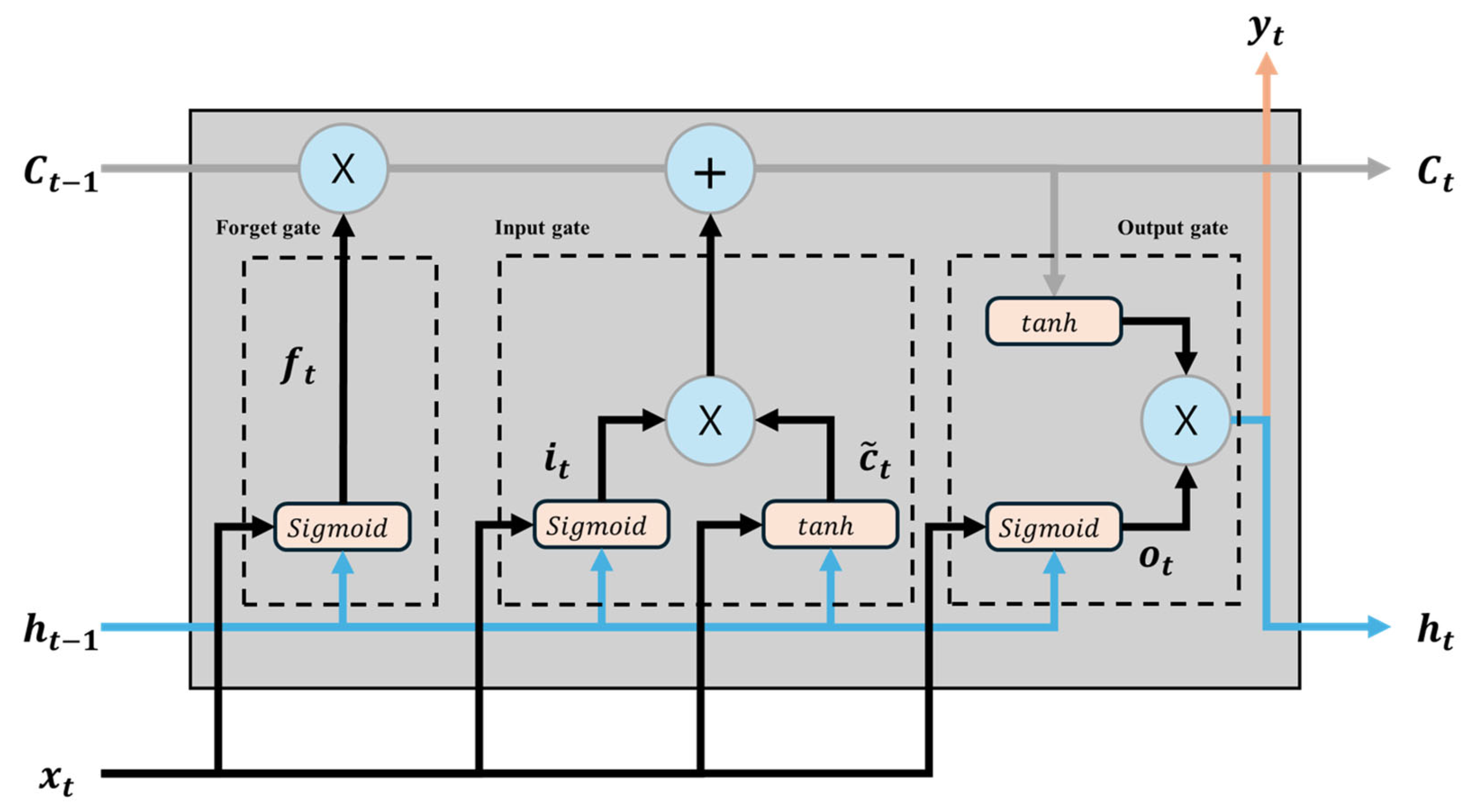
In this study, the Long Short-Term Memory (LSTM) model was selected as the final prediction model to effectively learn the temporal variability of river water levels. LSTM is an extension of the Recurrent Neural Network (RNN), designed to overcome the vanishing gradient problem commonly encountered during long-term time-series learning in standard RNNs [52]. The LSTM model consists of three primary gates: the input gate, forget gate, and output gate. These gates allow the model to discard unnecessary information while retaining important past information in the memory cell over long periods, enabling it to simultaneously learn both the temporal continuity and cumulative effects of the data [53]. The structure and equations of each gate are presented in Figure 2 and in Equations (1)–(6).
f t = σ ( W f · [ h t 1 , x t ] + b f )
i t = σ ( W i · [ h t 1 , x t ] + b i )
C ~ t = tanh ( W C · [ h t 1 , x t ] + b C )
C t = ( f t × C t 1 + i t ) × C ~ t
O t = σ ( W O · [ h t 1 , x t ] + b O )
h t = O t × tan h ( C t )
In this equation, σ denotes the sigmoid function, which maps the output to a range between 0 and 1, thereby controlling the amount of information passing through the gate. tanh() represents the hyperbolic tangent function, which transforms the output into a range between −1 and 1. xt is the input vector at the current time step t, ht−1 is the hidden state from the previous time step, and Ct−1 is the previous cell state. b represents the bias vector for each gate, and W denotes the weight matrix of each gate.
This structural characteristic is well-suited for capturing the temporal causality present in river basin variables, such as precipitation and reservoir water levels. Moreover, interactions among hydrological variables often involve time lags, whereby past water-level changes tend to affect flood levels after a certain period [54,55]. LSTM is capable of inherently learning these lagged effects, making it advantageous for reflecting the specific dynamics of river water-level prediction.
Furthermore, previous studies have extensively compared LSTM with traditional machine learning models and statistical approaches, consistently demonstrating that LSTM-based models provide superior performance in capturing nonlinear temporal dependencies and lag effects in hydrological time-series prediction tasks [23,40,41]. Based on these established findings, this study focused on leveraging the strengths of LSTM rather than conducting an exhaustive model benchmarking, with particular emphasis on developing and validating the proposed two-step sequential framework.
Accordingly, this study leveraged the memory cell architecture of LSTM to quantitatively learn the temporal dependencies of accumulated precipitation, reservoir releases, and inflows during flood-level prediction, aiming to ensure stability in long-term forecasts.

2.3.2. Prediction Strategy

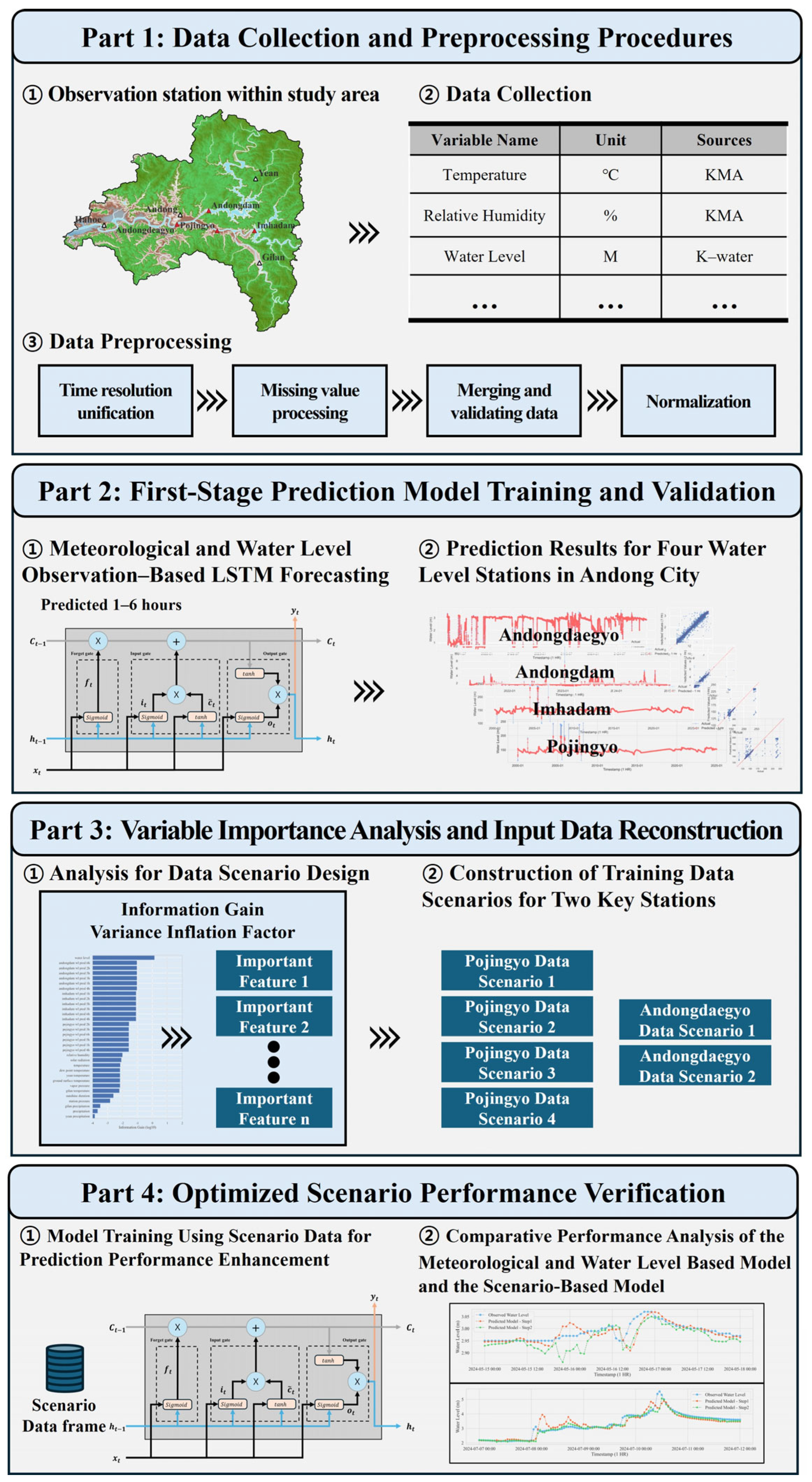
The overall prediction strategy of this study is structured as a two-step sequential workflow, as illustrated in Figure 3. Both Step 1 and Step 2 were developed using the same LSTM-based modeling framework. However, their input variables and learning objectives differ. In Step 1, meteorological variables, such as precipitation, air temperature, and humidity, together with observed water-level data, were used to predict river water levels at one-hour intervals from one to six hours ahead based on the current time step.
In Step 2, the predicted water levels obtained from the Step 1 model were incorporated as additional input variables to refine the initial predictions. By combining these predicted values with the original input variables, the Step 2 model was designed to learn residual errors and temporal variation patterns between the initial predictions and the observed water levels. This sequential prediction strategy aims to reduce biases and uncertainties arising from the initial prediction stage, particularly during periods of rapid water-level rise in the flood season.
Because the two steps involve different input configurations and learning objectives, their hyperparameters were optimized separately using the same optimization procedure. To assess the potential influence of different hyperparameter settings, an additional controlled experiment was conducted using identical hyperparameters for both steps. The results indicate that the observed performance improvement is primarily associated with the inclusion of predicted water-level data as additional input features, rather than differences in hyperparameter settings. Accordingly, the proposed framework was evaluated under both independently optimized and controlled conditions to examine the effect of input-feature configuration on prediction performance.
Unlike recursive forecasting approaches, which iteratively use previous predictions as inputs and may lead to error accumulation, the proposed framework incorporates predicted water-level information from hydrologically connected stations as additional input features in a second-stage model. This structure enables the model to capture spatial dependencies while mitigating the direct propagation of prediction errors.

2.4. Time-Series Data Preprocessing and Leakage-Controlled Input Configuration

In this study, a time-series normalization process was performed to integrate meteorological data, reservoir water-level data, and river water-level data, which were used as input variables for the river water-level prediction model for a consistent temporal resolution. Because the measurement intervals differed across observation stations, all variables were reconstructed at a one-hour time step to ensure consistency in the input variables used in the model. During this process, data with higher temporal resolution were aggregated into hourly averages, whereas data with lower temporal resolution were refined to hourly intervals using linear interpolation.
In the missing value processing stage, interpolation procedures were applied considering the characteristics of each variable. Linear interpolation was applied to variables with high temporal continuity, such as water level, humidity, and temperature. In addition, bidirectional interpolation was performed by incorporating both boundary values of the missing intervals. This approach preserved the continuity of the time series while preventing unrealistic fluctuations.
Given the discontinuous nature of precipitation, applying simple linear interpolation across the entire time series may distort the actual timing of rainfall events. Therefore, in this study, independent rainfall events were identified using a no-rainfall interval of at least three hours, and linear interpolation was performed only within each rainfall event. Interpolation was applied only to missing values located between adjacent precipitation observations, whereas missing values occurring outside rainfall events (i.e., during non-rainfall periods) were replaced with zero. This procedure was designed to preserve both the continuity of rainfall events and the distinction between rainfall and non-rainfall periods.
For solar radiation and sunshine duration data, physically meaningful values occur only during the daytime. Therefore, missing-value treatment was conducted by distinguishing physically valid zero values from actual missing or abnormal records. During daytime hours (08:00–18:00), observed zero values were retained as valid data because sunshine duration or solar radiation can be zero under cloudy or overcast conditions. Linear interpolation was applied only to actual missing or abnormal daytime records identified in the original dataset. During nighttime hours, after 18:00 and before 08:00, sunshine duration and solar radiation were assumed to be physically zero. Therefore, missing values and abnormal nonzero values during this period were replaced with zero.
After interpolation for all variables was completed, the datasets were merged based on the time index to construct a single continuous time-series dataset. The final dataset was then reviewed for outliers and validated to ensure that no missing values remained at any time step, and it was subsequently used as input data for the LSTM-based river water-level prediction model.
To ensure stable training of the LSTM model and facilitate faster convergence, all input variables were normalized to a common scale. During the process, standardization was performed using only the training data to prevent data leakage, and the validation and test data were subsequently transformed based on the parameters derived from the training data. In this study, Standard Scaling was applied to minimize differences in units and distribution among variables and to mitigate the issues of exploding and vanishing gradients.
In addition, data splitting was performed to prevent potential information leakage arising from the two-step sequential prediction structure. To ensure that information from the Step 2 test period was not included during the training of the Step 1 model, the training, validation, and test periods were separated according to chronological order. Furthermore, the dataset was split so that information from the evaluation period would not be incorporated into the training process throughout the sequential prediction process.

2.5. Model Performance Metrics

In this study, the target variable of each proposed model was the river water level observed at two water-level gauging stations located in Andong City. To evaluate the prediction performance of each model, four evaluation metrics—Kling–Gupta Efficiency (KGE), Root Mean Squared Error (RMSE), Mean Absolute Error (MAE), and the Coefficient of Determination (R2)—were used to assess the accuracy of river water-level predictions.
The Kling–Gupta Efficiency (KGE) is a performance metric that simultaneously considers three components. These include the correlation coefficient (r), representing the correlation between observed and predicted values; the ratio of the predicted mean to the observed mean, indicating bias; and the ratio of the coefficients of variation of the simulated and observed values, reflecting variability [56,57]. A value closer to 1 indicates better predictive performance, and the KGE is calculated as shown in Equations (7)–(10).
K G E = 1 ( r 1 ) 2 + ( α 1 ) 2 + ( β 1 ) 2
r = ( x i x ¯ ) ( y i y ̿ ) ( x i x ¯ ) 2 ( y i y ̿ ) 2
α = σ y / y ¯ σ x / x ¯
β = y ̿ x ¯
where x i and y i denote the observed and predicted values at time step i , respectively; x ¯ and y ¯ are their mean values; and σ x and σ y are their standard deviations. In addition, r is the correlation coefficient between the predicted and observed values, α is the ratio of the coefficient of variation of the predicted values to that of the observed values, and β is the ratio of the mean predicted value to the mean observed value.
The Root Mean Squared Error (RMSE) is defined as the square root of the Mean Squared Error (MSE), providing a measure that accounts for the magnitude of squared errors to evaluate predictive performance. Values closer to zero indicate superior predictive performance. RMSE is calculated as shown in Equation (11).
R M S E = i = 1 n ( y i y i ^ ) 2 n
The Mean Absolute Error (MAE) is calculated by taking the absolute differences between predicted and observed values and then averaging them. Similar to other metrics, smaller MAE values indicate better predictive performance. MAE is calculated as shown in Equation (12).
M A E = i = 1 n | ( y i y i ^ ) | n
R2 is calculated as the square of the correlation coefficient (r) between predicted and observed values. It is a metric that indicates how well the model reproduces the observed data, with values closer to 1 representing better predictive performance. R2 is calculated as shown in Equation (13).
R 2 = 1 i = 1 n ( y i y i ^ ) 2 i = 1 n ( y i y ¯ ) 2
Here, y i ^ denotes the value predicted by the model at time step i, y   ¯ is the mean of the observed values, y i is the observed value at time step i, and n represents the total number of time steps in the series.

2.6. Hyperparameter Navigation Strategy

The algorithmic parameter tuning in this study was performed using a grid search approach. Grid search explores all possible combinations within a predefined parameter range, allowing for a quantitative comparison of the model performance for each combination [58]. In this study, the coefficient of determination (R2) was used as the performance metric, and the hyperparameter combination that maximized R2 was identified. The search ranges for each parameter are summarized in Table 1.

2.7. Information Gain Ratio Analysis

In the two-step prediction strategy employed in this study, variance inflation factor (VIF) analysis was conducted to mitigate potential multicollinearity among input variables that could affect prediction outcomes [59]. The VIF analysis enabled a quantitative assessment of the correlation structure among input variables at each prediction step, and the variables containing redundant information were selectively removed to ensure stable model training.
To further enhance prediction performance, an information gain (IG) analysis, a decision tree-based information content-evaluation method, was applied to construct the training dataset for the Step 2 prediction model [60,61,62]. IG quantitatively evaluates the importance of each input variable by measuring the reduction in the variance of the target variable before and after splitting the dataset based on a specific variable. This approach provides an effective means to assess the contribution of each variable in regression problems. In this study, IG was calculated using a variance-reduction criterion based on a univariate decision-tree regressor. Specifically, IG was defined as the reduction in the variance of the target variable before and after splitting the dataset based on a given input variable, as expressed in Equation (14). The calculated IG values were then used to select key input variables with high contributions to prediction performance, while excluding variables with low information contribution, thereby improving the performance of the Step-2 prediction model [63,64,65].
I G ( X j ) = V a r ( y ) ( n L n V a r ( y L ) + n R n V a r ( y R ) )
where x j   j th, y L , and   y R  represent the subsets of the target variable after splitting the data based on the optimal threshold of   X j n L n R , and n denote the number of samples in the left node, right node, and the entire dataset, respectively.

3. Results and Discussions

3.1. Water Level Prediction Using Weather and Magnetic Water Level Data

This study analyzed the performance of the Step 1 river water-level prediction model, which was constructed using meteorological data and observed water-level data. Four target stations, Andongdam, Imhadam, Pojingyo, and Andongdaegyo, were considered, with independent prediction models trained for each station.
The final hyperparameters for the models at each station are presented in Table 2. Hyperparameter optimization was performed using a grid search, selecting the combination that maximized the R2 value. The prediction performance of the models was evaluated using RMSE, MAE, KGE, and R2, and the performance metrics for each station across prediction times from one to six hours are summarized in Table 3. The analysis results showed that all four target stations achieved an outstanding prediction performance, with R2 values equal to or greater than 0.9 for the one-hour-ahead forecasts. In particular, at Andongdam, Imhadam, and Andongdaegyo, R2 values remained at or above 0.9, even for six-hours-ahead forecasts, demonstrating the stability of the short-term water-level predictions. Although the performance at Pojingyo tended to decrease more noticeably as the prediction lead time increased, the model still maintained a high prediction accuracy with R2 values at or above 0.75 for the six-hour forecast. This indicates that the Step 1 prediction model, which combines meteorological data and observed water-level data, effectively reflects the various hydrological conditions.
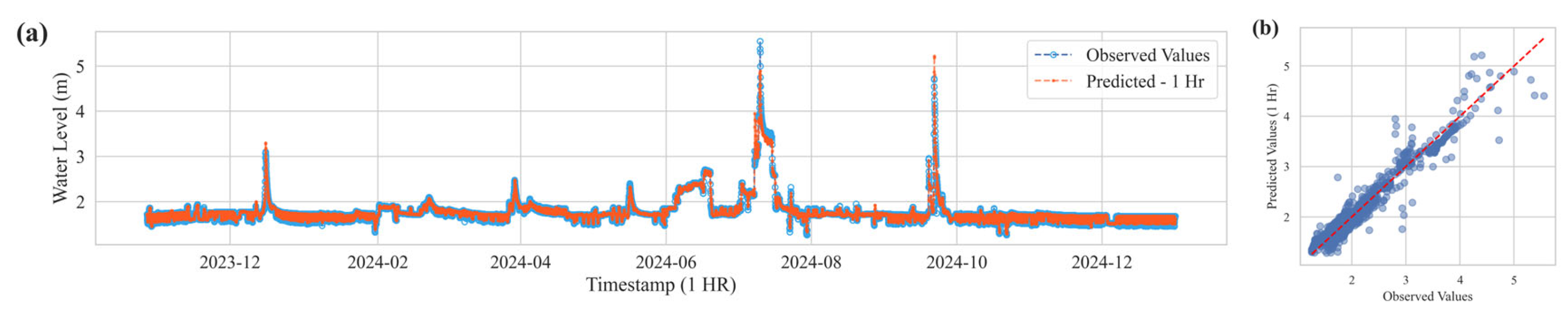
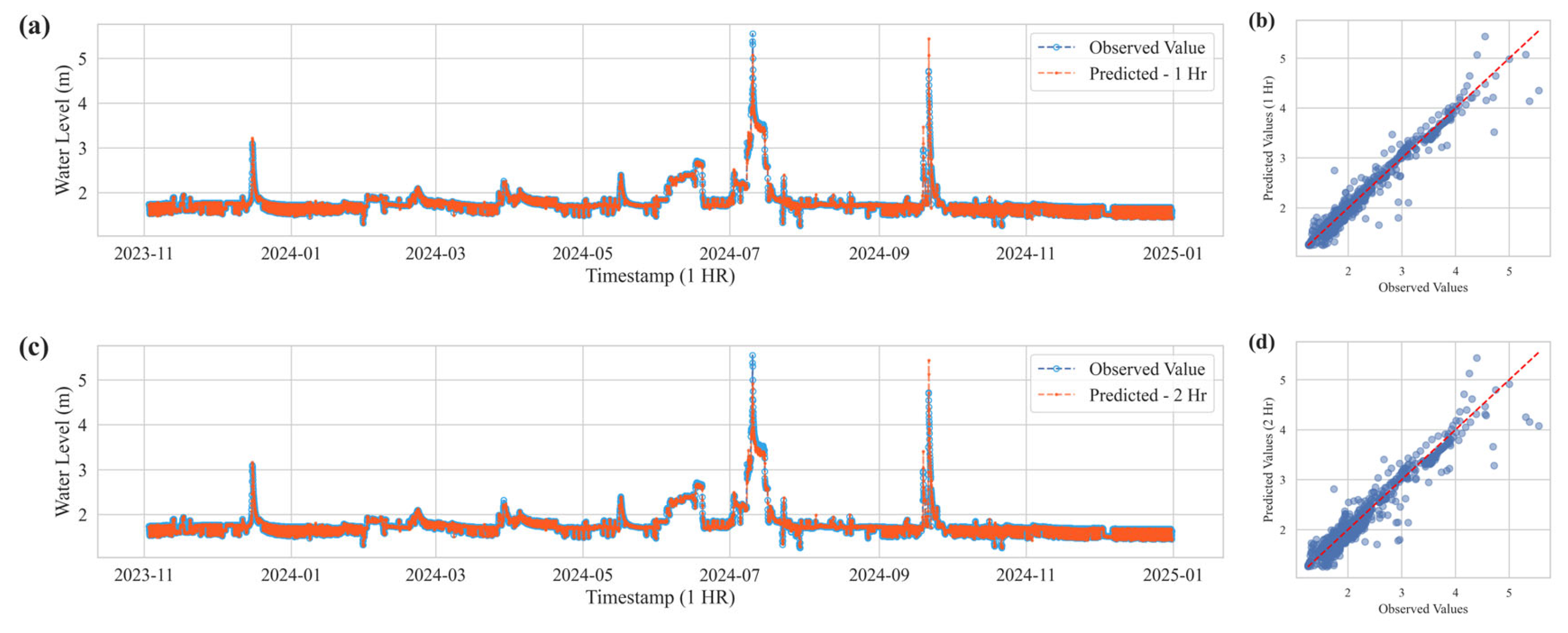
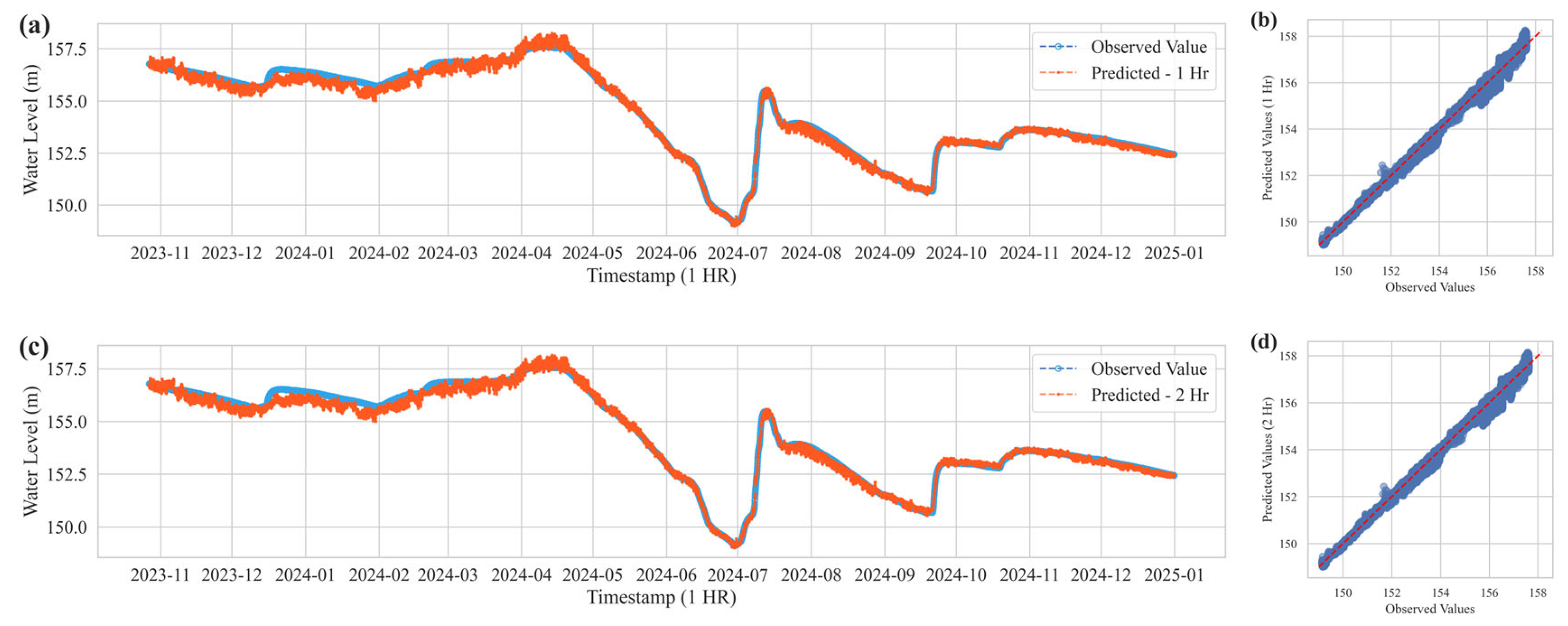
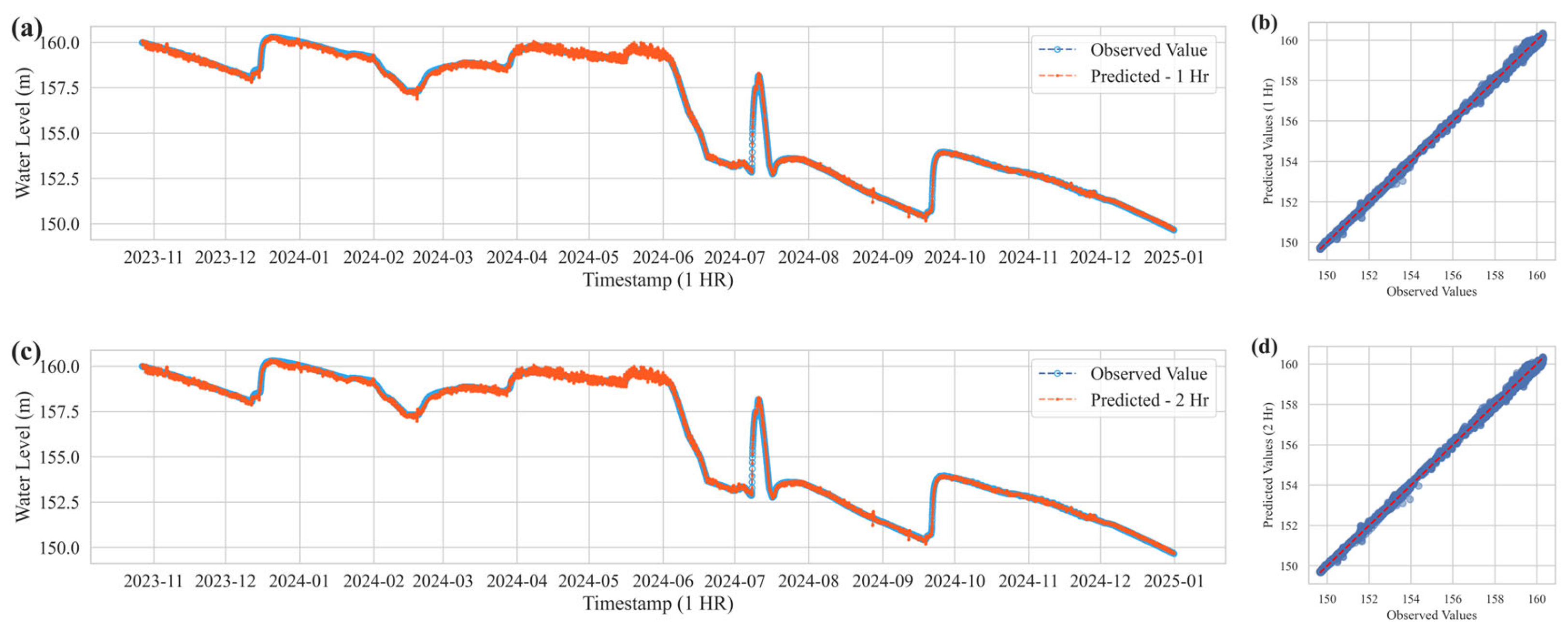
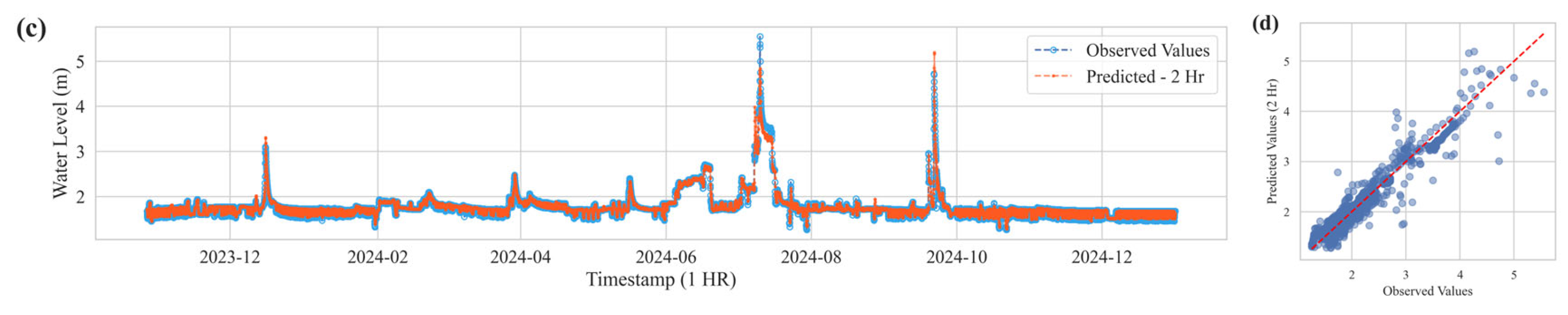
Figure 4, Figure 5, Figure 6 and Figure 7 present time-series plots and scatter plots illustrating the relationship between the predicted and observed values at each station. Overall, the predictions closely followed the observed values, showing a high degree of agreement in both the temporal trends of the time series and the distribution patterns in the scatter plots.

3.2. Learning Data Composition Results of Model Including Predicted Water Level Data

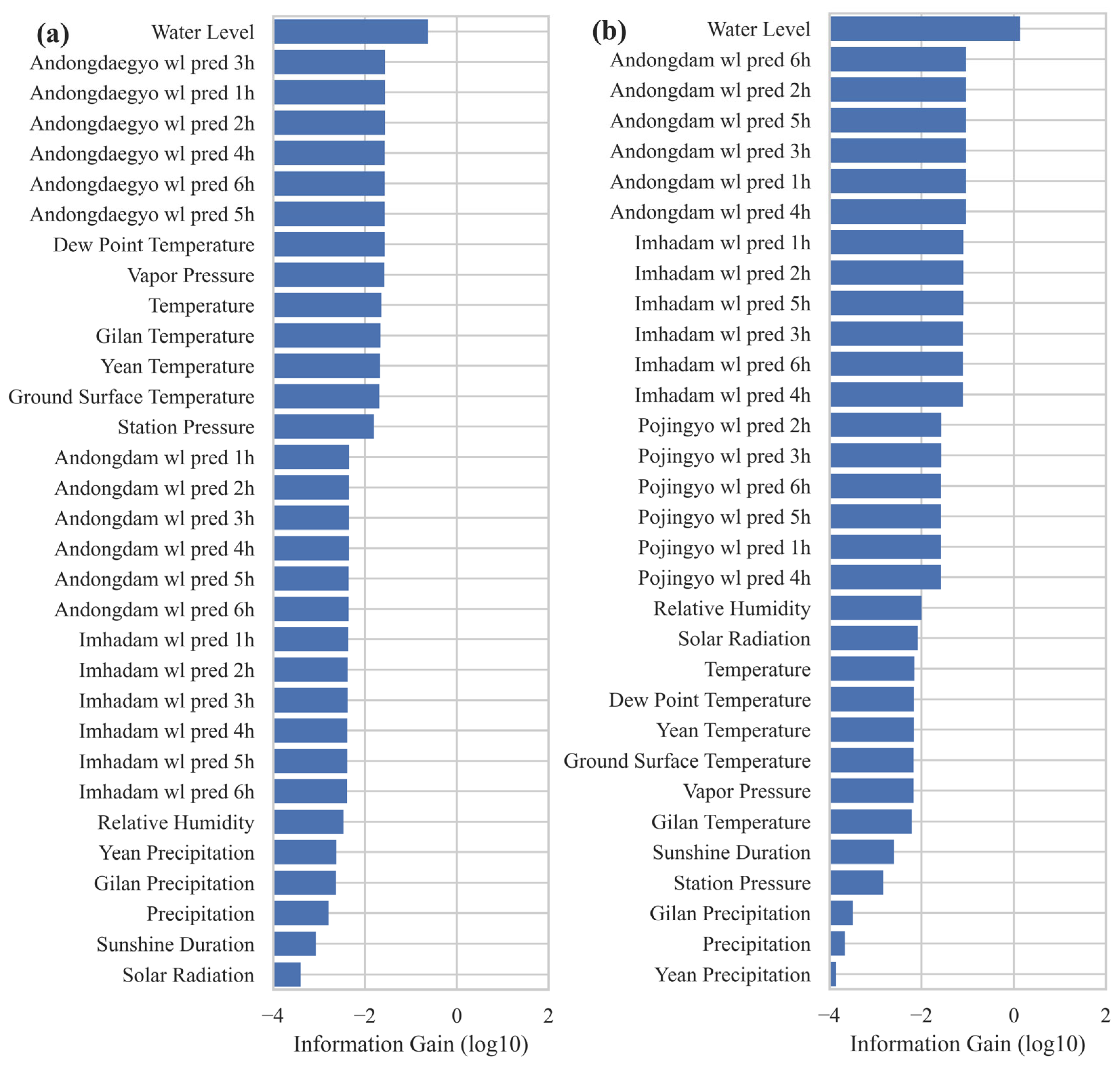
An information gain (IG) analysis was performed to construct the training dataset for the river water-level prediction at the primary target stations, Pojingyo and Andongdaegyo. This analysis aimed to identify key input variables, including predicted water levels, that contribute significantly to the prediction performance. Figure 8a presents the IG analysis results for Pojingyo, while Figure 8b shows those for Andongdaegyo. At both stations, the river water-level variables showed the highest variance-reduction-based IG values, indicating that the target station’s water-level data served as a key influencing factor. In particular, Andonggyo showed a relatively higher dependency on water-level data compared to Pojingyo, which is attributed to its wider channel and greater depth, resulting in lower water-level variability and, thus, greater reliance on water-level information. Furthermore, the predicted water-level variables derived from the Step 1 model at Andongdaegyo had higher IG values than the meteorological data observed at the flood-monitoring station. In the case of Pojingyo, some predicted water-level variables, excluding those from Andongdaegyo, showed lower IG values than the meteorological data. It may be attributed to the location of Pojingyo near a river confluence, which makes it relatively more susceptible to external hydrological influences.
Because water level is a continuous numerical variable, IG was calculated using a variance-reduction approach based on a univariate decision-tree regressor. For each candidate variable, the decision-tree regressor determined an optimal split threshold, and IG was calculated as the reduction in the variance of the target water level before and after the split. Therefore, continuous water-level variables were not manually discretized into predefined classes.
Building upon the IG-based ranking results, a variance inflation factor (VIF) analysis was conducted on 32 candidate features to mitigate multicollinearity in the input configuration of the Step 2 prediction model. Since VIF values exceeding 10 are generally considered indicative of severe multicollinearity, variables exhibiting strong intercorrelations were iteratively removed until all remaining variables satisfied the threshold criterion (VIF < 10) [66,67,68].
The analysis revealed that relatively high VIF values were primarily associated with predicted water-level variables, particularly when multiple lagged features derived from the same gauging station were included simultaneously. To address this issue, such variables were not jointly incorporated without further evaluation. Instead, multiple input-variable scenarios were constructed by varying combinations of high-ranked IG features while considering VIF results.
The final input configuration was determined by comparing the predictive performance of these scenarios under an identical LSTM-based modeling framework. Details of the selected variables, excluded features, and corresponding VIF values are summarized in Table 4.
This study presents the composition of the prediction scenarios with a focus on cases where predictive performance was improved relative to the Step 1 model, utilizing only meteorological and observed water-level data. For Pojingyo, improvements in predictive performance were observed in some scenarios that incorporated predicted water-level variables, whereas for Andongdaegyo, no substantial enhancement was noted compared with the model based on meteorological and observed water-level data. Accordingly, for Andongdaegyo, the Step 1 scenario that showed the best predictive performance was adopted as the reference scenario for subsequent analyses.

3.3. Water Level Prediction Using Predicted and Observed Water Level Data

The hyperparameters for the models constructed using input scenarios that included predicted water levels are summarized in Table 5, and the corresponding model performance metrics are presented in Table 6. For Pojingyo, models incorporating predicted water levels generally showed superior performance across most scenarios compared with models based on meteorological and observed water-level data. In particular, the inclusion of predicted water-level data from a single site typically resulted in performance improvement. These results were consistent with the outcomes of the input data scenarios derived from the IG analysis conducted in Section 3.2. The observed water level, the predicted water level, and the dew point temperature at Andonggyo, derived from the IG analysis, exhibited the highest information gain ratios. By incorporating these variables into the input dataset and removing highly correlated variables based on the VIF analysis to mitigate multicollinearity, Scenario 4 achieved the highest predictive performance. In contrast, at Andongdaegyo, the model based on the original meteorological and observed water-level data showed outstanding performance, whereas inclusion of predicted water-level variables resulted in a decline in predictive accuracy.
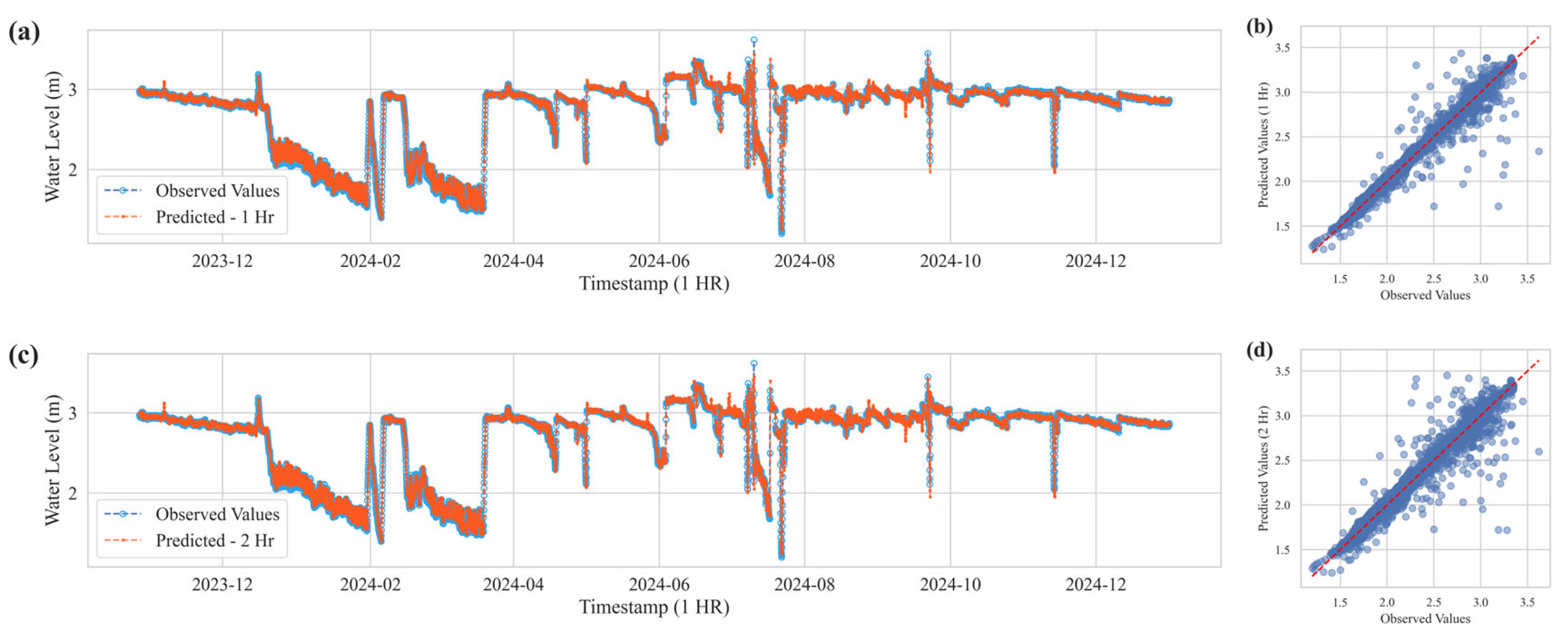
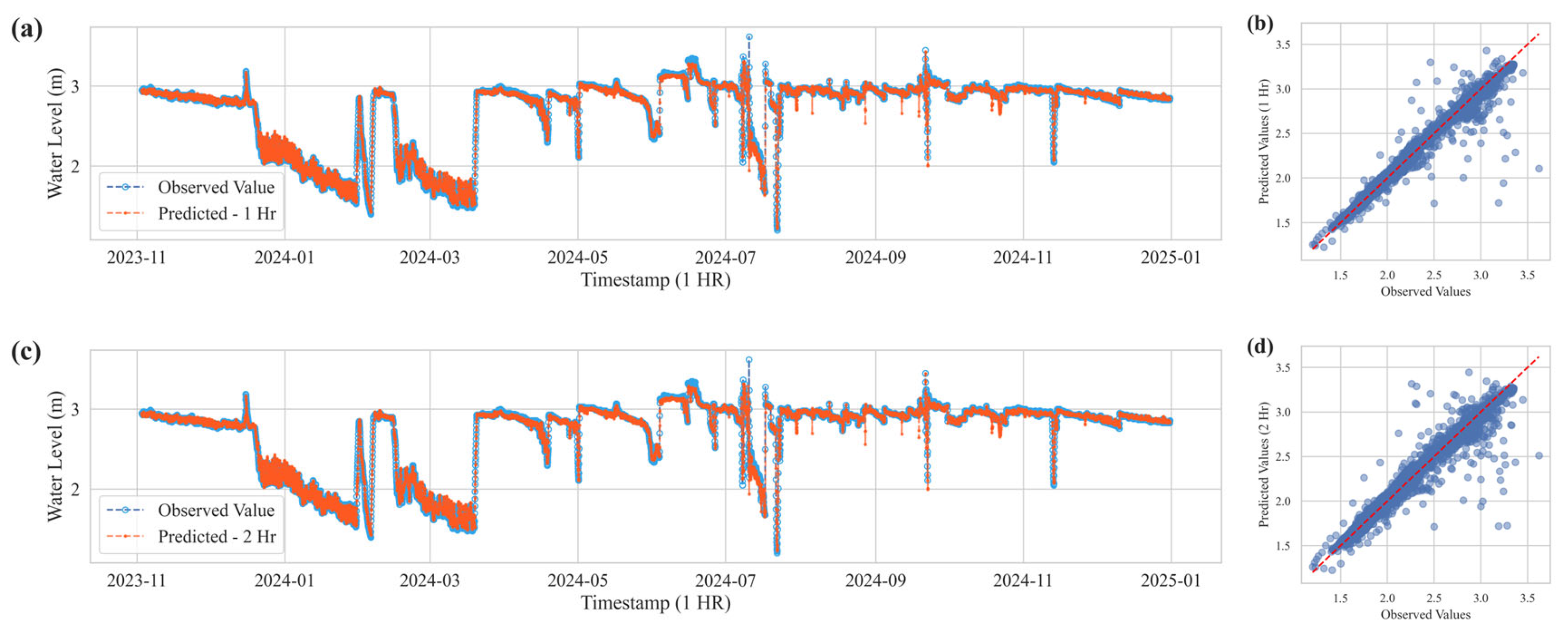
Figure 9 presents the one-hour and two-hour time series predictions and the scatter plot illustrating the correlation between observed and predicted water levels for the pre-4 Scenario, which exhibited the highest performance among the Pojingyo scenarios. The results indicate that the predicted water levels closely reproduced the trends of the observed levels during the test period and maintained more stable predictive performance compared to the Step 1 model. Figure 10 shows the time series predictions and scatter plot for the scenarios conducted at Andongdaeggyo. While the predicted values at Andongdaegyo visually captured the observed trends, the performance metrics indicated lower predictive accuracy compared to the Step 1 model.

3.4. High Water-Level Performance Comparison of Water-Level Model

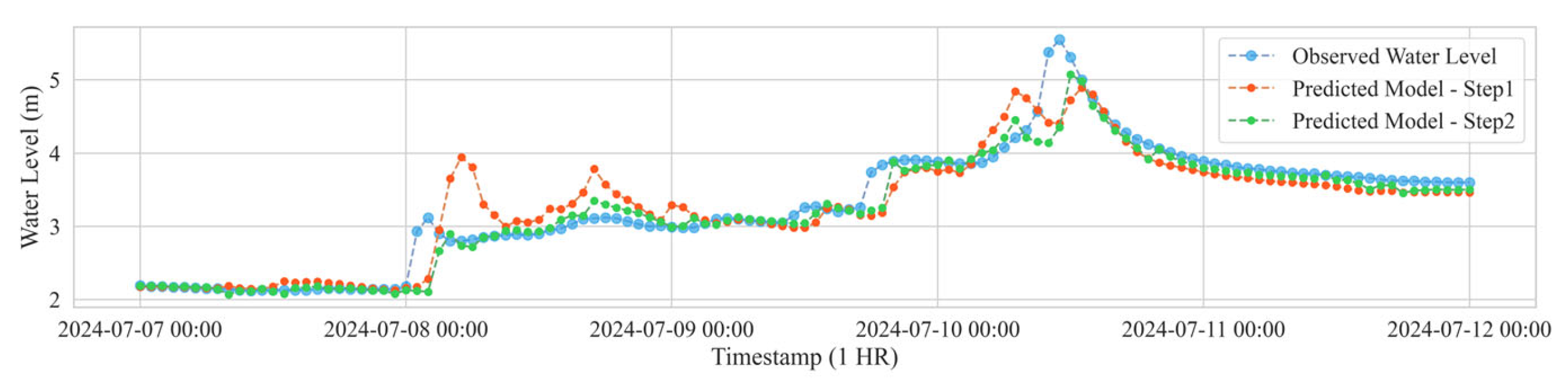
This study conducted a detailed analysis of the predictive performance during periods of rising water levels at the Andongdaegyo and Pojingyo stations. Figure 11 presents the water level predictions at Pojingyo for the period from 7 July to 12 July 2024, included in the test dataset, comparing the Step 1 model with the Step 2 prediction scenario (pre-4), incorporating predicted water levels. Overall, the model trained on original meteorological and observed water-level data showed higher sensitivity to water-level fluctuations, often producing a larger range of predicted water-level changes compared to the observations. In contrast, the Step 2 model showed a more stable response, closely following the observed water-level trends without overreacting to short-term fluctuations.
The quantitative performance comparison between the Step 1 prediction model and the Step 2 prediction scenario (pre-4) for Pojingyo is presented in Table 7. The results indicate that, across all prediction lead times (1–6 h), the Step 2 model incorporating predicted water levels generally exhibited improvements in RMSE, KGE, and R2. In contrast, MAE showed a decrease in performance, which is likely attributable to a reduction in errors during abrupt water-level changes or extreme values, while the average error across the entire period increased.
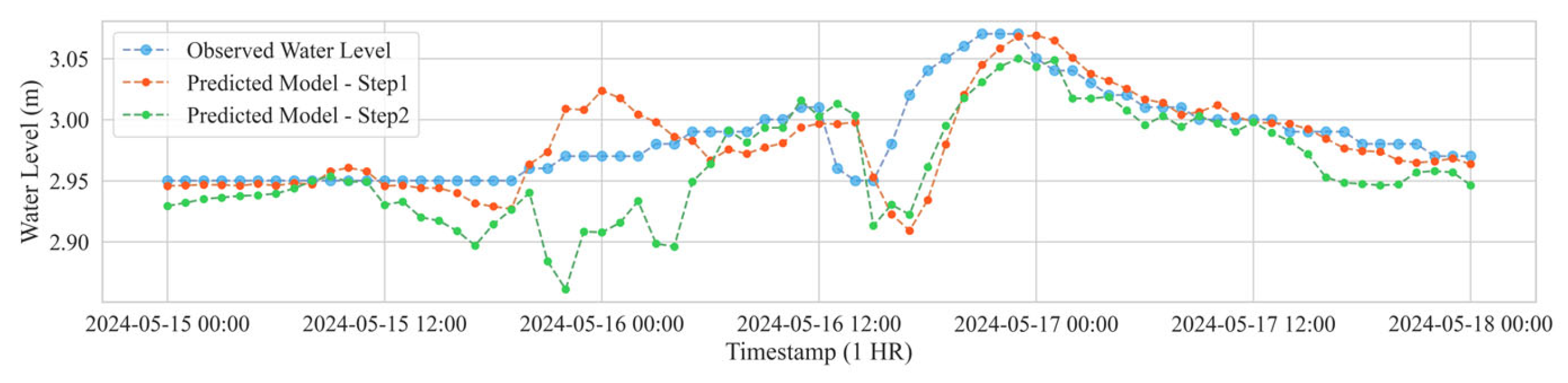
Figure 12 presents the predicted water levels at the Andongdaegyo station for the period from 15 May to 18 May 2024, included in the test dataset, comparing the Step 1 model based solely on meteorological and observed water-level data with the Step 2 model incorporating predicted water levels. The Step 1 model relatively stably reproduced the fluctuations of observed values during the high-water period, whereas the Step 2 model responded more sensitively to water-level changes, exhibiting a tendency toward increased variability.
The performance comparison between the Step 1 and Step 2 prediction models for Andongdaegyo is summarized in Table 8. Across all prediction lead times, the Step 1 model demonstrated outstanding performance compared to the Step 2 model based on the KGE and R2 metrics. When the predicted water-level variables were additionally included, the predictive performance decreased. This result suggests that, at Andongdaegyo, the hydrological response can be sufficiently explained using only meteorological data and observed water-level data, and that the additional predicted water-level information may have acted as redundant information, thereby negatively affecting the model training process.
For Pojingyo, where performance improvement was observed, an additional analysis of predictive performance by lead times (1–6 h) was conducted for the upper 10% high water-level periods. The comparison results are presented in Table 9, showing that the Step 2 prediction model consistently outperformed the Step 1 model across all lead times and performance metrics. The Step 2 model reduced RMSE by 32.92–39.75% and MAE by 15.39–21.82%, indicating an overall reduction in prediction errors, while KGE improved by 6.95–13.36%. In particular, the improvement in R2 increased as the lead time increased, rising from 6.08% for the one-hour prediction to 26.37% for the six-hour prediction.
Based on the above results, the applicability of the proposed framework to other basins should be considered. While previous studies have mainly used observed upstream water level data, the use of predicted water levels remains limited, highlighting the novelty of this approach. The results indicate that its effectiveness depends on basin characteristics and upstream–downstream connectivity. In basins with strong hydrological linkage, predicted upstream information may improve performance, whereas it may act as redundant input in simpler systems. Therefore, transferability requires basin-specific consideration and further validation.

4. Conclusions

This study proposes a sequential prediction strategy that combines a Step 1 river water-level prediction model, based on meteorological data and observed water-level data, with a Step 2 prediction model that utilizes the Step 1 prediction results as additional input variables. The applicability of the proposed approach was evaluated for Andong City in Gyeongsangbuk-do, Republic of Korea. Short-term water-level predictions with lead times ranging from 1 to 6 h were conducted for major monitoring stations, including Andongdam, Imhadam, Pojingyo, and Andongdaegyo. In addition, the prediction performance at each station and the differences arising from the composition of input data were comprehensively analyzed.
The results of the Step 1 prediction indicated that the model using solely meteorological data and observed water-level data achieved high accuracy with R2 values at or above 0.98 at all stations except Pojingyo, even for forecasts beyond a one-hour lead time. At Andongdam, Imhadam, and Andongdaegyo, the model maintained strong performance with R2 values at or above 0.95, even as the prediction lead time increased. These results suggest that the hydrological responses at these locations can be sufficiently explained using meteorological and observed water-level data alone. In contrast, Pojingyo exhibited a relatively larger decline in prediction performance as the lead time increased, with R2 decreasing from approximately 0.93 for the one-hour prediction to about 0.78 for the six-hour prediction. This result implies that short-term water-level variability in the upstream reach is relatively high and more strongly influenced by localized factors, indicating potential limitations in reproducing such variability using only meteorological and observed water-level inputs.
To address this limitation, a Step-2 prediction model was designed to utilize the hydrological connectivity among stations within the same basin. During the construction of the Step 2 input variables, an IG analysis and a VIF analysis were performed to mitigate potential multicollinearity issues arising from highly correlated predicted water-level variables. Based on these analyses, variables with high contributions to prediction performance were selected to construct the input dataset. The results showed that the observed water-level data and the predicted water-level variables from nearby stations exhibited high information gain. Among the tested input scenarios, Scenario pre-4 demonstrated a meaningful improvement in R2 compared to the Step 1 prediction model. Specifically, the R2 values improved by approximately 3.94% for the one-hour lead time and 8.38% for the six-hour lead time, with the largest improvement of 9.24% observed for the four-hour lead time.
In the Step 2 prediction results incorporating predicted water levels, the overall prediction performance tended to improve compared to the Step 1 model, particularly at upstream stations such as Pojingyo. A comparison of statistical characteristics between the two stations shows that Andongdaegyo exhibits higher variability, with a larger standard deviation (1.206 m vs. 0.608 m) and coefficient of variation (0.780 vs. 0.333), despite a comparable mean water level (1.547 m vs. 1.826 m). In particular, when the predicted water-level data from the downstream station Andongdaegyo was included as an input variable, the model was able to more sensitively capture water-level fluctuations at Pojingyo. This finding suggests that the predicted water-level data can help improve prediction performance by reflecting upstream–downstream hydrological relationships within the river system, rather than being solely explained by variability at the target station.
For Pojingyo, where performance improvement was confirmed, additional evaluations of prediction performance were conducted for each lead time, focusing on the top 10% high water-level conditions. The Step 2 prediction model demonstrated consistent performance improvements over the Step 1 prediction model across all lead times and evaluation metrics. The Step 2 model decreased RMSE by 32.92–39.75% and MAE by 15.39–21.82%, indicating an overall reduction in prediction errors under high water-level conditions. In addition, the KGE improved by 6.95–13.36%. Notably, the improvement in R2 increased with longer lead times, showing a 6.08% improvement for the one-hour prediction, which further increased to 26.37% for the six-hour prediction. It indicates that even under longer lead-time forecasts, with increased uncertainty, the Step 2 strategy is more effective in reproducing variability and improving explanatory power under high water-level conditions.
In contrast, for Andongdaegyo, where a sufficiently high prediction performance was already achieved using solely meteorological data and observed water-level data, the Step 2 model, incorporating additional predicted water-level data, resulted in a decline in performance. This may indicate that the additional input variables acted as redundant information, potentially affecting training stability and predictive generalization. This finding is also consistent with previous studies, indicating that strong correlations and multicollinearity among input variables may lead to a reduced prediction performance [69,70,71]. Therefore, strategies utilizing predicted water-level data should not be uniformly applied to all stations. Instead, they should be designed selectively by considering the locational characteristics of the stations (e.g., upstream–downstream relationships), the magnitude of water-level variability, and the correlation structure and multicollinearity among input variables.
Therefore, this study confirmed that the sequential prediction strategy utilizing predicted water levels as input variables can effectively improve short-term flood water-level prediction performance under specific conditions, while also identifying the limitations associated with the use of predicted data. Future research should further examine the general applicability of the proposed prediction strategy through integration with physically based hydrological models, a quantitative assessment of prediction uncertainty, and additional validation across diverse basins and extreme rainfall events.

Author Contributions

Conceptualization, C.K. and H.H. (Heechan Han); methodology, C.K.; software, C.K.; validation, C.K., H.H. (Heechan Han), D.K. and C.J.; formal analysis, C.K.; investigation, C.K. and C.J.; resources, H.H. (Heechan Han); data curation, C.K. and D.K.; writing—original draft preparation, C.K.; writing—review and editing, C.K., H.H. (Heechan Han), S.P., D.K., C.J. and H.H. (Hyejun Han).; visualization, C.K., S.P., H.H. (Heechan Han), D.K., C.J. and H.H. (Hyejun Han).; supervision, H.H. (Heechan Han) and C.J.; project administration, H.H. (Heechan Han) and C.J.; funding acquisition, H.H. (Heechan Han). All authors have read and agreed to the published version of the manuscript.

Funding

This work was supported by the Korea Environment Industry & Technology Institute (KEITI) through the Aquatic Ecosystem Conservation Research Program, and funded by the Korea Ministry of Climate, Energy, and Environment (MCEE) (RS-2025-02304832).

Data Availability Statement

The original contributions presented in this study are included in the article. Further inquiries can be directed to the corresponding author.

Acknowledgments

During the preparation of this manuscript, the authors used ChatGPT (version o3 and 5.2) for improving the readability and language of the text. The authors reviewed and edited the output and take full responsibility for the content of this publication.

Conflicts of Interest

The authors declare no conflicts of interest.

References

  1. IPCC. Climate Change 2023: Synthesis Report. In Contribution of Working Group s I, II and III to the Sixth Assessment Report of the Intergovernmental Panel on Climate Change; Core Writing Team, Lee, H., Romero, J., Eds.; IPCC: Geneva, Switzerland, 2023. [Google Scholar]
  2. World Meteorological Organization. United in Science 2024: A multi-Organization High-Level Compilation of the Latest Weather, Climate, Water and Related Environmental and Social Sciences for the Future; World Meteorological Organization: Geneva, Switzerland, 2024. [Google Scholar]
  3. Tellman, B.; Sullivan, J.A.; Kuhn, C.; Kettner, A.J.; Doyle, C.S.; Brakenridge, G.R.; Erickson, T.A.; Slayback, D.A. Satellite imaging reveals increased proportion of population exposed to floods. Nature 2021, 596, 80–86. [Google Scholar] [CrossRef]
  4. Park, S.; Western, A.W.; Peel, M.C. Climate change paradox: Worsening droughts amidst increasing average precipitation across South Korea. J. Hydrol. 2026, 665, 134658. [Google Scholar] [CrossRef]
  5. Tripathy, K.P.; Mukherjee, S.; Mishra, A.K.; Mann, M.E.; Williams, A.P. Climate change will accelerate the high-end risk of compound drought and heatwave events. Proc. Natl. Acad. Sci. USA 2023, 120, e2219825120. [Google Scholar] [CrossRef]
  6. Martel, J.-L.; Brissette, F.P.; Lucas-Picher, P.; Troin, M.; Arsenault, R. Climate Change and Rainfall Intensity–Duration–Frequency Curves: Overview of Science and Guidelines for Adaptation. J. Hydrol. Eng. 2021, 26, 03121001. [Google Scholar] [CrossRef]
  7. Moldakhmetov, M.; Makhmudova, L.; Mussina, A.; Abdullayeva, A.; Birimbayeva, L.; Tursyngali, M.; Imamova, B.; Dautalieva, M.; Buralkhiyev, S.; Vangelis, H. Reaction of Minimum Streamflow of Arid Kazakhstan Rivers to Climate Non-Stationarity. Hydrology 2026, 13, 62. [Google Scholar] [CrossRef]
  8. Danso-Amoako, E.; Scholz, M.; Kalimeris, N.; Yang, Q.; Shao, J. Predicting dam failure risk for sustainable flood retention basins: A generic case study for the wider Greater Manchester area. Comput. Environ. Urban Syst. 2012, 36, 423–433. [Google Scholar] [CrossRef]
  9. Ahmed, Y.; Al-Faraj, F.; Scholz, M.; Soliman, A. Assessment of Upstream Human Intervention Coupled with Climate Change Impact for a Transboundary River Flow Regime: Nile River Basin. Water Resour. Manag. 2019, 33, 2485–2500. [Google Scholar] [CrossRef]
  10. Wang, H.; Liu, J.; Klaar, M.; Chen, A.; Gudmundsson, L.; Holden, J. Anthropogenic climate change has influenced global river flow seasonality. Science 2024, 383, 1009–1014. [Google Scholar] [CrossRef]
  11. Nguyen, B.Q.; Pham, H.T.; Le, T.H.; Le, M.-H.; Nguyen, H.T.T.; Do, H.X. Four-decades assessment of hydrological drought using streamflow reconstruction in poorly-gauged basins in Vietnam. Adv. Space Res. 2026, 77, 4552–4567. [Google Scholar] [CrossRef]
  12. Anees, M.T.; Abdullah, K.; Nawawi, M.; Ab Rahman, N.N.N.; Piah, A.R.M.; Zakaria, N.A.; Syakir, M.; Omar, A.M. Numerical modeling techniques for flood analysis. J. Afr. Earth Sci. 2016, 124, 478–486. [Google Scholar] [CrossRef]
  13. Son, A.-L.; Kim, B.; Han, K.-Y. A Simple and Robust Method for Simultaneous Consideration of Overland and Underground Space in Urban Flood Modeling. Water 2016, 8, 494. [Google Scholar] [CrossRef]
  14. Elsafi, S.H. Artificial Neural Networks (ANNs) for flood forecasting at Dongola Station in the River Nile, Sudan. Alex. Eng. J. 2014, 53, 655–662. [Google Scholar] [CrossRef]
  15. Mosavi, A.; Ozturk, P.; Chau, K. Flood Prediction Using Machine Learning Models: Literature Review. Water 2018, 10, 1536. [Google Scholar] [CrossRef]
  16. Shirzadi, A.; Shahabi, H.; Salvati, A.; Jafari Nodoushan, E.; Mohammad Hoseini, S.; Hajizadeh Tahan, M.; Clague, J.J. Leveraging imbalanced dataset in urban flood susceptibility prediction: A case study of Sanandaj City. J. Hydrol. 2026, 666, 134727. [Google Scholar] [CrossRef]
  17. Kim, S.; Gangopadhyay, S.; McGuire, M.; Lall, U.; Devineni, N. The Role of Water Demand and Paleo Streamflow in Advancing Reservoir Drought Risk Analysis. Water Resour. Res. 2025, 61, e2025WR040096. [Google Scholar] [CrossRef]
  18. Young, C.-C.; Liu, W.-C.; Wu, M.-C. A physically based and machine learning hybrid approach for accurate rainfall-runoff modeling during extreme typhoon events. Appl. Soft Comput. 2017, 53, 205–216. [Google Scholar] [CrossRef]
  19. Fei, K.; Du, H.; Gao, L. Accurate water level predictions in a tidal reach: Integration of Physics-based and Machine learning approaches. J. Hydrol. 2023, 622, 129705. [Google Scholar] [CrossRef]
  20. Wang, Y.; Gupta, H.V. Towards Interpretable Physical-Conceptual Catchment-Scale Hydrological Modeling Using the Mass-Conserving-Perceptron. Water Resour. Res. 2024, 60, e2024WR037224. [Google Scholar] [CrossRef]
  21. Antwi-Agyakwa, K.T.; Afenyo, M.K.; Angnuureng, D.B. Know to Predict, Forecast to Warn: A Review of Flood Risk Prediction Tools. Water 2023, 15, 427. [Google Scholar] [CrossRef]
  22. Vidyarthi, V.K.; Jain, A. Incorporating non-uniformity and non-linearity of hydrologic and catchment characteristics in rainfall–runoff modeling using conceptual, data-driven, and hybrid techniques. J. Hydroinformatics 2022, 24, 350–366. [Google Scholar] [CrossRef]
  23. Sahu, G.; Mangukiya, N.K.; Sharma, A. Does MC-LSTM model improve the reliability of streamflow prediction in human-influenced watersheds? J. Hydrol. 2026, 665, 134711. [Google Scholar] [CrossRef]
  24. Kratzert, F.; Klotz, D.; Herrnegger, M.; Sampson, A.K.; Hochreiter, S.; Nearing, G.S. Toward Improved Predictions in Ungauged Basins: Exploiting the Power of Machine Learning. Water Resour. Res. 2019, 55, 11344–11354. [Google Scholar] [CrossRef]
  25. Rahman, K.U.; Pham, Q.B.; Jadoon, K.Z.; Shahid, M.; Kushwaha, D.P.; Duan, Z.; Mohammadi, B.; Khedher, K.M.; Anh, D.T. Comparison of machine learning and process-based SWAT model in simulating streamflow in the Upper Indus Basin. Appl. Water Sci. 2022, 12, 178. [Google Scholar] [CrossRef]
  26. Belina, Y.; Kebede, A.; Masinde, M. Comparative analysis of HEC-HMS and machine learning models for rainfall-runoff prediction in the upper Baro watershed, Ethiopia. Hydrol. Res. 2024, 55, 873–889. [Google Scholar] [CrossRef]
  27. Jung, J.; Mo, H.; Lee, J.; Yoo, Y.; Kim, H.S. Flood Stage Forecasting at the Gurye-Gyo Station in Sumjin River Using LSTM-Based Deep Learning Models. J. Korean Soc. Hazard Mitig. 2021, 21, 193–201. [Google Scholar] [CrossRef]
  28. Mihret, T.T.; Zemale, F.A.; Worqlul, A.W.; Ayalew, A.D.; Chen, M.; Fohrer, N. Hybrid GR4J-LSTM modeling for streamflow prediction of extreme events in data-scarce regions: Upper Blue Nile Basin, Ethiopia. J. Hydrol. Reg. Stud. 2025, 62, 102977. [Google Scholar] [CrossRef]
  29. Jiang, M.; Araújo, J.G.M.; Ellsworth, W.; Gooding, S.; Grefenstette, E. Generative Data Refinement: Just Ask for Better Data. arXiv 2025, arXiv:2509.08653. [Google Scholar] [CrossRef]
  30. Cui, Y.; Chen, X.; Gao, J.; Yan, B.; Tang, G.; Hong, Y. Global water cycle and remote sensing big data: Overview, challenge, and opportunities. Big Earth Data 2018, 2, 282–297. [Google Scholar] [CrossRef]
  31. Sheffield, J.; Wood, E.F.; Pan, M.; Beck, H.; Coccia, G.; Serrat-Capdevila, A.; Verbist, K. Satellite Remote Sensing for Water Resources Management: Potential for Supporting Sustainable Development in Data-Poor Regions. Water Resour. Res. 2018, 54, 9724–9758. [Google Scholar] [CrossRef]
  32. Batista, G.E.A.P.A.; Monard, M.C. An analysis of four missing data treatment methods for supervised learning. Appl. Artif. Intell. 2003, 17, 519–533. [Google Scholar] [CrossRef]
  33. Stekhoven, D.J.; Bühlmann, P. MissForest—Non-parametric missing value imputation for mixed-type data. Bioinformatics 2012, 28, 112–118. [Google Scholar] [CrossRef]
  34. Shumailov, I.; Shumaylov, Z.; Zhao, Y.; Papernot, N.; Anderson, R.; Gal, Y. AI models collapse when trained on recursively generated data. Nature 2024, 631, 755–759. [Google Scholar] [CrossRef]
  35. Ignatius Baptist, N.N.; Raimond, K.; Brema, J.S.S. Prediction of Potential Evapotranspiration Using Climatic Parameters Using Machine Learning Techniques and Univariate Forecasting. In 2025 Second International Conference on Cognitive Robotics and Intelligent Systems (ICC—ROBINS); IEEE: New York, NY, USA, 2025; pp. 352–357. [Google Scholar] [CrossRef]
  36. Huang, S.; Xia, J.; Wang, Y.; Wang, W.; Zeng, S.; She, D.; Wang, G. Coupling Machine Learning Into Hydrodynamic Models to Improve River Modeling With Complex Boundary Conditions. Water Resour. Res. 2022, 58, e2022WR032183. [Google Scholar] [CrossRef]
  37. Zhang, S.; Zhang, D.; Huang, G.; Wan, J.; Kang, Y.; Jiang, D.; Xia, B.; Zhao, Z.; Liu, R. A novel framework for multi-step water level predicting by spatial–temporal deep learning models based on integrated physical models. J. Hydrol. 2025, 661, 133683. [Google Scholar] [CrossRef]
  38. Deng, B.; Liu, P.; Chin, R.J.; Kumar, P.; Jiang, C.; Xiang, Y.; Liu, Y.; Lai, S.H.; Luo, H. Hybrid metaheuristic machine learning approach for water level prediction: A case study in Dongting Lake. Front. Earth Sci. 2022, 10, 928052. [Google Scholar] [CrossRef]
  39. Vizi, Z.; Batki, B.; Rátki, L.; Szalánczi, S.; Fehérváry, I.; Kozák, P.; Kiss, T. Water level prediction using long short-term memory neural network model for a lowland river: A case study on the Tisza River, Central Europe. Environ. Sci. Eur. 2023, 35, 92. [Google Scholar] [CrossRef]
  40. Adli Zakaria, M.N.; Ahmed, A.N.; Abdul Malek, M.; Birima, A.H.; Hayet Khan, M.M.; Sherif, M.; Elshafie, A. Exploring machine learning algorithms for accurate water level forecasting in Muda river, Malaysia. Heliyon 2023, 9, e17689. [Google Scholar] [CrossRef]
  41. Widiasari, I.R.; Efendi, R. Utilizing LSTM-GRU for IOT-Based Water Level Prediction Using Multi-Variable Rainfall Time Series Data. Informatics 2024, 11, 73. [Google Scholar] [CrossRef]
  42. Zaji, A.H.; Bonakdari, H.; Gharabaghi, B. Applying Upstream Satellite Signals and a 2-D Error Minimization Algorithm to Advance Early Warning and Management of Flood Water Levels and River Discharge. IEEE Trans. Geosci. Remote Sens. 2019, 57, 902–910. [Google Scholar] [CrossRef]
  43. Shorten, C.; Khoshgoftaar, T.M. A survey on Image Data Augmentation for Deep Learning. J. Big Data 2019, 6, 60. [Google Scholar] [CrossRef]
  44. Cho, M.; Kim, C.; Jung, K.; Jung, H. Water Level Prediction Model Applying a Long Short-Term Memory (LSTM)–Gated Recurrent Unit (GRU) Method for Flood Prediction. Water 2022, 14, 2221. [Google Scholar] [CrossRef]
  45. Hong, W.P.; Song, C.G. Prediction of Water Level at Downstream Site by Using Water Level Data at Upstream Gaging Station. J. Korean Soc. Saf. 2020, 35, 28–33. [Google Scholar] [CrossRef]
  46. Wei, C.-C. Comparison of River Basin Water Level Forecasting Methods: Sequential Neural Networks and Multiple-Input Functional Neural Networks. Remote Sens. 2020, 12, 4172. [Google Scholar] [CrossRef]
  47. Lee, D.-G.; Ahn, K.-H. A stacking ensemble model for hydrological post-processing to improve streamflow forecasts at medium-range timescales over South Korea. J. Hydrol. 2021, 600, 126681. [Google Scholar] [CrossRef]
  48. Mohammadi, B. A review on the applications of machine learning for runoff modeling. Sustain. Water Resour. Manag. 2021, 7, 98. [Google Scholar] [CrossRef]
  49. Bhasme, P.; Vagadiya, J.; Bhatia, U. Enhancing predictive skills in physically-consistent way: Physics Informed Machine Learning for hydrological processes. J. Hydrol. 2022, 615, 128618. [Google Scholar] [CrossRef]
  50. Baek, H.; Kim, M.; Kwon, W. Observed short- and long-term changes in summer precipitation over South Korea and their links to large-scale circulation anomalies. Int. J. Climatol. 2017, 37, 972–986. [Google Scholar] [CrossRef]
  51. Rahman, G.; Kim, J.-Y.; Kim, T.-W.; Park, M.; Kwon, H.-H. Spatial and temporal variations in temperature and precipitation trends in South Korea over the past half-century (1974–2023) using innovative trend analysis. J. Hydro Environ. Res. 2025, 58, 1–18. [Google Scholar] [CrossRef]
  52. Hochreiter, S.; Schmidhuber, J. Long short-term memory. Neural Comput. 1997, 9, 1735–1780. [Google Scholar] [CrossRef]
  53. Graves, A. Long short-term memory. Supervised Seq. Label. Recurr. Neural Netw. 2012, 10, 37–45. [Google Scholar]
  54. Lee, S.; Kim, S.; Jung, J.; Yoon, K.S. Case study on flood water level prediction accuracy of LSTM model according to condition of reference hydrological station combination. J. Korea Water Resour. Assoc. 2023, 56, 981–992. [Google Scholar] [CrossRef]
  55. Wang, Y.; Huang, Y.; Xiao, M.; Zhou, S.; Xiong, B.; Jin, Z. Medium-long-term prediction of water level based on an improved spatio-temporal attention mechanism for long short-term memory networks. J. Hydrol. 2023, 618, 129163. [Google Scholar] [CrossRef]
  56. Gupta, H.V.; Kling, H.; Yilmaz, K.K.; Martinez, G.F. Decomposition of the mean squared error and NSE performance criteria: Implications for improving hydrological modelling. J. Hydrol. 2009, 377, 80–91. [Google Scholar] [CrossRef]
  57. Kling, H.; Fuchs, M.; Paulin, M. Runoff conditions in the upper Danube basin under an ensemble of climate change scenarios. J. Hydrol. 2012, 424–425, 264–277. [Google Scholar] [CrossRef]
  58. Kim, C.; Park, S.; Han, H. Multi-Hazard Susceptibility Mapping Using Machine Learning Approaches: A Case Study of South Korea. Remote Sens. 2025, 17, 1660. [Google Scholar] [CrossRef]
  59. O’brien, R.M. A Caution Regarding Rules of Thumb for Variance Inflation Factors. Qual. Quant. 2007, 41, 673–690. [Google Scholar] [CrossRef]
  60. De Ville, B. Decision trees. WIREs Comput. Stat. 2013, 5, 448–455. [Google Scholar] [CrossRef]
  61. Shang, C.; Li, M.; Feng, S.; Jiang, Q.; Fan, J. Feature selection via maximizing global information gain for text classification. Knowl. Based Syst. 2013, 54, 298–309. [Google Scholar] [CrossRef]
  62. Gao, J.; Wang, Z.; Jin, T.; Cheng, J.; Lei, Z.; Gao, S. Information gain ratio-based subfeature grouping empowers particle swarm optimization for feature selection. Knowl. Based Syst. 2024, 286, 111380. [Google Scholar] [CrossRef]
  63. Quinlan, J.R. Induction of decision trees. Mach. Learn. 1986, 1, 81–106. [Google Scholar] [CrossRef]
  64. Yu, L.; Cao, Y.; Zhou, C.; Wang, Y.; Huo, Z. Landslide Susceptibility Mapping Combining Information Gain Ratio and Support Vector Machines: A Case Study from Wushan Segment in the Three Gorges Reservoir Area, China. Appl. Sci. 2019, 9, 4756. [Google Scholar] [CrossRef]
  65. Odhiambo Omuya, E.; Onyango Okeyo, G.; Waema Kimwele, M. Feature Selection for Classification using Principal Component Analysis and Information Gain. Expert Syst. Appl. 2021, 174, 114765. [Google Scholar] [CrossRef]
  66. Craney, T.A.; Surles, J.G. Model-Dependent Variance Inflation Factor Cutoff Values. Qual. Eng. 2002, 14, 391–403. [Google Scholar] [CrossRef]
  67. Thompson, C.G.; Kim, R.S.; Aloe, A.M.; Becker, B.J. Extracting the Variance Inflation Factor and Other Multicollinearity Diagnostics from Typical Regression Results. Basic Appl. Soc. Psychol. 2017, 39, 81–90. [Google Scholar] [CrossRef]
  68. Li, J.; Cheng, K.; Wang, S.; Morstatter, F.; Trevino, R.P.; Tang, J.; Liu, H. Feature Selection: A Data Perspective. ACM Comput. Surv. 2018, 50, 1–45. [Google Scholar] [CrossRef]
  69. Alin, A. Multicollinearity. WIREs Comput. Stat. 2010, 2, 370–374. [Google Scholar] [CrossRef]
  70. Dormann, C.F.; Elith, J.; Bacher, S.; Buchmann, C.; Carl, G.; Carré, G.; Marquéz, J.R.G.; Gruber, B.; Lafourcade, B.; Leitão, P.J.; et al. Collinearity: A review of methods to deal with it and a simulation study evaluating their performance. Ecography 2013, 36, 27–46. [Google Scholar] [CrossRef]
  71. Chan, J.Y.-L.; Leow, S.M.H.; Bea, K.T.; Cheng, W.K.; Phoong, S.W.; Hong, Z.-W.; Chen, Y.-L. Mitigating the Multicollinearity Problem and Its Machine Learning Approach: A Review. Mathematics 2022, 10, 1283. [Google Scholar] [CrossRef]
Figure 1. Study area and locations of observatories. The study area is highlighted in red, whereas red triangles represent water level observatories, and white triangles represent weather observatories.
Water 18 01231 g001
Figure 2. Schematic diagram of the LSTM architecture.
Water 18 01231 g002
Figure 3. Study Flow: The process consists of four phases: (1) Collection and preprocessing of meteorological and water-level data, (2) training a baseline LSTM model for water level prediction, (3) input variable optimization using information gain and variance inflation factors to construct data scenarios, and (4) retraining the model with optimized scenarios for comparative performance evaluation.
Water 18 01231 g003
Figure 4. Water-level prediction results for Andongdam. (a) Time series of 1-h-ahead predictions, (b) scatter plot of 1-h-ahead predictions, (c) time series of 2-h-ahead predictions, and (d) scatter plot of 2-h-ahead predictions.
Water 18 01231 g004
Figure 5. Water-level prediction results for Imhadam. (a) Time series of 1-h-ahead predictions, (b) scatter plot of 1-h-ahead predictions, (c) time series of 2-h-ahead predictions, and (d) scatter plot of 2-h-ahead predictions.
Water 18 01231 g005
Figure 6. Water-level prediction results for Pojingyo. (a) Time series of 1-h-ahead predictions, (b) scatter plot of 1-h-ahead predictions, (c) time series of 2-h-ahead predictions, and (d) scatter plot of 2-h-ahead predictions.
Water 18 01231 g006aWater 18 01231 g006b
Figure 7. Water-level prediction results for Andongdaegyo. (a) Time series of 1-h-ahead predictions, (b) scatter plot of 1-h-ahead predictions, (c) time series of 2-h-ahead predictions, and (d) scatter plot of 2-h-ahead predictions.
Water 18 01231 g007
Figure 8. Variance-reduction-based information gain analysis results for input data selection. (a) Pojingyo information gain analysis, (b) Andongdaegyo information gain analysis.
Water 18 01231 g008
Figure 9. Water-level prediction results for the pre-4 scenario at Pojingyo. (a) Time series of 1-h-ahead predictions, (b) scatter plot of 1-h-ahead predictions, (c) time series of 2-h-ahead predictions, and (d) scatter plot of 2-h-ahead predictions.
Water 18 01231 g009
Figure 10. Water-level prediction results for the prediction scenario at Andongdaegyo. (a) Time series of 1-h-ahead predictions, (b) scatter plot of 1-h-ahead predictions, (c) time series of 2-h-ahead predictions, and (d) scatter plot of 2-h-ahead predictions.
Water 18 01231 g010
Figure 11. Comparison of flood level prediction results by the Pojingyo scenario.
Water 18 01231 g011
Figure 12. Comparison of flood-level prediction results by the Andongdaegyo station.
Water 18 01231 g012
Table 1. Parameter range.
ParameterRange
Hidden node size32, 64, 128
Number of layers1, 2, 3, 4
Dropout0, 0.1, 0.2, 0.3, 0.4
lr0.01, 0.001, 0.0001
Activation functionLeaky ReLU, ReLU, none
Table 2. Table of parameters of the model using meteorological and water-level data.
Hidden Node
Size
Number of
Layers
DropoutIrActivation
Function
Andongdam64400.001Leaky ReLU
Imhadam128200.01None
Pojingyo12810.20.01None
Andongdaegyo64400.001Leaky ReLU
Table 3. Performance metrics for water-level prediction models by station.
Prediction TimeRMSE (m)MAE (m)KGER2
Andongdam1 h0.22690.16890.98690.9889
2 h0.23330.17280.97210.9883
3 h0.25080.18530.95640.9865
4 h0.24670.18240.95870.9869
5 h0.24220.18320.94750.9874
6 h0.24300.18810.94030.9873
Imhadam1 h0.09400.07080.99370.9993
2 h0.09610.07200.99450.9992
3 h0.10880.08260.99020.9990
4 h0.11260.08400.99120.9989
5 h0.12670.09540.98690.9987
6 h0.13630.10250.98630.9985
Pojingyo1 h0.09040.02560.92950.9315
2 h0.11530.03440.90390.8884
3 h0.13440.04270.88120.8484
4 h0.14770.05010.86360.8170
5 h0.15580.05660.85000.7964
6 h 0.16190.06220.83850.7801
Andongdaegyo1 h0.06150.02220.99520.9945
2 h0.08030.02850.99380.9906
3 h0.09740.0350.9920.9862
4 h0.11310.04130.98980.9813
5 h0.12820.04740.98720.9760
6 h0.14260.05310.98450.9703
Table 4. Learning material scenario, including IG analysis-based prediction level.
Scenario NumberIncluded Variables
Pojingyo
Pre-1
Water Level, Relative Humidity, Precipitation (Yean, Gilan, Andong), Sunshine Duration, 1 h Pred Water Level (Andongdaegyo, Imhadam), Dew Point Temperature
Pojingyo
Pre-2
Water Level, Relative Humidity, Precipitation (Yean, Gilan, Andong), Sunshine Duration, 1 h Pred Water Level (Andongdaegyo, Imhadam)
Pojingyo
Pre-3
Water Level, Relative Humidity, Precipitation (Yean, Gilan, Andong), Sunshine Duration, 1 h Pred Water Level (Andongdaegyo)
Pojingyo
Pre-4
Water Level, Relative Humidity, Precipitation (Yean, Gilan, Andong), Sunshine Duration, 1 h Pred Water Level (Andongdaegyo), Dew Point Temperature
Andongdaegyo
Prediction
Water Level, Relative Humidity, Precipitation (Yean, Gilan, Andong), Sunshine Duration, Dew Point Temperature, Pred Water Level (1, 2 h Imhadam, 2 h Pojingyo)
Table 5. Table of parameters for the model, including predicted water-level data.
Hidden Node
Size
Number of
Layers
DropoutIrActivation
Function
Pojingyo
Pre-1
12810.10.01None
Pojingyo
Pre-2
64300.01None
Pojingyo
Pre-3
12810.40.01Leaky ReLU
Pojingyo
Pre-4
12810.20.01None
Andongdaegyo
Prediction
3210.20.01Leaky ReLU
Table 6. Predictive model performance indicators by scenario.
Prediction TimeRMSE (m)MAE (m)KGER2
Pojingyo
Pre-1
1 h0.06910.04660.95940.9543
2 h0.08530.05690.93200.9304
3 h0.09830.06470.90970.9076
4 h0.11050.07310.88080.8832
5 h0.12040.07910.86110.8614
6 h0.12990.08540.83750.8386
Pojingyo
pre-2
1 h0.06720.03770.95260.9567
2 h0.08280.04730.93380.9343
3 h0.09670.05680.91380.9104
4 h0.10910.06520.89370.8861
5 h0.12020.07260.87420.8618
6 h0.12980.07870.85700.8389
Pojingyo
pre-3
1 h0.05970.03320.97830.9658
2 h0.07790.04260.95270.9419
3 h0.09350.05160.92460.9163
4 h0.10670.05960.90120.8912
5 h0.11780.06650.87140.8674
6 h0.12670.07230.86180.8465
Pojingyo
pre-4
1 h0.05760.02810.98120.9682
2 h0.07680.03990.96140.9435
3 h0.09240.05070.93510.9182
4 h0.10600.06100.91730.8925
5 h0.11720.06860.89430.8686
6 h0.12710.07540.87910.8455
Andongdaegyo
Prediction
1 h0.05400.02390.97920.9844
2 h0.06620.02920.98110.9765
3 h0.07740.03480.98120.9679
4 h0.08620.03990.97920.9602
5 h0.09580.04490.97520.9507
6 h0.10600.04980.96960.9397
Table 7. Performance comparison between the Step 1 and Step 2 water-level prediction models at the Pojingyo station.
Prediction TimeRMSE (%)MAE (%)KGE (%)R2 (%)
1 h36.28%−9.77%5.56%3.94%
2 h33.39%−15.99%6.36%6.20%
3 h31.25%−18.74%6.12%8.23%
4 h28.23%−21.76%6.22%9.24%
5 h24.78%−21.20%5.21%9.07%
6 h21.49%−21.22%4.84%8.38%
Table 8. Performance comparison between the Step 1 and Step 2 water-level prediction models at the Andongdaegyo station.
Prediction TimeRMSE (%)MAE (%)KGE (%)R2 (%)
1 h12.2%−7.66%−1.61%−1.02%
2 h17.56%−2.46%−1.28%−1.42%
3 h20.53%0.57%−1.09%−1.86%
4 h23.78%3.39%−1.07%−2.15%
5 h25.27%5.27%−1.22%−2.59%
6 h25.67%6.21%−1.51%−3.15%
Table 9. Pojingyo high water-level evaluation by lead time, performance metrics, and improvement rates for Step 1 and Step 2.
Prediction TimeRMSE (m)MAE (m)KGER2
Step 1Step 2Step 1Step 2Step 1Step 2Step 1Step 2
1 h39.74%21.82%6.95%6.08%
0.21340.12860.07380.05770.90090.96350.89810.9527
2 h39.64%19.18%9.14%11.07%
0.2770.16720.10220.08260.85890.93740.82830.9200
3 h39.75%18.42%11.64%17.22%
0.32980.19870.13030.10630.82060.91610.75660.8869
4 h38.76%17.07%12.24%22.69%
0.36840.22560.15470.12830.78850.88500.69620.8542
5 h36.07%15.83%13.36%25.38%
0.39400.25190.17630.14840.76430.86640.65260.8182
6 h32.92%15.39%13.20%26.37%
0.41400.27770.19560.16550.74230.84030.61630.7788
Disclaimer/Publisher’s Note: The statements, opinions and data contained in all publications are solely those of the individual author(s) and contributor(s) and not of MDPI and/or the editor(s). MDPI and/or the editor(s) disclaim responsibility for any injury to people or property resulting from any ideas, methods, instructions or products referred to in the content.