

Article

The Effect of Water Treatment Processes on the Performance of Proton Exchange Membrane Water Electrolysis

Department of Civil Engineering, Pukyong National University, 45 Yongso-ro, Nam-gu, Busan 48513, Republic of Korea
*
Author to whom correspondence should be addressed.
Water 2026, 18(10), 1213; https://doi.org/10.3390/w18101213
Submission received: 9 April 2026 / Revised: 13 May 2026 / Accepted: 15 May 2026 / Published: 17 May 2026

Abstract

This study investigates performance variation and cell degradation in proton exchange membrane water electrolysis (PEMWE) systems depending on feed water quality. In commercial PEMWE designs, simplified water treatment configurations focusing primarily on electrical conductivity (EC) control are sometimes adopted instead of conventional full ultrapure water production processes. To evaluate the impact of different water treatment processes on cell degradation, permeates from various processes were used as feed water, and cell voltage patterns were analyzed based on EC and total organic carbon (TOC) levels. The experimental results demonstrated that both the two-pass reverse osmosis (RO) and mixed-bed polisher (MBP) permeates achieved an EC below 1 μS/cm, meeting the minimum required standard. Although the cell voltage increase trends for both permeates were similar, the MBP permeate exhibited a higher TOC level despite its lower EC. The elevated TOC level observed in the MBP permeate is attributed to the low organic matter rejection rate of the RO membrane used in the preceding process. This highlights that in simplified water treatment processes for PEMWE, implementing a two-pass RO configuration is essential for effective TOC control. However, simply introducing this configuration is insufficient; it must be accompanied by strategic RO membrane selection to ensure stable operation of PEMWE systems.

1. Introduction

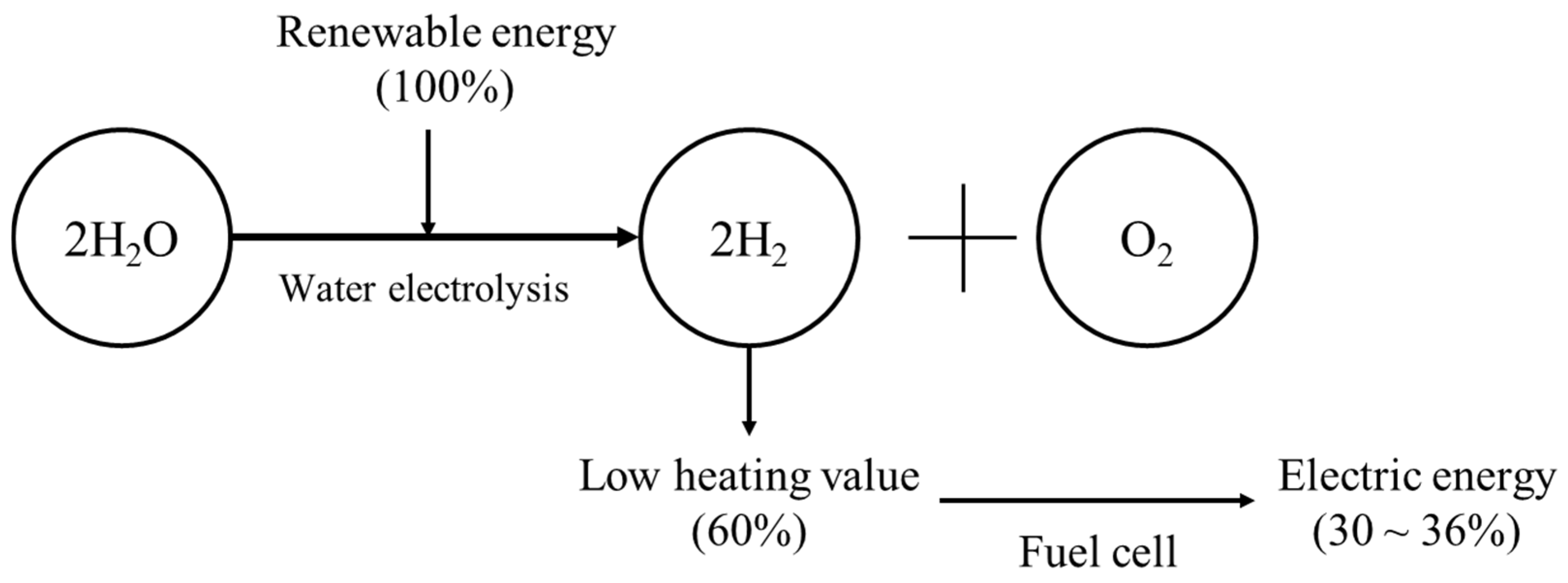
Green hydrogen produced by water electrolysis using renewable energy produces no carbon emissions, unlike conventional fossil-fuel-based hydrogen production. Therefore, it is considered to be a promising energy carrier for achieving carbon neutrality [1]. As shown in Figure 1, the energy conversion cycle proceeds from renewable energy (100%) through water electrolysis, hydrogen storage, and conversion to electrical energy using a fuel cell. This cycle yields an overall energy recovery rate of approximately 30–36% relative to the initial power input [2,3]. Despite conversion losses, hydrogen enables large-scale and long-term energy storage. Consequently, power-to-gas-to-power systems using hydrogen utilize surplus electricity from intermittent renewable energy sources to stabilize the power grid [4].
Proton exchange membrane water electrolysis (PEMWE) is used to produce green hydrogen using intermittent renewable energy due to its fast response rate and wide operating range [5]. However, proton exchange membrane (PEM) and catalysts are sensitive to feed water quality. Impurities in the water cause decreased membrane ionic conductivity and catalyst poisoning, increasing the cell voltage. Therefore, water quality management is required for long-term operation [6]. The main features of the PEMWE system are presented in Table 1.
The required feed water quality for PEMWE systems is presented in accordance with the international standard ASTM D1193, the Standard Specification for Reagent Water [7]. This standard defines the physicochemical properties of water by grade, as presented in Table 2. Inversely proportional to resistivity, electrical conductivity (EC) is also utilized as a monitoring parameter for water quality evaluation. Recommended feed water quality for PEMWE systems corresponds to Type I ultrapure water, and the minimum requirement is Type II [8].
A multi-stage post-treatment process is required to obtain the Type I level after the reverse osmosis (RO) process to further remove trace residual ions and organic matter, including UV oxidation, continuous electrodeionization (CEDI), membrane degasifier (MDG), mixed-bed polisher (MBP), final membrane filtration, and so on [9,10]. Applying such a multi-stage water treatment system increases the design complexity of the integrated PEMWE system.
Commercial PEMWE systems often adopt a simpler design than that of a complex multi-stage water treatment process. In a 1 MW commercial system design [11], the water treatment configuration primarily focuses on EC control; feed water is introduced through a carbon filter and a deionizer, while the circulating water continuously passes through an MBP to maintain the target water purity. The RO process is employed to control TOC in water treatment systems. For instance, in large-scale PEMWE plant designs [12], raw surface water undergoes fine screening, coagulation, filtration, and an RO process to produce the feed water, followed by a side-stream polishing method—where 2–10% of the circulating water is diverted and treated—that is applied to economically prevent impurity accumulation. In these simple water treatment configurations, the design tends to focus on controlling EC to achieve water quality comparable to Type I water.
Recent industrial pilot studies and techno-economic assessments highlight the economic viability of integrating simplified water treatment processes, such as RO combined with MBP or ion exchange systems [13,14]. Specifically, when utilizing seawater as the raw water source, ion exchange is implemented to meet the strict EC requirements (0.1–1 μS/cm) while minimizing costs. Consequently, reducing the complexity of the water treatment system through RO and ion exchange designs is preferred in certain commercial designs to minimize capital and operational costs.
Following this trend of applying simplified desalination processes, another recent study evaluated the impact of water treatment levels on hydrogen production by applying permeates from different seawater desalination processes—such as softening with ballasted flocculation (SBF), the RO process, and ion exchange—to a PEMWE [15]. However, as this study focused on the feasibility of using seawater as the raw water for water treatment processes applied to PEMWE, it utilized water qualities that deviate from commercial PEMWE requirements. For example, the EC of the RO permeate reached 510 μS/cm, and the TOC was expected to be higher than that of Type II water because a single-pass RO process was applied. As a result, a sharp increase in cell voltage to 2.4 V within an hour was observed from the beginning of PEMWE operation when using the RO permeate, whereas no sharp voltage increase was observed during the experimental period when the MBP permeate was utilized, which implies that further treatment processes are required to meet water quality criteria for PEMWE.
Even if a simpler water treatment design is adopted, the design requirement should include both EC and TOC control to meet at least Type II water standards (Table 2). For raw water sources without extremely high EC (such as seawater), both EC and TOC requirements for Type II water quality can be effectively achieved using two-pass RO processes. Therefore, this study investigates the impact of feed water produced by simplified treatment processes on PEMWE cell performance by evaluating permeates from single-pass RO, two-pass RO, and MBP processes. Utilizing these permeates, the performance degradation of the PEMWE system was investigated by monitoring the cell voltage increase during the operating periods.
To quantitatively compare the impact of permeates satisfying at least Type II water standards, long-term observation is required. Ir-based catalysts used in commercial anodes, where the oxygen evolution reaction (OER) occurs, have high durability, requiring over 1000 h of operation to observe a distinct increasing trend in cell voltage under these controlled water quality conditions [16]. Therefore, conducting a quantitative examination of the degradation impact within a short timeframe is difficult.
Under OER conditions, the exchange current density of Ir is approximately 10−8 to 10−7 A/cm2, whereas that of Pt is significantly lower, ranging from 10−10 to 10−9 A/cm2 [17]. Since the hydrogen production rate is proportional to the applied current, maintaining the same current density for a Pt anode necessitates a higher overpotential compared to an Ir anode. This increased overpotential elevates the electrode potential, acting as a thermodynamic driving force that accelerates the electrochemical dissolution of the catalyst metal [18,19].
Therefore, the main objective of this work is to evaluate the use of two-pass RO permeates as the feed water for PEMWE using this accelerated degradation framework. For comparison, single-pass RO permeate and MBP permeates using two-pass RO permeate as their feed water were also tested. The PEMWE performance tests were conducted by monitoring the cell voltage increase during the operation periods.

2. Methods

2.1. The Water Treatment System to Produce PEMWE Feed Water

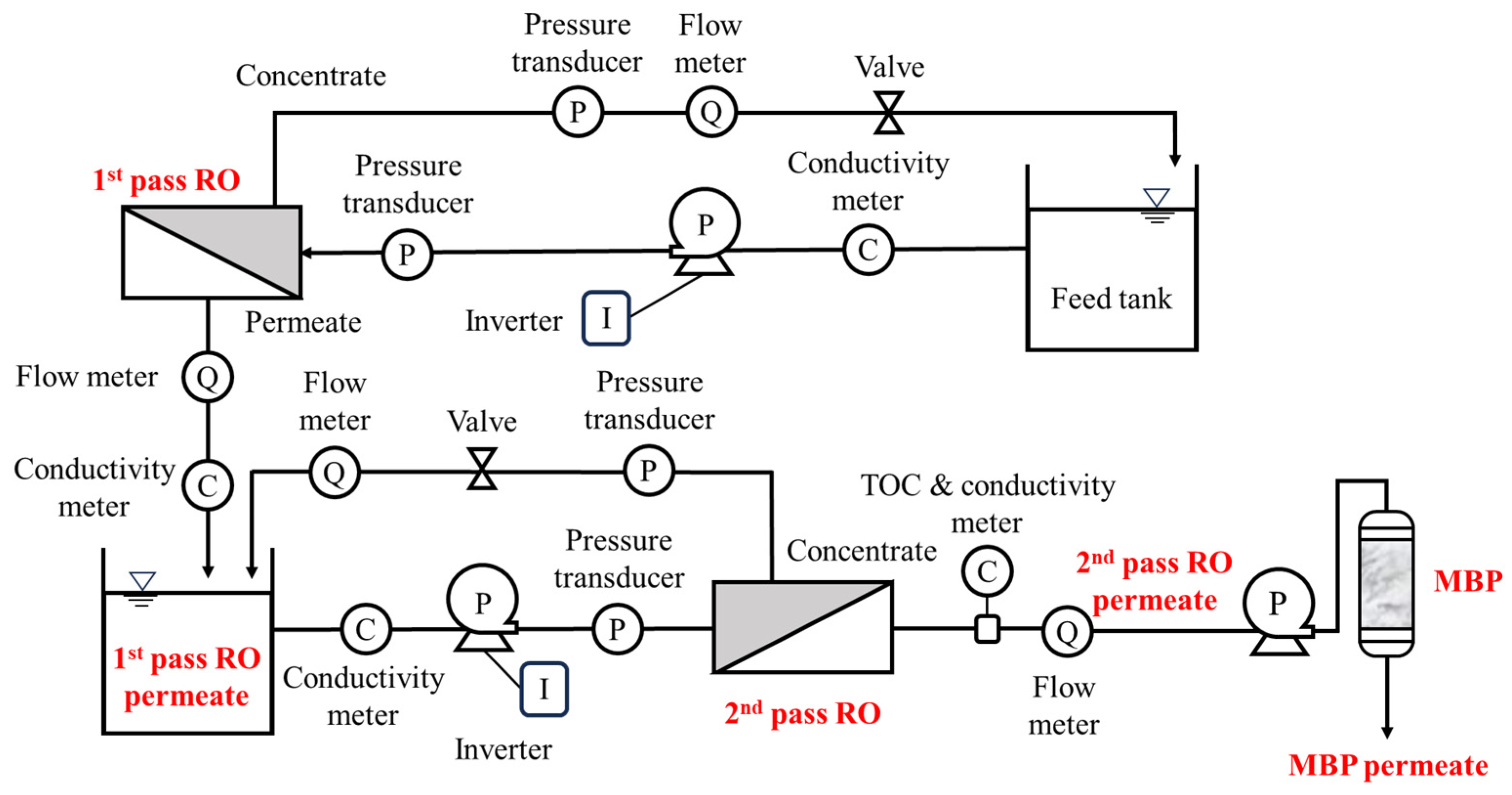
A water treatment system consisting of a two-pass RO process, followed by the MBP process, was used to produce feed water for PEMWE experiments (Figure 2). Feed water was stored in a feed tank, pressurized by a high-pressure vertical multistage centrifugal pump (CR3-17 A-FGJ-A-E-HQQE, Grundfos, Bjerringbro, Denmark), and supplied to the first-pass RO module. The first-pass RO permeate was collected in the permeate tank, and the concentrate was discharged. The first-pass RO permeate was supplied to the second-pass RO module using a high-pressure pump (CR3-17 A-FGJ-A-E-HQQE, Grundfos, Bjerringbro, Denmark). The second-pass RO permeate was introduced into the MBP process. Pump inverters and electronic flow meters were interlocked to control flux and system recovery at each RO process. Inline flow sensors (P525-1S and 3-2536-P0, GF Signet, Irwindale, CA, USA) were installed in the first-pass RO process. An inline flow meter (FS300A G3/4, Shenzhen Crown Haosheng Technology, Guangdong, China) was installed in the second-pass RO process. Pressure transmitters (A-10, WIKA, Klingenberg, Germany) were installed before and after each module to monitor pressure. A conductivity-temperature sensor was installed in the feed water inlet pipe to measure water temperature and EC.
Tap water from Busan Metropolitan City was used as feed water. Tap water is treated through advanced drinking water treatment processes, including pre-ozonation, rapid sand filtration, post-ozonation, and granular activated carbon (GAC) [20]. EC was used as a continuous monitoring parameter and calculated using Equation (1), applying a conversion factor of 0.64 to the total dissolved solids (TDS) concentration [21]. The water quality of the tap water used as the source is summarized (Table 3). Anions present in the feed water remain within the anode circulation system, where they can contribute to localized degradation such as metallic component corrosion and anode catalyst poisoning [8]. However, their transport into the PEM is electrostatically inhibited by the Donnan exclusion effect; the fixed negative charges of the sulfonic acid groups within the PEM effectively repel anions [22]. This electrochemical barrier prevents significant deterioration of the membrane’s bulk ionic conductivity. Consequently, previous studies on water impurities in PEM water electrolysis have predominantly focused on cations, which readily displace protons within the membrane and directly increase ohmic resistance [8]. For these reasons, anion concentrations were excluded from the primary analysis in this study.
EC ( μ S / cm ) = TDS ( mg / L ) 0.64
Hydraulic operating conditions of the first-pass RO process and the second-pass RO process, and specifications of RO membranes are summarized (Table 4 and Table 5). The second-pass RO permeate was supplied as feed water to the MBP process. The MBP process consisted of a cartridge filter filled with 0.6 L of mixed-bed ion exchange resin (MR-450 UPW, Dow, Midland County, MI, USA). The booster pump (DX-8000-0350, Kotek, Republic of Korea) maintained a flow rate of 0.93 L/min.
The first-pass RO, the second-pass RO, and the MBP permeate were used as three feed water sources for PEMWE performance evaluation. EC and TOC were measured to evaluate permeate water quality. EC was measured offline using a portable multi-parameter water-quality meter (Ultrameter II 6PFCE, Myron L Company Carlsbad, CA, USA). The first-pass RO permeate TOC was measured using a laboratory analyzer (Torch, Teledyne Tekmar, Mason, OH, USA). The second-pass RO permeate TOC was continuously measured using an online analyzer (TOC-1000e, Shimadzu, Kyoto, Japan).
The laboratory analyzer limit of detection (50 μg/L) and the fixed installation of the online analyzer on the second-pass RO pipeline restricted direct measurement of the MBP permeate TOC. Since organic leaching from the MBP ion-exchange resin causes an increase in TOC [23], the initial 2 L of the MBP permeate was discarded. Assuming a negligible TOC increase from the MBP ion exchange resin, the TOC values of the second-pass RO permeates supplied to the MBP process were regarded as those of the MBP permeates. As the possibility of minute organic leaching cannot be completely excluded, uncertainty remains concerning the potential increase in TOC concentration in the final MBP permeate.

2.2. PEMWE Hydrogen Production Mechanism

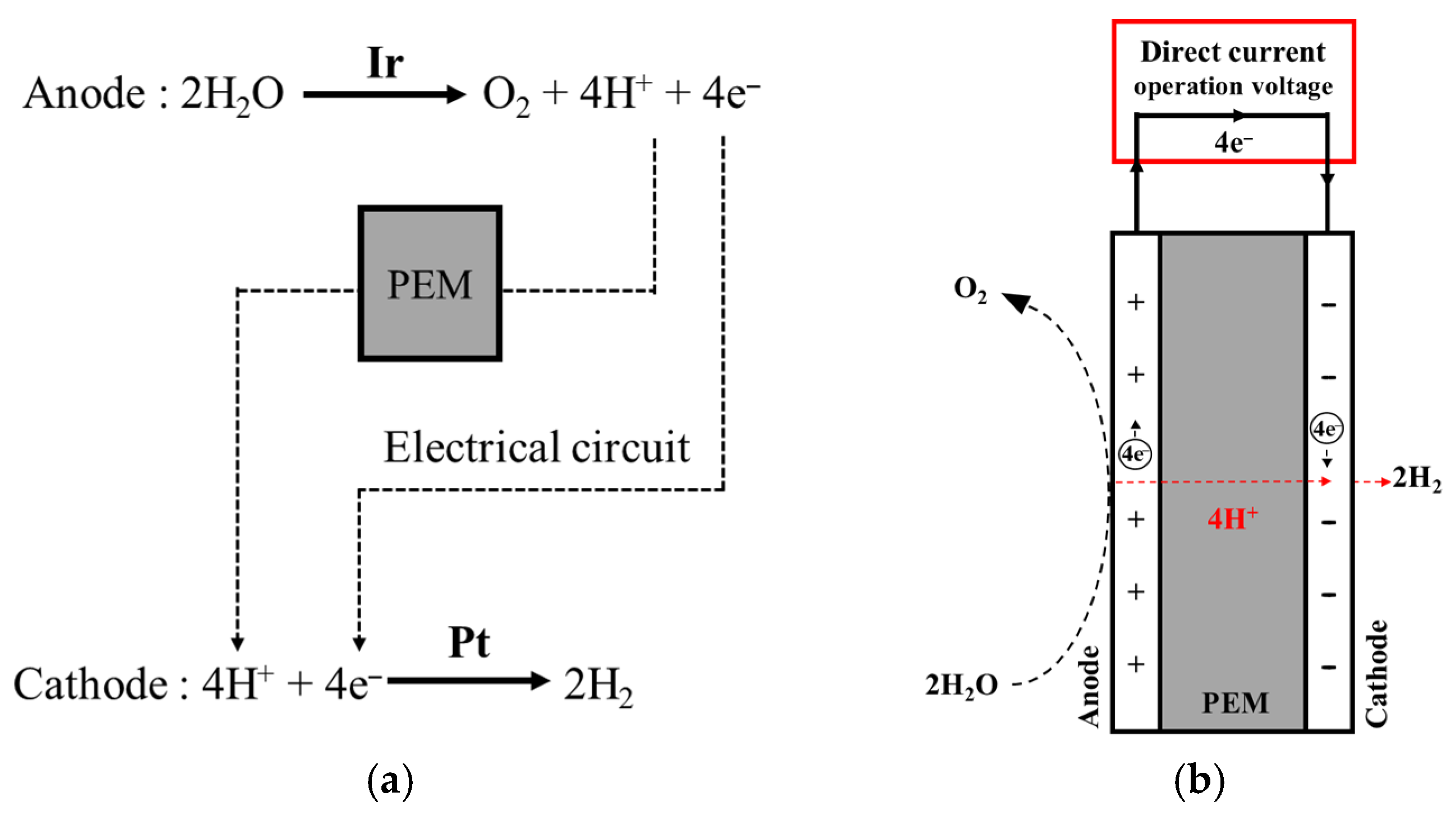
Feed water supplied to the anode of the PEMWE cell undergoes OER (Figure 3a). The high electrochemical potential required for OER creates an oxidative environment at the anode. Protons generated at the anode are transported through the PEM to the cathode by hydration-dependent mechanisms [24]. Electrons are transferred through the external circuit. Protons and electrons combine at the cathode and are reduced to hydrogen gas through the hydrogen evolution reaction (HER) [25]. These reactions occur in the membrane electrode assembly (MEA) (Figure 3b). Commercial PEMWE systems use Ir-based catalysts at the anode and Pt as the cathode catalyst to ensure durability under oxidative conditions [26].

2.3. Experimental Setup for PEMWE

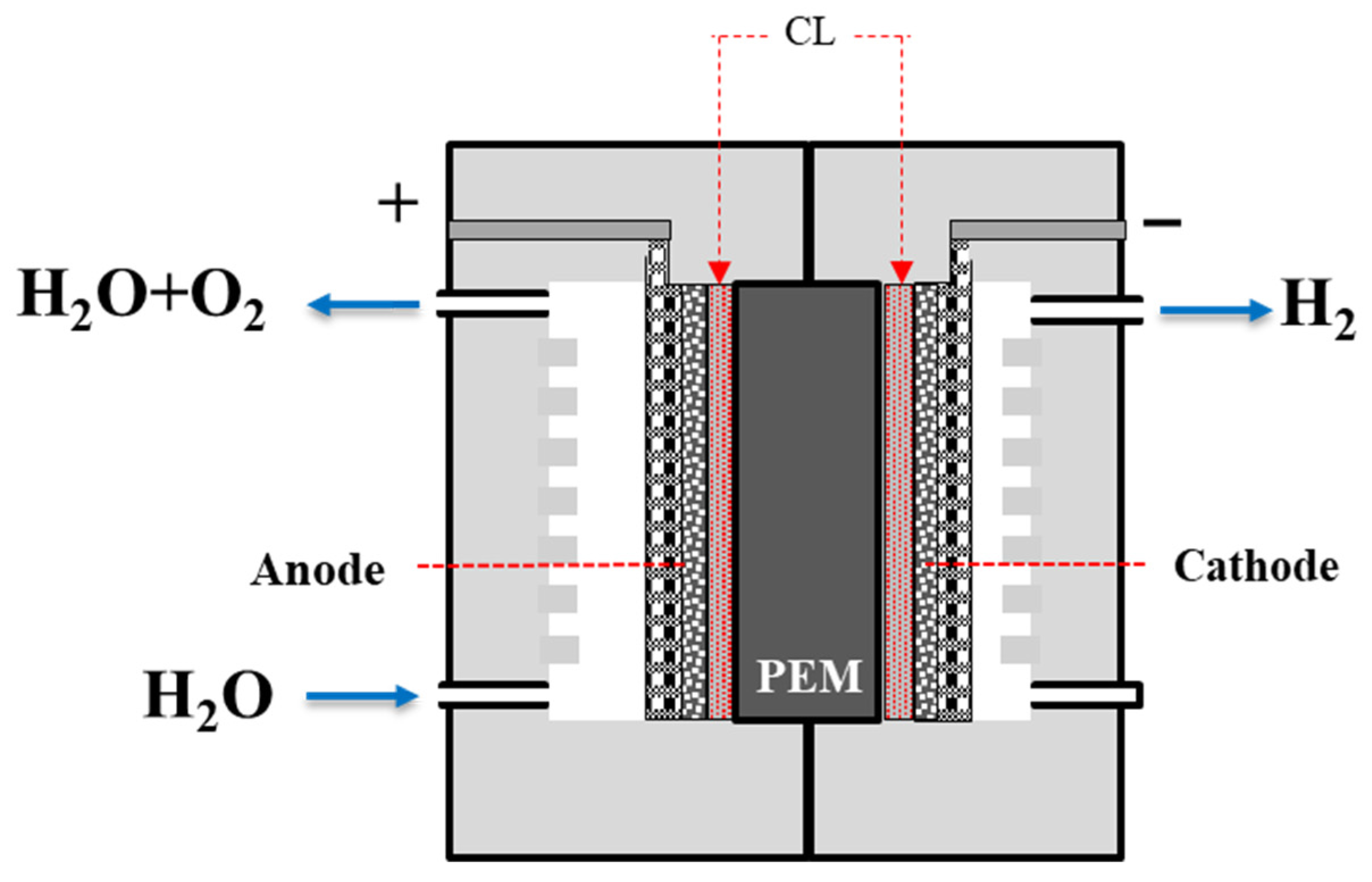
The PEMWE cell utilized for this study consists of end plates, flow fields, and an MEA structure (Figure 4). The MEA structure comprises a catalyst layer (CL) bonded to both sides of the PEM, equipped with Pt catalyst on both the anode and cathode. Generally, Ir catalysts are utilized for PEMWE anodes due to their high electrochemical stability and catalytic activity under OER conditions. In this study, however, a Pt catalyst was applied to the anode to induce accelerated degradation. This approach leverages the lower OER exchange current density of Pt, which results in a higher overpotential and promotes quantifiable electrochemical dissolution within a reduced experimental timeframe.
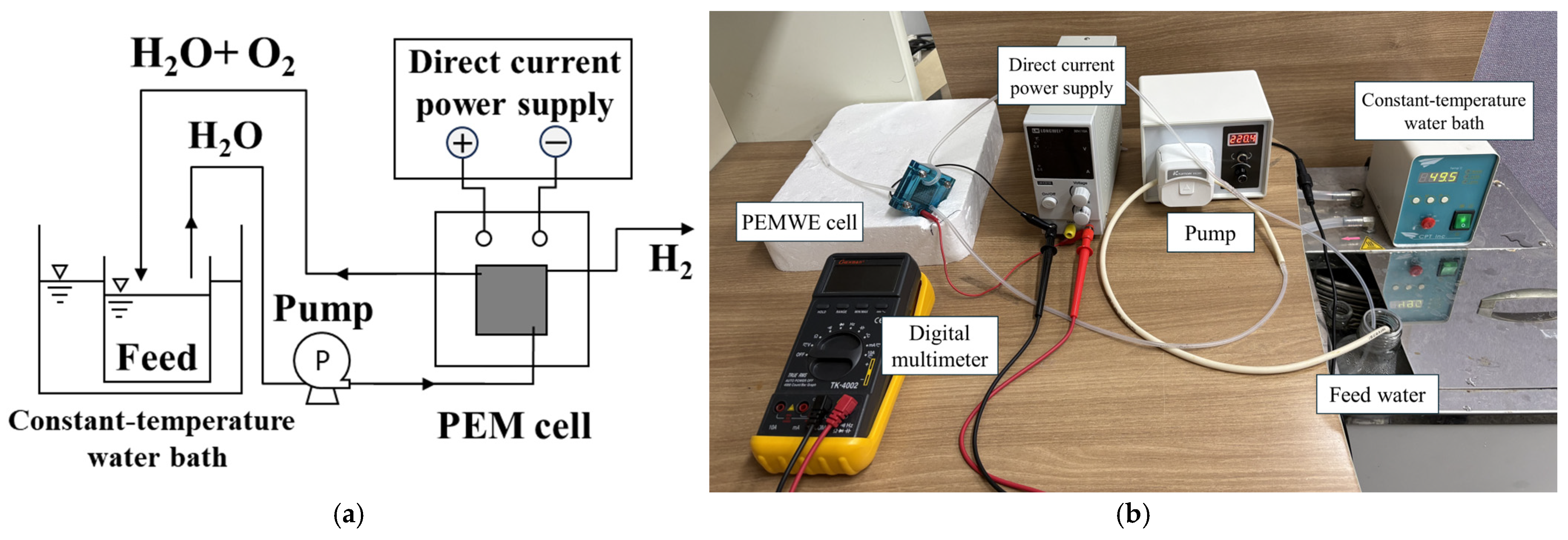
The PEMWE system consists of water supply, an electrochemical cell, power control, and measurement equipment (Figure 5). To remove internal contaminants, at least 1 L of the second-pass RO permeate was flushed through the cell using a peristaltic pump (KK300, Kamoer Fluid Tech, Shanghai, China) and discarded without recirculation. PEM hydration for proton transport was achieved by circulating the second-pass RO permeate in the PEMWE system for 30 min.
Following PEM hydration, the circulating second-pass RO permeate was drained. Permeates from each water treatment process (the first-pass RO, the second-pass RO, or the MBP permeate) were introduced for performance evaluation. The introduced permeate, stored in a glass beaker within a constant-temperature water bath (DRC-22, CPT, Gyeonggi-do, Republic of Korea), was continuously circulated to the anode using a peristaltic pump. Unreacted permeate and oxygen gas were recirculated to the glass beaker, and hydrogen gas produced at the cathode was discharged after the production rate measurement. The anode surface temperature was measured using an infrared thermometer (CIT-1, CAS, Gyeonggi-do, Republic of Korea), and the water bath temperature was adjusted to maintain a constant temperature.
After the cell temperature stabilized, water electrolysis was conducted by applying a constant current using a direct current power supply (LW-K3010D, Dongguan Longwei Electronic Technology Co., Ltd., Guangdong, China). Cell voltage was observed as a function of operating time using a digital multimeter (TK-4001, Taekwang, Busan, Republic of Korea). The EC and pH of the circulating permeate in the beaker were measured using a portable multi-parameter water quality meter (Ultrameter II 6PFCE, Myron L Company, Carlsbad, CA, USA) and a pH meter (HM-501, HM Digital, Republic of Korea), respectively, to monitor ion accumulation during electrolysis.
(Model: Gemini 3 Flash Thinking; Google LLC) was used to check English grammar.

3. Results and Discussion

3.1. Permeate Water Quality of Water Treatment Processes for PEMWE

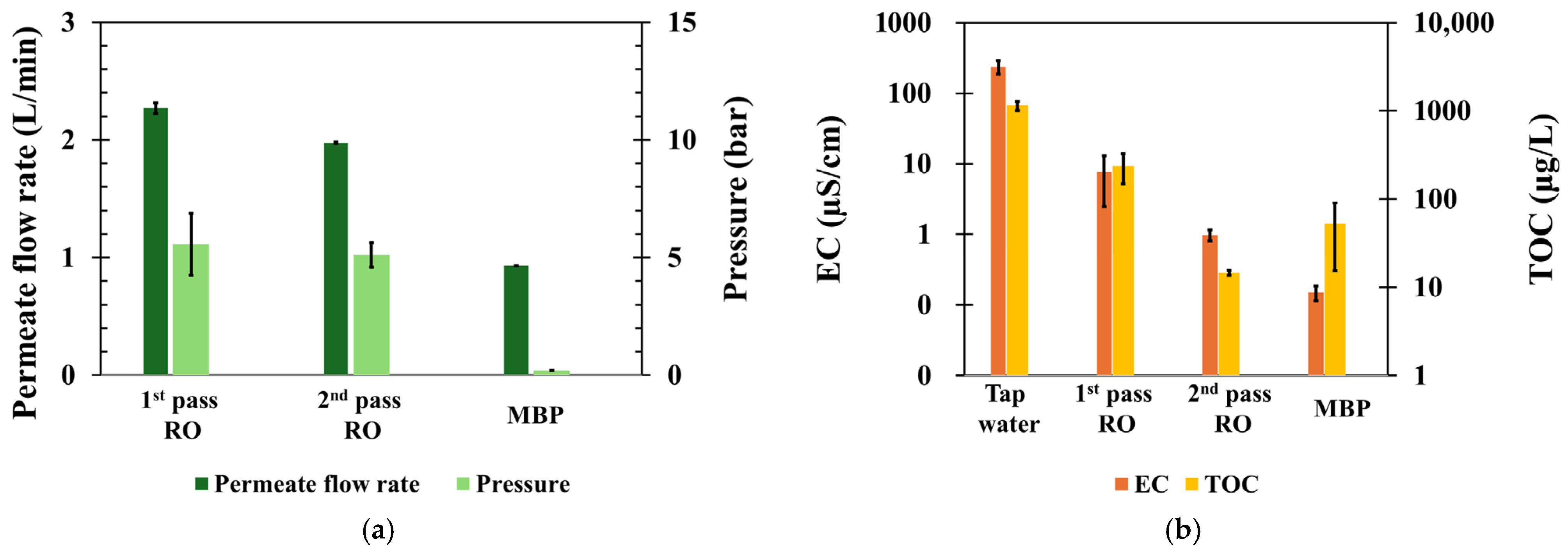
The operating conditions for each water treatment process are summarized (Figure 6a). The measured pressure and flow rate in Figure 6a confirmed that the system operated under the RO operating conditions described in Table 4. The first-pass RO process operated at a pressure of 5.56 ± 1.31 bar and a flow rate of 2.27 ± 0.05 L/min. The second-pass RO process operated at a pressure of 5.12 ± 0.52 bar and a flow rate of 1.98 ± 0.01 L/min. The MBP process operated at a pressure of 0.2 bar and a flow rate of 0.93 L/min. Permeate water quality (EC and TOC) for each water treatment process is presented (Figure 6b). The EC of tap water was 235.6 ± 49.7 μS/cm, which was reduced by 97% to 8 ± 4 μS/cm after the first-pass RO process, and by 89% to 0.89 ± 0.03 μS/cm after the second-pass RO process. The EC of the MBP permeate was 0.17 ± 0.03 μS/cm. The TOC of tap water was 1140 μg/L, which was reduced by 78% to 250 ± 70 μg/L after the first-pass RO process, and by 94% to 15 ± 1 μg/L after the second-pass RO process. The TOC of the MBP permeate (52 ± 37 μg/L) was represented by the second-pass RO permeate TOC, as mentioned in Section 2.1.
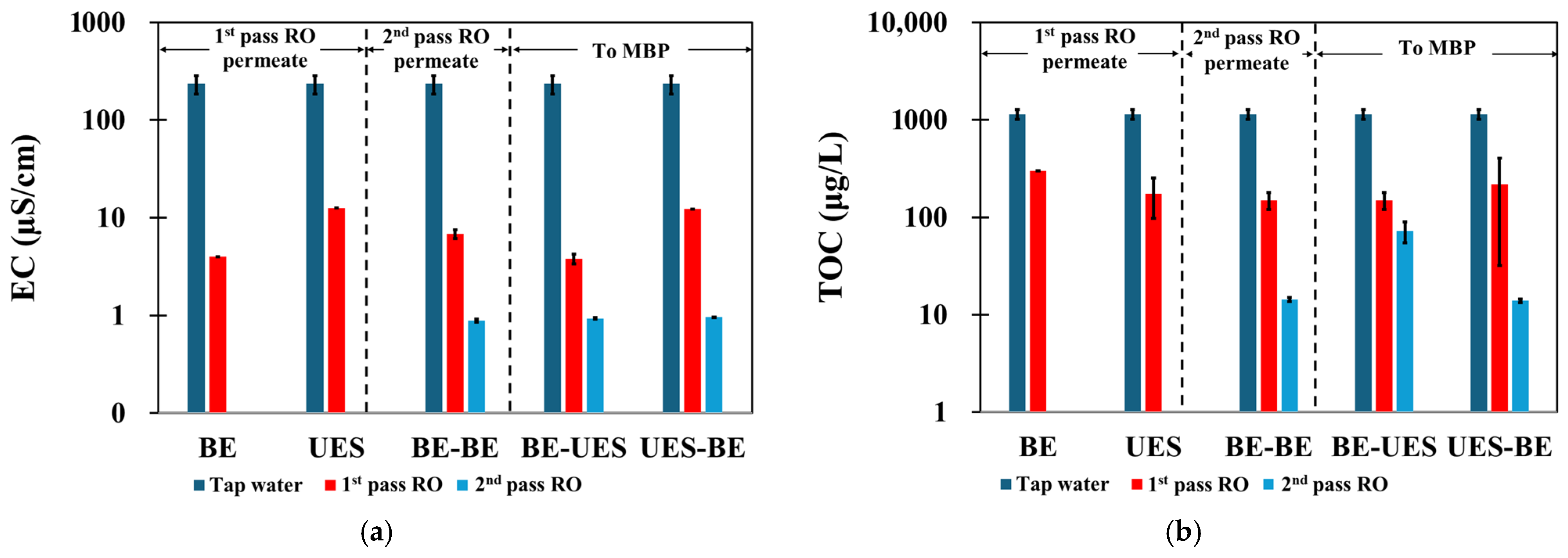
Permeate water quality variations are attributed to different RO membrane configurations (Figure 7). The first-pass RO permeate data (Figure 6b) represent combined results from RE4040-BE (BE) and BW 4040 UES (UES) membranes. The second-pass RO permeate data originated from the BE–BE configuration. The MBP process utilized the second-pass RO permeate produced from the BE–UES and UES–BE configurations. The EC of the second-pass RO permeate was about 1 μS/cm regardless of membrane combinations (Figure 7a), which is the same result as reported in the literature [9] about the two-pass RO process for ultrapure water production. While the EC of the permeates showed relatively minor variations depending on the membrane types, the TOC removal efficiency and permeate TOC concentrations depended significantly on the selection of membranes for the first- and second-pass RO processes. In cases where the BE membrane was selected for the second pass, a high TOC removal efficiency of approximately 94.0% (relative to the first-pass permeate) was achieved, resulting in a permeate TOC of 15 ± 1 μg/L. In contrast, using the UES membrane as the second-pass RO resulted in a lower removal efficiency of approximately 72.0%. The small standard deviations of the measured TOC values confirm the distinct performance differences among the membrane configurations clearly.
Consequently, the TOC of the MBP permeate (52 ± 37 μg/L) exceeded that of the second-pass RO permeate (15 ± 1 μg/L) produced from the BE–BE configuration. This is attributed to the fact that the MBP process was supplied with second-pass RO permeates from configurations with lower TOC removal efficiency, such as the BE–UES and UES–BE combinations. These results underscore that strategic membrane selection in the second-pass RO is essential for effective TOC control in simplified water treatment systems.

3.2. Initial Performance Verification and Experimental Considerations of the PEMWE System

3.2.1. System Reliability Verification Based on Hydrogen Production

Reliability of experimental apparatus was verified by comparing measured hydrogen production with theoretical values derived from Faraday’s law (Equation (2)) [27,28].
V H 2 = I · t z · F × V m
where V H 2 is the theoretical hydrogen production volume, I is the applied current, t is the reaction time, z is the number of electrons required to produce one mole of hydrogen ( z   =   2 ), and F is the Faraday constant (96,485 C/mol). V m is volume per mole of gas under experimental conditions; 24.45 L/mol was used based on the ideal gas law at 25 °C and 1 atm.
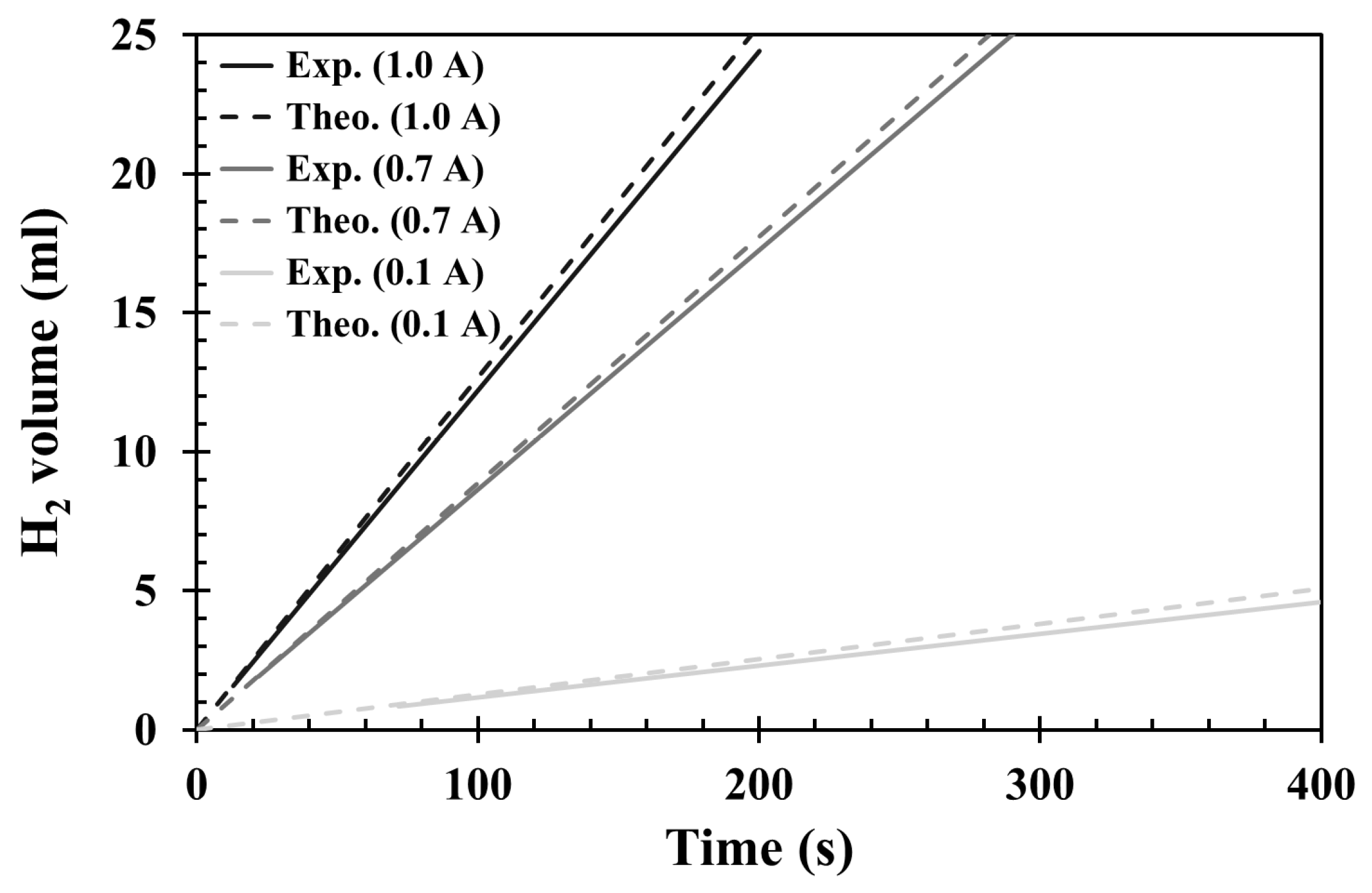
Based on Equation (2), the theoretical hydrogen production rates (slopes) for current levels of 1.0, 0.7, and 0.1 A were determined to be 0.1267, 0.0887, and 0.0127 mL/s, respectively. Figure 8 presents the fitted trend lines representing the measured production rates compared with the theoretical values. The experimental production rates were determined by evaluating the slopes of the fitted trend lines for each current level. At a current of 1.0 A, the experimental slope was 0.1221 mL/s ( R 2 = 0.9996), resulting in an error rate of 3.6%. Similarly, at 0.7 A and 0.1 A, the experimental slopes were 0.0862 mL/s ( R 2 = 0.9988) and 0.0115 mL/s ( R 2 = 0.9987), showing error rates of 2.8% and 9.4%, respectively. The high coefficients of determination ( R 2 > 0.99) and low error margins confirm that hydrogen gas was generated consistently with the theoretical values across the tested current range.

3.2.2. Experimental Considerations for Stable PEMWE Operation

The performance of PEMWE operation can be monitored by observing the cell voltage during hydrogen production. Even under commercial PEMWE operating conditions, the anode is exposed to acidic conditions and high voltage [29], which induces degradation of the anode catalysts [30,31] and membrane [32]. Cell voltage increases as the anode catalyst and membrane degradation become severe.
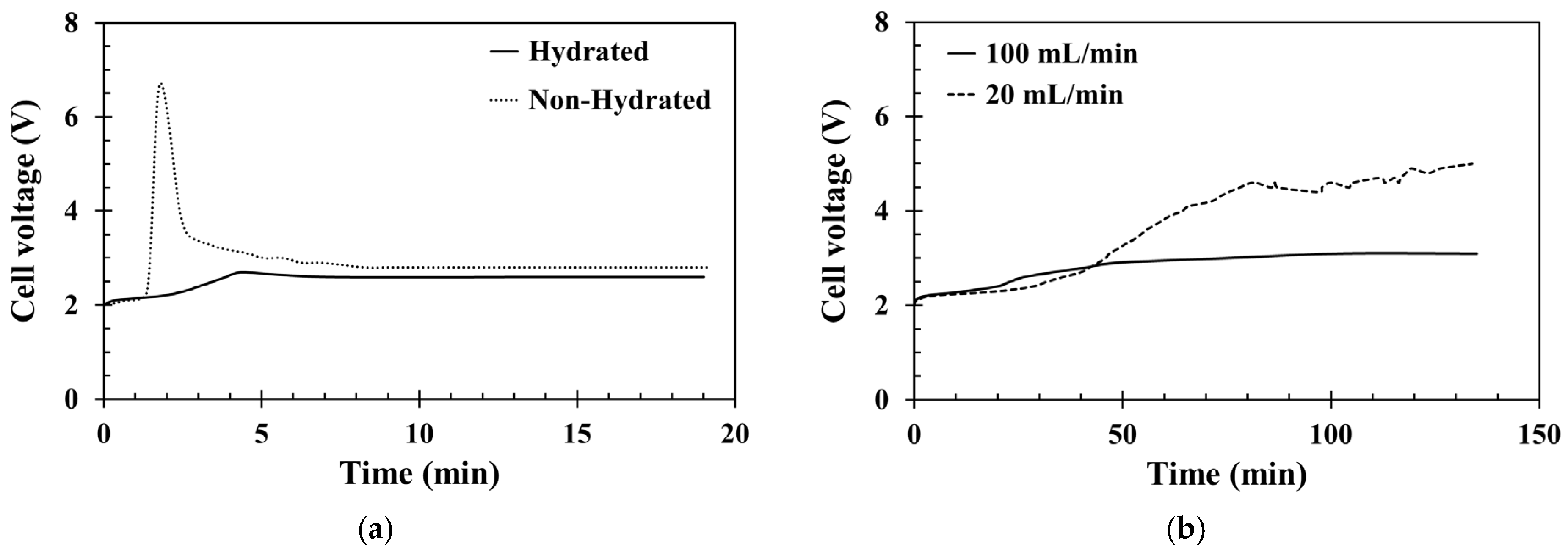
These degradations (i.e., voltage increase) can be accelerated by overpotential resulting from improper operation [33]. To properly evaluate PEMWE performance depending on water quality, the overpotential due to improper operation must be excluded. Consistent with hydration-dependent proton transport mechanisms (Section 2.2), overpotential occurred immediately under non-hydrated conditions, whereas initial cell voltage remained stable following PEM hydration [34] (Figure 9a). These findings demonstrate that proper hydration is necessary to prevent overpotential during initial operation.
At the anode of PEMWE, oxygen gas is produced. The residual oxygen gas hinders proton transfer through the PEM [35]. To remove it, a sufficient circulating flow rate for the anode chamber is required. Insufficient product (oxygen gas) removal at the anode caused continuous cell voltage increase at a flow rate of 20 mL/min, whereas cell voltage remained stable at 100 mL/min (Figure 9b). These results demonstrate that an adequate flow rate is necessary to ensure effective oxygen gas removal and prevent continuous system degradation.
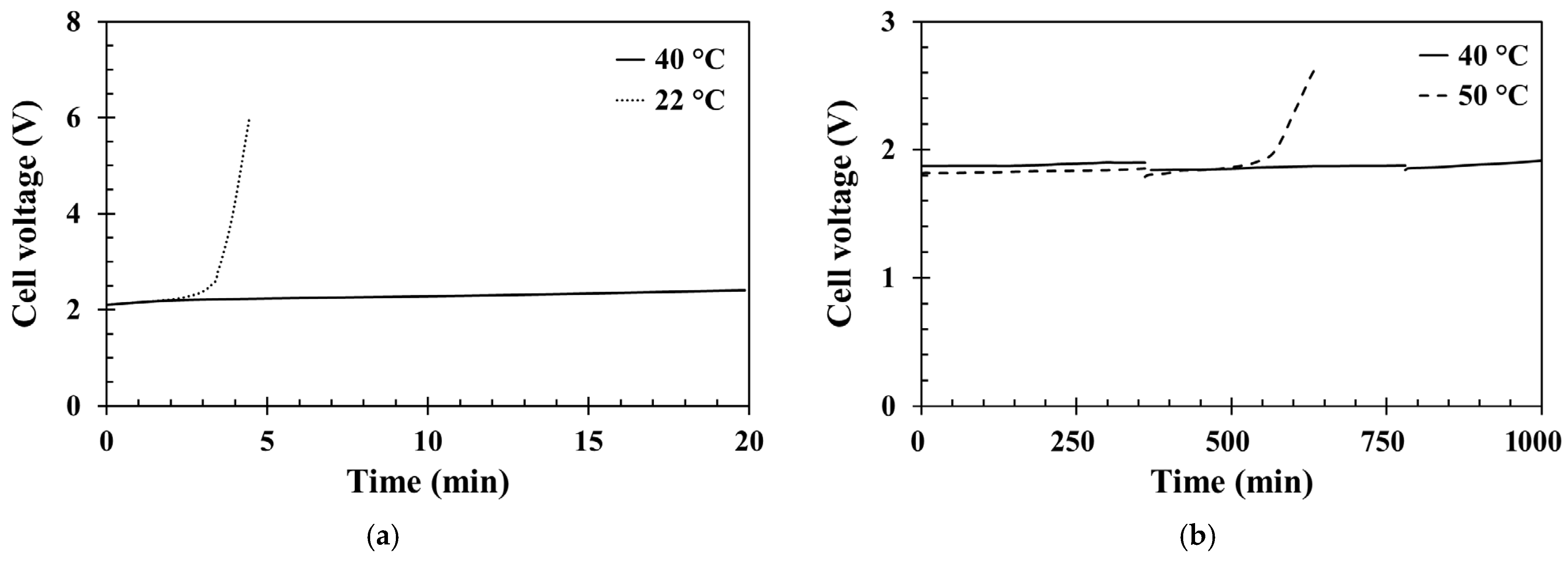
Cell voltage at the operating temperatures of 22 °C, 40 °C, and 50 °C was monitored (Figure 10). At 22 °C, cell voltage sharply increased to approximately 6 V within 5 min [36] (Figure 10a). At 50 °C, cell voltage increased rapidly after approximately 500 min, indicating excessively accelerated degradation of MEA components [37] (Figure 10b). Cell voltage at 40 °C remained stable. Such extreme overpotential and rapid degradation would obscure performance differences caused by individual water treatment processes. Therefore, the operating temperature was adjusted to 40 °C to prevent excessive degradation and isolate the effects of water treatment processes during evaluation.
PEMWE operation requires an appropriate temperature range inside the cell. At lower operating temperatures, membrane ionic conductivity decreases, and overvoltage increases [36]. High temperatures accelerate chemical and mechanical membrane degradation, leading to significant thinning and increased hydrogen crossover. This accelerated degradation results in a rapid increase in cell voltage and premature PEMWE system failure [37].

3.3. Interpretation of a PEMWE Performance Test

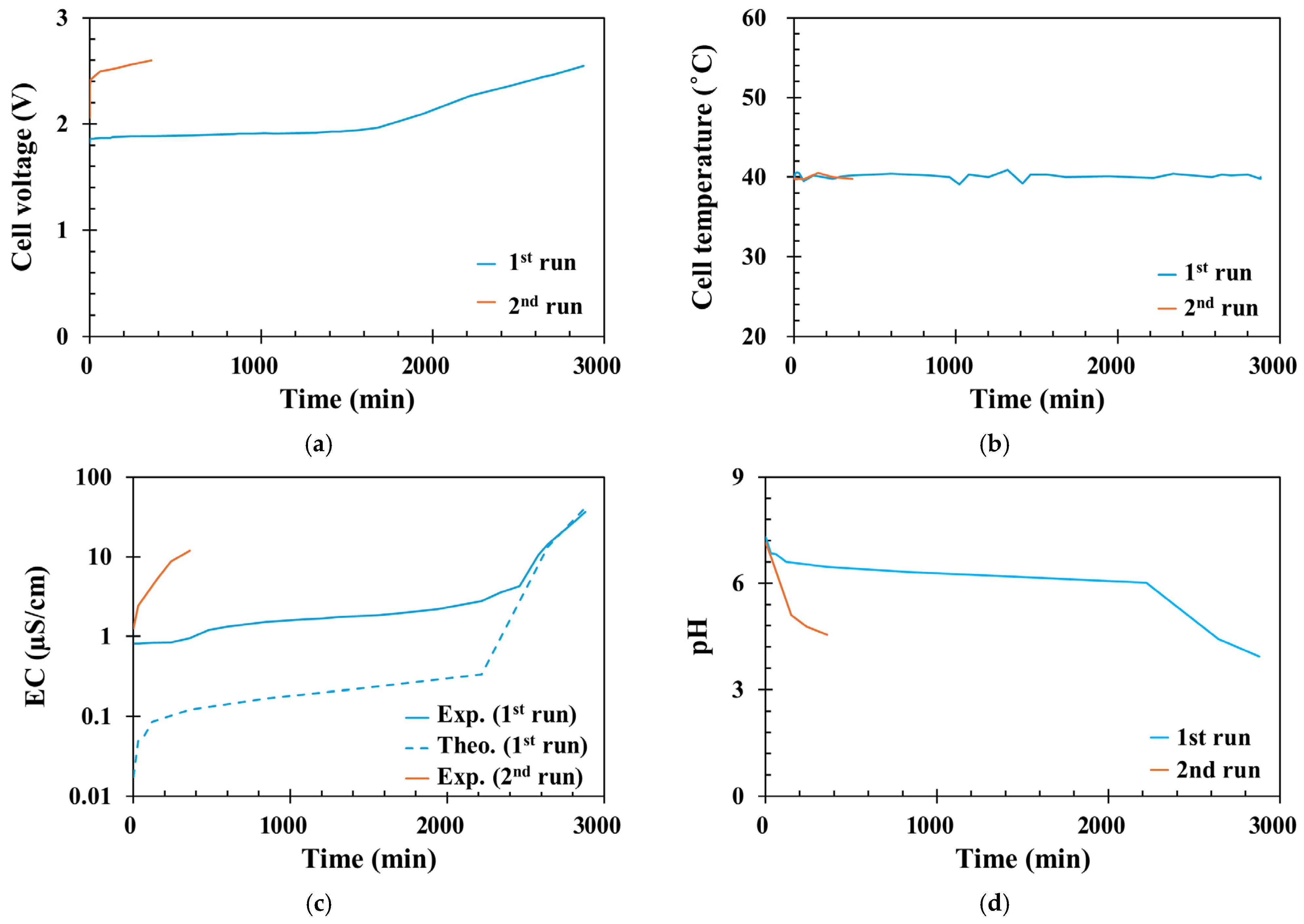
Figure 11 shows cell voltage, EC, pH, and cell temperature during a PEMWE experiment using, for example, the second-pass RO permeate. The electrical current required to maintain a constant production rate of hydrogen was set to 0.7 A, and the cell voltage increased over time (Figure 11a). If the operating conditions are set properly, as discussed in Section 3.2.2, the increase in cell voltage in the PEMWE is affected only by feed water quality. For example, cell temperature was maintained at 40 °C throughout operation (Figure 11b) to avoid unexpected degradation of PEMWE cells. As discussed in Section 3.1, the EC and TOC of the second-pass RO permeate were 0.91 μS/cm and 14 μg/L, respectively, which means that cations and organic impurities exist in the feed water for PEMWE.
Cation impurities in the feed water displace protons and bind to the ionomer within the membrane [38]. This displacement gradually reduces the membrane ionic conductivity, and as this effect accumulates, it consequently elevates the cell voltage and accelerates the degradation of the membrane (Figure 11a). Organic impurities also cause degradation in PEMWE. At the electrodes, organic compounds poison the active surfaces, accelerating the dissolution and deactivation of the catalysts, which elevate the cell voltage [39,40]. Within the membrane, organic fouling hinders ion transport [41], leading to an increase in the cell voltage (Figure 11a). This voltage increase accelerates system degradation.
Feed water was circulated from the beaker to the PEMWE cell as described in Figure 5. The EC of the circulating water increased gradually over 2400 min of operation, followed by a sharp increase thereafter (Figure 11c). The increase in EC can be partly explained by the decrease in pH, as shown in Figure 11d. Proton concentration in aqueous solution ( c H + ) is derived from measured pH ( c H + = 10 p H ). The theoretical EC increase ( Δ κ ) due to proton accumulation is calculated using Kohlrausch’s law of independent migration of ions (Equation (3)) [42].
Δ κ = λ H + × Δ c H + × 10 3
where λ H + is the limiting molar conductivity of protons (349.6 S·cm2/mol at 298 K).
Theoretical EC calculated from the observed pH drop was plotted as a dashed line in Figure 11c. The difference between the theoretical and experimental EC can be attributed to cation leaching from the catalyst layer coated on the anode. As discussed in Section 3.2.2, the catalyst on the anode corrodes under strongly acidic conditions with high electrical potential in the anode chamber.
To evaluate the state of the cell components following the initial operation, an additional test was conducted to compare the initial state of a fresh cell with its state after the 48-h accelerated test. In the first run with a fresh cell, the cell voltage increased from 1.848 V to 2.548 V over 48 h of operation. After completing this operation, the cell was flushed, and a second run was initiated under identical operating conditions using fresh feed water. During the second run, the initial cell voltage started at 2.06 V and rapidly surged to 2.3 V within 1 min. Furthermore, the cell voltage reached 2.6 V after 6 h of operation. This difference in the voltage levels confirms that the cell was degraded during the preceding 48-h accelerated test.

3.4. Comparison of the PEMWE Performance Across Different Water Treatment Processes

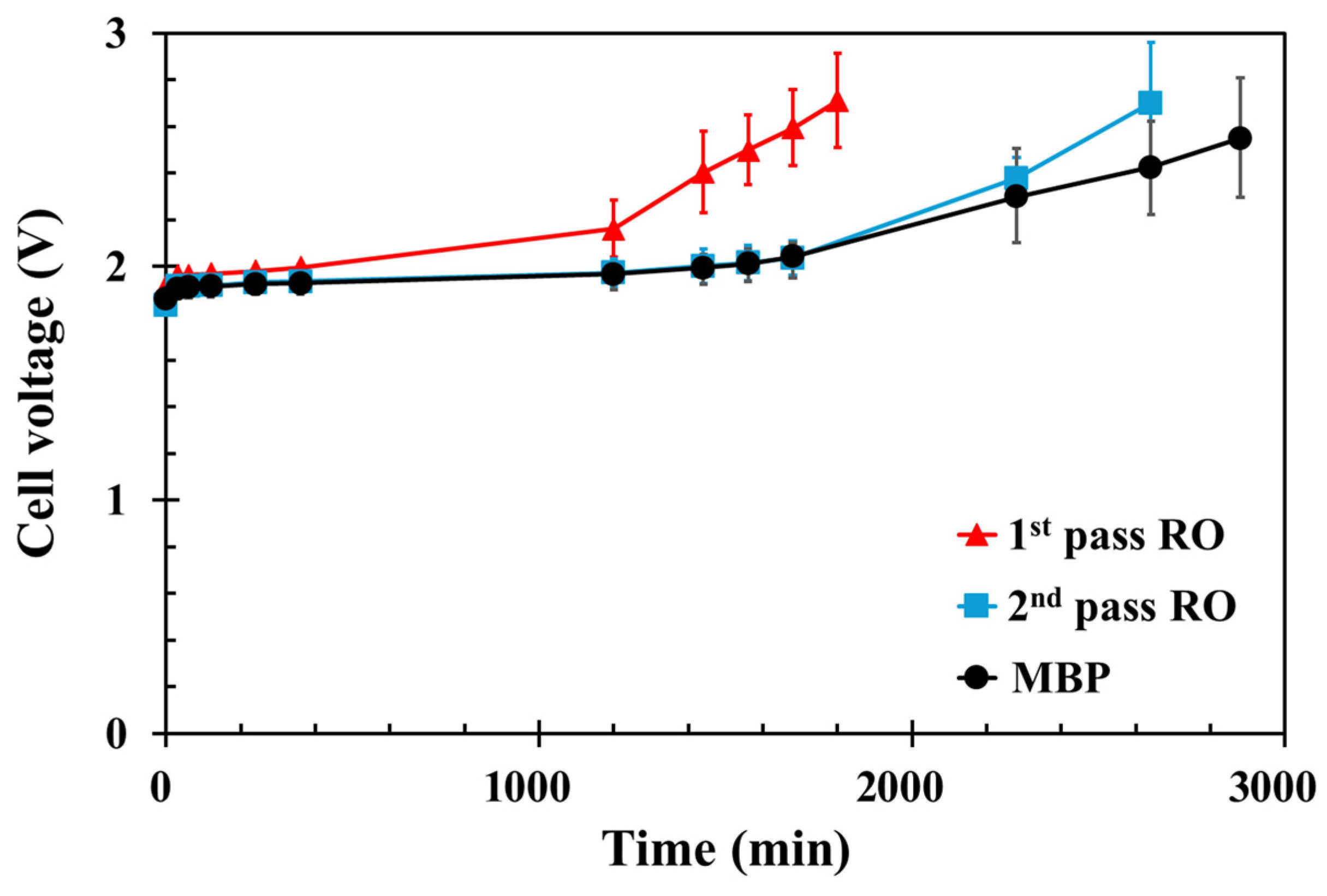
The effect of water quality on PEMWE performance was investigated using three different water treatment processes: first-pass RO, second-pass RO, and MBP permeates (Figure 12). For all applied water treatment processes, cell voltage increased over time. However, the cell voltage trends differed depending on the permeates used as feed water for PEMWE.
When the first-pass RO permeates (EC ≅ 7.7 ± 5.2 μS/cm, TOC ≅ 238 ± 88 μg/L) were used, a higher cell voltage was observed within a shorter time compared to the second-pass RO and MBP permeates. This rapid voltage increase is attributed to relatively high levels of cations and organic impurities in the feed water. Specifically, cationic species undergo ion exchange with protons in the ionomer, reducing the membrane ionic conductivity and inducing an additional voltage penalty. Additionally, organic molecules attach to electrode surfaces, causing catalyst deactivation and dissolution, and block internal ion-transport pathways via membrane fouling. These factors acted in combination to continuously degrade the PEMWE system throughout operation, and the rate of voltage increase further accelerated from approximately 1200 min (Figure 12).
Compared to the first-pass RO permeates, the second-pass RO (EC ≅ 0.893 ± 0.03 μS/cm, TOC ≅ 15 ± 1 μg/L) and MBP (EC ≅ 0.17 ± 0.03 μS/cm, TOC ≅ 52 ± 37 μg/L) permeates showed smaller cell voltage increases. Interestingly, the second-pass RO permeates showed a cell voltage trend comparable to that of the MBP permeates. To conduct an error analysis of the cell voltage trends, standard deviations were included in Figure 12. The error bars for the second-pass RO and MBP permeates overlapped extensively throughout the observation period, demonstrating that the variations between these two groups are not statistically significant. In commercial PEMWE systems, a 10% increase from the initial cell voltage typically dictates stack replacement, and 2.4 V is sometimes applied as the upper limit for end-of-life testing purposes [43,44]. Within these voltage limitations, the cell voltage increase patterns of the second-pass RO permeates were even closer to those of the MBP permeates (Figure 12).
To quantitatively associate these experimental observations with the underlying degradation mechanisms, multiple linear regression analyses were performed. In the first model, cell voltage (Vcell) was defined as the dependent variable, while operation time ( t ), TOC, and EC were defined as independent variables. The resulting regression equation was:
V c e l l = 1.77857 + 0.00023 t + 0.00096 T O C + 0.00073 E C
The analysis showed that the p -value for EC was 0.899, indicating a complete lack of statistical significance. In contrast, TOC had a highly significant impact on the cell voltage increase ( p -value = 2.63 × 1 0 5 ). This quantitative finding explains the similar voltage increase patterns observed in both water treatment permeates: although the second-pass RO permeates contained higher levels of cation impurities (higher EC), their lower levels of organic impurities (lower TOC) predominantly governed the performance degradation. To clarify the role of the MBP process, which is primarily implemented for EC control, a second regression model for cell voltage (Vcell) was conducted by replacing EC with a categorical variable for the MBP process:
V c e l l = 1.81047 + 0.00023 t + 0.00088 T O C 0.0552 M B P
This revised model ( R 2 = 0.694 ) confirmed the dominant influence of TOC ( p -value = 5.34 × 1 0 6 ). The regression coefficients provide a direct quantitative measure of the degradation; specifically, each 1   μ g / L increase in TOC resulted in a voltage rise of approximately 0.00088 to 0.00096 V. Combined with the overlapping error bars in Figure 12, this confirms that the performance differences between the second-pass RO and MBP permeates are practically marginal.
The higher TOC values observed in the MBP permeates were attributed to the selection of an RO membrane with a lower TOC rejection rate for the preceding two-pass RO process. Since the MBP process is not designed for organic removal but rather for ion exchange, the TOC concentration in the final MBP permeate is primarily determined by the rejection efficiency of the preceding RO membranes. This finding indicates that merely implementing a two-pass RO process is insufficient to resolve organic-matter-related issues; rather, it must be accompanied by the proper selection of RO membranes to effectively control TOC and ensure stable PEMWE performance.

4. Conclusions

The influence of different water treatment configurations on the performance of PEMWE was investigated. By comparing first-pass RO, second-pass RO, and MBP permeates used as feed water, this study evaluated the degradation patterns associated with water impurities under an accelerated testing framework.
The experimental results confirmed that TOC was the primary driver of the cell voltage increase ( p -value = 2.63 × 1 0 5 ), whereas EC showed no statistical significance ( p -value =   0.899 ). Notably, the second-pass RO and MBP permeates exhibited comparable voltage trends, with their error bars overlapping throughout the observation period. This finding indicates that a two-pass RO configuration can effectively reduce the design complexity of the water treatment process for PEMWE systems, offering a cost-effective alternative to multi-stage post-treatment processes. However, merely configuring a two-pass RO process does not guarantee compliance with ASTM D1193 Type II standards. To effectively control TOC, the two-pass RO configuration must be accompanied by the proper selection of RO membranes.
This study employed a Pt anode as an accelerated degradation surrogate to observe quantifiable voltage increases within a limited timeframe. Although the higher overpotential of Pt accelerated catalyst dissolution compared to commercial Ir anodes, the underlying degradation mechanisms remained fundamentally consistent. Specifically, the initial cell voltage was 1.848 V before the 48-h test, but it increased to 2.06 V after the accelerated test, confirming that performance loss occurred due to the degradation of cell components. However, since the degradation rates of Pt differ from those of commercial Ir-based catalysts during long-term operation, these short-term trials are limited in their ability to quantitatively forecast long-term commercial performance.
Furthermore, a core challenge faced during this study was the difficulty in isolating the influence of individual impurities, as the focus was primarily on evaluating the overall performance of the water treatment configurations. Therefore, future experiments should be conducted under single-variable-controlled conditions to precisely determine the impact of specific ions and organic species. Finally, to apply these findings to commercial systems and promote a circular economy in water management, long-term studies using commercial Ir catalysts are required.

Author Contributions

Conceptualization, D.K. (Dongkyu Kang) and S.K.; methodology, D.K. (Dongkyu Kang) and S.K.; validation, D.K. (Dongkyu Kang), J.K. and S.K.; formal analysis, D.K. (Dongkyu Kang), J.K. and S.K.; investigation, D.K. (Dongkyu Kang) and J.K.; data curation, D.K. (Dongkyu Kang) and J.K.; writing—original draft preparation, D.K. (Dongkyu Kang); writing—review and editing, D.K. (Dongkyu Kang), D.K. (Dongkeon Kim) and S.K.; visualization, D.K. (Dongkyu Kang), J.K. and D.K. (Dongkeon Kim); supervision, S.K. All authors have read and agreed to the published version of the manuscript.

Funding

This research was supported by Basic Science Research Program through the National Research Foundation of Korea (NRF) funded by the Ministry of Education (RS-2025-25397043).

Data Availability Statement

The original contributions presented in this study are included in the article. Further inquiries can be directed to the corresponding author.

Acknowledgments

Gemini (Model: Gemini 3 Flash Thinking; Google LLC) was used to check English grammar.

Conflicts of Interest

The authors declare no conflicts of interest.

Abbreviations

The following abbreviations are used in this manuscript:
PEMWEProton exchange membrane water electrolysis
IrIridium
PtPlatinum
ECElectrical conductivity
TOCTotal organic carbon
ROReverse osmosis
CEDIContinuous electrodeionization
MDGMembrane degasifier
MBPMixed-bed polisher
SBFSoftening with ballasted flocculation
GACGranular activated carbon
TDSTotal dissolved solids
OEROxygen evolution reaction
PEMProton exchange membrane
HERHydrogen evolution reaction
MEAMembrane electrode assembly
CLCatalyst layer

References

  1. IRENA. Green Hydrogen Supply: A Guide to Policy Making; International Renewable Energy Agency: Abu Dhabi, United Arab Emirates, 2021; ISBN 978-92-9260-344-1. Available online: https://www.irena.org/publications/2021/May/Green-Hydrogen-Supply-A-Guide-To-Policy-Making (accessed on 30 March 2026).
  2. Kang, S.; Kim, J.; Park, J.; Cho, D. Predicting Initial Construction Costs of Electrolysis Hydrogen Production Plants for Building Sustainable Energy Systems. J. Hydrog. New Energy 2024, 35, 257–268. [Google Scholar] [CrossRef]
  3. Tawalbeh, M.; Alarab, S.; Al-Othman, A.; Javed, R.M.N. The Operating Parameters, Structural Composition, and Fuel Sustainability Aspects of PEM Fuel Cells: A Mini Review. Fuels 2022, 3, 449–474. [Google Scholar] [CrossRef]
  4. Egeland-Eriksen, T.; Hajizadeh, A.; Sartori, S. Hydrogen-based systems for integration of renewable energy in power systems: Achievements and perspectives. Int. J. Hydrogen Energy 2021, 46, 31963–31983. [Google Scholar] [CrossRef]
  5. IRENA. Green Hydrogen Cost Reduction: Scaling up Electrolysers to Meet the 1.5 °C Climate Goal; International Renewable Energy Agency: Abu Dhabi, United Arab Emirates, 2020; ISBN 978-92-9260-295-6. Available online: https://www.irena.org/publications/2020/Dec/Green-hydrogen-cost-reduction (accessed on 30 March 2026).
  6. Carmo, M.; Fritz, D.L.; Mergel, J.; Stolten, D. A comprehensive review on PEM water electrolysis. Int. J. Hydrogen Energy 2013, 38, 4901–4934. [Google Scholar] [CrossRef]
  7. ASTM D1193-06(2018); Standard Specification for Reagent Water. ASTM International: West Conshohocken, PA, USA, 2018.
  8. Becker, H.; Murawski, D.J.; Shinde, D.V.; Stephens, I.E.L.; Hinds, G.; Smith, G. Impact of impurities on water electrolysis: A review. Sustain. Energy Fuels 2023, 7, 1565–1603. [Google Scholar] [CrossRef]
  9. Kim, D.; Lee, H.; Jeon, J.; Kim, S. High recovery design of reverse osmosis process with high permeate water quality and low wastewater discharge for ultra-pure water production. Desalination 2024, 592, 118149. [Google Scholar] [CrossRef]
  10. Badgett, A.; Brauch, J.; Thatte, A.; Rubin, R.; Skangos, C.; Wang, X.; Ahluwalia, R.; Pivovar, B.; Ruth, M. Updated Manufactured Cost Analysis for Proton Exchange Membrane Water Electrolyzers; NREL/TP-6A20-87625; National Renewable Energy Laboratory (NREL): Golden, CO, USA, 2024. Available online: https://www.nrel.gov/docs/fy24osti/87625.pdf (accessed on 30 March 2026).
  11. Metsäjoki, J.; Nikiforow, K. Design and Testing of 50 kW PEM Electrolyser in FinH2-Project; VTT Technical Research Centre of Finland: Espoo, Finland, 2024; Available online: https://www.finh2.fi/wp-content/uploads/design-and-testing-of-50-kW-PEM-electrolyzer.pdf (accessed on 30 March 2026).
  12. Spoof-Tuomi, K.; Manfo, T.A. Techno-Economic Analysis of Green Hydrogen Production: 20 MW PEM Electrolysis Plant; University of Vaasa: Vaasa, Finland, 2025; Available online: https://www.uwasa.fi/sites/default/files/2025-06/T1.3%261.4%20Techno-economic%20analysis%20of%20green%20hydrogen%20production_0.pdf (accessed on 30 March 2026).
  13. Dokhani, S.; Assadi, M.; Pollet, B.G. Techno-economic assessment of hydrogen production from seawater. Int. J. Hydrogen Energy 2023, 48, 9592–9608. [Google Scholar] [CrossRef]
  14. Maniscalco, M.P.; Culcasi, A.; Asaro, S.M.; Ferraro, M. Hydrogen from Seawater: An Environmental and Economic Evaluation of Aem and Pem Electrolysis Coupled with Advanced Desalination Systems. Chem. Eng. Trans. 2025, 119, 97–102. [Google Scholar] [CrossRef]
  15. Sin, P.P.S.; Yadai, T.; Yamamura, H.; Suzuki, Y.; Ota, Y.; Nishioka, K. Effect of Water Quality Produced at Each Stage of the Seawater Desalination Process on Hydrogen Production in Water Electrolysis. Appl. Sci. 2026, 16, 2622. [Google Scholar] [CrossRef]
  16. Rakousky, C.; Reimer, U.; Wippermann, K.; Kuhri, S.; Carmo, M.; Lueke, W.; Stolten, D. Polymer electrolyte membrane water electrolysis: Restraining degradation in the presence of fluctuating power. J. Power Sources 2017, 342, 38–47. [Google Scholar] [CrossRef]
  17. Reier, T.; Oezaslan, M.; Strasser, P. Electrocatalytic Oxygen Evolution Reaction (OER) on Ru, Ir, and Pt Catalysts: A Comparative Study of Nanoparticles and Bulk Materials. ACS Catal. 2012, 2, 1765–1772. [Google Scholar] [CrossRef]
  18. Jovanovič, P.; Hodnik, N.; Ruiz-Zepeda, F.; Arčon, I.; Jozinović, B.; Zorko, M.; Bele, M.; Šala, M.; Selih, V.S.; Hočevar, S.; et al. Electrochemical Dissolution of Iridium and Iridium Oxide Particles in Acidic Media: Transmission Electron Microscopy, Electrochemical Flow Cell Coupled to Inductively Coupled Plasma Mass Spectrometry, and X-ray Absorption Spectroscopy Study. J. Am. Chem. Soc. 2017, 139, 12837–12846. [Google Scholar] [CrossRef]
  19. Wang, Z.; Tada, E.; Nishikata, A. Effect of Oxygen Evolution on Platinum Dissolution in Acidic Solution. Mater. Trans. 2015, 56, 1214–1218. [Google Scholar] [CrossRef][Green Version]
  20. Oh, C.; Kim, D.; Kim, S. Differential Behavior of Salt and Organic Matter Passage in 2-Pass RO Systems for Ultrapure Water Production. Separations 2026, 13, 93. [Google Scholar] [CrossRef]
  21. APHA; AWWA; WEF. Standard Methods for the Examination of Water and Wastewater, 23rd ed.; American Public Health Association: Washington, DC, USA, 2017. [Google Scholar]
  22. Castro, S.; Ssekimpi, D.; Tang, Y.; Hallinan, D. Transport in perfluorosulfonic acid (PFSA) membranes: Effects of pretreatment, side-chain length, and alkali metal cation. Front. Membr. Sci. Technol. 2025, 4, 1681118. [Google Scholar] [CrossRef]
  23. DuPont. DuPont™ AmberTec™ MR-450 UPW H/OH Ion Exchange Resin Product Data Sheet; Form No. 45-000880-en, Rev. 2; DuPont: Wilmington, DE, USA, 2024; Available online: https://www.dupont.com (accessed on 30 March 2026).
  24. Zuo, Z.; Fu, Y.; Manthiram, A. Novel Blend Membranes Based on Acid-Base Interactions for Fuel Cells. Polymers 2012, 4, 1627–1644. [Google Scholar] [CrossRef]
  25. El-Shafie, M. Hydrogen production by water electrolysis technologies: A review. Results Eng. 2023, 20, 101426. [Google Scholar] [CrossRef]
  26. Schmidt, O.; Gambhir, A.; Staffell, I.; Hawkes, A.; Nelson, J.; Few, S. Future cost and performance of water electrolysis: An expert elicitation study. Int. J. Hydrogen Energy 2017, 42, 30470–30492. [Google Scholar] [CrossRef]
  27. Tsotridis, G.; Pilenga, A. EU Harmonised Protocols for Testing of Low Temperature Water Electrolysers; EUR 30752 EN; Publications Office of the European Union: Luxembourg, 2021; ISBN 978-92-76-39400-6. [Google Scholar] [CrossRef]
  28. Ursúa, A.; Gandía, L.M.; Sanchis, P. Hydrogen Production From Water Electrolysis: Current Status and Future Trends. Proc. IEEE 2012, 100, 410–426. [Google Scholar] [CrossRef]
  29. Feng, Q.; Yuan, X.-Z.; Liu, G.; Wei, B.; Zhang, Z.; Li, H.; Wang, H. A review of proton exchange membrane water electrolysis on degradation mechanisms and mitigation strategies. J. Power Sources 2017, 366, 33–55. [Google Scholar] [CrossRef]
  30. Diaz-Morales, O.; Raaijman, S.; Kortlever, R.; Kooyman, P.J.; Wezendonk, T.; Gascon, J.; Fu, W.; Koper, M.T.M. Selectivity Trends Between Oxygen Evolution and Chlorine Evolution on Iridium-Based Double Perovskites in Acidic Media. Nat. Commun. 2016, 7, 12363. [Google Scholar] [CrossRef] [PubMed]
  31. Vinogradova, O.; Krishnamurthy, D.; Pande, V.; Viswanathan, V. Quantifying Confidence in DFT-Predicted Surface Pourbaix Diagrams of Transition-Metal Electrode-Electrolyte Interfaces. Langmuir 2018, 34, 12259–12269. [Google Scholar] [CrossRef] [PubMed]
  32. Arun, M.; Giddey, S.; Joseph, P.; Dhawale, D.S. Challenges and mitigation strategies for general failure and degradation in polymer electrolyte membrane-based fuel cells and electrolysers. J. Mater. Chem. A 2025, 13, 11236–11263. [Google Scholar] [CrossRef]
  33. Falcão, D.S.; Pinto, A.M.F.R. A review on PEM electrolyzer modelling: Guidelines for beginners. J. Clean. Prod. 2020, 261, 121184. [Google Scholar] [CrossRef]
  34. Ito, H.; Maeda, T.; Nakano, A.; Takena, H. Properties of Nafion membranes under PEM water electrolysis conditions. Int. J. Hydrogen Energy 2011, 36, 10527–10540. [Google Scholar] [CrossRef]
  35. Marangio, F.; Santarelli, M.; Cali, M. Theoretical model and experimental analysis of a high pressure PEM water electrolyser for hydrogen production. Int. J. Hydrogen Energy 2009, 34, 1143–1158. [Google Scholar] [CrossRef]
  36. Sartory, M.; Wallnöfer-Ogris, E.; Salman, P.; Fellinger, T.; Justl, M.; Trattner, A.; Klell, M. Theoretical and experimental analysis of an asymmetric high pressure PEM water electrolyser up to 155 bar. Int. J. Hydrogen Energy 2017, 42, 30493–30508. [Google Scholar] [CrossRef]
  37. Kuhnert, E.; Heidinger, M.; Sandu, D.; Hacker, V.; Bodner, M. Analysis of PEM Water Electrolyzer Failure Due to Induced Hydrogen Crossover in Catalyst-Coated PFSA Membranes. Membranes 2023, 13, 348. [Google Scholar] [CrossRef]
  38. Padgett, E.; Adesso, A.; Yu, H.; Wrubel, J.; Bender, G.; Pivovar, B.; Alia, S.M. Performance Losses and Current-Driven Recovery from Cation Contaminants in PEM Water Electrolysis. J. Electrochem. Soc. 2024, 171, 064510. [Google Scholar] [CrossRef]
  39. Ka, S.; Lee, Y.; Lim, C.; Kim, E.-D.; Bang, H.-S.; Kim, W.; Choi, J.-Y.; Oh, H.-S.; Lee, W.H. Accelerated dissolution of iridium anode in the presence of organic compounds. Nat. Commun. 2025, 16, 8946. [Google Scholar] [CrossRef] [PubMed]
  40. Yukuhiro, V.Y.; Vicente, R.A.; Fernández, P.S.; Cuesta, A. Alkaline-Metal Cations Affect Pt Deactivation for the Electrooxidation of Small Organic Molecules by Affecting the Formation of Inactive Pt Oxide. J. Am. Chem. Soc. 2024, 146, 27745–27754. [Google Scholar] [CrossRef] [PubMed]
  41. Yao, Y.; Chen, Y.; Wang, J.; Tian, R.; Shen, J.; Lin, Y.; Van der Bruggen, B.; Wang, X.; Gao, C. Organic-fouling inevitable, control achievable: Mitigation strategies in electro-driven membrane systems. Water Res. 2026, 290, 125126. [Google Scholar] [CrossRef] [PubMed]
  42. Atkins, P.; de Paula, J. Atkins’ Physical Chemistry, 10th ed.; Oxford University Press: Oxford, UK, 2014. [Google Scholar]
  43. U.S. Department of Energy (DOE). Technical Targets for Proton Exchange Membrane Electrolysis. 2026. Available online: https://www.energy.gov/cmei/fuels/technical-targets-proton-exchange-membrane-electrolysis (accessed on 30 March 2026).
  44. Malkow, T.; Pilenga, A.; Tsotridis, G.; De Marco, G. EU Harmonised Polarisation Curve Test Method for Low-Temperature Water Electrolysis; EUR 29182 EN; Publications Office of the European Union: Luxembourg, 2018. [Google Scholar] [CrossRef]
Figure 1. Schematic of renewable energy-based hydrogen production and energy conversion cycle.
Water 18 01213 g001
Figure 2. Schematic diagram of the water treatment system.
Water 18 01213 g002
Figure 3. Hydrogen production mechanism using PEMWE: (a) electrode reactions and mass transfer; (b) MEA structure.
Water 18 01213 g003
Figure 4. Schematic structure of the PEMWE cell.
Water 18 01213 g004
Figure 5. PEMWE system configuration: (a) schematic diagram and (b) photograph.
Water 18 01213 g005
Figure 6. (a) Operating conditions and (b) permeate characteristics (EC and TOC) of each water treatment process (first-pass RO: 19 LMH and 25% recovery; second-pass RO: 23 LMH and 15% recovery; both at ~25 °C; MBP: constant flow rate of 0.93 L/min). Error bars represent standard deviations.
Water 18 01213 g006
Figure 7. Permeate water quality ((a) EC and (b) TOC) for different RO membrane configurations (feed: tap water; RO: permeate flux 19–23 LMH and recovery 15–25%; MBP: constant flow rate of 0.93 L/min). Error bars represent standard deviations.
Water 18 01213 g007
Figure 8. Comparison of experimental and theoretical H2 production volumes at different applied currents (0.1, 0.7, and 1.0 A) using second-pass RO permeate at 40 °C.
Water 18 01213 g008
Figure 9. Changes in cell voltage (a) with and without hydration, and (b) with the anode chamber circulating flow rates of 20 and 100 mL/min. (applied current: 1.0 A; cell temperature: 22 °C for (a), 40 °C for (b)).
Water 18 01213 g009
Figure 10. Changes in cell voltage at different operating temperatures: (a) 22 and 40 °C and (b) 40 and 50 °C (feed: second-pass RO permeate; applied current: 1.0 A for (a) and 0.7 A for (b); anode recirculation flow rate: 100 mL/min).
Water 18 01213 g010
Figure 11. PEMWE experimental data using the second-pass RO permeate: (a) cell voltage; (b) cell temperature; (c) EC; (d) pH (operating conditions: applied current 0.7 A, cell temperature 40 °C, and anode circulation flow rate 100 mL/min).
Water 18 01213 g011
Figure 12. Cell voltage under accelerated conditions for the first-pass RO, the second-pass RO, and MBP permeates (operating conditions: applied current 0.7 A, cell temperature 40 °C, and anode circulation flow rate 100 mL/min). Error bars represent the standard deviation of independent measurements.
Water 18 01213 g012
Table 1. The main features of the PEMWE system.
ParameterPEMWE
Feed waterPure water with negligible impurities
SeparatorProton exchange membrane
CatalystCathodeIridium (Ir)
AnodePlatinum (Pt)
StrengthsHigh purity hydrogen (99.999%)
Fast response capability
Wide turndown ratio
WeaknessesCatalyst dissolution (corrosion)
High catalyst cost
Table 2. Water quality specifications according to the ASTM D1193 standard.
ParameterType IType II
Resistivity (MΩ·cm)>18>1
TOC (μg/L) *<50<50
Sodium (μg/L)<1<5
Chloride (μg/L)<1<5
Total Silica (μg/L)<3<3
Note: * Total organic carbon.
Table 3. Water quality data of the tap water used in experiments.
ParameterConcentration
EC (µS/cm)235.6 ± 49.7
TOC (mg/L)1.14 ± 0.13
Na+ (mg/L)12.54 ± 5.17
Ca2+ (mg/L)20.10 ± 4.46
Mg2+ (mg/L)3.94 ± 0.85
K+ (mg/L)3.96 ± 0.83
Cl (mg/L)21.44 ± 5.01
SO42− (mg/L)34.40 ± 7.76
Table 4. Operating conditions of the two-pass RO process.
Permeate Flux
(Lm−2h−1 (LMH))
Temperature
(°C)
Module Recovery
(%)
1st pass RO1925 ± 225
2nd pass RO2325 ± 115
Table 5. Specifications of the RO membranes.
ManufacturerModuleArea
(m2)
Permeate Flow Rate (m3d−1)Salt Rejection (%)
Toray Advanced Materials Korea Inc.RE4040-BE7.99.199.7
LG ChemBW 4040 UES7.910.299.0
Disclaimer/Publisher’s Note: The statements, opinions and data contained in all publications are solely those of the individual author(s) and contributor(s) and not of MDPI and/or the editor(s). MDPI and/or the editor(s) disclaim responsibility for any injury to people or property resulting from any ideas, methods, instructions or products referred to in the content.