Review

A Review of Flow Evolution and Operational Stability in Pumps Under Particle-Laden Conditions

National Research Center of Pumps, Jiangsu University, Zhenjiang 212013, China
*
Author to whom correspondence should be addressed.
Water 2026, 18(10), 1190; https://doi.org/10.3390/w18101190
Submission received: 13 April 2026 / Revised: 6 May 2026 / Accepted: 13 May 2026 / Published: 14 May 2026

Abstract

Solid–liquid transport pumps are widely used in slurry conveying, deep-sea mining, and sediment-laden water delivery, where suspended particles substantially modify internal flow behavior, energy transfer, and operational stability. This review systematically summarizes recent progress on flow evolution and stability issues in centrifugal pumps and related particle-laden pump systems. The fundamental mechanisms of particle dynamics are first discussed, including single-particle transport and force response, particle collision and agglomeration, turbulence modulation by particle assemblies, and wake-induced local disturbances. On this basis, the review further examines particle-induced changes in global flow topology, local separation and backflow, leakage shear layers, and the evolution of representative vortex structures, with particular attention to the enhancement of flow unsteadiness. In addition, the influences of particle size, concentration, density, and shape on hydraulic performance, wear failure, and operational reliability are summarized, together with recent advances in stability evaluation and fault diagnosis. Although substantial progress has been achieved, current studies still show limitations in cross-scale correlation, unified mechanism interpretation, and life-cycle coupled analysis. This review provides a useful reference for understanding solid–liquid two-phase flow mechanisms and for improving anti-wear design and stable operation control of transport pumps.

1. Introduction

Solid–liquid two-phase transport is widely encountered in engineering applications such as slurry conveying, tailings backfilling, deep-sea mining, agricultural irrigation, oil production, and molten-salt thermal energy storage, as shown in Figure 1. As the core hydraulic equipment in these processes, solid–liquid transport pumps perform multiple functions, including medium conveyance, energy conversion, and the maintenance of stable system operation. Their operating condition directly affects the efficiency, safety, and service life of the entire engineering system. Pump-related technologies are also widely involved in livestock environmental control, food 3D-printing feeding, irrigation pumping, submersible drainage, and large-capacity water delivery [1,2,3,4,5]. Compared with clean-water conditions, the introduction of solid particles significantly alters the internal flow structure and energy transfer pathways within the pump, transforming the flow from a single-phase continuous medium into a complex solid–liquid two-phase flow characterized by pronounced interphase slip, particle migration, collision and agglomeration, wake interference, and turbulence modulation. These effects are manifested not only in head degradation and efficiency reduction, but also in a series of associated problems, including local blockage, particle-induced erosion, intensified pressure pulsation, amplified unsteady loads, and reduced long-term operational reliability. Therefore, a systematic review of flow evolution and operational stability in pumps under particle-laden conditions has become an important topic in the study of solid–liquid transport pumps and related two-phase flow equipment [6,7,8].
From the perspective of multiphase flow, particle-laden flows exhibit pronounced multiscale coupling characteristics. The force response of individual particles, inter-particle collision and contact, inertial clustering, wake interference, and the two-way modulation of turbulence by particle assemblies collectively govern the macroscopic transport behavior, energy dissipation, and structural evolution of the flow field. Although substantial progress has been achieved in theoretical analysis, experimental measurement, and numerical simulation in recent years, a unified and clear understanding is still lacking as to how particle-scale behavior is transmitted across scales and subsequently affects pump-scale flow characteristics and hydraulic performance [9,10,11].
For flows inside pumps, this multiscale coupling is further intensified by rotational work input, channel curvature, near-wall shear, clearance leakage, and rotor–stator interaction. Existing studies have covered a variety of pump types, including centrifugal pumps, slurry pumps, deep-sea lifting pumps, semi-open sewage pumps, multistage pumps, and double-suction pumps, but the majority of investigations have focused on centrifugal pumps. Although these pumps differ in structural configuration, they share common features in particle migration and accumulation, local flow reconstruction, the evolution of typical vortex structures, and the enhancement of unsteady flow responses. Compared with a pump-type-based parallel literature survey, a problem-oriented review that summarizes the intrinsic links among particle dynamics, flow structure evolution, and stability deterioration is more conducive to identifying the key underlying mechanisms in this field [6,12,13].
On this basis, the present paper reviews the research progress on flow evolution and operational stability in centrifugal pumps and related particle-laden transport pumps, with particular emphasis on particle effects. Rather than classifying the literature strictly by pump type, this review is organized around several major themes, including particle dynamics, flow structure reconstruction, unsteadiness enhancement, and stability deterioration. First, the fundamental dynamic mechanisms of particle transport, collision and agglomeration, turbulence modulation, and wake disturbance inside pumps are summarized. Subsequently, the effects of particles on the overall flow topology, local flow structures, and the evolution of typical vortex structures are discussed. Finally, particle-induced enhancement of flow unsteadiness, deterioration of operational stability, wear failure, and related evaluation and diagnostic issues are analyzed, with the aim of providing a reference for future studies on solid–liquid two-phase flow mechanisms, anti-wear design, and stable operation control in pumps.
However, existing studies are still limited by fragmented mechanism interpretation and insufficient cross-scale correlation. Particle transport, wake disturbance, vortex evolution, wear, cavitation, and stability degradation are often discussed separately, and the pathway through which particle-scale behavior evolves into pump-scale instability remains unclear. To address this gap, this review extracts a cross-scale mechanism chain of “particle dynamics–flow-structure reconstruction–unsteady response amplification–stability deterioration”. This mechanism chain links particle-scale behaviors with local flow-structure evolution and system-level stability responses, thereby providing a focused conceptual basis for future modelling, experimental validation, and stability prediction of particle-laden pump flows.
This review mainly covers foundational particle-dynamics studies and recent theoretical, experimental, and numerical investigations on particle-laden pump flows up to 2026. Representative systems include centrifugal, slurry, deep-sea lifting, semi-open sewage, multistage, and double-suction pumps, with emphasis on particle dynamics, flow/vortex evolution, unsteady response, wear, cavitation-related instability, and stability evaluation.

2. Fundamental Mechanisms of Particle Dynamics in Pumps

To elucidate the intrinsic mechanisms underlying the evolution of internal flow structures and the variation in operational stability under particle effects, it is first necessary to examine the fundamental laws governing particle motion inside pumps. Particle behavior in centrifugal pumps is not merely a simple process of interphase transport; rather, it involves multiple aspects simultaneously, including the force response and trajectory evolution of individual particles, collision and agglomeration in multiparticle systems, modulation of the background turbulence by particle assemblies, and local flow disturbances induced by particle wakes. Together, these processes constitute the foundation of the dynamic behavior of solid–liquid two-phase flow inside pumps and also provide the basis for understanding the subsequent reconstruction of flow structures and the development of unsteady responses. Therefore, this section reviews the fundamental mechanisms of particle dynamic behavior in pumps from the above perspectives.

2.1. Force Response and Transport Characteristics of Single Particles

The trajectory and transport characteristics of a single particle in a flow field constitute the microscopic physical basis for understanding the wear of pump flow-passage components, local blockage, and energy dissipation in solid–liquid two-phase flow. In complex non-uniform flow fields, particles are subjected not only to Stokes drag, but their motion is more fundamentally governed by the nonlinear coupling between multiple hydrodynamic force components and particle inertia.
To accurately describe the force balance of small particles in a non-uniform fluid, Maxey and Riley [14] established the classical equation of motion for a single particle (the MR equation):
m p d v p d t = m p ρ f V p g + ρ f V p D v f D t k ρ f V p d d t v p v f a 2 10 2 v f 6 π μ a ( v p v f     1 6 a 2 2 v f ) 6 π μ a 2 0 t d d τ ( v p τ v f τ 1 6 a 2 2 v f ) π ν ( t τ ) d τ
Here, mp and Vp represent the mass and volume of the particle, respectively, and a is the particle radius; ρf, μ, and ν denote the fluid density, dynamic viscosity, and kinematic viscosity, respectively; vp and vf denote the particle velocity and the undisturbed background fluid velocity, respectively, and g is the gravitational acceleration; d/dt denotes the derivative along the particle trajectory, while D/Dt denotes the material derivative of the fluid; k is the added-mass coefficient; ∇2vf represents the Laplacian term of the background fluid velocity field and is used to characterize the Faxén correction; τ is the dummy variable in the history-force integral. This equation indicates that, in addition to drag, the pressure-gradient force associated with the undisturbed flow, the added-mass force, and the Basset history force should also be considered. It should be noted that the classical Maxey–Riley equation is mainly derived for small, isolated, rigid spherical particles in a non-uniform flow. Therefore, its direct application is generally limited to particles whose size is much smaller than the characteristic flow length scale and whose relative motion corresponds to a low particle Reynolds number. For larger particles, non-spherical particles, or dense particle-laden flows, finite-size effects, shape-dependent drag/lift, interparticle collisions, wake interactions, and wall contacts may become important; thus, modified force models or coupled CFD–DEM descriptions are usually required. In particular, when the particle size is comparable to the microscopic scales of the flow, unsteady forces such as the added-mass force and the history force become especially significant. Further analysis by Farazmand and Haller [15] showed that the Basset history force introduces an integro-differential characteristic with a singular kernel, causing the evolution of particle trajectories to exhibit a pronounced long-memory effect. In addition, in boundary layers with finite Reynolds number and strong shear, particle inertia may lead to significant dynamic slip between the particle and the fluid, making lateral migration mechanisms particularly prominent. Marchioli et al. [9] pointed out that, besides the Saffman lift induced by ambient shear and the Magnus lift induced by particle rotation, the normal lift acting on particles in the immediate near-wall region is highly complex, involving multiple second-order nonlinear interactions such as shear–translation and rotation–rotation coupling. These complex near-wall force mechanisms directly determine the residence time and contact state of particles near the wall.
When particles are suspended in turbulent flows containing multiscale vortical structures, the force mechanisms described above further develop into a pronounced inertial response, namely preferential concentration. Eaton and Fessler [16], through extensive experimental and numerical studies, demonstrated that, due to inertia, heavy particles cannot always follow fluid streamlines, but are instead centrifuged out of vortex cores and become highly concentrated in regions of high strain rate and low vorticity; this effect is most pronounced when the particle Stokes number is close to unity. Meanwhile, numerical simulations by Wang and Maxey [17] showed that inertial deviations in particle trajectories cause particles to preferentially sweep through downward-moving fluid pathways, thereby significantly increasing their mean transport and settling velocities. Experiments conducted by Aliseda et al. [18] in decaying homogeneous isotropic turbulence further confirmed that preferential concentration markedly enhances the mean settling velocity of heavy particles, and that this enhancement increases monotonically with particle volume fraction; conditional statistics showed that particle settling velocity exhibits an approximately linear increase with local concentration.
In summary, the transport behavior of a single particle in non-uniform flow fundamentally depends on the coupled action of multiple forces, including drag, pressure-gradient force, added-mass force, history force, and lift. In near-wall shear flows and turbulent environments, particle inertia further induces typical phenomena such as lateral migration, preferential concentration, and enhanced settling. These force and motion laws at the single-particle scale not only determine the basic transport characteristics of particles in complex flow fields, but also provide the foundation for understanding subsequent particle collision and agglomeration, turbulence modulation by particle assemblies, and the evolution of local flow structures.

2.2. Collision Mechanisms in Multiparticle Systems

Microscopic dynamic processes in multiparticle systems, such as particle collision and agglomeration, directly determine the structural evolution and macroscopic performance of solid–liquid two-phase flow. Microscopic collisions not only alter the spatial distribution of particles but also lead to significant energy dissipation. Liu et al. [19], through direct numerical simulation (DNS), pointed out that particle collision is an important source of energy loss in two-phase flow. Wang et al. [20], using a CFD–DEM coupling approach to investigate centrifugal pumps under stall conditions, also showed that increasing particle concentration can significantly amplify internal pressure pulsation and entropy production. Therefore, clarifying the general collision mechanisms in particle systems and understanding how these mechanisms are intensified or modified in the complex flow field inside pumps constitutes the central focus of this subsection.
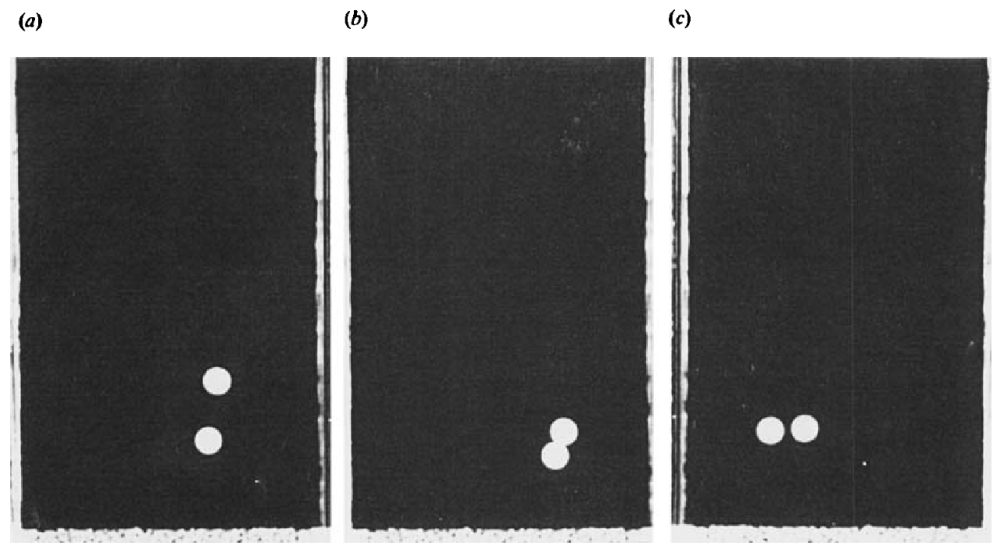
In general flow fields, collisions in multiparticle systems are mainly driven by wake effects. Early work by Fortes et al. [21] confirmed the wake-induced rear-end collision mechanism known as drafting–kissing–tumbling (DKT), which is caused by the low-pressure region in the particle wake (see Figure 2). Furthermore, using the lattice Boltzmann method (LBM), Wang et al. [22] found that a greater difference in particle size leads to a shorter contact duration during the DKT process. Dash et al. [23], based on the immersed boundary-lattice Boltzmann method (IB-LBM), pointed out that the mutual twisting and repulsive torque generated after contact are the key factors driving particle tumbling and separation. At the microscopic mechanical level, the review by Zhu et al. [24] indicated that mechanical collisions between particles are commonly quantified using the Hertz–Mindlin model, whereas van der Waals forces or liquid-bridge forces are the underlying mechanisms governing particle agglomeration. Once local shear flow is introduced, the above pattern changes accordingly. Liu et al. [19], through DNS simulations of pipe flow, found that due to the combined effects of velocity gradients and wall repulsion, the contact duration between two particles is shortened, and the particles are more readily separated and redispersed by the fluid after collision. In contrast, if the flow field cannot effectively redisperse the particles, experiments and theoretical analysis by van Wijk [25] showed that particles with different sizes may merge because of slip-velocity differences, thereby causing a sharp local increase in concentration and even blockage.
When the research scenario shifts to the strongly turbulent flow inside centrifugal pumps, impeller rotation and rotor–stator interaction further modify particle evolution pathways. To address this complex condition, CFD–DEM has been widely used to capture discrete particle collision behavior. Zhao et al. [26] simulated the collision characteristics of binary particles inside a pump and demonstrated that coarse particles, owing to their larger inertia, are more likely to deviate from streamlines and impact the wall. As the proportion of coarse particles increases, both collision frequency and normal impact intensity are enhanced. However, when the concentration of coarse particles becomes sufficiently high, a particle buffering layer may form, which slows the increase in direct collisions in certain regions. Lin et al. [27], using a multisphere model, more accurately tracked the spatial tumbling motion and contact forces of large non-spherical particles. Huang et al. [28] further quantified that, with increasing solid concentration, both the number of particle contacts and the contact force in local regions increase significantly, thereby directly leading to concentrated energy dissipation.

2.3. Turbulence Modulation by Particle Assemblies

The modulation of turbulence by particle assemblies is a key physical process governing energy dissipation and hydraulic performance in solid–liquid two-phase flows. In general particle-laden flows, the onset of two-way coupling is primarily controlled by particle volume fraction. Elghobashi [29] showed through theoretical analysis that when the particle volume fraction ranges from 10−6 to 10−3, interphase momentum transfer becomes sufficient to significantly alter the background turbulence structure, thereby giving rise to two-way coupling. Once two-way coupling is established, the ratio of particle size to the characteristic eddy scale determines whether turbulence is enhanced or attenuated. Gore and Crowe [30] proposed a critical length-scale ratio of dp/le ≈ 0.1, where dp is the particle diameter and le is the characteristic scale of the dominant energy-containing eddies. When dp/le > 0.1, large particles tend to generate turbulence through their wakes, thereby enhancing flow fluctuations; when dp/le < 0.1, small particles tend to absorb energy from the dominant eddies, resulting in turbulence attenuation. Regarding the specific pathways through which particles modulate turbulence, Balachandar et al. [31] summarized three classical mechanisms in dilute suspensions: particle-induced enhancement of fluid dissipation, kinetic energy transfer between particles and fluid, and the formation of particle wakes and vortex shedding. In addition, Bosse et al. [32], in their study of homogeneous isotropic turbulence, further showed that when two-way coupling is considered, not only is the turbulent kinetic energy at high wavenumbers modified, but the mean settling velocity of particle assemblies is also significantly enhanced due to turbulence modulation.
However, these general patterns have mostly been established in unbounded or homogeneous turbulence, whereas the interior of transport pumps consists of confined and elongated passages with strong wall-shear effects, making turbulence modulation in near-wall shear flows substantially different from that in homogeneous turbulence. In pipe flows and near-wall environments, momentum transfer and turbulent fluctuations exhibit pronounced anisotropy. Cui et al. [33] conducted PIV/PTV experiments in high-Reynolds-number horizontal particle-laden pipe flow and found that a large amount of momentum is transferred from the liquid phase to the solid phase, leading to reduced turbulent Reynolds stress and increased viscous stress. Particles also significantly suppressed the vertical velocity fluctuations of the fluid, ultimately resulting in an overall attenuation of turbulence activity. Wu et al. [34], using direct numerical simulation (DNS) to investigate low-Reynolds-number pipe flow, reached a similar conclusion: large particles weaken the intensity of large-scale streamwise vortices in the near-wall region and reduce streamwise velocity fluctuations, while simultaneously inducing small-scale vortices that enhance radial and azimuthal velocity fluctuations. To further clarify the microscopic origin of this wall-bounded modulation, Wang et al. [35] performed DNS of wall turbulence and, based on the turbulence self-sustaining process, showed that particle inertia determines how particles interfere with large-scale and very-large-scale motions (LSMs/VLSMs): low-inertia particles promote the generation of VLSMs by exerting feedback forces in the inner layer of turbulence, whereas high-inertia particles enhance VLSMs by directly contributing to the Reynolds shear stress of comparable scale in the outer layer. These studies provide an important basis for understanding the restructuring of Reynolds stress in confined boundary layers.
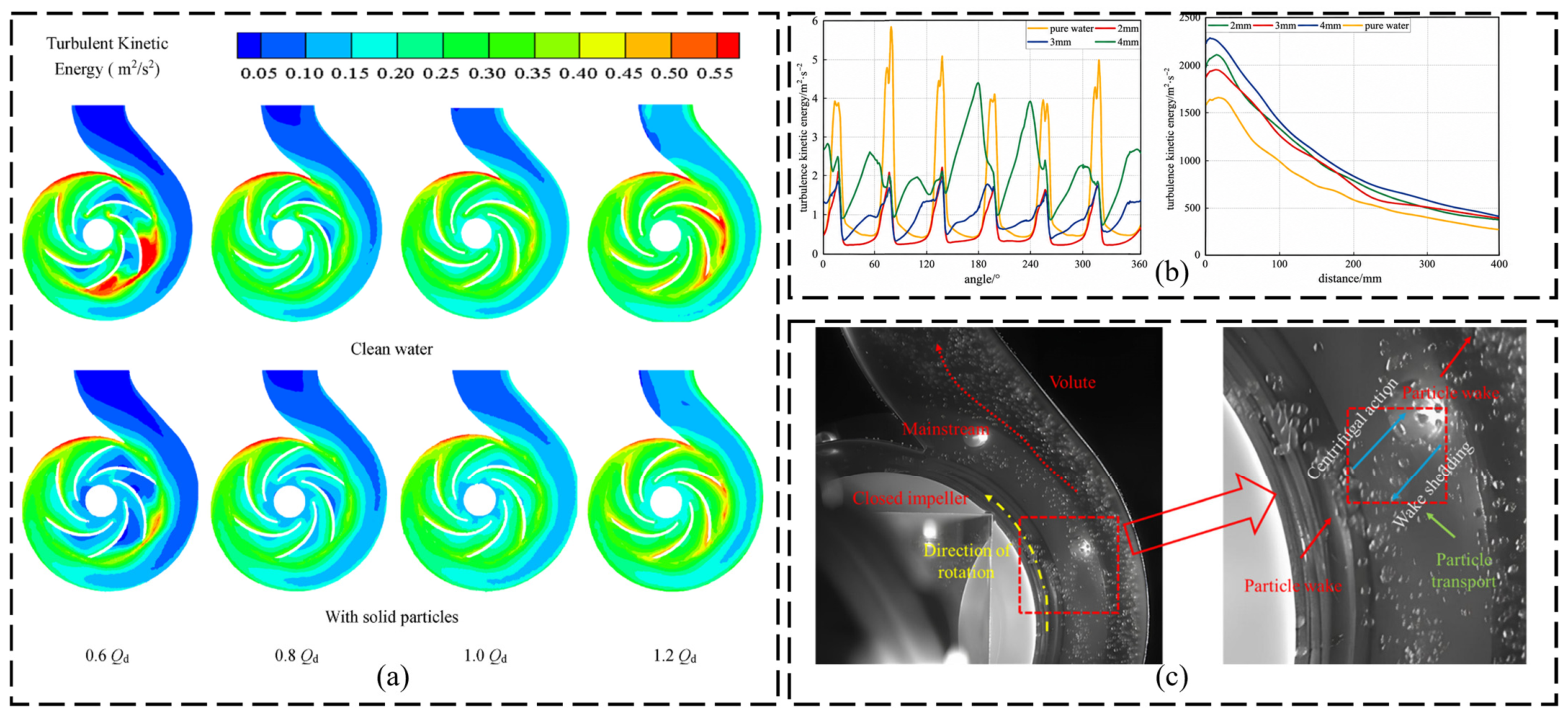
When the focus is further narrowed to centrifugal pumps, which are complex confined flow systems jointly influenced by strong rotation, channel curvature, and unsteady rotor–stator interaction, turbulence modulation by particle assemblies is manifested as energy redistribution among large-scale coherent vortical structures and distortion of unsteady wake structures. On the one hand, particle assemblies can significantly suppress the overall turbulence activity inside the pump. Wang et al. [36] found that dense fine particles absorb a considerable amount of energy during transport, thereby reducing the kinetic energy of the liquid phase and directly suppressing vortex generation in impeller passages. Cheng et al. [37] reported similar findings, showing that, compared with clean-water conditions, the addition of particles decreases the overall turbulent kinetic energy inside the pump, and that this attenuation becomes more pronounced under low-flow-rate conditions; the corresponding distribution of turbulent kinetic energy is shown in Figure 3a. In addition, Cao et al. [38] used a coupled CFD–DEM method to investigate the influence of particle size on the turbulent kinetic energy of a guide-vane centrifugal pump. Their results showed that the addition of particles modifies the local energy-loss characteristics of the fluid. In particular, larger particles can disturb the flow structures near the impeller outlet and guide-vane outlet more strongly, leading to larger and more irregular turbulent kinetic energy fluctuations, as shown in Figure 3b. This indicates that particle assemblies may not only attenuate local vortical structures in some regions, but also enhance local turbulence intensity when particle inertia becomes significant. On the other hand, in high-frequency shear regions dominated by rotor–stator interaction, particles can also cause significant distortion of unsteady wake structures. Using high-speed imaging, Pu et al. [39] revealed the evolution of these unsteady vortical structures and found that, as particle concentration increases, particle wakes near the volute tongue exhibit a pronounced “wake-cutting” phenomenon, as shown in Figure 3c, accompanied by significant solid–liquid phase separation. Lin et al. [27] further pointed out that, under large-particle conditions, the introduction of high-concentration coarse particle assemblies intensifies local collision effects and further transfers the distortion of microscopic vortical and wake structures into severe wear of macroscopic flow-passage components.

2.4. Particle Wakes and Local Flow Disturbances

In solid–liquid centrifugal pumps, the formation and evolution of particle wakes not only alter the local flow topology but also induce flow disturbances that constitute an important microscopic mechanism responsible for local energy dissipation, flow instability, and blade impact wear. Balachandar and Eaton [31] pointed out that particle wakes and the associated vortex shedding are among the core pathways through which particles modulate liquid-phase turbulence: large particles generally enhance local turbulence through wake vortex shedding, whereas small particles tend to act as additional dissipation sources and thereby attenuate turbulence. From the wake evolution of isolated particles in free flow to the macroscopic interference of dense particle assemblies in confined pump passages, wake structures and the associated local flow disturbances exhibit clear progressive and distorted characteristics. In theoretical and CFD studies, laminar or uniform-flow particle wakes are often treated as reference cases, while turbulent wakes are obtained by resolving the interaction between the particle wake and prescribed background turbulence. For example, Bagchi and Balachandar [35] used DNS to simulate an isolated spherical particle exposed to a uniform flow superposed with precomputed isotropic turbulence, and compared each turbulent-inflow case with a companion uniform-flow case at the same mean particle Reynolds number. Their results showed that ambient turbulence shortens the mean recirculation region, enhances wake mixing, reduces the wake velocity deficit, and may promote wake oscillation or vortex shedding under certain Reynolds-number conditions.
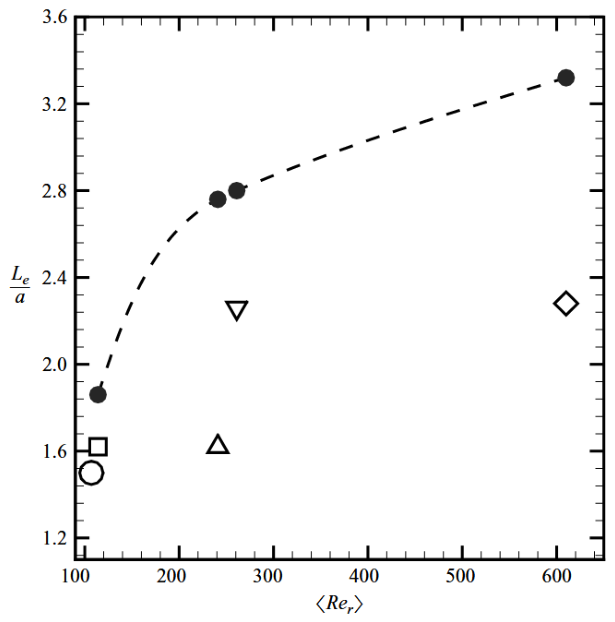
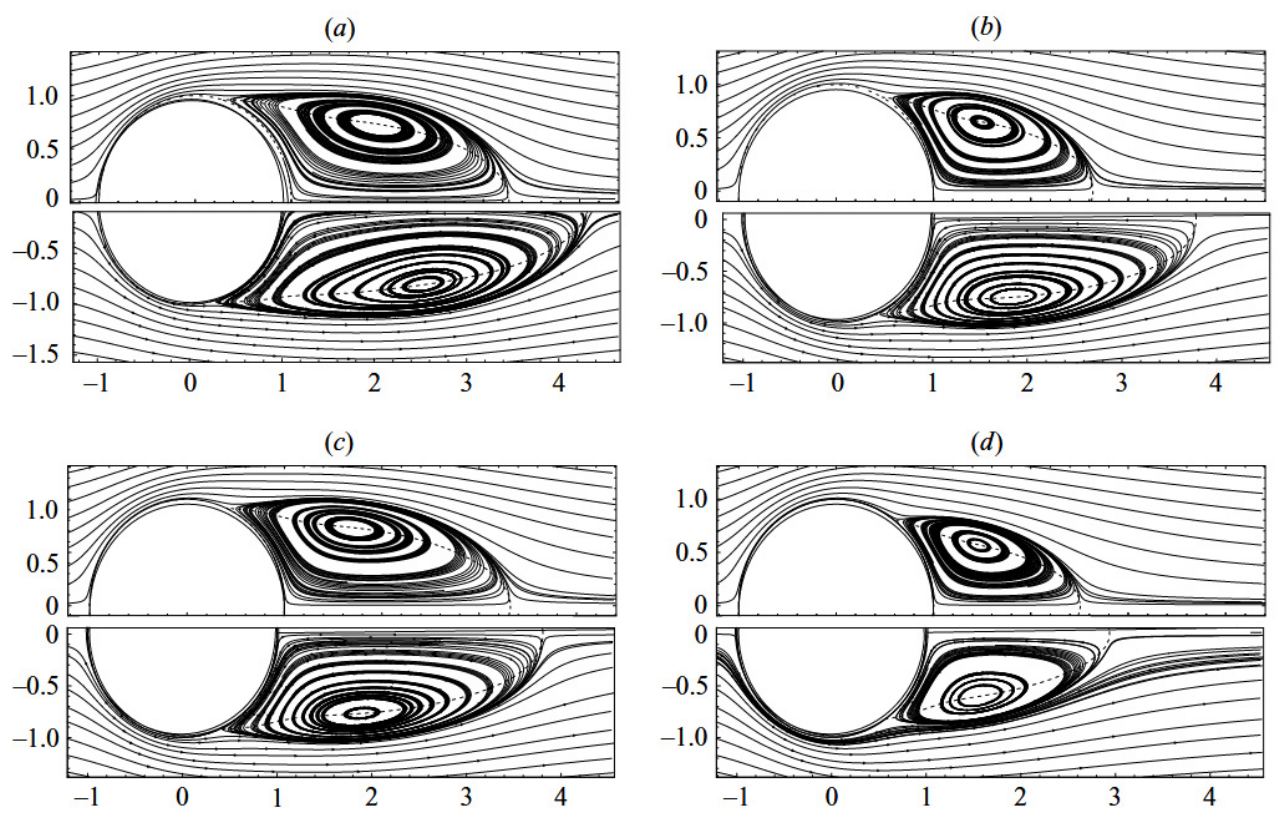
The evolution of wakes behind isolated particles in free flow and their interaction with turbulence provide the basis for understanding local disturbances. Bagchi and Balachandar [40], through DNS of isolated particles in isotropic turbulence, found that ambient turbulence significantly enhances wake mixing, shortens the mean recirculation length, and can induce vortex shedding even at moderate Reynolds numbers, thereby markedly amplifying local fluctuating kinetic energy (as shown in Figure 4 and Figure 5). Experiments by Wu and Faeth [41] also showed that the wake behind a sphere in a turbulent environment exhibits self-similar behavior resembling that in laminar flow, while its mean velocity decays more rapidly. Conventional theory usually assumes that particles smooth turbulent fluctuations; however, three-dimensional trajectory tracking of buoyant particles by Mathai et al. [42] showed that the enhancement caused by wake vortex shedding can exceed the spatial filtering effect, such that the variance of particle acceleration actually increases with particle size. Kim et al. [43] further pointed out that the sweeping of external turbulent vortex tubes can cause migration of the stagnation point on the particle surface and asymmetric evolution of near-wake vortices, thereby generating intense local transient lift and drag fluctuations on the particle.
When the local particle concentration increases, wake interference between particles becomes an important mechanism of microscopic flow disturbance. Zhu et al. [44] found that for a trailing particle located within the wake region of a leading particle, the fluid drag decreases exponentially as the interparticle spacing decreases, and may even fall to less than one-fifth of the drag on an isolated particle at contact. This drag deficit induced by the wake directly promotes particle acceleration and catching-up behavior, thereby triggering the DKT mechanism. Fortes et al. [21], in fluidized-bed experiments, observed that particles aligned in the streamwise direction are highly unstable; after contact, they rapidly tumble and tend to form stable transverse arrays. Dash and Lee [23], based on IB-LBM simulations, further revealed that the tumbling of a trailing particle is not caused solely by abrupt drag variation, but is jointly driven by rotational torque induced by the non-uniform pressure field on the wake surface and by hydrodynamic repulsive forces. Under high-concentration conditions inside pumps, microscopic wake interference and frequent torque interactions constitute important sources of local particle agglomeration and high-frequency microscopic disturbances.
In the narrow and confined impeller passages of pumps, walls and boundary-layer shear break the symmetry of particle wakes, resulting in further distortion of local flow structures. DNS of particles in turbulent channel flow by Zeng et al. [45] showed that the wakes of particles located in the buffer layer are deflected away from the wall, while the wall suppresses vortex shedding on the lower side, leading to one-sided shedding and asymmetric local disturbances. Regarding the influence of particles on the macroscopic turbulent flow field, fully resolved fictitious-domain simulations by Wu et al. [34] showed that large particles weaken the intensity of large-scale streamwise vortices in the near-wall region and reduce the maximum streamwise velocity fluctuation, while simultaneously exciting small-scale vortices in their wakes, thereby enhancing radial and azimuthal velocity fluctuations. Experiments by Cui and Wang [33] on high-Reynolds-number horizontal particle-laden pipe flow further confirmed that particle accumulation in the near-wall region promotes momentum transfer from the liquid phase to the solid phase, which not only significantly suppresses the vertical velocity fluctuations of the fluid, but also reduces the local turbulent Reynolds stress and increases the viscous stress, thus leading overall to attenuation of turbulence activity in the near-wall region.
In the complex rotating flow field of transport pumps, the interaction between the impeller and the volute further imparts more distinctive evolution patterns and stronger large-scale modulation effects to particle wakes. High-speed imaging experiments by Pu et al. [39] revealed pronounced mass transfer between neighboring particle wakes, and a strong “wake-cutting” phenomenon was observed in the volute tongue region. As the solid concentration increased, solid–liquid separation between wakes became more severe, leading to larger wake voids and greater overall wake length. Regarding the macroscopic modulation of liquid-phase turbulence inside pumps by particles, Shi et al. [38] pointed out that the introduction of solid particles fundamentally changes the energy distribution inside the pump: particle-induced local disturbances increase the energy fraction of large-scale turbulent structures while reducing the dissipation associated with small-scale random turbulent structures. This also explains why, at extremely low concentrations, particles do not necessarily deteriorate the flow field and may even slightly improve pump efficiency by suppressing small-scale dissipation and reducing local flow-separation losses.
From a critical perspective, existing studies on particle wakes and turbulence modulation still show methodological differences that may lead to inconsistent conclusions. DNS and particle-resolved simulations can resolve finite-size wakes, wake oscillation, and vortex shedding, but most of them are limited to isolated particles, simplified turbulence, or idealized boundaries. In contrast, pump-scale CFD–DPM or CFD–DEM models can consider rotation, wall confinement, particle collision, and rotor–stator interaction, but they usually depend on empirical closures for drag, collision, and turbulence modulation. Therefore, whether particles enhance or suppress turbulence should not be interpreted as a universal conclusion, but should be related to particle Reynolds number, particle-to-eddy scale ratio, concentration, wall confinement, and the modelling approach used.
In summary, particle dynamic behavior inside pumps is a multilevel coupled process jointly governed by single-particle force response, multiparticle collision and agglomeration, turbulence modulation by particle assemblies, and particle-wake-induced disturbances. After entering a solid–liquid transport pump, particles undergo velocity slip, trajectory deviation, and local accumulation under the combined effects of centrifugal force, pressure-gradient force, drag, lift, and wall confinement, and further alter local momentum exchange and energy dissipation through collision, agglomeration, and wake interference. Meanwhile, the two-way modulation of background turbulence by particle assemblies leads to redistribution of turbulent kinetic energy, enhancement of large-scale coherent structures, or suppression of small-scale dissipation, while particle wakes and their unsteady evolution continuously induce local disturbances in near-wall regions, shear layers, and rotor–stator interaction zones. Therefore, particle dynamics inside pumps are not isolated microscopic transport phenomena, but rather the direct physical basis for the subsequent reconstruction of global flow topology, the evolution of local vortex structures, and the amplification of unsteady responses, and they also provide the prerequisite for understanding the mechanisms by which particles affect the operational stability of solid–liquid transport pumps.

3. Evolution of Flow and Vortex Structures in Pumps Under Particle Effects

After clarifying the fundamental mechanisms of particle transport, collision, turbulence modulation, and wake-induced disturbance, further attention should be paid to how these microscopic processes accumulate and amplify within the complex rotating flow field of pumps, eventually giving rise to changes at the level of flow structures. Under the combined effects of particle migration, accumulation, slip, and interphase momentum exchange, the internal flow field of pumps undergoes not only global topological reconstruction, but also progressive evolution of typical local structures, including the near-wall boundary layer, separation and recirculation zones, and clearance leakage regions, which in turn affects the development of representative vortex structures and flow unsteadiness. Therefore, this section reviews the reconstruction process and evolutionary characteristics of internal flow structures in pumps under particle effects, with emphasis on the overall flow topology, typical local flow structures, the evolution of representative vortex structures, and the enhancement of flow unsteadiness.

3.1. Effects of Particles on the Overall Flow Topology in Pumps

In solid–liquid two-phase pumps, solid particles do not behave as passive tracers that completely follow fluid motion. Owing to their relatively large mass and inertia, particle trajectories under the coupled action of multiple force fields inside the pump deviate markedly from liquid-phase streamlines, giving rise to pronounced interphase separation, spatial migration, and local accumulation. Using a CFD–DEM approach to study a two-stage slurry transport pump, Su et al. [46] showed that particles experience a distinct deceleration when entering the impeller and form an initial local accumulation near the impeller inlet. As the flow develops in the radial direction, the particle distribution becomes increasingly non-uniform under the work input of the impeller. Liu et al. [47], through DEM–CFD simulations of a deep-sea lifting pump, found that because the acceleration of entrained particles lags behind that of the liquid phase, particles spontaneously migrate toward the pressure side of the blade. In addition, particle shape also affects this migration pathway. RANS–DEM simulations by Shao et al. [48] and Tan et al. [49] for cubic and cylindrical non-spherical particles, respectively, both confirmed that non-spherical particles likewise tend to migrate toward the blade pressure side and are prone to substantial accumulation in the middle region of the guide vane. At a more macroscopic level, Deng et al. [50], combining high-flow-rate experiments with numerical calculations, pointed out that, under the influence of fluid backflow within the guide vane, particles undergo local agglomeration at the guide-vane outlet and exhibit distinct strand-like and pulsating transport characteristics. Such active migration, jointly induced by particle mass, shape, and flow-field structure, breaks the original spatial equilibrium and becomes the starting point for changes in the overall flow topology inside the pump.
Local particle accumulation in specific regions occupies the effective flow area and, through strong interphase blockage and squeezing effects, forces the macroscopic velocity and pressure fields inside the pump to redistribute. In terms of the velocity field, the numerical results of Su et al. [46] revealed the influence of local accumulation on the liquid-phase backflow pattern, showing that the backflow velocity in the front chamber increases abnormally due to blockage and further compresses the inlet main flow, causing it to deflect toward the hub. Lin et al. [51], in a CFD–DEM study of a centrifugal pump under high-concentration conditions, further confirmed that the accumulation of a large number of particles in the pump outlet region significantly intensifies reverse liquid-phase backflow and aggravates flow non-uniformity. In terms of the pressure field, solid–liquid phase separation leads to a pronounced imbalance in the blade surface loading. Liu et al. [47], through quantitative analysis, showed that as particle volume fraction increases, the transverse pressure gradient in the impeller becomes significantly larger, and the maximum static pressure on the blade working surface rises markedly. Moreover, if non-ideal boundary conditions are present, flow distortion is further exacerbated. Using the Mixture model to investigate the influence of bent-pipe inflow on a centrifugal pump, Yao et al. [52] found that the combined effect of inlet bend flow and solid particles aggravates unstable flow inside the pump, causing abnormal particle accumulation near the outer wall of the inlet and at the trailing part of the blade suction side, thereby further amplifying the overall non-uniformity of the internal flow field.
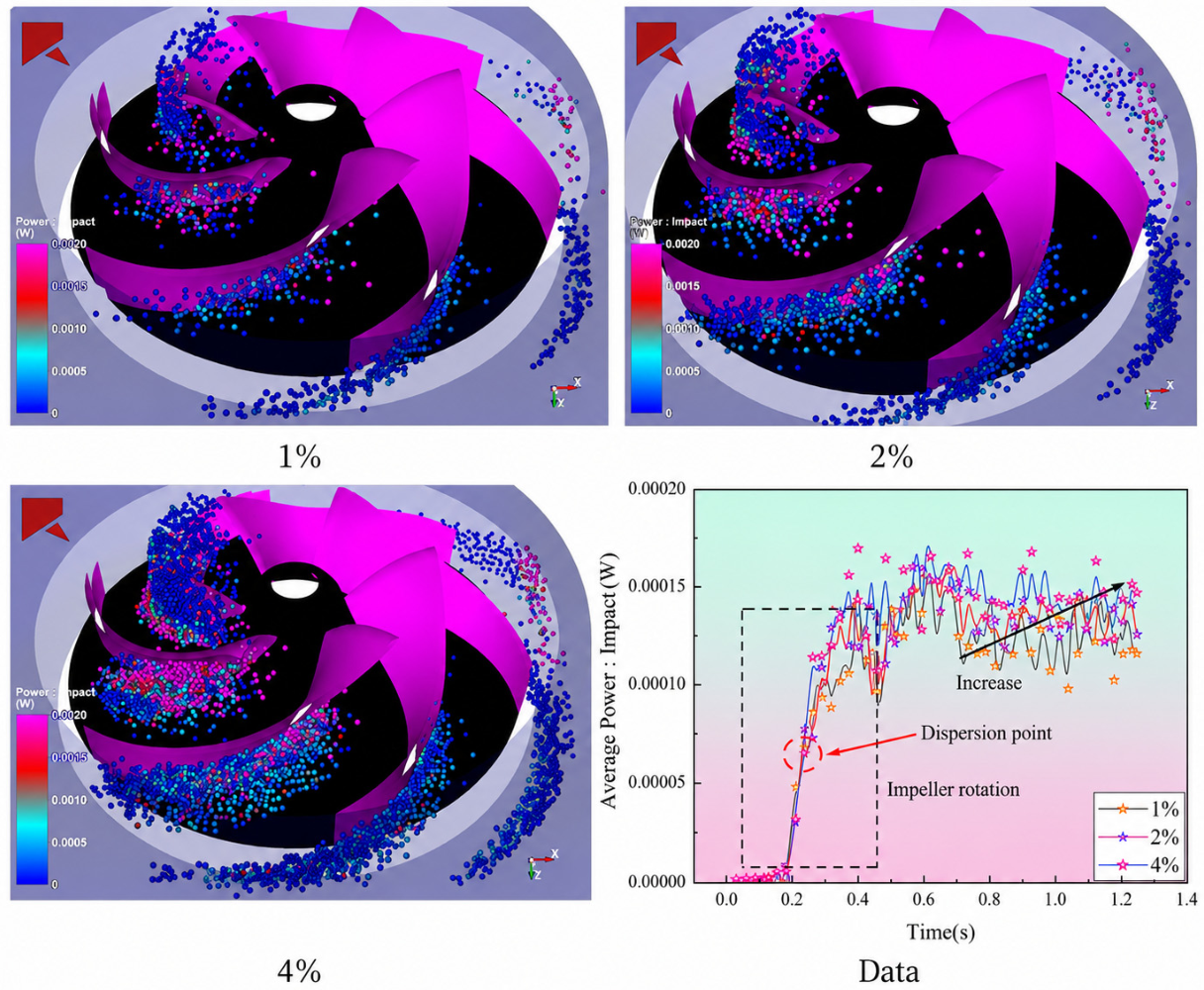
More importantly, this distortion of the macroscopic velocity and pressure fields is accompanied by significant interphase momentum exchange, which fundamentally reshapes the energy-dissipation pattern inside the pump and provides the prerequisite for local structural instability. Using an improved CFD–DEM model to investigate particle dynamic characteristics in a centrifugal pump, Pu et al. [53] found that as solid concentration increases, both the shear power dissipation of particles dominated by pressure-gradient forces and the overlap degree in particle collisions increase significantly (as shown in Figure 6). In a CFD–DEM study of gas–solid flow in an elbow–reducer connection, Wang et al. [54] demonstrated with the aid of thermodynamic entropy-production theory that such momentum exchange caused by particle collisions and velocity differences is the core mechanism responsible for the enhancement of local secondary flow and turbulent energy dissipation. In the macroscopic flow field, this redistribution of dissipation is further manifested as the spatial transfer of turbulent kinetic energy (TKE). PIV experiments on the volute of a centrifugal pump by Pu et al. [55] directly showed that the introduction of solid particles causes severe fluctuations in the absolute velocity components, and that regions of high turbulent kinetic energy are no longer uniformly distributed, but instead become highly concentrated near local areas such as the outer wall of the volute and the volute tongue. The superposition of local high-dissipation regions and strong shear backflow zones further weakens boundary-layer stability.

3.2. Effects of Particles on the Evolution of Typical Local Flow Structures

Compared with the redistribution of the overall flow field, the influence of particles on pump flow is more prominently manifested in several typical local flow structures, mainly including near-wall flow and boundary layers, separation and recirculation structures, as well as clearance leakage flow and local shear layers.
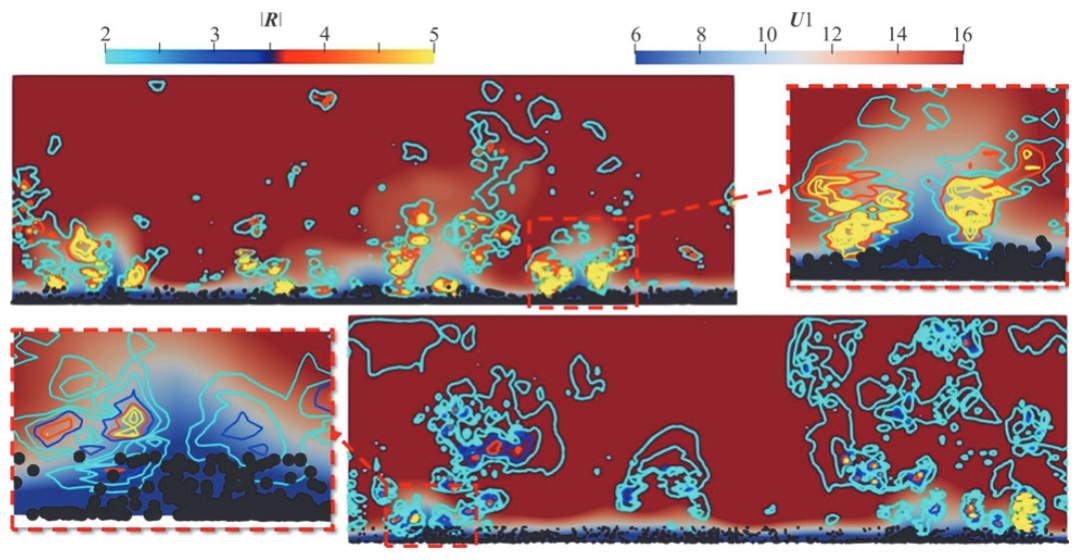
After entering the pump, particles first affect the flow by migrating toward the wall and directly disturbing coherent structures within the boundary layer. Rousta et al. [56], using DNS, found that inertial particles tend to migrate toward regions with lower fluctuation intensity and preferentially accumulate in near-wall low-speed streaks, while the particle Stokes number significantly affects the strength of near-wall vortices and the streak structure. Such near-wall accumulation directly alters the velocity distribution and slip characteristics of the boundary layer (as shown in Figure 7). By solving the velocity triangle of solid–liquid two-phase flow, Lv et al. [57] showed that, under the influence of the wall boundary layer, particles exhibit pronounced velocity slip in the near-wall region, and the peak slip velocity decreases significantly with increasing particle size. As particles continue to move in the near-wall region, their modulation of fluid turbulence gradually becomes evident. Using PIV measurements in a dilute liquid–solid turbulent boundary layer, Gao et al. [58] confirmed that the addition of particles thickens the buffer layer of the mean velocity profile and enhances the wall-normal turbulent intensity in the near-wall region. On this basis, the complex dynamic collisions between particles and the wall further reshape near-wall vortex structures. Feng et al. [59] observed that particle rebound motions during wall collisions disrupt wall-attached hairpin vortices and break the self-similarity of coherent structures. By incorporating a near-wall particle friction-dissipation term into an improved CFD–DEM coupling model, Pu et al. [60] further pointed out that collisions between particles and rough walls intensify the instability of Kelvin–Helmholtz vortices within the shear layer, directly leading to a significant increase in the turbulence dissipation rate in the near-wall region.
Once a large amount of boundary-layer kinetic energy is consumed by particle friction and collisions, the ability of the fluid to resist adverse pressure gradients decreases accordingly, and particles also become more likely to remain in low-velocity regions, thereby inducing and intensifying local separation and recirculation structures. Jiang et al. [61], using CFD–DEM combined with high-speed imaging experiments, found that under the action of inertial force, particles tend to deviate toward the blade pressure side, and this accumulation directly promotes and intensifies the low-speed separation vortex near the leading part of the pressure side. Multiple CFD–DEM studies consistently indicate that, under off-design conditions or in the presence of complex particle shapes, particles are prone to remain in low-velocity regions and significantly aggravate local blockage, separation, and recirculation. Wang et al. [20] reported that under deep stall conditions, large-scale stall vortices can capture a substantial number of particles, causing the local blockage intensity in the central flow passage to be about 10% higher than that under critical stall conditions. Similarly, under extreme conditions such as shutdown backflow, Hu et al. [62] confirmed that coarse particles can be squeezed and accumulated at the interface between the guide vane and the impeller, directly resulting in severe local retention and passage blockage. In addition to the effect of macroscopic operating conditions, Zhu et al. [63] found that particle shape itself can also reconstruct recirculation regions. Non-spherical particles with large aspect ratios are highly prone to tumbling and swirling in the diffuser section, dissipating kinetic energy while inducing pronounced secondary recirculation, which in turn hinders the normal downstream transport of the fluid. Likewise, Hong et al. [64], in their study of unsteady flow in a deep-sea mining pump, pointed out that unstable wakes in rotor–stator interaction regions are highly susceptible to interference from two-phase media, resulting in very strong turbulent kinetic energy fluctuations.
As separation and recirculation zones compress the main flow passage, high-speed solid–liquid two-phase flow is forced to leak through high-shear passages such as tip clearances and balance holes, where particle intrusion causes severe local flow reconstruction and vortex breakdown. Jia et al. [65], in a study of a two-stage pump considering clearance leakage, found that leakage flow exerts a significant lateral squeezing effect on the main flow, causing streamlines to deviate and inducing local shear vortices in regions such as the hub, where high-inertia coarse particles tend to accumulate severely because of their delayed turning response. Once a large number of particles enter the clearance, their direct disruption of leakage vortices becomes a key factor in local flow deterioration. Wang et al. [66] quantitatively showed that when St < 1, particles possess strong flow-following ability and enter the blade tip clearance in large numbers, where their intense disturbance causes the original leakage vortex structure to break up and shed, thereby exciting high-amplitude low-frequency pressure pulsations. When St ≥ 1, by contrast, particles are dominated by inertia and accumulate on the pressure side. Although their direct disruption of leakage vortices is weakened, local erosive wear is aggravated. Variations in clearance size can further amplify two-phase interference within the shear layer. Peng et al. [67] found that with increasing blade tip clearance, the leakage flow entering the clearance increases and strengthens the inlet leakage vortex, thereby greatly enhancing the generation of turbulent kinetic energy as well as local wall collision and friction losses. In multistage pump systems, such local shear and rectifying effects can also be transmitted between stages. Yang et al. [68] further confirmed that this strong local shear and two-phase interference effect can exert a profound influence on the evolution of the internal flow pattern during interstage transmission.

3.3. Modulation of the Evolution of Typical Vortex Structures by Particles

In solid–liquid pumps, the migration, accumulation, and slip of solid particles within the flow passage fundamentally alter the local energy distribution and shear state of the flow field, thereby reshaping the conditions for vortex generation and evolution. Using PIV and proper orthogonal decomposition (POD), Shi et al. [38] found that the introduction of low-concentration particles changes the energy distribution of the fluid, increasing the energy fraction of large-scale energy-containing vortices while suppressing small-scale random turbulence, thus modifying the initial state of flow separation within the boundary layer. Jiang et al. [61] and Wang et al. [20], both using CFD–DEM coupling methods, further revealed the mechanism by which high-concentration particle accumulation modifies vortex initiation conditions: local particle accumulation intensifies interphase momentum exchange and particle collisions, which not only leads to distortion of local velocity gradients and a significant increase in entropy production within the vortex-initiation core region, but also increases the blockage coefficient of the flow passage and enlarges the size of stall vortices, thereby deteriorating the initial flow field for vortex generation from both thermodynamic and geometric perspectives. Using entropy-production theory to analyze the internal flow in a centrifugal pump, Peng et al. [69] similarly confirmed that particle accumulation not only generally increases the pressure level within the flow passage but also suppresses certain unstable motions in the blade boundary layer to some extent, thus altering the starting point of secondary vortex evolution at its source.
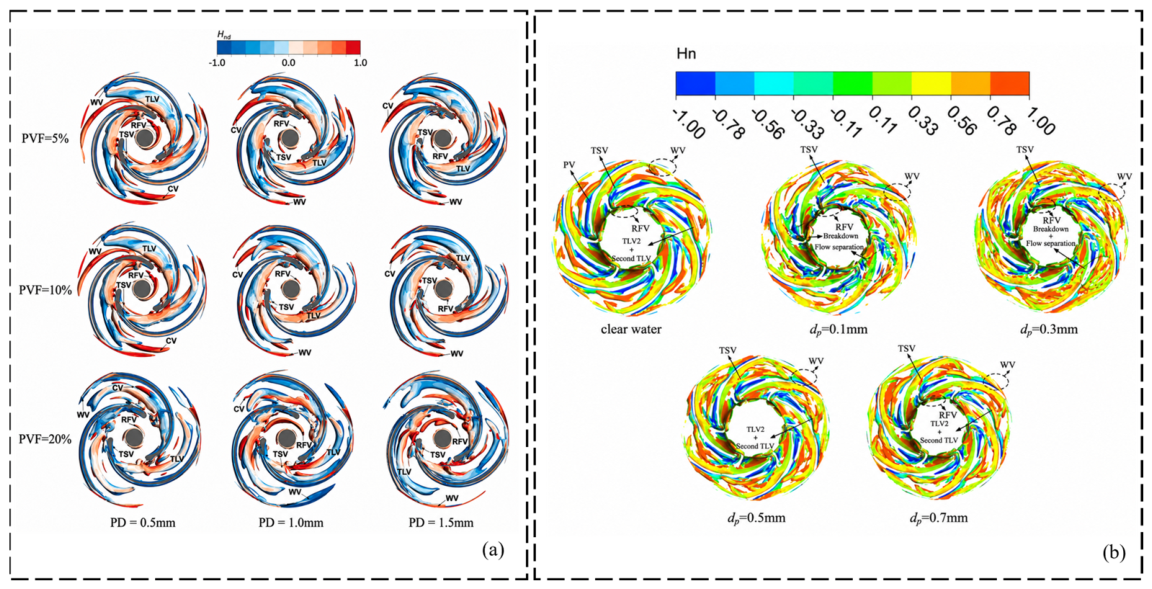
Once the local conditions for vortex generation have been reshaped by particles, the resulting typical vortex structures undergo significant two-way coupling with the particles during their subsequent development. On the one hand, the topology and entrainment characteristics of vortices determine the pathways of particle spatial redistribution. Based on an Eulerian–Lagrangian approach, Wang et al. [66] introduced the Stokes number to quantify particle–vortex interaction in a semi-open centrifugal pump and showed that when St < 1, particles exhibit strong flow-following ability and are readily entrained by the tip leakage vortex (TLV) into the suction-side region of the blade; when St > 1, however, particles are dominated by inertia and deviate from the streamlines, making them difficult to be fully constrained by vortical motion, and they consequently accumulate in large numbers near the rear shroud and the blade pressure side, leading to severe wear. Gao et al. [70], in a DEM–CFD study of a vortex pump, reached a similar conclusion: after entering the volute, particles are entrained by large-scale spiral recirculation vortices and tend to undergo secondary retention and distribution distortion in regions where vortex intensity is relatively weak. Further investigation by Wang et al. [71] on solid–liquid two-phase flow in a semi-open centrifugal pump also showed that particles undergo rotation and slip under the combined action of local shear and vortex-induced pressure gradients, thereby strengthening interphase momentum coupling, while the vortex structures inside the pump after particle addition are illustrated in Figure 8a. On the other hand, inertial penetration and frequent impacts of particles exert a strong feedback effect on vortex structures. Through an in-depth analysis based on the vorticity transport equation, Wang et al. [72,73] found that when high-concentration particles penetrate vortex cores, their frequent impacts intensify the stretching and fragmentation of the tip leakage vortex, significantly altering the distributions of the local relative vorticity stretching term, Coriolis-force term, and viscous diffusion term. This promotes earlier breakup, separation, and re-merging of originally continuous leakage vortices and separation vortices. The structural evolution and flow trajectories of leakage vortices under different particle sizes are shown in Figure 8b. As a result, the intensity of secondary leakage vortices is weakened and flow instability is aggravated.
Such microscopic particle–vortex interactions ultimately alter the evolution of vortex structures at the macroscopic level and further transmit their influence to system-level unsteady flow and stability problems. Using high-speed imaging, Pu et al. [39] captured the unsteady evolution of particle wakes in a centrifugal pump and confirmed that particle–vortex agglomerates formed by inertial accumulation not only undergo intense cutting and dissipation at the volute tongue as they rotate with the impeller, but also induce pronounced solid–liquid phase separation, thereby causing strong spatiotemporal non-uniformity in the flow field. Fonseca et al. [74] further showed that highly energetic unstable fluid structures are generally generated at frequencies close to the rotational speed and then undergo cascade breakdown into smaller-scale vortices. Wang et al. [20] explicitly pointed out that, as particle concentration increases, not only does the amplitude of the dominant-frequency pressure pulsation rise significantly, but the disturbance of different fluid structures by particle clusters also excites broad secondary-frequency and high-frequency pressure pulsation characteristics. In addition, Jin et al. [75], in their study of deep-sea multistage mining pumps, showed that local flow mutations and vortex distortion induced by coarse particles at the end-face regions of interstage cascades can significantly aggravate the unsteady wear of flow-passage components.

3.4. Mechanisms of Particle-Induced Enhancement of Flow Unsteadiness

The influence of particles on pump flow is not limited to the aspects discussed in the preceding subsections. More importantly, particles can further intensify the unsteady characteristics of the flow. Particle migration, accumulation, and their interactions with local separation flow, leakage flow, and vortex structures can disrupt the original spatiotemporal stability of the flow field, making local flow more prone to fluctuation, breakup, and reorganization. Meanwhile, these local unsteady structures can propagate and couple with each other over a wider range through pressure disturbances and velocity fluctuations, thereby continuously amplifying unsteady effects. Ultimately, particle-induced enhancement of unsteady flow manifests itself in intensified pressure pulsations, aggravated unsteady load fluctuations, and a decline in operational stability.
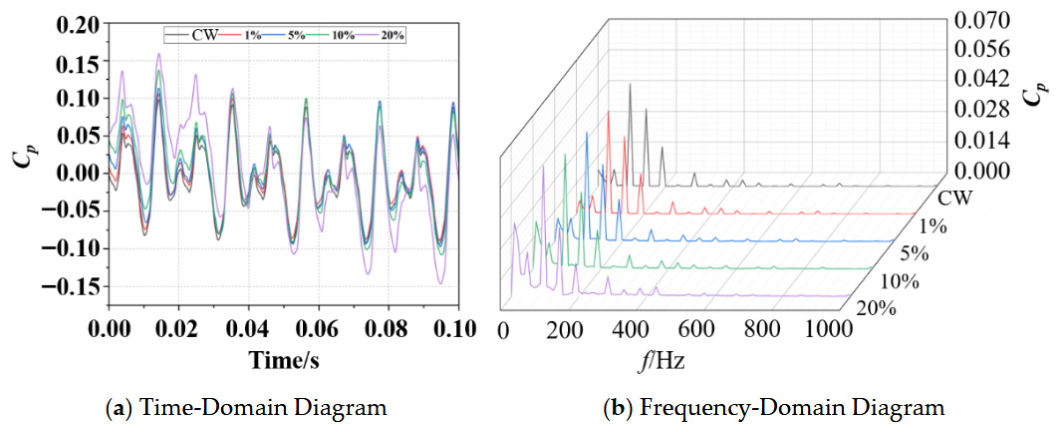
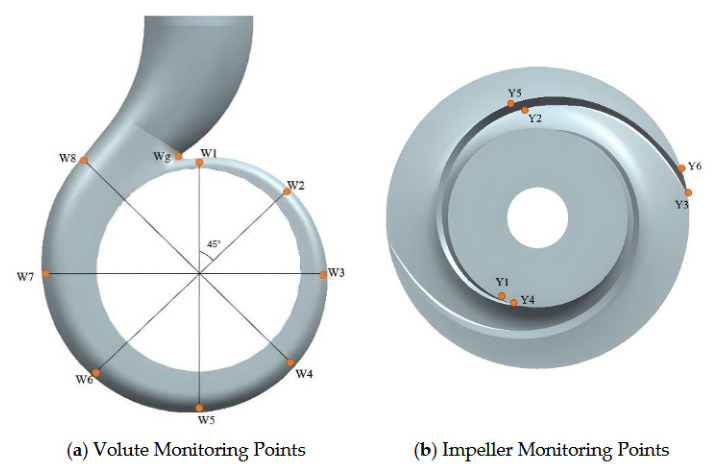
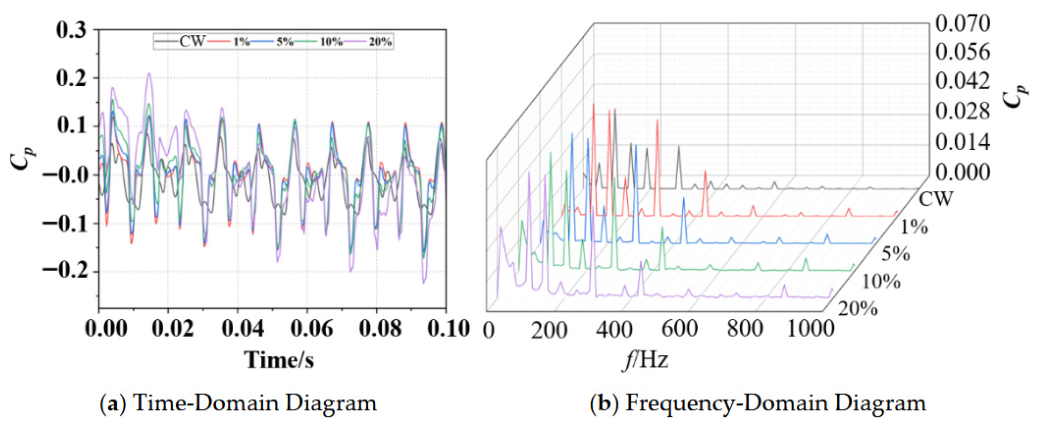
According to two-way and four-way coupling theories, because of the pronounced density difference between the solid and liquid phases, solid particles inevitably exhibit velocity slip and inertial lag relative to the carrier fluid, and such interphase momentum exchange continuously disturbs the established flow structures. Using high-speed imaging to directly observe wake evolution behind the impeller, Pu et al. [39] found that inertial particles form complex wakes with non-uniform concentration distributions under impeller rotation. After detaching from the blade, these particle wakes are readily subjected to cutting, dispersion, and breakup by the main flow, thereby making the spatiotemporal organization of the flow more random. Meanwhile, Wang et al. [76], using CFD–DEM to investigate a semi-open sewage pump, pointed out that velocity slip between particles and fluid induces unstable wake structures behind the particles, and that increasing particle concentration significantly enhances interphase momentum exchange, which in turn becomes a direct cause of intensified local pressure pulsations (as shown in Figure 9, Figure 10 and Figure 11). Furthermore, Chen et al. [77], in their unsteady simulations of an energy-storage pump, also noted that shear interaction between particles and fluid introduces substantial velocity disturbances, and such disturbances at the microscopic scale weaken the coherence of the original fluid-particle motion. These findings indicate that the breakup of local structures caused by interphase slip, wake shedding, and shear disturbance directly destroys the relatively coherent main-flow and boundary-layer structures found in single-phase flow, thereby constituting the starting point for the intensification of unsteady flow inside pumps.
These particle-induced local fluctuations do not decay independently; instead, they rapidly undergo complex coupling, transmission, and amplification within shear layers, separation and recirculation zones, clearance leakage regions, and vortex structures inside the pump. Wang et al. [71], through a CFD–DEM study of leakage flow in a semi-open centrifugal pump, found that during migration toward the blade tip, particles frequently collide with the wall and the fluid, directly cutting and disrupting the original tip leakage vortex (TLV) structure, causing an otherwise relatively stable vortex to deflect and reorganize, and thereby exciting strong high-frequency pressure pulsations. Once the local vortex structure is disrupted, it can further resonate with and be amplified by rotor–stator interaction. Using dynamic mode decomposition (DMD) to extract coherent structures from unstable flow fields, Lu et al. [78] confirmed that, due to rotor–stator interaction between the impeller and the volute, fragmented vortical structures converge in narrow interface regions, causing both the scale and number of vortices to increase rapidly under low-flow-rate conditions. Hong et al. [64] in a transient analysis of a deep-sea mining pump, similarly showed that the interaction between rotating blades and stationary guide vanes acts as an important amplifier of flow-field pulsation intensity, and that the pulsation intensity associated with particle-induced vortex distortion is much higher in this region than in other flow-passage components. The amplification of local fluctuations is also accompanied by complex competitive mechanisms. Chen et al. [77] pointed out that when the fluid performs work to drive locally accumulated particle clusters, this process can suppress pulsations to some extent; however, the turbulence disturbances amplified by particle-induced shear usually dominate, ultimately leading to a several-fold increase in unsteady pulsations in critical regions such as the volute tongue. Meanwhile, both the mechanistic analysis by Jiang et al. [61] and the study by Wang et al. [20] under stall conditions showed that particle clusters moving along the blade pressure side promote the growth of low-speed vortices near the blade leading edge and the formation of stall vortices, further inducing pronounced secondary-frequency pulsation features. It is precisely this cross-scale coupling, involving microscopic shear, vortex breakup, and macroscopic rotor–stator interaction, that allows local unsteady disturbances to be rapidly amplified.
As local fluctuations continue to couple and intensify, unsteady characteristics are no longer confined to a specific local region, but instead propagate throughout a wider flow domain, eventually leading to a marked increase in the overall unsteadiness of the internal flow and laying the hydrodynamic foundation for subsequent stability problems. From a macroscopic perspective, the presence of the solid phase causes the overall flow evolution to become more delayed and more prone to instability. Zhang et al. [79], in their study of the startup transient process of a centrifugal pump, showed that solid–liquid two-phase flow more readily gives rise to large-scale separation and recirculation within the pump, which not only changes the original flow organization but also significantly prolongs the time required for the flow field to reach macroscopic stability. Zhao et al. [80] demonstrated that the unsteady characteristics of solid–liquid two-phase flow exhibit a “low-frequency, high-amplitude” feature, with the dominant frequency even shifting to approximately 0.8 times that under pure-water conditions. Wang et al. [76], in their study of a semi-open impeller, also found that particle volume blockage significantly amplifies the amplitudes of the fundamental frequency and its harmonics caused by rotor–stator interaction, with the maximum increase reaching 97.73% of that under pure-water conditions. As the disorder of the entire flow field increases, the mode of energy dissipation within the system also undergoes a fundamental change. Based on entropy-production theory, Wang et al. [20] and Jiang et al. [61] both pointed out that with increasing particle concentration and intensified internal unsteady fluctuations, the turbulent dissipation entropy production caused by high-frequency vortex breakup, reorganization, and interphase friction rises sharply. Under extreme conditions, Zhao et al. [81] further showed that the diffusion of stall vortices and local particle blockage significantly disrupt the pressure-pulsation waveform at the impeller outlet and markedly increase the pulsation range.
In summary, the evolution of internal flow structures in pumps under particle effects is a cross-scale coupled process in which microscopic particle behavior is progressively amplified into macroscopic flow characteristics. Particle migration and accumulation first break the original uniformity of the flow field and reconstruct the overall flow topology through interphase slip and momentum exchange, while inducing the evolution of typical local structures such as boundary-layer thickening, intensified separation and recirculation, and shear-layer instability. On this basis, the two-way interaction between particles and vortex structures further modifies the conditions and pathways of vortex generation and development, causing vortices to undergo stretching, breakup, and reorganization, and significantly enhancing the spatiotemporal non-uniformity of the flow. Meanwhile, local unstable structures triggered by particle-wake disturbances, collision effects, and their coupling with rotor–stator interaction continue to propagate and amplify within the flow passage, ultimately manifesting as intensified pressure pulsations, aggravated unsteady loads, and reduced overall flow stability. Therefore, particles not only affect the evolution of internal flow patterns by altering local flow structures, but also act as a key factor inducing flow instability inside pumps through a chain mechanism of “structure reconstruction–vortex modulation–unsteadiness amplification.”

4. Effects of Particles on the Operational Stability of Pumps

As discussed above, the persistent effects of particles on internal flow structures, vortex evolution, and unsteady flow characteristics in pumps ultimately manifest themselves in engineering problems such as hydraulic performance degradation, aggravated local wear, intensified pressure pulsations, and reduced long-term operational reliability. Meanwhile, significant coupling also exists among variations in particle properties, cumulative wear effects, and abnormal dynamic responses, which makes the evaluation of operational stability and fault diagnosis an indispensable part of research on particle-laden centrifugal pumps. Therefore, building upon the mechanistic analysis presented above, this section further reviews the effects of particles on pump operational stability from three aspects: the influence of particle properties, wear mechanisms and life prediction, and stability evaluation and fault diagnosis.

4.1. Effects of Particle Properties on Pump Performance

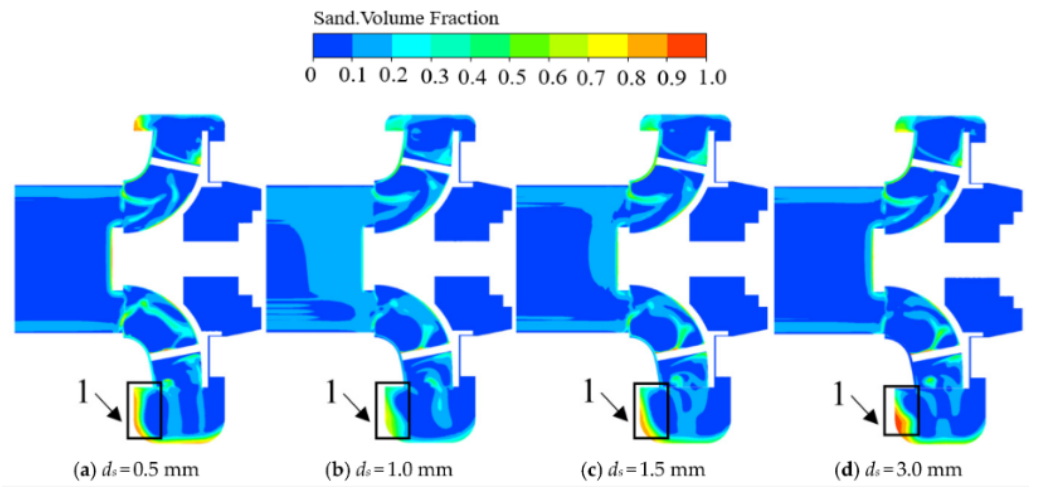
Particle size directly determines particle inertia and flow-following capability, and is therefore a key factor inducing local flow separation and abrupt changes in energy transfer. In terms of flow-structure characteristics, Wang [82] and Chen et al. [83], through experiments and CFD–DPM simulations, consistently showed that as particle size increases, particle momentum and inertial force are significantly enhanced, whereas circumferential velocity decreases, causing particles to deviate more readily from liquid-phase streamlines. As a result, particle trajectories shift markedly from the blade suction side toward the blade working surface, thereby inducing severe local fluid impact. Wang et al. [84] further showed that coarse particles accumulate more evidently in the impeller and volute passages, as shown in Figure 12, and confirmed that particle size plays a dominant role in head degradation by intensifying the pressure-gradient difference between the front and rear chambers of the impeller. Regarding the specific pattern of performance degradation, the numerical results by Zhang et al. [85] revealed a distinct threshold behavior: when particle size is smaller than 0.15 mm, variations in head and efficiency are relatively limited; however, once particle size exceeds 0.15 mm, the energy required to maintain particle suspension rises rapidly, resulting in a cliff-like deterioration in hydraulic performance. In terms of pressure pulsation and stable operation, increasing particle size can also threaten pump stability by altering rotor force balance. Zhou et al. [86] likewise pointed out that large particles continuously reduce the radial force acting on the impeller while increasing the radial force borne by the volute and tongue, thereby shifting the risk of instability more toward stationary components. At the same time, the wear-prone region also migrates. The high kinetic-energy impacts caused by large particles tend to concentrate wear near the trailing part of the blade pressure side and the hub, while aggravating material loss in the volute tongue region.
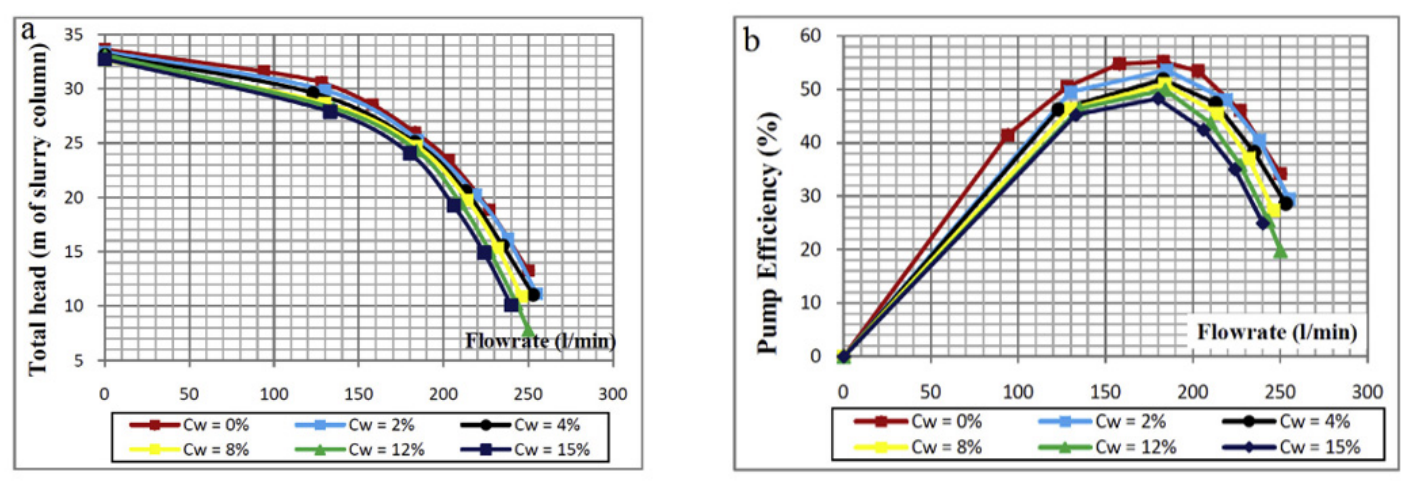
Particle concentration mainly reshapes the internal energy-transfer network and turbulence distribution by altering interparticle interaction frequency and mixture viscosity. In terms of flow-structure characteristics, both the PIV observations and improved CFD–DEM simulations of Pu et al. [53,55] showed that with increasing concentration, particle collision frequency, collision overlap, and shear power dissipation all increase significantly, thereby markedly suppressing turbulent kinetic energy (TKE) in the volute, especially near the outer wall and tongue region, while aggravating flow disorder. This collective “blockage–dissipation effect” strongly suppresses hydraulic performance. Studies by Wang et al. [87] and Hong [88] showed that the decline rates of head and efficiency are strongly negatively correlated with particle volume fraction (The corresponding relationship is shown in Figure 13.). Wang et al. [84] further pointed out that concentration is the primary factor governing efficiency degradation. Zhou et al. [86] summarized that performance decreases with concentration following an inverse functional relationship. In terms of wear response, Huang et al. [28] noted that increasing concentration prolongs the residence and acceleration time of particles in the impeller and sharply increases the number of particle–wall contacts, causing particles to collide frequently with the blade suction side at impact angles close to 90°, while the wear morphology rapidly evolves from isolated pits into widespread flake-like damage.
Particle density mainly governs the non-uniform migration and severe local accumulation of particles among pump flow-passage components by amplifying centrifugal and gravitational effects. Numerical simulations by Chen [83] and Zhang et al. [89] consistently found that with increasing particle density, the flow-following capability of particles decreases significantly. Driven by strong centrifugal force, particles rapidly pass through blade passages and accumulate intensively near the outer edge of the volute and on the blade working surface (pressure side). In terms of hydraulic performance response, comparative studies by Zhang et al. [85] and Hong et al. [88] showed that although increasing density raises the specific weight of the fluid mixture and causes simultaneous reductions in head and efficiency, its overall weakening effect on macroscopic hydraulic performance is relatively smaller than that of particle size and concentration. However, its threat to local stability and wear is more pronounced. Increasing density alleviates wear on the blade back side, but makes the outer edge of the volute a more vulnerable anti-wear region. Zhang [89] pointed out that such non-uniform accumulation of high-density solids can induce significant local pressure-gradient mutations, causing severe periodic fluctuations of pressure and turbulent kinetic energy in the rotor–stator interaction region near the volute and tongue, thereby threatening long-term operational stability.
In addition, particle shape, as a microscopic geometric property, also exerts a non-negligible influence. Jiang et al. [61] pointed out that compared with regular spherical particles, non-spherical and angular particles are generally subjected to stronger centrifugal effects in rotating flow fields. Meanwhile, as sphericity decreases, the pressure-gradient force acting on particles is weakened, making them more likely to adhere to and slide along the blade pressure side. Xu et al. [90] further confirmed that when this difference in aerodynamic behavior is combined with sharp-edged morphology, the local erosion rate inside the pump increases significantly, and the resulting wear is markedly more severe than that caused by spherical particles of the same size.
Finally, it should be noted that the above particle-property parameters do not act independently in actual operation, but instead exhibit significant multi-parameter synergistic coupling effects. Numerical simulations by Xu et al. [90] on sediment-laden irrigation pumps directly quantified this synergistic degradation mechanism: when particle size and concentration simultaneously exceed critical thresholds, the microscopic drag dissipation associated with fine particles and the inertial blockage effect associated with coarse particles superimpose on each other, triggering a phase-like transition from “local disturbance” to “global flow disorder,” which leads to a 37% increase in the low-pressure region and a nonlinear accelerated collapse of the pressure field. Nevertheless, such synergistic effects are not exclusively detrimental. Wang et al. [84] found that under certain extreme combinations, such as the coexistence of 0.5 mm fine particles and an ultra-high concentration of 20%, the very high viscous resistance may partly offset certain flow-separation structures, and may even lead to a slight anomalous recovery of pump head. Therefore, particle parameters should be regarded as a coupled system, which ultimately determines the performance boundaries and stable operating range of centrifugal pumps by jointly altering internal flow structures and energy-transfer pathways.

4.2. Particle-Induced Pump Wear Mechanisms and Life Prediction

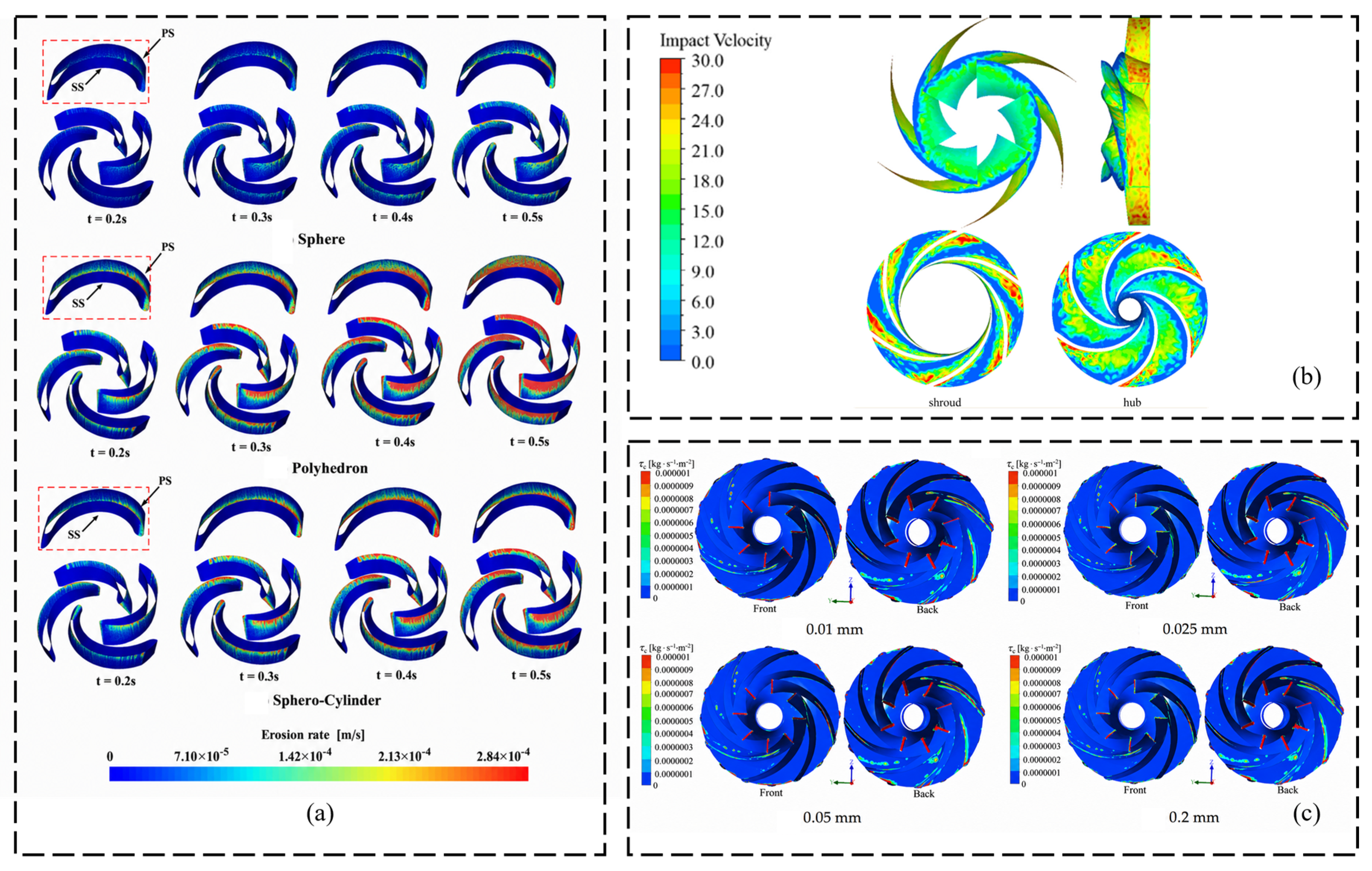
Under prolonged multiphase-flow conditions, wear inside pumps rarely occurs in a single mode, but rather results from a compound wear mechanism jointly determined by particle impact angle and impact velocity. Using a discrete phase model (DPM) combined with the McLaury wear model to study a single-stage centrifugal pump, Li et al. [91] found that the blade pressure side is mainly subjected to high-viscosity, large-angle, and high-velocity particle impacts, exhibiting typical impact wear, whereas the volute wall is more often exposed to low-velocity, small-angle particles and is dominated by cutting and frictional wear. The distribution of impact velocity on the impeller pressure side and on the front and rear shrouds is shown in Figure 14b. Wang et al. [92] further introduced a deformable Archard–Oka composite wear model and confirmed that significant synergistic evolution of abrasive wear and erosive wear exists in a micro centrifugal pump, with abrasive wear dominating volute damage and erosive wear being highly concentrated on blade surfaces. In addition, the physical properties of particles play a decisive role in local damage mechanisms. Song et al. [93], using a Lagrangian tracking method to analyze a double-suction pump, showed that large particles are more likely to deviate toward the blade pressure side and generate localized impact erosion at the leading edge, whereas small particles are more prone to produce continuous sliding abrasion in the blade outlet region. The wear-rate distributions on the impeller under different particle sizes are shown in Figure 14c. By analyzing particle morphology, Yasser et al. [94] found that irregular particles, such as polyhedral particles, compared with spherical ones, induce stronger local friction and contact stress concentration, thereby causing deeper micro-cutting and material removal. The wear-rate distributions on the impeller blades under different particle shapes are shown in Figure 14a. Energy-dissipation analysis by Zhao et al. [26] for binary mixtures of coarse and fine particles further indicated that coarse particles with large inertia dominate the near-wall shear work and impact work, and are therefore the key factor responsible for deep wear.
As particle parameters, operating conditions, and local flow conditions vary, the dominant wear mechanisms and the distribution of critical wear regions also change significantly. At the macroscopic level, differences in local mechanisms are ultimately manifested as spatially non-uniform distributions of critical wear zones. Lai et al. [95] pointed out that the blade leading edge, the outer periphery of the rear shroud, and the volute tongue are typical locations most susceptible to failure during long-term service. By combining SEM and EDS microscopic tests with numerical calculations, Qiao et al. [96] revealed the high-risk characteristics of complex local features such as the mechanical-seal flushing port in a double-suction pump, showing that local turbulent diffusion can deflect particle trajectories and generate sustained large-angle impingement, thereby accelerating local corrosion–wear synergistic damage. However, the distribution of wear hot spots does not vary linearly with operating conditions. Unsteady-flow analysis by Tarodiya and Gandhi [97] showed that when the flow rate deviates from the best-efficiency point, intensified internal backflow causes the wall-thickness loss rate to rise rapidly along the midline and rear side of the volute. More specifically, Lin et al. [51], in their study of high-concentration solid–liquid two-phase flow with concentrations ranging from 10% to 50%, identified a nonlinear shift in spatial wear distribution: at extremely high concentrations, the wear rate in the volute decreases instead, because locally accumulated particles form a “particle protective layer” that buffers the direct cutting action of subsequent particles on the wall, whereas wear in the impeller region continues to intensify.
On this basis, subsequent studies further developed wear models, critical-region identification methods, and life-prediction approaches to describe long-term damage accumulation and failure risk. Early wear prediction was mostly based on static initial flow fields; however, long-term local wear alters the geometric boundaries of the flow passage and, in turn, feeds back into the internal flow. Through CFD comparisons of blades before and after actual wear, Xiao et al. [98] found that blade thinning and increased radial clearance caused by long-term service significantly change the internal leakage-flow structure, so that the wear rate near the blade outlet and bottom decreases substantially in the later stage of wear. This indicates that the dynamic evolution of geometric boundaries must be considered in long-term life prediction. To achieve a more accurate quantitative description, Shen et al. [99] proposed a dynamic-boundary-based geometric reconstruction strategy for worn wall surfaces, which tracks morphological evolution with microsecond-level time steps and divides the life cycle into three stages. Their predictions showed that during the intermediate stage of wear, degradation of the geometric boundary causes the loss rates of pump head and efficiency to reach their peak, thereby advancing wear assessment from qualitative evaluation to full-life-cycle quantitative prediction. Meanwhile, to overcome the high computational cost of dynamic models, Yasser et al. [94] combined CFD–DEM simulations with artificial neural networks (ANNs) to establish a method capable of rapidly and accurately predicting the wear depth in critical regions under different particle conditions, thus providing a more efficient mathematical tool for material selection and life warning in engineering applications.

4.3. Operational Stability and Fault Diagnosis of Solid–Liquid Transport Pumps

Under particle-laden operating conditions, the internal operating state of pumps is highly susceptible to disturbances induced by particles and flow separation. To evaluate pump operating conditions with reasonable accuracy, it is first necessary to clarify the principal indicators used to characterize operational stability. Macroscopic hydraulic performance and energy loss constitute the basic indicators for assessing stability variations. Using an Eulerian–Eulerian multiphase-flow model, Pradhan et al. [100] found that, with increasing particle concentration and particle size, both the head ratio and efficiency ratio of centrifugal pumps decrease significantly, directly reflecting the weakening effect of particle inertia and friction on hydraulic performance. From a deeper perspective of energy conversion, Wang et al. [20] introduced entropy-production theory to evaluate energy loss under the coupling of cavitation and solid–liquid two-phase flow, and pointed out that turbulent dissipation entropy production and wall entropy production are the major sources of irreversible energy loss. The addition of particles further intensifies entropy production in the impeller and volute, thereby enabling effective characterization of the deterioration of pump operational stability from the perspective of energy dissipation.
Compared with macroscopic time-averaged indicators, dynamic response indicators such as pressure pulsation and vibration acceleration are more sensitive to transient abnormalities associated with internal unsteady flow. Zhan et al. [12] pointed out that pressure pulsation is a core indicator for characterizing fluid excitation and internal instability, and that discrete components in the frequency domain can directly reflect specific unstable flow structures. Experimental results reported by Wang et al. [101] further confirmed that, during the transport of sediment-laden water containing particles of multiple sizes, increasing sediment concentration significantly intensifies outlet pressure pulsation and pump vibration, and that the deterioration of these dynamic indicators is closely correlated with the degree of local impeller wear. Therefore, hydraulic performance, energy dissipation, pressure pulsation, and vibration response together constitute a multidimensional index system for evaluating pump operational stability.
However, owing to the coupling between complex internal two-phase flow and mechanical structures, observable dynamic signals often exhibit pronounced nonlinearity, nonstationarity, and strong background noise. Accordingly, advanced signal-processing and fault-diagnosis methods are required to extract abnormal information and identify fault states. In terms of signal feature extraction, Liang et al. [102] proposed a method combining empirical mode decomposition (EMD) and multifractal detrended fluctuation analysis (MFDFA). Their study showed that the characteristic parameters of the multifractal spectrum can effectively quantify signal irregularity, thereby enabling relatively accurate discrimination among normal conditions, different degrees of cavitation, and abnormal operating conditions such as foundation-bolt looseness. Wang et al. [103] also used wavelet transform at an early stage to denoise vibration signals and reconstruct them across frequency bands, successfully capturing incipient fault features hidden under complex operating conditions.
After sensitive features have been extracted, pattern-recognition methods based on machine learning and deep learning further improve the reliability of fault diagnosis. Niamat Ullah et al. [104] used wavelet coherence analysis (WCA) to transform one-dimensional vibration signals into two-dimensional coherence maps, and then employed convolutional neural networks (CNNs) and convolutional autoencoders (CAEs) to automatically extract both local and global features reflecting pump health conditions, thereby achieving high-accuracy identification of soft faults such as mechanical-seal holes, scratches, and impeller defects. To address the problem of excessively high dimensionality and redundancy in multidomain features, Saif Ahmad et al. [105] proposed an explanatory-ratio linear discriminant analysis (ER-LDA) method, which selects the most discriminative features by calculating the ratio of within-class to between-class scatter and then feeds them into a k-nearest neighbor (KNN) algorithm, achieving high classification accuracy for soft faults in multistage centrifugal pumps.
In practical engineering applications, a single evaluation index or a single diagnostic method is often insufficient to comprehensively cover all potential causes, whereas different indicators and methods exhibit clear complementarity. Therefore, integrated assessment based on multiple methods has become an important development trend. On the one hand, combining physical response indicators with data-driven models is conducive to predicting degradation trends. Lu et al. [106] combined variational mode decomposition with a CNN–LSTM hybrid model, effectively suppressing the interference caused by the nonstationarity of pressure-pulsation signals and enabling relatively accurate predictive estimation of high-frequency pressure pulsations. On the other hand, linking responses in specific frequency bands with wear mechanisms is helpful for life assessment. Using principal component analysis (PCA) to reduce the dimensionality of vibration spectra, Mani et al. [107] found that the amplitude at the blade-passing frequency (VPF) decreases continuously with increasing wear at the impeller trailing edge. This integrated analysis directly relates vibration characteristics to wear evolution and thus provides a basis for non-intrusive wear diagnosis. Overall, accurate operational-stability indicators and fault-diagnosis methods together constitute an important tool system for determining whether a pump operates stably, whether abnormal conditions are present, and the severity and type of such abnormalities.
In addition to wear and pressure-pulsation problems, recent CFD studies have also examined the coupling among solid particles, cavitation, and strong vortical flow in pumps. Wang et al. [108] numerically investigated cavitation characteristics under solid–liquid two-phase conditions in a centrifugal pump by improving the PANS turbulence model and the Zwart–Gerber–Belamari cavitation model. Their results showed that sand particles can promote cavitation development, delay cavity shedding, modify particle distribution through large-scale cavity structures, and increase local vorticity and irreversible flow loss. Lin et al. [109] further simulated sand-contained cavitation in an axial-flow pump and found that increasing sediment concentration enlarged the vortex region and cavitation area near the blade, making the impeller flow more disordered. These studies indicate that cavitation, particle transport, and vortex evolution are not independent phenomena, but are coupled mechanisms that may jointly deteriorate pump stability under particle-laden conditions.
Taken together, these findings suggest a cross-scale mechanism chain of “particle dynamics–flow-structure reconstruction–unsteady response amplification–stability deterioration”. In this chain, particle slip, accumulation, collision, wake disturbance, and wall contact provide the initial disturbance sources; separation/recirculation, leakage vortices, cavitation structures, and rotor–stator interaction act as key transmission interfaces; and pressure pulsation, energy loss, wear, cavitation instability, and fault signals form the final stability responses. This framework further indicates that coupled indicators integrating particle parameters, vortex/cavitation intensity, pressure pulsation, energy loss, and wear evolution may provide more reliable stability evaluation than single hydraulic-performance or diagnostic indices. However, the applicability of such coupled indicators still needs to be validated under different pump types, particle properties, coupling strategies, and operating conditions.

5. Conclusions and Outlook

5.1. Conclusions

This review summarizes recent progress on flow evolution and operational stability in pumps under particle-laden conditions. Existing studies show that solid particles do not passively follow the liquid phase after entering the pump. Instead, particle inertia, velocity slip, migration, collision, wake disturbance, and turbulence modulation jointly determine the basic dynamic behavior of solid–liquid two-phase flow.
A key conclusion is that particle effects are progressively transmitted across scales. At the microscopic scale, particle force response, collision, and wake evolution provide the initial disturbance sources. At the local flow-structure scale, these disturbances modify boundary layers, separation and recirculation zones, leakage shear layers, and typical vortex structures. At the system scale, they are further amplified into pressure pulsations, non-uniform energy dissipation, wear failure, cavitation-related instability, and reliability degradation.
Particle properties, including size, concentration, density, and shape, strongly influence pump performance and stability boundaries. In general, larger or denser particles enhance inertial migration and local impact, while increasing concentration intensifies collision, blockage, and energy dissipation. However, their effects are not always linear, because particle-induced turbulence modulation, local buffering layers, and operating-condition-dependent flow reconstruction may lead to different or even competing trends.
Overall, current research has advanced from macroscopic performance evaluation toward local flow-structure analysis and microscopic particle-dynamics interpretation. Nevertheless, unified cross-scale mechanisms and quantitative causal relationships among particle behavior, flow-structure evolution, and operational stability remain insufficiently established. Therefore, the mechanism chain of “particle dynamics–flow-structure reconstruction–unsteady response amplification–stability deterioration” provides a useful basis for future studies on particle-laden pump flows.

5.2. Outlook

Future research may be further strengthened in three aspects. First, greater attention should be paid to multiscale mechanisms and cross-scale correlations. The transmission pathway from particle-scale behavior to local flow reconstruction and then to macroscopic stability deterioration should be quantitatively clarified, rather than only described through isolated phenomena.
Second, high-fidelity numerical simulation and advanced experimental diagnostics should be further combined. Particle-resolved simulations, CFD–DEM coupling, high-speed visualization, PIV/PTV measurements, and synchronized pressure/vibration monitoring can provide stronger support for validating particle–fluid–wall interaction mechanisms under realistic pump conditions.
Third, future studies should move toward integrated stability evaluation and engineering applications. Coupled indicators involving particle parameters, vortex/cavitation intensity, pressure pulsation, energy loss, wear evolution, and fault signals should be developed for anti-wear design, operation optimization, fault warning, and life prediction of solid–liquid transport pumps.

Author Contributions

Conceptualization, S.J. and W.L.; methodology, S.J. and W.S.; literature collection and analysis, S.J., W.S., T.L. and L.J.; writing—original draft preparation, S.J.; writing—review and editing, W.L., W.S., T.L. and L.J.; visualization, T.L. and L.J.; supervision, W.L.; project administration, W.L.; funding acquisition, W.L. All authors have read and agreed to the published version of the manuscript.

Funding

The work was sponsored by the National Natural Science Foundation of China (No.52309112, No.52179085), China Postdoctoral Science Foundation (No.2025M780566).

Data Availability Statement

No new data were created in this study. All data discussed in this review are available in the cited references.

Conflicts of Interest

The authors declare no conflict of interest.

References

  1. Han, Z.; Wang, K.; Dai, L.; Li, K.; Wang, X. Recent Application of Heat Pump Systems for Environmental Control in Livestock Facilities—A Review. Agriculture 2024, 14, 2309. [Google Scholar] [CrossRef]
  2. Lin, L.; Duan, Y.; Aziz, T.; Shami, A.; Asmari, F.A.; El Hadi Mohamed, R.A.; Cui, H. Design of a Peristaltic Pump-Based Feeding Device for Achieving Continuous Production in Food 3D Printing. Innov. Food Sci. Emerg. Technol. 2025, 100, 103941. [Google Scholar] [CrossRef]
  3. Li, D.; Qu, J.; Mo, Y.; Zhu, Q.; Zhu, D. Sizing Optimization of a Stand-Alone Multi-Energy Complementary Water Pumping System for Hose-Drawn Traveler in Typical Regions of China. Agriculture 2026, 16, 90. [Google Scholar] [CrossRef]
  4. Rakibuzzaman, M.; Islam, M.D.; Kim, H.-H.; Suh, S.-H.; Zhou, L.; Iqbal, A.P. Numerical Simulation of Solid–Liquid Two-Phase Flow Analysis of Submersible Drainage Pumps. Irrig. Drain. 2025, 74, 2279–2294. [Google Scholar] [CrossRef]
  5. Wang, Z.; Chen, Y.; Rakibuzzaman, M.; Agarwal, R.; Zhou, L. Numerical and Experimental Investigations of a Double-Suction Pump with a Middle Spacer and a Staggered Impeller. Irrig. Drain. 2025, 74, 944–956. [Google Scholar] [CrossRef]
  6. Duan, A.; Lin, Z.; Chen, D.; Li, Y. A Review on the Hydraulic Performance and Erosion Wear Characteristic of the Centrifugal Slurry Pump. Particuology 2024, 95, 370–392. [Google Scholar] [CrossRef]
  7. Wang, R.; Zhu, Z.; Su, X.; Mianowicz, K.; Jia, H.; Wu, K. Slurry Pumps in Deep-Sea Mining: A Review of Numerical and Experimental Studies. Ocean Eng. 2022, 251, 111150. [Google Scholar] [CrossRef]
  8. Singh, J. A Review on Mechanisms and Testing of Wear in Slurry Pumps, Pipeline Circuits, and Hydraulic Turbines. J. Tribol. 2021, 143, 090801. [Google Scholar] [CrossRef]
  9. Marchioli, C.; Bourgoin, M.; Coletti, F.; Fox, R.; Magnaudet, J.; Reeks, M.; Simonin, O.; Sommerfeld, M.; Toschi, F.; Wang, L.-P.; et al. Particle-Laden Flows. Int. J. Multiph. Flow 2025, 191, 105291. [Google Scholar] [CrossRef]
  10. Brandt, L.; Coletti, F. Particle-Laden Turbulence: Progress and Perspectives. Annu. Rev. Fluid Mech. 2022, 54, 159–189. [Google Scholar] [CrossRef]
  11. Ghannam, A.; Chehade, A.; Generous, M.M.; Alazzam, A.; Kleinstreuer, C.; Ahmadi, G.; Abu-Nada, E. A Comprehensive Review of Particle-Laden Flows Modeling: Single/Multiphase Modeling Approaches, Benchmarks, Heat Transfer, Intermolecular Interactions, Recent Advances and Future Directions. Phys. Rep. 2025, 1118–1120, 1–96. [Google Scholar] [CrossRef]
  12. Zhang, N.; Li, D.; Gao, B.; Ni, D.; Li, Z. Unsteady Pressure Pulsations in Pumps—A Review. Energies 2022, 16, 150. [Google Scholar] [CrossRef]
  13. Ranjbari, P.; Ebrahimi, M.; Ein-Mozaffari, F.; Upreti, S.; Lohi, A. A Critical Review of the Coupled CFD–DEM Method for the Simulation of Two-Phase Liquid–Solid Systems. Powder Technol. 2025, 454, 120677. [Google Scholar] [CrossRef]
  14. Maxey, M.R.; Riley, J.J. Equation of Motion for a Small Rigid Sphere in a Nonuniform Flow. Phys. Fluids 1983, 26, 883–889. [Google Scholar] [CrossRef]
  15. Farazmand, M.; Haller, G. The Maxey–Riley Equation: Existence, Uniqueness and Regularity of Solutions. Nonlinear Anal. Real World Appl. 2015, 22, 98–106. [Google Scholar] [CrossRef]
  16. Eaton, J.K.; Fessler, J.R. Preferential concentration of particles by turbulence. Int. J. Multiph. Flow 1994, 20, 169–209. [Google Scholar] [CrossRef]
  17. Wang, L.-P.; Maxey, M.R. Settling Velocity and Concentration Distribution of Heavy Particles in Homogeneous Isotropic Turbulence. J. Fluid Mech. 1993, 256, 27–68. [Google Scholar] [CrossRef]
  18. Aliseda, A.; Cartellier, A.; Hainaux, F.; Lasheras, J.C. Effect of Preferential Concentration on the Settling Velocity of Heavy Particles in Homogeneous Isotropic Turbulence. J. Fluid Mech. 2002, 468, 77–105. [Google Scholar] [CrossRef]
  19. Liu, L. Research on Dynamic Performance of Solid-Liquid Two-Phase Flow in Hydraulic Transport in Deep Sea Mining. Ph.D. Thesis, Shanghai Jiaotong University, Shanghai, China, 2019. [Google Scholar] [CrossRef]
  20. Wang, Y.; Li, M.; Chen, J.; Lei, J.; Tao, Z.; Xu, Q.; Liu, H. CFD-DEM study on effect of particle property on solid-liquid two-phase flow structure in a centrifugal pump under stall conditions. Powder Technol. 2025, 458, 121003. [Google Scholar] [CrossRef]
  21. Fortes, A.F.; Joseph, D.D.; Lundgren, T.S. Nonlinear Mechanics of Fluidization of Beds of Spherical Particles. J. Fluid Mech. 1987, 177, 467–483. [Google Scholar] [CrossRef]
  22. Wang, L.; Guo, Z.L.; Mi, J.C. Drafting, kissing and tumbling process of two particles with different sizes. Comput. Fluids 2014, 96, 20–34. [Google Scholar] [CrossRef]
  23. Dash, S.M.; Lee, T.S. Two Spheres Sedimentation Dynamics in a Viscous Liquid Column. Comput. Fluids 2015, 123, 218–234. [Google Scholar] [CrossRef]
  24. Zhu, H.P.; Zhou, Z.Y.; Yang, R.Y.; Yu, A.B. Discrete Particle Simulation of Particulate Systems: Theoretical Developments. Chem. Eng. Sci. 2007, 62, 3378–3396. [Google Scholar] [CrossRef]
  25. Van Wijk, J. Vertical Hydraulic Transport for Deep Sea Mining. Ph.D. Thesis, Delft University of Technology, Delft, The Netherlands, 2016. [Google Scholar]
  26. Zhao, Z.; Wang, G.; Liang, W.; Zhang, W.; Bai, L.; Zhou, L. CFD-DEM investigation of binary particle flow and wear characteristics in a centrifugal pump. Adv. Powder Technol. 2026, 37, 105163. [Google Scholar] [CrossRef]
  27. Lin, Z.; Li, B.; Tao, J.; Liu, H.; Li, Y.; Zheng, X. Multi-Sphere Method-Based Study of Large-Particle Solid–Liquid Two-Phase Flow and Erosion in Centrifugal Pumps. Flow Meas. Instrum. 2026, 107, 103069. [Google Scholar] [CrossRef]
  28. Huang, K.; Liu, D.; You, B.; Ni, Z.; Song, T. Research on effects of particle concentrations on the performance and erosion of centrifugal pump. Fluid Mach. 2022, 50, 35. [Google Scholar] [CrossRef]
  29. Elghobashi, S. On Predicting Particle-Laden Turbulent Flows. Appl. Sci. Res. 1994, 52, 309–329. [Google Scholar] [CrossRef]
  30. Gore, R.A.; Crowe, C.T. Modulation of Turbulence by a Dispersed Phase. J. Fluids Eng. 1991, 113, 304–307. [Google Scholar] [CrossRef]
  31. Balachandar, S.; Eaton, J.K. Turbulent Dispersed Multiphase Flow. Annu. Rev. Fluid Mech. 2010, 42, 111–133. [Google Scholar] [CrossRef]
  32. Bosse, T.; Kleiser, L.; Meiburg, E. Small Particles in Homogeneous Turbulence: Settling Velocity Enhancement by Two-Way Coupling. Phys. Fluids 2006, 18, 027102. [Google Scholar] [CrossRef]
  33. Cui, G.; Wang, W. Experimental study on the interaction between particles and turbulence in pipe flows at high reynolds numbers. Eng. Mech. 2024, 41, 1. [Google Scholar] [CrossRef]
  34. Wu, T.; Shao, X.; Yu, Z. Fully Resolved Numerical Simulation of Turbulent Pipe Flows Laden with Large Neutrally-Buoyant Particles. J. Hydrodyn. 2011, 23, 21–25. [Google Scholar] [CrossRef]
  35. Wang, G. Interactions between inertial particles and wall-bounded turbulence: Turbulence modulation and particle distribution. Acta Aerodyn. Sin. 2021, 39, 182. [Google Scholar] [CrossRef]
  36. Wang, Y.; Li, W.; He, T.; Han, C.; Zhu, Z.; Lin, Z. The Effect of Solid Particle Size and Concentrations on Internal Flow and External Characteristics of the Dense Fine Particles Solid–Liquid Two-Phase Centrifugal Pump under Low Flow Condition. AIP Adv. 2021, 11, 085309. [Google Scholar] [CrossRef]
  37. Cheng, W.; Fan, H.; Cheng, W.; Shao, C. Investigation on Wear Induced by Solid-Liquid Two-Phase FLow in a Centrifugal Pump Based on EDEM-Fluent Coupling Method. Flow Meas. Instrum. 2024, 96, 102542. [Google Scholar] [CrossRef]
  38. Cao, W.; Wang, H.; Tang, J. Study on Wear Characteristics of a Guide Vane Centrifugal Pump Based on CFD–DEM. J. Mar. Sci. Eng. 2024, 12, 593. [Google Scholar] [CrossRef]
  39. Pu, W.; Ji, L.; Li, W.; Yang, Q.; Liu, Z.; Yang, Y.; Li, H.; Huang, W.; Agarwal, R. Experimental Study on the Unsteady Evolution Mechanism of Centrifugal Pump Impeller Wake under Solid–Liquid Two-Phase Conditions: Impact of Particle Concentration. Phys. Fluids 2024, 36, 113327. [Google Scholar] [CrossRef]
  40. Bagchi, P.; Balachandar, S. Response of the Wake of an Isolated Particle to an Isotropic Turbulent Flow. J. Fluid Mech. 2004, 518, 95–123. [Google Scholar] [CrossRef]
  41. Wu, J.-S.; Faeth, G.M. Effect of Ambient Turbulence Intensity on Sphere Wakes at Intermediate Reynolds Number. AIAA J. 1995, 33, 171–173. [Google Scholar] [CrossRef]
  42. Mathai, V.; Prakash, V.N.; Brons, J.; Sun, C.; Lohse, D. Wake-Driven Dynamics of Finite-Sized Buoyant Spheres in Turbulence. Phys. Rev. Lett. 2015, 115, 124501. [Google Scholar] [CrossRef]
  43. Kim, I.; Elghobashi, S.; Sirignano, W.A. Unsteady Flow Interactions between an Advected Cylindrical Vortex Tube and a Spherical Particle. J. Fluid Mech. 1995, 288, 123–155. [Google Scholar] [CrossRef]
  44. Zhu, C.; Liang, S.C.; Fan, L.S. Particle Wake Effects on the Drag Force of an Interactive Particle. Int. J. Multiph. Flow 1994, 20, 117–129. [Google Scholar] [CrossRef]
  45. Zeng, L.; Balachandar, S.; Najjar, F.M. Wake Response of a Stationary Finite-Sized Particle in a Turbulent Channel Flow. Int. J. Multiph. Flow 2010, 36, 406–422. [Google Scholar] [CrossRef]
  46. Su, X.; Tang, Z.; Li, Y.; Zhu, Z.; Mianowicz, K.; Balaz, P. Research of Particle Motion in a Two-Stage Slurry Transport Pump for Deep-Ocean Mining by the CFD-DEM Method. Energies 2020, 13, 6711. [Google Scholar] [CrossRef]
  47. Liu, S.; Li, Y.; Hu, X. Effect of Particle Volume Fraction on the Performance of Deep-sea Mining Electric Lifting Pump Based on DEM-CFD. J. Mech. Eng. 2020, 56, 257. [Google Scholar] [CrossRef]
  48. Shao, C.; Wu, X.F.; Tan, M.G.; Ma, H.C.; Liu, H.L. Numerical study on cubic particle solid–liquid two-phase flow in multistage pump. J. Appl. Fluid Mech. 2022, 15, 1377–1386. [Google Scholar] [CrossRef]
  49. Tan, M.; Shao, C.; Wu, X.; Liu, H.; Pan, B. Numerical Study on Cylindrical Particle Solid–Liquid Two-Phase Flow in a Slurry Pump. Comput. Part. Mech. 2024, 11, 921–933. [Google Scholar] [CrossRef]
  50. Deng, L.; Hu, Q.; Chen, J.; Kang, Y.; Liu, S. Particle Distribution and Motion in Six-Stage Centrifugal Pump by Means of Slurry Experiment and CFD-DEM Simulation. J. Mar. Sci. Eng. 2021, 9, 716. [Google Scholar] [CrossRef]
  51. Lin, Z.; Hu, L.; Tao, J.; Zhu, X.; Zhou, C.; Li, Y. Analysis of High-Concentration Solid-Liquid Flow and Erosion Characteristics of Centrifugal Pump Based on CFD-DEM. Chem. Eng. Sci. 2025, 317, 122106. [Google Scholar] [CrossRef]
  52. Yao, Z.; Song, W.; You, L.; Lv, S. Research on the Internal Flow Characteristics of Solid-liquid Phasesin the Centrifugal Pump by the Bent Pipe Inlet Flow. China Rural Water Hydropower 2023, 11, 202–209. [Google Scholar] [CrossRef]
  53. Pu, W.; Ji, L.; Li, W.; Shi, W.; Tian, F.; Xiao, C.; Yang, Q.; Yang, Y.; Agarwal, R. Study on the Particle Dynamic Characteristics in a Centrifugal Pump Based on an Improved Computational Fluid Dynamics-Discrete Element Model. Phys. Fluids 2024, 36, 123331. [Google Scholar] [CrossRef]
  54. Wang, C.; Liu, M.; Yan, J. Flow Irreversibility versus Wear of Elbow-Reducer Connection with Gas-Solid Two-Phase Flow: A Numerical Study via CFD-DEM Coupling Method. Powder Technol. 2023, 428, 118835. [Google Scholar] [CrossRef]
  55. Pu, W.; Ji, L.; Li, W.; Shi, W.; Yang, Y.; Li, H.; Zhang, X. Experimental Study of Solid-Liquid Two-Phase Flow Field in a Centrifugal Pump Volute under Multiple Working Conditions. Flow Meas. Instrum. 2024, 100, 102739. [Google Scholar] [CrossRef]
  56. Rousta, F.; Ahmadi, G.; Lessani, B.; Liu, C. Numerical Study of the Near-Wall Vortical Structures in Particle-Laden Turbulent Flow by a New Vortex Identification Method-Liutex. J. Hydrodyn. 2024, 36, 53–60. [Google Scholar] [CrossRef]
  57. Lv, Y.; Su, X.; Yang, H.; Zhang, M.; Liu, Y. Velocity slip in a deep-sea slurry pump and its effect on particle transportation. J. Appl. Fluid Mech. 2023, 16, 1654–1665. [Google Scholar] [CrossRef]
  58. Gao, T.; Sun, J.; Sun, K.; Yuan, P.; Yu, L.; Chen, W. Experimental Study on the Interaction between Particles and Coherent Structures in Dilute Liquid–Solid Two-Phase Turbulent Boundary Layer. AIP Adv. 2024, 14, 085326. [Google Scholar] [CrossRef]
  59. Feng, Y.; Liu, H.; Zheng, X. The Modulation of Coherent Structures by the Near-Wall Motions of Particles. J. Fluid Mech. 2024, 981, A26. [Google Scholar] [CrossRef]
  60. Pu, W.; Ji, L.; Li, W.; Shi, W.; Tian, F.; Huang, W.; Yang, Y.; Xu, X.; Agarwal, R.; Jiang, S. Energy Dissipation of Solid–Liquid Flow in a Centrifugal Pump Based on an Improved Four-Way Coupling Method. Phys. Fluids 2025, 37, 013344. [Google Scholar] [CrossRef]
  61. Jiang, L.; Zhao, Y.; Zhao, Z.; Guo, T.; Bai, L.; Zhou, L. CFD-DEM Simulation and Experimental Study of Particle Dynamics in a Solid-Liquid Two-Phase Centrifugal Pump. Adv. Powder Technol. 2025, 36, 105077. [Google Scholar] [CrossRef]
  62. Hu, Q.; Chen, J.; Deng, L.; Kang, Y.; Liu, S. CFD-DEM Simulation of Backflow Blockage of Deep-Sea Multistage Pump. JMSE 2021, 9, 987. [Google Scholar] [CrossRef]
  63. Zhu, Z.; Sun, J.; Lin, Z.; Jin, Y.; Li, Y. Characterization of the Ellipsoidal Particle Motion in a Two-Stage Lifting Pump Using CFD-DEM Method. Comput. Part. Mech. 2025, 12, 1579–1594. [Google Scholar] [CrossRef]
  64. Hong, S.; Hu, J.; Wei, P.; Man, H.; Yang, Z.; Wu, J.; Hu, X. Research on the Unsteady Flow Characteristics of Solid–Liquid Two-Phase Flow in a Deep-Sea Mining Lift Pump and Model Experimental Verification. J. Mar. Sci. Eng. 2024, 12, 1611. [Google Scholar] [CrossRef]
  65. Jia, H.; Wang, Y.; Zhu, Z.; Su, X.; Tang, Z. Coarse Particle Motion Characteristics in a Double-Stage Slurry Pump Considering Leakage Flow. Shock Vib. 2021, 2021, 5904446. [Google Scholar] [CrossRef]
  66. Wang, K.; Jiao, Z.; Wang, Y.; Dong, J.; Liu, H.; Feng, J. Quantitative Insights into the Effect of Particle Stokes Number on the Erosion Behavior in Semi-Open Centrifugal Pump: Vortex-Particle-Surface Interaction. Powder Technol. 2026, 476, 122360. [Google Scholar] [CrossRef]
  67. Peng, G.; Yang, J.; Ma, L.; Wang, Z.; Chang, H.; Hong, S.; Ji, G.; Lou, Y. Research on the Influence of Particles and Blade Tip Clearance on the Wear Characteristics of a Submersible Sewage Pump. Water 2024, 16, 2845. [Google Scholar] [CrossRef]
  68. Yang, Z.; Gu, Y.; Zhang, Y.; Yan, Z. Study on Solid-Liquid Two-Phase Flow and Wear Characteristics in Multistage Centrifugal Pumps Based on the Euler-Lagrange Approach. Water 2025, 17, 2271. [Google Scholar] [CrossRef]
  69. Peng, G.; Du, J.; Chang, H.; Chen, Q.; Li, J.; Pan, C.; Yang, Y. Numerical and Experimental Analysis of Influence of Impeller Structures on Slurry Pump Performance. Front. Energy Res. 2021, 9, 762159. [Google Scholar] [CrossRef]
  70. Gao, X.; Shi, W.; Shi, Y.; Chang, H.; Zhao, T. DEM-CFD Simulation and Experiments on the Flow Characteristics of Particles in Vortex Pumps. Water 2020, 12, 2444. [Google Scholar] [CrossRef]
  71. Wang, H.; Yang, Y.; Ge, H.; Chen, P.; Che, Q.; Yao, Y.; Ji, L.; Zhou, L.; Li, H.; He, Z. CFD-DEM Simulation of Particle Transport in Solid–Liquid Flow within a Semi-Open Centrifugal Pump. Eng. Appl. Comput. Fluid Mech. 2025, 19, 2585367. [Google Scholar] [CrossRef]
  72. Wang, K.; Liu, H.; Wang, L.; Guo, P.; Wang, Y.; Yang, J. Effect of Particle Size on Vortex Structure and Erosion Behavior of Semi-Open Centrifugal Pump. Energy 2024, 293, 130576. [Google Scholar] [CrossRef]
  73. Wang, K.; Liu, H.; Wang, L.; Lu, J. Effects of particle volume concentration on the leakage vortex and erosioncharacteristics of semi-open centrifugal pump. Trans. Chin. Soc. Agric. Eng. 2023, 39, 44. [Google Scholar] [CrossRef]
  74. Fonseca, W.D.P.; Cerqueira, R.F.L.; Perissinotto, R.M.; Monte Verde, W.; Castro, M.S.; Franklin, E.M. Particle Image Velocimetry in the Impeller of a Centrifugal Pump: A POD-Based Analysis. Flow Meas. Instrum. 2023, 94, 102483. [Google Scholar] [CrossRef]
  75. Jin, Y.; Cai, Z.; Cui, J. The Characteristics of Coarse Particle Solid–Liquid Two-Phase Flow and Wear Properties in Deep-Sea Multistage Mining Pumps. Phys. Fluids 2025, 37, 013339. [Google Scholar] [CrossRef]
  76. Wang, H.; Liu, S.; Wang, C.; Shen, Z.; Li, G.; Li, A.; Meng, F.; Cheng, X.; Wang, H. Mechanisms of Flow-Induced Pressure Pulsations in Semi-Open Impeller Sewage Pumps Under Solid–Liquid Two-Phase Flow Conditions. Water 2026, 18, 317. [Google Scholar] [CrossRef]
  77. Chen, M.; Tan, L. Role of Particle Motion on Pressure Fluctuation and Erosion for a Centrifugal Pump in Energy Storage Pump Station. J. Energy Storage 2024, 99, 113252. [Google Scholar] [CrossRef]
  78. Lu, J.; Ning, C.; Wu, F.; Liu, X.; Luo, K.; Zhang, F.; Qiu, Y. Dynamic Mode Decomposition Based Investigation of Unsteady Flow Characteristics and Pressure Pulsations in Centrifugal Pumps Operating under Partial Load Conditions for Scientific Advancement. Flow Meas. Instrum. 2025, 103, 102850. [Google Scholar] [CrossRef]
  79. Zhang, Y.; Li, Y.; Zhu, Z.; Cui, B. Computational Analysis of Centrifugal Pump Delivering Solid-Liquid Two-Phase Flow during Startup Period. Chin. J. Mech. Eng. 2014, 27, 178–185. [Google Scholar] [CrossRef]
  80. Zhao, W.; Zhao, G. Numerical Investigation on the Transient Characteristics of Sediment-Laden Two-Phase Flow in a Centrifugal Pump. J. Mech. Sci. Technol. 2018, 32, 167–176. [Google Scholar] [CrossRef]
  81. Zhao, Y.; Yang, Z.; Song, W.; Zhang, Q. An analysis of the effect of rotating stall on unsteady flow in Solid-Liquid Two-Phase centrifugal pumps. China Rural Water Hydropower 2022, 06, 251–256. [Google Scholar]
  82. Wang, Y.; Li, W.; He, T.; Liu, H.; Han, C.; Zhu, Z. Experimental Study on the Influence of Particle Diameter, Mass Concentration, and Impeller Material on the Wear Performance of Solid–Liquid Two-Phase Centrifugal Pump Blade. Front. Energy Res. 2022, 10, 893385. [Google Scholar] [CrossRef]
  83. Chen, Z.; Heng, Y.; Xiong, P.; Jiang, Q.; Luo, X.; Shen, K. Influence of Particle Properties on the Performance and Wear of Centrifugal Pumps Based on CFD-DPM. J. Xihua Univ. Nat. Sci. Ed. 2024, 43, 87–96+102. [Google Scholar] [CrossRef]
  84. Wang, H.; Li, A.; Wang, C.; Liu, S.; Shi, Y.; Yu, H.; Wang, X.; Jia, X. Influence Mechanism of Particle Diameter and Volume Fraction on the Solid–Liquid Two-Phase Flow Performance of Semi-Open Impeller Sewage Pumps. Water 2025, 18, 74. [Google Scholar] [CrossRef]
  85. Zhang, Y.; Li, Y.; Cui, B.; Zhu, Z.; Dou, H. Numerical Simulation and Analysis of Solid-Liquid Two-Phase Flow in Centrifugal Pump. Chin. J. Mech. Eng. 2013, 26, 53–60. [Google Scholar] [CrossRef]
  86. Zhou, Y. Research on the Influence of Particle Parameters on the Performance of Low Specific Speed Centrifugal Pump. Master’s Thesis, Xihua University, Chengdu, China, 2021. [Google Scholar] [CrossRef]
  87. Wang, Z.; Qian, Z. Effects of Concentration and Size of Silt Particles on the Performance of a Double-Suction Centrifugal Pump. Energy 2017, 123, 36–46. [Google Scholar] [CrossRef]
  88. Hong, S.; Hu, X. Influence of Different Particle Parameters and Operating Conditions on Flow Characteristics and Performance of Deep-Sea Mining Pump. J. Mar. Sci. Eng. 2022, 10, 363. [Google Scholar] [CrossRef]
  89. Zhang, C.; Zhao, T.; Liao, N.; Xu, Y. Distributions of Solid/Liquid Two-Phase Flow Fields in Centrifugal Pump: A Simulation Study. Chin. J. Vac. Sci. Technol. 2019, 39, 870–875. [Google Scholar] [CrossRef]
  90. Xu, R.; Hong, S.; Yang, Z.; Hu, X.; Jiang, Y.; Han, Y.; Gao, C.; Wang, X. Synergistic Effects of Sediment Size and Concentration on Performance Degradation in Centrifugal Irrigation Pumps: A Southern Xinjiang Case Study. Agriculture 2025, 15, 1843. [Google Scholar] [CrossRef]
  91. Li, W.; Yang, Y.; Wu, P.; Ji, L.; Liu, M.; Qi, H.; Li, S. Impact Characteristics and Erosion Mechanism of Solid Particles in a Centrifugal Pump. Front. Energy Res. 2023, 11, 1206309. [Google Scholar] [CrossRef]
  92. Wang, T.; Li, J.; Nan, N.; Chen, D.; Cao, D.; Han, W. Complex Wear of Micro Centrifugal Pump under Deformable Wear Model. Trans. Chin. Soc. Agric. Mach. 2024, 55, 136–145. [Google Scholar] [CrossRef]
  93. Song, X.; Yao, R.; Shen, Y.; Bi, H.; Zhang, Y.; Du, L.; Wang, Z. Numerical Prediction of Erosion Based on the Solid-Liquid Two-Phase Flow in a Double-Suction Centrifugal Pump. J. Mar. Sci. Eng. 2021, 9, 836. [Google Scholar] [CrossRef]
  94. Yasser, E.; Zhou, L.; El-Emam, M.A. Failure Mechanism Analysis of Erosion in Centrifugal Pumps Attributed to Particle Morphology: A Coupled CFD–DEM–ANN Approach. Eng. Fail. Anal. 2025, 181, 109957. [Google Scholar] [CrossRef]
  95. Lai, F.; Wang, Y.; EI-Shahat, S.A.; Li, G.; Zhu, X. Numerical Study of Solid Particle Erosion in a Centrifugal Pump for Liquid–Solid Flow. J. Fluids Eng. 2019, 141, 121302. [Google Scholar] [CrossRef]
  96. Qiao, L.F.; Mo, L.; Mao, L.J.; Zhu, J.L.; Zeng, L.X. Erosion wear characteristics and failure mechanism of the Sulzer oil pump. J. Appl. Fluid Mech. 2024, 17, 424–441. [Google Scholar] [CrossRef]
  97. Tarodiya, R.; Gandhi, B.K. Numerical Investigation of Erosive Wear of a Centrifugal Slurry Pump Due to Solid–Liquid Flow. J. Tribol. 2021, 143, 101702. [Google Scholar] [CrossRef]
  98. Xiao, Y.; Guo, B.; Ahn, S.-H.; Luo, Y.; Wang, Z.; Shi, G.; Li, Y. Slurry Flow and Erosion Prediction in a Centrifugal Pump after Long-Term Operation. Energies 2019, 12, 1523. [Google Scholar] [CrossRef]
  99. Shen, X.; Li, R.; Han, W.; Chen, D.; Sun, J.; Tian, Y. Progressive Erosion and Pump Performance Prediction of Double Suction Centrifugal Pump Vane Based on Dynamic Boundary. Trans. Chin. Soc. Agric. Mach. 2024, 55, 212–220. [Google Scholar] [CrossRef]
  100. Pradhan, A.R.; Kumar, S.; Gupta, C. Impact of Solids on Flow Patterns and Performance of a Centrifugal Slurry Pump: A Numerical Study. Int. J. Interact. Des. Manuf. 2025, 19, 2035–2048. [Google Scholar] [CrossRef]
  101. Wang, Y.; Wang, X.; Chen, J.; Li, G.; Liu, H.; Xiong, W. An Experimental Insight into Dynamic Characteristics and Wear of Centrifugal Pump Handling Multi-Size Particulate Slurry. Eng. Fail. Anal. 2022, 138, 106303. [Google Scholar] [CrossRef]
  102. Liang, X.; Luo, Y.; Deng, F.; Li, Y. Investigation on Vibration Signal Characteristics in a Centrifugal Pump Using EMD-LS-MFDFA. Processes 2022, 10, 1169. [Google Scholar] [CrossRef]
  103. Wang, H.; Chen, P. Intelligent Diagnosis Method for a Centrifugal Pump Using Features of Vibration Signals. Neural Comput. Appl. 2009, 18, 397–405. [Google Scholar] [CrossRef]
  104. Ullah, N.; Ahmad, Z.; Siddique, M.F.; Im, K.; Shon, D.-K.; Yoon, T.-H.; Yoo, D.-S.; Kim, J.-M. An Intelligent Framework for Fault Diagnosis of Centrifugal Pump Leveraging Wavelet Coherence Analysis and Deep Learning. Sensors 2023, 23, 8850. [Google Scholar] [CrossRef] [PubMed]
  105. Ullah, S.; Ahmad, Z.; Kim, J.-M. Fault Diagnosis of a Multistage Centrifugal Pump Using Explanatory Ratio Linear Discriminant Analysis. Sensors 2024, 24, 1830. [Google Scholar] [CrossRef] [PubMed]
  106. Lu, J.; Zhou, Y.; Ge, Y.; Liu, J.; Zhang, C. Research into Prediction Method for Pressure Pulsations in a Centrifugal Pump Based on Variational Mode Decomposition–Particle Swarm Optimization and Hybrid Deep Learning Models. Sensors 2024, 24, 4196. [Google Scholar] [CrossRef]
  107. Mani, G.; Wolfe, D.; Zhao, X.; Zuo, M.J. Vibration-Based Wear Assessment in Slurry Pumps. In Asset Condition, Information Systems and Decision Models; Amadi-Echendu, J.E., Willett, R., Brown, K., Mathew, J., Eds.; Engineering Asset Management Review; Springer: London, UK, 2012; pp. 105–123. ISBN 978-1-4471-2923-3. [Google Scholar]
  108. Wang, Y.; Li, M.; Chen, J.; Wang, X.; Huang, Y.; Liu, H. Numerical Investigation on Cavitation Characteristics under Solid–Liquid Two-Phase Conditions in a Centrifugal Pump. Comput. Part. Mech. 2025, 12, 987–1000. [Google Scholar] [CrossRef]
  109. Lin, P.; Hu, D.; Lu, J.-M.; Wang, S. CFD Numerical Simulation of Sand-Contained Cavitation Characteristics of Axial-Flow Pump. Adv. Mech. Eng. 2021, 13, 16878140211032785. [Google Scholar] [CrossRef]
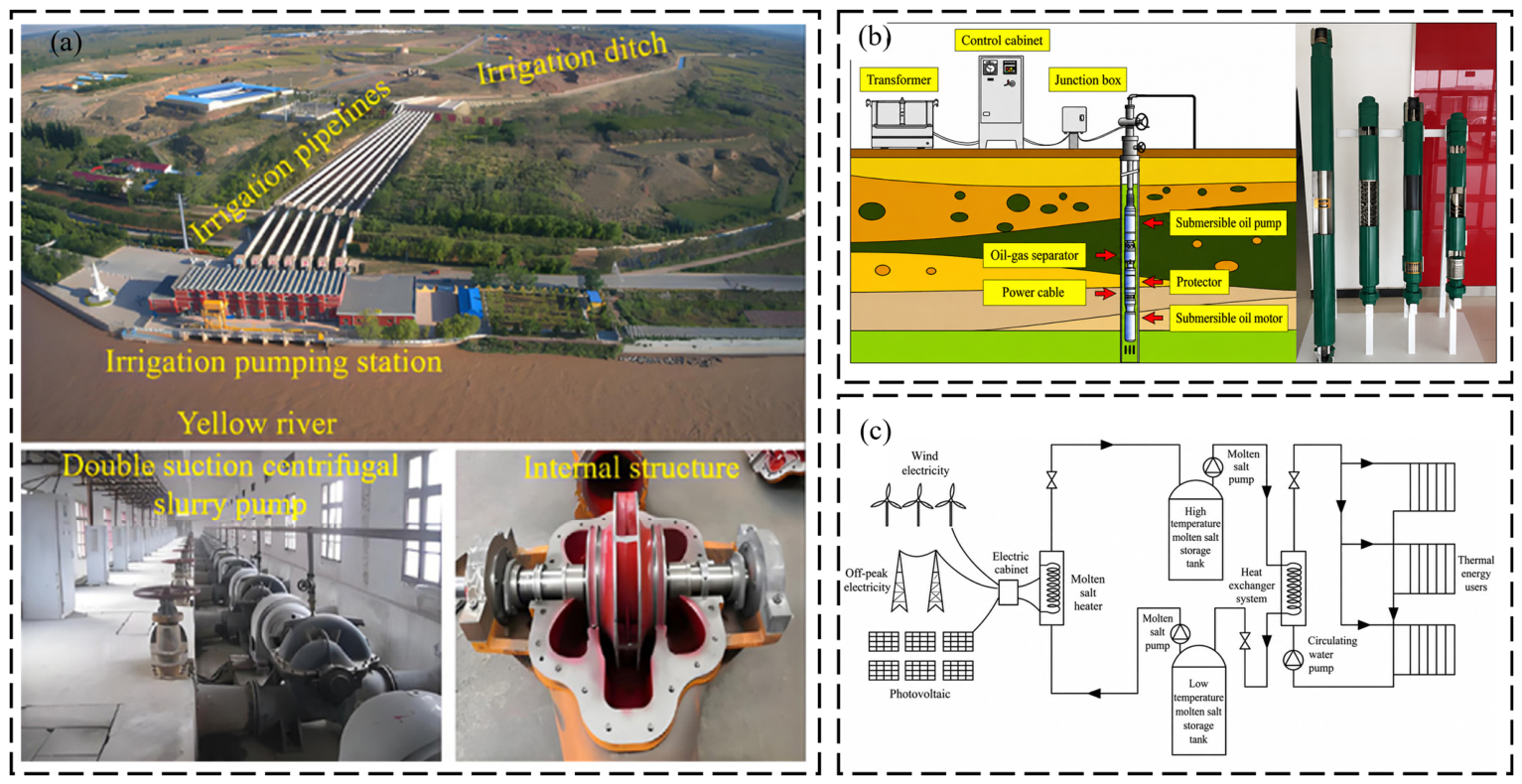
Figure 1. Application of the solid–liquid two-phase transport: (a) agricultural irrigation engineering, (b) electric submersible pump system for oil extraction, (c) molten salt energy storage process. Adapted from Ref. [6] with permission from Elsevier. Copyright 2024 Chinese Society of Particuology and Institute of Process Engineering, Chinese Academy of Sciences. Published by Elsevier B.V.
Water 18 01190 g001
Figure 2. DKT phenomenon in a three-dimensional bed at Re = 800: (a) drafting; (b) kissing; (c) tumbling. The mechanism is not affected by the walls. Reprinted from Ref. [21] with permission from Cambridge University Press. Copyright 1987 Cambridge University Press.
Water 18 01190 g002
Figure 3. Studies on turbulence modulation by particle assemblies: (a) distribution of fluid turbulent kinetic energy on the mid-span section of the pump under different flow rates; (b) variation in turbulent kinetic energy under different particle-size conditions in a guide-vane centrifugal pump; (c) interaction of particle wakes. Reprinted from Refs. [37,38,39] with permission from the respective copyright holders. Panel (a) is reprinted from Ref. [37] with permission from Elsevier, Copyright 2024 Elsevier Ltd.; panel (b) is reproduced from Ref. [38], licensed under CC BY 4.0; panel (c) is reprinted from Ref. [39] with permission from AIP Publishing, Copyright 2024 AIP Publishing.
Water 18 01190 g003
Figure 4. Mean wake structure. For each figure, the top half is the turbulent inflow case, and the bottom half is the uniform inflow case. (a) Case 5 (d/η = 9.59, Rer = 610); (b) case 6 (d/η = 9.59, Rer = 241); (c) case 3 (d/η = 3.84, Rer = 261); (d) case 1 (d/η = 1.53, Rer = 107). Here, d = particle diameter, η = Kolmogorov scale and Rer is particle Reynolds number based on the mean relative velocity. Reprinted from Ref. [40] with permission from Cambridge University Press. Copyright 2004 Cambridge University Press.
Water 18 01190 g004
Figure 5. Effect of turbulence on the length Le of the recirculation region. Solid circles are the uniform-flow results. □, Case 1 (d/η = 1.53, I = 0.1, Rer = 107); ▽, case 3 (d/η = 3.84, I = 0.1, Rer = 261); ○, case 4 (d/η = 3.84, I = 0.25, Rer = 114); ◇, case 5 (d/η = 9.59, I = 0.1, Rer = 610); △, case 6 (d/η = 9.59, I = 0.25, Rer = 241). Reprinted from Ref. [40] with permission from Cambridge University Press. Copyright 2004 Cambridge University Press.
Water 18 01190 g005
Figure 6. Impact energy loss caused by particle collision. Reprinted from Ref. [53] with permission from AIP Publishing. Copyright 2024 AIP Publishing.
Water 18 01190 g006
Figure 7. Streamwise velocity contour, U1, Liutex strength isolines, |R| from the Y-Z wall to the center of the channel in the plane, and particle dispersion for near-wall particles. The top contours depict the flow with St = 10 particles, while the bottom graphs illustrate the flow with St = 100 particles. Reprinted from Ref. [56] with permission from Springer Nature. Copyright 2024 Springer Nature.
Water 18 01190 g007
Figure 8. Numerical studies on particle modulation of vortex-structure evolution in pumps. Reprinted from Refs. [71,72] with permission from the respective copyright holders. Panel (a) is reprinted from Ref. [71] with permission from Taylor & Francis, Copyright 2025 Taylor & Francis; panel (b) is reprinted from Ref. [72] with permission from Elsevier, Copyright 2024 Elsevier Ltd.
Water 18 01190 g008
Figure 9. Distribution diagram of volute and impeller monitoring points. Reprinted from Ref. [76], Copyright 2026 by the authors, published by MDPI under the Creative Commons Attribution License (CC BY 4.0).
Water 18 01190 g009
Figure 10. Time-domain and frequency-domain diagrams of pressure pulsation at monitoring point Y1 under different particle volume fraction conditions. Reprinted from Ref. [76], Copyright 2026 by the authors, published by MDPI under the Creative Commons Attribution License (CC BY 4.0).
Water 18 01190 g010
Figure 11. Time-domain and frequency-domain diagrams of pressure pulsation at monitoring point Y2 under different particle volume fraction conditions. Reprinted from Ref. [76], Copyright 2026 by the authors, published by MDPI under the Creative Commons Attribution License (CC BY 4.0).
Water 18 01190 g011
Figure 12. Solid-phase distribution in the radial mid-section of a semi-open impeller sewage pump under different particle diameter conditions. Reprinted from Ref. [84], licensed under CC BY 4.0.
Water 18 01190 g012
Figure 13. Head-flow rate (a) and efficiency-flow rate (b) curves of the slurry pump for different silt concentrations (by weight). Reprinted from Ref. [87] with permission from Elsevier. Copyright 2017 Elsevier Ltd.
Water 18 01190 g013
Figure 14. Studies on particle-induced pump wear mechanisms. Reprinted/reproduced from Refs. [91,93,94] Panel (a) is reprinted from Ref. [89] with permission from Elsevier, Copyright 2025 Elsevier Ltd.; panel (b) is reproduced from Ref. [87], Copyright 2023 by the authors, published by Frontiers under the Creative Commons Attribution License (CC BY 4.0); panel (c) is reproduced from Ref. [28], Copyright 2021 by the authors, published by MDPI under the Creative Commons Attribution License (CC BY 4.0).
Water 18 01190 g014
Disclaimer/Publisher’s Note: The statements, opinions and data contained in all publications are solely those of the individual author(s) and contributor(s) and not of MDPI and/or the editor(s). MDPI and/or the editor(s) disclaim responsibility for any injury to people or property resulting from any ideas, methods, instructions or products referred to in the content.