Article

Evaluation Protocol of a Piezometric Network for Hydrogeochemical Applications: The Strait of Messina (Italy) Case

1
Istituto Nazionale di Geofisica e Vulcanologia, Sezione Osservatorio Etneo, 95125 Catania, Italy
2
Dipartimento di Scienze della Terra e del Mare, Università di Palermo, 90123 Palermo, Italy
3
Dipartimento di Scienze Biologiche, Geologiche e Ambientali, Università di Catania, 95129 Catania, Italy
4
Dipartimento di Ingegneria, Università degli Studi di Messina, 98166 Messina, Italy
5
Istituto Nazionale di Geofisica e Vulcanologia, Sezione Osservatorio Nazionale Terremoti, 00143 Roma, Italy
*
Author to whom correspondence should be addressed.
Water 2026, 18(10), 1188; https://doi.org/10.3390/w18101188
Submission received: 10 April 2026 / Revised: 7 May 2026 / Accepted: 13 May 2026 / Published: 14 May 2026
(This article belongs to the Section Hydrogeology)

Abstract

In complex hydrogeological systems, such as multilayered aquifers in densely urbanized coastal areas, multi-parametric, multi-depth networks are required for discriminating between anthropogenic and natural signals. This study presents an evaluation protocol of a pre-existing piezometric network, composed of 66 piezometers, aimed at implementing a near real-time (NRTM) hydrogeochemical monitoring system in the Strait of Messina (Sicily, Italy) area. A rigorous selection process was conducted to determine the suitability of these sites for hosting permanent, above-ground instrumentation. After excluding 55 sites for logistical and administrative reasons, the remaining piezometers were evaluated through a multi-step protocol. Video inspections and vertical logs of temperature and electric conductivity were carried out to identify pipe integrity and screened sections. Water samples were collected, for the execution of geochemical and isotopic analyses, to distinguish between groundwater bodies and stagnant water or local infiltration. Finally, preliminary near real-time monitoring of water level and temperature assessed the response of the sites to hydrological cycles and tidal effects. A scoring system was applied to rank the sites, resulting in a priority list for the installation of the permanent monitoring network. The evaluation protocol was tested in the Strait of Messina, but it is based on a generical approach, independent of the specific setting of a study area, making it suitable for general applications worldwide.

1. Introduction

Piezometric networks provide the opportunity of direct access to groundwater bodies, allowing not only spot measurements of chemical–physical parameters (water table elevation, temperature, electric conductivity, etc.), but also the installation of in-hole dataloggers, or multiparametric probes connected to external data acquisition and transmission facilities, enabling the near real-time monitoring (NRTM) of these parameters.
Examples of NRTM systems, aimed at measuring water table elevation for groundwater management, are from the North China Plain [1] and from the USA, in the Great Plains Aquifer [2], and California’s Central Valley [3].
Salinity, whose proxy is the Electric Conductivity (EC) of water, is a very important parameter characterizing groundwater in coastal areas, since high values indicate salinization processes, often due to the intrusion of saline wedges fostered by overexploitation of aquifers [4].
Combined measures of water depth, temperature and EC have been used for tracing the infiltration of stormwaters in urban environments [5].
In complex systems, such as multilayered aquifers in densely urbanized coastal areas, prone to saline wedge intrusions, multi-parametric, multi-depth networks are required for discriminating between anthropogenic and natural signals [6].
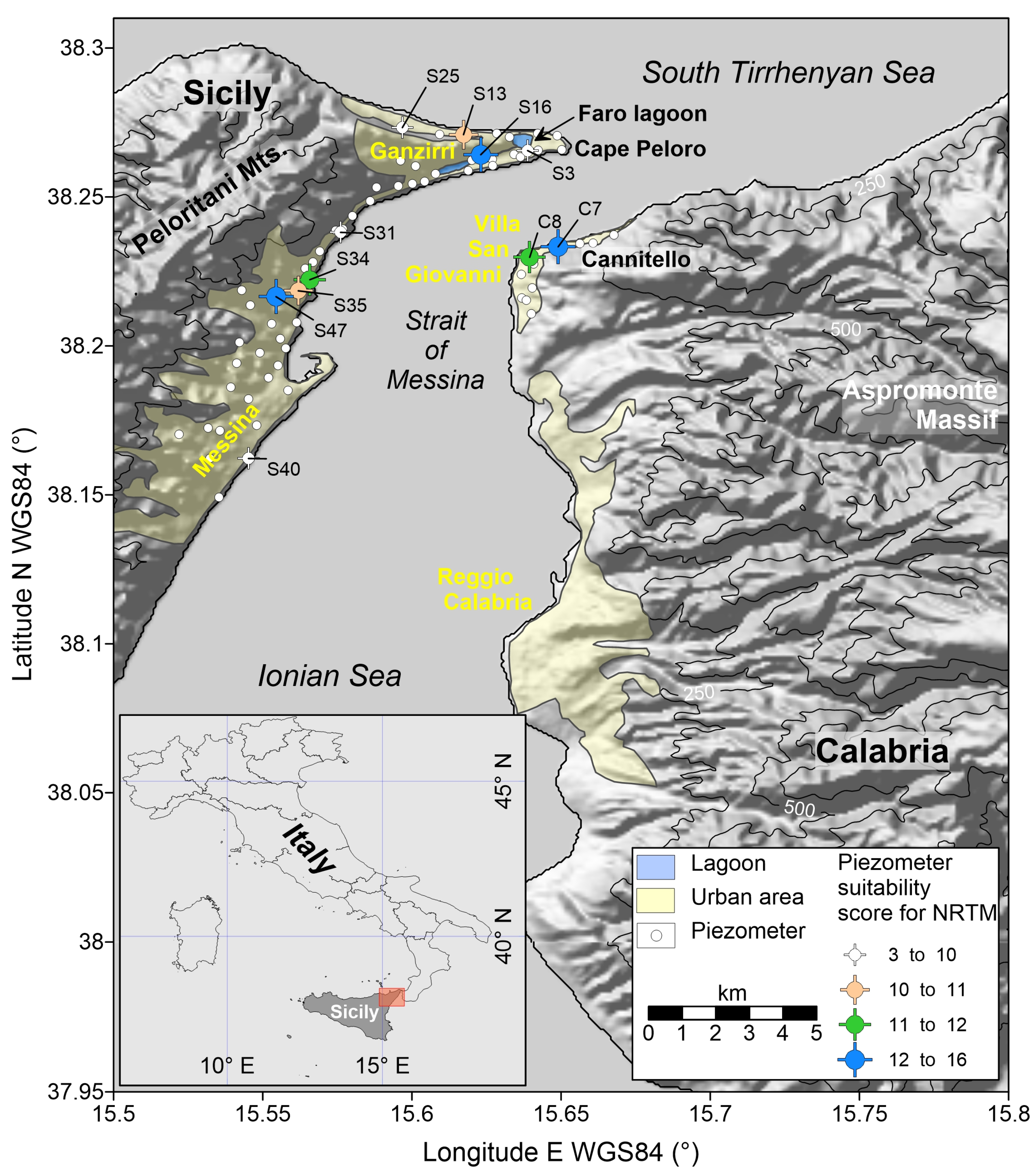
This is the case of the Strait of Messina (Italy), separating Sicily from continental Italy (Figure 1), whose landscape is dominated by a complex interdigitation of natural and built environments, where the evolutive dynamics of one part could trigger profound perturbations in the other, and vice versa.
In this paper, we present the protocol followed for evaluating a pre-existing piezometric network, and its suitability for hosting a NRTM hydrogeochemical system. We present a theoretical approach, but also its practical application, stressing the limits due to peculiar logistic conditions. The aim of the network is the collection of data useful for reconstructing the dynamics of possible sea wedge intrusions, the meteoric recharge of groundwater and its response to changes in rainfall dynamics, and the individuation of fast infiltration pathways of surface runoff, carrying potential pollutants to the aquifers.
After illustrating the procedure for selecting piezometers suitable for hosting permanent, above ground instrumentation, results of hydrogeochemical investigations, carried out to discriminate between holes intercepting groundwater bodies from those fed by local infiltration, are presented. The selected piezometers underwent preliminary temperature and water level monitoring, for evaluating their potential response to the natural and anthropic processes of interest, leading to the selection of a subset of sites suitable for the permanent monitoring network.
The final aim of the network is the production of open access data of interest for different stakeholders, including, but not limited to, the scientific community, the shellfish food industry, urban planners, water companies, public agencies, and general contractors involved in civil infrastructure construction.

2. Study Area Settings

2.1. Geology

The Strait of Messina is, at its narrowest, a 3 km wide and <100 m deep marine passageway [7] that separates Sicily from Calabria, the southernmost region of continental Italy (Figure 1). It is characterized by Miocene—quaternary sediments, whose deposition and movement are governed by syn-sedimentary tectonic processes [8,9], which rest unconformably on Alpine and Hercynian metamorphic basement units and intercalated Late Oligo—terrigenous successions [10,11]. Tectonically, the area lies within a highly active zone marked by normal and strike-slip faulting, associated with the extensional regime of the back-arc Tyrrhenian Basin, and the differential retreat of the Ionian slab beneath Calabria and Sicily.
The sedimentary basin of the Strait of Messina divides the study area into two separate sectors: the eastern sector of the Aspromonte Massif in southern Calabria, and the eastern sector of the Peloritani Mountain Chain in north-eastern Sicily. The Aspromonte Massif is characterized by a south-east-verging crystalline edifice composed of Palaeozoic metamorphic rocks intruded by granitoids during late-to-post-orogenic phases [12,13]. These basement rocks are partially overlain by Miocene to Quaternary sediments [12]. In the northern part of this sector, specifically in the Cannitello area, exposed lithologies include primarily leucogranites, paragneisses and pegmatoid gneisses, while sporadic sedimentary outcrops consist of Lower Pliocene “Trubi” marls and the Tyrrhenian-age Ravagnese and Bovetto Sands. Low-lying coastal areas are instead covered by recent alluvial deposits, composed of gravels and sands of various grain-size [8].
The Peloritani Mountain Chain forms the southernmost portion of the Calabro-Peloritani Orogen, and consists of a south-verging nappe structure formed mainly by Palaeozoic basement rocks affected by Variscan and Alpine metamorphism, locally overlain by Mesozoic sedimentary successions [13]. On the eastern coast of this sector, specifically in the Messina area, basement rocks include Aspromonte crystalline units intruded by Variscan granitoids, while low-lying coastal areas show Miocene-Pleistocene sedimentary cover with coastal areas overlain by Holocene alluvial and beach deposits [14].

2.2. Hydrogeology

The Strait of Messina represents a geologically and hydrogeologically complex transitional zone between the northeastern Sicilian coast, notably the Messina area with the Ganzirri lagoons, and the opposite Calabrian coast. This region is marked by intense tectonic activity, diverse sedimentary environments, and dynamic interactions between groundwater, surface water, and marine systems, which together define a unique hydrogeological framework of both scientific and environmental significance.
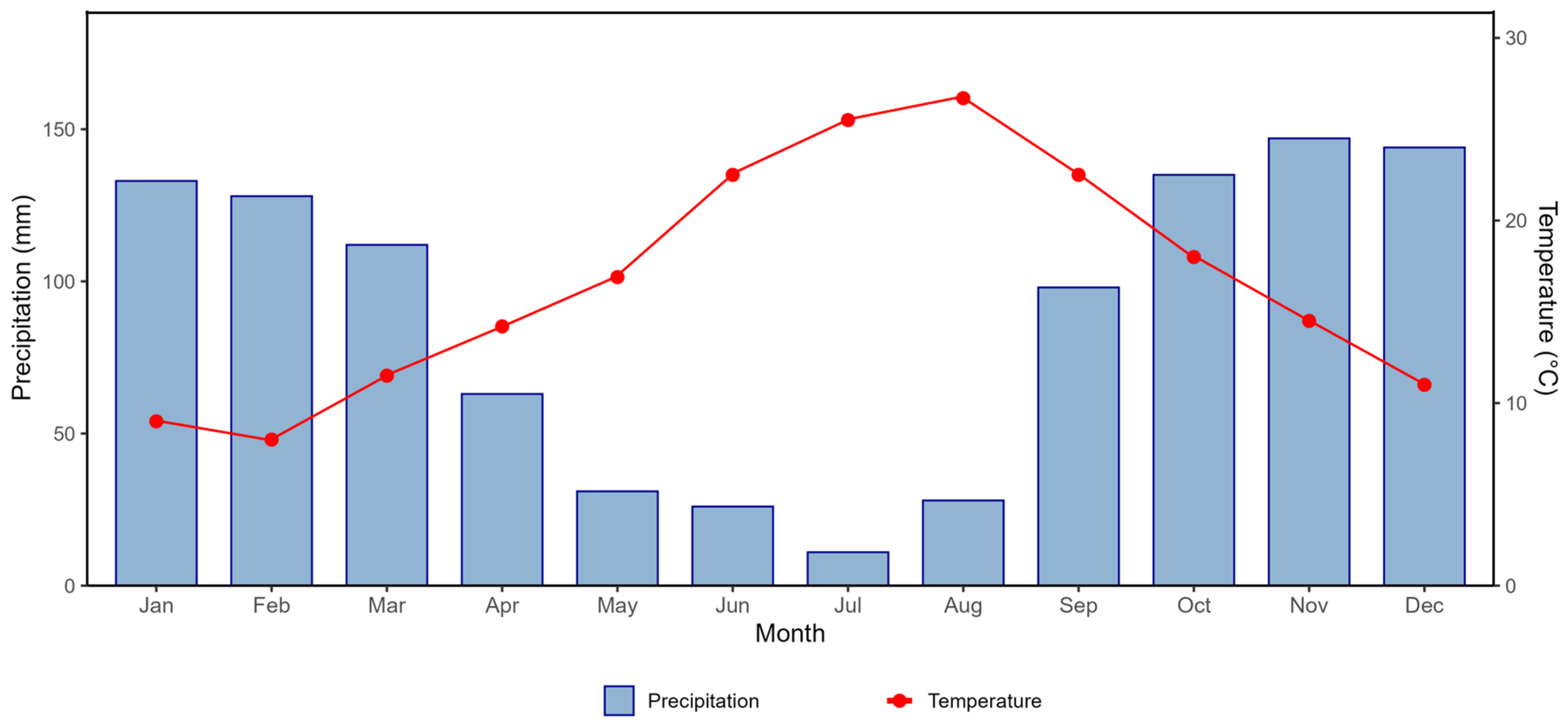
The study area is characterized by a typical Mediterranean climate, with mild, wet winters and hot, dry summers, as illustrated by the ombrothermic diagram of mean monthly temperature and precipitation (Figure 2). Mean monthly air temperatures range from about 10–12 °C in winter to 25–28 °C in summer, while precipitation is strongly seasonal, with maxima in autumn–winter and minima in late spring–summer, when rainfall is often negligible. This climatic regime exerts primary control on aquifer recharge, which mainly occurs during the cool and wet season, and on groundwater–surface water interactions in the coastal lagoons and adjacent aquifers, with marked intra-annual variability in freshwater inflows to the system [15].
The Sicilian coastal zone around Messina, and particularly the area encompassing the Ganzirri and Faro brackish coastal lagoons, is characterized by a multilayered hydrogeological system controlled by the interplay of tectonics, sedimentation, and hydrodynamics. These lagoons formed within a morpho-tectonic depression at Cape Peloro, where Late Holocene sedimentary processes have shaped a sand tongue separating them from the open sea. Faro lagoon, with a maximum depth of about 39 m, and the Ganzirri one, shallower with a maximum depth of approximately 7 m, are connected to each other and to the sea through a network of artificial and natural channels, facilitating complex exchanges of freshwater and seawater [16].
The aquifer system that feeds them is primarily recharged by precipitation and runoff from the Peloritani foothills, with groundwater flow directed from these inland areas toward the coast [16]. This shallow aquifer is composed of fluvio-deltaic and coastal sediments, which overlay older metamorphic basement rocks [16,17]. The hydrochemical regime of the lagoons and adjacent aquifers reflects a mixture of freshwater inputs and marine influence, resulting in spatial and temporal variations in salinity and water quality [18]. Seasonal and anthropogenic management of the connecting channels strongly modulates hydrodynamics, influencing water renewal times and stratification patterns, particularly in the Faro lagoon, which exhibits meromictic behavior with distinct density layers [16,18].
The structural features not only control the morphology of the coastal zone but also influence groundwater circulation by creating preferential pathways for fluid migration, including potential ascent of mineralized thermal waters. The complex morphosedimentary environment offshore, shaped by bottom currents and sediment gravity flows, further affects sediment distribution and aquifer recharge dynamics [17].
Despite increasing urbanization and water demand [19], the coastal aquifers and lagoons maintain a delicate balance between freshwater and marine water, although localized problems such as eutrophication, nitrate contamination from agriculture, and limited seawater intrusion have been documented. The lagoons have historically supported traditional aquaculture, but environmental pressures necessitate integrated management approaches based on continuous hydrogeological monitoring and multidisciplinary studies combining geophysical, hydrochemical, and isotopic data [16].
The opposite side of the strait, the Calabrian coastal sector, is part of the broader Gioia Tauro Plain and adjacent coastal sectors, which display a distinct but interconnected hydrogeological architecture. The region is characterized by a multilayered aquifer system comprising a shallow phreatic aquifer, hosted in Late Pleistocene to Holocene marine and alluvial sediments, a Pliocene aquitard, and a deeper artesian aquifer hosted in Late Miocene formations. Recharge of the shallow aquifer is predominantly from local precipitation and runoff draining from the Aspromonte and the carbonate Serre Massifs, with groundwater flow generally oriented from the mountainous hinterland toward the coast [20].
Hydraulic conductivity in the shallow aquifer varies widely, reflecting sediment heterogeneity from sands to gravels, with values typically between 10−5 and 10−4 m/s and localized higher values [20,21]. Moreover, in Vespasiano et al. [20] study, investigation on Gioia Tauro coastal plain highlighted that the deeper aquifer shows complex hydrogeochemical signatures, including Na-HCO3 and Na-Cl water types, resulting from prolonged water–rock interactions, cation exchange processes, and mixing with connate brines or deep thermal waters ascending along major strike-slip faults. Moreover, groundwater in the Calabrian coastal aquifers is subjected to anthropogenic pressures from intensive agriculture and urbanization, leading to nitrate and sulphate contamination, especially in the shallow aquifer [20,22,23]. Despite high water demand, direct seawater intrusion is limited and localized, with seawater contributions to groundwater generally below 7%, sustained by relatively high recharge rates [20,22].

2.3. The Piezometric Network

Since 2017, the Italian National Institute of Geophysics and Volcanology (INGV) has managed a huge network of piezometers and inclinometers, formerly owned by the “Società Stretto di Messina” (SSM), a company tasked by the Italian government with the development of the bridge over the Messina Strait. In particular, 66 piezometers were drilled by the SSM for the monitoring of the water table in the areas affected by the giant pillars of the bridge, both during the phase of construction and during the infrastructure’s operation. These piezometers are distributed on both sides of the Messina Strait and, currently, are part of a hydrologic monitoring network, financially supported by the EU through the Italian post-COVID-19 pandemic NRRP MEET project, aimed at establishing a Geodynamic Observatory in the city of Messina.
A preliminary evaluation of the sites of potential use for the monitoring network excluded 55 out of the 66 piezometers, for several logistic and/or administrative reasons, as reported in Cangemi et al. [24], with additional information from later surveys. Piezometers located directly on roadways or narrow sidewalks (28, all on the Sicily side with the exception of one on the opposite side) were excluded ab initio, given the impossibility of building overground facilities (solar panels and shelters containing batteries and equipment). The other 22 piezometers, 15 on the Sicily side and seven on the Calabria one, proved untraceable due to roadworks carried out after their drilling. Of the remaining five excluded, 1 was dry, 2 polluted by oil or other chemicals and 2 filled by sediments. The remaining 11 sites were considered of potential use for the network. Data related to their position, elevation and depth of the water table are reported in Table 1; their location is shown in Figure 1.

3. Materials and Methods

3.1. Geochemical Analyses

Onsite measurements and water samples for analyses were taken in May 2024, when a preliminary video inspection from well heads to hole bottoms was carried out, using a Vevor (Taicang, China) system.
A water temperature–electric conductivity log was traced along the water column, with steps of 1 m starting at −1 m from the water column head, using a Hanna (Smithfield, RI, USA) HI98494 multiparametric probe, with resolutions of ±0.01 °C for temperature and 1 µS cm−1 from 0 to 9999 µS cm−1, and 0.01 mS cm−1 from 10.00 to 99.99 mS cm−1 for EC. Water samples were taken at the top of the water column, using a Niskin bottle.
Moreover, pH was measured inside the sampling bottle, using a Thermo Scientific (Waltham, MA, USA) Orion Star A121 portable instrument (resolution ± 0.01 pH units). We collected 4 water samples at each location: 2 for major ions, 1 for HCO3 determination, 1 for isotopic analyses. Samples were stored in double-capped polyethylene bottles. Water samples for the determination of major ions were first filtered using 0.45 μm Millipore MF filters and then collected in LD-PE (low-density polyethylene) bottles acidifying the aliquot destined for cation determination with HNO3 (Suprapure quality). Major ions were determined by ionic chromatography using a Thermo Scientific (Waltham, MA, USA) Dionex ICS-5000+, with the exception of HCO3, determined by an automatic titrator. The measurement accuracy was 5%. All measured values were processed using the computer program PHREEQC, version 3.1.2 [25], using the phreeqc.dat and wateqf4.dat databases in order to calculate the ion activities and PCO2 (partial pressure of CO2) of the water samples, as well as the saturation state with respect to relevant minerals.
δD and δ18O versus V-SMOW were determined using an online pyrolysis system (TC/EA) with a CF-IRMS (Delta XP, Thermo Bremen, Germany) and the CO2–water equilibration conventional technique with a CF-IRMS (Delta V Plus connected to the Gas Bench II); precision was ±0.1‰ for δ18O and ±1‰ for δD. The isotopic values in carbonate and TDIC were measured by Thermo Delta V Plus mass spectrometer coupled with Gas Bench II.
All chemicals used during laboratory manipulations were of ultrapure grade. Ultrapure water (resistivity of 18.2 MΩ cm or better) was obtained from a Sartorius (Bagno a Ripoli, Italy) Arium® mini system. Nitric acid 65% (w/w), ammonia solution and hydrochloric acid were purchased from J.T. Baker chemicals. Working standard solutions of the studied elements were prepared daily by stepwise dilution of the multi-element stock standard solutions from DBH, Merck or CPI International (1000 ± 5 mg L−1) in a 1 M HCl medium.
All the analyses were carried out at the INGV laboratories of Palermo.

3.2. Preliminary near Real-Time Monitoring

Preliminary near real-time monitoring of water temperature and level has been carried out since autumn 2023 in the potentially suitable piezometers, using available small low cost dataloggers.
Two different types of loggers were employed: (1) Tinytag Aquatic 2 temperature loggers, from Gemini Data Loggers (Chichester, West Sussex, UK), with a 0.01 °C resolution, (2) Hobo U20L-01 absolute pressure and temperature loggers, from LI-COR® (Lincoln, NE, USA), with a resolution of 0.2 mbar and 0.1 °C for pressure and temperature, respectively. Absolute pressure was converted to water depth using atmospheric pressure data collected at the INGV meteorological station of Messina, integrated with data from other close stations. Water depths were finally converted in water table elevation above sea level using freatimetric measures carried out at the time of data downloading. The acquisition interval was set at 30 min, to obtain unaliased hourly data, but water table elevations are reported hourly, to match the acquisition period of external atmospheric pressure data.
Due to the unavailability of a sufficient number of loggers available for simultaneous measurements, data acquisition was carried out in different periods and with different durations.

4. Hydrogeochemical Network Design

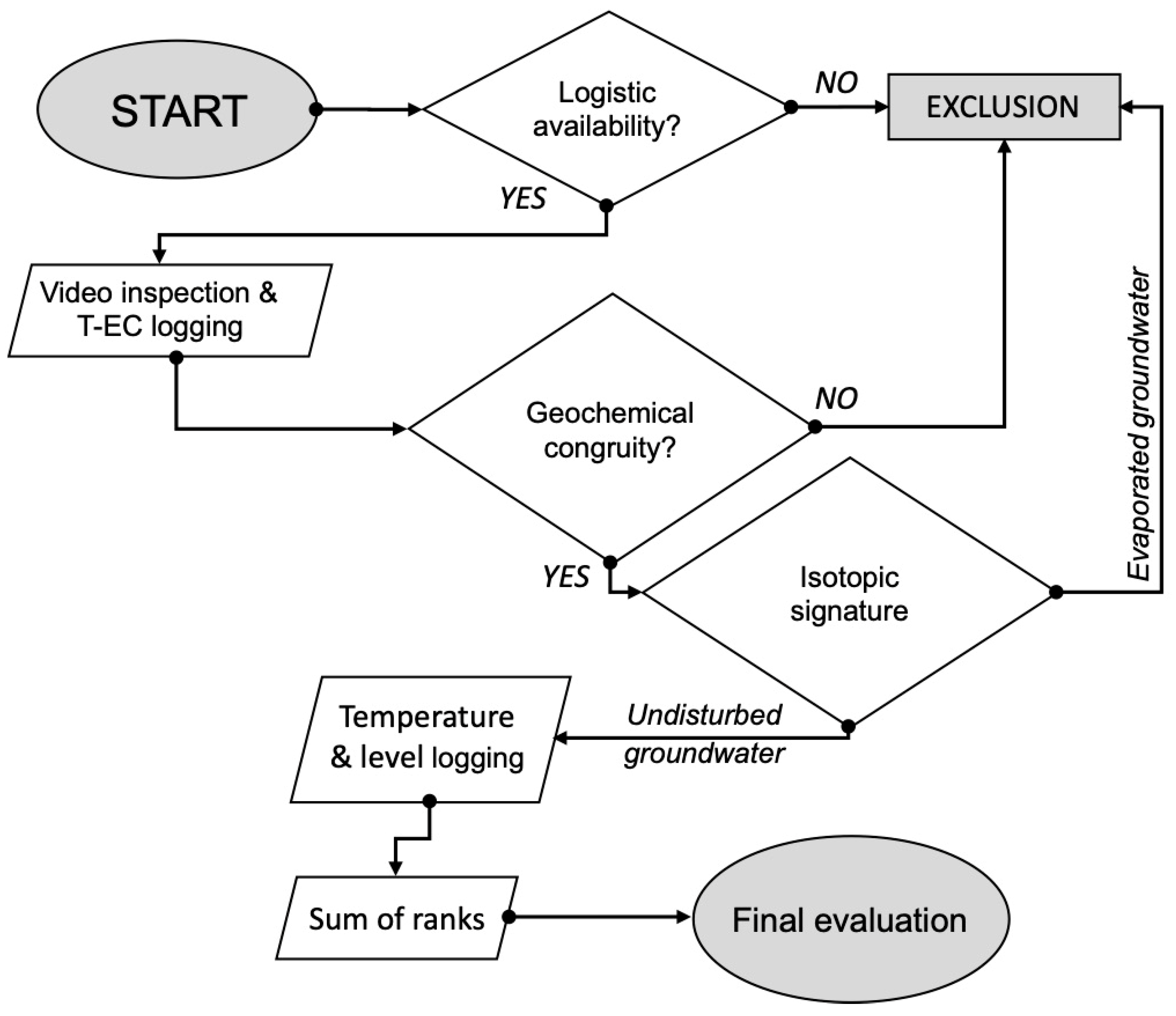
The logical flow followed for the design of the hydrogeochemical network is illustrated in the flow chart of Figure 3. The first step consisted of the assessment of the logistical availability of the sites, leading to the exclusion of all the piezometers not suitable for permanent overground installations. At the end of this phase, 11 sites were selected (see Section 2.3 for details).
The next steps consisted of carrying out a video inspection and vertical water temperature–electric conductivity logs and collecting groundwater samples in the piezometers for the determination of their chemical and isotopic compositions in order to (i) identify blind and screened sections of the pipes, and their relative positions with respect the water table; (ii) evaluate the relationship between freshwater lenses and the seawater wedge; (iii) assess the congruity of the water geochemical fingerprint with the lithological character of the host rocks; and (iv) discriminate between groundwater bodies and stagnant water accumulations due to local infiltration (isotopic composition).
Finally, preliminary temperature and level near real-time monitoring of the piezometers was carried out, aimed at verifying the time dynamics of these parameters, distinguishing between sites responsive to direct infiltration of rainfall from those showing longer term variations linked to the seasonal hydrological cycle. At the end of each step, an arbitrary score ranging from 0 (not suitable) to 3 (best suitability) was assigned to the different sites, and the sum of scores was used for creating a priority list of their potential suitability for the inclusion in the monitoring network.
In the following paragraphs, the evaluation procedure will be described in detail; it should be noted that, in the flow chart, we described the theoretical best logical approach. In our case, we started the temperature-level logging in some wells prior to executing step 1 (video inspection and temperature–electric conductivity (EC) logging), due to the insufficient number of dataloggers for simultaneous coverage of the entire network.

4.1. Video Inspection and Vertical Temperature–Electric Conductivity Logging

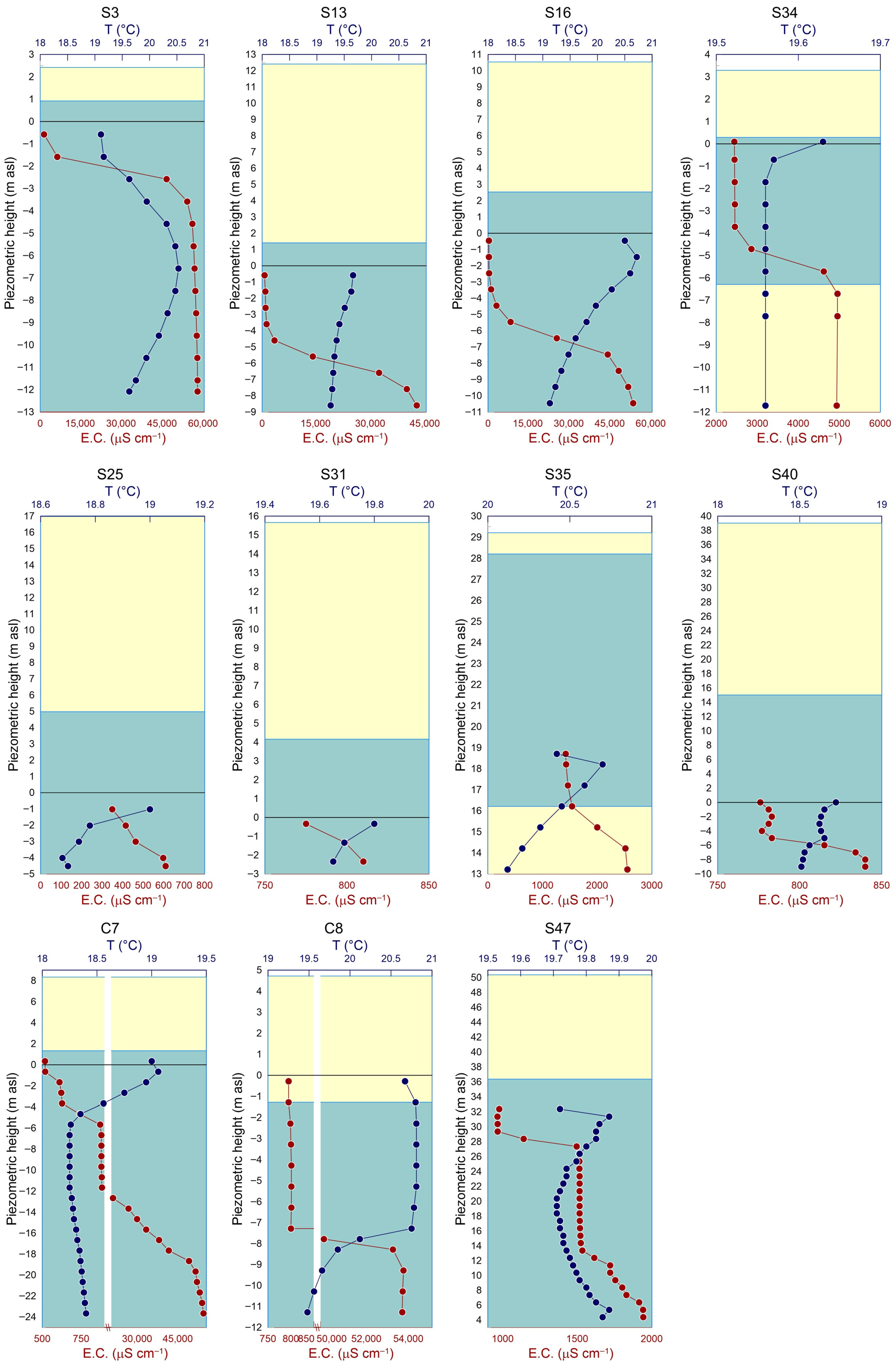
Figure 4 shows temperature and level logs of the piezometers, highlighting in yellow and light blue the blind and screened sections of the pipes, as resulting from the video inspection, respectively; the vertical scale is expressed in m above sea level.
Three wells (S25, S35, S40) exhibited screened sections more than 5 m long over the free surface of the water table, indicating a high sensitivity to drains locally infiltrating water, thus being evaluated with a 0 score. The opposite condition, with a score of 3, was found in C7, where the water table lies below the upper limit of the screened section. In between, there were other two groups of piezometers, with screened pipe sections over the water table with lengths < 2 m (C8, S3, S13, S34) and in the range 2–5 m (S16, S31, S47), were evaluated with a 2 and 1 score, respectively.
Analogously, a score from 0 to 3 was attributed to the results of the EC log, following the principle that a piezometer deeper than sea level should intercept the saline wedge, if permeability barriers due to peculiar geotectonic settings are not present. Electric conductivity 1 < mS cm−1 gained a 0 score (S25, S31, S40) and, instead, a score of 3 was attributed to piezometers showing an evident salinity gradient, reaching values comparable to seawater at their bottom (C7, C8, S3, S16); the same score was given to S35 and S47, characterized by low EC values because the intercepted aquifers lay several meters above sea level. The other two classes include sites with EC in the ranges 1–10 mS cm−1 (S34) and 10–45 mS cm−1 (S13), score 1 and 2, respectively.

4.2. Geochemical Congruity Assessment

Physicochemical parameters and chemical and isotopic compositions are reported in Table 2 and Table 3, respectively. The collected groundwaters are characterized by pH ranging between 6.82 and 7.81, temperatures from 18.7 to 20.7 °C and electrical conductivity between 274 and 2440 μS cm−1. Temperatures are compatible with the climatic regime of the area, as illustrated in paragraph 2.2. The recorded pH range highlights the presence of a wide lithological variability, as previously described, with slightly acidic groundwaters compatible with crystalline magmatic/metamorphic hosting rocks, and more alkaline groundwaters, typical of carbonate aquifers. Electric conductivity range confirms the lithological variability, from low soluble crystalline magmatic/metamorphic rocks to higher soluble carbonate and evaporitic deposits, also accounting for a possible mixing with seawater.
Chlorine is the most abundant among anions, whose concentration reaches the maximum value of 14.3 mmol L−1, followed by HCO3, SO42−, NO3, F and Br (up to 7.57, 3.06, 0.928, 0.294 and 0.022 mmol L−1, respectively). Among the cations, Na is the most abundant, with concentrations up to 13.7 mmol L−1, followed by Ca, Mg and K cations (up to 4, 2.06, and 0.4 mmol L−1, respectively).
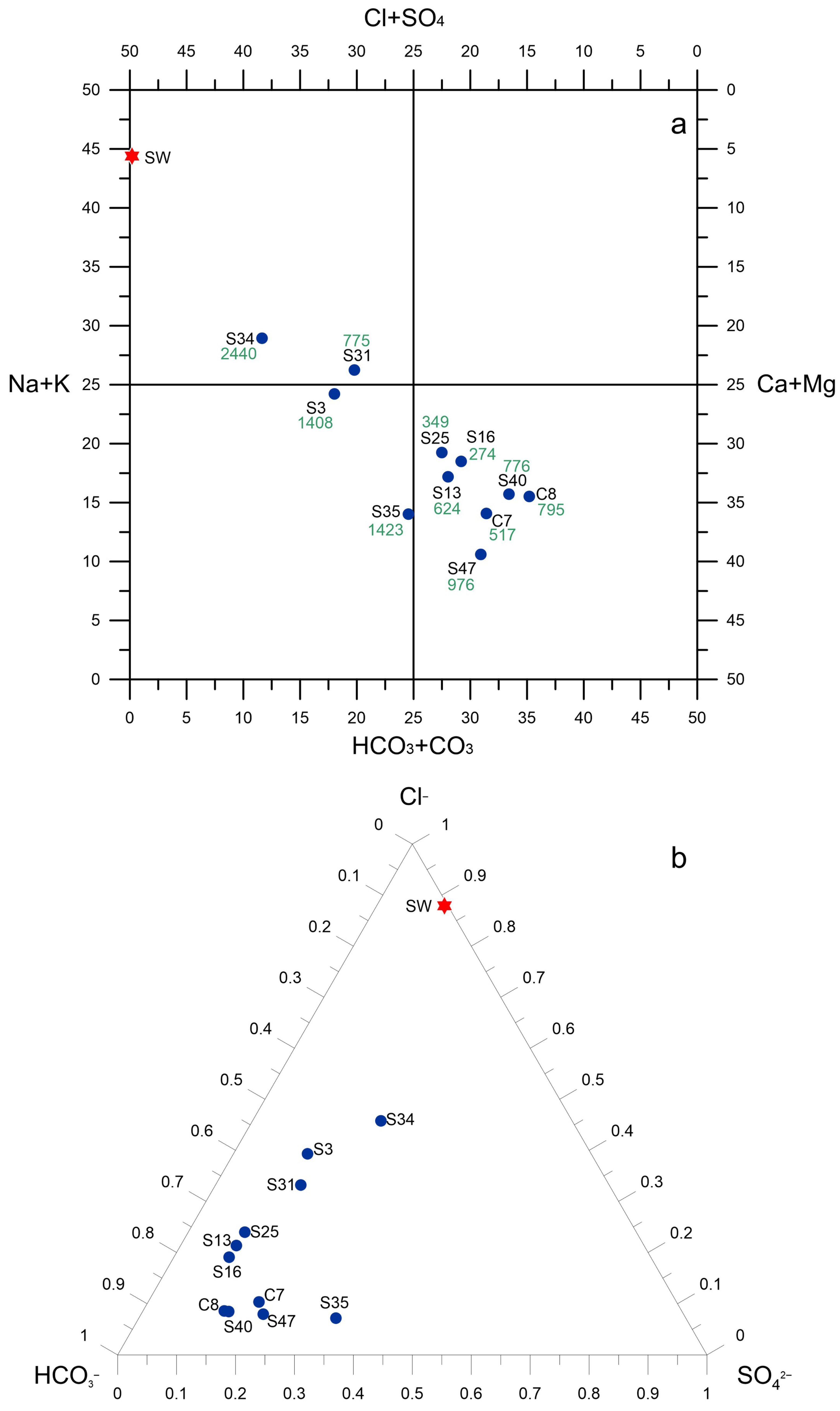
Compositional data plotted on a Langelier–Ludwig diagram (Figure 5a) depict a mixing process between two main endmembers, consisting of carbonate waters (bicarbonate earth-alkaline composition, lower right quadrant) and seawater (red star in the upper left, chloride–sulphate–alkaline quadrant), with a minor shift toward the chloride–sulphate–earth–alkaline quadrant (lower left), more evident in sites S3 and S35. This secondary shift can be attributed to the presence of gypsum belonging to the Messinian Gessoso-Solfifera formation, whose presence is reported in the subsoil of the area.
The anion ternary diagram (Figure 5b) confirms these mixing processes, with samples that from the bicarbonate corner move toward the Cl-dominated seawater composition, modulated by a minor component trending to the SO42− corner, due to the dissolution of evaporitic deposits.
Saturation indexes (Table 4) indicate that most of the samples are close to saturation with respect to carbonate species, but undersaturated with respect to evaporitic phases (gypsum, anhydrite, and especially halite), following the solubility coefficient series of these minerals. Undersaturation is also exhibited by the dissolved CO2.
In summary, the geochemical data indicate that the geochemical fingerprint of the sampled groundwaters is coherent with the lithological heterogeneity of the host rocks, including carbonates, evaporitic deposits, polygenetic terrigenous sediments, but also granites and other metamorphic rocks, outcropping both on the Sicilian and Calabrian sides of the Strait of Messina.
When plotted on the Langelier–Ludwig diagram (Figure 5a), the points tend to be clustered around its center, with shifts toward the different corners, following the mixing with one or more different members: sea water (upper left), selenitic water (lower left), carbonate water (bottom right). The contribution of groundwater circulating in metamorphic rocks (upper right) is the least represented, according to the low solubility of their mineral matrix and low water–rock interaction times, due to a fast circulation through fractures.
Additional information is provided by coupling the chemical composition with EC, used as a proxy of salinity, it is worth noting that three sites, S16, S25, S31, exhibit EC values sensibly lower than the other wells showing similar geochemical facies, indicating a possible dilution due to the direct infiltration of rainwater, poor in dissolved salts, into the pipes. The dilution effect is also confirmed by the saturation indexes (Table 4), which show the lowest values in the same wells. Based on these considerations, we attributed the score of 2 to these three sites, and the score of 3 to all the others.

4.3. Isotopic Signature Evaluation

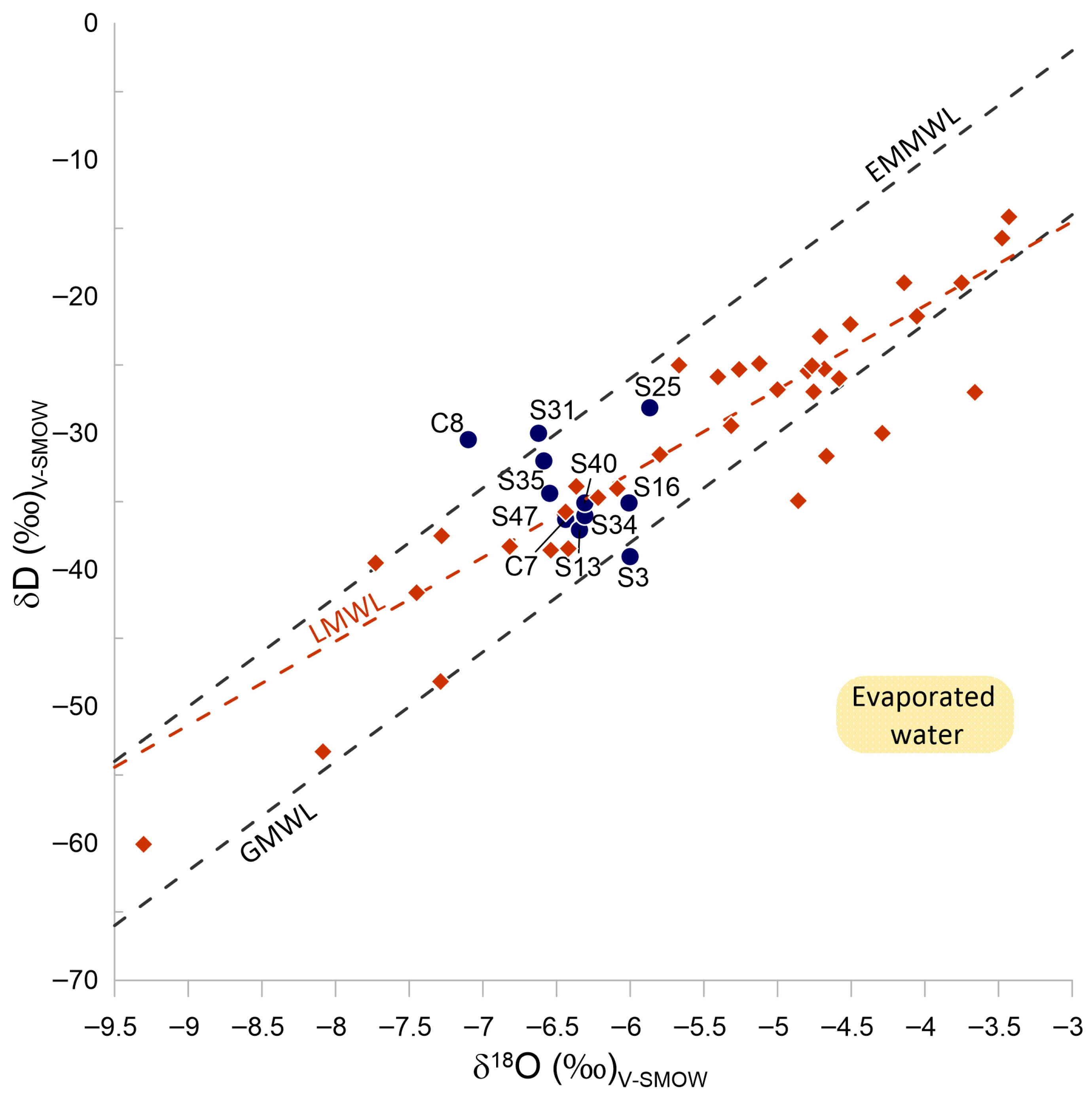
Hydrogen and oxygen isotopic compositions of groundwater (Table 3, Figure 6) generally fall between the Global Meteoric Water Line (GMWL) [26] and the Eastern Mediterranean Meteoric Water Line (EMMWL) [27], fitting at different extents with the local meteoric water line (LMWL), calculated by Liotta et al. [28], using data acquired in rain samplers located at different altitudes in the area.
The LMWL is the main indicator of a pure meteoric recharge of groundwater, being representative of the isotopic composition of precipitation falling in the specific geographic context under evaluation. The sites best fitting the LMWL, which are C7, S13, S16; S34, S40 and S47, followed by S35 and S25, fell between this line and the EMMWL. Sites S31 and S3 fall immediately outside the EMMWL and the GMWL, respectively, with the latter trending the most toward the area of evaporated water. Finally, C8 is the most distant from the LMWL, and falls over the EMMWL. Following the order of distance from the LMWL, the scores of 3, 2, 1 and 0 were attributed to the 4 groups described above.

4.4. Temperature and Level Monitoring

Temperature and level monitoring data must be interpreted cautiously.
First, level variations in the piezometers can be caused by both direct and lateral recharge, the former driven by precipitation falling in the same area, the latter by rainfall affecting the recharge area, that are thus also far from the site where the water table elevation is measured; in this case, time delays between rainfall and level changes are highly variable, according to length and hydraulic characteristics of the hydrogeological circuit.
Second, rainfall data presented here have been acquired in the urban area of Messina, where the piezometers are located: consequently, these data provide precise information about the direct recharge, but they are only a qualitative proxy for estimating what happens in the lateral recharge areas.
Third, the highly variable duration of the data acquisition periods of each site (from a few months to more than two complete hydrological years), a consequence of the unavailability of a sufficient number of dataloggers for covering the entire network, have given time series with different statistical significance.
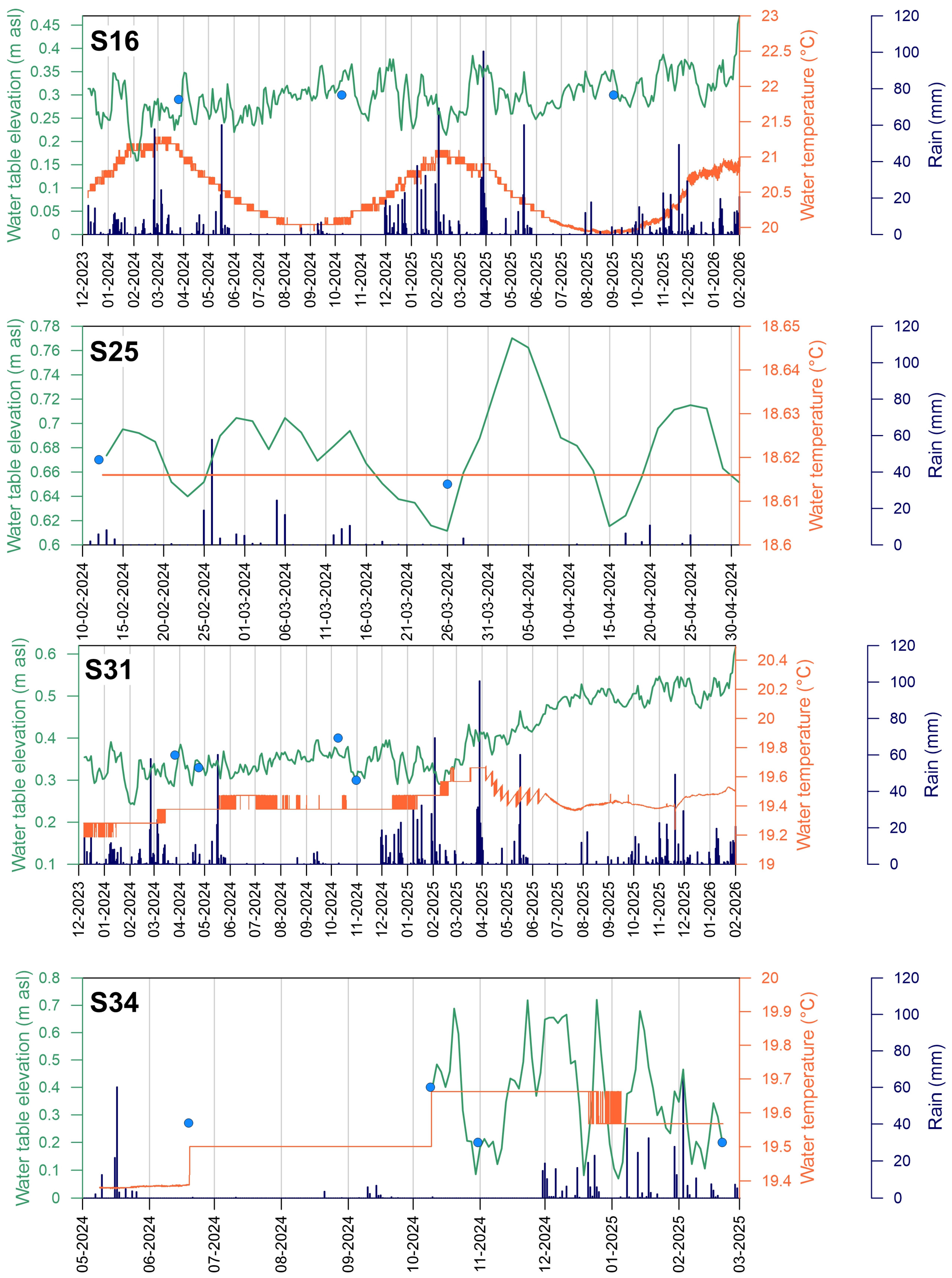
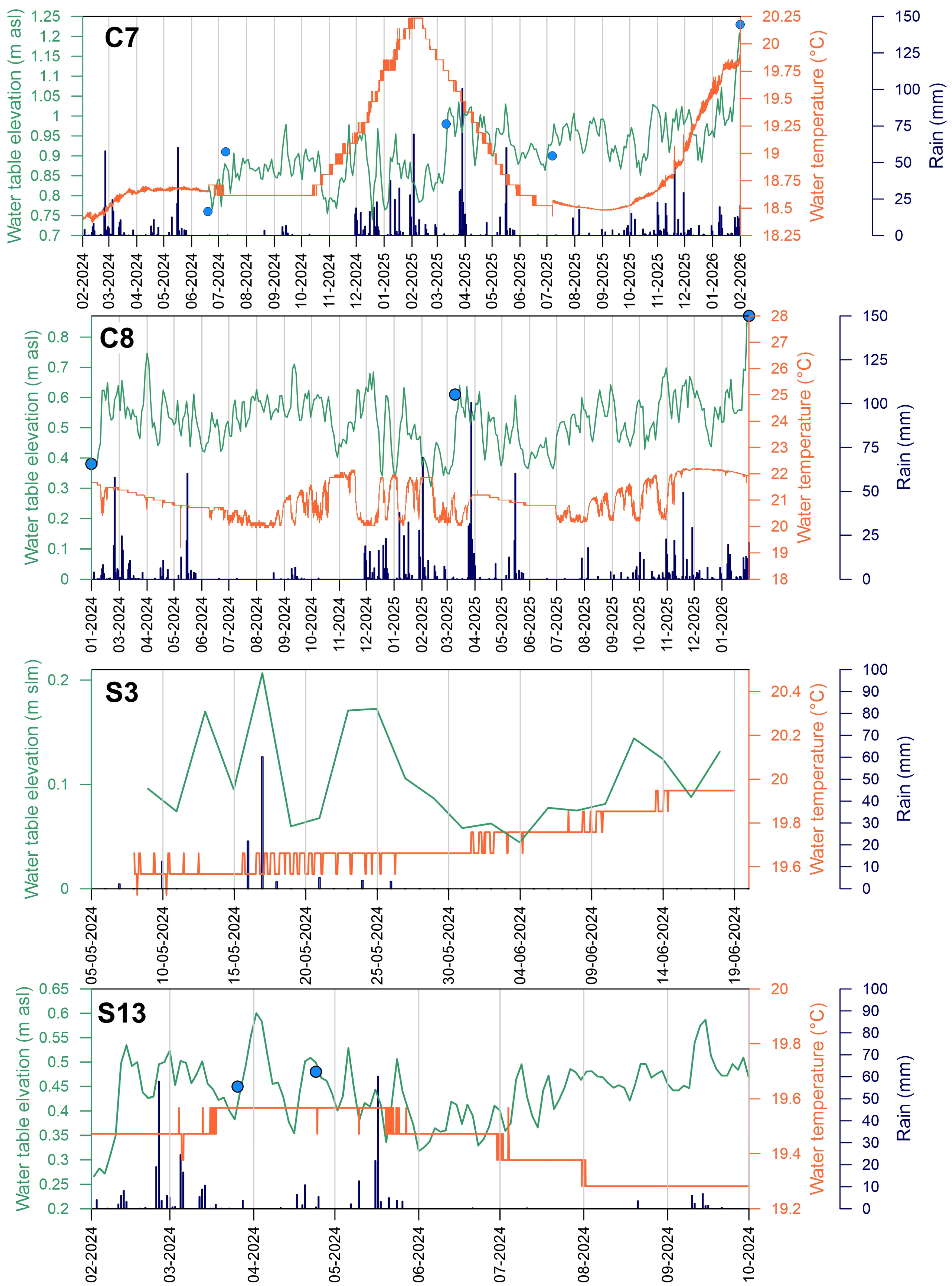
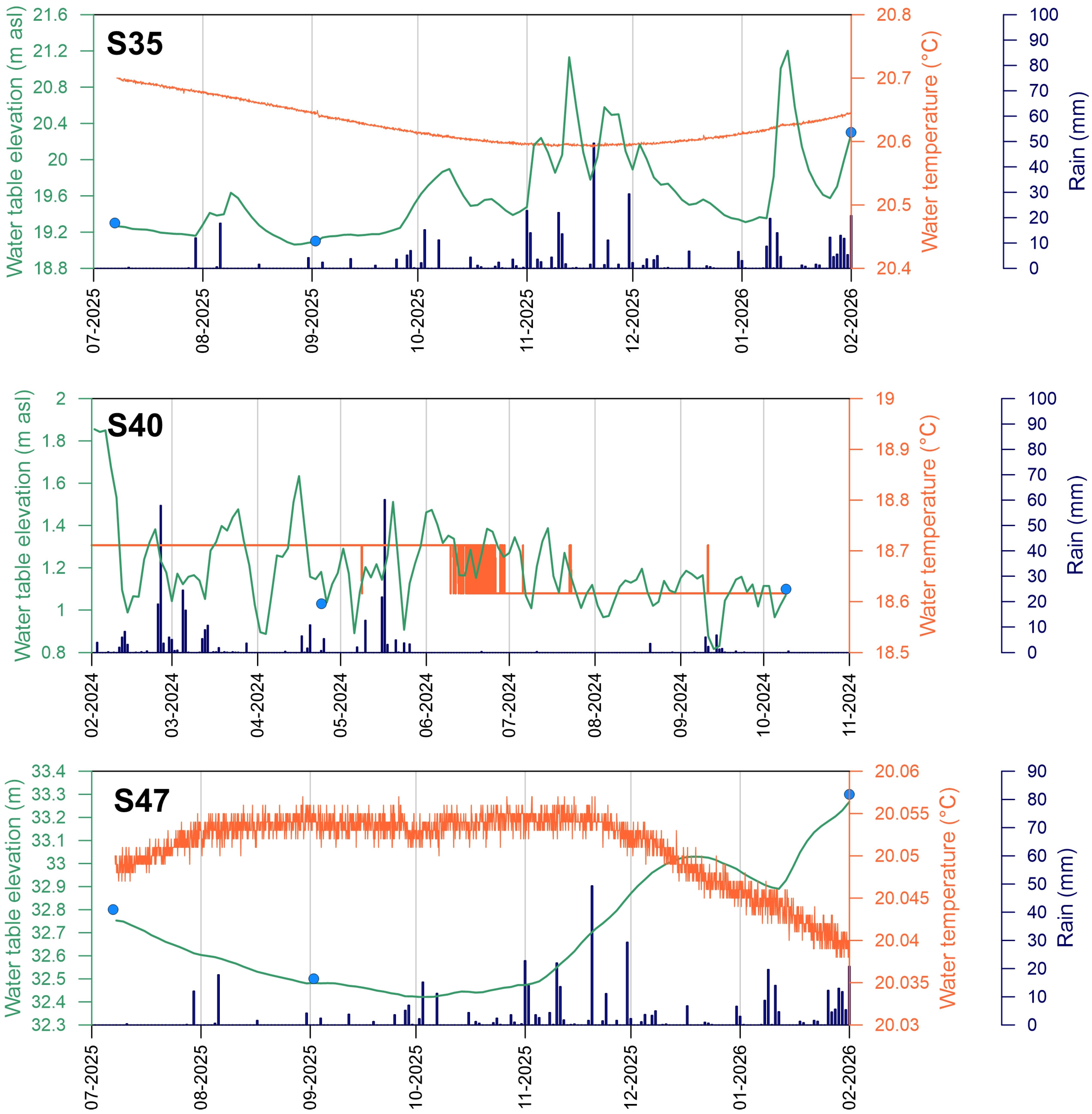
The results from the preliminary near real-time temperature and level monitoring, presented in Figure 7, have been grouped following the above-mentioned considerations.
Group 1 includes the sites where data for two complete hydrological years are available: C7, C8, S16, and S31. Their common character is the absence of a marked intra-annual periodicity, a general increment of the level (0.4–0.5 m on average) from the beginning of 2024 to the end of 2025 (with a relative minimum at the end of 2024, following the difference in the total amount of precipitations), and high frequency (tens of days) oscillations of minor amplitude (0.1–0.2 m), maybe due to tidal cycles or other effects.
Temperature signals exhibit a slight variability, oscillating 1.5–2 °C between maxima at the end of winter and minima at the end of summer, that is the same cyclicity observed in the underground environments of Sicily [29]; only site S31 showed an anomalous trend, with a constant increment and a peak centered on April 2025.
Group 2 includes sites monitored for at least half a hydrological cycle (S34, S35, S47), and characterized by constant temperatures (oscillations of very few tenths of °C) and level increments following periods of rainfall with very short delays and rapid oscillations (days), like S34 and S35, or with longer periods (months), like S47.
Group 3 includes the remaining four sites (S3, S13, S25, S40), with quite constant temperatures and level oscillations also of the order of tens of centimeters, but not directly linked to rainfall or other hydrological periodicities, like S13 and S40, monitored for at least half a hydrological cycle. The monitoring of S3 and S25 was interrupted after 2 months, because S3 was considered to be of no geological interest, being a local water lens suspended between the two Ganzirri lagoons, and S25 because it was identified as a stagnant water accumulation inside the pipe during the video inspection.
Following the above exposed criteria, the scores of 3, 2 and 0 were attributed to Groups 1, 2 and 3, respectively.

4.5. Site Suitability Evaluation

The suitability of the piezometers for hosting a permanent NRTM network has been assessed by the sum of the scores obtained during the different evaluation steps, and it is summarized in Table 5, where the sites have been ordered in descending order.
Site C7, on the Calabrian side of the Strait, obtained the best score, with a full score in each step of the evaluation protocol: water table over the upper limit of the screened section of the pipe, EC profile individuating a fresh water lens floating over the saline wedge, geochemical compatibility with the general geology of the area, and isotopic composition well fitted with the LMWL, with results of the preliminary level/temperature NRTM showing variations compatible with the hydrological cycle, with higher frequency periodicities ascribable to tidal effects.
Immediately following C7 are sites S16 and S47, on the Sicilian side, where the screened section of the pipe is well extended over the water table, allowing the possible rapid drainage of local rainfall introducing an ambient noise that disturbs the hydrogeochemical signal.
These are followed by sites C8 and S34, with the same score: C8 showed an isotopic composition fitting poorly with the LMWL, indicating the possible presence of fast infiltrating rain, while the EC log of S34 indicated a scarce interaction with seawater, not expected for piezometers located close to the coastline and with a water table elevation near to sea level.
The next sites in the ranking are S13 and S35, the former affected by NRTM results indicating random variations in the level signal, the latter with a very long screened section over the water table, generating a high sensitivity to the drainage of local rainfall.
The last four sites, S3, S31, S40 and S25, obtained low scores during different steps, making them not suitable for hosting permanent stations of the NRTM network.
The other seven piezometers were considered idoneous for insertion in the network, even if with some limitations. According to the relative scores, sites C7, S16 and S47 were considered fully suitable for multi-purpose hydrogeological monitoring, while the other sites only for specific aims: C8 for the reconstruction of the water table response to direct infiltration, S34 not for the evaluation of the relationship with the sea wedge, and so on.
The location of the sites, classified following the suitability rank, is shown in Figure 1.

5. Concluding Remarks

The study successfully established a rigorous multi-step evaluation protocol designed to transform a pre-existing piezometric network into a high-performance near real-time monitoring system for the Strait of Messina area. By filtering the original 66 sites through logistical and administrative criteria, the research focused on eleven locations deemed suitable for permanent instrumentation. The subsequent integration of video inspections, vertical logging of temperature and electrical conductivity, detailed geochemical and isotopic analyses, and preliminary temperature/level logging, provided a comprehensive framework for ranking these sites based on their response to variations in the related hydrogeological structures.
The results identified site C7 in Calabria as the most representative location, achieving the highest suitability score due to its ideal pipe fenestration and a clear salinity gradient that perfectly reflects the interaction between freshwater lenses and the saline wedge. While sites S16 and S47 also demonstrated high potential, they showed a moderate sensitivity to local rainfall drainage, which must be accounted for by correct data interpretation. Conversely, several other sites were deemed unsuitable for the permanent network, after being identified as hydraulically isolated groundwater bodies.
The evaluation protocol tested in the specific case of the Strait of Messina area has a general validity, and can be successfully applied to similar hydrogeological systems in other locations worldwide. In applying our protocol to different hydrogeological settings, attention should be paid to adapting the arbitrary scale of scores to the local conditions.

Author Contributions

Conceptualization, M.C. and P.M.; methodology, M.C. and P.M.; validation, M.C. and P.M.; formal analysis, I.B., M.C. and P.M.; investigation, M.C. and P.M.; data curation, M.C.; writing—original draft preparation, A.B., I.B., M.C., P.M., M.M. and D.M.; writing—review and editing, all authors.; visualization, I.B., M.C. and P.M.; project administration, M.M. and G.S.; funding acquisition, G.S. All authors have read and agreed to the published version of the manuscript.

Funding

This research was funded by the Italian Recovery Plan (NRRP) project “Monitoring Earth’s Evolution and Tectonics” (MEET)-missione 4, componente 2, investimento 3.1 “Fondo per la realizzazione di un sistema integrato di infrastrutture di ricerca e innovazione”.

Data Availability Statement

Water level and temperature data presented in Figure 7 are available at: https://zenodo.org/search?q=18680937&L=list&p=1&s=10&sort=bestmatch (accessed on 9 April 2026). All other relevant data are shown in article tables.

Acknowledgments

The authors have reviewed and edited the output and take full responsibility for the content of this publication.

Conflicts of Interest

The authors declare no conflicts of interest.

Abbreviations

The following abbreviations are used in this manuscript:
ECElectric Conductivity
EMMWLEast Mediterranean Meteoric Water Line
GMWLGlobal Meteoric Water Line
INGVIstituto Nazionale di Geofisica e Vulcanologia
LMWLLocal Meteoric Water Line
NRRP MEETItalian Recovery Plan project “Monitoring Earth’s Evolution and Tectonics”
NRTMNear Real-Time Monitoring
SSMSocietà Stretto di Messina
V-SMOWVienna-Standard Mean Oceanic Water

References

  1. Zhou, Y.; Dong, D.; Liu, J.; Li, W. Upgrading a regional groundwater level monitoring network for Beijing Plain, China. Geosci. Front. 2013, 4, 127–138. [Google Scholar] [CrossRef]
  2. McGuire, V.L. Water-Level and Recoverable Water in Storage Changes, High Plains Aquifer, Predevelopment to 2015 and 2013–15; U.S. Geological Survey Scientific Investigations Report 2017–5040; U.S. Geological Survey: Reston, VA, USA, 2017.
  3. Central Valley Groundwater Monitoring Collaborative. Trend Monitoring Workplan; Central Valley Regional Water Quality Control Board: Sacramento, CA, USA, 2017.
  4. Parra, L.; Sendra, S.; Lloret, J.; Bosch, I. Development of a Conductivity Sensor for Monitoring Groundwater Resources to Optimize Water Management in Smart City Environments. Sensors 2015, 15, 20990–21015. [Google Scholar] [CrossRef]
  5. Shi, B.; Catsamas, S.; Kolotelo, P.; Wang, M.; Lintern, A.; Jovanovic, D.; Bach, P.M.; Deletic, A.; McCarthy, D.T. A Low-Cost Water Depth and Electrical Conductivity Sensor for Detecting Inputs into Urban Stormwater Networks. Sensors 2021, 21, 3056. [Google Scholar] [CrossRef] [PubMed]
  6. Kim, K.Y.; Chon, C.M.; Park, K.H.; Park, Y.S.; Woo, N.C. Multi-depth monitoring of electrical conductivity and temperature of groundwater at a multilayered coastal aquifer: Jeju Island, Korea. Hydrol. Process. Int. J. 2008, 22, 3724–3733. [Google Scholar] [CrossRef]
  7. Longhitano, S.G. Between Scylla and Charybdis (part 1): The sedimentary dynamics of the modern Messina Strait (central Mediterranean) as analogue to interpret the past. Earth Sci. Rev. 2018, 185, 259–287. [Google Scholar] [CrossRef]
  8. Atzori, P.; Ghisetti, F.; Pezzino, A.; Vezzanil, L. Carta Geologica del Bordo Occidentale dell’Aspromonte, Scala 1:50.000; S.EL.CA.: Firenze, Italy, 1983. [Google Scholar]
  9. Ghisetti, F. Recent deformations and the seismogenic source in the Messina strait (Southern Italy). Tectonophysics 1984, 109, 191–208. [Google Scholar] [CrossRef]
  10. Bonardi, G.; Cavazza, W.; Perrone, V.; Rossi, S. Calabria-Peloritani terrane and northern Ionian Sea. In Anatomy of an Orogen: The Apennines and Adjacent Mediterranean Basins; Springer: Dordrecht, The Netherlands, 2001; pp. 287–306. [Google Scholar] [CrossRef]
  11. Perri, F.; Dominici, R.; Le Pera, E.; Chiocci, F.L.; Martorelli, E. Holocene sediments of the Messina Strait (southern Italy): Relationships between source area and depositional basin. Mar. Pet. Geol. 2016, 77, 553–566. [Google Scholar] [CrossRef]
  12. Pezzino, A.; Angì, G.; Fazio, E.; Fiannacca, P.; Lo Giudice, A.; Ortolano, G.; Punturo, R.; Cirrincione, R.; De Vuono, E. Alpine Metamorphism in the Aspromonte Massif: Implications for a New Framework for the Southern Sector of the Calabria-Peloritani Orogen, Italy. Int. Geol. Rev. 2008, 50, 423–441. [Google Scholar] [CrossRef]
  13. Cirrincione, R.; Atzori, P.; Pezzino, A. Sub-greenschist facies assemblages of metabasites from south-eastern Peloritani range (NE-Sicily). Mineral. Petrol. 1999, 67, 193–212. [Google Scholar] [CrossRef]
  14. Somma, R. The stratigraphic record of the Alì-Montagnareale Unit (Peloritani Mountains, NE Sicily, Italy). Rend. Online Soc. Geol. Ital. 2013, 25, 106–115. [Google Scholar] [CrossRef]
  15. Borzì, I.; Bonaccorso, B. Quantifying Groundwater Resources for Municipal Water Use in a Data-Scarce Region. Hydrology 2021, 8, 184. [Google Scholar] [CrossRef]
  16. Somma, R.; Spoto, E.S.; Giacobbe, S. Geological and Structural Framework, Inventory, and Quantitative Assessment of Geodiversity: The Case Study of the Lake Faro and Lake Ganzirri Global Geosites (Italy). Geosciences 2024, 14, 236. [Google Scholar] [CrossRef]
  17. Doglioni, C.; Ligi, M.; Scrocca, D.; Bigi, S.; Bartoluzzi, G.; Carminati, E.; Cuffaro, M.; D’oriano, F.; Forleo, V.; Muccini, F.; et al. The tectonic puzzle of the Messina area (Southern Italy): Insights from new seismic reflection data. Sci. Rep. 2012, 2, 970. [Google Scholar] [CrossRef]
  18. Capillo, G.; Silvestro, S.; Sanfilippo, M.; Fiorino, E.; Giangrosso, G.; Ferrantelli, V.; Vazzana, I.; Faggio, C. Assessment of Electrolytes and Metals Profile of the Faro Lake (Capo Peloro Lagoon, Sicily, Italy) and Its Impact on Mytilus galloprovincialis. Chem. Biodivers. 2018, 15, e1800044. [Google Scholar] [CrossRef] [PubMed]
  19. Manganaro, A.; Pulicanò, G.; Sanfilippo, M. Temporal evolution of the area of Capo Peloro (Sicily, Italy) from pristine site into urbanized area. Transit. Waters Bull. 2011, 5, 23–31. [Google Scholar]
  20. Vespasiano, G.; Cianflone, G.; Marini, L.; De Rosa, R.; Polemio, M.; Walraevens, K.; Vaselli, O.; Pizzino, L.; Cinti, D.; Capecchiacci, F.; et al. Hydrogeochemical and isotopic characterization of the Gioia Tauro coastal Plain (Calabria—Southern Italy): A multidisciplinary approach for a focused management of vulnerable strategic systems. Sci. Total Environ. 2023, 862, 160694. [Google Scholar] [CrossRef]
  21. De Vita, P.; Allocca, V.; Celico, F.; Fabbrocino, S.; Cesaria, M.; Monacelli, G.; Musilli, I.; Piscopo, P.; Scalise, A.R.; Summa, G.; et al. Hydrogeology of continental southern Italy. J. Maps 2018, 14, 230–241. [Google Scholar] [CrossRef]
  22. Vespasiano, G.; Marini, L.; Muto, F.; Auqué, L.F.; Cipriani, M.; De Rosa, R.; Critelli, S.; Gimeno, M.J.; Blasco, M.; Dotsika, E.; et al. Chemical, isotopic and geotectonic relations of the warm and cold waters of the Cotronei (Ponte Coniglio), Bruciarello and Repole thermal areas, (Calabria—Southern Italy). Geothermics 2021, 96, 102228. [Google Scholar] [CrossRef]
  23. Cianflone, G.; Vespasiano, G.; De Rosa, R.; Dominici, R.; Apollaro, C.; Vaselli, O.; Pizzino, L.; Tolomei, C.; Capecchiacci, F.; Polemio, M. Hydrostratigraphic Framework and Physicochemical Status of Groundwater in the Gioia Tauro Coastal Plain (Calabria—Southern Italy). Water 2021, 13, 3279. [Google Scholar] [CrossRef]
  24. Cangemi, M.; Madonia, P.; Mattia, M. Valutazione operativa della rete piezometrica INGV dell’area dello Stretto di Messina. INGV Rapp. Tec. 2024, 480, 2039–7941. [Google Scholar]
  25. Parkhurst, D.L.; Appelo, C.A.J. User’s Guide to PHREEQC (Version 2.17.5)—A Computer Program for Speciation, Batch-Reaction, One-Dimensional Transport and Inverse Geochemical Calculations; U.S. Department of the Interior: Denver, CO, USA; U.S. Geological Survey: Denver, CO, USA, 2010. Available online: https://wwwbrr.cr.usgs.gov/projects/GWC_coupled/phreeqc/html/final.html (accessed on 9 April 2026).
  26. Craig, H. Isotopic variations in meteoric waters. Science 1961, 133, 1702–1708. [Google Scholar] [CrossRef]
  27. Gat, J.R.; Carmi, I. Evolution of the isotopic composition of atmospheric waters in the Mediterranean Sea area. J. Geophys. Res. 1970, 75, 3039–3048. [Google Scholar] [CrossRef]
  28. Liotta, M.; Grassa, F.; D’Alessandro, W.; Favara, R.; Gagliano Candela, E.; Pisciotta, A.; Scaletta, C. Isotopic composition of precipitation and groundwater in Sicily, Italy. Appl. Geochem. 2013, 34, 199–206. [Google Scholar] [CrossRef]
  29. Madonia, P.; Cangemi, M.; Casamento, G.; Di Maggio, C.; Di Pietro, R.; Interlandi, M.; Barraco, G.; D’Aleo, R.; Di Trapani, F. Atmospheric CO2 Concentrations in Caves Protected as Nature Reserves and Related Gas Hazard. Atmosphere 2022, 13, 1760. [Google Scholar] [CrossRef]
Figure 1. Study area with location of piezometers and their suitability score for inclusion in the near real-time monitoring (NRTM) hydrogeochemical network, as described in Section 4.
Water 18 01188 g001
Figure 2. Ombrothermic diagram of the Messina–Strait of Messina area showing mean monthly air temperature and precipitation, re-elaborated from climatological data reported in [16].
Water 18 01188 g002
Figure 3. Logical flow chart illustrating the procedure followed for the design of the hydrogeochemical network.
Water 18 01188 g003
Figure 4. Vertical log of temperature (blue lines and dots) and electric conductivity (red lines and dots) along the piezometers. In yellow and light blue blind and screened sections, respectively. Free water table elevations are indicated by the curves, whose first point is located 1 m below the groundwater surface. The bottom of the piezometers is located within 1 m from the last measure.
Water 18 01188 g004
Figure 5. Langelier–Ludwig diagram (a) and ternary anion diagram (b) showing the relative proportions of the main dissolved chemical species; electric conductivity is shown in green in the upper (a) panel, SW is sea water.
Water 18 01188 g005
Figure 6. δ18O vs. δD diagram reporting water isotopic composition of piezometers (blue dots), rainfalls (red diamonds) [28]. The Global (GMWL) [26], East Mediterranean (EMMWL) [27] and Local (LMWL) [28] Meteoric Water Lines are also shown.
Water 18 01188 g006
Figure 7. Water table elevation (green line) and temperature (orange line) recorded in the piezometers with in-hole dataloggers; daily rainfall amounts (blue bars) and occasionally direct control phreatimetric measurements (light blue dots) are also shown.
Water 18 01188 g007aWater 18 01188 g007bWater 18 01188 g007c
Table 1. Position, elevation, depth of the water table and water table elevation of the piezometers potentially exploitable for the monitoring network. Measurements were taken in July 2023.
IDLongitude E WGS84Latitude N WGS84Well Head Elevation (m asl)Water Table Depth (m bwh)Water Table Elevation (m asl)
C715.649038.23327.657.280.37
C815.639438.22973.953.870.08
S315.638738.26552.162.25−0.09
S1315.617238.270911.9611.850.11
S1615.623038.264110.2810.120.16
S2515.596738.273216.5816.260.32
S3115.576038.238115.3715.170.2
S3415.565738.22223.002.830.17
S3515.561838.21842910.0118.99
S4015.545238.162239.0337.851.18
S4715.542138.216550.1617.8332.33
Table 2. Physicochemical parameters.
IDT (°C)pHElectrical Conductivity (μS cm−1)
C719.07.03517
C820.76.91795
S319.17.241408
S1319.77.61624
S1620.56.98274
S2519.07.47349
S3119.87.35775
S3419.67.812440
S3520.47.011423
S4018.77.17776
S4719.76.82976
Table 3. Concentrations of major elements (mmol L−1), D and O isotopic composition (expressed using δ‰ V-SMOW) in groundwater; bdl is below detection limit.
IDNa+K+Mg2+Ca2+ClNO3SO42−HCO3δDδ18O
C71.4210.1160.669351.480750.865bdl0.587953.43−36−6.4
C82.2330.3800.915352.12221.098bdl0.659655.73−30−7.1
S37.7270.3680.747253.001258.439bdl0.969955.46−39−6.0
S131.41870.12530.29271.312751.5214bdl0.248052.825−37−6.3
S160.9720.0970.27080.63550.820bdl0.152251.70−35−6.0
S251.1500.1060.22880.76221.1530.0370.158751.68−28−5.9
S313.4810.1180.604951.052.834bdl0.444952.82−30−6.6
S3413.7200.4001.86413.2431514.342bdl2.352255.26−36−6.3
S354.4930.1472.061054.001751.6000.9283.062657.57−32−6.6
S402.2030.1970.533852.2850.9970.6070.645755.19−35−6.3
S471.9400.1250.63463.458851.238bdl1.234356.39−34−6.5
Table 4. Saturation with regard to the main carbonate and sulphate minerals and partial pressure of CO2 are given as the saturation index SImineral = log Ωmineral = log (ion activity product/solubility product Kmineral); nd is not determined.
IDAragoniteCalciteDolomiteAnhydriteGypsumHaliteCO2
C7−0.52−0.38−0.96−2.3−1.95−7.56−1.66
C8−0.28−0.14−0.5−2.15−1.82−7.3−1.32
S30.130.270.09−1.93−1.57−5.97−1.7
S13−0.030.11−0.21−2.66−2.3−7.28−2.33
S16−0.54−0.4−1.07−3.15−2.8−7.79nd
S25−0.61−0.47−1.33−3.04−2.68−7.59−2.41
S31−0.49−0.35−0.77−2.56−2.21−6.7−2.12
S340.620.761.42−1.64−1.29−5.5−2.3
S350.120.260.34−1.43−1.1−6.88−1.32
S40−0.060.08−0.32−2.14−1.79−7.34−1.63
S47−0.16−0.02−0.64−1.75−1.39−7.31nd
Table 5. Suitability of the sites for hosting permanent NRTM stations. Sites have been ordered according to their rank, obtained as a sum of the scores attributed during each evaluation step.
IDScreeningEC/T logChemistryIsotopesT/L MonitoringTotal
C73333315
S161323312
S471333212
C82330311
S342133211
S132233010
S350332210
S3233109
S31102137
S40003306
S25002204
Disclaimer/Publisher’s Note: The statements, opinions and data contained in all publications are solely those of the individual author(s) and contributor(s) and not of MDPI and/or the editor(s). MDPI and/or the editor(s) disclaim responsibility for any injury to people or property resulting from any ideas, methods, instructions or products referred to in the content.