


Abstract
(1) Background: Metabolic disorders, including hypertension, hyperlipidemia, and hyperglycemia (HHH), rank at the top of the disease burden in China. However, population-level assessment of pharmacological treatment remains limited by the lack of scalable metrics for monitoring medication use and outcomes. (2) Methods: We pioneered the use of standardized combined “HHH” medication usage—encompassing antihypertensive, antidiabetic, and lipid-lowering agents—as an integrated proxy for evaluating interventions for cardiovascular diseases and diabetes. Leveraging wastewater-based epidemiology (WBE), we quantified HHH medication loads (mg/d/1000 persons) across 30 prefectures covering all regions in China, and mapped the associated geographical disparities using independent t-tests. Associations with environmental, socioeconomic, demographic, social service, and health-related behavioral and lifestyle factors were further examined via correlation analysis. (3) Results: Our findings confirmed a pronounced north–south gradient in HHH medication uses (the mean standardized loads in the north were approximately twice as high as those in the south, p < 0.05). Furthermore, aging, sex ratio, nicotine consumption, obesity rate, the comprehensive Air Quality Index (AQI), precipitation and the Urban Wellness and Healthcare Index were identified as the top seven influencing factors (|r| values ranging from 0.37 to 0.71, all p < 0.05). (4) Conclusions: As a comprehensive national-scale analysis of multi-drug use for HHH via WBE, this study provides valuable insights into national multi-disease pharmacological treatment, offering evidence-based support for refining clinical prescribing guidelines and rationalizing the allocation of healthcare resources.
1. Introduction
Metabolic disorders, including hypertension, hyperlipidemia, and hyperglycemia (HHH), are leading causes of global morbidity and mortality [1,2]. Epidemiological data indicate a substantial worldwide prevalence for these conditions; for instance, the global prevalence of hypertension among adults is estimated at 31.1%, alongside widespread hyperlipidemia (approx. 39.0% globally) and rapidly rising hyperglycemia (approx. 9.3%) [1,2]. This absolute disease burden is particularly pronounced in China [3]. Driven by rapid urbanization, an aging demographic, and dietary transitions toward high-salt and high-fat intakes, the prevalence of these cardiometabolic risk factors among Chinese adults presents a severe public health challenge. Current national data report the prevalence of hypertension, hyperlipidemia, and hyperglycemia at 27.5%, 40.4%, and 13.7%, respectively [4,5,6]. Furthermore, the increasing rate of HHH comorbidity substantially elevates the risk of severe downstream complications, such as cardiovascular diseases and diabetes [2,7].
The three cardiometabolic risk factors studied in this study share a core pathological cascade, insulin resistance–chronic inflammation–vascular endothelial dysfunction, which drives elevated blood glucose, dyslipidemia, and blood pressure [8,9,10,11]. Since these chronic conditions often occur together and share common physiological pathways, treatment usually involves combination drug therapy targeting multiple risk factors simultaneously. This pathogenic convergence and clinical interdependence necessitate that HHH research be conducted within a comorbidity framework, rather than through isolated disease-specific paradigms [12,13].
Current regional research on medication therapy for HHH remains dominated by single-disease paradigms or analysis of the drug-related factors of a certain type of disease [14,15,16]. However, the comorbidity-driven medication interplay was scarcely looked at: isolated pharmacoepidemiologic analysis of antihypertensive prescriptions may misinterpret high medication consumption as reflecting hypertension prevalence alone, whereas the actual drivers may be the increased demand for potent antihypertensives (e.g., angiotensin-converting enzyme inhibitors/angiotensin II receptor blockers) among patients with diabetes–hypertension comorbidity [17,18,19]. Additionally, even fewer attempts were carried out to clarify how urban-specific factors, for example, dietary patterns and air quality, concurrently influence both disease emergence and medication utilization patterns [20,21,22].
The above-mentioned limitations are caused mostly by the constraints of traditional estimation methods, such as sales statistics and questionnaire surveys, employed to analyze regional pharmaceutical usage trends and evaluate prescription rationality [23,24,25]. They are very costly and complex if multiple diseases and medications are involved. In contrast, wastewater-based epidemiology (WBE) combined with a correction factor to estimate the pharmaceutical consumption via target compounds effectively addresses the gaps of traditional methods in terms of coverage and timeliness. Currently, WBE has been practically applied in monitoring illegal drugs, licit medications, emerging contaminants, and epidemic spread [26,27,28]. To ensure reliable estimates, recent technical advancements have focused on resolving methodological uncertainties and verifying biomarker stability in sewer networks [29,30]. While European countries have successfully utilized WBE to track specific antihypertensive and antidiabetic usage for public health management [15,31,32], comprehensive multi-disease comparative analyses remain scarce. In China, WBE has been applied to characterize temporal variations, spatial distribution patterns, and the prevalence of medication loads [30]. However, lipid-lowering medications, which target the leading health risk in China, have not yet been included.
Leveraging the unique advantages of WBE, this study conducted a multicenter survey across 30 prefecture-level cities in China (covering 28 province-level administrative regions). Moving beyond traditional prescription data and single-disease WBE tracking, we directly compared WBE-derived pharmaceutical mass loads across multiple diseases with official prevalence statistics. Consequently, we introduced the HHH medication load—defined as the wastewater-derived aggregated mass load per 1000 inhabitants of key medications targeting hypertension, hyperglycemia, and hyperlipidemia—as a novel comprehensive indicator for evaluating population-level pharmacological treatment. Furthermore, we systematically analyzed the geographical disparities in HHH pharmaceutical loads and clarified their correlations with social and environmental factors. These findings address critical knowledge gaps in medication therapy for multimorbidity, providing a new evidence base for regional health policies aimed at reducing the disease burden.
2. Materials and Methods
2.1. Reagents and Materials
A total of 12 first-line HHH treatment pharmaceuticals including antidiabetic, antihypertensive and lipid-lowering medications were included in this method. These target standards were grouped based on their pharmacological classes, with analytes listed alphabetically within each group: (1) antidiabetic medication: metformin; (2) antihypertensives: atenolol, hydrochlorothiazide, irbesartan, losartan, metoprolol, oxprenolol, propranolol, valsartan; (3) lipid-lowering medications: atorvastatin, lovastatin, rosuvastatin. Detailed chemical information is provided in Table S1. These 12 compounds were selected based on clinical guidelines and prescription prevalence. Specifically, eight antihypertensives were chosen to reflect diverse pharmacological mechanisms and high production volumes [16,32,33], while three statins were included as the primary pharmacological intervention for cardiovascular disease prevention [34]. For antidiabetics, metformin alone serves as a robust biomarker, given its status as the first-line treatment for type 2 diabetes [35,36] and its dominant market share (>55%) in China [37,38,39]. To correct for matrix effects, isotopically labeled internal standards were utilized. Where exact isotope analogs were unavailable, surrogate standards (e.g., 4-hydroxybenzoic acid-D4) with similar structural properties and retention times were assigned (details in Table S3). All purchased chemical standards and isotope-labeled internal standards were obtained in solutions of acetonitrile (HPLC-grade) at concentration of 200 μg/mL. Acetonitrile was purchased from Fisher Scientific (Pittsburgh, PA, USA). Formic acid and ammonium formate were purchased from CNW Technologies (Shanghai, China), and hydrochloric acid was purchased from Merck (Kilsyth, VIC, Australia). Ultrapure water was purchased from Watsons Corporation (Singapore). The polyethersulfone (PES) needle filter (13 mm, 0.22 μm) was used for sample pretreatment and is available from ANPEL Laboratory Technologies Inc. (Shanghai, China).
2.2. Sample Preparation and Analysis
The study aimed to collect 24 h mixed influent samples from 126 WWTPs in 30 major cities across China in 2020 and 2021, including both the capital and direct representatives of each province. The target locations were selected to represent most Chinese urban areas, encompassing regions such as the northwest (Urumqi, Lanzhou, Yinchuan, Xi’an), northeast (Harbin, Shenyang, Changchun), northern China (Hohhot, Taiyuan, Shijiazhuang, Beijing, Tianjin), central (Zhengzhou, Wuhan, Changsha), eastern (Suzhou, Hangzhou, Hefei, Jinan, Nanchang, Xiamen), southern (Guangzhou, Shenzhen, Nanning) and southwest (Chengdu, Chongqing, Guiyang, Kunming) regions. These locations covered most of China’s urban areas with a combined population of approximately 140 million, capturing the nation’s urban diversity and providing a comprehensive representation across all major regions. Wastewater samples were collected in polyethylene terephthalate (PET, ANPEL Laboratory Technologies Inc., Shanghai, China) bottles, acidified with HCl to achieve a pH of 2 immediately after sampling to inhibit microbial activity and minimize initial compound degradation, and stored in dark conditions at −20 °C until subsequent analysis to ensure the stability of the target pharmaceuticals [40]. Details of sample collection are shown in Figure S1 and Table S2.
2.3. Sample Analysis, Quality Assurance and Quality Control
The validated method from the published study [37] was applied to quantification of metformin. For the evaluation of antihypertensive and lipid-lowering pharmaceuticals, wastewater samples were filtered through a PES needle filter before deuterated internal standards were added. Following the addition of these standards, direct injection analysis was performed using high-performance liquid chromatography–mass spectrometry (HPLC-MS/MS; Exion LC-6500+ Triple Quad, AB Sciex, Framingham, MA, USA). Chromatographic separation was performed on a Kinetex biphenyl column (2.1 × 50 mm, 2.6 μm, Phenomenex, Torrance, CA, USA). The analysis proceeded at a flow rate of 0.50 mL/min through the system, using 0.1% formic acid (phase A) and methanol (Fisher Scientific, Pittsburgh, PA, USA) containing 0.1% formic acid (phase B). The gradient elution procedure was as follows: an initial phase B proportion of 5% at 0 min, rising to 97% at 4 min, held until 5.5 min, returning to 5% at 5.51 min, and ending at 7.5 min. The column temperature was maintained at 40 °C with an injection volume of 20 μL. An electrospray ionization (ESI) source was operated with alternating positive and negative ion modes. The ion source voltage was set to 5500 volts in positive ion mode and −4500 volt in negative ion mode; the ion source temperature was set to 500 °C. The curtain gas, ion source gas 1, ion source gas 2 and collision gas were set to 30, 50, 60 and 7 psi, respectively. Other mass spectrometry parameters are listed in Table S3.
According to ICH guidelines, the reliability of the large-volume direct injection method utilized in this study was rigorously validated through limits of detection (LODs), limits of quantification (LOQs), linearity, matrix effects, accuracy, and precision. Specifically, the LODs and LOQs for all target compounds ranged from 0.3 to 2.4 ng/L and 1–20 ng/L, respectively, and the calibration curves (1–1000 ng/L) exhibited correlation coefficients (R2) > 0.99. To evaluate matrix effects, the responses of target substances spiked in the wastewater matrix were compared with those prepared in pure water. The observed matrix effects were corrected using deuterated internal standards. The effectiveness of this correction was validated by the method’s accuracy, which fell within the acceptable range of 85–115%. Finally, to account for uncertainty propagation across the entire analytical procedure, the overall measurement precision was assessed, yielding both intra-day and inter-day relative standard deviations (RSDs) < 15%. Further details are provided in Text S1 and Table S4.
2.4. WBE Estimation
The daily mass load (mg/d/1000 persons) of each target compound per 1000 inhabitants at a specific WWTP was estimated by (1):
where Cin is the influent concentration of the target compound, Fin is the influent flow of the specific WWTP (obtained from the staff in each respective plant), P is the population served by the WWTP (based on the census data of the WWTP service areas).
The consumption (mg/d/1000 persons) of each target compound was estimated by the following equation:
Load is daily mass load of each target compound at a specific WWTP, and EF is excretion fraction of a given dose of compound excreted as main metabolite through urine.
The defined daily doses (dose/d/1000 persons, Dose) of each target compound was estimated by (3):
Load is daily mass load of each target compound at a specific WWTP, EF is excretion fraction of a given dose of compound excreted as main metabolite through urine, and DDD is defined daily dose (mg/d/person).
2.5. Statistical Analysis
Data analysis was performed using one-way ANOVA and was used to compare spatiotemporal data, with differences considered statistically significant at p < 0.05. Indicator data for this study were extracted from the China Statistical Yearbook (2021–2022) and official municipal statistics, incorporating 74 social and natural environmental factors across five dimensions: natural environment, socioeconomic status, social structure and demographics, social environment and services, and health-related behaviors and lifestyles. To identify potential factors of HHH medication consumption in China, the Kolmogorov–Smirnov test was first used to assess the normality of pharmaceutical load data. The results indicated non-normal distribution; thus, Spearman’s rank correlation analysis was employed to examine associations between the utilization burden of eight frequently monitored HHH pharmaceuticals (detection frequency > 50%) and the aforementioned factors. Correlation coefficients were visualized as a heatmap, with detailed coefficients and two-tailed p-values reported in Supplementary Tables S9 and S10. Correlation strength was defined as follows [41]: |r| = 0–0.19 (weak/none), 0.20–0.39 (weak), 0.40–0.59 (moderate), and |r| ≥ 0.6 (strong). Regional differences were analyzed using the Kruskal–Wallis test. All calculations were performed using Excel 365 (Microsoft Co., Redmond, WA, USA). All statistical analyses were performed with SPSS 25 (IBM Co., Armonk, NY, USA), with a significance level set at p < 0.05. Additionally, all graphs were generated using Origin 2025 (OriginLab Co., Northampton, MA, USA).
3. Results and Discussion
3.1. Occurrence of HHH Pharmaceuticals in Wastewater
The samples were analyzed for 12 HHH pharmaceuticals. At least four and up to 11 targets were detected in each sample. Eight pharmaceuticals were detected in more than 50% of the samples (Table 1), indicating that these compounds are widespread in major cities in China. The detection concentration of most samples exceeds the LOQ, of which the concentration range of metformin was <LOD to 123,300 ng/L (24,800 ± 20,200 ng/L), while the concentrations of the other 11 pharmaceuticals ranged from <LOD to 22,100 ng/L. In the 30 cities evaluated, the median load of each pharmaceutical ranged from 0.1 to 4853 mg/d/1000 persons. The median load of most pharmaceuticals was in the range of 0.5–5 mg/d/1000 persons, while the median load of metformin (4853 mg/d/1000 persons), metoprolol (270.0 mg/d/1000 persons), irbesartan (192.0 mg/d/1000 persons) and hydrochlorothiazide (156.5 mg/d/1000 persons) exceeded 50 mg/d/1000 persons.
Table 1.
The concentrations (ng/L), detection frequency (%), load (mg/d/1000 persons), consumption (mg/d/1000 persons), and dose (dose/d/1000 persons) of 13 HHH pharmaceuticals in this study (n = 445).
The consumption of metformin was 7746 mg/d/1000 persons, while the consumption of the other 11 pharmaceuticals ranged from 0.1 to 1663.2 mg/d/1000 persons. The dose of metformin, hydrochlorothiazide, losartan, irbesartan, valsartan, metoprolol, rosuvastatin and atorvastatin was higher than that of other pharmaceuticals (≥0.5 dose/d/1000 persons). These pharmaceuticals are first-line medications in the prevention and treatment guidelines for diabetes, hypertension and hyperlipidemia in China [4,42,43], and according to the Interim Measures for the Administration of Drugs under Basic Medical Insurance issued by the National Healthcare Security Administration in 2020, all their different dosage forms are covered by China’s medical insurance. These indicate that these pharmaceuticals are widely used in the management of HHH diseases. What is noteworthy is that although the detection frequency of propranolol is high (91%), the estimated dose is close to zero, which is related to its generally low concentration level (3.6 ± 2.4 ng/L).
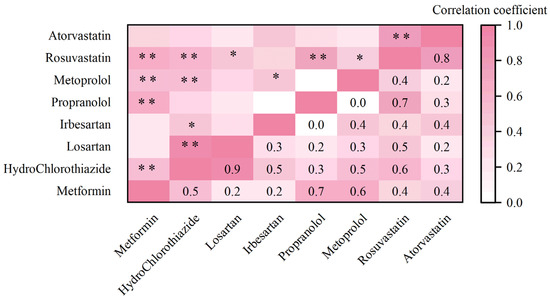
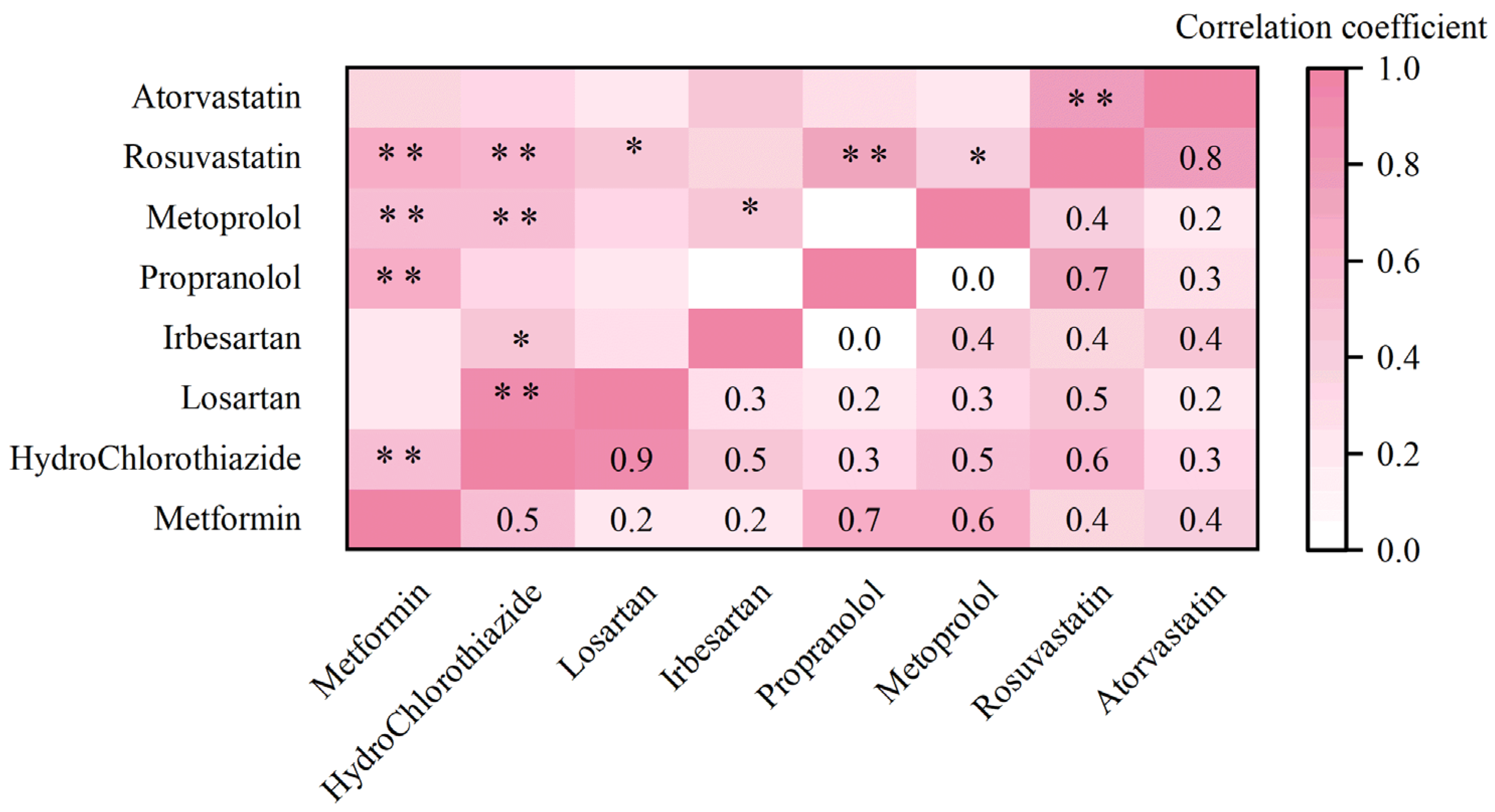
The correlation analysis of the loads of pharmaceuticals revealed thirteen significant positive correlations (p < 0.05) among target compounds in wastewater, including antihypertensive pharmaceuticals and lipid-lowering pharmaceuticals with metformin—suggesting a high prevalence of polypharmacy for HHH (Figure 1). This pattern is indicative of multimorbidity within the population, which aligns with epidemiological evidence demonstrating the clustering of these chronic conditions in certain demographic groups [12,44,45]. Furthermore, significant positive correlations were observed among antihypertensive pharmaceuticals, particularly between fixed-dose combinations or add-on therapies containing diuretics, such as hydrochlorothiazide and other classes like angiotensin receptor blockers (ARBs; e.g., irbesartan). This pattern likely reflects guideline-recommended combination antihypertensive therapy, in which agents with complementary mechanisms are co-prescribed to enhance blood pressure control and improve treatment adherence [4,46].
Figure 1.
The correlation of the average per load of HHH pharmaceuticals (mg/d/1000 persons) in different cities. Note: * p < 0.05, ** p < 0.01. Detailed correlation coefficients and the p values are provided in Tables S7 and S8.
These results demonstrate that the coexistence of multiple pharmaceutical residues serves as an effective proxy for evaluating complex multiple morbidities and treatment issues. It highlights the frequent use of multi-drug therapy in the clinical management of HHH-related conditions. As these cardiometabolic disorders share common pathophysiological mechanisms, their management typically follows an integrated treatment approach that targets multiple risk factors simultaneously rather than addressing each condition in isolation. Consequently, effective treatment often relies on coordinated pharmacological strategies combining agents with complementary mechanisms. These findings reinforce that research on HHH pharmaceutical management should emphasize the collaborative use of multiple drugs, rather than focusing solely on the monitoring of individual medications.
3.2. Spatial Differences in the Use of HHH Pharmaceuticals
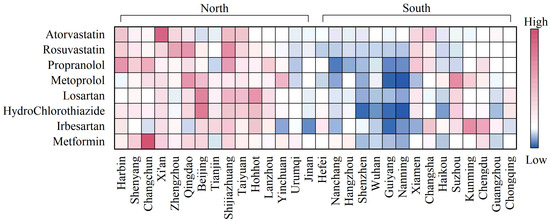
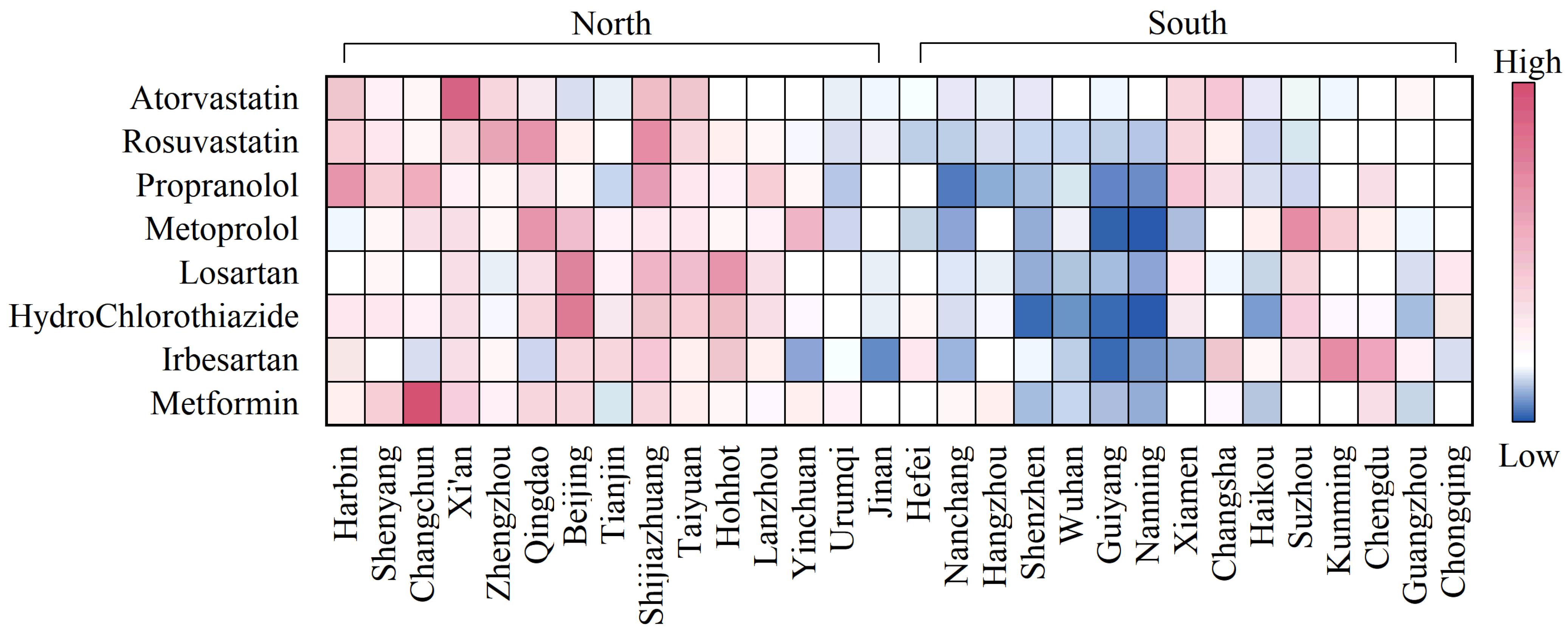
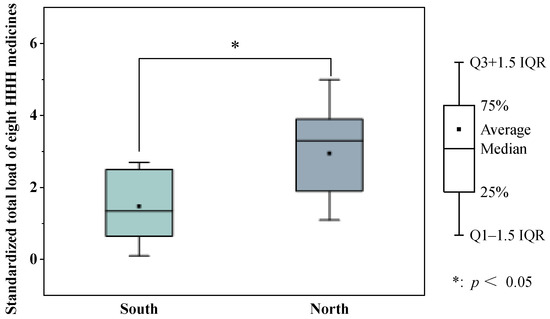
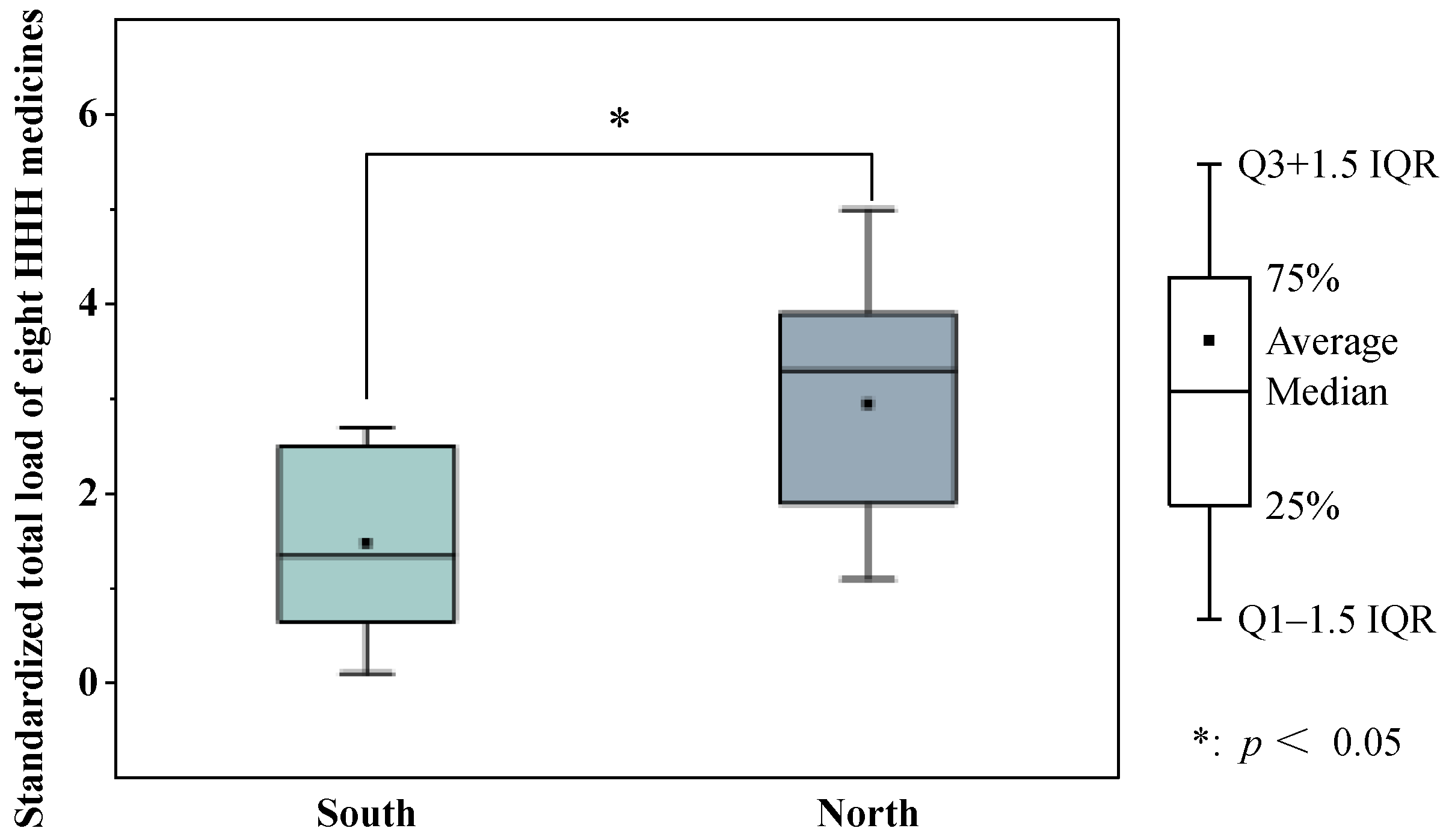
The sum of a standardized load of eight target compounds (detection frequency > 50%) in wastewater in the north was statistically significantly higher than in the south (the mean standardized loads in the north were approximately twice as high as those in the south, p < 0.05; Figure 2 and Figure 3), which was consistent with the north–south variations in the prevalence of HHH diseases in previous reports [47]. To some extent, this difference reflects the systematic spatial differentiation of population exposure levels, consumption patterns and health status among regions.
Figure 2.
Heatmap illustrating the load of the 8 detected HHH pharmaceuticals across the 30 cities in south and north of China. The dividing line between the north and south of China is the Qinling–Huaihe Line. The data for each compound underwent min–max scaling for normalization.
Figure 3.
Comparison of total HHH medication load between northern and southern China. The total load for each city refers to the sum of the standardized loads of the 8 HHH pharmaceuticals. In this study, the Kruskal–Wallis one-way ANOVA was used to examine differences in the standardized total amounts of eight HHH medicines between southern and northern China. The results showed a significant difference in the total load of HHH medicines between southern and northern China (p < 0.05).
A potentially important influencing factor is the high dietary salt intake in the traditional dietary pattern in northern China [48], which may impact the disease patterns. A high-salt diet is not only a well-documented risk factor for chronic diseases such as hypertension, but may also indirectly lead to the regional enrichment of target compounds in the residual characteristics of wastewater by affecting the metabolic pathway or pharmaceutical use behavior [49,50,51].
The detection results indicated that the loads of antihypertensive drugs in Suzhou, Chengdu and Kunming were higher than those in other cities. This spatial distribution feature may be closely associated with the population age structure and regional food culture. The above three cities have relatively high proportions of aging populations aged 65 and above (12.4% in Suzhou, 13.6% in Chengdu and 10.5% in Kunming). Age is an independent risk factor for hypertension [52]; thus, the high proportion of the aging population aged 65 and above directly increases the consumption demand for hypertension-related pharmaceuticals. High dietary salt intake is an established risk factor for hypertension [53,54]; the salt content of traditional dishes in these areas is generally high [55,56]. Long-term high salt consumption is also an important factor affecting antihypertensive pharmaceutical load.
The monitoring data further reveal that the load of irbesartan in Kunming and Chengdu, as well as that of metoprolol in Suzhou, was higher than that in other major cities across the country. In detail, the prevalence of diabetes in Kunming and Chengdu (12–14%) is higher than the national average (about 11.2%). As a first-line drug for the treatment of Diabetic Nephropathy [57], the drug use intensity of irbesartan is closely associated with the need for complication management; therefore, the level of pharmaceutical residues in the wastewater of the two cities increases accordingly. Suzhou has a high prevalence of coronary artery disease, heart failure and sympathetic hyperactivity-induced hypertension in young adults. Moreover, metoprolol, as a beta-adrenergic receptor blocker, is extensively employed in the management of the three diseases [58]. This finding is highly consistent with the epidemiological characteristics of region-specific diseases and clinical pharmaceutical practice, reflecting the direct impact of the regional disease spectrum on pharmaceutical consumption patterns.
Beyond indicating the population’s pharmaceutical behavior, pharmaceutical residues in wastewater can additionally be regarded as a biomarker of regional disease burden and clinical practice. Geographical differences reflect the interactive effects of environmental, health, and social factors, including the multi-dimensional influencing forces of regional aging population structure, food culture, medical accessibility and treatment preference. This lays the experimental foundation for the subsequent regional correlation factor research in this study.
3.3. Social and Environmental Factors Related to the Use of HHH Pharmaceuticals
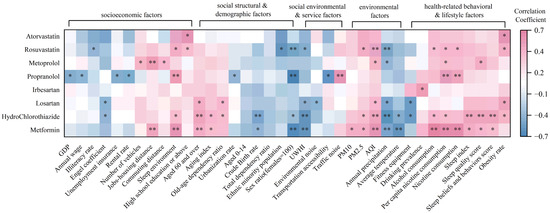
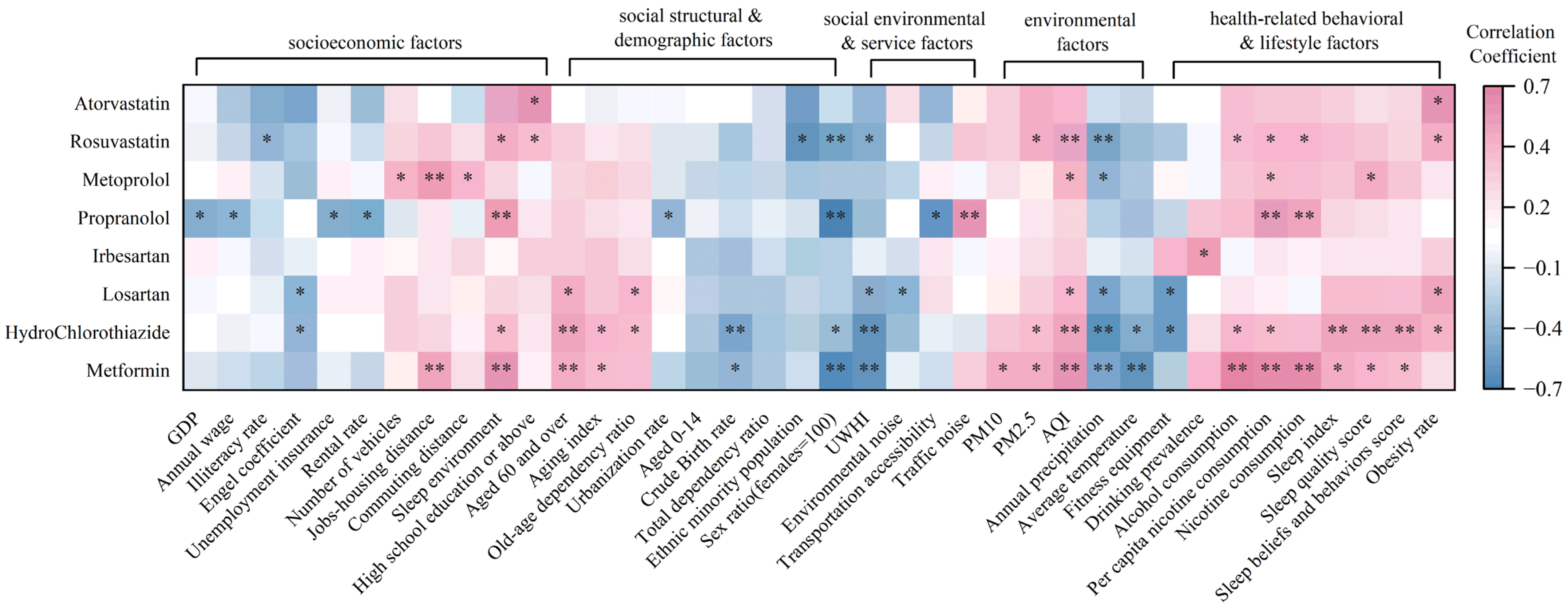
Relevant analysis showed that natural environmental factors have a significant correlation with the HHH load (HHH load refers to the per capita load of HHH drugs). A significant positive correlation (r values ranging from 0.45 to 0.59, all p < 0.05) was observed between the AQI and HHH pharmaceutical loads (Figure 4), indicating higher rates of HHH pharmaceutical utilization in regions with poorer air quality [59,60,61]. Deteriorated air quality PM2.5 exposure can induce systemic inflammatory responses and oxidative stress, which in turn trigger cardiovascular dysfunction and neurological dysregulation, thereby contributing to the development of HHH [62]. These stress responses exacerbate underlying conditions, thereby driving up the clinical demand for HHH medications. A significant negative correlation (r values ranging from −0.40 to −0.61, all p < 0.05) existed between precipitation and HHH pharmaceutical residues in wastewater, which is primarily attributed to precipitation effectively scavenging atmospheric particulate matter and gaseous pollutants [63,64], improving air quality and consequently reducing the health risks associated with pollution-induced adverse events. Additionally, rainy weather limits outdoor activities, further minimizing direct pollutant exposure. This helps mitigate acute cardiovascular events and subsequently lowers the reliance on HHH medications. These findings provide a novel perspective for the prevention of air pollution-related cardiovascular health issues.
Figure 4.
Correlation analysis between the load of the selected representative HHH pharmaceuticals and the catchment-specific social, demographic, economic, natural environmental and behavioral descriptors as defined by China Statistical Yearbook. Note: * p < 0.05, ** p < 0.01. The load for each compound underwent min–max scaling for normalization. Additional details about the factors are provided in Tables S5 and S6. The color gradient of each cell represents the magnitude of the Spearman correlation coefficient for each pairwise comparison. Detailed correlation coefficients and the p values are provided in Tables S9 and S10.
The results showed that the health-related behaviors and lifestyles of the population were significantly associated with the HHH pharmaceutical load. A significant positive correlation (r values ranging from 0.38 to 0.71, all p < 0.05) was identified between per capita alcohol/nicotine consumption and HHH pharmaceutical loads in wastewater. Smoking induces sympathetic hyperactivity, which induces endothelial dysfunction and insulin resistance and increases cardiovascular disease risk [65,66,67]; alcohol consumption disrupts glucose homeostasis, elevates blood pressure and thus imposes a heavier burden on the cardiovascular system [66,68,69]. Collectively, these behaviors accelerate disease progression, directly driving up the regional demand for HHH medications. A higher obesity rate correlated with greater pharmaceutical loads (r values ranging from 0.44 to 0.60, all p < 0.05) implies that regions with higher obesity rates may face heavier disease burden or higher medication use intensity. Clinically, obesity expands the patient pool requiring chronic medications due to its strong link with metabolic disorders. Additionally, obesity-related alterations in pharmacokinetics and pharmacodynamics can reduce drug efficacy—often requiring higher maintenance doses—and affect the urinary excretion of parent compounds [70,71]. These findings confirm that smoking, excessive alcohol consumption, and obesity are significantly associated with HHH progression [72], providing evidence for targeted interventions focused on modifiable lifestyle factors to reduce the burden of chronic noncommunicable diseases at the population level.
HHH load is related to social population structure and social services. The standardized male-to-female ratio (per 100 females) (r values ranging from 0.37 to 0.68, all p < 0.05) and the percentage of individuals aged 60 years or older were both significantly correlated with HHH pharmaceutical loads (r values ranging from 0.47 to 0.53, all p < 0.05). The latter finding indicates that the risk of HHH is significantly higher in the elderly than in younger people [73,74]. This demographic’s reliance on long-term polypharmacy naturally elevates the baseline of pharmaceutical excretion. A higher female proportion in the contributing population is associated with increased wastewater HHH drug loads. This pattern plausibly reflects sex-specific differences in disease burden. Although the prevalence of diabetes is marginally lower in women than in men, women show a higher prevalence of hypertension and hyperlipidemia [75]. Moreover, mortality is consistently higher in women across all three diseases. This elevated mortality risk may stimulate greater health-seeking behavior and more intensive clinical management among women, thereby increasing medication utilization and, consequently, drug residues detected in wastewater. The Urban Wellness and Healthcare Index (UWHI), computed via big data analysis encompassing five dimensions including environmental quality, healthcare resources, industrial integration, social welfare, and health policies, was significantly negatively correlated with HHH pharmaceutical loads (r values ranging from 0.45 to 0.60, all p < 0.05). A higher UWHI generally reflects favorable ecological settings, well-established comprehensive medical service systems, and effective health policy interventions. By emphasizing preventative care and early screening, these comprehensive systems help stabilize underlying conditions, thereby reducing the population’s reliance on high-dose medications. The UWHI serves as an indicator to guide the cross-regional scientific development and strategic deployment of the health industry [76]; it may also provide a quantitative basis for promoting regional public health initiatives and offering a support reference for elderly populations to select suitable living environments and pursue optimal quality of life in the future. By contrast, basic healthcare access metrics (e.g., medical insurance participation, number of hospitals) showed no significant correlation with HHH drug loads (Tables S9 and S10). This indicates that the mere quantitative expansion of medical infrastructure facilitates equitable drug availability but does not alter underlying disease prevalence. Ultimately, integrated preventative care—rather than just basic healthcare provision—is the primary factor mitigating reliance on chronic medications.
Building upon the previous analysis, a comprehensive assessment (Tables S9 and S10) identified 38 socio-environmental factors significantly correlated with HHH pharmaceutical loads. Most medications were simultaneously associated with at least seven key variables—most notably precipitation, the AQI, and nicotine consumption, which exerted the most pervasive influence alongside aging, gender ratio, obesity, and the UWHI. In contrast to the conclusions drawn from prior international studies [77], no statistically significant association was identified between socioeconomic status (SES) and HHH medication utilization in the present research. This observation could be attributed to China’s universal basic medical insurance system, which covers over 95% of the population. By substantially enhancing the accessibility of medical resources across regions with varying levels of economic development, this system has effectively equalized medication access across all social strata. Notably, hydrochlorothiazide and metformin were particularly prominent: these two agents were significantly correlated with more than 15 social and natural environmental factors, of which eight correlations were classified as strong. Conversely, irbesartan and atorvastatin showed no significant correlations with the majority of social environmental factors. This lack of association may stem from two key considerations: first, the clinical indications of these two drugs are not restricted to HHH; second, the scope of social and natural environmental factors incorporated in this study was limited, meaning that potential correlating factors merit further exploration. These findings not only elucidate the complex correlational patterns between HHH medication consumption and social–environmental factors but also validate the high sensitivity of WBE in monitoring regional disparities in health behaviors and potential exposure risks.
The results highlight the need for public policymakers to prioritize region-specific environmental factors when formulating targeted strategies for regional health management. The findings on factors associated with HHH medications indicate that its influencing factors operate across multiple levels. At the individual level, rigorously enforced smoking bans in public areas effectively control the occurrence of secondhand smoke exposure in public spaces. At the population level, it is important to promote stricter industrial emission controls, optimize transportation infrastructure, advance energy transition initiatives, and thereby achieve sustained improvements in ambient air quality. National and regional policies play a further critical role by strengthening the integration of health-oriented elements into urban planning and policy formulation to enhance the quality of human settlements.
3.4. Limitations
Uncertainties such as in-sewer degradation, prescribing practices and direct disposal of unused drugs are inherent concerns in WBE and have been assessed in previous studies [40,78,79]. Furthermore, estimating consumption introduces potential bias, as excretion factors vary with local demographics and static WWTP population data often misses transient demographic shifts. Therefore, to minimize bias and ensure statistical reliability, all spatial comparisons and correlation analyses were based directly on load data. Long-term observations are lacking due to the broad sampling coverage, and factor selection may be incomplete since this is a preliminary investigation of HHH drug-related factors. Additionally, as the 2020–2021 sampling coincided with the COVID-19 pandemic, lockdowns and reduced outpatient visits may have temporarily altered chronic medication patterns. The observed trends might thus reflect these disruptions, highlighting the need for future post-pandemic validation.
4. Conclusions
This study employed WBE to monitor 13 pharmaceuticals treating hypertension, hyperlipidemia, and hyperglycemia (HHH)—specifically metformin, nine antihypertensives, and three lipid-lowering agents—in wastewater influents across major Chinese cities. Eight of these compounds were detected in over 50% of the samples. Pharmaceutical loads were significantly higher in the north of China than in the south. Furthermore, the loads were closely associated with factors such as age/gender structure, precipitation, the AQI, alcohol/nicotine consumption, obesity rate, and the UWHI. Ultimately, WBE serves as an objective tool for tracking population-level pharmaceutical use or the treatment of diseases, providing valuable data for public health and environment assessment.
Supplementary Materials
The following supporting information can be downloaded at: https://www.mdpi.com/article/10.3390/w18101175/s1, Table S1. Detailed chemical information of compound. Table S2. Wastewater treatment plants (WWTPs) and sampling information. Table S3. Mass spectrometer parameters (quantifier and qualifier ions), retention time, declustering potential and collision energy. Table S4. Method validation parameters. Table S5. List of social and environmental factors (region: northeast, north, northwest). Table S6. List of social and environmental factors (region: east, central, south, southwest). Table S7. Two-tailed p-values of the Spearman correlation analysis between drug loads. Table S8. Correlation coefficients (R) between drug loads. Table S9. Correlation coefficients (R) between each factor and load of selected drugs. Text S1. Validation of the analytical method. Table S10. Two-tailed p-values of the Spearman correlation analysis between each factor and load of selected drugs. Figure S1. Location of WWTPs sampled in China. Refs. [37,80,81,82,83,84,85] are cited in the Supplementary Materials.
Author Contributions
Conceptualization, P.D.; methodology, R.Z. and L.Z.; software, R.Z. and L.Z.; validation, P.D., R.Z. and L.Z.; formal analysis, R.Z. and L.Z.; investigation, R.Z., K.M., Z.F. and L.Z.; resources, P.D. and X.L.; data curation, R.Z. and L.Z.; writing—original draft preparation, R.Z. and L.Z.; writing—review and editing, P.D., Q.Z., K.A.D., Y.Z., P.K.T. and X.L.; visualization, R.Z. and L.Z.; supervision, P.D. and P.K.T.; project administration, P.D.; funding acquisition, P.D. All authors have read and agreed to the published version of the manuscript.
Funding
This work is supported by the National Natural Science Foundation of China (Grant No. 42171073), the Young Elite Scientists Sponsorship Program by CAST (Grant No. 2019QNRC001), and the Second Tibetan Plateau Scientific Expedition and Research Program (STEP) (Grant No. 2019QZKK0306).
Data Availability Statement
The original contributions presented in this study are included in the article and Supplementary Materials. Further inquiries can be directed to the corresponding author.
Acknowledgments
The authors are extremely grateful to all the personnel at the wastewater treatment plants for their assistance in wastewater sampling.
Conflicts of Interest
The authors declare that they have no known competing financial interests or personal relationships that could have appeared to influence the work reported in this paper.
Abbreviation
The following abbreviation is used in this manuscript:
| HHH | hypertension, hyperlipidemia, and hyperglycemia |
References
- Mills, K.T.; Stefanescu, A.; He, J. The global epidemiology of hypertension. Nat. Rev. Nephrol. 2020, 16, 223–237. [Google Scholar] [CrossRef] [Scilit]
- Murray, C.J.; Aravkin, A.Y.; Zheng, P.; Abbafati, C.; Abbas, K.M.; Abbasi-Kangevari, M.; Abd-Allah, F.; Abdelalim, A.; Abdollahi, M.; Abdollahpour, I. Global burden of 87 risk factors in 204 countries and territories, 1990–2019: A systematic analysis for the Global Burden of Disease Study 2019. Lancet 2020, 396, 1223–1249. [Google Scholar] [CrossRef] [Scilit]
- Peng, W.; Chen, S.; Chen, X.; Ma, Y.; Wang, T.; Sun, X.; Wang, Y.; Ding, G.; Wang, Y. Trends in major non-communicable diseases and related risk factors in China 2002–2019: An analysis of nationally representative survey data. Lancet Reg. Health West Pac. 2024, 43, 100809. [Google Scholar] [CrossRef] [Scilit] [PubMed]
- Wang, J.G. Chinese Guidelines for the Prevention and Treatment of Hypertension (2024 revision). J. Geriatr. Cardiol. 2025, 22, 1–149. [Google Scholar] [CrossRef] [Scilit] [PubMed]
- Zhou, Y.; Liu, J.; Zhao, Z.; Zhou, M.; Ng, M. The national and provincial prevalence and non-fatal burdens of diabetes in China from 2005 to 2023 with projections of prevalence to 2050. Mil. Med. Res. 2025, 12, 28. [Google Scholar] [CrossRef] [Scilit]
- Joint Committee on the Chinese Guidelines for Lipid Management. Chinese Guidelines for Lipid Management (2023). Zhonghua Xin Xue Guan Bing. Za Zhi. 2023, 51, 221–255. [Google Scholar] [CrossRef] [Scilit]
- Institute for Health Metrics and Evaluation (IHME). Global Burden of Disease 2021: Findings from the GBD 2021 Study. Available online: https://www.healthdata.org/research-analysis/library/global-burden-disease-2021-findings-gbd-2021-study (accessed on 19 March 2026).
- Zheng, L.; Zeng, A.; Liu, L.; Tian, W.; Wang, R.; Zhang, L.; Hua, H.; Zhao, J. Metabolic syndrome: Molecular mechanisms and therapeutic interventions. Mol. Biomed. 2025, 6, 59. [Google Scholar] [CrossRef] [Scilit]
- Thomaz, F.S.; John, O.D.; Sinha, P.; Shafie, S.R.; Worrall, S. The Metabolic Syndrome: An overview and proposed mechanisms. Obesities 2024, 4, 226–255. [Google Scholar] [CrossRef] [Scilit]
- Freeman, A.; Acevedo, L.; Pennings, N. Insulin Resistance; StatPearls Publishing: Treasure Island, FL, USA, 2026. [Google Scholar]
- Johnson, A.M.; Olefsky, J.M. The origins and drivers of insulin resistance. Cell 2013, 152, 673–684. [Google Scholar] [CrossRef] [Scilit] [PubMed]
- Yu, N.; Zhang, M.; Zhang, X.; Zhao, Z.; Li, C.; Huang, Z.; Gao, X.; Zhang, W.; Yu, M.; Zhang, Y. Study on the status and influencing factors of comorbidity of hypertension, diabetes, and dyslipidemia among middle-aged and elderly Chinese adults. Chin. J. Epidemiol. 2023, 44, 196–204. [Google Scholar] [CrossRef]
- Cai, X.; Hu, D.; Pan, C.; Li, G.; Lu, J.; Ji, Q.; Su, B.; Tian, H.; Qu, S.; Weng, J. The risk factors of glycemic control, blood pressure control, lipid control in Chinese patients with newly diagnosed type 2 diabetes _ A nationwide prospective cohort study. Sci. Rep. 2019, 9, 7709. [Google Scholar] [CrossRef] [Scilit] [PubMed]
- Zhou, X.; Liu, S.; Zhang, M.; Shi, C.; Chen, M.; Hou, C.; Di, B. Wastewater-based estimation of diabetes mellitus prevalence in 237 cities: A cross-China study. Sci. Total Environ. 2024, 924, 171659. [Google Scholar] [CrossRef] [Scilit] [PubMed]
- Yavuz Guzel, E.; Atasoy Aydin, A.; Gören, İ.E.; Unuvar, N.; Daglioglu, N. Estimation of anti-diabetes drug metformin in Turkiye using wastewater-based epidemiology. Drug Test. Anal. 2024, 16, 1295–1305. [Google Scholar] [CrossRef] [Scilit] [PubMed]
- Hou, C.; Zhong, Y.; Zhang, L.; Liu, M.; Yan, F.; Chen, M.; Wang, Y.; Xu, P.; Su, M.; Hu, C. Estimating the prevalence of hypertension in 164 cities in China by wastewater-based epidemiology. J. Hazard. Mater. 2023, 443, 130147. [Google Scholar] [CrossRef] [Scilit]
- Qi, H.; Li, F.; Zeng-Wu, W.; Jing, L. 2023 Guideline for the management of hypertension in the elderly population in China. J. Geriatr. Cardiol. 2024, 21, 589. [Google Scholar] [CrossRef] [Scilit]
- Wang, W.; Wan, Q.; Wang, S.; Ning, G.; Bi, Y.; Liu, L.; Liu, Y.; Liu, Y.; Li, X.; Li, T. Management Guidelines for Diabetic Patients With Hypertension. J. Diabetes. 2025, 17, e70093. [Google Scholar] [CrossRef] [Scilit]
- Lloyd-Jones, D.M.; Bansal, N.; Collins, K.J.; Johnson, H.M.; Khan, S.S.; Altieri, M.M.; Williamson, J.D.; Smith, S.C.; Ferdinand, K.C.; Talbot, A.W.; et al. 2025 AHA/ACC/AANP/AAPA/ABC/ACCP/ACPM/AGS/AMA/ASPC/NMA/PCNA/SGIM Guideline for the Prevention, Detection, Evaluation and Management of High Blood Pressure in Adults: A Report of the American College of Cardiology/American Heart Association Joint Committee on Clinical Practice Guidelines. Circulation 2025, 152, e114–e218. [Google Scholar] [CrossRef] [Scilit]
- Fu, M.; Yang, D.; Luo, Y.; Zou, Y. Dietary patterns and metabolic syndrome amongst adult residents: A cross-sectional study in a rapidly urbanized Southern Chinese city. Medicine 2024, 103, e39692. [Google Scholar] [CrossRef] [Scilit]
- Pomeranz, J.L. Expanded policy rationales support sugar-sweetened beverage taxes. Nat. Food. 2023, 4, 931–932. [Google Scholar] [CrossRef] [Scilit]
- Al Mohajer, M.; Slusky, D.; Nix, D.; Nicodemo, C. Investigating socioeconomic deprivation and antibiotic prescribing among older medicare patients using an instrumental variable approach. Antimicrob. Steward. Healthc. Epidemiol. 2025, 5, e110. [Google Scholar] [CrossRef] [Scilit]
- Wang, J.; Ye, Y.; Chen, X.; Hu, X.; Peng, Y. Diverse trends in antihypertensive medication usage among US Adults with hypertension by socioeconomic status and comorbidities, 1999–2020. Blood Press. 2025, 34, 2506081. [Google Scholar] [CrossRef] [Scilit]
- Zhang, J.; Xu, S.; Liu, X.; Zhang, J.; Hu, S.; Liu, X.; Yang, C.; Fang, Y. Time trends and regional variation in utilization of antidiabetic medicines in China, 2015–2022. Diabetes Obes. Metab. 2024, 26, 2752–2760. [Google Scholar] [CrossRef] [Scilit]
- Abdelkader, N.N.; Awaisu, A.; Elewa, H.; Mahfoud, Z.; Al Abdulla, S.A.; Owais, A.; El Hajj, M.S. Prescribing trends and patterns for antihypertensive agents in primary healthcare settings in Qatar: A retrospective observational study. J. Pharm. Policy Pract. 2025, 18, 2512183. [Google Scholar] [CrossRef] [Scilit]
- Núñez-Delgado, A.; Zhang, Z.; Bontempi, E.; Coccia, M.; Race, M.; Zhou, Y. Editorial on the Topic “New Research on Detection and Removal of Emerging Pollutants”. Materials 2023, 16, 725. [Google Scholar] [CrossRef] [Scilit] [PubMed]
- Sayed, K.; Wan-Mohtar, W.H.M.; Mohd Hanafiah, Z.; Bithi, A.S.; Md Isa, N.; Abd Manan, T.S.B. Occurrence of pharmaceuticals in rice (Oryza sativa L.) plant through wastewater irrigation. Environ. Toxicol. Pharmacol. 2024, 109, 104475. [Google Scholar] [CrossRef] [Scilit]
- Zhao, M.; Zhu, Z.; Zhang, R.; Ma, K.; Zhang, L.; Li, D.; Du, P. Wastewater Surveillance for Benzodiazepines in Wuhu, China: Occurrence, Removal, and Consumption Patterns. Water 2025, 17, 1204. [Google Scholar] [CrossRef] [Scilit]
- Zheng, Q.; Lin, X.; He, Y.; Wang, Z.; Du, P.; Li, X.; Ren, Y.; Wang, D.; Wen, L.; Zhao, Z.; et al. Progress on Wastewater-based Epidemiology in China: Implementation Challenges and Opportunities in Public Health. Biomed. Environ. Sci. 2025, 38, 1354. [Google Scholar] [CrossRef] [Scilit]
- Zheng, Q.; Duan, L.; He, Y.; Wang, Z.; Lin, X.; Du, P.; Li, X.; Ren, Y.; Wang, D.; Wen, L.; et al. Wastewater-based epidemiology in China: A decade of advancements and challenges. J. Hazard. Mater. Adv. 2025, 19, 100792. [Google Scholar] [CrossRef] [Scilit]
- Fontanals, N.; Marce, R.M.; Montes, R.; Rodil, R.; Gonzalez-Marino, I.; Valcarcel, Y.; Rodriguez-Mozaz, S.; Borrull, F.; Quintana, J.B.; Pocurull, E. Wastewater-based epidemiology to assess pharmaceutical consumption. Spanish perspective. Sci. Total Environ. 2024, 953, 176108. [Google Scholar] [CrossRef] [Scilit] [PubMed]
- Galani, A.; Alygizakis, N.; Aalizadeh, R.; Kastritis, E.; Dimopoulos, M.-A.; Thomaidis, N.S. Patterns of pharmaceuticals use during the first wave of COVID-19 pandemic in Athens, Greece as revealed by wastewater-based epidemiology. Sci. Total Environ. 2021, 798, 149014. [Google Scholar] [CrossRef] [Scilit]
- Tomsone, L.E.; Perkons, I.; Sukajeva, V.; Neilands, R.; Kokina, K.; Bartkevics, V.; Pugajeva, I. Consumption trends of pharmaceuticals and psychoactive drugs in Latvia determined by the analysis of wastewater. Water Res. 2022, 221, 118800. [Google Scholar] [CrossRef] [Scilit]
- Jing, R.; Yao, H.; Yan, Q.; Xue, Y.; Sun, W.; Lu, P.; Zhang, Z.; Xie, R.; Cui, B.; Feng, B. Trends and Gaps in Statin Use for Cardiovascular Disease Prevention in Type 2 Diabetes: A Real-World Study in Shanghai, China. Endocr. Pract. 2023, 29, 747–753. [Google Scholar] [CrossRef] [Scilit]
- Foretz, M.; Guigas, B.; Viollet, B. Understanding the glucoregulatory mechanisms of metformin in type 2 diabetes mellitus. Nat. Rev. Endocrinol. 2019, 15, 569–589. [Google Scholar] [CrossRef] [Scilit]
- Engler, C.; Leo, M.; Pfeifer, B.; Juchum, M.; Chen-Koenig, D.; Poelzl, K.; Schoenherr, H.; Vill, D.; Oberdanner, J.; Eisendle, E.; et al. Long-term trends in the prescription of antidiabetic drugs: Real-world evidence from the Diabetes Registry Tyrol 2012-2018. BMJ Open Diabetes Res. Care 2020, 8, e001279. [Google Scholar] [CrossRef] [Scilit] [PubMed]
- Zheng, Q.; Du, P.; Wang, Z.; Zhang, L.; Zhu, Z.; Huang, J.; Wang, Z.; Hall, W.; Dang, A.K.; Wang, D.; et al. Nation-Wide Wastewater-Based Epidemiology Assessment of Metformin Usage in China: 2014–2020. ACS ES&T Water 2023, 3, 195–202. [Google Scholar] [CrossRef] [Scilit]
- Expert Group of Metformin in Clinical Practice. Chinese expert consensus statement on metformin in clinical practice. Chin. Med. J. 2020, 133, 1445–1447. [Google Scholar] [CrossRef] [Scilit] [PubMed]
- Triggle, C.R.; Mohammed, I.; Bshesh, K.; Marei, I.; Ye, K.; Ding, H.; MacDonald, R.; Hollenberg, M.D.; Hill, M.A. Metformin: Is it a drug for all reasons and diseases? Metabolism 2022, 133, 155223. [Google Scholar] [CrossRef] [Scilit]
- Wen, J.; Duan, L.; Wang, B.; Dong, Q.; Liu, Y.; Chen, C.; Huang, J.; Yu, G. In-sewer stability assessment of 140 pharmaceuticals, personal care products, pesticides and their metabolites: Implications for wastewater-based epidemiology biomarker screening. Environ. Int. 2024, 184, 108465. [Google Scholar] [CrossRef] [Scilit]
- Cohen, J. Statistical Power Analysis for the Behavioral Sciences, 2nd ed.; Routledge: New York, NY, USA, 1988. [Google Scholar]
- Joint Committee for the Revision of Guidelines for the Prevention and Treatment of Dyslipidemia in Chinese Adults. Guidelines for the Prevention and Treatment of Dyslipidemia in Chinese Adults. Zhonghua Xin Xue Guan Bing. Za Zhi 2016, 44, 833–853. [CrossRef]
- Society, C.D.; Zhu, D.; Guo, L. Guidelines for the Prevention and Treatment of Type 2 Diabetes in China (2020 Edition). Chin. J. Diabetes Mellitus. 2021, 37, 311–398. [Google Scholar] [CrossRef]
- Beijing Hypertension Association; China Association of Gerontology and Geriatrics; Beijing Community Health Service Association; Beijing Community Health Promotion Association. Chinese Expert Consensus on Grassroots Prevention and Treatment of Hypertension Combined with Type 2 Diabetes Mellitus and Dyslipidemia in Adults 2024. Chin. Gen. Pract. 2024, 27, 3453–3457. [Google Scholar] [CrossRef]
- Wang, M.; Zhou, X.; Li, Y.; Liu, F.; Yao, Z. A Meta-analysis of the Prevalence of Chronic Disease Multimorbidity Among Middle-aged and Elderly People in China from 2010 to 2019. Chin. Gen. Pract. 2021, 24, 2085. [Google Scholar] [CrossRef]
- Marx, N.; Federici, M.; Schuett, K.; Mueller-Wieland, D.; Ajjan, R.A.; Antunes, M.J.; Christodorescu, R.M.; Crawford, C.; Di Angelantonio, E.; Eliasson, B. 2023 ESC Guidelines for the management of cardiovascular disease in patients with diabetes: Developed by the task force on the management of cardiovascular disease in patients with diabetes of the European Society of Cardiology (ESC). Eur. Heart J. 2023, 44, 4043–4140. [Google Scholar] [CrossRef] [Scilit]
- Zhang, M.; Shi, Y.; Zhou, B.; Huang, Z.; Zhao, Z.; Li, C.; Zhang, X.; Han, G.; Peng, K.; Li, X. Prevalence, awareness, treatment, and control of hypertension in China, 2004–2018: Findings from six rounds of a national survey. BMJ 2023, 380, e071952. [Google Scholar] [CrossRef] [Scilit]
- Liu, Z.; Man, Q.; Li, Y.; Yang, X.; Ding, G.; Zhang, J.; Zhao, W. Estimation of 24-hour urinary sodium and potassium excretion among Chinese adults: A cross-sectional study from the China National Nutrition Survey. Am. J. Clin. Nutr. 2024, 119, 164–173. [Google Scholar] [CrossRef] [Scilit]
- World Health Organization. Guideline: Sodium Intake for Adults and Children; World Health Organization: Geneva, Switzerland, 2012. [Google Scholar]
- Mente, A.; O’Donnell, M.J.; Rangarajan, S.; McQueen, M.J.; Poirier, P.; Wielgosz, A.; Morrison, H.; Li, W.; Wang, X.; Di, C. Association of urinary sodium and potassium excretion with blood pressure. N. Engl. J. Med. 2014, 371, 601–611. [Google Scholar] [CrossRef] [Scilit]
- Gao, P.; You, M.; Li, L.; Zhang, Q.; Fang, X.; Wei, X.; Zhou, Q.; Zhang, H.; Wang, M.; Lu, Z. Salt-induced hepatic inflammatory memory contributes to cardiovascular damage through epigenetic modulation of SIRT3. Circulation 2022, 145, 375–391. [Google Scholar] [CrossRef] [Scilit]
- Sun, N.; Jiang, Y.; Wang, H.; Yuan, Y.; Cheng, W.; Han, Q.; Yuan, H.; Yang, L.; Guo, Z.; Sun, Y.; et al. Survey on sodium and potassium intake in patients with hypertension in China. J. Clin. Hypertens. 2021, 23, 1957–1964. [Google Scholar] [CrossRef] [Scilit]
- He, F.J.; Tan, M.; Ma, Y.; MacGregor, G.A. Salt reduction to prevent hypertension and cardiovascular disease: JACC state-of-the-art review. J. Am. Coll. Cardiol. 2020, 75, 632–647. [Google Scholar] [CrossRef] [Scilit]
- Breeze, P.; Sworn, K.; McGrane, E.; Abraham, S.; Cantrell, A. Relationships between sodium, fats and carbohydrates on blood pressure, cholesterol and HbA1c: An umbrella review of systematic reviews. BMJ Nutr. Prev. Health 2024, 7, 191. [Google Scholar] [CrossRef] [Scilit]
- Yu, W.; Lan, Y.; Lyu, J.; Sun, D.; Pei, P.; Du, H.; Chen, J.; Chen, Z.; Li, L.; Yu, C. Epidemiological characteristics of preserved vegetable intake in adults in 10 areas of China. Zhonghua Liu Xing Bing. Xue Za Zhi 2024, 45, 19–25. [Google Scholar] [CrossRef]
- Zhang, L.; Xu, Q.; Jiang, K.; Li, Z.; Wen, Y.; Hu, Z.; Xie, C.; Shi, Z.; Sharma, M.; Zhao, Y. Knowledge, attitudes, and practices of oil and salt intake and related influencing factors in Southwestern China. Front. Nutr. 2024, 11, 1334977. [Google Scholar] [CrossRef] [Scilit]
- Gross, J.L.; De Azevedo, M.J.; Silveiro, S.P.; Canani, L.H.; Caramori, M.L.; Zelmanovitz, T. Diabetic nephropathy: Diagnosis, prevention, and treatment. Diabetes Care 2005, 28, 164–176. [Google Scholar] [CrossRef] [Scilit]
- Ebell, M.H. ACC/AHA Guideline for the Management of Patients With Chronic Coronary Disease. Am. Fam. Physician 2024, 109, 283B–283D. [Google Scholar]
- Zhu, A.; Liu, M.; Yu, J.; Zhang, R.; Zhang, Y.; Chen, R.; Ruan, Y. Association between air pollution and hypertension hospitalizations: A time series analysis in Lanzhou. BMC Public Health 2024, 24, 3260. [Google Scholar] [CrossRef] [Scilit]
- Zhai, F.; Liu, N.; Wu, S.; Wang, J. Exposure-response relationship between air pollutants, temperature, and risk of hospital admission for type 2 diabetes mellitus. J. Environ. Occup. Med. 2024, 41, 1109–1114. Available online: https://www.jeom.org/en/article/doi/10.11836/JEOM24011 (accessed on 19 March 2026).
- Gaio, V.; Roquette, R.; Dias, C.M.; Nunes, B. Ambient air pollution and lipid profile: Systematic review and meta-analysis. Environ. Pollut. 2019, 254, 113036. [Google Scholar] [CrossRef] [Scilit]
- Rajagopalan, S.; Al-Kindi, S.G.; Brook, R.D. Air pollution and cardiovascular disease: JACC state-of-the-art review. J. Am. Coll. Cardiol. 2018, 72, 2054–2070. [Google Scholar] [CrossRef] [Scilit]
- Duhanyan, N.; Roustan, Y. Below-cloud scavenging by rain of atmospheric gases and particulates. Atmos. Environ. 2011, 45, 7201–7217. [Google Scholar] [CrossRef] [Scilit]
- Zhao, X.; Sun, Y.; Zhao, C.; Jiang, H. Impact of precipitation with different intensity on PM2.5 over typical regions of China. Atmosphere 2020, 11, 906. [Google Scholar] [CrossRef] [Scilit]
- Kotlyarov, S. The role of smoking in the mechanisms of development of chronic obstructive pulmonary disease and atherosclerosis. Int. J. Mol. Sci. 2023, 24, 8725. [Google Scholar] [CrossRef] [Scilit]
- Unger, T.; Borghi, C.; Charchar, F.; Khan, N.A.; Poulter, N.R.; Prabhakaran, D.; Ramirez, A.; Schlaich, M.; Stergiou, G.S.; Tomaszewski, M. 2020 International Society of Hypertension global hypertension practice guidelines. Hypertension 2020, 75, 1334–1357. [Google Scholar] [CrossRef] [Scilit]
- Hahad, O.; Kuntic, M.; Kuntic, I.; Daiber, A.; Münzel, T. Tobacco smoking and vascular biology and function: Evidence from human studies. Pflug. Arch. 2023, 475, 797–805. [Google Scholar] [CrossRef] [Scilit]
- Knott, C.; Bell, S.; Britton, A. Alcohol consumption and the risk of type 2 diabetes: A systematic review and dose-response meta-analysis of more than 1.9 million individuals from 38 observational studies. Diabetes Care 2015, 38, 1804–1812. [Google Scholar] [CrossRef] [Scilit]
- Roerecke, M.; Kaczorowski, J.; Tobe, S.W.; Gmel, G.; Hasan, O.S.; Rehm, J. The effect of a reduction in alcohol consumption on blood pressure: A systematic review and meta-analysis. Lancet Public Health 2017, 2, e108–e120. [Google Scholar] [CrossRef] [Scilit]
- Hanley, M.J.; Abernethy, D.R.; Greenblatt, D.J. Effect of obesity on the pharmacokinetics of drugs in humans. Clin. Pharmacokinet. 2010, 49, 71–87. [Google Scholar] [CrossRef] [Scilit]
- Lin, X.; Li, H. Obesity: Epidemiology, pathophysiology, and therapeutics. Front. Endocrinol. 2021, 12, 706978. [Google Scholar] [CrossRef] [Scilit]
- Ding, L.; Liang, Y.; Tan, E.C.; Hu, Y.; Zhang, C.; Liu, Y.; Xue, F.; Wang, R. Smoking, heavy drinking, physical inactivity, and obesity among middle-aged and older adults in China: Cross-sectional findings from the baseline survey of CHARLS 2011–2012. BMC Public Health 2020, 20, 1062. [Google Scholar] [CrossRef] [Scilit]
- Ma, L.; Wang, Z.; Fan, J.; Hu, S. An Essential Introduction to the Annual Report on Cardiovascular Health and Diseases in China (2021). Chin. Gen. Pract. 2022, 25, 3331. [Google Scholar] [CrossRef]
- Wang, L.; Chen, Z.; Zhang, M.; Zhao, Z.; Huang, Z.; Zhang, X.; Li, C.; Guan, Y.; Wang, X.; Wang, Z. Study of the prevalence and disease burden of chronic disease in the elderly in China. Chin. J. Epidemiol. 2019, 40, 277–283. [Google Scholar] [CrossRef]
- IHME. Global Burden of Disease Study 2023 (GBD 2023) Data Resources; Institute for Health Metrics and Evaluation: Seattle, WA, USA, 2024. [Google Scholar]
- Wang, Q.; Zhou, Z.; Huang, L. Improvement of China’s healthy city construction policies from the perspective of policy instruments. BMC Public Health 2025, 25, 1958. [Google Scholar] [CrossRef] [Scilit]
- Aida, J.; Inoue, Y.; Tabuchi, T.; Kondo, N. Modifiable risk factors of inequalities in hypertension: Analysis of 100 million health checkups recipients. Hypertens. Res. 2024, 47, 1555–1566. [Google Scholar] [CrossRef] [Scilit]
- Li, J.; O’Brien, J.W.; Tscharke, B.J.; He, C.; Shimko, K.M.; Shao, X.; Zhai, N.; Mueller, J.F.; Thomas, K.V. National survey of the occurrence of antimicrobial agents in Australian wastewater and their socioeconomic correlates. Nat. Water 2024, 2, 1166–1177. [Google Scholar] [CrossRef] [Scilit]
- Li, Z.; Li, J.; Hu, Y.; Yan, Y.; Tang, S.; Ma, R.; Li, L. Evaluation of pharmaceutical consumption between urban and suburban catchments in China by wastewater-based epidemiology. Environ. Res. 2024, 250, 118544. [Google Scholar] [CrossRef] [Scilit]
- WHO. ATC/DDD Index. Available online: https://atcddd.fhi.no/atc_ddd_index/ (accessed on 20 November 2025).
- Riva, F.; Zuccato, E.; Castiglioni, S. Prioritization and analysis of pharmaceuticals for human use contaminating the aquatic ecosystem in Italy. J. Pharm. Biomed. Anal. 2015, 106, 71–78. [Google Scholar] [CrossRef] [Scilit]
- Ter Laak, T.L.; Kooij, P.J.; Tolkamp, H.; Hofman, J. Different compositions of pharmaceuticals in Dutch and Belgian rivers explained by consumption patterns and treatment efficiency. Environ. Sci. Pollut. Res. 2014, 21, 12843–12855. [Google Scholar] [CrossRef] [Scilit]
- Lienert, J.; Güdel, K.; Escher, B.I. Screening method for ecotoxicological hazard assessment of 42 pharmaceuticals considering human metabolism and excretory routes. Environ. Sci. Technol. 2007, 41, 4471–4478. [Google Scholar] [CrossRef] [Scilit]
- Baselt, R.C. Disposition of Toxic Drugs and Chemicals in Man, 12th ed.; Biomedical Publications: Seal Beach, CA, USA, 2020. [Google Scholar]
- Deng, B.; Yin, H.; Liu, Y.; Ning, X. Pharmacokinetics of propranolol hydrochlorid in human urine by capillary electrophoresis coupled with electrochemiluminescence. Anal. Sci. 2011, 27, 55–59. [Google Scholar] [CrossRef] [Scilit]

Disclaimer/Publisher’s Note: The statements, opinions and data contained in all publications are solely those of the individual author(s) and contributor(s) and not of MDPI and/or the editor(s). MDPI and/or the editor(s) disclaim responsibility for any injury to people or property resulting from any ideas, methods, instructions or products referred to in the content. |
© 2026 by the authors. Licensee MDPI, Basel, Switzerland. This article is an open access article distributed under the terms and conditions of the Creative Commons Attribution (CC BY) license.