Physicochemical Conditions Shaping Phytoplankton Development in Shallow Lakes of Bellsund During the Ablation Season, West Spitsbergen
Abstract
1. Introduction
2. Materials and Methods
2.1. Study Area
2.2. Study Objects Characterisation of the Conditions of Functioning and Occurrence of Lakes
2.3. Field Research
2.4. Laboratory and Computational Research
2.5. Statistical Analysis
| Scope | Method | Apparatus | Norm | Reference Materials |
|---|---|---|---|---|
| I. Field measurements | ||||
| Temperature [°C] | Electrometric | YSI Pro 1030 | ||
| Reaction (pH) | YSI Pro 1030 | |||
| COND * [µS cm−1] | YSI Pro 1030 | YSI 3167 | ||
| II. Laboratory measurements | ||||
| Turbidity [FTU] | Spectrophotometric | Hach DR 2000 | Hach 8237 | |
| Color [mg Pt L−1] | Hach 8025 | |||
| Total suspended solids [mg L−1] | Pastel UV | |||
| Sodium [mg Na+ L−1] | Ion chromatography | Metrohm MIC-3 | PN-EN ISO 14911:2002 [40] | Environment Canada MISSIPPI-14 and ION-915 |
| Potassium [mg K+ L−1] | ||||
| Calcium [mg Ca2+ L−1] | ||||
| Magnesium [mg Mg2+ L−1] | ||||
| Ammonium nitrogen [mg NH4+ L−1] | ||||
| Chlorides [mg Cl− L−1] | PN-EN ISO 10304-1:2009 [41] | |||
| Sulphates [mg SO42− L−1] | ||||
| Nitrate nitrogen [mg NO3− L−1] | ||||
| Nitrite nitrogen [mg NO2− L−1] | ||||
| Nmin ** [mg N L−1] | Calculation | |||
| Total nitrogen [mg N L−1] | Spectrophotometric | Hach DR 900 | HACH 10071 | Nitrogen total standard solution (Supelco) |
| Total phosphorus [mg P L−1] | Spectrophotometric | Hach DR 900 | HACH 8190 | Phosphorus total standard solution (Supelco) |
| Orthophosphates [mg PO43− L−1] | HACH 8048 | |||
| Pmin *** [mg P L−1] | Calculation | |||
| Metals and metalloids [µg L−1] | Mass spectrometry | ICP-MS | EnviroMAT ES-L-2 CRM EnviroMAT ES-H-2 CRM | |
3. Results
3.1. Weather and Hydrological Conditions at the Time of Sampling
3.2. Physicochemical Water Properties
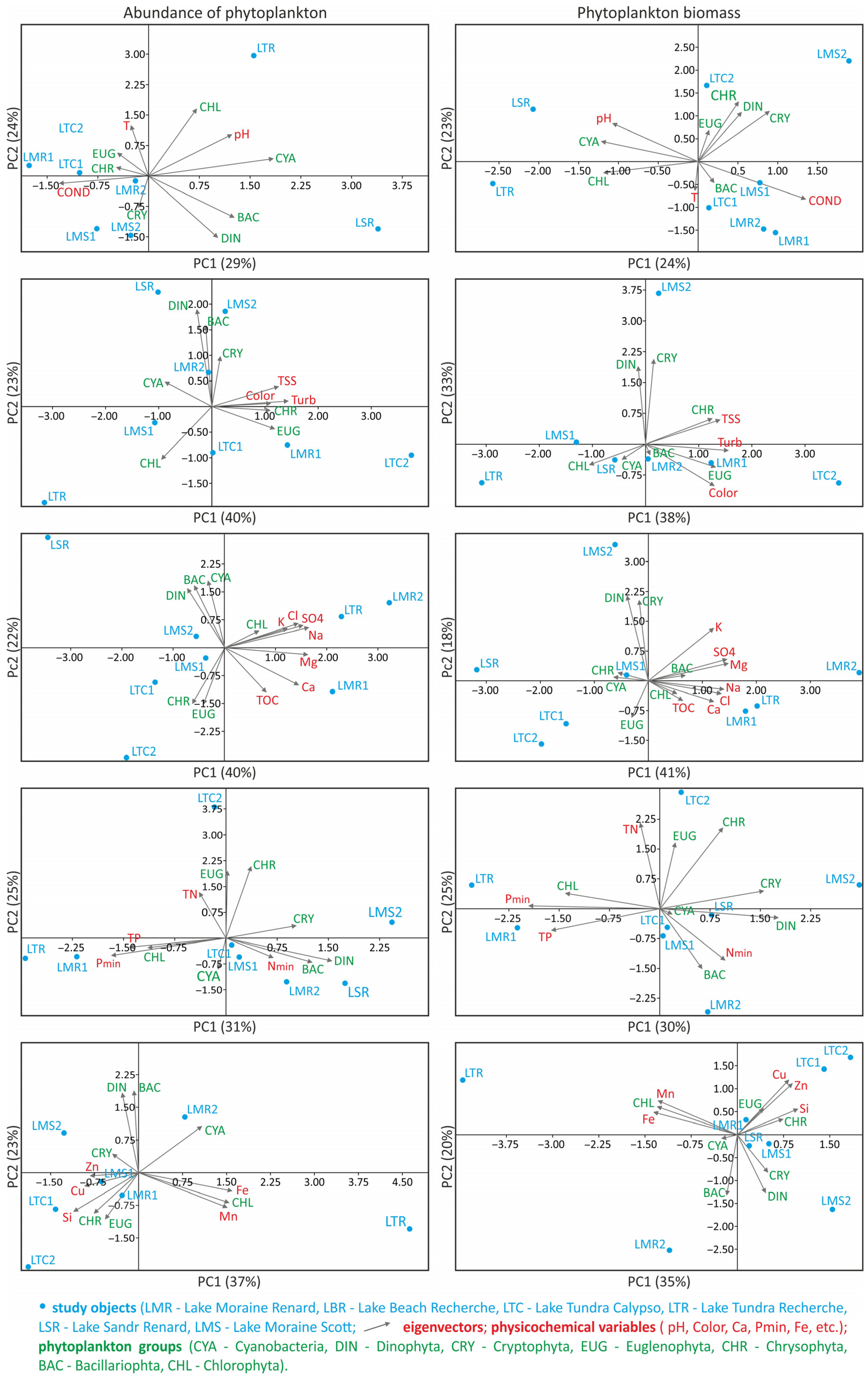
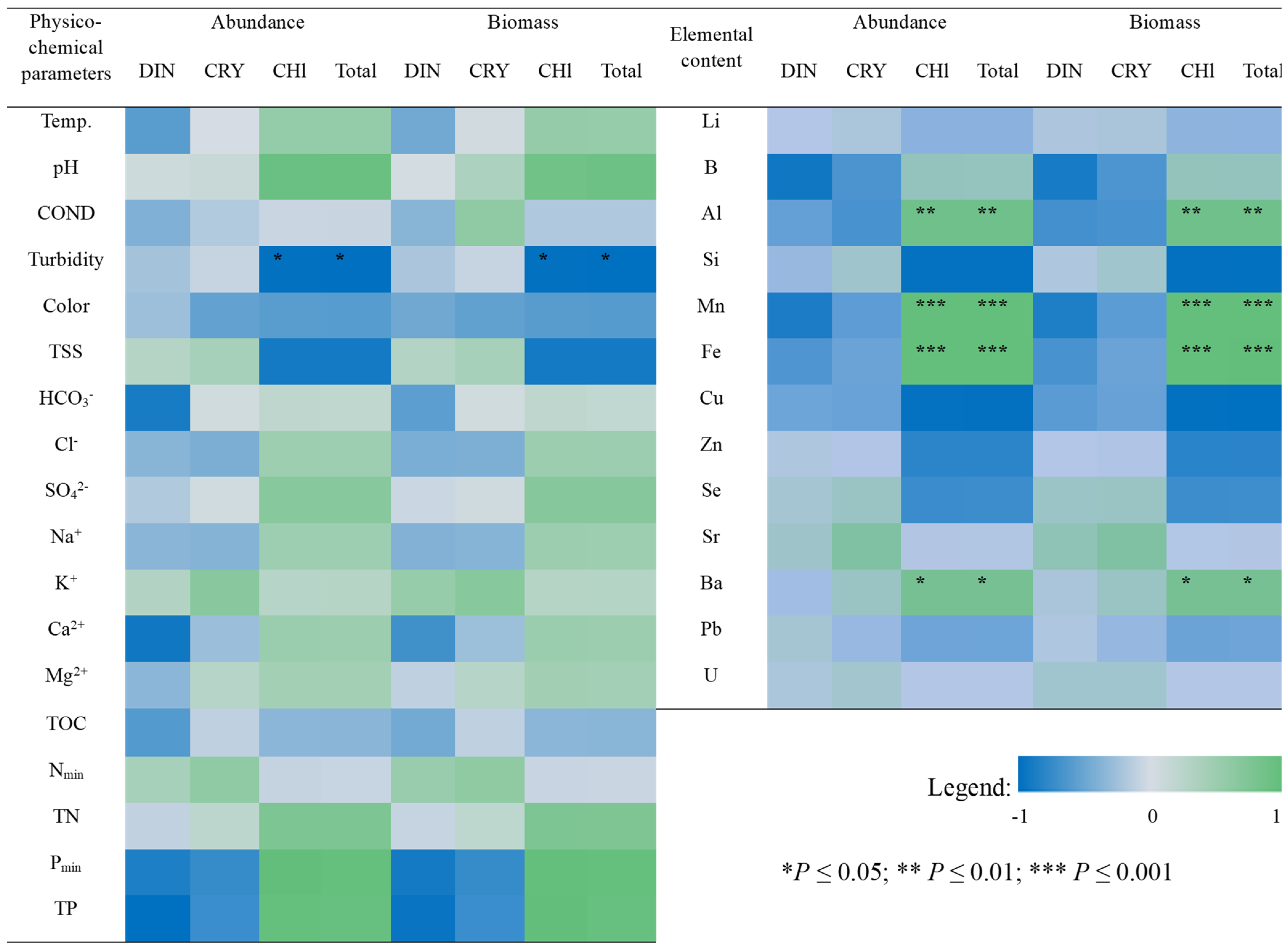
3.3. Species Structure, Abundance and Biomass of Phytoplankton
4. Discussion
5. Conclusions
Author Contributions
Funding
Data Availability Statement
Conflicts of Interest
References
- Dahlke, S. Rapid Climate Changes in the Arctic Region of Svalbard: Processes, Implications and Representativeness for the Broader Arctic. Ph.D. Thesis, Universitäsverlag Potsdam, Potsdam, Germany, 2020. [Google Scholar]
- Park, J.H.; Kim, S.-J.; Lim, H.-G.; Kug, J.-S.; Yang, E.J.; Kim, B.-M. Phytoplankton Responses to Increasing Arctic River Discharge under the Present and Future Climate Simulations. Environ. Res. Lett. 2023, 18, 064037. [Google Scholar] [CrossRef]
- Nordli, Ø.; Przybylak, R.; Ogilvie, A.E.J.; Isaksen, K. Long-Term Temperature Trends and Variability on Spitsbergen: The Extended Svalbard Airport Temperature Series, 1898–2012. Polar Res. 2014, 33, 21349. [Google Scholar] [CrossRef]
- Bae, S.; Kim, H.; Nam, S.-I.; Choi, K.-H.; Kim, T.-W.; Yun, S.T.; Kim, H.S.; Kim, T.-H.; Han, D.; Ko, Y.H.; et al. The Composition and Abundance of Phytoplankton after Spring Bloom in the Arctic Svalbard Fjords. Estuar. Coast. Shelf Sci. 2022, 275, 107970. [Google Scholar] [CrossRef]
- Krajewska, M.; Szymczak-Żyła, M.; Tylmann, W.; Kowalewska, G. Climate Change Impact on Primary Production and Phytoplankton Taxonomy in Western Spitsbergen Fjords Based on Pigments in Sediments. Glob. Planet. Chang. 2020, 189, 103158. [Google Scholar] [CrossRef]
- Payne, C.M.; Roesler, C.S. Characterizing the Influence of Atlantic Water Intrusion on Water Mass Formation and Phytoplankton Distribution in Kongsfjorden, Svalbard. Cont. Shelf Res. 2019, 191, 104005. [Google Scholar] [CrossRef]
- Franczak, Ł. Development and Functioning of Catchment-Lake Systems at the Forefield of the Scott and Renard Glaciers (NW Part of the Wedel Jarlsberg Land, Spitsbergen). Ph.D. Thesis, Maria Curie-Skłodowska University, Lublin, Poland, 2017. [Google Scholar]
- Ruman, M.; Kosek, K.; Koziol, K.; Ciepły, M.; Kozak-Dylewska, K.; Polkowska, Ż. A High-Arctic Flow-through Lake System Hydrochemical Changes: Revvatnet, Southwestern Svalbard (Years 2010–2018). Chemosphere 2021, 275, 130046. [Google Scholar] [CrossRef]
- Rautio, M.; Dufresne, F.; Laurion, I.; Bonilla, S.; Vincent, W.F.; Christoffersen, K.S. Shallow Freshwater Ecosystems of the Circumpolar Arctic. Écoscience 2011, 18, 204–222. [Google Scholar] [CrossRef]
- Kubečková, K.; Elster, J.; Kanda, H. Periphyton Ecology of Glacial and Snowfed Streams, Ny-Ålesund, Svalbard: The Influence of Discharge Disturbances Due to Sloughing, Scraping and Peeling. Nova Hedwig. Beih. 2001, 123, 139–170. [Google Scholar]
- Kvíderová, J. Research on Cryosestic Communities in Svalbard: The Snow Algae of Temporary Snowfields in Petuniabukta, Central Svalbard. Czech Polar Rep. 2012, 2, 8–19. [Google Scholar] [CrossRef]
- Stibal, M.; Šabacká, M.; Kaštovská, K. Microbial Communities on Glacier Surfaces in Svalbard: Impact of Physical and Chemical Properties on Abundance and Structure of Cyanobacteria and Algae. Microb. Ecol. 2006, 52, 644–654. [Google Scholar] [CrossRef] [PubMed]
- Matuła, J.; Pietryka, M.; Richter, D.; Wojtuń, B. Cyanoprokaryota and Algae of Arctic Terrestrial Ecosystems in the Hornsund Area, Spitsbergen. Pol. Polar Res. 2007, 28, 283–315. [Google Scholar]
- Fredriksen, S.; Røst Kile, M. The Algal Vegetation in the Outer Part of Isfjorden, Spitsbergen: Revisiting Per Svendsen’s Sites 50 Years Later. Polar Res. 2012, 31, 17538. [Google Scholar] [CrossRef]
- Piquet, A.M.-T.; van de Poll, W.H.; Visser, R.J.W.; Wiencke, C.; Bolhuis, H.; Buma, A.G.J. Springtime Phytoplankton Dynamics in Arctic Krossfjorden and Kongsfjorden (Spitsbergen) as a Function of Glacier Proximity. Biogeosciences 2014, 11, 2263–2279. [Google Scholar] [CrossRef]
- Wiktor, J.; Wojciechowska, K. Differences in Taxonomic Composition of Summer Phytoplankton in Two Fjords of West Spitsbergen, Svalbard. Pol. Polar Res. 2005, 26, 259–268. [Google Scholar]
- Komárek, J.; Kovacik, L. Schizotrichacean Cyanobacteria from Central Spitsbergen (Svalbard). Polar Biol. 2013, 36, 1811–1822. [Google Scholar] [CrossRef]
- Hejduková, E.; Elster, J.; Nedbalová, L. Annual Cycle of Freshwater Diatoms in the High Arctic Revealed by Multiparameter Fluorescent Staining. Microb. Ecol. 2020, 80, 559–572. [Google Scholar] [CrossRef] [PubMed]
- Zgrundo, A.; Wojtasik, B.; Convey, P.; Majewska, R. Diatom Communities in the High Arctic Aquatic Habitats of Northern Spitsbergen (Svalbard). Polar Biol. 2017, 40, 873–890. [Google Scholar] [CrossRef] [PubMed]
- Heesch, S.; Pažoutová, M.; Moniz, M.B.J.; Rindi, F. Prasiolales (Trebouxiophyceae, Chlorophyta) of the Svalbard Archipelago: Diversity, Biogeography and Description of the New Genera Prasionella and Prasionema. Eur. J. Phycol. 2016, 51, 171–187. [Google Scholar] [CrossRef]
- Lenzenweger, R.; Lütz, C. A Contribution to Knowledge of the Desmid Flora (Desmidiaceae, Zygnemaphyceae) of Spitzbergen. Algol. Stud. Arch. Hydrobiol. 2006, 119, 79–89. [Google Scholar] [CrossRef]
- Richter, D.; Matuła, J.; Pietryka, M. The Northernmost Populations of Tetraspora Gelatinosa (Chlorophyta) from Spitsbergen. Pol. Polar Res. 2014, 35, 521–538. [Google Scholar] [CrossRef]
- Heikkinen, J.M.; Niittynen, P.; Soininen, J.; Pajunen, V. Patterns and Drivers for Benthic Algal Biomass in Sub-Arctic Mountain Ponds. Hydrobiologia 2024, 851, 689–708. [Google Scholar] [CrossRef]
- Willen, T. Phytoplankton from Lakes and Ponds on Vestspitsbergen. Acta Phytogeogr. Suec. 1980, 68, 173–188. [Google Scholar]
- Kim, G.H.; Klochkova, T.A.; Kang, S.H. Notes on Freshwater and Terrestrial Algae from Ny-Ålesund, Svalbard (High Arctic Sea Area). J. Environ. Biol. 2008, 29, 485–491. [Google Scholar] [PubMed]
- Kim, G.H.; Klochkova, T.A.; Han, J.W.; Kang, S.-H.; Choi, H.G.; Chung, K.W.; Kim, S.J. Freshwater and Terrestrial Algae from Ny-Ålesund and Blomstrandhalvøya Island (Svalbard). J. Environ. Biol. 2011, 64, 25–31. [Google Scholar] [CrossRef]
- Holzinger, A.; Roleda, M.Y.; Lütz, C. The Vegetative Arctic Freshwater Green Alga Zygnema Is Insensitive to Experimental UV Exposure. Micron 2009, 40, 831–838. [Google Scholar] [CrossRef] [PubMed]
- Dallmann, W.K.; Hjelle, A.; Ohta, Y.; Salvigsen, O.; Bjornerud, M.G.; Hauser, E.C.; Maher, H.D.; Craddock, C. Geological Map of Svalbard 1:100 000, Sheet B 11 G; Norwegian Polar Institute: Tromsø, Norway, 1990. [Google Scholar]
- Hjelle, A. Geology of Svalbard; Polarhandbook 7; Norsk Polarinstitutt: Oslo, Norway, 1993; ISBN 978-82-7666-057-9. [Google Scholar]
- Landvik, J.Y.; Bolstad, M.; Lycke, A.K.; Mangerud, J.; Sejrup, H.P. Weichselian Stratigraphy and Palaeoenvironments at Bellsund, Western Svalbard. Boreas 1992, 21, 335–358. [Google Scholar] [CrossRef]
- Pękala, K.; Repelewska-Pękalowa, J.; Zagórski, P. Quaternary Deposits and Stratigraphy. In The Geographical Environment of NW Part of Wedel Jarlsberg Land (Spitsbergen, Svalbard); Zagórski, P., Harasimiuk, M., Rodzik, J., Eds.; UMCS: Lublin, Poland, 2013; pp. 48–63. [Google Scholar]
- Reder, J.; Zagórski, P. Recession and Development of Marginal Zone of the Renard Glacier. Landform Anal. 2007, 5, 175–178. [Google Scholar]
- Szumińska, D.; Szopińska, M.; Lehmann-Konera, S.; Franczak, Ł.; Kociuba, W.; Chmiel, S.; Kalinowski, P.; Polkowska, Ż. Water Chemistry of Tundra Lakes in the Periglacial Zone of the Bellsund Fiord (Svalbard) in the Summer of 2013. Sci. Total Environ. 2018, 624, 1669–1679. [Google Scholar] [CrossRef]
- PN-EN ISO 5667-1:2022-07; Water Quality—Sampling—Part 1: Guidelines for Developing Sampling Programs and Sampling Techniques. Polish Committee for Standardization: Warsaw, Poland, 2022.
- PN-EN ISO 5667-3:2018-08; Water Quality—Sampling—Part 3: Guidelines for the Preservation and Handling of Water Samples. Polish Committee for Standardization: Warsaw, Poland, 2018.
- Utermöhl, H. Zur Vervollkommnung Der Quantitativen Phytoplankton-Methodik: Mit 1 Tabelle Und 15 Abbildungen Im Text Und Auf 1 Tafel. Mitt. Int. Ver. Theor. Angew. Limnol. 1958, 9, 1–38. [Google Scholar] [CrossRef]
- Hillebrand, H.; Dürselen, C.-D.; Kirschtel, D.; Pollingher, U.; Zohary, T. Biovolume Calculation for Pelagic and Benthic Microalgae. J. Phycol. 1999, 35, 403–424. [Google Scholar] [CrossRef]
- Lepš, J.; Šmilauer, P. Multivariate Analysis of Ecological Data Using CANOCO; Cambridge University Press: Cambridge, UK, 2003; ISBN 978-0-511-61514-6. [Google Scholar]
- Diez, D.; C¸etinkaya-Rundel, M.; Barr, C.D. OpenIntro Statistics, 4th ed.; OpenIntro: Mountain View, CA, USA, 2019; ISBN 978-1-943450-07-7. [Google Scholar]
- PN-EN ISO 14911:2002; Water Quality—Determination of Dissolved Li+, Na+, NH4+, K+, Mn2+, Ca2+, Mg2+, Sr2+ and Ba2+ Using Ion Chromatography—Method for Water and Waste Water. Polish Committee for Standardization: Warsaw, Poland, 2002.
- PN-EN ISO 10304-1:2009; Water Quality—Determination of Dissolved Anions by Liquid Chromatography of Ions—Part 1: Determination of Bromide, Chloride, Fluoride, Nitrate, Nitrite, Phosphate and Sulfate. Polish Committee for Standardization: Warsaw, Poland, 2009.
- Marszałek, H.; Górniak, D. Changes in Water Chemistry along the Newly Formed High Arctic Fluvial–Lacustrine System of the Brattegg Valley (SW Spitsbergen, Svalbard). Environ. Earth Sci. 2017, 76, 449. [Google Scholar] [CrossRef]
- Krawczyk, W.E.; Bartoszewski, S.A.; Siwek, K. Rain Water Chemistry at Calypsobyen, Svalbard. Pol. Polar Res. 2008, 29, 149–162. [Google Scholar]
- Mędrek, K.; Gluza, A.; Siwek, K.; Zagórski, P. Warunki meteorologiczne na stacji w Calypsobyen w sezonie letnim 2014 na tle wielolecia 1986–2011 (The meteorological conditions on the Calypsobyen in summer 2014 on the background of multiyear 1986–2011). Probl. Klim. Polar. 2014, 24, 37–50. [Google Scholar]
- Livingstone, S.J.; Li, Y.; Rutishauser, A.; Sanderson, R.J.; Winter, K.; Mikucki, J.A.; Björnsson, H.; Bowling, J.S.; Chu, W.; Dow, C.F.; et al. Subglacial Lakes and Their Changing Role in a Warming Climate. Nat. Rev. Earth Environ. 2022, 3, 106–124. [Google Scholar] [CrossRef]
- Prowse, T.D.; Wrona, F.J.; Reist, J.D.; Gibson, J.J.; Hobbie, J.E.; Lévesque, L.M.J.; Vincent, W.F. Climate Change Effects on Hydroecology of Arctic Freshwater Ecosystems. AMBIO J. Hum. Environ. 2006, 35, 347–358. [Google Scholar] [CrossRef]
- Woelders, L.; Lenaerts, J.T.M.; Hagemans, K.; Akkerman, K.; van Hoof, T.B.; Hoek, W.Z. Recent Climate Warming Drives Ecological Change in a Remote High-Arctic Lake. Sci. Rep. 2018, 8, 6858. [Google Scholar] [CrossRef]
- Vincent, W.F.; Callaghan, T.V.; Dahl-Jensen, D.; Johansson, M.; Kovacs, K.M.; Michel, C.; Prowse, T.; Reist, J.D.; Sharp, M. Ecological Implications of Changes in the Arctic Cryosphere. Ambio 2011, 40, 87–99. [Google Scholar] [CrossRef]
- Jensen, T.C.; Walseng, B.; Hessen, D.O.; Dimante-Deimantovica, I.; Novichkova, A.A.; Chertoprud, E.S.; Chertoprud, M.V.; Sakharova, E.G.; Krylov, A.V.; Frisch, D.; et al. Changes in Trophic State and Aquatic Communities in High Arctic Ponds in Response to Increasing Goose Populations. Freshw. Biol. 2019, 64, 1241–1254. [Google Scholar] [CrossRef]
- Tank, S.E.; Lesack, L.F.W.; McQueen, D.J. Elevated pH Regulates Bacterial Carbon Cycling in Lakes with High Photosynthetic Activity. Ecology 2009, 90, 1910–1922. [Google Scholar] [CrossRef]
- Mazurek, M.; Paluszkiewicz, R.; Rachlewicz, G.; Zwoliński, Z. Variability of Water Chemistry in Tundra Lakes, Petuniabukta Coast, Central Spitsbergen, Svalbard. Sci. World J. 2012, 2012, 596516. [Google Scholar] [CrossRef]
- Ellis-Evans, J.C.; Galchenko, V.; Laybourn-Parry, J.; Mylnikov, A.P.; Petz, W. Environmental Characteristics and Microbial Plankton Activity of Freshwater Environments at Kongsfjorden, Spitsbergen (Svalbard). Arch. Hydrobiol. 2001, 152, 609–632. [Google Scholar] [CrossRef]
- Chmiel, S.; Bartoszewski, S.; Gluza, A.; Siwek, K.; Zagórski, P. Physicochemical Characteristics of Land Waters in the Bellsund Region (Spitsbergen). Landform Anal. 2007, 5, 13–15. [Google Scholar]
- Calizza, E.; Salvatori, R.; Rossi, D.; Pasquali, V.; Careddu, G.; Sporta Caputi, S.; Maccapan, D.; Santarelli, L.; Montemurro, P.; Rossi, L.; et al. Climate-Related Drivers of Nutrient Inputs and Food Web Structure in Shallow Arctic Lake Ecosystems. Sci. Rep. 2022, 12, 2125. [Google Scholar] [CrossRef] [PubMed]
- Clyde, N.; Hargan, K.E.; Forbes, M.R.; Iverson, S.A.; Blais, J.M.; Smol, J.P.; Bump, J.K.; Gilchrist, H.G. Seaduck Engineers in the Arctic Archipelago: Nesting Eiders Deliver Marine Nutrients and Transform the Chemistry of Island Soils, Plants, and Ponds. Oecologia 2021, 195, 1041–1052. [Google Scholar] [CrossRef] [PubMed]
- Zmudczyńska-Skarbek, K.; Balazy, P. Following the Flow of Ornithogenic Nutrients through the Arctic Marine Coastal Food Webs. J. Mar. Syst. 2017, 168, 31–37. [Google Scholar] [CrossRef]
- Ziółek, M.; Bartmiński, P.; Stach, A. The Influence of Seabirds on the Concentration of Selected Heavy Metals in Organic Soil on the Bellsund Coast, Western Spitsbergen. Arct. Antarct. Alp. Res. 2017, 49, 507–520. [Google Scholar] [CrossRef]
- Ziółek, M.; Melke, J. The Impact of Seabirds on the Content of Various Forms of Phosphorus in Organic Soils of the Bellsund Coast, Western Spitsbergen. Polar Res. 2014, 33, 19986. [Google Scholar] [CrossRef]
- Zwolicki, A.; Zmudczyńska-Skarbek, K.M.; Iliszko, L.; Stempniewicz, L. Guano Deposition and Nutrient Enrichment in the Vicinity of Planktivorous and Piscivorous Seabird Colonies in Spitsbergen. Polar Biol. 2013, 36, 363–372. [Google Scholar] [CrossRef]
- Holmgren, S.U.; Bigler, C.; Ingólfsson, Ó.; Wolfe, A.P. The Holocene–Anthropocene Transition in Lakes of Western Spitsbergen, Svalbard (Norwegian High Arctic): Climate Change and Nitrogen Deposition. J. Paleolimnol. 2010, 43, 393–412. [Google Scholar] [CrossRef]
- Kosek, K.; Luczkiewicz, A.; Kozioł, K.; Jankowska, K.; Ruman, M.; Polkowska, Ż. Environmental Characteristics of a Tundra River System in Svalbard. Part 1: Bacterial Abundance, Community Structure and Nutrient Levels. Sci. Total Environ. 2019, 653, 1571–1584. [Google Scholar] [CrossRef] [PubMed]
- Chmiel, S.; Reszka, M.; Rysiak, A. Heavy Metals and Radioactivity in Environmental Samples of the Scott Glacier Region on Spitsbergen in Summer 2005. Quaest. Geogr. A 2009, 28, 23–29. [Google Scholar]
- Jóźwiak, M.; Jóźwiak, M. The Heavy Metals in Water of Select Spitsbergen and Iceland Glaciers. Landform Anal. 2007, 5, 32–34. [Google Scholar]
- Lehmann-Konera, S.; Kociuba, W.; Chmiel, S.; Franczak, Ł.; Polkowska, Ż. Effects of Biotransport and Hydro-Meteorological Conditions on Transport of Trace Elements in the Scott River (Bellsund, Spitsbergen). PeerJ 2021, 9, e11477. [Google Scholar] [CrossRef]
- Colombo, N.; Salerno, F.; Gruber, S.; Freppaz, M.; Williams, M.; Fratianni, S.; Giardino, M. Review: Impacts of Permafrost Degradation on Inorganic Chemistry of Surface Fresh Water. Glob. Planet. Chang. 2018, 162, 69–83. [Google Scholar] [CrossRef]
- Rudnicka-Kępa, P.; Zaborska, A. Sources, Fate and Distribution of Inorganic Contaminants in the Svalbard Area, Representative of a Typical Arctic Critical Environment—A Review. Environ. Monit. Assess. 2021, 193, 724. [Google Scholar] [CrossRef]
- Moedt, S.M.; Olrik, K.; Schmidt, N.M.; Jeppesen, E.; Christoffersen, K.S. Long-Term Phytoplankton Dynamics in Two High Arctic Lakes (North-East Greenland). Freshw. Biol. 2024, 69, 403–415. [Google Scholar] [CrossRef]
- Schartau, A.K.; Mariash, H.L.; Christoffersen, K.S.; Bogan, D.; Dubovskaya, O.P.; Fefilova, E.B.; Hayden, B.; Ingvason, H.R.; Ivanova, E.A.; Kononova, O.N.; et al. First Circumpolar Assessment of Arctic Freshwater Phytoplankton and Zooplankton Diversity: Spatial Patterns and Environmental Factors. Freshw. Biol. 2022, 67, 141–158. [Google Scholar] [CrossRef]
- Afonina, E.Y.; Tashlykova, N.A. Phytoplankton and Zooplankton Succession during the Dry–Refilling Cycle: A Case Study in Large, Fluctuating Soda Lakes. Freshw. Biol. 2023, 68, 987–1006. [Google Scholar] [CrossRef]
- Latała, A.; Hamoud, N.; Pliński, M. Growth Dynamics and Morphology of Plankton Green Algae from Brackish Waters under the Influence of Salinity, Temperature and Light. Acta Ichthyol. Piscat. 1991, 21, 101–116. [Google Scholar] [CrossRef]
- Moisander, P.H.; Rantajärvi, E.; Huttunen, M.; Kononen, K. Phytoplankton Community in Relation to Salinity Fronts at the Entrance to the Gulf of Finland, Baltic Sea. Ophelia 1997, 46, 187–203. [Google Scholar] [CrossRef]
- Oliva, M.G.; Lugo, A.; Alcocer, J.; Peralta, L.; del Rosario Sánchez, M. Phytoplankton Dynamics in a Deep, Tropical, Hyposaline Lake. Hydrobiologia 2001, 466, 299–306. [Google Scholar] [CrossRef]
- Korponai, K.; Szabó, A.; Somogyi, B.; Boros, E.; Borsodi, A.K.; Jurecska, L.; Vörös, L.; Felföldi, T. Dual Bloom of Green Algae and Purple Bacteria in an Extremely Shallow Soda Pan. Extremophiles 2019, 23, 467–477. [Google Scholar] [CrossRef]
- González, A.C. Las Chlorococcales Dulciacuícolas de Cuba; Bibliotheca Phicologica; J. Cramer: Berlin–Stuttgart, Germany, 1996. [Google Scholar]
- Allan, J.D.; Castillo, M.M. Nutrient Dynamics. In Stream Ecology: Structure and Function of Running Waters; Springer: Dordrecht, The Netherlands, 2007; pp. 255–285. ISBN 978-1-4020-5583-6. [Google Scholar]
- Dupas, R.; Abbott, B.W.; Minaudo, C.; Fovet, O. Distribution of Landscape Units Within Catchments Influences Nutrient Export Dynamics. Front. Environ. Sci. 2019, 7, 43. [Google Scholar] [CrossRef]
- Jeppesen, E.; Kronvang, B.; Meerhoff, M.; Søndergaard, M.; Hansen, K.M.; Andersen, H.E.; Lauridsen, T.L.; Liboriussen, L.; Beklioglu, M.; Ozen, A.; et al. Climate Change Effects on Runoff, Catchment Phosphorus Loading and Lake Ecological State, and Potential Adaptations. J. Environ. Qual. 2009, 38, 1930–1941. [Google Scholar] [CrossRef]
- Pérez-Martín, M.Á. Understanding Nutrient Loads from Catchment and Eutrophication in a Salt Lagoon: The Mar Menor Case. Water 2023, 15, 3569. [Google Scholar] [CrossRef]
- Pinckney, J.L.; Paerl, H.W.; Tester, P.; Richardson, T.L. The Role of Nutrient Loading and Eutrophication in Estuarine Ecology. Environ. Health. Perspect. 2001, 109, 699–706. [Google Scholar] [CrossRef] [PubMed]
- Sharov, A.N. Phytoplankton of Cold-Water Lake Ecosystems under the Influence of Natural and Anthropogenic Factors. Issues Mod. Algol. 2021, 1, 42–49. [Google Scholar] [CrossRef]
- Hazuková, V.; Burpee, B.T.; McFarlane-Wilson, I.; Saros, J.E. Under Ice and Early Summer Phytoplankton Dynamics in Two Arctic Lakes with Differing DOC. J. Geophys. Res. Biogeosci. 2021, 126, e2020JG005972. [Google Scholar] [CrossRef]
- Willett, V.B.; Reynolds, B.A.; Stevens, P.A.; Ormerod, S.J.; Jones, D.L. Dissolved Organic Nitrogen Regulation in Freshwaters. J. Environ. Qual. 2004, 33, 201–209. [Google Scholar] [CrossRef]
- Paerl, H.W. Ecophysiological and Trophic Implications of Light-Stimulated Amino Acid Utilization in Marine Picoplankton. Appl. Environ. Microbiol. 1991, 57, 473–479. [Google Scholar] [CrossRef] [PubMed]
- Granéli, E.; Carlsson, P.; Legrand, C. The Role of C, N and P in Dissolved and Particulate Organic Matter as a Nutrient Source for Phytoplankton Growth, Including Toxic Species. Aquat. Ecol. 1999, 33, 17–27. [Google Scholar] [CrossRef]
- Forrström, L. Phytoplankton Ecology of Subarctic Lakes in Finnish Lapland. Ph.D. Thesis, University of Helsinki, Helsinki, Finland, 2006. [Google Scholar]
- Ferencz, B.; Toporowska, M.; Dawidek, J.; Sobolewski, W. Hydro-Chemical Conditions of Shaping the Water Quality of Shallow Łęczna-Włodawa Lakes (Eastern Poland). CLEAN—Soil Air Water 2017, 45, 1600152. [Google Scholar] [CrossRef]
- Poniewozik, M.; Lenard, T. Phytoplankton Composition and Ecological Status of Lakes with Cyanobacteria Dominance. Int. J. Environ. Res. Public Health 2022, 19, 3832. [Google Scholar] [CrossRef]
- Šupraha, L.; Bosak, S.; Ljubešić, Z.; Mihanović, H.; Olujić, G.; Mikac, I.; Viličić, D. Cryptophyte Bloom in a Mediterranean Estuary: High Abundance of Plagioselmis Cf. Prolonga in the Krka River Estuary (Eastern Adriatic Sea). Sci. Mar. 2014, 78, 329–338. [Google Scholar] [CrossRef]
- Laybourn-Parry, J.; Marshall, W.A. Photosynthesis, Mixotrophy and Microbial Plankton Dynamics in Two High Arctic Lakes during Summer. Polar Biol. 2003, 26, 517–524. [Google Scholar] [CrossRef]
- Laybourn-Parry, J.; Roberts, E.; Bell, E. Mixotrophy as a Survival Strategy in Antarctic Lakes. In Antarctic Ecosystems: Models for Wider Ecological Understanding; Davison, W., Howard-Williams, C., Broady, P., Eds.; New Zealand Natural Sciences: Christchurch, New Zealand, 2000; pp. 33–40. ISBN 0473 06877 X. [Google Scholar]
- Calbet, A. Plankton Adaptations to Extreme Environments. In The Wonders of Marine Plankton; Springer Nature: Cham, Switzerland, 2024; pp. 95–101. ISBN 978-3-031-50765-6. [Google Scholar]
- Lyon, B.R.; Mock, T.; Lyon, B.R.; Mock, T. Polar Microalgae: New Approaches towards Understanding Adaptations to an Extreme and Changing Environment. Biology 2014, 3, 56–80. [Google Scholar] [CrossRef]
- Padisák, J.; Naselli-Flores, L. Phytoplankton in Extreme Environments: Importance and Consequences of Habitat Permanency. Hydrobiologia 2021, 848, 157–176. [Google Scholar] [CrossRef]
- Côté, G.; Pienitz, R.; Velle, G.; Wang, X. Impact of Geese on the Limnology of Lakes and Ponds from Bylot Island (Nunavut, Canada). Int. Rev. Hydrobiol. 2010, 95, 105–129. [Google Scholar] [CrossRef]
- Luoto, T.P.; Brooks, S.J.; Salonen, V.-P. Ecological Responses to Climate Change in a Bird-Impacted High Arctic Pond (Nordaustlandet, Svalbard). J. Paleolimnol. 2014, 51, 87–97. [Google Scholar] [CrossRef]
- Figuerola, J.; Green, A.J. Dispersal of Aquatic Organisms by Waterbirds: A Review of Past Research and Priorities for Future Studies. Freshw. Biol. 2002, 47, 483–494. [Google Scholar] [CrossRef]
- Incagnone, G.; Marrone, F.; Barone, R.; Robba, L.; Naselli-Flores, L. How Do Freshwater Organisms Cross the “Dry Ocean”? A Review on Passive Dispersal and Colonization Processes with a Special Focus on Temporary Ponds. Hydrobiologia 2015, 750, 103–123. [Google Scholar] [CrossRef]
- Naselli-Flores, L.; Padisák, J. Blowing in the Wind: How Many Roads Can a Phytoplanktont Walk down? A Synthesis on Phytoplankton Biogeography and Spatial Processes. Hydrobiologia 2016, 764, 303–313. [Google Scholar] [CrossRef]
- Kristiansen, J. 16. Dispersal of Freshwater Algae—A Review. Hydrobiologia 1996, 336, 151–157. [Google Scholar] [CrossRef]
- Stewart, K.W.; Schlichting, H.E. Dispersal of Algae and Protozoa by Selected Aquatic Insects. J. Ecol. 1966, 54, 551–562. [Google Scholar] [CrossRef]


| Parameter | Unit | Name of the Research Object | |||||
|---|---|---|---|---|---|---|---|
| LMR | LBR | LTC | LTR | LSR | LMS | ||
| Location | [λ, φ] | 77°32′20″ N 14°33′57″ E | 77°29′38″ N 14°37′26″ E | 77°32′20″ N 14°33′57″ E | 77°32′41″ N 14°47′05″ E | 77°32′30″ N 14°31′00″ E | 77°33′35″ N 14°25′54″ E |
| Max/min height of the lake catchment area | [m n.p.m.] | 15.3/1.6 | 8.8/1.2 | 37.5/34.4 | 27.4/17.4 | 17.1/14.2 | 92.4/71.4 |
| Distance from the sea shoreline | [m] | 65 | 75 | 652 | 195 | 1210 | 1200 |
| Surface area | [ha] | 0.29 | 0.27 | 0.95 | 3.78 | 0.99 | 0.04 |
| Maximum depth | [m] | 0.73 | 2.83 | 0.35 | 0.94 | 0.92 | 1.32 |
| Supply type | snow/permafrost-fed | ||||||
| periodically inflow | periodically inflow | periodically inflow | no-outflow | periodically flow | no-outflow | ||
| Periodicity of the lake | permanent | permanent | periodic | permanent | permanent /periodic | permanent | |
| Lake sediment type */ Max thickness | min-org | min-org | min-org | org-min | mineral | mineral | |
| [m] | 0.16 | 0.25 | 0.01 | 0.26 | 0.03 | 0.25 | |
| Presence of fauna ** | ++ | ++ | +++ | ++++ | +++ | + | |
| Point | LSR | LMR1 | LMR2 | LMS1 | LMS2 | LTC1 | LTC2 | LTR | LBR |
|---|---|---|---|---|---|---|---|---|---|
| Date (2022) | 27.06 | 24.06 | 27.07 | 27.06 | 27.07 | 27.06 | 27.07 | 27.07 | 24.06 |
| Indices characterizing the physical state, including thermal conditions | |||||||||
| Temperature [°C] | 9.3 | 13.0 | 13.9 | 7.1 | 11.5 | 11.6 | 11.9 | 13.5 | 11.8 |
| Turbidity [NTU] | 1 | 2 | 1 | 1 | 1 | 1 | 2 | - | nd |
| Color [mg Pt L−1] | 11 | 9 | 5 | - | - | 7 | 15 | - | nd |
| Suspended solids [mg L−1] | 2.6 | 3.0 | 2.8 | <2.5 | 2.9 | 2.7 | 2.9 | <2.5 | nd |
| Indices characterizing acidification and salinity | |||||||||
| Reaction [pH] | 8.62 | 8.23 | 8.51 | 8.18 | 8.54 | 8.23 | 8.63 | 8.83 | 8.68 |
| COND [µS cm−3] | 115 | 388 | 403 | 293 | 323 | 228 | 226 | 216 | 4128 |
| HCO3− [mg L−1] | 80.6 | 160.5 | 176.4 | 161.1 | 154.4 | 160.5 | 165.4 | 161.7 | nd |
| Chlorides [mg Cl− L−1] | 7.50 | 14.70 | 22.90 | 5.20 | 6.20 | 7.30 | 6.30 | 15.50 | nd |
| Sulphates [mg SO42− L−1] | 6.20 | 80.70 | 122.62 | 49.70 | 61.60 | 6.96 | 6.99 | 103.1 | nd |
| Sodium [mg Na+ L−1] | 4.71 | 9.99 | 15.80 | 3.80 | 4.50 | 4.55 | 4.38 | 10.58 | nd |
| Potassium [mg K+ L−1] | 0.50 | 1.54 | 2.22 | 1.44 | 2.06 | 0.39 | 0.47 | 1.59 | nd |
| Calcium [mg Ca2+ L−1] | 21.80 | 47.90 | 48.60 | 47.00 | 36.80 | 38.40 | 40.60 | 48.60 | nd |
| Magnesium [mg Mg2+ L−1] | 5.70 | 27.9 | 36.9 | 22.30 | 27.01 | 15.34 | 17.14 | 29.43 | nd |
| Indices characterizing organic pollutants | |||||||||
| TOC * [mg C L−1] | 0.7 | 1.5 | 1.0 | 0.8 | 0.9 | 0.9 | 1.0 | 0.8 | nd |
| Indices characterizing nutrient conditions | |||||||||
| Nitrates [mg NO3− L−1] | 0.06 | 0.05 | 0.25 | 0.05 | 0.11 | 0.08 | 0.06 | 0.07 | nd |
| Nmin ** [mg N L−1] | 0.01 | 0.01 | 0.06 | 0.01 | 0.04 | 0.02 | 0.01 | 0.02 | nd |
| Total nitrogen [mg N L−1] | 1.24 | 0.77 | 0.41 | 0.54 | 1.18 | 0.70 | 1.81 | 1.65 | nd |
| Orthophosphates [mg PO43 L−1] | 0.02 | 0.08 | 0.04 | 0.04 | 0.01 | 0.03 | 0.02 | 0.10 | nd |
| Pmin *** [mg P L−1] | 0.01 | 0.03 | 0.01 | 0.01 | <0.01 | 0.01 | 0.01 | 0.03 | nd |
| Total phosphorus [mg P L−1] | 0.02 | 0.05 | 0.04 | 0.03 | 0.02 | 0.02 | 0.03 | 0.04 | nd |
| LSR | LMR1 | LMR2 | LMS1 | LMS2 | LTC1 | LTC2 | LTR | |
|---|---|---|---|---|---|---|---|---|
| 27.06.22 | 24.06.22 | 27.07.22 | 27.06.22 | 27.07.22 | 27.06.22 | 27.07.22 | 27.07.22 | |
| Li | 0.31 | 2.60 | 3.37 | 1.47 | 1.81 | 0.35 | 0.43 | 1.18 |
| B | 0.90 | 6.90 | 11.04 | 1.53 | 2.36 | 2.33 | 2.59 | 8.04 |
| Al | 16.93 | 8.62 | 15.45 | 6.52 | 9.28 | 18.28 | 5.90 | 32.45 |
| Si | 189.9 | 304.8 | 120.4 | 938.6 | 651.2 | 702.5 | 705.8 | 163.6 |
| Mn | 1.20 | 1.20 | 0.83 | 1.60 | 0.71 | 0.36 | 1.88 | 9.68 |
| Fe | 95.28 | 47.90 | 78.23 | 55.16 | 58.55 | 53.44 | 43.96 | 399.7 |
| Cu | 3.17 | 3.12 | 1.97 | 2.73 | 2.58 | 3.86 | 2.99 | 2.25 |
| Zn | 108.5 | 86.56 | 63.85 | 79.41 | 88.83 | 108.4 | 103.7 | 77.27 |
| Se | 0.79 | 1.14 | 1.20 | 0.94 | 1.10 | 0.84 | 0.72 | 0.82 |
| Sr | 214.0 | 65.72 | 87.47 | 635.4 | 746.2 | 393.9 | 438.1 | 388.6 |
| Ba | 0.91 | 2.09 | 2.34 | 2.82 | 3.63 | 1.21 | 1.21 | 5.10 |
| Pb | 1.47 | 0.88 | 0.64 | 0.92 | 0.95 | 0.89 | 1.51 | 0.90 |
| U | 0.29 | 1.43 | 1.70 | 1.28 | 1.30 | 0.26 | 0.14 | 0.94 |
Disclaimer/Publisher’s Note: The statements, opinions and data contained in all publications are solely those of the individual author(s) and contributor(s) and not of MDPI and/or the editor(s). MDPI and/or the editor(s) disclaim responsibility for any injury to people or property resulting from any ideas, methods, instructions or products referred to in the content. |
© 2025 by the authors. Licensee MDPI, Basel, Switzerland. This article is an open access article distributed under the terms and conditions of the Creative Commons Attribution (CC BY) license.
Share and Cite
Ziółek, M.; Poniewozik, M.; Franczak, Ł.; Kończak, M. Physicochemical Conditions Shaping Phytoplankton Development in Shallow Lakes of Bellsund During the Ablation Season, West Spitsbergen. Water 2026, 18, 91. https://doi.org/10.3390/w18010091
Ziółek M, Poniewozik M, Franczak Ł, Kończak M. Physicochemical Conditions Shaping Phytoplankton Development in Shallow Lakes of Bellsund During the Ablation Season, West Spitsbergen. Water. 2026; 18(1):91. https://doi.org/10.3390/w18010091
Chicago/Turabian StyleZiółek, Marta, Małgorzata Poniewozik, Łukasz Franczak, and Magdalena Kończak. 2026. "Physicochemical Conditions Shaping Phytoplankton Development in Shallow Lakes of Bellsund During the Ablation Season, West Spitsbergen" Water 18, no. 1: 91. https://doi.org/10.3390/w18010091
APA StyleZiółek, M., Poniewozik, M., Franczak, Ł., & Kończak, M. (2026). Physicochemical Conditions Shaping Phytoplankton Development in Shallow Lakes of Bellsund During the Ablation Season, West Spitsbergen. Water, 18(1), 91. https://doi.org/10.3390/w18010091