Article

Magnetic Biochar from Almond Shell@ZIF-8 Composite for the Adsorption of Fluoroquinolones from Water


Facultad de Ciencias, Escuela Superior Politécnica de Chimborazo ESPOCH, Panamericana Sur Km 1 ½, Riobamba 060155, Ecuador
*
Authors to whom correspondence should be addressed.
Water 2026, 18(1), 82; https://doi.org/10.3390/w18010082
Submission received: 5 November 2025 / Revised: 18 December 2025 / Accepted: 23 December 2025 / Published: 29 December 2025
(This article belongs to the Section Wastewater Treatment and Reuse)

Abstract

This study aimed to synthesize a magnetic biochar@ZIF-8 composite derived from almond shell biomass for the adsorption of fluoroquinolones (FQs) from aqueous media. The biochar was prepared under different pyrolysis conditions using a central composite design (CCD) based on temperature and residence time, with biochar yield (%) and ofloxacin adsorption capacity selected as the response variables. Subsequently, the composite was obtained by combining KOH-activated biochar with ZIF-8 and magnetic particles, producing a hierarchically porous material with enhanced surface area and functional groups favorable for adsorption. The physicochemical and morphological properties of the composite were characterized by SEM–EDS, FTIR, BET, TGA, and XRD analyses, confirming the successful incorporation of ZIF-8 and magnetic phases onto the biochar surface. The adsorption performance was systematically evaluated by studying the effects of pH and contact time. The kinetic data fitted well to the pseudo-second-order model, suggesting that chemisorption predominates through π–π stacking, hydrogen bonding, and coordination interactions between FQ molecules and the active sites of the composite. Furthermore, the material exhibited high reusability, maintaining over 84% of its adsorption capacity after four cycles, with efficient magnetic recovery without the need for filtration or centrifugation. Overall, the magnetic biochar@ZIF-8 composite demonstrates a sustainable, cost-effective, and magnetically separable adsorbent for water remediation, transforming almond shell waste into a high-value material within the framework of circular economy principles.

1. Introduction

Fluoroquinolones (FQs) are broad-spectrum antibiotics extensively applied in both human and veterinary medicine to treat a wide range of bacterial infections. After administration, FQs can be excreted through urine and feces either in their unmetabolized form or as biotransformation products [1]. After administration, FQs are excreted through urine and feces either in their unmetabolized form or as biotransformation products, which are discharged into wastewater treatment plants (WWTPs) [2]. However, conventional WWTPs are often unable to achieve complete removal of these compounds due to their pseudopersistent and recalcitrant characteristics. Consequently, their release into receiving water bodies constitutes a point source of contamination that can affect multiple aquatic compartments, including surface, ground, irrigation, and even drinking water [3]. The widespread occurrence of FQs in the aquatic environment raises serious concerns, as they contribute to the development of antibiotic-resistant bacteria, the alteration of microbial communities, and potential adverse impacts on both ecosystems and human health [4]. Among the FQs detected, ofloxacin (OFX) is one of the most frequently found in environmental water samples. It has also been included in the Fourth Watch List of substances recommended for monitoring under the European Union Water Framework Directive [5]. Therefore, the development of cost-effective and sustainable technologies for the removal of emerging contaminants such as FQs from wastewater is urgently required.
In this context, adsorption has emerged as an efficient, cost-effective, and easily applicable alternative compared to other advanced treatment technologies such as nanofiltration, photocatalysis, ozonation, advanced oxidation processes (AOPs) or electrochemical treatments [6]. Numerous studies have focused on the use of a wide range of adsorbent materials, such as carbons derived from lignocellulosic residues, zeolites, metal–organic frameworks (MOFs), chitin, nanoparticles, and magnetic nanocomposites [7,8]. In particular, carbon materials derived from lignocellulosic residues such as rice husks, coconut shells, palm bark, sugarcane bagasse, and almond shells have shown high adsorption potential [9]. Biomass is typically converted through thermal pyrolysis into a solid carbonaceous material known as biochar, produced at high temperatures (300–700 °C) under oxygen-limited conditions [10]. These abundant, renewable, and low-cost adsorbents offer a sustainable solution for water remediation due to their favorable physicochemical properties, such as high surface area and porosity [11].
The incorporation of metal–organic frameworks (MOFs) into biochar matrices has recently attracted considerable attention for environmental remediation [12,13]. These composites combine the enhanced selectivity, surface chemistry, and porosity of MOFs with the high stability and durability of biochar, resulting in sustainable and eco-friendly materials suitable for large-scale applications [14,15]. MOFs are crystalline three-dimensional structures composed of a metal center or clusters coordinated with organic ligands, exhibiting a highly porous structure and tunable chemical properties that make them suitable as adsorbents [16]. In this way, MOFs have been used as precursors to produce porous carbon materials with improved stability. However, their synthesis involves high reagent consumption and material loss during thermochemical processes, reducing yield, extending processing time, and raising concerns about scalability and environmental impact [17]. To overcome these limitations, immobilizing MOFs within biochar structures has proven effective in producing cost-efficient composites with high adsorption capacity and multifunctional performance, eliminating the need for MOF carbonization and minimizing secondary contamination or metal leaching [18].
In this context, recent studies have demonstrated that biochar@ZIF-8 has been used for boron adsorption, promoting a homogeneous dispersion of MOF particles, enhancing interfacial contact, porosity, and the number of active adsorption sites compared to the pristine materials [19]. The composite also exhibited a strong affinity for boron even in the presence of competing ions and retained more than 85% of its initial adsorption capacity after five regeneration cycles, confirming its excellent stability and reusability. Overall, the integration of ZIF-8 into the biochar matrix enhances the physicochemical robustness of the composite and prevents particle aggregation or Zn leaching, highlighting biochar@ZIF-8 as a cost-effective and sustainable sorbent for environmental remediation [20]. In any case, the appropriate selection of synthesis methods and pyrolysis parameters (e.g., temperature and time), along with appropriate pretreatment or activation steps, plays a crucial role in optimizing the adsorption performance toward both organic and inorganic pollutants [21]. In many instances, a well-controlled thermal treatment during calcination enhances the structural porosity and surface hydrophobicity of the material. Therefore, it is essential to perform multivariate optimization studies to evaluate the material’s performance and adsorption capacity toward the target analytes [22,23]. Moreover, several strategies have been developed to tailor the textural, morphological, and chemical properties of adsorbents, including surface oxidation, hydroxylation, grafting of functional groups, heteroatom or metal doping, and the fabrication of functional composites with improved physicochemical characteristics [24].
Therefore, the present work focuses on the development of a biochar@ZIF-8-based composite for the adsorption of fluoroquinolones. The synthesis parameters for biochar preparation were optimized using a central composite design to evaluate the material yield and adsorption performance toward ofloxacin as a model compound. Furthermore, different adsorption parameters were optimized, and the obtained materials were characterized by SEM, FTIR, TGA, and BET analyses, demonstrating their potential as efficient and sustainable adsorbents for water remediation.

2. Materials and Methods

2.1. Reagents

All reagents used were of analytical grade. Ofloxacin (OFL), Ciprofloxacin (CIP), Norfloxacin, Danofloxacin (DAN), Enrofloxacin (ENR), and Difloxacin hydrochloride (DIF) (≥98% purity) were purchased from Sigma-Aldrich (St. Louis, MO, USA). Stock standard solutions of each analyte were prepared in methanol (MeOH) containing 0.05% sodium hydroxide (NaOH, 98.0%) and stored in amber bottles at 4 °C. Zinc nitrate hexahydrate, 2-methylimidazole (Hmim), and potassium hydroxide (KOH, ≥98.0%) were also obtained from Sigma-Aldrich (St. Louis, MO, USA). Methanol (MeOH, ≥99%) and solutions of 0.1 mol L−1 hydrochloric acid (HCl, ≥37.0%) and 0.1 mol L−1 sodium hydroxide (NaOH, 98.0%) were prepared for pH adjustment.

2.2. Preparation of Magnetic Biochar from Almond Shell@ZIF-8 Composite

First, almond shell biochar was produced by pyrolysis in a tubular furnace under controlled conditions. A central composite design (CCD) was applied to evaluate the effects of temperature (300–700 °C) and residence time (30–90 min) on biochar yield (%) and ofloxacin extraction, using a fixed heating rate of 10 °C min−1 in all experiments. The corresponding outcomes are presented in Section 3.1. The magnetic biochar@ZIF-8 composite was synthesized by adapting previously reported procedures [18]. 1 g of almond shell biochar was chemically activated with 2 g of KOH at 750 °C for 90 min under nitrogen to obtain activated biochar, which was washed with water until neutral pH. For magnetization, 1 g of activated biochar was treated with FeSO4 and Fe(NO3)3 in water at 40 °C, adjusting the pH to 11–12 using NaOH to promote the in situ coprecipitation of Fe3O4 (magnetite) particles onto the biochar surface. The suspension was left to stand overnight to ensure complete formation and anchoring of the magnetic particles, and the resulting magnetic biochar was washed with water until neutral pH. ZIF-8 was then grown in situ on the magnetic biochar surface. A solution of 1.47 g of Zn(NO3)2·6H2O in 50 mL of methanol was prepared and combined with 0.2 g of magnetic biochar, stirring the mixture at room temperature for 6 h. Subsequently, 2.7 g of Hmim dissolved in 50 mL of methanol was added dropwise. After 12 h of stirring, the solid was separated by centrifugation, washed with methanol, and dried, yielding the magnetic biochar@ZIF-8 composite.

2.3. Instrumentation and Software

The morphology and elemental composition of the synthesized materials were examined using a Hitachi S-3400N scanning electron microscope (SEM, Hitachi High-Tech Corporation, Tokyo, Japan) coupled with a Bruker AXS Xflash 4010 energy-dispersive X-ray spectroscopy (EDS) detector (Bruker Corporation, Billerica, MA, USA). Fourier-transform infrared (FTIR) spectra were recorded with a JASCO FT/IR-4100 spectrometer (PerkinElmer, Waltham, MA, USA) with a spectral range from 4000 to 500 cm−1 at the attenuated total reflectance mode to identify the surface functional groups. Nitrogen adsorption–desorption measurements were performed at 77 K using approximately 200 mg of sample degassed at 423 K overnight with a Micromeritics TriStar II analyzer (Micromeritics Instrument Corporation, Norcross, GA, USA). The specific surface area was calculated according to the Brunauer–Emmett–Teller (BET) model, while the pore volume and pore size distribution were derived from the two-dimensional non-local density functional theory (2D-NLDFT) method. Thermal stability was evaluated from 100 to 900 °C under nitrogen flow using a heating rate of 10 °C min−1. The point of zero charge (pHpzc) of the adsorbents was determined using a Zetasizer Nano ZS90 (Malvern Panalytical Ltd., Malvern, UK) following the pH-drift method with an initial pH range of 2–12. The zeta potential is zero at the pHpzc. It is positive below the pHpzc and negative above it, reflecting the change in surface charge with pH. This relationship determines the electrostatic interactions between the adsorbent and charged species in solution.

2.4. Batch Experiments

The adsorption performance of the biochar-based materials toward FQs was evaluated under batch conditions at 25 °C using 3 mL of solution with an initial fluoroquinolone concentration of 10 mg L−1 and an adsorbent dose of 1 mg mL−1. The biochar was dispersed in the pollutant solution and maintained under continuous stirring until equilibrium was reached. After the adsorption process, the residual concentration of the pollutant in the supernatant was quantified using UV–Vis spectrophotometry. Additional experiments were conducted at different initial pH values (3, 6, and 9) to investigate the influence of pH, ensuring sufficient contact time to achieve adsorption equilibrium. The extraction efficiency (%E) and the equilibrium adsorption capacity (Qe, mg g−1) were calculated according to Equations (1) and (2), respectively:
% E = C i C e C i · 100
Q e = C i C e m · V  
where Ci (mg mL−1 ) is the initial pollutant concentration, Ce (mg mL−1) is the concentration remaining at equilibrium, V represents the solution volume in L, and m denotes the mass of the biochar-based material used in g. All tests were conducted three times, and the average result was recorded.

2.5. Adsorption Kinetics

The adsorption kinetics were investigated by measuring the concentration of each fluoroquinolone remaining in solution at selected time intervals under batch conditions. A 10 mg L−1 fluoroquinolone solution was used, maintaining the system at pH 6 and room temperature. The experimental results were fitted to non-linear pseudo-first-order (PFO) and pseudo-second-order (PSO) models to describe the adsorption behavior. Moreover, the intraparticle diffusion model was applied to better understand the diffusion mechanism and identify the rate-controlling steps of the adsorption process.
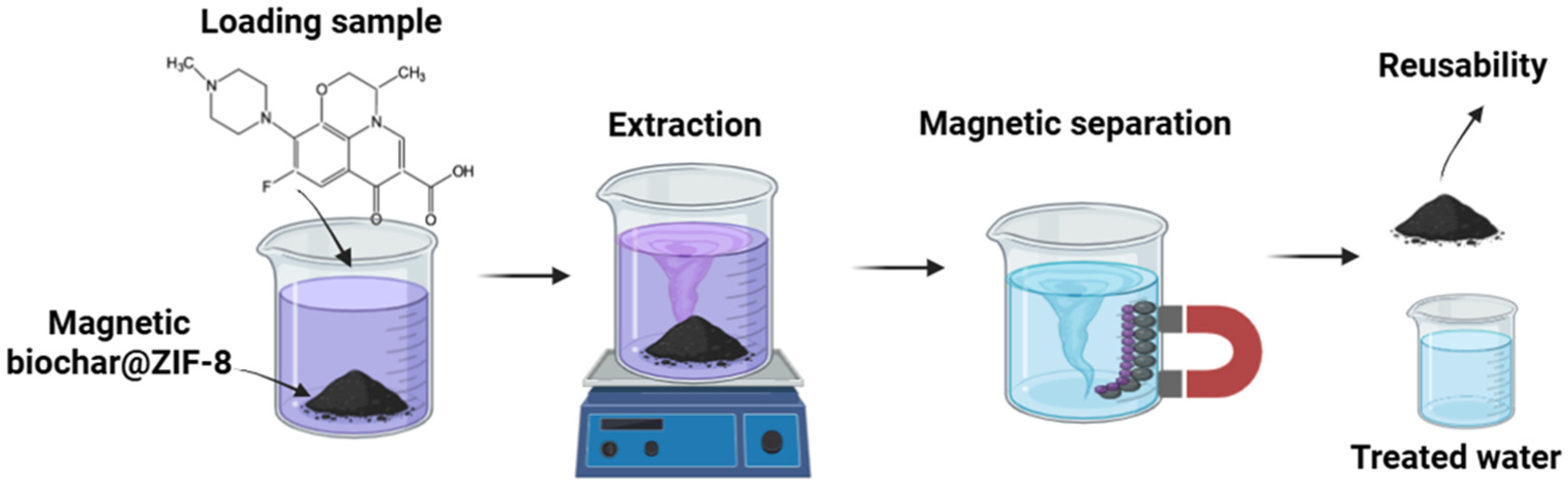
Furthermore, Figure 1 shows a schematic representation of the adsorption process of fluoroquinolones in water samples under optimized conditions. As can be observed, once the adsorption takes place, the material can be easily separated from the solution using an external magnet, allowing a simple phase separation without the need for complex instrumentation such as filtration or centrifugation. This approach provides multiple advantages, including cost-effectiveness, operational simplicity, and suitability for automation and miniaturization. In addition, the magnetic biochar@ZIF-8 composite exhibits high reusability, short separation time, and excellent dispersibility in aqueous media, making it a promising material for sustainable water remediation applications.

3. Results

3.1. Optimization of Pyrolysis Parameters

Table 1 shows the experimental design matrix of the central composite design (CCD), including the coded and actual levels of temperature and residence time, as well as the corresponding experimental and predicted values for biochar yield (%) and ofloxacin extraction (%). Biochar yield was determined as the percentage of solid biochar obtained after pyrolysis relative to the initial dry biomass mass, and all biochars obtained under the CCD conditions were tested for ofloxacin extraction before chemical activation. In this way, the close agreement between the measured and predicted values confirms the adequacy of the fitted quadratic model in describing the experimental data for biochar yield (%).
The statistical significance of the fitted model was validated by the ANOVA results (Table 2), which showed a very high F-value (7554.39) and an extremely low p-value (<0.0001), confirming the robustness of the model. Temperature (A) was identified as the most influential factor on biochar yield, followed by its quadratic term (A2) and residence time (B). The lack of fit was not significant (p = 0.061), indicating that the model adequately represents the experimental variability. These findings demonstrate that both temperature and residence time play an important role in governing the pyrolysis behavior of almond shell biomass, in agreement with previous findings reported in the literature.
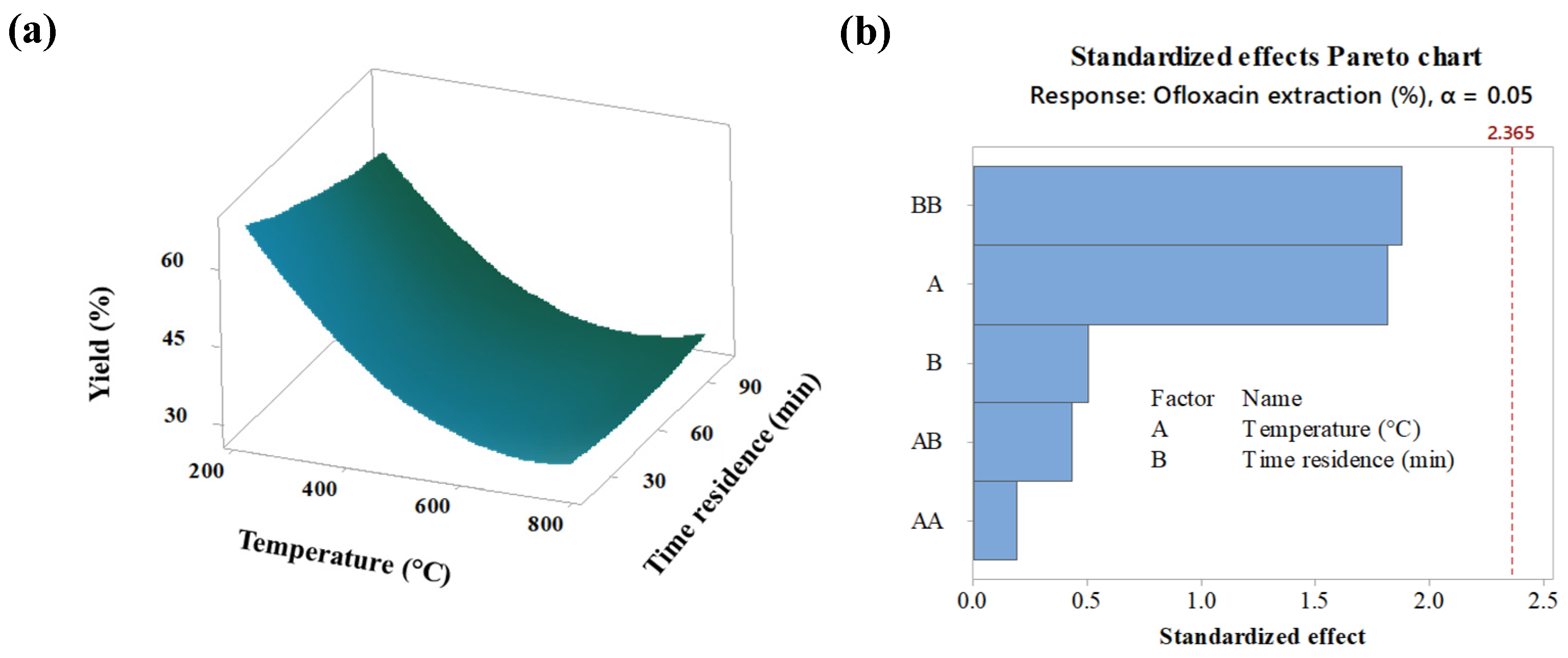
The response surface model obtained from the central composite design shows that temperature and residence time significantly influence the biochar yield (%) from almond shell biomass (Figure 2a). As the temperature increases, the yield decreases notably. At 300 °C, the yield was approximately 54%, while at 700 °C it dropped to about 30%. A longer residence time also slightly reduced the yield, suggesting that at higher temperatures, a greater fraction of carbon is converted into volatile compounds. These results are consistent with previous studies [22,23], which report that low temperatures favor the retention of solid carbon, whereas higher temperatures intensify thermal decomposition and reduce the amount of biochar produced. The standardized Pareto chart (Figure 2b) was used to compare the relative influence of temperature (A) and residence time (B) on ofloxacin extraction efficiency within the CCD model. In this chart, the vertical reference line represents the significance threshold at α = 0.05 (standardized effect ≈ 2.3). As can be noted, none of the tested factors exceeded this limit, indicating that neither temperature nor residence time had a statistically significant effect on ofloxacin extraction within the explored range. Thus, the selected conditions for biochar production were 300 °C, 90 min and 10 °C min−1, based on yield and energy efficiency. After that, the KOH activation was performed at 750 °C using a 2:1 KOH-to-biochar ratio, following conditions previously reported to optimize porosity and surface functionality [24,25]. Similar activation strategies using lignocellulosic residues are well established in the literature [26], with two-step carbonization–activation methods generally preferred due to their improved surface properties.

3.2. Characterization of Biochar-Derived Materials

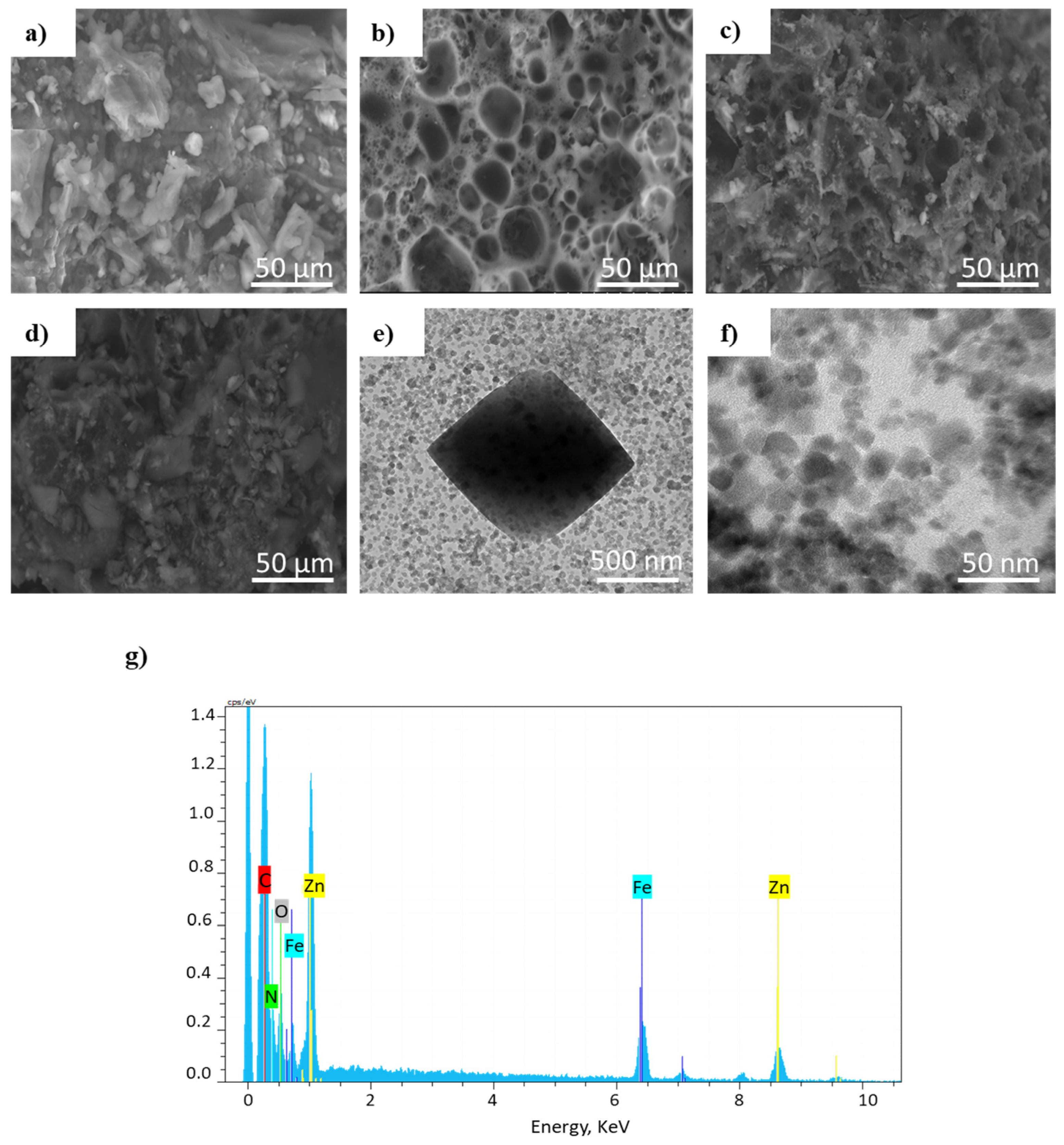
The morphology and microstructure of the synthesized materials were analyzed by SEM and TEM (Figure 3). The unactivated biochar (Figure 3a) presents a dense and compact surface with irregular particles and limited porosity, typical of carbonized biomass. After activation with KOH (Figure 3b), the material shows a more porous and irregular structure, with visible cavities and channels formed as a result of the chemical action of the activating agent. The magnetic biochar (Figure 3c) maintains a similar porous framework, although slight particle aggregation is observed, suggesting the successful incorporation of magnetic particles without compromising structural integrity. In addition, the biochar@ZIF-8 composite (Figure 3d) shows a uniform distribution of ZIF-8 particles over the biochar surface, indicating a well-integrated structure. Figure 3e displays a well-defined rhombic dodecahedral morphology characteristic of crystalline ZIF-8, while Figure 3f reveals a homogeneous dispersion of ZIF-8 particles across the biochar matrix that prevents agglomeration. Furthermore, the incorporation of ZIF-8 on biochar was confirmed by EDS analysis (Figure 3g). Peaks corresponding to carbon (C) and oxygen (O) are attributed to the biochar matrix, while nitrogen (N) and zinc (Zn) originate from the ZIF-8 structure in the magnetic biochar@ZIF-8 composite. The presence of iron (Fe) further confirms the successful introduction of magnetic particles, forming a hybrid structure with potential multifunctional properties for adsorption applications and enabling easy material separation without the need for complex instrumentation.
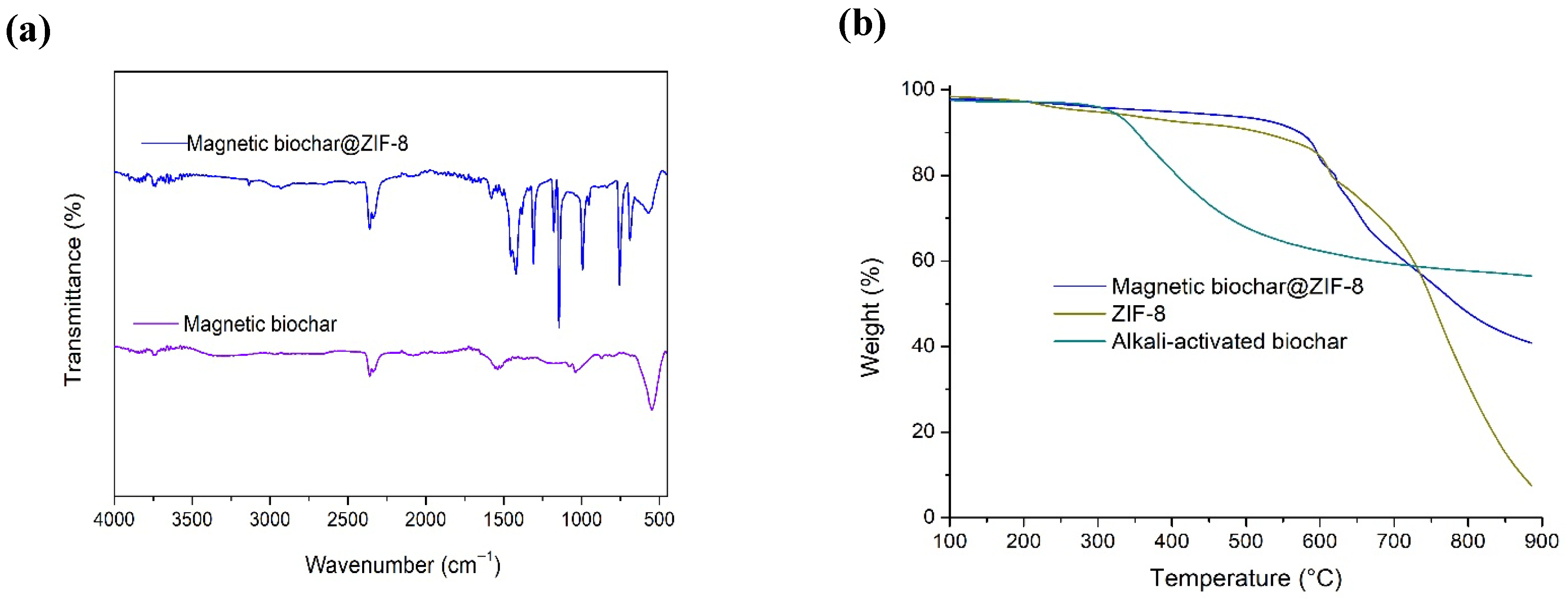
The FTIR spectra of magnetic biochar and magnetic biochar@ZIF-8 are presented in Figure 4a. The spectrum of the composite shows absorption bands at 1570 and 1390 cm−1, attributed to C=C stretching and O–H bending vibrations of aromatic and carboxylic groups typical of biochar. After magnetic modification, an additional peak appears at 574 cm−1, attributed to Fe–O vibrations, which evidences the incorporation of magnetic components into the material [27]. In addition, new peaks around 1200 cm−1 are associated with C–N stretching in the imidazolate ring of ZIF-8, confirming the successful incorporation of ZIF-8 onto the biochar surface [28,29]. The thermal stability of activated biochar, ZIF-8, and magnetic biochar@ZIF-8 was evaluated by TGA (Figure 4b). Activated biochar shows a small weight loss below 150 °C caused by moisture evaporation, followed by a larger mass loss between 300 and 600 °C due to the decomposition of organic components such as cellulose, hemicellulose, and lignin. ZIF-8 starts to decompose sharply around 550 °C when the imidazolate framework breaks down. The magnetic biochar@ZIF-8 composite shows a more gradual weight loss from 400 to 700 °C, indicating that both biochar and ZIF-8 structures are present and interact to improve thermal resistance. The remaining weight above 700 °C corresponds to stable metal oxides (Fe2O3), confirming that the composite is more thermally stable than the individual materials [30,31].
As shown in Table 3, ZIF-8 has a very high surface area (1076.45 m2 g−1) and a total pore volume of 0.61 cm3 g−1, which is typical of its microporous structure [32]. In the magnetic biochar@ZIF-8 composite, the surface area decreased slightly to 1036.6 m2 g−1. This small reduction can be explained by the fact that ZIF-8 crystals and magnetic particles were deposited on the surface of the KOH-activated biochar, partially covering its pores. However, the total pore volume increased to 0.97 cm3 g−1, and the average pore size became larger (18.59 nm). These results suggest that the composite material developed mesoporous characteristics due to the combination of biochar, ZIF-8, and magnetic particles. The presence of both micro- and mesopores makes it easier for fluoroquinolone molecules to move through the material and reach the active sites [18,20]. Overall, the addition of ZIF-8 and magnetic components improved the structure and adsorption properties of the biochar, making it more effective for water treatment applications.
Furthermore, almond shells were selected as the biochar precursor due to their inherently higher surface area compared with other common food wastes, such as walnut and peanut shells. Previous studies have reported an intrinsic BET surface area of approximately 6.20 m2/g for raw almond shells [33]. In our work, this value increased up to ~1036 m2/g after KOH activation and ZIF-8 incorporation, demonstrating the substantial structural enhancement achieved through the proposed synthesis strategy. This marked improvement in surface area supports the selection of almond shell as an effective and sustainable precursor for developing high-performance adsorbent materials.

3.3. Comparative Adsorption Performance of the Synthesized Materials

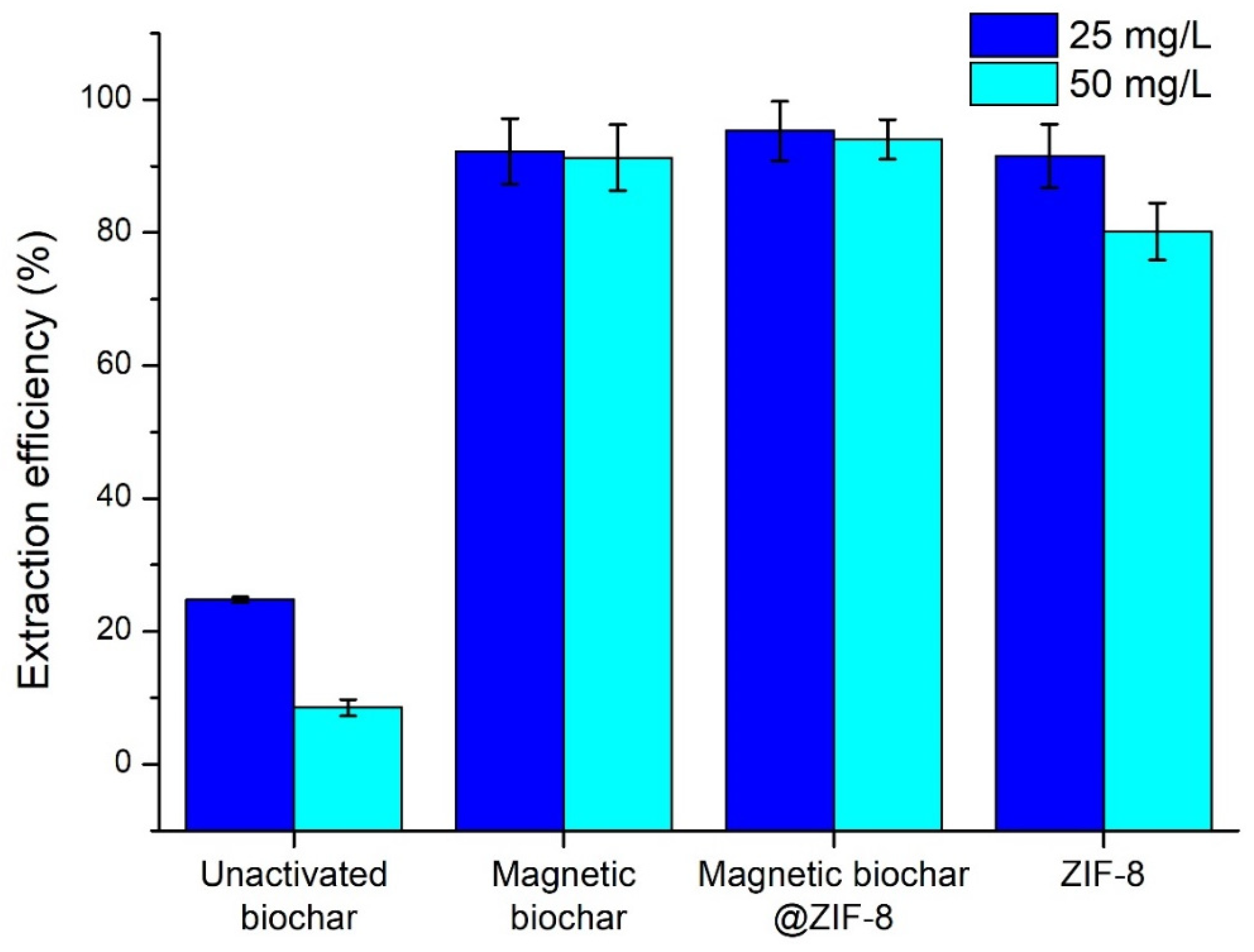
The extraction efficiency of the synthesized materials was also evaluated using ofloxacin solutions at two initial concentrations (25 and 50 mg L−1), as shown in Figure 5. The unactivated biochar exhibited the lowest extraction efficiency, attributed to its limited surface area and low density of active sites. After magnetic modification, the efficiency increased, indicating that activation and magnetization significantly improved surface functionality and adsorption capacity. The magnetic biochar@ZIF-8 composite showed slightly higher extraction efficiency than the magnetic biochar, suggesting that the incorporation of ZIF-8 into the biochar matrix further enhanced adsorption performance, selectivity, and structural stability. In contrast, ZIF-8 particles exhibited lower efficiency, likely due to particle agglomeration and limited chemical stability in aqueous media [15,34].

3.4. Effect of pH on Adsorption

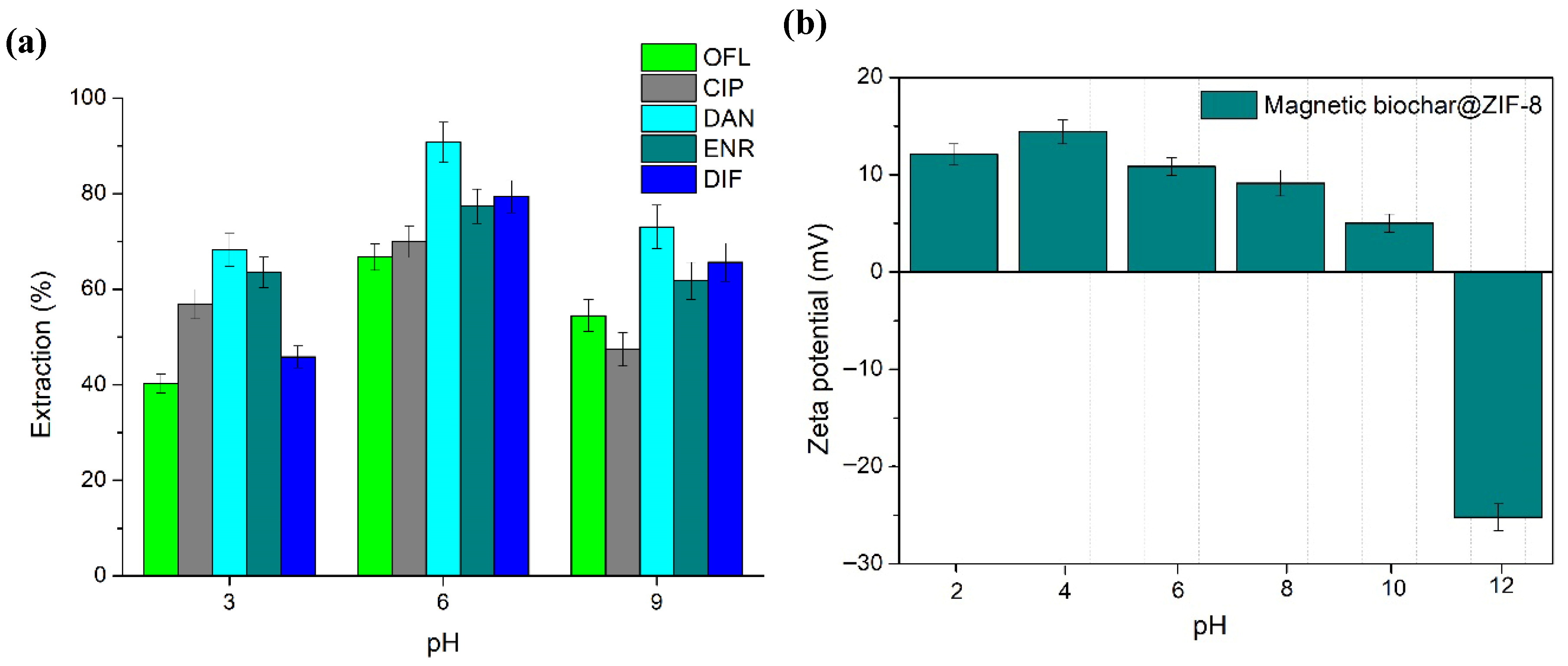
The extraction performance depends on the pH of the extraction medium, since this parameter influences both the surface charge of the adsorbent and the ionization state of target analytes. Thus, the effect of pH on the sample solution was studied in the range of 3 to 9. The pKa values of the studied fluoroquinolones are as follows: ofloxacin (6.1–8.3), ciprofloxacin (5.8–8.2), danofloxacin (6.1–8.6), enrofloxacin (5.9–7.7), difloxacin (5.7–7.2) [35,36]. When the pH is lower than the pKa, the molecules are mainly cationic, and when it is higher, they are anionic. As shown in Figure 6a, the highest extraction was obtained at pH 6, where the FQs are in their zwitterionic form. At this pH, electrostatic forces are weak (Figure 6b), suggesting that the adsorption mainly occurs through hydrophobic interactions, π–π stacking between the aromatic rings of FQs and the imidazole groups of ZIF-8, and hydrogen bonding with functional groups on the material surface.

3.5. Kinetic Parameters

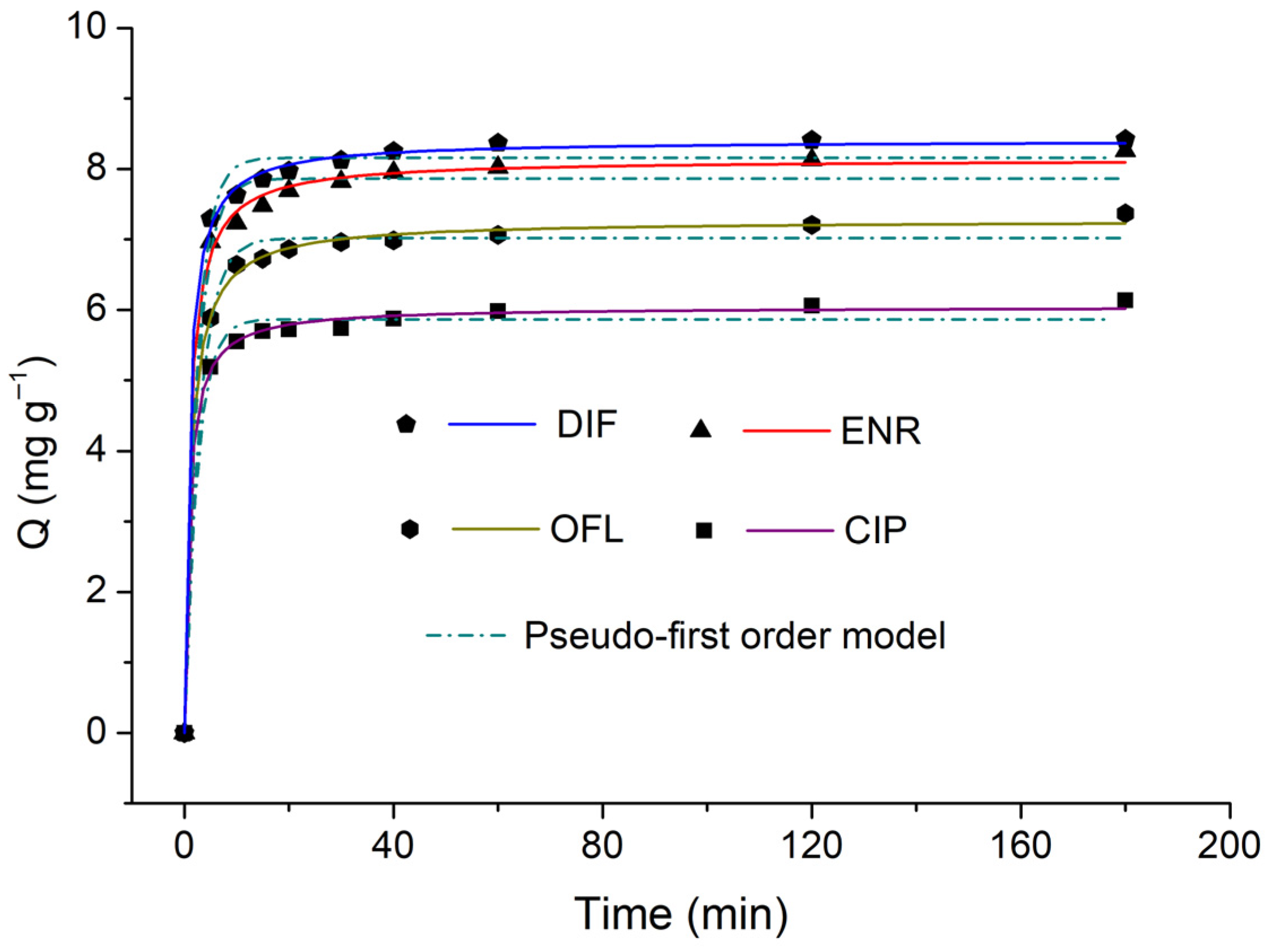
Figure 7 shows the adsorption kinetics of FQs onto the magnetic biochar@ZIF-8 composite. As observed, adsorption occurred rapidly during the first few minutes and gradually reached equilibrium after approximately 60 min. Although both pseudo-first-order and pseudo-second-order models were tested, the kinetic data fitted better to the pseudo-second-order model (solid line), suggesting that the adsorption process is mainly controlled by chemisorption involving interactions between the active sites and fluoroquinolone molecules.
Table 4 shows that the pseudo-second-order model exhibited higher correlation coefficients (R2 > 0.997) compared to those obtained from the other models, including the intraparticle diffusion model, which describes the diffusion of the adsorbate from the solution into the pores of the adsorbent. These results are consistent with previously reported studies [6,37]. Once the pseudo-second-order (PSO) model was identified as the best fit, its parameters were used to estimate the contact time required to achieve a given removal efficiency, which is essential for reactor design and process optimization. The PSO model also supports the selection of adsorbent dosage and operational cycles, while insights from the pseudo-first-order and intraparticle diffusion models help identify mass-transfer limitations and improve overall adsorption performance.
The adsorption rate is an important parameter in the design of adsorbent materials for contaminant removal and can be evaluated by analyzing the effect of contact time on the adsorption process. In this study, the maximum adsorption capacity of each adsorbent was determined from the fitting of the experimental data to the pseudo-second-order kinetic model. It is worth noting that the adsorption capacity obtained for the Magnetic biochar@ZIF-8 composite is comparable to, or even higher than, most of the values reported in the literature for fluoroquinolone adsorption using biochars, MOFs, or composite materials (Table 5).

3.6. Adsorption Mechanism

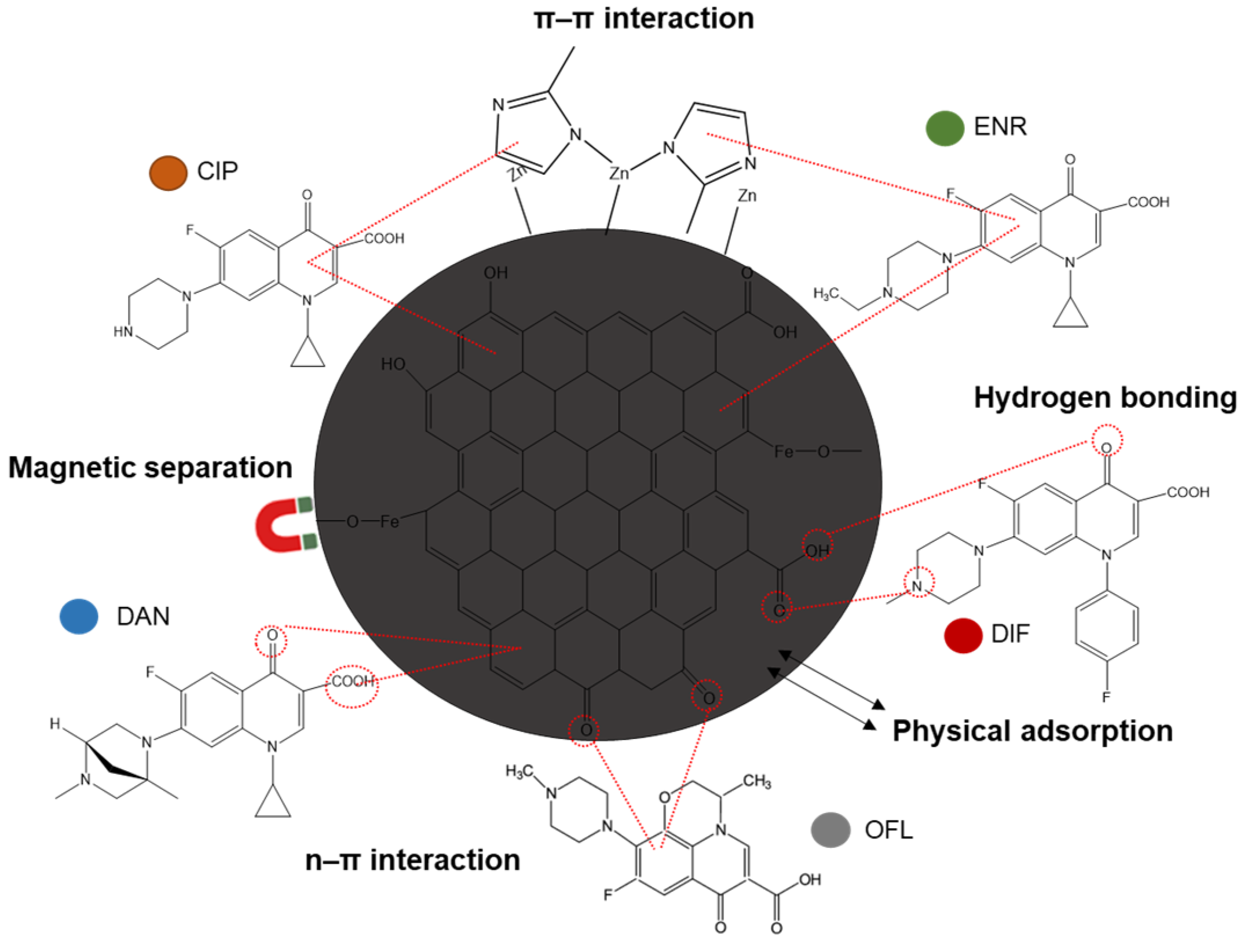
The proposed adsorption mechanism of FQs onto magnetic biochar@ZIF-8 involves the synergistic contribution of several types of interactions between the functional groups of the adsorbent and the FQ molecules, as shown in Figure 8. The KOH-activated biochar provides a porous carbon matrix rich in hydroxyl and oxygen-containing groups, which facilitates hydrogen bonding and improves surface wettability [24,36]. The ZIF-8 coating introduces imidazole rings and Zn2+ sites that promote π–π interactions with the aromatic rings of FQs and coordination with oxygen or nitrogen atoms in their functional groups. Consequently, hydrophobic interactions and π–π stacking dominate due to the aromatic nature of both FQs and the composite, while hydrogen bonding and coordination further stabilize the adsorbed complexes. Moreover, the magnetic component (Fe3O4) not only enables easy recovery of the adsorbent after use but also provides additional reactive sites for interaction [14]. Therefore, the excellent adsorption performance of the magnetic biochar@ZIF-8 composite arises from the combined effects of its porous structure, surface functionalities, and the coexistence of metal–organic and magnetic phases.

3.7. Reusability of Adsorbent

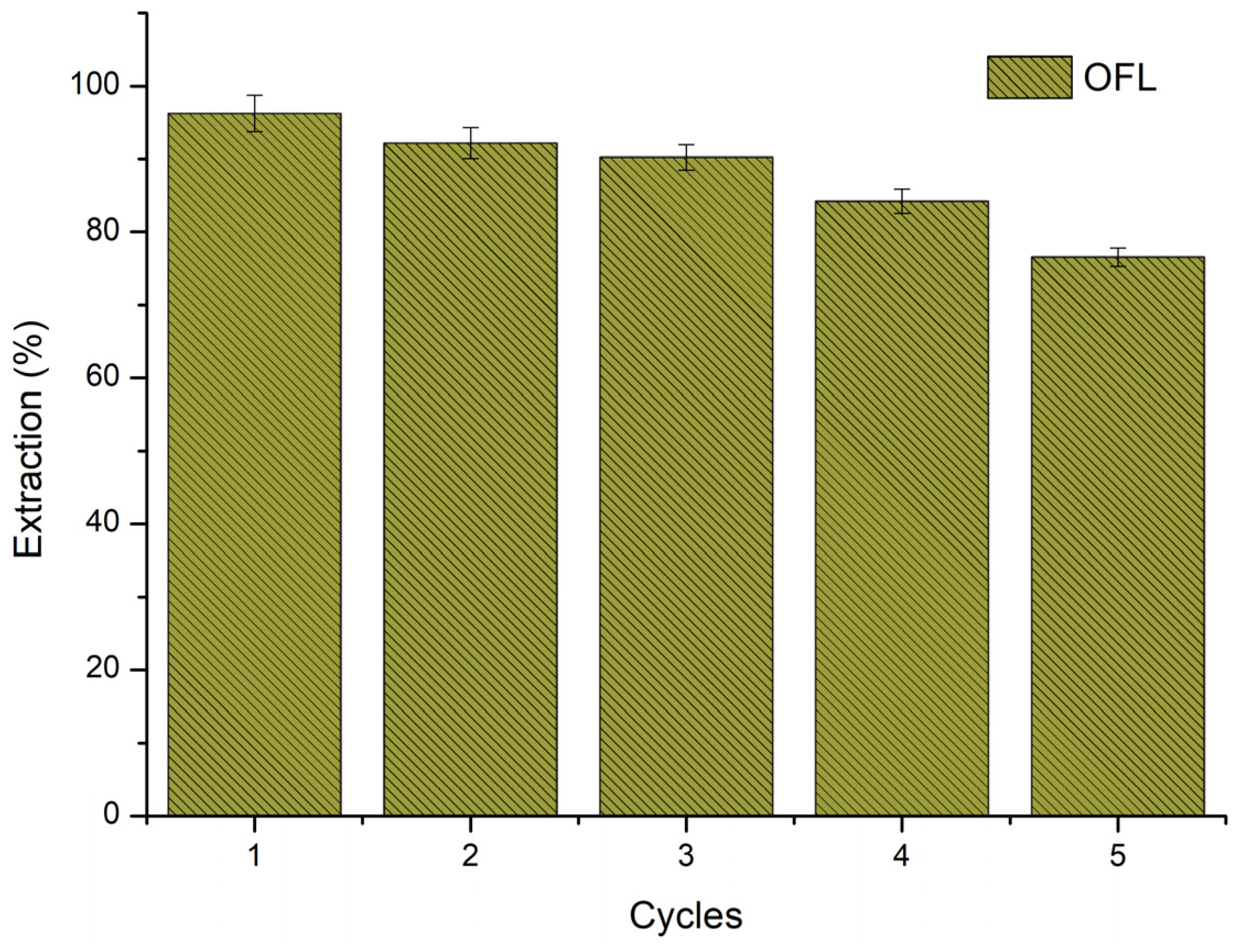
The reusability of the magnetic biochar@ZIF-8 composite was evaluated through five consecutive adsorption–desorption cycles using ofloxacin (OFL) as the model compound. In our preliminary tests, several solvents were evaluated, and the 10% AcOH/EtOH mixture provided the highest desorption efficiency and the best regeneration performance. Therefore, it was selected as the regeneration solvent, consistent with other studies reported in the literature [41] that have also employed this desorption mixture and shown that strongly retained target and non-target compounds on biochar surfaces require chemical agents for effective desorption. Thus, between each cycle, the adsorbent was washed with a mixture of 10% AcOH/EtOH (5 mL) and water (5 mL) to facilitate regeneration, then dried and reused in the subsequent adsorption experiments. As shown in Figure 9, the extraction efficiency remained above 84% after four cycles, indicating the high stability and regeneration capacity of the composite. A slight decrease in performance was observed in the fifth cycle, which can be attributed to the partial loss of active sites or minor structural changes after repeated use. Nevertheless, the material retained most of its adsorption capacity, confirming its excellent potential for cost-effective and sustainable water treatment applications.

4. Conclusions

In this study, a magnetic biochar@ZIF-8 composite derived from almond shell biomass was successfully synthesized and characterized as an efficient adsorbent for the extraction efficiency of fluoroquinolones from aqueous solutions. The integration of ZIF-8 and magnetic particles onto the KOH-activated biochar provided a hierarchical porous structure combining micro- and mesopores, which enhanced the surface area, pore volume, and accessibility of active sites. The adsorption process followed a pseudo-second-order kinetic model, indicating that chemisorption was the dominant mechanism, supported by π–π interactions and hydrogen bonding between functional groups of the adsorbent and fluoroquinolone molecules. Furthermore, the composite demonstrated remarkable thermal and chemical stability, maintaining over 84% of its adsorption capacity after four regeneration cycles. Overall, the magnetic biochar@ZIF-8 composite represents a cost-effective, sustainable, and easily recoverable material with high potential for practical applications in water purification and environmental remediation. Future studies could incorporate isotherm analysis using different models to better describe equilibrium capacity and support process design.

Author Contributions

Conceptualization, D.B. and P.P.; methodology, D.B., C.M. and P.P.; software, D.B. and Z.H.; validation, D.B. and P.P.; formal analysis, D.B., C.M. and Z.H.; investigation, D.B., C.M. and P.P.; resources, D.B. and Z.H.; data curation, C.M. and P.P.; writing—original draft preparation, D.B. and P.P.; writing—review and editing, C.M. and Z.H.; visualization, D.B. and P.P.; supervision, D.B. and C.M. All authors have read and agreed to the published version of the manuscript.

Funding

This research received no external funding.

Data Availability Statement

The data presented in this study are available upon request from the corresponding authors.

Conflicts of Interest

The authors declare no conflicts of interest.

References

  1. Sodhi, K.K.; Singh, D.K. Insight into the Fluoroquinolone Resistance, Sources, Ecotoxicity, and Degradation with Special Emphasis on Ciprofloxacin. J. Water Process Eng. 2021, 43, 102218. [Google Scholar] [CrossRef]
  2. Thai, V.A.; Dang, V.D.; Thuy, N.T.; Pandit, B.; Vo, T.K.Q.; Khedulkar, A.P. Fluoroquinolones: Fate, Effects on the Environment and Selected Removal Methods. J. Clean. Prod. 2023, 418, 137762. [Google Scholar] [CrossRef]
  3. Maia, A.S.; Paíga, P.; Delerue-Matos, C.; Castro, P.M.L.; Tiritan, M.E. Quantification of Fluoroquinolones in Wastewaters by Liquid Chromatography-Tandem Mass Spectrometry. Environ. Pollut. 2020, 259, 113927. [Google Scholar] [CrossRef] [PubMed]
  4. de Ilurdoz, M.S.; Sadhwani, J.J.; Reboso, J.V. Antibiotic Removal Processes from Water & Wastewater for the Protection of the Aquatic Environment—A Review. J. Water Process Eng. 2022, 45, 102474. [Google Scholar] [CrossRef]
  5. Schreiber, L.; Halko, R.; Santana-Viera, S.; Michalides, N.M.; Sosa-Ferrera, Z.; Santana-Rodríguez, J.J. Evaluation of European Watch List Contaminants in Environmental Matrices and Microplastics: Analytical Strategies, Mechanisms of Adsorption and Occurrence. Trends Environ. Anal. Chem. 2024, 44, e00245. [Google Scholar] [CrossRef]
  6. Ezzahi, K.; Rabichi, I.; Befenzi, H.; Record, E.; Bouzid, T.; Yaacoubi, A.; Baçaoui, A.; Habibi, Y.; El Fels, L. Optimization, Characterization, and DFT Study of Activated-Biochar from Lignocellulosic Biomass for Fluoroquinolone Antibiotic Adsorption. Results Eng. 2025, 27, 106540. [Google Scholar] [CrossRef]
  7. Adegoke, K.A.; Akinnawo, S.O.; Adebusuyi, T.A.; Ajala, O.A.; Adegoke, R.O.; Maxakato, N.W.; Bello, O.S. Modified Biomass Adsorbents for Removal of Organic Pollutants: A Review of Batch and Optimization Studies. Int. J. Environ. Sci. Technol. 2023, 20, 11615–11644. [Google Scholar] [CrossRef]
  8. Ashiq, A.; Vithanage, M.; Sarkar, B.; Kumar, M.; Bhatnagar, A.; Khan, E.; Xi, Y.; Ok, Y.S. Carbon-Based Adsorbents for Fluoroquinolone Removal from Water and Wastewater: A Critical Review. Environ. Res. 2021, 197, 111091. [Google Scholar] [CrossRef]
  9. Zhang, J.; Liu, J.; Liu, R. Effects of Pyrolysis Temperature and Heating Time on Biochar Obtained from the Pyrolysis of Straw and Lignosulfonate. Bioresour. Technol. 2015, 176, 288–291. [Google Scholar] [CrossRef]
  10. Adekanye, T.; Dada, O.; Kolapo, J. Pyrolysis of Maize Cob at Different Temperatures for Biochar Production: Proximate, Ultimate and Spectroscopic Characterisation. Res. Agric. Eng. 2022, 68, 27–34. [Google Scholar] [CrossRef]
  11. Nguyen, C.T.; Tungtakanpoung, D.; Tra, V.T.; Kajitvichyanukul, P. Kinetic, Isotherm and Mechanism in Paraquat Removal by Adsorption Process Using Corn Cob Biochar Produced from Different Pyrolysis Conditions. Case Stud. Chem. Environ. Eng. 2022, 6, 100248. [Google Scholar] [CrossRef]
  12. Lan, W.; Zhao, X.; Wang, Y.; Jin, X.; Ji, J.; Cheng, Z.; Yang, G.; Li, H.; Chen, G. Research Progress of Biochar Modification Technology and Its Application in Environmental Remediation. Biomass Bioenergy 2024, 184, 107178. [Google Scholar] [CrossRef]
  13. Bedair, A.; Abdelhameed, R.M.; Hammad, S.F.; Abdallah, I.A.; Mansour, F.R. Applications of Metal Organic Frameworks in Dispersive Micro Solid Phase Extraction (D-μ-SPE). J. Chromatogr. A 2024, 1732, 465192. [Google Scholar] [CrossRef] [PubMed]
  14. Chen, W.; Yun, F.; Zheng, S.; Shi, C.; Han, J. In Situ Growth ZIF-8 on Porous Chitosan/Hydroxyapatite Composite Fibers for Ultra-Efficiently Eliminating Lead Ions in Wastewater. Mater. Today Commun. 2023, 37, 107255. [Google Scholar] [CrossRef]
  15. Liu, Z.; Li, Y.; Li, C.; Thummavichai, K.; Feng, C.; Li, Z.; Liu, S.; Zhang, S.; Wang, N.; Zhu, Y. MOF-Derived Biochar Composites for Enhanced High Performance Photocatalytic Degradation of Tetracycline Hydrochloride. RSC Adv. 2022, 12, 31900–31910. [Google Scholar] [CrossRef]
  16. Ambroz, F.; Macdonald, T.J.; Martis, V.; Parkin, I.P. Evaluation of the BET Theory for the Characterization of Meso and Microporous MOFs. Small Methods 2018, 2, 1800173. [Google Scholar] [CrossRef]
  17. Liang, Y.; Zhang, Q.; Li, S.; Fei, J.; Zhou, J.; Shan, S.; Li, Z.; Li, H.; Chen, S. Highly Efficient Removal of Quinolones by Using the Easily Reusable MOF Derived-Carbon. J. Hazard. Mater. 2022, 423, 127181. [Google Scholar] [CrossRef]
  18. Ma, X.; Li, Y.; Du, Y.; Chen, S.; Bai, Y.; Li, L.; Qi, C.; Wu, P.; Zhang, S. In-Situ Synthesis of ZIF-8 on Magnetic Pineapple Leaf Biochar as an Efficient and Reusable Adsorbent for Methylene Blue Removal from Wastewater. Environ. Sci. Pollut. Res. 2024, 31, 24113–24128. [Google Scholar] [CrossRef]
  19. Huang, Q.; Zhang, Q.; Zhao, S.; Zhang, C.; Guan, H.; Liu, J. Efficient Recovery of Rare Metal Lanthanum from Water by MOF-Modified Biochar: DFT Calculation and Dynamic Adsorption. Biochar 2025, 7, 29. [Google Scholar] [CrossRef]
  20. Luo, M.; Zhu, C.; Chen, Q.; Song, F.; Hao, W.; Shen, Z.; Konhauser, K.O.; Alessi, D.S.; Zhong, C. In-Situ Growth of ZIF-8 Nanocrystals on Biochar for Boron Adsorption. Colloids Surf. A Physicochem. Eng. Asp. 2023, 657, 130504. [Google Scholar] [CrossRef]
  21. Debevc, S.; Weldekidan, H.; Snowdon, M.R.; Vivekanandhan, S.; Wood, D.F.; Misra, M.; Mohanty, A.K. Valorization of Almond Shell Biomass to Biocarbon Materials: Influence of Pyrolysis Temperature on Their Physicochemical Properties and Electrical Conductivity. Carbon Trends 2022, 9, 100214. [Google Scholar] [CrossRef]
  22. Li, Y.; Gupta, R.; Zhang, Q.; You, S. Review of Biochar Production via Crop Residue Pyrolysis: Development and Perspectives. Bioresour. Technol. 2023, 369, 128423. [Google Scholar] [CrossRef]
  23. Ahmed, S.F.; Mehejabin, F.; Chowdhury, A.A.; Almomani, F.; Khan, N.A.; Badruddin, I.A.; Kamangar, S. Biochar Produced from Waste-Based Feedstocks: Mechanisms, Affecting Factors, Economy, Utilization, Challenges, and Prospects. GCB Bioenergy 2024, 16, e13175. [Google Scholar] [CrossRef]
  24. Fu, Y.; Shen, Y.; Zhang, Z.; Ge, X.; Chen, M. Activated Bio-Chars Derived from Rice Husk via One- and Two-Step KOH-Catalyzed Pyrolysis for Phenol Adsorption. Sci. Total Environ. 2019, 646, 1567–1577. [Google Scholar] [CrossRef] [PubMed]
  25. Jamil, U.; Zeeshan, M.; Khan, S.R.; Saeed, S. Synthesis and Two-Step KOH Based Activation of Porous Biochar of Wheat Straw and Waste Tire for Adsorptive Exclusion of Chromium (VI) from Aqueous Solution; Thermodynamic and Regeneration Study. J. Water Process Eng. 2023, 53, 103892. [Google Scholar] [CrossRef]
  26. Ruiz, B.; Cabrera-Codony, A.; Girón, R.P.; Anfruns, A.; Martín, M.J.; Suárez-Ruiz, I.; Fuente, E. From Fly Ashes of Lignocellulose Waste Combustion to Sustainable Activated Carbons for VOCs Removal. Sustain. Chem. Pharm. 2025, 44, 101943. [Google Scholar] [CrossRef]
  27. Sabrpisheh, Z.; Lemraski, E.G.; Abbasi, Z.; Tahmasebi, Z. Methylene Blue Adsorption on Modified Biochar with Magnetic Nanoparticles and Humic Acid Coating. Phys. Chem. Res. 2024, 12, 949–962. [Google Scholar] [CrossRef]
  28. Xiong, Y.; Li, G.; Feng, D.; Lao, A.; Wu, H.; Chen, J.; Nie, Y.; Zhang, W.; Zheng, Z. ZIF-8-Derived Nanoporous Carbon for Highly Efficient Adsorption of Microcystin-LR: Synthesis, Characterization, and Mechanistic Insights. J. Mater. Sci. 2025, 60, 9566–9581. [Google Scholar] [CrossRef]
  29. Xiao, Y.; Yang, H.; Bu, X.; Feng, P. ZIF-8 Derived Carbon Materials with Multifunctional Selective Adsorption Abilities. Carbon 2021, 176, 421–430. [Google Scholar] [CrossRef]
  30. Burbano, A.A.; Gascó, G.; Horst, F.; Lassalle, V.; Méndez, A. Production, Characteristics and Use of Magnetic Biochar Nanocomposites as Sorbents. Biomass Bioenergy 2023, 172, 106772. [Google Scholar] [CrossRef]
  31. Luo, S.; Qin, J.; Wu, Y.; Feng, F. Tetracycline Adsorption on Magnetic Sludge Biochar: Size Effect of the Fe3O4 Nanoparticles. R. Soc. Open Sci. 2022, 9, 210805. [Google Scholar] [CrossRef]
  32. Yu, R.; Wu, Z. High Adsorption for Ofloxacin and Reusability by the Use of ZIF-8 for Wastewater Treatment. Microporous Mesoporous Mater. 2020, 308, 110494. [Google Scholar] [CrossRef]
  33. Celebi, H.; Bahadir, T.; Bilican, I. An Inclusive Physico-Chemical Perspective on Food Waste: Textural and Morphological Structure. Mater. Chem. Phys. 2023, 310, 128461. [Google Scholar] [CrossRef]
  34. Jiang, Y.C.; Luo, M.F.; Niu, Z.N.; Xu, S.Y.; Gao, Y.; Gao, Y.; Gao, W.J.; Luo, J.J.; Liu, R.L. In-Situ Growth of Bimetallic FeCo-MOF on Magnetic Biochar for Enhanced Clearance of Tetracycline and Fruit Preservation. Chem. Eng. J. 2023, 451, 138804. [Google Scholar] [CrossRef]
  35. Palacio, D.A.; Rivas, B.L.; Urbano, B.F. Ultrafiltration Membranes with Three Water-Soluble Polyelectrolyte Copolymers to Remove Ciprofloxacin from Aqueous Systems. Chem. Eng. J. 2018, 351, 85–93. [Google Scholar] [CrossRef]
  36. Jiménez-Lozano, E.; Marqués, I.; Barrón, D.; Beltrán, J.L.; Barbosa, J. Determination of PKa Values of Quinolones from Mobility and Spectroscopic Data Obtained by Capillary Electrophoresis and a Diode Array Detector. Anal. Chim. Acta 2002, 464, 37–45. [Google Scholar] [CrossRef]
  37. Li Wu, L.; Ling Tan, H.; Pei Lim, Y. Effect of Solvents on ZIF-8 and Its Adsorption Efficiency for Norfloxacin. Sci. Res. J. 2025, 22, 61–82. [Google Scholar] [CrossRef]
  38. Wang, Y.; Lu, J.; Wu, J.; Liu, Q.; Zhang, H.; Jin, S. Adsorptive Removal of Fluoroquinolone Antibiotics Using Bamboo Biochar. Sustainability 2015, 7, 12947–12957. [Google Scholar] [CrossRef]
  39. Dang, B.T.; Gotore, O.; Ramaraj, R.; Unpaprom, Y.; Whangchai, N.; Bui, X.T.; Maseda, H.; Itayama, T. Sustainability and Application of Corncob-Derived Biochar for Removal of Fluoroquinolones. Biomass Convers. Biorefin. 2021, 12, 913–923. [Google Scholar] [CrossRef]
  40. Li, R.; Wang, Z.; Zhao, X.; Li, X.; Xie, X. Magnetic Biochar-Based Manganese Oxide Composite for Enhanced Fluoroquinolone Antibiotic Removal from Water. Environ. Sci. Pollut. Res. 2018, 25, 31136–31148. [Google Scholar] [CrossRef]
  41. Alsawy, T.; Rashad, E.; El-Qelish, M.; Mohammed, R.H. A Comprehensive Review on the Chemical Regeneration of Biochar Adsorbent for Sustainable Wastewater Treatment. npj Clean Water 2022, 5, 29. [Google Scholar] [CrossRef]
Figure 1. Schematic representation of the adsorption–desorption cycle using magnetic biochar magnetic@ZIF-8 derived from almond shell for fluoroquinolone remediation.
Water 18 00082 g001
Figure 2. Response surface modeling obtained from the Central Composite Design: (a) effect of pyrolysis temperature and residence time on the biochar yield from almond shell biomass; (b) standardized Pareto chart representing the influence of the same parameters on the extraction efficiency of ofloxacin.
Water 18 00082 g002
Figure 3. SEM micrographs of (a) unactivated biochar, (b) biochar activated with KOH, (c) magnetic biochar, and (d) magnetic biochar@ZIF-8 composite. TEM images of (e) ZIF-8 and (f) magnetic biochar @ZIF-8, and (g) EDS spectrum of the magnetic biochar @ZIF-8 composite.
Water 18 00082 g003
Figure 4. FTIR spectra of (a) magnetic biochar and magnetic biochar@ZIF-8 composite, and (b) TGA curves of alkali-activated biochar, pristine ZIF-8, and magnetic biochar@ZIF-8 composite.
Water 18 00082 g004
Figure 5. Comparison of the extraction efficiency (%; error bars represent standard deviation, n = 3) of ofloxacin using unactivated almond shell biochar, KOH-activated biochar, magnetic biochar@ZIF-8, and ZIF-8.
Water 18 00082 g005
Figure 6. (a) Effect of pH on the extraction efficiency (% error bars represent standard deviation, n = 3) and (b) zeta potential of the magnetic biochar@ZIF-8 at different pH values. OFL: ofloxacin; CIP: ciprofloxacin; DAN: danofloxacin; ENR: enrofloxacin; DIF: difloxacin.
Water 18 00082 g006
Figure 7. Adsorption kinetics of FQs onto the magnetic biochar@ZIF-8 composite. Experimental data were fitted using pseudo-first-order (dashed line) and pseudo-second-order (solid line) kinetic models to evaluate the adsorption mechanism. Experiments were carried out using an initial FQ concentration of 10 mg L−1, an adsorbent dose of 1 mg mL−1, at 25 °C and pH 6.
Water 18 00082 g007
Figure 8. Proposed adsorption mechanism of FQs onto magnetic biochar@ZIF-8.
Water 18 00082 g008
Figure 9. Proposed adsorption mechanism of FQs onto magnetic biochar@ZIF-8.
Water 18 00082 g009
Table 1. Experimental design matrix and dependent variables attributed to the factors of Central Composite Design.
Coded LevelActual LevelExperimental Responses
Yield (%)Ofloxacin Extraction (%)
ABTemperature (°C)Time Residence (min)MeasuredPredicted
1−1−1300.030.054.5454.2918.3
21−1700.030.029.7529.575.1
3−11300.090.047.4847.4223.8
411700.090.028.1728.185.6
5−1.40217.260.060.2560.414.0
61.40782.860.029.2629.325.6
70−1.4500.017.637.5437.7918.7
801.4500.0102.431.9931.958.7
900500.060.033.4233.237.59
1000500.060.033.1933.237.61
1100500.060.033.1933.237.53
1200500.060.033.2033.237.68
1300500.060.033.1933.237.60
Table 2. Analysis of variance (ANOVA) for the yield (%) of almond shell biochar.
ParameterSum of SquaresdfMean SquaresF-Valuep Value
Model1243.245248.6497554.390.000
A966.491966.49329,363.770.000
B34.02134.0211033.630.000
A2235.191117.6093573.160.000
B24.6614.658141.520.000
AB7.5117.517.512228.23
Lineal1000.512500.25715,198.700.000
Residual0.2370.033
Lack of fit0.1930.0625.800.061
Pure error0.0440.011
Total1243.4712
Table 3. Textural properties of ZIF-8 and magnetic biochar@ZIF-8 composite obtained from N2 adsorption–desorption analysis.
MaterialsBET Surface Area (m2/g)Total Pore Volume
(cm3/g)
Average Pore
Size DBJH (nm)
ZIF-81076.450.619.149
Magnetic biochar@ZIF-81036.60.9718.588
Table 4. Values of kinetic parameters for the extraction efficiency of FQs by adsorption using magnetic biochar@ZIF-8.
ParameterPseudo First OrderPseudo Second OrderIntra-Particle Diffusion
Qe
(mg/g)
K1R2Qe
(mg/g)
K2R2KipdCR2
OFL7.0170.3500.9927.2710.1120.9990.3384.2160.310
CIP5.8680.4140.9916.0460.1870.9980.2763.6000.289
DAN7.8880.3870.9878.1550.1210.9940.3844.7540.315
ENR7.8620.4020.9858.1390.1230.9970.3794.7690.307
DIF8.1600.4200.9908.4080.1380.9980.3805.0420.279
Table 5. Maximum adsorption capacity of fluoroquinolones using the pseudo-second-order model and different adsorbents.
SampleQe (mg g−1)Reference
Bamboo biochar19.91[38]
Corncob-derived biochar0.1523[39]
Magnetic biochar-based
manganese oxide composite
4.64[40]
ZIF-810.71[37]
Magnetic biochar@ZIF-88.43This work
Disclaimer/Publisher’s Note: The statements, opinions and data contained in all publications are solely those of the individual author(s) and contributor(s) and not of MDPI and/or the editor(s). MDPI and/or the editor(s) disclaim responsibility for any injury to people or property resulting from any ideas, methods, instructions or products referred to in the content.