Article

Phytoplankton Community Shifts Under Nutrient Imbalance in the Yellow River Estuary and Adjacent Coastal Waters

1
Shanghai Key Laboratory of Air Quality and Environmental Health, Department of Environmental Science & Engineering, Fudan University, Shanghai 200438, China
2
Key Laboratory of Land and Sea Ecological Governance and Systematic Regulation, Ministry of Ecology and Environment, Shandong Academy for Environmental Planning, Jinan 250101, China
3
Institute of Eco-Chongming (IEC), National Observations and Research Station for Wetland Ecosystems of the Yangtze Estuary, Shanghai 202151, China
4
Institute of Atmospheric Sciences, Fudan University, Shanghai 200438, China
*
Author to whom correspondence should be addressed.
Water 2026, 18(1), 54; https://doi.org/10.3390/w18010054
Submission received: 1 December 2025 / Revised: 17 December 2025 / Accepted: 22 December 2025 / Published: 24 December 2025
(This article belongs to the Section Oceans and Coastal Zones)

Abstract

The phytoplankton community structure is regulated by environmental conditions, influencing ecosystem stability and productivity. In August 2023, a survey was conducted at 28 stations in the Yellow River Estuary (YRE) and adjacent coastal waters, where phytoplankton communities, nutrients, chlorophyll-a, and other environmental factors were synchronously analyzed. Across-site comparison, redundancy analysis (RDA), and K-means clustering were applied to characterize spatial patterns and identify key factors controlling diatom to dinoflagellate ratios and dominant taxa. The nutrient structure, particularly DIN/PO43−, corresponded closely with the spatial shift between diatom and dinoflagellate dominance. Offshore areas dominated by diatoms (Cerataulina, Chaetoceros) exhibited higher salinity and more balanced nutrient ratios, whereas nearshore zones influenced by Yellow River inputs had high DIN, low PO43−, and evident phosphorus limitation, favoring dinoflagellates (Noctiluca, Heterodinium). These results indicate that nutrient imbalance and salinity gradients are likely the main drivers of diatom-to-dinoflagellate transitions and shape the phytoplankton composition in the estuary coastal waters. This study provides insights linking nutrient imbalance to phytoplankton community succession and advances the understanding of estuarine phytoplankton dynamics.

1. Introduction

Phytoplankton are widely distributed and serve as the fundamental primary producers in marine ecosystems, contributing significantly to global carbon cycling and food web dynamics [1]. Their community structure and diversity are strongly regulated by multiple environmental factors, and shifts in composition can profoundly affect ecosystem resilience, stability and the sustainable use of biological resources [2]. Estuaries, positioned at the land-ocean interface, are ecologically sensitive zones simultaneously influenced by terrestrial inputs and marine processes [3]. Large rivers deliver substantial amounts of nutrients and organic matter to coastal seas, fostering phytoplankton growth and reproduction [4].
Under these pressures, a critical response of estuarine ecosystems is a pronounced shift in phytoplankton community structure. Particularly notable is the widely observed transition from diatom to dinoflagellate dominance in many estuarine systems worldwide. As dinoflagellates constitute the dominant species in many harmful algal blooms, this community shift may significantly elevate ecological risks [5,6]. Previous studies have identified several key mechanisms driving diatom–dinoflagellate succession. In the East China Sea, strong anthropogenic influence has resulted in persistently low Si/N ratios that constrain diatom growth, while high DIN inputs and elevated N/P ratios promote dinoflagellate blooms [7]. Experimental evidence further shows that dinoflagellates outperform diatoms under higher temperatures and high N/P conditions [8]. Both field observations in the Arctic Ocean and laboratory culture experiments have demonstrated that silicate limitation suppresses the net accumulation of biogenic silica in diatoms, thereby constraining their growth, whereas silicate enrichment significantly enhances diatom growth rates [9,10]. Moreover, dinoflagellate culture experiments conducted using samples from the Brittany coastal waters have shown that dinoflagellates benefit from mixotrophy, which enhances their competitiveness under nutrient imbalance or low-light conditions [11,12]. Salinity gradients additionally shape community succession. Studies in the Yellow Sea have indicated that diatoms exhibit greater thermal tolerance but higher sensitivity to salinity changes compared with dinoflagellates, while dinoflagellates show stronger tolerance to salinity variability [13,14].These mechanistic insights are consistent with observations from multiple estuarine systems worldwide, where similar community shifts have been documented. Field investigations in the Bohai Bay have shown that seasonal shifts in water quality can significantly influence phytoplankton community structure [15]. Sediment studies in the Changjiang Estuary further indicate an ongoing transition in offshore phytoplankton communities from diatom to dinoflagellate dominance, a pattern closely associated with increasing sea surface temperature and elevated N/P ratios [16]. In the estuarine Baltic Sea, long-term observations likewise reveal that decadal-scale variations in the diatom to dinoflagellate ratio are jointly driven by regional climate variability and changes in nutrient availability [17]. Given these widespread patterns observed across estuarine systems worldwide, it is essential to assess whether similar phytoplankton community shifts are occurring in the Yellow River Estuary (YRE), a region undergoing rapid hydrological and biogeochemical alterations. However, these studies primarily rely on seasonal or interannual time-series data, which inherently incorporate uncertainties arising from climate variability, river discharge fluctuations, and seasonal nutrient cycles. In contrast, a multi-station horizontal comparison conducted within the same period may reduce temporal variability and allows a clearer evaluation of how nutrient gradients directly influence phytoplankton community structure. Spatially explicit sampling enables the identification of ecological zones, nutrient-limitation patterns, and phytoplankton niche partitioning that cannot be resolved by time-series observations alone. Moreover, ecosystem assessment and management in estuarine environments inherently rely on spatially resolved observations, as spatial heterogeneity governs habitat differentiation, biogeochemical processes, and ecological risks.
The YRE is a typical system subject to intense anthropogenic interventions, among which the Water-Sediment Regulation Scheme (WSRS) is the most intensive and recurrent [18,19]. The WSRS was officially initiated in 2002 by the Yellow River Conservancy Commission. Each summer, the WSRS releases large quantities of water, sediments, and nutrients over a short period, generating a pronounced spatial gradient of physicochemical properties from the estuary to the adjacent sea [20]. Because key seasonal climatic factors (e.g., temperature and light) remain relatively consistent along this gradient and the pulses measurably alter nutrient inputs and biotic communities [21], the survey after WSRS offers a rare opportunity to isolate the effects of nutrient availability and stoichiometry on phytoplankton dynamics.
This study employed a horizontal comparative approach to eliminate the influence of climatic and riverine discharge variability inherent in traditional interannual comparisons. Following the completion of the WSRS in August 2023, transect-based observations were conducted across the YRE and adjacent waters, revealing the controlling effects of nutrient gradients on phytoplankton communities, particularly the spatial patterns of the diatom to dinoflagellate ratio. This study provides new insights into the response mechanisms of phytoplankton composition and biomass to environmental variables in estuarine ecosystems.

2. Materials and Methods

2.1. Study Area

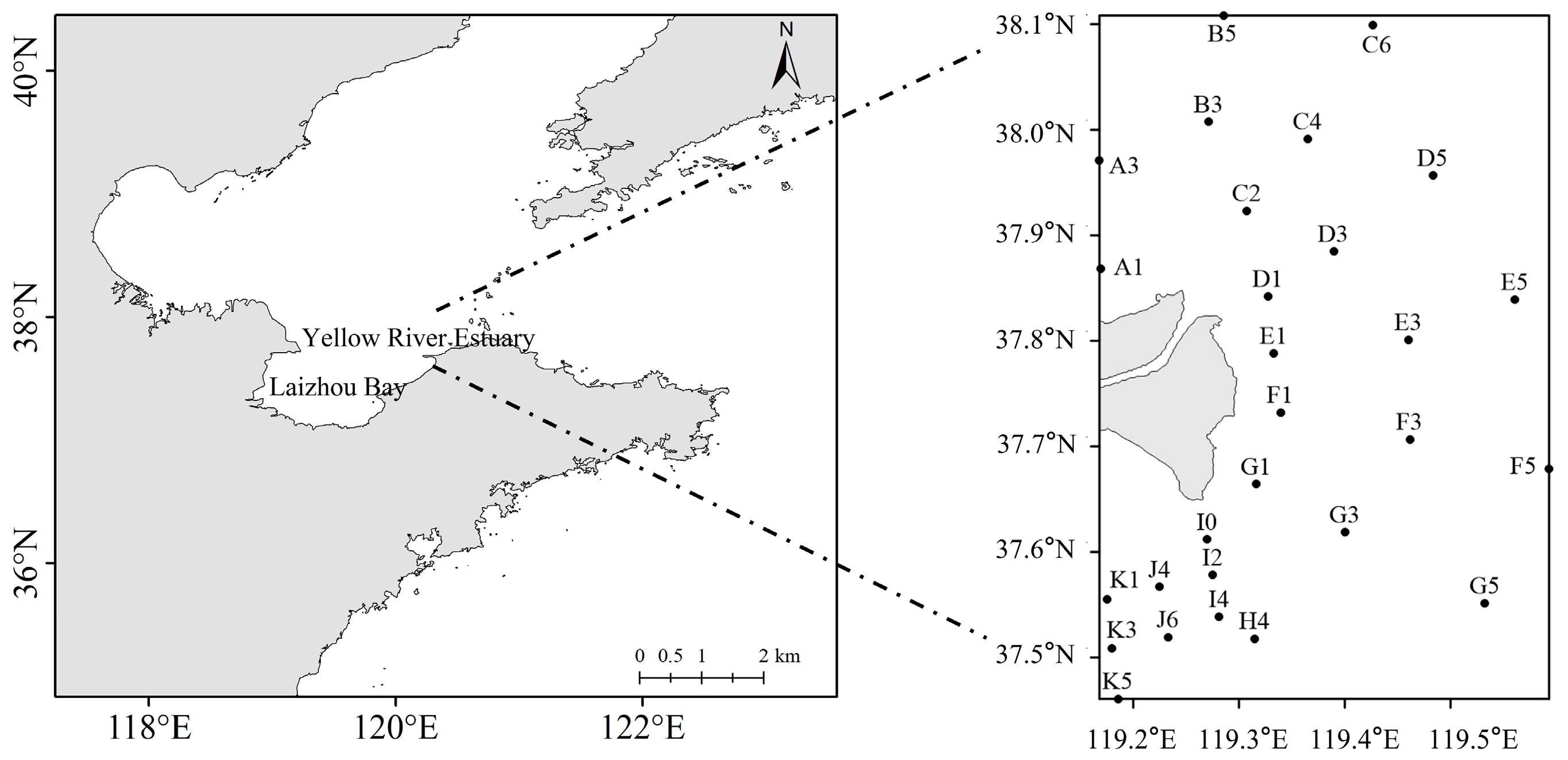
The study area is situated in the coastal waters adjacent to the YRE in northern Shandong Province, China, with its geographic coordinates ranging from 37.46° N to 38.11° N and 119.16° E to 119.60° E. The area has an average water depth of approximately 10 m, receiving inflows from major rivers including the Yellow River, Zhimai River, and Xiaoqing River. As a typical shallow continental shelf embayment influenced by interactions among anthropogenic activities, ocean currents, and wind-driven currents, frequent occurrences of drastic alterations in phytoplankton community composition induced by nutrient structural imbalances have been documented. The study area and monitoring points are depicted in Figure 1.

2.2. Field Sampling and Laboratory Analysis

The cruise survey was conducted in August 2023 following the completion of the WSRS, when the hydrological impact of freshwater release is strongest and the estuarine salinity and nutrient gradients are most pronounced. This period also coincides with higher temperatures and enhanced stratification, conditions that are highly relevant for understanding phytoplankton responses and HAB susceptibility in the YRE.
Water samples from the ocean surface (0–5 m depth) at 28 stations were collected with 200 mL aliquots filtered through 0.45 μm cellulose acetate membranes for nutrients analyses, 750 mL aliquots through 0.65 μm glass fiber membranes (pressure < 0.02 MPa) for Chl-a measurement, and 1000 mL aliquots through 0.22 μm mixed cellulose ester membranes (pressure < 0.02 MPa) for phytoplankton taxa determination. The 0.22 µm and 0.65 µm pore sizes were chosen because micro- and nano-phytoplankton dominate in the high-turbidity YRE, and this pore size ensures efficient capture of small cells for DNA extraction and Chl-a quantification. However, we acknowledge that this method may under-represent larger microphytoplankton. All membrane samples were preserved in centrifuge tubes under cryopreservation at −20 °C for subsequent laboratory analyses.
Extraction of phytoplankton community DNA was performed using the DNeasy Powersoil Pro Kit (QIAGEN, Hilden, Germany), where sample membranes were minced followed by lysis, centrifugation, and elution according to the manufacturer’s protocol, with blank controls processed concurrently. Following the assessment of DNA concentration and purity using NanoDrop, primer pairs 515F/907R (GTGCCAGCMGCCGCGGTAA/CCGTCAATTCMTTTRAGTTT) and 547F/V4R (CCAGCASCYGCGGTAATTCC/ACTTTCGTTCTTGATYRA) were selected for PCR amplification targeting the 18S rRNA and 16S rRNA genes, respectively. These primers are widely used in phytoplankton and microbial community studies. As with all universal primers, some degree of amplification bias is unavoidable, and certain taxa may be under-represented due to primer-template mismatches. The resulting amplicons were submitted to Shanghai Personal biotechnology Co., Ltd. (http://www.personalbio.cn/ (accessed on 5 January 2024)) for paired-end sequencing on the Illumina MiSeq platform. Amplicon Sequence Variants (ASVs) were generated using DADA2, followed by taxonomic annotation against the SILVA v132 database (99% identity threshold) with the Naïve Bayes classifier to derive taxa-relative abundance profiles.
Nutrient components NH4+, NO3, NO2, PO43− and SiO32− were measured using a Nutrient Autoanalyzer (Seal AutoAnalyzer AA3 HR, SEAL Analytical, Flensburg, Germany), with the principle based on spectrophotometry. For specific analytical procedures, refer to the QuAAtro Applications Method. The detection limits for NH4+, NO3, NO2, and SiO32− were 0.02 μmol/L, whereas PO43− had a detection limit of 0.01 μmol/L.
Chlorophyll a samples were treated with 90% acetone under dark conditions at 4 °C for 24 h extraction, followed by centrifugation at 4000 rpm for 10 min to retain the supernatant. Absorbance values were measured using an ultraviolet-visible spectrophotometer (UV5200, Shanghai Metash Instruments Co., Ltd., Shanghai, China) at wavelengths of 750, 664, 647, and 630 nm, with 90% acetone serving as the blank. Chlorophyll a concentration was calculated using the following formula:
C C h l a = [ 11.85   ( E 664 E 750 ) 1.54   ( E 647 E 750 ) 0.08   ( E 630 E 750 ) ]   ×   V a c e t o n e / V w a t e r
where E750, E664, E647, and E630 are the absorbance values at the respective wavelengths. Vacetone is the volume of acetone extract (mL). Vwater sample is the volume of filtered seawater (L).

2.3. Data Analysis

Spatial distribution patterns of environmental factors were mapped using Surfer 23, applying Kriging interpolation to visually represent the spatial patterns of nutrients and other environmental factors. Redundancy analysis (RDA) was performed using Canoco 5 to explore the relationships between major phytoplankton communities and environmental variables. Both environmental variables and community abundance data were standardized (z-score transformation) to eliminate the influence of differing scales. The significance of RDA was assessed using permutation tests with 999 permutations to evaluate the contribution of each axis and explanatory variable. In this study, alpha diversity indices (Shannon and Chao1) were calculated based on ASV-level relative sequence abundance derived from amplicon sequencing data. Because high-throughput sequencing provides read counts rather than cell abundance or biovolume measurements, diversity metrics were computed using sequence-based community profiles, which is the standard approach for metabarcoding studies. To identify spatial community patterns, K-means clustering was conducted in R (version 4.2.2). The optimal number of clusters (K) was determined using the silhouette method, which showed the highest silhouette coefficient at K = 2. This result is consistent with the ecological expectation that the YRE features two major phytoplankton regimes shaped by the strong estuarine–coastal gradient. Clustering was repeated 25 times to avoid local optima. Outlier stations exhibiting extreme biological or physicochemical values inconsistent with the regional hydrodynamic pattern were excluded, as these anomalies disproportionately influenced clustering and multivariate ordination outputs. To assess whether the community zones identified by K-means clustering exhibited statistically significant differences, a Mann–Whitney U non-parametric rank-sum test was performed. This method is suitable for data that do not necessarily follow a normal distribution and is used to evaluate whether the medians of two independent samples differ significantly. In the analysis, outlier samples were removed, a two-tailed test was applied, and the significance level was set at p < 0.05 to ensure robustness of the results. Indicator analysis was conducted using the IndVal method to identify phytoplankton genera associated with different zones [22]. Statistical significance was tested using 999 permutations, with IndVal > 0.6 and p < 0.05 considered significant.

3. Results and Discussion

3.1. Physical Conditions

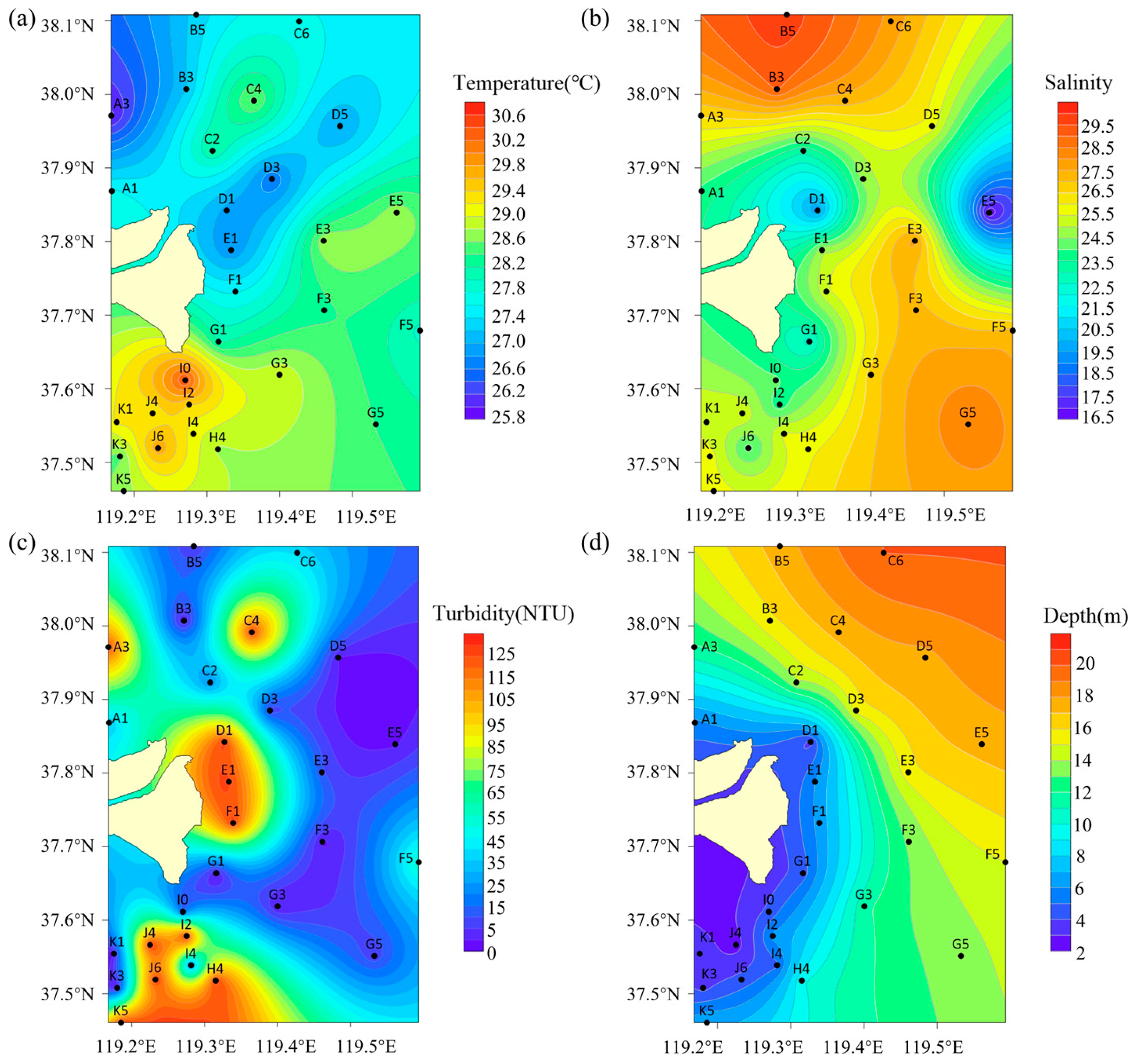
In the offshore area of the YRE, the ranges of temperature, salinity, turbidity, and water depth ranged from 25.9 to 30.4 °C, 16.6 to 29.7, 0 to 126.6 NTU, and 2.6 to 20 m with the mean values of 28.2 °C, 25.3, 51.4 NTU, and 10.3 m, respectively. All parameters demonstrated pronounced spatial heterogeneity (Figure 2). Within the zone influenced by the Yellow River’s freshwater discharge, temperatures and salinity were relatively lower, while turbidity was higher. The low salinity extended south to the Laizhou Bay, where elevated temperatures and turbidity were observed. Water depth demonstrated a trend of gradual deepening from the coast towards the open sea.

3.2. Spatial Variation in Phytoplankton Composition

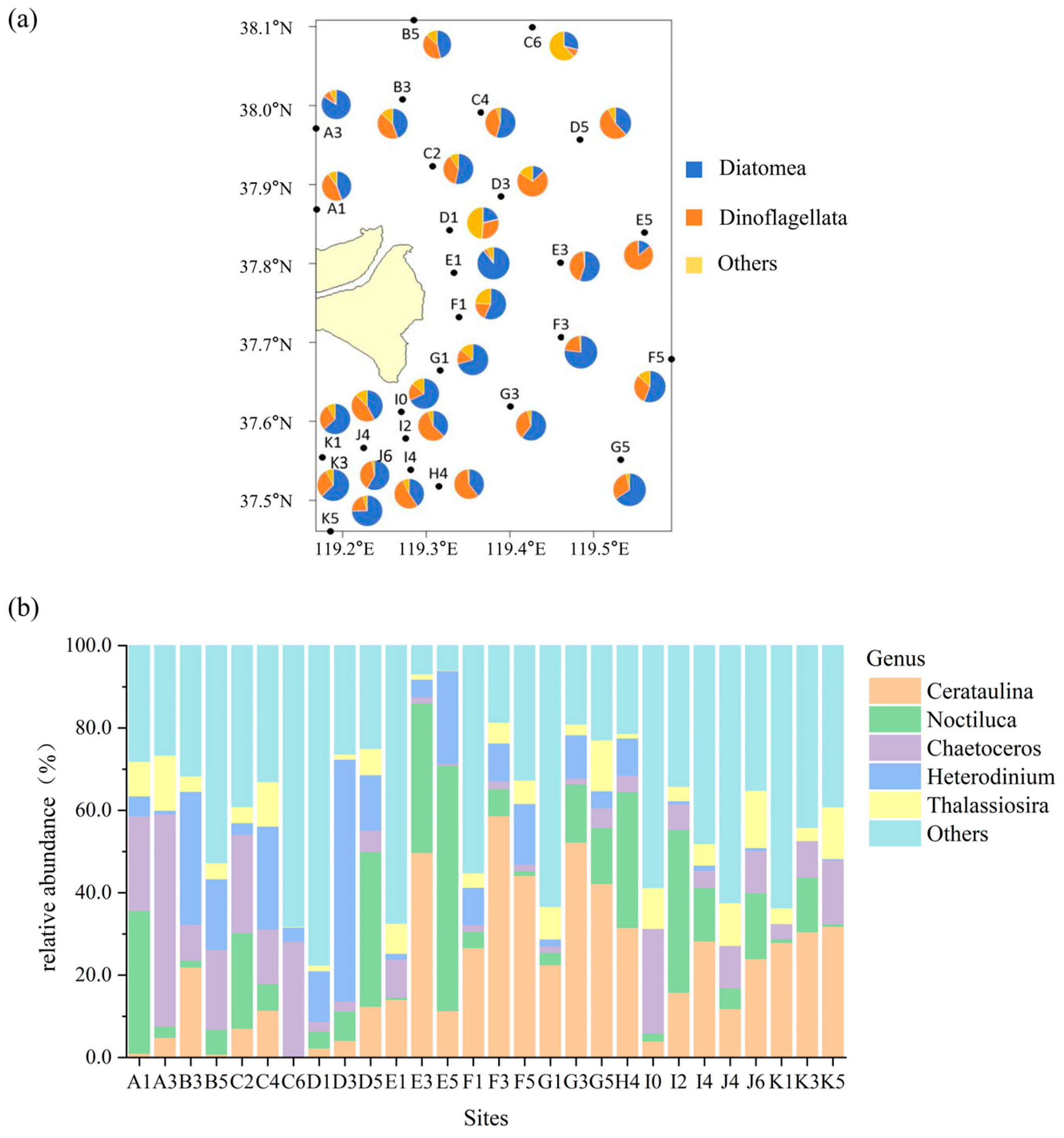
A total of 254 groups of eukaryotic phytoplankton were identified at the genus level, including 68 diatoms, 63 dinoflagellates, and smaller proportions of chlorophytes, cryptophytes, ochrophytes, and others (Figure S1). At the phylum level, the community was dominated by diatoms and dinoflagellates, which together accounted for >50% of total abundance (Figure 3a). In the YRE coastal waters, diatoms dominated the phytoplankton community, contributing more than 60% of total abundance at the stations in the southeastern estuary and Laizhou Bay (e.g., A3, E1, F3, G1-G5, I0, J6, and K1-K5; Figure 3a). By contrast, dinoflagellates were relatively more abundant in the northeastern parts of estuary and Bay (e.g., D3, D5, E5, I2, and H4). Previous studies in the Bohai Sea have reported the dominance of diatoms in nutrient-rich estuarine and bay waters and increase in dinoflagellates under altered nutrient regimes and reduced silicate availability [23]. The dominance of diatoms and dinoflagellates has also been documented in other eutrophic coasts, such as the western Mediterranean Sea [24].
Genera with a relative abundance greater than 5% at any station were defined as dominant genera. The top 5 dominant genera of eukaryotes in the YRE waters were Cerataulina (~21.1%), Noctiluca (~14.1%), Chaetoceros (~11.0%), Thalassiosira (~10.9%), and Heterodinium (~9.7%) (Figure 3b). These dominant taxa are consistent with earlier reports from the YRE and Bohai Sea, where diatoms such as Chaetoceros, Thalassiosira, Skeletonema, and Cerataulina, together with dinoflagellates including Noctiluca and Ceratium, have been repeatedly identified as key bloom-forming species [25]. Historical studies indicate that large centric diatoms (e.g., Chaetoceros, Coscinodiscus) dominated during the 20th century, but since 2000 smaller pennate diatoms (e.g., Nacicula, Nitzschia closterium) and benthic species such as Paralia sulcate have increased, while dinoflagellates (e.g., Ceratium, Noctiluca and Protoperidinium) have shown a clear rising trend [26]. The spatial distribution of dominant genera also varied regionally with Cerataulina dominated in the southeastern YRE and Laizhou Bay (sections F–K) and Chaetoceros and Heterodinium prevailed in the Yellow River diluted water area (sections A–E). Noctiluca and Thalassiosira were consistently abundant across all regions, indicating their broad ecological adaptability. Moreover, some genera identified in this study, such as Thalassiosira, Gyrodinium, Protoperidinium, and Pseudo-nitzschia, may reflect a combination of local growth and offshore transport [27,28,29]. These groups include both estuarine-tolerant species and oceanic species that can be advected landward through tidal mixing, coastal currents, or regional circulation.
Cyanobacteria in the YRE coastal waters were almost exclusively represented by Synechococcus CC9902 and Cyanobium PCC-6307, jointly accounting for >90% of the community (Figure S2). Synechococcus are well adapted to nutrient-enriched environments and can utilize diverse nitrogen sources, enabling their widespread distribution across aquatic systems [30]. In this study, Synechococcus dominated in the YRE, whereas Cyanobium were more abundant in Laizhou Bay (sections H–K). This distribution pattern agrees with earlier studies in the Bohai Sea and other eutrophic coasts, where Synechococcus are commonly reported as the prevailing cyanobacterial taxa [31,32,33].

3.3. Spatial Distribution of Phytoplankton Diversity

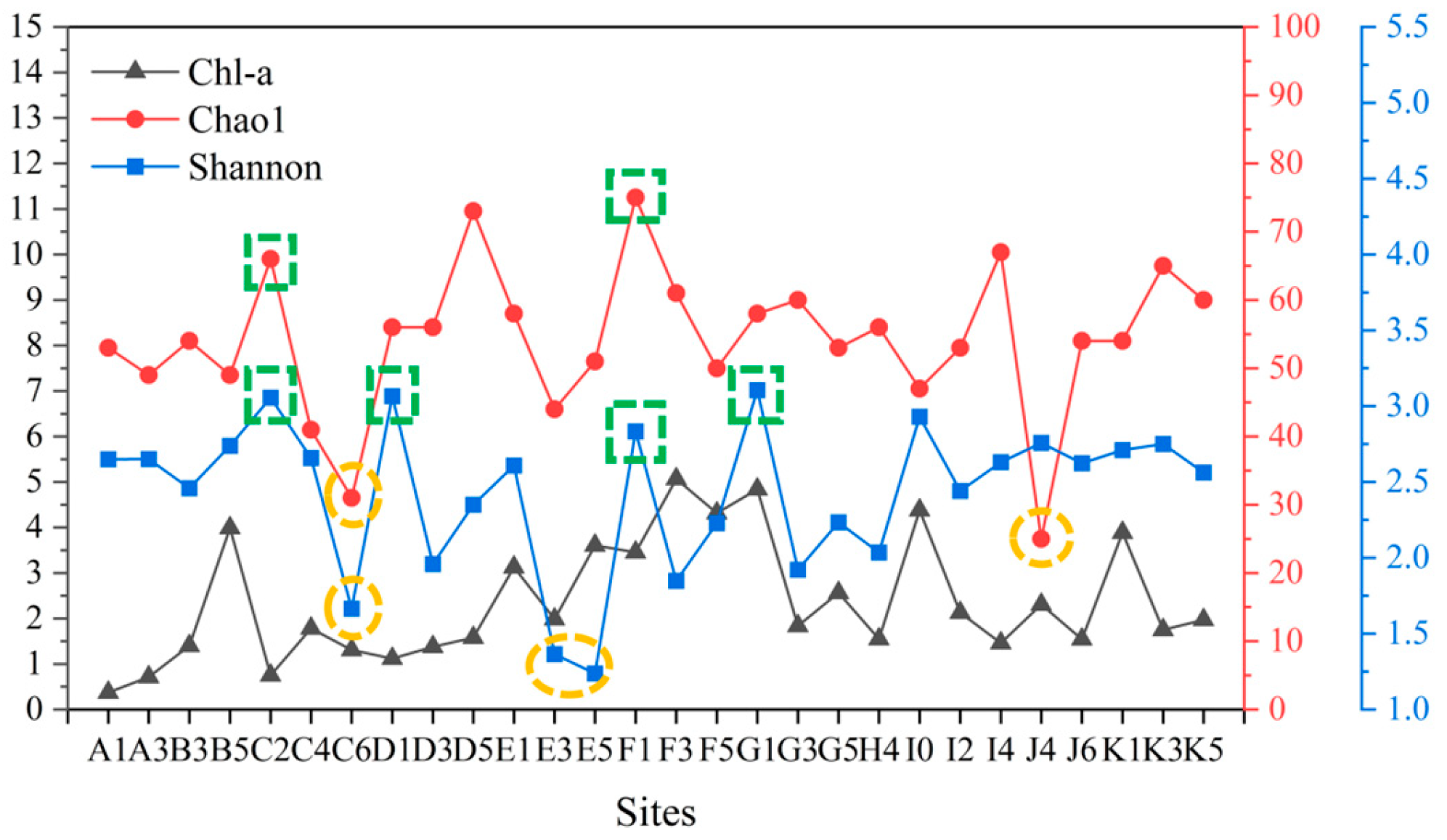
Alpha diversity was assessed using the Chao1 and Shannon indices, with mean values of 54.3 and 2.4, respectively (Figure 4). The Chao1 index reflects species richness, while the Shannon index integrates both richness and evenness to describe community diversity. Our observation of the Shannon index (2.4) is consistent with values reported in Laizhou Bay during 2004–2018 (1.29–2.77, average 2.22–2.28) [34] and in the Bohai Sea during 2011–2020 (2.0–2.6) [35].
Relatively high phytoplankton diversity was found at coastal stations C2, D1, F1, and G1 from the Yellow River mouth southward, with substantially varied Chl-a concentrations of 0.75, 1.1, 3.5, and 4.8 μg/L, respectively. These stations were located in shallow nearshore areas strongly affected by Yellow River dilution water. In contrast, the lowest diversity occurred at offshore stations farther from riverine influence (e.g., C6, E3, E5, and J4, with Chl-a concentrations of 1.3, 2.0, 3.6, and 2.3 μg/L, respectively), where nutrient ratios, salinity, and turbidity could be more stable. It is evident that the spatial distribution of phytoplankton diversity did not show a relationship with Chl-a concentrations. Higher diversity levels correspond to increased multidimensional complexity in community structure, thereby enhancing the robustness of ecosystem stability [31].

3.4. Distinct Zones in Diatom and Dinoflagellate Proportions

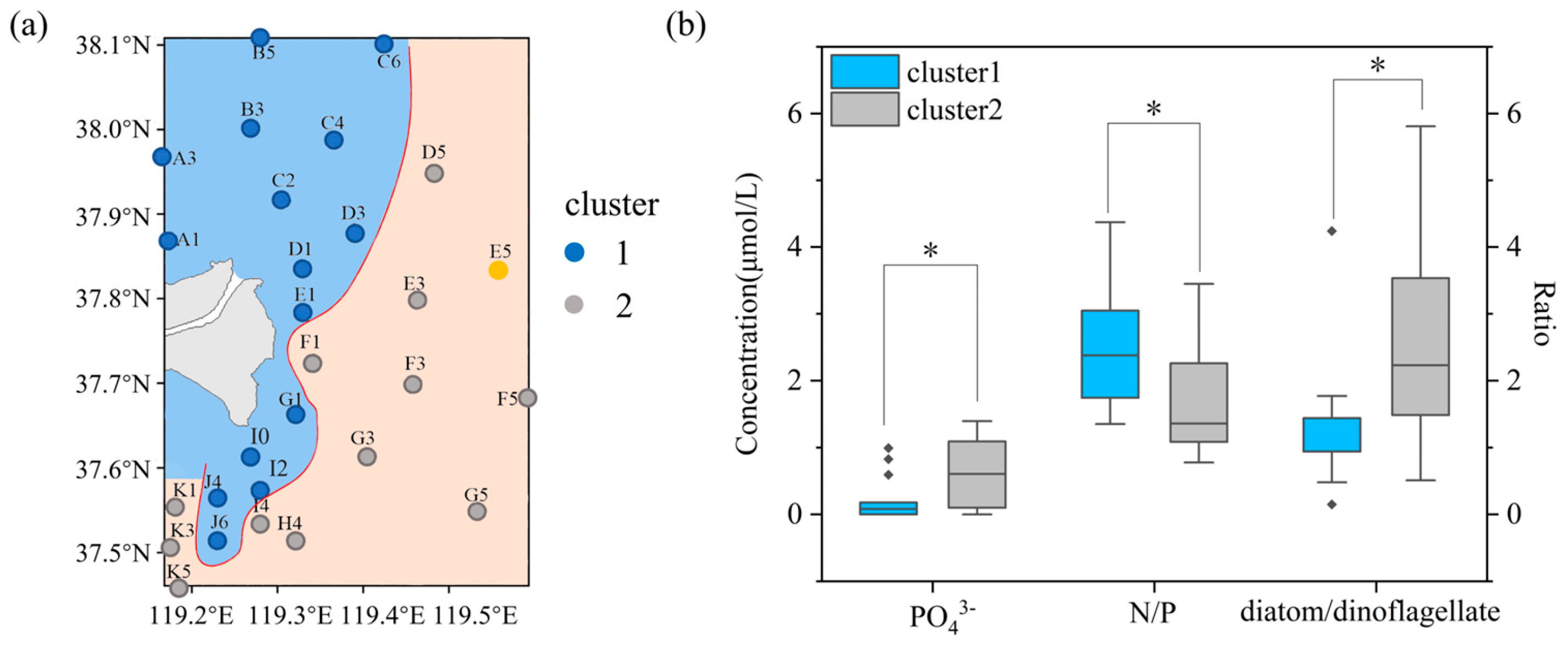
Based on the relative abundances of diatoms and dinoflagellates of each station (excluding E5), the K-means clustering algorithm was employed distinguish regional specific characteristics. Using the silhouette method, the optimal number of clusters was determined to be K = 2 (Figure S3). The numbers of stations included in Cluster1 and Cluster2 were 15 and 12, respectively (Figure 5a). The stations within Cluster1 were primarily located in the Yellow River diluted water region and the nearshore area. This cluster was generally characterized by low PO43− concentrations (0–0.99 μmol/L), high DIN (3.4–53.8 μmol/L, average 20.6 μmol/L), and low Chl-a (0.37–4.8 μg/L, average 2.1 μg/L) (Figures S3 and S4). The freshwater input from the Yellow River is dominated by nitrogen-rich agricultural and industrial runoff, while in the highly turbid estuary, phosphate is readily removed through adsorption processes. The phytoplankton community was predominantly composed of Noctiluca, Chaetoceros, and Heterodinium. The stations in Cluster2 were predominantly distributed in the southeastern area and Laizhou Bay (Figure 5a). Phosphate concentrations ranged from 0 to 1.4 μmol/L, DIN were relatively low (5.4–28.1 μmol/L, average 14.0 μmol/L), while Chl-a were higher (1.5–5.1 μg/L, average 2.6 μg/L) (Figures S4 and S5). The relatively high Chl-a in this region may result from the alleviated phosphorus limitation and a more favorable N/P stoichiometry for phytoplankton growth, complemented by the potential input of regenerated nitrogen and the lower turbidity that enhances light availability. The phytoplankton community was primarily dominated by Cerataulina and Noctiluca.
E5 exhibited markedly anomalous characteristics among all sampling stations and could therefore be regarded as a significant outlier warranting separate discussion (Figure 5a). At this station, salinity reached the lowest value across the region, while NH4+ concentrations were markedly elevated, reflecting a typical condition of severe eutrophication. Its phytoplankton community composition also differed substantially from those of other stations, characterized by the lowest diatom-to-dinoflagellate ratio (Figure 3a). Dinoflagellates, particularly Noctiluca and Heterodinium, were overwhelmingly dominant at E5, further indicating that its ecological environment diverges notably from other areas.
Although E5 is geographically located in the offshore region, it exhibits a combination of low salinity, elevated NH4+, and dinoflagellate dominance. This pattern is more likely driven by the interaction of multiple physical and biogeochemical processes rather than by the direct influence of Yellow River discharge. Possible drivers include the offshore extension of coastal low-salinity water transported by alongshore currents [36]. In the Bohai Sea, prevailing summer southerly-southeasterly winds and the associated northeastward surface circulation facilitate the seaward advection of the Yellow River diluted water, shaping the spatial distribution of salinity and suspended materials in the surrounding region [37,38,39]. Such wind-driven and circulation-mediated transport provides a plausible hydrodynamic pathway through which low-salinity water may reach E5. In addition, the input of regenerated nutrients through upwelling or vertical mixing [40]. Therefore, the anomaly observed at E5 is more plausibly a localized phenomenon shaped by regional hydrodynamics and nutrient regeneration processes, rather than a simple reflection of estuarine influence.

3.5. Difference in Nutrient Structures of Two Zones

To verify the differences in the environmental conditions and community structure between the above-mentioned clusters, a Mann–Whitney U non-parametric rank-sum test was performed on the diatom-to-dinoflagellate ratio and related environmental factors. After processing the outlier samples (A3, E1, G1, I0), the results revealed a significantly higher diatom-to-dinoflagellate ratio in Cluster2 compared to Cluster1 (p < 0.05, Figure 5b). Simultaneously, PO43− concentration and DIN/PO43− also showed significant differences between the two regions (p < 0.05), while no significant difference was found in DIN (Figure 5b and Figure S5). This indicates that PO43− and the associated DIN/PO43− ratio were likely key factors driving the changes in phytoplankton community composition in the YRE coastal waters, aligning with the pattern and results reported in previous research [41,42].
Nutrient limitation was further assessed using concentration thresholds and stoichiometric ratios [20,43]. In the offshore YRE, approximately 42% of stations had PO43− concentrations < 0.1 µmol/L, indicating absolute PO43− limitation (Figures S4 and S5). Based on nutrient ratios, ~57% of stations exhibited DIN/PO43− > 22 and ~46% had SiO32−/PO43− ratios > 22 (Figure S6), suggesting widespread relative PO43− limitation. By contrast, only ~4% of stations were DIN limited (DIN/PO43− < 10 and SiO32−/DIN > 1), while ~28.6% showed potentially SiO32− limitation (SiO32−/PO43− < 10 and SiO32−/DIN < 1) (Figure S6). Overall, the PO43−-limited zones distributed across nearshore and central YRE waters, SiO32−-limited zones concentrated in the southeastern offshore, and DIN-limited zones occurred only at a few offshore stations (Figure S5a). In addition to riverine inputs and other external nutrient sources, regenerated nutrients and sediment resuspension also play an important role in regulating nitrogen availability in estuarine ecosystems. Microbial communities and heterotrophic zooplankton in the water column continuously regenerate NH4+ through organic matter degradation and nitrogen mineralization, thereby providing an additional nitrogen source for dinoflagellates and other groups that preferentially utilize ammonium [44,45]. Sediment resuspension and benthic-pelagic coupling can release nutrients stored in the sediments back into the water column, promoting phytoplankton growth [46,47]. However, phosphate is more strongly adsorbed onto particulate matter and is therefore less efficiently released during resuspension compared to nitrogen [48,49]. This asymmetric regeneration of nitrogen and phosphorus further elevates the DIN/PO43− ratio, intensifies the existing phosphorus limitation in the region, and favors the dominance of dinoflagellates. These mechanisms are consistent with the spatial patterns of phytoplankton community structure observed in this study.
The coexistence of widespread absolute PO43− scarcity and the statistical importance of PO43− and DIN/PO43− in explaining diatom to dinoflagellate ratios provides strong empirical support for our proposed mechanism. Research in Xiamen Bay has shown that high DIN/PO43− ratios lead to widespread phosphorus limitation, thereby altering the relative abundance of major phytoplankton groups [50]. Along the East China Sea coast, interactions among different water masses and the influence of upwelling similarly shape the spatial distribution of phytoplankton: dinoflagellates dominate regions influenced by Changjiang Diluted Water, whereas diatoms are more abundant in areas where diluted water mixes with Kuroshio-derived upwelling [51].Furthermore, dinoflagellates possess enhanced heterotrophic or mixotrophic capacities, conferring superior adaptability to nutrient-enriched environments. In the PO43−-depleted, NO3-enriched environment of the YRE waters, elevated nitrogen concentrations no longer enhance phytoplankton growth, whereas phosphorus emerges as the predominant factor constraining phytoplankton productivity (Figure S5b) [52]. Wang et al. [53] consistently identified top-down controls as dominant regulators of Chl-a concentrations, with PO43− emerging as the critical limiting factor during the late-phase WSRS. The community shift observed here aligns with the general principle that nutrient concentration changes significantly influence diatom-dinoflagellate competition, with dinoflagellates gaining a competitive advantage under high nutrient conditions [8].
In coastal ecosystems subjected to substantial anthropogenic disturbance, hydrodynamic processes often regulate water mass structure, mixing intensity, and nutrient transport, thereby influencing phytoplankton competition and reshaping community composition [54]. Bisinicu and Lazar [55] found that the dam breach has significantly increased silicate and nitrate concentrations regulating mesozooplankton communities in the Romanian Black Sea coast. They also observed the increasing biodiversity and environmental quality from transitional to marine environments. It has been suggested that freshwater inflow events such as dam breaches, major floods, and water-sediment regulations may provide critical insights into how ecosystems respond to significant nutrient and sediment inputs. In the YRE, strong river discharge establishes pronounced salinity gradients, and dinoflagellates exhibit greater tolerance to salinity fluctuations than diatoms [13,56]. By contrast, silicate inputs from the Yellow River undergo rapid sedimentation in the estuary, subsequently dispersing southward and offshore via alongshore currents and resuspension processes, thereby replenishing silicate concentrations [57,58]. These regions feature stabilized water columns and balanced nutrient stoichiometry, providing optimal habitats for diatom proliferation. Additionally, the high turbidity associated with freshwater inputs near the estuary induces light limitation, further promoting the growth of low-light-adapted dinoflagellates, whereas the lower turbidity in offshore waters supports the rapid photosynthetic growth of diatoms [59,60]. Collectively, our results suggest that nutrient stoichiometry, together with hydrodynamic modulation of resource availability, jointly shapes phytoplankton community structure in the YRE and adjacent waters. In particular, persistently high DIN/PO43− ratios favor dinoflagellates due to their stronger competitive performance under phosphorus-limited conditions, contributing to their dominance in nearshore, river-influenced waters and may increase ecological risks associated with HAB development [31].

3.6. Controlling Factors of Phytoplankton Taxa

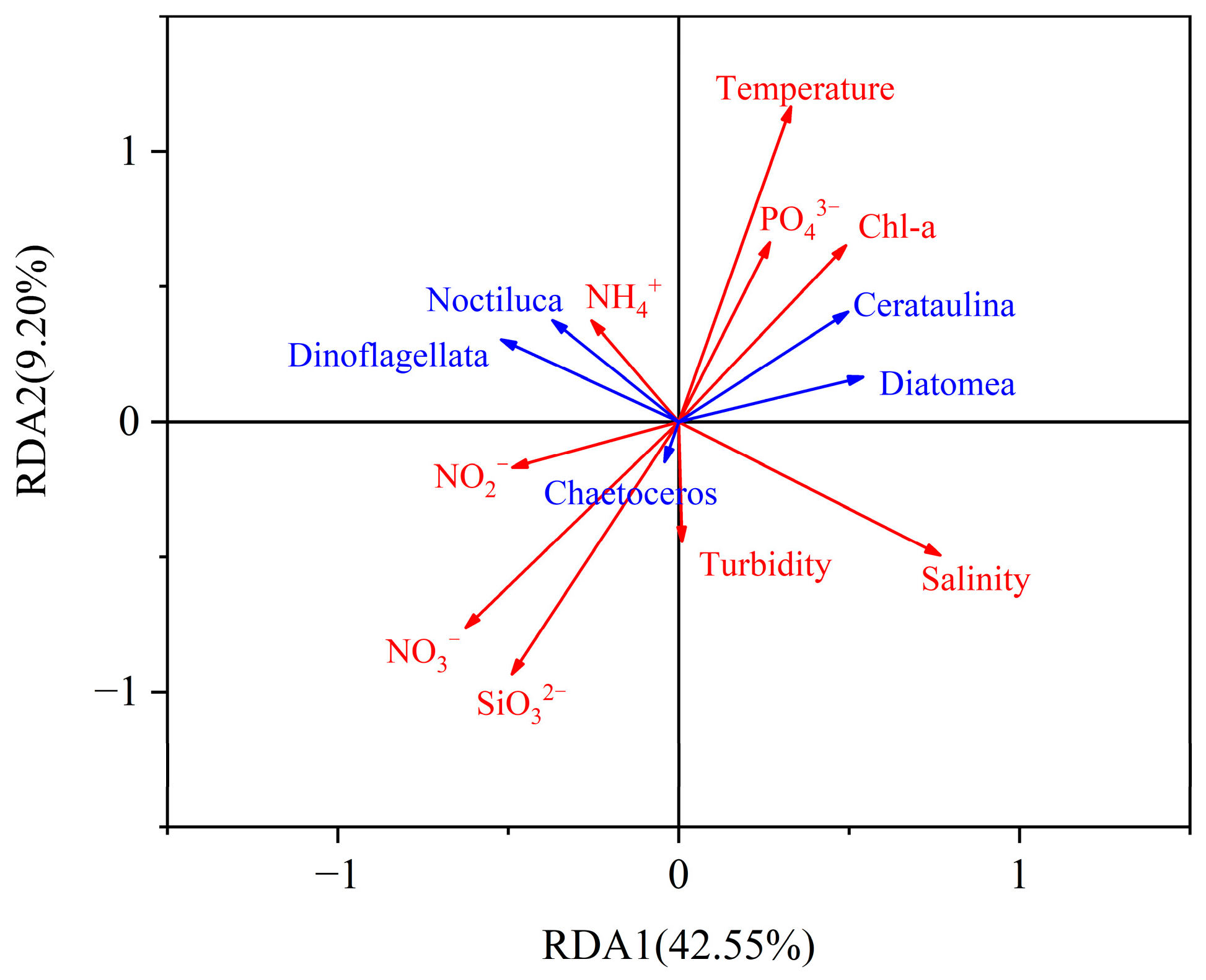
Redundancy analysis was conducted to investigate relationships between major eukaryotic phytoplankton groups (diatoms and dinoflagellates) and dominant genera (Cerataulina, Noctiluca, and Chaetoceros) and environmental variables in the YRE and adjacent waters (Figure 6). These three genera were selected due to their high relative abundance across stations and their ecological sensitivities to key estuarine environmental gradients. Their pronounced associations with environmental variables in the RDA further substantiate their suitability as representative and environmentally responsive taxa in the YRE. Axis 1 and Axis 2 explained 42.55% and 9.20% of the variance, respectively. Diatom Cerataulina was positively correlated with salinity, Chl-a, temperature, and PO43−, but negatively correlated with NO3 and SiO32−. Cerataulina is a primary contributor to Chl-a in the estuary and its proliferation further enhanced by elevated summer temperatures. Cerataulina pelagica is recognized as the representative species of this genus, with numerous studies showing that it can rapidly proliferate following nutrient-pulse inputs or episodes of enhanced shallow mixing, making it a typical short-term responder in coastal phytoplankton communities [61,62]. The short vector for Chaetoceros in the RDA biplot indicated weak loadings on the main environmental gradients, implying that its spatial pattern was only weakly explained by the measured variables and may reflect broader tolerance. Consistently, Chaetoceros ranks among the most dominant and diverse diatom genera in global marine phytoplankton, particularly prospering in nutrient-enriched regimes [32]. Within Chaetoceros, species such as C. pseudocurvisetus and C. curvisetus are known to be sensitive to nutrient supply, particularly silicate, and typically increase rapidly when SiO32− is abundant and N:P ratios are moderate [63,64]. This ecological preference aligns well with the positive association between Chaetoceros and silicate revealed in our results, further supporting its role as a silicate-responsive taxon in the estuary. The dinoflagellate Noctiluca showed positive associations with temperature and NH4+, whereas it was negatively associated with salinity. This is compatible with the wide distribution of Noctiluca in temperate to tropical coasts, whose populations often surge in eutrophic nearshore, estuarine, and upwelling systems [65]. Noctiluca scintillans often proliferates under elevated NH4+, warm temperatures, and strengthened stratification, and is widely recognized as an indicator of eutrophication and high red-tide risk due to its ability to rapidly restructure plankton communities [66,67]. This alga’s cells are rich in NH4+ salts, potentially altering seawater quality and impacting the ecological environment [33].
Vectors for PO43−, temperature, and salinity formed acute angles with the diatom vector and were nearly perpendicular or opposed to the dinoflagellate vector, indicating positive affinities with diatoms but weak or negative associations with dinoflagellates [68]. In contrast, NO3, NH4+, and SiO32− aligned positively with dinoflagellates. NO3 and SiO32− showed a significantly positive correlation, and both negatively correlated with salinity (Figure S8), suggesting that both nutrients were mainly supplied by Yellow River discharge favoring dinoflagellate growth. The RDA results were further consistent with the key factors identified through K-means clustering and the non-parametric significance tests, reinforcing the central role of PO43− and the DIN/PO43− ratio in regulating diatom to dinoflagellate shifts.
IndVal analyses were conducted to identify the representative genera at different sampling sites. According to the IndVal, Coscinodiscus was identified as an indicator of the Yellow River diluted water region and the nearshore area (Cluster 1; IndVal = 0.632, p = 0.029), while Mamiella was significantly associated with the offshore and Laizhou Bay region (Cluster 2; IndVal = 0.610, p = 0.026). Coscinodiscus growth is strongly influenced by nutrient availability, particularly showing a high dependence on silicate. Experimental studies have demonstrated that Coscinodiscus exhibits high uptake kinetics and silicon requirement thresholds, which confer a competitive advantage in silicate-rich waters [69]. In contrast, Mamiella belongs to the Mamiellophyceae, a group commonly found in coastal and oligotrophic waters. Based on a global survey of coastal samples, members of this class have been shown to have a widespread distribution across a broad range of coastal environments, with their occurrence shaped by adaptations to lower nutrient concentrations and environmental gradients [70,71].
Although zooplankton were not measured in this study, previous research in the Bohai Sea indicates that copepods (e.g., Oithona similis, Paracalanus sp., Calanus sinicus) and other microzooplankton are typically the dominant grazers during summer [72,73,74]. These grazers may impose selective top-down pressure on small diatoms and dinoflagellates, potentially contributing to some of the spatial patterns observed in our phytoplankton community. Incorporating zooplankton data in future surveys would help clarify these grazer–phytoplankton interactions.
This study is based on a short-term survey, and therefore the observed spatial patterns may be influenced by transient environmental fluctuations. In addition, sampling was restricted to the surface layer, which may not adequately capture the full vertical structure of phytoplankton in a stratified estuarine system. The filtration sampling and molecular methods employed may also underestimate larger microphytoplankton and certain groups. These limitations suggest that further studies with long-term or multiyear monitoring and comparisons of various sampling and analytical methods are needed for understanding the mechanisms of phytoplankton ecosystem and for providing the guidance of water management.

4. Conclusions

This study investigated environmental factors influencing the diatom to dinoflagellate ratio through an across-site comparison in the YRE coastal waters. The phytoplankton community was mainly composed of diatoms and dinoflagellates, accounting for more than half of the total abundance, and exhibited pronounced spatial differentiation: diatoms (e.g., Cerataulina, Chaetoceros) dominated the southeastern sector and Laizhou Bay, whereas dinoflagellates (Noctiluca, Heterodinium) prevailed in low-salinity, high DIN, and low PO43− nearshore waters strongly influenced by riverine inputs. The mean Shannon index was 2.4, comparable to previously reported values in Laizhou Bay and the Bohai Sea, indicating a diverse and relatively stable summer community structure.
K-means clustering identified two ecological zones: an offshore region with a more balanced nutrient structure and diatom dominance and a nearshore region characterized by DIN/PO43− imbalance and dinoflagellate prevalence. Subsequent RDA showed that PO43− and salinity were positively associated with diatoms, whereas NO3, NH4+, and SiO32− were more closely related to dinoflagellates, clearly demonstrating that DIN/PO43− imbalance and phosphorus limitation were the key mechanisms driving the diatom to dinoflagellate shift. This study clarifies how the nutrient structure shapes the spatial organization of phytoplankton in the estuary waters, providing scientific insight for understanding estuarine phytoplankton dynamics and informing regional ecological restoration.
From a management perspective, our results suggest that regulating riverine nitrogen inputs is critical for the YRE. Stations characterized by relatively high DIN concentrations (generally > ~15–20 µM) together with low phosphate availability (PO43− < ~0.1 µM) exhibited elevated DIN/PO43− ratios and an increased relative contribution of dinoflagellates conditions commonly associated with higher HAB risk. Therefore, maintaining DIN below ~20 µM, alongside routine monitoring of the PO43− concentration and DIN/PO43− ratio, could support eutrophication mitigation strategies and HAB risk assessment.

Supplementary Materials

The following supporting information can be downloaded at: https://www.mdpi.com/article/10.3390/w18010054/s1, Figure S1: Eukaryotic phytoplankton community composition at phylum level; Figure S2: Cyanobacterial community structure at genus level; Figure S3: Cyanobacterial community structure at genus level; Figure S4: Distributions of (a) SiO32−, (b) NO3, (c) NH4+, (d) PO43−, (e) NO2 and (f) DIN in the Yellow River Estuary and adjacent waters during 14–18 August 2023; Figure S5: Distributions of (a) nutrient limitation zones and (b) Chl-a in the Yellow River Estuary and adjacent waters during 14–18 August 2023; Figure S6: Distributions of (a) log (DIN/PO43−), (b) log (SiO32−/DIN) and (c) log (SiO32−/PO43−) in the Yellow River Estuary and adjacent waters during 14–18 August 2023; Figure S7: Box plot of dissolved inorganic nitrogen (DIN), Chlorophyll a (Chl-a), Chao1 and Shannon indices in the Yellow River Estuary and adjacent waters during 14–18 August 2023 (no statistically significant differences between cluster1 and 2). The plotted data were log-transformed; Figure S8: Correlation matrix of environmental factors in the Yellow River Estuary and adjacent waters during 14–18 August 2023, with red and blue indicating positive and negative correlations, respectively; Table S1: Relative abundance of the top five eukaryotic phytoplankton at the phylum level; Table S2: Relative abundance of the top ten eukaryotic phytoplankton at the genus level; Table S3: Phytoplankton community diversity, including the Chao1 diversity index and the Shannon diversity index.

Author Contributions

Conceptualization, Y.C.; validation, Y.L.; formal analysis, Y.L. and Y.C.; investigation, D.Z.; data curation, Y.L., M.Z. and H.R.; writing—original draft preparation, Y.L.; writing—review and editing, Y.L. and Y.C.; methodology, Y.L., M.Z., K.Y. and Y.C.; supervision, Y.C.; funding acquisition, Z.G. and Y.C. All authors have read and agreed to the published version of the manuscript.

Funding

This research was funded by the Key Program of the National Natural Science Foundation of China (No. 42530101) and the Shanghai Natural Science Foundation of China (No. 22ZR1403800).

Data Availability Statement

The original contributions presented in this study are included in the article/Supplementary Materials. Further inquiries can be directed to the corresponding author.

Acknowledgments

We acknowledge Naishuang Bi from Ocean University of China for providing the cruise platform support in the Yellow River Estuary.

Conflicts of Interest

The authors declare no conflicts of interest.

Abbreviations

The following abbreviations are used in this manuscript:
YREYellow River Estuary
WSRSWater-Sediment Regulation Scheme
RDARedundancy analysis
ASVsAmplicon sequence variants

References

  1. Kwon, E.Y.; Sreeush, M.G.; Timmermann, A.; Karl, D.M.; Church, M.J.; Lee, S.-S.; Yamaguchi, R. Nutrient uptake plasticity in phytoplankton sustains future ocean net primary production. Sci. Adv. 2022, 8, eadd2475. [Google Scholar] [CrossRef] [PubMed]
  2. Akter, S.; Nama, S.; Wodeyar, K.A.; Deshmukhe, G.; Nayak, B.B.; Jaiswar, A.K.; Landge, A.T.; Ramteke, K. Unravelling tropical estuary health through a multivariate analysis of spatiotemporal phytoplankton diversity and community structure in relation to environmental interactions. Aquat. Sci. 2024, 86, 109. [Google Scholar] [CrossRef]
  3. Ptacnik, R.; Solimini, A.G.; Andersen, T.; Tamminen, T.; Brettum, P.; Lepisto, L.; Willen, E.; Rekolainen, S. Diversity predicts stability and resource use efficiency in natural phytoplankton communities. Proc. Natl. Acad. Sci. USA 2008, 105, 5134–5138. [Google Scholar] [CrossRef] [PubMed]
  4. Zhang, J.; Li, F.; Lv, Q.; Wang, Y.; Yu, J.; Gao, Y.; Ren, Z.; Zhang, X.; Lv, Z. Impact of the Water-Sediment Regulation Scheme on the phytoplankton community in the Yellow River estuary. J. Clean. Prod. 2021, 294, 126291. [Google Scholar] [CrossRef]
  5. Ren, Z.; Li, F.; Wei, J.; Li, S.; Lv, Z.; Gao, Y.; Cong, X. Community characteristics of macrobenthos in the Huanghe (Yellow River) Estuary during water and sediment discharge regulation. Acta Oceanol. Sin. 2016, 35, 74–81. [Google Scholar] [CrossRef]
  6. Howarth, R.W.; Marino, R. Nitrogen as the limiting nutrient for eutrophication in coastal marine ecosystems: Evolving views over three decades. Limnol. Oceanogr. 2006, 51, 364–376. [Google Scholar] [CrossRef]
  7. Zhou, Y.; Zhang, Y.; Li, F.; Tan, L.; Wang, J. Nutrients structure changes impact the competition and succession between diatom and dinoflagellate in the East China Sea. Sci. Total Environ. 2017, 574, 499–508. [Google Scholar] [CrossRef]
  8. Bi, R.; Cao, Z.; Ismar-Rebitz, S.M.H.; Sommer, U.; Zhang, H.; Ding, Y.; Zhao, M. Responses of Marine Diatom-Dinoflagellate Competition to Multiple Environmental Drivers: Abundance, Elemental, and Biochemical Aspects. Front. Microbiol. 2021, 12, 731786. [Google Scholar] [CrossRef]
  9. Krause, J.W.; Schulz, I.K.; Rowe, K.A.; Dobbins, W.; Winding, M.H.S.; Sejr, M.K.; Duarte, C.M.; Agusti, S. Silicic acid limitation drives bloom termination and potential carbon sequestration in an Arctic bloom. Sci. Rep. 2019, 9, 8149. [Google Scholar] [CrossRef]
  10. Bondoc, K.G.V.; Heuschele, J.; Gillard, J.; Vyverman, W.; Pohnert, G. Selective silicate-directed motility in diatoms. Nat. Commun. 2016, 7, 10540. [Google Scholar] [CrossRef]
  11. Yang, H.; Hu, Z.; Tang, Y.Z. Plasticity and Multiplicity of Trophic Modes in the Dinoflagellate Karlodinium and Their Pertinence to Population Maintenance and Bloom Dynamics. J. Mar. Sci. Eng. 2021, 9, 51. [Google Scholar] [CrossRef]
  12. Mena, C.; Long, M.; Lorand, O.; Malestroit, P.; Rabiller, E.; Maguer, J.-F.; L’Helguen, S.; De Gioux, A.R. Impact of light and nutrient availability on the phagotrophic activity of harmful bloom-forming dinoflagellates. J. Plankton Res. 2024, 47, fbae038. [Google Scholar] [CrossRef] [PubMed]
  13. Weng, C.; Ding, D.; Yang, Q.; Zhu, L.; Sun, J.; Qu, K.; Cui, Z.; Wei, Y. Significance of temperature and salinity in the dynamics of diatoms and dinoflagellates along the coastal Yellow Sea. Prog. Oceanogr. 2025, 234, 103478. [Google Scholar] [CrossRef]
  14. Yuan, M.; Jiang, C.; Weng, X.; Zhang, M. Influence of Salinity Gradient Changes on Phytoplankton Growth Caused by Sluice Construction in Yongjiang River Estuary Area. Water 2020, 12, 2492. [Google Scholar] [CrossRef]
  15. Song, Y.Y.; Guo, Y.Y.; Liu, H.J.; Zhang, G.C.; Zhang, X.D.; Thangaraj, S.; Sun, J. Water quality shifts the dominant phytoplankton group from diatoms to dinoflagellates in the coastal ecosystem of the Bohai Bay. Mar. Pollut. Bull. 2022, 183, 114078. [Google Scholar] [CrossRef]
  16. Fang, F.T.; Zhu, Z.Y.; Ge, J.Z.; Deng, B.; Du, J.Z.; Zhang, J. Reconstruction of the main phytoplankton population off the Changjiang Estuary in the East China Sea and its assemblage shift in recent decades: From observations to simulation. Mar. Pollut. Bull. 2022, 178, 113638. [Google Scholar] [CrossRef]
  17. Klais, R.; Tamminen, T.; Kremp, A.; Spilling, K.; Olli, K. Decadal-Scale Changes of Dinoflagellates and Diatoms in the Anomalous Baltic Sea Spring Bloom. PLoS ONE 2011, 6, e21567. [Google Scholar] [CrossRef]
  18. Liu, S.M.; Li, L.W.; Zhang, G.L.; Liu, Z.; Yu, Z.G.; Ren, J.L. Impacts of human activities on nutrient transports in the Huanghe (Yellow River) estuary. J. Hydrol. 2012, 430, 103–110. [Google Scholar] [CrossRef]
  19. Li, G.; Sheng, L. Model of water-sediment regulation in Yellow River and its effect. Sci. China Technol. Sci. 2011, 54, 924–930. [Google Scholar] [CrossRef]
  20. Li, B. Research summarize on dynamic mechanisms of geomorphological evolution in world estuary delta. Shanghai Land Resour. 2020, 41, 93–97. Available online: https://kns.cnki.net/kcms2/article/abstract?v=zYSMMY9t1scDx8GkwJV14eYnw655iyHErd3umSYA-iZ65WrwDFUf4CCX3AXXNxmCp4_LyqxjtCG3vgtyuK1b-R6u31dcZLOmaVUrsXIojfD-l5EAkPIM-_WrXa1c3r8ahMGk2YM52LCEWaDpPVlQnlZWfy7iHdZEV9CPLpcVMdNvu98xFx8SaHPlsQwy33Zc&uniplatform=NZKPT&language=CHS (accessed on 21 December 2025).
  21. Qiao, S.; Yang, Y.; Xu, B.; Yang, Y.; Zhu, M.; Li, F.; Yu, H. How the Water-Sediment Regulation Scheme in the Yellow River affected the estuary ecosystem in the last 10 years? Sci. Total Environ. 2024, 927, 172002. [Google Scholar] [CrossRef]
  22. Dufrene, M.; Legendre, P. Species assemblages and indicator species: The need for a flexible asymmetrical approach. Ecol. Monogr. 1997, 67, 345–366. [Google Scholar] [CrossRef]
  23. Wang, H.; Qin, H.; Qiao, S.; Li, F.; Shi, H.; Zhang, X. Effect of the yellow river runoff into the sea on the salinity of the waters near the estuary. Coast. Eng. 2022, 41, 115–127. [Google Scholar] [CrossRef]
  24. Justic, D.; Rabalais, N.N.; Turner, R.E. Stoichiometric nutrient balance and origin of coastal eutrophication. Mar. Pollut. Bull. 1995, 30, 41–46. [Google Scholar] [CrossRef]
  25. Nelson, D.M.; Treguer, P.; Brzezinski, M.A.; Leynaert, A.; Queguiner, B. Production and dissolution of biogenic silica in the ocean-revised global estimates, comparison with regional data and relationship to biogenic sedimentation. Glob. Biogeochem. Cycles 1995, 9, 359–372. [Google Scholar] [CrossRef]
  26. Duan, X.; Qin, H.; Ma, H.; Xu, Z.; Lv, H.; Liang, S. Temporospatial distribution of phosphorus and response of phytoplankton to low phosphorus stress in the Yellow River estuary and Laizhou Bay. Period. Ocean. Univ. China 2023, 53, 87–98. [Google Scholar] [CrossRef]
  27. von Dassow, P.; Mikhno, M.; Percopo, I.; Orellana, V.R.; Aguilera, V.; Alvarez, G.; Araya, M.; Cornejo-Guzman, S.; Llona, T.; Mardones, J.I.; et al. Diversity and toxicity of the planktonic diatom genus Pseudo-nitzschia from coastal and offshore waters of the Southeast Pacific, including Pseudo-nitzschia dampieri sp. nov. Harmful Algae 2023, 130, 102520. [Google Scholar] [CrossRef]
  28. Chappell, P.D.; Whitney, L.P.; Haddock, T.L.; Menden-Deuer, S.; Roy, E.G.; Wells, M.L.; Jenkins, B.D. Thalassiosira spp. community composition shifts in response to chemical and physical forcing in the northeast Pacific Ocean. Front. Microbiol. 2013, 4, 54400. [Google Scholar] [CrossRef]
  29. Manning, T.; Thilagaraj, A.V.; Mouradov, D.; Piola, R.; Grandison, C.; Gordon, M.; Shimeta, J.; Mouradov, A. Diversity of dinoflagellate assemblages in coastal temperate and offshore tropical waters of Australia. BMC Ecol. Evol. 2021, 21, 27. [Google Scholar] [CrossRef]
  30. Wu, X.; Duan, H.; Bi, N.; Yuan, P.; Wang, A.; Wang, H. Interannual and seasonal variation of chlorophyll-a off the Yellow River Mouth (1997–2012): Dominance of river inputs and coastal dynamics. Estuar. Coast. Shelf Sci. 2016, 183, 402–412. [Google Scholar] [CrossRef]
  31. Xin, M.; Wang, B.; Xie, L.; Sun, X.; Wei, Q.; Mang, S.; Chen, K. Long-term changes in nutrient regimes and their ecological effects in the Bohai Sea, China. Mar. Pollut. Bull. 2019, 146, 562–573. [Google Scholar] [CrossRef]
  32. Torres, E.S.; del Rio, J.G. Spatial variations of phytoplankton community structure in a highly eutrophicated coast of the Western Mediterranean Sea. Water Sci. Technol. 1995, 32, 313–322. [Google Scholar] [CrossRef]
  33. Chen, N.; Huang, H. Advances in the study of biodiversity of phytoplankton and red tide species in China (I): The Bohai Sea. Oceanol. Limnol. Sin. 2021, 52, 346–362. [Google Scholar] [CrossRef]
  34. Jiang, H.; He, J.; Cheng, L.; Liu, N.; Fu, P.; Wang, N.; Jiang, X.; Sun, S.; Zhang, J. Long-term response of plankton assemblage to differentiated nutrient reductions in Laizhou Bay, China. J. Sea Res. 2024, 198, 102490. [Google Scholar] [CrossRef]
  35. Wang, Y.; Liu, Z.; Qi, Y.; Chen, X.; Chen, Y.; Su, D.; Yuan, X.; Klippel-Cooper, J. Response of phytoplankton communities to environmental changes in the Bohai Sea in late summer (2011–2020). Acta Oceanol. Sin. 2024, 43, 107–120. [Google Scholar] [CrossRef]
  36. Wang, Y.Y.; Bi, R.; Gao, J.W.; Zhang, H.L.; Li, L.; Ding, Y.; Jin, G.E.; Zhao, M.X. Kuroshio Intrusion Combined with Coastal Currents Affects Phytoplankton in the Northern South China Sea Revealed by Lipid Biomarkers. J. Ocean Univ. China 2023, 22, 576–586. [Google Scholar] [CrossRef]
  37. Wang, Q.; Guo, X.; Takeoka, H. Seasonal variations of the Yellow River plume in the Bohai Sea: A model study. J. Geophys. Res. Ocean. 2008, 113, C08046. [Google Scholar] [CrossRef]
  38. Bian, C.; Jiang, W.; Pohlmann, T.; Suendermann, J. Hydrography-Physical Description of the Bohai Sea. J. Coast. Res. 2016, 74, 1–12. [Google Scholar] [CrossRef]
  39. Liu, X.; Qiao, L.; Li, G.; Zhong, Y.; Miao, H.; Hu, R. Discontinuity of sediment transport from the Bohai Sea to the open sea dominated by the wind direction. Estuar. Coast. Shelf Sci. 2023, 293, 108486. [Google Scholar] [CrossRef]
  40. Lee, B.; Lee, C.H.; Kim, Y.B.; Kim, C.H.; Park, C.H.; Baek, S.H. Impacts of stratified water column on summer phytoplankton community structure and dynamics in the East Sea, Korea. Cont. Shelf Res. 2026, 296, 105592. [Google Scholar] [CrossRef]
  41. Zhang, X.; Yu, K.; Li, M.; Jiang, H.; Gao, W.; Zhao, J.; Li, K. Diatom-dinoflagellate succession in the Bohai Sea: The role of N/P ratios and dissolved organic nitrogen components. Water Res. 2024, 251, 121150. [Google Scholar] [CrossRef]
  42. Chen, K.; Achterberg, E.P.; Li, K.; Zhang, J.; Xin, M.; Wang, X. Governance pathway for coastal eutrophication based on regime shifts in diatom-dinoflagellate composition of the Bohai and Baltic Seas. Water Res. 2024, 250, 121042. [Google Scholar] [CrossRef] [PubMed]
  43. Wang, H.; Yang, Z.; Saito, Y.; Liu, J.P.; Sun, X.; Wang, Y. Stepwise decreases of the Huanghe (Yellow River) sediment load (1950–2005): Impacts of climate change and human activities. Glob. Planet. Change 2007, 57, 331–354. [Google Scholar] [CrossRef]
  44. Bode, A.; Barquero, S.; González, N.; Alvarez-Ossorio, M.T.; Varela, M. Contribution of heterotrophic plankton to nitrogen regeneration in the upwelling ecosystem of A Coruna (NW Spain). J. Plankton Res. 2004, 26, 11–28. [Google Scholar] [CrossRef]
  45. Varela, M.M.; Barquero, S.; Bode, A.; Fernández, E.; González, N.; Teira, E.; Varela, M. Microplanktonic regeneration of ammonium and dissolved organic nitrogen in the upwelling area of the NW of Spain:: Relationships with dissolved organic carbon production and phytoplankton size-structure. J. Plankton Res. 2003, 25, 719–736. [Google Scholar] [CrossRef]
  46. Rowe, G.T.; Clifford, C.H.; Smith, K.L. Benthic nutrient regeneration and its coupling to primary productivity in coastal waters. Nature 1975, 255, 215–217. [Google Scholar] [CrossRef]
  47. Tian, S.; Gaye, B.; Tang, J.; Luo, Y.; Lahajnar, N.; Daehnke, K.; Sanders, T.; Xiong, T.; Zhai, W.; Emeis, K.-C. Nitrate Regeneration and Loss in the Central Yellow Sea Bottom Water Revealed by Nitrogen Isotopes. Front. Mar. Sci. 2022, 9, 834953. [Google Scholar] [CrossRef]
  48. Lv, Y.; Zhang, M.; Yin, H. Phosphorus release from the sediment of a drinking water reservoir under the influence of seasonal hypoxia. Sci. Total Environ. 2024, 917, 170490. [Google Scholar] [CrossRef]
  49. Dunn, R.J.K.; Waltham, N.J.; Teasdale, P.R.; Robertson, D.; Welsh, D.T. Short-Term Nitrogen and Phosphorus Release during the Disturbance of Surface Sediments: A Case Study in an Urbanised Estuarine System (Gold Coast Broadwater, Australia). J. Mar. Sci. Eng. 2017, 5, 16. [Google Scholar] [CrossRef]
  50. Lu, X.; Yu, W.; Chen, B.; Ma, Z.; Chen, G.; Ge, F.; An, S.; Han, W. Imbalanced phytoplankton C, N, P and its relationship with seawater nutrients in Xiamen Bay, China. Mar. Pollut. Bull. 2023, 187, 114566. [Google Scholar] [CrossRef]
  51. Gao, J.; Bi, R.; Sachs, J.P.; Wang, Y.; Ding, Y.; Che, H.; Zhang, J.; Yao, P.; Shi, J.; Zhao, M. Assessing the interaction of oceanic and riverine processes on coastal phytoplankton dynamics in the East China Sea. Mar. Life Sci. Technol. 2025, 7, 157–175. [Google Scholar] [CrossRef]
  52. Jiang, M.; Nakano, S.-I. The crucial influence of trophic status on the relative requirement of nitrogen to phosphorus for phytoplankton growth. Water Res. 2022, 222, 118868. [Google Scholar] [CrossRef] [PubMed]
  53. Wang, Y.; Zhang, J.; Lv, Q.; Lv, Z.; Wang, Y.; Gao, Y.; Ren, Z. Effects of water and sediment regulation scheme on phytoplankton community and abundance in the Yellow River Estuary. Mar. Environ. Sci. 2021, 40, 369–378. [Google Scholar] [CrossRef]
  54. Chen, Z.; Sun, J.; Gu, T.; Zhang, G.; Wei, Y. Nutrient ratios driven by vertical stratification regulate phytoplankton community structure in the oligotrophic western Pacific Ocean. Ocean Sci. 2021, 17, 1775–1789. [Google Scholar] [CrossRef]
  55. Bisinicu, E.; Lazar, L. Assessing the Black Sea Mesozooplankton Community Following the Nova Kakhovka Dam Breach. J. Mar. Sci. Eng. 2025, 13, 67. [Google Scholar] [CrossRef]
  56. Haraguchi, L.; Kraft, K.; Yloestalo, P.; Kielosto, S.; Haellfors, H.; Tamminen, T.; Seppaelae, J. Trait response of three Baltic Sea spring dinoflagellates to temperature, salinity, and light gradients. Front. Mar. Sci. 2023, 10, 1156487. [Google Scholar] [CrossRef]
  57. Guo, Z.; Chen, M.; Ouyang, W.; Lin, C.; He, M. Fine particle contents in sediment drive silica transport and deposition to the estuary in the turbid river basin. Water Res. 2024, 255, 121464. [Google Scholar] [CrossRef]
  58. Paudel, B.; Montagna, P.A.; Adams, L. Variations in the release of silicate and orthophosphate along a salinity gradient: Do sediment composition and physical forcing have roles? Estuar. Coast. Shelf Sci. 2015, 157, 42–50. [Google Scholar] [CrossRef]
  59. Wang, Y.; Wu, H.; Lin, J.; Zhu, J.; Zhang, W.; Li, C. Phytoplankton Blooms off a High Turbidity Estuary: A Case Study in the Changjiang River Estuary. J. Geophys. Res. Ocean. 2019, 124, 8036–8059. [Google Scholar] [CrossRef]
  60. Lin, Q.; Feng, Z.; Wang, Y.; Wang, X.; Bian, Z.; Zhang, F.; Cao, F.; Wu, H.; Wang, Y.P. Light attenuation parameterization in a highly turbid mega estuary and its impact on the coastal planktonic ecosystem. Front. Mar. Sci. 2024, 11, 1486261. [Google Scholar] [CrossRef]
  61. Carstensen, J.; Klais, R.; Cloern, J.E. Phytoplankton blooms in estuarine and coastal waters: Seasonal patterns and key species. Estuar. Coast. Shelf Sci. 2015, 162, 98–109. [Google Scholar] [CrossRef]
  62. Yang, L.; Wang, H.; Cui, Z.; Wang, H.; Ding, X.; Zhang, D.; Zhang, H.; Li, S.; Jiang, T. Microbial community dynamics and ecological interactions during an atypical winter Cerataulina pelagica (Bacillariophyta) bloom in Laizhou Bay, southern Bohai Sea. Mar. Environ. Res. 2025, 212, 107589. [Google Scholar] [CrossRef]
  63. Kuwata, A.; Takahashi, M. Life-form population responses of a marine planktonic diatom, chaetoceros-pseudocurvisetus, to oligotrophication in regionally upwelled water. Mar. Biol. 1990, 107, 503–512. [Google Scholar] [CrossRef]
  64. Cui, Z.; Liu, S.; Xu, Q.; Zhao, Y.; Chen, N. Differential ecological adaptation of diverse Chaetoceros species revealed by metabarcoding analysis. Environ. DNA 2023, 5, 1332–1350. [Google Scholar] [CrossRef]
  65. Harrison, P.J.; Furuya, K.; Glibert, P.M.; Xu, J.; Liu, H.B.; Yin, K.; Lee, J.H.W.; Anderson, D.M.; Gowen, R.; Al-Azri, A.R.; et al. Geographical distribution of red and green Noctiluca scintillans. Chin. J. Oceanol. Limnol. 2011, 29, 807–831. [Google Scholar] [CrossRef]
  66. Gomes, H.D.R.; Goes, J.I.; Matondkar, S.G.P.; Buskey, E.J.; Basu, S.; Parab, S.; Thoppil, P. Massive outbreaks of Noctiluca scintillans blooms in the Arabian Sea due to spread of hypoxia. Nat. Commun. 2014, 5, 4862. [Google Scholar] [CrossRef]
  67. Wang, Y.; Zhou, M.; Yue, X.; Chen, Y.; Su, D.; Liu, Z. Noctiluca scintillans Bloom Reshapes Microbial Community Structure, Interaction Networks, and Metabolism Patterns in Qinhuangdao Coastal Waters, China. Microorganisms 2025, 13, 1959. [Google Scholar] [CrossRef]
  68. Wang, Q.; Yang, Q.; Zhu, L.; Cui, Z.; Qu, K.; Wei, Y. Environmental controls on the seasonal variations of diatoms and dinoflagellates in the Qingdao coastal region, the Yellow Sea. Mar. Environ. Res. 2024, 198, 106524. [Google Scholar] [CrossRef]
  69. Nishikawa, T.; Hori, Y. Effects of nitrogen, phosphorus and silicon on a growth of a diatom Coscinodiscus wailesii causing Porphyra bleaching isolated from Harima-Nada, Seto Inland Sea, Japan. Nippon Suisan Gakkaishi 2004, 70, 872–878. [Google Scholar] [CrossRef]
  70. Tragin, M.; Vaulot, D. Novel diversity within marine Mamiellophyceae (Chlorophyta) unveiled by metabarcoding. Sci. Rep. 2019, 9, 5190. [Google Scholar] [CrossRef]
  71. Yung, C.C.M.; Redondo, E.R.; Sanchez, F.; Yau, S.; Piganeau, G. Diversity and Evolution of Mamiellophyceae: Early-Diverging Phytoplanktonic Green Algae Containing Many Cosmopolitan Species. J. Mar. Sci. Eng. 2022, 10, 240. [Google Scholar] [CrossRef]
  72. Shi, Y.; Wang, J.; Zuo, T.; Shan, X.; Jin, X.; Sun, J.; Yuan, W.; Pakhomov, E.A. Seasonal Changes in Zooplankton Community Structure and Distribution Pattern in the Yellow Sea, China. Front. Mar. Sci. 2020, 7, 391. [Google Scholar] [CrossRef]
  73. Zhao, Y.; Dong, Y.; Li, H.; Lin, S.; Huang, L.; Xiao, T.; Gregori, G.; Zhao, L.; Zhang, W. Grazing by microzooplankton and copepods on the microbial food web in spring in the southern Yellow Sea, China. Mar. Life Sci. Technol. 2020, 2, 442–455. [Google Scholar] [CrossRef]
  74. Feng, C.; Han, M.; Dong, C.; Jia, J.; Chen, J.; Wong, C.K.; Liu, X. Mesozooplankton Selective Feeding on Phytoplankton in a Semi-Enclosed Bay as Revealed by HPLC Pigment Analysis. Water 2020, 12, 2031. [Google Scholar] [CrossRef]
Figure 1. Stations of research cruise in the Yellow River Estuary during 14–18 August 2023.
Water 18 00054 g001
Figure 2. Distributions of (a) temperature, (b) salinity, (c) turbidity, and (d) water depth in the Yellow River Estuary and adjacent waters during 14–18 August 2023. Black dots denote sampling stations during the cruise, and color scale indicates parameter magnitudes.
Water 18 00054 g002
Figure 3. (a) Pie charts of diatom vs. dinoflagellate proportions. (b) Dominant phytoplankton community composition at genus level in the YRE and adjacent waters during 14–18 August 2023.
Water 18 00054 g003
Figure 4. Spatial variations in Chao1 and Shannon indices of eukaryotic phytoplankton in the YRE and adjacent waters during 14–18 August 2023. Green squares indicate high values and yellow circles indicate low values.
Water 18 00054 g004
Figure 5. (a) K-means clustering of stations and (b) box plot of PO43− concentrations, and rations of DIN/PO43− and diatoms/dinoflagellates in the YRE and adjacent waters during 14–18 August 2023. * denotes statistical significance at p < 0.05. The yellow dot in subfigure (a) indicates the station identified as a significant outlier. Rhombuses in subfigure (b) indicate outliers in the boxplots.
Water 18 00054 g005
Figure 6. The RDA biplot for dominant phytoplankton taxa and environmental variables in the Yellow River Estuary and adjacent waters during 14–18 August 2023.
Water 18 00054 g006
Disclaimer/Publisher’s Note: The statements, opinions and data contained in all publications are solely those of the individual author(s) and contributor(s) and not of MDPI and/or the editor(s). MDPI and/or the editor(s) disclaim responsibility for any injury to people or property resulting from any ideas, methods, instructions or products referred to in the content.