Article

Evaluating the Performance of Infiltration Models Under Semi-Arid Conditions: A Case Study from the Oum Zessar Watershed, Tunisia


1
Anbar Technical Institute, Middle Technical University, Baghdad 10074, Iraq
2
College of Engineering, Dams and Water Resources Engineering, University of Anbar, Ramadi 31001, Iraq
3
Soil Physics and Land Management Group, Wageningen University, 6700 AA Wageningen, The Netherlands
*
Author to whom correspondence should be addressed.
Water 2026, 18(1), 55; https://doi.org/10.3390/w18010055
Submission received: 17 November 2025 / Revised: 18 December 2025 / Accepted: 19 December 2025 / Published: 24 December 2025

Abstract

The infiltration process is an essential element of the hydrological cycle and water management. To provide a consideration for selecting an infiltration model and setting parameter values in the Oum Zessar watershed, the effectiveness of four infiltration models—Horton, Philip, Kostiakov, and Green–Ampt—is systematically evaluated using infiltration rate data measured in several field locations. The constant infiltration rate (CIR) of several locations was assessed using the double-ring infiltrometer technique and juxtaposed with values derived from the models. The parametric equations of each model were calibrated using time-series infiltration data obtained from the experimental observations. Excel functions were used to simplify the intricate mathematical calculations of the parameters. The model’s accuracy was assessed using six statistical metrics: Root Mean Square Error (RMSE), Sum of Squared Errors (SSE), Standard Error (STD ERR), and bias, along with the highest values of Nash–Sutcliffe Efficiency (NSE) and correlation (CORR). The greatest values of NSE and CORR, along with the lowest values of RMSE, SSE, STD ERR, and bias, indicate the optimal model. Moreover, the Model Performance Index (MPI) was implemented to evaluate the effectiveness of the modules by providing a clear scoring system for the models. The obtained results indicated that Kostiakov model displays the optimal fitting values on all indicators and locations, and the Horton model showed the second-best fitting values in most of the indicators.

1. Introduction

The infiltration process plays a crucial role in several water management aspects like water balance, in runoff analysis, groundwater recharge. and in the design of nature-based solutions (NBSs) for water conservation [1]. Therefore, enhancing our understanding of the infiltration process is crucial for water managers to provide effective NBSs to water resource challenges [2,3]. Infiltration is the process connecting surface water and groundwater, and it is a key element in the hydrologic cycle. Infiltration is defined as the process by which water flows into soil from the ground surface or by which water is absorbed by soil [4,5,6,7]. This process is influenced by different characteristics for each soil type and situation: soil type, soil texture, soil moisture, slope, vegetation covers and type, temperature, rainfall intensity, and duration [8,9]. Generally, the infiltration rate plays a vital role in catchment management. It is used to determine the quantity of runoff, the design of the hydraulic and urban drainage systems, and estimations of groundwater recharge [10,11]. Overall, groundwater recharge is known to be one of the most important flux components in determining the sustainability of aquifers [12]. Nature-based solutions (NBSs) in water management methods that resemble nature have become more common, especially in semi-arid and arid regions where water shortage and groundwater depletion are common. To predict how effective NBSs will be in reducing water shortages or recharging groundwater, it is essential to accurately calculate the infiltration rate for hydrological modeling.
Modeling in hydrology influences the studies that occur in remote areas, like rainwater harvesting modules [13], and estimating infiltration rates is a critical part of modeling in hydrology. For the determination of the infiltration rate, several infiltration models have been developed and proposed by various scientists. Among them are the Green–Ampt [14], Kostiakov [15], Horton [16], and the model of Philip [17]. Many comparative studies of different infiltration models have been conducted over the years to determine how well different models perform in different soil types and field scenarios [18,19]. Ogbe et al. [20] found that the Kostiakov, Philip, and Horton models, which were used to simulate cumulative infiltrations on sandy soil, performed similarly well and closely matched field observations. According to Oku and Aiyelari [21] and Adindu et al. [22], Philip’s model outperformed Kostiakov’s model in predicting infiltration into inceptisols in the forest humid zone of Nigeria. Experiments were carried out by Sreejani et al. [23] to evaluate the infiltration characteristics of a soil in Andhra Pradesh, Southern India. The research utilized field data and the Kostiakov, Green–Ampt, Philip’s, and Horton’s infiltration models to measure soil infiltration rates at five sites on the Andhra University campus. The analysis, applying the correlation coefficient and Standard Error, indicates that Kostiakov’s model is the most suitable for the soil conditions in the research area, achieving a correlation coefficient of 0.99.
Singt et al. [24] compared the infiltration rates from several infiltration models (Horton’s, Philip’s, Modified Philip’s, and Green–Ampt) with field data from ten locations in NIT Kurukshetra, India. The study found that while the modified Philip’s model is much more in line with observed field data, the infiltration rate versus time plots for field data and modeled data do not match accurately. Thomas et al. [25], specifically, evaluated the suitability of the Kostiakov, Philip, Horton, and Green–Ampt models. They compared the variables estimated by those models with field data from wetland soils by using linear regression analysis. The study suggested using Philip’s model to generate infiltration data for inland valley bottom soils that share characteristics with wetland soils. Utin et al. [26] and Mahapatra et al. [27] found that the Kostiakov model demonstrated superior accuracy, exhibiting the lowest parameter uncertainty when predicting infiltration behavior across an Indian catchment, in contrast to the Philip model.
The suitability and prediction accuracy of infiltration models are significantly influenced by site conditions, as these models do not account for variations in initial water content. For instance, Mohamoud et al. [28] and Ruth et al. [29] described that to evaluate surface runoff and optimize irrigation projects, the Kostiakov model is better compared to the Philip model.
For widely used infiltration models, a comprehensive evaluation of the performance, such as the Horton module, Philip module, Kostiakov module, and Green–Ampt module, using recent field infiltration data across various Tunisian soils is still limited, although many studies have examined soil infiltration in Tunisia, particularly with regard to soil conservation techniques, hydrological modeling, and the hydraulic characterization of soils. For example, Ghazouani et al. [30] conducted research in eastern Tunisia exploring the effects of various tillage systems on infiltration in sandy loam soils without evaluating the performance of particular infiltration modules. In the same way, Ben Slimane et al. [31] evaluated soil hydraulic characteristics in Tunisia without using any modules.
In another study, Hamdi et al. [32] used hydrological models like SWAT to forecast soil erosion and runoff in semi-arid catchments like Merguellil in central Tunisia; however, this study lacked a focused analysis of the infiltration models themselves. To better understand the efficacy of infiltration models in Tunisian soils across a range of physical soil conditions and semi-arid climate zones, a field-based, multi-location assessment is therefore needed.
Although various studies have established the use of infiltration models in semi-arid regions, including Tunisia, the focus has generally been on soil hydraulic parameters, runoff and erosion effects, and other aspects at small catchment scales. Furthermore, no credible statistical approaches, other than fundamental statistical indicators, were proposed for multi-model comparison.
Therefore, a detailed, multi-site evaluation of these models is an essential need. The extensive scope of this study makes it difficult for water resource managers to properly apply the findings while pushing for nature-based solutions (NBSs), such as identifying suitable locations and rainfall gathering systems that adequately ameliorate water shortages.
The objective of this research is to evaluate the performances of four infiltration models for Tunisian conditions on a watershed scale. Models with high accuracy can be used as an alternative to field management in estimating the infiltration rate. The double-ring infiltrometer method will be used to calculate the constant infiltration rate (CIR) of various sites. After that, the obtained values will be compared with the CIR values from the infiltration models developed by Horton, Philip, Kostiakov, and Green–Ampt. Unlike the previous studies, the current proposed study will integrate field measurements covering a wide area and include multiple sites that represent different parts of the study area, ensuring diversity and reducing analysis errors.

2. Materials and Methods

2.1. Study Area

The southeastern region of Tunisia is the study area for this research (Figure 1). With a surface area of roughly 150 km2, it is a watershed known as “Oum Zessar” [33]. The climate of Tunisia is influenced by Mediterranean climate patterns but is still considered a semi-arid and arid climate, with an average annual temperature of 19–22 °C and 150–230 mm of precipitation. While summer is nearly rainless, the seasons with the highest rates of precipitation are winter (40%), autumn (32%), and spring (26%). [34].
According to Abdeladhim et al. [35], southeast Tunisia could be represented by the Oum Zessar watershed, and therefore, the outcomes of the case study can be generalized to the broader area having similar biophysical features. The watershed comprises several sub-catchments, from which 16 sites were carefully selected to represent the basin, showcasing key variations in soil types, land cover, and geomorphological conditions. The final set of sites reflects the major hydrogeological units identified in previous regional studies, despite the watershed’s natural diversity. Therefore, the selected sites provide a model framework for analyzing soil infiltration behavior and testing the effectiveness of seepage models under the current environmental conditions of the watershed.
Field measurements were conducted to determine seepage rate values for the 16 sites. Table 1 presents site information for the 16 sites, including the soil type at each location. The USDA triangular soil texture test was used to determine soil texture and physical properties. The test measures the amounts of three essential components—clay, silt, and sand—by analyzing a soil sample in a lab. By displaying the percentages of the three components as intersecting lines, the “soil texture triangle” provides a visual aid for determining the texture type once these proportions have been determined. This classification highlights the behavior of soil with respect to drainage, aeration, water retention, and suitability for different agricultural practices. This test is considered an essential component of land use planning, hydrological research, and agricultural research. The results show that approximately 82% of soil collected samples consist of four main textures: sandy loam (29%), loam (27%), clay loam (17%), and sandy clay loam (12%).

2.2. Infiltration Measurements

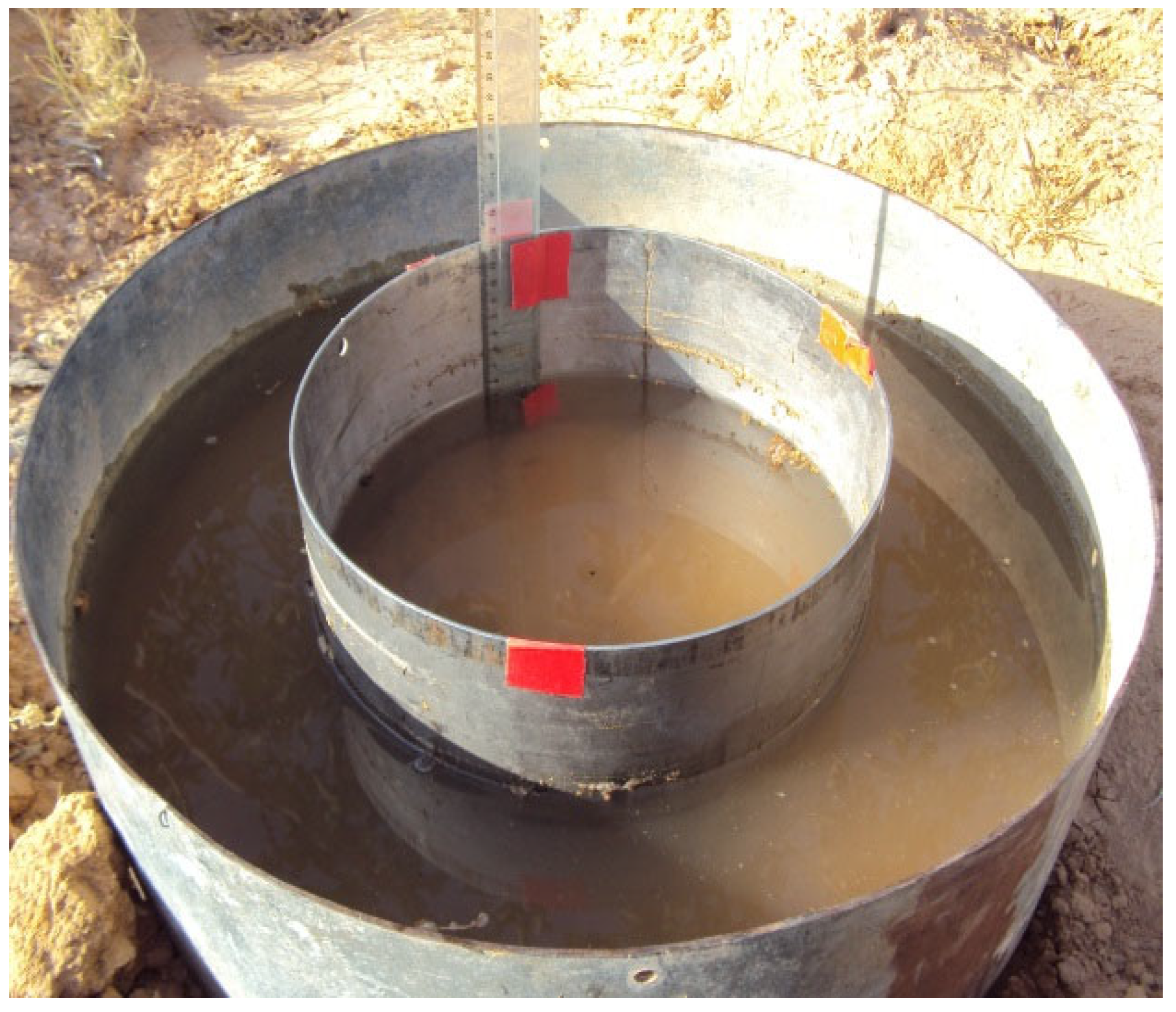
The infiltration rate was assessed with a local made double-ring infiltrometer (Figure 2), as this method is basic and effective even in difficult field conditions (no access to electricity or internet is required, and there are no fragile components that could be damaged by dust or during transport).
This study was based on the field experiments of Bosch et al. [36], Abdullah et al. [37], and Autovino et al. [38] in the same region, other studies in other semi-arid regions, and many others [39,40]. This study used double-ring infiltrometers with an 18 cm inner-ring diameter and a 30 cm outer-ring diameter.
Soil infiltration rates were measured in each site’s retention basin. The two rings were carefully implanted 5–10 cm into the ground to reduce the risk of damage from particles in the soil, which could compromise the rings or change the soil profile. The measurements were carried out using tap water. During the day, the ambient temperature ranged from 25 °C to 37 °C. The outer and inner rings were initially filled to a height of 15 cm. Throughout the test, the water level was manually measured at increasing intervals using a scale affixed to the inner ring. When the water level in the outer ring fell under that of the inner, additional water was added to keep the levels balanced. This process was repeated until the water level decreased to 5 cm above the soil surface, at which point the water was refilled for the following cycle. A plastic bottle or bag was placed inside the rings to keep the soil from being disturbed during the watering procedure. The mean infiltration rate was calculated for each location by measuring at regular time intervals of 2, 4, 10, 15, 30, and 60 min until a constant infiltration rate was achieved.

2.3. Infiltration Rates: Prediction Models

To evaluate which infiltration model best fits the observed field infiltration rate data, the following models were considered:
Horton model
The Horton model, an empirical infiltration rate equation developed by Horton in 1939 [16], is among the most well-known infiltration models in hydrology. The infiltration rate and capacity can be calculated using the formula below:
f p = f c + f 0 f c e k h t 0     t     t c
where the following are true:
fp = infiltration rate at (t) measured from the start of the experiment (cm/h);
fc = constant infiltration rate at t = tc (cm/h);
f0 = infiltration rate at t = 0, the beginning of the measurement (cm/h);
kh = steady decline in the infiltration rate (1/h);
t = time (h).
This model is straightforward and appropriate for experimental data. Horton’s model posits that infiltration initiates at a fixed rate f0 and, after that, diminishes exponentially with time. Eventually, when the soil saturation level attains a particular limit, the infiltration rate equals fc. The primary limitation of this model resides in the identification of the parameters fc, f0, and k, as these must be established through data fitting. Nevertheless, with the progression of computer systems, a basic spreadsheet may accomplish this work.
Kostiakov model
Kostiakov [15] proposed an equation for cumulative infiltration:
F p = a t b
where the variables are as follows:
Fp = cumulative infiltration capacity (cm/h);
a = constant > 0 (cm/h(1 − b));
b = constant 0 < b < 1 (dimensionless);
t = time (h).
Therefore, the infiltration capacity is expressed as:
f p = ( a b ) t b 1
The Kostiakov model parameters are derived from a logarithmic plot of (f) against (t). The plotted points are used to create a line of best fit. The graph’s slope is b, and log(a) will be represented as the y-intercept. These factors are particular to the site and are contingent upon soil texture, bulk density, moisture content, and other soil characteristics.
Kostiakov’s equation effectively determined the structural condition of soil beneath forest cover during the infiltration experiment [41].
Philip model
In order to establish a connection between cumulative infiltration and soil characteristics, Philip [17] suggested an infinite series solution of Richard’s equation, which is expressed as:
F p = s . t ( 0.5 ) + k t
Infiltration capacity can be stated using the equation above as:
f p = ( 0.5 ) s t 0.5   + k
where the following hold true:
f p = infiltration volume at any time t from the start (cm/h);
s = sorptivity is the suction potential function of soil (cm/h (1/2));
k = soil saturated hydraulic conductivity (cm/h);
t = time (h).
Green–Ampt model
Darcy’s Law-based infiltration capacity model was created by Green and Ampt [42]. The model is a popular hydrological model of soil water infiltration. It assumes a strong wetting front dividing saturated and unsaturated soil zones. The model excels at forecasting infiltration in ponds. The physical model is expressed as:
f p   =   K   ( 1   +   ( η S c / F p )  
where the following hold true:
K = saturated hydraulic conductivity (cm/h);
Sc = capillary suction at the wetting front (cm);
η = porosity of the soil (dimensionless).
Then, the infiltration capacity may be expressed as:
f p = m + ( n F p )
where the variable are as follows:
Fp = Cumulative infiltration capacity (cm/h);
m and n = Green–Ampt parameters of the infiltration model;
m = the saturated hydraulic conductivity (K) when the soil maintains a consistent infiltration rate after long periods of saturation (cm/h);
n = the difference between the saturating front suction head (Sc) and the volumetric water content (cm).
The model demonstrates the initial rapid infiltration that is the result of the soil’s water absorption capacity and capillary forces. The model’s calibration reflects the hydraulic behavior of the soil at each measured site. The model parameters m and n were measured in the field and used in Equation (7) to compute cumulative infiltration capacity.

2.4. Model Accuracy Evaluation

After calculating the CIR value for each model, the accuracy of each module was evaluated by using six statistic indicators. Best-fitting modules will show the lower values for the Root Mean Square Error (RMSE), Sum of Squared Errors (SSE), Standard Error (STD ERR), and bias, while the highest value of Nash–Sutcliffe Efficiency (NSE) and correlation (CORR) refer to ideal accuracy [42]
The models’ variables were adjusted for every individual location. Through the use of an objective equation, the approach determines the Sum of Squared Residuals (SSE) that was observed to be the smallest between the data that was observed (H) and the data that was simulated (F). This equation is shown as Equation (8).
S S E =   i = 1 n ( H F ) 2
The Nash–Sutcliffe Efficiency (NSE), the Pearson correlation coefficient (CC), the Root Mean Square Error (RMSE), and the bias estimate were the four statistical criteria that were used for the purpose of determining whether or not the models are accurate and whether or not the parameters are appropriate. In hydrology, one of the most common criteria that is applied is the Nash–Sutcliffe coefficient (NSE), which can be found in Equation (9). The values of the NSE range from 0 to 1, with values that are a little closer to 1 indicating a better match.
N S E = 1 i = 1 n ( H F ) 2 i = 1 n ( H H ¯ ) 2
There is a basis for Pearson’s correlation coefficient (CC) that is the technique of covariance, which is represented by Equation (10). As an indication of the degree of linearity between the variables that were simulated and those that were observed (infiltration), it serves as a measure. In the realm of correlation, a value of +1 signifies a perfect positive correlation, where the intensity is equal to its absolute value. The values of this correlation vary from −1 to +1.
C O R R . = n H F ( H ) ( F ) n H 2 ( H ) 2 n F 2 ( F ) 2
The Root Mean Square Error (RMSE) is a method that is frequently utilized as a correlation index between simulated data and data that has been observed. It is a standard approach that is regularly applied. The Root Mean Square Error (RMSE) is almost always positive and does not have a predetermined range or criteria, as shown in Equation (11). The predictive value of the simulated data, on the other hand, becomes typically more accurate as the value begins to decline.
R M S E =   1 n   ( i = 1 n ( H F ) 2
Bias analysis (bias) is a technique that offers a numerical approximation of the level of uncertainty that results from inaccurate estimations. In order to calculate the bias estimate, which is represented by Equation (12), we divide the difference between the data that was observed and the data that was simulated by the total number of estimations. If its value is zero, the estimator is said to be objective.
B i a s = i = 1 n ( H F ) N

2.5. Statistical Analysis

Followed by the accuracy evaluating for the four modules, by calculating the six indicators, a Model Performance Index (MPI) was implemented to evaluate the effectiveness of the modules comprehensively. MPI provide a single score in such a multi-criteria decision environment. Guided by the Organization for Economic Co-operation and Development [43], the process of creating the indicators was implemented.
The values of the (RMSE), (SSE), (STD ERR), bias, (NSE), and (CORR) were normalized to make the values comparable (see Equations (13) and (14)).
For RMSE, SSE, STD ERR, and bias:
N I =   X M a x X i X M a x X M i n
For CORR, NSE:
N I =   X i X M i n X M a x X M i n
where the variables are defined as follows:
NI = the indicator for normalization;
Xmax = the best value (biggest or lowers) regarding the statistical metric;
Xmin = the worst value (biggest or lowers) regarding the statistical metric;
Xi = the individual value for each statistical metric for each module.
Next, the MPI was calculated for each infiltration module using Equation (15). The models with higher MPIs indicate the best performances.
M P I =   1 n i = 1 n N I t
Here,
n = number of statistical metrics to find MPI for each mode. The average value of all six statistical metrics was calculated, and each average value considered to be (Xmax, Xmin, and Xi); then, the NI and MPI were calculated for each module.

3. Results and Discussion

Infiltration measurements often exhibit a rapid early decline in rate, which is attributed to the extreme initial suction of dry soil and the swift saturation of big pores. With time, the soil reaches a high saturated state, and the infiltration process stops. Finally, the rate settles down to a value that is almost constant, with little or no change between measurements. This stabilization shows that the soil has reached a nearly constant hydraulic state, where gravity forces, not soil suction, have the most effect on infiltration.
To further ensure the accuracy of the recorded field data, the inspection and recording of infiltration values continued over time, even after the observed readings stabilized. This is indicated by the unchanging values for each location, which are underlined to distinguish them from the other values as shown in Table 2. All field experiments demonstrated that the values remained stable regardless of the passage of time, and this aligns with the definition of CIR. For each of the 16 sites, the value is acknowledged as the CIR and is thereafter emphasized in the table only upon verification of this consistency. In summary, catchment 1 has the lowest beginning infiltration rate at 31.6 cm/h, whereas catchment 13 has the highest initial infiltration rate at 86 cm/h.
The CIR is the lowest rate of infiltration that occurs when the soil’s capacity to absorb water has been fully utilized. Site 13 had the highest infiltration velocity in our sample, at 27.2 cm/h. Site 1 has the lowest constant infiltration velocity, at 2.4 cm/h.
Using the time-series infiltration data from the experimental measurements, each model’s parametric equation was calibrated, where parameters such as empirical constants, sorptivity, and initial and final infiltration rates were calculated using a nonlinear curve fitting technique.
In order to overcome the complicated mathematical process in calculating the parameters, Excel functions analysis was used using Microsoft Excel (Version 2016, Microsoft Corporation, Redmond, WA, USA). The equation for each module was introduced, as well as the required data. This reduced the number of incorrect estimates by determining which model parameters provide the greatest match.
The model’s parameter values are shown in Table 3. The calculated parameters of these infiltration models may be used to formulate the infiltration equation for the research region.
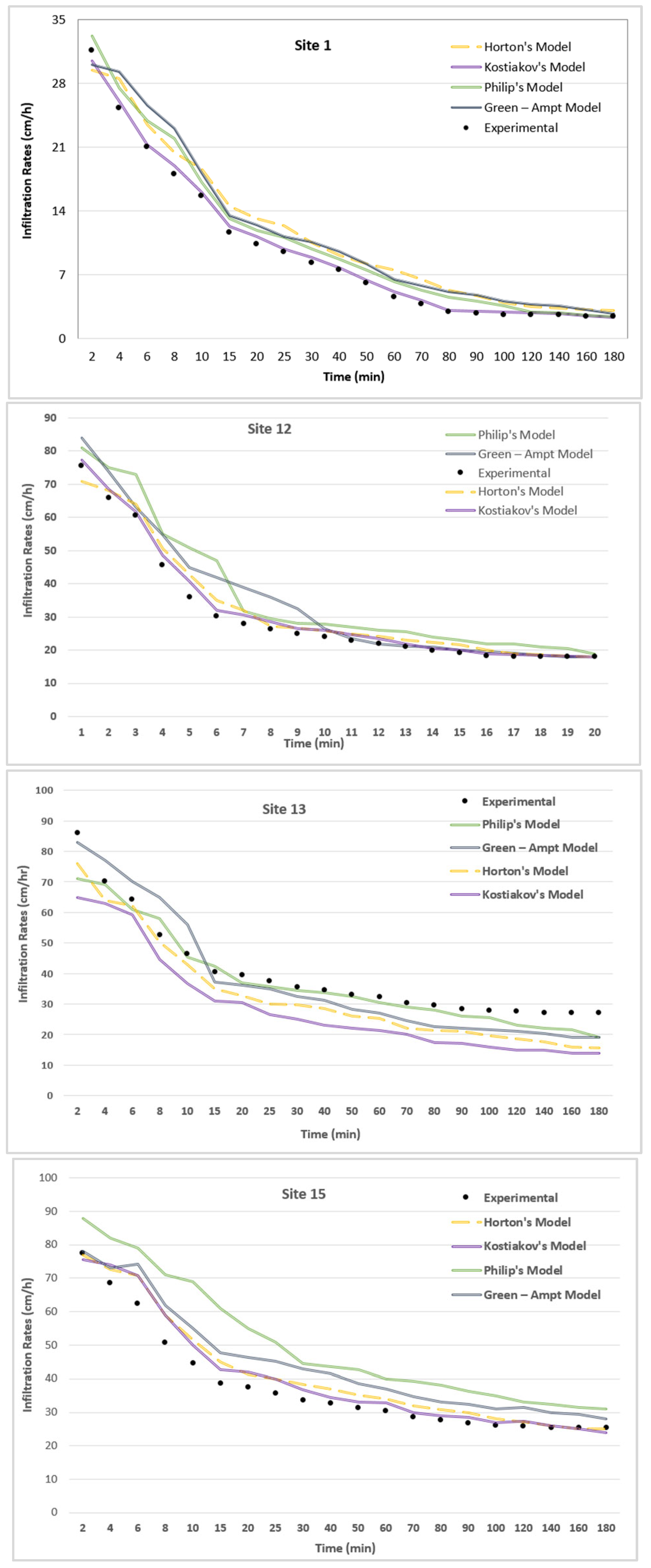
After estimating the parameters for each model, the CIR was predicted using each module and using the Excel environment. As a result, the data set was created. This set consisted of five values of the CIR for each of the 16 sites. One value was from the experiment measurement, and four values were from the modules. To illustrate the results, a total of 16 figures were created, declaring the interaction of the CIR values in each site. Only four of those figures were selected to be presented in this study. Those are Site 1, Site 12, Site 13, and Site 15, which clearly represent the interactive trend (see Figure 3). The selection of the figures was influenced by the location of the sites in the study area and the value of the experimental CIR. The remaining figures exhibit similar trends and are hence not included to prevent redundancy. However, all data from 16 locations was taken into account in the overall analysis and statistical observation.
In general, for each module, the values of the CRI for the 16 sites did not show profound differences, as shown in Figure 3. Although some modules show some differences compared to the experimental infiltration rate, the difference is nearly constant. For example, in Site 15, Philip’s model overestimated the CIR at a constant rate, while in Site 13, all the modules underestimated the CIR with time. Model accuracy may fluctuate based on site-specific conditions, such as the soil characteristics in the watershed, which were not included within the constraints of this research. This pattern suggests that the patterns remain consistent throughout the majority of sites. For a limited number of locations, a significant discrepancy exists between the experimental and projected CIR values for some modules. Further analysis may reveal the origins of these discrepancies, thereby enhancing the model’s accuracy. For a better overview, Table 4 presents the whole set of date for the CIR values.
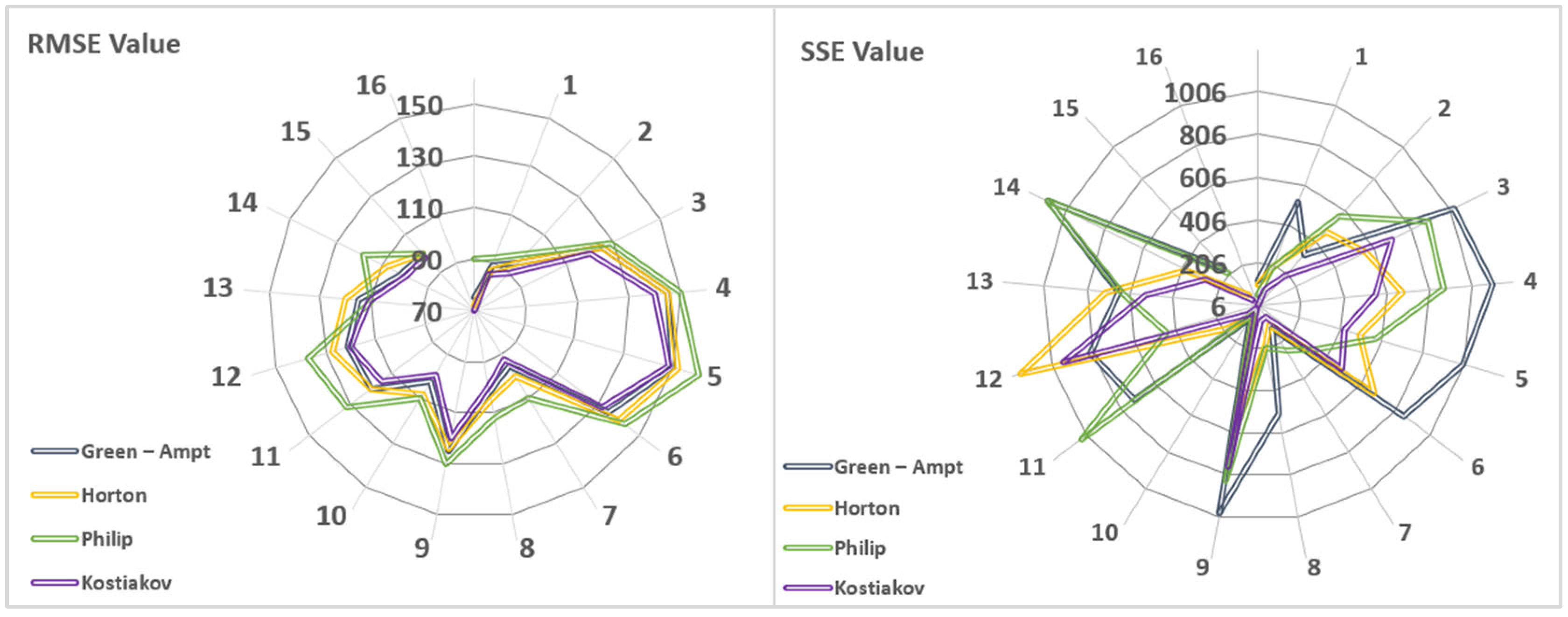
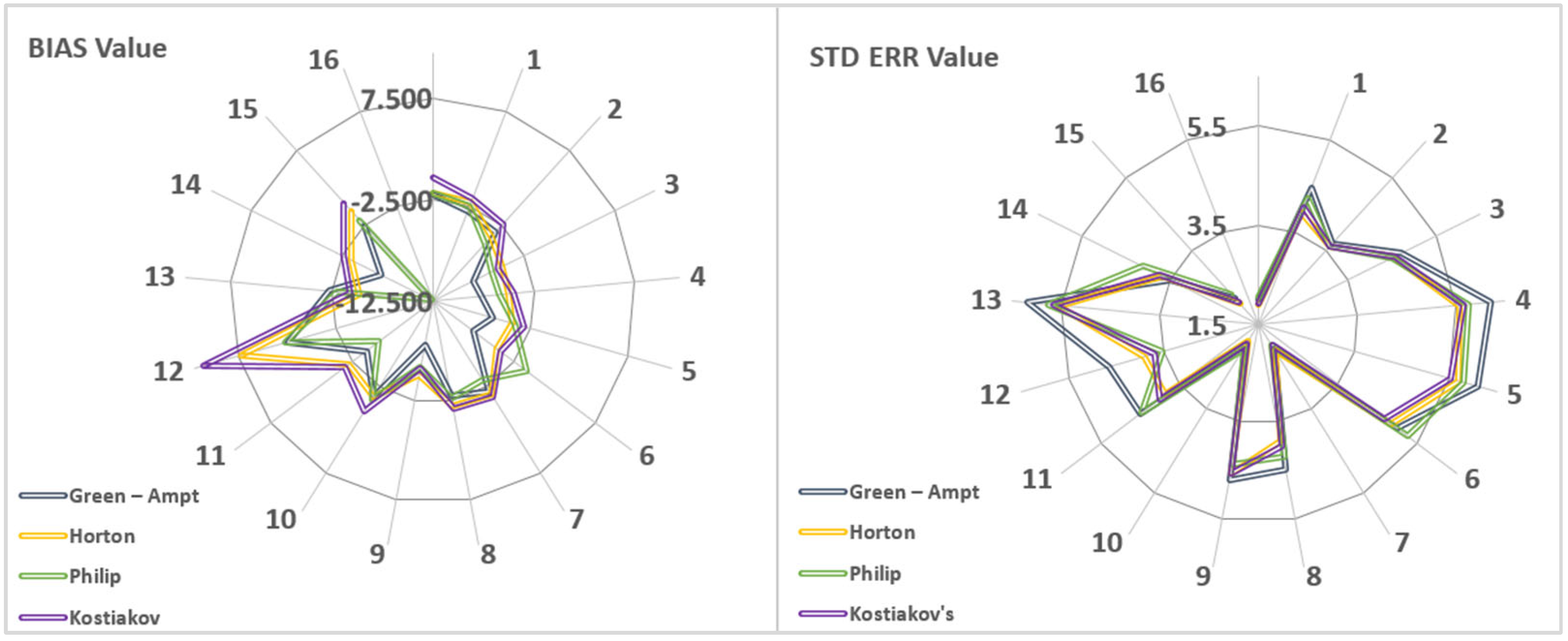
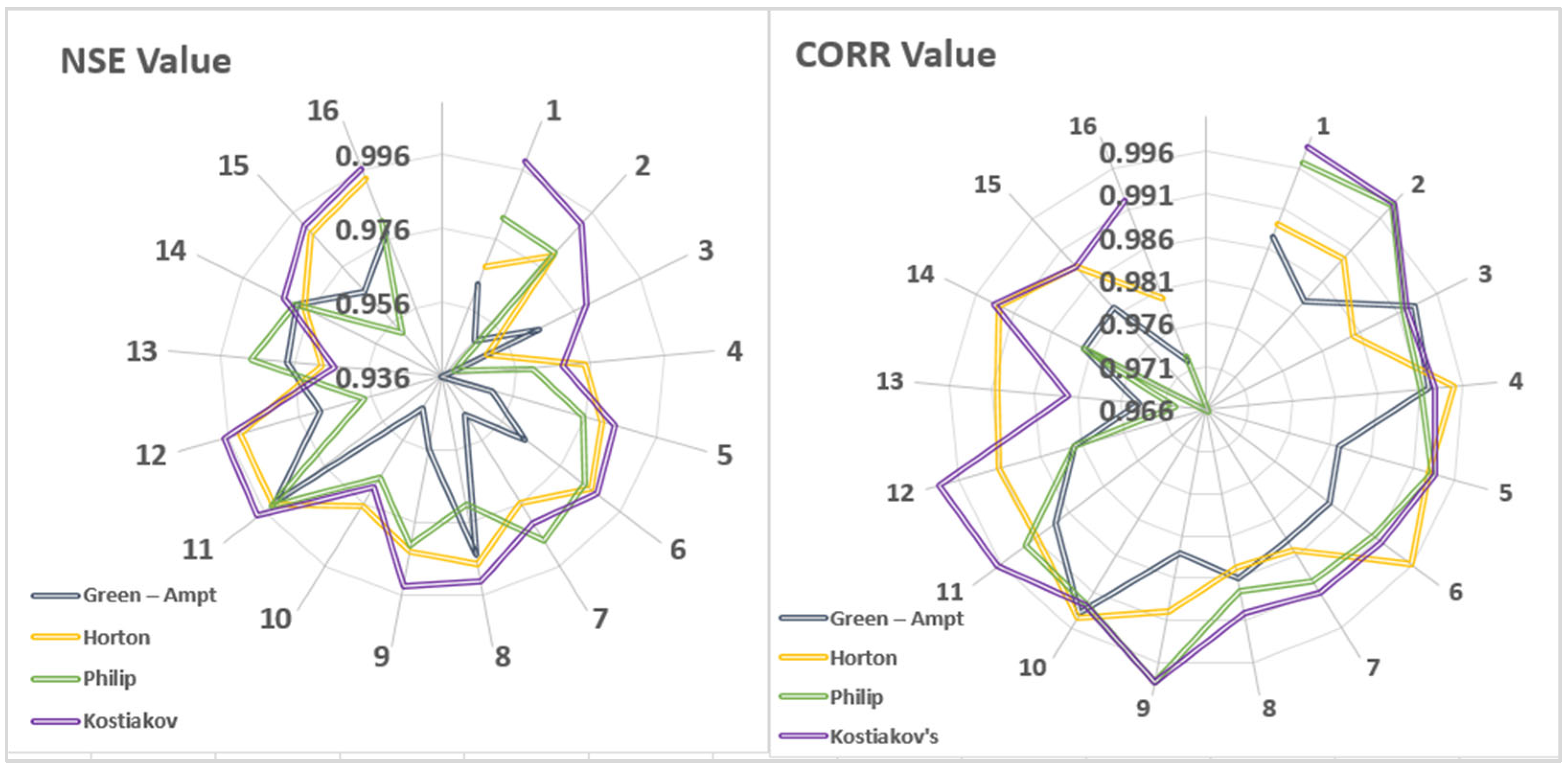
From the evaluation of the modules, six matrixes were developed to show the values of six statistical indicators to choose the best module for assessing the constant infiltration rate in the watershed. The matrix shows these six values for each module and for the 16 sites. From the matrix, the highest values of NSE and CORR were marked, along with the lowest values of RMSE, SSE, STD ERR, and bias. The results of the matrixes are demonstrated visually in Figure 4 and Figure 5.
As shown in Figure 4, in general, Kostiakov’s module has low values across all sites, particularly for the RMSE, SSE, and STD ERR, with a relatively low value for bias. Horton has the second-lowest values in most indicators. Philip scores the highest values in RMSE for all sites and in SSE values for some sites. The Green–Ampt module scored, overall, the highest STD ERR values and SSE values for some sites. The chart demonstrates that Kostiakov records the lowest values, followed by Horton, which indicates high accuracy.
A visual comparison of the NSE and CORR values of the four models is presented in Figure 5 for each of the 16 sites. Horton’s module was followed by Kostiakov’s module, which scored highly at almost all of the sites. Horton’s model achieved greater values for CORR than Kostiakov’s at Sites 4, 6, 10, and 13, as well as the next highest score after Kostiakov’s for the remaining locations. In comparison to other modules, this indicates a better level of accuracy with respect to these two indications.
In accordance with the results above, the MPI results provided a clear scoring system for the models, as shown in Table 5. Kostiakov recorded the highest rank with bigger MPIs than other models, followed by Horton. It is noticeable that none of the models achieved a perfect MPI score (MPI = 1), which reflects the challenges in infiltration data modeling in the field.
The better performance of the Kostiakov model in this study agrees with the conclusions of [26,27,28,29], who also concluded that the Kostiakov model is superior to the other models. However, unlike [25] model, the data showed that Philip’s model underestimated infiltration, possibly due to differences in initial soil moisture and compaction.
It is recommended to focus on one (or both) of the models proposed in this study, which was concluded to be highly accurate for conducting advanced studies and analyses on the possibility of predicting infiltration values compared to on-site computational methods.
The circumstances under which the measurements were made for this study (e.g., lack in time and resources) forced the researchers not to include informative site-specific data. The module prediction may be improved further by performing comparison studies in a variety of locations with known soil profiles. Future research should concentrate on enhancing these models to take into account variations in soil properties and moisture content more effectively, thereby ensuring more precise predictions across various agricultural contexts.

4. Conclusions

The aim of this research was to evaluate the performance of the four infiltration models for Tunisian conditions, and this work suggests that the Kostiakov model is the first comprehensive alternative to predicting soil infiltration from watershed field trials. And the result can be expanded to all the nearby areas considering the soil profile, followed by Horton to be the second alternative. These models had lowers values for RMSE, SSE, STD ERR, and bias (close to zero) and the highest values for NSE and CORR, which refer to ideal accuracy. In additional, implementing the Model Performance Index (MPI) showed similar results, giving the priority to Kostiakov to be ranked first (among the four investigated models).
Taking everything into consideration, it can be concluded that while the Kostiakov module and Horton module demonstrate a high level of accuracy in estimating accumulative soil infiltration in the Oum Zessar watershed, the Green–Ampt module and Philip module produce less reliable forecasts in the current circumstances. Using the Kostiakov and Horton modules results in accurate prediction of the infiltration rate for the hydrological modeling of these NbS measures to be applied in the study area.

Author Contributions

Conceptualization, R.A. and A.A.; methodology, R.A. and M.R.; software, A.A. and R.A.; validation, A.A. and M.R.; formal analysis, R.A. and A.A.; investigation, A.A.; resources, R.A. and A.A.; data curation, R.A.; writing—original draft preparation, R.A. and A.A.; writing—review and editing, M.E.S.; visualization, R.A. and M.E.S.; supervision, M.R.; project administration, M.E.S., R.A. and A.A. All authors have read and agreed to the published version of the manuscript.

Funding

This research received no external funding.

Data Availability Statement

The original contributions presented in this study are included in the article. Further inquiries can be directed to the corresponding author.

Conflicts of Interest

The authors declare no conflicts of interest.

References

  1. Xia, Q.; Han, H.; Xiong, J.; Zheng, C.; Zhang, Z.; Huang, H.; Zhao, Q. Research Progress of Soil Water Infiltration. E3S Web Conf. 2020, 189, 01006. [Google Scholar]
  2. Harisuseno, D.; Cahya, E.N. Determination of soil infiltration rate equation based on soil properties using multiple linear regression. J. Water Land Dev. 2020, 47, 77–88. [Google Scholar] [CrossRef]
  3. Adham, A.; Abed, R.; Mahdi, K.; Hassan, W.H.; Riksen, M.; Ritsema, C. Rainwater catchment system reliability analysis for Al Abila Dam in Iraq’s western desert. Water 2023, 15, 944. [Google Scholar] [CrossRef]
  4. Horton, R.E. The role of infiltration in the hydrologic cycle. Eos Trans. Am. Geophys. Union 1933, 14, 446–460. [Google Scholar]
  5. Feki, M.; Ravazzani, G.; Ceppi, A.; Milleo, G.; Mancini, M. Impact of infiltration process modeling on soil water content simulations for irrigation management. Water 2018, 10, 850. [Google Scholar] [CrossRef]
  6. Patle, G.T.; Sikar, T.T.; Rawat, K.S.; Singh, S.K. Estimation of infiltration rate from soil properties using regression model for cultivated land. Geol. Ecol. Landsc. 2019, 3, 1–13. [Google Scholar] [CrossRef]
  7. Zakwan, M.; Niazkar, M. A comparative analysis of data-driven empirical and artificial intelligence models for estimating infiltration rates. Complexity 2021, 1, 9945218. [Google Scholar]
  8. Angelaki, A.; Sihag, P.; Sakellariou-Makrantonaki, M.; Tzimopoulos, C. The effect of sorptivity on cumulative infiltration. Water Supply 2021, 21, 606–614. [Google Scholar]
  9. Sharief, S.M.; Zakwan, M.; Farhana, S.N. Estimation of Infiltration Rate using a Nonlinear Regression Model. J. Water Manag. Model. 2023, 31, C509. [Google Scholar] [CrossRef]
  10. Liu, C.W.; Chen, S.K.; Jou, S.W.; Kuo, S.F. Estimation of the infiltration rate of a paddy field in Yun-Lin, Taiwan. Agric. Syst. 2001, 68, 41–54. [Google Scholar] [CrossRef]
  11. Rahman, G.A.; Talaat, A.M.; Zawe, C. Assessment of Infiltration Rate for Sustainability of Reclaimed Area in Harare Region-Zimbabwe. Middle East J. 2016, 5, 1–5. [Google Scholar]
  12. Kebede, M.M.; Kumar, M.; Mekonnen, M.M.; Clement, T.P. Enhancing groundwater recharge through Nature-Based Solutions: Benefits and barriers. Hydrology 2024, 11, 195. [Google Scholar] [CrossRef]
  13. Abed, R.; Adham, A.; Allawi, M.F.; Ritsema, C. Potential impacts of climate change on the Al Abila Dam in the Western Desert of Iraq. Hydrology 2023, 10, 183. [Google Scholar] [CrossRef]
  14. Green, W.H.; Ampt, G.A. Studies on Soil Phyics. J. Agric. Sci. 1911, 4, 1–24. [Google Scholar] [CrossRef]
  15. Kostiakov, A.N. On the Dynamics of the Coefficient of Water-Percolation in Soils and on the Necessity of Studying It from a Dynamic Point of View for Purposes of Amelioration. 1932, pp. 17–21. Available online: https://scispace.com/papers/on-the-dynamics-of-the-coefficient-of-water-percolation-in-k4vcanqlg0?citations_page=30 (accessed on 18 December 2025).
  16. Horton, R.E. The interpretation and application of runoff plat experiments with reference to soil erosion problems. Soil Sci. Soc. Am. J. 1939, 3, 340–349. [Google Scholar] [CrossRef]
  17. Philip, J.R. The theory of infiltration: 1. The infiltration equation and its solution. Soil Sci. 1957, 83, 345–358. [Google Scholar] [CrossRef]
  18. Haghiabi, A.H.; Abedi-Koupai, J.; Heidarpour, M.; Mohammadzadeh-Habili, J. A new method for estimating the parameters of Kostiakov and modified Kostiakov infiltration equations. World Appl. Sci. J. 2011, 15, 129–135. [Google Scholar]
  19. Adham, A.; Seeyan, S.; Abed, R.; Mahdi, K.; Riksen, M.; Ritsema, C. Sustainability of the Al-Abila Dam in the western desert of Iraq. Water 2022, 14, 586. [Google Scholar] [CrossRef]
  20. Ogbe, V.B.; Jayeoba, O.J.; Ode, S.O. Comparison of four soil infiltration models on a sandy soil in Lafia, Southern Guinea Savanna Zone of Nigeria. Prod. Agric. Technol. 2011, 7, 116–126. [Google Scholar]
  21. Oku, E.; Aiyelari, A. Predictability of Philip and Kostiakov infiltration models under inceptisols in the humid forest zone, Nigeria. Agric. Nat. Resour. 2011, 45, 594–602. [Google Scholar]
  22. Adindu Ruth, U.; Igbokwe Kelechi, K.; Dike Ijeoma, I. Philip model capability to estimate infiltration for solis of Aba, Abia State. J. Earth Sci. Geotech. Eng. 2015, 5, 63–68. [Google Scholar]
  23. Sreejani, T.P.; Abhishek, D.; Srinivas Rao, G.V.; Abbulu, Y. A study on infiltration characteristics of soils at Andhra university campus, Visakhapatnam. Int. J. Environ. Res. Dev. 2017, 7, 29–44. [Google Scholar]
  24. Singh, B.; Sihag, P.; Singh, K. Comparison of infiltration models in NIT Kurukshetra campus. Appl. Water Sci. 2018, 8, 63. [Google Scholar] [CrossRef]
  25. Thomas, A.; Ofosu, A.; Emmanuel, A.; De-Graft, A.; Ayine, A.; Asare, A.; Alexander, A. Comparison and Estimation of Four Infiltration Models. Open J. Soil Sci. 2020, 10, 45–57. [Google Scholar] [CrossRef]
  26. Utin, U.E.; Oguike, P.C. Evaluation of Philip’s and Kostiakov’s infiltration models on soils derived from three parent materials in Akwa Ibom state, Nigeria. J. Sci. Eng. Res. 2018, 5, 79–87. [Google Scholar]
  27. Mahapatra, S.; Jha, M.K.; Biswal, S.; Senapati, D. Assessing variability of infiltration characteristics and reliability of infiltration models in a tropical sub-humid region of India. Sci. Rep. 2020, 10, 1515. [Google Scholar] [CrossRef]
  28. Mohamoud, Y.M. Evaluating the Green and Ampt infiltration parameter values for tilled and crusted soils. J. Hydrol. 1991, 123, 25–38. [Google Scholar] [CrossRef]
  29. Ruth, U.A.; Kelechi, K.I.; Timothy, O.C.; Ike-Amadi, C.A. Application Kostiakov’s Infiltration Model on The Soils of Umudike, Abia State-Nigeria. Am. J. Environ. Eng. 2014, 4, 1–6. [Google Scholar]
  30. Ghazouani, W.; Zairi, A.; Slatni, A. Influence of tillage systems on soil physical properties and water infiltration in semi-arid Tunisia. Soil Tillage Res. 2022, 219, 105334. [Google Scholar]
  31. Ben Slimane, A.; Nasr, Z.; Bouhlila, R.; El Ayeb, N. Evaluation of hydraulic conductivity and water retention properties of Tunisian soils. J. Hydrol. Reg. Stud. 2021, 35, 100818. [Google Scholar] [CrossRef]
  32. Hamdi, R.; Jebari, S.; Berndtsson, R.; Bahri, A.; Boufaroua, M. Assessment of surface runoff and soil erosion in semi-arid Tunisia using the SWAT model. J. Soil Water Conserv. 2015, 70, 334–344. [Google Scholar]
  33. Adham, A.; Riksen, M.; Abed, R.; Shadeed, S.; Ritsema, C. Assessing suitable techniques for rainwater harvesting using analytical hierarchy process (AHP) methods and GIS techniques. Water 2022, 14, 2110. [Google Scholar] [CrossRef]
  34. Ouessar, M. Hydrological Impacts of Rainwater Harvesting in Wadi Oum Zessar Watershed (Southern Tunisia); Ghent University: Ghent, Belgium, 2007. [Google Scholar]
  35. Abdeladhim, M.A.; Fleskens, L.; Baartman, J.; Sghaier, M.; Ouessar, M.; Ritsema, C.J. Generation of potential sites for sustainable water harvesting techniques in Oum Zessar watershed, South East Tunisia. Sustainability 2022, 14, 5754. [Google Scholar] [CrossRef]
  36. Van den Bosch, S.; Hessel, R.; Ouessar, M.; Zerrim, A.; Ritsema, C.J. Determining the Saturated Vertical Hydraulic Conductivity of Retention Basins in the Oum Zessar Watershed, Soutern Tunisia. 2014. Available online: https://edepot.wur.nl/332036 (accessed on 18 December 2025).
  37. Abdullah, O.S.; Kamel, A.H.; Khalil, W.H.; Al-damook, A. Estimation of Hydropower Harvesting from the Hydraulic Structures on Rivers: Ramadi Barrage, Iraq as a Case Study. Iraqi J. Civ. Eng. 2020, 14, 37–43. [Google Scholar]
  38. Autovino, D.; Bagarello, V.; Caltabellotta, G.; Varadi, F.K.; Zanna, F. One-dimensional infiltration in a layered soil measured in the laboratory with the mini-disk infiltrometer. J. Hydrol. Hydromech. 2024, 72, 149–157. [Google Scholar] [CrossRef]
  39. Adham, A.; Riksen, M.; Ouessar, M.; Abed, R.; Ritsema, C. Development of methodology for existing rainwater harvesting assessment in (semi-) arid regions. In Water and Land Security in Drylands: Response to Climate Change; Springer International Publishing: Cham, Switzerland, 2017; pp. 171–184. [Google Scholar]
  40. Sayl, K.N.; AL-Ani, A.; Oliwi, S. Hydrologic Study for Iraqi Western Desert to Assessment of Water Harvesting Projects. Iraqi J. Civ. Eng. 2012, 7, 16–27. [Google Scholar] [CrossRef]
  41. Ukata, S.U.; Akintoye, O.A.; Digha, O.N.; Alade, A.; Asiyanbi, A. The transformation of Kostiakov’s (1932) infiltration equation on the infiltration rate of forest land cover in Biase, Cross River State, Nigeria. IOSR J. Environ. Sci. Toxicol. Food Technol. 2015, 9, 47–50. [Google Scholar]
  42. Zhang, H.H. Model Selection in High-Dimensional Regression. In Wiley StatsRef: Statistics Reference Online; John Wiley & Sons: Hoboken, NJ, USA, 2014; Volume 14, pp. 1–19. [Google Scholar]
  43. OECD. Handbook on Constructing Composite Indicators: Methodology and User Guide; OECD Publishing: Paris, France, 2008. [Google Scholar]
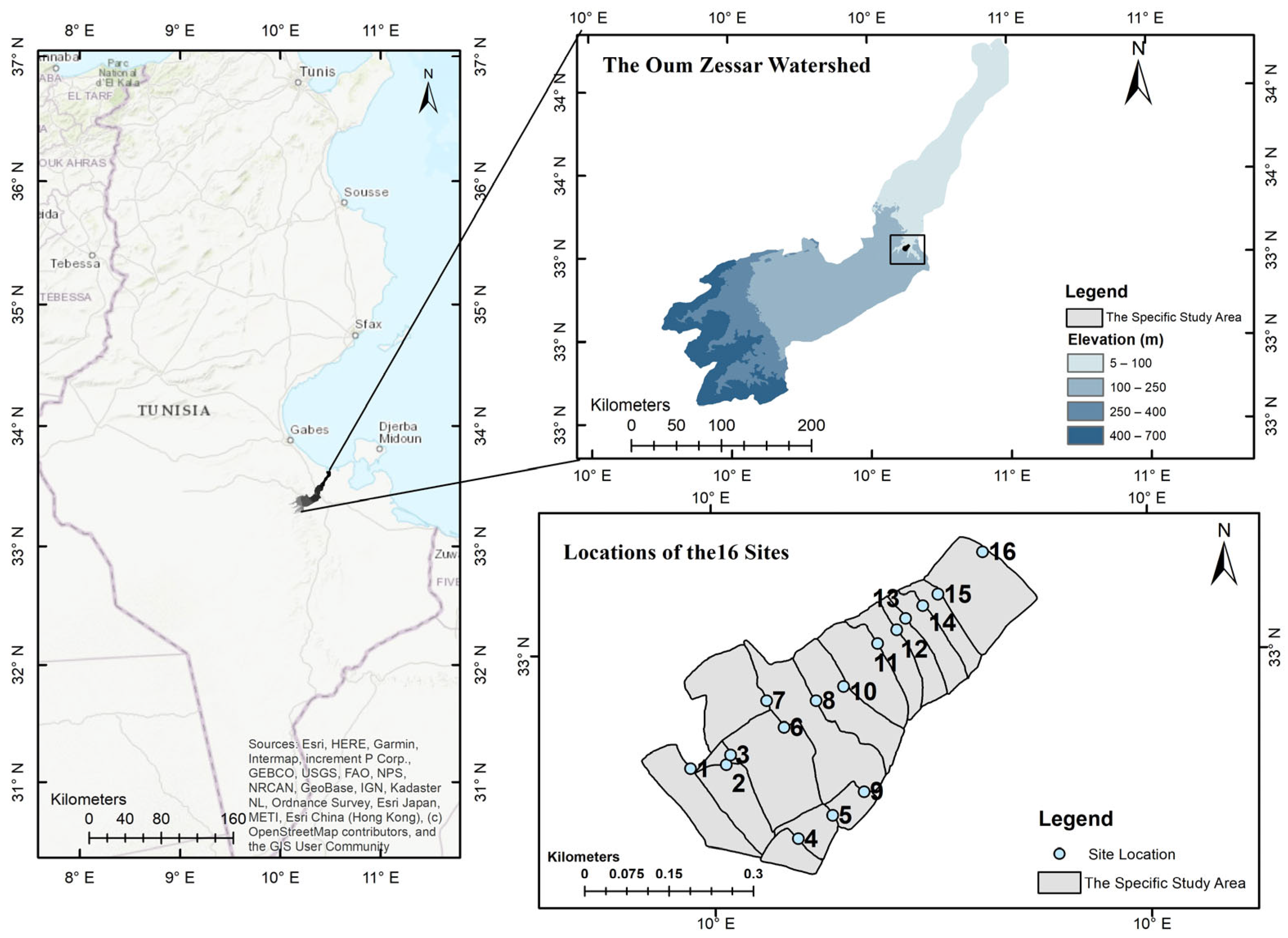
Figure 1. The locations of Oum Zessar and the chosen measurement sites within the watershed.
Water 18 00055 g001
Figure 2. Experimental double-ring infiltrometer.
Water 18 00055 g002
Figure 3. Experimental and calculated infiltration rate values at selected sites in the Oum Zessar study area, Tunisia.
Water 18 00055 g003
Figure 4. RMSE, SSE, STD ERR, and bias for the modules.
Water 18 00055 g004aWater 18 00055 g004b
Figure 5. Comparison of the NSE and CORR values of the four models for the 16 sites.
Water 18 00055 g005
Table 1. The location and soil type of the 16 selected sites in the Oum Zessar watershed.
Site#Elevation (m)Latitude
(Degree)
Longitude
(Degree)
Soil Type
1114.8033.42316810.374534Loam
2117.2033.42322510.375217Loam
3110.1233.42338210.375302Loam
4119.053.61652210.152355Clay loam
5121.7733.42239410.377235Sand
6114.4033.42381310.376327Sandy loam
7116.3733.42424610.376001Sandy clay loam
8113.2233.42423410.376950Clay loam
9103.9933.42276710.377845Clay loam
1088.9333.42445710.377475Sandy clay loam
11111.9633.42513710.378138Silty clay loam
12107.3833.42519510.378435Sandy loam
13106.0433.42553410.378678Sand
14102.6433.42573510.379008Sandy loam
15109.1433.42591610.379304Sandy loam
16108.1533.42658510.380165Silty clay loam
Table 2. Results of the double ring infiltration measurements in the Oum Zessar study site, Tunisia. Infiltration rates are in cm/h.
Time (min)Site (1)Site (2)Site (3)Site (4)Site (5)Site (6)Site (7)Site (8)Site (9)Site (10)Site (11)Site (12)Site (13)Site (14)Site (15)Site (16)
231.660.155.370.385.38375.34162.273.5541.175.78682.877.544.1
425.350.346.36582817035.352.468.2534.865.970.379.568.537.8
62145.140.2567279613147.259.2530.560.764.269.562.433.5
8183028.650.364.362.355.32832.153.5527.545.652.661.850.830.5
1015.620.522.445.756.255.1502522.648.9525.136.146.453.744.628.1
1511.614.616.538.246.8474321.616.741.4521.130.240.544.338.724.1
2010.312.315.432.640.142372014.435.8519.827.939.437.637.622.8
259.510.813.629.335353419.212.932.551926.437.632.535.822
308.39.311.524.532.5312918.211.427.7517.824.935.53033.720.8
407.58.510.621.728.52926.317.410.624.951724.134.62632.820
506.17.49.118.622.623.123.116.39.521.8515.62333.120.131.318.6
604.56.38.315.419.319.320.314.88.418.651421.932.316.830.517
703.85.46.413.217.117.118.213.77.516.4513.32130.414.628.616.3
802.94.35.610.315.315.415.412.96.413.5512.419.929.612.827.815.4
902.73.64.58.913.613.11412.35.712.1512.219.228.511.126.715.2
1002.62.73.87.611.211.212.511.64.810.8512.118.327.88.72615.1
1202.62.53.66.59.59.311.811.14.59.7512.11827.6725.815.1
1402.62.53.26.58.78.911.410.24.59.7512.11827.26.225.415.1
1602.42.53.26.48.78.911.410.24.59.65121827.26.225.415
1802.42.53.26.48.78.911.410.24.59.65121827.26.225.415
CIR
cm/h
2.42.53.26.48.78.911.410.24.59.65121827.26.225.415
Table 3. The parameter values of the four various infiltration models.
Site #Constant
Infiltration
Rate
(cm/h)
HortonKostiakovPhilipGreen–Ampt
f p = f c + f 0 f c e k h t f p = ( a b ) t b 1 f p = 0.5 s t 0.5 + k f p = m + ( n F p )
kh (1/h)A (cm/h(1–b))bSk (cm/h)m (cm/h)N (cm)
Site 12.401.906.750.548.101.010.026.30
Site 22.501.326.330.567.861.980.025.02
Site 33.201.127.140.619.252.350.027.12
Site 46.400.987.050.659.753.150.026.12
Site 58.700.897.870.6710.244.121.0111.25
Site 68.900.708.100.7411.304.602.1013.20
Site 711.400.698.250.7312.105.102.7014.10
Site 810.200.879.300.7514.205.902.5013.70
Site 94.501.846.020.618.902.010.038.50
Site 109.650.906.500.577.801.800.606.80
Site 1112.000.657.100.598.302.102.1013.10
Site 1218.000.517.800.6511.104.102.3013.60
Site 1327.200.328.300.709.502.901.508.60
Site 146.200.975.600.5110.304.001.307.90
Site 1525.400.305.300.497.801.901.808.60
Site 1615.000.579.200.718.501.122.308.10
Table 4. Experimental and calculated CIRs for 16 sites in the Oum Zessar study area, Tunisia.
Site NumberConstant
Infiltration
Rate (cm/h)
Horton’s ModelKostiakov’s ModelPhilip’s ModelGreen–Ampt Model
Site 12.43.12.32.42.7
Site 22.52.32.52.11.9
Site 33.23.43.13.63.1
Site 46.49.38.18.39.6
Site 58.79.58.19.39.0
Site 68.910.17.87.59.1
Site 711.47.610.25.09.6
Site 810.210.112.314.19.3
Site 94.54.2124.54.313.916
Site 109.6512.8611.6414.114.3
Site 1112.012.110.010.211.8
Site 1218.017.917.919.017.9
Site 1327.215.613.819.019.1
Site 146.27.25.03.31.0
Site 1525.425.024.031.028.0
Site 1615.011.811.011.011.0
Table 5. MPI ranks for the four infiltration modules.
ModelNI RMSENI NSENI SSENI CORRNI STD.ERRNI BiasMPIRank
Kostiakov0.2535290.78810910.61414710.6376770.1192631
Horton010.95462710.9721670810.1368552
Philip0.7649530.3025460.3012050.3154820.493961290.1644210.0650713
Green–Ampt1000000.0277784
Disclaimer/Publisher’s Note: The statements, opinions and data contained in all publications are solely those of the individual author(s) and contributor(s) and not of MDPI and/or the editor(s). MDPI and/or the editor(s) disclaim responsibility for any injury to people or property resulting from any ideas, methods, instructions or products referred to in the content.