
Article

Distribution of 210Pb and 210Po and Particulate Organic Carbon (POC) Fluxes in the Northwestern Pacific Ocean in Summer 2024


by
Nikolay A. Bezhin
1,2,*,
Eduard A. Tokar’
1,2,
Diana V. Tarasevich
2,
Viktoriia A. Razina
1,2,
Anna I. Matskevich
1,
Vladislav A. Turyanskiy
2,
Iuliia G. Shibetskaia
1,2 and
Dmitry K. Patrushev
3
1
Laboratory of Fundamental and Applied Chemistry, Sakhalin State University, Lenina Str., 290, 693000 Yuzhno-Sakhalinsk, Russia
2
Research Laboratory of Radioecology and Marine Radiochemistry, Sevastopol State University, Universitetskaya Str., 33, 299053 Sevastopol, Russia
3
Institute of High Technologies and Advanced Materials, Far Eastern Federal University, Ajax Bay, 10, Russky Island, 690922 Vladivostok, Russia
*
Author to whom correspondence should be addressed.
Water 2026, 18(1), 31; https://doi.org/10.3390/w18010031
Submission received: 11 November 2025 / Revised: 17 December 2025 / Accepted: 18 December 2025 / Published: 22 December 2025
(This article belongs to the Special Issue Research on the Carbon and Water Cycle in Aquatic Ecosystems)

Abstract

During the 71st cruise of the R/V Akademik Oparin in the summer of 2024, we assessed the distributions of dissolved and particulate forms of 210Pb and 210Po in the Sea of Japan, the Sea of Okhotsk, and the northwestern Pacific Ocean. Quantitative estimates of vertical fluxes were derived based on measured concentrations of suspended particulate matter (SPM) and particulate organic carbon (POC). This study provides the first in situ measurements of these radionuclides and the first estimates of derived fluxes for the Sea of Okhotsk. The study confirmed the existence of two contrasting biogeochemical regimes: a sedimentation regime in the productive waters of the Sea of Okhotsk and a recycling regime in the oligotrophic waters of the open ocean, separated by the dynamic transition zone of the Kuril Islands. The calculated POC fluxes confirmed the high efficiency of the biological pump in the coastal seas. The identified anomalies in the distribution of radionuclides indicate a significant role of lateral transport and the sorption of organic carbon onto mineral particles in shaping vertical fluxes matter.

1. Introduction

Due to their high radiotoxicity, 210Pb and 210Po are considered priority radionuclides. Regulatory requirements stipulate that they must be quantified in drinking water when total alpha/beta activity exceeds established levels [1]. For the same reason, monitoring of 210Pb and 210Po in drinking water is mandatory in several European countries. Analyzing these radionuclides at low concentrations is challenging due to their nuclear-physical characteristics: 210Po is a pure alpha emitter, while 210Pb is a low-energy beta emitter with a low-energy gamma line (47 keV) that is highly absorbed by the sample matrix, resulting in low detection efficiency. This challenge is compounded by their low maximum permissible activity concentrations (0.11 Bq/L for 210Po and 0.2 Bq/L for 210Pb) [2].
In addition to the radiotoxicological aspect, the 210Po/210Pb pair serves as a powerful tool for studying biogeochemical processes in the ocean. Specifically, this pair is used to quantify SPM sedimentation and POC export fluxes [3,4]. The application of the 210Po/210Pb imbalance is based on the premise that the sinking of organic particles creates a deficit of 210Po relative to 210Pb in surface waters, due to the preferential biological uptake of 210Po [5,6]. Unlike 210Pb, 210Po is more actively incorporated into the biological cycle, taken up by organism cells, and recycled during the regeneration of organic matter [7].
Combining the 210Po/210Pb ratio with other approaches, such as sediment traps or the use of the 234Th/238U pair, allows for a more complete assessment of downward particle fluxes by integrating data over timescales ranging from days to months [8]. Specifically, the 234Th/238U pair provides information on POC export over a timescale of 2–3 weeks, whereas the 210Po/210Pb pair yields estimates of seasonal fluxes integrated over 2–3 months [4,9].
The study of these fluxes is critically important for understanding the role of the biological pump—a key mechanism of carbon dioxide absorption by the ocean, which converts CO2 into biomass and transports it to deep layers [10,11]. Although most of the carbon is recycled near the surface, a variable portion of it leaves the euphotic zone through gravitational settling, with less than 1% reaching the seafloor [12,13]. The efficiency of this pump, which influences the planet’s thermal balance, varies significantly in space and time, making its global assessment challenging [9].
In deep oligotrophic waters with low suspended particle concentrations, radioactive equilibrium is typically established between 210Pb and 210Po. However, a significant deficit of 210Po has been observed in the meso- and bathypelagic zones of various regions of the World Ocean. This disequilibrium is explained either by the scavenging of 210Po by particles originating from productive surface waters or from the shelf [14], or by its effective adsorption onto particles with minimal desorption at depth [15]. An alternative hypothesis suggests the absence of active uptake of 210Po by bacteria in deep oligotrophic waters.
Studies of POC fluxes using the 210Po/210Pb pair have been conducted in various regions of the World Ocean: the northern [16], southern [17], and equatorial [18] Atlantic, the Sargasso Sea [19], the northern [4,20] and equatorial [20,21] Pacific, the western Arctic Ocean [22], the East China Sea [23] and the South China Sea [24], and Prydz Bay (Antarctica) [25,26]. However, for the waters of the Russian Federation, particularly the northwestern part of the Pacific Ocean, such studies are currently lacking. The unique differences in the half-lives and biogeochemical behavior of these radionuclides provide an opportunity to gain new insights into processes in the water column of this region [4], which determines the relevance of the present work.
The primary objective of this work was therefore to use the distributions of 210Pb and 210Po as tracers to investigate contrasting particle export regimes and to provide the first quantitative estimates of SPM and POC fluxes for the Sea of Okhotsk and the adjacent northwestern Pacific Ocean.

2. Materials and Methods

2.1. Sampling and Filtration

Field investigations were conducted during the 71st cruise of the R/V Akademik Oparin (4 June–15 July 2024) in the Sea of Japan, the Sea of Okhotsk, and the northwestern Pacific Ocean. The study focused on investigating the distributions of dissolved and particulate 210Pb and 210Po, as well as determining SPM and POC concentrations.
During the cruise, samples were collected at 14 stations. Vertical profiles were obtained at 11 stations, while only surface samples were collected at the remaining three stations (21, 46, and 87), resulting in a total of 29 discrete water samples. Sampling depths were chosen to include the surface, the chlorophyll maximum, and/or the base of the mixed layer. A map of the sampling stations is presented in Figure 1. Station numbers correspond to the cruise’s general station list. The stations were selected to represent the key biogeochemical provinces of the region: the coastal seas (Japan Sea, Sea of Okhotsk), the dynamic Kuril Islands transition zone, and the oligotrophic open Pacific, to enable a comparative analysis of particle export regimes.
To determine the activity of particulate forms, water samples (1100–5100 L) were filtered through pre-weighed polypropylene cartridge prefilters (Geyer PP05-10SL, LLC “Akvatoriya”, St. Petersburg, Russia) with a pore size of 0.5 μm. The flow rate was maintained at 15 L/min. A high flow rate was used to minimize the sorption of radionuclides (particularly 210Pb and 210Po) onto the prefilter matrix itself. Such sorption can occur as the filter becomes saturated with suspended particles and would distort the original phase distribution.
Subsequently, the prefilters were dried in a drying oven at 70–80 °C and weighed to determine the SPM concentration in the seawater using the gravimetric method. The filters were then ashed at 600 °C in a muffle furnace (SAFTherm, Luan, China) and the resulting ash was used to determine the activity of particulate forms of 210Pb and 210Po.
To determine the activity of dissolved forms of 210Pb and 210Po, seawater samples from various depths were collected into 20 L plastic containers using a UNIPUMP BCP 3.5-0.5-65 submersible pump (LLC “Sabline Service”, Moscow, Russia) installed on board the vessel.
Samples for POC analysis were collected by filtering seawater (up to 10 L) through pre-combusted (4–6 h at 450–500 °C) GF/F glass fiber filters, 47 mm in diameter, with a pore size of 0.7 μm (GVS Life Sciences, Albino, Italy).

2.2. Hydrological Survey

The distribution of temperature, salinity, and chlorophyll fluorescence was measured during the cruise of the R/V Akademik Oparin using a multiparameter CTD probe from the CTD-63 system (Sea & Sun Technology GmbH, Trappenkamp, Germany).

2.3. Concentration of Dissolved Forms of 210Pb and 210Po

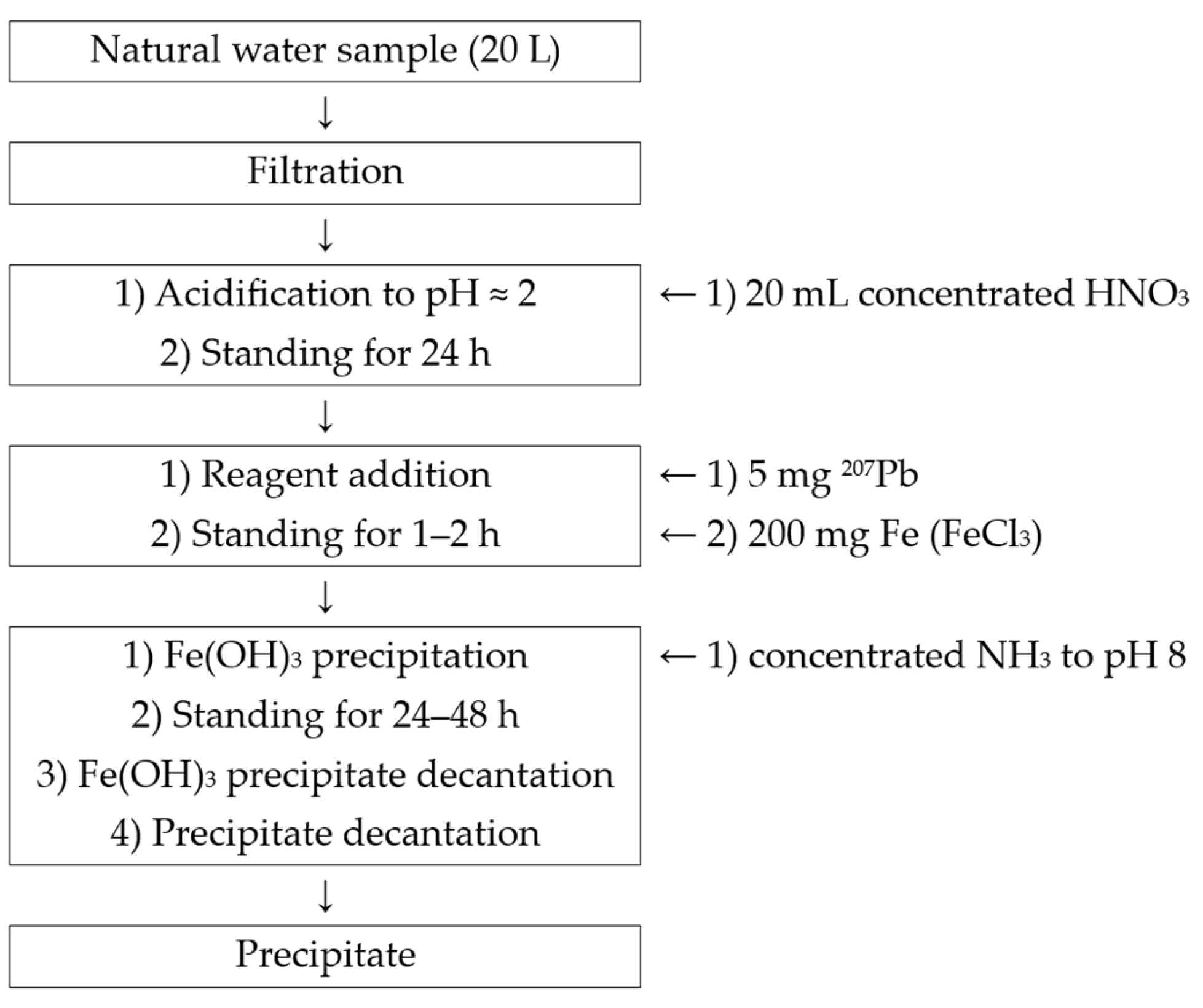
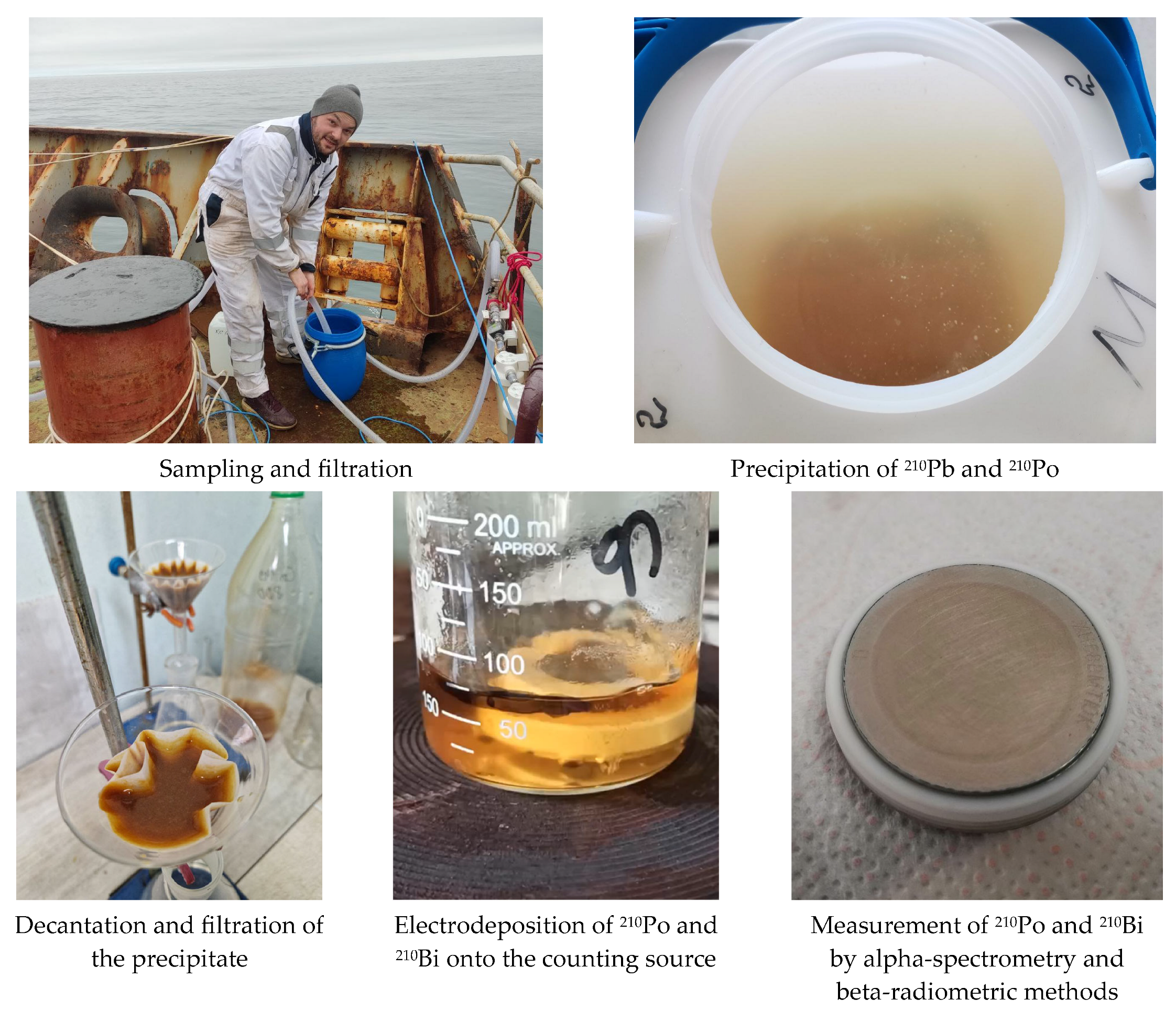
A scheme for the preconcentration of 210Pb and 210Po by precipitation using iron(III) chloride from natural waters is presented in detail in Figure 2.
For the concentration of dissolved radionuclides, 20 L water samples were collected after filtration. Subsequently, nitric acid was added to the sample container at a rate of at least 1 mL of concentrated nitric acid per 1 L of sample (until reaching pH ≤ 2), and the mixture was left to stand for 24 h.
After this holding period, 5 mg of stable lead isotope in the form of lead nitrate and 200 mg of iron in the form of iron(III) chloride were added to the collected sample. The mixture was thoroughly stirred and left to stand for 1–2 h.
An ammonia solution was then added to adjust the pH to 8 for the coprecipitation of 210Pb and 210Po with iron(III) hydroxide. After settling for 24–48 h, the precipitate was decanted and transferred to 1 L containers for further processing in the laboratory after the expedition.

2.4. Determination of 210Pb and 210Po Activity by Alpha-Spectrometry and Radiometric Method After Radiochemical Preparation

The obtained iron(III) hydroxide precipitate was separated by filtration through a “White Ribbon” filter, followed by dissolution in 20 mL of dilute hydrochloric acid.
The polypropylene cartridges (mechanical filters) were ashed in a muffle furnace at 600 °C for 4 h. The ash was dissolved in 50 mL of concentrated nitric acid and 50 mL of 30% hydrogen peroxide [27]. Although elemental polonium is volatile, the 210Po in the particulate samples is immobilized within the refractory mineral matrix of the ash, preventing its loss during this step.
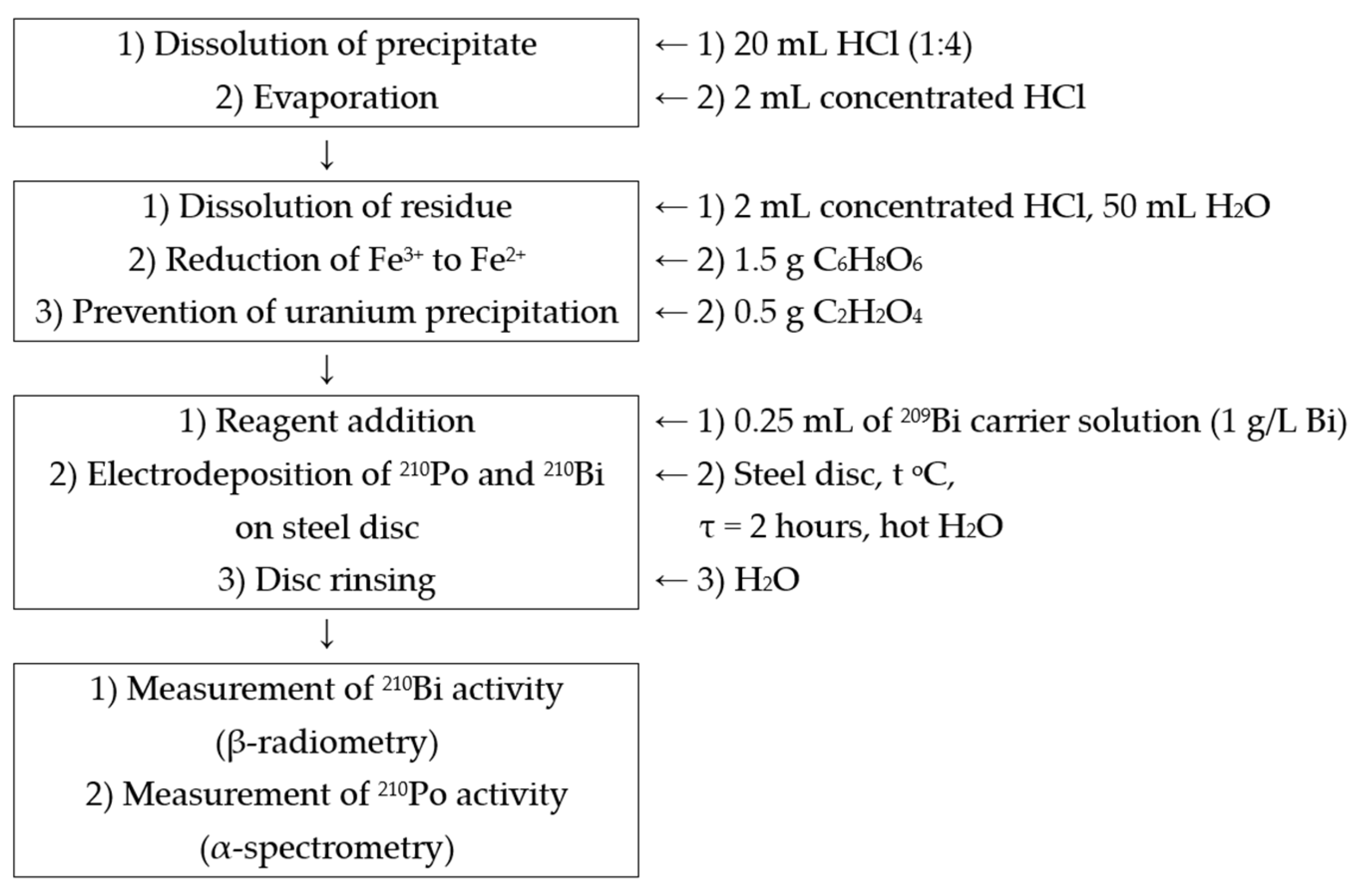
Subsequent preparation of the counting source was performed according to the methodology described in [28,29]. The scheme of radiochemical preparation is presented in Figure 3.
The resulting sample solution was evaporated to a minimal volume (approximately 5 mL), ensuring the residue did not dry completely. It was then transferred to a water bath and evaporated to dryness, taking care to prevent the residue from burning. The dry residue was moistened with 2 mL of concentrated hydrochloric acid and evaporated to dryness again. Subsequently, the process proceeded to the electrodeposition of 210Po and 210Bi onto the counting source.
2 mL of concentrated hydrochloric acid was added to the beaker containing the dry residue (concentrate) of the sample. Distilled water was then added to reach a total volume of 50 mL. The beaker was covered with a watch glass and heated on a laboratory hotplate until the residue dissolved. Ascorbic acid (approximately 100–200 mg) was added to the solution until it became colorless (reducing Fe3+ to Fe2+), followed by 0.5 g of oxalic acid to prevent the precipitation of U.
Prior to electrodeposition, 0.25 mL of a stable 209Bi carrier solution (Certified Reference Material CRM 0541:2003, 1 g/L Bi) was added to yield a final Bi concentration of approximately 5 mg/L. The solution was stirred, and electrochemical deposition of 210Po and 210Bi isotopes onto a clean steel disk (34 mm in diameter) was carried out. Prior to deposition, one side of the disk was treated with sandpaper and wiped with cotton wool soaked in ethyl alcohol. The spontaneous electrochemical deposition of 210Po and 210Bi was carried out onto a steel disk from the vigorously boiling solution for 2 h. As the solution evaporated, hot distilled water was added to maintain the original volume.
After 2 h, the beaker with the sample was removed from the hotplate. After the precipitate settled, the solution was decanted. The holder with the disk was carefully removed using tweezers and rinsed with distilled water. The disk was then carefully removed from the holder to avoid damaging the thin active deposit, rinsed again with water, and air-dried to constant weight.
Stable carriers were used to monitor the efficiency (yield) at all stages. The chemical yield of lead at the coprecipitation and dissolution stages was monitored using the stable isotope 207Pb added at the beginning of the analysis. Its content in aliquots of the solution was determined by atomic absorption spectroscopy (AAS). The efficiency of the electrochemical deposition of polonium and bismuth was determined using the stable 209Bi carrier added immediately before electrolysis. Its concentration in the electrolyte before and after the procedure was also measured by AAS. The obtained radionuclide activity values were corrected for the calculated chemical and electrochemical yields, and the uncertainties associated with these determinations were included in the overall measurement uncertainty.
The activity of 210Pb (via its daughter 210Bi) in the prepared counting sources (disks), prepared as described above, was measured no earlier than 10 h afterward using an UMF-2000 alpha–beta radiometer (LLC NPP “Doza,” Zelenograd, Russia) for a duration of at least 8 h several times. Multiple measurements were performed over time. The initial 210Bi activity was derived through standard decay-curve analysis. Following this, the activity of 210Po was measured by alpha-spectrometry using the “UMF-Spectr” spectrometric complex (LLC NPP “Doza,” Zelenograd, Russia) for a duration of at least 8 h.
The combined standard uncertainty for each activity concentration was calculated by propagating the individual uncertainties. The main uncertainty components included: Poisson counting statistics for the sample and background, the uncertainty in detector efficiency calibration (for β-counting) or spectrometric energy calibration (for α-spectrometry), and the uncertainty in chemical yield determination. The reported relative combined uncertainties for 210Pb and 210Po activities reflect these contributions and typically ranged between 9% and 15%.
The overall sequence for the concentration, separation, and determination of 210Pb and 210Po in environmental samples is presented in Figure 4.

2.5. Determination of POC Concentration

The determination of organic carbon concentration was performed using a TOC-L CSN carbon analyzer equipped with an SSM-5000A solid sample module (Shimadzu, Kyoto, Japan). The analysis was carried out using the difference method, calculating the concentration of total carbon versus inorganic carbon. The difference method (POC = TC − IC) is based on first determining total carbon (TC). Subsequently, inorganic carbon is removed by combustion of the solid sample at a high temperature (680 °C) and subsequent determination of inorganic carbon (IC) using a non-dispersive infrared (NDIR) detector.

2.6. Calculation of SPM and POC Fluxes

A one-dimensional steady-state model [30,31,32,33] was used to estimate the fluxes. The particulate 210Po flux was calculated using formulas that employ the trapezoidal method for integrating the radionuclide inventory in the water column:
F 210 Po = 0 z λ Po A 210 Pb A 210 Po dz   Bq / ( m 2 day ) ,
where λPo is the decay constant of 210Po, day–1 (0.00502 day–1); A 210 Pb is the total activity of 210Pb in dissolved and particulate forms, Bq/m3; and A 210 Po is the total activity of 210Po in dissolved and particulate forms, Bq/m3.
The specific activity of particulate 210Po was calculated using equation:
A 210 Po ( Part ) sp = A 210 Po ( Part ) C SPM   Bq / g ,
where CSPM is the SPM concentration, g/m3.
Based on these quantities, the SPM flux was calculated using Equation:
F SPM = F 210 Po A 210 Po ( Part ) sp . avg   g / ( m 2 day ) ,
The POC flux was calculated using equation:
F POC = F SPM C POC C SPM avg   g   C / ( m 2 day ) ,
where CPOC is the POC concentration, g/m3.

3. Results and Discussion

3.1. Distribution of 210Pb and 210Po

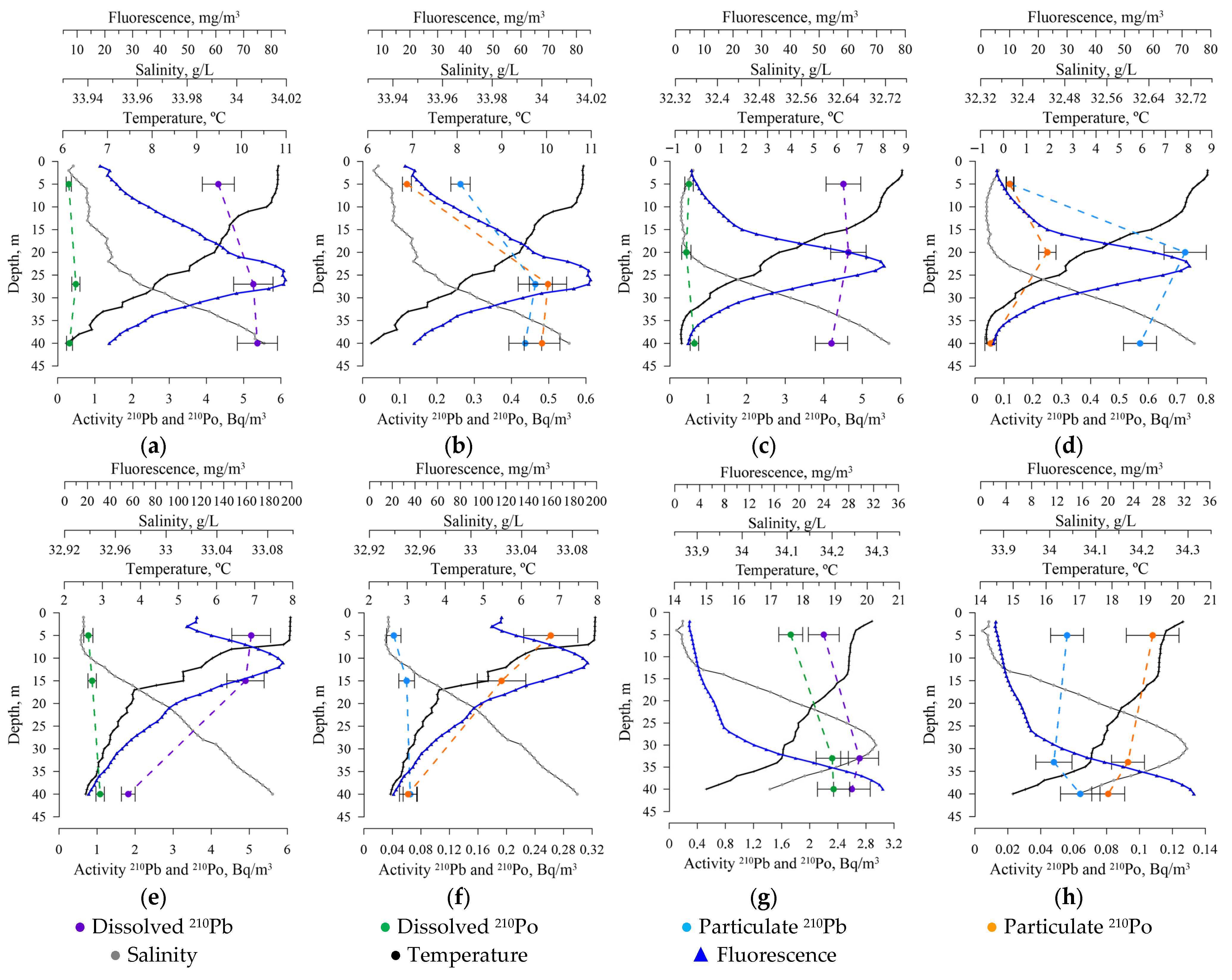
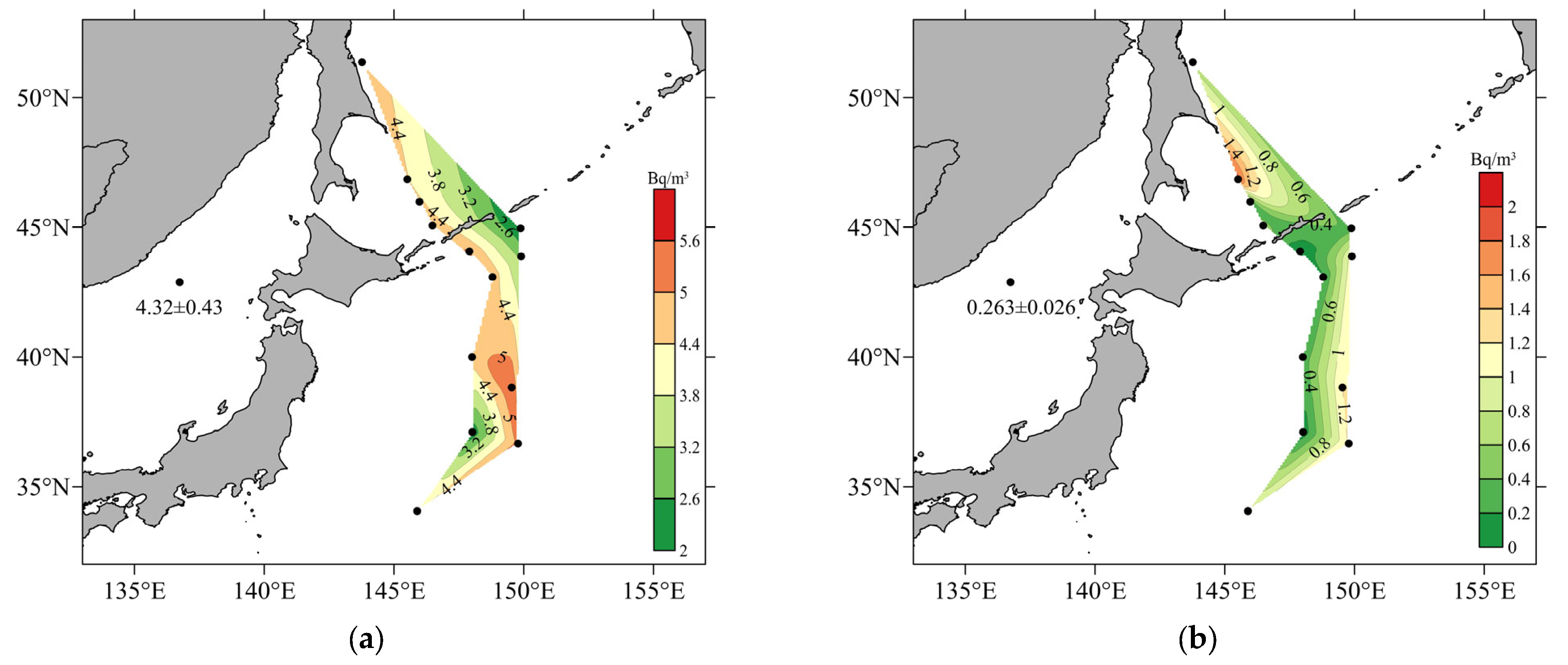
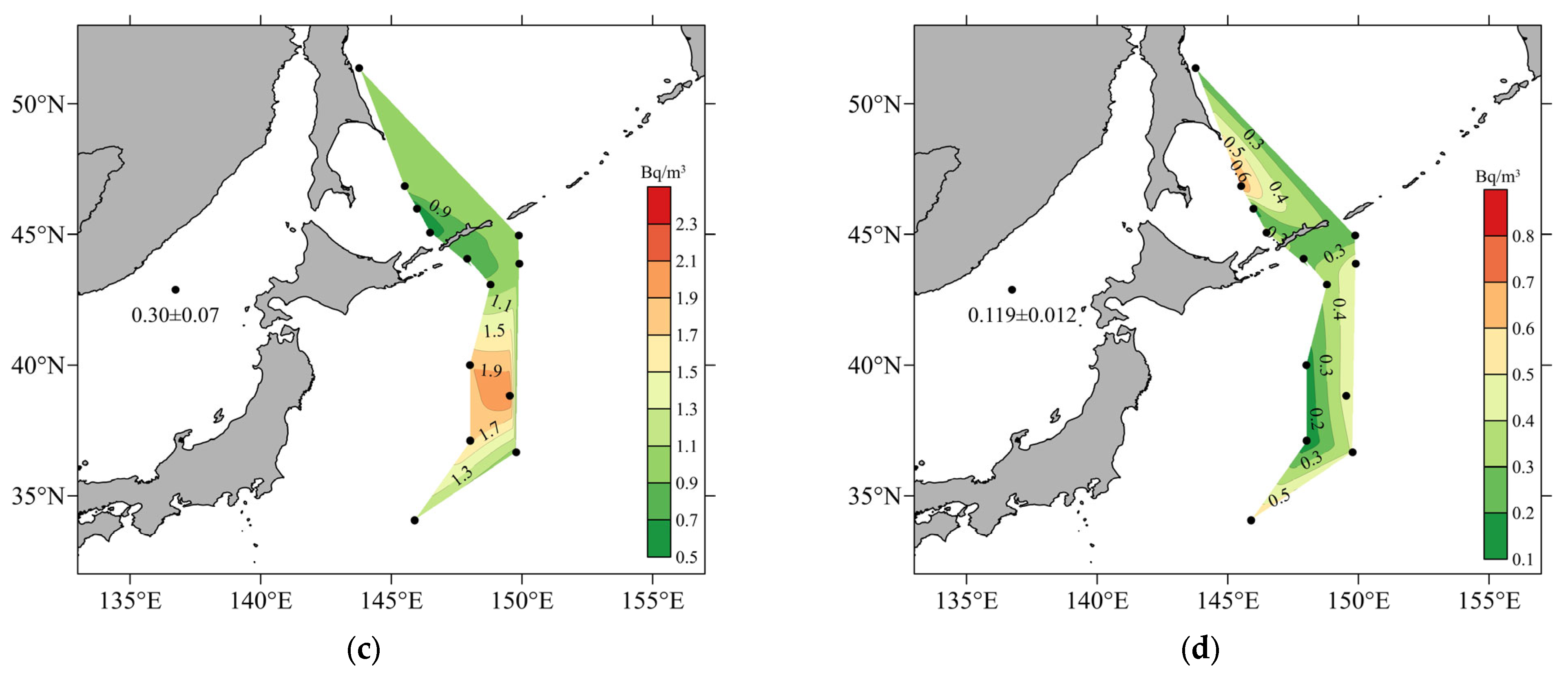
The spatial and vertical distributions of dissolved and particulate 210Pb and 210Po in the study area during summer 2024 are presented in Figure 5 and Figure 6, respectively, with the complete dataset provided in Table 1.
The activity of dissolved 210Pb in the surface layer ranged from 2.02 to 5.55 Bq/m3, with an average of 4.28 ± 0.43 Bq/m3. The activity of particulate 210Pb ranged from 0.042 to 1.904 Bq/m3, averaging 0.632 ± 0.063 Bq/m3. The activity of dissolved 210Po in the surface layer ranged from 0.30 to 2.13 Bq/m3, with an average of 1.09 ± 0.11 Bq/m3, while particulate 210Po activity ranged from 0.108 to 0.737 Bq/m3, averaging 0.328 ± 0.033 Bq/m3.
It should be noted that the activity of 210Pb and 210Po in dissolved and particulate forms had not been previously determined in the Sea of Okhotsk. At the same time, the established values are consistent with those previously obtained for the northwestern Pacific Ocean [34] and the Sea of Japan and the East China Sea [35].
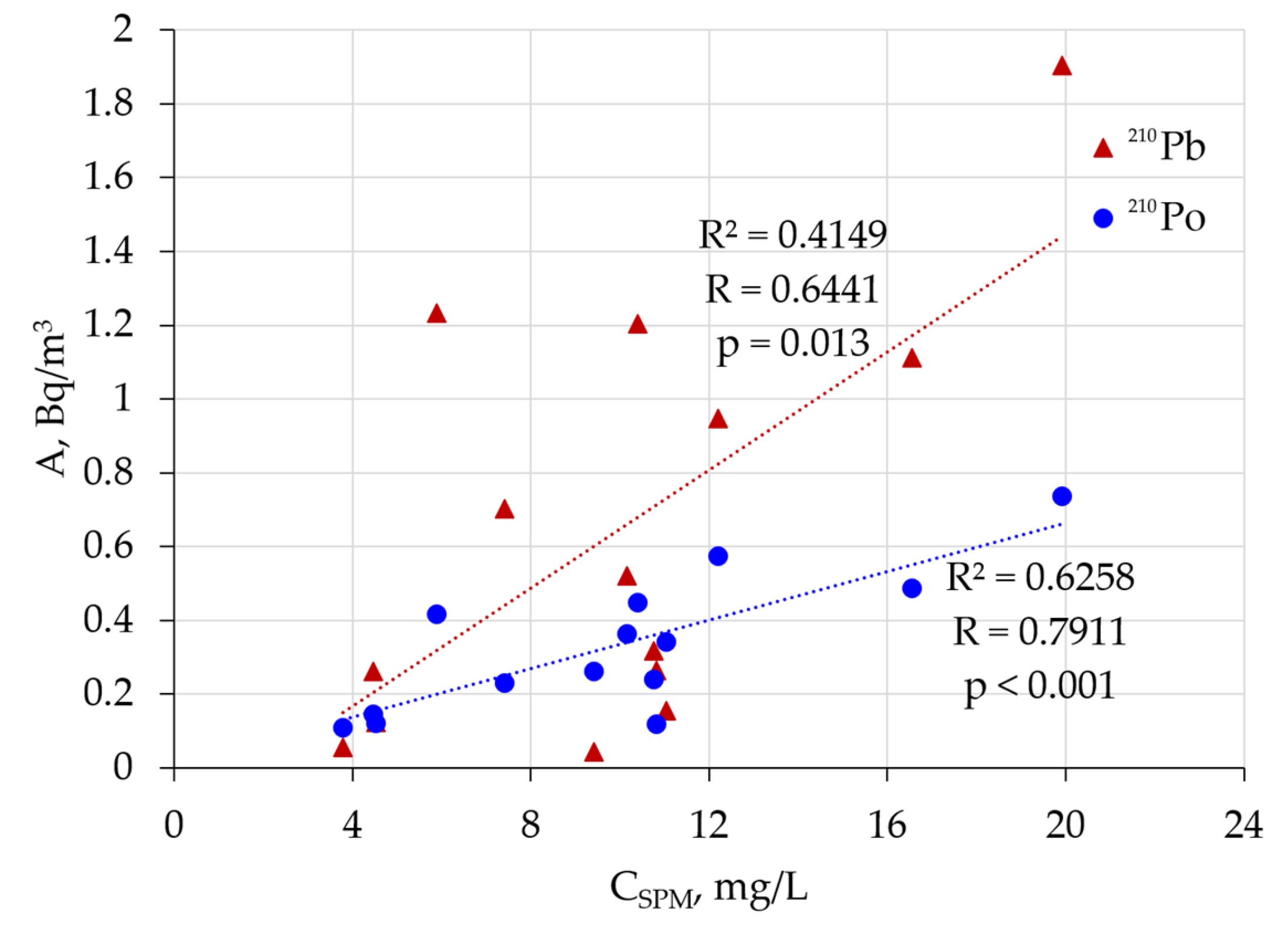
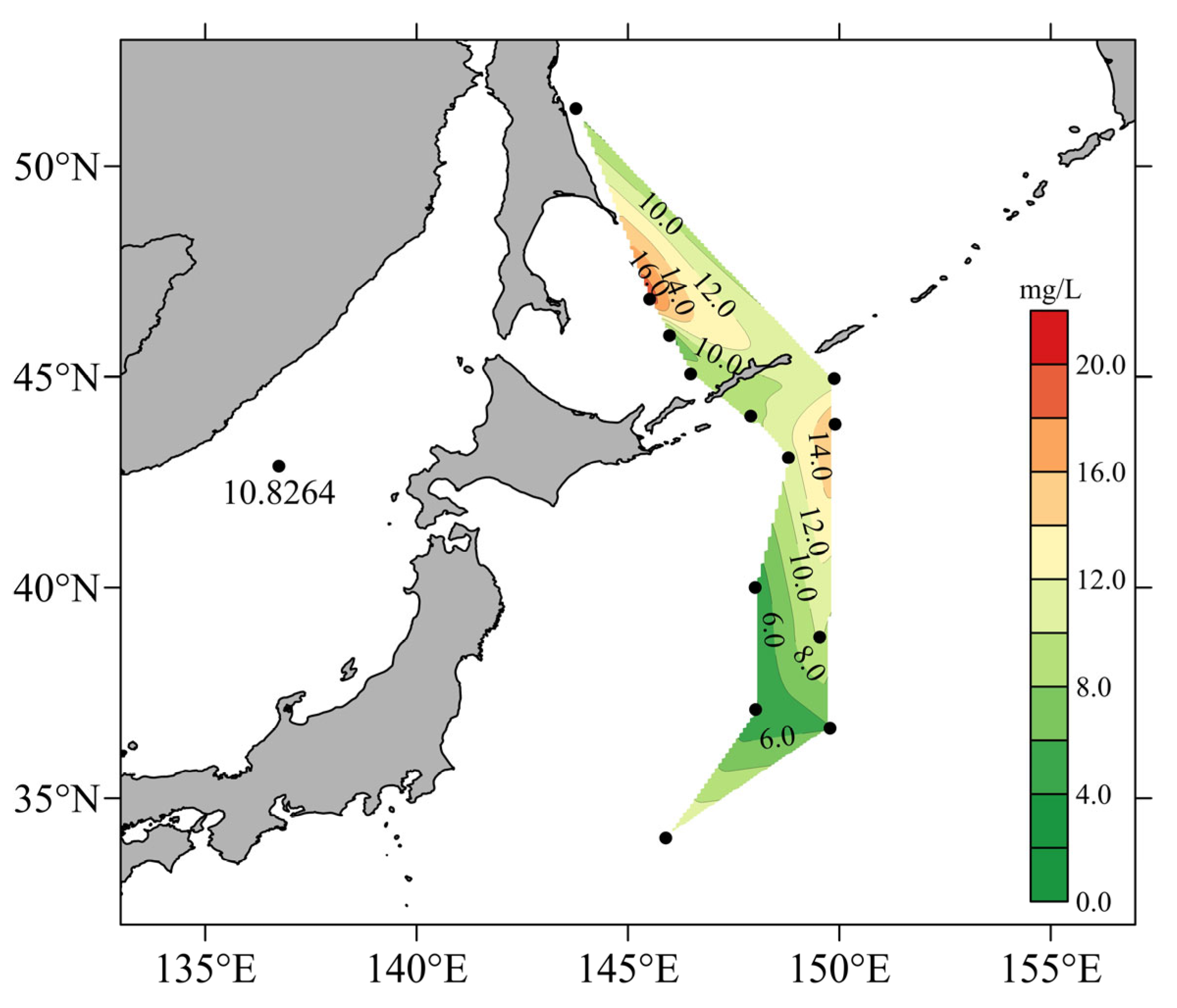
The distribution maps (Figure 5 and Figure 7) show that particulate 210Pb and 210Po concentrations are correlated with SPM distribution. Specifically, particulate radionuclide activities decrease with decreasing SPM concentration. The obtained relationship between the activity of particulate 210Pb and 210Po in surface samples and the concentration of SPM is presented in Figure 8.
The correlation coefficient between particulate 210Po concentration and SPM concentration (R = 0.79) was higher than that for 210Pb (R = 0.64). This difference serves as direct evidence of their distinct interaction mechanisms with marine biogenic and lithogenic particles. While 210Pb is primarily sorbed onto the surface of inorganic particles (an abiotic process), 210Po is actively incorporated into the biological cycle, showing a strong affinity for biogenic particles [4], which demonstrates its closer association with the biogenic fraction of SPM. This confirms that 210Po is a more specific tracer for studying the biological pump.
Analysis of the vertical profiles (Table 1, Figure 7) revealed a clear gradient in the behavior of the 210Po/210Pb pair from the coastal seas (the Sea of Japan and the Sea of Okhotsk) towards the open waters of the Pacific Ocean, with a transition zone in the region of the Kuril Islands. This observation is consistent with current understanding of the biogeochemistry of these radionuclides [4].
The productive waters of the Sea of Japan (Station 1) and the Sea of Okhotsk (Stations 22, 23) exhibit the characteristic pattern of an efficient biological pump. At Station 1, the chlorophyll maximum at a depth of 27 m (84.42 mg/m3) coincides precisely with the maxima of particulate 210Pb and 210Po (0.464 Bq/m3 and 0.498 Bq/m3, respectively). This provides direct evidence that the thermocline acts not only as a physical barrier but also as an active biogeochemical zone where radionuclides are scavenged by sinking particles and exported from the surface water column. At Station 22, within the layer of maximum fluorescence (60.26 mg/m3 at 20 m), a similar but more pronounced process of active removal of dissolved 210Po and its conversion to the particulate form is observed.
In the transition zone of the Kuril Islands (Stations 25, 88), extremely high fluorescence values were recorded (up to 152.3 mg/m3 at Station 25), which is consistent with known data on the high productivity of strait zones [34]. However, an anomaly was identified at Station 25: despite high chlorophyll concentrations (a proxy for phytoplankton biomass), particulate radionuclide concentrations remained low. This, combined with an anomalously low content of dissolved 210Pb at depth (1.82 Bq/m3), indicates a complex interplay of advection and biological uptake processes in this dynamic region.
In the oligotrophic waters of the open ocean (Stations 36, 61, 68), a pronounced decoupling between fluorescence and radionuclide distribution is observed. Low fluorescence values (1.33–2.66 mg/m3) indicate a low biomass of photosynthetic organisms. At the same time, the dissolved 210Po/210Pb ratio is close to equilibrium (~0.9 at Station 36), which is characteristic of a “recycling regime” [35], where remineralization processes dominate over sedimentation. At Stations 61 and 68, in the subsurface layer (20 m), an increase in particulate 210Po is observed with a minimal increase in fluorescence, which may indicate sorption onto lithogenic particle surfaces or association with non-phytoplankton particulate matter.
Certain stations exhibit unique features that highlight the complexity of processes in the region. At Station 81, a distinct chlorophyll maximum (77.54 mg/m3) is accompanied by an increase in particulate 210Po, aligning it with the coastal sedimentation regime. The profile of Station 6 indicates the dominance of lithogenic SPM: at the 20 m depth horizon, an extremely low specific activity of particulate radionuclides is observed alongside a high SPM concentration. The anomalously high content of particulate 210Po at Station 31, coupled with moderate chlorophyll values, may be attributed to the predominance of fine organic SPM (detritus, bacterioplankton) with high sorption capacity [36].
A comparison of the highly productive Stations 21 and 87 revealed an important pattern. At Station 87, despite the record chlorophyll concentration (161.6 mg/m3), the content of particulate radionuclides remains relatively moderate. In contrast, Station 21, with a somewhat lower biomass (104.7 mg/m3), exhibits the maximum concentrations of particulate 210Pb and 210Po. This suggests that these stations represent different phases of bloom development. Station 87 corresponds to an active growth phase, whereas Station 21 represents a mature phase, when the processes of radionuclide sorption and bioassimilation reach their maximum.

3.2. Fluxes of SPM and POC

Using the distributions presented in Table 1 and the flux model described in Section 2.6, we performed quantitative assessments of SPM and POC export parameters.
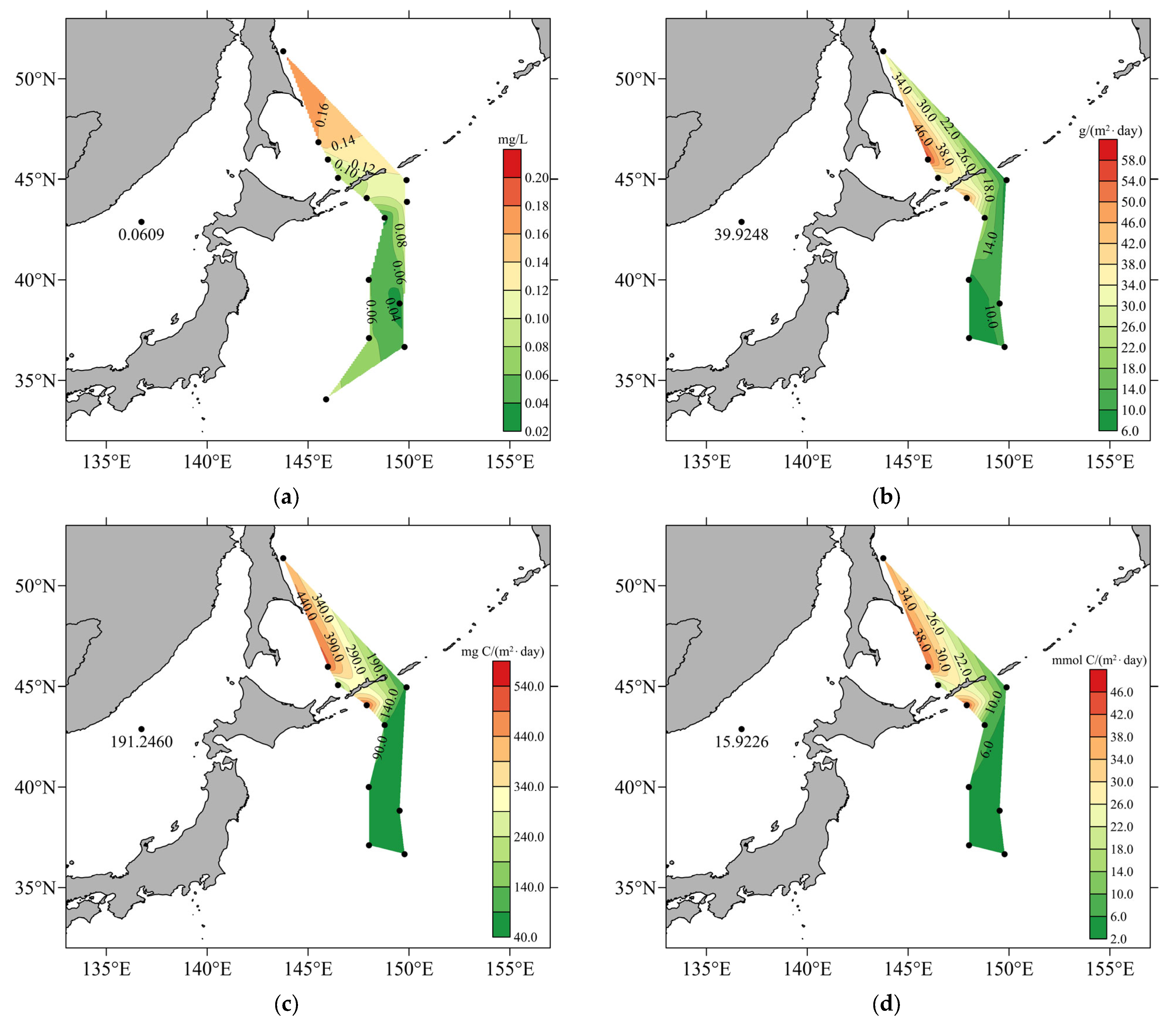
The obtained results, presented in Table 2 and Figure 9, demonstrate a clear gradient in flux magnitudes, reflecting the transition from highly productive shelf waters to oligotrophic areas of the open ocean.
The maximum values of both SPM fluxes (up to 56.6 g/(m2·day)) and POC fluxes (up to 44.68 mmol C/(m2·day)) were obtained for the coastal areas of the Sea of Okhotsk near Sakhalin Island and the Kuril Islands (Stations 6, 22, 25). These values show good agreement with data from other productive marginal seas [9,34] and correlate with the previously identified zones of high biological productivity, confirming the efficient operation of the biological pump in these regions.
In the open waters of the Pacific Ocean (Stations 36, 61, 68), the fluxes decrease by an order of magnitude (FPOC: 3.85–6.89 mmol C/(m2·day)), which is characteristic of oligotrophic waters [35] and corresponds to the “recycling regime” identified earlier, where remineralization processes dominate over sedimentation.
A comparative analysis of the anomalous stations highlights the complexity of the processes controlling vertical fluxes. At Station 31, the high content of particulate 210Po is not accompanied by a significant POC flux, indicating specific sorption processes in this area. In the case of Station 6, a unique combination is observed: a high POC flux (35.6 mmol C/(m2·day)) alongside signs of lithogenic SPM dominance. This suggests that in the coastal areas of the Sea of Okhotsk, the mechanisms of vertical organic carbon transport may not only involve the classical biological pump but also effective sorption of POC onto mineral particles, which enhances the total flux of organic matter to deeper layers.
The calculated SPM and POC fluxes (Table 2) provide a quantitative expression of the contrasting biogeochemical regimes identified earlier. Station representative of the efficient sedimentation regime in productive coastal waters (e.g., Station 22, Sea of Okhotsk) yielded substantial POC fluxes (42.71 mmol C/(m2·day)). This confirms the direct link between high chlorophyll levels, active 210Po assimilation, and effective vertical export of organic matter.
The transition zone of the Kuril Islands (e.g., Station 25), characterized by extreme surface productivity, also resulted in very high POC flux (44.68 mmol C/(m2·day)). However, as noted earlier, the decoupling between high biomass and relatively low particulate radionuclide concentrations at this station suggests that lateral advection and particle dynamics modulate the export efficiency, highlighting the complex interplay of biology and physics in this dynamic region.
In stark contrast, stations within the recycling regime of the oligotrophic open ocean (e.g., Stations 36, 68), which exhibited near-equilibrium 210Po/210Pb ratios and low fluorescence, produced an order-of-magnitude lower POC fluxes (3.85–4.44 mmol C/(m2·day)). This quantifies the dominance of remineralization over particle export in these waters. This direct correlation between the biogeochemical patterns and the calculated fluxes.
Our POC export estimates are based on 210Po/210Pb disequilibrium measured using the Fe(OH)3 co-precipitation method, with chemical yields rigorously monitored using stable 207Pb and 209Bi carriers. We note that a method intercomparison study suggested this approach may yield lower total 210Po activities compared to the Co-APDC technique in certain marine settings [33]. While our protocol of direct yield control ensures the internal accuracy of our measurements, we acknowledge this methodological consideration. Therefore, the absolute values of our derived POC fluxes may represent upper-bound estimates. Importantly, any potential systematic bias does not affect the relative patterns central to our study. The clear quantitative contrast between the efficient export regime of the Sea of Okhotsk and the recycling-dominated regime of the oligotrophic open ocean remains robust.
Thus, the calculated fluxes quantitatively confirm the previously identified spatial heterogeneity in the ecosystem functioning of the region: from active vertical export of organic carbon in the coastal seas to its efficient recycling in the oligotrophic waters of the open ocean.

4. Conclusions

We have presented a comprehensive dataset on the distributions of dissolved and particulate 210Pb and 210Po, SPM, and POC for the waters of the Sea of Okhotsk and the northwestern Pacific Ocean. These data represent the first such measurements for the Sea of Okhotsk.
A clear distinction between biogeochemical regimes has been established. The waters of the Sea of Okhotsk are characterized by a “sedimentation regime” with an efficient biological pump, where the maxima of particulate 210Pb and 210Po in the thermocline layer correlate with the chlorophyll maximum. The open oligotrophic waters of the Pacific Ocean exhibit a “recycling regime” with a near-equilibrium dissolved 210Po/210Pb ratio and the dominance of remineralization processes.
Our results demonstrate the key role of the Kuril Islands zone as a dynamic transition region. Extremely high values of primary productivity were recorded; however, the distribution of radionuclides in this area is complicated by intense processes of lateral water mass transport.
We provide quantitative assessments of SPM and POC export fluxes. POC fluxes in the productive coastal waters of the Sea of Okhotsk (tens of mmol C/(m2·day)) were an order of magnitude higher than in the oligotrophic open ocean waters ((single digits of mmol C/(m2·day)), which quantitatively confirms the high efficiency of the biological pump in the marginal seas.
We identified and interpreted several anomalies that indicate a complex interplay of physicochemical and biological processes. The high POC flux at a station showing signs of lithogenic SPM (Station 6) highlights the importance of organic carbon sorption onto mineral particle surfaces. The anomalously high concentration of particulate 210Po under moderate productivity (Station 31) underscores the role of specific sorption mechanisms potentially mediated by non-phytoplankton particles or dissolved organic matter.
The obtained data demonstrate the potential of using radioactive tracers for the quantitative assessment of matter fluxes.

Author Contributions

Conceptualization, N.A.B. and E.A.T.; methodology, N.A.B. and D.V.T.; validation, V.A.R., A.I.M., I.G.S. and D.K.P.; formal analysis, V.A.R., A.I.M., V.A.T. and I.G.S.; investigation, All authors; resources, E.A.T., A.I.M. and V.A.T.; data curation, D.V.T., V.A.T. and I.G.S.; writing—original draft preparation, All authors; writing—review and editing, All authors; visualization, N.A.B., D.V.T. and V.A.R.; supervision, N.A.B.; project administration, E.A.T.; funding acquisition, E.A.T. All authors have read and agreed to the published version of the manuscript.

Funding

This research was carried out within the framework of the state assignment of Sakhalin State University, project No. FEFF-2024-0005.

Data Availability Statement

The original contributions presented in this study are included in the article. Further inquiries can be directed to the corresponding author.

Conflicts of Interest

The authors declare no conflicts of interest.

Abbreviations

The following abbreviations are used in this manuscript:
CTDConductivity, Temperature, Depth
POCParticulate Organic Carbon
R/VResearch Vessel
SPMSuspended Particulate Matter

References

  1. Sanitary Rules 2.6.1.2612-10; Basic Sanitary Rules for Radiation Safety (OSPORB-99/2010). Federal Service for Surveillance on Consumer Rights Protection and Human Wellbeing (Rospotrebnadzor): Moscow, Russia, 2010. (In Russian)
  2. Sanitary Rules and Norms SanPiN 2.6.1.2523-09; Radiation Safety Standards (NRB-99/2009). Federal Center for Hygiene and Epidemiology of Rospotrebnadzor: Moscow, Russia, 2009. (In Russian)
  3. Villa-Alfageme, M.; Mas, J.L.; Hurtado-Bermudez, S.; Masqué, P. Rapid determination of 210Pb and 210Po in water and application to marine samples. Talanta 2016, 160, 28–35. [Google Scholar] [CrossRef]
  4. Verdeny, E.; Masqué, P.; Garcia-Orellana, J.; Hanfland, C.; Cochran, J.K.; Stewart, G.M. POC export from ocean surface waters by means of 234Th/238U and 210Po/210Pb disequilibria: A review of the use of two radiotracer pairs. Deep Sea Res. Part II Top. Stud. Oceanogr. 2009, 56, 1502–1518. [Google Scholar] [CrossRef]
  5. Choi, H.Y.; Stewart, G.; Lomas, M.W.; Kelly, R.P.; Moran, S.B. Linking the distribution of 210Po and 210Pb with plankton community along Line P, Northeast Subarctic Pacific. J. Environ. Radioact. 2014, 138, 390–401. [Google Scholar] [CrossRef]
  6. Subha Anand, S.; Rengarajan, R.; Shenoy, D.; Gauns, M.; Naqvi, S.W.A. POC export fluxes in the Arabian Sea and the Bay of Bengal: A simultaneous 234Th/238U and 210Po/210Pb study. Mar. Chem. 2017, 198, 70–87. [Google Scholar] [CrossRef]
  7. Hayes, C.T.; Black, E.E.; Anderson, R.F.; Baskaran, M.; Buesseler, K.O.; Charette, M.A.; Cheng, H.; Kirk Cochran, J.; Lawrence Edwards, R.; Fitzgerald, P.; et al. Flux of particulate elements in the North Atlantic Ocean constrained by multiple radionuclides. Glob. Biogeochem. Cycl. 2018, 32, 1738–1758. [Google Scholar] [CrossRef]
  8. Craig, H.; Krishnaswami, S.; Somayajulu, B.L.K. Lead-210–radium-226. Radioactive disequilibrium in the deep sea. Earth Planet. Sci. Lett. 1973, 17, 295–305. [Google Scholar] [CrossRef]
  9. Stewart, G.M.; Bradley Moran, S.; Lomas, M.W. Seasonal POC fluxes at BATS estimated from 210Po deficits. Deep Sea Res. Part I Oceanogr. Res. Pap. 2010, 57, 113–124. [Google Scholar] [CrossRef]
  10. Ducklow, H.D.; Steinberg, D.K.; Buesseler, K.O. Upper ocean carbon export and the biological pump. Oceanography 2001, 14, 50–58. [Google Scholar] [CrossRef]
  11. Feely, R.A.; Sabine, C.L.; Takahashi, T.; Wanninkhof, R. Uptake and storage of carbon dioxide in the oceans: The global CO2 survey. Oceanography 2001, 14, 18–32. [Google Scholar] [CrossRef]
  12. Berelson, W.M.; Johnson, K.; Coale, K.; Li, H.-C. Organic matter diagenesis in the sediments of the San Pedro Shelf along a transect affected by sewage effluent. Cont. Shelf Res. 2002, 22, 1101–1115. [Google Scholar] [CrossRef]
  13. Eppley, R.W.; Peterson, B.J. Particulate organic matter flux and planktonic new production in the deep ocean. Nature 1979, 282, 677–680. [Google Scholar] [CrossRef]
  14. Bacon, M.P.; Spencer, D.W.; Brewer, P.G. 210Pb/226Ra and 210Po/210Pb disequilibria in seawater and suspended particulate matter. Earth Planet. Sci. Lett. 1976, 32, 277–296. [Google Scholar] [CrossRef]
  15. De Soto, F.; Ceballos-Romero, E.; Villa-Alfageme, M. A microscopic simulation of particle flux in ocean waters: Application to radioactive pair disequilibrium. Geochim. Cosmochim. Acta 2018, 239, 136–158. [Google Scholar] [CrossRef]
  16. Ceballos-Romero, E.; Le Moigne, F.A.C.; Henson, S.; Marsay, C.M.; Sanders, R.J.; García-Tenorio, R.; Villa-Alfageme, M. Influence of bloom dynamics on particle export efficiency in the North Atlantic: A comparative study of radioanalytical techniques and sediment traps. Mar. Chem. 2016, 186, 198–210. [Google Scholar] [CrossRef]
  17. Friedrich, J.; Rutgers van der Loeff, M.M. A two-tracer (210Po–234Th) approach to distinguish organic carbon and biogenic silica export flux in the Antarctic circumpolar current. Deep Sea Res. Part I Oceanogr. Res. Pap. 2002, 49, 101–120. [Google Scholar] [CrossRef]
  18. Sarin, M.M.; Guebuem, K.; Church, T.M. 210Po and 210Pb in the South-equatorial Atlantic: Distribution and disequilibrium in the upper 500 m. Deep Sea Res. Part II Top. Stud. Oceanogr. 1999, 46, 907–917. [Google Scholar] [CrossRef]
  19. Kim, G.; Church, T.M. Seasonal biogeochemical fluxes of 234Th and 210Po in the upper Sargasso Sea: In fluence from atmospheric iron deposition. Glob. Biogeochem. Cycl. 2001, 15, 651–661. [Google Scholar] [CrossRef]
  20. Cochran, J.K.; Wei, Z.; Horowitz, E.; Fitzgerald, P.; Heilbrun, C.; Stephens, M.; Lam, P.J.; Le Roy, E.; Charette, M. 210Po and 210Pb distributions along the GEOTRACES Pacific Meridional Transect (GP15): Tracers of scavenging and particulate organic carbon (POC) export. Glob. Biogeochem. Cycl. 2024, 38, e2024GB008243. [Google Scholar] [CrossRef]
  21. Murray, J.W.; Paul, B.; Dunne, J.P.; Chapin, T. 234Th, 210Pb, 210Po and stable Pb in the Central Equatorial Pacific: Tracers for particle cycling. Deep Sea Res. Part I Oceanogr. Res. Pap. 2005, 52, 2109–2139. [Google Scholar] [CrossRef]
  22. Bam, W.; Maiti, K.; Baskaran, M. 210Po and 210Pb as tracers of particle cycling and export in the Western Arctic Ocean. Front. Mar. Sci. 2021, 8, 697444. [Google Scholar] [CrossRef]
  23. Zhong, Q.; Li, L.; Puigcorbé, V.; Huang, D.; Yu, T.; Du, J. Contrasting behaviors of 210Po, 210Pb and 234Th in the East China Sea during a severe red tide: Enhanced scavenging and promoted fractionation. Acta Oceanol. Sin. 2022, 41, 5–21. [Google Scholar] [CrossRef]
  24. Yang, W.; Zhao, X.; Guo, L.; Huang, B.; Chen, M.; Fang, Z.; Zhang, X.; Qiu, Y. Utilization of Soot and 210Po-210Pb disequilibria to constrain particulate organic carbon fluxes in the northeastern South China Sea. Front. Mar. Sci. 2021, 8, 694428. [Google Scholar] [CrossRef]
  25. Hu, H.; Liu, X.; Ren, C.; Jia, R.; Qiu, Y.; Zheng, M.; Chen, M. 210Po/210Pb disequilibria and its estimate of particulate organic carbon export around Prydz Bay, Antarctica. Front. Mar. Sci. 2021, 8, 701014. [Google Scholar] [CrossRef]
  26. Chen, M.; Chen, M.; Zheng, M.; Qiu, Y.; Chen, Q.; Li, Q. 210Po/210Pb disequilibria influenced by production and remineralization of particulate organic matter around Prydz Bay, Antarctica. Deep Sea Res. Part II Top. Stud. Oceanogr. 2021, 191–192, 104961. [Google Scholar] [CrossRef]
  27. Frolova, M.A.; Bezhin, N.A.; Slizchenko, E.V.; Kozlovskaia, O.N.; Tananaev, I.G. Assessment of Seasonal Variability in Phosphorus Biodynamics by Cosmogenic Isotopes 32P, 33P around Balaklava Coast. Materials 2023, 16, 1791. [Google Scholar] [CrossRef]
  28. Betenekov, N.D. Radioecological Monitoring: A Textbook; Ural University Press: Yekaterinburg, Russia, 2014. (In Russian) [Google Scholar]
  29. All-Russian Scientific-Research Institute of Mineral Resources named after N.M. Fedorovsky. Procedure for Measuring the Volumetric Activity of Polonium-210 (210Po) and Lead-210 (210Pb) in Natural (Fresh and Mineralized), Process, and Waste Water Samples by Alpha-Beta Radiometric Method with Radiochemical Preparation; All-Russian Scientific-Research Institute of Mineral Resources named after N.M. Fedorovsky: Moscow, Russia, 2021. (In Russian) [Google Scholar]
  30. Buesseler, K.O. Do upper-ocean sediment traps provide an accurate record of particle flux? Nature 1991, 353, 420–423. [Google Scholar] [CrossRef]
  31. Gulin, S.B.; Samyshev, E.Z.; Stokozov, N.A.; Sysoev, A.A. Assessment of sedimentation rate of the suspended matter from superficial layer of water of the Bransfield strait (Western Antarctic) with the use of Thorium-34 as natural radiotrasser. Ukr. Antarct. J. 2003, 1, 30–36. (In Russian) [Google Scholar] [CrossRef]
  32. Roca-Martí, M.; Puigcorbé, V.; Rutgers van der Loeff, M.M.; Katlein, C.; Fernández-Méndez, M.; Peeken, I.; Masqué, P. Carbon export fluxes and export efficiency in the central Arctic during the record sea-ice minimum in 2012: A joint 234Th/238U and 210Po/210Pb study. J. Geophys. Res. Ocean. 2016, 121, 5030–5049. [Google Scholar] [CrossRef]
  33. Roca-Martí, M.; Puigcorbé, V.; Castrillejo, M.; Casacuberta, N.; Garcia-Orellana, J.; Cochran, J.K.; Masqué, P. Quantifying 210Po/210Pb Disequilibrium in Seawater: A Comparison of Two Precipitation Methods with Differing Results. Front. Mar. Sci. 2021, 8, 684484. [Google Scholar] [CrossRef]
  34. Zhong, Q.; Yu, T.; Lin, H.; Lin, J.; Ji, J.; Ni, J.; Du, J.; Huang, D. 210Po–210Pb Disequilibrium in the Western North Pacific Ocean: Particle Cycling and POC Export. Front. Mar. Sci. 2021, 8, 700524. [Google Scholar] [CrossRef]
  35. Seo, H.; Joung, D.; Kim, G. Contrasting Behaviors of 210Pb and 210Po in the Productive Shelf Water Versus the Oligotrophic Water. Front. Mar. Sci. 2021, 8, 701441. [Google Scholar] [CrossRef]
  36. Buesseler, K.O.; Benitez-Nelson, C.R.; Moran, S.B.; Burd, A.; Charette, M.; Cochran, J.K.; Coppola, L.; Fisher, N.S.; Fowler, S.W.; Gardner, W.D.; et al. An assessment of particulate organic carbon to thorium-234 ratios in the ocean and their impact on the application of 234Th as a POC flux proxy. Mar. Chem. 2006, 100, 213–233. [Google Scholar] [CrossRef]
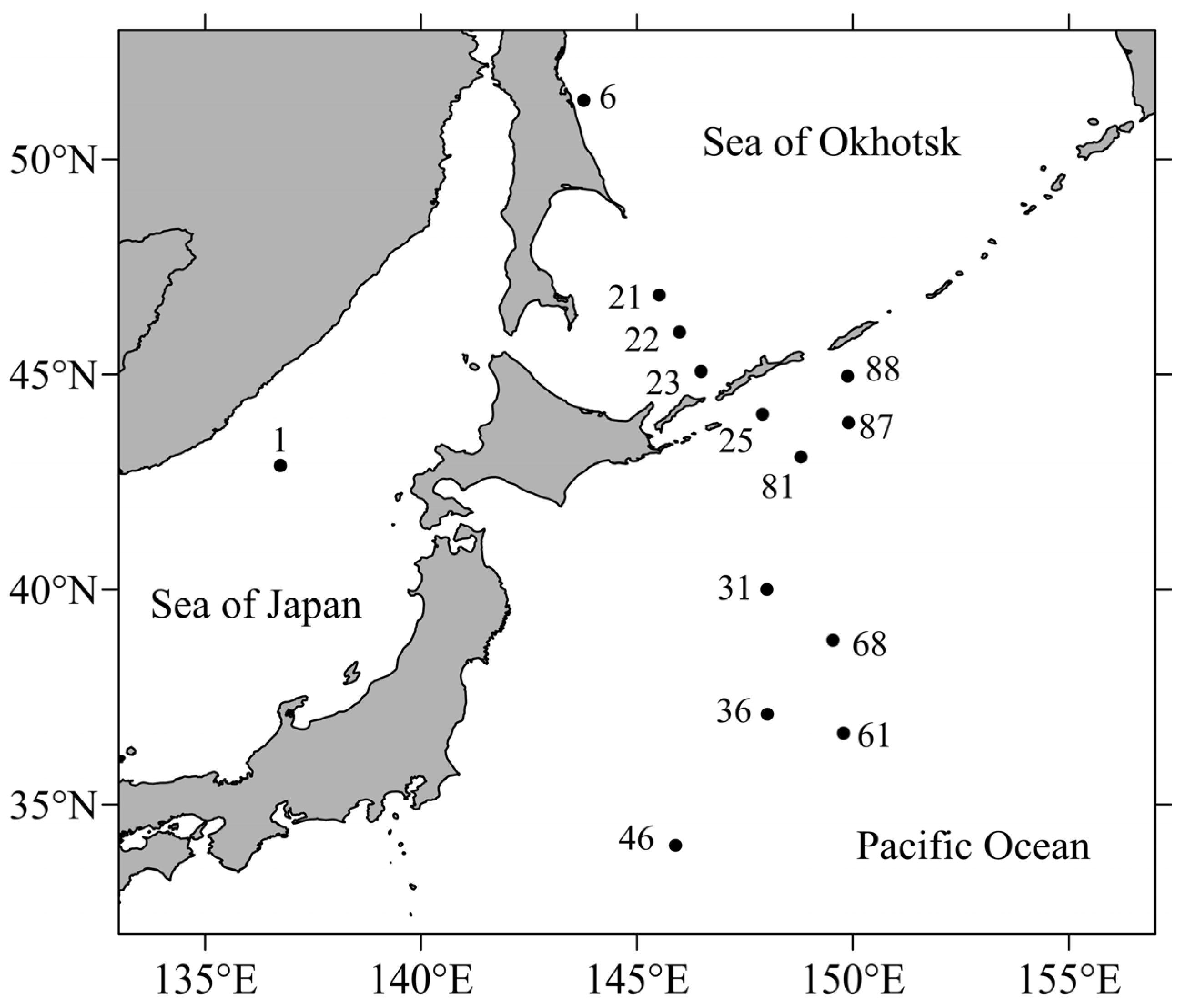
Figure 1. Map of sampling stations (Station numbers correspond to those in the official station log of the 71st cruise of the R/V Akademik Oparin).
Water 18 00031 g001
Figure 2. Scheme for the precipitative concentration of 210Pb and 210Po from natural waters using iron(III) chloride.
Water 18 00031 g002
Figure 3. Scheme for the concentration and analysis of 210Pb and 210Po in environmental samples.
Water 18 00031 g003
Figure 4. Sequence for the concentration, separation, and determination of 210Pb and 210Po in environmental samples.
Water 18 00031 g004
Figure 5. Surface distribution of 210Pb (a,b) and 210Po (c,d) in dissolved (a,c) and particulate (b,d) forms.
Water 18 00031 g005aWater 18 00031 g005b
Figure 6. Examples of vertical profiles of 210Pb and 210Po activity in dissolved form and 210Pb and 210Po in particulate form, obtained during the 71st cruise of the R/V Akademik Oparin in summer 2024 at stations 1 (a,b), 22 (c,d), 25 (e,f), 36 (g,h).
Water 18 00031 g006
Figure 7. Surface distribution of SPM (CSPM, mg/L).
Water 18 00031 g007
Figure 8. Relationship between the activity of particulate 210Pb and 210Po and the SPM concentration.
Water 18 00031 g008
Figure 9. Surface distributions: (a) POC concentration (CPOC, mg/L); (b) SPM flux (FSPM, g/(m2·day)); (c) POC flux (FPOC, mg C/(m2·day)); (d) POC flux (FPOC, mmol C/(m2·day)).
Water 18 00031 g009
Table 1. Hydrological parameters and measured activities obtained during the 71st cruise of the R/V Akademik Oparin (4 June–15 July 2024).
Station
No. *
CoordinatesDepth
(m)
T (°C)S (‰)Chlorophyll
Fluorescence
(mg/m3)
A 210Pb (Bq/m3)A 210Po (Bq/m3)CSPM
(mg/L)
Lat. (N)Long. (E)Diss.Part.Diss.Part.
1136.7404942.88050510.806733.937324.284.32 ± 0.430.263 ± 0.0260.30 ± 0.070.119 ± 0.01210.8264
278.063333.961084.425.26 ± 0.530.464 ± 0.0460.49 ± 0.110.498 ± 0.05018.9233
406.078134.011021.605.37 ± 0.540.437 ± 0.0440.32 ± 0.080.482 ± 0.04818.2654
6143.7680551.3692151.153331.62959.144.93 ± 0.490.702 ± 0.0701.04 ± 0.140.230 ± 0.0267.4075
20−0.117932.068330.494.28 ± 0.430.045 ± 0.0090.30 ± 0.080.047 ± 0.01012.8219
21145.5144746.8454856.958332.5678104.74.43 ± 0.441.904 ± 0.1901.05 ± 0.150.737 ± 0.07419.9269
22145.9824945.9833258.410732.34147.404.51 ± 0.450.122 ± 0.0130.50 ± 0.110.120 ± 0.0134.5184
203.499832.345760.264.64 ± 0.460.727 ± 0.0730.43 ± 0.120.250 ± 0.03011.9668
40−0.716432.72634.394.20 ± 0.420.571 ± 0.0570.64 ± 0.110.054 ± 0.02011.1527
23146.4801245.0695959.040832.449711.954.80 ± 0.480.521 ± 0.0520.68 ± 0.120.362 ± 0.04210.1514
304.124632.841147.164.53 ± 0.450.181 ± 0.0210.77 ± 0.140.158 ± 0.02013.6434
25147.9058244.0678857.919232.9331129.25.05 ± 0.510.042 ± 0.0100.77 ± 0.120.262 ± 0.0389.4139
155.128332.9665152.34.90 ± 0.490.060 ± 0.0110.87 ± 0.110.193 ± 0.03416.5764
402.562733.083821.081.82 ± 0.180.065 ± 0.0101.08 ± 0.110.062 ± 0.01216.1874
31148.0093940.00293520.248234.48238.664.70 ± 0.470.262 ± 0.0261.88 ± 0.230.144 ± 0.0274.4625
2016.678334.274720.235.21 ± 0.520.383 ± 0.0381.17 ± 0.180.702 ± 0.07017.7603
36148.0184537.10271519.592833.86592.662.20 ± 0.220.056 ± 0.0101.73 ± 0.170.108 ± 0.0163.7826
3317.337734.259919.442.71 ± 0.270.048 ± 0.0112.32 ± 0.230.093 ± 0.01013.2455
4014.993734.061633.482.60 ± 0.260.064 ± 0.0122.34 ± 0.230.081 ± 0.01013.0464
46145.8919234.05742523.515534.47756.444.31 ± 0.430.947 ± 0.0951.17 ± 0.130.575 ± 0.05812.2051
61149.7783936.66245524.633334.47001.335.19 ± 0.521.234 ± 0.1231.02 ± 0.140.417 ± 0.0525.8806
2024.155534.46022.144.94 ± 0.490.562 ± 0.0562.28 ± 0.230.334 ± 0.03812.7721
68149.5329838.82417521.702534.60082.035.55 ± 0.561.204 ± 0.1202.13 ± 0.210.448 ± 0.04810.4037
2021.363134.59122.575.49 ± 0.550.757 ± 0.0762.05 ± 0.210.482 ± 0.05014.7758
81148.7927643.08188516.560334.016023.224.76 ± 0.480.154 ± 0.0200.94 ± 0.130.340 ± 0.03911.0367
2013.012634.054677.544.82 ± 0.480.087 ± 0.0121.29 ± 0.140.125 ± 0.01815.0450
87149.8990443.8757954.737533.0093161.573.08 ± 0.311.112 ± 0.1110.90 ± 0.160.487 ± 0.05016.5432
88149.8774444.9606553.571033.019021.312.02 ± 0.200.318 ± 0.0321.08 ± 0.160.239 ± 0.03410.7690
153.520333.019668.203.92 ± 0.390.066 ± 0.0100.88 ± 0.120.144 ± 0.02114.0514
* Station numbers correspond to those in the official station log of the 71st cruise of the R/V Akademik Oparin.
Table 2. Results of sedimentation parameter calculations based on the obtained distributions of different forms of 210Pb and 210Po during the 71st cruise of the R/V Akademik Oparin (4 June–15 July 2024).
Station
No.
CoordinatesDepth
(m)
CSPM
(mg/L)
F 210 Po
(Bq/(m2·day))
FSPM
(g/(m2·day))
CPOC
(mg/L)
FPOC
Lat. (N)Long. (E)(mg C/(m2·Day))(mmol C/(m2·Day))
1136.7404942.88050510.82640.913839.920.061191.2515.92
2718.92330.075
4018.26540.095
6143.7680551.3692157.40750.423530.930.183428.0735.60
2012.82190.097
21 *145.5144746.84548519.92690.160
22145.9824945.9833254.51840.868256.590.085513.0142.71
2011.96680.146
4011.15270.020
23146.4801245.06959510.15140.613328.060.080166.2013.84
3013.64340.061
25147.9058244.0678859.41390.592848.360.103536.6044.68
1516.57640.198
4016.18740.167
31148.0093940.0029354.46250.32458.520.06249.094.09
2017.76030.066
36148.0184537.1027153.78260.07447.940.06453.334.44
3313.24550.075
4013.04640.063
46 *145.8919234.05742512.20510.088
61149.7783936.6624555.88060.421710.470.04865.135.42
2012.77210.068
68149.5329838.82417510.40370.401910.880.02846.243.85
2014.77580.079
81148.7927643.08188511.03670.359520.160.02882.736.89
2015.04500.079
87 *149.8990443.87579516.54320.119
88149.8774444.96065510.76900.12558.130.11774.386.19
1514.05140.110
* Flux calculations for Stations 21, 46, and 87 were not possible because only surface samples were collected at these stations.
Disclaimer/Publisher’s Note: The statements, opinions and data contained in all publications are solely those of the individual author(s) and contributor(s) and not of MDPI and/or the editor(s). MDPI and/or the editor(s) disclaim responsibility for any injury to people or property resulting from any ideas, methods, instructions or products referred to in the content.