


Abstract
To investigate the influence of land use landscape patterns on lake water quality in the basin, the land use and water quality data of the Yilong Lake Basin from 1993 to 2023 were analyzed with a geographic information system, remote sensing, and landscape ecology methods in this research. The results show that (1) the land use landscape pattern and water quality of the Yilong Lake Basin had significant changes: the lake surface area, farmland, and shrubland declined, with grassland showing the sharpest decrease and serving as the main source of conversion to other land types, while forest land expanded and built-up land increased by five times. The landscape pattern analysis showed that the aggregation degree of the core habitat in the basin increased and the landscape had decreased patch density and increased heterogeneity. Regarding water quality, the concentrations of total nitrogen (TN), total phosphorus (TP), and ammonium nitrogen (NH4+-N); permanganate index (IMn); and biochemical oxygen demand over 5 days (BOD5) decreased. Furthermore, the concentration of dissolved oxygen (DO) increased and the concentration of chlorophyll-a (Chl-a) fluctuated for a long time but did not decrease dramatically at the end of the period compared with the beginning. In general, the eutrophication degree of Yilong Lake slightly decreased. (2) The landscape configuration strongly shaped the water quality: the redundancy analysis (RDA) revealed that the edge density (ED), landscape shape index (LSI), largest patch index (LPI), and patch density (PD) were negatively associated with the eutrophication of Yilong Lake (TN, TP, NH4+-N, Chl-a), whereas the contagion index (CONTAG) was positively associated; the Shannon’s diversity index (SHDI) was closely linked with TN and IMn but negatively with DO; and the patch cohesion index (COHESION) had a low interpretation power for water quality changes. In particular, larger and more cohesive ecological patches supported a higher DO, while an increased patch density was linked to an elevated IMn and reduced DO. These results indicate that the restoration of key ecological patches and enhanced landscape cohesion helped to improve the water quality, whereas increased patch density and landscape heterogeneity negatively affected it. (3) In the past 30 years, the ecological management and protection work on Yilong Lake, such as returning farmland to forests and lakes, wetland restoration, and sewage pipe network construction, achieved remarkable results that were reflected in the change in the relationship between land use landscape pattern and water quality in the basin. However, human activities still affected the dynamic evolution of water quality: the expansion of built-up land increased the patch density, the reduction in shrubland and grassland weakened natural filtration, and the rapid urbanization process introduced more pollution sources. Although the increase in forest land helped to improve the water quality, the effect was not fully developed. These findings provide a scientific basis for the management and ecological restoration of plateau lakes. Strengthening land use planning, controlling urban expansion, and maintaining ecological patches are essential for sustaining water quality and promoting the coordinated development of the ecology and economy in the Yilong Lake Basin.
1. Introduction
Water is the most important natural resource on Earth [1]. With the rapid economic development and population growth, the global demand for fresh water has increased dramatically, which has seriously threatened global water security [2], where the uneven distribution of water resources and deterioration of water quality have further aggravated this problem [3,4,5,6]. In various human activities, land use changes and their corresponding landscape patterns have become key factors affecting water quality [7]. The influence of human activities on the natural environment can be better understood by comparing the response of landscape pattern change and lake water quality in a basin [8]. A landscape pattern, as a combination of natural and human factors [9], not only affects hydrological and biogeochemical processes but also affects the process of land pollutants flowing into a water body through hydrological processes and energy and nutrient cycling, as well as by means of affecting the functions of the underlying surface [10,11]; relatively small changes in the landscape pattern can significantly disturb water quality indices. Therefore, using landscape patterns to quantify the human–land integrated environmental influence is helpful to understand the response relationship between land use structure and lake water quality in a basin.
Since the 1970s, the research on the spatial–temporal linkage between land use and water quality has been the focus of the field, and many researchers have verified the influence of land use on lake water quality using various methods, most of which focus on the correlation between land use types and water quality in the basin [10,12,13]. In recent years, increasingly more researchers introduced the spatial patterns of landscape ecology into the research on the relationship between land use and water quality change. For example, some researchers discussed the water quality response to landscape pattern indices in a basin [9,14,15,16] and strongly proved the close relationship between the landscape pattern and water quality in a basin [17,18,19]. These studies covered the correlation between land use landscape pattern and water quality in a basin [19]; the influence of the landscape pattern on water quality indices under spatial–temporal differences [20,21], such as buffering areas of different scales [15] and different seasons; and the thresholds of landscape buffering areas [9].
In terms of the correlation between land use landscape patterns and water quality, the research focused on the response between the landscape compositions, patterns, and water quality in basins at the spatial–temporal scale. In the United States, the relationship between land use composition and non-point source pollutants in river basins was analyzed, showing that forest land acted as a nutrient transformation zone, reducing nitrate concentrations, while agricultural and built-up areas were major contributors to water pollution [12]. In northern Europe, catchment-scale studies in Estonia confirmed that landscape metrics were significantly correlated with nutrient and organic matter losses, and that these relationships exhibited strong scale dependence [22]. In the Hudson River Basin of New York, geomorphological patterns within a 200 m buffer zone were also found to influence nitrogen levels in adjacent waters [23]. In addition, studies incorporating historical land use data and groundwater flow models demonstrated that the lag effect of the land use legacy continued to influence lake nutrient concentrations across decades [24].
Similarly, in Asia, the responses to the landscape composition, pattern, and water quality in basins at different spatial–temporal scales has been widely investigated. For example, the spatial structure of land use in a basin was studied at the level of landscape pattern in the basin, and the close relationship between the landscape pattern in the basin and water quality of adjacent reservoirs was confirmed [19]. The spatial–temporal differences in terms of the influence of landscape pattern indices of different land use types on water quality indices in a basin in an agricultural area in western China were discussed at the scale of multiple buffering areas in the basin [21]. For the source area of Dongting Lake in China, the 400 m buffering area was identified as the key scale for a landscape pattern to affect water quality parameters in a basin, and the strong correlation between landscape pattern indices and some eutrophication water quality indices at this scale and the landscape pattern threshold that might lead to its abrupt change were revealed [9]. The spatial scale of Dianchi Lake in China had a significant influence on the threshold relationship between the landscape pattern and water quality, and the landscape pattern of the buffering area of the 1100 m riparian zone had the greatest influence on the water quality [25]. Moreover, regarding the time scale of the research, the relationship between water quality observation data over many years or rainy and dry seasons and landscape pattern indices in the basin was investigated [20,26]. Regarding research methods, approaches commonly spanned both statistical models (such as multiple regression analysis and redundancy analysis (RDA)) and various simulation or predictive models [9,12,22,23,24,26,27,28]. These include mechanistic models designed to simulate physical processes, such as the Environmental Fluid Dynamics Code (EFDC) and the MODFLOW groundwater model, as well as data-driven techniques such as the back propagation artificial neural network (BPANN) and support vector regression (SVR). However, the influencing factors of the environment and water quality changes in different areas had their particularities, and the method should be selected according to specific circumstances when the method was planned for the target area.
Although the relationship between landscape patterns and water quality has been widely reported in various watersheds, studies that systematically examined the long-term dynamics of landscape configuration over three decades or more are still relatively few, especially in closed plateau lakes, where hydrological closure and limited water exchange make the water quality particularly sensitive to changes in patch fragmentation and connectivity. Moreover, the combined effects of large-scale ecological restoration policies and continuous urbanization on landscape pattern evolution have rarely been quantified over such an extended period. The continuous land use data from 1993 to 2023 and the long-term water quality monitoring records available for the Yilong Lake Basin therefore provide an important opportunity to reveal the sustained influence of landscape pattern changes on lake eutrophication under these contrasting driving forces.
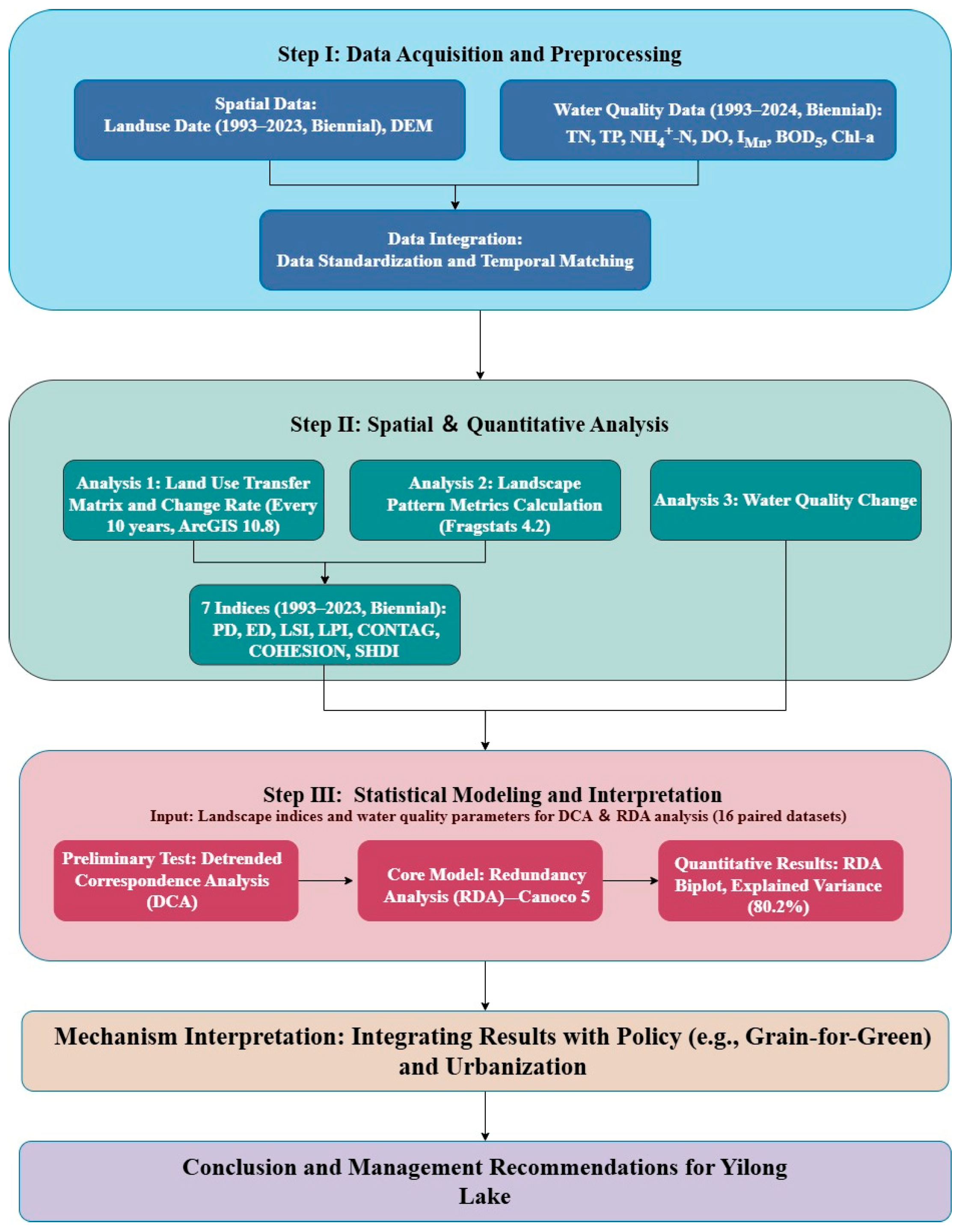
In the past few decades, Yilong Lake, a typical closed plateau lake in southwest China, has been under serious threat of water quality deterioration due to the combined influence [29,30] of alien species invasion, increased intensity of human activities [29], increased nutrient loads, and the resulting algae proliferation [8,29,31,32]. Given the inherent spatio-temporal complexity and the necessity of quantifying the integrated effects of policy and urbanization on water quality dynamics in the Yilong Lake Basin [33,34], we selected RDA as the core analytical method. Compared with univariate or simple regression approaches, RDA is uniquely suited to simultaneously evaluate multiple water quality response variables and effectively visualize the joint influence of multiple landscape indices on eutrophication indicators. Therefore, this study emphasizes the critical need to understand how long-term changes in landscape configuration shape water quality dynamics, utilizing Yilong Lake as a representative plateau basin to provide critical, quantitative insights into landscape–water interactions under rapid development. The overall methodological workflow of this research is illustrated in Figure 1.
Figure 1.
Research framework.
2. Materials and Methods
2.1. Research Area
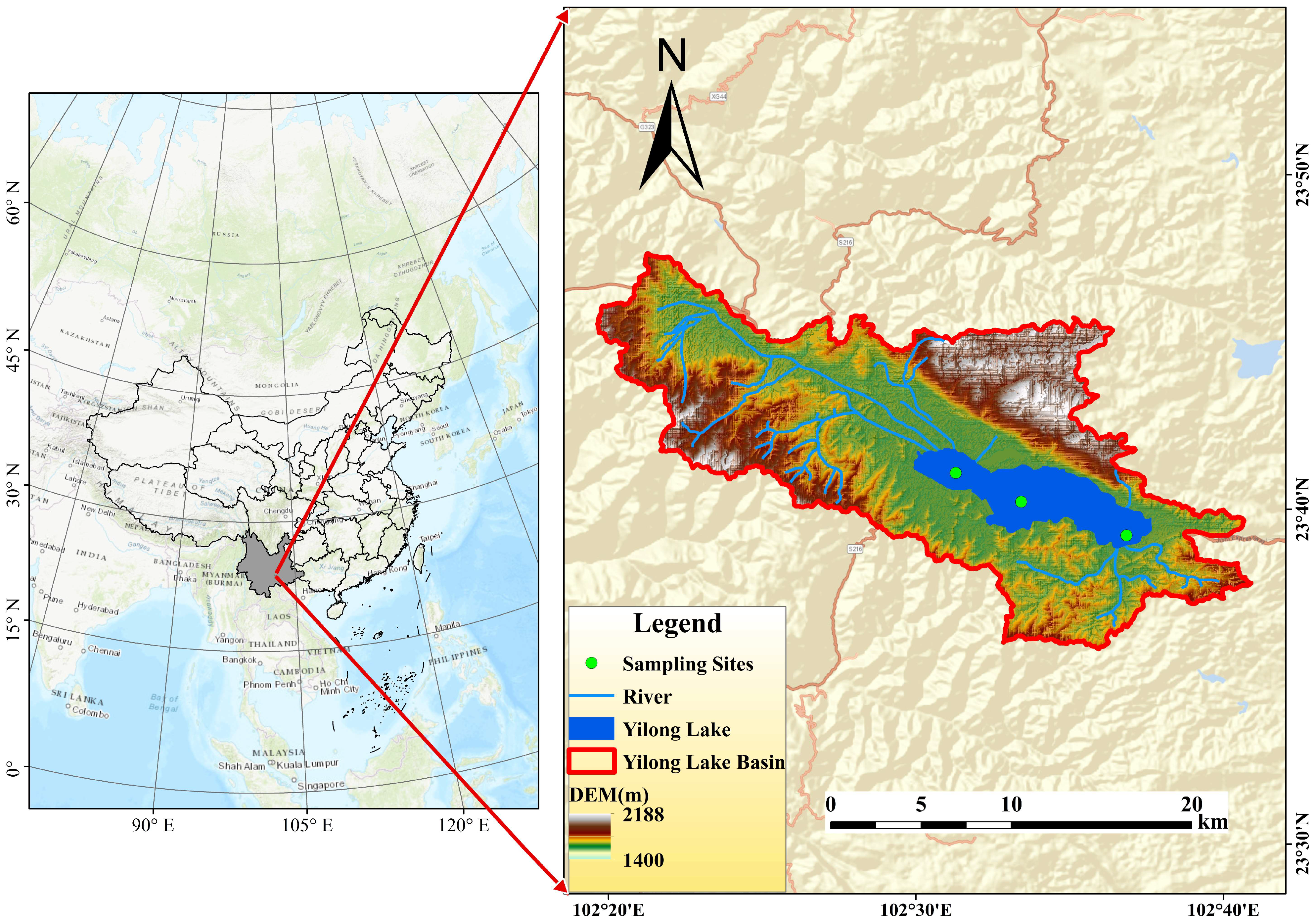
Yilong Lake, as the smallest of nine plateau lakes in Yunnan Province, is in the southeast of Yunnan Province, between 102°28′ E and 102°38′ E and between 23°28′ N and 23°42′ N (Figure 2). Its basin covered an area of about 343.14 km2, with an average elevation of 1412 m and an average depth of 3.9 m. The basin is located at the intersection of northern subtropical dry monsoon and mid-tropical sub-humid monsoon regions [8]. With distinct dry and wet seasons, the rainy season generally extends from May to October; the annual average temperature is stable at 18.0 °C; the annual mean precipitation is 919.9 mm; and the annual mean evaporation is 1908.6 mm, mostly from surface runoff and precipitation recharge. Hydrologically, Yilong Lake is a closed basin without surface outflow and is mainly recharged by precipitation, evaporation, and inflows from seven small rivers, which constitute the major pathways for external water and nutrient input.
Figure 2.
Location of research area. The map was created by the authors using ArcGIS (Version 10.8, Esri, https://www.esri.com, accessed on 30 October 2025). Watershed boundary delineation was based on a Digital Elevation Model (SRTM 1 Arc-Second Global) obtained from the USGS EROS Center (https://lpdaac.usgs.gov/products/srtmgl1v003/, accessed on 10 March 2025). Map lines delineate study areas and do not necessarily depict accepted national boundaries.
According to previous studies on climate and environmental changes in Yilong Lake [35,36], the areas around Yilong Lake were subjected to strong human disturbance. Over the past 50 years, large areas of wetlands along the lakeshore were converted to farmland, and agricultural activities have contributed substantial pollutant loads to the water flowing into the lake [37]. Since the 1990s, the water quality of Yilong Lake has been severely degraded due to the rapid development of agriculture and urbanization in the basin, leading to major environmental problems associated with water pollution from activities such as water overexploitation, urban sewage discharge, farmland reclamation, and intensive cage aquaculture [30]. So far, the water quality of Yilong Lake remains poor. According to the China Surface Water Environmental Quality Standard (GB 3838-2002) [38], the lake has long been classified as Class V or inferior to Class V, indicating moderate to severe eutrophic conditions [8]. Given this situation, improving the water environment of Yilong Lake is of great strategic significance for the ecological security of the basin to enhance the level of local economic development and realize the coordinated development of the regional economy. Based on the landscape pattern composition, the relationship between land use variation features and lake water quality change in the Yilong Lake Basin is discussed, and the effect of land use/landscape pattern change under the influence of human activities on lake water quality was analyzed, which has important practical significance and scientific value for ensuring ecological security and treatment of the water environment of the Yilong Lake Basin.
2.2. Spatial Data
(1) Digital Elevation Model data: SRTM data with a 30 m resolution from United States Geological Survey (USGS) [39] were used, and the boundaries of the basin were calculated and extracted with the hydrological analysis tool in ArcGIS (Version 10.8, Esri, Redlands, CA, USA).
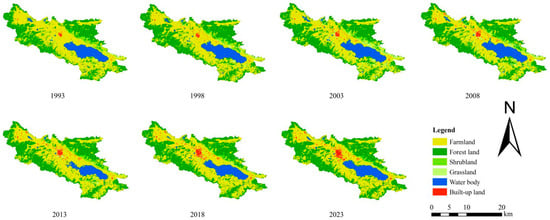
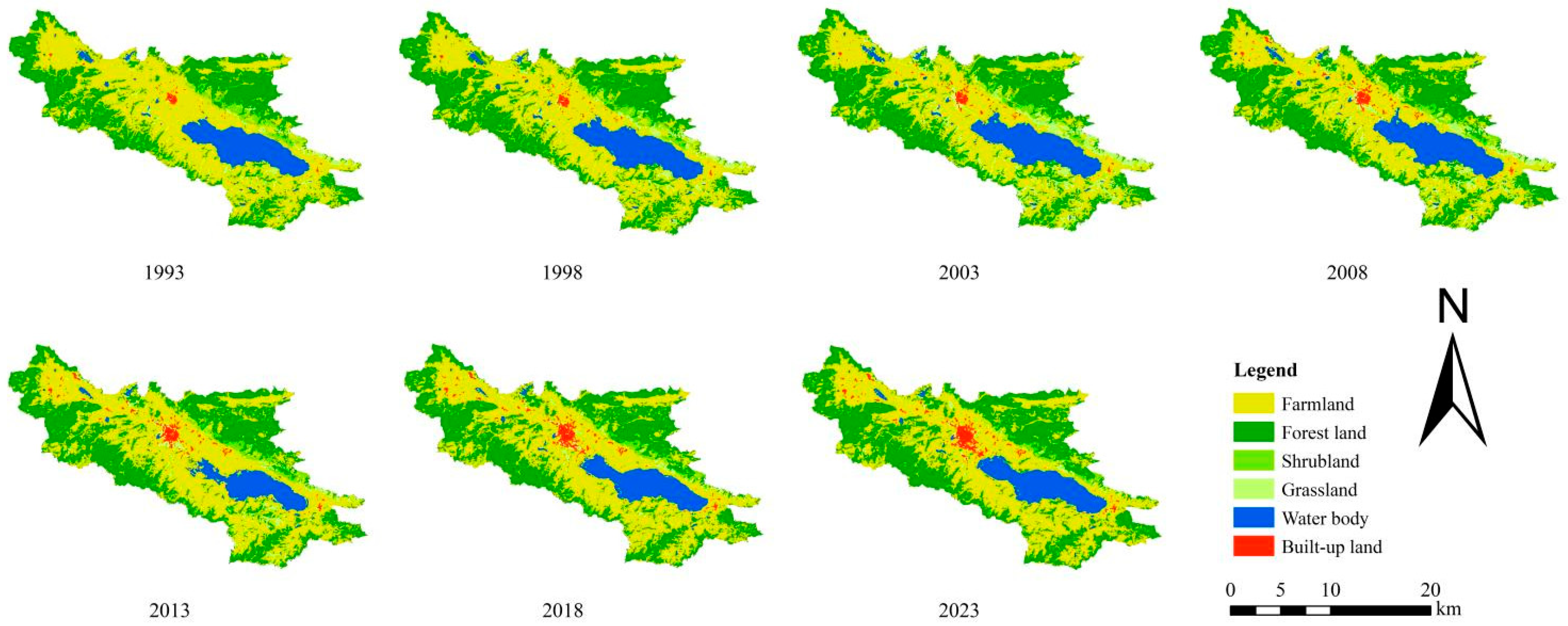
(2) Land use data: The data from 1993 to 2023 used in this study were taken from the annual land cover dataset with a 30 m accuracy from 1985 to 2023 in China [40] and divided into 16 periods, with one period every two years. The land use types include farmland, forest land, shrubland, grassland, water body, and built-up land, which are displayed in five-year periods (Figure 3).
Figure 3.
Distribution of land use types in Yilong Lake Basin. The land cover map was created by the authors using ArcGIS 10.8. The underlying dataset was derived from the 30 m annual land cover datasets and its dynamics in China from 1985 to 2023 [40], available on Zenodo under a CC BY 4.0 license (DOI: 10.5281/zenodo.12779975).
2.3. Water Quality Data
The water quality data were derived from the long-term monitoring data of Yilong Lake from 1993 to 2024 by the Yunnan Research Academy of Eco-environmental Sciences, involving seven indices: total nitrogen (TN), total phosphorus (TP), ammonium nitrogen (NH4+-N), permanganate index (IMn), dissolved oxygen (DO), biochemical oxygen demand over 5 days (BOD5), and the concentration of chlorophyll-a (Chl-a). TN, TP, NH4+-N, and Chl-a were selected as indicators of nutrient enrichment associated with agricultural expansion and fertilizer use; IMn and BOD5 were included to reflect organic pollution from urban and industrial wastewater; and DO was used to capture oxygen dynamics influenced by both nutrient loading and organic matter decomposition. The annual mean value of each index was calculated on a yearly basis. Due to the lag of the water quality response to land types [24,41], the land use data of each year were paired with the mean water quality values of the same year and the subsequent year. For instance, land use in 2013 was matched with the average water quality from 2013–2014. In this way, a total of 16 landscape–water quality datasets were constructed.
2.4. Research Methods
2.4.1. Land Use Transfer Matrix
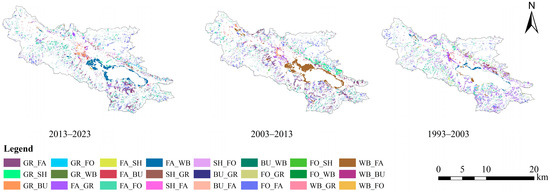
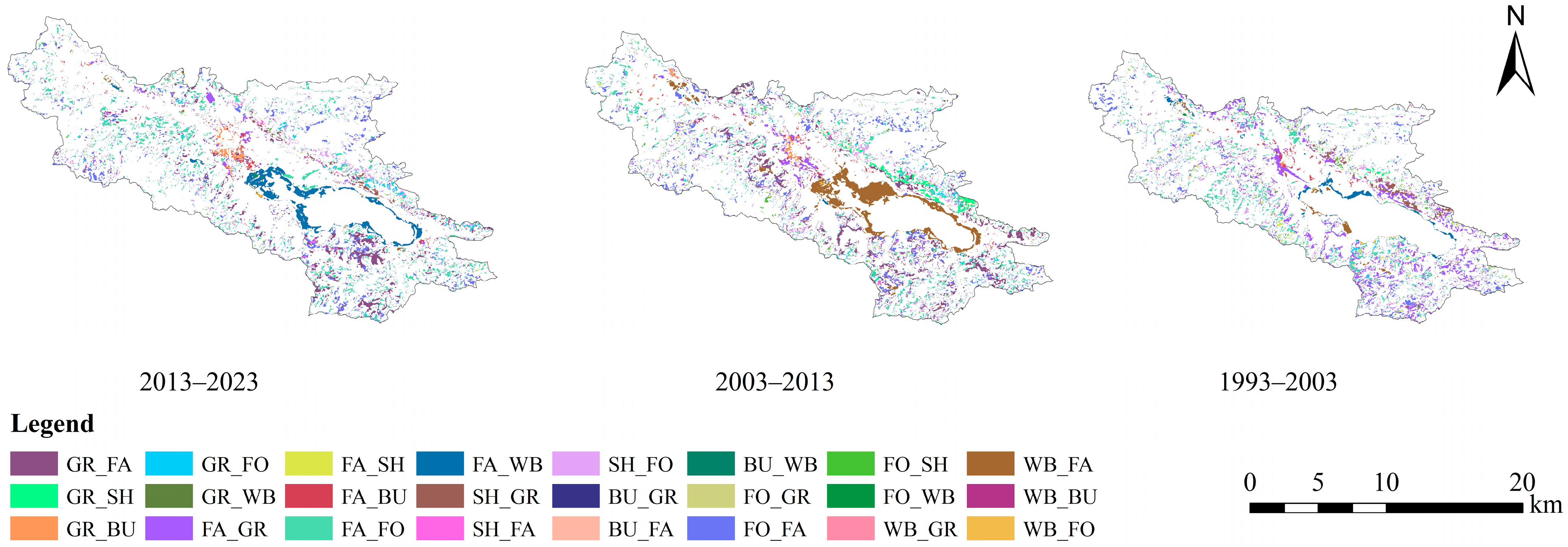
In this study, the land use transfer matrix was used to analyze spatial–temporal changes in the research area every ten years. Using this method, the changes in various types of land at the beginning and end of the research period were calculated and summarized to show changes in the land use morphology and purposes (Figure 4).
Figure 4.
Transfer of land use types in Yilong Lake Basin from 1993 to 2023 (WB: water body, GR: grassland, FA: farmland, FO: forest land, BU: built-up land, SH: shrubland, GR→FA: grassland into farmland).
2.4.2. Landscape Pattern Indices
Landscape pattern indices provide quantitative characterizations of landscape pattern features in an area, which can highly concentrate landscape information [42], and they are widely used in landscape ecology quantitative research. Since ecological processes represented by landscape pattern indices are interrelated or independent, priority was given to landscape variables that had been shown to have significant influences on water quality in previous research [19,22,43,44]. Based on the actual situation of the Yilong Lake Basin, seven landscape indices were finally selected: patch density (PD), edge density (ED), landscape shape index (LSI), largest patch index (LPI), patch cohesion index (COHESION), contagion index (CONTAG), and Shannon’s diversity index (SHDI), with the principles shown in Table 1. ArcGIS 10.8 and Fragstats (Version 4.2, University of Massachusetts, Amherst, MA, USA) were used to calculate each landscape pattern index.
Table 1.
Selected landscape pattern indices of Yilong Lake Basin.
2.4.3. Redundancy Analysis (RDA)
To further investigate the influence of the land use landscape pattern on the lake water quality and its interpretation degree, Canoco (Version 5, Microcomputer Power, Ithaca, NY, USA) software was used to conduct a redundancy analysis (RDA) [28,45,46]. First, detrended correspondence analysis (DCA) was conducted on the water quality parameters, and the results show that the gradient length of the first axis was 0.4, and thus, the RDA method was a reasonable choice.
In addition, the variations in land use fractions (e.g., farmland, forest land, grassland, and built-up land) during the study period were further analyzed to interpret the mechanisms by which changes in the landscape patterns influenced water quality.
3. Results
3.1. Land Use Change
To better understand the mechanisms underlying the relationships revealed by the RDA, the temporal variations in the proportions of different land use types were analyzed. These land use fractions provided important background information for interpreting how the landscape configuration affected the water quality changes.
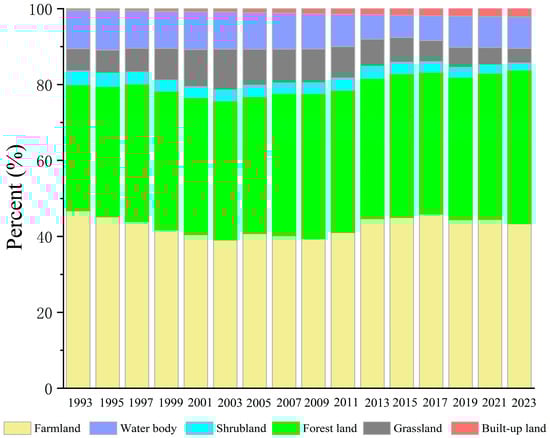
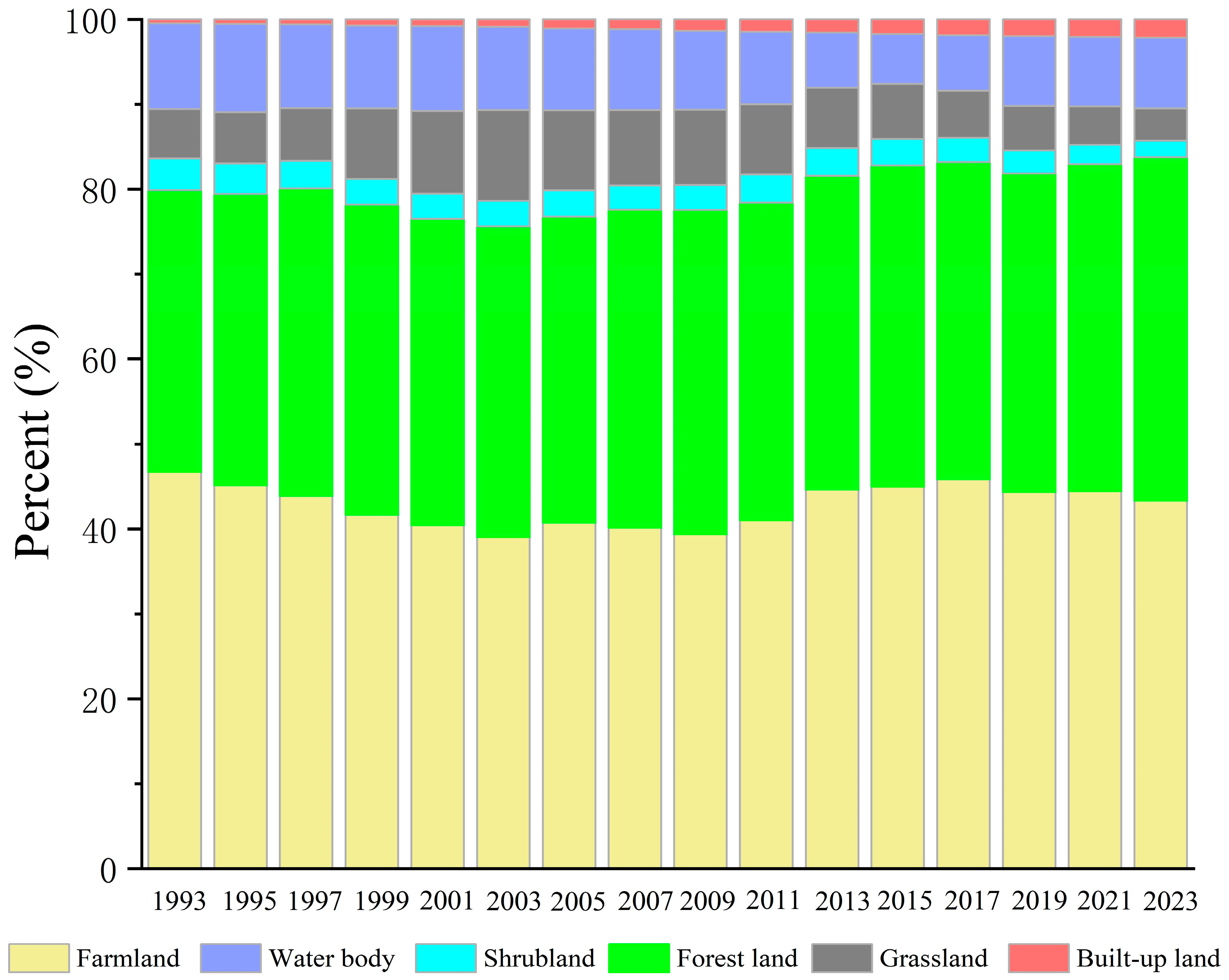
The Yilong Lake Basin covered an area of 343.14 km2 during 1993–2023. Figure 5 and Figure 6 show that the land use types are ranked by proportion as follows: farmland, forest land, water body, grassland, and built-up land. Farmland was dominant, accounting for more than 43% on average. The forest land area accounted for more than 38% on average. The water body area accounted for 9.35% on average, the grassland area accounted for 6.33% on average, and the built-up land area accounted for 1.22% on average. From 1993 to 2023, the area proportion of each land use type changed greatly. Among them, the grassland area changed the most, showing a trend of increasing first and then decreasing rapidly. The built-up land area continued to increase, and in 2023, the area reached 5 times that in 1993. The areas of farmland and water body fluctuated significantly, and the area change showed multiple increases and decreases, but showing a decreasing trend at the beginning and end of the period. The farmland area decreased from 47% in 1993 to 39% in 2003 and then fluctuated up to 44% in 2023. The water body area decreased from 10.2% in 1993 to 6.23% in 2015 but increased to 9.19% in 2023. The forest land area, as a whole, showed an increasing trend from 37.12% in 1993 to 41.72% in 2023.
Figure 5.
Changes of land use proportion in Yilong Lake Basin from 1993 to 2023.
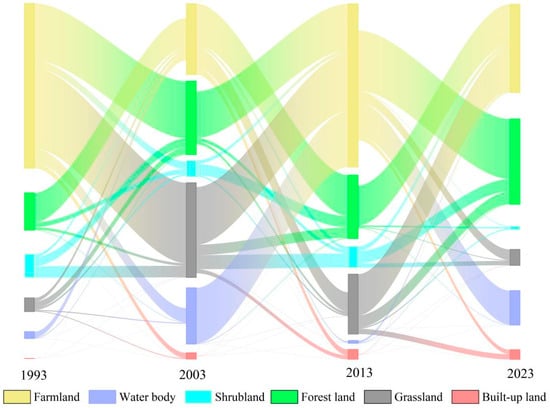
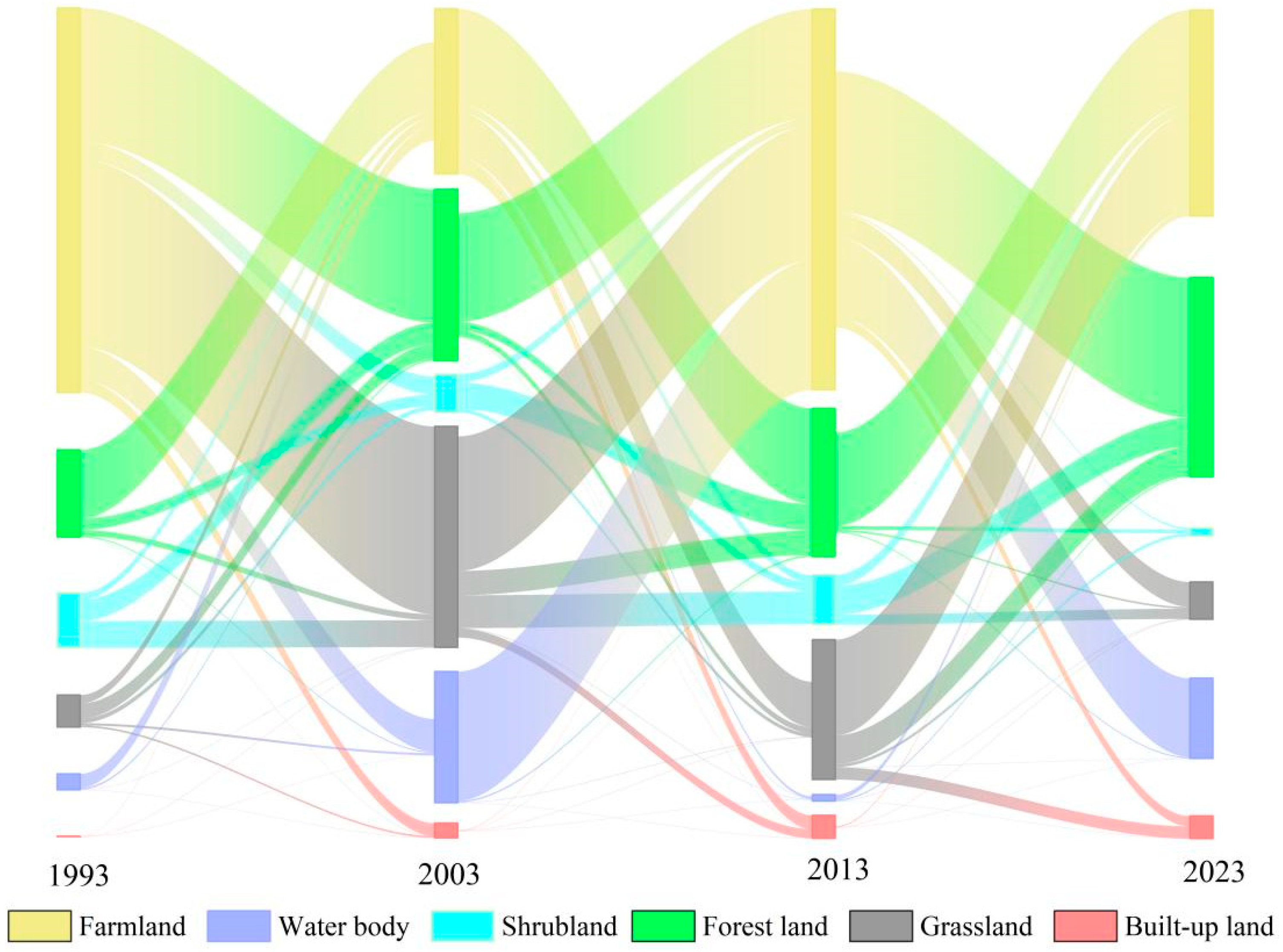
Figure 6.
Transfer of land use in Yilong Lake Basin from 1993 to 2023.
Figure 6 shows that grassland was the type with the most obvious area transfer, and the main direction of transfer was toward forest land and farmland; forest land was the type with the largest area proportion increase (4.6% from the beginning to the end of the period), and the main sources of area increase were farmland and grassland; the built-up land proportion was relatively small but in a state of continuous increase, and the main sources of area increase were farmland and grassland, as well as water bodies but only as a small portion.
3.2. Water Quality Change
Chl-a, TN, TP, and NH4+-N are important indices for reflecting the nutrient level of lake water. The contents of organic matter in water can be reflected by BOD5 and IMn, while DO indicates the oxygen status of the water, which is closely related to the intensity of human activities [47,48].
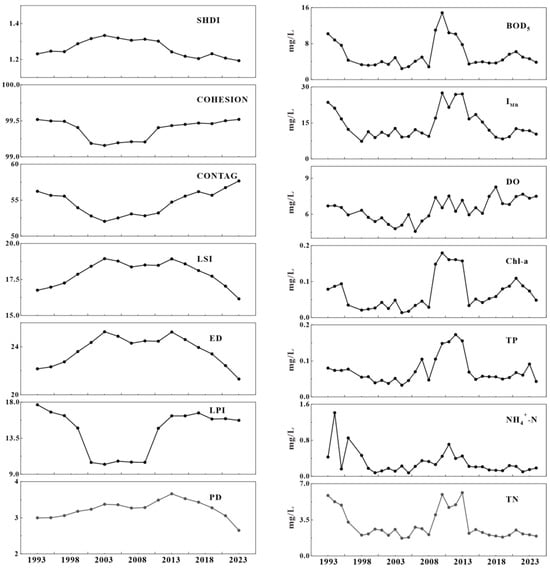
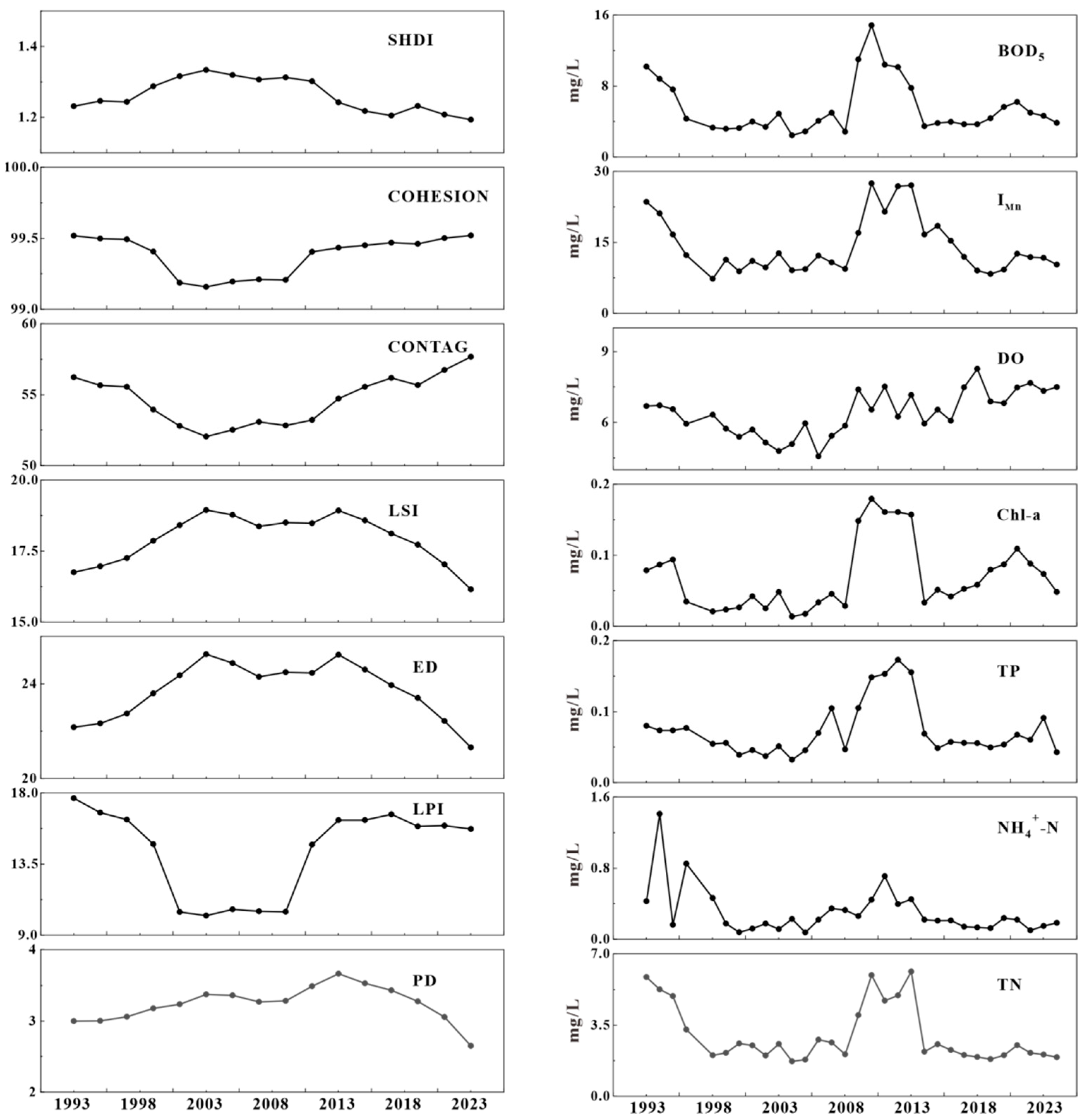
According to Figure 7, among the seven water quality indicators of the Yilong Lake Basin from 1993 to 2024, DO exhibited a generally increasing trend, with concentrations remaining above 6 mg/L for most of the study period and only briefly falling below 5 mg/L in the two years at the beginning of the 21st century. This was mainly because the lake was shallow, with an average depth of about 3.9 m, and had a large water surface area, mostly above 30 km2 [30], which allows sufficient air–water contact and rapid oxygen exchange to maintain a relatively stable DO level. The pollution degrees of TN and IMn were the highest: TN was consistently above 2.0 mg/L and even higher than 5 mg/L in the 1990s, while IMn was consistently higher than 10 mg/L until 2019 and was over 20 mg/L from 2009 to 2014. NH4+-N remained stable at 0.15–0.5 mg/L. TP was consistently higher than 0.05 mg/L and reached its peak value during the period of sharp decrease in the surface area of Yilong Lake from 2009 to 2014. The concentrations of BOD5 and Chl-a were 3–6 and 0.02–0.1 mg/L, respectively, in most of the years during the research, which also reached peak values during the period of sharp decrease in the surface area of Yilong Lake, i.e., it exceeded 10 and 0.16 mg/L, respectively, and the changes have been relatively stable in recent years.
Figure 7.
Changes in water quality indices (annual, mg/L) and landscape pattern indices during research period.
In short, the trends of indices such as Chl-a, TN, TP, and NH4+-N were generally the same, showing a downward trend from 1993 to 2008, a fluctuating upward trend from 2008 to 2014, and a fluctuating downward trend from 2014 to 2024. The trends of IMn and BOD5 were roughly the same, showing a downward trend with minor changes, but the trend of DO was the opposite and negatively correlated with the trends of IMn and BOD5, reflecting a rise in the dissolution rate of IMn in anoxic condition, which was consistent with the conclusions of previous studies [49,50]. It is noteworthy that all indices showed a very obvious upward trend from 2008 to 2014, which was mainly attributed to the sharp decrease in Yilong Lake’s area caused by the severe drought from 2009 to 2011 [30,51].
In addition, climatic variability, especially precipitation, also affected the lake surface area and water quality. Yilong Lake is a shallow, closed-basin lake with inflow only from rivers within the basin and no external river recharge. Its water level mainly depends on rainfall and evaporation. During 2009–2014, a prolonged drought caused a sharp decline in the lake area and increased concentrations of TN, TP, NH4+-N, and Chl-a due to reduced dilution and enhanced evaporation. These findings indicate that variations in rainfall directly influenced the lake’s hydrological balance and pollutant concentrations.
3.3. Redundancy Analysis (RDA) of Landscape Pattern and Water Quality of Yilong Lake Basin from 1993 to 2023
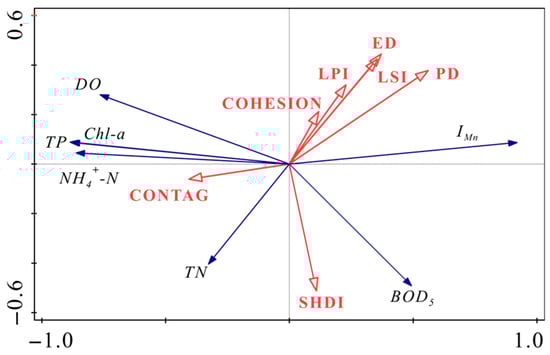
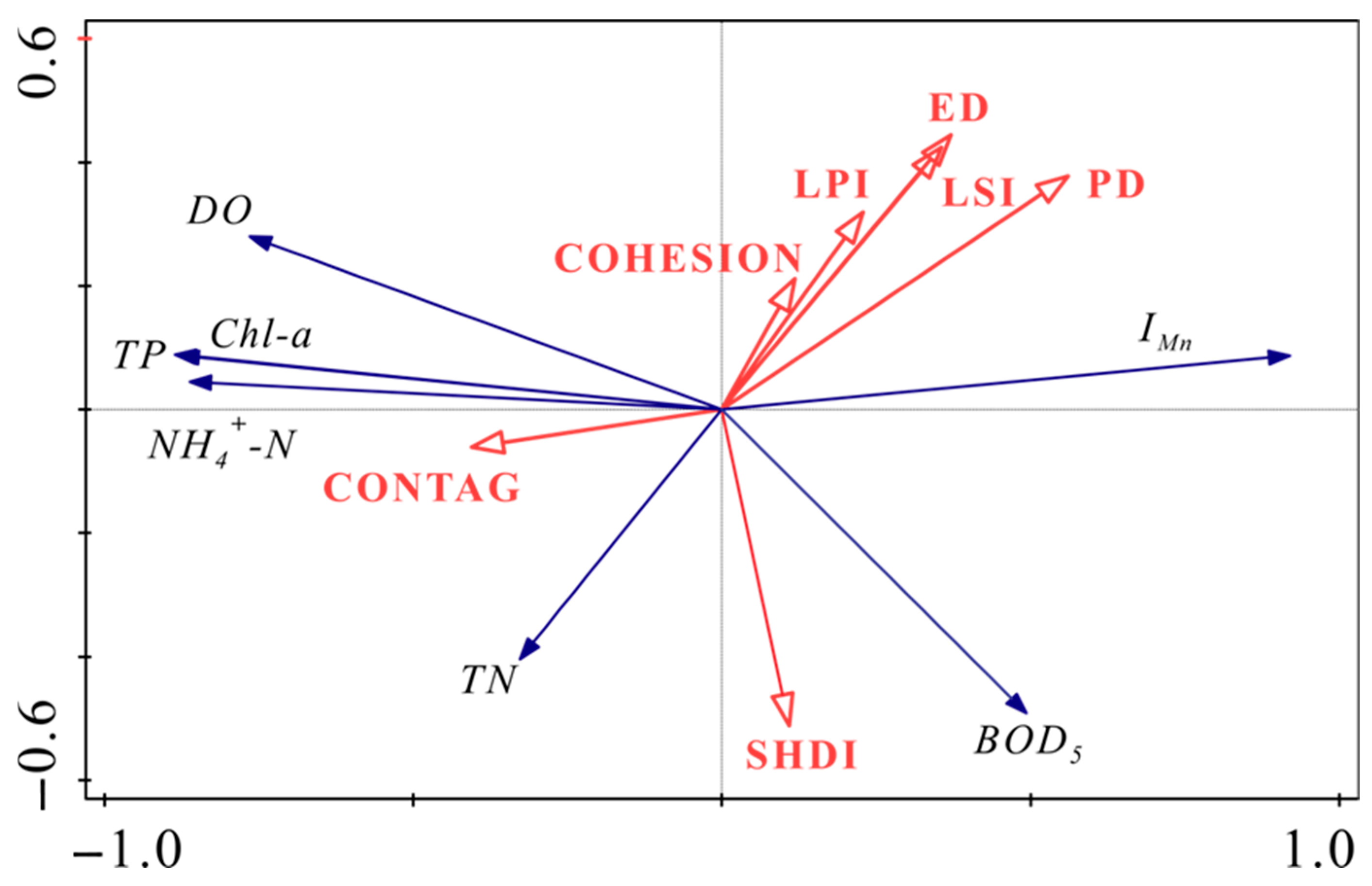
A redundancy analysis of the landscape pattern indices and the corresponding water quality indices over 16 periods was carried out using Canoco5 software (Figure 8). When the p value was lower than 0.05, the total explanation rate of each landscape pattern index for water quality was 80.2% during the research period, indicating that land use change played an important role in the water quality evolution of the Yilong Lake Basin, and most of the information of water quality change can be explained by the seven landscape pattern indices. Specifically, PD and LSI had higher explanation rates for water quality change (p values were both less than 0.05), explaining 24.2% and 23.7% of the change, respectively. The angle between the two types of arrows in the figure represents the correlation between variables; the cosine of the angle represents the correlation coefficient. An angle less than 90° indicates a positive correlation that weakens as the angle increases, while an angle greater than 90° indicates a negative correlation that becomes stronger as the angle increases. An angle close to 90° represents little or no correlation [43,46].
Figure 8.
RDA rankings of water quality and landscape pattern indices.
4. Discussion
4.1. Reasons for Water Quality Changes
The overall improvement of water quality in Yilong Lake from 1993 to 2023, as reflected by the decreases in TN, TP, NH4+-N, IMn, BOD5, and Chl-a, together with the increase in DO, was mainly related to a series of ecological restoration and pollution control measures in the basin [30,51]. The continuous implementation of the Returning Farmland to Forest Program since the late 1990s, especially the large-scale afforestation during 2003–2008, increased the forest land area and improved the ecological capacity for nutrient retention and purification [30,43]. Meanwhile, the construction and upgrading of sewage treatment plants and the closure of soybean-processing enterprises after 2010 reduced the discharge of nitrogen, phosphorus, and organic matter [30]. Although the built-up land continued to expand, its impact was gradually offset by improved wastewater treatment. In addition, the severe drought from 2009 to 2011 led to a marked decline in lake surface area and caused temporary deterioration in the water quality, which was alleviated after the implementation of wetland restoration, returning fishponds to lake, and water diversion projects after 2015 [30,51]. These measures collectively reshaped the land use and landscape pattern of the basin, contributing to the long-term water quality improvement of Yilong Lake.
4.2. Influence of Landscape Pattern Indices on Water Quality
The ED and LSI represent the landscape shape complexity and number of marginal habitats in a landscape, respectively, and are generally related to the complexity of ecological processes within a region. Figure 8 shows that when the ED and LSI increased, the concentrations of Chl-a, TP, TN, and NH4+-N in Yilong Lake decreased, but the concentrations of IMn and BOD5 increased. The reason may be that the shrubland, farmland, and grassland distributed in blocks in the basin were reduced and transformed into forest lands and built-up land due to the policy of returning farmland to forest and the rapid development of urbanization, which broke the aggregation of the original land types to a certain degree. From 1993 to 2023, a large-scale Returning Farmland to Forest Program was implemented in the Yilong Lake Basin; especially from 2003 to 2008, the forest plantation area was 8.47 km2, the area of hill closed for afforestation was 15 km2, and the area of farmland returned to forest was 3.20 km2, which significantly increased the forest land area [30]. At the same time, the process of urbanization was accelerated. Since the 1990s, the soybean product industry has been developing rapidly, where state-owned, collective, and individual enterprises coexisted, and a large amount of built-up land, such as soybean product factories, posed a serious threat to the water quality [30]. So far, the built-up land in the basin has been increased by five times. Although the sewage treatment plant of the Soybean Product Park was renovated and expanded later to reduce the discharge of NH4+-N and TN pollution sources, the reduction effect was not obvious due to the sharp decrease in the surface area of Yilong Lake from 2009 to 2014 [51]. Ultimately, the results show that with the increase in the ED and LSI, the concentrations of TP, TN, and NH4+-N in the lake water could be decreased, but the content of IMn and BOD5 in the water increased.
CONTAG reflects the spread degree of different types of patches, and its indexical meaning is opposite to that of the ED and LSI. In this research, the three indices formed two opposite angles, among which CONTAG was positively correlated with the eutrophication indices, such as TN, NH4+-N, TP, and Chl-a, but was negatively correlated with IMn and BOD5. This indicates that the higher the aggregation degree of the dominant landscape in the basin, the more likely it was to lead to eutrophication caused by nitrogen and phosphorus, but the content of DO was increased, and the IMn and BOD5 pollution was alleviated. This trend was reflected in the management measures of the Yilong Lake Basin: in 2001, the Rural Non-point Source Pollution Control Project was launched, which reduced the content of pollutants discharged into Yilong Lake by more than half compared with the 1990s [30]. With the sewage treatment plant put into service in 2002, sediment dredging and water diversion from other basins that launched in 2004, the construction of artificial wetland that launched in 2007 [30,51], and the numerous pollution control and soil and water conservation measures that began after 2010 [29,30], the landscape aggregation degree was improved and organic pollution was alleviated to a certain degree. However, the management measures were focused on industrial land, built-up land, etc.; therefore, problems such as TN, NH4+-N, and TP were not significantly alleviated, showing that CONTAG is positively correlated with the water nutrient indices of nitrogen, phosphorus, etc.
The LPI represents the relative area of the largest patch of the landscape, and COHESION represents the cohesion of the landscape. The two were strongly negatively correlated with TN, weakly negatively correlated with indices such as NH4+-N and TP, and strongly positively correlated with the concentration of IMn; however, the index COHESION had a low explanation rate for water quality changes. This indicates that the decrease in the farmland and grassland areas and the increase in the built-up land area were also reflected as the change in the LPI to a certain degree. The largest patch in the basin was farmland, which tended to be reduced in general and was mostly transformed into urban and industrial land (the soybean product industry was prosperous). This brought nitrogen pollution sources and reflected a positive correlation between the LPI and TN. Second, coming to the 21st century, 32.67 km2 of farmland was treated and the discharge of wastewater was reduced by more than half compared with the 1990s through the “Rural Non-point Source Pollution Control Project” launched by the local government [30]; in addition, the water quality was significantly improved through sediment dredging, water hyacinth and garbage salvage, and water diversion from other basins [29,30]. In 2017, fish ponds and farmland on both sides of the city moat (Songcun section) were reclaimed and transformed into forest lands with aquatic plants, and a solar water ecological remediation system was installed [30], which further improved the cohesion of the landscape. The policies of returning ponds to lakes, constructing lakeside wetlands, and expanding the sewage discharging and interception pipe network implemented in 2018 [30,51], as well as the ongoing policy of returning farmlands to forests, have played positive roles in reducing the LPI and alleviating TN, NH4+-N, and TP pollution of the lake water.
The SHDI represents the landscape diversity in the basin. The overall explanation amount is small, mainly showing a strong positive correlation with TN and BOD5 and a low correlation with other water quality indices. Generally, a decrease in landscape diversity means a decrease in ecosystem stability and resistance, thereby increasing the risk of water pollution [22,47]. However, this research showed the opposite scenario, i.e., the decrease in the SHDI led to an increase in TN and BOD5 to a certain degree, indicating that complex landscape types bring ecological costs to a certain degree; researchers in other basins also came to similar conclusions [19,43]. Given this phenomenon, by comparing the land use transfer situation of the basin and the local industrial development, it was found that the reasons for this may be that the built-up land expanded rapidly, and the point sources of pollution in the basin were increased unceasingly. During the research period, especially in the decade after 2010, although some pollution sources were reduced by measures such as reclaiming fish ponds and fish farms along the lake, forbidding the keeping of livestock, and banning soybean product processing enterprises in the Yilong Lake Basin [30], the growth rate of built-up land was not significantly slowed down but was instead spread further, which increased the landscape heterogeneity. For a long time, the development of the soybean product industry in the basin also had a profound impact on the water quality. Although the discharge of organic matter was somewhat reduced after the renovation and expansion of the sewage treatment plant in 2006, the reduction effect was limited due to the sharp decrease in the water surface area [30] and the deterioration of self-purification ability. Therefore, it was shown that the SHDI was positively correlated with TN and BOD5 in the basin.
PD reflects the patch differentiation or density of the landscape in the region. It was positively correlated with IMn and negatively correlated with indices such as DO, TN, NH4+-N, TP, and Chl-a. This indicates that the patch density of the landscape composition intensified the distribution of IMn, but slowed down the eutrophication induced by N and P. The reason for this phenomenon was related to the increase in the patch density of various landscape types caused by human influence in the basin [52]. Although the landscape cohesion in some areas was enhanced by the project of soil and water loss control, the policy of returning pond to lake, and the construction of lakeside wetland from 2003 to 2018 [30,51], the patch density was increased due to the rapid growth and scattered distribution of the built-up land overall. At the same time, the grassland area in the basin decreased by two-thirds at the end of the research period compared with the peak value. Some researchers showed that the concentrations of nitrogen and phosphorus nutrients in the basin water may be increased by the large distribution of grassland [53,54,55] because more water pollutants may be introduced by animal husbandry in these areas. Therefore, farmland and grassland were heavily encroached on due to the restoration of built-up land and forest land, and the TN, NH4+-N, and TP concentrations in the lake were decreased to a certain degree when PD was increased. In addition, the rising cage culture in the 1980s and 1990s, as well as the gradual process of banning this at the end of the century [30], had profound impacts on the landscape pattern and water quality. Therefore, although the water eutrophication caused by nitrogen and phosphorus pollution sources was slowed down by the patch density increase in the Yilong Lake Basin, the distribution of IMn pollution sources increased to some degree. In short, the PD change reflected the pollution control effect of a series of policies, such as returning to forest, returning to lake, and constructing wetland in the Yilong Lake Basin. However, the living space of the landscape, such as grassland and shrubland, was continuously encroached in the process of urbanization development, which increased the risk of IMn pollution in the water.
Except for the relationship between the above landscape pattern indices and water quality indices, the correlation between other landscape indices and water quality indices was weak. At present, there is no conclusive research on the response relationship between landscape pattern and water quality in the basin, and the relationship between part of the landscape pattern and water quality cannot be reasonably explained for the time being [43]. However, this does not mean that the landscape pattern indices have no influence on water quality, and the influence mechanism thereof may be indirect and affected by other factors, such as human control and climate change [8,56]. In addition, the impact of landscape pattern indices based on land use types on water quality indices may have a lagging effect [24,41], and the habitat of any region would have its particularity; therefore, it was necessary to conduct targeted research on the selection of appropriate landscape pattern indices and water quality indices.
5. Conclusions
- (1)
- From 1993 to 2023, land use in the Yilong Lake Basin changed notably: farmland, shrubland, grassland, and water areas decreased, while forest land and built-up land expanded, especially the latter. The patch density slightly declined, but the landscape connectivity and heterogeneity improved. The water quality also changed, where TN, TP, Chl-a, and NH4+-N decreased overall, DO increased, and IMn and BOD5 showed opposite trends. These shifts suggest that eutrophication was mitigated, and the land use change had complex impacts on water quality.
- (2)
- Landscape patterns strongly influenced the water quality. The RDA showed that the LPI, ED, and LSI were positively correlated with IMn and negatively with TN, TP, NH4+-N, and Chl-a. The PD showed similar trends but was negatively correlated with DO and positively with BOD5. In contrast, CONTAG was positively correlated with most indices and negatively with BOD5. These results indicate that enhancing ecological connectivity may improve the water quality, while a higher patch density and heterogeneity may worsen it.
- (3)
- Over the past 30 years, ecological management reduced TN, TP, NH4+-N, Chl-a, IMn, and BOD5, but increased DO. Yet, urbanization still affected the water quality. Built-up land expanded rapidly, which increased the patch density; the loss of shrubland and grassland weakened filtration, which raised the runoff risks. The forest land expansion helped, but urban growth added new pollution sources. As most forests lie far from the lake, their purification role is limited. In general, the improvement of water quality in the Yilong Lake Basin was due to the reduction in farmland and the increase in forest lands, but the expansion of built-up land may pose a threat to water quality.
This study not only reveals the long-term response of water quality to land use and landscape pattern changes in the Yilong Lake Basin but also provides practical guidance for basin management. In future ecological protection work, it is recommended to enhance the protection of forest and wetland ecosystems, strictly control built-up land expansion, and continue ecological restoration to maintain water quality improvement and support regional sustainable development.
Supplementary Materials
The following supporting information can be downloaded at: https://www.mdpi.com/article/10.3390/w18010030/s1, Table S1: Landscape pattern metrics for Yilong Lake Basin from 1993 to 2023 (biennial); Table S2: Land use area statistics for Yilong Lake Basin from 1993 to 2023 (biennial); Table S3: Land use transition matrix for Yilong Lake Basin from 1993 to 2023; Table S4: Water quality data for Yilong Lake from 1993 to 2023.
Author Contributions
Conceptualization, Y.H.; Methodology, Y.H.; Software, R.W.; Validation, Y.J.; Writing—Original Draft Preparation, Y.H.; Writing—Review & Editing, J.L.; Project Administration, J.L.; Funding Acquisition, J.L. All authors have read and agreed to the published version of the manuscript.
Funding
This research was funded by the Science and Technology Plan Project of Yunnan Province (202203AC100002), the National Natural Science Foundation of China-Yunnan Joint Fund (U220220245), Yunnan Research Projects (202303AC100019) and (202305AM340026).
Data Availability Statement
The original contributions presented in this study are included in the article/Supplementary Materials. Further inquiries can be directed to the corresponding author.
Conflicts of Interest
The funders had no role in the design of the study; in the collection, analyses, or interpretation of data; in the writing of the manuscript; or in the decision to publish the results.
References
- Vörösmarty, C.J.; McIntyre, P.B.; Gessner, M.O.; Dudgeon, D.; Prusevich, A.; Green, P.; Glidden, S.; Bunn, S.E.; Sullivan, C.A.; Liermann, C.R.; et al. Global threats to human water security and river biodiversity. Nature 2010, 467, 555–561. [Google Scholar] [CrossRef] [Scilit]
- Grant, S.B.; Saphores, J.D.; Feldman, D.L.; Hamilton, A.J.; Fletcher, T.D.; Cook, P.L.M.; Stewardson, M.; Sanders, B.F.; Levin, L.A.; Ambrose, R.F.; et al. Taking the “waste” out of “wastewater” for human water security and ecosystem sustainability. Science 2012, 337, 681–686. [Google Scholar] [CrossRef] [Scilit]
- Guo, C.; Chen, Y.; Gozlan, R.E.; Liu, H.; Lu, Y.; Qu, X.; Xia, W.; Xiong, F.; Xie, S.; Wang, L. Patterns of fish communities and water quality in impounded lakes of China’s south-to-north water diversion project. Sci. Total Environ. 2020, 713, 136515. [Google Scholar] [CrossRef] [Scilit]
- Purvis, L.; Dinar, A. Are intra- and inter-basin water transfers a sustainable policy intervention for addressing water scarcity? Water Secur. 2019, 9, 100058. [Google Scholar] [CrossRef] [Scilit]
- Rodell, M.; Famiglietti, J.S.; Wiese, D.N.; Reager, J.T.; Beaudoing, H.K.; Landerer, F.W.; Lo, M.H. Emerging trends in global freshwater availability. Nature 2018, 557, 651–659. [Google Scholar] [CrossRef] [Scilit] [PubMed]
- Sinha, P.; Rollason, E.; Bracken, L.J.; Wainwright, J.; Reaney, S.M. A new framework for integrated, holistic, and transparent evaluation of inter-basin water transfer schemes. Sci. Total Environ. 2020, 721, 137646. [Google Scholar] [CrossRef] [Scilit] [PubMed]
- Wen, Z.; Zheng, H.; Ouyang, Z.Y. Research progress on the relationship between biodiversity and ecosystem services. Chin. J. Appl. Ecol. 2020, 31, 340–348. [Google Scholar]
- Yuan, Z.; Wu, D.; Niu, L.; Ma, X.; Li, Y.; Hillman, A.L.; Abbott, M.B.; Zhou, A. Contrasting ecosystem responses to climatic events and human activity revealed by a sedimentary record from lake Yilong, southwestern China. Sci. Total Environ. 2021, 783, 146922. [Google Scholar] [CrossRef] [Scilit]
- Liu, H.; Meng, C.; Wang, Y.; Liu, X.; Li, Y.; Li, Y.; Wu, J. Multi-spatial scale effects of multidimensional landscape pattern on stream water nitrogen pollution in a subtropical agricultural watershed. J. Environ. Manag. 2022, 321, 115962. [Google Scholar] [CrossRef] [Scilit]
- Karr, J.R.; Schlosser, I.J. Water Resources and the Land-Water Interface: Water resources in agricultural watersheds can be improved by effective multidisciplinary planning. Science 1978, 201, 229–234. [Google Scholar] [CrossRef] [Scilit]
- Orwin, J.F.; Klotz, F.; Taube, N.; Kerr, J.G.; Laceby, J.P. Linking catchment structural units (CSUs) with water quality: Implications for ambient monitoring network design and data interpretation. J. Environ. Manag. 2022, 312, 114881. [Google Scholar] [CrossRef] [Scilit] [PubMed]
- Basnyat, P.; Teeter, L.D.; Flynn, K.M.; Lockaby, B.G. Relationships between landscape characteristics and nonpoint source pollution inputs to coastal estuaries. Environ. Manag. 1999, 23, 539–549. [Google Scholar] [CrossRef] [Scilit] [PubMed]
- Schlosser, I.J.; Karr, J.R. Riparian vegetation and channel morphology impact on spatial patterns of water quality in agricultural watersheds. Environ. Manag. 1981, 5, 233–243. [Google Scholar] [CrossRef] [Scilit]
- Clément, F.; Ruiz, J.; Rodríguez, M.A.; Blais, D.; Campeau, S. Landscape diversity and forest edge density regulate stream water quality in agricultural catchments. Ecol. Indic. 2017, 72, 627–639. [Google Scholar] [CrossRef] [Scilit]
- Shen, Z.; Hou, X.; Li, W.; Aini, G.; Chen, L.; Gong, Y. Impact of landscape pattern at multiple spatial scales on water quality: A case study in a typical urbanised watershed in China. Ecol. Indic. 2015, 48, 417–427. [Google Scholar] [CrossRef] [Scilit]
- Wu, J.; Lu, J. Spatial scale effects of landscape metrics on stream water quality and their seasonal changes. Water Res. 2021, 191, 116811. [Google Scholar] [CrossRef] [Scilit]
- Chi, Y.; Zhang, Z.; Gao, J.; Xie, Z.; Zhao, M.; Wang, E. Evaluating landscape ecological sensitivity of an estuarine island based on landscape pattern across temporal and spatial scales. Ecol. Indic. 2019, 101, 221–237. [Google Scholar] [CrossRef] [Scilit]
- Liu, J.; Shen, Z.; Chen, L. Assessing how spatial variations of land use pattern affect water quality across a typical urbanized watershed in Beijing, China. Landsc. Urban Plan. 2018, 176, 51–63. [Google Scholar] [CrossRef] [Scilit]
- Lee, S.W.; Hwang, S.J.; Lee, S.B.; Hwang, H.S.; Sung, H.C. Landscape ecological approach to the relationships of land use patterns in watersheds to water quality characteristics. Landsc. Urban Plan. 2009, 92, 80–89. [Google Scholar] [CrossRef] [Scilit]
- Bu, H.; Meng, W.; Zhang, Y.; Wan, J. Relationships between land use patterns and water quality in the Taizi river basin, China. Ecol. Indic. 2014, 41, 187–197. [Google Scholar] [CrossRef] [Scilit]
- Cheng, X.; Song, J.; Yan, J. Influences of landscape pattern on water quality at multiple scales in an agricultural basin of western China. Environ. Pollut. 2023, 319, 120986. [Google Scholar] [CrossRef] [Scilit]
- Uuemaa, E.; Roosaare, J.; Mander, Ü. Scale dependence of landscape metrics and their indicatory value for nutrient and organic matter losses from catchments. Ecol. Indic. 2005, 5, 350–369. [Google Scholar] [CrossRef] [Scilit]
- Tran, C.P.; Bode, R.W.; Smith, A.J.; Kleppel, G.S. Land-use proximity as a basis for assessing stream water quality in New York state (USA). Ecol. Indic. 2010, 10, 727–733. [Google Scholar] [CrossRef] [Scilit]
- Martin, S.L.; Hayes, D.B.; Kendall, A.D.; Hyndman, D.W. The land-use legacy effect: Towards a mechanistic understanding of time-lagged water quality responses to land use/cover. Sci. Total Environ. 2017, 579, 1794–1803. [Google Scholar] [CrossRef] [Scilit]
- Zhong, X.; Xu, Q.; Yi, H.; Jin, L. Study on the threshold relationship between landscape pattern and water quality considering spatial scale effect—A case study of dianchi lake basin in China. Environ. Sci. Pollut. Res. 2022, 29, 44103–44118. [Google Scholar] [CrossRef] [Scilit] [PubMed]
- Zhang, X.; Chen, L.; Yu, Y.; Shen, Z. Water quality variability affected by landscape patterns and the associated temporal observation scales in the rapidly urbanizing watershed. J. Environ. Manag. 2021, 298, 113523. [Google Scholar] [CrossRef] [Scilit] [PubMed]
- Wang, H.; Xiong, X.; Wang, K.; Li, X.; Hu, H.; Li, Q.; Yin, H.; Wu, C. The effects of land use on water quality of alpine rivers: A case study in Qilian mountain, China. Sci. Total Environ. 2023, 875, 162696. [Google Scholar] [CrossRef] [Scilit]
- Mo, W.; Yang, N.; Zhao, Y.; Xu, Z. Impacts of land use patterns on river water quality: The case of Dongjiang Lake Basin, China. Ecol. Inform. 2023, 75, 102083. [Google Scholar] [CrossRef] [Scilit]
- Zhao, L.; Li, Y.; Zou, R.; He, B.; Zhu, X.; Liu, Y.; Wang, J.; Zhu, Y. A three-dimensional water quality modeling approach for exploring the eutrophication responses to load reduction scenarios in lake Yilong (China). Environ. Pollut. 2013, 177, 13–21. [Google Scholar] [CrossRef] [Scilit]
- Huang, Y.; Ma, R.; Shi, H.; Li, J.; Tu, S. Centennial lake environmental evolution reflected by diatoms in Yilong lake, Yunnan province, China. Appl. Sci. 2023, 13, 5288. [Google Scholar] [CrossRef] [Scilit]
- Yang, K.; Yu, Z.; Luo, Y.; Yang, Y.; Zhao, L.; Zhou, X. Spatial and temporal variations in the relationship between lake water surface temperatures and water quality—A case study of Dianchi Lake. Sci. Total Environ. 2018, 624, 859–871. [Google Scholar] [CrossRef] [Scilit] [PubMed]
- Yang, K.; Pan, M.; Luo, Y.; Chen, K.; Zhao, Y.; Zhou, X. A time-series analysis of urbanization-induced impervious surface area extent in the Dianchi lake watershed from 1988–2017. Int. J. Remote Sens. 2018, 40, 573–592. [Google Scholar] [CrossRef] [Scilit]
- Du, H.; Chen, Z.; Mao, G.; Chen, L.; Crittenden, J.; Li, R.Y.M.; Chai, L. Evaluation of eutrophication in freshwater lakes: A new non-equilibrium statistical approach. Ecol. Indic. 2019, 102, 686–692. [Google Scholar] [CrossRef] [Scilit]
- Zhao, L.; Wang, M.; Liang, Z.; Zhou, Q. Identification of regime shifts and their potential drivers in the shallow eutrophic lake Yilong, southwest China. Sustainability 2020, 12, 3704. [Google Scholar] [CrossRef] [Scilit]
- Bai, J.; Cui, B.; Chen, B.; Zhang, K.; Wei, D.; Gao, H.; Xiao, R. Spatial distribution and ecological risk assessment of heavy metals in surface sediments from a typical plateau lake wetland, China. Ecol. Model. 2011, 222, 301–306. [Google Scholar] [CrossRef] [Scilit]
- Li, K.; Tan, B.; Ni, J.; Liao, M.N. Hydroclimate changes since last glacial maximum: Geochemical evidence from Yilong lake, southwestern China. Acta Ecol. Sin. 2018, 38, 8973–8982. [Google Scholar] [CrossRef] [Scilit]
- Bai, J.; Yang, Z.; Cui, B.; Gao, H.; Ding, Q. Some heavy metals distribution in wetland soils under different land use types along a typical plateau lake, China. Soil Tillage Res. 2010, 106, 344–348. [Google Scholar] [CrossRef] [Scilit]
- GB 3838-2002; Environmental Quality Standard for Surface Water. State Environmental Protection Administration of China: Beijing, China, 2002.
- U.S. Geological Survey. Shuttle Radar Topography Mission (SRTM) 1 Arc-Second Digital Terrain Elevation Data—Void Filled. U.S. Geological Survey. 2018. Available online: https://www.usgs.gov/centers/eros/science/usgs-eros-archive-digital-elevation-shuttle-radar-topography-mission-srtm-1 (accessed on 10 March 2025).
- Yang, J. The 30 m Annual Land Cover Datasets and Its Dynamics in China from 1985 to 2023. Zenodo. 2024. Available online: https://www.ncdc.ac.cn/portal (accessed on 15 March 2025).
- Meals, D.W.; Dressing, S.A.; Davenport, T.E. Lag time in water quality response to best management practices: A review. J. Environ. Qual. 2009, 39, 85–96. [Google Scholar] [CrossRef] [Scilit] [PubMed]
- Peng, J.; Wang, Y.; Zhang, Y.; Wu, J.; Li, W.; Li, Y. Evaluating the effectiveness of landscape metrics in quantifying spatial patterns. Ecol. Indic. 2010, 10, 217–223. [Google Scholar] [CrossRef] [Scilit]
- Peng, S.; Li, S. Scale relationship between landscape pattern and water quality in different pollution source areas: A case study of the Fuxian lake watershed, China. Ecol. Indic. 2021, 121, 107136. [Google Scholar] [CrossRef] [Scilit]
- Xiao, H.; Ji, W. Relating landscape characteristics to non-point source pollution in mine waste-located watersheds using geospatial techniques. J. Environ. Manag. 2007, 82, 111–119. [Google Scholar] [CrossRef] [Scilit] [PubMed]
- Ding, J.; Jiang, Y.; Liu, Q.; Hou, Z.; Liao, J.; Fu, L.; Peng, Q. Influences of the land use pattern on water quality in low-order streams of the Dongjiang River basin, China: A multi-scale analysis. Sci. Total Environ. 2016, 551–552, 205–216. [Google Scholar] [CrossRef] [Scilit]
- Legendre, P.; Oksanen, J.; ter Braak, C.J.F. Testing the significance of canonical axes in redundancy analysis. Methods Ecol. Evol. 2010, 2, 269–277. [Google Scholar] [CrossRef] [Scilit]
- Karydis, M. Eutrophication assessment of coastal waters based on indicators: A literature review. Global NEST J. 2013, 11, 373–390. [Google Scholar]
- Suresh, K.; Tang, T.; Van Vliet, M.T.H.; Bierkens, M.F.P.; Strokal, M.; Sorger-Domenigg, F.; Wada, Y. Recent advancement in water quality indicators for eutrophication in global freshwater lakes. Environ. Res. Lett. 2023, 18, 063004. [Google Scholar] [CrossRef] [Scilit]
- Davison, W. Iron and manganese in lakes. Earth Sci. Rev. 1993, 34, 119–163. [Google Scholar] [CrossRef] [Scilit]
- Bastviken, D.; Persson, L.; Odham, G.; Tranvik, L. Degradation of dissolved organic matter in oxic and anoxic lake water. Limnol. Oceanogr. 2004, 49, 109–116. [Google Scholar] [CrossRef] [Scilit]
- Sui, Q.; Duan, L.; Zhang, Y.; Zhang, X.; Liu, Q.; Zhang, H. Seasonal water quality changes and the eutrophication of lake Yilong in southwest China. Water 2022, 14, 3385. [Google Scholar] [CrossRef] [Scilit]
- Collinge, S.K. Ecological consequences of habitat fragmentation: Implications for landscape architecture and planning. Landsc. Urban Plan. 1996, 36, 59–77. [Google Scholar] [CrossRef] [Scilit]
- Heathwaite, A.L.; Griffiths, P.; Parkinson, R.J. Nitrogen and phosphorus in runoff from grassland with buffer strips following application of fertilizers and manures. Soil Use Manag. 1998, 14, 142–148. [Google Scholar] [CrossRef] [Scilit]
- Smith, S.J.; Menzel, R.G.; Rhoades, E.D.; Williams, J.R.; Eck, H.V. Nutrient and sediment discharge from southern plains grasslands. J. Range Manag. 1983, 36, 435. [Google Scholar] [CrossRef] [Scilit]
- Watson, C.; Foy, R. Environmental impacts of nitrogen and phosphorus cycling in grassland systems. Outlook Agric. 2001, 30, 117–127. [Google Scholar] [CrossRef] [Scilit]
- Longyang, Q. Assessing the effects of climate change on water quality of plateau deep-water lake-a study case of hongfeng lake. Sci. Total Environ. 2019, 647, 1518–1530. [Google Scholar] [CrossRef] [Scilit] [PubMed]

Disclaimer/Publisher’s Note: The statements, opinions and data contained in all publications are solely those of the individual author(s) and contributor(s) and not of MDPI and/or the editor(s). MDPI and/or the editor(s) disclaim responsibility for any injury to people or property resulting from any ideas, methods, instructions or products referred to in the content. |
© 2025 by the authors. Licensee MDPI, Basel, Switzerland. This article is an open access article distributed under the terms and conditions of the Creative Commons Attribution (CC BY) license.