Article

Effects of Herbivorous Fish on Competition and Growth of Canopy-Forming and Meadow-Forming Submerged Macrophytes: Implications for Lake Restoration


1
State Key Laboratory of Lake and Watershed Science for Water Security, Nanjing Institute of Geography & Limnology, Chinese Academy of Sciences (NIGLAS), Nanjing 210008, China
2
Aquatic Plants Research Center, Wuhan Botanical Garden, Chinese Academy of Sciences, Wuhan 430074, China
3
Changjiang Nanjing Waterway Engineering Bureau, Nanjing 210011, China
4
Sino-Danish College, University of Chinese Academy of Sciences, Beijing 100049, China
5
Department of Ecoscience and Water Technology Centre (WATEC), Aarhus University, DK-8000 Aarhus, Denmark
6
Institute for Ecological Research and Pollution Control of Plateau Lakes, School of Ecology and Environmental Science, Yunnan University, Kunming 650504, China
7
Department of Ecology and Institute of Hydrobiology, Jinan University, Guangzhou 510632, China
*
Author to whom correspondence should be addressed.
Water 2026, 18(1), 28; https://doi.org/10.3390/w18010028 (registering DOI)
Submission received: 18 November 2025 / Revised: 16 December 2025 / Accepted: 18 December 2025 / Published: 21 December 2025
(This article belongs to the Special Issue Protection and Restoration of Freshwater Ecosystems)

Abstract

Submerged macrophytes play a pivotal role in the restoration of shallow lakes. Compared to meadow-forming Vallisneria, canopy-forming Myriophyllum spicatum exhibits characteristics that may render it the dominant species. However, M. spicatum may hamper recreational and commercial activities. Herbivorous fish may potentially regulate the biomass and interspecific competition between the two plant species. We conducted an enclosure experiment to elucidate the effects of grass carp (Ctenopharyngodon idella) and Wuchang bream (Megalobrama amblycephala) on the biomass ratio and morphological traits of M. spicatum and V. denseserrulata. Grass carp significantly reduced the biomass, density, and relative growth rate of both plant species, while Wuchang bream had no significant effect on any of these variables. Accordingly, the biomass ratio of M. spicatum to V. denseserrulata was significantly lower in the grass carp treatment than in both the fish-free controls and the Wuchang bream treatment. Wuchang bream significantly decreased the individual height of V. denseserrulata, whereas grass carp substantially reduced the height of both plant species. Our findings suggest that Wuchang bream may be more appropriate for maintaining meadow-forming species such as Vallisneria than grass carp, though it faces challenges in controlling both the biomass and height of canopy-forming species like M. spicatum.

1. Introduction

Submerged macrophytes play a crucial role in structuring aquatic ecosystems and maintaining the clarity of lakes [1]; however, they frequently vanish under eutrophication. Therefore, reestablishment of the macrophyte community is of key importance in lake restoration [2,3]. Submerged macrophytes typically form canopies or meadows [4]. Canopy formers grow upwards and create a canopy-like cover near the water surface, enabling them to tolerate relatively low light levels. Moreover, they can absorb nutrients from both the water and sediment and reduce sediment resuspension, directly and indirectly increasing water clarity [5,6]. An excessive canopy, however, may adversely affect the use of lakes for recreational and commercial activities, such as boating and swimming. Deep-rooted meadow formers do not grow nearly as tall as canopy formers [7] and may also enhance sediment accumulation [8,9,10]. However, since Myriophyllum spicatum can reproduce vegetatively through fragmentation, it spreads widely and is challenging to control [5,11]. Whether the meadow-growing Vallisneria americana may compensate for its non-optimal growth form and coexist with M. spicatum was studied by Titus and Adams [12]. They found that M. spicatum outcompeted V. americana in Wisconsin lakes and often became the dominant or only species. Intentional or unintentional excessive proliferation of M. spicatum has emerged as a significant issue in numerous lakes [5,11].
To control excessive macrophyte growth, the introduction of herbivores, particularly grass carp, has proven to be a useful and widely adopted method [13,14]. Unfortunately, grass carp stocking rarely achieves the desired objective of moderate control of aquatic vegetation; rather, it often leads to complete macrophyte elimination [13,15,16]. Zhen et al. [17] suggested that Wuchang bream (Megalobrama amblycephala), a medium-sized herbivore, might serve as an ideal substitute for large-sized grass carp to obtain moderate control of Vallisneria denseserrulata populations. V. denseserrulata is a perennial, meadow-forming submerged macrophyte, which is frequently used in lake restoration initiatives in China [3] Due to its rapid clonal growth and highly developed root system [18]. However, following restoration, the Vallisneria-dominated community may shift to a state where M. spicatum becomes dominant [19].
Herbivory, particularly selective herbivory, can alter submerged macrophyte assemblages in lakes [20] and boost the competitive advantage of M. spicatum. Pípalová [21] found a transition from dominance of Eleocharis acicularis, Potamogeton pusillus, and P. pectinatus to dominance by M. spicatum, Ceratophyllum demersum, and Lemnaceae species following low-density grass carp stocking. The high phenolic content in M. spicatum may deter fish from feeding on it [22], leading to comparatively low grazing pressure on this species. However, studies on the selective herbivory of grass carp on M. spicatum and Vallisneria have produced mixed results [23,24]. In a laboratory study, grass carp preferred V. spiralis over M. spicatum, while Wuchang bream did not exhibit any significant feeding selectivity [25]. In an investigation by Leslie Jr et al. [26], however, V. americana and M. spicatum were the last remaining species in Florida lakes subjected to extensive grass carp herbivory, and the authors concluded that these two species are non-preferred food items, particularly V. americana. However, feeding experiments conducted in Oregon-Washington by Bonar et al. [16] revealed that grass carp preferred V. americana over M. spicatum, while Kapuscinski et al. [27] found that rudd (Scardinius erythrophthalmus) did not exhibit a preference for V. americana, despite its very low phenolic content. Previously, Vallisneria was the dominant taxon in many lakes in the Yangtze River basin [18] and constituted the primary food source for numerous herbivorous fish [28,29].
In this study, we aimed to answer the following questions: How does grass carp and Wuchang bream herbivory affect a V. denseserrulata and M. spicatum communities? Does herbivory by particularly large fish enhance the competitive edge of M. spicatum? We conducted an enclosure experiment to investigate the impacts of herbivory by large-bodied grass carp and medium-sized Wuchang bream on the growth, density, and morphological characteristics of canopy-forming M. spicatum and meadow-forming V. denseserrulata. Our hypothesis was that the presence of these herbivorous fish species would suppress the growth and density of submerged macrophytes, with grass carp exerting a stronger impact than Wuchang bream. Furthermore, we hypothesized that fish herbivory would alter macrophytes’ competitive interactions and increase the ratio of M. spicatum to V. denseserrulata, particularly under grass carp grazing.

2. Materials and Methods

2.1. Experimental Design

The enclosure experiment was conducted from May to November in a 6000 m2 fish-free pond situated in Dushan town, Ezhou City, Hubei Province, near Lake Liangzi, where Wuchang bream was first discovered. The pond bottom was flat. It was dried in the winter before the experiment to minimize spatial heterogeneity in sediment characteristics. In May, V. denseserrulata individuals were planted evenly at 16 to 18 cm intervals at sites previously free of macrophytes. Then, they were left to grow undisturbed for approximately two months, during which they formed a uniform carpet on the pond bottom. Subsequently, 12 nylon square enclosures (2.0 m × 2.0 m; mesh size 1 cm; net height 1.5 m; water depth 1.0 m) were randomly established in the pond. Each enclosure was open at the top and bottom and secured with four bamboo sticks, allowing water to flow through but excluding fish, to ensure identical nutrient levels and water temperature across all treatments. Finally, 1000 ± 20 g (wet weight) M. spicatum were planted evenly in each of the 12 enclosures to create a community with two macrophyte species.
The experiment comprised three treatments, each with four replicates. In the control group, no fish were introduced. In the grass carp treatment, a single grass carp was introduced into each enclosure (approximately 1 year old, wet weight 300 ± 10 g ind−1, total length 29.6 ± 0.3 cm ind−1). In the Wuchang bream treatment, two Wuchang bream (also approximately 1 year old, wet weight 190 ± 7 g ind−1, total length 25.5 ± 0.4 cm ind−1) were added to each experimental enclosure. The total fish biomass in the Wuchang bream treatment exceeded that in the grass carp treatment. However, the total food intake of the two Wuchang bream was expected to be approximately half that of a single grass carp [30] at the onset of the 100-day experiment. After a two-day acclimation period, floating plant debris, mainly from fish feeding, was collected daily from each enclosure using a nylon net bag with a mesh size of 0.2 × 0.2 cm. The debris was then separated into V. denseserrulata and M. spicatum and cleaned to determine wet weight.
The experiment ran for 100 days. Fish were caught by electrofishing, plants were removed manually, and fish and plants were measured at the end of the experiment.

2.2. Water Quality

On the first day of the experiment (day 0), four water samples were randomly collected from the 12 interconnected enclosures before fish stocking. At the end of the experiment, a water sample was taken from the upper 30 cm of each enclosure’s water surface with a 2.5-L plexiglass water sampler. The concentrations of total nitrogen (TN), total dissolved nitrogen (TDN), total phosphorus (TP), and total dissolved phosphorus (TDP) were determined following Chinese standard methods [31]. The chlorophyll a content in the water was measured using spectrophotometry from material retained on a GF/C filter after 24 h and extracted in a 90% (v/v) acetone/water solution. The values were calculated without correcting for phaeophytin interference [32].

2.3. Measurement of Plant Traits

The initial biomass of V. denseserrulata was determined using a welded iron frame (0.5 m × 0.5 m) at eight randomly selected sites near the enclosures.
Plant trait parameters were determined at the end of the experiment. All plants were manually collected and rinsed with tap water to eliminate any matter attached to leaves and roots. For each enclosure, total biomass (wet weight) at the end, and daily plant debris were estimated using an electronic scale (with a precision of 50 g).
Ten individuals of V. denseserrulata and three individuals of M. spicatum were randomly selected from each enclosure to measure changes in trait parameters. The wet weight of each plant from the two macrophyte species, including leaves and roots, was measured using an electronic balance (with a precision of 0.01 g), the number of leaves was counted, and the total length (including roots) as well as the lengths of three randomly selected leaves from each plant were measured using a ruler (precision of 1 mm). Shoot density in each enclosure was calculated by dividing the total biomass by the average wet weight of ten plants. Leaf weight per length was calculated as individual leaf weight divided by total leaf length (average length of the three randomly selected leaves multiplied by leaf number). For M. spicatum, the number of branches of each plant was counted, and total length (including roots) was measured using a ruler (precision 1 mm).

2.4. Growth of Macrophytes and Fish

The relative growth rate (RGR) of plant and fish in each enclosure was calculated using the following equation:
R G R m g   g 1 d 1 = 1000 × ln W f W i / d a y s
where W f (g) and W i (g) are the final and initial wet weight of plants or fish in each enclosure, respectively.

2.5. Data Analysis

We employed repeated measures analysis of variance (rmANOVA) to assess the impact of fish presence, time, and their interaction on total wet weight of V. denseserrulata and M. spicatum plant debris within the enclosures. A one-way analysis of variance (one-way ANOVA) was conducted to examine variations in the biomass, relative growth rate (RGR), and total length of the two plant species, as well as the differences in the biomass ratio between the two plants, the branch number of M. spicatum, and the morphological characteristics of V. denseserrulata across the various treatments at the end of the experiment. Assumptions of sphericity and normality were assessed using Mauchly’s test and Shapiro-Wilk test, respectively, with data transformation applied when necessary to meet parametric assumptions. Post hoc pairwise comparisons following significant rmANOVA or one-way ANOVA results were conducted using Tukey’s HSD test, adjusted for multiple comparisons. All statistical comparisons were performed with the SPSS software package, version 22.0 (IBM Corporation, Somers, NY, USA).

3. Results

3.1. Nutrients, Phytoplankton Biomass, and Water Clarity

The mean concentrations of TN and TP were lower, 0.4 ± 0.01 mg L−1 and 73.9 ± 8.3 μg L−1, respectively, at the end of the experiment compared to the start, where they were 0.5 ± 0.008 mg L−1 and 205 ± 9.7 μg L−1 (p < 0.01 for both TN and TP). Meanwhile, the biomass of phytoplankton (chlorophyll a) was lower (0.7 ± 0.2 μg L−1) at the end of the experiment than at the start (3.3 ± 0.5 μg L−1) (p < 0.01). Secchi depth reached the bottom throughout the experiment.

3.2. Plant Biomass and Growth

At the end of the experiment, the biomass of both V. denseserrulata (p = 0.3) and M. spicatum (p = 0.1) within the Wuchang bream group showed no significant difference compared to the control group (Figure 1A,B). However, grass carp reduced the biomass of both V. denseserrulata (p = 0.002) and M. spicatum (p < 0.0001) (Figure 1A,B).
In comparison with the control group, Wuchang bream did not affect the RGR of the two plant species (p = 0.8 for both) (Figure 1C,D), whereas grass carp reduced the RGR of both V. denseserrulata (p = 0.01) and M. spicatum (p = 0.002) (Figure 1C,D).

3.3. Biomass Ratio and Traits of the Two Macrophyte Species

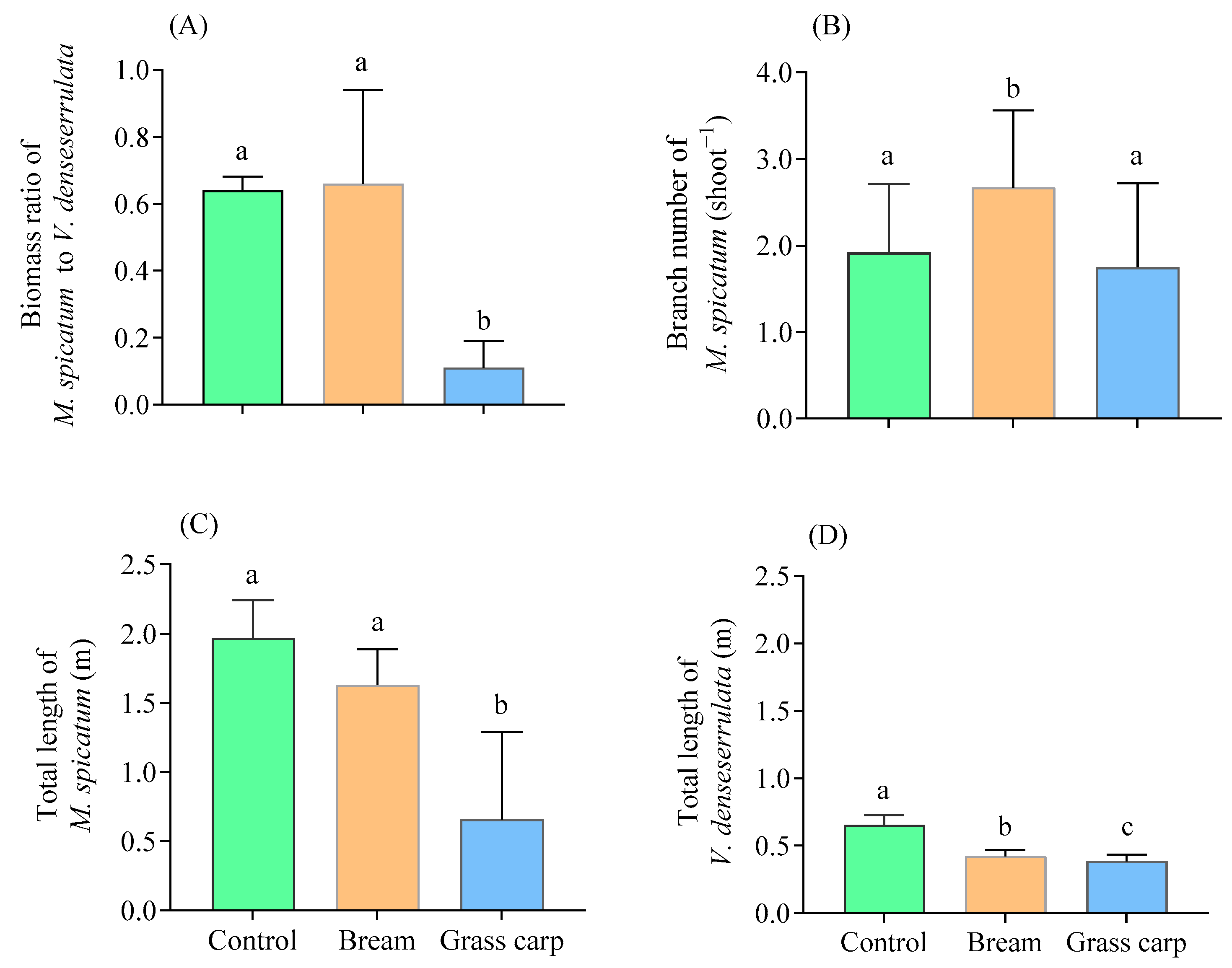
Compared to the controls, Wuchang bream did not affect the biomass ratio of M. spicatum to V. denseserrulata (p = 0.8), whereas grass carp caused a significant reduction (p = 0.004) (Figure 2A).
The branch number of M. spicatum increased in the Wuchang bream treatment (p < 0.046), while no change occurred in the grass carp treatment (p = 0.7) compared to the controls (Figure 2B). M. spicatum total length decreased in both the Wuchang bream treatment (p = 0.06) and the grass carp treatment (p < 0.0001) (Figure 2C). At the end of the experiment, the total length of V. denseserrulata was lower in both fish treatments (p < 0.0001 for both) compared to the controls (Figure 2D).
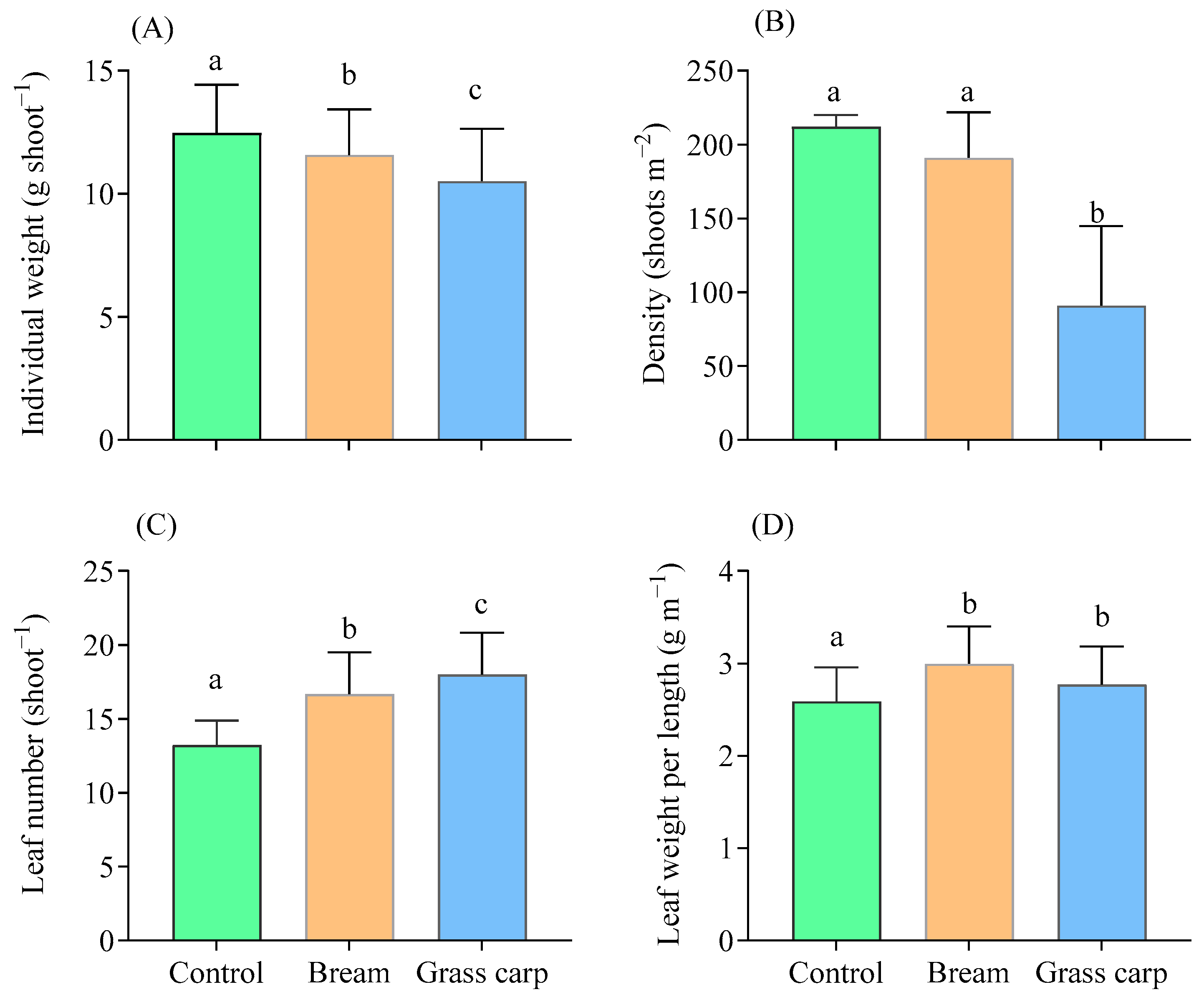
Both Wuchang bream (p = 0.048) and grass carp (p < 0.0001) reduced the individual wet weight of V. denseserrulata compared to the controls (Figure 3A). In contrast, Wuchang bream had no effect on shoot density (p = 0.5), whereas grass carp caused a significant reduction (p = 0.003) (Figure 3B).
Both fish species produced a reduction in the individual leaf number of V. denseserrulata compared to the controls (p < 0.0001 for both fish species) (Figure 3C). Leaf weight per length increased significantly in both fish treatments compared to the controls (p < 0.0001 for both fish species) (Figure 3D).

3.4. Debris in Fish Treatments

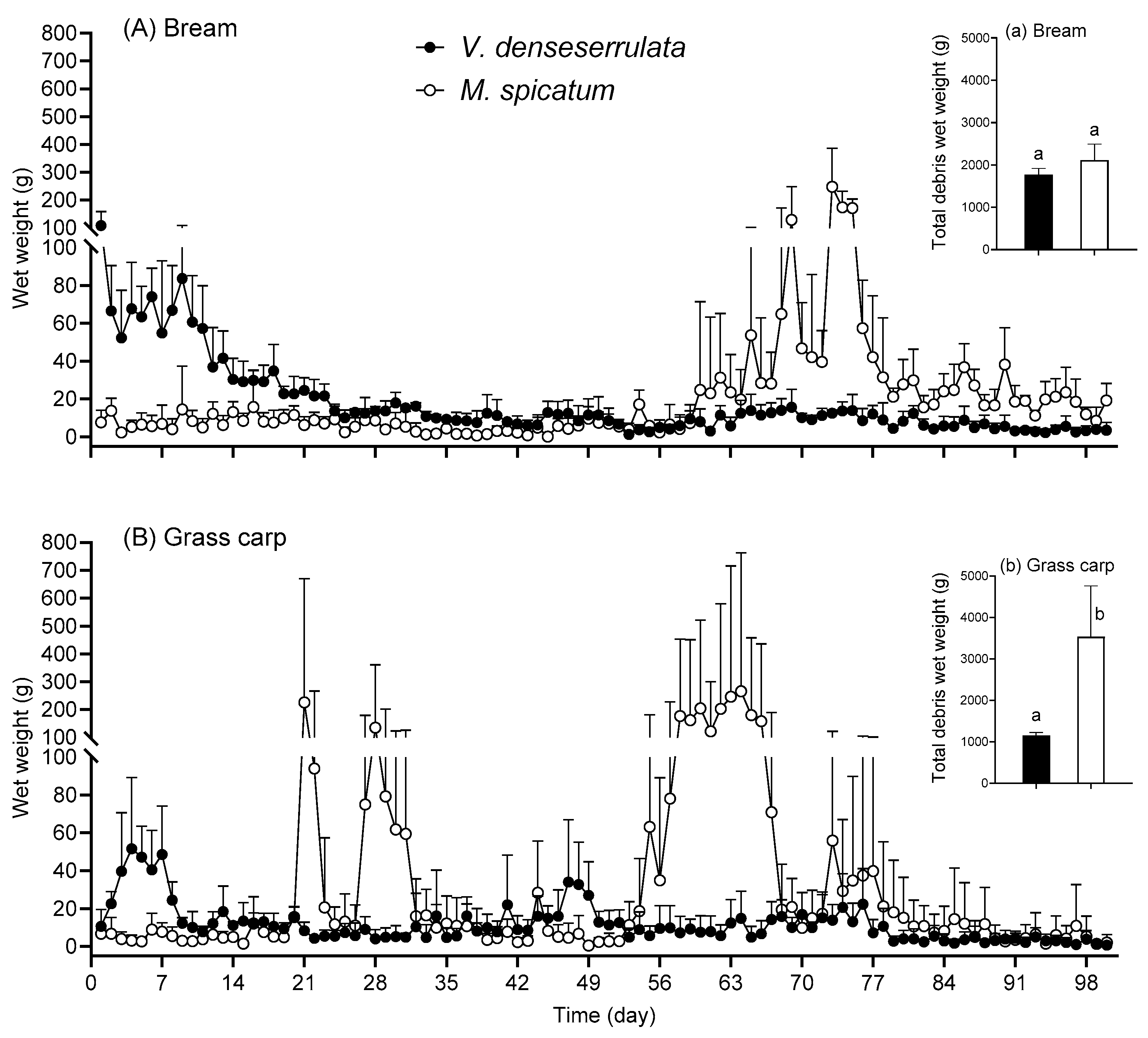
In the Wuchang bream treatment, the two types of plant debris exhibited significantly different temporal patterns. The wet weight of V. denseserrulata debris was initially high after fish stocking, followed by a decrease, whereas M. spicatum debris was initially low but increased towards the end of the experiment (p < 0.0001, Figure 4A). The total amount of M. spicatum debris tended to be slightly higher than that of V. denseserrulata, but the difference was not statistically significant (p = 0.4, Figure 4a).
In the grass carp treatment, the wet weight of V. denseserrulata debris was high during the first week and then decreased over time, while the wet weight of M. spicatum debris increased sharply in weeks 3 and 8; however, the changes were not significant throughout the full course of the experiment (p = 0.2, Figure 4B). Similarly, the total amount of M. spicatum debris tended to be greater than that of V. denseserrulata, but the difference was not significant (p = 0.1, Figure 4b).
The total amount of debris of V. denseserrulata was significantly higher in the Wuchang bream treatment than in the grass carp treatment (p = 0.009, Figure 4). In contrast, M. spicatum debris tended to be greatest in the grass carp treatment, but the difference was not statistically significant (p = 0.3, Figure 4).
During the experiment, no debris from either species was observed in the controls.

4. Discussion

The results support our first hypothesis: both grass carp and Wuchang bream substantially reduced the growth of M. spicatum and V. denseserrulata, the reduction being significant under grass carp grazing but not under Wuchang bream. The second hypothesis was partially supported: Wuchang bream caused a slight, though insignificant, increase in the M. spicatum to V. denseserrulata biomass (wet weight) ratio. However, contrary to our expectation, grass carp significantly decreased this ratio. These results reveal a species-specific effect of herbivorous fish on the growth and competitive interactions of different submerged macrophyte species, highlighting the importance of selecting a suitable herbivorous fish for controlling the targeted submerged macrophyte species.
The two herbivorous fish species used had negative effects on submerged macrophyte biomass, as indicated by debris production. Initially, the debris wet weight of V. denseserrulata was higher than that of M. spicatum, suggesting that V. denseserrulata was the preferred food item for both fish. This may reflect the softer and more palatable tissues of V. denseserrulata and thereby higher digestibility [33]. As the biomass and height of V. denseserrulata gradually declined, and its leaf thickness increased, it became more difficult for the herbivorous fish to feed on [13,17], resulting in enhanced grazing on M. spicatum. In addition, as M. spicatum primarily reproduces through vegetative fragmentation [34,35], intense grazing and its physical disturbance may have caused shoot breakage and debris accumulation, contributing to the observed increase in debris. The greater total debris wet weight of V. denseserrulata in the Wuchang bream treatment and of M. spicatum in the grass carp group demonstrated species-specific efficiency in handling and consumption. The nuanced feeding preferences and foraging intensity of these fish species underscore the importance of species-specific management in aquatic ecosystems. The persistent grazing by Wuchang bream may suppress plant recovery through continuous mechanical damage, while grass carp’s patch-clearing behavior could create opportunities for the non-selective feeding macrophytes to establish. However, as hypothesized, we found that the biomass of both M. spicatum and V. denseserrulata declined, particularly in the grass carp treatment.
The effects of the two fish species on the submerged macrophyte biomass differed: grass carp herbivory caused a significantly stronger biomass reduction of both M. spicatum and V. denseserrulata. Grass carp, often introduced into water bodies for aquatic weed control, are known to feed voraciously, particularly on submerged macrophytes [11,36]. Their large mouth and powerful pharyngeal teeth provide strong chewing ability, enabling an expanded diet and a high growth rate [25,37,38]. Such morphological and functional traits are often beneficial for controlling invasive plant species but may also lead to unintended consequences for native aquatic plant communities [39]. In contrast, Wuchang bream had a relatively insignificant impact on M. spicatum and V. denseserrulata growth. Wuchang bream, characterized by a small mouth and less developed teeth, are less capable of consuming tough or fibrous plant material, resulting in reduced food consumption and a lower growth rate [25,28] and, consequently, a limited impact on the biomass of both species. This difference in impact on plant communities suggests that while grass carp can rapidly alter vegetation dynamics due to their high consumption rates, Wuchang bream may have a slower and more gradual effect in the long term, as indicated by the debris accumulation.
Observations comparable to ours were made in Devils Lake, Oregon, where grass carp grazing prevented Egeria densa and M. spicatum canopy formation, as indicated by a reduced plant volume [39]. Although E. densa was the most preferred food item, M. spicatum was completely removed, E. densa exhibited enhanced biomass but reduced volume, while the biomass of V. americana did not change [39]. This pattern reflects the ability of grass carp to selectively target and diminish certain plant species, thereby altering the structural dynamics of the aquatic vegetation. In our study, the biomass ratio of M. spicatum to V. denseserrulata decreased significantly in the grass carp treatment compared to the controls, indicating stronger effects of grass carp on M. spicatum than on V. denseserrulata. A study by Xiao et al. [40] showed that canopy shading by M. spicatum reduced the light availability for V. denseserrulata, inhibiting the growth of its young ramets. Thus, intensive grazing by grass carp would first remove the nuisance M. spicatum and prevent canopy formation, thereby improving light conditions for V. denseserrulata growth. However, despite the theoretical benefits of reduced shading, the compensatory growth of V. denseserrulata remained insufficient to prevent vegetation loss in our study, and the biomass of V. denseserrulata decreased severely. Our findings suggest that while grass carp can effectively control nuisance species like M. spicatum, their impact on more desirable species, such as V. denseserrulata, may be profound and negative. Wuchang bream, however, showed only moderate (and insignificant) control of submerged macrophytes in our experiment. The selective and less intensive grazing behavior of Wuchang bream may contribute to a more gradual reduction in the canopy expansion of M. spicatum, causing a slower, yet steady decline. This contrasts with the rapid and widespread removal typically caused by grass carp, which leads to more abrupt changes in plant community structure. Additionally, the basal rosette morphology of V. denseserrulata and its strong clonal growth may allow to persist as the last plant species in communities dominated by V. denseserrulata and M. spicatum under intense fish herbivory, as observed in our grass carp treatment.
Both V. denseserrulata and M. spicatum exhibited a certain plasticity to compensate for fish grazing. The number of M. spicatum branches increased in the Wuchang bream treatment compared to the controls, expanding their leaf area and thereby compensating for loss by fish grazing. A similar development did not occur in the grass carp treatment. This is likely due to excessive grazing towards the end of the experiment, preventing plant regeneration and thus compensatory growth. The reduction observed in the total length of V. denseserrulata was similar to that observed in our former study on V. denseserrulata exposed to fish grazing, but without M. spicatum presence [17]. However, V. denseserrulata density did not change in the Wuchang bream treatment and even decreased in the grass carp treatment, which contrasts with the results of the former study [17] where V. denseserrulata density increased in the absence of M. spicatum. In this study, the shading canopy of M. spicatum likely reduced the light availability to V. denseserrulata and, thereby, prevented its compensatory growth and clonal growth, as found in previous investigations exposing V. americana and V. spiralis to reduced light availability [40,41].
Our results have management implications. In an attempt to restore lakes after nutrient loading reduction, transplantation of submerged macrophytes and fish removal have frequently been employed [42]. However, this intervention has often resulted in dense plant growth reaching the water surface, which can impair recreational use (e.g., boating, swimming, angling) [7]. The return of herbivorous fish may help control tall-growing species such as Hydrilla and Elodea, which are preferred food items for many herbivores [13,26]. In our study, M. spicatum was controlled only when the biomass of the preferred V. denseserrulata could not meet the feeding needs of fish. Therefore, alternative methods are required to manage unpalatable, canopy-forming species such as M. spicatum. Given that grass carp is a large, fast-growing species that is hard to manage [11], medium-sized herbivorous fish like Wuchang bream might be more appropriate for sustaining meadow-forming species such as Vallisneria. Additionally, excessive densities of herbivorous fish can have negative effects [36], so regulation of herbivore densities may be necessary to ensure an adequate supply of macrophytes and preserve clear-water conditions. Long-term field studies are recommended to examine the effects of varying densities of herbivorous fish on more complex macrophyte communities than those studied here. Furthermore, the effects of reasonable stocking of herbivorous fish on controlling canopy-forming submerged macrophytes to create a sustainable and stable macrophyte community need to be elucidated in the future.

5. Conclusions

In conclusion, this study demonstrated that herbivory by Wuchang bream and grass carp exerted distinct effects on the submerged macrophytes V. denseserrulata and M. spicatum. Grass carp significantly reduced the biomass and relative growth rates of both plant species, whereas Wuchang bream exerted no significant effect on these variables. Regarding the biomass ratio of M. spicatum to V. denseserrulata, grass carp resulted in a significant reduction, while Wuchang bream did not. Morphologically, Wuchang bream increased the branch number of M. spicatum but exhibited no significant effect on its shoot density. Conversely, grass carp had no significant impact on M. spicatum branch number but reduced V. denseserrulata shoot density. Both fish species decreased the total length of M. spicatum and V. denseserrulata, as well as the individual wet weight and leaf number of V. denseserrulata, while increasing the leaf weight per unit length of V. denseserrulata. Both fish treatments generated plant debris (absent in controls), with Wuchang bream treatments yielding significantly more V. denseserrulata debris than grass carp treatments, and grass carp treatments exhibiting a trend towards higher M. spicatum debris. These findings indicate that grass carp exerted stronger negative effects on macrophyte performance and biomass allocation, whereas Wuchang bream primarily influenced specific morphological traits, underscoring the species-specific nature of herbivory impacts on submerged macrophyte communities.

Author Contributions

Conceptualization, W.Z., Z.L. (Zhengwen Liu) and J.Y.; methodology, W.Z., X.Z., Z.L. (Zhenmei Lin) and Y.G.; software, W.Z. and J.Y.; validation, W.Z., Z.L. (Zhenmei Lin), X.Z. and Y.G.; formal analysis, W.Z. and J.Y.; investigation, X.Z., Q.W., Y.G., K.Y. and B.G.; resources, K.L. and E.J.; data curation, W.Z. and J.Y.; writing—original draft preparation, W.Z., X.Z., Z.L. (Zhenmei Lin) and J.Y.; writing—review and editing, W.Z., Z.L. (Zhenmei Lin), J.Y., E.J., Z.L. (Zhengwen Liu), K.L. and K.Y.; visualization, W.Z. and J.Y.; supervision, J.Y.; project administration, J.Y.; funding acquisition, J.Y. and E.J. All authors have read and agreed to the published version of the manuscript.

Funding

The study was supported by the National Natural Science Foundation of China (42277067), Jiangxi Provincial Natural Science Foundation (20242BAB23063), Jiangsu Provincial Science and Technology Planning Project (No. BK20231516), the State Key Laboratory of Lake and Watershed Science for Water Security (NKL2023-KP02), and the Science and Technology Innovation Project of Changjiang Nanjing Waterway Engineering Bureau (NCWEB-KJ026). Erik Jeppesen was supported by the BIDEB2232 program (project 118C250), ANAEE Denmark, the AU Water Technology Centre, WATEC, and the Yunnan Provincial Council of Academicians and Experts Workstations (202405AF140006).

Data Availability Statement

The original contributions presented in this study are included in the article. Further inquiries can be directed to the corresponding author.

Acknowledgments

We are grateful to Kexiang Xu for fish breeding and advice on fish farming. Thanks also to Xinli Wan for boating and plant collection, to Hui Zhang and Huan Sun for assistance in the determination of plant traits, and to Anne Mette Poulsen for linguistic assistance.

Conflicts of Interest

Author Qianhong Wang and Kai Yang were employed by the company Changjiang Nanjing Waterway Engineering Bureau The remaining authors declare that the research was conducted in the absence of any commercial or financial relationships that could be construed as a potential conflict of interest.

References

  1. Carpenter, S.R.; Lodge, D.M. Effects of Submersed Macrophytes on Ecosystem Processes. Aquat. Bot. 1986, 26, 341–370. [Google Scholar] [CrossRef]
  2. Yu, J.; Liu, Z.; He, H.; Zhen, W.; Guan, B.; Chen, F.; Li, K.; Zhong, P.; Teixeira-de Mello, F.; Jeppesen, E. Submerged Macrophytes Facilitate Dominance of Omnivorous Fish in a Subtropical Shallow Lake: Implications for Lake Restoration. Hydrobiologia 2016, 775, 97–107. [Google Scholar] [CrossRef]
  3. Liu, Z.; Hu, J.; Zhong, P.; Zhang, X.; Ning, J.; Larsen, S.E.; Chen, D.; Gao, Y.; He, H.; Jeppesen, E. Successful Restoration of a Tropical Shallow Eutrophic Lake: Strong Bottom-up but Weak Top-down Effects Recorded. Water Res. 2018, 146, 88–97. [Google Scholar] [CrossRef]
  4. Barko, J.W.; James, W.F. Effects of Submerged Aquatic Macrophytes on Nutrient Dynamics, Sedimentation, and Resuspension. In The Structuring Role of Submerged Macrophytes in Lakes; Jeppesen, E., Søndergaard, M., Søndergaard, M., Christoffersen, K., Eds.; Springer: New York, NY, USA, 1998; pp. 197–214. ISBN 978-1-4612-0695-8. [Google Scholar]
  5. Nichols, S.A.; Shaw, B.H. Ecological Life Histories of the Three Aquatic Nuisance Plants, Myriophyllum spicatum, Potamogeton crispus and Elodea canadensis. Hydrobiologia 1986, 131, 3–21. [Google Scholar] [CrossRef]
  6. Smith, C.S.; Barko, J.W. Ecology of Eurasian Watermilfoil. J. Aquat. Plant Manag. 1990, 28, 55–64. [Google Scholar]
  7. Hilt, S.; Gross, E.M.; Hupfer, M.; Morscheid, H.; Mählmann, J.; Melzer, A.; Poltz, J.; Sandrock, S.; Scharf, E.-M.; Schneider, S.; et al. Restoration of Submerged Vegetation in Shallow Eutrophic Lakes—A Guideline and State of the Art in Germany. Limnologica 2006, 36, 155–171. [Google Scholar] [CrossRef]
  8. Madsen, J.D.; Chambers, P.A.; James, W.F.; Koch, E.W.; Westlake, D.F. The Interaction between Water Movement, Sediment Dynamics and Submersed Macrophytes. Hydrobiologia 2001, 444, 71–84. [Google Scholar] [CrossRef]
  9. Widdows, J.; Pope, N.; Brinsley, M.; Asmus, H.; Asmus, R. Effects of Seagrass Beds (Zostera noltii and Z. marina) on near-Bed Hydrodynamics and Sediment Resuspension. Mar. Ecol. Prog. Ser. 2008, 358, 125–136. [Google Scholar] [CrossRef]
  10. Ganthy, F.; Soissons, L.; Sauriau, P.-G.; Verney, R.; Sottolichio, A. Effects of Short Flexible Seagrass Zostera noltei on Flow, Erosion and Deposition Processes Determined Using Flume Experiments. Sedimentology 2015, 62, 997–1023. [Google Scholar] [CrossRef]
  11. Hussner, A.; Stiers, I.; Verhofstad, M.J.J.M.; Bakker, E.S.; Grutters, B.M.C.; Haury, J.; van Valkenburg, J.L.C.H.; Brundu, G.; Newman, J.; Clayton, J.S.; et al. Management and Control Methods of Invasive Alien Freshwater Aquatic Plants: A Review. Aquat. Bot. 2017, 136, 112–137. [Google Scholar] [CrossRef]
  12. Titus, J.E.; Adams, M.S. Coexistence and the Comparative Light Relations of the Submersed Macrophytes Myriophyllum spicatum L. and Vallisneria americana Michx. Oecologia 1979, 40, 273–286. [Google Scholar] [CrossRef]
  13. Petr, T. Interactions Between Fish and Aquatic Macrophytes in Inland Waters: A Review; Food & Agriculture Org.: Rome, Italy, 2000; ISBN 978-92-5-104453-7. [Google Scholar]
  14. Mitchell, A.J.; Kelly, A.M. The Public Sector Role in the Establishment of Grass Carp in the United States. Fisheries 2006, 31, 113–121. [Google Scholar] [CrossRef]
  15. Cassani, J.R. Problems and Prospects for Grass Carp as a Management Tool. Am. Fish. Soc. Symp. 1995, 15, 407–412. [Google Scholar]
  16. Bonar, S.A.; Bolding, B.; Divens, M. Effects of Triploid Grass Carp on Aquatic Plants, Water Quality, and Public Satisfaction in Washington State. N. Am. J. Fish. Manag. 2002, 22, 96–105. [Google Scholar] [CrossRef]
  17. Zhen, W.; Zhang, X.; Guan, B.; Yin, C.; Yu, J.; Jeppesen, E.; Zhao, X.; Liu, Z. Stocking of Herbivorous Fish in Eutrophic Shallow Clear-Water Lakes to Reduce Standing Height of Submerged Macrophytes While Maintaining Their Biomass. Ecol. Eng. 2018, 113, 61–64. [Google Scholar] [CrossRef]
  18. Zhou, Y.; Li, X.; Zhao, Y.; Zhou, W.; Li, L.; Wang, B.; Cui, X.; Chen, J.; Song, Z. Divergences in Reproductive Strategy Explain the Distribution Ranges of Vallisneria Species in China. Aquat. Bot. 2016, 132, 41–48. [Google Scholar] [CrossRef]
  19. Yu, J.; Zhen, W.; Guan, B.; Zhong, P.; Jeppesen, E.; Liu, Z. Dominance of Myriophyllum spicatum in Submerged Macrophyte Communities Associated with Grass Carp. Knowl. Manag. Aquat. Ecosyst. 2016, 417, 24. [Google Scholar] [CrossRef]
  20. Lodge, D.M. Herbivory on Freshwater Macrophytes. Aquat. Bot. 1991, 41, 195–224. [Google Scholar] [CrossRef]
  21. Pípalová, I. Initial Impact of Low Stocking Density of Grass Carp on Aquatic Macrophytes. Aquat. Bot. 2002, 73, 9–18. [Google Scholar] [CrossRef]
  22. Dorenbosch, M.; Bakker, E.S. Herbivory in Omnivorous Fishes: Effect of Plant Secondary Metabolites and Prey Stoichiometry. Freshw. Biol. 2011, 56, 1783–1797. [Google Scholar] [CrossRef]
  23. Cooke, G.D.; Welch, E.B.; Peterson, S.; Nichols, S.A. Restoration and Management of Lakes and Reservoirs, 3rd ed.; CRC Press: Boca Raton, FL, USA, 2005; ISBN 978-0-429-18923-4. [Google Scholar]
  24. Dibble, E.; Kovalenko, K. Ecological Impact of Grass Carp: A Review of the Available Data. J. Aquat. Plant Manag. 2009, 47, 1–15. [Google Scholar]
  25. Chen, S.; Liu, X. Nutrition and Bioenergetics of the Chinese Herbivorous with Important Food Values. III. Preliminary Studies on the Feeding Selectivity of Ctenopharyngodon idella and Megalobrama amblycephala. Acta Hydrobiol. Sin. 1991, 15, 180–183. [Google Scholar] [CrossRef]
  26. Leslie, A.J.; Dyke, J.M.V.; Hestand, R.S.; Thompson, B.Z. Management of Aquatic Plants in Multi-Use Lakes with Grass Carp (Ctenopharyngodon idella). Lake Reserv. Manag. 1987, 3, 266–276. [Google Scholar] [CrossRef]
  27. Kapuscinski, K.L.; Farrell, J.M.; Stehman, S.V.; Boyer, G.L.; Fernando, D.D.; Teece, M.A.; Tschaplinski, T.J. Selective Herbivory by an Invasive Cyprinid, the Rudd Scardinius erythrophthalmus. Freshw. Biol. 2014, 59, 2315–2327. [Google Scholar] [CrossRef]
  28. Tsao, W.S. A Biological Study of Magalobrama amblycephala and M. terminalis of Liang-Tse Lake. Acta Hydrobiol. Sin. 1960, 1, 57–78. [Google Scholar]
  29. Wu, X.; Cao, W.; Yi, G.; Yang, G.; Luo, Y. The Cyprinid Fishes of China; Shanghai Science and Technology Press: Shanghai, China, 1964. [Google Scholar]
  30. Chen, S.; Liu, X.; Su, Z. Nutrition and Bioenergetics of the Chinese Herbivorous with Important Food Values. II. Maximum Consumption and Digestion of Seven Aquatic Plants By Ctenopharyngodon idella and Megalobrama amblycephala. Acta Hydrobiol. Sin. 1993, 17, 1–12. [Google Scholar] [CrossRef]
  31. Jin, X.; Tu, Q. The Standard Methods for Observation and Analysis in Lake Eutrophication, 2nd ed.; China Environmental Science Press: Beijing, China, 1990. [Google Scholar]
  32. The State Environmental Protection Administration. Water and Wastewater Monitoring and Analysis Method, 4th ed.; China Environmental Science Press: Beijing, China, 2002. [Google Scholar]
  33. Sun, J.; Wang, L.; Ma, L.; Min, F.; Huang, T.; Zhang, Y.; Wu, Z.; He, F. Factors Affecting Palatability of Four Submerged Macrophytes for Grass Carp Ctenopharyngodon idella. Environ. Sci. Pollut. Res. 2017, 24, 28046–28054. [Google Scholar] [CrossRef]
  34. Umetsu, C.A.; Evangelista, H.B.A.; Thomaz, S.M. The Colonization, Regeneration, and Growth Rates of Macrophytes from Fragments: A Comparison between Exotic and Native Submerged Aquatic Species. Aquat. Ecol. 2012, 46, 443–449. [Google Scholar] [CrossRef]
  35. Li, F.; Zhu, L.; Xie, Y.; Jiang, L.; Chen, X.; Deng, Z.; Pan, B. Colonization by Fragments of the Submerged Macrophyte Myriophyllum spicatum under Different Sediment Type and Density Conditions. Sci. Rep. 2015, 5, 11821. [Google Scholar] [CrossRef]
  36. Pípalová, I. A Review of Grass Carp Use for Aquatic Weed Control and Its Impact on Water Bodies. J. Aquat. Plant Manag. 2006, 44, 1–12. [Google Scholar]
  37. Nie, D.; Hong, S. The Histology of the Digestive Tract of the Grass Carp (Ctenopharyngodon idellus). Acta Hydrobiol. Sin. 1963, 3, 1–25. [Google Scholar]
  38. Hlckling, C.F. On the Feeding Process in the White Amur, Ctenopharyngodon idella. J. Zool. 1966, 148, 408–419. [Google Scholar] [CrossRef]
  39. Bonar, S.A.; Thomas, G.L.; Th1Esfeld, S.L.; Pauley, G.B.; Stables, T.B. Effect of Triploid Grass Carp on the Aquatic Macrophyte Community of Devils Lake, Oregon. N. Am. J. Fish. Manag. 1993, 13, 757. [Google Scholar] [CrossRef]
  40. Xiao, K.; Yu, D.; Wu, Z. Differential Effects of Water Depth and Sediment Type on Clonal Growth of the Submersed Macrophyte Vallisneria natans. Hydrobiologia 2007, 589, 265–272. [Google Scholar] [CrossRef]
  41. Kimber, A.; Owens, J.L.; Crumpton, W.G. Light Availability and Growth of Wildcelery (Vallisneria americana) in Upper Mississippi River Backwaters. Regul. Rivers Res. Manag. 1995, 11, 167–174. [Google Scholar] [CrossRef]
  42. Sayer, C.D.; Davidson, T.A.; Rawcliffe, R.; Langdon, P.G.; Leavitt, P.R.; Cockerton, G.; Rose, N.L.; Croft, T. Consequences of Fish Kills for Long-Term Trophic Structure in Shallow Lakes: Implications for Theory and Restoration. Ecosystems 2016, 19, 1289–1309. [Google Scholar] [CrossRef]
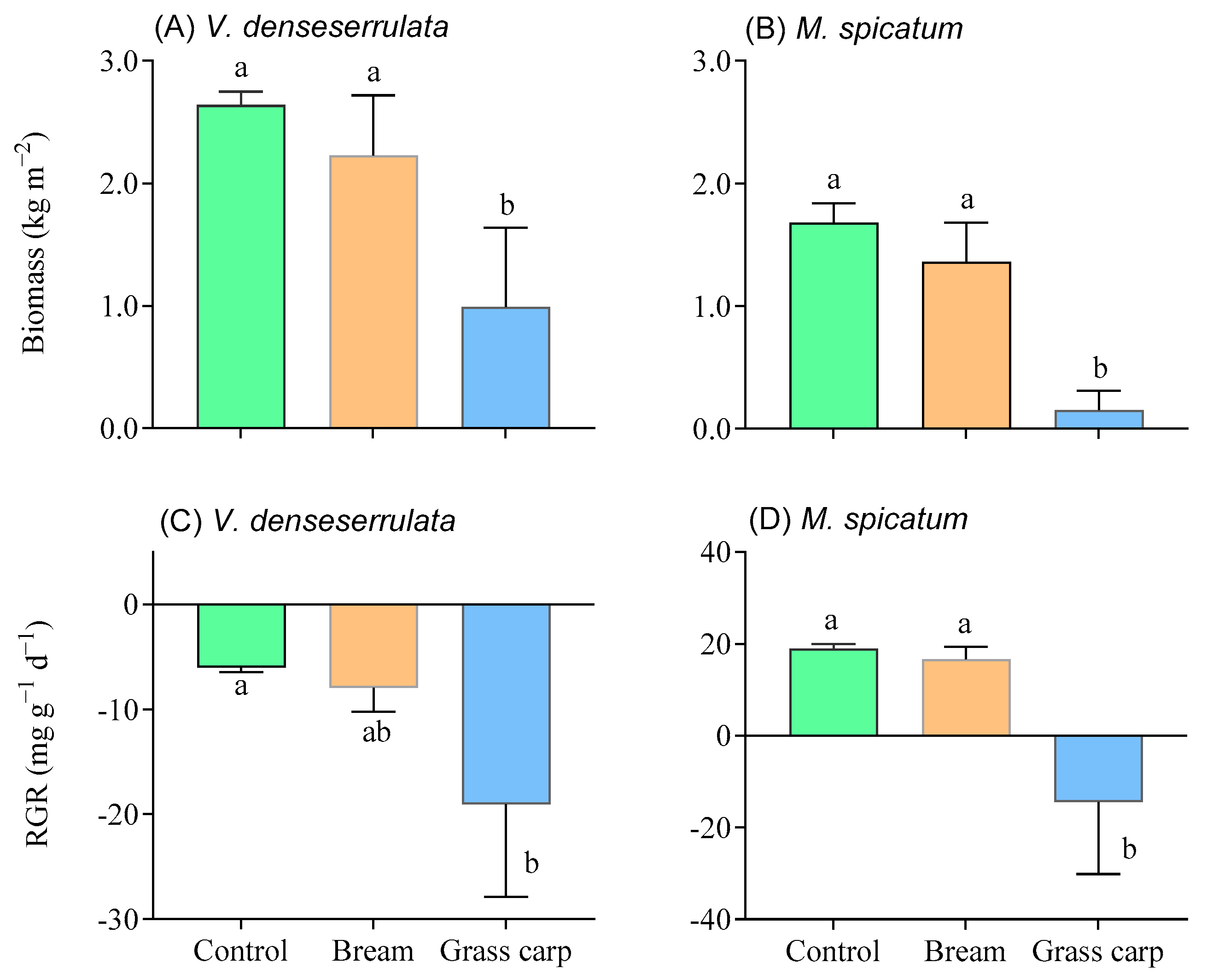
Figure 1. Effects of fish herbivory on the biomass (A,B) and RGR (C,D) of Vallisneria denseserrulata and Myriophyllum spicatum. Data presented as the mean ± SD. Different letters (a, b) indicate a significant difference across treatments.
Water 18 00028 g001
Figure 2. Effects of fish herbivory on Myriophyllum spicatum: Vallisneria denseserrulata in terms of wet weight (A), branch number of M. spicatum (B), and total lengths of M. spicatum (C) and V. denseserrulata (D). Data are presented as the mean ± SD. Different letters indicate a significant difference across treatments.
Water 18 00028 g002
Figure 3. Effects of fish herbivory on mean individual wet weight (A), density (B), leaf number (C), and leaf weight per length (D) of Vallisneria denseserrulata. The data are presented as mean + SD. Different letters indicate significant difference across treatments.
Water 18 00028 g003
Figure 4. Daily (A,B) and total (a,b) wet weight of debris during the 100-day experiment. Data are mean ± SE in each treatment. Different letters indicate significant differences across treatments.
Water 18 00028 g004
Disclaimer/Publisher’s Note: The statements, opinions and data contained in all publications are solely those of the individual author(s) and contributor(s) and not of MDPI and/or the editor(s). MDPI and/or the editor(s) disclaim responsibility for any injury to people or property resulting from any ideas, methods, instructions or products referred to in the content.