Article

Integrating Multi-Index and Health Risk Assessment to Evaluate Drinking Water Quality in Central Romania

1
Research Institute for Auxiliary Organic Products SA, ICPAO, 8 Carpati Street, 551022 Medias, Romania
2
Research Institute for Analytical Instrumentation Subsidiary, National Institute of Research and Development for Optoelectronics INOE 2000, 67 Donath Street, 400293 Cluj-Napoca, Romania
*
Author to whom correspondence should be addressed.
Water 2026, 18(1), 23; https://doi.org/10.3390/w18010023 (registering DOI)
Submission received: 27 November 2025 / Revised: 14 December 2025 / Accepted: 19 December 2025 / Published: 21 December 2025
(This article belongs to the Special Issue New Technologies to Ensure Safe Drinking Water)

Abstract

Chemical contaminants in drinking water represent a widespread threat to human health, making water quality monitoring an essential mitigation measure. This study aimed to assess the quality of drinking water by conducting comprehensive multi-year seasonal monitoring at seven distribution points in central Romania, determining the spatial and temporal trends of relevant physical parameters (pH and electrical conductivity) and chemical contaminants (NO2, NO3, NH4, Cl, and SO4). The pollution degree was evaluated using the pollution index and the overall pollution assessment index. The principal component analysis attributed over 60% of water quality variance to NO2, NO3, and NH4 pollution, linked to incomplete nitrification or external loading, such as agricultural practices. Additionally, a human health risk assessment was performed according to U.S. EPA guidelines, calculating the chronic daily intake, hazard quotient, and hazard index for nitrogen compounds via oral and dermal exposure pathways for both adults and children. The results showed significant seasonal fluctuations in nitrogen compounds and electrical conductivity. The pollution indices classified the water bodies across a spectrum from “light” to “significant” pollution degrees. The health risk assessment revealed that NO3 was the primary risk driver, with hazard index values exceeding the threshold of one in specific locations and seasons, indicating potential adverse health effects, particularly for children.

1. Introduction

Global access to safe and uncontaminated drinking water for personal domestic use is a widely recognised human right and constitutes a primary indicator of public health [1,2]. The WHO reports that unsafe drinking water is a major source of infectious diseases [3]. Children are more susceptible to normal levels of toxins due to higher relative concentrations (the effect of low body weight and higher water intake) [4]. In agricultural regions, elevated health risks are associated with nitrate in groundwater [5,6,7]. Sulphate and chloride determine the corrosion and leaching of lead and copper in drinking water [8]. Electrical conductivity (σ) reflects the cumulative effect of all dissolved ions [9,10]. The interference of these parameters promotes contamination and accelerates infrastructure deterioration in distribution networks [11]. The quality of water in distribution systems depends on the source parameters, seasonal climatic fluctuations, and the integrity of the distribution infrastructure [12,13].
Nitrogen compounds, specifically nitrite (NO2), nitrate (NO3), and ammonium (NH4), are a class of global contaminants originating from agricultural runoff, livestock farming, wastewater discharge, or industrial effluents, and are used as indicators of anthropogenic pollution [14,15,16]. The mobility of these compounds in the soil allows them to readily leach into groundwater and surface water [17]. Their seasonal variability is linked to fertiliser application in spring or to heavy rainfall causing contaminants to flow into aquifers [18], and should be included in the risk assessment.
In drinking water derived from surface water, nitrate concentrations usually do not exceed 10 mg/L, except for areas exposed to runoffs, sewage effluents, and industrial wastes. However, exposures to higher nitrate concentrations in drinking water (>50 mg/L) were recorded in 15 European countries, affecting about 10 million people [19].
Due to their direct and indirect health impacts, the presence of nitrogen species in drinking water must be minimised. Consumption of drinking water polluted with nitrite, nitrate, or ammonium is linked to several classes of diseases. Cumulated nitrogenous chemical contamination, via combined routes, produces a spectrum of non-malignant and malignant, dose-dependent diseases distinct from microbial water-borne infections [20]. Examples include methaemoglobinaemia, where nitrite oxidises haemoglobin, causing ischemia, in particular in infants <6 months [21]; undesirable outcomes in pregnancy, where chronic nitrate intake is associated with foetal growth restriction, pre-term delivery, and neural tube defects [22,23]; thyroid dysfunction due to deficient iodide absorption in the presence of nitrate, which promotes hypothyroidism in children and healthy pregnant women [24,25]; promotion of type-2 diabetes [26] via oxidative stress pathways [27]; elevated methaemoglobin levels and cardiovascular stress, causing ischemic disease and disturbed blood pressure [28]; and glioma and gastrointestinal cancers, as suggested by statistical associations [29,30]. A recent study found that nitrate levels in tap water, even below legal limits, can pose health risks to bottle-fed infants when combined with disinfection by-products, highlighting the need for integrated risk assessments [31]. Likewise, a multi-route exposure study demonstrated that dermal absorption during showering contributes to the total daily intake of nitrosamine precursors, significantly increasing bladder cancer risk [32].
Infants are the most vulnerable age class to nitrogenous species exposure. High nitrate levels can cause methaemoglobinaemia, a potentially fatal condition in infants, while the endogenous conversion of nitrate to nitrite generates N-nitroso compounds, classified as carcinogens causing gastro-intestinal tract cancers [33,34]. According to the U.S. Environmental Protection Agency (EPA), the maximum contaminant level for nitrate in drinking water is 10 mg/L, measured as nitrate-nitrogen (NO3-N); for nitrite, it is 1 mg/L, measured as nitrite-nitrogen (NO2-N) [35]. The World Health Organization (WHO) guideline value for nitrate is 50 mg/L of nitrate ions (NO3), which is equivalent to approximately 11.3 mg/L as N; for nitrite, it is 3 mg/L of nitrite ions (NO2), equivalent to approximately 0.92 mg/L as N [36]. Nitrate levels in tap water, combined with disinfection by-products, can result in N-Nitrosodimethylamine (a potent carcinogen) through chloramination, as pointed out by multi-source and multi-route exposure. Therefore, water contamination and health impacts require integrated risk assessments [37]. Moreover, a review revealed that thresholds for nitrate in public drinking water offer protection against infant methaemoglobinaemia, but not against the risk of specific cancers and congenital disabilities, although it is a precursor in the pathway of N-nitroso compound formation [33]. Consequently, reference thresholds are not sufficient to assess cumulative health risks, in particular among sensitive subjects.
Despite the remarkable health benefits of the chlorination of municipal drinking waters, epidemiological studies have revealed an association between disinfection by-products, in particular trihalomethanes consumed with chlorinated drinking water, and an increased risk of bladder cancer [38]. Some other products of the residual chlorine’s reactions with the organic matter and bromide are trihalomethanes, haloacetic acids, chlorophenols, chloral hydrate, and haloacetonitriles, suspected of causing DNA damage and cancers [39]. Sulphate ingestion through drinking water was widely reported to cause acute (osmotic) diarrhoea [40].
The evaluation of water quality is increasingly based on pollution indices, which integrate different metrics into a single, comprehensible value. The pollution index (PI) and the overall pollution assessment (OPA) discriminate pollution categories, reflecting the progressive degradation of water bodies. These indices characterise the environmental state. The consequent risk to human health can be assessed by determining the hazard quotient (HQ) and hazard index (HI) in order to quantify carcinogenic and non-carcinogenic risks [41]. The HQ is the ratio between the concentration of a contaminant and the reference dose considered safe for human health. The HI is used when assessing the effects synergistic contaminants and is calculated as the sum of individual HQ values. An Italian study determined the HQ and HI in relation to oral and dermal exposure to contaminated groundwater by grouping the populations into three groups: children, adults, and workers [7]. Çankaya et al. performed seasonal sampling for NO3 and NO2, and their HQ and HI for children and adults, separately [42]. Golaki et al. demonstrated combined nitrate and nitrite HQ and HI in all age groups based on 12 months of data [43]. The HQ and HI have some important limitations: the aggregate exposure to a chemical from all relevant sources, and not only from a specific source, should be assessed, otherwise the risk might be underestimated. Goumenou [44] developed an alternative approach simulating an aggregated exposure: the source-related HQ (HQs) for a specific source compared to the reference values and adjusted by a correction factor. Some studies combine heavy metal pollution indices and their uptake in fish with human health risk indices for children and adults through the ingestion and skin absorption of water [45]. Similarly, an index-based approach was applied to evaluate pollution in drinking water sources and associated health risks for nitrogenous-derived compounds and a series of other contaminants [46].
The indexing of multi-annual pollution of drinking water based on spatial–temporal trend analysis and consequent health risk assessments for Transylvania (Romania), based on the mentioned methodologies, is scarce. Therefore, this study presents a comprehensive, multi-year seasonal monitoring of seven water distribution points in central Romania by determining the spatial and temporal trends of relevant physical parameters and chemical contaminants. Then, we classify the pollution degree using established pollution indices, and conduct a human health risk assessment to quantify the potential non-carcinogenic risks associated with the nitrogen compound exposure for both adult and child populations. The novelty of this study lies in its integrated methodological approach and the geographic and temporal data gaps it fills, offering the first holistic evaluation of long-term drinking water pollution and its health implications for the communities (adults vs. children) in the studied areas of central Romania. More specifically, this is among the first studies in Transylvania to integrate long-term, seasonally resolved monitoring and age-specific health risk assessment within a unified methodological framework. The dataset, which spans multiple years and has been largely inaccessible for this region, facilitates the discernment of emerging contamination patterns that cannot be revealed by short-term studies. This research has a significant scientific and societal relevance across multiple domains. For public health, it provides evidence regarding drinking water contamination risks affecting a large number of residents. From an environmental management perspective, it supplies comprehensive, actionable baseline data for water quality monitoring. Methodologically, it establishes a replicable analytical framework within an Eastern European context. The findings also support regulatory compliance by supporting the alignment with international and national water quality standards. The final goal of the study was to simultaneously cover the following methodological gaps identified in the literature: multi-annual record, seasonal resolution, spatial–temporal data, and estimated nitrogen age-specific non-carcinogenic health risk. The obtained data and risk calculation results can directly guide intervention priorities and policies.

2. Materials and Methods

2.1. Area of Study and Sampling Procedure

The present study was conducted in seven different locations (Agnita, Alma, Medias, Dumbraveni, Tarnaveni, Iernut, and Sura Mare localities) in Sibiu County, Romania. Sibiu County is located in central Romania, in the southeastern region of Transylvania. The area under consideration encompasses approximately 5432 km2, constituting about 2.3% of Romania’s total territory. The topography, geology, and climate of the region are significantly impacted by its geographical location, which is situated at the intersection of the Transylvanian Plateau and the Southern Carpathians. Sibiu County is characterised by its pronounced spatial heterogeneity, both in terms of morphology and climate. This heterogeneity results from the county’s position as a transitional zone between the Transylvanian Plateau and the Southern Carpathians. The landscape is discernibly segmented into plateau and hills, valleys, and high mountains. From a geological perspective, the convergence of sedimentary plateau rocks and crystalline mountain massifs creates a diverse array of landforms. These landforms dictate the potential for various resource opportunities in the region [47].
The geology of Sibiu County is intricate as a consequence of its location at the southern periphery of the Transylvanian Basin and the northern periphery of the Southern Carpathians. In the plateau and hilly regions, sedimentary rocks predominate, including limestones, marls, sandstones, and clays, which are associated with the Transylvanian Basin and the inter-Carpathian depressions [48].
From a climatological perspective, the topography exacerbates variations in temperature, precipitation, and snow cover duration, all of which determine the potential land uses. The annual average air temperature varies considerably, within a range of approximately 9.4 to 4.3 °C. Precipitation also varies significantly across the landscape, ranging from approximately 650 mm in lower depressions to over 1300 mm in mountainous regions [47].
A seasonal monitoring campaign was conducted from seven water distribution points, starting from January 2022 to October 2024, four times per year, covering all four seasons (winter—January, spring—April, summer—July, and autumn—October). The sampling points are Agnita (SP1), Alma (SP2), Medias (SP3), Dumbraveni (SP4), Tarnaveni (SP5), Iernut (SP6), and Sura Mare (SP7) (Figure 1).
Samples were collected in sterile polyethylene containers from the water system distribution after the water was pumped for up to half an hour to prevent stagnation. The sampling procedure followed strict guidelines for sampling drinking water from distribution networks [49]. To exclude contamination, containers were rinsed with each water sample, eliminating the air after filling. The samples were then transported to the laboratory in opaque cooling boxes at 4 °C under controlled conditions. They were prepared for the proposed analysis on the same day. Good homogenisation was applied before all determinations. Filtration was performed prior to the anion’s measurements using 0.45 µm filters.

2.2. Instrumentation Analysis

A comprehensive analysis of chemicals was performed immediately after sampling. Key physicochemical indicators (pH and electrical conductivity) were determined utilising an InoLab Multi 740 multiparameter (WTW, Gotha, Germany). After the homogenisation and filtration, NO2, NO3, and NH4 were measured through UV–VIS spectrophotometry using Specord 200 Plus equipment (Analytik Jena, Jena, Germany). The chloride content (Cl) was determined through titration, while SO4 was measured by UV–VIS spectrophotometry. To ensure analytical accuracy, check standards and blank samples were regularly measured. The uncertainty and accuracy of methods were 1.0% and 0.004 (pH), 2.9% and 9.1 µS/cm (electrical conductivity), 7.6% and 1.4 × 10⁻⁴ mg/L (NO2), 8.9% and 0.02 mg/L (NO3), 9.0% and 1.5 × 10⁻³ mg/L (NH4), and 12% and 0.63 mg/L (Cl). Pearson correlation and PCA were applied in order to determine the correlations between chemical indicators and pollution index scores.

2.3. Statistical Analysis

Data were processed with the help of XLSTAT, an Excel Add-in software extension (2016 MSO, 2508 version, 32-bit). Data included two replicates per measurement. The minimum, maximum, median, and standard deviation values were calculated based on the obtained results. Data followed a normal distribution. Two different statistical techniques were applied: Pearson correlation and principal component analysis (PCA). Pearson correlation was applied for all chemical indicators and pollution index scores. The significance level was 0.05 (α = 0.05). The aim of applying this method was to determine the correlation status between the mentioned data.
PCA is a multivariate statistical analysis method used to determine and observe clusters, trends, and outliers. In statistical analysis, PCA locates hyperplanes, planes, and lines in K-dimensional space that best represent data points using the least squares method [50]. In this study, the significance level applied to the PCA was 5%. The PCA type was correlation (Pearson) and the rotation method was Varimax.

2.4. Pollution Degree Estimation

To estimate the pollution degree, two different paths were followed: 1. the assessment of the pollution with nitrogen compounds (NO2, NO3, and NH4); 2. the assessment of the overall pollution degree. Therefore, two different methods were applied: the pollution index (PI) and the overall pollution assessment index (OPA), respectively. The pollution index was applied individually for NO2, NO3, and NH4 concentrations by using Equations (1)–(3):
P I N O 2 =   N O 2 C T H C T H C ,
  P I N O 3 = N O 3 C T H C T H C ,
  P I N H 4 = N H 4 C T H C T H C ,
Here, PIx represents the pollution index for each compound; NO2C, NO3C, and NH4C are the concentrations of the nitrogen compounds determined in the water samples; THC represents the concentration threshold value for each component. The THC value for NO2 and NH4 is 0.5 mg/L, and the value for NO3 is 50 mg/L, based on the guidelines for drinking water quality [36,51]. According to the calculation results, the samples were assigned one of the five pollution classes: very significant pollution degree (PIx > 3.0), significant pollution degree (2.0 < PIx < 3.0), moderate pollution degree (1.0 < PIx < 2.0), light pollution degree (0 < PIx < 1.0), and no pollution (PIx < 0) [52,53].
The overall, cumulative level of pollution with Cl, SO4, NO2, NO3, and NH4 was assessed based on the OPA index (Equation (4)).
O P A = i = 1 i = n C T H c × 100 × W i i = 1 i = n W i ,
Here, C and THC are the concentration values and thresholds, respectively, for each contaminant in the water samples, while Wi represents the weight of each parameter, calculated as the ratio between one and THC. One of the following pollution classes can be associated to the obtained score: high pollution degree (OPA > 30), medium pollution degree (15 < OPA < 30), and low pollution degree (OPA < 15) [54].

2.5. Evaluating the Exposure at Potential Toxic Agents in Human Populations

The present investigation employed the technique recommended by the U.S. Environmental Protection Agency (EPA) to conduct a comprehensive health risk evaluation. This approach constitutes a type of assessment that integrates water pollution with its risk to human health. It characterises the extent of harm caused to the human body by the exposure to water pollution through various pathways, such as oral intake and dermal contact [55]. The objective of the risk assessment is to develop recommendations and preventive measures for the protection of human health. Also, the chronic daily intake (CDI) was determined for children and adults for two contamination routes: water oral intake and skin contact (Equations (5) and (6)).
C D I O I = C × I R × E D × E F A T × B W ,
C D I S C = C × S A × E D × E F × E T A T × B W × K p ,
H Q O I / S C = C D I O I / S C R D O     O I / S C
H I O I =   H Q N O 2 + H Q N O 3
Here, according to the USEPA guidelines and handbooks [56,57] and Zakir et al. [58], CDIOI and CDISC represent the chronic daily intake through ingestion (oral intake) and skin contact routes, respectively, expressed as mg/kg × day. C represents the concentration (mg/L) of the considered compound with potentially negative effects on human health, in this case, NO3 and NO2. IR, ED, and EF are the ingestion rates (children: 1.8 L/day; adults: 2.2 L/day), exposure duration (children: 6 years; adults: 70 years), and exposure frequency (children and adults: 365 days/year). AT is the average time (children: 2190 days; adults: 25,550 days) and BW is the average body weight (children: 15 kg; adults: 70 kg). SA is the skin surface area (children: 6600 cm2; adults: 18,000 cm2) and Kp is the permeability coefficient (children and adults: 0.01). ET represents the exposure time (children: 1.0 h/day; adults: 0.58 h/day) [58].
The chronic daily intake is used further in the hazard quotient methods in order to quantify the health risk posed by toxin ingestion and skin contact. In this context, two methods were used: the hazard quotient (HQ) and the hazard index (HI). The HQ is applied for determining the hazard generated by each compound, while the HI is used to determine the cumulative impact of toxins (Equations (7) and (8)). The HQ is based on the ratio between the CDI and the reference dose (RDO). The RDO is specific for each toxin and it is expressed as mg/kg x day. A score exceeding 1 (HQ > 1.0; HI > 1.0) indicates that the threshold has been surpassed, and that the contaminant concentration poses a risk to the human health [58].

3. Results and Discussion

3.1. Assessment of Physicochemical Parameters in Water

The content and trend of NO2, NO3, NH4, Cl, and SO4, the electrical conductivity (σ), as well as the pH were determined in seven drinking water sources (SPA1–SPA7) during four different seasons from 2022 to 2024. Descriptive statistics of the chemical indicators (mean, standard deviation, minimum, maximum, and median values) are presented in Table 1.
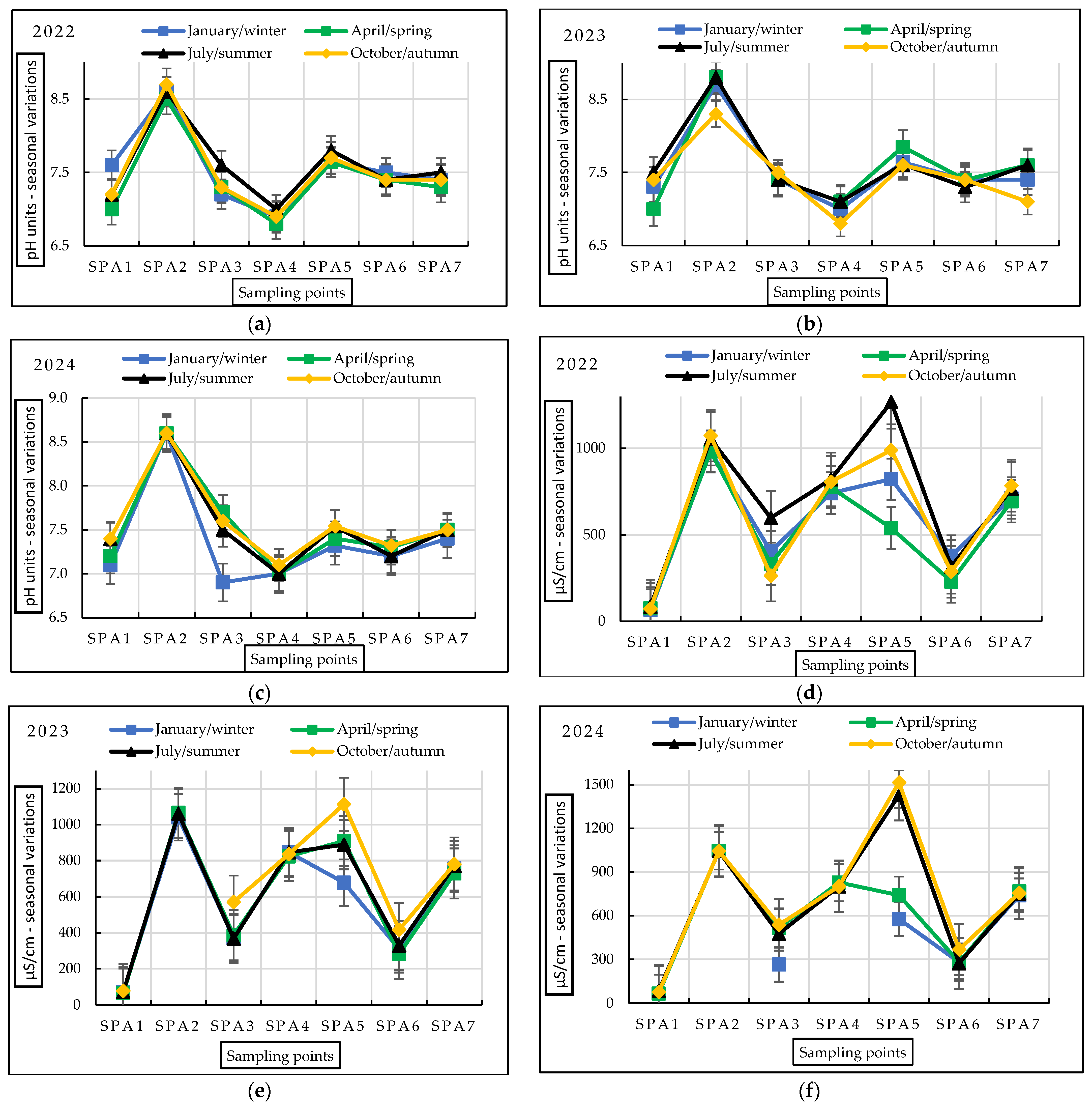
The pH values varied within the safe range specified by the Romanian and international guidelines, with a higher trend observed at the SPA2 sampling source and generally lower values at SPA4 (Figure 2a–c). There was a slightly increasing trend (probably due to the CO3 input and treatment adjustments) during 2022–2024 in all samples, except for SPA6, which showed a significant decrease (possibly due to pollution caused by acid rain and organic acids). The mean values of pH in 2022 varied between 6.80 and 8.70, in 2023 varied between 6.80 and 8.80, and in 2024 ranged from 6.90 to 8.60 (Table 1). Comparable values, ranging between 6.70 and 7.99, were reported in a study conducted in Malaysia analysing tap water from 20 selected locations [59].
The electrical conductivity (σ) of the studied drinking water sources exhibited distinct seasonal patterns and significant spatial variability throughout the monitoring period. The mean electrical conductivity (σ) varied between 65.0 and 1268 µS/cm in 2022, between 66.0 and 1113 µS/cm in 2023, and between 67.0 and 1516 µS/cm in 2024. Generally, the highest values were obtained in the summer season and the lowest in the rainy season. This correlates with the higher precipitation volume in the rainy season, which is affected by the evaporation caused by high temperatures and lower precipitation levels in the summer season. SPA2 was characterised by the highest σ values, and SPA1 by the lowest (Figure 2d–f). SPA1 is situated at the highest altitude, near the Carpathian Mountains, which is reflected in the lowest contaminant concentration values compared to the rest of the samples. The EU Drinking Water Directive established a specification for electrical conductivity of 2500 µS/cm [60]. The results obtained are under the parametric value set by the directive.
The Cl content exceeded the threshold established by the Romanian and international guidelines for drinking water (250 mg/L) up to four times in SPA2, three times in SPA4, and once in SPA5. Typically, Cl contamination is generated only by anthropogenic activities [61]. Cl varied between 2.13 and 281 mg/L in 2022, between 0.71 and 1053 mg/L in 2023, and between 0.96 and 1041 mg/L in 2024 (Table 1). There were seasonal variations, generally with a higher Cl content in the autumn. The variability between samples is determined by the primary water source and its water–rock interaction (geogenic source), as well as by the agricultural and industrial activities. Conversely, a study analysing the quality of various drinking water sources in Nigeria reported that Cl concentrations in municipal water were within the recommended limit [62].
The SO4 content was lower in all samples, ranging from 1.88 to 133 mg/L in 2022, from 19.8 to 139 mg/L in 2023, and from 4.30 to 80 mg/L in 2024. SPA1 was characterised by the lowest concentrations (1.89–2.88 mg/L 2022, 0.93–4.11 mg/L in 2023, and 4.3 mg/L in 2024), with the highest trend in the winter season. SPA4 had the highest SO4 content, with an average of 104 mg/L in 2022, 126 mg/L in 2023, and 80 mg/L in 2024. All of the values obtained were below the taste threshold of 250 mg/L set by the WHO and by the EPA [36,63].
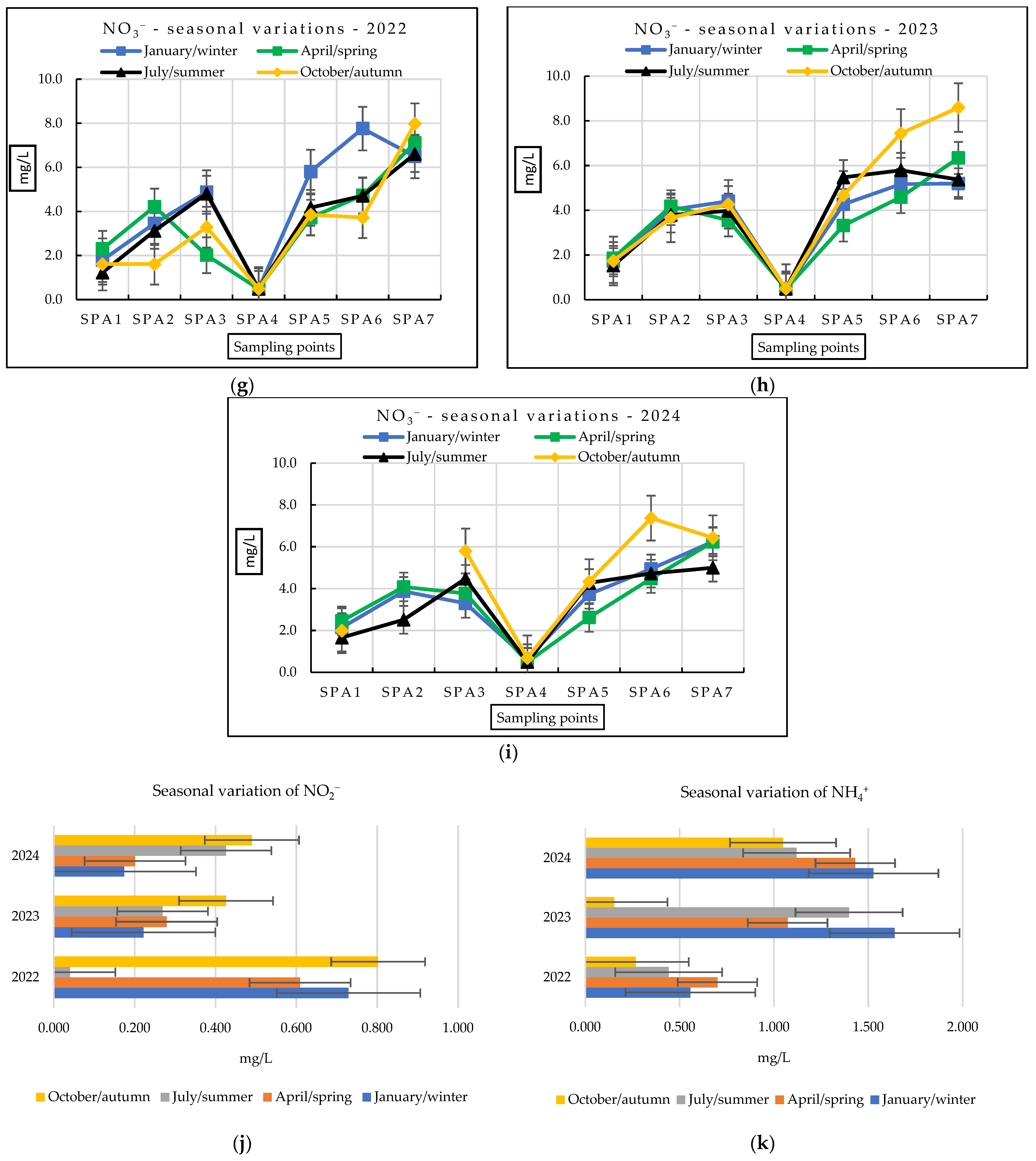
Concerning the nitrogen species content, the waters were characterised by elevated concentrations of NO2 and NH4 that were up to three times higher than the 0.5 mg/L threshold limit established by the Romanian and international guidelines related to drinking water quality. High values were predominantly observed in SPA7, with an upward trend in the autumn and winter seasons for NO2 (Figure 2j), and in the spring and winter seasons for NH4 (Figure 2k). In 2022, the trend varied between 0.004 and 0.80 mg NO2/L, and between 0.007 and 0.70 mg NH4/L. In 2023, the trend ranged from 0.02 to 0.43 mg NO2/L, and from 0.007 to 1.64 mg NH4/L. In 2024, the trend ranged from 0.04 to 0.49 mg NO2/L, and from 0.006 to 1.53 mg NH4/L. It was observed that, in the autumn season, NO2 reached the highest concentrations in all three years, while NH4 reached the highest concentrations in winter. The results are one to two orders of magnitude above the ones reported in municipal tap water in Denmark [64], indicating an unusual degree of nitrification instability within the distribution network. NH4 (from various sources or derived from disinfectants) may be nitrified to NO2 and finally NO3 [64].
Nitrate varied between 0.50 and 8.6 mg/L, below the threshold established by the Romanian and WHO guidelines of 50 mg/L [36,51]. SPA4 was characterised by the lowest content (<1.0 mg/L), while SPA7 was characterised by the highest. The mean concentrations ranged between 0.49 and 7.98 mg/L in 2022, between 0.49 and 8.59 in 2023, and between 0.49 and 7.37 mg/L in 2024, with no significant variations between the monitored years. In a study conducted in Denmark, no strong seasonal variation was reported in distributed drinking water nitrate concentrations, which aligns with the findings of the current study [64]. Nitrification (or agricultural/groundwater loading) frequently results in NO3, which is more stable. High levels of NO3 in drinking water are known to be harmful to human health, particularly for young children and expectant mothers [64].
Changes in water samples over the years are related to the different sources of water used in the supply network. These sources have specific geological conditions and water–rock interactions, resulting in different chemical compositions. It has been noticed that climate variability with different effects has occurred in recent years, with trends of lower precipitation amounts [65,66]. It can thus be concluded that the natural dilution process is caused by a decrease in precipitation and an increase in evaporation during the summer months. This ultimately results in an increase in salts, ions, electrical conductivity, and SO4, Cl, and nitrogen compounds. Moreover, the low-flow conditions of water with a low CO2 content have been shown to increase the pH. SPA2 and SP4 were characterised by the highest electrical conductivity, which is associated with high Cl and SO4 contents. Both areas are known for agricultural communities. The intensive agricultural practices, such as excessive and improper farming (e.g., animal husbandry and crop production), are significant sources of high Cl and SO4 ion levels. This is due to the intensive use of fertilisers (both chemical and natural) and irrigation, which increases soil salinity. Additionally, aquifers and surface waters are used as sources for the network supply, and thus contribute to the overall levels of these ions. Furthermore, both areas are characterised by a rural topography, each equipped with individual septic tanks and obsolete sewer systems. This configuration fosters the occurrence of wastewater leakage, which is characterised by a high concentration of detergents and faecal matter.

3.2. Spatiotemporal Analysis of Water Pollution

After analysing the concentrations against the reference values from the drinking water quality guidelines, the pollution degree was calculated by determining the following: (1) the overall pollution assessment based on the OPA index; (2) the individual pollution assessment based on the pollution index (PI) by contaminant (NO2, NO3, and NH4).
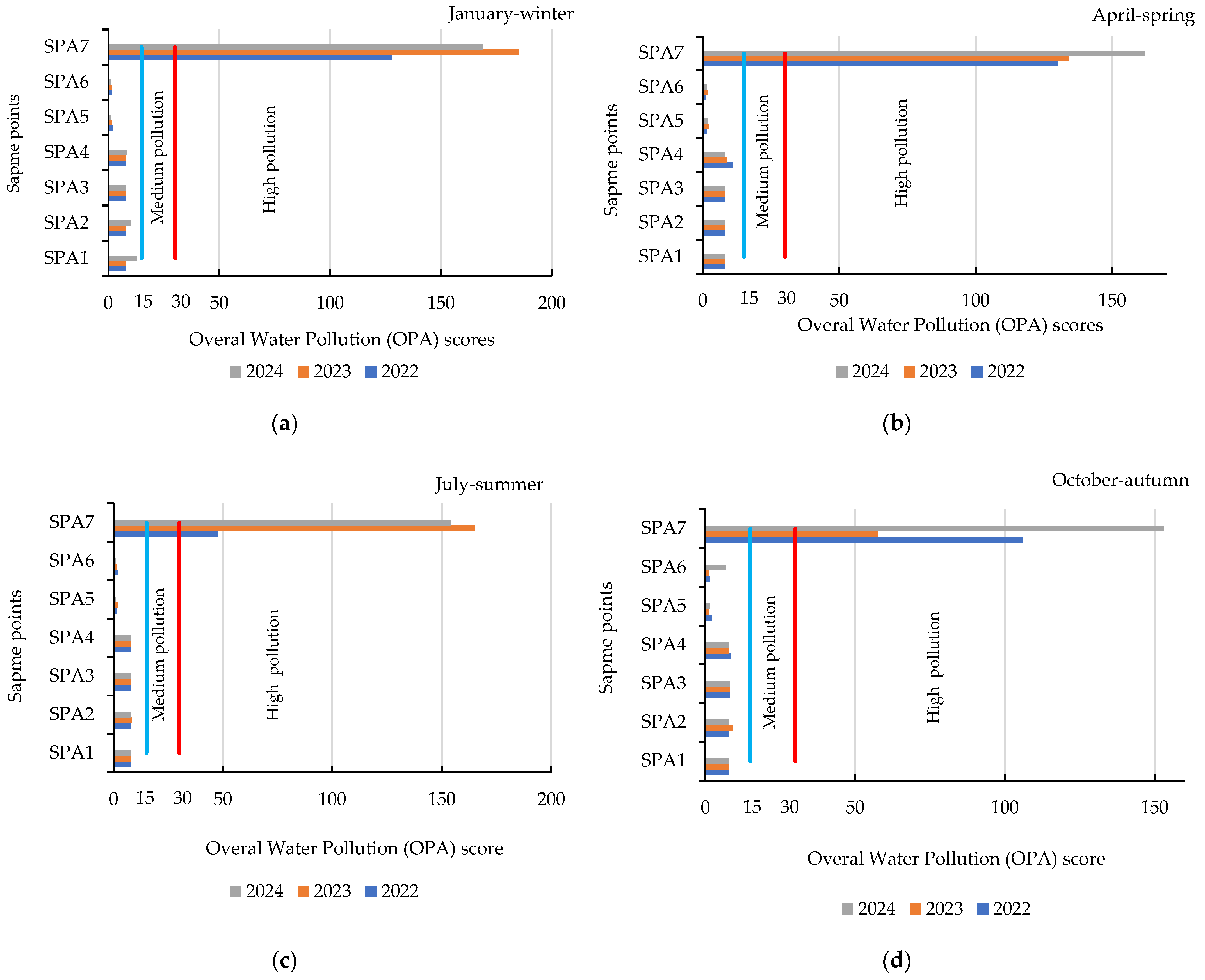
For the overall water pollution, the OPA index was applied for Cl, SO4, NO2, and NO3, and their cumulative content. The results are presented in Figure 3. Water pollution was determined after applying the OPA index. Samples were integrated into two categories of pollution, with scores varying from season to season. In the winter season, SPA7 was characterised by high pollution from 2022 to 2024 (OPA scores ranged between 128 and 185, exceeding the limit value of 30 up to six times). The high score is directly corelated to the high content of NO2 and NH4, which exceeded (up to 1.5 times) the threshold concerning the drinking water quality (Figure 3a). SPA1 tends to be included into the medium pollution category in winter 2024 (OPA = 12.7), with similar scores (OPA = 7.96) obtained in 2022 and 2023, indicating a low pollution degree. In the summer season (July), scores were lower than in winter, but still higher than the threshold limit (up to five times) in SPA7 (OPA: 47.9–165). Samples SPA1–SPA6 were characterised by a low pollution degree, with scores ranging between 7.96–8.28 (SPA1–SPA4) and 1.05–1.79 (SPA5 and SPA6) (Figure 3c). In the rainy seasons (April and October), some scores were higher than in the summer and winter seasons (Figure 3b,d). SPA4 presented the highest score of the study (10.9 in April, 2022 and 8.35 in October 2022). A low pollution degree was indicated by the OPA scores for the majority of samples in both seasons. An exception was SPA7, characterised by a high pollution level (OPAApril: 130–162; OPAOctober: 57.7–153), which was correlated to the high amount of NO2 and SO4 in October, and NH4 and NO2 in April.
Due to the low fluctuations of NO2 and NH4 contents, samples SPA1–SPA4 were characterised by a similar score trend.
An individual assessment by contaminant was necessary for observing the correlation of the OPA index results to the nitrogen compounds. Therefore, the pollution index (PI) was applied based on individual contaminant species. The PI was calculated for NO2, NO3, and NH4. The results (mean values) are presented in Table 2. It was noticed that the studied samples were not contaminated with NO3 based on the PINO3 scores. The PINO3 score ranges throughout all monitoring periods were 0.859–0.990 (2022), 0.872–0.990 (2023), and 0.880–0.988 (2024). According to the PINO2 results, the majority of samples were characterised by a clean status from the perspective of NO2 content, except for SPA7 in 2022, which presented a high pollution level status (Table 2). On the other hand, a moderate pollution status was found in 2023 and 2024, which was related to the mean NH4 content. SPA7 was characterised as moderately polluted, and the rest of the samples had a clean status.
Correlations between the chemical parameter concentrations and OPA scores were determined according to the Pearson correlation and PCA representations. Generally, positive corelations were determined between the OPA scores and NO2 and NH4 concentrations, and between the NO2 and NH4 amounts (Table 3; Supplementary Tables S1 and S2). This suggested that the high OPA scores were linked to the high content nitrogen compounds due to a shared source.
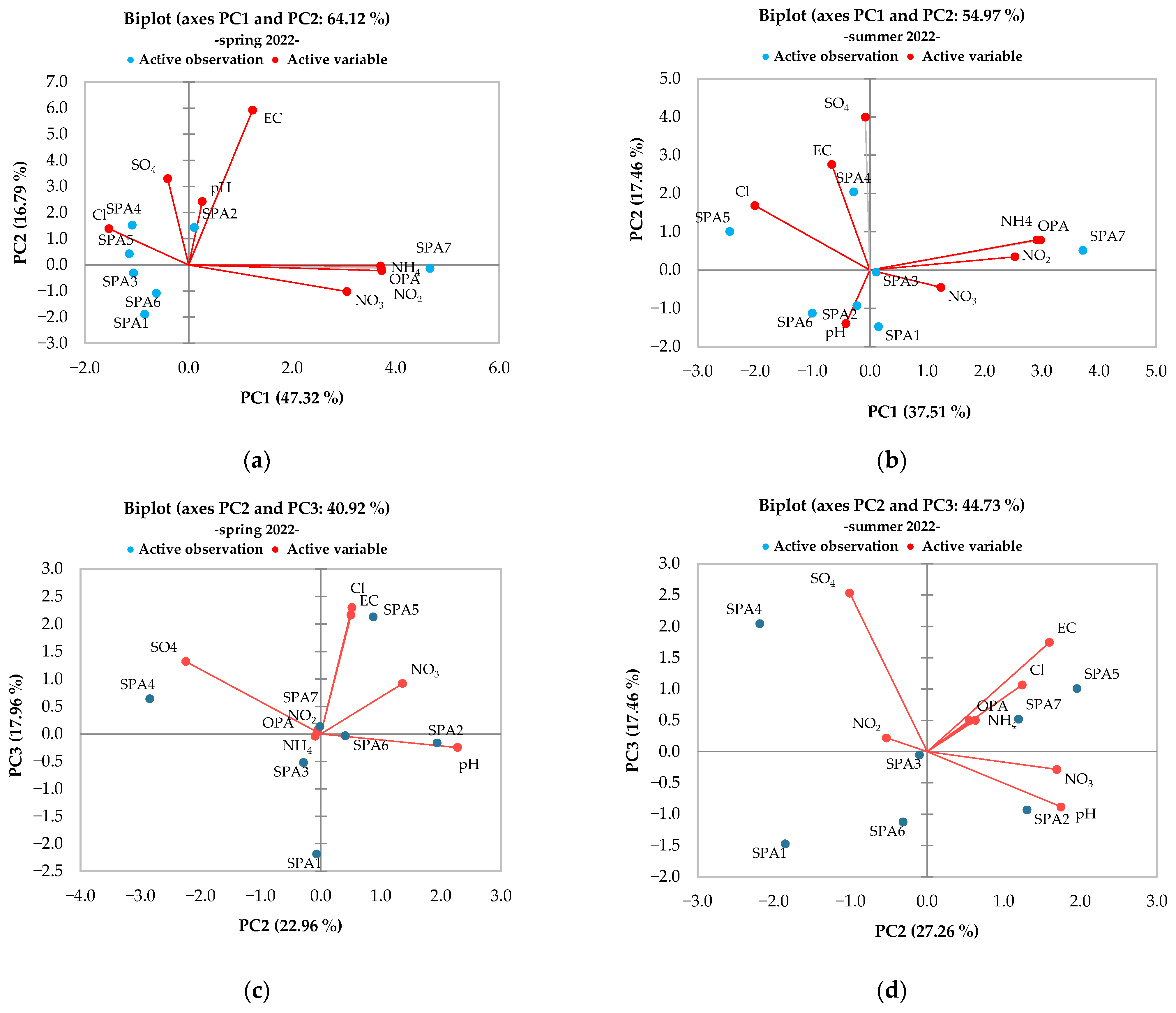
The PCA exhibited a total variance that exceeded 50%. This finding indicates that the initial two principal components (PC1 and PC2) account for the bulk of the variation in water chemistry across seasons (Figure 4a,b and Figure S1a–d). While not exceedingly elevated, this value is sufficient to discern salient patterns within the dataset. In 2022, PCA1 was 47.3% in spring and 37.5% in summer, and PCA2 was around 17% in both seasons (Figure 4a,b). It was noticed that, in both seasons, NH4 and NO2 had the highest positive contribution to the PCA1, OPA scores, and SPA7 observations, which was characterised by the highest amount of nitrogen compounds and scores. The negative loading (low degree) in PC1 was represented by the pH level in the summer season, while in the spring, the pH level exhibited a positive loading but low variability. An examination of the pH loading according to season showed that the pH level exhibits considerably low influence or variability in the summer.
In the case of PCA2, the EC, SO4, and Cl had the highest positive loadings but low variability in both seasons, indicating that PCA2 captures a salinity/mineralisation gradient.
In 2023 and 2024, as indicated in the Supplementary Material (Supplementary Figure S1a–h), the highest positive loadings in PCA1 were represented by the nitrogen compounds and OPA scores, which were the highest in SPA7. PCA1 reliably detects a nitrogen pollution gradient, suggesting that SPA7 remains a significant source of nitrogen enrichment, likely attributable to stable or recurring sources such as agricultural inputs or the presence of wastewater or septic system leakage, which is a concern. This finding confirms that nitrogen remains the predominant factor contributing to variations in water chemistry over extended periods, a conclusion that is supported by the analysis of multiple years of data, although the variability or influence degree of the indicators is low.
Differences were observed for NO3 (positive loadings for PCA2 in the autumn season of 2023 and summer season of 2024) and SO4 (negative loadings for PCA1 and PCA2 in the summer season of 2024 and positive loadings in winter of 2023 and 2024, and negative loadings for PCA2 in autumn 2024), but were characterised by a low variability. The negative SO4 loadings are consistent with dilution during high-flow events, potential SO4 reduction in warm, low-oxygen zones, and strong SO4 runoff dominance [67]. The variations obtained in 2023 were between 12% and 17% for PCA2, and 48–51% for PCA1; in 2024, PCA1 varied from 15% to 17%, and PCA2 from 44% to 48% (Supplementary Figure S1a–d).
PCA counting for PC2 and PC3 presented a lower variability compared to the first analysis (ranging between 36.9% and 46.4%) (Figure 4c,d and Supplementary Figure S1e–h). In the spring season of 2022, the variability in indicators was low. Among this, the highest positive loading related to PC2, with a contribution of 22.9%, was represented by the pH, followed by NO3, Cl, and EC; SO4 had a negative loading, and NO2 and NH4 presented no variability, being close to zero. Regarding PC3 (17.9% variability), positive loading characterised all parameters except for pH and NH4. In the summer season (44.7% total variability), there were slight differences, except for NO3, which fell into negative loading (PC3) (Figure 4d). In the winter season of 2023, SO4 and NO2 had a negative loading for PC2, and NO2, NH4, NO3, and Cl for PC3 (Figure S1e). In the autumn of 2023, positive loading characterised all chemical parameters in PC2, and pH and nitrogen compounds in PC3, but with low variability (Figure S1f). In the winter season of 2024, pH and NO3 had low variability and negative loading in PC3 (Figure S1g). The summer season of 2024 was characterised by a very low variability, the lowest in all of the applied PCAs (Figure S1h). Generally, the highest variability was obtained in the cases of EC, Cl, SO4, pH, and NO3, potentially caused by hydrological changes in water sources, such as dissolution, runoff, or ion inputs with geogenic and anthropogenic origins.

3.3. Risk Characterisation

Given the pollution status exhibited by the pollution scores, and the exceedance of national and international thresholds for drinking water quality, human health risk assessment was performed. This analysis converts qualitative data into quantitative data, determining if the exposure to contaminated water poses risks to human health.
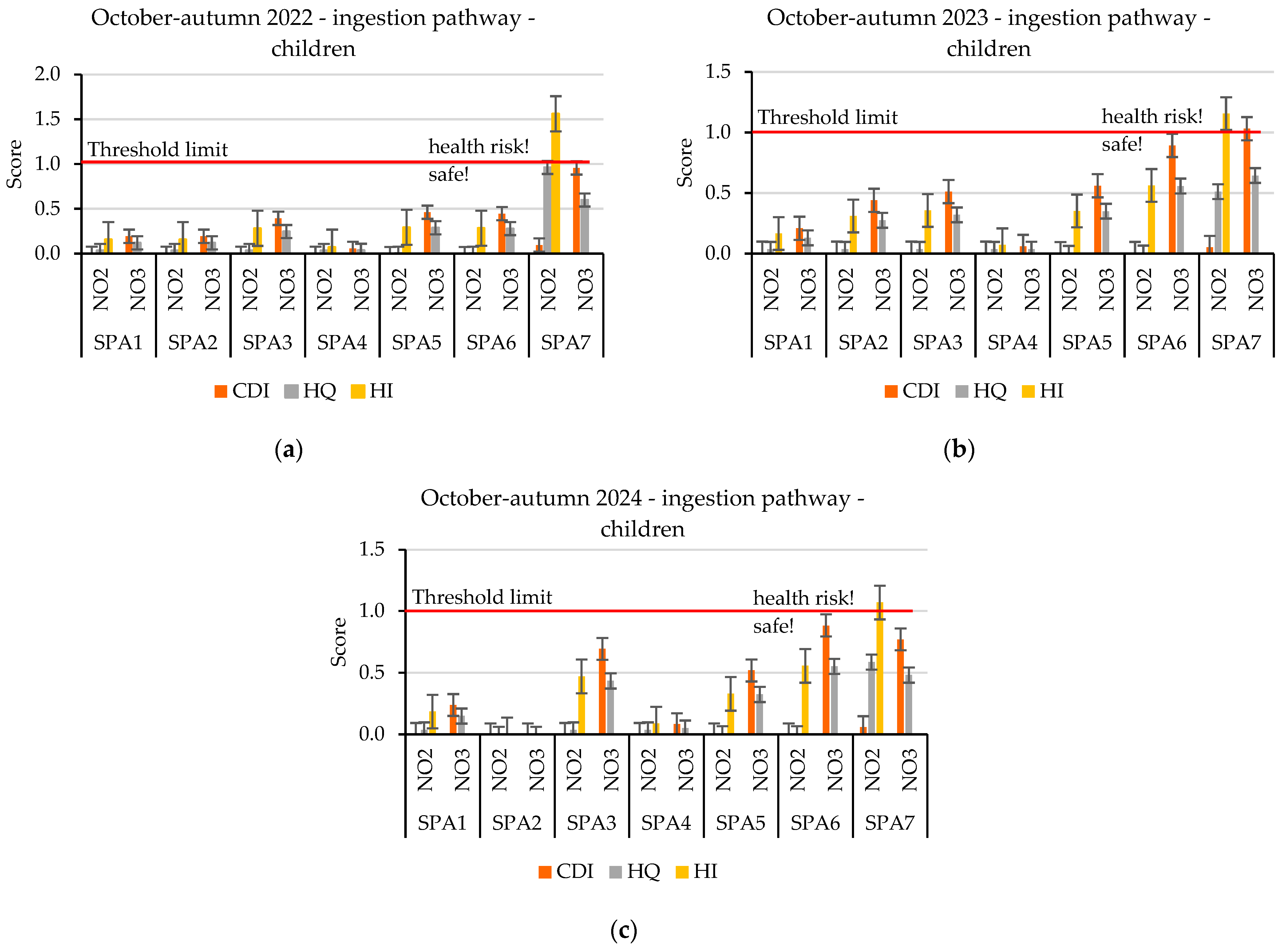
The first studied pathway was oral ingestion. The results are presented in Table 4, and the trends are presented in Figure 5a–c and Supplementary Figures S2 and S3a–i. For children, the CDI through water ingestion presented a minimum value of 0.00024 mg NO2/kg × day in 2023. A maximum value of 1.0313 mg NO3/kg × day was obtained in the same year, while the average value was 0.4461 mg NO3/kg × day and 0.00892 mg NO2/kg × day (Figure 5a–c; Supplementary Figure S2a–i). For adults, the average CDI score was 0.1168 mg NO3/kg × day and 1.049 × 10⁻⁴ mg NO2/kg × day. The minimum score was obtained in 2023 (CDI = 6.286 × 10⁻⁵ mg NO2/kg × day), while the maximum score was obtained in 2023 with a value of 0.2701 mg NO3/kg × day (Table 4; Figure S3a–i).
Furthermore, the HQ corresponding to the oral intake of NO2 in children had a minimum value of 0.0024 in 2023, while the HQNO3 minimum was 0.0365. The maximum score was obtained in 2022 (HQNO2 = 0.9624). This score is concerning due to its proximity to the threshold limit of 1.0, which indicates the presence of carcinogenic risk. The average scores for this index were 0.2788 for the HQ related to NO3 intake, and 0.0892 for the HQ implying the ingestion of NO2 (Figure 5a–c; Supplementary Figure S3a–i).
The hazard to adults was related to the minimum and maximum HQ values obtained for NO2 oral intake (HQmin = 0.0006 and HQmax = 0.2521) in 2023. The average HQ score was 0.073 for NO3 and lower for NO2 (HQ = 0.0233).
Observation of the HQ scores indicated that the threshold limit of 1.0 was not exceeded, suggesting that the studied water sources would be safe for drinking. However, the HI scores, which provide an overall assessment of hazard (cumulative impacts of NO2 and NO3), presented health risks related to the exposure through the oral ingestion pathway. A study assessing the potential human health risks associated with NO3 and F reported that the permissible threshold was exceeded in HQNO3 in 40% of samples for children, while 26% of the water samples posed a high risk for adults [68].
The HI scores exceeded the limit in the scenarios implicating children (Figure 5a–c). In general, the limit was exceeded in most seasons, except for summer 2022, all seasons of 2023, and winter, spring, and summer in 2024. The highest values were obtained in samples from SPA7 in all seasons of all three years, indicating a risk to human health if ingested. The descending trend concerning the highest HI scores characterising the samples was SPA7 > SPA6 > SPA5 > SPA3 > SPA2 > SPA1 > SPA4 in winter, SPA7 > SPA2 > SPA6 > SPA5 > SPA1 > SPA3 > SPA4 in spring, SPA7 > SPA3 > SPA6 > SPA5 > SPA2 > SPA1 > SPA4 in summer, and SPA7 > SPA5 > SPA6 > SPA3 > SPA1 > SPA2 > SPA4 in autumn of 2022. In 2023, in the autumn season, the highest scores trend was SPA7 > SPA6 > SPA3 > SPA5 > SPA2 > SPA1 > SPA4, and in 2024 it was SPA7 > SPA6 > SPA3 > SPA5 > SPA1 > SPA4 > SPA2. The scenario involving adults was characterised by the highest HI scores, ranging from 0.142 to 0.409, both of which were obtained in SPA7 in 2022. In 2023, the highest HI scores ranged from 0.171 to 0.303 (SPA7), and in 2024 they ranged from 0.177 to 0.280 (SPA7) (Supplementary Figure S3a–i). In a study conducted in Suihua, China, the assessment of NO3 in rural groundwater revealed significant health risks across different age and gender groups. The HI values were highest in infants, reaching a maximum of 32.03, followed by children, with a maximum of 17.98. This was followed by adult women, with a maximum of 12.45, and finally adult men, whose maximum was 10.81 [69]. Thus, the results from the current study and data from the scientific literature demonstrate that even moderate nitrate enrichment in drinking water can cause the HI to exceed the acceptable level for the most vulnerable age groups.
Nitrogen species in high amounts can have negative effects and even cause diseases (like methaemoglobinaemia or cancer), especially in vulnerable subpopulations such as infants, small children, and already unhealthy persons [70].
The last studied and assessed exposure pathway was dermal contact for children and adults (Table 5). The CDI and HQ were determined for the N-NO3 component. The results showed no exceedances of the threshold limit (HQ < 1.0), suggesting that dermal contact with the studied water samples does not pose a significant risk to either children or adults.
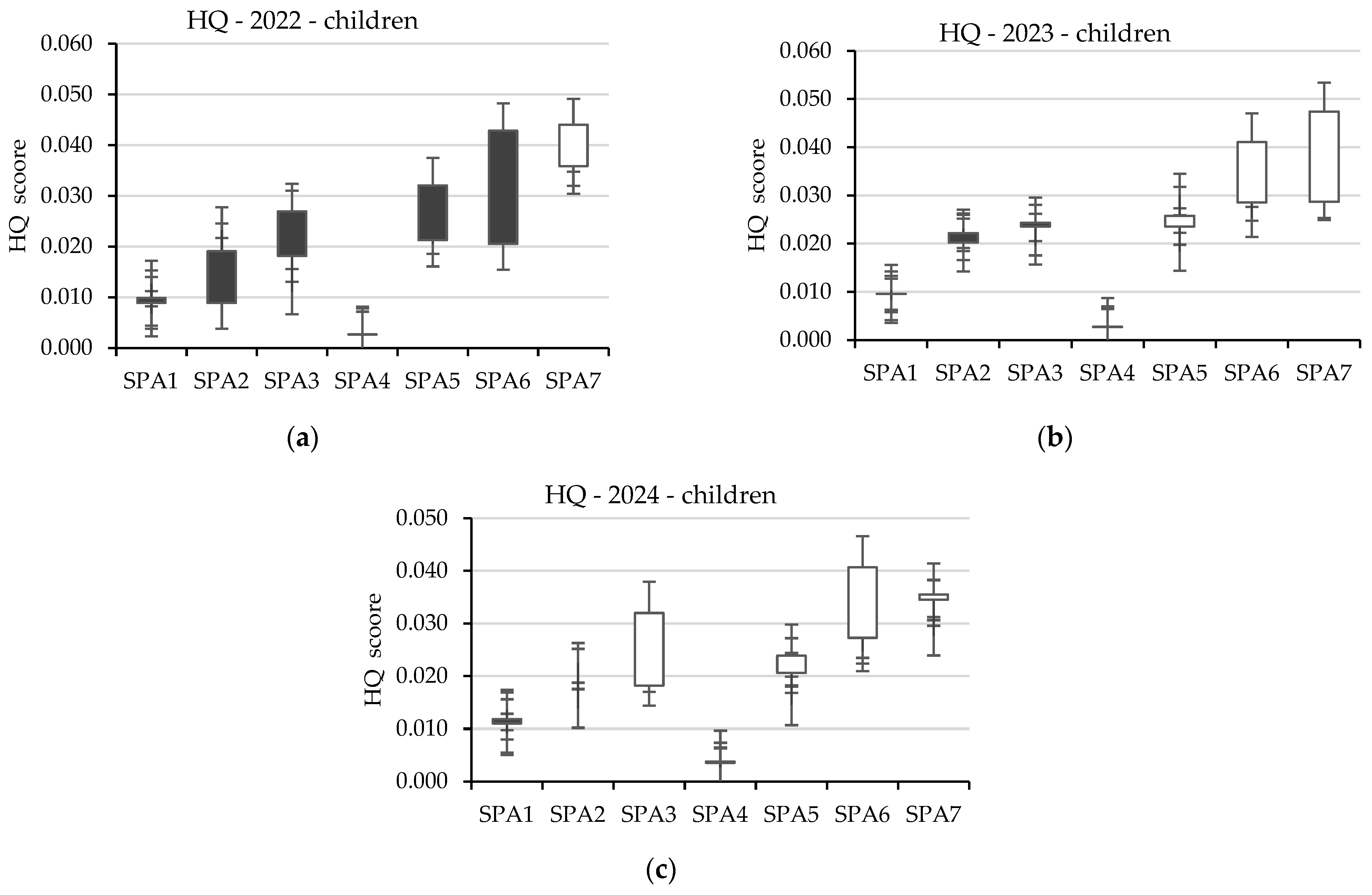
The minimum score for the CDI was 0.000484 mg N-NO3/kg x day during the entire observation study concerning the health impact assessment scenario on children (Figure 6; Supplementary Figure S4a–c). For adults, the lowest score was 0.000164 mg N-NO3/kg × day, and the maximum score was 0.00289 mg N-NO3/kg × day, which was obtained in 2024 (Supplementary Figure S5a–c). In Dilwarpur Mandal, India, an assessment of groundwater hydrochemistry during pre- and post-rainy seasons revealed significant health risks associated with NO3 exposure through dermal contact. The analysis showed that the HQ for dermal exposure to NO3 exceeded the threshold limit of 1.0 across various age groups, indicating potential non-carcinogenic health effects [71].
The hazard posed by the dermal contact pathway in children was represented by maximum and minimum values of 0.0474 and 0.00269, respectively, as well as an average score of 0.0205, all of which indicate safety. HQ scores were lower for adults, indicating that children are more vulnerable to N-NO3 exposure through dermal contact. The average HQ score was 0.00704, with a maximum score of 0.0161. The minimum HQ score was 0.000911 (Supplementary Figure S6a–c).
Generally, the deterministic human health risk assessment showed that children may be exposed to non-carcinogenic risks of infection caused by NO2, NO3, and NH4, particularly through oral ingestion.

4. Conclusions and Perspectives

The current study characterised health risk by combining hydrochemical monitoring, pollution indices, and health-based exposure metrics across seasons, locations, and population groups. Although the hydrochemical conditions were generally acceptable, recurrent elevations of nitrogen species, particularly NO2 and NH4, were observed at specific locations. SPA7 was identified as the most critical site. These exceedances, together with pronounced seasonal variability, suggest ongoing pressure from site-specific sources and hydrological conditions.
According to the pollution indices, contamination levels are not uniform across the study area. While most sites exhibited low pollution levels throughout the monitoring period, some samples repeatedly showed elevated pollution levels, particularly during the wet and cold seasons. Occasional medium pollution levels at other sites shows that deterioration can occur episodically, even in otherwise low-impact environments. These findings emphasise the importance of considering both spatial heterogeneity and seasonal dynamics when assessing water quality. The health risk assessment concluded that the probability of adverse health effects varies substantially by age group, location, and season. For adults, exposure levels to nitrogen compounds generally remain below health-based reference values, resulting in a low likelihood of measurable health impacts under current conditions. In contrast, children consistently exhibit higher exposure levels due to their lower body weight and higher intake rates. This increases the probability of health impacts, particularly during seasonal exposure peaks. Although acute toxicity events are unlikely, the recurrence and persistence of seasonal peaks increase the probability of cumulative or subclinical health effects. Dermal exposure pathways pose a negligible health risk to all population groups, confirming ingestion as the dominant exposure route. NO2 poses the highest concern due to its association with methaemoglobinaemia in infants and its potential contribution to longer-term health effects in children. Consequently, even moderate exposure levels may result in moderate health consequences for sensitive populations. While NO3 exposure is largely within regulatory limits, it presents low immediate consequences under current conditions but remains relevant for chronic exposure scenarios.
The holistic risk assessment indicates that the probability of pervasive acute health consequences is minimal. However, local and seasonal factors pose a moderate risk to vulnerable populations, particularly children. While the impacts are generally not severe, they justify proactive management. The application of a risk-based framework that accounts for likelihood, consequences, and uncertainty is key to effectively protecting public health and sustainably managing drinking water resources.
It is recommended that these findings be taken into consideration in order to emphasise the necessity of continued surveillance, targeted management of high-risk sites, and preventive strategies guided by a risk-based approach. It is imperative that regulatory compliance is maintained and vulnerable populations are protected through ongoing monitoring, consideration of seasonal risks, and adaptive management. Future research should extend the assessment framework to include additional contaminants, such as heavy metals. Furthermore, risk estimates should be refined by considering combined exposures and population-specific vulnerabilities.

Supplementary Materials

The following information which provides additional data visualizations, detailed seasonal risk assessments, and statistical correlations supporting the main findings can be downloaded at: https://www.mdpi.com/article/10.3390/w18010023/s1, Figure S1: PCA representation of the most representative seasons, PC1 and PC2: (a) January-winter 2023, (b) October-autumn 2023, (c) January-winter 2024, and (d) July-summer 2024, and PC2 and PC3: (e) January-winter 2023, (f) October-autumn 2023, (g) January-winter 2024, and (h) July-summer 2024; Figure S2: Risk assessment after oral ingestion of samples SPA1-SPA7 during the autumn seasons of 2022-2024 by children: (a) CDI, HQ, HI scores obtained in January 2022; (b) CDI, HQ, HI scores obtained in April 2022 (c) CDI, HQ, HI scores obtained in July 2022, (d) CDI, HQ, HI scores obtained in January 2023, (e) CDI, HQ, HI scores obtained in April 2023, (f) CDI, HQ, HI scores obtained in July 2023, (g) CDI, HQ, HI scores obtained in January 2024, (h) CDI, HQ, HI scores obtained in April 2024, (i) CDI, HQ, HI scores obtained in July 2024; Figure S3: Risk assessment after oral ingestion of samples SPA1-SPA7 during the autumn seasons of 2022-2024 by adults. CDI, HQ, HI scores obtained in (a) January 2022, (b) April 2022, (c) July 2022, (d) October 2022, (e) January 2023, (f) April 2023, (g) July 2023, (h) October 2023, (i) January 2024, (j) April 2024, (k) July 2024, (l) October 2024; Figure S4: Risk assessment after dermal contact in samples SPA1-SPA7 (children). CDI scores obtained during: (a) 2022, (b) 2023, (c) 2024; Figure S5: Risk assessment after dermal contact in samples SPA1-SPA7 (adults). CDI scores obtained during: (a) 2022, (b) 2023, (c) 2024; Figure S6: Risk assessment after dermal contact in samples SPA1-SPA7 (adults). HQ scores obtained during: (a) 2022, (b) 2023, (c) 2024; Table S1: Correlation of chemical parameters (mean values) obtained in October-autumn 2023 and OPA scores; Table S2: Correlation of chemical parameters (mean values) obtained in July-summer 2024 and OPA scores.

Author Contributions

Conceptualisation, M.-A.R., E.K., and D.C.; methodology, M.-A.R. and D.C.; validation, O.B., A.C., and C.R.; formal analysis, M.-A.R., O.B., A.C., and D.C.; investigation, M.-A.R., D.C., and E.K.; data curation, M.-A.R., O.B., A.C., D.C., E.K., and C.R.; writing—original draft preparation, M.-A.R., E.K., and D.C.; writing—review and editing, M.-A.R., E.K., and C.R.; visualisation, M.-A.R., O.B., A.C., D.C., E.K., and C.R.; supervision, M.-A.R., E.K., and C.R. All authors have read and agreed to the published version of the manuscript.

Funding

This research received no external funding.

Data Availability Statement

The original contributions presented in this study are included in the article and in the Supplementary Materials. Further inquiries can be directed to the corresponding author.

Acknowledgments

This research was carried out through the Core Program within the National Research Development and Innovation Plan 2022–2027, carried out with the support of MCID, project no. PN 23 05.

Conflicts of Interest

Authors Maria-Alexandra Resz, Olimpiu Blăjan, Dorina Călugăru, and Augustin Crucean were employed by the company Research Institute for Auxiliary Organic Products SA, ICPAO, 8 Carpati Street, 551022, Medias, Romania. The remaining authors declare that the research was conducted in the absence of any commercial or financial relationships that could be construed as a potential conflict of interest.

Abbreviations

The following abbreviations are used in this article:
CDIChronic Daily Intake
EPAU.S. Environmental Protection Agency
OPAOverall Pollution Assessment
PCAPrincipal Component Analysis
WHOWorld Health Organization
ClChloride
ECElectrical Conductivity
HIHazard Index
HQHazard Quotient
NO2Nitrite
NO3Nitrate
NH4Ammonium
PIPollution Index
SO4Sulphate

References

  1. WHO. Guidelines for Drinking-Water Quality: Fourth Edition Incorporating the First and Second Addenda, 4th ed.; World Health Organization: Geneva, Switzerland, 2022; p. 614. [Google Scholar]
  2. UN. The Human Rights to Safe Drinking Water and Sanitation: Resolution/Adopted by the General Assembly. Available online: https://digitallibrary.un.org/record/4032820?v=pdf#files (accessed on 14 October 2025).
  3. WHO. Drinking-Water. Available online: https://www.who.int/news-room/fact-sheets/detail/drinking-water (accessed on 14 October 2025).
  4. Ayejoto, D.A.; Egbueri, J.C. Human health risk assessment of nitrate and heavy metals in urban groundwater in Southeast Nigeria. Ecol. Front. 2024, 44, 60–72. [Google Scholar] [CrossRef]
  5. Sarikar, S.; Vijaykumar, K. Assessment of Water Quality Index and Non-Carcinogenic Risk for Ingestion of Nitrate for Drinking Purpose of Bhosga Reservoir, Karnataka, India. Curr. World Environ. 2022, 17, 467–479. [Google Scholar] [CrossRef]
  6. Alharbi, T.; El-Sorogy, A.S. Health Risk Assessment of Nitrate and Fluoride in the Groundwater of Central Saudi Arabia. Water 2023, 15, 2220. [Google Scholar] [CrossRef]
  7. Cocca, D.; Lasagna, M.; Destefanis, E.; Bottasso, C.; De Luca, D.A. Human Health Risk Assessment of Heavy Metals and Nitrates Associated with Oral and Dermal Groundwater Exposure: The Poirino Plateau Case Study (NW Italy). Sustainability 2023, 16, 222. [Google Scholar] [CrossRef]
  8. Kumar, S.; Singh, R.; Maurya, N.S. Modelling of corrosion rate in the drinking water distribution network using Design Expert 13 software. Environ. Sci. Pollut. Res. 2023, 30, 45428–45444. [Google Scholar] [CrossRef] [PubMed]
  9. Fetrat, S.; Islam, S. Investigation of the physicochemical parameters of drinking water in Herat province and its comparison with World Health Organization standards. Discov. Water 2024, 4, 112. [Google Scholar] [CrossRef]
  10. Kebede, S.; Hailu, K.; Siraj, A.; Birhanu, B. Environmental isotopes (δ18O–δ2H, 222Rn) and electrical conductivity in backtracking sources of urban pipe water, monitoring the stability of water quality and estimating pipe water residence time. Front. Water 2023, 5, 1066055. [Google Scholar] [CrossRef]
  11. Al-Sodani, K.A.A.; Maslehuddin, M.; Al-Amoudi, O.S.B.; Saleh, T.A.; Shameem, M. Efficiency of generic and proprietary inhibitors in mitigating Corrosion of Carbon Steel in Chloride-Sulfate Environments. Sci. Rep. 2018, 8, 11443. [Google Scholar] [CrossRef]
  12. Uddin, M.G.; Nash, S.; Olbert, A.I. A review of water quality index models and their use for assessing surface water quality. Ecol. Indic. 2021, 122, 107218. [Google Scholar] [CrossRef]
  13. Lapworth, D.J.; Baran, N.; Stuart, M.E.; Ward, R.S. Emerging organic contaminants in groundwater: A review of sources, fate and occurrence. Environ. Pollut. 2012, 163, 287–303. [Google Scholar] [CrossRef]
  14. Bijay, S.; Craswell, E. Fertilizers and nitrate pollution of surface and ground water: An increasingly pervasive global problem. SN Appl. Sci. 2021, 3, 518. [Google Scholar] [CrossRef]
  15. Usman, M.; Sanaullah, M.; Ullah, A.; Li, S.; Farooq, M. Nitrogen Pollution Originating from Wastewater and Agriculture: Advances in Treatment and Management. Rev. Environ. Contam. Toxicol. 2022, 260, 9. [Google Scholar] [CrossRef]
  16. Chaturwedi, A.K.; Kashyap, N.K.; Gupta, P.; Biswas, S.; Shriwas, S.K.; Vaishnav, M.M.; Hait, M. Industrial Effluents and their Impact on Water Pollution—An Overview. ES Gen. 2024, 5, 1203. [Google Scholar] [CrossRef]
  17. Wakida, F.T.; Lerner, D.N. Non-agricultural sources of groundwater nitrate: A review and case study. Water Res. 2005, 39, 3–16. [Google Scholar] [CrossRef]
  18. Pasten-Zapata, E.; Ledesma-Ruiz, R.; Harter, T.; Ramirez, A.I.; Mahlknecht, J. Assessment of sources and fate of nitrate in shallow groundwater of an agricultural area by using a multi-tracer approach. Sci. Total Environ. 2014, 470–471, 855–864. [Google Scholar] [CrossRef]
  19. WHO. Nitrate and Nitrite in Drinking-Water. Available online: https://www.who.int/docs/default-source/wash-documents/wash-chemicals/nitrate-nitrite-background-document.pdf (accessed on 14 October 2025).
  20. de Vries, W. Impacts of nitrogen emissions on ecosystems and human health: A mini review. Curr. Opin. Environ. Sci. Health 2021, 21, 100249. [Google Scholar] [CrossRef]
  21. Fossen Johnson, S. Methemoglobinemia: Infants at risk. Curr. Probl. Pediatr. Adolesc. Health Care 2019, 49, 57–67. [Google Scholar] [CrossRef] [PubMed]
  22. Clemmensen, P.J.; Schullehner, J.; Brix, N.; Sigsgaard, T.; Stayner, L.T.; Kolstad, H.A.; Ramlau-Hansen, C.H. Prenatal Exposure to Nitrate in Drinking Water and Adverse Health Outcomes in the Offspring: A Review of Current Epidemiological Research. Curr. Environ. Health Rep. 2023, 10, 250–263. [Google Scholar] [CrossRef]
  23. Wright, G.; Semprini, J. Early prenatal nitrate exposure and birth outcomes: A study of Iowa’s public drinking water (1970–1988). PLoS Water 2025, 4, e0000329. [Google Scholar] [CrossRef]
  24. Gatseva, P.D.; Argirova, M.D. High-nitrate levels in drinking water may be a risk factor for thyroid dysfunction in children and pregnant women living in rural Bulgarian areas. Int. J. Hyg. Environ. Health 2008, 211, 555–559. [Google Scholar] [CrossRef]
  25. Horton, M.K.; Blount, B.C.; Valentin-Blasini, L.; Wapner, R.; Whyatt, R.; Gennings, C.; Factor-Litvak, P. CO-occurring exposure to perchlorate, nitrate and thiocyanate alters thyroid function in healthy pregnant women. Environ. Res. 2015, 143, 1–9. [Google Scholar] [CrossRef]
  26. Srour, B.; Chazelas, E.; Druesne-Pecollo, N.; Esseddik, Y.; de Edelenyi, F.S.; Agaesse, C.; De Sa, A.; Lutchia, R.; Debras, C.; Sellem, L.; et al. Dietary exposure to nitrites and nitrates in association with type 2 diabetes risk: Results from the NutriNet-Sante population-based cohort study. PLoS Med. 2023, 20, e1004149. [Google Scholar] [CrossRef]
  27. Pitocco, D.; Zaccardi, F.; Di Stasio, E.; Romitelli, F.; Santini, S.A.; Zuppi, C.; Ghirlanda, G. Oxidative stress, nitric oxide, and diabetes. Rev. Diabet. Stud. 2010, 7, 15–25. [Google Scholar] [CrossRef] [PubMed]
  28. Fan, A.M. Nitrate and Nitrite in Drinking Water: A Toxicological Review. In Encyclopedia of Environmental Health; Nriagu, J.O., Ed.; Elsevier: Burlington, ON, Canada, 2011; pp. 137–145. [Google Scholar]
  29. Essien, E.E.; Said Abasse, K.; Cote, A.; Mohamed, K.S.; Baig, M.; Habib, M.; Naveed, M.; Yu, X.; Xie, W.; Jinfang, S.; et al. Drinking-water nitrate and cancer risk: A systematic review and meta-analysis. Arch. Environ. Occup. Health 2022, 77, 51–67. [Google Scholar] [CrossRef] [PubMed]
  30. Picetti, R.; Deeney, M.; Pastorino, S.; Miller, M.R.; Shah, A.; Leon, D.A.; Dangour, A.D.; Green, R. Nitrate and nitrite contamination in drinking water and cancer risk: A systematic review with meta-analysis. Environ. Res. 2022, 210, 112988. [Google Scholar] [CrossRef] [PubMed]
  31. Knobeloch, L.; Salna, B.; Hogan, A.; Postle, J.; Anderson, H. Blue babies and nitrate-contaminated well water. Environ. Health Perspect. 2000, 108, 675–678. [Google Scholar] [CrossRef]
  32. Barry, K.H.; Jones, R.R.; Cantor, K.P.; Beane Freeman, L.E.; Wheeler, D.C.; Baris, D.; Johnson, A.T.; Hosain, G.M.; Schwenn, M.; Zhang, H.; et al. Ingested Nitrate and Nitrite and Bladder Cancer in Northern New England. Epidemiology 2020, 31, 136–144. [Google Scholar] [CrossRef]
  33. Ward, M.H.; Jones, R.R.; Brender, J.D.; de Kok, T.M.; Weyer, P.J.; Nolan, B.T.; Villanueva, C.M.; van Breda, S.G. Drinking Water Nitrate and Human Health: An Updated Review. Int. J. Environ. Res. Public Health 2018, 15, 1557. [Google Scholar] [CrossRef]
  34. Schullehner, J.; Hansen, B.; Thygesen, M.; Pedersen, C.B.; Sigsgaard, T. Nitrate in drinking water and colorectal cancer risk: A nationwide population-based cohort study. Int. J. Cancer 2018, 143, 73–79. [Google Scholar] [CrossRef]
  35. U.S. EPA. National Primary Drinking Water Regulations. Available online: https://www.epa.gov/ground-water-and-drinking-water/national-primary-drinking-water-regulations (accessed on 11 December 2025).
  36. WHO. Guidelines for Drinking-Water Quality, 4th ed.; World Health Organization: Geneva, Switzerland, 2017; p. 631. [Google Scholar]
  37. Sailaukhanuly, Y.; Azat, S.; Kunarbekova, M.; Tovassarov, A.; Toshtay, K.; Tauanov, Z.; Carlsen, L.; Berndtsson, R. Health Risk Assessment of Nitrate in Drinking Water with Potential Source Identification: A Case Study in Almaty, Kazakhstan. Int. J. Environ. Res. Public Health 2023, 21, 55. [Google Scholar] [CrossRef]
  38. Li, X.F.; Mitch, W.A. Drinking Water Disinfection Byproducts (DBPs) and Human Health Effects: Multidisciplinary Challenges and Opportunities. Environ. Sci. Technol. 2018, 52, 1681–1689. [Google Scholar] [CrossRef] [PubMed]
  39. Neguez, S.; Laky, D. Byproduct Formation of Chlorination and Chlorine Dioxide Oxidation in Drinking Water Treatment. Period. Polytech. Chem. Eng. 2023, 67, 367–385. [Google Scholar] [CrossRef]
  40. Backer, L.C.; Esteban, E.; Rubin, C.H.; Kieszak, S.; McGeehin, M.A. Assessing Acute Diarrhea from sulfate in drinking water. J.-Am. Water Work. Assoc. 2001, 93, 76–84. [Google Scholar] [CrossRef]
  41. Pongpiachan, S.; Iijima, A.; Cao, J. Hazard Quotients, Hazard Indexes, and Cancer Risks of Toxic Metals in PM10 during Firework Displays. Atmosphere 2018, 9, 144. [Google Scholar] [CrossRef]
  42. Cankaya, S.; Varol, M.; Bekleyen, A. Hydrochemistry, water quality and health risk assessment of streams in Bismil plain, an important agricultural area in southeast Turkiye. Environ. Pollut. 2023, 331, 121874. [Google Scholar] [CrossRef]
  43. Golaki, M.; Azhdarpoor, A.; Mohamadpour, A.; Derakhshan, Z.; Conti, G.O. Health risk assessment and spatial distribution of nitrate, nitrite, fluoride, and coliform contaminants in drinking water resources of kazerun, Iran. Environ. Res. 2022, 203, 111850. [Google Scholar] [CrossRef] [PubMed]
  44. Goumenou, M.; Tsatsakis, A. Proposing new approaches for the risk characterisation of single chemicals and chemical mixtures: The source related Hazard Quotient (HQ(S)) and Hazard Index (HI(S)) and the adversity specific Hazard Index (HI(A)). Toxicol. Rep. 2019, 6, 632–636. [Google Scholar] [CrossRef]
  45. Dippong, T.; Resz, M.A.; Tanaselia, C.; Cadar, O. Assessing microbiological and heavy metal pollution in surface waters associated with potential human health risk assessment at fish ingestion exposure. J. Hazard. Mater. 2024, 476, 135187. [Google Scholar] [CrossRef]
  46. Dippong, T.; Resz, M.A. Chemical Assessment of Drinking Water Quality and Associated Human Health Risk of Heavy Metals in Gutai Mountains, Romania. Toxics 2024, 12, 168. [Google Scholar] [CrossRef]
  47. Costea, M.; Gherasim, V. Anthropogenic changes in the geomorphological system. A case study: Sibiu depression (Sibiu–Tălmaciu sector), Transylvania, Romania. Acta Oecologica Carp. IV 2011, 4, 17–26. [Google Scholar]
  48. Lazar, K. Tourism in the centre region, between statistical coordinates and master plan targets. Bull. Transilv. Univ. Braşov. Ser. V Econ. Sci. 2018, 11, 49–56. [Google Scholar]
  49. SR ISO 5667-5:2017; Water Quality—Sampling—Part 5: Guidance for Sampling Drinking Water from Treatment Plants and Distribution Networks. International Organization for Standardization: Geneva, Switzerland, 2017.
  50. Greenacre, M.; Groenen, P.J.F.; Hastie, T.; D’Enza, A.I.; Markos, A.; Tuzhilina, E. Principal component analysis. Nat. Rev. Methods Primers 2022, 2, 100. [Google Scholar] [CrossRef]
  51. Romanian Government. Regulation no. 7 from 25 January of 2023. Related to the Water Quality Destined for Human Consumption. Available online: https://www.dspbihor.gov.ro/legislatie/Ordonanta_7_din_%202023.pdf (accessed on 14 October 2025).
  52. Dippong, T.; Török, I.; Tănăselia, C.; Resz, M.-A. Impact of water and sediment pollution in Valea Viseu river, Romania. Process Saf. Environ. Prot. 2025, 195, 106796. [Google Scholar] [CrossRef]
  53. Panneerselvam, B.; Karuppannan, S.; Muniraj, K. Evaluation of drinking and irrigation suitability of groundwater with special emphasizing the health risk posed by nitrate contamination using nitrate pollution index (NPI) and human health risk assessment (HHRA). Hum. Ecol. Risk Assess. Int. J. 2020, 27, 1324–1348. [Google Scholar] [CrossRef]
  54. Edet, A.E.; Offiong, O.E. Evaluation of water quality pollution indices for heavy metal contamination monitoring. A study case from Akpabuyo-Odukpani area, Lower Cross River Basin (southeastern Nigeria). GeoJournal 2002, 57, 295–304. [Google Scholar] [CrossRef]
  55. Zhai, Y.; Zhao, X.; Teng, Y.; Li, X.; Zhang, J.; Wu, J.; Zuo, R. Groundwater nitrate pollution and human health risk assessment by using HHRA model in an agricultural area, NE China. Ecotoxicol. Environ. Saf. 2017, 137, 130–142. [Google Scholar] [CrossRef]
  56. EPA. Risk Assessment Guidance for Superfund Volume I: Human Health Evaluation Manual (Part E, Supplemental Guidance for Dermal Risk Assessment); EPA: Washington, DC, USA, 2004; p. 156. [Google Scholar]
  57. EPA. Update for Chapter 3 of the Exposure Factors Handbook Ingestion of Water and Other Select Liquids; EPA: Washington, DC, USA, 2019; p. 157. [Google Scholar]
  58. Zakir, H.M.; Sharmin, S.; Akter, A.; Rahman, M.S. Assessment of health risk of heavy metals and water quality indices for irrigation and drinking suitability of waters: A case study of Jamalpur Sadar area, Bangladesh. Environ. Adv. 2020, 2, 100005. [Google Scholar] [CrossRef]
  59. Ong, C.; Ibrahim, S.; Sen Gupta, B. A survey of tap water quality in Kuala Lumpur. Urban Water J. 2007, 4, 29–41. [Google Scholar] [CrossRef]
  60. Official Journal of the European Union. Directive (EU) 2020/2184 of the European Parliament and of the Council of 16 December 2020 on the Quality of Water Intended for Human Consumption; Publications Office of the European Union: Luxembourg, 2020; Volume 62, pp. 1–62. [Google Scholar]
  61. Chen, K.; Wang, S.; Wang, W.; Yin, S.; Lu, X.; Yu, Y.; Liu, Y.; Zhang, X. Characteristic and spatial-temporal distribution of anthropogenic Chlorine emissions in Central China: An updated inventory. J. Clean. Prod. 2025, 497, 145104. [Google Scholar] [CrossRef]
  62. Ucheana, I.A.; Ihedioha, J.N.; Abugu, H.O.; Ekere, N.R. Water quality assessment of various drinking water sources in some urban centres in Enugu, Nigeria: Estimating the human health and ecological risk. Environ. Earth Sci. 2024, 83, 325. [Google Scholar] [CrossRef]
  63. U.S. EPA. 2018 Edition of the Drinking Water Standards and Health Advisories Tables. Available online: https://www.epa.gov/system/files/documents/2022-01/dwtable2018.pdf (accessed on 11 December 2025).
  64. Schullehner, J.; Stayner, L.; Hansen, B. Nitrate, Nitrite, and Ammonium Variability in Drinking Water Distribution Systems. Int. J. Environ. Res. Public Health 2017, 14, 276. [Google Scholar] [CrossRef] [PubMed]
  65. The Global Economy. Romania: Precipitation. Available online: https://www.theglobaleconomy.com/Romania/precipitation/#:~:text=The%20latest%20value%20from%202022,a%20liquid%20or%20a%20solid (accessed on 10 December 2025).
  66. Trading Economics. Romania Average Precipitation. Available online: https://tradingeconomics.com/romania/precipitation (accessed on 10 December 2025).
  67. Zheng, T.; Deng, Y.; Wang, Y.; Jiang, H.; Xie, X.; Gan, Y. Microbial sulfate reduction facilitates seasonal variation of arsenic concentration in groundwater of Jianghan Plain, Central China. Sci. Total Environ. 2020, 735, 139327. [Google Scholar] [CrossRef] [PubMed]
  68. Bisht, M.; Shrivastava, M.; N Kumar, S.; Singh, R. Evaluation of the drinking water quality and potential health risks of nitrate and fluoride in Southwest Delhi, India. Int. J. Environ. Anal. Chem. 2023, 104, 9652–9674. [Google Scholar] [CrossRef]
  69. Sun, Q.; Yang, K.; Liu, T.; Yu, J.; Li, C.; Yang, D.; Hu, C.; Guo, L. Health risk assessment of nitrate pollution of drinking groundwater in rural areas of Suihua, China. J. Water Health 2023, 21, 1193–1208. [Google Scholar] [CrossRef]
  70. Minnesota Department of Health. Nitrate Report for 2023–2024: Drinking Water Protection. Available online: https://www.health.state.mn.us/communities/environment/water/docs/contaminants/nitrpt20232024.pdf (accessed on 10 December 2025).
  71. Ullengula, M.; Dhakate, R.; Gunnam, V.R.; Venkata, S. Appraisal of hydrochemistry and non-carcinogenic risk assessment for the distribution of Fluoride and Nitrate in a semi-arid region. Res. Sq. 2024. [Google Scholar] [CrossRef]
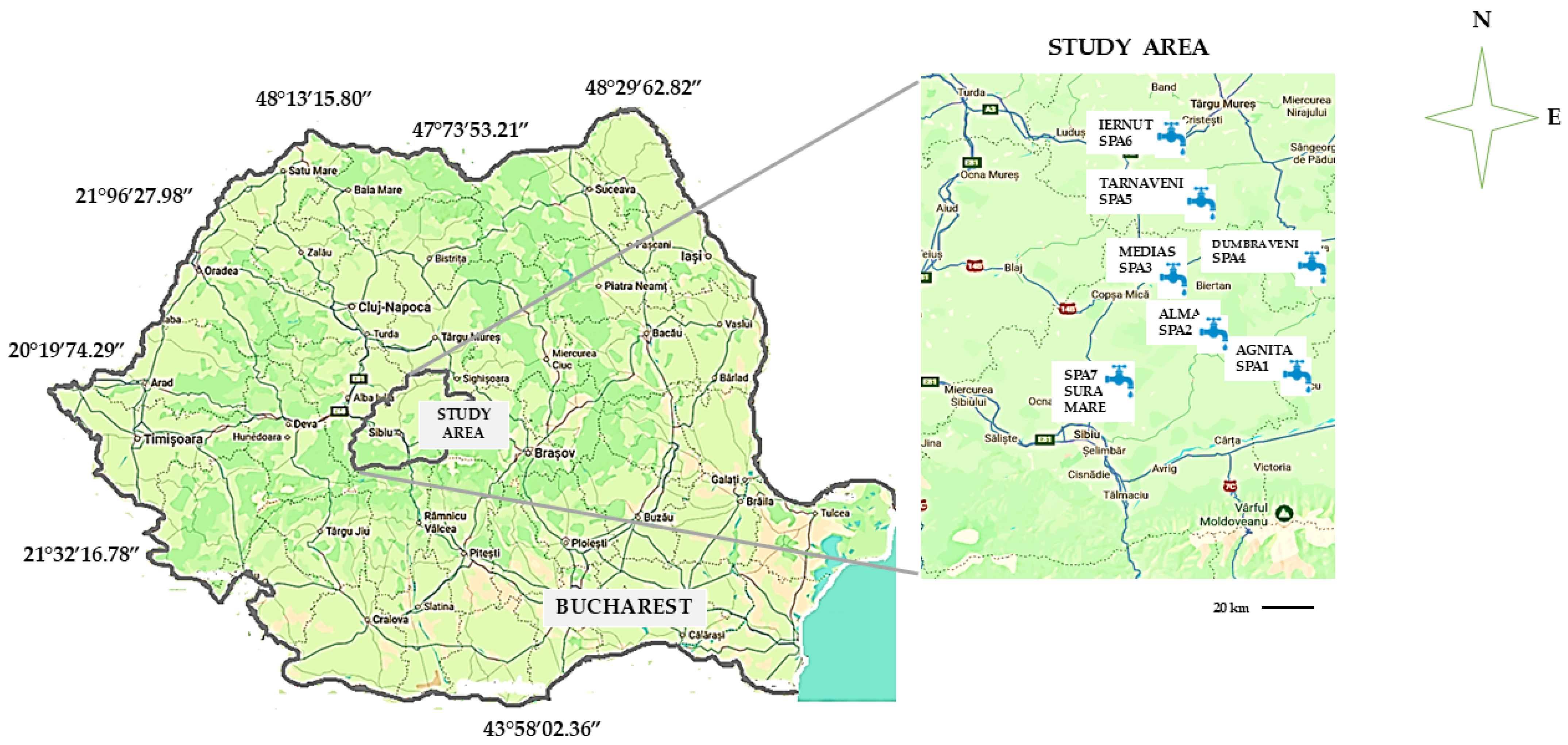
Figure 1. Localisation of the study area.
Water 18 00023 g001
Figure 2. Seasonal variations in the monitored parameters in SPA1–SPA7 during 2022–2024 (ak).
Water 18 00023 g002aWater 18 00023 g002b
Figure 3. Seasonal variations in scores after applying the overall pollution assessment index (OPA): (a) OPA results in January/winter; (b) OPA results in April/spring; (c) OPA results in July/summer; (d) OPA results in October/autumn.
Water 18 00023 g003
Figure 4. PCA for the most representative seasons. PC1 and PC2: (a) April/spring 2022 and (b) July/summer 2022; PC2 and PC3: (c) April/spring 2022 and (d) July/summer 2022.
Water 18 00023 g004
Figure 5. Risk assessment after oral ingestion of samples from sources SPA1–SPA7 during the autumn seasons of 2022–2024 by children: (a) CDI, HQ, and HI scores obtained in October/autumn 2022; (b) CDI, HQ, and HI scores obtained in October/autumn 2023; (c) CDI, HQ, and HI scores obtained in October/autumn 2024.
Water 18 00023 g005
Figure 6. Risk assessment after dermal contact in samples SPA1–SPA7 (children). HQ scores obtained during (a) 2022, (b) 2023, and (c) 2024.
Water 18 00023 g006
Table 1. Descriptive statistics of chemical parameters (mean values determined in each sample, and the minimum, maximum, and median values of all results determined during the sampling campaigns; expressed as µS/cm for electrical conductivity and mg/L for anions) determined in the water samples (SPA1–SPA7) in four seasons (January, April, July, and October) of three different years (2022–2024).
2022MAC *SPA1SPA 2SPA 3SPA4SPA5SPA6SPA7MinMaxMedian
2022
pH6.5–9.57.25 ± 0.258.60 ± 0.087.35 ± 0.176.90 ± 0.087.70 ± 0.077.43 ± 0.057.40 ± 0.086.808.707.40
σ **25074.3 ± 8.301023 ± 48.2400 ± 144786 ± 35.1904 ± 305302 ± 61.8740 ± 42.865.01268703
NO20.50.030 ± 0.00.030 ± 0.00.030 ± 0.00.030 ± 0.00.006 ± 0.0030.004 ± 0.00.545 ± 0.350.0040.800.03
NO3501.73 ± 0.453.10 ± 1.103.75 ± 1.370.49 ± 0.0024.39 ± 0.975.23 ± 1.757.05 ± 0.670.497.983.72
NH40.50.05 ± 0.00.05 ± 0.00.05 ± 0.00.06 ± 0.0140.01 ± 0.0040.01 ± 0.0020.49 ± 0.180.0070.700.05
SO42502.50 ± 0.4345.0 ± 0.028.9 ± 13.9104 ± 8.7723.2 ± 7.8420.1 ± 7.3224.0 ± 0.01.8811322.1
Cl2503.07 ± 1.0815.2 ± 0.041.1 ± 9.227.9 ± 1.47197 ± 73.536.9 ± 10.78.13 ± 0.02.1328132.8
2023
pH6.5–9.57.30 ± 0.228.65 ± 0.247.43 ± 0.057.00 ± 0.147.68 ± 0.127.38 ± 0.057.43 ± 0.246.808.807.40
σ25072.3 ± 4.921056 ± 12.8423 ± 98.6838 ± 10.4897 ± 178334 ± 58.3760 ± 22.866.01113729
NO20.50.030 ± 0.00.030 ± 0.00.030 ± 0.00.030 ± 0.00.004 ± 0.0010.004 ± 0.00.299 ± 0.090.0020.430.03
NO3501.71 ± 0.143.91 ± 0.234.05 ± 0.380.49 ± 0.0054.43 ± 0.895.75 ± 1.236.38 ± 1.560.498.594.10
NH40.50.05 ± 0.00.05 ± 0.0040.05 ± 0.00.05 ± 0.0040.01 ± 0.0030.01 ± 0.0031.07 ± 0.650.0071.640.05
SO425061.4 ± 0.8554.8 ± 17.3126 ± 16.626.9 ± 3.1721.8 ± 2.33139 ± 0.024.0 ± 0.019.813930.4
Cl2501.78 ± 0.92534 ± 73342.36 ± 10.525.89 ± 0.50174 ± 32.137.56 ± 10.25.75 ± 0.890.71105331.8
2024
pH6.5–9.57.28 ± 0.158.60 ± 0.017.43 ± 0.367.03 ± 0.057.45 ± 0.117.26 ± 0.067.48 ± 0.056.908.607.40
σ25076.7 ± 9.501045 ± 1.00449 ± 125811 ± 15.01066 ± 476301 ± 44.9754 ± 11.167.01516740
NO20.50.030 ± 0.00.030 ± 0.00.030 ± 0.00.030 ± 0.00.004 ± 0.00.004 ± 0.00.323 ± 0.160.0040.490.03
NO3502.06 ± 0.333.49 ± 0.854.33 ± 1.090.58 ± 0.103.74 ± 0.795.38 ± 1.345.98 ± 0.660.497.373.87
NH40.50.06 ± 0.020.05 ± 0.0080.05 ± 0.00.05 ± 0.00.01 ± 0.0040.01 ± 0.0021.28 ± 0.230.0061.530.05
SO42504.3 ± 0.044.5 ± 0.062 ± 0.080.2 ± 0.019.6 ± 7.0918.7 ± 1.9720.0 ± 0.04.308020.4
Cl25040.5 ± 55.9524 ± 73263.7 ± 0.0406 ± 565130 ± 1.0630.2 ± 7.167.0 ± 0.00.96104134.4
Note: * Maximum Allowable Concentration specified by the Romanian Legislation [51], and International Guideline of the World Health Organization [36]; ** σ = electrical conductivity expressed as µS/cm.
Table 2. PI scores considering the average contents of NO3, NO2, and NH4 obtained over three years for samples SPA1–SPA7.
202220232024
PINO3PINO2PINH4PINO3PINO2PINH4PINO3PINO2PINH4
SPA10.965 **−0.940 *−0.900 *0.966 **−0.940 *−0.900 *0.959 **−0.940 *−0.877 *
SPA20.938 **−0.940 *−0.900 *0.922 **−0.940 *−0.894 *0.945 **−0.940 *−0.892 *
SPA30.925 **−0.940 *−0.900 *0.919 **−0.940 *−0.900 *0.913 **−0.940 *−0.899 *
SPA40.990 **−0.940 *−0.884 *0.990 **−0.940 *−0.897 *0.988 **−0.940 *−0.900 *
SPA50.912 **−0.989 *−0.980 *0.911 **−0.993 *−0.975 *0.925 **−0.992 *−0.982 *
SPA60.895 **−0.992 *−0.979 *0.885 **−0.992 *−0.980 *0.892 **−0.992 *−0.957 *
SPA70.859 **0.090 **−0.017 *0.872 **−0.402 *1.133 ***0.880 **−0.355 *1.564 ***
Note: * clean status; ** light pollution level status; *** moderate pollution level status.
Table 3. Pearson correlation of the chemical parameter concentrations (mean values) obtained in April/spring 2022 with the OPA scores.
VariablesOPAECpHClNH4NO2NO3SO4
OPA10.264−0.115−0.3401.0001.0000.6940.030
EC0.26410.507−0.0140.2740.2520.1550.326
pH−0.1150.50710.067−0.126−0.1020.411−0.569
Cl−0.340−0.0140.0671−0.347−0.333−0.1560.035
NH41.0000.274−0.126−0.34710.9990.6780.052
NO21.0000.252−0.102−0.3330.99910.7120.005
NO30.6940.1550.411−0.1560.6780.7121−0.541
SO40.0300.326−0.5690.0350.0520.005−0.5411
Note: Values in bold are different from 0, with a significance level alpha = 0.05.
Table 4. Hazard quotient (HQ), chronic daily intake (CDI), and hazard index (HI) scores (mean, minimal, and maximum values) obtained between 2022 and 2024 during four seasons in two study cases (oral ingestion exposure at children and at adults).
ChildrenAdults
HQNO3HQNO3
averageminmaxaverageminmax
20220.275750.004800.000480.07220.00960.1567
20230.28630.03650.644550.0750.00960.1688
20240.27430.03650.55270.07180.00960.1448
HQNO2HQNO2
20220.115630.004800.962400.03030.00130.2521
20230.073110.00240.51120.01910.00060.1339
20240.07880.00480.58800.02060.00130.154
CDINO3 (mg/kg × day)CDINO3 (mg/kg × day)
20220.441190.002880.95740.115550.01530.2507
20230.45810.05841.03130.119980.01530.2701
20240.43890.05840.88440.114940.01530.2316
CDINO2 (mg/kg × day)CDINO2 (mg/kg × day)
20220.011560.000480.096240.003020.0001260.0252
20230.007310.000240.051120.001916.286 × 10−50.01339
20240.007880.000480.05880.002060.0001260.0154
HIHI
20220.391380.072521.56080.10250.018990.4087
20230.35940.072521.15570.09410.018990.3027
20240.35310.072521.07030.09250.018990.2803
Table 5. Hazard quotient (HQ) scores (mean, minimal, and maximum values) obtained between 2022 and 2024 in all seasons in the two study cases (dermal contact exposure in children and adults).
Dermal Contact Exposure in
Children
Dermal Contact Exposure in
Adults
averageminmaxaverageminmax
2022
Winter0.0241920.0027040.0428190.0082002120.0009164790.014514028
Spring0.0193810.0026870.0392330.0065692540.0009108670.013298291
Summer0.0198070.0026870.036440.0067138070.0009108670.012351886
Autumn0.017770.0026870.0440220.0070772380.0009108670.014921767
2023
Winter0.0199252570.0026872340.0286766990.0067538860.0009108670.009720284
Spring0.0191811240.0026872340.0350002510.0065016540.0009108670.011863721
Summer0.0208191620.0026872340.0319488340.0070568850.0009108670.01082941
Autumn0.0243372390.0027424130.0474211190.0082493760.0009295710.016073912
2024
Winter0.0196178290.0035811390.0345146730.006649680.0012138660.011699129
Spring0.0190226810.0027037870.034387760.0064479480.0009164790.011656111
Summer0.0182288870.0026872340.0275896660.0061788820.0009108670.009351822
Autumn0.0244674360.0037853020.0406671680.0082935070.001283070.013784586
Disclaimer/Publisher’s Note: The statements, opinions and data contained in all publications are solely those of the individual author(s) and contributor(s) and not of MDPI and/or the editor(s). MDPI and/or the editor(s) disclaim responsibility for any injury to people or property resulting from any ideas, methods, instructions or products referred to in the content.