Synergistic Pollution Removal in Paper Mill Wastewater Using Monoculture-Constructed Wetlands Optimized by RSM


 ,
,  and
and 
Abstract
1. Introduction
2. Materials and Methods
2.1. Source and Characterization of Wastewater
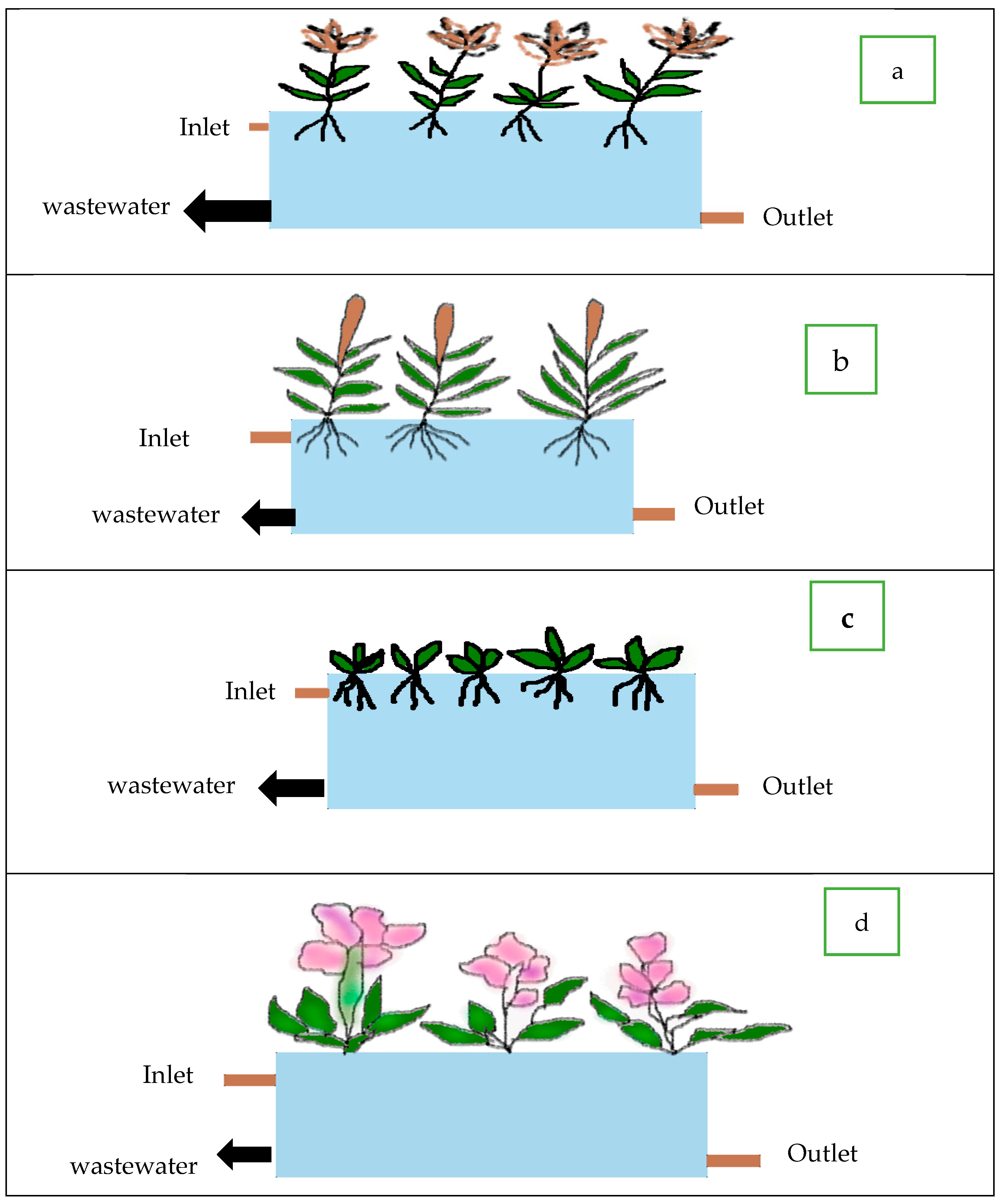
2.2. Experimental Setup
2.3. Statistical Analysis and Response Surface Models
3. Results and Discussion
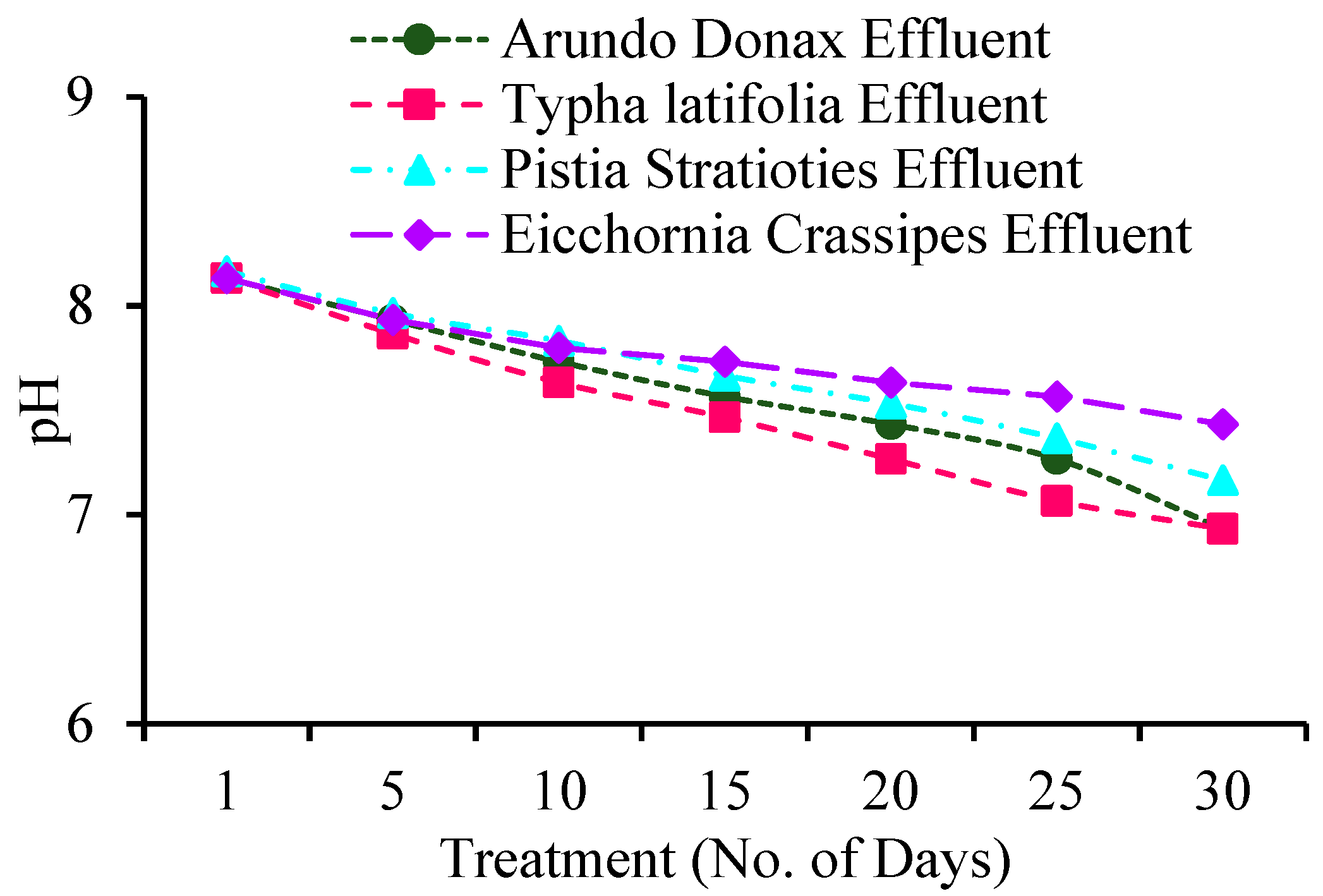
3.1. Variations of pH During Constructed Wetlands
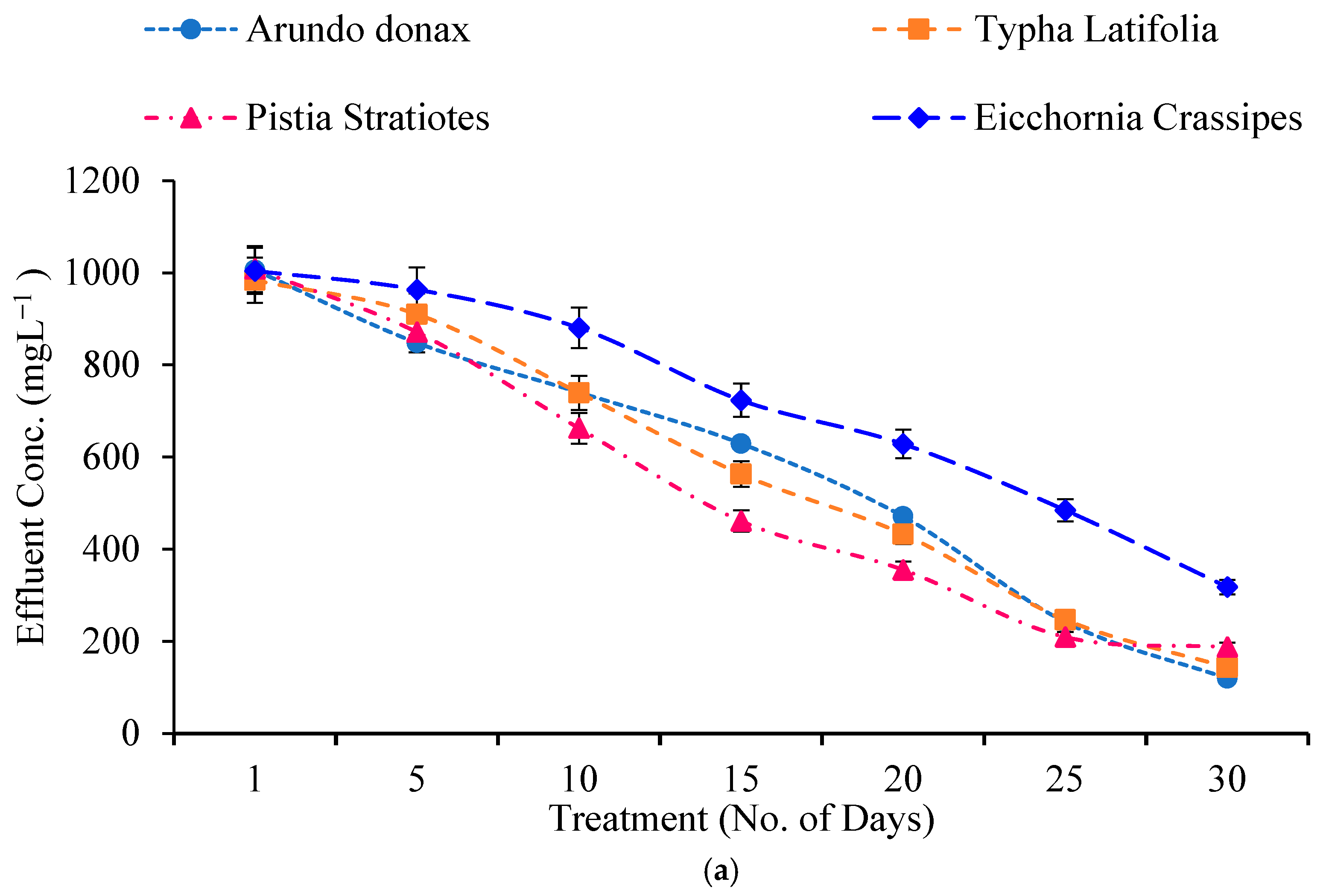
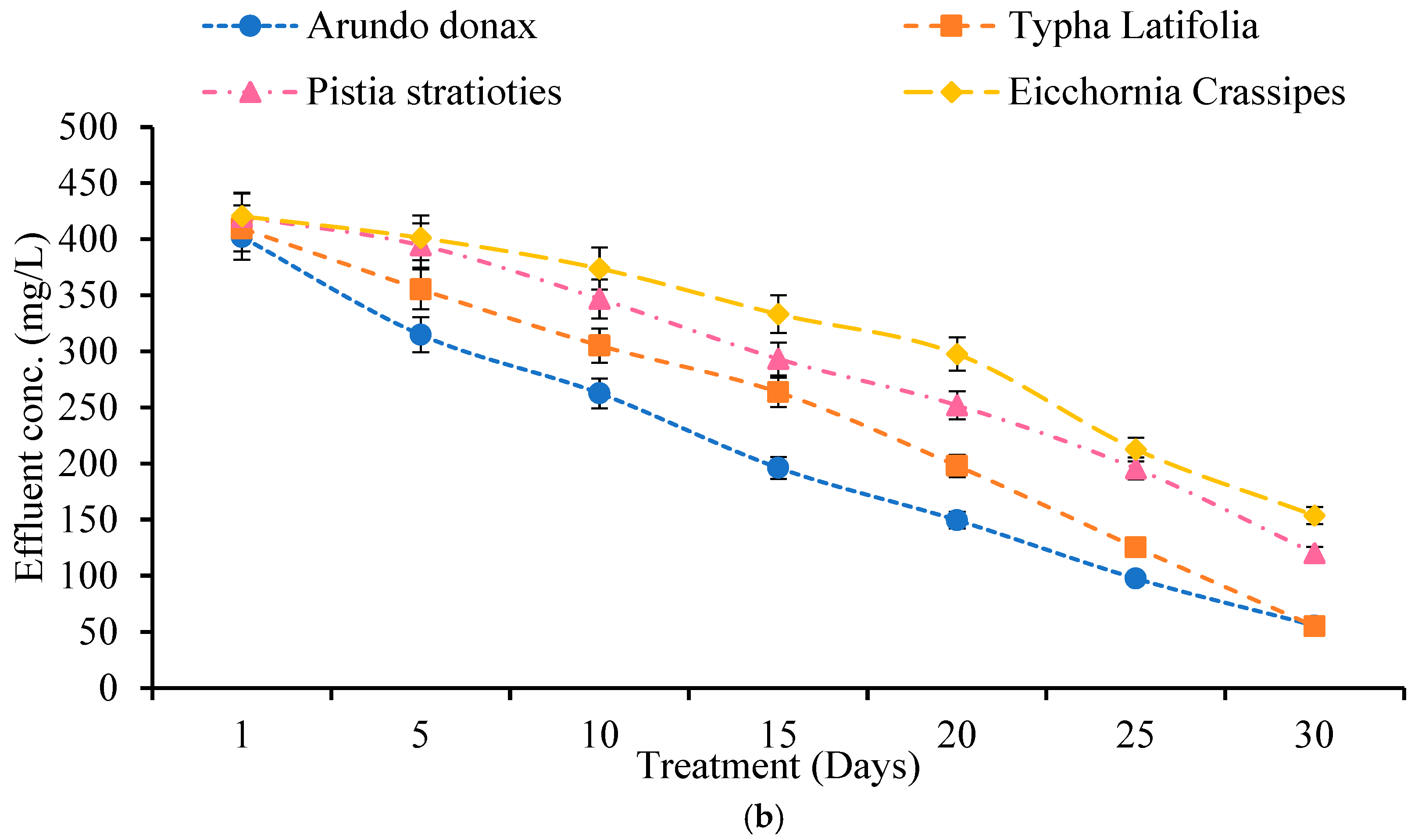
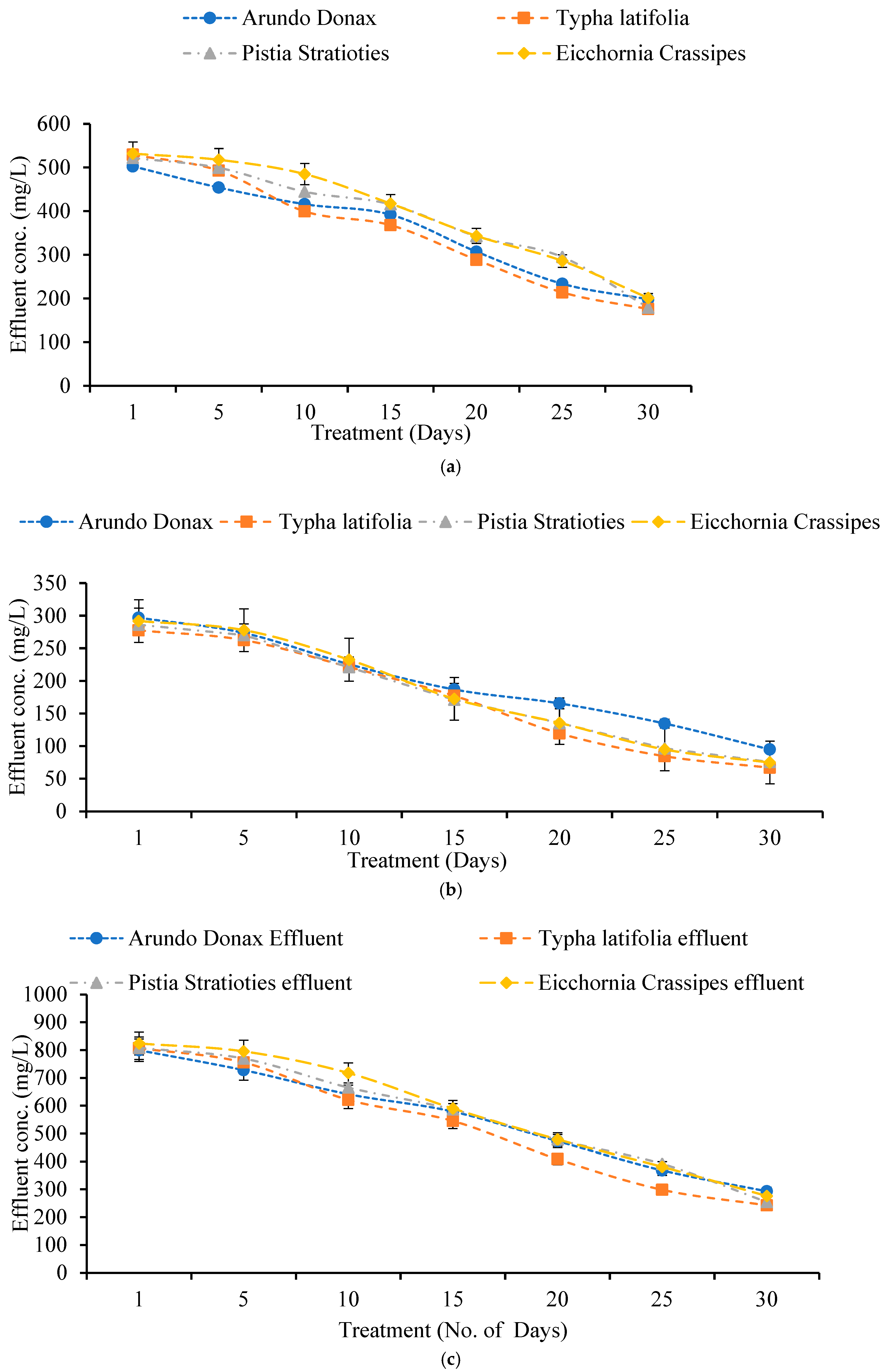
3.2. Impact of Constructed Wetlands on COD and BOD
3.3. Effect of Constructed Wetlands on TDS, TSS, and TS Removal
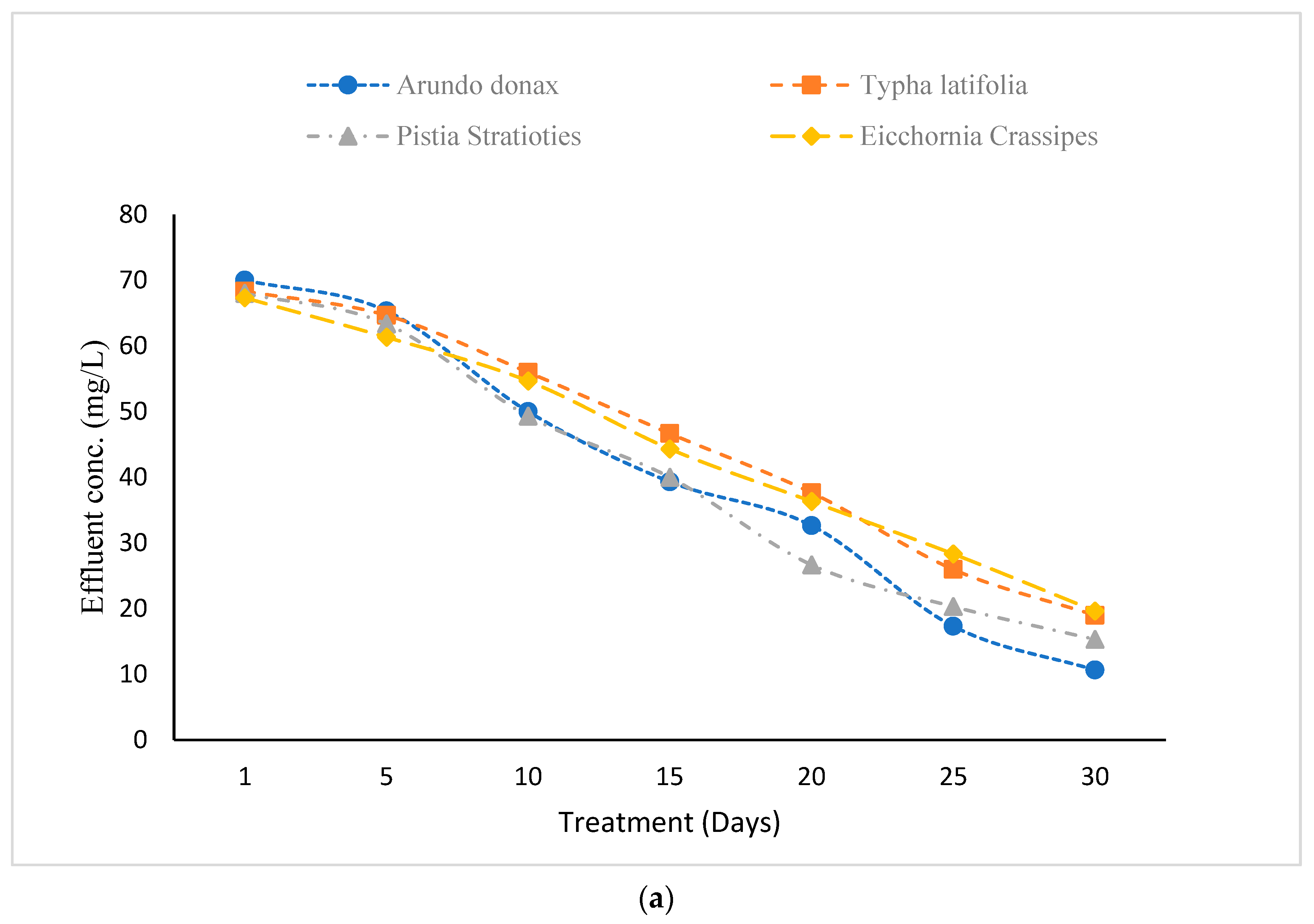
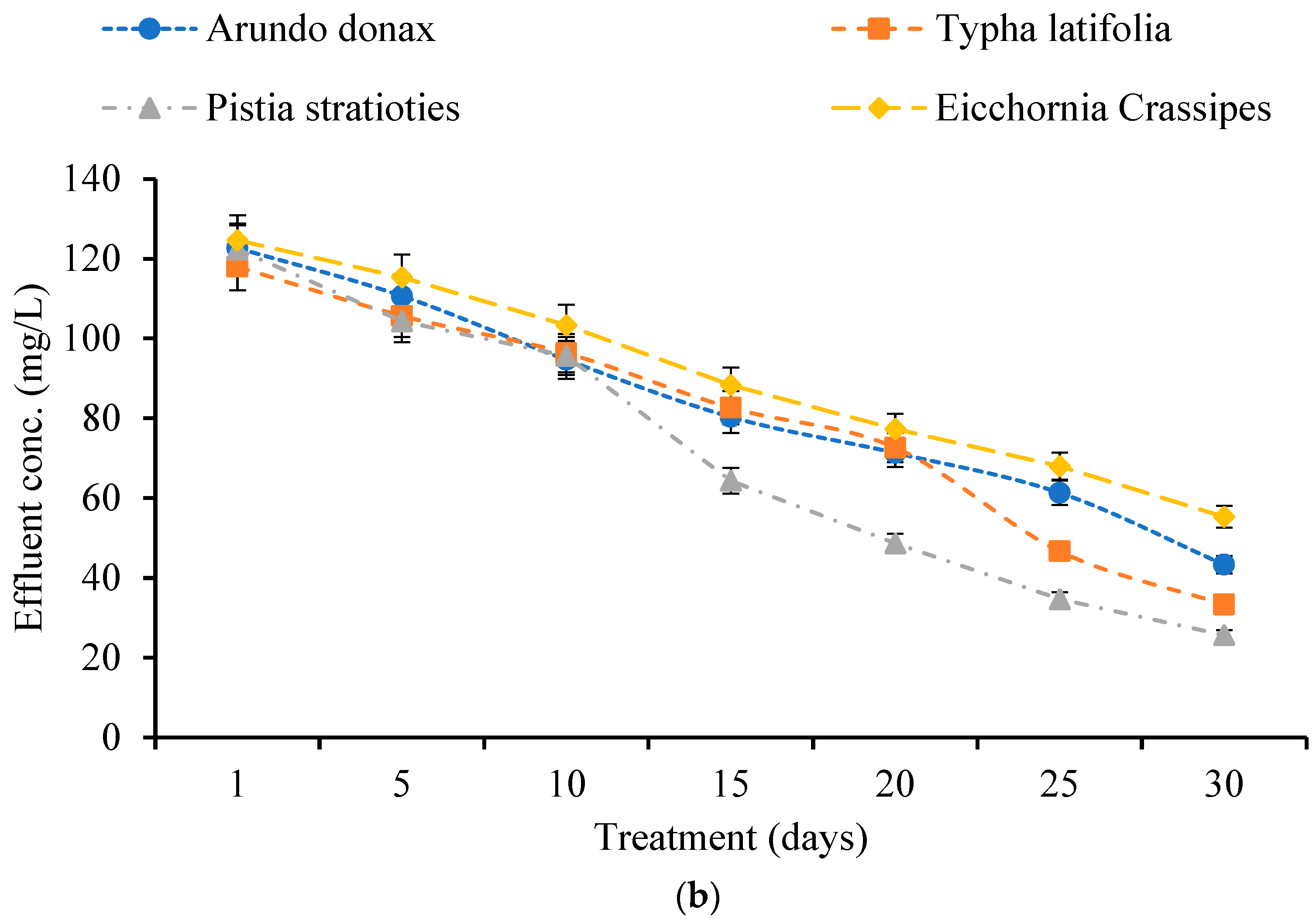
3.4. Effect of Constructed Wetlands on Nitrates and Phosphates
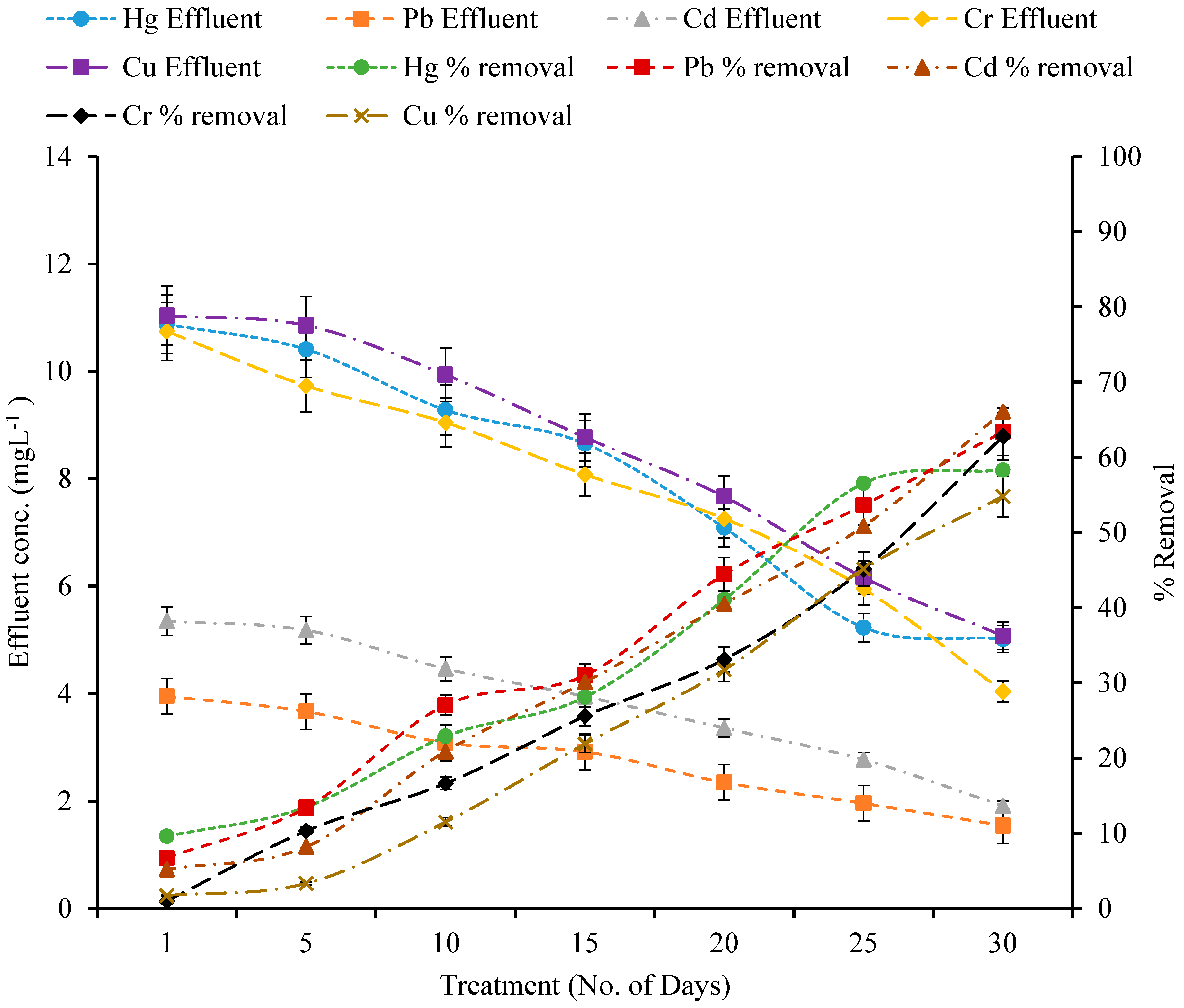
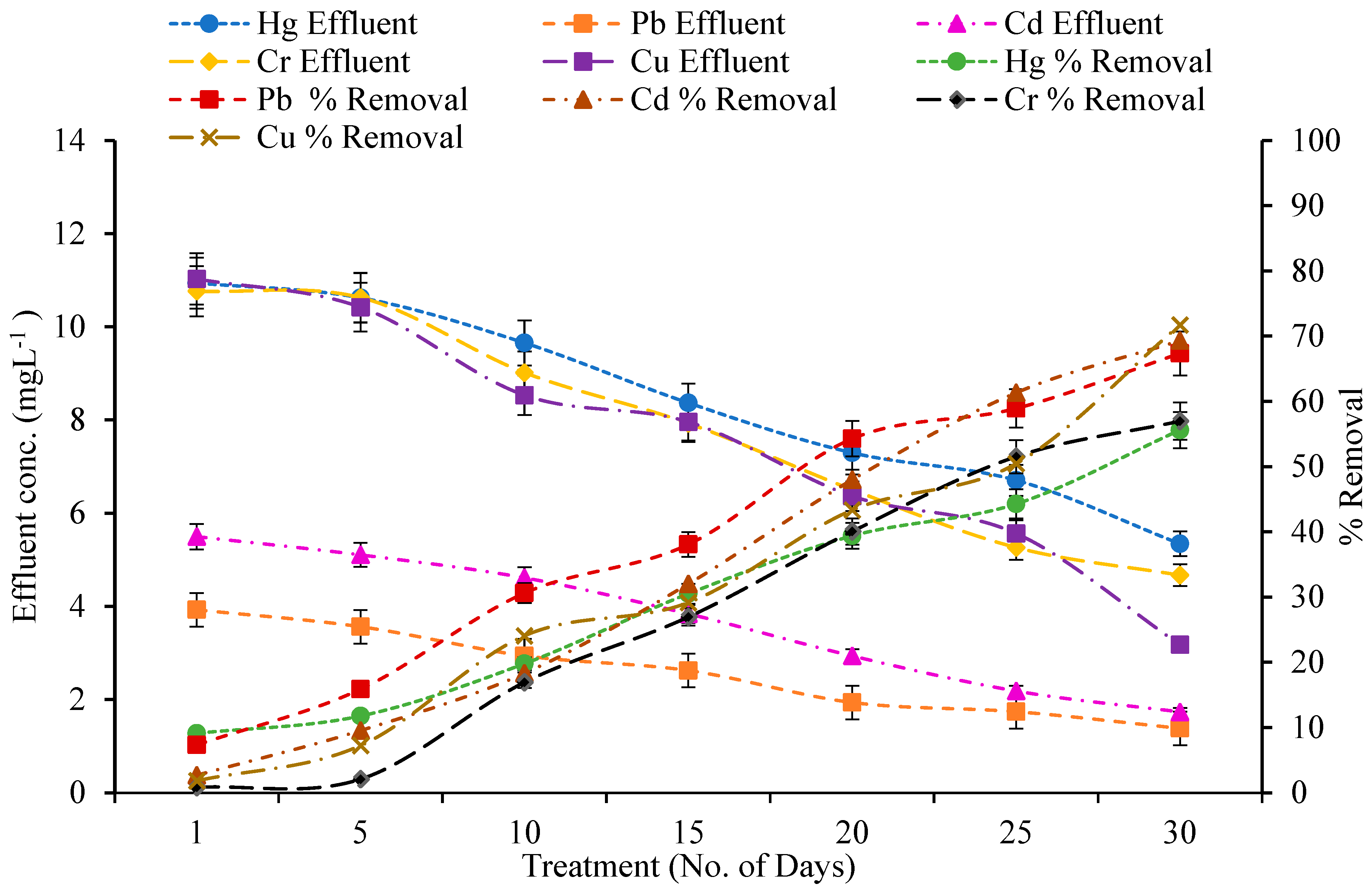
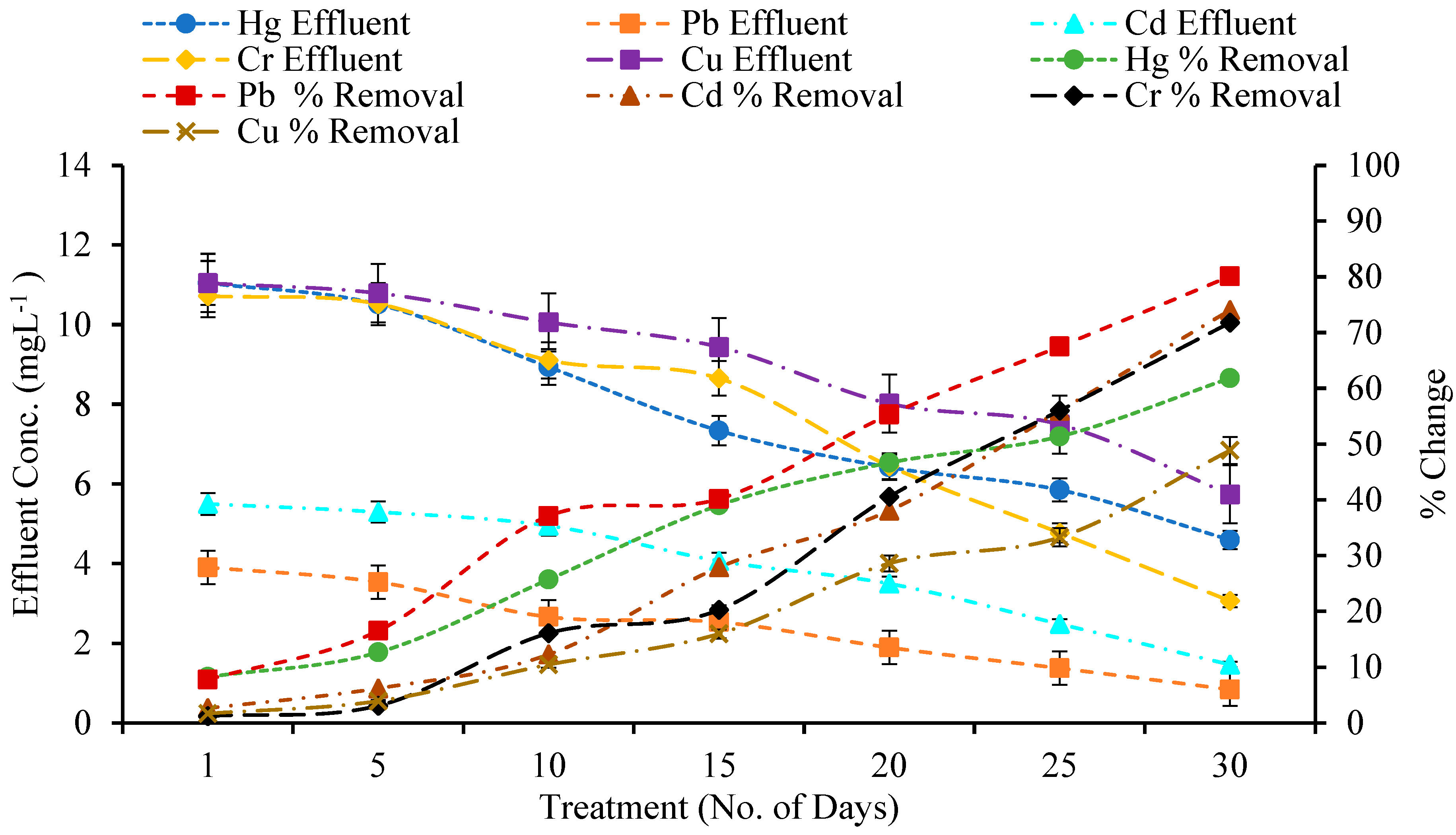
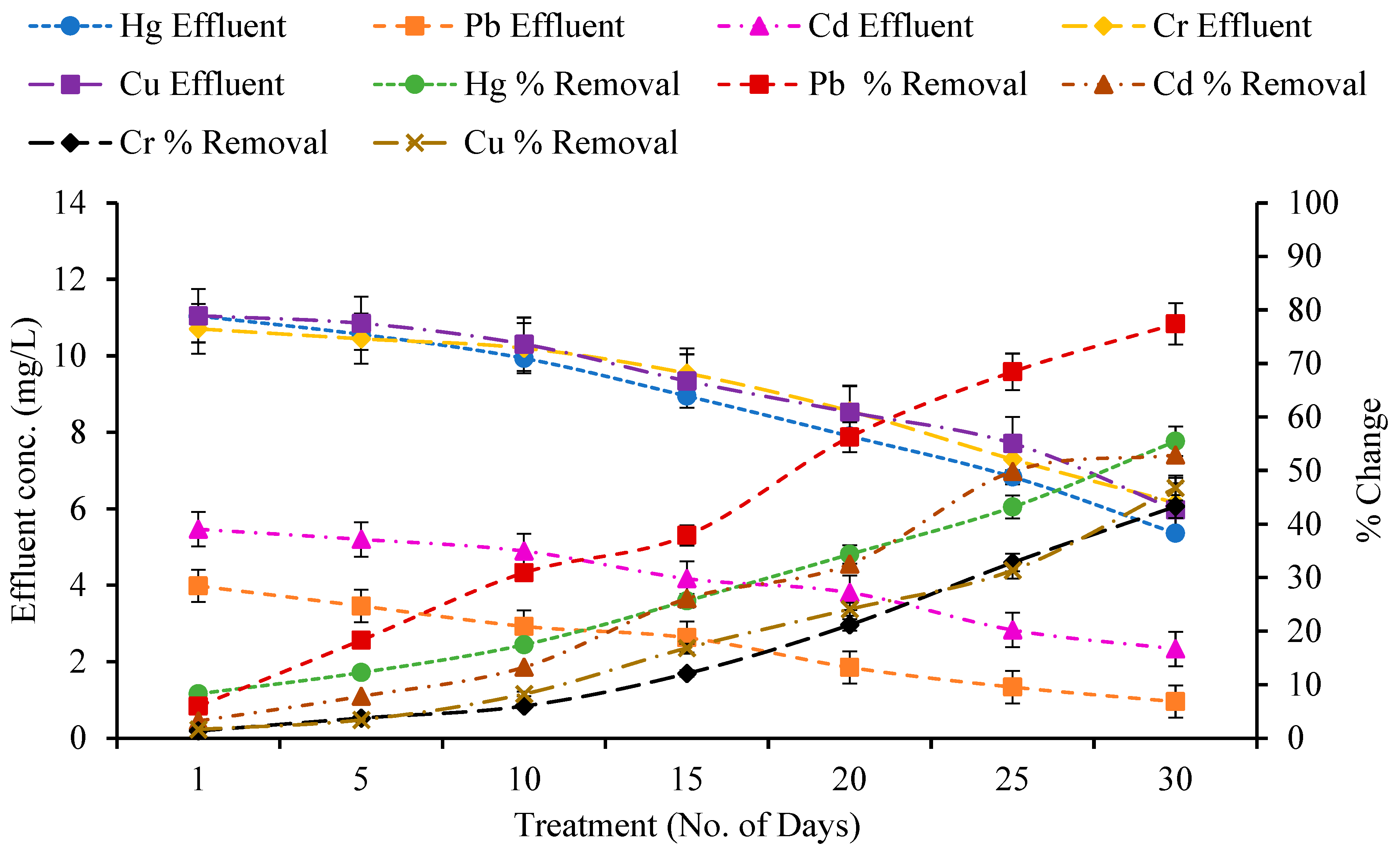
3.5. Findings and Discussion: Heavy Metal Removal by Wetland Plants
- Best mercury removal: P. stratiotes (61.82%).
- P. stratiotes (80.09%) and E. crassipes (77.41%) have the best lead removal rates.
- Best Cd removal: P. stratiotes (74.04%).
- Best Cr removal: P. stratiotes (71.78%).
- T. latifolia had the best Cu removal rate (71.72%).
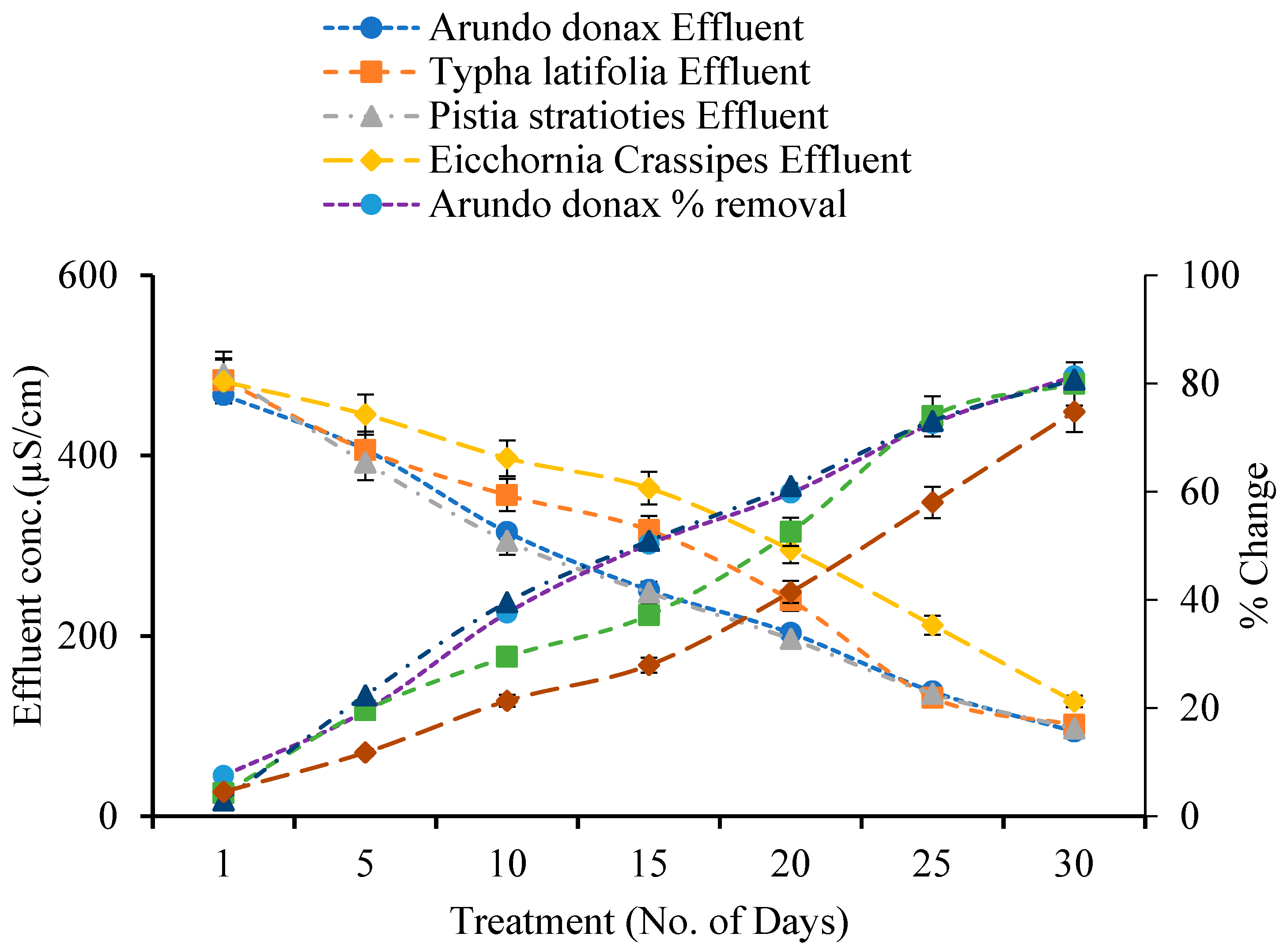
3.6. Effects of Constructed Wetland on Electrical Conductivity
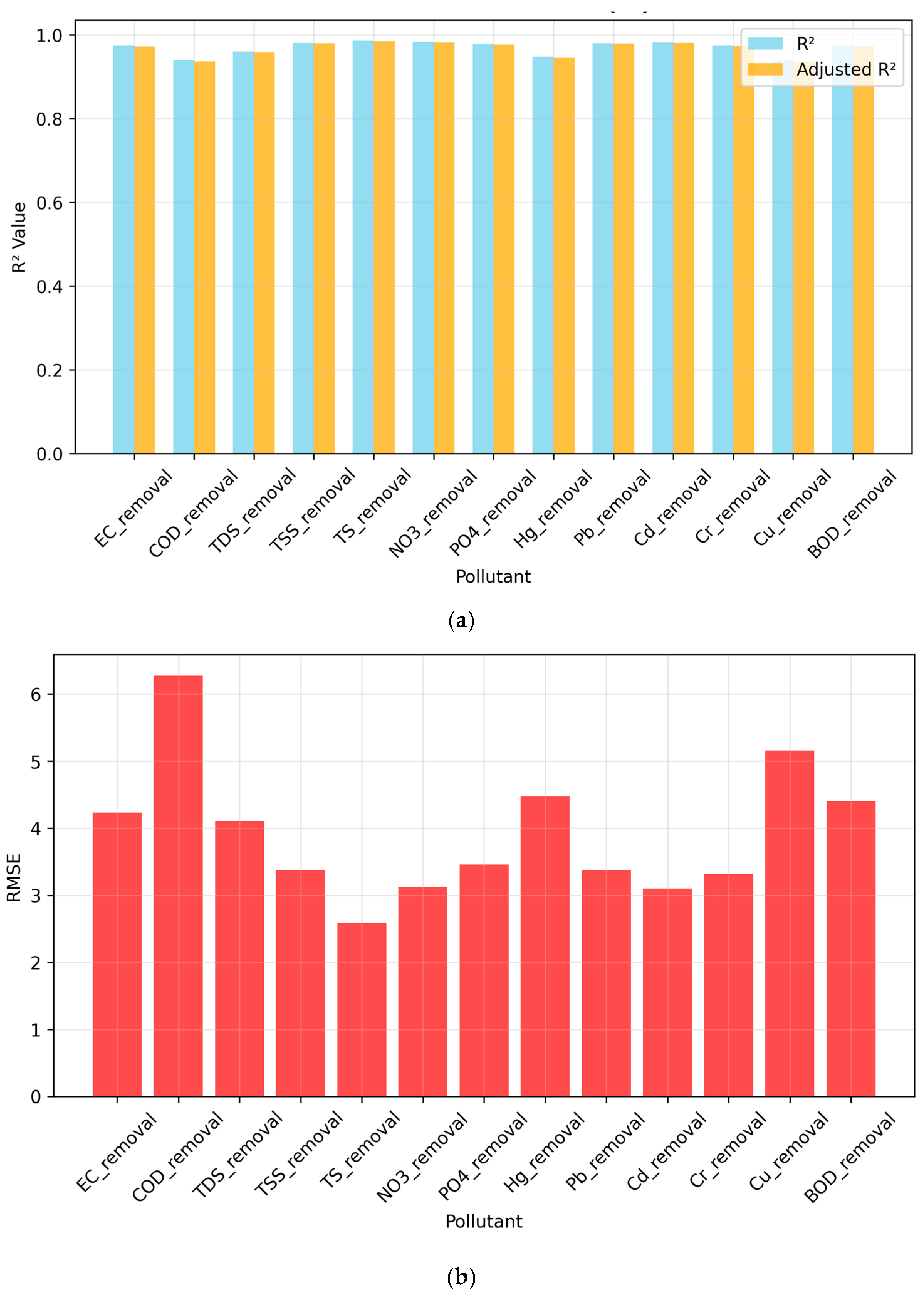
3.7. Response Surface Models
4. Conclusions
- This study’s findings show that constructed wetlands planted with monoculture species, specifically Arundo donax, Typha latifolia, Pistia stratiotes, and Eichhornia crassipes, may effectively treat paper mill wastewater from the Hattar Industrial Estate. The macrophytes had diverse levels of removal effectiveness for several parameters such as COD, BOD, total solids, nitrates, phosphates, and heavy metals (Hg, Pb, Cd, Cr, and Cu). The use of inexpensive and locally available materials in created wetlands is a viable way to enhance wastewater treatment in the paper recycling industry.
- RSM indicated that retention time, A. donax, and wetlands greatly improve pollution removal, although various plant–treatment combinations provide varying efficiencies, emphasizing the need of synergistic effects for maximum performance. There was a diminishing impact of wetland treatment on the removal of pollutants over time. The study also identified specific plant types that can be used for customized removal of certain pollutants with wetlands.
- Furthermore, this study helps global efforts to achieve carbon neutrality by proposing a practical approach for implementation in developing nations. The findings of this study can be utilized to guide the design and operation of constructed wetlands for effective wastewater treatment, thereby reducing environmental pollution and supporting sustainable industrial practices.
- Based on the above results, it was recommended to examine how different hydraulic retention durations and seasonal changes affect treatment efficacy and vegetation performance in artificial wetlands. The nutrient removal efficiency and biomass output of A. donax, T. latifolia, P. stratiotes, and E. crassipes in the treatment of paper mill effluent should be determined.
- The viability of mixed plant species arrangements for pollution reduction, system resilience, and biological diversity should be evaluated. By implementing these recommendations, paper recycling industries can significantly improve the effectiveness of their wastewater treatment processes, ensuring environmental compliance and reducing the ecological impact of their operations.
Author Contributions
Funding
Data Availability Statement
Conflicts of Interest
Appendix A


References
- Ukaogo, P.O.; Ewuzie, U.; Onwuka, C.V. Environmental pollution: Causes, effects, and remedies. In Microorganisms for Sustainable Environment and Health; Elsevier: Amsterdam, The Netherlands, 2020; pp. 419–429. [Google Scholar]
- Iftikhar, A.; Hayat, M.T.; Zeb, B.S.; Siddique, M.; Bhatti, Z.A. Anaerobic biological treatment of wastewater from the paper recycling industry by a UASB reactor. Sains Malays. 2023, 52, 1087–1099. [Google Scholar] [CrossRef]
- Cabrera, M.N. Pulp mill wastewater: Characteristics and treatment. Biol. Wastewater Treat. Resour. Recover. 2017, 2, 119–139. [Google Scholar]
- Mahmood, Q.; Shaheen, S.; Bilal, M.; Tariq, M.; Zeb, B.S.; Ullah, Z.; Ali, A. Chemical pollutants from an industrial estate in Pakistan: A threat to environmental sustainability. Appl. Water Sci. 2019, 9, 47. [Google Scholar]
- Muhamad, M.H.; Abdullah, S.R.S.; Hasan, H.A.; Rahim, R.A.A. Comparison of attached- versus suspended-growth SBR systems for treatment of recycled paper mill wastewater. J. Environ. Manag. 2015, 163, 115–124. [Google Scholar] [CrossRef] [PubMed]
- Brix, H. Wastewater treatment in constructed wetlands: System design, removal processes, and treatment performance. In Constructed Wetlands for Water Quality Improvement; CRC Press: Boca Raton, FL, USA, 2020; pp. 9–22. [Google Scholar]
- Yusoff, M.F.M.; Rozaimah, S.A.S.; Hassimi, A.H.; Hawati, J.; Habibah, A. Performance of a continuous pilot subsurface constructed wetland using Scirpus grossus for removal of COD, colour, and suspended solids in recycled pulp and paper effluent. Environ. Technol. Innov. 2019, 13, 346–352. [Google Scholar] [CrossRef]
- Choudhary, A.K.; Kumar, S.; Sharma, C. Constructed wetlands: An approach for wastewater treatment. Elixir Pollut. 2011, 37, 3666–3672. [Google Scholar]
- Shravani, M.; Banerjee, R.; Pallavi, N. Natural and constructed wetlands: A review on water purification and ecosystem services. J. Mater. Environ. Sci. 2025, 16, 1245–1269. [Google Scholar]
- Arivoli, A.; Mohanraj, R.; Seenivasan, R. Application of vertical flow constructed wetlands for heavy metal removal from pulp and paper industry wastewater. Environ. Sci. Pollut. Res. 2015, 22, 13336–13343. [Google Scholar] [CrossRef] [PubMed]
- Gautam, P.K.; Gautam, R.K.; Banerjee, S.; Chattopadhyaya, M.C.; Pandey, J.D. Heavy metals in the environment: Fate, transport, toxicity, and remediation technologies. Nova Sci. Publ. 2016, 60, 101–130. [Google Scholar]
- Meng, P.; Pei, H.; Hu, W.; Shao, Y.; Li, Z. Influencing factors and improvement measures for microbial degradation in constructed wetlands. Bioresour. Technol. 2014, 157, 316–326. [Google Scholar] [CrossRef]
- Wang, L.; Ma, L.; Wang, J.; Zhao, X.; Jing, Y.; Liu, C.; Xu, M. Research progress on the removal of contaminants from wastewater by constructed wetland substrate: A review. Water 2024, 16, 1848. [Google Scholar] [CrossRef]
- APHA. Standard Methods for the Examination of Water and Wastewater, 21st ed.; American Public Health Association: Washington, DC, USA, 2005. [Google Scholar]
- Saeed, T.; Al-Muyeed, A.; Yadav, A.K.; Miah, M.J.; Hasan, M.R.; Zaman, T.; Ahmed, T. Influence of aeration, plants, electrodes, and pollutant loads on treatment performance of constructed wetlands: A comprehensive study with septage. Sci. Total Environ. 2023, 892, 164558. [Google Scholar] [CrossRef]
- Zeb, B.S.; Mahmood, Q.; Irshad, M.; Zafar, H.; Wang, R. Sustainable treatment of combined industrial wastewater using phytoremediation in biofilm wetlands. Int. J. Phytorem. 2025, 27, 128–134. [Google Scholar] [CrossRef] [PubMed]
- Hoagland, D.R.; Arnon, D.I. The water-culture method for growing plants without soil. Calif. Agric. Exp. Stn. Circ. 1950, 347, 1–32. [Google Scholar]
- APHA; AWWA; WEF. Standard Methods for the Examination of Water and Wastewater, 24th ed.; American Public Health Association: Washington, DC, USA, 2023. [Google Scholar]
- Darajeh, N.; Idris, A.; Masoumi, H.R.F.; Nourani, A.; Truong, P.; Sairi, N.A. Modeling BOD and COD removal in floating wetlands treating palm oil mill effluent. J. Environ. Manag. 2016, 181, 343–352. [Google Scholar] [CrossRef]
- Queiroz, R.D.C.S.D.; Lôbo, I.P.; Ribeiro, V.D.S.; Rodrigues, L.B.; Almeida Neto, J.A.D. Phytoremediation potential of aquatic macrophytes in dairy wastewater treatment. Int. J. Phytorem. 2020, 22, 518–528. [Google Scholar] [CrossRef] [PubMed]
- Mohan, S.; Vidhya, K.; Sivakumar, C.; Sugnathi, M.; Shanmugavadivu, V.; Devi, M. Textile wastewater treatment using natural coagulant (Azadirachta indica). Int. Res. J. Multidiscip. Technovation 2019, 1, 636–642. [Google Scholar]
- Shahid, M.J.; Al-Surhanee, A.A.; Kouadri, F.; Ali, S.; Nawaz, N.; Afzal, M.; Soliman, M.H. Role of microorganisms in the remediation of wastewater in floating treatment wetlands: A review. Sustainability 2020, 12, 5559. [Google Scholar] [CrossRef]
- Valipour, A.; Hamnabard, N.; Woo, K.S.; Ahn, Y.H. Performance of high-rate constructed phytoremediation process with attached growth for domestic wastewater treatment: Effect of high TDS and Cu. J. Environ. Manag. 2014, 145, 1–8. [Google Scholar] [CrossRef]
- Wei, F.; Shahid, M.J.; Alnusairi, G.S.; Afzal, M.; Khan, A.; El-Esawi, M.A.; Ali, S. Implementation of Floating Treatment Wetlands for Textile Wastewater Management: A Review. Sustainability 2020, 12, 5801. [Google Scholar] [CrossRef]
- Shukla, V.; Hiwrale, I.; Dhodapkar, R.S.; Pal, S. Constructed wetlands: Insights and future directions. In Biological and Hybrid Wastewater Treatment Technology; Springer Nature: Cham, Switzerland, 2024; pp. 303–343. [Google Scholar]
- Gabr, M.E.; Salem, M.; Mahanna, H.; Mossad, M. Floating wetlands for sustainable drainage wastewater treatment. Sustainability 2022, 14, 6101. [Google Scholar] [CrossRef]
- Spangler, J.T.; Sample, D.J.; Fox, L.J.; Albano, J.P.; White, S.A. Nitrogen and phosphorus removal by plants in floating treatment wetlands. Environ. Sci. Pollut. Res. 2019, 26, 5751–5768. [Google Scholar] [CrossRef] [PubMed]
- Liang, X.; Xu, Y.; Yin, L.; Wang, R.; Li, P.; Wang, J.; Liu, K. Sustainable utilization of pulp and paper wastewater. Water 2023, 15, 4135. [Google Scholar] [CrossRef]
- Cheng, L.; Yue, B.; Meng, B.; Wang, T.; Liang, Y. Simulation of heavy metals and organic contaminants during waste paper recycling. Environ. Sci. Pollut. Res. 2024, 31, 63834–63846. [Google Scholar] [CrossRef]
- Furszyfer Del Rio, D.D.; Sovacool, B.K.; Griffiths, S.; Bazilian, M.; Kim, J.; Foley, A.M.; Rooney, D. Decarbonizing the pulp and paper industry: A critical and systematic review of sociotechnical developments and policy options. Renewable and Sustainable Energy Reviews 2022, 167, 112706. [Google Scholar] [CrossRef]
- Lyubenova, L.; Schröder, P. Effects of heavy metals on detoxification systems of Typha latifolia. Bioresour. Technol. 2011, 102, 996–1004. [Google Scholar] [CrossRef]
- Shi, J.; Xiang, Z.; Peng, T.; Li, H.; Huang, K.; Liu, D.; Huang, T. Effects of melatonin-treated Nasturtium officinale on cadmium uptake. Int. J. Environ. Anal. Chem. 2021, 101, 2288–2296. [Google Scholar] [CrossRef]
- Castaldi, P.; Silvetti, M.; Manzano, R.; Brundu, G.; Roggero, P.P.; Garau, G. Phytostabilization of arsenic and trace metals using Phragmites australis and Arundo donax. Geoderma 2018, 314, 63–72. [Google Scholar] [CrossRef]
- Zheng, S.; Wang, Q.; Yuan, Y.; Sun, W. Human health risk assessment of heavy metals in soil and food crops in the Pearl River Delta urban agglomeration of China. Food Chem. 2020, 316, 126213. [Google Scholar] [CrossRef] [PubMed]
- Ugya, A.Y.; Imam, T.S.; Tahir, S.M. Removal of heavy metals using Pistia stratiotes from an industrially polluted stream. IOSR J. Environ. Sci. Toxicol. Food Technol. 2015, 9, 48–51. [Google Scholar]
- Hegazy, A.K.; Abdel-Ghani, N.T.; El-Chaghaby, G.A. Phytoremediation potential of Typha domingensis for industrial wastewater. Int. J. Environ. Sci. Technol. 2011, 8, 639–648. [Google Scholar] [CrossRef]
- Sukumaran, D. Phytoremediation of heavy metals using constructed wetland technology. Appl. Ecol. Environ. Sci. 2013, 1, 92–97. [Google Scholar]
- Sarwar, T.; Shahid, M.; Natasha; Khalid, S.; Shah, A.H.; Ahmad, N.; Bakhat, H.F. Heavy metal accumulation in soil–plant systems irrigated with wastewater. Environ. Geochem. Health 2020, 42, 4281–4297. [Google Scholar] [CrossRef]
- Leguizamo, M.A.O.; Gómez, W.D.F.; Sarmiento, M.C.G. Native wetland plants for heavy metal phytoremediation: A review. Chemosphere 2017, 168, 1230–1247. [Google Scholar] [CrossRef] [PubMed]
- Xu, L.; Zhang, B.; Peng, X.; Zhang, X.; Sun, B.; Sun, H.; Zhuang, X. Microbial community dynamics in constructed wetlands under varying ammonium concentrations. Process Biochem. 2020, 93, 55–62. [Google Scholar] [CrossRef]



| Serial No | Parameters | Unit | Paper Recycling Industrial Wastewater |
|---|---|---|---|
| 1 | pH | - | 8.166 ± 0.11 |
| 2 | EC | µS/cm | 505.33 ± 1.52 |
| 3 | COD | mg/L | 1013 ± 2 |
| 4 | TDS | mg/L | 536.66 ± 2.08 |
| 5 | TSS | mg/L | 301 ± 2 |
| 6 | TS | mg/L | 837.666 ± 0.57 |
| 7 | BOD | mg/L | 436 ± 2.64 |
| 8 | Nitrate | mg/L | 79.66 ± 1.52 |
| 9 | Phosphate | mg/L | 134.66 ± 2.08 |
| 10 | Hg | mg/L | 12.04 ± 0.05 |
| 11 | Pb | mg/L | 4.236 ± 0.04 |
| 12 | Cd | mg/L | 5.65 ± 0.17 |
| 13 | Cr | mg/L | 10.856 ± 0.01 |
| 14 | Cu | mg/L | 11.236 ± 0.02 |
| S. No. | Compound | Formula | Volume (mL) | Molar Mass (g/mol) |
|---|---|---|---|---|
| 1 | Calcium Nitrate | Ca (NO3)2 | 7 | 164.088 |
| 2 | Potassium Nitrate | KNO3 | 5 | 101.1 |
| 3 | Monopotassium phosphate | KH2PO4 | 2 | 136.1 |
| 4 | Heptahydrate magnesium sulfate | MgSO4·7H2O | 2 | 246 |
| 5 | Trace elements | H3BO3 MnCl2·4H2O ZnSO4·7H2O CuSO4·5H2O NaMoO4 | 1 | 2.8 1.8 0.2 0.1 0.025 |
| 6 | Fe EDTA | KOH FeSO4·7H2O EDTA·2Na | 1 | 56 0.278 0.746 |
| Parameter | Worst Plant | Control (Avg.) | Worst Plant (Avg.) | Reduction (%) | p Value | Significant |
|---|---|---|---|---|---|---|
| COD (mg/L) | Eichhornia crassipes | 996.86 | 714.81 | 28.3 | 0.022451 | TRUE |
| BOD (mg/L) | Eichhornia crassipes | 429.86 | 313.33 | 27.1 | 0.018318 | TRUE |
| EC (µS/cm) | Eichhornia crassipes | 502.9 | 332.05 | 34 | 0.01183 | TRUE |
| Nitrates (mg/L) | Typha latifolia | 75.3 | 45.48 | 39.6 | 0.002338 | TRUE |
| Phosphates (mg/L) | Eichhornia crassipes | 127.52 | 90.33 | 29.2 | 0.002824 | TRUE |
| Hg (mg/L) | Eichhornia crassipes | 11.64 | 8.66 | 25.6 | 0.00376 | TRUE |
| Pb (mg/L) | Arundo donax | 9.89 | 2.78 | 71.8 | 0.266075 | FALSE |
| Cd (mg/L) | Eichhornia crassipes | 5.59 | 4.1 | 26.7 | 0.013649 | TRUE |
| Cr (mg/L) | Eichhornia crassipes | 10.39 | 8.99 | 13.5 | 0.035261 | TRUE |
| Cu (mg/L) | Pistia stratiotes | 10.73 | 8.94 | 16.6 | 0.023781 | TRUE |
| TDS (mg/L) | Arundo donax | 0 | 357.71 | −∞ | 0.000168 | TRUE |
| TSS (mg/L) | Arundo donax | 234.43 | 196.95 | 16 | 0.006509 | TRUE |
| TS (mg/L) | Eichhornia crassipes | 580.38 | 580.52 | 0 | 0.994882 | FALSE |
| pH | Eichhornia crassipes | 8.07 | 7.75 | 4.1 | 0.003102 | TRUE |
| EC | COD | BOD | PO4− | NO3− | TSS | TDS | Hg | Pb | Cd | Cr | Cu | |
|---|---|---|---|---|---|---|---|---|---|---|---|---|
| Intercept | −4.000 *** | −3.631 *** | −1.060 * | −2.027 *** | −1.431 *** | −1.205 *** | −1.051 ** | −1.834 *** | -3.244 *** | −3.267 *** | −1.697 *** | −3.279 *** |
| Arundo donax | 1.831 * | 0.971 | 3.315 *** | 3.780 *** | 3.481 *** | −0.502 | 1.828 * | 1.290 | 3.777 *** | 2.923 *** | 2.474 *** | 1.435 |
| Typha latifolia | −0.281 | −1.083 | −0.321 | −0.095 | −0.250 | 0.851 | 0.276 | 0.669 | 0.938 | −0.961 | −0.089 | −2.165 |
| Pistia stratiotes | −2.488 ** | −2.360 | −0.703 | −1.945 ** | −1.218 * | −1.059 | −3.146 *** | −1.778 | −2.906 *** | −2.814 *** | −3.654 *** | −0.802 |
| Eichhornia crassipes | −3.063 *** | −1.159 | −3.351 *** | −3.767 *** | −3.444 *** | −0.495 | −0.009 | −2.015 * | −5.052 *** | −2.416 *** | −0.429 | −1.748 |
| Wetlands | 7.526 *** | 1.962 | −0.722 | 2.403 *** | 0.427 | 9.633 *** | 7.316 *** | 5.944 *** | 7.742 *** | 0.921 | −2.187 *** | 0.266 |
| Days | 1.959 *** | 1.579 *** | 1.492 *** | 1.787 *** | 1.621 *** | 1.727 *** | 1.837 *** | 1.536 *** | 1.795 *** | 1.775 *** | 1.567 *** | 1.607 *** |
| A. donax * Wetlands | 1.722 | −1.436 | −1.149 | −8.451 *** | −3.804 *** | 2.889 *** | −1.765 * | −0.548 | −8.496 *** | −3.810 *** | −2.813 *** | −3.788 ** |
| T. latifolia * Wetlands | −0.341 | 1.721 | 2.254 * | 2.601 ** | 2.398 *** | −1.648 * | 2.148 ** | −1.415 | −0.871 | 1.967 ** | −0.007 | 6.973 *** |
| P. stratiotes * Wetlands | 7.843 *** | 8.155 *** | −1.535 | 3.659 *** | 0.441 | 5.954 *** | 9.922 *** | 6.155 *** | 7.528 *** | 1.420 | 4.759 *** | −2.287 |
| E. crassipes * Wetlands | −1.698 | −6.477 *** | −0.291 | 4.595 *** | 1.391 * | 2.438 ** | −2.988 *** | 1.752 | 9.581 *** | 1.344 | −4.126 *** | −0.631 |
| A. donax * Days | 0.593 *** | 0.540 *** | 0.393 *** | 0.457 *** | 0.424 *** | 0.583 *** | 0.436 *** | 0.492 *** | 0.474 *** | 0.501 *** | 0.489 *** | 0.525 *** |
| T. latifolia * Days | 0.569 *** | 0.501 *** | 0.471 *** | 0.511 *** | 0.490 *** | 0.402 *** | 0.484 *** | 0.404 *** | 0.466 *** | 0.558 *** | 0.479 *** | 0.595 *** |
| P. stratiotes * Days | 0.492 *** | 0.406 *** | 0.342 *** | 0.419 *** | 0.373 *** | 0.445 *** | 0.614 *** | 0.397 *** | 0.468 *** | 0.490 *** | 0.530 *** | 0.316 *** |
| E. crassipes * Days | 0.305 *** | 0.132 | 0.286 *** | 0.400 *** | 0.334 *** | 0.297 *** | 0.303 *** | 0.243 *** | 0.387 *** | 0.225 *** | 0.068 | 0.171 ** |
| Wetlands * Days | 0.082 | 0.847 *** | 0.292 *** | 0.323 *** | 0.274 *** | 0.199 *** | −0.182 *** | −0.177 ** | 0.007 | 0.031 | 0.059 | −0.171 * |
| Pollutant | Statistics | p Value | AIC | BIC |
|---|---|---|---|---|
| EC_removal | 739.8673 | 0 | 1455.047 | 1500.93 |
| COD_removal | 308.5179 | 0 | 1653.488 | 1699.371 |
| TDS_removal | 480.6459 | 0 | 1438.631 | 1484.513 |
| TSS_removal | 1015.68 | 0 | 1340.875 | 1386.758 |
| TS_removal | 1397.462 | 0 | 1206.477 | 1252.36 |
| NO3−_removal | 1144.987 | 0 | 1301.568 | 1347.45 |
| PO4−2_removal | 879.0421 | 0 | 1353.196 | 1399.078 |
| Hg_removal | 362.5533 | 0 | 1482.887 | 1528.769 |
| Pb_removal | 960.632 | 0 | 1339.95 | 1385.833 |
| Cd_removal | 1069.563 | 0 | 1297.593 | 1343.476 |
| Cr_removal | 755.683 | 0 | 1331.872 | 1377.755 |
| Cu_removal | 304.5473 | 0 | 1554.433 | 1600.316 |
| BOD_removal | 753.2365 | 0 | 1474.538 | 1520.42 |
Disclaimer/Publisher’s Note: The statements, opinions and data contained in all publications are solely those of the individual author(s) and contributor(s) and not of MDPI and/or the editor(s). MDPI and/or the editor(s) disclaim responsibility for any injury to people or property resulting from any ideas, methods, instructions or products referred to in the content. |
© 2025 by the authors. Licensee MDPI, Basel, Switzerland. This article is an open access article distributed under the terms and conditions of the Creative Commons Attribution (CC BY) license.
Share and Cite
Iftikhar, A.; Hayat, M.T.; Zeb, B.S.; Siddique, M.; Irshad, M.; Mahmood, Q.; Gazder, U.; Hung, Y.-T. Synergistic Pollution Removal in Paper Mill Wastewater Using Monoculture-Constructed Wetlands Optimized by RSM. Water 2026, 18, 22. https://doi.org/10.3390/w18010022
Iftikhar A, Hayat MT, Zeb BS, Siddique M, Irshad M, Mahmood Q, Gazder U, Hung Y-T. Synergistic Pollution Removal in Paper Mill Wastewater Using Monoculture-Constructed Wetlands Optimized by RSM. Water. 2026; 18(1):22. https://doi.org/10.3390/w18010022
Chicago/Turabian StyleIftikhar, Aaima, Malik Tahir Hayat, Bibi Saima Zeb, Maria Siddique, Muhammad Irshad, Qaisar Mahmood, Uneb Gazder, and Yung-Tse Hung. 2026. "Synergistic Pollution Removal in Paper Mill Wastewater Using Monoculture-Constructed Wetlands Optimized by RSM" Water 18, no. 1: 22. https://doi.org/10.3390/w18010022
APA StyleIftikhar, A., Hayat, M. T., Zeb, B. S., Siddique, M., Irshad, M., Mahmood, Q., Gazder, U., & Hung, Y.-T. (2026). Synergistic Pollution Removal in Paper Mill Wastewater Using Monoculture-Constructed Wetlands Optimized by RSM. Water, 18(1), 22. https://doi.org/10.3390/w18010022