Applications of Vulnerability Assessment and Numerical Modelling for Seawater Intrusion in Coastal Aquifers: An Overview


Abstract
1. Introduction
2. Methods for Assessing Seawater Intrusion Processes in Coastal Aquifers
3. Fieldwork and Analytical Techniques
3.1. Hydrogeological Conditions and Investigations
3.2. Geoelectrical Methods for Seawater Intrusion
3.3. Chemical Analysis
3.3.1. Chemical Parameters
3.3.2. Isotope Analyses
3.4. Monitoring Systems
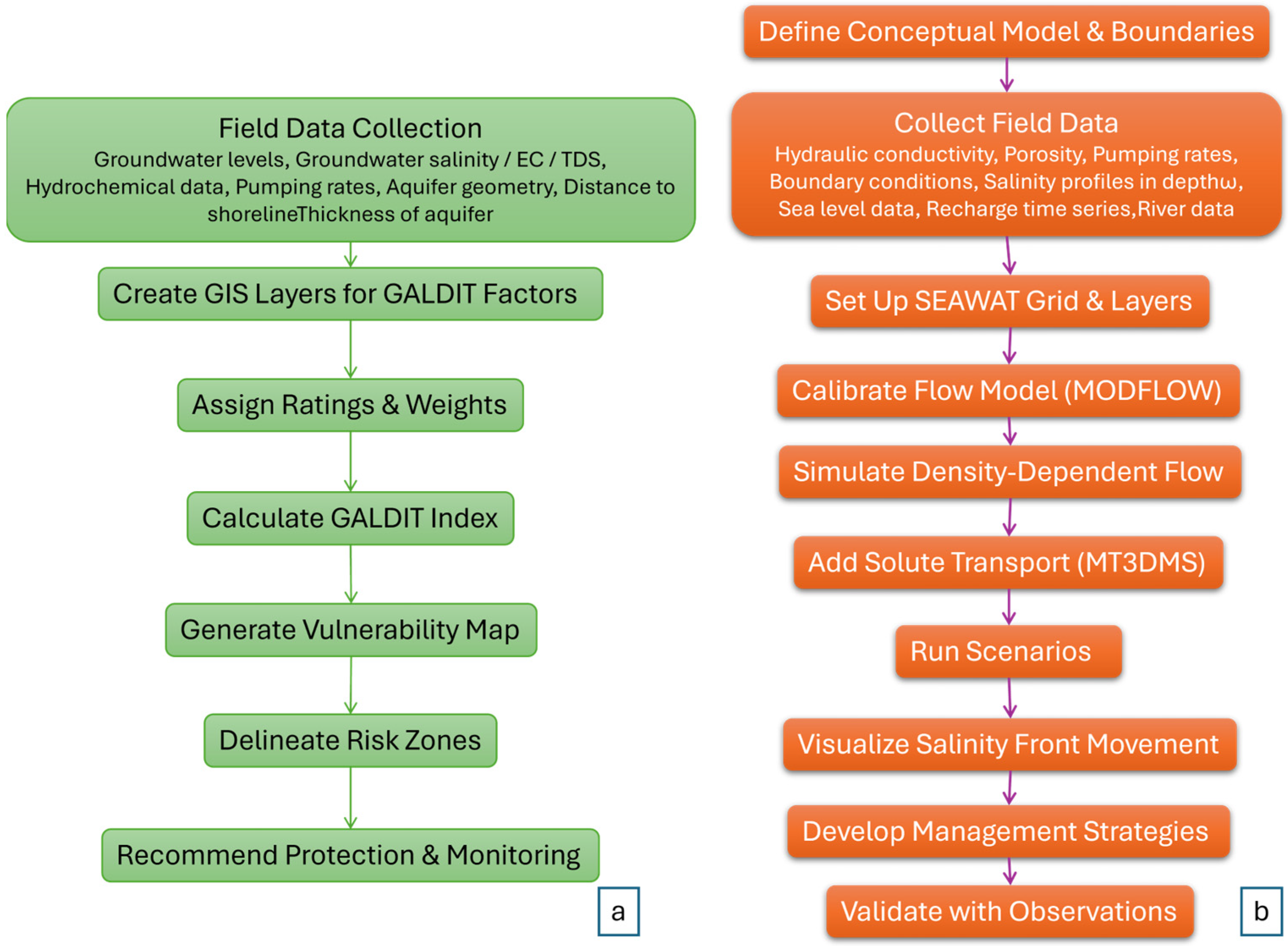
4. The GALDIT Method
4.1. Description and Application
4.2. Parameter-Modified Variants of GALDIT
- GAPDIT replaces L with P (pumping rate), more accurate in regions with intensive groundwater extraction [38].
- GALDIT-i adds hydraulic gradient (i), improving correlation with EC and TDS and enhancing the link to water quality data [42].
- GAiDIT replaces the parameter L (groundwater level above sea level) with the hydraulic gradient i, improving performance in heavily pumped coastal aquifers [42].
- GALDITE incorporates parameter E (groundwater exploitation), incorporating the effect of over-pumping [43].
- GALDITMW adds M (porous medium/grain size) and W (well density), relating vulnerability to aquifer texture and well distribution [44].
- M-GALDIT replaces parameter I with groundwater quality index (GQISWI), making it appropriate when intensive monitoring data are available [45].
4.3. Dynamic and Temporal Approaches to GALDIT
4.4. Optimization and Machine Learning Approaches for GALDIT
4.5. Coupling with Process-Based Models
4.6. Hybrid Approaches Combining GALDIT with Other Indices
4.7. Multi-Criteria and Risk Extensions of GALDIT
5. Numerical Modeling with SEAWAT
5.1. SEAWAT Model Description Applications in Case Studies
5.2. Main Mechanisms and Findings
5.3. Management Measures
5.4. Uncertainties and Limitations
6. Advances and Suggested Improvements to the GALDIT Method
6.1. Methodological Extensions
6.2. Climate and Dynamic Factors
6.3. Data and Monitoring Improvements
6.4. Integration with New Tools
7. Suggestions for Improving the Application SEAWAT Model
7.1. Geological and Hydrogeological Data Needs
7.2. Model Development and Calibration
7.3. Monitoring and Long-Term Data
8. Similarities and Differences Between GALDIT and SEAWAT Models
9. Discussion
10. Future Challenges
11. Conclusions
Supplementary Materials
Author Contributions
Funding
Data Availability Statement
Conflicts of Interest
Abbreviations
| AHP | Analytic Hierarchy Process |
| AVI | Aquifer Vulnerability Index |
| DRASTIC | Depth to water D, Recharge R, Aquifer media A, Soil media S, Topography T, Impact of vadose zone I, Hydraulic conductivity C |
| EC | Electrical Conductivity |
| GAiDIT | Modified GALDIT index replacing parameter L with hydraulic gradient i |
| GALDIT | Groundwater occurrence G, Aquifer hydraulic conductivity A, Level of groundwater above sea L, Distance from shore D, Impact of intrusion I, Thickness of aquifer T |
| GALDIT-i | Variant of GALDIT incorporating hydraulic gradient i |
| GALDITE | Modified GALDIT including groundwater extraction E parameter |
| GAPDIT | GALDIT with adjusted parameterization for pumping conditions |
| GQISWI | Groundwater Quality Index for Seawater Intrusion |
| ILDRT | Integrated Level of Dependency and Risk Task method |
| MAR | Managed Aquifer Recharge |
| MODFLOW | Modular Finite-Difference Groundwater Flow Model |
| MT3DMS | Modular Three-Dimensional Multi-Species Transport Model |
| SEAWAT | Numerical model coupling MODFLOW and MT3DMS for variable-density groundwater flow |
| SWI | Seawater Intrusion |
| TDS | Total Dissolved Solids |
| WQI | Water Quality Index |
References
- Zagana, E.; Papailiopoulou, M.; Mylonas, A.; Giannakea, A.M.; Pouliaris, C. Cross Comparison of GALDIT Method Application in Three Costal Aquifers in Greece. Water 2024, 16, 3093. [Google Scholar] [CrossRef]
- Idowu, T.E.; Jepkosgei, C.; Nyadawa, M.; Korowe, M.O.; Waswa, R.M.; Lasisi, K.H.; Kiplangat, N.; Munyi, J.; Ajibade, F.O. Integrated Seawater Intrusion and Groundwater Quality Assessment of a Coastal Aquifer: GALDIT, Geospatial and Analytical Approaches. Environ. Sci. Pollut. Res. 2022, 29, 36699–36720. [Google Scholar] [CrossRef]
- Vadiati, M.; Adamowski, J.; Beynaghi, A. A Brief Overview of Trends in Groundwater Research: Progress towards Sustainability? J. Environ. Manag. 2018, 223, 849–851. [Google Scholar] [CrossRef]
- Saidi, S.; Bouri, S.; Dhia, H.B. Groundwater Management Based on GIS Techniques, Chemical Indicators and Vulnerability to Seawater Intrusion Modelling: Application to the Mahdia–Ksour Essaf Aquifer, Tunisia. Environ. Earth Sci. 2013, 70, 1551–1568. [Google Scholar] [CrossRef]
- Bouderbala, A.; Remini, B.; Saaed Hamoudi, A.; Pulido-Bosch, A. Assessment of Groundwater Vulnerability and Quality in Coastal Aquifers: A Case Study (Tipaza, North Algeria). Arab. J. Geosci. 2016, 9, 181. [Google Scholar] [CrossRef]
- Azizi, F.; Vadiati, M.; Asghari Moghaddam, A.; Nazemi, A.; Adamowski, J. A Hydrogeological-Based Multi-Criteria Method for Assessing the Vulnerability of Coastal Aquifers to Saltwater Intrusion. Environ. Earth Sci. 2019, 78, 548. [Google Scholar] [CrossRef]
- Kim, I.H.; Chung, I.-M.; Chang, S.W. Development of Seawater Intrusion Vulnerability Assessment for Averaged Seasonality of Using Modified GALDIT Method. Water 2021, 13, 1820. [Google Scholar] [CrossRef]
- Abd-Elhamid, H.F.; Javadi, A.A. A Density-Dependant Finite Element Model for Analysis of Saltwater Intrusion in Coastal Aquifers. J. Hydrol. 2011, 401, 259–271. [Google Scholar] [CrossRef]
- Tomaszkiewicz, M.; Abou Najm, M.; El-Fadel, M. Development of a Groundwater Quality Index for Seawater Intrusion in Coastal Aquifers. Environ. Model. Softw. 2014, 57, 13–26. [Google Scholar] [CrossRef]
- Capaccioni, B.; Didero, M.; Paletta, C.; Didero, L. Saline Intrusion and Refreshening in a Multilayer Coastal Aquifer in the Catania Plain (Sicily, Southern Italy): Dynamics of Degradation Processes According to the Hydrochemical Characteristics of Groundwaters. J. Hydrol. 2005, 307, 1–16. [Google Scholar] [CrossRef]
- Milnes, E.; Renard, P. The Problem of Salt Recycling and Seawater Intrusion in Coastal Irrigated Plains: An Example from the Kiti Aquifer (Southern Cyprus). J. Hydrol. 2004, 288, 327–343. [Google Scholar] [CrossRef]
- Mondal, N.C.; Singh, V.P.; Singh, V.S.; Saxena, V.K. Determining the Interaction between Groundwater and Saline Water through Groundwater Major Ions Chemistry. J. Hydrol. 2010, 388, 100–111. [Google Scholar] [CrossRef]
- Nadiri, A.A.; Bordbar, M.; Nikoo, M.R.; Silabi, L.S.S.; Senapathi, V.; Xiao, Y. Assessing Vulnerability of Coastal Aquifer to Seawater Intrusion Using Convolutional Neural Network. Mar. Pollut. Bull. 2023, 197, 115669. [Google Scholar] [CrossRef]
- Mahesha, A.; Vyshali Lathashri, U.A.; Ramesh, H. Parameter Estimation and Vulnerability Assessment of Coastal Unconfined Aquifer to Saltwater Intrusion. J. Hydrol. Eng. 2012, 17, 933–943. [Google Scholar] [CrossRef]
- Chandrajith, R.; Chaturangani, D.; Abeykoon, S.; Barth, J.A.C.; Van Geldern, R.; Edirisinghe, E.A.N.V.; Dissanayake, C.B. Quantification of Groundwater–Seawater Interaction in a Coastal Sandy Aquifer System: A Study from Panama, Sri Lanka. Environ. Earth Sci. 2013, 72, 867–877. [Google Scholar] [CrossRef]
- Han, D.; Post, V.E.A.; Song, X. Groundwater Salinization Processes and Reversibility of Seawater Intrusion in Coastal Carbonate Aquifers. J. Hydrol. 2015, 531, 1067–1080. [Google Scholar] [CrossRef]
- Shin, K.; Koh, D.-C.; Jung, H.; Lee, J. The Hydrogeochemical Characteristics of Groundwater Subjected to Seawater Intrusion in the Archipelago, Korea. Water 2020, 12, 1542. [Google Scholar] [CrossRef]
- Chandrajith, R.; Bandara, U.G.C.; Diyabalanage, S.; Senaratne, S.; Barth, J.A.C. Application of Water Quality Index as a Vulnerability Indicator to Determine Seawater Intrusion in Unconsolidated Sedimentary Aquifers in a Tropical Coastal Region of Sri Lanka. Groundw. Sustain. Dev. 2022, 19, 100831. [Google Scholar] [CrossRef]
- Chachadi, A.G.; Lobo-Ferreira, J.-P. Sea Water Intrusion Vulnerability Mapping of Aquifers Using the GALDIT Method. Coastin—A Coast. Policy Res. Newsl. 2001, 4, 7–9. [Google Scholar]
- Stempvoort, D.V.; Ewert, L.; Wassenaar, L. Aquifer Vulnerability Index: A GIS—Compatible Method for Groundwater Vulnerability Mapping. Can. Water Resour. J. 1993, 18, 25–37. [Google Scholar] [CrossRef]
- Aller, L.; Lehr, J.H.; Petty, R.; Bennett, T. Drastic: A Standardized System to Evaluate Groundwater Pollution Potential Using Hydrogeologic Setting. J. Geol. Soc. India 1987, 29, 23–37. [Google Scholar] [CrossRef]
- Doerfliger, N.; Jeannin, P.-Y.; Zwahlen, F. Water Vulnerability Assessment in Karst Environments: A New Method of Defining Protection Areas Using a Multi-Attribute Approach and GIS Tools (EPIK Method). Environ. Geol. 1999, 39, 165–176. [Google Scholar] [CrossRef]
- Goldscheider, N. Karst Groundwater Vulnerability Mapping: Application of a New Method in the Swabian Alb, Germany. Hydrogeol. J. 2002, 13, 555–564. [Google Scholar] [CrossRef]
- Busico, G.; Kazakis, N.; Cuoco, E.; Colombani, N.; Tedesco, D.; Voudouris, K.; Mastrocicco, M. A Novel Hybrid Method of Specific Vulnerability to Anthropogenic Pollution Using Multivariate Statistical and Regression Analyses. Water Res. 2020, 171, 115386. [Google Scholar] [CrossRef] [PubMed]
- Allouche, N.; Maanan, M.; Gontara, M.; Rollo, N.; Jmal, I.; Bouri, S. A Global Risk Approach to Assessing Groundwater Vulnerability. Environ. Model. Softw. 2017, 88, 168–182. [Google Scholar] [CrossRef]
- Nasri, G.; Hajji, S.; Aydi, W.; Boughariou, E.; Allouche, N.; Bouri, S. Water Vulnerability of Coastal Aquifers Using AHP and Parametric Models: Methodological Overview and a Case Study Assessment. Arab. J. Geosci. 2021, 14, 59. [Google Scholar] [CrossRef]
- Nasiri, M.; Moghaddam, H.K.; Hamidi, M. Development of Multi-Criteria Decision Making Methods for Reduction of Seawater Intrusion in Coastal Aquifers Using SEAWAT Code. J. Contam. Hydrol. 2021, 242, 103848. [Google Scholar] [CrossRef]
- Kayalvizhi, S.; Jiavana, K.F.K.; Suganthi, K.; Malarvizhi, S. Prediction of Ground Water Quality in Western Regions of Tamil Nadu Using Deep Auto Encoders. Urban Clim. 2023, 49, 101458. [Google Scholar] [CrossRef]
- Nadiri, A.A.; Moazamnia, M.; Sadeghfam, S.; Gnanachandrasamy, G.; Venkatramanan, S. Formulating Convolutional Neural Network for Mapping Total Aquifer Vulnerability to Pollution. Environ. Pollut. 2022, 304, 119208. [Google Scholar] [CrossRef]
- Dunlop, G.; Palanichamy, J.; Kokkat, A.; Ej, J.; Palani, S. Simulation of Saltwater Intrusion into Coastal Aquifer of Nagapattinam in the Lower Cauvery Basin Using SEAWAT. Groundw. Sustain. Dev. 2019, 8, 294–301. [Google Scholar] [CrossRef]
- Langevin, C.; Swain, E.; Wolfert, M. Simulation of Integrated Surface-Water/Ground-Water Flow and Salinity for a Coastal Wetland and Adjacent Estuary. J. Hydrol. 2005, 314, 212–234. [Google Scholar] [CrossRef]
- Guo, W.; Langevin, C.D. User’s Guide to SEAWAT: A Computer Program for Simulation of Three-Dimensional Variable-Density Ground-Water Flow; U.S. Geological Survey: Reston, VA, USA, 2002.
- Chang, S.W.; Chung, I.-M.; Kim, M.-G.; Tolera, M.; Koh, G.-W. Application of GALDIT in Assessing the Seawater Intrusion Vulnerability of Jeju Island, South Korea. Water 2019, 11, 1824. [Google Scholar] [CrossRef]
- Alves, R.D.S.; Lucena, L.R.F.D. Numerical Modeling of NE Brazil Coastal Aquifer: Fault Controlled Conduits for Seawater Intrusion. J. S. Am. Earth Sci. 2022, 117, 103872. [Google Scholar] [CrossRef]
- Jayathunga, K.; Diyabalanage, S.; Frank, A.H.; Chandrajith, R.; Barth, J.A.C. Influences of Seawater Intrusion and Anthropogenic Activities on Shallow Coastal Aquifers in Sri Lanka: Evidence from Hydrogeochemical and Stable Isotope Data. Environ. Sci. Pollut. Res. 2020, 27, 23002–23014. [Google Scholar] [CrossRef]
- Yusuf, M.A.; Abiye, T.A.; Ibrahim, K.O.; Ojulari, B.A. Assessment of Saltwater–Freshwater Interactions Using Water Samples and Borehole Logging Information in the Lagos Coastal Region, Nigeria. Environ. Earth Sci. 2021, 80, 679. [Google Scholar] [CrossRef]
- Oumarou Danni, S.; Bouchaou, L.; Elmouden, A.; N’da, B.; Ait Brahim, Y.; Malki, M. Isotopic and Chemical Tracers for the Sustainable Management of Water Resources in Semi-Arid Area: Case of Massa Catchment, Morocco. In Groundwater and Global Change in the Western Mediterranean Area; Calvache, M.L., Duque, C., Pulido-Velazquez, D., Eds.; Environmental Earth Sciences; Springer International Publishing: Cham, Switzerland, 2018; pp. 261–268. ISBN 978-3-319-69355-2. [Google Scholar]
- Gorgij, A.D.; Moghaddam, A.A. Vulnerability Assessment of Saltwater Intrusion Using Simplified GAPDIT Method: A Case Study of Azarshahr Plain Aquifer, East Azerbaijan, Iran. Arab. J. Geosci. 2016, 9, 106. [Google Scholar] [CrossRef]
- Mahrez, B.; Klebingat, S.; Houha, B.; Houria, B. GIS-Based GALDIT Method for Vulnerability Assessment to Seawater Intrusion of the Quaternary Coastal Collo Aquifer (NE-Algeria). Arab. J. Geosci. 2018, 11, 71. [Google Scholar] [CrossRef]
- Barzegar, R.; Razzagh, S.; Quilty, J.; Adamowski, J.; Kheyrollah Pour, H.; Booij, M.J. Improving GALDIT-Based Groundwater Vulnerability Predictive Mapping Using Coupled Resampling Algorithms and Machine Learning Models. J. Hydrol. 2021, 598, 126370. [Google Scholar] [CrossRef]
- Bordbar, M.; Neshat, A.; Javadi, S. Modification of the GALDIT Framework Using Statistical and Entropy Models to Assess Coastal Aquifer Vulnerability. Hydrol. Sci. J. 2019, 64, 1117–1128. [Google Scholar] [CrossRef]
- Parizi, E.; Hosseini, S.M.; Ataie-Ashtiani, B.; Simmons, C.T. Vulnerability Mapping of Coastal Aquifers to Seawater Intrusion: Review, Development and Application. J. Hydrol. 2019, 570, 555–573. [Google Scholar] [CrossRef]
- Lima, V.H.S.; Fernandes, L.F.S.; Moura, J.P.; Oliveira, M.D.D.; Akabassi, L.; Pacheco, F.A.L. A Framework for Analyzing Seawater Intrusion in Coastal Areas: An Adapted GALDIT Model Application for Espírito Santo, Brazil. Case Stud. Chem. Environ. Eng. 2024, 10, 100887. [Google Scholar] [CrossRef]
- Faal, F.; Nikoo, M.R.; Ashrafi, S.M.; Šimůnek, J. Advancing Aquifer Vulnerability Mapping through Integrated Deep Learning Approaches. J. Clean. Prod. 2024, 481, 144112. [Google Scholar] [CrossRef]
- Goswami, S.; Rai, A.K. Identifying Intrusion of Seawater in Coastal Aquifers by Modified GALDIT (M-GALDIT) Index. Groundw. Sustain. Dev. 2024, 25, 101173. [Google Scholar] [CrossRef]
- Santha Sophiya, M.; Syed, T.H. Assessment of Vulnerability to Seawater Intrusion and Potential Remediation Measures for Coastal Aquifers: A Case Study from Eastern India. Environ. Earth Sci. 2013, 70, 1197–1209. [Google Scholar] [CrossRef]
- Ez-zaouy, Y.; Bouchaou, L.; Hssaisoune, M.; Aangri, A.; Busico, G.; Danni, S.O.; Attar, O.; Nehmadou, M.; Saad, A.; Brahim, Y.A. Groundwater Vulnerability and, Risk Assessment of Seawater Intrusion for the Development of a Strategy Plan towards Sustainability: Case of the Souss-Massa Coastal Area, Morocco. J. Hydrol. Reg. Stud. 2025, 57, 102128. [Google Scholar] [CrossRef]
- Kazakis, N.; Busico, G.; Colombani, N.; Mastrocicco, M.; Pavlou, A.; Voudouris, K. GALDIT-SUSI a Modified Method to Account for Surface Water Bodies in the Assessment of Aquifer Vulnerability to Seawater Intrusion. J. Environ. Manag. 2019, 235, 257–265. [Google Scholar] [CrossRef] [PubMed]
- Kazakis, N.; Spiliotis, M.; Voudouris, K.; Pliakas, F.-K.; Papadopoulos, B. A Fuzzy Multicriteria Categorization of the GALDIT Method to Assess Seawater Intrusion Vulnerability of Coastal Aquifers. Sci. Total Environ. 2018, 621, 524–534. [Google Scholar] [CrossRef]
- Abd-Elaty, I.; Ahmed, A. Would Mixed Physical Barriers Be Able to Desalinate Coastal Aquifers from Seawater Intrusion under Pumping Conditions? Groundw. Sustain. Dev. 2025, 29, 101424. [Google Scholar] [CrossRef]
- Siarkos, I.; Mallios, Z.; Tzoraki, O.; Latinopoulos, P. A Methodological Framework for the Optimal Design of Injection Barriers against Seawater Intrusion in Coastal-Rural Regions. Sci. Total Environ. 2025, 966, 178679. [Google Scholar] [CrossRef] [PubMed]
- Abd-Elaty, I.; Abdoulhalik, A.; Ahmed, A. The Impact of Future Hydrology Stresses and Climate Change on Submarine Groundwater Discharge in Arid Regions: A Case Study of the Nile Delta Aquifer, Egypt. J. Hydrol. Reg. Stud. 2023, 47, 101395. [Google Scholar] [CrossRef]
- Abd-Elaty, I.; Sallam, G.A.H.; Pugliese, L.; Negm, A.M.; Straface, S.; Scozzari, A.; Ahmed, A. Managing Coastal Aquifer Salinity under Sea Level Rise Using Rice Cultivation Recharge for Sustainable Land Cover. J. Hydrol. Reg. Stud. 2023, 48, 101466. [Google Scholar] [CrossRef]
- Elkhedr, M.; Abdelhalim, A. Sustainable Desalination at Coastal Zones: Study on Abstraction Rate, Salinity and Depth at Coastal Aquifers, Case Study: Coastal Nile Delta Aquifer, Egypt. Alex. Eng. J. 2025, 115, 177–200. [Google Scholar] [CrossRef]
- Yang, H.; Sun, H.; Liu, T.; Yang, X.; Yang, F.; Jiao, J. Characterization of Seawater Intrusion Based on Machine Learning and Implications for Offshore Management under Shared Socioeconomic Paths. J. Hydrol. 2023, 623, 129862. [Google Scholar] [CrossRef]
- Yang, H.; Yang, T.; Yang, F.; Yang, X. Assessment of Groundwater Salinization Impact in Coastal Aquifers Based on the Shared Socioeconomic Pathways: An Integrated Modeling Approach. Environ. Res. 2023, 234, 116618. [Google Scholar] [CrossRef]
- Janardhana, M.R.; Khairy, H. Simulation of Seawater Intrusion in Coastal Aquifers: A Case Study on the Amol–Ghaemshahr Coastal Aquifer System, Northern Iran. Environ. Earth Sci. 2019, 78, 695. [Google Scholar] [CrossRef]
- Pham, Q.-N.; Nguyen, T.-C.; Ta, T.-T.; Tran, T.-L. Comprehensive Approach to Sustainable Groundwater Management in Semi-Arid Ninh Thuan Plain, Vietnam. Groundw. Sustain. Dev. 2023, 23, 101031. [Google Scholar] [CrossRef]
- Elhazek, A.; Abdelmageed, N.; El Belasy, A.; Amin, D. Groundwater Modeling for Seawater Intrusion Simulation in Coastal Aquifers in Ain Sukhna, Egypt. Eng. Res. J. 2024, 53, 212–219. [Google Scholar] [CrossRef]
- Chang, Y.; Hu, B.X.; Xu, Z.; Li, X.; Tong, J.; Chen, L.; Zhang, H.; Miao, J.; Liu, H.; Ma, Z. Numerical Simulation of Seawater Intrusion to Coastal Aquifers and Brine Water/Freshwater Interaction in South Coast of Laizhou Bay, China. J. Contam. Hydrol. 2018, 215, 1–10. [Google Scholar] [CrossRef]
- Motevalli, A.; Moradi, H.R.; Javadi, S. A Comprehensive Evaluation of Groundwater Vulnerability to Saltwater Up-Coning and Sea Water Intrusion in a Coastal Aquifer (Case Study: Ghaemshahr-Juybar Aquifer). J. Hydrol. 2018, 557, 753–773. [Google Scholar] [CrossRef]
- Jafarzadeh, F.; Asghari Moghaddam, A.; Razzagh, S.; Barzegar, R.; Cloutier, V.; Rosa, E. A Meta-Ensemble Machine Learning Strategy to Assess Groundwater Holistic Vulnerability in Coastal Aquifers. Groundw. Sustain. Dev. 2024, 26, 101296. [Google Scholar] [CrossRef]
- El-Said Salem, Z.; Arafa, N.A.; Abdeldayem, A.L.; Youssef, Y.M. Machine Learning-Enhanced GALDIT Modeling for the Nile Delta Aquifer Vulnerability Assessment in the Mediterranean Region. Groundw. Sustain. Dev. 2025, 28, 101403. [Google Scholar] [CrossRef]
- Mansour, A.Y.S.; Baba, A.; Gunduz, O.; Şimşek, C.; Elçi, A.; Murathan, A.; Sözbilir, H. Modeling of Seawater Intrusion in a Coastal Aquifer of Karaburun Peninsula, Western Turkey. Environ. Earth Sci. 2017, 76, 775. [Google Scholar] [CrossRef]
- Gopinath, S.; Srinivasamoorthy, K.; Saravanan, K.; Suma, C.S.; Prakash, R.; Senthilnathan, D.; Chandrasekaran, N.; Srinivas, Y.; Sarma, V.S. Modeling Saline Water Intrusion in Nagapattinam Coastal Aquifers, Tamilnadu, India. Model. Earth Syst. Environ. 2016, 2, 2. [Google Scholar] [CrossRef]
- Nofal, E.R.; Amer, M.A.; El-Didy, S.M.; Fekry, A.M. Delineation and Modeling of Seawater Intrusion into the Nile Delta Aquifer: A New Perspective. Water Sci. 2015, 29, 156–166. [Google Scholar] [CrossRef]
- Boufekane, A.; Maizi, D.; Madene, E.; Busico, G.; Zghibi, A. Hybridization of GALDIT Method to Assess Actual and Future Coastal Vulnerability to Seawater Intrusion. J. Environ. Manag. 2022, 318, 115580. [Google Scholar] [CrossRef]
- Gaiolini, M.; Ofori, A.; Postacchini, M.; Mastrocicco, M.; Colombani, N. Model Based Quantification of Salinization Dynamics under Changing Hydrological Conditions in the Volturno River (Italy) Coastal Aquifer. J. Hydrol. 2025, 660, 133395. [Google Scholar] [CrossRef]
- Gharekhani, M.; Reza Nikoo, M.; Allah Nadiri, A.; Al-Rawas, G.; Sana, A.; Gandomi, A.H.; Nematollahi, B.; Senapathi, V. A new approach for assessing the assembled vulnerability of coastal aquifers based on optimization models. J. Hydrol. 2023, 625, 130084. [Google Scholar] [CrossRef]
- Huang, P.; Hou, M.; Sun, T.; Xu, H.; Ma, C.; Zhou, A. Sustainable groundwater management in coastal cities: Insights from groundwater potential and vulnerability using ensemble learning and knowledge-driven models. J. Cleaner Prod. 2024, 442, 141152. [Google Scholar] [CrossRef]
- Mokhtar, M.E.; Chibout, M.; Mansouri, B.E.; Chao, J.; Kili, M.; El Kanti, S.M. Modeling of the Groundwater Flow and Saltwater Intrusion in the Coastal Aquifer of Fum Al Wad, Province of Laayoun, Morocco. Int. J. Geosci. 2018, 09, 71–92. [Google Scholar] [CrossRef]
- Al Taliby, W.; Pandit, A.; Heck, H. Comparison of Seepage Simulation in a Saline Environment below an Estuary Using MODFLOW and SEAWAT. Hydrol. Current Res. 2017, 08. [Google Scholar] [CrossRef]
- Lyu, P.; Song, J.; Yin, Z.; Wu, J.; Wu, J. Integrated SEAWAT model and GALDIT method for dynamic vulnerability assessment of coastal aquifer to seawater intrusion. Sci. Total Environ. 2024, 925, 171740. [Google Scholar] [CrossRef] [PubMed]
- Xiao, H.; Zhang, Z.; Tang, Y.; Li, H.; Tang, Q. Numerical modeling for determination of the dominant factor inducing saltwater intrusion into shallow aquifer in the Mekong River Estuary within the Mekong Delta, Vietnam. Sustain. Horiz. 2024, 12, 100111. [Google Scholar] [CrossRef]



| Feature | GALDIT | SEAWAT |
|---|---|---|
| Method Type | Index-based, parametric | Numerical, process-based |
| Purpose | Assess static vulnerability zones to seawater intrusion | Create a dynamic simulation of salinity transport and groundwater movement over time and space. |
| Key Parameters | Six hydrogeological parameters (G, A, L, D, I, T) | Full hydrogeological dataset: hydraulic conductivity, storativity, porosity, salinity, boundary conditions, etc. |
| Advantages | Low data requirements, quick and simple application, appropriate for areas with limited data, applied with GIS | High reliability, high realism, dynamic and predictive, and supportive of scenario analysis |
| Output | Static vulnerability map | Dynamic flow and salinity simulation |
| Limitations | Only offers subjective parameter weights and static assessments, it ignores changes over time. | Requires a large amount of high-quality input data, the calibration process is difficult and computationally demanding. |
| Recommended Use | Quick evaluation, first screening, and initial risk mapping | Comprehensive planning and management; assessment of control strategies, complex coastal aquifers |
| Best use | Screening and zoning | Detailed planning, scenarios |
| Benefit of Combination | Provides spatial zoning to guide targeted SEAWAT simulations | Validates and refines GALDIT maps with dynamic outputs |
| Typical Tools | GIS software (e.g., ArcGIS Pro 3.1., QGIS 3.34) | USGS SEAWAT, often coupled with MODFLOW and MT3DMS, various GUIs |
| Applications | Coastal areas, small unconfined aquifers | Large coastal systems with intensive pumping, climate change projections |
Disclaimer/Publisher’s Note: The statements, opinions and data contained in all publications are solely those of the individual author(s) and contributor(s) and not of MDPI and/or the editor(s). MDPI and/or the editor(s) disclaim responsibility for any injury to people or property resulting from any ideas, methods, instructions or products referred to in the content. |
© 2025 by the authors. Licensee MDPI, Basel, Switzerland. This article is an open access article distributed under the terms and conditions of the Creative Commons Attribution (CC BY) license.
Share and Cite
Papailiopoulou, M.; Zagana, E.; Pouliaris, C.; Kazakis, N. Applications of Vulnerability Assessment and Numerical Modelling for Seawater Intrusion in Coastal Aquifers: An Overview. Water 2026, 18, 19. https://doi.org/10.3390/w18010019
Papailiopoulou M, Zagana E, Pouliaris C, Kazakis N. Applications of Vulnerability Assessment and Numerical Modelling for Seawater Intrusion in Coastal Aquifers: An Overview. Water. 2026; 18(1):19. https://doi.org/10.3390/w18010019
Chicago/Turabian StylePapailiopoulou, Maria, Eleni Zagana, Christos Pouliaris, and Nerantzis Kazakis. 2026. "Applications of Vulnerability Assessment and Numerical Modelling for Seawater Intrusion in Coastal Aquifers: An Overview" Water 18, no. 1: 19. https://doi.org/10.3390/w18010019
APA StylePapailiopoulou, M., Zagana, E., Pouliaris, C., & Kazakis, N. (2026). Applications of Vulnerability Assessment and Numerical Modelling for Seawater Intrusion in Coastal Aquifers: An Overview. Water, 18(1), 19. https://doi.org/10.3390/w18010019