Next Article in Journal
Correction: Jia et al. Impact of Water pH and Cultivar on Lettuce Growth, Water Use Efficiency, and Nutrient Use Efficiency in Deep Water Culture Systems. Water 2025, 17, 2637
Previous Article in Journal
Multi-Factor Driving Force Analysis of Soil Salinization in Desert–Oasis Regions Using Satellite Data
error_outline You can access the new MDPI.com website here. Explore and share your feedback with us.
 
 
Article

Numerical Study on the Permeability Evolution Within Fault Damage Zones

1
College of Safety and Environmental Engineering, Shandong University of Science and Technology, Qingdao 266590, China
2
Zuoquan Wulihou Coal Industry Co., Ltd., Shanxi Lu’ an Group, Jinzhong 030600, China
*
Author to whom correspondence should be addressed.
Water 2026, 18(1), 134; https://doi.org/10.3390/w18010134
Submission received: 19 October 2025 / Revised: 8 December 2025 / Accepted: 18 December 2025 / Published: 5 January 2026
(This article belongs to the Topic Human Impact on Groundwater Environment, 2nd Edition)

Abstract

This study investigates the permeability evolution in floor fault damage zones under stress–seepage–damage coupling, with a focus on water inrush risks caused by confined water upward conduction during deep mining. A stochastic fracture geometry model of the fault damage zone was developed using the discrete fracture network (DFN) model and the Monte Carlo method. Based on geological data from a mining area in Shandong, a multiphysics-coupled numerical model under mining-induced conditions was established with COMSOL Multiphysics. The simulations visually reveal the dynamic evolution of damage propagation patterns in the floor strata during working face advancement. Results indicate that the damage zone stabilizes after the working face advances to 80 m, with its morphology exhibiting strong spatial correlation to regions of high seepage velocity. Moreover, increasing confined water pressure plays a critical role in driving flow field evolution.

1. Introduction

With the gradual depletion of shallow coal resources, mining depths in China continue to increase, leading to the exploitation of deeper, lower coal seams situated in complex geological environments characterized by high in situ stresses and elevated water pressure [1]. Furthermore, the presence of structural discontinuities, such as faults and collapse columns, renders floor water inrush a significant threat to mining safety [2,3,4,5]. Among these, fault structures and their associated damage zones act as preferential pathways for the upward flow of confined water [6]. These zones are highly susceptible to reactivation and enhanced seepage under the coupled influence of mining-induced stresses and high water pressure, significantly amplifying the risk of water inrush. Therefore, investigating the evolution of permeability within fault zones under the coupled effects of stress, seepage, and damage during mining is of paramount importance for a fundamental understanding of water inrush mechanisms and for the advancement of predictive theories and mitigation technologies.
Macro- and micro-defect structures, such as pores and fractures, are ubiquitously present within rock masses [7,8], exerting a considerable influence on their mechanical strength and stability. Conventional continuum mechanics theories exhibit significant limitations in characterizing the initiation, propagation, and interconnection behaviors of numerous discrete fractures within rock masses [9]. In recent years, the discrete fracture network (DFN) model, grounded in stochastic theory, has been increasingly employed to address seepage problems in fractured rock masses [10]. This approach utilizes the Monte Carlo method to generate stochastic fracture systems that adhere to geostatistical principles, thereby providing a more realistic representation of the heterogeneity, anisotropy, and connectivity of fractures within fault zones. He et al. [11] applied a dual-field iteration method to investigate the coupled seepage and stress fields in fractured rock masses. Wang et al. [12] developed a two-dimensional DFN model using the discrete element software Universal Distinct Element Code (UDEC) based on the Monte Carlo method and computed the permeability characteristics of the rock mass fracture network under linearly applied boundary conditions. Chen et al. [13] employed an integrated approach combining geological modeling with a DFN model. Through numerical simulations, they systematically examined the influence of fracture network penetration depth, mechanical parameters of fracture surfaces, and the number of intersecting fractures on slope stability mechanisms.
During the seepage process, the stress exerted by fluid flow perturbs the original stress field within the rock mass, leading to its redistribution. This alteration in the stress field, in turn, induces the deformation and propagation of pre-existing fractures, thereby modifying their hydraulic conductivity and resulting in a subsequent redistribution of the seepage field. This phenomenon of mutual interaction and influence between stress and seepage is referred to as stress–seepage coupling [14]. While current research on DFN primarily focuses on stress–seepage coupling processes, the stress field in rock masses often undergoes dramatic changes under mining-induced disturbances. This not only causes elastic deformation of fractures but also promotes the extension and coalescence of pre-existing fractures, as well as the initiation of new ones—a process fundamentally characterized as rock damage. The evolution of such damage substantially compromises the rock mass’s ability to impede water flow, an effect that cannot be adequately captured by stress–seepage coupling analysis alone. Consequently, a damage variable is introduced to quantify the extent of rock failure, enabling the establishment of a comprehensive multi-field coupling model that integrates the stress field, seepage field, and damage evolution—namely, the “stress–seepage–damage” coupling model.
Faults, as fractured geological structures, serve as potential preferential pathways for water inrush between confined aquifers (such as the Ordovician limestone aquifer) and mining excavations [15]. Sun et al. [16] derived a mathematical model for abrupt changes in permeability coefficient under the influence of stress and water pressure based on the Mohr–Coulomb and maximum tensile stress criteria, incorporating it into the numerical simulation software FLAC3D to simulate fault activation-induced water inrush. Bian et al. [17] analyzed the coupling effects of stress field, displacement field, seepage field, and failure zone in surrounding rock under various fault geometries (dip angle, width) and water pressure conditions, revealing the relationship between water inrush risk and fault geometric parameters. An et al. [18] established a fluid–solid coupling model considering particle erosion to simulate the transport and loss of fillings within faults and the evolution of permeability, uncovering the disaster mechanism whereby erosion leads to the formation of preferential flow channels and subsequent water inrush. Feng et al. [19] analyzed variations in shear stress, plastic zone, and water inflow during the mining process of concealed small faults, revealing their characteristics of delayed water inrush and the influence of water pressure on the connectivity of water-conducting channels. The fault damage zone is a complex geological modification region formed in the rock mass on both sides of the main fault plane under tectonic stress, characterized by a dual structure comprising a fractured zone and a high-density fracture zone, differentiated by the degree of rock failure. The fractured zone, consisting of cataclasites such as fault gouge and breccia, exhibits significant heterogeneity. Its permeability is governed by the spatial distribution of clay content; when the proportion of clay cement exceeds 30%, the permeability can decrease by 2–3 orders of magnitude, forming a localized seepage barrier. Conversely, preferential flow paths may develop in areas with lower clay content. The fracture zone, serving as a transition between the fractured zone and the intact bedrock, contains a network of tensile fractures. The permeability anisotropy in this zone is controlled by the coupling between fracture orientation and the in situ stress field, with the maximum permeability direction typically forming a specific angle with the principal stress axis. While traditional fault water inrush models predominantly focus on the upward conduction of Ordovician confined water through the fault interior or the influence of fractures on the flow state of confined water, this study builds upon previous research by incorporating the Fault Damage Zone into numerical simulations. This approach enables a more realistic representation of the dynamic process of fault activation and water inrush channel formation under the combined effects of mining-induced stress, confined water pressure in the floor strata, and damage in the surrounding rock, thereby offering a more realistic framework for analyzing water inrush mechanisms.
Numerical simulation provides a fundamental methodology for analyzing coupled stress–seepage–damage processes in geotechnical contexts [20]. Available numerical platforms exhibit distinct theoretical foundations and application ranges: FLAC3D adopts the finite-difference approach to model nonlinear deformation and stability in geomaterials [21]; 3DEC (Three-Dimensional Distinct Element Code) employs the discrete element method to capture discontinuous deformation and failure in jointed rock masses [22]; ABAQUS (version 2021)and ANSYS (version 2019)are frequently chosen for problems involving complex structural mechanics and computational fluid dynamics [23]. Given the need to embed governing equations within a unified multiphysics framework, the present work utilizes COMSOL Multiphysics 6.0, a finite element-based environment that offers native interfaces for coupling multiple physical fields. The software further supports user-defined equations, enabling the direct implementation of constitutive relations with damage variables and permeability evolution laws.
This study presents a novel integration of the DFN model with fault damage zone characterization to examine the role of stochastic fractures in damage propagation and seepage field evolution near fault zones. Using geological data from a coal mine in Shandong, a stochastic fracture network model of the fault damage zone was generated through Monte Carlo simulation. A coupled stress–seepage–damage numerical model was implemented within the COMSOL Multiphysics platform. The investigation systematically characterizes the evolution of the floor damage zone and stress field during working face advancement, together with seepage field responses to different confined water pressures. The analysis aims to clarify the mechanisms governing seepage pathway development and water inrush initiation in fault zones under mining conditions from a multiphysics perspective, establishing a theoretical basis for preventing and controlling water hazards in coal mine floors.

2. Materials and Methods

2.1. Discrete Fracture Network Model

Given the stochastic and uncertain nature of fracture distribution within natural rock masses, the DFN model is introduced to investigate the fracture system. This model conceptualizes the fracture network as being randomly generated based on statistical methods, where its key attributes—including spatial location, trace length, aperture, orientation, and density—are governed by probability distribution functions.

2.2. Fundamentals of the Monte Carlo Method

The procedure for generating a stochastic fracture network using the Monte Carlo method involves the following steps:

2.2.1. Generation of Uniformly Distributed Random Numbers

A sequence of random numbers uniformly distributed over the interval [ a , b ] is generated using the linear congruential method. This method is based on the principle that if two integers a and b yield the same remainder when divided by a positive integer m , then a and b are congruent modulo m , denoted as a b   ( mod   m ) . The computational procedure is as follows:
x i + 1 = ( a · x i + c )   mod   m
ξ i + 1 = x i + 1 m
where x i is the i t h random variable, a is the multiplier, c is the increment, m is the modulus, and x 0 is the initial value (seed) of the random number sequence.

2.2.2. Transformation to Target Distribution Random Numbers

Uniformly distributed random numbers ξ generated by Equation (1) are transformed into random numbers following a target probability distribution through mathematical operations. Taking the uniform distribution as an example, for a uniform distribution over the interval  [ a , b ] , the probability density function is as follows:
f ( x ) = 1 b a ( a x b )
The corresponding random number generation formula is achieved via linear transformation:
x r = a + ( b a ) · ξ ( ξ [ 0 , 1 ] )
where ξ is the generated uniform random number in [ 0 , 1 ] , and a and b are the lower and upper bounds, respectively, of the target distribution interval.
Based on the research content of this paper, the following assumptions are made regarding random fractures within the fault damage zone:
1.
The geometric parameters of fractures in the fracture network studied in this paper include: major semi-axis length and minor semi-axis length of the ellipse, fracture density, fracture dip angle, and coordinates of the fracture center point.
2.
The major semi-axis length of the ellipse reflects the spatial extent of fracture propagation, while the minor semi-axis length characterizes the fracture aperture.
3.
Fractures in the network are mathematically described by the elliptical equation:
( x X 0 ) cos θ + ( y Y 0 ) sin θ 2 a 2 + - ( x X 0 ) sin θ + ( y Y 0 ) cos θ 2 b 2 = 1
4.
The total number of fractures is determined by multiplying the area of the generation domain by the fracture density.
5.
If a generated fracture extends partially beyond the study domain boundary, the portion outside the boundary is truncated. Fractures lying entirely outside the study domain boundary are discarded from the model.

2.2.3. Determination of Geometric Parameters for the Fracture Network Model

Research [24] demonstrates that fracture center coordinates follow a uniform distribution, while fracture propagation extent and aperture each conform to either a negative exponential or log-normal distribution. Fracture dip angle follows a normal or log-normal distribution, and fracture density adheres to a negative exponential distribution. The generation of a two-dimensional fracture network requires determining parameters, including propagation extent, aperture, dip angle, and density. The specific procedure involves calculating the number of fractures by multiplying the generation domain area by fracture density, generating uniformly distributed random numbers within the interval, and then applying direct sampling based on each parameter’s probability distribution function to assign corresponding values to each fracture. Based on geological and hydrogeological parameters combined with borehole data from the Shandong mining area, the analysis yields the following fracture distribution parameters within the study region (Table 1):
Based on the Monte Carlo method and the fundamental assumptions regarding stochastic fractures described above, a two-dimensional DFN generation program was developed using COMSOL Multiphysics with MATLAB (R2018a). Selecting the fault damage zones on both sides of a fault in a mining area of Shandong as the study region, and based on field conditions, a rectangle measuring 210 m in length and 50 m in width was generated as the study domain. After generating stochastic fractures within this study domain, Boolean difference operations were applied in COMSOL Multiphysics to incorporate the fault damage zone study area into the geometric model for subsequent numerical solving.

2.3. Solid Mechanics Equilibrium Equation

Prior to mining excavation, the rock mass is in a state of mechanical equilibrium. Based on Biot’s effective stress theory, this equilibrium state is governed by the following equation for solid mechanics:
E 2 1 + ν 1 2 ν x i · u + E 2 1 + ν 2 μ i + α p + F i = 0
where E is the Young’s modulus of the rock mass, v is the Poisson’s ratio, μ i are the components of the displacement vector ( i = x , y , z ), α is Biot’s effective stress coefficient (typically ranging between 0 and 1), p is the pore pressure, and F i are the components of the body force.

2.4. Seepage Equation

Underground coal and rock masses, as typical porous media, exhibit significant complexity in their internal fluid flow processes. The analysis typically characterizes the flow using macroscopic seepage velocities derived from volume-averaging methods, rather than directly investigating the actual flow parameters within the pores. The seepage velocity obtained from Darcy’s experiment represents such an average velocity. The expression of Darcy’s law is given by [25]
ν = κ μ p ρ g
where v is the Darcy velocity of the fluid, κ is the permeability, μ is the dynamic viscosity of the fluid, p is the pore water pressure, ρ is the fluid density, and g is the gravitational acceleration vector.
The continuity equation for fluid flow in porous media is expressed as follows [26]:
t ε ρ f + · ρ f ν = 0
where ε denotes the porosity.
By combining Equations (7) and (8), the governing equation for seepage flow in heterogeneous porous media can be derived as follows:
ϕ t = · κ μ p · κ ρ g μ
In studying fluid flow through fractures in underground coal and rock masses, two primary approaches are commonly employed: The first treats the DFN as an equivalent continuous porous medium, describing its seepage characteristics based on Darcy’s law; the second directly investigates the actual state of fluid flow within the fractures, governed by the fluid momentum conservation equation [27]:
ρ u t + ρ u · u = p + μ u + u T + ρ g
where u is the fluid velocity vector, ρ is the fluid density, t is time, p is pressure, μ is the dynamic viscosity of the fluid, and g is the gravitational acceleration vector.
For flow problems in porous rock masses, the momentum conservation equation must be modified to the Brinkman equation, expressed as follows:
ρ f ϕ ν t + ν · ν ϕ = p + ρ f g + 1 ϕ μ ν + ν T μ κ + ρ β ν ν
where ρ f is the fluid density, ϕ is the porosity, ν is the Darcy velocity vector, t is time, p is pressure, g is the gravitational acceleration vector, μ is the dynamic viscosity of the fluid, κ is the permeability of the porous medium, and β is the inertial resistance coefficient.

2.5. Damage Criterion Equation

The evolution mechanism of failure and damage zones in the roof and floor strata during deep coal seam mining represents a core research focus. Within the theoretical framework of porous media elasticity, the rock mass in the mining-affected area is treated as an isotropic, linear elastic porous medium, neglecting plastic deformation and time-dependent effects. The stress–strain relationship follows the generalized Hooke’s law. Considering the combined effects of pore fluid pressure, thermal stress, and mining-induced additional stress on rock mass damage, the constitutive equation is expressed as:
· σ + σ e x t + F = 0
where σ is the divergence operator, σ e x t is the Cauchy stress tensor within the rock mass, and F  represents the body force vector.
Based on the strain equivalence principle, the nonlinear behavior of the rock stress–strain curve is primarily attributed to the initiation and propagation of microcracks, rather than conventional plastic deformation. By integrating the maximum tensile stress criterion and the Mohr–Coulomb criterion, a piecewise damage variable model is constructed to characterize the coupled evolution process of tensile and shear damage.

2.5.1. Tensile Damage Criterion

Based on the maximum tensile stress criterion, tensile damage initiates when the minimum principal stress reaches the tensile strength threshold:
F 1 = σ 3 f t 0
where σ 3 is the minimum principal stress, and f t 0 is the uniaxial tensile strength.
Considering the combined influence of internal friction angle and compressive strength, shear damage is evaluated based on a modified Mohr–Coulomb criterion:
F 2 = σ 1 σ 3 1 + sin φ 1 sin φ f c 0
where σ 1 is the maximum principal stress, σ 3 is the minimum principal stress, φ is the internal friction angle, and f c 0 is the uniaxial compressive strength.

2.5.2. Damage Variable Definition

The damage variable is described by a piecewise function to characterize its evolution under different damage modes [28,29]:
D = max 0          F 1 < 0 ,    F 2 < 0 1 ε t 0 ε 3 n    F 1 0 1 ε c 0 ε 1 n    F 2 0
where ε t 0 is the maximum tensile principal strain at tensile damage initiation, ε c 0 is the maximum compressive principal strain at shear damage initiation, and n is a parameter governing the evolution of element damage, taken here as 2. F 1 represents the stress state functions for damage evaluation based on the maximum tensile stress criterion, and F 2 represents the modified Mohr–Coulomb criterion.

2.5.3. Permeability Equation Considering Damage Variable

Once rock damage occurs, the permeability can be expressed as [29]
k D = k exp α k D
where α k is the influence coefficient of damage on permeability, taken as 5 in this study.

2.6. Working Face Overview

This study is based on geological data from a mining panel in Shandong. The coal seam has an average thickness of 7.2 m and a burial depth of approximately 900 m. The main aquifer affecting the working face is a residual water-bearing layer in the floor strata, located 208 m below the upper mined coal seam. A through-going fault borders the northern side of the panel, with a dip angle of 30°, a width of 4 m, and a throw of 35 m.

2.7. Basic Model Assumptions

Numerical simulations using COMSOL Multiphysics often involve simplifications due to discrepancies between the numerical model and actual field conditions. To rationally construct the model while approximating real-world conditions based on the geological setting and mining plan of the coal mine panel, the following assumptions are adopted:
1.
The interfacial effects between adjacent rock layers are neglected, and each layer is treated as a homogeneous, isotropic medium.
2.
The rock mass is fully saturated with groundwater, and only single-phase fluid flow is considered.
3.
The rock mass is modeled as a saturated poroelastic medium, and its deformation is assumed to be small.
4.
Groundwater flow in the porous medium follows Darcy’s law.
5.
The mining area is considered to be under constant temperature, and thermal effects are neglected due to minimal temperature variations.

2.8. Geometric Model Construction

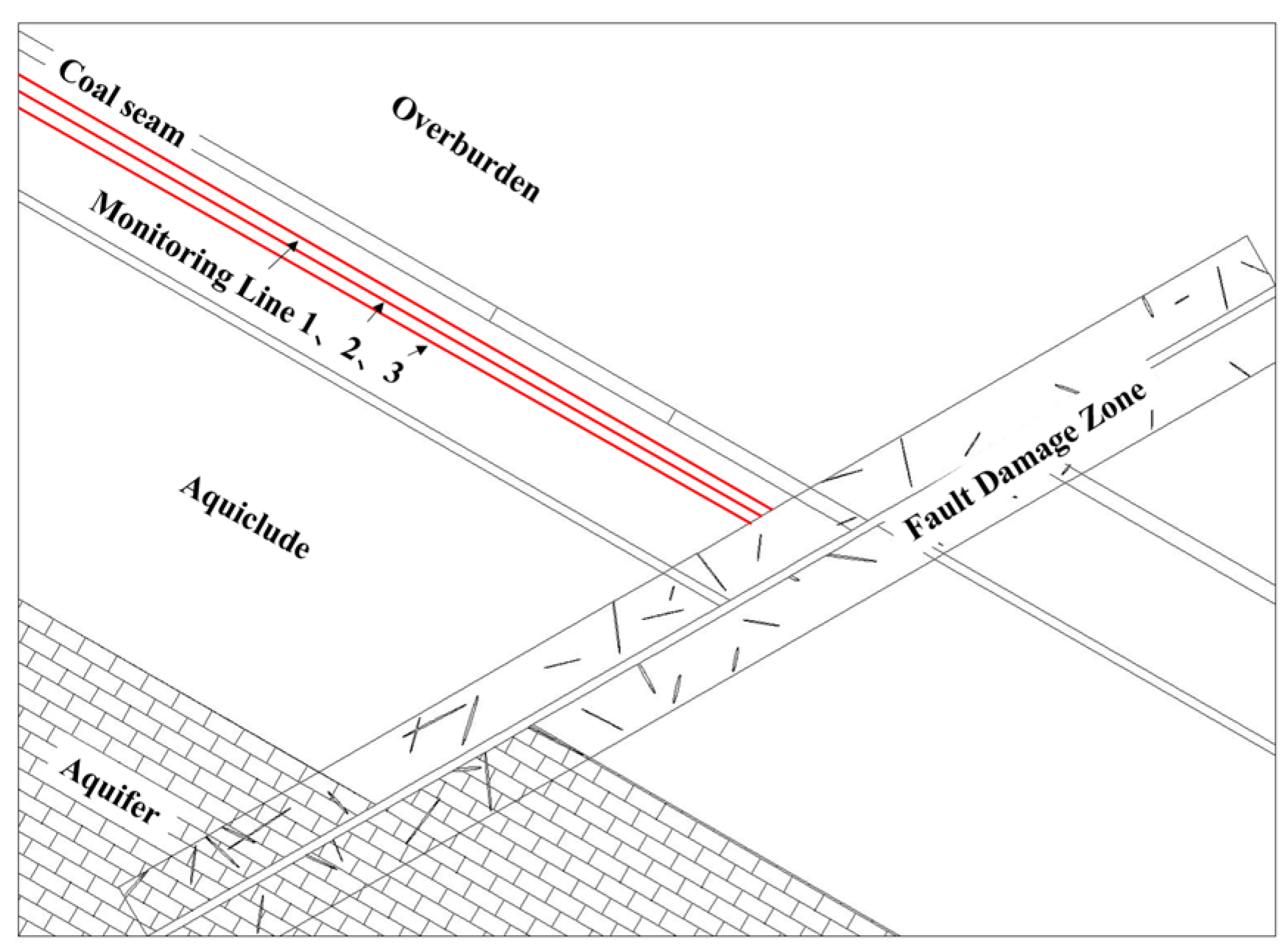
The model was solved utilizing the Solid Mechanics and Darcy’s law interfaces. Based on the actual geological conditions and comprehensive stratigraphic properties of the mining site, a numerical model for fault activation-induced water inrush was established (Figure 1). The model represents a cross-section along the strike of the working face, with dimensions of 550 m in length, 400 m in height, and a thickness of 2.2 m. The panel has a dip length of 90 m. The fault has a dip angle of 30°, a throw of 35 m, and an associated fault zone extending 570 m in length and 25 m in width. Three monitoring lines were embedded at depths of 0 m, 5 m, and 10 m above the deep aquifer within the model to track stress variations in the floor strata during the advancement of the working face.

2.9. Finite Element Mesh Generation

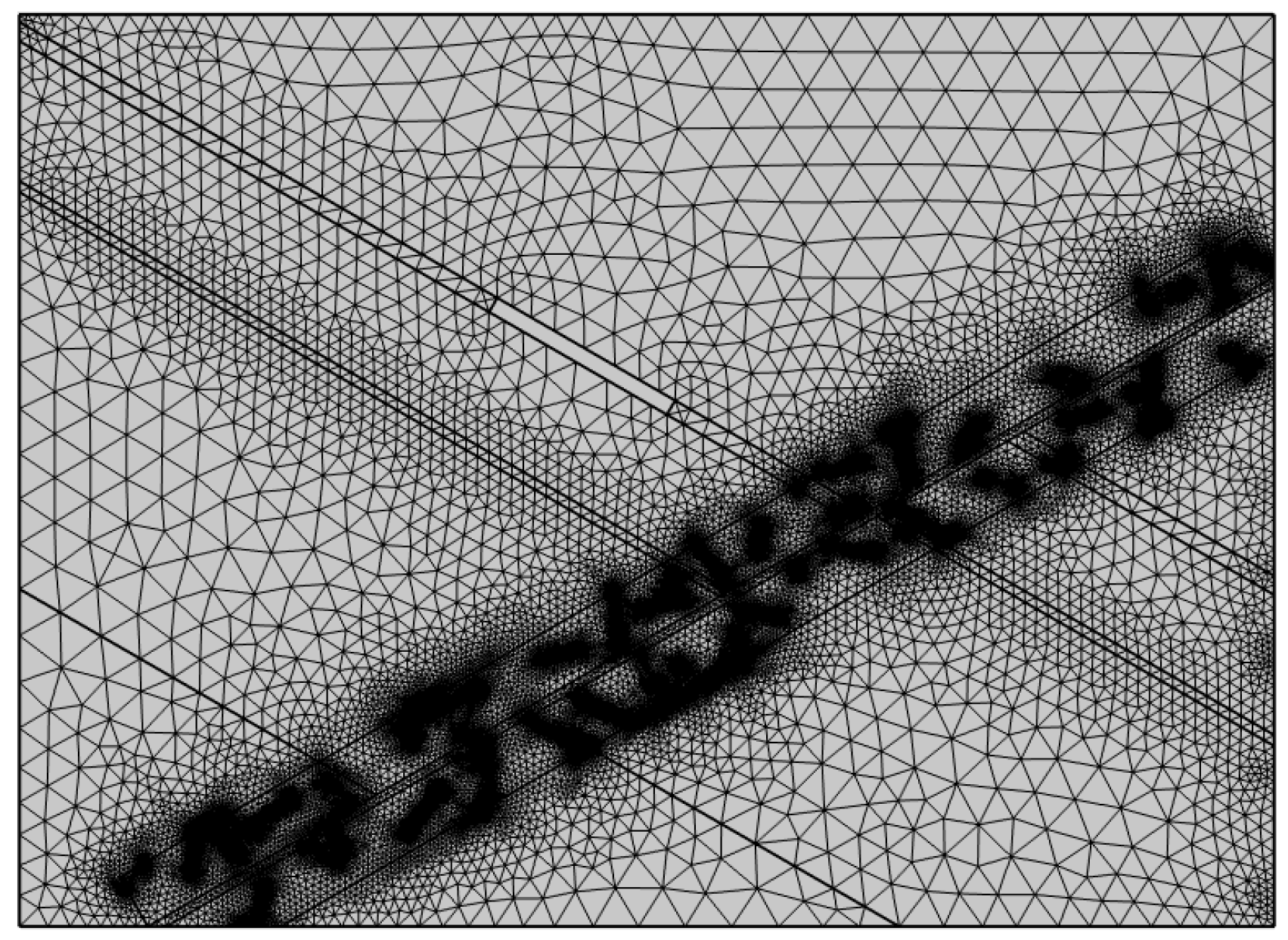
In this numerical model, a free-triangular mesh was employed to create an unstructured mesh (Figure 2), ensuring sufficiently refined discretization at critical interfaces to enhance the accuracy and physical realism of the computational results. Special mesh refinement was applied within the fault damage zone to improve solution precision. The mesh parameters within the fault damage zone were set as follows: maximum element size of 2.68 m, minimum element size of 0.008 m, maximum element growth rate of 1.05, curvature factor of 0.2, and narrow region resolution of 1. In the remaining domains of the model, the mesh was configured with a maximum element size of 11.2 m, minimum element size of 0.16 m, maximum element growth rate of 1.1, curvature factor of 0.25, and narrow region resolution of 1.

2.10. Boundary Conditions

For the stress and damage fields, the model employed a composite constraint mechanism: roller constraints (normal displacement constraints) were applied to both lateral boundaries, a fixed constraint was imposed on the bottom boundary, and the mined-out area (goaf) boundary was set as free. The overburden weight of the rock layers, derived from borehole data, was converted into a uniformly distributed load of p = 17.25 MPa applied to the top boundary. For the seepage field, the upper and lower boundaries were defined as pressure inlets, while the goaf boundary is specified as a pressure outlet.

2.11. Material Properties

The required material parameters included the density and dynamic viscosity of groundwater, as well as the mechanical properties of the various rock strata. The density of groundwater is typically set to 1 × 10³ kg/m3, and its dynamic viscosity to 1 × 10⁻³ Pa·s. The mechanical parameters for the different rock layers are provided in the table below (Table 2).

2.12. Research Scheme

Based on the actual mining plan of the study area, a protective coal pillar of 97.3 m was reserved on the right side of the coal seam, and the full-seam mining method was adopted. To better visualize the impact of working face advancement, the model employed a progressive excavation approach with a step size of 5 m, totaling 8 steps for a cumulative excavation length of 40 m. The confined water pressure in the floor aquifer, Pin, was set to vary from 3.0 to 5.5 MPa with an increment of 0.5 MPa. The distribution characteristics of the stress field and the evolution of the seepage field in the floor strata were systematically analyzed under progressive working face advancement and different water pressure conditions.

3. Results

3.1. Model Solution Error Verification

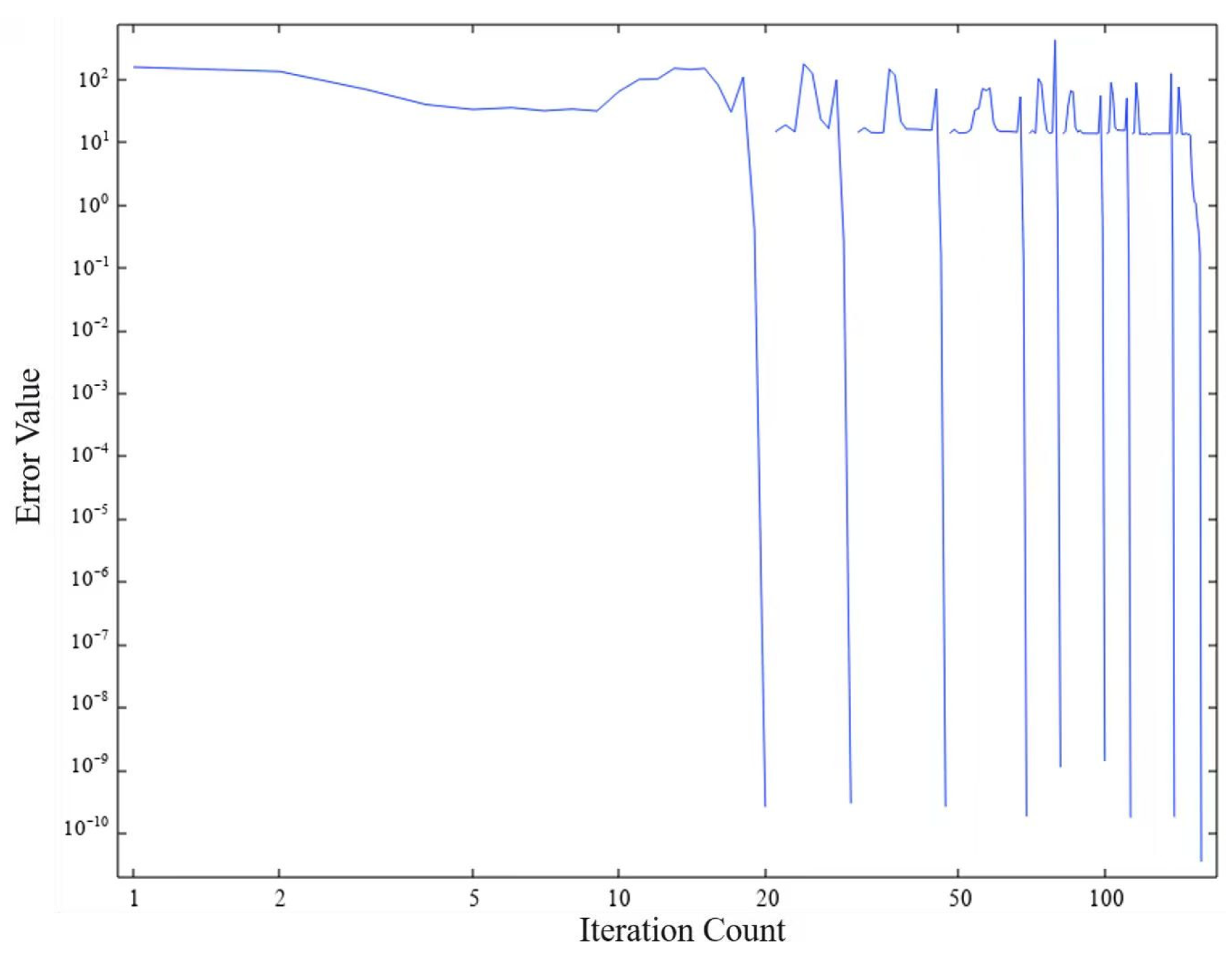
The model was solved using the steady-state solver in COMSOL Multiphysics. To ensure computational accuracy, the built-in automatic (Newton) nonlinear method was selected with the following parameter settings: initial damping factor of 0.01, minimum damping factor of 1 × 10⁻⁶, iteration step limit of 10, step growth limit of 1, and recovery damping factor of 0.75. The convergence behavior of the nonlinear solver during the solution process is illustrated below(Figure 3).
As observed from the figure, the initial iteration stage represents a preliminary adjustment phase of the solver, during which the error remains at a relatively high level with gradual changes. Subsequently, the curve exhibits a steep decline, reducing the error to the order of 1 × 10⁻¹⁰, indicating an extremely low error level. With increasing iterations, the curve demonstrates multiple distinct step-like drops, reflecting the highly nonlinear nature of the problem. Each correction effectively reduces the error, and the final error reaches an exceptionally low magnitude, confirming the high precision and stability of the solution.

3.2. Analysis of Stress Field Distribution Under Different Advance Distances

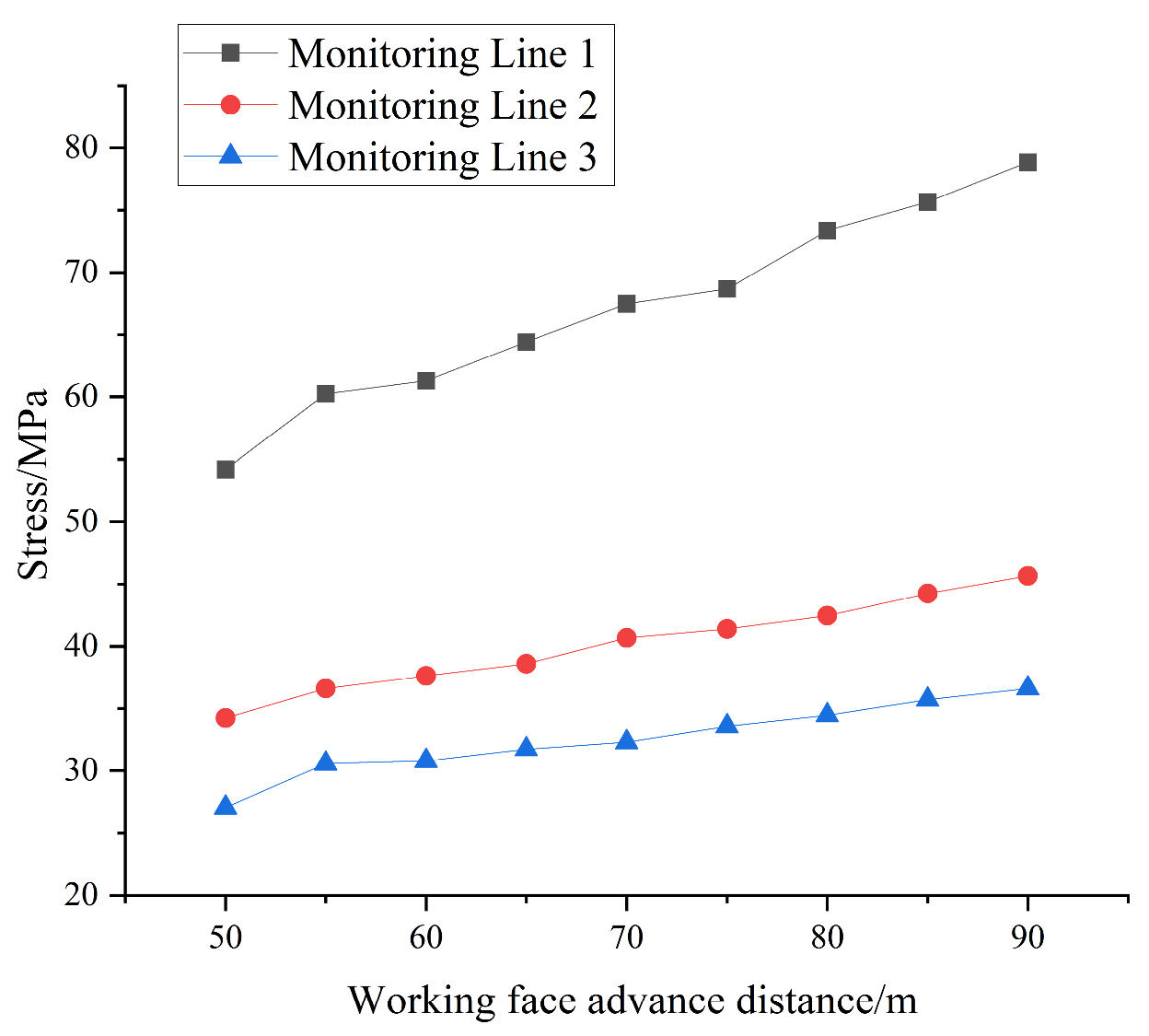
As the working face advances, significant fluctuations occur in the stress field distribution. The peak stresses are primarily concentrated near the open-off cut and the stopping line, with values of 54.19 MPa, 60.24 MPa, 61.30 MPa, 64.41 MPa, 67.48 MPa, 68.66 MPa, 73.35 MPa, 75.66 MPa, and 78.86 MPa, respectively. The advancement of the working face leads to a redistribution of mining-induced stress. The coal mass ahead of the working face exhibits stress concentration due to abutment pressure, while the floor strata in the goaf experience a sharp stress release owing to unloading. This dynamic variation causes the stress state in the floor rock mass to transition from tensile to compressive, rendering it a zone highly sensitive to mining disturbance and prone to deformation instability and structural failure. Stress fluctuation and peak stress variation curves monitored along the measurement lines at 0 m, 5 m, and 10 m below the coal seam (Figure 4) indicate that the stress fluctuation is most pronounced at 0 m depth, and the peak stress exhibits a decreasing trend with increasing depth. This demonstrates that the influence of mining disturbance attenuates significantly with greater depth into the floor strata.
Under dynamic confined water pressure conditions, the coal seam floor is subjected to the combined effects of mining-induced stress, confined water pressure, and the overburden weight, resulting in complex spatiotemporal evolution characteristics of the stress field with distinct zoning patterns. As the working face advances, the stress field undergoes redistribution: the vertical stress decreases significantly within a certain range of the floor due to the unloading of overburden weight, forming a pressure relief zone. Meanwhile, at the edges of the goaf, vertical stress increases owing to stress transfer, creating stress concentration areas. The stress state of the floor rock mass sequentially undergoes three stages: compression, relief, and recompression. Ahead of the working face, the bearing stress reaches its peak due to the transfer of overlying loads, inducing compressive deformation in the floor strata. In the goaf area, stress partially recovers due to rock fragmentation and compaction, placing the floor in a pressure-relieved and expanded state. At the interface between the compression and expansion zones, the abrupt transition in stress state readily triggers shear deformation, failure, and periodic stress fluctuations.
Mining-induced stress is transmitted through the rock mass to the Fault Damage Zone, leading to stress concentration at the tips of fractures or fissures and initiating damage accumulation. The damage zone expands around these fractures, with some fractures becoming interconnected. The floor beneath the coal pillar experiences vertical displacement and horizontal movement toward the goaf under the influence of abutment pressure. Areas around the open-off cut, which remain in a long-term pressure-relieved and expanded state, are more prone to the development of mining-induced fractures, representing high-risk zones for water inrush. The variation in stress field distribution during the advancement of the working face is illustrated in Figure 5.
The evolution of the damage zone with the advancement of the working face is shown in the figure below(Figure 6). Considering the stress–damage coupling effect under mining influence, the damage zone in the floor strata progressively expands and intensifies as the working face advances. During the initial mining stage, when the working face has advanced 50 m, the floor damage is relatively minor. The damaged area is primarily distributed directly below the floor, exhibiting a narrow, tongue-like shape with a low degree of damage. At this stage, the floor rock mass remains largely intact with high load-bearing capacity, and the stress redistribution caused by mining disturbance only results in localized rock failure.
As the working face advances to 65 m, the damage pattern undergoes a significant transformation. Influenced by mining-induced stress concentration, the damaged area expands substantially, gradually assuming a “V”-shaped distribution. The propagation of the damage zone is not limited to an increase in vertical depth but also shows pronounced development along the direction of the working face advancement, indicating a gradual expansion of the mining-disturbed area within the floor rock mass.
When the working face reaches 80 m, the damage zone extends further. The damage depth approaches its maximum value, while the zone continues to elongate along the strike of the working face. At this point, mining pressure manifestations become extremely significant, and the damage in localized areas of the floor approaches its peak. With further advancement to 90 m, the damage morphology remains largely consistent with that at 80 m. The vertical depth of the damage zone stabilizes, and continued advancement only results in a gradual horizontal extension of the damaged area along the working face. This phenomenon indicates that once the working face advances beyond a critical distance, the load-bearing capacity of the floor reaches its limit state. Subsequently, the release of mining pressure occurs primarily through horizontal stress diffusion rather than further transmission into deeper rock strata.
According to the numerical simulation results, the damage zone in the floor strata expands rapidly during the initial stage of advancement (50–80 m), but the damage depth stabilizes after the working face advances beyond 80 m. This indicates that once the working face reaches a critical distance, the depth of floor damage no longer increases significantly. The results show that the ultimate failure depth of the floor is 18.03 m.
The empirical formula for calculating the floor failure depth is derived from a comprehensive analysis of extensive field measurement data. The Coal Mine Water Prevention and Control Design Code [30] provides a formula that considers both the burial depth and dip angle of the coal seam, expressed as follows:
h 1 =   0.0085 H +   0.1665 α +   0.1079 L   4.3579 = 18.16
where h 1 is the failure depth of the floor, H is the burial depth of the coal seam, α is the dip angle of the coal seam, and L is the inclined length of the working face.
Subsequently, scholars have refined the calculation formula for floor failure depth based on practical mining conditions. Guan [31], employing mathematical statistics, derived a formula correlating floor failure depth with coal seam mining thickness, burial depth, and working face inclined length:
h 1 = 0.0113 H + 6.25 ln L 40 + 2.52 ln m 1.48 = 19.23
where h 1  is the failure depth of the floor,  H is the burial depth of the coal seam, L is the inclined length of the working face, and m is the mining thickness of the coal seam.
The calculated result of 18.03 shows general agreement with the empirical formula. Analysis of the damage zone development characteristics within the Fault Damage Zone reveals that damage concentration primarily occurs at the tips and intersections of pre-existing fractures, exhibiting a distinct star-clustered distribution pattern. Due to the boundary effect of the fractured rock zone, the surrounding rock at the periphery of the fault damage zone remains undamaged, with both its tensile and shear strength significantly higher than those within the fault damage zone, thereby forming a hard boundary that constrains damage propagation. Compared to mining-induced damage in the general floor strata, damage development within the fault damage zone is mainly confined to its spatial extent rather than freely expanding as observed in the floor damage area. Analysis of the stress distribution characteristics indicates that the orientation of the maximum principal stress undergoes deflection within the fault damage zone, causing fracture propagation paths to deviate from the primary stress direction.

3.3. Analysis of Darcy Velocity Field Under Different Confined Water Pressures

The heterogeneous characteristics of seepage processes are primarily manifested in both spatial zoning and structural stratification. In the study of seepage behavior in porous media, macroscopic-scale averaged seepage characteristics can be employed to replace detailed characterization of complex water flow behavior within individual fractures at the microscopic level. This approach simplifies the representation of the actual flow mechanisms in fractures through the use of an equivalent continuum model, effectively circumventing the numerical challenges associated with directly simulating complex flow features in DFN while maintaining the accuracy of numerical results. Therefore, this study adopts a coupled physics interface combining Solid Mechanics and Darcy’s law.
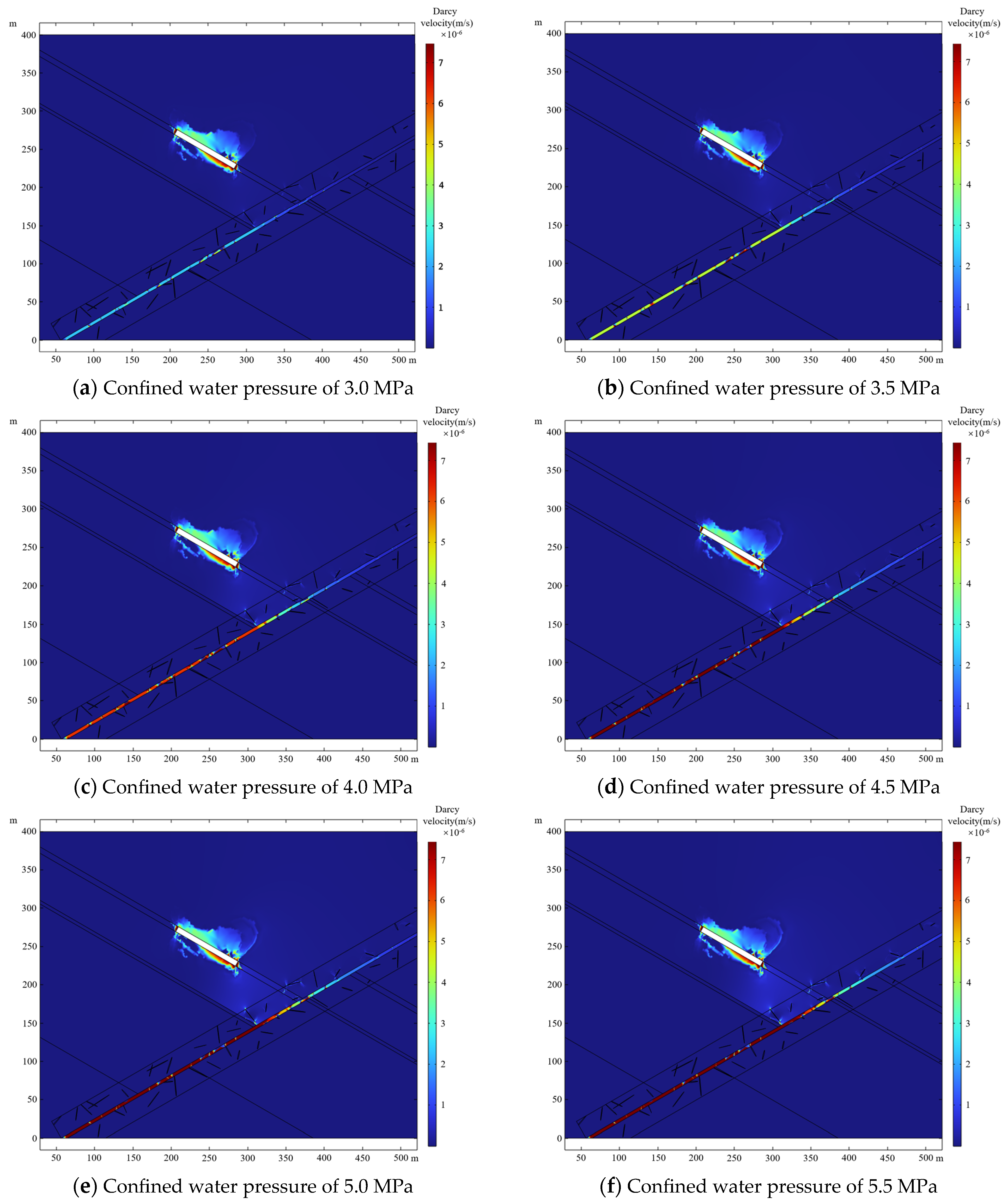
To investigate the influence of confined water pressure on the Darcy velocity field during deep mining, a series of numerical simulations was conducted for the scenario in which the working face had advanced 90 m. The confined water pressure was varied from 3 MPa to 5.5 MPa with a solution step size of 0.5 MPa. Comparative analysis was performed on the results obtained under different pressure conditions (Figure 7).
The increase in confined water pressure significantly influences fluid flow characteristics, leading to notable changes in the distribution of the Darcy velocity field. As shown in the figure above, water pressure exhibits a significant positive effect on the Darcy velocity, substantially enhancing the fluid flow velocity. As the confined water pressure in the floor aquifer increases, the maximum seepage velocity in the working face rises from 1.1087 × 10⁻⁴ m/s to 7.0548 × 10⁻⁴ m/s. The increase in water pressure induces a fundamental transformation in the seepage properties of the fluid, with intensified seepage effects being the direct cause of the sharp velocity increase.
The evolution of the damage zone exhibits significant spatial coupling with the distribution of the Darcy velocity field. Regions of high seepage velocity align closely with the geometric morphology of the floor damage zone, indicating a strong correlation between the permeability field distribution and the development range of the damaged area. The mining-induced damage zone in the floor strata undergoes stress redistribution, leading to rock mass damage and promoting fracture propagation within the failure zone. The continuous increase in water pressure not only drives further development and interconnection of fractures in the floor but also significantly enhances the permeability of the rock mass. The intensified water driving pressure enables the connection of flow channels that were non-conductive or weakly conductive under lower water pressure conditions. Collectively, these factors result in substantial alterations in fluid seepage behavior.
The influence of the stress field distribution on the seepage velocity displays spatial heterogeneity. In areas of stress concentration, the effect of stress on fluid seepage velocity is more pronounced, whereas in regions remote from stress concentration zones, the influence of stress on seepage is relatively weak. Consequently, the Darcy velocity field within the failure zone exhibits a heterogeneous distribution. Furthermore, as the permeability coefficient within the floor damage zone is significantly higher than that of the intact rock mass on either side, the driving effect of confined water pressure on the seepage velocity is particularly prominent in this region, directly establishing the damage zone as the primary pathway for fluid seepage.

4. Conclusions

Based on the geological conditions of a mining area in Shandong, this study developed a stochastic fracture geometry model of the fault damage zone using the Monte Carlo method. Governing equations for seepage flow in porous media and damage criteria for rock mass were derived to establish a numerical model simulating water inrush from fault activation under stress–seepage–damage coupling. The model was solved using the finite element software COMSOL Multiphysics 6.0. This study examined how working face advancement distance affects damage zone evolution and stress field distribution, along with variations in the Darcy velocity field during mining. The investigation revealed the evolutionary patterns controlling floor damage extent and water inrush channel formation, leading to the following main conclusions:
1.
The introduction of the fault damage zone enables more realistic simulation of both intact rock mass and fractured zones, providing an intuitive representation of mining-induced damage propagation, stress field distribution, and Darcy velocity field evolution within the floor strata and fault-affected areas. This approach simultaneously simplifies the complex computations arising from fracture heterogeneity, thereby establishing a novel methodology for numerical simulation of mining-induced fault activation and water inrush from floor strata.
2.
Analysis of the influence of working face advancement on damage zone evolution and stress field distribution reveals that the floor damage zone progressively expands with mining activity, stabilizing after the working face advances to 80 m. This demonstrates the existence of a limit to floor failure depth, with the maximum developed failure depth reaching 18.03 m. Furthermore, damage propagation within the fault damage zone exhibits significant spatial constraints and localized concentration characteristics.
3.
Analysis of the influence of confined water pressure on Darcy velocity field distribution indicates a non-uniform seepage field distribution, where high-velocity zones show strong spatial correlation with damage areas. This suggests a synergistic enhancement effect between water pressure and damage evolution. Increasing water pressure promotes the extension and interconnection of pre-existing fractures while enhancing rock mass permeability. The combined action of these mechanisms leads to substantial changes in the seepage field, with water pressure serving as the primary driving force for fluid flow and demonstrating a significant positive effect on seepage velocity.

Author Contributions

Conceptualization, J.Z. and Y.G.; methodology, J.Z., Y.G. and D.K.; software, Y.G., J.Z. and L.S.; validation, Y.G., J.Z. and L.S.; formal analysis, Y.G., J.Z. and D.K.; investigation, Y.G. and J.Z.; resources, Y.G.; data curation, Y.G.; writing—original draft preparation, Y.G.; writing—review and editing, Y.G. and L.S.; visualization, Y.G., L.S. and H.L.; supervision, Y.G. and L.S.; project administration, Y.G., G.J. and L.S.; funding acquisition, Y.G., G.J. and Z.M. All authors have read and agreed to the published version of the manuscript.

Funding

This research was funded by the National Natural Science Foundation of China, grant number 52304238; Shandong Provincial Natural Science Foundation, grant number ZR2023ME002; The Open Foundation of State Key Laboratory of Disaster Prevention and Ecology Protection in Open-pit Coal Mines, grant number MDPC2025ZR01; and the Postdoctoral Innovation Project Special Fund of Shandong Province, grant number SDCX-ZG-202502107.

Data Availability Statement

The datasets generated and analyzed during the current study are not publicly available due to the proprietary nature of the numerical models and simulation parameters, but are available from the corresponding author upon reasonable request for academic and research purposes.

Acknowledgments

We also wish to thank our colleagues from the State Key Laboratory of Mining Disaster Prevention and Control for their technical assistance in data acquisition and analysis. Special thanks are extended to the anonymous reviewers whose constructive comments significantly improved the quality of this manuscript.

Conflicts of Interest

Authors Lihong Shi, Hongtao Li and Zhenguo Mao were employed by the company China Zuoquan Wulihou Coal Industry Co., Ltd. The remaining authors declare that the research was conducted in the absence of any commercial or financial relationships that could be construed as a potential conflict of interest.

References

  1. Han, Z.; Liu, H.; Guo, X.; Liang, J.; Qiao, Z.; Cao, C.; Guo, L.; Chen, X. Damage evolution and failure warning in early-age flexible-formwork concrete for underground support. Geohazard Mech. 2025, 3, 187–196. [Google Scholar] [CrossRef]
  2. Yang, J. Study on the Water Inrush Law and Catastrophic Model of Coal Seam Floor in Deep Mining of Handan-Xingtai Mining Area. Master’s Thesis, North China Institute of Science and Technology, Langfang, China, 2020. [Google Scholar]
  3. Yang, W.; Wang, H.; Yang, X.; Zhang, B.; Yang, L.; Fang, Z.; Wang, M. Development and application of tunnel water inrush model test system under high ground stress and high water pressure. Chin. J. Rock Mech. Eng. 2017, 36, 3992–4001. [Google Scholar]
  4. Liang, K.; Li, Y.; Bai, Y.; Zhang, W.; Han, C.; Xie, D.; Liang, S.; Xi, B. Water-Richness Evaluation of Sandstone Aquifer Based on Set Pair Analysis Variable Fuzzy Set Coupling Method: A Case Study on Bayangaole Mine, China. Water 2025, 17, 1826. [Google Scholar] [CrossRef]
  5. Jiao, H.; Lun, Z.; Ni, Y.; Chang, Z.; Fan, L.; Ma, L. Evaluation of Water-Inrush Risk and Water-Preserved Mining Under Goaf Water. Water 2025, 17, 1734. [Google Scholar] [CrossRef]
  6. Zhang, S.; Huang, P.; Li, Y.; Wang, C.; Wu, Z. Regularity and mechanisms of water-sand inrushes within mining-activated faults. Coal Geol. Explor. 2017, 36, 3992–4001. [Google Scholar]
  7. Wen, Y.; Meng, F.; Liu, P.; Li, Z.; Cai, Q.; Wang, F.; Liu, J. Rockburst failure time prediction based on a fuzzy comprehensive evaluation method using the acoustic emission. Geohazard Mech. 2025, 3, 220–230. [Google Scholar] [CrossRef]
  8. Huang, D.; Zhu, Y.; Qiao, S.; Xing, D.; Wang, X. Numerical experiments on maero-and miero damage characteristiesof red sandstone with pore double fractures. J. Shandong Univ. Sci. Technol. (Nat. Sci.) 2023, 42, 32–42. [Google Scholar]
  9. Fang, P. Simulation and Application of Channel Slope Seepage Based on Random Fissures. Master’s Thesis, University of Jinan, Jinan, China, 2022. [Google Scholar]
  10. Zhong, J.; Li, B.; Song, Z.; Zou, L. Numerical Study on Grouting Reinforcement Effect on Fractured Rock Masses of Tunnels Based on Discrete Fracture Networks. Chin. J. Undergr. Space Eng. 2024, 20, 1286–1297. [Google Scholar]
  11. He, Y. Coupled Unsteady Seepage and Stress Fields Indiscrete Fracture Rock Mass. Master’s Thesis, Xi’an University of Technology, Xi’an, China, 2007. [Google Scholar]
  12. Wang, X. Numerical Study on Equivalent Permeability of Fractured Rock Masses by Using Stochastic Discrete Fracture Networks and Fractal Dimension Method. Master’s Thesis, ShanDong University, Jinan, China, 2014. [Google Scholar]
  13. Chen, H.; Wang, Y.; Wu, H.; Li, B.; Yang, T.; Li, X. Analysis of instability mechanisms in high-steep rock slopes controlled by discrete fracture networks. J. Eng. Geol. 2025, 1–15. [Google Scholar] [CrossRef]
  14. Yang, L. Analysis Of Stress and Seepage Field Changes in Goaf Floor Based on Multiphysical Field Coupling. Master’s Thesis, Guangxi University, Nanning, China, 2023. [Google Scholar]
  15. Gong, X.; Ma, D.; Wu, L.; Li, Q.; Li, Z.; Du, F.; Qiao, R.; Han, J. Water Inrush Mechanism During Mining Adjacent to Large Water-Conducting Faults. Water 2025, 17, 1508. [Google Scholar] [CrossRef]
  16. Sun, W.; Liu, Q.; Wang, X.; Li, L.; Chen, Q.; Yang, H. Dynamic Evolution of Permeability Coefficient and Delayed Water Inrush Mechanism in Fault Zones Under Mining-Induced Stress-Seepage Coupling. Min. Saf. Environ. Prot. 1–10. Available online: https://link.cnki.net/urlid/50.1062.td.20250528.1639.002 (accessed on 29 May 2025).
  17. Bian, K.; Li, S.; Liu, B. Study on water inrush law of mining floor in coal seam with fault above confined water. Saf. Coal Mines 2022, 53, 169–177. [Google Scholar]
  18. An, T.; Yao, B.; Li, S.; Du, F.; Li, Z.; Wang, G. Study on the fault erosion-seepage rule under the effect of floor confined water. J. Min. Saf. Eng. 2023, 40, 354–360. [Google Scholar] [CrossRef]
  19. Feng, Y.; Lin, Z.; Wang, W. Research on water inrush disaster law from coal mine floor with concealed small fault under mining. Saf. Coal Mines 2022, 53, 200–209. [Google Scholar]
  20. Wang, J.; Jiang, A.; Song, Z. An elastoplastie stress-seepage-damage coupling model of rock (II): Parametric inversion and numerical simulation. Rock Soil Mech. 2015, 36, 3606–3614. [Google Scholar]
  21. Xu, L.; Cai, F.; Chen, G.; Wang, G. Implementation of nonlinear dynamic constitutive model in FLAC3D with considering cyclic softening behaviors of soils. Rock Soil Mech. 2016, 37, 3329–3335. [Google Scholar]
  22. Yi, K.; Li, F.; Shang, Q.; Liu, J. Study on the Failure Mechanism of Jointed Rock Mass Based on Seepage stress Coupling Distinet Element Model. Min. Res. Dev. 2017, 37, 55–58. [Google Scholar]
  23. Merrett, C.; Baldassarre, A.; Balsara, H.; Martinez, M. Benchmarking finite element analysis of linear viscoelastic materials using a beam model. Mech. Time-Depend. Mater. 2025, 29, 22. [Google Scholar] [CrossRef]
  24. Huang, T. Coupling study among seepage-stress-temperature in fractured rockmass. Chin. J. Rock Mech. Eng. 2022, 21, 77–82. [Google Scholar]
  25. Bear, J. Dynamics of Fluids in Porous Media; China Architecture & Building Press: Beijing, China, 1983. [Google Scholar]
  26. Kong, X.; Li, D.; Xu, X.; Lu, D. Study on mathematical models of fluid-solid-thermal coupling seepage. J. Hydrodyn. 2005, 2, 269–275. [Google Scholar] [CrossRef]
  27. Xue, Y.; Liu, Y.; Dang, F.; Liu, J.; Ma, Z.; Zhu, L.; Yang, H. Assessment of the nonlinear flow characteristic of water inrush based on the brinkman and forchheimer seepage model. Water 2019, 11, 855. [Google Scholar] [CrossRef]
  28. Zhu, W.; Tang, C.; Yang, T.; Liang, Z. Constitutive relationship of mesoscopic elements used in rfpazd and its validations. Chin. J. Rock Mech. Eng. 2003, 22, 24–29. [Google Scholar]
  29. Zhu, W.; Wei, C.; Tian, J.; Yang, T.H.; Tang, C.A. Coupled thermal-hydraulic-mechanical model during rock damage and its preliminary application. Rock Soil Mech. 2009, 30, 3851–3857. [Google Scholar]
  30. GB 51070-2014; Code for Design of Coal Mine Water Prevention and Control. China Planning Press: Beijing, China, 2014.
  31. Guan, Y.; Li, M.; Jin, K. Study on mining-induced failure characteristics of coal seam floor. Saf. Coal Mines 2003, 2, 29–32. [Google Scholar] [CrossRef]
Figure 1. Geometric model of the floor fault activation-induced water inrush simulation.
Water 18 00134 g001
Figure 2. Model mesh.
Water 18 00134 g002
Figure 3. Model convergence plot.
Water 18 00134 g003
Figure 4. Evolution of peak stress during working face advancement.
Water 18 00134 g004
Figure 5. Stress field distribution during working face advancement.
Water 18 00134 g005aWater 18 00134 g005b
Figure 6. Evolution of the damage zone during working face advancement.
Water 18 00134 g006aWater 18 00134 g006b
Figure 7. Distribution of Darcy velocity field under different water pressures.
Water 18 00134 g007
Table 1. Fracture geometric parameters.
Center Point Dip   Angle   ( ° ) Propagation   Extent   ( m ) Aperture   ( m ) Density
Uniform DistributionNormal DistributionLog-Normal Distribution
MeanVarianceMeanVariance
1 4566100.30.005
2 13510480.30.005
Table 2. Mechanical parameters of rock strata.
Overlying StrataCoal Seam Floor Strata Aquiclude 1 Aquiclude 2 Aquifer
Young’s
Modulus,
E (GPa)
5.07.08.09.05.09.0
Poisson’s Ratio
ν
0.270.290.270.270.290.27
Density
ρ (kg/m3)
ρkg/m3
242013502420217025302500
Compressive Strength
fc0 (Mpa)
15.15.023.959.515.159.5
Tensile Strength,
ft0
(Mpa)
3.20.83.54.25.14.8
Internal Friction Angle, Internal Friction Angle,
φ °
333234333234
Disclaimer/Publisher’s Note: The statements, opinions and data contained in all publications are solely those of the individual author(s) and contributor(s) and not of MDPI and/or the editor(s). MDPI and/or the editor(s) disclaim responsibility for any injury to people or property resulting from any ideas, methods, instructions or products referred to in the content.