
Article

Study on Spatio-Temporal Changes and Driving Factors of Soil and Water Conservation Ecosystem Services in the Source Region of the Yellow River


1
School of Ethnology and Sociology, Qinghai Minzu University, Xining 810007, China
2
School of Politics and Public Administration, Qinghai Minzu University, Xining 810007, China
3
State Key Laboratory of Soil and Water Conservation and Desertification Control, Institute of Soil and Water Conservation, Northwest A&F University, Yangling 712100, China
4
Makehe Forestry Bureau of Qinghai Province, Xining 810007, China
*
Author to whom correspondence should be addressed.
Water 2026, 18(1), 128; https://doi.org/10.3390/w18010128
Submission received: 24 November 2025 / Revised: 16 December 2025 / Accepted: 30 December 2025 / Published: 5 January 2026
(This article belongs to the Special Issue Soil Erosion and Soil and Water Conservation, 2nd Edition)

Abstract

This study takes the source region of the Yellow River from 2000 to 2024 as the research area, and integrates multi-source remote sensing, long-term meteorological observation, and land use data from 2000 to 2024. Using GIS spatial analysis, the standard ellipse model, and a geographic detector, this study systematically depicts the spatio-temporal heterogeneity and multi-scale evolution trend of soil and water conservation services, and then quantifies the spatial differentiation of the contribution rate of climate fluctuation, land use transformation, and human activity intensity to service change. The results showed the following: (1) The land use pattern in the source region of the Yellow River showed a one-way transformation of “grassland dominated, forest land increased alone, and the rest decreased”. The net increase in forest land 204.3 km2 was all from the transformation of grassland. The vegetation coverage increased by 9.9%, and the low-value area of soil and water conservation services in the northwest continued to expand. (2) The overall moving distance of the center of gravity of soil and water conservation service capacity is not significant compared with the spatial scale of the source area of the Yellow River. The standard deviation ellipse of each year also did not show systematic and large changes in area, shape, or direction. (3) Annual mean temperature (Q = 0.590) and vegetation coverage (Q = 0.527) are the most influential single factors, while the interaction between annual mean temperature and precipitation (bidirectional enhancement) is the most stable synergistic driving combination. The single-factor Q values of topography and human activities were <0.10. (4) Climate and economic factors are the key factors driving the spatial differentiation of soil and water conservation service capacity, and the role of each driving factor has an optimal range to reduce the risk of soil erosion. The optimal range of population density is 7~9 person/km2, the optimal range of average GDP is 11,900~14,100 yuan/km2, the optimal range of annual average temperature is 1.71~3.47 °C, the optimal range of annual precipitation is 682~730 mm, the optimal range of vegetation coverage is 81.7~100%, and the optimal range of altitude is 3390~3740 m. The optimal range of slope is 18.3~24.3°. The optimal range of soil moisture is 26.7~29.4%. The optimal range of grazing intensity is 0.352~0.652. The study proposes countermeasures such as strict control of development in high-value areas of soil and water conservation services and key ecological restoration in low-value areas, the establishment of breeding bases and catchment areas in low-precipitation areas to cope with climate change, the optimization of grazing strategies, so as to provide scientific support for the stability of alpine grassland ecosystem services, and the high-quality development of the Yellow River Basin.

1. Introduction

The source region of the Yellow River is located in the northeast of the Qinghai–Tibet Plateau in China, with complex terrain and large altitude span, which belongs to the typical alpine ecological fragile area [1]. As the birthplace of the Yellow River, it has extremely high hydrological and ecological value [2,3]. However, the region is also one of China’s ecologically fragile areas, facing severe ecological problems for a long time, especially the challenge of soil erosion. Soil erosion has led to a decline in water conservation capacity and the deterioration of soil quality, and has a profound impact on regional ecosystem service functions [4,5,6]. With the intensification of global climate change and the interference of human activities, especially the advancement of overgrazing, farmland reclamation, and urbanization, the problem of soil erosion in the source region of the Yellow River is becoming more and more serious [7,8,9,10,11]. At the same time, soil and water conservation, as a key measure to alleviate soil erosion, plays a vital role in ecological environment protection, restoration, and sustainable development [12,13].
The effectiveness of soil and water conservation has a profound impact on the supply of ecosystem services. Ecosystem services are derived from the inherent functions of natural ecosystems and provide a series of key benefits for humans, such as water conservation, soil retention, climate regulation, and biodiversity maintenance [14,15]. In the source region of the Yellow River, soil and water conservation ecosystem services play an irreplaceable role in maintaining regional ecological stability, ensuring water supply and improving agricultural productivity [16,17]. However, the dual pressures of climate change and human activities make the soil and water conservation services in the region face severe challenges [18,19]. Changes in precipitation patterns, changes in land use patterns, and land development caused by population growth have aggravated soil erosion and further affected the stability of ecosystem services [20,21].
Soil erosion in the source region of the Yellow River is dominated by hydraulic erosion, accompanied by the combined effect of wind erosion and freeze–thaw erosion [22,23,24]. During the 20 years from 2001 to 2020, the average annual soil erosion modulus in this area was about 1932 t·km−2·yryear−1, and the total annual erosion amount was 225.18 × 10⁶ t. About 78.64% of the area was mild erosion, but local high-intensity erosion was concentrated in meadow-degraded areas and river valleys with steep slopes and low vegetation coverage [25]. Another evaluation based on 137Cs isotope tracing indicates that the average erosion modulus in the source region of the Yellow River is as high as 6460 t·km−2·year−1, of which 99% of the samples are in the high-intensity erosion range (5000–8000 t·km−2·year−1). The erosion intensity showed obvious north–south spatial differentiation, and the northern region was significantly stronger than the southern region [26,27]. Studies have shown that, in the past 20 years, the soil and water conservation service in the source area of the Yellow River has shown an overall growth trend, showing a pattern of “high in the southeast and low in the northwest” in space. Although more than 90% of the region’s soil conservation has improved, local high-intensity erosion is still prominent, concentrated in vegetation degradation areas and steep slopes [4,16]. Through the quantitative analysis of land use change in the source region of the Yellow River from 2000 to 2020, the land degradation in the source region of the Yellow River has increased significantly in the past two decades, which has a negative impact on the regional water conservation function [28,29]. At the same time, other ecosystem services such as water supply and carbon storage also show a synergistic or trade-off relationship, and their spatial distribution is regulated by natural factors and human activities [30,31]. Among the natural factors, slope, precipitation, and vegetation coverage (NDVI) are the key factors affecting the spatial heterogeneity of soil and water conservation services [32,33]. In terms of human activities, land use changes such as grassland overgrazing and infrastructure construction have significantly weakened soil erosion resistance [9,20]. The explanatory power of multi-factor interactions such as slope and precipitation, NDVI, and land use on soil and water conservation services in the source region of the Yellow River is generally higher than that of single factors, which highlights the complexity of the driving mechanism [34,35].
Existing research mainly relies on remote sensing and GIS technology, focusing on soil erosion assessment or the simulation of a single ecosystem service (such as soil and water conservation). For example, soil and water conservation service assessment based on the InVEST model is widely used in the middle reaches of the Yellow River and the Loess Plateau [36,37]. However, the studies often ignore the driving mechanism of multi-factor coupling and have insufficient explanatory power for long-term dynamics and its spatial heterogeneity. For example, Wang P (2023) pointed out that the dominant factors of soil and water conservation services change with the change in land use type and period [38]; Liu Q (2024) analyzed the interaction and driving mechanism of ecosystem services at different spatial scales, which showed that the construction of a scientific service evaluation framework should take into account the direct effect of driving factors and their scale dependence and indirect conduction path [39]. These results highlight the lack of multi-dimensional and long-term comprehensive analysis in current research.
Therefore, this study proposes a three-dimensional synergistic driving framework of “climate–land use–human activities”. It is assumed that climate change and land use change are the main controlling factors of the evolution of soil and water conservation ecosystem services in the source region of the Yellow River, while human activities amplify or weaken the above effects through nonlinear interaction effects. Based on this, the study integrates multi-source remote sensing images, long-term meteorological observation, and land use data (2000–2024), and uses GIS spatial analysis, the standard ellipse model, and the geographic detector method to analyze the spatial and temporal differentiation characteristics and dynamic evolution process of regional soil and water conservation services from multiple dimensions and multiple scales, so as to identify the contribution rate and spatial difference in climate fluctuation, land use transformation, and human activity intensity to its change, so as to provide scientific support for ecological restoration and soil and water conservation management in the source region of the Yellow River.

2. Date and Methods

2.1. Research Area Overview

The source region of the Yellow River (95.5° E–103.5° E, 32.0° N–36.5° N) is located in the eastern edge of the Qinghai–Tibet Plateau in China (Figure 1a). It is defined as the basin above the Tangnaihai hydrological station section, involving 6 prefectures and 18 counties in the Qinghai, Sichuan, and Gansu provinces, with an area of 121,972 km2. The topography is mainly composed of plateau plains, mountains, and hilly platforms. The altitude is between 2680 and 6248 m, with an average altitude of 4123 m. The western part is separated by the Bayan Har Mountains and the Jinsha River, and the northern part is the Animaqing Mountain. The glaciers on the mountains are covered with snow all year round. Lakes, marshes, and wetlands are all over the basin. Plateau grassland, forest land, and marsh land are the three dominant types of land use pattern in the study area, accounting for more than 80% of the total area. The climate type belongs to the semi-arid and semi-humid type in the sub-cold zone of the Qinghai–Tibet Plateau. The temperature in the east is higher than that in the west, and the precipitation in the southeast is higher than that in the northwest. The spatial distribution of water and heat is significantly different. Affected by the southwest monsoon, the annual precipitation is mostly concentrated in May–September, with an average annual cumulative precipitation of 407–582 mm. The annual cumulative evaporation is 484–584 mm, and the annual average temperature is about −1.6 °C. In general, the source region of the Yellow River is a typical alpine ecosystem, which integrates key functions such as water conservation and recharge, soil and water conservation, and regional climate regulation. As the most important water source and runoff-producing area in the upper reaches of the Yellow River, its ecological status is crucial (Figure 1b).

2.2. Data

2.2.1. NPP Data

The NPP dataset are derived from NASA’s MOD17A2HGF dataset, which is derived from the NASA Earth Science Data website (https://ladsweb.modaps.eosdis.nasa.gov/search/order, accessed on 9 October 2025). The time range is 2000–2024, and the spatial resolution is 250 m. The product is based on the light use efficiency model (LUE model), which can reveal the fixed carbon content of vegetation per unit area in a specific period of time [40]. It is widely used in the study of the ecosystem carbon cycle, the seasonal dynamics of vegetation, and the impact of climate change. With its high spatial resolution of 500 m and high temporal resolution of 8 days, it can capture subtle changes in productivity on a regional scale and is the core remote sensing index for evaluating vegetation productivity and the carbon cycle [41].

2.2.2. Digital Elevation Data (DEM)

The terrain data is ASTER GDEM (V2 version) 30 m spatial resolution DEM (Digital Elevation Model) product from the “Geospatial Data Cloud” of the Chinese Academy of Sciences (http://www.gscloud.cn/, accessed on 9 October 2025). The ASTER GDEM data product is calculated and generated by the advanced spaceborne thermal emission and reflection radiometer data. It is the only publicly available high-resolution digital elevation model with full coverage of land in the world [42]. It has been widely used in ecological, climatic, and geological studies at the global scale [43].

2.2.3. Land Use Data

The data used in this study were published by Professor Yang Jie and Professor Huang Xin of Wuhan University and stored in the Zenodo open science platform (https://zenodo.org/records/15853565, accessed on 9 October 2025). The time range is from 1985 to 2024, and the spatial resolution is 30 m. The land use datasets released by Zenodo are equipped with permanent DOI, providing rich and structured metadata [44]. Anyone can freely download and directly reference in subsequent research, which greatly improves the reusability of data [45] and provides data support for subsequent related research.

2.2.4. NDVI Data

The data were shared and published by Gao Jixi scholars on the platform of the National Qinghai–Tibet Plateau Scientific Data Center (https://data.tpdc.ac.cn/zh-hans/data/10535b0b-8502-4465-bc53-78bcf24387b3, accessed on 14 October 2025), with a time range of 2000–2024 and a spatial resolution of 250 m. Since NDVI can be directly extracted from multiple satellites (such as MODIS, Landsat, Sentinel-2, etc.), and most products are free and open to the public, researchers can obtain consistent and long-term time series data on a global scale, which is suitable for cross-regional and cross-period comparative analysis [46]. It can effectively extract and quantify changes in vegetation coverage [47].

2.2.5. Soil Properties Data

The data are based on the processing of the world soil database HWSD2.0 constructed by the Food and Agriculture Organization of the United Nations (FAO) and the International Institute for Applied Systems Research (IIASA) in Vienna (https://openknowledge.fao.org/handle/20.500.14283/cc3823en, accessed on 6 November 2025) [48]. The data include the data of 7 soil depth layers, which are 0–20 cm, 20–40 cm, 40–60 cm, 60–80 cm, 80–100 cm, 100–150 cm, and 150–200 cm, respectively. This paper selects 0–20 cm depth data.

2.2.6. Soil Moisture Data

The data are publicly available from the NASA Earth Science Data System (https://disc.gsfc.nasa.gov/datasets/FLDAS_NOAH01_C_GL_M_001/summary?keywords=FLDAS, accessed on 5 November 2025). The time range is from 1 January 1982 to 1 September 2024, and the spatial resolution is 0.1° × ×0.1° [49]. FLDAS is an advanced data system designed to monitor and evaluate global hydrological and climatic conditions [50]. It generates multiple models of hydrological and climatic conditions such as soil moisture, evapotranspiration, and runoff by combining different land models, rainfall data, and meteorological inputs (such as temperature, humidity, radiation, and wind speed). These models support applications in precision agriculture, disaster management, urban planning, and many other fields [51]. They promote scientific decision-making and sustainable development and are widely used in various studies.

2.2.7. GDP per Capita

The data are based on the “China Statistical Yearbook” and provincial and municipal statistical bulletins (https://www.stats.gov.cn/sj/ndsj/, accessed on 28 September 2025; https://tjgb.hongheiku.com/category/zgtjgb, accessed on 28 September 2025). The time range is 2000–2024. Because the per capita GDP data of 7 counties involved in the source area of the Yellow River in 2024 have not been found, the per capita GDP of 7 counties in 2024 is calculated according to the growth rate interpolation method. These seven counties are Maqin County, Chenduo County, Zeku County, Henan County, Xiahe County, Ruoergai County, and Hongyuan County. China Statistical Yearbook and provincial (municipal) statistical bulletins are official statistical data compiled and publicly released by the National Bureau of Statistics and local statistical bureaus, with high authenticity and reliability [52]. Per capita GDP is widely considered to be one of the important human driving factors affecting the service capacity of soil and water conservation [53,54], which provides a real and reliable data source for the quantification of the driving factors of soil and water conservation service capacity.

2.2.8. Meteorological Data

The data are derived from the data shared by ShouZhang Peng scholars on the platform of the National Qinghai–Tibet Plateau Scientific Data Center (https://data.tpdc.ac.cn/zh-hans/data/faae7605-a0f2-4d18-b28f-5cee413766a2, accessed on 25 October 2025; oOV01 visit date: 25 October 2025). The time range is 1901–2024, and the spatial resolution is 1 km. The dataset provides high-resolution meteorological elements such as temperature and precipitation, and has been cited by a large number of ecological and climate research institutes, providing a basic driving field for climate and hydrological research in the plateau region [55].

2.2.9. Grazing Intensity Data

The dataset is derived from the dataset published on the Fig share website by Professor WenPing Yuan of the Carbon Neutralization Institute of Peking University in 2024 (https://doi.org/10.6084/m9.figshare.26195684, accessed on 23 October 2025) [56]. The time range is 1980–2024, and the spatial resolution is about 250 m × 250 m. The dataset integrates high-resolution remote sensing and ground observations across the country to meet the requirements of regional-scale soil and water conservation service assessment [57].

2.2.10. Population Density

The LandScan population dataset used in this study was developed by the United States Department of Energy Oak Ridge National Laboratory (ORNL) and publicly released through the East View Cartographic platform (https://landscan.ornl.gov/, accessed on 16 October 2025). The time range is 2000–2023, and the spatial resolution is 1 km. The data of 2024 are calculated according to the area of 20 counties in the source region of the Yellow River and the number of permanent residents in 2024 (https://tjgb.hongheiku.com/category/zgtjgb, accessed on 28 September 2025). Using innovative methods such as GIS and remote sensing, LandScan is the social standard for the release of global population data. It is the world’s most accurate, reliable, geographically based, distributed model and the best resolution global population dynamics statistical analysis database [58].

2.3. Method

2.3.1. Soil and Water Conservation Service Index

Evaluation Model
Soil and water conservation services are the ability of vegetation roots to fix soil and reduce the entry of topsoil into ditches, emphasizing the key role of vegetation structure in mitigating rainwater erosion and inhibiting erosion [59]. In this paper, the average value of vegetation net primary productivity (NPPmean), soil erodibility factor (K), and slope factor (Fslo) were selected to calculate the soil and water conservation service capacity. The index highlights the key functions of vegetation cover, geomorphological features, and soil structure in maintaining soil and water resources, and clearly shows the fundamental spatial distribution characteristics of ecosystem soil and water conservation effects [60,61]. The formula [62] is as follows:
S e = N P P m e a n 1 - K 1 - F s l o
In the formula, Se is the soil and water conservation service capacity index, and the value is between 0 and 1; NPPmean is the average annual net primary productivity of vegetation; Fslo is the slope factor; K is a soil erodibility factor.
Se, NPPmean, K Factor Normalization Processing
Normalization is a data preprocessing technique that aims to convert data of different dimensions and different value ranges to the same scale for more fair and effective comparison or analysis [63]. By normalization, the Se, NPPmean, and K factors are adjusted to 0–1 to eliminate the difference in order of magnitude. The calculation formula is as follows:
X n = X - X min X max - X min
In the formula, the normalization method is used to process the original data X, Xmin and Xmax are the minimum and maximum values of the original data, Xn is the normalized data
Calculation of Soil Erodibility Factor
Soil erodibility (K) is a key index to measure the difficulty of soil particles being separated and transported under rain erosion [64]. Studies have shown that it is mainly related to soil physical and chemical properties such as soil texture, organic matter content, soil structure, and permeability [65]. In 1989, Sharpley proposed to use the EPIC-K model to calculate the KK factor value [66]. In 2007, Keli Zhang et al. corrected it according to the measured soil erodibility data in China, and the simulation accuracy reached 0.613 [67]. The calculation formula is as follows:
K E P I C = 0.2 + 0.3 exp - 0.0256   m c 1 - m s i l t / 100 × m s i l t / m c + m s i l t 0.3 × 1 - 0.25   o r g C / o r g C + exp 3.72 - 2.95   o r g C × 1 - 0.7 1 - m s / 100 / 1 - m s / 100 + exp - 5.51 + 22.9 1 - m s / 100
K = 0.0383 + 0.51575 K E P I C × 0.1317
In the formula, KEPIC is the soil erodibility factor before correction; K is the modified soil erodibility factor; mc, msilt, ms, orgC are the percentage content of clay, silt, sand, and organic carbon, respectively. The conversion coefficient from American units to international units is 0.1317, making it more in line with China’s measured range. The value of −0.0383 is a constant of the correction equation, which is used to eliminate systematic bias., and 0.51575 is the slope system, which indicates the linear proportional relationship between K and KEPIC.
Calculation of Slope Factor
Slope factor is a key parameter to quantitatively characterize the potential impact of terrain slope on soil erosion [68]. Based on the digital elevation model (DEM), the slope factor of the Yellow River source area is extracted.

2.3.2. Standard Deviation Ellipse and Barycenter Model

The spatial and temporal evolution characteristics of soil and water conservation service capacity were revealed by standard deviation ellipse and the gravity center analysis method [69]. In this paper, 2000, 2005, 2010, 2015, 2020, and 2024 were selected as typical years to construct the center of gravity migration path, and to explore the spatial and temporal variation in high value of soil and water conservation service capacity. The geographical coordinates of the center of gravity of the region are expressed as follows:
x ¯ q = i = 1 n q i x i i = 1 n q i y ¯ q = i = 1 n q i y i i = 1 n q i
In the formula, x ¯ q, y ¯ q represents the weighted average center; xi, yi represent the geometric barycentric coordinates of the region; qi represents the regional attribute value.

2.3.3. Optimal Geodetector Model

Geodetector is a kind of statistical method system based on the principle of spatial differentiation, which is used to identify and quantify the driving factors behind it [70,71]. Its core is a tool for detecting and utilizing spatial heterogeneity [72]. The optimal parameter geographic detector uses the geographic detector “GD” package in R4.5.2 language to discretize the continuous factors, and calculates the QPD value of each continuous variable in different classification methods (equal interval, natural interval, quantile interval, geometric interval, and standard deviation classification method). The parameter combination with the largest QPD value is the optimal discrete combination of the independent variable. The factor detector is a geographical detector that can test whether a specific factor is the cause of some special distribution diversity [73]. The calculation formula is as follows:
Q P D = 1 h = 1 L N p h δ P D h 2 N δ D 2
In the formula, QPD is the detection value of each index to soil and water conservation capacity, and the value range is 0–1. The larger the QPD value is, the stronger the explanatory power of each factor to the spatial differentiation of soil and water conservation capacity is. h is the stratification of the dependent variable P or the influence factor D (h = 1 … L), that is, the classification or partition; Nph, N are the number of units in the layer h and the whole region, respectively; δ D 2 and   δ 2 are the variance of Y value of layer h and the whole region, respectively.
The interactive detector is an extension of the geographical detector method. By comparing the q value under the interaction of a single factor and a two-factor, it can be judged whether the two factors have a synergistic (enhancement) or antagonistic (weakening) effect when they work together [74]. The method and type of interaction detection are shown in Table 1.
Risk detection is used to determine the most suitable factor affecting the service capacity of soil and water conservation and its most suitable range. Through the analysis of t statistics, risk detection in this paper refers to the risk detection of soil erosion capacity. The calculation formula is as follows:
t = Y ¯ h = 1 Y ¯ h = 2 V a r ( Y h = 1 ) N h = 1 + V a r ( Y h = 2 ) N h = 2 1 / 2
In the formula, Yh is the ecosystem service per unit area h; nh is the number of samples per unit area h; var is variance.
Ecological detection is used to compare whether there is a significant difference in the influence of each factor on the spatial distribution of attribute Y, which is measured by F statistics. The calculation formula is as follows:
F = N X 1 ( N x 2 1 ) S S W X 1 N X 2 ( N x 1 1 ) S S W X 2 S S W X 1 = h = 1 L 1 N h σ h 2 , S S W X 2 = h = 1 L 2 N h σ h 2
In the formula, NX1 and NX2 represent the number of samples of two factors X1 and X2, respectively; the sum of the internal variance of the stratification generated by the factors X1 and X2 is expressed as SSWX1 and SSWX2, respectively. L1 and L2 are used to represent the number of layers of variables X1 and X2.

2.3.4. Driving Factors

Combined with the natural and socio-economic conditions of the source region of the Yellow River, this paper selects natural factors such as climate, vegetation, topography, soil, and human factors such as population, economy, and human activities. Among them, the annual average temperature and annual average precipitation were selected as the characterization indexes of climatic factors. Elevation and slope characterize topographic factors, vegetation coverage characterizes vegetation factors, and soil moisture characterizes soil factors; average GDP represents economic factors, population density represents population factors, and grazing intensity represents human activity intensity factors (Table 2).
Vegetation Coverage
Vegetation coverage is defined as the ratio of the vertical projection area of vegetation canopy on the ground to the total area of the study area, which is the core index to quantify the surface vegetation status [75], and its calculation formula is as follows:
F V C   = ( N D V I N D V I s o i l ) N D V I v e g N D V I s o i l
In the formula, FVC is vegetation coverage; NDVI is the NDVI value of the study area; the NDVIsoil value of the bare soil or non-vegetated area in the study area; it is the NDVIveg value of the pixels completely covered by vegetation in the study area.
Intensity of Human Activity
The intensity of human activity refers to the quantitative characterization of the degree of interference and transformation of a region by human social and economic behavior [76,77]. Considering that the main impact of human activities on ecology in the source region of the Yellow River is grazing, this paper uses grazing intensity to measure the impact of human activities on grassland. The calculation formula is as follows:
H A i = a = 1 k ( r a W a ) S e × n b = 1 t u i t i = 1 n b = 1 t u i b
In the formula, HAi is the grazing intensity of a grid; k is the number of livestock species in the study area; ra is the conversion coefficient of the standard sheep unit of the a-type livestock; Wa is the number of a species of livestock; n is the number of grassland grids in the grazing area of the study area; it is the number of impact factors; uib is the influence value of an influence factor in a grid.

3. Results

3.1. Spatio-Temporal Changes of Land Use and Vegetation Coverage in the Source Region of the Yellow River

3.1.1. Spatio-Temporal Variation Characteristics of Land Use

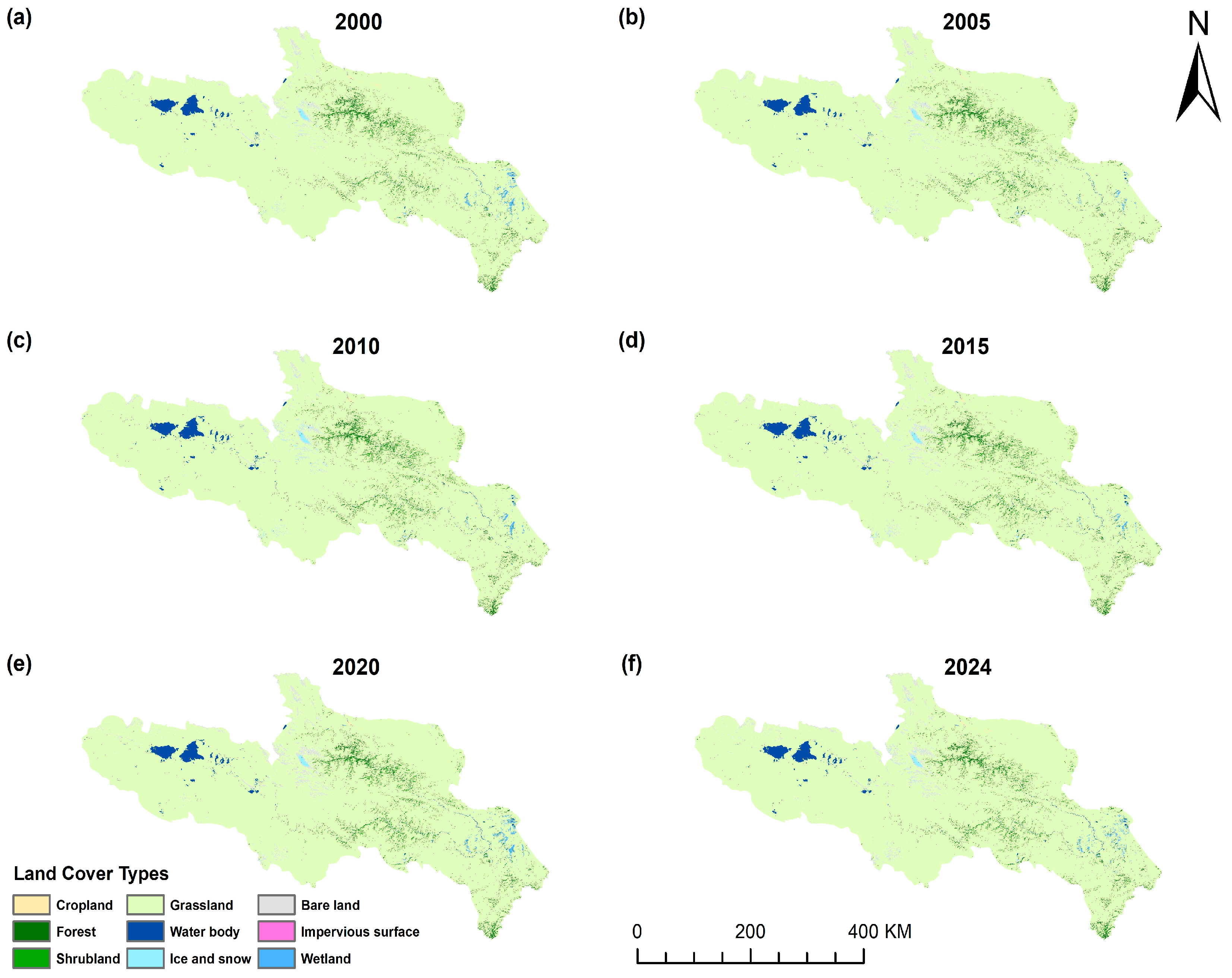
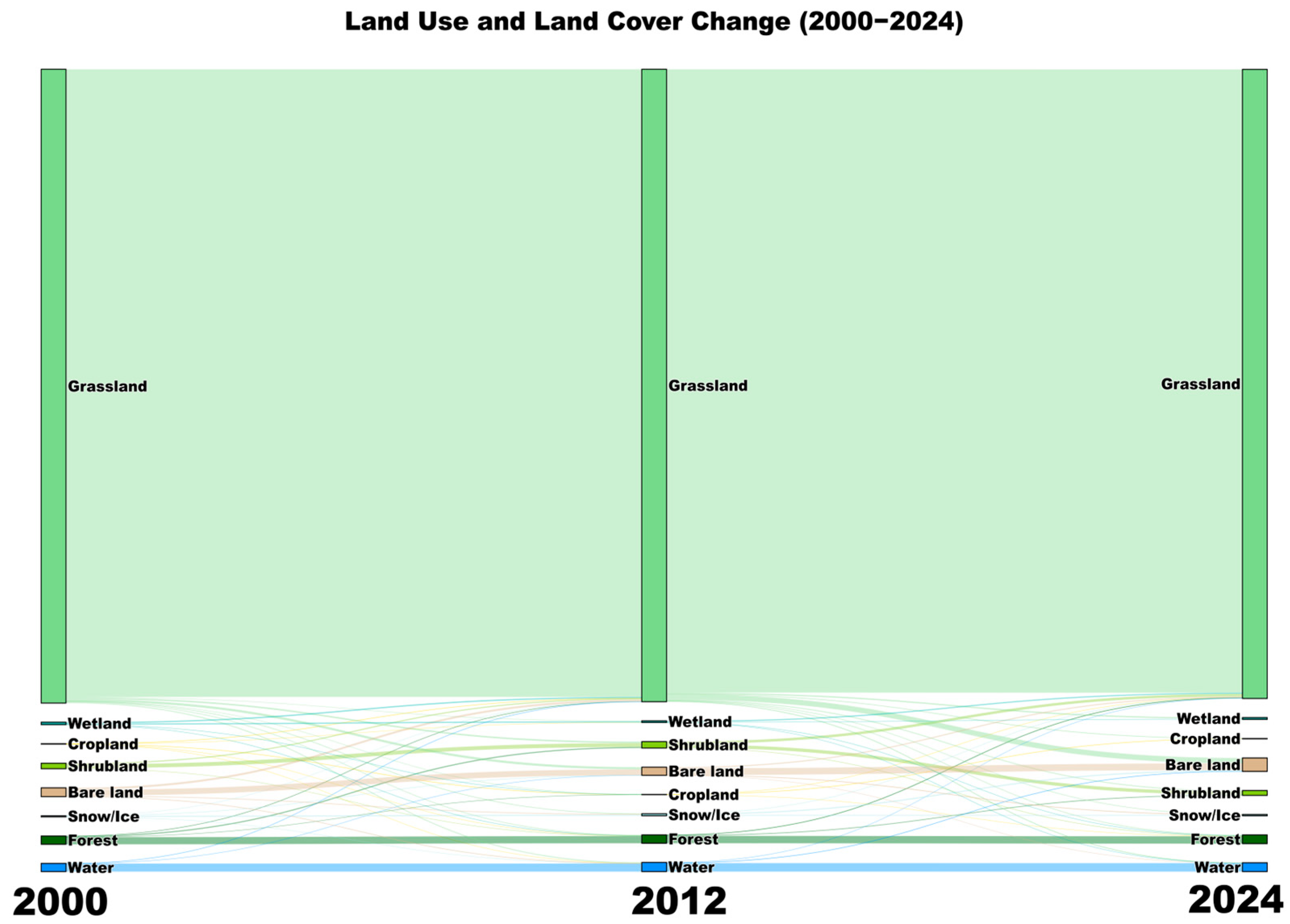
The analysis of the land use transfer matrix in the source region of the Yellow River from 2000 to 2024 shows that the land use types in the region have undergone significant dynamic changes in time and space. On the whole, the land use pattern in the source region of the Yellow River is dominated by grassland and supplemented by other types. Forest land is the only type of continuous expansion in the source area, with an increase of 204.3 km2, all from grassland. The area of cultivated land, shrub land, and wetland is decreasing year by year, and it is transformed into grassland on a large scale. The variation in water body and ice and snow was not significant, while the bare land area decreased first and then increased. The regional land change generally presents the single direction characteristics of “grassland dominance, single increase in forest land, and reduction in the rest”.
From the perspective of time distribution characteristics (Figure 2), the change rhythm of the two stages of 2000–2012 and 2012–2024 is basically the same, but the intensity is different. From 2000 to 2012, the area of grassland increased by 13,302 km2, and the conversion of shrub land, bare land, and wetland to grassland was 212.5 km2, 382.3 km2, and 241.8 km2, respectively, totaling 836.6 km2, of which bare land accounted for 45.6%. From 2012 to 2024, the conversion rate of the three decreased relatively, among which the area of wetlands and shrubs decreased, while the area of bare land increased. The net increase in forest land area was 149.1 km2, and 95.3% of the new area was due to the transfer of grassland. In the same period, although the area of ice and snow and cultivated land continued to shrink, the decline has slowed down.
From the perspective of spatial variation characteristics (Figure 3), from 2000 to 2024, grassland is the dominant type in the source area of the Yellow River, accounting for about 96.7% of the area, and its spatial range has shrunk in some areas, especially in the marginal zone. The conversion to bare land and water is obvious. Forest land and shrub land show a staggered distribution pattern, and there are frequent spatial conversions between them, forming an obvious ecological transition zone. The southern mountainous area was grassland in 2000, and a new dark green forest spot appeared in 2024, indicating that the grassland was all converted into forest land. In 2000, the bare land spread outward from the periphery of the grassland and the edge of the high-altitude ice and snow belt, showing a patchy expansion in space. Wetlands are mainly distributed in low-lying valleys and low-lying areas in the central and western regions, adjacent to grassland and cultivated land. Its range showed a shrinking trend from 2012 to 2024, and 97% of it was converted into grassland. The distribution of water body is relatively stable, but there is mutual transformation at the junction of local area and grassland, and it expands outward 82.1 km2 in the same period. Snow and ice are mainly concentrated in high-altitude areas, and their edges retreat to bare land, indicating a contraction of the spatial range. There is a spatial adjacency and transformation relationship between cultivated land, wetland, and grassland, but the overall distribution pattern remains relatively stable. The shrub belt in the northern piedmont of the mountain was light green in 2000, and basically disappeared in 2024, all of which were transformed grassland.

3.1.2. Spatio-Temporal Variation Characteristics of Vegetation Coverage

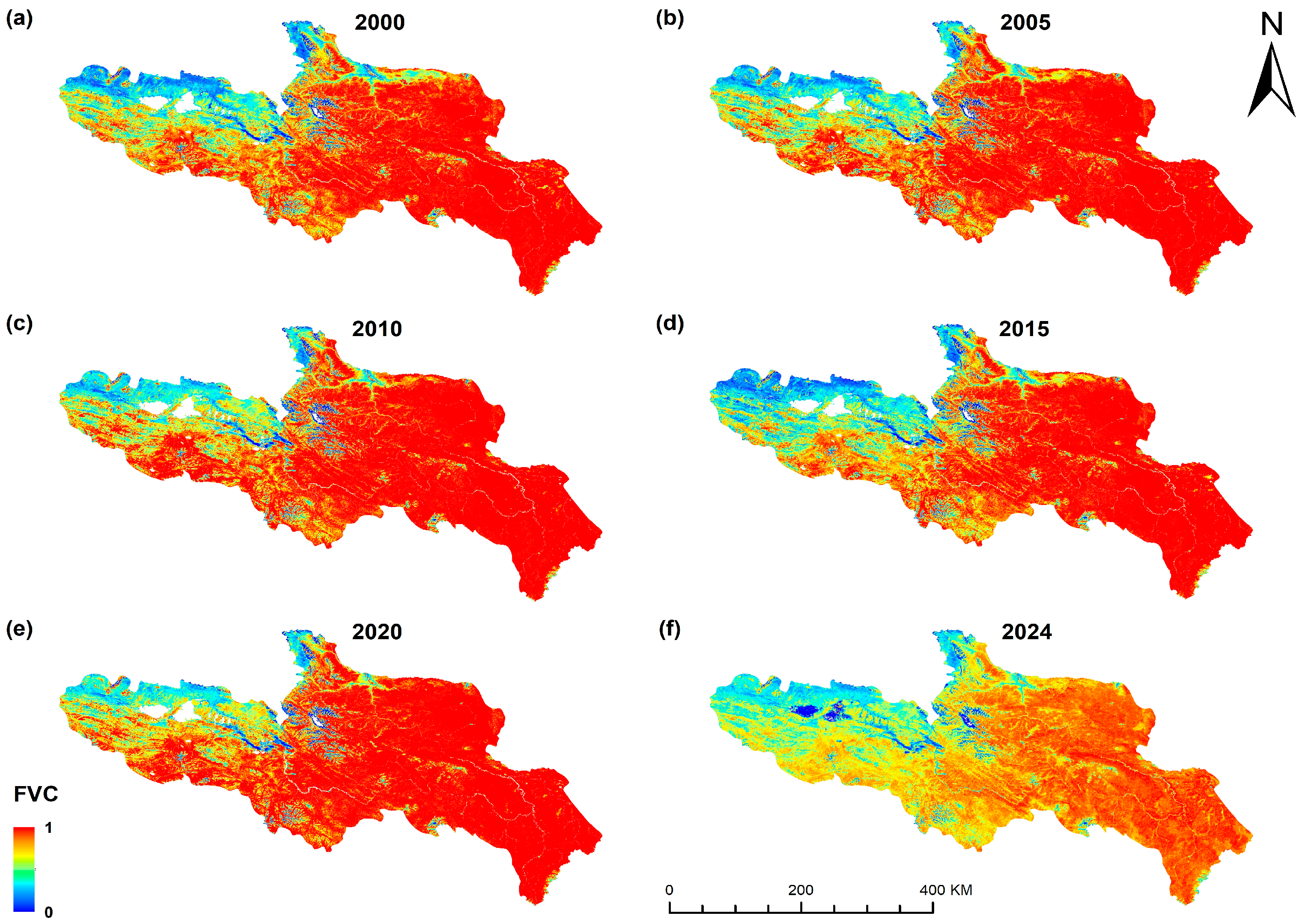
Overall, the spatial heterogeneity of vegetation coverage in the source region of the Yellow River is significant (Figure 4). The high coverage areas are concentrated in the east and south, while the middle and low coverage areas are widely occupied in the central and northwest. In the past 24 years, the macro pattern has remained stable, but local changes have been obvious.
From the perspective of spatial variation characteristics, the overall spatial distribution of vegetation coverage is “high in the east and low in the west”. The boundary of the high vegetation coverage area in the east and south is clear, and the spatial scope remains basically unchanged. It is mainly distributed in Guoluobanma County and Jiuzhi County, Tongde, Hainan, Huangnan Henan, Zeku, Gannan Xiahe, Maqu, Aba Hongyuan, Ruoergai, and other regions. The central region shows an obvious vegetation coverage degradation zone, extending from northeast to southwest, and the low coverage area is connected into a piece. The northwest is the region with the lowest vegetation coverage, and its low coverage range continues to expand from 2010 to 2024, mainly distributed in the Qumalai and Guoluomaduo areas of Yushu. The spatial distribution of vegetation coverage was generally consistent in each period, but the phenomenon of local degradation was more obvious.

3.2. Spatio-Temporal Variation Characteristics of Soil and Water Conservation Service Capacity in the Source Region of the Yellow River Temporal and Spatial Variation of Soil and Water Conservation Service Capacity in the Source Region of the Yellow River

3.2.1. Spatio-Temporal Distribution of Soil and Water Conservation Service Capacity

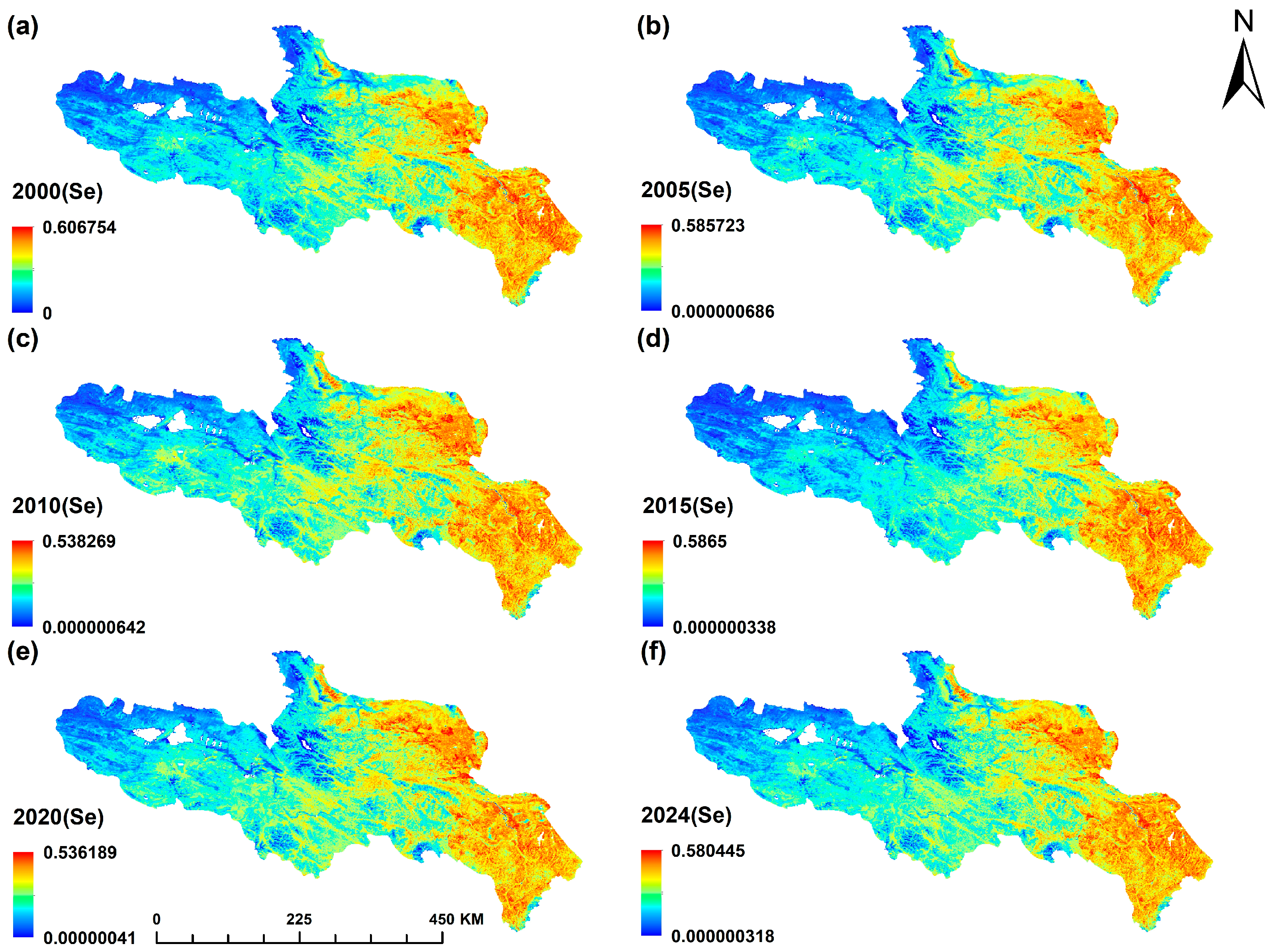
On the whole (Figure 5), the spatial distribution of soil and water conservation service capacity in the source region of the Yellow River shows a significant correlation with land use types. The high vegetation coverage area corresponds to a higher service capacity value, and the bare land expansion area is highly consistent with the low-value area of service capacity.
Upon analysis of time variation characteristics, the service capacity of soil and water conservation in the source region of the Yellow River showed a fluctuating downward trend. The service capacity value was 0.6068 in 2000, decreased to 0.5857 in 2005, and further decreased to 0.5383 in 2010, reaching the lowest level during the study period. In 2015, it rebounded to 0.5865, but in 2020 it fell again to 0.5362, and finally recovered to 0.5804 in 2024. During the whole research period, the fluctuation range of the value was 0.0706, which showed that the instability of service capacity was obvious.
Upon analysis of spatial variation characteristics, the service capacity of soil and water conservation in the source region of the Yellow River shows a clear pattern of high in the southeast and low in the northwest. The high service capacity values are concentrated in the woodland and shrub coverage areas in the southeastern part of the study area. The general ability value area is highly consistent with the central grassland zone, while the low-value area is widely corresponding to the bare land concentration area in the northwest. From 2000 to 2010, the range of low-value area in the northwest continued to expand, which was highly consistent with the decrease in vegetation coverage in the same period. From 2015 to 2024, the service capacity in the central region recovered partially, but the low-value area in the northwest still maintained a large range.

3.2.2. Center of Gravity Migration of Soil and Water Conservation Service Capacity

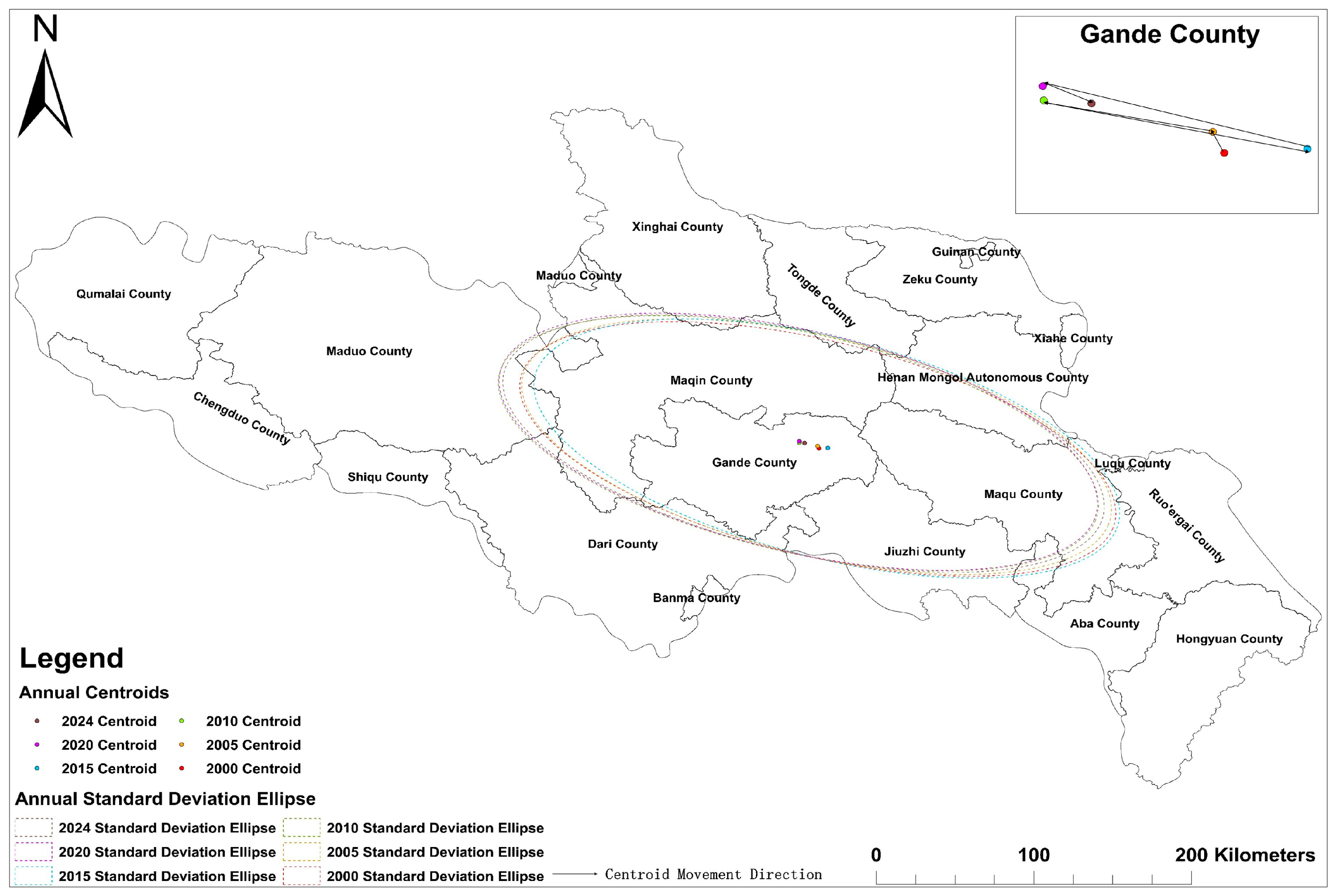
It can be seen from Figure 6 that the overall moving distance of the center of gravity of soil and water conservation service capacity in the source region of the Yellow River is not significant compared with the spatial scale of the source region of the Yellow River. The standard deviation ellipse of each year did not show systematic and significant changes in area, shape, or direction. In 2000–2024, the center of gravity of soil and water conservation service capacity in the source region of the Yellow River was always located in Gande County, and the overall migration to the northwest was about 52 km, with an average annual of 2.2 km. From 2000 to 2005, the center of gravity moved northward by 11 km. From 2005 to 2010, it continued to move northwest by 18 km; from 2010 to 2015, it returned to the northeast of 8 km; in 2015–2020, it moved 12 km to the northwest; in 2020–2024, it still moved 3 km northwestward, and the cumulative trajectory swung from “north–northwest–northeast–northwest” to the northwest. The long axis of the standard deviation ellipse is synchronized with the north by 8, and the area is reduced from about 1.50 × 10 km2 in 2000 to 1.46 × 10 km2 in 2024. The short axis is slightly retracted and the oblateness is maintained at 0.54.

3.3. Analysis of Driving Factors of Soil and Water Conservation Service Capacity in the Source Region of the Yellow River Driving Factors of Soil and Water Conservation Service Capacity in the Source Region of the Yellow River

3.3.1. Factor Detector Detection

Based on the nine driving factors that passed the multicollinearity test, this study used the factor detection module in the parameter-optimal geographic detector to quantify the independent explanatory power of each single factor on the spatial heterogeneity of soil and water conservation services in the source region of the Yellow River in 2000, 2005, 2010, 2015, 2020, and 2024 (expressed as the Q value). The Q value ranges from 0 to 1, and the higher the value, the stronger the ability of the corresponding factor to explain the spatial differentiation (Table 3).
It can be seen from Table 3 that the nine driving factors have obvious fluctuations between years. The annual average temperature (X1), vegetation coverage (X3), and grazing intensity (X9) fluctuated between 2000 and 2024, especially X3, which fluctuated greatly (standard deviation is often higher than 0.04), reaching a peak of 0.6022 in 2020 and falling to 0.5508 in 2024, still higher than the early level. The Q values of annual average precipitation (X2), soil moisture (X6), and population density (X8) showed an overall downward trend from 2000 to 2024, especially the standard deviation of X8, which gradually increased, and the results were unstable. Elevation (X4), slope (X5), and average GDP (X7) have small interannual changes and are generally stable.
The analysis results show that the annual average temperature (X1) and vegetation coverage (X3) are always the most important factors affecting the service capacity of soil and water conservation in these six years, and the average Q values are 0.5898 and 0.5270, respectively. The explanatory power of elevation (X4), slope (X5), and grazing intensity (X9) was always low, indicating that they had very limited influence on the formation of the spatial pattern of soil and water conservation services. The driving factors are arranged in descending order according to the Q value: annual average temperature > vegetation coverage > annual average rainfall > average GDP > population density > soil moisture > grazing intensity > elevation > slope. This ranking result clearly reveals that the dominant driving factors for the spatial differentiation of soil and water conservation services in the study area from 2000 to 2024 are mainly natural factors. Temperature and vegetation conditions have the strongest explanatory power as key natural factors, while topography and human activities have little impact on soil and water conservation services.

3.3.2. Interactive Detector Detection

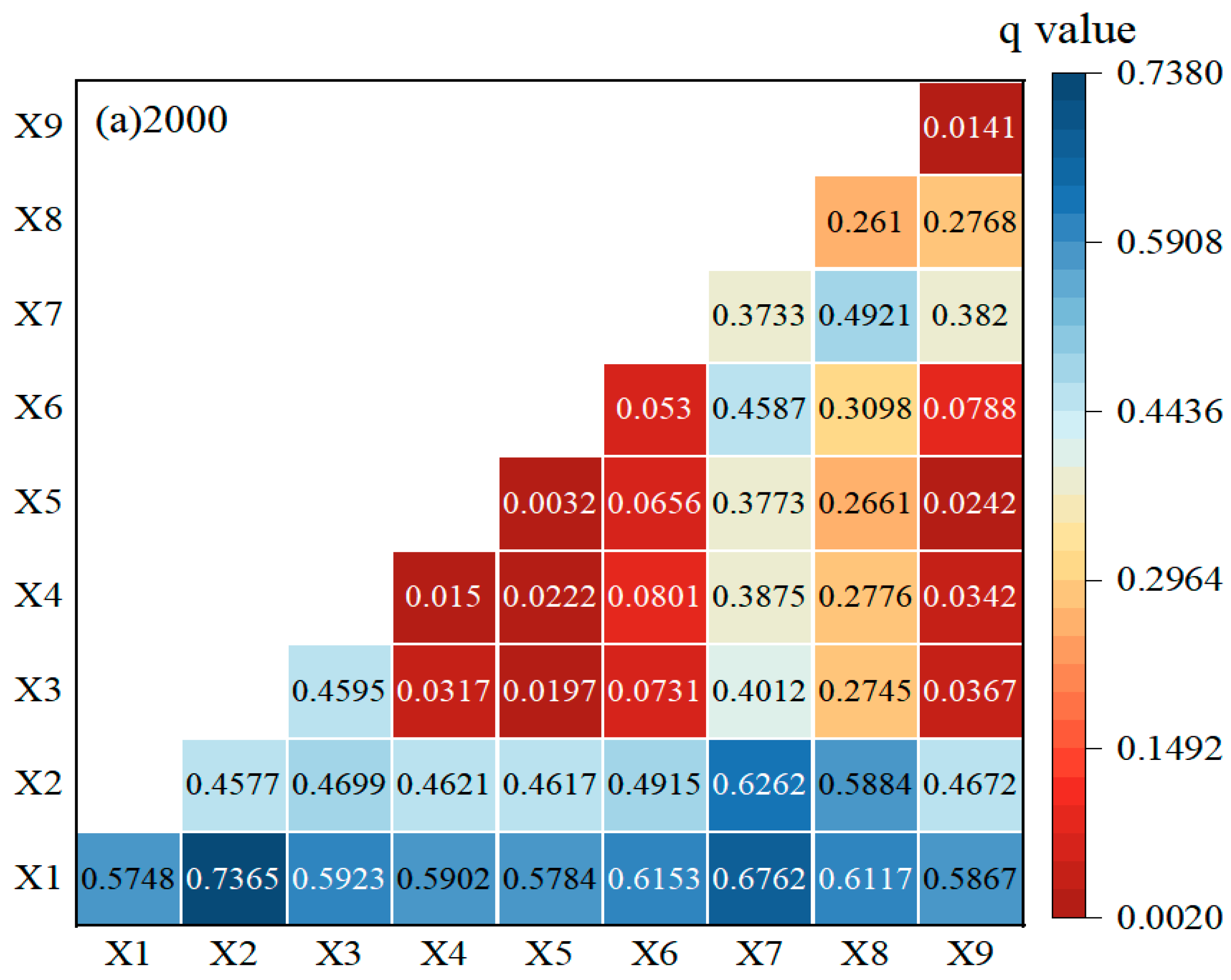
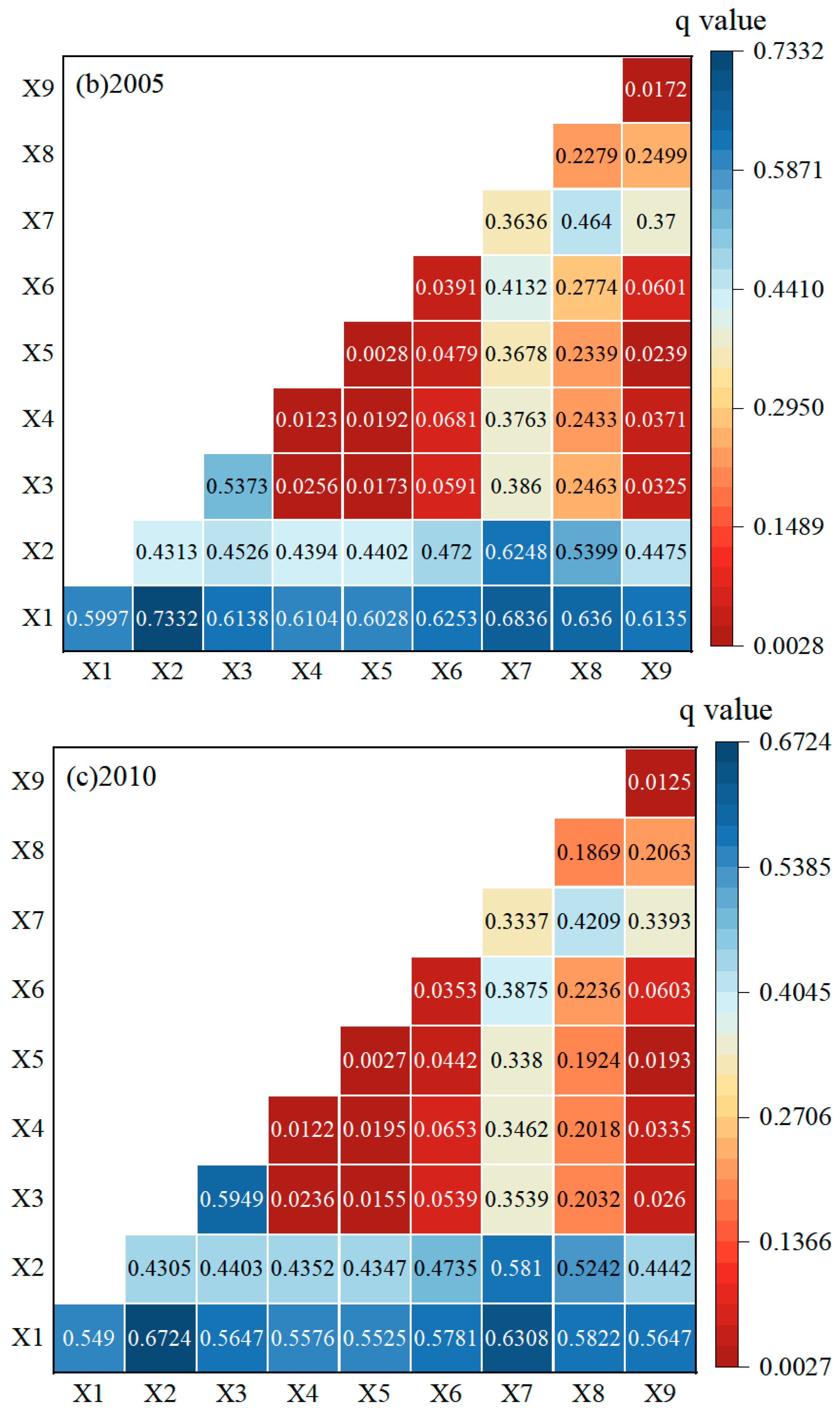
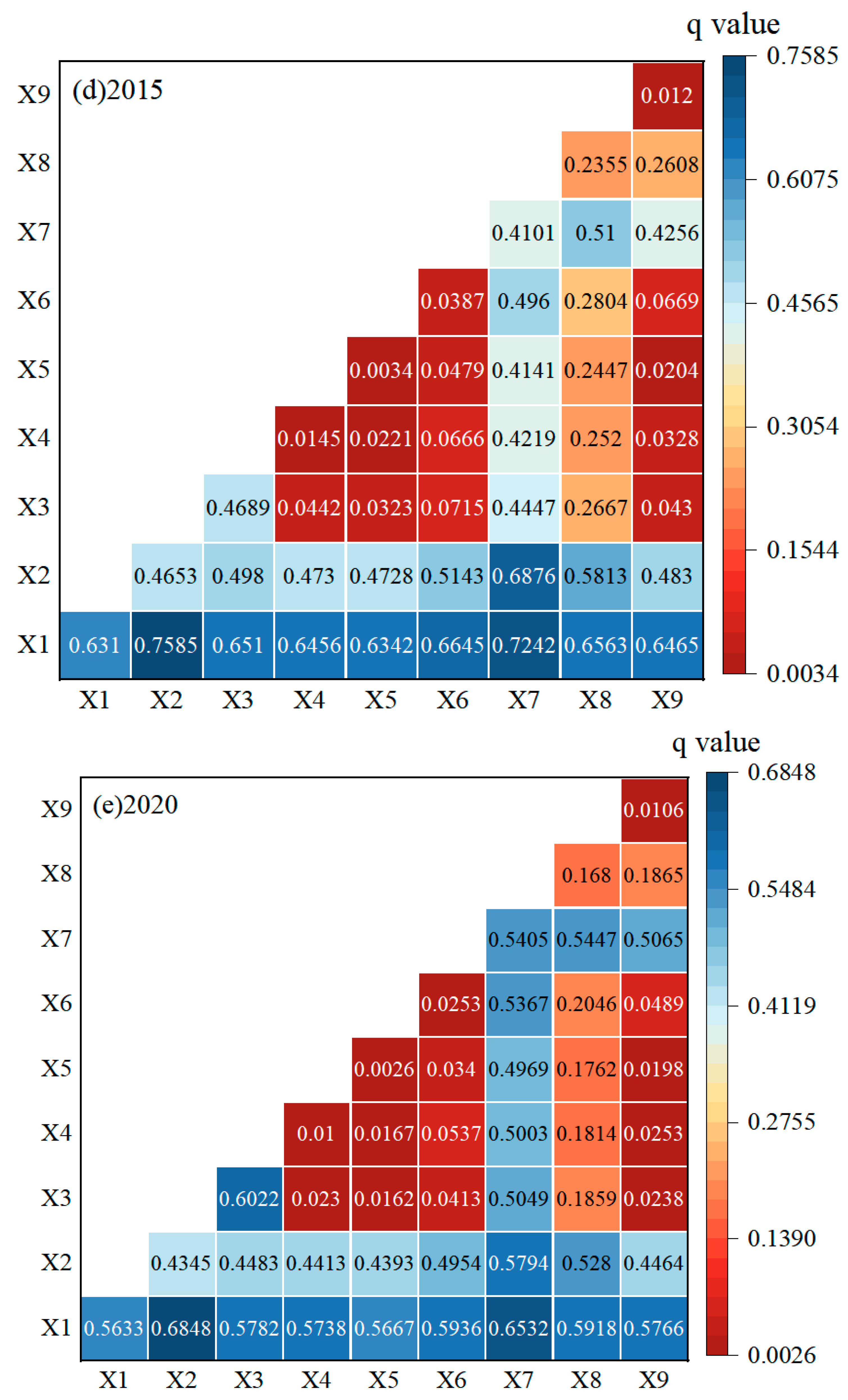
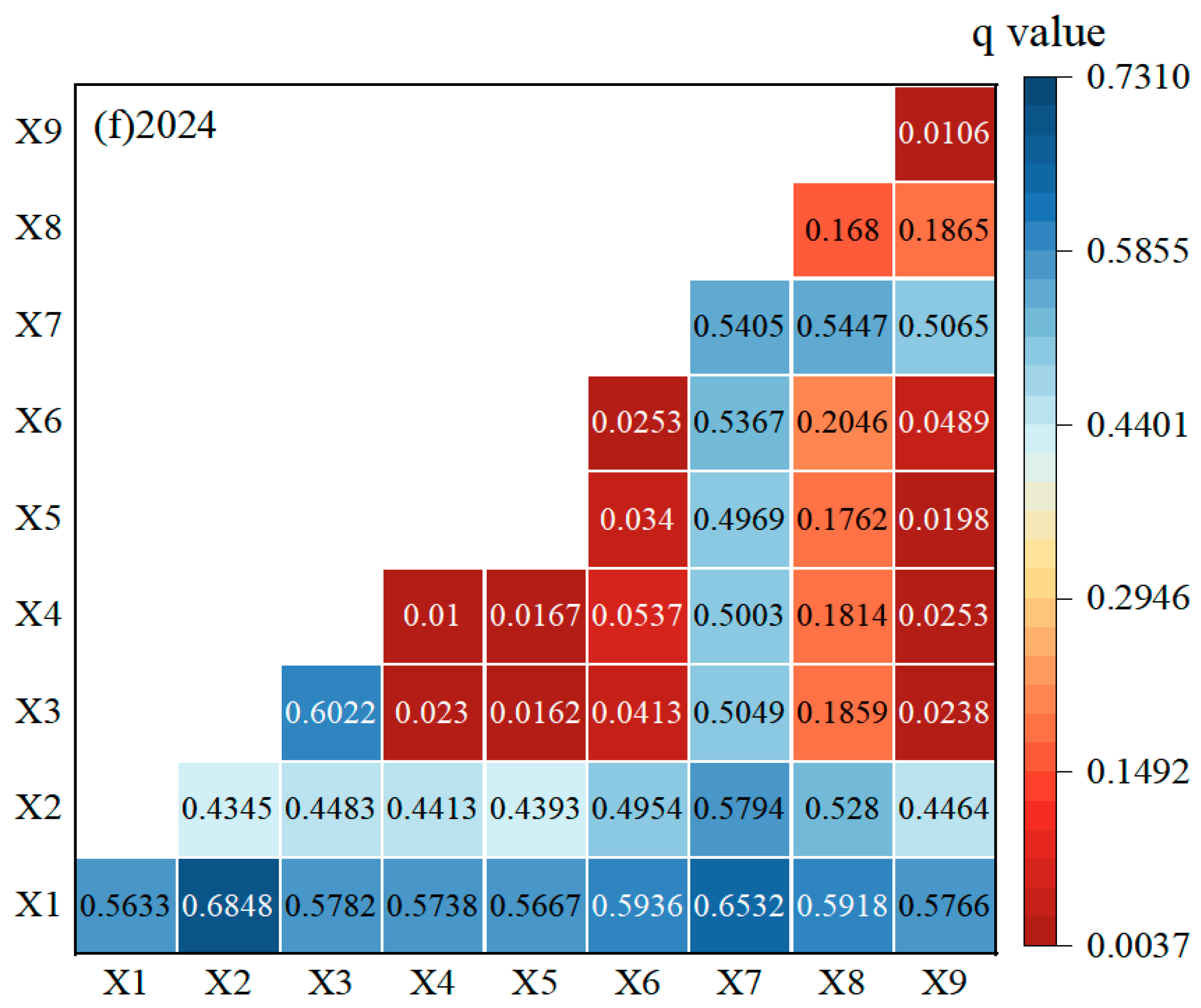
From the analysis of interactive detection results (Figure 7), the explanatory power of the interaction between the driving factors in the region on the spatial heterogeneity of soil and water conservation services is generally higher than the independent explanatory effect of any single factor. The interaction between annual average temperature (X1) and annual average precipitation (X2) from 2000 to 2024 is the strongest, and the interaction type is a two-way enhancement type, with an average Q > 0.67, indicating that climate factors (hydrothermal combination) are the most stable and strongest synergistic factors driving soil and water conservation services. From the perspective of the spatial differentiation of the interaction over the years, the interaction between annual average temperature and annual average precipitation showed a “W” type two-way enhancement pattern from 2000 to 2024, reaching a peak in 2015, with a Q value of 0.7585. The annual average temperature and elevation (X4), slope (X5), soil moisture (X6), and grazing intensity (X9) showed a nonlinear increasing trend. During the six years, the interaction between vegetation coverage (X3) and other factors remained nonlinearly weakened, and the interaction with average GDP (X7) and population density (X8) remained weakened in the six years. There is a one-way weakening interaction with elevation, slope, soil moisture, etc., indicating that vegetation coverage has an inhibitory effect on the explanatory power of terrain, soil, and other factors. The nonlinear weakening interaction occurs between factors that have relatively weak explanatory power for soil and water conservation services. For example, in 2020, there will be a nonlinear interaction between average GDP and soil moisture, vegetation coverage, elevation, slope, etc., indicating that the interaction between economic factors and natural and topographic factors in 2020 is greater than that of single factors.

3.3.3. Risk Detector Detection

The risk detection results of soil and water conservation service capacity in the source region of the Yellow River from 2000 to 2024 are shown in Table 4. On the whole, the population density (X8) and the per capita GDP (X7) are the dominant driving factors affecting the soil and water conservation service capacity in the source area of the Yellow River. The Q values are 0.3552 and 0.3496, and there is a clear optimal interval. The optimal interval of population density is 7~9 person/km2, and too-low or too-high population pressure may have a negative impact on the system. The optimal range of GDP is 11,900~14,100 yuan/km2, and the intensity of economic activity is lower or higher than this range, which may increase the risk of soil erosion. Meteorological factors play a key role in the service capacity of soil and water conservation. The Q values of annual average temperature (X1) and annual average precipitation (X2) are second only to economic factors, which are 0.3473 and 0.3244, respectively. The optimal range of annual average temperature is 1.71~3.47° C, and the optimal range of annual precipitation is 682~730 mm. Too-high or too-low temperature, or too much or too little water, may increase the risk of soil erosion. The table shows that the optimal range of vegetation coverage (X3) is extremely high (81.7~100%), and the optimal range of altitude (X4) is 3390–3740 m. The optimal range of slope (X5) is 18.3~24.3°. The optimal range of soil moisture (X6) is 26.7~29.4%. The optimal range of grazing intensity (X9) is 0.352~0.652. It shows that suitable altitude, gentle slope, high vegetation coverage, wet soil, and moderate grazing intensity have the lowest risk of soil erosion.
From the perspective of interannual changes (Table 5), the driving factors affecting the service capacity of soil and water conservation in the source region of the Yellow River from 2000 to 2024 have changed from climate and economic “two-factor” dominance to economic dominance and natural constraints. From 2000 to 2005, the Q values of climatic factors (X1, X2) and socio-economic factors (X7, X8, X9) were 0.3133~0.3575, which belonged to the strong driving stage of nature and humans. From 2010 to 2024, the Q value of socio-economic factors remained stable or slightly increased, especially population density, while the Q value of natural factors (X1, X2, X3, X4, X5) showed a slow downward trend. The optimal range of each factor also changed, among which the optimal range of terrain factors (X4, X5) and vegetation coverage (X3) almost did not change, the altitude was stable at 3390~3740 mm, and the slope was 15.3~19.2°. The vegetation coverage was stable at 81.1~100%. The “optimal range” of GDP density (X7) has increased significantly, from 3710 yuan/km2 in 2000 to 44,600 yuan/km2 in 2024. It reflects the dynamic adjustment of the relationship between economic development and ecological protection. The optimal range of annual mean temperature (X1) extends from low temperature (0.82~2.32 °C) to a warmer range (2.28~5.84 °C). The optimal range of annual mean precipitation (X2) fluctuates greatly (592~843 mm), but it remains in the medium-rich range of 600–800 mm. The warming trend of temperature and the fluctuation of precipitation may be related to the regional response of global climate change.

3.3.4. Ecological Detector Detection

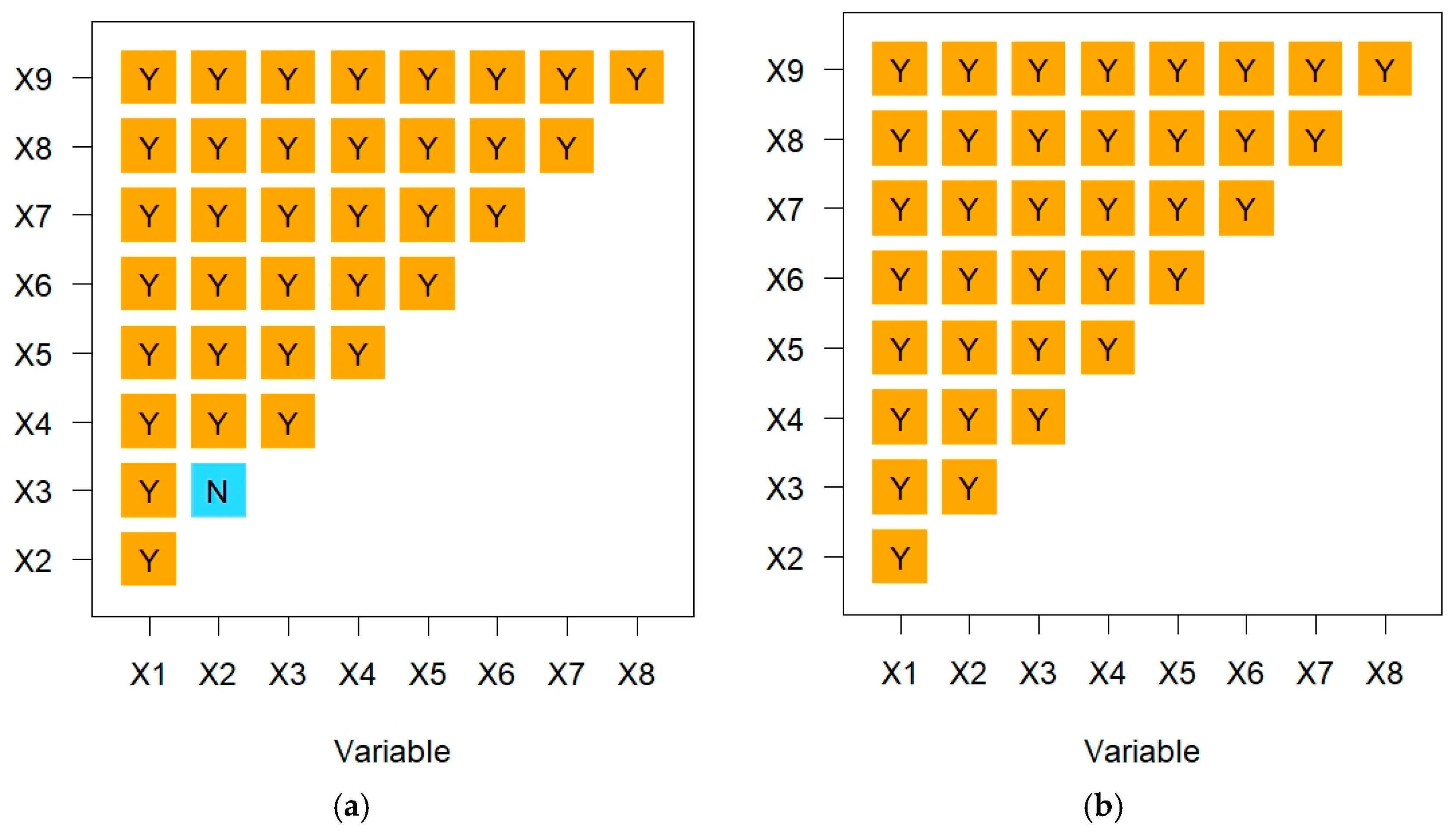
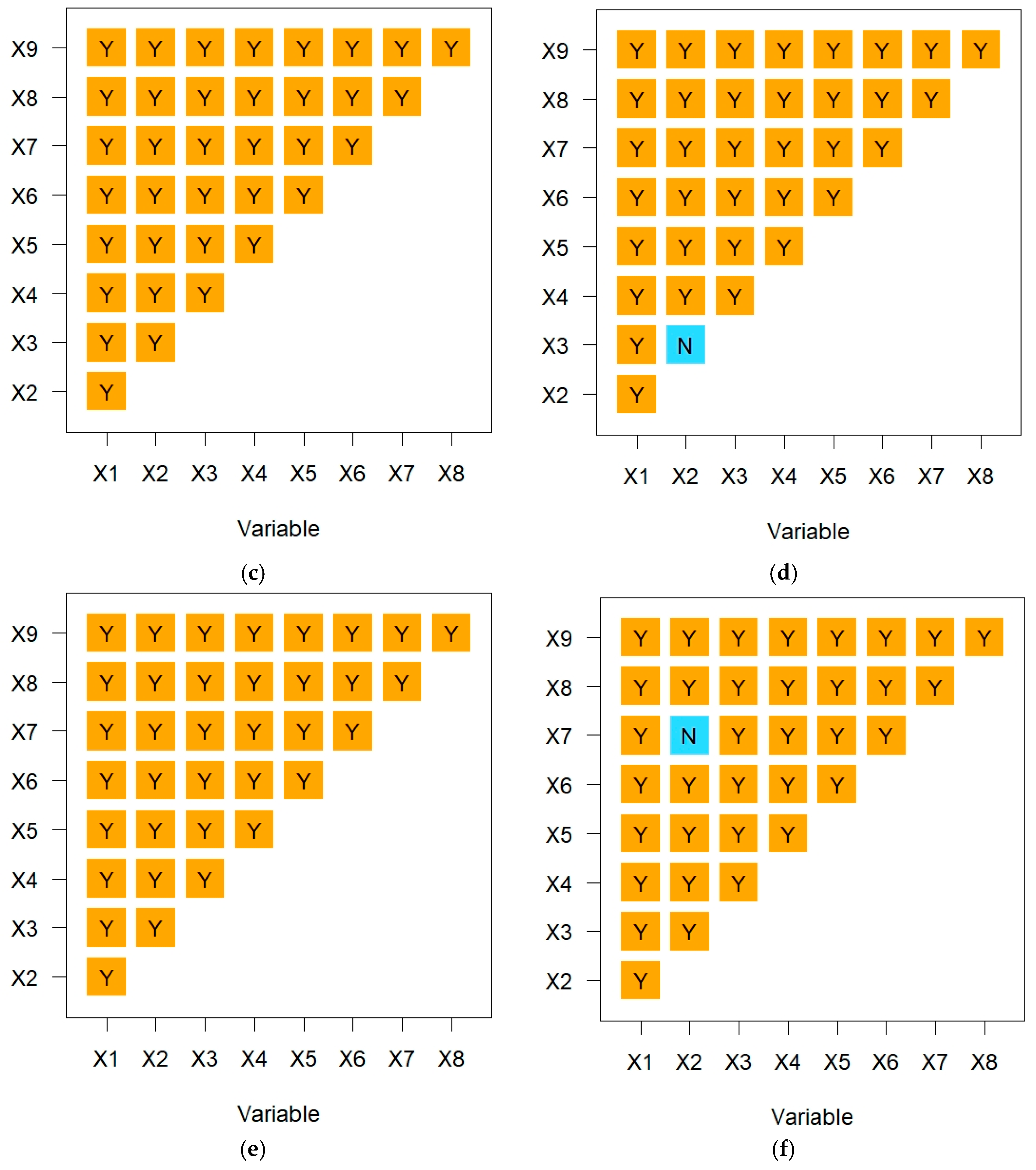
Ecological detection is used to test whether there is a significant difference in the impact of the two factors on the spatial distribution of soil and water conservation service capacity. Among them, “Y” represents a significant difference, and “N” represents no significant difference.
According to the ecological detection results (Figure 8), in the six years of 2000, 2005, 2010, 2015, 2020, and 2024, 97% of the nine driving factors have significant differences, only the average annual precipitation and vegetation coverage in 2000 and 2005, and the average annual precipitation and population density and GDP in 2024. In 2000, 2005, 2010, 2015, 2020, and 2024, the proportion of significant difference (Y) in all driving factor combinations was 97%, 100%, 100%, 97%, 100%, and 97%, respectively. Among them, the combination of annual average temperature and all factors remained completely significant in the six years, showing the strongest stability; the combination of vegetation coverage and all factors also remained significant. After the interaction between annual average precipitation and vegetation coverage, it was not significant in 2000 and 2015 (N). After the interaction between annual average precipitation and GDP, it was not significant only in 2024, and it was significant in other years. In each year, the number of significant difference factors was the lowest in 2000, 2015, and 2024, only one pair of interaction factors lost significance (X2–X3, X2–X3 and X2–X7, respectively), and the remaining 35 pairs of interaction factors remained significant. In the remaining years, all 36 pairs of interaction factors showed significant differences, reflecting the overall stability and periodic fluctuation characteristics of the difference relationship between ecological factors.

4. Discussion

4.1. Spatio-Temporal Pattern of Land Use and Vegetation Cover Change and Its Impact on Soil and Water Conservation Services

The spatio-temporal evolution of land use and vegetation coverage is the core factor that determines the level of soil and water conservation services in ecologically fragile areas [78,79,80]. This study found that, from 2000 to 2024, the land use pattern in the source region of the Yellow River showed a significant feature of “grassland dominance, forest land increase, and other reductions”, which had a profound impact on the regional soil and water conservation service capacity. As the only type of continuous expansion, the increment of 204.3 km2 of forest land is all derived from the transformation of grassland, and the transformation occurs mainly on the sunny slope and semi-sunny slope at an altitude of 3800–4200 m. This phenomenon may not be a simple natural succession, but implies a strong artificial intervention or policy-driven signal. For example, the implementation of ecological projects such as “returning grazing land to grassland” and “natural forest protection” has promoted the ecological transformation of grassland to forest land in suitable habitats [81,82]. As an ecosystem type with the strongest water conservation and soil conservation capacity, the increase in forest land has a significant effect on the improvement of regional soil and water conservation capacity [83,84]. However, this study found that the overall service capacity of soil and water conservation showed a fluctuating downward trend, which was inconsistent with the research results in other regions [85,86,87,88]. This seemingly contradictory phenomenon may be due to the fact that the ecological vulnerability in the source area of the Yellow River leads to the lack of improvement of soil and water conservation service capacity. The annual average temperature in the source area of the Yellow River is 0.79 °C. Due to alpine hypoxia and the thin soil layer, the vegetation growth period is slow and the survival rate is low [89,90]. For example, the annual average temperature in Maduo County is −4.1 °C, and the number of strong wind days accounts for 70–85% of the year. In addition, the thickness of the soil layer is only about 50 cm, which is easily blown away by the strong wind. Plant roots can significantly affect soil erosion [91,92]. Only a temporary increase in vegetation coverage cannot significantly improve the water holding capacity of soil, thus affecting the improvement of soil and water conservation service capacity in the source region of the Yellow River.

4.2. Spatial and Temporal Heterogeneity Changes in Soil and Water Conservation Service Capacity

The service capacity of soil and water conservation in the source area of the Yellow River shows strong heterogeneity in the spatial and temporal dimensions. Spatially, the stable pattern of “high in the southeast and low in the northwest” is highly consistent with the distribution of vegetation coverage and land use types, highlighting the decisive role of ecosystem background in service capacity [62,93,94]. In terms of time variation characteristics, the value of soil and water conservation service capacity in the source region of the Yellow River fluctuated and decreased in 24 years, and there were two obvious troughs in 2010 and 2020. This fluctuation may be related to the interannual variation in climate [95], especially the precipitation pattern and extreme drought weather [96,97,98,99,100]. The trough around 2010 may be related to the periodic drought experienced by the source region of the Yellow River during this period, resulting in limited soil moisture and vegetation growth, thus weakening the soil retention capacity [101].
The shift in gravity center usually reflects the spatial change in soil and water conservation service capacity [102]. The standard deviation ellipse showed that the center of gravity of soil and water conservation service capacity in the source region of the Yellow River maintained a high interannual fluctuation and overall pattern stability from 2000 to 2024. Although the overall moving distance was not significant relative to the spatial scale of the source region of the Yellow River, it only migrated to the northwest by 52 km, the long axis was 8 ° north-west, and the area was reduced by 2.7%. The standard deviation ellipse of each year did not show systematic and large changes in area, shape, or direction. However, combined with land use change data, it was found that the center of gravity movement was highly coupled with grassland restoration (bare land → grassland 212 km2) in the northwest of Gande County. The service capacity of the high-value areas in the southeast is relatively weakened, and the service capacity of the low-value areas in the northwest is relatively improved, which may be related to the implementation of the “Returning Grazing to Grassland” project in the SanJiangYuan area [103,104]. The problem that the transfer of the center of gravity of soil and water conservation service capacity is not obvious needs to be further verified The shrinkage of the elliptical area means that the high-value area is highly concentrated in the southeast, and the low-value area is continuously expanded in the northwest direction, showing a “dual-polarization” pattern of “high-value more concentrated and low-value more connected”, which increases the overall instability and risk of service capacity to a certain extent [105,106]. Studies have shown that the spatial contraction of ecosystem services can easily lead to a decline in system resilience. Once the high-value area encounters drought or insect disaster, the overall service may -fall off a cliff [107,108,109]. Therefore, the direction of soil and water conservation in the source region of the Yellow River should focus on the low-value area of soil and water conservation service capacity of strip or corridor restoration.

4.3. Dominance and Interaction of Climate Factors

The results of the geographical detector showed that the annual average temperature (X1) and vegetation coverage (X3) were the most stable dominant factors affecting the soil and water conservation service capacity in the source region of the Yellow River, and their explanatory power (Q value) was significantly higher than other factors. This finding is consistent with the results of other ecologically fragile areas [110,111]. The risk detector further revealed that the risk value in the middle and high temperature range (>1.6 °C) was the highest and showed an upward trend, indicating that the increase in temperature may continue to increase the risk of regional soil erosion by accelerating the degradation of permafrost and changing soil hydrological processes [112,113]. I- Interactive detection reveals a more complex driving mechanism than single factor [114,115]. The “two-way enhancement” interaction between annual average temperature and precipitation is the most powerful synergistic driving combination, indicating that the combination of water and heat has the greatest contribution to the spatial heterogeneity of soil and water conservation service capacity [60,116].
In contrast, vegetation coverage and other factors (such as topography, soil, human activities) showed a “nonlinear weakening” interaction or “one-way weakening”, indicating that, in the unique alpine environment of the source region of the Yellow River, the increase in vegetation coverage did not synchronously translate into the improvement of soil and water conservation function. The reason may be that the increase in vegetation coverage in areas with a fragile ecological background, such as Maduo and Qumalai, has shallow roots and limited soil improvement, and does not show a soil and water conservation service function [117,118]. In addition, the explanatory power of topography and human activities is generally weak, and it may be that the climate and vegetation pattern masks the subtle effects of local topography and human activities. However, it cannot be ignored that, after the average GDP (X7) and population density (X8) reach a certain level, their negative impact on soil and water conservation is weakened, indicating that, after the higher stage of economic development, the accompanying ecological protection investment and management enhancement (such as ecological compensation, national park system) may offset the negative effects of development and construction to a certain extent [119].

4.4. Soil and Water Conservation Service Management Strategies and Policy Implications

In the face of the impact of land use change and human activities on soil and water conservation services, the source region of the Yellow River has taken a number of ecological protection and restoration measures [120,121]. For example, the Outline of the Yellow River Basin Ecological Protection and High-quality Development Plan clearly propose to strengthen grazing prohibition and enclosure and implement comprehensive management of degraded grasslands, and increasing the protection of rivers and lakes, prohibiting the surrounding mining, sand mining, and other systems [3,122], providing an institutional guarantee for ecological protection in the source area of the Yellow River. For example, the “SanJiangYuan National Park Regulations” clearly stipulate the guidelines for a series of activities from planning and construction, resource protection to utilization management, social participation, etc., and provide legal protection for ecological protection in the source area of the Yellow River [123]. These systems correspond to the impact of various driving factors on soil and water conservation service capacity revealed in this study, and provide a scientific basis for policy formulation from the management level.
Based on the above policy basis, this paper proposes to strengthen soil and water conservation services from three aspects: differentiated ecological management, climate change adaptive management, and human activity management. Firstly, it is very important to implement differentiated ecological management strategies. The policy has established a core area of ecological protection red line and prohibited infrastructure construction and mineral resources development [124]. However, the high service capacity area in the southeast should focus on protecting and maintaining existing forests, shrubs, and high-quality grassland, and strictly control unreasonable development activities. The ecological degradation zone in the central and northwestern regions should be the key area for ecological restoration, inhibiting the expansion of bare land [125]. Secondly, climate change adaptive management should be incorporated into future ecological planning. The climate factor in the source region of the Yellow River is the dominant factor, and the future ecological planning must fully consider the long-term trend of climate warming and wetting [126,127]. Crop breeding and artificial precipitation layout measures are mentioned in the relevant document system [128]. However, artificial precipitation has been unable to meet the current situation of uneven spatial and temporal precipitation. Therefore, catchment areas can be established in areas with low annual rainfall to maintain ecological water needs [129]. Finally, in terms of human activity management, risk detection results show that moderate- and high-intensity grazing is still an important risk source of soil erosion. The policy should continue to implement the scientific rotation and rest grazing system, continue to improve the ecological compensation policy, and realize the coordinated development of ecological protection and people’s livelihood improvement [130,131].

5. Conclusions

5.1. Spatio-Temporal Variation Characteristics of Land Use and Vegetation Coverage in the Source Region of the Yellow River

The land use pattern in the source region of the Yellow River has undergone a directional transformation, and the vegetation coverage has generally increased but the spatial heterogeneity is significant. From 2000 to 2024, the land use in the source region of the Yellow River showed a single directional change characteristic of “grassland dominance, single increase in forest land and reduction in the rest”. In the same period, the regional average vegetation coverage increased from 57.9% to 67.8%, with a cumulative increase of 9.9%. However, its spatial distribution always maintained the pattern of “high in the east and low in the west”, and the low coverage area in the northwest continued to expand, with obvious local degradation.

5.2. Spatial and Temporal Variation Characteristics of Soil and Water Conservation Service Capacity in the Source Region of the Yellow River

The center of gravity of soil and water conservation service capacity in the source region of the Yellow River maintained high interannual volatility and overall pattern stability from 2000 to 2024. The overall moving distance was not significant relative to the spatial scale of the source region of the Yellow River. It only migrated to the northwest by 52 km, the long axis was 8° to the north, and the area was reduced by 2.7%. The standard deviation ellipses of each year did not show systematic and significant changes in area, shape, or direction.

5.3. Driving Factors Analysis of Soil and Water Conservation Service Capacity in the Source Region of the Yellow River

Climate and economic factors are the key factors driving the spatial differentiation of soil and water conservation service capacity, and the role of each driving factor has an optimal range to reduce the risk of soil erosion. Geodetector analysis showed that annual mean temperature (Q = 0.590) and vegetation coverage (Q = 0.527) were the most influential single factors, while the interaction between annual mean temperature and precipitation (bidirectional enhancement) was the most stable synergistic driving combination. The risk detector further identifies the key intervals that have a significant impact on service capacity, including the following: the optimal interval of population density is 7~9 person/km2, the optimal interval of average GDP is 11,900~14,100 yuan/km2, the optimal interval of annual average temperature is 1.71~3.47 °C, the optimal interval of annual precipitation is 682~730 mm, the optimal interval of vegetation coverage is 81.7~100%, and the optimal interval of altitude (X4) is 3390~3740 m. The optimal range of slope is 18.3~24.3°. The optimal range of soil moisture is 26.7~29.4%. The optimal range of grazing intensity was 0.352~0.652.

5.4. Adaptation Strategies to Climate and Human Challenges in the Source Region of the Yellow River

Based on the analysis of soil and water conservation service capacity and driving factors in the source region of the Yellow River from 2000 to 2024, adaptive strategies for climate change and human disturbance are proposed: in terms of ecological restoration projects, ecological restoration projects should continue to be implemented, but differentiated restoration in the southeast and northwest should be emphasized. The southeast strictly controls development on the basis of original protection, and the northwest focuses on ecological restoration, especially bare land vegetation coverage and wetland protection; in response to climate challenges, an alpine breeding bank was established, and a catchment area was established in areas with low annual average precipitation (<400 mm). In terms of human disturbance, we will optimize grazing strategies, continue to implement scientific rotation and rest grazing systems, and continue to improve ecological compensation policies.

Author Contributions

Conceptualization, X.L. and T.C.; data collection, X.L. and B.Y.; methodology, T.C.; software, K.S. and F.Z.; verification, K.S.; formal analysis, X.L.; data monitoring, T.C. and K.S.; writing—original preparation, X.L.; visualization, K.S. and F.Z.; supervision, X.Z.; project management, X.L. All authors have read and agreed to the published version of the manuscript.

Funding

This research was funded by “ Research on the optimization of modernization path for achieving harmonious coexistence between human and nature at the source of the Yellow River from the perspective of “two combinations”, grant number 25QN074”. The funder is Xiaoqing Li, and the funding number is 15000 yuan.

Data Availability Statement

The original data presented in this study are as follows: (1) land cover data, from the Zenodo platform (https://doi.org/10.5281/zenodo.15853565); (2) NPP data by distributed NASA EOSDIS Land Processes Distributed Active Archive Center (https://doi.org/10.5067/MODIS/MOD17A3HGF.061); (3) The NDVI data are derived from the National Tibetan Plateau /Third Pole Environment Data Center (https://doi.org/10.11888/Terre.tpdc.300328; accessed on 14 October 2025); (4) Soil moisture is derived from the NASA Earth Science Data website (https://disc.gsfc.nasa.gov/datasets/FLDAS_NOAH01_C_GL_M_001/summary?keywords=FLDAS, accessed on 5 November 2025); (5) Annual average temperature and annual average precipitation are derived from the National Tibetan Plateau/Third Pole Environment Data Center (https://doi.org/10.11888/Meteoro.tpdc.270961; https://doi.org/10.5281/zenodo.3114194); (6) The LandScan population dataset was developed by the Oak Ridge National Laboratory (ORNL) of the United States Department of Energy and provided by East View Cartographic (https://landscan.ornl.gov/); (7) The DEM data come from the “Geospatial Data Cloud” of the Chinese Academy of Sciences (http://www.gscloud.cn/); (8) The average GDP is derived from the “China Statistical Yearbook” (https://www.stats.gov.cn/sj/ndsj/, accessed on 28 September 2025).

Conflicts of Interest

The authors declare no conflicts of interest.

References

  1. Su, T.; Miao, C.; Duan, Q.; Gou, J.J.; Guo, X.Y.; Zhao, X. Hydrological response to climate change and human activities in the Three-River Source Region. Hydrol. Earth Syst. Sci. Discuss. 2022, 2022, 1477–1492. [Google Scholar] [CrossRef]
  2. Liu, M.; Zhong, J.; Xu, S. Simulation of Spatial and Temporal Variations in the Water Yield Function in the Source Area of the Yellow River and an Analysis of Influencing Factors. Sustainability 2024, 16, 8259. [Google Scholar] [CrossRef]
  3. Wang, D.; Zhao, Y.; Yang, W.; Ma, K.; Hao, T.; Zhao, J.; Tang, R.; Pu, Y.; Zhang, X.; Mujtaba, K.G.; et al. Ecological–economic assessment and managerial significance of water conservation in the Headwaters of the Yellow River. Water 2022, 14, 2553. [Google Scholar] [CrossRef]
  4. Zhu, M.; He, W.; Zhang, Q.; Xiong, Y.; Tan, S.; He, H. Spatial and temporal characteristics of soil conservation service in the area of the upper and middle of the Yellow River, China. Heliyon 2019, 5, e02985. [Google Scholar] [CrossRef]
  5. Tarpeh, H.S. Assessing the Effect of Land Degradation on Farmer’s Livelihood: A Case of Muhanga District, Rwanda. Glob. Acad. Sci. J. Multidiscip. Stud. (GASJMS) 2025, 3, 29–41. [Google Scholar]
  6. Joorabian Shooshtari, S.; Ardakani, T.; Beik Khormizi, H. Modeling future sediment retention service in the Bagh-e-Shadi Forest protected area using InVEST and the ACCESS-ESM1-5 climate model. Sci. Rep. 2025, 15, 3435. [Google Scholar] [CrossRef]
  7. Jin, J.; Wang, G.; Zhang, J.; Yang, Q.; Liu, C.; Liu, Y.; Bao, Z.; He, R. Impacts of climate change on hydrology in the Yellow River source region, China. J. Water Clim. Change 2020, 11, 916–930. [Google Scholar] [CrossRef]
  8. Wang, X.; Yang, T.; Yong, B.; Krysanova, V.; Shi, P.; Li, Z.; Zhou, X. Impacts of climate change on flow regime and sequential threats to riverine ecosystem in the source region of the Yellow River. Environ. Earth Sci. 2018, 77, 465. [Google Scholar] [CrossRef]
  9. Lu, Z.; Song, Q.; Zhao, J.; Wang, S. Prediction and evaluation of ecosystem service value based on land use of the Yellow River source area. Sustainability 2022, 15, 687. [Google Scholar] [CrossRef]
  10. Li, X.; Zhang, Y.; Yan, H.; Salahou, M.K. Watershed-level spatial pattern of degraded alpine meadow and its key influencing factors in the Yellow River Source Zone of West China. Ecol. Indic. 2023, 146, 109865. [Google Scholar] [CrossRef]
  11. Ma, L.; Liu, Z.; Zhao, B.; Lyu, J.; Zheng, F.; Xu, W.; Gan, X. Variations of runoff and sediment and their response to human activities in the source region of the Yellow River, China. Environ. Earth Sci. 2021, 80, 552. [Google Scholar] [CrossRef]
  12. Zhang, F.; Liu, B.; Zhu, L.; Cruse, R.; Li, D.; Panagos, P.; Borrelli, P.; Kuzyakov, Y.; An, S. Call for joint international actions to improve scientific understanding and address soil erosion and riverine sediment issues in mountainous regions. Int. Soil Water Conserv. Res. 2023, 11, 586–588. [Google Scholar] [CrossRef]
  13. Liu, M.; Xi, J. Multi-Objective optimization of the spatial structure and layout of the protected area based on ecosystem services: A case study of the Yellow River’s headwaters region in the three-river-source national park. Chin. J. Urban Environ. Stud. 2021, 9, 2150016. [Google Scholar] [CrossRef]
  14. Chang, Y.; Wang, Y.; Yuan, L.; Yao, X.; Zhang, R.; Liu, X.; Fan, Z.; Guo, J. Spatial scale effects on the trade-offs and synergies of ecosystem services in China’s Huaihe river basin. Sci. Rep. 2025, 15, 22301. [Google Scholar] [CrossRef]
  15. Winkler, G.; Pagano, L.; Vergamini, D.; Bartolini, F. Soils and ecosystem services: Policy narratives and instruments for soil health in the EU. Bio-Based Appl. Econ. (BAE) 2025, 14, 79–92. [Google Scholar] [CrossRef]
  16. Xue, J.; Li, Z.; Feng, Q.; Gui, J.; Zhang, B. Spatiotemporal variations of water conservation and its influencing factors in ecological barrier region, Qinghai-Tibet Plateau. J. Hydrol. Reg. Stud. 2022, 42, 101164. [Google Scholar] [CrossRef]
  17. Li, J. Evaluation of soil and water conservation function in Dingxi City, Upper Yellow River Basin. Water 2022, 14, 2919. [Google Scholar] [CrossRef]
  18. Yang, Y.; Zhang, X.; Chen, J.; Qin, T.; Xu, S.; Lu, J.; Liu, H.; Gao, H. Evolution and influencing factors of water yield and water conservation services in the yellow river source area from 2000 to 2020. Appl. Ecol. Environ. Res. 2023, 21, 4195–4212. [Google Scholar] [CrossRef]
  19. Zhang, H.; Song, Q.; Zhao, J.; Liu, P.; Lu, Z.; Wang, S. Application of the New Assessment Framework in the Identification of Key Areas for Ecological Protection: A Case Study of the Yellow River Source Area on the Tibetan Plateau. Geocarto Int. 2023, 38, 2292748. [Google Scholar] [CrossRef]
  20. Li, J.; Chen, X.; Kurban, A.; Voorde, T.; Maeyer, P.; Zhang, C. Coupled SSPs-RCPs scenarios to project the future dynamic variations of water-soil-carbon-biodiversity services in Central Asia. Ecol. Indic. 2021, 129, 107936. [Google Scholar] [CrossRef]
  21. Wang, R.; Zhao, J.; Chen, G.; Lin, Y.; Yang, A.; Cheng, J. Coupling PLUS–InVEST model for ecosystem service research in Yunnan Province, China. Sustainability 2022, 15, 271. [Google Scholar] [CrossRef]
  22. Guo, B.; Zhang, F.; Yang, G.; Jiang, L. Improved method of freeze–thaw erosion for the Three-River Source Region in the Qinghai–Tibetan Plateau, China. Geomat. Nat. Hazards Risk 2017, 8, 1678–1694. [Google Scholar] [CrossRef]
  23. Tong, S.; Li, G.; Li, X.; Li, J.; Zhai, H.; Zhao, J.; Zhu, H.; Liu, Y.; Chen, W.; Hu, X. Soil water erosion and its hydrodynamic characteristics in degraded bald patches of alpine meadows in the Yellow River Source Area, western China. Sustainability 2023, 15, 8165. [Google Scholar] [CrossRef]
  24. Yang, J.; Jia, D.; Zhai, B.; Chen, X.; Wang, J. Bank erosion under the impacts of fluvial erosion, frost heaving/freeze-thaw process of rivers in seasonal frozen regions. Heliyon 2024, 10, e37448. [Google Scholar] [CrossRef]
  25. Su, J.; Tang, R.; Lin, H. Simulation and Spatio-Temporal Analysis of Soil Erosion in the Source Region of the Yellow River Using Machine Learning Method. Land 2024, 13, 1456. [Google Scholar] [CrossRef]
  26. Shao, Q.Q.; Xiao, T.; Liu, J.Y.; Qi, Y. Soil erosion rates and characteristics of typical alpine meadow using 137Cs technique in Qinghai-Tibet Plateau. Chin. Sci. Bull. 2011, 56, 1708–1713. [Google Scholar] [CrossRef]
  27. Lin, H.; Zhao, Y. Soil erosion assessment of alpine grassland in the source park of the yellow river on the qinghai-Tibetan plateau, China. Front. Ecol. Evol. 2022, 9, 771439. [Google Scholar] [CrossRef]
  28. Liu, Y.; Bai, W.; Chen, Z.; Wang, G.; Zhang, K. Quantitative Assessment of Habitat Quality and Analysis of its Drivers in the Yellow River Basin. Pol. J. Environ. Stud. 2025, 1–13. [Google Scholar] [CrossRef]
  29. Cui, J.; Zhu, M.; Liang, Y.; Qin, G.; Li, J.; Liu, Y. Land use/land cover change and their driving factors in the Yellow River Basin of Shandong Province based on google earth Engine from 2000 to 2020. ISPRS Int. J. Geo-Inf. 2022, 11, 163. [Google Scholar] [CrossRef]
  30. Lyu, R.; Clarke, K.C.; Zhang, J.; Feng, J.; Jia, X.; Li, J. Spatial correlations among ecosystem services and their socio-ecological driving factors: A case study in the city belt along the Yellow River in Ningxia, China. Appl. Geogr. 2019, 108, 64–73. [Google Scholar] [CrossRef]
  31. Wei, J.; Hu, A.; Gan, X.; Zhao, X.; Huang, Y. Spatial and temporal characteristics of ecosystem service trade-off and synergy relationships in the Western Sichuan Plateau, China. Forests 2022, 13, 1845. [Google Scholar] [CrossRef]
  32. Wang, L.J.; Ma, S.; Jiang, J.; Zhao, Y.; Zhang, J. Spatiotemporal variation in ecosystem services and their drivers among different landscape heterogeneity units and terrain gradients in the southern hill and mountain belt, China. Remote Sens. 2021, 13, 1375. [Google Scholar] [CrossRef]
  33. Zheng, T.; Zhou, Z.; Zou, Y.; Pulatov, B.; Biswas, A. Analysis of spatial and temporal characteristics and spatial flow process of soil conservation service in Jinghe Basin of China. Sustainability 2021, 13, 1794. [Google Scholar] [CrossRef]
  34. Ling, M.; Chen, J.; Lan, Y.; Chen, Z.; You, H.; Han, X.; Zhou, G. Exploring the drivers of soil conservation variation in the source of Yellow River under diverse development scenarios from a geospatial perspective. Sustainability 2024, 16, 777. [Google Scholar] [CrossRef]
  35. Jia, H.; Yang, S.; Liu, L.; Wang, R.; Li, Z.; Li, H.; Liu, J. Distinguishing the Multifactorial Impacts on Ecosystem Services under the Long-Term Ecological Restoration in the Gonghe Basin of China. Remote Sens. 2024, 16, 2460. [Google Scholar] [CrossRef]
  36. Zhu, L.; Sheng, S.; Gong, H.; Yang, Q.; Zhang, X.; Xiao, H. Analyzing Coupling Coordination and Driving Factors of Social–Ecological Resilience: A Case Study of the Lower Yellow River. Sustainability 2024, 16, 10456. [Google Scholar] [CrossRef]
  37. Yang, J.; Xie, B.; Tao, W.; Zhang, D. Ecosystem services assessment, trade-off, and bundles in the Yellow River Basin, China. Diversity 2021, 13, 308. [Google Scholar] [CrossRef]
  38. Wang, P.; Xu, M. Dynamics and interactions of water-related ecosystem services in the Yellow River Basin, China. J. Geogr. Sci. 2023, 33, 1681–1701. [Google Scholar] [CrossRef]
  39. Liu, Q.; Qiao, J.; Li, M.; Huang, M. Spatiotemporal heterogeneity of ecosystem service interactions and their drivers at different spatial scales in the Yellow River Basin. Sci. Total Environ. 2024, 908, 168486. [Google Scholar] [CrossRef] [PubMed]
  40. Sun, Y.; Tang, R.; Huang, L.; Liu, M.; Jiang, Y.; Li, Z. Synergistic estimates of global 4-day 500 m gross primary production, evapotranspiration, and ecosystem water use efficiency from satellite data. J. Hydrol. 2025, 660, 133506. [Google Scholar] [CrossRef]
  41. Daldegan, G.A.; Noon, M.; Zvoleff, A.; Gonzalez-Roglich, M. A Review of Publicly Available Geospatial Datasets and Indicators in Support of Land Degradation Monitoring; Global Environment Facility (GEF): Washington, DC, USA, 2018. [Google Scholar]
  42. Abrams, M.; Tsu, H.; Hulley, G.; Iwao, K.; Pieri, D.; Cudahy, T.; Kargel, J. The advanced spaceborne thermal emission and reflection radiometer (ASTER) after fifteen years: Review of global products. Int. J. Appl. Earth Obs. Geoinf. 2015, 38, 292–301. [Google Scholar] [CrossRef]
  43. Gesch, D.; Oimoen, M.; Danielson, J.; Meyer, D. Validation of the ASTER global digital elevation model version 3 over the conterminous United States. Int. Arch. Photogramm. Remote Sens. Spat. Inf. Sci. 2016, 41, 143–148. [Google Scholar] [CrossRef]
  44. Burgelman, J.C.; Pascu, C.; Szkuta, K.; Von Schomberg, R.; Karalopoulos, A.; Repanas, K.; Schouppe, M. Open science, open data, and open scholarship: European policies to make science fit for the twenty-first century. Front. Big Data 2019, 2, 43. [Google Scholar] [CrossRef]
  45. Grassi, G.; Schwingshackl, C.; Gasser, T.; Houghton, R.A.; Sitch, S.; Canadell, J.G.; Cescatti, A.; Ciais, P.; Federici, S.; Friedlingstein, P.; et al. Harmonising the land-use flux estimates of global models and national inventories for 2000–2020. Earth Syst. Sci. Data 2023, 15, 1093–1114. [Google Scholar] [CrossRef]
  46. Meneses-Tovar, C.L. NDVI as indicator of degradation. Unasylva 2011, 62, 39–46. [Google Scholar]
  47. Balik, G.; Aktaş, E.; Önaç, A.K.; Birişçi, T. Vegetation Cover Change of Çeşme Alaçatı Wind Power Plant Using Normalized Difference Vegetation Index (NDVI). J. Int. Environ. Appl. Sci. 2017, 12, 204–211. [Google Scholar]
  48. FAO; IIASA. Harmonized World Soil Database Version 2.0.; Food and Agriculture Organization of the United Nations location: Rome, Italy; Laxenburg, Austria, 2023. [Google Scholar] [CrossRef]
  49. McNally, A.; Arsenault, K.; Kumar, S.; Shukla, S.; Peterson, P.; Wang, S.; Funk, C.; Peters-Lidard, C.D. A land data assimilation system for sub-Saharan Africa food and water security applications. Sci. Data 2017, 4, 170012. [Google Scholar] [CrossRef]
  50. McNally, A.; McCartney, S.; Ruane, A.C.; Mladenova, I.E.; Whitcraft, A.K.; Becker-Reshef, I.; Bolten, J.; Peters-Lidard, C.; Rosenzweig, C.; Uz, S.S. Hydrologic and agricultural earth observations and modeling for the water-food nexus. Front. Environ. Sci. 2019, 7, 23. [Google Scholar] [CrossRef]
  51. Hazra, A.; McNally, A.; Slinski, K.; Arsenault, K.R.; Shukla, S.; Getirana, A.; Koster, R.D. NASA’s NMME-based S2S hydrologic forecast system for food insecurity early warning in Southern Africa. J. Hydrology 2023, 617, 129005. [Google Scholar] [CrossRef]
  52. Holz, C.A. OECD-China Governance Project: The Institutional Arrangements for the Production of Statistics; OECD Publishing: Paris, France, 2005. [Google Scholar]
  53. Li, Q.; Kou, X.; Niu, L.; Xia, X.; Xiao, W.; Zhu, J. Spatiotemporal variations and its driving factors of soil conservation services in the Three Gorges Reservoir area in China. Front. Environ. Sci. 2023, 11, 1266169. [Google Scholar] [CrossRef]
  54. Xiu, Y.; Wang, N.; Peng, F.; Wang, Q. Spatial–temporal variations of water ecosystem services value and its influencing factors: A case in typical regions of the Central Loess Plateau. Sustainability 2022, 14, 7169. [Google Scholar] [CrossRef]
  55. Jia, J.; Sun, K.; Lü, S.; Li, M.; Wan, Y.; Yu, G.; Gao, Y. Determining whether Qinghai–Tibet Plateau waterbodies have acted like carbon sinks or sources over the past 20 years. Sci. Bull. 2022, 67, 2345–2357. [Google Scholar] [CrossRef] [PubMed]
  56. Wang, D.; Peng, Q.; Li, X.; Zhang, W.; Xia, X.; Qin, Z.; Ren, P.; Liang, S.; Yuan, W. A long-term high-resolution dataset of grasslands grazing intensity in China. Sci. Data 2024, 11, 1194. [Google Scholar] [CrossRef]
  57. Wang, H.; Ciais, P.; Yang, H.; Smith, P.; Grassi, G.; Schwingshackl, C.; Panagos, P.; Bar-On, Y.; Sitch, S.; Chevallier, F.; et al. Land use-induced soil carbon loss in the dry tropics nearly offsets gains in northern lands. Nat. Commun. 2025, 16, 10008. [Google Scholar] [CrossRef]
  58. Dobson, J.E.; Bright, E.A.; Coleman, P.R.; Durfee, R.C.; Worley, B.A. LandScan: A global population database for estimating populations at risk. Photogramm. Eng. Remote Sens. 2000, 66, 849–857. [Google Scholar]
  59. Chen, L.; Liu, Y.; Li, J.; Tian, P.; Zhang, H. Surface water changes in China’s Yangtze River Delta over the past forty years. Sustain. Cities Soc. 2023, 91, 104458. [Google Scholar] [CrossRef]
  60. Zuo, L.; Jiang, Y.; Gao, J.; Du, F.; Zhang, Y. Separating the effects of two dimensions on ecosystem services: Environmental variables and net trade-offs. J. Geogr. Sci. 2023, 33, 845–863. [Google Scholar] [CrossRef]
  61. Fu, B.; Liu, Y.; Lü, Y.; He, C.; Zeng, Y.; Wu, B. Assessing the soil erosion control service of ecosystems change in the Loess Plateau of China. Ecol. Complex. 2011, 8, 284–293. [Google Scholar] [CrossRef]
  62. Yuan, L.; Mao, Z.Y.; Bin, X.; Yu, X.W. Analysis of changes in ecosystem capacity index and driving factors in the Loess Plateau under ecological engineering orientation. Front. Ecol. Evol. 2024, 12, 1404424. [Google Scholar] [CrossRef]
  63. Gholizadeh, A.; BORŮVKA, L.; Saberioon, M.M.; Kozák, J.; Vašát, R.; Němeček, K. Comparing different data preprocessing methods for monitoring soil heavy metals based on soil spectral features. Soil Water Res. 2015, 10, 218–227. [Google Scholar] [CrossRef]
  64. Perović, V.; Čakmak, D.; Pavlović, D.; Matić, M.; Kostić, O.; Mitrović, M.; Pavlović, P. From prediction to ecological insight: Exploring soil erodibility through integrated spatial modelling. Landsc. Ecol. 2025, 40, 164. [Google Scholar] [CrossRef]
  65. Wang, B.; Zheng, F.; Römkens, M.J.M. Comparison of soil erodibility factors in USLE, RUSLE2, EPIC and Dg models based on a Chinese soil erodibility database. Acta Agric. Scand. Sect. B–Soil Plant Sci. 2013, 63, 69–79. [Google Scholar] [CrossRef]
  66. Sharpley, A.N.; Williams, J.R. Epic-Erosion/Productivity Impact Calculator: 1. Model Determination; U.S. Department of Agriculture (USDA): Madison, WI, USA, 1990. [Google Scholar]
  67. Zhang, K.L.; Shu, A.P.; Xu, X.L.; Yang, Q.K.; Yu, B. Soil erodibility and its estimation for agricultural soils in China. J. Arid. Environ. 2008, 72, 1002–1011. [Google Scholar] [CrossRef]
  68. Nearing, M.A. A single, continuous function for slope steepness influence on soil loss. Soil Sci. Soc. Am. J. 1997, 61, 917–919. [Google Scholar] [CrossRef]
  69. Ke, L.; Jiang, Q.; Wang, L.; Lu, Y.; Zhao, Y.; Wang, Q. Spatiotemporal Evolution of Ecosystem Service Value and Its Tradeoffs and Synergies in the Liaoning Coastal Economic Belt. Sustainability 2025, 17, 5245. [Google Scholar] [CrossRef]
  70. Kang, L.; Ma, L.; Liu, Y. Comparing the driving mechanisms of different types of urban construction land expansion: A case study of the Beijing-Tianjin-Hebei region. J. Geogr. Sci. 2024, 34, 722–744. [Google Scholar] [CrossRef]
  71. Zhang, C.; Li, J.; Zhou, Z.; Sun, Y. Application of ecosystem service flows model in water security assessment: A case study in Weihe River Basin, China. Ecol. Indic. 2021, 120, 106974. [Google Scholar] [CrossRef]
  72. Bin, L.; Yang, W.; Xu, K. Driving Force Exploration for Flash Flood Based on Mann–Kendall Test and Geographical Detector: A Case Study of Hainan Island, China. Sustainability 2023, 15, 12517. [Google Scholar] [CrossRef]
  73. Chen, J.; Wang, D.; Li, G.; Sun, Z.; Wang, X.; Zhang, X.; Zhang, W. Spatial and temporal heterogeneity analysis of water conservation in Beijing-Tianjin-Hebei urban agglomeration based on the geodetector and spatial elastic coefficient trajectory models. GeoHealth 2020, 4, e2020GH000248. [Google Scholar] [CrossRef]
  74. Ran, Q.; Hao, Y.; Xia, A.; Liu, W.; Hu, R.; Cui, X.; Wang, Y. Quantitative assessment of the impact of physical and anthropogenic factors on vegetation spatial-temporal variation in Northern Tibet. Remote Sens. 2019, 11, 1183. [Google Scholar] [CrossRef]
  75. Li, J.; Liu, Y.; Cao, M.; Xue, B. Space-time characteristics of vegetation cover and distribution: Case of the Henan Province in China. Sustainability 2015, 7, 11967–11979. [Google Scholar] [CrossRef]
  76. Ah, R.; Yu, T.; Dong, Z.; Tong, B. Spatiotemporal variations in the intensity of human activity in Inner Mongolia and the identification of influencing forces. Sustainability 2022, 14, 6252. [Google Scholar] [CrossRef]
  77. Luan, Y.; Huang, G.; Zheng, G.; Wang, Y. Correlation between spatio-temporal evolution of habitat quality and human activity intensity in typical mountain cities: A case study of Guiyang city, China. Int. J. Environ. Res. Public Health 2022, 19, 14294. [Google Scholar] [CrossRef] [PubMed]
  78. Zhang, B.; Feng, Q.; Li, Z.; Lu, Z.; Zhang, B.; Cheng, W. Land Use/Cover-Related Ecosystem Service Value in Fragile Ecological Environments: A Case Study in Hexi Region, China. Remote Sens. 2024, 16, 563. [Google Scholar] [CrossRef]
  79. Ci, M.; Ye, L.; Liao, C.; Yao, L.; Tu, Z.; Xing, Q.; Ding, Z. Long-term dynamics of ecosystem services and their influencing factors in ecologically fragile southwest China. Sustainability 2023, 15, 12331. [Google Scholar] [CrossRef]
  80. Liu, L.; Bao, S.; Han, M.; Li, H.; Hu, Y.; Zhang, L. Dynamic Spatio-Temporal Simulation of Land Use and Ecosystem Service Value Assessment in Agro-Pastoral Ecotone, China. Sustainability 2024, 16, 5922. [Google Scholar] [CrossRef]
  81. Han, Z.; Song, W.; Deng, X.; Xu, X. Grassland ecosystem responses to climate change and human activities within the Three-River Headwaters region of China. Sci. Rep. 2018, 8, 9079. [Google Scholar] [CrossRef]
  82. Sun, Z.; Wang, J. The 30m-NDVI-based alpine grassland changes and climate impacts in the Three-River headwaters region on the Qinghai-Tibet Plateau from 1990 to 2018. J. Resour. Ecol. 2022, 13, 186–195. [Google Scholar]
  83. Yin, G.; Shao, J.; Guo, Y.; Dang, Y. Effects of Forest Resource Changes on Ecosystem Function: A Case Study of Xichuan County, the Main Source of Water for South-to-North Water Transfer in China. Acta Ecol. Sin. 2017, 37, 6973–6985. [Google Scholar]
  84. Liang, Y.; Zhang, L.; Li, Q.; Yang, L.; Sun, J.; Tian, G.; Wang, D. Spatiotemporal Dynamics and Forecasting of Ecosystem Service Value in Zhengzhou Using Land-Use Scenario Simulation. Land 2025, 14, 2255. [Google Scholar] [CrossRef]
  85. Guo, X.; Wang, L.; Fu, Q.; Ma, F. Ecological Function Zoning Framework for Small Watershed Ecosystem Services Based on Multivariate Analysis from a Scale Perspective. Land 2024, 13, 1030. [Google Scholar] [CrossRef]
  86. Nelson, E.; Mendoza, G.; Regetz, J.; Polasky, S.; Tallis, H.; Cameron, D.; Shaw, M. Modeling multiple ecosystem services, biodiversity conservation, commodity production, and tradeoffs at landscape scales. Front. Ecol. Environ. 2009, 7, 4–11. [Google Scholar] [CrossRef]
  87. Stefanidis, S.; Proutsos, N.; Alexandridis, V.; Mallinis, G. Ecosystem services supply from Peri-Urban watersheds in Greece: Soil conservation and water retention. Land 2024, 13, 765. [Google Scholar] [CrossRef]
  88. Wang, Y.; Cheng, H.; Wang, N.; Huang, C.; Zhang, K.; Qiao, B.; Wen, P. Trade-off and synergy relationships and spatial bundle analysis of ecosystem services in the qilian mountains. Remote Sens. 2023, 15, 2950. [Google Scholar] [CrossRef]
  89. Loreti, E.; Striker, G.G. Plant responses to hypoxia: Signaling and adaptation. Plants 2020, 9, 1704. [Google Scholar] [CrossRef]
  90. Zhang, G.; Zhang, Y.; Dong, J.; Xiao, X. Green-up dates in the Tibetan Plateau have continuously advanced from 1982 to 2011. Proc. Natl. Acad. Sci. USA 2013, 110, 4309–4314. [Google Scholar] [CrossRef] [PubMed]
  91. Ma, J.; Li, Z.; Sun, B.; Ma, B. Mechanism and modeling of different plant root effects on soil detachment rate. Catena 2022, 212, 106109. [Google Scholar] [CrossRef]
  92. Ma, J.; Ma, B.; Li, Z.; Wang, C.; Shang, Y.; Zhang, Z. Determining the mechanism of the root effect on soil detachment under mixed modes of different plant species using flume simulation. Sci. Total Environ. 2023, 858, 159888. [Google Scholar] [CrossRef]
  93. Kremen, C. Managing ecosystem services: What do we need to know about their ecology? Ecol. Lett. 2005, 8, 468–479. [Google Scholar] [CrossRef]
  94. De Groot, R.S.; Wilson, M.A.; Boumans, R.M.J. A typology for the classification, description and valuation of ecosystem functions, goods and services. Ecol. Econ. 2002, 41, 393–408. [Google Scholar] [CrossRef]
  95. Fang, F.Y.; Fang, Q.; Yu, W.Y.; Fan, C.H.; Zi, R.Y.; Zhao, L.S. RUSLE model evaluation of the soil and water conservation ratio of the guizhou province in china between 2000 and 2019. Sustainability 2022, 14, 8219. [Google Scholar] [CrossRef]
  96. Geng, J.; Ji, H.; Hao, L. Quantitative assessment of climate change, land conversion, and management measures on key ecosystem services in arid and semi-arid regions: A case study of Inner Mongolia, China. Sustainability 2025, 17, 6348. [Google Scholar] [CrossRef]
  97. Han, H.Q.; Su, Z.H.; Zhang, K.X.; Bai, Y.M. Impact of Extreme Weather Events on Ecosystem Services. Appl. Ecol. Environ. Res. 2024, 22, 3577–3602. [Google Scholar] [CrossRef]
  98. Ren, J.; Zhao, X.Y.; Xu, X.C.; Ma, P.; Du, Y. Spatial-temporal evolution, tradeoffs and synergies of ecosystem services in the middle Yellow River. Earth Env. 2022, 13, 477–490. [Google Scholar]
  99. Jia, H.; Wang, X.; Sun, W.; Mu, X.M.; Gao, P.; Zhao, G.J.; Li, Z.X. Estimation of soil erosion and evaluation of soil and water conservation benefit in terraces under extreme precipitation. Water 2022, 14, 1675. [Google Scholar] [CrossRef]
  100. Yu, K.; Yang, C.; Wu, T.; Zhai, Y.F.; Tian, S.X.; Feng, Y.Q. Analysis of vegetation coverage changes and driving forces in the source region of the yellow river. Sci. Rep. 2025, 15, 22569. [Google Scholar] [CrossRef] [PubMed]
  101. Liu, X.; Song, X.N.; Leng, P.; Ji, Y.S.; Hong, W. Spatiotemporal variation of drought conditions based on MODIS data over the source area of Yellow River. J. Univ. Chin. Acad. Sci. 2019, 36, 178. [Google Scholar]
  102. Peitian, Z.H.U.; Yonghuan, M.A.; Peixian, C.H.E.N.; Lei, L.I.; Ruixue, G.U.O. Migration characteristics of cultivated land gravity center and climate suitability evaluation in China. J. Beijing Norm. Univ. (Nat. Sci.) 2024, 60, 397–404. [Google Scholar]
  103. Li, Z.Y.; Shen, Q.Y.; Fan, W.D.; Dong, S.K.; Wang, Z.Y.; Xu, Y.D.; Ma, T.X.; Cao, Y. Nature-based solutions vs. human-induced approaches for alpine grassland ecosystem: “climate-help” overwhelms “human act” to promote ecological restoration in the Three-River-Source Region of Qinghai–Tibet Plateau. Remote Sens. 2024, 16, 1156. [Google Scholar] [CrossRef]
  104. Ling, W. Three-River-Source National Park System Pilot Area’s steps toward cohesive conservation and management. Int. J. Geoheritage Parks 2020, 8, 220–224. [Google Scholar] [CrossRef]
  105. Batabyal, A.A.; Kahn, J.R.; O’Neill, R.V. On the scarcity value of ecosystem services. J. Environ. Econ. Manag. 2003, 46, 334–352. [Google Scholar] [CrossRef]
  106. Portela, A.P. Freshwater ecosystem services resilience in a changing world. Limnetica 2025, 45, 1. [Google Scholar] [CrossRef]
  107. Breshears, D.D.; López-Hoffman, L.; Graumlich, L.J. When ecosystem services crash: Preparing for big, fast, patchy climate change. Ambio 2011, 40, 256–263. [Google Scholar] [CrossRef]
  108. Anderegg, W.R.L.; Kane, J.M.; Anderegg, L.D.L. Consequences of widespread tree mortality triggered by drought and temperature stress. Nat. Clim. Change 2013, 3, 30–36. [Google Scholar] [CrossRef]
  109. Biggs, R.; Schlüter, M.; Biggs, D.; Bohensky, E.L.; BurnSilver, S.; Cundill, G.; West, P.C. Toward principles for enhancing the resilience of ecosystem services. Annu. Rev. Environ. Resour. 2012, 37, 421–448. [Google Scholar] [CrossRef]
  110. Wei, C.; Zeng, J.; Wang, J.; Jiang, X.; You, Y.; Wang, L.; Su, K. Assessing the impact of climate and human activities on ecosystem services in the loess plateau ecological screen, China. Remote Sens. 2023, 15, 4717. [Google Scholar] [CrossRef]
  111. Hou, J.; Qin, T.; Liu, S.S.; Wang, J.W.; Dong, B.; Yan, S.J.; Nie, H. Analysis and prediction of ecosystem service values based on land use/cover change in the Yiluo River Basin. Sustainability 2021, 13, 6432. [Google Scholar] [CrossRef]
  112. Zollinger, B.; Alewell, C.; Kneisel, C.; Meusburger, K.; Brandová, D.; Kubik, P.; Schaller, M.; Ketterer, M.; Egli, M. The effect of permafrost on time-split soil erosion using radionuclides (137Cs, 239+ 240Pu, meteoric 10Be) and stable isotopes (δ 13C) in the eastern Swiss Alps. J. Soils Sediments 2015, 15, 1400–1419. [Google Scholar] [CrossRef]
  113. Zhu, L.; Yang, M.; Liu, J.; Zhang, Y.; Li, B.; Zhou, B.; Chen, X. The influence of permafrost degradation on the change of suprapermafrost water: A case study in the source areaof the Yellow River. Hydrogeol. Eng. Geol. 2023, 50, 3–13. [Google Scholar]
  114. GGuo, Z.G.; Niu, F.J.; Zhan, H.; Wu, Q.B. Changes of grassland ecosystem due to degradation of permafrost frozen soil in the Qinghai-Tibet Plateau. Acta Ecol. Sin. 2007, 27, 3294–3301. [Google Scholar]
  115. Yu, Y.; Fang, S.; Zhuo, W. Revealing the driving mechanisms of land surface temperature spatial heterogeneity and its sensitive regions in China based on GeoDetector. Remote Sens. 2023, 15, 2814. [Google Scholar] [CrossRef]
  116. Jia, X.L.; Zhu, J.Y.; Li, Y.Y.; Wu, W.B.; Hu, X.Y. Analysis of the driving role and impact of road construction on carbon stock. Environ. Sci. Pollut. Res. 2023, 30, 67131–67149. [Google Scholar] [CrossRef]
  117. Qing, L.; Dan, L.; Wang, S.; Wang, J.F.; Wang, R.D.; Fu, G.; Yuan, Y.X.; Zheng, Z.H. Spatiotemporal patterns and driving factors of soil protection in the wind-water erosion area of Chinese Loess Plateau. J. Arid Land 2024, 16, 1522–1540. [Google Scholar]
  118. Le Goff, N.; Ottorini, J.M.; Ningre, F. Dynamics of a mixed beech (Fagus silvatica L.) and hornbeam (Carpinus betulus L.) natural regeneration in North-East France: Evolution of stand density and species composition with an insight into tree mortality factors. bioRxiv 2025. [Google Scholar] [CrossRef]
  119. Luo, X.; Liang, X.; Lin, J.S. Plant transpiration and groundwater dynamics in water-limited climates: Impacts of hydraulic redistribution. Water Resour. Res. 2016, 52, 4416–4437. [Google Scholar] [CrossRef]
  120. Rule, A.; Dill, S.E.; Sun, G.; Chen, A.; Khawaja, S.; Li, I.; Rozelle, S. Challenges and opportunities in aligning conservation with development in China’s national parks: A narrative literature review. Int. J. Environ. Res. Public Health 2022, 19, 12778. [Google Scholar] [CrossRef]
  121. Yong, X.U.; Chuansheng, W. Ecological protection and high-quality development in the Yellow River Basin: Framework, path, and countermeasure. Bull. Chin. Acad. Sci. (Chin. Version) 2020, 35, 875–883. [Google Scholar]
  122. Shao, Q.; Cao, W.; Fan, J.; Huang, L.; Xu, X.L. Effects of an ecological conservation and restoration project in the Three-River Source Region, China. J. Geogr. Sci. 2017, 27, 183–204. [Google Scholar] [CrossRef]
  123. Cao, W.; Wu, D.; Huang, L.; Lu, L. Spatial and temporal variations and significance identification of ecosystem services in the Sanjiangyuan National Park, China. Sci. Rep. 2020, 10, 6151. [Google Scholar] [CrossRef]
  124. Zou, J.; Bai, Y. Ecological Vulnerability Assessment of the Sanjiangyuan Region Based on” Pressure-State-Response-Management” Model. World Sci. Res. J. 2024, 10, 22–39. [Google Scholar]
  125. Xing, X.Y.; Yang, X.C.; Guo, J.; Chen, A.; Zhang, M.; Yang, D.; Hou, Z.Y.; Zhang, H.L.; Wang, X.H. Identifying ecological governance zones for the Beijing-Tianjin Sandstorm Source Control Project by integrating ecosystem services and dust flow trajectories and its driving forces analysis. Ecol. Indic. 2024, 158, 111616. [Google Scholar] [CrossRef]
  126. Chen, F.H.; Xie, T.T.; Yang, Y.J.; Chen, S.Q.; Chen, F.; Huang, W.; Chen, J. Discussion of the “warming and wetting” trend and its future variation in the drylands of Northwest China under global warming. Sci. China Earth Sci. 2023, 66, 1241–1257. [Google Scholar] [CrossRef]
  127. Li, L.; Yang, S.; Wang, Z.; Zhu, X.; Tang, H. Evidence of warming and wetting climate over the Qinghai-Tibet Plateau. Arct. Antarct. Alp. Res. 2010, 42, 449–457. [Google Scholar] [CrossRef]
  128. Du, F.C. A study on the rationale and consequences of ecological migration in the Sanjiangyuan of the Qinghai Tibetan Plateau. Can. Divers. 2011, 8, 27–31. [Google Scholar]
  129. Zheng, H.; Gao, J.; Xie, G.; Jin, Y.; Zhang, B. Identifying important ecological areas for potential rainwater harvesting in the semi-arid area of Chifeng, China. PLoS ONE 2018, 13, e0201132. [Google Scholar] [CrossRef] [PubMed]
  130. Jiang, Y.; Zhang, J.; Chen, K.; Xue, X.; Michael, A.U. Moving towards a systematic marine eco-compensation mechanism in China: Policy, practice and strategy. Ocean Coast. Manag. 2019, 169, 10–19. [Google Scholar] [CrossRef]
  131. Börner, J.; Baylis, K.; Corbera, E.; Ezzine-de-Blas, D.; Honey-Rosés, J.; Persson, U.M.; Wunder, S. The effectiveness of payments for environmental services. World Dev. 2017, 96, 359–374. [Google Scholar] [CrossRef]
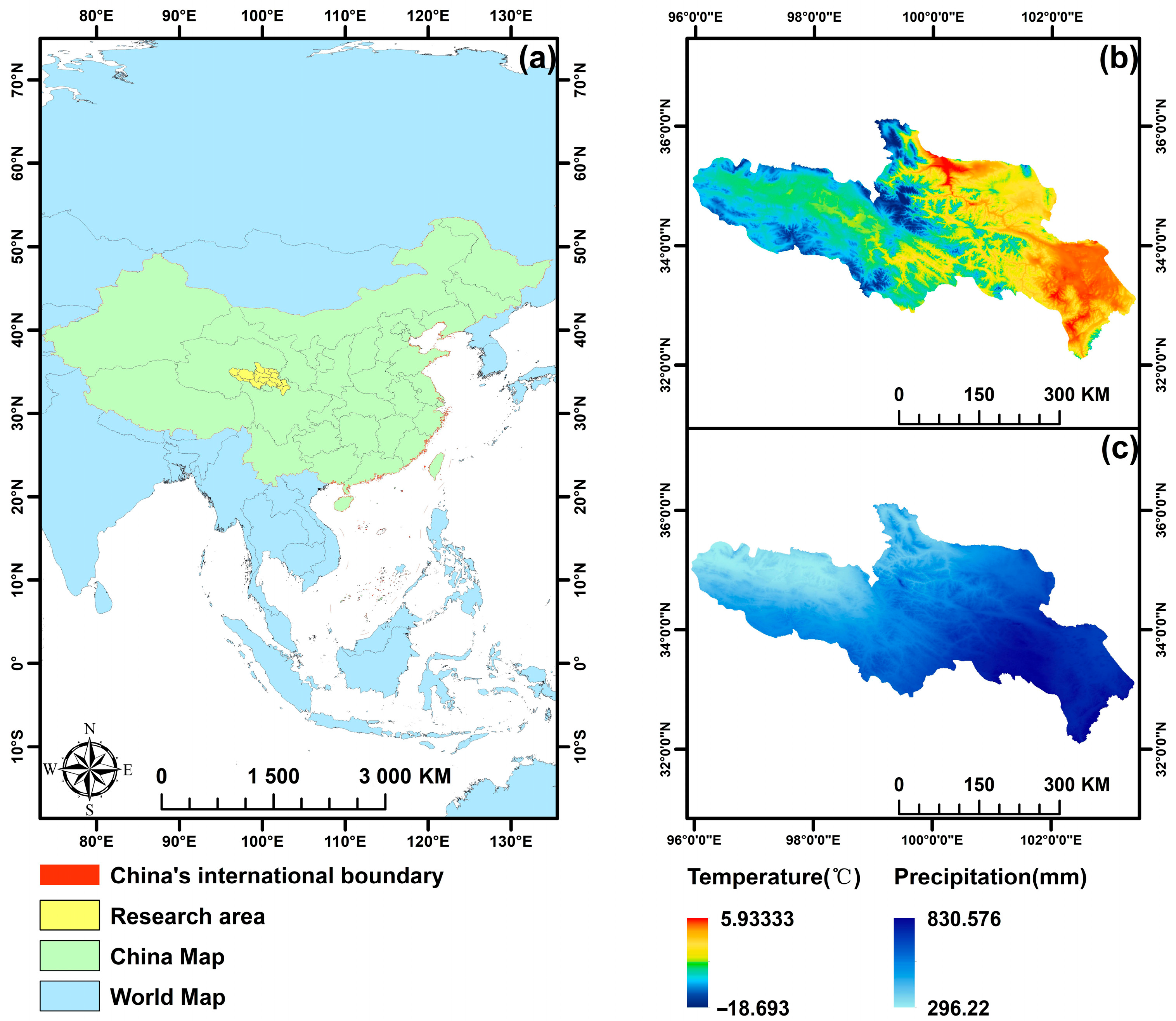
Figure 1. Geographical location map of the Yellow River source area. (a) Location map of the study area; (b,c) annual average temperature, annual average precipitation figure.
Water 18 00128 g001
Figure 2. Characteristics of land use transfer in the source region of the Yellow River from 2000 to 2024. (The thickness of the line indicates the area of the land use type converted to another type; the thicker the line, the larger the area of the land use type converted to another type; the finer the line, the smaller the amount of conversion).
Water 18 00128 g002
Figure 3. Spatial distribution of land use types in the source region of the Yellow River from 2000 to 2024. (af) represent the land use types in the source region of the Yellow River in in 2000, 2005, 2010, 2015, 2020, and 2024.
Water 18 00128 g003
Figure 4. Spatial distribution of vegetation coverage in the source region of the Yellow River from 2000 to 2024. (FVC represents the vegetation coverage in the source region of the Yellow River. (af) represent the vegetation coverage in the source region of the Yellow River in 2000, 2005, 2010, 2015, 2020, and 2024. Upon analysis of time variation characteristics, the vegetation coverage in the source area of the Yellow River basically showed a steady increase trend, with an average vegetation coverage of about 57.9% in 2000 and an average annual increase of 0.4% in 2005. The average coverage increased to 61.3% in 2010, increased by 2.4% in 2015, stabilized at 67.8% in 2024, and increased by 9.9% in 24 years. Although the vegetation coverage in the central and western regions showed a slight downward trend from 2000 to 2010, the overall trend tended to increase.
Water 18 00128 g004
Figure 5. Spatial distribution of soil and water conservation service capacity index in the source region of the Yellow River from 2000 to 2024. Se represents the service capacity index of soil and water conservation in the source region of the Yellow River. (af) represent the soil and water conservation service capacity index of the source region of the Yellow River in 2000, 2005, 2010, 2015, 2020, and 2024.
Water 18 00128 g005
Figure 6. The migration trajectory of standard deviation ellipse center of gravity of soil and water conservation capacity in source region of the Yellow River from 2000 to 2024.
Water 18 00128 g006
Figure 7. Detection of interactive factors of soil and water conservation service capacity in the source region of the Yellow River from 2000 to 2024. (af) represent the interaction factor detection of soil and water conservation service capacity in the source region of the Yellow River in 2000, 2005, 2010, 2015, 2020, and 2024. (X1 represents the annual average temperature; X2 represents the annual mean precipitation; X3 represents the vegetation coverage; X4 represents the DEM; X5 represents the slope; X6 represents the soil moisture; X7 represents the average GDP; X8 represents the population density; X9 represents the grazing capacity).
Water 18 00128 g007aWater 18 00128 g007bWater 18 00128 g007cWater 18 00128 g007d
Figure 8. Ecological detection results of driving factors of soil and water conservation service capacity in the source region of the Yellow River from 2000 to 2024. (af) represent the ecological detection results of the driving factors of soil and water conservation services in the source region of the Yellow River in 2000, 2005, 2010, 2015, 2020, and 2024. (X1 represents the annual average temperature; X2 represents the annual mean precipitation; X3 represents the vegetation coverage; X4 represents the DEM; X5 represents the slope; X6 represents the soil moisture; X7 represents the average GDP; X8 represents the population density; X9 represents the grazing capacity).
Water 18 00128 g008aWater 18 00128 g008b
Table 1. Types of interaction of influencing factors.
Judgment StandardInteraction
q X 1 X 2 < min q X 1 , q X 2 Nonlinear weakening
min q X 1 , q X 2 < q X 1 X 2 < max q X 1 , q X 2 Single-factor nonlinear weakening
q X 1 X 2 > max q X 1 , q X 2 Double-factor strengthening
q X 1 X 2 = q X 1 + q X 2 Independence
q X 1 X 2 > q X 1 + q X 2 Nonlinear enhancement
Table 2. Driving factors of soil and water conservation capacity in source region of the Yellow River.
Influencing FactorsExplanatory VariablesCode
Physical factorClimate factorsAnnual average temperature/°CX1
Annual mean precipitation/mmX2
Vegetation factorVegetation coverage/%X3
Orographic factorDEM/mX4
Slope/(°)X5
Soil factorsSoil moisture/%X6
Human factorsEconomic factorsAverage GDP/(yuan·km−2)X7
Demographic factorsPopulation density/(person·km−2)X8
Human activitiesGrazing capacityX9
Table 3. Single-factor detection of soil and water conservation service capacity in the source region of the Yellow River from 2000 to 2024.
FactorYear
200020052010201520202024
X10.5748 ± 0.01060.5997 ± 0.00700.549 ± 0.02880.6310 ± 0.02910.5633 ± 0.01870.6209 ± 0.0220
X20.4577 ± 0.01240.4313 ± 0.00620.4305 ± 0.00680.4653 ± 0.01780.4345 ± 0.00400.4214 ± 0.0132
X30.4595 ± 0.05380.5373 ± 0.00120.5949 ± 0.04190.4689 ± 0.04720.6022 ± 0.04710.5508 ± 0.0107
X40.015 ± 0.00150.0123 ± 0.00040.0122 ± 0.00050.0145 ± 0.00110.01 ± 0.00200.0136 ± 0.0005
X50.0032 ± 0.00000.0028 ± 0.00020.0027 ± 0.00030.0034 ± 0.00020.0026 ± 0.00030.0037 ± 0.0004
X60.053 ± 0.01200.0391 ± 0.00210.0353 ± 0.00050.0387 ± 0.00180.0253 ± 0.00760.025 ± 0.0078
X70.3733 ± 0.00910.3636 ± 0.01600.3337 ± 0.03710.4101 ± 0.01680.4225 ± 0.02560.4143 ± 0.0198
X80.261 ± 0.04360.2279 ± 0.02020.1869 ± 0.00870.2355 ± 0.02560.168 ± 0.02210.1164 ± 0.0586
X90.0141 ± 0.00050.0172 ± 0.00170.0125 ± 0.00160.012 ± 0.00190.0106 ± 0.00290.0222 ± 0.0052
Note(s): X1 represents the annual average temperature; X2 represents the annual mean precipitation; X3 represents the vegetation coverage; X4 represents the DEM; X5 represents the slope; X6 represents the soil moisture; X7 represents the average GDP; X8 represents the population density; X9 represents the grazing capacity.
Table 4. The annual average risk value of driving factors of soil and water conservation service in the source region of the Yellow River from 2000 to 2024.
FactorOptimal RangeQ Value
X11.71~3.47/°C0.3473
X2682~730/mm0.3244
X381.7~100/%0.2604
X43390~3740/m0.2538
X518.3~24.3/(°)0.2488
X626.7~29.4/%0.2768
X711,900~14,100/(yuan·km−2)0.3496
X87~9(person·km−2)0.3552
X90.352~0.6520.2583
Note(s): X1 represents the annual average temperature; X2 represents the annual mean precipitation; X3 represents the vegetation coverage; X4 represents the DEM; X5 represents the slope; X6 represents the soil moisture; X7 represents the average GDP; X8 represents the population density; X9 represents the grazing capacity.
Table 5. Risk value of driving factors of soil and water conservation service in the source region of the Yellow River from 2000 to 2024.
YearFactorOptimal RangeQ Value
2000X10.821~2.320/°C0.3474
X2637~701/mm0.3233
X381.1~100/%0.2409
X43390~3740/m0.2386
X518.3~24.3 (°)0.2338
X625.9~29.1/%0.2631
X73710~4290/(yuan·km−2)0.3575
X86.3~13.2 (person·km−2)0.3133
X90.140~0.2210.3184
2005X11.62~3.23/°C0.3526
X2712~768/mm0.3174
X381.1~100/%0.2427
X43390~3740/m0.2404
X518.3~24.3 (°)0.2353
X624.2~24.9/%0.2685
X77000~8490/(yuan·km−2)0.3515
X87~9 (person·km−2)0.3519
X90.305~0.5920.2497
2010X11.71~3.47/°C0.3473
X2682~730/mm0.3244
X381.1–100/%0.2604
X43390~3740/m0.2538
X518.3~24.3 (°)0.2488
X626.7~29.4/%0.2768
X711,900~14,100/(yuan·km−2)0.3496
X87~9 (person·km−2)0.3552
X90.352~0.6520.2583
2015X12~5.54/°C0.3223
X2592~640/mm0.2915
X381.1~100/%0.2262
X43390~3740/m0.2193
X515.2~19.3 (°)0.2142
X625.1~29.0/%0.2388
X727,200~28,600/(yuan·km−2)0.3335
X87~8 (person·km−2)0.3141
X90.671~0.8150.2197
2020X11.92~5.55/°C0.3266
X2783~843/mm0.3094
X385.2~100/%0.2452
X43390~3740/m0.2406
X515.2~19.3 (°)0.2369
X628.9~31.3/%0.2497
X71.57~2.3/(yuan·km−2)0.3315
X85~6 (person·km−2)0.3234
X90.512~0.9460.2378
2024X12.28~5.84/°C0.3270
X2686~783/mm0.2990
X381.1~100/%0.2288
X43390~3740/m0.2276
X515.2~19.3 (°)0.2231
X627.6~28.3/%0.2686
X744,600~61,100/(yuan·km−2)0.3400
X87~9 (person·km−2)0.3152
X90.374~0.6620.2371
Note(s): X1 represents the annual average temperature; X2 represents the annual mean precipitation; X3 represents the vegetation coverage; X4 represents the DEM; X5 represents the slope; X6 represents the soil moisture; X7 represents the average GDP; X8 represents the population density; X9 represents the grazing capacity.
Disclaimer/Publisher’s Note: The statements, opinions and data contained in all publications are solely those of the individual author(s) and contributor(s) and not of MDPI and/or the editor(s). MDPI and/or the editor(s) disclaim responsibility for any injury to people or property resulting from any ideas, methods, instructions or products referred to in the content.