
Next Article in Journal
Integrated Effects of Irrigation Amounts, Fertilizer Types, and Tillage Practices on Crop Growth, Yield, and Fruit Quality of Processing Tomato
Previous Article in Journal
Grading Evaluation of Grouting Seal Quality for Recharge Channels in Water-Hazardous Aquifers of Extremely Complex Mines
error_outline You can access the new MDPI.com website here. Explore and share your feedback with us.
 
 
Article

Virtual Water and Agricultural Sustainability: Unraveling the Trade–Water Nexus in Ecuador’s Crop Sector Through Empirical Modeling


1
Department of Food Security and Agricultural Development, Kyungpook National University, Daegu 41566, Republic of Korea
2
Department of Agricultural Civil Engineering, Kyungpook National University, Daegu 41566, Republic of Korea
3
Interdisciplinary Research Centre for Membranes and Water Security, King Fahd University of Petroleum & Minerals, Dhahran 31261, Saudi Arabia
4
Department of Rural Development, Kyungpook National University, Daegu 41566, Republic of Korea
5
Institute of Agricultural Science & Technology, Kyungpook National University, Daegu 41566, Republic of Korea
*
Author to whom correspondence should be addressed.
Water 2026, 18(1), 122; https://doi.org/10.3390/w18010122
Submission received: 8 December 2025 / Revised: 28 December 2025 / Accepted: 31 December 2025 / Published: 4 January 2026
(This article belongs to the Section Water Use and Scarcity)

Abstract

Freshwater scarcity increasingly constrains agricultural sustainability and global food security, particularly where crop production and trade shape national water balances. This study quantifies Ecuador’s green (soil moisture/rainfall) and blue (surface and groundwater) virtual water flows associated with seven strategic crops (banana, cocoa, pineapple, maize, rice, barley and potato) from 2000 to 2023 using the Hoekstra–Mekonnen accounting framework, and FAOSTAT production and bilateral trade data. Furthermore, Logarithmic Mean Divisia Index (LMDI) decomposition analysis was applied to identify the key drivers influencing virtual water trade, including economic growth, population, product structure, and water intensity. Results reveal that Ecuador operates as a persistent net exporter of virtual water, with export flows dominated by green water, reflecting the country’s reliance on rainfall-supported production. Virtual water exports increased from 3000 to >15,000 Mm3·yr−1 over the study period, while imports remained substantially smaller, confirming Ecuador’s structurally export-oriented agricultural economy. The LMDI outcomes show that export growth is driven primarily by economic expansion (8.28 × 10⁸ m3) and shifts in the crop export mix, partially offset by improvements in water intensity. These findings highlight Ecuador’s vulnerability to trade-related water pressures and demonstrate the value of virtual water indicators for guiding water governance and SDG-aligned trade strategies, thereby promoting the decoupling of economic growth from water resource consumption and connecting virtual water trade to domestic water scarcity.

1. Introduction

Agricultural water productivity remains a cornerstone of global food security and sustainable development [1], indispensable for sustaining food production and supporting socio-economic growth. However, increasing population, climate change, and excessive freshwater withdrawal continue to stress available water, particularly in regions already vulnerable to climatic variability [2]. The Food and Agriculture Organization (FAO) reports that agriculture accounts for about 71% of global freshwater withdrawals, while industries and municipalities account for 20% and 9%, respectively, highlighting the sector’s central role in water uses [3,4]. The imbalance between water demand and supply is particularly severe in arid and semi-arid regions, such as parts of Africa, Latin America and Middle East, where limited renewable water resources, combined with erratic rainfall and increasing evapotranspiration, amplify vulnerability to hydrological stress [5,6,7,8,9]. These growing pressures have brought renewed attention to the need for technical and managerial actions that connect agricultural production, trade, and water use efficiency within the broader framework of sustainable resource governance, establishing rational water policies, and guiding the strategic use of food trade with other regions to mitigate water scarcity [10].
Within this context, the notion of virtual water introduced by Tony Allan in the 1990s and further developed by Hoekstra & Mekonnen provides an analytical framework for assessing how water is embedded and transferred through the international trade of goods to understand how water resources are indirectly transferred among nations [10,11]. Virtual water trade (VWT) quantifies the volume of water required to produce a commodity and how this “hidden” flow connects the hydrological systems of exporting and importing nations. It offers a lens through which to evaluate global interdependence in food and water security, revealing how trade can alleviate or intensify local water scarcity [12,13]. Recent research has highlighted VWT’s contribution to advancing the United Nations Sustainable Development Goals, notably SDG 2 (Zero Hunger), SDG 6 (Clean Water and Sanitation), and SDG 12 (Responsible Consumption and Production) [14,15]. By linking consumption and production across borders, the virtual water and water footprint frameworks support the design of sustainable water governance strategies that account for transboundary resource flows [16,17].
At the international level, understanding the structure of trade partnerships is fundamental to analyzing virtual water dynamics. A country’s water footprint extends beyond its borders through imports and exports that connect its agricultural system to foreign hydrological and climatic regimes [17,18,19]. Consequently, identifying partner-specific flows and their composition is crucial for assessing exposure to supply shocks, environmental risks, and hydrological vulnerabilities. Recent studies emphasize that such assessments can foster more cooperative and sustainable approaches to global water governance [20,21]. In South America, virtual water research has focused mainly on large agricultural exporters such as Brazil and Argentina, where studies consistently show the region to be a major net exporter of virtual water through rain-fed commodity production [22,23]. Sub-national analyses, such as those for Argentina’s maize sector, further highlight the predominance of green virtual water embedded in export supply chains [24]. By contrast, evidence for Andean countries, particularly Ecuador, remains limited, generally confined to irrigation management and basin-scale assessments rather than comprehensive national virtual water trade evaluations.
Ecuador, recognized globally for its export-oriented agricultural sector, particularly banana, cocoa, pineapple, and rice, represents a compelling case for this line of inquiry. The country’s agricultural sector constitutes a vital pillar of the national economy [25,26,27]. Yet, Ecuador simultaneously faces significant challenges in water availability, especially in its Coastal and Andean regions, where seasonal droughts and increasing irrigation demand place additional strain on freshwater systems [2,28,29]. This paradox of being a leading agricultural exporter while confronting water scarcity, underscores the urgent need for an integrated evaluation of the trade–water nexus in Ecuador from both economic and environmental perspectives [17,19,20,21,26].
Despite agriculture’s importance, empirical evidence on the volume, structure, and drivers of virtual water embedded in Ecuador’s traded crops remains limited. The absence of such data constrains the formulation of water-smart trade policies and masks the extent to which export-led growth contributes to domestic hydrological stress. Assessing how water is virtually exchanged through imports and exports is critical to identifying trade-offs between economic performance, environmental sustainability, and social equity. Ecuador’s seven strategic commodities, banana, cocoa, pineapple, rice, maize, barley, and potato, play dual roles of supporting rural livelihoods and ensuring national food security [30]. Yet the lack of integrated strategies aligning trade and water governance continues to threaten the sustainability of both
Beyond simple accounting of virtual water flows, it is essential to understand the drivers behind changes in virtual water trade over time. Structural Decomposition Analysis (SDA) and Index Decomposition Analysis (IDA) are two widely used methods for identifying and quantifying the drivers behind changes in environmental indicators such as water consumption and virtual water trade. SDA is grounded in input-output models and is particularly effective at capturing both direct and indirect impacts of various factors on water-related indices [31]. In contrast, IDA, and specifically the Logarithmic Mean Divisia Index (LMDI) method, is more flexible and operational, with lower data requirements and ease of use [16]. LMDI is a preferred IDA approach due to its theoretical soundness, adaptability, and the absence of residual terms in its results [32]. It can decompose aggregate changes in water use or virtual water trade into the contributions of multiple driving factors, such as water intensity, industrial structure, economic scale, population, and technology, and is applicable to both additive and multiplicative decomposition forms. LMDI is particularly valued for its ability to handle zero and negative values, provide unique and consistent results, and facilitate the analysis of both total and intensity indicators [33]. Its flexibility has led to widespread application in energy and environmental research [34,35,36] and more recently adapted for water studies [12,15,16,37,38], helping to identify whether improvements in water-use efficiency are sufficient to decouple economic growth from water consumption [10].
Accordingly, the present study aims to assess the dynamics of virtual water trade in Ecuador’s crop sector. It focuses on seven strategic commodities: bananas, cocoa, barley, rice, pineapple, potato, and maize, covering the period from 2000 to 2023. By quantifying the green and blue water footprint associated with the production of each crop and analyzing trade flows, this research evaluates Ecuador’s status as a net importer or exporter of virtual water and identifies the main drivers influencing these dynamics. Ultimately, this work contributes to the growing body of literature on virtual water in relation to the SDGs.

2. Materials and Methods

This study examines the dynamics of virtual water trade of seven principal crops in Ecuador between 2000 and 2023 and identifies the driving factors of the virtual water trade (import/export) during this period using decomposition analysis.

2.1. Study Area

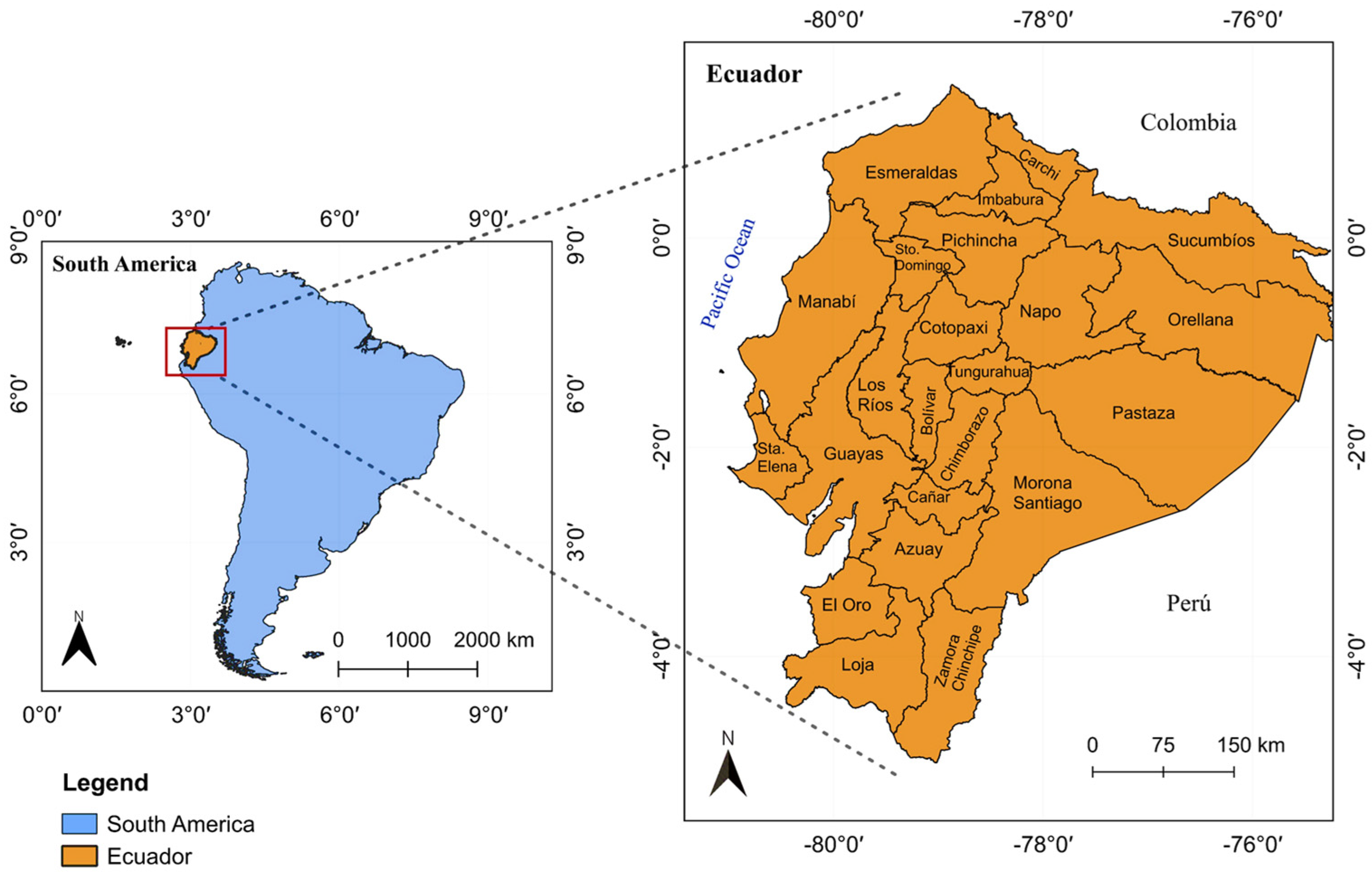
Ecuador, a culturally and biologically diverse republic located in the northwestern part of South America, covers an area of 283,561 km2 and borders Colombia, Peru, and the Pacific Ocean (Figure 1). The Equator line, or latitude 00°00′00″, runs across 13 sovereign countries, dividing them into Northern and Southern Hemispheres. This geographical feature gives Ecuador its name, as it is located on the Equator. The country comprises 24 provinces divided into 4 regions: Coast, Andean Highlands, Amazon and Galapagos Island. Currently, Ecuador’s population is estimated at over 18 million, with a significant proportion engaged in agricultural activities [39,40].
Due to its biodiversity, Ecuador depends substantially on its petroleum resources, occupying the 69th place on GDP globally. Historically, the national economy heavily relied on agriculture and aquaculture; however, shifts in global market trends and advancement in technology have diversified the country’s economic base. In recent years the services sector has emerged as the dominant contributor, accounting for 60.4% of the national GDP, followed by industry at 32.9%, while agriculture including livestock and forestry accounts for 6.7% [41,42].

2.2. Data Sources

This study analyzes virtual water trade of seven key Ecuadorian agricultural commodities, including banana, cocoa, pineapple, barley, maize, rice and potato over the period 2000 to 2023. The preliminary agricultural trade data for the seven strategic commodities, along with gross domestic product (GDP), and population figures, were obtained from the Food and Agriculture Organization of the United Nations [43] for the period 2000–2023 (Table 1), summarized and explained under Table A1. The water footprint and virtual water content (VWC) of each crop and its respective partner countries were derived from the global water footprint assessment database developed by Mekonnen & Hoekstra [44], which provides spatially explicit estimates of green and blue water use in crop production. All datasets were harmonized to ensure temporal consistency and standardized to annual units (Mm3 yr−1).
To ensure the reliability of the input data, FAOSTAT production and bilateral trade quantities were cross-checked with national statistics from the Ministry of Agriculture and Livestock, and the National Institute of Statistics and Census.

2.2.1. Virtual Water Use Calculation of Crops

The determination of virtual water use (VWU) for the seven specific Ecuadorian crops in the selected time period was estimated by multiplying the country-specific virtual water content (VWC) by the quantity (Q) of each respective commodity, measured in cubic meters per year (m3/yr). The sample was calculated following the calculation framework of Hoekstra et al. [10]. Accordingly, Equation (1) represents the total amount of water required for every crop cultivation:
V W U   =   V W C   ×   Q
Equation (1), express the virtual water content (VWC) coefficients for each crop, which were obtained from global database of Mekonnen and Hoekstra, which provides separate footprint components by region. The seven selected crops were chosen based on its high contribution to national production and export earnings, its relevance to domestic food security and the representation of different production systems (rainfed vs. irrigated/tropical vs. highland).
This study focuses on two components: green water, referring to rainwater consumed during crop growth through evapotranspiration, and blue water, which includes groundwater and surface resources withdrawn for irrigation. The grey water footprint was excluded due to consistent limitations regarding to partner specific time series data on pesticide/pollutants loads and locally relevant water-quality standards, which compromise comparability across countries and years.

2.2.2. Net Virtual Water Trade for Crops

The Ecuadorian products exchange represents the water embedded in international trade, through VWT, which indicates the water used in exporting and importing Ecuador’s crops. Therefore, the VWT was calculated based on the water footprint (green and blue), which indicates the total amount of rainfall and surface water used for producing crops. The export of virtual water in the exporting country has the same meaning as the import of virtual water in the importing country. This relationship is represented by three directly sourced Equations (2)–(4). In these equations, Q represents the annual volume of exports and imports (in tons).
IVW = V W C i × Q i
EVW = V W C e × Q e
NVW = I V W E V W
In Equation (4), Net Virtual Water (NVW) represents the difference between Imported Virtual Water (IVW) and Exported Virtual Water (EVW) in measuring a country’s water balance [m3/ton].

2.2.3. Ecuador’s Virtual Water Trade Decomposition

This study aimed to assess the main drivers of virtual water trade flows, focusing on socioeconomic and environmental variables and their impacts on Ecuador’s water resources. To achieve this, we used a decomposition index based on the LMDI method to link virtual water trade to domestic water scarcity (Equations (5) and (6)).
L M D I i = P t × G D P t P t × Q i G D P t × V W T t Q i
L M D I e = P t × G D P t P t × Q e G D P t × V W T t Q e
where Pt represents the total annual population; GDPt represents the annual gross domestic product; VWTt represents the total virtual water trade of products.
The LMDI method here applied aims to decompose the change in virtual water trade into product structure, economic growth, population and water intensity. Capturing the total economic output, consumption scale, composition traded crops and measures changes in water used volume of production. Through this decomposition, the LMDI framework quantifies the individual contribution of each factor to the total change in virtual water imports and exports.

2.3. Software and Statistics

Data processing, including virtual water calculations, was performed using Microsoft Excel, following the accounting framework established by Hoekstra and Mekonnen, which allowed the decomposition of crop water into green water (effective rainfall stored in soil moisture) and blue water (surface and groundwater used for irrigation), linking them to crop-specific production systems in Ecuador and partner countries. Values were validated with national agricultural statistics, and inconsistencies were resolved by averaging and exclusion of anomalous outliers. The LMDI decomposition, used to identify the driving forces behind changes in virtual water trade, was implemented in Python 3.12, allowing for a transparent and replicable analytical workflow. Based on their agronomic and trade characteristics, the seven crops were grouped into three analytical categories: grains, fruits and trees-tuber crops, to facilitate comparative assessment of water-use patterns and trade dependencies across crop types.

3. Results

3.1. The Virtual Water Use in Ecuador’s Crop Production

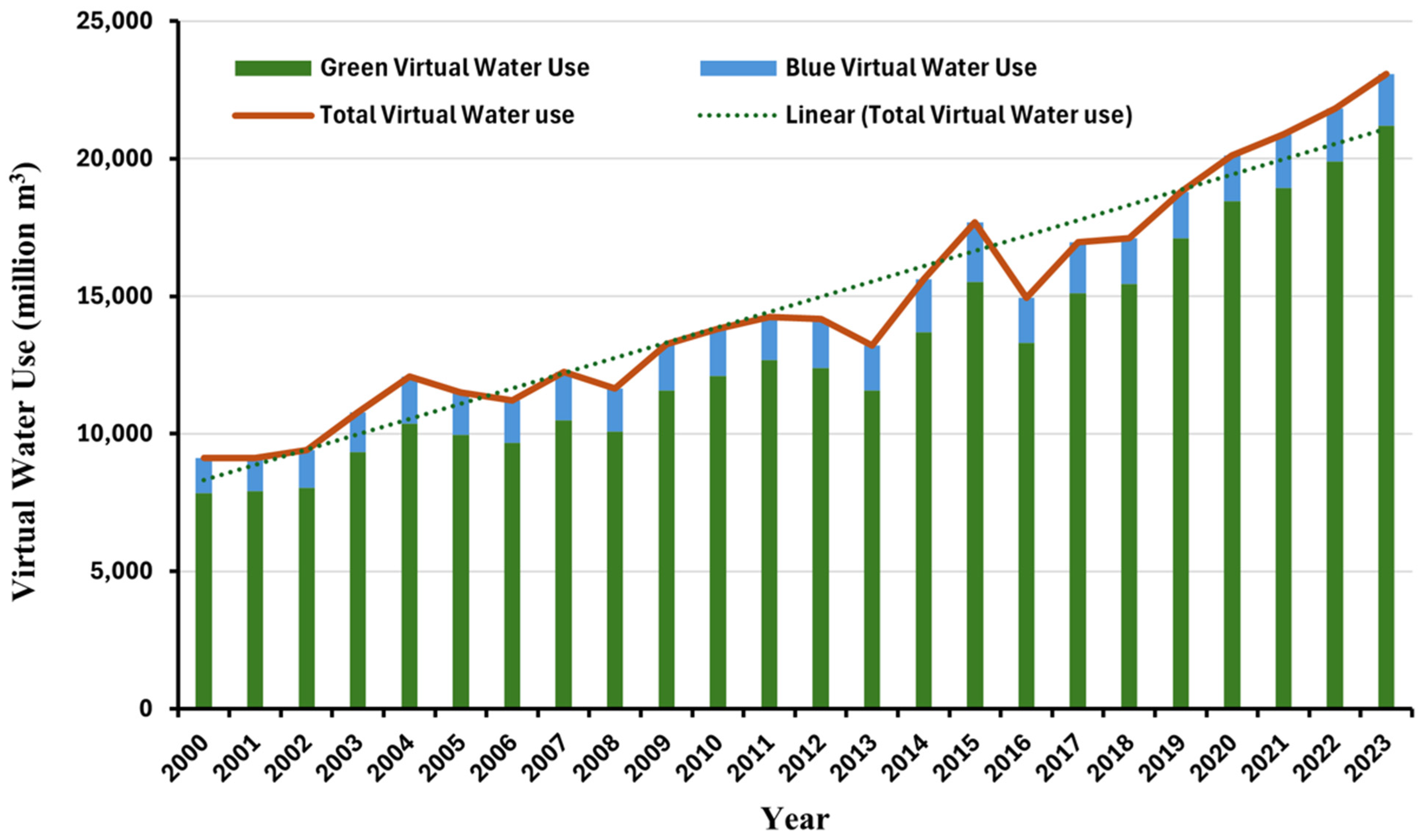
Ecuador’s seven strategic commodities have a dual impact on the rural livelihoods and national food systems. However, it supports rural income and its access to food availability, which are becoming increasingly threatened due to lack of differentiated strategies to align it with water governance and sustainable food security [10]. Figure 2 illustrates the annual dynamics of virtual water use (VWU) in Ecuador’s principal crop production between 2000 and 2023, disaggregated into green and blue water components. Over this 24-year period, total VWU increased by approximately 32%, equivalent to an average annual rise of 1.5%. The trend reveals a steady upward trajectory in green water footprint consumption, which dominates Ecuador’s agricultural water use. A pronounced surge occurred in 2014–2015, when the total amount VWU exceeded 16,000 Mm3·yr−1, likely reflecting both expanded cultivated areas and intensified production in high water demand crops such as cocoa beans, rice and banana. A secondary sustained rise from 2019 to 2023 suggests continued growth in water-intensive exported crops under favorable rainfall.
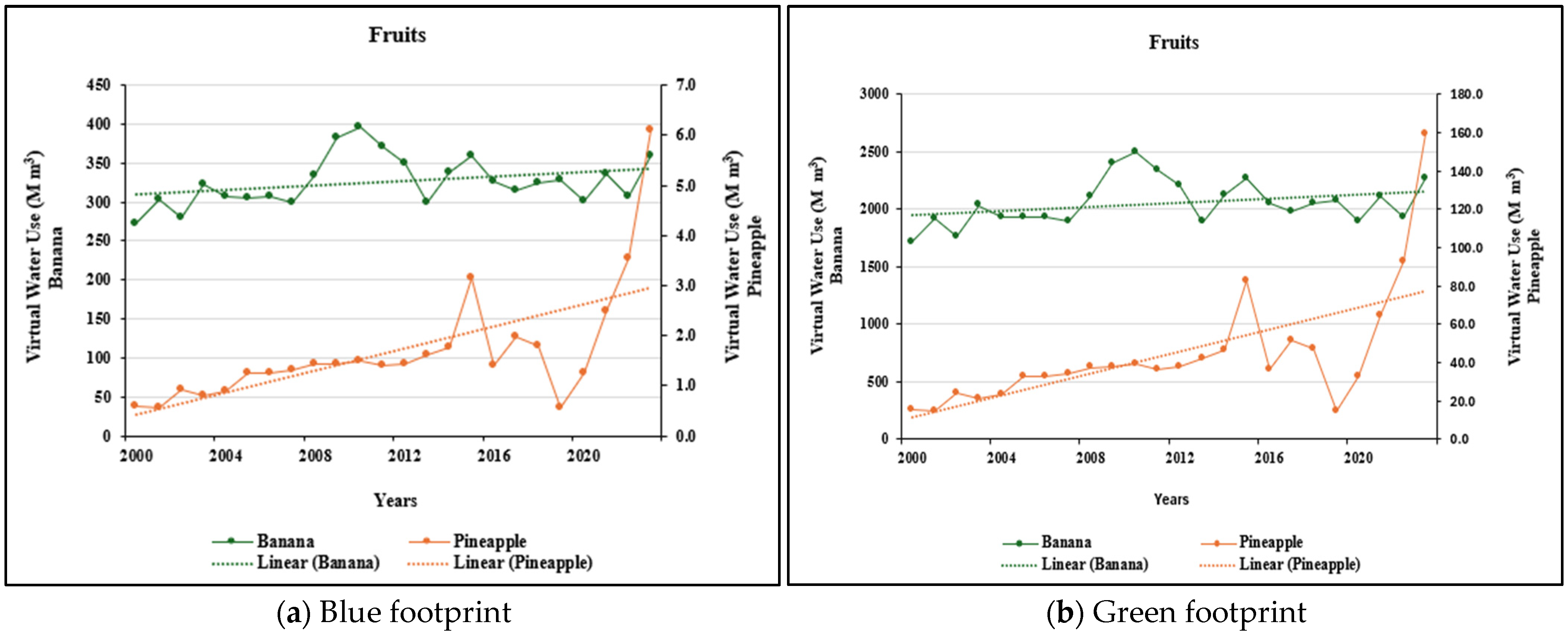
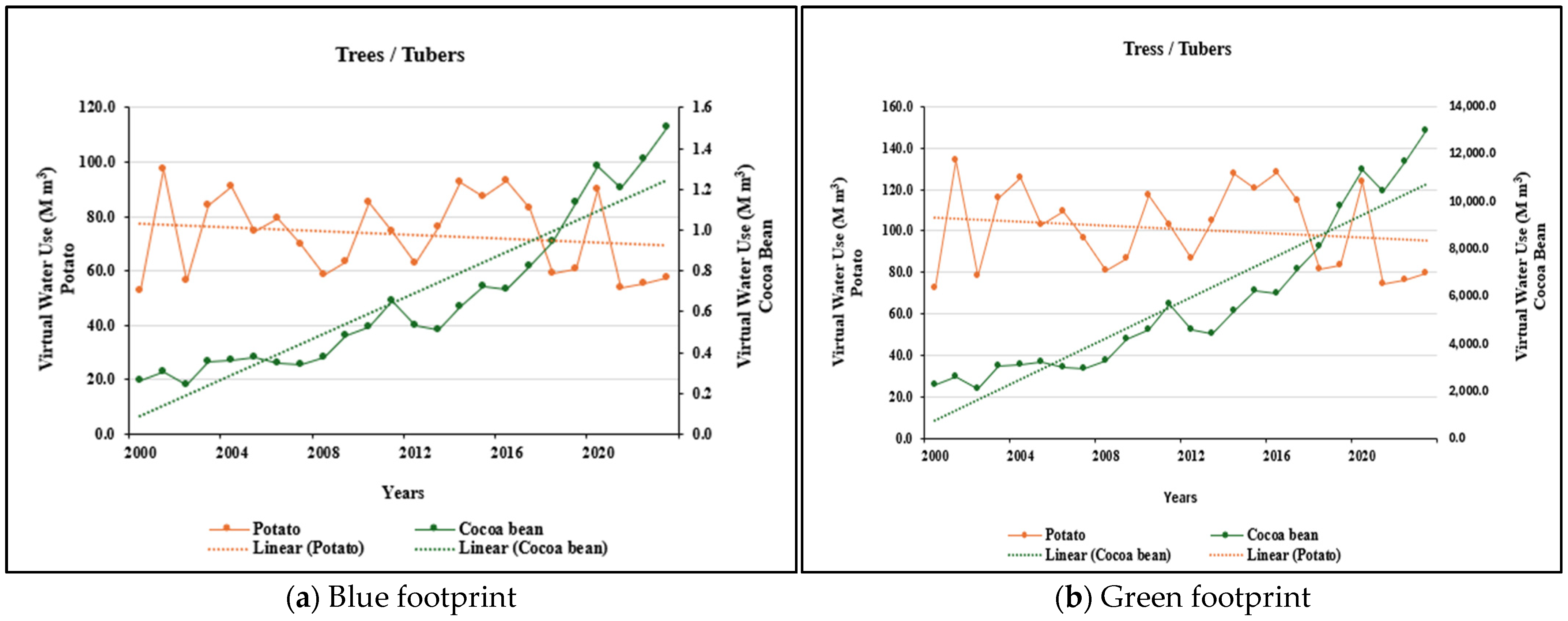
The calculated production virtual water use on the crop group, distinguished between blue WF and green WF of crops, was analyzed in terms of m3/ton, showing the changing trends in local production over a selected time. The results are represented in Figure A1, Figure A2 and Figure A3, which illustrates the distribution of virtual water use across three categories: grains (rice, maize and barley), fruits (banana and pineapple), and trees/tubers (potato and cocoa bean). This comparative analysis reveals how Ecuador’s agricultural production is underpinned by different patterns of water use. Grains such as maize and barley are most dependent on green water, making them highly sensitive to rainfall variability, while rice incorporates a non-trivial blue water component due to irrigated lowland systems. Among the fruit group, banana emerges as a predominantly green water user, whereas pineapple shows a growing reliance on blue water use in recent years. Cocoa beans illustrate the importance of rainfed agroforestry systems, with a steadily rising green-water footprint, while potato combines predominantly green-water use with modest irrigation inputs in certain years. Together, these results provide a comprehensive overview of Ecuador’s strategic crops virtual water use patterns, highlighting the differentiated impact of blue and green water resources.

3.2. Virtual Water Trade of Ecuador’s Seven Principal Crops

Numerous studies have emphasized the contribution of virtual water trade on water conservation and food security [12]. To provide a national overview, the seven commodities were aggregated to examine the long-term dynamics of imported and exported virtual water as it concerns Ecuador.

3.2.1. Virtual Water Imports

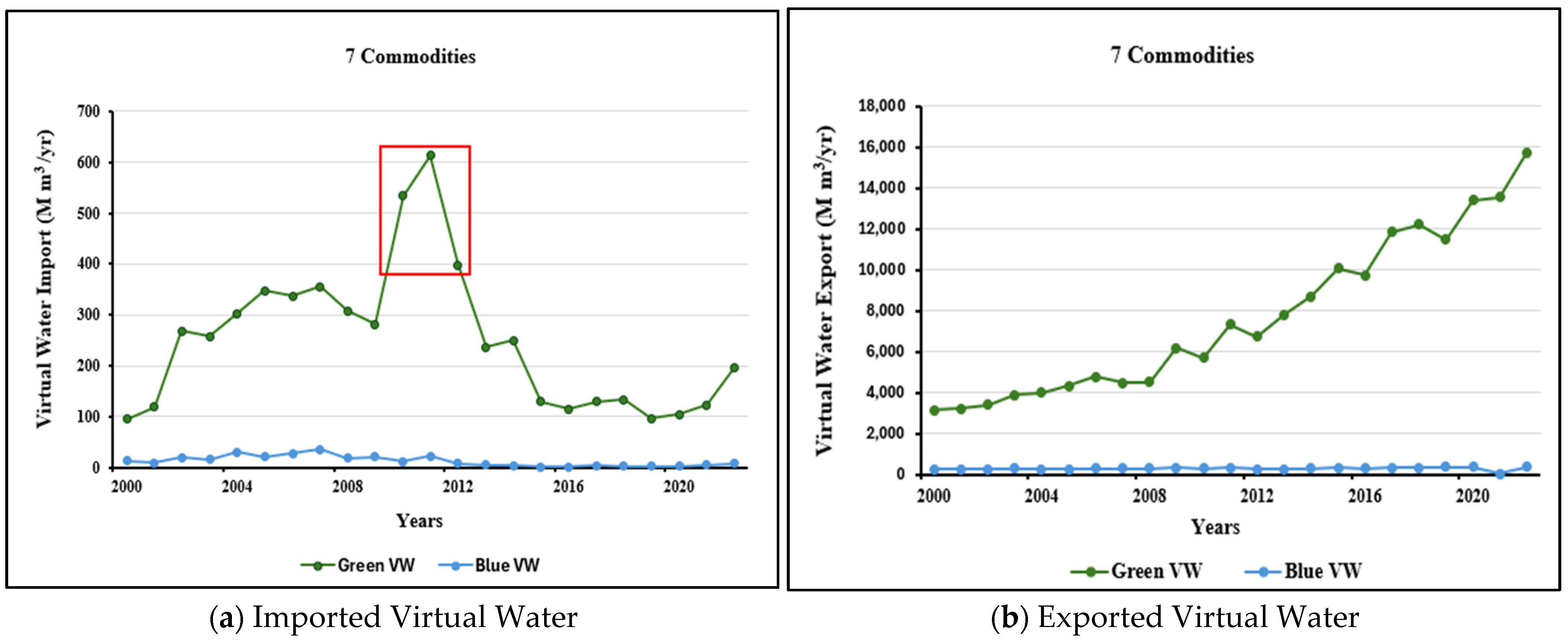
Figure A4 illustrates the virtual water import volumes in Ecuador between 2000 and 2023, which have been overwhelmingly dominated by the green water footprint with recurrent peaks in 2010–2013, and volumes ranging from approximately 300 to over 600 million m3 per year. The fluctuations are linked to major inflows of grains such as rice, barley, and maize corn, complemented by tubers like potato, fruits like banana, pineapple and cocoa beans. By contrast, the contribution of blue water contributes negligibly to total IVW throughout the entire period, consistently below 50 Mm3. This evidence highlights that Ecuador’s agricultural trade profile is primarily dependent on rainfed production systems abroad, underscoring the relative importance of green water in shaping the country’s virtual water imports.
In Ecuador, the seven selected crops, beyond representing major commodities in the national agricultural economy, are assumed to be strategically imported to satisfy domestic demand [15]. Over the 2000 to 2023 period, the cumulative total amount of imported green and blue virtual water reached approximately 507.9 and 28.7 million m3, respectively. As summarized in Table A2, the results highlight the predominance of green water over blue in Ecuador’s crop imports. These cumulative import values were derived from FAOSTAT bilateral trade data, integrated across the selected period to capture the long-term dynamics of water-embedded trade.
The grains category (i.e., maize, rice and barley) emerged as the dominant contributor in terms of Ecuador’s virtual water imports. Maize alone accounted for the highest volume of green water, reaching around 4889 million m3, followed by barley with 878 million m3, making up approximately 90% of the total virtual water imported between 2000 and 2023. Such a concentration reflects Ecuador’s dependence on cereal imports produced largely under rainfed conditions in partner countries. Blue water volumes remained comparatively low, though maize again represented the leading share among irrigated systems. This distribution illustrates how Ecuador’s trade structure relies mainly on green water-based agricultural production abroad, linking food security and external water resources.

3.2.2. Virtual Water Exports

Over the past two decades, Ecuador’s virtual water exports have been overwhelmingly dominated by green water, a pattern consistent with the country’s climatic and agricultural conditions. As illustrated in Figure A4, export volumes of green water increased from roughly 3000 Mm3·yr−1 in 2000 to over 15,000 Mm3·yr−1 in 2023, whereas blue water exports remained negligible and nearly constant. This dominance arises from Ecuador’s humid tropical climate, characterized by high annual precipitation across much of the coastal and Amazon regions, combined with limited investment in irrigation infrastructure. Consequently, most export-oriented crops, such as banana, cocoa and maize are cultivated under rainfed systems rather than large-scale irrigation [37,38]. From a virtual water perspective, Ecuador effectively exports its agricultural commodities through embedded green water rather than withdrawals of surface or groundwater (blue water). This dynamic links the country’s export performance closely to rainfall regimes and highlights the importance of enhancing soil-moisture retention, improving rainwater-use efficiency, and strengthening resilience to climatic fluctuations to safeguard its water-embedded trade advantage [49].
The cumulative export pattern of Ecuador’s seven principal crops reveal a clear asymmetry between blue and green virtual water flows. As shown in Table A2, blue water exports are heavily concentrated on a limited number of commodities, most notably cocoa beans, which exceed 130,000 Mm3 of cumulative water volume between 2000 and 2023, followed by smaller contributions from banana, pineapple, and maize. In contrast, green water exports remain comparatively low across all crops, reflecting the predominance of irrigated systems in the country’s main export supply chains. This pattern aligns with Ecuador’s tropical humid coastal environment, where banana production, primarily in El Oro, Los Ríos and Guayas provinces, relies extensively on managed irrigation to maintain year-round yields and sustain international market standards [37]. The relatively small green water component also indicates that most export-oriented plantations are in areas where rainfall is abundant yet insufficiently reliable for fully rainfed cultivation. From a virtual water trade perspective, this structure underscores Ecuador’s dependence on blue water resources to sustain its leading export commodities and raising concerns about long-term of irrigation water allocation efficiency, and resilience to hydrological stress under climate variability [49].
While annual trends (Figure A4) indicate a persistent predominance of green water footprint exports in Ecuador’s trade, the cumulative crop-specific analysis (Table A5) highlights the disproportionate influence of a few irrigated commodities, chiefly pineapple and cocoa on total blue water volumes. This distinction arises from the different aggregation perspectives: systems-level rainfall dependence versus crop-level export intensity.

3.2.3. Net Virtual Water Trade

Building on a preceding analysis of import and export patterns, it becomes essential to examine Ecuador’s virtual water balance (NVW), the difference between the total volume of water embodied in exported crops and that imported through trade. Evaluating NVW provides a broader understanding of the country’s hydrological trade position, revealing whether Ecuador acts as a net exporter or importer of water resources when embedded in agricultural commodities. This balance is critical to assess the sustainability of trade relationships, since a persistent positive NVW may indicate increasing pressure on domestic water resources, whereas a negative NVW reflects reliance on external, often rainfed water systems.
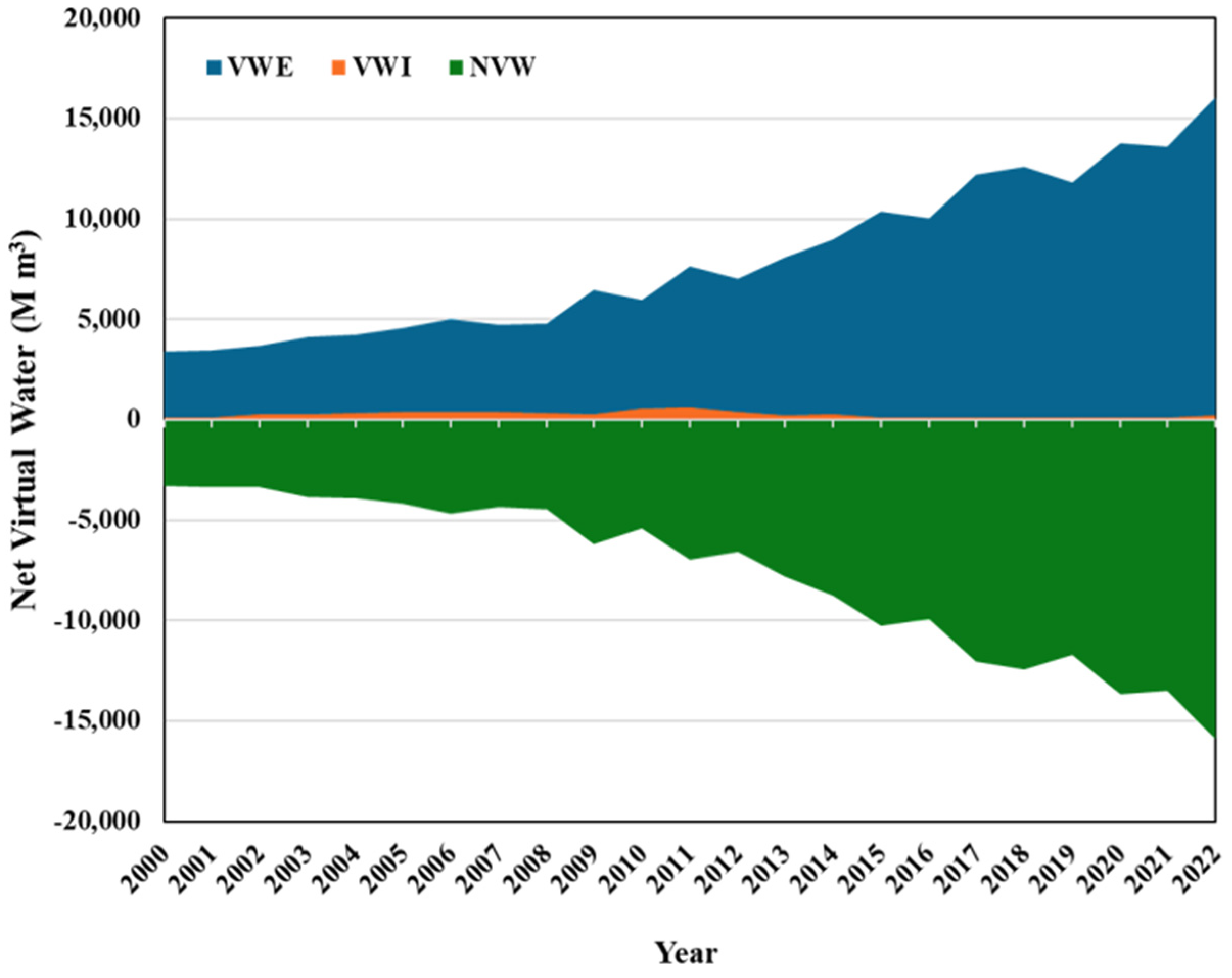
Following Hoekstra’s convention between VWI and VWE, Ecuador’s annual NVW is consistently negative (Table 2), confirming a net-exporter position predominantly driven by green-water.
Figure 3 displays the net virtual water trends over the study period.

3.3. Principal Partner Countries in Ecuador’s Virtual Water Trade

To understand the dynamics in virtual water, it is indispensable to identify the main trade partners for the seven crops and their impact on Ecuador’s virtual water flow. From 2000 to 2023, import and export volume and connectivity related to VWT has changed.

3.3.1. Import Trading Partners

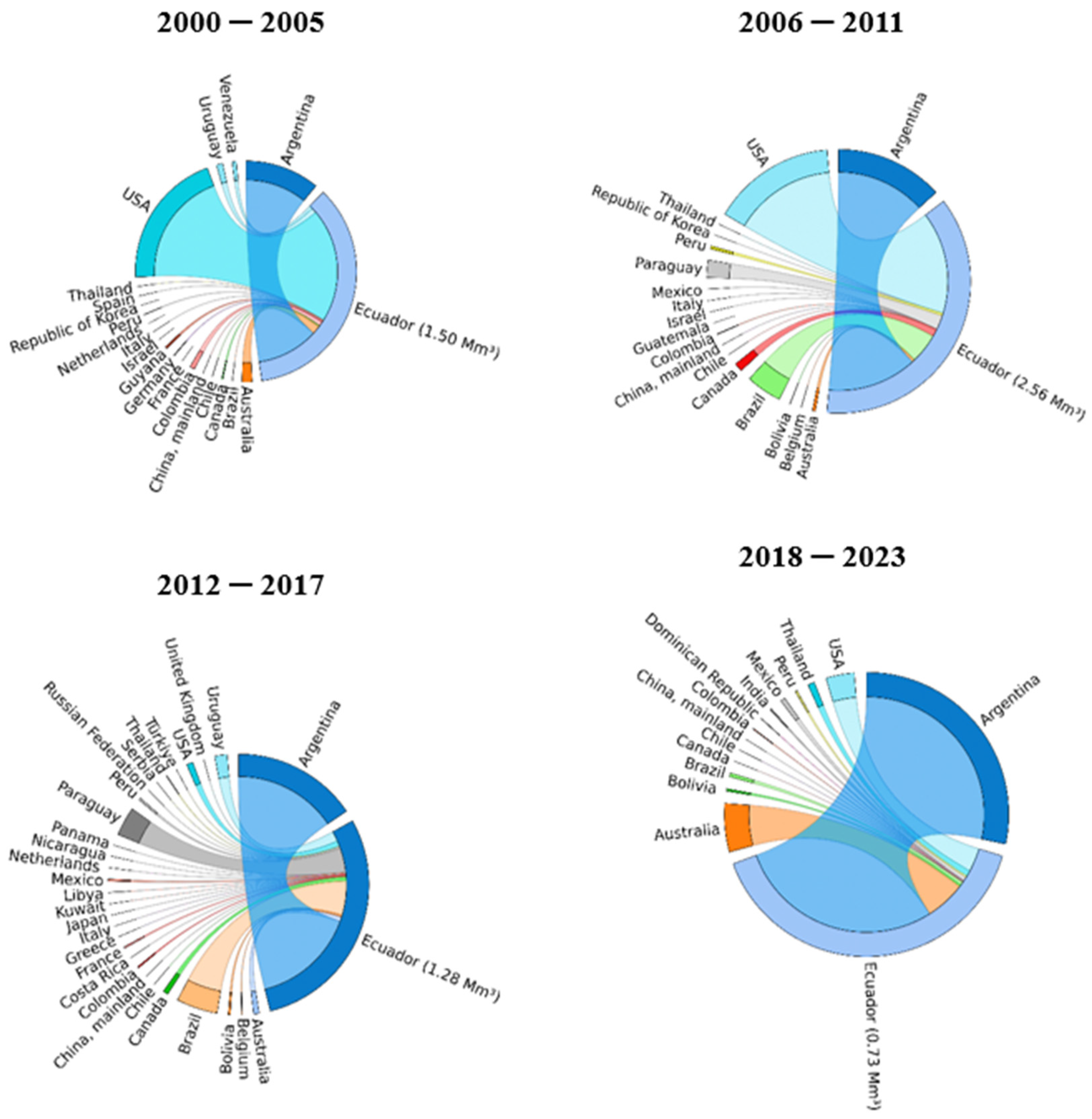
Between 2000 and 2023, Ecuador’s virtual water imports were largely shaped by grain sector, particularly maize, barley and rice, which together accounted for over 85% of the total embodied water volumes exchanged. Among these, maize represented the largest contributor, reflecting Ecuador’s structural dependence on external grain supplies to sustain livestock feed production and the growing agro-industrial sector. According to FAOSTAT trade data, Argentina and United States consistently dominated Ecuador’s maize supply network, while Paraguay, Brazil and Perú provided complementary inflows during periods of regional production surplus. These trade partners are predominantly rainfed producers, implying that the majority of the virtual water imported by Ecuador was green water, originating from precipitation-fed cultivation rather than irrigation withdrawals. This hydrological configuration is consistent with findings from Mekonnen and Hoekstra [44], who identified South America as a global hotspot for green water dominated cereal exports.
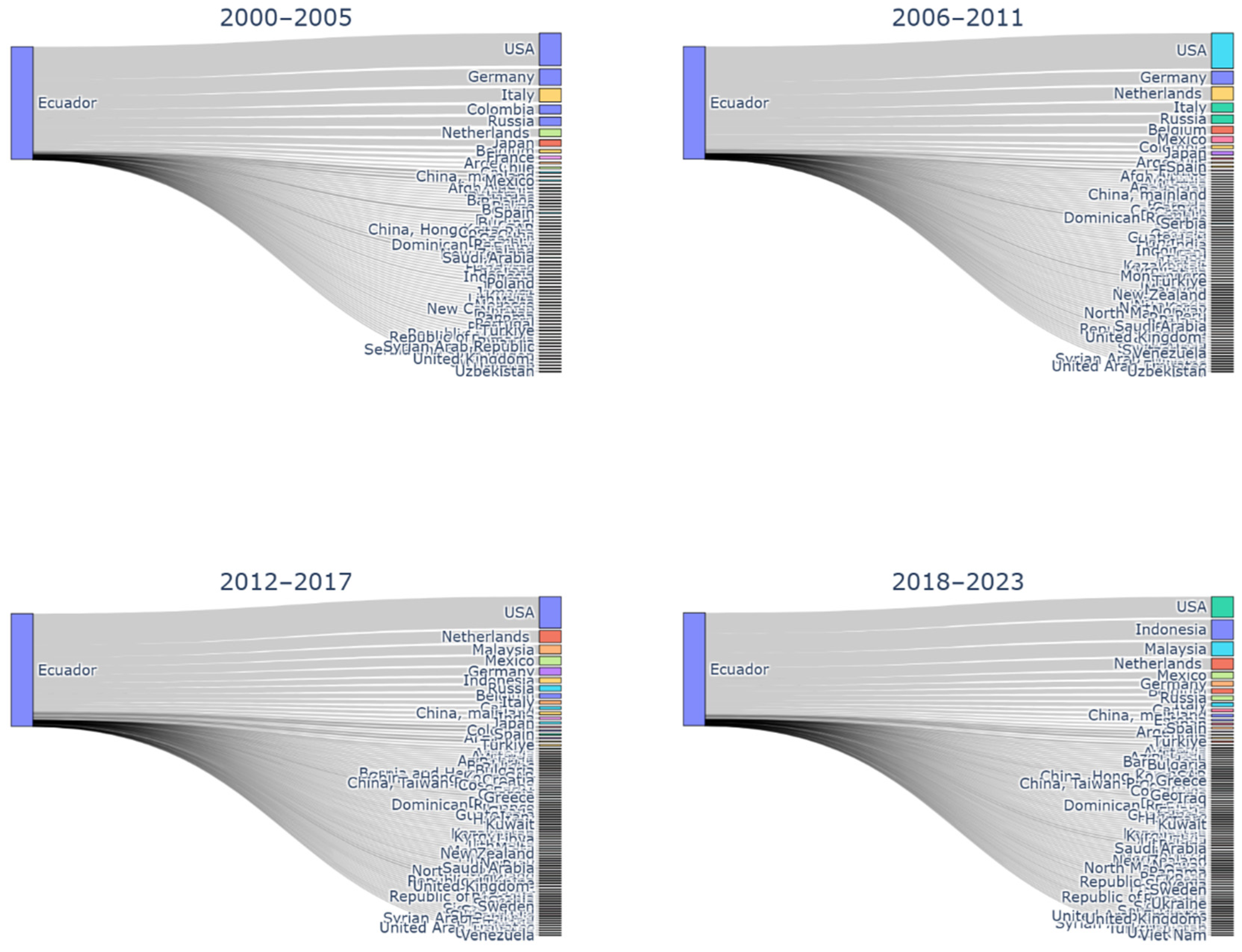
The chord diagrams (Figure 4) illustrate how Ecuador’s virtual water trade connectivity evolved across four sub-periods (2000–2005, 2006–2011, 2012–2017, and 2018–2023), revealing a gradual intensifications and diversification of trade linkages. While Argentina remained the primary contributor throughout, the later periods (2012–2023) show the inclusion of emerging supplies, suggesting an adaptative shift in Ecuador’s import strategy to buffer against regional climatic variability.
From a hydrological perspective, the predominance of green-water imports underscores that Ecuador’s food security strategy implicitly relies on the rainfall and soil-moisture regimes of its trading partners rather than domestic irrigation systems. This structural dependence links national consumption patterns to climatic fluctuations abroad, emphasizing the importance of trade diversification supply partners and investments in water-efficient local crops production to strengthen resilience against global hydrological risks and market volatility.

3.3.2. Export Trading Partners

Ecuador’s export-side virtual water flows are overwhelmingly channeled through banana and cocoa supply chains, with pineapple contributing at a growing but modest rate; rice, maize, potato and barley play marginal role in export volumes. The partner composition reflects global demand hubs: for banana, the principal destinations over the last decade include Russia, USA, Germany and Netherlands (which serves as a gateway to the European Union) (Figure 5); notably, Russia absorbs about one-fifth of Ecuador’s annual banana shipments and remaining critical despite periodic trade disruption [50,51,52]. In the case of cocoa beans, exports concentrate heavily in Southeast Asia (especially in Malaysia and Indonesia), as well as in Europe and North America, reflecting the geography of industrial processing and confectionery demand [53]. From a hydrological perspective, these exports originate primarily from Ecuador’s humid lowlands and Andean foothills, where rainfall dominates production and irrigation use remains limited; as a result, the country increasingly externalizes its own rainfall resources as embedded green water to high-consumption international markets. Given that Ecuador is the world’s leading banana exporter, earning about USD 3.5 billion in 2022 with one-fifth of that destinated for Russia and giving that cocoa beans accounted for approximately 3.76% of merchandise exports in 2023, the scale and partner-structure of the trade magnify the virtual water implications. Maintaining such trade patterns implies not only economic opportunity but also a transfer of rain-fed water resources abroad which in turn raises important questions for national water-smart trade policy and alignment with the SDGs.

3.4. Ecuador’s Virtual Water Trade Determinant Driving Factors

The decomposition analysis was applied to understand the factors shaping Ecuador’s virtual water trade, examining the socioeconomic and environmental implications. Through LMDI, the total change in both exports and imports was decomposed into four key drivers: population, economic growth, product structure, and water intensity shown on (Table A4 and Table A5). This approach clarifies how socio-economic and environmental conditions have influenced the direction and magnitude of water-embedded trade flows.

3.4.1. Export Change

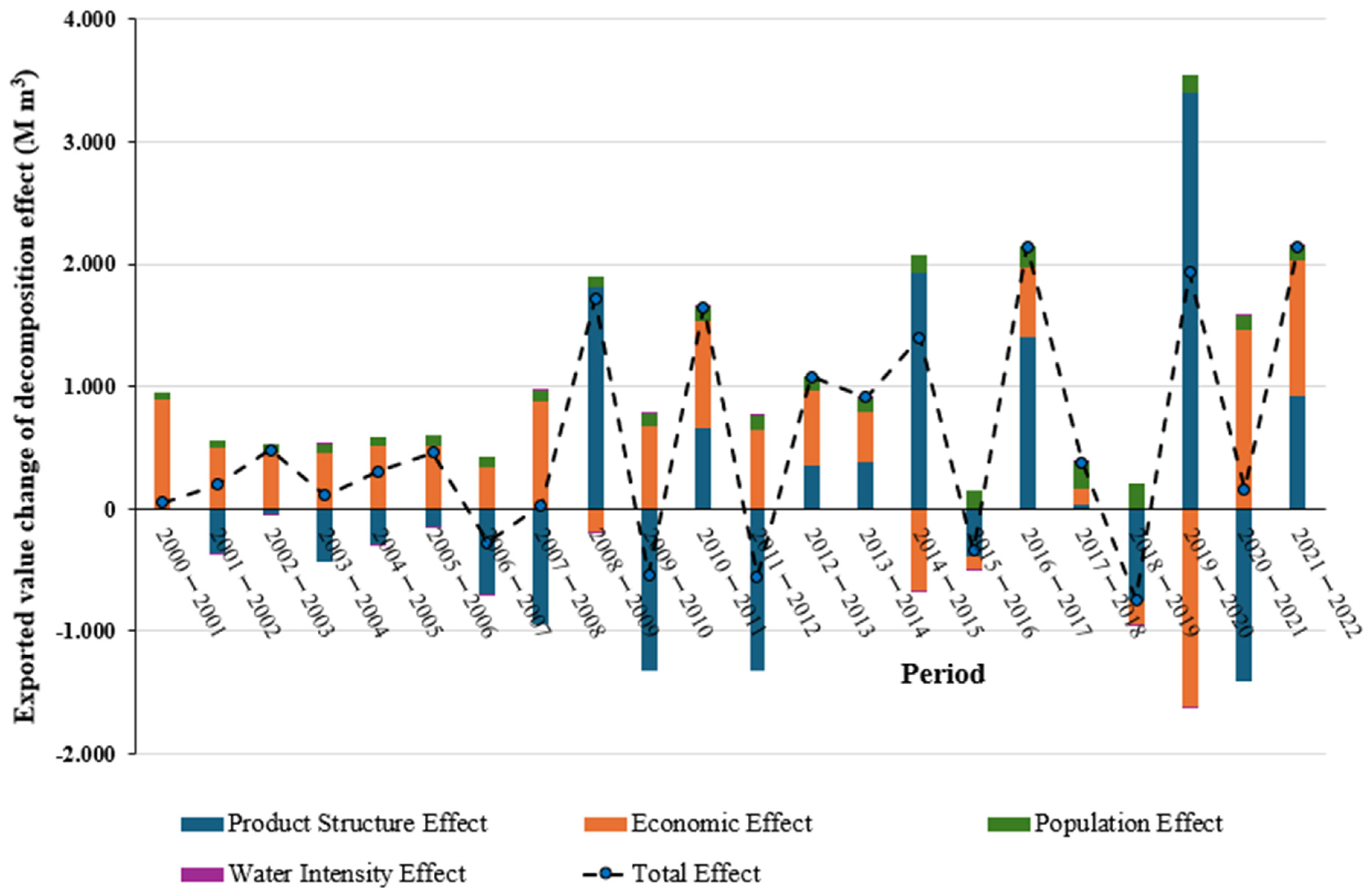
Figure 6, illustrate the magnitude and direction of the main driving forces influencing Ecuador’s virtual water exports between 2000 and 2023. Over this period, the total virtual water export amount increased markedly, with a cumulative change exceeding 1.26 × 10⁹ m3. The analysis identifies how four contributing effects, such as population size, economic patterns, product structure, and water intensity, assessed using LMDI method connects virtual water trade to domestic water scarcity, promoting production water usage, decoupling the relationship of economic growth and water resource consumption.
The economic growth effect emerged as the dominant factor driving the expansion of virtual water exports. This reflects sustained increases in GDP and the continued orientation of agricultural production toward export markets, which have driven greater water use in trade. The growth of international demand for key crops such as banana, cocoa, rice and pineapple, combined with domestic investment in commercial farming, substantially amplified the volume of water embedded in exported goods. This finding underscores the close relationship between economic expansion and the intensification of agricultural water use.
The product structure effect ranked as the second major contributor, remaining positive throughout most periods. This pattern indicates a progressive shift in Ecuador’s export portfolio toward high value yet water intensive commodities, which increased the overall water footprint of trade. The structural transition toward crops with higher irrigation requirements has deepened the economy’s exposure to water scarcity, especially in the coastal and Andean regions where hydrological stress and competition for irrigation water are growing.
In contrast, the population effect exerted only a minor influence on total exports. While population growth supports domestic consumption, its indirect link to export expansion is comparatively weak, reaffirming that foreign markets forces, not demographic change, dominate Ecuador’s water-related trade patterns. The water intensity effect was negative for most sub-periods, reflecting progressive but modest improvements in irrigation efficiency and farm-level water management. Nevertheless, these gains did not offset the combined impact of economic and structural drivers, meaning total virtual water export continued to rise. This imbalance reveals that Ecuador export growth remains partially coupled with water consumption, indicating limited progress toward SDG 6.4 on improving water use efficiency.

3.4.2. Import Change

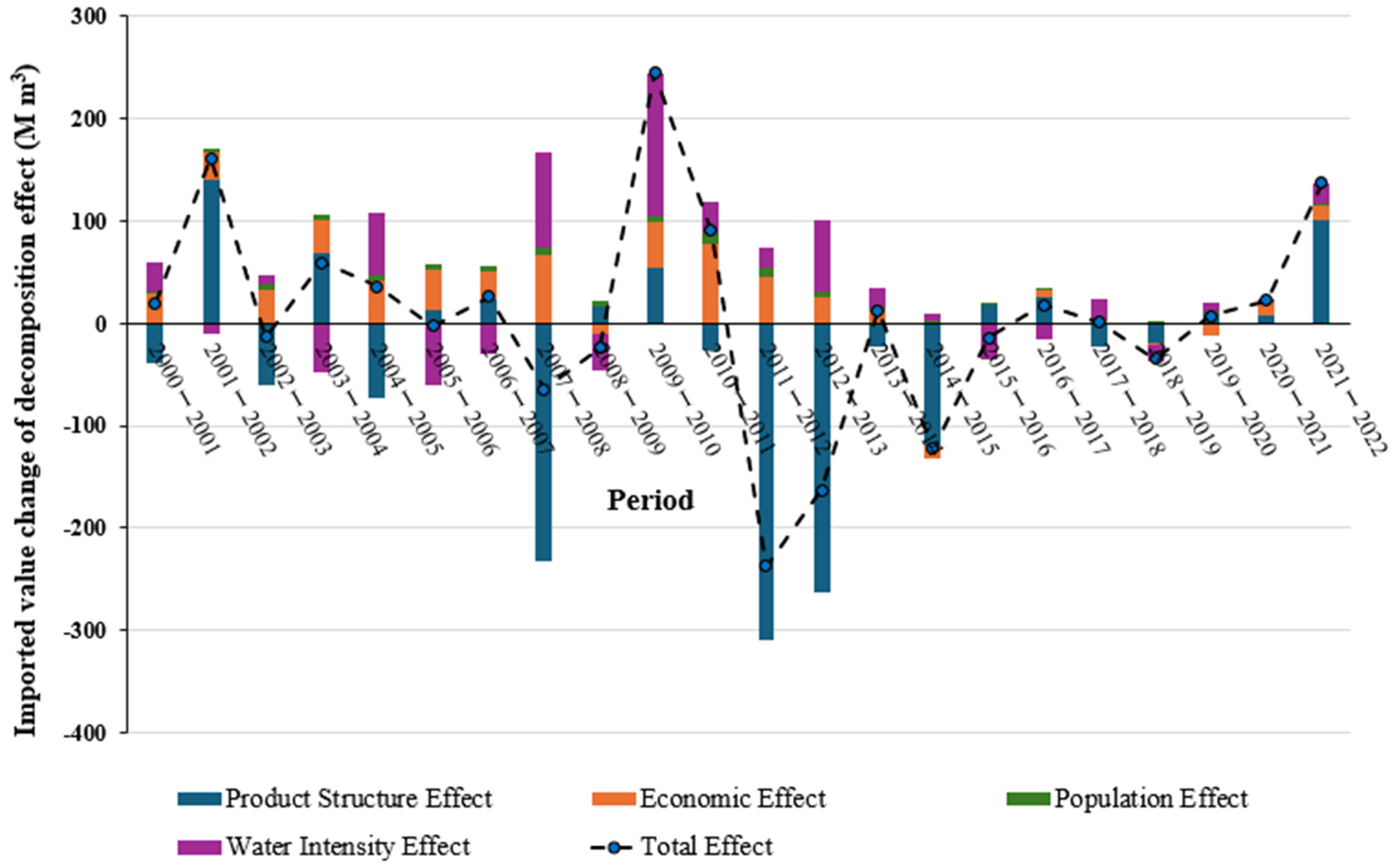
The decomposition analysis for Ecuador’s virtual water imports (Figure 7) reveals a moderate but persistent rise in the inflow of water embedded in traded commodities, totaling approximately 1.5 × 10⁸ m3 over the study period. The pattern reflects the interaction of economic, demographic, structural, and technological factors that have shaped the country’s import behavior within an increasingly globalized food system.
The economic growth effect was a consistent positive contributor, indicating that rising national income levels and the gradual expansion of domestic demand have increased reliance on imported goods, particularly cereals and processed food products. The population effect followed a similar trajectory, supporting the notion that demographic growth and urbanization have raised overall consumption needs, thus intensifying the demand for foreign agricultural inputs.
The product structure effect displayed marked variability, alternating between positive and negative contributions. These oscillations correspond to changes in the composition of imports and shifts in trade partnerships. Periods of negative structural impact, such as 2007–2008, 2011–2012, and 2012–2013, suggest substitution toward commodities with smaller virtual-water footprints, whereas positive spikes denote years when higher-footprint goods dominated import flows. This volatility highlights Ecuador’s sensitivity to market conditions and external supply dynamics.
The water intensity effect does not show a sustained decline after 2010; rather, the decomposition results show fluctuating but predominantly positive contributions throughout 2000–2023, indicating that Ecuador did not experience a consistent improvement in the efficiency of virtual-water inflows. Positive water-intensity values suggest that the virtual water content per unit of imported value generally increased rather than declined. Although some years show minor reductions, these episodes were insufficient to counterbalance the broader upward trend. Overall, the magnitude of the water-intensity effect remained modest relative to the strong positive contributions of economic and population factors, confirming that import-driven efficiency gains did not play a major role in shaping Ecuador’s virtual-water inflows.
This result generally indicates that while Ecuador’s import structure has become slightly more water-efficient, the aggregate trend remains upward, and the country continues to function primarily as a net virtual-water exporter. The dominance of export-oriented, water-intensive production outweighs the limited reductions achieved through improved import efficiency. Consequently, Ecuador’s trade profile continues to link domestic water resources to international markets, underscoring the need for strategies that harmonize trade policy, food security, and sustainable water management within a broader resource-governance framework.

4. Discussion

Ecuador’s agricultural and trade systems have evolved in tandem with profound shifts in the national economy and climate conditions. Before the 2000s era, production was constrained by limited irrigation coverage, low mechanization, and fragmented market access [54]. Subsequent oil-driven economic reforms expanded national income and accelerated food demand [55], while post-2000 diversification introduced a wider mix of crops: banana, cocoa, rice, pineapple, maize, potato, and barley, each drawing on distinct water regimes and agro-ecological zones. This transformation has enhanced export earnings but also deepened dependence on both rainfall variability and irrigation expansion, particularly on the coastal and Andean belts.
The virtual-water accounting results demonstrate a persistent net-exporter condition, confirming that Ecuador exports far more water embedded in crops than it imports. Over 2000–2023, virtual-water exports exceeded imports by more than an order of magnitude, revealing how the country effectively transfers its rainfed and irrigated resources abroad through agricultural trade. Green-water flows dominated both production and exports, mirroring the reliance on precipitation-fed systems, while blue-water use though smaller was concentrated in high-value crops such as pineapple and cocoa. This structure links Ecuador’s economic competitiveness directly to hydrological variability, particularly in semi-arid provinces where agricultural withdrawals already overlap with domestic and ecosystem needs.
The decomposition results using the LDMI indicate that demographic dynamics have played a relatively minor role in shaping Ecuador’s virtual water trade. Although population growth and urbanization have gradually increased domestic food demand, their overall contribution to virtual water flows remains limited [34,36,56]. Ecuador presents pronounced hydrological contrast between its Coastal lowlands and Andean highlands, which shape virtual water use and deep alluvial soils, supporting rainfed export-oriented systems dominated by cocoa and increasingly pineapple; exhibiting a high green-water dependence and relatively low blue-water intensity, which explains why water-intensity effect is generally weak and why the product structure effect strongly increases virtual water exports. This pattern suggests that Ecuador’s agricultural water use is primarily influenced by external market forces and trade dynamics rather than internal demographic pressure, underscoring the strong dependence of the national agricultural sector on global demand and price structures.
Taken together, the findings reveal that Ecuador’s virtual water trade remains only partially decoupled from economic growth. Modest improvements in water-use efficiency reflected in the negative water-intensity effect signal some progress toward Sustainable Development Goal 6.4 on efficient water management. However, these gains have been outweighed by the continued expansion of export-oriented production. The persistence of this imbalance shows that economic and structural pressures continue to drive water-embedded trade, while efficiency improvements alone remain insufficient to achieve a full decoupling between economic development and water-resource consumption [14,15,56].
From a governance standpoint, this duality presents both an opportunity and a challenge. On one hand, Ecuador’s export sector provides a vital source of income and foreign exchange; on the other, it externalizes domestic hydrological pressure and exposes the country to external climatic variability through its import dependence on rainfed cereals. Effective water governance must therefore bridge the gap between trade and hydrology by integrating virtual-water metrics into agricultural, trade, and climate policies. Encouraging less water-intensive export portfolios, promoting efficient irrigation technologies, and strengthening basin-level allocation frameworks could help align national trade performance with sustainable resource management. In practical terms, several pathways emerge from the findings. First, promoting less water-intensive export portfolios and encouraging diversification toward crops with predominantly green-water footprints can moderate pressure on surface and groundwater systems. Second, improving irrigation performance in the limited but strategically important blue-water export chains can yield disproportionate benefits for water security. Third, investments in rainwater harvesting, soil-moisture conservation, and climate-resilient varieties can reduce exposure to rainfall variability while maintaining export competitiveness. Collectively, these measures would support a stronger decoupling of economic growth from water use, aligning Ecuador’s agricultural development trajectory with SDGs 2, 6 and 12 and reinforcing the role of virtual-water accounting as a decision-support tool rather than solely an analytical metric.
Ultimately, Ecuador’s experience reflects a broader pattern across emerging agricultural economies: economic and structural forces remain the primary engines of virtual-water growth, while efficiency gains play a secondary, compensatory role. The findings highlight that advancing toward sustainable water use will require policy coherence between trade strategy and water management, ensuring that economic competitiveness does not come at the expense of long-term water security.

Limitations and Prospects

Although the present study establishes a robust empirical foundation for understanding Ecuador’s trade-embedded water dynamics between 2000 and 2023, certain limitations must be acknowledged. The analysis relied primarily on secondary datasets from FAOSTAT and the global water footprint database by Mekonnen and Hoekstra [10]. Yet these sources are widely recognized, differences in reporting frequency, aggregation level, and yield estimation introduce uncertainty into the annual virtual water calculations. The omission of grey water footprint, which represents the volume of water required to assimilate pollutants from fertilizer and pesticide use, constitutes the main data limitation. Including grey water would offer a more complete assessment of the environmental burden associated with trade, particularly for intensively cultivated crops such as rice, banana, and cocoa, where agrochemical runoff can substantially affect water quality. Moreover, the present analysis does not incorporate grey-water and yield-adjusted scenarios under present day conditions, which are increasingly relevant for understanding the impacts of climate variability and land-use change. Integrating crop yield projections and updated water-productivity data would allow for more dynamic modeling of virtual water flows under different climatic or trade policy pathways. Expanding the framework to include socio-environmental indicators such as carbon intensity, economic water productivity, or ecosystem vulnerability would also strengthen the multidimensional understanding of resource tradeoffs.
Another methodological limitation concerns the use of national-level averages for water footprint values. Such aggregation masks regional disparities in irrigation efficiency, crop yield, and climate variability across Ecuador’s diverse agro-ecological zones. Local variations in rainfall, soil type, and irrigation infrastructure mean that the actual water use per ton of production can differ considerably between coastal, Andean, and Amazon regions. Future research should incorporate spatially explicit datasets or remote-sensing estimates of evapotranspiration to better capture these heterogeneities and refine the distinction between green and blue water use.
Looking ahead, future studies could build upon this work by (i) coupling virtual water trade analysis with climate-econometric models to explore how precipitation anomalies and temperature shifts affect trade flows; (ii) integrating LMDI decomposition with decoupling elasticity models to better quantify progress toward Sustainable Development Goal 6.4; and (iii) incorporating stakeholder-based governance assessments to evaluate institutional responses to water scarcity in export-oriented regions. Establishing national databases on virtual water accounting would further enhance data transparency and facilitate periodic monitoring.
Addressing these limitations will enable future research to capture the full complexity of the water–economy nexus. Incorporating grey water footprints, region-specific production data, and climate-responsive indicators will be essential for developing more accurate, policy-relevant strategies that align trade performance with long-term water sustainability

5. Conclusions

This study provides a comprehensive assessment of Ecuador’s virtual water trade across seven strategic agricultural commodities between 2000 and 2023, integrating the Hoekstra & Mekonnen water footprint framework with the Logarithmic Mean Divisa Index (LMDI) decomposition. The findings reveal that Ecuador is a persistent net exporter of virtual water, largely driven by green-water flows associated with rainfed systems. Export growth was mainly propelled by economic expansion and structural shifts toward high-value, water-intensive crops such as banana, cocoa, rice, and pineapple, while improvements in water-use efficiency played a smaller, compensatory role. Although water intensity declined modestly, the overall scale of virtual water exports continued to rise, reflecting only partial decoupling between economic growth and water consumption.
The study also underscores the need for policies that align agricultural trade strategies with sustainable water management. Strengthening irrigation efficiency, promoting diversified and less water-intensive export portfolios, and incorporating grey-water pollution indicators into national accounting are essential for reducing hydrological pressure. Future policy design should also integrate virtual-water metrics into trade and climate frameworks to achieve the targets of SDG 6.4 and ensure that Ecuador’s economic competitiveness does not compromise long-term water security. By quantifying the links between trade, resource use, and sustainability, this work contributes a baseline for evidence-based governance in semi-arid and export-oriented economies facing similar challenges.

Author Contributions

Conceptualization, E.I.C.E.; methodology, E.I.C.E.; software, E.I.C.E. and Q.A.; validation, K.-S.C. and H.-S.H.; formal analysis, E.I.C.E.; investigation, E.I.C.E.; resources, K.-S.C.; data curation, E.I.C.E., Q.A. and G.O.; writing—original draft preparation, E.I.C.E., Q.A. and G.O.; writing—review and editing, Q.A., G.O. and K.-S.C.; visualization, E.I.C.E., Q.A. and G.O.; supervision, K.-S.C. and H.-S.H. All authors have read and agreed to the published version of the manuscript.

Funding

This research received no external funding.

Data Availability Statement

The original contributions presented in this study are included in the article. Further inquiries can be directed to the corresponding author.

Acknowledgments

The authors extend their appreciation to the Department of Agricultural Civil Engineering and the Institute of International Research and Development (IIRD) at Kyungpook National University under the KOICA Scholarship Program; their support in fostering our academic and national development.

Conflicts of Interest

The authors declare no conflicts of interest.

Abbreviations

The following abbreviations are used in this manuscript:
LMDILogarithmic Mean Divisa Index
SDGSustainable Development Goals
GDPGross Domestic Product
FAOFood and Agriculture Organization
VWTVirtual Water Trade
VWUVirtual Water Use
NVWNet Virtual Water
VWIVirtual Water Import
VWEVirtual Water Export
WFWater Footprint

Appendix A

Appendix A.1. Ecuador’s Crop Production

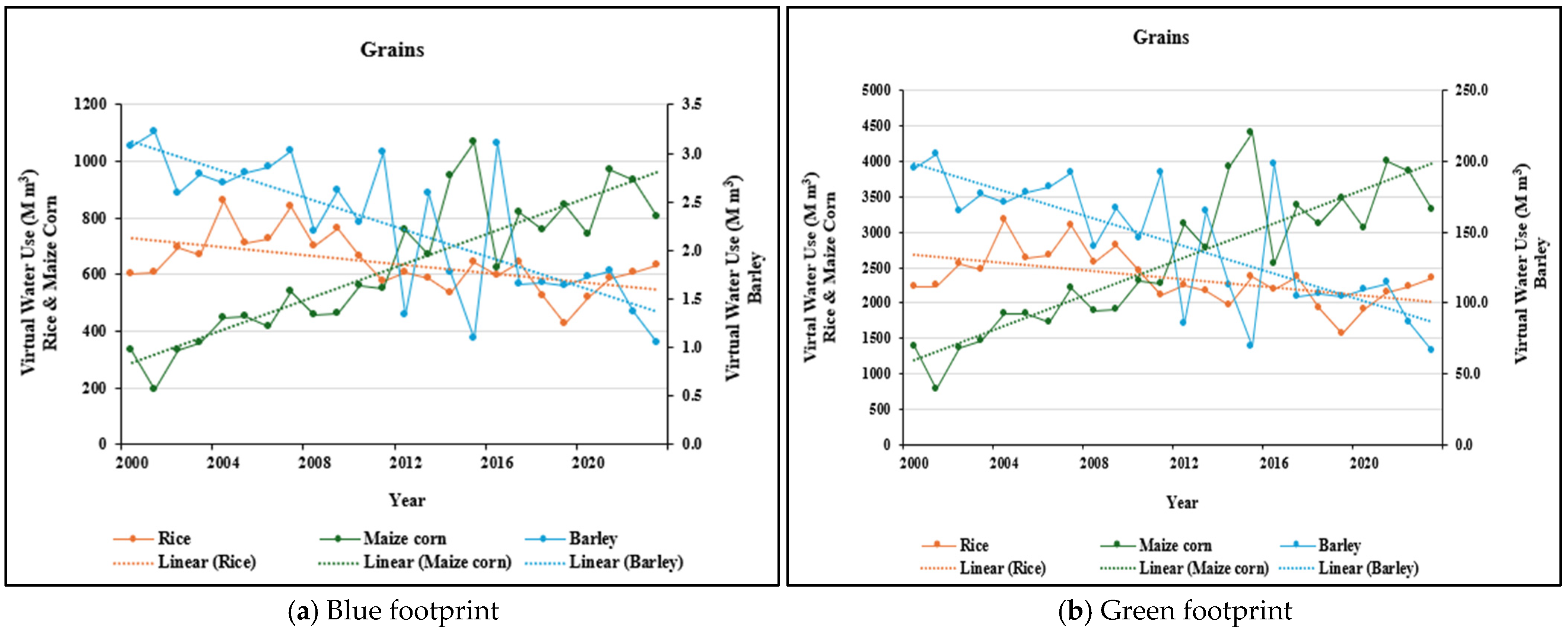
Figure A1. Comparison of the estimated virtual water use of grains under the blue and the green water footprint. In both panels, left axis represents rice and maize, while the right axis represents barley in (M m3).
Water 18 00122 g0a1
Rice, barley and maize are central to Ecuador’s agricultural economy and food system. Rice and maize constitute staple grains, used for animal feed and consumed domestically, while barley, although produced in smaller volumes, support local demand in beverages, livestock fodder and as a buffer crop in highland areas (Figure A1).
Figure A2. Comparison of the estimated virtual water use of grains under the blue and the green water footprint. In both panels, left axis represents banana, while the right axis represents pineapple in (M m3).
Water 18 00122 g0a2
Figure A2, displays pineapple and banana virtual water analysis. Banana has become an Ecuador’s flagship export crop and a cornerstone of its rural economy, accounting for nearly one-third of global banana exports and provide hundreds to thousands employment [26]. Pineapple, although less dominant than banana, has expanded rapidly since 2000s, with its production concentrated in the coastal provinces. Both crops are thus directly tied to foreign exchange earnings and indirectly to rural income and livelihoods, while contributing less to direct household food security compared to cereals.
Figure A3. Comparison of the estimated virtual water use of trees/tubers under the blue and green water footprint. In both panels, left axis represents banana, while the right axis represents pineapple in (M m3).
Water 18 00122 g0a3

Appendix A.2. Ecuador’s Import and Export

Figure A4. Virtual Water Import and Export Trends of Seven Commodities, Ecuador 2000–2023.
Water 18 00122 g0a4

Appendix B

Appendix B.1. Statistics Summary (Data Collection)

Table A1. Descriptive statistics of key variables used in virtual water trade analysis.
YearAnnual
Population
Annual GDPImport ValuesExport ValuesProduction Values
2000 12,689,2061,381,5431.3108,196,3913,401,161,6739,113,493,852
2001 1,291,0741,791,303.533127,673,6063,457,238,7599,128,170,705
2002 13,138,4722,059,158.6288,209,0033,659,563,8059,405,906,378
2003 13,372,3062,315,622.219274,138,8604,144,380,26910,767,759,562
2004 13,608,7012,586,209.093332,651,5324,255,802,77512,071,075,835
200513,846,1632,909,026.256367,840,1514,567,693,62611,494,566,897
2006 14,086,1313,243,670.009364,685,5555,030,312,17311,210,615,720
200714,328,7733,478,924.976390,792,9984,752,125,44412,240,889,707
200814,575,2024,194,757.3325,964,3184,775,794,83511,637,615,769
200914,825,9544,053,363.103301,695,0506,490,708,58113,256,456,021
2010 15,076,6954,520,309.607545,540,9225,976,951,87413,820,860,816
201115,326,2275,153,691.8635,763,7157,624,906,93714,253,165,146
2012 15,572,1945,634,083.915405,188,3617,002,301,12714,163,172,331
2013 15,807,1286,109,290.555241,879,7338,074,294,85113,206,008,280
2014 16,035,1246,405,799.553253,740,307.58,988,864,92015,616,933,537
2015 16,266,2255,976,159.625131,145,119.710,391,094,55717,682,813,264
2016 16,505,1395,917,637.872116,494,252.610,052,497,56014,947,354,184
2017 16,759,5196,233,322.245133,935,493.212,196,456,10416,967,303,806
201817,049,5476,303,919.051134,695,100.812,574,565,65317,110,998,832
2019 17,340,0216,205,057.47499,506,829.3111,835,531,14318,780,430,749
2020 17,546,0655,463,645.309106,139,798.713,766,200,55220,117,547,540
2021 17,682,4546,075,802.429128,173,482.113,616,199,28020,887,451,665
2022 17,823,8976,540,998.245201,858,962.516,076,801,19621,819,632,725
202317,980,0836,609,804.126--23,070,729,092

Appendix B.2. Ecuador’s Imported and Exported Virtual Water Amount

Table A2. The total amounts of virtual water from Ecuador’s crop importation—FAOSTAT bilateral trade (2000–2023).
CategoryCropWater Imports (million m3)
Green WaterBlue Water
GrainsRice14.290.47
Barley878.1017.46
Maize corn4888.8026.38
FruitsPineapple0.110.01
Banana5.081.00
Starch roots/TreesPotato0.700.87
Cocoa bean3.760.0012
Table A3. The total amounts of virtual water from Ecuador’s crop exportation—FAOSTAT bilateral trade (2000–2023).
CategoryCropWater Exports (million m3)
Green WaterBlue Water
GrainsRice20.5475.68
Barley0.5534.99
Maize corn286.62117.97
FruitsPineapple20.175276.75
Banana631,208.1439,761.13
Starch roots/TreesPotato12.4017.12
Cocoa bean15,069.70134,755.00

Appendix B.3. Logarithmic Mean Divisa Index Analysis of Ecuador’s Virtual Water Trade

Table A4. The logarithmic mean divisa index (LMDI) analysis of Ecuador’s crop imported virtual water trade (million m3).
VWT Change (Import)
YearProduct
Structure
Economic GrowthPopulationWater
Intensity
Total Effect
2000–2001−39,731,669.4729,251,202.041,949,139.29328,013,142.1419,481,814
2001–2002139,343,541.627,457,186.823,445,145.304−9,918,939.746160,326,934
2002–2003−59,937,080.5932,422,553.44,872,770.3438,780,076.838−13,861,680
2003–200467,658,641.6733,202,6575,264,704.666−47,609,833.3458,516,170
2004–2005−73,126,985.7341,108,894.336,045,758.62461,160,951.7735,188,619
2005–200611,917,837.7339,878,497.256,292,890.147−61,285,371.13−3,196,146
2006–200723,597,973.2226,399,457.36,439,410.449−30,332,337.9726,104,503
2007–2008−232,181,687.866,643,952.356,073,422.73594,638,572.68−64,825,740
2008–200916,304,874.79−10,732,704.755,339,253.863−35,267,886.91−24,356,463
2009–201053,092,740.5644,626,7436,864,215.026139,373,190.4243,956,889
2010–2011−27,250,806.177,299,128.749,676,400.96530,499,103.490,223,827
2011–2012−309,908,075.345,224,048.858,079,191.31819,601,927.13−237,002,908
2012–2013−263,323,051.225,487,354.744,713,118.78670,400,558.71−162,722,019
2013–2014−22,983,483.5411,731,760.113,544,939.87519,652,322.9211,945,539.37
2014–2015−119,604,910.9−12,196,735.782,513,868.3726,678,140.886−122,609,637.5
2015–201618,760,566.61−1,202,999.6291,782,460.76−33,990,782.91−14,650,755.17
2016–201725,418,971.956,456,607.8711,900,082.894−16,333,546.5717,442,116.14
2017–2018−22,941,247.291,504,794.672,292,487.59119,901,194.51757,229.48
2018–2019−18,685,751.82−1,799,568.331,923,288.418−16,626,020.74−35,188,052.47
2019–20209,083,482.975−12,770,278.811,185,469.9879,130,463.2196,629,137.37
2020–20218,092,130.33812,351,470.39900,575.2649664,621.12922,008,797.12
2021–2022100,609,836.913,531,856.15146,1341.1320,857,960.75136,460,995
2022–2023-----
Sum−715,794,151.4495,875,877.792,559,935.81277,987,507.2150,629,169.3
Table A5. The logarithmic mean divisa index (LMDI) analysis of Ecuador’s crop exported virtual water trade (million m3).
VWT Change (Export)
YearProduct
Structure
Economic GrowthPopulationWater
Intensity
Total Effect
2000–2001−893,411,481.6888,331,027.459,193,495.99−17,242.839554,095,798.95
2001–2002−359,239,403.2494,049,308.861,990,023.49−17,693.08031196,782,236
2002–2003−44,547,494.41455,717,459.368,489,563.19−15,925.0758479,643,603
2003–2004−429,536,650.3461,568,376.673,187,552.024742.666134105,224,021
2004–2005−283,385,313.8515,723,070.375,845,805.4−3788.885681308,179,773
2005–2006−142,959,438.8518,861,993.381,877,245.89−2847.377068457,776,953
2006–2007−702,323,493.1339,707,80782,862,233.76−4029.603452−279,757,482
2007–2008−939,082,952.3885,192,395.480,669,699.644085.27135326,783,228.01
2008–20091,807,349,973−190,117,35094,578,656.5−13,583.711161,711,797,696
2009–2010−1,317,985,742673,347,724.8103,570,264.47343.211026−541,060,410
2010–2011657,127,794.9882,622,754.8110,487,812.911,137.40551,650,249,500
2011–2012−1,316,990,689646,627,172.3115,518,728.911,136.017−554,833,652
2012–2013355,530,554.6607,437,043.3112,327,190.1−1547.0049721,075,293,241
2013–2014388,419,707.4403,122,473.4121,809,934.51650.526442913,353,765.8
2014–20151,930,725,627−670,007,589.2138,095,218−2593.4412481,398,810,662
2015–2016−389,501,444.3−100,356,798.4148,696,683.6−4542.661534−341,166,102
2016–20171,396,800,175574,855,663.5169,171,403.1−1134.040912,140,826,108
2017–201827,900,970.57139,174,987.2212,026,888.23733.072309379,106,579
2018–2019−754,990,406.3−192,331,825205,554,612.9−8435.717502−741,776,054
2019–20203,402,893,839−1,621,182,422150,494,999.6−3889.2173721,932,202,527
2020–2021−1,416,230,3351,466,579,444106,931,8172984.775368157,283,910.8
2021–2022924,657,727.11,101,711,843118,976,791.515,592.672432,145,361,954
2022–2023-----
Sum1,901,221,5248,280,634,5602,492,356,620.58−34,847.0412,674,177,858

References

  1. Du, Y.; Zhao, D.; Qiu, S.; Zhou, F.; Peng, J. How can virtual water trade reshape water stress pattern? A global evaluation based on the metacoupling perspective. Ecol. Indic. 2022, 145, 109712. [Google Scholar] [CrossRef]
  2. Cuero Espinoza, E.I.; Adeyi, Q.; Ahmad, M.J.; Hwang, H.-S.; Choi, K.-S. Sustainability Synergies Between Water Governance and Agrotourism Development in the Semi-Arid Climate: A Case Study of Esmeraldas Province, Ecuador. Water 2025, 17, 2215. [Google Scholar] [CrossRef]
  3. Mahlknecht, J.; González-Bravo, R.; Loge, F.J. Water-energy-food security: A Nexus perspective of the current situation in Latin America and the Caribbean. Energy 2020, 194, 116824. [Google Scholar] [CrossRef]
  4. Faures, J.M.; Eliasson, A.; Hoogeveen, J.; Vallee, D. AQUASTAT-FAO’s Information System on Water and Agriculture. GRID—Magazine, 2001, p. 18. Available online: https://www.fao.org/aquastat/en/overview/methodology/water-use (accessed on 6 November 2025).
  5. Arab Water Council. Perspectives on Water and Climate Change Adaptation: Arid and Semi-Arid Regions. 2009. Available online: https://www.preventionweb.net/files/12914_PersPap09.AridandSemiAridRegions1.pdf? (accessed on 1 December 2025).
  6. Leal Filho, W.; Totin, E.; Franke, J.A.; Andrew, S.M.; Abubakar, I.R.; Azadi, H.; Nunn, P.D.; Ouweneel, B.; Williams, P.A.; Simpson, N.P. Understanding responses to climate-related water scarcity in Africa. Sci. Total Environ. 2022, 806, 150420. [Google Scholar] [CrossRef] [PubMed]
  7. Morante-Carballo, F.; Montalván-Burbano, N.; Quiñonez-Barzola, X.; Jaya-Montalvo, M.; Carrión-Mero, P. What Do We Know about Water Scarcity in Semi-Arid Zones? A Global Analysis and Research Trends. Water 2022, 14, 2685. [Google Scholar] [CrossRef]
  8. FAO. Coping with Water Scarcity an Action Framework for Agriculture and Food Security. 2012. Available online: https://www.fao.org/4/i3015e/i3015e.pdf? (accessed on 1 December 2025).
  9. Lu, J.; Jia, L.; Menenti, M.; Zheng, C.; Hu, G.; Ji, D. The impacts of drought on water availability: Spatial and temporal analysis in the Belt and Road region (2001–2020). Int. J. Digit. Earth 2025, 18, 2449706. [Google Scholar] [CrossRef]
  10. Chapagain, K.; Hoekstra, A.Y. The blue, green and grey water footprint of rice from production and consumption perspectives. Ecol. Econ. 2011, 70, 749–758. [Google Scholar] [CrossRef]
  11. Zhang, M.; Zhang, Y.; Tian, Q.; Man, X.; Wang, M. Virtual water flows and drivers in the international trade of agricultural products of the regional comprehensive economic partnership. Water Sci. Technol. 2024, 89, 730–744. [Google Scholar] [CrossRef]
  12. de Fraiture, C.; Cai, X.; Amarasinghe, U.; Rosegrant, M.; Molden, D. Does International Cereal Trade Save Water? The Impact of Virtual Water Trade on Global Water Use. 2004. Available online: https://core.ac.uk/download/pdf/48034908.pdf (accessed on 9 October 2025).
  13. Maroufpoor, S.; Bozorg-Haddad, O.; Maroufpoor, E.; Gerbens-Leenes, P.W.; Loáiciga, H.A.; Savic, D.; Singh, V.P. Optimal virtual water flows for improved food security in water-scarce countries. Sci. Rep. 2021, 11, 21027. [Google Scholar] [CrossRef]
  14. Adeyi, Q.; Adelodun, B.; Odey, G.; Choi, K.S. Spatio-temporal Dynamics of Water Footprints of Food Consumption in South Korea: A Decomposition Analysis. Environ. Manag. 2025, 75, 2348–2364. [Google Scholar] [CrossRef]
  15. Odey, G.; Adelodun, B.; Lee, S.; Adeyemi, K.A.; Cho, G.; Choi, K.S. Environmental and Socioeconomic Determinants of Virtual Water Trade of Grain Products: An Empirical Analysis of South Korea Using Decomposition and Decoupling Model. Agronomy 2022, 12, 3105. [Google Scholar] [CrossRef]
  16. Sun, J.X.; Yin, Y.L.; Sun, S.K.; Wang, Y.B.; Yu, X.; Yan, K. Review on research status of virtual water: The perspective of accounting methods, impact assessment and limitations. Agric. Water Manag. 2021, 243, 106407. [Google Scholar] [CrossRef]
  17. Mekonnen, M.M.; Kebede, M.M.; Demeke, B.W.; Carr, J.A.; Chapagain, A.; Dalin, C.; Debaere, P.; D’Odorico, P.; Marston, L.; Ray, C.; et al. Trends and environmental impacts of virtual water trade. Nat. Rev. Earth Environ. 2024, 5, 890–905. [Google Scholar] [CrossRef]
  18. Tamea, S.; Allamano, P.; Carr, J.A.; Claps, P.; Laio, F.; Ridolfi, L. Local and global perspectives on the virtual water trade. Hydrol. Earth Syst. Sci. 2013, 17, 1205–1215. [Google Scholar] [CrossRef]
  19. Dalin, C.; Konar, M.; Hanasaki, N.; Rinaldo, A.; Rodriguez-Iturbe, I. Evolution of the global virtual water trade network. Proc. Natl. Acad. Sci. USA 2012, 109, 5989–5994. [Google Scholar] [CrossRef] [PubMed]
  20. Vallino, E.; Ridolfi, L.; Laio, F. Trade of economically and physically scarce virtual water in the global food network. Sci. Rep. 2021, 11, 22806. [Google Scholar] [CrossRef]
  21. Silvestrini, M.M.; Rossi, T.J.A.; Sarti, F.M. Socioeconomic and Environmental Dimensions of Agriculture, Livestock, and Fisheries: A Network Study on Carbon and Water Footprints in Global Food Trade. Standards 2025, 5, 19. [Google Scholar] [CrossRef]
  22. Prates, R.C. The balance of trade in virtual water in the countries of south america. Int. J. Adv. Eng. Res. Sci. 2019, 6, 323–331. [Google Scholar] [CrossRef]
  23. Hoekstra, A.Y.; Hung, P.Q. Virtual Water Trade—A Quantification of Virtual Water Flows Between Nations in Relation to International Crop Trade. 2002. Available online: https://www.waterfootprint.org/resources/Report11.pdf? (accessed on 25 December 2025).
  24. Arrien, M.M.; Aldaya, M.M.; Rodriguez, C.I. Water Footprint and Virtual Water Trade of Maize in the Province of Buenos Aires, Argentina. Water 2021, 13, 1769. [Google Scholar] [CrossRef]
  25. Veliz, K.; Chico-Santamarta, L.; Ramirez, A.D. The Environmental Profile of Ecuadorian Export Banana: A Life Cycle Assessment. Foods 2022, 11, 3288. [Google Scholar] [CrossRef]
  26. Tendata. What Are the Main Agricultural Exports from Ecuador? 2024. Available online: https://www.tendata.com/blogs/export/5477.html (accessed on 13 October 2025).
  27. International Trade Administration. Ecuador Country Commercial Guide. 2025. Available online: https://www.trade.gov/country-commercial-guides/ecuador-agriculture (accessed on 13 October 2025).
  28. Vera, J.F.R.; Mera, Y.E.Z.; Pérez-Martín, M.Á. Adapting water resources systems to climate change in tropical areas: Ecuadorian coast. Sci. Total Environ. 2020, 703, 135554. [Google Scholar] [CrossRef] [PubMed]
  29. Boelens, R.A. The Rules of the Game and the Game of the Rules: Normalization and Resistance in Andean Water Control. Ph.D. Thesis, Wageningen University, Wageningen, The Netherlands, 2008. Available online: https://www.researchgate.net/profile/Rutgerd-Boelens/publication/40099015_The_Rules_of_the_Game_and_the_Game_of_the_Rules_Normalization_and_Resistance_in_Andean_Water_Control/links/5f537633458515e96d2f08fd/The-Rules-of-the-Game-and-the-Game-of-the-Rules-Normalization-and-Resistance-in-Andean-Water-Control.pdf (accessed on 19 April 2025).
  30. FAO; INEC. Food and Agriculture Microdata Catalogue Ecuador—Annual Agricultural Area and Production Survey 2020. 2023. Available online: https://microdata.fao.org/index.php (accessed on 3 May 2025).
  31. Fang, K.; He, J.; Liu, Q.; Wang, S.; Geng, Y.; Heijungs, R.; Du, Y.; Yue, W.; Xu, A.; Fang, C. Water footprint of nations amplified by scarcity in the Belt and Road Initiative. Heliyon 2023, 9, e12957. [Google Scholar] [CrossRef] [PubMed]
  32. Sun, L.; Dong, H.; Geng, Y.; Li, Z.; Liu, Z.; Fujita, T.; Ohnishi, S.; Fujii, M. Uncovering driving forces on urban metabolism—A case of Shenyang. J. Clean. Prod. 2016, 114, 171–179. [Google Scholar] [CrossRef]
  33. Meng, H.; Xing, L.; Hu, J.; Shen, C.; Zhang, H.; Wu, J. Exploring the characteristics and drivers of virtual cropland trade of major agricultural products in China. J. Clean. Prod. 2024, 448, 141392. [Google Scholar] [CrossRef]
  34. Ang, B.W. Decomposition analysis for policymaking in energy: Which is the preferred method? Energy Policy 2004, 32, 1131–1139. [Google Scholar] [CrossRef]
  35. Khan, S.; Majeed, M.T. Drivers of Decoupling Economic Growth from Carbon Emission: Empirical Analysis of ASEAN Countries Using Decoupling and Decomposition Model. Pak. J. Commer. Soc. Sci. 2020, 14, 450–483. Available online: https://www.econstor.eu/handle/10419/222910 (accessed on 6 November 2025).
  36. Song, J.; Yin, Y.; Xu, H.; Wang, Y.; Wu, P.; Sun, S. Drivers of domestic grain virtual water flow: A study for China. Agric. Water Manag. 2020, 239, 106175. [Google Scholar] [CrossRef]
  37. Matovelle, C.; Mudarra, M.; Andreo, B. Efficiency analysis of irrigation ditches over different land uses in the Andean region of Ecuador: Implication for nature-based water management strategies. Environ. Earth Sci. 2025, 84, 107. [Google Scholar] [CrossRef]
  38. Flores, M.; Llambo, Á.; Loza, D.; Naya, S.; Tarrío-Saavedra, J. Predicting rainfall and irrigation requirements of corn in Ecuador. Heliyon 2023, 9, e18334. [Google Scholar] [CrossRef]
  39. Wikipedia. Ecuador. Wikipedia Fundation. 2025. Available online: https://es.wikipedia.org/wiki/Ecuador (accessed on 21 August 2025).
  40. Embassy of Ecuador in Washington, DC. Ecuador Facts and Geography. 2009. Available online: https://web.archive.org/web/20090327140334/http://www.ecuador.org/esp/datos_ecuador.htm (accessed on 21 August 2025).
  41. Wikipedia. Economy of Ecuador. 2025. Available online: https://en.wikipedia.org/wiki/Economy_of_Ecuador (accessed on 22 August 2025).
  42. Central Bank of Ecuador. The Ecuadorian Economy Reported an Annual Contraction of 2.0% in 2024. 2025. Available online: https://www.bce.fin.ec/en/the-ecuadorian-economy-reported-an-annual-contraction-of-2-0-in-2024/ (accessed on 22 August 2025).
  43. FAOSTAT. FAOSTAT Database. Food and Agriculture Organization of the United Nations. 2025. Available online: https://www.fao.org/faostat/en/#data/QI (accessed on 22 August 2025).
  44. Mekonnen, M.M.; Hoekstra, A.Y. The green, blue and grey water footprint of crops and derived crop products. Hydrol. Earth Syst. Sci. 2011, 15, 1577–1600. [Google Scholar] [CrossRef]
  45. FAO. Crops and Livestock Products. 2025. Available online: https://www.fao.org/faostat/en/#data/QCL (accessed on 21 October 2025).
  46. FAOSTAT. Ecuador’s Annual Population. 2025. Available online: https://www.fao.org/faostat/en/#data/OA (accessed on 21 October 2025).
  47. FAO. Ecuador’s Macro Indicators—GDP. 2025. Available online: https://www.fao.org/faostat/en/#data/MK (accessed on 21 October 2025).
  48. Mekonnen, M.M.; Hoekstra, A.Y. The Green, Blue and Grey Water Footprint of Crops and Derived Crop Products Vol. 2. 2010. Available online: http://www.unesco-ihe.org/value-of-water-research-report-series (accessed on 26 August 2025).
  49. Quishpe-Vásquez, C.; Gámiz-Fortis, S.R.; García-Valdecasas-Ojeda, M.; Castro-Díez, Y.; Esteban-Parra, M.J. Tropical Pacific sea surface temperature influence on seasonal streamflow variability in Ecuador. Int. J. Climatol. 2019, 39, 3895–3914. [Google Scholar] [CrossRef]
  50. OEC. Banana in Ecuador. 2024. Available online: https://oec.world/en/profile/bilateral-product/bananas/reporter/ecu? (accessed on 23 October 2025).
  51. Molina, G. Diplomatic tensions between Ecuador and Russia Over Military Equipment Threaten Banana Exports. AP J. 2024. Available online: https://apnews.com/article/ecuador-russia-bananas-military-exports-diplomacy-1c8f21060450b22411af7b6c05e173a3 (accessed on 23 October 2025).
  52. FAO. Banana Market Review. 2023. Available online: https://openknowledge.fao.org/server/api/core/bitstreams/cd3e1df8-6e70-461a-9963-9827ad69389f/content? (accessed on 23 October 2025).
  53. TrendEconomy. Annual International Trade Statistics by Country—Ecuador Import and Export. 2024. Available online: https://trendeconomy.com/data/h2/Ecuador/1801? (accessed on 23 October 2025).
  54. Ruff, S. Agricultural Progress in Ecuador, 1970–82. 1984. Available online: https://ageconsearch.umn.edu/record/147526/files/faer208.pdf (accessed on 16 September 2025).
  55. Toledo, L.; Salmoral, G.; Viteri-Salazar, O. Rethinking Agricultural Policy in Ecuador (1960–2020): Analysis Based on the Water–Energy–Food Security Nexus. Sustainability 2023, 15, 12850. [Google Scholar] [CrossRef]
  56. Fu, T.; Xu, C.; Huang, X. Analysis of Virtual Water Trade Flow and Driving Factors in the European Union. Water 2021, 13, 1771. [Google Scholar] [CrossRef]
Figure 1. Ecuador’s map and its administrative regions.
Water 18 00122 g001
Figure 2. Total virtual water use in Ecuador’s crop production between 2000 and 2023.
Water 18 00122 g002
Figure 3. Net volume of virtual water trade flows over the study period.
Water 18 00122 g003
Figure 4. Temporal evolution of Ecuador’s virtual water import partners (2000–2023).
Water 18 00122 g004
Figure 5. Dynamics of Ecuador’s virtual water export partners across major agricultural commodities (2000–2023).
Water 18 00122 g005
Figure 6. Decomposition effect of Ecuador virtual water export by driving factor using LMDI method.
Water 18 00122 g006
Figure 7. Decomposition effect of Ecuador virtual water import by driving factor using LMDI method.
Water 18 00122 g007
Table 1. Overview of data sources.
InputSources
Production, Export and Import dataFAO [45]
Virtual Water Use Crop CalculationAuthor estimation
Net Virtual Water Crops TradeAuthor estimation
PopulationFAOSTAT [46]
Gross Domestic Product (GDP)FAO [47]
Water FootprintHoekstra et al. [44,48]
Table 2. Ecuador’s net virtual water trade of major crops over 2000 and 2023.
YearVWIVWENVW
2000108,196,3913,401,161,673−3,292,965,282
2001127,673,6063,457,238,759−3,329,565,153
2002288,209,0033,659,563,805−3,371,354,802
2003274,138,8604,144,380,269−3,870,241,409
2004332,651,5324,255,802,775−3,923,151,243
2005367,840,1514,567,693,626−4,199,853,475
2006364,685,5555,030,312,173−4,665,626,618
2007390,792,9984,752,125,444−4,361,332,446
2008325,964,3184,775,794,835−4,449,830,517
2009301,695,0506,490,708,581−6,189,013,531
2010545,540,9225,976,951,874−5,431,410,952
2011635,763,7157,624,906,937−6,989,143,222
2012405,188,3617,002,301,127−6,597,112,766
2013241,879,7338,074,294,851−7,832,415,118
2014253,740,307.58,988,864,920−8,735,124,613
2015131,145,119.710,391,094,557−10,259,949,437
2016116,494,252.610,052,497,560−9,936,003,308
2017133,935,493.212,196,456,104−12,062,520,611
2018134,695,100.812,574,565,653−12,439,870,552
201999,506,829.3111,835,531,143−11,736,024,314
2020106,139,798.713,766,200,552−13,660,060,753
2021128,173,482.113,616,199,280−13,488,025,797
2022201,858,962.516,076,801,196−15,874,942,234
2023---
Disclaimer/Publisher’s Note: The statements, opinions and data contained in all publications are solely those of the individual author(s) and contributor(s) and not of MDPI and/or the editor(s). MDPI and/or the editor(s) disclaim responsibility for any injury to people or property resulting from any ideas, methods, instructions or products referred to in the content.