Article

Leakage Modelling in Water Distribution Networks: A Novel Framework for Embedding FAVAD Formulation into EPANET 2.2

Dipartimento di Ingegneria Civile e Architettura, Università degli Studi di Pavia, 27100 Pavia, Italy
*
Author to whom correspondence should be addressed.
Water 2026, 18(1), 100; https://doi.org/10.3390/w18010100 (registering DOI)
Submission received: 8 November 2025 / Revised: 18 December 2025 / Accepted: 19 December 2025 / Published: 1 January 2026
(This article belongs to the Section Urban Water Management)

Abstract

This paper proposes a novel framework for embedding the Fixed And Variable Area Discharge (FAVAD) equation into the software EPANET 2.2 for the simulation of water distribution networks (WDNs). This framework yields a realistic model of leakage outflows that accounts for the expansion of the leak area as a function of service pressure. Without altering the source code of EPANET, this is accomplished by using node emitters and by iteratively adjusting emitter coefficients in the Matlab® (R2023a) environment to mimic the effects of the FAVAD equation along WDN pipes. An additional benefit consists of preventing backflow occurring under negative pressure conditions in EPANET 2.2. The application to two benchmark WDNs under various leakage configurations demonstrates the robustness and the numerical efficiency of the framework, as well as the impact and benefits of the FAVAD formulation. For instance, for pipes with higher elasticity, omitting the expansion of the leak area leads to an underestimation of the total leakage rate that exceeds 30% for one of the studied cases. Furthermore, the algorithm successfully prevents leakage backflow under both demand-driven and pressure-driven analyses.

1. Introduction

Due to aging pipes and ever-increasing water demand requests associated with urban population growth, water distribution networks (WDNs) are increasingly susceptible to failure [1]. Prior to failure, cracked pipelines often exhibit water leakage issues that are likely to grow over time, according to the leak-before-burst (LBB) concept, as discussed in Rathnayaka et al. [2]. Leakage is considered the main cause of water loss in WDNs. For instance, in the United States, it was estimated that there was a yearly loss of about 17% of the delivered water due to leaks [3]. The presence of leakage is associated with various unpleasant effects, namely the following:
  • Increase in water volumes withdrawn from the source(s) to feed the WDN;
  • Increase in water treatment costs;
  • Increase in energy consumption, whether the WDN is supplied by pumps [4];
  • Increase in head losses in WDNs’ pipes, potentially resulting in service pressure lowering and unmet user demands [5].
To avoid or reduce unpleasant leak effects, three main tasks must be performed, viz., detection, localization and sizing [6,7,8], to proceed with repair interventions. Physically based models assist water utility staff and practitioners with leakage monitoring. While leak detection methods encompass a wide range of techniques, from visual inspection to water mass balance, precisely localizing the leak within the WDN is a more cumbersome task. Over the years, various experimental and numerical techniques have been developed for leak localization, ranging from cross-correlation function [9,10,11,12] and impedance methods [13,14,15] to more recent techniques based on machine learning and artificial intelligence approaches [16,17,18]. Though transient analysis offers indisputable advantages for localization, steady-state analyses have been shown to provide sufficient information to address this issue, generally based on the analysis of flows during minimum-consumption periods [19,20,21,22]. Furthermore, with prior knowledge (or an assumption) of the leak location, the steady-state analysis also enables sizing the leak and evaluating its outflow [23,24]. In the scientific literature, two main leakage outflow formulations were proposed for adoption in steady-state modelling, namely the power law [25] and the Fixed And Variable Area Discharge (FAVAD) equation [26]. Although easy to implement in hydraulic solvers for an expeditious evaluation of leakage outflow, the power law suffers from the drawback of neglecting the leak area variation as a function of the current pressure, which was proven to impact leakage outflow [27]. Hence, despite its more difficult implementation, FAVAD expression was found to yield a more realistic evaluation of outflow leakage. Though some algorithms implementing the FAVAD equation for the modelling of leakage have been proposed in the scientific literature [27,28], the majority of freeware and proprietary software still do not consider it and remain limited to the power law equation, as is the case with the current version of EPANET 2.2 [29] using the emitter approach. Therefore, the proper modelling of leakage in EPANET is still a major concern and a matter of debate among scientists and practitioners [30,31,32]. To bridge this gap, the present paper proposes a novel iterative algorithm that can be connected to EPANET 2.2 by means of the toolkit developed by Eliades et al. [33]. The algorithm embeds the FAVAD formulation into the emitter function of EPANET 2.2 via an iterative procedure. To demonstrate the efficiency and practical benefits of the proposed approach, the developed framework is tested against various leakage configurations on two benchmark WDNs of different sizes. Besides the possibility of considering the FAVAD equation for modelling leakage, the algorithm also features the following advantageous aspects:
  • Prevention of leakage backflow under both demand-driven and pressure-driven analyses (DDA and PDA);
  • Keeping the original WDN topology without any addition of fictitious elements;
  • Association of leaks with pipes rather than nodes, and providing leaks on pipes as an output;
  • Flexibility of dealing with different leakage configurations;
  • No alteration of the source code of EPANET 2.2.

2. Methodology

The methodology of this work starts by introducing the basic mathematical equations describing both the power law and the FAVAD formulations (Section 2.1). Afterwards, the procedure for writing the FAVAD expression under a power law form is developed (Section 2.2). Finally, in Section 2.3, the steps of the algorithm for incorporating FAVAD expression into EPANET 2.2 through an iterative procedure are detailed.

2.1. Basic Formulations

The leakage characterization, namely the relationship between the leakage flow and the pressure head, is crucial for pressure management and leak control in a WDN. Generally, a leak through a crack in a pipe can be seen as a flow through an orifice, and thus it can be described by Torricelli’s equation:
Q = C d A 2 g h
where Cd (dimensionless) is the orifice discharge coefficient (a value of 0.6 is commonly assumed), A (m2) is the orifice area, g (ms−2) is the acceleration of gravity and h (m) is the pressure head at the orifice location.
In more general terms, Equation (1) can be rewritten in a power law form:
Q l = C h N 1
The parameters C and N1 define, respectively, the leak coefficient (in ls−1mN1) and the leak exponent (dimensionless). EPANET 2.2 allows using such a formulation for leakage characterization under the emitter setting, with a default value of exponent set to 0.5 that refers to the orifice equation (Equation (1)). The emitter coefficient C = C d A 2 g is defined as a parameter to be set considering the initial leak area. In order to use the emitter formulation for leakage modelling, and because the leak area is susceptible to expanding with increasing pressure, the leakage exponent was generally set to values higher than the default value 0.5 [34,35]. Although it may approximate the effect of leakage outflow variation due to local expansion of the leak area around a certain service pressure, it cannot perform accurately when service pressure varies significantly. Additionally, in EPANET 2.2, the emitter exponent is defined under the general settings that apply to the entire WDN, inhibiting the user from defining the leak exponent separately for each node, unlike the leak coefficient.
Assuming linear elastic behaviour for the pipe material, Cassa and Van Zyl [36] found that the leak area A expands linearly with the pressure head h, starting from an initial leak area A0. Hence, A is composed of a fixed area and a variable area (function of the pressure through a coefficient m (m2/m)) according to the following formulation:
A = A 0 + m h
For a more rigorous definition of the leak outflow, the area–pressure relationship is considered, and the incorporation of Equation (3) into Equation (1) yields the FAVAD formulation for leak discharge [26].
Q l = C d 2 g A 0 + m h h 0.5
Equation (4) can be rewritten as
Q l = C d A 0 2 g 1 + m h A 0 h 0.5
where NL = mh/A0 is defined as the leakage number that represents the ratio between the variable and the constant parts of the leak area. More insights into the relationship between N1 and NL can be found in the work of Cassa and van Zyl [37].
Referring to the related literature, a direct relationship between N1 and NL was found [38,39]:
N L = N 1 0.5 1.5 N 1
From Equation (6), two main remarks can be made:
  • The leakage exponent tends to 0.5 when the leakage number tends to 0. Evidently, the fact that NL approaches 0 means no leak area variation, so the leak outflow simply obeys the orifice equation.
  • The increase in NL (i.e., the variable part of the leak area is increasing) is followed by an increase in the leak exponent, reaching a maximum value of 1.5.
It is worth noticing that the latter maximum value of the leak exponent is significantly lower than some values obtained via calibration of field test measurements, i.e., up to about 2.79 [40]. This overestimation of the leak exponent can be explained by the fact that, when a constant leak coefficient is assumed, the area variation effect is incorporated only into the value of the leak exponent.
The slope m was found to be a function of the pipe material and dimensions (Young modulus, diameter and wall thickness), the leaking crack length, and the flow characteristics. Cassa and van Zyl [36] performed an intensive series of numerical tests to build up empirical formulae for the parameters m depending on the leak shape (longitudinal, spiral and circumferential cracks):
m = 2.93157 d 0.3379 L c 4.8 10 0.5997 log L c 2 ρ g E t 1.746   : Longitudinal   crack 3.7714 d 0.178569 L c 6.051 σ l 0.0928 10 1.05 log L c 2 ρ g E t 1.6795             : Spiral   crack 1.64802   ×   10 5 L c 4.87992662 σ l 1.09182555 10 0.82763163 log L c 2 ρ g E t 0.33824224 d 0.186376316   : Circumferential   crack
where E, d, t and Lc represent the Young’s modulus (Pa), the internal pipe diameter (m), the wall thickness (m), and the crack length (m), respectively. σl (Pa) represents the longitudinal stress due to the internal pressure p (Pa) given by [41]:
σ l = p d 4 t

2.2. Formatting FAVAD Under Power Law Expression

In this subsection, expressions of the leak exponent and the leak coefficient to write the FAVAD formulation (Equation (4)) under the power law form (Equation (2)) are presented. Though both the leak exponent and the leak coefficients should depend on pressure and the leak parameters (the initial area A0 and the slope m), EPANET 2.2 does not consider this dependence. Indeed, the emitter coefficient is node-sensitive, while the exponent can be set as a single value for all WDN nodes.
Accordingly, in order to incorporate FAVAD expression into EPANET 2.2, an alternative approach to setting the leak parameters is adopted: embedding the area variation effect entirely into the leak coefficient C without altering the expression of the exponent N1 (kept under a default value of 0.5). It is worth noticing that this option does not reflect the physical parameters of the leak, but rather it uses “artificial” ones to comply with EPANET 2.2 on the one hand and to yield a proper evaluation of the leakage outflow on the other hand. The expression of FAVAD under the power law form comes from rearranging Equation (4) in the form of Equation (2) to write
Q l = C h 0.5
with
C = C d 2 g A 0 + m h
being the new pressure-dependent emitter coefficient term.
The expression of Equation (9) is the classical power-law formulation, obeying the hydraulics of an orifice with variable area and having a constant exponent equal to 0.5. On the one hand, in this new formulation, the emitter coefficient (Equation (10)) is a function of the pressure (linear function), and thus, all the variability in the crack behaviour is represented by one single parameter that can be easily tailored and tuned differently for each node in the EPANET 2.2 environment. On the other hand, the emitter exponent, set to be constant and equal to 0.5 for all the nodes, is in line with the current setting option of EPANET 2.2.

2.3. Algorithm for Implementation of the FAVAD Formulation Under EPANET 2.2

2.3.1. Main Steps

Prior to building the main Matlab script for implementing the FAVAD approach, formatted under the power law form, a separate Matlab function was written based on Equation (7) to evaluate the area–pressure slope m for the three considered cases of crack shapes. This function receives as inputs: the pressure, the internal diameter, the wall thickness, the Young modulus and the crack length to return three values of m corresponding, respectively, to longitudinal, spiral and circumferential crack shapes. It is observed through Equation (7) that for longitudinal crack shapes, m is independent of the longitudinal stress, i.e., of the internal pressure.
For a proper implementation of the algorithm to obtain realistic results, the wall thickness of all pipes of the WDN should be defined. In general, a standard EPANET input file defines pipe lengths and diameters, and it does not include the wall thickness; therefore, the latter should be set as an input parameter in the Matlab script, as detailed in the following section. The main algorithm steps of the proposed procedure are as follows:
  • Upload the network input file and define required parameters.
  • Define a set of leaking pipes.
  • Analyse the network under the assumption of a fixed leak area: k = 1. One run of EPANET is performed.
  • Start a first loop through all the leaking pipes: in each of the end nodes of a leaking pipe i:
    • Evaluate the parameters m (slope of area versus pressure curve) considering the obtained pressure in the node and the characteristics of the leaking pipe linked to that node (the pipe treated at the iteration i);
    • Evaluate the emitter coefficient C as a function of the pressure in the node and the evaluated value of m;
    • Set the two obtained values of C (one for each end node) as emitter coefficients for these nodes.
  • After setting the new emitter coefficients for all the end nodes of the leaking pipes, analyse the network: k = k +1, another run of EPANET is performed.
  • For all the nodes of the network, check the pressure difference between the iterations k and k − 1 and set a condition (a stop criterion for the algorithm), for example: condition: mean(|Pressure(j,k)−Pressure(j,k−1)|) < ε, with j and k being indices associated with nodes and iterations, respectively, whereas ε is the predefined tolerance.
  • As long as the condition is not fulfilled, repeat steps 4 to 6, resetting the emitter coefficients to zero before looping over the leaking pipes.
  • Once the condition is fulfilled, save the output results for all the nodes (head, pressure, emitter coefficient, total outflow, leakage outflow, …)
  • For the pipes, evaluate the leakage from each pipe considering the leakage flow rate at its end nodes and its connection to other pipes, and save the results for all the pipes of the network (velocity, flow rate, leakage).
For the proposed algorithm, it is worth noticing the following:
  • Although evaluated at nodes, the leakage is associated with pipes, which is more physically based;
  • To calculate the emitter coefficients, the pressure and the slope m are evaluated. In fact, m is not a constant parameter for all pipes, as it depends on the pipe characteristics. Furthermore, if spiral or circumferential crack shapes are considered, the parameter m also becomes pressure-dependent. Therefore, one of the advantages of the proposed algorithm is that it does not require linearization of head-area plots towards a constant value of m when dealing with spiral or circumferential cracks. In fact, m is updated based on the evaluated pressure at the nodes in each iteration.
  • For the convergence of the algorithm, the iterative procedure is set to end once nodal pressure values for two consecutive iterations are quasi equal, i.e., the searched for emitter coefficient values are obtained (since they are pressure dependent). Accordingly, the stop criterion as defined in step 6 assumes that the convergence is reached once the mean value of the nodal pressure difference between the two last iterations (“k” and “k−1”) does not exceed the predefined tolerance ε. For instance, for the numerical tests carried out in this work, ε was set equal to 1 × 10⁻³ m (1 mm of pressure head).
  • For outputs related to pipes, the algorithm allows for evaluating leakage from each pipe separately, including cases where nodes are shared by multiple leaking pipes.
Furthermore, the algorithm considers specific configurations that may occur in a leaking WDN, as it is detailed in the following subsection.

2.3.2. Specific Configurations of Pipe Leakage

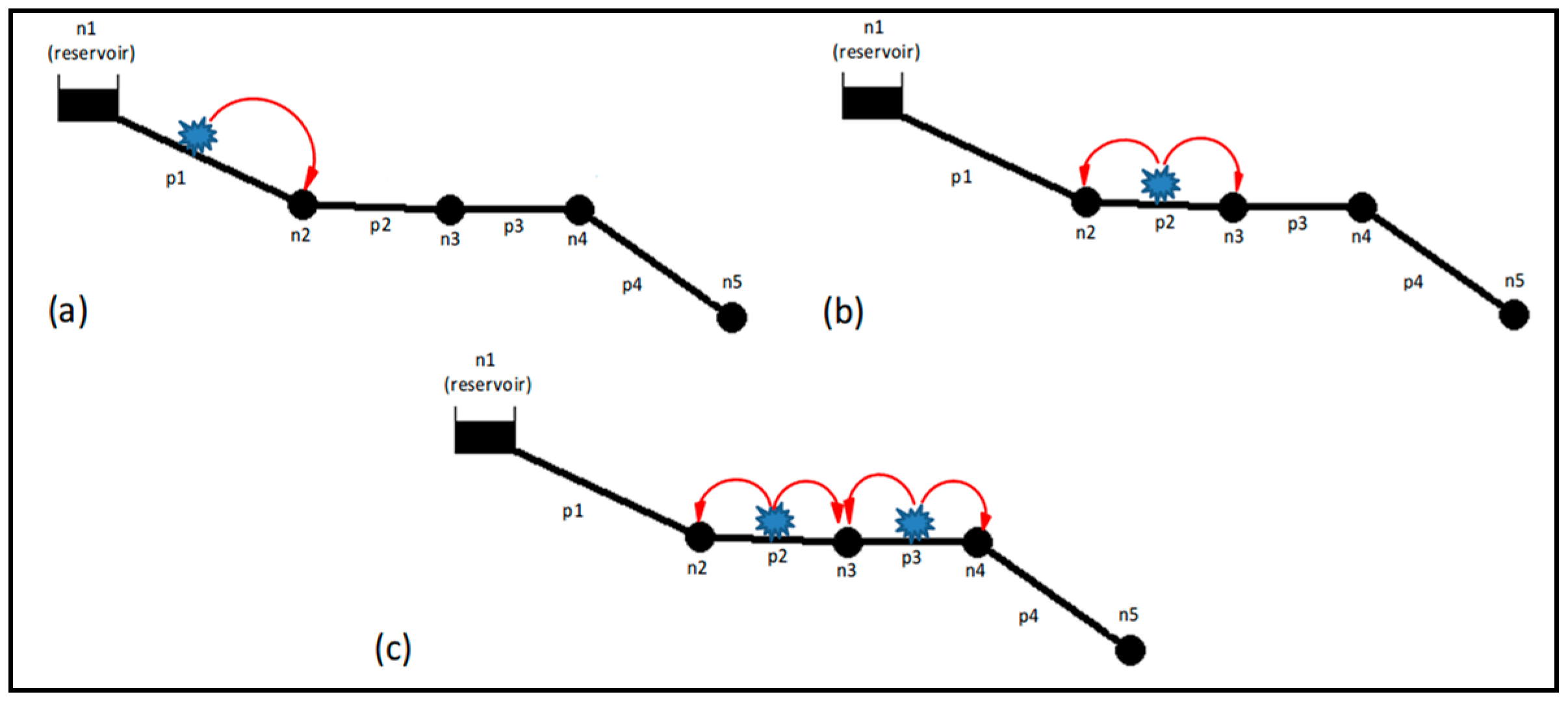
To enumerate various leakage configurations that may take place in a WDN and to explain how they are dealt with in the proposed algorithm, a simple pipeline network composed of 4 pipes and 5 nodes fed by a reservoir (node n1) is considered, as shown in Figure 1.
The three specific leakage configurations of Figure 1 are treated as follows:
  • A leaking pipe with a reservoir (or a tank) as one of the end nodes (1st configuration: Figure 1a: the reservoir (node n1) is one of the end nodes of the leaking pipe (pipe p1). In this case, the leakage rate is calculated through an emitter coefficient C evaluated only at node n2 (as indicated by the red arrow) using the expression given by Equation (10) and the slope m value calculated using Equation (7) depending on the leak shape.
  • A leaking pipe with both end nodes as normal junctions (2nd configuration: Figure 1b: both end nodes n2 and n3 of the leaking pipe (pipe p2) are normal junctions. In this case, the emitter coefficient is evaluated for both node n2 and node n3 (as indicated by the red arrows in both sides of the leak), considering their respective pressure values and assuming that the crack area is divided evenly between the two sides of the pipe (the side linked to node n2 and the side linked to node n3). In fact, since it is possible to evaluate the leak on both sides of the pipe, it is assumed that the leak flow from each side of the pipe is the result of the contribution of half the length of the crack. It must be noted that, in practice, a pipe can accommodate a large number of narrow cracks (in the range of a few millimetres in length) randomly distributed along its length. For modelling purposes, all these narrow cracks are modelled as a single crack centred in the middle of the pipe, with a length equal to the sum of the lengths of the narrow elementary cracks and a width equal to their mean width. Since the network’s input file for EPANET 2.2 reports only the end nodes of each pipe and treats them as calculation points, the effect of the crack, i.e., the leakage outflow, is evaluated at the end nodes of the pipe, under the assumption that the crack is centred in the middle. It is worth noticing that assuming a centred crack and splitting its effect (the leakage) between the two end nodes of the pipe is not an equivalent representation of the narrow cracks’ effects due to the difference between local pressures (in elementary crack positions) and the end node pressures. Indeed, elementary leakage rates are not equal to both leakage rates evaluated in end nodes. If crack locations are known, embedding the FAVAD approach in EPANET would require adding as many dummy nodes as the number of cracks. This task, although possible to execute, necessitates altering the WDN’s input file, which would complicate the numerical model. Additionally, in most cases, precise leak locations are unknown. Then, to keep using EPANET without altering the network topology or EPANET’s source code, a way to proceed is to calibrate the lengths of the centred cracks to compensate for the errors in leakage evaluation induced by the difference in pressure values between end nodes and crack locations. Since the calibration of the crack length is not the scope of this work, as it requires field leakage data in hand, we assumed that the crack length Lc is an already calibrated length that compensates for the pressure effects.
Without loss of generality, a simple representation of a centred crack of a longitudinal shape is shown in Figure 2, in which, geometrically, the crack length contributes equally to the leak outflow from both sides of the pipe.
With this assumption the expression of the emitter coefficient is used after being rewritten considering only half of the crack length. Then, for nodes n2 and n3 of Figure 1b, the emitter coefficients are evaluated through Equation (10), considering the half of the crack area (0.5A0 instead of A0) and a parameter m evaluated through Equation (7), considering the half of the crack length (0.5Lc instead of Lc).
iii.
An end node belonging to more than one leaking pipe (3rd configuration: Figure 1c): the node n3 is an end node of two adjacent leaking pipes (pipe p2 and pipe p3). Under this configuration, node n3 will appear as a calculation node for the emitter coefficient in two distinct loops i (once as an end node for pipe p2 and once as an end node for pipe p3). In this case, the resulting emitter coefficients from both loops are summed up to evaluate the emitter coefficient of node n3 (two red arrows are directed to node 3 from p2 and p3 as seen in Figure 1c).

3. Case Studies

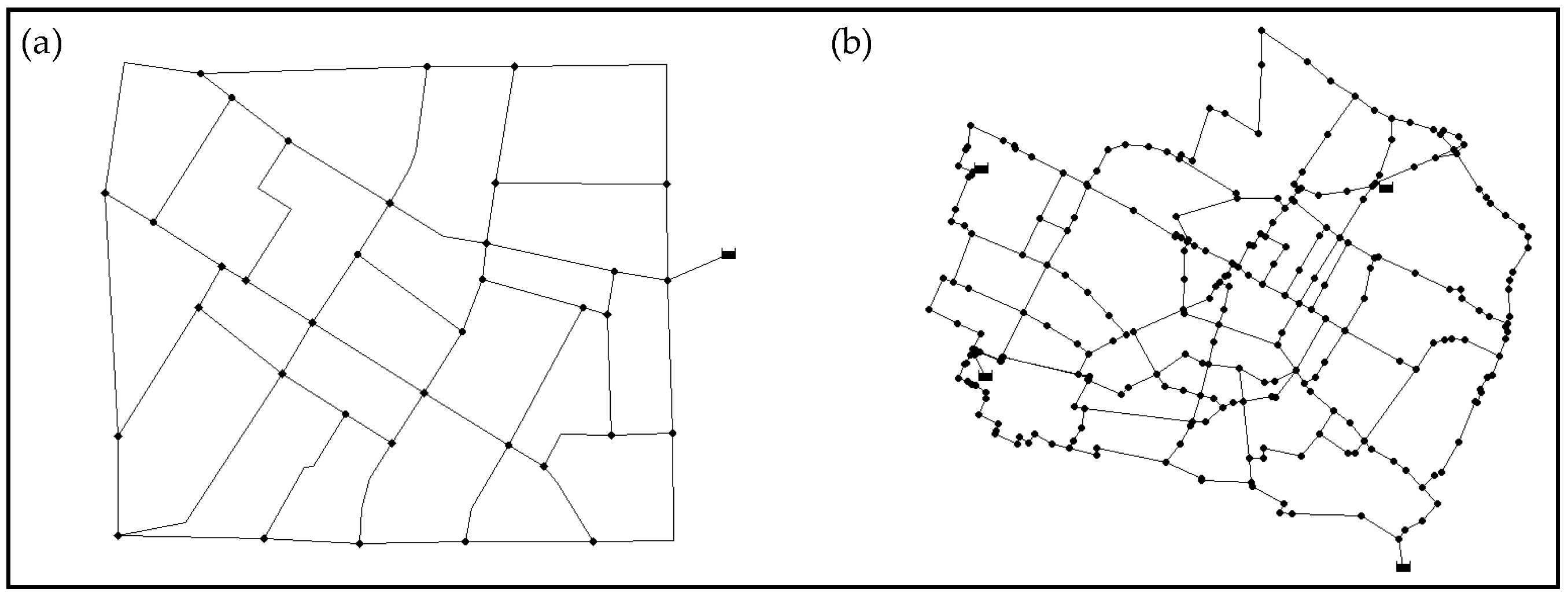
To prove the reliability of the proposed framework, three main sets of tests were performed. The first set of tests was conducted to demonstrate the robustness of the proposed algorithm for leakage evaluation under different pressure scenarios in comparison with conventional EPANET 2.2. By focusing, respectively, on pipe material and crack geometry, the second set of tests aimed to define the main conditions under which the crack area variability should be imperatively considered for a proper modelling of leakage in WDNs. The third test, applied to a larger WDN, focuses on both the scalability of the algorithm and its usefulness in preventing leakage backflow under both DDA and PDA. To this end, two WDNs are considered as case studies: Fossolo and Modena networks, which were extensively used as test cases in several previous works [42,43,44,45,46]. Fossolo WDN consists of 58 pipes and 36 demand nodes fed by a reservoir (node 37) with a fixed head of 121 m. Modena WDN consists of 317 pipes and 267 demand nodes fed from four reservoirs (nodes 268, 269, 270 and 271 with fixed heads of 72 m, 73.8 m, 73 m and 74.5 m, respectively). The layout of Fossolo and Modena WDNs is plotted in Figure 3. Additionally, a summary of the various tests conducted on both networks is reported in Table 1.
For a proper analysis of leakage in a WDN using EPANET 2.2, including the FAVAD approach by means of the proposed algorithm, some additional parameters should be defined, in addition to those included in the EPANET input file as reported in Table 2, prior to the hydraulic analysis. Knowing that Fossolo WDN is made up of polyethylene pipes [43,44], the Young modulus and the wall thickness t are set accordingly, considering High Density Polyethylene (HDPE) material. Thicknesses t were assumed to be 1/10 of pipe diameters, consistent with data provided by HDPE pipe manufacturers for the range of pipe diameters of the studied WDN. For Modena WDN, according to the value of the Hazen–Williams coefficient of 130 given for all pipes, a cast iron material was assumed, corresponding to a Young’s Modulus of about 100 GPa. The thickness of the pipe walls is given considering the range of diameters as detailed in Table 2. Additionally, for both WDNs, a crack length per unit of pipe length (mm/m) is defined, and a constant crack width is assumed for the crack dimensions, making the crack size proportional to the pipe length (i.e., long pipes are more susceptible to cracks).
For the tests conducted on Fossolo WDN, a set of 12 pipes corresponding to about 20% of the total number of pipes was assumed to be leaking, as reported in Table 3. For the test conducted on Modena WDN, only four pipes out of the pipes forming the network are assumed to be leaking, as detailed in Table 4.

4. Application and Results

4.1. First Test: Present Algorithm vs. Calibrated EPANET 2.2

4.1.1. Calibration of Emitter Coefficients in EPANET 2.2

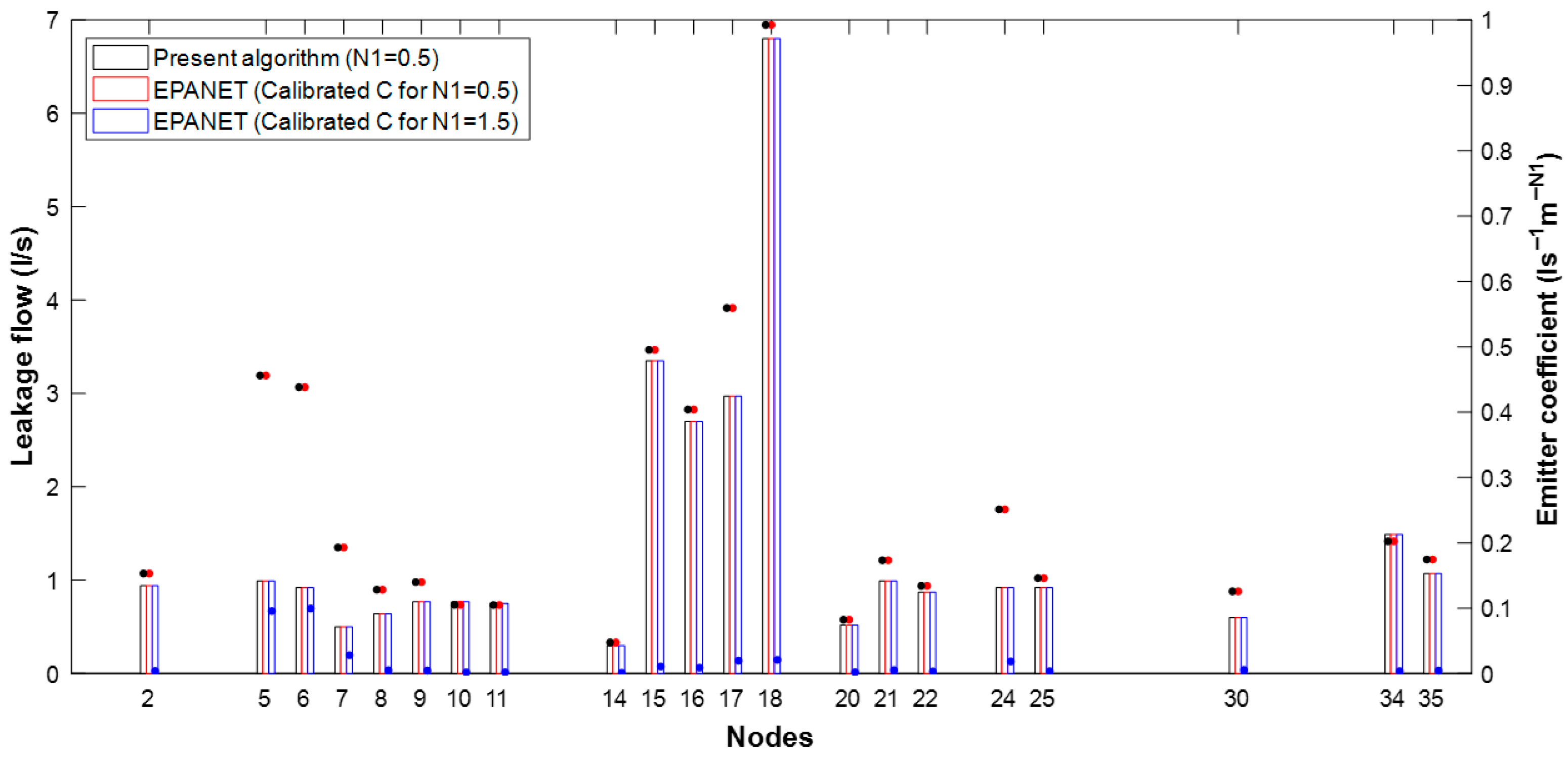
Firstly, considering the default settings of Fossolo WDN, the additional parameters reported in Table 2, and assuming a longitudinal crack shape, the WDN was analysed through the developed algorithm, yielding the results in Table 5 for the leaking nodes. Under these parameters, a leakage rate of 46.8% is obtained. Afterwards, Fossolo WDN was analysed directly in EPANET 2.2 after calibration of the emitter coefficients to obtain the same pressure and leakage flow results as those obtained with the developed algorithm (Figure 4).
It must be noted that, in EPANET 2.2, the emitter coefficients at the nodes were calibrated considering the two extreme cases of emitter exponent N1, i.e., for N1 = 0.5 and for N1 = 1.5. Obviously, for N1 = 0.5, the same emitter coefficients as those calculated through the algorithm are obtained, as shown in Table 6 and plotted in Figure 4.

4.1.2. Testing of the Calibrated Emitter Coefficients Under a Reduced Service Pressure

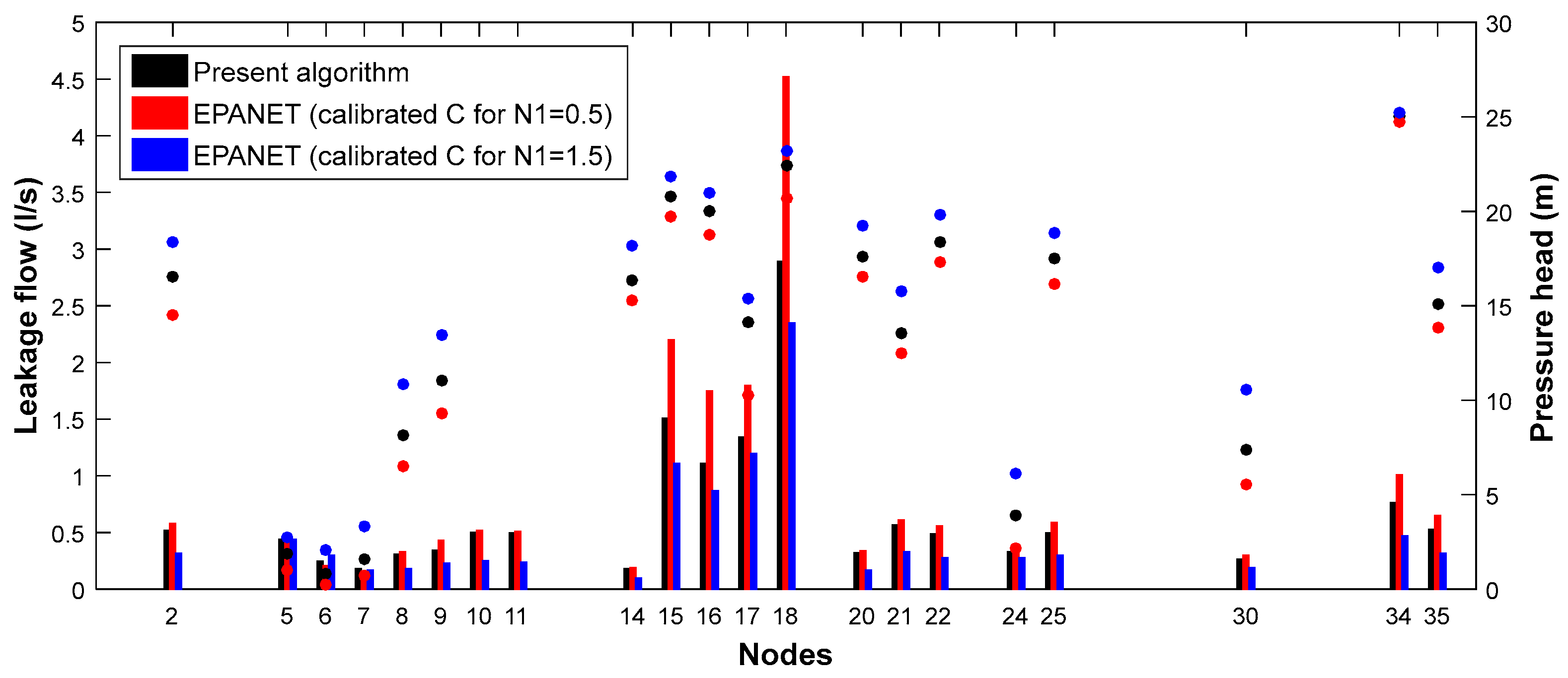
After performing the calibration of the emitter coefficients in EPANET 2.2 under the default service pressure, a reduction in the service pressure in Fossolo WDN was obtained by lowering the level of the reservoir by 30 m (the elevation of node 37 is decreased from 121 m to 91 m). Under this reduced service pressure, the network was first analysed with the developed algorithm that generated a new set of emitter coefficients as in Table 7. Then, an analysis of the WDN was performed in EPANET 2.2, using the calibrated values of the emitter coefficients of Table 6. The results of the analyses in terms of pressure and leakage flow are graphically plotted in Figure 5.
In Figure 5, a divergence in the results of the hydraulic analyses between EPANET 2.2 and the developed algorithm is noted. Obtained values of total leakage rates are 28.99%, 34.78% and 22.94%, respectively, for the present algorithm, for EPANET 2.2 with C values calibrated under N1 = 0.5 and for EPANET 2.2 with C values calibrated under N1 = 1.5.
Considering that the emitter coefficient is pressure-dependent, the developed algorithm yields a new set of emitter coefficients in the leaking nodes (as reported in Table 7) and, as a result, different pressure values and leakage flows compared to those obtained with EPANET 2.2 using previously calibrated emitter coefficients. For the two cases of exponent N1, EPANET 2.2 was unable to reproduce the results obtained through the developed algorithm; the leakage rate is either underestimated or overestimated, depending on N1 values. Therefore, the calibration performed under the default service pressure is no longer valid once the service pressure varies. This attests to the reliability of the developed algorithm, in which, unlike conventional EPANET, the emitter coefficient is an output calculated along with flow parameters, conferring upon this framework the flexibility in dealing with various pressure settings. In fact, for a variable leak area, a calibration performed in EPANET 2.2 is not unique, and if made under specific pressure settings, it will lead to inaccurate results once used under different pressure settings. In the following subsection, the service pressure of Fossolo WDN is further reduced to delve into this aspect and highlight the leak backflow issue that is encountered once using the emitter function in EPANET 2.2 for nodes with negative pressure values.

4.1.3. Testing of the Calibrated Emitter Coefficients Under Highly Reduced Service Pressure

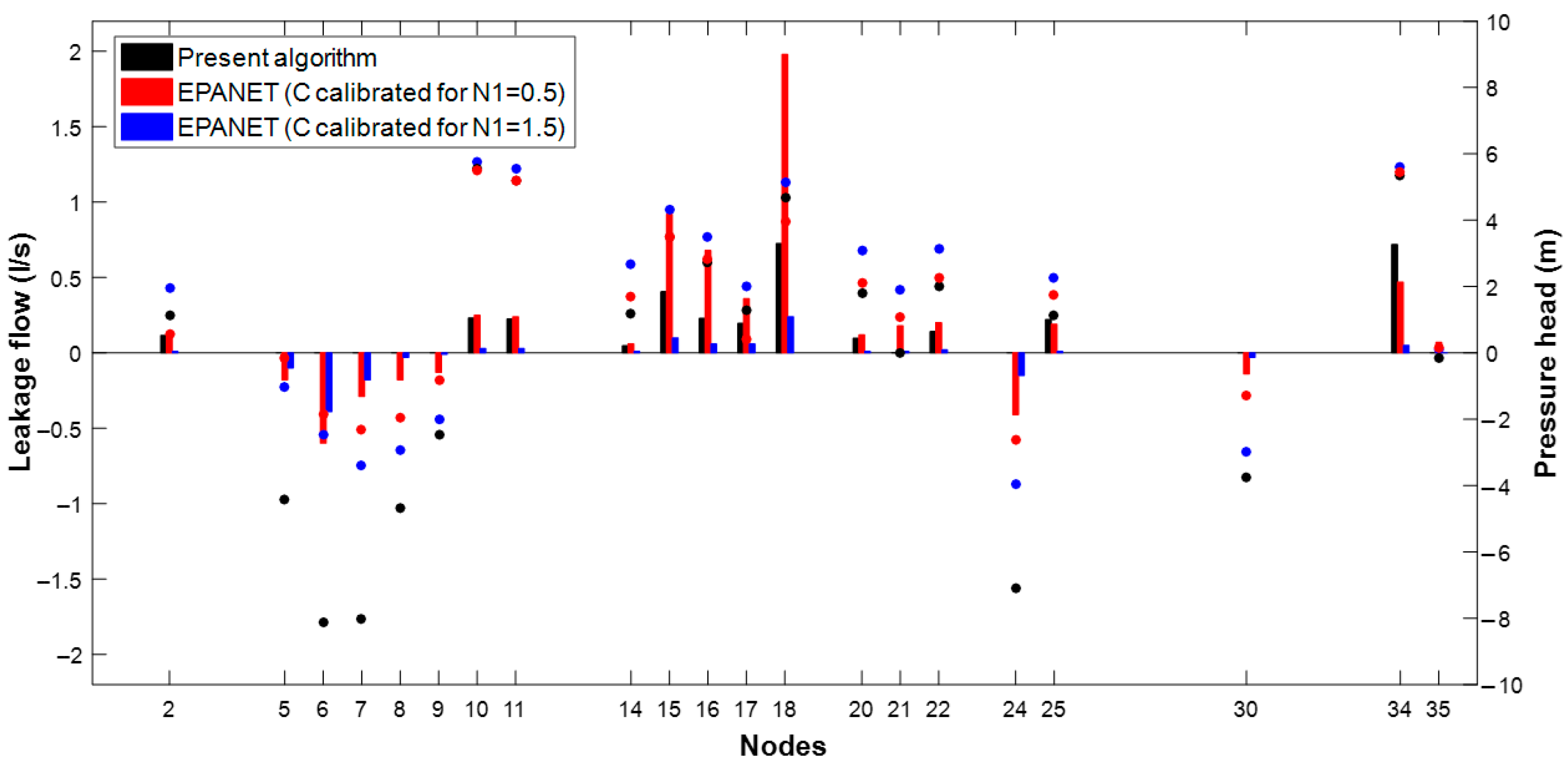
A further reduction in service pressure in the Fossolo WDN is achieved by lowering the reservoir level by 50 m compared to the default settings (the elevation of node 37 is decreased from 121 m to 71 m). For a longitudinal crack shape, analyses similar to those in the previous subsection were performed, yielding emitter coefficients calculated by the developed algorithm shown in Table 8 and to the pressure and leakage flow as graphically illustrated in Figure 6 for the three considered cases.
Figure 6 shows discrepancies in the results between the developed algorithm and EPANET 2.2 under both calibration cases. Values of total leakage rates of 9.01%, 10.33% and −0.74% were obtained for the present algorithm, for EPANET 2.2 with C values calibrated under N1 = 0.5, and for EPANET 2.2 with C values calibrated under N1 = 1.5, respectively.
In addition to the imprecise evaluation of flow parameters obtained by EPANET 2.2 based on the initial calibration of Table 6, outcomes of EPANET 2.2 involve leakage backflows evaluated in nodes exhibiting negative pressure values. The latter describes suction rather than discharge flow in these nodes, making the leakage analysis through the emitter function in EPANET 2.2 inaccurate. Hence, the backflow issue yields an erroneous assessment of the total leakage rate, which presents a negative, non-realistic value in the case of N1 = 1.5, for which the effect of negative pressure in nodes is more prominent. In contrast, under the developed algorithm, this issue is resolved. Indeed, referring to the values of the emitter coefficients in Table 8, it is observed that null coefficients are obtained for nodes exhibiting negative pressure values to prevent leakage backflow from taking place.

4.1.4. Evaluation of Leakage in Pipes

The direct use of EPANET 2.2 for leakage modelling requires associating leaks with nodes through the definition of corresponding emitter coefficients. Nevertheless, pipes, rather than nodes, are the sites of cracks. Unlike EPANET 2.2, the developed algorithm associates leakage with pipes, and end nodes are used only as calculation points. Hence, in addition to the leakage outflow from nodes, one of the main outcomes of the developed algorithm is that it provides the leakage rate from each pipe as an output by summing the outflows from the end nodes, while accounting for the leakage contribution from adjacent leaking pipes (if any). For instance, under default service pressure, the leakage rate on pipe 20 adds up to 2.07 L/s, which is allocated to its end nodes, namely 0.94 L/s to node 2 and 1.13 L/s to node 18. As node 18 also receives some leakage contribution from pipe 40, the total leakage rate assigned to this node is 6.80 L/s (as reported in Table 5), larger than 1.13 L/s (contribution from pipe 20) and even larger than the total leakage rate from pipe 20 itself. Consequently, the sum of end nodes’ leakage outflow is not necessarily equal to the leakage outflow of the pipe.
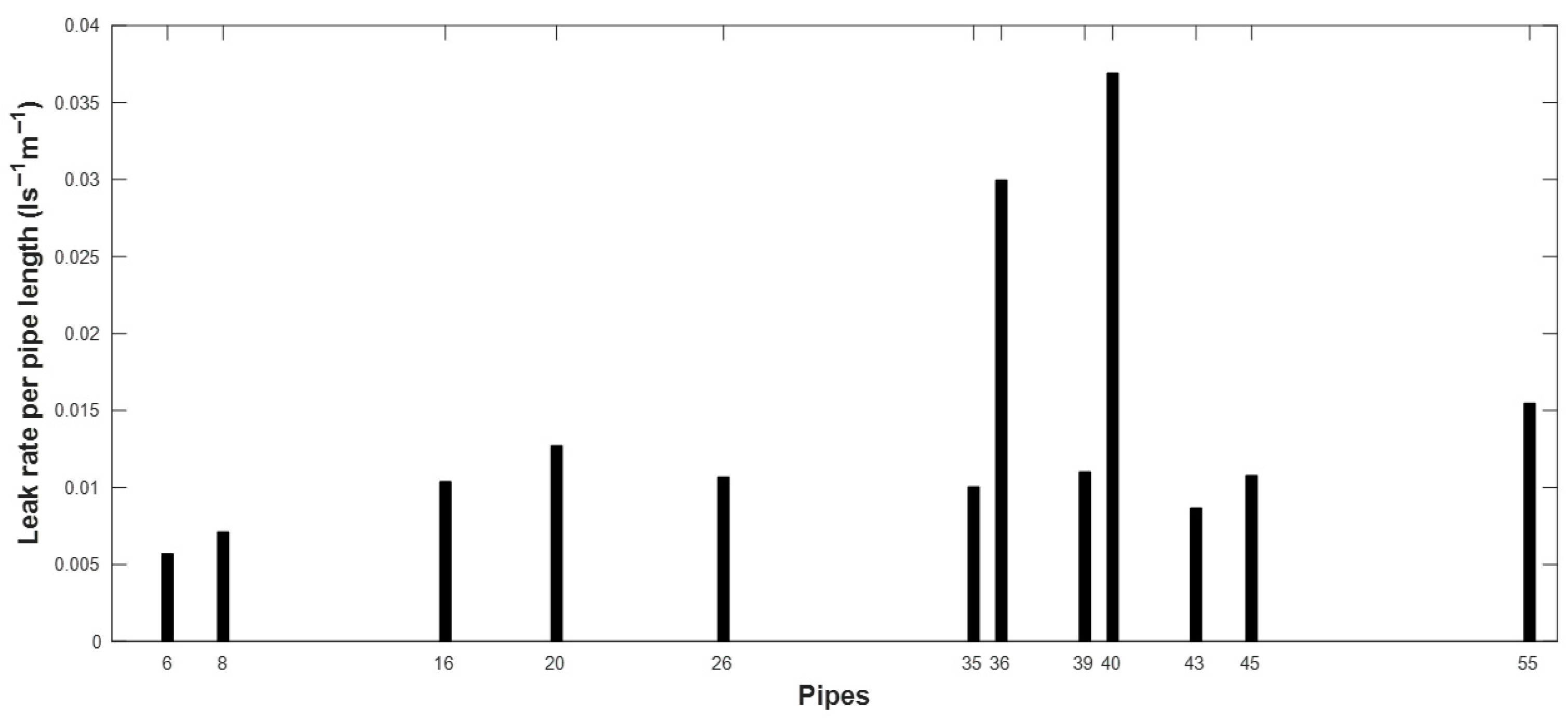
Furthermore, Figure 7 illustrates bar plots of the leakage rate per pipe length for the leaking pipes. While most pipes show quite constant values (around 0.01 ls−1m−1), it is worth noting that pipes 36 and 40 feature much higher leakage rates per pipe length (0.03 ls−1m−1 and 0.037 ls−1m−1, respectively). Indeed, defining the average pressure as the mean of the end nodes’ pressure, it is seen that these two pipes, while having the smallest diameter (16 mm), are exposed to high average pressure heads (an average pressure head of 45 m and 37 m is evaluated for pipes 36 and 40, respectively). On the other hand, pipes 6, 8, and 39, although having the same diameter as pipe 36 and 40, do not experience such a high value of leakage rate per pipe length, due to their much lower average pressure heads (values of 4 m, 10 m and 26 m are evaluated for pipes 6, 8, and 39, respectively). Additionally, pipe 16, even after being subjected to the highest average pressure head (around 53 m) among the leaking pipes, still shows a value of leakage rate per pipe length of around 0.01 ls−1m−1, due to its larger diameter (147.2 mm). Thus, since all the pipes are made of the same material (HDPE), and the leakage rate in Figure 7 is normalized by the pipe length, it is clear that more critical leakage situations are the result of a combination of small pipe diameter and high pressure level. Interestingly, this is in line with the findings in the work of Herrera et al. [47], who studied the main factors impacting the pipe’s probability of failure (length, diameter, material and pressures).
The developed model is capable of providing the leakage from each individual pipe as an output. A higher leakage rate per pipe length may indicate a critical leakage situation. In practice, the results of Figure 7 can serve to prioritize intervention actions for pipes that undergo critical leakage situations that should be immediately repaired to avoid the network failure. Obviously, leakage rate per pipe length is an important index for proper WDN management, but it is not enough for establishing an efficient maintenance schedule. In fact, it should be consolidated with other parameters that are out of scope for this work, including the capability of the pipeline to remain in service under the leakage state before its complete failure. Also, the direct correlation between the two phenomena of pipeline failure and leakage rate deserves further and deeper investigations. For instance, an in-depth study based on the leak-before-burst (LBB) design principle can be of major interest to prevent WDN failure [2,48].

4.2. Second Test: FAVAD Approach vs. Fixed-Area Assumption

4.2.1. Effect of Pipe Material

To define the main cases in which the FAVAD approach becomes mandatory for a proper modelling of leakage in WDNs, while assuming a longitudinal crack shape, the Fossolo WDN was tested considering three different cases:
  • Under a fixed leaking area assumption (m = 0): by performing a direct analysis in EPANET 2.2 with setting C = C d 2 g A 0 and N1 = 0.5;
  • Using the developed algorithm, considering the FAVAD approach in the case of HDPE pipes (E = 1 GPa);
  • Using the developed algorithm, considering the FAVAD approach and assuming the pipes of Fossolo WDN to be made up of cast iron (E = 100 GPa).
It is worth noticing that, for a proper comparison of results under the fixed-area assumption, two cases were considered; firstly, the default Hazen–Williams coefficients (HW = 150) that refer to HDPE pipes of Fossolo WDN were used, and then the Hazen–Williams coefficients of all the pipes were reduced to 130 to mimic the presence of cast iron, instead of HDPE pipes. In Table 9, the obtained leakage flows are reported and compared.
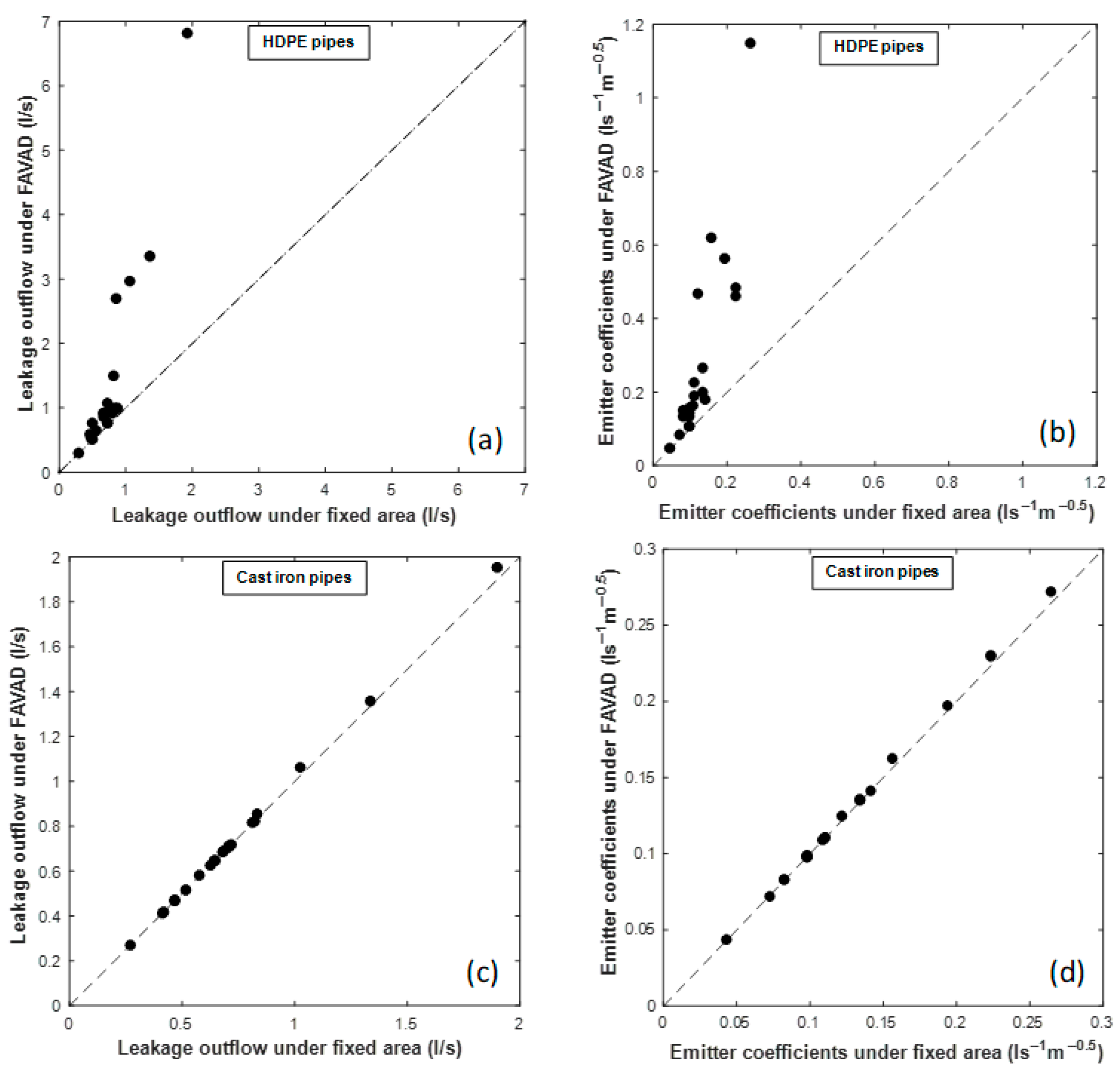
Additionally, Figure 8 shows the flow rates (a, and c), and the emitter coefficients (b, and d) obtained for the leaking nodes in both cases of pipes material.
From the values in Table 9 and as highlighted through the graphs in Figure 8, it is observed that for materials with higher elasticity (lower Young modulus), accurate modelling of the leakage requires accounting for the variation in the crack area with pressure. In fact, an underestimation of the overall leakage rate by more than 30% was obtained for HDPE pipes in Fossolo WDN under the fixed-crack-area assumption (Figure 8a). Nevertheless, for rigid pipes (higher Young modulus) in which the leak area is only slightly affected by the pressure, the fixed-crack-area assumption still yields acceptable results with a relative error in the leakage rate of less than 1% compared to the FAVAD approach (Figure 8c). In this case, one can still use EPANET 2.2 with no need to consider the FAVAD formulation. Furthermore, Figure 8 shows that under FAVAD, the emitter coefficients for HDPE pipes are much higher than those for cast iron pipes. In fact, it is seen that the emitter coefficient under FAVAD increases to about 1.2 ls−1m−0.5 for HDPE (Figure 8b), while its maximum value is lower than 0.3 ls−1m−0.5 for cast iron (Figure 8d). These observations are justified by the fact that cracks in higher-elasticity pipes are more prone to expanding under pressure compared to cracks in rigid pipes. As a result, the leakage rate, which is proportional to the crack area, will be higher if this expansion is considered in the model. This expansion is not included in EPANET’s emitter function, which considers only leakage from the fixed area, leading to an underestimation of the total leakage rate. Additionally, it is expected that for pipes with a higher Young modulus, a calibration of emitter coefficients performed under a defined pressure condition can still be valid if the pressure changes. In fact, as shown in Figure 8 for the case of cast iron, the emitter coefficients evaluated under FAVAD are very slightly different from those calculated for the fixed-area case.
Another aspect to point out is the number of iterations required for the developed algorithm to converge. As reported in Table 9, the algorithm converged in 35 iterations for HDPE pipes, while only 3 iterations were required for the case of cast iron. Obviously, considering that the initial condition of the algorithm is the fixed-area state, a higher number of iterations is due to a greater variability in the crack area with the pressure.

4.2.2. Effect of the Crack Shape

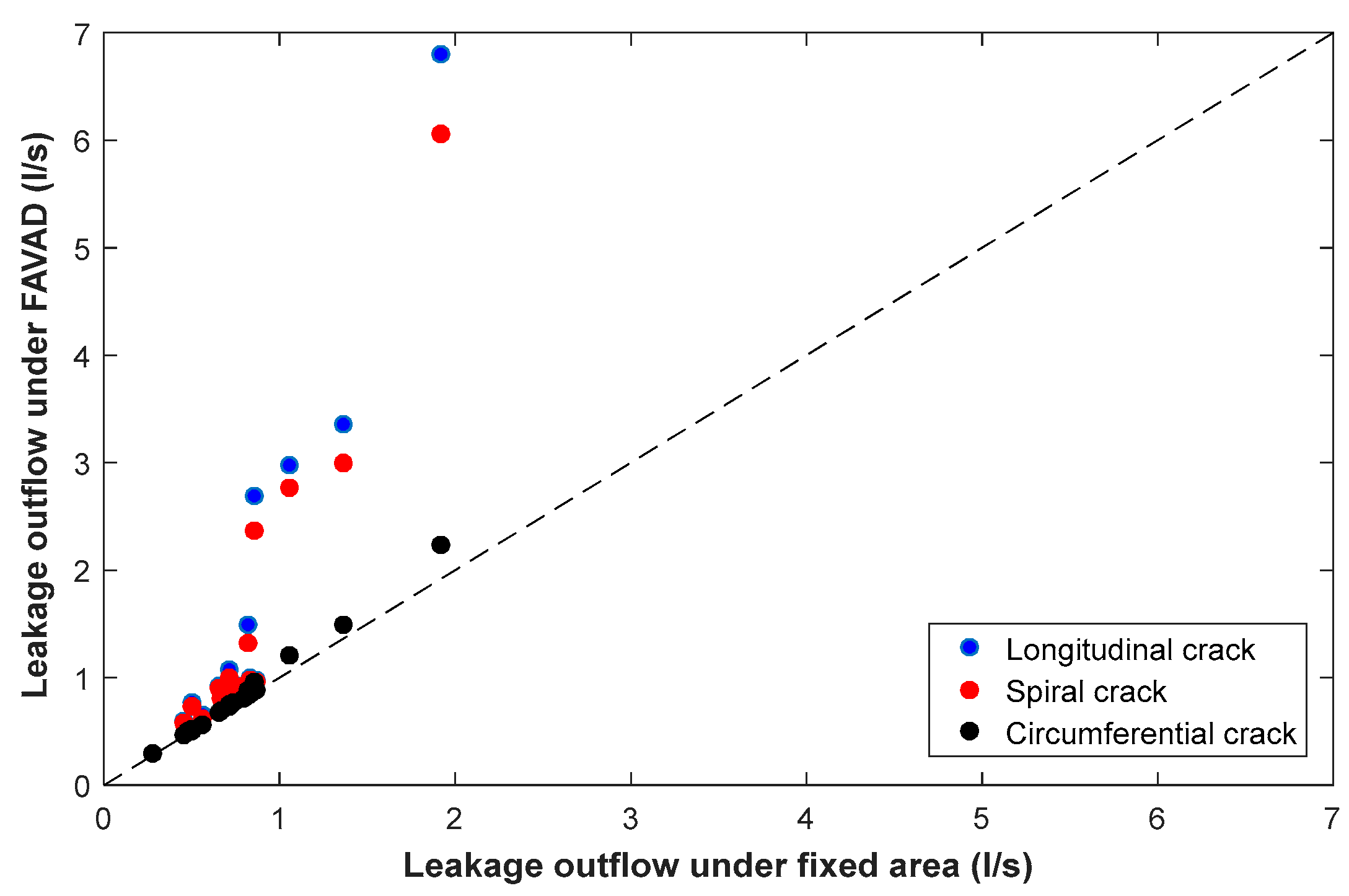
In this subsection, the effect of the crack shape on the leakage analysis is investigated. Indeed, the crack shape is a parameter that is susceptible to guiding the choice between opting for the simple fixed-area formulation and using the FAVAD approach. To this end, as all the previous tests were performed for a longitudinal crack shape, the network was further analysed considering spiral and circumferential crack shapes under the default settings of Fossolo WDN with HDPE pipes. Leakage flow results from these analyses, compared with the case of a fixed-area assumption, are reported in Table 10 and graphically plotted in Figure 9.
Table 10 and Figure 9 indicate that, even for materials with higher elasticity, if the leaking crack has a circumferential shape, the fixed-area assumption and, hence, the direct use of EPANET 2.2, yield acceptable results. The latter proves the weak dependence of the circumferential crack area on the pressure head. Consequently, the lowest leakage rate is obtained for these cracks, as it refers mainly to the discharge from the fixed area of the leak. Nevertheless, for longitudinal and spiral cracks, it becomes necessary to consider the variations in leak area to obtain a reliable leakage evaluation. In fact, these observations are in accordance with those made by Cassa and Van Zyl [36], who stated that the highest head-area slopes m are generally produced by longitudinal cracks, based on the results of their experiments. Furthermore, referring to Equation (7) reporting the empirical expressions of the head area slope as obtained by Cassa and Van Zyl [36], it is clearly shown that, for circumferential cracks, the order of magnitude of m is significantly lower than that for longitudinal and spiral cracks. The latter indicates that circumferential cracks expand very slightly under pressure, which justifies the quasi-similarity of the leakage rates obtained under fixed-area and FAVAD formulations, as plotted in Figure 9.
Regarding the number of iterations reported in Table 10 for the three cases, as previously mentioned, a higher value indicates a greater divergence from the fixed-area case.

4.3. Third Test: Large-Scale WDN Under PDA Approach

In order to verify the scalability of the proposed methodology and assess its reliability in handling larger-scale WDNs, a third test case is performed by applying the algorithm to the Modena network. Unlike the two previous test cases, which were analysed using only DDA, for this test case, the model is run using both DDA and PDA.
Besides leakage, users’ actual demands must be defined for WDN analysis. The results of the leakage modelling in EPANET 2.2 are directly dependent on the defined node head–flow relationship. To this end, two different approaches can be set in EPANET 2.2. Demand Driven Analysis (DDA) maintains nodal demands equal to given base demands regardless of the pressure in nodes. In contrast, pressure-driven analysis (PDA) allows evaluating the actual demands depending on the pressure in each node of the WDN; hence, the initially set demand in nodes is not always satisfied. In EPANET 2.2, PDA is set following the node head–flow relationship given by the Wagner equation [49]:
q i = h i r e q             if   h i > h i r e q q i r e q h i h i min h i r e q h i min n   if   h i min h i h i r e q 0                     if   h i < h i min
where nodes i, qi, qireq, hi, himin and hireq represent, respectively, the actual delivered outflow (L/s), the required outflow (L/s) set as a nodal demand, the total pressure head (m), the minimum pressure head (m) below which no outflow is delivered, and the required pressure head (m) to ensure the full nodal demand is delivered; n is an exponent that is typically set to 0.5.
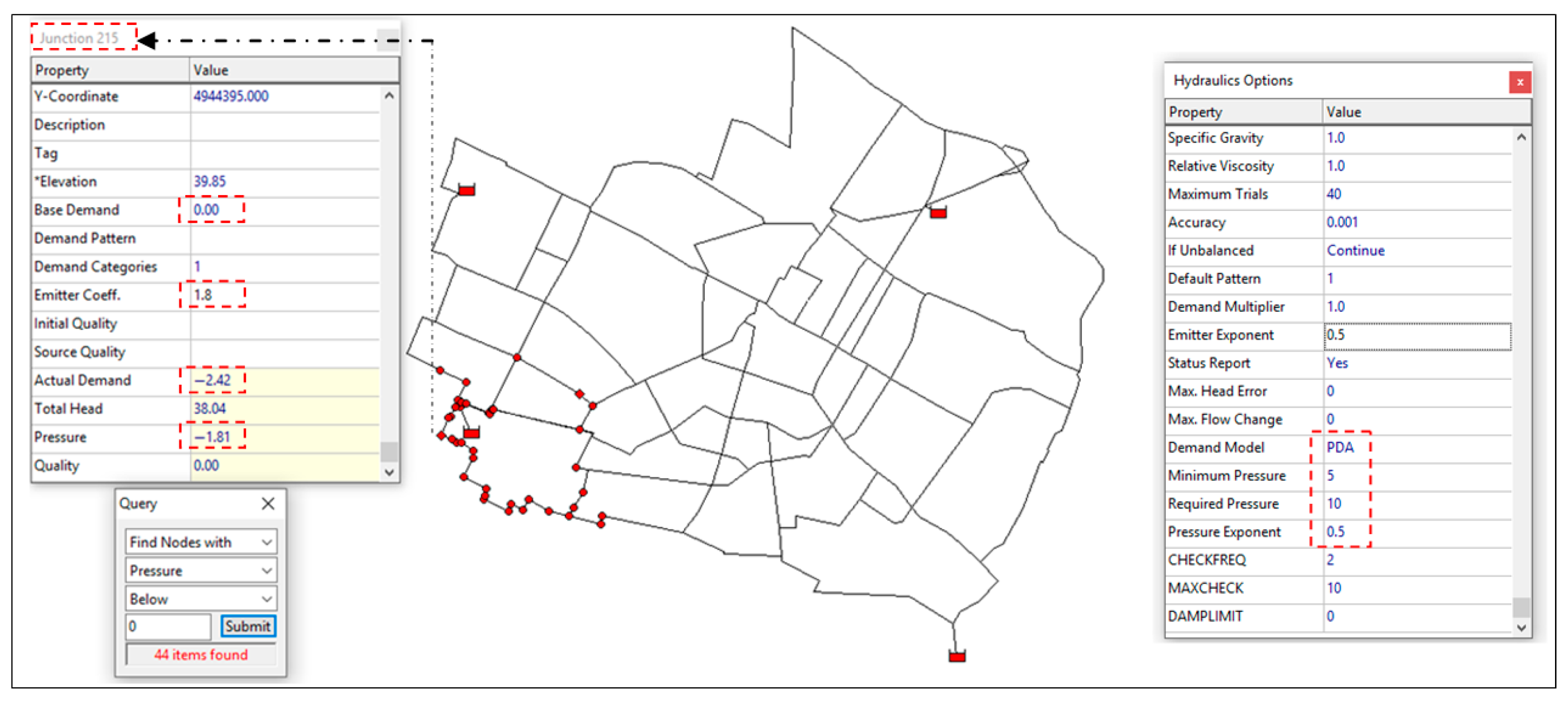
In addition to testing the scalability of the model, PDA is chosen to shed light on the fact that the emitter backflow issue discussed under DDA may also occur under PDA. In fact, although PDA sets a minimum pressure head that must be satisfied for a nodal outflow to be delivered, a node may exhibit a negative internal pressure head, even though its total pressure head remains higher enough due to its elevation. In EPANET 2.2, this negative pressure head results in a negative leakage rate when an emitter is set at that node. To test Modena WDN in this specific case, the levels of the reservoirs were lowered, and the required PDA pressure settings were set as defined in Table 1. Under these settings, some nodes in the Modena network showed negative pressure values under the intact case of the WDN (no leakage. Firstly, to emphasize the backflow issue under PDA, node 215, which does not have a base demand, is supposed to be leaking, and an emitter is set. Analysis in EPANET 2.2 results in a negative flow rate in node 215 as shown in Figure 10. The latter shows that, even with PDA, the emitter backflow issue can occur.
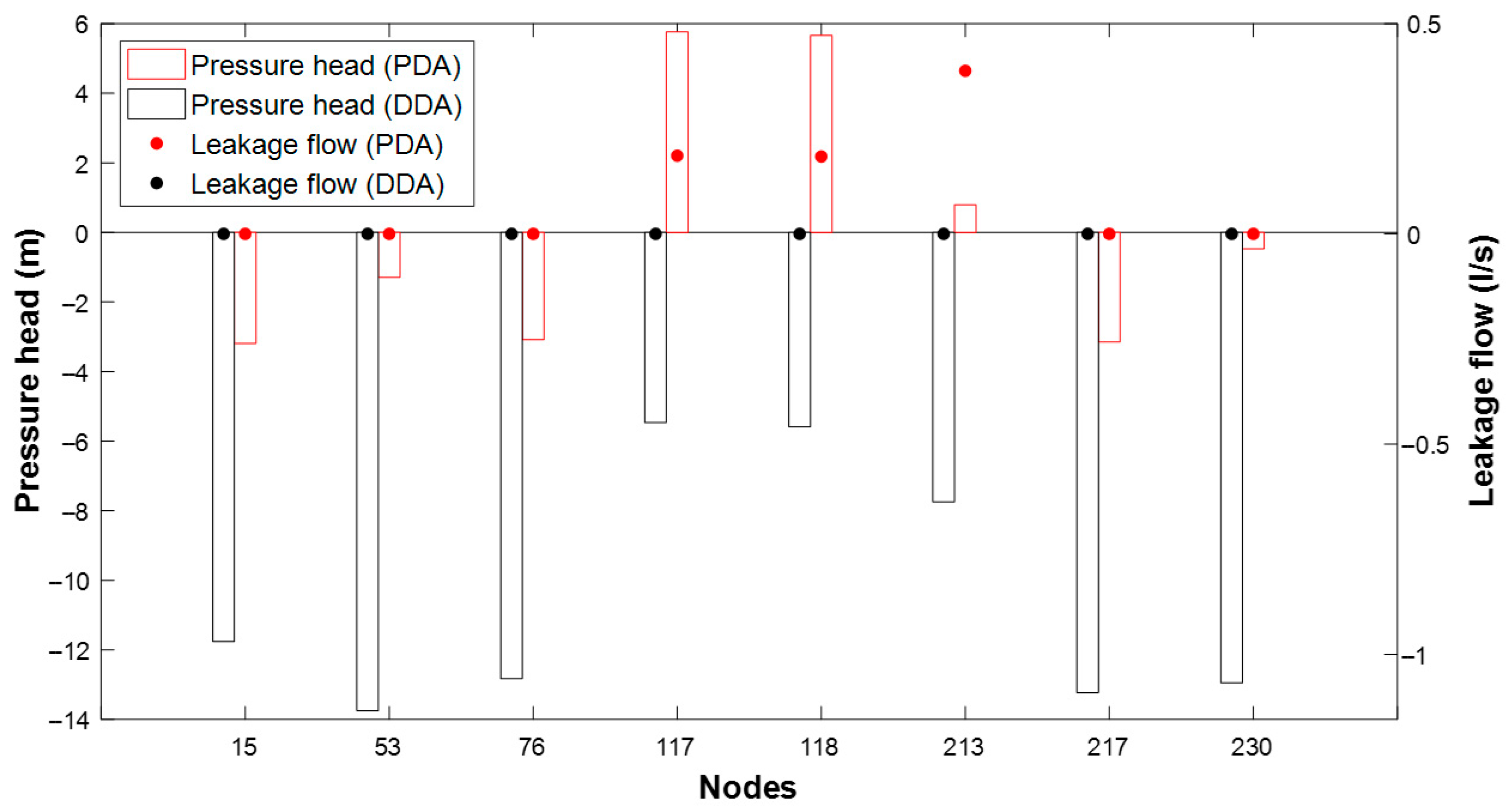
Afterward, to test the Modena WDN using the proposed model, the set of leaking pipes in Table 2 was selected, and the WDN was analysed under both DDA and PDA demand models. The results of the analysis are reported in Table 11 and graphically plotted in Figure 11.
The results in Table 11 and Figure 11 clearly demonstrate the developed model’s ability to prevent the leakage backflow under PDA by setting null emitter coefficients for nodes with negative pressure, as discussed in Section 4.1.3. Consequently, these nodes did not show leakage outflow. Under the DDA demand model, since all end nodes of the assumed leaking pipes experienced negative pressure (negative pressure in nodes is more common under DDA because it assumes demands are always met, regardless of nodal pressures), no leakage flow was obtained. Additionally, in the PDA demand model, some nodes had positive pressure values and hence exhibit leakage flow (nodes 117, 118 and 213). For the remaining nodes, negative pressure values were obtained; the algorithm prevented leakage backflow, and no leakage was evaluated.

5. Conclusions

A novel framework for embedding the FAVAD approach for leakage modelling in EPANET 2.2 was developed and tested. The proposed formulation defines a pressure-dependent emitter coefficient that is evaluated iteratively along with the flow parameters in the EPANET 2.2 environment. The applications of benchmark WDNs for various leakage configurations demonstrated the reliability of the developed algorithm compared with the fixed-area assumption, which was found to lose accuracy for highly elastic materials, particularly for longitudinal and spiral crack shapes. Another advantage of the present model is that the proposed algorithm directly links leakage to pipes without altering either the network topology or the EPANET source code. Additionally, the algorithm is designed to properly handle nodes with negative pressure, to prevent the unrealistic leak backflow encountered in EPANET 2.2 under the emitter function. The main outcomes of the developed model are as follows:
  • The FAVAD approach can be successfully embedded into EPANET 2.2 following an iterative procedure without altering the WDN’s input file or EPANET’s source code;
  • An iterative procedure in Matlab allows using the emitter function of EPANET 2.2 for leakage modelling while preventing leakage backflow in case of negative nodal pressure under both DDA and PDA demand models;
  • Although evaluated in end nodes, through the iterative procedure, it is possible to associate leakage with pipes and to evaluate the leakage rate for each pipe in the EPANET environment;
  • The use of the FAVAD approach becomes necessary in the case of modelling leakage in a highly elastic pipeline that accommodates longitudinal or spiral cracks.
The developed framework proved its reliability through the conducted test cases. Nevertheless, associating leakage with pipes and evaluating the leakage rate at the end nodes still requires a leak-length calibration to compensate for the difference between the actual locations of the cracks and the end nodes’ positions. Given the scarcity of FAVAD-based leakage modelling results, conducting experimental measurements of leakage in a lab-scale WDN can provide further validation of the proposed model. Also, a sensitivity analysis of the effects of the main parameters of a WDN on leakage results may be of particular interest for future research.

Author Contributions

Conceptualization, Z.H. and C.G.; Formal analysis, Z.H. and C.G.; Methodology, Z.H. and C.G.; Software, Z.H. and C.G.; Supervision, E.C.; Validation, E.C.; Visualization, Z.H.; Writing—original draft, Z.H.; Writing—review and editing, E.C. and C.G. All authors have read and agreed to the published version of the manuscript.

Funding

This research received no external funding.

Data Availability Statement

The original contributions presented in this study are included in the article.

Conflicts of Interest

The authors declare no conflicts of interest.

Abbreviations

The following abbreviations are used in this manuscript:
DDADemand-driven analysis
FAVADFixed and variable area discharge
HDPEHigh-density polyethylene
LBBLeak before burst
PDAPressure-driven analysis
WDNWater distribution network

References

  1. Lo Presti, J.; Giudicianni, C.; Toffanin, C.; Creaco, E.; Magni, L.; Galuppini, G. Combining clustering and regularized neural network for burst detection and localization and flow/pressure sensor placement in water distribution networks. J. Water Process Eng. 2024, 63, 105473. [Google Scholar]
  2. Rathnayaka, S.; Shannon, B.; Zhang, C.; Kodikara, J. Introduction of the leak-before-break (LBB) concept for cast iron water pipes on the basis of laboratory experiments. Urban Water J. 2017, 14, 820–828. [Google Scholar] [CrossRef]
  3. Rupiper, A.; Weill, J.; Bruno, E.; Jessoe, K.; Loge, F. Untapped potential: Leak reduction is the most cost-effective urban water management tool. Environ. Res. Lett. 2022, 17, 034021. [Google Scholar] [CrossRef]
  4. Latchoomun, L.; Mawooa, D.; Ah King, R.T.F.; Busawon, K.; Binns, R. Quantifying the Pumping Energy Loss Associated with Different Types of Leak in a Piping System. In Emerging Trends in Electrical, Electronic and Communications Engineering; ELECOM 2016. Lecture Notes in Electrical Engineering; Fleming, P., Vyas, N., Sanei, S., Deb, K., Eds.; Springer: Cham, Switzerland, 2017; Volume 416. [Google Scholar] [CrossRef]
  5. Altowayti, W.A.H.; Othman, N.; Tajarudin, H.A.; Al-Dhaqm, A.; Asharuddin, S.M.; Al-Gheethi, A.; Alshalif, A.F.; Salem, A.A.; Din, M.F.M.; Fitriani, N.; et al. Evaluating the Pressure and Loss Behavior in Water Pipes Using Smart Mathematical Modelling. Water 2021, 13, 3500. [Google Scholar] [CrossRef]
  6. Anfinsen, H.; Aamo, O.M. Leak detection, size estimation and localization in branched pipe flows. Automatica 2022, 140, 110213. [Google Scholar] [CrossRef]
  7. Wilhelmsen, N.C.A.; Aamo, O.M. Leak Detection, Size Estimation and Localization in Water Distribution Networks Containing Loops. In Proceedings of the 2022 IEEE 61st Conference on Decision and Control (CDC), Cancun, Mexico, 6–9 December 2022; pp. 5429–5436. [Google Scholar] [CrossRef]
  8. Barros, D.; Zanfei, A.; Menapace, A.; Meirelles, G.; Herrera, M.; Brentan, B. Leak detection and localization in water distribution systems via multilayer networks. Water Res. X 2025, 26, 100280. [Google Scholar] [CrossRef]
  9. Beck, S.B.; Curren, M.D.; Sims, N.D.; Stanway, R. Pipeline network features and leak detection by cross-correlation analysis of reflected waves. J. Hydraul. Eng. 2015, 131, 715–723. [Google Scholar] [CrossRef]
  10. Elandalibe, K.; Jbari, A.; Bourouhou, A. Application of cross-correlation technique for multi leakage detection. In Proceedings of the 2015 Third World Conference on Complex Systems (WCCS), Marrakech, Morocco, 23–25 November 2015; pp. 1–4. [Google Scholar] [CrossRef]
  11. Gao, Y.; Brennan, M.J.; Liu, Y.; Almeida, F.C.L.; Joseph, P.F. Improving the shape of the cross-correlation function for leak detection in a plastic water distribution pipe using acoustic signals. Appl. Acoust. 2017, 127, 24–33. [Google Scholar] [CrossRef]
  12. Nicola, M.; Nicola, C.I.; Vintilă, A.; Hurezeanu, I.; Duță, M. Pipeline Leakage Detection by Means of Acoustic Emission Technique Using Cross-Correlation Function. J. Mech. Eng. Autom. 2018, 8, 59–67. [Google Scholar]
  13. Lee, P.J.; Vítkovský, J.P.; Lambert, M.F.; Simpson, A.R.; James, A. Frequency Domain Analysis for Detecting Pipeline Leaks. J. Hydraul. Eng. 2005, 131, 596. [Google Scholar] [CrossRef]
  14. Lay-Ekuakille, A.; Vergallo, P.; Trotta, A. Impedance Method for Leak Detection in Zigzag Pipelines. Meas. Sci. Rev. 2010, 10, 209–213. [Google Scholar] [CrossRef]
  15. Kim, S. Time-domain impedance method for transient analysis and leakage detection in reservoir pipeline valve systems. Mech. Syst. Signal Process. 2022, 167, 108527. [Google Scholar] [CrossRef]
  16. Lee, S.; Kim, B. Machine learning model for leak detection using water pipeline vibration sensor. Sensors 2023, 23, 8935. [Google Scholar] [CrossRef]
  17. Rajasekaran, U.; Kothandaraman, M.; Hong Pua, C. Water pipeline leak detection and localization with an integrated AI technique. IEEE Access 2024, 13, 2736–2745. [Google Scholar] [CrossRef]
  18. Chen, J.; Wu, X.; Jiang, Z.; Li, Q.; Zhang, L.; Chu, J.; Song, Y.; Yang, L. Application of machine learning to leakage detection of fluid pipelines in recent years: A review and prospect. Measurement 2025, 248, 116857. [Google Scholar] [CrossRef]
  19. Alves, D.; Blesa, J.; Duviella, E.; Rajaoarisoa, L. Leak Detection in Water Distribution Networks Based on Water Demand Analysis. IFAC-PapersOnLine 2022, 55, 679–684. [Google Scholar] [CrossRef]
  20. Lee, S.S.; Lee, H.-H.; Lee, Y.-J. Prediction of Minimum Night Flow for Enhancing Leakage Detection Capabilities in Water Distribution Networks. Appl. Sci. 2022, 12, 6467. [Google Scholar] [CrossRef]
  21. Zhang, B.; Zhang, J.; Xiong, J. Leakage assessment of water supply networks in a university based on WB-Easy Calc and night minimum flow: A case study in Xi’an. Water Supply 2024, 24, 2781. [Google Scholar] [CrossRef]
  22. Giudicianni, C.; Mazzoni, F.; Marsili, V.; Alvisi, S.; Creaco, E. Modelling minimum night consumption as a function of long-run average outflow to users and applications to real world case studies. Front. Water 2025, 7, 1693893. [Google Scholar] [CrossRef]
  23. Mazzolani, G.; Berardi, L.; Laucelli, D.; Martino, R.; Simone, A.; Giustolisi, O. A Methodology to Estimate Leakages in Water Distribution Networks Based on Inlet Flow Data Analysis. Procedia Eng. 2016, 162, 411–418. [Google Scholar] [CrossRef]
  24. Lizarraga-Raygoza, A.; Delgado-Aguiñaga, J.A.; Begovich, O. Steady state algorithm for leak diagnosis in water pipeline systems. IFAC Pap. 2018, 51, 402–407. [Google Scholar] [CrossRef]
  25. Tucciarelli, T.; Criminisi, A.; Termini, D. Leak analysis in pipeline system by means of optimal value regulation. J. Hydraul. Eng. 1999, 125, 277–285. [Google Scholar] [CrossRef]
  26. May, J. Pressure Dependent Leakage; World Water and Environmental Engineering, Water Environment Federation: Washington, DC, USA, 1994. [Google Scholar]
  27. Piller, O.; van Zyl, J.E. Incorporating the FAVAD Leakage Equation into Water Distribution System Analysis. Procedia Eng. 2014, 89, 613–617. [Google Scholar] [CrossRef]
  28. Creaco, E. Global algorithm based on inverse outflow/head relationship for solving water distribution networks with multiple nodal outflows and improved convergence. J. Water Resour. Plan. Manag. 2025, 151, 04025017. [Google Scholar] [CrossRef]
  29. Rossman, L.A.; Woo, H.; Tryby, M.; Shang, F.; Janke, R.; Haxton, T. EPANET 2.2 User’s Manual; Water Infrastructure Division, Center for Environmental Solutions and Emergency Response, Office of Research and Development, U.S. Environmental Protection Agency: Cincinnati, OH, USA, 2020.
  30. Muranho, J.; Ferreira, A.; Sousa, J.; Gomes, A.; Sá Marques, A. Pressure–dependent Demand and Leakage Modelling with an EPANET Extension—WaterNetGen. Procedia Eng. 2014, 89, 632–639. [Google Scholar] [CrossRef]
  31. Wang, J.; Wang, H.; Nie, L. Hydraulic Simulation of Water Supply Network Leakage Based on EPANET. J. Pipeline Syst. Eng. Pract. 2023, 15, 05023006. [Google Scholar] [CrossRef]
  32. Alsaydalani, M.O. Hydraulic modelling for leakage reduction in water distribution systems through pressure control. Open Civ. Eng. J. 2024, 18, E18741495289971. [Google Scholar] [CrossRef]
  33. Demetrios, G.E.; Marios, K.; Stelios, V.; Marios, M.P. EPANET-MATLAB Toolkit: An Open-Source Software for Interfacing EPANET with MATLAB. In Proceedings of the 14th International Conference on Computing and Control for the Water Industry (CCWI), Amsterdam, The Netherlands, 7–9 November 2016. [Google Scholar] [CrossRef]
  34. Grevenstein, B.; van Zyl, J.E. An experimental investigation into the pressure-leakage relationship of some failed water pipes. J. Water Supply Res. Technol.—AQUA 2007, 56, 117–124. [Google Scholar] [CrossRef]
  35. Ferrante, M. Experimental investigation of the effects of pipe material on the leak head discharge relationship. J. Hydraul. Eng. ASCE 2012, 138, 736–743. [Google Scholar] [CrossRef]
  36. Cassa, A.M.; van Zyl, J.E. Predicting the head-leakage slope of cracks in pipes subject to elastic deformations. J. Water Supply Res. Technol.-AQUA 2013, 62, 214–223. [Google Scholar] [CrossRef]
  37. Cassa, A.M.; van Zyl, J.E. Predicting the leakage exponents of elastically deforming cracks in pipes. Procedia Eng. 2014, 70, 302–310. [Google Scholar] [CrossRef]
  38. Deyi, M.; van Zyl, J.; Shepherd, M. Applying the FAVAD Concept and Leakage Number to Real Networks: A Case Study in Kwadabeka, South Africa. Procedia Eng. 2014, 89, 1537–1544. [Google Scholar] [CrossRef]
  39. Marzola, I.; Alvisi, S.; Franchini, M. Analysis of MNF and FAVAD Model for Leakage Characterization by Exploiting Smart-Metered Data: The Case of the Gorino Ferrarese (FE-Italy) District. Water 2021, 13, 643. [Google Scholar] [CrossRef]
  40. Serafeim, A.V.; Fourniotis, N.T.; Deidda, R.; Kokosalakis, G.; Langousis, A. Leakages in water distribution networks: Estimation methods, influential factors, and mitigation strategies—A comprehensive review. Water 2024, 16, 1534. [Google Scholar] [CrossRef]
  41. Gere, J.M. Mechanics of Materials, 5th ed.; Brooks/Cole: Pacific Grove, CA, USA, 2001. [Google Scholar]
  42. Creaco, E.; Franchini, M. Low level hybrid procedure for the multi-objective design of water distribution networks. Procedia Eng. 2014, 70, 369–378. [Google Scholar] [CrossRef]
  43. Yazdi, J.; Choi, Y.H.; Kim, J.H. Non-dominated sorting harmony search differential evolution (NS-HS-DE): A hybrid algorithm for multi-objective design of water distribution networks. Water 2017, 9, 587. [Google Scholar] [CrossRef]
  44. Santonastaso, G.F.; Di Nardo, A.; Di Natale, M.; Giudicianni, C.; Greco, R. Scaling-laws of flow entropy with topological metrics of water distribution networks. Entropy 2018, 20, 95. [Google Scholar] [CrossRef] [PubMed]
  45. Bonora, M.A.; Capano, G.; De Rango, A.; Maiolo, M. Novel Eulerian approach with cellular automata modelling to estimate water quality in a drinking water network. Water Resour. Manag. 2022, 36, 5961–5976. [Google Scholar] [CrossRef]
  46. Artina, S.; Bolognesi, A.; Bragalli, C.; D’ambrosio, C.; Marchi, A. Comparison among best solutions of the optimal design of water distribution networks obtained with different algorithms. In CCWI 2011 Urban Water Management: Challenges and Opportunities; Centre for Water Systems: Exeter, UK, 2011; Volume 3, pp. 985–990. [Google Scholar]
  47. Herrera, M.; Giudicianni, C.; Sasidharan, M.; Wright, R.; Creaco, E.; Parlikad, A.K. Landmark-node based reliability assessment for critical infrastructure networks. Reliab. Eng. Syst. Saf. 2025, 265, 111563. [Google Scholar] [CrossRef]
  48. Stephens, M.; Gong, J.; Zhang, C.; Marchi, A.; Dix, L.; Lambert, M.F. Leak-Before-Break Main Failure Prevention for Water Distribution Pipes Using Acoustic Smart Water Technologies: Case Study in Adelaide. J. Water Resour. Plan. Manag. 2020, 146, 05020020. [Google Scholar] [CrossRef]
  49. Wagner, J.M.; Shamir, U.; Marks, D.H. Water distribution reliability: Simulation method. J. Water Resour. Plan. Manag. 1988, 114, 276–294. [Google Scholar] [CrossRef]
Figure 1. Schematic of a simple network with different leakage configurations: (a) a leaking pipe with a reservoir as one end node, (b) a leaking pipe with both end nodes as normal junctions, (c) an end node belonging to more than one leaking pipe.
Water 18 00100 g001
Figure 2. Assumption of equal contribution of the crack length in the leak outflow.
Water 18 00100 g002
Figure 3. Layouts of the tested WDNs: (a) Fossolo WDN, (b) Modena WDN.
Water 18 00100 g003
Figure 4. Leakage flow (bar charts) and corresponding emitter coefficients (dot plots) under default service pressure for the present algorithm and the two calibrated EPANET models in Fossolo WDN.
Water 18 00100 g004
Figure 5. Comparison of leakage flow (bar charts) and pressure head (dot plots) under reduced pressure: present algorithm (leakage rate = 28.99%), calibrated EPANET 2.2 for N1 = 0.5 (leakage rate = 34.78%), and calibrated EPANET 2.2 for N1 = 1.5 (leakage rate = 22.94%).
Water 18 00100 g005
Figure 6. Comparison of leakage flow (bar charts) and pressure head (dot plots) under highly reduced service pressure: present algorithm (leakage rate = 9.01%), calibrated EPANET 2.2 for N1 = 0.5 (leakage rate = 10.33%; inaccurate rate due to backflow in some nodes), and calibrated EPANET 2.2 for N1 = 1.5 (leakage rate = −0.74%; unrealistic negative value due to the prominence of the backflow issue).
Water 18 00100 g006
Figure 7. Leakage rate per pipe length for Fossolo WDN.
Water 18 00100 g007
Figure 8. Leakage outflow and emitter coefficients for HDPE (a,b) and cast iron (c,d).
Water 18 00100 g008
Figure 9. Comparison of leakage outflow as a function of the crack shape (HDPE pipes).
Water 18 00100 g009
Figure 10. Emitter backflow issue in EPANET 2.2 under the PDA demand model (Node 215 without base demand exhibits negative pressure leading to negative actual demand, i.e., the emitter backflow).
Water 18 00100 g010
Figure 11. Pressure head and leakage flow at the end nodes of leaking pipes for DDA and PDA demand models in the Modena WDN.
Water 18 00100 g011
Table 1. Summary of the conducted tests on Fossolo and Modena WDNs.
TestsObjectiveNetworkDemand ModelSettings
First test- Calibration of emitter coefficients in EPANET 2.2FossoloDDA- Default settings
- Testing the stability of the calibrationFossoloDDA- Reduced service pressure
(reservoir level lowered to 91 m)
- Preventing the emitter backflowFossoloDDA- Highly reduced service pressure
(reservoir level lowered to 71 m)
Second test- Effect of crack shapeFossoloDDA- Different crack shapes (longitudinal, spiral and circumferential)
- Effect of pipe materialFossoloDDA- Two different pipe materials
(HDPE and cast iron)
Third test- Scalability of the algorithm
and preventing the emitter backflow under PDA
ModenaDDA and PDA- Reduced service pressure (reservoir levels lowered by 35 m each); PDA with hmin = 5 m; hreq = 10 m and n = 0.5
Table 2. Additional parameters to apply the FAVAD approach in Fossolo and Modena WDNs.
ParameterFossolo WDNModena WDN
Young modulus E (GPa)1 (HDPE)100 (cast iron)
Pipe wall thickness t (mm)0.1D (with D (mm) is the pipe diameter)4.57 (for D = 100; 125; 150 mm)
5.84 (for D = 200 mm)
7.11 (for D = 250; 300 mm)
7.87 (for D = 350; 400 mm)
Crack length per unit of pipe length lc (mm/m)0.50.5
Crack width Wc (mm)11
Table 3. Leaking pipes with end nodes for Fossolo WDN.
PipeNode n1Node n2PipeNode n1Node n2
656361516
872439309
161011401718
20218431421
26258452122
352015553435
Table 4. Leaking pipes with end nodes for Modena WDN.
PipeNode n1Node n2PipeNode n1Node n2
285323094118117
447621723715213
Table 5. Results of the analysis of Fossolo WDN in the leaking nodes under default service pressure.
NodeC
(ls−1m−0.5)
Pressure Head (m)Leakage Flow (L/s)NodeC
(ls−1m−0.5)
Pressure Head (m)Leakage Flow (L/s)
20.153238.070.94170.559428.202.97
50.45604.760.99180.992647.036.80
60.43834.390.92200.082540.710.52
70.19306.860.50210.173332.550.99
80.128325.480.64220.134341.850.87
90.140030.070.77240.251113.570.92
100.105153.390.77250.146040.370.92
110.105052.110.75300.125822.630.60
140.047738.480.30340.202454.131.49
150.495445.693.35350.174637.861.07
160.404044.502.70Leakage rate46.8%
Table 6. Calibrated values of the emitter coefficients in the leaking nodes under EPANET 2.2. (values leading to the same pressures and leakage flows as in Table 5).
NodeC (ls−1m−N1)NodeC (ls−1m−N1)
N1 = 0.5N1 = 1.5N1 = 0.5N1 = 1.5
20.15320.0040170.55940.0198
50.45600.0957180.99260.0211
60.43830.0997200.08250.0020
70.19300.0281210.17330.0053
80.12830.0050220.13430.0032
90.14000.0046240.25110.0185
100.10510.0019250.14600.0036
110.10500.0020300.12580.0055
140.04770.0012340.20240.0037
150.49540.0108350.17460.0046
160.40400.0090
Table 7. Calculated values of the emitter coefficients in the leaking nodes by the present algorithm under reduced service pressure.
NodeC (ls−1m−0.5)NodeC (ls−1m−0.5)NodeC (ls−1m−0.5)
20.1278110.1010210.1547
50.3179140.0452220.1140
60.2660150.3308240.1675
70.1471160.2486250.1188
80.1077170.3579300.0966
90.1035180.6112340.1527
100.1011200.0767350.1358
Table 8. Calculated values of the emitter coefficients in the leaking nodes by the present algorithm under highly reduced service pressure.
NodeC (ls−1m−0.5)NodeC (ls−1m−0.5)NodeC (ls−1m−0.5)
20.1096110.0984210.1414
50140.0434220.0998
60150.2169240
70160.1387250.2088
80170.174300
90180.3363340.3113
100.0984200.0728350
Table 9. Comparison of results for fixed-area and FAVAD approaches for HDPE and cast iron pipes.
HDPE Pipes
E = 1 GPa; HW = 150
Cast Iron
E = 100 GPa; HW = 130
Fixed AreaFAVADFixed AreaFAVAD
Number of iterations13513
Leakage rate32.28%46.80%31.05%31.30%
Relative error of leakage rate30.44%0.80%
Table 10. Comparison of results for fixed area and FAVAD approaches for different crack shapes.
Fixed AreaFAVAD
Longitudinal CrackSpiral CrackCircumferential Crack
Number of iterations135314
Leakage rate32.28%46.80%44.85%33.66%
Relative error with reference to the fixed-area assumption0%30.44%28.02%4.10%
Table 11. Results of leakage analysis for Modena WDN under DDA and PDA demand models.
Node IDElevation (m)DDAPDA
Head
(m)
Pressure Head (m)C (ls−1m−0.5)Leakage Flow (L/s)Head
(m)
Pressure Head (m)C
(ls−1m−0.5)
Leakage Flow (L/s)
1541.2629.49−11.760038.06−3.1900
5339.2825.52−13.750037.98−1.2900
7641.0928.25−12.830038.00−3.0800
11730.5925.11−5.470036.365.770.0774780.186
11830.7325.13−5.590036.395.660.0774770.184
21337.329.54−7.750038.090.790.4343970.388
21741.1627.92−13.230038.00−3.1500
23038.4925.53−12.950038.01−0.4700
Disclaimer/Publisher’s Note: The statements, opinions and data contained in all publications are solely those of the individual author(s) and contributor(s) and not of MDPI and/or the editor(s). MDPI and/or the editor(s) disclaim responsibility for any injury to people or property resulting from any ideas, methods, instructions or products referred to in the content.