Research on the Performance Evaluation System for Ecological Product Value Realization Projects: A Case Study of the Comprehensive Water Environment Management Project for a Drinking Water Source



Abstract
1. Introduction
2. Materials and Method
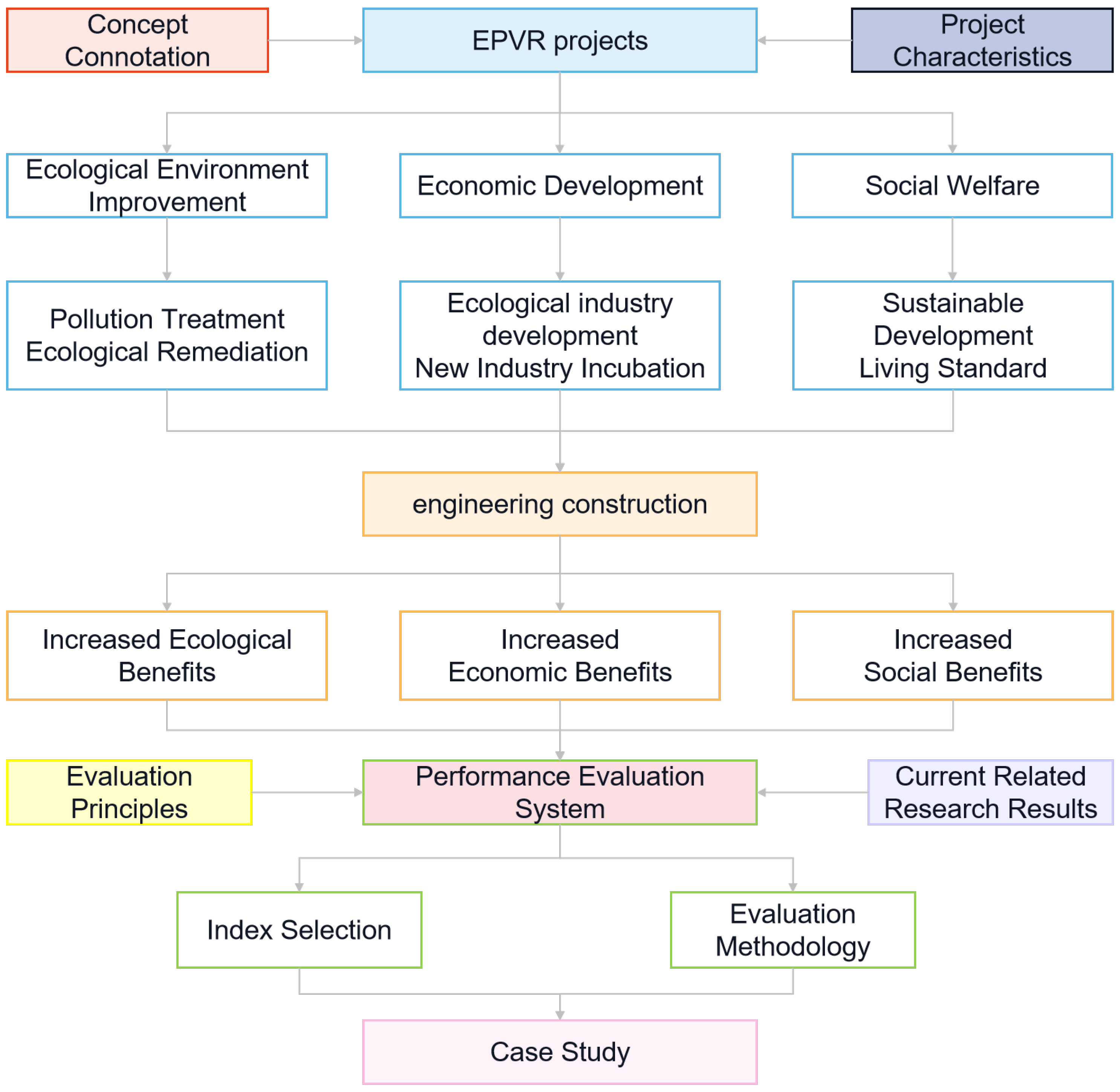
2.1. Evaluation Framework
2.2. Evaluation Index System
2.3. Evaluation Method
- (1)
- PCPI = 1.0: This is the fundamental break-even point in the cost–benefit analysis. It represents the minimum requirement for a project’s total monetized benefits to cover its costs, a universal criterion for financial viability.
- (2)
- PCPI = 3.0: This “Excellent” threshold is more stringent and accounts for several real-world complexities: (a) Hidden Costs and Uncertainty: It builds in a buffer for ecological or social costs that are difficult to fully monetize (e.g., biodiversity loss, community disruption). (b) Policy Ambition: It aligns with the high-performance targets set by Chinese ecological civilization policies, encouraging projects that deliver exceptional value. (c) Investment Attractiveness: A ratio significantly above 1.0 indicates strong efficiency and makes the project more attractive for public or private investment.
- (3).
- Veco-benefit < 0 as a Veto Criterion: This strict rule ensures the evaluation system’s alignment with the core EPVR principle that economic or social gains must not come at the expense of ecological integrity, which will prevent “greenwashing” and ensures projects genuinely contribute to ecosystem enhancement.
3. Empirical Study
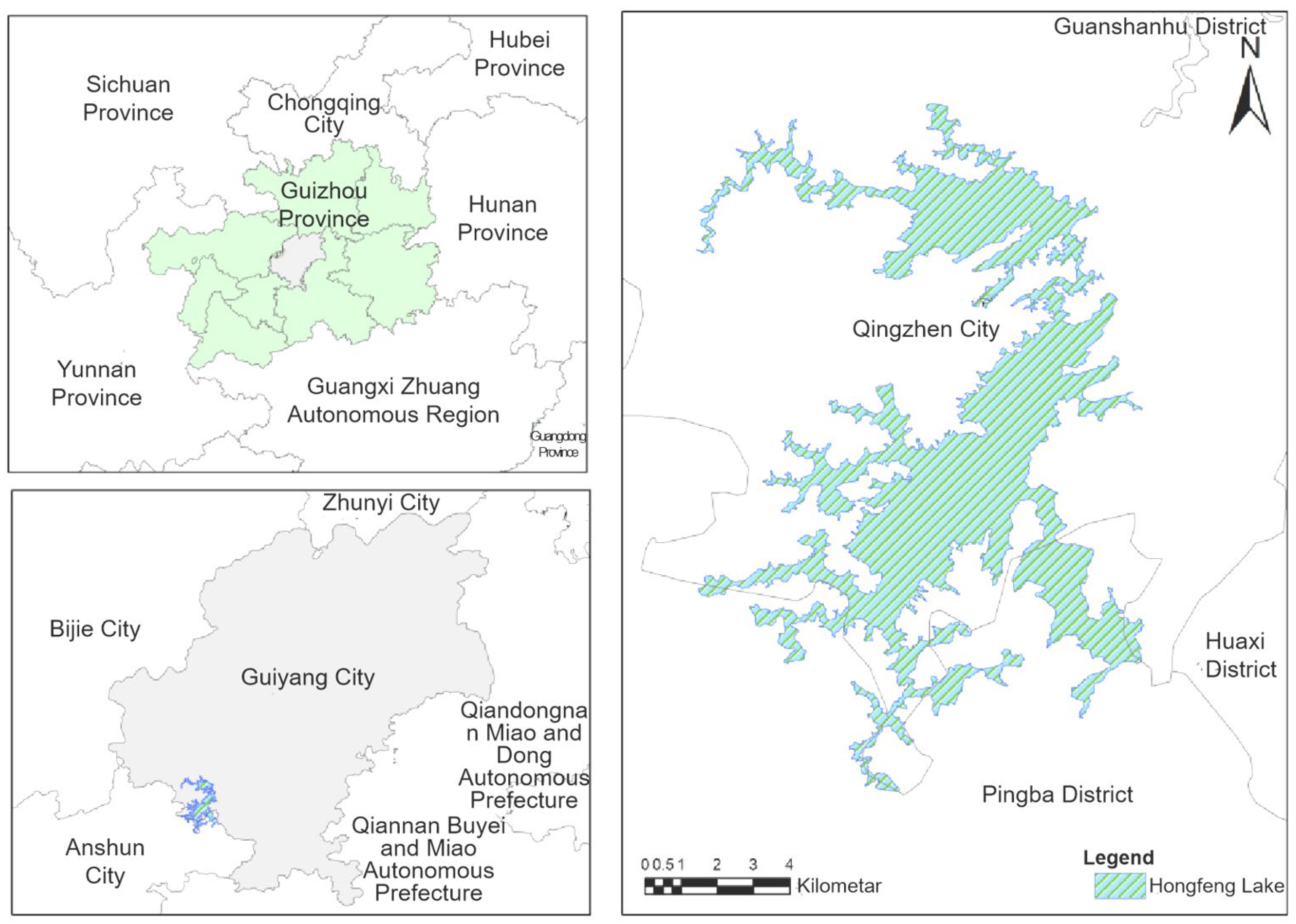
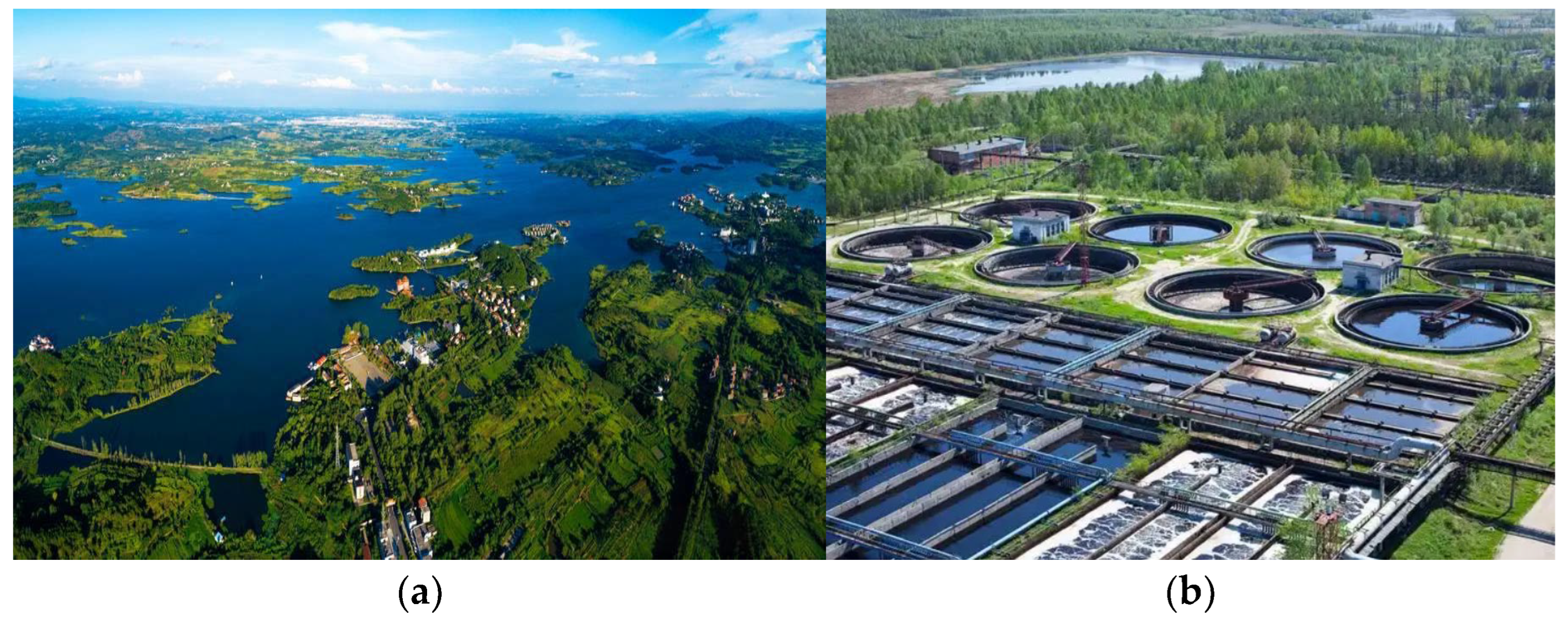
3.1. Study Area
3.2. Data Sources
3.3. Results
3.3.1. Scope of Evaluation
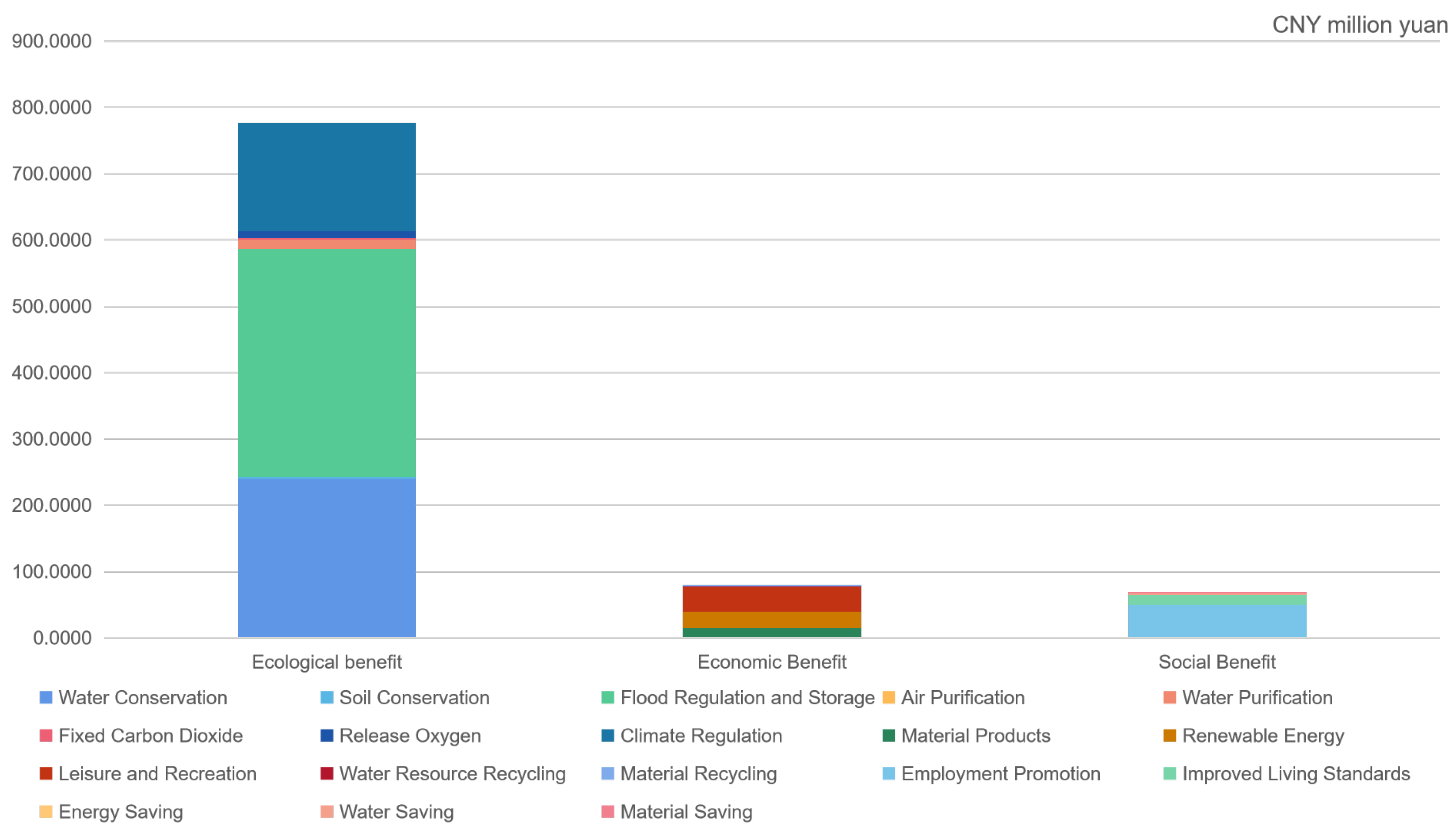
3.3.2. Benefit and Cost Analysis
3.3.3. Sensitivity Analysis and Validation
- (1)
- Cost data, though sourced from official documentation, predominantly represent planned or budgeted expenditures rather than final actualized costs. Actual final costs may vary due to construction delays, price fluctuations, or scope changes. The lack of a reported deviation range in source documents is a limitation. For analytical purposes, these figures are adopted as fixed inputs but acknowledges this static snapshot may not capture dynamic financial realities.
- (2)
- Benefit valuation generates “exact” monetary values by applying unit prices (e.g., water price, carbon price, wage rates) to estimated physical quantities. However, this approach introduces key uncertainties stemming from both unit price variability and estimation errors in physical quantities, with (1) water resource prices exhibiting substantial regional and policy-driven variability; (2) carbon sequestration estimates relying on ecological modeling frameworks that inherently contain estimation errors; and (3) tourism valuation (V14) derived through the travel cost method being contingent upon sample survey data, introducing sampling-related uncertainties.
3.3.4. Discussion
- (1)
- Strict Zoning Regulations. Under China’s Water Pollution Prevention and Control Law, tourism and aquaculture are prohibited within Grade I water source protection zones, effectively restricting the monetization of high-value leisure and recreation potentials (denoted as V14). This policy barrier directly suppresses market-based value realization.
- (2)
- Market Mechanism Deficiencies. Guizhou currently lacks mature trading platforms for critical ecological services such as Water Purification Value (V7) and Carbon Sequestration (V8), leaving these benefits as positive externalities rather than convertible cash flows.
- (3)
- Comparative Context. In contrast to wetland parks that often achieve an excellent performance through tourism revenues, drinking water protection projects inherently exhibit lower economic conversion efficiency. This underscores the necessity of establishing differentiated evaluation standards for “protection-oriented” versus “development-oriented” EPVR projects.
- (1)
- Eco-Fisheries: Introducing “clean-water fisheries” (e.g., non-feed, filter-feeding species) in non-core zones to monetize water purification services, which requires policy adjustments to permit limited, ecologically sound aquaculture in buffer zones.
- (2)
- Ecological Branding: Certifying agricultural products (e.g., “Hongfeng Pure Water” labeled crops) cultivated within the watershed to capture quality-based price premiums, depending on establishing trusted certification systems and market linkages.
- (1)
- Dominance of Ecological Benefits: Consistent with studies on the Xin’an River ecological compensation project [14] and water conservancy projects in Zhejiang [16], the case study shows ecological benefits constituting the vast majority (84.04%) of total generated value, which reaffirms that environmental restoration projects are primarily creators of non-market regulatory services.
- (2)
- Beyond Benefit Accounting: Prior research often stops at benefit accounting (e.g., GEP calculation for a region [7,8]). This study’s key advancement is integrating these benefits with project-specific costs to calculate the PCPI, which shifts the question from “How much value is created?” to “How efficiently is value created relative to the investment?”. The efficiency metric (PCPI = 0.77) provides a more direct tool for project prioritization and budget allocation.
- (3)
- Highlighting the “Protection vs. Development” Spectrum: The low economic conversion efficiency (8.65%) at Hongfeng Lake starkly contrasts with the higher ratios often reported for development-oriented projects like ecotourism parks or wetland parks open to recreation [10]. This contrast is not a flaw but a critical insight, underscoring the necessity for differentiated performance standards and policy incentives. A drinking water protection project should not be judged by the same economic return expectations as a tourism development project. The presented framework, with its flexible indicator system, allows for such context-specific adaptation.
- (4)
- Validation of Enhancement Strategies: The proposed strategies, such as developing eco-fisheries and ecological branding, find support in the related literature. Studies on karst desertification control [10] and agroforestry [11] similarly advocate for value-added industries based on ecosystem quality. The study’s contribution is contextualizing these strategies within the strict regulatory constraints of a Grade I water source protection zone, proposing feasible pathways like “clean-water fisheries” in non-core zones.
4. Conclusions
- (1)
- The “Benefit-Cost” framework successfully quantified the “invisible” ecological values, proving that while the project has a financial deficit (CNY −270.99 million), the project generates massive ecological welfare.
- (2)
- The evaluation identified that the project functions as a “High Ecological/Low Economic” infrastructure, and the primary bottleneck lies in policy constraints, such as strict zoning regulations and the lack of market mechanisms to trade ecological credits (water rights, carbon).
- (3)
- To address the weak economic conversion capability, targeted suggestions on enhancement strategies are proposed, mainly focused on diversified business development paths of Hongfeng Lake’s eco-products, which require parallel policy innovations and market development.
- (4)
- The indicator system can be adapted based on local ecosystems (e.g., coastal, forest, wetland). The methodology is scalable for different administrative levels and can incorporate local data on climate, hydrology, and socioeconomics.
- (5)
- Monetary valuation is a core component of the evaluation framework, which quantifies benefits through market prices, shadow prices, and cost-based methods (e.g., water resource pricing, carbon trading, treatment cost avoidance). This approach allows ecological and social benefits to be expressed in monetary terms, enabling direct cost–benefit comparison and comprehensive analysis.
- (6)
- The proposed framework effectively quantifies integrated performance, providing a practical tool for project screening, optimization, and policy-making in China’s evolving EPVR landscape.
- (7)
- The framework’s flexibility in indicator selection and scalability across administrative levels makes it a versatile tool for ecosystem-based project management globally, as evidenced by similar valuation needs in Lake Bengaluru [27] and Lake Biwa [28]. Furthermore, the framework can be applied to green infrastructure projects [29], where benefits like air purification, noise reduction, and recreational value can be assessed through the same benefit–cost logic. Notably, a successful application in other fields requires (a) availability of local data for both biophysical metrics (e.g., tons of carbon sequestered) and unit prices for valuation; (b) careful selection of appropriate valuation methods suited to the cultural and market context (e.g., contingent valuation for cultural services in some settings); and (c) transparent communication about the uncertainties inherent in monetizing non-market goods.
Author Contributions
Funding
Data Availability Statement
Conflicts of Interest
References
- Liu, M.C.; Bai, Y.X.; Su, B.R. Analysis of the Hotspots of Ecological Compensation Research in China in the Past 20 Years based on a Bibliometric Study. J. Res. Ecol. 2022, 13, 80–92. [Google Scholar]
- Liu, X.; Qin, G.; Qin, F. Selection of Accounting Valuation Models for Ecological Environment Compensation and Case Analysis. Com. Acct 2023, 14, 91–94. [Google Scholar] [CrossRef]
- The Central People’s Government of the People’s Republic of China. Opinions on Establishing and Improving the Mechanism for Realizing the Value of Ecological Products. 2021. Available online: https://www.gov.cn/zhengce/2021-04/26/content_5602763.htm (accessed on 16 September 2025).
- Costanza, R.; De Groot, R.; Braat, L.; Kubiszewski, I.; Fioramonti, L.; Sutton, P.; Farber, S.; Grasso, M. Twenty Years of Ecosystem Services: How Far Have We Come and How Far Do We Still Need to Go? Eco. Serv. 2017, 28, 1–16. [Google Scholar] [CrossRef]
- Xie, G.D.; Liu, J.Y.; Xu, J.; Xiao, Y.; Zhen, L.; Zhang, C.S.; Wang, Y.Y.; Qin, K.Y.; Gan, S.; Jiang, Y. A spatio-temporal delineation of trans-boundary ecosystem service flows from Inner Mongolia. Environ. Res. Lett. 2019, 14, 065002. [Google Scholar] [CrossRef]
- Yu, B.; Dong, X. Wetland Ecosystem Service Value Assessment Based on Emergy: A Case Study of Poyang Lake Wetland; ICEE: La Vergne, TN, USA, 2011. [Google Scholar]
- National Development and Reform Commission. Technical Specification for Accounting Gross Ecosystem Product (Trial Implementation); National Development and Reform Commission: Beijing, China, 2022.
- Ouyang, Z.Y.; Song, C.S.; Zheng, H.; Polasky, S.; Xiao, Y.; Bateman, I.J.; Daily, G.C. Using gross ecosystem product (GEP) to value nature in decision making. Proc. Natl. Acad. Sci. USA 2020, 117, 14593–14601. [Google Scholar] [CrossRef]
- Beijing Municipal Commission of Development and Reform. Guidelines for Estimating and Applying the Value of Ecosystem Product in Specific Geographic Units (Trial Implementation); Beijing Municipal Commission of Development and Reform: Beijing, China, 2023.
- Zhou, J.; Zhou, J.; Wang, Q.; Tang, J.; Lin, L. A review of ecological assets and ecological products supply: Implications for the karst rocky desertification control. Int. J. Environ. Res. Public Health 2022, 19, 10168. [Google Scholar] [CrossRef]
- Hu, W.; Gu, Z.; Xiong, K.; Lu, Y.; Li, Z.; Zhang, M.; You, L.; Ruan, H. A Review of Value Realization and Rural Revitalization of Eco-Products: Insights for Agroforestry Ecosystem in Karst Desertification Control. Land 2024, 13, 1888. [Google Scholar] [CrossRef]
- Shao, J.; Cai, C. Influential mechanism of green consumption on the realization of ecological products value in China. Front. Sustain. Food Syst. 2025, 8, 1460497. [Google Scholar] [CrossRef]
- Zhu, M.; Zhang, X.; Ehsan, E.; Fan, B.; Khalid, Z. Assessing ecological product values in the Yellow River Basin: Factors, trends, and strategies for sustainable development. Ecol. Indic. 2024, 12, 639–662. [Google Scholar] [CrossRef]
- Shi, L. A Coordinated Development Study on Ecological Benefits and Farmers’ Well-being from Upstream Ecological Compensation in the Xin’an River Basin. Master’s Thesis, Zhejiang Ocean University, Zhoushan City, China, 2023. [Google Scholar]
- Perring, M.; Erickson, T.; Brancalion, P. Rocketing Restoration: Enabling the Upscaling of Ecological Restoration. Restor. Ecol. 2019, 7, 1017–1023. [Google Scholar] [CrossRef]
- Yu, G.; Xu, Z.; Zhou, X.; You, A.; Hu, K.; Xu, K.; Tang, W. A Case Study on the Accounting of Ecological Product Values of Typical Water Conservancy Projects in Zhejiang Province. Environ. Pollut. Control. 2024, 46, 26–31. [Google Scholar] [CrossRef]
- Xu, D.; Zhang, W.; Guan, X. Research on the Economic and Ecological Benefit Evaluation of Ecological Restoration Projects Based on Ecosystem Products Value Realization. J. Arid Land Resour. Environ. 2023, 37, 57–65. [Google Scholar] [CrossRef]
- Li, W. Theories, Methods, and Applications of Ecosystem Service Function Value Assessmentl; China Renmin University Press: Beijing, China, 2008. [Google Scholar]
- Wang, L.; Gan, L.; Liu, P.; Jiang, H. Application Research on the Accounting of Ecological Product Value Based on Construction Projects. Chin. Eng. Cons. 2025, 2, 119–122. Available online: https://kns.cnki.net/kcms2/article/abstract?v=NitQnVYDOcrqRPDTSpkQDncUsvC14zyPNFhwASAZldFtkdHiPMbWHJaIbzavy29fGNitRuFRIxbazvyy4HlFlsnf9FAQNE5CQYtD6kMCdoip-VrEk_S9fFFxphoHhAV6AKH3AsFcBRlagn3QK4Y5reHn7M4wflLJV6Qqm06BVFwW1q4SGmpLMg==&uniplatform=NZKPT&language=CHS (accessed on 10 November 2025).
- Yang, S.; Lu, F.; Zhang, L. Comprehensive Benefit Assessment of the Natural Forest Protection Program. Environ. Prot. Sci. 2022, 48, 18–26. [Google Scholar] [CrossRef]
- He, S.; Duan, X.; Hao, L.; Xia, T.; Li, X.; Chen, S. Research on the Construction of Ecological Performance Evaluation Index System for Marine Restoration Projects from a Management Perspective. Chin. J. Environ. Manag. 2021, 13, 47–54. [Google Scholar] [CrossRef]
- Xie, H.L.; Chen, Q.R. The connotation, goal and mode of realizing the value of ecological products. Econ. Geogr. 2022, 42, 147–154. [Google Scholar] [CrossRef]
- Gao, X.L.; Lin, Y.Q.; Xu, W.H.; Ouyang, Z.Y. Research progress on the value realization of ecological products. Acta Ecol. Sin. 2020, 40, 24–33. [Google Scholar] [CrossRef]
- Liu, J.M.; Su, X.J.; Liu, Y.M.; Shu, W. A Review of Research on Progress in the Theory and Practice of Eco-Product Value Realization. Land 2024, 13, 316. [Google Scholar] [CrossRef]
- Hou, D.; Song, D.; Song, Y. Green and Sustainable Remediation of Farmland Contaminated Soil: Analytical Framework and Related Considerations. Environ. Prot. 2018, 46, 36–40. [Google Scholar] [CrossRef]
- Yan, N.; Liu, G.; Casazza, M.; Yang, Z. A new multiscale collection and allocation framework for national ecological compensation funds based on ecosystem service supply and demand dynamics. J. Clean. Prod. 2024, 452, 142118. [Google Scholar] [CrossRef]
- Birawat, K.; T, H.; C.Nachiyar, M.; N.A, M.; C.V, S. Impact of urbanisation on lakes—A study of Bengaluru lakes through water quality index (WQI) and overall index of pollution (OIP). Environ. Monit. Assess. 2021, 193, 408. [Google Scholar] [CrossRef]
- Abe, T.; Sobajima, Y.; Sugano, K.; Takeda, S. Diversity of landscape impressions around lakeshore embankment in east coastal area of Lake Biwa. J. JSCE. 2024, 80, 8. [Google Scholar] [CrossRef]
- European Environment Agency. Green Infrastructure and Ecosystem Accounting: Lessons from EU Member States; EEA Report No. 12/2025; European Environment Agency: Copenhagen, Denmark, 2025. [Google Scholar]



| No. | First-Level Indicator | Second-Level Indicator | Third-Level Indicator | Fourth-Level Indicator | Illustrate |
|---|---|---|---|---|---|
| 1 | Comprehensive Benefits | Ecological benefit | Regulation Services | Water Conservation | Value of water conservation |
| 2 | Soil Conservation | Value of soil conservation | |||
| 3 | Windbreak and Sand Fixation | Value of windbreak and sand fixation | |||
| 4 | Coastal Protection | Value of coastal protection | |||
| 5 | Flood Regulation and Storage | Value of flood regulation and storage | |||
| 6 | Air Purification | Value of air purification | |||
| 7 | Water Purification | Value of water purification | |||
| 8 | Fixed carbon dioxide | Value of fixed carbon dioxide | |||
| 9 | Release oxygen | Value of release oxygen | |||
| 10 | Climate Regulation | Value of climate regulation | |||
| 11 | Noise Reduction | Value of noise reduction | |||
| 12 | Economic Benefit | Material Supply | Material Products | Value of material products | |
| 13 | Renewable Energy | Value of renewable energy | |||
| 14 | Cultural Services | Leisure and Recreation | Value of leisure and recreation | ||
| 15 | Value-added Landscape | Added value of landscape | |||
| 16 | Resource Utilization | Energy Cascading Utilization | Value of energy cascading utilization | ||
| 17 | Water Resource Recycling | Value of water resource recycling | |||
| 18 | Material Recycling | Value of material recycling | |||
| 19 | Social Benefit | Human Well-being | Employment Promotion | Value of income from generated employment | |
| 20 | Improved Living Standards | Value of increased resident income | |||
| 21 | Resource Conservation | Energy Saving | Value of energy saving | ||
| 22 | Water Saving | Value of water saving | |||
| 23 | Material Saving | Value of material saving | |||
| 24 | Land Saving | Value of land saving | |||
| 25 | Mineral Resource Saving | Value of mineral resource saving | |||
| 26 | Cost Input | Cost | Construct Cost | Construct Cost | Value of construct cost |
| Indicator | Formula | Illustrate |
|---|---|---|
| Water Conservation | V1 represents the value of water conservation (yuan); Q1 is the amount of water conservation (m3); P1 is the market price of water resources (yuan/m3). | |
| Soil Conservation | V2 represents the soil conservation value (yuan); V2,S represents the value of reducing siltation (yuan); V2,D represents the value of reducing non-point source pollution (yuan); QD represents the soil conservation quantity (t); (yuan/m3); ρ represents the soil bulk density (t/m3); λ represents the sedimentation coefficient; c2 represents the cost of reservoir construction(yuan/m3); C2,i represents the purity of the ith pollutant (such as nitrogen or phosphorus) in the soil (%), where i represents the number of nutrient substances in the soil; P2,i represents the cost of treating the ith pollutant. | |
| Windbreak and Sand Fixation | V3 represents the windbreak and sand fixation value (yuan); Q3 represents the windbreak and sand fixation conservation quantity (t); ρ represents the soil bulk density (t/m3); h represents the thickness of soil desertification and sand cover (m); c3 represents the cost of sand control project (yuan/m3). | |
| Coastal Protection | V4 represents the total value of coastal protection (yuan); Q4,i represents the length of the ith coastline (km/a); C6,i represents the protection cost of the ith coastline (yuan/km). | |
| Flood Regulation and Storage | V5 represents the flood storage value (yuan); Q5 represents the amount of flood storage (m3); C5 represents the engineering cost and maintenance cost per unit capacity of the reservoir (yuan). | |
| Air Purification | V6 represents the total value of water purification (yuan); Q6,i represents the purification amount of the ith water pollutant (t); C6,i represents the treatment cost of the ith water pollutant (yuan); i is the ith air pollutant. | |
| Water Purification | V7 represents the total value of water purification (yuan); Q7,i represents the purification amount of the ith water pollutant (t); C7,i represents the treatment cost of the ith water pollutant (yuan); i is the ith water pollutant. | |
| Fixed Carbon Dioxide | V8 is the value of fixed carbon dioxide (yuan); Q8 is the total amount of fixed carbon dioxide (t); C8 is the price of industrial carbon capture (yuan/t). | |
| Release Oxygen | V9 is the value of release oxygen (yuan); Q9 is the total amount of release oxygen (t); C9 is the price for industrial oxygen production (yuan/t). | |
| Climate Regulation | V10 is the value of climate regulation (yuan); Q10 is the total energy consumed by the transpiration and evaporation of an ecosystem (kWh/a); C10 is the electricity price (yuan/kWh). | |
| Noise Reduction | V10 is the value of noise reduction (yuan); Q11 is the amount of noise reduction (db); C11 is the construction and maintenance costs of sound insulation walls (yuan·db/a). | |
| Material Products | V12 is the value of material products (yuan); Q12,i is the amount of the ith product (t); P12,i is the price of the ith product (yuan/t). | |
| Renewable Energy | V13 is the value of renewable energy (yuan); Q13,i is the amount of the ith renewable energy (t); P13,i is the price of the ith renewable energy (yuan/t). | |
| Leisure and Recreation | V14 is the value of leisure tourism (yuan); CT is the average travel cost for tourists (sampling survey); N represents the total number of tourists. | |
| Value-added Landscape | V15 represents the added value of landscape (yuan); V15,H represents the added value of hotel (yuan); V15,R represents the added value of residential housing (yuan); Q15,H represents the number of hotel rooms sold (d); P15,H represents the price of sold hotel rooms (yuan/d); P′15,H represents the average price of hotel rooms (yuan/d); Q15,R represents the area of value-added residential housing (m2); P15,R represents the price of residential housing (yuan/m2); P′15,H represents the average price of residential housing (yuan/m2). | |
| Energy Cascading Utilization | V16 is the value of energy cascading utilization (yuan); Q16,i is the usage amount of the ith energy cascading utilization (kWh/a); P16,i is the price of the ith energy cascading utilization (yuan/kWh); c16,i is the cost of the ith energy cascading utilization (yuan/kWh). | |
| Water Resource Recycling | V17 is the value of water resource recycling (yuan); Q17,i is the usage amount of the ith inferior water resources (t/a); P16,i is the price of the ith inferior water resources (yuan/t); c17,i is the cost of the ith inferior water resources (yuan/t). | |
| Material Recycling | V18 is the value of material recycling (yuan); Q18,i is the usage amount of the ith recycling material (t/a); P18,i is the price of the ith recycling material (yuan/t); c18,i is the cost of the ith recycling material (yuan/t). | |
| Employment Promotion | V19 is the value of employment promotion (yuan); Q19 is the number of new employment (person/a); P19 is the average wage of new employment (yuan/person). | |
| Improved Living Standards | V20 is the added value of residents’ income (yuan); Q20 is the number of the regional residents (person); P20 is the average increase in per capita income (yuan/person). | |
| Energy Saving | V21 is the value of energy saving (yuan); Q21,i is the saving amount of the ith energy (kWh/a); P21,i is the price of the ith energy (yuan/kWh). | |
| Water Saving | V22 is the value of water saving (yuan); Q22,i is the saving amount of the ith water resource (t/a); P22,i is the price of the ith water resource (yuan/t). | |
| Material Saving | V23 is the value of material saving (yuan); Q23,i is the saving amount of the ith material (t/a); P23,i is the price of the ith material (yuan/t). | |
| Land Saving | V24 is the value of land saving (yuan); Q24 is the saving area of land (m2); P24 is the land price (yuan/m2). | |
| Mineral Resource saving | V25 is the value of mineral resource saving (yuan); Q25,i is the saving amount of the ith mineral resource (t/a); P25,i is the price of the ith mineral resource(yuan/t). | |
| Construct Cost | Vcost is the total investment of the project (yuan); Ccost,i is the investment of the ith construction content (yuan). |
| Value Range | Evaluation Result | Explanation | Application | |
|---|---|---|---|---|
| Scenarios | Proposed Actions | |||
| Veco-benefit < 0 | Poor | Unacceptable | Advance Evaluation | Project is not feasible. |
| 0 ≤ EP < 1 | Moderate | Positive benefits, but less than investment cost; acceptable under certain conditions. | Advance Evaluation | Project has weak EPVR capacity; project components can be optimized. |
| Post-fact Assessment | Check if construction adhered to design; identify issues for improvement. | |||
| 1 ≤ EP < 3 | Good | Considerable benefits, exceeding investment cost, but potential uncovered hidden costs may remain. | Advance Evaluation | Project has good EPVR capacity and can proceed with implementation. |
| Post-fact Assessment | Project construction and operation performance is good; sustainable operation is viable. | |||
| EP ≥ 3 | Excellent | Benefits far exceed investment cost, representing the best projects. | Advance Evaluation | Project has excellent EPVR capacity and can be given priority for implementation. |
| Post-fact Assessment | Project construction and operation performance is excellent; sustainable operation and replication are recommended. | |||
| Indicator Category | Indicators | Included in Evaluation Scope |
|---|---|---|
| Ecological Benefit | Water Conservation | Yes |
| Soil Conservation | Yes | |
| Windbreak and Sand Fixation | No | |
| Coastal Protection | No | |
| Flood Regulation and Storage | Yes | |
| Air Purification | Yes | |
| Water Purification | Yes | |
| Fixed carbon dioxide | Yes | |
| Release oxygen | Yes | |
| Climate Regulation | Yes | |
| Noise Reduction | No | |
| Economic Benefit | Material Products | Yes |
| Renewable Energy | Yes | |
| Leisure and Recreation | Yes | |
| Value-added Landscape | No | |
| Energy Cascading Utilization | No | |
| Water Resource Recycling | No | |
| Material Recycling | Yes | |
| Social Benefit | Employment Promotion | Yes |
| Improved Living Standards | Yes | |
| Energy Saving | Yes | |
| Water Saving | Yes | |
| Material Saving | Yes | |
| Land Saving | No | |
| Mineral Resource Saving | No | |
| Cost | Construct Cost | Yes |
| Indicators | Physical Quantity | Unit | Value (CNY Million per Year) | Subtotal (CNY Million per Year) | ||
|---|---|---|---|---|---|---|
| Ecological Benefit | Water Conservation | Water Conservation | 29.1686 | million m3 per year | 240.06 | 776.24 |
| Soil Conservation | Reduce Siltation | 0.2656 | million t per year | 0.88 | ||
| Reduce Non-Point Source Pollution of Nitrogen | 3.1939 | million t per year | 1.66 | |||
| Reduce Non-Point Source Pollution of Nitrogen Phosphorus | 0.7288 | million t per year | ||||
| Flood Regulation and Storage | Lake Storage and Regulation | 41.6097 | million m3 per year | 332.46 | ||
| Vegetation Storage and Regulation | 1.6813 | million m3 per year | 10.90 | |||
| Air Purification | Sulfur Dioxide Purification | 85.8900 | t per year | 0.10 | ||
| Nitrogen oxides (NOx) purification | 3.1200 | t per year | 0.01 | |||
| Dust Elimination | 2.2800 | t per year | 0.01 | |||
| Water Purification | COD Purification | 0.4500 | t per year | 12.50 | ||
| Total Nitrogen (TN) Purification | 0.0300 | t per year | 0.61 | |||
| Total Phosphorus (TP) Purification | 0.0300 | t per year | 0.97 | |||
| Fixed Carbon Dioxide | Fixed Carbon Dioxide | 0.0313 | million t per year | 2.03 | ||
| Release Oxygen | Release Oxygen | 0.0228 | million t per year | 10.79 | ||
| Climate Regulation | Cooling and humidifying | 163.2606 | million kWh per year | 163.26 | ||
| Economic Benefit | Material Products | Freshwater Supply | 7.3815 | million m3 per year | 14.76 | 79.89 |
| Renewable Energy | Hydropower | 54.7000 | million kWh per year | 24.92 | ||
| Leisure and Recreation | Leisure and Recreation | / | / | 36.79 | ||
| Water Resource Recycling | Circulating Water Aquaculture | 0.3200 | million m3 per year | 0.64 | ||
| Material Recycling | Cement | 3120.00 | t per year | 1.23 | ||
| Steel Bars | 390.00 | t per year | 1.55 | |||
| Social Benefit | Employment Promotion | Employment | 500.00 | person | 49.93 | 67.53 |
| Improved Living Standards | Ecological Resettlement | 2232.00 * | person | 16.50 | ||
| Energy Saving | Solar Street Light | 0.9855 | million kWh per year | 0.48 | ||
| Water Saving | Eco-irrigation for Water Conservation | 0.0004 | million m3 per year | 0.0007 | ||
| Material Saving | Cement | 97.50 | t per year | 0.04 | ||
| Steel Bars | 117.00 | t per year | 0.46 | |||
| Straw | 112.94 | t per year | 0.0011 | |||
| Fecal Residue and Waste Water | 406.71 | t per year | 0.12 | |||
| Total | 923.66 | |||||
| Content of the Project | Description | Investments (CNY Million Yuan) |
|---|---|---|
| Ecological migration | For 558 households in 7 villagers’ groups within the first-level protection area of Hongfeng Lake. | 865 |
| Shutdown and relocation of industrial pollution sources | Shut down 15 high-energy-consuming enterprises, demolish 176 livestock and poultry farms, over 700 fish cages and feed-fed fish farms, and remove 122,000 square meters of illegal buildings. | 100 * |
| Construction of rural sewage treatment facilities | Build 133 to 134 sets of rural domestic sewage treatment facilities and their supporting pipelines to achieve full coverage of sewage in secondary protection zones and quasi-protection zones. | 180 |
| Construction of isolation and protection for water sources | 38.5 km of fencing and 144 signboards were built in the first-level protection zone, and 677 m of water area isolation floating rafts were implemented. | 13 |
| Construction of a smart supervision platform | A “space-air-ground integrated” monitoring and early warning platform has been established, including automatic water quality monitoring stations and video surveillance points. | 8.6 |
| Treatment of black and odorous water | 8 urban black and odorous water bodies including Dongmen River were treated, and 40.89 km of new sewage pipelines were built. | 28.06 |
| Total | 1194.66 | |
| Parameter Variation | Change in Total Benefit (Million CNY) | PCPI Result | Deviation |
|---|---|---|---|
| Baseline | 923.66 | 0.77 | - |
| Water Price +20% | 971.68 | 0.81 | +5.2% |
| Water Price −20% | 875.66 | 0.73 | −5.2% |
| Carbon Price +20% | 924.08 | 0.77 | +0.04% |
| Carbon Price −20% | 923.30 | 0.77 | −0.04% |
Disclaimer/Publisher’s Note: The statements, opinions and data contained in all publications are solely those of the individual author(s) and contributor(s) and not of MDPI and/or the editor(s). MDPI and/or the editor(s) disclaim responsibility for any injury to people or property resulting from any ideas, methods, instructions or products referred to in the content. |
© 2026 by the authors. Licensee MDPI, Basel, Switzerland. This article is an open access article distributed under the terms and conditions of the Creative Commons Attribution (CC BY) license.
Share and Cite
Chen, Y.-H.; Chai, C.; Wu, Q.-L.; Wang, N.-N. Research on the Performance Evaluation System for Ecological Product Value Realization Projects: A Case Study of the Comprehensive Water Environment Management Project for a Drinking Water Source. Water 2026, 18, 102. https://doi.org/10.3390/w18010102
Chen Y-H, Chai C, Wu Q-L, Wang N-N. Research on the Performance Evaluation System for Ecological Product Value Realization Projects: A Case Study of the Comprehensive Water Environment Management Project for a Drinking Water Source. Water. 2026; 18(1):102. https://doi.org/10.3390/w18010102
Chicago/Turabian StyleChen, Yuan-Hua, Chang Chai, Qing-Lian Wu, and Nan-Nan Wang. 2026. "Research on the Performance Evaluation System for Ecological Product Value Realization Projects: A Case Study of the Comprehensive Water Environment Management Project for a Drinking Water Source" Water 18, no. 1: 102. https://doi.org/10.3390/w18010102
APA StyleChen, Y.-H., Chai, C., Wu, Q.-L., & Wang, N.-N. (2026). Research on the Performance Evaluation System for Ecological Product Value Realization Projects: A Case Study of the Comprehensive Water Environment Management Project for a Drinking Water Source. Water, 18(1), 102. https://doi.org/10.3390/w18010102