Article

Integrated Stochastic Framework for Drought Assessment and Forecasting Using Climate Indices, Remote Sensing, and ARIMA Modelling

1
Department of Civil Engineering, College of Engineering, King Khalid University, Abha 61411, Saudi Arabia
2
Center for Engineering and Technology Innovations, King Khalid University, Abha 61421, Saudi Arabia
3
Civil Engineering Department, College of Engineering, Imam Mohammad Ibn Saud Islamic University (IMSIU), Riyadh 11564, Saudi Arabia
4
Department of Biological and Agricultural Engineering & Zachry Department of Civil Engineering, Texas A & M University, College Station, TX 77843-2117, USA
*
Author to whom correspondence should be addressed.
Water 2025, 17(24), 3582; https://doi.org/10.3390/w17243582
Submission received: 12 November 2025 / Revised: 4 December 2025 / Accepted: 13 December 2025 / Published: 17 December 2025
(This article belongs to the Special Issue Drought Evaluation Under Climate Change Condition)

Abstract

This study presents an integrated stochastic framework for assessing and forecasting drought dynamics in the western Bhagirathi–Hooghly River Basin, encompassing the districts of Bankura, Birbhum, Burdwan, Medinipur, and Purulia. Employing multiple probabilistic and statistical techniques, including the gamma-based standardized precipitation index (SPI), effective drought index (EDI), rainfall anomaly index (RAI), and the auto-regressive integrated moving average (ARIMA) model, the research quantifies spatio-temporal variability and projects drought risk under non-stationary climatic conditions. The analysis of century-long rainfall records (1905–2023), coupled with LANDSAT-derived vegetation and moisture indices, reveals escalating drought frequency and severity, particularly in Purulia, where recurrent droughts occur at roughly four-year intervals. Stochastic evaluation of rainfall anomalies and SPI distributions indicates significant inter-annual variability and complex temporal dependencies across all districts. ARIMA-based forecasts (2025–2045) suggest persistent negative SPI trends, with Bankura and Purulia exhibiting heightened drought probability and reduced predictability at longer timescales. The integration of remote sensing and time-series modelling enhances the robustness of drought prediction by combining climatic stochasticity with land-surface responses. The findings demonstrate that a hybrid stochastic modelling approach effectively captures uncertainty in drought evolution and supports climate-resilient water resource management. This research contributes a novel, region-specific stochastic framework that advances risk-based drought assessment, aligning with the broader goal of developing adaptive and probabilistic environmental management strategies under changing climatic regimes.

1. Introduction

Droughts pose a serious threat to the sustainability of the environment and the economy because they have a cascading effect on ecosystems and multiple economic sectors [1]. Drought-induced ecological degradation includes loss of habitat, a decline in biodiversity, and productivity loss [2,3]. Plants and aquatic life are particularly susceptible since they often have lower rates of regrowth and higher death rates [4]. All of these effects weaken economic systems, which emphasizes how important it is to achieve long-term sustainability by putting effective drought-mitigation strategies and sustainable water management plans into place. The agriculture industry, which is heavily dependent on a consistent supply of water for managing livestock and growing crops, suffers large financial losses during droughts [5]. This disrupts supply networks, raising food prices and causing economic instability, in addition to affecting farmers’ incomes and food security [6]. Water supply also affects industries that depend on it outside agriculture, such as energy and, particularly, hydroelectric power generation. Rising global temperatures due to anthropogenic climate change are upsetting the hydrological cycle, changing precipitation patterns, lengthening dry periods, and increasing evaporation rates [7]. These changes lead to an increase in the frequency of droughts, particularly in places that are already vulnerable [8]. Understanding the complex links between climatic conditions and drought episodes is essential to developing accurate prediction models and useful mitigation strategies.
The demand for a more precise, timely, and comprehensive understanding of drought phenomena has led to significant advancements in the methods used for contemporary drought assessments across time [9]. Traditional approaches mostly employed meteorological data and historical records to assess drought conditions. But due to advancements in technology, sophisticated measures such as the standardized precipitation index (SPI) are now available, offering a multi-temporal perspective on the duration and intensity of the drought [10]. Remote sensing technology has revolutionized drought monitoring by providing high-resolution geographic data on plant health, soil moisture, and surface-water levels, enabling extensive and real-time assessments [11,12]. Furthermore, using statistical models like the auto-regressive integrated moving average (ARIMA) has improved the capacity of forecasting future drought events using past climatic data [13]. Improved drought assessments and forecasts are now more accurate and reliable due to the integration of climate change scenarios into these improvements. The aforementioned advancement in techniques highlights a comprehensive strategy that integrates satellite imaging, ground-based observations, and prediction modelling to tackle the intricacies of droughts within the framework of climate change.
India’s drought exhibits significant regional variation because of different climatic and topographical causes [14,15]. In the Ganga Delta region, drought is primarily characterized by protracted dry spells and irregular monsoon patterns that reduce the availability of water for daily needs and farming [16]. This area is rich in water resources, but deforestation, over-exploitation of groundwater, and climate change threaten to reduce this water retention capacity and increase the region’s vulnerability to drought [17,18]. Food security and livelihoods are put in jeopardy when natural hydrology and human activities intersect [19,20]. Reforestation, sustainable water practices, and climate-resilient agriculture are among the effective management alternatives that are crucial in this environment to lessen the effects of drought and preserve the socio-ecological resilience of the Ganga Delta area. Thus, comprehending the type, extent, and intensity of drought in the Ganga Delta area is a major area of attention for researchers. To effectively measure drought conditions, extensive research on land use changes, hydrological cycles, and climate trends is required. This study examines the intricate relationship between drought events and climate dynamics in order to offer crucial insights for the sustainable management of water resources. We use geographic information Systems (GISs) and advanced remote sensing technology to track drought indicators, including water levels, vegetation health, and soil moisture. The combination of multi-temporal SPIs (SPI3, SPI6, and SPI12), innovative remote sensing technologies, and complex ARIMA models constitutes innovative research at the regional level in drought prediction and evaluation, especially when considering climate change [21,22]. This all-inclusive strategy addresses both short- and long-term drought dynamics, enabling accurate and scalable drought monitoring and forecasting. The novel aspect of the work is the combination of statistical models that take into account past patterns in precipitation and predicted changes in climate, with high-resolution satellite data to capture regional variations in vegetation and soil moisture. Therefore, this comprehensive approach is a major breakthrough in regional climate change research and drought management since it not only increases the accuracy of drought predictions but also provides information for the creation of climate-adaptive policies.

2. Materials and Methods

2.1. Study Area

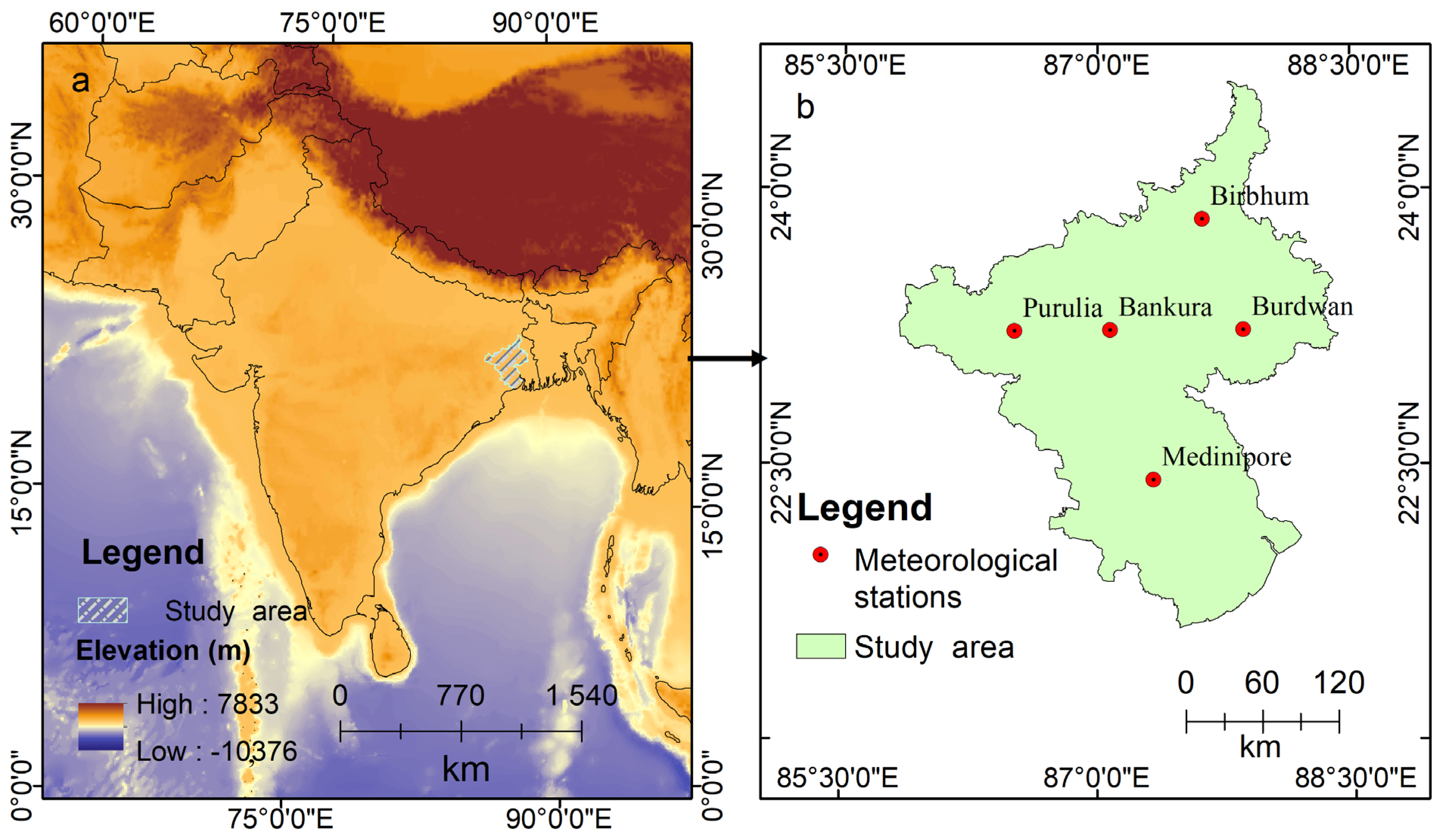
The districts of Purulia, Bankura, Burdwan, Birbhum, and Medinipur comprise the research region, which offers a varied terrain for investigating the characteristics of drought. Drought conditions vary per district due to distinct geographical, meteorological, and hydrological features. Figure 1 shows the study area location, which is in the western part of the Bhagirathi–Hooghly River region (Rarh and plateau fringe), and the IMD meteorological station within the study region. Purulia, a region in western West Bengal, is distinguished by an arid climate and a rough topography with many hills [23]. Due to its high rates of evapotranspiration and infrequent rainfall, the area is particularly vulnerable to drought [24]. Agricultural distress is a common occurrence due to the prevailing red and lateritic soils, which worsen water retention problems. Like Purulia, Bankura has a hilly terrain with a sizable amount of forest cover and red lateritic soils. Prolonged dry periods and erratic monsoon rains affect the district’s agricultural output and water supply [25]. The community is susceptible to drought since the agriculture is rain-fed. The topography of Birbhum is characterized by gentle slopes and a mixture of alluvial and red lateritic soils [26]. The district experiences sporadic droughts due to the unequal distribution of modest rainfall. Due to the region’s strong reliance on monsoons for agricultural activities, crop failures caused by drought are a potential risk. Burdwan, sometimes called the “rice bowl of Bengal,” contains alluvial soil, which is comparatively more productive than that of Purulia and Bankura. But because of irregular rainfall patterns and extensive groundwater extraction for irrigation, even this area is struggling with drought. While the western portion of Burdwan encounters circumstances akin to drought, the eastern portion is more vulnerable to waterlogging. This area has a variety of geological features, with pleasant slopes in the west and coastal regions in the east [26]. Because of its dependency on surface water for irrigation and low rainfall, Paschim Medinipur is seriously at risk of experiencing a drought. Purba Medinipur benefits from the seashore, but when the monsoons fail, it also faces drought conditions that impact drinking water supply and agriculture [27].

2.2. Database

The present study has been carried out based on the combination of rainfall data, groundwater data, and remote sensing-derived data. Regarding the rainfall data, we selected 5 meteorological stations to geospatially cover the entire plateau fringe and Rarh region of West Bengal. The monthly rainfall data temporally ranges from 1905 to 2023 and has been gathered from the India Meteorological Department (IMD), with no missing observations across the entire time span (https://mausam.imd.gov.in/ accessed on 21 December 2023). Regarding the groundwater level data, we used seasonal characteristics of groundwater levels and the data, spanning from 2013 to 2023, have been collected from the same stations using a secondary source (CGWB). Regarding the remote sensing data, the current analysis employs Landsat 8 OLI data from 2023, encompassing the pre-monsoon, monsoon, and post-monsoon seasons. The Google Earth Engine (GEE) is a web-based system that offers access to all Landsat data in both surface reflectance- and top of atmosphere (TOA)-adjusted reflectance formats. In light of this, the current study examines the “Landsat 8 surface reflectance tier 1,” which offers the OLI/TIRS sensors’ atmospherically adjusted surface reflectance.

2.3. Methodology

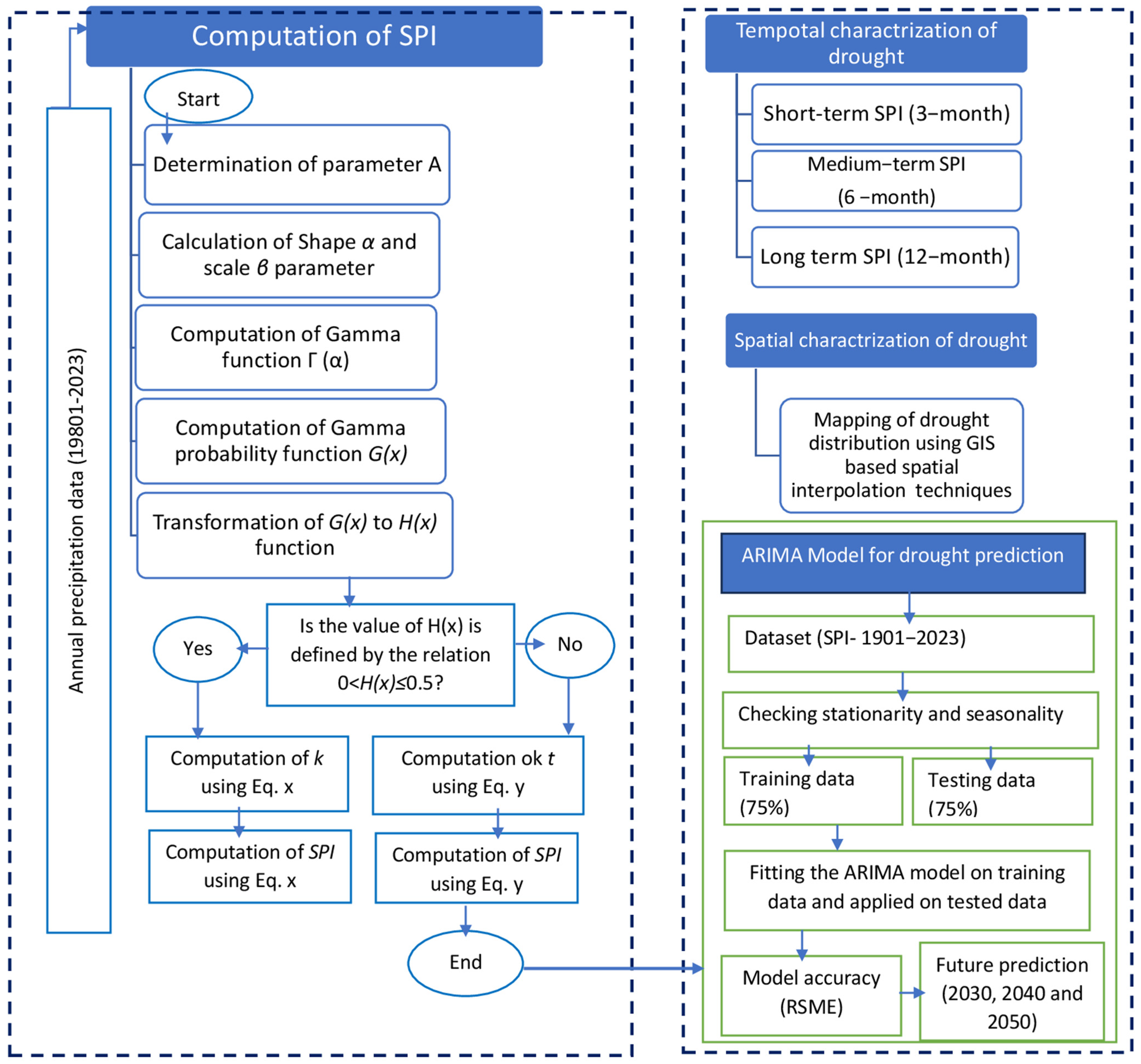
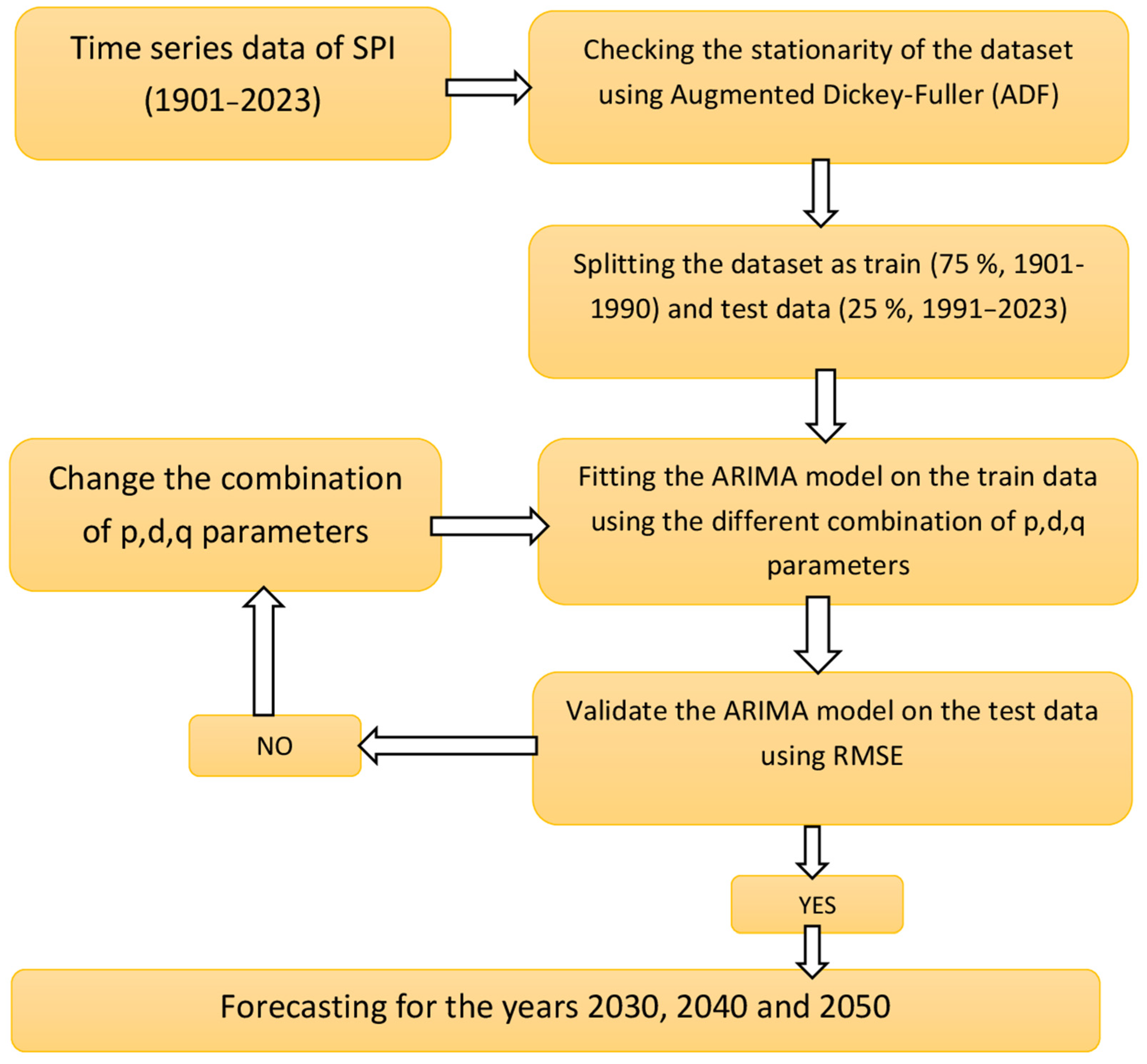
The present study aims to quantify the drought character using gamma SPI methods, the effective drought index, and the rainfall anomaly index based on annual rainfall data of the selected meteorological stations. For future predictions, the derived results of the gamma SPI have been transferred into the ARIMA model framework as model inputs. Before fitting the model using the model fit function, the dataset was processed for several reasons. First, the null cells within the dataset were identified and filled with the proper statistical principles. We checked its stationarity and seasonality absolutely necessary for fitting the time-series trendlines. The entire dataset was split into training data (75%) and test data (25%). Finally, the model was fitted with the train data and test data, followed by an accuracy assessment based on the RMSE. Moreover, the model has been used to forecast the annual SPI ranging from 2025 to 2045. The detailed methodological framework explaining the drought assessment process is depicted in Figure 2.

2.3.1. Methods for Drought Assessment

Effective Drought Index (EDI)
To overcome the limitation of the existing drought assessment indices, Byun and Wilhite [28] established this method using effective precipitation (EP). The function of EP represents the current day and previous day’s precipitation with lower weights, represented in Equations (1)–(3) as follows.
E P i = n = 1 i ( m = 1 i P m n ) = P 1 + P 1 + P 2 2 + P 1 + P 2 + P 3 3 + P 1 + P 2 + + P 365 365 = P 1   ( 1 + 1 2 + 1 3 + + 1 365 ) + P 2 ( 1 2 + 1 3 + + 1 365 ) + + p 365 ( 1 365 )
Finally, the following equations are applied to obtain the EDI.
DEPi = EPI − MEP
EDI = DEPi/ST (DEPi)
where MEP is the mean of the EP and ST is the standard deviation
The EDI, like the SPI, is a standardized index that is developed based on at least 30 years of precipitation data. The values of the EDI are determined to be extremely wet for an EDI ≥ 2; severely wet for an EDI of 1.5–1.99; moderately wet for an EDI of 1.0–1.49; normal for an EDI of −0.99–0.99; moderately dry for an EDI of (−)1.0–(−)1.49; severely dry for an EDI of (−)1.50–(−)1.99; and extremely dry for an EDI ≤ (−)2.
Rainfall Anomaly Index
This method is a good measure to analyze the frequency and intensity of dry and rainy years of a particular region effectively. Rooy [29] developed the RAI for determining both positive and negative anomalies (Equations (4) and (5)).
R A I = + 3 × ( ( p p ¯ ) ( m ¯ p ¯ ) ) for   a   positive   anomaly
R A I = 3 × ( ( p p ¯ ) ( x ¯ p ¯ ) ) for   a   negative   anomaly
where p and p ¯ are the current and mean annual precipitation of the historical series, respectively. m ¯ is the average value of the highest value of the historical series for the positive anomaly and x ¯ is the average of the ten lowest values of annual precipitation of the historical series for the negative anomaly. The RAI values ranging from RAI > 4, 4 < RAI > 2, 2 < RAI > 0, 0 < RAI > −2, −2 < RAI > −4, to RAI > −4 represent extremely humid, very humid, humid, dry, very dry, and extremely dry, respectively.
Standardize Precipitation Index (SPI)
The index is popularly used for precipitation-based drought severity assessments. The method works with the fitting of long-term precipitation time-series data to an appropriate statistical distribution. It assumes that the gamma probability function provides a better result for long-term precipitation data than the normal and log distributions [30]. The algorithm of the gamma probability density function (p.d.f) is as follows (Equations (6)–(14)).
g x = 1 β α Γ ( α ) x α 1 e x / β
where shape parameter, scale parameter, amount of precipitation, and gamma function are represented by α > 0, β > 0, x > 0, and Γ (α), respectively. The Γ (α) is estimated by Equation (3).
  Γ α = 0 y α 1   e y   d y
Again, α and β are required to be estimated to fit the distribution to the precipitation data series. The algorithms of the estimations of α and β are presented in Equations (5) and (6).
α = 1 4 A   ( 1 + 1 + 4 A 3 ) ,
β = x ¯ α ,   A = ln x ¯ Ʃ   l n ( x ) n
where n is the number of observations.
Again, the integration of the cumulative probability function or G (x) of the precipitation data is calculated using Equation (7).
G x = 0 x G x d x = 1 β α Γ ( α ) 0 x x α 1 e x / β d x
By substituting t = x/β, Equation (7) becomes
G x = 1 Γ ( α ) 0 x t α 1 e 1 d t
In long-term precipitation data, many months possess zero precipitation (x = 0), but the gamma probability function is undefined for x = 0. Therefore, a modified cumulative probability function for the gamma distribution has been applied using Equation (8).
H x = q + ( 1 q )   G ( x )
where q represents the probability of zero precipitation.
Lastly, the transformation of the cumulative probability distribution into the standard normal distribution is performed to obtain the final value of the SPI [31].
Z = SPI = ( t c 0 + c 1 t + c 2 t 2 1 + d 1 t + d 2 t 2 + d 3 t 3 ) ,   t = l n ( 1 ( H x ) 2 ) for   0 < H ( x ) < 0.5
Z = SPI = + ( t c 0 + c 1 t + c 2 t 2 1 + d 1 t + d 2 t 2 + d 3 t 3 ) ,   t = l n ( 1 ( 1.0 H x ) 2 ) for   0 < H ( x ) < 1.0
where c0 = 2.515517, c1 = 0.802853, c2 = 0.010328 and d1 = 1.432788, d2 = 0.189269, and d3 = 0.001308.
The SPI values are classified in the following ways: 2 or more as extremely wet; 1.5 to 1.99 as very wet; 1 to 1.49 as moderately wet; 0.99 to 0.0 as normal; 0.0 to −0.99 as near-normal; −1 to −1.49 as moderately dry; −1.5 to −1.99 as severely dry; and −2 or less as extremely dry.
Remote Sensing Methods
Remote sensing offers a wide method for drought assessment by enabling the continuous monitoring of large areas (Equations (15)–(18)). The normalized difference water index (NDWI) is effectively used for identifying changes in water content within vegetation and soil. The Normalized Difference Vegetation Index (NDVI) is widely used to obtain insight into vegetative health and photosynthetic activity by comparing the difference between NIR and red-light reflectance. The vegetation condition index (VCI) enhances this analysis by contextualizing current NDVI values against historical data, thereby offering a relative measure of vegetation health over time; values close to 100 suggest optimal conditions, while values near 0 indicate severe stress. The moisture stress index (MSI) adds another layer by focusing on the physiological stress experienced by plants due to insufficient water, calculated using the ratio of SWIR to NIR reflectance. Higher MSI values indicate greater moisture stress, providing a direct measure of drought impact. By integrating these indices, researchers can develop a nuanced understanding of drought dynamics, capturing both immediate and long-term effects on ecosystems.
N D W I = N I R S W I R N I R + S W I R
N D V I = N I R R E D N I R + R E D
V C I = N V V I N D V I m i n N D V I m a x N D V I m i n
M S I = S W I R N I R
where Red: red band (0.66 μm); SWIR: shortwave Infrared (1.6 μm); NIR: near-infrared (0.85 μm); NDVI min: minimum NDVI value over a period (typically a season or year); NDVImax: maximum NDVI value over a period.

2.3.2. ARIMA Model for Drought Prediction

ARIMA is a powerful statistical model applied to forecast suitable time-series data. First, the stationarity of the dataset was tested by applying the Augmented Dickey–Fuller (ADF) test [32]. The methodological flow chart of the ARIMA model is shown in Figure 3. The following regression equation yields the complete formula for the ADF test statistic (Equation (19)).
y t = α + β t + γ y t 1 + i = 1 p δ i y t 1 + ε t
where
yt is the time-series at time t;
∆yt is the first difference in yt (Δyt = yt − yt − 1);
α is a constant term (drift); βt is a time trend (optional);
γ is the coefficient for yt−1which indicates the presence of a unit root;
i = 1 p δ i y t 1 represents the lagged differences to account for higher-order autoregressive processes;
ϵt is the error term.
Confirming the data’s stationarity, the ARIMA model was applied with different pdq combinations to fit the data. The pdq combinations are ARIMA (4-1-3), ARIMA (2-0-0), and ARIMA (4-1-5), to find the minimum RMSE. The ARIMA model can indeed be defined in terms of the backshift (or lag) operator B.
λ p B = ( 1 B ) d Y t = q ( B ) ε t
where λ p B = λ 1 B λ 2 B 2 λ p B 2 p .
(1 − B)d represents the differencing part, with dd being the degree of differencing.
Yt is the time-series at time t.
ϵt is the error term (white noise) at time t.
B is the backshift operator such that
B Y t = B Y t 1 , B 2 Y t = B Y t 2  
The following is a specific example for ARIMA (4,1,2), where p = 4, d = 1, and q = 2.
1 λ 1 B λ 2 B 2 λ 3 B 3 λ 4 B 4 1 B Y t 1 = ( 1 1 B 2 B 2 ) ε t
λ 1 , λ 2 ,   λ 3 , λ 4 are the autoregressive (AR) parameters; 1 and 2 are the moving average (MA) parameters; B is the backshift operator; Yt is the differenced time-series at time t; and ϵt is the error term at time t.
The ARIMA model selection was guided by statistical information criteria, namely the Akaike Information Criterion (AIC) and Bayesian Information Criterion (BIC). These criteria evaluate the model’s performance by balancing goodness of fit with model complexity. Lower AIC and BIC values indicate a better-fitting model. Competing ARIMA (p,d,q) models were compared based on these criteria, and the model with the minimum AIC/BIC was selected as the optimal configuration for SPI forecasting.

3. Results

3.1. Rainfall Pattern Analysis

As the region lies in a tropical monsoon climate, which occurs from June to September, the region has the highest levels of rainfall during this time. The pre-monsoon season is characterized by very-high temperatures and dry weather, whereas the post-monsoon season is characterized by low temperatures and completely dry weather with very little rainfall. The box plot (Figure 4) displays the patterns of rainfall distribution for five areas (Bankura, Birbhum, Burdwan, Medinipur, and Purulia) over the three seasons of the monsoon, post-monsoon, and monsoon periods. Rainfall is heaviest and most variable throughout the monsoon season in all locations, with median values much greater than during the pre- and post-monsoon periods. The distribution of rainfall is lower and more stable throughout the pre-monsoon and post-monsoon seasons, with a few outliers showing sporadic heavier rainfall occurrences. This regular pattern of higher rainfall in the pre-monsoon and post-monsoon seasons and reduced rainfall during the monsoon months emphasize how strongly the monsoon environment influences these areas.
Higher percentages imply greater variability in rainfall. With CVs ranging from 37.72% in Burdwan to 48.22% in Purulia during the pre-monsoon season, all districts show considerable variability, suggesting notable variations in rainfall (Table 1). In Bankura, the CVs decrease significantly from 17.26% to 19.49% during the monsoon season, indicating more steady and regular rainfall patterns. But following the monsoon season, CVs increased dramatically, from 53.56% in Medinipur to 62.40% in Bankura, indicating wildly erratic and unpredictable rainfall. This pattern shows that although rainfall during the monsoon season is somewhat consistent and predictable, there is a great deal of unpredictability in rainfall during the pre-monsoon and post-monsoon periods. This presents difficulties for regions that prepare for agriculture and the management of water resources.

3.2. History of Drought

Drought occurrence in India between 1900 and 2016 has impacted around 1391 million people, according to reports from the Centre for Research on the Epidemiology of Disasters (http://cred.columbia.edu/cred-2016-annual-meeting-info-page/ accessed on 24 December 2024). Future drought occurrences are projected to become more intense and frequent, endangering the nation’s food security and access to water. There were twenty-one drought years in the north-west region, five of which were mild and four of which were severe. Between 1985 and 1987, there were three years in a row of drought, with 1987 being one of the worst. Two further years of drought in succession were 1999–2000 and 1904–1905. Approximately 50% of the region’s drought years coincide with the recognized drought years in India. Of the total 17 years of drought, 6 (1918, 1920) were moderate, and 2 (1920, 1920) were severe. The following two years of drought were 1965 and 1966. As a result, this region, and India as a whole, shared half of the drought years. The CNER displayed similar tendencies. Throughout the course of110 years, it is interesting to observe that the CNER has not had consecutive drought years. Out of the five high regions, the northeast region experienced the highest number of drought occurrences [2]). Of them, one (2008) was considered severe, and five were considered moderate. There were three instances of consecutive drought years, 1957–1959, 1961–1962, and 1981–1982, respectively. This region contributes to barely 18% of all of India’s drought years. Thirteen drought years occurred in the peninsular region, three of which (1918, 1952, and 2002) were very bad.
There is a clear pattern of rising incidence and severity over time in the frequency and severity of drought episodes in the Purulia district. Drought occurrences from the beginning of the 20th century (1901–1950) were comparatively rare, occurring on average once every 8–10 years, with moderate and occasionally severe intensity. But from 1951 to 1970, the mid-20th century experienced a minor rise in the frequency of droughts, with one major occurrence happening around every five years. The frequency and intensity of droughts have significantly increased throughout the late 20th and early 21st centuries (1981–2024). Approximately every four years, there were several instances of severe and intense drought throughout this time. With a notable number of severe and exceptional droughts, the last few decades (1991–2024) have been especially severe, suggesting a concerning pattern of rising climatic stress in the area (Table 2). This emphasizes how critical it is to implement efficient drought mitigation and management plans in order to handle the district of Purulia’s growing climate problems.

3.3. Rainfall Anomaly Analysis

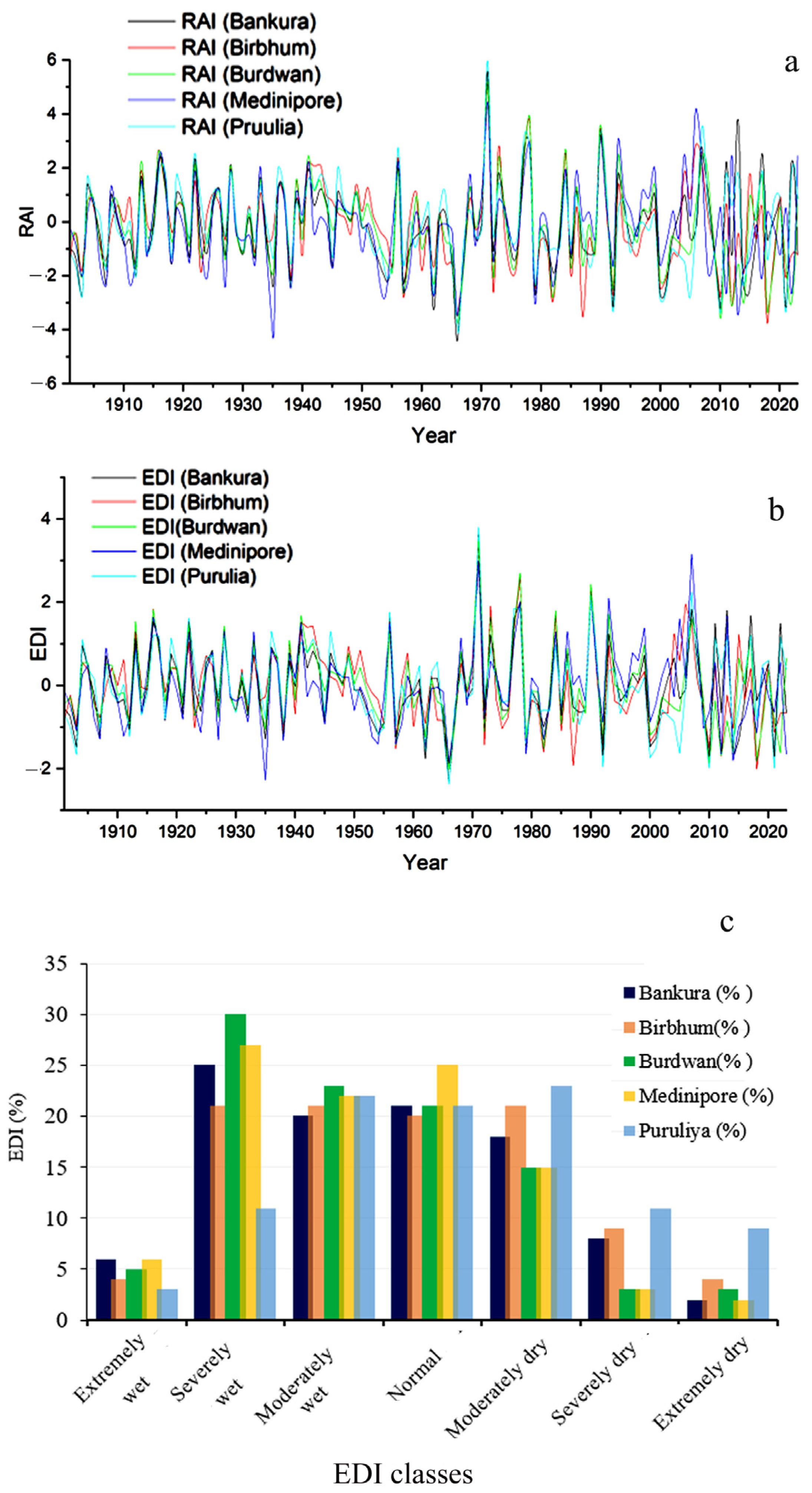
Burdwan, Medinipur, and Purulia had 8%, 8%, and 4% of the samples categorized as extremely humid (>4 RAI), respectively. With 36% of the sample classified as very humid (0–2 RAI), Burdwan has the highest rate, followed by Medinipur (29%), Birbhum (21%), Bankura (26%), and Purulia (17%) (Table 3). The analysis of the rainfall-based drought index (RAI) indicates that Burdwan and Medinipur experience comparatively lower drought severity than the other districts. Humid (0–2 RAI): The percentages of the samples allocated as humid in Bankura, Birbhum, Burdwan, and Medinipur are comparable, ranging from 23% to 27%. With 29%, Purulia has the highest proportion. Dry (−2 RAI): The proportion of the samples reported as dry in Bankura, Birbhum, and Medinipur ranges from 21% to 23%. With 21%, Burdwan has the lowest proportion. With 27%, Purulia has the highest proportion. This implies that compared to the other districts, Purulia has a higher percentage of its land classed as dry, suggesting a higher possibility of drought. Very Dry (−2 RAI): Bankura, Birbhum, and Medinipur have comparable rates of samples (14% to 16%) which fall within this category. With 9%, Burdwan has the lowest proportion. With a proportion of 14%, Purulia has the highest (Figure 4a). In comparison to the other districts, this shows that Purulia is dry, indicating an increased drought severity. Extremely Dry (<−4 RAI): The percentages of the samples in Bankura, Birbhum, and Purulia fall into this category, ranging from 7% to 11%, which are comparable.
In the Indian state of West Bengal, the districts of Bankura, Birbhum, Burdwan, Medinipur, and Purulia exhibit notable regional differences in terms of wet and dry conditions, as shown by the effective drought index (EDI) (Figure 4b). In comparison to the other districts, Burdwan has the largest percentage of extremely wet circumstances (30%), suggesting a higher frequency of high moisture levels. Purulia, on the other hand, stands out as having the greatest proportion of severely dry circumstances (9%), emphasizing its vulnerability to severe droughts. With 25% and 27% of their samples classed as severely wet, respectively, Bankura and Medinipur exhibit similar trends, indicating a tendency towards wetter weather. While Birbhum displays a fair distribution throughout classes, it is more common in moderately dry circumstances (21%) than in other situations (Figure 5). The overall range in EDI values among these districts highlights the heterogeneous climatic conditions seen in West Bengal, where certain regions are more vulnerable to precipitation while others are at high risk of drought. Because of this geographical variance, each district requires customized drought management and water resource planning techniques.

3.4. Pattern of Gamma SPI

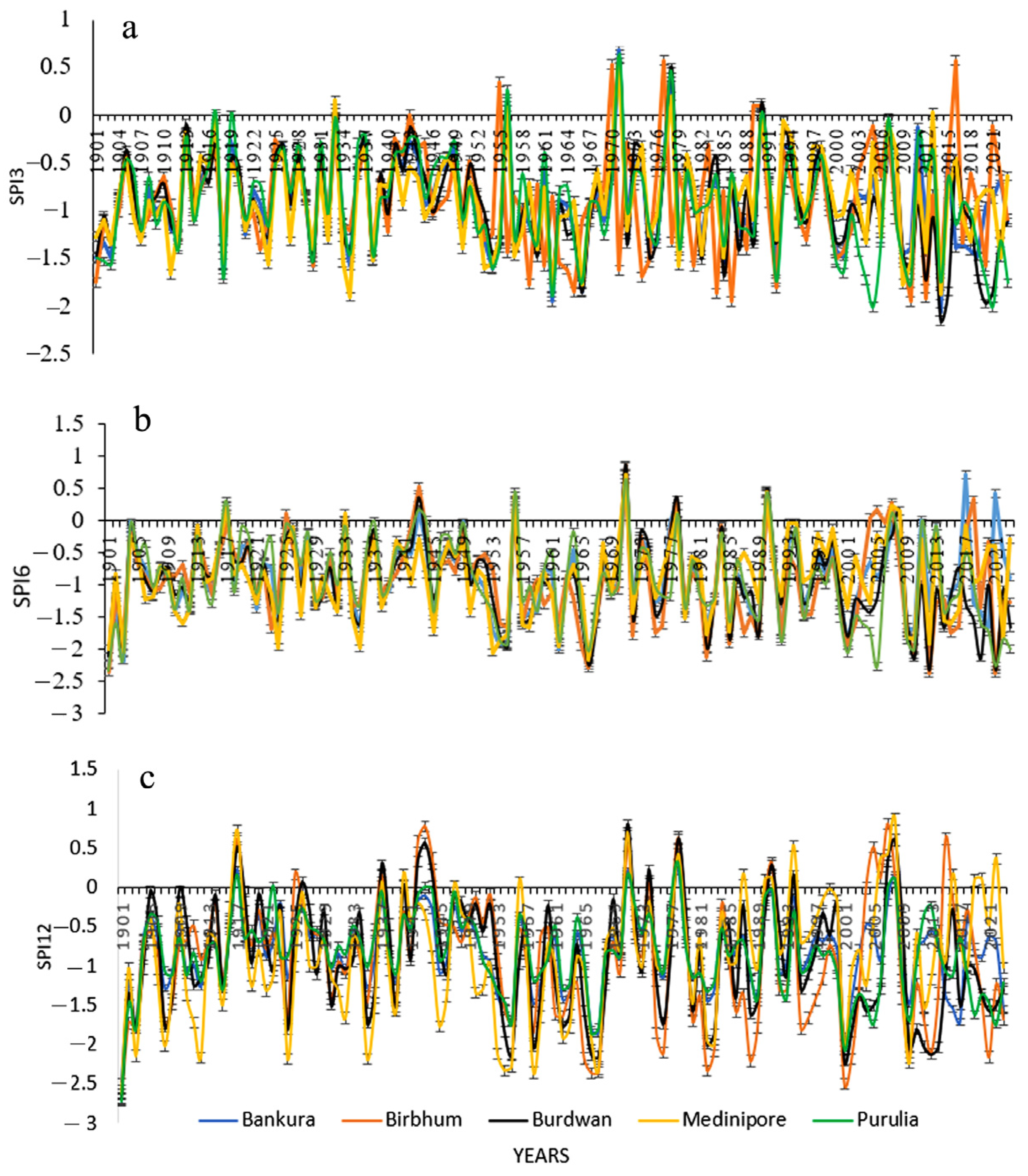
The standardized precipitation index (SPI) values for the districts of Bankura, Birbhum, Burdwan, Medinipur, and Purulia across three different timescales (3-month, 6-month, and 12-month) indicate varying levels of drought severity (Figure 6a–c). Consistently negative average SPI values across all districts and timescales suggest prevalent drought conditions, with Purulia and Birbhum experiencing the most severe droughts, evidenced by their lowest minimum SPI values. The variability in drought severity is further highlighted by the standard deviation and coefficient of variation, with higher values for the 6-month and 12-month SPIs indicating more significant fluctuations in precipitation over these longer periods. This increased variability underscores the importance of monitoring longer-term precipitation trends to better understand and mitigate the impacts of drought.
The 3-month standardized precipitation index (SPI) chart depicts the variability of drought conditions across five districts in West Bengal: Bankura, Birbhum, Burdwan, Medinipur, and Purulia, over a historical period. The SPI values range from −2.5 to 1, with negative values indicating drought and positive values indicating wet conditions. Throughout the timeline, there are pronounced fluctuations in SPI values for all districts, reflecting periods of both significant drought and wet conditions. Notably, Purulia and Bankura exhibit more frequent and severe drought episodes, with SPI values often dipping below −1.5, which is particularly evident during the mid-20th century and again around the 1980s and early 2000s. Medinipur and Birbhum show relatively less-severe droughts but still experience notable dry periods. Burdwan demonstrates considerable variability, with significant wet periods countering the dry spells.
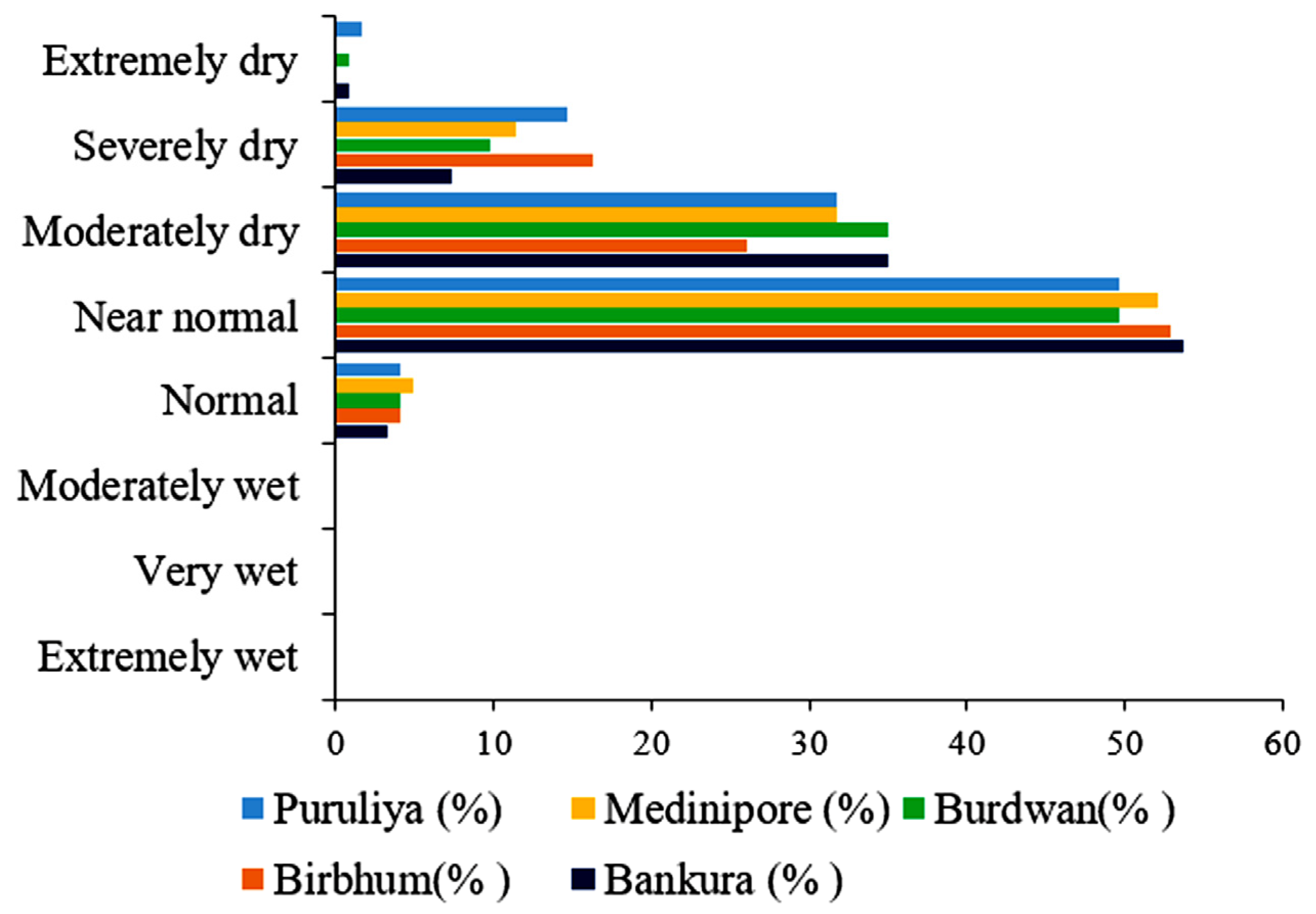
The overall trend highlights the recurrent nature of droughts across these regions, underscoring the need for effective drought management strategies tailored to the specific climatic patterns of each district. None of the districts experienced “extremely wet,” “very wet,” or “moderately wet” conditions (SPI > 1). A small percentage of periods fell under the “normal” category, with Medinipur (4.88%) and the other districts ranging from 3.25% to 4.07%. The majority of the periods were “near-normal” (SPI 0.0 to −0.99), with over half the periods in Bankura (53.66%), Birbhum (52.85%), and Medinipur (52.03%), and slightly lower percentages in Burdwan and Purulia (both at 49.59%). “Moderately dry” conditions (SPI −1 to −1.49) were significant, particularly in Bankura and Burdwan (both at 34.96%), and were slightly lower in Medinipur, Purulia (both at 31.71%), and Birbhum (26.02%). “Severely dry” conditions (SPI −1.5 to −1.99) were more prevalent in Birbhum (16.26%) and Purulia (14.63%), with lower percentages in Burdwan (9.76%), Medinipur (11.38%), and Bankura (7.32%). “Extremely dry” conditions (SPI ≤ −2) were rare but notable in Bankura, Burdwan (both at 0.81%), and Purulia (1.63%). These data highlight that while moderate drought conditions are common, severe and extreme drought conditions are present but less frequent, indicating the need for targeted drought mitigation strategies in these regions.

3.5. ARIMA Model Prediction on Test Data and Model Validation

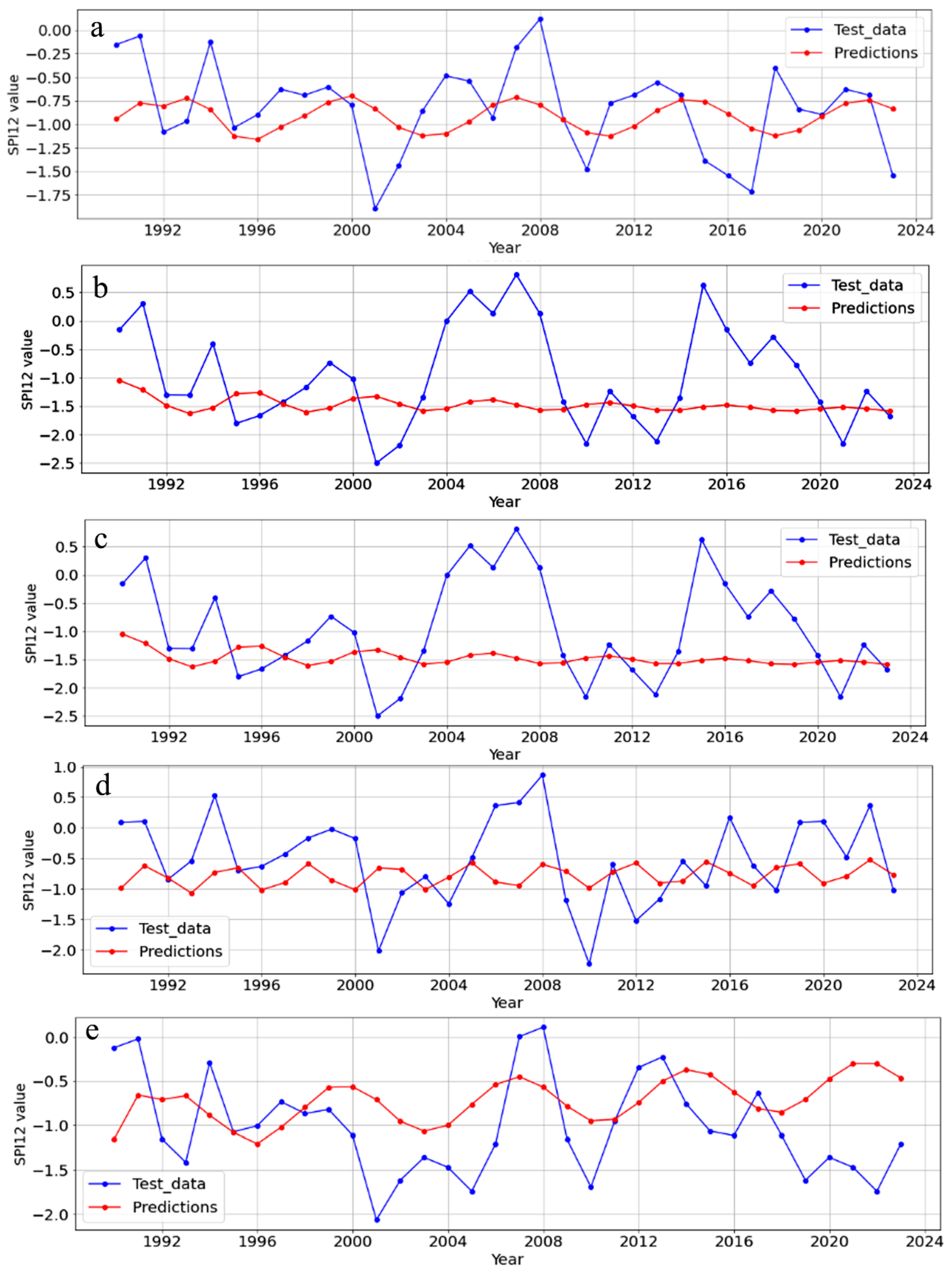
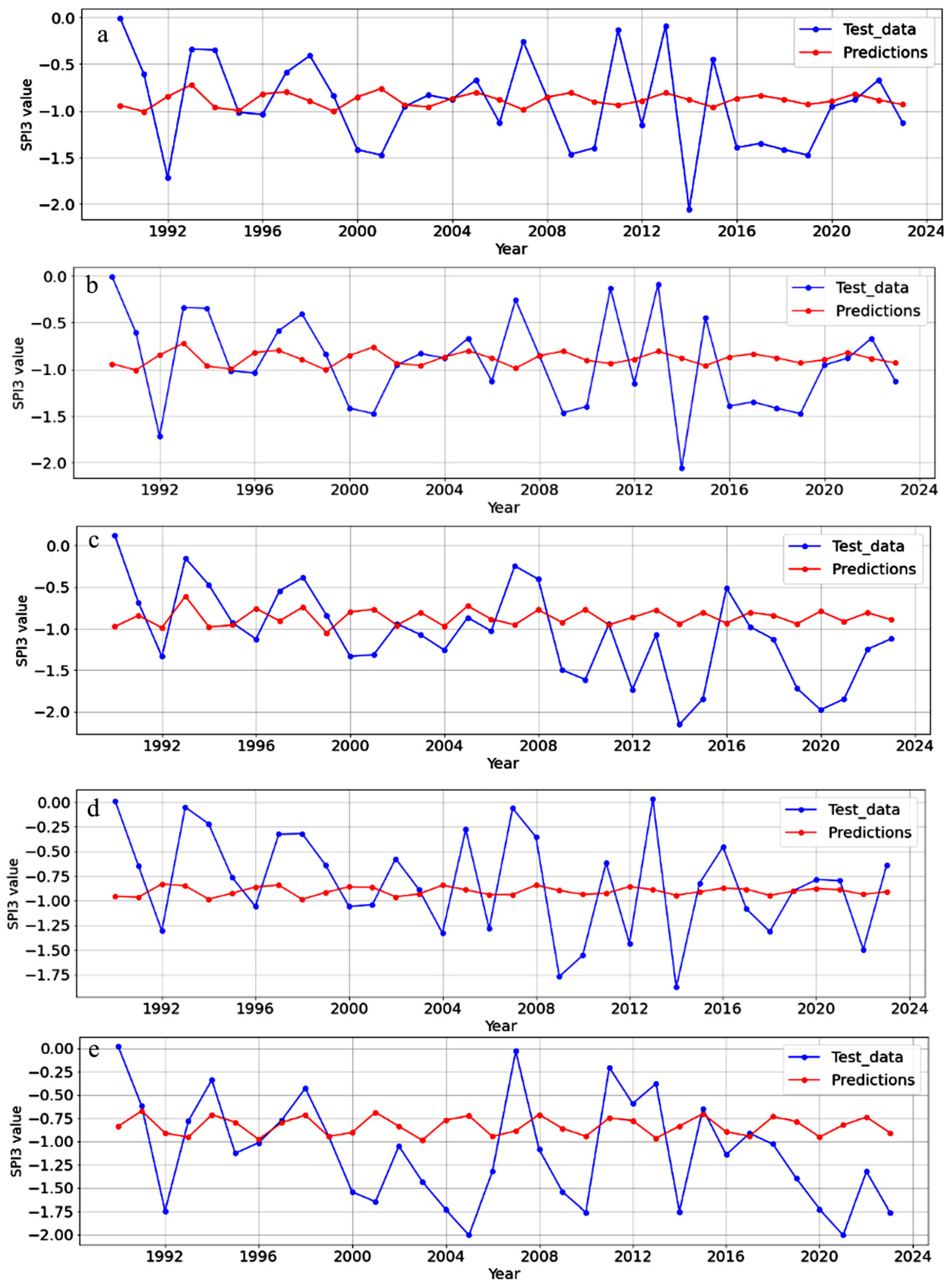
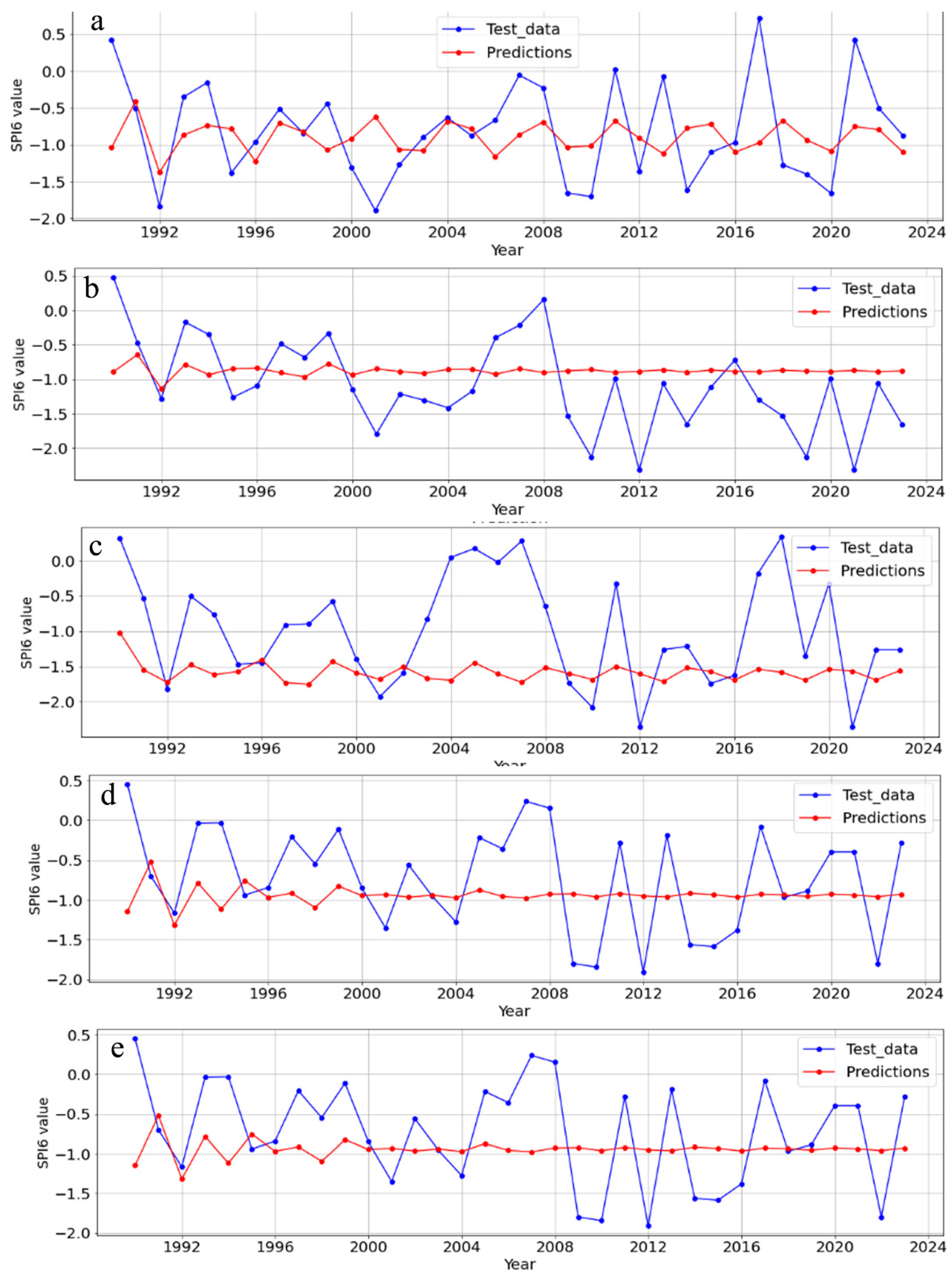
The performance evaluation shows different levels of the model’s accuracy and dependability in the context of drought prediction using ARIMA models across different stations (Figure 7, Figure 8 and Figure 9). With an R-squared value of 0.82, the ARIMA (4,1,5) model for SPI3 shows high predictive potential for Bankura. This means that the model accounts for 82% of the variability in the data (Table 4). The RMSE is 0.51, showing that the model’s predictions are quite close to the actual values.
The model’s AIC (144.611) and BIC (169.385) values are relatively low, suggesting a reasonable match. The residuals appear to be white noise (Ljung–Box statistic: 0.01; p-value: 0.91) and normally distributed (JB test: p-value: 0.49). Conversely, the R-squared value of 0.61 for the SPI6 model (ARIMA (5,1,6)) for Bankura is lower, indicating moderate explanatory power. The RMSE is 0.48, while the AIC (184.096) and BIC (213.824) are greater than in the SPI3 model. With a p-value of 0.30 and a normal distribution of 0.43, the residuals exhibit no significant autocorrelation. A further decrease in R-squared to 0.40, with comparable AIC and BIC values and an RMSE of 0.50, is demonstrated by the SPI12 model (ARIMA (4,1,4). The Ljung–Box statistic (0.01, p-value = 0.98) shows strong autocorrelation in the residuals, despite the fact that the residuals are normally distributed (p-value = 0.09). The ARIMA (4,1,4) model for SPI3 for Birbhum has an RMSE of 0.66, an AIC of 152.40, a BIC of 177.17, and a modest R-squared of 0.52. The residuals show no significant autocorrelation and normalcy, passing the JB test (p-value = 0.30) and the Ljung–Box test (p-value = 0.17). Nevertheless, the residuals of the SPI6 model (ARIMA (4,1,5)) for Birbhum pass the normalcy test (p-value = 0.04) but show some autocorrelation (p-value = 0.09). It also has a lower R-squared of 0.37, greater AIC (183.65) and BIC (213.38), and an RMSE of 0.91. At Burdwan, the performance of the ARIMA models for SPI3, SPI6, and SPI12 varies, with SPI6 (ARIMA (4,1,5)) obtaining the greatest R-squared of 0.69. Additionally, the model’s RMSE is 0.56, its residuals pass the Ljung–Box and JB tests, and its AIC (179.59) and BIC (209.32) values are acceptable. The R-squared of the SPI3 model (ARIMA (4,1,5)) is significantly worse at 0.16, but the SPI12 model (ARIMA (4,1,3)) exhibits a marginal improvement at 0.21. With R-squared values of around 0.52, Medinipur consistently demonstrates moderate performance throughout the SPI3, SPI6, and SPI12 models.
The JB and Ljung–Box tests on the residuals for each model yield no significant autocorrelation or abnormalities. The RMSE values vary from 0.52 to 0.54, and the AIC and BIC values are comparatively low, indicating a decent match. Lastly, Purulia displays performance variances across various SPI types. The AIC (149.249), BIC (174.022), and RMSE (0.62) are greater in the SPI3 model (ARIMA (4,1,5), which has a low R-squared of 0.21. With a lower AIC and BIC value, an RMSE of 0.58, and an R-squared of 0.63, the SPI6 model (ARIMA (4,1,5)) performs better. With an R-squared of 0.84, the SPI12 model (ARIMA (4,1,5)) has the strongest prediction ability. Every model’s residual passes the normality test and exhibits negligible autocorrelation.

3.6. ARIMA Model for the Prediction of SPI for 2030, 2040 and 2050

The ARIMA model predictions for future drought conditions based on the standardized precipitation index (SPI) values for the years 2030, 2040, and 2050 indicate varying degrees of drought severity across the districts of Bankura, Birbhum, Burdwan, Medinipur, and Purulia (Table 5). By 2050, Bankura is projected to experience increasingly severe droughts, especially in the short term (SPI3: −1.38). Birbhum shows a significant improvement in short-term drought conditions (SPI3: −0.05), suggesting near-normal conditions by 2050, though longer-term projections (SPI6 and SPI12) still indicate moderate drought. Burdwan and Medinipur show persistent drought conditions, with Medinipur experiencing particularly severe long-term drought (SPI6: −1.44). Purulia’s drought severity remains consistent, with a slight worsening over time, especially in the 12-month interval (SPI12: −1.38). Overall, these projections underscore the need for targeted drought management strategies, with particular attention to the more severely affected districts such as Bankura and Purulia.

3.7. Nature of Drought in Relation to NDWI, NDVI, and Groundwater Level

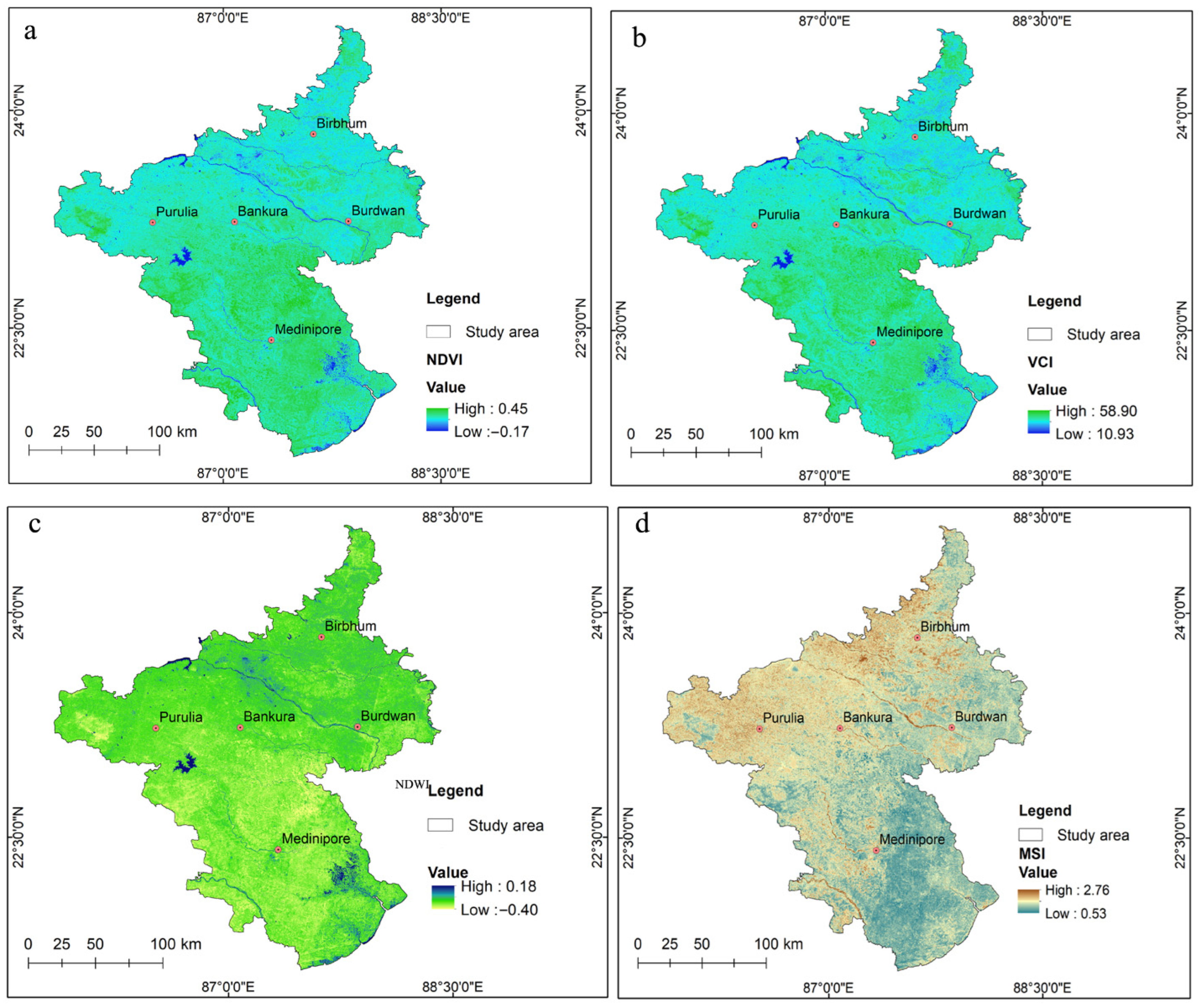
In the districts of Purulia, Bankura, Birbhum, and Burdwan, the nature of drought and its regional variations are evident through the analysis of the NDWI, NDVI, and groundwater levels (Figure 10a–d). Purulia and Bankura exhibit significant declines in the NDWI during drought periods, reflecting acute water scarcity due to their undulating terrain and lateritic soils which hinder water retention. These regions also show substantial drops in the NDVI, indicating severe vegetation stress and reduced crop yields.
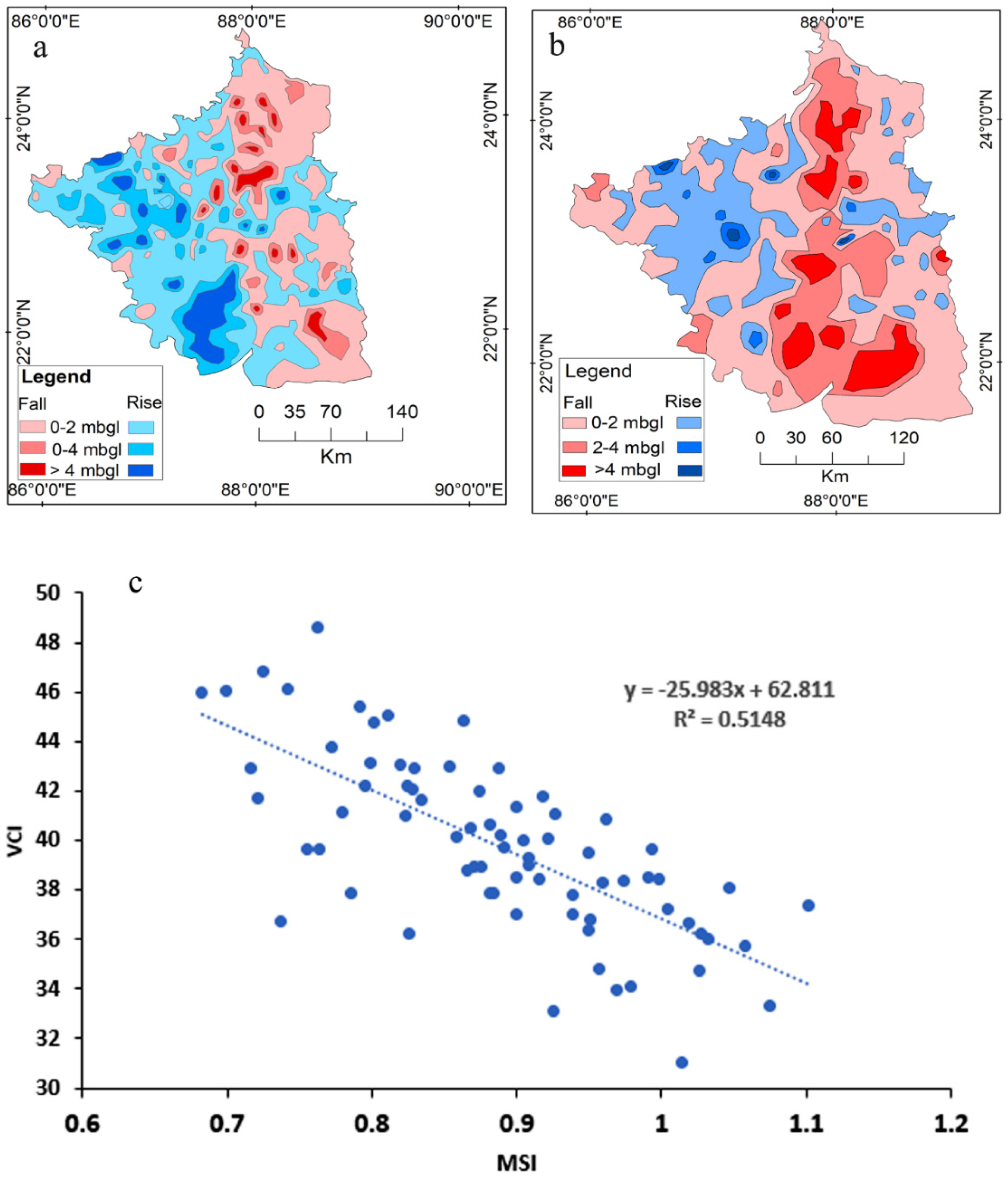
Groundwater levels in these districts decline markedly during droughts, further exacerbating water scarcity. Birbhum, with its plateau regions and diverse cropping systems, demonstrates moderate declines in the NDWI and NDVI, showing some resilience due to better natural water retention and mixed agricultural practices. Groundwater levels in Birbhum decline moderately but show better recovery rates. Burdwan, benefiting from extensive irrigation infrastructure and effective water management practices, shows relatively stable NDWI and NDVI values, with minimal impact on vegetation health during droughts. Groundwater levels in Burdwan exhibit lower declines, supported by both surface and groundwater sources. Overall, Purulia and Bankura are identified as highly vulnerable to drought, while Birbhum and Burdwan display varying degrees of resilience, underscoring the importance of regional water management and sustainable agricultural practices. With a R2 value of 0.5148, the equation y = −25.983x + 62.811 shows that the vegetative condition index (VCI) and the moisture stress index (MSI) have a negative connection (Figure 11). This implies that the health and vitality of vegetation decline dramatically with increasing moisture stress, which indicates drier circumstances. The VCI drops by around 25.983 units for every unit increase in the MSI, according to the slope of −25.983, highlighting the grave consequences of moisture stress on plants. Based on the moderate R2 value of 0.5148, changes in moisture stress may explain around 51.48% of the variability in vegetative status.

4. Discussion

Drought behaviour in eastern India is strongly governed by the variability of monsoonal rainfall, which remains highly erratic and spatially uneven across the region. Several national and global studies have shown that climate change is reshaping drought characteristics by intensifying evapotranspiration, disturbing monsoon circulation, and altering the temporal distribution of rainfall [1,2,3,4]. Rising temperatures and increased atmospheric moisture demand accelerate soil moisture depletion, thereby amplifying meteorological, agricultural, and hydrological drought even in years when seasonal rainfall totals appear near-normal [2,7,19]. The present results from the western Bhagirathi–Hooghly basin are consistent with this broader understanding, but they also demonstrate that drought frequency has risen sharply during the late twentieth and early twenty-first century, especially in Purulia and Bankura. In these districts, droughts now recur at roughly four-year intervals, which is much shorter than the 8–10-year recurrence interval observed during the early twentieth century. This shift is consistent with earlier regional findings for the drought-prone zones of West Bengal [15,16,23,24,25].

4.1. Climate Teleconnections and Drought Response

The association between large-scale ocean–atmosphere anomalies and drought in eastern India has been widely reported [2,3,14,15]. Consistent with this literature, our results show that almost all severe drought years in Purulia coincide with El Niño events. The warming of the eastern and central Pacific alters the Walker circulation and raises sea-surface temperatures in the Bay of Bengal, which disrupt monsoon onset and reduce rainfall over eastern India [2,3]. Table 6 clearly shows that at the national scale, El Niño years have repeatedly aligned with drought events across multiple climatic regions. Our long-term rainfall analysis for Purulia and the neighbouring districts reinforces this teleconnection by showing pronounced negative SPI anomalies during strong El Niño years such as 2002, 2005, 2010, and 2015.
In the present study area, the same pattern is visible: during the 2002, 2005, 2010, and 2015 El Niño years, SPI values fell sharply below −1.5, and vegetation indices (NDVI and VCI) showed widespread stress. Although a few exceptions exist (e.g., 2007, where rainfall did not collapse despite El Niño events), the overall teleconnection pattern remains robust. This finding strengthens the case for incorporating seasonal ENSO forecasts into drought-preparedness strategies for western West Bengal.

4.2. Comparison with Existing Research

Earlier drought research in India has primarily focused on SPI-based monitoring at national and regional scales. For example, Asadi Zarch et al. [10] and Satoh et al. [7] demonstrated the increasing severity of SPI-based drought under warming conditions. Thomas et al. [15] applied the SPI in Bundelkhand and highlighted the need for multi-temporal assessments, while Bhunia et al. [16] examined SPI patterns for three drought-affected districts in West Bengal. Our results not only corroborate these findings but extend them by using a longer 120-year rainfall dataset, allowing for the detection of decadal shifts in drought behaviour. Recent studies in Purulia and its neighbouring districts have used MCDM-based drought mapping [23], livelihood vulnerability analysis [24], and groundwater studies [25]. While these works highlighted structural dryness caused by lateritic soils, non-perennial rivers, and rugged terrain, they did not integrate climatic indices with remote sensing and time-series forecasting. Our results refine these earlier insights by showing how the structural water scarcity of the plateau fringe translates into a dynamic drought response, characterized by a sharper SPI decline, stronger rainfall anomalies, and slower recovery in the NDVI and groundwater.
At the methodological level, remote sensing has emerged as a powerful tool for drought monitoring [9,11]. However, most Indian studies employ the NDVI or NDWI in isolation. In contrast, our study combines the NDVI, NDWI, VCI, and MSI, enabling a more comprehensive assessment of vegetation stress and surface-water depletion. This approach aligns with the global best practices described by AghaKouchak et al. [11] and mirrors recent advances in drought ecology [4]. Forecasting studies in India have used ARIMA, hybrid, or machine learning models [3,12,13,21,22]. Han et al. [13] combined ARIMA with remote sensing data in China and Aldhafeeri et al. [21] introduced SPI-informed machine learning frameworks. Our work differs in that we model multi-temporal SPIs (SPI-3, SPI-6, SPI-12) with an AIC/BIC-guided ARIMA and validate using RMSE and residual diagnostics, as recommended in statistical hydrology [30,32]. This produces interpretable, district-level drought forecasts up to 2050.

4.3. Innovative Contribution and Practical Implications

Within this broader context, the present study contributes to the literature in three main ways. First, it introduces a region-specific integrated stochastic framework that couples century-long rainfall records (1905–2023), multiple probabilistic drought indices (SPI, EDI, and RAI), remote sensing-based vegetation and moisture indicators, and ARIMA-based SPI forecasts into a single workflow. To our knowledge, no earlier work has applied such a multi-index, multi-source stochastic framework to the western Bhagirathi–Hooghly basin or to the Rarh–plateau fringe of West Bengal [9,10,11,16,18,23,24,25]. Second, the study provides district-level differentiation of drought behaviour: Purulia and Bankura show high-frequency, high-severity drought with strong El Niño sensitivity and slow recovery, whereas Burdwan and Medinipur maintain relatively higher humidity and vegetation resilience due to better surface-water and groundwater infrastructure [16,17,23,24,25,27]. Third, by extending SPI-based ARIMA forecasts to 2050, the study quantifies the future persistence of negative SPI trajectories, especially in Bankura and Purulia, and explicitly links these forecasts with sectoral adaptation needs in agriculture and water management [1,3,5,7,8,14,18].
The implications for this practice are substantial. The integration of the SPI, remote sensing, and ARIMA modelling can enhance the precision and timeliness of early warning systems and drought monitoring, enabling more proactive planning by government agencies and communities [1,3,5,6]. In agriculture, the projected increase in moderate to severe drought—particularly under SPI6 and SPI12—supports a shift towards drought-tolerant crops, micro-irrigation, and soil moisture conservation measures in the lateritic uplands of Bankura and Purulia [5,15,16,23,24,25]. For water resources, ARIMA-informed forecasts can guide investments in check dams, recharge structures, and conjunctive use strategies, especially in the structurally water-scarce blocks identified in previous studies [17,23,24,25,27]. At the policy level, the combination of long-term drought statistics, ENSO–drought linkages, and remote sensing evidence of vegetation stress offers a sound scientific basis for district-level drought contingency plans and climate-adaptation strategies [1,2,7,18]. Finally, by making probabilistic drought projections transparent and reproducible, the stochastic framework proposed here can support climate-risk dialogues with local communities, improving the awareness, preparedness, and uptake of water conservation measures [5,6,8,18,19].

5. Conclusions

The study on drought assessment and prediction using SPI3, SPI6, SPI12, remote sensing, and ARIMA models in Bankura and Purulia concludes that these methods collectively provide a robust framework for accurately characterizing and predicting drought conditions. The SPIs effectively captured varying drought timescales, while remote sensing offered critical spatial insights into vegetation health and soil moisture. The ARIMA models demonstrated reliable future drought predictions, highlighting significant temporal variability and recurrent drought patterns. The findings underscore the severe impact of droughts on agriculture. In Bankura, where long-term drought conditions are more pronounced, measures such as introducing drought-resistant crops, promoting micro-irrigation in lateritic uplands, adopting contour trenching and mulching for soil moisture conservation, and expanding groundwater-recharge structures in highly affected blocks (e.g., Khatra and Ranibandh) are particularly suitable. In Purulia, where frequent short-to-medium-term droughts and rapid soil moisture depletion are dominant, the use of short-duration paddy and stress-tolerant minor millets, the development of village-level water-harvesting structures (check dams), the adoption of agroforestry systems, and strengthening community-based drought early warning communications are especially relevant. Overall, the study emphasizes the importance of integrating climate change considerations into drought models and suggests tailored regional adaptation strategies to build resilience in vulnerable communities. The integration of these tools enhances early warning systems, aiding policymakers in developing targeted drought mitigation strategies and preparedness.

Author Contributions

Conceptualization: M.A., J.M., H.T.H., M.S.A. and V.P.S.; Data Curation: M.A., J.M. and H.T.H.; Formal Analysis: M.A., J.M., H.T.H., M.S.A. and V.P.S.; Funding Acquisition H.T.H.; Investigation: M.A. and J.M.; Methodology: M.A., J.M. and H.T.H.; Project Administration: M.A., J.M., H.T.H., M.S.A. and V.P.S.; Resources: H.T.H., M.S.A. and V.P.S.; Software: M.A., J.M., H.T.H., M.S.A. and V.P.S.; Supervision: M.A., J.M. and H.T.H.; Validation: H.T.H.; Visualization: M.A., J.M., H.T.H., M.S.A. and V.P.S.; Writing Original Draft: M.A., J.M. and H.T.H.; Writing Review and Editing: M.S.A. and V.P.S. All authors have read and agreed to the published version of the manuscript.

Funding

Funding for this research was provided under award numbers RGP2/1196/46 by the Deanship of Scientific Research; King Khalid University, Ministry of Education, Kingdom of Saudi Arabia.

Data Availability Statement

The raw data supporting the conclusions of this article will be made available by the authors on request.

Acknowledgments

The authors extend their appreciation to the Deanship of Scientific Research at King Khalid University for funding this work through the Research Group under grant number RGP2/196/46.

Conflicts of Interest

The authors declare no conflicts of interest.

References

  1. Lawrence, J.; Blackett, P.; Cradock-Henry, N.A. Cascading Climate Change Impacts and Implications. Clim. Risk Manag. 2020, 29, 100234. [Google Scholar] [CrossRef]
  2. Vicente-Serrano, S.M.; Quiring, S.M.; Peña-Gallardo, M.; Yuan, S.; Domínguez-Castro, F. A Review of Environmental Droughts: Increased Risk under Global Warming? Earth Sci. Rev. 2020, 201, 102953. [Google Scholar] [CrossRef]
  3. Kim, T.W.; Jehanzaib, M. Drought Risk Analysis, Forecasting and Assessment under Climate Change. Water 2020, 12, 1862. [Google Scholar] [CrossRef]
  4. Bond, N.R.; Lake, P.S.; Arthington, A.H. The Impacts of Drought on Freshwater Ecosystems: An Australian Perspective. Hydrobiologia 2008, 600, 3–16. [Google Scholar] [CrossRef]
  5. Miyan, M.A. Droughts in Asian Least Developed Countries: Vulnerability and Sustainability. Weather Clim. Extrem. 2015, 7, 8–23. [Google Scholar] [CrossRef]
  6. Mishra, A.; Bruno, E.; Zilberman, D. Compound Natural and Human Disasters: Managing Drought and COVID-19 to Sustain Global Agriculture and Food Sectors. Sci. Total Environ. 2021, 754, 142210. [Google Scholar] [CrossRef]
  7. Satoh, Y.; Yoshimura, K.; Pokhrel, Y.; Kim, H.; Shiogama, H.; Yokohata, T.; Hanasaki, N.; Wada, Y.; Burek, P.; Byers, E.; et al. The Timing of Unprecedented Hydrological Drought under Climate Change. Nat. Commun. 2022, 13, 3287. [Google Scholar] [CrossRef]
  8. Güneralp, B.; Güneralp, I.; Liu, Y. Changing Global Patterns of Urban Exposure to Flood and Drought Hazards. Glob. Environ. Change 2015, 31, 217–225. [Google Scholar] [CrossRef]
  9. Kumar, V.; Sharma, K.V.; Pham, Q.B.; Srivastava, A.K.; Bogireddy, C.; Yadav, S.M. Advancements in Drought Using Remote Sensing: Assessing Progress, Overcoming Challenges, and Exploring Future Opportunities. Theor. Appl. Climatol. 2024, 155, 4251–4288. [Google Scholar] [CrossRef]
  10. Asadi Zarch, M.A.; Sivakumar, B.; Sharma, A. Droughts in a Warming Climate: A Global Assessment of Standardized Precipitation Index (SPI) and Reconnaissance Drought Index (RDI). J. Hydrol. 2015, 526, 183–195. [Google Scholar] [CrossRef]
  11. AghaKouchak, A.; Farahmand, A.; Melton, F.S.; Teixeira, J.; Anderson, M.C.; Wardlow, B.D.; Hain, C.R. Remote Sensing of Drought: Progress, Challenges and Opportunities. Rev. Geophys. 2015, 53, 452–480. [Google Scholar] [CrossRef]
  12. Qu, X.; Zeng, Z.; Yuan, Z.; Huo, J.; Wang, Y.; Xu, J. River Runoff Modelling and Hydrological Drought Assessment Based on High-Resolution Brightness Temperatures in Mainland China. Water 2021, 13, 2429. [Google Scholar] [CrossRef]
  13. Han, P.; Wang, P.X.; Zhang, S.Y.; Zhu, D.H. Drought Forecasting Based on the Remote Sensing Data Using ARIMA Models. Math. Comput. Model. 2010, 51, 1398–1403. [Google Scholar] [CrossRef]
  14. Jain, S.K.; Agarwal, P.K.; Singh, V.P. Problems Related to Water Resources Management in India. In Hydrology and Water Resources of India; Springer: Dordrecht, The Netherlands, 2007; pp. 871–936. [Google Scholar] [CrossRef]
  15. Thomas, T.; Jaiswal, R.K.; Nayak, P.C.; Ghosh, N.C. Comprehensive Evaluation of the Changing Drought Characteristics in Bundelkhand Region of Central India. Meteorol. Atmos. Phys. 2014, 127, 163–182. [Google Scholar] [CrossRef]
  16. Bhunia, P.; Das, P.; Maiti, R. Meteorological Drought Study Through SPI in Three Drought Prone Districts of West Bengal, India. Earth Syst. Environ. 2019, 4, 43–55. [Google Scholar] [CrossRef]
  17. Bandyopadhyay, S.; Sekhar Kar, N.; Das, S.; Sen, J. River Systems and Water Resources of West Bengal: A Review. In Rejuvenation of Surface Water Resources of India: Potential, Problems and Prospects; Geological Society of India: Bangalore, India, 2015; pp. 63–84. [Google Scholar] [CrossRef]
  18. Ahady, A.B.; Klopries, E.M.; Schüttrumpf, H.; Wolf, S. Drought Analysis Methods: A Multidisciplinary Review with Insights on Key Decision-Making Factors in Method Selection. Water 2025, 17, 2248. [Google Scholar] [CrossRef]
  19. Mondal, S.; Mishra, A. Quantifying the Precipitation, Evapotranspiration, and Soil Moisture Network’s Interaction Over Global Land Surface Hydrological Cycle. Water Resour. Res. 2024, 60, e2023WR034861. [Google Scholar] [CrossRef]
  20. Sarkar, P.; Kumar, P.; Vishwakarma, D.K.; Ashok, A.; Elbeltagi, A.; Gupta, S.; Kuriqi, A. Watershed Prioritization Using Morphometric Analysis by MCDM Approaches. Ecol. Inform. 2022, 70, 101763. [Google Scholar] [CrossRef]
  21. Aldhafeeri, A.A.; Ali, M.; Khan, M.; Labban, A.H. SPI-Informed Drought Forecasts Integrating Advanced Signal Decomposition and Machine Learning Models. Water 2025, 17, 2747. [Google Scholar] [CrossRef]
  22. Jang, O.J.; Moon, H.T.; Moon, Y. Il Drought Forecasting for Decision Makers Using Water Balance Analysis and Deep Neural Network. Water 2022, 14, 1922. [Google Scholar] [CrossRef]
  23. Mandal, K.K.; Alam, S.; Jaman, T.; Bera, M.K. GIS-Based Multi-Criteria Approach for Block Level Drought Hazard Mapping in the Purulia District, West Bengal, India. Discov. Environ. 2025, 3, 82. [Google Scholar] [CrossRef]
  24. Goswami, A.; Majumder, P. Assessment of Extreme Climatic Impact on Agricultural Livelihood in the Purulia District of West Bengal through Multi-Criteria Decision Model. In Agriculture and Climatic Issues in South Asia: Geospatial Applications; CRC Press: Boca Raton, FL, USA, 2023; pp. 371–398. [Google Scholar] [CrossRef]
  25. Bera, A.; Das, S. Water Resource Management in Semi-Arid Purulia District of West Bengal, in the Context of Sustainable Development Goals. In Groundwater and Society: Applications of Geospatial Technology; Springer: Cham, Switzerland, 2021; pp. 501–519. [Google Scholar] [CrossRef]
  26. Ghosh, S.; Guchhait, S.K.; Hu, X.F. Characterization and Evolution of Primary and Secondary Laterites in Northwestern Bengal Basin, West Bengal, India. J. Palaeogeogr. 2015, 4, 203–230. [Google Scholar] [CrossRef]
  27. Chowdhury, A.; Jha, M.K.; Chowdary, V.M.; Mal, B.C. Integrated Remote Sensing and GIS-Based Approach for Assessing Groundwater Potential in West Medinipur District, West Bengal, India. Int. J. Remote Sens. 2008, 30, 231–250. [Google Scholar] [CrossRef]
  28. Byun, H.-R.; Wilhite, D.A. Objective Quantification of Drought Severity and Duration. J. Clim. 1999, 12, 2747–2756. [Google Scholar] [CrossRef]
  29. Van Rooy, M.P. A Rainfall Anomaly Index Independent of Time and Space. 1965. Available online: https://www.scirp.org/reference/referencespapers?referenceid=3722343 (accessed on 4 December 2025).
  30. Shiau, J.T. Effects of Gamma-Distribution Variations on SPI-Based Stationary and Nonstationary Drought Analyses. Water Resour. Manag. 2020, 34, 2081–2095. [Google Scholar] [CrossRef]
  31. Sharon, A. Propositional Logic Applied to Three Contradictory Definitions of the Zeta Function, and to Conditionally Convergent Series. 2019. Available online: https://ssrn.com/abstract=3450279 (accessed on 4 December 2025).
  32. Busari, S.I.; Samson, T.K. Modelling and Forecasting New Cases of COVID-19 in Nigeria: Comparison of Regression, ARIMA and Machine Learning Models. Sci. Afr. 2022, 18, e01404. [Google Scholar] [CrossRef]
Figure 1. Location of the study area. (a) Location of the western part of the Bhagirathi–Hooghly River region (Rarh and plateau fringe) and (b) IMD meteorological station within the study region.
Water 17 03582 g001
Figure 2. Methodological framework explaining the drought assessment process.
Water 17 03582 g002
Figure 3. Methodological flow chart of the ARIMA model.
Water 17 03582 g003
Figure 4. Rainfall indices. (a) Temporal variation in the RAI from 1901 to 2020 for Bankura, Birbhum, Burdwan, Medinipur, and Purulia; (b) temporal variation in the EDI; (c) percentage distribution of EDI drought–wetness classes.
Water 17 03582 g004
Figure 5. Classification of drought category according to the values of SPI.
Water 17 03582 g005
Figure 6. Pattern of drought (a) SPI3, (b) SPI6, and (c) SPI12.
Water 17 03582 g006
Figure 7. Performance evaluation of the ARIMA model in predicting SPI-3 values across five representative meteorological stations: (a) Bankura, (b) Birbhum, (c) Burdwan, (d) Medinipur, and (e) Purulia.
Water 17 03582 g007
Figure 8. Performance evaluation of the ARIMA model in predicting SPI-6 values across five representative meteorological stations: (a) Bankura, (b) Birbhum, (c) Burdwan, (d) Medinipur, and (e) Purulia.
Water 17 03582 g008
Figure 9. Performance evaluation of the ARIMA model in predicting SPI-12 values across five representative meteorological stations: (a) Bankura, (b) Birbhum, (c) Burdwan, (d) Medinipur, and (e) Purulia.
Water 17 03582 g009
Figure 10. Characterizing drought in relation to NDWI, NDVI, and MSI. (a) (Spatial distribution of NDVI showing vegetation greenness variation across the study area. (b) VCI map illustrating vegetation stress relative to long-term conditions, (c) NDWI depiction indicating surface water and moisture availability, and (d) MSI map highlighting spatial patterns of surface moisture stress.
Water 17 03582 g010
Figure 11. Characterizing drought in relation to groundwater level. (a) groundwater fluctuation in monsoon, (b) groundwater fluctuation in post-monsoon and (c) the correlation between VCI and MSI.
Water 17 03582 g011
Table 1. Descriptive statistics of seasonal rainfall pattern (source: District Disaster Management Plan, Purulia (2020–2021).
StationsSeasons Average   ( x ¯ ) Standard Deviation (SD)Coefficient of Variation
(CV) in Percentage
BankuraPre-monsoon45.9006918.8707941.11221
Monsoon276.975747.8127917.26245
Post-monsoon31.818419.855562.40257
BirbhumPre-monsoon42.1985316.1532438.27914
Monsoon270.829652.7803219.48838
Post-monsoon31.2358619.3892162.07356
BurdwanPre-monsoon46.8824417.6853837.72282
Monsoon272.288549.2610118.09148
Post-monsoon31.0878517.4267456.05643
MedinipurPre-monsoon54.1599421.3475539.41575
Monsoon295.405353.0526617.95928
Post-monsoon42.3306822.6732853.56229
PuruliaPre-monsoon35.4906617.1133148.21921
Monsoon265.379646.5023317.52294
Post-monsoon28.5281315.8806755.66669
Table 2. Frequency of drought events and intensity in Purulia district.
PeriodsOccurrence and Intensity
1991–20001903 (Moderate)
2001–20151907 (Severe)
1901–19101911 (Severe)
1911–19201912 (Moderate)
1931–19401938 (Moderate)
1941–19501945 (Moderate)
1951–19601954 (Moderate)
1951–19601955 (Moderate)
1961–19701966 (Extreme)
1981–19901983 (Moderate)
1991–20001992 (Severe), 1998 (Moderate), and 2000 (Severe)
2001–20242001 (Severe), 2003 (Extreme), 2004 (Moderate), 2005 (Severe), 2010 (Severe), and 2015 (Extreme)
Table 3. The variation in the rainfall anomaly index of all the stations.
RAI RangeClassificationBankura (% of Sample)Birbhum (% of Sample)Burdwan (% of Sample)Medinipur (% of Sample)Purulia (% of Sample)
>4Extremely humid84884
0.2–4Very humid2621362917
0–2Humid2327232329
(−2)–0Dry2121212327
−2–(−4)Very dry151691414
<−4Extremely dry711339
Table 4. Statistics of ARIMA model.
Stations
Bankura
Data ARIMA ModelsPerformance Evaluation CriteriaLjung–Box StatisticsJB Test for Normality
of the Residuals
R2AICBICRMSETest Statisticp-Valuep-Value
BankuraSPI3ARIMA (4,1,5)0.82144.611169.3850.510.010.910.49
SPI6ARIMA (5,1,6)0.61184.096213.8240.480.300.430.43
SPI12ARIMA (4,1,4)0.40122.55149.800.500.010.980.09
BirbhumSPI3ARIMA (4,1,4)0.52152.40177.170.660.170.680.30
SPI6ARIMA (4,1,5)0.37183.65213.380.910.09 0.770.04
SPI12ARIMA (4,1,5)0.42191.83219.080.850.010.940.39
BurdwanSPI3ARIMA (4,1,5)0.16137.66162.440.580.110.740.42
SPI6ARIMA (4,1,5)0.69179.59209.320.560.030.870.80
SPI12ARIMA (4,1,3)0.21179.59209.320.570.030.870.08
MedinipurSPI3ARIMA (4,1,4)0.52136.40161.170.520.420.520.33
SPI6ARIMA (4,1,5)0.52175.01204.730.530.10.960.44
SPI12ARIMA (4,1,3)0.51175.01204.730.540.10.960.44
PuruliaSPI3ARIMA (4,1,5)0.21149.249174.0220.620.030.870.42
SPI6ARIMA (4,1,5)0.63182.59207.370.580.070.800.47
SPI12ARIMA (4,1,5)0.84182.59207.370.760.07 0.800.47
Table 5. ARIMA model for future prediction (2030, 2040 and 2050) based on SPI values.
Future Drought PredictionBankuraBirbhumBurdwanMedinipurPurulia
SPI3 (2030)−1.30−0.97−0.94−0.95−0.83
SPI3 (2040)−1.33−0.99−0.97−0.88−0.84
SPI3 (2050)−1.38−0.05−0.98−0.91−0.88
SPI6 (2030)−1.02−0.89−1.04−1.42−0.94
SPI6 (2040)−1.21−0.95−1.14−1.49−0.96
SPI6 (2050)−1.11−0.91−1.09−1.44−0.99
SPI12 (2030)−1.35−0.98−0.94−0.92−1.34
SPI12 (2040)−1.33−0.97−0.99−0.86−1.35
SPI12 (2050)−1.22−0.99−1.12−0.93−1.38
Table 6. Relation of Indian drought phenomena with El Niño events.
Northwest Region (NWR), Total (21)
Drought year (DY) 1904, 1925, 1948, 1972, 1974, 1982,1985, 1986, 1991, 1999, 2000
Moderate DY 1901, 1905, 1939, 1951, 2002
Severe DY 1911, 1915, 1918, 1987, 1911
Central Region (WCR), 17
DY 1902, 1904, 1965, 1966, 1968, 1979, 1987, 1995, 2004
Moderate DY 1905, 1941, 1972, 1974, 2002, 2009
Severe DY 1918, 1920
Central Northeast Region (CNER), 19
DY 1903, 1907, 1918, 1928, 1932, 1951, 1959, 1968, 1974, 1992, 2004
Moderate DY 1901, 1965, 1966, 1972, 2009, 2010
Severe DY 1979, 2002
Northeast Region (NER) 21
DY 1925, 1957, 1958, 1959, 1961, 1962, 1967, 1975, 1981, 1982, 1986, 1994, 1996, 2001, 2005
Moderate DY 1972, 1980, 1992, 2006, 2010
Severe DY 2008
Peninsular Region (PEN), 13
DY 1905, 1911, 1913, 1930, 1934, 1972, 1976, 1987, 1990, 1999
Moderate DY 0
Severe DY 1918, 1952, 2002
Red years are those featuring El Niño events.
Disclaimer/Publisher’s Note: The statements, opinions and data contained in all publications are solely those of the individual author(s) and contributor(s) and not of MDPI and/or the editor(s). MDPI and/or the editor(s) disclaim responsibility for any injury to people or property resulting from any ideas, methods, instructions or products referred to in the content.