1. Introduction
Urban stormwater runoff, particularly the “first flush,” is recognized as a dominant pathway for the transport of particulate and nutrient pollutants to receiving waters. The first flush typically carries disproportionately high loads of contaminants during the early stages of rainfall [
1]. Road-deposited solids and sediments transported by stormwater span a broad particle size range, from submicron particles to more than 10,000 μm [
2]. Significantly, more than 80% of stormwater pollutants are associated with fine particles smaller than 100 μm [
3,
4]. Among these pollutants, phosphorus is of particular concern. Phosphorus is readily adsorbed to fine particles and contributes significantly to eutrophication. Total phosphorus (TP) in runoff exists as both particulate phosphorus (PP) and dissolved phosphorus (DP), the latter being more bioavailable and rapidly assimilated by aquatic biota [
5,
6].
Conventional best management practices (BMPs) for stormwater, including sedimentation basins and sand filters, are capable of reducing particulate fractions but have limited efficacy for dissolved phosphorus. Field data often report TP removal rates of less than 40%, which is insufficient to meet the target range of 50–65% proposed for eutrophication control [
7]. Dissolved phosphorus remains particularly problematic; for example, Ostrom et al. (2019) found that DP accounted for 36–44% of TP in urban stormwater, with proportions exceeding 80% during autumn leaf decomposition [
8]. This underscores the critical need for treatment systems that effectively capture both fine particles and soluble phosphorus.
In response to these challenges, regulatory agencies have tightened stormwater performance standards. Since 2020, the Korean Ministry of Environment (MOE) has mandated that filtration-based nonpoint source (NPS) pollution control facilities achieve >80% annual SS removal and maintain <10 cm of head loss [
9]. Filtration units are widely considered among the most effective BMPs for urban stormwater due to their relatively high pollutant removal potential [
10,
11,
12,
13]. However, achieving consistently high phosphorus removal while meeting hydraulic constraints remains challenging with conventional systems.
Recent research has highlighted the importance of selecting appropriate filter media. Adsorptive materials with high surface area, strong P-binding capacity, durability, and low leaching potential are critical for enhanced phosphorus removal [
14]. Lightweight polypropylene fiber-ball media, in particular, have shown excellent removal efficiency for particles < 3 μm and superior recovery after backwashing compared to ceramic or granular alternatives [
4]. In parallel, up-flow filtration configurations have been demonstrated to outperform conventional down-flow systems under stormwater conditions with high solids loads, offering advantages such as reduced clogging, extended filter runs, and higher surface loading rates [
12,
15,
16].
Nevertheless, stormwater treatment facilities face significant challenges due to irregular rainfall, fluctuating flow rates, and variable pollutant concentrations. Most existing systems rely on fixed backwashing schedules or limited air–water flushing, which often results in incomplete media regeneration and reduced long-term performance. To date, the integration of Internet-of-Things (IoT) technology for automated control of stormwater filtration units has been minimal. The development of autonomous backwash control based on real-time monitoring is essential to ensure reliable and efficient operation under dynamic stormwater conditions.
In light of these needs, this study develops and evaluates a novel stormwater filtration system that combines high-efficiency up-flow filtration with IoT-enabled automatic control. In this study, polyaluminum chloride silicate (PACS) was used as the primary coagulant. Urban stormwater typically contains suspended solids at 50–1200 mg/L and total phosphorus at 0.1–2.5 mg/L, with substantially higher values often observed during first-flush events. The system integrates fiber-ball media and PACS coagulation to remove fine particles (<3 μm) and phosphorus simultaneously. Uniquely, it employs turbidity and pressure sensors as surrogate indicators to trigger autonomous operation. The objectives of this study are to (1) quantify turbidity, SS, and TP removal efficiencies under optimized coagulant dosing; (2) demonstrate the feasibility of real-time autonomous control based on turbidity as a surrogate for pollutant breakthrough; and (3) benchmark the performance of the IoT-enabled filter against conventional and advanced stormwater treatment systems. By addressing both the challenge of pollutant removal and the operational limitations of current BMPs, this work provides a proof-of-concept for next-generation smart stormwater treatment infrastructure.
2. Materials and Methods
2.1. Experimental Device
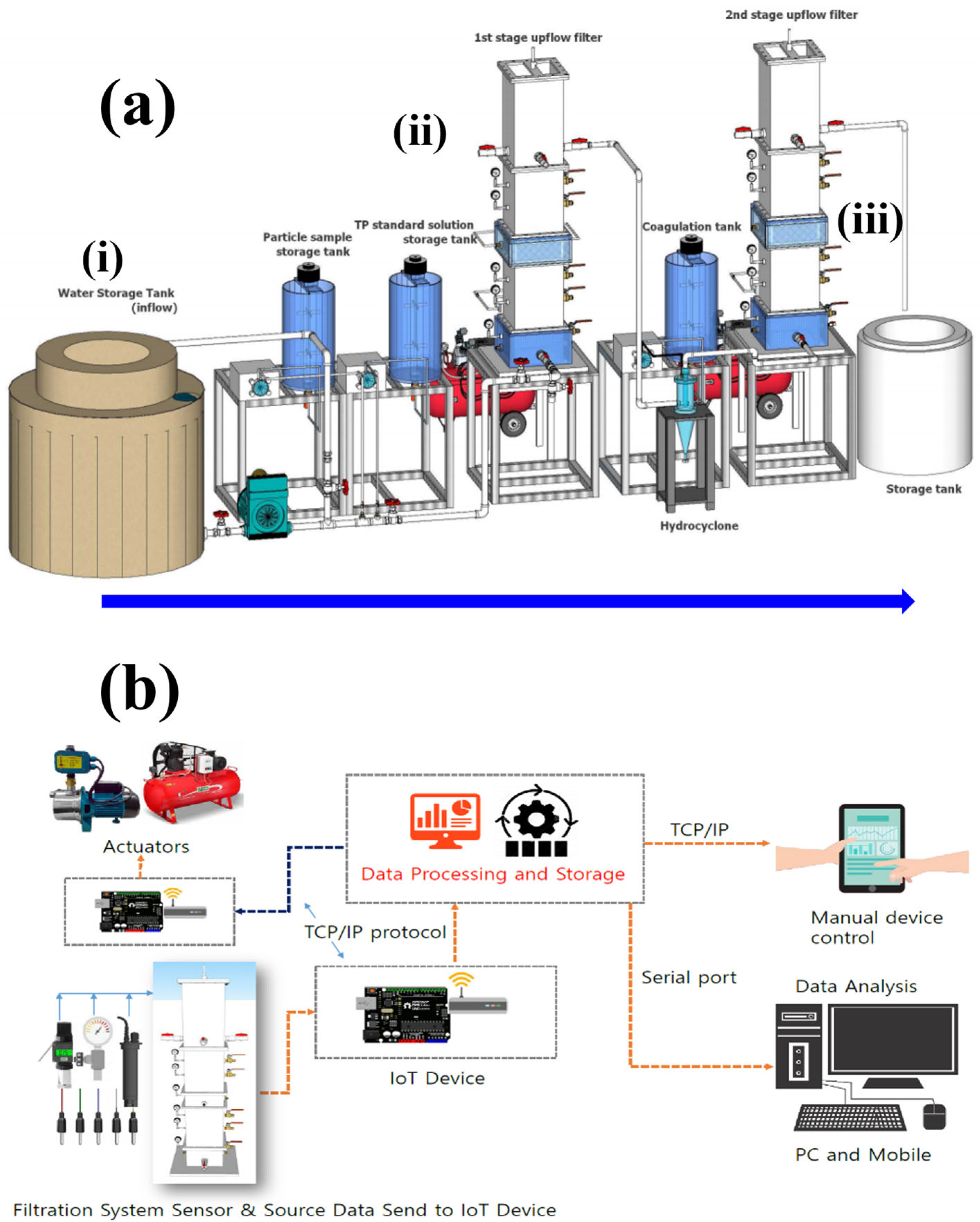
A laboratory-scale high-efficiency up-flow filtration system was designed to evaluate turbidity-based IoT control for stormwater treatment (
Figure 1). Component (i) represents the influent preparation and injection system, where particle suspensions and TP standard solutions are prepared and delivered to the filtration column. Component (ii) illustrates the dual-stage up-flow filtration system, including the coagulation tank and hydro cyclone for pre-treatment. Component (iii) represents the backwash and effluent handling system.
Influent preparation and dosing. The influent tank (20 L capacity) was fabricated from acrylic and equipped with a mechanical stirrer to ensure homogeneity of particle suspensions. A Masterflex peristaltic pump (Avantor, PA, USA) provided variable influent flow, allowing adjustment of surface overflow rates (15–27 m3·m−2·h−1). A separate coagulant reservoir with a metering pump enabled accurate injection of polyaluminum chloride silicate (PACS) upstream of the filter. For selected runs, the influent was directed through a dual hydrocyclone, installed to simulate combined coagulation and grit removal.
Filter column design. The two-stage filtration unit was constructed from transparent acrylic (0.2 m × 0.2 m cross-section, 1.2 m total height) for direct visualization of operation. Each stage contained 0.3 m of filter media, separated by a 0.1 m intermediate zone and topped with a 0.5 m freeboard. The total adequate volume was ~28 L. The cartridge-type design in 0.3 m increments allowed replacement of individual sections, flexible adjustment of column height, and easier maintenance under varied experimental conditions.
The filter media consisted of 20 mm diameter fiber-ball elements made of polypropylene (PP) and polyethylene (PE). Owing to their lightweight and compressible properties, the fiber balls offered ~95% porosity and high permeability, enabling high-rate operation with low head loss.
Backwashing devices. Airlift backwashers were embedded at the midpoints of each cartridge (0.1 m spacing), while supplementary air injection nozzles were installed at the base of the lower cartridge. This configuration enabled a two-step cleaning: primary resuspension via airlift and secondary scouring from the bottom. Effluent reservoirs collected the backwash water for solids mass balance.
A separate coagulant reservoir, equipped with a metering pump, was installed upstream of the dual-stage filtration system to ensure complete mixing before the influent entered the first-stage filter. The coagulant reservoir was not positioned between the filtration stages.
Instrumentation. Sampling ports were installed at the effluent of each media stage (
Figure S1) to monitor pollutant removal profiles along the column. Pressure gauges were mounted at 100 mm intervals and complemented by electronic pressure transducers for continuous head loss monitoring. Turbidity probes were installed at the influent, mid-column, and effluent positions to provide stage-wise performance data (
Figure S2).
IoT platform. The sensors were connected to a microcontroller-based IoT module (Arduino-compatible) that processed signals and wirelessly transmitted data (
Figure S3). The platform consisted of a data logger, Wi-Fi router, and local display. A feedback control algorithm was programmed such that when effluent turbidity exceeded a threshold or head loss reached 10 cm, the IoT device triggered automated valve operation to initiate backwashing. This integration allowed real-time monitoring, remote access via mobile devices, and autonomous operation with minimal manual intervention.
2.2. Operation and Analytical Methods
In this study, the first-flush condition was reproduced by artificially increasing the concentrations of fine suspended solids and TP in the influent rather than simulating a specific rainfall hydrograph. This approach was intended to emulate the characteristic pollutant surge observed during the initial phase of stormwater runoff. Only TP was measured, and fractionation into particulate phosphorus (PP) and dissolved phosphorus (DP) was not conducted. The discussion of PP and DP was intended to provide conceptual context for interpreting the observed turbidity–TP relationships. Future studies will incorporate PP/DP fractionation to evaluate how coagulation and filtration affect individual phosphorus species more directly.
Powdered particles smaller than 3 μm, certified by the Ministry of Environment (Korea), were first dispersed as a 10% (w/w) stock suspension in a 20 L stirred reservoir and then diluted with tap water to achieve target influent turbidity levels ranging from approximately 100 to over 400 NTU, corresponding to suspended solids concentrations of 200–1800 mg/L. To simulate nutrient loadings, a standard phosphate solution (KH2PO4, 1000 mg/L TP) was introduced into the influent stream by a Masterflex metering pump, (Avantor, PA, USA) and for selected experiments, the influent was directed through a hydrocyclone coagulation unit before entering the filter to promote particle aggregation.
The system was operated under variable hydraulic loading, with surface overflow rates adjusted between 15 and 27 m3·m−2·h−1 by controlling pump speed, and coagulant (PACS) doses in the range of 5–30 mg/L were applied based on jar test results. Each run continued until effluent turbidity indicated breakthrough or the terminal head loss approached 10 cm, with operation times ranging from less than 20 min to several hours, depending on the influent quality. Grab samples were collected at regular intervals of 5–10 min from the influent, mid-column ports, and final effluent to assess stage-specific removal of turbidity, SS, and TP.
Simultaneously, pressure gauges installed at 100 mm intervals and electronic transducers continuously recorded head loss, while turbidity sensors at the mid-column and effluent ports provided real-time monitoring, all signals being logged through the IoT acquisition system. At the end of each cycle, the column was drained and subjected to sequential backwashing consisting of a 5 min airlift agitation followed by drainage and sample collection, and a 5 min air scour from the bottom with subsequent drainage. The concentrations and volumes of wash water were used to estimate the mass of solids retained in the media.
Water quality analyses were performed according to Standard Methods [
17]: turbidity was measured with a Hach (CO, USA) 2100N turbidimeter (0–4000 NTU range), SS was quantified gravimetrically from 500 mL subsamples filtered through pre-weighed GF/C filters and dried at 105 °C, TP was analyzed after persulfate digestion by ascorbic acid colorimetry with a detection limit of ~0.01 mg/L, and pH was determined using a calibrated electrode. Particle size distribution of influent and effluent was assessed by laser diffraction (Mastersizer 3000, Malvern Instruments, Worcestershire, UK) to evaluate fine particle removal efficiency. Each operating condition was repeated in triplicate to ensure reproducibility, and sensor data were logged at 5 s intervals and synchronized with manual sampling. At the same time, threshold values for turbidity and head loss were used to validate the IoT-based automatic backwashing control.
3. Results
3.1. Coagulation Dose Optimization and Media Characteristics
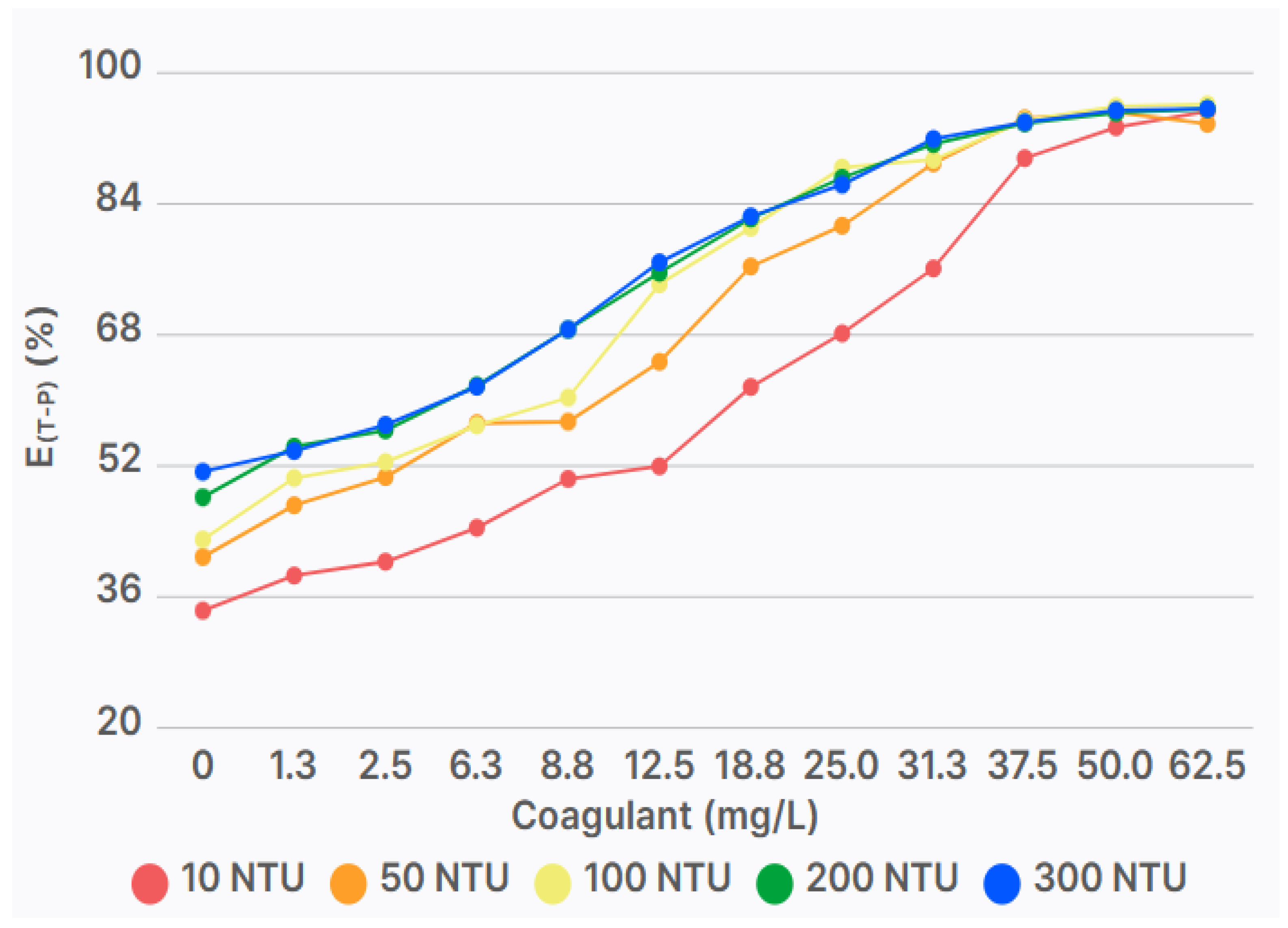
The effect of PACS dosage on phosphorus and turbidity removal was systematically evaluated under a wide range of influent turbidity conditions, representative of stormwater first flush events. Phosphorus removal efficiency increased steadily with increasing coagulant concentration for all turbidity levels. Still, the degree of response was highly dependent on the initial particle concentration (
Figure 2). At the lowest turbidity tested (10 NTU), phosphorus removal efficiency was limited to approximately 85% even at the highest PACS dose of 62.5 mg/L, reflecting the inherent difficulty of treating low-solids runoff where dissolved phosphorus dominates. In contrast, at moderate turbidity levels (50–100 NTU), TP removal exceeded 70% once PACS dosage surpassed ~25 mg/L, and continued to increase to nearly 90% at higher doses. Under high turbidity conditions (200–300 NTU), removal efficiencies were dramatically higher; more than 80% of phosphorus was removed with only 12.5 mg/L PACS, and near-complete removal (~95–100%) was observed at dosages of 25–30 mg/L. These results highlight the strong interaction between particulate matter concentration and coagulation efficiency, since abundant particles provide additional surfaces for phosphorus adsorption and promote the formation of stable flocs.
The observed dependency on turbidity levels can be explained by the distribution of phosphorus fractions in stormwater. Previous studies have shown that during high-intensity rainfall events, particulate phosphorus (PP) constitutes the majority of total phosphorus, whereas dissolved phosphorus (DP) is dominant in clearer runoff or during baseflow conditions [
1,
3,
8]. Because PACS is most effective at aggregating fine particles and colloidal matter, the presence of high particulate loads allows for rapid phosphorus removal through particle bridging and charge neutralization. Conversely, in low-turbidity waters, the high proportion of DP limits removal efficiency even at elevated coagulant doses, as DP is less responsive to traditional coagulation mechanisms. This distinction highlights the importance of tailoring coagulant dosing strategies to influent characteristics to achieve optimal treatment outcomes.
Based on these results, the optimal PACS dosage can be summarized in three ranges: (1) 5–10 mg/L, sufficient for >90% turbidity reduction regardless of influent solids concentration; (2) 20–30 mg/L, necessary to ensure >70% TP removal when influent turbidity is ≥100 NTU; and (3) doses >30 mg/L, which offer marginal gains beyond 90–95% phosphorus removal and may not be economically justified in routine operation. For this study, a concentration of 28 mg/L was selected for the IoT-controlled filtration trials to maximize phosphorus capture under simulated first flush conditions of ~300 NTU, balancing treatment efficiency with practical considerations of chemical consumption.
In parallel with coagulant optimization, the physical and hydraulic properties of the filter media were characterized to ensure their suitability for high-rate stormwater treatment. The spherical fiber-ball media, fabricated from a polypropylene/polyethylene blend with an average diameter of 20 mm, exhibited a very low bulk density (~0.083 g/cm
3) and exceptionally high porosity (~95%). SEM images confirmed a highly porous, fibrous structure that provides extensive surface area for particle entrapment while maintaining open flow channels (
Figure S4). Hydraulic conductivity tests indicated a clean-bed permeability of ~1.55 cm/s (~56 m/h), which is substantially higher than typical sand or granular media, enabling operation at elevated surface loading rates without significant head loss. The lightweight nature of the fiber balls also enhances their fluidization during backwashing, improving cleaning efficiency and minimizing clogging.
The regenerative capacity of the fiber-ball media is particularly relevant for stormwater BMPs, where intermittent operation and heavy particle loads can accelerate clogging. Previous studies reported that fiber-ball media restored ~89% of their initial filtration efficiency following a simple air–water backwash, significantly outperforming granular alternatives such as sand or ceramic media [
4]. This resilience reduces the need for frequent media replacement and lowers long-term operational costs. Furthermore, the spherical geometry of the fiber balls helps distribute hydraulic shear forces evenly during backwashing, further improving regeneration efficiency. Together, these attributes establish fiber-ball media as a robust alternative to conventional granular press, particularly for applications requiring high throughput, low head loss, and sustainable operation under variable influent conditions.
In summary, the coagulation dose optimization and media characterization confirm two critical requirements for effective stormwater treatment: (1) optimized PACS dosing that accounts for influent turbidity and phosphorus speciation, and (2) the use of engineered fiber-ball media that combine high porosity, low density, and strong regenerative properties. These findings provide the foundation for the subsequent filtration experiments, where the combined effects of coagulation and advanced filter media are further enhanced through the integration of IoT-enabled autonomous control.
3.2. Correlation of Turbidity with Suspended Solids and Total Phosphorus
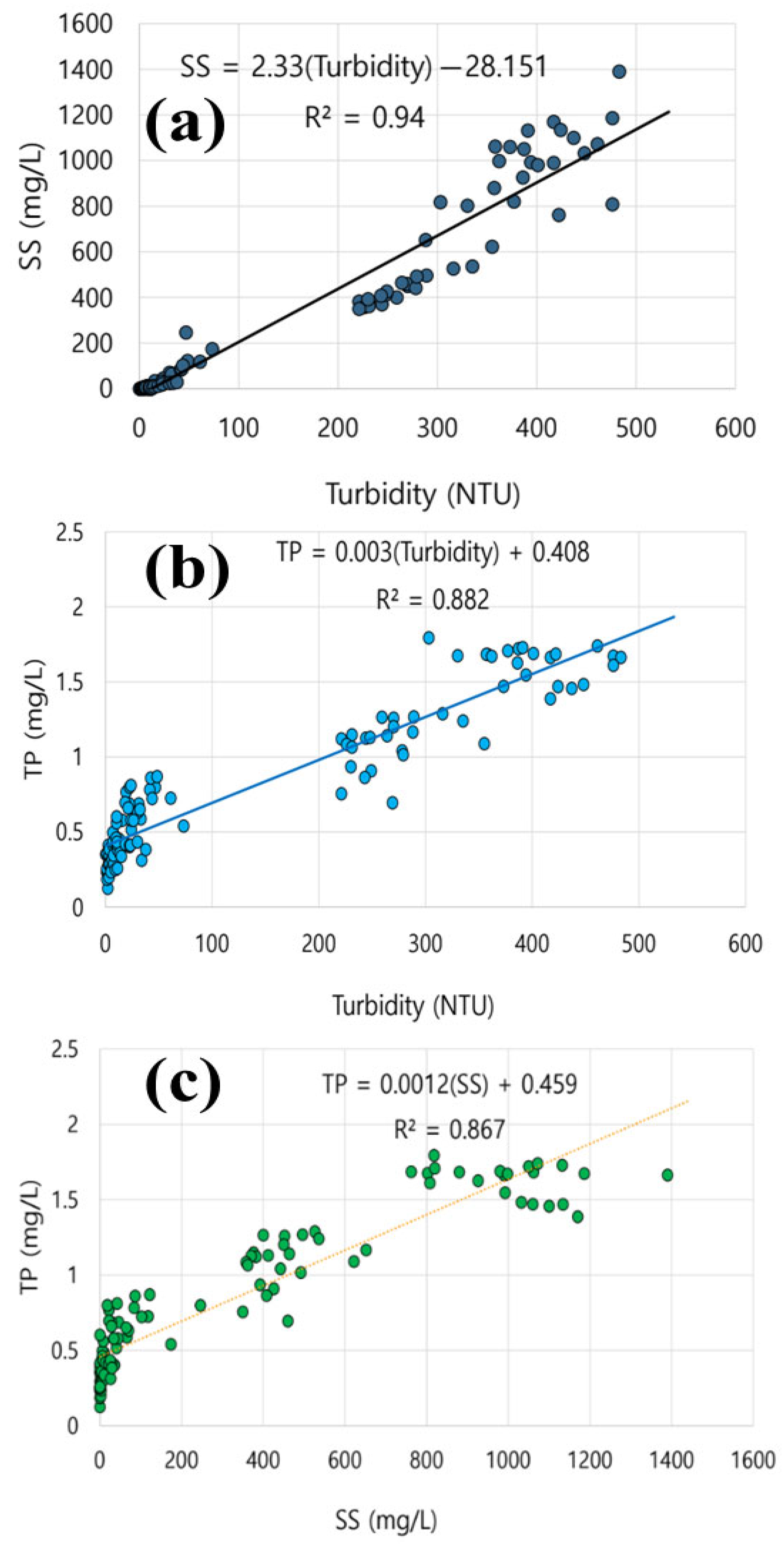
To evaluate the feasibility of using turbidity as a surrogate parameter for stormwater treatment control, correlations among turbidity, suspended solids (SS), and total phosphorus (TP) were analyzed (
Figure 3). The results demonstrated consistently strong linear relationships, suggesting that turbidity can serve as a reliable indicator of particulate pollution and associated phosphorus fractions in stormwater runoff.
The relationship between turbidity and SS was powerful (
Figure 3a). A linear regression yielded the equation SS = 2.33(Turbidity) − 28.15 with R
2 = 0.94, indicating that more than 90% of the variance in SS concentration can be explained by turbidity alone. This strong correlation is expected because turbidity directly measures the scattering of light caused by suspended particles in the water column. As turbidity increased from <50 NTU to nearly 500 NTU, SS concentrations rose from below 100 mg/L to over 1200 mg/L. The linearity across this wide range demonstrates that turbidity can be used as a robust predictor of SS in stormwater, including under high-loading first-flush conditions. These findings are consistent with previous studies that reported strong turbidity-SS relationships in urban runoff, where fine particles dominate pollutant loads [
2,
3].
A similarly strong correlation was observed between turbidity and TP (
Figure 3b). The regression TP = 0.003(Turbidity) + 0.408 yielded an R
2 of 0.882, indicating that turbidity explains nearly 90% of the variation in phosphorus concentration. This relationship reflects the fact that phosphorus in stormwater is strongly particle-associated, with particulate phosphorus (PP) often accounting for more than half of TP under high solids conditions [
5]. At low turbidity levels, TP concentrations were dominated by dissolved phosphorus (DP), typically ~0.4–0.5 mg/L, which explains the positive intercept in the regression. As turbidity increased, TP rose proportionally, reaching ~2 mg/L at 500 NTU. The slightly weaker correlation compared to turbidity–SS reflects the variability in DP contribution, which does not correlate directly with turbidity. Nevertheless, the high R
2 demonstrates that turbidity is an effective surrogate for predicting TP in most stormwater conditions, particularly during first-flush events where PP dominates.
The relationship between SS and TP further reinforces this linkage (
Figure 3c). The regression TP = 0.0012(SS) + 0.459 yielded R
2 = 0.867, confirming that TP increases proportionally with suspended solids concentration. This trend underscores the particulate-bound nature of phosphorus: as SS increases from <200 mg/L to >1200 mg/L, TP rises from ~0.5 mg/L to nearly 2.0 mg/L. The slope indicates that for every 1000 mg/L increase in SS, TP increases by ~1.2 mg/L. This finding supports the conclusion that removal of SS through coagulation and filtration will directly lead to significant reductions in TP, even when a fraction of TP remains in dissolved form.
These strong correlations have both scientific and practical implications. Scientifically, they support the conceptual understanding that phosphorus in stormwater is predominantly transported in particulate and colloidal forms, which are efficiently captured through coagulation and filtration. Practically, the correlations provide a sound basis for using turbidity as a low-cost, real-time surrogate for both SS and TP in IoT-based stormwater control systems. Turbidity sensors are inexpensive, robust, and capable of continuous monitoring, whereas nutrient-specific sensors are costly, maintenance-intensive, and often less reliable under field conditions. Previous research has highlighted the potential of turbidity-informed control strategies at the system scale (e.g., stormwater ponds). Still, this study provides one of the first demonstrations of such an approach at the unit-process level of filtration BMPs.
However, it is essential to recognize that these correlations were obtained under controlled laboratory conditions where particle characteristics and influent composition were relatively uniform. In actual stormwater runoff, the composition of suspended solids, the proportions of particulate and dissolved phosphorus, organic matter content, and hydrologic variability can differ substantially among sites and events. As a result, the strength of turbidity–SS–TP relationships may vary under real rainfall conditions, and turbidity-based surrogate monitoring will require field validation and site-specific calibration to ensure reliable performance.
In summary, while the laboratory findings confirm that turbidity can serve as a reliable proxy for particulate load and phosphorus under controlled conditions, its application in field-deployed IoT-based filtration systems should incorporate adaptive calibration and ongoing validation. Nonetheless, adopting turbidity as a primary feedback variable offers a promising pathway for enabling cost-effective, condition-responsive stormwater BMPs that minimize instrumentation complexity while maintaining high treatment efficiency.
3.3. Two-Stage Up-Flow Filtration Under Manual Operation
After confirming the optimal coagulant dosage and validating turbidity as a surrogate indicator, the performance of the two-stage upflow filter, operated under manual control, was evaluated to establish a baseline for comparison with the IoT-enabled system. The filter consisted of two sequential media beds, each 0.3 m in depth, for a total bed depth of 0.6 m. Operation was conducted at a surface overflow rate (SOR) of ~20 m3·m−2·h−1, which is approximately four to five times higher than the design loading rates typically recommended for conventional sand filters (<5 m3·m−2·h−1). This elevated hydraulic loading was selected to simulate first-flush stormwater conditions, which are characterized by rapid, high-volume flows carrying large pollutant loads.
The results demonstrated that the two-stage filter consistently achieved excellent pollutant removal (
Figure 4,
Table 1). An average of 96.6% reduced turbidity, while suspended solids removal reached 98.8%. Total phosphorus concentrations decreased from ~1.5–2.0 mg/L in the influent to ~0.2–0.3 mg/L in the effluent, corresponding to an average removal efficiency of 85.6%. These values are substantially higher than those reported for conventional BMPs, which often achieve less than 40% TP removal [
8]. Furthermore, the TP removal observed here exceeds the enhanced treatment target range of 50–65% recommended for mitigating eutrophication in urban receiving waters [
7]. This superior performance can be attributed to the combined effects of PACS coagulation, which effectively converts dissolved and colloidal phosphorus into particulate form, and fiber-ball media, which efficiently capture the resulting flocs.
Hydraulic performance was equally impressive. Head loss across the two media stages increased gradually during operation. Still, it remained below 10 cm in all runs, even after seven consecutive filtration cycles (
Figure 4a). The low and stable head loss reflects the advantages of the up-flow configuration. In contrast to down-flow filters, where particles accumulate at the top of the media bed and cause surface blinding, the up-flow design allows larger and denser particles to settle at the bottom of the filter column, minimizing clogging and prolonging run times. Previous studies have similarly reported that up-flow filters sustain longer operational cycles and higher hydraulic loading rates compared to their down-flow counterparts when treating solids-rich influents [
12,
16].
In addition to excellent performance, the two-stage filter demonstrated operational consistency across multiple cycles. The data summarized in
Table 1 show that pollutant removal remained consistently high, while head loss remained well within acceptable limits, regardless of cycle number. This indicates that the filter media maintained its effectiveness after backwashing, highlighting the resilience of fiber-ball media. These results confirm that the two-stage up-flow filter can serve as a high-performance BMP capable of meeting regulatory standards and provide a robust benchmark for evaluating the added benefits of IoT-enabled autonomous control. Although residual aluminum was not measured, the influent pH during all filtration cycles remained within the circumneutral range (6.5–7.8), a range in which PACS-generated aluminum residuals are generally minimal according to previous studies. A detailed assessment of effluent aluminum will be needed in future work to confirm regulatory compliance.
Airlift backwashing effectively detached accumulated solids from the fiber-ball media, producing a concentrated backwash stream. Although the treatment of backwash water was not included in this study, such streams in field applications are typically managed through simple settling, dewatering, or transfer to municipal wastewater facilities due to their relatively small volume and high solids content.
3.4. IoT-Based Single-Stage Filtration Operation
Building on the strong baseline established with manual operation, a single-stage up-flow filter equipped with IoT-enabled autonomous control was evaluated. The system was instrumented with turbidity and pressure sensors connected to a microcontroller programmed with a feedback algorithm. The control logic was designed to initiate backwashing when head loss exceeded 10 cm or effluent turbidity rose above a set threshold. This configuration allowed the filter to adapt dynamically to real-time influent conditions without requiring manual intervention.
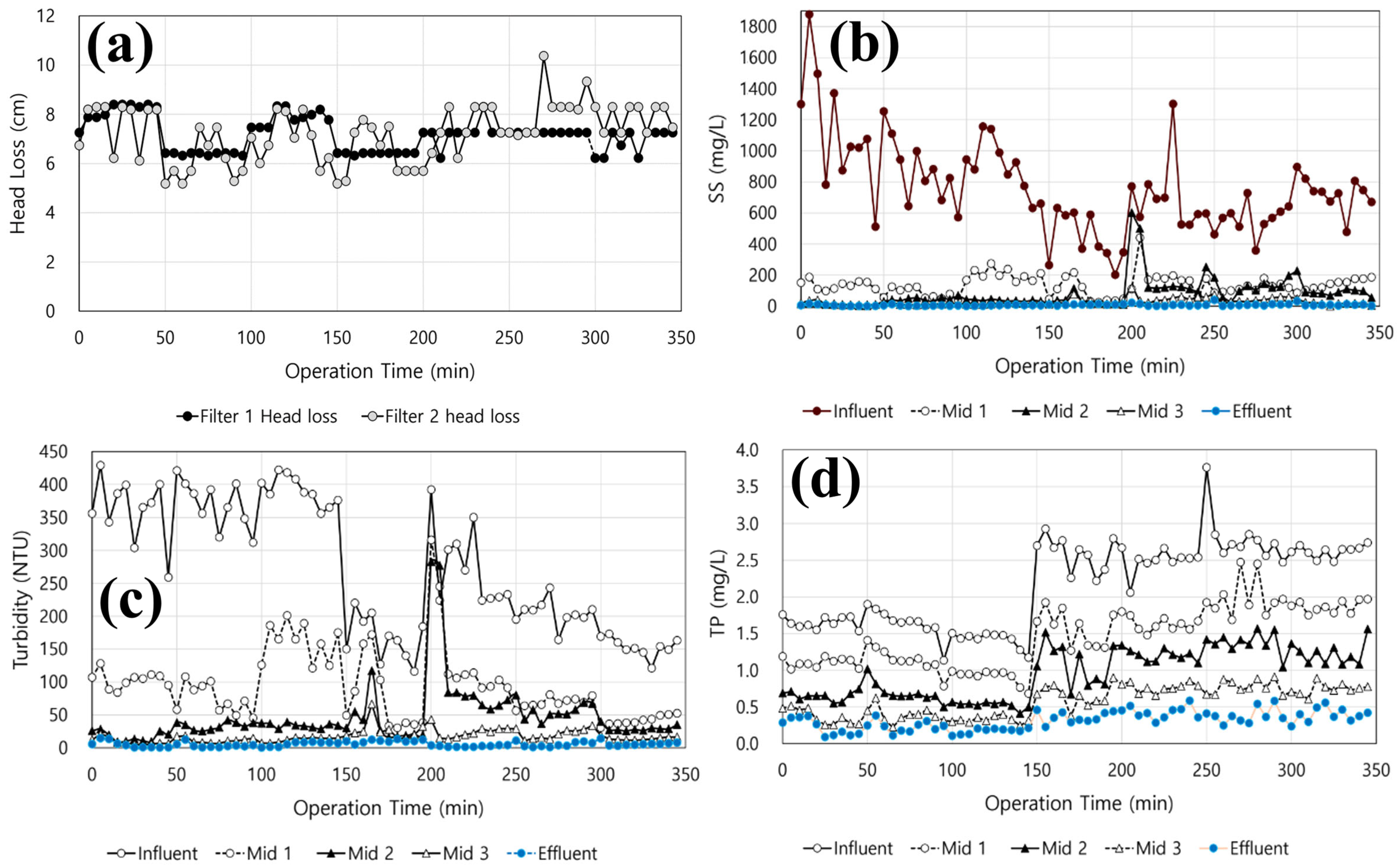
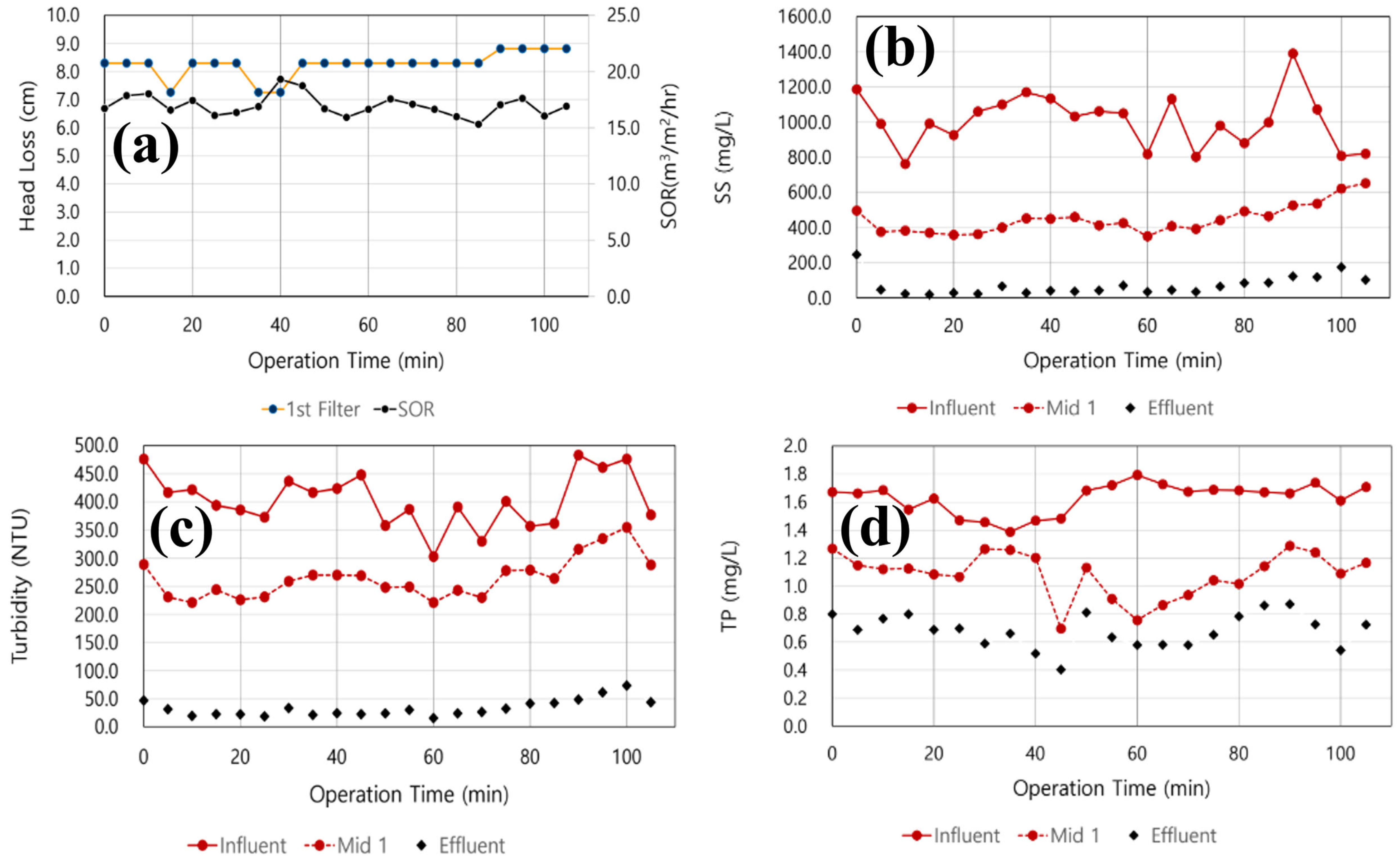
The filter was tested under extreme influent conditions representative of first-flush runoff. Average influent turbidity was ~403 NTU, suspended solids averaged ~1008 mg/L, and total phosphorus averaged ~1.63 mg/L, all significantly higher than typical urban stormwater levels. PACS was continuously dosed at 28 mg/L, a concentration selected based on coagulation optimization results to ensure reliable phosphorus removal under high solids loading. Despite these severe conditions, the system maintained stable hydraulic performance. Head loss remained between 7.3 and 8.8 cm throughout 105 min of continuous operation and never exceeded the 10 cm threshold that would trigger backwashing (
Figure 5a). This demonstrates that the filter was capable of treating a whole storm event without requiring manual maintenance, underscoring the effectiveness of real-time monitoring and control in sustaining operation under variable conditions.
Pollutant removal performance was also noteworthy. Effluent turbidity ranged from 15.5 to 73.2 NTU, corresponding to 20–96% removal with an average of ~51% (
Figure 5c). Suspended solids removal was consistently high, averaging ~92% with a range of 78.5–98.2% (
Figure 5b). Total phosphorus concentrations decreased to 0.40–0.87 mg/L, corresponding to removal efficiencies of 47.7–72.9% and an average of ~58% (
Figure 5d). Although TP removal was lower than the ~85% achieved with the two-stage filter, it still met the enhanced treatment targets of 50–65% and substantially outperformed conventional passive filters. These results highlight the capacity of the IoT-controlled system to provide reliable pollutant removal even in compact, single-stage configurations.
The implications of these results are significant. By integrating IoT-based feedback control, the filter was able to maintain stable operation and high removal efficiencies without manual oversight. This level of autonomy is particularly valuable for decentralized applications in urban areas, where maintenance resources are limited and pollutant loads are highly variable. The ability to initiate backwash only when necessary reduces water and energy consumption compared to time-based schedules, contributing to more sustainable operation. Furthermore, the successful demonstration of IoT-enabled filtration at the unit process level represents a significant advancement over previous applications of innovative stormwater management, which have primarily focused on system-scale control, such as detention basins.
In summary, the IoT-based single-stage filter demonstrated that autonomous control can sustain treatment performance and optimize maintenance under challenging influent conditions. This finding confirms the potential of intelligent, turbidity-informed filtration systems as next-generation BMPs capable of providing reliable, adaptive stormwater treatment in real-world urban environments.
3.5. Comparison with Existing Stormwater Treatment Systems
To contextualize the performance of the developed system, it is helpful to compare it with established stormwater treatment technologies documented in the literature. Media cartridge filters, such as the StormFilter
® system (Contech Engineered Solutions, OH, USA) verified by the U.S. EPA, typically achieve 70–90% removal of suspended solids (SS) and 30–60% removal of total phosphorus (TP) [
18,
19]. However, their performance deteriorates under high turbidity events due to clogging, necessitating frequent maintenance.
Bioretention and sand-based filters have also been widely studied. Hsieh and Davis (2005) reported that optimized sand/soil mixes can effectively reduce SS in urban runoff, while phosphorus removal remains variable [
20]. Liu and Davis (2014) further demonstrated that phosphorus speciation plays a key role, with particulate phosphorus more effectively removed by filtration than dissolved forms, highlighting the inherent limitation of conventional sand or bioretention filters [
3].
Advanced treatment methods, such as membrane filtration, provide higher removal efficiencies. Dietze et al. (2003) showed that membrane systems could remove more than 95% of SS and achieve 70–90% phosphorus reduction [
21]. Similarly, Koh et al. (2020) reported significant phosphorus removal from wastewater using ultrafiltration, although fouling and operational costs remain critical barriers to large-scale stormwater applications [
22].
Constructed wetlands and biofilters amended with sorptive media represent another line of development. Arias et al. (2013) characterized phosphorus transport in urban runoff [
10]. They emphasized the role of fine suspended sediments, while Balch et al. (2013) demonstrated that media amendments can substantially enhance phosphorus capture in pilot-scale biofiltration systems [
23]. Despite these improvements, such systems are subject to seasonal variability and lack real-time operational control.
In contrast, the up-flow IoT-controlled filter developed in this study achieved nearly 99% SS removal and ~85% TP removal under high surface loading rates. Under autonomous operation, the system maintained >90% SS and ~58% TP removal even at extreme influent conditions (turbidity ~400 NTU, SS > 1000 mg/L, TP ~1.6 mg/L), while controlling head loss and backwash without manual intervention. These results demonstrate that the proposed system rivals or surpasses the performance of advanced technologies, while offering operational simplicity and resilience required for practical urban deployment.
3.6. Implications for Smart Stormwater Management
The findings of this study have several important implications for advancing stormwater management practices. First, the results demonstrate that coagulation-assisted up-flow filtration can provide pollutant removal efficiencies that substantially exceed those of conventional BMPs. By integrating PACS dosing with fiber-ball media, the system achieved ~99% SS removal and up to ~85% TP removal at high surface loading rates, outperforming traditional filters and even approaching the performance of membrane technologies. These outcomes suggest that up-flow filtration with engineered lightweight media represents a robust and scalable solution for treating stormwater first flushes, which are typically characterized by high solids and nutrient loads.
Second, validating turbidity as a reliable surrogate for both SS and TP has practical significance for the deployment of IoT-enabled BMPs. Strong correlations (R2 = 0.94 for SS, R2 ≈ 0.88 for TP) indicate that continuous turbidity monitoring can effectively substitute for more complex nutrient sensors, which are expensive, maintenance-intensive, and often unsuitable for field conditions. By leveraging turbidity as the primary control parameter, IoT-based systems can achieve real-time, condition-responsive operation without compromising treatment objectives. This approach simplifies system design, reduces costs, and makes the technology more accessible for large-scale implementation.
Third, the successful demonstration of IoT-based autonomous control at the unit-process level marks a significant advance in the evolution of smart stormwater infrastructure. While previous efforts have focused on basin-level or watershed-scale controls, few studies have applied IoT technology directly to filtration BMPs. The ability of the developed system to autonomously maintain head loss below 10 cm, optimize backwash timing, and sustain pollutant removal under extreme influent conditions demonstrates its resilience and adaptability. This level of autonomy is critical to ensuring reliable operation in the face of unpredictable rainfall patterns and fluctuating pollutant levels, both of which are expected to intensify under climate change scenarios.
Finally, the broader implication of this research is the potential to integrate networks of IoT-enabled filtration units into urban stormwater systems. By linking multiple autonomous filters through wireless communication, it is possible to create coordinated, watershed-scale treatment strategies that dynamically adjust to spatial and temporal variations in runoff quality. Such an approach could transform stormwater management from a static, infrastructure-heavy practice into a flexible, adaptive system capable of responding in real time to environmental challenges. This vision aligns with emerging global priorities for sustainable urban water management, integrating water quality protection with digital innovation and resilience planning.
Several practical considerations are relevant for the field implementation of the developed system. Fiber-ball media are commercially available at approximately 8–15 USD per kg, and based on durability data reported for similar filtration media and the backwash recovery observed in this study, full or partial replacement is typically expected every 1–2 years, depending on solids loading and maintenance frequency. The system is designed to target fine particles and phosphorus; additional treatment components, such as sorptive media, would be required to address hydrophobic pollutants, such as oils. The estimated energy demand for pumping and airlift backwashing is relatively low (<0.1 kWh per m3 of treated water), supporting the feasibility of autonomous operation. Despite these advantages, several aspects, such as managing backwash water, monitoring residual aluminum, and validating performance under variable stormwater compositions, remain unresolved challenges that warrant further investigation.
4. Conclusions
This study developed and evaluated a novel stormwater treatment system that integrates coagulation-assisted up-flow filtration with IoT-enabled autonomous control. Laboratory-scale experiments demonstrated that combining optimized PACS dosing with lightweight fiber-ball media effectively addresses two critical challenges in stormwater management: the removal of fine suspended solids and the reduction in phosphorus loads. Results showed that under two-stage manual operation, the system achieved ~99% SS removal, 96.6% turbidity reduction, and ~85% TP removal, far surpassing the performance of conventional BMPs and meeting enhanced treatment benchmarks for eutrophication control.
A key innovation of this work was the validation of turbidity as a surrogate parameter for real-time control. Strong correlations were observed between turbidity and both SS (R2 = 0.94) and TP (R2 = 0.882), confirming that turbidity can reliably reflect pollutant concentrations in stormwater runoff. Leveraging this relationship, the IoT-controlled single-stage filter maintained stable hydraulic performance (head loss < 10 cm) and achieved >90% SS removal and ~58% TP removal under extreme influent conditions, without requiring manual intervention. These findings represent one of the first demonstrations of autonomous operation at the unit process level of a stormwater BMP.
The scientific contributions of this study lie in providing robust evidence that IoT-based feedback control can be successfully integrated with advanced filter media to create innovative, adaptive stormwater treatment systems. The use of turbidity as a low-cost, real-time proxy for pollutant removal simplifies system design and operational control, bridging the gap between laboratory research and practical field deployment. In field applications, upflow operation can be maintained using a controlled-inlet pump or a constant-head distribution chamber. Pressure monitoring can be achieved with low-maintenance digital sensors, and coagulant dosing can be automated or applied only during high-load events. Therefore, the required operational effort is comparable to that of other BMPs and does not substantially increase maintenance complexity. The developed system demonstrates that compact, decentralized filters can autonomously maintain treatment performance, reduce maintenance frequency, and operate sustainably in urban environments where stormwater quality is highly variable.
Looking forward, field-scale demonstrations are needed to validate the system under real storm events and seasonal variations. Future work should also explore optimizing coagulant dosing strategies in conjunction with IoT-based controls, integrating multiple sensors to enhance robustness, and developing networked systems to coordinate treatment across various sites within a watershed. Such efforts will be essential to realizing the full potential of smart stormwater infrastructure as part of resilient, sustainable urban water management.