1. Introduction
Over the past decade, the frequency of extreme rainfall events driven by climate change has increased rapidly, leading to a corresponding rise in flood-related damage [
1,
2]. Frequent inundation in densely populated and asset-heavy urban areas has resulted in significant casualties and property losses [
2,
3]. Structural measures, such as the expansion of drainage facilities, are essential for long-term protection. However, such measures require considerable time and financial resources to implement, which limits their ability to address immediate risks. Non-structural measures, particularly the development of highly reliable urban flood forecasting models that can predict inundation in advance and support preemptive disaster response, are therefore crucial [
4]. Current warnings issued by the Korea Meteorological Administration (KMA) and river flood alerts by the Ministry of Environment provide broad risk information but are limited in terms of predicting specific, localized inundation that reflects sewer network characteristics or topographical conditions. As a result, there is an urgent need for technologies that can accurately predict local urban inundation and be deployed immediately in operational forecasting [
5].
Urban inundation analysis technology has evolved from early GIS-based database construction and simple inundation analysis, as seen in Choi et al.’s report [
6], to dual-drainage modeling techniques that couple 1D sewer network analysis with 2D surface flow analysis to reflect the complex interactions between urban topography and sewer systems. Lee et al. [
7,
8] linked the SWMM model with a DEM-based inundation analysis model to incorporate the re-inflow process after sewer surcharge, which enabled a realistic simulation of inundation persistence. Subsequently, Lee et al. [
9] developed a fully coupled 1D–2D model that considered inlet and building blockage effects for the Sadangcheon basin and evaluated its suitability. Further advancements in research on 1D–2D coupled models were reported [
10,
11,
12,
13,
14,
15]. Bazin et al. [
16] demonstrated that flow exchange through manholes can be reproduced accurately using weir or orifice equations to simulate actual urban inundation behavior.
Despite their high precision, these physically based dual-drainage models impose a substantial computational burden, which limits their direct application to real-time flood forecasting where rapid calculation is essential. To address this, Yoon et al. [
17] proposed linking SWMM and HEC-RAS for flood forecasting in large basins such as Jungnangcheon, and Keum et al. [
18] explored a method for predicting inundation areas by constructing a scenario database based on 1D analysis results. However, simple coupling or scenario-based approaches have inherent limitations in flexibly responding to sudden, localized torrential rainfall while maintaining physical accuracy. Real-time forecasting systems therefore face the challenge of meeting the need for rapid computation to secure sufficient lead time while also ensuring reliable accuracy.
Existing studies have largely focused on developing new coupling techniques or verifying hydraulic performance against experimental data or specific past events. Research that quantitatively compares and evaluates performance, particularly the trade-off between accuracy and efficiency, against commercial models commonly used in practice is limited from a forecasting standpoint. This study applies the previously developed 1D–2D dual-drainage model, HC-SURF (Hyper Connected Solution for Urban Flood), to the Sillim and Daerim drainage sub-basins in the Dorimcheon basin in Seoul, which experienced significant damage during actual extreme rainfall. By quantitatively comparing inundation simulation performance with industry-standard commercial models in terms of both accuracy and computational efficiency, this study aims to validate the applicability of HC-SURF for real-time urban flood forecasting.
2. Materials and Methods
2.1. Theoretical Background
2.1.1. HC-SURF Model
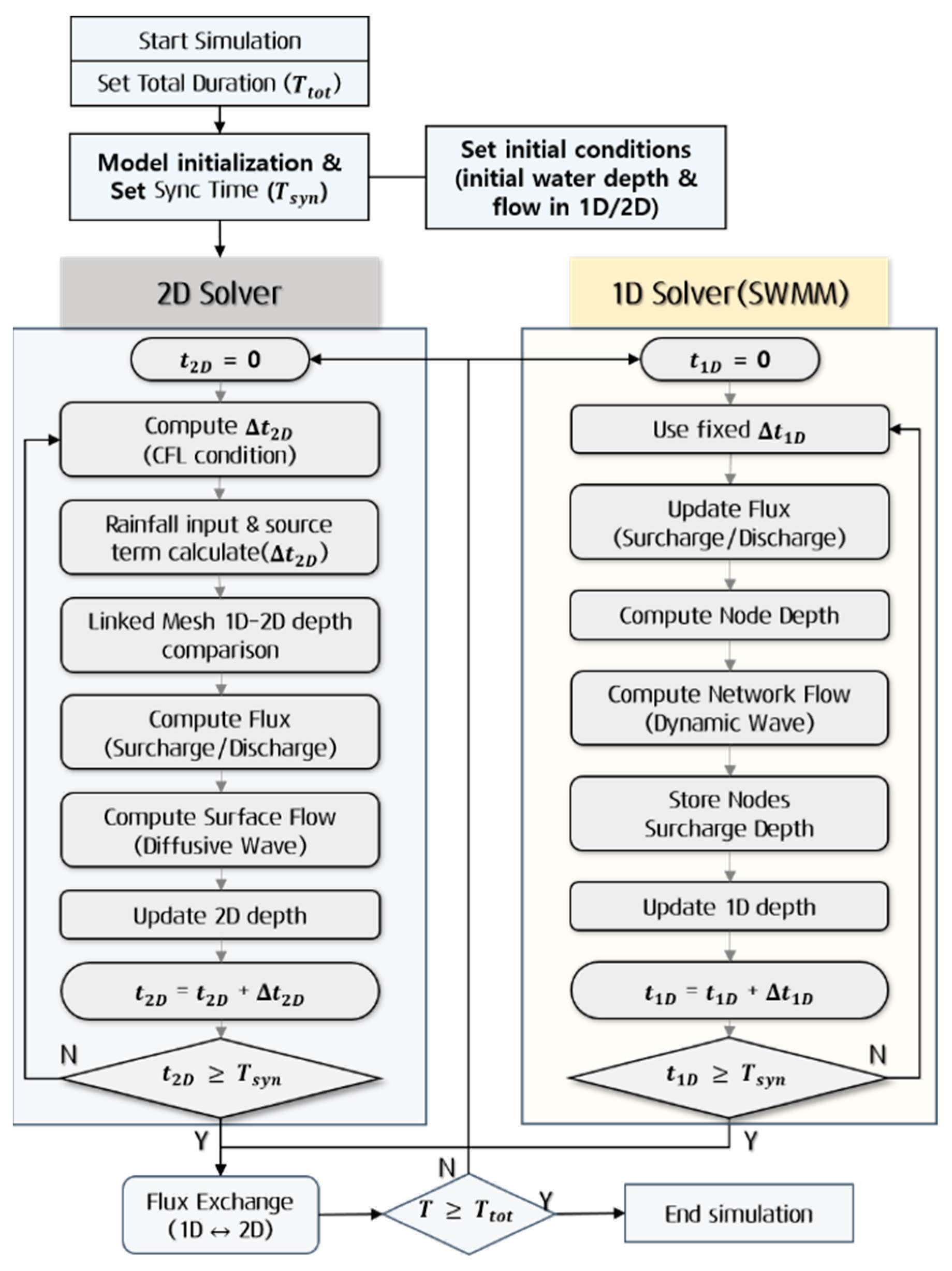
The HC-SURF model used in this evaluation is a dual-drainage model for urban inundation analysis. It employs a strongly coupled structure that links a 2D surface flow module with a 1D storm sewer network module. The two modules are synchronized at a consistent time interval, which enables the bi-directional exchange of flow between the surface and the sewer network. Conventional coupling techniques, often constrained by the minimum time step required by the Courant–Friedrichs–Lewy (CFL) condition, tend to have low computational efficiency. In contrast, HC-SURF is a high-speed model that improves efficiency by applying a fixed-time-step synchronization technique while maintaining a realistic representation of the underlying physical processes [
19].
2.1.2. 2D Surface Flow
The 2D surface flow component is computed on a discretized grid by solving the continuity and momentum equations derived from the 2D shallow water equations (SWE), with the momentum equation using the diffusive wave approximation. These governing equations are discretized using the finite volume method (FVM). A wetting–drying scheme is applied to address numerical instability in shallow water depths. Cells with water depth below a specified threshold are treated as being in a “Dry” state. In this state, the momentum equation is not computed and the flow velocity is set to zero to prevent numerical oscillations. When inflow occurs from adjacent “Wet” cells and the water level exceeds the sum of the bed elevation and the threshold depth, the cell returns to a “Wet” state and the momentum equation is solved again. Importantly, even for cells in the “Dry” state, the continuity equation (the first component of Equation (1)) continues to be solved across the entire computational domain. This ensures that the mass within the cell is conserved rather than lost, even when velocity is fixed at zero, which minimizes mass error in the overall system. The governing equation is expressed in conservative vector form in Equation (1).
In the conservative variable , is the water depth (m), and and are the depth-averaged velocities (m/s) in the and directions, respectively. and represent the flux vectors in the and directions, respectively, and is the gravitational acceleration. The vector includes source terms that reflect the hydrological and hydraulic characteristics of the urban surface, such as rainfall, friction, terrain slope, and the exchange with the sewer network.
2.1.3. 1D Drainage Network
The 1D conduit analysis computes flow velocity and water level within the pipes using the dynamic wave module (Full Saint-Venant) of EPA-SWMM 5.2 (US Environmental Protection Agency, Washington, DC, USA) [
20]. Water levels at nodes (manholes) are determined using the continuity equation, and conduit flow is calculated using the momentum equation, as shown in Equations (2) and (3).
where
represents the cross-sectional area of the conduit,
is the flow rate,
is the hydraulic head, and
is the friction slope.
2.1.4. 1D–2D Flow Exchange
The 1D–2D coupling in the dual-drainage system ensures mass conservation by exchanging water level and flow rate information between the manhole or inlet and its corresponding surface cell at each synchronization point. Flow entering the network from the surface (discharge) and flow moving from the network onto the surface (surcharge) are calculated using weir or orifice equations, selected according to the water level conditions.
When the manhole water level is below the ground-surface elevation, inflow is calculated using the weir formula, as shown in Equation (4):
where
is the weir coefficient,
is the weir width, and
is the surface-water level. Conversely, when the manhole water level exceeds the ground-surface elevation, the resulting surcharge is calculated using the orifice formula (Equation (5)):
where
is the orifice coefficient,
is the surface area of the manhole, and
is the manhole water level.
While conventional CFL-driven methods require very short calculation time steps, such as 0.001 s, HC-SURF improves efficiency by applying a fixed synchronization interval. A potential drawback of this approach is that an interval that is too long may fail to capture rapid changes in manhole and surface water levels. To address this, a linear interpolation technique is used. By representing continuous variation through a linear interpolation of manhole and surface water levels within each fixed interval, the model achieves accuracy comparable to that of the minimum time step method. When the manhole water levels (
) at times
and
are known, the water level at any time
within that interval is derived as shown in Equation (6).
The interpolated manhole water level
is then substituted into Equations (4) and (5) to compute the continuous exchange flow rate. This approach significantly improves computational efficiency and reduces peak-time errors compared with synchronization based on the 2D minimum Δt synchronization. For large metropolitan basins, it has produced a 15–20% reduction in computation time. However, performance degradation, such as underestimation of drainage peaks and increased inundation area, becomes noticeable when the interval exceeds 180 s. A range of 60 to 180 s is therefore recommended [
19]. Based on this guidance, a 60-s fixed synchronization interval was selected in this study to balance computational accuracy and operational efficiency (
Figure 1).
2.2. Comparison of Model Characteristics
2.2.1. PC-SWMM
The 1D flow analysis in PC-SWMM (Computational Hydraulics International (CHI), Guelph, ON, Canada) is based on the dynamic wave, the full Saint-Venant equations, module of EPA-SWMM 5. It solves the continuity and momentum equations to model changes in water level and flow rate within conduits while accounting for friction, local losses, and control structures. The model also provides a 2D surface analysis function based on the SWE, which computes surface flow on a mesh using spatial layers for terrain, roughness, and infiltration. The 1D network and 2D surface are linked at manhole or inlet surface cells, and bi-directional exchange, including discharge and surcharge, is calculated using weir or orifice equations according to the water level differential. Practical applications have shown that a dual-drainage system can be implemented in PC-SWMM by configuring the 2D cell-to-network connections as a series of orifice or weir links [
21,
22,
23,
24,
25].
2.2.2. InfoWorks Integrated Catchment Modelling (ICM)
The 1D solver in InfoWorks ICM (Autodesk, San Francisco, CA, USA) simulates unsteady flow in rivers, conduits, and manholes using the Saint-Venant equations, with options for various friction formulas and hydraulic structure loss models. Its 2D engine applies the conservative form of the SWE and the MULFLOOD solver [
26]. Within ICM, the exchange at “2D Flood Type” nodes is calculated using a weir equation, where the crest is set at the node’s ground elevation and the crest length corresponds to the circumference of the node shaft. The 1D–2D coupling can be configured using methods such as Point or Linear Coupling [
27].
2.2.3. Model Comparison
A comparative summary highlights the architectural differences among the models. HC-SURF combines a 1D SWMM 5.2 conduit solver with a 2D diffusive wave FVM surface flow solver, linked through a fixed time step synchronization. PC-SWMM couples modular 1D SWMM 5.2x and 2D diffusive FVM components, which are architecturally similar to HC-SURF, but the exchange of variables occurs at each time integration step of the 1D solver. InfoWorks ICM features a tightly integrated structure that computes its proprietary 1D Saint-Venant solver and 2D dynamic FVM solver simultaneously within a single platform. The platform also allows the user to select the flow exchange method, such as exchange at each 1D or 2D time step, which provides flexible application. Although all three models use the full Saint-Venant equations, or dynamic wave, for 1D network analysis, a key distinction is that PC-SWMM and HC-SURF are based on the EPA-SWMM 5.2 engine, whereas InfoWorks ICM uses its own proprietary 1D engine (
Table 1).
2.3. Study Area
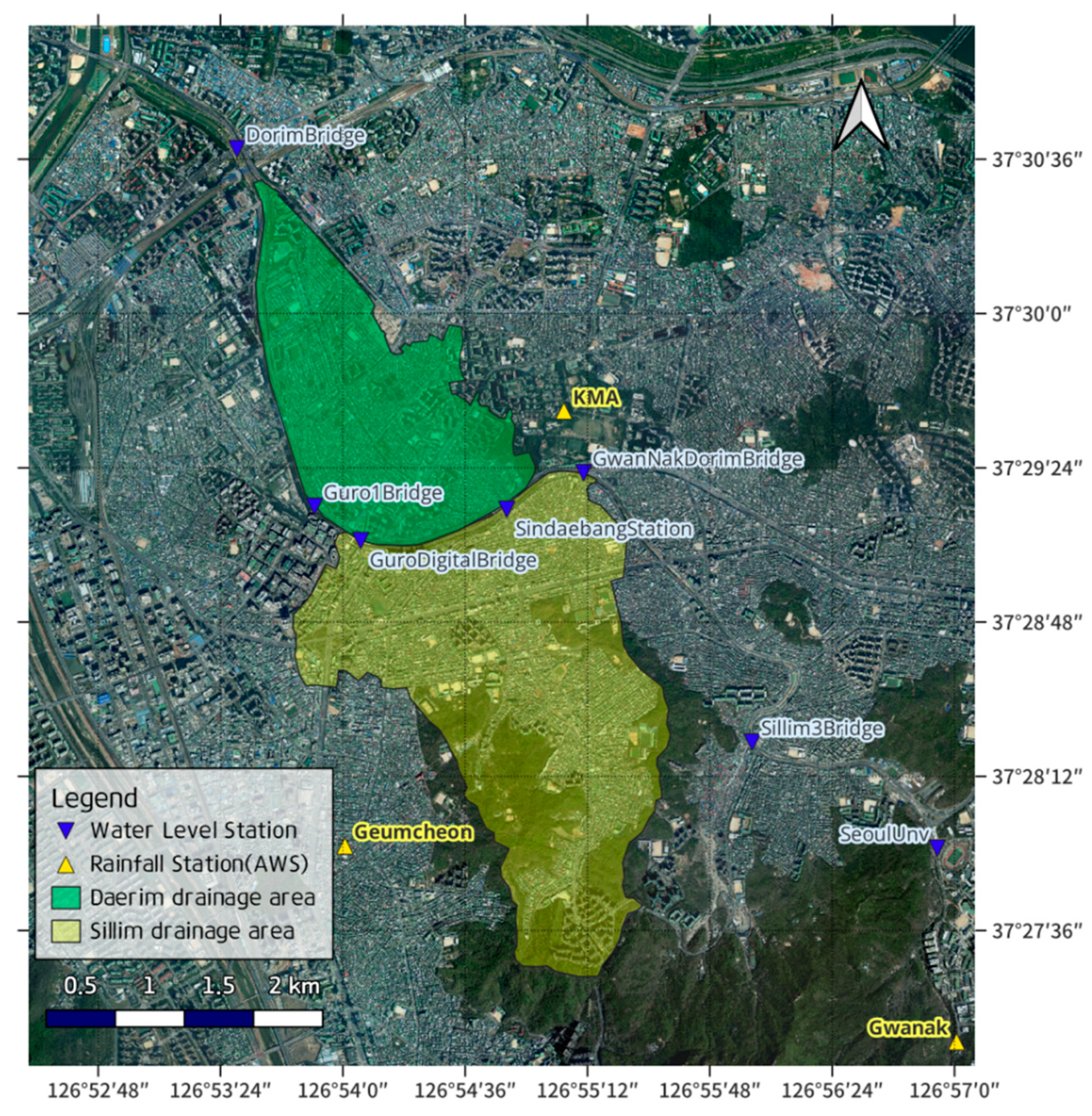
The study area for this research consists of the Sillim and Daerim drainage areas within the Dorimcheon basin in Seoul, South Korea. These two sub-basins were selected to evaluate the model’s applicability across different topographical characteristics typical of urban environments. The Sillim drainage area covers approximately 5.14 km2 and has a steep average slope of 16.2%. Urbanized land use accounts for about 70% of its total area. Because of the high proportion of impervious surfaces and the steep terrain, the time of concentration is short, which results in rapid surface water accumulation in the downstream lowlands during heavy rainfall. The Daerim drainage area, adjacent to the Sillim basin, covers approximately 2.71 km2. It is characterized by relatively flat terrain with gentle slopes and a high density of residential and commercial buildings. It represents a typical low-lying urban area where drainage depends heavily on sewer networks and pumping stations. This makes the area highly vulnerable to inundation when sewer capacity is exceeded or when the receiving river level rises.
By applying the model to these two contrasting areas, one representing a steep rapid-runoff basin (Sillim) and the other a flat drainage-dependent lowland (Daerim), this study aims to validate the model’s performance under varying hydraulic conditions (
Figure 2).
2.4. Input-Data Construction
Hydraulic and hydrological data for the target area were compiled to support the numerical analysis.
2.4.1. Topographic Input Data
For the hydraulic data, the initial storm sewer networks for both drainage areas were constructed using the Flood Control Plan Summary Report for Specific River Basins (Dorimcheon and Siheungcheon, May 2022) published by the Ministry of Environment [
28]. For the topographic data, GIS materials—including digital topographic maps and building layers—were obtained from the National Geographic Information Institute (NGII) [
29]. Land use maps used to analyze hydrological parameters such as impervious area ratio and infiltration capacity were acquired from the Environmental Geographic Information Service (EGIS) [
30].
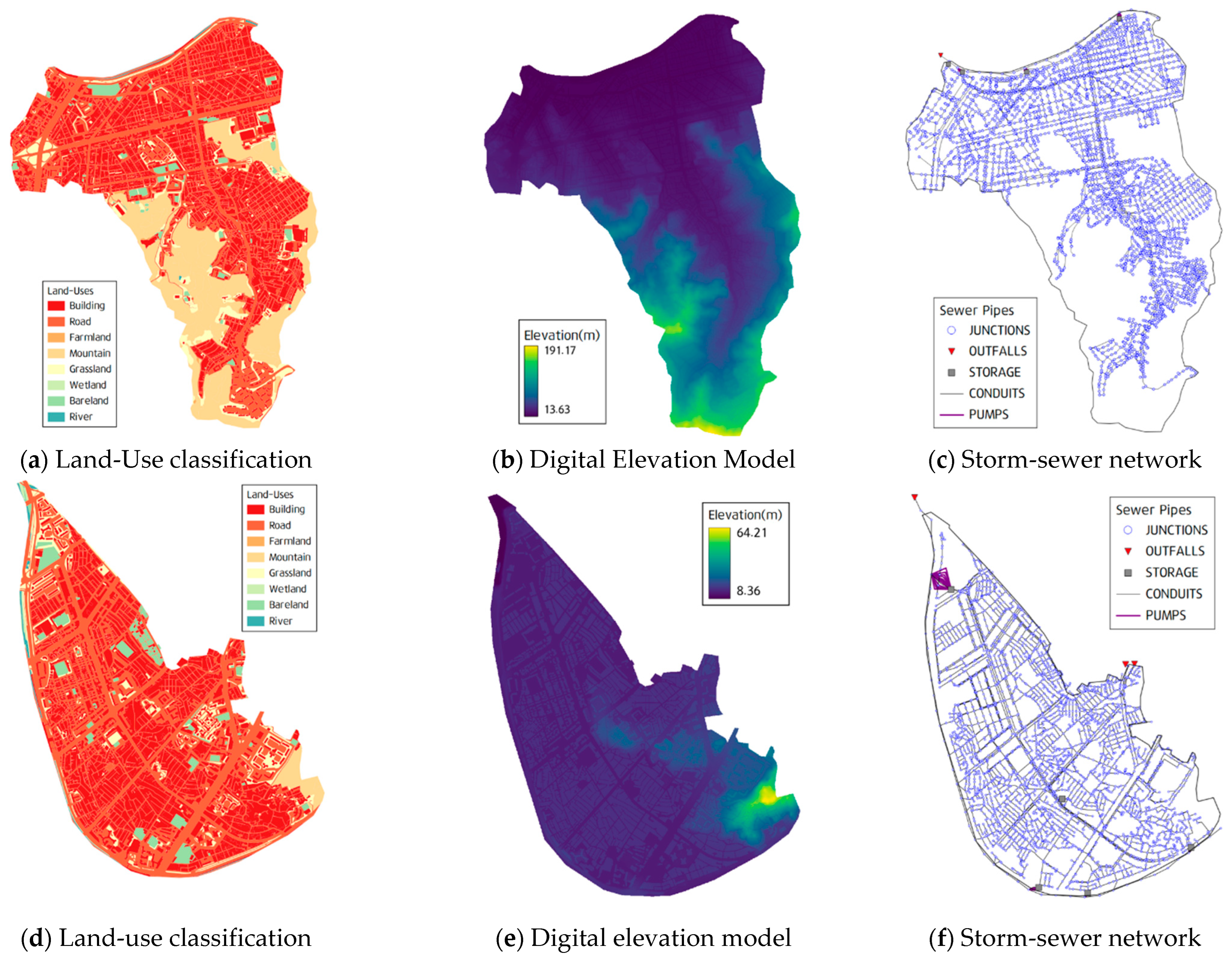
The Digital Elevation Models (DEMs) of the target areas contained local construction-related depressions, which posed a risk of unrealistic ponding during the hydrological analysis. To address this, the fill sink algorithm [
31] was applied to remove these closed depressions and restore effective runoff pathways in the terrain. The resulting land use maps, DEMs, and storm sewer networks prepared for the Sillim (a–c) and Daerim (d–f) drainage areas are shown in
Figure 3.
2.4.2. Rainfall Data
The Sillim and Daerim drainage areas experienced significant casualties and property damage during a heavy rainfall event in August 2022. This study performed an urban flood analysis using this event, and the model’s accuracy was verified by comparing the simulation results with the 2022 Seoul Inundation Trace Map provided by the Ministry of the Interior and Safety [
32].
To accurately represent rainfall characteristics, 1 min interval rainfall data from the Automatic Weather System (AWS) were obtained from the Korea Meteorological Administration (KMA) [
33]. The average rainfall for each basin was calculated using the Thiessen polygon method applied to nearby weather stations, including KMA and Geumcheon. This study used 48 h of 1 min rainfall data from 8 and 9 August 2022, the period during which the flood damage occurred. The rainfall event applied in this study is summarized in
Table 2.
2.4.3. Model Setup
To objectively compare the performance of the three models, identical geometric and hydraulic conditions were applied when generating the 2D surface numerical grids for both the Sillim and Daerim drainage areas. The grid structure was created to split along building outlines, which allowed for precise representation of the obstruction effect of buildings on runoff. A consistent base grid resolution between 5 m by 5 m and 10 m by 10 m was maintained. To assign topographic and physical properties, grid elevations for building areas were uniformly raised by 3 m relative to the DEM to account for their obstacle effect on surface flow. The roughness coefficient, which represents surface flow resistance, was assigned to each grid cell according to the Environmental Geographic Information Service (EGIS)’s large category land use classification [
30]. Soil Conservation Service curve number (SCS-CN) values used to simulate direct runoff were also calculated and applied based on the same land use map. Details of the grids generated for each model and drainage area are provided in
Table 3.
2.5. Analysis Procedure
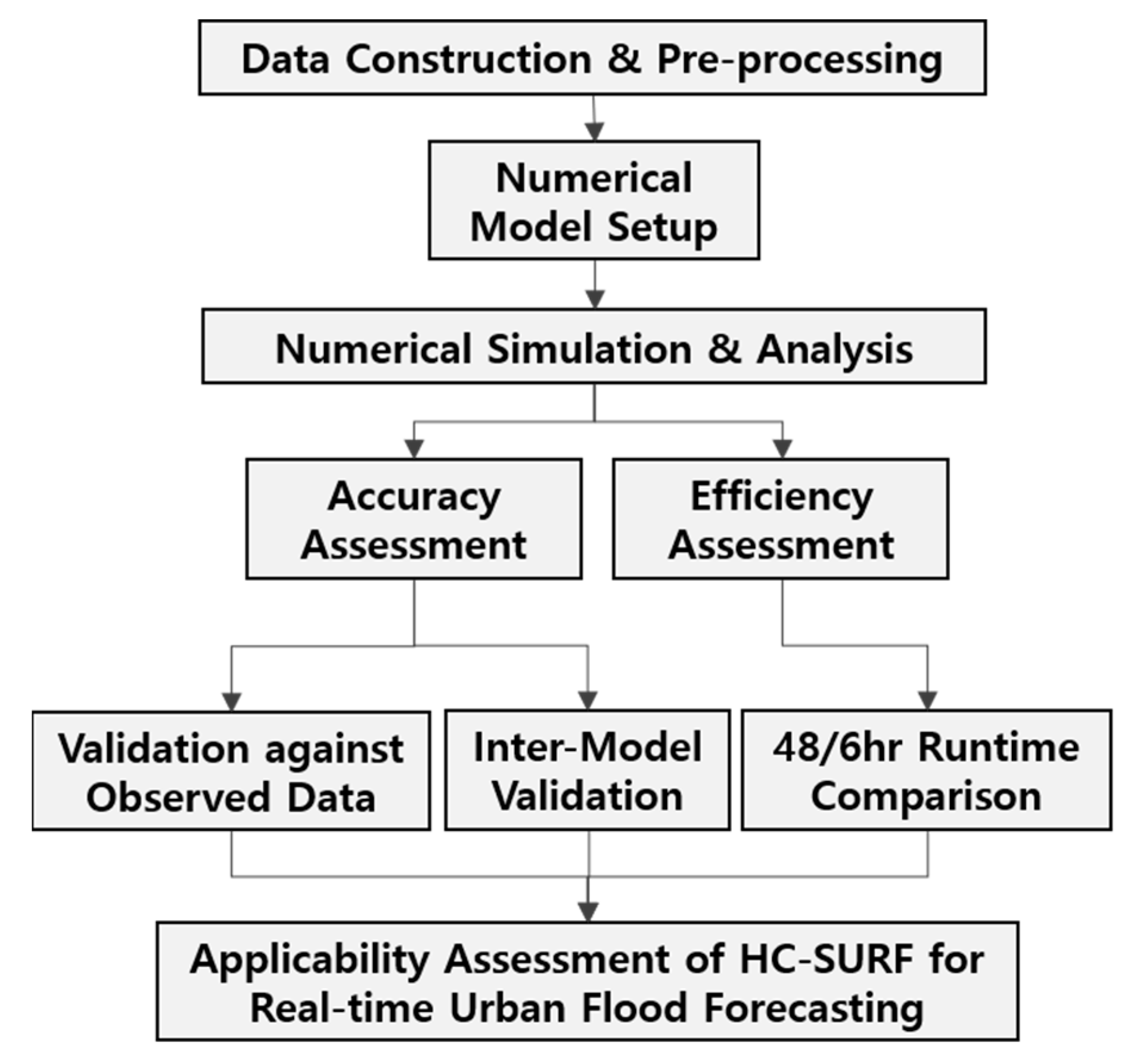
To comprehensively evaluate the applicability of the HC-SURF model for urban flood forecasting, a three step analysis procedure was implemented to assess its accuracy and computational speed (
Figure 4).
First, the model’s accuracy was verified by comparing its simulation results with the observed inundation trace map from the August 2022 flood, which served as the ground truth. The similarity between each model’s predictions and the observed map was quantified using spatial statistical techniques.
Second, the accuracy of HC-SURF was further examined through inter-model comparisons. Differences in spatial inundation extents between HC-SURF and the commercial models, PC-SWMM and InfoWorks ICM, were analyzed under identical input conditions to assess the hydraulic consistency and physical validity of HC-SURF.
Third, to evaluate computational speed, the runtime of each model was compared by simulating the 48 h and 6 h rainfall events ten times each. All simulations were performed in the same computing environment to assess the computational efficiency required for real-time urban flood forecasting.
2.6. Evaluation Metrics
In this study, the spatial agreement between the simulated inundation extent and the observed inundation trace map was evaluated using binary classification statistical indices. These indices assess predictive performance by categorizing the model results as Inundated (1) or Not Inundated (0) and comparing them with actual observations. For this analysis, the threshold depth used to classify inundation was set to 0.1 m. The metrics applied were the critical success index (CSI), probability of detection (POD), and false alarm ratio (FAR). The definitions and interpretation criteria for each metric are summarized below [
34,
35].
CSI: The CSI is the most representative metric for overall predictive accuracy. It is calculated by dividing the area of correct inundation predictions, the true positives (TP), by the total area of observed or predicted inundation, which includes both under predictions (false negatives, (FN)) and over predictions (false positives, (FP)). A value approaching 1 indicates a perfect prediction. The CSI is sensitive to both over prediction and under prediction, which makes it suitable for comprehensive performance assessment.
POD. This metric evaluates how effectively the model detects actual inundation, indicating its ability to reproduce the event. A value close to 1 means the model successfully captured the inundation with minimal omissions.
FAR. This metric represents the ratio of the area falsely predicted as inundated when no inundation actually occurred. It is used to assess the model’s tendency to over predict. A value approaching 0 indicates fewer false alarms.
The accuracy of each model was verified against the inundation trace map from the August 2022 flood event. Because the original trace map included building areas within the flooded region, these building footprints were removed before conducting the accuracy assessment. The maximum inundation area, defined as inundation depth greater than or equal to 0.1 m, was derived for each model. For quantitative comparison, the analysis results were converted to ASCII Grid format, and the CSI, POD, and FAR metrics were then calculated on a cell-by-cell basis.
3. Results and Discussion
3.1. Accuracy Verification Using Inundation Trace Map
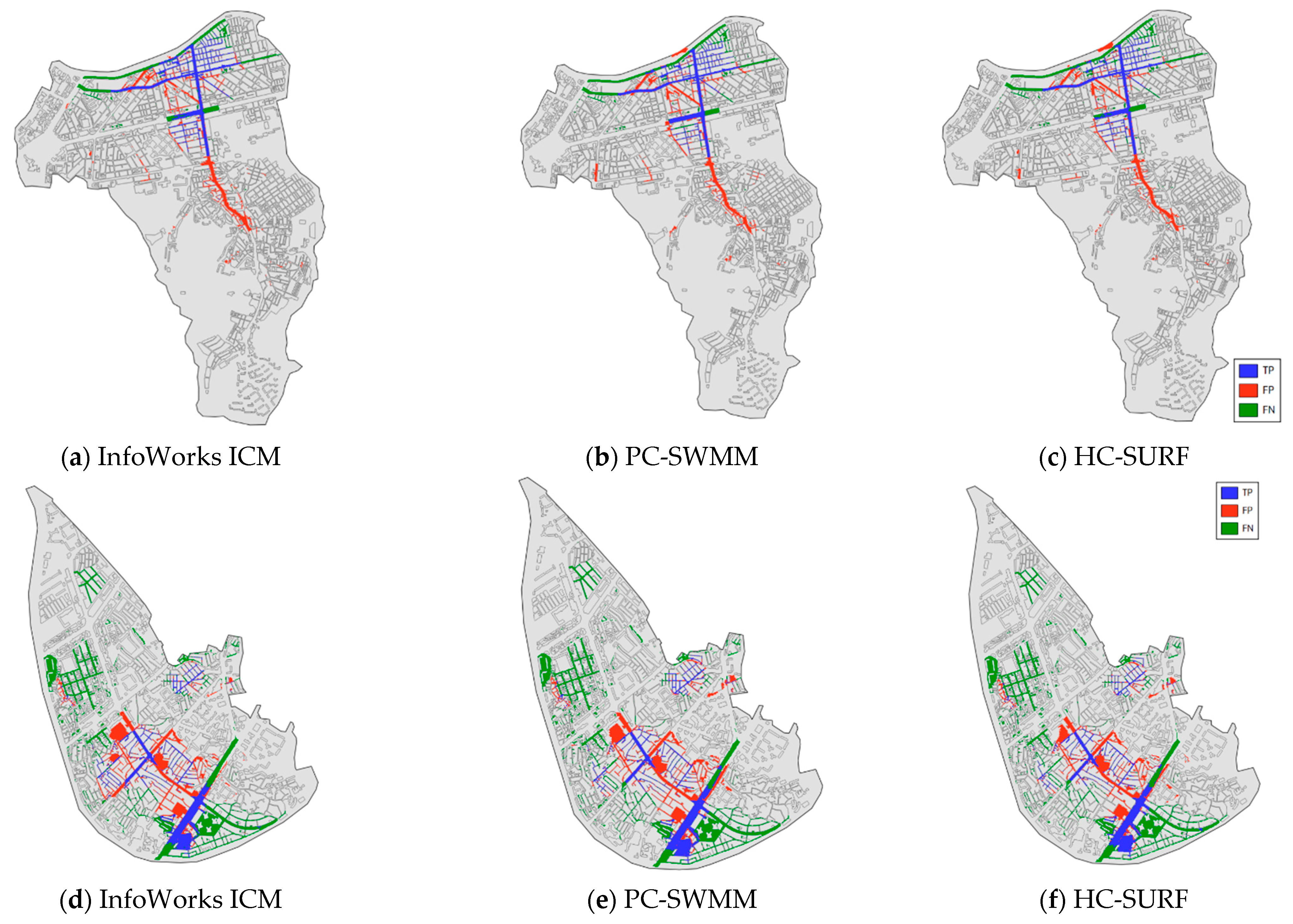
The analysis results for the Sillim drainage area showed that InfoWorks ICM achieved a CSI of 0.48, POD of 0.84, and FAR of 0.47. PC-SWMM demonstrated a CSI of 0.44, POD of 0.79, and FAR of 0.50. The HC-SURF model produced a CSI of 0.45, POD of 0.81, and FAR of 0.49. For the Daerim drainage area, which covers 2.71 km
2 and is characterized by flat, low-lying terrain, the overall performance metrics were lower than those for the steep Sillim basin. InfoWorks ICM recorded a CSI of 0.26, POD of 0.35, and FAR of 0.51. PC-SWMM showed a CSI of 0.25, POD of 0.36, and FAR of 0.54. The HC-SURF model presented a CSI of 0.26, POD of 0.37, and FAR of 0.53. Although HC-SURF produced slightly higher CSI values than PC-SWMM in both basins (0.45 vs. 0.44 in Sillim and 0.26 vs. 0.25 in Daerim), this should not be interpreted as evidence that HC-SURF is hydraulically superior. In theory, PC-SWMM, which uses a tighter coupling method, is expected to provide more rigorous results than the fixed-time synchronization approach used by HC-SURF. The slight advantage observed for HC-SURF is primarily attributed to the finer mesh resolution used in this study. As shown in
Table 3, the average element area for HC-SURF was substantially smaller than that of PC-SWMM in both the Sillim basin, 38.1 m
2 vs. 86.2 m
2, and the Daerim basin, 27.5 m
2 vs. 73.1 m
2. This higher spatial resolution allowed HC-SURF to represent complex urban features such as building gaps and road networks more precisely, which contributed to a closer match with the inundation trace map. Considering the inherent uncertainties in the observed inundation trace map and the influence of grid resolution differences, the small difference in CSI values, about 0.01, is within a reasonable margin of error. It is therefore appropriate to conclude that HC-SURF demonstrates accuracy equivalent to that of commercial models, effectively balancing computational efficiency with predictive performance rather than indicating superior hydraulic accuracy. All models exhibited relatively high FAR values, approximately 0.47 to 0.54, across both basins. This over prediction is attributed to common factors, including flow being simulated into narrow non flooded roads, uncertainties in the trace map, and smoothing effects in the DEM. The generally lower accuracy in the Daerim basin compared with Sillim further suggests that inundation in low lying areas, where drainage depends heavily on sewer capacity and pumping stations, is more sensitive to spatial data inaccuracies than inundation driven primarily by slope, as shown in
Figure 5.
3.2. Inter-Model Comparison
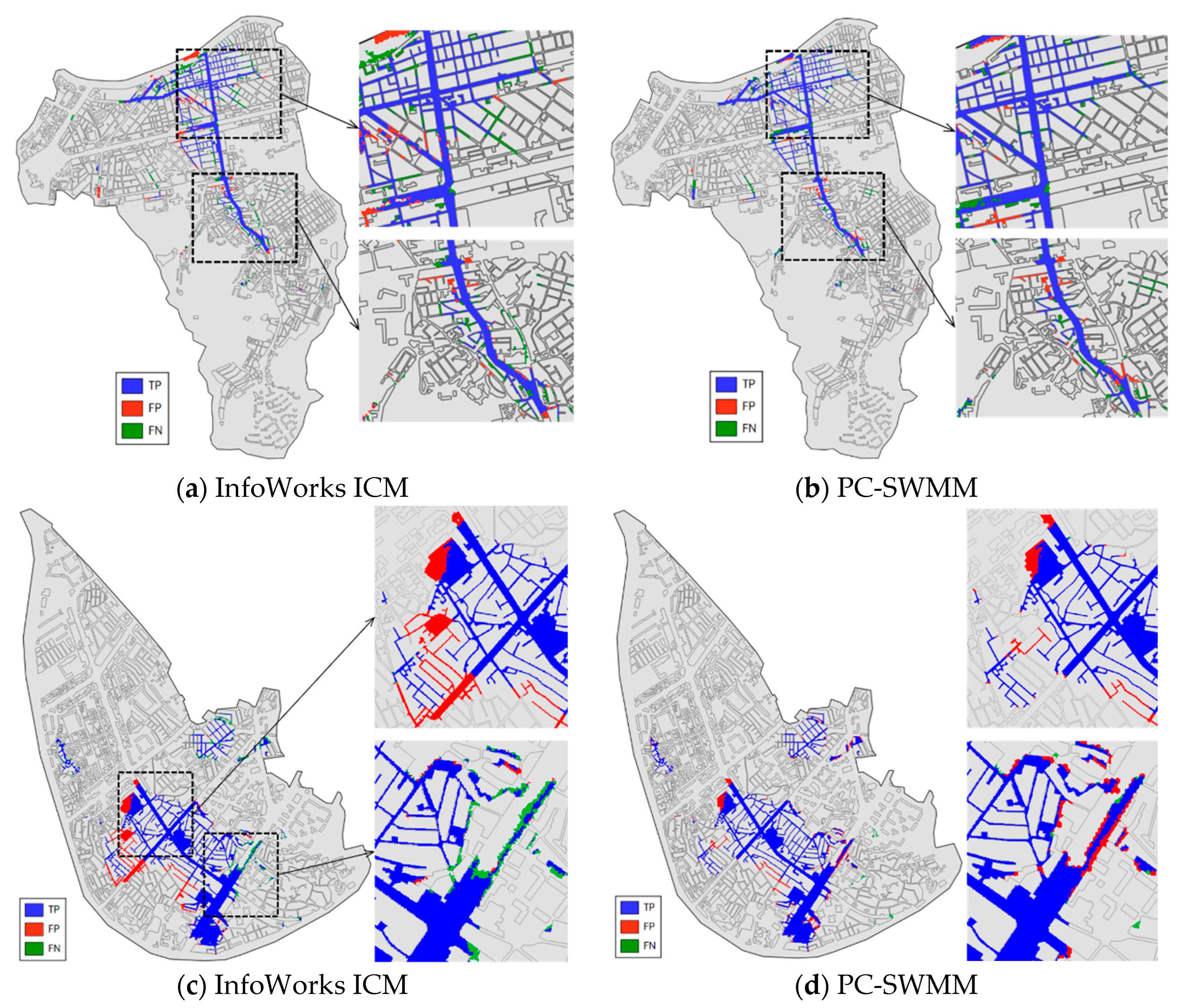
This section validates HC-SURF through an inter-model comparison to assess whether it produces physically plausible and consistent results across different topographical conditions. The maximum inundation area simulated by each model was compared using binary classification indices. For this inter-model comparison, the commercial models (InfoWorks ICM and PC-SWMM) were treated as the reference data to evaluate the overlap (TP) and deviations (FP, FN) of the HC-SURF results. For the Sillim drainage area, the comparison results are shown in
Figure 6a,b. The comparison between HC-SURF and InfoWorks ICM (
Figure 6a) produced a CSI of 0.72, POD of 0.82, and FAR of 0.14. The comparison between HC-SURF and PC-SWMM (
Figure 6b) showed a CSI of 0.80, POD of 0.86, and FAR of 0.08. For the Daerim drainage area, the inter-model agreement was even stronger, as illustrated in
Figure 6c,d. The comparison between HC-SURF and InfoWorks ICM (
Figure 6c) yielded a CSI of 0.81, POD of 0.94, and FAR of 0.15. The comparison between HC-SURF and PC-SWMM (
Figure 6d) showed very high agreement, with a CSI of 0.88, POD of 0.99, and FAR of 0.10. The consistently higher CSI values relative to PC-SWMM, 0.80 for Sillim and 0.88 for Daerim, indicate that the spatial predictions of the two models are highly similar. This similarity demonstrates the hydraulic stability of HC-SURF, as both models use the SWMM 1D engine and apply a diffusive-wave-based 2D analysis. The differences observed with the dynamic-wave-based InfoWorks ICM, CSI 0.72 for Sillim and 0.81 for Daerim, are considered physically reasonable. The higher level of agreement with ICM in the flat Daerim basin, CSI 0.81, compared with the steep Sillim basin (CSI 0.72), supports the theoretical understanding that discrepancies between diffusive wave (HC-SURF) and dynamic wave (ICM) formulations are more pronounced in steep terrain where inertial forces dominate, while the results tend to converge in flatter lowland areas. Note that InfoWorks ICM maintains high computational efficiency despite using a high-resolution mesh. This is likely attributed to its proprietary optimization techniques, such as grouping adjacent triangular elements to mitigate explicit time-step constraints.
3.3. Computational Efficiency Analysis
To evaluate computational speed, an essential factor for urban flood forecasting, the run times of each model were compared for both the Sillim and Daerim drainage areas. All simulations were conducted on a PC equipped with an AMD Ryzen 7 7700X CPU, 4.5 GHz with eight cores, and 32 GB of RAM. Under identical parameter settings, both the 48- and 6 h rainfall events were simulated ten times each, and the average computation times were used to compare operational performance. For the Sillim drainage area, HC-SURF required 67 min 20 s for the 48 h simulation. This was approximately 9% faster than InfoWorks ICM, which 74 min 01 s, and 44% faster than PC-SWMM, which required 121 min 28 s. For the 6 h simulation, the run times were 8 min 05 s for HC-SURF, 8 min 15 s for InfoWorks ICM, and 13 min 11 s for PC-SWMM. For the Daerim drainage area, the simulation times were significantly shorter, reflecting the smaller basin area and fewer grid elements. For the 48 h event, HC-SURF 31 min 22 s), which was approximately 5% faster than InfoWorks ICM (32 min 57 s) and 11% faster than PC-SWMM (35 min 16 s). For the 6 h simulation, the run times were 3 min 43 s for HC-SURF3 min 43 s, or InfoWorks ICM, and 4 min 23 s for PC-SWMM. These results confirm that both HC-SURF and InfoWorks ICM can produce a 6 h flood forecast in under 10 min across different basin scales, meeting the essential requirement for rapid urban flood forecasting.
3.4. Summary of Analysis
The performance of HC-SURF, PC-SWMM, and InfoWorks ICM was compared across the Sillim and Daerim drainage areas, focusing on spatial accuracy against observed data, inter-model consistency, and computational efficiency. First, in terms of spatial agreement with the observed inundation trace map, using the 0.1 m threshold, HC-SURF demonstrated accuracy comparable to that of the commercial models in both basins. In the steep Sillim basin, HC-SURF achieved a CSI of 0.45, balancing a POD of 0.81 and a FAR of 0.49. This performance was equivalent to InfoWorks ICM, CSI 0.48, and comparable to PC-SWMM, CSI 0.44. In the flat low lying Daerim basin, although overall CSI values were lower due to the complex drainage characteristics of lowland terrain, HC-SURF, CSI 0.26, maintained performance parity with both InfoWorks ICM, CSI 0.26, and PC-SWMM, CSI 0.25.
Second, the inter-model analysis confirmed strong hydraulic consistency. HC-SURF showed high spatial agreement with PC-SWMM, achieving CSI values of 0.80 in Sillim and 0.88 in Daerim. This high level of similarity reflects the stability of HC-SURF, as both models use the same 1D engine and a diffusive wave based 2D scheme. Comparisons with the dynamic-wave-based InfoWorks ICM yielded CSI values of 0.72 in Sillim and 0.81 in Daerim. The stronger agreement in the flat Daerim basin aligns with theoretical expectations that diffusive and dynamic wave formulations tend to converge in areas with gentle slopes.
Finally, in terms of computational efficiency, HC-SURF consistently outperformed the commercial models. For the 48 h rainfall simulation in the Sillim basin, HC-SURF was approximately 9% faster than InfoWorks ICM and 44% faster than PC-SWMM. In the Daerim basin, HC-SURF again showed the fastest performance, reducing computation time by about 5% compared with InfoWorks ICM and 11% compared with PC-SWMM. HC-SURF successfully simulated a 6 h rainfall event in approximately 8 min for the Sillim basin and in under 4 min for the Daerim basin, meeting the lead time requirements for real-time urban flood forecasting (
Table 4).
4. Conclusions
This study evaluated the practical applicability of the in-house 1D–2D dual drainage model, HC-SURF, for real-time urban-inundation forecasting. The model was applied to the extreme rainfall event of August 2022 in two different urban catchments, the steep Sillim drainage area and the low-lying Daerim drainage area. Its accuracy and computational efficiency were verified through quantitative comparisons with two widely used commercial models, PC-SWMM and InfoWorks ICM.
First, in terms of accuracy against observed data, HC-SURF demonstrated reproducibility comparable to that of the commercial models in both basins. In the Sillim basin, HC-SURF achieved a CSI of 0.45, which was equivalent to InfoWorks ICM at 0.48 and comparable to PC-SWMM at 0.44. In the Daerim basin, although the overall accuracy metrics were lower due to the complex drainage characteristics of low lying terrain, HC-SURF, CSI 0.26, maintained performance parity with InfoWorks ICM, 0.26, and PC-SWMM, 0.25. The slightly higher CSI values produced by HC-SURF relative to PC-SWMM are attributed to the finer grid resolution used in the HC-SURF model setup rather than any inherent hydraulic advantage. It is therefore concluded that HC-SURF achieves a simulation accuracy equivalent to that of established commercial software. In addition, unlike commercial models that require costly licenses and operate as black box systems, HC-SURF provides a cost-effective and customizable in-house alternative that can support large scale or nationwide deployment.
Second, the inter-model comparison confirmed the physical plausibility and stability of HC-SURF. The model showed substantial spatial agreement with PC-SWMM, achieving high CSI values of 0.80 in Sillim and 0.88 in Daerim. This strong similarity reflects the hydraulic consistency of HC-SURF, as both models use the same 1D engine and a diffusive wave 2D scheme. The comparison with the dynamic wave based InfoWorks ICM yielded CSI values of 0.72 in Sillim and 0.81 in Daerim. The higher agreement observed in the flat Daerim basin aligns with the theoretical understanding that results from diffusive and dynamic wave formulations tend to converge in regions with gentle slopes.
Third, regarding computational efficiency, the fixed time synchronization technique in HC-SURF demonstrated strong performance. For the 48 h rainfall simulation in the Sillim basin, HC-SURF was approximately 9% faster than InfoWorks ICM and 44% faster than PC-SWMM. In the Daerim basin, HC-SURF again showed the fastest performance, reducing computation times by about 5% compared with InfoWorks ICM and 11% compared with PC-SWMM. The model completed the 6 h rainfall simulation in approximately 8 min for the Sillim basin and under 4 min for the Daerim basin, meeting the strict lead time requirements for real-time urban flood forecasting.
These results indicate that the HC-SURF model achieves a strong balance between accuracy and efficiency. It maintains the computational speed required for operational forecasting systems while providing inundation predictions comparable to those of advanced commercial models. This demonstrates that HC-SURF can serve as a practically viable tool for establishing a domestic, technology-based, real-time urban inundation forecasting system.
This study does have limitations, including the reliance on a single extreme rainfall event and the inherent uncertainty in the inundation trace map data. In addition, the slight performance variations influenced by grid resolution highlight the need for further sensitivity analyses. Therefore, future work should focus on expanding the model’s applicability by testing under a broader range of basin conditions, optimizing grid configurations, and incorporating external river flooding scenarios.
Author Contributions
Conceptualization, S.-B.S. and H.-J.K.; methodology, S.-B.S. and H.-J.K.; software, S.-B.S.; validation, S.-B.S. and H.-J.K.; formal analysis, S.-B.S.; investigation, S.-B.S.; resources, S.-B.S.; data curation, H.-J.K.; writing—original draft preparation, S.-B.S. and H.-J.K.; writing—review and editing, S.-B.S. and H.-J.K.; visualization, S.-B.S.; supervision, H.-J.K.; project administration, H.-J.K.; funding acquisition, H.-J.K. All authors have read and agreed to the published version of the manuscript.
Funding
This work was supported by the Korea Environment Industry & Technology Institute (KEITI) through R&D Program for Innovative Flood Protection Technologies against Climate Crisis Project, funded by Korea Ministry of Environment (MOE) (2480000599).
Data Availability Statement
The data are available from the authors upon reasonable request due to distribution restrictions, as this study is based on non-public data obtained from a government agency.
Acknowledgments
The authors express their sincere gratitude to the Korea Environment Industry & Technology Institute (KEITI) and Korea Ministry of Environment (MOE) for funding and support through the R&D Program for Innovative Flood Protection Technologies against Climate Crisis Project. The authors would also like to thank their collaborators and team members for their valuable contributions to this research.
Conflicts of Interest
The authors declare no conflicts of interest.
Abbreviations
The following abbreviations are used in this manuscript:
| AWS | Automatic Weather System |
| CFL | Courant–Friedrichs–Lewy |
| CHI | Computational Hydraulics International |
| CSI | Critical success index |
| DEM | Digital Elevation Model |
| FAR | False alarm ratio |
| FVM | Finite volume method |
| HC-SURF | Hyper Connected Solution for Urban Flood |
| ICM | InfoWorks Integrated Catchment Model |
| KEITI | Korea Environment Industry & Technology Institute |
| KMA | Korea Meteorological Administration |
| MOE | Ministry of Environment |
| POD | Probability of detection |
| RMSE | Root-mean-square error |
| SWE | Shallow-water equations |
| SWMM | Storm Water Management Model |
References
- Kim, H.R.; Moon, M.; Yun, J.; Ha, K.J. Trends and spatio-temporal variability of summer mean and extreme precipitation across South Korea for 1973–2022. Asia-Pac. J. Atmos. Sci. 2023, 59, 385–398. [Google Scholar] [CrossRef] [PubMed]
- Agonafir, C.; Lakhankar, T.; Khanbilvardi, R.; Krakauer, N.; Radell, D.; Devineni, N. A review of recent advances in urban flood research. Water Secur. 2023, 19, 100141. [Google Scholar] [CrossRef]
- Park, C.; Kang, M.J.; Hwang, J.; Cho, H.-O.; Kim, S.; Son, S.W. Multiscale drivers of catastrophic heavy rainfall event in early August 2022 in South Korea. Weather Clim. Extrem. 2024, 44, 100681. [Google Scholar] [CrossRef]
- Byaruhanga, N.; Kibirige, D.; Gokool, S.; Mkhonta, G. Evolution of flood prediction and forecasting models for flood early warning systems: A scoping review. Water 2024, 16, 1763. [Google Scholar] [CrossRef]
- Li, Y.; Osei, F.B.; Hu, T.; Shi, Y.; Stein, A. Urban inundation mapping by coupling 1D–2D models and model comparison. Int. J. Appl. Earth Obs. Geoinf. 2024, 130, 103869. [Google Scholar] [CrossRef]
- Choi, S.Y.; Lee, J.Y.; Cho, W.C.; Lee, J.H.; Choi, C.K. Development of flood inundation analysis system for urban areas using GIS. J. GIS Assoc. Korea 2003, 11, 155–170. [Google Scholar]
- Lee, C.-H.; Han, K.-Y.; Choi, K.-H. DEM-based urban inundation analysis model linked with SWMM. J. Korea Water Resour. Assoc. 2006, 39, 441–452. [Google Scholar] [CrossRef]
- Lee, C.-H.; Han, K.-Y.; Noh, J.-W. Development of urban inundation analysis model using dual-drainage concept. J. Korean Soc. Civ. Eng. B 2006, 26, 379–387. [Google Scholar]
- Lee, S.; Noh, S.J.; Jang, C.; Rhee, D.S. Simulation and analysis of urban inundation using the integrated 1D–2D urban flood model. J. Korea Water Resour. Assoc. 2017, 50, 263–275. [Google Scholar]
- Sanders, B.F.; Schubert, J.E.; Gallegos, H.A. Integral formulation of shallow-water equations with anisotropic porosity for urban flood modeling. J. Hydrol. 2008, 362, 19–38. [Google Scholar] [CrossRef]
- Seyoum, S.D.; Vojinovic, Z.; Price, R.K.; Weesakul, S. Coupled 1D and noninertia 2D flood inundation model for simulation of urban flooding. J. Hydraul. Eng. 2012, 138, 23–34. [Google Scholar] [CrossRef]
- Chen, Y.; Zhou, H.; Zhang, H.; Du, G.; Zhou, J. Urban flood risk warning under rapid urbanization. Environ. Res. 2015, 139, 3–10. [Google Scholar] [CrossRef] [PubMed]
- Leandro, J.; Martins, R. A methodology for linking 2D overland flow models with the sewer network model SWMM 5.1 based on dynamic link libraries. Water Sci. Technol. 2016, 73, 3017–3026. [Google Scholar] [CrossRef] [PubMed]
- Martins, R.; Leandro, J.; Chen, A.S.; Djordjević, S. A comparison of three dual drainage models: Shallow water vs. local inertial vs. diffusive wave. J. Hydroinf. 2017, 19, 331–348. [Google Scholar] [CrossRef]
- Li, Q.; Liang, Q.; Xia, X. A novel 1D–2D coupled model for hydrodynamic simulation of flows in drainage networks. Adv. Water Resour. 2020, 137, 103519. [Google Scholar] [CrossRef]
- Bazin, P.-H.; Nakagawa, H.; Kawaike, K.; Paquier, A.; Mignot, E. Modeling flow exchanges between a street and an underground drainage pipe during urban floods. J. Hydraul. Eng. 2014, 140, 04014051. [Google Scholar] [CrossRef]
- Yoon, S.S.; Choi, C.K.; Bae, D.H. Connection of Hydrologic and Hydraulic Models for Flood Forecasting in a Large Urban Watershed. J. Korea Water Resour. Assoc. 2008, 41, 929–941. [Google Scholar] [CrossRef][Green Version]
- Keum, H.-J.; Kim, H.-I.; Han, K.-Y. Real-time forecast of rainfall impact on urban inundation. J. Korean Assoc. Geogr. Inf. Stud. 2018, 21, 76–92. [Google Scholar]
- Sim, S.B.; Kim, H.J. An urban flood model development coupling the 1D and 2D model with fixed-time synchronization. Water 2024, 16, 2726. [Google Scholar] [CrossRef]
- Rossman, L.A.; Simon, M.A. Storm Water Management Model (SWMM) User’s Manual Version 5.2; EPA/600/R-22/030; US Environmental Protection Agency: Washington, DC, USA, 2022.
- James, R.; Finney, K.; Perera, N.; James, B.; Peyron, N. SWMM5/PCSWMM Integrated 1D–2D Modeling; Computational Hydraulics International (CHI): Guelph, ON, Canada, 2012. [Google Scholar]
- Shrestha, A.; Chaosakul, T.; Priyankara, D.P.M.P.; Chuyen, L.H.; Myat, S.S.; Syne, N.K.; Irvine, K.; Koottatep, T.; Babel, M.S. Application of PCSWMM to explore possible climate change impacts on surface flooding in a peri-urban area of Pathumthani, Thailand. J. Water Manag. Model. 2014, 22, C377. [Google Scholar] [CrossRef]
- Abdelrahman, Y.T.; Moustafa, A.M.E.; Elfawy, M. Simulating flood urban drainage networks through 1D/2D model analysis. J. Water Manag. Model. 2018, 26, C454. [Google Scholar] [CrossRef]
- Rangari, V.A.; Gonugunta, R.; Umamahesh, N.V.; Patel, A.K.; Bhatt, C.M. 1D–2D modeling of urban floods and risk map generation for the part of Hyderabad city. Int. Arch. Photogramm. Remote Sens. Spat. Inf. Sci. 2018, XLII–5, 445–450. [Google Scholar] [CrossRef]
- Sidek, L.M.; Chua, L.H.C.; Azizi, A.S.M.; Basri, H.; Jaafar, A.S.; Moon, W.C. Application of PCSWMM for the 1-D and 1-D–2-D modeling of urban flooding in Damansara catchment, Malaysia. Appl. Sci. 2021, 11, 9300. [Google Scholar] [CrossRef]
- Alcrudo, F.; Mulet-Martí, J. Urban inundation models based upon the shallow water equations: Numerical and practical issues. In Finite Volumes for Complex Applications; Hermes Science Publishing: London, UK, 2005; Volume IV, pp. 3–12. [Google Scholar]
- Wei, H.; Wu, H.; Zhang, L.; Liu, J. Urban flooding simulation and flood risk assessment based on the InfoWorks ICM model: A case study of the urban inland rivers in Zhengzhou, China. Water Sci. Technol. 2024, 90, 1338–1358. [Google Scholar] [CrossRef]
- Ministry of Environment. Flood Control Plan Report for Specific River Basins (Dorimcheon, Siheungcheon); Ministry of Environment: Sejong, Republic of Korea, 2022.
- National Geographic Information Institute (NGII). National Spatial Data Infrastructure Portal. Available online: http://map.ngii.go.kr (accessed on 20 August 2024).
- Ministry of Environment. Environmental Geographic Information Service (EGIS). Available online: https://egis.me.go.kr (accessed on 20 August 2024).
- Wang, L.; Liu, H. An efficient method for identifying and filling surface depressions in digital elevation models for hydrologic analysis and modeling. Int. J. Geogr. Inf. Sci. 2006, 20, 193–213. [Google Scholar] [CrossRef]
- Ministry of the Interior and Safety. Public Data Portal (Inundation Trace Map). Available online: https://www.data.go.kr (accessed on 20 August 2024).
- Korea Meteorological Administration (KMA). Open MET Data Portal. Available online: https://data.kma.go.kr (accessed on 20 August 2024).
- Schaefer, J.T. The critical success index as an indicator of warning skill. Weather Forecast. 1990, 5, 570–575. [Google Scholar] [CrossRef]
- Wing, O.E.J.; Bates, P.D.; Sampson, C.C.; Smith, A.M.; Johnson, K.A.; Erickson, T.A. Validation of a 30 m resolution flood hazard model of the conterminous United States. Water Resour. Res. 2017, 53, 7968–7986. [Google Scholar] [CrossRef]
| Disclaimer/Publisher’s Note: The statements, opinions and data contained in all publications are solely those of the individual author(s) and contributor(s) and not of MDPI and/or the editor(s). MDPI and/or the editor(s) disclaim responsibility for any injury to people or property resulting from any ideas, methods, instructions or products referred to in the content. |
© 2025 by the authors. Licensee MDPI, Basel, Switzerland. This article is an open access article distributed under the terms and conditions of the Creative Commons Attribution (CC BY) license (https://creativecommons.org/licenses/by/4.0/).