Abstract
This study investigated variation in mesozooplankton community structure and indicator species in the Yellow Sea and northern East China Sea, based on four surveys conducted at different times of year. Total mesozooplankton abundance ranged from 1063 to 4515 ind. m−3, and dry weight ranged from 23.3 to 44.6 mg m−3, with higher values observed in May and August compared to October and January. Redundancy analysis explained a modest fraction of the variation in community structure (17.6% in total; Axis 1: 10.5%, Axis 2: 4.6%), with temperature, salinity, and chlorophyll a jointly contributing to the observed gradients. Cluster and indicator species analyses delineated three ecologically distinct regions: (1) a neritic coastal area dominated by coastal copepods and meroplankton; (2) a cold-water region associated with the Yellow Sea Bottom Cold Water (YSBCW); and (3) a warm offshore region influenced by the Jeju and Yellow Sea Warm Currents. Oithona atlantica was consistently linked to the YSBCW, suggesting its potential as a biological indicator of cold-water mass, whereas Clausocalanus minor was confined to warm offshore waters and reflected the seasonal northward expansion of warm currents. These findings demonstrate a clear coupling between mesozooplankton community dynamics and hydrographic conditions during the survey periods.
1. Introduction
Marine zooplankton are essential components of pelagic ecosystems. By linking primary producers to higher trophic levels and mediating the vertical flux of organic material, they play pivotal roles in marine food webs and biogeochemical cycling [1]. Due to their short generation times and rapid population turnover, zooplankton are highly responsive to environmental variability. Their community composition and dynamics are shaped by a variety of physical and biological drivers, including temperature, salinity, turbidity, and ocean circulation [2,3,4,5,6], as well as factors such as food availability, prey selectivity, and trophic interactions [7,8,9]. Owing to these traits, zooplankton are widely recognized as effective biological indicators of marine ecosystem variability [10,11]. Spatiotemporal analysis of their community structure provides valuable insights into oceanographic conditions and ecosystem responses to environmental factors.
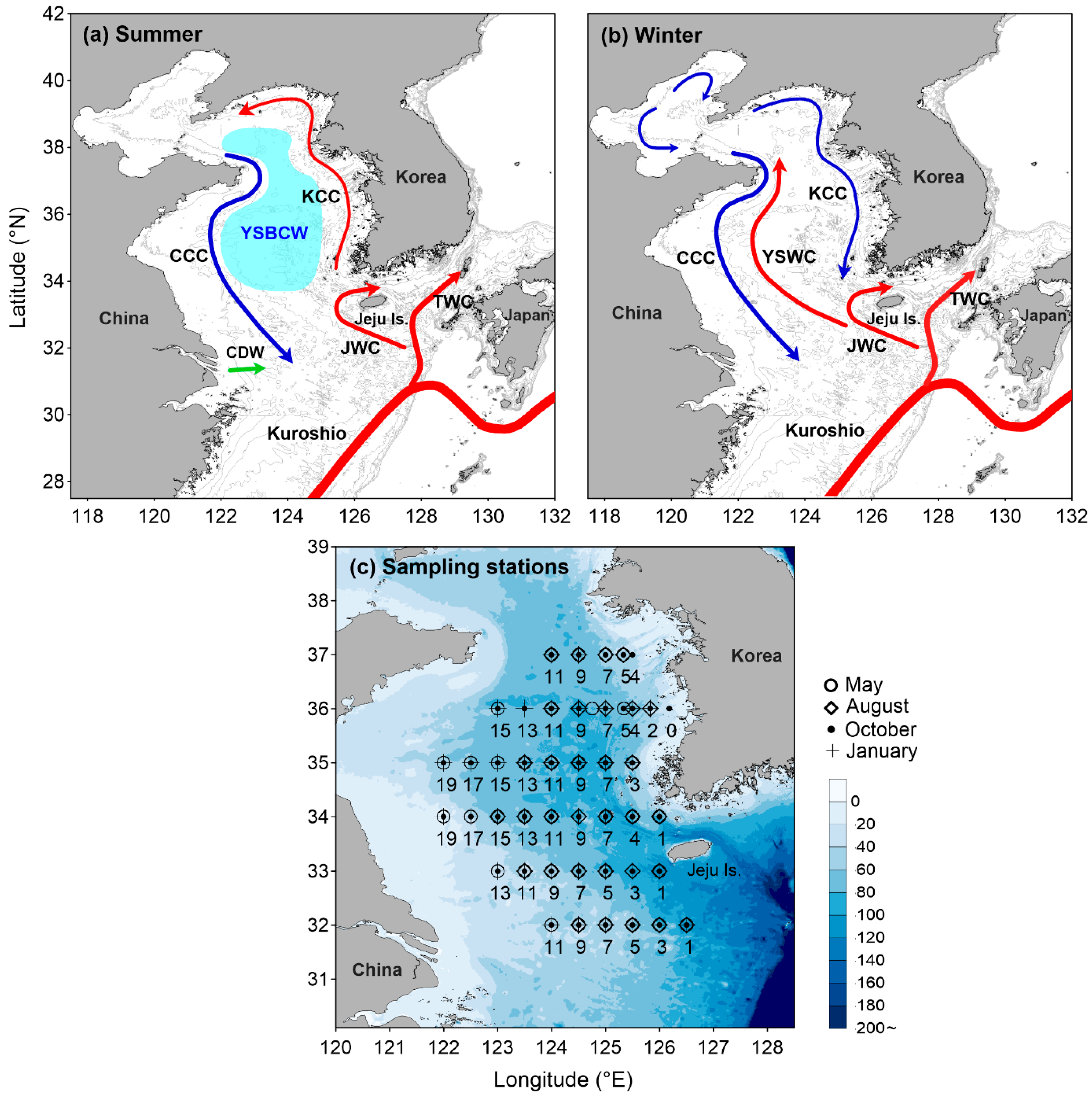
The Yellow Sea and northern East China Sea, marginal seas of the Northwest Pacific, are characterized by pronounced seasonal hydrographic variability [12,13,14], with particularly marked contrast occurring between summer and winter [15]. In summer, Yellow Sea Bottom Cold Water (YSBCW) develops in the central basin as a cold, saline bottom water mass [16,17] (Figure 1a; [15]). Meanwhile, warm currents such as the Jeju Warm Current (JWC) and Tsushima Warm Current (TWC), both branches of the Kuroshio Current, strengthen their northward transport during this period [18]. In winter, the Yellow Sea Warm Current (YSWC) intrudes from the East China Sea, generating a northward inflow into the Yellow Sea [19,20] (Figure 1b; [15]). Coastal currents also undergo seasonal reversals: the Korean Coastal Current (KCC) flows northward in summer and southward in winter, while the China Coastal Current (CCC) flows predominantly southward year-round with seasonal variation in strength. The region’s shallow depth (typically <100 m) and strong tidal amplitude produce well-developed tidal fronts that act as hydrographic boundaries and influence vertical mixing and stratification [21]. Such seasonal hydrodynamic shifts are expected to exert a potential influence on the composition and spatial distribution of zooplankton communities.
Figure 1.
Diagram of circulation patterns in the Yellow Sea and East China Sea, modified from [15]: (a) summer; (b) winter. (c) Map showing sampling stations. Abbreviations: CCC, Chinese Coastal Current; KCC, Korean Coastal Current; YSBCW, Yellow Sea Bottom Cold Water; CDW, Changjiang Diluted Water; JWC, Jeju Warm Current; TWC, Tsushima Warm Current; YSWC, Yellow Sea Warm Current. Red, blue, and green arrows indicate warm currents, cold currents, and diluted water, respectively.
Elucidating how zooplankton communities respond to this dynamic hydrography requires detailed and repeated investigations. While a number of studies have documented the community structure of zooplankton in the Yellow Sea [22,23,24,25,26,27,28], such investigations have been constrained by limited spatial coverage or short temporal windows. More recent research (e.g., [29,30]) has expanded this scope through assessment of indicator species and community traits across multiple seasons. However, these studies have often lacked an integrated analysis of physical oceanographic features such as thermohaline structure and current systems, which hampers a comprehensive understanding of zooplankton community variability in this region.
To address these gaps, we applied a multi-period approach across a broad latitudinal range (32–37° N) in the Yellow Sea and northern East China Sea. By integrating mesozooplankton community clustering, indicator species analysis, and detailed hydrographic information, we not only examined differences among the surveyed periods but also strengthened the physical interpretation of community patterns. In addition, by delineating ecological zones based on both biological and oceanographic features, we expanded the understanding of spatial ecosystem structure in this complex region.
2. Materials and Methods
2.1. Field Surveys
Samplings were conducted at multiple stations in the Yellow Sea and northern East China Sea (Figure 1c) in May 2021 (36 stations), August 2022 (32 stations), October 2021 (41 stations), and January 2024 (39 stations). At each station, temperature and salinity were measured using a conductivity–temperature–depth (CTD) profiler (Sea-Bird 911, Sea-Bird Scientific, Bellevue, WA, USA). Hydrographic visualizations, such as T–S diagrams and contour plots, were produced using Ocean Data View (ODV, version 5.8.1).
Seawater samples were collected from four to five discrete depths using Niskin bottles mounted on a rosette sampler (General Oceanics Inc., Miami, FL, USA). Water samples were filtered through pre-combusted Whatman GF/F glass fiber filters (Whatman, Maidstone, UK), immediately frozen, and stored at −70 °C until further analysis. In the laboratory, chlorophyll a (chl-a) was extracted with 90% acetone for 24 h in the dark at 4 °C, and quantified using a fluorometer (10-AU, Turner Designs, San Jose, CA, USA). Depth-averaged chl-a concentrations were calculated by averaging values across all sampled layers.
At the same stations, mesozooplankton samples were collected via a vertical tow of a conical plankton net (60 cm diameter, 200 µm mesh) equipped with a flowmeter (Model 438 115, Hydro-Bios, Kiel, Germany). The net was towed from 5 m above the seafloor to the surface. Water depth at the stations ranged from 18 to 104 m. Two hauls were conducted per station, from which one sample was fixed onboard with 5% neutral formalin for community structure analysis and the other was immediately frozen for dry-weight analysis. Sampling times varied among stations, including both day and night. As each tow sampled the entire water column, potential effects of diel vertical migration were assumed to be minor.
2.2. Sample Analysis
For taxonomic analysis, formalin-preserved samples were gently rinsed with tap water and subsampled using a Motoda plankton splitter (fraction range: 1/32 to 1/1024). From each subsample, 300–500 individuals were identified to the lowest possible taxonomic level under a dissecting microscope (Stemi 2000-C, Zeiss, Oberkochen, Germany) and an optical microscope (Axioskop, Zeiss). Species identification followed the taxonomic keys of Chihara and Murano [31]. Mesozooplankton abundance was standardized to individuals per cubic meter (ind. m−3). For dry-weight analysis, frozen samples were freeze-dried and biomass was calculated as milligrams dry weight per cubic meter (mg DW m−3) following standard zooplankton procedures [32].
2.3. Data Analysis
Mesozooplankton abundance and dry weight were described, and dominant species were identified for each sampling period. Species contributing more than 1% of the total abundance in any months were considered dominant. To examine the temporal variations in mesozooplankton abundance and dry weight, one-way analysis of variance (ANOVA) was applied to each variable, followed by Tukey’s post hoc test. Prior to analysis, data were tested for normality (Shapiro–Wilk test) and homogeneity of variance (Levene’s test). All statistical analyses were performed in R (version 4.3.1), with statistical significance set at p < 0.05.
Redundancy analysis (RDA) was performed to assess the influence of environmental factors on zooplankton community structure. For this analysis, we selected taxa that were either consistently dominant (e.g., Paracalanus parvus, Ditrichocorycaeus affinis, Oithona atlantica, O. similis, Oikopleura dioica) or exhibited clear seasonal peaks (e.g., Acartia omorii, Centropages abdominalis, Paracalanus aculeatus, Doliolum nationalis), and we also included species associated with characteristic water mass conditions (e.g., Calanus sinicus, Clausocalanus minor), allowing the RDA to capture key ecological gradients in the study area. Prior to analysis, abundance data were transformed using log(x + 1). An initial model including all environmental variables (surface, water column mean, bottom) was tested, and variables exhibiting similar tendencies were removed to avoid redundancy. The significance of the final model was assessed using permutation tests. Canonical ordination was performed using Canoco v5 [33].
Cluster analysis (CA) was conducted using species-specific abundance data, in which community similarities were quantified with the Bray–Curtis index and visualized using non-metric multidimensional scaling (NMS). To determine the optimal number of groups, indicator species analysis (ISA) was applied to two to six candidate groupings, and the number of groups with the highest number of significant indicator taxa and the strongest statistical support was selected for each season. The significance of group separation was evaluated using the multi-response permutation procedure (MRPP).
Indicator species analysis (ISA) was conducted to identify representative taxa for each cluster using the indicator value approach [34]. The indicator value (IndVal(ij) = A(ij) × B(ij) × 100) combines specificity (A) and fidelity (B), and has values ranging from 0 to 100. A score of 100 indicates a species that occurs exclusively and consistently within a particular cluster. Indicator species significance was assessed using 4999 permutations without additional correction for multiple testing. All multivariate analyses (CA, MRPP, ISA) were performed using PC-ORD version 7 [35].
3. Results
3.1. Hydrography and Water Masses
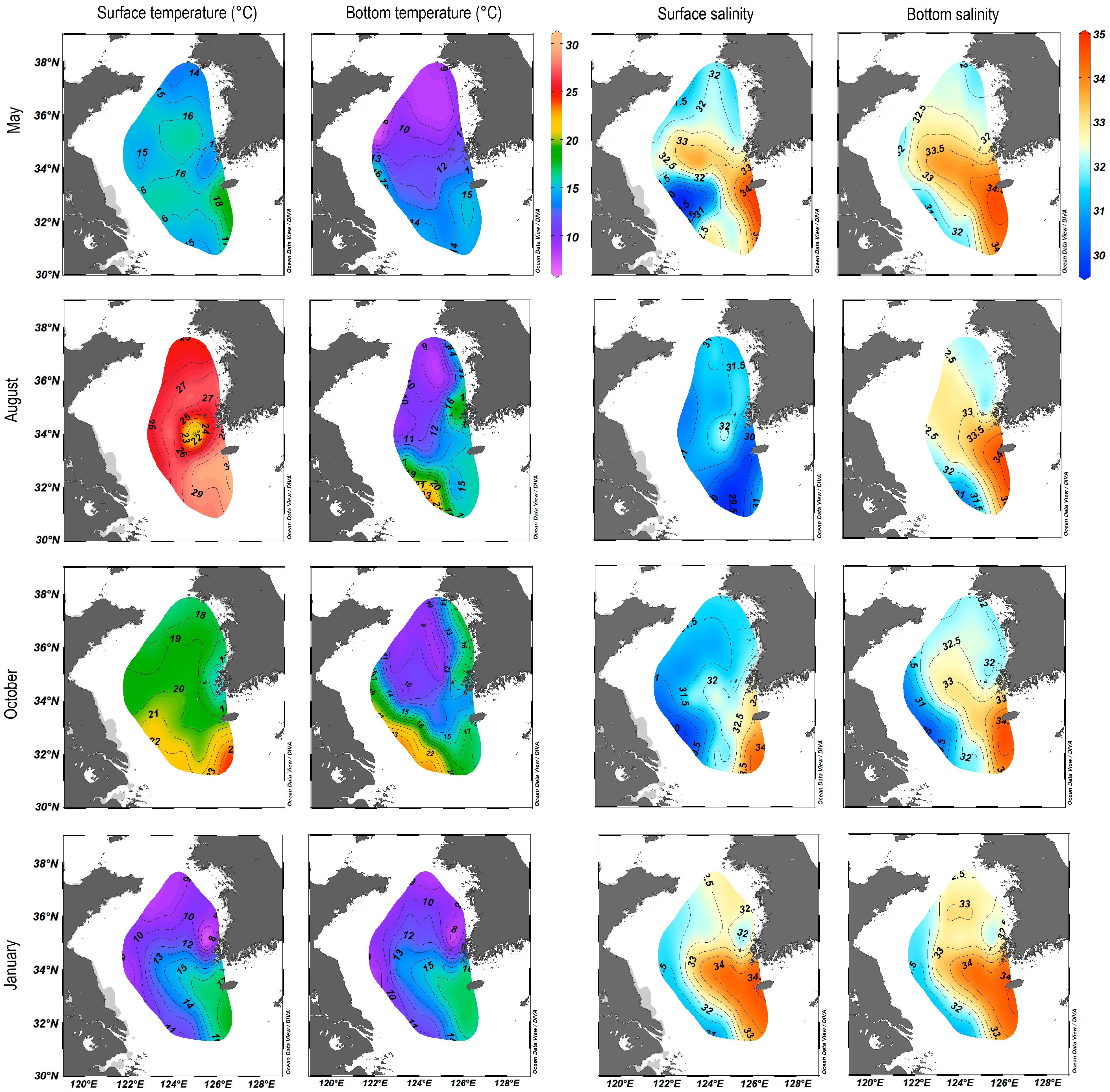
Hydrographic conditions varied markedly across the study area during the survey periods (Figure 2). In May, surface waters remained relatively cool (≤18.4 °C), while bottom waters were substantially colder (as low as 7.5 °C), with salinity ranging from approximately 29.5 nearshore to >34 offshore. Vertical stratification was moderate. In August, strong stratification developed, with surface temperatures exceeding 30 °C in southern areas and bottom temperatures remaining below 10 °C in the central Yellow Sea. Surface salinity decreased in southern areas (<30), while bottom salinity exceeded 34.0 in the offshore area. By October, surface temperatures had declined to ≤ 24.4 °C, accompanied by a weakening of the vertical stratification. Bottom temperatures in deeper areas remained consistently below 10 °C. In January, the water column was largely homogeneous, with temperatures ranging from 6.7 to 17.9 °C and relatively uniform salinity (31.4–34.4). The coldest surface waters occurred in northern regions.
Figure 2.
Horizontal distributions of temperature (°C) and salinity in the surface (5 m) and bottom layers across the study area for each survey period.
Surface (0 m) and depth-averaged chl-a concentrations both showed variations during the survey periods. Surface values were highest in May (0.2–12.8 µg L−1), followed by October and January (0.3–2.5 µg L−1), and relatively low in August (0.1–1.5 µg L−1). Depth-averaged concentrations peaked in May (0.3–5.8 µg L−1) and August (0.3–4.7 µg L−1), with lower values observed in October (0.3–1.9 µg L−1) and January (0.3–2.5 µg L−1). In May and August, elevated chl-a levels were concentrated at stations closest to the Korean coast and in the southern part of the study area, whereas in October and January overall concentrations were lower and spatial gradients were weaker.
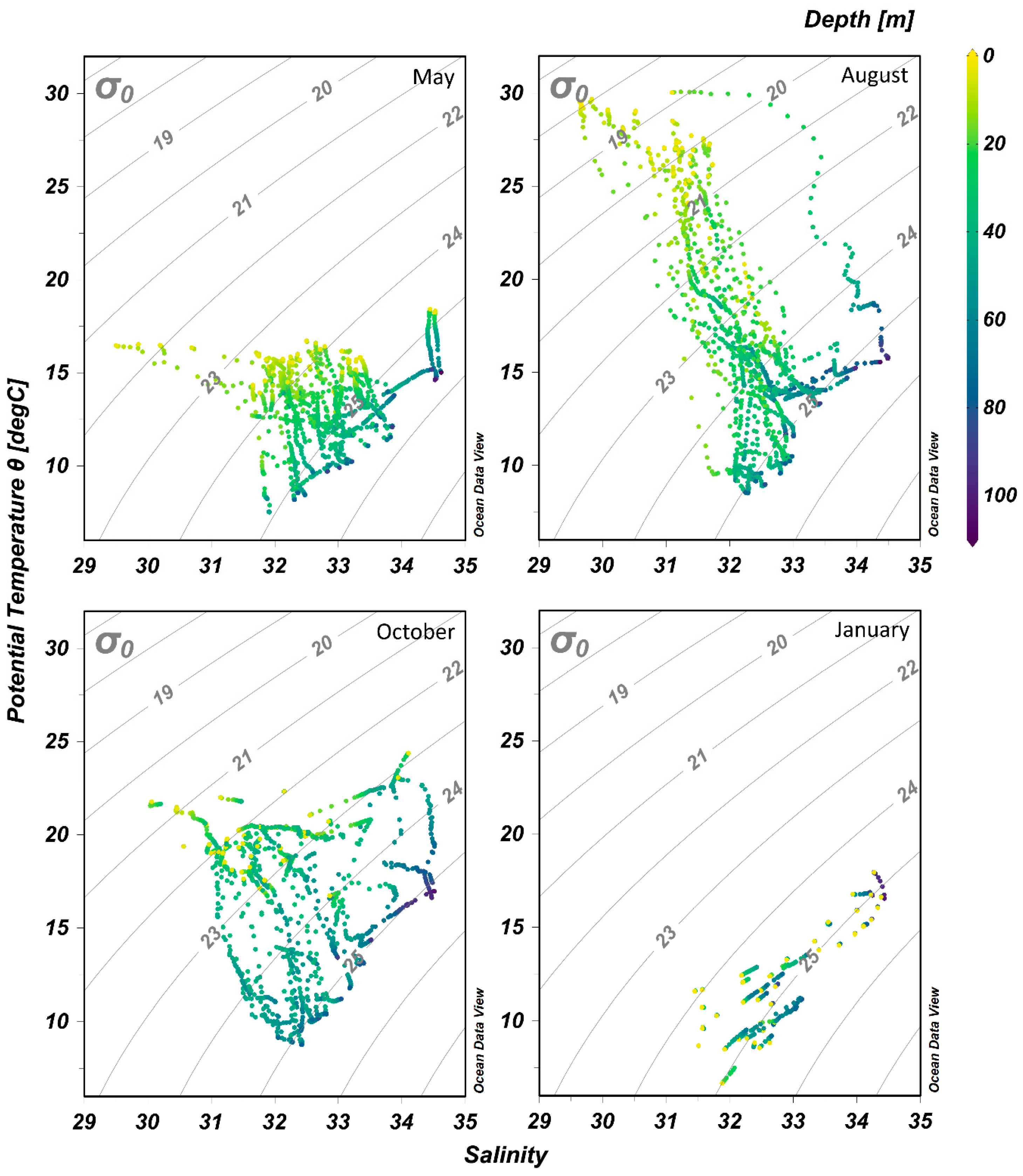
Based on the hydrography (Figure 2) and T–S diagrams (Figure 3), two distinctive water masses were identified. One was the Yellow Sea Bottom Cold Water (YSBCW), characterized by subsurface temperatures below 10 °C and persisting the central Yellow Sea from May through October. The other was a warm and saline water mass (temperature > 24 °C, salinity > 33.5) detected near Jeju Island in all surveyed months.
Figure 3.
Temperature–salinity (T–S) diagrams for each survey period in the Yellow Sea and northern East China Sea. Color scale (0–100) indicates station depth (m), and contour lines represent potential density anomaly (σθ; kg m−3).
3.2. Mesozooplankton Abundance and Dry Weight
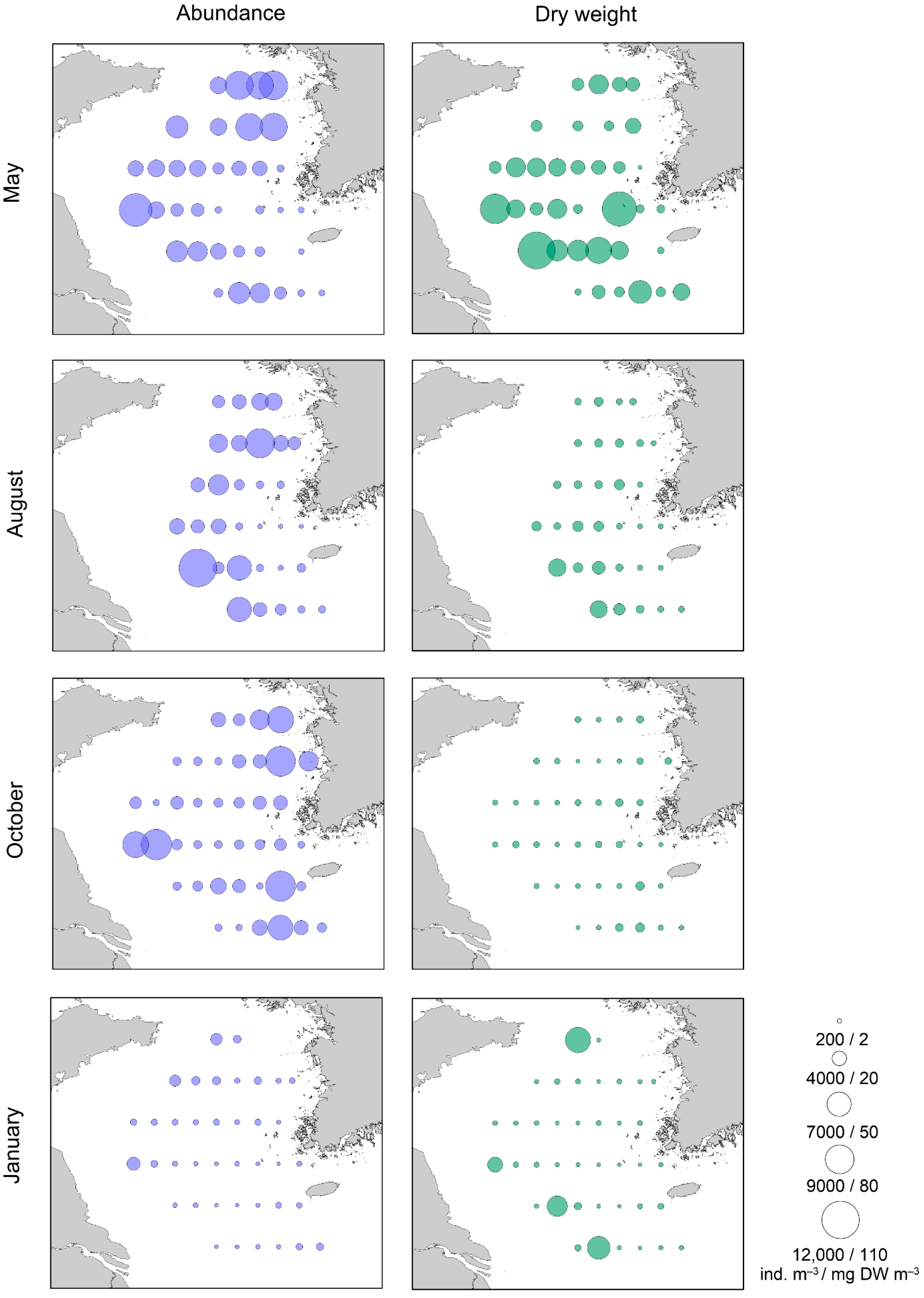
Mesozooplankton abundance and dry weight showed marked temporal and spatial variations across the study area (Figure 4). In May, total abundance ranged from 922 to 10,550 ind. m−3, with peaks in coastal areas around 36–37° N. In August, the highest abundance was recorded, reaching 12,302 ind. m−3. In October, values ranged from 1202 to 9784 ind. m−3 and were elevated along the coasts of China, Korea, and Jeju Island. In January, abundance declined substantially (200–3614 ind. m−3).
Figure 4.
Spatial distributions of mesozooplankton total abundance (ind. m−3; left) and dry weight (mg DW m−3; right) during the survey periods in the Yellow Sea and northern East China Sea.
In May, dry weight values ranged from 3.3 to 114.2 mg DW m−3, with higher biomass around 33–34° N. In August, dry weight peaked at 123.3 mg DW m−3, with the highest values in southern waters. In October, values were generally lower (8.8–52.3 mg DW m−3) and were slightly elevated in the eastern region. In January, dry weight ranged widely (5.9–188.2 mg DW m−3), with notable maxima at several stations.
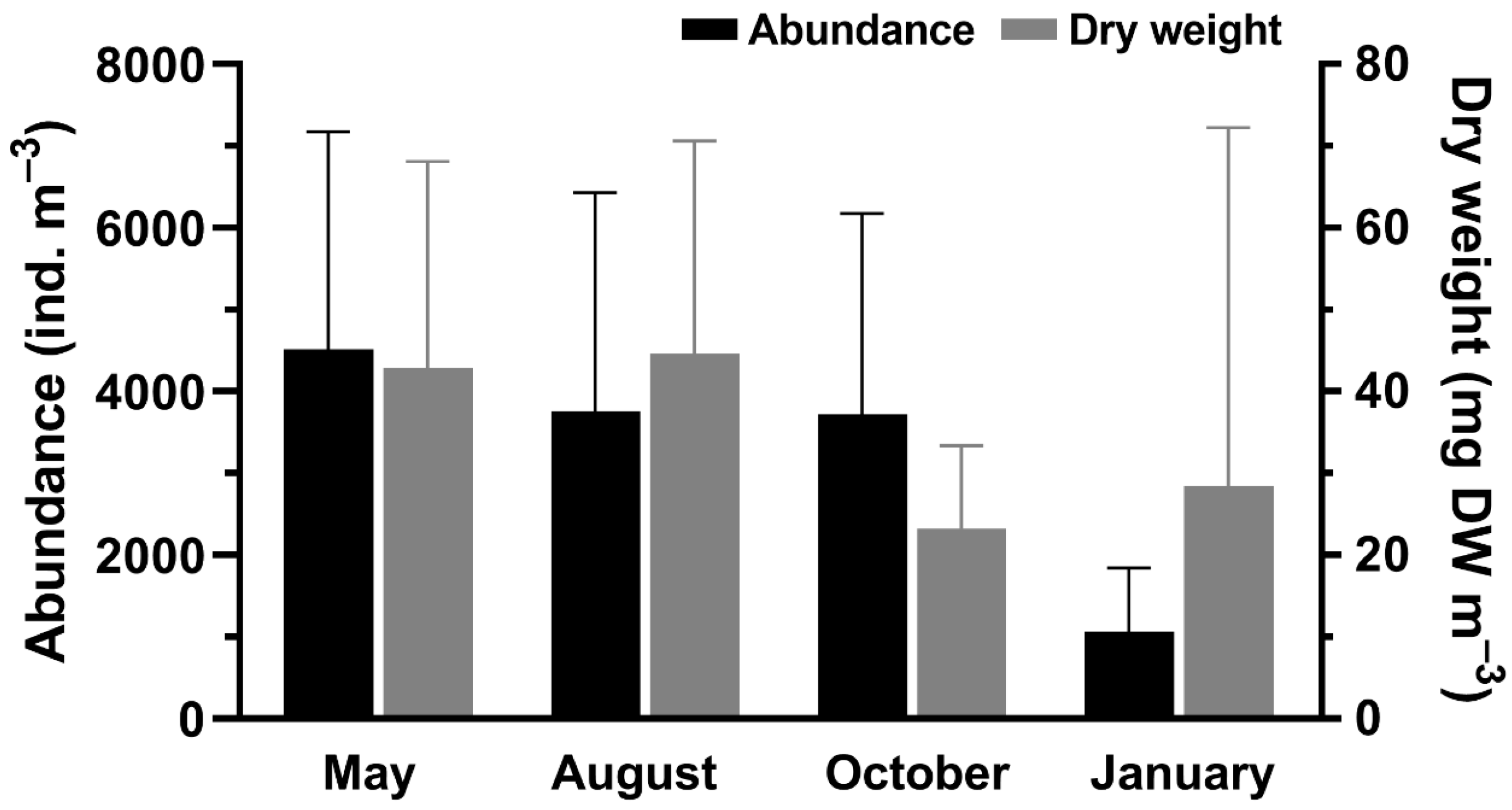
Mean abundance (Figure 5) was highest in May (4515 ± 2664 ind. m−3), followed by August (3757 ± 2672 ind. m−3) and October (3714 ± 2461 ind. m−3), and was lowest in January (1063 ± 779 ind. m−3). One-way ANOVA revealed significant differences among the survey periods (p < 0.001), and post hoc Tukey testing showed that May, August, and October did not significantly differ, but all were significantly higher than January.
Figure 5.
Mean values with standard deviations of mesozooplankton abundance (ind. m−3, black bars) and dry weight (mg DW m−3, gray bars) across the four survey periods in the Yellow Sea and northern East China Sea.
The highest mean dry weight values occurred in August (44.6 ± 26.1 mg DW m−3) and May (42.8 ± 25.3 mg DW m−3), followed by January (28.4 ± 43.8 mg DW m−3) and October (23.3 ± 10.1 mg DW m−3). Dry weight was significantly higher in May and August than in October and January (p < 0.05).
3.3. Dominant Species and Environmental Associations
The species present varied depending on the survey period (Table 1). Paracalanus parvus, including copepodites (stages I–V) and adults (stage VI), was the most persistent and abundant species year-round. Several other species displayed strong seasonal dominance. In May, in particular Calanus copepodites (11.5%) and Centropages abdominalis (5.9%) were prominent. In August, Doliolum nationalis (13.9%) emerged as the second most dominant species. In October, Paracalanus aculeatus (2.6%) was seasonally dominant, while Oikopleura dioica remained abundant (5.7%). In January, Oithona similis (16.6%) and Oithona copepodites (14.0%) were consistently abundant.
Table 1.
Mean abundance (ind. m−3) and dominance (%) of mesozooplankton species accounting for more than 1% of the total abundance during the study periods in the Yellow Sea and northern East China Sea.
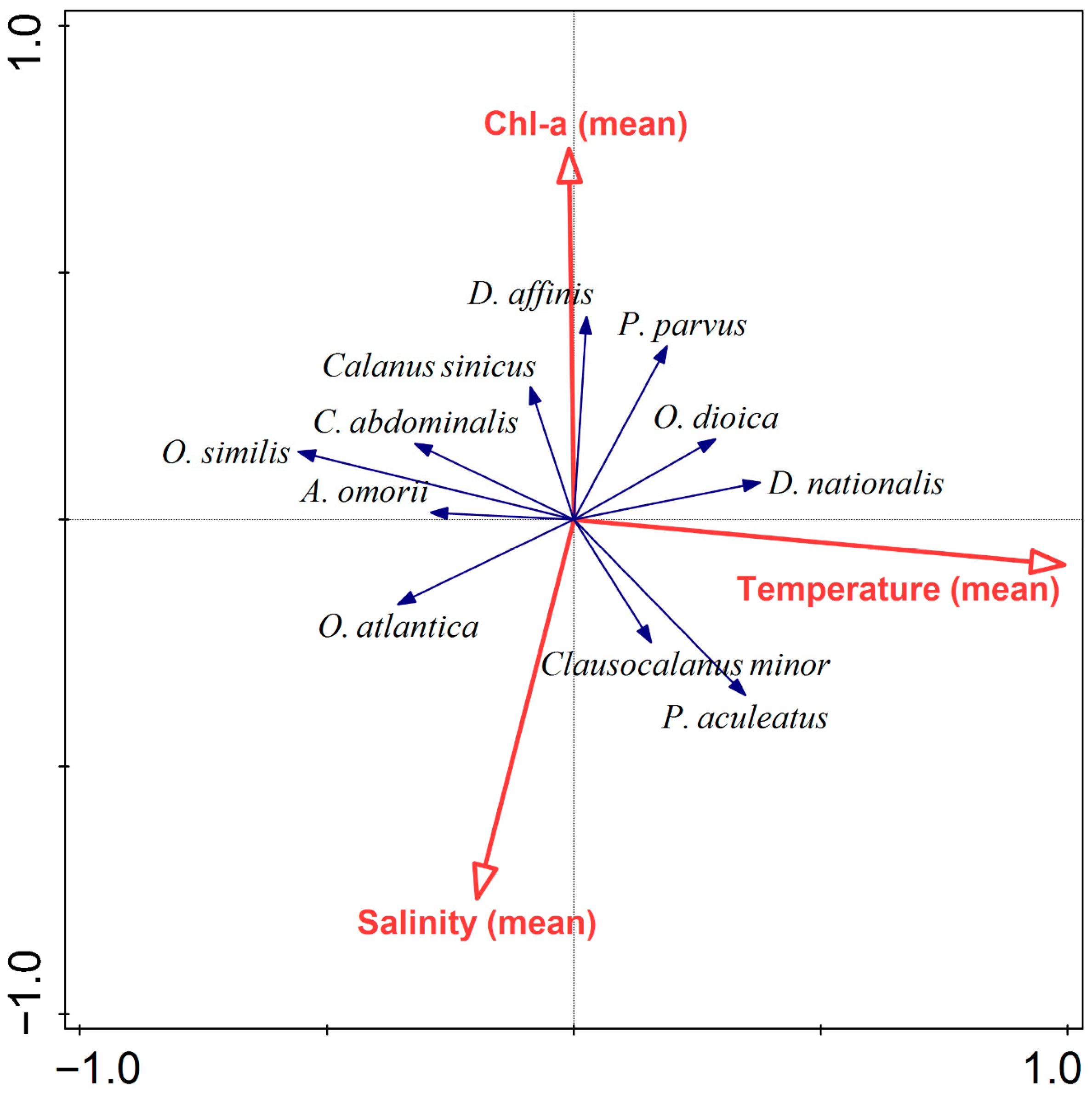
Redundancy analysis (RDA) revealed that zooplankton taxa exhibited distinct responses to the environmental gradients (Figure 6; Table 2). The model explained 17.60% of the total variation in species composition, with an adjusted explained variation of 15.89%. Forward selection identified all three environmental variables as significant (p < 0.005), with temperature (10.4%) contributing the most to the explained variation, followed by salinity (3.9%) and chl-a concentration (3.3%). Clausocalanus minor, P. aculeatus, and D. nationalis were aligned with the positive direction of the temperature vector, indicating their affinity for warmer conditions. In contrast, Ditrichocorycaeus affinis showed a strong alignment with the chl-a vector, reflecting its close relationship with high-productivity waters. P. parvus and O. dioica occupied intermediate positions between the temperature and chl-a vectors, suggesting that their distributions were jointly influenced by both variables. Meanwhile, Acartia omorii, Calanus sinicus, C. abdominalis, Oithona atlantica and O. similis were oriented toward the low-temperature and low-salinity direction, consistent with their occurrence in cooler water conditions.
Figure 6.
Redundancy analysis (RDA) ordination showing the relationships between dominant and seasonally distinctive species and the environmental variables. Sampling stations are represented by points, and arrows indicate the direction and magnitude of correlations with environmental factors.
Table 2.
Summary of redundancy analysis (RDA) showing the relationships between dominant and seasonally distinctive species and environmental variables (water column mean temperature, salinity, and chlorophyll a concentration).
3.4. Mesozooplankton Community Clusters and Indicator Species
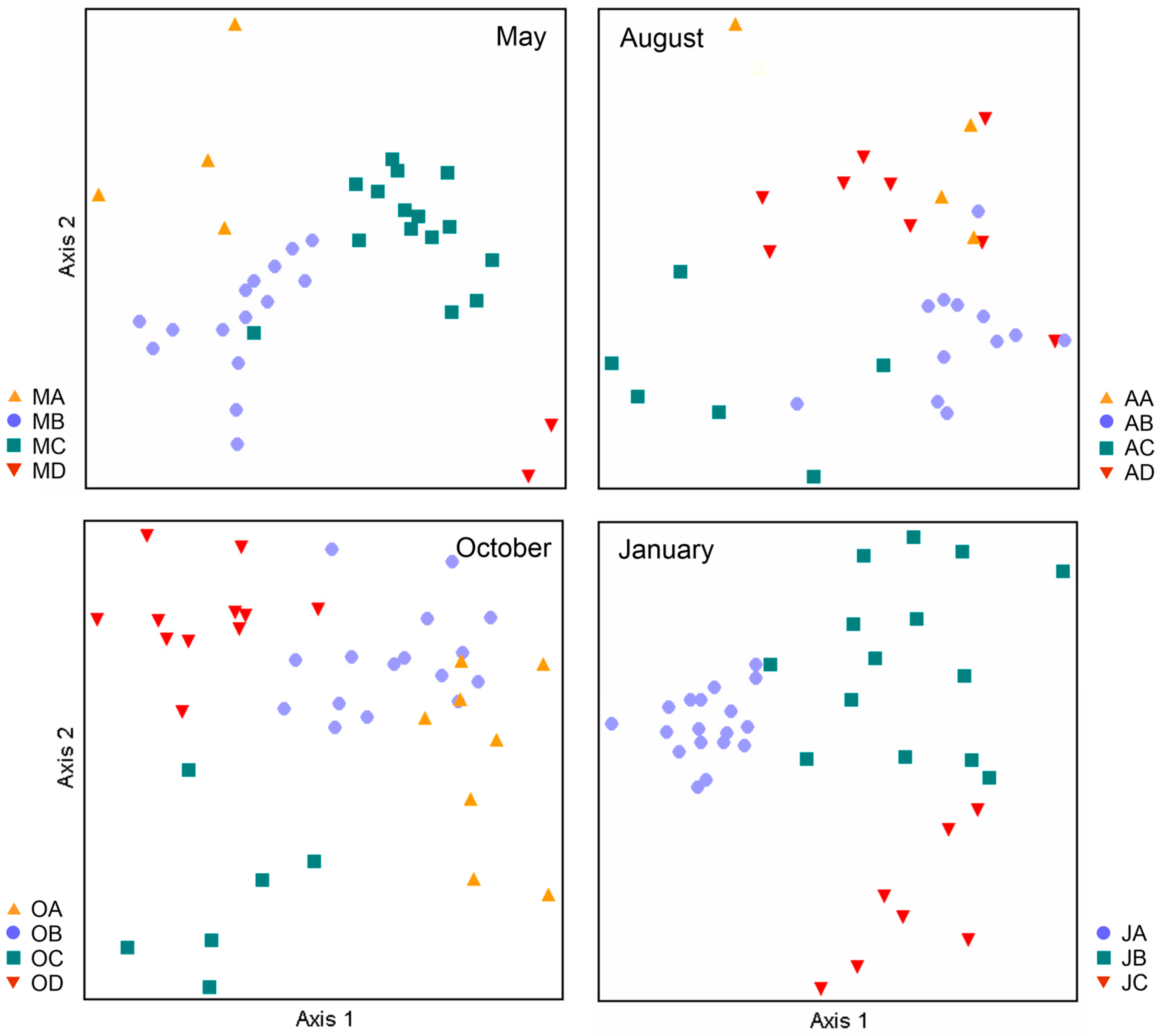
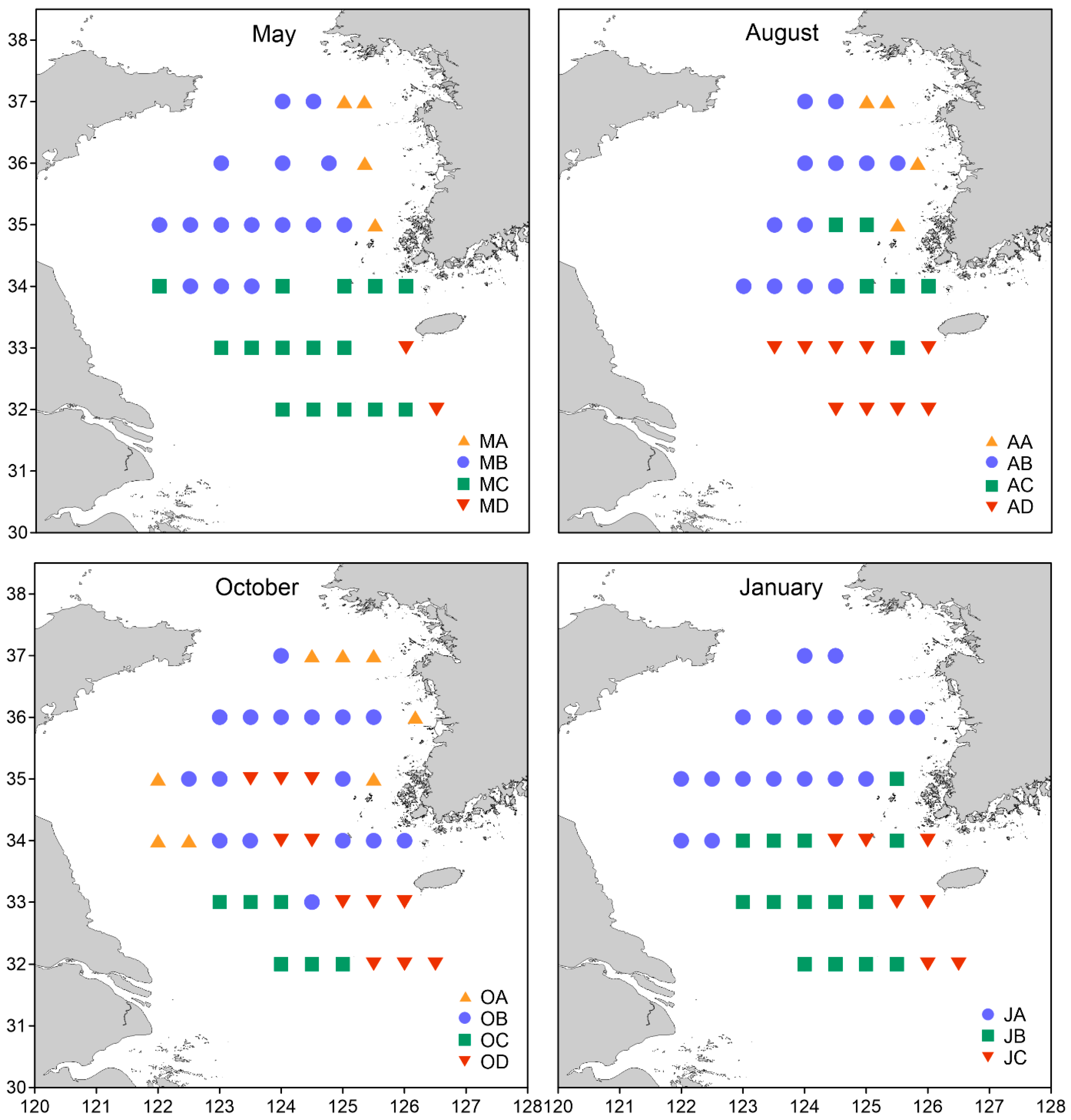
The cluster analysis showed spatial variability in mesozooplankton community composition across the study area (Figure 7 and Figure 8). In May, August, and October, the community was divided into four distinct clusters (designated MA–MD, AA–AD, and OA–OD, respectively), while in January, three clusters (JA–JC) were identified. All groupings were statistically supported by the MRPP results (p < 0.05).
Figure 7.
Non-metric multidimensional scaling ordination of zooplankton communities based on Bray–Curtis dissimilarity for each survey period. Each point represents a sampling station, and colors indicate clustered groups.
Figure 8.
Spatial distribution of mesozooplankton clusters in the Yellow Sea and northern East China Sea for each survey period (see Table 3). Each cluster is represented by a different colored symbol.
Along the Korean and Chinese coast, clusters MA, AA, and OA were consistently distinguished in the nearshore area, with meroplankton frequently appearing as indicator taxa (Table 3). In the central–northern region, cluster MB was identified, and other surveys revealed clusters AB and OB in broadly similar areas. Oithona atlantica served as an indicator taxon in this region during the warmer periods, whereas the winter cluster JA exhibited greater species heterogeneity.
Table 3.
Mesozooplankton indicator species (IndVal ≥ 40) for clustered groups in the Yellow Sea and northern East China Sea during the study period (p < 0.05, Monte Carlo test). Within each group, species are listed in descending order of IndVal.
Near Jeju Island, the cluster designated as MD during one survey was replaced by clusters AD, OD, and JC at other surveys, each characterized by different copepod indicator taxa (Table 3). In contrast, the southwestern offshore region did not show consistent clustering patterns across surveys.
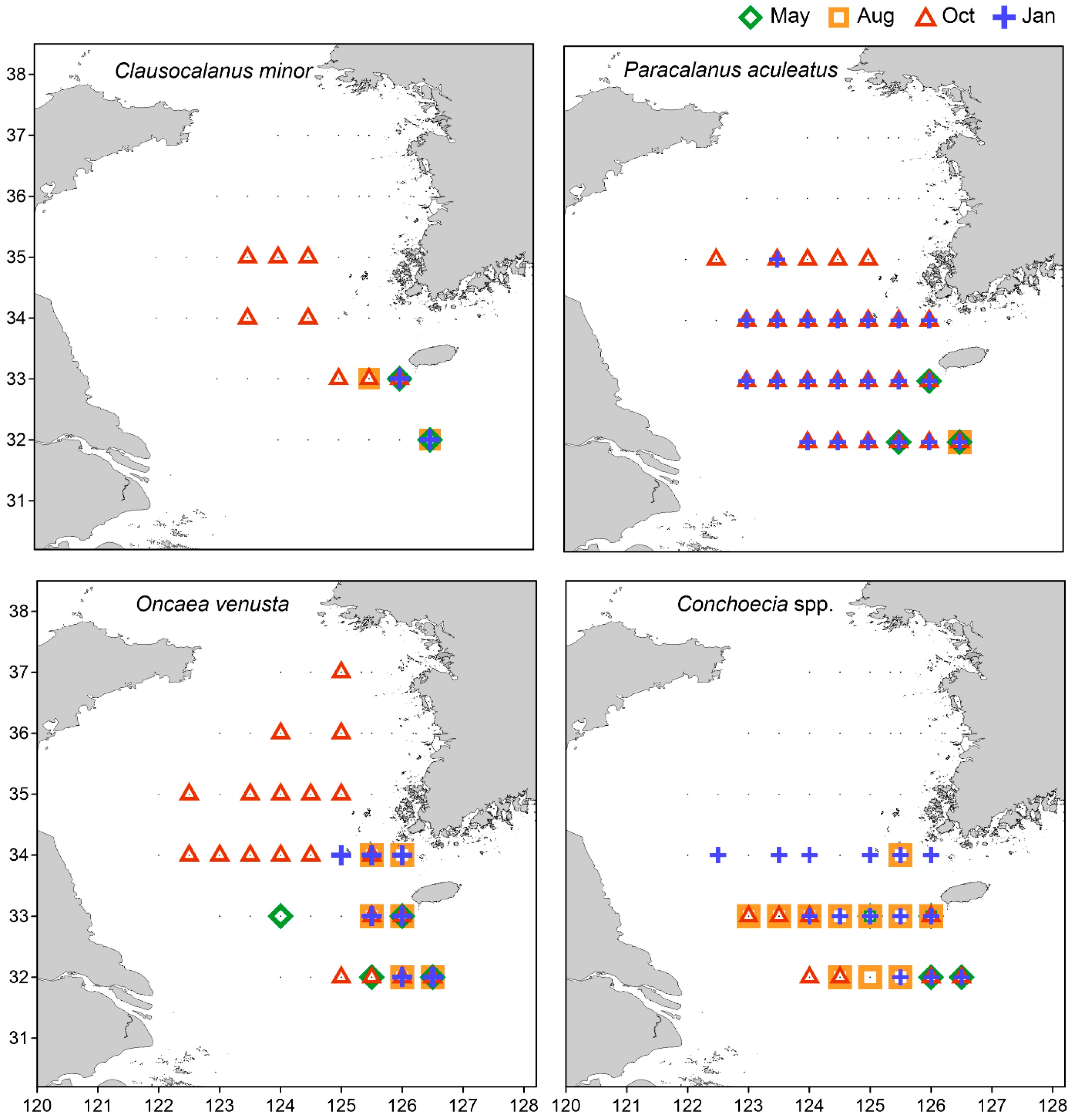
Among the 11 species repeatedly identified as indicators in the warm-water zone (Figure 8; Table 3), four taxa, namely Clausocalanus minor, Paracalanus aculeatus, Oncaea venusta, and Conchoecia spp., were detected across all survey periods, although their abundance varied among months (Figure 9). C. minor was primarily restricted to waters south of Jeju Island during most surveys, but extended into the central Yellow Sea in October. P. aculeatus occurred south of Jeju Island in May and August, while its distribution expanded across the southern Yellow Sea (below 35° N) in October and January. O. venusta was generally confined to waters south of 34° N, yet extended northward to 37° N in October. In contrast, Conchoecia spp. did not extend beyond 34° N during any of the four surveys.
Figure 9.
Variation in the distribution of four representative warm-water indicator species in the Yellow Sea and northern East China Sea. Colored symbols indicate differences in species occurrence among the survey periods.
4. Discussion
4.1. Environmental Drivers of Community Variability
Observed changes in mesozooplankton abundance and dry weight (Figure 5) corresponded with the environmental conditions across the survey periods. In May, stratification had begun to develop (Figure 2), and chl-a concentrations were relatively high, coinciding with elevated abundance and dry weight. In August, chl-a concentrations were lower, yet total biomass remained comparable to May due to the temporary increase in Doliolum nationalis, which is known to form short-lived blooms during warm periods [36]. In October, the water column entered a transitional state as stratification weakened. By January, strong vertical mixing had developed (Figure 2), reducing primary production across the region, which was reflected in the lowest zooplankton abundance and dry weight observed during the year (Figure 5).
The RDA results (Figure 6) allowed us to reaffirm the ecological characteristics of the dominant taxa. Paracalanus parvus and Oikopleura dioica, which persistently contributed a large proportion of the community throughout the year (Table 1), were positioned between the temperature and chl-a vectors, indicating broad environmental tolerance and supporting their characterization as ubiquitous coastal taxa [37]. In contrast, Acartia omorii, Calanus sinicus, Centropages abdominalis, Oithona atlantica and O. similis were oriented toward the lower-temperature direction, consistent with previously reported cold-water affinities [38,39]. Conversely, Clausocalanus minor, Paracalanus aculeatus, and Doliolum nationalis, located toward the higher-temperature direction, have been described as warm-water or offshore-associated species, and the present results are consistent with those patterns [36,40,41] (see Supplementary Materials).
4.2. Influence of Frontal Systems on Coastal Communities
In the Korean coastal waters, a nearshore cluster (MA, AA, OA) was consistently distinguished from offshore groups across the survey periods (Figure 8), with indicator taxa largely composed of coastal copepods such as corycaeus [41] and meroplankton (Table 3). Although temperature and salinity in this region varied across surveys (Figure 2), the repeated emergence of this nearshore grouping indicates that physical boundary processes likely play an important role in maintaining a distinct coastal community structure.
The Yellow Sea is a shallow marginal sea (<100 m) characterized by a large tidal range, where thermal, salinity, and tidal fronts are well developed [22,42]. These oceanic fronts act as physical boundaries separating water masses and are considered critical factors shaping mesozooplankton distribution patterns [43]. The spatial extent of coastal communities observed in this study closely aligned with the reported locations of such fronts [22,42]; In particular, the weakening of thermal fronts during winter, as noted by Lee and Beardsley [42], corresponds with the absence of distinct coastal clusters in January (Figure 8). Overall, the spatial distribution of coastal groups and their indicator species suggests that these assemblages are shaped by the seasonal dynamics of the region’s hydrographic fronts, which may help delineate the ecological boundaries of coastal waters in the Yellow Sea.
4.3. Indicator Species of the YSBCW
Cold-water-associated mesozooplankton communities were consistently identified in the north-central part of the study area, where the Yellow Sea Bottom Cold Water (YSBCW) typically develops. This region exhibited low bottom temperatures in the horizontal distributions (Figure 2), and the T–S structure of these waters corresponded to the σθ range characteristic of the YSBCW (Figure 3). Their recurrence across May, August, and October (MB, AB, OB; Figure 8) therefore indicates a persistent association with this cold, dense water mass.
The copepod Calanus sinicus has traditionally been regarded as an indicator of the YSBCW because of its strong association with cold bottom layers [44]. Although adults can tolerate a relatively wide thermal range, reproduction and early development are generally restricted to 5–23 °C [45,46,47]. These traits explain its seasonal dynamics and affinity for cold bottom waters [44]. In the present study, C. sinicus was recorded (Table 1) but did not emerge as an indicator species for any of the cold-water clusters (MB, AB, OB; Table 3). Its absence as an indicator species appears to reflect its broad spatial occurrence across the study area, which reduces its specificity to any single cold-water cluster. The RDA results (Figure 6) further support this interpretation by showing that C. sinicus responds not only to temperature but also to other environmental gradients, including chl-a. Taken together, these factors likely weakened its distinctiveness as an indicator of the YSBCW in this dataset.
In contrast, Oithona atlantica appeared as an indicator species for the cold-water–associated clusters in both May and August (Table 3), and its distribution corresponded closely with the extent of the YSBCW. This suggests that O. atlantica may have potential as a biological indicator of the cold bottom water mass in the Yellow Sea. Previous observations from Toyama Bay in the southern Sea of Japan reported that O. atlantica tends to occur in relatively deeper and cooler layers compared with other congeners [48], which is broadly consistent with the characteristics of the YSBCW. Although these findings imply an affinity for colder conditions, additional studies are needed to better understand its environmental tolerance and ecological role and to determine whether O. atlantica can function as a reliable indicator of the YSBCW in this region.
4.4. Influence of Warm Currents near Jeju Island
Clusters near Jeju Island (MD, AD, OD, JC) were clearly identified and consistently appeared across the survey periods (Figure 8). These communities were generally associated with waters characterized by relatively high temperature and salinity (Figure 2 and Figure 3), and warm-water taxa such as Clausocalanus minor, Paracalanus aculeatus, and Oncaea venusta [40] frequently emerged as indicator species in this region.
Because this area remained relatively warm and saline throughout all surveys (Figure 2 and Figure 3), spatial changes in these communities appear to reflect variations in current patterns rather than local differences in temperature or salinity. The extent of the warm-water zone varied among survey periods, likely due to fluctuations in the influence of regional warm currents. In May, the warm-water assemblage was confined to waters south of Jeju Island. By August, it had expanded westward, a pattern that resembles the seasonal strengthening of the Jeju Warm Current (JWC) [49,50]. In October, the warm-water area extended to around 35° N, consistent with the northward progression of the Tsushima Warm Current (TWC) [19,51]. Although warm currents typically weaken in winter, the persistence of warm-water assemblages up to 34° N suggests some influence of the Yellow Sea Warm Current (YSWC), which intensifies during this period [20,52].
Among those warm-water taxa, C. minor exhibited the most restricted and offshore-centered distribution [53], indicating higher specificity as a warm-water indicator species. Its northward expansion into the central study area during October (Figure 9) aligns with seasonal enhancement of the JWC and TWC [19,51]. Notably, although C. minor remained within the warm-water zone in winter, it did not progress into the central Yellow Sea, reflecting a weaker association with the YSWC [20,21]. These patterns demonstrate that C. minor is strongly affiliated with warm-current systems and may serve as a biologically meaningful indicator of the northward influence of the JWC in the Yellow Sea and northern East China Sea.
The repeated identification of Oithona atlantica and C. minor as indicator taxa also highlights their potential utility in long-term monitoring. Because their spatial distributions correspond closely with changes in major water masses, these species may provide valuable biological signals of climate-driven hydrographic variability in the region.
4.5. Limitations for Interpreting Regional Variability
Although a cluster was also identified in the southwestern part of the study area, its spatial extent did not remain consistent across surveys (Figure 8), and the indicator taxa appearing in different seasons did not share common ecological characteristics (Table 3). For these reasons, this region could not be clearly defined as a coherent ecological zone. This ambiguity likely reflects the combined influence of several physical processes. The southwestern stations lie near the boundaries of the YSBCW and the Chinese coastal water, where the seasonal extent of each water mass varies among years. Additional influences such as topographic retention, tidal mixing, and intermittent warm-water intrusions may also contribute to the region’s hydrographic complexity [13,14]. Consistent with this interpretation, the temperature and salinity distributions (Figure 2) and seasonal shifts in T–S structure (Figure 3) indicate that the southwestern area functions as a transitional zone where multiple water mass characteristics overlap, which likely explains the unstable cluster boundaries and the lack of consistent indicator taxa.
It is worth considering that the southwestern region included relatively few sampling stations, limiting the ability to resolve finer-scale spatial patterns or to delineate clearer community boundaries. More broadly, the dataset used in this study was not derived from a continuous multi-year seasonal time series, as each season was sampled in a different year. Consequently, some patterns may represent year-specific conditions rather than recurrent seasonal signals. In addition, because sampling was not vertically stratified, it was not possible to directly link the vertical structure of water masses with depth-specific community responses. Future work involving repeated seasonal monitoring, increased station density in the southwestern area, and depth-stratified sampling would enable more detailed assessment of the processes shaping mesozooplankton community variability.
5. Conclusions
This study characterized mesozooplankton community patterns in the Yellow Sea and northern East China Sea, identifying distinct spatial assemblages shaped by regional hydrographic structure (Table 4). Coastal communities were dominated by neritic copepods and meroplankton, reflecting the influence of tidal mixing and coastal hydrographic fronts. In the cold-water region, Oithona atlantica exhibited a strong association with the Yellow Sea Bottom Cold Water (YSBCW), suggesting its potential as a biological tracer of this subsurface feature. Warm-water assemblages near Jeju Island were characterized by oceanic copepods such as Clausocalanus minor, whose distribution closely tracked the northward penetration of warm currents. Collectively, these findings highlight the value of mesozooplankton as indicators of hydrographic variability in marginal seas and underscore their utility for detecting shifts in water-mass structure under ongoing environmental change.
Table 4.
Summary of ecologically distinct areas in the Yellow Sea and northern East China Sea, characterized by their hydrographic conditions, key indicator species, and ecological affinities. Abbreviations: YSBCW, Yellow Sea Bottom Cold Water; JWC, Jeju Warm Current; YSWC, Yellow Sea Warm Current.
Author Contributions
G.K.: Writing—original draft, Investigation, Conceptualization. H.-K.K.: Writing—review and editing, Conceptualization. D.H.C.: Writing—review and editing. All authors have read and agreed to the published version of the manuscript.
Funding
This research was supported by the Korea Institute of Marine Science & Technology Promotion (KIMST) funded by the Ministry of Oceans and Fisheries (20210696). Additional support was provided by the research projects of the Korea Institute of Ocean Science and Technology (KIOST; PEA0301, PEA0302).
Data Availability Statement
The datasets presented in this article are not readily available because the data are part of an ongoing study. Requests to access the datasets should be directed to corresponding author.
Acknowledgments
We thank the crews of the R/V Onnuri and R/V Isabu of KIOST for their support during the field surveys.
Conflicts of Interest
The authors declare no conflicts of interest.
References
- Steinberg, D.K.; Landry, M.R. Zooplankton and the ocean carbon cycle. Annu. Rev. Mar. Sci. 2017, 9, 413–444. [Google Scholar] [CrossRef]
- Beaugrand, G.; Reid, P.C.; Ibanez, F.; Lindley, J.A.; Edwards, M. Reorganization of North Atlantic marine copepod biodiversity and climate. Science 2002, 296, 1692–1694. [Google Scholar] [CrossRef]
- Pepin, P.; Johnson, C.L.; Harvey, M.; Casault, B.; Chassé, J.; Colbourne, E.B.; Galbraith, P.S.; Hebert, D.; Lazin, G.; Maillet, G.; et al. A multivariate evaluation of environmental effects on zooplankton community structure in the western North Atlantic. Prog. Oceanogr. 2015, 134, 197–220. [Google Scholar] [CrossRef]
- Kodama, T.; Wagawa, T.; Iguchi, N.; Takada, Y.; Takahashi, T.; Fukudome, K.I.; Morimoto, H.; Goto, T. Spatial variations in zooplankton community structure along the Japanese coastline in the Japan Sea: Influence of the coastal current. Ocean Sci. 2018, 14, 355–369. [Google Scholar] [CrossRef]
- Wells, S.R.; Bresnan, E.; Cook, K.; Eerkes-Medrano, D.; Machairopoulou, M.; Mayor, D.J.; Rabe, B.; Wright, P. Environmental drivers of a decline in a coastal zooplankton community. ICES J. Mar. Sci. 2022, 79, 844–854. [Google Scholar] [CrossRef]
- Gastauer, S.; Ohman, M.D. Resolving abrupt frontal gradients in zooplankton community composition and marine snow fields with an autonomous Zooglider. Limnol. Oceanogr. 2024, 70, S102–S120. [Google Scholar] [CrossRef]
- Beaugrand, G.; Reid, P.C. Long-term changes in phytoplankton, zooplankton and salmon related to climate. Glob. Change Biol. 2003, 9, 801–817. [Google Scholar] [CrossRef]
- Kiørboe, T. How zooplankton feed: Mechanisms, traits and trade-offs. Biol. Rev. 2011, 86, 311–339. [Google Scholar] [CrossRef]
- Daewel, U.; Hjøllo, S.S.; Huret, M.; Ji, R.; Maar, M.; Niiranen, S.; Travers-Trolet, M.; Peck, M.A.; van de Wolfshaar, K.E. Predation control of zooplankton dynamics: A review of observations and models. ICES J. Mar. Sci. 2014, 71, 254–271. [Google Scholar] [CrossRef]
- Richardson, A.J. In hot water: Zooplankton and climate change. ICES J. Mar. Sci. 2008, 65, 279–295. [Google Scholar] [CrossRef]
- Chiba, S.; Batten, S.D.; Martin, C.S.; Ivory, S.; Miloslavich, P.; Weatherdon, L.V. Zooplankton monitoring to contribute towards addressing global biodiversity conservation challenges. J. Plankton Res. 2018, 40, 509–518. [Google Scholar] [CrossRef] [PubMed]
- Ichikawa, H.; Beardsley, R.C. The current system in the Yellow and East China Seas. J. Oceanogr. 2002, 58, 77–92. [Google Scholar] [CrossRef]
- Isobe, A. Recent advances in ocean-circulation research on the Yellow Sea and East China Sea shelves. J. Oceanogr. 2008, 64, 569–584. [Google Scholar] [CrossRef]
- Lie, H.J.; Cho, C.H.; Lee, S. Tongue-shaped frontal structure and warm water intrusion in the southern Yellow Sea in winter. J. Geophys. Res. Oceans 2009, 114, C01003. [Google Scholar] [CrossRef]
- Park, K.A.; Park, J.E.; Choi, B.J.; Lee, S.H.; Shin, H.R.; Lee, S.R.; Byun, D.S.; Kang, B.; Lee, E. Schematic maps of ocean currents in the Yellow Sea and the East China Sea for science textbooks based on scientific knowledge from oceanic measurements. Sea 2017, 22, 151–171. (In Korean) [Google Scholar] [CrossRef]
- Zhang, S.W.; Wang, Q.Y.; Lü, Y.; Cui, H.; Yuan, Y.L. Observation of the seasonal evolution of the Yellow Sea Cold Water Mass in 1996–1998. Cont. Shelf Res. 2008, 28, 442–457. [Google Scholar] [CrossRef]
- Hwang, J.H.; Van, S.P.; Choi, B.J.; Chang, Y.S.; Kim, Y.H. The physical processes in the Yellow Sea. Ocean Coast. Manag. 2014, 102, 449–457. [Google Scholar] [CrossRef]
- Teague, W.J.; Jacobs, G.A.; Ko, D.S.; Tang, T.Y.; Chang, K.I.; Suk, M.S. Connectivity of the Taiwan, Cheju, and Korea Straits. Cont. Shelf Res. 2003, 23, 63–77. [Google Scholar] [CrossRef]
- Lie, H.J.; Cho, C.H.; Lee, J.H.; Lee, S.; Tang, Y.; Zou, E. Does the Yellow Sea Warm Current really exist as a persistent mean flow? J. Geophys. Res. Oceans 2001, 106, 22199–22210. [Google Scholar] [CrossRef]
- Xu, L.; Wu, D.; Lin, X.; Ma, C. The study of the Yellow Sea Warm Current and its seasonal variability. J. Hydrodyn. 2009, 21, 159–165. [Google Scholar] [CrossRef]
- Park, S.; Chu, P.C. Thermal and haline fronts in the Yellow/East China Seas: Surface and subsurface seasonality comparison. J. Oceanogr. 2006, 62, 617–638. [Google Scholar] [CrossRef]
- Zuo, T.; Wang, R.; Chen, Y.Q.; Gao, S.W.; Wang, K. Autumn net copepod abundance and assemblages in relation to water masses on the continental shelf of the Yellow Sea and East China Sea. J. Mar. Syst. 2006, 59, 159–172. [Google Scholar] [CrossRef]
- Sun, S.; Huo, Y.; Yang, B. Zooplankton functional groups on the continental shelf of the Yellow Sea. Deep Sea Res. Part II Top. Stud. Oceanogr. 2010, 57, 1006–1016. [Google Scholar] [CrossRef]
- Chen, H.J.; Liu, G.X. Zooplankton community structure in the Yellow Sea and East China Sea in autumn. Braz. J. Oceanogr. 2015, 63, 455–468. [Google Scholar] [CrossRef]
- Shi, Y.Q.; Zuo, T.; Yuan, W.; Sun, J.Q.; Wang, J. Spatial variation in zooplankton communities in relation to key environmental factors in the Yellow Sea and East China Sea during winter. Cont. Shelf Res. 2018, 170, 33–41. [Google Scholar] [CrossRef]
- Lee, J.Y.; Park, W.; Moon, S.Y.; Cha, H.K. Distribution and indicator species of zooplankton in the East Sea, Yellow Sea and Northern East China Sea in winter. J. Environ. Biol. 2019, 40, 871–883. [Google Scholar] [CrossRef]

- Wang, W.; Zhang, G.; Sun, X.; Zhang, F.; Zhang, X. Temporal variability in zooplankton community in the western Yellow Sea and its possible links to green tides. Peer J. 2019, 7, e6641. [Google Scholar] [CrossRef]
- Wang, X.; Zhuang, Y.; Zheng, Z.; Chen, H.; Ge, R.; Liu, G. Zooplankton assemblages and indicator species in the Changjiang River Estuary and its adjacent waters. Cont. Shelf Res. 2023, 260, 105000. [Google Scholar] [CrossRef]
- Shi, Y.; Wang, J.; Zuo, T.; Shan, X.; Jin, X.; Sun, J.; Yuan, W.; Pakhomov, E.A. Seasonal changes in zooplankton community structure and distribution pattern in the Yellow Sea, China. Front. Mar. Sci. 2020, 7, 391. [Google Scholar] [CrossRef]
- Kim, G.; Park, W.; Choi, D.H.; Kang, H.K. Seasonal variation in the mesozooplankton community structure and indicator species of the Yellow Sea. Reg. Stud. Mar. Sci. 2024, 73, 103454. [Google Scholar] [CrossRef]
- Chihara, M.; Murano, M. An Illustrated Guide to Marine Plankton in Japan; Tokai University Press: Tokyo, Japan, 1997; Volume 2. [Google Scholar]
- Harris, R.; Wiebe, P.; Lenz, J.; Skjoldal, H.R.; Huntley, M. (Eds.) ICES Zooplankton Methodology Manual; Academic Press: London, UK, 2000. [Google Scholar]
- ter Braak, C.J.F.; Šmilauer, P. Canoco Reference Manual and User’s Guide: Software for Ordination, version 5.0; Microcomputer Power: Ithaca, NY, USA, 2012. [Google Scholar]
- Dufrêne, M.; Legendre, P. Species assemblages and indicator species: The need for a flexible asymmetrical approach. Ecol. Monogr. 1997, 67, 345–366. [Google Scholar] [CrossRef]
- PC-ORD. Multivariate Analysis of Ecological Data, version 7; MjM Software Design: Corvallis, OR, USA, 2023. Available online: https://www.wildblueberrymedia.net/ (accessed on 19 June 2025).
- Choi, H.U.; Jeong, Y.S.; Choo, S.; Soh, H.Y. Variation in the Occurrence of Salp and Doliolid Assemblages in the Northeastern East China Sea from 2019 to 2023. J. Mar. Sci. Eng. 2024, 12, 862. [Google Scholar] [CrossRef]
- Cornils, A.; Schulz, J.; Schmitt, P.; Lanuru, M.; Richter, C.; Schnack-Schiel, S.B. Mesozooplankton distribution in the Spermonde Archipelago (Indonesia, Sulawesi) with special reference to the Calanoida (Copepoda). Deep Sea Res. Part II Top. Stud. Oceanogr. 2010, 57, 2076–2088. [Google Scholar] [CrossRef]
- Kas’yan, V.V. Distribution and seasonal dynamics of the abundance of Centropages abdominalis Sato and C. tenuiremis Thompson et Scott (Copepoda) in Amursky Bay, Sea of Japan. Russ. J. Mar. Biol. 2004, 30, 87–95. [Google Scholar] [CrossRef]
- Castellani, C.; Licandro, P.; Fileman, E.; Di Capua, I.; Mazzocchi, M.G. Oithona similis likes it cool: Evidence from two long-term time series. J. Plankton Res. 2016, 38, 703–717. [Google Scholar] [CrossRef]
- Noda, M.; Ikeda, I.; Ueno, S.; Hashimoto, H.; Gushima, K. Enrichment of coastal zooplankton communities by drifting zooplankton patches from the Kuroshio front. Mar. Ecol. Progr. Ser. 1998, 170, 55–65. [Google Scholar] [CrossRef]
- Shin, S.S.; Choi, S.Y.; Seo, M.H.; Lee, S.J.; Soh, H.Y.; Youn, S.H. Spatiotemporal distribution characteristics of copepods in the water masses of the northeastern East China Sea. J. Mar. Sci. Eng. 2022, 10, 754. [Google Scholar] [CrossRef]
- Lee, S.H.; Beardsley, R.C. Influence of stratification on residual tidal currents in the Yellow Sea. J. Geophys. Res. Oceans 1999, 104, 15679–15701. [Google Scholar] [CrossRef]
- Liu, G.M.; Sun, S.; Wang, H.; Zhang, Y.; Yang, B.; Ji, P. Abundance of Calanus sinicus across the tidal front in the Yellow Sea, China. Fish. Oceanogr. 2003, 12, 291–298. [Google Scholar] [CrossRef]
- Wang, R.; Zuo, T.; Wang, K.E. The Yellow Sea cold bottom water—An oversummering site for Calanus sinicus (Copepoda, Crustacea). J. Plankton Res. 2003, 25, 169–183. [Google Scholar] [CrossRef]
- Pu, X.M.; Sun, S.; Yang, B.; Ji, P.; Zhang, Y.S.; Zhang, F. The combined effects of temperature and food supply on Calanus sinicus in the southern Yellow Sea in summer. J. Plankton Res. 2004, 26, 1049–1057. [Google Scholar] [CrossRef]
- Zhang, G.T.; Sun, S.; Zhang, F. Seasonal variation of reproduction rates and body size of Calanus sinicus in the Southern Yellow Sea, China. J. Plankton Res. 2005, 27, 135–143. [Google Scholar] [CrossRef]
- Kang, H.K.; Lee, C.R.; Kim, D.; Yoo, S. Effects of enhanced pCO2 and temperature on reproduction and survival of the copepod Calanus sinicus. Ocean Polar Res. 2016, 38, 303–314. [Google Scholar] [CrossRef]
- Takahashi, T.; Uchiyama, I. Seasonal changes in the density and vertical distribution of nauplii, copepodites and adults of the genera Oithona and Oncaea (Copepoda) in the surface water of Toyama Bay, southern Sea of Japan. Plankton Benthos Res. 2008, 3, 143–151. [Google Scholar] [CrossRef][Green Version]
- Lie, H.J.; Cho, C.H.; Lee, J.H.; Lee, S.; Tang, Y. Seasonal Variation of the Cheju Warm Current in the Northern East China Sea. J. Oceanogr. 2000, 56, 197–211. [Google Scholar] [CrossRef]
- Lie, H.J.; Cho, C. Seasonal circulation patterns of the Yellow and East China Seas derived from satellite-tracked drifter trajectories and hydrographic observations. Prog. Oceanogr. 2016, 146, 121–141. [Google Scholar] [CrossRef]
- Isobe, A. On the origin of the Tsushima Warm Current and its seasonality. Cont. Shelf Res. 1999, 19, 117–133. [Google Scholar] [CrossRef]
- Hur, H.B.; Jacobs, G.A.; Teague, W.J. Monthly variations of water masses in the Yellow and East China Seas. J. Oceanogr. 2000, 56, 359. [Google Scholar] [CrossRef]
- Kim, G.; Kang, H.K.; Myoung, J.G. Seasonal and interannual variation in mesozooplankton community structure off Tongyeong, southeastern coast of Korea, from 2011 to 2014. Ocean Sci. J. 2017, 52, 113–125. [Google Scholar] [CrossRef]
Disclaimer/Publisher’s Note: The statements, opinions and data contained in all publications are solely those of the individual author(s) and contributor(s) and not of MDPI and/or the editor(s). MDPI and/or the editor(s) disclaim responsibility for any injury to people or property resulting from any ideas, methods, instructions or products referred to in the content. |
© 2025 by the authors. Licensee MDPI, Basel, Switzerland. This article is an open access article distributed under the terms and conditions of the Creative Commons Attribution (CC BY) license (https://creativecommons.org/licenses/by/4.0/).