You are currently viewing a new version of our website. To view the old version click .
Water
  • Article
  • Open Access

14 December 2025

Environmental Sustainability of Nanobubble Watering Through Life-Cycle Evidence and Eco-Innovation for Circular Farming Systems

,
and
1
Department of Water Engineering, Vytautas Magnus University, K. Donelaičio g. 58, 44248 Kaunas, Lithuania
2
Department of Management, ISM University of Management and Economics, Gedimino pr. 7, 01103 Vilnius, Lithuania
*
Author to whom correspondence should be addressed.
This article belongs to the Special Issue Water and Soil Pollution from Agriculture: Mechanisms, Assessments and Mitigation Strategies

Abstract

Nanobubble-saturated water (NBSW) is widely seen as a potential innovation for sustainable agriculture; however, its overall environmental impact still requires clarification. This study examined the sustainability performance of NBSW using laboratory experiments, a life-cycle assessment (LCA), and an expert-based feasibility evaluation. Air and oxygen nanobubble (ONB) watering were applied to silty clay loam and sandy loam soils, and environmental impacts were assessed using ILCD 2011 midpoint indicators. The results revealed that the electricity required for NB generation was the most significant contributor to the impacts across all categories, while material and nutrient inputs had only a minor impact. Air-NB and ONB treatments demonstrated similar life-cycle profiles because of their comparable energy demand. Conventional watering did not involve electricity use but increased nitrate leaching in sandy soil, leading to the possibility of eutrophication. Expert assessments indicated that future adoption of NBSW depends mainly on reducing energy consumption and improving operational reliability and cost efficiency. When combined with low-carbon energy and efficiency improvements, NBSW may contribute to reducing nutrient losses and enhancing resource efficiency in watering. These findings show that NB technology has potential as an eco-innovation, but more study is needed before it can be considered a viable circular-agriculture solution.

1. Introduction

According to the FAO (2017), agriculture consumes over 70% of worldwide freshwater withdrawals, making water an essential resource for crop yield. Availability and utilization were influenced by regional climate conditions, agricultural systems, and infrastructure [1]. Therefore, crop production may be highly efficient with advanced irrigation systems and innovative technology [2]. Nanobubble-saturated water (NBSW) is an innovative technique for water-saving irrigation that may increase agricultural yields and carbon sequestration and reduce greenhouse gas emissions [3]. Nanobubbles (NBs) have exceptional physicochemical properties such as high specific surface area, efficient gas transfer, and long-term stability, making them ideal for environmental applications such as water and wastewater treatment, phytoremediation, agriculture, and sediment remediation [4,5,6,7,8,9]. Although NBs have been seen to remain for weeks to months in aquatic environments [10,11,12], further studies have shown that NBs’ impacts in soils are temporary and texture-dependent. Some studies suggest that NBSW can increase soil moisture retention, boost microbial activity, and improve nutrient absorption, all of which lead to better plant development. Oxygen nanobubbles (ONBs) can cause rapid oxygenation but short-lived shifts in moisture–solute patterns; air-NBs are more stable and, in some cases, have better short-term moisture retention, whereas ONBs may increase aerobic microbial processes that disrupt structures near the surface, increasing the risk of evaporation under drier conditions [13]. While the short-term outcomes of NBSW seem scientifically promising, their transient nature raises significant concerns regarding the technology’s sustainability at the system level. Generating and applying NBs requires both energy and resource inputs, and without a comprehensive assessment, it remains uncertain if their potential benefits outweigh the associated environmental costs. To address this gap, a life-cycle assessment (LCA) is needed. The LCA is an internationally standardized approach (ISO 14040 and ISO 14044) for evaluating the environmental implications of products and processes across their whole life-cycle, including raw material extraction, generation, use, and disposal [14,15,16]. The energy demand of irrigation and water treatment demonstrates why such an in-depth assessment is required. Irrigation consumes approximately 1896 PJ of energy per year and releases 216 million metric tons of CO2, representing up to 15% of agricultural energy and GHG emissions [17]. Groundwater pumping and wastewater treatment are major energy sources in water management systems. Although groundwater is used in approximately 40% of the irrigated agriculture in the world, it contributes to about 89% of the overall irrigation energy consumption, highlighting the disproportionate energy cost of pumping operations [17]. Similarly, in wastewater treatment, aeration techniques alone contribute to 50–90% of total power consumption, making oxygen-transfer efficiency a key aspect influencing overall environmental performance [18]. Compared with conventional aeration techniques, NBs have shown an up to six-fold increase in oxygen-transfer rates due to their unique gas-transfer capacity [18], indicating the possibility of lowering the total energy intensity. A decision-support tool has shown that the environmental effect of reusing water for irrigation differs based on the energy mix, water source, and treatment techniques [19]. Similarly, research has shown that utilizing treated wastewater for irrigation could reduce the effects on ecosystems and human health while increasing resource burdens. These findings highlight the trade-offs that only LCA can fully explain [20].
Taking all of the above into consideration, eco-innovation supports the development of technologies that increase environmental performance while remaining economically viable in real markets [21]. These technologies reduce resource consumption and environmental impacts across the whole product and process life-cycles [22]. Due to the double-externality problem, environmental advantages mostly benefit society while resulting in lower incentives for private investment compared to existing technologies [21]. As a result, regulatory drivers, market demand conditions, and economic benefits such as cost savings all have a substantial impact on whether eco-innovations become widely adopted [22]. Circular economy (CE) strategies prioritize enhancing resource efficiency and reducing waste across agricultural production systems [23]. CE supports the transition to sustainable and resilient agri-food systems by reducing inputs and environmental constraints while maintaining productive capacity [23]. Integrating eco-innovation with CE principles promotes technological advancement while maintaining long-term environmental and economic value creation [22,23]. Evaluating the economic viability of innovative environmental technologies is thus critical for their effective implementation in real-world water management contexts [24]. Positioning this assessment within the broader perspectives of eco-innovation and the circular economy allows for a deeper examination of whether NBSW can contribute to resource-efficient and market-viable agricultural water management solutions. The purpose of this research is to integrate experimental data on the short-term impacts of NBSW with a system-level assessment of its environmental impact. The objectives of this study were to (1) determine the energy intensity and environmental performance thresholds at which NBSW (air and ONB) may achieve environmental equivalence compared to conventional watering in key impact categories; (2) analyze soil-type-dependent nutrient trade-offs by determining how variations in nitrate (NO3), phosphate (PO43−), and potassium (K+) leaching affect the relative environmental advantages of NB watering; and (3) evaluate sustainability trade-offs and policy relevance by interpreting results using eco-innovation and circular-economy frameworks.

2. Materials and Methods

2.1. Modeling and Impact Assessment

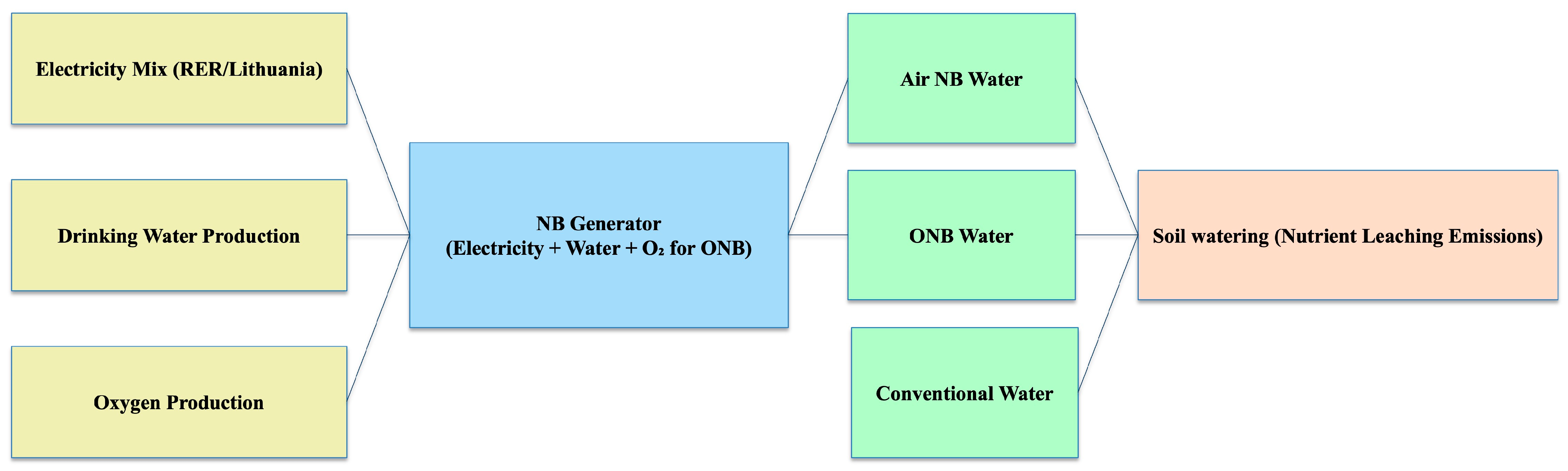
The LCA was conducted using openLCA (version 2.5.0; GreenDelta, Berlin, Germany). The analysis involved the “cradle-to-operation” phase, which included NB generation and laboratory-scale watering applications. The functional unit of 1 m3 of treated water was applied. The system boundaries contained both foreground and background processes. The foreground system included the NB generator operation, consumption of electricity, water input, oxygen utilization for ONB, and watering events, which resulted in nutrient leaching through the soil. The background system, as represented by the European Reference Life Cycle Database (ELCD 3.2) [14], contained upstream processes such as generating and distributing electricity, drinking water treatment and delivery, and oxygen production [25]. The International Reference Life Cycle Data System (ILCD) 2011 midpoint (H) method was used for the impact assessment, which included categories such as climate change (greenhouse gas emissions), acidification (soil and water acidifying gases), eutrophication (nutrient enrichment in water bodies), freshwater ecotoxicity (toxic effects on aquatic life), human toxicity (health impacts from pollutants), particulate matter formation (airborne particles affecting air quality), photochemical ozone formation (smog creation from NOₓ and VOCs), ionizing radiation (radioactive emissions), ozone depletion (damage to the ozone layer), resource use (extraction of minerals and fossil resources), and water use (freshwater consumption and scarcity). All parameters were modeled under European-average conditions. It should be highlighted that electricity consumption related to water distribution or pumping was excluded from the system boundaries for both water treatments. This limitation arises from the fact that the experiments were conducted in a controlled laboratory environment, where both conventional and NB water were supplied through the same system and did not require any additional on-site pumping. A sensitivity analysis was not performed since no measured pumping-energy data were available and including assumed values would bring unverified assumptions into the model. The system boundaries of the LCA model are illustrated in Figure 1.
Figure 1. System boundaries of the LCA for NB and conventional watering.

2.2. Experimental Context and Data Source

The environmental assessment in this study was based on two parallel laboratory experiments carried out at Vytautas Magnus University in Kaunas, Lithuania [13]. The experiments were performed using two distinct soil types: silty clay loam (SCL, experiment E1) and sandy loam (SL, experiment E2). Three different types of water were used for soil sample watering: conventional water, ONB water, and air-NB water. Conventional water was applied directly, and the same laboratory tap-water source has been used to produce NB water.
NBSW was produced using a HLYZ-002 NB generator (HOLLY Technology, PRC). The device has a rated power of 1.1 kW and uses a venturi-based pressurized gas–liquid mixing system to produce ultrafine bubbles (<200 nm in diameter). The generator required 10 min to generate 40 L of NB water, which resulted in an energy usage of 0.183 kWh per batch. Scaled to 1 m3, the energy demand was computed as 4.583 kWh·m−3, which was utilized as the reference electricity input for both Air-NB and ONB generation. Air-NB employed ambient laboratory air as its gas source. A compressed cylinder was used to provide oxygen for ONB generation. In this LCA model, oxygen consumption was represented as a parameter (θO2) and defined mathematically as follows:
θ O 2 = M a s s   o f   o x y g e n   s u p p l i e d   ( k g ) T r e a t e d   w a t e r   v o l u m e   ( m 3 )
The parameter θO2 was set at 1.0 kg O2·m−3 in all modeled scenarios. Figure 1 represents system boundaries and foreground inventory inputs. During the experimental period, a total of 24 conventional watering events (conducted along with the NB treatments), 13 ONB watering events, and 11 Air-NB watering events were performed. Each experimental scenario used a total of 69.75 L of water.
Nutrient leaching data were recorded as elementary flows to soil, based on the measured leachate volume and nutrient concentrations. In experiment E1, NBSW leached 295.2 mg of nitrate (NO3), 2.24 mg of phosphate (PO43−), and 58.6 mg of potassium (K+), while conventional watering leached 525.3 mg of NO3, 2.26 mg of PO43−, and 95.7 mg of K+. In experiment E2, conventional watering leached 2266 mg of NO3, 1.87 mg of PO43−, and 167.4 mg of K+. There was no leachate water collected from the NB-treated sandy loam soil, hence NPK leaching for the Air-NB and ONB scenarios in E2 were not examined. In ELCD, water flows were represented as “drinking water, at plant” and defined as kilograms (1 m3 = 1000 kg). All the empirical data on watering volumes and nutrient leaching [13] were obtained from the prior experimental study, which was utilized to set up the current LCA. Table 1 summarizes the key inventory data from the SCL (E1) and SL (E2) soil tests, respectively.
Table 1. Life-cycle inventory data for air and ONB versus conventional watering in experiments E1 and E2.

2.3. Economic and Business Feasibility Assessment

To support the environmental life-cycle analysis, an additional evaluation was conducted to determine the economic feasibility and business viability of NBSW for practical applications in the watering and water management sectors. This stage was integrated to present a decision-support perspective by incorporating expert-based assessments into a multi-criteria assessment framework using the simple additive weighting (SAW) approach.

2.3.1. Assessment Framework

The SAW technique was chosen because it is clear and effective in aggregating weighted expert assessments into a single feasibility index. The analysis involved three main phases: (1) developing relevant evaluation criteria; (2) obtaining expert assessments and significance weights for each criterion; and (3) normalizing and combining data to calculate a composite feasibility score for NB technology. The scores were calculated using a 5-point Likert scale, with 1 indicating very low performance and 5 indicating very high performance or importance.

2.3.2. Selection of Evaluation Criteria

Nine criteria have been developed to indicate the key factors impacting NB technology’s viability in business. These included the initial investment cost (interview protocol; comparative investment analysis of agricultural irrigation systems), operations and maintenance costs, market adoption potential, return on investment (ROI), scalability and adaptability, risk and reliability, innovation and competitive advantage, environmental advantages, and policy and market support. The criteria were chosen based on clean technology adoption literature, water-treatment economics, and expert evaluations to provide a thorough understanding of technical, financial, and market dimensions.

2.3.3. Data Collection and Interview Protocol

The experts usually have different opinions, and sometimes conflicting ones. Their level of suitability must be assessed, which is why a multiple-criteria method is being used. The significance of two experts can be expressed as a correlation coefficient rather than the degree coefficient for a larger number of experts. In the case of a larger number of experts, the degree of compatibility can be indicated by the concordance coefficient (W). The evaluation results may be practical if the expert assessments have a high rate of suitability. The results may be presented using the concordance coefficient, which is computed by comparing different objects (opinions).
Each expert (total 9 experts) [26] was interviewed individually using a semi-structured approach. The interviews had two sections: (a) experts will rate each of the nine criteria on a 100-point scale (0.1–1) based on importance or perceived performance for NB technology—0.1 = Very Low, 0.25 = Low, 0.5 = Moderate, 0.8 = High, 1 = Very High. Results will be normalized and weighted using the SAW method to rank overall feasibility; and (b) a qualitative assessment of perspectives, opportunities, and perceived challenges for market implementation.

2.3.4. Data Analysis

The gathered data was examined using the SAW multi-criteria decision-making model. Ranging is an approach in which the most significant index obtains a range equal to one, the second is given a range equal to two, and so on, with the last being given a range (m). Equivalent indexes receive the same range, which is the arithmetic average of both ranges. The concept of the dispersion concordance coefficient is connected to the sum of each index’s range when compared to the range of all experts.
C i = j = 1 r C i j , ( i = 1 , , m )
It is expressed by the deviation into the comparison with average values C ¯ and S (dispersion):
S = i = 1 m C i C ¯ 2
The formula used to determine the average value C ¯ is as follows:
C ¯ = i = 1 m C i m = i = 1 m j = 1 r C i j m
If experts evaluate all indexes equally, the most important index would have a range of 1, and the total of index ranges would be equal to r; the second regarding importance would be index—2r, and so on, with the final index—mr. This is an example of the ideal degree of compatibility. In this case, dispersion would have the maximum possible value:
S m a x = i = 1 m r i 1 2 r ( m + 1 ) 2 = r 2 m ( m 2 1 ) 12
The concordance coefficient is the ratio between dispersion and the maximum value of S m a x :
W = 12 S r 2 m ( m 2 1 )
When experts’ opinions are consistent, the value of the concordance coefficient W is near one; if the values differ, then W is near zero. Concordance coefficients may be used in practice to examine limiting values, indicating that expert opinions may be regarded to be consistent. The number of objects m > 7, and the significance of the concordance coefficient may be represented as follows:
x 2 = W r m 1 = 12 S r m m + 1
Here x 2 > x k r 2 —Experts opinions are compatible; SAW—simple additive weighting method. Multiple data analysis is required to select the optimal option. The sum of all indexes with weight Sj for each j-m object must be determined.
S j = i = 1 m ω i r i j ~
Here ω i —weight of i —index; r i j ~ —value of i —index for j—object with the weight.
r i j ~ = r i j j = 1 n r i j
The biggest value of S j represents the opinion of a certain expert, who optimally expresses the opinions of all experts.

3. Results

3.1. Energy Intensity and Environmental Performance

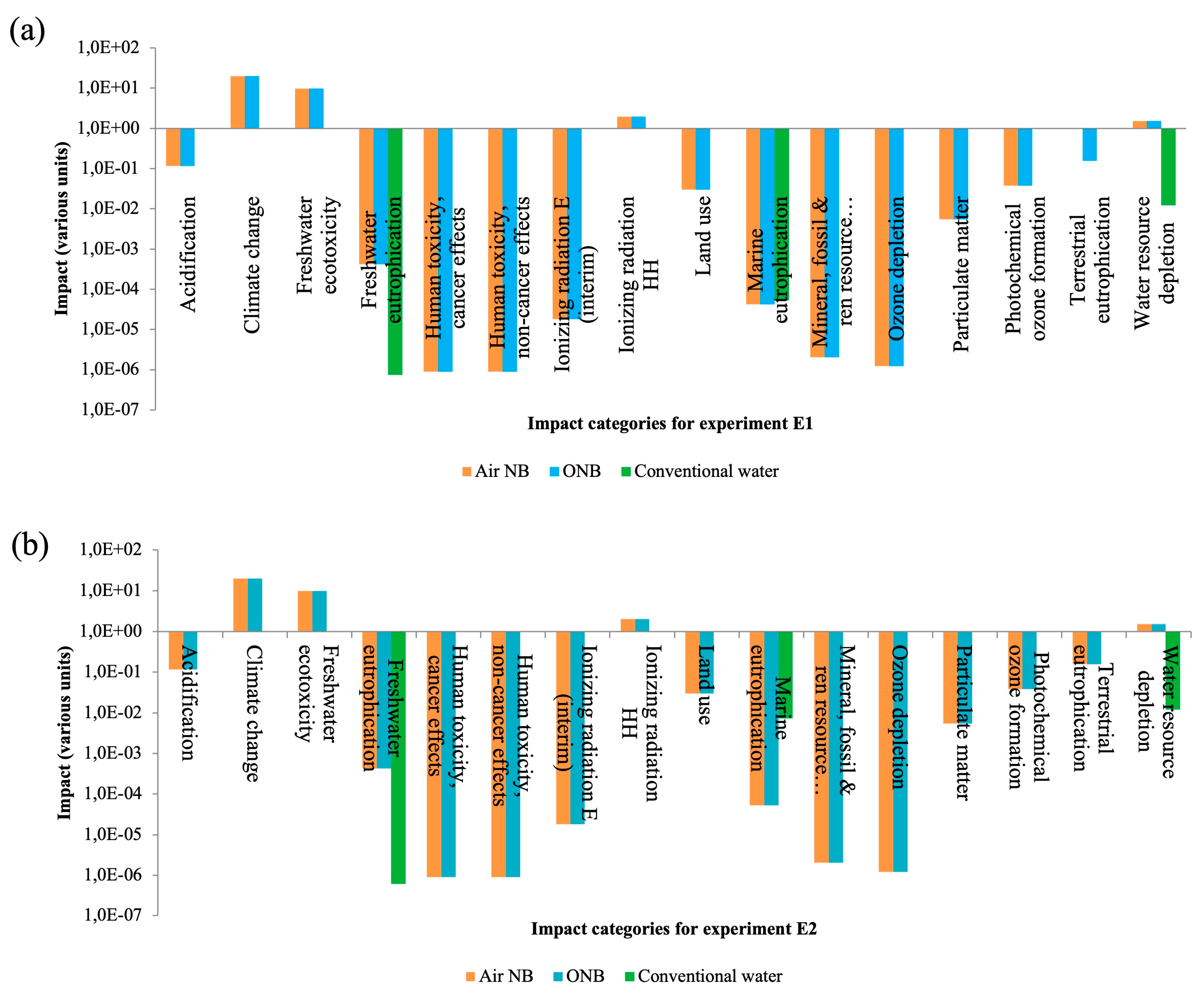
Table 2 summarizes the midpoint impact outcomes for each scenario. In both experiments, the total environmental impact was primarily attributed to electricity consumption during NB generation. Climate change (≈19.8 kg CO2 eq m−3), resource depletion (≈2 × 10⁻⁶ kg Sb eq m−3), and human toxicity (≈9 × 10⁻⁷ CTUh m−3) were almost entirely attributed to electricity use. Air-NB and ONB treatments had identical impact values across all categories due to the same energy input and water quality being determined for both gas types. The conventional watering scenarios, on the other hand, which did not require electricity, showed significantly lower impacts across each of the categories. Nutrient-related categories including eutrophication and acidification had an insignificant influence (<0.10%). As a result, the environmental performance of NBSW was determined by its operational electricity consumption rather than chemical or material inputs. Experiments E1 and E2 differed only slightly since the life-cycle inventory for water and energy inputs was the same for each functional unit.
Table 2. Midpoint LCIA results per 1 m3 of treated water for air-NB, ONB, and conventional watering in experiments E1 and E2.
Figure 2a,b demonstrates the relative differences among major categories adjusted to the conventional watering baseline. Despite the possible agronomic or water-use gains that have been found experimentally, the data show that NBW has a greater total environmental impact due to the energy required for NB generation. However, the conventional scenarios exhibited somewhat higher values for the nutrient-related impacts (eutrophication and acidification), which corresponded to the larger nutrient leaching seen under conventional watering conditions.
Figure 2. Comparison of ILCD 2011 midpoint, per 1 m3 functional unit for air-NB, ONB, and conventional watering in (a) E1 and (b) E2.

3.2. Soil-Type-Dependent Nutrient Trade-Offs

Nutrient leaching data from experiments E1 and E2 were incorporated with the life-cycle model for assessing soil-specific nutrient trade-offs. In experiment E1, NBSW treatments (Air-NB and ONB) reduced nitrate and phosphate losses compared to conventional watering (420 mg vs. 525 mg NO3 and 8.9 mg vs. 2.26 mg PO43−, respectively). In experiment E2, conventional watering resulted in significantly higher nitrate leaching (2266 mg NO3 m−3) and slightly increased phosphate loss (1.87 mg PO43− m−3). In conventional water, NO3 and PO43− inputs contributed to marine and freshwater eutrophication potentials of 1.7 × 10⁻³ kg N eq m−3 in E1 and 7.3 × 10⁻³ kg N eq m−3 in E2, showing higher leaching and impact levels in SL soil due to enhanced nitrate mobility. PO4 related eutrophication potentials were minimal (~6.0 × 10⁻⁷ kg P eq m−3), which is consistent with the low PO4 concentrations reported in leachate water. The LCIA results reflected these differences: marine and freshwater eutrophication potentials were larger in experiment E2 due to increased nitrate mobility, but phosphate-related effects were not significant and were equivalent across both soils. Overall, soil texture impacted eutrophication results but not total environmental assessment. NB scenarios exhibited equivalent contribution profiles between the two experiments. Nutrient-related impact categories revealed minor variation, which reflects measured variations in leachate composition and soil permeability. Experiment E2 had higher marine and freshwater eutrophication values due to increased NO3 mobility, but PO43− related impacts were low and equivalent in both soils.

3.3. Expert-Based Feasibility Evaluation

The SAW method was used to aggregate expert scores, and the concordance coefficient (W) and chi-square (χ2) values were determined to assess the agreement among experts. All assessments had χ2 values above the critical threshold (χ2(0.05,8) = 15.51), which indicates a statistically significant level of expert consensus (Table 3). According to the findings, experts suggest that NBT has potential but is still in its early stages for large-scale commercial applications. The highest feasibility scores ( S j = 5.98) have been obtained for questions that concern future business potential and operating and maintenance costs ( S j ≈ 5.93), which indicates that the technology’s economic appeal is highly connected to enhancing system efficiency and lowering energy intensity. Experts also confirmed that ROI and initial investment cost are important factors influencing future adoption, with concordance coefficients of W = 0.54–0.63, which reflects significant alignment in assessment.
Table 3. The results of the concordance coefficient calculation and the SAW (expert evaluation).
Intermediate feasibility scores for market adoption potential ( S j = 5.77) and policy and funding support ( S j ≈ 5.83) suggest that institutional support may contribute to implementation, but it is secondary to financial and technical performance. Similarly, innovation and competitive advantage ( S j = 5.67) and environmental co-benefits were considered as significant but not sufficient drivers unless significant economic benefits are determined. The lowest relative scores were connected with risk and reliability (W = 0.54, S j ≈ 5.68), which demonstrates that practitioners remain concerned about long-term stability and operational consistency. However, even in these areas, expert agreement was statistically significant, implying that the perceived risks are moderate and controllable with more technology refinement and standardization. The experts evaluated NBSW’s commercial and policy feasibility as moderate-to-high ( S j ≈ 5.7–9). The highest level of agreement has been reached on economic efficiency and operational effectiveness, specifically operation and maintenance costs, future business potential, and ROI. Moreover, experts assess policy and funding support moderately ( S j = 5.8), which shows that institutional and regulatory frameworks are supportive.
Evaluation criteria include initial investment cost, operational and maintenance costs, market adoption potential, ROI, scalability and adaptability, risk and reliability, innovation and competitive advantage, environmental benefits, and policy/market support.

4. Discussion

4.1. Environmental Performance of NBSW

The life-cycle inventory developed for NBSW production assessed the resource and energy consumption associated with its application in soil watering. Electricity demand (4.583 kWh m−3) was the primary input for both air and ONB watering, whereas water and nutrient inputs had an insignificant impact on the overall inventory. This trend is consistent with deeper LCA findings from the water sector, where operational electricity consumption frequently drives life-cycle costs, outweighing contributions from infrastructure or chemical inputs [27,28,29]. The electricity consumption between both air and ONB treatments contributed to the comparable impact observed in both cases. The LCIA results indicated that categories such as climate change, resource depletion, and human toxicity were almost determined by the use of electricity during NB formation. Meanwhile, conventional watering, which did not require the additional energy as in NB generation, had zero values in energy-related categories when compared to NBSW. A similar dominance of electricity has been found in the LCA of water supply systems, where the operation phase determined the majority of environmental impacts even when infrastructure and material flows varied significantly [27,29]. These categories were also highlighted as key indicators for energy-intensive processes, which supports the methodological relevance of the present impact selection [30]. Using the ILCD-recommended midpoint framework confirmed that the results were methodologically consistent and comparable. Further studies also validated that ILCD-based characterization provides consistent rankings for energy-driven effects across various European electricity mixes [31]. Minor non-zero values in the eutrophication and acidification categories were associated with the observed nitrate and phosphate leaching during conventional watering. Other LCA studies on water management have found comparable nutrient contributions, but these are secondary to energy-related impacts [27,28]. Despite the importance of electricity-driven implications in this LCA, various agronomic studies demonstrate that aerated and NB watering may significantly increase crop yield and water-use efficiency when compared to conventional watering [32,33]. NB oxygation has been found to enhance soil structure and boost beneficial microbial activity, which results in increased yields and irrigation efficiency for crops such as tomatoes and cucumbers [3,34,35]. These productivity gains can reduce the electricity-related burden when expressed per unit of harvested biomass, especially in systems where irrigation energy accounts for a significant share of agricultural GHG emissions and can be mitigated by using renewable-powered pumping [17,36].
The physical behavior of NBs provides additional insight into these observations. NBs have high gas-transfer efficiency and long-term oxygen persistence in water, which can improve soil oxygenation and water quality [37]. However, their production is fundamentally energy-intensive due to the pressure and cavitation mechanisms required for their generation. This is why, despite potential advancements in gas dissolution and soil oxygen delivery, the total environmental impact of NBSW systems is determined by electricity consumption rather than material or chemical emissions. The similarity of results across both soil types in this study suggests that when the amount of energy used per functional unit is identical, soil texture has little influence on life-cycle outcomes, which is consistent with previous analyses of water distribution and aeration systems [28,29]. However, this assessment is mainly focused on the impact of NBs at the soil level. Environmental modeling did not reflect the potential agronomic benefits often reported in the literature [8,38], such as enhanced root oxygenation [34,39], increased nutrient absorption [40], or improved plant growth [32,41,42]. As a result, the electricity consumption determined here indicates the upper bound of environmental cost in the absence of plant-level performance improvements. If NB watering increases biomass production, decreases watering frequency [43], or enhances nutrient efficiency in the cultivation area, the relative impact of energy consumption may be significantly reduced at the system level. It may also generate economic benefits by increasing crop production volumes, as previously reported in studies [35,44]. A more comprehensive study, including crop production results, must be conducted to determine whether long-term agricultural advantages can cover the short-term energy costs of NB generation.

4.2. Sustainability Trade-Offs and Policy Relevance of NBSW Watering

The expert-based feasibility analysis complements the environmental life-cycle assessment by incorporating NBSW within the broader framework of agricultural eco-innovation and the transition toward a circular economy. According to the results, experts evaluated NBSW’s commercial and policy feasibility as moderate-to-high (Sj ≈ 5.7–9). The highest level of agreement has been reached on economic efficiency and operational effectiveness, specifically operation and maintenance costs, future business potential, and ROI. These findings emphasize that, while experts recognize NBSW’s environmental potential, its future expansion will be primarily driven by economic feasibility and energy efficiency improvements rather than its environmental characteristics alone. This trend aligns with the broader eco-innovation literature, which emphasizes cost savings, technological performance, and market appeal as significant drivers of sustainable technology adoption [45]. The emphasis on operational efficiency and ROI aligns with the life-cycle findings of this study, which identified energy consumption as the primary driver of both environmental and economic performance in NBSW systems. In practical terms, three levers are most likely to increase feasibility: (i) reducing the electrical intensity of NB generation at the point of use (for example, by right-sizing generators, optimizing gas–liquid mixing and dissolved-oxygen setpoints, and applying variable frequency drives on feed pumps to decrease part-load losses); (ii) shifting the electricity source to on-site renewables where feasible (e.g., photovoltaic-powered (PV) watering/NB systems), which reduces grid-related impacts [46]; and (iii) operating NB systems when watering demand is highest in agronomic terms (on-demand or short pulses) rather than continuously. The use of variable frequency drives (VFDs) in agricultural pumps and PV-powered watering systems has been shown to save energy and reduce life-cycle impacts [36].
Energy consumption contributed to nearly all the environmental impact categories in the LCA; thus, experts highlighted that the future success and adaptability of NBSW technologies depends on reducing electricity demand and improving generator efficiency. Improving energy performance is considered the most efficient approach for increasing the environmental and economic viability of NBSW applications. This finding aligns with previous energy-focused life-cycle studies, which emphasize that significant environmental improvements in water and soil technologies can only be achieved by lowering electricity demand or incorporating low-carbon energy sources [27,28,29]. Methodological guidelines emphasize the importance of energy-related effect categories, such as climate change, human toxicity, and resource depletion, which implies that approaches to addressing these areas of concern contribute directly to system sustainability [31]. As a result, the experts’ emphasis on energy-driven feasibility considerations is consistent with the empirical data obtained through the LCA. In parallel, studies indicate that NB treatment can provide agronomic and process advantages that are important at the system level, such as increased yields, enhanced water-use efficiency, and improved oxygen transfer. For crops, NBSW treatment enhanced yield and improved irrigation-water productivity in greenhouse tomatoes and cucumbers, whereas ONB treatments increased biomass and improved soil aeration [35,44]. For treatment processes, NB aeration has demonstrated higher oxygen-transfer and removal efficiencies in wastewater systems than conventional fine-bubble aeration [47,48], which implies that NB use in integrated farm or water-treatment settings can produce offsetting benefits that affect the overall feasibility picture.
Experts assess policy and funding support moderately (Sj = 5.8), which shows that institutional and regulatory frameworks are supportive but not strong enough for promoting large-scale implementation. Within the eco-innovation framework, regulatory incentives and public support programs are considered as critical accelerators that operate alongside market forces to advance the diffusion of environmental technologies [45]. Targeted initiatives, such as energy efficiency programs, agricultural innovation grants, and green-technology funding, could help to promote NBSW adoption, particularly as the technology transitions from laboratory testing to field application. To overcome the “double-externality” barrier identified in eco-innovation theory, where environmental improvements primarily benefit society while the costs of implementation are generally high for the firms, greater regulatory and financial support mechanisms are required [21,45]. Experts also pointed out that risk and reliability remain barriers to large-scale adoption (Sj ≈ 5.7), which reflects a lack of knowledge regarding the long-term operational stability of NB systems, gas-transfer efficiency, and the oxygen delivery of NBs while also highlighting their high energy consumption and system design sensitivity [37]. These technical constraints confirm the assessments of experts that, despite its potential, NBSW is still in its early stages of commercialization and requires more improvement in order to achieve better standardization. Field-scale pilots should report standardized metrics, such as kWh·m−3 for NB generation, delivered DO (mg·L−1) at the source, oxygen-transfer efficiency (OTE%), and crop-level outcomes (yield, watering frequency, and nutrient-use efficiency), comparatively. This allows farmers, managers, and utilities to evaluate if NB benefits outweigh energy costs under real conditions. Since NBs have been shown to enhance mass transfer and pollutant removal performance, it is suggested to compare NB aeration versus fine-bubble systems in wastewater and drainage applications on a kWh per kg-COD removed basis [49]. From a circular-economy viewpoint, experts agree that NBSW may contribute to resource-efficient and low-waste agricultural systems, as long as the energy and economic trade-offs are addressed. Circular agriculture highlights resource circulation, notably water, nutrients, and energy, through technological and managerial innovation [1,50]. By enhancing oxygen transfer and lowering nutrient losses, NBSW promotes resource optimization and eco-efficiency. However, the increased energy consumption observed in the LCA suggests that, without efficiency improvements, NBSW may transfer environmental pressure from nutrient losses to energy usage. As shown by recent sustainability assessments of agri-environmental systems, this trade-off emphasizes the significance of including LCA and techno-economic indicators into circular-agriculture innovation planning [31,51]. In practice, a strategy for implementation would consist of (1) energy minimization at the source (generator selection, VFD-enabled pumping, and pulsed/on-demand NB injection), (2) supply decarbonization (PV-powered irrigation/NB where site conditions allow) [36,46], and (3) measurement and verification (transparent reporting of energy-per-benefit ratios such as kWh per tonne of yield improvement or kWh per percentage reduction in watering frequency). Documented PV-irrigation LCAs demonstrate that on-site solar energy production may significantly minimize the life-cycle impact of electricity-intensive watering operations, which is directly relevant to NBSW adoption [36].
Since obtaining both environmental and economic alignment is necessary for the technology to be effective, the expert consensus thus offers a balanced assessment of the fundamental system-level trade-offs. NBSW’s potential to develop from a laboratory-scale concept to a scalable circular farming solution will depend on its ability to achieve a low electrical intensity, ensure long-term operational reliability, and secure supportive policy frameworks. This dual emphasis aligns with the overall development pattern of eco-innovations [28], which generally advance from early stages focused on technology viability and research investment to broader adoption driven by institutional support and cost efficiency.

5. Summary and Conclusions

The results revealed that the electricity consumption during NB formation was the most significant contributor across all midpoint impact categories, while nutrient and material inputs exhibited a minor effect. Both air and ONB treatments had nearly identical life-cycle profiles, which demonstrated that gas type had no effect on overall performance. Conventional watering, on the other hand, had no energy-related effects compared to NB treatments but resulted in larger nitrate losses, particularly in SL soil, which increased the potential for eutrophication. Although NB watering reduced nutrient loss in coarser soils, these advantages only partially offset the energy costs associated with system operation. Expert assessments showed a generally positive but critical perspective, noting that NBSW’s long-term viability is dependent on improving energy efficiency, reliability, and economic returns. Policy and funding support were identified as enabling components for further adoption once the technology achieves lower energy requirements.
Overall, the study suggests that energy intensity remains the most important component that influences NBSW’s environmental and economic viability, whereas soil texture mostly influences nutrient dynamics rather than total impact levels. The optimization of power demand, rather than gas type, has the most potential for improvement. The broader use of NBSW will require its integration with low-carbon energy sources and supporting policy frameworks, ensuring that such technologies effectively and efficiently contribute to sustainable water and soil management within circular-agricultural systems. From an eco-innovation perspective, NB watering represents an emerging technological solution that enhances both environmental and economic sustainability in agricultural systems. NB technology improves oxygen-transfer and water-use efficiency, which increases resource productivity and reduces nutrient losses, lowering farm-level eutrophication potential. Meanwhile, the focus on energy efficiency and renewable integration positions NBSW as a step toward decarbonized irrigation. Overall, NB watering offers a more efficient way to manage water, energy, and nutrient flows in circular farming systems, and it supports core eco-innovation goals such as minimizing resource inputs, reducing environmental burdens, and promoting the use of clean energy, while providing operational and economic advantages that can drive long-term sustainability.

Author Contributions

Conceptualization, A.P., Y.A., and B.P.; methodology, A.P., Y.A., and B.P.; software, Y.A. and B.P.; validation, A.P., Y.A., and B.P.; formal analysis, A.P., Y.A., and B.P.; investigation, Y.A. and B.P.; resources, A.P., Y.A., and B.P.; data curation, Y.A. and B.P.; writing—original draft preparation, A.P., Y.A. and B.P.; writing—review and editing, A.P. and B.P.; visualization, Y.A.; supervision, A.P.; project administration, A.P.; funding acquisition, Y.A. All authors have read and agreed to the published version of the manuscript.

Funding

This research received funding from Vytautas Magnus University (VMU), Lithuania.

Data Availability Statement

The original contributions presented in this study are included in the article. Further inquiries can be directed to the corresponding author.

Conflicts of Interest

The authors declare no conflicts of interest.

References

  1. FAO. Water for Sustainable Food and Agriculture: A Report Produced for the G20 Presidency of Germany; FAO: Rome, Italy, 2017; ISBN 978-92-5-109977-3. [Google Scholar]
  2. Levidow, L.; Zaccaria, D.; Maia, R.; Vivas, E.; Todorovic, M.; Scardigno, A. Improving water-efficient irrigation: Prospects and difficulties of innovative practices. Agric. Water Manag. 2014, 146, 84–94. [Google Scholar] [CrossRef]
  3. Lei, H.J.; Jin, C.C.; Hu, S.G.; Pan, H.W.; Li, Y.P.; Wang, L.Y. Effect of aerated subsurface drip irrigation on soil ventilation of Solanum purpurei in greenhouse. J. Jiangsu Univ. Nat. Sci. Ed. 2019, 40, 325–331. [Google Scholar]
  4. Ebina, K.; Shi, K.; Hirao, M.; Hashimoto, J.; Kawato, Y.; Kaneshiro, S.; Morimoto, T.; Koizumi, K.; Yoshikawa, H. Oxygen and air nanobubble water solution promote the growth of plants, fishes, and mice. PLoS ONE 2013, 8, e65339. [Google Scholar] [CrossRef] [PubMed]
  5. Kim, M.-S.; Han, M.; Kim, T.-I.; Lee, J.-W.; Kwak, D.-H. Effect of nanobubbles for improvement of water quality in freshwater: Flotation model simulation. Sep. Purif. Technol. 2020, 241, 116731. [Google Scholar] [CrossRef]
  6. Li, P.; Wang, J.; Liao, Z.; Ueda, Y.; Yoshikawa, K.; Zhang, G. Microbubbles for effective cleaning of metal surfaces without chemical agents. Langmuir 2020, 38, 769–776. [Google Scholar] [CrossRef]
  7. Tang, Y.; Zhang, M.; Zhang, J.; Lyu, T.; Cooper, M.; Pan, G. Reducing arsenic toxicity using the interfacial oxygen nanobubble technology for sediment remediation. Water Res. 2021, 205, 117657. [Google Scholar] [CrossRef]
  8. Wang, Y.; Wang, S.; Sun, J.; Dai, H.; Zhang, B.; Xiang, W.; Hu, Z.; Hu, J.; Li, P.; Yang, J.; et al. Nanobubbles promote nutrient utilization and plant growth in rice by upregulating nutrient uptake genes and stimulating growth hormone production. Sci. Total Environ. 2021, 800, 149627. [Google Scholar] [CrossRef]
  9. Zhang, Z.; Yu, Y.; Xi, H.; Zhou, Y. Review of micro-aeration hydrolysis acidification for the pretreatment of toxic and refractory organic wastewater. J. Clean. Prod. 2021, 317, 128343. [Google Scholar] [CrossRef]
  10. Atkinson, A.J.; Apul, O.G.; Schneider, O.; Garcia-Segura, S.; Westerhoff, P. Nanobubble technologies offer opportunities to improve water treatment. Acc. Chem. Res. 2019, 52, 1196–1205. [Google Scholar] [CrossRef]
  11. Nirmalkar, N.; Pacek, A.W.; Barigou, M. On the existence and stability of bulk nanobubbles. Langmuir 2018, 34, 10964–10973. [Google Scholar] [CrossRef]
  12. Soyluoglu, M.; Kim, D.; Zaker, Y.; Karanfil, T. Stability of oxygen nanobubbles under freshwater conditions. Water Res. 2021, 206, 117749. [Google Scholar] [CrossRef] [PubMed]
  13. Povilaitis, A.; Arablousabet, Y. Transient Effects of Air and Oxygen Nanobubbles on Soil Moisture Retention and Soil-Substance Interactions in Compost-Amended Soil. Water 2025, 17, 1923. [Google Scholar] [CrossRef]
  14. European Commission-Joint Research Centre-Institute for Environment and Sustainability. International Reference Life Cycle Data System (ILCD) Handbook-General Guide for Life Cycle Assessment-Detailed Guidance, 1st ed.; Publications Office of the European Union: Luxembourg, 2010; EUR 24708 EN; ISBN 978-92-79-19092-6. [Google Scholar] [CrossRef]
  15. ISO 14040; Environmental Management—Life Cycle Assessment—Principles and Framework. International Organization for Standardization (ISO): Geneva, Switzerland, 2006.
  16. ISO 14044; Environmental Management—Life Cycle Assessment—Requirements and Guidelines. International Organization for Standardization (ISO): Geneva, Switzerland, 2006.
  17. Qin, J.; Duan, W.; Zou, S.; Chen, Y.; Huang, W.; Rosa, L. Global Energy Use and Carbon Emissions from Irrigated Agriculture. Nat. Commun. 2024, 15, 3084. [Google Scholar] [CrossRef] [PubMed]
  18. Yaparatne, S.; Doherty, Z.E.; Magdaleno, A.L.; Matula, E.E.; MacRae, J.D.; Garcia-Segura, S.; Apul, O.G. Effect of Air Nanobubbles on Oxygen Transfer, Oxygen Uptake, and Diversity of Aerobic Microbial Consortium in Activated Sludge Reactors. Bioresour. Technol. 2022, 351, 127090. [Google Scholar] [CrossRef]
  19. Kalboussi, N.; Biard, Y.; Pradeleix, L.; Rapaport, A.; Sinfort, C.; Ait-mouheb, N. Life Cycle Assessment as Decision Support Tool for Water Reuse in Agriculture Irrigation. Sci. Total. Environ. 2022, 836, 155486. [Google Scholar] [CrossRef]
  20. Santos, L.; Brás, I.; Ferreira, M.; Domingos, I.; Ferreira, J. Life Cycle Assessment of Green Space Irrigation Using Treated Wastewater: A Case Study. Sustainability 2024, 16, 5696. [Google Scholar] [CrossRef]
  21. Rennings, K. Redefining Innovation-Eco-Innovation Research and the Contribution from Ecological Economics. Ecol. Econ. 2000, 32, 319–332. [Google Scholar] [CrossRef]
  22. Horbach, J.; Rammer, C.; Rennings, K. Determinants of Eco-Innovations by Type of Environmental Impact-The Role of Regulatory Push/Pull, Technology Push and Market Pull. Ecol. Econ. 2012, 78, 112–122. [Google Scholar] [CrossRef]
  23. Peng, J.; Baleæentis, T.; Streimikiene, D.; Dabkiene, V.; Agnusdei, G.P. Circular Economy in Agriculture: A Systematic Literature Review. Sustain. Dev. 2025, 33, 501–516. [Google Scholar] [CrossRef]
  24. Garrone, P.; Grilli, L.; Groppi, A.; Marzano, R. Barriers and Drivers in the Adoption of Advanced Wastewater Treatment Technologies: A Comparative Analysis of Italian Utilities. J. Clean. Prod. 2018, 171, S69–S78. [Google Scholar] [CrossRef]
  25. Ministry of Energy of the Republic of Lithuania. Power and Transport Sectors Are Key Areas for Action in Lithuania’s Pursuit of Energy Independence. 2023. Available online: https://enmin.lrv.lt/en/news/power-and-transport-sectors-are-key-areas-for-action-in-lithuanias-pursuit-of-energy-independence (accessed on 7 July 2025).
  26. Aliyeva, K.; Aliyeva, A.; Aliyev, R.; Özdeşer, M. Application of Fuzzy Simple Additive Weighting Method in Group Decision-Making for Capital Investment. Axioms 2023, 12, 797. [Google Scholar] [CrossRef]
  27. Lemos, D.; Dias, A.C.; Gabarrell, X.; Arroja, L. Environmental assessment of an urban water system. Water Res. 2013, 47, 4194–4205. [Google Scholar] [CrossRef]
  28. Thompson, M.; Moussavi, S.; Li, S.; Barutha, P.; Dvorak, B. Environmental Life Cycle Assessment of Small Water Resource Recovery Facilities: Comparison of Mechanical and Lagoon Systems. Water Res. 2022, 215, 118234. [Google Scholar] [CrossRef] [PubMed]
  29. Mo, W.; Zhang, Q.; Mihelcic, J.R. Life cycle environmental and economic implications of small drinking water systems. Water Res. 2018, 143, 155–164. [Google Scholar] [CrossRef]
  30. European Commission-Joint Research Centre-Institute for Environment and Sustainability. International Reference Life Cycle Data System (ILCD) Handbook: Recommendations for Life Cycle Impact Assessment in the European Context, 1st ed.; Publications Office of the European Union: Luxembourg, 2011; EUR 24571 EN. [Google Scholar] [CrossRef]
  31. Rybaczewska-Błażejowska, M.; Jezierski, D. Comparison of ReCiPe 2016, ILCD 2011, CML-IA baseline and IMPACT 2002+ LCIA methods: A case study based on the electricity consumption mix in Europe. Int. J. Life Cycle Assess. 2024, 29, 1799–1817. [Google Scholar] [CrossRef]
  32. Chen, W.; Bastida, F.; Liu, Y.; He, J.; Song, P.; Kuang, N.; Li, Y. Nanobubble Oxygenated Water Increases Crop Production via Soil Structure Improvement: The Perspective of Microbially Mediated Effects. Agric. Water Manag. 2023, 282, 108263. [Google Scholar] [CrossRef]
  33. Du, Y.-D.; Niu, W.-Q.; Gu, X.-B.; Zhang, Q.; Cui, B.-J.; Zhao, Y. Crop Yield and Water Use Efficiency under Aerated Irrigation: A Meta-Analysis. Agric. Water Manag. 2018, 210, 158–164. [Google Scholar] [CrossRef]
  34. Mamun, M.A.; Islam, T. Oxygenated Nanobubbles as a Sustainable Strategy to Strengthen Plant Health in Controlled Environment Agriculture. Sustainability 2025, 17, 5275. [Google Scholar] [CrossRef]
  35. Ouyang, Z.; Tian, J.; Yan, X.; Yang, Z. Micro-Nano Oxygenated Irrigation Improves the Yield and Quality of Greenhouse Cucumbers Under-Film Drip Irrigation. Sci. Rep. 2023, 13, 19453. [Google Scholar] [CrossRef]
  36. Flores Cayuela, J.A.; Mérida García, A.; Fernández García, I.; Rodríguez Díaz, J.A. Life Cycle Assessment of Large-Scale Solar Photovoltaic Irrigation. Sci. Total. Environ. 2024, 954, 176813. [Google Scholar] [CrossRef]
  37. Lyu, T.; Wu, S.; Mortimer, R.J.G.; Pan, G. Nanobubble technology in environmental engineering: Revolutionization potential and challenges. Environ. Sci. Technol. 2019, 53, 7175–7176. [Google Scholar] [CrossRef] [PubMed]
  38. Arablousabet, Y.; Povilaitis, A. The Impact of Nanobubble Gases in Enhancing Soil Moisture, Nutrient Uptake Efficiency and Plant Growth: A Review. Water 2024, 16, 3074. [Google Scholar] [CrossRef]
  39. DeBoer, E.J.; Richardson, M.D.; Gentimis, T.; McCalla, J.H. Analysis of Nanobubble-Oxygenated Water for Horticultural Applications. HortTechnology 2024, 34, 769–773. [Google Scholar] [CrossRef]
  40. Bian, Q.; Dong, Z.; Zhao, Y.; Feng, Y.; Fu, Y.; Wang, Z.; Zhu, J.; Ma, L. Micro-/Nanobubble Oxygenation Irrigation Enhances Soil Phosphorus Availability and Yield by Altering Soil Bacterial Community Abundance and Core Microbial Populations. Front. Plant Sci. 2025, 15, 1497952. [Google Scholar] [CrossRef]
  41. Liu, Y.; Zhou, Y.; Wang, T.; Pan, J.; Zhou, B.; Muhammad, T.; Zhou, C.; Li, Y. Micro-Nano Bubble Water Oxygation: Synergistically Improving Irrigation Water Use Efficiency, Crop Yield and Quality. J. Clean. Prod. 2019, 222, 835–843. [Google Scholar] [CrossRef]
  42. Lei, H.; Wang, W.; Liang, Y.; Xiao, Z.; Pan, H.; Wang, L.; Du, M. Effect of Nano-Bubble Irrigation on the Yield and Greenhouse Gas Warming Potential of Greenhouse Tomatoes. Agronomy 2023, 13, 2917. [Google Scholar] [CrossRef]
  43. Calvo, J.D.; Del Campo, T.V.; Acuña, A.A. Irrigation Water Treated with Oxygen Nanobubbles Decreases Irrigation Volume While Maintaining Turfgrass Quality in Central Chile. Grasses 2025, 4, 6. [Google Scholar] [CrossRef]
  44. Xue, S.; Gao, J.; Liu, C.; Marhaba, T.; Zhang, W. Unveiling the Potential of Nanobubbles in Water: Impacts on Tomato’s Early Growth and Soil Properties. Sci. Total. Environ. 2023, 903, 166499. [Google Scholar] [CrossRef]
  45. Hojnik, J.; Ruzzier, M. What Drives Eco-Innovation? A Review of an Emerging Literature. Environ. Innov. Soc. Transit. 2016, 19, 31–41. [Google Scholar] [CrossRef]
  46. Terang, B.; Baruah, D.C. Techno-Economic and Environmental Assessment of Solar Photovoltaic, Diesel, and Electric Water Pumps for Irrigation in Assam, India. Energy Policy 2023, 183, 113807. [Google Scholar] [CrossRef]
  47. Kizhisseri, M.I.; Sakr, M.; Maraqa, M.; Mohamed, M.M. A Comparative Bench Scale Study of Oxygen Transfer Dynamics Using Micro-Nano Bubbles and Conventional Aeration in Water Treatment Systems. Heliyon 2025, 11, e41687. [Google Scholar] [CrossRef]
  48. Ahmadi, M.; Doroodmand, M.M.; Nabi Bidhendi, G.; Torabian, A.; Mehrdadi, N. Efficient Wastewater Treatment via Aeration Through a Novel Nanobubble System in Sequence Batch Reactors. Front. Energy Res. 2022, 10, 884353. [Google Scholar] [CrossRef]
  49. Lyu, T.; Wu, Y.; Zhang, Y.; Fan, W.; Wu, S.; Mortimer, R.J.G.; Pan, G. Nanobubble Aeration Enhanced Wastewater Treatment and Bioenergy Generation in Constructed Wetlands Coupled with Microbial Fuel Cells. Sci. Total. Environ. 2023, 895, 165131. [Google Scholar] [CrossRef]
  50. Yu, S.; Peng, L.; Xu, Y.; Song, S.; Xie, G.-J.; Liu, Y.; Ni, B.-J. Optimizing Light Sources for Selective Growth of Purple Bacteria and Efficient Formation of Value-Added Products. J. Clean. Prod. 2021, 280, 124493. [Google Scholar] [CrossRef]
  51. Khan, I.A.; Haq, F.; Kiran, M.; Aziz, T. Circular economy and waste management: Transforming waste into resources for a sustainable future. Int. J. Environ. Sci. Technol. 2025, 22, 17327–17346. [Google Scholar] [CrossRef]
Disclaimer/Publisher’s Note: The statements, opinions and data contained in all publications are solely those of the individual author(s) and contributor(s) and not of MDPI and/or the editor(s). MDPI and/or the editor(s) disclaim responsibility for any injury to people or property resulting from any ideas, methods, instructions or products referred to in the content.

Article Metrics

Citations

Article Access Statistics

Multiple requests from the same IP address are counted as one view.