Groundwater Exploitation Outlook: Threats and Pathways to Their Prevention

Abstract
1. Introduction
1.1. Problem Statement
1.2. Objective and Research Question
2. Methods: The Road to Identify Threats and Preventive Measures
3. Main Findings Linked to SDG 6
3.1. Human-Driven Groundwater Vulnerability

| Dimensions | Sustainability Goals | Main Indicators |
|---|---|---|
| Environment | Decrease energy use for pumping Decrease pumping contribution to climate Change Reduce non-point source contribution to GW pollution Increase GW replenishment rate Evaluate GW productivity Assess GW availability and climate effects | Specific energy consumption (kWh/m3) GHG emission during operation (ton CO2e) Contaminant concentration (mg/L) Total renewable groundwater resources (m3/year) Renewable GW volume per capita (m3/hab.year) Groundwater abstraction and recharge index (%); index of total abstraction ratio to total exploitable GW (%); groundwater share index in water supply for all uses (%); index of change in groundwater storage (%); percent of basin area under natural vegetation (%) Water-level trend index in observation wells (%) Specific discharge (m3/s/m) Groundwater drought index Groundwater resources vulnerability index (%) Stress index (m3 of GW consumed/m3 Renewable GW) (%) Index of non-conventional water resources supply in the study area, relative to conventional water resources in the period studied. |
| Protect GW quality | Index of change in groundwater quality in a given period (yeari–yearn) (%); index of change in groundwater quality compared to short-term and long-term periods (%); electrical conductivity index | |
| Socio-economy | Increase GW system efficiency | Affordability or cost (USD/m3) Management expenditure index (%) Index of change in human development index (HDI) (%) |
3.2. Relevant Groundwater Indicators
4. DPSIR Framework: Identifying GW Factors of Vulnerability and Corrective/Preventive Actions
5. Discussion and Recommendations
- ♦
- An estimation of the sustainable yield of the aquifers to maintain a suitable future supply of water. Aquifer transmissivity and natural recharge must be characterized to allow for the establishment of sustainable yield. The pressure of population and industry growth combined with climate change and leakage in water-supply systems are contributing to GW overexploitation in order to satisfy the increasing demand in many regions [7,48,50,52]. Therefore, efforts must be made to establish a sustainable yield for each aquifer according to their replenishment [49,51].
- ♦
- An assessment of the effects of pumping on seasonal fluctuations in GW levels near sensible ecosystems (e.g., lake, wetland), and on springs. The estimation of changes in aquifer storage is difficult due to the lack of investment in data gathering, but it is of utmost importance in defining the pumping schedule and intensity to prevent ecosystem disturbance [44,46] and guarantee sustainable yield [7] in the context of the food–energy–water nexus [20].
- ♦
- An assessment of the spatiotemporal effects of anthropogenic non-point pollution (from irrigated agriculture and livestock production) on GW quality attributes (e.g., physico-chemical, bacteriological). In relation to this matter, Sarah et al. [53] contributed to the quantification of the volume of contaminated GW and the GW virtually lost due to contamination. Another example is the European Nitrate Directive that requires the establishment of Nitrate-Vulnerable Zones, i.e., areas where agriculture was likely to result in nitrate concentrations of 50 mg/L or above in water bodies [66,68].
- ♦
- The monitoring of piezometric pressure and an analysis of historical fluctuations in GW levels to understand the impact of land-use changes, as a consequence of demophoric growth that impairs GW replenishment, contributes to generate potential contaminants, and might cause land subsidence [20,44,66].
- ♦
- An assessment of the risk of salt intrusion (SI) to constrain the exploitation of aquifers to a minimum safe level of water. The risk of SI increases with the possibility of sea-level rise (climate change effect) and land subsidence [62].
Funding
Data Availability Statement
Conflicts of Interest
References
- Molle, F.; Berkoff, J. Cities vs. agriculture: A review of intersectoral water re-allocation. Nat. Resour. Forum 2009, 33, 6–18. [Google Scholar] [CrossRef] [Scilit]
- Gleeson, T.; Alley, W.M.; Allen, D.M.; Sophocleous, M.A.; Zhou, Y.; Taniguchi, M.; VanderSteen, J. Towards sustainable groundwater use: Setting long-term goals, backcasting, and managing adaptively. Ground Water 2011, 50, 19–26. [Google Scholar] [CrossRef] [Scilit]
- McDonald, R.I.; Weber, K.; Padowski, J.; Flörke, M.; Schneider, C.; Green, P.A.; Gleeson, T.; Eckman, S.; Lehner, B.; Balk, D.; et al. Water on an urban planet: Urbanization and the reach of urban water infrastructure. Glob. Environ. Change 2014, 27, 96–105. [Google Scholar] [CrossRef] [Scilit]
- Laccarino, M. Why there is water scarcity. AIMS Geosci. 2021, 7, 529–541. [Google Scholar] [CrossRef] [Scilit]
- Salehi, A.A.; Ghannadi-Maragheh, M.; Torab-Mostaedi, M.; Torkaman, R.; Asadollahzadeh, M. A review on the water-energy nexus for drinking water production from humid air. Renew. Sustain. Energy Rev. 2020, 120, 109627. [Google Scholar] [CrossRef] [Scilit]
- European Commission Report. The EU Water Framework Directive; European Commission Report: Brussels, Belgium, 2014. [Google Scholar] [CrossRef]
- Arfanuzzaman, M.; Atiq Rahman, A. Sustainable water demand management in the face of rapid urbanization and ground water depletion for sociale-cological resilience building. Glob. Ecol. Conserv. 2017, 10, 9–22. [Google Scholar] [CrossRef] [Scilit]
- Huang, Y.-C.; Lee, C.-M. Designing an optimal water supply portfolio for Taiwan under the impact of climate change: Case study of the Penghu area. J. Hydrol. 2019, 573, 235–245. [Google Scholar] [CrossRef] [Scilit]
- Maupin, M.A.; Kenny, J.F.; Hutson, S.S.; Lovelace, J.K.; Barber, N.L.; Linsey, K.S. Estimated Use of Water in the United States in 2010; Circular 1405; U.S. Geological Survey: Reston, VA, USA, 2014; 56p. [CrossRef]
- Dieter, C.A.; Maupin, M.A.; Caldwell, R.R.; Harris, M.A.; Ivahnenko, T.I.; Lovelace, J.K.; Barber, N.L.; Linsey, K.S. Estimated Use of Water in the United States in 2015; Circular 1441; U.S. Geological Survey: Reston, VA, USA, 2018; 65p. [CrossRef] [Scilit]
- Margat, J.; van der Gun, J. Groundwater Around the World: A Geographic Synopsis; CRC Press/Balkema: New York, NY, USA, 2013. [Google Scholar]
- Twarakavi, N.K.C.; Kaluarachchi, J.J. Sustainability of ground water quality considering land use changes and public health risks. J. Environ. Manag. 2006, 81, 405–419. [Google Scholar] [CrossRef] [Scilit] [PubMed]
- Wolf, L.; Zwiener, C.; Zemann, M. Tracking artificial sweeteners and pharmaceuticals introduced into urban groundwater by leaking sewer networks. Sci. Total Environ. 2012, 430, 8–19. [Google Scholar] [CrossRef] [Scilit]
- Liu, Y.; Wang, P.; Gojenko, B.; Yu, J.; Wei, L.; Luo, D.; Xiao, T. A review of water pollution arising from agriculture and mining activities in Central Asia: Facts, causes and effects. Environ. Pollut. 2021, 291, 118209. [Google Scholar] [CrossRef] [Scilit]
- European Commission. The EU Nitrates Directive. 2010. Available online: https://publications.europa.eu/en/publication-detail/-/publication/b2f78dad-e7cb-41c7-8f31-c71653f95631/language-en/format-PDF/source-100865477 (accessed on 31 October 2021).
- Driscoll, M. Planetary Impacts of Food Production and Consumption; Alpro Foundation: Wevelgem, Belgium, 2019. [Google Scholar]
- Buerge, I.J.; Buser, H.-R.; Kahle, M.; Müller, M.D.; Poiger, T. Ubiquitous occurrence of the artificial sweetener acesulfame in the aquatic environment: An ideal chemical marker of domestic wastewater in groundwater. Environ. Sci. Technol. 2009, 43, 4381–4385. [Google Scholar] [CrossRef] [Scilit]
- Fetouani, S.; Sbaa, M.; Vanclooster, M.; Bendra, B. Assessing ground water quality in the irrigated plain of Triffa (north-east Morocco). Agric. Water Manag. 2008, 95, 133–142. [Google Scholar] [CrossRef] [Scilit]
- Hoogesteger, J.; Wester, P. Intensive groundwater use and (in) equity: Processes and governance challenges. Environ. Sci. Policy 2025, 51, 117–124. [Google Scholar] [CrossRef] [Scilit]
- Moraes-Santos, E.C.; Dias, R.A.; Balestieri, J.A.P. Groundwater and the water-food-energy nexus: The grants for water resources use and its importance and necessity of integrated management. Land Use Policy 2021, 109, 105585. [Google Scholar] [CrossRef] [Scilit]
- Bucatariu, C.A. The concept of (virtual) water in the food industry. In The Interaction of Food Industry and Environment; Academic Press: Cambridge, MA, USA, 2021; pp. 223–243. [Google Scholar] [CrossRef] [Scilit]
- Saha, D.; Marwaha, S.; Mukherjee, A. Groundwater Resources and Sustainable Management Issues in India. In Clean and Sustainable Groundwater in India; Springer: Singapore, 2017; pp. 1–11. [Google Scholar] [CrossRef] [Scilit]
- NGWA. Facts About Global Groundwater Usage; Compiled by the Ground Water Association; NGVA: Westerville, OH, USA, 2021; Available online: https://www.ngwa.org/what-is-groundwater/About-groundwater/facts-about-global-groundwater-usage (accessed on 28 October 2021).
- Joshi, S.K.; Gupta, S.; Sinha, R.; Densmore, A.L.; Rai, S.P.; Shekhar, S.; Mason, P.J.; van Dijk, W. Strongly heterogeneous patterns of groundwater depletion in Northwestern India. J. Hydrol. 2021, 598, 126492. [Google Scholar] [CrossRef] [Scilit]
- MacDonald, A.; Bonsor, H.; Ahmed, K.; Burgess, W.G.; Basharat, M.; Calow, R.C.; Dixit, A.; Foster, S.S.D.; Gopal, K.; Lapworth, D.J.; et al. Groundwater quality and depletion in the Indo-Gangetic Basin mapped from in situ observations. Nat. Geosci. 2016, 9, 762–766. [Google Scholar] [CrossRef] [Scilit]
- Bjerre, E.; Kristensen, L.S.; Engesgaard, P.; Højberg, A.L. Drivers and barriers for taking account of geological uncertainty in decision making for groundwater protection. Sci. Total Environ. 2020, 746, 141045. [Google Scholar] [CrossRef] [Scilit]
- Wu, D.-L.; Zhang, M.; He, L.-X.; Zou, H.-Y.; Liu, Y.-S.; Li, B.-B.; Yang, Y.-Y.; Liu, C.; He, L.-Y.; Ying, G.-G. Contamination profile of antibiotic resistance genes in ground water in comparison with surface water. Sci. Total Environ. 2020, 715, 136975. [Google Scholar] [CrossRef] [Scilit] [PubMed]
- Bigas, H. Water Security & the Global Water Agenda. A UN-Water Analytical Brief; Institute for Water, Environment and Health, United Nations University: Hamilton, ON, Canada, 2013. [Google Scholar]
- Liu, B.; Zhang, F.; Qin, X.; Wu, Z.; Wang, X.; He, Y. Spatiotemporal assessment of water security in China: An integrated supply-demand coupling model. J. Clean. Prod. 2021, 321, 128955. [Google Scholar] [CrossRef] [Scilit]
- Balmford, A.; Green, R.E.; Scharlemann, J.P.W. Sparing land for nature: Exploring the potential impact of changes in agricultural yield on the area needed for crop production. Glob. Change Biol. 2005, 11, 1594–1605. [Google Scholar] [CrossRef] [Scilit]
- Poot, J.; Pawar, S. Is demography destiny? Urban population change and economic vitality of future cities. J. Urban Manag. 2013, 2, 5–23. [Google Scholar] [CrossRef] [Scilit]
- UNDP. The Sustainable Development Goals in Actions. 2017. Available online: https://www.undp.org/sustainable-development-goals (accessed on 29 October 2021).
- Kristensen, P. The DPSIR framework. In Paper Presented at the 27–29 September 2004 Workshop on a Comprehensive/Detailed Assessment of the Vulnerability of Water Resources to Environmental Change in Africa Using River Basin Approach; UNEP Headquarters: Nairobi, Kenya, 2004. [Google Scholar]
- EEA. Europe’s Environment: The Dobris Assessment; European Environmental Agency: Copenhagen, Denmark, 1995. [Google Scholar]
- Atkins, J.P.; Burdon, D.; Elliott, M.; Gregory, A.J. Management of the marine environment: Integrating ecosystem services and societal benefits with the DPSIR framework in a systems approach. Mar. Pollut. Bull. 2011, 62, 215–226. [Google Scholar] [CrossRef] [Scilit]
- Kelble, C.R.; Loomis, D.K.; Lovelace, S.; Nuttle, W.K.; Ortner, P.B.; Fletcher, P.; Boyer, J.N. The EBM-DPSER Conceptual Model: Integrating Ecosystem Services into the DPSIR Framework. PLoS ONE 2013, 8, e70766. [Google Scholar] [CrossRef] [Scilit]
- O’Higgins, T.; Farmer, A.; Daskalov, G.; Knudsen, S.; Mee, L. Achieving good environmental status in the Black Sea: Scale mismatches in environmental management. Ecol. Soc. 2014, 19, 54. [Google Scholar] [CrossRef] [Scilit]
- Andualem, T.G.; Demeke, G.G.; Ahmed, I.; Dar, M.A.; Yibeltal, M. Groundwater recharge estimation using empirical methods from rainfall and streamflow records. J. Hydrol. Reg. Stud. 2021, 37, 100917. [Google Scholar] [CrossRef] [Scilit]
- Aeschbach-Hertig, W.; Gleeson, T. Regional strategies for the accelerating global problem of groundwater depletion. Nat. Geosci. 2012, 5, 853–861. [Google Scholar] [CrossRef] [Scilit]
- Llamas, R. Lessons learnt from the impact of the neglected role of groundwater in Spain’s water policy. Water Resour. Perspect. Eval. Manag. Policy 2003, 50, 63–81. [Google Scholar] [CrossRef] [Scilit]
- Lam, K.L.; Kenway, S.J.; Lant, P.A. Energy use for water provision in cities. J. Clean. Prod. 2017, 143, 699–709. [Google Scholar] [CrossRef] [Scilit]
- Osmanoğlu, B.; Dixon, T.H.; Wdowinski, S.; Cabral-Cano, E.; Jiang, Y. Mexico City subsidence observed with persistent scatterer InSAR. Int. J. Appl. Earth Obs. Geoinf. 2011, 13, 1–12. [Google Scholar] [CrossRef] [Scilit]
- Galloway, D.L.; Burbey, T.J. Review: Regional land subsidence accompanying groundwater extraction. Hydrogeol. J. 2011, 19, 1459–1486. [Google Scholar] [CrossRef] [Scilit]
- An, Y.; Shen, Q.; Shum, C.; Gao, F.; Zhang, X.; Jiang, L.; Wang, H. TS-InSAR assessment of groundwater overexploitation-land subsidence linkage: Hengshui case study. J. Hydrol. Reg. Stud. 2025, 60, 102489. [Google Scholar] [CrossRef] [Scilit]
- Fan, B.; Shi, X.; Luo, G.; Hellwich, O.; Ma, X.; Shang, M.; Wang, Y.; Ochege, F.U. Ground subsidence and disaster risk induced by groundwater overexploitation: A comprehensive assessment from arid oasis regions. Int. J. Disaster Risk Reduct. 2025, 119, 105328. [Google Scholar] [CrossRef] [Scilit]
- Samani, S. Assessment of groundwater sustainability and management plan formulations through the integration of hydrogeological, environmental, social, economic and policy indices. Groundw. Sustain. Dev. 2021, 15, 100681. [Google Scholar] [CrossRef] [Scilit]
- Morris, B.L.; Lawrence, A.R.L.; Chilton, P.J.C.; Adams, B.; Calow, R.C.; Klinck, B.A. Groundwater and Its Susceptibility to Degradation: A Global Assessment of the Problem and Options for Management; United Nations Environment Programme: Nairobi, Kenya, 2003; 126p, Available online: https://nora.nerc.ac.uk/id/eprint/19395/ (accessed on 23 September 2025).
- Stuart, M.E.; Gooddy, D.C.; Bloomfield, J.P.; Williams, A.T. A review of the impact of climate change on future nitrate concentrations in groundwater of the UK. Sci. Total Environ. 2011, 409, 2859–2873. [Google Scholar] [CrossRef] [Scilit] [PubMed]
- Wada, Y.; Wisser, D.; Bierkens, M.F.P. Global modeling of withdrawal, allocation and consumptive use of surface water and groundwater resources. Earth Syst. Dyn. 2014, 5, 15–40. [Google Scholar] [CrossRef] [Scilit]
- Famiglietti, J. The global groundwater crisis. Nat. Clim. Change 2014, 4, 945–948. [Google Scholar] [CrossRef] [Scilit]
- Thomas, B.F.; Caineta, J.; Nanteza, J. Global assessment of groundwater sustainability based on storage anomalies. Geophys. Res. Lett. 2017, 44, 445–455. [Google Scholar] [CrossRef] [Scilit]
- Thomas, B.F.; Famiglietti, J.S. Identifying Climate-Induced Groundwater Depletion in GRACE Observations. Sci. Rep. 2019, 9, 4124. [Google Scholar] [CrossRef] [Scilit]
- Sarah, S.; Ahmed, S.; Violette, S.; de Marsily, G. Groundwater sustainability challenges revealed by quantification of contaminated groundwater volume and aquifer depletion in hard rock aquifer systems. J. Hydrol. 2021, 597, 126286. [Google Scholar] [CrossRef] [Scilit]
- Hannibal, B.; Portney, K. The impact of water scarcity on support for hydraulic fracturing regulation: A water-energy nexus study. Energy Policy 2020, 146, 111718. [Google Scholar] [CrossRef] [Scilit]
- Li, X.; Shen, X.; Jiang, W.; Xi, Y.; Li, S. Comprehensive review of emerging contaminants: Detection technologies, environmental impact, and management strategies. Ecotoxicol. Environ. Saf. 2024, 278, 116420. [Google Scholar] [CrossRef] [Scilit]
- Yang, Y.-Y.; Zhao, J.-L.; Liu, Y.-S.; Liu, W.-R.; Zhang, Q.-Q.; Yao, L.; Hu, L.-X.; Zhang, J.-N.; Jiang, Y.-X.; Ying, G.-G. Pharmaceuticals and personal care products (PPCPs) and artificial sweeteners (ASs) in surface and ground waters and their application as indication of wastewater contamination. Sci. Total Environ. 2018, 616–617, 816–823. [Google Scholar] [CrossRef] [Scilit]
- Katz, B.G.; Eberts, S.M.; Kauffman, L.J. Using Cl/Br ratios and other indicators to assess potential impacts on groundwater quality from septic systems: A review and examples from principal aquifers in the United States. J. Hydrol. 2011, 397, 151–166. [Google Scholar] [CrossRef] [Scilit]
- Mondal, P.; Bhowmick, S.; Chatterjee, D.; Figoli, A.; van der Bruggen, B. Remediation of inorganic arsenic in groundwater for safe water supply: A critical assessment of technological solutions. Chemosphere 2013, 92, 157–170. [Google Scholar] [CrossRef] [Scilit]
- Chen, Q.-L.; Li, H.; Zhou, X.-Y.; Zhao, Y.; Su, J.-Q.; Zhang, X.; Huang, F.-Y. An underappreciated hotspot of antibiotic resistance: The groundwater near the municipal solid waste landfill. Sci. Total Environ. 2017, 609, 966–973. [Google Scholar] [CrossRef] [Scilit] [PubMed]
- Chen, Q.-L.; An, X.-L.; Li, H.; Zhu, Y.-G.; Su, J.-Q.; Cui, L. Do manure-borne or indigenous soil microorganisms influence the spread of antibiotic resistance genes in manured soil? Soil Biol. Biochem. 2017, 114, 229–237. [Google Scholar] [CrossRef] [Scilit]
- Khan, S.J.; Anderson, R. Potable reuse: Experiences in Australia. Curr. Opin. Environ. Sci. Health 2018, 2, 55–60. [Google Scholar] [CrossRef] [Scilit]
- Rahmawati, N.; Vuillaume, J.-F.; Purnama, I.L.S. Salt intrusion in coastal and lowland areas of Semarang City. J. Hydrol. 2013, 494, 146–159. [Google Scholar] [CrossRef] [Scilit]
- Zhang, W.; Gago-Ferrero, P.; Gao, Q.; Ahrens, L.; Blum, K.; Rostvall, A.; Björlenius, B.; Andersson, P.L.; Wiberg, K.; Haglund, P.; et al. Evaluation of five filter media in column experiment on the removal of selected organic micropollutants and phosphorus from household wastewater. J. Environ. Manag. 2019, 246, 920–928. [Google Scholar] [CrossRef] [Scilit]
- Liu, C.Y.; Ku, C.Y.; Ni, C. Deep learning time-series modeling for assessing land subsidence under reduced groundwater use. Sci. Rep. 2025, 15, 30901. [Google Scholar] [CrossRef] [Scilit] [PubMed]
- European Commission. Establishing a framework for community action in the field of water policy. Directive 2000/60/EC of the European Parliament and of the Council. In Official Journal of the European Communities; European Commission: Brussels, Belgium, 2000; pp. 1–72. [Google Scholar]
- Qu, Y.; Liu, Y. Evaluating the low-carbon development of urban China. Environ. Dev. Sustain. 2016, 19, 939–953. [Google Scholar] [CrossRef] [Scilit]
- Zhao, R.; Fang, C.; Liu, H.; Liu, X. Evaluating urban ecosystem resilience using the DPSIR framework and the ENA model: A case study of 35 cities in China. Sustain. Cities Soc. 2021, 72, 102997. [Google Scholar] [CrossRef] [Scilit]
- Nikollaidis, N.P.; Poikane, S.; Bouraoui, F.; Herrero, F.S.; Free, G.; Varkitzi, I.; van de Bund, W.; Kelly, M.G. Comparison of eutrophication assessment for the Nitrates and Water Framework Directives: Impacts and opportunities for streamlined approaches. Ecol. Indic. 2025, 177, 113375. [Google Scholar] [CrossRef] [Scilit]
- de Jonge, V.N.; Pinto, R.; Turner, R.K. Integrating ecological, economic and social aspects to generate useful management information under the EU Directives ‘ecosystem approach’. Ocean Coast. Manag. 2012, 68, 169–188. [Google Scholar] [CrossRef] [Scilit]
- Gari, S.R.; Newton, A.; Icely, J.D. A review of the application and evolution of the DPSIR framework with an emphasis on coastal social-ecological systems. Ocean Coast. Manag. 2015, 103, 63–77. [Google Scholar] [CrossRef] [Scilit]
- Spangenberg, J.H. Biodiversity pressure and the driving forces behind. Ecol. Econ. 2007, 61, 146–158. [Google Scholar] [CrossRef] [Scilit]
- Zaldívar, J.; Cardoso, A.; Viaroli, P.; Newton, A.; Wit, R.; Ibanez, C.; Reizopoulou, S.; Somma, F.; Razinkovas, A.; Basset, A.; et al. Eutrophication in transitional waters: An overview (JRC-EU). Transitional Waters Monogr. 2008, 1, 1–78. [Google Scholar] [CrossRef]
- Haase, D.; Nuissi, H. Does urban sprawl drive changes in the water balance and policy? The case of Leipzig (Germany) 1870–2003. Landsc. Urban Plan. 2007, 80, 1–13. [Google Scholar] [CrossRef] [Scilit]
- Omann, I.; Stocker, A.; Jäger, J. Climate change as a threat to biodiversity: An application of the DPSIR approach. Ecol. Econ. 2009, 69, 24–31. [Google Scholar] [CrossRef] [Scilit]

| Search String | (“Ground Water” OR Groundwater OR Aquifer AND Driver AND Pressure AND Impact) Returned 341 Documents and Articles from 1991 to 2025 |
|---|---|
| Flow diagram of the entire procedure for literature selection |  |
| Exclusion criteria | A total of 61 documents that do not meet the research criteria were excluded (59 non-articles, and 2 non-English texts) A total of 164 articles were excluded because the discussions did not entail impacts on GW. |
| Articles included in this study | A total of 116 articles from Scopus (2005 to 2025) were included in this study for full consideration. After reading the above articles from Scopus, certain other articles (5) were retrieved from the Web of Science database. Additionally, some documents from the European Environmental Agency, US Geological Survey, and Books were also considered for the description of DPSIR framework. A total of 125 documents were fully considered in this research. |
| Category of Indicator | Threats | Reference |
|---|---|---|
| Quantity | GW depletion is a critical issue of global concern and has worsened due to climate change. Overexploitation and excessive pumping can lead to GW depletion when it is extracted at a faster rate than it can be replenished. | [47,48,49,50,51,52] |
| The high value of virtual water and the water footprint, which means the amount of water ‘embedded’ in an agricultural product, entailing the entire food supply chain from production to delivery including pollution produced. | [53] | |
| Reductions in GW recharge that might occur naturally (from rainfall or percolation from adjacent water bodies) or artificially (i.e., induced human activities like irrigation). | [20,38] | |
| Energy consumption requires improvements, because the current level of specific energy (kWh/m3) consumption associated with GW supply is high. | [20] | |
| The hydraulic fracturing or fracking process contaminates GW sources and uses significant amounts of water. | [54] | |
| Intensive GW extraction followed by drought leads to land subsidence due to the compaction of the compressible underground layer. | [44] | |
| Quality | Virtual GW loss due to contamination refers to the volume of the contaminated GW physically available in the aquifer but not appropriate for consumption. | [53] |
| GW contamination (e.g., Total Coliforms, contaminants of emerging concerns—CECs, inorganic arsenic) by wastewater via discharge from domestic sewage systems, leakage from sewers (and septic tanks), and the recharging of contaminated wetland (rivers, lakes). | [13,55,56,57,58] | |
| Landfilling is also a source of GW contamination because antibiotic resistance genes can leachate into GW. | [27,59] | |
| Manure application can introduce antibiotic resistance genes (besides nutrients and organic matter) to crop soil, posing a potential risk to surface/groundwater and human health. | [60] | |
| Use of wastewater to artificially promote recharge of GW without appropriate further treatment [60]. | [61] | |
| Climate change contributes to increase the concentration of leached nitrate from agricultural land in GW. | [48] |
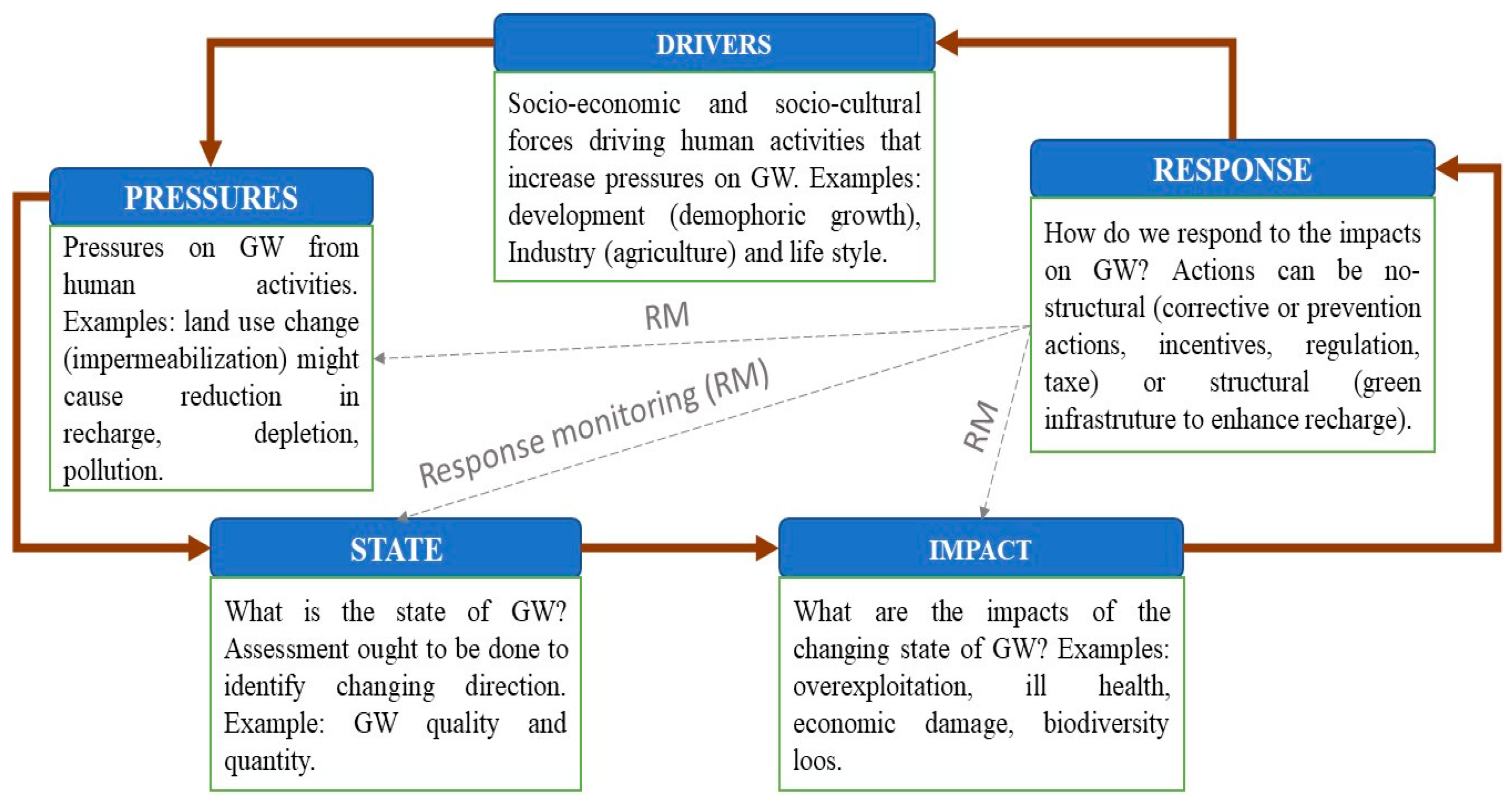
| Drivers ⟶ | Pressure ⟶ | State ⟶ | Impact ⟶ | Response ⟶ | Monitoring Using Indicators |
|---|---|---|---|---|---|
| Natural population growth and urbanization rate Intensive industry Urban population density. | Proportion of green area (for infiltration) Proportion of GW consumption Industrial consumption of GW Per capita GW consumption Non-point (e.g., agricultural) pollution Manure application in crop land Failure of septic-tank system Sea-level rise Contamination of surface water by wastewater Hydraulic fracturing or fracking process Climate change (might reduce precipitation across the years) Wastewater discharge per unit land area. | Changing in GW quality Changing in GW quantity (volume) Changing in GW recharge rate. | GW depletion GW contamination Human diseases Extreme limitation of the consumption or ultimately inhibition of water supply Biodiversity loss Salt intrusion (due to sea-level rise, land subsidence, and GW over-exploitation *) | Investment in urban landscaping Provision of sewage treatment compliance Reduction in the proportion of MSW landfilled and design adequately controlled landfill Appropriate management of septic tanks Use of urban green infrastructure to promote GW recharge Adoption of collective wastewater treatment system for small communities to avoid high densities of households with septic tanks # Mapping sewer systems and monitor (including optical) their conditions to understand sewer–GW interactions Delineation of the perimeter to be protected to constrain land-use practice Controlling manure application to reduce the risk of the introduction of antibiotic resistance genes into GW Multi-sectorial planning and management that integrate water resources with waste, land use/environment, and energy sector and stakeholder engagement/participation. | Appropriate indicators (related to pressure and state—see Table 2 and Table 3, and columns 2 and 3 of Table 4) must be selected for the long-term spatiotemporal monitoring of water quantity, quality, and related ecosystem equilibrium across time. Attention should be given to the fact that the mean residence time (or renewal time) of an aquifer—the average time for GW to flow from recharge to discharge areas—ought to be used for the planning horizon +. Therefore, effective predictive modeling must act as a guide when mitigating the impacts. |
Disclaimer/Publisher’s Note: The statements, opinions and data contained in all publications are solely those of the individual author(s) and contributor(s) and not of MDPI and/or the editor(s). MDPI and/or the editor(s) disclaim responsibility for any injury to people or property resulting from any ideas, methods, instructions or products referred to in the content. |
© 2025 by the author. Licensee MDPI, Basel, Switzerland. This article is an open access article distributed under the terms and conditions of the Creative Commons Attribution (CC BY) license (https://creativecommons.org/licenses/by/4.0/).
Share and Cite
Mata-Lima, H. Groundwater Exploitation Outlook: Threats and Pathways to Their Prevention. Water 2025, 17, 3501. https://doi.org/10.3390/w17243501
Mata-Lima H. Groundwater Exploitation Outlook: Threats and Pathways to Their Prevention. Water. 2025; 17(24):3501. https://doi.org/10.3390/w17243501
Chicago/Turabian StyleMata-Lima, Herlander. 2025. "Groundwater Exploitation Outlook: Threats and Pathways to Their Prevention" Water 17, no. 24: 3501. https://doi.org/10.3390/w17243501
APA StyleMata-Lima, H. (2025). Groundwater Exploitation Outlook: Threats and Pathways to Their Prevention. Water, 17(24), 3501. https://doi.org/10.3390/w17243501