Review

Tsunami Early Warning Systems: Enhancing Coastal Resilience Through Integrated Risk Management
by
Francisco-Javier Perez-Rodriguez
,
Manuel Otero-Mateo
,
Moises Batista
* and
Magdalena Ramirez-Peña
Department of Mechanical Engineering and Industrial Design, School of Engineering, University of Cadiz. Av. University of Cádiz 10, E11519 Puerto Real, Spain
*
Author to whom correspondence should be addressed.
Water 2025, 17(24), 3489; https://doi.org/10.3390/w17243489 (registering DOI)
Submission received: 4 November 2025 / Revised: 2 December 2025 / Accepted: 4 December 2025 / Published: 10 December 2025
(This article belongs to the Special Issue Recent Advances in Flood Risk Assessment and Management)

Abstract

Tsunamis are among the most destructive natural hazards, posing severe risks to coastal communities and infrastructure. Effective flood risk management (FRM) for these extreme events requires robust and well-integrated early warning systems (TEWSs). This paper explores the fundamental principles and technologies underlying tsunami TEWS, emphasizing their critical role within the broader context of FRM. It examines how modern systems integrate seismic sensor networks, wave detection buoys, and satellite monitoring to provide rapid and accurate alerts. Technical and logistical challenges are discussed, including the need for precise propagation models and real-time data integration to minimize false alarms and improve system efficiency. Case studies, such as the Pacific Tsunami Warning System (PTWS) and the Indian Ocean Tsunami Warning System (IOTWS), are presented to evaluate lessons learned and areas for improvement. Finally, this paper argues that to be truly effective, TEWS must be complemented by coastal resilience strategies, community engagement, and strong public policies that promote preparedness and adaptation to future events. This comprehensive approach not only enhances response capabilities but also significantly reduces the risk of human and economic losses in the world’s most vulnerable regions.

1. Introduction

Tsunamis are among the most destructive natural hazards on Earth, capable of causing catastrophic damage to coastal infrastructure, ecosystems, and human life within minutes after an undersea earthquake or volcanic eruption. The rapid onset and immense energy released during these events make early detection and timely response essential components of disaster risk reduction.
Tsunami Early Warning Systems (TEWSs) are therefore critical tools for safeguarding coastal populations. As shown in Figure 1, these systems integrate advanced technologies for detection, communication, and modeling of seismic and oceanographic events. Modern TEWS employs ocean-bottom pressure sensors, wave-detection buoys, and seismic networks to identify earthquakes that may generate tsunamis [1]. In addition, synthetic aperture radar (SAR) and satellite monitoring support real-time assessment of sea-level variations and post-event impacts [2].
The 2004 Indian Ocean tsunami marked a turning point in the global development of TEWS, stimulating the creation of regional systems such as the Indian Ocean Tsunami Early Warning System (IOTWS) and the Pacific Tsunami Warning System (PTWS) [3]. Subsequent advances, including the German-–Indonesian Tsunami Early Warning System (GITEWS), have enabled faster and more accurate response mechanisms through high-resolution numerical simulations that predict wave propagation and inundation height in near real time [4].
Despite these achievements, significant challenges persist. Key limitations involve the precision of propagation models, the resilience of sensors in harsh marine environments, and the rapid dissemination of data through robust communication networks. Ongoing research aims to enhance model accuracy, reduce false alarms, and improve the speed and clarity of warning messages [5,6].
Globally, tsunamis represent a major hazard because approximately 40% of the world’s population lives within 100 km of the coastline [7]. Events such as the 2004 Indian Ocean tsunami, with over 230,000 fatalities, and the 2011 Tōhoku tsunami in Japan, which caused more than 300 billion USD in economic losses [8], have underscored the urgent need for integrated early-warning and risk-management strategies. Although historically associated with the Pacific and Indian Oceans, recent studies indicate that other regions—such as the Atlantic and the Mediterranean—are also exposed to tsunami hazards due to tectonic activity and submarine landslides, including cases documented in the Gulf of Cádiz [9]. This highlights the need for integrated approaches to risk management, including both early warning systems and appropriate urban planning and coastal resilience strategies.
In this context, the present review explores the fundamental principles, architectures, and technologies underpinning modern tsunami early warning systems, emphasizing their role as integral components of Flood Risk Management (FRM). Beyond describing the technical aspects, the paper critically examines the operational, institutional, and social dimensions that influence TEWS effectiveness. This cross-cutting perspective seeks to bridge the gap between technology and governance by assessing how detection networks, communication protocols, and community preparedness interact to enhance coastal resilience.
The paper is structured as follows: Section 2 presents the theoretical framework of tsunami generation and FRM; Section 3 details the architecture and operation of TEWS; Section 4 analyzes current challenges and opportunities; Section 5 reviews relevant case studies; and Section 6 discusses implications and future perspectives, leading to the final conclusions in Section 7.

2. Theoretical Framework

The term “tsunami” derives from the Japanese words tsu (harbor) and nami (wave), referring to the destructive “harbor waves” that cause the greatest impact upon reaching coastal areas. Tsunamis are long-wavelength, low-frequency waves generated by abrupt seafloor displacements due to undersea earthquakes, submarine landslides, or volcanic eruptions. These volcanic eruptions can generate tsunamis through several distinct mechanisms, including: the rapid collapse or landslide of volcanic flanks into the ocean, which displaces water suddenly; violent submarine explosions that eject material and shockwaves; and, in rare but dramatic cases, atmospheric pressure waves generated by explosive eruptions above sea level, as observed in the 1883 Krakatoa eruption and more recently during the 2022 Hunga Tonga–Hunga Ha’apai event [10,11]. These pressure waves can travel at high speeds and couple with the ocean surface, inducing tsunami-like disturbances over vast distances. Unlike tides, tsunamis are not influenced by gravitational interactions between the Earth, Moon, and Sun, but by sudden geological disturbances that transmit energy through the water column. According to the United States Geological Survey (USGS), each tsunami event is characterized by unique generation mechanisms, making it impossible to establish a single universal model [12].
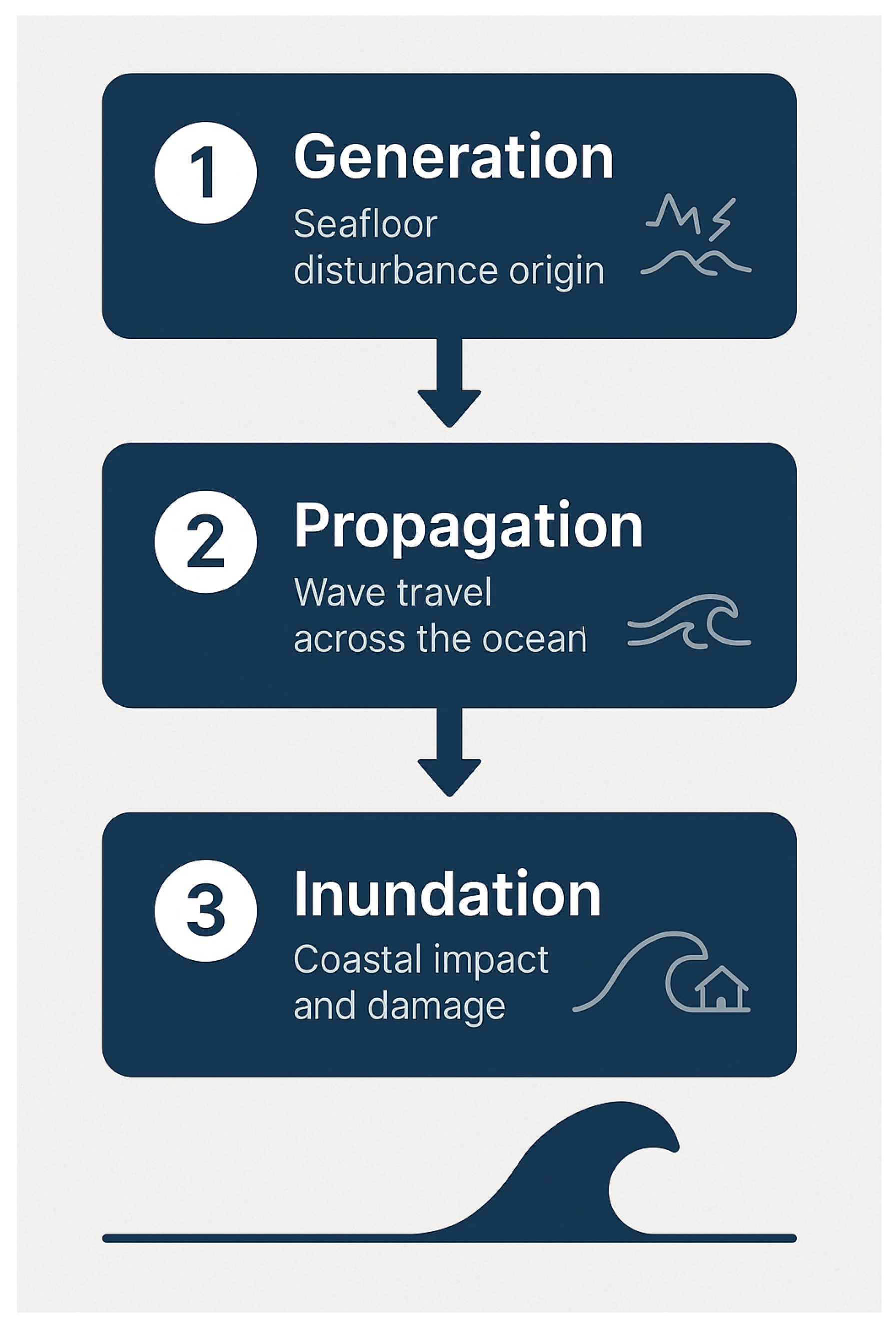
A tsunami typically develops through three sequential phases: generation, propagation, and inundation, as shown in Figure 2. The generation phase depends on the dynamics of the triggering event, determining the initial energy released and the wavelength of the tsunami. During propagation, the wave travels across ocean basins at speeds exceeding 800 km/h in deep water. As it approaches shallow coastal zones, wave height increases due to energy compression and decreasing water depth, leading to the final inundation phase, where the wave’s destructive potential is fully manifested.
At the basin scale, tsunami propagation is most commonly modeled using depth-averaged Non-linear Shallow Water Equations (NSWE), which express conservation of mass and momentum for a vertically integrated water column. For shorter wavelengths, complex bathymetry, or landslide-generated tsunamis, Boussinesq-type formulations extend the NSWE with frequency-dispersion terms, improving the representation of wave shoaling, refraction, harbor resonance, and other nearshore transformation processes.
To assess tsunami intensity, the Sieberg–Ambraseys scale—ranging from I (very weak) to VI (disastrous)—is commonly used. This descriptive scale focuses on observed effects rather than numerical wave height alone, offering valuable insights into local impacts [12].
Within the broader context of disaster risk management, tsunami hazard mitigation forms part of the FRM cycle, which encompasses prevention, mitigation, preparedness, early warning, emergency response, and post-disaster recovery [13,14]. Effective FRM relies on a comprehensive understanding of three interrelated components: hazard, exposure, and vulnerability.
  • Hazard assessment quantifies the probability of flood events based on variables such as earthquake magnitude, ocean bathymetry, and coastal topography.
  • Exposure analysis identifies people, infrastructure, and ecosystems located in tsunami-prone zones.
  • Vulnerability assessment evaluates the capacity of these elements to resist or recover from inundation, considering factors such as construction standards, governance quality, and community resources.
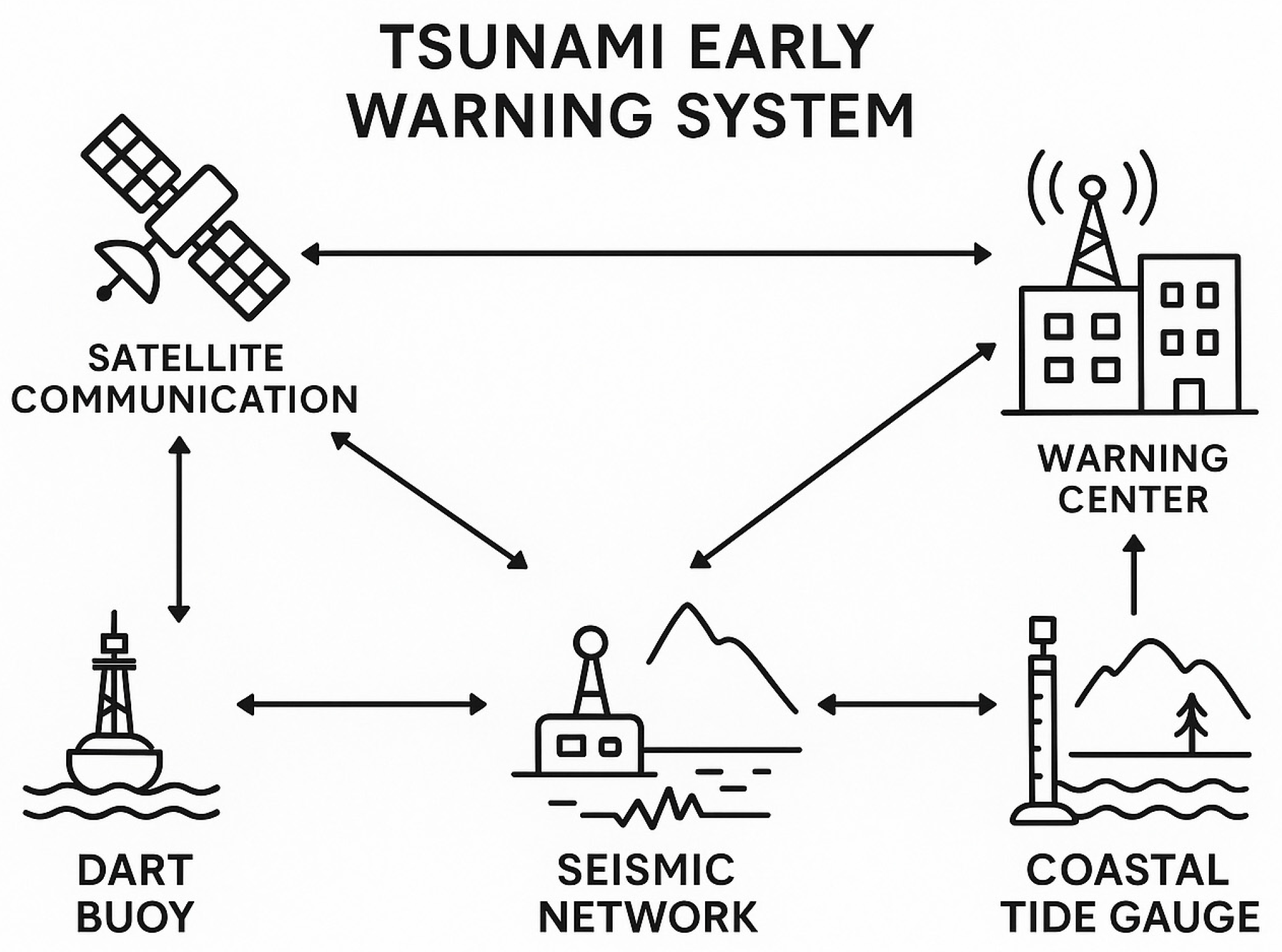
An effective Tsunami Early Warning System (TEWS) integrates these components into four core functions: detection, communication, preparedness, and coordinated response [15]. The detection phase employs seismic and oceanic sensor networks to capture real-time data on disturbances. The detection phase employs seismic and oceanic sensor networks to capture real-time data on disturbances. However, in regions where deep-ocean instruments such as DART buoys are unavailable, non-operational, or unsuitable for deployment—such as in the entire Mediterranean basin or in parts of the Indonesian archipelago—strategically located sea level sensors become the primary monitoring tool. These coastal or island-based tide gauges, when calibrated and integrated within early warning frameworks, are capable not only of identifying anomalous wave activity but also of serving as the initial triggering mechanism for alerts. Their operational reliability and placement near vulnerable zones make them indispensable, particularly in areas with limited access to offshore infrastructure [16]. The communication phase transforms scientific information into accessible alerts disseminated through radio, television, mobile networks, sirens, information panels, online platforms and Global Disaster Alert and Coordination System [17], ensuring inclusivity for vulnerable populations. Preparedness includes community education, simulation drills, and emergency planning, while the response phase involves coordinated evacuation and recovery efforts.
Recent studies emphasize that the effectiveness of TEWS depends not only on technological sophistication but also on institutional coordination and social engagement. Despite extensive research on sensor networks, algorithms, and propagation models, there is still limited synthesis integrating these technical aspects with governance and community resilience. Consequently, TEWS must be understood as socio-technical systems—complex networks where engineering solutions, institutional frameworks, and human behavior interact dynamically to reduce risk [18,19].
Global initiatives such as the Global Sea Level Observing System (GLOSS) and the UNESCO Intergovernmental Oceanographic Commission (IOC) play a critical role in coordinating international standards for sea-level observation and tsunami monitoring. With more than 290 tide-gauge stations worldwide—over half providing real-time data—GLOSS exemplifies the collaborative effort needed to strengthen global warning capacity [20].
Ultimately, the theoretical foundation of tsunami early warning systems lies in the convergence of geophysical science, engineering innovation, and disaster governance. Understanding how these components interact is essential for transforming early warning from a purely technological exercise into a holistic framework for FRM and community resilience.

3. Tsunami Early Warning Systems

Tsunami early warning systems (TEWSs) are the first line of defense against one of the most devastating natural hazards on Earth. Their effectiveness depends on the coordinated integration of technology, communication protocols, institutional collaboration, and community preparedness [8]. A well-functioning TEWS operates as a multilayered framework that continuously monitors oceanic and seismic parameters, processes data in real time, disseminates clear alerts, and enables timely and organized responses (Figure 3).
Modern systems combine seismic networks, ocean-bottom pressure sensors, coastal tide gauges, and GPS-equipped buoys to detect and confirm seismic tsunami generation with high precision. The Deep-ocean Assessment and Reporting of Tsunamis (DART) system represents one of the most advanced technologies, using seabed pressure sensors connected to surface buoys that transmit real-time data via satellite [21]. These instruments can detect changes in water pressure equivalent to wave heights of ±0.5 m within the first minutes after an event, providing rapid confirmation of tsunami formation [3,22].
Data accuracy is verified through cross-validation among heterogeneous sensors, ensuring that anomalies are promptly identified. When discrepancies exceed uncertainty thresholds, quality control procedures are initiated, including recalibration and model comparison [21,22,23,24,25]. This multi-source validation minimizes false alarms and reinforces system reliability. Coastal tide gauges continuously record sea-level variations, while GPS buoys detect vertical displacements of the sea surface with centimeter accuracy. The redundancy created by combining these instruments guarantees robust performance even under adverse marine conditions [22,24,25].
Once seismic and oceanographic data are collected, tsunami warning centers employ numerical propagation models to simulate wave travel times, amplitudes, and potential inundation zones [26]. In operational practice, these simulations are typically implemented in well-established tsunami propagation codes such as MOST, FUNWAVE, TUNAMI, COMCOT, GEOCLAW, or TsunAWI. Most of these models solve the depth-averaged Non-linear Shallow Water Equations, and, in some configurations, their dispersive Boussinesq extensions, on structured or unstructured grids. Numerically, they rely on finite-difference, finite-volume, or finite-element discretizations combined with explicit high-order time-stepping schemes (e.g., Runge–Kutta or predictor–corrector algorithms) to balance numerical stability, accuracy, and real-time performance.
The precision of these simulations depends on bathymetric resolution and computational capacity. Advances in GPU-accelerated and AI-enhanced modeling have significantly reduced relative computation times compared to earlier methods, enabling faster and more operationally viable forecasts. For example, tsunami simulation systems like HySEA, implemented within platforms such as GDACS, can complete standard-resolution runs in tens of seconds; however, total computation time remains dependent on domain size, spatial resolution, and model complexity [27]. Continuous data assimilation enables real-time refinement of tsunami forecasts as updated sensor inputs—such as revised seismic solutions or sea level measurements—become available. This dynamic correction process enhances the accuracy of propagation and inundation models, reducing uncertainty in both arrival time and wave amplitude estimations.
However, detection and modeling alone are insufficient. The success of a TEWS depends equally on the speed, clarity, and inclusiveness of its communication processes. All Tsunami Service Providers (TSPs) designated by the Intergovernmental Oceanographic Commission of UNESCO (IOC-UNESCO)—including those serving the Pacific, Indian Ocean, North-East Atlantic, Mediterranean, and Caribbean regions—follow harmonized procedures for data validation, threat level assessment, and message dissemination through regional and national authorities. These standardized protocols ensure consistency and reliability across all operational centers globally [19,24,28]. Redundant communication networks—including electronic sirens, SMS systems, radio and television broadcasts, and digital platforms—ensure the dissemination of warnings even in cases of partial infrastructure failure.
Special emphasis must be placed on accessibility. Alerts must reach all population groups, including people with disabilities and linguistic minorities. Following UNESCO-IOC and WMO guidelines, multi-sensory communication strategies combine visual signals, sirens, and text-based alerts to guarantee universal reach.
Preparedness and response represent the human dimension of TEWS. Training programs, community drills, and certification initiatives such as the UNESCO “Tsunami Ready” program strengthen social resilience by ensuring that citizens understand how to interpret and act upon warnings [18,29]. Evacuation planning must consider topographic constraints, accessibility of routes, and the specific needs of vulnerable populations. In this sense, preparedness is as vital as technology: a perfectly detected tsunami is useless without an informed and organized response.
The progressive integration of satellite technologies and artificial intelligence is redefining the predictive capacity of TEWS. Satellite altimetry from missions such as Sentinel-6 and Jason contributes to detecting sea-level anomalies relevant to tsunami generation and propagation. Although these satellites do not form part of real-time early warning chains due to orbital delays, their post-event measurements can support rapid damage assessments. When integrated into response protocols, this data enables early identification of the most affected coastal areas, facilitating the prioritization of emergency aid and targeted rescue operations [23,30,31]. Synthetic Aperture Radar (SAR) imagery provides high-resolution mapping of affected coastlines, while GNSS-reflectometry and ionospheric monitoring extend the detection capability to tsunamis of non-seismic origin [32]. In parallel, deep learning and transformer-based models are being investigated to improve seismic event discrimination and magnitude estimation, potentially contributing to reducing false alarms. However, their operational integration into tsunami early warning systems remains limited, as real-time constraints and the need for extensive validation pose significant implementation challenges [33].
The convergence of Internet of Things (IoT) networks, 5G communications, and edge computing enables distributed sensing and near-instant data transmission from oceanic sensors. Field-programmable gate arrays (FPGAs) have demonstrated capabilities to locally process seismic signals with latencies as low as 17 milliseconds in pilot deployments [25]. These advances support the transition from static monitoring infrastructures to adaptive cyber-physical systems with potential for real-time decision-making. However, it is critical to distinguish between near-field and far-field tsunami events: local seismic and edge-processing sensors offer clear advantages in near-field scenarios where every second counts, but their effectiveness diminishes in far-field contexts, where detection relies more on deep-ocean instrumentation and broad seismic networks.
Globally, the Intergovernmental Oceanographic Commission (IOC) of UNESCO coordinates four regional frameworks: the Pacific (PTWS), Indian Ocean (IOTWS), Mediterranean and Northeast Atlantic (NEAMTWS), and Caribbean (CARIBE-EWS) systems [23,33]. These networks link seismic, oceanographic, and meteorological agencies to ensure rapid, standardized warnings. They exemplify a governance model that integrates science, technology, and policy for global risk reduction.
Nevertheless, persistent disparities in infrastructure, funding, and technical capacity continue to hinder uniform performance among regions. Strengthening institutional coordination, fostering international cooperation, and investing in community-based education remain essential to achieving a globally resilient TEWS architecture. Ultimately, the effectiveness of these systems lies not only in technological sophistication but in their ability to transform information into decisive, life-saving action.

4. Challenges and Opportunities in Tsunami Early Warning Systems

The challenges and opportunities of early warning systems (TEWSs) can be grouped into four main dimensions, which are summarized in Table 1.
First, current TEWSs continue to face fundamental technological and scientific limitations. In particular, uncertainties in sensor precision and data interpretation directly affect forecast reliability [22,34,35]. Seismic networks and ocean-bottom pressure sensors exhibit measurement uncertainties exceeding ±0.5 m in wave height estimation during the critical first 15 min post-earthquake [22,25]. These technological constraints become particularly problematic for near-field events where warning times are compressed below 30 min, as demonstrated during the 2011 Tohoku tsunami when initial magnitude underestimations delayed evacuation orders [36].
At the modeling level, the difficulty of capturing non-linear wave interactions remains a major barrier to accurate inundation prediction [37]. Traditional shallow-water equations fail to account for dispersive effects in short-wavelength tsunamis generated by submarine landslides or meteorite impacts, with model discrepancies in near-shore amplification factors [38]. Recent advances in GPU-accelerated finite-element modeling have reduced simulation times from hours to minutes but require computational resources unavailable in most warning centers [25,27].
In addition to precision and modeling, sensor reliability in marine environments introduces additional operational constraints, with DART buoys affected by latency, high power demand, biofouling, and extreme weather conditions, all of which can compromise data continuity at critical moments [21]. The integration of emerging technologies such as GNSS-derived ionospheric disturbance monitoring shows promise for indirect tsunami detection, particularly for large-magnitude events. However, these methods currently lack the spatial resolution and latency performance required for precise coastal impact assessments or real-time early warning applications. In contrast, IoT-based sea level sensors equipped with local processing capabilities offer a reliable alternative, especially for near-field and non-seismic tsunamis. These systems can act as primary triggering mechanisms in regions where DART buoys are unavailable, enabling timely and location-specific alerts through edge computing and rapid data transmission [32,39].
Beyond hardware and modeling, a second major challenge concerns the integration of early warning systems into broader risk management frameworks. Effective tsunami risk mitigation requires seamless integration of technological systems with multi-sector governance frameworks, a challenge exacerbated by jurisdictional fragmentation in coastal zones [40,41]. For example, the 2022 Tonga volcanic tsunami revealed critical gaps in cross-agency coordination, where meteorological warnings conflicted with seismic alerts, causing confusion among maritime operators [42]. Successful models like Japan’s JMA-ERCD system demonstrate that standardized protocols, rapid decision chains, and strong community engagement can reduce decision latency and improve evacuation compliance [43,44].
Urban and coastal planning constraints further amplify these governance challenges. Sea-level rise associated with global warming, combined with local tectonic subsidence or uplift, is expected to intensify future coastal exposure [45]. The implementation of dynamic evacuation routes using real-time inundation models has reduced casualties in pilot projects but requires GIS infrastructure absent in developing nations [46]. Compounding these issues, coastal communities that lack regular tsunami evacuation drills often perceive dynamic visualization systems as intrusive or unnecessary, which can undermine their acceptance and operational effectiveness [47].
Moreover, risk communication strategies must evolve beyond simple alert dissemination to address cognitive barriers in threat perception [43,48]. Neuroimaging studies reveal that populations with prior tsunami exposure process warning information through amygdala-driven fear responses rather than prefrontal decision-making pathways, necessitating tailored messaging strategies [49]. The development of multisensory alert systems, including visual projection tools, can improve compliance and evacuation efficiency [50].
Linked to this governance and planning dimension are the socioeconomic factors that condition how early warning systems function in practice. TEWSs are not only technical infrastructures; they are also social systems that rely on public trust, alert comprehension, and the capacity of communities to act. Empirical research demonstrates that social capital and community networks act as protective factors during tsunami events, particularly for vulnerable populations such as the elderly and those with low socioeconomic resources [51]. Communities with higher levels of social participation and community organizations show better preparation and response to tsunami warnings, demonstrating the importance of strengthening social structures as an integral component of warning systems [52,53].
However, the economic barriers to implementing early warning systems are particularly pronounced in developing countries, where infrastructure, maintenance, and operation costs often exceed available financial capabilities [54]. Access to information, knowledge about disaster risk reduction, and proximity to hazard are determining factors in evacuation behavior, highlighting the need for educational and community awareness programs [55,56]. Disparities in access to communication technologies and digital literacy create inequities in the reception and understanding of warnings, particularly in rural and indigenous communities [57].
Finally, recent advances in real-time data assimilation, artificial intelligence (AI), and distributed computing architectures present a transformative opportunity to overcome several of the limitations described above. AI advances in tsunami early warning deep learning architectures are reshaping tsunami prediction through feature extraction from multi-modal sensor arrays [25,58]. Transformer-based models processing raw seismic waveforms have reduced magnitude estimation errors to ±0.3 while cutting processing latency and accuracy between 55 and 100 s, outperforming traditional early warning systems algorithms [26]. The TEAM (Transformer Earthquake Alerting Model) framework demonstrates promise, increasing precision in discriminating tsunamigenic events and reducing the response time for early warning by 2.3 s/1.2 s (analyzed data from Japan/Italy) [33].
In parallel, real-time data assimilation techniques now enable dynamic model correction during tsunami propagation [27,58]. Convolutional neural networks (CNN) trained on 1000 unknown synthetic tsunami scenarios can increase performance with average maximum tsunami amplitude and tsunami arrival time forecasting errors of ~0.4 m and ~48 s, respectively, a critical advancement of evacuation decisions occur occurs during wave transit [25]. The integration of GNSS-derived total electron content (TEC) measurements provides independent validation, detecting ionospheric disturbances with 91.7% F-score to confirm tsunami waves [32,39].
These AI-driven capabilities are being accelerated by edge computing. FPGAs executing compressed neural networks on ocean-bottom sensors [27]. These embedded AI systems have demonstrated 17-millisecond response times in detecting P-wave onsets, enabling shore-based alerts 8–12 s faster than centralized processing architectures [25,59]. Hybrid quantum machine learning prototypes show potential for solving inverse problems in tsunami source characterization, reducing computation times and providing a maximum accuracy up to 96.03% of results [60].
The convergence of IoT networks and 5G communications enables novel distributed sensing paradigms, can be very effective in the tasks of data collection, transmission, and tsunami detection [21]. Adaptive mesh refinement techniques coupled with generative adversarial networks (GANs) now produce hyper-local inundation maps resolution, overcoming previous limitations in nearshore bathymetric modeling [25,61]. These technological leaps position next-generation warning systems to better address the critical challenge of near-field tsunami events. While long lead times may be feasible for far-field tectonic sources, near-field scenarios require ultra-fast detection and dissemination systems. In such cases, only localized, low-latency sensor networks and immediate community-level response protocols can offer effective mitigation [27,38].
In this sense, modern TEWS should be understood not only as sensor networks but also as algorithmic pipelines in which the choice of governing equations, numerical schemes, and machine-learning architectures directly conditions forecast skill, lead time, and operational robustness.
In summary, the main challenges facing tsunami early warning systems arise not only from sensor accuracy and model fidelity, but also from institutional coordination, coastal planning, and persistent socioeconomic asymmetries. At the same time, rapid advances in AI, real-time data assimilation, IoT, and edge computing create new opportunities to improve warning lead times, reduce false alarms, and tailor evacuation strategies to specific coastal settings. Bridging these dimensions (technological, institutional, social, and computational) will be essential for the next generation of TEWS to function as truly integrated instruments of FRM and coastal resilience.

5. Case Studies and Lessons Learned

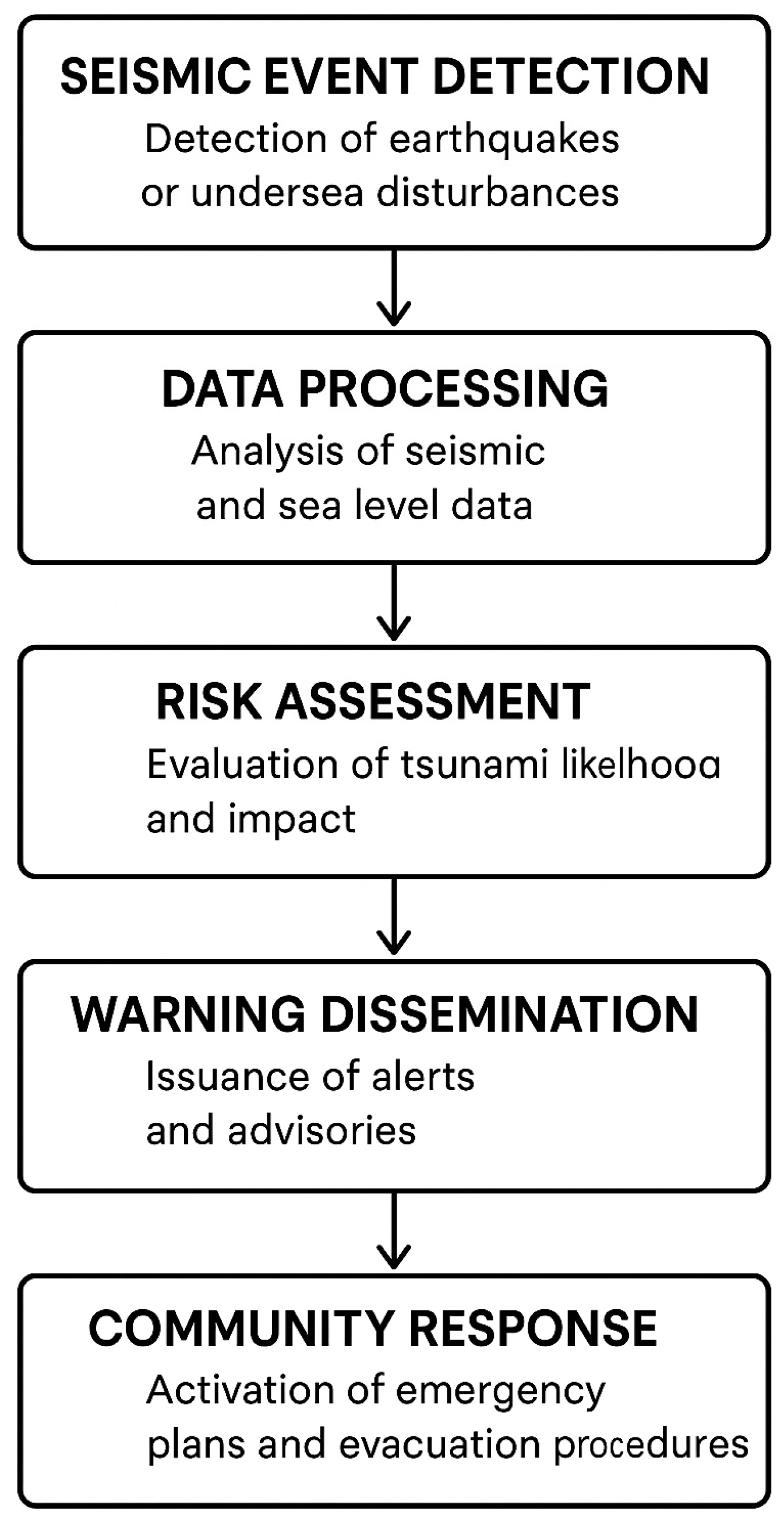
To understand the practical implications of tsunami early warning systems (TEWSs), it is essential to analyze real-world implementations that illustrate both their strengths and limitations. Case studies of major regional systems and extreme events provide critical insights into how technological, institutional, and social factors intersect in operational warning contexts. Figure 4 summarizes the end-to-end process of a tsunami early warning system. These examples allow for an assessment of system effectiveness under varying geopolitical, oceanographic, and infrastructural conditions, offering valuable lessons for the continuous improvement of flood risk governance frameworks.
The Pacific Tsunami Warning Center (PTWC) provides a first reference point for operational TEWS at scale. Established following the 1946 Aleutian Islands tsunami, its mission has been to monitor seismic activity and sea level disturbances across the Pacific Basin and issue alerts accordingly. The PTWC integrates seismic data, sea level information from coastal tide gauges, and real-time deep-ocean pressure data from the DART buoy network.
The DART buoy network, in particular, has been fundamental in enhancing deep-ocean tsunami detection. Recent assessments underscore the critical role of regional seismic networks in enhancing the sensitivity and precision of the PTWC’s detection capabilities, thereby improving response times and reducing uncertainty in early alerts [24]. This architecture not only enables rapid confirmation of tsunami generation, but also supports coordinated alert dissemination across multiple national jurisdictions in the Pacific Basin.
The most severe catastrophe in the PTWC’s area of concern occurred on 11 March 2011, when a magnitude 9.0 earthquake off the coast of Tōhoku, Japan, triggered a devastating tsunami. Waves reached heights of up to 40 m and penetrated up to 10 km inland. The event resulted in over 18,000 fatalities and caused massive infrastructure damage, including the Fukushima Daiichi nuclear disaster. Despite Japan’s advanced TEWS, including a highly dense seismic and oceanic monitoring network coordinated by the Japan Meteorological Agency (JMA), the initial warning underestimated the tsunami’s magnitude. Although alerts were issued within three minutes, the initial underestimation of wave height influenced evacuation decisions and has been cited as a contributing factor to the scale of losses. This event highlighted that even sophisticated systems can be overwhelmed by extreme geophysical events [62].
The event also underscored that technological capacity alone is not sufficient. The effectiveness of the system is inseparable from broader governance structures and cooperative frameworks among Pacific nations. The ability of the center to rapidly issue warnings during events such as the 2010 Chile and 2011 Japan tsunamis exemplifies the importance of robust cross-border coordination and data-sharing protocols [63].
A second instructive case is the Indian Ocean Tsunami Warning System (IOTWS), which was established in the aftermath of the catastrophic 2004 Indian Ocean tsunami. The magnitude 9.1 earthquake off the coast of Sumatra generated a transoceanic tsunami that affected 14 countries, caused over 230,000 deaths, and exposed the absence of a coordinated regional warning architecture. In response, UNESCO’s Intergovernmental Oceanographic Commission (IOC) coordinated the development of the IOTWS. Unlike the Pacific, the Indian Ocean lacked any prior TEWS infrastructure. Since then, nations such as Indonesia, India, and Thailand have established national tsunami warning centers that operate in concert with regional hubs, utilizing a network of seismic stations, coastal tide gauges, and DART buoys [29]. The IOTWS illustrates the potential of multilateral frameworks in enhancing regional resilience. However, the system still faces challenges related to data latency, technological asymmetries between nations, and public trust in warning messages. Nonetheless, its rapid deployment post-2004 represents one of the most significant advancements in regional disaster risk governance in recent history [64].
The comparative analysis of the 2004 Indian Ocean tsunami and the 2011 Tōhoku tsunami yields several lessons that remain central to TEWS design, particularly in low-income and densely populated regions. In many affected countries, the absence of seismic monitoring infrastructure, limited public awareness, and a lack of evacuation planning resulted in catastrophic outcomes. In contrast, the 2011 Tōhoku earthquake and tsunami in Japan, although similarly devastating, demonstrated the value of a mature TEWS. The Japan Meteorological Agency (JMA) issued an initial warning within three minutes of the seismic event, aided by dense seismic networks and real-time modeling tools [65].
However, the 2011 event also exposed limitations. Although early warnings were issued, the underestimated wave height predictions and the public’s difficulty in interpreting warnings—especially with complex language and insufficient lead times—resulted in substantial fatalities. These cases emphasize that TEWS must go beyond detection; they require robust public education, scenario-based planning, and resilient infrastructure to be truly effective. Notably, during the 2011 Tōhoku event, the early comparison of observed sea level data with precomputed inundation scenarios revealed a significant underestimation of the earthquake’s magnitude. Although several international agencies issued higher magnitude estimates in near real time, procedural constraints within the Japan Meteorological Agency (JMA) led to the prioritization of domestic estimations and the disregard of external inputs. This institutional rigidity delayed the full activation of response protocols and contributed to the under preparedness in some coastal zones, despite the availability of more accurate data [63].
Taken together, these case studies show that warning systems evolve in direct response to catastrophic events, and that their effectiveness is shaped by more than just sensor density or modeling sophistication. Long-term resilience depends on institutional coordination, shared protocols, public trust, and the ability to translate technical detection into rapid, actionable, and context-aware protective behavior at the community level.

6. Discussion

6.1. Significant Research Information

Based on the research conducted, it can be stated that tsunami early warning systems (TEWSs) have undergone a significant evolution since the devastating 2004 Indian Ocean tsunami, establishing a risk management paradigm that integrates technological capabilities, social preparedness, and coastal (land-use) planning. Research demonstrates that the effectiveness of these systems is not solely dependent on technological sophistication, but on the holistic integration of components including detection, communication, community preparedness, and coastal resilience [8,35].
DART systems can constrain initial offshore wave-height estimation errors to approximately ±0.5 m during the first 15 min after a seismic event [22,25]. While this represents a significant improvement over earlier capabilities, critical limitations remain in near-field events where warning times are compressed below 30 min, as evidenced during the 2011 Tohoku tsunami [36].
The integration of emerging technologies such as machine learning has shown promising results, with convolutional neural network (CNN) algorithms achieving reductions in maximum tsunami amplitude prediction errors to ~0.4 m and arrival times to ~48 s [25]. These advances represent a substantial improvement in the predictive capability of current systems.
Moreover, recent studies underscore the need to complement conventional seismic- and buoy-based TEWS with additional observation technologies capable of detecting atypical tsunami generation mechanisms and enhancing warning lead times. High-frequency (HF) surface wave radars and satellite-based synthetic aperture radar (SAR) have demonstrated potential for detecting tsunamigenic sea surface disturbances in oceanic settings, offering critical lead time in far-field events. However, their operational utility is significantly limited in near-field contexts where tsunami wave travel times can be shorter than 30 min. In such cases, the latency associated with data acquisition and processing renders these systems insufficient for real-time early warning, underscoring the need for complementary, locally deployed sensors capable of immediate detection and alerting [66].
In parallel, adaptive early warning frameworks that incorporate probabilistic risk assessment are being proposed to address uncertainties in tsunami modeling and to guide decision-making under complex coastal risk scenarios [67]. Such approaches are already being integrated into large-scale systems such as the Indian Ocean Tsunami Warning System (IOTWS), which now also monitors atypical sources including submarine landslides and volcanic activity, thereby broadening its applicability and resilience. For atypical Tsunami, probabilistic methods, based on seismic activity are useless [68,69]. Replicating these integrated, multi-technology, and adaptive frameworks in other coastal settings will require overcoming challenges such as ensuring sustained funding for high-cost technologies, harmonizing multi-agency coordination, and tailoring system architecture to local hazard profiles and socio-economic contexts.

6.2. Practical and Theoretical Implications

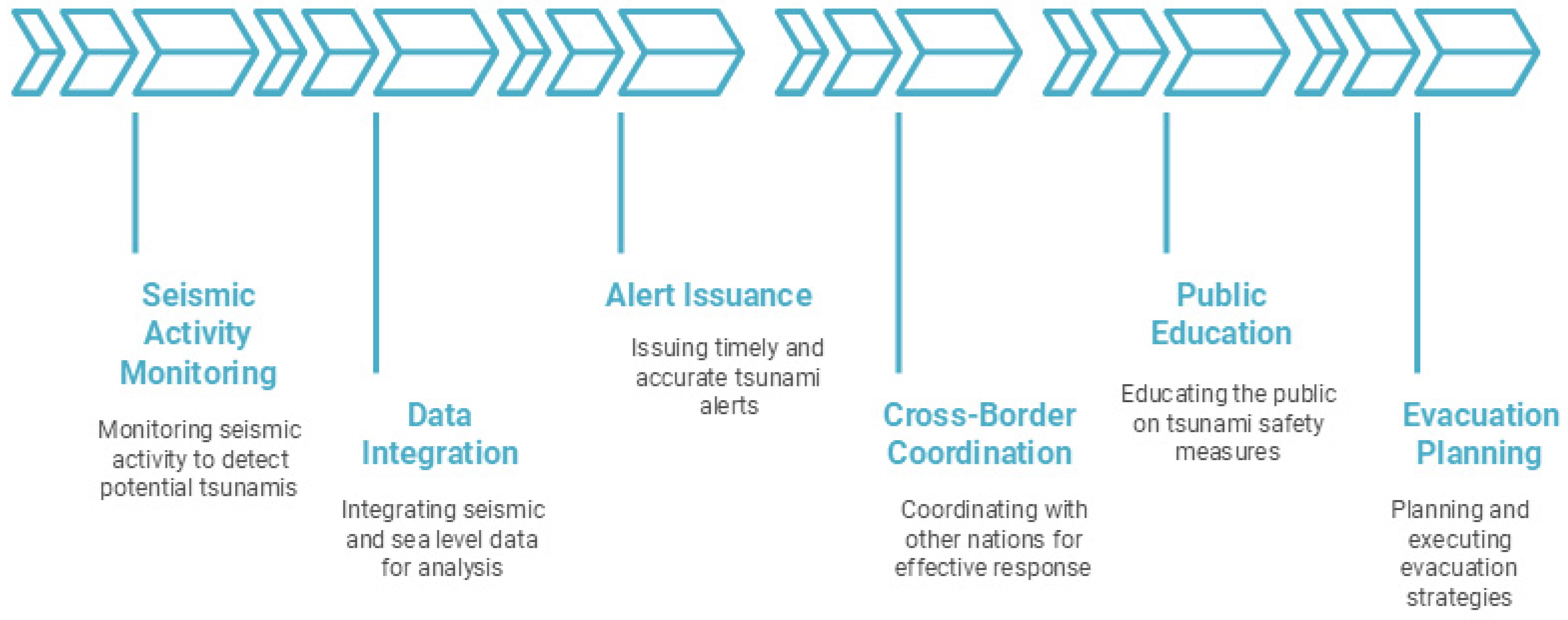
The findings of this review underscore the need to adopt a holistic approach that goes beyond purely technological detection. This paradigm integrates four fundamental pillars: (1) advanced monitoring and detection, (2) multilevel communication and coordination, (3) participatory community preparedness, and (4) adaptive coastal resilience (Figure 5).
Comprehensive tsunami risk management requires a systemic understanding where each component feeds back into the others, generating a synergistic effect that enhances the overall effectiveness of the system [8,9]. This holistic perspective is consistent with conceptual risk management frameworks that emphasize the importance of integrating both human capital development and the implementation of innovative practices [10].
Recent studies highlight the growing emphasis on expanding and interconnecting regional cooperation mechanisms around Tsunami Early Warning Systems (TEWSs) to enhance operational and technical capacities. Pal et al. [70] stress the critical need for international assistance and institutional coordination to strengthen these capabilities effectively. Furthermore, the development of integrated cybernetic systems, as proposed by Little et al. [71], supports not only early detection but also effective community response through agent-based simulations and behavioral modeling, reinforcing the holistic design approach that integrates social factors alongside technological components. Advances in distributed system architectures and interoperability standards, exemplified by the DEWS and TRIDEC projects [72,73], demonstrate how scalable and adaptable TEWS can be constructed by integrating seismic sensors, tide gauges, and real-time predictive simulations.
A practical illustration of this holistic transition is the SIPAT decision support system in Chile [74], which moves beyond detection-centric frameworks to incorporate near-real-time coastal impact prediction, evidencing the maturity of integrated risk management approaches. Replicating such integrated and adaptive systems in diverse coastal areas presents challenges including securing sustainable funding, harmonizing multi-agency collaboration, and customizing system design to local hazard profiles and socioeconomic contexts.
This review shows that strengthening coastal resilience is a fundamental element that must be proactively integrated into early warning systems. Natural coastal ecosystems, particularly mangroves and coral reefs, function as natural barriers that absorb the impact of tsunami waves. The historical degradation of these ecosystems significantly amplified the damage during the 2004 Indian Ocean tsunami compared to areas where these ecosystems remained intact [75].
Coastal planning emerges as a critical component that must incorporate methodologies such as CRET (Concatenated Risk by Earthquake-Tsunami) to quantify concatenated earthquake-tsunami risks [76]. This approach makes it possible to establish three risk levels and generate provisions for the adaptability of exposed elements, establishing requirements for new land uses [76].
Recent research highlights the effectiveness of multivariate and contextual approaches in enhancing community resilience against tsunamis. The CORE resilience model developed by Villagra et al. [77] serves as a robust framework integrating physical, environmental, and social indicators to assess the adaptive capacity of coastal communities in Chile, emphasizing the need for evidence-based coastal planning policies. Bernard [7] identifies three fundamental pillars of coastal community resilience: hazard assessment, community preparedness, and clear guidance in alert communication and response, noting that these actions not only save lives but also accelerate post-tsunami recovery.
Pushpalal [78] proposes a conceptual framework dividing resilience into three phases: in situ resistance, immediate survival capacity, and recovery potential, where socioeconomic, geographic, and infrastructural factors play key roles. Furthermore, Raskin and Wang [79] advocate for 50-year resilience plans incorporating strategic relocation of critical infrastructure and clear evacuation routes, while addressing the economic realities of coastal populations. Finally, Marcucci [80] proposes architectural and productive resilience strategies for fishing communities in Chile, suggesting that post-disaster reconstruction can be leveraged to improve both functional and social resilience of coastal settlements. Replicating these integrated approaches across other coastal regions will require overcoming challenges such as adapting frameworks to local contexts, ensuring long-term policy commitment, and balancing economic and social priorities.
Community participation and transformative risk education emerge as determining factors in the effectiveness of early warning system. Research shows that social capital and community networks act as protective factors during tsunami events, particularly for vulnerable populations such as the elderly and communities with limited socio-economic resources [51,52].
Community education programs should adopt approaches that strengthen local knowledge building and the capacity for community self-organization [18,20]. Community environmental education from an intercultural perspective contributes significantly to socio-environmental justice and the promotion of sustainable practices [20].
The implementation of regular drills and certification programs such as UNESCO’s “Tsunami Ready” have been shown to significantly improve community preparedness and response [19]. These programs should consider the specific vulnerabilities of special populations, including people with disabilities, the elderly, and tourists [29].
Community participation is essential for strengthening tsunami preparedness, as demonstrated by the study in Pangandaran, Indonesia, where the direct experience of the 2006 tsunami motivated both the population and authorities to implement a participatory early warning system [81]. Active community involvement has positive effects on risk reduction, with participants more likely to adopt preparedness behaviors such as assembling emergency kits and planning evacuation routes [52].
The use of accessible technologies adapted to local contexts, such as mobile applications integrated into community alert systems, enhances risk education and preparedness in tsunami-prone areas [82]. Furthermore, combining advanced oceanographic instruments with public awareness activities strengthens community trust and the overall efficacy of early warning systems [83]. Replicating these integrated socio-technical strategies in other coastal communities entails overcoming challenges including ensuring sustained community engagement, adapting technologies to local capacities, and maintaining trust through transparent and inclusive communication.

6.3. Future Perspectives and Emerging Technologies

Emerging artificial intelligence techniques are reshaping the predictive capability of early warning systems. Transformer models for seismic alerts (TEAM) have demonstrated superior accuracy in discriminating tsunamigenic events, reducing response times by 2.3 s/1.2 s for data analyzed from Japan and Italy, respectively [Italy respectively [33].
The development of deep learning architectures enables the processing of multi-modal sensor arrays with automatic feature extraction [25,58]. Real-time data assimilation systems enable dynamic model correction during tsunami propagation using convolutional neural networks trained with 1000 synthetic tsunami scenarios [25].
From an algorithmic standpoint, most deep-learning-based TEWS prototypes share a similar structure. Input features typically consist of raw or minimally processed seismic waveforms, GNSS displacement time series, and offshore sea-level records from DART bottom-pressure sensors and coastal tide gauges. Convolutional layers are used to extract local time-frequency patterns, which are then passed to recurrent layers such as Long Short-Term Memory (LSTM) networks or to attention mechanisms in transformer architectures to capture long-range temporal dependencies. Depending on the target application, these models are trained with regression losses (e.g., mean-squared error on estimated moment magnitude or maximum offshore wave height) or classification losses (e.g., cross-entropy for tsunamigenic versus non-tsunamigenic events and multi-class regional threat levels).
Beyond deep learning, more classical statistical and hybrid approaches are also being explored for tsunami early warning algorithms. Li and Goda developed hazard- and risk-based sequential multiple linear regression schemes for the S-Net ocean-bottom sensor system in Tohoku, Japan, demonstrating how regression-based algorithms can be embedded within TEWS decision rules [84]. In parallel, Alan et al. applied an LSTM deep-learning network to the 30 October 2020 Izmir–Samos tsunami, showing that recurrent architectures can enhance early-warning lead time while preserving hydrodynamic fidelity [85]. Togetherfidelity [85] Together with system-level reviews of TEWS architectures such as Wächter et al. [72], these studies illustrate the diversity of algorithmic strategies currently under investigation for real-time tsunami detection and impact forecasting.
The convergence of Internet of Things (IoT) sensor networks and distributed edge computing is enabling distributed sensing paradigms that overcome the limitations of centralized systems [21]. IoT sensor networks can capture seismic signals and pre-tsunami environmental anomalies [38].
Implementation of edge computing with programmable gate arrays (FPGAs) running compressed neural networks on ocean bottom sensors has demonstrated response times of 17 milliseconds in P-wave detection, enabling coastal warnings 8–12 s faster than centralized processing architectures [35,59].
Hybrid quantum machine learning prototypes show potential for solving inverse problems in tsunami source characterization, reducing computational time and achieving accuracies of up to 96.03% [60]. In parallel, coastal digital twins, enabled by adaptive mesh refinement and generative adversarial networks (GANs), aim to generate hyper-local inundation forecasts that overcome previous limitations in nearshore bathymetric modeling [25,61].
While IoT-enabled distributed sensing, edge computing, and FPGA-accelerated onboard detection have already been demonstrated in pilot deployments with sub-second response times [35,59], quantum machine learning and coastal digital twins remain at a more exploratory stage. These emerging approaches show potential for rapid source inversion and hyper-local inundation forecasting but are not yet mature for widespread operational use [60,61].

6.4. Limitations of the TEWS

Despite these advances, several limitations persist. From a technological perspective, current systems face fundamental limitations in sensor accuracy and data interpretation that directly impact the reliability of predictions [22,34]. Uncertainties in wave height estimation exceed ±0.5 m during the first 15 min post-earthquake, becoming particularly problematic for near-field events where warning times are compressed below 30 min [22,25].
Sensor reliability in marine environments also remains a structural limitation. Deep-ocean platforms are exposed to battery depletion, vandalism, biofouling, and extreme weather conditions, which can interrupt data streams at precisely the most critical moments [21]. The integration of emerging technologies such as GNSS ionospheric disturbance monitoring shows promise, particularly for detecting atmospheric signatures of large tsunamigenic events. However, this approach currently lacks the spatial resolution necessary for precise coastal impact assessments. In parallel, submarine telecommunication cables—such as those developed under the SMART initiative—are being equipped with pressure, seismic, and temperature sensors, offering a high-resolution and low-latency alternative for tsunami monitoring. Although their deployment involves substantial investment, their capacity to provide continuous and distributed real-time data across vast oceanic domains makes them a highly promising tool for enhancing tsunami early warning, especially in regions underserved by traditional buoy networks [32,39].
In addition, socio-economic constraints continue to limit the global equity of TEWS. The acquisition, deployment, maintenance, and operation of dense sensor networks, high-speed communication infrastructure, and trained personnel require sustained investment that many countries cannot easily guarantee [54]. Disparities in access to communication technologies and digital literacy create inequities in receiving and understanding warnings, particularly in rural and indigenous communities [57].
Finally, this review is limited by the fact that much of the available evidence derives from a small number of large events and from regions with relatively advanced monitoring capacity. There is a need for longitudinal studies that evaluate community response to specific warning protocols, the influence of local governance structures on evacuation behavior, and the long-term effectiveness of integrated multi-hazard approaches. Addressing these gaps is essential for generalizing best practices beyond well-instrumented settings.

7. Conclusions

Tsunami early warning systems represent one of the most significant developments in natural disaster risk management in the 21st century. The evidence presented confirms that the effectiveness of these systems depends not only on technological advances, but also on the adoption of holistic approaches that integrate scientific capability with social capital, community participation, and coastal resilience.
Emerging technologies, including artificial intelligence, the Internet of Things (IoT), and, prospectively, quantum computing, offer substantial potential to enhance the precision, speed, and reliability of tsunami early warning systems [21,33,60]. These technologies can improve real-time source characterization, nearshore impact forecasting, and alert dissemination, particularly in near-field scenarios. However, replicating these advanced frameworks in diverse coastal areas requires alignment with local conditions, including technological infrastructure, economic capacity, and institutional readiness [54]. Ensuring sustained funding and long-term policy support remains a persistent structural challenge, especially in low-income regions that are highly exposed to tsunamis but lack robust technical and financial resources [57].
Adaptive governance models that foster multi-agency coordination and community engagement are critical to translating technological capability into effective public protection [70,71]. Integrated socio-technical systems that combine advanced sensor networks, real-time data assimilation supported by machine learning models, and inclusive risk communication strategies show strong potential to improve preparedness and reduce casualties [25,58]. The experience of integrated decision-support platforms such as SIPAT in Chile illustrates how near–real-time coastal impact prediction can be aligned with locally informed risk-management practices [74].
Scaling these capabilities requires interoperable data standards, robust maintenance strategies for marine sensor networks, and sustained public trust in alerting protocols, particularly in resource-constrained coastal regions [72,73]. This involves addressing sensor reliability in harsh marine environments [21] and overcoming sociocultural barriers to technology adoption and trust in official warnings [52,81]. In addition, the increasingly diverse nature of tsunami sources, including non-seismic events, underscores the need to incorporate multi-sensor observations such as synthetic aperture radar and ionospheric monitoring, so that atypical events can be detected and characterized comprehensively [32,66].
Community participation and transformative education remain fundamental pillars for the long-term effectiveness and legitimacy of early warning systems. Educational programs should adopt cross-cultural approaches that strengthen local knowledge and community self-organization capacity. Successful replication in other coastal zones requires tailoring system design to local hazard profiles and socio-economic conditions [78,79], building technical capacity for operational personnel, and ensuring sustained community involvement through inclusive communication, training, and equitable access to warning technologies [82,83]. Addressing these aspects systematically is essential to achieve durable risk reduction.
In summary, the future of tsunami early warning systems lies in the convergence of technological innovation, social empowerment, and adaptive coastal planning. Advancing these dimensions in an integrated manner will not only improve the protection of human life but also support sustainable development and help address structural vulnerability in exposed coastal communities.

Author Contributions

Conceptualization, F.-J.P.-R. and M.R.-P.; formal analysis, F.-J.P.-R. and M.O.-M.; investigation, F.-J.P.-R., M.B., M.O.-M. and M.R.-P.; writing—original draft preparation, F.-J.P.-R. and M.R.-P.; writing—review and editing F.-J.P.-R., M.B., M.O.-M. and M.R.-P.; visualization F.-J.P.-R. and M.B.; supervision, M.O.-M. and M.R.-P.; project administration, M.O.-M. and M.R.-P. All authors have read and agreed to the published version of the manuscript.

Funding

This research received no external funding.

Data Availability Statement

No new data were created or analyzed in this study. Data sharing is not applicable to this article.

Conflicts of Interest

The authors declare no conflicts of interest.

References

  1. Parsi, M.; Akbarpour Jannat, M.R. Tsunami Warning System Using of IoT. J. Ocean. 2020, 11, 1–17. [Google Scholar] [CrossRef]
  2. Dubois, J.; Daba, J.; Karam, H.; Abdallah, J. An Enhanced SAR-Based Tsunami Detection System. Int. J. Electr. Commun. Eng. 2014, 8, 1242–1246. [Google Scholar]
  3. Matsumoto, H. Advances for Tsunami Measurement Technologies and Its Applications. In Tsunami—A Growing Disaster; IntechOpen: London, UK, 2011. [Google Scholar]
  4. Rakowsky, N.; Androsov, A.; Fuchs, A.; Harig, S.; Immerz, A.; Danilov, S.; Hiller, W.; Schröter, J. Operational Tsunami Modelling with TsunAWI—Recent Developments and Applications. Nat. Hazards Earth Syst. Sci. 2013, 13, 1629–1642. [Google Scholar] [CrossRef]
  5. Braddock, R. Sensitivity Analysis of the Tsunami Warning Potential. Reliab. Eng. Syst. Saf. 2003, 79, 225–228. [Google Scholar] [CrossRef]
  6. Joseph, A. The Role of IOC-UNESCO in Tsunami Early Warnings. In Tsunamis; Elsevier: Amsterdam, The Netherlands, 2011; pp. 121–124. ISBN 9780123850539. [Google Scholar]
  7. Bernard, E.N.; Mofjeld, H.O.; Titov, V.; Synolakis, C.E.; González, F.I.; Purvis, M.J.; Sharpe, J.E.; Mayberry, G.C.; Robertson, R.E.A. Tsunami: Scientific Frontiers, Mitigation, Forecasting and Policy Implications. Philos. Trans. R. Soc. A Math. Phys. Eng. Sci. 2006, 364, 1989–2007. [Google Scholar] [CrossRef]
  8. Mori, N.; Satake, K.; Cox, D.; Goda, K.; Catalan, P.A.; Ho, T.C.; Imamura, F.; Tomiczek, T.; Lynett, P.; Miyashita, T.; et al. Giant Tsunami Monitoring, Early Warning and Hazard Assessment. Nat. Rev. Earth Environ. 2022, 3, 557–572. [Google Scholar] [CrossRef]
  9. Imamura, F.; Suppasri, A.; Latcharote, P.; Otake, T. A Global Assessment of Tsunami Hazards Over the Last 400 Years; International Research Institute of Disaster Science (IRIDeS): Sendai, Japan, 2016. [Google Scholar]
  10. Devlin, A.T.; Jay, D.A.; Talke, S.A.; Pan, J. Global Water Level Variability Observed after the Hunga Tonga-Hunga Ha’ Apai Volcanic Tsunami of 2022. Ocean Sci. 2023, 19, 517–534. [Google Scholar] [CrossRef]
  11. Omira, R.; Ramalho, R.S.; Kim, J.; González, P.J.; Kadri, U.; Miranda, J.M.; Carrilho, F.; Baptista, M.A. Global Tonga Tsunami Explained by a Fast-Moving Atmospheric Source. Nature 2022, 609, 734–740. [Google Scholar] [CrossRef]
  12. Climate ADAPT Establecimiento de Sistemas de Alerta Rápida. In Sharing Adaptation Knowledge for a Climate-Resilient Europe; Climate-ADAPT: Berlin, Germany, 2025.
  13. United Nations Office for Disaster Risk Reduction (UNDRR). United Nations Office for Disaster Risk Reduction (UNDRR) Strategic Framework 2022–2025; United Nations Office for Disaster Risk Reduction (UNDRR): Geneva, Switzerland, 2022.
  14. Intergovernmental Oceanographic Commission. Quality Control of In Situ. Sea Level Observations; Intergovernmental Oceanographic Commission (IOC) of United Nations Educational, Scientific and Cultural Organization (UNESCO): Paris, France, 2020; Volume 1. [Google Scholar]
  15. UN/ISDR Platform for the Promotion of Early Warning (PPEW); UN Secretariat of the International Strategy for Disaster Reduction (UN/ISDR). Tercera Conferencia Internacional Sobre Alerta Temprana Del Concepto a La Acción. In Proceedings of the Desarrollo de Sistemas de Alerta Temprana: Lista de Comprobación, Bonn, Germany, 27 March 2006. [Google Scholar]
  16. Annunziato, A. Tsunami Detection Model for Sea Level Measurement Devices. Geociences 2022, 12, 386. [Google Scholar] [CrossRef]
  17. Masante, D.; Barantiev, D.; Destro, E.; Mastronunzio, M.; Paris, S.; Proietti, C.; Salvitti, V.; Santini, M. Multi-Hazard Early Warning System Global Disaster Alert and Coordination System (GDACS); European Commission: Brussels, Belgium, 2025. [Google Scholar]
  18. García Montano, H.; Maltez Perez, N.J. Modelamientos de Los Parámetros Geofísicos Por Una Fuente Sísmica Capaz de Generar Un Tsunami En La Costa de Pochomil, Nicaragua. Rev. Cient. FAREM-Estelí 2022, 11, 175–194. [Google Scholar] [CrossRef]
  19. European Environment Agency. Late Lessons from Early Warnings II—Summary; EEA Report No 1/2013; European Environment Agency (EEA): Copenhagen, Denmark, 22 January 2013. [Google Scholar] [CrossRef]
  20. Organización Meteorológica Mundial (OMM). Organización Meteorológica Mundial, 2021; Organización Meteorológica Mundial, 201521, OMM-N° 1150: Suiza 201521; Organización Meteorológica Mundial (OMM): Geneva, Switzerland, 2015; ISBN 978-92-63-31150-4. [Google Scholar]
  21. Esposito, M.; Palma, L.; Belli, A.; Sabbatini, L.; Pierleoni, P. Recent Advances in Internet of Things Solutions for Early Warning: A Review. Sensors 2022, 22, 2124. [Google Scholar] [CrossRef]
  22. Gopinathan, D.; Venugopal, M.; Roy, D.; Rajendran, K.; Guillas, S.; Dias, F. Uncertainties in the 2004 Sumatra-Andaman Source through Nonlinear Inversion of Tsunami Waves. Proc. R. Soc. Math. Phys. Eng. Sci. 2017, 473, 20170353. [Google Scholar] [CrossRef] [PubMed]
  23. Hamlington, B.D.; Leben, R.R.; Godin, O.A.; Gica, E.; Titov, V.V.; Haines, B.J.; Desai, S.D. Could Satellite Altimetry Have Improved Early Detection and Warning of the 2011 Tohoku Tsunami? Geophys. Res. Lett. 2012, 39, 4–9. [Google Scholar] [CrossRef]
  24. Sardina, V.; Weinstein, S.; Koyanagi, K. Baseline Assessment of the Importance of Contributions from Regional Seismic Networks to the Pacific Tsunami Warning Center’s Operations. Seismol. Res. Lett. 2020, 91, 687–694. [Google Scholar] [CrossRef]
  25. Makinoshima, F.; Oishi, Y.; Yamazaki, T.; Furumura, T.; Imamura, F. Early Forecasting of Tsunami Inundation from Tsunami and Geodetic Data with Convolutional Neural Networks. Nat. Commun. 2021, 12, 2253. [Google Scholar] [CrossRef]
  26. Licciardi, A.; Bletery, Q.; Rouet-Leduc, B.; Ampuero, J.-P.; Juhel, K. Instantaneous Tracking of Earthquake Growth with Elastogravity Signals. Nature 2022, 606, 319–324. [Google Scholar] [CrossRef]
  27. Lavrentiev, M.; Lysakov, K.; Marchuk, A.; Oblaukhov, K. Fundamentals of Fast Tsunami Wave Parameter Determination Technology for Hazard Mitigation. Sensors 2022, 22, 7630. [Google Scholar] [CrossRef]
  28. Federación Internacional de Sociedades de la Cruz Roja y de la Media Luna Roja. Sistemas Comunitarios de Alerta Temprana: Principios Rectores. 2012. Available online: https://www.preventionweb.net/es/publication/sistemas-comunitarios-de-alerta-temprana-principios-rectores (accessed on 1 November 2025).
  29. Schiermeier, Q.; Witze, A. Tsunami Watch. Nature 2009, 462, 968–969. [Google Scholar] [CrossRef]
  30. Ajmar, A.; Annunziato, A.; Boccardo, P.; Tonolo, F.G.; Wania, A. Tsunami Modeling and Satellite-Based Emergency Mapping: Workflow Integration Opportunities. Geosciences 2019, 9, 314. [Google Scholar] [CrossRef]
  31. Arai, K. Tsunami Warning System with Sea Surface Features Derived from Altimeter Onboard Satellites. Int. J. Adv. Comput. Sci. Appl. 2017, 8, 582–587. [Google Scholar] [CrossRef]
  32. Constantinou, V.; Ravanelli, M.; Liu, H.; Bortnik, J. Deep Learning Driven Detection of Tsunami Related Internal Gravity: A Path towards Open-Ocean Natural Hazards Detection. In Proceedings of the IEEE/CVF International Conference on Computer Vision, Paris, France, 2–6 October 2023; IEEE Computer Society: Los Alamitos, CA, USA, 2023; pp. 3750–3755. [Google Scholar]
  33. Muenchmeyer, J.; Bindi, D.; Leser, U.; Tilmann, F. The Transformer Earthquake Alerting Model: A New Versatile Approach to earthquake Early Warning. Geophys. J. Int. 2021, 225, 646–656. [Google Scholar] [CrossRef]
  34. Selva, J.; Lorito, S.; Volpe, M.; Romano, F.; Tonini, R.; Perfetti, P.; Bernardi, F.; Taroni, M.; Scala, A.; Babeyko, A.; et al. Probabilistic Tsunami Forecasting for Early Warning. Nat. Commun. 2021, 12, 5677. [Google Scholar] [CrossRef]
  35. Minson, S.E.; Brooks, B.A.; Glennie, C.L.; Murray, J.R.; Langbein, J.O.; Owen, S.E.; Heaton, T.H.; Iannucci, R.A.; Hauser, D.L. Crowdsourced Earthquake Early Warning. Sci. Adv. 2015, 1, e1500036. [Google Scholar] [CrossRef]
  36. Gusman, A.; Tanioka, Y.; MacInnes, B.T.; Tsushima, H. A Methodology for Near-Field Tsunami Inundation Forecasting: Application the 2011 Tohoku Tsunami. J. Geophys. Res. Solid. Earth 2014, 119, 8186–8206. [Google Scholar] [CrossRef]
  37. Rauter, M.; Viroulet, S.; Gylfadottir, S.S.; Fellin, W.; Lovholt, F. Granular Porous Landslide Tsunami Modelling—The 2014 Lake Askja Flank. Nat. Commun. 2022, 13, 678. [Google Scholar] [CrossRef]
  38. Berger, M.J.; LeVeque, R.J. Towards Adaptive Simulations of Dispersive Tsunami Propagation from an Asteroid Impact. In Proceedings of the International Congress of Mathematicians, Helsinki, Finland, 3–6 July 2022; pp. 5056–5071. [Google Scholar]
  39. Savastano, G.; Komjathy, A.; Verkhoglyadova, O.; Mazzoni, A.; Crespi, M.; Wei, Y.; Mannucci, A.J. Real-Time Detection of Tsunami Ionospheric Disturbances with a Stand-Alone GNSS Receiver: A Preliminary Feasibility Demonstration. Sci. Rep. 2017, 7, 46607. [Google Scholar] [CrossRef] [PubMed]
  40. Fearnley, C.J.; Dixon, D. Editorial: Early Warning Systems for Pandemics: Lessons Learned from natural Hazards. Int. J. Disaster Risk Reduct. 2020, 49, 101674. [Google Scholar] [CrossRef] [PubMed]
  41. Mirianna, B.; Robert, S.T.; Cinthia, A.; Miguel, A.; Orlando, C.V.; Cisneros, A.; Monica, C.I.; Adama, D.; Leon, L.; Giorgio, M.; et al. Opportunities and Challenges for People-Centered-Hazard Early Warning Systems: Perspectives from the Global South. iScience 2025, 28, 112353. [Google Scholar] [CrossRef]
  42. Harrison, S.E.; Lawson, V.R.; Kaiser, L.; Potter, S.H.; Johnston, D. Understanding Mariners’ Tsunami Information Needs and Decision-Making: A Post-Event Case Study of the 2022 Tonga Eruption and Tsunami. iScience 2025, 28, 111801. [Google Scholar] [CrossRef]
  43. Fakhruddin, B.; Clark, H.; Robinson, L.; Hieber-Girardet, L. Should I Stay or Should I Go Now? Why Risk Communication Is the Critical in Disaster Risk Reduction. Prog. Disaster Sci. 2020, 8, 100139. [Google Scholar] [CrossRef]
  44. Nakai, H.; Itatani, T.; Kaganoi, S.; Okamura, A.; Horiike, R.; Yamasaki, M. Needs of Children with Neurodevelopmental Disorders and Geographic of Emergency Shelters Suitable for Vulnerable People during A Tsunami. Int. J. Environ. Res. Public Health 2021, 18, 1845. [Google Scholar] [CrossRef]
  45. Grezio, A.; Anzidei, M.; Baglione, E.; Brizuela, B.; Di Manna, P.; Selva, J.; Taroni, M.; Tonini, R.; Vecchio, A. Including Sea-Level Rise and Vertical Land Movements in Probabilistic Hazard Assessment for the Mediterranean Sea. Sci. Rep. 2024, 14, 28873. [Google Scholar] [CrossRef]
  46. An, G.; Wang, Z.; Qu, M.; Hu, S. Integrated Optimization of Emergency Evacuation Routing for Dam-Induced Flooding: A Coupled Flood-Road Network Modeling Approach. Appl. Sci. Based 2025, 15, 4518. [Google Scholar] [CrossRef]
  47. Shiozaki, D.; Hashimoto, Y. System Development for Tsunami Evacuation Drill Using ICT and Tsunami Simulation Data. J. Disaster Res. 2024, 19, 72–80. [Google Scholar] [CrossRef]
  48. Pablo Arias, J.; Bronfman, N.C.; Cisternas, P.C.; Repetto, P.B. Hazard Proximity and Risk Perception of Tsunamis in Coastal Cities: Are Able to Identify Their Risk? PLoS ONE 2017, 12, e0186455. [Google Scholar] [CrossRef]
  49. Massazza, A.; Brewin, C.R.; Joffe, H. Feelings, Thoughts, and Behaviors During Disaster. Qual. Health Res. 2021, 31, 323–337. [Google Scholar] [CrossRef]
  50. Zeng, J.; Rebelo, F.; He, R.; Noriega, P.; Vilar, E.; Wang, Z. Using virtual reality to explore the effect of multimodal alarms on human emergency evacuation behaviors. Virtual Real. 2025, 29, 77. [Google Scholar] [CrossRef]
  51. Ye, M.; Aldrich, D.P. Substitute or Complement? How Social Capital, Age and Socioeconomic Interacted to Impact Mortality in Japan’s 3/11 Tsunami. SSM-Popul. Health 2019, 7, 100403. [Google Scholar] [CrossRef]
  52. Witvorapong, N.; Muttarak, R.; Pothisiri, W. Social Participation and Disaster Risk Reduction Behaviors in Tsunami Areas. PLoS ONE 2015, 10, e0130862. [Google Scholar] [CrossRef]
  53. Lestari, F.; Jibiki, Y.; Sasaki, D.; Pelupessy, D.; Zulys, A.; Imamura, F. People’s Response to Potential Natural Hazard-Triggered Technological after a Sudden-Onset Earthquake in Indonesia. Int. J. Environ. Res. Public Health 2021, 18, 3369. [Google Scholar] [CrossRef] [PubMed]
  54. Gardner-Stephen, P.; Wallace, A.; Hawtin, K.; Al-Nuaimi, G.; Tran, A.; Le Mozo, T.; Lloyd, M. Reducing Cost While Increasing the Resilience & Effectiveness of tsunami Early Warning Systems. In Proceedings of the IEEE Global Humanitarian Technology Conference (GHTC), Seattle, WA, USA, 17–20 October 2019; IEEE: New York, NY, USA, 2019; pp. 487–494. [Google Scholar]
  55. Alamdar, F.; Kalantari, M.; Rajabifard, A. Understanding the Provision of Multi-Agency Sensor Information in disaster Management: A Case Study on the Australian State of Victoria. Int. J. Disaster Risk Reduct. 2017, 22, 475–493. [Google Scholar] [CrossRef]
  56. Baytiyeh, H.; Naja, M. Promoting Earthquake Disaster Mitigation in Lebanon through Civic. Disaster Prev. Manag. 2013, 22, 340–350. [Google Scholar] [CrossRef]
  57. Villagra, P.; Quintana, C. Disaster Governance for Community Resilience in Coastal Towns: Chilean Studies. Int. J. Environ. Res. Public Health 2017, 14, 1063. [Google Scholar] [CrossRef] [PubMed]
  58. Mulia, I.E.; Ueda, N.; Miyoshi, T.; Gusman, A.R.; Satake, K. Machine Learning-Based Tsunami Inundation Prediction Derived from offshore Observations. Nat. Commun. 2022, 13, 5489. [Google Scholar] [CrossRef] [PubMed]
  59. Sugondo, R.A.; Machbub, C. P-Wave Detection Using Deep Learning in Time and Frequency Domain for imbalanced Dataset. Helyon 2021, 7, e08605. [Google Scholar] [CrossRef] [PubMed]
  60. Dutta, S.S.; Sandeep, S.; Nandhini, D.; Amutha, S. Hybrid Quantum Neural Networks: Harnessing Dressed Quantum Circuits for Enhanced Tsunami Prediction via Earthquake Data Fusion. EPJ Quantum Technol. 2025, 12, 4. [Google Scholar] [CrossRef]
  61. Davies, G.; Weber, R.; Wilson, K.; Cummins, P. From Offshore to Onshore Probabilistic Tsunami Hazard Assessment via efficient Monte Carlo Sampling. Geophys. J. Int. 2022, 230, 1630–1651. [Google Scholar] [CrossRef]
  62. Takahashi, T.; Konuma, T. Problem of Present Tsunami Warning System Indicated by the 2004 Indian Ocean Tsunami. In Proceedings of the Coastal Engineering, Melbourne, Australia, 18–20 July 2007. [Google Scholar]
  63. Blackford, M.E. Early Warning Systems for Tsunami—An Overview BT—Early Warning Systems for Natural Disaster Reduction. In Early Warning Systems for Natural Disaster Reduction; Zschau, J., Küppers, A., Eds.; Springer: Berlin/Heidelberg, Germany, 2003; pp. 535–536. ISBN 978-3-642-55903-7. [Google Scholar]
  64. Register, C.; Escaleras, M. Mitigating Natural Disasters through Collective Action: The Effectiveness of Tsunami Early Warnings. South Econ. J. 2008, 74, 1017–1034. [Google Scholar]
  65. Hoshiba, M.; Ozaki, T. Early Warning for Geological Disasters Earthquake Early Warning and Tsunami Warning of the Japan Meteorological Agency, and Their Performance in the 2011 off the Pacific Coast of Tohoku Earthquake (Mw 9.0); Wenzel, F., Zschau, J., Eds.; Springer: Berlin/Heidelberg, Germany, 2014; pp. 1–28. ISBN 978-3-642-12233-0. [Google Scholar]
  66. Sheenu, P. Advance Prediction of Tsunami by Radio Methods. Int. J. Innov. Eng. Technol. (IJIET) 2015, 5, 207–2014. [Google Scholar]
  67. Woo, G. Risk-Informed Tsunami Warnings. Geol. Soc. Spec. Publ. 2018, 456, 191–197. [Google Scholar] [CrossRef]
  68. Necmioglu, O.; Heidarzadeh, M.; Vougioukalakis, G.E.; Selva, J. Landslide Induced Tsunami Hazard at Volcanoes: The Case of Santorini. Pure Appl. Geophys. 2023, 180, 1811–1834. [Google Scholar] [CrossRef]
  69. Srinivasa Kumar, T.; Manneela, S. A Review of the Progress, Challenges and Future Trends in Tsunami Early Warning Systems. J. Geol. Soc. India 2021, 97, 1533–1544. [Google Scholar] [CrossRef]
  70. Pal, I.; Ghosh, S.; Dash, I.; Mukhopadhyay, A. Review of Tsunami Early Warning System and Coastal Resilience with a Focus on Indian Ocean. Int. J. Disaster Resil. Built Environ. 2022, 14, 593–610. [Google Scholar] [CrossRef]
  71. Little, R.G.; Birkland, T.; Wallace, W.A.; Herabat, P. Socio-Technological Systems Integration to Support Tsunami Warning and Evacuation. SSRN Electron. J. 2011, 1–10. [Google Scholar] [CrossRef]
  72. Wächter, J.; Babeyko, A.; Fleischer, J.; Haner, R.; Hammitzsch, M.; Kloth, A.; Lendholt, M. Development of Tsunami Early Warning Systems and Future Challenges. Nat. Hazards Earth Syst. Sci. 2012, 12, 1923–1935. [Google Scholar] [CrossRef]
  73. Reißland, S.; Herrnkind, S.; Guenther, M.; Babeyko, A.; Comoglu, M.; Hammitzsch, M. Experiences Integrating Autonomous Components and Legacy Systems into Tsunami Early Warning Systems. In Proceedings of the General Assembly European Geosciences Union, Vienna, Austria, 22–27 April 2012; p. 10053. [Google Scholar]
  74. Catalán, P.; Gubler, A.; Cañas, J.; Zúñiga, C.; Zelaya, C.; Pizarro, L.; Valdes, C.; Mena, R.; Toledo, E.; Cienfuegos, R. Design and Operational Implementation of the Integrated Tsunami Forecast and Warning System in Chile (SIPAT). Coast. Eng. J. 2020, 62, 373–388. [Google Scholar] [CrossRef]
  75. Chatenoux, B.; Peduzzi, P. Impacts from the 2004 Indian Ocean Tsunami: Analysing the Potential Protecting Role of Environmental Features. Nat. Hazards 2007, 40, 289–304. [Google Scholar] [CrossRef]
  76. European Comission. User Workshop of the Copernicus Emergency Management Service—Summary Report; Publications Office of the European Union: Luxembourg, 2016. [Google Scholar]
  77. Villagra, P.; Herrmann, M.G.; Quintana, C.; Sepúlveda, R.D. Community Resilience to Tsunamis along the Southeastern Pacific: A Multivariate Approach Incorporating Physical, Environmental, and Social Indicators. Nat. Hazards 2017, 88, 1087–1111. [Google Scholar] [CrossRef]
  78. Pushpalal, D. A Conceptual Framework for Evaluating Tsunami Resilience. IOP Conf. Ser. Earth Environ. Sci. 2017, 56, 012026. [Google Scholar] [CrossRef]
  79. Raskin, J.; Wang, Y.M. Fifty-Year Resilience Strategies for Coastal Communities at Risk for Tsunamis. Nat. Hazards Rev. 2017, 18. [Google Scholar] [CrossRef]
  80. Marcucci, D. Coastal Resilience: New Perspectives of Spatial and Productive Development for the Chilean Caletas Exposed to Tsunami Risk. Procedia Econ. Financ. 2014, 18, 39–46. [Google Scholar] [CrossRef]
  81. Hadian, S.D.; Khadijah, U.L.S.; Saepudin, E.; Budiono, A.; Yuliawati, A.K. Community Participation In Tsunami Early Warning System In Pangandaran. In Proceedings of the 6th International Symposium on Earth Hazard And disasterDisaster Mitigation (ISEDM), Bandung, Indonesia, 11–12 October 2016; Meilano, I., Zulfakriza, Eds.; AMER INST PHYSICS: Melville, Australia, 2017; Volume 1857. [Google Scholar]
  82. Pamuji, A.K.; Retno Susilorini, R.M.I.; Ismail, A.; Amasto, A.H. The Effectiveness of Mobile Application of Earthquake and Tsunami Early Warning System in Community Based Disaster Risk Reduction. Int. J. Eng. Res. Technol. 2020, 13, 2979–2984. [Google Scholar] [CrossRef]
  83. Sumy, D.; McBride, S.; von Hillebrandt-Andrade, C.; Kohler, M.; Orcutt, J.; Kodaira, S.; Moran, K.; McNamara, D.; Hori, T.; Vanacore, E.; et al. Long-Term Ocean Observing Coupled with Community Engagement Improves Tsunami Early Warning. Oceanography 2021, 34, 70–77. [Google Scholar] [CrossRef]
  84. Li, Y.; Goda, K. Hazard and Risk-Based Tsunami Early Warning Algorithms for Ocean Bottom Sensor S-Net System in Tohoku, Japan, Using Sequential Multiple Linear Regression. Geosciences 2022, 12, 350. [Google Scholar] [CrossRef]
  85. Alan, A.R.; Bayindir, C.; Ozaydin, F.; Altintas, A.A. The Predictability of the 30 October 2020 İzmir-Samos Tsunami Hydrodynamics and Enhancement of Its Early Warning Time by LSTM Deep Learning Network. Water 2023, 15, 4195. [Google Scholar] [CrossRef]
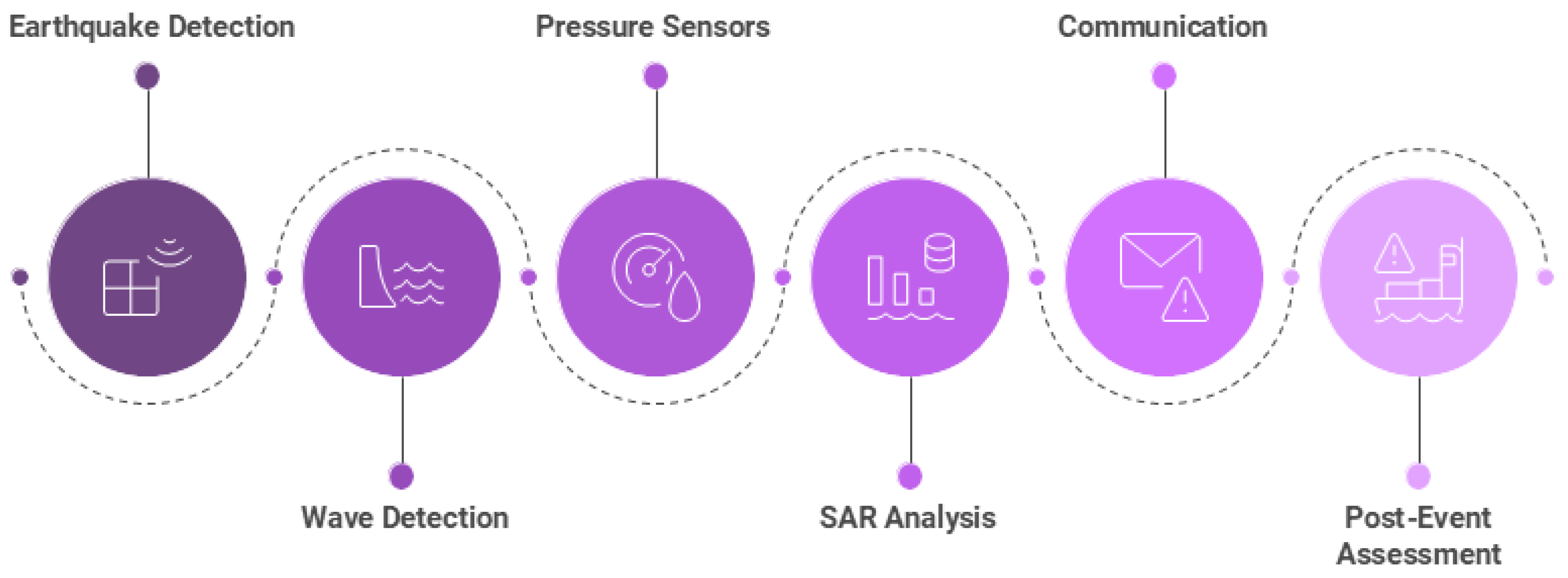
Figure 1. This is a figure. Schemes follow the same formatting. Source: Author’s own elaboration.
Water 17 03489 g001
Figure 2. Tsunami formation and impact. Source: Author’s own elaboration.
Water 17 03489 g002
Figure 3. Tsunami Early Warning System. Source: Author’s own elaboration.
Water 17 03489 g003
Figure 4. Tsunami Early Warning System Process. Source: Author’s own elaboration.
Water 17 03489 g004
Figure 5. Integrated Holistic Approach. Source: Author’s own elaboration.
Water 17 03489 g005
Table 1. Tsunami Early Warning Systems: Challenges and Opportunities.
CharacteristicTechnological
and Scientific
Limitations
Integration
with Risk
Management
Socioeconomic
Factors
Real-Time Data
and AI
Advances
Sensor Precision and DataPrecision & DataUncertain offshore seismic and pressure data; sea level sensors often the only viable option in regions lacking DART buoysDelayed or ambiguous evacuation instructions if detection is incompleteUnequal access to official alerts and local calibration limitationsAutomated multi-sensor fusion, including tide gauges, improves confirmation speed and geographic specificity
Modeling ChallengesNon-linear tsunami dynamics hard to modelStatic inundation maps limit adaptive responseLimited capacity for high-resolution modelingReal-time data assimilation updates forecasts
Sensor ReliabilityOffshore sensors face failure, latency, biofoulingWarning content must fit local contextCommunity trust and social networks matterEdge computing lowers detection latency
Emerging TechnologiesGNSS, radar, ionosphere still limited operationallyDynamic evacuation routing needs reliable networksDigital divide limits alert reachIoT and 5G enable dense coastal sensing
Disclaimer/Publisher’s Note: The statements, opinions and data contained in all publications are solely those of the individual author(s) and contributor(s) and not of MDPI and/or the editor(s). MDPI and/or the editor(s) disclaim responsibility for any injury to people or property resulting from any ideas, methods, instructions or products referred to in the content.