You are currently viewing a new version of our website. To view the old version click .
Water
  • Article
  • Open Access

6 December 2025

Meter-Scale Redox Stratification Drives the Restructuring of Microbial Nitrogen Cycling in Soil-Sediment Ecotone of Coal Mining Subsidence Area

,
,
,
,
,
,
and
School of Environment and Spatial Informatics, China University of Mining and Technology, Xuzhou 221116, China
*
Author to whom correspondence should be addressed.
Water2025, 17(24), 3469;https://doi.org/10.3390/w17243469 
(registering DOI)
This article belongs to the Section Soil and Water

Abstract

The coal mining subsidence area constitutes a distinct ecotone in the transition from agricultural soil to sediment, yet the microbially mediated nitrogen cycle within it remains inadequately understood. This investigation comprehensively analyzed physicochemical properties, microbial communities, functional genes, and co-occurrence networks along a 0–6500 mm depth gradient. Results indicated that pH transitioned from acidic to alkaline, while TN, TP, OM, and NH4+–N accumulated with depth. NO3–N decreased rapidly within 1000 mm and then stabilized. Alpha-diversity showed an S-shaped increase in richness, with Shannon index peaking at 1500 mm. Beta-diversity shifted along PC1, and the shallow subsidence area (SS) influenced by NO3–N; the transition zone (TZ) regulated by OM, TN, and NH4+–N; deep subsidence area (DS) was constrained by TP and pH. Microbial communities transitioned from aerobic/facultative to strictly anaerobic phyla, yet Pseudomonadota remained dominant (24–32%) across depths. With increasing depth, gene abundances for denitrification, assimilatory nitrate reduction to ammonium (ANRA), and nitrate assimilation declined, while those for dissimilatory nitrate reduction to ammonium (DNRA) and nitrification increased; nitrogen fixation remained weak. Co-occurrence networks shifted from highly connected, short-pathlength, and clustered in TZ to highly modular and long-pathlength in DS, with Aminicenantes, Syntrophus, and Methanoregula as key taxa. Overall, the thick and stable reducing zone in the subsidence area restructured the nitrogen cycle, shifting terminal products from N2 removal to NH4+ retention. These findings advance the understanding of nitrogen transformation in soil-sediment ecotones and provide a mechanistic framework for nitrogen cycling in mining-affected ecosystems.

1. Introduction

Large-scale subsidence resulting from underground coal mining is modifying topography and hydrologic processes in the eastern plains of China, leading to the formation of subsidence lakes and high-water-table wetlands [1]. The coal mining subsidence areas with high groundwater levels, prevalent in the provinces of Hebei, Henan, Anhui, Shandong, and Jiangsu, overlap significantly with China’s vital grain-producing regions. By the end of 2024, this coal-grain overlap region had developed a total subsidence area of approximately 2 million hectares, including 660,000 hectares of permanently waterlogged land. Furthermore, this problem is worsening at a rate of an additional 70,000 hectares per year. On the one hand, vast expanses of fertile farmland and numerous villages have been submerged, severely compromising food security, ecological integrity, and residential safety in regions where coal resources extensively overlap with arable land. On the other hand, the characteristic land-to-water transition triggers a comprehensive reconfiguration of soil physicochemical properties, a redistribution of nutrient pools, and fundamental shifts in ecological functions. This is manifested through synergistic alterations in soil moisture content, pH value, nutrient availability, and metal migration, which drastically reshape biogeochemical cycles [2,3]. Coal mining subsidence areas are now recognized as a significant surface water resource in mining regions. However, they exhibit a dual nature that distinctly differs from natural water bodies such as lakes and rivers. This unique characteristic stems from the submergence and transformation of former farmland soils, which are rich in nutrients like nitrogen (N) and phosphorus (P), into sediments, combined with the release of elements such as iron and sulfur from deep coal seams. This confluence of factors creates a paradox, as these areas represent both a potential water supply and a source of ecological and environmental risk [4,5]. Consequently, a number of studies have investigated the physicochemical conditions, nutrient profiles, pollutant characteristics, and microbial distribution within these subsidence areas [6,7,8,9].
Extensive research has been devoted to microorganisms in terrestrial, aquatic, and marine ecosystems, driven by their critical biogeochemical functions [10,11,12,13]. A key area of investigation explores the interplay between microbial biogeography and ecosystem processes, particularly nitrogen cycling. Environmental factors, including the spatiotemporal heterogeneity of nitrogen concentration, pH, and pollutants, are known to shape microbial distribution. Furthermore, distinct habitats like sediment and soil, characterized by different environmental conditions, harbor unique microbial communities and associated functionalities. However, the precise nature of the differences between sedimentary and soil microbial profiles remains inadequately understood, partly because these habitats are seldom adjacent. Previous comparative studies have primarily focused on interfaces in coastal zones, wetlands, and lakes [14], examining how water-level fluctuations influence microbial community composition and nitrogen cycling in constructed wetlands, coastal areas, and reservoirs, or tracking microbial succession as lake sediments become exposed and form soils [15,16]. In contrast, the unique transformation from soil to submerged sediment has received scant attention, and the evolution of coal mining subsidence areas is one of them. Given the increasing frequency of eutrophication events, there is a growing imperative to understand the microbially mediated ecological impacts of this soil-to-sediment transformation [17].
Nitrogen cycling is primarily driven by microbial processes in sediment and soil systems [18,19], ultimately controlling the ecological fate and destination of nitrogen [20]. These processes are governed by the structure, diversity, and distribution of the involved microbial communities [21,22], which are, in turn, shaped by local physicochemical conditions and substrate concentrations. This complex interplay dictates specific nitrogen pathways across different environments. For instance, nitrification and denitrification predominantly occur in shallow sedimentary environments like littoral zones and estuaries [23]; in contrast, lake sediments can be significant sources of N2O via denitrification under anaerobic nitrate-reducing conditions, while agricultural soils contribute less N2O primarily through aerobic ammonia oxidation [24]. Therefore, understanding how the gradual subsidence and submergence of terrestrial soils into aquatic sediments alters nitrogen cycling is crucial for assessing the ecosystem functions of coal mining subsidence areas, particularly their role in greenhouse gas emissions and water eutrophication [20,25,26,27].
The Guqiao Mine, with an annual design capacity of 10 million tons, ranks among the largest underground coal mines in Asia. Extensive subsidence areas resulting from its mining operations are predominantly permanently waterlogged. This transformation has altered the pre-existing land use patterns and triggered a series of ecological and environmental issues. Previous studies have investigated the microbial composition in water, sediments, and soils of the Guqiao coal mining subsidence area [25,28]. However, research on the effects of habitat changes caused by dry-to-wet transitions on microbial community composition, stability, and nitrogen cycling remains limited. To address this knowledge gap, this study combined geochemical analysis with metagenomic sequencing to investigate coal mining subsidence areas with high groundwater levels in eastern China. Our objectives were: (1) to analyze the spatial distribution of nitrogen, phosphorus, and chemical factors in sediment and soil; (2) to elucidate how soil-to-sediment conversion influences microbial composition and stability; and (3) clarify how this conversion affects the nitrogen cycling processes. This study aims to fill critical gaps in understanding the impact of subsidence on aquatic microbial ecology, providing theoretical foundations for controlling internal nitrogen pollution and guiding ecological restoration in subsidence areas.

2. Materials and Methods

2.1. Study Area

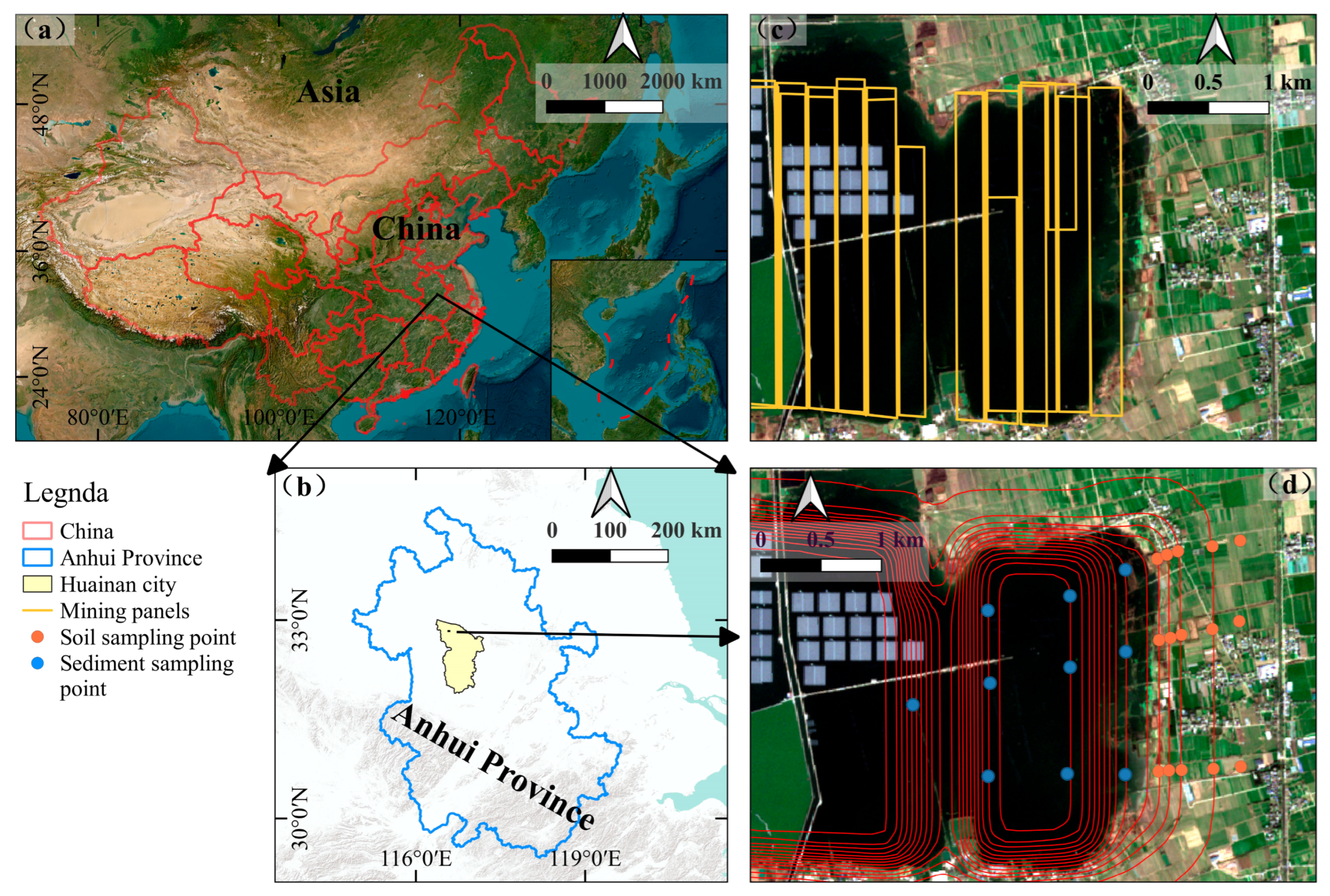
The study area is located in the coal mining subsidence zone of the Guqiao Mine in Huainan City, Anhui Province (Figure 1a,b), within a subtropical humid region characterized by an average annual precipitation of approximately 926 mm and a shallow groundwater table at only 1–2 m below the surface. The mine field features a monoclinal structure with a north–south strike, dipping gently eastward. The coal seams are buried at depths between 400 and 1000 m with an inter-seam spacing of approximately 180 m. The approved production capacity of the mine is 9.00 million tons per annum (Mt/a). Phase-based longwall mining, progressing from west to east, has induced surface subsidence at a rate of up to 800 mm per year. Consequently, a waterlogged subsidence area has formed and has been progressively expanding over time (Figure 1c), extensive areas of farmland have been submerged and gradually transformed into submerged sediments. As of 2024, the total subsided area in the Guqiao mining region has reached 2446 hectares, of which over 1300 hectares are permanently inundated. This has resulted in widespread agricultural waterlogging and frequent eutrophication events. It is projected that the water-accumulated area will expand to approximately 6500 hectares upon the completion of the entire mining operation [29].
Figure 1. Location and sampling layout for Guqiao coal-mining subsidence area. (a) Regional location of the Huainan coal-mining subsidence area in China, (b) Location of the study site within Anhui Province and Huainan City, (c) Layout of underground mining panels beneath the subsidence lake, (d) Surface subsidence contours (red lines) and soil/sediment sampling sites in the subsidence area.

2.2. Sample Collection

To investigate the impacts of the transition from farmland to submerged sediments on regional nitrogen cycling and water eutrophication, a sampling campaign was conducted in December 2024 within the geographical coordinates of 116°32′06″–116°38′53″ E and 32°43′46″–32°51′50″ N. Three nearly parallel east–west oriented transects were established, spaced approximately 1000 m apart, with sampling sites arranged along each transect at comparable subsidence depths so that, for each depth, three spatially separated locations within the basin could be treated as parallel replicates. Along each transect, submerged sediment samples were collected from west to east at subsidence depths of 6500 mm, 6000 mm, 5500 mm, and 2500 mm, while soil samples were obtained at 2000 mm, 1500 mm, 1000 mm, 500 mm, and 0 mm (Figure 1d); a composite sample was created at each sampling site by homogenizing three sub-samples collected from the immediate vicinity.
Sediment samples were collected using a grab sampler and dripped dry with gauze. From each sampling site, the sediments were divided into two aliquots. One aliquot was sealed in a sterile bag and stored in a portable refrigerator at 2–6 °C for physicochemical analysis. The other aliquot was portioned into cryovials, flash-frozen in liquid nitrogen, and subsequently transferred to a −80 °C freezer in the laboratory for future molecular biological identification. Soil samples were manually collected using a spade following the excavation of the topsoil layer (approximately 0–5 cm). All samples were then processed identically to the sediments under aseptic conditions for both refrigerated and cryopreserved storage.

2.3. Chemical Analysis

Total nitrogen (TN) was determined by the Kjeldahl digestion–distillation method using an automated Kjeldahl analyzer (Kjeltec 8400, FOSS, Hillerød, Denmark); total phosphorus (TP) was measured after alkaline fusion with sodium hydroxide (Shanghai Hushi Laboratory Equipment Co., Ltd., Shanghai, China) followed by molybdenum–antimony colorimetry, in which orthophosphate forms a phosphomolybdate complex that is reduced to a stable blue compound and quantified spectrophotometrically [30]. Organic matter (OM) was quantified by dichromate oxidation with concentrated sulfuric acid [31]. The pH was measured potentiometrically using a glass-electrode pH meter (PHS-3C, Shanghai INESA Scientific Instrument Co., Ltd., Shanghai, China)in a 1:2.5 (w/v) solid:water suspension after equilibration [32]. Ammonium (NH4+–N) and nitrate (NO3–N) concentrations in 2 M KCl (Sangon Biotech (Shanghai) Co., Ltd., Shanghai, China) extracts were determined with a continuous flow analyzer (AA3, SEAL Analytical GmbH, Norderstedt, Germany). Ammonium was analyzed by the indophenol blue colorimetric method, where NH4+ is oxidized to form an indophenol dye measured spectrophotometrically [33]. Nitrate was measured by a cadmium-reduction-diazotization procedure, in which NO3 is first reduced to NO2 on a copperized cadmium column or equivalent reducing system and then quantified as an azo dye [34].

2.4. DNA Extraction and Metagenomic Sequencing

Total genomic DNA was extracted from soil and sediment using the E.Z.N.A.® soil DNA kit (Omega Bio-tek, Norcross, GA, USA) according to the manufacturer’s instructions. DNA concentration and purity were evaluated with a NanoDrop spectrophotometer (Thermo Fisher Scientific, Waltham, MA, USA) and a Qubit 4.0 Fluorometer (Invitrogen, Waltham, MA, USA) employing the dsDNA HS Assay Kit. DNA integrity was confirmed through 1% agarose gel electrophoresis. The DNA was fragmented using a Covaris M220 (Genomics Co., Ltd., Shenzhen, China) to obtain fragments of approximately 350 bp. A paired-end library was then constructed using the NEXTFLEX® Rapid DNA-Seq Kit (Bio Scientific, Avondale, AZ, USA). The DNA samples were subjected to metagenomic sequencing on the Illumina NextSeq 2000 platform (Illumina, San Diego, CA, USA) at Shanghai Majorbio Bio-pharm Technology Co., Ltd. (Shanghai, China) The raw sequencing data generated in this study have been deposited in the NCBI database under accession number PRJNA 1313453.

2.5. Bioinformatics Analysis

Bioinformatic processing was conducted by Majorbio Cloud Platform (www.majorbio.com). Raw reads were quality-filtered and adapter-trimmed using fastp (v0.20.0) under the criteria of Q-score ≥ 20 and length ≥ 50 bp [35]. Host-derived reads were removed by alignment to a reference genome using BWA (v0.7.17) [36]. De novo assembly was conducted with MEGAHIT (v1.1.2), retaining contigs ≥ 300 bp [37]. Open reading frames (ORFs) were predicted using Prodigal (v2.6.3), and genes ≥ 100 bp were translated. Non-redundant gene sets were constructed with CD-HIT (v4.7) at 90% identity and 90% coverage, selecting the longest sequence per cluster [38]. Gene abundance was quantified by mapping reads to the non-redundant catalog using SOAPaligner (v2.21) at 95% identity [39]. The best-hit taxonomy of non-redundant genes was obtained by aligning them against the NCBI NR database by DIAMOND (http://ab.inf.uni-tuebingen.de/software/diamond/ (accessed on 9 February 2025), version 2.0.13) with an e-value cutoff of 1 × 10⁻⁵. Similarly, the functional annotation of non-redundant genes was obtained [40]. Based on the taxonomic and functional annotation and the abundance profiles of non-redundant genes, differential abundance analysis at the taxonomic, functional, and gene levels was performed using one-way ANOVA followed by Tukey’s HSD post hoc test.

3. Result

3.1. Physicochemical Transitions Along the Subsidence Gradient

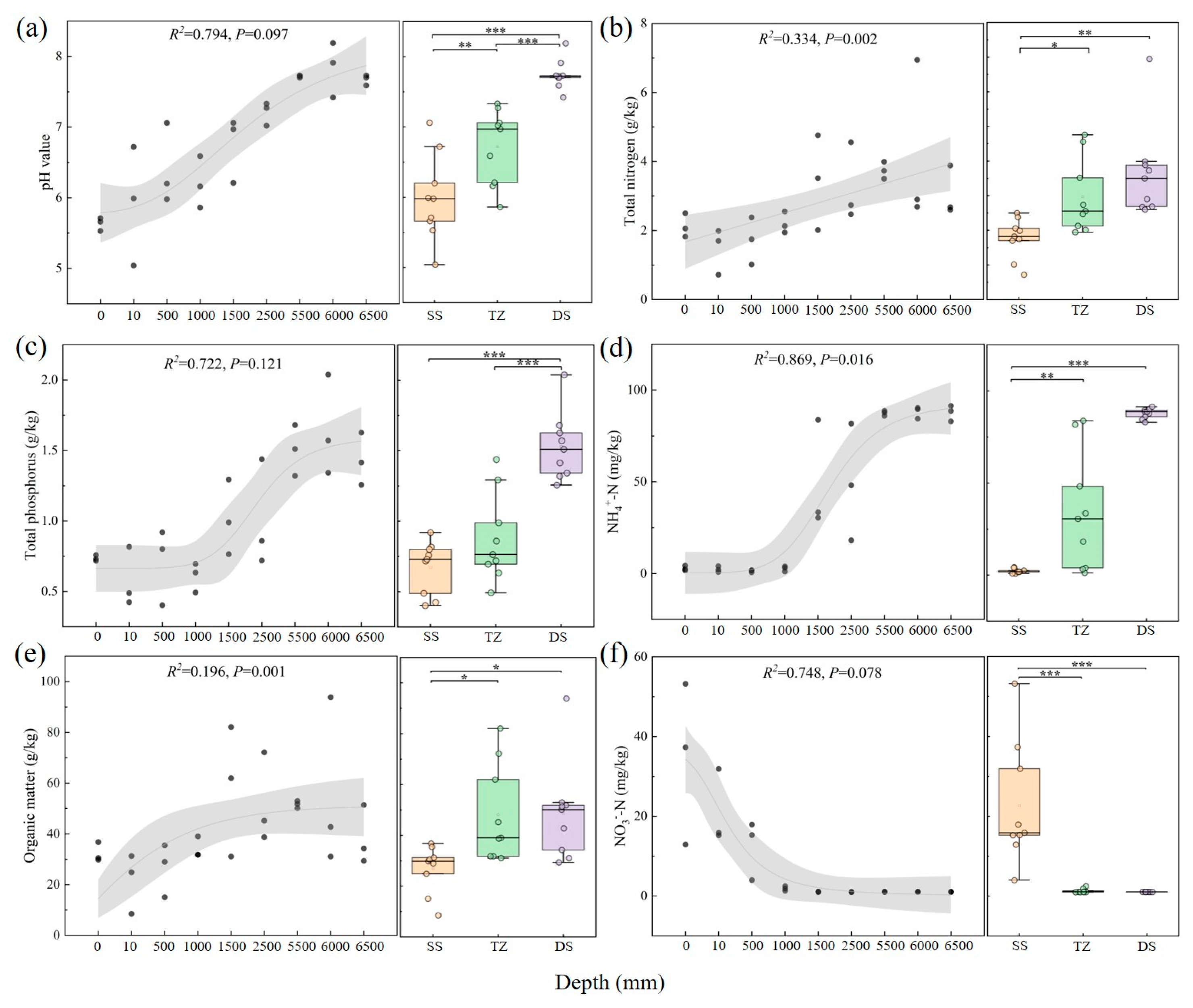
The physicochemical properties of the sediments were closely linked to the subsidence depth. The values of pH, TN, TP, NH4+–N, and OM exhibited a significant increasing trend with greater subsidence depth, demonstrating statistically significant differences (p < 0.05) between the deep subsidence (DS, 5500–6500 mm) and shallow subsidence (SS, 0–500 mm) zones (Figure 2a–e). Conversely, the NO3–N content decreased significantly (p < 0.05) with increasing subsidence depth and stabilized after the subsidence depth exceeded 1000 mm (Figure 2f). These results indicate a marked shift from oxidizing to reducing conditions during the transition from soil to sediment, as evidenced by the change in pH from 5.63 ± 0.09 to 7.84 ± 0.39. This transition was accompanied by the substantial accumulation of TN (from 2.13 ± 0.34 g·kg−1 to 3.05 ± 0.72 g·kg−1), TP (from 0.74 ± 0.02 g·kg−1 to 1.43 ± 0.19 g·kg−1), and OM (from 21.53 ± 11.74 g·kg−1 to 88.36 ± 25.68 g·kg−1). In summary, Figure 1 depicts the transformation from a nitrate-rich, weakly acidic soil to a nutrient-rich (TN, TP, OM, NH4+–N), weakly alkaline sediment.
Figure 2. Variations in soil/sediment physicochemical properties as functions of subsidence depth in the Guqiao mining area. (a) pH value, (b) Total nitrogen (TN), (c) Total phosphorus (TP), (d) NH4+–N, (e) Organic matter (OM), (f) NO3–N. The solid line represents the linear regression trend, with the gray shaded area indicating the 95% confidence interval. SS, TZ, DS represent the shallow subsidence, transition zone, and deep subsidence, respectively. Data distribution across different regions is shown by the boxplots (n = 9 per group). The central line within the box denotes the median, the box limits represent the 25th and 75th percentiles, and the whiskers extend to the entire data range, the circles represent individual data points. Asterisks indicate the significance of pairwise comparisons (* p ≤ 0.05, ** p ≤ 0.01, *** p ≤ 0.001) following Tukey’s HSD (for ANOVA).

3.2. Changes in Microbial Diversity

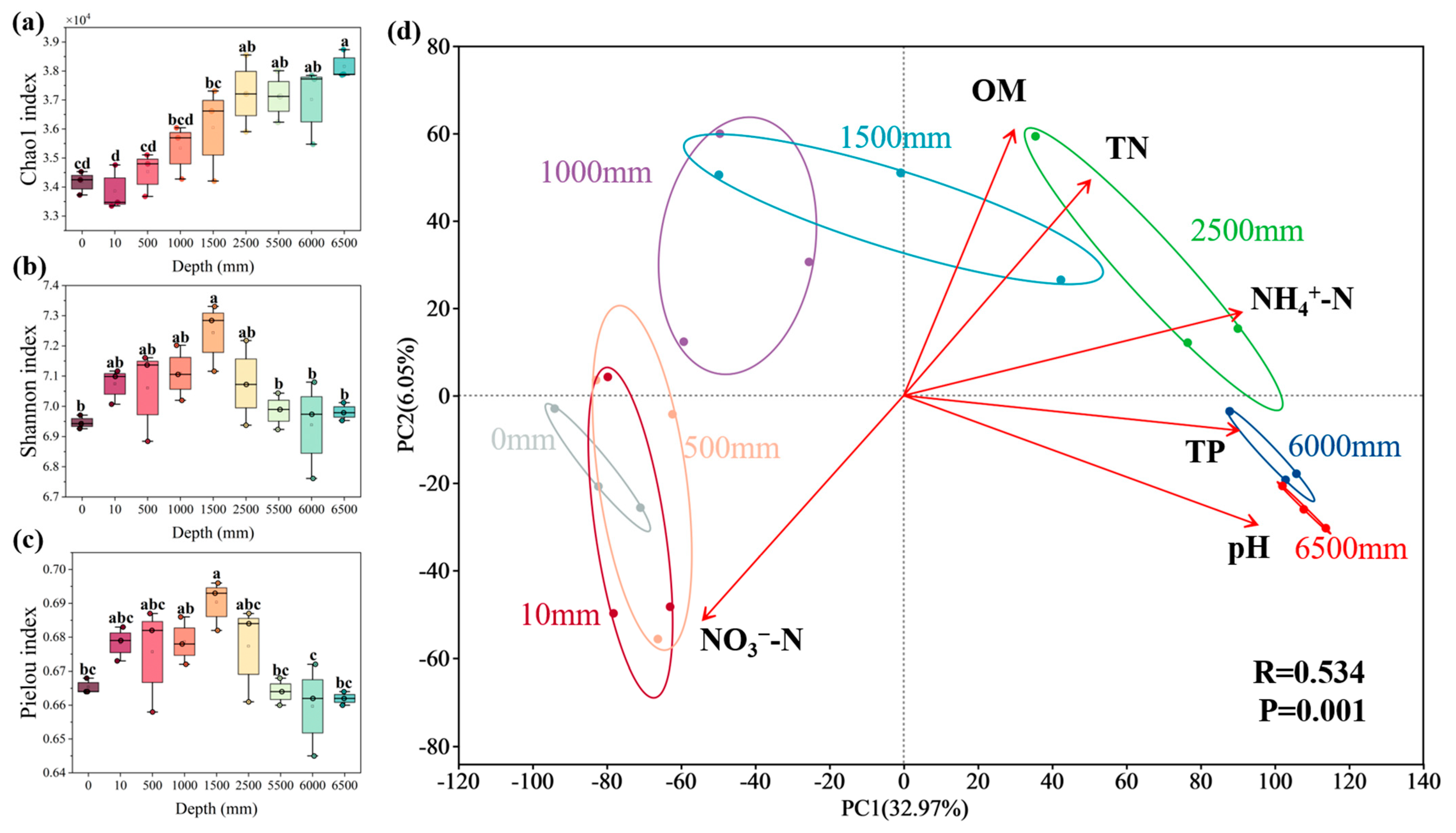
Along the sedimentation depth gradient, the Chao1 index exhibited a distinct trend compared to the Shannon and Pielou indices. The Chao1 index, indicative of species richness, increased with depth, following a sigmoidal curve. A marked increase was observed within the transition zone (TZ, 1000–2500 mm), resulting in a significant difference between the SS and DS zones (Figure 3a). In contrast, the Shannon index, which reflects both species richness and evenness, and the Pielou index, representative of species evenness, displayed similar patterns: both initially increased and then decreased with depth, reaching their maximum values at 1500 mm (Figure 3b,c).
Figure 3. Changes in microbial diversity along the sedimentation depth gradient. (a) Chao1 index and (b) Shannon index, and (c) Pielou index. The center line, box, and whiskers of the box plots represent the median, interquartile range, and full data range, respectively. Different letters above the boxes indicate significant differences (p < 0.05, one-way ANOVA with Tukey’s HSD test). (d) Principal component analysis (PCA) depicting the microbial community differences. The ellipse represents 95% confidence interval.
The PCA analysis revealed a clear differentiation of communities along the first two principal axes (Figure 3d). PC1 and PC2 explained 32.97% and 6.05% of the total variance in community composition, respectively. Vectors for pH (R2 = 0.80, p = 0.001), NH4+–N (R2 = 0.69, p = 0.001) and TP (R2 = 0.65, p = 0.001) were aligned with the deep subsidence (DS) samples, indicating that higher pH and the accumulation of ammonium and phosphorus were more strongly associated with deep communities, whereas the NO3–N (R2 = 0.44, p = 0.001) vector pointed towards the SS samples on the opposite side of the ordination. OM (R2 = 0.36, p = 0.005) and TN (R2 = 0.39, p = 0.001) vectors were oriented towards the transition-zone (TZ) samples, particularly at 2500 mm.

3.3. Differentiation of Species Composition

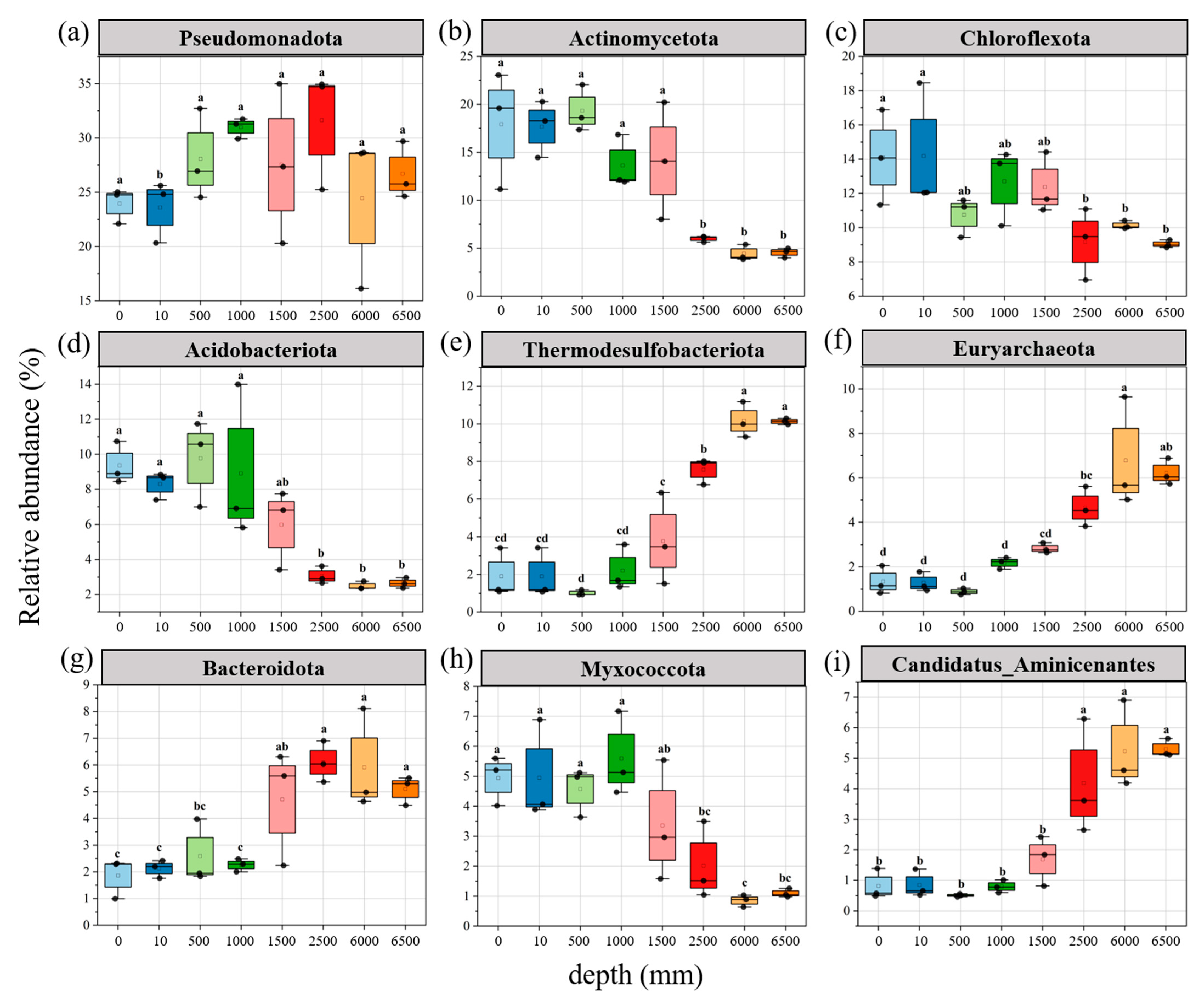
At the phylum level, the relative abundance of microorganisms exhibited clear variations along the subsidence gradient (Figure 4). The relative abundances of aerobic and facultative anaerobic taxa, such as Actinomycetota, Chloroflexota, Acidobacteriota, and Myxococcota, decreased significantly with progressing subsidence. In contrast, the relative abundances of Thermodesulfobacteriota, Euryarchaeota, Bacteroidota, and Candidatus_Aminicenantes increased markedly, indicating a shift in community dominance toward anaerobic groups. Notably, the predominance of Pseudomonadota within the microbial community remained largely unchanged throughout the evolution of the coal mining subsidence area (relative abundance: 23.59 ± 3% to 31.64 ± 6%). These results demonstrate that the process of coal mining subsidence drives a successional transition from an aerobic and facultative anaerobic community dominated by Pseudomonadota, Actinomycetota, and Chloroflexota in soils to a facultative anaerobic and anaerobic community dominated by Pseudomonadota, Thermodesulfobacteriota, and Euryarchaeota in sediments.
Figure 4. Variations in microbial composition across different sedimentation depths for the top nine abundant phyla. Significant differences (p < 0.05) among samples, determined by one-way ANOVA followed by Tukey’s HSD test, are indicated by different letters above the box plots.

3.4. Analysis of Microbial Correlation Network at Different Subsidence Depths

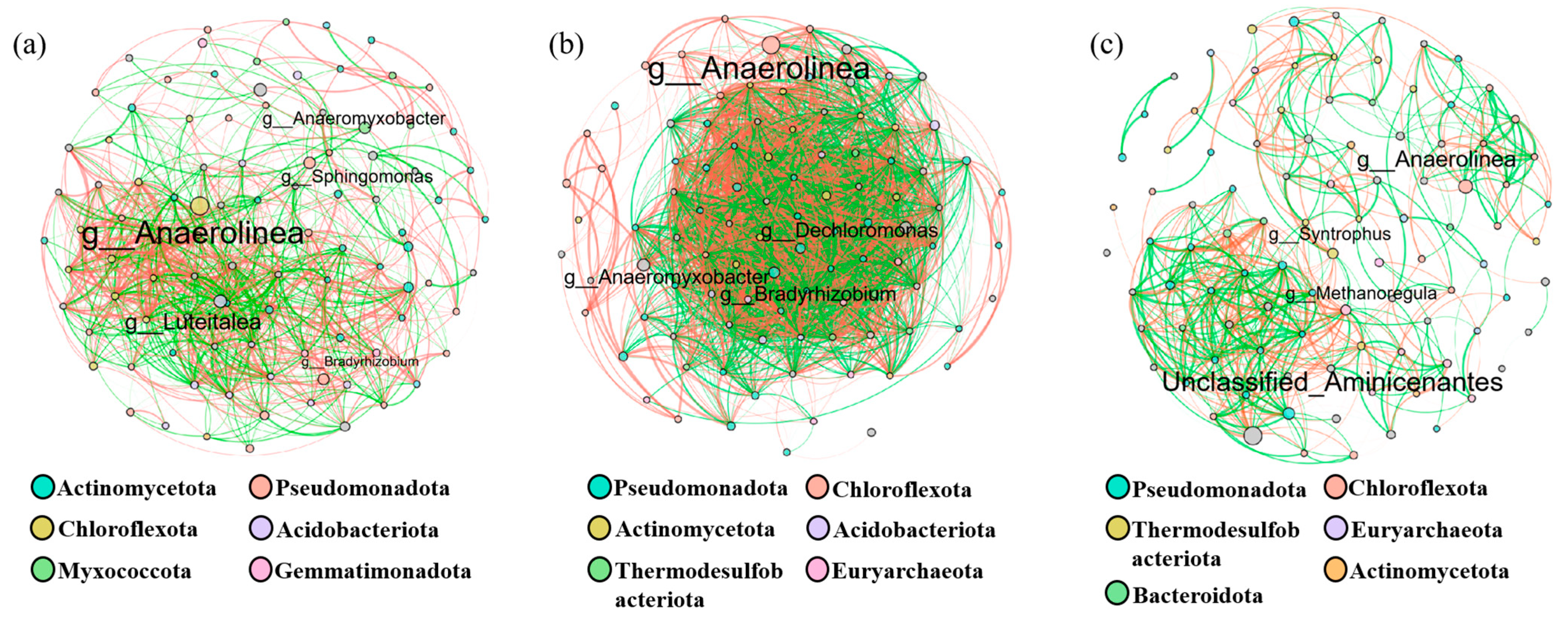
Changes in the microbial community structure during the subsidence process were further investigated by constructing co-occurrence networks. The results demonstrated that the microbial community structures were distinctly different at various subsidence depths (Figure 5). In SS, the primary contributing phyla were Actinomycetota (23.47%), Pseudomonadota (20.41%), Chloroflexota (12.24%), and Acidobacteriota (10.20%). The genus Anaerolinea served as the most prominent hub (Figure 5a). In TZ, the relatively abundant phyla were Pseudomonadota (30.61%), Chloroflexota (12.24%), Actinomycetota (9.18%), and Acidobacteriota (8.16%); at the genus level, the hub nodes were predominantly represented by Anaerolinea, while Dechloromonas, Bradyrhizobium, and Anaeromyxobacter formed a highly connected core (Figure 5b). In DS, the dominant phyla were Pseudomonadota (23.23%), Chloroflexota (13.13%), Thermodesulfobacteriota (12.12%), and Euryarchaeota (7.07%). At the genus level, Unclassified_Aminicenantes constituted the network core, with Methanoregula, Syntrophus, and Anaerolinea forming relatively independent subgroups, respectively (Figure 5c).
Figure 5. Microbial co-occurrence networks at the phylum level across different subsidence depths. (a) Shallow subsidence (SS). (b) Transition zone (TZ). (c) Deep subsidence (DS). Networks were constructed based on significant Spearman correlations (Spearman|R| > 0.5, p < 0.05). Each node represents a microbial genus, colored according to its phylum affiliation. Node size is proportional to the mean relative abundance of the genus. Red edges indicate significant positive correlations, and green edges represent significant negative correlations.
The network topology analysis revealed distinct structural characteristics among the three networks. The TZ network exhibited the highest density (0.514), characterized by the largest positive correlation cluster (0.528) and the shortest information transmission path (1.674), indicating high density (0.514) and low modularity (0.112). The SS network demonstrated intermediate connectivity (1007) and moderate modularity (0.278). In contrast, the DS network displayed pronounced multi-module differentiation (0.492) with sparse connections (656), reflecting long path length (3.053) and low density (0.135) (Table 1) [41,42].
Table 1. Topological properties of co-occurrence network analysis.

3.5. Key Nitrogen Cycling Processes

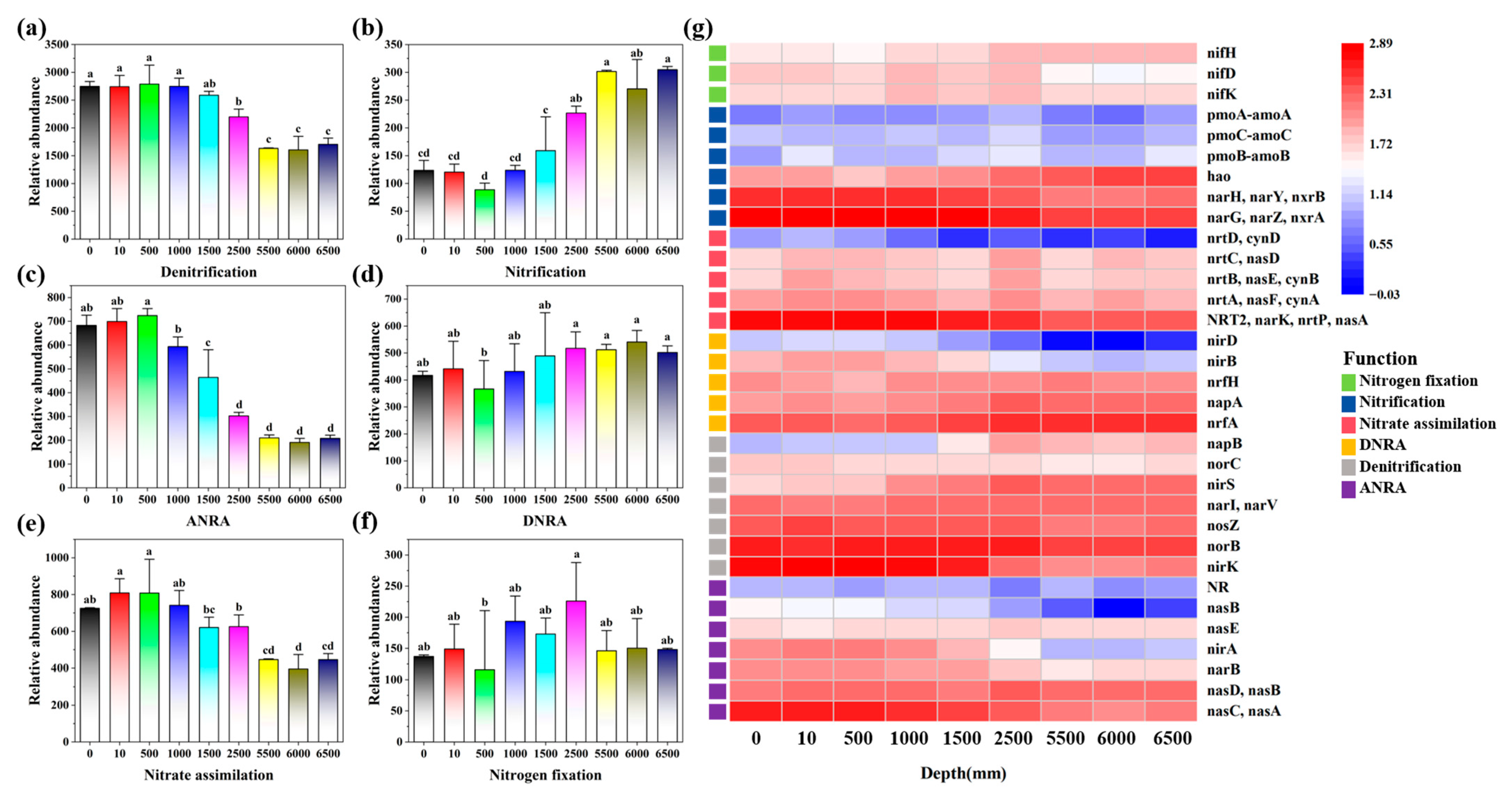
Based on functional annotation, the relative abundances of functional genes encoding nitrogen cycling processes were revealed to vary with subsidence depth. The relative abundances of genes involved in denitrification, assimilatory nitrate reduction (ANRA), and nitrate assimilation significantly decreased with increasing subsidence depth (Figure 6a–c), indicating that the rates of these processes were substantially higher in soil than in sediment. In contrast, the relative abundances of genes associated with nitrification and DNRA increased significantly with subsidence depth (Figure 6d,e), suggesting a gradual enhancement of these processes during the transition from soil to sediment. The relative abundance of nitrogen fixation genes exhibited an initial increase, peaking at 2500 mm (225.84 ± 65.63), followed by a decrease at greater subsidence depths (Figure 6f). Despite this peak, its value remained considerably lower compared to other functional genes, indicating that nitrogen fixation was a relatively weak process throughout the subsidence evolution. Conversely, although the relative abundance of denitrification genes reached a minimum (1605.45 ± 372.44) at 6000 mm, it still exceeded the abundances of all other functional genes, underscoring the dominant role of denitrification across the entire evolutionary process.
Figure 6. Distribution of key nitrogen cycling processes across the subsidence depth gradient. (af) Relative abundance (in RPKM—reads per kilobase per million mapped reads) of major functional genes involved in key nitrogen cycling processes: (a) denitrification, (b) assimilatory nitrate reduction to Ammonium (ANRA), (c) nitrate assimilation, (d) nitrification, (e) dissimilatory nitrate reduction to ammonium (DNRA), and (f) nitrogen fixation. (g) Heatmap depicting RPKM-based abundance profiles of nitrogen cycling genes across depths. Significant differences (p < 0.05) among samples, determined by one-way ANOVA followed by Tukey’s HSD test, are indicated by different letters above the box plots.
More specifically, the relative abundance of nitrogen cycling functional encoding genes was analyzed based on a gene heatmap (Figure 6g). In denitrification, the encoding of nirK, norB, nosZ, and narI/V dominated. Notably, while denitrification activity generally decreased with increasing subsidence depth, the abundance of napB contrastingly increased. For ANRA (Assimilatory Nitrate Reduction to Ammonium), the encoding of nasA, nasB, nasC, nasD, narB, and nirA was predominant. In nitrate assimilation, the genes NRT2, nark, nrtP, and nasA played a dominant role. Nitrification was primarily governed by the encoding of narG, narZ, narH, narY, nxrA, nxrB, and hao. Finally, DNRA (Dissimilatory Nitrate Reduction to Ammonium) was mainly dominated by the encoding of nrfA, nrfH, and napA.
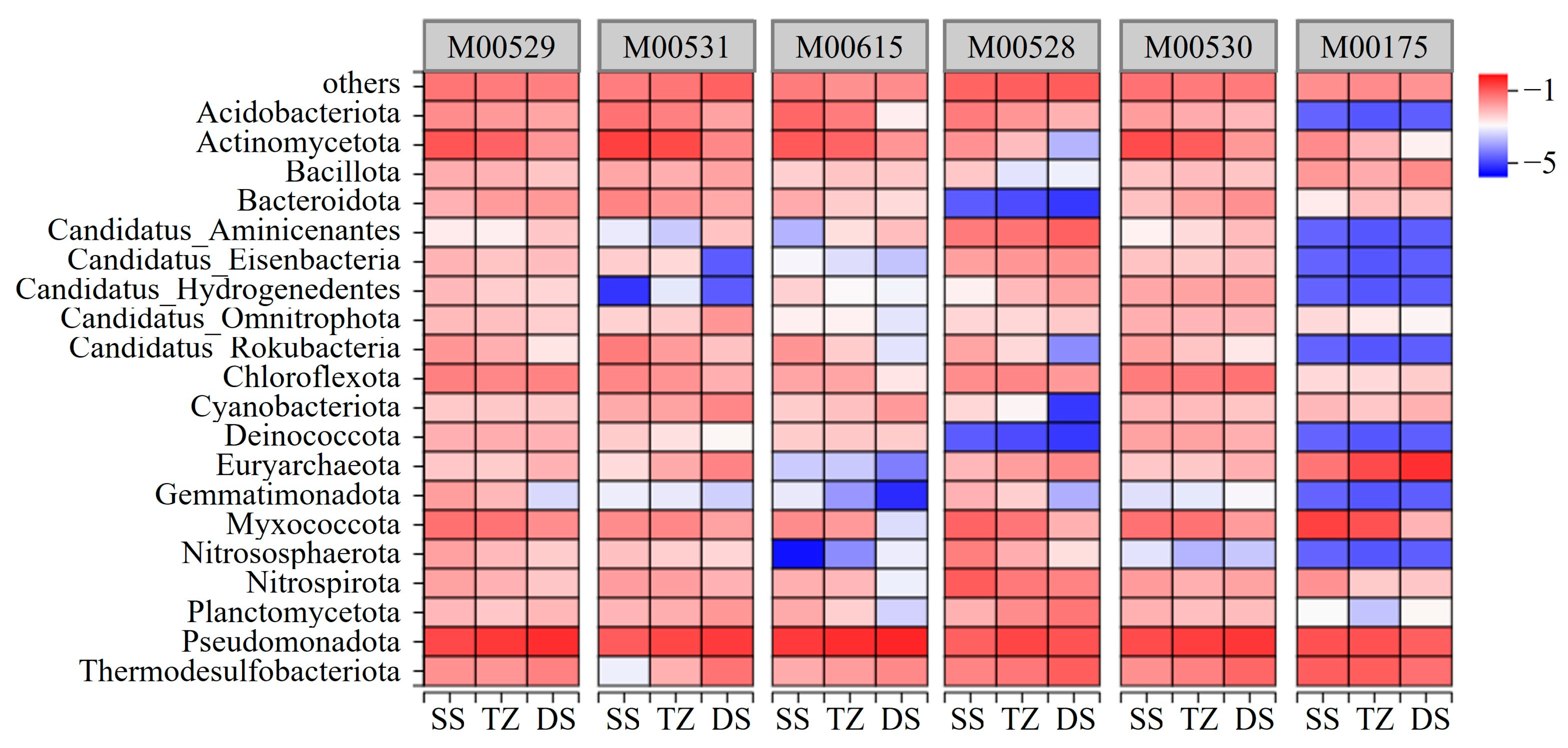
The relative contributions of microbial phyla to nitrogen cycling processes were analyzed to determine the changes in nitrogen cycling during the evolution of coal mining-induced subsidence (Figure 7). The results demonstrated that as the mining subsidence depth increased, the contributions to the processes of denitrification (M00529), ANRA (M00531), and nitrate assimilation (M00615) shifted from a multi-phylum synergy involving Pseudomonadota, Myxococcota, Chloroflexota, Actinomycetota, and Acidobacteriota in the SS area to a pattern dominated primarily by a few dominant phyla, mainly Pseudomonadota, in the DS area, exhibiting an overall decreasing trend in contribution magnitude. In contrast, the dominant contributing phyla for nitrification (M00528), DNRA (M00530), and nitrogen fixation (M00175) underwent succession. For nitrification and DNRA, the contributions of phyla such as Thermodesulfobacteriota and Pseudomonadota increased, while those of Nitrospirota, Myxococcota, and Actinomycetota decreased. Regarding nitrogen fixation, a transition occurred from Myxococcota being the primary contributor to Euryarchaeota assuming the major role. Notably, Pseudomonadota played a significant role across all six processes, indicating its pivotal function in nitrogen cycling during coal mining subsidence.
Figure 7. Relative contributions of dominant phyla to six nitrogen-cycling functions across subsidence depths.

4. Discussion

4.1. Changes in Microbial Community and Nitrogen Transformation Induced by Subsidence-Driven Redox Stratification

Along the subsidence gradient from 0 to 6500 mm, physicochemical analyses revealed a clear geochemical transition indicative of developing redox stratification (Figure 2). NO3–N rapidly decreased and stabilized within approximately 1000 mm, a pattern consistent with the high relative abundance of denitrification genes (e.g., nirK, nosZ) in the shallow subsidence (SS) zone as revealed by metagenomic analysis (Section 3.5). pH increased from 5.63 to 7.84, while TN, TP, OM, and NH4+–N exhibited continuous accumulation with depth (Figure 2). Concurrently, the alpha diversity of the microbial community exhibited contrasting trends between richness and evenness. Species richness, as estimated by the Chao1 index, increased continuously with depth, showing the most pronounced rise in the transition zone between 1000 and 2500 mm, and remained elevated in the deep subsidence zone. In contrast, both species evenness, measured by the Pielou index, and the Shannon diversity index peaked at a depth of 1500 mm before subsequently declining, suggesting that this depth corresponds to an optimal configuration of resource and habitat heterogeneity. PCA revealed a clear differentiation along PC1. The SS communities were significantly associated with NO3–N, while communities in the TZ (particularly at 2500 mm) were associated with OM, TN, and NH4+–N. In contrast, DS communities were more closely aligned with TP and pH. At the phylum level, the microbial composition was also reconfigured along the depth gradient: Actinomycetota and Chloroflexota decreased with subsidence depth, whereas anaerobic groups such as Thermodesulfobacteriota and Euryarchaeota increased. Meanwhile, Pseudomonadota maintained a stable high relative abundance of 24–32% across the entire subsidence gradient (Figure 4). Collectively, these results indicate that mining-induced subsidence extends the common pattern of shallow oxidation and deep reduction into a meter-scale, long-term stable stratification, thereby reshaping microbial community [43].
In terms of the physicochemical environment, coal mining-induced subsidence leads to a high groundwater table and long-term weak exchange between overlying water and pore water [44]. This hinders the deep penetration of surface oxygen and nitrate supply. Following the sequential depletion of electron acceptors, O2, NO3, Mn/Fe(III), and SO42− are consumed progressively from shallow to deep layers. Consequently, the redox interface stabilizes, deepens, and thickens, which directly accounts for the shallow attenuation of NO3–N and the deep enrichment of NH4+–N (Figure 2b,f). The observed increase in pH can be attributed to alkalinity generated by anaerobic mineralization or sulfate reduction, while the accumulation of Total Phosphorus (TP) is linked to P cycling dynamics co-regulated by the reductive dissolution of Fe(III)/Mn(IV) oxides [45,46]. This also explains the covariation of the DS community with pH and TP in the PCA (Figure 3d). Regarding diversity, the TZ, situated at the confluence of gradually depleting oxidants and increasingly abundant substrates, features the most extensive and thickest redox interface coupled with the most complex substrate gradients [47]. The increased niche availability and resource heterogeneity collectively enhance species richness. In contrast, as the environment transitions into the DS zone, energy acquisition becomes more dependent on a limited number of anaerobic pathways, leading to the expansion of dominant taxa and a consequent decrease in evenness (Figure 3a–c). Concerning community composition, the decreased abundances of Actinomycetota and Chloroflexota, alongside the increased abundances of Thermodesulfobacteriota and Euryarchaeota in the DS region, represent a direct response to the prolonged reducing conditions and organic substrate-rich environment. The maintenance of a high relative abundance of Pseudomonadota across the entire gradient stems from the prevalence of facultative/versatile respirers within this phylum (capable of nitrate/nitrite respiration, sulfur metabolism, etc.). These taxa can find “feasible solutions” under varying combinations of electron acceptors and donors, thereby exhibiting stable dominance across different zones (Figure 4) [48].
Our findings are consistent with previous research in three key aspects, collectively demonstrating that the thickness and stability of redox interfaces govern microbial community assembly and nitrogen cycling processes [49]. First, from a physicochemical perspective, the patterns of shallow nitrate attenuation, deep accumulation of ammonium and nutrients, and increasing pH with depth are common features in estuarine, salt marsh, and littoral sediments, though typically observed at centimeter to decimeter scales [50,51]. Our results align closely with these established patterns (Figure 2), with the principal distinction being the extension of these gradients to meter-scale depths. Second, in terms of diversity, the resource heterogeneity and expanded interface width resulting from mining-induced subsidence enhanced species richness, while the specialized metabolism of DS reduced evenness—a diversity pattern consistent with various stratified systems (Figure 3a–c). Third, regarding community composition, the replacement of aerobic and facultative taxa by anaerobic groups represents a classic response in sedimentary environments. We observed a similar trajectory in the increased abundances of Thermodesulfobacteriota and Euryarchaeota (Figure 4). In other words, our results do not contradict existing theories but rather provide a clearer and more systematic empirical demonstration at the meter scale [52].
It is worth noting that although similar phenomena have been addressed, our findings reveal key differences from previous studies, which can be attributed to the unique geographical and hydrological environment of the subsidence area, including anthropogenic closed terrain, coal-bearing stratum sediments, and stagnant hydrological conditions dominated by high groundwater levels, all of which jointly promote the development and maintenance of abnormally thick and stable REDOX gradients. In typical natural systems, such as tidal salt marshes or seasonally stratified lakes, frequent physical disturbances, including tidal action, bioturbation, and allochthonous sediment inputs, continually reset chemical stratification, confining it largely to the upper tens of centimeters [20,47,53]. In contrast, the study area represents a groundwater-flooded depression with extremely limited hydrological exchange. This enclosed and stagnant nature significantly dampens the physical mixing processes common in natural systems, thereby facilitating the sustained development of chemical gradients over meter scales. Furthermore, sediments derived from the weathering of local coal-bearing strata are rich in organic matter and can continuously release reducing agents, such as pyrite, providing a persistent source of electron donors for anaerobic metabolic processes in deeper layers. This hydrological context directly accounts for the clearer separation of depth-associated clusters in the PCA (Figure 3d) and the more pronounced anaerobic succession at the phylum level (Figure 4). A further discrepancy is the consistently dominant presence of Pseudomonadota across depth zones. Whereas prior research often reports a distinct shift in dominance towards fermentative Firmicutes or other specialist anaerobic phyla in deeper strata [54,55], Pseudomonadota maintained a high relative abundance (24–32%) throughout the sediment profile in our subsidence system.
In summary, evidence from physicochemical habitat conditions, diversity patterns, and phylum-level replacements collectively indicates that the subsidence area can be interpreted as a system that geometrically amplifies common sedimentary principles. The combination of a high groundwater table and limited hydrological exchange extrapolates differential processes to the meter scale, thereby stabilizing a distinct functional zonation: nitrification/denitrification in shallow layers and dissimilatory nitrate reduction to ammonium (DNRA)/sulfate reduction/methanogenesis in deeper zones. Through resource heterogeneity and sequential depletion of electron acceptors, this environment drives a characteristic microbial community evolution, marked by increased richness at depth and directed functional convergence [56].

4.2. Coal Mining Subsidence Promotes Specific Rebalancing of Nitrogen Cycling Processes

Along the subsidence gradient, the abundance of DNRA marker genes (nrfA/nrfH, napA) increased with depth, while those associated with ANRA and nitrate assimilation decreased. Although denitrification-related genes exhibited an overall decline, they remained the most abundant in terms of absolute abundance. In contrast, the relative abundance of nitrification-related genes increased in the deeper layers, suggesting a persistent nitrification potential even under the prevailing reducing conditions (Figure 6). These microbial shifts are corroborated by the physicochemical background, wherein NO3–N was rapidly depleted in shallow layers and stabilized, while the concentrations of NH4+–N, OM, TN, TP, and pH increased with depth (Figure 2). Collectively, these findings reveal a transition in the nitrogen cycle from a removal pathway, characterized by the generation of N2 in soils, to an accumulation pathway, characterized by the generation of NH4+ in sediments [57,58].
The rebalancing of the aforementioned nitrogen cycling processes is governed by the idiosyncratic features of coal mining subsidence areas. Firstly, subsidence creates a unique combination of persistent NO3 scarcity, abundant electron donors, and enhanced reducing conditions in the deep layers (Figure 2). Within this environment, DNRA gains a competitive edge over denitrification, which is more dependent on relatively high nitrate availability and lower electron donor pressure [59]. Previous studies indicate that DNRA systematically consumes more nitrate, reducing it to NH4+, under conditions of high C:NO3 ratios and nitrate limitation [60]. In contrast, denitrification regains dominance when electron donors are limited or NO3 is abundant. The observed accumulation of deep-layer NH4+ and the increase in DNRA gene abundances align precisely with this mechanism (Figure 2d and Figure 6e). Secondly, sulfides present in coal-bearing sediments may act as potent electron donors promoting DNRA, while simultaneously potentially inhibiting copper-dependent reductases essential for denitrification (e.g., NirK and NosZ, Figure 6g) [59]. This dual effect further shifts the reaction equilibrium from N2 towards NH4+ production, a nitrogen-sulfur coupling phenomenon that has been experimentally validated in multiple sediment and wetland studies [61,62]. Furthermore, despite the strongly reducing conditions in the deep sedimentary environment, studies indicate that micro-oxic niches persist within sediment particles and flocs [63,64]. Coupled with the high affinity for ammonia and adaptability of comammox Nitrospira, which performs Complete Ammonia Oxidation [65], this adequately explains the observed increase, rather than decrease, in nitrification potential within the deep subsidence zone. Collectively, these processes form a coherent causal chain that corresponds directly with the NO3 depletion, NH4+ enrichment, pH elevation, and abundance of organic substrates resulting from the coal mining subsidence process.
The findings of this study align with previous reports in several aspects. Physicochemically, rapid NO3 consumption in shallow layers and the accumulation of NH4+ and other nutrients at depth are commonly observed in sediments from estuaries, salt marshes, and lakeshores [66]. Along such redox gradients, dissimilatory nitrate reduction to ammonium (DNRA) often increases with depth, a pattern consistent across many shallow marine and coastal sedimentary systems. Functionally, multi-site 15N tracing and enrichment culture studies corroborate that increased organic carbon loading, elevated C:NO3 ratios, and enhanced sulfide availability stimulate DNRA while suppressing denitrification, a trend that agrees with the patterns observed in this work [60]. Simultaneously, a key distinctive feature revealed in this study is the significant enhancement of nitrification processes with increasing subsidence depth, which contrasts with the commonly reported pattern of higher nitrification activity in soils compared to sediments. This divergence can be primarily attributed to the unique geochemical context of coal mining subsidence areas, characterized by pronounced sulfide and ferrous iron backgrounds. The coupling of reduced minerals and preserved organic matter in coal measure sediments readily supplies electron donors driven by sulfur and Fe2+ [67,68]. Sulfide (S2−) is known to increase the relative contribution of DNRA and, beyond certain thresholds, inhibit terminal enzymes of denitrification. This shifts the end product further toward NH4+, thereby directly supplying more substrate for nitrification [69]. Secondly, even under predominantly reducing conditions, coupled nitrification denitrification can persist within micro aerobic niches or flocs, explaining the sustained nitrification potential observed even in deeper waterlogged subsidence zones [70]. Thirdly, since the discovery of comammox (complete ammonia oxidizers) with their high affinity for ammonia, complete nitrification under low substrate and diffusion limited conditions has been documented in various sedimentary and groundwater systems, providing a plausible explanation for the high abundance of nitrification functional genes detected in the deeper subsidence areas [71].
Overall, the observed increase in DNRA, relative decline in denitrification, and enhanced nitrification potential do not represent contradictory processes. Instead, they reflect a rebalancing of the nitrogen cycle shaped by the combined effects of coal mining-induced subsidence and the redistribution of electron donors and acceptors. The thick reducing zone shifts nitrogen transformation pathways from N2 production in soils to NH4+ generation in deep sediments, thereby amplifying the deep endogenous nitrogen pool. Following hydrological alterations such as engineered drainage or stormwater recharge, the transient flux of NH4+ across the sediment–water interface may be magnified, potentially leading to a sharp increase in nitrogen levels in the overlying water [72,73]. The depletion of NO3 in shallow zones and the accumulation of NH4+ at depth provide an environmental context conducive to the increase in DNRA gene abundance. Meanwhile, the physical and physiological basis for the increasing trend of nitrification potential in deep anaerobic environments may be the presence of micro-oxygen niches and comammox bacteria.

4.3. Restructuring of the Co-Occurrence Network from a Densely Connected to a Modular Configuration

The topological properties of the correlation-based microbial co-occurrence network exhibited a clear gradient along the coal mining subsidence gradient. The TZ network was characterized by the highest density, shortest path length, and greatest clustering, but the lowest modularity. The SS zone displayed intermediate values, whereas the DS zone transitioned to a sparser, more modular architecture (Table 1). A corresponding shift in core taxa was observed: the TZ was dominated by a highly connected core comprising Anaerolinea, Dechloromonas, and Bradyrhizobium, while the DS network was structured around Unclassified_Aminicenantes as a central hub, with Methanoregula, Syntrophus, and Anaerolinea forming relatively discrete subnetworks (Figure 5). Collectively, these metrics depict an orderly succession from a high-cooperation and short-pathway network towards a multi-module and long-pathway network topology.
The TZ represents a critical interface where diminishing oxidizing conditions converge with increasing substrate concentration. In this zone, electron acceptors (e.g., NO3) transported from the overlying water are likely still available, whereas electron donors and intermediates (e.g., volatile fatty acids, H2/acetate, sulfides) generated by organic-matter degradation and reduced minerals are expected to accumulate. Such a configuration may favor relatively rapid transformations among substrates, intermediates and terminal electron acceptors [74]. In TZ, the co-occurrence network was dominated by positive correlations, exhibiting higher connectivity, shorter path lengths, and larger cluster formations. Such a pattern is often interpreted as being compatible with potential metabolic cooperation or shared habitat preferences. In contrast, the DS zone network was more modular and displayed slightly negative cohesion, which may reflect stronger environmental filtering imposed by the persistent anoxia, elevated pH, and sulfide availability, alongside intensified resource partitioning for limited electron acceptors in the deeper environment. Within this context, the broader cross-phylum connectivity observed in the TZ appears to transition toward more specialized functional subnetworks in the DS. Anaerolinea maintained high centrality across all three zones, consistent with its recognized ecological role in fermentation and polymer degradation under anaerobic conditions [75]. In the DS zone, the central positioning of taxa such as Aminicenantes, Syntrophus, and Methanoregula may be linked to the deep subsurface material-energy flow structured around syntrophic metabolism and hydrogenotrophic methanogenesis.
In terms of the relationship between topological properties and community functioning, higher clustering and shorter path lengths have been theorized to correlate with the potential for stronger metabolic coupling and enhanced material transfer efficiency, whereas greater modularity and longer path lengths tend to confine disturbances locally and increase robustness [41]. Relevant theoretical frameworks further suggest that such a trade-off between efficiency and robustness is likely a common feature across various ecological and other complex networks, rather than being unique to any specific system [23]. In this context, the highly connected, less modular TZ network and the more modular DS network observed in this study can be viewed as two contrasting configurations along this hypothesized continuum. Previous studies have reached consistent conclusions: co-occurrence networks in open water columns or shallow sediments are generally more susceptible to seasonal or event-driven resetting, manifesting as relatively higher connectivity and more rapid spatiotemporal turnover [76,77]. In contrast, closed or weakly exchanged subsidence lakes tend to develop network structures with stable zonation patterns, a finding that has been corroborated by recent microbial studies on subsidence lakes and closed basins [78]. At the same time, our results also exhibit features that differ from many previous studies of shallow open systems. In the latter, deep network cores are often dominated by a limited number of fermentative or sulfate-reducing bacterial taxa, whereas in the coal mining subsidence sediments studied here, the deeper multi-modular and more specialized network is associated with several distinct anaerobic lineages. Notably, taxa such as Aminicenantes, Syntrophus, and Methanoregula, which show high centrality in the DS network, align with a potential deep subsurface material-energy flow organized around syntrophic metabolism and hydrogenotrophic methanogenesis. This pattern is also consistent with the high organic matter concentration observed in the mining area sediments.

5. Conclusions

This study systematically elucidated the profound transformations in soil and sediment physicochemical properties, microbial community structure, and nitrogen cycling processes along a coal mining-induced subsidence gradient. The principal conclusions are as follows.
Subsidence establishes an observed meter-scale redox gradient, transitioning from shallow, nitrate-rich, weakly acidic soils to deep, ammonium- and nutrient-rich, weakly alkaline sediments. This redox gradient, characterized by increasing anoxia, ammonium concentration, and pH, acts as an environmental filter that drives systematic microbial succession, shifting from communities dominated by aerobic/facultative anaerobic taxa to those dominated by obligate anaerobes, while Pseudomonadota maintains a stable dominance due to its metabolic versatility.
Nitrogen cycling undergoes a fundamental rebalancing. The deep, reducing, nitrate-depleted, and organic-rich sedimentary environment favors DNRA, resulting in ammonium accumulation and a shift from nitrogen loss to nitrogen retention. It is worth noting that the genetic potential for nitrification increases with depth, likely supported by microaerobic niches and the high ammonia affinity of comammox organisms.
The microbial network is reconfigured from a cooperative state to a modular structure. Microbial co-occurrence patterns shift from a highly connected and cooperative state in the transition zone, indicative of efficient substrate processing, to a sparse, modular configuration in the deep subsidence area, reflecting specialized anaerobic metabolisms and increased niche differentiation.
This study extends the current understanding of the spatial structure of soil–sediment transition zones from decimeter to meter scales in a coal-mining subsidence setting, providing an additional perspective for microbial ecology and biogeochemical cycling research. Our findings indicate that the combination of prolonged waterlogging, enhanced organic-matter preservation and the geochemical characteristics of coal-bearing strata gives rise to characteristic redox and nutrient gradients in these subsidence systems. Clarifying these processes is important for assessing the long-term ecological consequences of coal-mining subsidence landscapes, which are now widespread in eastern China and in many other mining regions worldwide. Future work should incorporate temporal (seasonal and interannual) monitoring and comparative studies across multiple basins to further evaluate the generality and dynamics of the patterns reported here.

Author Contributions

Conceptualization, Y.C., X.J. and Z.H.; Methodology, Y.C., Y.L., X.Z. and L.H.; Software, X.Z., L.M., L.H. and Z.H.; Validation, Y.C. and R.C.; Investigation, Y.C., Y.L., X.Z., R.C. and L.M.; Resources, R.C., L.M. and X.J.; Data curation, Y.C. and L.H.; Writing—original draft, Y.C. and Y.L.; Writing—review and editing, Z.H.; Visualization, Y.C., Y.L. and X.Z.; Supervision, X.J.; Project administration, Z.H.; Funding acquisition, Z.H. All authors have read and agreed to the published version of the manuscript.

Funding

This work was supported by the National Key Research and Development Program (Approval No. 2023YFE0122300).

Data Availability Statement

The data presented in this study will be openly available in NCBI, reference number PRJNA 1313453, https://www.ncbi.nlm.nih.gov/ (accessed on 25 September 2025).

Conflicts of Interest

The authors declare that they have no known competing financial interests or personal relationships that could have appeared to influence the work reported in this paper.

References

  1. Zhang, K.; Yang, K.; Wu, X.T.; Bai, L.; Zhao, J.G.; Zheng, X.H. Effects of Underground Coal Mining on Soil Spatial Water Content Distribution and Plant Growth Type in Northwest China. ACS Omega 2022, 7, 18688–18698. [Google Scholar] [CrossRef]
  2. Bai, E.; Guo, W.; Zhang, H.; Tan, Y.; Li, X.; Wei, Z. Degradation mechanism of cultivated land and its protection technology in the central coal-grain overlapped area of China. J. Clean. Prod. 2024, 468, 143075. [Google Scholar] [CrossRef]
  3. Bian, Z.; Inyang, H.I.; Daniels, J.L.; Otto, F.; Struthers, S. Environmental issues from coal mining and their solutions. Min. Sci. Technol. 2010, 20, 215–223. [Google Scholar] [CrossRef]
  4. He, T.; Xiao, W.; Zhao, Y.L.; Deng, X.; Hu, Z. Identification of waterlogging in Eastern China induced by mining subsidence: A case study of Google Earth Engine time-series analysis applied to the Huainan coal field. Remote Sens. Environ. 2020, 242, 111742. [Google Scholar] [CrossRef]
  5. Ma, K.; Zhang, Y.; Ruan, M.; Guo, J.; Chai, T. Land Subsidence in a Coal Mining Area Reduced Soil Fertility and Led to Soil Degradation in Arid and Semi-Arid Regions. Int. J. Environ. Res. Public Health 2019, 16, 3929. [Google Scholar] [CrossRef]
  6. Chen, G.; Wang, X.; Wang, R.; Liu, G. Health risk assessment of potentially harmful elements in subsidence water bodies using a Monte Carlo approach: An example from the Huainan coal mining area, China. Ecotoxicol. Environ. Saf. 2019, 171, 737–745. [Google Scholar] [CrossRef]
  7. Wang, X.; Li, Y.; Wei, Y.; Meng, H.; Hong, J. Effects of fertilization and reclamation time on soil bacterial communities in coal mining subsidence areas. Sci. Total Environ. 2020, 739, 139882. [Google Scholar] [CrossRef] [PubMed]
  8. Jiang, C.; Jiang, C.; Wang, Q.; Liu, H.; Li, D.; Zhu, Q.; Liu, F. Seasonal characteristics of groundwater discharge controlled by precipitation and its environmental effects in a coal mining subsidence lake, eastern China. Sci. Total Environ. 2024, 915, 170067. [Google Scholar] [CrossRef]
  9. Shen, Z.; Shang, Z.; Wang, F.; Liang, Y.; Zou, Y.; Liu, F. Bacterial diversity in surface sediments of collapsed lakes in Huaibei, China. Sci. Rep. 2022, 12, 15784. [Google Scholar] [CrossRef] [PubMed]
  10. Pang, Q.; Zhao, G.; Wang, D.; Zhu, X.; Xie, L.; Zuo, D.; Wang, L.; Tian, L.; Peng, F.; Xu, B. Water periods impact the structure and metabolic potential of the nitrogen-cycling microbial communities in rivers of arid and semi-arid regions. Water Res. 2024, 267, 122472. [Google Scholar] [CrossRef]
  11. Zakem, E.; Polz, M.; Follows, M. Redox-informed models of global biogeochemical cycles. Nat. Commun. 2020, 11, 5680. [Google Scholar] [CrossRef]
  12. Levine, N.; Alexander, H.; Bertrand, E.M.; Coles, V.; Dutkiewicz, S.; Leles, S. Microbial ecology to ocean carbon cycling: From genomes to numerical models. Annu. Rev. Earth Planet. Sci. 2025, 53, 595–624. [Google Scholar] [CrossRef]
  13. Birnbaum, C.; Waryszak, P.; Trevathan-Tackett, S.; Bowen, J.; Connolly, R.M.; Duarte, C.; Macreadie, P. Global review of blue carbon ecosystem microbial communities. Environ. Microbiol. 2025, 27, e70168. [Google Scholar] [CrossRef] [PubMed]
  14. Stoliker, D.L.; Repert, D.A.; Smith, R.L.; Song, B.; Leblanc, D.R.; Mccobb, T.D.; Conaway, C.H.; Hyun, S.P.; Koh, D.C.; Moon, H.S. Hydrologic Controls on Nitrogen Cycling Processes and Functional Gene Abundance in Sediments of a Groundwater Flow-Through Lake. Environ. Sci. Technol. 2016, 50, 3649–3657. [Google Scholar] [CrossRef]
  15. Fan, Y.; Zhou, Z.; Liu, F.; Qian, L.; Yu, X.; Huang, F.; Hu, R.; Su, H.; Gu, H.; Yan, Q. The vertical partitioning between denitrification and dissimilatory nitrate reduction to ammonium of coastal mangrove sediment microbiomes. Water Res. 2024, 262, 122113. [Google Scholar] [CrossRef]
  16. Tian, L.Q.; Wu, G.P.; Chi, S.Y.; Liu, X.; Wang, C.L.; Jiang, H.L. Water level fluctuation regulated the effect of bacterial community on ecosystem multifunctionality in Poyang Lake wetland. J. Environ. Manag. 2025, 373, 123965. [Google Scholar] [CrossRef] [PubMed]
  17. Feng, L.; Zhang, Z.; Yang, G.; Wu, G.Y.; Yang, Q.; Chen, Q. Microbial communities and sediment nitrogen cycle in a coastal eutrophic lake with salinity and nutrients shifted by seawater intrusion. Environ. Res. Sect. A 2023, 225, 115590. [Google Scholar] [CrossRef]
  18. Kuypers, M.M.M.; Marchant, H.K.; Kartal, B. The microbial nitrogen-cycling network. Nat. Rev. Microbiol. 2018, 16, 263–276. [Google Scholar] [CrossRef]
  19. Masuda, Y.; Mise, K.; Xu, Z.; Zhang, Z.; Shiratori, Y.; Senoo, K.; Itoh, H. Global soil metagenomics reveals distribution and predominance of Deltaproteobacteria in nitrogen-fixing microbiome. Microbiome 2024, 12, 95. [Google Scholar] [CrossRef]
  20. Guo, J.; Wang, X.; Cao, X.; Qi, W.; Peng, J.; Liu, H.; Qu, J. The influence of wet-to-dry season shifts on the microbial community stability and nitrogen cycle in the Poyang Lake sediment. Sci. Total Environ. 2023, 903, 166036. [Google Scholar] [CrossRef]
  21. Li, J.; Yang, L.; Yu, S.; Ding, A.; Zuo, R.; Yang, J.; Li, X.; Wang, J. Environmental stressors altered the groundwater microbiome and nitrogen cycling: A focus on influencing mechanisms and pathways. Sci. Total Environ. 2023, 905, 167004. [Google Scholar] [CrossRef]
  22. Pang, L.; Sun, Y.; Yue, Y.; Liu, C.; An, C.; Yang, T.; Lu, X.; Xu, Q.; Mei, J.; Liu, M.; et al. Stability of Aquatic Nitrogen Cycle Under Dramatic Changes of Water and Sediment Inflows to the Three Gorges Reservoir. GeoHealth 2022, 6, e2022GH000607. [Google Scholar] [CrossRef]
  23. Gao, C.; Xu, L.; Montoya, L.; Madera, M.; Hollingsworth, J.; Chen, L.; Purdom, E.; Singan, V.; Vogel, J.; Hutmacher, R.B.; et al. Co-occurrence networks reveal more complexity than community composition in resistance and resilience of microbial communities. Nat. Commun. 2022, 13, 3867. [Google Scholar] [CrossRef]
  24. Jiang, L.P.; Yu, J.; Wang, S.Y.; Wang, X.M.; Schwark, L.; Zhu, G.B. Complete ammonia oxidization in agricultural soils: High ammonia fertilizer loss but low N2O production. Glob. Change Biol. 2023, 29, 1984–1997. [Google Scholar] [CrossRef]
  25. Fang, W.; Fan, T.; Xu, L.; Wang, S.; Wang, X.; Lu, A.; Chen, Y. Seasonal succession of microbial community co-occurrence patterns and community assembly mechanism in coal mining subsidence lakes. Front. Microbiol. 2023, 14, 1098236. [Google Scholar] [CrossRef] [PubMed]
  26. Li, S.; Zhang, L.; Fang, W.K.; Shen, Z. Variations in bacterial community succession and assembly mechanisms with mine age across various habitats in coal mining subsidence water areas. Sci. Total Environ. 2024, 948, 174822. [Google Scholar] [CrossRef] [PubMed]
  27. Pascoal, F.; Areosa, I.; Torgo, L.; Branco, P.; Baptista, M.S.; Lee, C.K.; Cary, S.C.; Magalhaes, C. The spatial distribution and biogeochemical drivers of nitrogen cycle genes in an Antarctic desert. Front. Microbiol. 2022, 13, 927129. [Google Scholar] [CrossRef]
  28. Wang, S.; Hu, Y.; Fan, T.; Fang, W.; Liu, X.; Xu, L.; Li, B.; Wei, X. Microbial Community Structure and Co-Occurrence Patterns in Closed and Open Subsidence Lake Ecosystems. Water 2023, 15, 1829. [Google Scholar] [CrossRef]
  29. Li, G.; Hu, Z.; Yuan, D.; Li, P.; Feng, Z.; He, Y.; Wang, W. A new approach to increased land reclamation rate in a coal mining subsidence area: A case-study of Guqiao Coal Mine, China. Land Degrad. Dev. 2022, 33, 866–880. [Google Scholar] [CrossRef]
  30. Fan, X.; Xing, P. Differences in the composition of archaeal communities in sediments from contrasting zones of Lake Taihu. Front. Microbiol. 2016, 7, 1510. [Google Scholar] [CrossRef] [PubMed]
  31. Nayak, A.; Rahman, M.; Naidu, R.; Dhal, B.; Swain, C.; Nayak, A.; Tripathi, R.; Shahid, M.; Islam, M.; Pathak, H. Current and emerging methodologies for estimating carbon sequestration in agricultural soils: A review. Sci. Total Environ. 2019, 665, 890–912. [Google Scholar] [CrossRef]
  32. Li, Q.; Yang, J.; He, G.; Liu, X.; Zhang, D. Characteristics of soil C:N:P stoichiometry and enzyme activities in different grassland types in Qilian Mountain nature reserve-Tibetan Plateau. PLoS ONE 2022, 17, e0271399. [Google Scholar] [CrossRef]
  33. Ivani, I.; Degobbis, D. An optimal manual procedure for ammonia analysis in natural waters by the indophenol blue method. Water Res. 1984, 18, 1143–1147. [Google Scholar] [CrossRef]
  34. Johnson, K.; Petty, R. Determination of nitrate and nitrite in seawater by flow injection analysis. Limnol. Oceanogr. 1983, 28, 1260–1266. [Google Scholar] [CrossRef]
  35. Chen, S.; Zhou, Y.; Chen, Y.; Gu, J. fastp: An ultra-fast all-in-one FASTQ preprocessor. Bioinformatics 2018, 34, i884–i890. [Google Scholar] [CrossRef] [PubMed]
  36. Li, H.; Durbin, R. Fast and accurate short read alignment with Burrows–Wheeler transform. Bioinformatics 2009, 25, 1754–1760. [Google Scholar] [CrossRef]
  37. Li, D.; Liu, C.M.; Luo, R.; Sadakane, K.; Lam, T.W. MEGAHIT: An ultra-fast single-node solution for large and complex metagenomics assembly via succinct de Bruijn graph. Bioinformatics 2014, 31, 1674–1676. [Google Scholar] [CrossRef] [PubMed]
  38. Hyatt, D.; Chen, G.L.; Locascio, P.F.; Land, M.L.; Larimer, F.W.; Hauser, L.J. Prodigal: Prokaryotic gene recognition and translation initiation site identification. BMC Bioinform. 2010, 11, 119. [Google Scholar] [CrossRef]
  39. Li, R.; Li, Y.; Kristiansen, K.; Wang, J. SOAP: Short oligonucleotide alignment program. Bioinformatics 2008, 24, 713–714. [Google Scholar] [CrossRef] [PubMed]
  40. Huson, D.H.; Buchfink, B. Fast and sensitive protein alignment using DIAMOND. Nat. Methods 2015, 12, 59–60. [Google Scholar]
  41. Kajihara, K.T.; Hynson, N.A. Networks as tools for defining emergent properties of microbiomes and their stability. Microbiome 2024, 12, 184. [Google Scholar] [CrossRef]
  42. Dove, N.; Barnes, M.; Moreland, K.; Graham, R.; Berhe, A.; Hart, S. Depth dependence of climatic controls on soil microbial community activity and composition. ISME Commun. 2021, 1, 78. [Google Scholar] [CrossRef]
  43. Stegen, J.C.; Lin, X.; Konopka, A.E.; Fredrickson, J.K. Stochastic and deterministic assembly processes in subsurface microbial communities. ISME J. 2012, 6, 1653–1664. [Google Scholar] [CrossRef]
  44. Jrgensen, B.; Wenzhfer, F.; Egger, M.; Glud, R. Sediment oxygen consumption: Role in the global marine carbon cycle. Earth-Sci. Rev. 2022, 228, 103987. [Google Scholar]
  45. Bianchi, T.S.; Schreiner, K.M.; Smith, R.W.; Burdige, D.J.; Woodard, S.; Conley, D.J. Redox Effects on Organic Matter Storage in Coastal Sediments During the Holocene: A Biomarker/Proxy Perspective. Annu. Rev. Earth Planet Sci. 2016, 44, 295–319. [Google Scholar] [CrossRef]
  46. Smolders, E.; Baetens, E.; Verbeeck, M.; Nawara, S.; Diels, J.; Verdievel, M.; Peeters, B.; De Cooman, W.; Baken, S. Internal Loading and Redox Cycling of Sediment Iron Explain Reactive Phosphorus Concentrations in Lowland Rivers. Environ. Sci. Technol. 2017, 51, 2584–2592. [Google Scholar] [CrossRef]
  47. Kirol, A.P.; Morales Williams, A.M.; Braun, D.C.; Marti, C.L.; Pierson, O.E.; Wagner, K.J.; Schroth, A.W. Linking Sediment and Water Column Phosphorus Dynamics to Oxygen, Temperature, and Aeration in Shallow Eutrophic Lakes. Water Resour. Res. 2024, 60, e2023WR034813. [Google Scholar] [CrossRef]
  48. Jorgensen, B.B.; Findlay, A.J.; Pellerin, A. The Biogeochemical Sulfur Cycle of Marine Sediments. Front. Microbiol. 2019, 10, 849. [Google Scholar] [CrossRef]
  49. Froelich, P.N.; Klinkhammer, G.P.; Bender, M.L.; Luedtke, N.A.; Heath, G.R.; Cullen, D.; Dauphin, P.; Hammond, D.; Hartman, B.; Maynard, V. Early oxidation of organic matter in pelagic sediments of the eastern equatorial Atlantic: Suboxic diagenesis. Geochim. Cosmochim. Acta 1979, 43, 1075–1090. [Google Scholar] [CrossRef]
  50. Ye, F.; Duan, L.; Wang, Z.; Wang, Y.; Kou, X.; Wan, F.; Wang, Y. Sediment grain size regulates the biogeochemical processes of nitrate in the riparian zone by influencing nutrient concentrations and microbial abundance. Sci. Total Environ. 2024, 954, 176467. [Google Scholar] [CrossRef]
  51. Richard-Cerda, J.C.; Bockstiegel, M.; Muoz-Vega, E.; Knller, K.; Schüth, C.; Schulz, S. High-Resolution Monitoring and Redox-Potential-Based Solute Transport Modeling to Partition Denitrification Pathways at an Agricultural Site. ACS Environ. Sci. Technol. Water 2024, 4, 4917–4931. [Google Scholar] [CrossRef]
  52. Coyte, K.Z.; Schluter, J.; Foster, K.R. The ecology of the microbiome: Networks, competition, and stability. Science 2015, 350, 663–666. [Google Scholar] [CrossRef]
  53. O’Meara, T.A.; Yuan, F.; Sulman, B.N.; Noyce, G.L.; Rich, R.; Thornton, P.E.; Megonigal, J.P. Developing a Redox Network for Coastal Saltmarsh Systems in the PFLOTRAN Reaction Model. J. Geophys. Res. Biogeosci. 2024, 129, e2023JG007633. [Google Scholar] [CrossRef]
  54. Li, Y.; Liu, H.; Ye, D.; Jiang, Q.; Cui, X.; Li, J.; Jiang, J.; Wang, L.; Lu, X. Vertical distribution of dissimilatory iron reducing communities in the sediments of Taihu Lake. Sci. Total Environ. 2023, 889, 164332. [Google Scholar] [CrossRef]
  55. Liang, R.; Lau, M.; Vishnivetskaya, T.; Lloyd, K.G.; Onstott, T.C. Predominance of Anaerobic, Spore-Forming Bacteria in Metabolically Active Microbial Communities from Ancient Siberian Permafrost. Appl. Environ. Microb. 2019, 85, e519–e560. [Google Scholar] [CrossRef]
  56. Hu, J.; Chen, X.; Chen, Y.Y.; Li, C.; Ren, M.X.; Jiang, C.L.; Chen, Y.C.; An, S.K.; Xu, Y.F.; Zheng, L.G. Nitrate sources and transformations in surface water of a mining area due to intensive mining activities: Emphasis on effects on distinct subsidence waters. J. Environ. Manag. 2021, 298, 113451. [Google Scholar] [CrossRef] [PubMed]
  57. Broman, E.; Abdelgadir, M.; Bonaglia, S.; Forsberg, S.C.; Wikstrm, J.; Gunnarsson, J.; Nascimento, F.J.A.; Sjoling, S. Long-Term Pollution Does Not Inhibit Denitrification and DNRA by Adapted Benthic Microbial Communities. Microb. Ecol. 2023, 86, 2357–2372. [Google Scholar] [CrossRef] [PubMed]
  58. Sparacino-Watkins, C.; Stolz, J.F.; Basu, P. Nitrate and periplasmic nitrate reductases. Chem. Soc. Rev. 2014, 43, 676–706. [Google Scholar] [CrossRef]
  59. Saghaï, A.; Hallin, S. Diversity and ecology of NrfA-dependent ammonifying microorganisms. Trends Microbiol. 2024, 32, 602–613. [Google Scholar] [CrossRef]
  60. Cheng, Y.; Elrys, A.S.; Merwad, A.R.M.; Zhang, H.; Chen, Z.; Zhang, J.; Cai, Z.; Mueller, C. Global Patterns and Drivers of Soil Dissimilatory Nitrate Reduction to Ammonium. Environ. Sci. Technol. EST 2022, 56, 3791–3800. [Google Scholar] [CrossRef]
  61. Zhang, D.; Liu, F.; Al, M.A.; Yang, Y.; Yu, H.; Li, M.; Wu, K.; Niu, M.; Wang, C.; He, Z. Nitrogen and sulfur cycling and their coupling mechanisms in eutrophic lake sediment microbiomes. Sci. Total Environ. 2024, 928, 172518. [Google Scholar] [CrossRef] [PubMed]
  62. Zhou, R.; Hou, D.; Zeng, S.; Wei, D.; Yu, L.; Bao, S.; Weng, S.; He, J.; Huang, Z. Sedimentary nitrogen and sulfur reduction functional-couplings interplay with the microbial community of anthropogenic shrimp culture pond ecosystem. Front. Microbiol. 2022, 13, 830777. [Google Scholar] [CrossRef]
  63. Brune, A. Life at the oxic–anoxic interface: Microbial activities and adaptations. FEMS Microbiol. Rev. 2000, 24, 691–710. [Google Scholar] [CrossRef]
  64. Lehto, N.; Larsen, M.; Zhang, H.; Glud, R.; Davison, W. A mesocosm study of oxygen and trace metal dynamics in sediment microniches of reactive organic material. Sci. Rep. 2017, 7, 11369. [Google Scholar] [CrossRef]
  65. Han, P.; Tang, X.; Koch, H.; Dong, X.; Hou, L.; Wang, D.; Zhao, Q.; Li, Z.; Liu, M.; Lücker, S. Unveiling unique microbial nitrogen cycling and nitrification driver in coastal Antarctica. Nat. Commun. 2024, 15, 3143. [Google Scholar] [CrossRef]
  66. Murphy, A.E.; Bulseco, A.N.; Ackerman, R.; Vineis, J.H.; Bowen, J.L. Sulphide addition favours respiratory ammonification (DNRA) over complete denitrification and alters the active microbial community in salt marsh sediments. Environ. Microbiol. 2020, 22, 2124–2139. [Google Scholar] [CrossRef]
  67. Akimbekov, N.; Digel, I.; Tastambek, K.; Marat, A.K.; Turaliyeva, M.; Kaiyrmanova, G. Biotechnology of microorganisms from coal environments: From environmental remediation to energy production. Biology 2022, 11, 1306. [Google Scholar] [CrossRef] [PubMed]
  68. Jiang, C.; Cheng, L.; Li, C.; Zheng, L. A hydrochemical and multi-isotopic study of groundwater sulfate origin and contribution in the coal mining area. Ecotoxicol. Environ. Saf. 2022, 248, 114286. [Google Scholar] [CrossRef]
  69. Li, S.; Jiang, Z.; Ji, G. Effect of sulfur sources on the competition between denitrification and DNRA. Environ. Pollut. 2022, 305, 119322. [Google Scholar] [CrossRef]
  70. Takahashi, K.; Oshiki, M.; Ruan, C.; Morinaga, K.; Toyofuku, M.; Nomura, N.; Johnson, D.R. Denitrification in low oxic environments increases the accumulation of nitrogen oxide intermediates and modulates the evolutionary potential of microbial populations. Environ. Microbiol. Rep. 2024, 16, e13221. [Google Scholar] [CrossRef] [PubMed]
  71. Koch, H.; Van, K.; Lücker, S. Complete nitrification: Insights into the ecophysiology of comammox Nitrospira. Appl. Microbiol. Biotechnol. 2019, 103, 177–189. [Google Scholar] [CrossRef] [PubMed]
  72. Ding, H.; Zhou, M.; Wang, Y.; Hu, M.; Wen, J.; Li, S.; Bao, Y.; Zhao, J. Vertical niche differentiation of comammox Nitrospira in water-level fluctuation zone of the Three Gorges Reservoir, China. Environ. Sci. Eur. 2022, 34, 118. [Google Scholar] [CrossRef]
  73. Roumelis, C.; Willert, F.; Scaccia, M.; Welch, S.; Gabor, R.; Carrera, J.; Folch, A.; Salgot, M.; Sawyer, A. Water table fluctuations control nitrate and ammonium fate in coastal aquifers. Water Resour. Res. 2025, 61, e2024WR038087. [Google Scholar] [CrossRef]
  74. Qian, L.; Yu, X.; Gu, H.; Liu, F.; Fan, Y.; Wang, C.; He, Q.; Tian, Y.; Peng, Y.; Shu, L. Vertically stratified methane, nitrogen and sulphur cycling and coupling mechanisms in mangrove sediment microbiomes. Microbiome 2023, 11, 71. [Google Scholar] [CrossRef]
  75. Yu, T.; Wu, W.; Liang, W.; Wang, Y.; Hou, J.; Chen, Y.; Elvert, M.; Hinrichs, K.; Wang, F. Anaerobic degradation of organic carbon supports uncultured microbial populations in estuarine sediments. Microbiome 2023, 11, 84. [Google Scholar] [CrossRef]
  76. Chen, C.Z.; Li, P.; Liu, L.; Sun, Y.J.; Ju, W.M.; Li, Z.H. Seasonal variations of microbial communities and viral diversity in fishery-enhanced marine ranching sediments: Insights into metabolic potentials and ecological interactions. Microbiome 2024, 12, 209. [Google Scholar] [CrossRef]
  77. Lu, J.W.; Qing, C.; Huang, X.F.; Zeng, J.; Zheng, Y.K.; Xia, P.H. Seasonal dynamics and driving mechanisms of microbial biogenic elements cycling function, assembly process, and co-occurrence network in plateau lake sediments. Sci. Total Environ. 2024, 951, 175510. [Google Scholar] [CrossRef]
  78. Li, Y.; Kan, J.J.; Liu, F.L.; Lian, K.Y.; Liang, Y.T.; Shao, H.B.; McMinn, A.; Wang, H.L.; Wang, M. Depth shapes microbiome assembly and network stability in the Mariana Trench. Microbiol. Spectr. 2024, 12, e0211023. [Google Scholar] [CrossRef] [PubMed]
Disclaimer/Publisher’s Note: The statements, opinions and data contained in all publications are solely those of the individual author(s) and contributor(s) and not of MDPI and/or the editor(s). MDPI and/or the editor(s) disclaim responsibility for any injury to people or property resulting from any ideas, methods, instructions or products referred to in the content.

Article Metrics

Citations

Article Access Statistics

Multiple requests from the same IP address are counted as one view.