Article

Numerical Assessment of the Long-Term Dredging Impacts on Channel Evolution in the Middle Huai River

1
Anhui & Huai River Institute of Hydraulic Research, Hefei 230088, China
2
Anhui Provincial Key Laboratory of Water Science and Intelligent Water Conservancy, Hefei 230088, China
3
Environmental Systems Engineering, University of Regina, Regina, SK S4S 0A2, Canada
*
Author to whom correspondence should be addressed.
Water 2025, 17(24), 3466; https://doi.org/10.3390/w17243466 (registering DOI)
Submission received: 27 October 2025 / Revised: 27 November 2025 / Accepted: 2 December 2025 / Published: 6 December 2025

Abstract

Large-scale dredging in the middle Huai River has induced complex geomorphic responses that compromise the long-term stability of river regulation infrastructure. To evaluate these impacts, a one-dimensional numerical model was employed, calibrated and validated using field measurements and physical modeling, to simulate 30-year channel evolution under both baseline and dredged scenarios. Results indicate that dredging reversed the reach-scale sediment budget from net erosion (69.80 × 10⁴ m3) to net deposition (87.67 × 10⁴ m3), while eliciting highly heterogeneous local responses. In the Liufangdi Reach, dredging produced a tripartite pattern: depositional amplification in the south branch of the Upper-Liufangdi Reach, an erosion-to-deposition transition in the Erdaohe Reach, and intensified erosion in the north branch of the Lower-Liufangdi Reach. The main channel accounted for over 84% of net volumetric changes, driving the observed morphological adjustments, while dredging promoted synchronization between main channel and floodplain evolution and established stable flow redistribution within branching channels. These findings indicate the importance of implementing spatially differentiated dredging strategies informed by sediment availability, offering critical guidance for reconciling flood control objectives with long-term morphological stability in engineered river systems.

1. Introduction

Against the backdrop of global climate change, flood disasters have shown a significant increase in both frequency and intensity, presenting substantial threats to socioeconomic development worldwide [1,2,3]. As a country experiencing among the most severe effects of flooding worldwide, China faces substantial flood risks across its major river basins [4,5]. According to United Nations disaster statistics covering 2000–2020, China experienced approximately 20 flood events annually during this period, cumulatively affecting about 900 million people and accounting for 55% of the global population impacted by flood disaster [6]. Hence, enhancing river flood control capacity through scientific and effective engineering measures has become a pressing challenge in contemporary watershed management and hydraulic engineering in China.
The Huai River Basin, one of China’s major river systems, has experienced numerous flood events, including over ten major flood disasters since 1949 [7,8]. Compared to other sections of the basin, the middle reach is characterized by particularly gentle channel slopes. This geomorphic characteristic, combined with rapid inflow from upper mountainous areas and backwater effects from Hongze Lake, results in the typical phenomenon of “low discharge, high water levels,” making it the most vulnerable section in the basin-wide flood control system [9,10]. To alleviate these critical flood control pressures, dredging has been widely implemented to enhance channel conveyance capacity and mitigate flood damage [11,12]. Although previous studies have demonstrated the theoretical feasibility of long-distance dredging in the Huai River [13,14], the long-term systemic impacts arising from the actual engineering—including unpredictable erosion–deposition patterns and multiscale geomorphic adjustments—stand as an unresolved question. Consequently, a comprehensive morphodynamic investigation into its actual geomorphic consequences is urgently required.
Most studies on dredging efficacy are predominantly focused on estuarine and coastal environments, where the primary objective is to ensure navigability for heavy shipping demands [15,16]. Given that the hydrodynamic and sediment transport processes in these settings—governed by tides, wind stresses, and the Coriolis force—are fundamentally multi-dimensional, the application of two- or three-dimensional (2D/3D) models is a necessity for any meaningful simulation of dredging impacts [16,17,18,19]. However, the substantial computational cost and extensive data requirements for calibrating these higher-dimensional models make them prohibitive for long-term and large-scale morphodynamic simulations [20,21]. In contrast, for inland rivers, the key objective of dredging shifts to flood safety control, the evaluation of which necessitates simulations over large spatial and temporal scales. This established paradigm, which prioritizes model complexity in coastal settings, is therefore fundamentally misaligned with the requirements for simulating the long-term, large-scale evolution of natural rivers. Although one-dimensional (1D) numerical models have been extensively employed in studying long-term geomorphic evolution of large rivers due to their high computational efficiency and low parameter requirements [22,23,24,25], a systematic numerical assessment of long-term dredging impacts on channel evolution in large lowland rivers, such as the Middle Huai River, is still lacking.
This study employs a 1D numerical model to investigate the long-term channel evolution in the middle reach of the Huai River under both pre-dredging and post-dredging conditions. The model specifically examines the system-wide morphodynamic responses to dredging interventions and assesses their impact on erosion–deposition patterns across multiple spatial scales.

2. Study Area

The Huai River Basin in East China (Figure 1), is situated between the Yellow and Yangtze River Basins, encompasses a channel length of 1000 km and a catchment area of 270,000 km2 [26,27]. The basin sustains a dense population with highly developed industrial and agricultural sectors, making it one of China’s most strategically important river systems [28]. In addition, the basin is located in China’s north–south climate transition zone—characterized by a subtropical monsoon climate in the south and a warm temperate monsoon climate in the north—which creates complex meteorological conditions and marked spatiotemporal heterogeneity in precipitation [7]. Statistical data show that the multi-year average precipitation is approximately 883 mm, with a heavy concentration during the flood season (June–September), this pattern makes flood disasters among the most frequent natural hazards in the basin [28,29].
The middle reach of the Huai River extends from Honghekou to Zhongdu, spanning 490 km in length and draining a catchment area of 158,000 km2 at Zhongdu [30]. As the topographically lowest segment, it has an elevation difference of only 16 m and a channel slope of approximately 0.03‰, which is gentler compared to the upper (0.5‰) and lower (0.04‰) reaches. [31]. Furthermore, the outlet section between Fushan and Hongze Lake exhibits an adverse slope where the riverbed rises from −5.0 m to 10.5 m, creating an inverted profile that places over 200 km of the main channel downstream of Huainan City below the bed level of Hongze Lake [32]. These unique geomorphic constraints, combined with regional climatic conditions, result in substantially higher flood risk in the middle reach compared to other segments of the basin.
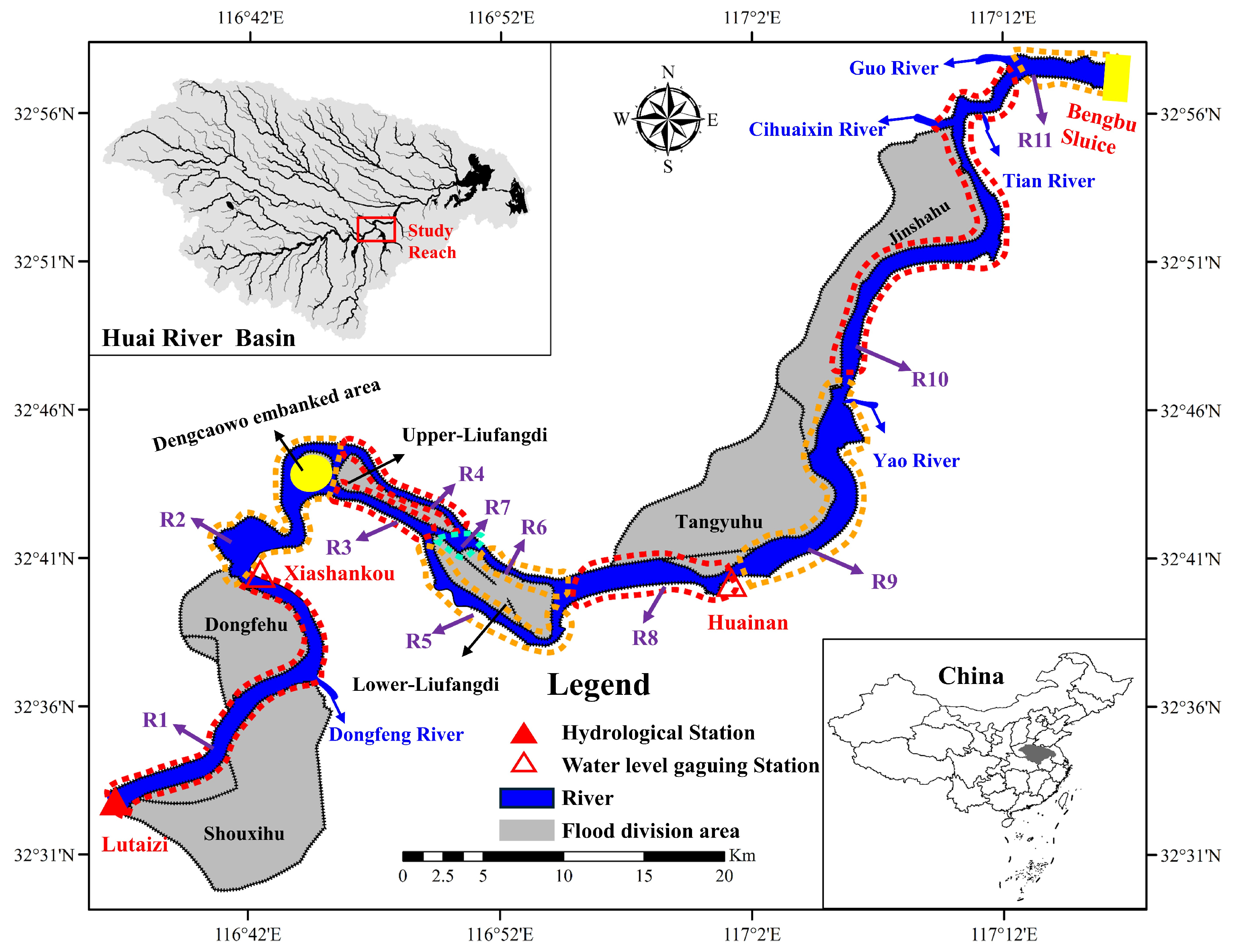
This study focuses on the Lutaizi–Bengbu Sluice section (LTZ-BBS section) in the middle reach of the Huai River, which is characterized by a highly complex channel morphology that includes meandering, confluences, and anabranching segments, exerting a significant influence on flow and sediment transport. Furthermore, this reach contains multiple flood diversion areas (including Shouxihu, Dongfenghu, Upper-Liufangdi (LFD), Lower-Liufangdi (LFD), Tangyuhu (TYH), and Jingshanhu) that regulate flows and thereby redistribute sediment, introducing additional complexity into the local flow–sediment dynamics. The combination of these natural and anthropogenic factors makes this reach an ideal case for investigating how dredging may trigger more pronounced and complex hydro-morphological responses, thus providing valuable insights into the long-term impacts of dredging on channel evolution. The division of the study reach is presented in Figure 1 and Table 1.

3. Methodology

3.1. Numerical Model

Although the Huai River is a sediment-scarce system with generally slow channel evolution under natural conditions, it experiences significant riverbed adjustments during high-flow years, resulting in pronounced non-uniform sediment movement. Furthermore, the sediment transport process further exhibits a distinct non-equilibrium pattern, characterized by hyper-saturation under low discharge and under-saturation during high-flow conditions. To simulate these processes, a 1D numerical model is developed based on non-equilibrium transport theory for non-uniform sediment [33]. The governing equations are presented below.
Continuity   equation :   Q x + B Z t = q
Momentum   equation :   Q t + x ( α Q 2 A ) + g A ( Z x + Q Q K 2 ) = q V x
Suspended   sediment   advection   equation :   ( A S k ) t + ( Q S k ) x = α s ω k B ( S k * S k )
Riverbed   deformation   equation :   γ A d t = j = 1 N α s ω k B ( S k * S k )
Sediment   transport   formula :   S k * = k s ( V 3 g h ω k ) m
Sediment   transport   equilibrium   equation :   i = 1 L ( n ) Q i S i , k = j = 1 M ( n ) Q j S j , k
where Q is the discharge (m3/s); x is the distance (m); B is the water surface width (m); t is time (s); q is the side inflow discharge (m3/s); α is the coefficient of momentum correction; A is the cross-sectional area (m2); g is the gravitational acceleration (m/s2); K is the discharge modulus; Vx is the component of inlet velocity on the mainstream (m/s); Sk, Sk* and ωk are the sediment concentration (kg/m3), sediment transport capacity (kg/m3) and settling velocity (m/s) of the group k particle size, respectively; αs is the adaptation coefficient; γ′ is the dry unit weight of sediment (kg/m3); Ad is the area of deposition (m2); ks and m are calibration parameters of sediment transport formula; L (n) and M (n) are the total numbers of inlet and outlet reaches connected with branching point; Si,k and Sj,k are the sediment concentration of the group k sediment grain size (kg/m3). The model parameters were assigned based on field data and previous studies [34,35], with ks = 0.01, m = 0.92, an adaptation coefficient αs of 0.25 for scour and 1.0 for deposition, and the Manning’s roughness coefficients of 0.0215 for the main channel and 0.0335 for the floodplain.
Although 1D numerical models lack the intrinsic capability to resolve cross-sectional scour–deposition distribution, computing riverbed deformation requires redistributing the total sediment volume between the floodplain and main channel, which also requires subsequent adjustment of the cross-sectional geometry. To address this, the perpendicular method was employed to allocate erosion and deposition areas within each cross-section [36], as described below.
Δ B i δ Z i δ A = η i c Δ B i i = 1 n η i c Δ B i
where δZi and ΔBi are the scour–deposition thickness (m) and width (m) in the perpendicular direction, respectively; δA is the scour–deposition area of the cross-section (m2); ηi is the perpendicular flow depth (m); c is an adjustment coefficient, taking a value of 0.5 for deposition and 1.5 for erosion.
Motivated by the low sediment concentration and slow riverbed evolution of the Huai River, a decoupled solution strategy was employed in the 1D numerical model. This approach solves the Saint-Venant equations prior to the sediment transport and riverbed deformation equations. For numerical stability, the Saint-Venant equations were discretized using the Preissmann four-point implicit scheme, and the sediment equations using an implicit upwind scheme, with the complete system solved efficiently via the Thomas algorithm. Comprehensive details on the equation discretization, solution process, as well as the methods for riverbed adjustment and cross-section updating can be found in references [36,37,38,39].

3.2. Model Validation

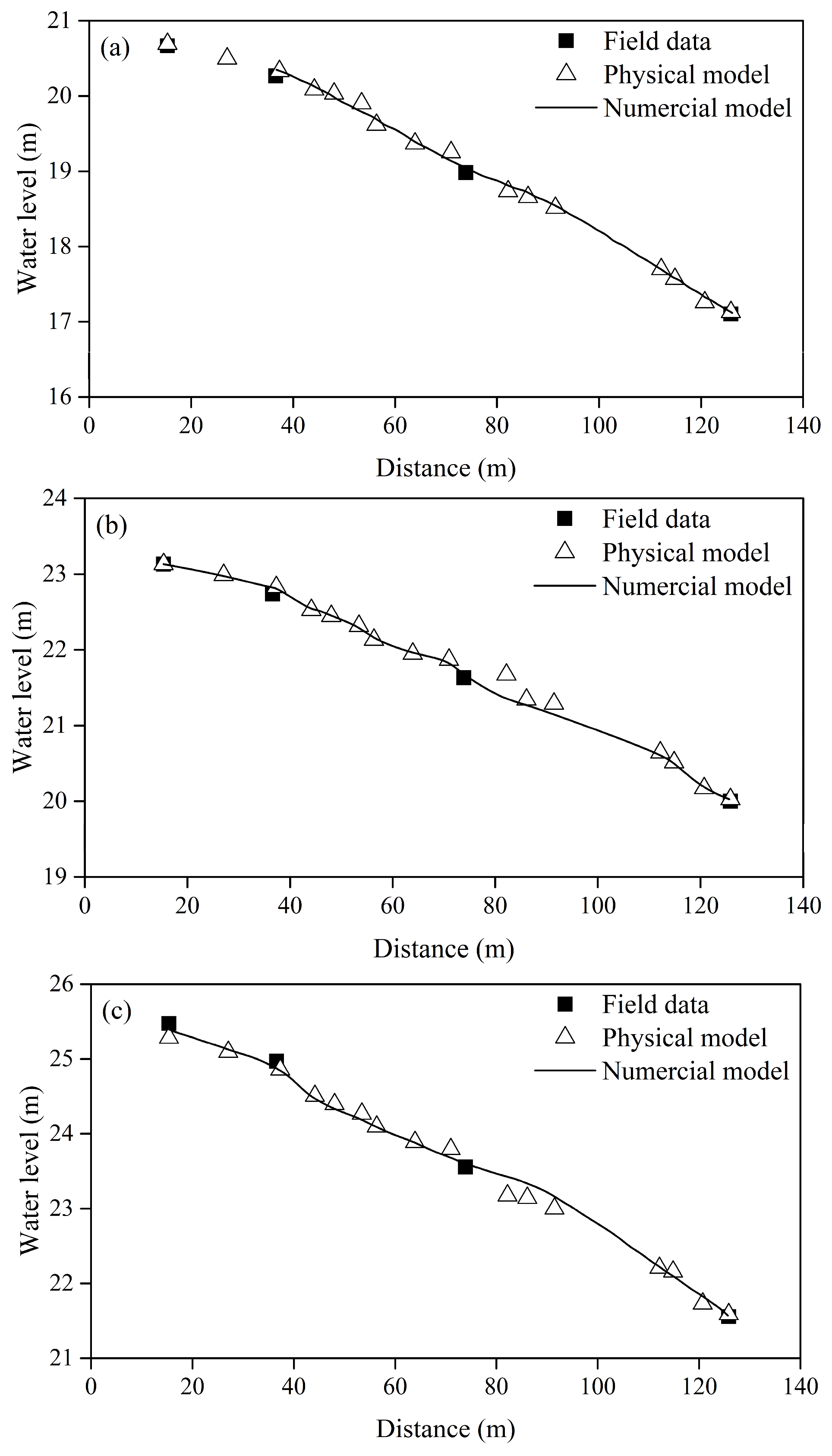
Owing to the absence of discharge monitoring stations in the study reach—where only water level gauging stations are available—comprehensive calibration of the model was challenging. Therefore, the model was validated using field data from a major flood event in 2020, combined with data from a physical model study. This physical model, constructed in the experimental facility of the Anhui & Huai River Institute of Hydraulic Research, simulated the 144.5 km river reach from Zhengyangguan to Bengbu Sluice. Built to geometric scales of 1:300 (horizontal) and 1:60 (vertical) based on 2018 topographic conditions, the model was designed to evaluate channel conveyance capacity and optimize dredging configurations. It provided high-precision measurements of water level and discharge, and the dataset was sourced from the Institute’s comprehensive engineering study reports [40]. The validation focused on water levels and branch discharge, with the results presented in Figure 2 and Table 2. For water levels, the computed values demonstrated close agreement with the field data across various discharges, with a maximum error of less than 10 cm, and were also consistent with the physical model data. Regarding branch discharge, discrepancies between the computed values and the physical model tests remained within 5% under both existing and dredged conditions. Although sediment and riverbed evolution data were not available in the study reach for direct validation, the model employed in this study has been rigorously validated for sediment transport and morphodynamic processes in the hydrologically contiguous reaches directly upstream and downstream of the study section, which share nearly identical sediment regimes and riverbed material composition [35,41,42,43]. These previous applications have demonstrated the model’s reliability in reproducing key phenomena such as the rising and falling limbs of sediment peaks and erosion–deposition patterns of channels. In addition, the sensitivity of long-term predictions to model parameters was specifically addressed in a prior study [42], which identified the sediment carrying capacity coefficient as the most influential empirical parameter. The analysis confirmed that the primary trends reported here are robust to variations in this coefficient, while physical parameters like riverbed roughness are well-constrained by field data. Collectively, the direct validation against water levels and discharge, combined with established model performance from other reaches, confirms that the model is accurate and suitable for analyzing the long-term morphological evolution of the Huai River in response to dredging engineering.

3.3. Model Setup

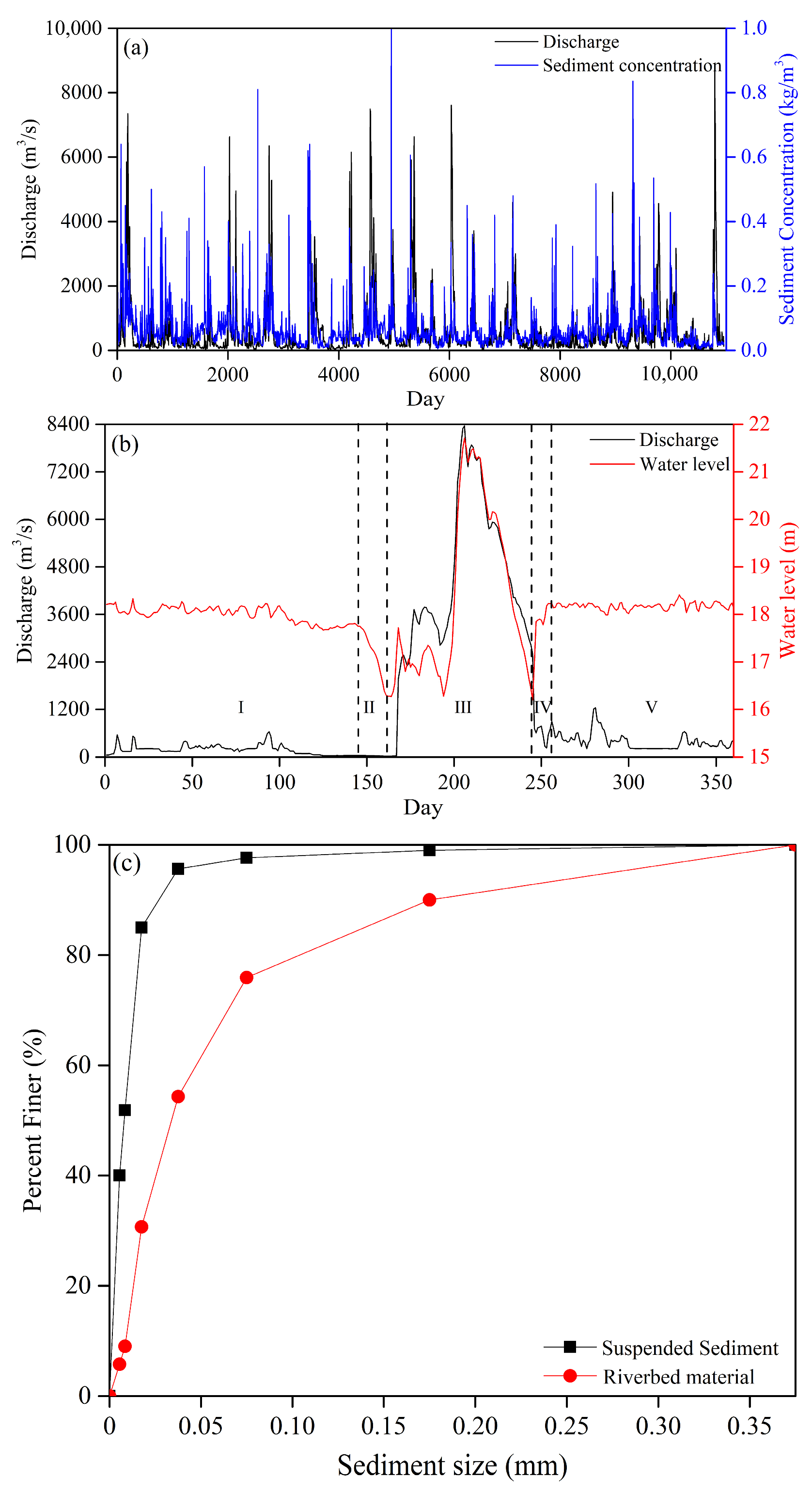
This study evaluated the long-term impact of dredging on the channel evolution in the middle reach of the Huai River by comparing two distinct topographic scenarios. Scenario 1 (the baseline) represents the existing topography, sourced from the 2018 survey dataset provided by the Huai River Water Conservancy Commission. Scenario 2 was constructed by systematically replacing the cross-sections in the baseline topography with newly designed sections that reflected the post-dredging channel geometry. This modification was applied specifically to the LTZ-BBS section, using the as-built design parameters—including the dredged length, top width, and side slope—as detailed in Table 3. A comprehensive 30-year morphodynamic simulation was conducted, utilizing the observed flow–sediment series from 1991 to 2020 as input to reflect recent changes in the flow–sediment regime (Figure 3a). This series provides a substantial and representative long-term sample, which encompasses a complete range of hydro-sedimentary conditions, enabling a comprehensive assessment of their combined impact on riverbed erosion and deposition. As the outlet boundary of the model is defined by the BBS, the actual operational rules of the sluice must be considered. Consequently, the boundary condition was configured based on the recorded daily water level and discharge patterns at the sluice throughout 2020. As illustrated in Figure 3b, the annual operational regime of the BBS can be categorized into five distinct zones. Zones I and V employ a constant water level control, set at 17.9 m for this study (the normal water level of the BBS ranges from 17.5 m to 18.0 m). Zone III utilizes a stage-discharge rating curve as the boundary. Zones II and IV are transitional periods, where the outflow is regulated according to the incoming discharge to ensure a smooth transition between flood and non-flood seasons. In addition, given the non-uniform characteristics of the sediment in the study reach, the grain-size distributions of the suspended load and riverbed material were divided into seven size ranges based on field data, with the median diameter of each were used in the calculations (Figure 3c).

4. Results

4.1. Patterns of Long-Term Channel Evolution

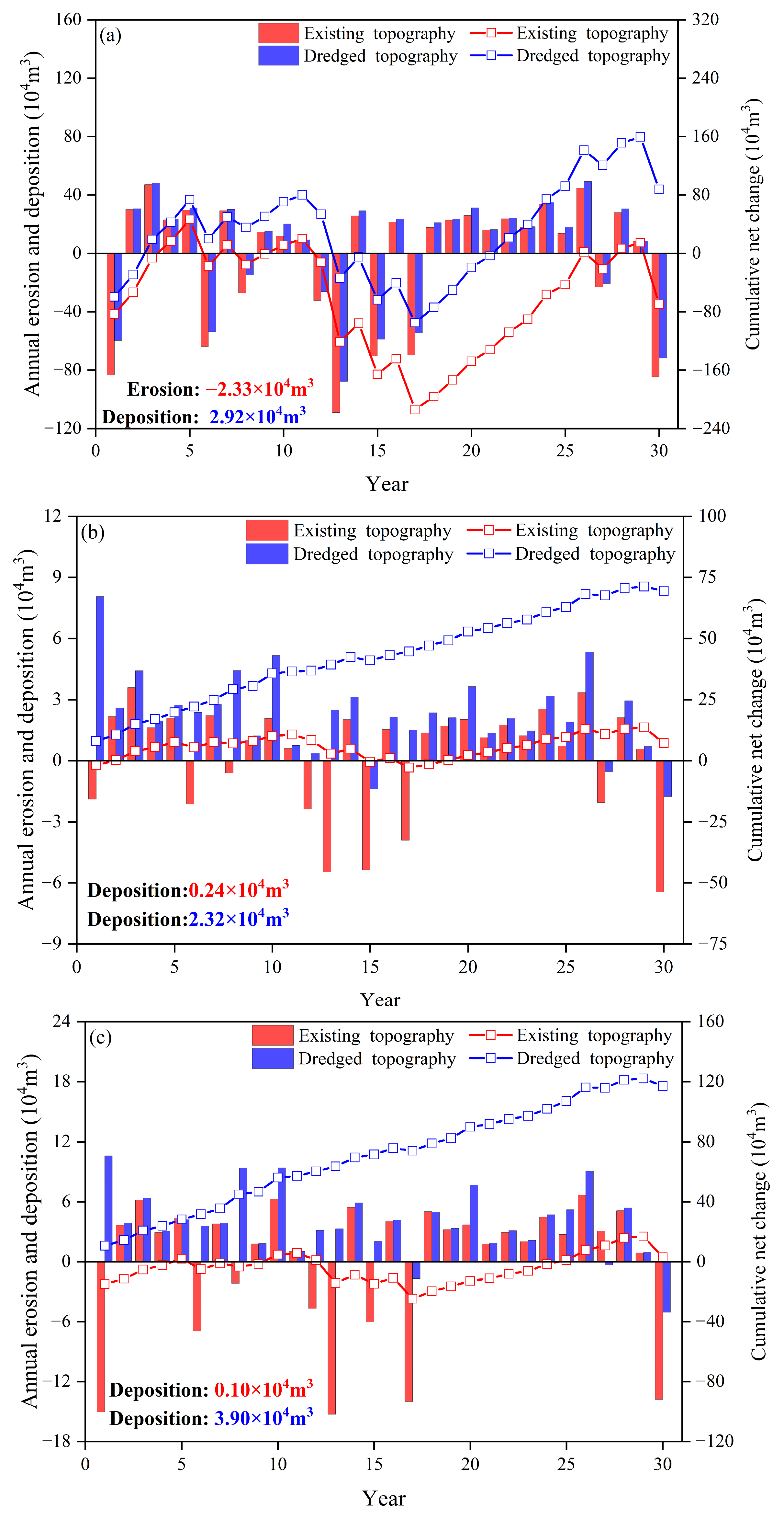
Figure 4 illustrates the annual erosion–deposition volumes and cumulative net volume changes over a 30-year period for the study reach under both existing and dredged topographies. At the reach scale (Figure 4a), dredging operations reversed the net volumetric change, transforming the channel evolution pattern from net erosion to net deposition. Specifically, under the existing topography, the reach was characterized by net erosion, with a cumulative erosion volume of 69.80 × 10⁴ m3 and an annual average of 2.33 × 10⁴ m3. In the dredged topography, the reach exhibited net deposition, accumulating a volume of 87.67 × 10⁴ m3 with an annual average of 2.92 × 10⁴ m3.
In contrast to the system-wide shift from erosion to deposition, the local response within the dredged segments was characterized by a pronounced amplification of pre-existing depositional trends. In the LFD reach (R3, R6 and R7; Figure 4b), slight deposition under the existing topography (cumulative deposition volume: 7.16 × 10⁴ m3; annual deposition volume: 0.24 × 10⁴ m3) was markedly amplified by dredging, which increased the cumulative deposition to 69.47 × 10⁴ m3 and the annual deposition to 2.32 × 10⁴ m3. A more substantial amplification was observed in the TYH reach (R9; Figure 4c), where minimal deposition (cumulative deposition volume: 3.01 × 10⁴ m3; annual deposition volume: 0.10 × 10⁴ m3) transitioned to intense deposition after dredging, resulting in a cumulative volume of 117.01 × 10⁴ m3 and an average annual volume of 3.90 × 10⁴ m3.
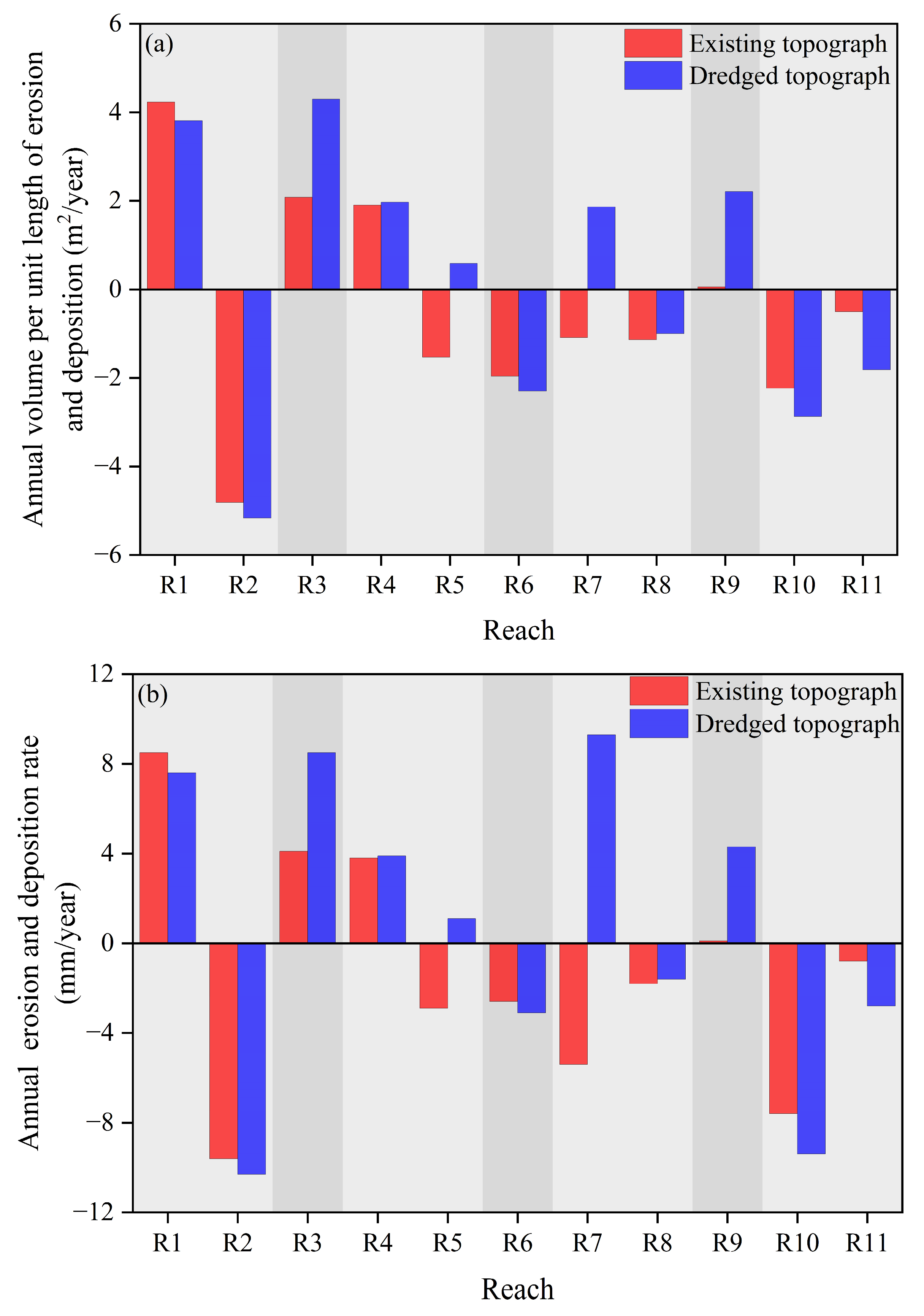
Spatial heterogeneity in channel evolution patterns is further detailed in Figure 5, which presents the annual volumetric change per unit channel length and corresponding erosion–deposition rates for each sub-reach (R1–R11). Within the dredged reaches, the net deposition at the integrated LFD reach scale (R3, R6, R7) masked highly divergent finer-scale behaviors, encompassing both amplified pre-existing trends and a complete pattern reversal. For example, R3 showed enhanced deposition, with the annual volumetric change per unit length increasing from 2.08 to 4.30 m2/year and the annual deposition rate rising from 4.1 to 8.5 mm/year. R6 experienced intensified erosion, with the annual volumetric change per unit length shifting from −1.96 to −2.30 m2/year and the annual erosion rate changing from −2.6 to −3.1 mm/year. In contrast, R7 exhibited a distinct transition from erosion to deposition, with the annual volumetric change per unit length changing from −1.09 to 1.86 m2/year and the annual erosion–deposition rate shifting from −5.4 to 9.3 mm/year. In addition, the dredged TYH reach (R9) exhibited substantially increased deposition, with the annual volumetric change per unit length increasing from 0.06 to 2.21 m2/year and the annual deposition rate rising from 0.1 to 4.3 mm/year.
Compared to the dredged zones, the non-dredged sub-reaches also exhibited complex responses to the system-wide changes, which manifested as reversals of pre-dredging patterns or persistent trends with altered intensity. For instance, R5 underwent a shift from erosion to deposition, with the annual volumetric change per unit length increasing from −1.53 to 0.58 m2/year and annual erosion–deposition rate shifting from −2.9 to 1.1 mm/year. In sub-reaches where the pre-dredging pattern persisted, the intensity of erosion or deposition showed clear divergence. Erosion intensified notably in R2, where the annual volumetric change per unit length changed from −4.81 to −5.17 m2/year and the annual erosion rate changing from −9.6 to −10.3 mm/year. A similar intensification was observed in R10 (volumetric change: −2.23 to −2.87 m2/year; annual erosion rate: −7.6 to −9.4 mm/year) and R11 (volumetric change: −0.50 to −1.81 m2/year; annual erosion rate: −0.8 to −2.8 mm/year). In contrast, R8 exhibited a weakening of erosion intensity, with the annual volumetric change per unit length decreasing from −1.14 to −1.00 m2/year and the annual erosion rate from −1.8 to −1.6 mm/year. For the depositional sub-reaches, intensity changes also varied. Deposition increased slightly in R4 (volumetric change: 1.90 to 1.97 m2/year; annual deposition rate: 3.8 to 3.9 mm/year) but decreased in R1 (volumetric change: 4.23 to 3.91 m2/year; annual deposition rate: 8.5 to 7.6 mm/year).

4.2. Adjustment Patterns of the Main Channel and Floodplain

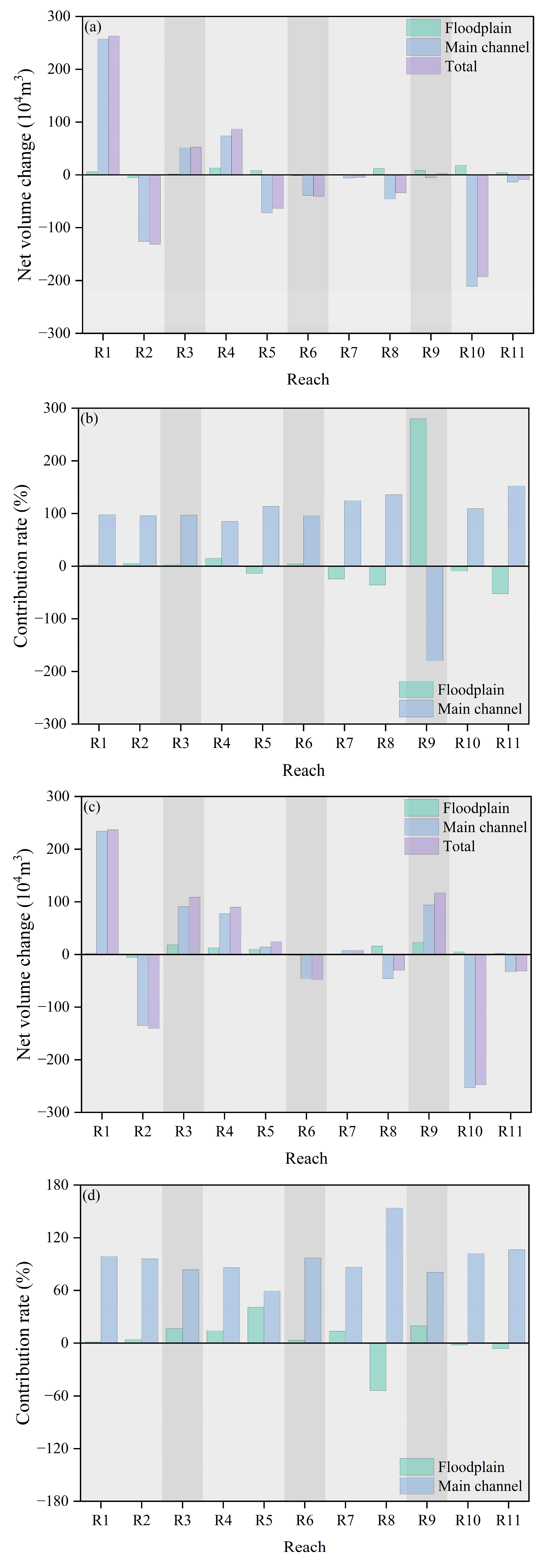
The net volume changes and corresponding contribution rates of the main channel and floodplain under existing and dredged topographies were compared, as shown in Figure 6. Overall, the net volumetric change at the reach scale frequently masks contrasting behaviors between the main channel and floodplain, with the main channel dominating the evolutionary trend in most cases.
Under the existing topography, the main channel accounted for more than 84% of the net volumetric change in several sub-reaches (R1, R2, R3, R4, R6). The volumetric change in the main channel within these sub-reaches ranged from −125.59 × 10⁴ m3 (erosion in R2) to 257.09 × 10⁴ m3 (deposition in R1), indicating a controlling influence on reach-scale evolution. Moreover, the contribution rate of the main channel exceeded 100% in several sub-reaches (R5, R7, R8, R10, R11) due to opposing volumetric changes between main channel and floodplain, as evidenced in R5 by the partial offset of main channel erosion (−71.64 × 10⁴ m3) through floodplain deposition (8.52 × 10⁴ m3). In addition, a notable exception to this pattern occurred in R9, where deposition on the floodplain (8.40 × 10⁴ m3) exceeded erosion in the main channel (−5.40 × 10⁴ m3), leading to a net depositional state in the reach.
Following dredging, the erosion–deposition relationship between the main channel and floodplain was noticeably altered. The most significant change was the reversal of main channel trend in certain sub-reaches, where large volumetric shifts led to a reconfiguration of the erosion–deposition pattern. For example, the main channel changed from erosion (−5.40 × 10⁴ m3) to pronounced deposition (94.06 × 10⁴ m3) after dredging in R9. This change considerably exceeded the increase in floodplain deposition (from 8.40 × 10⁴ m3 to 22.95 × 10⁴ m3), causing the contribution rate of the main channel to change from −179.7% to 80.38%, reestablishing its dominance and driving the whole sub-reach toward strong deposition. A similar phenomenon occurred in R5, where the main channel transitioned from erosion (−71.64 × 10⁴ m3) to deposition (14.26 × 10⁴ m3), constituting the primary reason of the overall reversal from erosion to deposition in this sub-reach. Concurrently, dredging moderated the opposing erosion–deposition relationship between the main channel and the floodplain, leading to more synchronous erosion–deposition trends in most sub-reaches (R5, R7 and R9) and enhancing the relative contribution of the floodplain in local areas (R3).

4.3. Temporal Variations in Flow Division Characteristics Within Multiple Channels

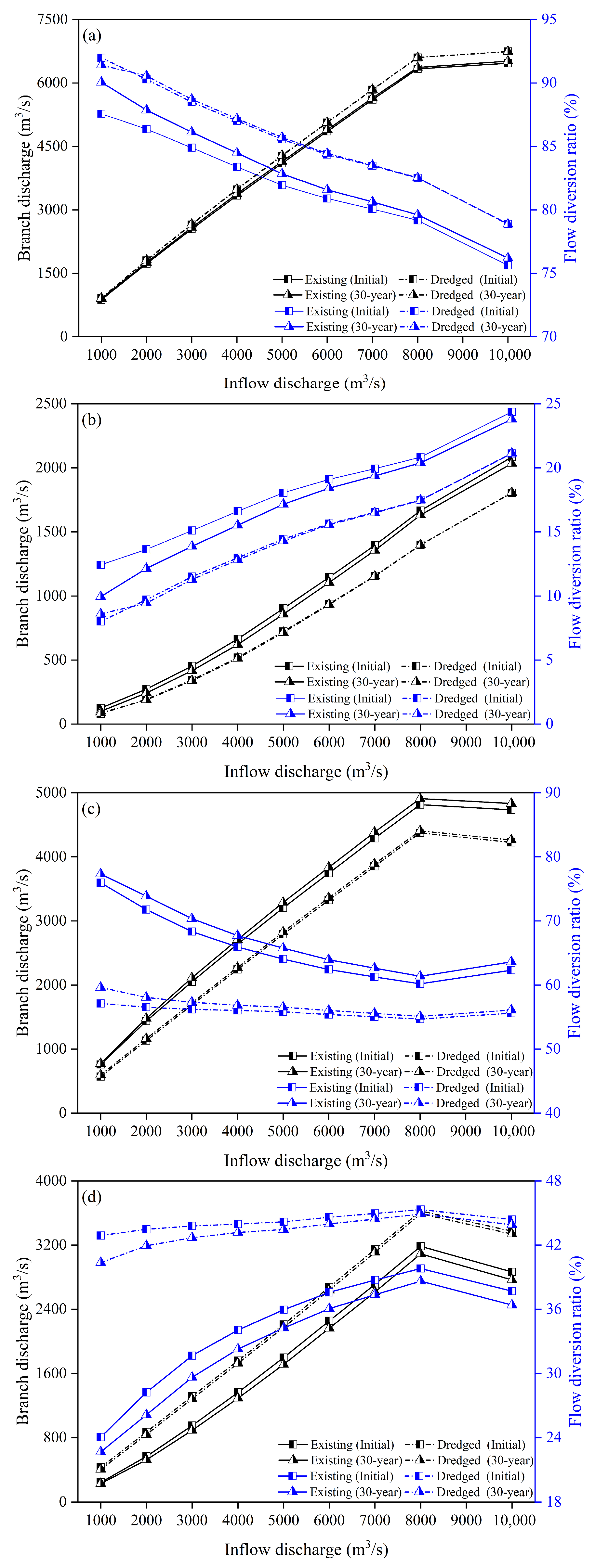
The temporal variations in flow division characteristics under existing and dredged topographies is illustrated in Figure 7, revealing distinct behaviors and corresponding responses to dredging operations across the studied reaches.
In the Upper-LFD reach, the South Branch (R3, Figure 7a) serves as the dominant channel, with mean discharge of 3982 m3/s and flow division ratio of 82% under varied inflow conditions, exceeding the corresponding values of 968 m3/s and 18% in the North Branch (R4, Figure 7b). Dredging further enhanced this pattern, increasing discharge by 44–279 m3/s and flow division ratio by 3–5 percentage points in R3. Moreover, the engineered configuration demonstrated excellent stability over the study period, with changes of less than 10 m3/s in discharge and 1% in flow division ratio between initial and final states, effectively suppressing the natural tendency of increasing flow capacity in R4 under existing conditions.
In contrast to the reinforced single-channel dominance in the Upper-LFD reach, the Lower-LFD reach developed a more balanced flow distribution between the two branches following dredging. Under the existing topography, this reach exhibited clearly unbalanced conditions, with the South Branch (R5, Figure 7c) accounting for 66% (3074 m3/s) of the total discharge—approximately double the 34% (1770 m3/s) for the North Branch (R6, Figure 7d). However, dredging substantially altered this distribution, with the mean discharge share of R5 decreased to 56% (2689 m3/s) and R6 increased to 44% (2156 m3/s), which demonstrates that dredging led to a more balanced flow distribution between the two branches in the Lower-LFD reach. In addition, this reconfigured pattern maintained long-term stability, with variations remaining below 3% in flow division ratios and 50 m3/s in discharges throughout the study period, mirroring the sustained effectiveness observed in the Upper-LFD reach. Notably, the combined flow in the branching channels falls below the inflow discharge at the discharge of 10,000 m3/s, which is attributed to overtopping and storage in flood detention basins.

5. Discussions

5.1. Multiscale System Responses of Channel Evolution to Dredging

As an intensive anthropogenic disturbance, dredging substantially reshapes both local morphology and system-wide evolutionary processes in channels. This study demonstrates that dredging induced a fundamental shift in channel evolution at the reach scale, transitioning the system from net erosion to net deposition (Figure 4). Such systemic alterations in erosion–deposition patterns are consistent with observations reported from Mucuripe Bay [44] and the Yangtze River Delta [19], confirming the significant role of dredging in modifying channel evolution across diverse environmental contexts.
Typically, this reach-scale shift was driven by substantial deposition within the dredged reaches (R3, R7 and R9; Figure 5), where artificially altered channel topography disrupted the pre-existing dynamic equilibrium, resulting in the formation of large pools that function as effective sediment traps [15,45,46,47]. This phenomenon was primarily caused by the dredging-induced expansion of the channel’s cross-section, which reduced flow velocities and diminished the sediment-carrying capacity, ultimately leading to deposition as the flow could no longer transport the incoming sediment load. In contrast to this prevailing trend, R6 exhibited strikingly divergent responses, with dredging leading to pronounced erosion intensification (Figure 5). This anomalous erosion stemmed from the intensive sediment trapping in the upstream dredged reaches (R3 and R7), which drastically reduced the sediment supply to R6. Consequently, despite increased discharge and an enlarged cross-sectional area in R6, the flow entering this reach was in a sediment-undersaturated state. To compensate for this sediment deficit, this “hungry” flow scoured the riverbed in R6, resulting in net erosion rather than deposition. This finding aligns with previous studies indicating that in low-sediment rivers such as the Huai River, long-distance dredging does not necessarily induce siltation [13,14].
In addition, the complex responses observed in non-dredged sub-reaches underscore the systemic nature of dredging as a geomorphic disturbance. These diverse adjustments, ranging from erosion–deposition reversals to intensity modulations, stem from alterations in the hydrodynamic and sediment transport regimes across the entire reach following the engineering intervention [48]. As a holistic system, the river exhibits differential feedback across its subunits—governed by their pre-existing geomorphic and hydraulic settings—in response to the altered boundary conditions, a mechanism of propagating impacts that finds consistent support in studies of disturbed fluvial systems [49,50].

5.2. Implications and Limitations

This study demonstrates that dredging triggers system-wide geomorphic adjustments governed by sediment availability, providing a critical framework for optimizing river management. The contrasting responses between deposition-amplified sub-reaches (R3, R7 and R9) and erosion-intensified sub-reaches (R6) highlight that effective dredging requires differentiated strategies based on pre-dredging sediment assessments. Sediment-rich areas can be leveraged for targeted dredging to enhance channel stability, while sediment-starved reaches like R6 necessitate protective measures to avoid detrimental scour. Furthermore, the complex adjustments observed in non-dredged areas emphasize that dredging impacts propagate beyond engineered sites, necessitating a reach-scale perspective in planning. These findings align with the sediment regulation principles of the Dujiangyan system, where strategic interventions achieve long-term functionality by harmonizing with natural processes [51,52,53]. By integrating sediment connectivity and spatial heterogeneity into management frameworks, dredging operations can maximize benefits while minimizing unintended morphological consequences across river systems.
Moreover, the geomorphic adjustments predicted by this study carry significant implications for ecological management strategies in the Middle Huai River. The large-scale sediment redistribution—through erosion in sub-reaches like R6 and deposition in areas like R3, R7, and R9—can fundamentally alter benthic habitats and remobilize legacy contaminants associated with riverbed sediments. Given the Huai River was one of China’s most heavily polluted rivers [54,55,56,57], integrating the present morphodynamic framework with sediment quality data is imperative for proactive environmental risk management. Such an integrated approach would allow decision-makers to identify reaches where dredging or natural erosion poses a higher ecological risk, thereby prioritizing monitoring efforts and guiding the development of targeted mitigation strategies during planning phases.
Despite successfully simulating long-term channel evolution under both dredged and non-dredged scenarios in the Huai River, this study has several limitations. First, the capability of one-dimensional models to accurately simulate morphological changes in complex river systems remains a subject of ongoing discussion, as some simulation results have been found to be accurate, whilst others are not [22,23,51,58]. In fact, the superior detail of higher-dimensional models comes with high computational cost and data demands [20], whereas 1D numerical models provide a practical alternative for simulations at large spatiotemporal scales, where capturing system-wide trends is more critical than resolving localized details [22]. Second, although the initial size distribution of the sediment is prescribed, the numerical model approximates sediment sorting through a simplified three-layer riverbed stratigraphy (surface exchange, middle transition, and bottom limit layers) that dynamically updates the riverbed surface gradation in response to erosion or deposition, rather than solving the complete sediment sorting processes which are crucial for the channel evolution pattern in the complex sub-reach [59,60]. Finally, it should be noted that sediment resuspension during dredging operations may lead to the dispersion of contaminants with potential ecological consequences [47,61,62], an aspect not addressed in the present morphodynamic study. While the focused application scenario ensures model reliability for its intended purpose, it inherently restricts generalizability. The model presented in this study was primarily designed to analyze channel evolution under engineering interventions, leaving other related processes unexamined. Future research should aim to enhance the model’s universality and expand its application scope, for instance by incorporating water quality parameters to better evaluate the comprehensive environmental impacts of dredging activities. Nevertheless, the numerical model developed herein provides a robust and efficient tool for predicting large-scale morphodynamic responses to dredging, offering a valuable foundation for river management strategies.

6. Conclusions

(1)
The implemented dredging in the Lutaizi–Bengbu Sluice section fundamentally reversed the long-term erosional trend of the channel, transforming the system from a state of net erosion (69.80 × 10⁴ m3) to one of net deposition (87.67 × 10⁴ m3).
(2)
Dredging reconfigured the sediment dynamics between the main channel and floodplain and synchronized the erosion–deposition trends of both, with the main channel dominating this process by contributing over 84% of the net volumetric changes.
(3)
In the Liufangdi Reach, dredging induced significant spatial heterogeneity in the geomorphic adjustment of adjacent sub-reaches, which exhibited contrasting erosion and deposition behaviors. This geomorphic reorganization altered the flow division characteristics, resulting in a stable and long-term regime with flow division ratios varying by less than 3%.
This study demonstrates that sustainable dredging must transition from uniform implementation to spatially distinct interventions, accounting for sub-reach geomorphic heterogeneity. By integrating these targeted measures with basin-scale sediment management, dredging can systematically reverse erosional trends and stabilize flow regimes, providing a transferable framework for engineered river restoration.

Author Contributions

Conceptualization, J.N. and H.Z.; methodology, J.N.; validation, H.Z., P.W. and J.N.; resources, H.Z. and H.L.; data curation, K.C.; writing—original draft preparation, K.C.; writing—review and editing, K.C. and P.W.; funding acquisition, J.N. All authors have read and agreed to the published version of the manuscript.

Funding

This work research was funded by the Anhui Provincial Natural Science Foundation Joint Fund for Water Science (2208085US04), the Anhui & Huai River Institute of Hydraulic Research Science and Technology Project (KY202302), and the Anhui Provincial Water Conservancy Science and Technology Project (slkj202501).

Data Availability Statement

The original contributions presented in this study are included in the article. Further inquiries can be directed to the corresponding author.

Conflicts of Interest

The authors declare no conflicts of interest.

References

  1. Kvočka, D.; Falconer, R.A.; Bray, M. Flood hazard assessment for extreme flood events. Nat. Hazards 2016, 84, 1569–1599. [Google Scholar] [CrossRef]
  2. Alfieri, L.; Burek, P.; Feyen, L.; Forzieri, G. Global warming increases the frequency of river floods in Europe. Hydrol. Earth Syst. Sci. 2015, 19, 2247–2260. [Google Scholar] [CrossRef]
  3. Min, S.-K.; Zhang, X.; Zwiers, F.W.; Hegerl, G.C. Human contribution to more-intense precipitation extremes. Nature 2011, 470, 378–381. [Google Scholar] [CrossRef] [PubMed]
  4. Kundzewicz, Z.W.; Su, B.; Wang, Y.; Xia, J.; Huang, J.; Jiang, T. Flood risk and its reduction in China. Adv. Water Resour. 2019, 130, 37–45. [Google Scholar] [CrossRef]
  5. Duan, W.; He, B.; Nover, D.; Fan, J.; Yang, G.; Chen, W.; Meng, H.; Liu, C. Floods and associated socioeconomic damages in China over the last century. Nat. Hazards 2016, 82, 401–413. [Google Scholar] [CrossRef]
  6. Wang, J.; Li, N.; Wang, Y.; Wang, S. Study on flood affected population and economic risk assessment and zoning method. China Water Resour. 2023, 8, 16–19. [Google Scholar] [CrossRef]
  7. Gao, C.; Zhang, Z.; Zhai, J.; Qing, L.; Yao, M. Research on meteorological thresholds of drought and flood disaster: A case study in the Huai River Basin, China. Stoch. Environ. Res. Risk Assess. 2014, 29, 157–167. [Google Scholar] [CrossRef]
  8. Ma, F.; Ye, A.; Gong, W.; Mao, Y.; Miao, C.; Di, Z. An estimate of human and natural contributions to flood changes of the Huai River. Glob. Planet. Change 2014, 119, 39–50. [Google Scholar] [CrossRef]
  9. Yu, B.; Lv, L.; Yang, X.; Ni, J. Research progress of flood outlet and river regulation in the middle reach of the Huaihe River. J. Sediment Res. 2021, 46, 74–80. [Google Scholar] [CrossRef]
  10. Chen, J.; Yu, M.; Deng, L.; Lu, Y. Review on influences of Yellow River intruding into Huaihe River on middle and lower reaches of Huaihe River and flood control measures. Yangtze River 2021, 52, 9–15. [Google Scholar] [CrossRef]
  11. Zhang, H.; Yu, B.; Ni, J.; Wang, J. Susceptibility and Periodicity of Water and Sediment Characteristics of Mainstream Huaihe River in Recent 66 Years. J. Yangtze River Sci. Res. Inst. 2020, 37, 6–11. [Google Scholar]
  12. Liu, Y. Regulation of the middle reaches of the Huaihe River and evaluation on its effect. Yangtze River 2008, 39, 1–3+110. [Google Scholar] [CrossRef]
  13. Guo, Q.; Han, Q.; Guan, J. Study on feasibility and long-term effect of bed dredging on lowering flood level in the reach below Bengbu of Huaihe River. J. Sediment. Res. 2016, 6, 1–7. [Google Scholar] [CrossRef]
  14. Guo, Q.; Lu, Q. Study on scale and effect of river dredging aiming at reducing flood level. J. Hydraul. Eng. 2022, 53, 496–503. [Google Scholar] [CrossRef]
  15. Yao, Y.; Chen, X.; Yuan, J.; Li, L.; Guan, W. Impacts of channel dredging on hydrodynamics and sediment dynamics in the main channels of the Jiaojiang River Estuary in China. Acta Oceanol. Sin. 2023, 42, 132–144. [Google Scholar] [CrossRef]
  16. Nugraha, A.; Khangaonkar, T.; Michalsen, D.; Brown, S. Numerical feasibility study for dredging and maintenance alternatives in Everett Harbor and Snohomish River. Reg. Stud. Mar. Sci. 2022, 56, 102695. [Google Scholar] [CrossRef]
  17. Ralston, D.K.; Talke, S.; Geyer, W.R.; Al-Zubaidi, H.A.M.; Sommerfield, C.K. Bigger Tides, Less Flooding: Effects of Dredging on Barotropic Dynamics in a Highly Modified Estuary. J. Geophys. Res. Ocean. 2019, 124, 196–211. [Google Scholar] [CrossRef]
  18. van Maren, D.S.; van Kessel, T.; Cronin, K.; Sittoni, L. The impact of channel deepening and dredging on estuarine sediment concentration. Cont. Shelf Res. 2015, 95, 1–14. [Google Scholar] [CrossRef]
  19. Luan, H.L.; Ding, P.X.; Wang, Z.B.; Yang, S.L.; Lu, J.Y. Morphodynamic impacts of large-scale engineering projects in the Yangtze River delta. Coast. Eng. 2018, 141, 1–11. [Google Scholar] [CrossRef]
  20. Abderrezzak, K.E.K.; Paquier, A. One-dimensional numerical modeling of sediment transport and bed deformation in open channels. Water Resour. Res. 2009, 45, W05404. [Google Scholar] [CrossRef]
  21. Wu, W.; Wang, S.S.Y. One-Dimensional Modeling of Dam-Break Flow over Movable Beds. J. Hydraul. Eng. 2007, 133, 48–58. [Google Scholar] [CrossRef]
  22. Zhou, M.; Xia, J.; Deng, S. One-dimensional modelling of channel evolution in an alluvial river with the effect of large-scale regulation engineering. J. Hydrol. 2019, 575, 965–975. [Google Scholar] [CrossRef]
  23. Dou, S.; Yu, X.; Du, H.; Zhang, F. Numerical simulations of flow and sediment transport within the Ning-Meng reach of the Yellow River, northern China. J. Arid Land 2017, 9, 591–608. [Google Scholar] [CrossRef]
  24. Xia, J.; Zhang, X.; Wang, Z.; Li, J.; Zhou, M. Modelling of hyperconcentrated flood and channel evolution in a braided reach using a dynamically coupled one-dimensional approach. J. Hydrol. 2018, 561, 622–635. [Google Scholar] [CrossRef]
  25. Canestrelli, A.; Lanzoni, S.; Fagherazzi, S. One-dimensional numerical modeling of the long-term morphodynamic evolution of a tidally-dominated estuary: The Lower Fly River (Papua New Guinea). Sediment. Geol. 2014, 301, 107–119. [Google Scholar] [CrossRef]
  26. He, Y.; Ye, J.; Yang, X. Analysis of the spatio-temporal patterns of dry and wet conditions in the Huai River Basin using the standardized precipitation index. Atmos. Res. 2015, 166, 120–128. [Google Scholar] [CrossRef]
  27. Lin, H.; Wang, J.; Li, F.; Xie, Y.; Jiang, C.; Sun, L. Drought Trends and the Extreme Drought Frequency and Characteristics under Climate Change Based on SPI and HI in the Upper and Middle Reaches of the Huai River Basin, China. Water 2020, 12, 1100. [Google Scholar] [CrossRef]
  28. Zhang, Y.; Shao, Q.; Xia, J.; Bunn, S.E.; Zuo, Q. Changes of flow regimes and precipitation in Huai River Basin in the last half century. Hydrol. Process. 2010, 25, 246–257. [Google Scholar] [CrossRef]
  29. Hu, Y.; Xu, S.; Wang, K.; Liang, S.; Su, C.; Feng, Z.; Zhao, M. Comparative Analysis of Extreme Flood Characteristics in the Huai River Basin: Insights from the 2020 Catastrophic Event. Water 2025, 17, 1815. [Google Scholar] [CrossRef]
  30. Yu, B.; Wu, P.; Sui, J.; Yang, X.; Ni, J. Fluvial geomorphology of the Middle Reach of the Huai River. Int. J. Sediment. Res. 2014, 29, 24–33. [Google Scholar] [CrossRef]
  31. Tang, H.; Cao, H.; Yuan, S.; Xiao, Y.; Jiang, C.; Gualtieri, C. A Numerical Study of Hydrodynamic Processes and Flood Mitigation in a Large River-lake System. Water Resour. Manag. 2020, 34, 3739–3760. [Google Scholar] [CrossRef]
  32. Xu, Y. Flood Disaster Characteristics and Causative Mechanisms in the Middle Reaches of the Huai River. Jianghuai Water Resour. Sci. Technol. 2009, 6, 18–20. [Google Scholar] [CrossRef]
  33. Han, Q. Theoretical study of non equililrium transportation of non uniform suspended load. Water Resour. Hydropower Eng. 2007, 38, 14–23. [Google Scholar] [CrossRef]
  34. Guo, Q. Sediment carrying capacity in natural rivers. J. Sediment Res. 2006, 5, 45–51. [Google Scholar] [CrossRef]
  35. Ni, J.; Yu, B.; Zhang, H.; Wang, J. Response of the Channel Regime to the Meng River Diversion and Dredging Project in the Wanglin section of the Huai River. Yangtze River 2021, 52, 6–11. [Google Scholar] [CrossRef]
  36. Feldman, A.D. Hec Models for Water Resources System Simulation: Theory and Experience. Adv. Hydrosci. 1981, 12, 297–423. [Google Scholar] [CrossRef]
  37. Wei, Z.; Zhao, L.; Fu, X. Research on Mathematical Model for Sediment in Yellow River. J. Wuhan Univ. Hydraul. Electr. Eng. 1997, 30, 22–26. Available online: https://kns.cnki.net/KCMS/detail/detail.aspx?dbcode=CJFQ&dbname=CJFD9697&filename=WSDD705.004 (accessed on 27 November 2025).
  38. Zhang, E.; Zhang, D.; Li, T. Three Steps Method to Compute Unsteady Flow for River Networks. J. Hohai Univ. (Nat. Sci.) 1982, 1, 1–13. Available online: https://kns.cnki.net/KCMS/detail/detail.aspx?dbcode=CJFQ&dbname=CJFD7984&filename=HHDX198201000 (accessed on 27 November 2025).
  39. Zhou, J.; Lin, B. One-dimensional mathematical model for suspended sediment by lateral integration. J. Hydraul. Eng. 1998, 124, 712–717. [Google Scholar] [CrossRef]
  40. Wang, J.S.; Ni, J. Research Report on River Engineering and Hydraulic Structure Model Tests for the Regulation and Construction Project of Flood Diversion Areas in the Xiaoshankou to Guohekou Reach of the Huai River; Anhui & Huai River Institute of Hydraulic Research: Hefei, China, 2023. [Google Scholar]
  41. Ni, J.; Yu, B.; Wu, P. A Numerical Study of the Flow and Sediment Interaction in the Middle Reach of the Huai River. Water 2021, 13, 2041. [Google Scholar] [CrossRef]
  42. Ni, J.; Yu, B.; Zhang, H.; Wang, J. Study on water and sediment transport law of Bengbu-Fushan Reach of main stream of Huaihe River. Water Resour. Hydropower Eng. 2020, 51, 132–137. [Google Scholar] [CrossRef]
  43. Ni, J.; Yu, B.; Zhang, H.; Wang, J. Study on fluvial processes between Bengbu to Fushan reach of the Huaihe River. J. Sediment. Res. 2018, 45, 38–43. [Google Scholar] [CrossRef]
  44. Moreira, L.B.; Castro, Í.B.; Fillmann, G.; Peres, T.F.; Belmino, I.K.C.; Sasaki, S.T.; Taniguchi, S.; Bícego, M.C.; Marins, R.V.; de Lacerda, L.D.; et al. Dredging impacts on the toxicity and development of sediment quality values in a semi-arid region (Ceará state, NE Brazil). Environ. Res. 2021, 193, 110525. [Google Scholar] [CrossRef]
  45. Helal, E.; Elsersawy, H.; Hamed, E.; Abdelhaleem, F.S. Sustainability of a navigation channel in the Nile River: A case study in Egypt. River Res. Appl. 2020, 36, 1817–1827. [Google Scholar] [CrossRef]
  46. Gob, F.; Houbrechts, G.; Hiver, J.M.; Petit, F. River dredging, channel dynamics and bedload transport in an incised meandering river (the River Semois, Belgium). River Res. Appl. 2005, 21, 791–804. [Google Scholar] [CrossRef]
  47. Bendô, A.R.R.; Da Silva, D.V.; Costi, J.; Kirinus, E.P.; Paula, D.P.; Albuquerque, M.G.; Marques, W.C. Hydromorphodynamics modeling of dredging and dumping activities in Mirim lagoon, RS, Brazil. Ocean Eng. 2023, 289, 116219. [Google Scholar] [CrossRef]
  48. Surian, N.; Rinaldi, M. Morphological response to river engineering and management in alluvial channels in Italy. Geomorphology 2003, 50, 307–326. [Google Scholar] [CrossRef]
  49. Smith, L.M.; Winkley, B.R. The response of the Lower Mississippi River to river engineering. Eng. Geol. 1996, 45, 433–455. [Google Scholar] [CrossRef]
  50. Heritage, G.; Entwistle, N. Impacts of River Engineering on River Channel Behaviour: Implications for Managing Downstream Flood Risk. Water 2020, 12, 1355. [Google Scholar] [CrossRef]
  51. Wang, X.K.; Cheng, K.; Luo, M.; Xu, Z.X.; Yan, X.F. Numerical assessment of hydro-morphodynamics affected by altered upstream discharge in the Dujiangyan reach of the Min River, China. Hydrol. Process. 2024, 38, e15113. [Google Scholar] [CrossRef]
  52. Cao, S.; Liu, X.; Er, H. Dujiangyan Irrigation System—A world cultural heritage corresponding to concepts of modern hydraulic science. J. Hydro-Environ. Res. 2010, 4, 3–13. [Google Scholar] [CrossRef]
  53. Huang, X.; Zhou, X.; You, J.; Yang, Q.; Wang, Y.; Ma, K. Wisdom, predicaments, and challenges of a millennium ancient weir—Dujiangyan Project. J. Mt. Sci. 2021, 18, 2971–2981. [Google Scholar] [CrossRef]
  54. Zhai, X.; Xia, J.; Zhang, Y. Water quality variation in the highly disturbed Huai River Basin, China from 1994 to 2005 by multi-statistical analyses. Sci. Total Environ. 2014, 496, 594–606. [Google Scholar] [CrossRef] [PubMed]
  55. Zhang, J.; Liu, G.; Wang, R.; Huang, H. Polycyclic aromatic hydrocarbons in the water-SPM-sediment system from the middle reaches of Huai River, China: Distribution, partitioning, origin tracing and ecological risk assessment. Environ. Pollut. 2017, 230, 61–71. [Google Scholar] [CrossRef]
  56. Zhang, Y.; Xia, J.; Liang, T.; Shao, Q. Impact of Water Projects on River Flow Regimes and Water Quality in Huai River Basin. Water Resour. Manag. 2009, 24, 889–908. [Google Scholar] [CrossRef]
  57. Zhang, Y.; Arthington, A.H.; Bunn, S.E.; Mackay, S.; Xia, J.; Kennard, M. Classification of Flow Regimes for Environmental Flow Assessment in Regulated Rivers: The Huai River Basin, China. River Res. Appl. 2011, 28, 989–1005. [Google Scholar] [CrossRef]
  58. Antoniazza, G.; Bakker, M.; Lane, S.N. Revisiting the morphological method in two-dimensions to quantify bed-material transport in braided rivers. Earth Surf. Process. Landf. 2019, 44, 2251–2267. [Google Scholar] [CrossRef]
  59. Guillén-Ludeña, S.; Franca, M.J.; Cardoso, A.H.; Schleiss, A.J. Evolution of the hydromorphodynamics of mountain river confluences for varying discharge ratios and junction angles. Geomorphology 2016, 255, 1–15. [Google Scholar] [CrossRef]
  60. Leite Ribeiro, M.; Blanckaert, K.; Roy, A.G.; Schleiss, A.J. Flow and sediment dynamics in channel confluences. J. Geophys. Res. Earth Surf. 2012, 117, F01035. [Google Scholar] [CrossRef]
  61. Niroumand-Jadidi, M.; Bovolo, F. Sentinel-2 Reveals Abrupt Increment of Total Suspended Matter While Ever Given Ship Blocked the Suez Canal. Water 2021, 13, 3286. [Google Scholar] [CrossRef]
  62. Manap, N.; Voulvoulis, N. Environmental management for dredging sediments—The requirement of developing nations. J. Environ. Manag. 2015, 147, 338–348. [Google Scholar] [CrossRef] [PubMed]
Figure 1. Location of the study reach and hydrological stations (The dotted lines indicate the ranges of different sub-reaches).
Water 17 03466 g001
Figure 2. Longitudinal variation in water levels for different discharges of the 2020 flood. (a) 3273 m3/s; (b) 4024 m3/s; (c) 6980 m3/s.
Water 17 03466 g002
Figure 3. The boundary parameters of 1D numerical simulation. (a) Flow–sediment conditions at the Lutaizi hydrological station; (b) Q-H relation of the Bengbu Sluice; (c) The grain-size distribution of suspended sediment and riverbed material in the study reach.
Water 17 03466 g003
Figure 4. Annual volumes of erosion–deposition and cumulative net volume change under existing and dredged topographies. (a) The entire reach; (b) the LFD dredged reach; (c) the TYH dredged reach (negative and positive values represent erosion and deposition, respectively).
Water 17 03466 g004
Figure 5. Characteristics of erosion and deposition under existing and dredged topographies across different reaches. (a) Annual volume per unit length; (b) annual rate (light and dark shades denote non-dredged and dredged reaches, respectively; negative and positive values represent erosion and deposition, respectively).
Water 17 03466 g005
Figure 6. Comparison of net volume changes and corresponding contribution rates of the main channel and floodplain under existing and dredged topographies. (a,b) indicate existing topography; (c,d) indicate dredged topography (light and dark shades denote non-dredged and dredged reaches, respectively; negative and positive values represent erosion and deposition, respectively).
Water 17 03466 g006
Figure 7. Temporal variations in flow division characteristics under existing and dredged topographies at different reaches. (a) R3; (b) R4; (c) R5; (d) R6.
Water 17 03466 g007
Table 1. Division of the study reaches into sub-reaches.
Reach NumberExtent DescriptionLength (km)
R1From the Lutaizi to the Xiashankou20.81
R2From the Xiashankou to the inlet of the LFD Reach9.16
R3South branch of the Upper-LFD Reach8.74
R4North branch of the Upper-LFD Reach16.50
R5South branch of the Lower-LFD Reach14.87
R6North branch of the Lower-LFD Reach7.49
R7Erdaohe Reach2.36
R8From the outlet of the LFD Reach to the Huainan9.95
R9From the Huainan to the Jinshangkou17.66
R10From the Jinshangkou to the Guohekou28.77
R11From the Guohekou to the Bengbu Sluice5.67
Table 2. Comparison of branch discharge at the LFD Reach (Q = 8000 m3/s).
TopographyReachUpper-LFD ReachLower-LFD Reach
Physical Model (m3/s)Numerical Model (m3/s)Relative Error
(%)
Physical Model (m3/s)Numerical Model (m3/s)Relative Error
(%)
Existing topographyR3636063400.3483248200.2
R4164016601.2316831800.4
Dredged topographyR5670466101.4451243753
R6129613907.3348836253.9
Table 3. River channel dredging parameters.
ReachLength (m)Width (m)SlopeDredged Volume (104 m3)
LTD reach (R3, R6, R7)18.23110~2601:4904.05
TYH reach (R9)19.68280~3201:41107.18
Disclaimer/Publisher’s Note: The statements, opinions and data contained in all publications are solely those of the individual author(s) and contributor(s) and not of MDPI and/or the editor(s). MDPI and/or the editor(s) disclaim responsibility for any injury to people or property resulting from any ideas, methods, instructions or products referred to in the content.