
Article

Impact of Seafloor Morphology on Regional Sea Level Rise in the Japan Trench Region

Department of Geoinformation and Cartography, Institute of Geodesy and Civil Engineering, University of Warmia and Mazury in Olsztyn, Oczapowskiego St. 2, 10-719 Olsztyn, Poland
*
Author to whom correspondence should be addressed.
Water 2025, 17(23), 3433; https://doi.org/10.3390/w17233433
Submission received: 7 November 2025 / Revised: 28 November 2025 / Accepted: 30 November 2025 / Published: 3 December 2025
(This article belongs to the Special Issue Climate Risk Management, Sea Level Rise and Coastal Impacts)

Abstract

Seafloor morphology forms regional sea level rise (SLR), affecting ocean circulation. Although many studies have examined global sea level rise, there remains a lack of analyses that show how seafloor morphology modifies the rate and character of regional SLR. Previous studies have rarely investigated the geophysical interactions between seafloor morphology and sea level modulation, leaving a gap in explaining the spatial variability of sea level trends and accelerations. The aim of the study is to assess the impact of seafloor morphology on the regional rate and character of Sea Level Rise (SLR) in the western Pacific, in the Japan Trench region. Seafloor morphology, through its interactions with gravity and circulation processes, is a major factor in how SLR trends and accelerations are determined across different locations. The analysis is based on hybrid datasets: numerical models, bathymetric data, and altimetric time series of sea level anomalies (SLA) from 1993 to 2023. SLR trends, seasonal and nodal cycles were determined at 78 virtual stations. Regional rates of sea level changes were estimated using linear regression, harmonic analysis, Continuous Wavelet Transform (CWT), and Kalman filtering. Future SLR was simulated using a modified Monte Carlo method with an AR(1) autoregressive model and a block bootstrap technique. The results indicated that SLR trends are positively correlated (r ≈ 0.9) with mean dynamic topography (MDT) and negatively correlated with depth (r ≈ –0.4), confirming the impact of ocean circulation and seafloor morphology on regional SLR. The strong, positive correlation of trends with the amplitude of the 18.61-year nodal cycle (r > 0.8) indicates the important role of long-term tidal components. The highest SLR accelerations (up to 1.7 mm/yr2) were observed in locations of seamounts and subduction zones, while in the ocean trench, the rate of change stabilized or inversed locally. The results confirm the research hypothesis—the regional rate of sea level rise depends on the morphology of the seafloor and the associated geophysical and dynamic processes. The results have wide global application, supporting the implementation of the UN Sustainable Development Goals, the development of marine protection and management policies, infrastructure planning and coastal safety.

1. Introduction

Systematic observations of sea level and forecasts of its future changes enable the assessment of risks to coastal areas, which is essential for infrastructure planning and investment along coastlines. In addition, sea level rise projections that take into account seafloor topography can be used to develop adaptation strategies, such as the construction of protective embankments, spatial planning, and marine ecosystem protection measures, and support decisions on sustainable development policies and, above all, on mitigating the effects of climate change [1]. According to the RCP 8.5 (Representative Concentration Pathway) scenario, the global mean sea level is expected to rise by up to 1 m by 2100 [2]. Current scientific research indicates that SLR is one of the most costly consequences of climate change [3,4]. It is estimated that without additional investment in adaptation activities, the economic losses caused by SLR on the European coast alone could exceed 950 billion EUR by the end of the century, with up to 3 million people affected [5]. On a global scale, the predicted economic losses are several times higher.
Spatial variations in water temperature and salinity, as well as ocean circulation and wind dynamics, lead to irregular redistribution of water mass, leading to regional sea level rises or falls [6]. Over the past 30 years, ocean mass has increased at a rate of more than 2 mm/year, mainly due to changes in land ice mass and hydrological balance, which also causes increased pressure on the seafloor and its deformation [7,8,9].
In addition, tectonic phenomena such as earthquakes have a significant impact on the geoid height and cause shifts in the Earth’s crust, leading to permanent changes in the topography of the seafloor. The available literature indicates that both earthquakes and subduction can cause uplift or subsidence of the seafloor morphology, thereby modifying slope angles and the depth of ocean basins and, consequently, influencing local sea level conditions. Consequently, integrating bathymetric data with information on tectonic activity is essential for accurately modeling ocean and climate processes and developing adaptation strategies in coastal areas [10,11,12,13]. Current research indicates that the uplift of the seafloor leads to a rise in sea level, while its subsidence leads to a sea level decrease, which is due to the principle of conservation of seawater mass. The consequence can be changes in regional sea level depending on the location, depth, and geometry of the ocean basin [14,15]. The available literature demonstrates that seafloor deformation caused by the load of the Earth’s crust, changes in ocean dynamics, atmospheric pressure, and land water resources has a significant impact on the seasonal cycle of sea level changes, observed by, e.g., satellite altimetry [16].
In addition, Sea level variations occur in waters of different depths, generating spatial correlations related to the seafloor morphology. Deeper regions respond slowly but steadily, absorbing heat and CO2, while shallow areas respond more quickly, exhibiting dynamic atmosphere-ocean feedbacks [17]. Different seafloor structures can cause slight shifts in the ocean surface—trenches locally lower and seamounts raise the sea level.
A suitable example is the expedition by a team of scientists from the Schmidt Ocean Institute, which took place in the eastern Pacific Ocean, from the coast of Costa Rica to Chile. By analyzing gravity anomalies and visible uplifts in the water surface, the researchers were able to identify four massive seamounts exceeding 2000 km in height. These structures, which are extinct volcanoes, generate local changes in the gravitational field, which corresponds to slight deformations of the ocean surface (https://schmidtocean.org/cruises/—accessed on 20 February 2025).
Therefore, the aim of this study is to comprehensively analyze long-term regional sea level rise in the Japan Trench region, taking into account the determination of trends and amplitudes of changes in annual, semi-annual, and 18.61-year cycles. The analysis also includes a reference to the obtained seafloor topography, as well as the determination of correlations between sea level changes, the amplitudes of these changes, seafloor topography, the mean dynamic topography (MDT) model, and the marine gravity anomalies model. In addition, the study assumes verification and validation of the results, taking into account potential affecting factors such as wind conditions or geoid heights. This study also contains a short-term SLR simulation for the period up to 2035. The analysis of sea level changes in relation to the seafloor morphology is crucial for understanding ocean circulation, climate modeling, infrastructure planning, and marine environmental protection. The results of this research support the implementation of the UN’s (United Nations Sustainable Development) 14th Goal: conserve and sustainably use the oceans, seas, and marine resources.
The structure of this study is as follows: the study area is presented in Section 2. Materials are briefly introduced in Section 3, and methodology is discussed in Section 4. Numerical analyses and the relation between the sea level dynamics regarding seafloor topography are presented in Section 5. Results validation and SLR simulation are discussed in Section 6. The summary and conclusion are presented in Section 7 and Section 8.

2. Study Area

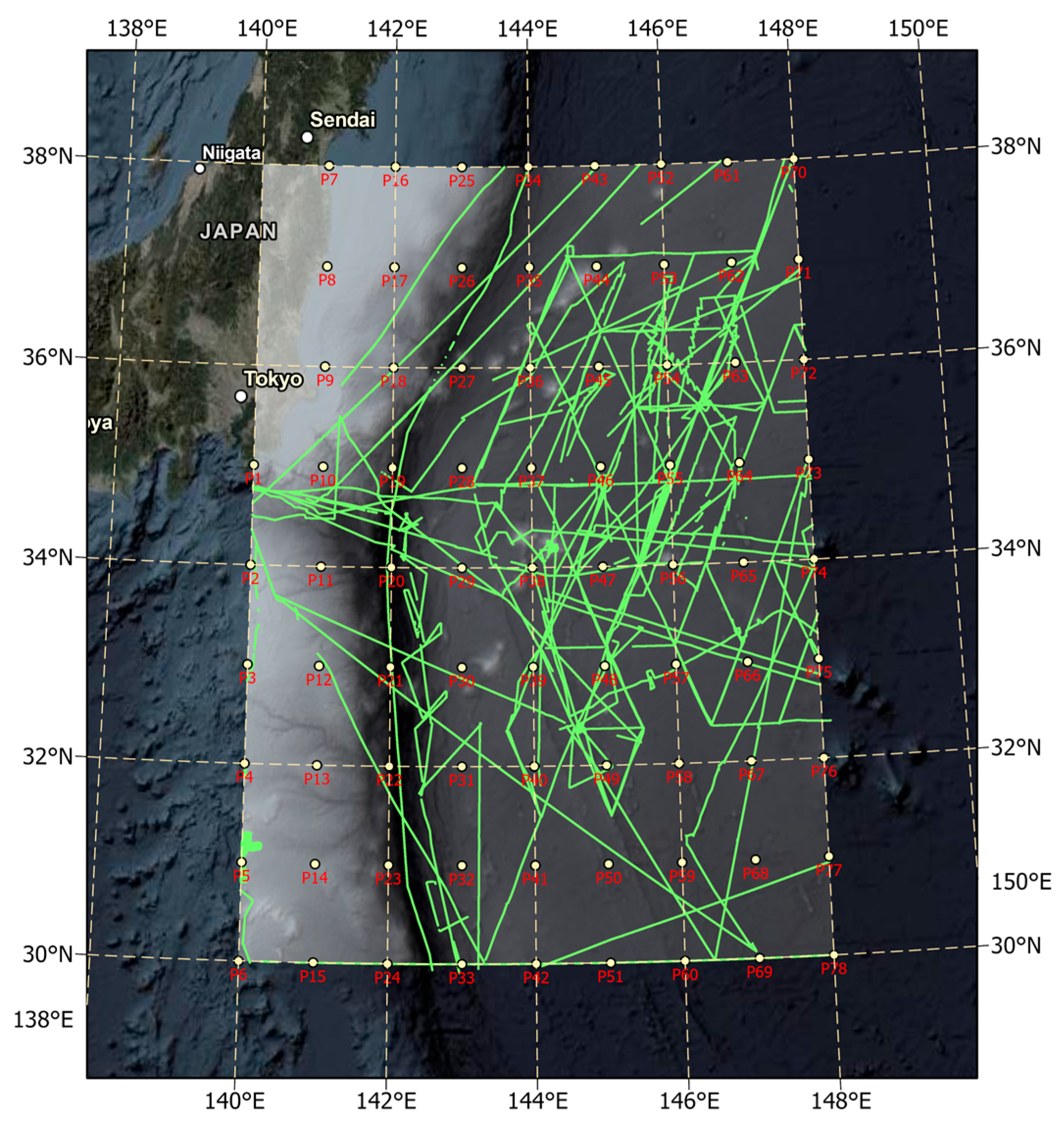
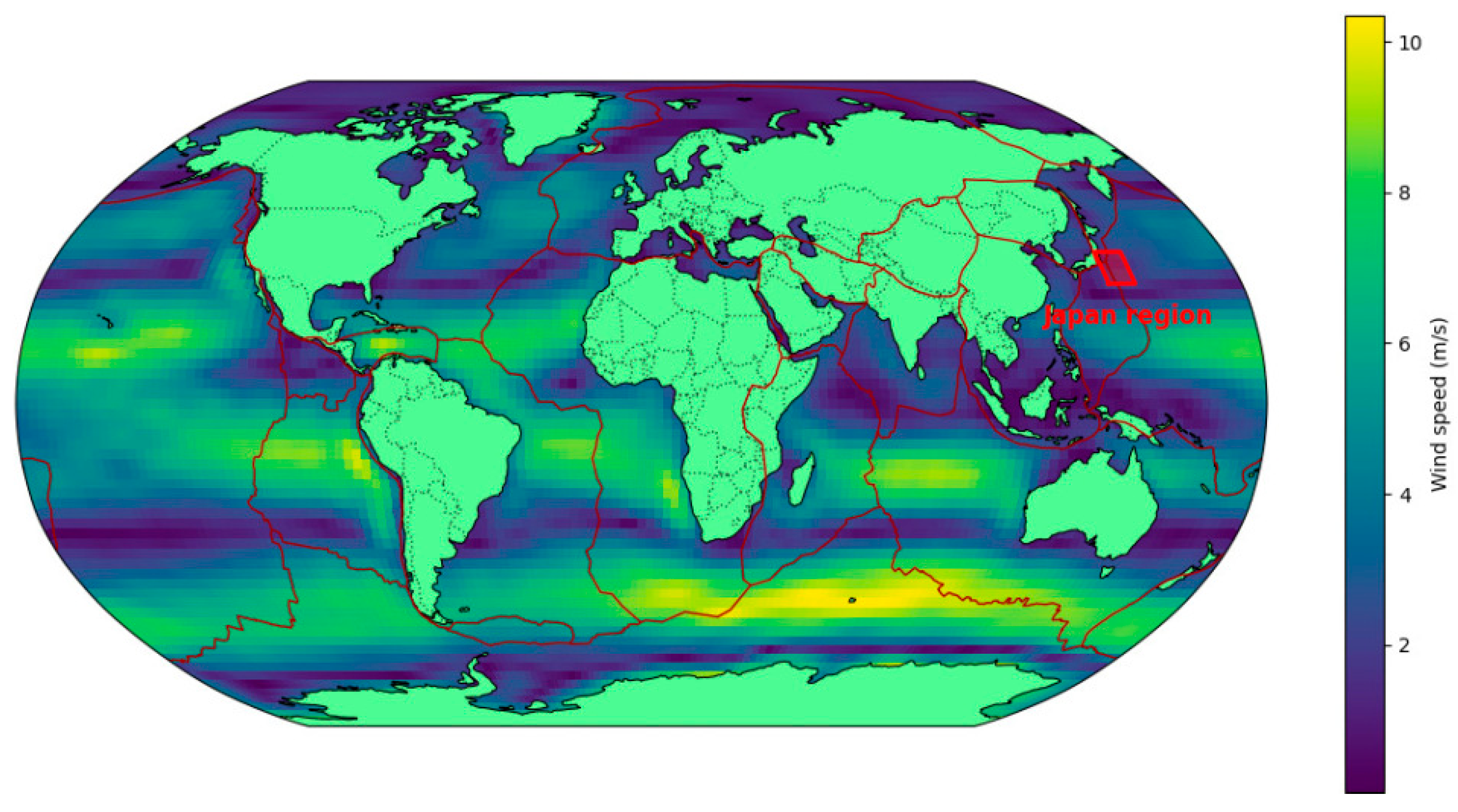
The Japan Trench and the Izu–Ogasawara Trench (also known as the Izu–Bonin Trench), as an extension, are the deepest and most seismically active geotectonic structures on Earth. Located in the western Pacific Ocean, along the eastern coast of Japan (Figure 1a), they represent a complex system of oceanic trenches with a complex geological structure. In the northern part, the Izu–Bonin Trench connects with the Japan Trench and the Sagami Trench, forming the so-called Boso triple junction—one of the most complex tectonic junctions in the world. On the East of the Volcanic Islands, the Izu–Bonin Trench changes direction and becomes the Mariana Trench, the deepest known oceanic depression [18].
The study area covers the active subduction zone of the Pacific Plate under the Japanese Plate, which generates intense geodynamic processes such as strong earthquakes, deformations, and uplifts of the seafloor, and tsunamis. The diversified seafloor relief includes many bathymetric structures, such as Boso Canyon, Katsuura Canyon, Bando Basin, Japanese Guyots, Mogi Seamount, Maiko Seamount, Izu–Ogasawara Rise, and parts of the Izu–Bonin–Mariana volcanic arc. These formations are crucial elements of the geodynamic system of the western Pacific and have specific importance for oceanographic and climate research. Due to tectonic activity and geographical location, the region is essential in the global circulation of heat and matter, where its dynamics affect both local and regional sea level changes. Understanding the geological and oceanographic processes occurring in this region allows for the assessment of long-term changes in the global climate system. In a wider context, this research contributes to a better understanding of the impact of changing ocean conditions on marine ecosystems and societies dependent on coastal resources.
The Japan Trench area is dominated by the warm Kuroshio Current, which significantly affects oceanographic conditions and sea level in this region. Available satellite data, reanalyzes, and the latest literature clearly indicate that the Kuroshio–Oyashio system, including the Kuroshio Extension, has undergone significant shifts and changes in mesoscale activity during the period from 1993 to 2023. These changes have been presented in the paper of Kawakami et al. [19] and in studies on the variability of mesoscale ocean eddies. Studies present that in the Kuroshio–Oyashio region, these eddies often have deep vertical structures, ranging from several hundred meters to even several tens of kilometers, which have a significant impact on local sea level and heat transport in the Kuroshio Extension–Oyashio region [20,21]. These changes affect the spatial distribution of sea surface height, mass, and energy exchange and may modify sediment transport, introducing an additional source of uncertainty in local sea level trends.
At the same time, many analyses point out that the lack of long and dense in situ measurement series in the immediate neighborhood of the Japan Trench makes it hard to identify these processes at the local level [19,22,23].
The motivation for research in this area is driven by the need to extend our knowledge of the specific characteristics of the Japan Trench and its connections with sea level change dynamics (Figure 1b). Due to its unique geological and oceanographic features, this area is a natural laboratory for studying geodynamic and climatic processes. The Japan Trench region is characterized by complex seafloor morphology, including seamounts, canyons, and corrugations. The seafloor is covered by a variable layer of sediments, ranging from a few to several hundred meters thick, comprising clay, silt, turbidites, and volcanic material, whose distribution is strongly controlled by tectonic processes, including seamount subduction leading to local deformations [24,25]. Turbidity flows are common in canyons, transporting sedimentary material downslope and often initiated by earthquakes; their intense activity has been documented, for example, after the 2011 Tōhoku earthquake [26]. The areas of corrugations and uplifts of sediments from the oceanic Plate are stripped away and accumulated into a deformed wedge with intense tectonics [27]. The variable structure of the sediments affects local seafloor deformation patterns and can generate regional anomalies in SLA measurements, as confirmed by seismic analyses and seafloor geodetic observations showing significant bathymetric displacements [28,29]. As a result, sediment diversity and dynamic seafloor deformation are important elements in interpreting sea level trends and changes in this region. The study area covers an area of approximately 660,000 km2 and is one of the most important regions in the world in terms of developing forecasting tools to minimize the risk of natural disasters and assess long-term changes in the climate system [30,31]. The study region and neighboring areas are presented in Figure 1a,b.

3. Materials

3.1. Satellite Altimetry Dataset

The Sea Level Thematic Assembly Centre (SL-TAC) is one of eight thematic data assembly centers within the Copernicus Marine Environment Monitoring Service (CMEMS). The main task of this Centre is to provide altimetric observations of sea surface height. The data are generated by an integrated processing system that includes all Copernicus altimetry missions (Sentinel-6A, Sentinel-3A/B) and other collaboration or occasional missions (Jason-3, Saral[-DP]/AltiKa, Cryosat-2, OSTM/Jason2, Jason-1, Topex/Poseidon, Envisat, GFO, ERS-1/2, Haiyang-2A/B) [32,33]. Multi-mission altimetry data processing was developed by Collecte Localisation Satellites (CLS, https://www.cls.fr/en/—accessed on 12 February 2025) as part of the Data Unification and Altimeter Combination System (DUACS), currently in version DT-2024 (https://duacs.cls.fr—accessed on 12 February 2025). Since November 2024, the DUACS system has been updated, and altimetry data covering the last 30 years have been reprocessed and made available in a new version of products (DT-2024) through CMEMS and Copernicus Climate Change Service (C3S) services. The updated product series incorporates new geophysical correction standards, advanced mapping methods, and improved processing techniques, providing a significant improvement in accuracy over the previous DT-2021 version. The products provided by SL-TAC include Level 3 (L3; along the track) and Level 4 (L4; grid) altimetry data. Both are generated in near real time (NRT) or with a delay/multi-year (DT/MY). The data has global coverage but is also available in regional versions [34]. The 4-level grid product (SEALEVEL_GLO_PHY_L4_MY_008_047) from the DT-2024 series was used to analyze long-term sea level changes over a period of 31 years. This product is currently available in an increased spatial resolution of 0.125° × 0.125° while maintaining the same temporal sampling. The previous netCDF files of the DT-2021 series have been deleted and replaced with new ones, compatible with the DT-2024 version [35]. The daily sea level anomalies (SLA) from 1 January 1993 to 31 December 2023 for each virtual station were used. Access date: 12 February 2025.

3.2. Bathymetry Dataset

The National Centers for Environmental Information (NCEI) and International Hydrographic Organization (IHO) Data Center for Digital Bathymetry (DCDB) offer open access to bathymetric data collected by hydrographic, oceanographic, and industrial entities during international surveys and expeditions. These data are available to the public without any limitations. The data is obtained from different sources, mainly governmental and academic (source information can be found in the metadata of each cruise), and consists of raw sonar data files. The datasets may also include processed or edited versions of the sonar data, auxiliary data, derivative products, and metadata. The multibeam bathymetric dataset, which includes 23 bathymetric tracklines, was used in this study (https://www.ncei.noaa.gov/maps/iho_dcdb/, accessed on 22 January 2025)—Figure 2. Data from two expeditions were incomplete, so the tracklines were supplemented with soundings from the Marine Geoscience Data System (MGDS) repository. All bathymetric datasets were acquired using multibeam sonars. The data files were provided in a format compatible with MB-System and contained backscatter and displacement bathymetry data that were processed after acquisition. These data were processed by the Global Multi-Resolution Topography (GMRT) team and incorporated into the GMRT Synthesis [36,37]. Due to the irregular distribution of surveys and large gaps between tracklines, the publicly available raster model of the General Bathymetric Chart of the Oceans (GEBCO_24) seafloor topography, released in July 2024, was used in this study [38]. This is a global bathymetric model with a resolution of 15 arcsec (~500 m), in which data values are assigned to pixels and represent the depth in meters at the center of the grid cells.
The grid uses version 2.6 of the SRTM15+ dataset as its “base” [39,40]. GEBCO also provides a type identifier (TID) grid that specifies the type of source data used for each grid cell, including single-beam ship-based bathymetry, multibeam ship-based bathymetry, lidar bathymetry, satellite gravity-derived depths, and grid interpolation depths [41]. Data from the NOAA NCEI repository were processed directly using the MB-System. The GEBCO model is not directly a multibeam file, but was used to fill in gaps where multibeam data is missing. The datasets were combined into a comprehensive bathymetric layer.
The final bathymetric model provides detailed mapping of the seafloor, combining the global coverage of GEBCO_24 with the high accuracy of local NOAA NCEI measurements. Bathymetry access date: 22 January 2025.

3.3. Gravity Anomalies Model and Geoid Model

Ongoing research on the depth and forms of seafloor topography is mostly based on analyzing marine gravity anomalies, which express local mass concentrations. Structures such as seamount ridges and elevations generate positive gravity anomalies, while ocean trenches and remains of glacial deposits generate negative anomalies [41,42]. Based on satellite altimetry data, Smith and Sandwell [43] developed a bathymetric model showing a significant correlation between seafloor topography and gravity anomalies in the wavelength range of 15 to 160 km. This study used marine gravity anomaly data from the Scripps Institution of Oceanography (SIO V32.1) model, published in August 2022, with a resolution of 1 arc-minute. This data is available in a 1 min × 1 min spatial grid and was obtained from the Scripps Institution of Oceanography (SIO V32.1) repository (https://topex.ucsd.edu/), University of California. Access date: 20 January 2025.
This study also used the local gravimetric geoid model JGEOID2019 developed by the Japan Geospatial Information Authority. It covers the area from 20° N to 50° N and from 120° E to 150° E with a 1 × 1.5 arc-minute (2 km) grid resolution. Geoid heights are referenced to the GRS80 ellipsoid. The model integrates the GOCE-based global geopotential model (GOCONS_GCF2_TIM_R6), land and marine gravity measurements, and the SIO V28.1 altimetry-derived marine gravity model. Its calculations are consistent with the second Helmert condensation method using Faye’s anomaly, combined with the “remove-calculate-restore” approach and the FEO kernel. Validation of the model with GNSS or leveling geoid undulations presents an accuracy of about 6 cm, which is an improvement of about 2 cm compared to the previous JGEOID2008 model [44]. Access date: 5 September 2025.

3.4. Mean Dynamic Topography Model

Mean Dynamic Topography (MDT) is a surface representation of mean ocean circulation. It is a key tool in ocean dynamics research, sea level change studies, analyses of the impact of bathymetry on tides and ocean surface formation, and in improving the accuracy of climate and hydrodynamic models [45]. In this research, the geodetic mean dynamic topography model DTU22MDT is derived using the recent DTU21MSS mean sea surface. The geodetic MDT was computed using the XGM2019e combined geoid model, which includes satellite altimetry-derived marine gravity data. The processing scheme used to derive the geodetic MDT is based on spatial filtering to reduce errors. The completed model DTUUH22MDT provides a state-of-the-art description of the 20–year mean global ocean circulation. This model is provided at a spatial resolution of 0.125° × 0.125° and is available in both GRAVSOFT grid format (ASCII) and standard XYZ ASCII file format. In the Japan Trench area, MDT values range from 0.35 m to 1.55 m. More information can be found on the Technical University of Denmark (DTU) website and in available literature [46,47]. Access date: 1 September 2025.

3.5. Wind Speed and Direction

Seafloor topography has a major impact on the way wind interacts with water movement, which translates into local sea level fluctuations. Therefore, in this study, we have analyzed the wind velocities in relation to sea level changes, which highly depend on local geographical conditions. Long-term mean monthly wind velocities were obtained from the NOAA Physical Sciences Laboratory (PSL) Public Reanalysis Dataset Collection. The data are from the NCEP/NCAR Reanalysis Project carried out by the NOAA PSL. Reanalysis datasets are created by entering climate observations using the same climate model throughout the reanalysis period to minimize the impact of modeling changes on climate statistics. The reanalysis data are created based on a wide range of meteorological observations from ships, satellites, in situ stations, radars, etc. The data sets are publicly available in standard netCDF format, and the model covers the period from 1 January 1948 to 1 August 2025, in a grid resolution of 2.5° × 2.5°, including 17 atmospheric pressure levels. For the aim of this study, wind velocity data at a level of 1000 mb, corresponding to an altitude close to sea level, were selected. The other pressure levels have approximate altitudes of: 850 mb (approximately 1500 m above sea level), 700 mb (approximately 3000 m above sea level), 500 mb (approximately 5500 m above sea level), and 300 mb (approximately 9300 m above sea level). These heights may vary depending on the average air temperature and the direction of air mass movement (rising/falling due to convergence or divergence). Data access: 26 September 2025 (https://downloads.psl.noaa.gov/Datasets/ncep.reanalysis/Monthlies/pressure/).

3.6. Glacial Isostatic Adjustment (GIA) Model

The LM17.3 model [48] is a global model of Vertical Land Motion (VLM) caused by Glacial Isostatic Adjustment (GIA). It was developed to reproduce the Earth’s response to changing ice loads from the Last Glacial Maximum (LGM) to the present day. The model was computed with a resolution of 0.5° × 0.5°, and the values are in mm/yr. It uses the Earth model VM5a [49]. In contrast to classical global GIA models [50,51,52], the LM17.3 model combines several regional ice load models, allowing for the capture of their spatial variability. The LM17.3 model is used in studies of vertical land movement trends, sea level projections, interpretation of GRACE and GNSS data, and validation of GIA models (https://doi.pangaea.de/10.1594/PANGAEA.932462). Access date: 10 September 2025.

4. Methodology

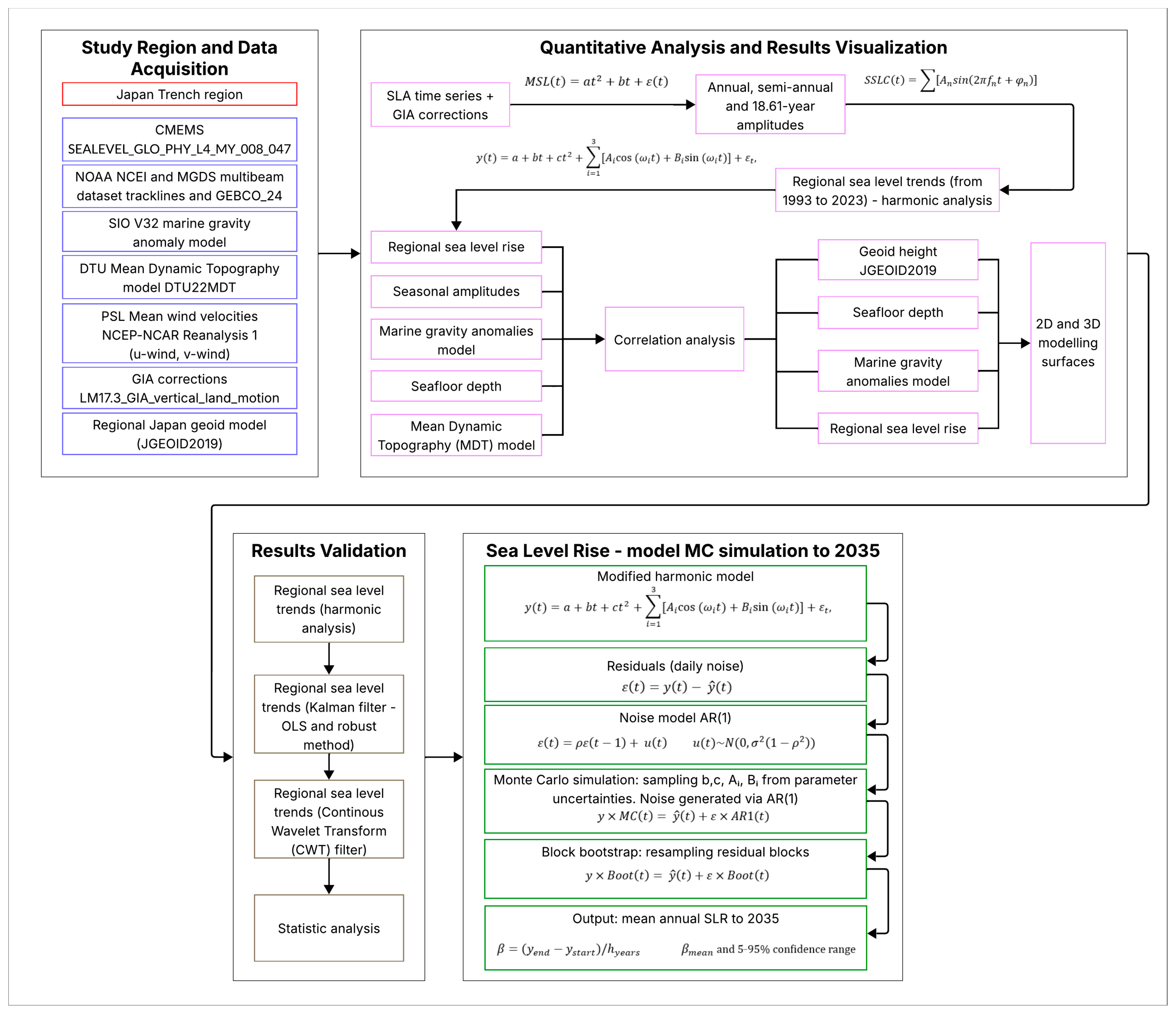
A methodological approach was implemented in the study to assess regional sea level rise (SLR) in relation to seafloor topography and selected geophysical variables (depth, mean dynamic topography (MDT), gravity anomalies, and wind velocity). This process was based on hybrid datasets combining satellite measurements, numerical, and bathymetric models. The research methodology includes data acquisition and processing, estimation of regional sea level trends, accelerations, and seasonal components, correlation analysis, validation of results, and simulation of future SLR scenarios.
Bathymetric data were obtained from the NOAA NCEI and MDGS databases, which made it possible to supplement missing measurement tracks. Files in MB-System formats were processed in the MB-System environment. In addition, the GEBCO_24 global bathymetric model was used, which was integrated with multibeam surveys to create a single, coherent, high-resolution bathymetric layer. Seventy-eight virtual stations were designed in the study area, located at a 1° × 1° grid. For each station, a 31-year time series of daily sea level anomalies (SLA) was obtained for the period 1993–2023. The data were derived from satellite altimetry and corrected by distributors for atmospheric effects (ionospheric delay, tropospheric effects) and geophysical processes, including crustal and ocean tides, tidal loading effects, sea state bias, and the inverted barometer effect.
Sea level change trends were estimated using ordinary least squares (OLS) regression and robust regression, which mitigates the impact of outliers. The linear model takes the following formula:
M S L t = a t + b + ε t
where M S L t —mean sea level in time t , a —bias, b —trend, ε t —residuals.
In the case of quadratic regression, including the acceleration of sea level change, the following model was used:
M S L t = a t 2 + b t + ε t
Harmonic analysis and Fast Fourier Transform (FFT) were used to identify seasonal fluctuations [53]. The model to describe the seasonal sea level cycle (SSLC) was presented as a sum of harmonics with amplitudes and phases corresponding to monthly MSL maxima and minima MSL:
S S L C t = A n s i n 2 π f n t + φ n
where A n —amplitudes, f n —frequency, φ n —phase.
A combination of regression, harmonic analysis, Continuous Wavelet Transform (CWT), and Kalman filter (KF) was used to validate sea level trends. This approach allows for the assessment of both seasonal and long-term sea level variability and independent verification of cyclical signal components [53,54,55,56,57,58,59]. These methods were defined by the following equations:
S L R t = T r e n d t + i H a r m o n i c i t + A m p l i t u d e i ( t )
S L R C W T t = T r e n d t + C W T t + A m p l i t u d e i ( t )
S L R K F t = T r e n d t + K F t + A m p l i t u d e i ( t )
where S L R t is the sea level rise at time t ; S L R C W T t is the sea level rise validated by the Continuous Wavelet Transform method; S L R K F t is the sea level rise validated by the Kalman filter method (OLS and robust); H a r m o n i c i t is the harmonic component representing seasonality; and A m p l i t u d e i ( t ) is the amplitude of seasonal and nodal cycles.
The combination of linear regression, harmonic analysis, FFT, CWT, and Kalman filtering enabled a reliable assessment of seasonal and long-term sea level variability. In the final process, a simulation of sea level rise until 2035 was performed based on a modified harmonic model with a quadratic component and the Monte Carlo method [60,61]. The analysis was carried out for 12 selected stations: 3 stations located in the coastal zone and canyons, 3 stations on the ocean trench, 3 stations on seamounts, and 3 stations in the corrugated seafloor. The results allowed for the estimation of potential differences in sea level change dynamics depending on bathymetric conditions. Sea level change simulations were developed using a quadratic trend model with a seasonal component and an AR(1) autoregressive model [62], which assumes autocorrelation between the value of the predicted variable and time-delayed values. Monte Carlo simulations. This method allows for a realistic representation of seasonality and autocorrelation of data, ensuring reliable estimation of forecast uncertainty. Although the approach is statistical and does not take physical processes into account, it is a precise tool for analyzing long-term SLR trends. The combination of the two methods has enabled a realistic prediction of sea level changes, taking into account seasonality and trend acceleration.
For each of the 12 selected points located on different seafloor forms (trench, canyon, seamount, and corrugations), an analysis of daily sea level anomaly changes over a period of 31 years was carried out. To estimate the long-term trend and seasonality, a deterministic model of the following form was used:
y ( t ) = a + b t + c t 2 + i = 1 3 [ A i c o s ( ω i t ) + B i s i n ( ω i t ) ] + ε t
where a means bias, b means trend, c means acceleration, A n means amplitudes, f n means frequency, and φ n means phase. Sine and cosine components represent cyclic seasonal fluctuations (annual, semi-annual, and 18.61–year).
The residuals of the model ε t were described by a first-order autoregressive model (AR(1)), which allowed autocorrelation [63]. The AR(p) model, in which the value is a linear combination of previous values, uses process memory, i.e., the assumption of autocorrelation between the value of the forecast variable and values delayed in time (p denotes the order of the model/delay/how many previous observations influence the current value of AR(p)).
The model parameters were estimated using the non-linear least squares method, followed by Monte Carlo simulations with parameters from normal distributions with variances corresponding to estimation errors. For each location, 1000 initial values were obtained, which allowed uncertainty intervals (5–95% percentiles) for subsequent sea level changes to be obtained. The selected points were grouped according to the type of seafloor topography. For each seafloor type, the linear trend b (cm/yr), acceleration c (cm/yr2), and uncertainty range obtained from Monte Carlo simulations were estimated. This approach allowed the study to assess whether the seafloor topography influences the local rate of sea level change, which may result from differences in ocean circulation and local gravity effects. The combined use of linear regression, harmonic analysis, CWT, and Kalman filtering allowed for a comprehensive assessment of long-term and seasonal sea level changes. The use of Monte Carlo simulation and the AR(1) model allowed the study to determine the uncertainty of forecasts depending on bathymetric structures. The approach used is an integrated, multi-model scheme for analyzing regional SLR trends, ensuring high reliability of results. The research process scheme is presented in Figure 3.

5. Results

5.1. Long-Term, Regional SLR Variability Regarding Seafloor Morphology

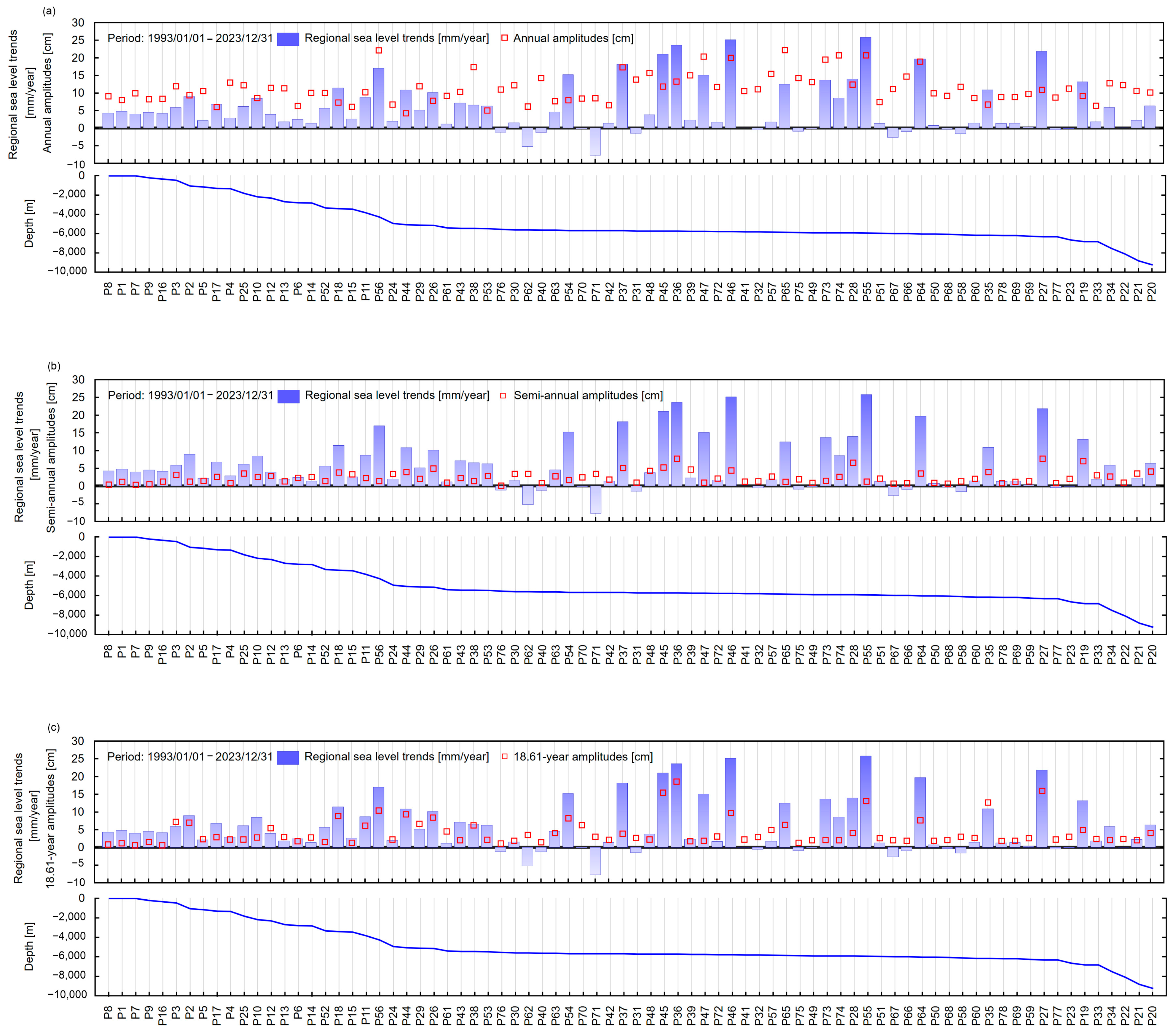
To assess the impact of seafloor topography on the spatial variation of regional sea level trends, the spatial distribution of regional sea level trends for each virtual station with corresponding depth values was presented in Figure 4. Previous studies have reported that the more diverse the seafloor structure, the higher the variations in regional sea level trend values. In deep parts of the ocean basin (e.g., in the Peru–Chile Trench), trend values were significantly lower, while at the tops of seamounts (e.g., New England and Corner Rise Seamounts) they were several times higher [53,64].
Estimation of regional sea level changes from 1993 to 2023 was carried out for 78 virtual stations (P1–P78) and presents spatial variation in both sea level change trends and cyclic amplitudes in relation to different seafloor forms. The trend values, determined by harmonic analysis, range from −7.8 ± 0.1 mm/yr to 25.8 ± 0.2 mm/yr. The depths of the seafloor range from 25 m to over 9200 m, confirming the presence of morphologically diverse features: continental shelf, slopes, ocean trench, corrugated areas, and underwater seamounts. Mean regional sea level trend for the entire area (656,980 km2) is 6.0 ± 0.01 mm/yr, which is higher than the mean observed global value. According to Hamlington et al. [65], the rate of global mean sea level rise over the last three decades has increased from about 2.1 mm/yr in 1993 to about 4.5 mm/yr in 2023. The highest positive trends, exceeding 20.0 mm/yr, were identified at points P36, P45, P46, P55, P56, P64, and P73, located between 35° N and 36° N and 142–148° E. These areas cover the eastern margin of the Japan Trench and parts of the Pacific Plate, which are subject to intense vertical motion associated with subduction. The lowest or negative trends were identified at points P31, P32, P49, P66–P67, P71, which occur in the central and western parts of the studied region (31–32° N and 142–148° E), suggesting more stable tectonic conditions characteristic of the Philippine Plate. The amplitudes of the annual cycle range from 4.27 cm (P44) to 22.30 cm (P65). The amplitude values, exceeding 20 cm, were observed at points P46, P55, P56, P65, and P74, located in the eastern part of the Japan Trench (depth > 4000 m), where the maximum fluctuations occur in April and October. Regional sea level trends in locations where depth is lower than 4000 m do not exceed 12.0 mm/yr. Above 4000 m depth, significant jumps from extremely positive (25.84 mm/yr) to negative values (−7.75 mm/yr) are observed. The annual amplitude values are also irregularly distributed at points located in depth > 4000 m (from 4.27 cm to 22.30 cm). In locations where depth is lower than 4000 m, annual amplitudes are approximately 10 cm. The amplitudes of the semi-annual cycle are significantly lower than the annual amplitudes (values range from 0.17 cm to 7.77 cm in stations with depth higher than 5500 m (P27, P36, and P19). The amplitudes are less dispersed in comparison with the depth and values of the regional trends of sea level. This indicates that the semi-annual cycle is weaker but more regular in the study area, probably related to seasonal air mass distribution, currents, or local monsoons. The amplitudes of the 18.61-year lunar nodal cycle range from 0.63 cm (P16, depth = 362 m) to 18.62 cm (P36, depth = 5750 m). In some locations, the amplitudes of the 18.61-year cycle reach values similar to or even higher than those of the annual cycle (P27, P36, P45—seamounts location). Furthermore, it can be observed that as the sea level trend increases, the amplitudes of the 18.61-year nodal cycle also increase. The amplitudes of the cycles (annual, semi-annual, nodal) are often comparable in magnitude to the effects of long-term trends, which emphasizes the importance of considering cyclic character in SLA time series analyses.

5.2. Analysis of Correlations Between Geophysical Parameters and SLR Trend

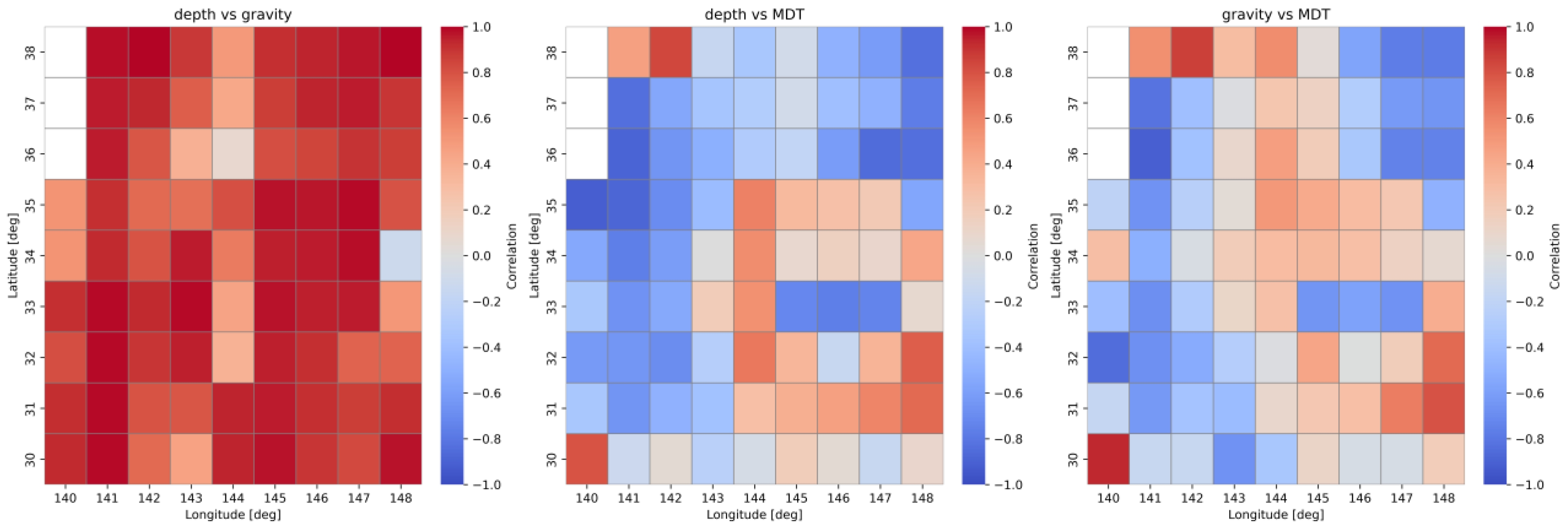
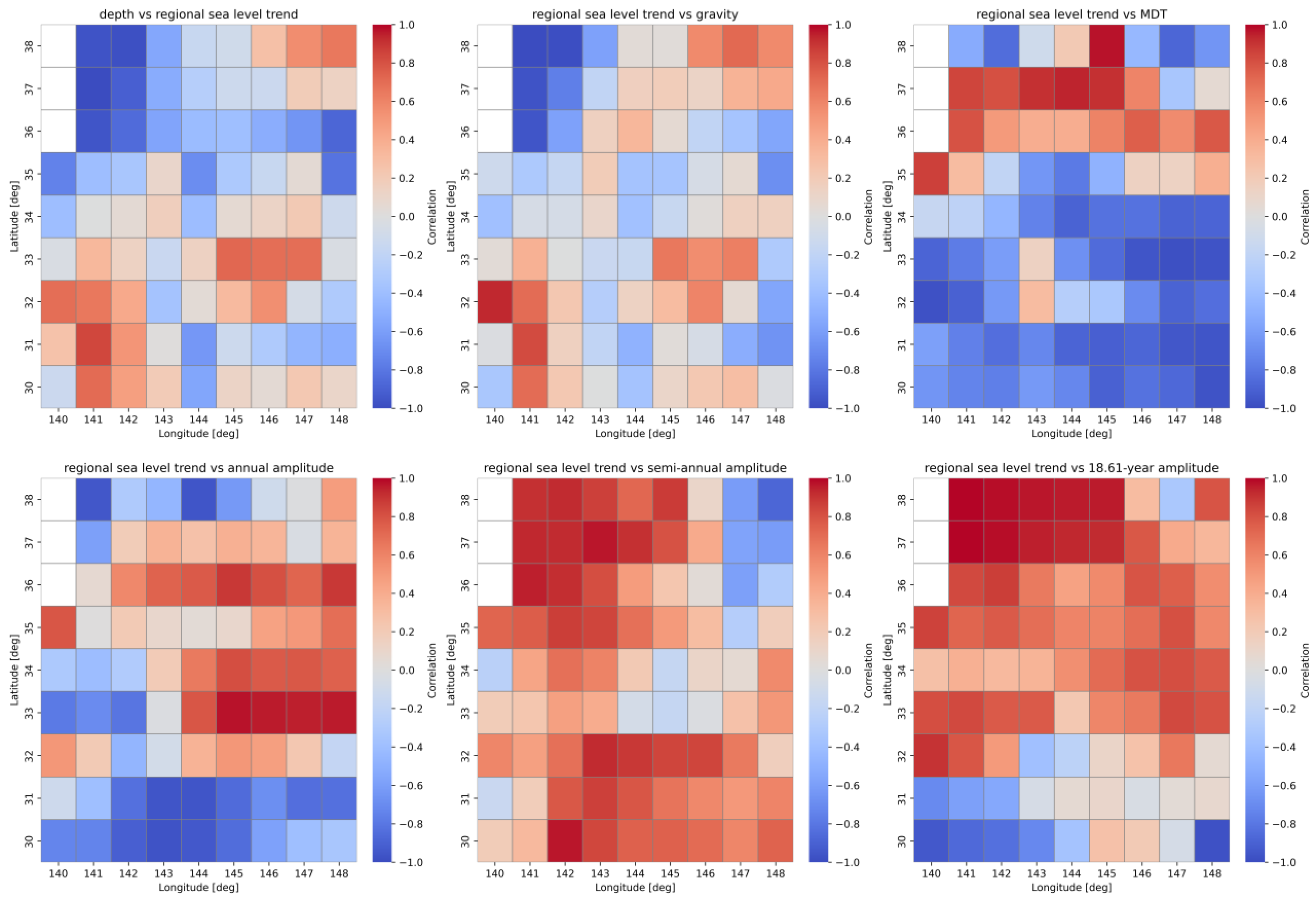
The depth profile point that the variability of trends and amplitudes is not a simple function of depth—in some shallow locations, amplitudes remain low, while at higher depths, significantly increased values are observed. This variation suggests that not only seafloor topography but local geophysical processes can affect sea level dynamics. The analysis suggests that the amplitudes of the cyclic sea level variations (annual, semi-annual, and 18.61-year) are essential and can significantly affect the interpretation of observed long-term trends. The lack of a simple relationship between amplitudes, trends, and depth indicates that other factors—such as the geological structure, the physical properties, or local tectonic conditions—may have an equally strong impact on sea level dynamics. In order to investigate in detail the spatial relationship between seafloor topography and local sea level variability, spatial Pearson correlation maps were generated (Figure 5), which allow for the assessment of mutual spatial relationships.
An analysis of Pearson’s correlation coefficients between variables: depth, marine gravity anomalies, MDT, regional sea level trends, and amplitudes of the different cycles has revealed significant spatial relationships. The correlation values indicate that the sea level variability is correlated with the seafloor topography and other geophysical variables. Strong correlation was observed between depth and marine gravity anomalies, where the correlation coefficients (r) ranged from 0.49 to 0.93. A positive correlation confirms that the values of gravity anomalies are lower in the deeper parts of the ocean and higher in the seamount area. Next, the correlation between depth and MDT is low and negative (from −0.33 to −0.70), which means that lower MDT values are correlated with higher depths. This relationship is consistent with relations between MDT and ocean circulation, where MDT is lower in regions with high depth or weak ocean circulation. Higher MDT values correspond to areas with upwelling phenomena and surface currents [66,67].
Correlations between regional sea level trends, depth, and gravity anomalies point out spatial variability.
Correlation of regional sea level trends–depth has negative coefficients (from –0.52 to –0.25), suggesting that the regional sea level trends are lower in deep-water areas, while the regional sea level trends–gravity correlation ranges from –0.19 to +0.03, which may indicate local disturbance effects. Regional sea level trends–MDT relationship is positive (approximately 0.2–0.9), which means that areas with higher dynamic topography (e.g., continental shelves and surface current zones) demonstrate SLR. This phenomenon is consistent with observations that elevated MDT reflects regions with increased circulation and heat transport energy, which strongly modulate the local rate of SLR [68,69].
Coefficients of relation of regional sea level trends–annual amplitude range from –0.95 to +0.36, which means that in some areas SLR is associated with a decrease in seasonal amplitude, while in others it is associated with an increase. Negative values are dominant in deep-water areas, where seasonality is weakly defined. The correlation between the regional sea level trends and semi-annual amplitude is positive (0.68–0.96), suggesting that shorter seasonal cycles can intensify local sea level oscillations in shallow water areas. The correlation between the regional sea level trends and the 18.61–year amplitude (lunar nodal cycle) shows high positive values (0.77–0.95), suggesting that sea level changes are strongly modulated by the nodal cycle. This confirms the importance of the long-term tidal component modulating local SLR trends [70].
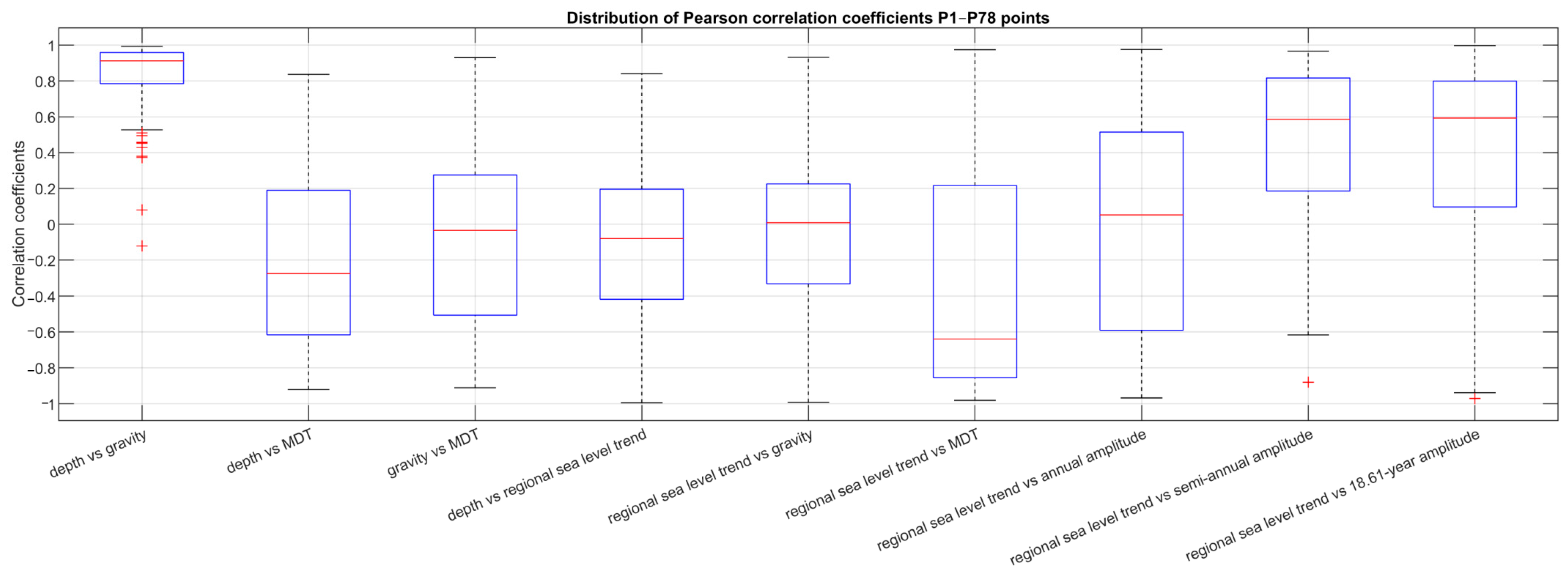
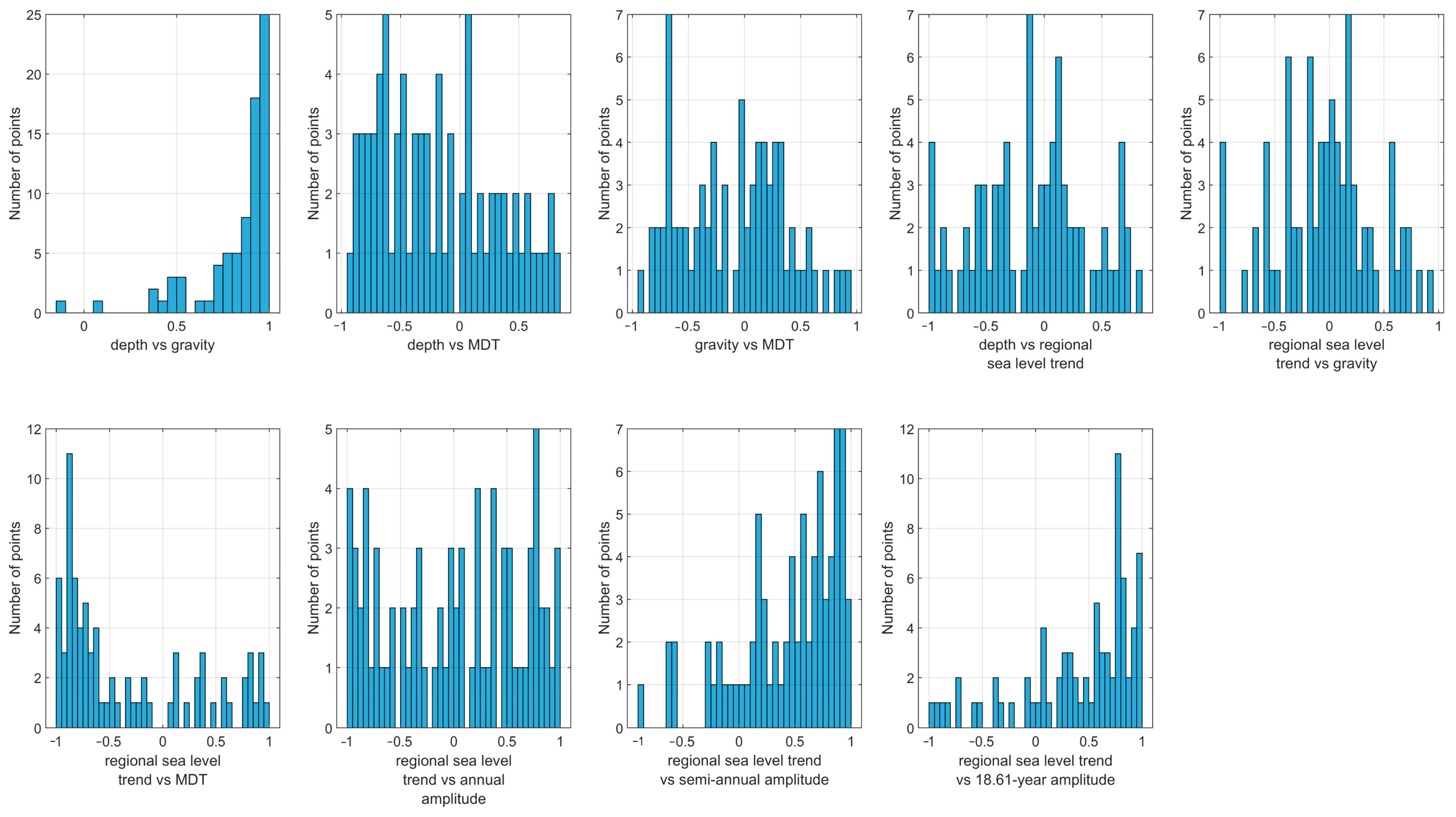
This spatial comparison by Pearson’s coefficients clarifies that the highest correlations occur between dynamic topography, tidal cycle amplitudes, and SLR trend in areas with complex morphology, while negative relationships dominate in deep-water regions, indicating stabilization or a deceleration in sea level change. In this study, the distribution of correlation coefficients is represented via boxplots (Figure 6) and histograms (Figure 7).
The boxplots illustrate differences in median values and interquartile ranges (IQRs), which indicate the strength and stability of relations between variable pairs. The lowest IQR and highest consistency has been observed in the depth–gravity pair (median ≈ 0.91), which indicates a strong, positive, and stable correlation. The largest IQR is observed for the depth–MDT pair (median ≈ –0.19), regional sea level trends—MDT (median ≈ –0.64), and regional sea level trends—annual amplitude (median ≈ 0.008), which suggests high coefficient variability and sensitivity of the relationship to local conditions. Outliers occur in the depth—gravity relation and separately in the regional sea level trends—18.61-year amplitude and the regional sea level trends—semi-annual amplitude, confirming the general consistency of the data with few anomalies.
Low, negative medians (from –0.32 to –0.03) were recorded for gravity—MDT, depth—regional sea level trends, and regional sea level trends—gravity, indicating weak or slightly negative, potentially non-linear relationships. Histograms (Figure 7) confirm these observations: depth—gravity shows a dominance of strong, positive correlations (r > 0.75), while depth—MDT and gravity—MDT show dispersed values around zero, indicating high variability and no clear linear relationship.
The distributions of pairs depth—regional sea level trends and regional sea level trends—gravity are wide and symmetric, with no clear dominant direction of the relationship. The depth—MDT pair is characterized by a dominance of negative correlations (median ≈ –0.64), while the depth—semi-annual amplitude and depth—18.61-year amplitude are shifted toward positive values (median ≈ 0.59), indicating moderate positive correlations. The annual amplitude—regional sea level trends present a wide, symmetrical distribution around zero (median ≈ 0.05), suggesting the coexistence of positive and negative correlations and potentially non-linear relationships.

5.3. The Importance of Seafloor Topography, Gravity Anomalies, Geoid Heights, and GIA Corrections in SLR Trend Estimation

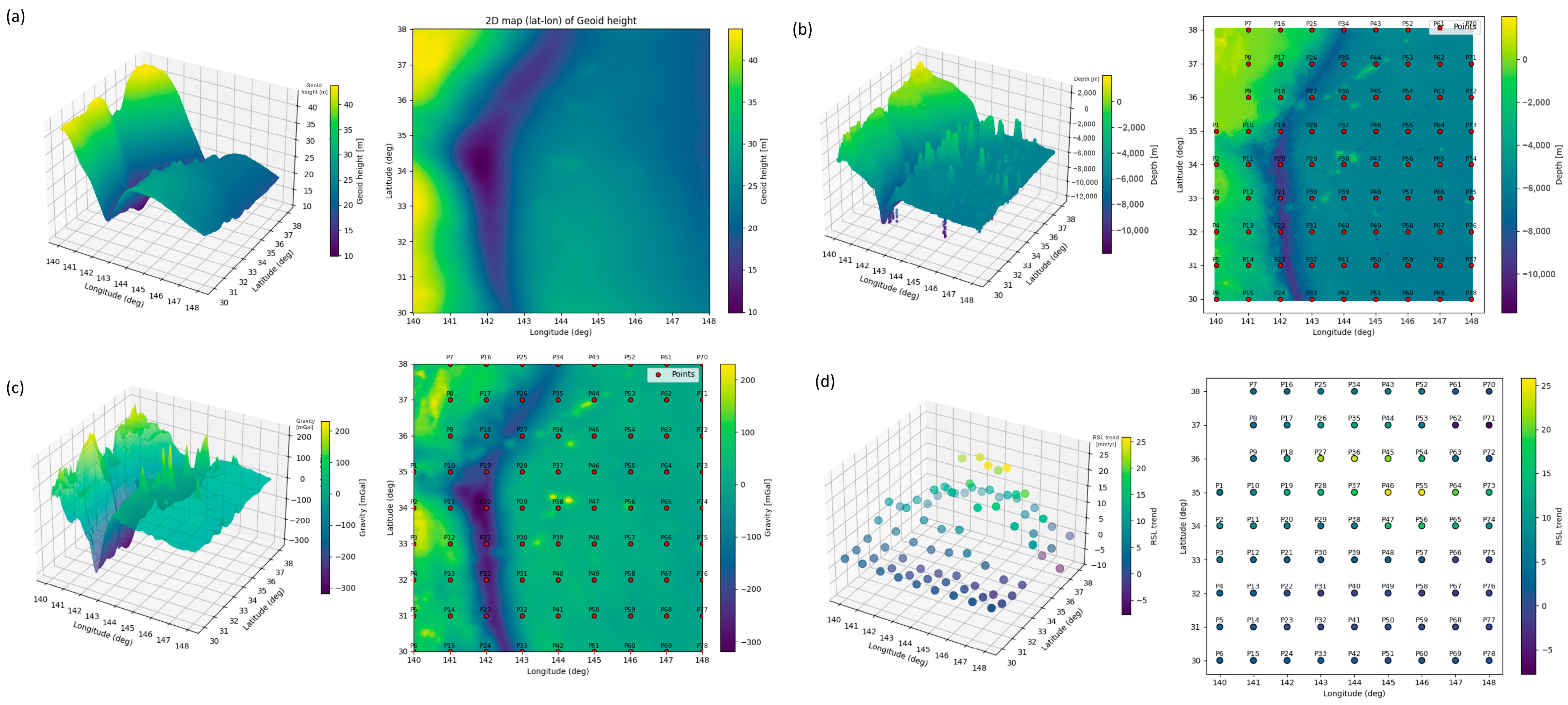
After computing the correlation coefficients and presenting them in the form of correlograms, 2D and 3D models were developed to illustrate the spatial distribution depth in the analyzed area, geoid heights, gravity anomalies and SLR trends (Figure 8).
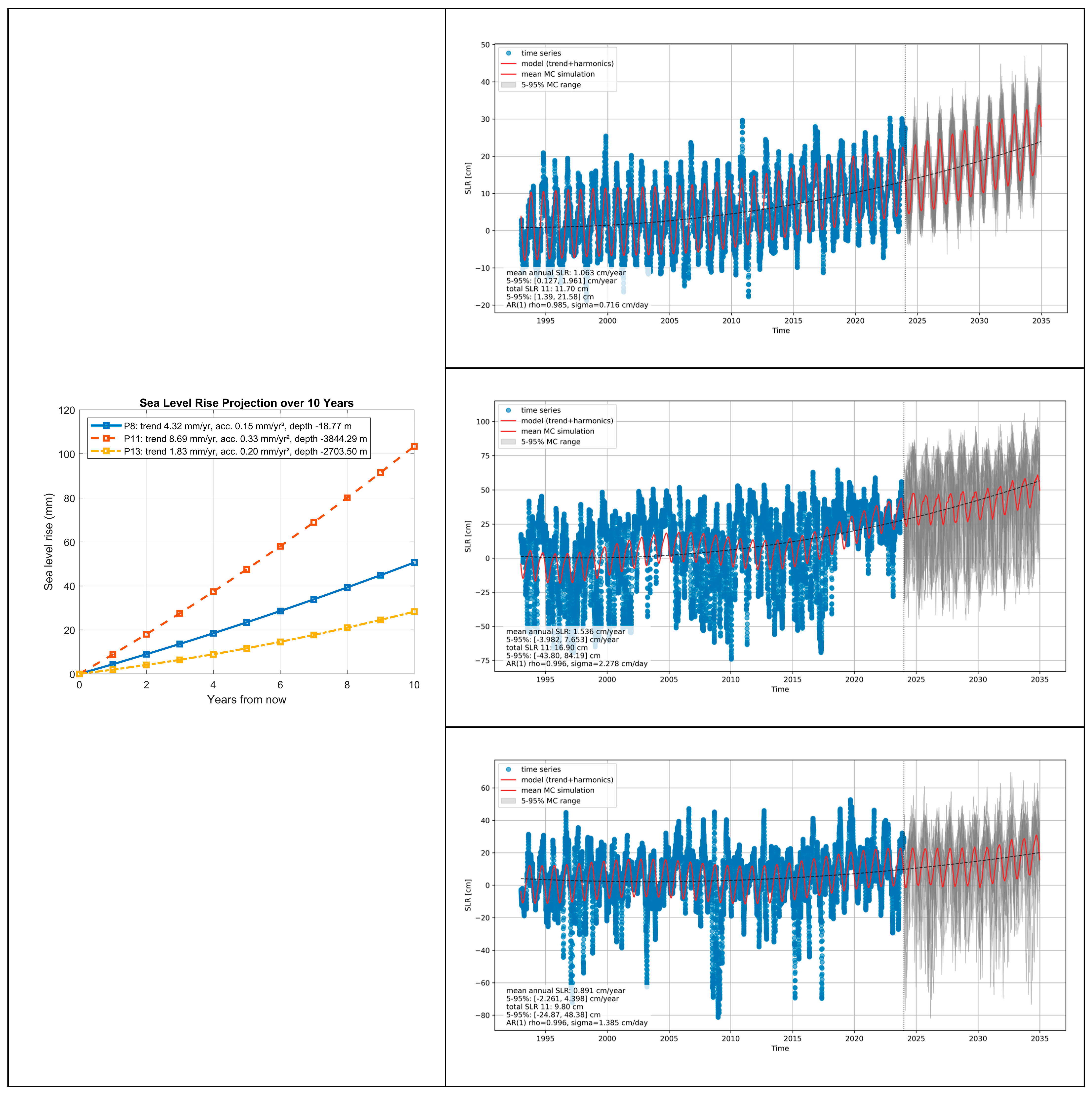
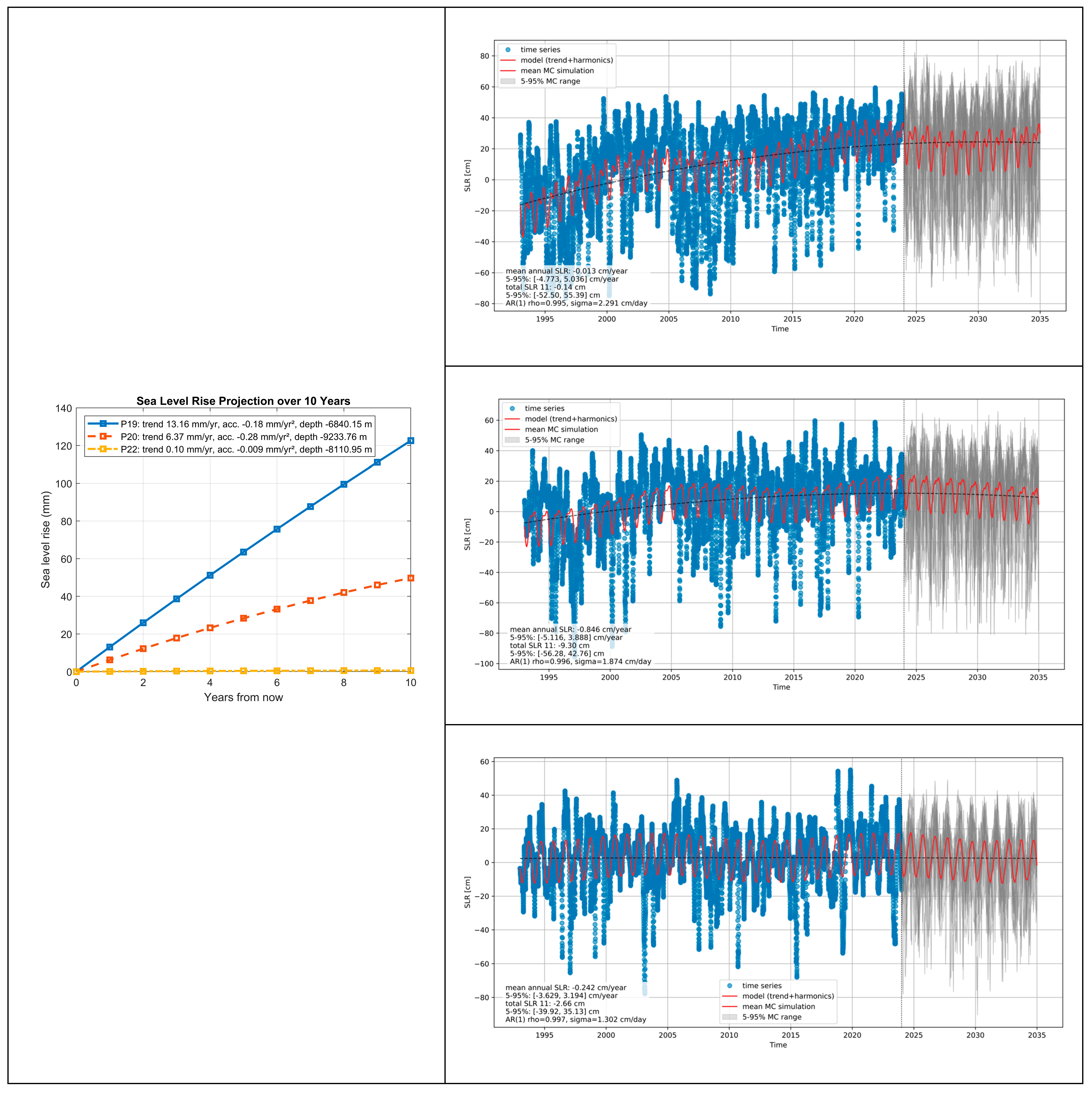
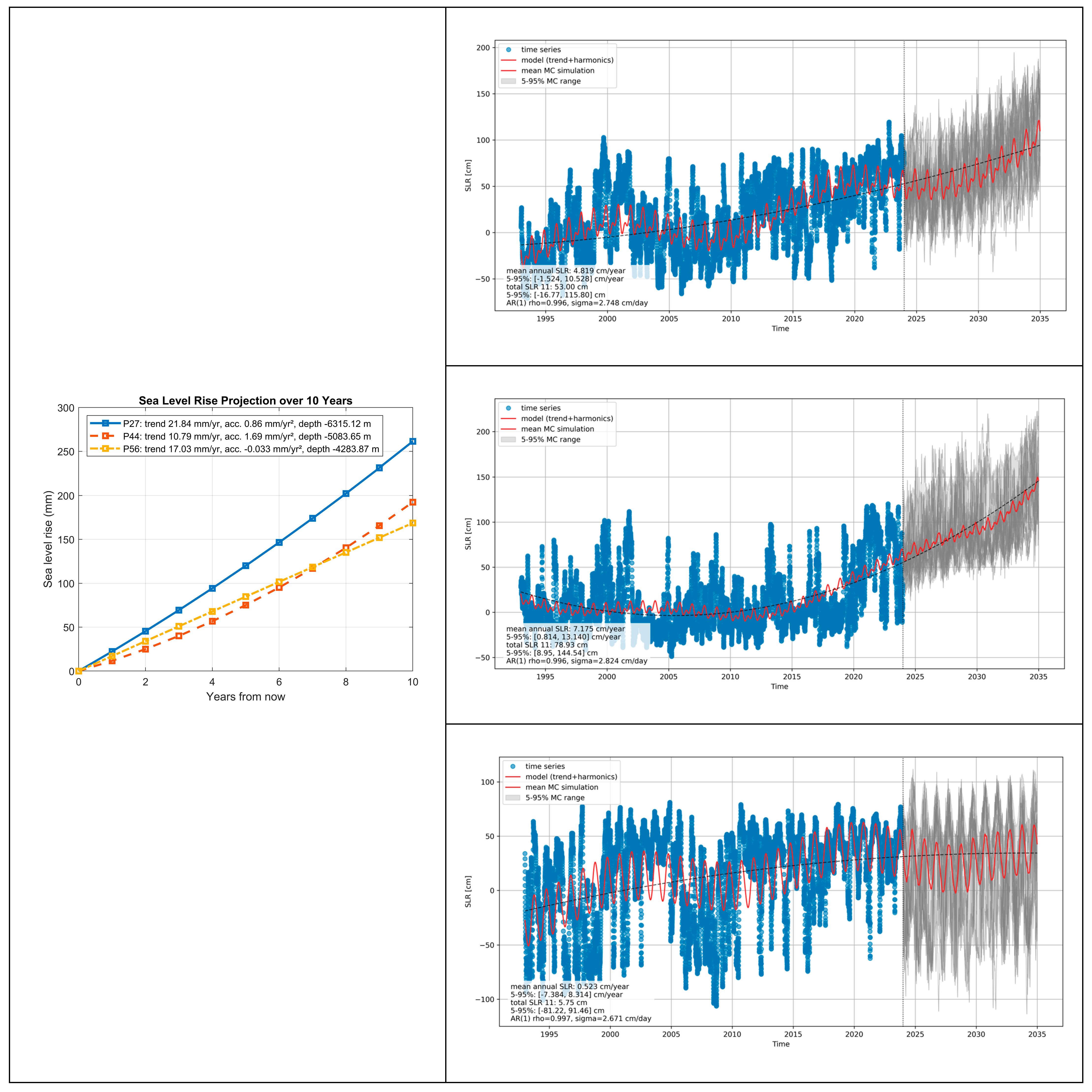
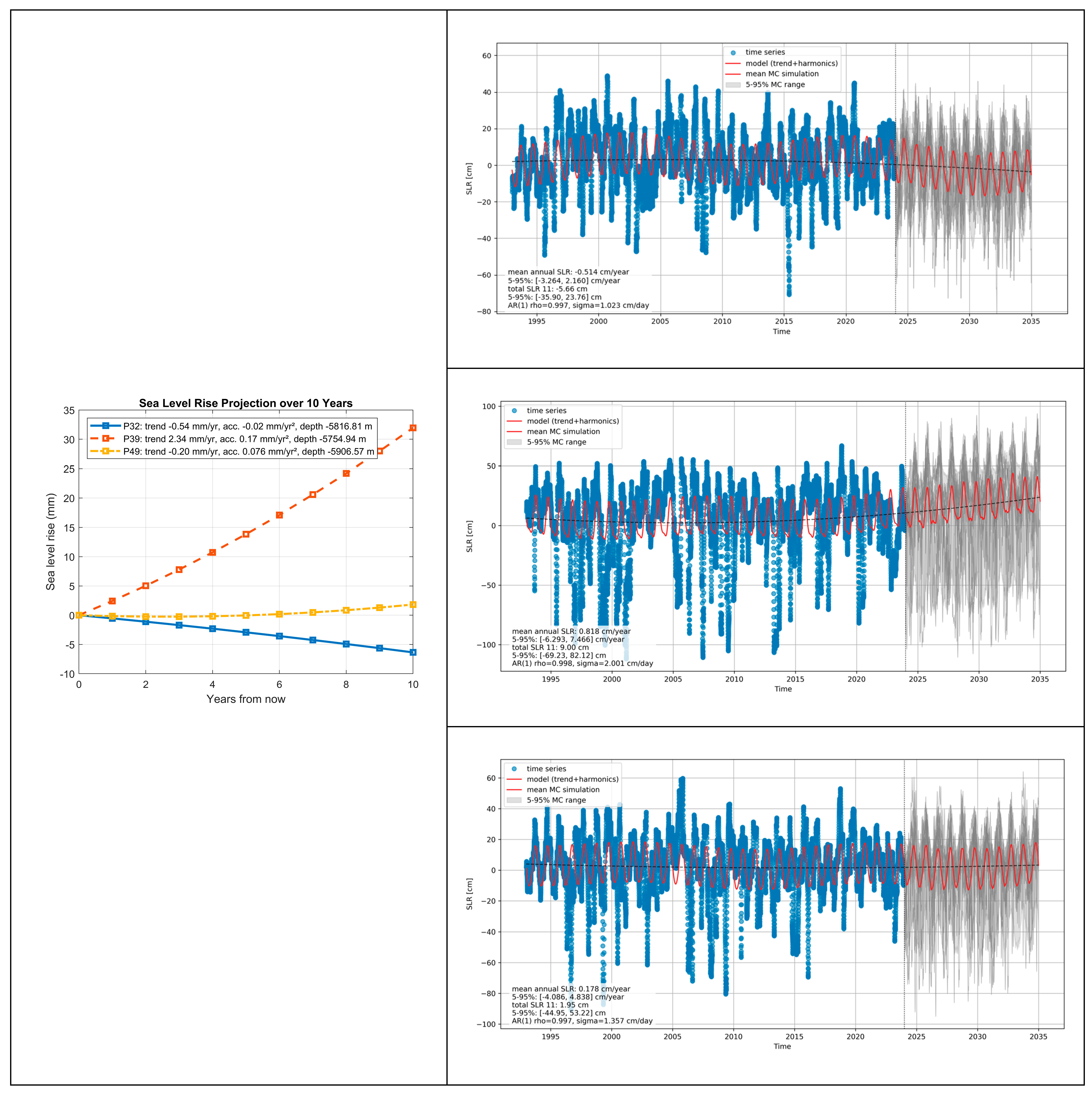
A comparison of sea level trends with the geoid heights distribution indicates a clear correlation. High geoid values and marine gravity anomalies are observed in coastal areas and within canyons (points P8, P11, P13) and correlate with moderate sea level trends. These areas are characterized by contrasts in seafloor forms (from coastal forms, canyons to the ocean trench) and local gravity anomalies, which may contribute to different displacements of water masses. In the Japan Trench region (points P19, P20, P22), where geoid heights reach from 10 to 15 m, a more stable or lower rate of SLR is observed. A decrease in geoid height and gravity anomalies may reflect local mass losses in the lithosphere and isostatic compensation effects. These changes affect the gravity field and crustal deformation, which limit local vertical displacements of the ocean surface relative to land, which may cause lower regional sea level trends. In contrast, points located on seamounts (P27, P44, P56) indicate higher variability in annual trends. High geoid values in these areas may cause local amplification of dynamic sea level effects associated with ocean circulation and the density structure of the waters. In areas with a corrugated seafloor (P32, P39, P49), geoid values are intermediate (approximately 30 m) and regional sea level trends range from −0.5 mm/yr to 2.5 mm/yr. This may indicate that local hydrodynamic processes dominate in such areas and the influence of gravity anomalies is limited. The observed relations suggest that the geoid height variability influences the local dynamics of sea level changes and, thus, the spatial variation of trends. Therefore, higher geoid values contribute to SLR, while negative SLR trends occur in areas of geoid decreases, which can have a stabilizing effect on its variability. The isostatic effects of GIA allowed for a more complete understanding of the spatial variation of regional sea level trends in the analyzed area (Figure 9).
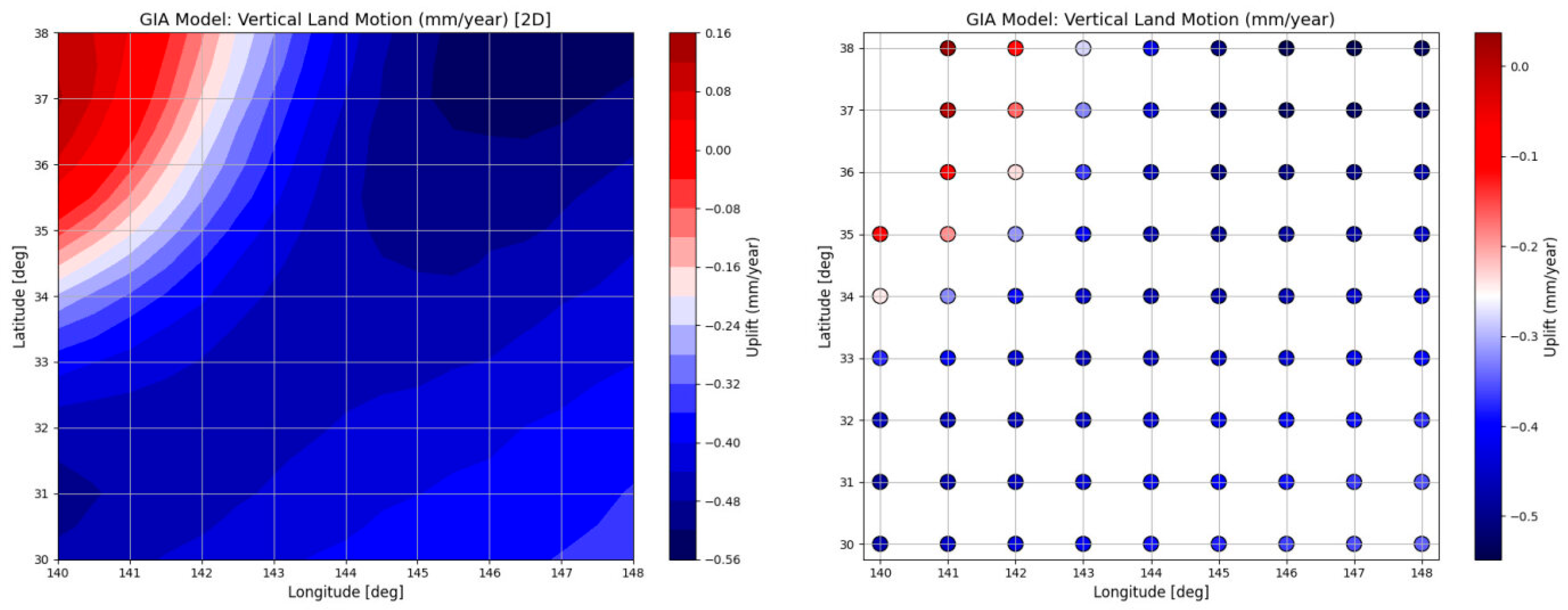
The GIA model indicates uplift values ranging from approximately −0.55 mm/yr to +0.04 mm/yr in the northwestern part of the study area. The highest negative values (−0.50 mm/yr) are observed in the northeast (36–38° N, 144–147° E), while in the southwestern part of the area (30–32° N, 140–142° E), vertical displacements are lower (approximately −0.40 mm/yr). A comparison of the GIA uplift map with the distribution of sea level change trends and geoid heights indicates a spatial interdependence between these variables. In locations with more negative uplift, locally higher sea level rise trends are observed, suggesting that some of the recorded changes are due to vertical crustal movements. The addition of the GIA correction allows the eustatic component (actual water level change) to be separated from the geodynamic component (ground movement). Coastal and canyon points (P8, P11, P13)—low uplift differences (from −0.45 to −0.39 mm/yr) indicate relative lithospheric stability. After GIA correction, the observed trends (approximately 5.0 mm/yr) mainly reflect the eustatic component related to circulation and seasonality. At points in the Japan Trench area (P19, P20, P22), uplift takes on more negative values (from −0.5 to −0.53 mm/yr), which means slow subsidence of the seafloor. After taking GIA into account, the eustatic SLR is lower than the trends without corrections. In the seamounts location (P27, P44, P56), values of uplift range from −0.44 to −0.50 mm/yr, and SLR trends occur approximately 10.0 mm/yr − 22.0 mm/yr. Seafloor corrugations (P32, P39, P49)—in areas with average uplift values (−0.45 mm/yr), regional sea level trends are low (approximately 0.5 mm/yr), confirming the balance between the eustatic and isostatic components. After applying the GIA correction, a more consistent spatial structure of trends was obtained. Negative uplift values (subsidence) increase the apparent SLR trend, while positive values decrease it. The highest impact of GIA is observed in the trench area, where tectonic effects may account for a significant part of the observed trend. In corrugation areas, the GIA correction does not significantly change the results, confirming the dominance of oceanic processes over geodynamic ones.

5.4. The Impact of Wind Speed and Direction on SLR Variability

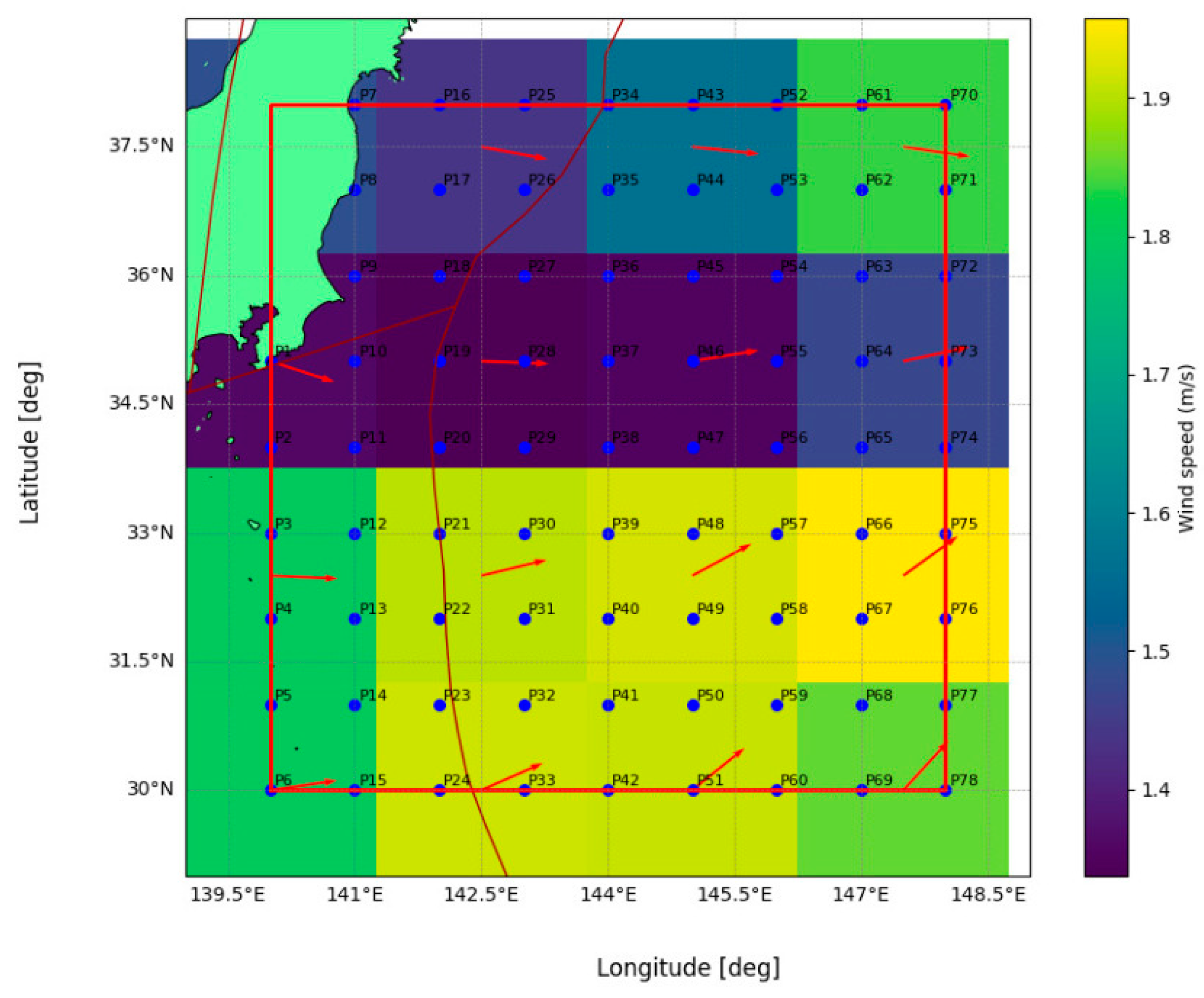
In addition, this study investigated wind speeds and directions (Figure 10) to verify their relation with regional sea level trends and seafloor topography.
It is evident that winds predominantly occur from west to east (ranging from 1.4 to 1.9 m/s). A similar configuration is observed in the coastal zone, where winds blow parallel to the submarine canyons. In these areas, a moderate SLR trend of approximately 4.5 mm/yr is observed. In the area of seamounts, the wind often blows skewed to their axis, which may intensify local water level rise (e.g., P36 = 23.7 mm/yr). Winds in areas of seafloor corrugations are dispersed and have no evident preferred direction. As a result, regional sea level trends are low or negative (e.g., P32 = –0.5 mm/yr). At point P38, the wind runs parallel to the warm Kuroshio Current—the regional sea level trends are visible (approximately 6.7 mm/yr). At points located above the current, the SLR trend exceeds even 20 mm/yr, while below the current axis, they take on values close to zero or negative. In this region, wind and ocean currents interact synergistically, enhancing water mass transport. In summary, winds blowing over seamounts contribute to regional sea level trends. When dispersed over the corrugated seafloor, they lead to low or negative trends. In contrast, moderate values prevail in the coastal zone and along the canyon, resulting from modifications in wind flow and local circulation.

6. Validation and SLR Simulation

6.1. Validation of SLR Trend Estimation Methods (Harmonic Method, CWT, and Kalman Filter)

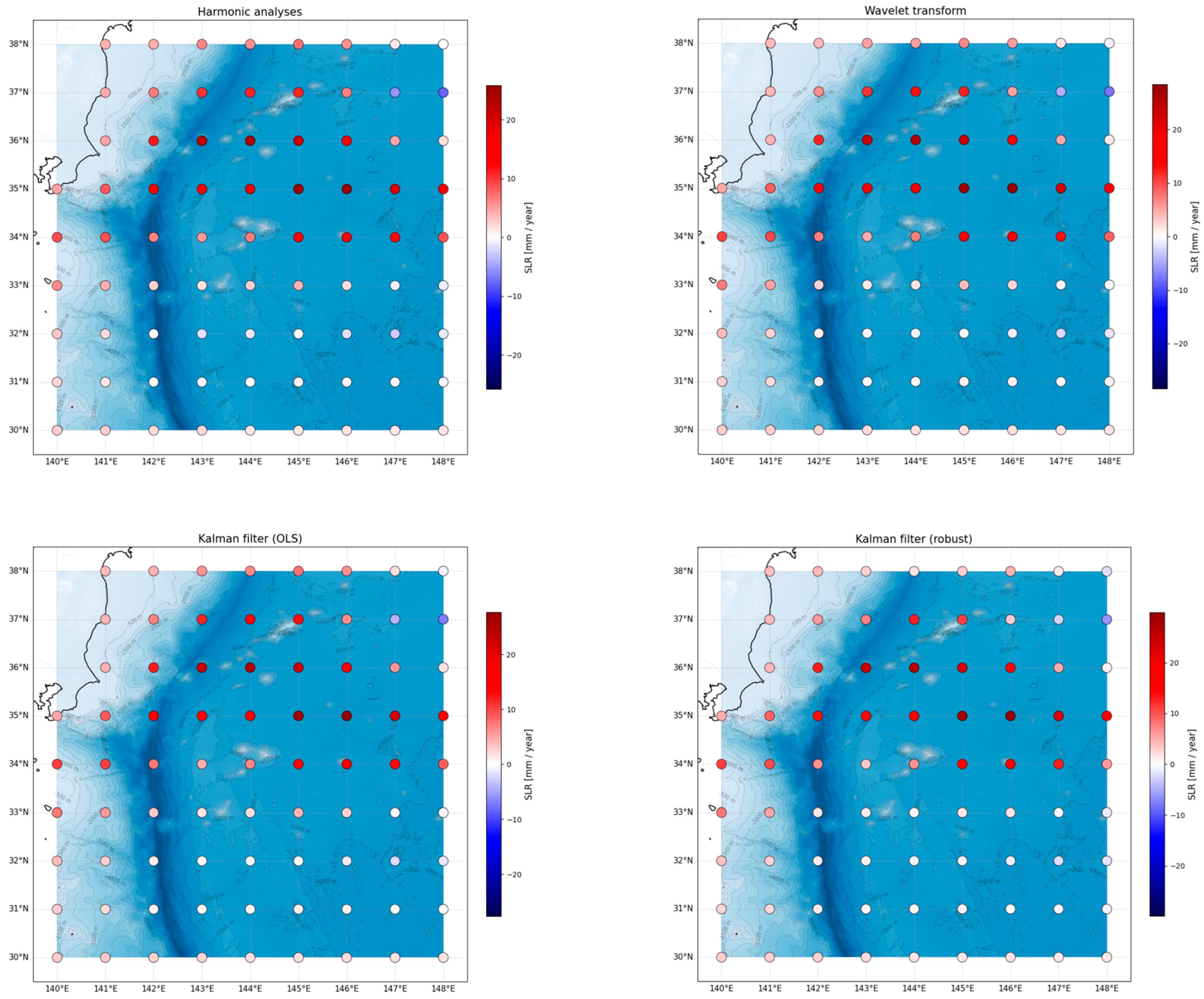
In order to validate the obtained regional sea level trends, the results using the harmonic analyses were compared with trends determined using alternative approaches: the Kalman filter (classical OLS and Robust versions) and the CWT method. The comparison was based on the analysis of descriptive statistics of 78 independent realizations for each method (Figure 11 and Table 1).
The mean difference between the trends from the harmonic analysis and the trends estimated using the Kalman filter (OLS) was –0.6 mm/yr (median –0.5 mm/yr), with a range from –2.6 to +0.7 mm/yr. This indicates that the harmonic method slightly underestimates the rate of SLR compared to Kalman filtering, which is more responsive to short-term signal disturbances. In the case of the Kalman filter (robust), the mean difference was –0.3 mm/yr (median –0.3 mm/yr), which confirms its closer fit to the trends obtained from the harmonic analysis. At the same time, the range of differences (–4.1 to +4.2 mm/yr) indicates that in areas with more dynamic geophysical processes, this method maintains local jumps and trend anomalies, which are smoothed out by the harmonic approach. In addition, the CWT method, which uses signal decomposition, allowed for precise separation of the trend, seasonal cycles, and short-term phenomena such as the intensification of ocean circulation or the influence of ENSO. Compared to the harmonic model, it presented a higher sensitivity to locally occurring, irregular fluctuations, which means higher SLR trend values in dynamic areas. At the same time, in the corrugation areas, the differences between the CWT filtering method and the harmonic analysis method remained marginal, confirming the correct representation of the long-term component by the harmonic method.
The results confirm that the harmonic model correctly represents the long-term sea level change signal, while the Kalman filtering and CWT methods provide effective validation and supplementation, in terms of uncertainty estimation and identification of short-term and locally non-stationary processes, respectively. These modified approaches allow the climate signal to be separated from phenomena related to the dynamics of the ocean environment of the studied region.
All methods indicate a positive, significant SLR trend in the analyzed region, but its value depends on the signal filtering method. The mean SLR rate for the harmonic method was 5.6 mm/yr, while for trends determined using Kalman filtering, ranging from 5.9 to 6.3 mm/yr, and using the CWT method, the trend was 6.2 mm/yr. The variability SLR indicates the influence of short-term processes on the estimation result. The harmonic method is characterized by the lowest variance (51.2), which indicates its tendency to smooth the signal and suppress peaks corresponding to local morphotectonic and circulation disturbances. The variance of the estimated trends using Kalman filters and the CWT methods was significantly high (55.4–62.0), suggesting their higher sensitivity to short-term geophysical effects. The highest asymmetry of distribution (skew > 1.5) was observed for the Kalman Robust method, which indicates the presence of random components of intense local sea level rise. These results clearly indicate that the harmonic model correctly reproduces the long-term SLR signal, while the Kalman filtering and CWT methods additionally maintain local, non-stationary ocean dynamics.

6.2. The Impact of Seafloor Morphology on SLR Acceleration in Light of Monte Carlo Simulations

To assess the impact of seafloor morphology on SLR acceleration, a simulation of sea level rise until 2035 was carried out using a modified harmonic model with a quadratic component and the Monte Carlo method, taking into account various bathymetric forms and their impact on local sea level dynamics (Figure 12, Figure 13, Figure 14 and Figure 15).
The results of the Monte Carlo simulation using the AR(1) autoregressive model and the block bootstrap method indicate different rates of SLR acceleration depending on the type of seafloor morphology. The analysis was focused on four characteristic morphological zones: coastal areas with canyons, ocean trench, seamounts, and corrugated seafloor. For points located in the coastal zone and canyon (e.g., P8, P11, P13), the values of sea level acceleration were 0.2–0.3 mm/yr2. This indicates a moderate but stable increase in the rate of SLR at these points. The use of the Monte Carlo method with block bootstrap showed relatively narrow confidence intervals, which indicates low variability of results and high stability of trends. Moderate acceleration in coastal areas may be related to local hydrodynamic conditions, intense coastal circulation, and the influence of ocean bottom currents, which modulate seasonal sea level fluctuations. At points located within the Japan Trench (e.g., P19, P20, P22), acceleration values of –0.20, –0.32, and –0.02 mm/yr2 were obtained, respectively, indicating negative acceleration, i.e., a slowdown or stabilization of the SLR trend. These results suggest that in deep ocean basins, the processes controlling sea level changes are different than those in coastal areas. Negative acceleration may result from a combination of thermosteric effects and local changes in deep circulation. In areas of seamounts (e.g., P27, P44, P56), significantly higher accelerations were observed, 0.87, 1.73, and −0.04 mm/yr2, respectively. Point P44 displays unusually high acceleration (1.73 mm/yr2), which may indicate local dynamic processes intensifying SLR. High acceleration values in seamount regions are also consistent with previous studies indicating a strong correlation between seafloor morphology and regional SLR dynamics [71]. However, the variability of results between points P27 and P56 indicates that the influence of seafloor topography is highly local and heterogeneous. In areas with corrugated seafloor (e.g., P32, P39, P49), acceleration values were –0.05, 0.11, 0.06 mm/yr2, suggesting slight but positive acceleration except at point P32, where the SLR trend is stable and shows a minimal decrease. These results may reflect a complex balance between thermal changes and dynamic effects. Relatively low amplitudes and low variance indicate the dominance of seasonal processes. The results confirm that seafloor morphology has a significant impact on the rate and character of sea level change. The highest accelerations were recorded in areas with complex topography (seamounts), while negative values dominate in the ocean trench, indicating stabilization or a decrease of the SLR process. The Monte Carlo simulation using the AR(1) model allowed for realistic mapping of the autocorrelation of time series, while the block bootstrap maintained the time structure and enabled reliable estimation of uncertainty intervals. The combination of methods used suggested that the differences between regions reflect actual variations in ocean dynamics. The simulations presented that the future rate of sea level rise in the western Pacific will vary strongly depending on the seafloor topography. The highest SLR increases are forecast for coastal areas and canyons—on average, +40 to +70 mm over the 11 years (to 2035), with high seasonal variability. In seamount regions, the predicted increase is even higher, reaching from +60 to +100 mm/11 yr, which is associated with intense tidal modulation and increased circulation energy. Opposite SLR trends are observed in the Japan Trench, where the rate of SLR remains close to stagnation (from −10 to +10 mm/11 yr) and may at times transition into periods of short-term sea level decrease. The areas of corrugations are characterized by a moderate rate of change of 25 to 40 mm/11 yr, representing a transition zone between the dynamics of the continental shelves and the stability of the deep ocean. The results clearly confirm that seafloor morphology is one of the factors regulating regional SLR acceleration, determining both the rate of change and the risk of extreme SLR.

7. Discussion

7.1. The Impact of Seafloor Morphology on Regional Sea Level Variability

Study results confirm that sea level variability in the western Pacific, in the Japan Trench region, is significantly modulated by local morphological conditions and geophysical processes. The diversity of trends and cyclic amplitudes indicates that the seafloor topography is fundamental in controlling regional sea changes. The research hypothesis that the regional rate and patterns of sea level change are determined by the topography of the seafloor is confirmed by the results.
The highest positive trend values (>20 mm/yr) and annual amplitudes (>20 cm) occur in areas with high bathymetric diversity (seamounts, subduction zones), where the strength of wind, ocean currents, and lithospheric deformations overlap, intensifying local SLR [72].
This phenomenon is consistent with the observations of Hamlington et al. [6], as well as with analyses of seafloor changes after the 2011 Tohokuoki earthquake [73] and studies of the seismic structure of the Japan Trench [29].

7.2. Correlation Analyses and the Effects of the Lunar Nodal Cycle

Correlation analysis indicated that the relationship between depth and gravity anomalies is significantly positive (r ≈ 0.7), confirming the connection between the seafloor topography and the distribution of gravimetric masses. The negative correlation between depth and MDT (r ≈ –0.5) suggests that deep-water areas are associated with lower circulation, while the positive regional sea level trends–MDT correlation (r ≤ 0.9) indicates that regions with intense water mass exchange are characterized by higher SLR rates [74,75,76].
The 18.61-year nodal cycle of the Moon also appears to have an important role, with its amplitude highly correlated with SLR trend (r > 0.8). This result confirms earlier observations by Peng et al. [77], indicating the modulation of SLR trend by long-term tidal changes [78]. The positive correlation between the trend and the 18.61-year amplitude is particularly evident in areas with unstable tectonic substrates and complex seafloor morphology [70,78,79,80,81].

7.3. Validation of Trend Estimation Methods, GIA Correction, and Identification of SLR Accelerations

Taking into account the isostatic adjustment (GIA) allowed the eustatic component to be separated from the geodynamic component, confirming that in areas of subsidence (uplift < –0.5 mm/yr), the observed SLR trends are overestimated, while in stable or slightly ascending areas they reflect actual changes in ocean volume [82,83].
Validation of trend estimation methods indicated high consistency between the harmonic method and Kalman filter algorithms, with average differences of –0.61 mm/yr (Kalman OLS) and –0.26 mm/yr (Kalman robust), respectively, confirming their usefulness in modeling incomplete and noisy signals. Monte Carlo simulations with the AR(1) model and block bootstrap technique have presented spatially variable SLR acceleration—the highest local accelerations were identified over areas with complex bathymetry (seamounts, elevations—up to 1.7 mm/yr), while stabilization or negative values were observed in the ocean trench area, in line with the available literature and more recent probabilistic analyses [71,84,85].

7.4. Practical Significance of the Results—The Impact of Seafloor Topography on Sea Level Rise

The geodetic and satellite techniques used in the study—including altimetry, radar interferometry, and geopotential models—provide key input to models used in oceanography, geology, and hydrology [86]. This research therefore contributes to a better understanding of the processes that generate ENSO, flood risk assessment, and climate change forecasting in coastal regions [87,88].
The results obtained provide a background for understanding ocean circulation mechanisms, climate modeling, natural resource management, tsunami forecasting, and public safety. This knowledge is also essential for planning submarine cable routes, pipelines, and environmental protection activities (https://seabed2030.org/—accessed on 12 February 2025). Research of this type directly supports the implementation of the 14th UN Sustainable Development Goal on the conservation and sustainable use of oceans, seas, and marine resources. This research is part of the most important global scientific and technological challenges, the so-called Grand Challenges, which include: SLR, threats to coastal infrastructure, and spatial planning in coastal areas. The results obtained may be of particular importance in the preparation of environmental expert reports and impact assessments, which are an essential element of planning investments related to the maritime economy.
This research has potential applications and implications for policy-making. For example, the results concerning the impact of seafloor topography on sea level change could form the basis for coastal development policy, including building regulations and minimum distance requirements from the coastline. In addition, they can support the implementation of sustainable practices and policies, such as responsible fishing or the designation of marine protected areas.
In summary, the integration of SLR trend analysis, correlation, methodological validation, GIA correction, and numerical simulations clearly indicates that regional sea level dynamics in the Japan Trench area are the result of complex interactions between tectonic, hydrodynamic, and climatic processes. The hypothesis of the key importance of seafloor morphology in modulating regional SLR changes is fully confirmed empirically, providing a solid base for further predictive research in this expanded geodetic-oceanographic context.

8. Conclusions

An analysis of regional sea level changes in the Japan Trench region has indicated that the SLR trend is highly modulated by seafloor morphology. Areas with diverse bathymetric structures (seamounts or ocean trench) present high, positive trends and cyclic amplitudes, confirming the major role of topography in forming local SLR signals. Long-term cycles, including the 18.61-year lunar nodal cycle and geodynamic processes, additionally modulate the rate of change. Considering the isostatic adjustment (GIA) allows the eustatic component to be separated from local effects of subsidence or uplift. The SLR trend estimation methods and numerical simulations used showed high reliability of results. Geodetic and satellite techniques provide essential data for monitoring ocean dynamics and forecasting climate risks. Regional sea level projections must consider the impact of bathymetry and its submarine structures, as these are the factors that significantly modulate local SLR acceleration and the associated environmental risks. The limitations of the study are mainly due to the resolution of the available data, the quality of the measurements, and the specific nature of the study area, which is a typical challenge in geophysical research. Despite these factors, the approach adopted has provided robust and reliable regional results, confirmed by data validation, and the results clearly support the hypothesis that the interaction between seafloor morphology and climate processes regulates regional SLR, providing a basis for further predictive analyses and adaptation strategies.

Author Contributions

Conceptualization, M.I. and K.P.; methodology, M.I. and K.P.; software, M.I. and K.P.; validation, M.I. and K.P.; formal analysis, M.I. and K.P.; investigation, M.I. and K.P.; resources, M.I. and K.P.; data curation, M.I. and K.P.; writing—original draft preparation, M.I. and K.P.; writing—review and editing, M.I. and K.P.; visualization, M.I. and K.P.; supervision, M.I., K.P., and K.K. All authors have read and agreed to the published version of the manuscript.

Funding

This research received no external funding.

Data Availability Statement

Satellite altimetry data were provided by the Copernicus Marine Environment Monitoring Service (https://data.marine.copernicus.eu/products)—accessed on 12 February 2025. Multibeam bathymetry data were provided by the NOAA National Centers for Environmental Information (NCEI) (https://www.ncei.noaa.gov/maps/iho_dcdb/)—accessed on 22 January 2025. Global, digital elevation GEBCO_24 model was provided by the General Bathymetric Chart of the Oceans (https://www.gebco.net/data_and_products/gridded_bathymetry_data/)—accessed on 22 January 2025. Free-air Gravity Anomaly Model SIO.V32 was provided by the Scripps Institution of Oceanography (SIO) (https://topex.ucsd.edu/pub/)—accessed on 20 January 2025. Mean Dynamic Topography Model—DTU22MDT model was provided by the Technical University of Denmark (DTU) (https://data.dtu.dk/)—accessed on 1 September 2025. Japan geoid model JGEOID2019 was provided by Geospatial Information Authority of Japan (https://www.isgeoid.polimi.it/Geoid/Asia/Japan/japan19_g.html)—accessed on 5 September 2025. GIA corrections were provided by Data Publisher for Earth & Environmental Science PANGAEA (https://doi.pangaea.de/10.1594/PANGAEA.932462)—accessed on 10 September 2025. Wind speeds and directions were provided by NOAA PSL (Physical Sciences Laboratory) Public Reanalysis Dataset Collection (https://psl.noaa.gov/data/gridded/data.ncep.reanalysis.html)—accessed on 26 September 2025.

Acknowledgments

The Authors would like to thank all the respectable Reviewers and Editors for their comments and suggestions concerning this paper. Their comments and suggestions contributed greatly to the improvement of this article. The Authors would like to thank all repositories for providing the free datasets.

Conflicts of Interest

The authors declare no conflicts of interest.

Abbreviations

The following abbreviations are used in this manuscript:
CMEMSCopernicus Marine Environment Monitoring Service
GEBCOGeneral Bathymetric Chart of the Oceans
SIOScripps Institution of Oceanography
NOAA NCEINational Oceanic and Atmospheric Administration, National Centers for
Environmental Information
SLASea Level Anomaly
MDTMean Dynamic Ocean Topography
GIAGlacial Isostatic Adjustment
SLRSea Level Rise
CWTContinuous Wavelet Transform
KFKalman Filter
OLSOrdinary Least Squares
VLMVertical Land Movements

References

  1. Sriver, R.L.; Lempert, R.J.; Wikman-Svahn, P.; Keller, K. Characterizing uncertain sea-level rise projections to support investment decisions. PLoS ONE 2018, 13, e0190641. [Google Scholar] [CrossRef]
  2. Horton, B.P.; Khan, N.S.; Cahill, N.; Lee, J.S.H.; Shaw, T.A.; Garner, A.J.; Kemp, A.C.; Engelhart, S.E.; Rahmstorf, S. Estimating global mean sea-level rise and its uncertainties by 2100 and 2300 from an expert survey. Npj Clim. Atmos. Sci. 2020, 3, 18. [Google Scholar] [CrossRef]
  3. Brown, S.; Jenkins, K.; Goodwin, P.; Lincke, D.; Vafeidis, A.T.; Tol, R.S.J.; Jenkins, R.; Warren, R.; Nicholls, R.J.; Jevrejeva, S.; et al. Global costs of protecting against sea-level rise at 1.5 to 4.0 °C. Clim. Change 2021, 167, 4. [Google Scholar] [CrossRef]
  4. Oelsmann, J.; Nicholls, R.; Lincke, D.; Marcos, M.; Sánchez, L.; Dettmering, D.; Hinkel, J.; Horton, B.; Seitz, F. Coastal populations experience sea level rise at least twice as large as the global average. Res. Sq. 2023. [Google Scholar] [CrossRef]
  5. Vousdoukas, M.I.; Mentaschi, L.; Voukouvalas, E.; Bianchi, A.; Dottori, F.; Feyen, L. Climatic and socioeconomic controls of future coastal flood risk in Europe. Nat. Clim. Change 2018, 8, 776–780. [Google Scholar] [CrossRef]
  6. Hamlington, B.D.; Gardner, A.S.; Ivins, E.; Lenaerts, J.T.M.; Reager, J.T.; Trossman, D.S.; Zaron, E.D.; Adhikari, S.; Arendt, A.; Aschwanden, A.; et al. Understanding of Contemporary Regional Sea-Level Change and the Implications for the Future. Rev. Geophys. 2020, 58, e2019RG000672. [Google Scholar] [CrossRef]
  7. Ludwigsen, C.B.; Andersen, O.B.; Marzeion, B.; Malles, J.-H.; Müller Schmied, H.; Döll, P.; Watson, C.; King, M.A. Global and regional ocean mass budget closure since 2003. Nat. Commun. 2024, 15, 1416. [Google Scholar] [CrossRef] [PubMed]
  8. Mu, D.; Huang, R.; Xu, T.; Yan, H. Inferring Global Ocean Mass Increase from Tide Gauges Network with Climate Models. Geophys. Res. Lett. 2024, 51, e2023GL108056. [Google Scholar] [CrossRef]
  9. Frederikse, T.; Riva, R.E.M.; King, M.A. Ocean Bottom Deformation Due To Present-Day Mass Redistribution and Its Impact on Sea Level Observations. Geophys. Res. Lett. 2017, 44, 12306–12314. [Google Scholar] [CrossRef]
  10. Cruz-Atienza, V.M.; Tago, J.; Domínguez, L.A.; Kostoglodov, V.; Ito, Y.; Ovando-Shelley, E.; Rodríguez-Nikl, T.; González, R.; Franco, S.; Solano-Rojas, D.; et al. Seafloor geodesy unveils seismogenesis of large subduction earthquakes in Mexico. Sci. Adv. 2025, 11, eadu8259. [Google Scholar] [CrossRef] [PubMed]
  11. Saldaña, B.; Cisternas, M.; Carvajal, M.; Melnick, D.; Cortés-Aranda, J.; Francois, J.P.; Carreño, A.; Guerra, M. Paleoseismological evidence of a century of coastal deformation in central Chile: Lasting emergence and ongoing submergence. Quat. Sci. Adv. 2025, 19, 100291. [Google Scholar] [CrossRef]
  12. Broerse, T.; Riva, R.; Vermeersen, B. Ocean contribution to seismic gravity changes: The sea level equation for seismic perturbations revisited. Geophys. J. Int. 2014, 199, 1094–1109. [Google Scholar] [CrossRef]
  13. Tanaka, Y.; Yu, Y.; Chao, B.F. Gravity and geoid changes by the 2004 and 2012 Sumatra earthquakes from satellite gravimetry and ocean altimetry. Terr. Atmos. Ocean. Sci. 2019, 30, 531–540. [Google Scholar] [CrossRef]
  14. Zhou, J.; Sun, H.; Xu, J.; Chen, X.; Cui, X. Co-seismic change in ocean bottom topography: Implication to absolute global mean sea level change. Geod. Geodyn. 2019, 10, 179–186. [Google Scholar] [CrossRef]
  15. Grezio, A.; Anzidei, M.; Baglione, E.; Brizuela, B.; Di Manna, P.; Selva, J.; Taroni, M.; Tonini, R.; Vecchio, A. Including sea-level rise and vertical land movements in probabilistic tsunami hazard assessment for the Mediterranean Sea. Sci. Rep. 2024, 14, 28873. [Google Scholar] [CrossRef]
  16. Ray, R.D.; Luthcke, S.B.; Van Dam, T. Monthly Crustal Loading Corrections for Satellite Altimetry. J. Atmos. Ocean. Technol. 2013, 30, 999–1005. [Google Scholar] [CrossRef]
  17. Reid, P.C.; Fischer, A.C.; Lewis-Brown, E.; Meredith, M.P.; Sparrow, M.; Andersson, A.J.; Antia, A.; Bates, N.R.; Bathmann, U.; Beaugrand, G.; et al. Chapter 1 Impacts of the Oceans on Climate Change. In Advances in Marine Biology; Elsevier: Amsterdam, The Netherlands, 2009; Volume 56, pp. 1–150. ISBN 978-0-12-374960-4. [Google Scholar]
  18. Zhang, H.; Wang, F.; Myhill, R.; Guo, H. Slab morphology and deformation beneath Izu-Bonin. Nat. Commun. 2019, 10, 1310. [Google Scholar] [CrossRef]
  19. Kawakami, Y.; Nakano, H.; Urakawa, L.S.; Toyoda, T.; Aoki, K.; Usui, N. Northward shift of the Kuroshio Extension during 1993–2021. Sci. Rep. 2023, 13, 16223. [Google Scholar] [CrossRef]
  20. Yao, H.; Ma, C.; Jing, Z.; Zhang, Z. On the Vertical Structure of Mesoscale Eddies in the Kuroshio-Oyashio Extension. Geophys. Res. Lett. 2023, 50, e2023GL105642. [Google Scholar] [CrossRef]
  21. Jing, Z.; Chang, P.; Shan, X.; Wang, S.; Wu, L.; Kurian, J. Mesoscale SST Dynamics in the Kuroshio–Oyashio Extension Region. J. Phys. Oceanogr. 2019, 49, 1339–1352. [Google Scholar] [CrossRef]
  22. Moon, J.; Tony Song, Y. Sea level and heat content changes in the western North Pacific. JGR Ocean. 2013, 118, 2014–2022. [Google Scholar] [CrossRef]
  23. Nakanishi, R.; Ashi, J. Sediment Transport Modeling Based on Geological Data for Holocene Coastal Evolution: Wave Source Estimation of Sandy Layers on the Coast of Hidaka, Hokkaido, Japan. JGR Earth Surf. 2022, 127, e2022JF006721. [Google Scholar] [CrossRef]
  24. Kodaira, S.; Takahashi, N.; Nakanishi, A.; Miura, S.; Kaneda, Y. Subducted Seamount Imaged in the Rupture Zone of the 1946 Nankaido Earthquake. Science 2000, 289, 104–106. [Google Scholar] [CrossRef]
  25. Kimura, G.; Kitamura, Y.; Yamaguchi, A.; Kameda, J.; Hashimoto, Y.; Hamahashi, M. Origin of the early Cenozoic belt boundary thrust and Izanagi–Pacific ridge subduction in the western Pacific margin. Isl. Arc 2019, 28, e12320. [Google Scholar] [CrossRef]
  26. Oguri, K.; Kawamura, K.; Sakaguchi, A.; Toyofuku, T.; Kasaya, T.; Murayama, M.; Fujikura, K.; Glud, R.N.; Kitazato, H. Hadal disturbance in the Japan Trench induced by the 2011 Tohoku–Oki Earthquake. Sci. Rep. 2013, 3, 1915. [Google Scholar] [CrossRef]
  27. Nakata, T.; Goto, H.; Watanabe, M.; Suzuki, Y.; Nishizawa, A.; Izumi, N.; Horiuchi, D.; Kido, Y. Active Faults along Japan Trench and Source Faults of Large Earthquakes. In Proceedings of the International Symposium on Engineering Lessons Learned from the 2011 Great East Japan Earthquake, Tokyo, Japan, 3–4 March 2012; pp. 254–262. [Google Scholar]
  28. Iinuma, T.; Hino, R.; Kido, M.; Inazu, D.; Osada, Y.; Ito, Y.; Ohzono, M.; Tsushima, H.; Suzuki, S.; Fujimoto, H.; et al. Coseismic slip distribution of the 2011 off the Pacific Coast of Tohoku Earthquake (M9.0) refined by means of seafloor geodetic data. J. Geophys. Res. 2012, 117, 2012JB009186. [Google Scholar] [CrossRef]
  29. Fujie, G.; Kodaira, S.; Sato, T.; Takahashi, T. Along-trench variations in the seismic structure of the incoming Pacific plate at the outer rise of the northern Japan Trench. Geophys. Res. Lett. 2016, 43, 666–673. [Google Scholar] [CrossRef]
  30. Lemenkova, P. Variations in the bathymetry and bottom morphology of the Izu-Bonin Trench modelled by GMT. Bull. Geography. Phys. Geogr. Ser. 2020, 18, 41–60. [Google Scholar] [CrossRef]
  31. Soh, W.; Taira, A.; Tokuyama, H. A trench fan in the Izu-Ogasawara Trench on the Boso Trench triple junction, Japan. Mar. Geol. 1988, 82, 235–249. [Google Scholar] [CrossRef]
  32. Lin-Ye, J.; Pérez Gómez, B.; Gallardo, A.; Manzano, F.; De Alfonso, M.; Bradshaw, E.; Hibbert, A. Delayed-mode reprocessing of in situ sea level data for the Copernicus Marine Service. Ocean Sci. 2023, 19, 1743–1751. [Google Scholar] [CrossRef]
  33. Ciliberti, S.A.; Grégoire, M.; Staneva, J.; Palazov, A.; Coppini, G.; Lecci, R.; Peneva, E.; Matreata, M.; Marinova, V.; Masina, S.; et al. Monitoring and Forecasting the Ocean State and Biogeochemical Processes in the Black Sea: Recent Developments in the Copernicus Marine Service. J. Mar. Sci. Eng. 2021, 9, 1146. [Google Scholar] [CrossRef]
  34. European Union-Copernicus Marine Service. Global Ocean Gridded L4 Sea Surface Heights and Derived Variables Reprocessed (1993-Ongoing); European Union-Copernicus Marine Service: Toulouse, France, 2021. [Google Scholar] [CrossRef]
  35. Ballarotta, M.; Dagneaux, Q.; Delepoulle, A.; Dibarboure, G.; Dupuy, S.; Faugère, Y.; Jenn-Alet, M.; Kocha, C.; Pujol, I.; Taburet, G. DUACS DT-2024: 30 years of reprocessed sea level altimetry products. In Proceedings of the EGU General Assembly 2025, Vienna, Austria, 27 April–2 May 2025. [Google Scholar] [CrossRef]
  36. McLain, K. Processed Acoustic Backscatter and Swath Bathymetry Data Acquired During R/V Roger Revelle Expedition ZHNG08RR (2005). Mar. Geosci. Data Syst. 2022. [Google Scholar] [CrossRef]
  37. Miller, E. Processed Acoustic Backscatter and Swath Bathymetry Data Acquired During R/V Roger Revelle Expedition ZHNG07RR (2005). Mar. Geosci. Data Syst. 2022. [Google Scholar] [CrossRef]
  38. Weatherall, P.; Ferreras, S.C.; Cardigos, S.D.; Cornish, N.; Davidson, S.R.; Dorschel, B.; Drennon, H.; Ferrini, V.; Harper, H.A.; Isler, T.; et al. GEBCO Bathymetric Compilation Group 2024. The GEBCO_2024 Grid—A Continuous Terrain Model of the Global Oceans and Land; NERC EDS British Oceanographic Data Centre NOC: Liverpool, UK, 2024. [Google Scholar] [CrossRef]
  39. Harper, H.; Sandwell, D.T. Global Predicted Bathymetry Using Neural Networks. Earth Space Sci. 2024, 11, e2023EA003199. [Google Scholar] [CrossRef]
  40. Tozer, B.; Sandwell, D.T.; Smith, W.H.F.; Olson, C.; Beale, J.R.; Wessel, P. Global Bathymetry and Topography at 15 Arc Sec: SRTM15+. Earth Space Sci. 2019, 6, 1847–1864. [Google Scholar] [CrossRef]
  41. An, D.; Guo, J.; Chang, X.; Wang, Z.; Jia, Y.; Liu, X.; Bondur, V.; Sun, H. High-precision 1′ × 1′ bathymetric model of Philippine Sea inversed from marine gravity anomalies. Geosci. Model Dev. 2024, 17, 2039–2052. [Google Scholar] [CrossRef]
  42. Nguyen, V.-S.; Pham, V.-T.; Van Nguyen, L.; Andersen, O.B.; Forsberg, R.; Tien Bui, D. Marine gravity anomaly mapping for the Gulf of Tonkin area (Vietnam) using Cryosat-2 and Saral/AltiKa satellite altimetry data. Adv. Space Res. 2020, 66, 505–519. [Google Scholar] [CrossRef]
  43. Smith, W.H.F.; Sandwell, D.T. Bathymetric prediction from dense satellite altimetry and sparse shipboard bathymetry. J. Geophys. Res. 1994, 99, 21803–21824. [Google Scholar] [CrossRef]
  44. Matsuo, K.; Kuroishi, Y. Refinement of a gravimetric geoid model for Japan using GOCE and an updated regional gravity field model. Earth Planets Space 2020, 72, 33. [Google Scholar] [CrossRef]
  45. Wu, Y.; Huang, J.; Shi, H.; He, X. Mean Dynamic Topography Modeling Based on Optimal Interpolation from Satellite Gravimetry and Altimetry Data. Appl. Sci. 2021, 11, 5286. [Google Scholar] [CrossRef]
  46. Knudsen, P.; Andersen, O.; Maximenko, N. A new ocean mean dynamic topography model, derived from a combination of gravity, altimetry and drifter velocity data. Adv. Space Res. 2021, 68, 1090–1102. [Google Scholar] [CrossRef]
  47. Ophaug, V.; Breili, K.; Gerlach, C. A comparative assessment of coastal mean dynamic topography in N orway by geodetic and ocean approaches. JGR Ocean. 2015, 120, 7807–7826. [Google Scholar] [CrossRef]
  48. Jäggi, A.; Weigelt, M.; Flechtner, F.; Güntner, A.; Mayer-Gürr, T.; Martinis, S.; Bruinsma, S.; Flury, J.; Bourgogne, S.; Steffen, H.; et al. European Gravity Service for Improved Emergency Management (EGSIEM)—From concept to implementation. Geophys. J. Int. 2019, 218, 1572–1590. [Google Scholar] [CrossRef]
  49. Peltier, W.R.; Argus, D.F.; Drummond, R. Space geodesy constrains ice age terminal deglaciation: The global ICE-6G_C (VM5a) model. JGR Solid Earth 2015, 120, 450–487. [Google Scholar] [CrossRef]
  50. Argus, D.F.; Peltier, W.R.; Drummond, R.; Moore, A.W. The Antarctica component of postglacial rebound model ICE-6G_C (VM5a) based on GPS positioning, exposure age dating of ice thicknesses, and relative sea level histories. Geophys. J. Int. 2014, 198, 537–563. [Google Scholar] [CrossRef]
  51. Gowan, E.J.; Tregoning, P.; Purcell, A.; Montillet, J.-P.; McClusky, S. A model of the western Laurentide Ice Sheet, using observations of glacial isostatic adjustment. Quat. Sci. Rev. 2016, 139, 1–16. [Google Scholar] [CrossRef]
  52. Whitehouse, P.L.; Bentley, M.J.; Le Brocq, A.M. A deglacial model for Antarctica: Geological constraints and glaciological modelling as a basis for a new model of Antarctic glacial isostatic adjustment. Quat. Sci. Rev. 2012, 32, 1–24. [Google Scholar] [CrossRef]
  53. Idzikowska, M.; Pajak, K.; Kowalczyk, K. Long-Term Sea Surface Variability Regarding Seafloor Topography. Sensors 2025, 25, 6391. [Google Scholar] [CrossRef] [PubMed]
  54. Schulte, J.A. Wavelet analysis for non-stationary, nonlinear time series. Nonlin. Process. Geophys. 2016, 23, 257–267. [Google Scholar] [CrossRef]
  55. Belkhou, A.; Jbari, A.; Belarbi, L. A continuous wavelet based technique for the analysis of electromyography signals. In Proceedings of the 2017 International Conference on Electrical and Information Technologies (ICEIT), Rabat, Morocco, 15–18 November 2017; IEEE: New York, NY, USA, 2017; pp. 1–5. [Google Scholar]
  56. Cai, C.; Harrington, P.d.B. Different Discrete Wavelet Transforms Applied to Denoising Analytical Data. J. Chem. Inf. Comput. Sci. 1998, 38, 1161–1170. [Google Scholar] [CrossRef]
  57. Addison, P.S. Introduction to redundancy rules: The continuous wavelet transform comes of age. Phil. Trans. R. Soc. A 2018, 376, 20170258. [Google Scholar] [CrossRef]
  58. Miller, R.N.; Cane, M.A. A Kalman Filter Analysis of Sea Level Height in the Tropical Pacific. J. Phys. Oceanogr. 1989, 19, 773–790. [Google Scholar] [CrossRef]
  59. Mosetti, R. A Kalman-filter estimate of the tidal harmonic constants. II Nuovo C. C 1983, 6, 445–452. [Google Scholar] [CrossRef]
  60. Elsiddieg, A.M.A. Quantifying the Impact of Sea Level on Coastal Cities using Bayesian optimized Monte Carlo Simulation model. Appl. Math. Inf. Sci. 2024, 18, 641–651. [Google Scholar] [CrossRef]
  61. Clare, M.C.A.; Leijnse, T.W.B.; McCall, R.T.; Diermanse, F.L.M.; Cotter, C.J.; Piggott, M.D. Multilevel multifidelity Monte Carlo methods for assessing uncertainty in coastal flooding. Nat. Hazards Earth Syst. Sci. 2022, 22, 2491–2515. [Google Scholar] [CrossRef]
  62. Lai, D.; Lu, B. Autoregressive Model for Time Series as a Deterministic Dynamic System. Predict. Anal. Futur. 2017, 7, 7–9. [Google Scholar]
  63. Wang, G. The 95 per cent confidence interval for the mean sea-level change rate derived from tide gauge data. Geophys. J. Int. 2023, 235, 1420–1433. [Google Scholar] [CrossRef]
  64. Idzikowska, M.; Pająk, K.; Kowalczyk, K. Possibility and quality assessment in seafloor modeling relative to the sea surface using hybrid data. Trans. GIS 2024, 28, 1175–1195. [Google Scholar] [CrossRef]
  65. Hamlington, B.D.; Bellas-Manley, A.; Willis, J.K.; Fournier, S.; Vinogradova, N.; Nerem, R.S.; Piecuch, C.G.; Thompson, P.R.; Kopp, R. The rate of global sea level rise doubled during the past three decades. Commun. Earth Environ. 2024, 5, 601. [Google Scholar] [CrossRef]
  66. Renkl, C.; Oliver, E.C.J.; Thompson, K.R. The alongshore tilt of mean dynamic topography and its implications for model validation and ocean monitoring. Ocean Sci. 2025, 21, 181–198. [Google Scholar] [CrossRef]
  67. Rio, M.-H.; Hernandez, F. A mean dynamic topography computed over the world ocean from altimetry, in situ measurements, and a geoid model. J. Geophys. Res. 2004, 109, 2003JC002226. [Google Scholar] [CrossRef]
  68. Le Traon, P.-Y.; Antoine, D.; Bentamy, A.; Bonekamp, H.; Breivik, L.A.; Chapron, B.; Corlett, G.; Dibarboure, G.; DiGiacomo, P.; Donlon, C.; et al. Use of satellite observations for operational oceanography: Recent achievements and future prospects. J. Oper. Oceanogr. 2015, 8, s12–s27. [Google Scholar] [CrossRef]
  69. Le Traon, P.Y. From satellite altimetry to Argo and operational oceanography: Three revolutions in oceanography. Ocean Sci. 2013, 9, 901–915. [Google Scholar] [CrossRef]
  70. Woodworth, P.L. A Note on the Nodal Tide in Sea Level Records. J. Coast. Res. 2012, 280, 316–323. [Google Scholar] [CrossRef]
  71. Hamlington, B.D.; Frederikse, T.; Nerem, R.S.; Fasullo, J.T.; Adhikari, S. Investigating the Acceleration of Regional Sea Level Rise During the Satellite Altimeter Era. Geophys. Res. Lett. 2020, 47, e2019GL086528. [Google Scholar] [CrossRef]
  72. Verolino, A.; Wee, S.F.; Jenkins, S.F.; Costa, F.; Switzer, A.D. SEATANI: Hazards from seamounts in Southeast Asia, Taiwan, and Andaman and Nicobar Islands (eastern India). Nat. Hazards Earth Syst. Sci. 2024, 24, 1203–1222. [Google Scholar] [CrossRef]
  73. Fujiwara, T.; Dos Santos Ferreira, C.; Bachmann, A.K.; Strasser, M.; Wefer, G.; Sun, T.; Kanamatsu, T.; Kodaira, S. Seafloor Displacement After the 2011 Tohoku-oki Earthquake in the Northern Japan Trench Examined by Repeated Bathymetric Surveys. Geophys. Res. Lett. 2017, 44, 11833–11839. [Google Scholar] [CrossRef]
  74. Cazenave, A.; Moreira, L. Contemporary sea-level changes from global to local scales: A review. Proc. R. Soc. A 2022, 478, 20220049. [Google Scholar] [CrossRef]
  75. Yang, A. Long-term global sea-level change due to dynamic topography since 410 Ma. Deep Sea Res. Part I Oceanogr. Res. Pap. 2023, 191, 103944. [Google Scholar] [CrossRef]
  76. Li, Z.; Guo, J.; Zhu, C.; Liu, X.; Hwang, C.; Lebedev, S.; Chang, X.; Soloviev, A.; Sun, H. The SDUST2022GRA global marine gravity anomalies recovered from radar and laser altimeter data: Contribution of ICESat-2 laser altimetry. Earth Syst. Sci. Data 2024, 16, 4119–4135. [Google Scholar] [CrossRef]
  77. Peng, D.; Hill, E.M.; Meltzner, A.J.; Switzer, A.D. Tide Gauge Records Show That the 18.61-Year Nodal Tidal Cycle Can Change High Water Levels by up to 30 cm. JGR Ocean. 2019, 124, 736–749. [Google Scholar] [CrossRef]
  78. Haigh, I.D.; Eliot, M.; Pattiaratchi, C. Global influences of the 18.61 year nodal cycle and 8.85 year cycle of lunar perigee on high tidal levels. J. Geophys. Res. Ocean. 2011, 116, C06025. [Google Scholar] [CrossRef]
  79. Guo, B.; Shu, Y.; Wang, W.; He, G.; Liang, Q.; Zhang, D.; Yu, L.; Wang, J.; Deng, X.; Yang, Y.; et al. Observations of Intermittent Seamount-Trapped Waves and Topographic Rossby Waves around the Slope of a Low-Latitude Deep Seamount. J. Phys. Oceanogr. 2024, 54, 281–299. [Google Scholar] [CrossRef]
  80. Schindelegger, M.; Kotzian, D.P.; Ray, R.D.; Green, J.A.M.; Stolzenberger, S. Interannual Changes in Tidal Conversion Modulate M2 Amplitudes in the Gulf of Maine. Geophys. Res. Lett. 2022, 49, e2022GL101671. [Google Scholar] [CrossRef]
  81. Pan, H.; Devlin, A.T.; Xu, T.; Lv, X.; Wei, Z. Anomalous 18.61-Year Nodal Cycles in the Gulf of Tonkin Revealed by Tide Gauges and Satellite Altimeter Records. Remote Sens. 2022, 14, 3672. [Google Scholar] [CrossRef]
  82. Oelsmann, J.; Marcos, M.; Passaro, M.; Sanchez, L.; Dettmering, D.; Dangendorf, S.; Seitz, F. Regional variations in relative sea-level changes influenced by nonlinear vertical land motion. Nat. Geosci. 2024, 17, 137–144. [Google Scholar] [CrossRef] [PubMed]
  83. Dangendorf, S.; Sun, Q.; Wahl, T.; Thompson, P.; Mitrovica, J.X.; Hamlington, B. Probabilistic reconstruction of sea-level changes and their causes since 1900. Earth Syst. Sci. Data 2024, 16, 3471–3494. [Google Scholar] [CrossRef]
  84. Purkey, S.G.; Johnson, G.C. Warming of Global Abyssal and Deep Southern Ocean Waters between the 1990s and 2000s: Contributions to Global Heat and Sea Level Rise Budgets *. J. Clim. 2010, 23, 6336–6351. [Google Scholar] [CrossRef]
  85. Dangendorf, S.; Hay, C.; Calafat, F.M.; Marcos, M.; Piecuch, C.G.; Berk, K.; Jensen, J. Persistent acceleration in global sea-level rise since the 1960s. Nat. Clim. Change 2019, 9, 705–710. [Google Scholar] [CrossRef]
  86. Mazloff, M.R.; Gille, S.T.; Cornuelle, B. Improving the geoid: Combining altimetry and mean dynamic topography in the California coastal ocean. Geophys. Res. Lett. 2014, 41, 8944–8952. [Google Scholar] [CrossRef]
  87. Wachler, B.; Seiffert, R.; Rasquin, C.; Kösters, F. Tidal response to sea level rise and bathymetric changes in the German Wadden Sea. Ocean Dyn. 2020, 70, 1033–1052. [Google Scholar] [CrossRef]
  88. Passeri, D.L.; Hagen, S.C.; Medeiros, S.C.; Bilskie, M.V.; Alizad, K.; Wang, D. The dynamic effects of sea level rise on low-gradient coastal landscapes: A review. Earth’s Future 2015, 3, 159–181. [Google Scholar] [CrossRef]
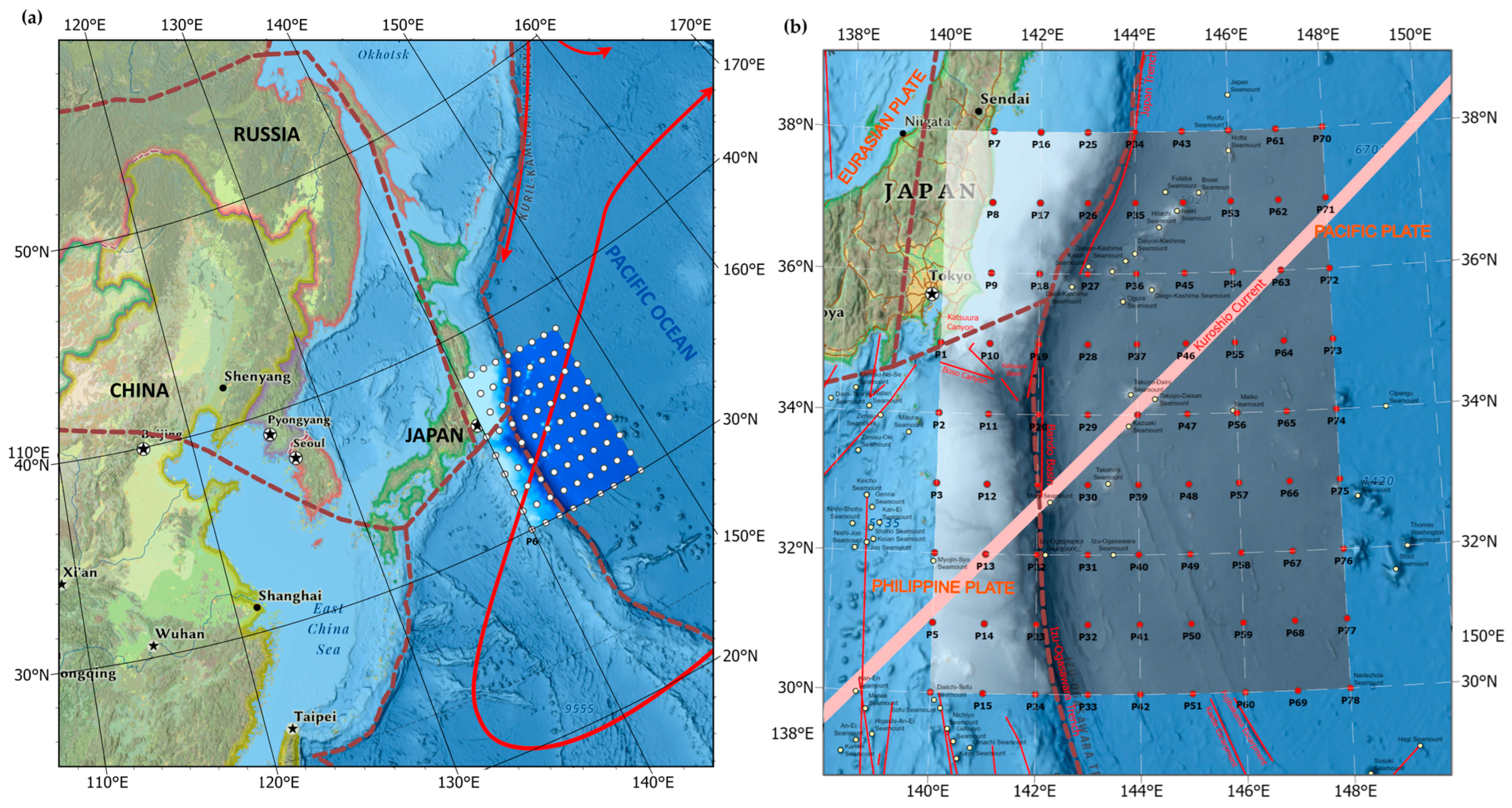
Figure 1. Study area—(a) neighboring areas and (b) study region Japan Trench (western Pacific Ocean 30–38° N, 140–148° E).
Water 17 03433 g001
Figure 2. Multibeam surveys tracklines in the Japan Trench area, presenting 23 sonar profiles recorded during the bathymetric campaigns from NOAA NCEI and MGDS repositories.
Water 17 03433 g002
Figure 3. Flowchart of the methodology for studying the impact of seafloor morphology on regional sea level rise, with steps from data analysis, SLR determination, to SLR acceleration simulations.
Water 17 03433 g003
Figure 4. Regional sea level trends [mm/yr] and amplitudes [cm] of the annual (a), semi-annual (b), and 18.61-year (c) cycle regarding depth profile in meters.
Water 17 03433 g004
Figure 5. Correlation coefficient maps (correlograms).
Water 17 03433 g005aWater 17 03433 g005b
Figure 6. Boxplots of the correlation coefficients. The blue box outline represents the interquartile range (IQR). The red line represents the median value and the red markers represent correlation outliers.
Water 17 03433 g006
Figure 7. Histograms of the correlation coefficients.
Water 17 03433 g007
Figure 8. 2D and 3D models of spatial distribution of variables: (a) geoid heights, (b) depth, (c) marine gravity anomalies, and (d) regional sea level trends.
Water 17 03433 g008
Figure 9. GIA models: Vertical Land Motion in the study area (mm/yr).
Water 17 03433 g009
Figure 10. Mean wind speed and direction map. Blue dots represent virtual stations and red arrows represent wind direction.
Water 17 03433 g010aWater 17 03433 g010b
Figure 11. Results validation. SLR trends determined by methods: harmonic analysis, CWT method, Kalman filter (OLS), Kalman filter (robust).
Water 17 03433 g011
Figure 12. Sea level rise simulation (virtual stations in the coastal zone with submarine canyons).
Water 17 03433 g012
Figure 13. Sea level rise simulation (virtual stations in the ocean trench location).
Water 17 03433 g013
Figure 14. Sea level rise simulation (virtual station in the seamounts location).
Water 17 03433 g014
Figure 15. Sea level rise simulation (virtual stations in the corrugations location).
Water 17 03433 g015
Table 1. Results validation. SLR trends determined by methods: harmonic analysis, Kalman filter (OLS), Kalman filter (robust), CWT method—statistics parameters.
Trend [mm/yr]MeanMedianMinimumMaximumVarianceStd. Dev.SkewnessKurtosis
Harmonic analysis5.653.88−7.7525.8451.157.151.110.82
Kalman filter (OLS)6.273.95−7.0627.7055.357.441.150.79
Kalman filter (robust)5.922.84−6.2729.9562.057.881.441.52
Wavelet transform6.213.83−7.5628.4458.537.651.221.00
Disclaimer/Publisher’s Note: The statements, opinions and data contained in all publications are solely those of the individual author(s) and contributor(s) and not of MDPI and/or the editor(s). MDPI and/or the editor(s) disclaim responsibility for any injury to people or property resulting from any ideas, methods, instructions or products referred to in the content.