Article

Performance Evaluation of the SRM and GRxJ—CemaNeige Models for Daily Streamflow Simulation in Two Catchments with Snow and Rain Dominated Hydrological Regimes

1
Departamento Manejo de Bosques y Medio Ambiente, Facultad de Ciencias Forestales, Universidad de Concepción, Concepción 4070386, Chile
2
Departamento de Matemáticas, Físicas y Estadística, Facultad de Ciencias Básicas, Universidad Católica del Maule, Talca 3460000, Chile
3
Department of Structures for Engineering and Architecture, University of Napoli Federico II, Via Claudio 21, 80125 Napoli, Italy
*
Author to whom correspondence should be addressed.
Water 2025, 17(23), 3413; https://doi.org/10.3390/w17233413 (registering DOI)
Submission received: 18 October 2025 / Revised: 21 November 2025 / Accepted: 28 November 2025 / Published: 30 November 2025

Abstract

This study evaluated the Snowmelt-Runoff Model (SRM) and the Génie Rural à X Paramètres Journalier (GRxJ) model family, analyzing the latter both independently and in combination with the CemaNeige snow module. SRM and GRxJ represent snowmelt-runoff and rainfall-runoff hydrological models, respectively. Accurate streamflow estimation in snow- and rain-dominated basins is crucial for water resource management, especially in the Andes where climate variability and glacier retreat threaten long-term water availability. The analysis was conducted in two Chilean watershed basins with contrasting regimes: the snow-dominated Aconcagua and the mixed rain–snow Duqueco basins. Daily data (2012–2020) of precipitation, temperature, evapotranspiration, snow cover (MODIS), and streamflow were used. Models were calibrated and validated with optimization algorithms and evaluated using N S E , R M S E , R 2 , P B I A S , K G E , M A E , log N S E and A P F B . The results show that SRM effectively reproduces variability and, in the case of the rain–snow regime basin, extreme events, with N S E ranging from 0.70 to 0.78 (Aconcagua) and 0.93 to 0.94 (Duqueco). Model selection should take into account the dominant hydrological processes. In this study, SRM showed the best performance in both analyzed catchments, although with limitations in reproducing extreme streamflow events. In contrast, the GRxJ models did not adequately capture the hydrological dynamics of the snow-dominated Aconcagua catchment. However, their performance improved considerably when applied to the mixed regime of the Duqueco River. These findings highlight the importance of adapting modeling strategies to local hydrological conditions and limited data availability, offering practical guidance for water management and climate change adaptation in Andean catchments.

1. Introduction

Accurate estimation of streamflow in river basins is essential for effective water resource management, supporting applications such as irrigation planning, hydropower generation, and reliable water supply for domestic and industrial users [1,2,3,4,5]. Achieving high precision, however, remains challenging due to multiple factors, including the increasing variability of precipitation driven by climate change and the complex interactions between surface water and groundwater systems [6,7].
Moreover, the dynamics of stormflow generation are significantly influenced by antecedent soil moisture, precipitation magnitude, and watershed hydrological connectivity, factors that complicate hydrological modeling [8]. Likewise, abrupt landscape disturbances, such as seismic events, can alter vegetation and geomorphology, modifying runoff patterns and increasing the challenge of accurately predicting risks associated with extreme events [9].
Globally, the growing pressure on freshwater resources is increasingly recognized as a critical threat to human well-being and long-term sustainability [10,11]. Over the past two decades, population growth, intensified human activities, and climate variability have exacerbated tensions between water supply and demand [12]. Mountainous catchments are particularly strategic in this context, as meltwater from glaciers provides essential water for downstream populations. Nevertheless, ongoing glacier retreat compromises this natural storage, resulting in net water losses and transient increases in runoff during the ablation season [13,14].
Hydrological models have become essential for simulating future streamflow and assessing the impacts of climate and land-use changes on river catchments [15,16]. Their importance is especially evident in data-scarce environments where understanding of hydrological processes is limited [17]. Such models simulate catchment responses under diverse climatic scenarios, supporting predictions of runoff generation [18]. Modeling approaches differ in their spatial representation, ranging from lumped to semi-distributed and fully distributed, and in conceptual complexity, from conceptual to physically based formulations. While complex models allow detailed process representation, they require extensive datasets and are subject to uncertainties related to equifinality, model structure, and future climate projections [19,20,21].
Among the most widely used approaches, the Snowmelt-Runoff Model (SRM) is a degree-day model developed to simulate daily streamflow in glacierized mountain catchments [22]. SRM has been extensively used to assess climate change impacts on streamflow in mountainous watersheds, including the Upper Rio Grande Basin [23,24].
In parallel, Pushpalatha et al. [25] introduced the GR6J model, a six-parameter lumped conceptual model for daily rainfall-runoff simulation, designed to improve low-flow performance relative to GR4J and GR5J. The later integration of the CemaNeige module enabled an explicit representation of snow accumulation and melt, enhancing the applicability of the model in snow-dominated basins [26]. These models have been successfully validated across more than 380 catchments with varying climatic and altitudinal characteristics [27].
In South America, recent applications have demonstrated the effectiveness of these models in mountainous environments. For instance, Escanilla-Minchel et al. [28] applied SRM+G to Chilean Andean catchments, achieving performance metrics exceeding 0.8 and a 7 % annual difference between observed and simulated discharge. Similarly, Flores et al. [29] evaluated GR4J, GR5J, and GR6J in forested catchments in south–central Chile, emphasizing the influence of evapotranspiration formulations and the consistent performance of GR6J under diverse land-cover conditions.
Despite numerous studies applying hydrological models such as SRM and the GRxJ family across different regions, no comparison to date has evaluated the performance of SRM and GRxJ (with and without the CemaNeige snow module) in reproducing streamflow in basins with hydrological regimes as contrasting as those commonly observed in Chile. Addressing this gap is essential for understanding the suitability of conceptual models in Chilean catchments that exhibit distinct rainfall- and snow-dominated dynamics. Therefore, the objective of this study is to assess and compare the performance of the SRM model and the GRxJ family (GR4J, GR5J, GR6J), the latter with and without the CemaNeige snow module, in two representative basins of central Chile: (1) the snow-dominated Aconcagua basin and (2) the mixed rain–snow Duqueco basin. Using traditional statistical performance metrics during both calibration and validation periods, this study aims to identify which model performs best under each of the hydrological regimes considered. The results provide valuable insights for water resource management and climate change adaptation in Andean catchments with limited data availability.

2. Materials and Methods

2.1. Study Area

The Aconcagua River Basin, located between 32 . 3 and 33 S and approximately 50 km north of Santiago, Chile, extends 215 km from the Andes to the Pacific Ocean, with an elevation difference exceeding 6100 m. Covering an area of 7333 km 2 , this arid basin is crucial to the national economy, contributing about 12 % of Chile’s agricultural, livestock, and forestry production. Large-scale irrigated agriculture in the basin relies heavily on seasonal meltwater from Andean snowpacks and glaciers [30].
Within the Valparaíso Region, the Aconcagua sub-basin exhibits a nival hydrological regime, characterized by snow accumulation in winter and runoff generated by snowmelt during spring and summer [31]. It covers 2109 km 2 , with a perimeter of 334 km, a mean elevation of 3270 m a.s.l., and a maximum altitude of 5923 m a.s.l. Its flow is sustained by a network of high-Andean tributaries, including the Juncal, Blanco, Colorado, Riecillos, and Juncalillo rivers, as well as smaller streams such as Vilcuya, Los Chacates, El Maitén, Del Bolsillo, De Los Leones, and Navarro.
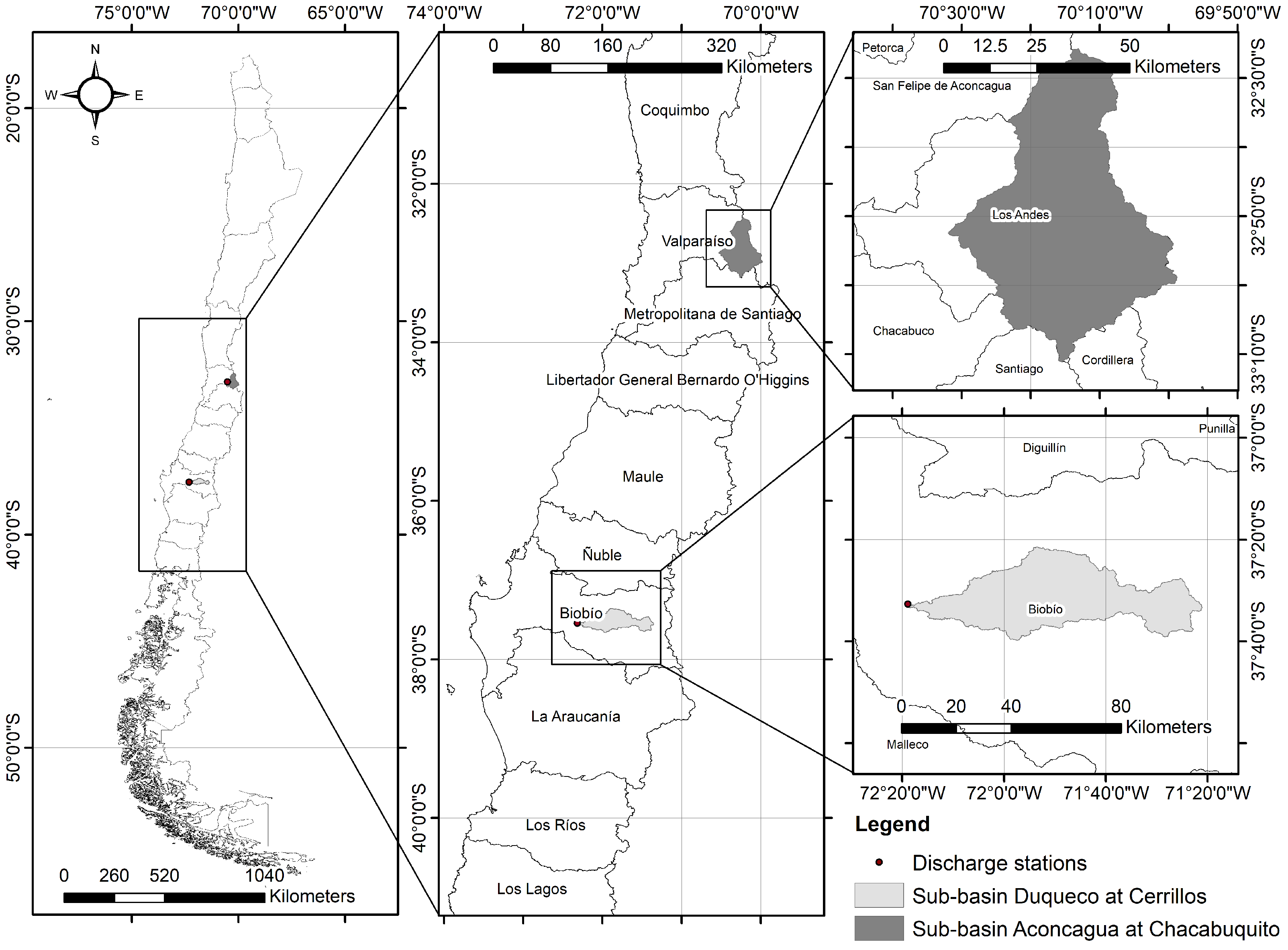
The hydrometric station “Aconcagua en Chacabuquito”, located at 950 m a.s.l. in the upper Andean sector of the sub-basin, monitors runoff from headwater tributaries before water is diverted for irrigation in the valley. Historical data (1950–2000) indicate an average annual discharge of 387 m 3 / s and a mean monthly discharge of 32 m 3 / s [32]. The station’s location is presented in Figure 1.
In contrast, the Duqueco River, located in the upper Biobío Basin, is classified as a mountain river [33], with a pluvio-nival regime governed by both winter precipitation and spring snowmelt. The river basin covers an area of 1433 km 2 , with a perimeter of 274 km, a mean elevation of 541 m a.s.l., and a maximum altitude of 3531 m a.s.l. Within this system, the Cerrillos sub-basin is particularly important, and streamflow and water quality are monitored at the “Cerrillos” station, situated in the mid-to-upper sub-basin (Figure 1). The main tributaries of this river are the Canicura River, the Dimilhue River, the Arilahuen River, and the Coreo River. This station provides essential information on seasonal hydrodynamics. According to Chile’s national water balance [34], the area is characterized by isothermal conditions ranging from 4 to 15 °C and annual precipitation between 1200 and 4000 mm, largely driven by Andean orographic effects.

2.2. Hydrometeorological Data

This study used daily records of precipitation, mean air temperature, and mean daily discharge for the period from 1 June 2012, to 29 April 2020. The data were obtained from the Aconcagua River at Chacabuquito station, operated by the Dirección General de Aguas (DGA), identified by the BNA code 05410002-7. The station is located in the middle Aconcagua River sub-basin, between the Colorado River and the Seco Stream. It is situated in the Valparaíso Region, Los Andes Province and Municipality, at an elevation of 950 m a.s.l.
Similarly, data for the Duqueco River were obtained from the Cerrillos station (BNA code 08323001-0), operated by the DGA. This station is located in the upper Biobío River basin, within the Biobío Region (Biobío Province, Los Ángeles Municipality), at an elevation of 129 m a.s.l.
Additionally, average daily potential evapotranspiration ( P E T ) was used as a climatic variable for the GRxJ models, with and without the CemaNeige module analysis. These data were obtained from the CAMELS-CL (C) dataset (Catchment Attributes and Meteorology for Large-sample Studies—Chile), developed by Alvarez-Garreton et al. [35]. This dataset provides physiographic and climatic catchment attributes, along with daily time series of meteorological and hydrological variables for watersheds across the country.
In addition, four alternative models for estimating potential evapotranspiration were evaluated: Oudin et al. [36], Hargreaves and Samani [37], Priestley and Taylor [38] and Priestley-Taylor modified in Lhomme [39].
The Oudin ( E o ) (Equations (1a) and (1b)):
E o = R e λ ρ + t + 5 100 , t + 5 > 0 ,
E o = 0 , t + 5 0 .
where E 0 Oudin’s model estimates for potential evapotranspiration ( mm · day 1 ); R e extraterrestrial radiation Mj · m 2 · day 1 ; t temperature (°C); λ latent heat flux Mj · kg 1 ; ρ water density kg · m 3 .
The Hargraves-Samani ( E h ) (Equation (2)):
E h = 0.0135 ( t + 17.78 ) R s ,
where E h Hargreaves’ model estimates for potential evapotranspiration mm · day 1 ; R s incident radiation Mj · m 2 · day 1 ; t temperature °C.
The Priestley-Taylor ( E p ) (3a) and modified (3b):
E p = Δ Δ + Y R n G ,
E p a = α Δ Δ + Y R n G .
where E p represents the equilibrium evaporation rate ( mm · day 1 ), assuming no aerodynamic transfer; Δ is slope of the saturated steam heat curve (Pa·°C−1); Y psychometric constant (Pa·°C−1); the equilibrium rate of actual evaporation is modified to give Priestley-Taylor P E T as E p a = α · E p [39]. The parameter “ α ” is associated with vegetation cover and reflects the ratio between actual evapotranspiration and the limiting evapotranspiration observed in the study area [38], α coefficient related to vegetation land cover.

2.3. Satellite Data

MODIS

In this study, snow cover area (SCA) was estimated to be using the MOD09A1.061 Terra Surface Reflectance product from the MODIS sensor, which provides 8-day composite surface reflectance data at a spatial resolution of 500 m. This product offers atmospherically corrected reflectance for MODIS bands 1 to 7 and is widely recognized for its reliability in snow monitoring applications [40]. Pixels included in this dataset are selected based on rigorous quality criteria, such as high observation frequency, low sensor viewing angles, minimal cloud or shadow contamination, and low aerosol presence, ensuring the consistency and accuracy of the input data, thus generating a satellite image composed of the best-quality, cloud-free pixels selected over the 8-day period.
The dataset was accessed and processed using Google Earth Engine (GEE), where the Normalized Difference Snow Index (NDSI) was applied to delineate snow and glacier-covered areas, following the methodology outlined by Riggs et al. [41]. The NDSI is calculated from the normalized difference between the green band green band (band 4) and the shortwave infrared (SWIR, band 6), using a threshold of 0.4, which is commonly applied to delineate snow and ice. This threshold has been shown to be adequate for satellite products with a spatial resolution of 500 m or more, reducing uncertainties in snow cover mapping [42].
The processing in GEE consisted of calculating the NDSI for each 8-day composite, applying the standard threshold of 0.4 to identify snow. Using this threshold, binary rasters were generated to represent only the snow-covered areas within the study basins. Subsequently, snow-covered area was quantified for each defined altitudinal band. Finally, the 8-day composite series was interpolated to produce a daily SCA time series.

2.4. Hydrological Models

2.4.1. SRM (Snowmelt-Runoff Model)

In [43] the authors developed the SRM model to calculate daily runoff mainly based on snow cover area, precipitation, and temperature. Equation (4) was used to estimate snowmelt-induced runoff in the study area. The model relies on daily data of snow cover, precipitation, and air temperature. It also incorporates parameters such as the runoff coefficient, degree-day factor, temperature lapse rate, and recession constant. Since runoff processes differ between snowmelt and rainfall, the runoff coefficient is separated into two values: C S for snow and C R for rain.
Q n + 1 = c S n · a n T n + Δ T n S n + c R n P n ( A · 10000 ) / 86400 1 k n + 1 + Q n k n + 1 ,
where Q mean daily discharge (in m 3 / s ), C S snowmelt-runoff coefficient, C R rainfallrunoff coefficient, a degree-day factor (in cm · ° C 1 · d 1 ), which indicates the snowmelt depth due to 1 degree day, T the number of degree-days (in ° C d ), Δ T temperature adjustment based on the temperature gradient from the measurement station to the basin average hypsometric elevation (in ° Cd ) and is given by Δ T = y · h s t h ¯ · 1 100 where y is the temperature lapse rate (°C per 100 m ), h s t is the elevation at which the measurement station is located (m.s.n.m.) and h ¯ is the mean hypsometric elevation of the area (m.s.n.m.). S the ratio of the snow-covered area to the total area, P precipitation contributing to runoff (in cm), if the catchment is divided into zones, precipitation P increases by 3% for every 100 m of elevation. The parameter T c r i t determines whether this precipitation is rainfall and turns into runoff immediately or it is snow and should be turned into runoff with a delay (once the melting condition is right), A the area of the basin (in km 2 ), k recession coefficient, which indicates how much the discharge declines in the absence of rainfall or snowmelt and is given by k = Q n + 1 / Q n where n and n + 1 are two consecutive days in a recession period. n the number of days in discharge calculations.
Since the temperature decreases with the increase in altitude, the probability of snowfall increases. If the basin elevation range is greater than 500 m, it is best to divide it into multiple zones, each with an elevation range of 500 m [44], for example, see Figure 2.

2.4.2. GRxJ Models (GR4J, GR5J, GR6J) and the CemaNeige Module

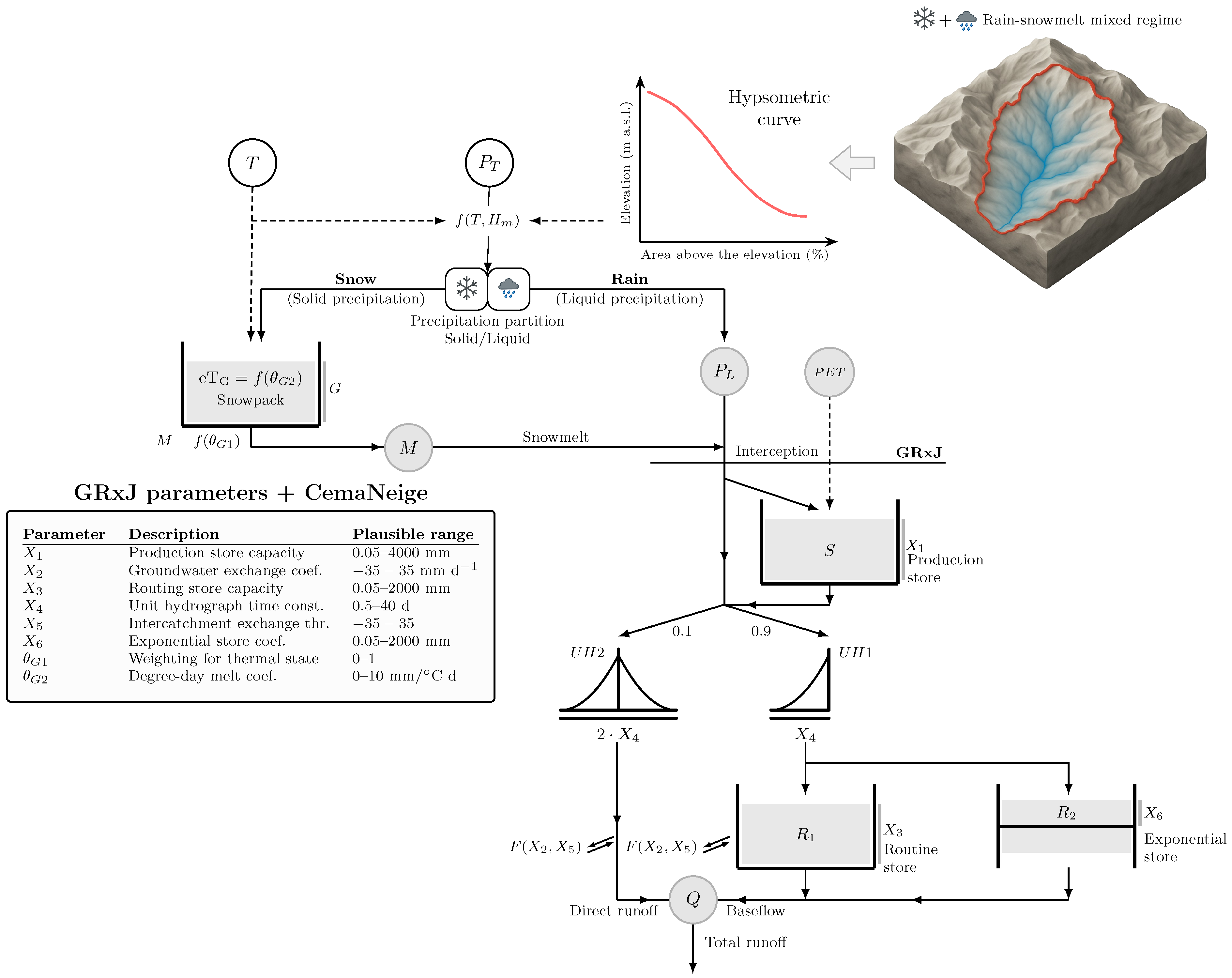
The GR4J model is a lumped, conceptual rainfall-runoff model designed to simulate daily streamflow using four parameters. It requires daily inputs of precipitation and potential evapotranspiration (both in mm), along with observed streamflow data for model calibration. Over time, this model has been extended into more complex versions: GR5J [45], which introduces a fifth parameter, and GR6J [25], which adds a sixth parameter. The parameters of these models are described in Figure 3. These models belong to the family of soil moisture accounting models [46].
To simulate snow accumulation and melt processes, the CemaNeige snow accounting module (SAR) was implemented. This routine is based on a degree-day approach and incorporates the thermal inertia of the snowpack. It uses two parameters: weighting coefficient for snow pack thermal state ( θ G 1 ) and degree-day melt coefficient ( θ G 2 ). Although it uses lumped daily input data, CemaNeige allows for enhanced altitudinal representation by dividing the catchment into elevation bands of equal area based on the hypsometric curve. Meteorological inputs for each elevation zone are interpolated from basin-averaged values using temperature and precipitation lapse rates, following the methodology of Valéry et al. [27]. The implementation of CemaNeige and GR6J is shown in Figure 3.

2.5. Calibration Strategy

The calibration and validation of the hydrological models were carried out by comparing observed streamflow with the streamflow simulated by each model. The calibration period spanned from 1 January 2012, to 31 May 2016, while the validation period extended from 1 June 2016, to 29 April 2020. These periods were selected to include four complete hydrological cycles for both calibration and validation. The Nash-Sutcliffe Efficiency ( N S E ) was used as the objective function [48].
For the calibration of the Snowmelt-Runoff Model (SRM) in the Aconcagua River at Chacabuquito, a genetic algorithm-based optimization approach was implemented using the GA package in R [49]. This method relies on a stochastic optimization process inspired by the principles of natural selection, in which a population of candidate solutions evolves over successive generations with the aim of maximizing an objective function. The calibration involved the optimization of seven parameters: five of them (a, C r , C s , T c r i t , and Lapse Rate [° C / 100 m ]) were defined as spatiotemporal variables (monthly and by elevation zone), resulting in a high-dimensional parameter space that includes 12 months and 9 elevation bands. Because this complexity could potentially increase the risk of overfitting, all parameters were constrained within physically plausible ranges reported in the literature and specifically aligned with the bounds proposed by Bhagwat et al. [50]. Additionally, model performance was evaluated using an independent validation period of equal length to the calibration period, which allowed verification of the temporal stability of the optimized parameters and ensured that the model did not fit only the specific characteristics of the calibration period The remaining two parameters (X and Y) were treated as fixed.
In the case of the Duqueco River at Cerrillos, a spatial-only optimization approach was applied to the same five parameters, with X and Y again held constant.
In the other case, the GRxJ models, with and without the CemaNeige module, were calibrated using the Mitchell optimization algorithm implemented in the airGR package (version 1.7.6) [51]. These models have a smaller number of parameters, all of which are aggregated in space and time, naturally reducing the risk of overfitting. In addition, the airGR calibration procedure combines an initial global search with a local refinement, allowing identification of parameter sets that maximize model performance without requiring additional measures like those applied in SRM.

2.6. Model Efficiency Indicators

To evaluate the performance of the simulations, commonly used metrics in hydrological modeling were applied, the Nash-Sutcliffe Efficiency ( N S E ), the Root Mean Square Error ( R M S E ), the Coefficient of Determination ( R 2 ), the Percent Bias ( P B I A S ), the Kling-Gupta Efficiency ( K G E ), Mean Absolute Error ( M A E ), the logarithmic version of the N S E ( log N S E ) and The Annual Peak Flow Bias ( A P F B ). The Nash-Sutcliffe efficiency ( N S E ), proposed by Nash and Sutcliffe [48] is a normalized statistic that estimates the relative magnitude of the residual variance compared to the measured data variance (Equation (5)) [52].
N S E = 1 i = 1 n Q i Q i 2 i = 1 n Q i Q ¯ 2 ,
where Q i is the observed daily discharge recorded by the station m 3 / s , Q i is the simulated daily discharge ( m 3 / s ), Q ¯ is the mean observed discharge ( m 3 / s ) and n is the number of daily records.
The root mean square error ( R M S E ) is estimated through the square root of the difference between the observed and simulated values over the total number of data (Equation (6)) [52].
R M S E = i = 1 n Q i Q i 2 n .
The coefficient of determination ( R 2 ) is defined as the squared Pearson’s correlation coefficient (Equation (7)) [53].
R 2 = i = 1 n Q i Q ¯ Q i Q ¯ i = 1 n Q i Q ¯ 2 · i = 1 n Q i Q ¯ 2 2 ,
where Q ¯ is the simulated average discharge ( m 3 / s ).
The Percent Bias ( P B I A S ) assesses the average tendency of the simulated values to over or under estimate the observations (Equation (8)) [54].
P B I A S = i = 1 n Q i Q i · 100 i = 1 n Q i .
The Kling-Gupta Efficiency ( K G E ) is an improvement on the Nash-Sutcliffe Efficiency proposed by Gupta et al. [55], in which the correlation, deviation and variability components are weighted equally, solving systematic problems of maximum value underestimation [56].
K G E = 1 ( 1 α ) 2 + ( 1 β ) 2 + ( 1 p ) 2 ,
α = σ obs σ sim , β = μ obs μ sim .
where σ o b s is the standard deviation of the observed daily discharge ( m 3 / s ), σ s i m is the standard deviation of the simulated daily discharge ( m 3 / s ), μ o b s is the mean of the observed daily discharge ( m 3 / s ), μ s i m is the mean of the simulated daily discharge ( m 3 / s ) and p is the Pearson correlation coefficient.
The Mean Absolute Error ( M A E ) is used in determining the global goodness of fit of simulated error (the difference between the observed data and the model predicted output). M A E values of 0 indicate a perfect fit.
M A E = i = 1 n | Q i Q i | n .
The logarithmic version of the N S E ( log N S E ) was proposed by Oudin et al. [57] to increase the sensitivity of model evaluation to low-flow simulations. Unlike the conventional N S E , which tends to be dominated by high flows, the log N S E applies a logarithmic transformation to both observed and simulated discharges, giving greater weight to low flows. This makes it particularly useful when low-flow accuracy is important in hydrological applications.
log N S E = 1 i = 1 n ( log ( Q i ) log ( Q i ) ) 2 i = 1 n ( log ( Q i ) log ( Q ¯ ) ) 2 .
The Annual Peak Flow Bias ( A P F B ) is an application specific metric that focuses on the annual peak flows. It measures the percent bias between the simulated and observed annual maximum flows (Mizukami et al. [58]).
A P F B = μ p e a k Q S μ p e a k Q 0 1 2 ,
where μ p e a k Q S is the mean of simulated annual peak flow series and is the mean of observed annual peak low series.

3. Results

3.1. Snowmelt-Runoff Model

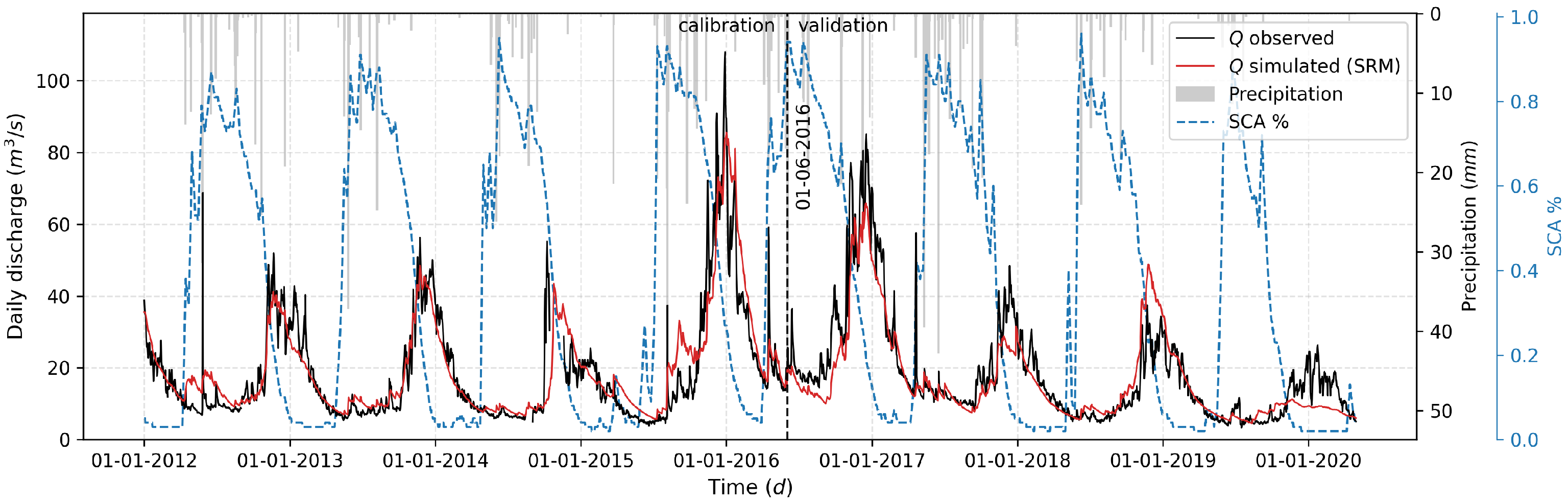
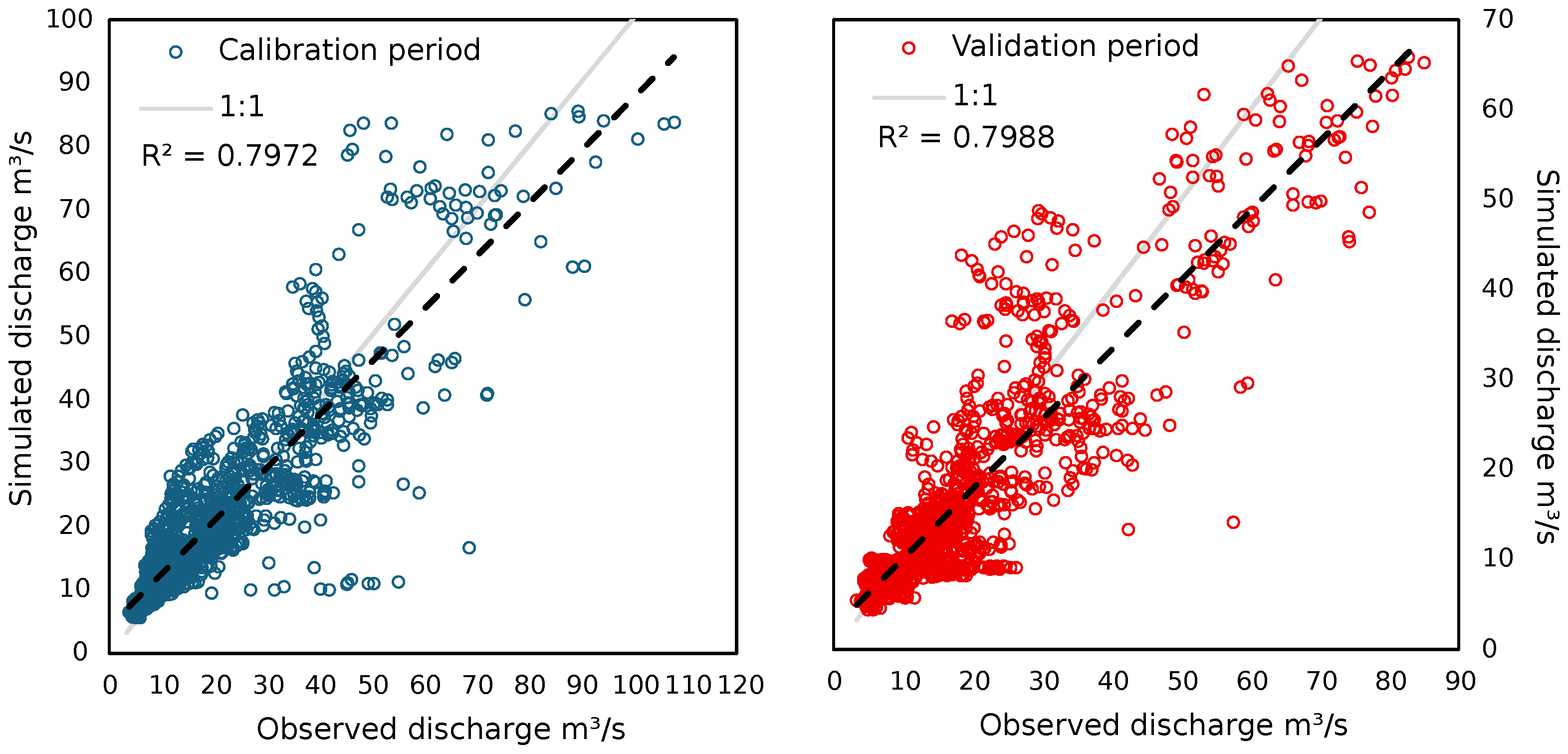
Figure 4 and Figure 5 compare simulated and observed streamflow. The model captures the overall trend across years; however, it does not adequately reproduce short-term variability, particularly abrupt changes. During the calibration period, streamflow tends to be overestimated, especially at low flows, while in the validation period a general underestimation is observed (Figure 5), with simulated values clustering around and below the 1:1 line. This bias is most evident in the final year of the record. In addition, the model consistently fails to reproduce extreme events throughout the simulation.
Additionally, a weak correlation is observed between precipitation events and streamflow response, suggesting that the hydrological regime of the basin is primarily governed by snow accumulation and melt processes rather than direct rainfall-runoff. This is further supported by Figure 4, which shows that streamflow reaches its minimum when the Snow-Covered Area (SCA) is at its maximum, emphasizing the role of snow accumulation in subsequent melt-driven flow. This behavior is consistent with the characteristics of the Aconcagua region.
The model simulation during the calibration period (1 January 2012 to 1 June 2016) yielded a Nash-Sutcliffe Efficiency ( N S E ) of 0.697 , a Root Mean Square Error ( R M S E ) of 8.607   m 3 / s , a coefficient of determination ( R 2 ) of 0.797 , a Percent Bias ( P B I A S ) of − 9.763 % , and a Kling-Gupta Efficiency ( K G E ) of 0.858 , a M A E of 5.152   m 3 / s , a log N S E of 0.785 and A P F B of 0.228 . In the validation period, the model achieved an N S E of 0.783 , R M S E of 6.735   m 3 / s , R 2 of 0.799 , P B I A S of 9.636 % , and K G E of 0.783 , M A E of 4.462   m 3 / s , log N S E of 0.769 and A P F B of 0.317 (Table 1).
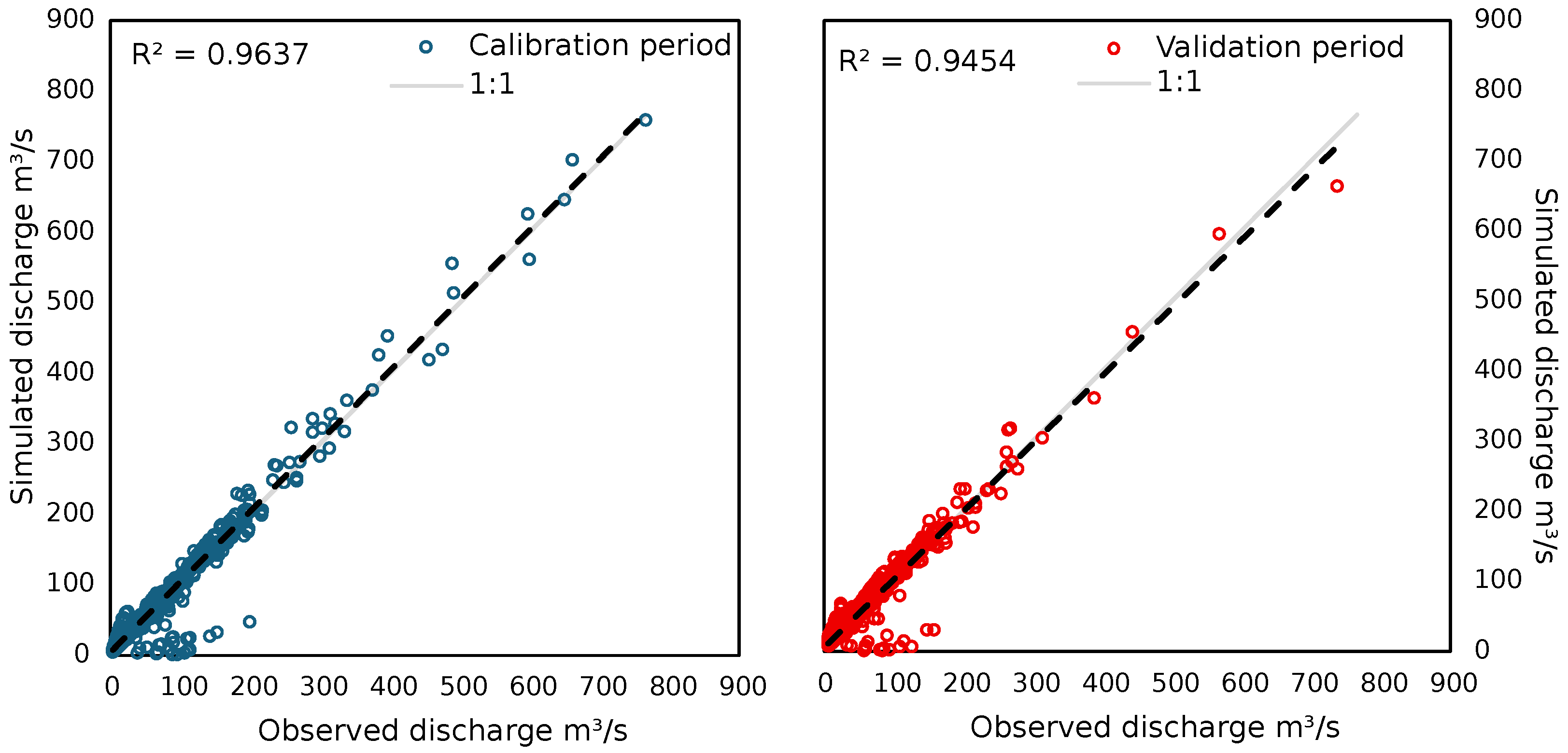
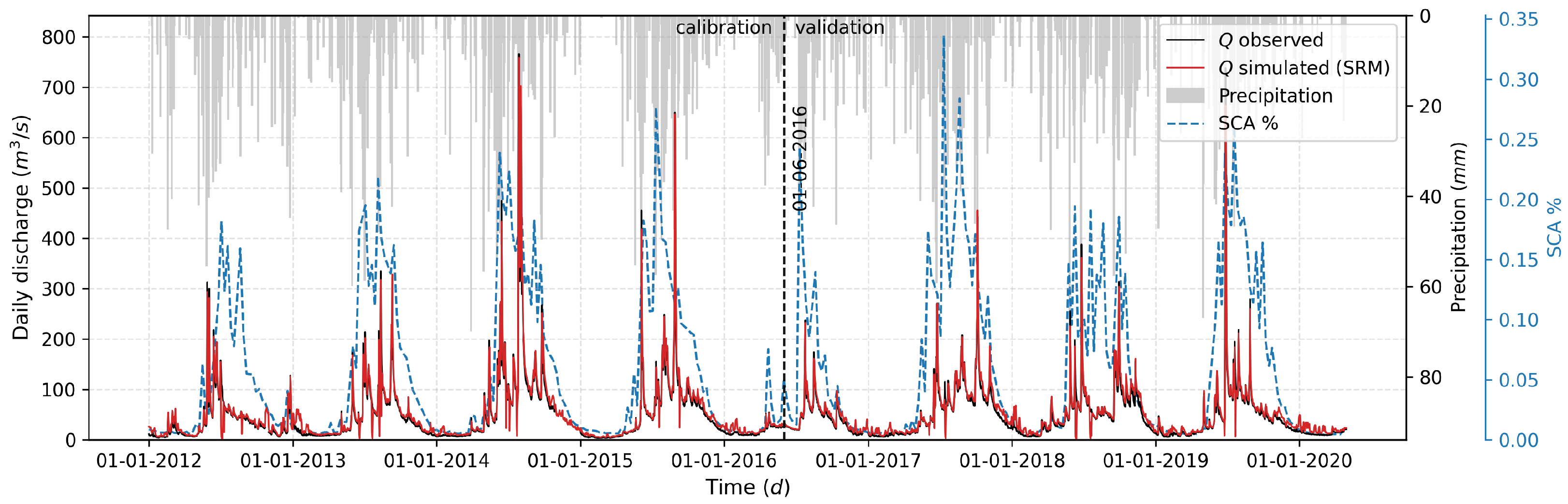
Figure 6 and Figure 7 demonstrate a high-quality simulation, with the model successfully reproducing both the general behavior and the variability of streamflow, including extreme events. During both the calibration and validation periods, the model performance is notable. However, abrupt drops in simulated streamflow compared to the observed values are evident in certain instances. This behavior is more clearly seen in Figure 7, where some points are distinctly clustered relative to the 1:1 line.
In contrast to the Aconcagua basin, the Duqueco basin exhibits a strong correlation between precipitation events and streamflow response (see Figure 6), indicating a precipitationdominated hydrological regime. However, not all extreme precipitation events lead to peak streamflow events. This suggests that peak flows are not solely determined by the intensity of individual rainfall events, but rather by the frequency and accumulation of hydrological processes over time. For instance, when base flows are already elevated, an extreme rainfall event is more likely to trigger a high-flow response compared to the same event occurring under low-flow conditions.
Moreover, considering that Figure 6 shows streamflow increases even during periods of snow accumulation, it is reinforced that, unlike the Aconcagua basin, snow accumulation is not the dominant process controlling streamflow in the Duqueco basin, indicating a pluvio-nival or predominantly precipitation-driven hydrological regime.
The model simulation during the calibration period (1 January 2012 to 1 June 2016) yielded a Nash-Sutcliffe Efficiency ( N S E ) of 0.943 , a Root Mean Square Error ( R M S E ) of 15.709   m 3 / s , a coefficient of determination ( R 2 ) of 0.964 , a Percent Bias ( P B I A S ) of 11.547 % , and a Kling-Gupta Efficiency ( K G E ) of 0.936 , a M A E of 8.465   m 3 / s , a log N S E of 0.853 and A P F B of 0.024 . In the validation period, the model achieved an N S E of 0.933 , R M S E of 12.979   m 3 / s , R 2 of 0.945 , P B I A S of 10.820 % , and K G E of 0.907 , a M A E of 7.644   m 3 / s , a log N S E of 0.793 and A P F B of 0.233 (see Table 2).

3.2. GRxJ Models (GR4J, GR5J, GR6J) with and Without the CemaNeige Module

3.2.1. Selection of the Evapotranspiration Model That Optimizes Model Performance

The evaluation of different potential evapotranspiration ( P E T ) formulations, combined with the three GRxJ model variants (GR4J, GR5J, GR6J) with and without the CemaNeige snow module, revealed basin-dependent differences (Table 3). In the Aconcagua River basin at Chacabuquito, the CAMELS-CL (C) formulation yielded the best results with GR4J, regardless of the inclusion of CemaNeige. For GR5J, no differences were detected among P E T models, whereas in GR6J, performance was slightly better with CAMELS-CL and Oudin’s formulation ( E o ). In contrast, in the Duqueco River basin at Cerrillos, Oudin’s model ( E o ) consistently outperformed all other formulations across GRxJ variants and CemaNeige configurations. Consequently, CAMELS-CL (C) was selected for the Aconcagua basin and Oudin’s formulation ( E o ) for the Duqueco basin.

3.2.2. Model Results

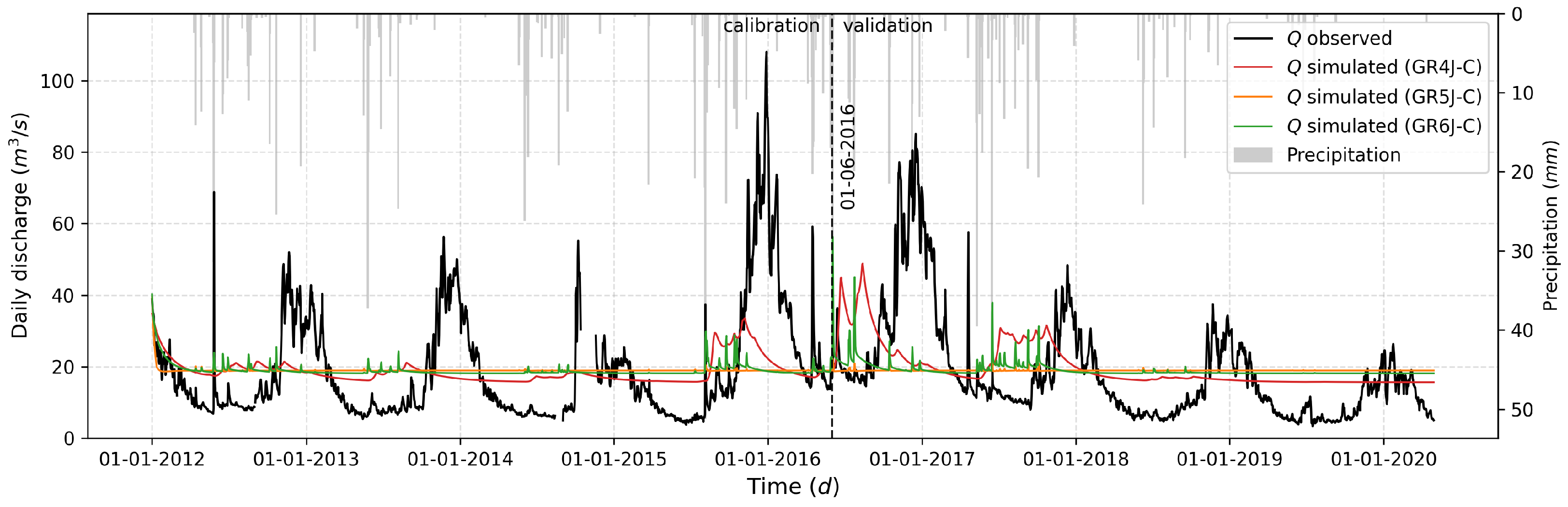
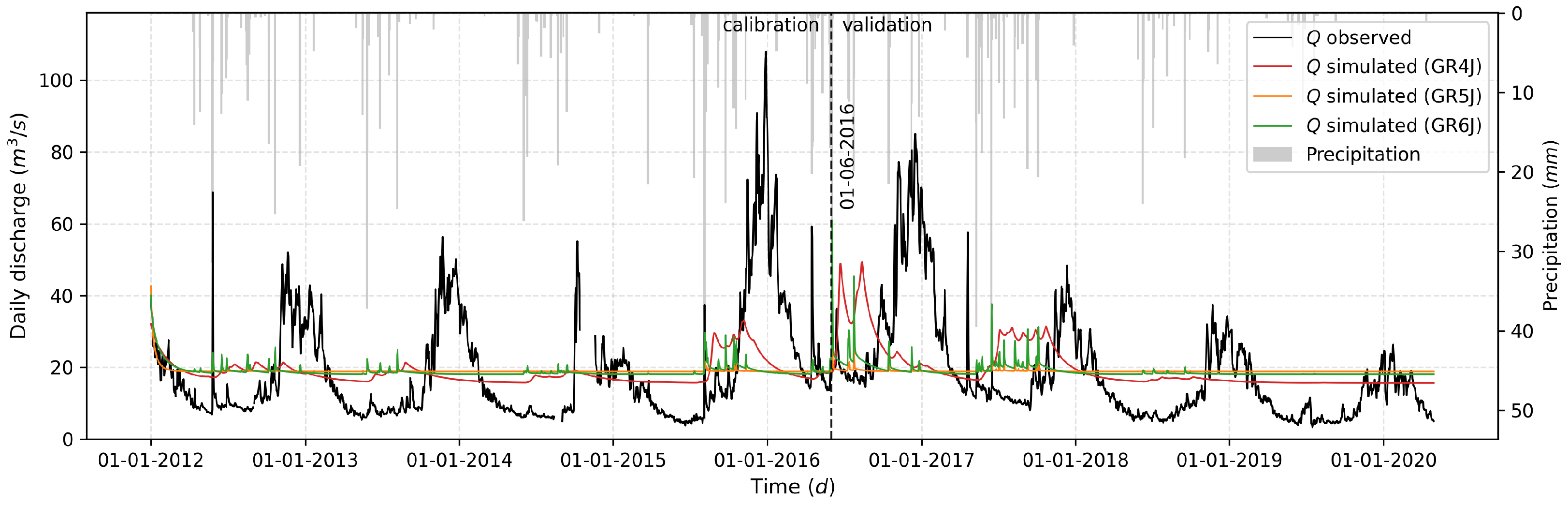
The simulations generated using the GRxJ models, both with and without the CemaNeige module, are presented in Figure 8 and Figure 9. In both cases, the models fail to adequately reproduce the observed streamflow behavior. The simulations tend to represent the mean flow as a relatively linear trend throughout the period, without capturing temporal variability or extreme events. However, it is worth noting that the models exhibit some sensitivity to precipitation events, particularly in the GR4J and GR6J configurations. In these cases, increases in simulated streamflow are observed following rainfall events, although this response is limited and does not reflect the observed streamflow values. Consequently, the overall performance of the models for the Aconcagua River basin at the Chacabuquito station cannot be considered satisfactory.
In Table 4, the GR4J, GR5J, and GR6J models showed very poor performance during both the calibration and validation periods, with or without the inclusion of the CemaNeige module. The N S E values were close to zero or even negative in all cases, indicating a very limited ability of the models to reproduce the observed streamflow. GR4J showed the highest N S E value ( 0.119 ) during calibration, but it dropped to 0.028 in validation, both being poor. GR5J and GR6J exhibited N S E values between 0.005 and 0.002 , with no improvements after incorporating CemaNeige.
The coefficient of determination ( R 2 ) was also low in all cases, with values below 0.140 , and the percent bias ( P B I A S ) was moderate, with some cases showing overestimation (e.g., GR4J with 1.902 % ) and others underestimation (e.g., GR4J with 8.244 % in validation). The Kling-Gupta Efficiency ( K G E ) was closer zero or negative for all models and periods, further confirming the poor agreement between simulated and observed streamflow. The addition of the CemaNeige module resulted in only marginal changes in the metrics, with no clear evidence of improvement.
To complement the evaluation of the GRxJ models’ performance across different aspects of hydrological variability, the log N S E , A P F B , and M A E metrics were considered. log N S E values were close to zero or negative ( 0.161 to 0.027 ), highlighting the limited ability of the models to simulate low flows. The A P F B index showed notable deviations in the shape of the hydrographs, particularly for peak flows, with values ranging from 0.38 to 0.65 . Finally, M A E ranged from 10.35 to 11.60   m 3 / s , reflecting consistent discrepancies between simulated and observed streamflows throughout the hydrograph. The log N S E , A P F B , and M A E values did not show significant improvements following the inclusion of the CemaNeige module, indicating that this module produced only marginal changes in the performance of G R 4 J , G R 5 J , and G R 6 J in the studied basin.
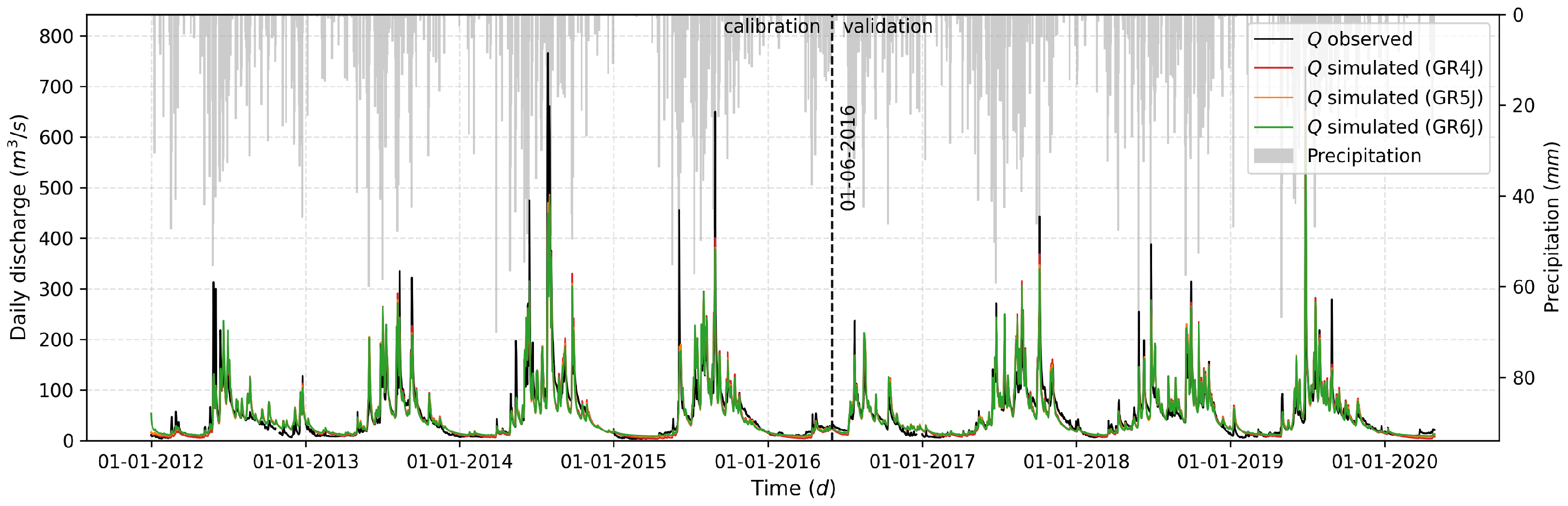
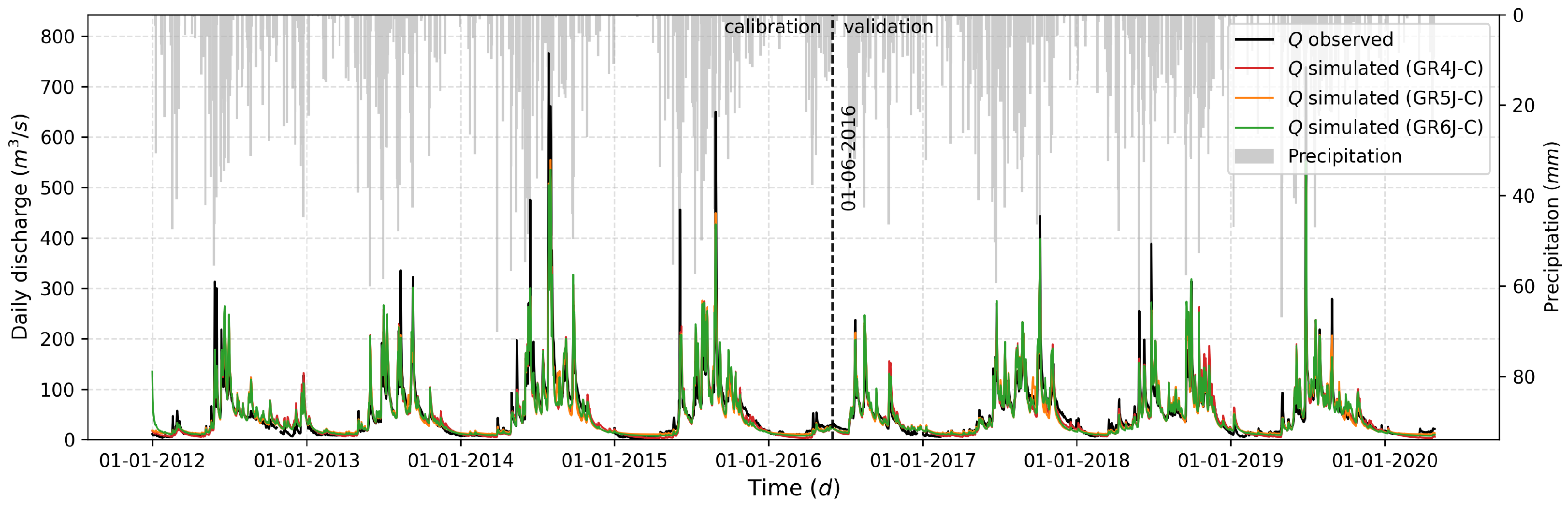
The simulations using the GRxJ models coupled with the CemaNeige snow module demonstrate an improved ability to capture both the variability and general trend of streamflow. In contrast, the standalone GRxJ models tend to underestimate peak flows and exhibit reduced performance in reproducing hydrological extremes (Figure 10). Visual inspection of the hydrographs shows a more accurate fit during the validation period for all models, especially when CemaNeige is included (Figure 11). Overall, while all GRxJ configurations deliver acceptable performance, the inclusion of the snow module enhances model performance.
As previously observed in the Aconcagua basin, the GRxJ models exhibit a certain sensitivity to precipitation events. This characteristic likely explains their improved performance in the Duqueco basin, where streamflow generation is strongly correlated with precipitation. The direct relationship between rainfall and runoff in Duqueco provides more favorable conditions for the GRxJ models to adequately simulate streamflow dynamics, an effect that is further enhanced by the inclusion of the CemaNeige module, which accounts for processes related to snow accumulation and melt.
The performance of the hydrological models GR4J, GR5J, and GR6J was evaluated with and without the CemaNeige snow accumulation and melt module during the calibration and validation periods (Table 5). Incorporating CemaNeige generally led to improved or comparable performance across most evaluated metrics. For the GR4J model, the N S E increased from 0.834 to 0.854 during calibration and increased slightly from 0.837 to 0.844 during validation, while the K G E improved from 0.864 to 0.882 in calibration and from 0.873 to 0.901 in validation. The GR5J model showed consistent improvements with CemaNeige, with the N S E rising from 0.832 to 0.860 in calibration and from 0.840 to 0.865 in validation, and the K G E increasing from 0.844 to 0.868 in calibration and from 0.888 to 0.928 in validation, presenting the best overall performance. Meanwhile, the GR6J model also benefited from the inclusion of CemaNeige, achieving higher N S E values (from 0.835 to 0.853 in calibration and from 0.846 to 0.855 in validation) and higher K G E scores (from 0.837 to 0.876 in calibration and from 0.902 to 0.906 in validation), although its performance was slightly lower than that of GR5J. Overall, the use of CemaNeige improved streamflow representation, especially in the GR5J and GR6J models.
To complement the evaluation of the GRxJ models’ performance across different aspects of hydrological variability, the log N S E , A P F B , and M A E metrics were considered. log N S E values were close to 0.84 ( 0.777 to 0.872 ), highlighting the models’ good ability to simulate low flows. The A P F B index showed moderate deviations for extreme flows, with values ranging from 0.15 to 0.30 . Finally, M A E ranged from 11.01 to 14.09   m 3 / s , reflecting a low error relative to the magnitude of streamflow. The log N S E , A P F B , and M A E values showed improvements following the inclusion of the CemaNeige module, especially for GR6J in the studied basin.

4. Discussion

4.1. Performance of Both Models

4.1.1. Aconcagua River in Chacabuquito

In the snow-dominated basin, the SRM model achieved a performance classified as good to very good, according to the performance ranges proposed by Moriasi et al. [59], during both calibration and validation periods. In contrast, the GRxJ family models, coupled with and without the CemaNeige module, showed unsatisfactory performance in the snow-dominated basin, with low and negative N S E values and poor capacity to adequately represent streamflow.
This difference can be partly explained by the structural characteristics of both models. As Martinec [43] pointed out, SRM allows extrapolation of input variables (precipitation and temperature) and considers parameters that vary in space (altitudinal zones or bands) and time (Martinec [43] notes can be parameterized every 15 days), in basins with a high correlation between precipitation and runoff, this allows for capturing greater precipitation inputs and adjusting runoff coefficients to simulate extreme events. However, in this basin, where such correlation is low, this extrapolation capability provides less advantage, as it does not significantly improve the estimation of extreme events. On the other hand, GRxJ models are designed with fixed parameters (space and time) and input variables constant in space, limiting their representativeness across the entire basin [25,45,46]. Although Valéry et al. [27] introduced the CemaNeige module to improve snow representation by extrapolating its input variables, its parameters remain fixed spatially and temporally, meaning it cannot simulate extreme events with the same performance as SRM.
Furthermore, the most significant difference in model performance in this study area lies in the approach each uses to represent snow processes. The SRM model directly incorporates the snow cover area (SCA) variable, mainly obtained from satellite images, allowing it to estimate snowmelt contributions even in the absence of precipitation. In contrast, the CemaNeige module simulates snow dynamics through an accumulation and melt routine (SAR), primarily based on daily temperature and precipitation data, which are extrapolated by altitudinal zones [27]. This difference is notable in areas like the one studied, where precipitation is infrequent. Under such conditions, CemaNeige faces a significant limitation since its ability to generate snow, and thus runoff, depends directly on the occurrence of precipitation events. If no precipitation is recorded, the model generates neither SCA nor runoff. In contrast, the SRM model is not affected by the absence of precipitation, as its snow cover estimation is primarily based on satellite observations. This allows it to more accurately represent hydrological dynamics in snow-dominated basins with scarce precipitation.
It is important to note that these results are specific to the Aconcagua River catchment and should not be interpreted as universally applicable to all snow-dominated basins.

4.1.2. Duqueco River in Cerrillos

In the rain–snow regime basin, both models showed performance ranging from good to very good, with the SRM model again achieving the best results. This is due to the high correlation between rainfall and runoff, which allows SRM, through the extrapolation of variables and spatially distributed parameterization, to capture greater precipitation inputs and convert them into runoff for extreme events. The GRxJ models, both with and without the CemaNeige module, also showed a significant improvement in performance compared to the snow-dominated basin. This improvement is primarily explained by the basin’s hydrological regime, characterized by abundant and frequent precipitation. Since the GRxJ models heavily rely on precipitation to simulate both snow accumulation processes (in the case of CemaNeige) and runoff, their ability to reproduce streamflow is substantially enhanced in contexts with frequent rainfall. These results highlight the high sensitivity of the GRxJ models to available precipitation, which favors their performance in basins like Duqueco. However, this same characteristic limits their applicability in basins with lower precipitation regimes, as observed in Aconcagua.

4.2. Influence of the PET Source on GRxJ Models’ Performance

Various methods to estimate potential evapotranspiration (PET) were evaluated as input variables for the GRxJ models, observing that an appropriate choice of PET source can partially improve their performance. For example, changing the source or estimation method of PET resulted in the most noticeable improvement in the GR5J model’s performance, from an N S E of 0.744 to 0.832 , for GR4J, from 0.807 to 0.834 , and for GR6J, from 0.810 to 0.835 . These improvements show that the appropriate selection of the PET estimation method positively influences the accuracy of the hydrological models evaluated.
In this study, the Oudin equation ( E o ) was identified as the PET source that provided the best results, which aligns with reports from other authors who have demonstrated its reliability as an input variable for the GRxJ models [29,60]. Particularly, although the GRxJ models’ performance in the Aconcagua River basin was poor, the best PET source corresponded to the CAMELS-CL (C) dataset, which is also based on the Oudin formula, reinforcing the evidence that among the evaluated options, this method is most suitable for GRxJ models.
These findings highlight the importance of adapting potential evapotranspiration estimation to the specific hydrometeorological context and suggest that, in data-scarce regions, the use of simple and robust methods such as Oudin’s, which bases its calculations on mean daily temperature and estimated extraterrestrial radiation, can significantly optimize the calibration and performance of hydrological models.

4.3. Comparison of GR4J, GR5J, and GR6J Performance with and Without the CemaNeige Module

Performance evaluation among the GRxJ family models in the mixed regime basin shows consistent results with those obtained by Flores et al. [29] and Park et al. [61]. In those studies, GR5J and GR6J demonstrated better performance compared to GR4J, with GR6J being the best model, although the improvement was partially relative to the others.
When incorporating the CemaNeige module, improvement in performance was evident for all models, which align with Sezen et al. [62], who reported an improvement in GR6J simulations with CemaNeige compared to the GR4J and GR6J models without it. However, in the present study, the model with the best performance was GR5J + CemaNeige, even outperforming GR6J with and without the module.
In the snow regime basin, although overall model performance was poor, the incorporation of the CemaNeige module also helped improve results. In this case, the GR4J + CemaNeige model achieved the best performance.
These results demonstrate that incorporating the snow module improves simulation performance in rain–snow regime basins. Although GR5J + CemaNeige showed improvement in this study compared to other GRxJ models, the works of Flores et al. [29], Park et al. [61], and Sezen et al. [62] did not perform a complete comparison of all GRxJ models with and without the CemaNeige module. This limitation prevents generalizing that GR5J + CemaNeige is the optimal model in different contexts.

4.4. Performance of Both Models in Previous Studies

Previous studies comparing the GR4J and SRM models support the findings of this research. For example, in the Dudh Koshi River basin in Nepal, the SRM model achieved an N S E of 0.86 , while GR4J obtained a value of 0.63 , representing a significant difference in the performance of the two models. While both are characterized by a robust and simple structure, SRM demonstrates a greater responsiveness to variations in temperature and precipitation, whereas GR4J shows notable limitations, especially during the winter season. Specifically, Pokhrel et al. [63] noted that, in the GR4J model, a temperature increase between 1 °C and 4 °C generated an increase in winter runoff of only 0.46 % to 1.49 % . In contrast, under the same conditions, SRM reported a much more significant increase, ranging from 10.2 % to 70.1 % . These results demonstrate that SRM has greater sensitivity and capacity to simulate runoff generated by snowmelt, a key aspect in basins dominated by this regime.
In a related study, Munoz Castro et al. [47] evaluated the GRxJ model family, both with and without the CemaNeige snow module, across 95 catchments distributed throughout Chile. A notable aspect of that study is that individual results by catchment are not reported; instead, catchments are grouped into quartiles based on parameter agreement indices, linking these groups to hydroclimatic and physiographic characteristics. The authors found that wetter catchments, with higher precipitation and runoff ratios, tend to exhibit better performance and more stable parameters, whereas semiarid and snow-influenced catchments showed lower agreement and less consistent results. Consequently, the GRxJ models demonstrate limitations in catchments where runoff is primarily driven by snow accumulation and melt under low precipitation conditions. This evaluation approach, based on grouping, contrasts with the present study, in which explicit results are reported for each catchment. In particular, the findings for the Aconcagua basin show that the GRxJ models (with or without CemaNeige) perform poorly in basins with a dominant snow regime and reduced precipitation, thus reinforcing the limitations identified by Muñoz Castro et al. [47].
It is also worth noting that Perrin et al. [46] highlighted structural limitations of the GR4J model in its application under climate change scenarios, particularly due to the lack of an adequate snow module. This further supports the findings of the present research.
In addition, Calizaya et al. [64] successfully applied the SRM model in the Santa River subbasin (Peru) to assess climate change impacts on runoff. The model exhibited strong performance during calibration and validation, with high efficiency metrics. Hydrological projections extended to 2080 under future climate scenarios further demonstrated SRM’s robustness in simulating watershed responses to changing climatic conditions. These findings affirm the model’s value as a reliable tool for climate impact assessment at the basin scale.
Although the GRxJ model family has shown limitations in basins with a dominant snow regime, mainly associated with hydroclimatic conditions, both models analyzed in this study (SRM and GRxJ) have proven to be applicable across a wide range of spatial scales from a physiographic perspective. For instance, Martinec [43] reported that the SRM model has been successfully implemented in over 120 catchments worldwide, with basin areas ranging from 2.65 km 2 to 917,444 km 2 , achieving good efficiency indicators in most cases. In Chile, Flores et al. [65] evaluated the GRxJ model family in 15 catchments in the Biobío Region, characterized by a strong correlation between rainfall and runoff, with areas ranging from 28.5 km 2 to 24,269 km 2 . Overall, good performance was obtained; however, in cases where the N S E was below 0.4 , the causes were attributed to factors such as input data quality, small catchment size, and potential anthropogenic influences.
Along these lines, the study by Flores et al. [65] highlights the importance of considering scale effects in parameter calibration and transfer, proposing a regionalization approach based on morphometric variables such as basin area, average slope, and form factor. This methodology allowed calibrated parameters to be transferred from monitored to ungauged catchments, achieving simulations with coefficients of determination ( R 2 ) ranging from 0.68 to 0.99 . These results suggest that, although the GRxJ models present limitations mainly related to hydrological regimes, their applicability can extend to various spatial scales, provided that catchment morphometric characteristics are properly accounted for. In this way, it is recognized that basin area, as a direct expression of scale effects, does not inherently limit the application of the model, but it does influence the stability and transferability of its parameters, which, to date, has not been studied in the case of SRM.
To date, no other studies have been identified that directly compare SRM with models from the GRxJ family, nor studies that apply GRxJ (with or without the CemaNeige module) in basins with such a dominant snow regime. At least in Andean catchments in South America, this remains an unexplored area of research. In this context, the results presented support the conclusion that the SRM model shows strong performance under various hydrological conditions, while GRxJ models achieve good results mainly in basins where precipitation is the primary driver of runoff.

5. Conclusions

This study evaluated the performance of the SRM and GRxJ (GR4J, GR5J, GR6J) hydrological models, with and without the CemaNeige snow module, in two Chilean catchments with contrasting hydrological regimes. The main findings and their implications lead to the following conclusions:
The results of this study indicate that model selection should be aligned with the dominant hydrological regime of each catchment. In particular, SRM demonstrated superior performance in the snow-dominated basin, likely due to its ability to incorporate satellite-derived snow cover information into the hydrological representation. In contrast, the GRxJ + CemaNeige models performed better in mixed (rain–snow) regimes where precipitation is more frequent. These results suggest that model selection should be guided by the prevailing hydrological regime.
The structural limitations of the GRxJ models, particularly their inability to adequately represent snow dynamics in the absence of precipitation, reduce their applicability in mountainous catchments of central–northern Chile. In this regard, the integration of satellite observations (as in SRM) represents a significant advantage for modeling in such regions.
The proper selection of the potential evapotranspiration ( P E T ) source had a direct impact on the performance of the GRxJ models. The Oudin formula stood out as the most suitable option, reinforcing the need to evaluate multiple input options during data preparation and model calibration.
Given that many Andean catchments share similar characteristics with the Aconcagua basin, the use of models like SRM may be more reliable for hydrological planning, meltwater runoff estimation, and climate change scenario evaluation. However, in catchments with frequent precipitation, the conceptual GRxJ + CemaNeige models can offer efficient and transferable solutions to ungauged basins, provided they are properly calibrated.
The calibration process used in this study for the SRM model involves high parameter dimensionality, especially due to its spatial and temporal variability, resulting in higher computational costs compared to the GRxJ models. The latter, with a simpler structure and fewer parameters, are more efficient for rapid simulations or in contexts with limited computational resources.
An important limitation of this study is that the superior performance observed for SRM in snow-dominated basins is based solely on the analysis of two specific catchments, and therefore cannot be generalized to other basins without further investigation. Additionally, the findings highlight that the behavior of the GRxJ models, both with and without CemaNeige, is strongly conditioned by precipitation, which should be taken into account when interpreting the results.
The availability of hydrometeorological data is limited, particularly regarding snow and soil moisture observations, which restricts the validation of intermediate hydrological processes and contributes to model uncertainty. Concerning soil representation, the GRxJ models include a conceptual structure that accounts for soil water storage and retention, although in a simplified form, whereas the SRM model does not explicitly represent these processes. This difference may influence each model’s ability to simulate the hydrological response in catchments where soil dynamics play a relevant role. Furthermore, the analysis was conducted in only two catchments with specific hydrological characteristics, which limits the generalization of the findings to other Andean basins. Finally, the SRM model involves a high level of parameter dimensionality, while the GRxJ models rely strongly on the frequency of precipitation events, which conditions their performance according to the dominant hydrological regime.
The fixed structure of the GRxJ model is a disadvantage in snow-influenced catchments or for capturing extreme events. Therefore, it is recommended that future research aimed at improving the GRxJ models should incorporate spatially and temporally variable parameterization, as well as the inclusion of snow cover area (SCA) as an input variable, to enhance their performance in mountainous regions and under infrequent precipitation scenarios. Additionally, we suggest evaluating the capacity of the SRM model to transfer its parameters to ungauged catchments, as well as explore semi-distributed models or models with dynamic vegetation cover to more fully represent hydrological processes in Andean catchments.

Author Contributions

Conceptualization, D.G. and S.Y.; methodology, B.R., V.O., D.G. and S.Y.; software, B.R. and V.O.; validation, B.R.; formal analysis, B.R.; writing—original draft preparation, B.R., V.O. and S.Y.; writing—review and editing, B.R., V.O., D.G., C.G. and S.Y.; visualization, B.R. and V.O.; supervision, C.G. and S.Y. All authors have read and agreed to the published version of the manuscript.

Funding

V.O is partially funded by UCM-IN-24200 internal grant, Universidad Católica de Maule.

Data Availability Statement

We provide open access to the dataset used in this study through the Zenodo repository. The dataset includes daily hydroclimatic time series (temperature, precipitation, evapotranspiration, and streamflow) as well as catchment physiographic information required for the GRxJ and CemaNeige models. It can be freely accessed and downloaded at: https://doi.org/10.5281/zenodo.17246190, accessed on 27 November 2025. This ensures full reproducibility and facilitates further research and validation.

Acknowledgments

The authors acknowledge the use of MODIS products distributed by NASA’s Earth Science Data Systems (ESDS) Program, which were accessed and processed through the Google Earth Engine (GEE) platform. We also thank the Center for Climate and Resilience Research (CR2) for providing access to the CAMELS-CL dataset, as well as Chile’s Dirección General de Aguas (DGA) for supplying hydrometric data for both watersheds in this study. These datasets were fundamental for the development of this study.

Conflicts of Interest

The authors declare no conflict of interest.

Abbreviations

The following abbreviations are used in this manuscript:
a.s.l.above sea level
airGRR package for GR models
BNABanco Nacional de Aforos (Chile’s National Hydrometric Database)
CAMELS-CLCatchment Attributes and Meteorology for Large-sample Studies—Chile
CemaNeigeSnow accounting routine (degree–day snow module for GR models)
CR2Center for Climate and Resilience Research (Chile)
DGADirección General de Aguas (Chilean Water Authority)
ESDS(NASA) Earth Science Data Systems
GAGenetic algorithm
GEEGoogle Earth Engine
GR4JGénie Rural daily rainfall–runoff model (4 parameters)
GR5JGénie Rural daily rainfall–runoff model (5 parameters)
GR6JGénie Rural daily rainfall–runoff model (6 parameters)
GRxJFamily of GR daily rainfall–runoff models ( x { 4 , 5 , 6 } )
KGEKling–Gupta Efficiency
MOD09A1MODIS Terra Surface Reflectance (8-day, 500 m) product
MODISModerate Resolution Imaging Spectroradiometer
NDSINormalized Difference Snow Index
NSENash–Sutcliffe Efficiency
PBIASPercent Bias
PETPotential Evapotranspiration
RThe R programming language
RMSERoot Mean Square Error
SARSnow Accounting Routine (in CemaNeige)
SCASnow Cover Area
SRMSnowmelt-Runoff Model
SWIRShortwave Infrared
UHUnit hydrograph

Appendix A

Appendix A.1

Table A1. Monthly average values of SRM model parameters in the Aconcagua River at Chacabuquito, by elevation zone.
Parameter
(Monthly Average)
Zone
123456789
a0.89710.30960.31020.46700.84060.68850.79060.86840.4537
y0.63900.63570.63890.69030.69790.40660.51490.52370.5932
C s 0.37600.18810.27980.25740.66990.21910.63610.99850.1273
C R 0.24610.03470.00860.06590.05620.02160.89360.60470.3107
T crit 3.79221.52073.53852.69622.70442.44802.06010.56533.9698
X1.1339
Y0.0480

Appendix A.2

Table A2. Parameter values for SRM in the Duqueco River at Cerrillos, by elevation zone.
ParameterZone
123456
a0.48580.98900.22280.54530.31000.1577
y0.65780.85100.94870.90060.87200.8256
C s 0.59530.00450.02640.12280.80930.0250
C R 0.01360.00160.00730.01720.40090.6573
T crit 0.97473.07152.38943.40191.64142.8075
X0.5750
Y0.1810

Appendix A.3

Table A3. Set of parameter values obtained for the Aconcagua River at Chacabuquito that maximize the objective function.
ModelCemaNeigeGRxJ ParametersCemaNeige Parameters
X 1 X 2 X 3 X 4 X 5 X 6 θ G 1 θ G 2
GR4JWithout323.04136.491592.464520.0000
GR5JWithout614.8404−4.3659233.22801.16250.4538
GR6JWithout486.74490.5211114.60541.2073−0.08880.3751
GR4JWith298.07566.9339101.696320.00000.00150.0878
GR5JWith1548.6440−6.2439218.52041.26640.43270.00150.0177
GR6JWith455.19250.5211114.88871.1971−0.08910.38140.70520.0857

Appendix A.4

Table A4. Set of parameter values obtained for the Duqueco River at Cerrillos that maximize the objective function.
ModelCemaNeigeGRxJ ParametersCemaNeige Parameters
X 1 X 2 X 3 X 4 X 5 X 6 θ G 1 θ G 2
GR4JWithout1032.77022.0369112.16832.0030
GR5JWithout885.85310.6728102.35471.54450.0991
GR6JWithout796.89220.1472118.93452.1298−0.83363.2755
GR4JWith665.14162.0597117.91921.99320.01052.0786
GR5JWith589.5081−0.5694119.42661.50821.00000.042520.7294
GR6JWith543.59590.148251.91942.0492−0.574911.59340.09137.4759

References

  1. Basso, S.; Botter, G. Streamflow variability and optimal capacity of run-of-river hydropower plants. Water Resour. Res. 2012, 48, 1–13. [Google Scholar] [CrossRef]
  2. Liu, Z.; Zhou, P.; Chen, X.; Guan, Y. A multivariate conditional model for streamflow prediction and spatial precipitation refinement. J. Geophys. Res. Atmos. 2015, 120, 10116–10129. [Google Scholar] [CrossRef]
  3. Ketchum, D.; Hoylman, Z.H.; Huntington, J.; Brinkerhoff, D.; Jencso, K.G. Irrigation intensification impacts sustainability of streamflow in the Western United States. Commun. Earth Environ. 2023, 4, 479. [Google Scholar] [CrossRef]
  4. Kumar, V.; Kedam, N.; Sharma, K.V.; Mehta, D.J.; Caloiero, T. Advanced Machine Learning Techniques to Improve Hydrological Prediction: A Comparative Analysis of Streamflow Prediction Models. Water 2023, 15, 2572. [Google Scholar] [CrossRef]
  5. Bhasme, P.; Bhatia, U. Improving the interpretability and predictive power of hydrological models: Applications for daily streamflow in managed and unmanaged catchments. J. Hydrol. 2024, 628, 130421. [Google Scholar] [CrossRef]
  6. Huntington, J.L.; Niswonger, R.G. Role of surface-water and groundwater interactions on projected summertime streamflow in snow dominated regions: An integrated modeling approach. Water Resour. Res. 2012, 48, 1–20. [Google Scholar] [CrossRef]
  7. Barthel, R.; Banzhaf, S. Groundwater and Surface Water Interaction at the Regional-scale—A Review with Focus on Regional Integrated Models. Water Resour. Manag. 2015, 30, 1–32. [Google Scholar] [CrossRef]
  8. Zhang, G.; Cui, P.; Gualtieri, C.; Zhang, J.; Ahmed Bazai, N.; Zhang, Z.; Wang, J.; Tang, J.; Chen, R.; Lei, M. Stormflow generation in a humid forest watershed controlled by antecedent wetness and rainfall amounts. J. Hydrol. 2021, 603, 127107. [Google Scholar] [CrossRef]
  9. Zhang, G.; Cui, P.; Gualtieri, C.; Bazai, N.A.; Zhang, X.; Zhang, Z. Increased nonstationarity of stormflow threshold behaviors in a forested watershed due to abrupt earthquake disturbance. Hydrol. Earth Syst. Sci. 2023, 27, 3005–3020. [Google Scholar] [CrossRef]
  10. Sofi, M.S.; Bhat, S.U.; Rashid, I.; Kuniyal, J.C. Socioeconomic Aspect of Disaster Risk in Kashmir: Contextualizing Village Vulnerability in Sindh Basin. In Climate Change Adaptation, Risk Management and Sustainable Practices in the Himalaya; Sharma, S., Kuniyal, J.C., Chand, P., Singh, P., Eds.; Springer International Publishing: Cham, Switzerland, 2023; pp. 199–212. [Google Scholar] [CrossRef]
  11. Thongley, T.; Thakur, P.K.; Khajuria, V.; Bhattarai, N.; Choden, K.; Chokila, C. Estimation of glacier dynamics of the major glaciers of Bhutan using geospatial techniques. J. Water Clim. Change 2023, 14, 2825–2841. [Google Scholar] [CrossRef]
  12. Rockström, J.; Gupta, J.; Qin, D.; Lade, S.J.; Abrams, J.F.; Andersen, L.S.; Armstrong McKay, D.I.; Bai, X.; Bala, G.; Bunn, S.E.; et al. Safe and just Earth system boundaries. Nature 2023, 619, 102–111. [Google Scholar] [CrossRef] [PubMed]
  13. Migliavacca, F.; Confortola, G.; Soncini, A.; Senese, A.; Diolaiuti, G.A.; Smiraglia, C.; Barcaza, G.; Bocchiola, D. Hydrology and potential climate changes in the Rio Maipo (Chile). Geogr. Fis. E Din. Quat. 2015, 38, 155–168. [Google Scholar] [CrossRef]
  14. Huh, K.I.; Baraër, M.; Mark, B.G.; Ahn, Y. Evaluating Glacier Volume Changes since the Little Ice Age Maximum and Consequences for Stream Flow by Integrating Models of Glacier Flow and Hydrology in the Cordillera Blanca, Peruvian Andes. Water 2018, 10, 1732. [Google Scholar] [CrossRef]
  15. Koneti, S.; Sunkara, S.; Roy, P. Hydrological Modeling with Respect to Impact of Land-Use and Land-Cover Change on the Runoff Dynamics in Godavari River Basin Using the HEC-HMS Model. ISPRS Int. J. Geo-Inf. 2018, 7, 206. [Google Scholar] [CrossRef]
  16. Krysanova, V.; Donnelly, C.; Gelfan, A.; Gerten, D.; Arheimer, B.; Hattermann, F.; Kundzewicz, Z.W. How the performance of hydrological models relates to credibility of projections under climate change. Hydrol. Sci. J. 2018, 63, 696–720. [Google Scholar] [CrossRef]
  17. Duan, Q.; Pappenberger, F.; Wood, A.; Cloke, H.L.; Schaake, J.C. (Eds.) Handbook of Hydrometeorological Ensemble Forecasting, 1st ed.; Springer: Berlin/Heidelberg, Germany, 2019. [Google Scholar] [CrossRef]
  18. Hrachowitz, M.; Clark, M.P. HESS Opinions: The complementary merits of competing modelling philosophies in hydrology. Hydrol. Earth Syst. Sci. 2017, 21, 3953–3973. [Google Scholar] [CrossRef]
  19. Nemri, S.; Kinnard, C. Comparing calibration strategies of a conceptual snow hydrology model and their impact on model performance and parameter identifiability. J. Hydrol. 2020, 582, 124474. [Google Scholar] [CrossRef]
  20. Ficklin, D.L.; Barnhart, B.L. SWAT hydrologic model parameter uncertainty and its implications for hydroclimatic projections in snowmelt-dependent watersheds. J. Hydrol. 2014, 519, 2081–2090. [Google Scholar] [CrossRef]
  21. Arsenault, R.; Brissette, F.P. Continuous streamflow prediction in ungauged basins: The effects of equifinality and parameter set selection on uncertainty in regionalization approaches. Water Resour. Res. 2014, 50, 6135–6153. [Google Scholar] [CrossRef]
  22. Rango, A.; Martinec, J.; Roberts, R. Relative importance of glacier contributions to streamflow in a changing climate. In Proceedings of the Second IASTED International Conference on Water Resource Management, Honolulu, HI, USA, 20–22 August 2007; ISBN 978-0-88986-680-5. [Google Scholar]
  23. Panday, P.K.; Williams, C.A.; Frey, K.E.; Brown, M.E. Application and evaluation of a snowmelt runoff model in the Tamor River basin, Eastern Himalaya using a Markov Chain Monte Carlo (MCMC) data assimilation approach. Hydrol. Process. 2013, 28, 5337–5353. [Google Scholar] [CrossRef]
  24. Tahir, A.A.; Chevallier, P.; Arnaud, Y.; Neppel, L.; Ahmad, B. Modeling snowmelt-runoff under climate scenarios in the Hunza River basin, Karakoram Range, Northern Pakistan. J. Hydrol. 2011, 409, 104–117. [Google Scholar] [CrossRef]
  25. Pushpalatha, R.; Perrin, C.; Le Moine, N.; Mathevet, T.; Andréassian, V. A downward structural sensitivity analysis of hydrological models to improve low-flow simulation. J. Hydrol. 2011, 411, 66–76. [Google Scholar] [CrossRef]
  26. Valéry, A.; Andréassian, V.; Perrin, C. ‘As simple as possible but not simpler’: What is useful in a temperature-based snow-accounting routine? Part 1—Comparison of six snow accounting routines on 380 catchments. J. Hydrol. 2014, 517, 1166–1175. [Google Scholar] [CrossRef]
  27. Valéry, A.; Andréassian, V.; Perrin, C. ‘As simple as possible but not simpler’: What is useful in a temperature-based snow-accounting routine? Part 2—Sensitivity analysis of the Cemaneige snow accounting routine on 380 catchments. J. Hydrol. 2014, 517, 1176–1187. [Google Scholar] [CrossRef]
  28. Escanilla-Minchel, R.; Alcayaga, H.; Soto-Alvarez, M.; Kinnard, C.; Urrutia, R. Evaluation of the Impact of Climate Change on Runoff Generation in an Andean Glacier Watershed. Water 2020, 12, 3547. [Google Scholar] [CrossRef]
  29. Flores, N.; Rodríguez, R.; Yépez, S.; Osores, V.; Rau, P.; Rivera, D.; Balocchi, F. Comparison of Three Daily Rainfall-Runoff Hydrological Models Using Four Evapotranspiration Models in Four Small Forested Watersheds with Different Land Cover in South-Central Chile. Water 2021, 13, 3191. [Google Scholar] [CrossRef]
  30. Webb, M.J.; Winter, J.M.; Spera, S.A.; Chipman, J.W.; Osterberg, E.C. Water, agriculture, and climate dynamics in central Chile’s Aconcagua River Basin. Phys. Geogr. 2020, 42, 395–415. [Google Scholar] [CrossRef]
  31. Bown, F.; Rivera, A.; Acuña, C. Recent glacier variations at the Aconcagua basin, central Chilean Andes. Ann. Glaciol. 2008, 48, 43–48. [Google Scholar] [CrossRef]
  32. Martínez, C.; Fernández, A.; Rubio, P. Caudales y variabilidad climática en una cuenca de latitudes medias en Sudamérica: Río Aconcagua, Chile Central (33ºS). Bol. Asoc. Geógr. Esp. 2012, 58, 227–248. [Google Scholar] [CrossRef]
  33. Yépez, S.; Salas, F.; Nardini, A.; Valenzuela, N.; Osores, V.; Vargas, J.; Rodríguez, R.; Piégay, H. Semi-automated morphological characterization using South Rivers Toolbox. Proc. IAHS 2024, 385, 189–196. [Google Scholar] [CrossRef]
  34. Dirección General de Aguas. Balance hídrico de Chile; Recursos Hídricos DGA, Ministerio de Obras Públicas (MOP): Santiago, Chile, 1987. [Google Scholar]
  35. Alvarez-Garreton, C.; Mendoza, P.A.; Boisier, J.P.; Addor, N.; Galleguillos, M.; Zambrano-Bigiarini, M.; Lara, A.; Puelma, C.; Cortes, G.; Garreaud, R.; et al. The CAMELS-CL dataset: Catchment attributes and meteorology for large sample studies—Chile dataset. Hydrol. Earth Syst. Sci. 2018, 22, 5817–5846. [Google Scholar] [CrossRef]
  36. Oudin, L.; Hervieu, F.; Michel, C.; Perrin, C.; Andréassian, V.; Anctil, F.; Loumagne, C. Which potential evapotranspiration input for a lumped rainfall–runoff model? J. Hydrol. 2005, 303, 290–306. [Google Scholar] [CrossRef]
  37. Hargreaves, G.H.; Samani, Z.A. Estimating Potential Evapotranspiration. J. Irrig. Drain. Div. 1982, 108, 225–230. [Google Scholar] [CrossRef]
  38. Priestley, C.H.B.; Taylor, R.J. On the Assessment of Surface Heat Flux and Evaporation Using Large-Scale Parameters. Mon. Weather Rev. 1972, 100, 81–92. [Google Scholar] [CrossRef]
  39. Lhomme, J.P. A theoretical basis for The Priestley—Taylor Coefficient. Bound.-Layer Meteorol. 1997, 82, 179–191. [Google Scholar] [CrossRef]
  40. Vermote, E. MODIS/Terra Surface Reflectance 8-Day L3 Global 500m SIN Grid V061. 2021. Available online: https://www.earthdata.nasa.gov/data/catalog/lpcloud-mod09a1-061 (accessed on 27 May 2025).
  41. Riggs, G.; Barton, J.; Casey, K.; Hall, D.; Salomonson, V. MODIS Snow Products User Guide. 2006. Available online: https://modis-snow-ice.gsfc.nasa.gov/uploads/sug_c5.pdf (accessed on 27 May 2025).
  42. Härer, S.; Bernhardt, M.; Siebers, M.; Schulz, K. On the need for a time- and location-dependent estimation of the NDSI threshold value for reducing existing uncertainties in snow cover maps at different scales. Cryosphere 2018, 12, 1629–1642. [Google Scholar] [CrossRef]
  43. Martinec, J. Snowmelt—Runoff Model for stream flow forecasts. Hydrol. Res. 1975, 6, 145–154. [Google Scholar] [CrossRef]
  44. Martinec, J.; Rango, A.; Major, E. The Snowmelt-Runoff Model (SRM) User’s Manual; NASA Reference Publication NASA-RP-1100; National Aeronautics and Space Administration (NASA): Washington, DC, USA, 1983. [Google Scholar]
  45. Le Moine, N. Le Bassin Versant de Surface vu par le Souterrain: Une voie D’amélioration des Performances et du Réalisme des Modèles Pluie-Débit ? Ph.D. Thesis, Université Pierre-et-Marie-Curie, Paris, France, 2008. [Google Scholar]
  46. Perrin, C.; Michel, C.; Andréassian, V. Improvement of a parsimonious model for streamflow simulation. J. Hydrol. 2003, 279, 275–289. [Google Scholar] [CrossRef]
  47. Muñoz Castro, E.; Mendoza, P.A.; Vásquez, N.; Vargas, X. Exploring parameter (dis)agreement due to calibration metric selection in conceptual rainfall–runoff models. Hydrol. Sci. J. 2023, 68, 1754–1768. [Google Scholar] [CrossRef]
  48. Nash, J.; Sutcliffe, J. River flow forecasting through conceptual models part I—A discussion of principles. J. Hydrol. 1970, 10, 282–290. [Google Scholar] [CrossRef]
  49. Scrucca, L. GA: A Package for Genetic Algorithms in R. J. Stat. Softw. 2013, 53, 1–37. [Google Scholar] [CrossRef]
  50. Bhagwat, N.; Kumar, R.; Qureshi, M.; Nagisetty, R.M.; Zhou, X. The Status, Applications, and Modifications of the Snowmelt Runoff Model (SRM): A Comprehensive Review. Hydrology 2025, 12, 156. [Google Scholar] [CrossRef]
  51. Coron, L.; Thirel, G.; Delaigue, O.; Perrin, C.; Andréassian, V. The suite of lumped GR hydrological models in an R package. Environ. Model. Softw. 2017, 94, 166–171. [Google Scholar] [CrossRef]
  52. Ritter, A.; Muñoz Carpena, R. Performance evaluation of hydrological models: Statistical significance for reducing subjectivity in goodness-of-fit assessments. J. Hydrol. 2013, 480, 33–45. [Google Scholar] [CrossRef]
  53. Krause, P.; Boyle, D.P.; Bäse, F. Comparison of different efficiency criteria for hydrological model assessment. Adv. Geosci. 2005, 5, 89–97. [Google Scholar] [CrossRef]
  54. Gupta, H.V.; Sorooshian, S.; Yapo, P.O. Status of Automatic Calibration for Hydrologic Models: Comparison with Multilevel Expert Calibration. J. Hydrol. Eng. 1999, 4, 135–143. [Google Scholar] [CrossRef]
  55. Gupta, H.V.; Kling, H.; Yilmaz, K.K.; Martinez, G.F. Decomposition of the mean squared error and NSE performance criteria: Implications for improving hydrological modelling. J. Hydrol. 2009, 377, 80–91. [Google Scholar] [CrossRef]
  56. Thiemig, V.; Rojas, R.; Zambrano-Bigiarini, M.; De Roo, A. Hydrological evaluation of satellite-based rainfall estimates over the Volta and Baro-Akobo Basin. J. Hydrol. 2013, 499, 324–338. [Google Scholar] [CrossRef]
  57. Oudin, L.; Andréassian, V.; Mathevet, T.; Perrin, C.; Michel, C. Dynamic averaging of rainfall-runoff model simulations from complementary model parameterizations. Water Resour. Res. 2006, 42, 1–10. [Google Scholar] [CrossRef]
  58. Mizukami, N.; Rakovec, O.; Newman, A.J.; Clark, M.P.; Wood, A.W.; Gupta, H.V.; Kumar, R. On the choice of calibration metrics for “high-flow” estimation using hydrologic models. Hydrol. Earth Syst. Sci. 2019, 23, 2601–2614. [Google Scholar] [CrossRef]
  59. Moriasi, D.N.; Arnold, J.G.; Liew, M.W.V.; Bingner, R.L.; Harmel, R.D.; Veith, T.L. Model Evaluation Guidelines for Systematic Quantification of Accuracy in Watershed Simulations. Trans. ASABE 2007, 50, 885–900. [Google Scholar] [CrossRef]
  60. Gharbia, S.S.; Smullen, T.; Gill, L.; Johnston, P.; Pilla, F. Spatially distributed potential evapotranspiration modeling and climate projections. Sci. Total Environ. 2018, 633, 571–592. [Google Scholar] [CrossRef] [PubMed]
  61. Park, J.; Sung, J.H.; Seo, Y.H.; Kim, B.S. Applicability of the daily hydrological models (GR4J, GR5J, and GR6J) in the South Korean basins. Sci. Rep. 2025, 15, 31912. [Google Scholar] [CrossRef] [PubMed]
  62. Sezen, C.; Bezak, N.; Šraj, M. Hydrological modelling of the karst Ljubljanica River catchment using lumped conceptual model. Acta Hydrotech. 2018, 31, 87–100. [Google Scholar] [CrossRef]
  63. Pokhrel, B.K.; Chevallier, P.; Andréassian, V.; Tahir, A.A.; Arnaud, Y.; Neppel, L.; Bajracharya, O.R.; Budhathoki, K.P. Comparison of two snowmelt modelling approaches in the Dudh Koshi basin (eastern Himalayas, Nepal). Hydrol. Sci. J. 2014, 59, 1507–1518. [Google Scholar] [CrossRef]
  64. Calizaya, E.; Mejía, A.; Barboza, E.; Calizaya, F.; Corroto, F.; Salas, R.; Vásquez, H.; Turpo, E. Modelling Snowmelt Runoff from Tropical Andean Glaciers under Climate Change Scenarios in the Santa River Sub-Basin (Peru). Water 2021, 13, 3535. [Google Scholar] [CrossRef]
  65. Flores, N.; Rodríguez, R.; Alzamora, R.; Gavilán, E.; Acuña, E.; Balocchi, F. Comparison of three daily rainfall-runoff models with multiple regression analysis for catchment parameters in Biobío, Chile. Hydrol. Sci. J. 2025, 1–15. [Google Scholar] [CrossRef]
Figure 1. Geographical location of the Aconcagua and Duqueco catchments under study in central Chile.
Water 17 03413 g001
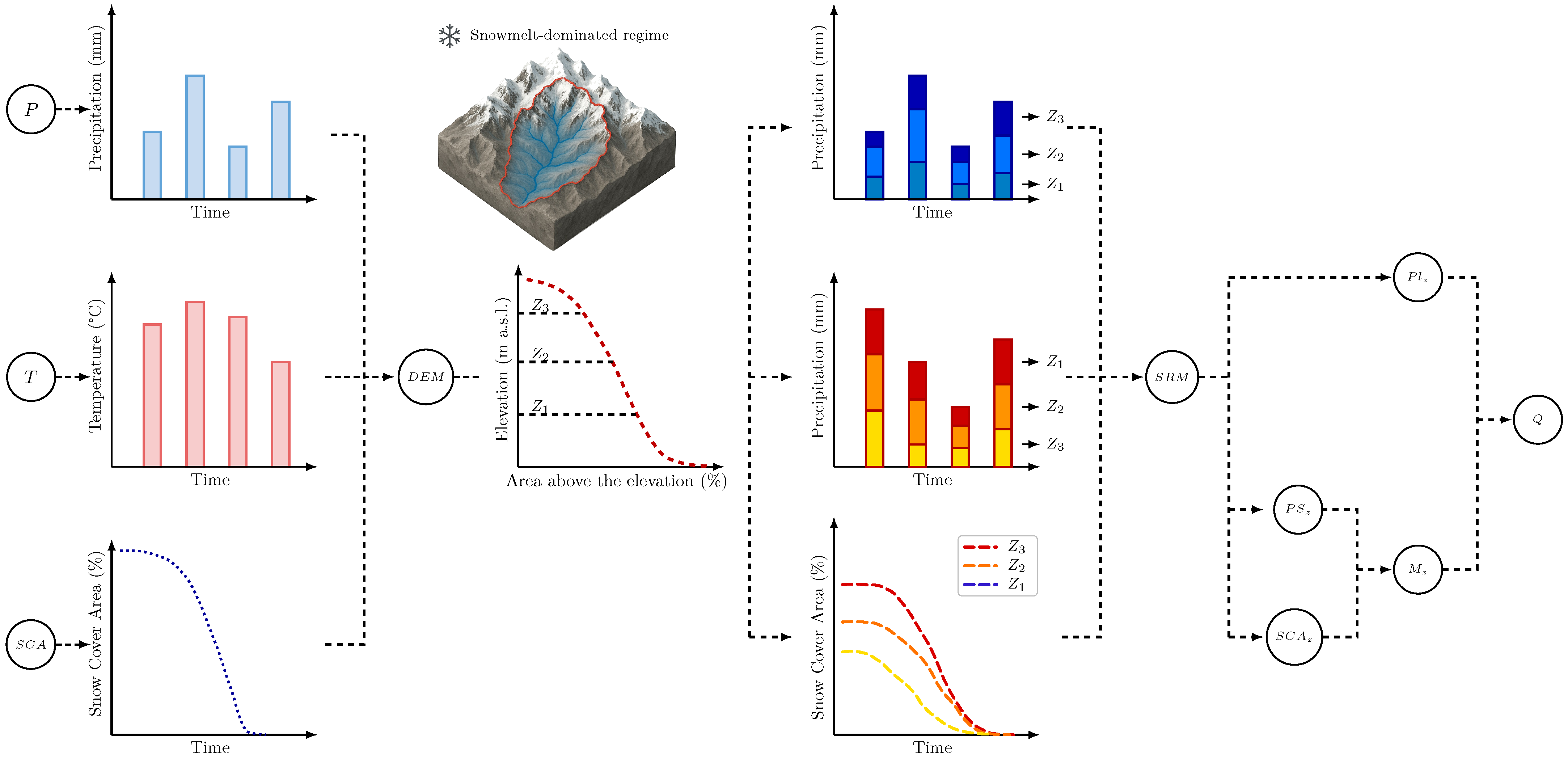
Figure 2. Conceptual diagram of the SRM model, where P is precipitation, T is temperature, S C A is snow cover area, DEM is the digital elevation model, and Z 1 , Z 2 , Z 3 represent elevation-based zones. P S z is solid precipitation by zone, P l z is liquid precipitation by zone, S C A z is snow cover area by zone, M z is snowmelt by zone, and Q is the simulated streamflow.
Water 17 03413 g002
Figure 3. Diagram of the GR6J hydrological model and the snow module, based on [47]. T is temperature, P T is total precipitation, H m is a characteristic elevation from the hypsometric curve, e T G is the cold-content of the snowpack, M is snowmelt, P L is liquid precipitation, P E T is potential evapotranspiration, U H 1 and U H 2 are unit hydrographs, and Q is total runoff.
Water 17 03413 g003
Figure 4. Simulated discharge using the SRM model for the Aconcagua River at Chacabuquito station (See parameters in Appendix A.1).
Water 17 03413 g004
Figure 5. Comparison between observed and simulated streamflow using the SRM model for the Aconcagua River at Chacabuquito station (dashed line represents the trend line).
Water 17 03413 g005
Figure 6. Simulated discharge using the SRM model for the Duqueco River at Cerrillos station (See parameters in Appendix A.2).
Water 17 03413 g006
Figure 7. Comparison between observed and simulated streamflow using the SRM model for the Duqueco River at Cerrillos (dashed line represents the trend line).
Water 17 03413 g007
Figure 8. Simulated discharge using the GRxJ models for the Aconcagua River at the Chacabuquito station (See parameters in Appendix A.3).
Water 17 03413 g008
Figure 9. Simulated discharge using the GRxJ models with the CemaNeige module for the Aconcagua River at the Chacabuquito station (See parameters in Appendix A.3).
Water 17 03413 g009
Figure 10. Simulated discharge using the GRxJ models for the Duqueco River at the Cerrillos station (See parameters in Appendix A.4).
Water 17 03413 g010
Figure 11. Simulated discharge using the GRxJ models with the CemaNeige module for the Duqueco River at the Cerrillos station (See parameters in Appendix A.4).
Water 17 03413 g011
Table 1. Statistical performance indicators of hydrological simulation using the SRM model for the Aconcagua River at the Chacabuquito station.
SRM
MetricCalibrationValidation
N S E 0.697 0.783
R M S E ( m 3 / s ) 8.607 6.735
R 2 0.797 0.799
P B I A S   ( % ) 9.763 9.636
K G E 0.858 0.783
M A E 5.152 4.462
log N S E 0.785 0.769
A P F B 0.228 0.317
Table 2. Statistical performance indicators of hydrological simulation using the SRM model for the Duqueco River at the Cerrillos station.
SRM
MetricCalibrationValidation
N S E 0.943 0.933
R M S E ( m 3 / s ) 15.709 12.979
R 2 0.964 0.945
P B I A S   ( % ) 11.547 10.820
K G E 0.936 0.907
M A E 8.465 7.644
log N S E 0.853 0.793
A P F B 0.024 0.233
Table 3. Performance of GRxJ hydrological models with and without the CemaNeige module under different P E T estimation methods, using N S E as the objective function.
BasinPET ModelCemaNeigeGR4JGR5JGR6J
Aconcagua River at the Chacabuquito stationCNo 0.112 0.005 0.005
Yes0.1190.0050.006
E o No0.0740.0050.004
Yes0.0740.0050.004
E h No−0.0220.0050.003
Yes−0.0210.0050.003
E p No−0.0220.0050.003
Yes−0.0390.0050.003
E p a No−0.430.0050.003
Yes−0.0220.0050.003
Duqueco River at the Cerrillos stationCNo0.8260.8190.829
Yes0.8450.8530.851
E o No0.8340.8320.835
Yes0.8540.8600.853
E h No0.8070.7510.810
Yes0.8310.7960.840
E p No0.8100.7440.810
Yes0.8350.7890.839
E p a No0.8110.7710.820
Yes0.8360.8140.844
Table 4. Statistical performance indicators of hydrological simulations using the GRxJ models with/without the CemaNeige module for the Aconcagua River at the Chacabuquito station.
CemaNeigeMetricGR4JGR5JGR6J
Calib.Valid.Calib.Valid.Calib.Valid.
Without N S E 0.112−0.0520.0050.0000.005−0.002
R M S E ( m 3 / s )14.36214.83315.20314.46715.20014.474
R 2 0.1340.0310.0050.0020.0060.007
P B I A S −1.9028.1960.0763.301−0.2953.904
K G E −0.0070.003−0.309−0.359−0.275−0.242
M A E 10.97710.97111.56610.36711.57510.493
log N S E 0.025−0.065−0.127−0.158−0.113−0.134
A P F B 0.6510.4640.6470.4960.6150.383
With N S E 0.119−0.0280.005−0.0020.0060.001
R M S E ( m 3 / s )14.30214.66315.20514.47015.19214.450
R 2 0.1400.0380.0050.0000.0070.008
P B I A S −1.0578.244−0.1603.136−0.2973.701
K G E 0.0080.011−0.323−0.399−0.271−0.244
M A E 10.99810.86111.59610.35311.56810.463
log N S E 0.027−0.053−0.130−0.161−0.111−0.131
A P F B 0.6440.4630.6580.5100.6160.394
Table 5. Statistical performance indicators of hydrological simulations using the GRxJ models with/without the CemaNeige module for the Duqueco River at the Cerrillos station.
CemaNeigeMetricGR4JGR5JGR6J
Calib.Valid.Calib.Valid.Calib.Valid.
Without N S E 0.8340.8370.8320.8400.8350.846
R M S E ( m 3 / s )26.56820.23826.70420.01926.52819.673
R 2 0.8340.8650.8340.8610.8380.862
P B I A S −0.4415.8011.1605.9991.0964.802
K G E 0.8640.8730.8440.8880.8370.902
M A E 13.93111.86414.08711.60514.06411.366
log N S E 0.8600.8070.8720.8480.8530.854
A P F B 0.3040.1820.2970.1690.3040.177
With N S E 0.8540.8440.8600.8650.8530.855
R M S E ( m 3 / s )24.92119.74824.44618.37225.01319.092
R 2 0.8540.8620.8610.8720.8530.871
P B I A S −1.1653.7050.4122.6121.0703.060
K G E 0.8820.9010.8680.9280.8760.906
M A E 14.00111.63813.36611.17513.53811.065
log N S E 0.8270.7770.8590.8640.8630.865
A P F B 0.2900.1490.2890.1870.2650.166
Disclaimer/Publisher’s Note: The statements, opinions and data contained in all publications are solely those of the individual author(s) and contributor(s) and not of MDPI and/or the editor(s). MDPI and/or the editor(s) disclaim responsibility for any injury to people or property resulting from any ideas, methods, instructions or products referred to in the content.