Article

Assessing the Dominant Impact of Climate and Land Use Change on Runoff Through Multi-Model Simulation in the Karst Headwater Region of the Wujiang River

1
College of Ecological Engineering, Guizhou University of Engineering Science, Bijie 551700, China
2
College of Hydraulic & Environmental Engineering, China Three Gorges University, Yichang 443002, China
3
Land-Atmosphere Interaction and Its Climatic Effects Group, State Key Laboratory of Tibetan Plateau Earth System, Environment and Resources (TPESER), Institute of Tibetan Plateau Research, Chinese Academy of Sciences, Beijing 100101, China
4
College of Earth and Planetary Sciences, University of Chinese Academy of Sciences, Beijing 100049, China
5
College of Atmospheric Science, Lanzhou University, Lanzhou 730000, China
6
National Observation and Research Station for Qomolongma Special Atmospheric Processes and Environmental Changes, Dingri 858200, China
7
Kathmandu Center of Research and Education, Chinese Academy of Sciences, Beijing 100101, China
8
China-Pakistan Joint Research Center on Earth Sciences, Chinese Academy of Sciences, Islamabad 45320, Pakistan
*
Author to whom correspondence should be addressed.
Water 2025, 17(23), 3412; https://doi.org/10.3390/w17233412
Submission received: 24 October 2025 / Revised: 23 November 2025 / Accepted: 26 November 2025 / Published: 29 November 2025
(This article belongs to the Section Hydrology)

Abstract

Assessing the runoff response to land use and climate change in karst basins is essential for sustainable water resources management and for advancing the understanding of basin-scale hydrometeorological processes. This study applied the SWAT model integrated with CA-Markov–based land use projections and CMIP6 climate data under the SSP245 (medium emissions) and SSP585 (high emissions) scenarios to conduct multi-scenario simulations, evaluating the impacts of these changes and projecting future runoff in the Wujiang River source region. The results indicate that (1) the SWAT model performed satisfactorily in simulating hydrological processes in this karst basin, with R2 and NSE values during calibration and validation reaching at least 0.75 and 0.7, respectively—furthermore, the PBIAS absolute values were below 10% during both calibration and validation; (2) runoff variations under four land use scenarios from 2000 to 2015 showed limited deviation from the baseline; (3) more pronounced runoff alterations were observed under extreme land use scenarios when compared to grassland-dominated conditions; (4) future climate scenarios SSP245 (medium emissions) and SSP585 (high emissions) consistently project a decreasing trend in runoff; and (5) combined scenario analyses reveal that climate change acts as the dominant factor driving runoff reduction in karst basins. These findings improve the mechanistic understanding of karst hydrological processes under global change, and the methodology established here holds potential for extension to other karst regions, thereby supporting strategic water resources planning.

1. Introduction

Under the dual pressures of global climate change and intensifying human activities, hydrological cycles are experiencing unprecedented alterations. Research on hydrology under environmental change has thus emerged as a key focus in global change studies. Among the various influencing factors, land use and climate change stand out as the primary drivers of runoff variation at the watershed scale [1]. With increasing human intervention, alterations in land surface structure modify key hydrological components—such as canopy interception, infiltration, surface albedo, and evapotranspiration—thereby reshaping the hydrological regime of river basins [2,3,4,5]. Concurrently, climate change directly affects critical hydrometeorological variables including precipitation, temperature, evapotranspiration, and groundwater dynamics, further perturbing the water cycle and redistributing water resources [6].
As the largest southern tributary in the upper Yangtze River system, the Wujiang River Basin is endowed with abundant water, biological, and mineral resources. It serves not only as a crucial ecological barrier for the upper Yangtze but also as a core region for economic development in southwestern China [7]. The basin lies in a transitional zone between the Yunnan–Guizhou Plateau and the western Hunan hills, characterized by complex geological structures and well-developed karst landforms, which give rise to distinctive regional hydrological processes. In recent years, under the combined influence of climate change and human activities, the hydrological regime of the area has undergone considerable transformation, with a growing frequency of extreme hydrological events. Therefore, investigating the runoff response to climate and land use/cover change (LUCC) is of practical significance for guiding water and land resource planning [8,9,10] and ecological conservation in the basin [11].
The Soil and Water Assessment Tool (SWAT), developed by the USDA, has gained widespread international application owing to its open-source code, modular architecture, and strong physical basis [12,13,14]. Numerous studies have demonstrated that the SWAT model performs well across diverse climate zones and watershed scales, and is effective in simulating the impacts of land use and climate change on hydrological processes [15,16,17,18,19].
In recent years, domestic research on hydrological processes in the karst regions of southwestern China has achieved notable progress [20,21,22]. Extensive studies have been conducted in typical karst basins such as the Wujiang River Basin and the upper Pearl River [23,24,25], uncovering unique hydrological response mechanisms attributable to the region’s distinctive hydrogeological setting. However, systematic research focusing specifically on the Wujiang River source area remains relatively limited. Most existing studies concentrate on single-factor influences, with insufficient exploration of the synergistic effects of land use and climate change. Temporally, while historical change analysis has received considerable attention, future scenario projections are comparatively underdeveloped.
Against this backdrop, this study takes the Wujiang River source area as its research object, aiming to systematically investigate the mechanisms by which land use and climate change affect watershed runoff and to project future trends, with particular attention to the hydrological peculiarities of karst terrain. To analyze the impact mechanisms, five historical land use scenarios (2000, 2005, 2010, 2015, and 2020) and three extreme land use scenarios (cropland, forests, and grassland) were selected. By holding meteorological inputs constant, we compared simulated runoff results to identify runoff responses to land cover changes across different periods. For future hydrological projections, the CA-Markov model was employed to predict land use in the study area for 2050, which was then combined with bias-corrected CMIP6 climate data—precipitation, temperature, and wind speed—under the SSP245 (medium emissions) and SSP585 (high emissions) scenarios [26], processed by the research team of Professor Zhou Jiayue. Through this integrated approach, this study aims to offer adaptive management recommendations for the conservation and management of the Wujiang River source area, while providing a theoretical reference for hydrological research in karst basins.

2. Materials and Methods

2.1. Study Area and Data Sources

2.1.1. Study Area

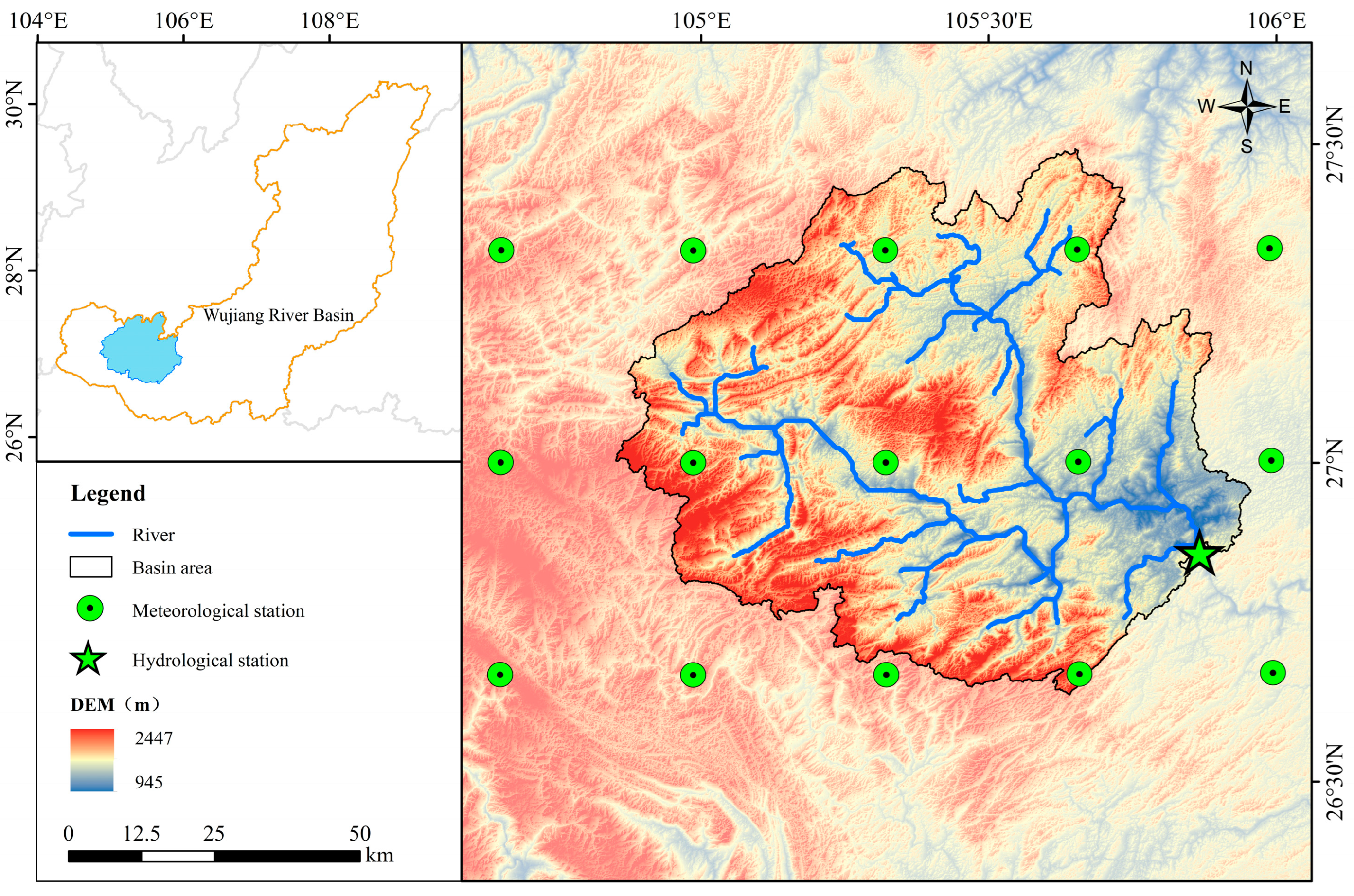
The Wujiang River, a major tributary in the upper Yangtze River basin, originates in the karst landscape of the Yunnan–Guizhou Plateau—a region characterized by complex hydrological processes and high ecological sensitivity. In recent decades, climate change and anthropogenic activities have exerted considerable influence on the local water cycle, potentially altering runoff patterns and water resource distribution. This study focuses on the headwaters of the Wujiang River basin (Figure 1), geographically located between 26°38′–27°29′ N and 104°51′–105°56′ E. The study basin encompasses Qixingguan District, Hezhang County, Dafang County, Nayong County, Zijin County, and Qianxi County, with the Hongjiadu Reservoir serving as the basin outlet. The total drainage area covers approximately 8086 km2, largely concentrated within Bijie City. Spatial variability in summer precipitation across the region is notable, generally exhibiting a declining gradient from south to north [27]. The basin exhibits distinct seasonal patterns: summers are hot and rainy, while winters are cold and dry. The flood season occurs predominantly from June to August, and the dry season spans December to February. Topography is predominantly mountainous, with a mean elevation of 1196 m above sea level. The climate is classified as a subtropical monsoon type, with a mean annual temperature of 13.4 °C. Monthly precipitation is highly variable, concentrated mainly between May and September, and the mean annual rainfall ranges from 849 to 1399 mm. Soils within the study area are primarily highly weathered and strongly acidic, followed by soils with high ion-exchange capacity and, to a lesser extent, soils with low fertility and weak structure. Runoff in the basin is supplied by both precipitation and groundwater sources.

2.1.2. Sources of Data

The data required for establishing the SWAT model and performing future land use and climate projections in the Wujiang River headwaters basin include digital elevation model (DEM) data, land use maps, soil type distributions, river network data, meteorological records, runoff observations, and future climate datasets, as summarized in Table 1. Specifically, a 30 m resolution DEM was acquired from the Geospatial Data Cloud platform (https://www.gscloud.cn/ (accessed on 15 March 2024)). As land use change is a macro-level and gradual process, using a five-year interval helps avoid interference from interannual fluctuations. Meanwhile, authoritative data sources (such as the Chinese Academy of Sciences datasets) are typically released on a five-year basis, ensuring consistency in classification systems and interpretation standards across different periods, thereby guaranteeing the accuracy and comparability of analytical results. Land use data for the years 2000, 2005, 2010, 2015, and 2020, also at 30 m resolution, were obtained from the Resource and Environmental Science and Data Center of the Chinese Academy of Sciences (https://www.rcsdc.cn (accessed on 15 March 2024)). These land use categories were reclassified into five types—cropland, forests, grassland, water bodies, and urban—according to the specific conditions of the study area. Meteorological inputs, including daily precipitation, maximum and minimum temperature, average wind speed, relative humidity, and solar radiation from 1990 to 2018, were sourced from the China Meteorological Assimilation Driving Datasets for Soil and Water Assessment Tool (CMADS). CMADS is not merely a simple data interpolation product; it employs advanced reanalysis data assimilation techniques and is calibrated using ground-based and upper-air meteorological observation data from China. Furthermore, it is specifically optimized for the SWAT model. Some researchers have achieved remarkable results using this dataset for hydrological studies in ungauged regions [28]. This dataset has been widely applied in China and is recognized for its high accuracy and applicability [29,30,31,32,33,34,35,36]. Soil parameters were derived from the Harmonized World Soil Database (HWSD) at 1 km spatial resolution, with soil hydraulic properties estimated using the SPAW 6.02.75 software. Monthly runoff data were extracted from the Chinese Natural Runoff Grid Point Dataset CNRD v1.0 [37,38,39]. For this study, hydrological records from the basin outlet—corresponding to the Hongjiadu Reservoir sub-basin—were used. Future daily meteorological data were obtained from the downscaled CMIP6 dataset for China (1979–2100) [40,41]. To project future hydrological conditions, precipitation and maximum/minimum temperature data under the SSP245 (medium emissions) and SSP585 (high emissions) scenarios [40,41,42] from 2041 to 2050 were selected for simulation.

2.2. Methods

In this study, a SWAT distributed hydrological model was developed based on historical data, while future land use conditions in the study area for 2050 were projected using the Ca-Markov model. Hydrological simulations and projections for the Wujiang River source area were conducted under multiple scenarios by integrating future climate data from CMIP6, specifically the SSP245 (medium emissions) and SSP585 (high emissions) scenarios.

2.2.1. SWAT and Modeling Calibration, Validation

(1)
The SWAT model
The Soil and Water Assessment Tool (SWAT) was employed in this study [43]. SWAT is a physically based, semi-distributed hydrological model designed to simulate water quality and quantity and predict the environmental impacts of land use, management practices, and climate change. The model discretizes a watershed into sub-basins, which are further subdivided into Hydrologic Response Units (HRUs)—unique combinations of land use, soil type, and slope. This structure allows for a detailed representation of spatial heterogeneity. By integrating soil properties and meteorological data, SWAT simulates key hydrological processes including surface runoff, soil water dynamics, and groundwater flow [44]. The simulation is fundamentally driven by the water balance equation, expressed as:
S W t = S W 0 + i = 1 t R d Q s E a W s Q g
a = 1,
where   S W t   is the soil water content after the end of the time period;   S W 0 is the soil water content before the beginning of the time period; The time step is   t   (d);   i   is the time period of soil water change; R d   is the precipitation during the time period; Q s   is the surface runoff during the time period; E a is the evaporation during the time period; W s is the infiltration from the surface to the deeper layers of the soil during the time period; and Q g is the soil infiltration during the time period.
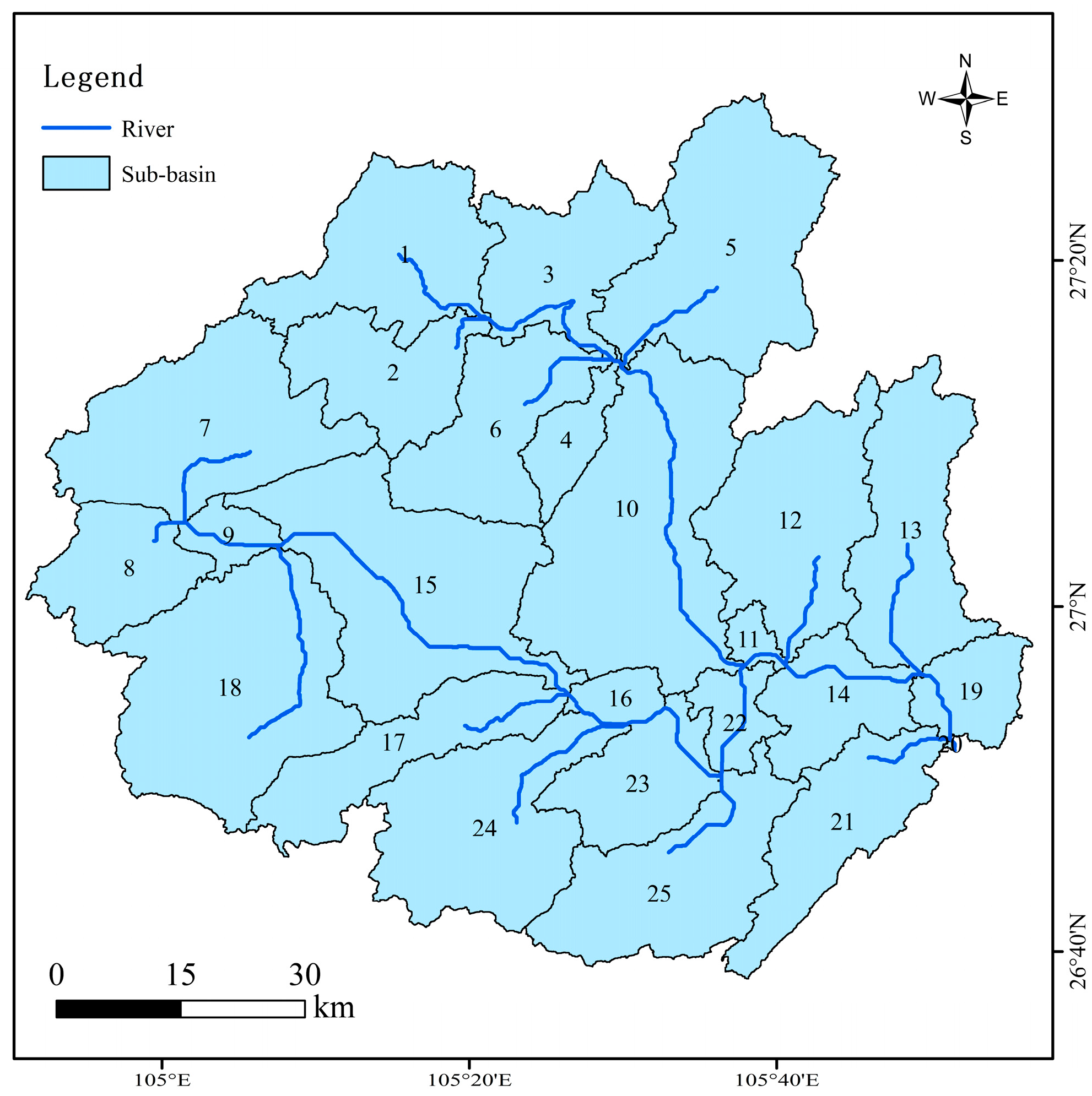
The DEM elevation data and river network data were input into ArcSWAT, and 25 subwatersheds were delineated (shown in Figure 2). Among these sub-basins, sub-basin No. 20 is the watershed outlet, and the outlet is the hydrological station is the watershed outlet of Hongjiadu Reservoir.
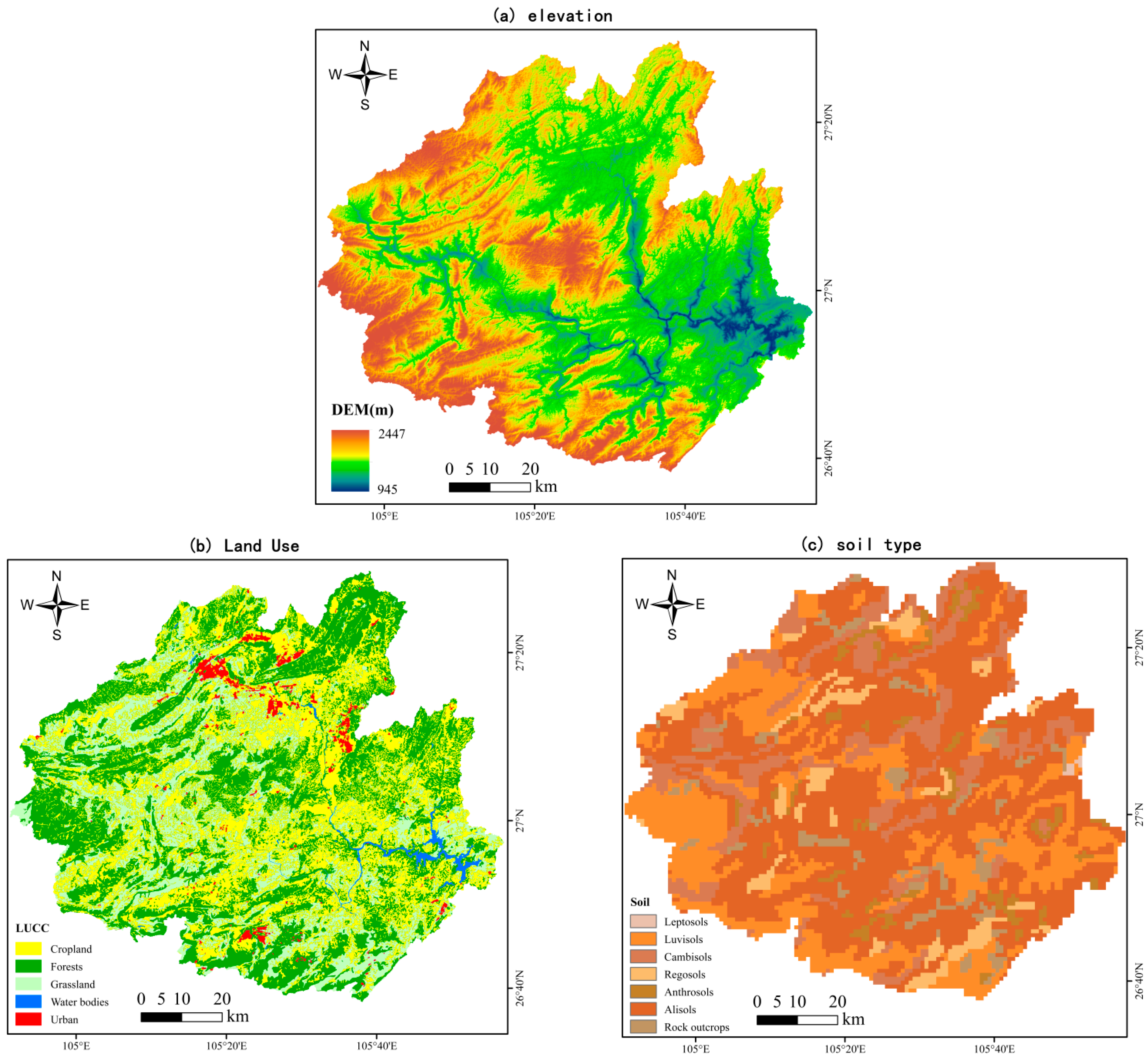
Prior to model simulation, the land use data were reclassified to conform to the primary land class standards of the Resource and Environmental Science and Data Center (RESDC) of the Chinese Academy of Sciences. The original secondary classes were aggregated into five primary categories: crop land, forests, grassland, water bodies, and urban. The construction land in the Wujiang River source area is heavily constrained by the karst plateau terrain and ecological protection red lines, exhibiting a typical pattern of “large-scale dispersion and small-scale clustering”. Urban and industrial–mining land is limited in scale and scattered across scarce intermountain basins and river valleys, resulting in high development costs. Rural settlements are even more fragmented, distributed along mountainous terrain in accordance with topographical conditions, making infrastructure provision challenging. The study area is predominantly rural in character. Soil data were categorized into seven types based on specific percentage thresholds, including thin layer soil, highly active leachate soil, highly active strong acid soil, anthropogenic soil, sparse rocky soil, daisy soil, and outcropping rock. The slope data retained the natural slope pattern without modification. These categorized land use, soil, and slope and land use datasets were integrated into ArcSWAT—with both thresholds left at their defaults—to serve as the fundamental inputs for generating the Hydrologic Response Units (HRUs), as illustrated in Figure 3.
(2)
SWAT model calibration and validation
Runoff data at the outlet of the Hongjiadu Reservoir sub-basin were derived from the monthly natural runoff data of the Chinese Natural Runoff Dataset version 1.0 (CNRD v1.0). The simulation period was split into three phases: a two-year warm-up period (1988–1989), a calibration period from 1990 to 2013, and a validation period from 2014 to 2018. Model performance was evaluated using the coefficient of determination (R2), the Nash-Sutcliffe efficiency coefficient (NSE), and the percent bias (PBIAS) [45]. The calibration was performed using the SUFI-2 algorithm within the SWAT-CUP 2012 software. This algorithm leverages a combined optimization and gradient search approach, enabling the simultaneous adjustment of multiple parameters and providing an assessment of uncertainty associated with model parameters and structure [46]. The formulae for these metrics are given below:
R 2 = 1 n O i O ¯ P i P ¯ i = 1 n O i O ¯ 2 i = 1 n P i P ¯ 2 2
a = 1,
N E S = 1 i = 1 n O i P i 2 i = 1 n O i O ¯ 2
a = 1,
P B I A S = 1 i = 1 n P i O i 2 i = 1 n P i × 100 %
In the formulae, O i   and P i   represent the observed and simulated values at time i, respectively, while O ¯   and P ¯   denote their corresponding averages over the entire period.
Higher R2 values indicate a better fit between observed and simulated values. Similarly, an NSE coefficient closer to 1 reflects greater simulation accuracy, while a smaller absolute PBIAS value signifies higher model precision. Generally, an NSE value ≥ 0.65 is considered to represent a “very good” simulation performance, whereas model performance is deemed “satisfactory” when NSE ≥ 0.5, R2 > 0.6, and the absolute PBIAS value is less than 10% [47,48].

2.2.2. CA-Markov Model

The CA-Markov model combines the strengths of Cellular Automata (CA) and Markov models. This integration addresses the limitation of the standard Markov model in spatial attribution, enabling the simulation of complex land use change processes [49].
The CA model simulates the self-replication of biological cells. It predicts the state of a cell in the next cycle based on its current state and the state of its neighbors, following predefined transition rules. This structure provides strong capabilities for simulating spatial dynamics [50,51], as expressed by:
S t + 1 = F S t , N
a = 1,
The Markov model is a probabilistic model based on the theory of Markov processes that uses past and current states to predict changes in future states. It has long-term predictive capability, but its spatial characteristics are weak [52]. It is characterized by.
S t + 1 = P i j × S t
a = 1,
In the formula, S t   and S t + 1 represent the state at time   t   and time   t + 1 , respectively;   F   denotes the cellular transformation rules;     N   is the cellular neighborhood; and P i j   represents the transition probability matrix.
The study first reclassified the land use data from 2010 and 2015, projected them into the same coordinate system, and resampled them to the same resolution. The data were then converted into ASCII format recognizable by IDRISI using ArcGIS 10.2 and imported into IDRISI 17.0. After reclassifying and reassigning values to the two periods of land use data, the Markov module was used to calculate the land use transition probability matrix and transition area matrix. Subsequently, spatial data such as elevation, slope, and roads were introduced, and constraints were applied to different land use types to generate a land use suitability atlas. Finally, the CA-Markov module was employed for multiple iterative simulations. The number of iterations in the model was determined based on the prediction time span; for example, a 5-year prediction interval required 5 iterations, a 10-year interval required 10 iterations, and so on. The predicted land use for 2020 was output as raster data. Using the overlay analysis function in ArcGIS 10.2, the simulation results were compared with the actual observed data, and the Kappa coefficient was calculated to evaluate the model’s accuracy and applicability. A Kappa value ≥ 0.75 was considered to indicate high accuracy of the predicted land use data [53]. Using the same method, the CA-Markov module was applied with the 2020 land use data as the baseline, combined with the suitability atlas generated from the 2010 and 2015 land use data. The simulation period was set to 30 years, with 30 iterations, to derive the land use data for 2050.
The Kappa coefficient can assess the degree of fit between the simulated data and the actual data of the image, and is commonly used in the land use change simulation accuracy test [54]. Its calculation formula is as follows:
K a p p a = P 0 P c 1 P c
a = 1,
In the formula, P 0 represents the overall simulation accuracy; P c denotes the theoretical simulation accuracy; 1 signifies the proportion of grid cells simulated under the ideal scenario.

2.2.3. Simulation Scenario Setup

(1)
Land Use Simulation Scenario Design
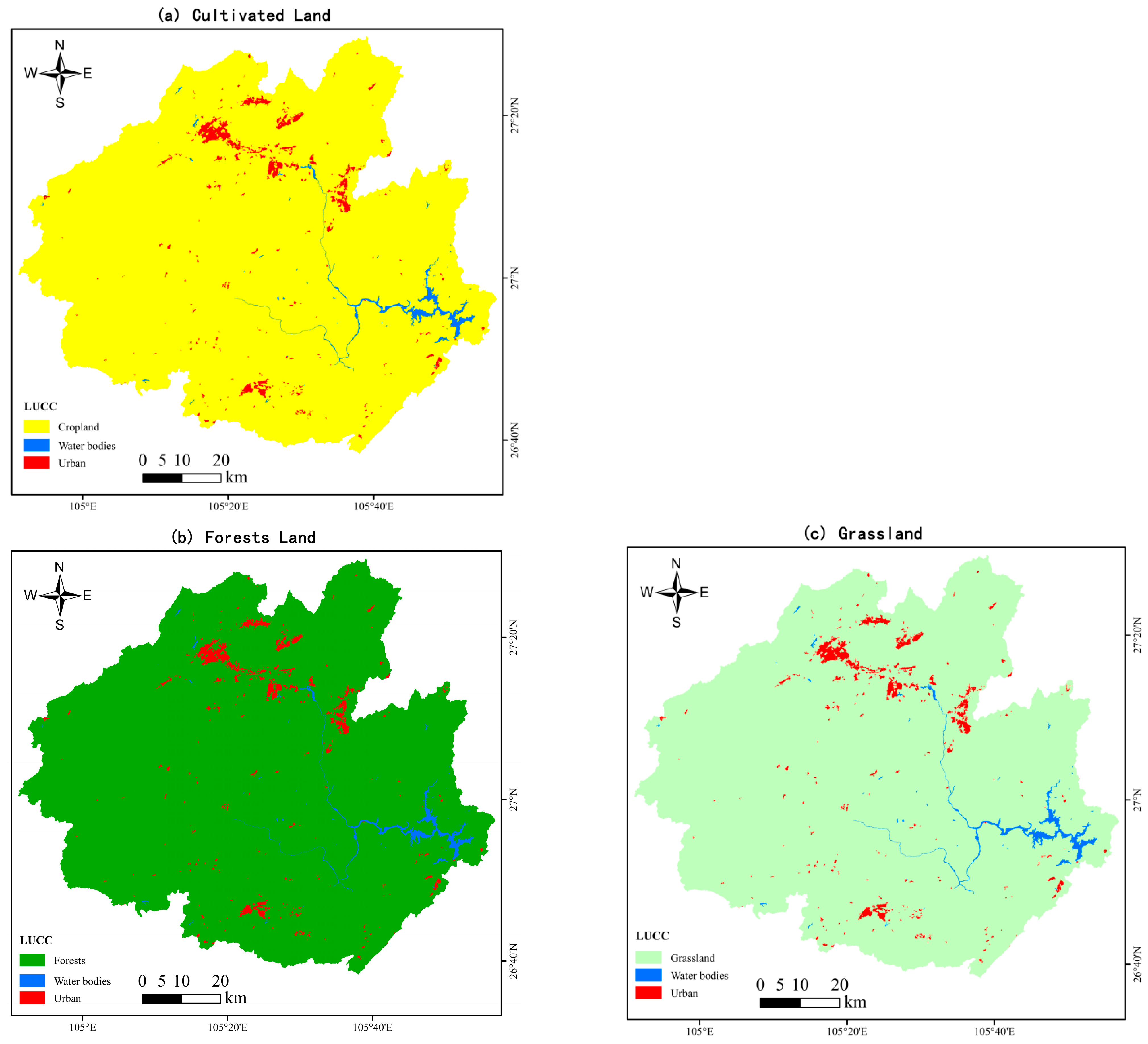
To quantify the hydrological impact of land use change, we established nine simulation scenarios (Figure 4). These were designed to analyze (i) historical runoff trends driven by past land use changes, and (ii) the response of basin runoff to extreme land use compositions dominated by single types.
All scenarios used the fixed meteorological data from 1990 to 2018. The specific land use configurations for each scenario were as follows:
  • Scenario 1 (Baseline):2020 land use map.
  • Scenario 2–5 (Historical Periods I–IV): Land use maps from 2000, 2005, 2010, and 2015, respectively.
  • Scenario 6 (Extreme Cropland): The 2020 map, with all forest and grassland converted to cropland.
  • Scenario 7 (Extreme Forestland): The 2020 map, with all cropland and grassland converted to forest.
  • Scenario 8 (Extreme Grassland): The 2020 map, with all cropland and forest converted to grassland.
  • Scenario 9 (Future Projection): The projected 2050 land use map.
(2)
Scenario Design for Climate and Integrated Future Projections
To evaluate the isolated impact of climate change, we designed scenarios that modified only the climate forcing relative to the Baseline (Scenario 1), while keeping the 2020 land use data fixed.
  • Scenario 10 (SSP245 Climate): Applies future climate projections from the SSP245 scenario.
  • Scenario 11 (SSP585 Climate): Applies future climate projections from the SSP585 scenario.
(3)
Integrated Future Scenario Simulation
To project the combined effect of future land use and climate change, two additional scenarios were developed. These scenarios integrate the projected 2050 land use pattern with future climate projections from different emission pathways.
  • Scenario 12 (Integrated SSP245): Simulates the combined impact of the 2050 land use and the medium-emission (SSP245) climate scenario.
  • Scenario 13 (Integrated SSP585): Simulates the combined impact of the 2050 land use and the high-emission (SSP585) climate scenario.

3. Results

3.1. Swat Model Calibration and Validation

The Wujiang River Source Area basin is characterized by karst topography, featuring significant slope variations, rapid rainfall–runoff response, relatively low surface runoff depth, rapid infiltration, high groundwater yield, substantial return flow from groundwater to surface channels, and snowfall due to high elevation. Therefore, parameter selection should focus on those related to slope, soil water, channel hydraulic conductivity, and groundwater dissipation. This study also referred to parameter selection schemes and corresponding sensitivity analysis results from other karst regions [55], ultimately determining 26 parameters. Using the SUFI-2 method in SWAT-CUP, 2000 iterations were performed, and the top 13 parameters with high sensitivity were selected for calibration (Table 2). This algorithm effectively handles various uncertainties, such as precipitation variability and measurement errors, thereby improving the accuracy of simulation results.
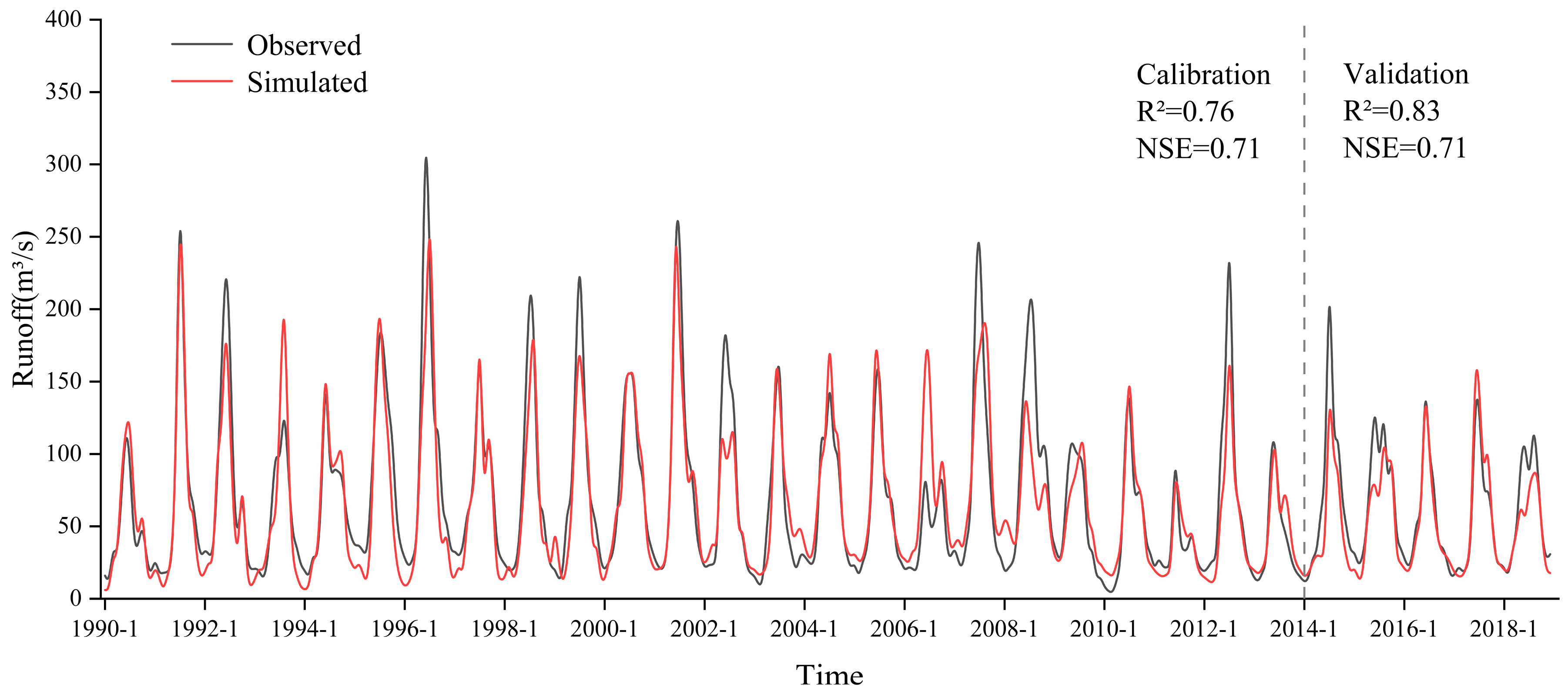
Following iterative manual adjustments to the parameter ranges, the model was further refined through 500 automated iterations in SWAT-CUP to closely match the observed hydrograph. The final performance metrics, presented in Table 3, confirm a satisfactory model fit. During the calibration period, the R2 and NSE values reached 0.76 and 0.71, respectively. These improved to 0.83 and 0.71 during the validation period, with all values exceeding the 0.70 threshold. Additionally, the absolute PBIAS values were 6.9% and 2.5% for the calibration and validation periods, respectively, both remaining within the 10% benchmark. These results demonstrate that the SWAT model is well-suited for simulating the hydrological processes in the Wujiang River headwaters basin.
Figure 5 presents the simulated and observed monthly runoff for the calibration and validation periods in the Wujiang River source area. The results reveal a distinct seasonal pattern, characterized by high peak flows in summer and low flows in winter, with a considerable difference between them. While the model tends to underestimate the peak flows compared to the low flows, the overall simulation captures the observed trends well. The close agreement between the simulated and observed hydrographs confirms that the model effectively represents the runoff generation processes in the study area and meets the required accuracy standards.

3.2. Analysis of Land Use Projections

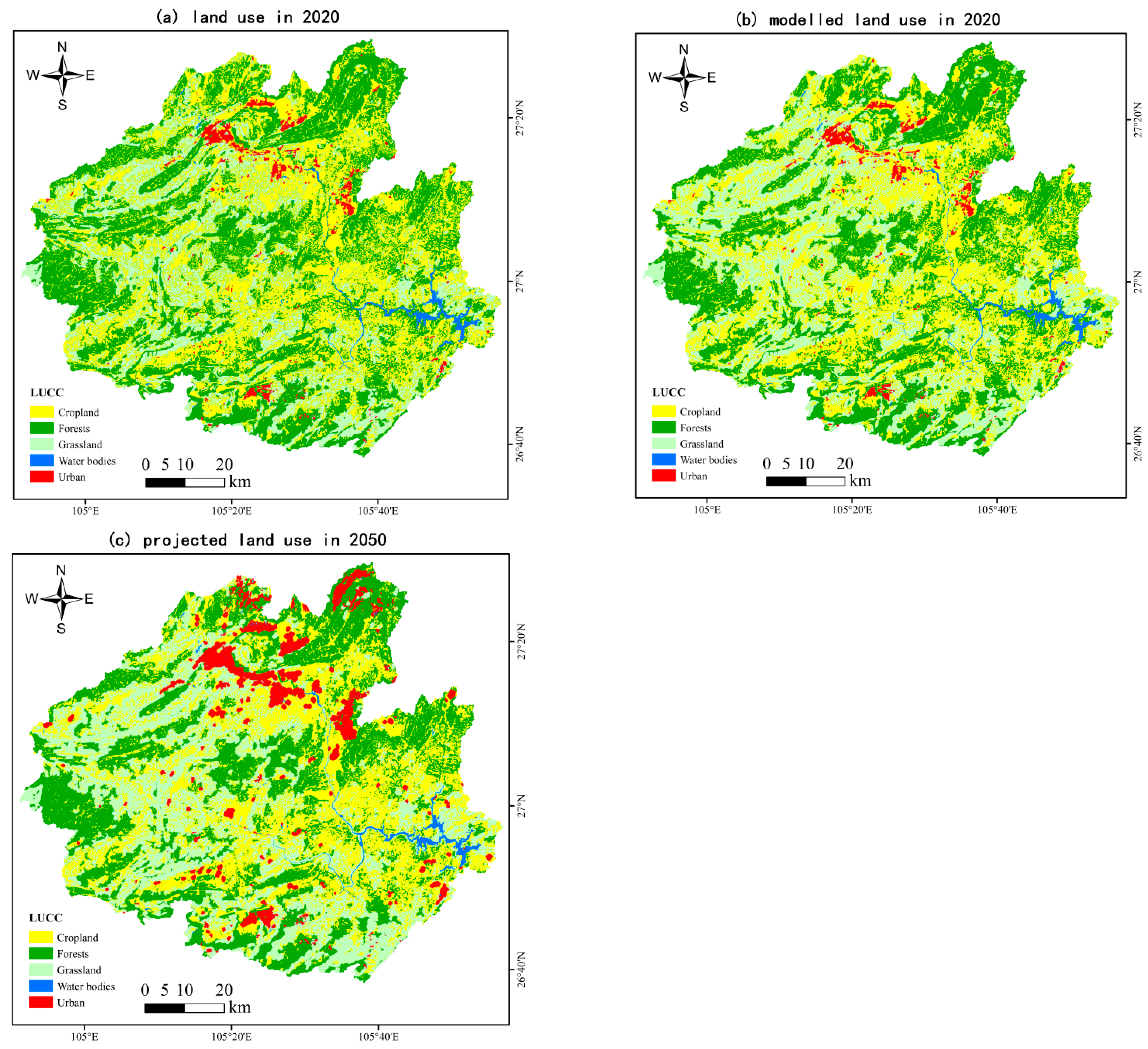
The land use projections for this study were generated using the CA-Markov model in IDRISI 17.0. This approach integrates the temporal predictive strength of the Markov model with the spatial simulation capability of Cellular Automata. To project the 2020 land use pattern, we initiated the model with data from 2010 and 2015. The simulation was run for 20 iterations using a 5 × 5 convolution filter for spatial refinement, based on a constructed land use transition probability matrix. The resulting simulation for 2020 achieved a Kappa coefficient of 0.8866, well above the 0.75 threshold, confirming a high degree of accuracy and model reliability. Using the validated 2020 land use map as a new baseline, we then conducted a 30-year projection to 2050. This long-term forecast incorporated the suitability atlas and produced the future land use distribution shown in Figure 6.
Statistical analysis of land use in the Wujiangyuan District reveals that cropland, forest, and grassland remained the dominant types in 2020 and are projected to remain so in 2050. The most striking change is a 236.15% projected expansion of built-up land by 2050, occurring primarily at the expense of cropland and forest, which are projected to decrease by 12.55% and 20.26%, respectively (Table 4). In contrast, grassland and water body areas are projected to increase. This land use dynamic, characterized by the conversion of cropland and forest to built-up and grassland areas, reflects the significant impact of ongoing urbanization and socio-economic development on the regional landscape.

3.3. Analysis of Future Climate Projections

To analyze the response of hydrological processes to future climate, this study utilized the downscaled CMIP6 dataset of precipitation, temperature, and wind speed for China (1979–2100). This dataset includes gridded daily precipitation, maximum temperature, minimum temperature, and near-surface wind speed at a 0.25° resolution over China. It integrates outputs from six CMIP6 models (CanESM5, FGOALS-g3, GFDL-CM4, IPSL-CM6A-LR, MPI-ESM1-2-HR, and MRI-ESM2-0). These model outputs were bilinearly interpolated to a 0.25° grid and subsequently bias-corrected using the Equidistant Cumulative Distribution Functions method, with the China Meteorological Forcing Dataset (CMFD) serving as the observational reference for precipitation and temperature.
The dataset covers the historical period (1979–2014) and the future periods (2015–2100) under the SSP245 and SSP585 scenarios. This study extracted data from the 15 grid points closest to the reference observational station for each of the six CMIP6 models under both scenarios, specifically for daily precipitation and maximum/minimum temperatures. The average of these values was used as the simulated future climate data.
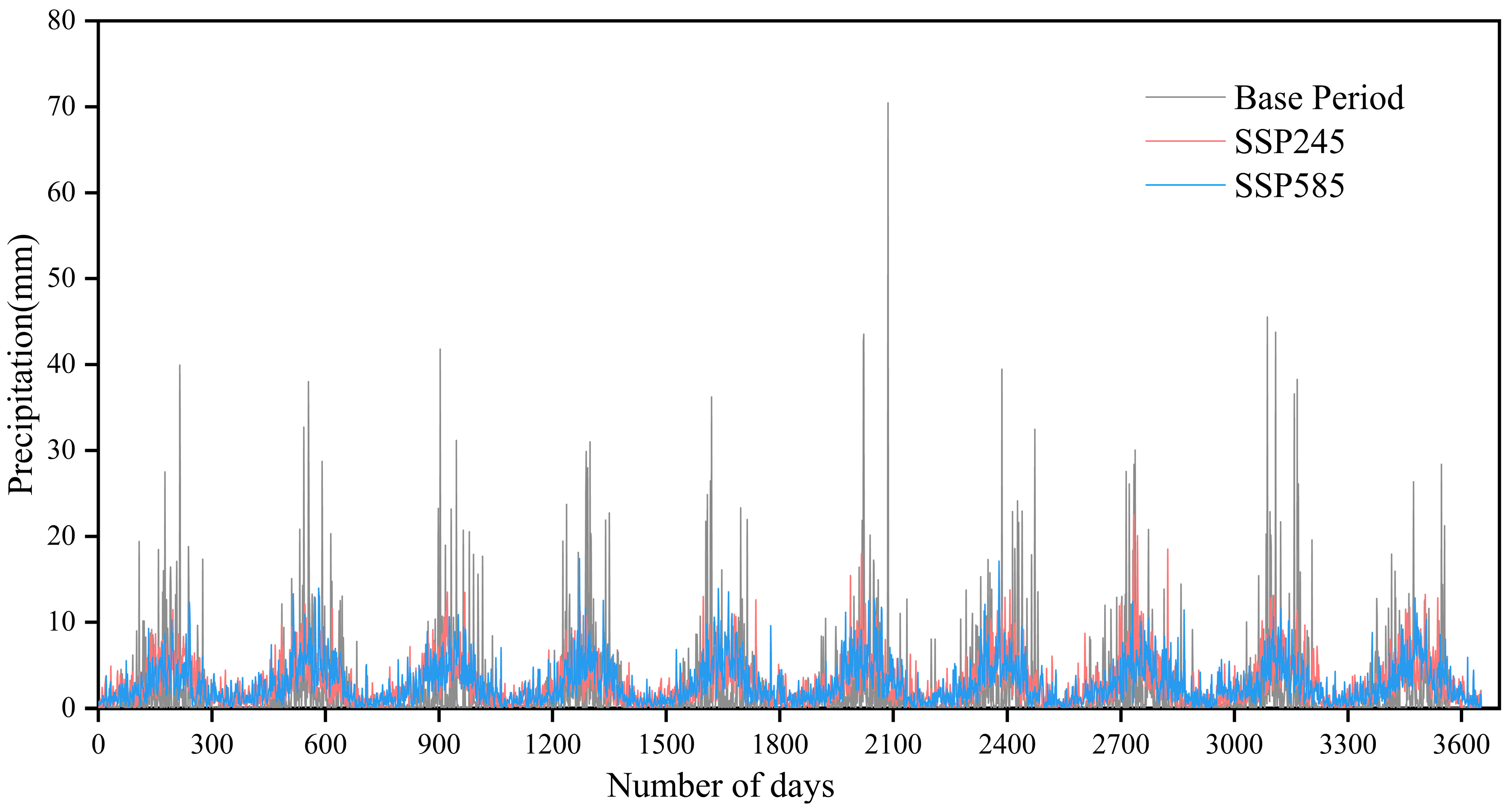
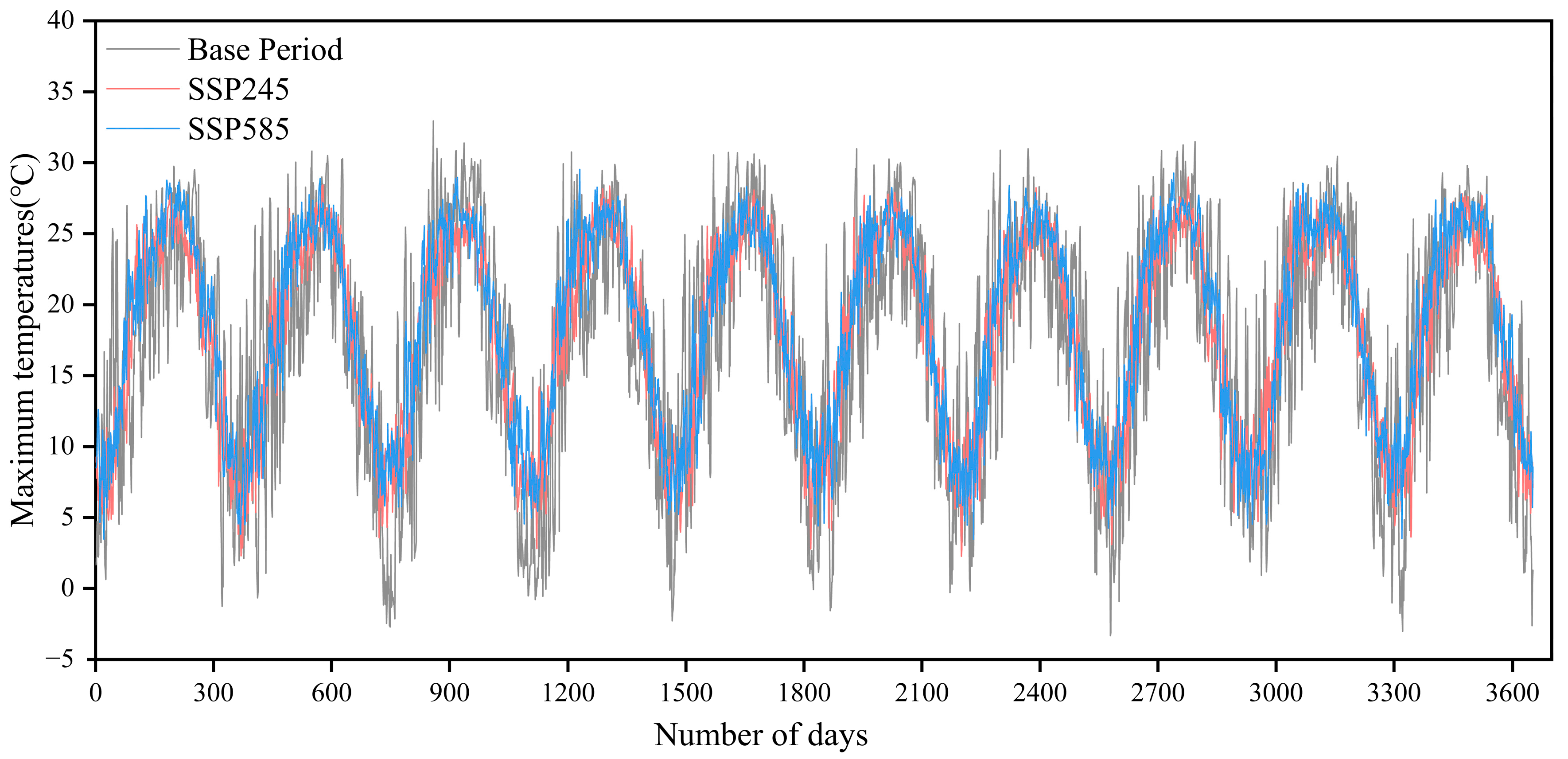
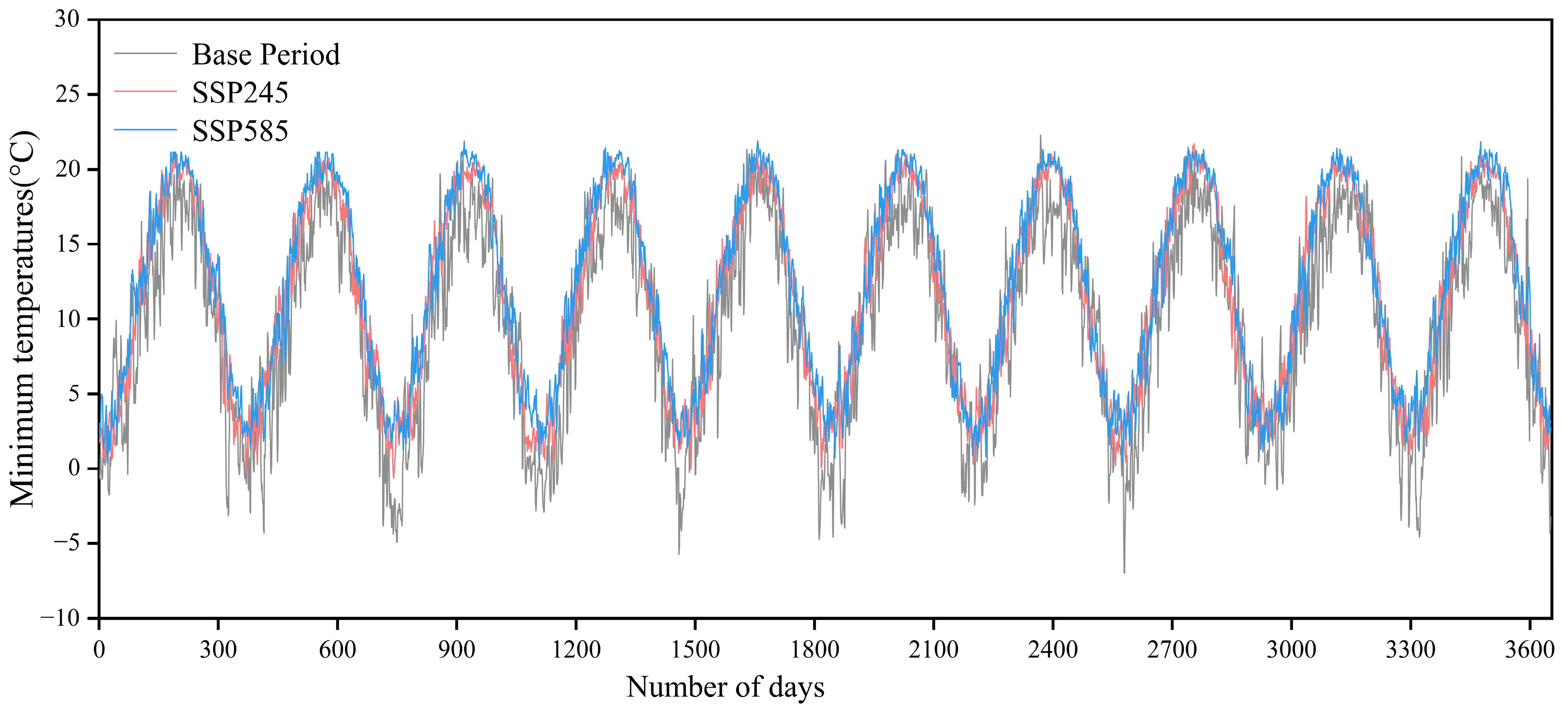
Figure 7, Figure 8, Figure 9 and Figure 10 show the comparison of the multi-year daily averages of precipitation, minimum temperature, and maximum temperature, respectively, between the baseline period (2009–2018) and the simulated future periods in the Wujiang River Source Area basin.
Projected annual mean precipitation under the SSP245 and SSP585 scenarios is 1003.05 mm and 1016.18 mm, respectively. These values represent increases of 39.35% and 41.18% compared to the baseline period (719.79 mm), indicating a significant wetting trend. However, despite this overall increase, the simulations project a more tempered intra-annual distribution. The future scenarios do not exhibit peak precipitation intensities as high as those observed historically, suggesting a change in the pattern of rainfall events alongside the increase in total volume.
A clear upward shift in the annual mean temperature range is projected under both future scenarios. Compared to the baseline range of 9.86 °C to 17.23 °C, temperatures are projected to rise to 11.56–17.92 °C under SSP245 and to 12.14–18.43 °C under SSP585. This indicates a consistent warming trend across the entire temperature spectrum.

3.4. Scenario Modeling Analysis

3.4.1. Land Use Change Scenario Simulation Analysis

Under constant meteorological conditions, simulations using historical land use data (LUCC00, LUCC05, LUCC10, LUCC15) resulted in minimal inter-annual runoff variation compared to the baseline (LUCC20). The changes were −0.11%, −0.32%, −0.27%, and −0.02%, respectively, indicating that historical land use changes had a limited influence on runoff generation in this basin.
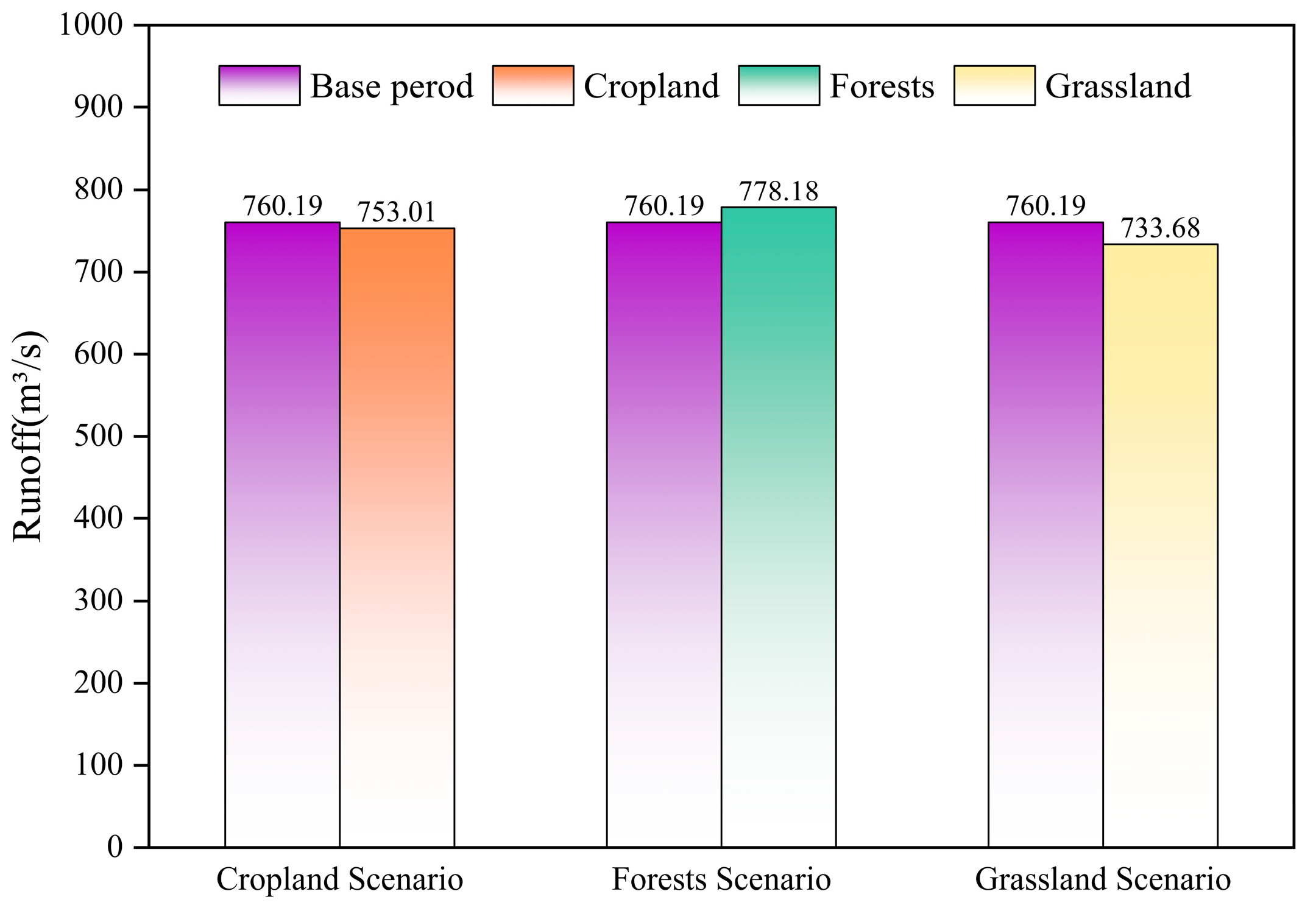
In contrast, simulations under extreme land use scenarios revealed a more pronounced hydrological response (Figure 10). The mean annual runoff was 753.01 m3/s (extreme cropland), 778.18 m3/s (extreme forest), and 733.68 m3/s (extreme grassland). Relative to the baseline, this represents a decrease of 0.97% for cropland, an increase of 2.34% for forest, and a decrease of 3.51% for grassland. This suggests that runoff is most sensitive to changes in grassland cover, followed by forest, and least sensitive to cropland.
The underlying karst landscape explains these responses. Forests enhance runoff generation by intercepting subsurface flow, thereby reducing deep infiltration into groundwater. Conversely, converting forest to cropland or grassland diminishes this interception capacity, allowing more water to infiltrate the karst system and reducing surface runoff.
Under the projected 2050 land use scenario, the mean annual runoff is simulated to be 775.38 m3/s, an increase of 1.98% compared to the baseline. This future scenario is characterized by a conversion of cropland and forest to grassland and water bodies, alongside an expansion of built-up land due to human activities. While the expansion of grassland—which our extreme scenario identified as reducing runoff—exerts a diminishing effect, this is outweighed by the impact of urbanization. The increase in impervious surfaces significantly reduces infiltration, leading to a net increase in surface runoff. This outcome demonstrates that runoff in the study area is considerably more sensitive to changes in built-up land than to changes in grassland.

3.4.2. Analysis of Future Climate Scenario Simulations

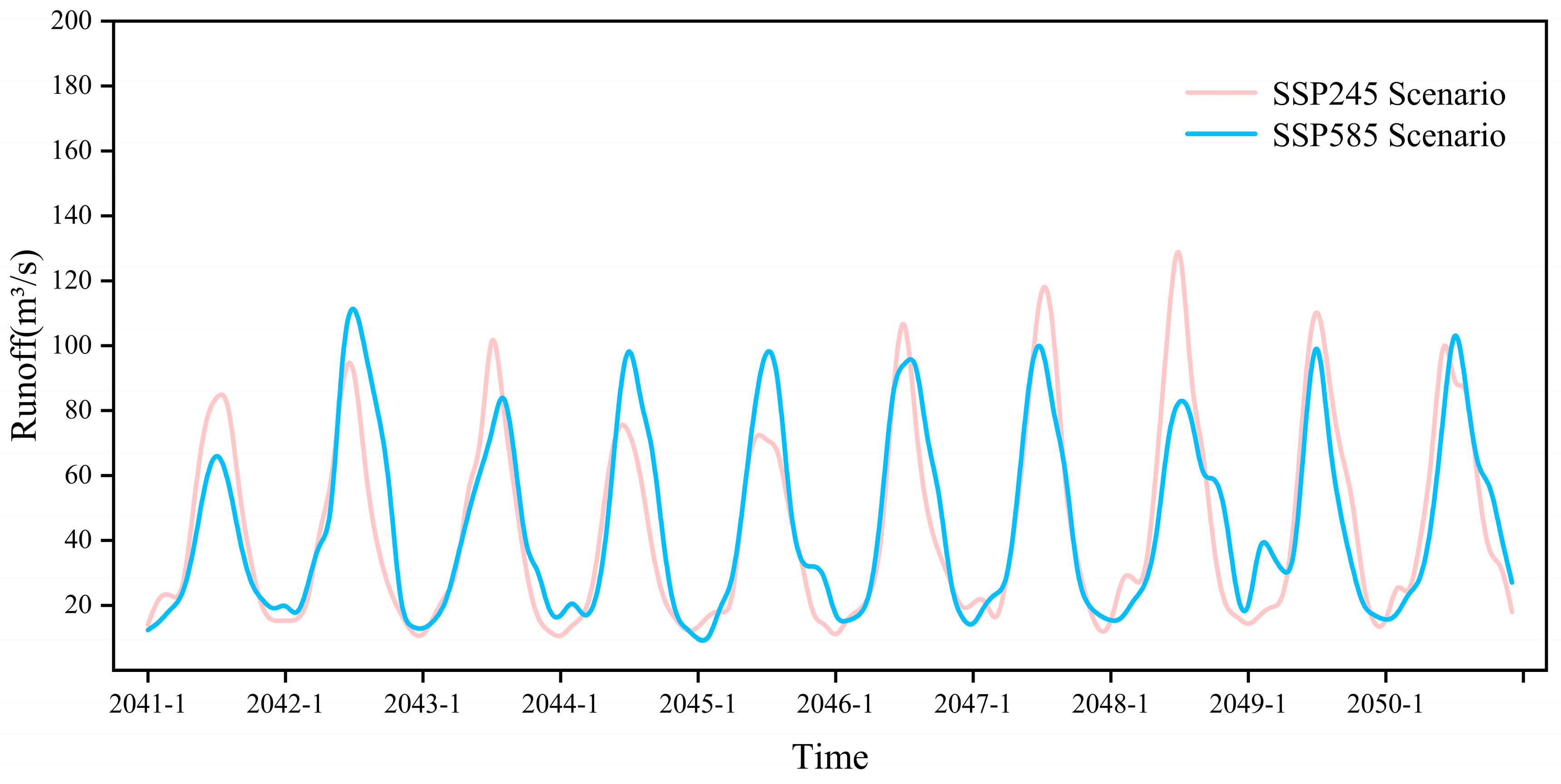
Under the future SSP245 and SSP585 scenarios, with land use held constant at the baseline level, the simulated mean annual runoff decreased to 526.79 m3/s and 537.68 m3/s, respectively (Figure 11). These values represent reductions of 14.61% and 12.85% compared to the baseline. In contrast to the projected increase in precipitation, these results indicate that rising temperatures and associated increases in evapotranspiration are the dominant factors driving future runoff reductions in the basin.
Under projected future climate scenarios, the Wujiang River Source Region Basin is expected to experience a decline in mean annual runoff, even under constant land use. Although the difference between the SSP245 and SSP585 scenarios is marginal, both show a clear reduction compared to the baseline.
This reduction in runoff, despite an overall increase in precipitation, is primarily attributed to two factors: the attenuation of peak precipitation events, which reduces the contribution from high-intensity rainfall, and elevated evaporation rates driven by rising mean annual temperatures. Consequently, even with a warmer and wetter future climate, the more uniform temporal distribution of precipitation and higher evaporative demand result in lower overall runoff generation.

3.4.3. Analysis of Integrated Modeling of Future Land Use and Climate Scenarios

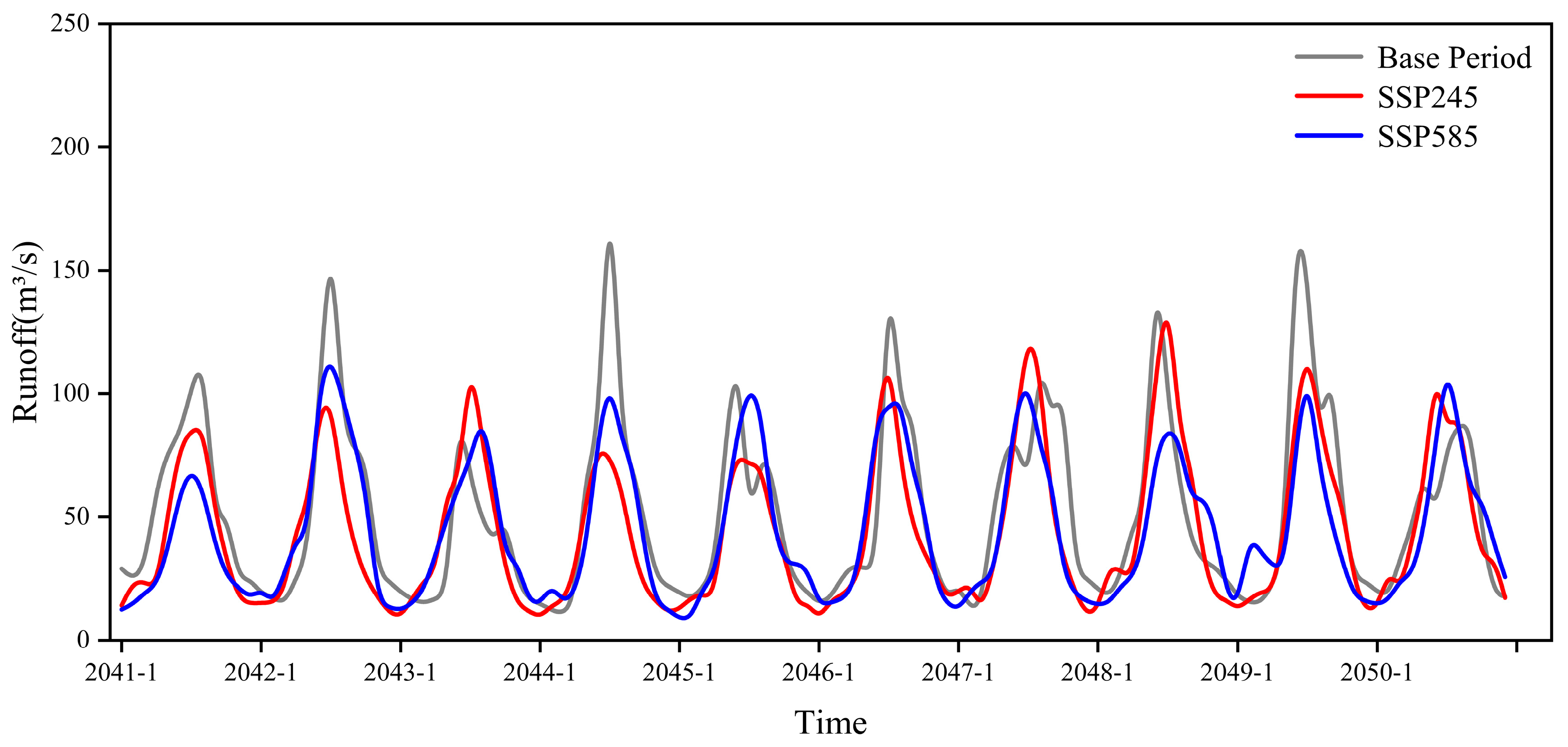
Runoff dynamics in the Wujiang River Source Region Basin are governed by the combined but unequal influences of climate change and land use change. Under the projected 2050 land use scenario (Figure 12), the mean annual runoff for SSP585 (537.03 m3/s) is slightly higher than for SSP245 (527.96 m3/s), yet both are substantially lower than the baseline of 616.93 m3/s, reflecting decreases of 12.95% and 14.42%, respectively. Although the future land use pattern itself promotes a runoff increase compared to the 2020 baseline, this effect is overridden by the strong suppressive effect of climate change. A comparative analysis confirms that climate change is the predominant driver of runoff reduction in the basin, with its influence significantly outweighing that of land use alteration.
In summary, the runoff changes in the source area of the Wujiang River are mainly driven by climate change under the combined effect of climate and land use. This conclusion is consistent with the findings of many scholars [56,57,58].

4. Discussion

This study presents a systematic assessment of runoff response to land use and climate change in the Wujiang River Source Region Basin, combining the SWAT model, CA-Markov, and CMIP6 climate scenarios. Our results highlight the distinctive hydrological behavior of karst systems under global change, offering a scientific foundation for regional water resource planning. In terms of model performance, the SWAT model produced generally acceptable simulations in this basin, though some discrepancies remain when compared with applications in data-rich basins. These are most apparent in the simulation of extreme hydrological events, which we attribute largely to the region’s complex karst hydrogeology. Previous work has shown that subsurface conduit networks and fractured aquifers fundamentally reshape surface–groundwater interactions—a process not fully represented in current model structures.
Further, this study provides a comprehensive evaluation of runoff responses to land use and climate change in the Wujiang River Source Region Basin by integrating the SWAT model, CA-Markov simulation, and CMIP6 climate scenarios. The findings reveal the distinctive hydrological behavior of karst systems under global environmental change and offer a valuable scientific basis for regional water resource management and planning.
Regarding model performance, the SWAT model demonstrated generally reliable applicability in the basin; however, discrepancies remain compared with applications in data-rich regions. These deviations are most evident during the simulation of extreme hydrological events, which can be largely attributed to the complex karst hydrogeological conditions. Previous studies have indicated that subsurface conduit systems and fractured aquifers significantly modify the surface–groundwater exchange process, and these mechanisms are not fully represented in most existing hydrological model frameworks. To reduce uncertainty in hydrological simulations, model inputs should ideally be derived from multiple data sources for cross-validation. Variations in parameterization can substantially influence model outputs, resulting in notably different simulation results [59]. In addition, the sensitivity of Q-related SWAT parameters is known to change with variations in precipitation inputs, suggesting that optimal hydrological parameter values are precipitation-dependent; when precipitation conditions shift, calibrated parameters may also need to be re-adjusted to reproduce observed runoff responses [45,60].
Moreover, although CMIP6 offers state-of-the-art global climate projections, regional precipitation estimates—especially for extreme rainfall events—still contain considerable uncertainty. These limitations likely affect the precision of the projected runoff trends and underscore the need for enhanced parameterization approaches and the incorporation of higher-resolution climate datasets in future studies.
When examining land use change (LUCC) between 2000 and 2020, we found that its impact on runoff was relatively modest, diverging from observations in many other basins worldwide. This indicates that historical land use transitions in the Wujiang River headwater region exerted only limited hydrological effects, whereas under future development scenarios, more pronounced changes in land use structure are expected to generate significant impacts on watershed runoff. Land use change alters hydrological processes by affecting infiltration capacity, vegetation structure, root uptake and transpiration, and the extent of surface imperviousness.
In humid and semi-humid regions, previous research has shown that forest expansion often enhances canopy interception and root absorption, reducing the proportion of precipitation contributing directly to surface runoff [61]. However, in karst landscapes characterized by shallow soils and high permeability, expansion of vegetation cover can enhance soil water storage, promote groundwater recharge, and accelerate subsurface flow through well-developed fissures and conduits. This hydrological mechanism is consistent with the findings of this study: the simulated increase in forest area was associated with an increase in runoff, suggesting that the enhanced groundwater connectivity and delayed shallow subsurface flow in the karst environment offset additional water losses caused by higher evapotranspiration.
Conversely, expansion of cultivated land and grassland reduced runoff due to higher vegetation water consumption and evapotranspiration rates, consistent with patterns observed in many mountainous catchments. In contrast, future expansion of construction land is expected to increase surface imperviousness, accelerate runoff concentration, and enhance surface flow generation—hydrological responses widely documented in rapidly urbanizing regions [62]. These findings highlight the importance of optimizing spatial planning and urban expansion trajectories to minimize increased hydrological risks in key source areas.
Compared with land use change, climate change is identified as the dominant driver of runoff variation [63]. Under SSP245 and SSP585 climate scenarios, annual runoff is projected to decrease by 14.61% and 12.85%, respectively, aligning with recent findings that climate variability has surpassed land use change as the main factor influencing hydrological dynamics in Southwest China. Rising temperatures enhance atmospheric evaporative demand, resulting in reduced water availability even when annual precipitation changes are moderate. Moreover, changes in precipitation seasonality can exert stronger effects on hydrology than changes in total precipitation. For instance, increased concentration of rainfall into fewer events or specific seasons can intensify water shortages during dry periods and increase flood risk during wet periods—a trend documented in recent regional studies.
The sensitivity of runoff simulations to different general circulation models (GCMs) further demonstrates that uncertainty in precipitation structure remains a critical limitation. This underlines the need for future research to incorporate multi-model ensemble approaches or uncertainty quantification frameworks to improve projection robustness and reduce the uncertainty associated with precipitation input.
Importantly, climate change and land use change do not exert purely additive effects, but interact to influence hydrological processes in non-linear ways. In this study, their combined impacts resulted in a greater reduction in runoff (12.95–14.42%) than either driver individually. This outcome is consistent with recent findings showing that feedback between climate and land systems can amplify hydrological responses, particularly when reductions in effective precipitation or increases in evapotranspiration coincide with modifications to surface infiltration capacity and water storage characteristics. Moreover, the coupled response demonstrates strong spatial heterogeneity. Subcatchments with extensive vegetation cover or higher elevations are more likely to respond to changing precipitation regimes through enhanced subsurface recharge and delayed flow pathways. In contrast, lowland areas or rapidly urbanizing subcatchments tend to generate quicker surface runoff and exhibit diminished hydrological buffering capacity [64]. Therefore, hydrological management in karst basins must account for both spatial variability and non-linear threshold behaviors. Uniform management strategies may overlook critical differences in local hydrological regimes, potentially reducing the effectiveness of interventions [65].
The unique behavior of the karst hydrological system is clearly demonstrated in our results. Compared to non-karst basins, the Wujiang River source region displays three distinctive traits: A substantially greater contribution of groundwater to total streamflow, which buffers the runoff response to rainfall variability; The prevalence of preferential flow paths in the soil, creating a “dual-threshold” effect in the rainfall–runoff relationship; Notable human-induced modifications to surface water–groundwater exchange pathways, resulting from activities such as terracing and reservoir construction.
These features collectively influence the natural trajectory of hydrological processes and introduce specific challenges for water resources management. For example, the high groundwater component implies that droughts may take longer to manifest but can persist for extended periods. Likewise, the “dual-threshold” runoff behavior calls for more refined rainfall–runoff models to support accurate flood forecasting.
This study has several limitations that point to valuable directions for future work. First, the model did not account for the direct physiological effects of rising atmospheric CO2—particularly the CO2 fertilization effect—which could bias estimates of actual evapotranspiration. Second, the groundwater module was parameterized rather simply and did not fully capture the complex subsurface flow dynamics typical of karst environments. Local climate factors, such as the urban heat island effect, were also omitted from the scenario analyses. These simplifications may affect the accuracy and generalizability of our results.
Future research should focus on the following areas. Methodologically, combining isotopic tracer techniques with distributed groundwater modeling could better characterize surface water–groundwater interactions. In terms of data, higher-resolution climate and land use scenarios would improve the reliability of predictive simulations. From an application standpoint, coupling hydrological model outputs with socio-economic models could enhance assessments of how water resource changes affect regional development. Together, these advances would deepen our understanding of karst hydrology and provide a stronger scientific foundation for regional sustainable development.

5. Conclusions

(1) The SWAT model demonstrated good performance in simulating hydrological processes for the Wujiang River source region—a karst-dominated basin. During calibration, the model achieved R2 and NES values of 0.76 and 0.71, respectively, with an absolute PBIAS of 2.5%; during validation, these three metrics were 0.83, 0.71, and 6.9%, demonstrating the model’s suitability for this complex environment.
(2) While historical land use changes had only limited effects on runoff, extreme scenario simulations revealed clearer patterns: expansions in cropland and grassland reduced runoff, whereas increased forest cover enhanced it. Projected growth in built-up areas is expected to substantially raise future runoff volumes.
(3) Climate change emerged as the dominant driver of runoff variation. Under the SSP245 and SSP585 scenarios, runoff is projected to decline by 14.61% and 12.85%, respectively. These reductions occur despite an overall increase in precipitation, pointing to the combined influence of higher temperatures and more uniform rainfall distribution.
(4) Under combined climate and land use change scenarios, total runoff is projected to decrease by 12.95% to 14.42%. This result underscores the overwhelming role of climate forcing in shaping future water resources in the Wujiang River source region, even as land use changes exert secondary influences.
In addition, the present results should be interpreted in light of several limitations of the modeling framework. The simulations did not explicitly incorporate the physiological effects of elevated atmospheric CO2 on vegetation water use, and groundwater processes were represented with simplified parameterization, which may not fully reflect the complex subsurface flow dynamics of karst systems. Localized climatic influences, such as urban heat island effects, were also not included in the scenario analysis, potentially introducing uncertainties into the hydrological projections. Future work should consider integrating more detailed groundwater process representations, higher-resolution climate and land use scenarios, and improved observational constraints to enhance model accuracy and applicability.

Author Contributions

Conceptualization, Q.Z.; methodology, Y.Z.; software, Y.Z.; validation, Q.Z. and Y.Z.; formal analysis, Y.Z.; investigation, Y.Z.; resources, Q.Z.; data curation, Q.Z.; writing—original draft preparation, Q.Z. and Y.Z.; writing—review and editing, Q.Z. and Y.Z.; supervision, Y.M. and X.D.; project administration, Q.Z.; funding acquisition, Q.Z. All authors have read and agreed to the published version of the manuscript.

Funding

This research was funded by the Bijie Science and Technology Joint Fund Project (bikelianhe[2025]29), grant number Programs for Joint Funds of Bijie Science and Technology (bikelianhe[2025]29).

Data Availability Statement

The raw data supporting the conclusions of this article will be made available by the authors on request.

Conflicts of Interest

The authors declare no conflicts of interest.

References

  1. Abbaszadeh, M.; Bazrafshan, O.; Mahdavi, R.; Sardooi, E.R.; Jamshidi, S. Modeling future hydrological characteristics based on land use/land cover and climate changes using the SWAT model. Water Resour. Manag. 2023, 37, 4177–4194. [Google Scholar] [CrossRef]
  2. Ahn, K.-H.; Merwade, V. Quantifying the relative impact of climate and human activities on stream flow. J. Hydrol. 2014, 515, 257–266. [Google Scholar] [CrossRef]
  3. Milly, P.C.D.; Dunne, K.A.; Vecchia, A.V. Global pattern of trends in stream flow and water availability in a changing climate. Nature 2005, 438, 347–350. [Google Scholar] [CrossRef] [PubMed]
  4. Yang, N.; Men, B.; Lin, C. Impact analysis of climate change on water resources. Procedia Eng. 2011, 24, 643–648. [Google Scholar] [CrossRef]
  5. Zhu, Y.; Wang, Y.; Chang, J.; Chen, L. Assessing runoff sensitivities to precipitation and temperature changes under global climate-change scenarios. Hydrol. Res. 2019, 50, 24–42. [Google Scholar]
  6. Long, H.; Wang, L.; Zhang, J.; Liu, Z.; Yang, Y. Hydrological simulation and prediction of the Jinghe River Basin based on CMIP6 climate scenario. Water Resour. Hydropower Eng. 2025, 56, 89–103. (In Chinese) [Google Scholar]
  7. Zhu, Q.; Fang, F.; Yu, W.; Han, Z.; Mao, Z.; Luo, S.; Zhao, L. Analysis of spatio-temporal evolution of habitat quality and its driving factors in the Wujiang river basin based on the InVEST model. J. Soil Water Conserv. 2025, 39, 371–380. (In Chinese) [Google Scholar]
  8. Chen, Q.; Chen, H.; Zhang, J.; Hou, Y.; Shen, M.; Chen, J.; Xu, C. Impacts of climate change and LULC change on runoff in the Jinsha River Basin. J. Geogr. Sci. 2020, 30, 85–102. [Google Scholar] [CrossRef]
  9. Mo, C.; Lai, S.; Yang, Q.; Huang, K.; Lei, X.; Yang, L.; Yan, Z.; Jiang, C. A comprehensive assessment of runoff dynamics in response to climate change and human activities in a typical karst watershed, Southwest China. J. Environ. Manag. 2023, 332, 117380. [Google Scholar] [CrossRef]
  10. Tian, J.; Guo, S.; Deng, L.; Yin, J.; Pan, Z.; He, S.; Li, Q. Adaptive optimal allocation of water resources response to future water availability and water demand in the Han River basin, China. Sci. Rep. 2021, 11, 7879. [Google Scholar] [CrossRef]
  11. Guo, J.; Zhai, L.; Sang, H.; Cheng, S.; Li, H. Effects of hydrothermal factors and human activities on the vegetation coverage of the Qinghai Tibet Plateau. Sci. Rep. 2023, 13, 12488. [Google Scholar] [CrossRef]
  12. Du, J.; Rui, H.; Zuo, T.; Li, Q.; Zheng, D.; Chen, A.; Xu, Y.; Xu, C.Y. Hydrological simulation by SWAT model with fixed and varied parameterization approaches under land use change. Water Resour. Manag. 2013, 27, 2823–2838. [Google Scholar] [CrossRef]
  13. Gassman, P.; Reyes, M.; Green, C.; Arnold, J. Soil and Water Assessment Tool: Historical development, applications, and future research directions. Trans. ASABE 2007, 50, 1211–1250. [Google Scholar] [CrossRef]
  14. Krysanova, V.; Srinivasan, R. Assessment of climate and land use change impacts with SWAT. Reg. Environ. Change 2014, 15, 431–434. [Google Scholar] [CrossRef]
  15. Yao, W.; Sun, X.; Zhou, J. Runoff simulation study of the Yellow River Basin (Henan Section) based on the SWAT model. Henan Sci. Technol. 2024, 51, 44–47. (In Chinese) [Google Scholar]
  16. Zhang, J.; Zhen, M. Study of runoff in the Black River Basin based on the SWAT model. Hebei Water Resour. 2024, 9, 29–31+35. (In Chinese) [Google Scholar]
  17. Meng, L.; Fan, X.; He, H. Study on the spatial-temporal variation characteristics of blue-green water in typical years in the Poyang Lake Basin based on SWAT model. J. Anhui Agric. Sci. 2024, 52, 59–64+113. (In Chinese) [Google Scholar]
  18. Shang, D.; Yang, J.; Wu, Y. Hydrological simulation and drought assessment of karst watershed based on SWAT model—A case study of Chishui River Basin. Water Sci. Eng. Technol. 2024, 1–5. (In Chinese) [Google Scholar]
  19. Yu, T.; Li, X.; Zhu, Y. Simulation Analysisi of Runoff in Binan River Basin Based on SWAT Model. J. Chongqing Norm. Univ. (Nat. Sci.) 2023, 40, 31–47. [Google Scholar] [CrossRef]
  20. Xu, P.; Sun, Y. Analysis of flood resource utilization potential in Xinancha River Basin based on SWAT model. Jilin Water Resour. 2024, 67–71. (In Chinese) [Google Scholar]
  21. Zhang, C. Analysis the Characteristics of Drought and Flood in Karst Area of Southwest China Based on SWAT Model; Chinese Academy of Geological Sciences: Beijing, China, 2021. (In Chinese) [Google Scholar]
  22. Ren, Q. Water Quantity Evaluation Methodology Based on Modified SWAT Hydrological Modeling in Southwest Karst Area; China University of Geosciences: Beijing, China, 2006. (In Chinese) [Google Scholar]
  23. Kang, W.; Ni, F.; Deng, Y. Spatial and temporal variation characteristics of blue-green water resources in Wujiang River Basin based on SWAT model. Chin. J. Agrometeorol. 2023, 44, 469–478. (In Chinese) [Google Scholar]
  24. Hou, W.; Gao, J. The runoff generation simulation and its spatial variation analysis in Sanchahe basin as the south source of Wujiang. J. Geogr. Sci. 2019, 29, 432–448. [Google Scholar] [CrossRef]
  25. Zhao, L.; Wang, Y.; Zhou, Y. Groundwater resources evaluation in the Pearl River Basin based on SWAT model. Earth Sci. 2024, 49, 1876–1890. (In Chinese) [Google Scholar]
  26. Zhou, J.; Lu, H.; Yang, K.; Jiang, R.; Yang, Y.; Wang, W.; Zhang, X. Projection of China’s future runoff based on the CMIP6 mid-high warming scenarios. Sci. China Earth Sci. 2023, 66, 528–546. [Google Scholar] [CrossRef]
  27. Cai, J.; Zhang, Y.; Yu, L. Spatio-temporal characteristics of summer rainfall in Bijie City from 1961 to 2020. J. Mt. Meteorol. 2025, 49, 74–80. (In Chinese) [Google Scholar]
  28. Wang, J.; Chen, Y.D.; Liang, F.M.; Ge, H.; Liu, M.; Chen, J.; Wang, L. Hydrological simulation based on CMADS dataset and basin similarity inungauged areas:A case study of Yuanjiang-Red River basin. South-North Water Transf. Water Sci. Technol. 2024, 22, 534–544. (In Chinese) [Google Scholar]
  29. Meng, X.Y.; Lin, C. Spatiotemporal evolution of droughts and floods in the Yellow River Basin: A novel approach combining CMADS-L evaluation, hydroclimatic zonation and CNN-LSTM prediction. J. Hydrol. Reg. Stud. 2025, 58, 102250. [Google Scholar] [CrossRef]
  30. Meng, X.Y.; Wang, H. Profound impacts of the China Meteorological Assimilation Dataset for SWAT model (CMADS). Water 2019, 11, 832. [Google Scholar] [CrossRef]
  31. Meng, X.Y.; Wang, H. Significance of the China Meteorological Assimilation Driving Datasets for the SWAT Model (CMADS) of East Asia. Water 2017, 9, 765. [Google Scholar] [CrossRef]
  32. Meng, X.; Wang, H. Establishment and evaluation of the China Meteorological Assimilation Driving Datasets for the SWAT Model (CMADS). Water 2018, 10, 1555. [Google Scholar] [CrossRef]
  33. Meng, X.; Zhang, X. Application and evaluation of the China Meteorological Assimilation Driving Datasets for the SWAT Model (CMADS) in poorly gauged regions in Western China. Water 2019, 11, 2171. [Google Scholar] [CrossRef]
  34. Meng, X.Y.; Wang, H. Investigating spatiotemporal changes of the land-surface processes in Xinjiang using high-resolution CLM3.5 and CLDAS: Soil temperature. Sci. Rep. 2017, 7, 13286. [Google Scholar] [CrossRef]
  35. Meng, X.; Wang, H. High-resolution simulation and validation of soil moisture in the arid region of Northwest China. Sci. Rep. 2019, 9, 17227. [Google Scholar] [CrossRef]
  36. Zhang, L.; Meng, X. Investigate the applicability of CMADS and CFSR reanalysis in Northeast China. Water 2020, 12, 996. [Google Scholar] [CrossRef]
  37. Gou, J.J.; Miao, C.Y.; Duan, Q.Y.; Tang, Q.; Di, Z.; Liao, W.; Wu, J.; Zhou, R. Sensitivity analysis-based automatic parameter calibration of the VIC model for streamflow simulations over China. Water Resour. Res. 2020, 56, e2019WR026266. [Google Scholar] [CrossRef]
  38. Gou, J.J.; Miao, C.Y.; Samaniego, L.; Xiao, M.; Wu, J.; Guo, X. CNRD v1.0: A high-quality natural runoff dataset for hydrological and climate studies in China. Bull. Am. Meteorol. Soc. 2021, 102, E929–E947. [Google Scholar] [CrossRef]
  39. Miao, C.Y.; Gou, J.J.; Fu, B.; Tang, Q.; Duan, Q.; Chen, Z.; Lei, H.; Chen, J.; Guo, J.; Borthwick, A.G.; et al. High-quality reconstruction of China’s natural streamflow. Sci. Bull. 2022, 67, 547–556. [Google Scholar] [CrossRef]
  40. Deepthi, B.; Sivakumar, B. General circulation models for rainfall simulations: Performance assessment using complex networks. Atmos. Res. 2022, 278, 106333. [Google Scholar] [CrossRef]
  41. Xu, L.; Wang, A.; Yu, W.; Yang, S. Hot spots of extreme precipitation change under 1.5 and 2 °C global warming scenarios. Weather. Clim. Extrem. 2021, 33, 100357. [Google Scholar] [CrossRef]
  42. Thrasher, B.; Wang, W.; Michaelis, A.; Melton, F.; Lee, T.; Nemani, R. NASA Global Daily Downscaled Projections, CMIP6. Sci. Data 2022, 9, 262. [Google Scholar] [CrossRef]
  43. Zhang, H.; Wang, B. Using an improved SWAT model to simulate hydrological responses to land use change: A case study of a catchment in tropical Australia. J. Hydrol. 2020, 585, 124822. [Google Scholar] [CrossRef]
  44. Huang, Q.; Zhang, W. Application and parameters sensitivity analysis of SWAT model. Arid Land Geogr. 2010, 33, 8–15. (In Chinese) [Google Scholar]
  45. Assaf, M.N.; Salis, N.; Manenti, S.; Tamellini, L.; Creaco, E.; Todeschini, S. Optimizing hydrological modelling on real urban catchment: Impact of calibration data selection and objective function. J. Hydrol. 2025, 662, 133821. [Google Scholar] [CrossRef]
  46. Zhou, Z.; Wu, J.; Yang, Y. Surface runoff simulation based on SWAT model in Beishan Reservoir watershed. South-North Water Transf. Water Sci. Technol. 2020, 18, 66–73. (In Chinese) [Google Scholar]
  47. Gemitzi, A. Predicting land cover changes using a CA Markov model under different shared socioeconomic pathways in Greece. GISci. Remote Sens. 2021, 58, 425–441. [Google Scholar] [CrossRef]
  48. Xu, C.; Hu, X.; Liu, Z.; Wang, X.; Tian, J.; Zhao, Z. Predicting the evolution trend of water and land resource carrying capacity based on CA-Markov model in an arid region of Northwest China. Sustainability 2023, 15, 1269. [Google Scholar] [CrossRef]
  49. Sang, L.; Zhang, C.; Yang, J.; Zhu, D.; Yun, W. Simulation of land use spatial pattern of towns and villages based on CA-Markov model. Math. Comput. Model. 2011, 54, 938–943. [Google Scholar] [CrossRef]
  50. Asif, M.; Kazmi, J.H.; Tariq, A.; Zhao, N.; Guluzade, R.; Soufan, W.; Almutairi, K.F.; El Sabagh, A.; Aslam, M. Modelling of land use and land cover changes and prediction using CA-Markov and Random Forest. Geocarto Int. 2023, 38, 2210532. [Google Scholar] [CrossRef]
  51. Gidey, E.; Dikinya, O.; Sebego, R.; Segosebe, E.; Zenebe, A. Cellular automata and Markov Chain (CA_Markov) model-based predictions of future land use and land cover scenarios (2015–2033) in Raya, northern Ethiopia. Model. Earth Syst. Environ. 2017, 3, 1245–1262. [Google Scholar] [CrossRef]
  52. Zhang, X.; Zhou, J.; Li, M. Analysis on spatial and temporal changes of regional habitat quality based on the spatial pattern reconstruction of land use. Acta Geogr. Sin. 2020, 75, 160–178. (In Chinese) [Google Scholar]
  53. Tian, J.; Guo, S.; Liu, D.; Chen, Q.; Wang, Q.; Ying, J.; Wu, X.; He, S. Impacts of climate and land use/cover changes on runoff in the Hanjiang River basin. Acta Geogr. Sin. 2020, 75, 2307–2318. (In Chinese) [Google Scholar]
  54. Lukas, P.; Melesse, A.M.; Kenea, T.T. Prediction of Future Land Use/Land Cover Changes Using a Coupled CA-ANN Model in the Upper Omo–Gibe River Basin, Ethiopia. Remote Sens. 2023, 15, 1148. [Google Scholar] [CrossRef]
  55. Tai, Z. Synergistic response of runoff to climate change and land use change in the upper Sancha River Basin of Guizhou Province. J. Guizhou Norm. Univ. 2022. [Google Scholar] [CrossRef]
  56. Yang, J.; Xie, B.; Zhang, D.; Tao, W. Climate and land use change impacts on water yield ecosystem service in the Yellow River Basin, China. Environ. Earth Sci. 2021, 80, 72. [Google Scholar] [CrossRef]
  57. Lv, Z.; Qin, T.; Wang, Y.; Mu, J.; Liu, S.; Nie, H. Effects of recent and potential land use and climate changes on runoff and sediment load in the Upper Yellow River Basin, China. Pol. J. Environ. Stud. 2020, 29, 4225–4240. [Google Scholar] [CrossRef]
  58. Ru, X.; Qiao, L.; Zhang, H.; Bai, T.; Min, R.; Wang, Y.; Wang, Q.; Song, H. Effects of land use and land cover change under shared socioeconomic pathways on future climate in the Yellow River basin, China. Urban Clim. 2024, 55, 101867. [Google Scholar] [CrossRef]
  59. Wei, C.; Dong, X.; Ma, Y.; Gou, J.; Li, L.; Bo, H.; Yu, D.; Su, B. Applicability comparison of various precipitation products of long-term hydrological simulations and their impact on parameter sensitivity. J. Hydrol. 2023, 618, 129187. [Google Scholar] [CrossRef]
  60. Zhang, J.; Liesch, T.; Chen, Z.; Goldscheider, N. Global analysis of land-use changes in karst areas and the implications for water resources. Hydrogeol. J. 2023, 31, 1197–1208. [Google Scholar] [CrossRef]
  61. Mo, C.; Bao, M.; Lai, S.; Deng, J.; Tang, P.; Xing, Z.; Tang, G.; Li, L. Impact of Future Climate and Land Use Changes on Runoff in a Typical Karst Basin, Southwest China. Water 2023, 15, 2240. [Google Scholar] [CrossRef]
  62. Nian, X.; Jun, N.; Xi, C.; Gui, S.; Hao, Y. Impacts of climate change on regional hydrological regimes of the Wujiang River watershed in the Karst area, Southwest China. Geoenironmental Disasters 2015, 2, 10. [Google Scholar]
  63. Le Mesnil, M.; Moussa, R.; Charlier, J.-B.; Caballero, Y. Impact of karst areas on runoff generation, lateral flow and interbasin groundwater flow at the storm-event timescale. Hydrol. Earth Syst. Sci. 2021, 25, 1259–1282. [Google Scholar] [CrossRef]
  64. Zeng, S.; Jiang, Y.; Liu, Z.; Pu, J.; Nerantzis, K.; He, Q.; Wu, Z.; Tian, X. Revegetation Reduces Soil Moisture and Groundwater but Not Water Yield in Humid Karst Areas. Water Resour. Res. 2025, 61, e2024WR038758. [Google Scholar] [CrossRef]
  65. Qu, Z.; Huang, S.; Hu, H.; Liu, D.; Liu, H.; Wang, L. Climate change and land-use policies exacerbate run-off reduction in a semi-arid inland river basin. J. Hydrol. 2025, 649, 132396. [Google Scholar] [CrossRef]
Figure 1. Basin overview map.
Water 17 03412 g001
Figure 2. Results of the sub-basin (1–25 represent the first to the twenty-fifth sub-basin respectively).
Water 17 03412 g002
Figure 3. The data input into the SWAT model: (ac) are the elevation data, land use data, and soil type data of the study area, respectively.
Water 17 03412 g003
Figure 4. (ac) Three extreme land use scenarios: cropland, forestland, and grassland, respectively.
Water 17 03412 g004
Figure 5. Comparison of actual and modeled runoff values.
Water 17 03412 g005
Figure 6. (a) The land use data for 2020, (b) the simulated land use data for 2020, and (c) the projected land use data for 2050.
Water 17 03412 g006
Figure 7. Comparison of the observed average daily precipitation during the baseline period with the projected average daily precipitation for the future.
Water 17 03412 g007
Figure 8. Comparison of observed daily maximum temperature during the baseline period with projected daily maximum temperature.
Water 17 03412 g008
Figure 9. Comparison of observed daily minimum temperature during the baseline period with projected daily minimum temperature.
Water 17 03412 g009
Figure 10. Comparison of limiting scenario runoff volumes in the study area.
Water 17 03412 g010
Figure 11. Comparison of runoff under the 2020 land use and future climate scenarios in the study area.
Water 17 03412 g011
Figure 12. Comparison of future composite scenario runoff volumes in the study area.
Water 17 03412 g012
Table 1. Sources of data.
TypeSourceYearResolution
Elevation DEMGeospatial Data Cloud (https://www.gscloud.cn/ (accessed on 15 March 2024))202330 m × 30 m
Land Use TypeResource and Environment Science and Data Center, CAS (https://www.rcsdc.cn (accessed on 15 March 2024))2020, 2015, 2010, 2005, 200030 m × 30 m
Soil TypeHWSD (Harmonized World Soil Database)20231 km × 1 km
Meteorological DataCMADS Dataset1990–2018Daily
Runoff DataChina Natural Runoff Dataset CNRD v1.0 (1961–2018)1990–2018Monthly
Future Climate DataCMIP6 Downscaled Dataset for China (Precipitation/Temperature/Wind) (1979–2100)2041–2050Daily
Table 2. Runoff simulation rate-setting parameters.
Parameter NameDefinitionValue RangeBest Value
ESCO.hruSoil evaporation compensation factor0.923~0.9310.930
REVAPMN.gwDepth threshold for shallow aquifer revap82.103~85.80083.027
SFTMP.bsnSnowfall temperature (°C)1.928~2.6512.224
GW_RELAY.gwGroundwater revap coefficient495.436~499.468497.734
SMTMP.bsnSnowmelt base temperature (°C) 0.642~0.7300.681
EPCO.hruPlant uptake compensation factor0.935~0.9640.956
CN2.mgtSCS runoff curve number−0.748~−0.686−0.731
SOL_BD.solSoil bulk density (g/cm3)1.866~1.8721.867
SOL_K.solSaturated hydraulic conductivity (mm/h)0.721~0.7320.731
ALPHA_BNK.rteBaseflow alpha factor for bank storage0.990~0.9980.995
GWQMN.gwThreshold depth for return flow (mm)4819.241~4849.8564828.731
SOL_AWC.solAvailable water capacity (mm/mm)−0.543~−0.529−0.553
ALPHA_BF.gwBaseflow recession constant0.325~0.3720.350
Table 3. Evaluation of runoff simulation results.
Evaluation ParameterCalibration PeriodValidation Period
R2NSEPBIAS (%)R2NSEPBIAS (%)
Performance0.760.71−2.50.830.716.9
Table 4. Land use area and rate of change 2020–2050.
Land Use Type202020502020–2050 Change
Area (km2)Share (%)Area (km2)Share (%)Change Rate (%)
Cropland3004.9137.162627.9032.50−12.55
Forests3070.6337.982448.5130.28−20.26
Grassland1789.2422.132457.1230.3937.33
Water bodies81.521.0183.231.032.10
Urban139.551.73469.085.80236.15
Disclaimer/Publisher’s Note: The statements, opinions and data contained in all publications are solely those of the individual author(s) and contributor(s) and not of MDPI and/or the editor(s). MDPI and/or the editor(s) disclaim responsibility for any injury to people or property resulting from any ideas, methods, instructions or products referred to in the content.