Article

Interannual Variability in Seasonal Sea Surface Temperature and Chlorophyll a in Priority Marine Regions of the Northwest of Mexico


by
Carlos Manuel Robles-Tamayo
1,
José Raúl Romo-León
1,*,
Ricardo García-Morales
2,
Gudelia Figueroa-Preciado
3,
Luis Fernando Enríquez-Ocaña
1 and
María Cristina Peñalba-Garmendia
1
1
Department of Scientific and Technological Research, University of Sonora, Boulevard Luis Donaldo Colosio s/n, Colonia Centro, Hermosillo 83000, SO, Mexico
2
Center for Biological Research, Northwest S.C. Nayarit Unit (UNCIBNOR+), Calle Dos No. 23, Cd del Conocimiento, Tepic 63173, NA, Mexico
3
Department of Mathematics, University of Sonora, Boulevard Luis Encinas y Rosales s/n, Colonia Centro, Hermosillo 83000, SO, Mexico
*
Author to whom correspondence should be addressed.
Water 2025, 17(22), 3227; https://doi.org/10.3390/w17223227
Submission received: 2 October 2025 / Revised: 6 November 2025 / Accepted: 7 November 2025 / Published: 11 November 2025
(This article belongs to the Special Issue Remote Sensing in Coastal Water Environment Monitoring)

Abstract

The northwest of Mexico has important zones for biodiversity conservation, denominated Priority Marine Regions (PMRs), and to study key oceanographic features related to ecological structure, it is necessary to understand environmental variability and observe climatic trends. Sea Surface Temperature (SST) is tightly associated with photosynthesis and serves as a control and driver for biological processes linked to the phytoplankton. Global climatic systems, like El Niño Southern Oscillation (ENSO), are responsible for the interannual and interdecadal variation in SST, since global circulation is modified by them. An important metric to assess phytoplanktonic biomass/photosynthesis is Chlorophyll a (Chl a), constituting the primary basis of the marine trophic web. The present study aims to examine the interannual oceanographic variability across 24 PMRs by employing monthly SST (°C) and Chl a (mg/m3) data derived from remote sensing instruments with spatial resolution of 4 km and 1 km from September 1997 to October 2018. We grouped the Priority Marine Regions into 18 main areas, based on a cluster analysis of Sea Surface Temperature. Significant differences were observed, showing higher SST levels during El Niño phase and higher Chl a concentration during La Niña phase, primarily in winter and spring, which will impact marine ecosystems.

1. Introduction

The South Californian Pacific and Gulf of California are some of the richest and most diverse marine habitats in the world, with unique oceanographic conditions due to circulation patterns of current systems and the effect of seasonal winds that influence the upwelling events determining high primary productivity levels [1,2,3,4]. However, as a consequence of current global shifts in climate conditions, key drivers for oceanic processes (such as temperature) are being modified [5,6,7], and potential effects of those changes on the region are considerably large [8,9,10]. Therefore, the monitoring and conservation of these regions is a priority to preserve and manage the natural and social capital they represent. Addressing the previous, and to protect and monitor valuable marine and coastal environments, the Mexican “National Biodiversity Commission” (CONABIO by its acronym in Spanish) characterized a set of “Priority Marine Regions” (PMRs), classified as important areas due to their high abundance of natural resources and biodiversity. To establish these areas, CONABIO analyzed environmental (abiotic and biotic factors) and economic (fishing areas, tourism) characteristics and factors, as well as the main ecosystem threats posed to each region (pollution, modification of the environment) [11].
Different variables have been used for analysis of the oceanographic variability describing physicochemical and biological variables, useful to describe changes in the coastal and marine ecosystems. One of them is the Sea Surface Temperature (SST), classified as an essential variable to describe climatic and oceanographic conditions that dictate physicochemical characteristics in the oceans [12] and an indicator of climatic change worldwide [13,14]. Another important variable is Chlorophyll a (Chl a) concentration, which determines phytoplankton biomass production in the water column [15,16]. Considered as the main component of the marine trophic webs, phytoplankton regulate the rate of carbon dioxide conversion into organic carbon through the photosynthesis process [17]. Not only are SST and Chl a analyses important to describe climatic changes associated with anthropogenic or natural factors [18,19,20,21], but they also constitute good proxies to understand modifications and trends in ecosystem function [22,23,24,25].
Global and regional climatic patterns are closely linked to driving large-scale atmospheric-oceanic phenomena, such as El Niño–Southern Oscillation (ENSO) [26,27,28]. Caused by temperature oscillation on the Southern Pacific Ocean, ENSO has been documented to have a diving effect on SST and Chl a along the Tropical Pacific Ocean, causing an irregular climatic and oceanographic variability characterized by its two different phases: El Niño (warm phase) and La Niña (cold phase) [29]. El Niño phase is described by an anomalous warming of surface waters along the Eastern Equatorial Pacific Ocean, alteration of the atmospheric pressure at tropical sea level between the Eastern and Western Pacific, causing advection of warm waters, and a depression of the water column thermocline [29,30,31]. Conversely, La Niña phase represents the opposite of El Niño, promotes the accumulation of warm water in the Western Equatorial Pacific, and has a cooling effect in the Eastern Tropical Pacific [29,32]. Previous work has discussed the ENSO effects on the SST levels and Chl a concentration, and the modifications to physical properties and ecosystem processes along the South Californian Pacific [33,34,35,36] and Gulf of California [37,38,39,40].
From this perspective, the use of satellite images obtained through remote sensing allows us to observe and quantify key oceanographic variables at different spatial and temporal scales [41]. Several SST and Chl a datasets have been developed to provide quality information regarding physical and biological characteristics of oceans [42,43]. These datasets have been used to study long-term biophysical trends of change, associated with climate shifts in marine and coastal environments [44] and Chl a [45,46] through different studies focused on ENSO productivity and climatic variability using satellite images in various regions of the world [47,48,49,50]. Therefore, the use of SST and Chl a analyses, as tools for regionalization of marine and coastal processes, could be useful to describe and understand the effect of climatological phenomena on primary productivity [51,52]. Moreover, regionalization supported by biophysical analysis would be useful to assess/model potential changes on marine and coastal ecosystems, under different climate change scenarios [52,53].
Previous studies have analyzed SST and Chl a variability and correlation, describing how climate variability and trends over large oceanographic regions of the Pacific Ocean pose a press-like driver for change over current conditions [54,55,56]. There have been numerous reports on the effect of SST changes on phytoplanktonic communities, and corresponding shifts in Chl a concentration [57,58,59]. However, there has been a general lack of approaches, trying to understand the seasonal variability posed by climatic systems, like El Niño Southern Oscillation (ENSO) on SST and Chl a concentration, even though these systems do not have a natural annual cycle [60,61,62]. The previous is extremely relevant, since climatic predictions under current climatic change conditions might not be even throughout the year, and the effect on seasonal oceanic productivity might reflect short-term seasonal changes, better than annual periods.
The effect of rapid climatic changes on conservation has to be addressed, since ecosystems might experience a shift in their environmental baseline. Therefore, to study areas intended for conservation (such as the PMR), it is of utmost importance to understand the effect their changes might pose on environmental drivers such as SST, on key response variables like Chl a, since these are a proxy for primary productivity, which will have a profound effect on ecosystem characteristics [38,63,64]. Specifically, ENSO events have been reported for the South Californian Pacific [34,35,36,59,65,66,67] and the Gulf of California [39,40,68,69,70,71,72], showing a profound effect on climatic variability, and, therefore, on SST levels and Chl a concentration; however, its seasonal effect is not addressed as extensively.
The present study analyses the interannual effects of ENSO phases on SST and Chl a variability and proposes a biophysical approach to the regionalization of the PMR in northwestern Mexico. Specifically, we use a remote sensing dataset time series (from 1997 to 2018) to (1) divide and regionalize PMR based on common biophysical characteristics using a cluster analysis, and (2) decompose the response of SST and Chl a by season, considering ENSO phases. This study seeks to understand the effects of a shift/trend in climatic conditions might have on marine environments.

2. Materials and Methods

2.1. Study Area

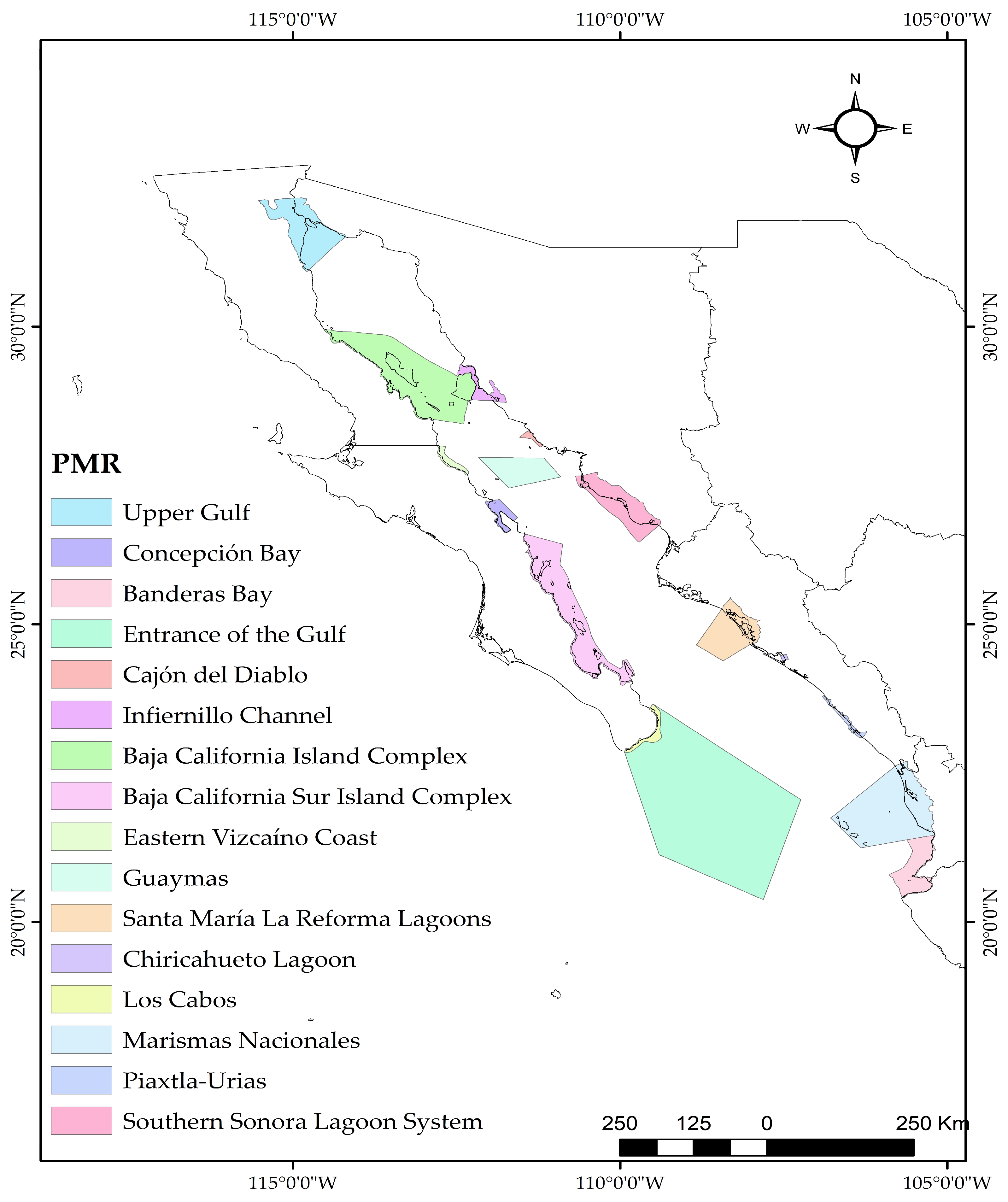
The study area comprises 24 PMRs (Table 1) distributed along the South Californian Pacific (Figure 1) and Gulf of California (Figure 2). The South Californian Pacific is mainly influenced by the California Current Systems, dominated by wind-driven upwelling, which provides nutrient-rich water to the euphotic section of the water column, supporting productivity levels in marine and coastal ecosystems [73]. This region is considered a transition between cold and fresh subarctic oceans, with a higher concentration of solutes, and warmer tropical and subtropical water [74]. The previous generates a seasonal variability, where subarctic characteristics dominate during winter and spring, while tropical and subtropical characteristics are present in summer and fall [3]. On the other hand, the Gulf of California is a dynamic sea rich in nutrients and high productivity levels [2]. These characteristics are associated with tidal mixing upwelling systems, seasonal winds, and high solar radiation [1,75]. The PMR in the region, where established/suggested by CONABIO, due to a combination of factors such as their high biodiversity, prominent social importance, or unique oceanographic conditions [11].

2.2. Sea Surface Temperature (SST) and Chlorophyll a (Chl a) Datasets

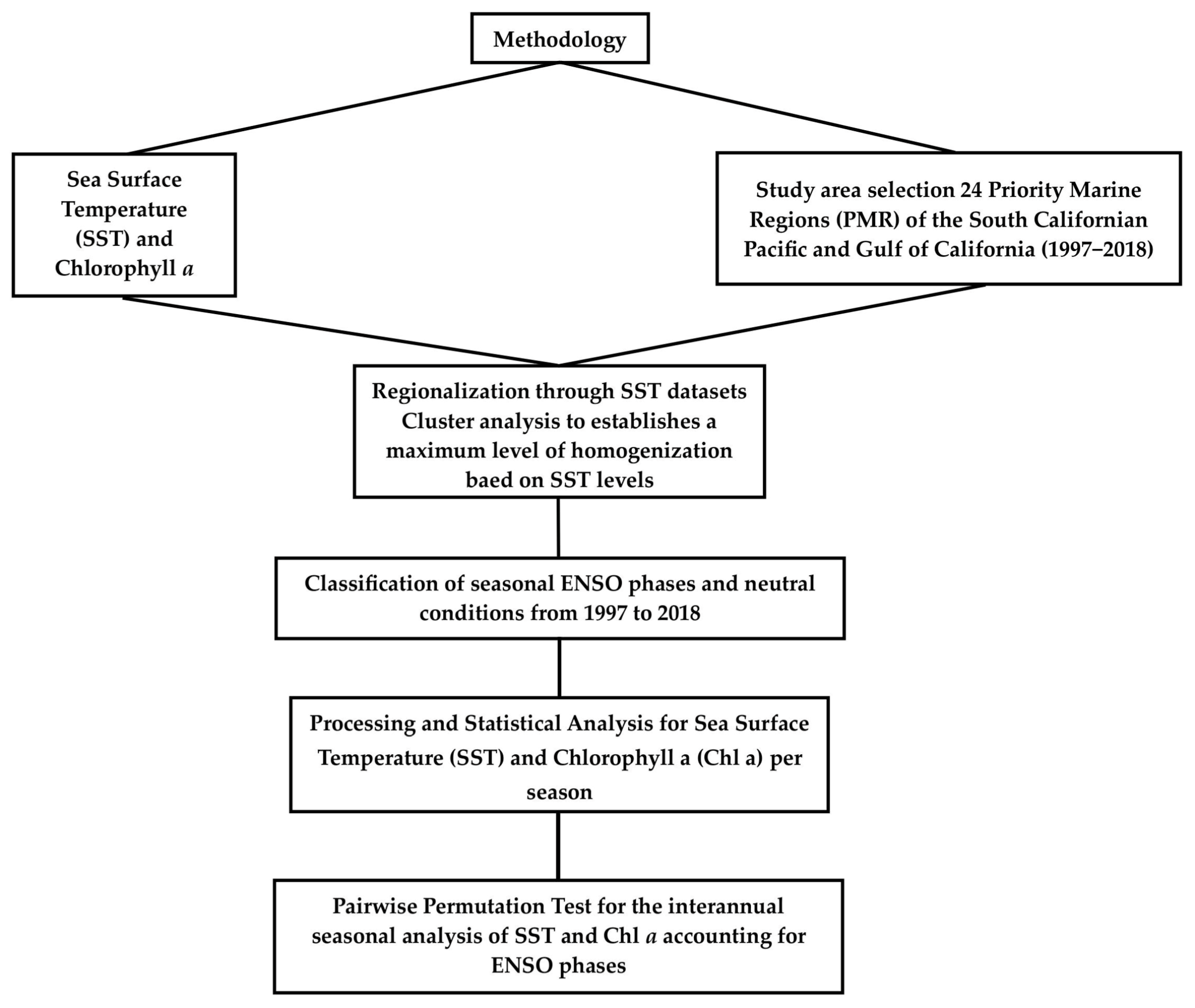
The present work uses a series of remotely sensing datasets, coupled with climatological indices and models, to explain ENSO effects on SST and Chl a on a seasonal basis (Figure 3).
To characterize oceanographic and environmental parameters of the 24 PMR, proxies from remote sensing products for SST and Chl a were obtained. Specifically, a period between September 1997 and October 2018 was selected to analyze two decades of data, and assess relationships and drivers to climatic phenomena. Specifically, for both variables, we obtained one monthly reading (temporal resolution), at 4 km (September 1997–January 2000 AVHRR datasets) and 1 km (February 2000–September 2018 WimSoft products) spatial resolution for SST, and at 1 km spatial resolution for Chl a (September 1997–September 2018 WimSoft).
SST datasets were downloaded from the Physical Oceanography Distributed Active Archive Center (PODAAC) from https://podaac.jpl.nasa.gov/ (accessed on 20 January 2025). Specifically, for the first period (September 1997–January 2000), we used monthly data from the sensor Advanced Very High Resolution Radiometer (AVHRR-Pathfinder version 5.0). The scale of the dataset is given in Celsius (°C), and it has a spatial resolution of 4 km. Monthly SST Level-3 products were mapped in uniformly distributed spatiotemporal grids. Each one of the pixels contains values, encompassing those potentially affected by clouds or other error sources. To exclude these errors, Overall Quality Flag (OQF) values were applied, obtaining an average of the highest-quality AVHRR Global Area Coverage (GAC) observations within approximately 4 km bins. Pathfinder algorithm uses the Reynolds Optimally Interpolated SST (OISST, Version 2) for quality control. Quality assessment is based on an Overall Quality Flag ranging from 0 (lowest) to 7 (highest), determined through a hierarchical set of tests. For studies requiring the highest precision, only level 7 data should be used [76,77,78]. To develop a continuous dataset (from September 1997 to October 2018), we complemented the previous period with monthly data, obtained from averaged composite images developed by the Scripps Institution of Oceanography at San Diego, California from http://www.wimsoft.com/Satellite_Projects.htm (accessed on 20 January 2025). from February 2000 to September 2018. After standardization of the AVHRR period, we used these datasets to complete 253 months of average SST database at each of our study sites.
Monthly Chl a datasets were also acquired from averaged composite images developed by the Scripps Institution of Oceanography at San Diego, California from http://www.wimsoft.com/Satellite_Projects.htm (accessed on 20 January 2025), from September 1997 to October 2018, which correspond to the same period of the SST dataset time series previously described (253-month period). The scale of the dataset is given in milligrams per cubic meter (mg/m3). Each composite image in the datasets was processed at Level 2 [79,80], data combining with unmapped datasets obtained by using daily images of SST and Chl a from unmapped data, and diverse sensors such as Sea-viewing Wide Field-of-view Sensor (SeaWiFS); Moderate Resolution Imaging Spectro-radiometer (MODIS) Terra and Aqua; Medium Resolution Imaging Spectrometer (MERIS); Visible Infrared Imaging Radiometer Suite (VIIRS); Visible Infrared Imaging Radiometer Suite-Joint Polar Satellite System (VIIRS-JPSS1); Ocean and Land Color Instrument-Water Reduced Resolution (OLCI-WRR) A and B, which were downloaded from the National Aeronautics and Space Administration (NASA) Ocean Color Web [80]. Individual satellite swaths were georeferenced to ensure a better spatial comparability among sensors, and only cloud-free pixels were merged to generate these monthly composite images by combining multiple satellite overpasses, and sensor data gaps caused by cloud cover were minimized, enhancing spatial and temporal coverage [80].
These monthly SST and Chl a datasets were accessed, analyzed, and extracted using Windows Image Manager Automation Module software (WIM/WAM), Wimsoft version 9.06 1991–2015, Copyright© Mati Karhu [81]. We used digital maps from CONABIO-PMR to locate the areas of interest 24 at the South Californian Pacific and Gulf of California [11]. We used the geographic limits of these areas to obtain monthly mean SST and Chl a, from the time period previously stated and conducted post-analysis of these variables, taking into account climatic drivers and seasonality.

2.3. Processing Calibration and Regionalization Through Sea Surface Temperature (SST) Datasets

To ensure consistency among SST datasets, a calibration to adjust AVHRR-Pathfinder values was necessary. Therefore, a period of seven years was used (February 2000 to February 2007) in which the data from AVHRR-Pathfinder version 5.0 coincide with composite images of multiple sensors from the WimSoft Web (February 2000–October 2018). As an analysis, we used a linear regression to observe how values of similar months correlate. Previous studies have applied a comparison of different sensors and their combinations [82,83], obtaining a similar distribution pattern and high coefficient correlation, which supports the application of long-term analysis through multiple sensors [82].
Once the calibration of the SST data was finished, a cluster analysis of the monthly SST data was performed to group the monthly average values of each PMR from both marine areas, the South Californian Pacific and the Gulf of California. The cluster analysis is a multivariate technique that combines objects into groups, based on similarity, applying fusion algorithms [84,85]. The present work uses cluster analysis on regional PMRs and establishes a maximum level of homogenization, considering the maximum differences between the groups, obtaining linkage distances to conform groups with similar SST levels (°C), to address Chl a concentration. Previous studies usually address climatic variation yearly, instead of seasonally, often miss the temporal variation posed by driving phenomena such as ENSO.

2.4. Processing and Statistical Analysis for Sea Surface Temperature (SST) and Chlorophyll a (Chl a)

As a key component of the present study, it was necessary to classify ENSO phases for particular seasons each year. For the previous, the Oceanic Niño Index (ONI) developed by the National Oceanic and Atmospheric Administration (NOAA) was used, which classifies SST anomalies of +0.5 higher as El Niño phases, and values of −0.5 lower as La Niña phases [86].
For each season, year, and PMR in the analysis, average values for SST and the Chl a value addition (of each season) were derived and related to a specific ENSO phase (present at the time). We used Permutation Tests (p-value < 0.05) to analyze the interannual differences among ENSO phases for each PMR studied. The permutation analysis determines statistical evidence against the null hypothesis by not finding differences [87,88], and all the analyses were completed in the Statistical Software version 7.5 and R Software version 3.4. In this last software, the libraries used to perform the Permutation Tests (p-value < 0.05) were wperm, lmperm, and FSA.

3. Results

3.1. Datasets and Regionalization

We obtained a total of 254 monthly measurements of SST and of Chl a for each of the PMR analyzed (Figure 1 and Figure 2). During this period, multiple ENSO phases were present, and, therefore, a representative number of each phase type (El Niño, La Niña, and neutral years) was ensured to assess variable behavior during those phases. Specifically, SST measurements were used to assess similarities among PMR and, therefore, achieve a consistent biophysical approach for regionalization.
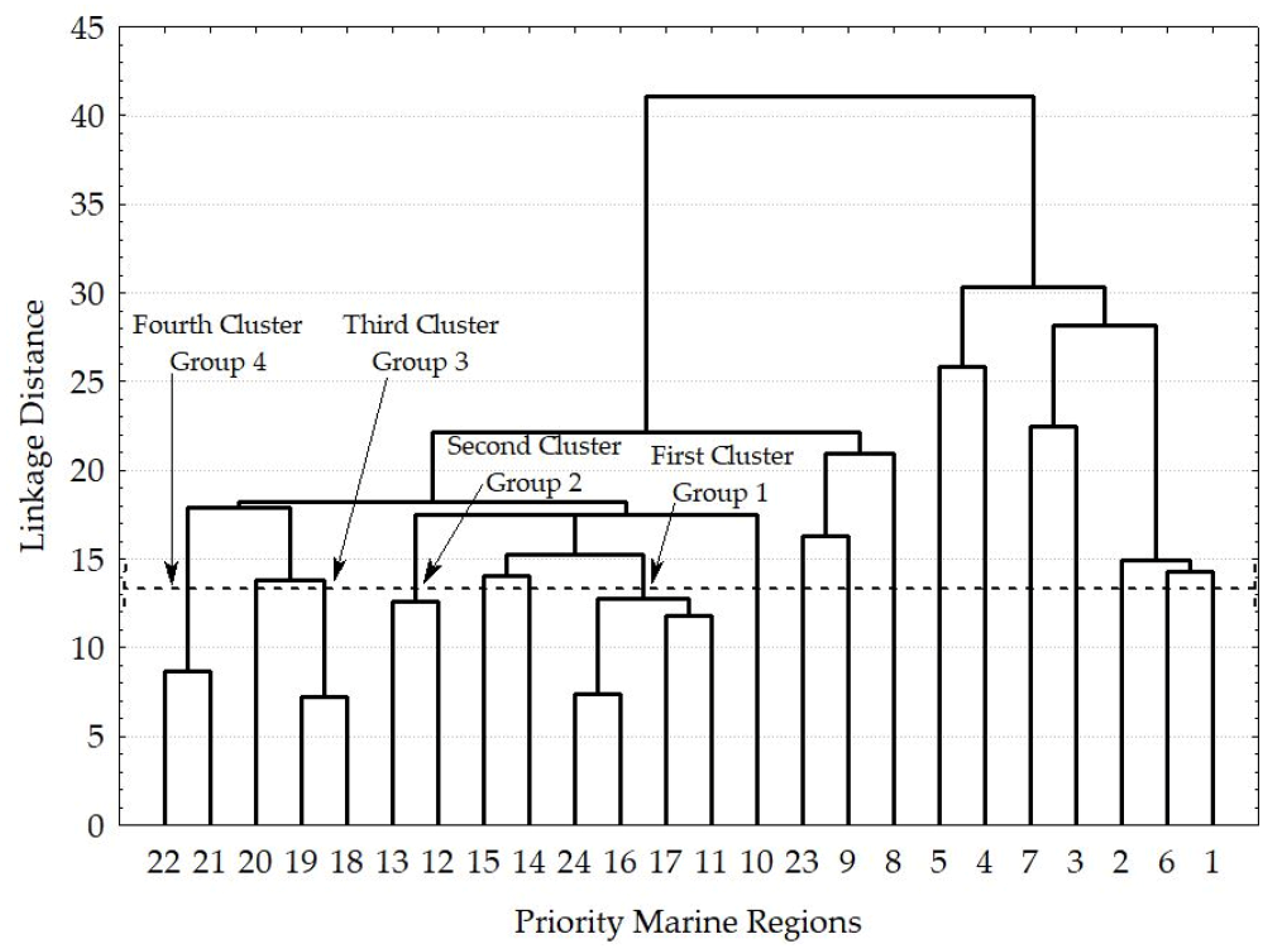
A cluster analysis for SST suggests the presence of four complexes composed of two to four PMR, and 14 regions classified into individual areas. These analyses consider linkage distances of 13 units to establish conglomerates, based on the dissimilarity or similarity of the SST values [52,71]. A total of 18 regions (Table 2, Figure 4) are suggested, of which four were gathered into groups (Group 1 to Group 4) recognized as a conjunction of areas, presenting similar SST behavior within each group. The rest of the regions were listed as individual sites by our analysis and were treated as such in our subsequent exercises. It is necessary to mention that the linkage distance was established to determine the whole conglomerates from the cluster analysis composed of PMR exclusively close to each other and located in the same marine area, which means that a conglomerate that represents a region is composed only of PMR of the South Californian Pacific or from the Gulf of California, but never a combination of both marine areas.
Results suggest that SST segregates PMRs as a consequence of the latitudinal gradient/location and SST patterns. This was expected, since this gradient poses changes in climatology controls, and, therefore, physical dynamics [4,33,89,90]. It is also worth noting that PMR, grouped within a cluster, tend to be proximate to each other, sharing location characteristics (coastal distance and latitudinal gradient). These results accentuate the influence of overarching controls on SST, which in turn affects biological activity in the ocean [91,92,93].

3.2. Interannual Analysis of ENSO: Sea Surface Temperature (SST)

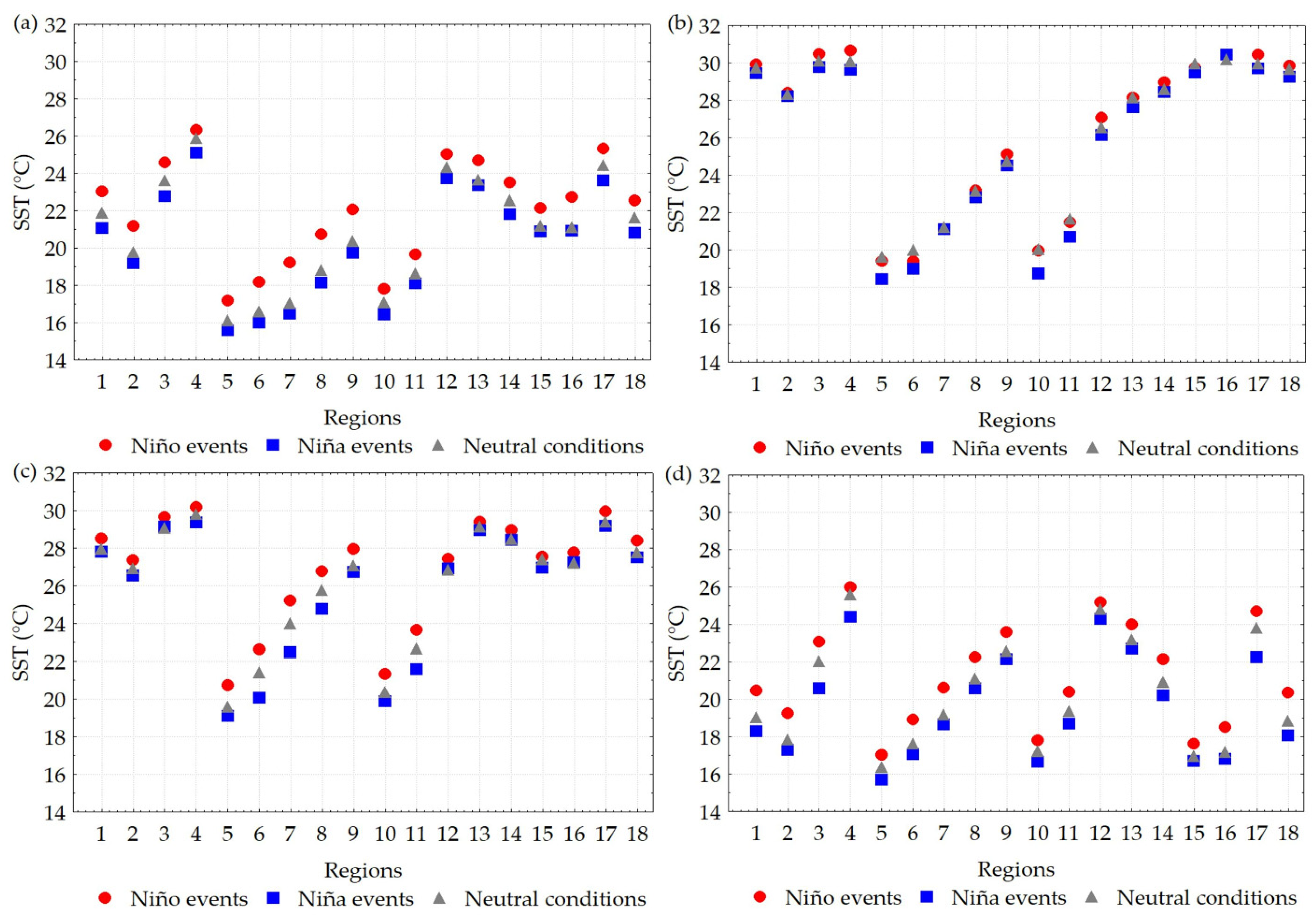
To analyze the seasonal SST for each cluster, considering ENSO phases, a Pairwise Permutation Test was performed. For the previous, the means of the monthly SST data was used for the whole period of study, divided between Niño, Niña, and neutral phases of ENSO. The analysis of these phases was conducted for each season of the year (spring, summer, autumn, and winter) to compare behavior and the influence of ENSO on temperature. Pairwise Permutation Tests comparisons and results are depicted in the following tables (Table 3 and Table 4), where the presence of the letters indicates that at least one of the groups (El Niño, La Niña, and neutral conditions) shows statistical differences (p-value < 0.05) on SST levels. It is important to indicate that this process was also performed with the interannual analysis of ENSO with the Chl a concentration. Additionally, to illustrate general trends, simple scatterplots showing the SST behavior for each phase per season are shown (Figure 5).
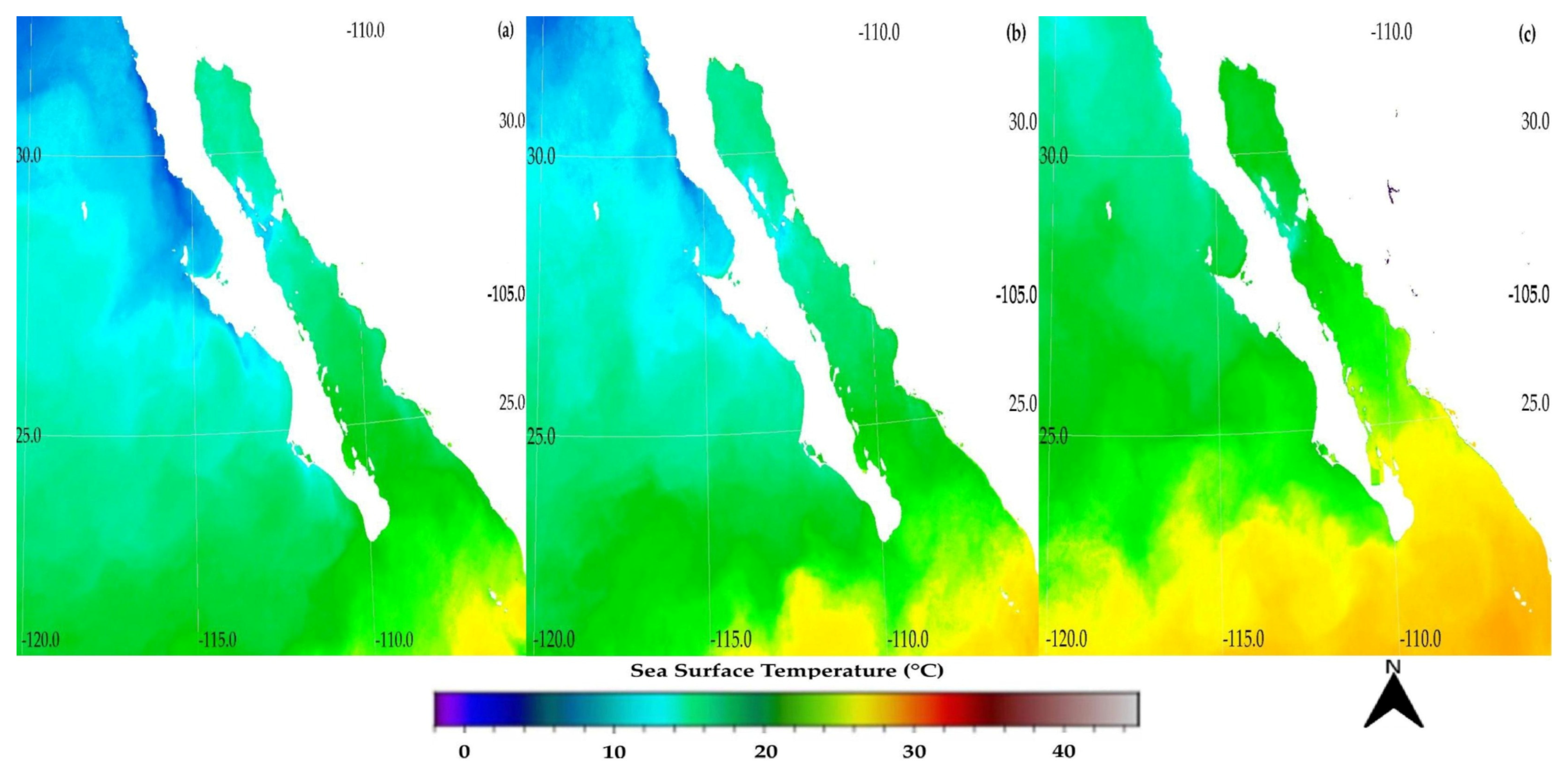
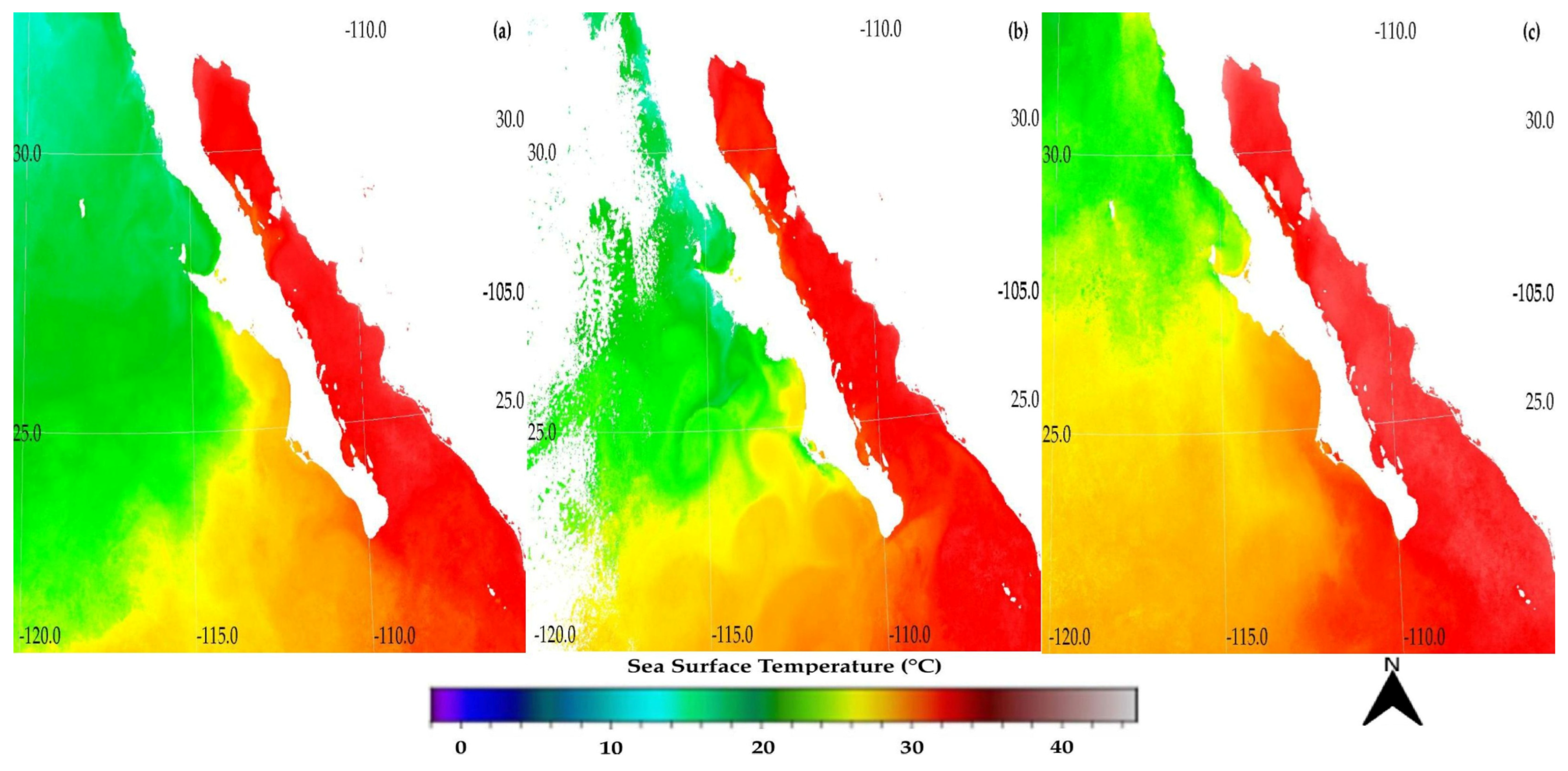
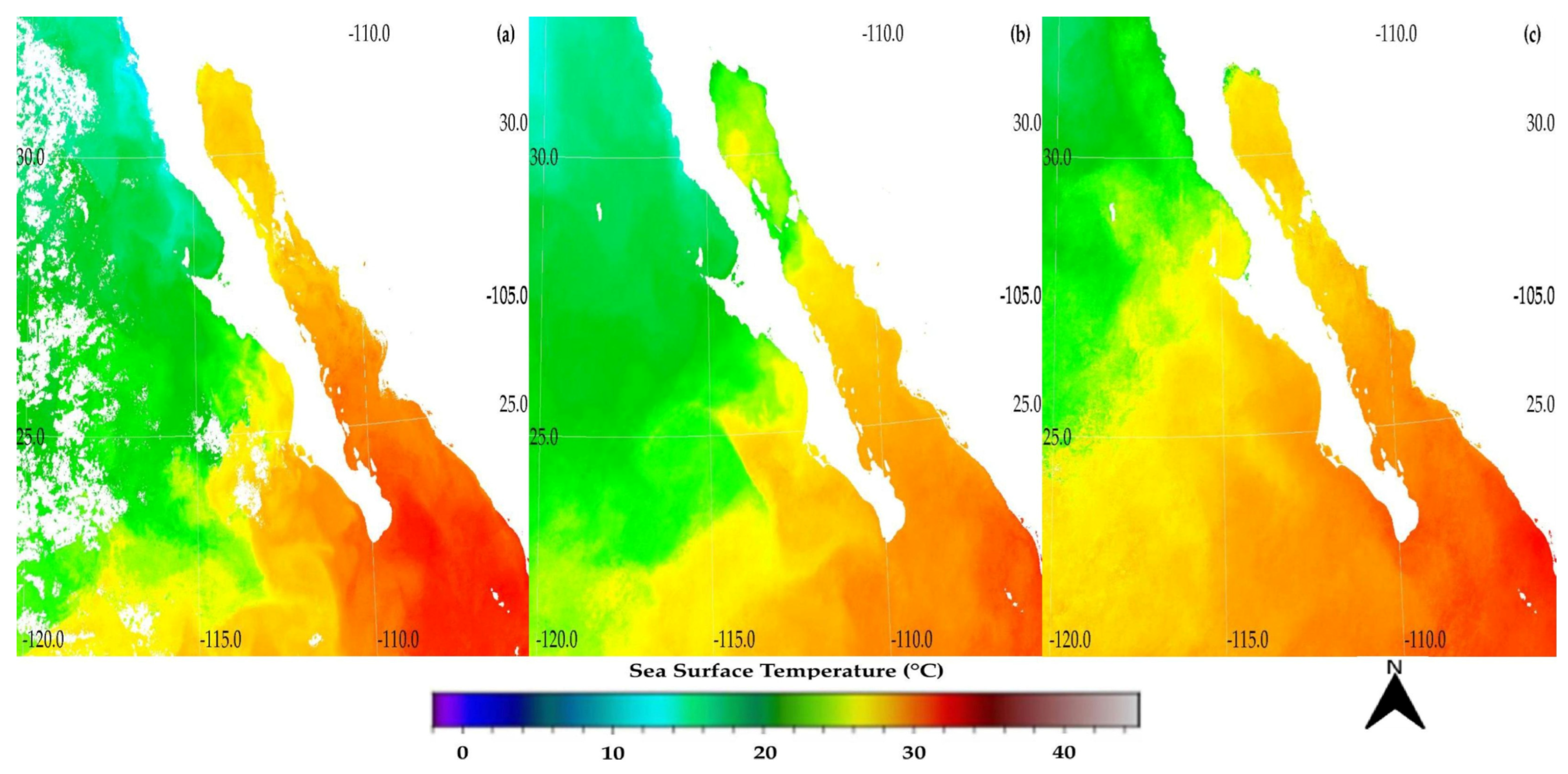
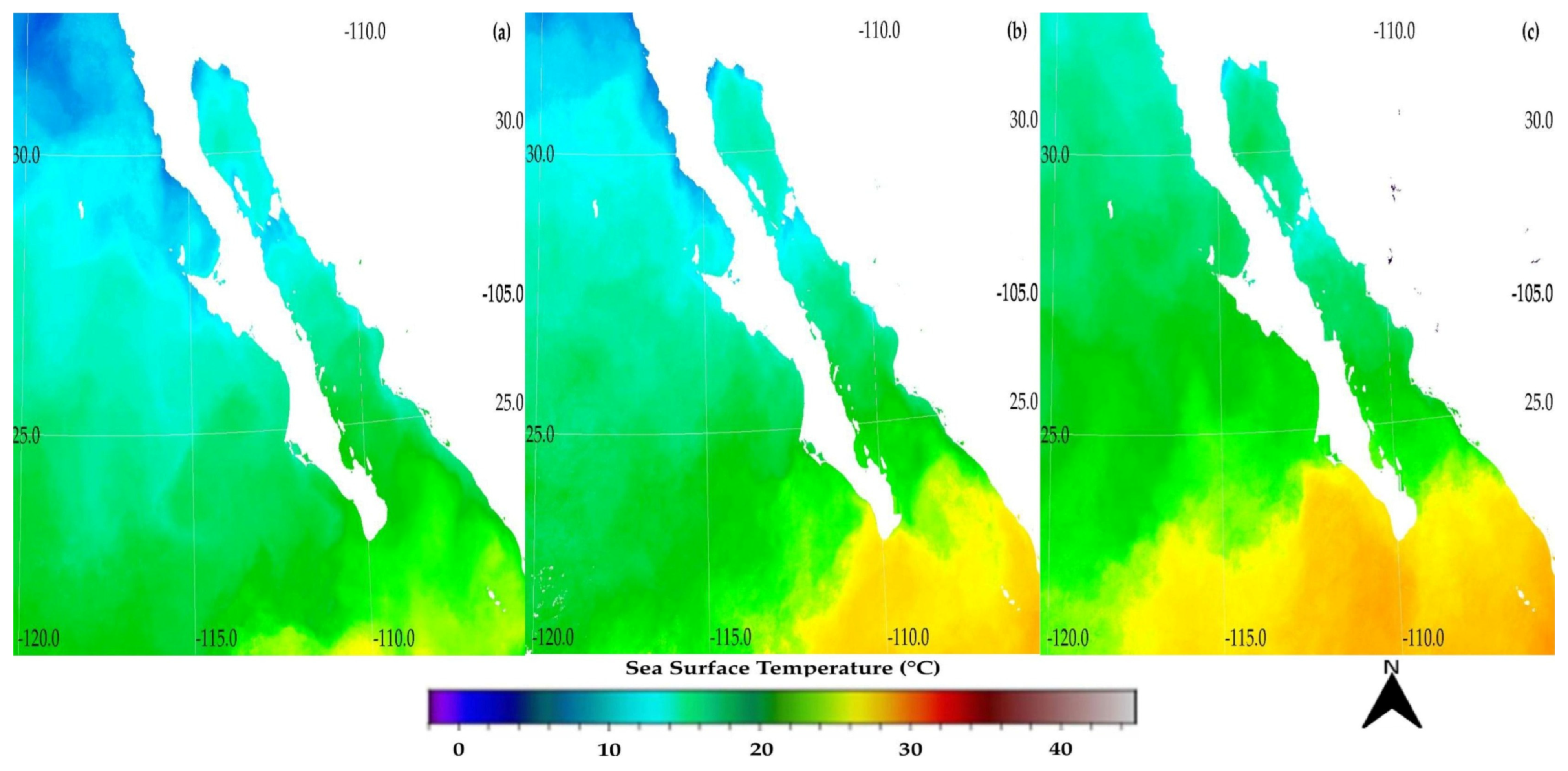
According to results, 17 of the 18 regions show higher temperatures during El Niño phase for spring, when compared to neutral and La Niña phases. As for summer, the trend is less clear, since only six regions present differences, of which three with higher temperatures occurred during El Niño, and the other three during neutral phases. Autumn presents a clear distinction of temperature readings, according to the ENSO phase in place, with 12 of the 18 regions presenting higher mean temperatures during El Niño events, and neither La Niña nor the neutral phases presenting higher mean temperatures for any of the regions. However, even more apparent than autumn was the winter season, where the whole 18 regions presented higher mean temperature during El Niño phases, suggesting ENSO strongly influences SST during this season. Monthly images of SST of March, August, November, and January 2011, 2013, and 2015 were taken to show the SST variability for each season of the year during the ENSO phases and neutral conditions, according to the results obtained from the Pairwise Permutation Test (Figure 6, Figure 7, Figure 8 and Figure 9).

3.3. Interannual Analysis of ENSO: Chlorophyll a (Chl a)

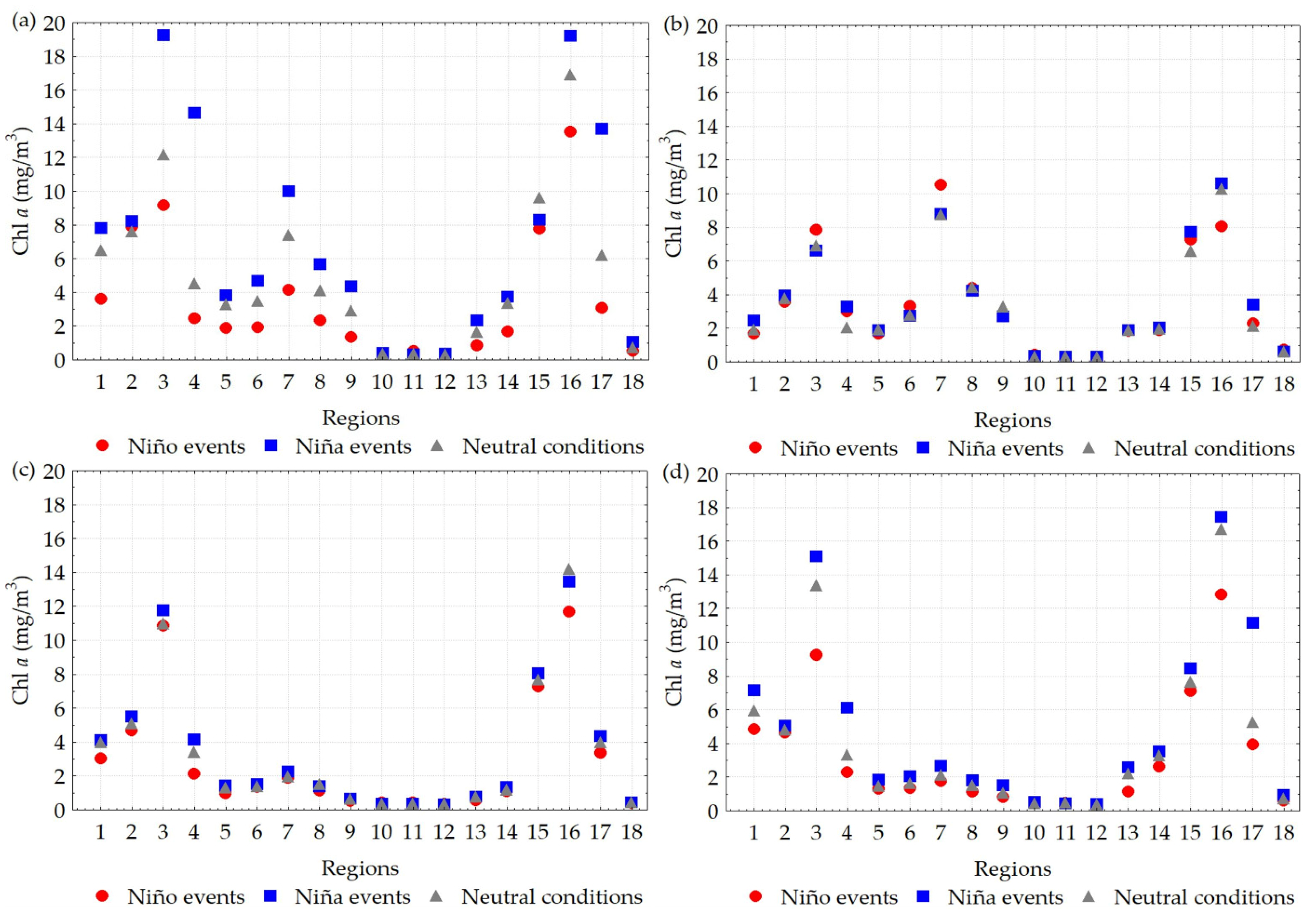
Seasonal analysis of Chl a concentration was also conducted via Pairwise Permutation Test, to assess differences among PMR clusters. For this analysis, the sum of the monthly Chl a data was used to assess differences in seasonality according to the ENSO phase (Niño, Niña, and neutral). Statistical differences (p-value < 0.05) among phases were observed in several regions, and during different seasons, suggesting significant ENSO influences on oceanic Chl a concentration (Table 5 and Table 6). However, when using Pairwise Permutation as a post hoc analysis, winter and spring show more differences among phases than summer and autumn (Figure 10).
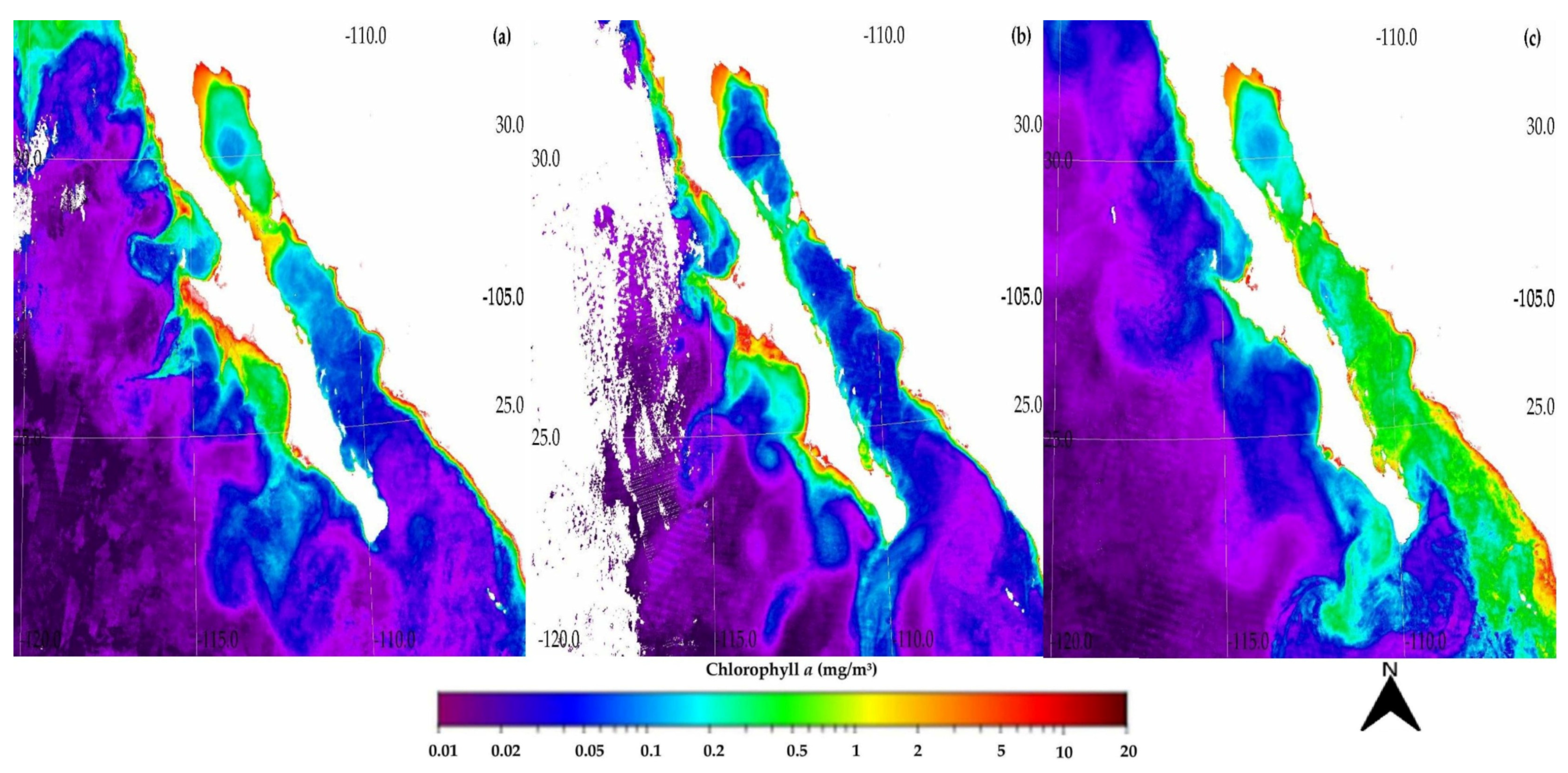
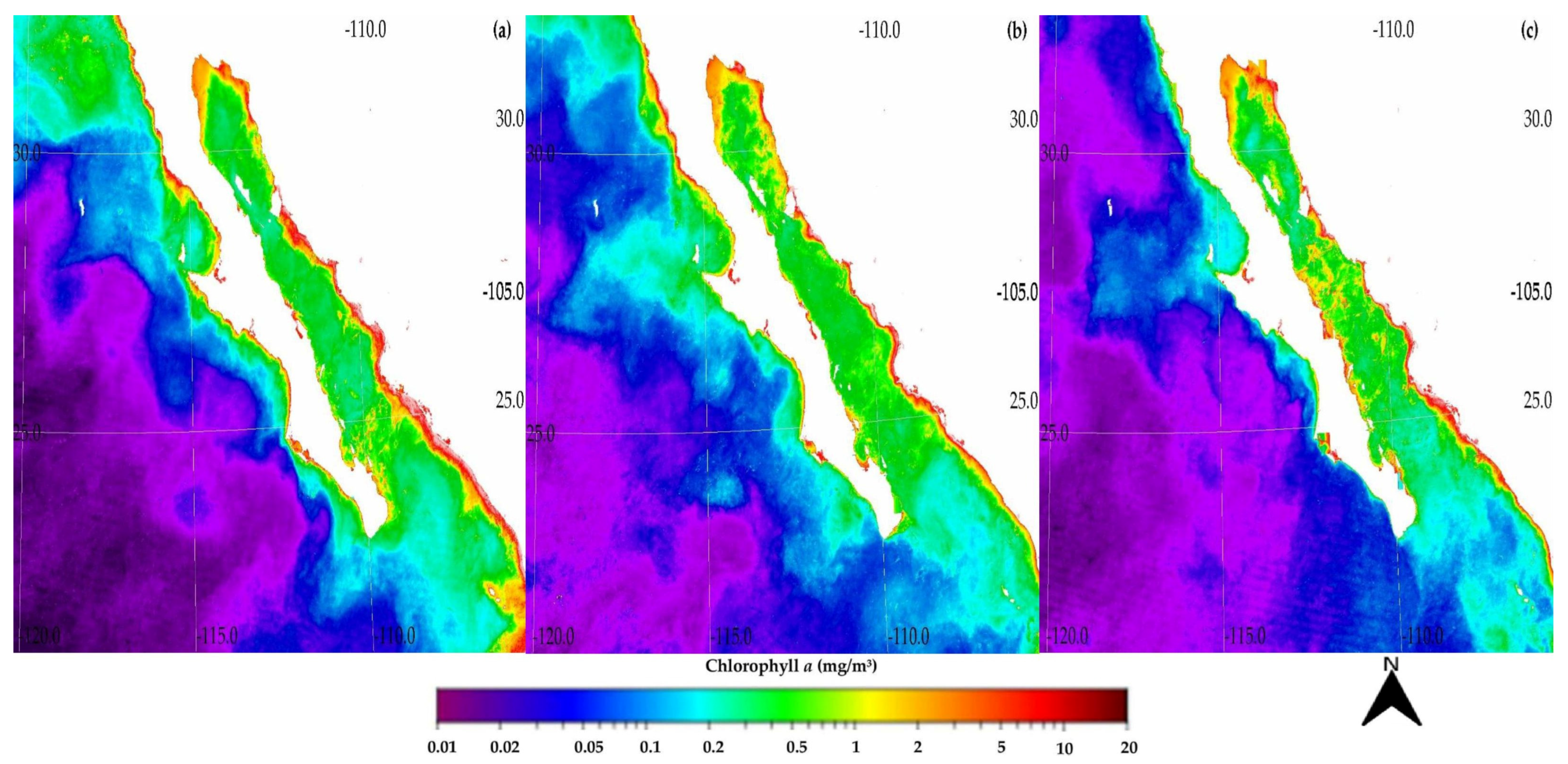
Our analysis for spring shows a higher concentration of Chl a in 13 of the regions during La Niña events, as opposed to none for El Niño or neutral conditions. For the summer, our results suggest that just 2 of the 18 regions show higher concentrations of Chl a during La Niña phases, and 1 during El Niño. On the other hand, when analyzing results for the autumn season, we found that 5 of the 18 regions showed higher concentrations of Chl a during La Niña events, as opposed to none for El Niño or neutral phases. Similar to spring, winter presents a high number of differences among the regions. Specifically, we found that 11 of the 18 regions present higher concentrations of Chl a during La Niña phases. The previous suggests a deep effect on productivity, as a consequence of ENSO driving forces, and a potential shift in oceanic ecological configurations/structure, if future conditions are dominated by one of those phases/regimes. Chl a interannual variability was also described using monthly images with the same months and years to represent a season of the year during neutral conditions and ENSO phases, based on the results obtained from the Pairwise Permutation Test (Figure 11, Figure 12, Figure 13 and Figure 14).

4. Discussion

4.1. Priority Marine Regions Aggregation

According to clustered SST analysis, this study identifies a total of 8 PMR in the South Californian Pacific, while the other 10 regions are grouped in the Gulf of California (Table 2, Figure 3). This agrees with previous studies, which have attempted to classify these regions using SST and/or Chl a, in an array of regional patterns addressing variability, trends, and dynamics [94,95,96]. Results from these works suggest that climate phenomena and characteristics, in association with dynamic oceanic processes such as wind/upwelling systems [4], constitute key drivers for Chl a [97,98], and SST [99,100] dynamics along the Baja California Peninsula. It has been reported that, for the South Californian Pacific Ocean, SST and Chl a variability is tightly linked to ocean-atmosphere interactions, as well as to the physical dynamics in the water column. Therefore, seasonal variability [3,4], and coastal upwelling events [15,101,102,103], contribute to variation in SST levels and Chl a concentration, as a consequence of fluctuation in phytoplankton biomass [33,98]. On the other hand, the Gulf of California is considered a transitional zone, with a climatology much more continental than oceanic [104], which generate a temperate-tropical climate, derived from the influence of the Intertropical Convergence Zone (ITCZ) movements [38,90] from the Tropical Pacific Ocean. And from these premises, the present study aggregates PMR using SST as a proxy to study variation and climatic trends. It is important to mention that the regionalization process obtained constitutes an improvement on spatial (1 km resolution from 2000 to 2018) and temporal resolutions used in previous works (monthly SST data), using a relatively extended time series (September 1997–October 2018).

4.2. Interannual Analysis of ENSO: Sea Surface Temperature (SST) and Chlorophyll a (Chl a) Variability in the South Californian Pacific and Gulf of California

The present work highlights the importance of interannual variability of ENSO phases, finding significant phase-dependent differences in SST levels (°C) and Chl a concentration (mg/m3), for all seasons (spring, summer, fall, and winter) for all the regions of the Southern Californian Pacific and Gulf of California, and primarily during winter and spring. For the South Californian Pacific, ENSO events were described through SST data, reporting higher values than the annual average in Magdalena Bay [105] and in Todos Los Santos Bay [34], effects that can be associated with weakening of the wind’s patterns and upwelling events in conjunction with the advection of tropical and subtropical water [3,106]. Similar effects were also described in the Gulf of California [83,89,107], reporting SST anomalies in the south and central regions of the Gulf in comparison with the Midriff Islands and the northern regions, these patterns are generally attributed to the link between the Gulf and the Pacific Ocean. Other studies suggests smaller effects of ENSO events in the SST, along the central and Midriff Islands of the Gulf of California, where major drivers of temperature variability are associated with other oceanic physical dynamics, such as tidal mixing effects and upwelling events [108,109,110] as well as to the modification of the seasonal wind patterns along the eastern coast of the gulf [111].
El Niño phase effects in Chl a variability have also been discussed for the South Californian Pacific in previous works [59,66], suggesting a decrease in phytoplankton biomass and important changes in phytoplankton composition. Furthermore, El Niño events are associated with the weakening of coastal upwelling and mixing processes, causing a lack of nutrients (nutricline sinking) and stratification of the water column (temperature thresholds). Other studies describe the presence of eventual anomalous subarctic water along the west coast of Baja California, which also influences productivity and concentration of Chl a [55,112]. Similar studies have been conducted across several sites of the Gulf of California [68,107,113], acknowledging a direct influence to the communication with the Pacific Ocean, which allows the entrance of equatorial surface water [114] from the Mexican Coastal Current [38], resulting in a more oligotrophic condition in comparison to the gulf, affecting the Chl a concentration [52,71,113,115]. Previous work suggests the effects of ENSO events (El Niño and La Niña) are evident at the entrance of the Gulf [107,116], associating interannual chlorophyll variability with this phenomenon on the Nayarit continental shelf. However, other studies suggest lesser ENSO effects at the central and Midriff Islands regions of the gulf, where oceanographic conditions (tidal mixing, constant upwellings) inhibit the influence of El Niño and La Niña events [110,117]. Similar results were reported in the northern Gulf of California [118,119], showing that phytoplankton biomass has a low response to interannual events due to the direct effect of northwestern wind patterns. Escalante et al. [107] analyzed SST anomalies and reported a delayed response of 3–6 months for the reestablishment of normal phytoplankton conditions once the ENSO warm phase ended. Hakspiel-Segura et al. [70] described Chl a variability as an indicator of resilience, reported a regulating process of Chl a value during warm and cold periods, indicating a mechanism of ecosystem resilience to climate variability at different spatiotemporal scales.
The present study suggests a strong ENSO influenced by driving SST and Chl a variability, which can only be observed when the phenomena are decomposed seasonally, rather than annually. In addition, the breakup of ENSO events in seasonal patterns uncovers environmental variability and oceanographic dynamics not fully addressed in previous studies. However, previously reported results support much of the analyses of SST levels and Chl a concentration for the South Californian Pacific and Gulf of California presented in this study, even though these studies were mainly conducted by characterizing entire years as a single phase of ENSO (El Niño, La Niña, or neutral events). However, a more specific and concise characterization of the effects of interannual ENSO events, for each season, consistently highlights higher SST levels during El Niño events, and higher Chl a concentration during La Niña events. These findings suggest that scenarios where SST rises due to climatic shift would result in significantly less productive oceans for the region studied.
Analysis of SST for the study areas in the present work shows significant differences between ENSO phases, in 17 of the 18 regions analyzed during spring, 6 regions differ during summer, 12 during autumn, and finally, all regions showed significant differences during winter, consistently finding higher SST levels during El Niño phases. Also, significant differences were found for Chl a concentration between ENSO phases, where concentrations rise during La Niña events for 13 of the 18 regions in spring, for 3 during summer, for 5 in the autumn, and finally for 11 of the 18 regions during winter. Previous studies have reported the effect on oceanographic dynamics and environmental variability, using SST and Chl a as a response variable, to describe possible scenarios, and trends of changes which might influence the structure and function of marine and coastal ecosystems [64,69,70,120,121]. López-Martínez et al. [71] analyze the increase in SST levels in the Gulf of California, and its linkage to the decreases in Chl a concentration and productivity, discussing the potential effect of warming trends on the decrease in productivity, and the subsequent potential effects on the habitat loss for many species, which could cause a decline in fisheries. Similar results were described by García-Morales et al. [122] for the Pacific region of Baja California, describing a tropicalization process in the southern area, indicating an increase in SST levels due to long-term events or a potential sign of global warming, which can alter the Chl a concentration as well as the biodiversity of marine ecosystems.
The results of this study show evidence that the spatiotemporal analyses of SST levels and Chl a concentration are important for the characterization of the oceanographic and environmental aspects of its variability, considered necessary to explain physical, climatological, and biological processes of the coastal and marine ecosystems, which can influence the distribution and abundance of marine resources. The process of developing oceanic indicators, tightly linked to ecological processes, to describe the interannual effect of climate phenomena, increases the understanding of current trends of change associated with environmental and oceanographic factors, which generate useful information to understand current and future stages of marine ecosystems.

5. Conclusions

Results from the present research show strong evidence, suggesting that SST and Chl a variability in the South Californian Pacific and Gulf of California is tightly related to ENSO seasonal events (El Niño and La Niña). Therefore, the assessment of oceanographic conditions within the year (adapting into a seasonal approach), and considering ENSO phases for those seasons, increases our understanding of the biological and climatological processes occurring in the ocean under current (and potentially future) conditions. The oceanographic variability using monthly SST data analysis performed an optimal ecological characterization of the regions analyzed (the South Californian Pacific and Gulf of California), and cluster analysis suggests that these areas could be separated into 18 (currently 24 PMR), with similar oceanographic and environmental aspects. Statistical analysis suggests interannual variability of the monthly SST and Chl a data in all the regions for all the seasons during interannual events (El Niño and La Niña) and neutral conditions were statistically different, showing higher SST levels during warm ENSO season and lower Chl a concentrations, while during cold ENSO season, higher Chl a concentrations and lower SST levels. If these trends drive oceanographic dynamics to a new baseline, the effects on the distribution and structure of marine and coastal ecosystems could be significant, affecting the distribution and abundance of marine organisms. This study provides a significant framework for the analysis and characterization of environmental and oceanographic patterns to describe possible trends of changes associated with global climate patterns that might result in a series of noble conditions for marine ecosystems. Fluctuations in oceanic temperature, which are tightly related to climate phenomena (such as ENSO), exert pressure on productivity. Results from this work further our understanding of trends of change associated with environmental and oceanographic factors. For the PMR analyzed, drastic inter-seasonal SST fluctuations might have profound effects on productivity, and, therefore, a significant effect on the biota present on site, due to resource availability [63,64,123,124,125]. For conservation and management, the analysis of potential present and future climate scenarios would contribute to a better-informed decision-making process. Future research, regarding phenological response from algae, might include addressing the effects of ENSO and Sea Surface Temperature on greening (Chlorophyll a production), using higher temporal resolution datasets.

Author Contributions

Conceptualization, J.R.R.-L. and C.M.R.-T.; methodology, C.M.R.-T., J.R.R.-L., R.G.-M., G.F.-P., L.F.E.-O. and M.C.P.-G.; software, C.M.R.-T., J.R.R.-L., R.G.-M. and G.F.-P.; validation, C.M.R.-T., J.R.R.-L., R.G.-M., G.F.-P., L.F.E.-O. and M.C.P.-G.; formal analysis, G.F.-P.; investigation, C.M.R.-T., J.R.R.-L., R.G.-M., G.F.-P., L.F.E.-O. and M.C.P.-G.; resources, J.R.R.-L. and R.G.-M.; data curation, C.M.R.-T.; writing—original draft preparation, C.M.R.-T.; writing—review and editing, C.M.R.-T., J.R.R.-L., R.G.-M., G.F.-P., L.F.E.-O. and M.C.P.-G.; visualization, C.M.R.-T., J.R.R.-L., R.G.-M., G.F.-P., L.F.E.-O. and M.C.P.-G.; supervision, C.M.R.-T., J.R.R.-L., R.G.-M., G.F.-P., L.F.E.-O. and M.C.P.-G.; project administration, J.R.R.-L. and R.G.-M.; funding acquisition, J.R.R.-L. and R.G.-M. All authors have read and agreed to the published version of the manuscript.

Funding

This research was funded by Secretaría de Ciencia, Humanidades, Tecnología e Innovación (Spanish for Secretary of Science, Humanities, Technology and Innovation; abbreviated SECIHTI). Project A3-S-77965: “Cambios Históricos y Recientes en la Distribución de Especies Bentónicas y Demersales Marinas del Golfo de California como Efecto del Calentamiento Global: Detección de especies con potencial invasivo”.

Data Availability Statement

The raw data supporting the conclusions of this article will be made available by the authors on request.

Acknowledgments

The authors acknowledge to SECIHTI for provide the funding through the Project A3-S-77965. The authors acknowledge to the Program in Biosciences, Interdisciplinary Faculty of Biological and Health Sciences of the University of Sonora as well as to the Center for Biological Research, Northwest S.C., and Diana Fischer for the English edition.

Conflicts of Interest

The authors declare no conflicts of interest.

References

  1. Álvarez-Borrego, S. Physical, chemical and biological oceanography of the Gulf of California. In The Gulf of California: Biodiversity and Conservation, 2nd ed.; Brusca, R., Ed.; The University of Arizona Press: Tucson, AZ, USA, 2010; pp. 24–48. ISBN 978-0816500109. [Google Scholar]
  2. Álvarez-Borrego, S. Phytoplankton Biomass in the Gulf of California: A review. Bot. Mar. 2012, 55, 119–128. [Google Scholar] [CrossRef]
  3. Durazo, R. Climate and upper ocean variability off Baja California, Mexico: 1997–2008. Prog. Oceanogr. 2009, 83, 361–368. [Google Scholar] [CrossRef]
  4. Durazo, R. Seasonality of the transitional region of the California Current System off Baja California. J. Geophys. Res. Ocean. 2015, 120, 1173–1196. [Google Scholar] [CrossRef]
  5. Houghton, J. Global Warming. Rep. Prog. Phys. 2005, 68, 1343–1403. [Google Scholar] [CrossRef]
  6. Doney, S.C.; Ruckelshaus, M.; Duffy, J.E.; Barry, J.P.; Chan, F.; English, C.A.; Galindo, H.M.; Grebmeier, J.M.; Hollowed, A.B.; Knowlton, N.; et al. Climate change impacts on marine ecosystems. Annu. Rev. Mar. Sci. 2012, 4, 11–37. [Google Scholar] [CrossRef] [PubMed]
  7. Ziqi, L. Impacts of global warming on marine ecosystems: Ocean acidification and fish catches. In Proceedings of the 4th International Conference on Materials Chemistry and Environmental Engineering, Applied and Computational Engineering, London, UK, 13 January 2024. [Google Scholar]
  8. Cheng, L.; Abraham, J.; Hausfather, Z.; Trenberth, K.E. How fast are the oceans warming? Science 2019, 363, 128–129. [Google Scholar] [CrossRef]
  9. Cheng, L.; Abraham, J.; Trenberth, K.E.; Fasullo, J.; Boyer, T.; Locarnini, R.; Zhang, B.; Yu, F.; Wan, L.; Chen, X.; et al. Upper Ocean Temperatures Hit Record High in 2020. Adv. Atmos. Sci. 2021, 38, 523–530. [Google Scholar] [CrossRef]
  10. Su, H.; Wei, Y.; Lu, W.; Yan, X.-H.; and Zhang, H. Unabated Global Ocean Warming Revealed by Ocean Heat Content from Remote Sensing Reconstruction. Remote Sens. 2023, 15, 566. [Google Scholar] [CrossRef]
  11. Arriaga-Cabrera, L.; Aguilar, A.; Espinoza, J.M. Regiones Marinas y Planeación Para la Conservación de la Biodiversidad. In Capital Natural de México. Vol. II: Estado de Conservación y Tendencias de Cambio, 1st ed.; Dirzo, R., González, R., March, I.J., Eds.; Comisión Nacional para el Conocimiento y Uso de la Biodiversidad, CONABIO: Ciudad de México, Mexico, 2009; Volume 2, pp. 433–457. [Google Scholar]
  12. Filipponi, F.; Valentini, E.; Taramelli, A. Sea Surface Temperature changes analysis, an Essential Climate Variable for Ecosystems Service Provisioning. In Proceedings of the 2017 9th International Workshop of Multitemporal Remote Sensing Images (MultiTemp2017), Brugge, Belgium, 27–29 June 2017. [Google Scholar]
  13. Tokioka, T. Influence of the ocean on the atmospheric global circulations and short-range climatic fluctuations. In Proceedings of the Expert Consultation to Examine Change in Abundance and Species of Neritic Fish Resources, San José, Costa Rica, 18–29 April 1983. [Google Scholar]
  14. Fingas, F. Chapter 5—Remote Sensing for Marine Management. In World Seas: An Environmental Evaluation: Volume III: Ecological Issues and Environmental Impacts, 2nd ed.; Sheppard, C., Ed.; Academic Press: London, UK, 2019; pp. 103–119. [Google Scholar]
  15. Gaxiola-Castro, G.; Cepeda-Morales, J.C.A.; Nájera-Martínez, S.; Espinosa-Carreón, T.L.; De la Cruz-Orozco, M.E.; Sosa-Avalos, R.; Aguirre-Hernández, E.; Cantú-Ontiveros, J.P. Biomasa y Producción de Fitoplancton. In Dinámica del Ecosistema Pelágico Frente a Baja California, 1997–2007. Diez Años de Investigaciones Mexicanas de la Corriente de California, 1st ed.; Gaxiola-Castro, G., Durazo-Arvizu, R., Eds.; Secretaría de Medio Ambiente y Recursos Naturales: Delegación Tlalpan, Mexico, 2010; pp. 59–85. [Google Scholar]
  16. Eisner, L.B.; Gann, J.C.; Ladd, C.; Cieciel, K.D.; Mordy, C.W. Late summer/early fall phytoplankton biomass (chlorophyll a) in the eastern Bering Sea: Spatial and temporal variations and factors affecting chlorophyll a concentrations. Deep Sea Res. Part II Top. Stud. Oceanogr. 2016, 134, 100–114. [Google Scholar] [CrossRef]
  17. Valiela, I. Marine Ecological Processes, 3rd ed.; Springer: New York, NY, USA, 2015; pp. 3–19. [Google Scholar]
  18. Harley, G.D.G.; Hughes, A.R.; Hultgren, K.M.; Miner, B.G.; Sorte, C.J.B.; Thornber, C.S.; Rodríguez, L.F.; Tomanek, L.; Williams, S.L. The impacts of climate change in coastal marine ecosystems. Ecol. Lett. 2006, 9, 228–241. [Google Scholar] [CrossRef]
  19. Boyce, D.G.; Lewis, M.R.; Worm, B. Global phytoplankton decline over the past century. Nature 2010, 466, 591–596. [Google Scholar] [CrossRef]
  20. Boyce, D.G.; Down, M.; Lewis, M.R.; Worm, B. Estimating phytoplankton over the past century. Prog. Oceanogr. 2014, 122, 163–173. [Google Scholar] [CrossRef]
  21. Alexandre, M.A.; Scott, J.D.; Friedland, K.D.; Mills, K.E.; Nye, J.A.; Pershing, A.J.; Thomas, A.C. Projected Sea Surface Temperature over the 21st century: Changes in the mean, variability and extremes for large marine ecosystems regions of Northern Oceans. Elem. Sci. Anthr. 2018, 6, 9. [Google Scholar] [CrossRef]
  22. Brierley, A.S.; Kingsford, M.J. Impacts of climate change on Marine Organism and Ecosystems. Curr. Biol. 2009, 19, 602–614. [Google Scholar] [CrossRef]
  23. Hoegh-Guldberg, O.; Bruno, J.F. The impacts of Climate Change on the World’s Marine Ecosystems. Science 2010, 328, 1523–1528. [Google Scholar] [CrossRef] [PubMed]
  24. Martínez-Arroyo, A.; Manzanilla-Naim, S.; Zavala-Hidalgo, J. Vulnerability to Climate change of marine and coastal fisheries. Atmósfera 2011, 24, 103–123. [Google Scholar]
  25. Yao, C.L.; Somero, G.N. The impact of ocean warming on marine organisms. Chin. Sci. Bull. 2014, 59, 468–479. [Google Scholar] [CrossRef]
  26. Yang, S.; Li, Z.; Yu, J.-Y.; Hu, X.; Dong, W.; He, S. El Niño–Southern Oscillation and its impact in the changing climate. Natl. Sci. Rev. 2018, 5, 840–857. [Google Scholar] [CrossRef]
  27. Odériz, I.; Silva, R.; Mortlock, T.R.; Mori, N. El Niño-Southern Oscillation Impacts on Global Wave Climate and Potential Coastal Hazards. J. Geophys. Res. Ocean. 2020, 125, e2020JC016464. [Google Scholar] [CrossRef]
  28. Hagen, M.; Azevedo, A. El Niño-Southern Oscillation (ENSO) Variations and Climate Changes Worldwide. Atmos. Clim. Sci. 2024, 14, 233–249. [Google Scholar]
  29. Rohli, R.V.; Vega, A. Climatology, 4th ed.; Jones & Bartlett Learning: Burlington, MA, USA, 2018; pp. 59–69. [Google Scholar]
  30. Vikas, M.; Dwarakish, G.S. El Niño: A Review. Int. J. Earth Sci. Eng. 2015, 8, 130–137. [Google Scholar]
  31. Soni, A.; Singh, P. A Review Paper on El Niño. Int. J. Innov. Res. Eng. Manag. 2022, 9, 269–272. [Google Scholar] [CrossRef]
  32. Trenberth, K.E. The definition of El Niño. Bull. Am. Meteorol. Soc. 1997, 78, 2771–2778. [Google Scholar] [CrossRef]
  33. Espinosa-Carreón, T.L.; Strub, P.T.; Beier, E.; Ocampo-Torres, F.; Gaxiola-Castro, G. Seasonal and interannual variability of satellite-derived chlorophyll pigment, surface height, and temperature off Baja California. J. Geophys. Res. Ocean. 2004, 109, C03039. [Google Scholar] [CrossRef]
  34. Durazo, R.; Castro, R.; Miranda, L.E.; Delgadillo-Hinojosa, F.; Mejía-Trejo, A. Anomalous hydrographic conditions off the northwestern coast of the Baja California Peninsula during 2013–2016. Cienc. Mar. 2017, 43, 81–92. [Google Scholar] [CrossRef]
  35. Jiménez-Quiroz, M.C.; Cervantes-Duarte, R.; Funes-Rodríguez, R.; Barón-Campis, S.A.; García-Romero, F.J.; Hernández-Trujillo, S.; Hernández-Becerril, D.U.; González-Armas, R.; Martell-Dubois, R.; Cerdeira-Estrada, S.; et al. Impact of “The Blob” and “El Niño” in the SW Baja California Peninsula: Plankton and Environmental Variability of Bahia Magdalena. Front. Mar. Sci. 2019, 6, 25. [Google Scholar] [CrossRef]
  36. Jiménez-Quiroz, M.C.; Barrón-Barraza, F.J.; Cervantes-Duarte, R.; Funes-Rodríguez, R.; González-Armas, R. Differences in the impact of intense ENSO+ in Bahia Magdalena (SW of Baja California, Mexico) in the context of climate change. Reg. Stud. Mar. Sci. 2024, 80, 103864. [Google Scholar] [CrossRef]
  37. Lluch-Cota, S.E.; Parés-Sierra, A.; Magaña-Rueda, V.O.; Arreguín-Sánchez, F.; Bazzino, G.; Herrera-Cervantes, H.; Lluch-Belda, D. Changing climate in the Gulf of California. Prog. Oceanogr. 2010, 87, 114–126. [Google Scholar] [CrossRef]
  38. García-Morales, R.; López-Martínez, J.; Valdez-Holguín, J.E.; Herrera-Cervantes, H.; Espinosa-Chaurand, L.D. Environmental Variability and Oceanographic Dynamics of the Central and Southern Coastal Zone of Sonora in the Gulf of California. Remote Sens. 2017, 9, 925. [Google Scholar] [CrossRef]
  39. Torres-Martínez, C.M.; Monreal-Gómez, M.A.; Coria-Monter, E.; Salas-de León, D.A.; Duran-Campos, E.; Merino-Ibarra, M. Three-dimensional distribution of nutrients and phytoplankton biomass in a semi-enclosed region of the Gulf of California during different ENSO phases. Bot. Mar. 2025, 68, 303–317. [Google Scholar] [CrossRef]
  40. Acevedo-Acosta, J.D.; Cervantes-Duarte, R.; González-Rodríguez, E.; Gómez-Gutiérrez, J. Anomalously warm conditions decrease microphytoplankton abundance in Alfonso Basin, Southwest Gulf of California. Cont. Shelf Res. 2025, 296, 105582. [Google Scholar] [CrossRef]
  41. Rajeesh, R.; Dwarakish, G.S. Satellite oceanography—A review. Aquat. Procedia 2015, 4, 165–172. [Google Scholar] [CrossRef]
  42. Longhurst, A.R. Ecological Geography of the Sea, 2nd ed.; Elsevier Academic Press: San Diego, CA, USA, 2007; pp. 1–19. [Google Scholar]
  43. Gayathri, K.D.; Ganasri, B.P.; Dwarakish, G.S. Applications of Remote in Satellite Oceanography: A review. Aquat. Procedia 2015, 4, 579–584. [Google Scholar] [CrossRef]
  44. Klemas, V. Remote Sensing Techniques for studying Coastal Ecosystems: An Overview. J. Coast. Res. 2011, 27, 2–17. [Google Scholar]
  45. Gregg, W.W.; Conkright, M.E. Global seasonal climatologies of ocean chlorophyll: Blending in situ and satellite data for the Coastal Zone Color Scanner era. J. Geophys. Res. Ocean. 2001, 106, 2499–2515. [Google Scholar] [CrossRef]
  46. Dutkiewicz, S.; Hickman, A.E.; Jahn, O.; Henson, S.; Beaulieu, C.; Monier, E. Ocean Color Signature of Climate Change. Nat. Commun. 2019, 10, 578. [Google Scholar] [CrossRef]
  47. Fardoshi, T.; Golder, M.R.; Abdur-Rouf, M.; Ul-Alam, M.M. Seasonal and Spatial Variability of Chlorophyll-a in Response to ENSO and Ocean Current in the Maritime Boundary of Bangladesh. J. Mar. Sci. 2023, 2023, 2843608. [Google Scholar] [CrossRef]
  48. Zhang, R.H.; Tian, F.; Shi, Q.; Wang, X.; Wu, T. Counteracting effects on ENSO induced by ocean chlorophyll interannual variability and tropical instability wave-scale perturbations in the tropical Pacific. Sci. China Earth Sci. 2024, 67, 387–404. [Google Scholar] [CrossRef]
  49. Tang, X.; Wan, X.; Wei, M.; Nie, H.; Qian, W.; Lu, X.; Zhu, L.; Feng, J. ENSO Significantly Changes the Carbon Sink and Source Pattern in the Pacific Ocean with Regional Differences. Remote Sens. 2024, 17, 4652. [Google Scholar] [CrossRef]
  50. Espinoza-Morriberón, D.; Mogollón, R.; Velasquez, O.; Yabar, G.; Villena, M.; Tam, J. Dynamics of Surface Chlorophyll and the Asymmetric Response of the High Productive Zone in the Peruvian Sea: Effects of El Niño and La Niña. Int. J. Clim. 2025, 45, e8764. [Google Scholar] [CrossRef]
  51. Santamaría-del-Angel, E.; Álvarez-Borrego, S.; Muller-Karger, F.E. Gulf of California biogeographic regions based on coastal zone color scanner imagery. J. Geophys. Res. Ocean. 1994, 99, 7411–7421. [Google Scholar] [CrossRef]
  52. Heras-Sánchez, M.C.; Valdez-Holguín, J.E.; Garatuza-Payán, J.; Cisneros-Mata, M.A.; Díaz-Tenorio, L.M.; Robles-Morua, A.; Hazas-Izquierdo, R.G. Regiones del Golfo de California determinadas por la distribución de la Temperatura Superficial del Mar y la concentración de Clorofila-a. Biotecnia 2018, 21, 13–21. [Google Scholar] [CrossRef]
  53. Santamaría-del-Angel, E.; González-Silvera, A.; Millán-Núñez, R.; Callejas-Jiménez, M.E.; Cajal-Medrano, R. Determining Dynamic Biogeographic Regions Using Remote Sensing Data. In Handbook of Satellite Remote Sensing Image Interpretation: Applications for Marine Living Resources Conservation and Management, 1st ed.; Morales, J., Stuart, V., Platt, T., Sathyendranath, S., Eds.; EU PRESPO and IOCCG: Dartmouth, NS, Canada, 2011; Volume 1, pp. 273–293. [Google Scholar]
  54. Thomas, A.C.; Strub, P.T.; Weatherbee, R.A.; James, C. Satellite views of Pacific chlorophyll variability: Comparisons to physical variability, local versus nonlocal influences and links to climate indices. Deep Sea Res. Part II Top. Stud. Oceanogr. 2012, 77–80, 99–116. [Google Scholar] [CrossRef]
  55. Herrera-Cervantes, H.; Lluch-Cota, S.E.; Lluch-Cota, D.B.; Gutiérrez-de-Velasco, G. Interannual correlations between sea surface temperature and concentration of chlorophyll pigment off Punta Eugenia, Baja California, during different remote forcing conditions. Ocean Sci. 2014, 10, 345–355. [Google Scholar] [CrossRef]
  56. Hou, X.; Dong, Q.; Xue, C.; Wu, S. Seasonal and interannual variability of chlorophyll-a and associated physical synchronous variability in the western tropical Pacific. J. Mar. Sys. 2016, 158, 59–71. [Google Scholar] [CrossRef]
  57. Rousseaux, C.S.; Gregg, W.W. Climate variability and phytoplankton composition in the Pacific Ocean. J. Geophys. Res. 2012, 117, C10006. [Google Scholar] [CrossRef]
  58. Couto, A.B.; Holbrook, N.J.; Maharaj, A.M. Unravelling Eastern Pacific and Central Pacific ENSO Contributions in South Pacific Chlorophyll-a Variability through Remote Sensing. Remote Sens. 2013, 5, 4067–4087. [Google Scholar] [CrossRef]
  59. González-Silvera, A.; Santamaría-Del-Ángel, E.; Camacho-Ibar, V.; López-Calderón, J.; Santander-Cruz, J.; Mercado-Santana, A. The Effect of Cold and Warm Anomalies on Phytoplankton Pigment Composition in Waters off the Northern Baja California Peninsula (México): 2007–2016. J. Mar. Sci. Eng. 2020, 8, 533. [Google Scholar] [CrossRef]
  60. Park, J.Y.; Kug, J.S.; Park, J.; Yeh, S.W.; Jang, C.J. Variability of chlorophyll associated with El Niño–Southern Oscillation and its possible biological feedback in the equatorial Pacific. J. Geophys. Res. Ocean. 2011, 116, C10001. [Google Scholar] [CrossRef]
  61. Lee, D.G.; Oh, J.H.; Kug, J.S. Delayed ENSO impact on phytoplankton variability over the Western-North Pacific Ocean. Environ. Res. Commun. 2024, 6, 101006. [Google Scholar] [CrossRef]
  62. Tensubaum, C.M.; Babanin, A.; Dash, M.K. Fingerprints of El Niño Southern Oscillation on global and regional oceanic chlorophyll-a timeseries (1997–2022). Sci. Total Environ. 2024, 955, 176893. [Google Scholar] [CrossRef] [PubMed]
  63. García-Morales, R.; Pérez-Lezama, E.L.; Shirasago-Germán, B. Influence of environmental variability of baleen whales (suborden Mysticeti) in the Gulf of California. Mar. Ecol. 2017, 38, e12479. [Google Scholar] [CrossRef]
  64. Farach-Espinoza, E.B.; López-Martínez, J.; García-Morales, R.; Nevarez-Martínez, M.O.; Ortega-García, S.; Lluch-Cota, D.B. Coupling oceanic mesoscale events with catches of the Pacific sardine (Sardinops sagax) in the Gulf of California. Prog. Oceanogr. 2022, 206, 102858. [Google Scholar] [CrossRef]
  65. Ortíz-Ahumada, J.C.; Álvarez-Borrego, S.; Gómez-Valdés, J. Effects of seasonal and interannual events on satellite-derived phytoplankton biomass and production in the southernmost part of the California Current System during 2003–2016. Cienc. Mar. 2018, 44, 1–20. [Google Scholar] [CrossRef]
  66. Gómez-Ocampo, E.; Gaxiola-Castro, G.; Durazo, R.; Beier, E. Effects of the 2013-2016 warm anomalies on the California Current phytoplankton. Deep Sea Res. Part II Top. Stud. Oceanogr. 2018, 151, 64–76. [Google Scholar] [CrossRef]
  67. Gutiérrez-Cardenas, G.S.; Morales-Acuña, E.; Tenorio-Fernadez, L.; Gómez-Gutiérrez, J.; Cervantes-Duarte, R.; Aguíñiga-García, S. El Niño–Southern Oscillation Diversity: Effect on Upwelling Center Intensity and Its Biological Response. J. Mar. Sci. Eng. 2024, 12, 1061. [Google Scholar] [CrossRef]
  68. Herrera-Cervantes, H.; Lluch-Cota, S.E.; Cortés-Ramos, J.; Farfán, L.; Morales-Aspeitia, R. Interannual variability of surface satellite-derived chlorophyll concentration in the bay of La Paz, Mexico, during 2003–2018 period: The ENSO signature. Cont. Shelf Res. 2020, 209, 104254. [Google Scholar] [CrossRef]
  69. Sanchez-Cabeza, J.A.; Herrera-Becerril, C.A.; Carballo, J.L.; Yáñez, B.; Álvarez-Sánchez, L.F.; Cardoso-Mohedano, J.G.; Ruíz-Fernandez, A.C. Rapid surface water warming and impact of the recent (2013–2016) temperature anomaly in shallow coastal waters at the eastern entrance of the Gulf of California. Prog. Oceanogr. 2022, 202, 102746. [Google Scholar] [CrossRef]
  70. Hakspiel-Segura, C.; Martínez-López, A.; Delgado-Contreras, J.A.; Robinson, C.J.; Gómez-Gutiérrez, J. Temporal variability of satellite chlorophyll-a as an ecological resilience indicator in the central region of the Gulf of California. Prog. Oceanogr. 2022, 205, 102825. [Google Scholar] [CrossRef]
  71. López-Martínez, J.; Farach-Espinosa, E.B.; Herrera-Cervantes, H.; García-Morales, R. Long-Term Variability in Sea Surface Temperature and Chlorophyll a Concentration in the Gulf of California. Remote Sens. 2023, 15, 4088. [Google Scholar] [CrossRef]
  72. Duran-Campos, E.; Salas-de-León, D.A.; Coria-Monter, E.; Monreal-Gómez, M.A.; Aldeco-Ramírez, J.; Quiroz-Martínez, B. ENSO effects in the southern Gulf of California estimated from satellite data. Cont. Shelf Res. 2023, 266, 105084. [Google Scholar] [CrossRef]
  73. Song, H.; Miller, A.J.; Cornuelle, B.D.; Di Lorenzo, E. Changes in upwelling and its water sources in the California Current System driven by different wind force. Dynam. Atmos. Ocean. 2011, 52, 170–191. [Google Scholar] [CrossRef]
  74. Baumgartner, T.R.; Christensen, N. Coupling of the Gulf of California to large-scale interannual climatic variability. J. Mar. Res. 1985, 43, 825–848. [Google Scholar] [CrossRef]
  75. Álvarez-Borrego, S.; Lara-Lara, J.R. The physical environment and primary productivity of the Gulf of California. In The Gulf and Peninsular Province of the Californias, 1st ed.; Dauphin, J.P., Simoneit, B.R.T., Eds.; American Association of Petroleum Geologist: Tulsa, OK, USA, 1991; Volume 47, pp. 555–567. [Google Scholar]
  76. Kilpatrick, K.A.; Podesta, G.P.; Evans, R. Overview of the NOAA/NASA Advanced Very High Resolution Radiometer Pathfinder algorithm for sea surface temperature and associated matchup database. J. Geophys. Res. 2001, 106, 9179–9197. [Google Scholar] [CrossRef]
  77. Casey, K.S.; Kearns, E.J.; Halliwell, V.; Evans, R. AVHRR Pathfinder Version 5.0, Interim Version 5.0, and Version 5.1 Global 4km Sea Surface Temperature (SST) Data for 1981–2009. NOAA National Centers for Environmental Information. Dataset. 2004. Available online: https://www.ncei.noaa.gov/access/metadata/landing-page/bin/iso?id=gov.noaa.nodc:AVHRR_Pathfinder-NODC-v5.0_v5.1 (accessed on 26 October 2025).
  78. Casey, K.S.; Brandon, T.S.; Cornillon, P.; Evans, R. The Past, Present, and Future of the AVHRR Pathfinder SST Program. In Oceanography from Space, 1st ed.; Barale, V., Gower, J.F.R., Alberotanza, L., Eds.; Springer Dordrecht: Dordrecht, The Netherlands, 2010; pp. 273–287. [Google Scholar]
  79. Kahru, M. The California Current Merged Satellite-Derived 4-km Dataset. Available online: https://spg-satdata.ucsd.edu/CC4km/ (accessed on 20 January 2025).
  80. Kahru, M.; Kudela, R.M.; Manzano-Sarabia, M.; Greg-Mitchell, B. Trends in the surface chlorophyll of the California Current: Merging data from multiple ocean color satellites. Deep Sea Res. Part II Top. Stud. Oceanogr. 2012, 77–80, 89–98. [Google Scholar] [CrossRef]
  81. Kahru, M. WIM Automation Module (WAM) USER’S MANUAL. Available online: https://www.wimsoft.com/auto_module.htm (accessed on 20 January 2025).
  82. Allega, L.; Cozzolino, E.; Pisoni, J.P.; Piccolo, M.C. Comparison of SST L3 products generated from the AVHRR and MODIS sensors in front of the San Jorge Gulf, Argentina. Rev. Teledetección 2017, 50, 17–26. [Google Scholar] [CrossRef]
  83. Robles-Tamayo, C.M.; Valdez-Holguín, J.E.; García-Morales, R.; Figueroa-Preciado, G.; Herrera-Cervantes, H.; López-Martínez, J.; Enríquez-Ocaña, L.F. Sea Surface Temperature (SST) Variability of the Eastern Coastal Zone of the Gulf of California. Remote Sens. 2018, 10, 1434. [Google Scholar] [CrossRef]
  84. Everitt, B.S.; Landau, S.; Leese, M.; Stahl, D. Cluster Analysis, 5th ed.; John Wiley & Sons Ltd.: Chichester, UK, 2011; p. 13. [Google Scholar]
  85. Backhaus, K.; Erichson, B.; Gensler, S.; Weiber, R.; Weiber, T. Cluster Analysis. In Multivariate Analysis, 2nd ed.; Backhaus, K., Erichson, B., Gensler, S., Weiber, R., Weiber, T., Eds.; Springer Gabler: Wiesbaden, Germany, 2023; pp. 453–532. [Google Scholar]
  86. NOAA National Centers for Environmental Prediction. Historical El Nino/La Nina Episodes (1950-present). Cold & Warm Episodes by Season. Available online: https://www.cpc.ncep.noaa.gov/products/analysis_monitoring/ensostuff/ONI_v5.php (accessed on 27 January 2025).
  87. Berry, K.J.; Johnston, J.E.; Mielke, P.W., Jr. A Primer of Permutation Statistical Methods, 1st ed.; Springer Nature: Cham, Switzerland, 2019; pp. 1–15. [Google Scholar]
  88. Berry, K.J.; Kvamme, K.L.; Johnston, J.E.; Mielke, P.W., Jr. Permutation Statistical Methods with R, 1st ed.; Springer Nature: Cham, Switzerland, 2021; pp. 1–18. [Google Scholar]
  89. Lavín, M.F.; Beier, E.; Badan, A. Estructura hidrográfica y circulación del Golfo de California: Escalas estacional e interanual. In Contribuciones a la Oceanografía Física en México, 1st ed.; Lavín, M.F., Ed.; Unión Geofísica Mexicana: Ensenada, Mexico, 1997; pp. 141–172. [Google Scholar]
  90. Lavín, M.F.; Marinone, S.G. An Overview of the Physical Oceanography of the Gulf of California. In Nonlinear Processes in Geophysical Fluid Dynamics, 1st ed.; Velasco-Fuentes, O.U., Sheinbaum, J., Ochoa, J., Eds.; Kluwer Academic Publishers: Dordrecht, The Netherlands, 2003; pp. 173–204. [Google Scholar]
  91. Yu, Y.; Xing, X.; Liu, H.; Yuan, Y.; Wang, Y.; Chai, F. The variability of chlorophyll-a and its relationship with dynamic factors in the basin of the South China Sea. J. Mar. Syst. 2019, 200, 103230. [Google Scholar] [CrossRef]
  92. Hussein, K.A.; Al-Abdouli, K.; Ghebreyesus, D.T.; Petchprayoon, P.; Al-Hosani, N.; Sharif, H.O. Spatiotemporal Variability of Chlorophyll-a and Sea Surface Temperature, and Their Relationship with Bathymetry over the Coasts of UAE. Remote Sens. 2021, 13, 2447. [Google Scholar] [CrossRef]
  93. Jönsson, B.F.; Salisbury, J.; Atwood, E.C.; Sathyendranath, S.; Mahadevan, A. Dominant timescales of variability in global satellite chlorophyll and SST revealed with a MOving Standard deviation Saturation (MOSS) approach. Remote Sens. Environ. 2023, 286, 113404. [Google Scholar] [CrossRef]
  94. García-Morales, R. Variabilidad Oceanográfica del Hábitat de Los Stocks de Sardinops sagax (Jenyns, 1842) (Clupeiformes: Clupeidae) en el Sistema de Corriente de California (1981–2005). Ph.D. Thesis, Centro Interdisciplinario de Ciencias Marinas-Instituto Politécnico Nacional, La Paz, Mexico, 2012. [Google Scholar]
  95. Thomas, A.C.; Mendelssohn, R.; Mendelssohn, R. Background trends in California Current surface chlorophyll concentrations: A state-space view. J. Geophys. Res. Ocean. 2013, 118, 5296–5311. [Google Scholar] [CrossRef]
  96. Hernández-de la Torre, B.; Aguirre-Gómez, R.; Gaxiola-Castro, G.; Álvarez-Borrego, S.; Gallegos-Cota, A.; Rosete-Vergés, F.; Bocco-Verdinelli, G. Ordenamiento ecológico marino: Propuesta metodológica. Hidrobiológica 2015, 25, 151–163. [Google Scholar]
  97. Zaytsev, O.; Cervantes-Duarte, R.; Montante, O.; Gallegos-García, A. Coastal upwelling activity on the Pacific shelf of the Baja California Peninsula. J. Oceanogr. 2003, 59, 489–502. [Google Scholar] [CrossRef]
  98. De la Cruz-Orozco, M.E.; Gómez-Ocampo, E.; Miranda-Bojórquez, L.E.; Cepeda-Morales, J.; Durazo, R.; Lavaniegos, B.E.; Espinosa-Carreón, T.L.; Sosa-Avalos, R.; Aguirre-Hernández, E.; Gaxiola-Castro, G. Phytoplankton biomass and production off the Baja California Peninsula: 1997–2016. Cienc. Mar. 2017, 43, 217–228. [Google Scholar] [CrossRef]
  99. Cervantes-Duarte, R.; López-López, S.; González-Rodríguez, E.; Futema-Jiménez, S. Ciclo estacional de nutrientes, temperatura, salinidad, clorofila a en Bahía Magdalena, BCS, México (2006–2007). CICIMAR Oceánides 2010, 25, 111–120. [Google Scholar] [CrossRef]
  100. Martínez-Fuentes, L.M.; Gaxiola-Castro, G.; Gómez-Ocampo, E.; Kahru, M. Effects of interannual events (1997–2012) on the hydrography and phytoplankton biomass of Sebastian Vizcaíno Bay. Cienc. Mar. 2016, 42, 81–97. [Google Scholar] [CrossRef][Green Version]
  101. Palacios-Hernández, E.; Argote-Espinosa, M.L.; Amador-Buenrostro, A.; Mancilla-Peraza, M. Simulación de la circulación barotrópica inducida por el viento en Bahía Sebastián Vizcaíno. BC Atmósfera 1996, 9, 171–188. [Google Scholar][Green Version]
  102. Pares-Sierra, A.; López, M.; and Pavía, E.G. Oceanografía Física del Océano Pacífico Nororiental. In Contribuciones a la Oceanografía Física en México, 1st ed.; Lavín, M.F., Ed.; Unión Geofísica Mexicana: Ensenada, Baja California, Mexico, 1997; pp. 1–24. [Google Scholar][Green Version]
  103. Durazo, R.; Ramírez-Manguilar, A.M.; Miranda, L.E.; Soto-Mardones, L.A. Climatología de las variables oceanográficas. In Dinámica del Ecosistema Pelágico Frente a Baja California, 1997–2007. In Diez Años de Investigaciones Mexicanas de la Corriente de California, 1st ed.; Gaxiola-Castro, G., Durazo-Arvizu, R., Eds.; Secretaría de Medio Ambiente y Recursos Naturales: Delegación Tlalpan, Mexico, 2010; pp. 25–57. [Google Scholar][Green Version]
  104. Álvarez-Borrego, S. Gulf of California. In Estuaries and Eclosed Seas, 1st ed.; Ketchum, B.H., Ed.; Elsevier: Amsterdam, The Netherlands, 1983; pp. 427–449. [Google Scholar][Green Version]
  105. Cervantes-Duarte, R.; García-Romero, F.J. Características hidrográficas en el litoral de Bahía Magdalena, BCS, México durante El Niño 2015. CICIMAR Oceánides 2016, 31, 9–19. [Google Scholar] [CrossRef]
  106. Durazo, R.; Baumgartner, T. Evolution of oceanographic conditions off Baja California: 1997–1999. Prog. Oceanogr. 2002, 54, 7–31. [Google Scholar] [CrossRef]
  107. Escalante, F.; Valdez-Holguín, J.E.; Álvarez-Borrego, S.; Lara-Lara, J.R. Temporal and spatial variation of sea surface temperature, chlorophyll a, and primary productivity in the Gulf of California. Cienc. Mar. 2013, 39, 203–215. [Google Scholar] [CrossRef]
  108. Robles, J.M.; Marinone, S.G. Seasonal and interannual thermohaline variability in the Guaymas Basin in the Gulf of California. Cont. Shelf Res. 1987, 7, 715–733. [Google Scholar] [CrossRef]
  109. Hidalgo-González, R.M.; Álvarez-Borrego, S. Total and new production in the Gulf of California estimated from ocean color data from the satellite sensor SeaWiFS. Deep Sea Res. Part II Top. Stud. Oceanogr. 2004, 51, 739–752. [Google Scholar] [CrossRef]
  110. Álvarez-Molina, L.L.; Álvarez-Borrego, S.; Lara-Lara, J.R.; Marinone, S.G. Annual and semiannual variations of phytoplankton biomass and production in the central Gulf of California estimated from satellite data. Cienc. Mar. 2013, 39, 217–230. [Google Scholar] [CrossRef]
  111. Herrera-Cervantes, H.; Lluch-Cota, D.B.; Lluch-Cota, S.E.; Gutiérrez-De Velasco, G. The ENSO signature in sea-surface temperature in the Gulf of California. J. Mar. Res. 2007, 65, 589–605. [Google Scholar] [CrossRef]
  112. Espinosa-Carreón, T.L.; Gaxiola-Castro, G.; Durazo, R.; De la Cruz-Orozco, M.D.; Norzagaray-Campos, M.; Solana-Arellano, E. Influence of anomalous subarctic water intrusion on phytoplankton production off Baja California. Cont. Shelf Res. 2015, 92, 108–121. [Google Scholar] [CrossRef]
  113. Robles-Tamayo, C.M.; García-Morales, R.; Valdez-Holguín, J.E.; Figueroa-Preciado, G.; Herrera-Cervantes, H.; López-Martínez, J.; Enríquez-Ocaña, L.F. Chlorophyll a Concentration Distribution on the Mainland Coast of the Gulf of California, Mexico. Remote Sens. 2020, 12, 1335. [Google Scholar] [CrossRef]
  114. Torres-Orozco, E. Análisis Volumétrico de las Masas de Agua del Golfo de California. Master’s Thesis, Centro de Investigación Científica y Educación de Ensenada, Ensenada, Mexico, 1993. [Google Scholar]
  115. Robles-Tamayo, C.M.; García-Morales, R.; Romo-León, J.R.; Figueroa-Preciado, G.; Peñalba-Garmendia, M.C.; Enríquez-Ocaña, L.F. Variability of Chl a Concentration of Priority Marine Regions of the Northwest of Mexico. Remote Sens. 2022, 14, 4891. [Google Scholar] [CrossRef]
  116. Cepeda-Morales, J.; Fernández-Vásquez, F.; Rivera-Caicedo, J.; Romero-Bañuelos, C.; Inda-Díaz, E.; Hernández-Almeida, O. Seasonal variability of satellite derived chlorophyll and sea surface temperature on the continental shelf of Nayarit, Mexico. Rev. Bio Cienc. 2017, 4, 1–17. [Google Scholar]
  117. López, M.; Candela, J.; Argote, M.L. Why does the Ballenas Channel have the coldest SST in the Gulf of California? Geophys. Res. Lett. 2006, 33, L11603. [Google Scholar] [CrossRef]
  118. Pérez-Arvizu, E.M.; Aragón-Noriega, E.A.; Espinosa-Carreón, T.L. Variabilidad estacional de clorofila a y su respuesta a condiciones El Niño y La Niña en el Norte del Golfo de California. Rev. Biol. Mar. Y Oceanogr. 2013, 48, 131–141. [Google Scholar] [CrossRef]
  119. Ramírez-León, M.R.; Álvarez-Borrego, S.; Turrent-Thompson, G.; Gaxiola-Castro, G.; Heckel-Dziendzielewski, G. Nutrient input from the Colorado River to the northern Gulf of California is not required to maintain a productive pelagic ecosystem. Cienc. Mar. 2015, 41, 169–188. [Google Scholar] [CrossRef]
  120. Acevedo-Acosta, J.D.; Martínez-López, A. Anomalously low diatom fluxes during 2009–2010 at Alfonso Basin, Gulf of California. Prog. Oceanogr. 2022, 206, 102837. [Google Scholar] [CrossRef]
  121. Gilly, W.; Markaida, U.; Danie, P.; Frawley, T.; Robinson, C.; Gómez-Gutierrez, J.; Hyun, D.; Soliman, J.; Pandey, P.; Rosenzweig, L. Long-term hydrographic changes in the Gulf of California and ecological impacts: A crack in the World’s Aquarium? Prog. Oceanogr. 2022, 206, 102857. [Google Scholar] [CrossRef]
  122. García-Morales, R.; Farach-Espinoza, E.B.; Herrera-Cervantes, H.; Nevares-Martínez, M.O.; López-Martínez, J. Long-term variability in sea surface temperature and chlorophyll-a concentration in the Pacific region off Baja California. Mar. Environ. Res. 2025, 208, 107156. [Google Scholar] [CrossRef]
  123. Sánchez-Velasco, L.; Beier, E.; Godínez, V.M.; Barton, E.D.; Santamaría-del Angel, E.; Jiménez-Rosenberg, S.P.A.; Marinone, S.G. Hydrographic and fish larvae distribution during the “Godzilla El Niño 2015–2016” in the northern end of the shallow oxygen minimum zone of the Eastern Tropical Pacific Ocean. J. Geophys. Res. Ocean. 2017, 122, 2156–2170. [Google Scholar] [CrossRef]
  124. Sandoval-Lugo, A.G.; Espinosa-Carreón, T.L.; Seminoff, J.A.; Hart, C.E.; Ley-Quiñonez, C.P.; Alonso-Aguirre, A.; Todd-Jones, T.; Zavala-Norzagaray, A.A. Movements of loggerhead sea turtles (Caretta caretta) in the Gulf of California: Integrating satellite telemetry and remotely sensed environmental variables. J. Mar. Biol. Assoc. U. K. 2020, 100, 817–824. [Google Scholar] [CrossRef]
  125. Silveyra-Bustamante, A.A.; Gómez-Gutiérrez, J.; González-Rodríguez, E.; Sánchez, C.; Schiariti, A.; Mendoza-Becerril, M.A. Seasonal variability of gelatinous zooplankton during an anomalously warm year at Cabo Pulmo National Park, Mexico. Lat. Am. J. Aquat. Res. 2020, 48, 779–793. [Google Scholar] [CrossRef]
Figure 1. Map of the Priority Marine Regions (PMR) located in the South Californian Pacific, where monthly Sea Surface Temperature (SST) and Chlorophyll a (Chl a) data were obtained for the oceanographic characterization.
Water 17 03227 g001
Figure 2. Map of the Priority Marine Regions (PMR) located in the Gulf of California, where monthly Sea Surface Temperature (SST) and Chlorophyll a (Chl a) data were obtained for the oceanographic characterization.
Water 17 03227 g002
Figure 3. Methodological flowchart and general description steps in the present work.
Water 17 03227 g003
Figure 4. Cluster analysis of the regions based on monthly Sea Surface Temperature (SST) data of Priority Marine Regions (PMR) of the northwest of Mexico. Linkage Distance (dotted line).
Water 17 03227 g004
Figure 5. Distribution patterns of the Pairwise Permutation Test for the interannual analysis of the monthly mean Sea Surface Temperature (SST) values for each one of the seasons of the year during interannual events (El Niño and La Niña) and Neutral conditions of the Regions of the northwest of Mexico during spring (a), summer (b), autumn (c), and winter (d).
Water 17 03227 g005
Figure 6. Spring SST interannual variability during: (a) ENSO cold-La Niña (24.85 °C, March 2011); (b) Neutral Conditions (25.11 °C, March 2013); (c) ENSO warm-El Niño (26.66 °C, March 2015). Upper left: 32°467′ N, 120°53′ W; Lower right: 20°451′ N, 105°760′ W. A decrease in mean SST can be perceived during La Niña, mostly in the central/northern regions of the Gulf of California and the north/west coast of the Baja California Peninsula. For the neutral phase, low SSTs are observed across the Midriff Islands and the Upper Gulf, as well as in the northern west coast of the Baja California Peninsula. During El Niño, an increase in the mean SST can be perceived at the entrance of the Gulf, at the south of the Gulf of California, and on the west coast of the Baja California Peninsula.
Water 17 03227 g006
Figure 7. Summer SST interannual variability during: (a) ENSO cold-La Niña (28.31 °C, August 2011); (b) Neutral Conditions (30.10 °C, August 2013); (c) ENSO warm-El Niño (28.87 °C, August 2015). Upper left: 32°467′ N, 120°53′ W; Lower right: 20°451′ N, 105°760′ W. For summer, high SST values can be observed in all the Gulf of California during the interannual events (El Niño and La Niña) and neutral phase of ENSO, as well as in the south of the west coast of the Baja California Peninsula during the El Niño event.
Water 17 03227 g007
Figure 8. Autumn SST interannual variability during: (a) ENSO cold-La Niña (28.12 °C, November 2011); (b) Neutral Conditions (26.32 °C, November 2013); (c) ENSO warm-El Niño (27.95 °C, November 2015). Upper left: 32°467′ N, 120°53′ W; Lower right: 20°451′ N, 105°760′ W. During autumn, high SST levels are observed for the Gulf of California, mainly at the southern area, as well as a general increase in the study regions in the interannual events and neutral phases.
Water 17 03227 g008
Figure 9. Winter SST interannual variability during: (a) ENSO cold-La Niña (23.24 °C, January 2011); (b) Neutral Conditions (23.97 °C, January 2013); (c) ENSO warm-El Niño (25.12 °C, January 2015). Upper left: 32°467′ N, 120°53′ W; Lower right: 20°451′ N, 105°760′ W. For Winter, low SST levels at the north and central area of the Gulf of California and in the northern west coast of the Baja California Peninsula for La Niña phase of ENSO, low SST mean values at the Upper Gulf and Midriff Islands for the neutral phase of ENSO and an increase in the SST values at the entrance of the Gulf of California and the west coast of the Baja California Peninsula during El Niño phase of the ENSO.
Water 17 03227 g009
Figure 10. Distribution patterns of the Pairwise Permutation Test for the interannual analysis of the monthly mean Chlorophyll a (Chl a) values for each one of the seasons of the year during interannual events (El Niño and La Niña) and Neutral Conditions of the Regions of the northwest of Mexico during spring (a), summer (b), autumn (c) and winter (d).
Water 17 03227 g010
Figure 11. Spring Chl a interannual variability during: (a) ENSO cold-La Niña (0.89 mg/m3, March 2011); (b) Neutral Conditions (0.69 mg/m3, March 2013); (c) ENSO warm-El Niño (0.44 mg/m3, March 2015). Upper left: 32°467′ N, 120°53′ W; Lower right: 20°451′ N, 105°760′ W. During spring, high Chl a concentrations are observed in south/central eastern coastal zone and the Upper Gulf, at the Gulf of California as well in the west coast of the Baja California Peninsula, at the area of the South Californian Pacific during La Niña. For neutral conditions, higher Chl a values persisted in the central/southeastern coastal zone of the Gulf of California and in the north of the South Californian Pacific. For the ENSO warm phase, Chl a data of the Gulf of California decreased at the entrance and increased in the Midriff Islands, while in the South Californian Pacific, a general decrease was observed all over the coastal zone.
Water 17 03227 g011
Figure 12. Summer Chl a interannual variability during: (a) ENSO cold-La Niña (0.37 mg/m3, August 2011); (b) Neutral Conditions (0.41 mg/m3, August 2013); (c) ENSO warm-El Niño (0.31 mg/m3, August 2015). Upper left: 32°467′ N, 120°53′ W; Lower right: 20°451′ N, 105°760′ W. For summer, during the ENSO cold phase, the Gulf of California showed low concentrations of Chl a in different areas (entrance, central, and north), except in the Upper Gulf, such as the South Californian Pacific, except in the central west coast. In neutral conditions, the Gulf of California maintains low Chl a concentration, with a decrease in the Midriff Islands Regions, an effect that was also observed in the South Californian Pacific, with a decrease in the southern area. During El Niño warm phase, an important decline of Chl a concentration is observed along the South Californian Pacific, while in the Gulf of California, the low Chl a concentration persists at north region.
Water 17 03227 g012
Figure 13. Autumn Chl a interannual variability during: (a) ENSO cold-La Niña (0.53 mg/m3, November 2011); (b) Neutral Conditions (0.41 mg/m3, November 2013); (c) ENSO warm-El Niño (0.40 mg/m3, November 2015). Upper left: 32°467′ N, 120°53′ W; Lower right: 20°451′ N, 105°760′ W. In autumn, low Chl a data are observed on the coast of the South Californian Pacific and higher concentrations in the south/central area of the Gulf of California during the ENSO cold phase. For neutral conditions, Chl a concentration decreased more in the coastal zone of the South Californian Pacific, while the Gulf of California presented higher concentrations in the Midriff Islands and Upper Gulf. For the ENSO warm phase, low Chl a data persisted in the South Californian Pacific and in the south of the Gulf of California.
Water 17 03227 g013
Figure 14. Winter Chl a interannual during: (a) ENSO cold-La Niña (0.53 mg/m3, January 2011); (b) Neutral Conditions (0.51 mg/m3, January 2013); (c) ENSO warm-El Niño (0.42 mg/m3, November 2015). Upper left: 32°467′ N, 120°53′ W; Lower right: 20°451′ N, 105°760′ W. During the ENSO cold phase, high Chl a concentration is observed along the eastern and northwestern coastal zone of the Gulf of California as well as at the central area of the South Californian Pacific. In neutral conditions, Chl a concentration decreases in the central area of the South Californian Pacific and the northeastern coastal zone of the Gulf of California. This Chl a decrease is more significant at the central and southern parts of the South Californian Pacific and south of the Gulf of California during the ENSO warm phase.
Water 17 03227 g014
Table 1. Geographic coordinates of the Priority Marine Regions of the northwest of Mexico, located in the South Californian Pacific and the Gulf of California.
NumberMarine
Area
Priority
Marine Region
Upper Left Latitude/Lower Right Longitude
1South Californian PacificEnsenadan32°31′48″ N/115°42′ W
2South Californian PacificVizcaíno28°57′36″ N/113°43′48″ W
3South Californian PacificSan Ignacio27°18′36″ N/112°46′48″ W
4South Californian PacificMagdalena Bay25°47′24″ N/111°21′36″ W
5South Californian PacificBarra de Malva-Cabo Falso25°47′24″ N/111°21′36″ W
6South Californian PacificGuadalupe Island29°22′12″ N/118°2′24″ W
7South Californian PacificAlijos Rock25°08′24″ N/115°32′24″ W
8South Californian PacificRevillagigedo Islands21°05′24″ N/109°30′00″ W
9Gulf of CaliforniaLos Cabos23°39′ N/109°21′36″ W
10Gulf of CaliforniaBaja California Sur Island Complex26°31′48″ N/109°47′24″ W
11Gulf of CaliforniaConcepcion Bay27°07′12″ N/111°33′ W
12Gulf of CaliforniaEastern Vizcaíno Coast27°59′24″ N/112°18′36″ W
13Gulf of CaliforniaBaja California Island Complex29°57′36″ N/112°12′36″ W
14Gulf of CaliforniaUpper Gulf32°10′12″ N/114°11′24″ W
15Gulf of CaliforniaInfiernillo Channel29°22′12″ N/111°43′48″ W
16Gulf of CaliforniaCajón del Diablo28°16′48″ N/111°09′36″ W
17Gulf of CaliforniaSouthern Sonora Lagoon System27°34′12″ N/109°21′36″ W
18Gulf of CaliforniaSanta María La Reforma Lagoons25°26′24″ N/107°49′48″ W
19Gulf of CaliforniaChiricahueto Lagoon24°29′24″ N/107°25′48″ W
20Gulf of CaliforniaPiaxtla-Urías23°48′ N/106°13′48″ W
21Gulf of CaliforniaMarismas Nacionales22°41′24″ N/105°9′36″ W
22Gulf of CaliforniaBanderas Bay21°27′36″ N/105°11′24″ W
23Gulf of CaliforniaEntrance of the Gulf22°51′ N/107°14′24″ W
24Gulf of CaliforniaGuaymas27°49′12″ N/110°54′36″ W
Table 2. Regions obtained from the cluster analysis of monthly Sea Surface Temperature (SST) data of Priority Marine Regions of the northwest of Mexico.
NumberMarine AreasRegions
1Gulf of CaliforniaGroup 1 (Concepción Bay, Cajón del Diablo, Southern Sonora Lagoon System and Guaymas)
2Gulf of CaliforniaGroup 2 (Eastern Vizcaíno Coast and Baja California Island Complex)
3Gulf of CaliforniaGroup 3 (Santa María La Reforma Lagoons and Chiricahueto Lagoon)
4Gulf of CaliforniaGroup 4 (Marismas Nacionales and Banderas Bay)
5South Californian PacificEnsenadan
6South Californian PacificVizcaíno
7South Californian PacificSan Ignacio
8South Californian PacificMagdalena Bay
9South Californian PacificBarra de Malva-Cabo Falso
10South Californian PacificGuadalupe Island
11South Californian PacificAlijos Rock
12South Californian PacificRevillagigedo Islands
13Gulf of CaliforniaLos Cabos
14Gulf of CaliforniaBaja California Sur Island Complex
15Gulf of CaliforniaUpper Gulf
16Gulf of CaliforniaInfiernillo Channel
17Gulf of CaliforniaPiaxtla-Urías
18Gulf of CaliforniaEntrance of the Gulf
Table 3. Pairwise Permutation Test for the interannual analysis of spring and summer monthly mean Sea Surface Temperature (SST) values during interannual events (El Niño and La Niña) and neutral conditions of the Regions of the northwest of Mexico. Similar groups represented with the same letter indicate no evidence of statistical differences within the same group, and vice versa, and sharing different letters shows evidence of significant differences.
RegionsSpringSummer
El NiñoLa NiñaNeutral ConditionsEl NiñoLa NiñaNeutral Conditions
123.04 (a)21.06 (b)21.86 (c)29.9029.43 29.72
221.16 (a)19.19 (b)19.76 (c) 28.4128.2028.32
324.58 (a)22.76 (b)23.62 (a)30.4729.7730.10
426.31 (a, b)25.11 (a)25.89 (b)30.66 (a)29.61 (b)30.07 (a, b)
517.18 (a)15.58 (b)16.08 (b)19.38 (a, b)18.41 (a)19.61 (b)
618.17 (a)16 (b)16.58 (c) 19.3818.9719.98
719.22 (a)16.45 (b)17.01 (b)21.0821.0921.23
820.73 (a)18.12 (b)18.80 (c)23.1622.7923.14
922.07 (a)19.74 (b)20.36 (b)25.1124.5224.71
1017.8216.42 17.0519.97 (a, b)18.74 (a)20.02 (b)
1119.64 (a)18.09 (b)18.64 (b)21.4520.6921.64
1225.02 (a)23.73 (b)24.33 (a, b)27.05 (a)26.13 (b)26.55 (a, b)
1324.71 (a)23.35 (b)23.65 (b)28.1427.6328.13
1423.51 (a)21.79 (b)22.54 (c)28.9728.4228.58
1522.14 (a)20.88 (b)21.17 (b)29.74 (a)29.48 (a)29.95 (a, b)
1622.73 (a)20.93 (a, b)21.09 (b)30.4130.4530.17
1725.32 (a)23.60 (b)24.45 (a)30.45 (a)29.71 (b)29.97 (a, b)
1822.53 (a)20.79 (b)21.61 (c)29.8329.2529.65
Table 4. Pairwise Permutation Test for the interannual analysis of the autumn and winter monthly mean Sea Surface Temperature (SST) values during interannual events (El Niño and La Niña) and neutral conditions of the Regions of the northwest of Mexico. Similar groups represented with the same letter indicate no evidence of statistical differences within the same group, and vice versa, sharing different letters shows evidence of significant differences.
RegionsAutumnWinter
El NiñoLa NiñaNeutral ConditionsEl NiñoLa NiñaNeutral Conditions
128.52 (a)27.81 (b)27.94 (a, b)20.46 (a)18.28 (b)19.01 (b)
227.34 (a)26.54 (b)26.90 (a, b)19.26 (a)17.27 (b)17.83 (a, b)
329.6529.1229.0623.05 (a)20.57 (b)22.02 (a)
430.18 (a)29.37 (b)29.81 (a, b)25.99 (a)24.41 (b)25.57 (a)
520.73 (a)19.10 (b)19.57 (a, b)17.03 (a)15.69 (b)16.35 (a, b)
622.62 (a)20.06 (b)21.41 (a)18.92 (a)17.06 (b)17.61 (a, b)
725.21 (a)22.47 (b)23.98 (a)20.61 (a)18.65 (b)19.18 (b)
826.77 (a)24.77 (b)25.77 (a, b)22.24 (a)20.59 (b)21.11 (a, b)
927.95 (a)26.74 (b)27.06 (a, b)23.57 (a)22.14 (b)22.54 (a, b)
1021.30 (a)19.89 (b)20.37 (a, b)17.82 (a)16.67 (b)17.20 (a, b)
1123.67 (a)21.60 (b)22.66 (a)20.39 (a)18.68 (b)19.36 (a, b)
1227.4526.9026.8625.16 (a)24.27 (b)24.80 (a, b)
1329.3928.9429.1223.97 (a)22.68 (b)23.17 (a, b)
1428.9728.4328.4622.15 (a)20.20 (b)20.90 (b)
1527.5426.9627.4117.60 (a)16.68 (b)16.96 (a, b)
1627.7627.2527.2018.52 (a)16.81 (b)17.17 (b)
1729.96 (a)29.16 (b)29.39 (a, b)24.71 (a)22.26 (b)23.79 (a)
1828.39 (a)27.50 (b)27.75 (b)20.37 (a)18.06 (b)18.83 (a)
Table 5. Pairwise Permutation Test for the interannual analysis of the spring and summer monthly mean Chlorophyll a (Chl a) values during interannual events (El Niño and La Niña) and neutral conditions of the Regions of the northwest of Mexico. Similar groups represented with the same letter indicate no evidence of statistical differences within the same group, and vice versa, and sharing different letters shows evidence of significant differences.
RegionsSpringSummer
El NiñoLa NiñaNeutral ConditionsEl NiñoLa NiñaNeutral Conditions
13.60 (a)7.82 (b)6.50 (b)1.66 2.461.90
27.898.217.613.583.943.78
39.17 (a)19.26 (b)12.18 (a)7.836.606.91
42.48 (a, b)14.62 (a)4.53 (b)2.97 (a, b)3.30 (a)2.04 (b)
51.90 (a)3.79 (b)3.26 (b)1.661.901.92
61.94 (a)4.66 (b)3.47 (c)3.312.752.80
74.12 (a)10 (b)7.39 (b)10.538.818.76
82.31 (a)5.67 (b)4.11 (c)4.394.214.43
91.34 (a)4.35 (b)2.90 (c)2.742.693.30
100.350.390.370.43 (a)0.35 (a, b)0.33 (b)
110.510.320.370.290.320.31
120.320.340.310.300.300.28
130.83 (a)2.35 (b)1.65 (c)1.821.901.87
141.67 (a)3.74 (b)3.35 (b)1.872.031.97
157.778.299.627.28 (a)7.71 (a, b)6.58 (a)
1613.53 (a)19.20 (b)16.90 (a, b)8.0410.6010.27
173.06 (a)13.69 (b)6.20 (a)2.283.412.15
180.52 (a)1.07 (b)0.72 (a)0.730.610.62
Table 6. Pairwise Permutation Test for the interannual analysis of the autumn and winter monthly mean Chlorophyll a (Chl a) values during interannual events (El Niño and La Niña) and Neutral Conditions of the Regions of the northwest of Mexico. Similar groups represented with the same letter indicate no evidence of statistical differences within the same group, and vice versa, and sharing different letters shows evidence of significant differences.
RegionsAutumnWinter
El NiñoLa NiñaNeutral ConditionsEl NiñoLa NiñaNeutral Conditions
13.02 (a)4.11 (b)3.98 (a, b)4.84 (a)7.14 (b)5.95 (a, b)
24.675.505.104.655.054.79
310.8611.7410.989.23 (a)15.08 (b)13.38 (b)
42.12 (a)4.12 (a, b)3.40 (b)2.31 (a)6.13 (b)3.31 (a, b)
50.99 (a)1.44 (b)1.32 (b)1.281.861.45
61.341.531.381.35 (a)2.06 (b)1.63 (a, b)
71.862.271.941.74 (a)2.68 (b)2.14 (a, b)
81.141.391.531.13 (a)1.79 (b)1.52 (a, b)
90.52 (a)0.65 (b)0.63 (a, b)0.79 (a)1.50 (b)1.08 (a, b)
100.450.380.370.530.530.46
110.420.360.350.470.430.49
120.380.320.340.340.400.36
130.58 (a)0.77 (a, b)0.79 (b)1.14 (a)2.58 (b)2.19 (b)
141.111.351.182.61 (a)3.51 (b)3.28 (a, b)
157.288.047.687.128.467.63
1611.6713.4614.1812.8117.4316.70
173.354.333.983.92 (a)11.14 (b)5.24 (a)
180.400.460.460.62 (a)0.94 (b)0.73 (a, b)
Disclaimer/Publisher’s Note: The statements, opinions and data contained in all publications are solely those of the individual author(s) and contributor(s) and not of MDPI and/or the editor(s). MDPI and/or the editor(s) disclaim responsibility for any injury to people or property resulting from any ideas, methods, instructions or products referred to in the content.