You are currently viewing a new version of our website. To view the old version click .
Water
  • Article
  • Open Access

5 November 2025

Decadal Trends and Spatial Analysis of Irrigation Suitability Indices Based on Groundwater Quality (2015–2024) in Agricultural Regions of Korea


,
,
,
and
1
Climate Change Division, National Institute of Agricultural Sciences, Rural Development Administration (RDA), Wanju 55365, Republic of Korea
2
R&D Planning Division, Research Policy Bureau, Rural Development Administration (RDA), Jeonju 54875, Republic of Korea
3
International Technology Cooperation Center, Technology Cooperation Bureau, Rural Development Administration (RDA), Jeonju 54875, Republic of Korea
*
Author to whom correspondence should be addressed.
This article belongs to the Section Water, Agriculture and Aquaculture

Abstract

This study evaluated the decadal trends and spatial distribution of four irrigation suitability indices—Electrical Conductivity (EC), Sodium Adsorption Ratio (SAR), Magnesium Hazard (MH), and Kelley’s Ratio (KR)—using agricultural groundwater data collected from 157 monitoring sites across Korea between 2015 and 2024. Internationally recognized classification criteria were applied, long-term trends were analyzed using the Mann–Kendall test and Sen’s slope estimator, and spatial distributions for 2015, 2020, and 2024 were visualized using Inverse Distance Weighting (IDW). The results showed that EC and SAR remained at generally low absolute levels but exhibited statistically significant increasing trends with Sen’s slopes of +0.0038 and +0.0053/year, respectively, indicating the necessity of long-term salinization management. KR remained largely stable throughout the study period. In contrast, MH displayed a distinct pattern, with unsuitable levels concentrated in Jeju Island—approximately 15% of monitoring sites were classified as unsuitable for irrigation. This was interpreted as the combined effect of the basaltic aquifer’s geological and hydrological characteristics, seawater intrusion, and the relatively high mobility of Mg compared with Ca. This study uniquely integrates temporal trend tests with spatial mapping at a national scale and offers a mechanistic interpretation of MH vulnerability in Jeju’s volcanic aquifers. These findings emphasize the need for tailored regional management centered on groundwater abstraction control and continuous monitoring to ensure the sustainable use of agricultural groundwater.

1. Introduction

Climate change and shifts in precipitation patterns are threatening the quantitative and qualitative stability of groundwater resources worldwide. The agricultural sector, which accounts for more than 70% of global water demand, is particularly dependent on groundwater [1,2]. Recent studies have highlighted that the increasing frequency of droughts and the intensification of rainfall due to climate change are exacerbating the instability of groundwater recharge, thereby posing a critical threat to the sustainability of agricultural production systems [3,4]. In Korea, the monsoon climate—characterized by concentrated summer rainfall—causes distinct seasonal variations in groundwater quality between the wet and dry seasons [5]. Moreover, rising sea levels and growing abstraction pressure in coastal zones accelerate seawater intrusion and soil salinization, increasing the vulnerability of agricultural groundwater quality [6,7,8]. These challenges have been widely reported in various contexts, including the Mediterranean coasts [9,10], the Nile Delta [11,12], large-scale irrigated regions in Asia [13,14], the Murray–Darling Basin in Australia [15], and volcanic islands such as the Canary Islands [16,17]. These cases collectively underscore the need for region-specific management strategies [18,19].
Against this backdrop, the evaluation of groundwater quality for irrigation has advanced globally through the application of diverse indices and methodologies. Core indices such as EC, SAR, KR, and MH have been widely used to assess the long-term suitability of irrigation water [20,21]. In addition, these conventional indices have recently been integrated with machine learning models to enhance predictive accuracy and support decision-making in irrigation water quality management [22]. More recently, GIS-based spatial analyses and water quality index (WQI) modeling [23,24], combined with multivariate statistical and machine learning approaches [25,26], have enabled more comprehensive evaluations. In particular, the Mann–Kendall test and Sen’s slope estimator have become essential tools for quantifying long-term water quality trends [27,28,29], while spatial interpolation methods such as Kriging and IDW have been effectively applied to visualize groundwater quality distribution and identify vulnerable zones [23,30]. These developments highlight the importance of integrating temporal trend analysis with spatial assessments to better understand groundwater quality vulnerabilities.
In Korea, studies on the quality and suitability of agricultural groundwater have also been reported, with several assessments utilizing indices such as EC, SAR, and KR [31,32,33]. Jeon et al. [30] conducted a long-term time-series analysis of national groundwater monitoring data and mapped regional trends in irrigation indices. However, their study did not incorporate spatial interpolation methods for an integrated spatiotemporal assessment. Consequently, most existing research has been limited to regional-scale or single-index analyses, and comprehensive evaluations that integrate multiple irrigation suitability indices using nationwide long-term monitoring data remain scarce at the global level.
To address these gaps, this study evaluated four irrigation suitability indices (EC, SAR, MH, and KR) using groundwater monitoring data from 157 sites across Korea for the period 2015–2024. The analysis integrated both temporal trends and spatial distribution patterns, with particular attention to the elevated MH unsuitability observed in Jeju’s volcanic aquifers. This phenomenon was interpreted in relation to geological and hydrological drivers and contextualized within international cases of coastal and volcanic island vulnerability. By conducting a nationwide spatiotemporal assessment based on long-term monitoring, this study offers a rare and original contribution in the global context and positions Korea as a representative case in East Asia, thereby providing novel scientific evidence to support sustainable management and policy development for agricultural groundwater resources.

2. Materials and Methods

2.1. Study Area

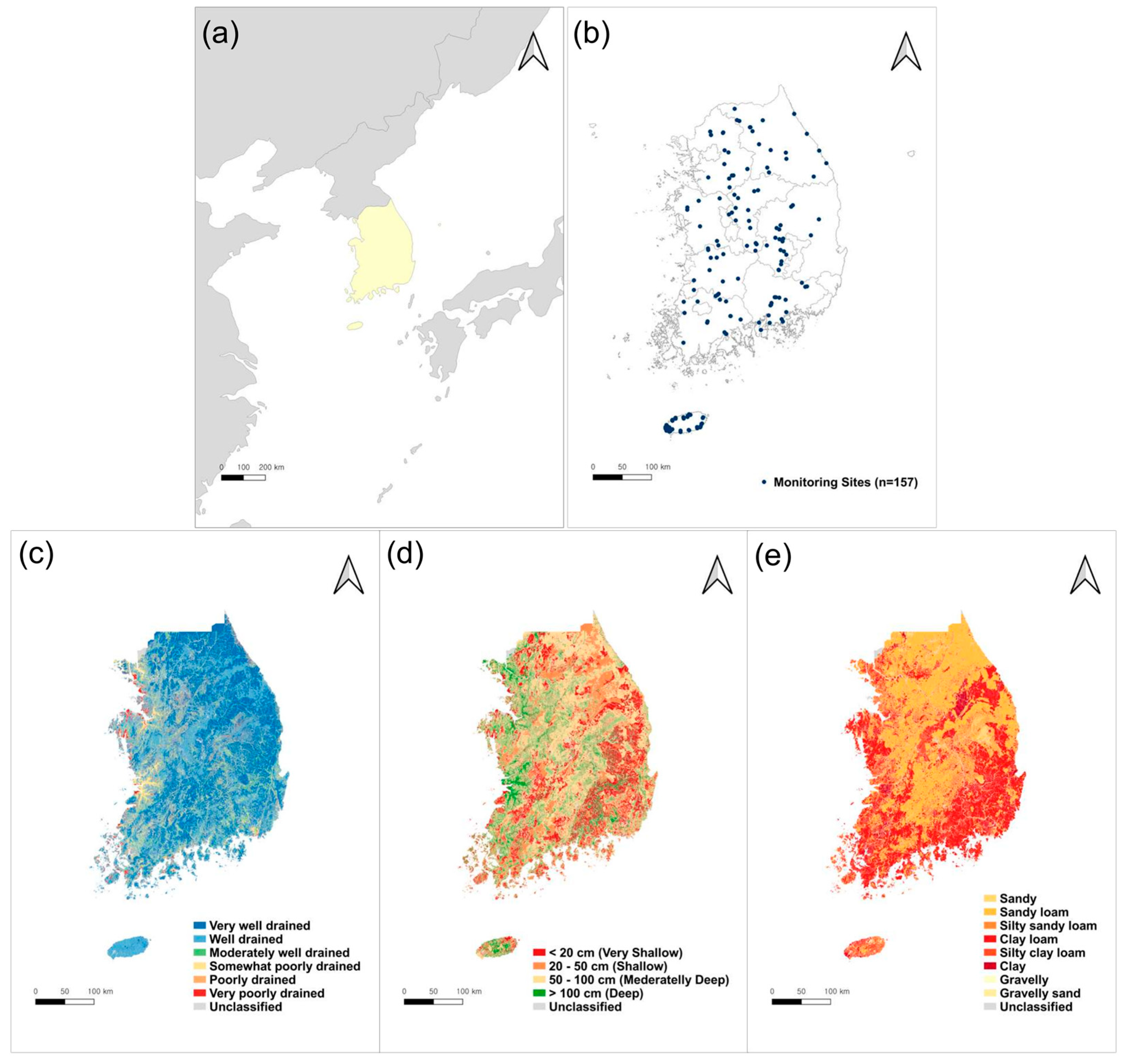
The study area is located in the northeastern part of the East Asian continent, between 33°06′ and 38°45′ N latitude and 124°59′ and 131°03′ E longitude (Figure 1a) [34]. The national territory covers approximately 100,412 km2, of which more than 70% consists of mountains and hilly areas. The Taebaek and Sobaek mountain ranges are developed in the eastern region, forming a topography characterized by higher elevations in the east and lower elevations in the west. In contrast, the western and southwestern regions contain extensive alluvial plains formed by fluvial sedimentation, which serve as a major foundation for agricultural activities [35].
Figure 1. Spatial visualization of the study area and key soil characteristics. (a) Location of the target study region in East Asia. (b) Groundwater monitoring sites across agricultural areas in South Korea. (c) Soil drainage classes. (d) Effective soil depth. (e) Subsoil texture types.
The climate is classified as temperate monsoon with distinct seasonal variations. Based on the 1991–2020 climatological normal, the nationwide average annual precipitation is 1306.3 mm. Regionally, the annual precipitation in the central region ranges from 1191.4 to 1444.9 mm, while that in the southern region ranges from 1011.2 to 1921.2 mm. In Jeju, the annual precipitation ranges from 1182.9 to 2030.0 mm. Seasonally, summer precipitation accounts for 710.9 mm, representing 54% of the annual total. Winters are cold and dry under the influence of northwesterly monsoon winds, whereas summers are hot and humid due to southeasterly monsoon winds [36,37].

2.2. Monitoring Sites, Data Processing, and Analysis

2.2.1. Monitoring Site

Since 2000, the Rural Development Administration (RDA) has conducted water quality monitoring of agricultural water resources to assess and evaluate agricultural resources and environmental conditions. From 2000 to 2006, monitoring was conducted biennially, and since 2007, it has been carried out annually at 300 stream sites (three times per year) and 200 groundwater sites (twice per year). For streams, eight standard parameters and eight additional parameters are measured; for groundwater, six standard parameters and eight additional parameters are measured. In this study, 157 groundwater sites that remained unchanged in location between 2015 and 2024 were selected. Eleven parameters, excluding heavy metals, were analyzed. Measurements taken twice annually were averaged for analysis. April and July correspond to the dry and wet seasons of Korea’s monsoonal climate, respectively, representing both hydrological extremes and minimizing seasonal bias (Figure 1b).

2.2.2. Data Processing and Analysis

Outliers in the raw data were removed using the interquartile range (IQR) method, and the same approach was applied to each calculated irrigation suitability index (SAR, MH, KR) to prevent distortion in box plot visualization and trend analysis; for data consistency and interpretative coherence, if any one of the four indices for a given site–year was identified as an outlier, all indices for that site–year were excluded from the analysis.

2.3. Hydrological Characteristics, Effective Soil Depth, and Subsoil Texture

In this study, the spatial distribution of effective soil depth, drainage class, and subsoil texture was analyzed using the 1:25,000-scale detailed soil map data obtained from the Korea Soil Information System (https://soil.rda.go.kr, Accessed on 23 July 2025) of the National Institute of Agricultural Sciences [38].
The original soil survey was conducted nationwide between the 1970s and 1990s and was subsequently digitized and updated in the 2000s by the Rural Development Administration (RDA). Although the dataset may not fully capture recent localized changes, soil physical and hydrological characteristics such as drainage class, effective soil depth, and subsoil texture are generally stable over time. Therefore, the map was deemed reliable for national-scale spatial analysis in this study.
Effective soil depth was classified into four categories: <20 cm, 20–50 cm, 50–100 cm, and >100 cm. Drainage class was categorized into seven levels: “very well-drained,” “well-drained,” “moderately well-drained,” “somewhat poorly drained,” “poorly drained,” “very poorly drained,” and “others.” Subsoil texture was classified into nine types, including sandy loam, clay loam, and silty clay loam.
For each polygon, the total area (m2) by class was calculated using attribute information, and the proportion (%) relative to the total area was computed. At the national scale, the results indicated that the 50–100 cm class was the most widespread for effective soil depth, “very well-drained” was dominant in drainage class, and sandy loam was the most prevalent in subsoil texture. All map production and spatial analyses were performed using QGIS 3.22.10 (QGIS Development Team, Switzerland).

2.4. Irrigation Suitability Indices and Trend Analysis

2.4.1. Irrigation Suitability Indices

In this study, the irrigation suitability of agricultural groundwater was evaluated using four indices: Electrical Conductivity (EC), Sodium Adsorption Ratio (SAR), Magnesium Hazard (MH), and Kelley’s Ratio (KR).
Electrical Conductivity (EC)
E C   =   M e a s u r e d   E l e c t r i c a l   C o n d u c t i v i t y   ( d S / m )
Sodium Adsorption Ratio (SAR)
S A R   =   [ N a + ] C a 2 +   +   M g 2 + 2
Magnesium Hazard (MH)
M H %   =   [ M g 2 + ] C a 2 +   +   [ M g 2 + ]   ×   100
Kelley’s Ratio (KR)
K R   =   [ N a + ] C a 2 +   +   [ M g 2 + ]

2.4.2. Mann–Kendall (M–K) Test and Sen’s Slope Estimation

For the long-term trend analysis, the non-parametric statistical methods of the Mann–Kendall (M–K) test and Sen’s slope estimator were applied. The Mann–Kendall (M–K) test evaluates whether there is an increasing or decreasing monotonic trend in the time series data, while Sen’s slope estimates the rate of change [39,40,41,42].
Mann–Kendall (M–K) test
The Mann–Kendall (M–K) test was used to detect monotonic trends in the time series data.
The test statistic S is calculated as
S   = i = 1 n 1 j = i + 1 n s g n ( x j   x i )
where
s g n θ =   + 1 ,       i f   θ > 0 0 ,       i f   θ = 0 1 ,       i f   θ < 0
Here, xi and xj are data values at times i and j, and n is the number of observations. For n ≥ 8, the variance of S is given by
V a r ( S ) = n ( n 1 ) ( 2 n + 5 ) p = 1 q t p ( t p 1 ) ( 2 t p + 5 ) 18
where tp is the number of tied values in the p-th group, and q is the number of tied groups.
The standardized test statistic Z is computed as
Z = S 1 V a r ( S )   ,       i f   S > 0 0   ,                                   i f   S = 0 S + 1 V a r ( S )   ,       i f   S < 0
A positive (negative) Z indicates an increasing (decreasing) trend.
Sen’s slope estimation
Sen’s slope estimator was used to quantify the magnitude of the monotonic trend. The pairwise slopes Qk are computed as:
Q k = ( x j x i ) ( j i ) ,               f o r   a l l   1 i < j n
Sen’s slope ( Q ^ ) is the median of the N = n(n − 1)/2 slope estimates {Qk}. The intercept is estimated by the median of { x i     Q ^   i } i = 1 n .
In the M–K test, the standardized Z-value indicates both the direction and significance of a monotonic trend. A positive Z represents an increasing trend, while a negative Z indicates a decreasing trend; when |Z| > 1.96, the trend is statistically significant at the 95% confidence level (p < 0.05). The corresponding p-value quantifies the probability of observing such a trend by chance, and lower p-values suggest stronger statistical evidence for a true monotonic change. The 95% confidence interval of Sen’s slope represents the uncertainty range of the estimated rate of change per year, providing a measure of the precision and reliability of the slope estimate.
To examine the reliability of the Mann–Kendall results, the potential influence of serial correlation was assessed using the Yue–Pilon prewhitening procedure implemented in the zyp package in R software version 4.5.1 (R Core Team, The R Foundation for Statistical Computing, Vienna, Austria) [43]. The comparative results between the unadjusted and prewhitened tests are presented in the Supplementary Information (Table S1 and Figure S1).

2.5. Spatial Analysis of Irrigation Suitability Indices

The spatial distribution of the irrigation suitability indices (EC, SAR, MH, and KR) was visualized using the Inverse Distance Weighting (IDW) interpolation method. The IDW method has been reported to provide reliable predictive performance, particularly in datasets with moderate sampling density and weak spatial autocorrelation [44,45]. IDW estimates the predicted value at each grid cell ( Z ( x 0 ) ) as a weighted average of surrounding observed values, expressed as
Z ( x 0 ) = i = 1 n Z ( x i ) d i p i = 1 n d i p
where Z ( x i ) is the observed value at location i , d i is the distance between the prediction and observation points, and p is the power parameter controlling the influence of distance. In this study, the power parameter was set to p = 2 , which provides a balanced representation between spatial smoothness and local variability in groundwater datasets [46,47]. The interpolation resolution was set to 30 m × 30 m.
Each index (EC, SAR, MH, and KR) was classified into sextile ranges for spatial comparison. The class thresholds were established using the 2020 dataset, and the same thresholds were applied to the 2015 and 2024 datasets to ensure consistency and to evaluate relative temporal trends across years.

2.6. International Standard Comparison and Spatial Analysis

In this study, the 2024 groundwater Magnesium Hazard (MH) values were classified according to the international standard proposed by Raghunath (1987) [48]. For each classification, the number and percentage of sites rated as “suitable” or “unsuitable” were calculated, and the spatial distribution by category was mapped.

3. Results and Discussion

3.1. Descriptive Statistical Analysis of Water Quality Parameters and Irrigation Suitability Indices

Table 1 summarizes the descriptive statistics (range, mean, and standard deviation) of groundwater quality parameters and irrigation suitability indices for the period 2015–2024, following outlier removal based on the interquartile range (IQR) method.
Table 1. Summary statistics (Range, Mean, and Standard Deviation) for groundwater quality parameters from 2015 to 2024 after outlier removal using the interquartile range (IQR) method.
The pH values ranged from 5.3 to 8.8, with a mean of 7.1, reflecting an overall neutral hydrochemical condition. The basic statistics prior to outlier removal are provided in Table S2 of the Supplementary Information (SI). Among the major cations, the mean concentrations of Na+, K+, Ca2+, and Mg2+ were 15.14 mg/L, 2.75 mg/L, 24.96 mg/L, and 7.15 mg/L, respectively. For the major anions, the mean concentrations of Cl and SO42− were 19.42 mg/L and 14.10 mg/L, respectively. In terms of nitrogen species, NO3-N averaged 4.74 mg/L, total nitrogen (T-N) averaged 6.58 mg/L, and total phosphorus (T-P) averaged 0.06 mg/L. For the irrigation suitability indices, the mean EC was 0.26 dS/m, the sodium adsorption ratio (SAR) averaged 0.70, the magnesium hazard (MH) averaged 34.70%, and the Kelley’s ratio (KR) averaged 0.41.
The groundwater quality characteristics analyzed in this study were found to be generally stable when compared with internationally established standards. The pH values fell within the acceptable range proposed by Ayers and Westcot [49], indicating that the groundwater was largely neutral. Chloride (Cl) concentrations were mostly below 70 mg/L, which, according to Ayers and Westcot (1985) [49], represents a safe level for most crops. Sulfate (SO42−) and nitrate-nitrogen (NO3-N) concentrations were below the drinking water standards set by WHO and USEPA (250 mg/L and 10 mg/L, respectively), confirming that the groundwater was overall in a favorable condition [49,50,51].
The irrigation suitability indices also remained within the permissible ranges defined by international standards. Electrical conductivity (EC) fell into the “Excellent to Good” category under the classification of Wilcox (1955), while sodium adsorption ratio (SAR) was evaluated as a low-risk level according to Richards (1954) [52,53]. In addition, both magnesium hazard (MH) and Kelley’s ratio (KR) satisfied the permissible limits proposed by Raghunath (1987) and Kelley (1940), respectively [48,54].

3.2. Boxplot Analysis and Median-Based Trend Assessment

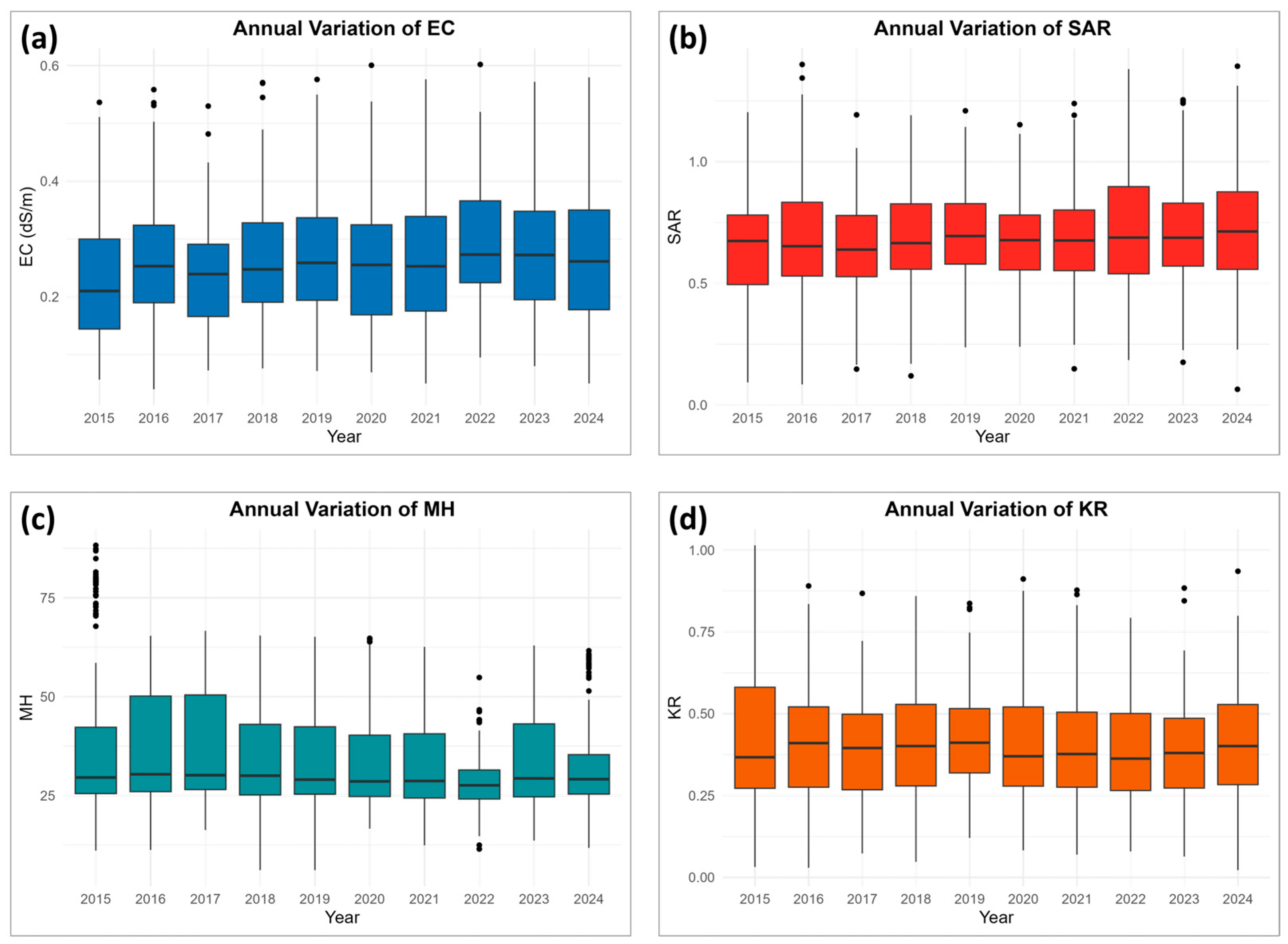
The yearly median values and overall statistical summary of the four irrigation-suitability indices are presented in Table S3, providing a concise overview of their temporal variation and general distribution characteristics from 2015 to 2024. These indices were further analyzed using boxplots to visualize distributional changes and median-based trends over time (Figure 2).
Figure 2. Boxplot distributions of irrigation suitability indices in groundwater from 2015 to 2024: (a) Electrical Conductivity (EC, dS/m), (b) Sodium Adsorption Ratio (SAR, unitless), (c) Magnesium Hazard (MH, %), and (d) Kelley’s Ratio (KR, unitless). The boxes represent the interquartile range (IQR) with the median indicated by the horizontal line, while whiskers denote variability outside the upper and lower quartiles. Outliers were identified and removed using the IQR method.

3.2.1. Electrical Conductivity (EC)

Electrical conductivity (EC) is an indicator of the concentration of dissolved ions in groundwater, directly affecting soil salinization and crop water uptake [55,56]. Elevated EC increases the osmotic potential in the rhizosphere, thereby reducing the water available to plants, which in the long term may cause yield and quality losses [57,58,59]. Conversely, excessively low EC may restrict nutrient transport and impair plant growth [60]. In this study, EC increased from 0.21 in 2015 to 0.26 in 2024, with a notable rise of +0.04 in 2016 compared to the previous year (Figure 2). The Mann–Kendall (M–K) test confirmed a statistically significant increasing trend (τ = 0.600, p = 0.020), and Sen’s slope was estimated at +0.00383/year (Table 2). These results indicate that the salinity level of agricultural groundwater has gradually increased, potentially contributing to soil salinization.
Table 2. Results of Mann–Kendall trend test and Sen’s slope estimator for groundwater irrigation suitability indices from 2015 to 2024. Statistically significant trends (p < 0.05) are indicated in bold.

3.2.2. Sodium Adsorption Ratio (SAR)

The sodium adsorption ratio (SAR) represents the relative proportion of sodium in irrigation water and is closely related to soil structural stability. High SAR values promote the replacement of calcium and magnesium ions in soil with sodium ions, leading to clay dispersion, reduced infiltration and drainage, and ultimately soil alkalinization [21,59,61,62]. In this study, SAR slightly increased from 0.67 in 2015 to 0.71 in 2024, with increments of +0.03 observed in 2018, 2019, and 2024 (Figure 2). The Mann–Kendall (M–K) test indicated a statistically significant increasing trend (τ = 0.556, p = 0.032), and Sen’s slope was estimated at +0.00526/year (Table 2). Although the absolute values remain at a low level, the results suggest the necessity of long-term management of sodium in groundwater.

3.2.3. Magnesium Hazard (MH)

Magnesium hazard (MH) is an index used to evaluate the excess of Mg2+ in irrigation water. An imbalance of Mg2+ relative to Ca2+ may cause soil alkalinization, fertility decline, and nutritional imbalances in crops [21,22,63,64]. In this study, the median MH decreased slightly from 29.5 in 2015 to 29.1 in 2024 (Figure 2). However, the Mann–Kendall (M–K) test did not show a statistically significant trend (τ = −0.467, p = 0.074) (Table 2). Overall, MH remained within the permissible limit, indicating a stable condition.

3.2.4. Kelley’s Ratio (KR)

Kelley’s ratio (KR) is an indicator of alkali hazard associated with sodium excess [21,22,54,65]. In this study, KR remained stable within the range of 0.36–0.41 from 2015 to 2024. The Mann–Kendall (M–K) test revealed no significant long-term trend (τ = −0.067, p = 0.858) (Figure 2, Table 2).
The site-wise Mann–Kendall analysis produced consistent spatial patterns with the nationwide results, and only minor differences were observed after prewhitening adjustment, as detailed in Table S1 and Figure S1.

3.3. Spatiotemporal Patterns of Irrigation Suitability

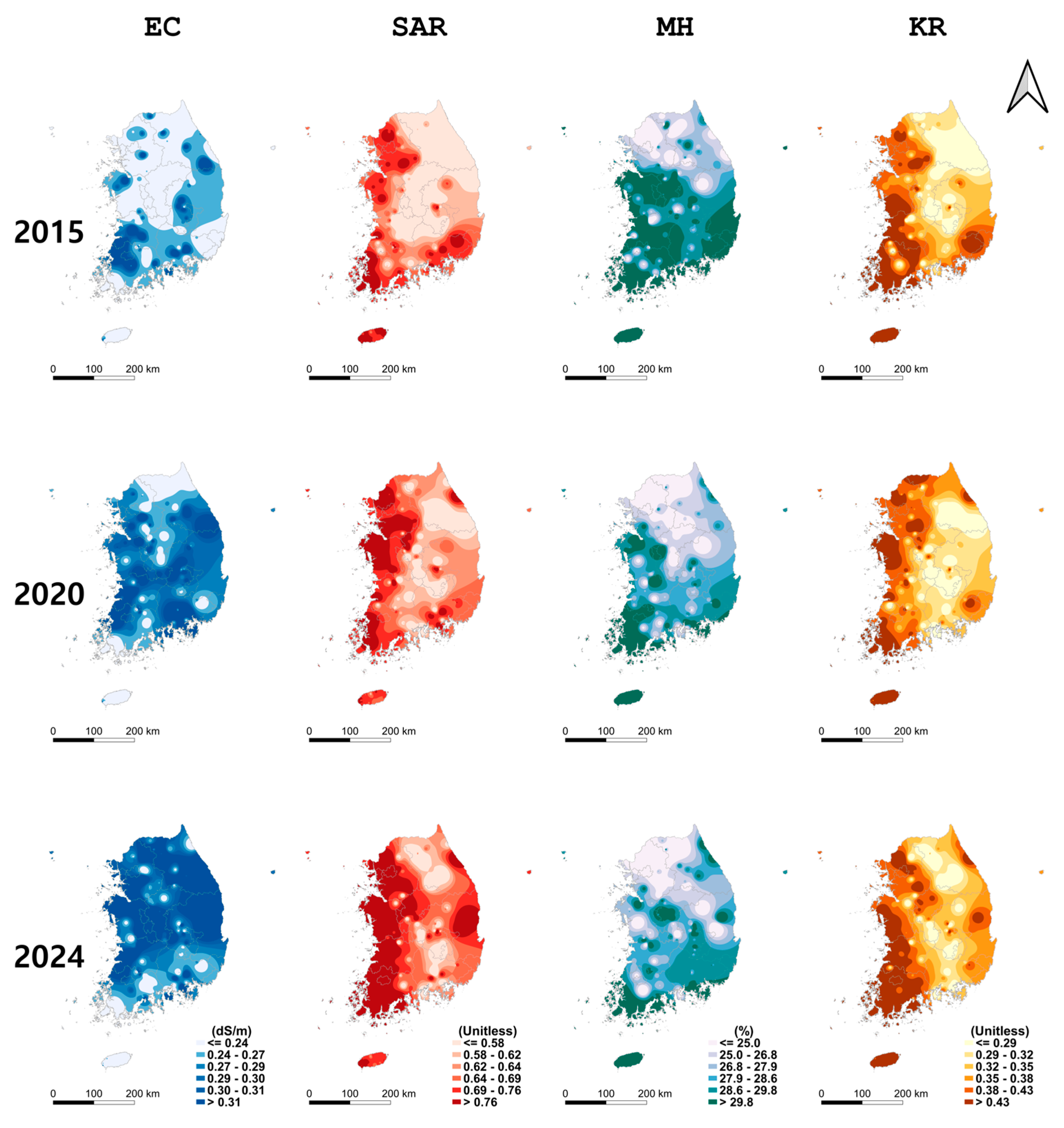
The spatial distribution of irrigation water quality indices (EC, SAR, MH, and KR) showed clear temporal and regional pattern changes between 2015, 2020, and 2024 (Figure 3).
Figure 3. Spatial distribution of irrigation water quality indices—Electrical Conductivity (EC, dS/m), Sodium Adsorption Ratio (SAR, unitless), Magnesium Hazard (MH, %), and Kelley’s Ratio (KR, unitless)—in agricultural regions of Korea for 2015, 2020, and 2024. Values were classified into sextiles (six-quantile classes) using thresholds derived from 2020 and applied uniformly to 2015 and 2024.
Electrical conductivity (EC) exhibited a progressive expansion of areas corresponding to the 5th–6th sextiles over time. In 2015, the 5th–6th sextiles were confined to parts of the western coast and southern lowlands, while most inland regions belonged to the 1st–2nd sextiles. By 2020, the 5th–6th sextiles expanded across the western and southern coastal areas, and 3rd–4th sextiles increased in some inland plains. In 2024, the distribution of 4th–5th sextiles extended further into the central inland plains, including Chungcheong and Jeonbuk.
Sodium adsorption ratio (SAR) also displayed higher sextile classes concentrated in coastal regions, gradually expanding toward inland areas. In 2015, the 4th–5th sextiles were mainly observed in the Jeonnam and Gyeongnam coasts and southern plains, whereas most inland areas corresponded to the 1st–3rd sextiles. By 2020, the proportion of 5th–6th sextiles became prominent in the southwestern coastal areas, and in 2024, the distribution extended into southern Chungcheong, Jeonbuk, and parts of Gyeongbuk inland.
Magnesium hazard (MH) showed less distinct temporal variation compared with the other indices. In 2015, 4th–5th sextiles were widely distributed across Gyeonggi, parts of Gangwon, and other inland regions, while southern coastal areas were mostly in the 1st–2nd sextiles. In 2020, 3rd–4th sextiles dominated nationwide, indicating a slight alleviation, but in 2024, areas exceeding the 4th sextile reappeared in inland Chungcheong, Gangwon, and parts of Gyeongnam.
Kelley’s ratio (KR) exhibited spatial distribution patterns similar to those of SAR. In 2015, 4th–5th sextiles were concentrated in the Jeonnam and Gyeongnam coasts and parts of southern Chungcheong. By 2020, the 3rd–4th sextiles expanded into the Jeonbuk–Chungnam western lowlands as well as into Gyeonggi and Gangwon. In 2024, the share of 5th–6th sextiles increased not only along the Jeonnam and Gyeongnam coasts but also in the western coast of Chungcheong and parts of Gyeongbuk inland.
In the case of Jeju Island, EC was predominantly distributed in the lower sextiles throughout the study period, although some high values were also observed. By contrast, the other indices exhibited relatively higher sextile classes. In particular, SAR, MH, and KR predominantly belonged to the 5th–6th sextiles from 2015 to 2024, indicating that Jeju consistently maintained relatively higher index values compared with the mainland regions. To quantify the regional disparity, the mean values of the irrigation-suitability indices were compared between Jeju Island and the mainland for 2015, 2020, and 2024 (Table S4). Jeju consistently exhibited higher SAR, MH, and KR values but lower EC, indicating that groundwater in the volcanic island exhibits distinct characteristics compared with inland aquifers. These spatial and temporal variations can be interpreted in relation to soil–hydrological constraints and seawater-related drivers, as discussed below.
The observed inland expansion of higher irrigation water quality index classes, particularly in EC and SAR, can largely be explained by soil and hydrological constraints that differ from those in inland regions (Figure 1). In the reclaimed lowlands along the western coast of Korea, shallow groundwater tables and poor vertical drainage favor the retention of salts within the soil profile. These conditions are further exacerbated by low organic matter content, limited exchangeable Ca2+, and low cation exchange capacity (CEC), all of which hinder the development of soil porosity [31,32,66,67]. Moreover, coastal soils often exhibit relatively deep effective soil depths that provide short-term buffering capacity against salinity; however, long-term constraints such as sandy layers, stoniness, and salinity hazards may instead promote the accumulation of salts in deeper horizons, thereby maintaining high irrigation water quality index values [68].
In addition to intrinsic soil and hydrological properties, intensive agricultural practices have also contributed to elevated salinity and nutrient levels in coastal groundwater. In Korea’s coastal lowlands, farmlands are densely concentrated and characterized by heavy fertilizer application, recycling of irrigation and drainage water, and continuous cultivation, which collectively enhance the leaching and re-entry of ions such as NO3, Cl, and Na+ into shallow aquifers [69]. In the coastal alluvial plains of southern Italy, groundwater salinization has been attributed not only to seawater intrusion but also to irrigation-induced salt recycling and marine spray deposition [9]. In natural deltaic plains such as the Volturno Delta, the combination of low hydraulic gradients, residual paleo-seawater, seawater intrusion, drought, and drainage or irrigation practices has been shown to intensify groundwater salinization [10]. The Nile Delta provides another example, where clay-dominated soils with very small pore sizes severely restrict infiltration and drainage, resulting in the accumulation of sodium and salts within the soil profile [12,70]. Such clay-rich soils lack the high permeability required to leach salts and sodium, leading to salinization, reduced infiltration, poor drainage, waterlogging, and other related problems [12,59,71].
Taken together, these findings indicate that the persistently high irrigation water quality index values observed in coastal areas result from the combined effects of (i) soil and hydrological constraints such as shallow groundwater tables, clay-rich soils, and poor drainage, and (ii) intensive agricultural activities including excessive fertilizer input and irrigation-drainage recycling; and (iii) seawater-related drivers including residual paleo-seawater, seawater intrusion, and marine spray deposition. Furthermore, these factors explain the inland gradient of decreasing salinity stress from the shoreline, a pattern consistently reported in coastal agricultural regions both in Korea and worldwide [72,73,74]. This finding is also in agreement with the spatial expansion of higher index classes observed in this study.

3.4. Evaluation of Irrigation Suitability Indices for Agricultural Groundwater: Special Attention to Magnesium Hazard (MH)

In this study, the irrigation suitability of agricultural groundwater was assessed using four indices (EC, SAR, MH, and KR) based on internationally recognized classification criteria (Table 3). EC was classified according to Wilcox (1955), SAR by Richards (1954), MH by Raghunath (1987), and KR by Kelley (1940) [48,52,53,54].
Table 3. Classification criteria for irrigation water quality using EC, SAR, MH, and KR, adapted from established international guidelines.
The temporal analysis showed that EC, SAR, and KR consistently indicated stable conditions, with nearly all sites classified as Permissible or better throughout the study period. SAR remained in the Very low category at all sites across all years, while EC was mostly Excellent or Good. KR also remained Permissible in all years except 2015 (99.2%). In contrast, MH revealed a higher proportion of unsuitable sites, with 20–26% of locations annually exceeding the threshold. These findings suggest that, although most indices reflect stable irrigation water quality, MH requires continuous monitoring and management in vulnerable areas.
Accordingly, this study conducted a supplementary analysis focusing on the MH index. In particular, the number and proportion of exceeding sites were calculated based on the most recent year (2024), and the spatial distribution of unsuitable sites was mapped.
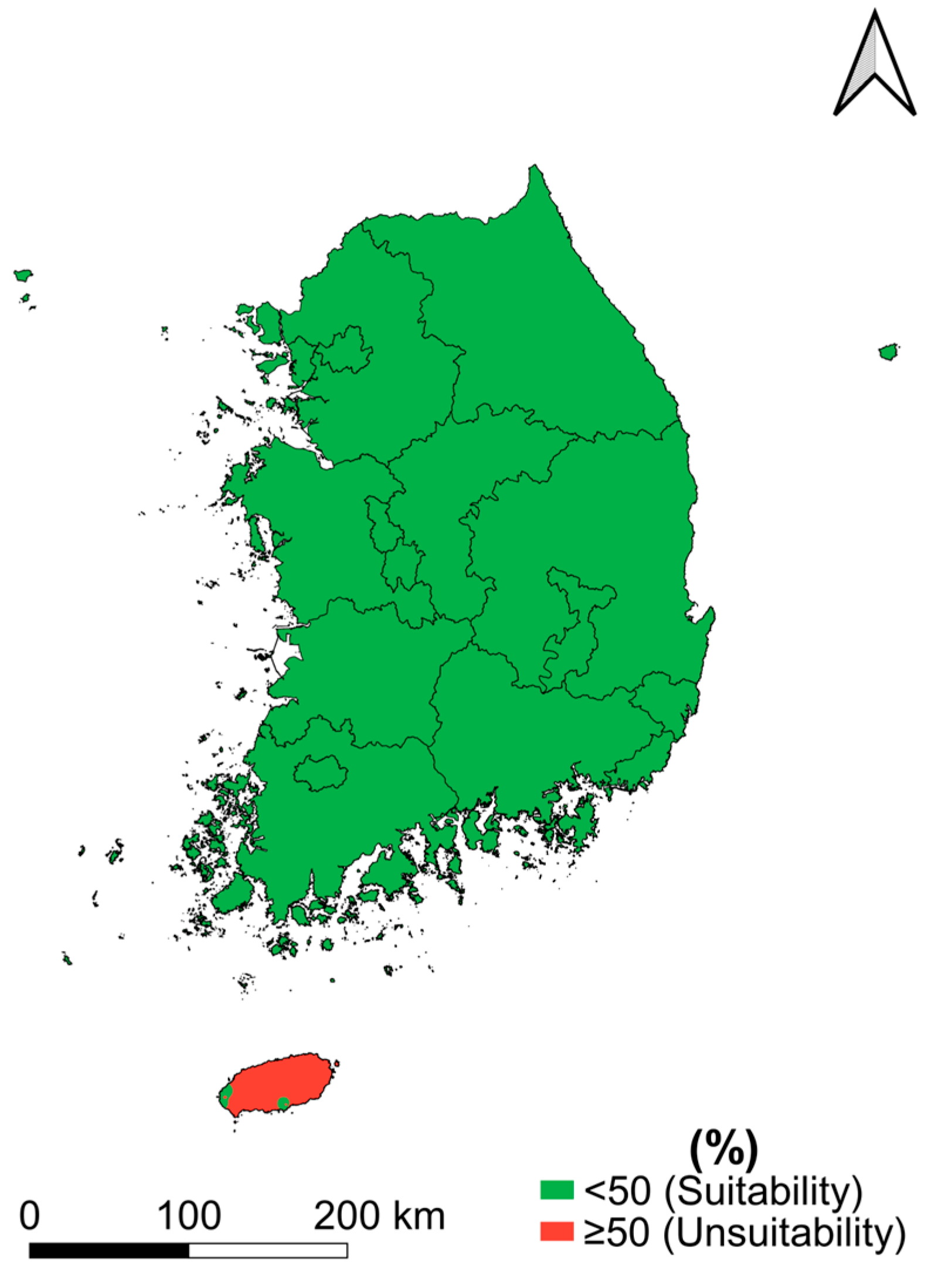
Table 4 summarizes the classification results of irrigation water suitability in 2024 based on the Magnesium Hazard (MH) index. Among the 131 monitoring sites, 109 sites (83.2%) were classified as suitable with values below the threshold (<50), while 22 sites (16.8%) were identified as unsuitable with values equal to or above the threshold (≥50).
Table 4. Number and proportion of groundwater sampling sites in 2024 classified as suitable or unsuitable for irrigation based on the international MH (Magnesium Hazard) standard.
Figure 4 illustrates the spatial distribution of suitability and unsuitability according to the MH index in 2024, with all unsuitable sites concentrated in Jeju Island. This pattern requires further interpretation in relation to geological and hydrological factors.
Figure 4. Spatial distribution of irrigation suitability based on the Magnesium Hazard (MH) index in 2024. Green areas indicate suitable groundwater for irrigation (MH < 50), while red areas represent unsuitable groundwater (MH ≥ 50). The results show that unsuitable zones are exclusively concentrated in Jeju Island, whereas the mainland regions remain within the suitable range.
The elevated Magnesium Hazard (MH) observed in Jeju Island can be interpreted as the combined result of geological and hydrogeochemical processes. The volcanic aquifers of Jeju are primarily composed of highly permeable basaltic lava flows, which facilitate rapid infiltration and intensive water–rock interaction, thereby promoting the leaching of Mg2+ and Ca2+ [75]. Beneath these permeable layers lies the Seogwipo Formation, a low-permeability sedimentary unit that acts as a confining layer. Although this formation restricts direct freshwater–seawater exchange, it occurs below sea level, making the basal aquifer system still vulnerable to seawater intrusion [66,76,77,78]. Consequently, in coastal zones where seawater mixing occurs, the high Mg content of seawater increases Mg concentrations and the Mg/Ca ratio in groundwater [66,67]. This tendency is quantitatively supported by the regional comparison of mean Mg/Ca ratios (Table S5), showing consistently higher ratios in Jeju groundwater than in inland aquifers. Moreover, Mg behaves more conservatively than Ca in groundwater and thus tends to persist; the relative mobility analysis by Koh et al. (2016) also demonstrated that Mg is preferentially leached and retained compared with Ca [77]. This interpretation is consistent with recent numerical simulations by Lee et al. [75], which demonstrated that Jeju’s volcanic aquifers are highly vulnerable to seawater intrusion owing to their high hydraulic conductivity and intensive groundwater abstraction. The combined effects of seawater–freshwater mixing and pumping-induced flow enhance Mg enrichment, reinforcing the link between hydrogeological vulnerability and elevated MH values. These processes collectively explain the relatively high proportion of MH-unsuitable areas in Jeju compared with international standards. This finding underscores the need for region-specific management strategies.
Volcanic coastal aquifers are inherently vulnerable to seawater intrusion due to their high permeability and heterogeneous geological structures, underscoring the need for region-specific long-term management. Connected lava-flow conducts induce preferential flow, accelerating pumping-induced seawater intrusion and necessitating optimization of well design and pumping strategies [17]. In the Canary Islands, managed aquifer recharge (MAR) using reclaimed water and rainfall has been proposed as an effective option to suppress seawater intrusion and enhance water security [16]. Similarly, in the Murray–Darling Basin of Australia, a long-term salinity management program successfully reduced both river salinity and transaction costs, demonstrating the importance of institutional frameworks that simultaneously monitor performance and costs [15]. Accordingly, in Jeju Island, management strategies must integrate the regulation of groundwater abstraction and continuous monitoring based on geological and hydrological characteristics, complemented by technical measures such as MAR, agricultural adaptations including salt-tolerant cultivars, crop system adjustments, mulching practices, and robust institutional frameworks for sustainable groundwater governance.

4. Conclusions

In this study, the irrigation suitability of agricultural groundwater was evaluated from 2015 to 2024 using four indices: EC, SAR, MH, and KR. The Mann–Kendall test revealed statistically significant increasing trends in EC (Z = 2.33, p = 0.020; Sen’s slope = +0.0038/year) and SAR (Z = 2.15, p = 0.032; Sen’s slope = +0.0053/year), indicating the need for long-term salinization management, while KR remained within a stable range. Spatial analysis showed a temporal expansion of higher EC and SAR classes from coastal to inland regions, reflecting the spatial gradient of salinity stress. In contrast, MH displayed a distinct pattern, with unsuitable levels concentrated exclusively in Jeju Island, where approximately 15% of sites were classified as unsuitable for irrigation. This was attributed to the geological characteristics of basaltic aquifers, seawater intrusion, and the higher mobility of Mg compared with Ca. Accordingly, Jeju requires tailored management strategies that combine groundwater abstraction control and continuous monitoring with technical measures such as managed aquifer recharge (MAR), as well as agricultural adaptations including salt-tolerant cultivars, crop system adjustments, and mulching practices. At the national scale, strengthening long-term monitoring and water quality management frameworks is essential to ensure the sustainable use of agricultural groundwater.
As nationwide groundwater monitoring is currently ongoing, the long-term evaluation of irrigation suitability will be enhanced through future studies employing surrogate modeling and other methodological refinements.

Supplementary Materials

The following supporting information can be downloaded at https://www.mdpi.com/article/10.3390/w17213172/s1. Table S1: Comparison of site-wise Mann–Kendall and Sen’s slope results between unadjusted and prewhitened (Yue–Pilon) tests for each groundwater quality indicator (2015–2024); Table S2: Descriptive statistics (range, mean, and standard deviation) of groundwater quality parameters and irrigation suitability indices from 2015 to 2024 before outlier removal; Table S3: Yearly median values and overall statistical summary of irrigation-suitability indices (2015–2024); Table S4: Mean irrigation-suitability indices (EC, SAR, MH, KR) of inland and Jeju Island groundwater in 2015, 2020, and 2024; Table S5: Comparison of mean Mg/Ca ratios between inland and Jeju groundwater (2015, 2020, and 2024); Figure S1: Site-wise trends of groundwater quality indicators (2015–2024).

Author Contributions

S.-J.Y. conceived and designed the study, conducted the investigation, analyzed the data, curated the dataset, and wrote the original draft. B.-M.L., G.-B.J. and M.-K.K. supervised the project and reviewed the manuscript. S.-K.C. provided conceptual guidance, supervised the research, and served as the corresponding author. All authors made significant contributions to the preparation of this manuscript. All authors have read and agreed to the published version of the manuscript.

Funding

This research was supported by the National Institute of Agricultural Sciences, Rural Development Administration, Korea, under the project “Evaluation of Agricultural Water Quality Variation (Phase VI) and Indicator Development (RS-2021-RD009748)”.

Data Availability Statement

The groundwater monitoring data used in this study were provided by the Rural Development Administration (RDA), Korea, and are not publicly available due to internal policy restrictions.

Acknowledgments

We would like to thank the anonymous reviewers for their valuable comments and suggestions, which greatly improved the quality of this manuscript.

Conflicts of Interest

The authors declare no conflicts of interest. The authors also declare that there are no potential commercial interests related to this work.

References

  1. Davamani, V.; John, J.E.; Poornachandhra, C.; Gopalakrishnan, B.; Arulmani, S.; Parameswari, E.; Santhosh, A.; Srinivasulu, A.; Lal, A.; Naidu, R. A critical review of climate change impacts on groundwater resources: A focus on the current status, future possibilities, and role of simulation models. Atmosphere 2024, 15, 122. [Google Scholar] [CrossRef]
  2. Mukhopadhyay, R.; Sarkar, B.; Jat, H.S.; Sharma, P.C.; Bolan, N.S. Soil salinity under climate change: Challenges for sustainable agriculture and food security. J. Environ. Manag. 2021, 280, 111736. [Google Scholar] [CrossRef]
  3. Su, Q.; Kambale, R.D.; Tzeng, J.-H.; Amy, G.L.; Ladner, D.A.; Karthikeyan, R. The growing trend of saltwater intrusion and its impact on coastal agriculture: Challenges and opportunities. Sci. Total Environ. 2025, 966, 178701. [Google Scholar] [CrossRef]
  4. Abd-Elaty, I.; Polemio, M. Saltwater intrusion management at different coastal aquifers bed slopes considering sea level rise and reduction in fresh groundwater storage. Stoch. Environ. Res. Risk Assess. 2023, 37, 2083–2098. [Google Scholar] [CrossRef]
  5. Ha, K.; Lee, E.; An, H.; Kim, S.; Park, C.; Kim, G.-B.; Ko, K.-S. Evaluation of Seasonal Groundwater Quality Changes Associated with Groundwater Pumping and Level Fluctuations in an Agricultural Area, Korea. Water 2021, 13, 51. [Google Scholar] [CrossRef]
  6. Mazhar, S.; Pellegrini, E.; Contin, M.; Bravo, C.; De Nobili, M. Impacts of salinization caused by sea level rise on the biological processes of coastal soils—A review. Front. Environ. Sci. 2022, 10, 909415. [Google Scholar] [CrossRef]
  7. Eldaw, E.; Huang, T.; Mohamed, A.K.; Mahama, Y. Classification of groundwater suitability for irrigation purposes using AHP and GIS in North Kurdufan, Sudan. Appl. Water Sci. 2021, 11, 126. [Google Scholar] [CrossRef]
  8. Benz, S.A.; Irvine, D.J.; Rau, G.C.; Bayer, P.; Menberg, K.; Blum, P.; Jamieson, R.C.; Griebler, C.; Kurylyk, B.L. Global Groundwater Warming due to Climate Change. Nat. Geosci. 2024, 17, 545–551. [Google Scholar] [CrossRef]
  9. Passarella, G.; Masciale, R.; Menichini, M.; Doveri, M.; Portoghese, I. Decoding salinization dynamics in Mediterranean coastal aquifers: A case study from a wetland in southern Italy. Environments 2025, 12, 227. [Google Scholar] [CrossRef]
  10. Colombani, N.; Alessandrino, L.; Gaiolini, M.; Gervasio, M.P.; Ruberti, D.; Mastrocicco, M. Unravelling the salinity origins in the coastal aquifer/aquitard system of the Volturno River (Italy). Water Res. 2024, 263, 122145. [Google Scholar] [CrossRef]
  11. El-Ghannam, M.K.; Wassar, F.; Morsy, S.; Hafez, M.; Parihar, C.M.; Burkey, K.O.; Abdallah, A.M. Controlled drainage in the Nile River Delta of Egypt: A promising approach for decreasing drainage off-site effects and enhancing yield and water use efficiency of wheat. J. Arid. Land 2023, 15, 460–476. [Google Scholar] [CrossRef]
  12. Hagage, M.; Abdulaziz, A.M.; Elbeih, S.F.; Hewaidy, A.G.A. Monitoring soil salinization and waterlogging in the northeastern Nile Delta linked to shallow saline groundwater and irrigation water quality. Sci. Rep. 2024, 14, 27838. [Google Scholar] [CrossRef]
  13. Liu, Z.; Gao, C.; Yan, Z.; Shao, L.; Chen, S.; Niu, J.; Zhang, X. Effects of long-term saline water irrigation on soil salinity and crop production in the North China Plain. Agric. Water Manag. 2024, 303, 109060. [Google Scholar] [CrossRef]
  14. Shokri, N.; Hassani, A.; Sahimi, M. Multi-scale soil salinization dynamics from global to pore scale: A review. Rev. Geophys. 2024, 62, e2023RG000804. [Google Scholar] [CrossRef]
  15. Loch, A.; Gregg, D. Salinity management in the Murray–Darling Basin: A transactioin cost study. Water Resour. Res. 2018, 54, 8813–8827. [Google Scholar] [CrossRef]
  16. Hernández Ríos, I.; Cruz-Pérez, N.; Chirivella-Guerra, J.I.; García-Gil, A.; Rodríguez-Alcántara, J.S.; Rodríguez-Martín, J.; Marazuela, M.Á.; Santamarta, J.C. Proposed recharge of island aquifer by deep wells with regenerated water in Gran Canaria (Spain). Groundw. Sustain. Dev. 2023, 22, 100959. [Google Scholar] [CrossRef]
  17. Geng, X.; Michael, H.A. Preferential flow enhances pumping-induced saltwater intrusion in volcanic island aquifers. Water Resour. Res. 2020, 56, e2019WR026390. [Google Scholar] [CrossRef]
  18. Tarolli, P.; Luo, J.; Park, E.; Barcaccia, G.; Masin, R. Soil salinization in agriculture: Mitigation and adaptation strategies combining nature-based solutions and bioengineering. iScience 2024, 27, 108830. [Google Scholar] [CrossRef]
  19. Tomaz, A.; Palma, P.; Fialho, S.; Lima, A.; Alvarenga, P.; Potes, M.; Costa, M.J.; Salgado, R. Risk assessment of irrigation-related soil salinization and sodification in Mediterranean areas. Water 2020, 12, 3569. [Google Scholar] [CrossRef]
  20. Adagba, T.; Kankara, A.I.; Idris, M.A. Evaluation of groundwater suitability for irrigation purpose using GIS and irrigation water quality indices. FUDMA J. Sci. 2022, 6, 63–80. [Google Scholar] [CrossRef]
  21. Sunitha, V.; Sudharshan Reddy, Y. Hydrogeochemical evaluation of groundwater in and around Lakkireddipalli and Ramapuram, Y.S.R District, Andhra Pradesh, India. HydroResearch 2019, 2, 85–96. [Google Scholar] [CrossRef]
  22. Nadjai, S.; Bouderbala, A.; Khammar, H.; Nabed, A.N.; Benaabidate, L. Assessment of groundwater suitability for drinking and irrigation purposes in the Middle Cheliff Aquifer, Algeria. Desalination Water Treat. 2024, 319, 100528. [Google Scholar] [CrossRef]
  23. Abadi, H.T.; Alemayehu, T.; Berhe, B.A. Assessing the suitability of water for irrigation purposes using irrigation water quality indices in the Irob catchment, Tigray, Northern Ethiopia. Water Qual. Res. J. 2025, 60, 177–192. [Google Scholar] [CrossRef]
  24. Megahed, H.A.; Farrag, A.E.-H.; Mohamed, A.A.; Darwish, M.H.; AbdelRahman, M.A.E.; El-Bagoury, H.; D’Antonio, P.; Scopa, A.; Saad, M.A.A. GIS-based modeling and analytical approaches for groundwater quality suitability for different purposes in the Egyptian Nile Valley, a case study in Wadi Qena. Front. Water 2025, 7, 1502169. [Google Scholar] [CrossRef]
  25. Ibrahim, H.; Yaseen, Z.M.; Scholz, M.; Ali, M.; Gad, M.; Elsayed, S.; Khadr, M.; Hussein, H.; Ibrahim, H.H.; Eid, M.H.; et al. Evaluation and prediction of groundwater quality for irrigation using an integrated water quality indices, machine learning models and GIS approaches: A representative case study. Water 2023, 15, 694. [Google Scholar] [CrossRef]
  26. Kaewdum, N.; Chotpantarat, S. Mapping potential zones for groundwater recharge using a GIS technique in the Lower Khwae Hanuman Sub-Basin area, Prachin Buri Province, Thailand. Front. Earth Sci. 2021, 9, 717313. [Google Scholar] [CrossRef]
  27. Machiwal, D.; Jha, M.K. Identifying sources of groundwater contamination in a hard-rock aquifer system using multivariate statistical analyses and GIS-based geostatistical modeling techniques. J. Hydrol. Reg. Stud. 2015, 4, 80–110. [Google Scholar] [CrossRef]
  28. Zhang, Z.; Song, C.; Guo, Y.; He, P.; Chen, N.; Liu, J.; Zhang, Y.; Zuo, Y.; Zhang, X. Effects of climate change and agricultural expansion on groundwater storage in the Amur River Basin. Front. Earth Sci. 2023, 10, 1037688. [Google Scholar] [CrossRef]
  29. Shahzad, H.; Farid, H.U.; Khan, Z.M.; Anjum, M.N.; Ahmad, I.; Chen, X.; Sakindar, P.; Mubeen, M.; Ahmad, M.; Gulakhmadov, A. An integrated use of GIS, geostatistical and map overlay techniques for spatio-temporal variability analysis of groundwater quality and level in the Punjab Province of Pakistan, South Asia. Water 2020, 12, 3555. [Google Scholar] [CrossRef]
  30. Jeon, C.; Raza, M.; Lee, J.-Y.; Kim, H.; Kim, C.-S.; Kim, B.; Kim, J.-W.; Kim, R.-H.; Lee, S.-W. Countrywide groundwater quality trend and suitability for use in key sectors of Korea. Water 2020, 12, 1193. [Google Scholar] [CrossRef]
  31. Seo, B.S.; Jung, J.; Jung, K.; Kang, B. Soil physico-chemical properties and groundwater levels at the “Agricultural Life Science Sites” in Saemangeum reclaimed land. Korean J. Soil Sci. Fertil. 2023, 56, 169–177. [Google Scholar] [CrossRef]
  32. Lee, S.; Bae, H.-S.; Kim, H.-K.; Noh, T.-H.; Lee, G.-H. Temporal Variations on Soil Salinity and Cation Displacement at Saemangeum and Yeongsangang Reclaimed Tidal Lands. J. Agric. Chem. Environ. 2014, 3, 121–129. [Google Scholar] [CrossRef][Green Version]
  33. Chung, D.Y.; Kim, H.J.; Kim, G.R.; Woo, H.N.; Park, S.H.; Shin, J.H.; Choi, Y.C. Properties and fate of nitrogen in a reclaimed tidal soil. CNU J. Agric. Sci. 2011, 38, 301–307. [Google Scholar][Green Version]
  34. MOLIT (Ministry of Land, Infrastructure and Transport). Comprehensive National Territorial Plan (2020–2040); MOLIT: Sejong, Republic of Korea, 2020.[Green Version]
  35. Kang, W.; Jang, E.; Yang, C.-Y.; Julien, P.Y. Geospatial analysis and model development for specific degradation in South Korea using model tree data mining. Catena 2021, 200, 105142. [Google Scholar] [CrossRef]
  36. Kim, S.; Park, J.; Choi, H.; Lee, D. Assessment of future rainfall quantile changes in South Korea under climate change scenarios. Water 2025, 17, 894. [Google Scholar] [CrossRef]
  37. KMA (Korea Meteorological Administration). Climate Normals (1991–2020). Available online: https://www.weather.go.kr (accessed on 10 September 2025).
  38. KSIS (Korea Soil Information System). Available online: https://soil.rda.go.kr/ (accessed on 23 July 2025).
  39. Mann, H.B. Nonparametric tests against trend. Econometrica 1945, 13, 245–259. [Google Scholar] [CrossRef]
  40. Kendall, M.G. Rank Correlation Methods, 4th ed.; Charles Griffin: London, UK, 1975. [Google Scholar]
  41. Helsel, D.R.; Hirsch, R.M. Statistical Methods in Water Resources; U.S. Geological Survey: Reston, VA, USA, 2002.
  42. Sen, P.K. Estimates of the regression coefficient based on Kendall’s tau. J. Am. Stat. Assoc. 1968, 63, 1379–1389. [Google Scholar] [CrossRef]
  43. Yue, S.; Pilon, P.; Cavadias, G. Power of the Mann–Kendall and Spearman’s rho tests for detecting monotonic trends in hydrological series. Hydrol. Process. 2002, 16, 1807–1829. [Google Scholar] [CrossRef]
  44. Gong, G.; Mattevada, S.; O’Bryant, S.E. Comparison of the accuracy of kriging and IDW interpolations in estimating groundwater arsenic concentrations in Texas. Environ. Res. 2014, 130, 59–69. [Google Scholar] [CrossRef] [PubMed]
  45. Tayyab, M.; Aslam, R.A.; Farooq, U.; Ali, S.; Khan, S.N.; Iqbal, M.; Khan, M.I.; Saddique, N. Comparative Study of Geospatial Techniques for Interpolating Groundwater Quality Data in Agricultural Areas of Punjab, Pakistan. Water 2023, 16, 139. [Google Scholar] [CrossRef]
  46. Bronowicka-Mielniczuk, U.; Mielniczuk, J.; Obroślak, R.; Przystupa, W. A Comparison of Some Interpolation Techniques for Determining Spatial Distribution of Nitrogen Compounds in Groundwater. Int. J. Environ. Res. 2019, 13, 679–687. [Google Scholar] [CrossRef]
  47. Barudžija, U.; Ivšinović, J.; Malvić, T. Selection of the Value of the Power Distance Exponent for Mapping with the Inverse Distance Weighting Method—Application in Subsurface Porosity Mapping, Northern Croatia Neogene. Geosciences 2024, 14, 155. [Google Scholar] [CrossRef]
  48. Raghunath, H.M. Ground Water; Wiley Eastern Ltd.: New Delhi, India, 1987. [Google Scholar]
  49. Ayers, R.S.; Westcot, D.W. Water Quality for Agriculture; FAO Irrigation and Drainage Paper 29 Rev. 1; FAO: Rome, Italy, 1985. [Google Scholar]
  50. WHO. Guidelines for Drinking-Water Quality, 4th ed.; WHO: Geneva, Switzerland, 2011. [Google Scholar]
  51. U.S. EPA. National Primary Drinking Water Regulations; EPA 816-F-09-004; U.S. Environmental Protection Agency: Washington, DC, USA, 2009.
  52. Wilcox, L.V. Classification and Use of Irrigation Waters; USDA Circular 969; U.S. Department of Agriculture: Washington, DC, USA, 1955.
  53. Richards, L.A. Diagnosis and Improvement of Saline and Alkali Soils; USDA Handbook 60; U.S. Department of Agriculture: Washington, DC, USA, 1954.
  54. Kelley, W.P. Permissible composition and concentration of irrigation waters. Trans. Am. Soc. Civ. Eng. 1940, 105, 849–864. [Google Scholar] [CrossRef]
  55. Simsek, C.; Gunduz, O. IWQ index: A GIS-integrated technique to assess irrigation water quality. Environ. Monit. Assess. 2007, 128, 277–300. [Google Scholar] [CrossRef]
  56. Shammi, M.; Rahman, R.; Rahman, M.M.; Moniruzzaman, M.; Bodrud-Doza, M.; Karmakar, B.; Uddin, M.K. Assessment of salinity hazard in existing water resources for irrigation and potentiality of conjunctive uses: A case report from Gopalganj district, Bangladesh. Sustain. Water Resour. Manag. 2016, 2, 369–378. [Google Scholar] [CrossRef]
  57. Machado, R.M.A.; Serralheiro, R.P. Soil salinity: Effects on vegetable crop growth—Management practices to prevent and mitigate soil salinization. Horticulturae 2017, 3, 30. [Google Scholar] [CrossRef]
  58. Siddha, S.; Sahu, P. Integrating GIS and irrigation water quality index approaches for identifying groundwater irrigation potential zones in Central Gujarat, India. Environ. Monit. Assess. 2023, 195, 1082. [Google Scholar] [CrossRef]
  59. Singh, N.; Tripathi, S.; Patel, B.B.; Patel, V.A.; Zala, J.N. Analysis of water quality of selected irrigation water sources in Gandevi Taluka of Navsari District of South Gujarat, India. Asian J. Agric. Ext. Econ. Sociol. 2023, 41, 699–711. [Google Scholar] [CrossRef]
  60. Heinen, M.; Marcelis, L.F.M.; Elings, A.; Figueroa, R.; del Amor, F.M. Effects of EC and fertigation strategy on water and nutrient uptake of tomato plants. Acta Hortic. 2002, 593, 101–108. [Google Scholar] [CrossRef]
  61. Trivedy, R.K.; Goel, P.K. Chemical and Biological Methods for Water Pollution Studies; Environmental Publications: Karad, India, 1984. [Google Scholar]
  62. Karanth, K.R. Groundwater Assessment, Development and Management; Tata McGraw-Hill: New Delhi, India, 1987. [Google Scholar]
  63. Szabolcs, I.; Darab, C. The influence of irrigation water of high sodium carbonate content on soils. In Proceedings of the 8th International Congress of International Congress of Soil Science, Bucharest, Romania, 31 August–9 September 1964; Volume 2, pp. 803–812. [Google Scholar]
  64. Paliwal, K.V. Irrigation with Saline Water; Water Technology Centre, IARI: New Delhi, India, 1972. [Google Scholar]
  65. Avvannavar, S.M.; Shrihari, S. Evaluation of water quality index for drinking purposes for River Netravathi, Mangalore, South India. Environ. Monit. Assess. 2008, 143, 279–290. [Google Scholar] [CrossRef]
  66. Lee, B.D.; Jeong, C.H.; Lee, Y.C.; Lee, Y.J.; Yang, J.H.; Choo, C.O.; Jang, H.W.; Oh, Y.H.; Hong, J.W. Statistical Analysis and Thermodynamic Equilibrium Modelling for Chemical Composition of Groundwater and Spring Water at Jeju Island, South Korea. Water 2020, 12, 777. [Google Scholar] [CrossRef]
  67. Chang, S.W.; Chung, I.-M.; Kim, M.-G.; Yifru, B.A. Vulnerability assessment considering impact of future groundwater exploitation on coastal groundwater resources in northeastern Jeju Island, South Korea. Environ. Earth Sci. 2020, 79, 498. [Google Scholar] [CrossRef]
  68. Hyun, B.-K.; Rim, S.-K.; Jung, S.-J.; Sonn, Y.-K.; Song, K.-C.; Noh, D.-C.; Lee, H.-S.; Hyun, G.-S.; Zhang, Y.-S.; Hong, S.-Y.; et al. The Study on the Limiting Factor to Determine Available Soil Depth in Korea. Korean J. Soil Sci. Fert. 2008, 41, 293–302. [Google Scholar]
  69. Kim, C.-S.; Raza, M.; Lee, J.-Y.; Kim, H.; Jeon, C.; Kim, B.; Kim, J.-W.; Kim, R.-H. Factors Controlling the Spatial Distribution and Temporal Trend of Nationwide Groundwater Quality in Korea. Sustainability 2020, 12, 9971. [Google Scholar] [CrossRef]
  70. Brouwer, C.; Goffeau, A.; Heibloem, M. Irrigation Water Management: Training Manual No. 1—Introduction to Irrigation; FAO: Rome, Italy, 1985. [Google Scholar]
  71. Albalasmeh, A.A.; Shainberg, I.; Levy, G.J.; Letey, J.; Wu, L.; Ben-Hur, M. Using wastewater in irrigation: The effects on infiltration process in a clayey soil. Water 2020, 12, 968. [Google Scholar] [CrossRef]
  72. Choi, M.G. Characteristics of salt tolerance in tree species (I)—Relationship between tree species distribution and soil salt concentration in East coastal forest. J. Korean For. Soc. 1986, 73, 1–8. [Google Scholar]
  73. Kim, D.G. Soil salinity and salt spray drift tolerance of native trees on the coastal windbreaks in the South Sea, Korea. Korean J. Environ. Ecol. 2010, 24, 14–25. [Google Scholar]
  74. Kim, D.G. Native tree species tolerant to saline soil and salt spray drift at the coastal forests in the West Sea, Korea. Korean J. Environ. Ecol. 2010, 24, 209–221. [Google Scholar]
  75. Lee, D.; Park, J.; Lee, H.A.; Woo, N.C. A Numerical Approach to Evaluating Groundwater Vulnerability to Seawater Intrusion on Jeju Volcanic Island, South Korea. Sustainability 2023, 15, 3081. [Google Scholar] [CrossRef]
  76. Won, J.H.; Lee, J.Y.; Kim, J.W.; Koh, G.W. Groundwater occurrence on Jeju Island, Korea. Hydrogeol. J. 2006, 14, 532–547. [Google Scholar] [CrossRef]
  77. Koh, D.-C.; Chae, G.-T.; Ryu, J.-S.; Lee, S.-G.; Ko, K.-S. Occurrence and mobility of major and trace elements in groundwater from pristine volcanic aquifers in Jeju Island, Korea. Appl. Geochem. 2016, 65, 87–102. [Google Scholar] [CrossRef]
  78. Koh, E.H.; Lee, J.Y.; Koh, G.W.; Woo, N.C. Impacts of land use change and groundwater management on long-term nitrate-nitrogen and chloride trends in groundwater of Jeju Island, Korea. Environ. Earth Sci. 2017, 76, 176. [Google Scholar] [CrossRef]
Disclaimer/Publisher’s Note: The statements, opinions and data contained in all publications are solely those of the individual author(s) and contributor(s) and not of MDPI and/or the editor(s). MDPI and/or the editor(s) disclaim responsibility for any injury to people or property resulting from any ideas, methods, instructions or products referred to in the content.

Article Metrics

Citations

Article Access Statistics

Multiple requests from the same IP address are counted as one view.