Article

Effects of Groundwater Fluctuations on the Water Uptake of Saltcedar in Two Habitats in an Arid Oasis, Northwestern China


School of Environmental Studies, China University of Geosciences, Wuhan 430074, China
*
Author to whom correspondence should be addressed.
Water 2025, 17(17), 2605; https://doi.org/10.3390/w17172605
Submission received: 8 July 2025 / Revised: 29 August 2025 / Accepted: 1 September 2025 / Published: 3 September 2025
(This article belongs to the Section Ecohydrology)

Abstract

To understand how phreatophytes correspond to groundwater dynamics in arid regions, it is important to examine the specific water use patterns in different habitats. In this study, we investigated whether and how saltcedar (Tamarix ramosissima Ledeb.) responded in its water use patterns to the changing groundwater table during the growing season in two contrasting habitats (i.e., riparian and dune sites). δ18O and δ2H values of xylem sap and four potential water sources (i.e., shallow, middle, and deep soil water, and groundwater) were measured to determine the water-use pattern. Comparisons of the water sources in different habitats indicated that the depths of water extraction by saltcedar were shallower in the riparian habitat than in the dune habitat. During the growing season, saltcedar in the diparian habitat consistently extracted soil water from a depth of 30−60 cm (volumetric water content: 18.2 ± 3.5%), which was recharged by groundwater. In contrast, the saltcedar in the dune habitat either extracted soil water from a deeper depth (below 100 cm, volumetric water content: 5.8 ± 1.2%) that was also supposed to be recharged by groundwater, or directly used groundwater. These results suggest that the primary water source for saltcedar was from deeper groundwater during the growing season and did not change with the groundwater fluctuation.

1. Introduction

Being more productive than other species and generally the dominant species of their communities, phreatophytes play critical roles in ecosystem services, hydrological processes, and biogeochemical cycles in water-limited environments [1,2]. As implied by its definition, a phreatophyte uses groundwater as the most reliable water source [3]. At present, however, regulation of water resources has profoundly altered groundwater regimes throughout the world, inducing significant changes in phreatophytes across multiple scales [2]. Therefore, understanding the relationship between phreatophytes and groundwater regimes is crucial for managing groundwater resources and maintaining ecosystem services in phreatophyte-dominated regions.
It has been widely recognized that the decline in the groundwater table can be detrimental to phreatophytes because when the water table drops beyond root access, drought stress and even mortality of species can occur [4,5,6,7,8]. A few studies have indicated that a rise in the water table can also be detrimental to phreatophytes due to the water stress caused by anoxia [9,10,11]. Some studies have revealed that the decline in the water table causes phreatophytes to shift from absorbing water from shallower soil layers to groundwater when soil water is depleted [12,13,14]. However, under extreme drought conditions, when groundwater exceeds the historical lowest water level, the water source for plants shifts from groundwater to soil water as water absorption depth remains unchanged [15]. In contrast, sites in southeastern Arizona receive substantial summer precipitation, where phreatophytes rely more on soil water as the groundwater table drops [16]. Therefore, to study the water use pattern of phreatophytes under groundwater fluctuation, it is necessary to consider both the changes in soil water and root distribution under changing hydrologic conditions [15].
Saltcedar (Tamarix ramosissima Ledeb.), a shrub widely distributed in northwest China as a native species and in the southwest USA as an invasive species, is probably one of the most studied and best understood phreatophytes [17,18]. It is found to be very opportunistic in its water-use strategy, often shifting its major water source between groundwater and soil water in response to changes in accessibility over time [19,20,21,22,23,24,25,26,27,28]. This water-use pattern has often been explained as an effect of the flexible root structure of saltcedar. One theory suggests that saltcedar can develop a dimorphic root system, in which taproots access the water table. In contrast, lateral roots explore soil water, allowing it to shift water sources when water conditions change [15]. Other experimental studies have suggested that saltcedar saplings might have the ability to modify their root architecture, growing new roots rapidly into water-rich soil layers during extended periods of drought [29].
However, recent studies have questioned these hypotheses, providing evidence that established saltcedar may have a fixed root structure [30,31]. For example, Sun et al. showed that the depth of water uptake by established saltcedar in a riparian forest was shallow and fixed. The switching of its water sources between groundwater and soil moisture was a result of water-table fluctuations: it derived water directly from groundwater when the water table was shallow, whereas it switched to groundwater-recharged soil water when the water table declined [31]. Zhang et al. indicated that saltcedar behaves as an obligate phreatophyte, using the soil water consistently after prolonged drought in some scenarios [30]. This is probably because the ability of saltcedar to grow new roots in response to groundwater dynamics may be effective only for saplings [22], and the roots of mature individuals may be stranded where they had initially developed when the water table changed quickly [15,32,33]. This initial root system, as suggested by [15], was usually in the vicinity of the water-table elevation under which the saltcedar had established itself. This means that the root structure and the resultant water-use pattern of mature saltcedar may be determined by the historical groundwater regime under which its saplings established [15].
Two distinct vertical distribution patterns of saltcedar roots have been reported separately, seeming to confirm this hypothesis. Earlier studies mostly considered that saltcedar would develop a deep root system, with taproots probably being over 3.1 m deep [23,25,34], to access deep and permanent groundwater [19,22,24]. This has been confirmed by several root investigations on established saltcedar, which discovered the increase of lateral root density with depth, with more than half of lateral roots occurring below 2.5 m depth and no active absorbing roots occurring in the upper soil layers [26,27]. A more recent study reported that more than 51% of the lateral root surface area of desert saltcedar occurred at depths of 2.5–3.1 m, close to the groundwater table [25]. In contrast, much research on saltcedar in riparian zones has shown that, although it is known as a phreatophyte, its root biomass is concentrated in shallow soil layers [28,31,33,34,35]. For example, both Imada et al. and Yu et al. found that, in the Virgin River floodplain of the southwestern United States and the lower Heihe River floodplain of northwestern China, most fine roots of mature saltcedar were concentrated at depths between 20 and 60 cm [28,35].
When comparing the above studies, the differences in root distribution of established saltcedar are clearly related to their habitats with different groundwater regimes: it has a deep root system in desert habitats with a deeper groundwater table, whereas it has a shallow root system in riparian habitats with a shallower groundwater table. It thus can be inferred that, counterintuitively, the established saltcedar might act as an obligate phreatophyte in more arid desert habitats and a facultative phreatophyte in riparian habitats with higher availability of groundwater. Although previous studies have examined the water-use strategies of saltcedar in different habitats, direct comparisons of established populations under contrasting groundwater regimes and soil textures remain limited. Whether the species’ distinct root structures and resulting water-use patterns are linked to local groundwater history is still unclear. In this study, we use multiparameter data (water stable isotopes, soil water content, and groundwater table depth) to directly compare saltcedar water-use patterns in riparian and dune sites, providing new ecohydrological insight into how hydrological and edaphic factors jointly shape plant water uptake. We attempt to address two research questions: (1) What is the difference in water-use pattern of the same saltcedar species between contrasting habitats with different groundwater accessibility? (2) What role do the groundwater regime and history play in causing this difference?

2. Materials and Methods

2.1. Study Site

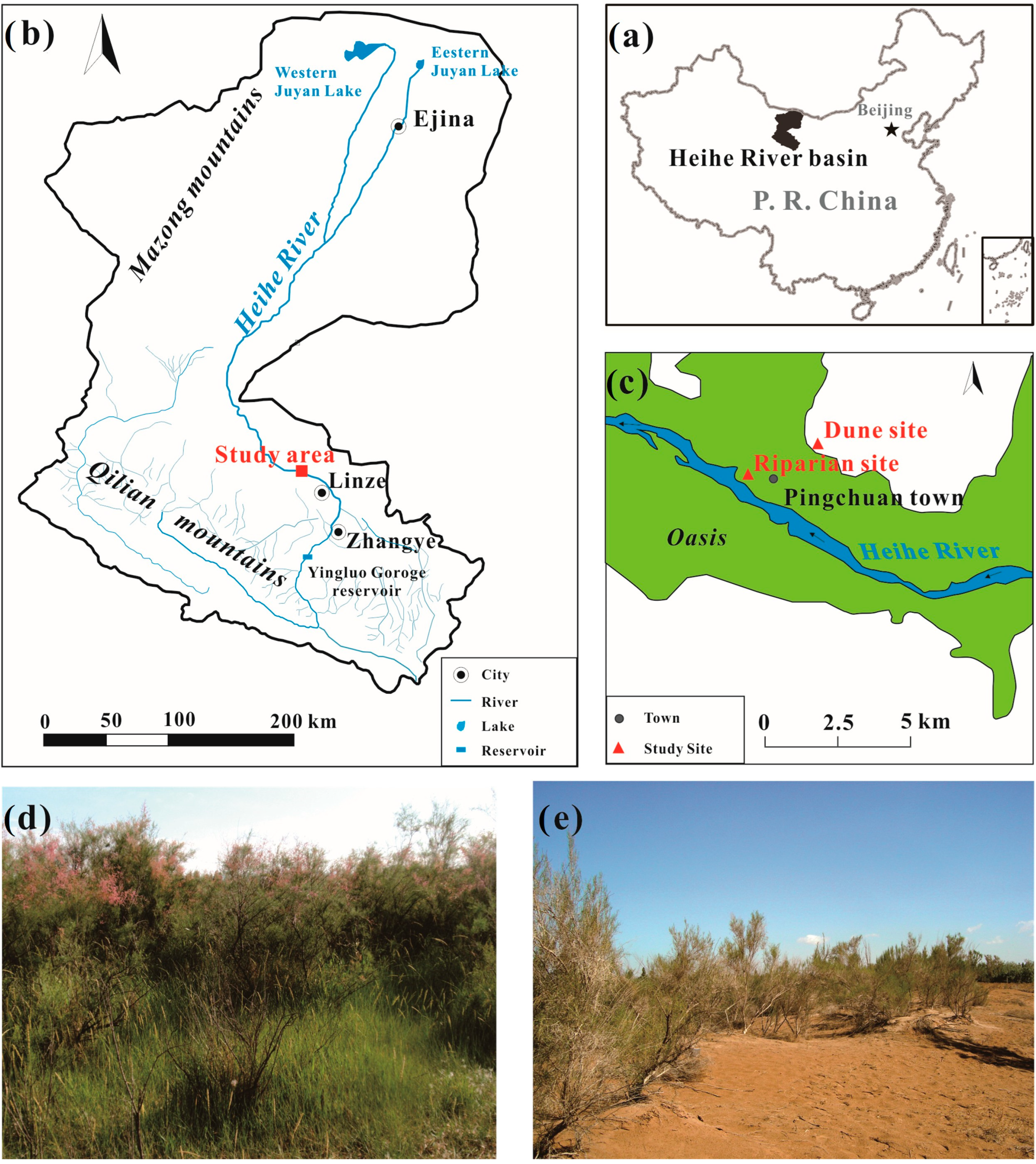
The study was conducted at a desert oasis ecotone in the middle region of the Heihe River Basin, northwestern China (Figure 1). The region has a continental climate, characterized by a hot and rainy period from July to September, during which approximately 65% of the annual precipitation occurs. In this season, the mean air temperature is 28.5 °C and total rainfall reaches 320 mm. In contrast, winter (defined here as December to February) is cold and dry, receiving only about 3% of annual precipitation, with a mean temperature of 12.4 °C and total rainfall of 45 mm. The long-term mean rainfall is 117 mm per year, whereas the mean annual pan-evaporation is 2390 mm [36]. The annual, maximum, and minimum air temperatures are 7.6 °C, 39.1 °C, and −27.3 °C, respectively. Two types of habitats (riparian (39°19′52.0′′ N, 100°05′53.4′′ E) and dune (39°21′00.8″ N, 100°07′46.1″ E)) were chosen as study sites. The riparian site, located approximately 80 m from the Heihe River bank, is dominated by saltcedar and Aeluropus pungens (M. Bieb.) C. Koch (prickly grass), with a mean vegetation coverage of about 80%. This site has a shallow groundwater table (0.5–2 m) and fine-textured soils with relatively high clay content, resulting in greater water-holding capacity. In contrast, the dune site, about 5 km away from the riverbank, is sparsely populated only by saltcedar, underlain by coarse sandy soils with low organic matter, and characterized by a deeper groundwater table (4–6 m) and limited soil moisture retention. These distinct hydrological and edaphic conditions provide an important context for interpreting differences in saltcedar water-uptake patterns between the two habitats [18].

2.2. Sample Collection

For isotopic characterization, xylem samples of saltcedar from the two sites were collected on two dates, one at the beginning (13 June) and the other at the end (31 August) of the summer in 2009, representing the two hydrological situations of the vegetation growing season. Four to six adult trees were randomly chosen, and fully suberized branches were cut from stem sections. The outer bark was discarded to separate the xylem tissues, which were immediately cut into short pieces for storage. At both plant sample dates, soils were sampled simultaneously at depths in the following order: 5, 15, 25, 35, 55, 75, 95, 115 cm at the riparian site, and 5, 15, 25, 35, 55, 75, 95, 115, 145, 175 cm at the dune site. All isotopic samples were stored in borosilicate glass bottles (CNW Technologies, Düsseldorf, Germany) sealed with parafilm (Bemis Company, Inc., Neenah, WI, USA) at −20 °C for subsequent measurement. Simultaneously, the soil samples from the profiles were collected in soil tins (stainless steel; ANPEL Laboratory Technologies Inc., Shanghai, China) for analyzing the soil texture and gravimetric SWC (%) at each site. Event-based rainwater samples were collected immediately after each rainfall event using a funnel connected to a sealed sampling bottle containing a floating ping-pong ball to minimize evaporation. This evaporation-reducing design ensured that rainwater samples were collected without significant isotopic fractionation, and all samples were promptly transferred into sealed vials and stored in cool, dark conditions until analysis [37]. River water was sampled directly using polyethylene bottles (ANPEL Laboratory Technologies Inc., Shanghai, China) weekly during the study period. Groundwater samples were taken weekly from a well at each site. The well depths were 3 m at the riparian site and 7 m at the dune site, both exceeding the local groundwater table depths to ensure groundwater always seeped into the wells. Each well had an approximate diameter of 11 cm. Additionally, before sampling, each well was purged by extracting at least three well volumes of water using a portable peristaltic pump (ANPEL Laboratory Technologies Inc., Shanghai, China) to ensure that fresh aquifer water was sampled. All these liquid water samples were collected using polyethylene bottles sealed with parafilm and stored under 2 °C conditions.

2.3. Field Measurements

Both river and groundwater levels were obtained by simultaneously measuring water pressure with an electronic pressure sensor (HOBO U20-001-02 water level logger; Onset, Bourne, MA, USA) and atmospheric pressure with a barometric pressure sensor (S-BPB-CM50; Onset, Bourne, MA, USA) [38]. The groundwater depth could be analyzed by subtracting the Earth’s surface level from the monitored groundwater table level. The data logger recording interval was 1 day. Rainfall was measured by a tipping-bucket rain gauge (20 cm diameter and 0.2 mm tip resolution; WPH1-/M308536; Midwest Group, Beijing, China).

2.4. Isotope Analysis

The soil and xylem samples had to be pretreated by the cryogenic vacuum distillation technique to extract water for the 18O and 2H isotopic characteristic analysis [14,39]. Isotope analyses of water samples were conducted at the State Key Laboratory of Biogeology and Environmental Geology, China University of Geosciences, using a Finnigan MAT253 isotope ratio mass spectrometer (Thermo Fisher Scientific, Bremen, Germany). The isotopic signatures were expressed in delta notation (δ) as per milliliter relative to the Vienna Standard Mean Ocean Water (V-SMOW), and the precision is 0.2‰ for δ18O and 1.5‰ for δ2H. Given that the study has pointed out that hydrogen isotope fractionation exists in the water absorption process in some xerophytes [40,41,42], 18O was used as the only tracer to investigate the depths of water extraction of saltcedar in this study.

2.5. Determination of the Water Sources for Saltcedar

Two complementary methodologies were employed to quantify saltcedar water sources: (1) Direct-inference approach: Xylem water δ18O values were compared to potential sources (soil water at discrete depths and groundwater) to identify extraction depths via isotopic similarity matching [43]. (2) IsoSource model algorithm: A multisource mass-balance algorithm iteratively evaluates a feasible range of water source contributions (0–100% in 1% increments) for saltcedar that satisfy isotopic mass balance within ±0.1‰ tolerance. Following Phillips and Gregg’s computational framework [44], it generates bounded ranges of feasible solutions. According to the characteristics of isotopic values of soil water at different depths (see details in the Section 3), soil texture, and hydraulic connection, three larger layers can be identified for the subsequent analysis in each site as follows, consistent with depth-specific source partitioning methods [45]:
(1) Shallow soil layer (0–30 cm at both sites) has the most obvious and unstable changes in isotopic values of soil water among all the layers. Within each soil profile, the shallow layer has the largest variation range of soil water isotopes.
(2) Middle soil layer (30–60 cm at the riparian site and 30–100 cm at the dune site) has lower and less variable isotopic values of soil water than those in the shallow soil layer.
(3) Deep soil layer (60–120 cm at the riparian site and 100–180 cm at the dune site) has the most stable variations in isotopic signatures of soil water, which are uniform in each profile.

3. Results

3.1. The Dynamics of Rainfall, River, and Groundwater

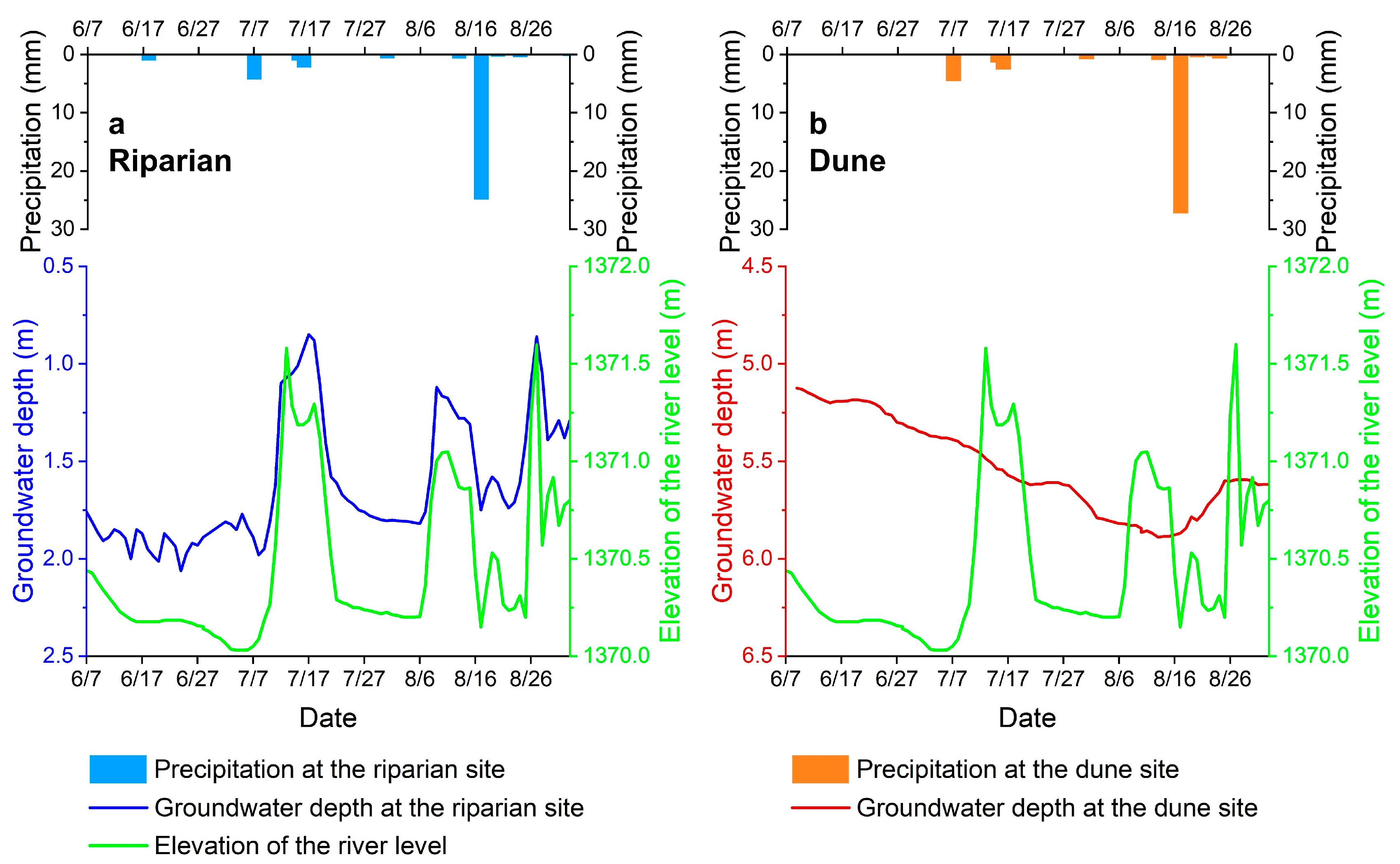
Figure 2 shows the amount of rainfall during the study period at both sites. At the riparian site, there were thirteen rainfall events (8 for <1 mm, 4 for 1–5 mm, and 1 for >5 mm) during the study period, accumulating a total of 36.13 mm. The maximum rainfall event occurred on August 17, with 24.86 mm of rainfall. At the dune site, there were eleven rainfall events (7 for <1 mm, 3 for 1–5 mm, and 1 for >5 mm) during the study period, accumulating a total of 39.26 mm. The maximum rainfall event occurred on 17 August, with 27.3 mm.
Figure 2 also presents the hydrographs of the river and the groundwater at the two study sites. The river stage changed dramatically during the study period, ranging from 1370.02 to 1371.56 m above sea level (m.a.s.l.). At the riparian site, the groundwater had shallow buried depths and displayed a close correlation with the river stage fluctuations, ranging from 0.59 m to 1.62 m in depth (the groundwater table ranged from 1370.03 to 1370.96 m m.a.s.l.). The response of the groundwater levels to the river stage fluctuations was almost instantaneous. This was due to the short distance of the riparian site from the Heihe River bank and the high permeability of the soil aquifer, which is composed of sand ranging from medium to coarse grain. There was no corresponding relationship between the river stage (or the groundwater) fluctuations and rainfall, indicating that rainfall at the study site had a negligible effect on the river and the groundwater dynamics.
In contrast, the dune site displayed a deeper groundwater table and varied more gently compared to that of the riparian site, ranging from 5.11 to 5.88 m beneath the ground surface. The groundwater table also had no response to rainfall. The groundwater level ranged from 1376.20 to 1376.97 m.a.s.l., which was always higher than the river and groundwater levels at the riparian site, indicating that the groundwater was not replenished by the Heihe River.

3.2. Soil Water Content (SWC)

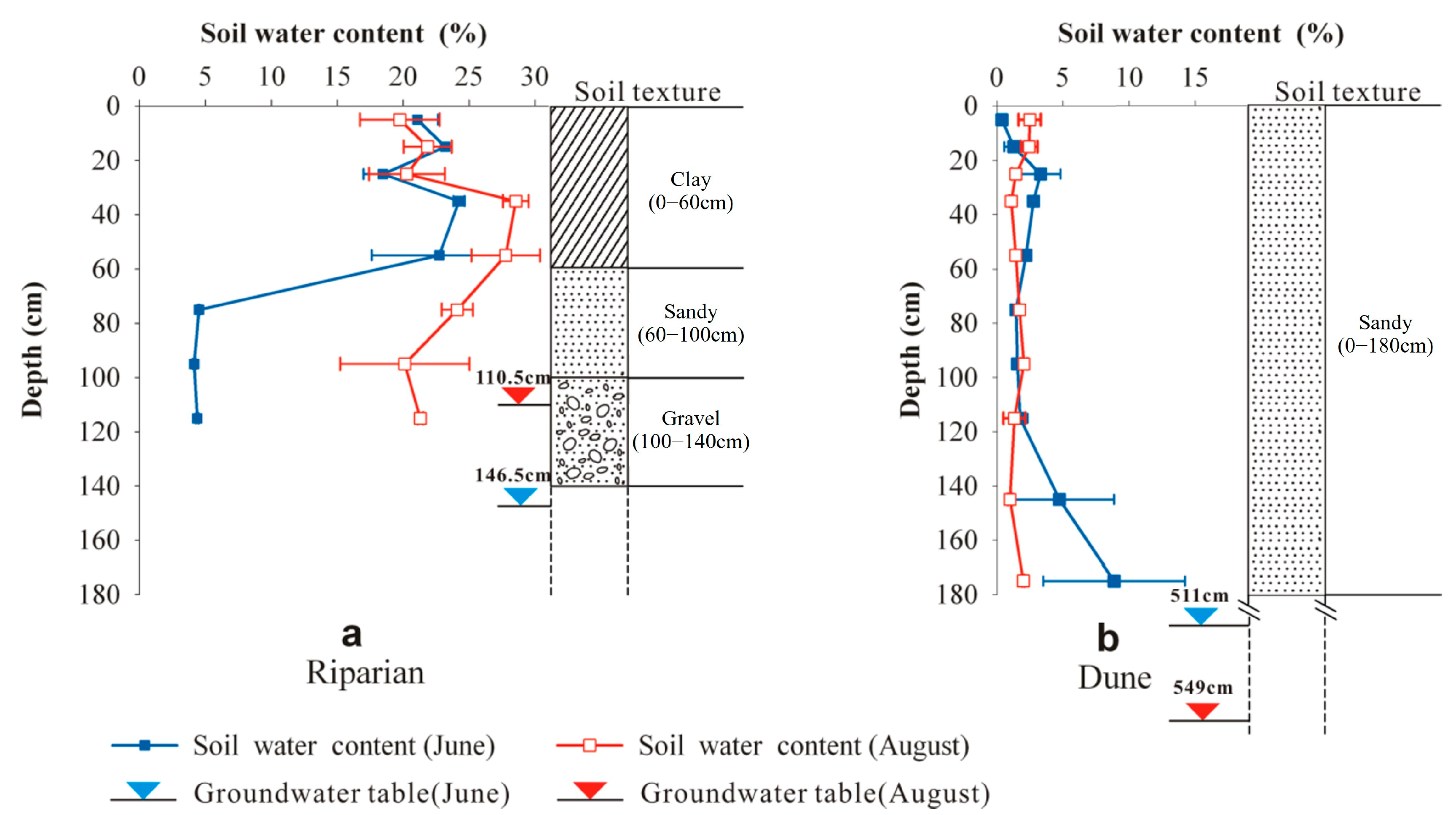
To determine the water availability of saltcedar, we examined SWC during different growing seasons (June and August). On each measurement date, SWC showed significant differences in the vertical distribution profiles of the two sites (Figure 3). At the riparian site, soils consisted of a clay layer (0~60 cm), overlying sands and gravel (60~140 cm), representing a typical dual structure of the soil texture profile on floodplains (Figure 3a). This fine-textured upper horizon confers high water-holding capacity, facilitating greater soil moisture retention compared with coarser substrates below. SWC in the clay layers, as a stable reservoir, remained high and constant on each measurement date, with values of 18.5%~23.1% on 13 June and 19.7%~21.8% on 31 August in the top 30 cm, and the highest SWC at a depth of 30-60 cm (with values of 22.7%~24.2% on 13 June and 27.8%~28.5% on 31 August) (Figure 3a). Conversely, SWC at depths below 60 cm, filled with coarse-textured soil, showed a significant seasonal difference (Figure 3a). On 13 June, this soil layer (60~120 cm) displayed dry conditions with a low SWC range from 4.2% to 4.5%, when groundwater was at a relatively low level (146.5 cm depth) (Figure 3a). On 31 August, however, SWC significantly increased up to 20.12%~24.1% and became a humid zone, when the groundwater table rose to 110.5 cm below the soil surface (Figure 3a).
At the dune site, the soil profile was composed entirely of coarse sands (0–140 cm) with low organic matter and a much lower water-holding capacity, which limits moisture storage and amplifies drought effects (Figure 3b). Soils contained less water overall than those at the riparian site at the same depths and on all measurement dates (Figure 3b). SWC displayed an extremely dry condition (SWC < 5%) in the 0–140 cm layer on each measurement date, and gradually increased below 140 cm on 13 June (SWC: 4.75%~8.92%), but this increase was absent on 31 August (SWC: 1.0%~2.0%) (Figure 3b).

3.3. Variations in δ18O and δ2H Signatures of River Water, Groundwater, Rain, and Soil Water

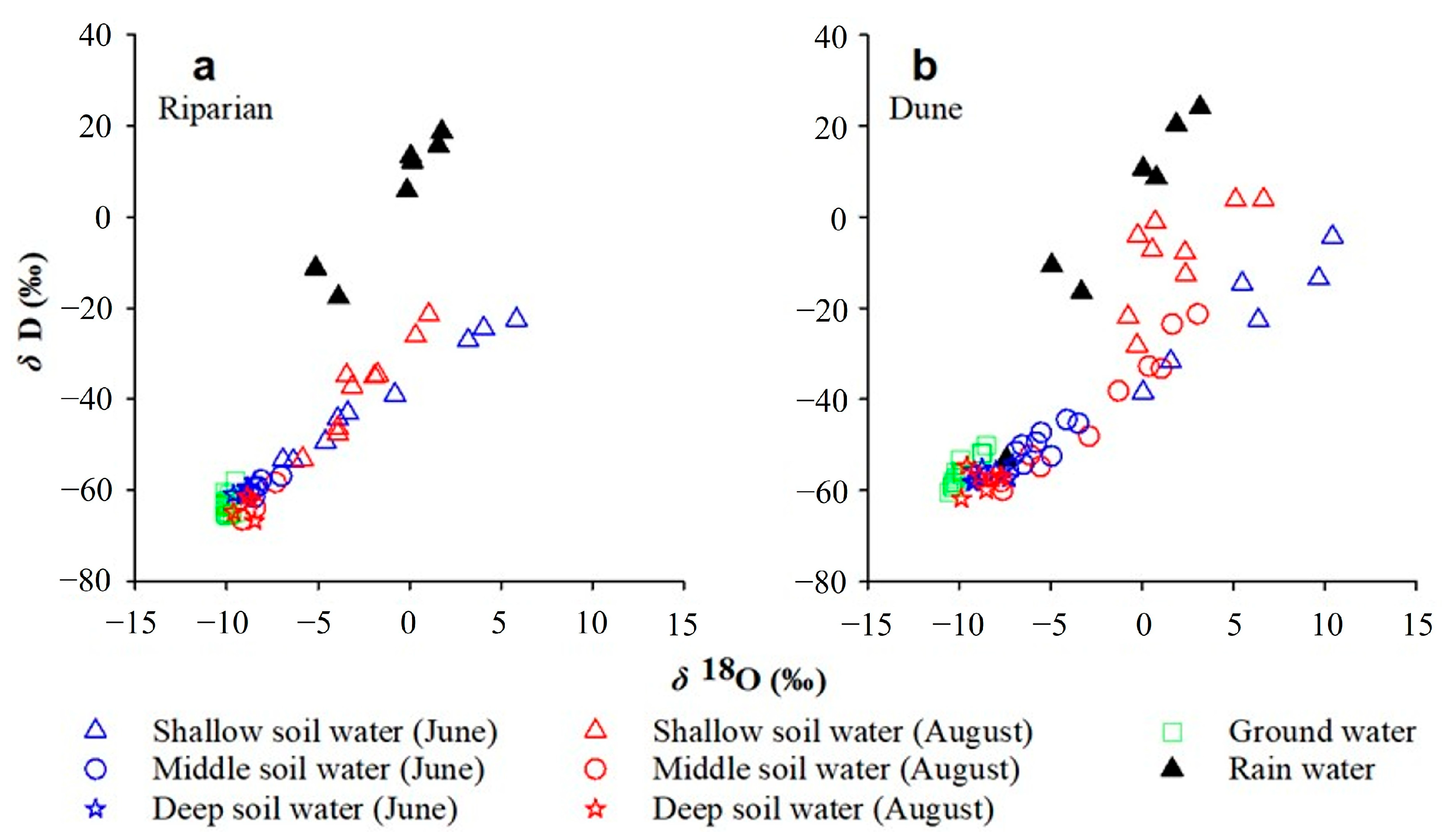
Table 1 presents the statistics of the δ18O and δ2H signatures for the different water compartments. During the study period, the isotopic values of groundwater were relatively constant at both sites, with mean isotopic values of −9.92 ± 0.19‰ for δ18O and −63.03 ± 2.01‰ for δ2H at the riparian site; and −9.68 ± 0.72‰ for δ18O and −55.20± 3.29‰ for δ2H at the dune site (Table 1). They were both significantly more negative than local rainwater (δ18O: −0.80 ± 2.47‰; δ2H: 5.27 ± 13.07‰) and soil water. In general, the δ18O and δ2H values of soil water peaked and varied sharply in the shallow soil layer, then decreased as the depth increased for each profile established at different sampling dates, and were relatively stable in the deep soil layer (Figure 4, Table 1). This was due to strong evaporation enrichment, which generally creates an isotopic concentration gradient along the soil profile [46,47].
The stable isotope concentration for the different water sources indicated that the isotopic values of the middle soil layer samples (30–60 cm at the riparian site: δ18O −8.19 to −8.98‰, δ2H −59.27 to −64.54‰; 30–100 cm at the dune site: δ18O −5.46 to −2.50‰, δ2H −49.38 to −42.24‰) and the deep soil layer (60–120 cm at the riparian site: δ18O −8.94 to −9.60 ‰, δ2H −60.10 to −63.75‰; 100–180 cm at the dune site: δ18O −8.37 to 8.63‰, δ2H −56.54 to −57.80‰) at both sites were always more depleted than rainwater (the riparian site: δ18O approximately −0.80‰ δ2H −5.27‰; the dune site: approximately −1.39‰ δ2H –2.37‰) but close to groundwater (riparian site: δ18O approximately −9.92‰ δ2H −63.03‰; dune site: approximately −9.68‰ δ2H −55.20‰) (Table 1, Figure 4). It was suggested that these soil layers only received vertical recharge from groundwater. For the shallow soil layer, however, (0–30 cm), there was a difference in characteristics between the two sites. At the riparian site, the isotopic values of the shallow soil layer (δ18O −1.43 to −2.51‰, δ2H −39.60 to −37.34‰) were still more negative than rainwater, indicating that the shallow soil layer received little recharge from rainwater during the study period (Table 1, Figure 4a). However, at the dune site, shallow soil water (δ18O −5.60 to 1.84‰ δ2H −20.87 to −8.36‰) showed partially enriched values, overlapping with rainwater isotopic signatures, implying that the influence of rainwater recharge could not be excluded (Table 1, Figure 4b).

3.4. δ18O of Plant Xylem Water and Soil Water

Saltcedar exhibited distinct seasonal shifts in xylem water δ18O at both sites, quantified through direct isotope analysis. At the riparian site, xylem δ18O depleted significantly from −8.26 ± 0.20‰ on 13 June to −9.01 ± 0.30‰ on 31 August (Δ = 0.75‰), indicating heightened groundwater influence following monsoon recharge. More dramatically, the dune site showed a 1.18‰ depletion from −8.24 ± 0.02‰ to −9.42 ± 0.08‰ over the same period, reflecting intensifying groundwater dependence as soil moisture declined (Table 2).
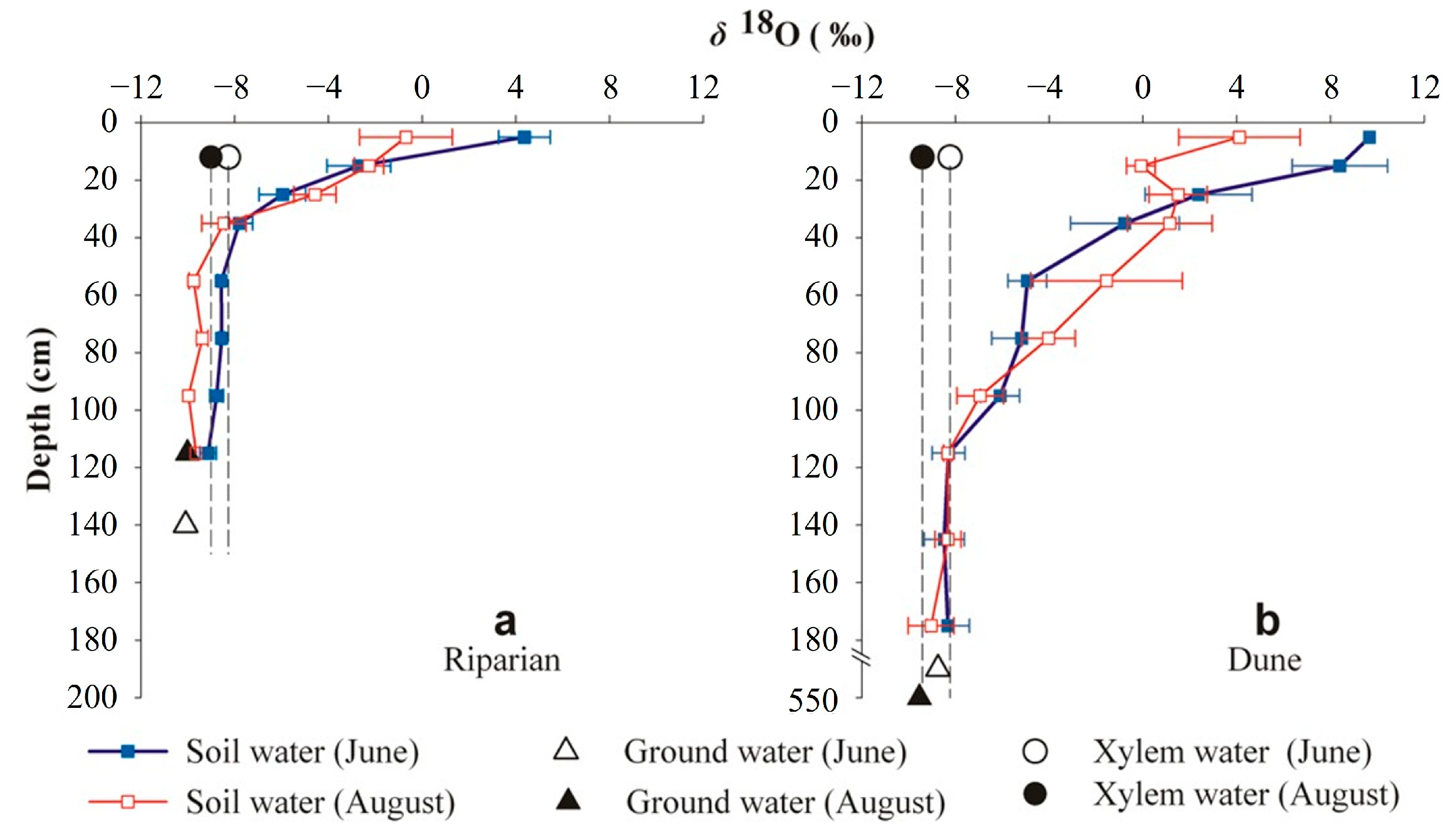
Water extraction depths, identified where soil δ18O profiles intersected xylem values (Figure 5), revealed habitat-specific strategies: the riparian site maintained consistent 30–60 cm uptake depths in both seasons, with xylem δ18O (−8.26‰ to −9.01‰) consistently enriched relative to groundwater (−9.92‰), confirming preferential use of soil water recharged by capillary rise. The dune site shifted extraction deeper as drought progressed: (1) On 13 June, uptake occurred below 115 cm depth, where soil δ18O (−8.30 ± 0.70‰) matched xylem values (−8.24 ± 0.02‰). (2) By 31 August, extraction descended below 180 cm, extrapolating from the 175 cm soil δ18O (−9.04 ± 0.97‰) toward groundwater (−9.68‰) to align with xylem δ18O (−9.42 ± 0.08‰). Using it as a basis, saltcedar obtained water from below 115 cm on 13 June, and below 180 cm on 31 August (Figure 5b).

3.5. Proportions of Potential Water Sources

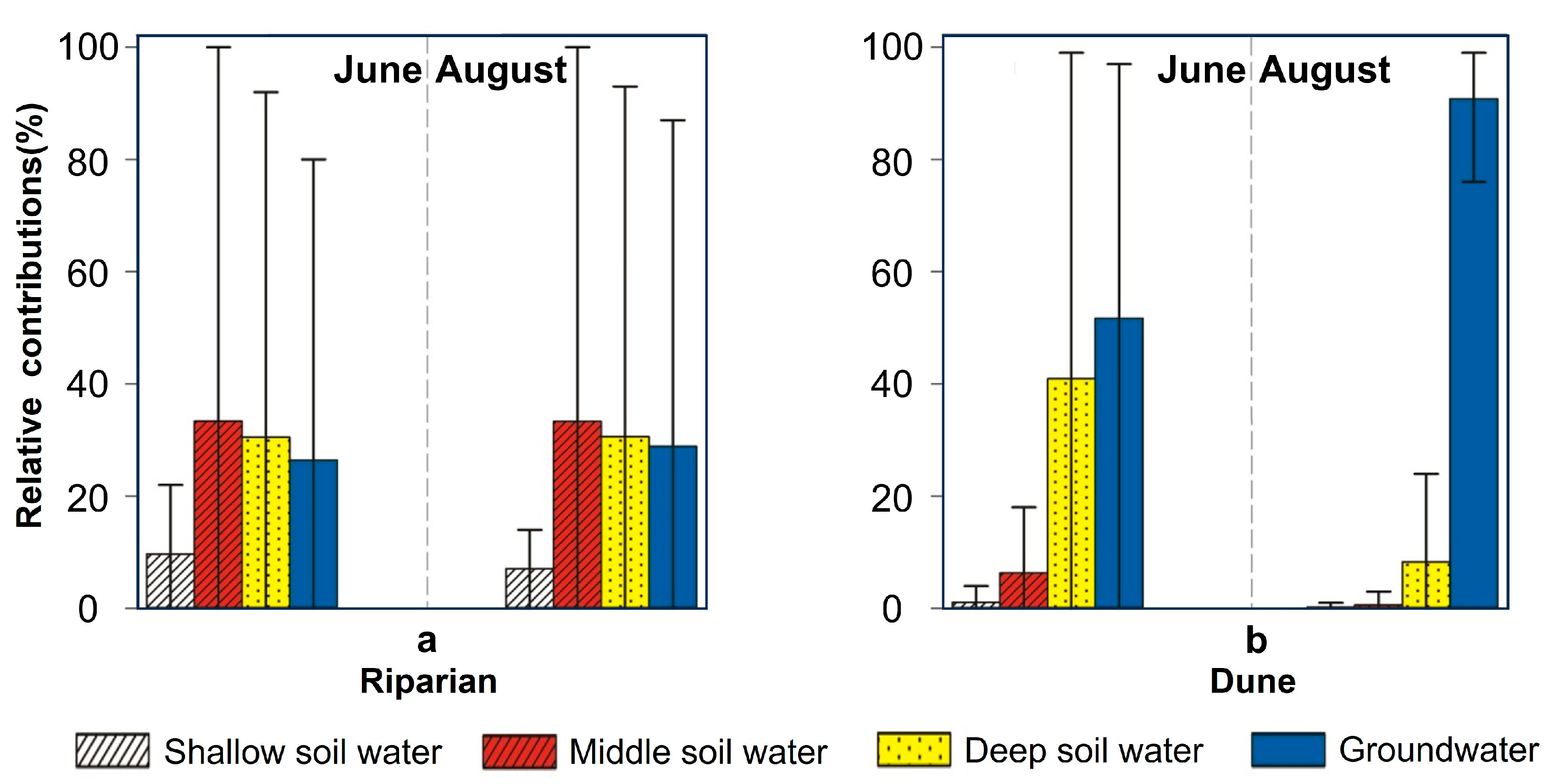
According to the IsoSource model, by comparing the isotopic values of xylem water with those of groundwater and soil water, the percentages of feasible water sources for saltcedar were calculated (Figure 6). At the riparian site, saltcedar mostly absorbed middle soil water (with a possible range of 0 to 100% and an average of 33%) and absorbed the lowest percentages of shallow soil water (less than 10%) on both measurement dates (Figure 6a). At the dune site, the water source for saltcedar was dominated by groundwater, with an average possible proportion of 52% on 13 June and up to 91% on 31 August, while contributions of shallow soil water displayed the lowest proportion on all measurement dates (Figure 6b).

4. Discussion

By comparing the water use patterns of saltcedar under two different habitats, it was found that the main water source was obviously different during the growing season. At the riparian site, saltcedar mainly absorbed soil water and did not change its primary water source with the groundwater table fluctuation, which reflected the characteristics of facultative phreatophytes. At the dune site, however, saltcedar appeared to be more dependent on groundwater in response to the continuous decline of the groundwater table, which reflected the characteristics of obligate phreatophytes.

4.1. Water Use Pattern of Saltcedar at the Riparian Site

For the riparian site, soil water will not be replenished by flood due to the regulation of river flow. Therefore, river water cannot be the potential water source of the saltcedar population. Rainfall and soil water isotope data did not match the same evaporation line, indicating that rainfall did not replenish the soil water, so rainfall cannot be the potential water source of saltcedar (Figure 4a). This was the result of high vegetation coverage in the riparian site, which intercepted a large proportion of rainfall, facilitated evaporation within the vegetation canopy, and reduced the infiltration amount of rainfall pulses. Additionally, high evapotranspiration (ET) capacity was also an important factor limiting rainfall infiltration. Previous studies have shown that the ET in the study area could reach 0.6–1.45 m/year [31]. Moreover, low-permeability clay loam soil generally overlaid the surface ground, with an infiltration rate below 5 mm/h, further limiting rainfall infiltration [48]. Studies have shown that the infiltration coefficient of the clay layer covered by vegetation was almost zero [49]. Liu et al. conducted a study in desert areas with coarse soil texture in the same region and found that the soil water content had almost no response to the precipitation pulse below 30 cm [50]. Therefore, the potential water sources of saltcedar at the riparian site are groundwater and soil water.
For the riparian habitat, the δ18O values of xylem samples on different observation dates were close to those of the middle soil water, indicating that although the groundwater level changed significantly, the middle soil water was always the primary water source in the growing season of saltcedar (Figure 5a). The calculation results of the IsoSource model have also proved this. Furthermore, the percentage of multiple water sources showed that the highest ratio was in the middle soil layer, followed by the deep soil layer and groundwater. In contrast, the shallow soil layer had relatively low ratios. The ratios among layers did not show any obvious difference between the two observation dates (Figure 6a). Along with this study, soil water is the essential source for plants in riparian zones in other regions such as the Badain Jaran Desert in China, southeastern Berlin in Germany, and the Darley River in Australia [30,51]. The water content of the middle-layer soil (30–60 cm) was maintained at high values of 22.7–24.2% (13 June) and 27.8–28.5% (31 August), providing a stable water source for the plant community (Figure 4a). The periodic elevation of groundwater was the source of replenishing the middle soil water. In addition to the near-surface area, the soil water content at all depths increased on 31 August compared with 13 June, indicating that groundwater was replenished during the period of high groundwater levels (Figure 3a). At the same time, soil water and groundwater isotopes matched the same line (Figure 4a), indicating that soil water received groundwater replenishment. Isotope values of soil water were richer than those of groundwater, indicating the effect of isotopic enrichment in the evaporation process. A slight decrease in δ18O of the middle soil water on the second observation date (31 August) also demonstrated the replenishment of soil water by the isotopically deficient groundwater (Figure 5a). The results indicated that the periodically uplifted groundwater level played an important role in soil water replenishment, especially when the available water stored in the vadose zone became scarce due to ET. Although the soil middle layer was above the groundwater level for most of the time during the study period, the middle layer was able to obtain sufficient recharge from the groundwater due to the presence of fine-textured soils, building a higher capillary fringe zone, which extended the contact time with the groundwater. Previous studies have proved that the thickness of the capillary fringe could reach about 80 cm for a clay soil layer [52]. When the groundwater level declined, the retention of the fine-texture layer made it difficult to discharge water, which left the middle-layer soil with a high moisture content for a long time [15]. Under the condition of sufficient soil water and shallow groundwater, saltcedar tends to utilize soil water under the principle of water use of plants [53].

4.2. Water Use Pattern of Saltcedar at the Dune Site

For the dune site, the research area is located far away from the Heihe River, and the groundwater level is higher than the river level; therefore, the river water cannot be a potential water source for saltcedar. The isotopic signatures of shallow soil water were close to those of rainfall (Figure 4b), reflecting that the source of shallow soil water was rainfall recharge due to the lower vegetation coverage and higher permeability of coarse sand texture. At the same time, the infiltration depth was still limited. According to previous studies, the infiltration depth of sandy soil in arid areas is no more than 50 cm [48]. Therefore, rainfall is too scarce to generate runoff or to recharge deep soil water or groundwater for the dune habitat. The isotopic values of middle soil water and deep soil water were extremely different from those of rainfall, which strongly suggested that the middle and deep soil water had no obvious response to rainfall and that rainfall could be a supplementary source only for shallow soil water (Figure 4b). This was because the scarce precipitation and high evaporation were affected by the arid climate. The soil was relatively dry, combined with hydration water and capillary water, which had an adverse effect on rainfall infiltration and plant water utilization. Therefore, the potential water sources of saltcedar in the dune region were groundwater and deep soil water.
For the dune habitat, the δ18O values of xylem samples on different observation dates were close to those of groundwater, suggesting that deep soil water or groundwater was the main water source during the growing season of saltcedar (Figure 5b). However, there were no water samples taken below a 180 cm depth to directly demonstrate this. The IsoSource model results also proved that the main water source for saltcedar in the dune habitat was groundwater. When the groundwater level continued to decrease during the dry season, the percentage of groundwater utilization changed from 52% to 91%, indicating that saltcedar showed a water absorption pattern more dependent on groundwater (Figure 6b). The reason was that during the study period, the SWC above 120 cm in depth remained at a low level of less than 5% (Figure 3), and could not be a potential water source for plants. The soil texture in the dune area is sandy. It has been demonstrated that the capillary rise height of coarse-grained soil is less than 60 cm [54]. However, the groundwater burial depth in the study area ranged from 5.11 to 5.88 m. Thus, the groundwater cannot replenish the soil water in the observed depth range by capillary action. Within this depth range, the soil water δ18O values observed on the second observation date (31 August) were significantly higher than those at the first observation date (13 June), which also reflected the characteristics of the soil isotope profile under the influence of ET enrichment (Figure 5b). This isotopic enrichment pattern is consistent with previous studies reporting strong evaporative effects on soil water in arid regions [36,48]. The SWC below 120 cm depth remained at a relatively high level at the first observation date. However, in the dry season, as plants continued to absorb water and there was no water replenishment source, the deep SWC gradually decreased (Figure 3b). Similar seasonal declines in deep soil moisture have been observed in other arid ecosystems where groundwater drawdown restricts recharge [48]. The deep soil water δ18O values observed on the second observation date (31 August) did not change significantly compared with the first observation date (13 June), proving that the soil water was not replenished by other water sources (Figure 5b). As the groundwater level continued to decline, deep soil water was not directly replenished by groundwater and was constantly consumed. Soil water was only replenished by film water and vaporized water produced by groundwater evaporation [30]. Under such a soil environment, even if the groundwater rises, the water-holding capacity of sandy soil is weak and cannot provide a stable water source required for plant survival. This unstable soil water cannot be a water source for saltcedar during the growing season, consistent with previous findings for deep-rooted phreatophytes [48]. Saltcedar is more inclined to directly use stable and abundant deep groundwater. On the second observation date (31 August), the δ18O values of the xylem were significantly lower than those on the first observation date (13 June) (Table 2), reflecting a strategic shift to deeper groundwater, consistent with previous observations in riparian poplar (Populus spp.) in Arizona during seasonal drought [16] and with broader findings that groundwater-dependent plants increasingly rely on deeper water sources in the dry season [12,13,30]. Zhang et al. showed that saltcedar growing on large desert sand dunes could adapt to the growth environment and change the water absorption layer [30]. After entering the rainy season, saltcedar mainly used soil water supplemented by rainfall at a depth of more than 60 cm. In the season when rainfall cannot infiltrate and replenish soil water, saltcedar used deeper soil water as its main source of water [30].
Although many studies have pointed out that the water source of saltcedar is affected by groundwater table fluctuations, in this study, we found that the water absorption depth of saltcedar depends mainly on the soil moisture state. The study in [3] also showed that when the river water source is unstable, saltcedar tends to use a more stable groundwater source as an alternative. Wu et al. found that, during the growing season, despite receiving rainfall input, saltcedar in the desert area prefers to use a more stable groundwater source with a depth of 5 m [55]. Many studies have also confirmed that the source of plant water depends on the water environment [15,30,56,57]. The regional soil water dynamics and status are affected by the balance between rainfall patterns (amount, period, and frequency) and evaporation, as well as soil hydraulic characteristics [58,59,60,61,62], and are also affected by groundwater table fluctuations and capillary upwelling zones [15]. Since there is no rainfall input in this study area, the source of plant water depends on soil water. Previous studies indicate that saltcedar growth is highly sensitive to soil moisture, and its water use strategies vary with environmental conditions. Although no universal optimum soil water content has been reported, Li et al. showed that when soil water content falls below approximately 7 %, plant water potential is affected, potentially limiting growth [63]. Zhang et al. further demonstrated that saltcedar adjusts its water uptake strategies depending on local conditions, for example, between floodplain and upland sites. At the riparian site, the SWC is stable and sufficient, allowing it to serve as the primary source of water for saltcedar [64]. In the dune area, as the SWC continues to decrease, saltcedar chooses to use groundwater as its main source of water.

5. Conclusions

In this study, we mainly used stable isotope techniques to investigate whether there are differences in water use patterns between riparian and dune habitats during the growing season of saltcedar in the middle reaches of the Heihe River. In terms of plant water sources, the main water source for saltcedar in the riparian site is the middle-deep soil water. During the entire study period, the water absorption layer did not change with the fluctuation of the groundwater table. However, in the dune area, groundwater is the main source of water for saltcedar. When the groundwater table continued to decline during the study period, saltcedar tended to rely on groundwater. In riparian sites with more abundant water sources (better water conditions), groundwater is typically shallow. The middle soil water is mainly used, while deep soil water and groundwater are also used. In the dune area, groundwater is deep, and water conditions are poor. As a result, saltcedar mainly uses groundwater. Through the comparison of the water use patterns and survival methods of plants in different habitats, it can be concluded that there are obvious differences in the water sources of saltcedar in different habitats in the same region. These differences are mainly affected by the groundwater burial depth, groundwater fluctuation amplitude, and soil water content. This study helps to explore the ecological factors that affect the water sources of saltcedar, to understand the inherent laws of saltcedar water use patterns in response to environmental changes, and to understand the interaction between the water cycle and the community. Also, these findings provide critical guidance for conserving groundwater resources in dune ecosystems and optimizing riparian restoration strategies under changing hydrological conditions.

Author Contributions

Conceptualization, J.W., S.H. and Z.S.; methodology, J.W., Z.S. and X.L.; validation, X.L. and Z.S.; formal analysis, J.W., S.H. and Z.S.; investigation, J.W., X.L. and Y.W.; data curation, Z.S. and X.L.; writing—original draft preparation, J.W., S.H. and Z.S.; writing—review and editing, S.H. and Z.S.; project administration, Z.S.; funding acquisition, Z.S. All authors have read and agreed to the published version of the manuscript.

Funding

This research was funded by the National Natural Science Foundation of China, grant number U2244230.

Data Availability Statement

The data presented in this study are available on request from the corresponding author due to privacy.

Acknowledgments

We acknowledge the Linze Inland River Basin Comprehensive Research Station and the Chinese Ecosystem Research Network for providing meteorological data. Honglang Xiao, Wenzhi Zhao, Zhihui Zhang, and Bowen Jin of the Cold and Arid Regions Environmental and Engineering Research Institute, Chinese Academy of Sciences, assisted with field sampling. We thank Yiqun Gan, Yunde Liu, Xu Wang, Lujian Sun, Linan Yu, Yalu Hu, Qixin Chang, and Jieyue Li of the China University of Geosciences for their help with sample analyses.

Conflicts of Interest

The authors declare no conflicts of interest.

References

  1. Giordano, C.V.; Guevara, A.; Boccalandro, H.E.; Sartor, C.; Villagra, P.E. Water status, drought responses, and growth of Prosopis flexuosa trees with different access to the water table in a warm South American desert. Plant Ecol. 2011, 212, 1123–1134. [Google Scholar] [CrossRef]
  2. Naumburg, E.; Mata-Gonzalez, R.; Hunter, R.G.; McLendon, T.; Martin, D.W. Phreatophytic vegetation and groundwater fluctuations: A review of current research and application of ecosystem response modeling with an emphasis on Great Basin vegetation. Environ. Manag. 2005, 35, 726–740. [Google Scholar] [CrossRef]
  3. Dawson, T.E.; Ehleringer, J.R. Streamside trees that do not use stream water. Nature 1991, 350, 335–337. [Google Scholar] [CrossRef]
  4. Mensforth, L.J.; Thorburn, P.J.; Tyerman, S.D.; Walker, G.R. Sources of water used by riparian Eucalyptus camaldulensis overlying highly saline groundwater. Oecologia 1994, 100, 21–28. [Google Scholar] [CrossRef] [PubMed]
  5. Stromberg, J.C.; Bagstad, K.J.; Leenhouts, J.M.; Lite, S.J.; Makings, E. Effects of stream flow intermittency on riparian vegetation of a semiarid region river (San Pedro River, Arizona). River Res. Appl. 2005, 21, 925–938. [Google Scholar] [CrossRef]
  6. Stromberg, J.C.; Beauchamp, V.B.; Dixon, M.D.; Lite, S.J.; Paradzick, C. Importance of low-flow and high-flow characteristics to restoration of riparian vegetation along rivers in arid south-western United States. Freshw. Biol. 2007, 52, 651–679. [Google Scholar] [CrossRef]
  7. Stromberg, J.C.; Lite, S.J.; Dixon, M.D. Effects of stream flow patterns on riparian vegetation of a semiarid river: Implications for a changing climate. River Res. Appl. 2010, 26, 712–729. [Google Scholar] [CrossRef]
  8. Williams, D.G.; Scott, R.L.; Huxman, T.E.; Goodrich, D.C.; Lin, G. Sensitivity of riparian ecosystems in arid and semiarid environments to moisture pulses. Hydrol. Process. 2006, 20, 3191–3205. [Google Scholar] [CrossRef]
  9. Theodore, T.K. Physiological-ecological impacts of flooding on riparian forest ecosystems. Wetlands 2002, 22, 550–561. [Google Scholar] [CrossRef]
  10. Silvertown, J.; Dodd, M.E.; Gowing, D.J.G.; Mountford, J.O. Hydrologically defined niches reveal a basis for species richness in plant communities. Nature 1999, 400, 61–63. [Google Scholar] [CrossRef]
  11. Vandersande, M.W.; Glenn, E.P.; Walworth, J.L. Tolerance of five riparian plants from the lower Colorado River to salinity drought and inundation. J. Arid Environ. 2001, 49, 147–159. [Google Scholar] [CrossRef]
  12. Dawson, T.E.; Pate, J.S. Seasonal water uptake and movement in root systems of Australian phreatophytic plants of dimorphic root morphology: A stable isotope investigation. Oecologia 1996, 107, 13–20. [Google Scholar] [CrossRef]
  13. McCole, A.A.; Stern, L.A. Seasonal water use patterns of Juniperus ashei on the Edwards Plateau, Texas, based on stable isotopes in water. J. Hydrol. 2007, 342, 238–248. [Google Scholar] [CrossRef]
  14. Smith, S.D.; Wellington, A.B.; Nachlinger, J.L.; Fox, C.A. Functional responses of riparian vegetation to streamflow diversion in the Eastern Sierra Nevada. Ecol. Appl. 1991, 1, 89–97. [Google Scholar] [CrossRef]
  15. Nippert, J.B.; Butler, J.J.; Kluitenberg, G.J.; Whittemore, D.O.; Arnold, D.; Spal, S.E.; Ward, J.K. Patterns of Tamarix water use during a record drought. Oecologia 2010, 162, 283–292. [Google Scholar] [CrossRef] [PubMed]
  16. Snyder, K.A.; Williams, D.G. Water sources used by riparian trees varies among stream types on the San Pedro River, Arizona. Agric. For. Meteorol. 2000, 105, 227–240. [Google Scholar] [CrossRef]
  17. Peng, S.; Zhao, C.; Zheng, X. Study on the relationship between human activities and spatial distribution changes of Tamarix in Ejina oasis. In Proceedings of the 2010 IEEE International Geoscience and Remote Sensing Symposium, Bryan, TX, USA, 25–30 July 2010; pp. 895–898. [Google Scholar] [CrossRef]
  18. Su, Y.-Z.; Wang, X.-F.; Yang, R.; Yang, X.; Liu, W.-J. Soil fertility, salinity and nematode diversity influenced by Tamarix ramosissima in different habitats in an arid desert oasis. Environ. Manag. 2012, 50, 226–236. [Google Scholar] [CrossRef]
  19. Busch, D.E.; Ingraham, N.L.; Smith, S.D. Water uptake in woody riparian phreatophytes of the southwestern United States: A stable isotope study. Ecol. Appl. 1992, 2, 450–459. [Google Scholar] [CrossRef]
  20. Glenn, E.P.; Nagler, P.L.; Morino, K.; Hultine, K.R. Phreatophytes under stress: Transpiration and stomatal conductance of saltcedar (Tamarix spp.) in a high-salinity environment. Plant Soil 2013, 371, 655–672. [Google Scholar] [CrossRef]
  21. Gries, D.; Foetzki, A.; Arndt, S.K.; Bruelheide, H.; Thomas, F.M.; Zhang, X.; Runge, M. Production of perennial vegetation in an oasis-desert transition zone in NW China: Allometric estimation, and assessment of flooding and use effects. Plant Ecol. 2005, 181, 23–43. [Google Scholar] [CrossRef]
  22. Horton, J.L.; Kolb, T.E.; Hart, S.C. Physiological response to groundwater depth varies among species and with river flow regulation. Ecol. Appl. 2001, 11, 1046–1059. [Google Scholar] [CrossRef]
  23. Smith, S.D.; Devitt, D.A.; Sala, A.; Cleverly, J.R.; Busch, D.E. Water relations of riparian plants from warm desert regions. Wetlands 1998, 18, 687–696. [Google Scholar] [CrossRef]
  24. Stromberg, J.C. Functional equivalency of saltcedar (Tamarix chinensis) and Fremont cottonwood (Populus fremonth) along a free-flowing river. Wetlands 1998, 18, 675–686. [Google Scholar] [CrossRef]
  25. Xu, G.-Q.; Li, Y.; Xu, H. Seasonal variation in plant hydraulic traits of two co-occurring desert shrubs, Tamarix ramosissima and Haloxylon ammodendron, with different rooting patterns. Ecol. Res. 2011, 26, 1071–1080. [Google Scholar] [CrossRef]
  26. Xu, H.; Li, Y. Water-use strategy of three central Asian desert shrubs and their responses to rain pulse events. Plant Soil 2006, 285, 5–17. [Google Scholar] [CrossRef]
  27. Xu, H.; Li, Y.; Xu, G.; Zou, T. Ecophysiological response and morphological adjustment of two Central Asian desert shrubs towards variation in summer precipitation. Plant Cell Environ. 2007, 30, 399–409. [Google Scholar] [CrossRef] [PubMed]
  28. Yu, T.; Feng, Q.; Si, J.; Xi, H.; Li, Z.; Chen, A. Hydraulic redistribution of soil water by roots of two desert riparian phreatophytes in northwest China’s extremely arid region. Plant Soil 2013, 372, 297–308. [Google Scholar] [CrossRef]
  29. Guevara, A.; Giordano, C.V.; Aranibar, J.; Quiroga, M.; Villagra, P.E. Phenotypic plasticity of the coarse root system of Prosopis flexuosa, a phreatophyte tree, in the Monte Desert (Argentina). Plant Soil 2010, 330, 447–464. [Google Scholar] [CrossRef]
  30. Zhang, J.; Wang, N.A.; Niu, Z.; Sun, J.; Dong, C.; Zhang, L. Stable isotope analysis of water sources for Tamarix laxa in the mega-dunes of the Badain Jaran Desert, China. J. Arid Land 2018, 10, 821–832. [Google Scholar] [CrossRef]
  31. Sun, Z.; Long, X.; Ma, R. Water uptake by saltcedar (Tamarix ramosissima) in a desert riparian forest: Responses to intra-annual water table fluctuation. Hydrol. Process. 2016, 30, 1388–1402. [Google Scholar] [CrossRef]
  32. Devitt, D.A.; Piorkowski, J.M.; Smith, S.D.; Cleverly, J.R.; Sala, A. Plant water relations of Tamarix ramosissima in response to the imposition and alleviation of soil moisture stress. J. Arid Environ. 1997, 36, 527–540. [Google Scholar] [CrossRef]
  33. Shafroth, P.B.; Stromberg, J.C.; Patten, D.T. Woody riparian vegetation response to different alluvial water table regimes. West. N. Am. Nat. 2000, 60, 66–76. [Google Scholar]
  34. Li, J.; Yu, B.; Zhao, C.; Nowak, R.S.; Zhao, Z.; Sheng, Y.; Li, J. Physiological and morphological responses of Tamarix ramosissima and Populus euphratica to altered groundwater availability. Tree Physiol. 2013, 33, 57–68. [Google Scholar] [CrossRef]
  35. Imada, S.; Taniguchi, T.; Acharya, K.; Yamanaka, N. Vertical distribution of fine roots of Tamarix ramosissima in an arid region of southern Nevada. J. Arid Environ. 2013, 92, 46–52. [Google Scholar] [CrossRef]
  36. Li, S.; Zhao, W. Satellite-based actual evapotranspiration estimation in the middle reach of the Heihe River Basin using the SEBAL method. Hydrol. Process. 2010, 24, 3337–3344. [Google Scholar] [CrossRef]
  37. Yaziz, M.I.; Gunting, H.; Sapari, N.; Ghazali, A.W. Variations in rainwater quality from roof catchments. Water Res. 1989, 23, 761–765. [Google Scholar] [CrossRef]
  38. Horsák, M.; Horsáková, V.; Polášek, M.; Peterka, T.; Hájek, M. Spring water table depth mediates within-site variation of soil temperature in groundwater-fed mires. Hydrol. Process. 2021, 35, e14293. [Google Scholar] [CrossRef]
  39. Sternberg, L.D.S.L.; Deniro, M.J.; Savidge, R.A. Oxygen isotope exchange between metabolites and water during biochemical reactions leading to cellulose synthesis. Plant Physiol. 1986, 82, 423–427. [Google Scholar] [CrossRef]
  40. Ellsworth, P.Z.; Williams, D.G. Hydrogen isotope fractionation during water uptake by woody xerophytes. Plant Soil 2007, 291, 93–107. [Google Scholar] [CrossRef]
  41. Lin, G.; Sternberg, L.d.S.L. Comparative study of water uptake and photosynthetic gas exchange between scrub and fringe red mangroves, Rhizophora mangle L. Oecologia 1992, 90, 399–403. [Google Scholar] [CrossRef]
  42. Horton, J.L.; Hart, S.C.; Kolb, T.E. Physiological condition and water source use of Sonoran desert riparian trees at the Bill Williams river, Arizona, USA. Isot. Environ. Health Stud. 2003, 39, 69–82. [Google Scholar] [CrossRef] [PubMed]
  43. Ehleringer, J.R.; Dawson, T.E. Water uptake by plants: Perspectives from stable isotope composition. Plant Cell Environ. 1992, 15, 1073–1082. [Google Scholar] [CrossRef]
  44. Phillips, D.L.; Gregg, J.W. Source partitioning using stable isotopes: Coping with too many sources. Oecologia 2003, 136, 261–269. [Google Scholar] [CrossRef]
  45. Sprenger, M.; Tetzlaff, D.; Soulsby, C. Soil water stable isotopes reveal evaporation dynamics at the soil–plant–atmosphere interface of the critical zone. Hydrol. Earth Syst. Sci. 2017, 21, 3839–3858. [Google Scholar] [CrossRef]
  46. Barnes, C.J.; Allison, G.B. The distribution of deuterium and 18O in dry soils: 1. Theory. J. Hydrol. 1983, 60, 141–156. [Google Scholar] [CrossRef]
  47. Gazis, C.; Feng, X. A stable isotope study of soil water: Evidence for mixing and preferential flow paths. Geoderma 2004, 119, 97–111. [Google Scholar] [CrossRef]
  48. Yang, W.; Tang, J.; Liang, H.; Dang, H.; Li, W. Deep soil water infiltration and its dynamic variation in the shifting sandy land of typical deserts in China. Sci. China Earth Sci. 2014, 57, 1816–1824. [Google Scholar] [CrossRef]
  49. Lihe, Y.; Xiaoyong, W.; Jinting, H.; Hongyun, M.A.; Jun, Z.; Jiaqiu, D.; Shuaijun, H.E. The impact of vegetation coverage increase on groundwater recharge in the arid regions of Northwest China: Experimental and numerical study. Geol. Bull. China 2015, 34, 2066–2073. [Google Scholar] [CrossRef]
  50. Liu, B.; Zhao, W.Z.; Chang, X.X.; Li, S.B. Response of soil moisture to rainfall pulse in desert region of the Heihe River Basin. J. Desert Res. 2011, 31, 716–772. (In Chinese) [Google Scholar]
  51. Landgraf, J.; Tetzlaff, D.; Dubbert, M.; Dubbert, D.; Smith, A.; Soulsby, C. Xylem water in riparian willow trees (Salix alba) reveals shallow sources of root water uptake by in situ monitoring of stable water isotopes. Hydrol. Earth Syst. Sci. 2022, 26, 2073–2092. [Google Scholar] [CrossRef]
  52. Fu, A.; Chen, Y.; Li, W. Water use strategies of the desert riparian forest plant community in the lower reaches of Heihe River Basin, China. Sci. China Earth Sci. 2014, 57, 1293–1305. [Google Scholar] [CrossRef]
  53. Adiku, S.G.K.; Rose, C.W.; Braddock, R.D.; Ozier-Lafontaine, H. On the simulation of root water extraction: Examination of a minimum energy hypothesis. Soil Sci. 2000, 165, 226–236. [Google Scholar] [CrossRef]
  54. Zhao, L.; Xiao, H.; Cheng, G.; Song, Y.; Zhao, L.; Li, C.; Yang, Q. A preliminary study of water sources of riparian plants in the lower reaches of the Heihe Basin. Acta Geosci. Sin. 2008, 29, 709–718. (In Chinese) [Google Scholar]
  55. Wu, Y.; Zhou, H.; Zheng, X.-J.; Li, Y.; Tang, L.-S. Seasonal changes in the water use strategies of three co-occurring desert shrubs. Hydrol. Process. 2014, 28, 6265–6275. [Google Scholar] [CrossRef]
  56. Dai, Y.; Zheng, X.-J.; Tang, L.-S.; Li, Y. Stable oxygen isotopes reveal distinct water use patterns of two Haloxylon species in the Gurbantonggut Desert. Plant Soil 2015, 389, 73–87. [Google Scholar] [CrossRef]
  57. Wu, G.; Jiang, S.; Liu, W.; Zhao, C.; Li, J. Competition between Populus euphratica and Tamarix ramosissima seedlings under simulated high groundwater availability. J. Arid Land 2016, 8, 293–303. [Google Scholar] [CrossRef]
  58. Ehleringer, J.R.; Phillips, S.L.; Schuster, W.S.F.; Sandquist, D.R. Differential utilization of summer rains by desert plants. Oecologia 1991, 88, 430–434. [Google Scholar] [CrossRef]
  59. Fravolini, A.; Hultine, K.R.; Brugnoli, E.; Gazal, R.; English, N.B.; Williams, D.G. Precipitation pulse use by an invasive woody legume: The role of soil texture and pulse size. Oecologia 2005, 144, 618–627. [Google Scholar] [CrossRef]
  60. Reynolds, J.F.; Virginia, R.A.; Kemp, P.R.; de Soyza, A.G.; Tremmel, D.C. Impact of drought on desert shrubs: Effects of seasonality and degree of resource island development. Ecol. Monogr. 1999, 69, 69–106. [Google Scholar] [CrossRef]
  61. Sala, O.E.; Lauenroth, W.K.; Parton, W.J.; Trlica, M.J. Water status of soil and vegetation in a shortgrass steppe. Oecologia 1981, 48, 327–331. [Google Scholar] [CrossRef]
  62. Sperry, J.S.; Hacke, U.G. Desert shrub water relations with respect to soil characteristics and plant functional type. Funct. Ecol. 2002, 16, 367–378. [Google Scholar] [CrossRef]
  63. Fu, A.; Li, W.; Chen, Y. The threshold of soil moisture and salinity influencing the growth of Populus euphratica and Tamarix ramosissima in the extremely arid region. Environ. Earth Sci. 2012, 66, 2519–2529. [Google Scholar] [CrossRef]
  64. Xu, Y.; Zhao, H.; Zhou, B.; Dong, Z.; Li, G.; Li, S. Variations in water use strategies of Tamarix ramosissima at coppice dunes along a precipitation gradient in desert regions of northwest China. Front. Plant Sci. 2024, 15, 1408943. [Google Scholar] [CrossRef]
Figure 1. Maps of the following: (a) the Heihe River Basin in China; (b) the study area in the Heihe River Basin; (c) a detail of the study area and the location of study sites; (d) a photograph of the riparian site; (e) a photograph of the dune site.
Water 17 02605 g001
Figure 2. Hydrological dynamics during the growing season from June to August 2009: (a) groundwater depth and rainfall at the riparian site; (b) groundwater depth and rainfall at the dune site. The green lines represent the river level of the nearby Heihe River.
Water 17 02605 g002
Figure 3. Vertical distribution of soil moisture and texture at (a) riparian and (b) dune sites during June and August. The blue line represents soil water in June, and the red line represents soil water in August.
Water 17 02605 g003
Figure 4. Natural abundances of hydrogen and oxygen stable isotopes in groundwater, soil water, and rainwater collected from the (a) riparian and (b) dune sites.
Water 17 02605 g004
Figure 5. Comparison of δ18O of soil water and plant stem water in the (a) riparian and (b) dune sites. The blue line represents soil water in June, and the red line represents soil water in August. The horizontal dashed lines extending from the xylem water isotope values are visual guides to aid in identifying the corresponding soil water extraction depths.
Water 17 02605 g005
Figure 6. Proportions of feasible water sources for saltcedar at (a) riparian and (b) dune sites in June and August, where δ18O values used for the calculations by the model are shown. Column heights represent the model-estimated mean source proportions, and bars represent the modeled minimum/maximum range.
Water 17 02605 g006
Table 1. Isotopic values for groundwater, rainwater, and soil water during the study period (mean ± SD, n = 3 per depth).
SiteIsotope Typeδ18Oδ2H
Rainwater−0.80 ± 2.47‰−5.27 ± 13.07‰
Groundwater−9.92 ± 0.19‰−63.03 ± 2.01‰
Shallow soil water (0–30 cm, 13 June)−1.43 ± 4.47‰−39.60 ± 11.49‰
Middle soil water (30–60 cm, 13 June)−8.19 ±0.57‰−59.27 ±1.58‰
RiparianDeep soil water (60–120 cm, 13 June)−8.94 ± 0.36‰−60.10 ± 1.25‰
Shallow soil water (0–30 cm, 31 August)−2.51 ± 2.06‰−37.34 ±9.63‰
Middle soil water (30–60 cm, 31 August)−8.98 ±0.98‰−64.54 ± 3.34‰
Deep soil water (60–120 cm, 31 August)−9.60 ± 0.30‰−63.75 ± 2.13‰
Rainwater−1.39 ± 3.89‰−2.37 ± 26.91‰
Groundwater−9.68 ± 0.72‰−55.20± 3.29‰
Shallow soil water (0–30 cm, 13 June)−5.60 ± 3.82‰−20.87 ± 11.54‰
DuneMiddle soil water (30–100 cm, 13 June)−5.46 ± 1.14‰−49.38 ± 3.24‰
Deep soil water (100–180 cm, 13 June)−8.37 ± 0.83‰−56.54 ± 1.31‰
Shallow soil water (0–30 cm, 31 August)1.84 ± 2.42‰−8.36 ± 10.36‰
Middle soil water (30–100 cm, 31 August)−2.50 ± 3.82‰−42.24 ± 13.55‰
Deep soil water (100–180 cm, 31 August)−8.63 ± 0.79‰−57.80 ± 2.15‰
Table 2. Isotopic values for soil water and plant stem water at riparian and dune sites during the study period (mean ± SD, n = 3 per depth).
Sample TypeRiparianDune
13 June31 August13 June31 August
Soil water
5 cm4.37 ± 1.10‰−0.69 ± 1.97‰9.67 ± 0.25‰4.12 ± 2.59‰
15 cm−2.70 ± 1.36‰−2.26 ± 0.62‰8.40 ± 2.03‰−0.08 ± 0.61‰
25 cm−5.96 ± 0.99‰−4.57 ± 0.90‰2.37 ± 2.28‰1.50 ± 1.24‰
35 cm−7.81 ± 0.57‰−8.46 ± 0.94‰−0.78 ± 2.32‰1.15 ± 1.81‰
55 cm−8.58 ± 0.15‰−9.76 ± 0.19‰−4.94 ± 0.83‰−1.55 ± 3.23‰
75 cm−8.55 ± 0.13‰−9.38 ± 0.24‰−5.17 ± 1.28‰−4.03 ± 1.14‰
95 cm−8.77 ± 0.29‰−9.97 ± 0.15‰−6.10 ± 0.84‰−6.95 ± 1.00‰
115 cm−9.13 ± 0.35‰−9.65 ± 0.12‰−8.30 ± 0.70‰−8.34 ± 0.18‰
145 cm−8.48 ± 0.86‰−8.32 ± 0.56‰
175cm−8.32 ± 0.91‰−9.04 ± 0.97‰
Salt cedar−8.26 ± 0.20‰−9.01 ± 0.30‰−8.24 ± 0.02‰−9.42 ± 0.08‰
Disclaimer/Publisher’s Note: The statements, opinions and data contained in all publications are solely those of the individual author(s) and contributor(s) and not of MDPI and/or the editor(s). MDPI and/or the editor(s) disclaim responsibility for any injury to people or property resulting from any ideas, methods, instructions or products referred to in the content.