Article

Values, Beliefs, and Norms: A Theoretical Approach to Understanding Household Water Insecurity Coping Strategies


by
Patrick Mbullo Owuor
Department of Anthropology, Wayne State University, 656 W. Kirby St., Detroit, MI 48202, USA
Water 2025, 17(1), 25; https://doi.org/10.3390/w17010025
Submission received: 2 December 2024 / Revised: 21 December 2024 / Accepted: 24 December 2024 / Published: 26 December 2024

Abstract

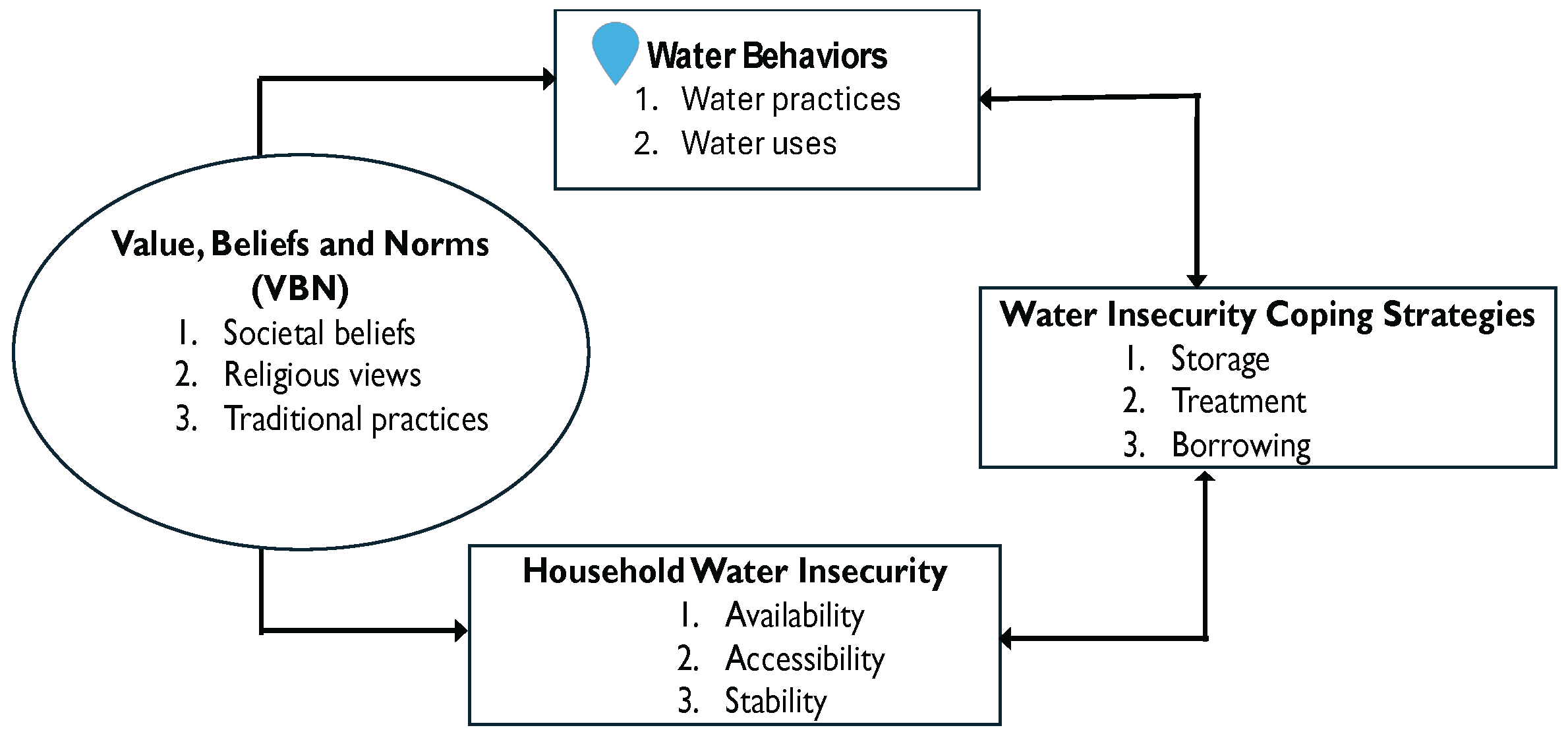
Water insecurity is an ongoing global challenge for households. Many families, especially those in regions experiencing water scarcity, employ different coping methods to alleviate its consequences. However, the strategies often utilized by displaced communities remain largely unexplored. Moreover, there is a lack of analysis on how values, beliefs, and social norms (VBN) shape household decisions regarding these methods. This qualitative study included in-depth interviews with 65 individuals impacted by the Thwake Dam construction in Makueni County, Kenya. The study utilized the VBN theory to analyze individual and household decisions by examining various coping strategies related to water insecurity. Our research shows that displaced communities employ different strategies to alleviate the negative impacts of water insecurity. However, the effectiveness of these strategies largely hinges on households’ capacity to store water. Personal values, beliefs, and norms—such as religious and cultural traditions—drive individuals’ reactions to diverse water circumstances, impacting their coping mechanisms. Household coping strategies for water insecurity differ significantly; however, water storage plays a crucial role in influencing other coping techniques among displaced communities. The VBN theoretical framework enhances our understanding of how families deal with water insecurity and use their water resources, illuminating individuals’ daily water-related experiences.
Keywords: household water insecurity; coping strategies; displacement; value, beliefs, and norms; Thwake Dam; Kenya household water insecurity; coping strategies; displacement; value, beliefs, and norms; Thwake Dam; Kenya