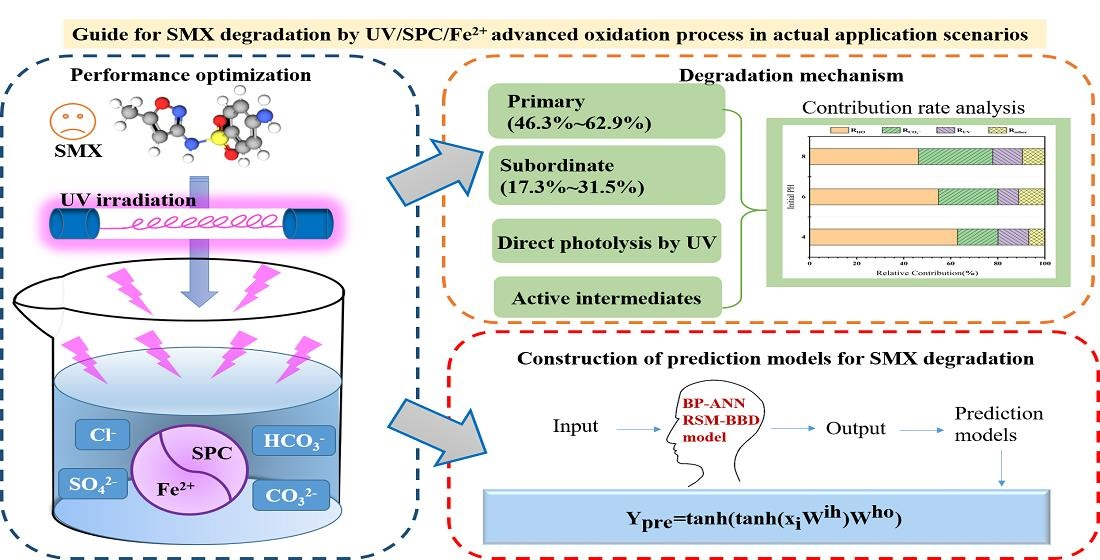
The Degradation of Sulfamethoxazole via the Fe2+/Ultraviolet/Sodium Percarbonate Advanced Oxidation Process: Performance, Mechanism, and Back-Propagate–Artificial Neural Network Prediction Model

 , and
, and Abstract
Share and Cite
Chen, J.; Ruan, C.; Xie, W.; Dai, C.; Gao, Y.; Liao, Z.; Gao, N. The Degradation of Sulfamethoxazole via the Fe2+/Ultraviolet/Sodium Percarbonate Advanced Oxidation Process: Performance, Mechanism, and Back-Propagate–Artificial Neural Network Prediction Model. Water 2024, 16, 532. https://doi.org/10.3390/w16040532
Chen J, Ruan C, Xie W, Dai C, Gao Y, Liao Z, Gao N. The Degradation of Sulfamethoxazole via the Fe2+/Ultraviolet/Sodium Percarbonate Advanced Oxidation Process: Performance, Mechanism, and Back-Propagate–Artificial Neural Network Prediction Model. Water. 2024; 16(4):532. https://doi.org/10.3390/w16040532
Chicago/Turabian StyleChen, Juxiang, Chong Ruan, Wanying Xie, Caiqiong Dai, Yuqiong Gao, Zhenliang Liao, and Naiyun Gao. 2024. "The Degradation of Sulfamethoxazole via the Fe2+/Ultraviolet/Sodium Percarbonate Advanced Oxidation Process: Performance, Mechanism, and Back-Propagate–Artificial Neural Network Prediction Model" Water 16, no. 4: 532. https://doi.org/10.3390/w16040532
APA StyleChen, J., Ruan, C., Xie, W., Dai, C., Gao, Y., Liao, Z., & Gao, N. (2024). The Degradation of Sulfamethoxazole via the Fe2+/Ultraviolet/Sodium Percarbonate Advanced Oxidation Process: Performance, Mechanism, and Back-Propagate–Artificial Neural Network Prediction Model. Water, 16(4), 532. https://doi.org/10.3390/w16040532