


Abstract
The uneven spatial and temporal distribution of water resources has consistently been one of the most significant limiting factors for social development in many regions. Furthermore, with the intensification of climate change, this inequality is progressively widening, posing a critical challenge to the sustainable development of human societies. The construction of large-scale water projects has become one of the crucial means to address the contradictions between water supply and demand. Thus, evaluating the functional aspects of water source network structures and systematically planning the layout of engineering measures in a scientifically reasonable manner are pressing issues that require urgent attention in current research efforts. Addressing this, our study takes the Erhai Lake basin and the surrounding areas in southwest China as the study area and combines landscape ecology and network analysis theory methods to propose a water supply network analysis method that takes into account both structure and node characteristics. Based on this methodology, we analyze the connectivity characteristics of water supply networks in the Erhai region under current (2020) and future (2035) planning scenarios. The results show that there were 215 nodes and 216 links in the water supply network of the Erhai Lake basin in 2020; with the implementation of a series of water conservancy projects, the planned 2035 water supply network will increase by 122 nodes and 163 links, and the connectivity of the regional water network will be significantly improved. Also, we identify some key nodes in the network, and the results show that the water supply network in 2035 will have obvious decentralization characteristics compared with that in 2020. And, based on the network degradation analysis, we find that with the implementation of engineering measures, the resilience of the water supply network will be significantly strengthened by 2035, with stronger risk tolerance. This study extends the quantitative representation of water source network characteristics, which can provide a useful reference for water network structure planning and optimization.
1. Introduction
Water resources are among the most precious resources on Earth and represent a critical factor in sustaining human and ecosystem health. However, water resource management has been facing a big challenge in recent years. Population growth and the temporal–spatial mismatch of water resources exert immense pressure on the sustainable supply and quality of water. Particularly, extreme events like droughts and floods are becoming more frequent in the context of climate change, exacerbating the uneven distribution of water resources. In this situation, ensuring reliable water supply has become a key factor limiting economic and social development and ecological health [1,2] in many regions. Therefore, researching the coordination and complementarity between water sources and supply networks has become a crucial issue in water resource management and regulation.
The water resource system is a dual-cycle system that involves the deep coupling of natural hydrological processes and human-controlled management. Natural water network characteristics determine the endowment of water resources in a region. In humid areas, river networks are dense; water systems are well connected; and the spatial and temporal distribution of water resources is relatively balanced. Conversely, arid regions have poor endowment of water resources. Therefore, enhancing the connectivity among water sources and improving the coordination and complementarity among supply networks are essential strategies to address sustainable development issues in arid regions. To settle this, many regions have constructed reservoirs and water diversion projects to strengthen the interconnection and intercommunication between different water sources and supply systems, alleviating water scarcity problems, for example, the Central Valley project [3] in the United States and the construction of large-scale water diversion projects in California [4], the James Bay water diversion project [5] in Canada, the Churchill–Nelson water diversion project [6], and the Sarda Sarova project [7] in India. These projects have enhanced the connectivity of water resources among basins, changed the allocation and management of water resources, effectively improved water resource utilization, and increased the resilience of water supply systems [8]. In order to alleviate the water scarcity problem in northern China, the South-to-North Water Diversion Project has been implemented to transport water from the water-rich Yangtze River basin to the water-stressed North China Plain, connecting water sources across regions. The ecological and environmental benefits of the first phase of the Eastern Route alone have a total value of 6.233 billion RMB [9]. The ecological water transfer projects in the inland river basins of northwest China have alleviated water competition between human society and natural landscapes by coordinating water allocation between upstream and downstream areas, promoting basin ecological restoration [10]. However, it is noteworthy that such inter-basin water transfer practices are not without controversy globally. For instance, in Europe, similar water transfer projects are subject to stringent regulations. The EU Water Framework Directive (WFD), effective since 2000, places particular emphasis on cross-border cooperation in transregional water transfer projects, such as water competition, water rights trading, and cost–benefit analysis. These regulations provide an important reference point for the complexities and potential environmental impacts that must be considered when managing interregional water resources. By building massive water diversion projects, humans are creating “artificial rivers” on Earth [11], which have a profound impact on the global water supply network, alleviating the uneven distribution of water resources in time and space and increasing the availability of water resources [12]. In the future, we may face a world dominated by engineered water, which is the key measure to solve the contradiction between water supply and demand.
To address the exacerbation issue of the uneven temporal and spatial distribution of water resources against the backdrop of climate change and to enhance the resilience of supply systems, the central government of China has elevated the construction of a nationwide water network to a national strategic level [13]. While engineering measures are beneficial to enhancing the connectivity of a water network, the water resource conditions in a region are primarily determined by climate. The key challenge in water network planning and construction is how to match the scale of engineering projects with the level of social development. Therefore, analyzing the characteristics of water sources and supply networks to achieve interconnectivity, coordinated operation and supply, and collaborative prevention and control are scientific prerequisites for optimizing the structure of the water network and enhancing the resilience of the water network system.
The water supply network is a complex network system that combines natural water bodies with artificial engineering. Researchers from different disciplines have proposed various evaluation methods for studying the connectivity of water supply networks, such as graph theory [14,15], landscape analysis [16], and hydrodynamic modeling [17]. However, graph theory simplifies the water network and lacks temporal and spatial dimensions, making it unsuitable for complex terrains. Landscape analysis has strict data requirements and lacks analysis of hydrological processes, making it difficult to handle human interventions. Hydrodynamic modeling requires long-sequence data for parameter calibration and has high complexity and computational demands, and the determination of relevant parameters is not easy. In recent years, with the rapid development of society, artificial networks have become more complex and diverse [18,19,20,21], including transportation networks, electrical grids, social networks, etc. [22,23]. Research has shown that the topological structure of networks greatly influences their functionality, particularly certain critical network nodes that play a decisive role in network resilience [18,24,25]. A water supply network has the characteristics of a network, and network theory analysis, as a kind of graph theory, has already been used in research on water supply networks. Network analysis theory is applied to water supply networks, where nodes represent reservoirs, users, and connection points, while edges represent rivers and pipeline facilities [26]. Yazdani and Jeffrey [27] analyzed the vulnerability of water supply networks using the directed graph weighted by pipeline hydraulic capacity. Giudiciani [28] et al. studied the influence of topology on undirected and unweighted graphs in indicators based on network attributes such as connectivity and robustness. Thomas Anchita [29] used calculations of complex network indicators and associated hydraulic criteria and studied hydraulic performance and connectivity under various demand increase scenarios. Meng [30] used stress–strain testing to propose a general mapping framework of network elasticity and topological properties to analyze the key influencing factors of water supply network elasticity. Network analysis theory has also been used to analyze the connectivity among the physical components of the hydrological cycle [31]. In addition, node–node connectivity in network analysis theory has also been used in collaborative research on human–water systems [32], providing a new perspective for water resource management [33]. For large-scale water diversion projects, Erik Porse [8] conducted a connectivity and resilience analysis of California’s waterway projects and a network degradation analysis. Xiang [34] proposed a system vulnerability assessment method for large-scale interregional construction projects based on complex network theory and proposed that the vulnerability of environmental and social factors was greater than that of economic factors in major transregional projects. Liu [35] used complex network theory to analyze the large water network project in Shanxi Province, China, including its transmission efficiency and important nodes, and put forward management suggestions. Wang [36] used network theory to analyze the changes in the importance of nodes before and after the construction of water conservancy projects in the Yongding River basin in China and found that water conservancy projects would not only cause the importance of some nodes to decrease but also lead to the importance of some nodes to increase. Network analysis provides a tool for analyzing water supply networks. When using network analysis methods to plan the structural elements of water supply networks, one can systematically understand the dynamics of complex networks, identify key nodes and connections to optimize resource allocation, and enhance the adaptability and resilience of the system. However, for complex networks, topological characteristics may not fully represent the impact of hydraulic performance and pipeline failure [37] and cannot reflect the characteristics of project scale, user demand, and economic benefits. Therefore, for complex water supply networks that combine natural features with artificial engineering, further research is needed to develop suitable analysis methods.
In response to the above-mentioned issues, this study focuses on the Erhai Lake basin in southwest China to explore methods for analyzing the characteristics of both natural and artificial supply networks. The Erhai Lake basin faces a series of problems, including water pollution, imbalanced water supply and demand, frequent droughts [38], and complex water resource management [39]. The Dianzhong Water Diversion Project and the Ludila Hydropower Station Water Resources Comprehensive Utilization Project (referred to as the Ludila Project) are two large-scale water engineering projects in Yunnan Province, China. They help improve water supply in the central part of Yunnan Province, enhance the reliability of water supply for drinking and agriculture, promote local economic and agricultural development, and strengthen water resource cooperation among different regions within Yunnan Province to facilitate regional development and resource sharing.
In order to quantitatively analyze the influence of large-scale water transfer projects on the water supply network of the Erhai Lake basin, it is difficult to select appropriate indicators to reasonably and quantitatively characterize the function of network system analysis; especially for water supply networks, the relevant theories and methods are still being explored. In this study, we combine landscape ecology and network analysis theory to construct a set of quantitative evaluation index systems of water supply networks and analyze the water supply network at the network layer and the node layer, respectively. Firstly, the water supply network of the Erhai Lake basin after the implementation of the project is compared with the existing water supply network of the Erhai Lake basin; the important nodes in the network are selected; and network degradation evaluation is carried out. The study hopes to provide new insights for water resource management and ecological conservation to address environmental challenges and ensure the sustainable development of water resources.
2. Research Area Background
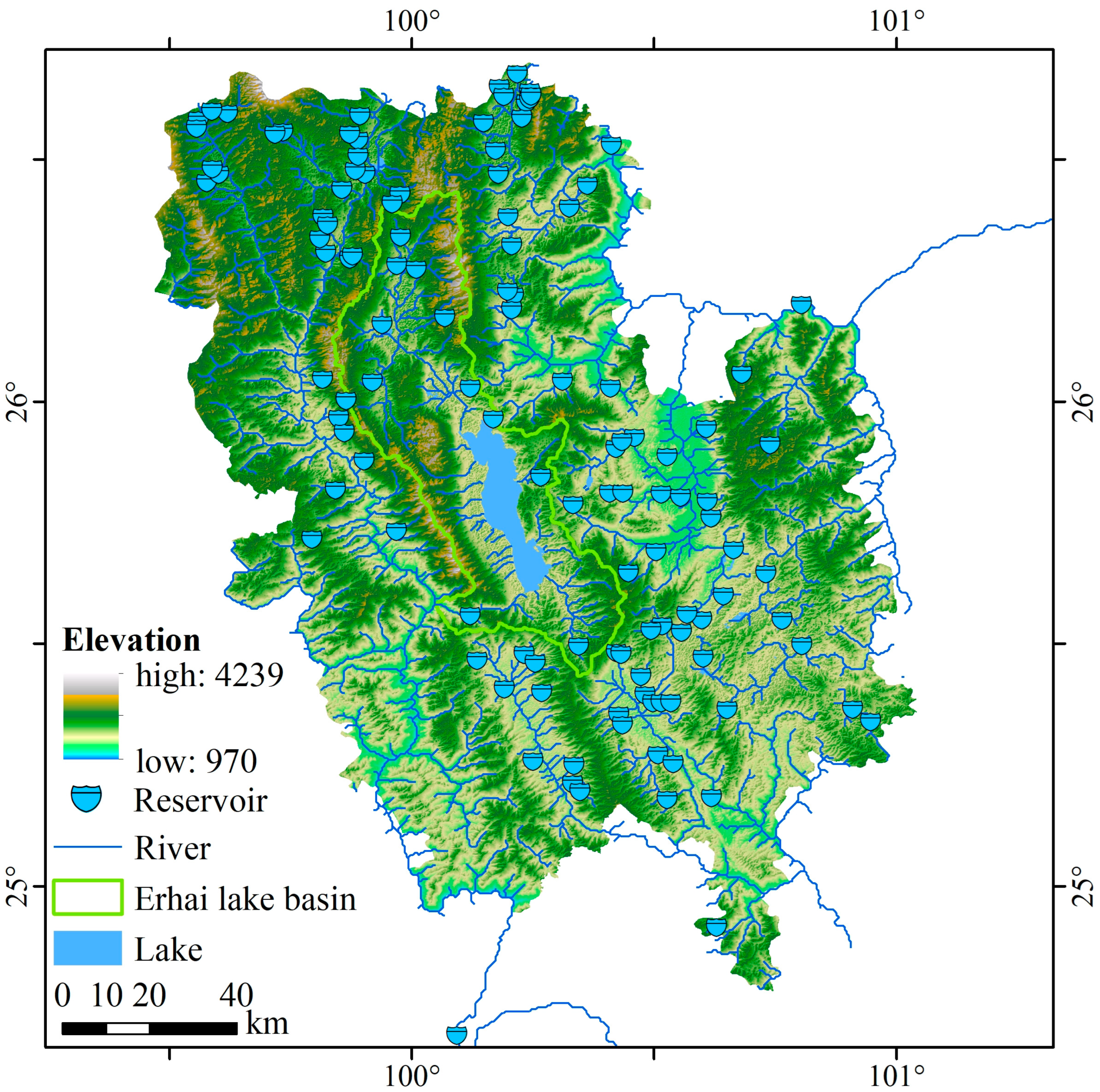
The Erhai Lake basin is located in Dali Bai Autonomous Prefecture, western Yunnan Province, China, located in the three major water systems of the Jinsha River, the Lancang River, and the Red River. It encompasses Erhai Lake and the surrounding lakes, rivers, and mountains. The Erhai Lake basin belongs to a subtropical monsoon climate, with warm and humid summers and relatively low temperatures in winter. Precipitation is higher in the summer season, which is the main rainy season, while the winter season is relatively dry. Precipitation varies with elevation and geographic location, with mountainous area typically receiving more rainfall, while basins and low-lying areas receive relatively less. The main economic source in the Erhai Lake basin is agriculture, with agriculture accounting for a significant portion of the total economic output. Tourism and fisheries also play crucial roles in the local economy. Erhai Lake is the largest freshwater lake on the Yunnan Plateau and is one of the important freshwater resources in Southwest China. It not only provides essential freshwater resources but also holds a special position in local culture and ecosystems. The study area covers 20,061 km2, with a total population of 2.825 million. The annual average rainfall is 995 mm; the annual average water resources are 5.858 billion m3; and the per capita water resources are 2074 m3, which is far lower than the provincial average. The actual total water consumption in 2019 was 1.162 billion cubic meters, of which 97 million cubic meters were for urban domestic use; 69 million cubic meters, for rural domestic use; 111 million cubic meters, for industrial use; and 885 million cubic meters, for agricultural irrigation. These accounted for 10%, 7%, 9%, and 74% of the total water consumption, respectively. Because the study area is located in a mountainous area, the distribution of water resources is uneven in time and space, which is very inconsistent with the distribution of urban population, cultivated land, etc., and the utilization of groundwater is lower. Therefore, compared with the surrounding areas, many water storage facilities have been built in the study area for water storage, including many small, independent water storage facilities, such as ponds, etc., and there are 1573 water storage facilities in the study area. In view of the fact that many small reservoirs and small dams only exist due to water storage projects and are not connected with the water system, this paper only considers large- and medium-sized water storage facilities and some small reservoirs. The specific distribution of reservoirs and rivers is shown in Figure 1.
Figure 1.
The Erhai Lake basin.
When the highest operating water level of Erhai Lake is 1966 m, the lake area is 252 km2, and the lake capacity is 2.92 billion m3. The lowest operating water level is 1964.3 m, and the variation between the legal maximum and minimum water levels is 1.7 m; the lake capacity is adjusted accordingly to 427 million m3. The average annual natural runoff in the Erhai Lake basin is 1.145 billion m3, and the utilization rate of water resources reaches 54.3% after deducting evaporation loss from the lake surface; the problem of water shortage in the basin is becoming increasingly prominent. Due to the constraints of water resources, it is important to maintain the basic balance of water volume in Erhai Lake as a last resort. Under the background conditions of developed planting industry, abundant tourism resources, and distinct dry and wet seasons in the Erhai Lake basin, agricultural non-point source pollutants are concentrated into the lake with rainfall runoff in June–October, which is the key environmental driving factor for the water quality exceeding the standard in the rainy season in the Erhai Lake in recent years, resulting in the phenomenon whereby the rise and fall in the Erhai water level and the change in water quality concentration in the lake area are basically synchronized.
The Dianzhong Water Diversion Project is a significant hydraulic engineering project in Yunnan Province, China, with substantial implications. It diverts the abundant water resources from Dianchi Lake to Kunming City and its surrounding areas, meeting the urgent need for water supply and irrigation. Its total water supply is 342 million m3, of which 74 million m3 is for urban life; 42 million m3, for the industry; and 225 million m3, for agricultural irrigation. The current population of the receiving area is 2.02 million, and the irrigated area is 80,666 km3. This project has not only essential implications in terms of technology and infrastructure but also profound impacts on ecology, society, and the economy. Particularly, in the Erhai Lake basin, the implementation of this project will replace Erhai Lake as the water source for the Binchuan and Xiangyun irrigation areas, alleviating the water stress in the Erhai Lake basin while preserving its ecological environment.
The Ludila Hydropower Station Water Resources Comprehensive Utilization Supporting Project is another crucial hydraulic engineering project in Yunnan Province, China. This project not only provides electricity resources to the region but also achieves the rational distribution of water resources through water regulation. The Ludila Project facility can divert water from the Jinsha River to Binchuan County and Xiangyun County, increasing the water supply for these areas. The Ludila Project facility is designed to supply 189.71 million m3 of water to the Binchuan irrigation district and 138.61 million m3 to the Xiangyun irrigation district. Additionally, the Ludila Project and Dianzhong Water Diversion Project facilities can be interconnected, serving as backup water sources for each other. Before the completion of the Dianzhong Water Diversion Project, the Ludila Project can solve the water demand of urban life, industry, and efficient agricultural development in Binchuan County, which has recently built the industrial and economic center of Dali Prefecture in Xiangyun County. After the completion of the Dianzhong Water Diversion Project, the Ludila Project can further guarantee the urban living and industrial water demand of Xiangyun County to sustain the industrial and economic center of Dali Prefecture in the long term and, at the same time, create conditions for the Dianzhong Water Diversion Project to supply water to the central Yunnan urban agglomeration, with Kunming as the core.
3. Materials and Methods
In this study, we use the combination of two methods to analyze the hydrological connectivity of the Erhai Lake basin. Landscape ecology pays attention to the analysis of water networks at the network level, and network analysis theory can analyze both the network characteristics and the node characteristics of water networks. First, we use the hydrological loop degree, node connectivity rate, and network connectivity in landscape ecology, and the average path length and clustering coefficient in network analysis theory to analyze the connectivity characteristics of the entire water supply network. Then, we apply degree centrality, betweenness centrality, closeness centrality, and improved K-shell decomposition method in network analysis theory to analyze the importance of nodes in the water supply network. The combination of these two methods not only helps us to fully understand the connectivity characteristics of the whole network but also analyzes the connectivity function of each node in the network and simulates the fault changes after node deletion.
This study first evaluates the connectivity of the water system in the Erhai Lake basin in 2020 and 2035 to analyze the impact of the Dianzhong Diversion Project, the Ludila Project, and other water projects. Then, the node importance of the water supply network is analyzed to select important nodes in the system for 2020 and 2035. The study also simulates the scenario where the water supply network is damaged by removing certain important nodes.
A water resource system is a network that includes water sources, links, and users (both natural and artificial), which can be mathematically represented as graphs with vertices (nodes) connected by edges (links). Based on engineering information on the Erhai Lake basin and the generated dam–river information provided by the Yunnan Water Conservancy and Hydroelectric Survey Design and Research Institute, Kunming, China, we first established the topological relationship network model of the water supply network of the Erhai Lake basin, as shown in Figure A1 and Figure A2, and node information is shown in Table A1 and Table A2. Then, the constructed network model was imported into Cytoscape software v.3.8.1 [40], and the Network Analyzer module was utilized to calculate some indicators. Cytoscape is open-source software for biological network analysis and visualization. It provides powerful tools and functionalities that help biologists, bioinformaticians, and systems biologists study and understand the structure and function of biological networks. Cytoscape has a wealth of network analysis tools for identifying topological features, centrality metrics, network modules, etc. [41], which can be employed for calculating network metrics in this research. However, there are some limitations in the process of model construction. We only consider surface water sources and engineering nodes, ignoring groundwater. Additionally, this is a purely topological study, lacking hydraulic indicators.
3.1. Hydrological Connectivity
This study evaluates the structural connectivity of the water system in the region’s river network based on the “node-edge” relationship in landscape ecology [42] and graph theory [43]. Three hydrological connectivity evaluation indicators are employed: hydrological loop degree (α), node connectivity rate (β), and network connectivity (χ) [44,45,46]. Additionally, the average path length and clustering coefficient from network analysis theory are also introduced [47] to quantify the hydrological connectivity of the water system. The water system connectivity evaluation indicators are established as follows:
- Hydrological loop degree: This indicator is used to quantify the degree to which nodes in a river network form loops, reflecting the capacity of each node in the river network to exchange material and energy [45].
- Node connectivity rate: Used to quantify the ease or difficulty with which nodes in a river network connect with other nodes, reflecting the ability of each node in the river network to establish and maintain connections within the water system [46].
- Network connectivity: It represents the ratio of the existing number of connections among corridors within the river network to the maximum possible number of connections, reflecting the strength of connectivity between river network systems and their capacity for water transport [44].where “n” represents the number of connecting links in the river network hydrological model and “v” represents the number of nodes.
- Average path length: It refers to the average shortest path length between nodes “i” and “j” in the graph. This metric measures the “closeness” of the graph and can be used to understand the speed of flow of certain elements in this network. A smaller average path length indicates higher efficiency of water transfer and complementarity in the water supply network [48].where “dij” represents the distance between node “i” and node “j” and “n” stands for the number of nodes in the network.
- Clustering coefficient: It reflects the density and clustering of connections among nodes in a network [49].
- n: node.
- CC(n): clustering coefficient of node n.
- CC: clustering coefficient of the entire network.
- Rn: number of relationships (triangles counted) among n’s neighboring nodes.
- Kn: number of first-order neighboring nodes of n.
3.2. Node Importance
A water network is the physical carrier of water circulation and water resource allocation. As the hub of a river, the node of a water network plays an important role in the connection of a water system. Node importance refers to the importance of nodes in the entire water supply network. It is classified according to different network attributes of nodes. In this study, node importance is weighted with four indicators: degree centrality, betweenness centrality, closeness centrality, and improved K decomposition in network analysis theory. The higher the value, the higher the importance of nodes in the entire water supply network. Identifying key nodes in complex water networks is of great significance to the comprehensive planning and management of water networks.
3.2.1. Node Importance Evaluation Index
Network analysis is a commonly used method in the study of transportation, electricity, and other networks. When applied to analyze water supply networks, a water supply network can be generalized as a network consisting of water sources, links, and users, which can be mathematically expressed as a set of vertices (nodes) connected by edges (links). This approach not only considers the relationships among various components of the water resource system but also reveals key nodes and critical paths in the network. In terms of studying key nodes in the network, Liu [35] defined node importance by four dimensions: local properties, global properties, propagation properties, and network position. Wang [50] pointed out the characteristics and application scope of these four indicators. When [51] conducted node importance analysis, Schick not only considered node connectivity and centrality but also added social functions characterized by indicators such as node population size and reproductive rate to quantify the node’s conservation value from a social perspective. Segurado [52] used graph theory methods to identify obstacles that affect structural connectivity in a watershed, thereby determining important nodes that can improve node connectivity and their connection modes. Bodin [53] established a joint connectivity index based on fish population protection value, habitat area, and connectivity relationships to prioritize nodes that need protection. For specific problems, degree centrality, betweenness centrality, closeness centrality, Laplacian operator, and other indicators are often used to characterize node importance from different perspectives [54,55]. When evaluating the importance of nodes in the water network, it is necessary to first select the existing evaluation indicators. In the selection process, the principles of reasonability, comprehensiveness, and ease of operation should be followed. Due to the limitation of evaluating node importance using a single indicator, this study selected four indicators, namely, degree centrality, betweenness centrality, closeness centrality, and improved K-core decomposition, in the dimensions of local properties, propagation properties, global properties, and network position, to evaluate the importance of nodes in the Erhai Lake basin water network.
- Degree centrality: Degree centrality is the most direct measure of node centrality in network analysis. The degree centrality value represents the ability of a network node to connect with its neighboring nodes. Higher degree centrality indicates a higher importance of the node in the network, meaning that the water source is more important in the water supply network. The formula for calculating degree centrality for a node is as follows:where ki represents the number of existing edges connected to node i and (N − 1) represents the number of edges through which node i is connected to all other nodes.
- Betweenness centrality: Node betweenness refers to the number of shortest paths passing through a node in a network. The higher the betweenness centrality, the more paths pass through that node in the water supply system network, indicating that the node has stronger hydraulic connectivity and is more important in the network. The formula for calculating betweenness centrality for a node is as follows [56]:where represents the number of paths, being the shortest paths, passing through node I; represents the number of shortest paths connecting s and t; and n is the number of nodes in the network.
- Closeness centrality: Closeness centrality is used to measure the ability of a node to influence other nodes through network connections, i.e., the impact of one water source on other water sources in a water supply system network. The closeness centrality (CCi) of a node is calculated as follows [57]:where “di” represents the average distance from node i to all other points and the reciprocal of the average distance is the closeness centrality.
- Network position—improved K-shell decomposition: The importance of a node in the overall network is determined by its position in the network. The K-shell method [58] can be used to measure the positional attributes of nodes, as indicated by the Ks metric. According to the K-shell method, nodes with degrees lower than or equal to k are sequentially removed from the network, resulting in the Ks value for each node. The procedure of the K-shell method is as follows: decompose the network graph into K-shells, where the maximum subnetwork in S = (G,E|G) with degrees greater than or equal to k is the K-core; nodes with Ks = k are the k-shell. However, when applying the K-shell method to evaluate node importance in the water network of the Erhai Lake basin, the evaluation results were not satisfactory, as all nodes had a Ks value of 1. Therefore, this study adopts an improved K-shell method (IKs).
The procedure of the improved K-shell method is as follows: Let the original global network be T0. For the node with the smallest degree in T0, set Ks1 = 1. Remove the node with the smallest degree in T0, resulting in subgraph T1. For the node in T1 with the smallest degree, set Ks = Ks1 + 1. Repeat this process until all nodes are removed. After the k-th node is removed, for nodes in the subgraph with a degree of 0, set their Ks value of k + 1. The improved K-shell method can reflect both the global network position attributes of nodes and the local differences among nodes.
3.2.2. Standardization of Metrics
Due to the measurement units and scales of the various indicators being different, it is difficult to conduct a comprehensive analysis. To facilitate comparisons of the importance of nodes under different evaluation systems, this study standardizes each metric as shown in the formula below:
where Qi represents the original evaluation metric, and Pi represents the standardized evaluation metric.
3.2.3. Comprehensive Node Importance Assessment
This study conducts a comprehensive evaluation of node importance using the analytic hierarchy process (AHP). The weights of the DC, BC, CC, and IKs indicators in the evaluation system are calculated using the AHP method.
The three-scale method (0, 1, 2) is used to compare each indicator pairwise and establish a comparison matrix. Since DC reflects the least abundant global topological structure information, it is considered relatively less important compared with other indicators. BC reflects the connectivity of nodes in the network, while CC reflects the degree of proximity between nodes and the network center. Both indicators characterize the global attributes of nodes and are considered equally important. IKs not only characterizes the global properties of nodes but also reflects local characteristics, making it more important than other indicators. Based on the assigned formulas below, the importance evaluation indicators for each node are obtained as shown in Table 1.
Table 1.
Comparison of node importance evaluation indicators.
We construct a judgment matrix using the range method:
where , , , , , and .
Upon verification, consistency ratio CR < 1, indicating that the judgment matrix passes the consistency test. The weight vector for each indicator is as follows:
Node importance is
4. Results
4.1. Analysis of Changes in Water Network Structural Connectivity
Based on Table 2 above, the following changes in the water network structure in the Erhai Lake basin are observed after the construction of the Dianzhong Water Diversion Project, the Ludila Project, and a series of reservoirs for the period from 2020 to 2035.
Table 2.
Water network structural connectivity.
Change in water network characteristics: From 2020 to 2035, significant changes occur in the water network characteristics of the Erhai Lake basin. The number of nodes increases from 215 to 337, and the number of links increases from 216 to 379, indicating a notable increase in the complexity and connectivity of the water network.
Increase in hydrological loopiness: Hydrological loopiness increases from 0.047 to 0.643, indicating increased complexity and diversity in the hydrological loops. This could be attributed to the construction of new water diversion projects and reservoirs, which results in more intersections of water sources and pathways.
Improvement in node connectivity: Node connectivity increases from 1.005 to 1.125, indicating a closer connection among different nodes within the basin and more efficient flow and distribution of water resources.
Changes in network connectivity: Hydrological connectivity slightly increases from 0.338 to 0.377, indicating stronger connections among different hydrological systems within the basin, potentially contributing to a more balanced distribution of water resources.
Reduction in characteristic path length: The characteristic path length decreases from 18.423 to 11.680, indicating that water resources’ transmission paths within the basin become, making it easier for water to flow from one location to another.
Increase in clustering coefficient: The clustering coefficient increases from 0.006 to 0.024, indicating that by 2035, water resource distribution within the basin will tend to aggregate in certain specific areas rather than being dispersed throughout the entire basin.
In summary, significant changes will occur in the water network characteristics of the Erhai Lake basin by 2035, with profound impacts on the distribution and flow of water resources due to the construction of new water diversion projects and reservoirs. These findings have significant reference value for watershed water resource management and planning for future water resource utilization. To better understand the impacts of these changes and the challenges that need to be faced in the future, further in-depth research is still needed.
4.2. Node Importance Analysis
4.2.1. The Importance of Nodes in the Year 2020
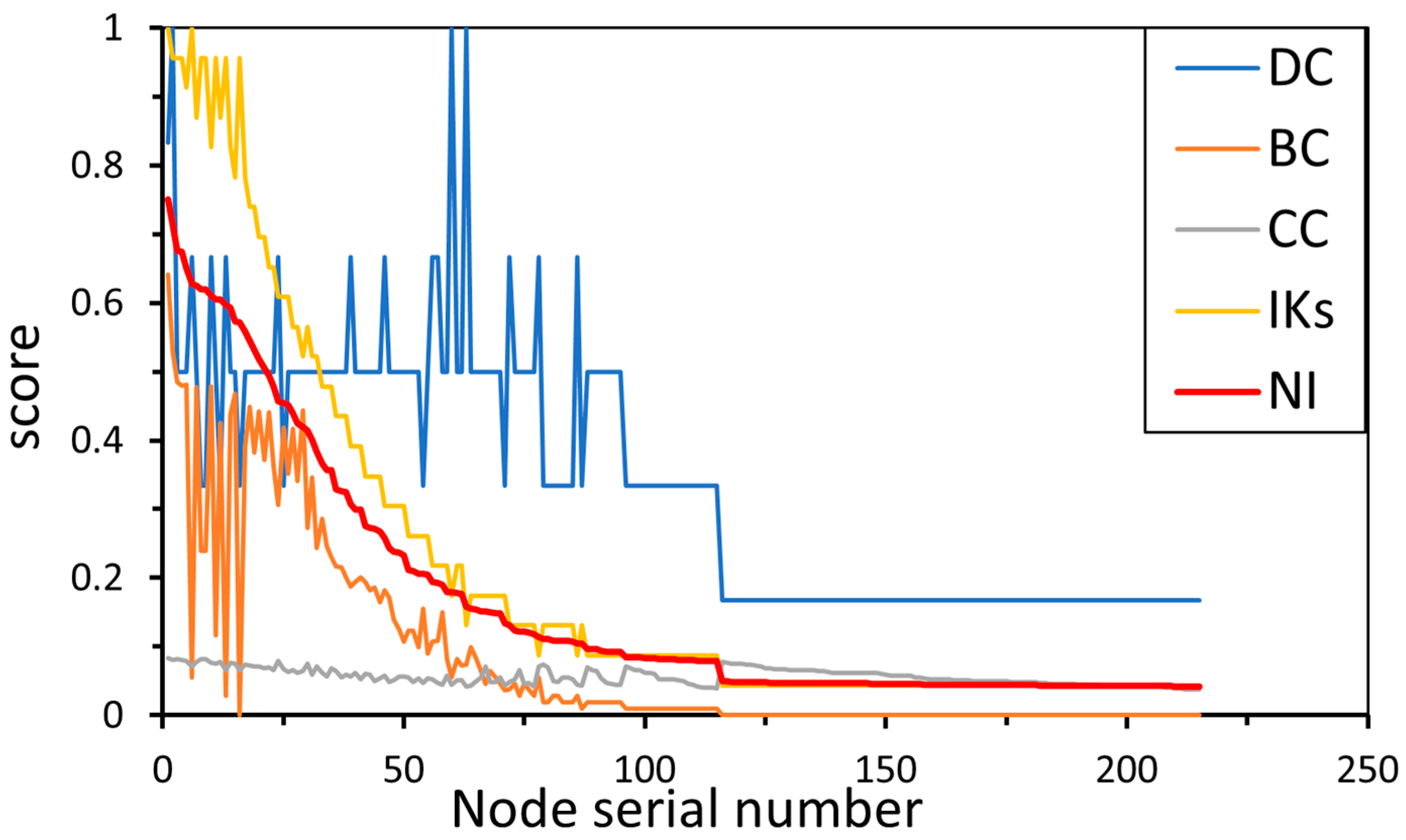
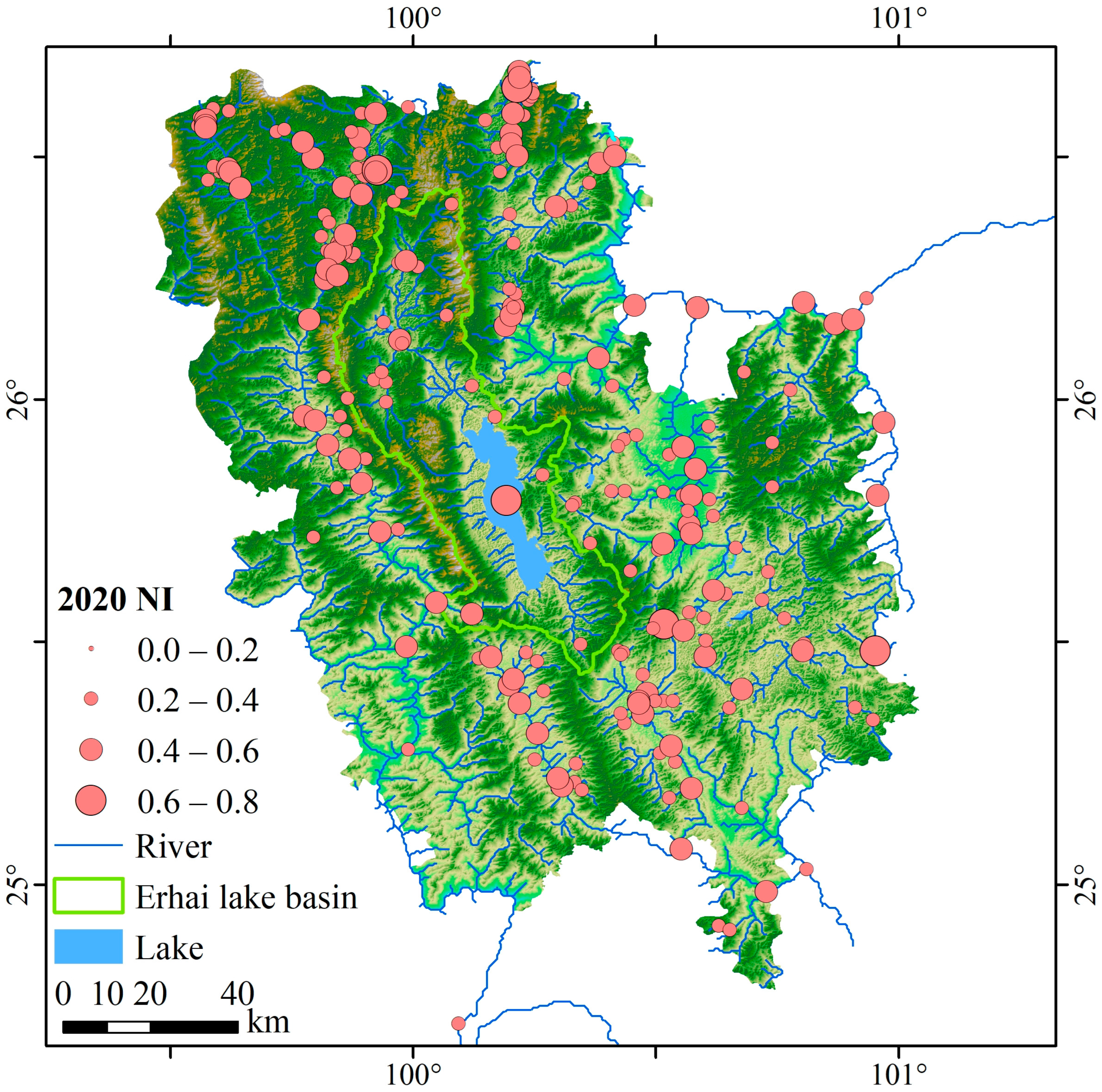
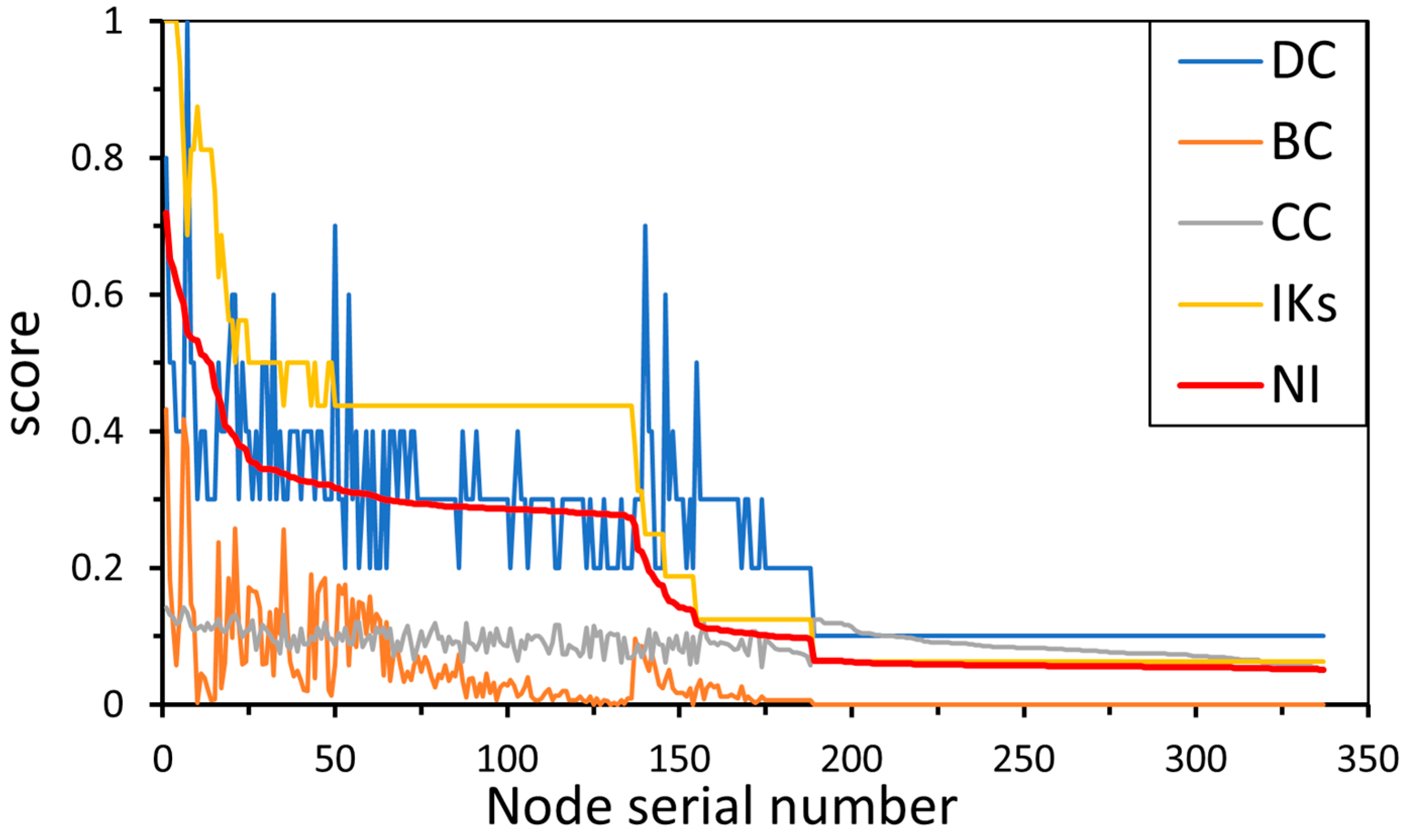
Following calculations, node importance in the Erhai Lake basin in the 2020 scenario is shown in the following Figure 2 and Figure 3. The names corresponding to the Cytoscape graph and node numbers can be seen in Figure A1 and Table A1.
Figure 2.
Node importance in 2020 scenario.
Figure 3.
Spatial distribution of node importance in 2020 scenario.
The top ten nodes in terms of importance in 2020 in the Erhai Lake basin are as follows: Xiaoguan Village reservoir, Erhai Lake, Pindianhai reservoir, Qinghai Lake reservoir, Zhonghe 0, Mici River 1, Zhonghe 1, Er Dian Qing, Hunsu Lake reservoir, and Zhonghe-Yupao River. These include one engineering node, one water body, four reservoirs, and four river nodes.
In the 2020 scenario, the Xiaoguan Village reservoir is considered one of the most important nodes in the Erhai Lake basin. The Xiaoguan Village reservoir, Pindianhai reservoir, Hunsu Lake reservoir, Qinghai Lake reservoir, and other reservoirs collectively form a connected water diversion system. The Xiaoguan Village reservoir not only supplies water but also stores water to meet downstream the Pindianhai reservoir’s and the Hunsu Lake reservoir’s water storage needs. The Pindianhai reservoir and Hunsu Lake reservoir can also supply water to the Qinghai Lake reservoir, forming a jointly operated Xiaoguan Village water source system, with the Xiaoguan Village reservoir at its core. The Xiaoguan Village reservoir plays a crucial role in water resource storage and distribution, storing water during the dry season to alleviate water pressure for usage and releasing water during the rainy season to prevent flooding disasters. It holds significant importance in watershed water resource management.
Erhai Lake, as an important water body node in the basin, has significant water storage capacity and plays a critical role in meeting water resource demand and supply. Its water quality and quantity directly impact the sustainability of the ecosystem and society. Erhai Lake provides conditions for the existence of multiple ecosystems and species and plays an important role in maintaining the ecological balance of the watershed. Its importance is closely related to ecological protection, biodiversity maintenance, and wetland function restoration.
River nodes such as Zhonghe 0, Mici River 1, Zhonghe 1, and Zhonghe-Yupao River have high importance. These nodes are convergence points for different water bodies and water flows and typically have complex water resource flow networks. They enhance the connectivity of water resources among different regions within the watershed, and these nodes play a crucial role in the transmission and distribution of water resources, thus holding high importance in the water resource network of the watershed.
Er Dian Qing, as an important node, is the entry point for the Yin’er Diversion Project. This project aims to provide water from Erhai Lake to fulfill the irrigation needs of the Binchuan irrigation area. It is also the intersection point for the future Ludila Project and Qinghai Lake Phase II Project, playing an important role in water supply within the watershed.
Overall, the water network characteristics of the Erhai Lake basin will undergo significant changes by 2035 due to the construction of new water diversion projects and reservoirs. These findings have important implications for watershed water resource management and future water resource utilization planning, and further research may be needed to better understand the impacts of these changes and future challenges.
4.2.2. The Importance of Nodes in the Year 2035
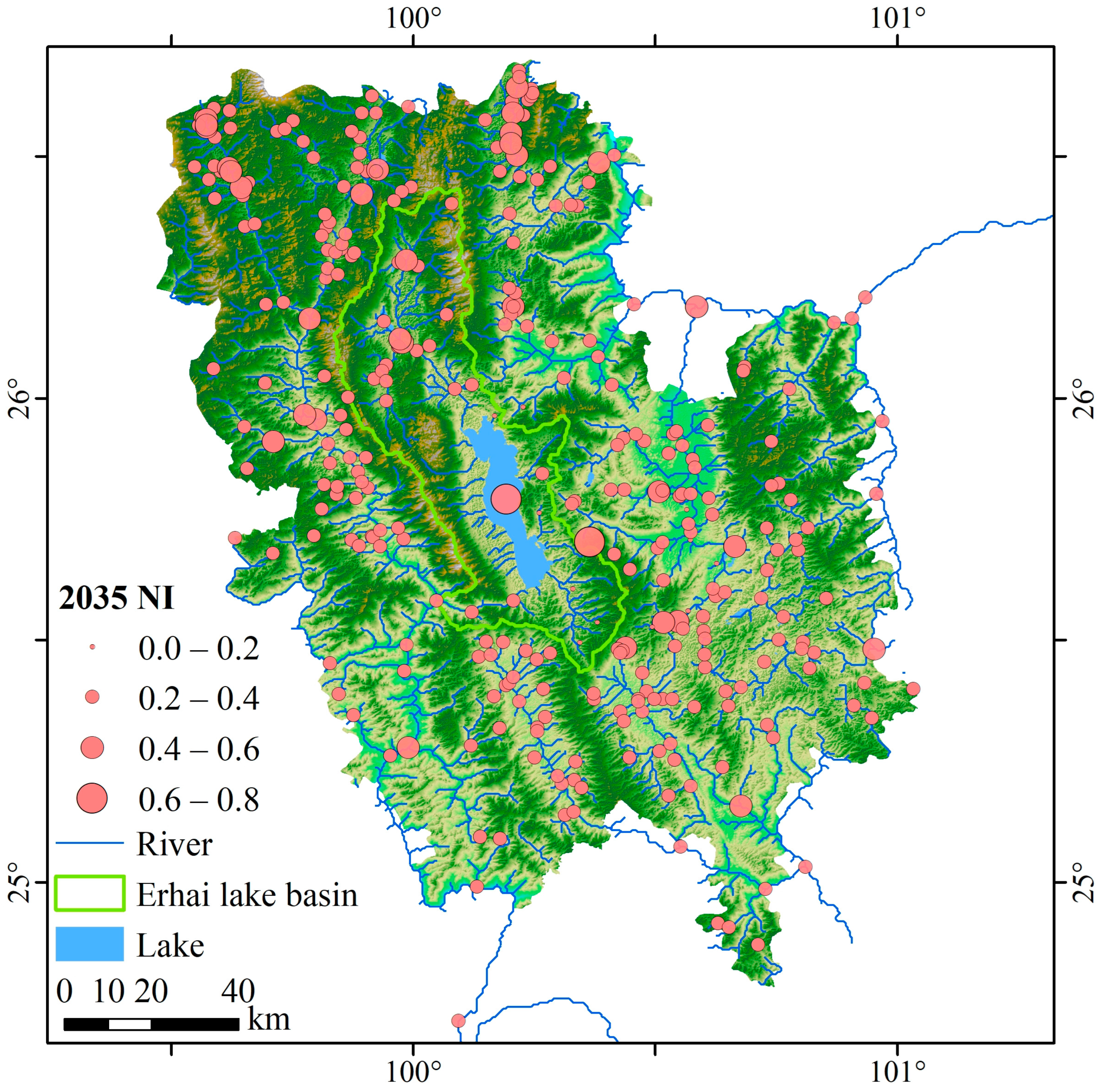
Following calculations, node importance in the Erhai Lake basin in the 2035 scenario is shown in the following Figure 4 and Figure 5. The names corresponding to the Cytoscape graph and node numbers can be seen in Figure A2 and Table A2.
Figure 4.
Node importance in 2035 scenario.
Figure 5.
Spatial distribution of node importance in 2035 scenario.
The top ten nodes in terms of importance are Er Dian Qing, Da Yin Dian Node, Dian Lu Er, Lu Di La Phase II Node, Lu Di La Bin Chuan Node, Dian Zhong 1 Node, Erhai Lake, Lu Di La East Line Project, Sang Yuan River–Jinsha River, and Xian E reservoir. There are a total of seven engineering nodes, one reservoir, one water body, and one river intersection in this list.
Erhai Lake, as a crucial water body in the basin, will continue to hold high importance even after the construction of the projects, maintaining its significant impact on the basin’s water resources and ecosystem.
With the construction of these projects, seven of the ten important nodes are engineering nodes related to the Dian Zhong Water Diversion Project or the Lu Di La Project, which proves that these projects will largely improve the connectivity of the water system in the Erhai basin. The Dian Zhong Water Diversion Project and Lu Di La Project will not only introduce external water sources but also establish interconnectivity among various projects, such as the Dian Zhong Water Diversion Project, Lu Di La Project, Qinghai Lake Project, and Yinyu Ruins Project. This will significantly enhance the connectivity of the water supply network and facilitate balanced water supply throughout the entire watershed.
The Xian E reservoir is a medium-sized reservoir in Binchuan County which not only connects the Yimin Lake reservoir and the Sangyuan River but also the Binchuan node of the Lu Di La Project, playing a crucial role in supplying water to the Binchuan irrigation area.
The Sang Yuan River–Jinsha River node serves as an important river confluence point and a water intake node for the Lu Di La East Line Project. Water taken from this node can be transported through the Lu Di La East Line Project to meet water demands within the basin. Simultaneously, it can flow naturally back to this node through the Sang Yuan River, facilitating water recycling. Therefore, it holds high importance.
Compared with 2020, the number of engineering nodes ranked in the top ten in terms of importance significantly will increase in 2035. The number of reservoir nodes and river nodes will decrease. This indicates that newly constructed water diversion projects have remarkable significance in the water supply network, making the basin water network larger and more complex, increasing water network connectivity, and improving resilience against risks. Nodes of different types are considered highly important because they play a critical role in water resource management, ecological conservation, flood control, and water resource distribution. Their high importance reflects their contributions and impacts on the overall water resource system within the basin. Therefore, these nodes require special attention and management to ensure the sustainable utilization of water resources and the sustainable development of the basin.
4.3. Network Degradation Analysis
When the inflow points of the Erhai Lake basin water system, control hubs, and hydraulic engineering nodes are damaged, the connectivity of the entire water network decreases. The impact of the destruction of nodes with different levels of importance on the water supply network’s efficiency varies. This article selectively removes some nodes based on their importance in the 2020 and 2035 water supply networks to analyze the changes in connectivity when these nodes are damaged.
4.3.1. Changes in the 2020 Water Network after Node Losses
Reduction in the number of nodes and links: After removing the selected nodes, the total number of nodes in the water network decreased by two–three units, and the number of links decreased by two–six units. This is likely because these nodes have more connections in the network, and their removal results in the breakage of some links. As a result, some secondary nodes lose those connections, leading to a decrease in the number of nodes. The specific changes of network characteristics are shown in Table 3.
Table 3.
Changes in the water supply network after the removal of some nodes in 2020 scenario.
Changes in hydrological loopiness: The hydrological system experienced a significant decline in overall water network cyclicality, indicating a reduction in the circular structure. This indicates that these nodes play an important role in forming circular connections within the water network, and the disruption of these nodes results in a substantial decrease in the number of circular patterns.
Decreased node connectivity: The connectivity rate of the nodes experienced a slight decline, suggesting a minor weakening of the interconnectivity among the nodes upon the removal of each of these nodes. This could be attributed to the critical role these nodes play in maintaining the connections between them.
Slight decrease in network connectivity: There was a slight decrease in the connectivity of the water system, with minimal changes being observed. This suggests that the overall connectivity of the entire water system remains relatively stable, although there is still a slight impact when certain nodes are removed.
Changes in characteristic path length: After removing the Xiaoguan Village reservoir, the characteristic path length decreased from 18.423 to 9.524, indicating a significant reduction in the average path length between nodes. This is because the Xiaoguan Village node is an important intermediate node, and its removal makes the transmission efficiency among nodes more direct and rapid. However, after removing the Mi Ci River 1 node, the characteristic path length increased from 18.423 to 18.604, resulting in a slight increase in network transmission efficiency. This node is located at the intersection of multiple paths, and its removal leads to longer paths that previously passed through this node, thus causing an increase in the average path length.
Significant change in clustering coefficient: The significant decrease in the clustering coefficient from 0.006 to 0 indicates a major change in the network structure. The clustering coefficient measures the density of connections among a node’s neighbors, so the decrease from 0.006 to 0 means a significant reduction in the density of connections among a node’s neighbors. These nodes may have multiple neighbor nodes in the network, and their removal results in the loss of connections for other nodes associated with them, leading to a sparser network of connections and affecting the clustering coefficient of the entire network.
4.3.2. Changes in the 2035 Water Network after Node Losses
In the 2035 scenario, the water supply network in the Erhai Lake basin exhibited different response patterns, with a range of changes in the number of nodes and links, mainly due to the evolution and adjustments in the network structure, making certain nodes more critical components with multiple links. The changes in the water system’s degree of connectedness were more significant compared with the 2020 scenario, indicating an increased reliance on key nodes within the network. Nonetheless, overall water system connectivity and node connectivity saw relatively modest changes, reflecting the resilience and stability of a mature network. However, changes in the clustering coefficient indicate significant adjustments in the local structure of the network, with variations in the density of connections among neighboring nodes, reflecting the network’s dynamic evolution in adapting to new pressures and challenges. The changes in characteristic path length were relatively small compared with the 2020 scenario, with the greatest increase being observed after the removal of the Erhai Lake node, signifying a significant reduction in network transmission efficiency. This is because the Erhai Lake node serves as an intersection point for multiple pathways, connected to various water diversion projects such as the Erhai-to-Binchuan Water Diversion Project, Dianzhong Water Diversion Project, and Ludila Project. Its removal leads to longer pathways that were originally routed through this node, resulting in an increase in characteristic path length. The specific changes of network characteristics are shown in Table 4.
Table 4.
Changes in the water supply network after the removal of some nodes in 2035 scenario.
In summary, according to the comparison of the 2020 and 2035 scenarios, the water supply network in the Erhai Lake basin underwent significant changes in both structure and function, increasing in complexity and dependence on key nodes. These changes indicate that over time and with engineering developments, the supply network will be adjusted to accommodate new challenges and demands. These changes are evident not only in alterations in network size and connectivity but also in its response to the removal of key nodes. Understanding these changes is crucial to assessing long-term network stability and resilience and provides important insights for future water supply network design and management. By analyzing these changes, we can better plan for and address potential risks and challenges in the future, ensuring the sustainability and efficiency of the water supply network.
5. Discussion
This study combines landscape ecology theory and the network analysis methodology to analyze the structural characteristics of the water supply network in the Erhai Lake basin. This study compares the characteristics of the water supply network under future planning scenarios with those of the current scenario, revealing the essential structural characteristics of the water supply network in this region and conducting failure simulations. According to the government’s regional development plan “Yunnan Water Network Construction Plan”, in order to alleviate the contradiction between the supply and demand of water resources in the region, it is expected that large-scale water conservancy projects, such as the Dianzhong Water Diversion Project and the Ludila hydropower station, as well as many other reservoirs and water transfer projects, will be completed by 2035. Therefore, we use the planned water network for 2035 as the future analysis scenario. However, as this is a long-term planning project, some adjustments may be made during the construction process due to the impact of real climate change and human activities. For example, the construction of some reservoirs may be canceled, and some water transfer pipeline routes may be changed, so the real water network in 2035 may be somewhat different from the expected water network.
5.1. Impact of Large-Scale Water Transfer Projects on the Water Supply Network
Large-scale water diversion and transfer projects will increase the number of nodes and connecting lines in the water supply network, and new engineering projects may create more water flow paths, not only providing additional water to the receiving area but also making the overall water network structure more complex, improving the flexibility and regulation of the water supply system. The addition of paths and nodes increases the system’s resilience to disturbances, such as drought and pollution, and ensures water supply through alternative paths. The California State Water Project [4] has significantly changed the topology of California’s water supply. It has not only increased the water transfer paths and nodes in the water supply network but also improved the stability of the system [8] during drought. However, it has a negative impact on the ecological environment of the delta region and has triggered the political controversy over water resources. After the construction of water conservancy projects in the Yongding River basin in China, the importance of nodes has changed, and it has been found that water conservancy projects will not only lead to the decrease in the importance of some nodes [36] but also lead to the increase in the importance of some nodes. The results of this study show that by 2035, the water supply network in the Erhai Lake basin will be more complex, with higher connectivity and higher transmission efficiency among nodes compared with 2020. The newly constructed engineering nodes have high importance in the entire water network, indicating that the construction of these projects is necessary. The addition of these new engineering nodes will allow the 2035 network to not only improve the utilization of local water sources but also bring about external water diversion. It reduces the excessive dependence of local users on local water sources, improves the ability of the water supply system to cope with risks, and guarantees the steady development of regional economy and society. But it also requires careful planning and management to ensure ecological and socio-economic balance.
5.2. Impact of Node Failure on Water Supply Network
Through network degradation analysis, it can be observed that damage to key nodes significantly affects the connectivity of the entire water network, and the degree and category of impact may vary among different nodes [53]. This may lead to the unuse of planned water sources, which would not only affect the normal use of industrial, agricultural, and domestic water but also lead to huge losses in some industries that are highly dependent on water. At the same time, there are ecological protection requirements of the Erhai Lake basin regarding the flow. The interruption of some nodes may lead to the decrease in the inflow to Erhai Lake and the decrease in the purification capacity of Erhai Lake, thus suffering ecological damage. The planned hydraulic engineering projects have increased new connectivity links, providing more alternative transmission pathways among water sources and even connecting previously disconnected networks. This can also lead to the emergence of new, shorter paths, improving transmission efficiency and avoiding multiple water sources sharing a single link. On the other hand, the complexity of the network increases, and even if some links are damaged, transmission can still be achieved through other paths. However, despite the construction of new facilities, the network still exhibits a high level of centralization, with most of the newly constructed facilities being located at key nodes and key links. Although this improves the ability to withstand risks to some extent, the impact of damage to key links and nodes should not be underestimated [8,59].
5.3. Deficiencies and Prospects
In an ideal water supply network, there should be multiple alternative transmission paths between nodes, and the importance of each node should not differ significantly, thereby preventing significant disruptions to the entire network due to damage to certain links. The removal of important nodes from the water supply network of the Erhai Lake basin has a significant impact on the network. Therefore, it is necessary to distribute important resources throughout the network rather than relying excessively on certain nodes. By decentralizing nodes and reducing their importance, the impact of a single node on the entire network can be reduced, potentially enhancing the network’s resilience and ability to handle failures. Although long-distance water transfer cannot avoid losses during the transportation process, excessive reliance on local water supplies by users makes them vulnerable to local hydrological changes. For instance, the drought that has occurred in the Erhai Lake basin in recent years has caused significant socio-economic losses. Inter-basin water transfer projects can divert water from abundant areas to water-deficient areas, reducing the degree to which users are affected by local hydrological changes and improving their ability to cope with natural risks. Due to the analysis of the water supply network being a purely topological study, it also has some limitations based on topological theory [27,60]. Firstly, the analysis conducted in this study primarily focuses only on surface water infrastructure and does not consider crucial resources such as groundwater, which also plays a significant role in human economic and social activities, especially during drought periods [61]. Secondly, the analysis of the entire water supply network in the Erhai Lake basin does not consider the weight factors of specific nodes or links, such as considering flow rates or construction costs. Thirdly, treating the network as a set of equidistant points and assuming equal distances between adjacent points simplifies the actual water supply network and does not consider factors such as losses during transportation over distance. In future research, the influence of water transport losses should be considered, such as the distance between nodes, losses during transport, and weighting nodes based on factors like flow rates or economic costs. Additionally, when setting up fault simulations, considering scenarios involving the simultaneous disruption of multiple nodes could provide a more comprehensive analysis [8,37]. Furthermore, integration with other system analysis techniques in future research can ensure that network analysis aligns more closely with real-world conditions. Water diversion projects play an important role in strengthening water supply networks, helping to expand and complicate basin water networks, increase connectivity within water networks, and enhance resilience to various risks [62]. However, the construction of inter-basin water transfer project facilities also needs scientific and reasonable technical support and policy guarantee, involving multiple factors, such as project investment, environmental protection, and social stability [63], and has a huge impact on human beings. In order to improve construction rationality and maximize the function of a water transfer project, the connectivity attribute of the water supply network in the graph theory layer may also be considered as one of the factors in project planning in the future.
6. Conclusions
In the southwestern region of China, the total water resources are abundant, but their spatial and temporal distribution is uneven. Drought has become a significant factor limiting the economic and social development of this area. Addressing this issue, this study focuses on the Erhai Lake basin and combines landscape ecology theory and network analysis theory to analyze the structural characteristics of the water supply network in both the current and future planning scenarios. The main conclusions of the study are as follows.
In 2020, the water supply network of the Erhai Lake basin reached 215 nodes and 216 links, forming a complex network system. The average path length was 18.423, and the hydrological loop degree was 0.047, indicating poor connectivity of the water supply network and low water transfer efficiency. In 2035, it is expected that after the completion of the Ludila Project and the Dianzhong Water Diversion Project, the water supply network of the Erhai Lake basin will have 337 nodes and 379 links, the average path length will decrease to 11.680, the hydrological loop degree will increase to 0.643, and the node connectivity rate will also increase slightly in terms of network connectivity. This shows that these large-scale water diversion projects have greatly increased the hydrological connectivity of the water supply network, and the water flow transfer efficiency is higher. At the same time, among the top 10 nodes in importance, the number of engineering nodes increases from 1 in 2020 to 7 in 2035, which also validates the rationality of planned works having a very positive impact on the hydrological connectivity of the water supply network. Node failure scenario settings for 2020 and 2035 show that node failure leads to a significant decline in the water system circulation index and other indicators, reducing the hydraulic connectivity of the water supply network.
This research provides new insights for water resource management and planning to better address environmental challenges and promoting the sustainable development of water resources.
Author Contributions
Conceptualization and methodology, K.S. and T.W.; validation, X.J. and H.X.; resources, X.J. and D.Y.; writing—original draft preparation, K.S.; supervision, T.W. and Z.W. All authors have read and agreed to the published version of the manuscript.
Funding
This work was supported by grants from National Key Research and Development Program of China (No. 2021YFC3000204), Natural Science Foundation of Henan (No. 222300420327), Natural Science Foundation of China (NSFC) (No. 52209038).
Data Availability Statement
The data presented in this study are available in Appendix A.
Acknowledgments
Thanks to Yunnan Institute of Water Conservancy and Hydropower Survey, Design, and Research for their material support for this study.
Conflicts of Interest
Author Dengming Yan was employed by the company Yellow River Engineering and Consulting Co. The remaining authors declare that the research was conducted in the absence of any commercial or financial relationships that could be construed as potential conflicts of interest.
Appendix A
Figure A1.
Water system modeling for 2020 scenario produced with Cytoscape. The numbers represent the node numbers, as specified in Schedules 1 and 2, and the arrows represent the direction of the water flow.
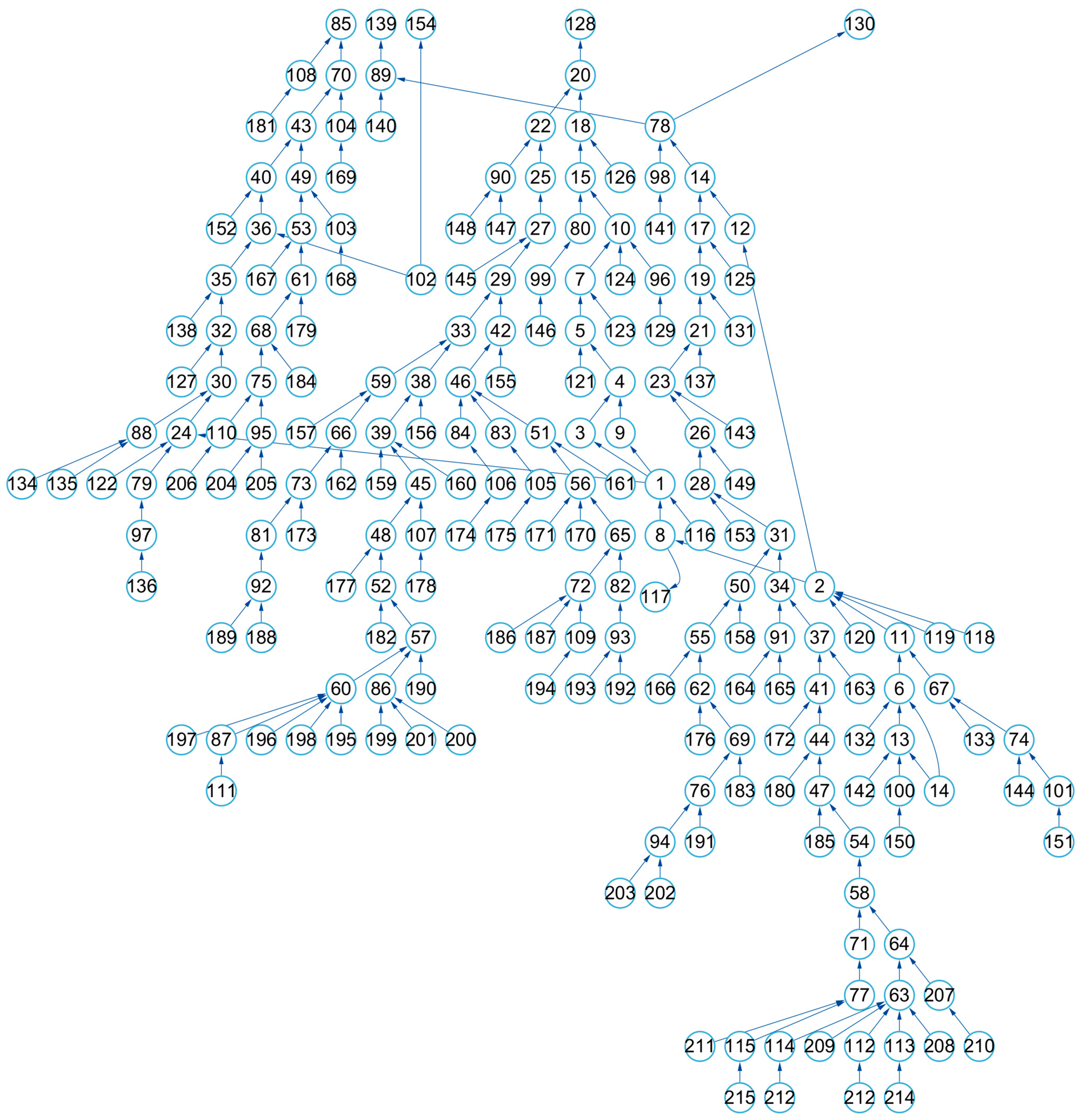
Figure A2.
Water system modeling for 2035 scenario produced with Cytoscape. The numbers represent the node numbers, as specified in Schedules 1 and 2, and the arrows represent the direction of the water flow.
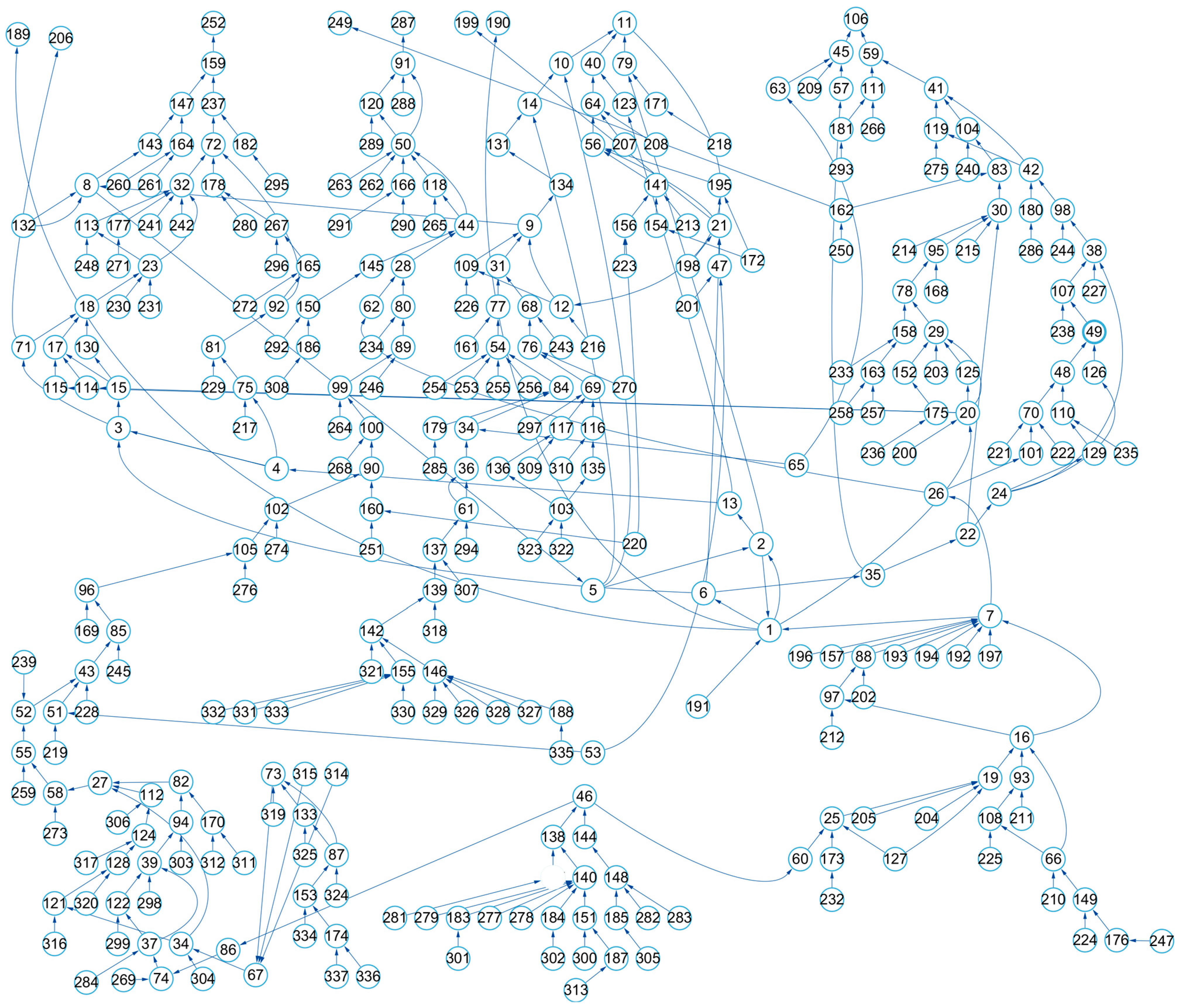
Table A1.
Node ordinal numbers and node names for 2020 scenario.
Table A2.
Node ordinal numbers and node names for 2035 scenario.
References
- Wang, T.; Wu, Z.; Wang, P.; Wu, T.; Zhang, Y.; Yin, J.; Yu, J.; Wang, H.; Guan, X.; Xu, H.; et al. Plant-groundwater interactions in drylands: A review of current research and future perspectives. Agric. For. Meteorol. 2023, 341, 109636. [Google Scholar] [CrossRef] [Scilit]
- Wang, T.; Wang, P.; Wu, Z.; Yu, J.; Pozdniakov, S.P.; Guan, X.; Wang, H.; Xu, H.; Yan, D. Modeling revealed the effect of root dynamics on the water adaptability of phreatophytes. Agric. For. Meteorol. 2022, 320, 108959. [Google Scholar] [CrossRef] [Scilit]
- Sugg, Z. An Equity Autopsy: Exploring the Role of Water Rights in Water Allocations and Impacts for the Central Valley Project during the 2012–2016 California Drought. Resources 2018, 7, 12. [Google Scholar] [CrossRef] [Scilit]
- Grigg, N.S. Large-scale water development in the United States: TVA and the California State Water Project. Int. J. Water Resour. Dev. 2023, 39, 70–88. [Google Scholar] [CrossRef] [Scilit]
- Rouse, W.R.; Woo, M.-K.; Price, J.S. Damming james bay: I. potential impacts on coastal climate and the water balance. Can. Geogr. 1992, 36, 2–7. [Google Scholar] [CrossRef] [Scilit]
- Shay, C.T.; Shay, J.M.; Johnston, B. Evaluating the impacts of a hydro-electric development in northern Manitoba, Canada. Environmetrics 1991, 2, 217–226. [Google Scholar] [CrossRef] [Scilit]
- Fisher, W.F. Diverting Water: Revisiting the Sardar Sarovar Project. Int. J. Water Resour. Dev. 2001, 17, 303–314. [Google Scholar] [CrossRef] [Scilit]
- Porse, E.; Lund, J. Network Analysis and Visualizations of Water Resources Infrastructure in California: Linking Connectivity and Resilience. J. Water Resour. Plan. Manag. 2016, 142, 04015041. [Google Scholar] [CrossRef] [Scilit]
- Yang, A.-M.; Zhang, L.; Gan, H.; Wang, H. Evaluation on eco-environmental benefits in water reception areas of the east-route phase 1 project of the south-to-north water diversion. Shuili Xuebao/J. Hydraul. Eng. 2011, 42, 563–571. [Google Scholar]
- Wang, S.; Wang, J.; Zhou, K.; Wang, W.; Wan, Y. Response of land-use/land cover change to ecological water conveyance in the lower reach of Tarim River. Water Resour. Prot. 2021, 37, 69–74+80. [Google Scholar] [CrossRef]
- Shumilova, O.; Tockner, K.; Thieme, M.; Koska, A.; Zarfl, C. Global Water Transfer Megaprojects: A Potential Solution for the Water-Food-Energy Nexus? Front. Environ. Sci. 2018, 6, 150. [Google Scholar] [CrossRef] [Scilit]
- Wang, Z.L.; Nixon, R.; Erwin, A.; Ma, Z. Assessing the Impacts of Large-Scale Water Transfer Projects on Communities: Lessons Learned from a Systematic Literature Review. Soc. Nat. Resour. 2021, 34, 820–841. [Google Scholar] [CrossRef] [Scilit]
- Outline of National Water Network Construction Plan. China Water Conservancy 2023, 11, 1–7. Available online: https://link.cnki.net/urlid/11.1374.TV.20230614.1915.002 (accessed on 1 January 2024).
- Kesavan, H.K.; Chandrashekar, M. Graph-theoretic models for pipe network analysis. J. Hydraul. Div. 1972, 98, 345–364. [Google Scholar] [CrossRef] [Scilit]
- Pien, K.-C.; Han, K.; Shang, W.; Majumdar, A.; Ochieng, W. Robustness analysis of the European air traffic network. Transp. A-Transp. Sci. 2015, 11, 772–792. [Google Scholar] [CrossRef] [Scilit]
- Pascual-Hortal, L.; Saura, S. Comparison and development of new graph-based landscape connectivity indices: Towards the priorization of habitat patches and corridors for conservation. Landsc. Ecol. 2006, 21, 959–967. [Google Scholar] [CrossRef] [Scilit]
- Jackson, C.R.; Pringle, C.M. Ecological Benefits of Reduced Hydrologic Connectivity in Intensively Developed Landscapes. Bioscience 2010, 60, 37–46. [Google Scholar] [CrossRef] [Scilit]
- Albert, R.; Jeong, H.; Barabási, A.L. Error and attack tolerance of complex networks. Nature 2000, 406, 378–382. [Google Scholar] [CrossRef] [Scilit]
- Bompard, E.; Napoli, R.; Xue, F. Analysis of structural vulnerabilities in power transmission grids. Int. J. Crit. Infrastruct. Prot. 2009, 2, 5–12. [Google Scholar] [CrossRef] [Scilit]
- He, S.; Li, S.; Ma, H.R. Integrating fluctuations into distribution of resources in transportation networks. Eur. Phys. J. B 2010, 76, 31–36. [Google Scholar] [CrossRef] [Scilit]
- Yazdani, A.; Jeffrey, P. A complex network approach to robustness and vulnerability of spatially organized water distribution networks. arXiv 2010, arXiv:1008.1770. [Google Scholar] [CrossRef] [Scilit]
- Kurant, M.; Thiran, P.; Hagmann, P. Error and attack tolerance of layered complex networks. Phys. Rev. E 2007, 76, 026103. [Google Scholar] [CrossRef] [Scilit] [PubMed]
- Strogatz, S.H. Exploring complex networks. Nature 2001, 410, 268–276. [Google Scholar] [CrossRef] [Scilit] [PubMed]
- Lai, Y.-C.; Motter, A.E.; Nishikawa, T. Attacks and Cascades in Complex Networks. Complex Netw. 2004, 650, 299–310. [Google Scholar]
- Ren, X.; Lyu, L. Review of ranking nodes in complex networks. Chin. Sci. Bull. 2014, 59, 1175–1197. [Google Scholar] [CrossRef] [Scilit]
- Castro-Gama, M.E.; Pan, Q.; Jonoski, A.; Solomatine, D. A Graph Theoretical Sectorization Approach for Energy Reduction in Water Distribution Networks. Procedia Eng. 2016, 154, 19–26. [Google Scholar] [CrossRef] [Scilit]
- Yazdani, A.; Jeffrey, P. Water distribution system vulnerability analysis using weighted and directed network models. Water Resour. Res. 2012, 48, 10. [Google Scholar] [CrossRef] [Scilit]
- Giudicianni, C.; Di Nardo, A.; Di Natale, M.; Greco, R.; Santonastaso, G.; Scala, A. Topological Taxonomy of Water Distribution Networks. Water 2018, 10, 444. [Google Scholar] [CrossRef] [Scilit]
- Anchieta, T.; Meirelles, G.; Carpitella, S.; Brentan, B.; Izquierdo, J. Water distribution network expansion: An evaluation from the perspective of complex networks and hydraulic criteria. J. Hydroinform. 2023, 25, 628–644. [Google Scholar] [CrossRef] [Scilit]
- Meng, F.; Fu, G.; Farmani, R.; Sweetapple, C.; Butler, D. Topological attributes of network resilience: A study in water distribution systems. Water Res. 2018, 143, 376–386. [Google Scholar] [CrossRef] [Scilit]
- Sivakumar, B. Networks: A generic theory for hydrology? Stoch. Environ. Res. Risk Assess. 2015, 29, 761–771. [Google Scholar] [CrossRef] [Scilit]
- Frota, R.L.; Souza Filho, F.d.A.; Barros, L.S.; Silva, S.M.O.; Porto, V.C.; Rocha, R.V. “Network” socio-hydrology: A case study of causal factors that shape the Jaguaribe River Basin, Ceará-Brazil. Hydrol. Sci. J. 2021, 66, 935–950. [Google Scholar] [CrossRef] [Scilit]
- Castro, C.V.; Carney, C.; de Brito, M.M. The role of network structure in integrated water management: A case study of collaboration and influence for adopting nature-based solutions. Front. Water 2023, 5, 1011952. [Google Scholar] [CrossRef] [Scilit]
- Xiang, P.; Li, J. Research on system vulnerability of interregional large-scale construction projects. Syst. Eng.-Theory Pract. 2016, 36, 2383–2390. [Google Scholar]
- Liu, Z.H.; Yu, H.; Yang, F.T. Evaluate the node importance for water network based on complex network theory. Sci. Sin. Technol. 2014, 44, 1280–1294. [Google Scholar] [CrossRef] [Scilit]
- He, W. Research on the Impact of Water Conservancy Projects on the Accessibility, Importance and Connectivity of Water Networks in River Basins. Master Thesis, Tianjin University, Tianjin, China, 2022. [Google Scholar]
- Pagano, A.; Sweetapple, C.; Farmani, R.; Giordano, R.; Butler, D. Water Distribution Networks Resilience Analysis: A Comparison between Graph Theory-Based Approaches and Global Resilience Analysis. Water Resour. Manag. 2019, 33, 2925–2940. [Google Scholar] [CrossRef] [Scilit]
- Yang, X.; Yuan, L.; Jiang, Z.; Feng, X.; Tang, M.; Li, C. Quantitative analysis of abnormal drought in Yunnan Province from 2011 to 2020 using GPS vertical displacement observations. Acta Geophys. Sin. 2022, 65, 2828–2843. [Google Scholar] [CrossRef]
- Ma, W.; Jiang, R.C.; Zhou, Y.; Su, J.G.; Xin, L.Y. Study on diagnosis of water environmental problems and water qualityprotection countermeasures in Erhai Lake Basin. Yangtze River 2021, 52, 45–53. [Google Scholar] [CrossRef]
- Shannon, P.; Markiel, A.; Ozier, O.; Baliga, N.S.; Wang, J.T.; Ramage, D.; Amin, N.; Schwikowski, B.; Ideker, T. Cytoscape: A software environment for integrated models of biomolecular interaction networks. Genome Res. 2003, 13, 2498–2504. [Google Scholar] [CrossRef] [Scilit]
- Assenov, Y.; Ramírez, F.; Schelhorn, S.E.; Lengauer, T.; Albrecht, M. Computing topological parameters of biological networks. Bioinformatics 2008, 24, 282–284. [Google Scholar] [CrossRef] [Scilit]
- Xiao, D.; Li, X.; Gao, J. Landscape Ecology; Science Press: Beijing, China, 2010; p. 351. [Google Scholar]
- Zhao, J.Y.; Dong, Z.R.; Yang, X.M.; Zhang, J.; Ma, D.; Xu, Z.H. Connectivity Evaluation Technology for Plain River Network Regions basedon Edge Connectivity from Graph Theory. J. Hydroecology 2017, 38, 1–6. [Google Scholar] [CrossRef]
- Min, X.; Zhen, Z.; Haixia, Z. Evaluation of Water System Connectivity of the District around Chaohu LakeBased on Comprehensive Indexes. Geogr. Geo-Inf. Sci. 2017, 33, 73–74. [Google Scholar] [CrossRef]
- Huang, C.; Chen, Y.; Li, Z.; Shen, X.; Tan, L. Optimization of water system pattern and connectivity in the Dongting Lake area. Shuikexue Jinzhan/Adv. Water Sci. 2019, 30, 661–672. [Google Scholar] [CrossRef]
- Dou, M.; Jin, M.; Niu, X.T.; Ren, J. Analysis of evolution characteristics of urban water system form based on remote sensing data. Eng. J. Wuhan Univ. 2016, 49, 16–21. [Google Scholar] [CrossRef]
- Freeman, L.C. A Set of Measures of Centrality Based on Betweenness. Sociometry 1977, 40, 35–41. [Google Scholar] [CrossRef] [Scilit]
- Fronczak, A.; Fronczak, P.; Hołyst, J.A. Average path length in random networks. Phys. Rev. E 2004, 70, 056110. [Google Scholar] [CrossRef] [Scilit]
- Watts, D.J.; Strogatz, S.H. Collective dynamics of ‘small-world’ networks. Nature 1998, 393, 440. [Google Scholar] [CrossRef] [Scilit]
- Lin, Y.; Zhang, J.J. Centralization of complex networks. Complex Syst. Complex. Sci. 2006, 3, 13–20. [Google Scholar] [CrossRef]
- Schick, R.S.; Lindley, S.T. Directed connectivity among fish populations in a riverine network. J. Appl. Ecol. 2007, 44, 1116–1126. [Google Scholar] [CrossRef] [Scilit]
- Segurado, P.; Branco, P.; Ferreira, M.T. Prioritizing restoration of structural connectivity in rivers: A graph based approach. Landsc. Ecol. 2013, 28, 1231–1238. [Google Scholar] [CrossRef] [Scilit]
- Bodin, O.; Saura, S. Ranking individual habitat patches as connectivity providers: Integrating network analysis and patch removal experiments. Ecol. Model. 2010, 221, 2393–2405. [Google Scholar] [CrossRef] [Scilit]
- Liu, J.G.; Ren, Z.M.; Guo, Q.; Wang, B.H. Node importance ranking of complex networks. Acta Phys. Sin. 2013, 62, 9–18. [Google Scholar] [CrossRef] [Scilit]
- Qi, X.; Duval, R.D.; Christensen, K. Terrorist Networks, Network Energy and Node Removal: A New Measure of Centrality Based on Laplacian Energy. Soc. Netw. 2013, 2, 19–31. [Google Scholar] [CrossRef]
- Verbavatz, V.; Barthelemy, M. Betweenness centrality in dense spatial networks. Phys. Rev. E 2022, 105, 054303. [Google Scholar] [CrossRef] [Scilit] [PubMed]
- Evans, T.S.; Chen, B. Linking the network centrality measures closeness and degree. Commun. Phys. 2022, 5, 172. [Google Scholar] [CrossRef] [Scilit]
- Seidman, S.B. Network structure and minimum degree. Soc. Netw. 1983, 5, 269–287. [Google Scholar] [CrossRef] [Scilit]
- Pandit, A.; Crittenden, J.C. Index of network resilience for urban water distribution systems. Int. J. Crit. Infrastruct. 2016, 12, 120–142. [Google Scholar] [CrossRef] [Scilit]
- Yazdani, A.; Jeffrey, P. Applying Network Theory to Quantify the Redundancy and Structural Robustness of Water Distribution Systems. J. Water Resour. Plan. Manag. 2012, 138, 153–161. [Google Scholar] [CrossRef] [Scilit]
- Medellín-Azuara, J.; MacEwan, D.; Howitt, R.E.; Koruakos, G.; Dogrul, E.C.; Brush, C.F.; Kadir, T.N.; Harter, T.; Melton, F.; Lund, J.R. Hydro-economic analysis of groundwater pumping for irrigated agriculture in California’s Central Valley, USA. Hydrogeol. J. 2015, 23, 1205–1216. [Google Scholar] [CrossRef] [Scilit]
- Pietrucha-Urbanik, K.; Rak, J. Water, Resources, and Resilience: Insights from Diverse Environmental Studies. Water 2023, 15, 3965. [Google Scholar] [CrossRef] [Scilit]
- Wen, F.; Yang, M.; Guan, W.; Cao, J.; Zou, Y.; Liu, X.; Wang, H.; Dong, N. The Impact of Inter-Basin Water Transfer Schemes on Hydropower Generation in the Upper Reaches of the Yangtze River during Extreme Drought Years. Sustainability 2023, 15, 8373. [Google Scholar] [CrossRef] [Scilit]






Disclaimer/Publisher’s Note: The statements, opinions and data contained in all publications are solely those of the individual author(s) and contributor(s) and not of MDPI and/or the editor(s). MDPI and/or the editor(s) disclaim responsibility for any injury to people or property resulting from any ideas, methods, instructions or products referred to in the content. |
© 2024 by the authors. Licensee MDPI, Basel, Switzerland. This article is an open access article distributed under the terms and conditions of the Creative Commons Attribution (CC BY) license (https://creativecommons.org/licenses/by/4.0/).